Contents · 1 chapter(s) · 129 entries
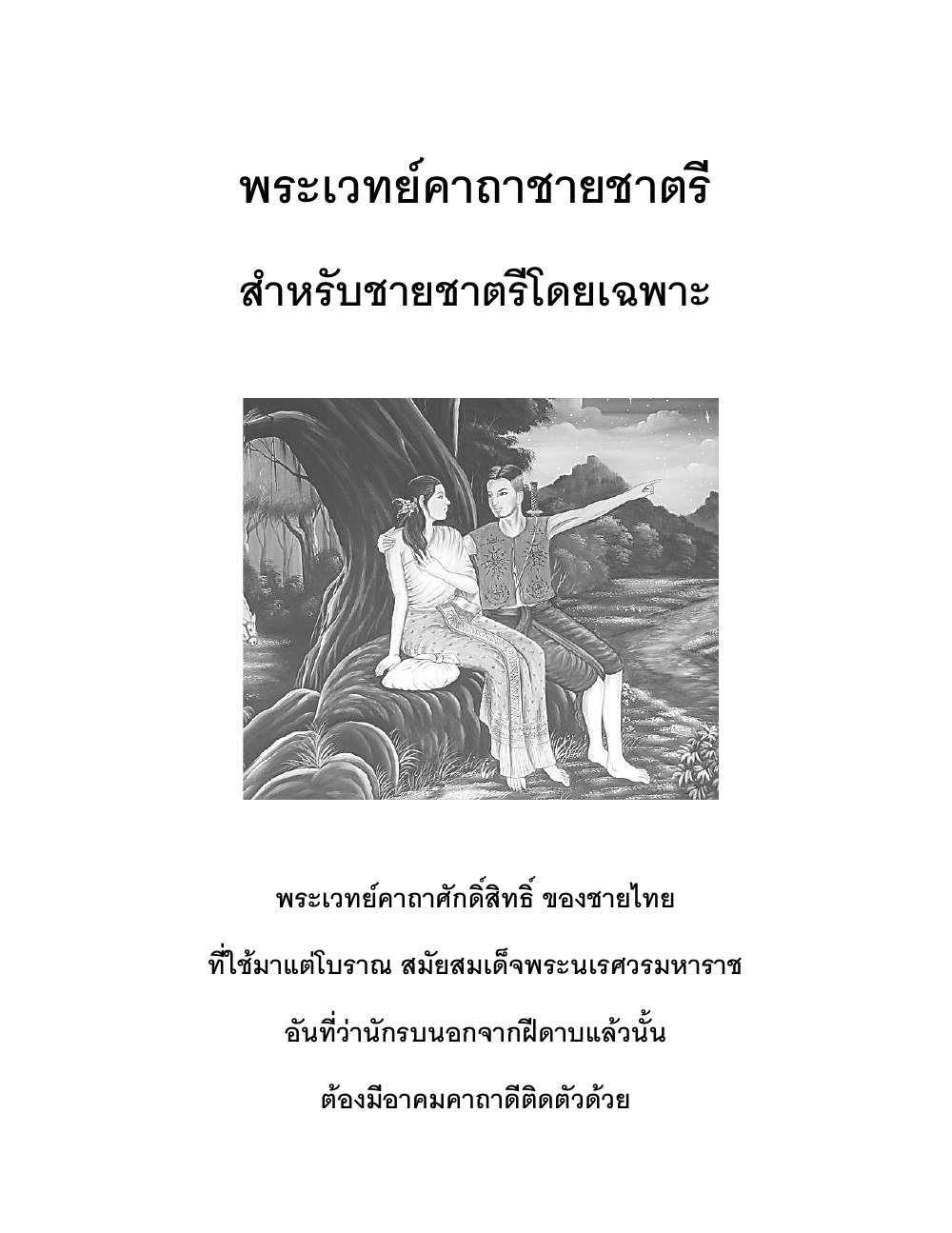
พระเวทย์คาถาชายชาตรี
สำหรับชายชาตรีโดยเฉพาะ
พระเวทย์คาถาศักดิ์สิทธิ์ ของชายไทย ที่ใช้มาแต่โบราณ สมัยสมเด็จพระนเรศวรมหาราช อันที่ว่านักรบนอกจากฝีดาบแล้วนั้น ต้องมีอาคมคาถาดีติดตัวด้วย
Vedic Katha for the Warrior Man (Chai Chatri)
For warrior men (chai chatri) specifically
[Illustration: a young man and a young woman sit together beneath a great banyan tree by a riverbank. The man wears a sleeveless vest embroidered with yantra designs and has a short sword tucked at his waist; he points toward distant mountains. The woman, seated beside him with a cloth bundle in her lap, follows his gesture with her gaze. In the background, under a starry night sky, a horse grazes near the hills.]
The sacred and potent Vedic katha of Thai men, used since ancient times, from the era of King Naresuan the Great. As for a warrior — besides skill with the sword — he must also carry good mantra-craft (khatha-akhom) upon his person.
สารบาญ
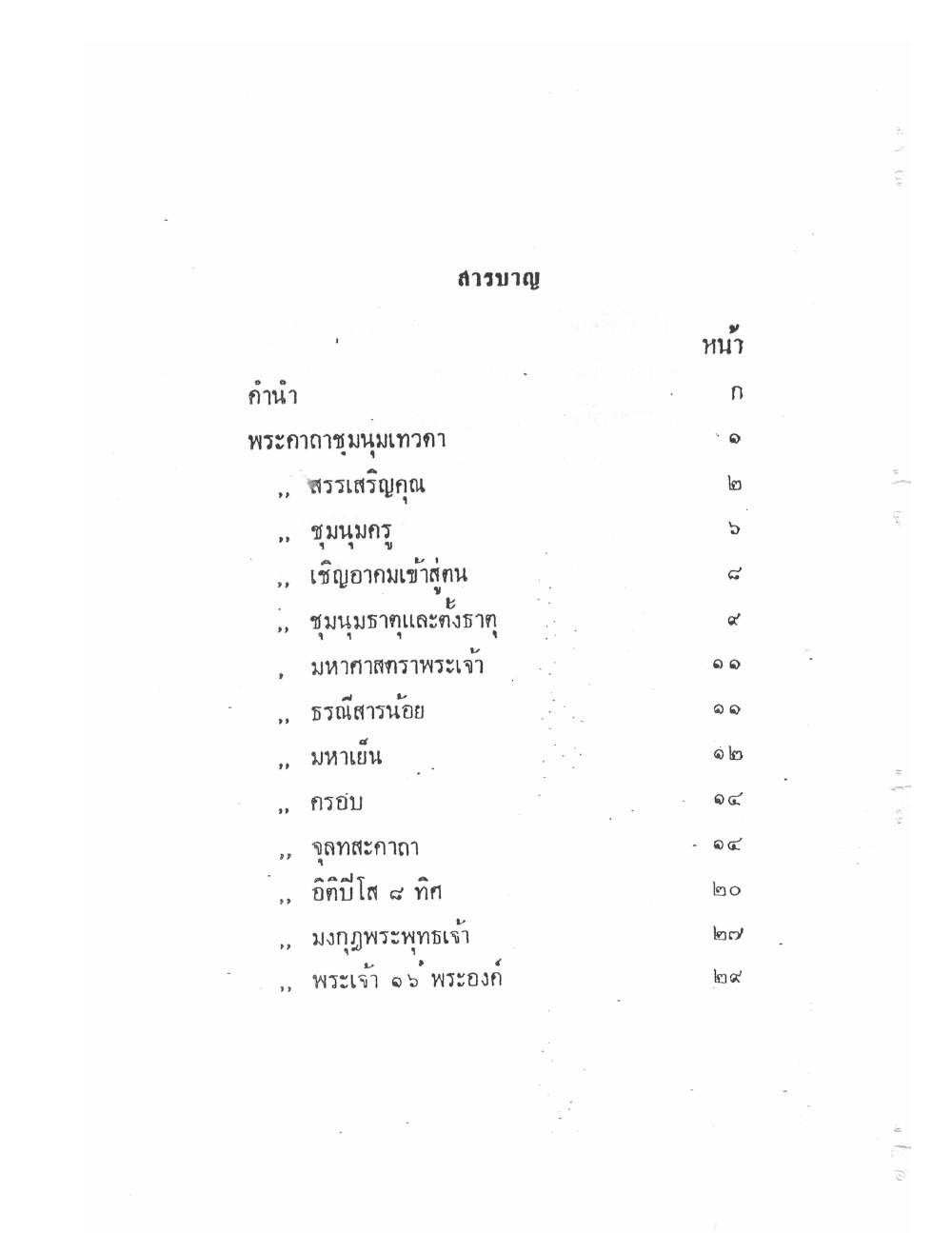
หน้า คำนำ ก พระคาถาชุมนุมเทวดา ๑ ,, สรรเสริญคุณ ๒ ,, ชุมนุมครู ๖ ,, เชิญอาคมเข้าสู่ตน ๘ ,, ชุมนุมธาตุและตั้งธาตุ ๙ ,, มหาศาสตราพระเจ้า ๑๑ ,, ธรณีสารน้อย ๑๑ ,, มหาเย็น ๑๒ ,, ครอบ ๑๔ ,, จุลทสะคาถา ๑๔ ,, อิติปิโส ๘ ทิศ ๒๐ ,, มงกุฎพระพุทธเจ้า ๒๗ ,, พระเจ้า ๑๖ พระองค์ ๒๙
Table of Contents
Page Preface — ก (ka) Katha for Convening the Deities — 1 ,, Praising Their Virtues — 2 ,, Convening the Teachers — 6 ,, Inviting the Sacred Power into Oneself — 8 ,, Convening and Establishing the Elements (Dhatu) — 9 ,, The Lord's Great Divine Weapon — 11 ,, The Lesser Earth-Goddess Invocation — 11 ,, The Great Cooling — 12 ,, The Crowning Rite — 14 ,, The Lesser Tenfold Katha — 14 ,, Itipiso in the Eight Directions — 20 ,, The Crown of the Buddha — 27 ,, The Sixteen Lords (Buddhas) — 29
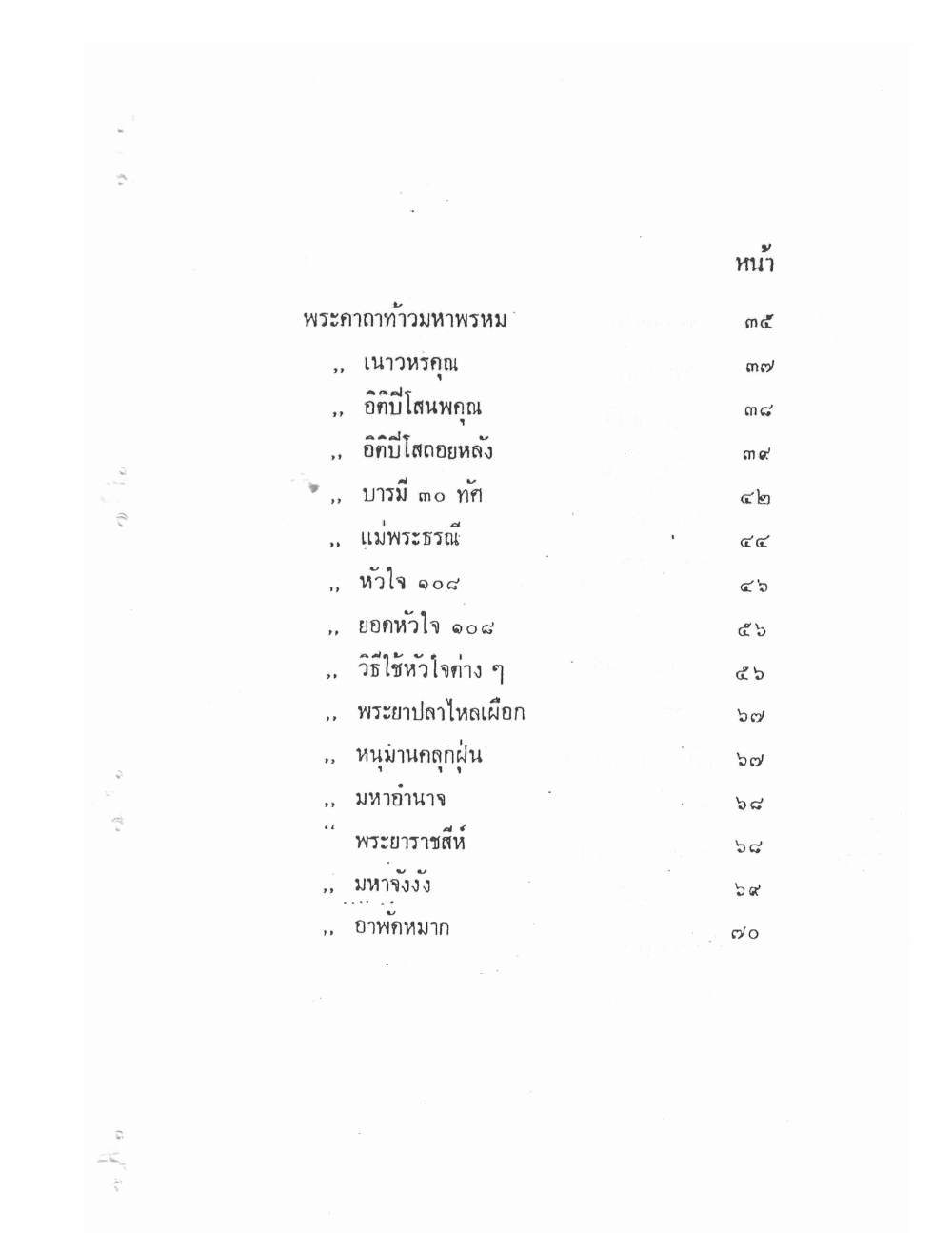
หน้า พระคาถาท้าวมหาพรหม ๓๕ ,, เนาวหรคุณ ๓๗ ,, อิติปิโสนพคุณ ๓๘ ,, อิติปิโสถอยหลัง ๓๙ ,, บารมี ๓๐ ทัศ ๔๒ ,, แม่พระธรณี ๔๔ ,, หัวใจ ๑๐๘ ๔๖ ,, ยอดหัวใจ ๑๐๘ ๕๖ ,, วิธีใช้หัวใจต่าง ๆ ๕๖ ,, พระยาปลาไหลเผือก ๖๗ ,, หนุมานคลุกฝุ่น ๖๗ ,, มหาอำนาจ ๖๘ ,, พระยาราชสีห์ ๖๘ ,, มหาจังงัง ๖๙ ,, อาพัดหมาก ๗๐
Page Katha of the Great Brahma King — 35 ,, The Nine Virtues (Nao Hara Khun) — 37 ,, Itipiso of the Nine Virtues — 38 ,, Itipiso Recited Backward — 39 ,, The Thirty Perfections (Barami) — 42 ,, Mother Earth (Phra Thorani) — 44 ,, The 108 Heart-Mantras — 46 ,, The Supreme 108 Heart-Mantras — 56 ,, How to Use the Various Heart-Mantras — 56 ,, The Lord of the White Eel — 67 ,, Hanuman Rolling in Dust — 67 ,, Great Power — 68 ,, The Lord Lion (Phraya Ratchasi) — 68 ,, The Great Paralyzing Spell — 69 ,, The Betel-Nut Charm — 70
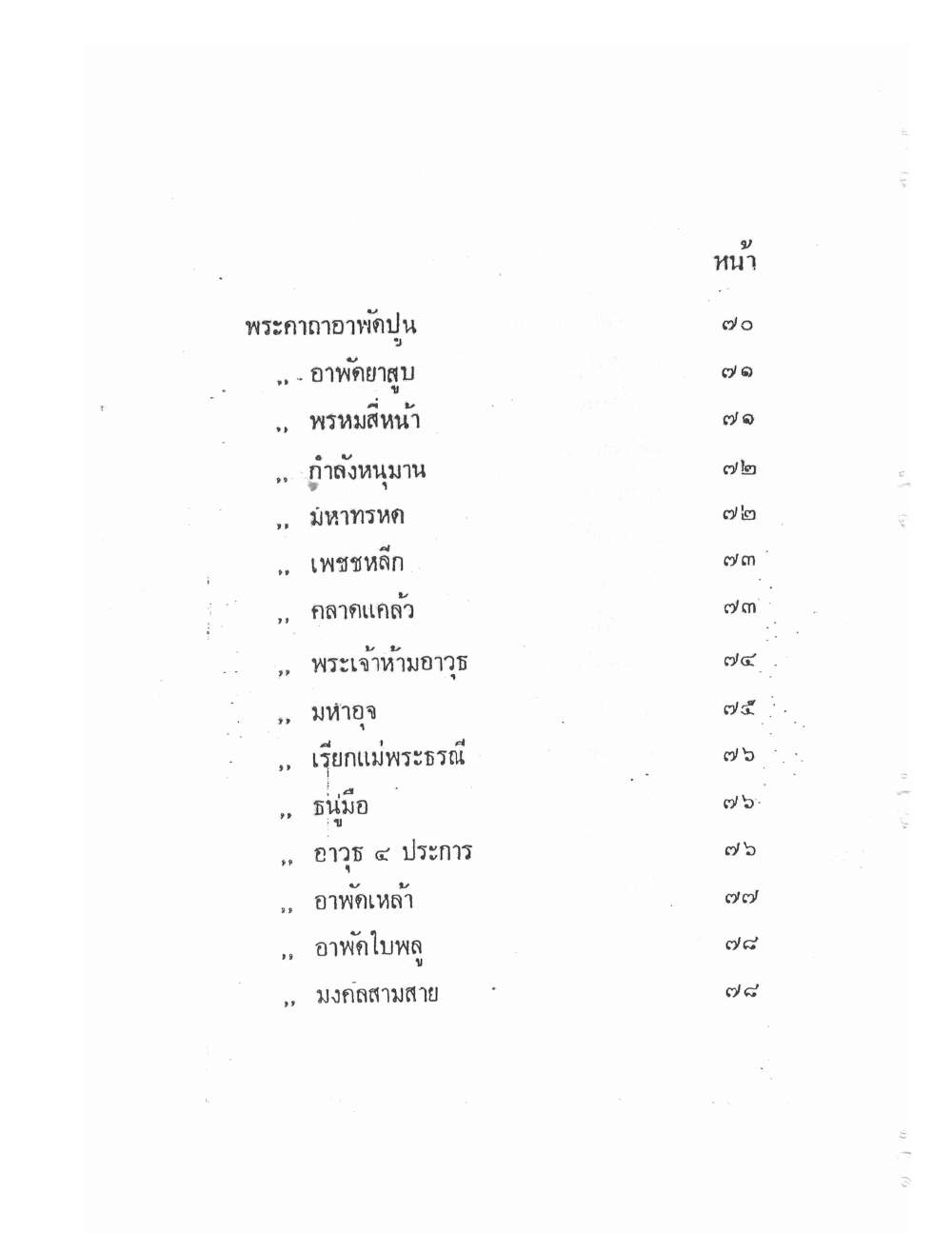
หน้า พระคาถาอาพัดปูน ๗๐ ,, อาพัดยาสูบ ๗๑ ,, พรหมสี่หน้า ๗๑ ,, กำลังหนุมาน ๗๒ ,, มหาทรหด ๗๒ ,, เพชรหลีก ๗๓ ,, คลาดแคล้ว ๗๓ ,, พระเจ้าห้ามอาวุธ ๗๔ ,, มหาอุด ๗๕ ,, เรียกแม่พระธรณี ๗๖ ,, ธนูมือ ๗๖ ,, อาวุธ ๔ ประการ ๗๖ ,, อาพัดเหล้า ๗๗ ,, อาพัดใบพลู ๗๘ ,, มงคลสามสาย ๗๘
Page The Lime-Paste Charm — 70 ,, The Tobacco Charm — 71 ,, The Four-Faced Brahma — 71 ,, The Strength of Hanuman — 72 ,, Great Endurance — 72 ,, Diamond Evasion — 73 ,, Escape from Harm — 73 ,, The Lord Who Wards Off Weapons — 74 ,, The Great Blocking Spell (Maha Ut) — 75 ,, Summoning Mother Earth — 76 ,, The Hand-Bow — 76 ,, The Four Kinds of Weapons — 76 ,, The Liquor Charm — 77 ,, The Betel-Leaf Charm — 78 ,, The Three-Stranded Sacred Thread — 78
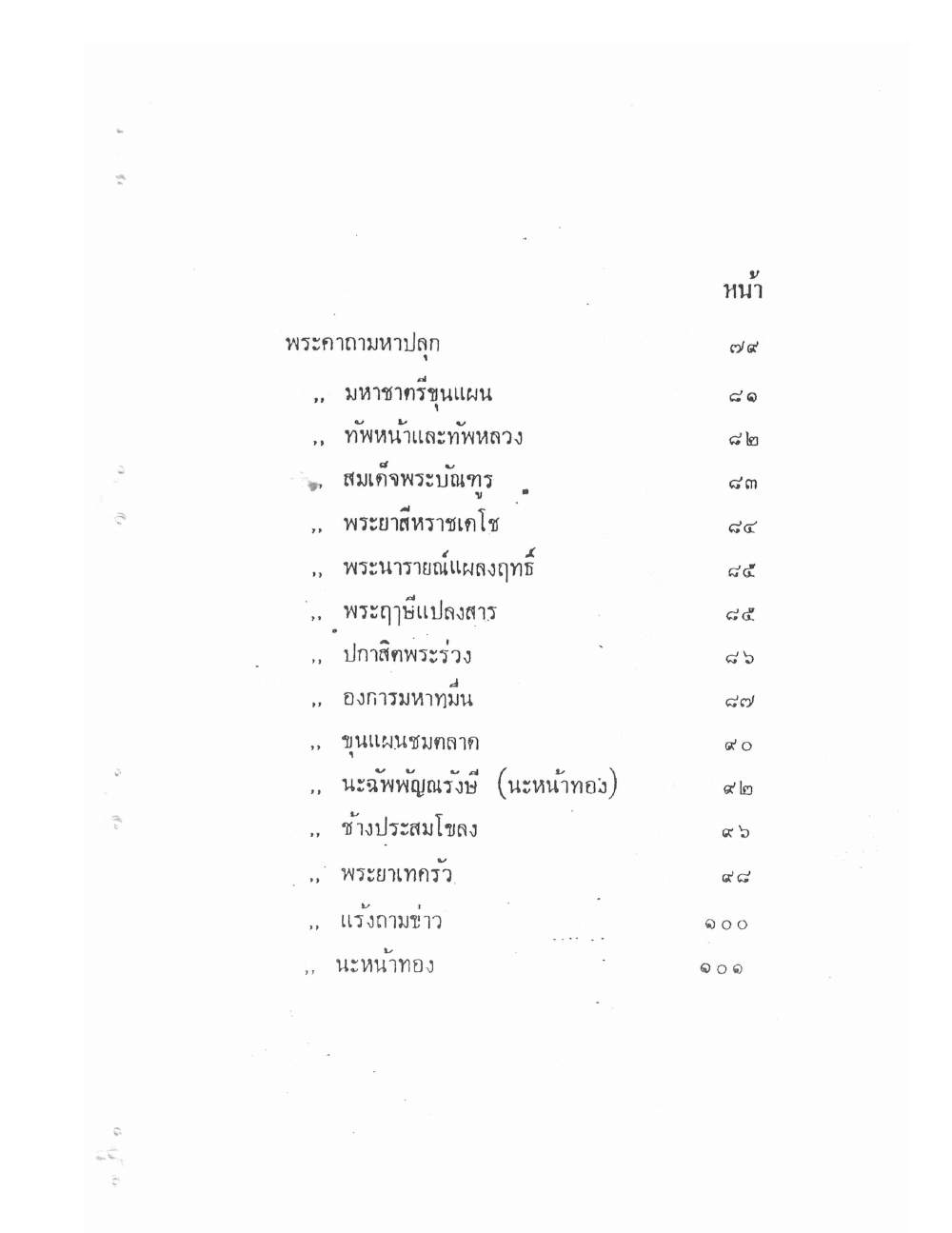
หน้า พระคาถามหาปลุก ๗๙ ,, มหาชาตรีขุนแผน ๘๑ ,, ทัพหน้าและทัพหลวง ๘๒ ,, สมเด็จพระบัณฑูร ๘๓ ,, พระยาสีหราชเดโช ๘๔ ,, พระนารายณ์แผลงฤทธิ์ ๘๕ ,, พระฤๅษีแปลงสาร ๘๕ ,, ปกาสิตพระร่วง ๘๖ ,, องการมหาทมื่น ๘๗ ,, ขุนแผนชมกลาด ๙๐ ,, นะฉัพพัณรังษี (นะหน้าทอง) ๙๒ ,, ช้างประสมโขลง ๙๖ ,, พระยาเทครัว ๙๘ ,, แร้งถามข่าว ๑๐๐ ,, นะหน้าทอง ๑๐๑
Page The Great Awakening Katha — 79 ,, The Great Chatri of Khun Phaen — 81 ,, The Vanguard and the Royal Army — 82 ,, His Supreme Royal Command — 83 ,, Lord Sihara Decho — 84 ,, Narayana Unleashing His Power — 85 ,, The Hermit Transforming the Message — 85 ,, The Proclamation of King Ruang — 86 ,, The Command of the Great Thamuen — 87 ,, Khun Phaen Surveying the Battlefield — 90 ,, Na of the Six-Colored Radiance (the Golden-Face Na) — 92 ,, The Elephant Joining the Herd — 96 ,, Lord Thekrua — 98 ,, The Vulture Asking for News — 100 ,, The Golden-Face Na — 101
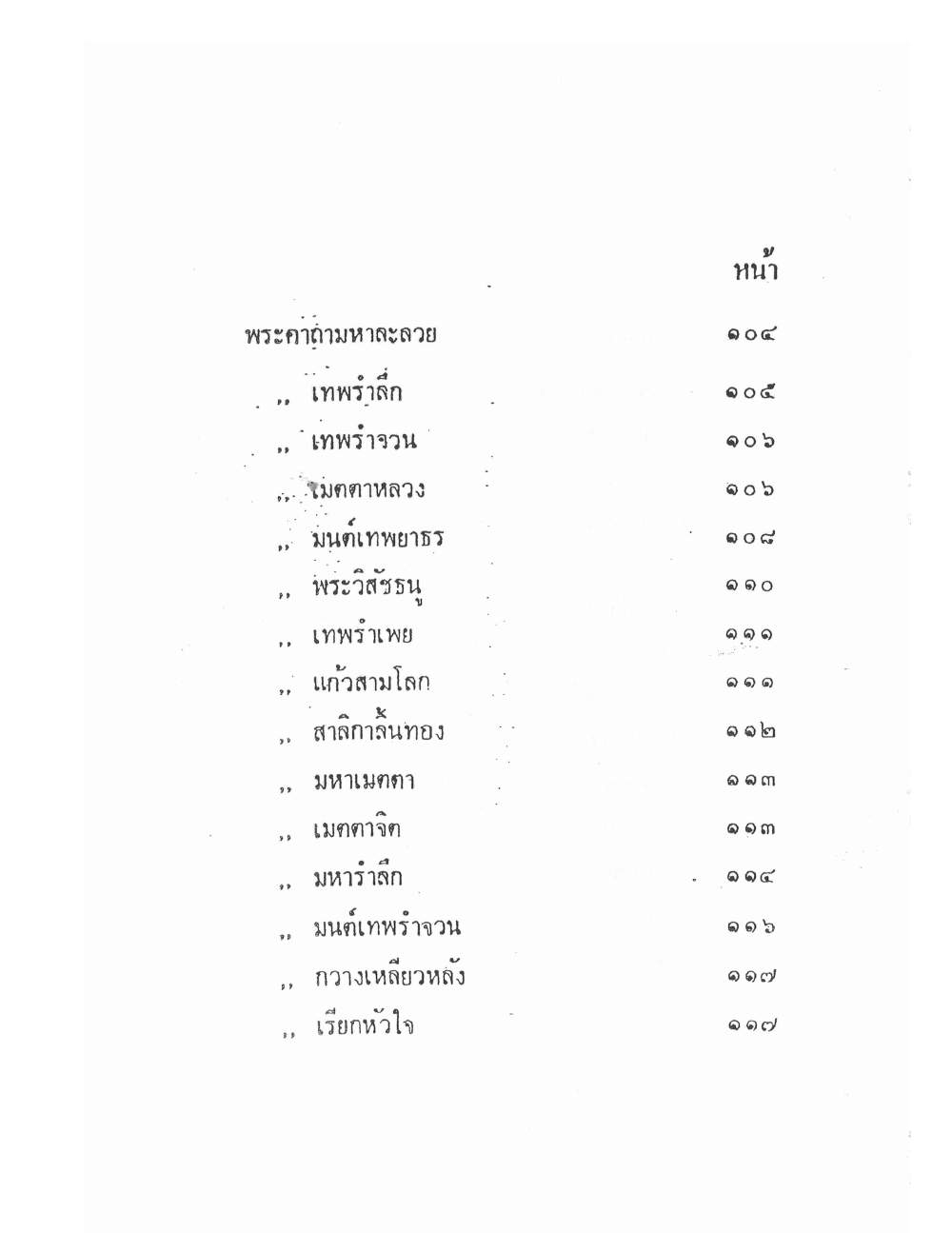
หน้า พระคาถามหาละลวย ๑๐๔ ,, เทพรำลึก ๑๐๔ ,, เทพรำจวน ๑๐๖ ,, เมตตาหลวง ๑๐๖ ,, มนต์เทพยาธร ๑๐๘ ,, พระวิสัชธนู ๑๑๐ ,, เทพรำเพย ๑๑๑ ,, แก้วสามโลก ๑๑๑ ,, สาลิกาลิ้นทอง ๑๑๒ ,, มหาเมตตา ๑๑๓ ,, เมตตาจิต ๑๑๓ ,, มหารำลึก ๑๑๔ ,, มนต์เทพรำจวน ๑๑๖ ,, กวางเหลียวหลัง ๑๑๗ ,, เรียกหัวใจ ๑๑๗
Page The Great Enchantment Katha — 104 ,, Divine Remembrance — 104 ,, Divine Longing — 106 ,, The Great Loving-Kindness — 106 ,, The Mantra of the Divine Bearer — 108 ,, [name uncertain: Phra Wisatchathanu] — 110 ,, The Divine Breeze — 111 ,, The Jewel of the Three Worlds — 111 ,, The Golden-Tongued Myna — 112 ,, Great Loving-Kindness — 113 ,, The Loving Mind — 113 ,, Great Remembrance — 114 ,, The Mantra of Divine Longing — 116 ,, The Deer Looking Back — 117 ,, Calling the Heart — 117
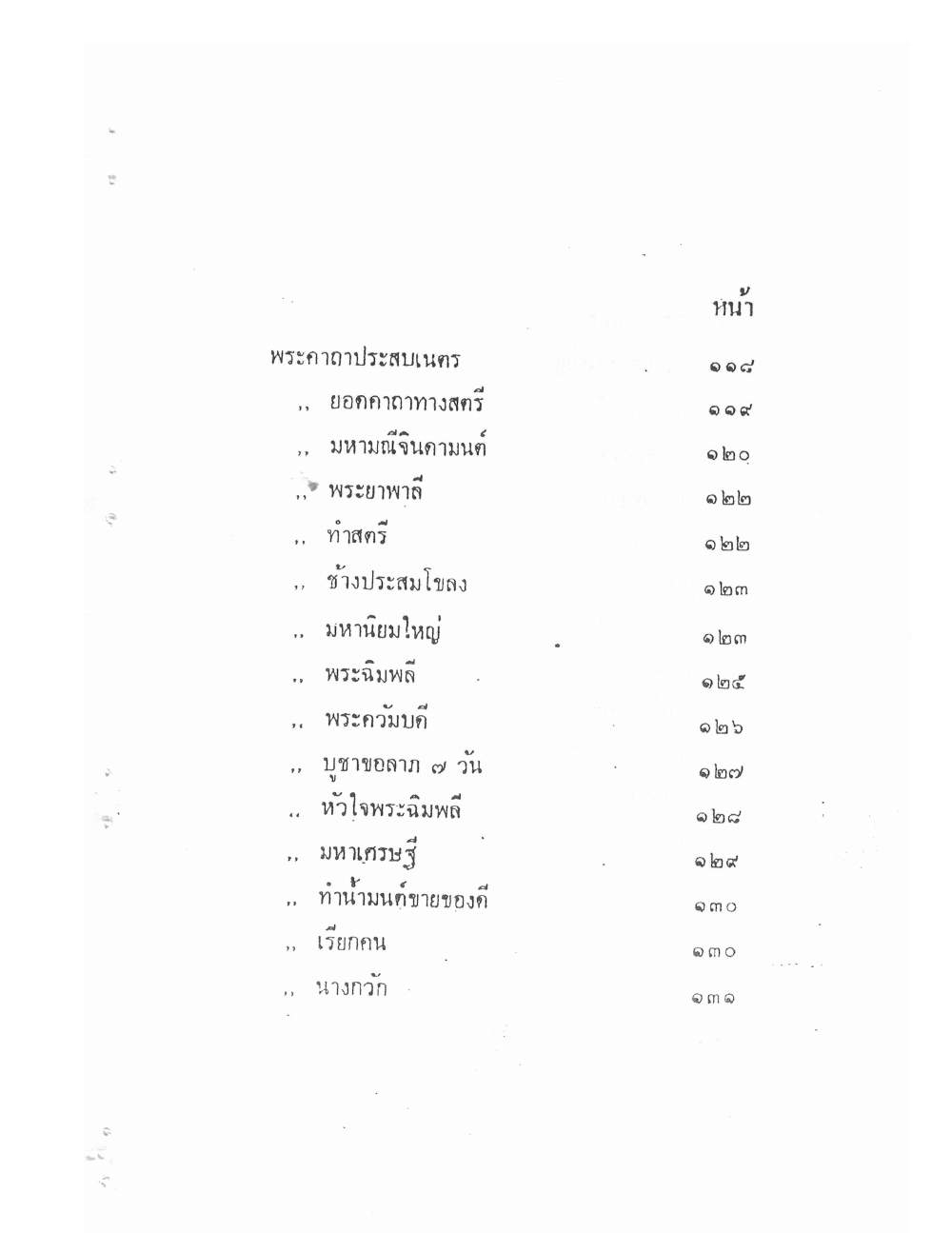
หน้า พระคาถาประสบเนตร ๑๑๘ ,, ยอดคาถาทางสตรี ๑๑๙ ,, มหามณีจินดามนต์ ๑๒๐ ,, พระยาพาลี ๑๒๒ ,, ทำสตรี ๑๒๒ ,, ช้างประสมโขลง ๑๒๓ ,, มหานิยมใหญ่ ๑๒๓ ,, พระฉิมพลี ๑๒๕ ,, พระควัมบดี ๑๒๖ ,, บูชาขอลาภ ๗ วัน ๑๒๗ ,, หัวใจพระฉิมพลี ๑๒๘ ,, มหาเศรษฐี ๑๒๙ ,, ทำน้ำมนต์ขายของดี ๑๓๐ ,, เรียกคน ๑๓๐ ,, นางกวัก ๑๓๑
Page The Katha of Meeting Eyes — 118 ,, The Supreme Katha Concerning Women — 119 ,, The Great Wish-Fulfilling Jewel Mantra — 120 ,, Lord Phali — 122 ,, Charming a Woman — 122 ,, The Elephant Joining the Herd — 123 ,, The Great Charm of Popularity — 123 ,, Phra Chimphli — 125 ,, Phra Khwam Bodi — 126 ,, Worshipping for Fortune over Seven Days — 127 ,, The Heart-Mantra of Phra Chimphli — 128 ,, The Great Wealthy Merchant — 129 ,, Making Holy Water for Good Sales — 130 ,, Calling Customers — 130 ,, The Beckoning Lady (Nang Kwak) — 131
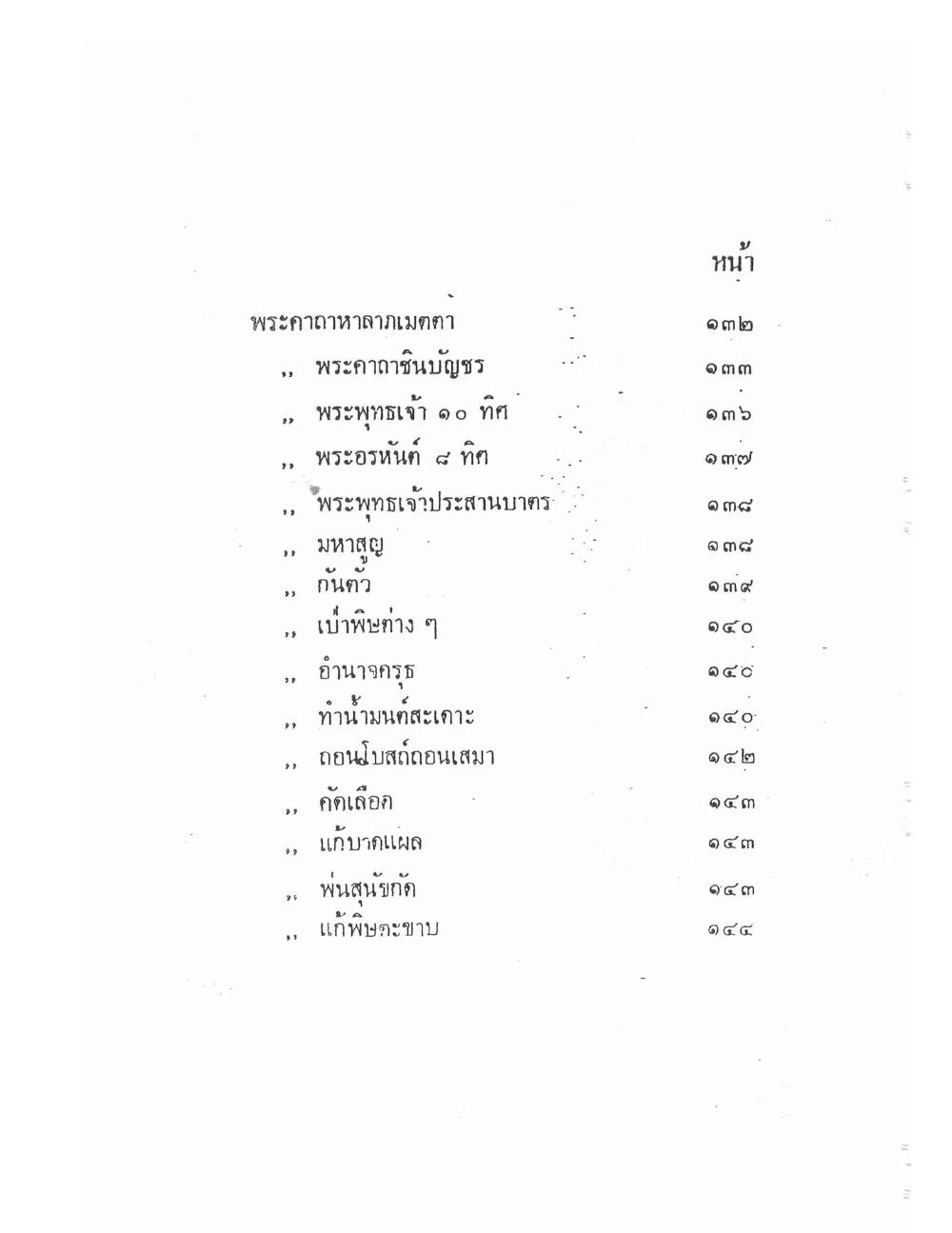
หน้า พระคาถาหาลาภเมตตา ๑๓๒ ,, พระคาถาชินบัญชร ๑๓๓ ,, พระพุทธเจ้า ๑๐ ทิศ ๑๓๖ ,, พระอรหันต์ ๘ ทิศ ๑๓๗ ,, พระพุทธเจ้าประสานบาตร ๑๓๘ ,, มหาสูญ ๑๓๘ ,, กันตัว ๑๓๙ ,, แก้พิษต่าง ๆ ๑๔๐ ,, อำนาจครุฑ ๑๔๐ ,, ทำน้ำมนต์สะเดาะ ๑๔๐ ,, ถอนโบสถ์ถอนเสมา ๑๔๒ ,, คัดเลือก ๑๔๓ ,, แก้บาดแผล ๑๔๓ ,, พ่นสุนัขกัด ๑๔๓ ,, แก้พิษตะขาบ ๑๔๔
Page Katha for Seeking Fortune and Loving-Kindness — 132 ,, The Chinabanchon Katha — 133 ,, The Buddhas of the Ten Directions — 136 ,, The Arahants of the Eight Directions — 137 ,, The Buddha Mending the Alms-Bowl — 138 ,, The Great Void — 138 ,, Self-Protection — 139 ,, Curing Various Poisons — 140 ,, The Power of Garuda — 140 ,, Making Holy Water to Release (from a Curse) — 140 ,, Withdrawing the Consecration of the Ordination Hall and Boundary Stones — 142 ,, Selecting — 143 ,, Healing Wounds — 143 ,, Blowing a Charm for Dog Bites — 143 ,, Curing Centipede Venom — 144
๑
พระคาถาชุมนุมเทวดา
๏ สาธุ สัคเค ข้าพเจ้าขออัญเชิญฝูงเทพยเจ้า ซึ่งสิงสถิตย์อยู่ในฉกามาพจรสวรรค์ กาเม อยู่ในกามภพ อนันต์จังหวัดวง จะรูเป เทพยเจ้าดำรงอยู่ในอรูปภพ คิริสิขระตะเฏ เทพยเจ้าอยู่ในห้วยมหรรณพสิงขรเชต ยุคนธรเขา จันตะลิกเข เทพยเจ้าอันแน่นเนาอยู่ใน อากาศ วิมาเน อยู่ในวิมานมาศรัตนมนเทียร ที่เป เทพยเจ้าอยู่ในเกาะเกียรน้อยและใหญ่ รัฏเฐ เทพยเจ้า อาศัยอยู่ในเรือนหลวง จะ คาเม เทพยเจ้าทั้งปวงอยู่ที่ บ้านน้อยใหญ่ ตรุวะนะคะหะเน เทพยเจ้าอยู่ในหมู่ไม้ ไพรพฤกษาศาล เคหะวัตถุมิ เขตเต เทพยเจ้าอยู่ ที่บ้านเรือนและไร่นา ภุมมา เทพยเจ้าอยู่ในพื้นภูมิประ- เทศ จายันตุ เทวา ข้าขออัญเชิญจงมาสโมสรประชุม ชะละถะละวิละเม เทพยเจ้าอยู่ที่ในน้ำและบนบกมิได้ เสมอกัน ยักขะคันธัพนาคา ทั้งยักษาและคนธรรพ์
1
Katha for Convening the Deities
Sādhu — O heavens (sagge), I invite the multitude of divine beings. Kāme — those dwelling in the realm of sensuous desire, boundless in its expanse. Cha-rūpe — the deities who abide in the formless realm. Kirisikharatae — the deities who dwell in the ravines, the great waters, and the peaks of the Yugandhara mountains. Jantalikkhe — the deities who throng densely in the sky. Vimāne — those who dwell in golden, jeweled palaces. Thīpe — the deities who dwell on the small and great islands. Raṭṭhe — the deities who reside in royal dwellings. Ca gāme — all the deities who dwell in villages both small and great. Taruvana-gahane — the deities who dwell among the trees of the forest groves. Gehavatthumhi khette — the deities who dwell in houses and in the fields. Bhummā — the deities who dwell upon the surface of the land. Come, O devas — I invite you all to gather together in assembly. Jala-thala-vilame — the deities who dwell in the water and on the land alike, without distinction. Yakkha-gandhabba-nāgā — together with the yakkhas and the gandharvas,
๒ นาคราชผู้เป็นใหญ่ ติฏฐันตา สันติเกยัง เทพเจ้าอยู่ ทุกเกาะแก่งแห่งตำบล มุนิ วะระวะจะนัง ข้าพเจ้า ขออัญเชิญพระฤๅษีทุกแห่งหน อันศักดิ์สิทธิ์ฤทธิรณ ด้วยเดชา สาธะโว เม สุณันตุ ข้าขออัญเชิญเทพยดา อันเรืองเดช ซึ่งสิงสถิตย์อยู่ในอมรพิมานเมฆเมืองฟ้า ธัมมัสสวนะกาโล อะยัมภทันตา ธัมมัสสวนะ กาโล กะยัมภทันตา ธัมมัสสวนะกาโล อะยัมภทันตา ข้าพเจ้าขออัญเชิญท้าวเทเวศร์สิ้น ขอบเขตจักรวาฬ จงมาสโมสรสมานกัน ในสถานที่นี้ เถิด ฯ
พระคาถาชุมนุมเทวดานี้ ก่อนที่จะประกอบพิธี กรรมใด ๆ ก็ดีพึงให้กล่าวอัญเชิญเทพยดาเสียก่อน
พระคาถาสรรเสริญคุณ
๏ อิติปิโสภควา สิบนิ้วข้าพเจ้าจะนมัสการ ข้าพเจ้าขอสรรเสริญคุณพระบิดา ๒๑ คุณพระมารดา
2 and the great naga-kings, standing near — sāntikeyyaṃ — the deities dwell in every islet and rapids of every district. Muni vara-vacanaṃ — I invite the holy hermits (ruesi) everywhere, sacred and mighty in power through their fiery potency. Sādhavo me suṇantu — I invite the radiant, glorious deities who dwell in the heavenly palaces amid the clouds of the celestial city. Dhammassavanakālo ayambhadantā, dhammassavanakālo ayambhadantā, dhammassavanakālo ayambhadantā ["Now is the time to listen to the Dhamma, venerable ones" — recited three times]. I invite all the Lords of the Devas without exception, to the very edge of the universe, to come and gather together in harmony in this place. So be it.
Before performing any rite whatsoever, one should first recite this Katha for Convening the Deities, inviting the deities in advance.
Katha of Praising Their Virtues
Itipiso Bhagavā — with my ten fingers joined I shall pay homage. I praise the twenty-one virtues of the father, [and] the virtues of the mother,
๓ ๑๒ คุณพระโพสพ ๓๙ คุณพระพุทธเจ้า ๕๖ คุณ พระธรรมเจ้า ๓๘ คุณพระสังฆเจ้า ๑๔ คุณครูอาจารย์ ๑๐ คุณพระกรรมฐาน ๘ คุณพระคงคา ๒ คุณพระ ธรณี ๒๑ คุณไฟ ๖ คุณลม ๗ คุณอากาศ ๑๐ คุณ อักษร ๔๑ คุณอักขระ ๓๓ คุณนิสวาส คุณอัสวาส คุณปัสสวาส คุณแก้วทั้ง ๓ ประการ คุณศีล ๕ คุณ ศีล ๗ คุณศีล ๑๐ คุณศีล ๒๒๗ คุณพระปัญญาญาณ คุณพระโสดา คุณพระสกิทาคา คุณพระอนาคา คุณ พระอรหันตา คุณมรรค ๔ คุณผล ๔ คุณนิพพาน ๑ จึงมาเป็น ๙ คุณพระนวโลกุตรธรรม เดชะ ข้าได้ เล่าเรียนศิลปศาสตร์วิชาการอันใด ๆ ของจงประสิทธิ์ คุณพระอาทิตย์ ๖ คุณพระจันทร์ ๑๕ คุณพระอังคาร ๘ คุณพระพุธ ๑๗ คุณพระเสาร์ ๑๐ คุณพระพฤหัสบดี ๑๐ คุณพระราหู ๑๒ คุณพระศุกร์ ๒๑ คุณพระเกตุ ๙
3 twelve [virtues]; the virtues of Mae Phosop (the Rice Goddess), thirty-nine; the virtues of the Buddha, fifty-six; the virtues of the Dhamma, thirty-eight; the virtues of the Sangha, fourteen; the virtues of teachers and masters, ten; the virtues of meditation practice, eight; the virtues of the Ganges (Phra Khongkha), two; the virtues of the Earth (Phra Thorani), twenty-one; the virtues of fire, six; the virtues of wind, seven; the virtues of the sky, ten; the virtues of the alphabet, forty-one; the virtues of the script, thirty-three; the virtue of in-breath, the virtue of out-breath, the virtue of held breath; the virtues of the Three Jewels; the virtue of the five precepts, the seven precepts, the ten precepts, the two-hundred-and-twenty-seven precepts; the virtue of wisdom-insight; the virtues of the Stream-Enterer, the Once-Returner, the Non-Returner, and the Arahant; the four paths, the four fruits, and the one Nibbana — together these make nine: the virtues of the nine transcendent (lokuttara) dhammas. By this power, whatever arts and sciences I have studied, may they be brought to accomplishment. The virtue of the Sun, six; the virtue of the Moon, fifteen; the virtue of Mars, eight; the virtue of Mercury, seventeen; the virtue of Saturn, ten; the virtue of Jupiter, ten; the virtue of Rahu, twelve; the virtue of Venus, twenty-one; the virtue of Ketu, nine;
๔ คุณท้าวเวสสุวรรณ อันเรืองเดช คุณพระนเรศร์ คุณพระนารายณ์ คุณพระอินทร์ คุณพระพรหม คุณ พระยม คุณพระกาฬ คุณพระโลกบาลทั้ง ๔ คุณพระ- มาตุลี คุณพระภูมิเจ้าที่และเจ้ากรุงพาลี เป็นที่เคารพ แก่ปวงชน
ที่มาสร้างกุศลพระบารมี ขอให้จำเริญสวัสดิ์ คุณ ศีลบารมี คุณทานบารมี คุณสัจจะบารมี คุณวิริยะบารมี คุณอธิษฐานบารมี คุณพรหมวิหาร ๔ เป็นที่เมตตา กรุณา มุทิตา อุเบกขา คุณพระคาถาว่านยา และ เลขยันต์ ประเจียดพิศมร แลมงคล คุณทั้งแปดหมื่น สี่พันพระธรรมขันธ์ จบพระไตรปิฎก ทั้ง ๓ ประการ คุณครูภายนอก คุณครูภายใน คุณพระฤๅษีตาวัว คุณ พระฤๅษีตาไฟ คุณพระฤๅษีอิศวร คุณพระฤๅษีกัสสป ๔ คุณพระฤๅษีนารอด คุณพระฤๅษีนาไลย คุณพระฤๅษี ประไลยโกฏ คุณพระฤๅษีพุทธมงคล คุณพระฤๅษีสิงห-
4 the virtue of glorious King Vessuwan (Kuvera); the virtue of Phra Naret; the virtue of Narayana (Vishnu); the virtue of Indra; the virtue of Brahma; the virtue of Yama; the virtue of Kala; the virtue of the Four Guardian Kings (Lokabala); the virtue of Phra Matuli (Indra's charioteer); the virtue of the Lord of the Land (Phra Phum) and King Phali of the underworld — these are objects of reverence for all people.
May whoever comes to build merit through these perfections (barami) flourish and prosper: the virtue of the perfection of morality, the perfection of giving, the perfection of truthfulness, the perfection of effort, the perfection of resolution; the virtue of the Four Divine Abidings (Brahmavihara) — loving-kindness, compassion, sympathetic joy, and equanimity; the virtue of the katha for herbal medicine, and of sacred diagrams (lek yant), protective cords, charms, and auspicious things; the virtue of all eighty-four thousand sections of the Dhamma, completing the Three Baskets (Tipitaka) in their three divisions; the virtue of outer teachers, the virtue of inner teachers; the virtue of the Ox-Eyed Hermit, the virtue of the Fire-Eyed Hermit, the virtue of the Hermit Isuan (Shiva), the virtue of the four Hermit Kassapas, the virtue of the Hermit Narot, the virtue of the Hermit Nalai, the virtue of the Hermit Pralai Kot, the virtue of the Hermit Buddhamongkhon, the virtue of the Hermit Sing-[continues on the next page]
๕
...ดาบส คุณพระฤๅษีสัจจพันธ์คิรี คุณพระฤๅษีมุนีดาบส ของจงมาเป็นประธาน
ข้าพเจ้าจะทำการขอให้ประสิทธิ์ ขอคุณพระ พุทธคุณณัง พระธรรมคุณณัง พระสังฆคุณณัง พระ พุทธคุณทั้งปวงจงประสิทธิแก่ตัวข้าพเจ้า สิทธิกิจจัง สิทธิกัมมัง สิทธิการิยัง สิทธิตะถาคะโต สิทธิลาโภ สิทธิเตโช สิทธิวาโย สิทธิอาโป สิทธิปถวี สิทธิบิดา สิทธิมารดา สิทธิครูอาจารย์ สิทธิอิศวร สิทธิอินทรา สิทธิพรหมา สิทธินารายณ์ สิทธิเทวา สิทธิราชา สิทธิ พุทธ สิทธิธัมมา สิทธิสังฆา สิทธิอัฏฐะ อรหันตานัง นะโมพุทธายะ มะอะอุ อิสวาสุ บัญจะ พุทธานะมา มิหัง ๚ะ
พระคาถาสรรเสริญคุณบทนี้ เมื่อจะกระทำการใดๆ ก็ให้ว่าเสียก่อน แล้วจึงทำ เถิก ประสิทธิทุกประการ แล ฯ
[Folio 5]
[Page opens mid-sentence, continuing from a preceding page not in this batch —] ...ascetics: the virtue of the Ruesi Sacchaphanthakhiri, the virtue of the Ruesi Munidabot — may they come and preside over this rite.
I now perform the request for empowerment: I ask that the virtue of the Buddha, the virtue of the Dhamma, the virtue of the Sangha — the whole virtue of the Buddha — be accomplished in me: success (sitthi) in duty, success in action, success in conduct, success as the Tathagata, success in gain, success in fire, success in wind, success in water, success in earth, success from father, success from mother, success from teacher, success from Isvara, success from Indra, success from Brahma, success from Narayana, success from the gods, success from kings, success as Buddha, success as Dhamma, success as Sangha, success in the eight — homage to the Arahants; namo buddhaya, ma a u, isavasu bancha buddhanamamihang.
As to this verse in praise of [the Triple Gem's] virtue: before doing any deed, recite it first and then act, and it will bring success in every respect.
๖
พระคาถาชุมนุมครู
๏ พุทธัง วันทิตวา ข้าพเจ้าไหว้แล้วซึ่งพระ พุทธคุณณัง ธัมมัง วันทิตวา ข้าพเจ้าไหว้แล้วซึ่ง พระธัมมะคุณณัง สังฆัง วันทิตวา ข้าพเจ้าไหว้แล้ว ซึ่งพระสังฆะคุณณัง
อนึ่ง ข้าพเจ้าขออาราธนาคุณพระพุทธเจ้า คุณ พระธัมมะเจ้า คุณพระสังฆะเจ้า อีกทั้งคุณพระบิดา มารดา คุณอุปัชฌาย์ครูอาจารย์ คุณพระฤๅษีตาไฟ คุณพระฤๅษีประไลยโกฏ คุณพระฤๅษีกัสสป คุณพระ ฤๅษีไตรภพ คุณพระฤๅษีทัสมงคล ทั้งพระเพชฉลูกัน และนักสิทธิวิทยาอีกทั้งนางพระธรณี นางพระคงคา พระเพลิงพระพายพระอิศวร ผู้เป็นเจ้าฟ้าเธอ จึงมา ประสิทธิพระพรชัยให้แก่ข้าพเจ้า ข้าพเจ้าจะขออัญเชิญ เทพยดาทั้งหลายทั่วพื้นพระปถพีคล พระฤๅษีทั้ง ๑๐๘ ตน บันดาลดลด้วยสรรพพิษแลวิทยา พระครูบา พระ
[Folio 6]
The Verse for Gathering the Teachers
'Buddham vanditva' — I have paid homage to the virtue of the Buddha. 'Dhammam vanditva' — I have paid homage to the virtue of the Dhamma. 'Sangham vanditva' — I have paid homage to the virtue of the Sangha.
Furthermore, I invite the virtue of the Lord Buddha, the virtue of the Lord Dhamma, the virtue of the Lord Sangha, and also the virtue of father and mother, the virtue of preceptor and teachers, the virtue of the Fire-gazing Ruesi, the virtue of the Ruesi Prolaikot, the virtue of the Ruesi Kassapa, the virtue of the Ruesi Traiphop, the virtue of the Ruesi Thatsamongkhon, together with the Phetchalu pair and the masters of siddhi-lore, and also Mother Earth, Mother Ganges, the Fire God, the Wind God, and Lord Shiva who is their heavenly lord — may they come and grant the blessing of victory to me. I invite the deities throughout the whole earth, and the 108 Ruesi, to bestow every kind of potency and knowledge upon me. The venerable teachers, the...
[the sentence is cut off here and continues onto the next page]
๗
ใดๆ ให้ภาวนาเสียก่อน เพื่อเกิดความสวัสดิมงคล อำนวยผลให้สำเร็จในกิจที่พึงปรารถนาจะกระทำนั้น ทุก ประการแล ฯ
พระคาถาเชิญอาคมเข้าสู่ตน
๏ เอหิคาถัง บียัง กาโยทิศา ปาโมกขัง อาจาริยัง เอหิพุทธานุภาเวนะ เอหิธัมมานุเวนะ เอหิสังฆานุภา- เวนะ กูจะสูบพระคาถาขึ้นไว้ในคอ กูจะยกพระคาถา ทั้งปวงขึ้นไว้เหนืออก กูจะยกพระคาถาทั้งปวงขึ้นไว้ เหนือเกษ พระครูกูเธอจึงให้กูเป็นเอกกว่าคนทั้งหลาย เอหิคลายคลายบียังมะมะ พุทธังสะระหิ โสมาเรสะระ เอหิมาเรมานะ อาคัจฉายะ อาคัจฉาหิ ธัมมังสะระหิ โสมาเรสะระ เอหิมาเรมาระ อาคัจฉายะ อาคัจฉาหิ สังฆังสะระหิ โสมาเรสะระ เอหิมาเรมาระ อาคัจฉายะ อาคัจฉาหิ กะขะคะฆะงะ จะฉะชะฌะญะ ฏะฐะทะฒะณะ ตะถะทะธะนะ ปะผะภะพะมะ ระยะละวะ สะหะฬะอัง
[Folio 7]
[Continuing —] ...whatever deed [one intends], recite this first, so as to bring about auspiciousness and grant success in whatever undertaking is desired, in every respect.
The Verse to Invite Mantric Power into Oneself
'Ehi kathang, biyang, kayothisa, pamokkhang, acariyang' — come, verse; come, the foremost teacher of body and place! By the power of the Buddha, come! By the power of the Dhamma, come! By the power of the Sangha, come! I shall draw the verse up into my throat; I shall raise all the verses onto my chest; I shall raise all the verses onto my head. My own teacher thus makes me foremost above all people. 'Ehi, be freed, be freed, biyang mama, buddhang sarahi, somaresara, ehi maremana, agacchaya, agacchahi; dhammang sarahi, somaresara, ehi maremara, agacchaya, agacchahi; sanghang sarahi, somaresara, ehi maremara, agacchaya, agacchahi' — [the forty-one letters, recited in order:] ka kha ga gha nga, ca cha ja jha nya, ṭa ṭha ḍa ḍha ṇa, ta tha da dha na, pa pha ba bha ma, ya ra la va, sa ha ḷa aṃ.
[continues onto the next page]
๘
ครูเฒ่า ครูพักและครูอักษร สถาพรกรรมสิทธิแก่ ข้าพเจ้าในกาลบัดนี้เถิก ฯ
๏ อิติปิ โส ภควา ข้าพเจ้าขออัญเชิญสมเด็จ พระสัมมาสัมพุทธเจ้า มาอยู่เหนือเกล้าเหนือผม ขอเชิญ พระพรหมมาอยู่เบื้องบ่าซ้าย ขอเชิญพระนารายณ์มาอยู่ เบื้องบ่าขวา ขอเชิญนางพระคงคามาเป็นน้ำลาย ขอ เชิญพระพายมาเป็นลมปาก ขอเชิญพระยานาคมาเป็น สร้อยสังวาลย์ ขอเชิญพระกาฬมาเป็นดวงใจ
ข้าพเจ้าจะทำการสิ่งใดภูตใดพรายใดอย่าได้เบียด เบียนบีฑา อย่าได้ประมาทพลาดพลั้ง ขออัญเชิญครู แต่หนหลัง พระฤๅษีทั้ง ๑๐๘ องค์ เดชะครูบาธิบาย อันเลิศล้ำ คุณครูอยู่ในถ้ำจงมาช่วยอวยพระพรชัยให้แก่ ข้าพเจ้า พุทธังประสิทธิมหาประสิทธิ ธัมมังประสิทธิ มหาประสิทธิ สังฆังประสิทธิมหาประสิทธิ ๚
พระคาถาชุมนุมครูบทนี้ มิว่าจะกระทำการสิ่ง
[Folio 8]
[Continuing —] ...the Old Teacher, the Resting Teacher, and the Letter Teacher: grant lasting success to me at this time.
'Itipi so bhagava' — I invite the Perfectly Self-Enlightened Buddha to reside above my crown and hair. I invite Brahma to reside upon my left shoulder. I invite Narayana [Vishnu] to reside upon my right shoulder. I invite Mother Ganges to become my saliva. I invite the Wind God to become the breath at my mouth. I invite the Naga king to become my necklace. I invite Kala [the god of death/time] to become my heart.
Whatever deed I do, let no spirit, ghost, or witch-spirit harass or afflict me; let me not be careless or slip in error. I invite the teachers of old, the 108 Ruesi — by the power of my teachers' peerless instruction, may the virtue of the teachers dwelling in caves come and bestow the blessing of victory upon me. 'Buddhang prasitthi maha prasitthi, dhammang prasitthi maha prasitthi, sanghang prasitthi maha prasitthi.'
This verse for gathering the teachers — no matter what deed [one is about to do]...
[cut off, continues onto the next page]
๙
ทรงอะ ทรงอา ทรงอิ ทรงอี ทรงอุ ทรงอู ทรงเอ ทรงโอ ทรงอำ ทรงอิน ทรงอะ ทรงนะโมพุทธายะ ทรงอักขระ ๔๑ ตัว โอกาเส ติฏฐาหิ ติฏฐะติ ๚
พระคาถาบทนี้ สำหรับใช้เชิญอักขรเวทย์มนต์ ให้เข้าสู่ตัวก่อนที่จะทำการใดๆ ก็ตาม ให้ว่าคาถาบทนี้ เสียก่อน เพื่อช่วยให้เวทย์มนต์นั้นขลังศักดิ์สิทธิ์ หรือว่า จะว่าทุกๆ วันได้ก็ยิ่งดี พระคาถาอาคมต่างๆ อาจจะ ถูกเรียกถูกคัดไปก็ได้ เมื่อว่าคาถานี้แล้วจะกลับมาสู่ตน ดังเดิม ฯ
พระคาถาชุมนุมธาตุและตั้งธาตุ
๏ เอหิปะถะวีพรหมา เอหิอาโปอินทะรา เอหิ เตโชนารายะ เอหิวาโยอิสรา ๚ะ
๏ นะอิเพชชกง อะระหังสุคะโตภะคะวา โมค พุทธะสัง อะระหังสุคะโตภะคะวา พุทธบีอิสะวาสุ อะระหังสุคะโตภะคะวา ธาโสมะอะอุ อะระหังสุคะโต
[Folio 9]
[This mantra] bears A, bears Ā, bears I, bears Ī, bears U, bears Ū, bears E, bears O, bears Aṃ, bears In, bears A, bears 'namo buddhaya' — bearing forty-one letters in all. 'Okase titthahi titthati' [by your leave — stand firm; it stands].
This verse is used to summon the power of the letter-spells into one's own body before performing any deed whatsoever. Recite this verse first, to help make that spell potent and efficacious — or better still, recite it every day. Various spells and mantras may be called away or drawn off [by rivals], but once this verse is recited, they will return to their owner as before.
The Verse for Gathering and Establishing the Elements
'Ehi pathavi brahma, ehi apo indara, ehi tejo naraya, ehi vayo isara' — [come, earth-element Brahma; come, water-element Indra; come, fire-element Narayana; come, wind-element Isvara].
'Na i phetchakong, arahang sugato bhagava, moka buddhasang, arahang sugato bhagava, phutthabi isavasu, arahang sugato bhagava, tha soma a u, arahang sugato...'
[continues onto the next page]
๑๐
ภะคะวา ยะภะอุอะมะ อะระหังสุคะโค ภะคะวา ๚ะ
๏ นะโมพุทธายะ นะมะพะทะ จะภะกะสะ นะโมพุทธายะ มะพะทะนะ ภะกะสะจะ นะโมพุทธายะ พะทะนะมะ กะสะจะภะ นะโมพุทธายะ ทะนะมะพะ สะจะภะกะ ๚ะ
พระคาถานี้สำหรับบริกรรมให้ธาตุทั้ง ๔ ในกาย ตัวเราสมบูรณ์
ก่อนที่จะใช้เวทย์มนต์คาถากระทำพิธีการใดๆ แล้วให้พึงทำธาตุในกายตัวเราให้สมบูรณ์เสียก่อน จะ ทำให้เกิดความขลังศักดิ์สิทธิ์ยิ่งขึ้น
พระคาถามหาศาสตราพระเจ้า
๏ มะอะอุ อะธิกะมูลัง ตรีเทวานังมหาศาสตรา อุอุอะนะมะมันตรา อุอะสะวามหามันตัง มะอะอุโล ปะเกญยัง องการะเสวะราชิโน ตรีนิอักขรานิ ชาตานิ นะโมพุทธายะ สัตถุโน ๚ะ
[Folio 10]
[Continuing —] '...bhagava, ya bha a u a ma, arahang sugato bhagava.'
'Namo buddhaya, na ma pha ta, ca bha ka sa; namo buddhaya, ma pha ta na, bha ka sa ca; namo buddhaya, pha ta na ma, ka sa ca bha; namo buddhaya, ta na ma pha, sa ca bha ka.'
This verse is for chanting to make the four elements within one's own body complete.
Before using any spell or mantra to perform a rite of any kind, one should first make the elements within one's body complete — this will make [the rite] all the more potent and efficacious.
The Great Weapon-Verse of the Lord
'Ma a u, adhikamulang, tri devanang maha sattra, u u a namamantra, u asavama hamantang, ma a u lo pakenyang, ongkara sevarachino, tri ni akkharani chatani, namo buddhaya satthuno.'
๑๑
พระคาถามหาศาสตราพระเจ้านี้ ถ้าหากผู้ใดถือ เวทย์มนต์คาถามิขึ้น ท่านให้เสกส้มบ่อยสระหัวเสียก่อน เรียนขึ้นแล ฯ
พระคาถาธรณีสารน้อย
๏ โองการพินธุนาถัง อุปปั่นนัง พรหมา สหปติ นามะ อาทิกัปเป สุอาคะโต บัญจะ ปะทุมัง ทิศวา นะโมพุทธายะ วันทะนัง ๚ะ
๏ สีโรเม พุทธะเทวัญจะ นะหาเค พรหมะเทวตา หะทะยัง นารายะกัญเจวะ ทะเวหัตเถ จะประเม สุราปาเท วิษณุกัญเจวะ สัมพะกัมมา ประสิทธิเม ๚ะ
๏ สัพพะพุทธานุภาเวนะ สัพพะธัมมานุภาเวนะ สัพพะสังมานุภาเวนะ สัพพะโสตถิภวันตุเม ๚ะ
๏ สิทธิกิจจัง สิทธิกัมมัง สิทธิการิยะ ตะถาคะโต สิทธิเตโช ชโย่นิจจัง สิทธิลาโภ นิรันตะรัง สัพพะสิทธิ ภะวันตุเม ๚ะ
[Folio 11]
As for this Great Weapon-Verse of the Lord: if anyone finds that a spell or mantra will not take hold for them, have them sprinkle themselves with lime-water and wash their head first, before learning it.
The Lesser Verse of the Earth's Essence
'Ongkara pinthunathang, uppannang, brahma sahapati nama, adikappe suakato, bancha patumang thisava, namo buddhaya vandanang.'
'Sirome buddhathewancha, na ha ke, brahma-devata hathayang, narayakancheva, thawehatthe cha prame, surapathe visanukancheva, sampakamma prasitthime.'
'Sabbabuddhanuphavena, sabbadhammanuphavena, sabbasanghamanuphavena, sabbasotthiphawantume' — by the power of all the Buddhas, by the power of all the Dhamma, by the power of all the Sangha, may every blessing be mine.
'Sitthikicchang, sitthikammang, sitthikariya tathagato, sitthitecho chayonicchang, sitthilapho nirantarang, sabbasitthi phawantume' — success in duty, success in deed, success in conduct as the Tathagata, success in fire, victory forever, success in unceasing gain — may all success be mine.
๑๒
พระคาถาธรณีสารนี้ ถ้าจะเล่าเรียนเวทย์มนต์ คาถาอันใดๆ ก็ดี ให้เสกน้ำมนต์อาบเสียก่อน บ่ดเบา เสนียดจังไรทั้งหลายดีนักแล ทำน้ำมนต์เบิกพระเนตร พระก็ได้ ทำน้ำมนต์ถอนแก้กันอุบาทว์ทั้งปวงก็ได้แล ฯ
พระคาถามหาเย็น
๏ สีโรเม พุทธะเทวัญจะ นะลาเค พรหม เทวตา หะทะยัง นารายะกัญเจวะ ทะเวหัตเถ จะ ประเม สุราปาเท วิษณุกัญเจวะ สัพพะกัมมา ประสิทธิ เม ๚ะ
๏ โอมสิทธิการ ครูกูจึงให้ตั้งสาราสิทธิแก่เทพยดา ทั้งหลาย ทั้งพระอินทร์ พระพรหม พระยม พระกาฬ ธะจึงมานั่งชุมนุมกันบ่มิได้นาน ได้เก้าโกฏิเก้าล้าน ธะ จึงให้กูตั้งสาตราพระมนต์ มนต์หนึ่งชื่อมหาเย็น ให้ แก่กูดังน้ำพระคงคาในท้องพระมหาสุรามฤทธิ์ ธะจึงให้ กูดับสรรพพิษทั้งหลายให้แก่ตนกู ให้กูเย็นดังน้ำพระ-
[Folio 12]
As for this Verse of the Earth's Essence: if one is to study any spell or mantra whatsoever, have [the student] sprinkle and bathe in blessed water first — it wards off every ill omen very well. This blessed water may also be used to open the eyes of a Buddha image, or to dispel and counter every kind of calamity.
The Great Cooling Verse
'Sirome buddhathewancha, na la ke, brahma-devata hathayang, narayakancheva, thawehatthe cha prame, surapathe visanukancheva, sappakamma prasitthime.'
'Om sitthikan' — my teacher has thus established the power of this mantra for me before all the gods: Indra, Brahma, Yama, and Kala. They gathered together before long, nine hundred million strong, and thereby had me establish the weapon-mantra — one mantra named the Great Cooling. Let it be to me like the water of the Ganges within the great mighty ocean; let it quench every poison for my own body; let me be cool like the water of the...
[continues onto the next page]
๑๓
คงคาในท้องพระมหาสมุทรสาคร อมทรุดๆ โทรมๆ ลงๆ นะๆ อะๆ อุๆ สวาหายะ ๚
๏ อิติปิโส ภะคะวา กูจะไหว้พระพุทธเจ้า ทั้ง ๒๘ พระองค์ ธะจึงมาทรงจำแนกนำอักขระ อะ ให้เย็นภายใน โม ให้เย็นภายนอก อะหายใจเข้า อา หายใจออก อุ ให้เย็นแก่ตัวกู ทั้งพระพุทธและพระ ธรรม ธะจึงมาจำแนกนำอักขรสาตราและอาคม อิกุม ไว้แล้วทั้งคาถาอันกล้าแข็ง คือหินผาศิลาแรง พุทโธ ธัมโม สังโม อุให้เย็นแก่ตัวกู อมชัยชัย สรรพอุบาทว์ จังไร ขอให้วินาศสันติ ๚ะ
พระคาถาบทนี้ ถ้าหากเล่าเรียนวิชาอาคมเกิด ความกลัดกลุ้มเร่าร้อน จึงให้เอาพระคาถานี้ทำน้ำมนต์ อาบหายสิ้นแล หรือก่อนจะเรียนเวทย์มนต์สิ่งไร ให้ เอาคาถานี้ทำน้ำมนต์อาบเสียก่อนประสิทธินักแล ๚ะ
[Folio 13]
[Continuing —] ...the Ganges within the great ocean-sea. 'Om trud-trud, throm-throm, long-long, na-na, a-a, u-u, savahaya.'
'Itipiso bhagava' — I pay homage to the twenty-eight Buddhas; may they now come and dispense the letters: A cools within, Mo cools without; A [is] the in-breath, A [is] the out-breath, U cools my own body. By both the Buddha and the Dhamma, may [they] dispense the letter-weapons and spells; I gather and store them together with the fiercest of verses, [hard] as rock and stone. 'Puttho, Dhammo, Sangho' — U, cool my own body! 'Om, victory, victory' — may every calamity and ill omen be utterly destroyed and brought to peace.
As for this verse: if, in the course of studying the arts of mantra, one becomes anxious and feverish, take this verse, make blessed water with it, and bathe — it will vanish entirely. Or, before learning any spell whatsoever, take this verse, make blessed water with it, and bathe first — it will be highly efficacious.
๑๔
พระคาถาครอบ
๏ โอมกูจะครอบแผ่นฟ้าและแผ่นดิน กูจะครอบ พระสมุทร์และสายสิญจน์ กูจะครอบพระอินทร์และพระ พรหม กูจะครอบพระยมแลพระกาฬ กูจะครอบพระ จตุโลกบาลทั้งสี่ กูจะครอบทั้งตัวกู กูเป็นลูกป่าเจ้า สมิงไพร ครูกูจึงใช้ให้กูเรียนคุณมนต์ แลจ่ามนต์ และ พระยามนต์ อย่าได้ไปไกลจากตนกู โอมประสิทธิแก่ ตัวกู สวาหะ ๚ะ
พระคาถาบทนี้ใช้ได้ทุกประการ ใช้ทำน้ำมนต์ รดก็ได้ หรือจะใช้ครอบคาถาทั้งหลายก็ได้ ไม่แปร ปรวนเลย ถึงใครมีของดีก็แพ้แก่เรา มาหาเราแล ๚ะ
จุลทัสสะคาถา
๏ สิทธิการิยะ พระคาถาทั้ง ๑๔ บทนี้ บังเกิด ในเมืองลังกาทวีป นักปราชญ์แลผู้วิเศษทั้งหลาย มี ความปรารถนาจักให้เกิดความเจริญแก่พระมหากษัตริย์
[Folio 14]
The Covering Verse
'Om, I shall cover the sky and the earth; I shall cover the ocean and the consecrated cotton-thread; I shall cover Indra and Brahma; I shall cover Yama and Kala; I shall cover the Four Guardians of the World; I shall cover my whole self. I am the forest-lord's child, the spirit of the wild woods. My teacher has thus had me learn the virtue-mantra, the charm-mantra, and the royal mantra — let them never go far from my own person. Om, may they be accomplished in me, svaha.'
This verse may be used for anything: it may be made into blessed water for sprinkling, or used generally to 'cover' [i.e., override] other verses — it never fails; even if another has something powerful, it will yield to us; all things shall come to us.
The Chulathatsa Verses
As to their efficacy: these fourteen verses arose in the island of Lanka [Sri Lanka]. The sages and adepts there wished to bring about prosperity for the great king...
๑๕
คือพระเจ้าเทวานัมบียะดิษ จึงเลือกเอาพระพุทธคุณที่ วิเศษ ประกอบขึ้นเป็นพระคาถา ๑๔ บทนี้ ถวายแก่ พระเจ้าเทวานัมบียะดิษ พร้อมทั้งอุปเท่ห์ด้วย
พระเจ้าเทวานัมบียะดิษเธอก็ทรงเล่าเรียนเอาพระ คาถานี้ไว้แล้ว ทรงสวดมนต์ภาวนาเป็นเนืองนิจ ก็ได้ บังเกิดพระยศพระเกียรติคะบะเดชะปรากฏไปทั่วทิศานุทิศ เสวยราชสมบัติยืนนานจีรังกาล อยู่ในเมืองอนุราชบุรี ลังกานั้น
จึงมีพระมหาเถรเจ้าองค์หนึ่ง ชื่อพระมหาชัย มงคลเถรเจ้า เธอมีศีลบริสุทธิ์ ได้ไปไหว้พระทันตธาตุ ถึงเมืองลังกา เธอมีความปรารถนาที่จะให้เป็นผลประ- โยชน์แก่พระมหากษัตริย์ในชมพูทวีป เธอจึงเรียนเอา พระคาถา ๑๔ บทนี้ มาถวายแก่สมเด็จพระพรหมไตร โลกเจ้า สมเด็จพระพรหมไตรโลกเจ้าจึงถวายแก่พระ มหากษัตริย์ในชมพูทวีป และพระมหากษัตริย์ก็ได้เล่า
[Folio 15]
[Continuing —] ...that is, King Devanampiya Tissa. They therefore selected the most excellent virtues of the Buddha and composed them into these fourteen verses, which they presented to King Devanampiya Tissa, together with their method of use.
King Devanampiya Tissa duly studied and retained this verse, chanting and reciting it constantly, and thereby gained fame, honor, and majesty renowned in every direction; he enjoyed the throne for a long and lasting age, dwelling in the city of Anuradhapura in that Lanka.
There then was a great elder monk named the Great Elder Mahachaimongkhon, a monk of pure virtue, who went to pay homage to the Buddha's Tooth Relic in the city of Lanka. He wished to bring benefit to the great kings of the Jambu continent [the human world], and so he learned these fourteen verses and brought them to present to the Supreme Lord Phrahm Trailokya. The Supreme Lord Phrahm Trailokya then presented them to the great king of the Jambu continent, and that great king in turn had them...
๑๖
เรียนทรงเอาไว้ สวดมนต์ภาวนาเป็นนิจกาล ก็ได้ จำเริญพระยศพระเกียรติปรากฏไปทั่วต่างประเทศ ต่าง ก็อ่อนน้อมมาสู่พระราชสมภารมิอาจจะขัดแข็งอยู่ได้เลย ด้วยเดชานุภาพพระพุทธมนต์ ๑๔ บทนี้แล
อธิบายว่า ท้าวพระยามหากษัตราธิราชและสมณะ พราหมณ์ เศรษฐี คหบดี กฎุมภี ทั้งหลาย ผู้ใด ปรารถนาซึ่งประโยชน์ และสุขในโลกทั้งสามนี้ไซร้ ให้ เรียนซึ่งพระคาถานี้ โดยอุเทศกระทำให้ชำนาญ แล สังวิทธยายไว้ทุกวันเป็นเนืองนิจมิได้ประมาท และ กษัตริย์พราหมณ์เศรษฐี กฎุมภีทั้งหลายนั้นก็จะมาถึงซึ่ง ความศิริสวัสดิภาพ หาโรคาพาธมิได้แล ยาจกระทำให้ เป็นที่เกรงขามแก่ข้าศึกศัตรู มีอายุยืนยาววัฒนาถาวร มีชัยชำนะแก่ข้าศึก ปรากฏไปในทิศานุทิศต่างๆ บรรดา คนทั้งปวงมาอยู่ในอำนาจแห่งตน ด้วยเดชะพระคาถานี้ คนทั้งหลายต่างก็น้อมนำเอาบรรณาการมาให้ ได้รับ
[Folio 16]
[Continuing —] ...learn it and retain it, chanting and reciting it constantly, and thereby his fame and honor grew and spread throughout every foreign land; all bowed down and submitted to the royal majesty, unable to stand defiant, by the power and might of these fourteen verses of the Buddha's mantra.
It is explained thus: any great king, monarch, monk, brahmin, wealthy man, householder, or man of property who desires benefit and happiness in these three worlds should learn this verse by heart until fluent, and recite it every day without fail. Then such kings, brahmins, wealthy men, and householders will attain good fortune and well-being, free from sickness and affliction; it will make them feared and respected by enemies and foes; they will enjoy a long and lasting life, achieve victory over their enemies, and be renowned in every direction; all people will come under their sway. By the power of this verse, people everywhere will bow down and bring tribute, and [the king] will receive...
[the sentence continues beyond this page, past the end of this batch]
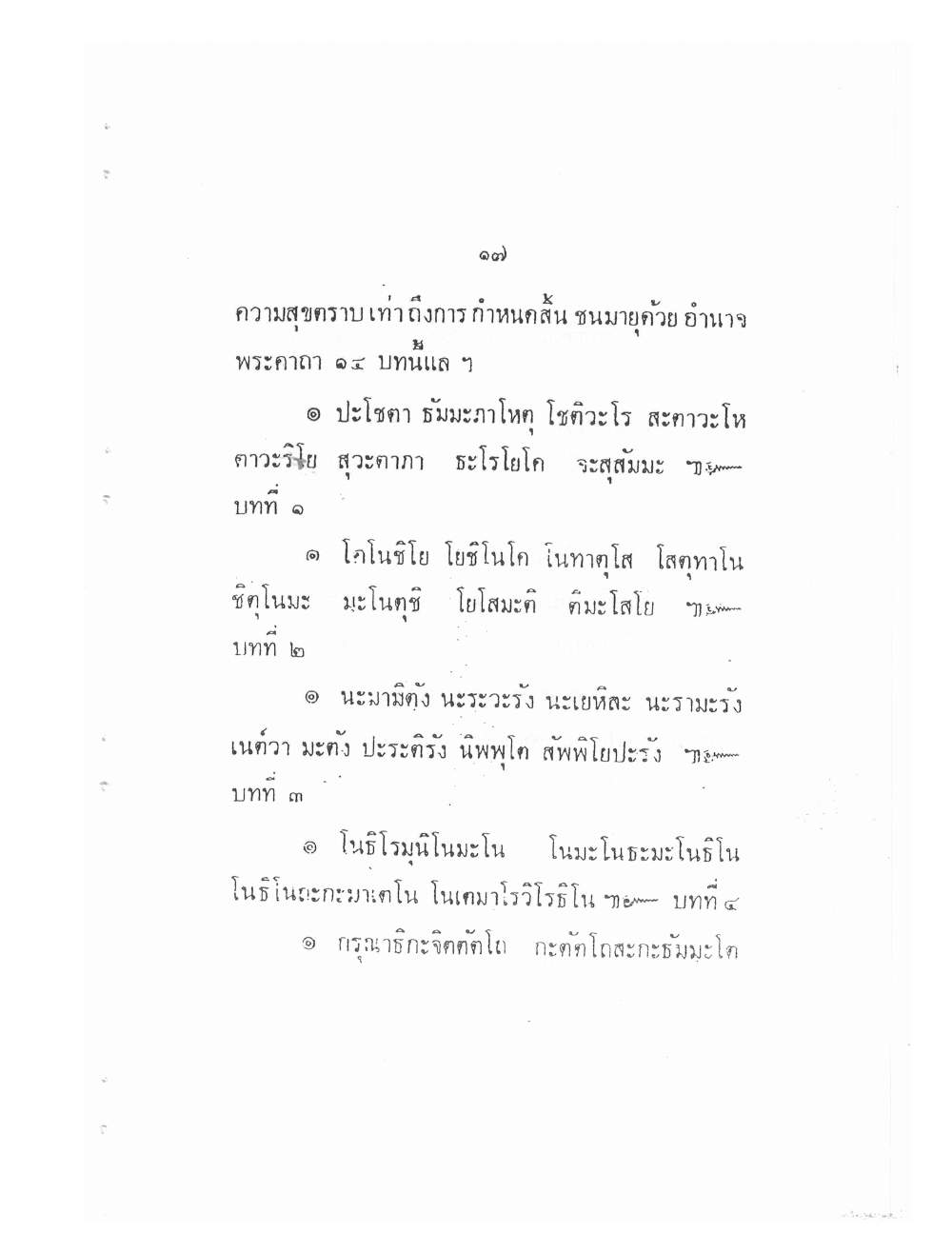
ความสุขตราบเท่าถึงการกำหนดสิ้นชนมายุด้วยอำนาจพระคาถา ๑๔ บทนี้แล ๚
๐ ปะโชตา ธัมมะภาโหตุ โชติวะโร สะดาวะโห ดาวะริโย สุวะดาภา ธะโรโยโค จะสุสัมมะ ๚ะ บทที่ ๑
๐ โภโนซิโย โยชิโนโค โนทาดุโส โสดุทาโน ชิดุโนมะ มะโนดุชิ โยโสมะคิ คิมะโสโย ๚ะ บทที่ ๒
๐ นะมามิตัง นะระวะรัง นะเยหิละ นะรามะรัง เนต์วา มะตัง ประดิรัง นิพพุโค สัพพิโยประรัง ๚ะ บทที่ ๓
๐ โนธิโรมุนิโนมะโน โนมะโนธะมะโนธิโน โนธิโนดะกะมาเดโน โนเตมาโรวิโรธิโน ๚ะ บทที่ ๔
๐ กรุณาธิกะจิตศัตโต กะดัดโกสะกะธัมมะโค
Happiness lasts until the very ending of one's lifespan, by the power of these 14 verses of sacred formula.
○ Pachotā dhammabhāhotu chotivaro sadāvaho dāvariyo suvadābhā dharoyoko jasusammā. — Verse 1
○ Phonosiyo yochinoko nothadutho sodutha no chidunoma manothuchi yosomaki khimasoyo. — Verse 2
○ Namāmitang naravarang nayehila naramarang netva matang pradirang nippuko sappiyoprarang. — Verse 3
○ Nothiromuninomano nomanothamanothino nothinodakamadeno notemarovirothino. — Verse 4
○ Karunādhikajitsatto kadatkosakadhammako [mantra syllables; verse continues onto the following page]
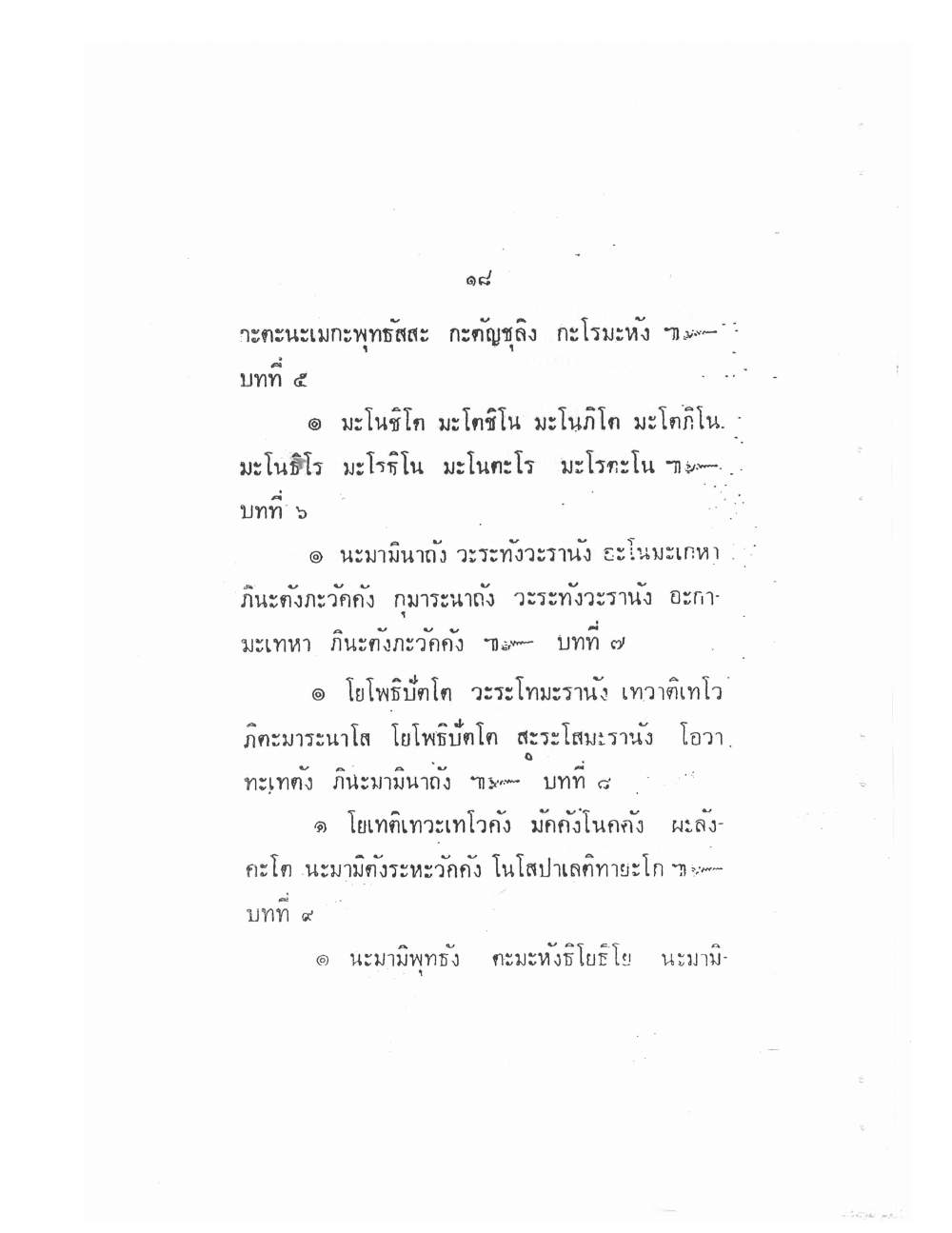
กะตะนะเมกะพุทธัสสะ กะกัญชุลิง กะโรมหัง ๚ะ บทที่ ๕
๐ มะโนชิโค มะโดชิโน มะโนภิโค มะโดภิโน มะโนธิโร มะโรธิโน มะโนกะโร มะโรกะโน ๚ะ บทที่ ๖
๐ นะมามินาถัง วะระทังวะรานัง อะโนมะเกหา ภินะดังภะวัคคัง กุมาระนาถัง วะระทังวะรานัง อะกามะเทหา ภินะดังภะวัคคัง ๚ะ บทที่ ๗
๐ โยโพธิบัตโต วะระโทมะรานัง เทวาติเทโว ภิดะมาระนาโส โยโพธิบัตโต สะระโสมะรานัง โอวาทะเทดัง ภินะมามินาถัง ๚ะ บทที่ ๘
๑ โยเทติเทวะเทโวดัง มักดังโนกดัง ผลังกะโด นะมามิดังระหะวักดัง โนโสปาเลติทายะโก ๚ะ บทที่ ๙
๐ นะมามิพุทธัง คะมะหังธิโยธิโย นะมามิ-
...katanamekabuddhassa kakanchuling karomahang. — Verse 5
○ Manochiko madochino manophiko madophino manothiro marothino manokaro marokano. — Verse 6
○ Namāmi nāthang varathangvaranang anomakehā phinadangbhavakkang kumāranāthang varathangvaranang akāmathehā phinadangbhavakkang. — Verse 7
○ Yobodhibatto varathomaranang thevātithevo phithamāranāso yobodhibatto sarasomaranang owāthathedang phinamāminathang. — Verse 8
○ Yothetithevathevodang makdangnokdang phalangkado namāmidangrahavakdang nosopālethithāyako. — Verse 9
○ Namāmi buddhang khamahangthiyothiyo namāmi- ["I do homage to the Buddha..."; verse continues onto the following page]
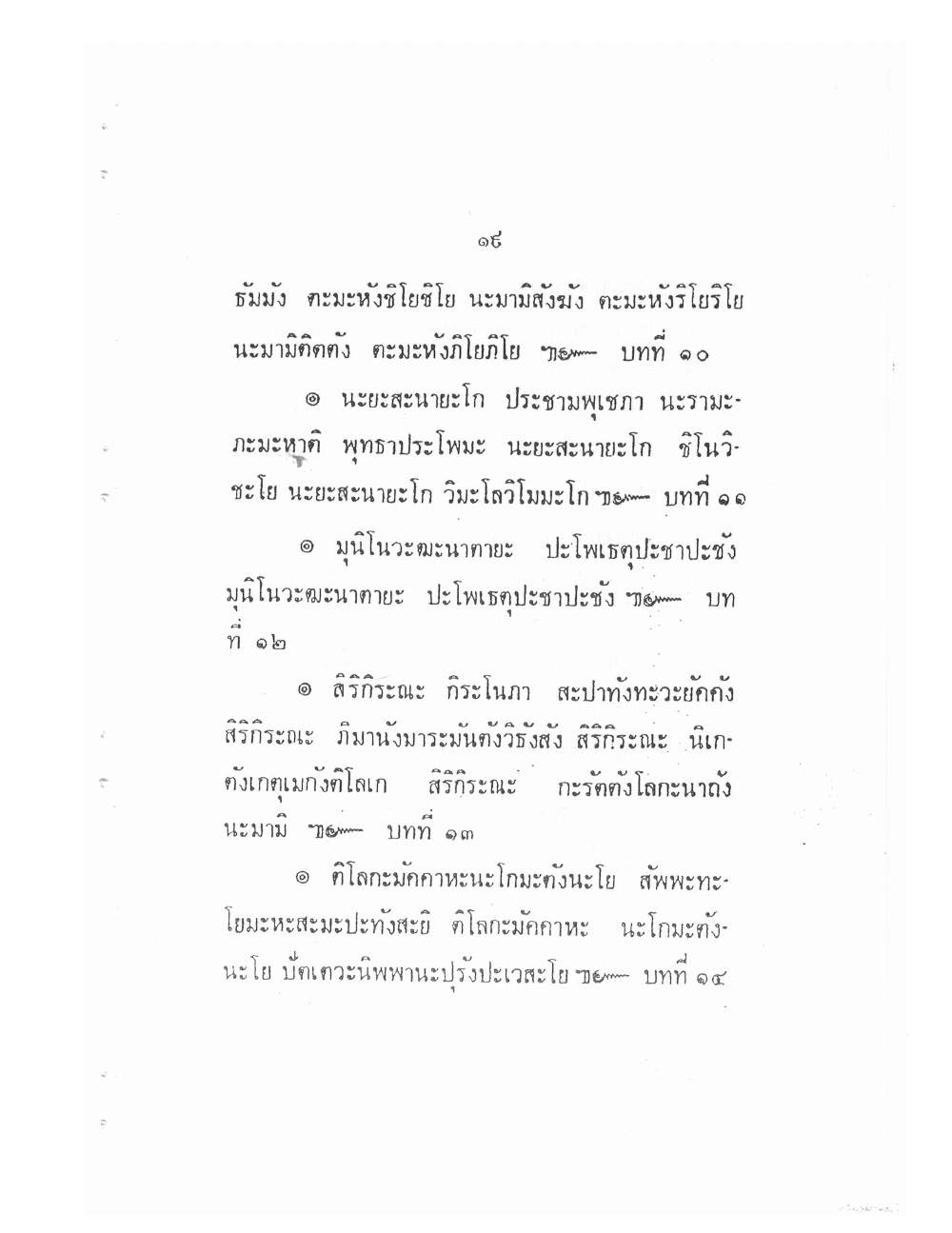
ธัมมัง คะมะหังชิโยชิโย นะมามิสังฆัง ตะมะหังริโยริโย นะมามิติดตัง ตะมะหังภิโยภิโย ๚ะ บทที่ ๑๐
๐ นะยะสะนายะโก ประชามพุเชภา นะรามะภะมะหาติ พุทธาประโพมะ นะยะสะนายะโก ชิโนวิชะโย นะยะสะนายะโก วิมะโลวิโมมะโก ๚ะ บทที่ ๑๑
๐ มุนิโนวะฒะนาทายะ ปะโพเธตุปะชาปะชัง มุนิโนวะฒะนาดายะ ปะโพเธตุปะชาปะชัง ๚ะ บทที่ ๑๒
๐ สิริกิระณะ กิระโนภา สะปาทังทะวะยักกัง สิริกิระณะ ภิมานังมาระมันดังวิดังสัง สิริกิระณะ นิเกดังเกตุเมกังติโลเก สิริกิระณะ กะรัดดังโลกะนาถัง นะมามิ ๚ะ บทที่ ๑๓
๐ ติโลกะมักกาหะนะโกมะดังนะโย สัพพะทะโยมะหะสะมะปะทังสะยิ ติโลกะมักกาหะ นะโกมะดัง นะโย บั้เตวะนิพพานะปุรังปะเวสะโย ๚ะ บทที่ ๑๔
...-dhammang khamahangchiyochiyo namāmi sanghang tamahangriyoriyo namāmi tidtang tamahangphiyophiyo. — Verse 10 ["...to the Dhamma... to the Sangha..."]
○ Nayasanāyoko prachāmphuchebhā narāmaphamahāti buddhāprapoma nayasanāyoko chinowichayo nayasanāyoko wimalowimomako. — Verse 11
○ Muninowathanāthāya papothetupachāpachang muninowathanāthāya papothetupachāpachang. — Verse 12
○ Sirikirana kiranopha sapāthangthawayakkang sirikirana phimānangmāramantangwidangsang sirikirana nikedangketumekangtiloke sirikirana karatdanglokanāthang namāmi. — Verse 13
○ Tilokamakkāhanakomadangnayo sappathayomahasamapadangsayi tilokamakkāha nakomadang nayo bantevanippānapurangpavesayo. — Verse 14
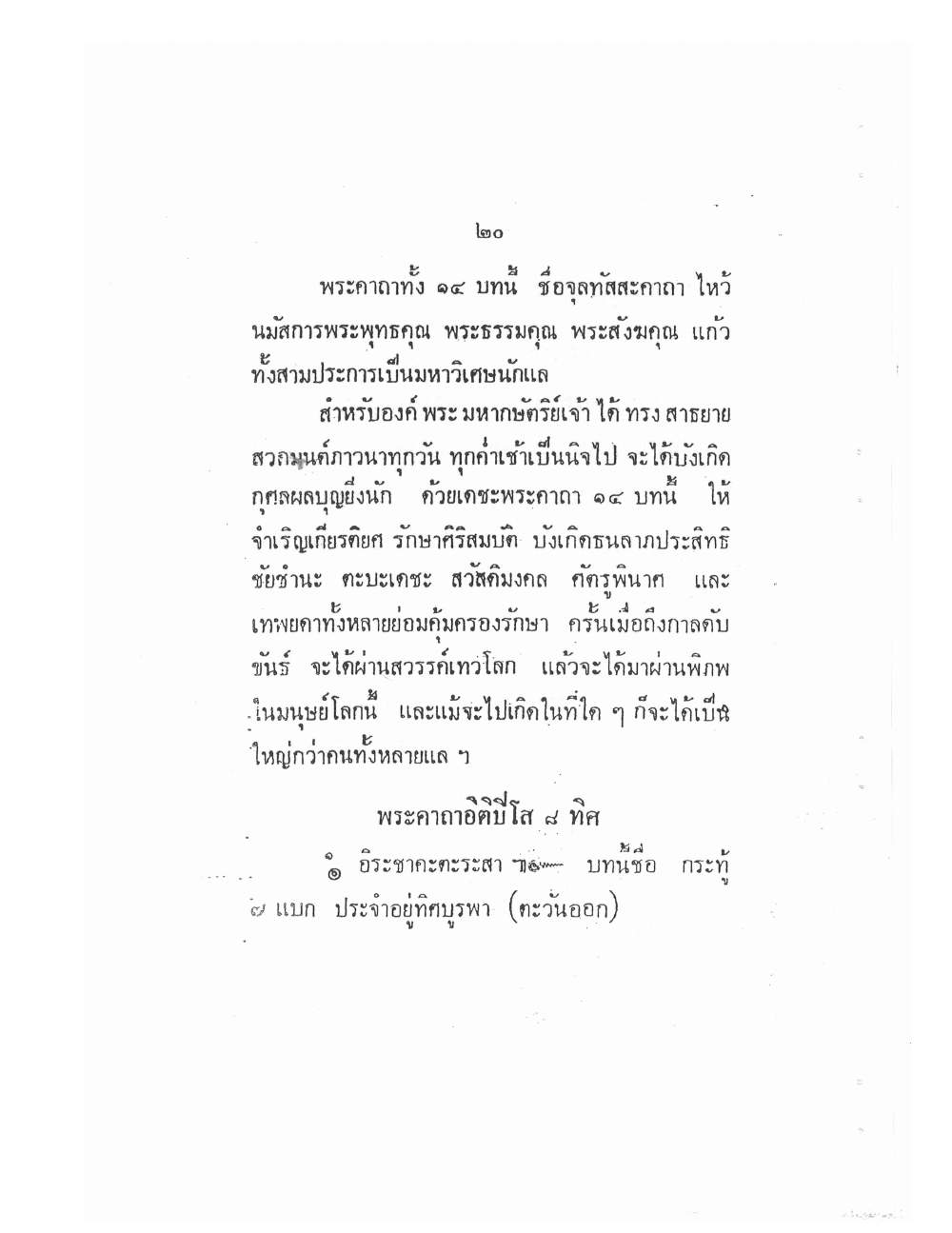
พระคาถาทั้ง ๑๔ บทนี้ ชื่อจุลทัสสะคาถา ไหว้นมัสการพระพุทธคุณ พระธรรมคุณ พระสังฆคุณ แก้วทั้งสามประการเป็นมหาวิเศษนักแล
สำหรับองค์พระมหากษัตริย์เจ้า ได้ทรงสาธยายสวดมนต์ภาวนาทุกวัน ทุกค่ำเช้าเป็นนิจไป จะได้บังเกิดกุศลผลบุญยิ่งนัก ด้วยเดชะพระคาถา ๑๔ บทนี้ ให้จำเริญเกียรติยศ รักษาศิริสมบัติ บังเกิดธนลาภประสิทธิชัยชำนะ ตะบะเดชะ สวัสดิมงคล ศัตรูพินาศ และเทพยดาทั้งหลายย่อมคุ้มครองรักษา ครั้นเมื่อถึงกาลดับขันธ์ จะได้ผ่านสวรรค์เทวโลก แล้วจะได้มาผ่านพิภพในมนุษย์โลกนี้ และแม้จะไปเกิดในที่ใด ๆ ก็จะได้เป็นใหญ่กว่าคนทั้งหลายแล ๚
พระคาถาอัฏฐีโส ๘ ทิศ
๐ อิระชาคะตะระสา ๚ะ บทนี้ชื่อ กระทู้ ๗ แบก ประจำอยู่ทิศบูรพา (ตะวันออก)
These 14 verses of formula are called the Culatassa Katha (Lesser Formula). They pay homage to the virtue of the Buddha, the virtue of the Dhamma, and the virtue of the Sangha, the Three Jewels — this is a matter of the highest excellence.
For a king who recites and chants these prayers as a daily practice, every morning and evening without fail, great merit and blessing will arise. By the power of these 14 verses, may he prosper in honour, preserve his fortune, gain wealth and success in victorious conquest, power and majesty, good fortune, and the destruction of his enemies; and the deities will protect and guard him. When at last his life ends, he shall pass through the heavenly worlds, and shall come again to pass through this world of men; and even wherever he may be reborn, he shall be greater than all other people.
The Eight-Direction Aṭṭhīso Formula
○ Irachākatarasā. — This verse is called Krathū Cet Baek (the Seven-Burden Charge), assigned to the eastern direction (east).
๒ ติหังจะโครถินัง ๚ะ บทนี้ชื่อเรียกว่า ฝนแสนห่า ประจำอยู่ทิศอาคเนย์ (ตะวันออกเฉียงใต้)
๓ บิสัมระโลปุสัตพุท ๚ะ บทนี้ชื่อเรียกว่า นารายณ์เกลื่อนสมุทร ประจำอยู่ทิศทักษิณ (ใต้)
๔ โสมาณะกะริถาโธ ๚ะ บทนี้ชื่อนารายณ์ถอดจักร์ ประจำอยู่ทิศหรดี (ตะวันตกเฉียงใต้)
๕ ภะสัมสัมวิศะเทภะ ๚ะ บทนี้ชื่อว่า นารายณ์ขว้างจักรกึงไตรภพ ประจำอยู่ทิศประจิม (ตะวันตกเฉียงใต้)
๖ คะพุทบั้นทูธัมวะคะ ๚ะ บทนี้ชื่อนารายณ์พลิกแผ่นดิน ประจำอยู่ทิศพายัพ (ตะวันตกเฉียงเหนือ)
๗ วาโธโนอะมะมะวา ๚ะ บทนี้ชื่อว่าตวาดฟ้าบ่าหิมพานต์ ประจำอยู่ทิศอุดร (เหนือ)
๘ อะวิชสุนุ๋สานุ๋ติ ๚ะ บทนี้ชื่อนารายณ์แปลงรูป ประจำอยู่ทิศอีสาน (ตะวันออกเฉียงเหนือ)
2. Tihangjakhorathinang. — This verse is called Fon Saen Hā (the Torrential Rain), assigned to the south-east direction.
3. Bisamralopusatphut. — This verse is called Nārāi Klư̄an Samut (Nārāyaṇa Churning the Ocean), assigned to the south (ใต้).
4. Somāṇakarithātho. — This verse is called Nārāi Thot Chak (Nārāyaṇa Removing His Discus), assigned to the south-west direction.
5. Phasamsamwidathepha. — This verse is called Nārāi Khwāng Chak Kưng Traiphop (Nārāyaṇa Hurling His Discus Across the Three Worlds), assigned to the west (ประจิม), given here as south-west.
6. Khaphutbanthūthammawakha. — This verse is called Nārāi Phlik Phaendin (Nārāyaṇa Overturning the Earth), assigned to the north-west direction.
7. Wāthonoamamawā. — This verse is called Twāt Fā Bā Himmaphān (Thundering Across the Sky over the Himavanta), assigned to the north.
8. Awichasunusanuti. — This verse is called Nārāi Plaeng Rūp (Nārāyaṇa Transforming His Form), assigned to the north-east direction.
๐ สิทธิการิยะ อุปเท่ห์พระอัฏฐีโส ๘ ทิศนี้ มีอานุภาพมากหลาย อาจป้องกันได้สารพัด ตามใจปรารถนาแล ๚
พระอาจารย์เจ้ากล่าวไว้ว่า ฝอยท่วมหลังช้างแล มีอุปเท่ห์มากมายเหลือจะพรรณนา แต่จะขอกล่าวไว้ย่อ ๆ พอเป็นบรรบัฐานดังต่อไปนี้
แม้จะยาตราไปทางสารทิศใด ให้ภาวนาพระคาถาประจำทิศตามทิศที่จะไปนั้น หรือจะทำน้ำมนต์ลูบหน้าประพรมพาหนะที่จะไปนั้น จะปราศจากอุปสรรคอันตรายทั้งปวงไม่มีมารบกวนเลย ป้องกันได้สารพัด แม้ว่าทิศที่จะไปนั้นจะต้องผีหลวงหรือหลาวเหล็ก (ทิศร้ายตามตำราโหราศาสตร์) ก็ดี คุ้มกันได้สิ้นทุกอย่าง ไปสงครามก็มีชัยชนะ ไปค้าขายก็มีกำไรมิได้ขาดทุน จะลงเป็นประเจียดป้องกันศาสตราวุธก็ได้ ทั้งเป็นเสน่ห์แก่ฝูงชนทั้งปวง เขียนบูชาไว้กับบ้านเรือนก็ย่อมป้อง
○ Siddhikāriya. The efficacy of this Eight-Direction Aṭṭhīso Formula is very great — it can guard against everything, according to one's wishes.
The venerable teacher has said: [its virtue is as abundant as] the down that covers an elephant's back — its efficacy is too abundant to fully describe, but let it be told briefly, enough to serve as a foundation, as follows.
Whenever one journeys in any direction, one should recite the verse assigned to the direction one is travelling toward, or make holy water to wipe over one's face and sprinkle over the mount or vehicle one is to travel in — one will then be free of every obstacle and danger, with nothing to trouble one; it guards against everything. Even if the direction of travel is one governed by a great spirit or an iron stake [an inauspicious direction according to astrological texts], it will still guard against everything entirely. Going to war, one will be victorious; going to trade, one will profit and never suffer loss. It may also be worn as an amulet to ward off weapons, and it grants charm before all people. Written and enshrined at one's home, it likewise guards...
กันภัยอันตรายได้ทุกอย่าง ถ้าจะไปนอนกลางป่า ให้เสกก้อนดินไปวางไว้ตามทิศ เมื่อจะวางทิศไหนให้เสกด้วยคาถาประจำทิศนั้นอีก ทิศละ ๘ จบ ป้องกันสารพัดสัตว์ร้าย เปรียบประดุจมีกำแพงแก้วกันคนไว้ถึง ๗ ชั้น ถึงแม้จะถูกข้าศึกโจรผู้ร้ายล้อมไว้ก็ดี จะหักออกทางทิศไหน ให้ภาวนาคาถาประจำทิศนั้นเถิด แล้วให้หักออกมาจะแคล้วคลาดจากอันตรายทั้งสิ้น ถ้าจะใช้เป็นบท ๆ ไป ท่านวางอุปเท่ห์วิธีใช้ไว้ดังนี้ คือ
๐ บทกระทู้ ๗ แบก เสกข้าวกินอย่างกงทน สารพัดอาวุธทั้งสิ้นทำอันตรายมิได้เลย ภาวนาเข้าสู้ช้างอาจจะง้างจับงาหัก กำลังหนัก ๑๗ ช้างสารกับพิษไฟสารพรรณพิษทุกสิ่ง ให้เอาถ้าผีตายวันเสาร์เผาวันอังคาร มาผสมกับชะมดพิมเสน ทำเป็นรูปคน เอาผ้าขาวคลุมไว้ เอาเหล้าข้าวเซ่น เสกด้วยคาถานี้ ๑๐๘ คาบ สารพัดใช้ได้ดังใจปรารถนา ถ้าจะลองสตรี ให้เอาข้าวสารตก
...it guards against every kind of danger. If one must sleep out in the forest, enchant lumps of earth and place them according to the directions; when placing one in a given direction, recite the verse assigned to that direction again, eight rounds per direction — this guards against every dangerous beast. It is as though one had a crystal wall seven layers thick standing guard around oneself. Even if surrounded by enemy troops or bandits, whichever direction one wishes to break out through, let one recite the verse assigned to that direction, then break outward, and one will escape entirely free of harm. If the verses are to be used individually, the method of use has been set down as follows:
○ The Verse of the Seven-Burden Charge: enchant rice and eat it as one endures hardship [as a soldier does] — no weapon whatsoever will be able to harm one. Recite it when going to face an elephant, and one may even wrestle it and break its tusk, with the strength of seventeen tuskers, against venomous fire and every kind of poison. Take [the remains of] one who died on a Saturday and was cremated on a Tuesday, mix it with civet musk and camphor, and shape it into the figure of a person. Cover it with white cloth, offer it liquor and rice, and enchant it with this verse 108 times — it may then be used for anything, according to one's wish. If testing it on a woman, take rice grains and let them fall...
ตื่นครกมา ๗ เม็ด เสก ๑๗ คาบ แช่น้ำมันหอมไว้ เอาน้ำมันติดให้ต้องตนตามมา อยู่ทิศบูรพาแลท่านเอย ๚
๐ บทเรียกฝนเสน่ห์ ถ้าอดน้ำวันยังค่ำ อย่ากลัวยาก เสกหมาก ๑๐๘ คาบ กลืนกระหนาบเข้าไปเถิดหนา ถ้าจะทำให้ฝนตก ให้เอาคาถายกเสกใส่เทียน แล้วจึงเพียรภาวนา พระคาถาแสนเก้าพัน รำลึกถึงชั้นเทวดา อินทร์พรหมสิ้นทั้งหลาย ตกเนื่องไปอย่างร้อนใจ ถ้าเป็นไข้เสก น้ำพ่นถ้วย ๗ หนก็หาย เคารพครูปริยายประสิทธิ์อยู่ทิศอาคเนย์แลท่านเอย ๚
๐ บทนารายณ์เกลื่อนสมุทธ์ ฤทธิ์สุด เสกพริกไทย ๗ เม็ด เม็ดละ ๗ หน แล้วพ่นลงที่ผีสักที่กี่สูญ หนึ่งเสกปูนทากี็ได้ถ้าเป็นความไข้จะให้หาย เอาชื่อคนทั้งหลายลงกระดาษ อย่าให้คลาดทำใส่เทียน แล้วจึงเขียนคาถาล้อม เสกพร้อมตามกำลังวัน เล่มเทียนนั้นหนัก ๑ บาท อย่าให้ขาดภาวนา ความที่หากสูญสิ้น อยู่ทิศทักษิณแลท่านเอย ๚
...wake seven grains [of the mixture] in a mortar, enchant seventeen rounds, soak them in perfumed oil; take that oil and apply it so that [the desired one] will be drawn to follow you. This stands in the eastern direction, good sir.
○ The Verse for Calling the Rain of Charm: if one must go without water all day long, do not fear the hardship — enchant a betel nut 108 times and swallow it down whole. To make rain fall, take the verse, raise it, and enchant a candle, then diligently recite it — this verse of ninety-nine thousand [merits], recalling the ranks of the deities, all the hosts of Indra and Brahma — rain will fall continuously and fervently. If one has a fever, enchant water and spray it from a cup seven times and it will be cured. Honour the teacher's transmitted lore — its efficacy stands in the south-east direction, good sir.
○ The Verse of Nārāyaṇa Churning the Ocean, of the utmost power: enchant seven peppercorns, seven times each grain, then blow it onto the place of a haunting spirit, and it will vanish entirely. Alternatively, enchant lime paste and apply it — it can likewise cure sickness. Take the names of all the people concerned and write them on paper without omission, place them by a candle, then write the verse encircling them, and enchant it according to the ruling power of the day; the candle should weigh one baht; do not let the recitation lapse, and whatever [affliction] there is will vanish utterly. This stands in the southern direction, good sir.
๐ บทนารายณ์ถอดจักร์ เสกน้ำมนต์ ๑๐๘ หน ลูกไม้ออกกลืนเข้าไป ให้พรมที่ศีรษะจะออกมาโดยคล่อง ๆ ถ้าถูกจำจองด้วยขื่อคาเอาคาถาเสกว่ารี ถ้าไม่มีเอาน้ำลายเป่ากระจายไปด้วยฤทธิ์ อยู่ทิศหรดีแลท่านเอย ๚
๐ บทนารายณ์ขว้างจักร์ ถ้าจะบังคับลมให้พัดหนัก ให้ภาวนากลืนเข้าไป ถ้าจะมิให้ลมพัดให้ภาวนาเอาเส้นคุนเพดาน อัดลมนิ่งนึกภาวนาในใจ พายุหยุดนิ่งแล แม้เดินทางไปพบเสือ ช้าง โจร ผู้ร้าย ให้ภาวนาเป็นมหาจังงัง ศัตรูหยุดยั้งไม่เข้าใกล้ ภาวนาตวาดศัตรูยกมือมิขึ้นเลย ตวาดช้าง ๆ ก็หนีไปสิ้น อยู่ทิศปราจิณแลท่านเอย ๚
๐ บทนารายณ์พลิกแผ่นดินหงาย สารพัดสะเดาะออกหลุดลุ่ยกระจายแล ภาวนาไว้เป็นเสน่ห์แก่ท้าวพระยาทั้งหลาย แม้นโทษถึงตายภาวนาอยู่มิตาย อยู่ทิศพายัพแลท่านเอย ๚
○ The Verse of Nārāyaṇa Removing His Discus: enchant holy water 108 times; if the fruit [i.e. the child] will not emerge and is swallowed [held back] in delivery, sprinkle it on the head and it will come out easily. If one is bound in stocks and chains, take the verse and enchant, saying 'Rī'; if there is none [available], spit and blow it scattering by its power instead. This stands in the south-west direction, good sir.
○ The Verse of Nārāyaṇa Hurling His Discus: to command the wind to blow hard, recite it and swallow [the breath] inward; to stop the wind from blowing, recite it while pressing the tongue to the roof of the mouth, holding the breath still, reciting silently in the mind — the storm will cease and grow still. Even when travelling and meeting a tiger, an elephant, bandits, or brigands, recite it to become a great paralysing power — the enemy will halt and not come near; recite it while shouting at the enemy and they will be unable even to raise their hands; shout at an elephant and it too will flee entirely. This stands in the eastern direction [ปราจิณ], good sir.
○ The Verse of Nārāyaṇa Overturning the Earth: it causes every bond and restraint to come loose, break apart, and scatter away. Recite it to win the favour and charm of kings and lords everywhere; even if condemned to death, recite it and one will not die. This stands in the north-west direction, good sir.
๐ บทนารายณ์ควาดฟ้าบ่าพระหิมพานต์ ศัตรูทั้งหลายอย่ากลัวมัน เป็นจังงังแล ถ้าจะต่อด้วยฝูงผี เสกทรายตีข้าวสารซัด แตกกระจัดกระจายจร อยู่ทิศอุดรแลท่านเอย ๚
๐ บทนารายณ์แปลงรูป ภาวนาสูบลมเข้าสามกลืน ยืนขมำดูเงาฉาย ถ้าเงาหายเป็นกำบัง คนอย่าหวังเห็นตัวเลย เสกน้ำมัน ๑๐๘ หน เอาไว้ใช้ เมื่อจะใช้เสกอีก ๗ หน ทาคนไปเถิดรา เป็นที่เสน่หาแก่คนทั้งหลาย ท่านเจ้านายเห็นหน้าถือดังลูกหลาน อยู่ทิศอีสาณแลท่านเอย ๚
๐ อนึ่งท่านให้เอา ชะมด พิมเสน กระแจะจันทน์หอม โกฏหัวบัว บดผสมเข้าด้วยกัน ให้ลงพระคาถานารายณ์แปลงรูปที่หน้าหินบด แล้วจึงเสกด้วยพระคาถาอิติปิโส ๘ ที เสกด้วยพระคาถา นารายณ์แปลงรูป ๑๐๘ ที บดแล้วเอาไว้ใช้ ทาตัวเราไปไหนเป็นเสน่ห์
○ The Verse of Nārāyaṇa Roaring Across the Sky over the Himavanta: enemies need not be feared — they will be struck paralysed. If confronted by a host of spirits, enchant sand and beaten rice and cast it, and they will scatter and break apart in all directions. This stands in the northern direction, good sir.
○ The Verse of Nārāyaṇa's Transformation: recite it while drawing in breath and swallowing three times, then stand and gaze steadily at your own shadow; if the shadow disappears and becomes hidden, no one shall be able to see your form at all. Enchant oil 108 times and keep it for use; when about to use it, enchant it a further 7 times and anoint someone with it, and it wins the love and charm of all people; masters and lords, upon seeing your face, will regard you as their own child. This stands in the north-east direction, good sir.
○ Furthermore, it is instructed to take civet musk, camphor, and fragrant sandalwood, and lotus-root, and grind them together, inscribing the Verse of Nārāyaṇa's Transformation upon the face of the grinding stone; then enchant it with the Itipiso verse eight times, and enchant it with the Verse of Nārāyaṇa's Transformation 108 times; once ground, keep it for use — anoint yourself with it wherever you go, and it becomes a charm...
เมตตานักแล ๚ เห็นหน้าเราคือดังพระนารายณ์แปลงรูป ถ้าไปหาสตรีเมื่อจะมาให้เรียกด้วย ๐ อาคัจฉายะ อาคัจฉาหิ มาสิ ๚ แล้วเรียกให้กลับมาเถิด อยู่มิได้เลย ตามเรามาแล อุปเท่ห์พระอัฏฐีโส ๘ ทิศนี้ มีมากมายนักสุดที่จะกล่าวไว้ ท่านดีค่าไว้ ค่าควรเมืองแล ๚
พระคาถามงกุฎพระพุทธเจ้า
๐ อิติปิโสวิเสเสอิ อิเสเสพุทธะนาเมอิ อิเมนาพุทธะตังโสเถอิ อิโสตังพุทธะปิติอิ ๚ะ
พระคาถาบทนี้ บางอาจารย์ท่านเรียกว่าอิติปิโสเรือนเตี้ย ถ้าจะแก้โรคภัยไข้เจ็บทั้งมวลให้เอามะกรูดส้มบ่อยใส่น้ำมนต์เสก ๓ ที รดหายสิ้นแล ถ้าบุคคลมีเคราะห์ก็หายหมด ภาวนาทุกวันมิดกันรก เสกน้ำล้างหน้าทุกวันกันโรคภัยไข้เจ็บคุณไสยทั้งมวล ถ้าจะให้มีตะบะเดชะให้ภาวนาทุกวัน เกิดสง่าราศีเป็นที่เมตตาแก่คนทั้งหลายให้ภาวนาแล้วแผ่เมตตาให้คนทั้งปวง ใคร
...exceedingly charming. Whoever sees your face will see it as though it were Nārāyaṇa transformed. When going to seek a woman, when you wish for her to come, call out: ○ Ākacchāya ākacchāhi māsi — then call for her to return, and she will be unable to remain, and will follow you here. The efficacy of this Eight-Direction Aṭṭhīso Formula is far too abundant to fully set down; the masters have prized it highly — its worth is fit for a kingdom.
The Crown Verse of the Buddha
○ Itipiso wisesei isesebuddhanāmei imenābuddhatangsothei isotangbuddhapitii.
This verse is called by some teachers the 'Low-Roofed Itipiso.' To cure any and all sickness, take a soured kaffir lime, put it in holy water, enchant it three times, and pour it [over the patient], and it will cure entirely. If a person is beset by misfortune, that too will be entirely relieved. Recite it daily and it will ward off all evil; enchant water for washing the face daily to ward off all sickness and black magic. If one wishes to gain power and majesty, recite it daily — it brings forth radiance and grace, and wins the goodwill of all people; recite it, then extend loving-kindness to all people — whoever...
คิดร้ายก็ต้องมีอันเป็นไป ถ้าปรารถนาสิ่งใดให้ภาวนาคาถานี้ ๑๘ คาบ เป็นไปดังใจนึก ถ้าจะให้เป็นมหาจังงัง ให้ภาวนาคาถานี้ ๘ คาบ เป็นมหาจังงังแล ถ้าจะให้เป็นมหาละลวยให้ภาวนา ๘ คาบ ถ้าช้าง ม้า วัว ควายสัตว์ที่ดุร้ายทั้งหลาย ให้เสกหญ้าเสกของให้มันกิน กลับใจอ่อนรักเราแล ถ้าภูติพรายมันเข้าอยู่ในคน เสกข้าวให้มันกินออกแล ถ้าปรารถนาจะให้เสียงไพเราะห์ ให้เสกขี้ผึ้งสีปาก เสกหมากกิน ไปเทศนาสวดร้องเป็นที่พอใจคนทั้งหลาย ให้เสกแป้งผัดหน้า เสกมงกุฎรัดเกล้าเป็นสง่าราศีใครเห็นใครรักทุกคน
อนึ่ง ให้เอาใบลานหรือกระดาษว่าวมาลงคาถานี้ ทำเป็นมงคลเสกด้วยตนเอง สารพัดกันศาสตราวุธทั้งหลายเป็นมหาวิเศษนักแล ถ้าแลเกิดเป็นความกันเราจะช่วยเขา ให้เขียนชื่อโจทย์ลงเท้าขวา เขียนชื่อจำเลยลงเท้าซ้าย เสกเป่าลงไปที่ชื่อนั้น แล้วเดินไปนั่งอยู่
...whoever intends harm will meet with misfortune in turn. If wishing for anything, recite this verse eighteen times, and it will come to pass as desired. To become a great paralysing power, recite this verse eight times, and it becomes a great paralysing power. To become a great confounding power, recite it eight times. As for elephants, horses, cattle, buffalo, or any fierce beast, enchant grass or fodder and give it to them to eat, and their hearts will soften and turn to love you. If a person is possessed by a spirit, enchant rice and give it to them to eat, and it will depart. If one wishes for a pleasant voice, enchant beeswax and apply it to the lips, enchant a betel quid and eat it, then go to preach or chant — it will please all who hear. Enchant face powder [and apply it], enchant a crown or head-band, and it brings radiance and grace — whoever sees you will love you, every one.
Furthermore, take a palm-leaf or kite-paper and inscribe this verse upon it, make it into an auspicious charm by enchanting it yourself — it wards off every manner of weapon, being of the greatest excellence. And should a dispute arise in which we wish to help someone, write the plaintiff's name beneath the right foot, write the defendant's name beneath the left foot, blow the enchantment down onto that name, then go and sit...
เหนือน้ำ เอาเท้าจุ่มลงไปในน้ำ ภาวนาไปจนกว่าจะ ได้ ๑๙ ที ถ้าจะให้ข้างไหนชนะ ยกเท้าข้างนั้นขึ้นก่อน พระคาถานี้ถ้าเข้าที่อับจน ให้ยึดต้นไม้ไว้ภาวนามิเห็น ตัวเราเลย พระคาถาบทนี้เป็นพระคาถาที่พระมหา- กษัตริย์แต่เก่าก่อนใช้เป็น พระคาถา ประจำ พระองค์ ทุก องค์แล ฯ
พระคาถาพระเจ้า ๑๖ พระองค์
◎ นะมะนะอะ นอ. กอ. นะกะ นอ. ออ. นอ. อะ นะอะกะอัง ๒ฯ
◎ อุมิอะมิ มะหิสุกัง สุนะพุทธัง อะสุนะ อะ ๒ฯ
สิทธิการิยะ พระอาจารย์เจ้าทั้งปวง แต่งอุปเท่ห์ พระคาถานี้ไว้ให้เป็นทานแก่สมณะชีพราหมณ์ กุลบุตร ทั้งปวง พระคาถานี้ท่านเรียกว่าธัมมะราชาจัดเป็นใหญ่ กว่าคาถาทั้งปวง ผู้ใดภาวนาไว้ได้อานิสงส์มาก สารพัด
...above the water, dip the foot down into the water. Recite until you reach 19 times. If you wish either side to win, raise that foot first. This spell — if you are ever cornered with no way out, cling to a tree trunk and recite it, and no one will see us at all. This spell was the spell that kings of old used as their own personal spell, every one of them.
The Spell of the Sixteen Buddhas
◎ Na ma na a. No. Ko. Na ka. No. O. No. A na a ka ang. (recite twice) [a string of magical Pali-derived syllables, not a translatable sentence]
◎ U mi a mi ma hi su kang su na phutthang a su na a. (recite twice) [likewise a magical syllable-string]
Siddhikariya — all the venerable teacher-masters composed the method for this spell and left it as a gift to monks, ascetics, brahmins, and the sons of good families generally. This spell is called Dhammaraja, and is reckoned greatest of all spells. Whoever recites it gains great merit — every kind of...
กันอันตรายทั้งปวง ทั้งคุณผีและคุณคน ถ้าเป็นไข้เป็น ฃาลทราง เสกน้ำมนต์ให้กินหรือใช้พ่นเป่าก็หายสิ้น เสก ข้าวให้เด็กอ่อนกิน มีปัญญาหาโรคภัยมิได้ ถ้าเจ็บคอ ให้เสกปูนทา ถ้าเจ็บตาให้เสกน้ำพ่น ถ้าเป็นตะพื้นให้ เสกไพลพ่น เสกยากิน ยาทาแก้โรคทั้งปวง ทำให้ยา มีฤทธิ์ขึ้นมา ถ้าเป็นผีให้เสกปูนสูญ สูญได้สารพัดผีทั้ง ปวง ถ้าก้างติดคอให้เสกน้ำให้กิน เสกน้ำสะเดาะลูก ในท้องก็ได้ เสกข้าวสารน้ำกินทุกวันอยู่คงแก่อาวุธทั้ง ปวง ๑๒ ภาษา ถ้าเสกกินอยู่ถึง ๓ ปี อยู่คงทนทั่วทั้ง ร่างกายจนกระทั่งถึงกระดูกแล ถ้าจะให้อยู่คงสิ้นทั้งเรือน ให้เอาดินสอพองเขียนพระคาถานี้ ใส่ในกระดานชนวน แล้วให้เสก ๑๐๘ ที ลบเอาผงนั้นใส่โอ่งน้ำกินหรือตุ่ม ข้าวสารก็ได้ จงกินเสียให้ทั่ว แล้วเสกซ้ำอีก ๗ ที หุงกินแล้วคงทั้งเรือนแล ฯ เสกไกล้พระเจดีย์ย่อมไว้คง ทนยิ่งนัก เสกปูนกากคอ ๓ แห่งอยู่คงทนยิ่งนัก ถ้า
...against every kind of danger, whether from the power of ghosts or the power of men. If someone has a fever or the wasting sickness of infancy, chant into holy water and give it to drink, or spray/blow it on them, and it will be cured completely. Chant into rice and feed it to infants, and they will be wise and free of disease. If the throat aches, chant into lime paste and apply it. If the eyes ache, chant into water and spray it. If there are convulsive spasms, chant into plai root and spray it. Chanted medicine, whether taken internally or applied, cures every disease and gives the medicine added potency. If it is a ghost, chant into lime powder to banish it — it can banish every kind of ghost. If a fishbone sticks in the throat, chant into water and give it to drink. Chanted water can also dislodge a child stuck in the womb. Chant into rice-grains and water and drink it daily, and one becomes invulnerable to weapons of the twelve tongues [every foreign nation]. If chanted food is eaten for as long as three years, one becomes invulnerable through the whole body, down to the very bones. If you wish the whole house to be protected, take chalk powder, write this spell on a slate tablet, then chant over it 108 times; scrape off the powder into the drinking-water jar or the rice jar, have everyone drink and eat it thoroughly, then chant a further 7 times, cook and eat, and the whole house will be protected. Chanting near a chedi makes the protection especially enduring. Chant into lime paste at three places on the throat for especially strong endurance. If...
ไปหลงทางให้ภาวนาพระคาถานี้จะพบทางแล เสก ใบหมากเม่ากิน อดข้าวได้ ๗ วัน เสกยอดขี้เหล็กกิน ๗ ยอด อยู่คงแก่อาวุธ ถ้าศัตรูไล่มาให้เสกกิ่งไม้ขวาง ทางไว้ หรือจะเสกทรายโปรยก็ได้ ศัตรูตามมาเห็นเป็น ขวากหนามกั้นไว้ตามมิทัน ถ้าเป็นการจวนตัวให้เสก น้ำลายทาเท้าทาตัวแล้ววิ่งไปเถิด จะมีกองไฟรั้วตะราง ขวางหน้าอยู่ก็ดี ก็มิได้เป็นอันตราย ถึงจะมีช่องอยู่สัก เท่าหัวแม่มือก็หลุดรอดไปได้
ถ้าจะทำให้ตัวใหญ่โตขึ้นมีอำนาจเดชะ เป็นที่ เกรงขามแก่คนทั้งหลาย ให้เอาคาถานี้เขียนลงกระดาน ชนวน เสกแล้วจึงลบเอาผงทาตัว ภาวนาอึดใจเดิน ไป ศัตรูเห็นตัวเราใหญ่โตนัก บังเกิดใจครั่นคร้ามมิ อาจที่จะทำร้ายเราได้เลย
ถ้าจะให้ตัวเล็กลง ให้ยืนภาวนาคาถานี้อยู่เรื่อย เมื่อศัตรูมันแลเห็นให้หมอบลงภาวนา มันมามิเห็นตัว
...if you become lost on the road, recite this spell and you will find the way. Chant into mak-mao leaves and eat them, and you can go without rice for 7 days. Chant into 7 young shoots of khilek and eat them, and you become invulnerable to weapons. If enemies give chase, chant into a branch and lay it across the path, or chant into sand and scatter it — the pursuing enemy will see it become thorny brambles blocking the way and will be unable to catch up. If truly desperate, chant into saliva, rub it on the feet and body, then run; even should there be a wall of fire or a barred fence across the path ahead, it will do no harm — even a gap no wider than a thumb will be enough to slip through and escape.
If you wish to make your body grow huge and full of overwhelming power, so as to be feared by all, write this spell on a slate tablet, chant over it, then wipe off the powder and rub it on the body; hold the breath while reciting and walk forward — the enemy, seeing how enormous we have become, will be struck with dread and unable to bring themselves to harm us at all.
If you wish to shrink, stand and recite this spell continuously; when the enemy catches sight of you, crouch down and keep reciting — they will come but will not see...
เราเลย ถ้าเป็นความกันถึงขึ้นโรงขึ้นศาล ให้เสกน้ำอาบ หรือล้างหน้าเสกแบ่งหอมน้ำมันหอมทาตัว เมื่อเวลาไป ก็ให้บริกรรมคาถานี้อยู่เรื่อยๆ เมื่อถึงประตูศาล ให้ เอาเท้ากระทืบดินเสียก่อน ๓ ที จึงเข้าไปให้นั่งเหนือ ลมภาวนาคาถานี้ไว้ อย่าย่อท้อเลย ถ้าศัตรูมันไล่รามา จวนตัวแล้ว ให้ฉวยต้นไม้หรือต้นหญ้ายึดไว้ให้แน่น รำลึกถึงคุณพระพุทธเจ้า
ภาวนาคาถานี้ไว้อย่าให้ขาดปากเลย ศัตรูมัน ตามเรามาถึงตรงนั้นมิอาจจะเห็นตัวเราเลย มันได้แค่ เวียนวนหาเราอยู่เปล่า ถ้าจะเข้าหาท้าวพระยาและผู้ใหญ่ เจ้านายให้เสกเครื่องแต่งตัว เสกแบ่งหอม น้ำมันหอม ทาตัว เห็นหน้าเราบังเกิดความเมตตาปรานียิ่งนัก ถ้า ไฟไหม้มารอบเรือนเรา ให้เสกน้ำก็ได้ เสกข้าวสารก็ ได้โปรยปรายไปหลังคาเรือน ไฟมิอาจจะไหม้เรือนเรา แล แม้เดินทางไปในที่เปลี่ยว ให้ภาวนาพระคาถานี้
...us at all. If it is a dispute reaching the courthouse or tribunal, chant into bathing water or face-washing water, and chant into scented powder and perfumed oil for the body. While on the way, keep murmuring this spell continuously. On reaching the courthouse gate, stamp the foot on the ground 3 times first, then go in and sit upwind, reciting this spell steadily — do not lose heart. If the enemy pursues and you are cornered, grasp a tree or a clump of grass and hold on firmly, calling to mind the virtues of the Buddha.
Recite this spell without ever letting it leave the lips. The enemy, though pursuing us right to that spot, will be unable to see us at all — all they can do is circle about searching for us in vain. If going to see a lord, a prince, or an elder or master, chant into your attire, and chant into scented powder and perfumed oil for the body — on seeing our face they will be filled with great compassion and kindness. If fire breaks out and surrounds our house, chant into water, or chant into rice grains and scatter them onto the roof, and the fire will be unable to burn our house. Also, when travelling through a lonely place, recite this spell...
ไว้หาอันตรายมิได้ ถ้าหากข้าศึกมันล้อมไว้ก็ดี ให้ ภาวนาพระคาถานี้แล้วแหกออกมาได้เลย ข้าศึกเผอิญ ให้ตกกะลึงไปหมด จะมิให้ขะโมยที่มันขะโมยของไป หนีรอดไปได้ ถ้าเอาพระคาถานี้ลงไม้กาหลงหรือใบไม้ ทั้งปวงก็ได้ เสกแล้วให้ขุดหลุมฝังตรงที่มันเอาของไป ขะโมยนั้นไปมิได้เลยวนเวียนอยู่ในที่นั้นเอง
ถ้าจะให้มันเจ็บที่ฝ่าเท้า ให้เสกหนามหรือไม้ แหลมๆ แทงลงที่รอยเท้าผู้ร้าย จะเป็นที่ส้นหรือที่ กลางฝ่าเท้าหรือปลายเท้ามันไปมิได้ ให้เจ็บปวดเท้า เหมือนถูกขวากหนามแล
ถ้าจะต่อสู้ด้วยข้าศึกให้ภาวนา สูบลมเข้าทางปาก ทางจมูก แล้วกลืนเข้าไปในท้องเรา ประเจียดเครื่อง ลา. มนตร์คาถาของขามาอยู่ในตัวเราสิ้น มันทำอันตราย แก่เรามิได้เลย
...and one will be kept free of danger. If enemy forces have surrounded you, recite this spell and you will be able to break clear out through them. The enemy troops will unexpectedly fall into confusion, and none of them who has stolen goods will be able to escape with the theft. This spell may also be inscribed on a ka-long branch, or on any leaf whatsoever; chant over it, then dig a hole and bury it exactly where the theft took place — the thief will be quite unable to leave, and will wander round and round on that very spot.
If you wish to make an enemy's soles ache, chant into thorns or sharp splinters of wood and drive them down into the footprint of the wrongdoer — whether at the heel, the middle of the sole, or the toes — and they will be unable to go on; their feet will ache as though pierced by thorns and brambles.
If you must do battle with an enemy, recite the spell while drawing breath in through mouth and nose, then swallow it down into our belly. [All] the protective cords and mantric spells that we wear then come to reside entirely within our own body, and nothing can do us any harm at all.
พระคาถานี้แม้ถูกจองจำไว้ในกรงเหล็ก ให้ อุตส่าห์บริกรรมเถิด สามารถหลุดออกมาได้ ผู้ใดพบ ให้เล่าเรียนเอาไว้เถิด สำหรับลูกผู้ชายแล ฯ
พระคาถานี้ เป็นพระคาถาของท่านอาจารย์แสง เมืองลพบุรี ซึ่งเป็นพระอาจารย์ของสมเด็จพระพุฒาจารย์ (โต) วัดระฆังฯ ซึ่งพระอาจารย์แสงองค์นี้ มีประวัติ เล่าถึงความศักดิ์สิทธิ์ของท่านไว้มาก ปรากฏในพระ- ราชนิพนธ์ของสมเด็จพระจุลจอมเกล้าเจ้าอยู่หัว ทรง พระราชนิพนธ์ไว้ในคราว เสด็จ ประพาส มณฑลอยุธยา เมื่อปีขาล พ.ศ. ๒๔๒๑ ความตอนหนึ่งว่า "ชรัวแสง คนทั้งปวงนับถือกันว่าเป็นผู้มีวิชา เดินตั้งแต่เมืองลพบุรี ลงไปฉันเพลที่กรุงเทพฯ ได้ เป็นคนกว้างขวาง เจ้า นาย ขุนนางรู้จักกันหมด ได้สร้างพระเจดีย์สูงไว้องค์ หนึ่งที่วัดมณีชลขันธ์ ตัวไม่ได้อยู่วัดนี้ หน้าเข้าพรรษา ไปจำพรรษาอยู่ที่วัดอื่น ถ้าถึงออกพรรษาแล้วมาปลูก
This spell — even if imprisoned in an iron cage, keep striving to recite it, and one will be able to break free. Whoever comes across it, let him learn and keep it; it is intended for sons/young men.
This spell is the spell of Ajarn Saeng of Lopburi, who was the teacher of Somdet Phra Phutthachan (To) of Wat Rakhang. This Ajarn Saeng has a recorded history telling much of his sanctity and miraculous power, which appears in the royal writings of King Chulalongkorn, composed on the occasion of his royal visit to the Ayutthaya region, in the Year of the Tiger, B.E. 2421 [1878 CE], one passage of which reads: "Old [Chariot/Elder] Saeng — everyone regarded him as a man possessed of learning and magical skill. He could walk from Lopburi down to eat his midday meal in Bangkok. He was a man of wide acquaintance; princes and nobles all knew him. He built a single tall chedi at Wat Manichonlakhan, though he himself did not reside at this temple — before the start of Buddhist Lent he would go to keep the rains retreat at another temple, and when Lent ended he would come back to plant...
โรงอยู่ริมพระเจดีย์ ๒ องค์นี้ ซึ่งก่อเองคนเดียวไม่ยอม ให้คนอื่นช่วย ราษฎรที่นับถือพากันช่วยเรี่ยไรอิฐปูน และพระเจดีย์องค์นี้ เจ้าของจะทำแล้วเสร็จแล้วคลอด ไปหรือจะทิ้งให้ผู้อื่นช่วย เมื่อตายแล้วไม่ได้ตามคู่ของ เธอก็สูงคือยู่.......ฯ ซึ่งตำราต้นฉบับของท่านอาจารย์ แสงดังที่กล่าวนี้ ผู้เขียนได้รวบรวมรักษาไว้เป็นอย่างดีฯ
พระคาถาท้าวมหาพรหม
◎ โองการพินธุนาถัง อุปปันนัง พรหมาสหะ ปะตินามะ อาทิกัปเป สุอาคะโต บัญจะปะทุมัง หิสะ วา นะโมพุทธายะ วันทะนัง ๒ฯ
พระคาถาองค์การท้าวมหาพรหม ถ้าจะสะเดาะ กลอนก็ได้ สะเดาะกุญแจก็ได้ ถ้าก้างติดคอเสกน้ำเสก ข้าวให้กิน ถ้าจะสะเดาะลูกในท้องให้ทำน้ำมนต์ให้กิน ถ้าจะสะเดาะโซ่ตรวน ให้อุตส่าห์บริกรรมไปเถิด ลุ่ยหลุดสิ้นแล วิเศษนัก ถ้าจะเผ่าขุนนางท้าวพระยา
...a shed beside these two chedis, which he built entirely by himself, refusing to let anyone else help. The devoted villagers together contributed brick and mortar for it. As for this chedi — whether the builder finished it himself or left it for others to complete, once he died he no longer kept pace with his companions... it stands that tall... [passage trails off in the source]. This original manuscript teaching of Ajarn Saeng, as recounted here, the writer has gathered together and preserved carefully, as a fine record.
The Spell of Great Brahma (Thao Maha Phrom)
◎ Ongkan phinthunathang uppannang phrommasaha patinama atikappe su-akhato bancha-pathumang hisawa namo phutthaya wantanang. (recite twice) [a Pali-derived invocation of Great Brahma, not a translatable prose sentence]
This spell of Great Brahma — it can be used to unlock a door-bolt, or to unlock a locked door. If a fishbone sticks in the throat, chant into water or rice and give it to eat. If you wish to dislodge a child stuck in the womb, make it into holy water and give it to drink. If you wish to break free of chains and shackles, keep striving to recite it and they will fall away completely — most excellent. If you wish to [win the favor of / approach] officials, lords and princes...
เสกเครื่องหอมทาตัวเป็นเมตตาแล ถ้าจะเอาเหล็กไหล หรือจะขุดทอง ขุมทรัพย์แผ่นดินทั้งปวง ให้ทำน้ำมนต์ ไปประพรมหนีมิได้เลย ถ้าว่าทองกลับเป็นถ่านไฟก็ดี เป็นกระดูกผีก็ดี ให้เอาคาถานี้ทำน้ำมนต์รดสามวันให้ บูชาเทวดาจงทุกวัน กลับเป็นทองดังเก่าแล ถ้าจะทำ นา ทำสวน ให้เอาคาถานี้ทำน้ำมนต์ไปประพรมให้ผล งอกงามยิ่งนัก ถ้าหากว่าข้าวของเงินทองตกน้ำ ให้ เอาเทียนจุดใส่ลงในกระทงเสก ๔ ที จึงเอาเทียนและ กระทงนั้นลอยไป
ถ้าของอยู่ตรงไหน กระทงนั้นจะลอยวนอยู่ตรง นั้น แม้จะทำสิ่งใดๆ ก็ดี ให้เอาพระคาถานี้ภาวนานำ พระคาถาอื่น ประสิทธินักแล
ภาวนาอยู่ทุกวันมิขาดอาหารเลย ถ้าจะหาเรือข้ามฟากมิได้ ให้บริกรรมคาถานี้มี เรือข้ามฟากแล ฯ
...chant into scented powder and rub it on the body — it produces loving-kindness. If you wish to obtain lek lai [a magical molten ore], or to dig for gold or any buried treasure in the earth, make it into holy water and sprinkle it about — the treasure cannot escape you at all. If the gold has turned into charcoal, or into the bones of the dead, take this spell, make holy water and sprinkle it for three days, making offerings to the guardian deities every day, and it will revert to gold as before. If tilling rice fields or making a garden, take this spell, make holy water and sprinkle it, and the crop will flourish exceedingly. If money, goods, or gold has fallen into water, light a candle, set it in a krathong [floating leaf-vessel], chant over it 4 times, then set the candle and krathong afloat.
Wherever the lost item lies, the krathong will float round and round right at that spot. Whatever else one wishes to do, use this spell to lead into other spells, and it will be especially effective.
Recite it daily, and one will never lack for food. If unable to find a boat to cross to the far bank, recite this spell and a boat to cross will appear.
พระคาถาเนาวหรคุณ
◎ อะ สัง วิ สุ โล ปุ สะ พุ ภะ ๒ฯ
◎ พระอิติปิโสเนาวหรคุณ มีอุปเท่ห์แลวิธีทั้ง เก้าบทท่านกล่าวมา เสกใช้ได้มากมายเลิศเหลือหลายจะ พรรณนา ลงตะกรุดแลลงผ้าทั้งเสกแบ่งแลทำผง ใช้ได้ มากอนันต์ หรือลงเลขยันต์ทางอยู่คง ตามเจตนาจง ระลึกตั้งภาวนา นับถือมั่นกันได้ สมดังใจปรารถนาขอ พรรณนาแต่ย่อๆ พอสมควร หนึ่งอยู่คงกระพันอาวุธ สรรพทั้งมวล เขี้ยวงาทุกกระบวน อสรพิษต่างๆ พรรณ ภูตผีศาจร้ายมิกล้ากลายทุกสิ่งอัน คุณคนคุณไสยพรรณ โรคภัยมิได้พาน เสกน้ำทำน้ำมนต์ ประเสริฐล้นมหา- ศาล ขับไล่ภูตผีพาล ลมเพพัดเป็นสัจจังท่องบ่นมนต์ อย่างย่อน้อยๆ พอจะเสกขลัง เริ่มต้นแต่ อะ สัง วิ สุ โล ปุ สะ พุ ภะ เอย ฯ
The Spell of the Nine Virtues (Nawaharakhun)
◎ A sang wi su lo pu sa phu pha. (recite twice) [an abbreviated Pali-derived charm-syllable string, not a translatable sentence]
◎ This Iti Pi So Nawaharakhun spell has methods and applications set out across all nine lines, as the teachers have described; when chanted it can be used in countless excellent ways, too many to recount — inscribed on takrud amulets, written on cloth, divided out in chanted portions, or made into powder; it has innumerable uses, or it may be inscribed as a numerical yantra for invulnerability. According to one's intention, recite it steadily and hold it in firm faith, and it will grant one's wishes exactly. Let it be described here only briefly, as is fitting: firstly, it grants invulnerability against every kind of weapon, and against every sort of fang and tusk; it wards off every variety of venomous serpent; evil spirits and demons dare not approach in any form; the power of black magic and sorcery, and disease and misfortune, cannot touch [the bearer]. Chant it into water to make holy water — supremely excellent and immense in power — it drives out wicked spirits and the wind-affliction; reciting the mantra even briefly and sparingly is enough to make it potent. Begin with: A sang wi su lo pu sa phu pha, oh.
พระคาถาอิติโสนพคุณ
◎ โสภะคะวาอิติบี้อะระหัง สัมมาสัมพุทโธ โสภะคะวาอิติบี้อะระหัง วิชชาจะระณะสัมปันโนโสภะคะ วาอิติบี้อะระหัง สุคะโต โสภะคะวาอิติบี้อะระหัง โลกะ วิทู โสภะคะวาอิติบี้อะระหังอนุตตะโร โสภะคะวาอิติบี้ อะระหัง ปุริสะทัมมะสาระถิ โสภะคะวาอิติบี้อะระหัง สัตถาเทวะมะนุสสานัง โสภะคะวาอิติบี้อะระหัง พุทโธ โสภะคะวาอิติบี้อะระหัง ภะคะวาติ ๒ฯ
พระคาถานี้ชื่อ อิติปิโสนพคุณ เมื่อมีทุกข์ภัยให้ ภาวนา ๑๔ คาบ เสกน้ำสระหัวเสีย เสกน้ำละเคาะ ๙ คาบ สะเคาะก้างปลาติดคอ ๓ คาบ บั่นพิษตะขาบ พิษแมลง บึ้ง พิษงูเห่า พิษปลาแขยง สารพัดพิษทั้งปวง ๙ คาบ ถ้าจะทำให้เป็นเสน่ห์ ให้เอากระแจะแบ่งหอมเสก ๗ คาบ เจิมหน้าสามแห่งเป็นเสน่ห์ เสกหมากกิน ๙ คาบ เป็น เสน่ห์แก่ขุนนางทั้งหลาย เสกของให้คนที่เกลียดกิน
The Spell of the Nine Iti-pi-so Virtues
◎ Sopakhawa iti pi arahang, samma sambuddho sopakhawa iti pi arahang, wichcha-charana-sampanno sopakhawa iti pi arahang, sukhato sopakhawa iti pi arahang, loka-widu sopakhawa iti pi arahang, anuttaro sopakhawa iti pi arahang, purisa-damma-sarathi sopakhawa iti pi arahang, sattha-deva-manussanang sopakhawa iti pi arahang, phutto sopakhawa iti pi arahang, phakhawati. (recite twice) [the nine traditional epithets of the Buddha from the Itipiso formula, each one interrupted and interleaved with the charm-refrain "iti pi arahang" for magical effect]
This spell is called Iti Pi So Noppakhun. In times of suffering and danger, recite it 14 times. Chant it into water to wash the hair to remove misfortune. Chant into water and tap [on the affected spot] 9 times. To dislodge a fishbone stuck in the throat, 3 times. It cuts off the venom of centipedes, the venom of biting spiders, the venom of cobras, and the venom of the khaeng catfish — every kind of venom — 9 times. If you wish to make a charm of attraction, take fragrant powder and chant over it 7 times, then anoint the forehead in three places to create attraction. Chant into betel nut and eat it 9 times to win the favor of officials of every rank. Chant into something and give it to a person who despises you to eat...
เกลียดมิได้เลย เสกหมากให้คนผีเข้ากิน ผีบอกชื่อแล เสกแบ่งน้ำมันหอมทาตัว คนทั้งหลายพึงพอใจแล แม้น จะไปหาลาภหรือหาเจ้านาย ให้เสกน้ำมนต์รดได้ผล วิเศษนัก เสกแบ่งทาตัว ๙ คาบ ศัตรูเห็นใจอ่อนสิ้น แล เสกน้ำพ่นตะพื้น ๙ คาบ เสกเหล้ากินให้เป็นคง ทนทรหด ๗ คาบ เสกข้าวให้หมากิน ๓ คาบ หมามิ เห่าแล เสกกล้วยให้เด็กกิน ๗ คาบหายไข้ เสกข้าวสาร ซัดคนล้ม ๗ คาบ เสกน้ำหมากให้สาวกิน ๓ คาบรักเรา ใช้ได้มากมายทุกประการแล ฯ
พระคาถาบทนี้ เป็นพระคาถาที่พระบาทสมเด็จ พระจอมเกล้าเจ้าอยู่หัวทรงโปรดภาวนาอยู่เป็นนิจสิน
พระคาถาอิติปิโสถอยหลัง
◎ ติวาคะภะ โธพุทนังสานุสมะวะเทถาสัต ถิระ สามะทัมสะริปุ โรคะนุตอะ ทูวิกะโล โคกะสุโน บั่น สัมณะระจะชาวิช โธพุทธัมมาสัมหัง ระอะวาคะภา โส บี้ติอิ ๒ฯ
...will be unable to refuse it. Chant into betel nut and give it to a ghost-possessed person to eat — the ghost will speak its own name. Chant into scented oil and rub it on the body — everyone will feel great fondness. If seeking fortune or seeking favor with a patron, chant into holy water and sprinkle it — the result will be especially excellent. Chant it and rub it on the body 9 times, and the enemy's heart will soften completely. Chant into water and spray the ground 9 times. Chant into liquor and drink it to become resilient and enduring, 7 times. Chant into rice and give it to a dog to eat 3 times, and the dog will not bark. Chant into bananas and give them to a child to eat 7 times to cure fever. Chant into rice grains and throw them to make a person fall, 7 times. Chant into betel-water and give it to a young woman to drink 3 times, and she will love us — it has countless uses in every respect.
This spell was the one that King Mongkut (Rama IV) was pleased to recite constantly, as a daily devotion.
The Iti Pi So Spell Recited Backwards
◎ Tiwakhapha thophutnangsanusamawathetha-sat thira samathamsaripu rokhanuta-a thuwikhalo khokhasuno ban samnarachachawit thophutthammasamhang ra-awakhapha so pi ti i. (recite twice) [the preceding Itipiso formula rendered syllable-by-syllable in reverse order, a standard device for a reversed or counter-spell]
จะกล่าวอุปเท่ห์ พระอิติปิโสถอยหลัง ผู้ใดเรียน ได้ไว้เป็นเยี่ยง ศัตรูนึก บ่มิกล้ากลายเป็นที่เสน่หาเทพา อารักษ์ มนุษย์หญิงชาย สิ่งใดปรารถนา ภาวนาอย่า กลาย ถ้วน ๑๐๘ หมายทำเมื่อเที่ยงคืน คนรักหนัก หนา ถือดังญาติกาทั้งอายุยืน จะทำสิ่งไร ตั้งใจอย่าขืน คืออย่าเป็นอื่น บ่ายหน้าหันบูรพ์ ไม้รักซ้อนแกะทำ พระภควัมอย่าสูญใส่น้ำมันแช่ เสกแปรเป็นคุณบ่ายหน้า หันบูรพ์ จนพระลุกนั่ง ใช้เป็นเสน่ห์ ล่องหนกำบัง ออกสงครามเจรจา ท้าวพระยาบี้ยัง ผู้งชนทั่วทั้ง รัก นักรักหนา ถ้าท่านจองจำ ตั้งจิตบริกรรม ด้วยพระ- คาถา มนต์น้ำหมากนั้น ๑๔ คาบครา ถูกต้องขื่อคา ลุ่ยหลุดบัดใจ ถ้าหาน้ำหมากมิได้ อาจารย์กล่าวไว้ใช้ ร่ายเบาไป ชื่อคาถาอันแข็ง อ่อนคือลนไฟ เสกสิ่งใดๆ กินคงกระพัน ๑๓ คาบนา ๑๔ คาบว่า ใช้เป็นจังงังโดย ท่านกล่าวมา เอาลิ้นคันเพดาน ๑๔ คาบ อย่าคลาด
Now to describe the method of the Iti Pi So Reversed. Whoever learns and keeps it as a model — his enemies will merely think of doing him harm but not dare to; it instead becomes a source of affection, winning the favor of guardian deities and of men and women alike. Whatever one wishes for, recite without faltering, a full 108 times, done at midnight, and one will be dearly loved as though by one's own kin, and will also gain long life. In whatever undertaking, set the intention firmly and do not waver — that is, let the mind not turn elsewhere. Face towards the east; carve an image of Phra Khaphakhom from rak-son wood, so that it will not be lost, soak it in oil, and chant to turn it into a talisman of power; face east until the figure seems to rise and sit up [image: a small carved guardian figure, said here to stir as if coming to life], and use it as a charm of attraction, for becoming invisible and hidden, for negotiating amid war, and for winning the favor of lords and princes and people everywhere — dearly, dearly loved. If you are imprisoned, fix the mind firmly and recite with this spell chanted into betel-water 14 times, and the wooden stocks and shackles will loosen and fall away at once. If betel-water cannot be found, the teacher-masters have said one may simply recite it lightly instead. This spell is called "the hard one"; to soften it is like passing it near a flame. Chant into anything and eat it for invulnerability, 13 times, or recite it 14 times to induce paralysis/stillness, as the teachers have taught. Press the tongue to the roof of the mouth [while reciting] 14 times, without fail...
เบ่าไปอย่าคลา กระทืบตีนออกมา อาวุธศาสตรา ลุ่ยหลุดจากมือ ๑๑ คาบนั้นท่านให้เลือกถือ จังงังมนุษย์ คือถืออาวุธ ลุ่ยหลุดจากมือ มหาละลวยฦา เป็นไก้เหมือนกัน ให้ร่างเบ่าไป ๑๑ คาบนั้นไซร้ เบ่าไปสู่มัน มันมาหาเรา เขาผูกมัดขันชะเนาะ บ่ายหน้าจำเพาะสู่หัวเชือกเข้า ถ้วน ๑๐๘ เบ่าสู่หัวเชือกเข้า ลุ่ยหลุดแลนา ถ้าจะลุยอัคคี เสกหมากกินดี เสกน้ำมนต์ทา ๕ คาบให้ไว้ ให้ใช้คาถา เสกน้ำมนต์ทา ไม่มีโภยภัย ถ้าจะล้วงตะกั่ว เสกน้ำมะกรูด ยกมือขึ้นไหว้ เจ้าประคุณทูนหัว ไม่มีอันตราย ผิว่าจะแก้ คุณเขาทำแล แม้คุณทั้งหลาย ยืนเหนือลมร้าย ๑๐ คาบ โดยหมายเบ่าไปอย่าคลา หายสิ้นสูญพลัน เมื่อทำรำลึก ตรึกหาพระพุทธ ธรรมะสังฆา ขอคุณบิดา ทั้งพระมารดา คุณครูอุปัชฌาย์ อยู่เหนือเกษา เสกหมากให้กิน ท่านรักนักหนา เสกน้ำล้างหน้า เมื่อมีทุกข์ภัย ทั้งสองสิ่ง
Blow [the charm] and do not falter. Stamp the foot as you step out — by weapons and blades will slip loose from the hand [of an attacker]; chant this 11 times, and you should choose to hold to this: a human-paralysis charm, that is, holding a weapon so it slips loose from the hand — a great bewildering charm as well, causing the same dazed confusion in others. Let the body [recite/]blow this 11 times as instructed; blow it toward the one who comes at you — if they have bound and tied you with a garrote, turn your face directly to the head of the rope and count out 108; blow toward the head of the rope and it will slip loose, truly. If about to walk through fire, chant over a betel quid and eat it well; chant over water and rub it on 5 times, keep this ready; use the incantation, chant over water and rub it on — there will be no danger at all. If about to test [molten] lead, chant over kaffir-lime water, raise the hands in reverence [saying] 'O revered one, crown of my head' — there will be no harm. Should you wish to undo what someone has done to you, or protect all of you, stand facing into the ill wind and chant 10 times with this intent — blow and do not falter, and it vanishes and is destroyed at once. When performing this, recollect and contemplate the Buddha, the Dhamma, the Sangha; invoke the virtue of your father and mother and of your teacher-preceptor to be above your head. Chant over betel and give it to someone to eat — they will love you very deeply. Chant over water and wash the face with it whenever there is trouble or danger — both of these things...
น้ำ เสก ๔ คาบครา ไม่ม้วยมรณา เทวดากลใจ อนึ่งเล่าหนา ขอดชายผ้าไว้ผูกเป็นหัวพิรอด ๑๗ คาบ ใส่หัวเป็นประเจียด ภาวนาเดินไป ขึ้นลงที่ไหน คนไม่เห็นเรา บั่นพิษงูตะขาบ แมลงบ่อง ๓ ที คงกระพันชาตรี ๑๙ คาบหนา แม้เขาตามไป หักกิ่งไม้มา เสกช่วงมรรคาเสกสิ่งๆไร ตามใจปรารถนา ศัตรูตามมาแคล้วคลาดไปไกล อนึ่งท่านว่าไว้ ให้เอาใบไม้รุ่นอ่อน ๗ สิ่ง ตายโหงตายห่า ไปพัดพลีมาวันกุมาเสารี เสกคาถานี้ ๑๐๘ คาบหนา พาตัวเดินไปเช้าในหลังคา ฝูงชนทั่วหน้าพากันหลับไหล
พระคาถาบารมี ๓๐ ทัศ ๐ อิติปาระมิตาตึงสา อิติสัพพัญญุมากะตา อิติโพธิมะนุปัตโต อิติปิโสจะเตนะโม ๛ พระคาถาบารมี พระพุทธเจ้าทั้ง ๓๐ ทัศ นี้...
...[chant over] water 4 times — the wearer will not die an evil death, and the deities will incline their hearts [favorably].
Also it is said: knot the end of a cloth and tie it into a phirot (woven protective knot) with 17 chants; wear it at the head as a prajiat (protective amulet-cloth); recite while walking, going up or down anywhere — people will not see us. To cut off the venom of snakes, centipedes, or scorpions, chant 3 times; for invulnerability (krapan chatri), chant 19 times. Even if someone pursues you, break off a branch, chant over the path and over anything at all according to your wish — the pursuing enemy will lose your trail and go far astray.
Also it is said: take 7 kinds of young tender leaves [associated with] violent death and plague-death, go and make an offering on a Saturday under [the influence of] Kumara; chant this incantation 108 times, then carry it and enter at dawn under the roof [of a house] — everyone there will fall fast asleep.
The Formula of the Thirty Perfections (Bāramī) 'Iti pāramitā tiṃsā, iti sabbaññutaṃ gataṃ, iti bodhimanuppatto, iti pi so ca te namo.' [end mark] This is the formula of the Perfections of the thirty [aspects/lifetimes] of the Buddha...
อุปเท่ห์วิธีใช้ได้แทบทุกประการ เสกน้ำมันหอมทาเป็นเสน่ห์เมตตา เสกข้าวกิน เสกหมากกิน อยู่คงแก่อาวุธทุกประการ แม้นศัตรูมันไล่เรามาให้ภาวนาไว้เถิด ตามมามิทันเลย ถ้าจะออกจากบ้านไปสถานที่ใด ๆ ให้ภาวนาคาถานี้ ๗ คาบเสียก่อน แล้วจึงไปเถิด ศัตรูเห็นหน้าเรา ให้บังเกิดความครั่นคร้าม สรรพสัตว์ทั้งหลายตลอดจนภูตผีปีศาจ มันเห็นเราเข้าบังเกิดสะดุ้งตกใจ อยู่มิได้หลบหนีไปสิ้นแล ถ้าจะลองสตรีภาพ ให้เสกชี้ผังติดชายผ้า รักเรานักอยู่มิได้เลย ให้เสกน้ำมนต์อาบ เป็นที่เมตตาแก่เจ้านายท้าวพระยาทั้งหลาย ถ้าจะทำให้เป็นมหาละลวย ให้เอากระโหลกหัวผีตรงหน้าผากมัน ลงด้วยพระคาถานี้ แล้วผูกติดไว้ที่เอว อยู่คงนัก พื้นแทงมิเข้าเลย ไปที่ใด ๆ เป็นมหาจังงังแล ให้เสกด้ายพรหมจารี ๗ เส้น จับเป็นมงคลสรวมหัว ผีมิแตก พื้นมิเข้า ถึงจะยิงมาเป็นห่าฝนก็มิถูกแล กัน
This method may be used for almost every purpose: chant over scented oil and rub it on as a charm of love and favor; chant over rice and eat it, chant over betel and eat it — you will be invulnerable to weapons of every kind. If an enemy pursues you, recite this and hold it in mind — they will never catch up. Before leaving the house for anywhere, recite this incantation 7 times first, then go; when the enemy sees our face, fear and dread will arise in them. All beings, down even to spirits and demons, will be startled and afraid upon seeing us, and can do nothing but flee. If you wish to try [charming] a woman, chant and fix [a mark] to the hem of her cloth — she will fall deeply in love and be unable to help herself. Chant over bathing water — it becomes a charm of favor with lords, princes, and kings of every rank. If you wish to become a great bewildering-charm, take a skull, write this incantation directly on its forehead, then tie it fast at the waist — you become greatly invulnerable, nothing can pierce you at all; wherever you go you become a great paralysis-charm. Chant over 7 strands of virgin-spun thread and knot it into an auspicious cord worn around the head — spirits cannot harm, nothing can pierce; even if fired upon like a hail of bullets, none will strike, and...
กระทำย่ายีได้สารพัด ทำมามิถูกเลย แม้จะกระทำด้วยวิชาการใด ๆ ก็ไม่ถูกต้อง กลับไปถูกเจ้าของผู้กระทำเองแล ให้เขียนพระคาถานี้ลงใส่ในแผ่นโลหะก็ได้ แช่น้ำอาบ เป็นสวัสดิโสภาคย์เป็นเสน่ห์แก่ชนทั้งหลาย ใช้ปลุกเสกเครื่องลางสารพัดมีฤทธิ์แล เสกของให้คนใจแข็งกินคลายทิฐิอ่อนสิ้นแล อุปเท่ห์ท่วมหลังช้าง ให้หาเอาเถิด แม้นเข้าที่อับจน ให้ยึดพระคาถานี้ไว้หลุดรอดปลอดภัยแล พระคาถาบทนี้ สำหรับเสกตะกรุดมหารูด ซึ่งตะกรุดดอกนี้ เมื่อสมเด็จพระนเรศวรเป็นเจ้าได้ทรงคาดออกชนช้างกับสมเด็จพระมหาอุปราชา
พระคาถาแม่พระธรณี ๑ ตัสสา เกสีสะโค ยะถาคังคา โสตัง ปะวัตตันติ มาระเสนา ปะติฏฐาตุง อะสักโกนโต ปะลายิงสุ ประระมิตานุภาเวนะ มาระเสนา ปะราชิตา ทิโสทิสัง
...any attempt to harm [the wearer], by any means, will fail utterly; even should it be attempted through any magical art, it will not succeed, but will instead rebound upon the very one who performed it. This incantation may also be written on a metal plate, then soaked and used for bathing — it becomes an auspicious blessing, a charm of favor with everyone. Use it to consecrate any kind of protective amulet, giving it power. Chant over food and give it to a hard-hearted person to eat — their stubbornness will soften and dissolve completely. It is a method as sheltering as being submerged on an elephant's back — seek and obtain it. Even should you fall into the most desperate straits, hold fast to this incantation and you will escape unharmed.
This verse of incantation is for consecrating the great 'ma-rood' takrut [rolled protective amulet-tube]; this particular takrut was the one His Majesty King Naresuan wore strapped on when he fought the elephant duel against the Crown Prince (Uparaja) [of Burma].
The Incantation of Mother Earth (Phra Mae Thoranī) 'Tassā kesī-so-taṃ yathā gaṅgā-sotaṃ pavattanti, māra-senā patiṭṭhātuṃ asakkontā palāyiṃsu, pāramitānubhāvena māra-senā parājitā disodisaṃ...'
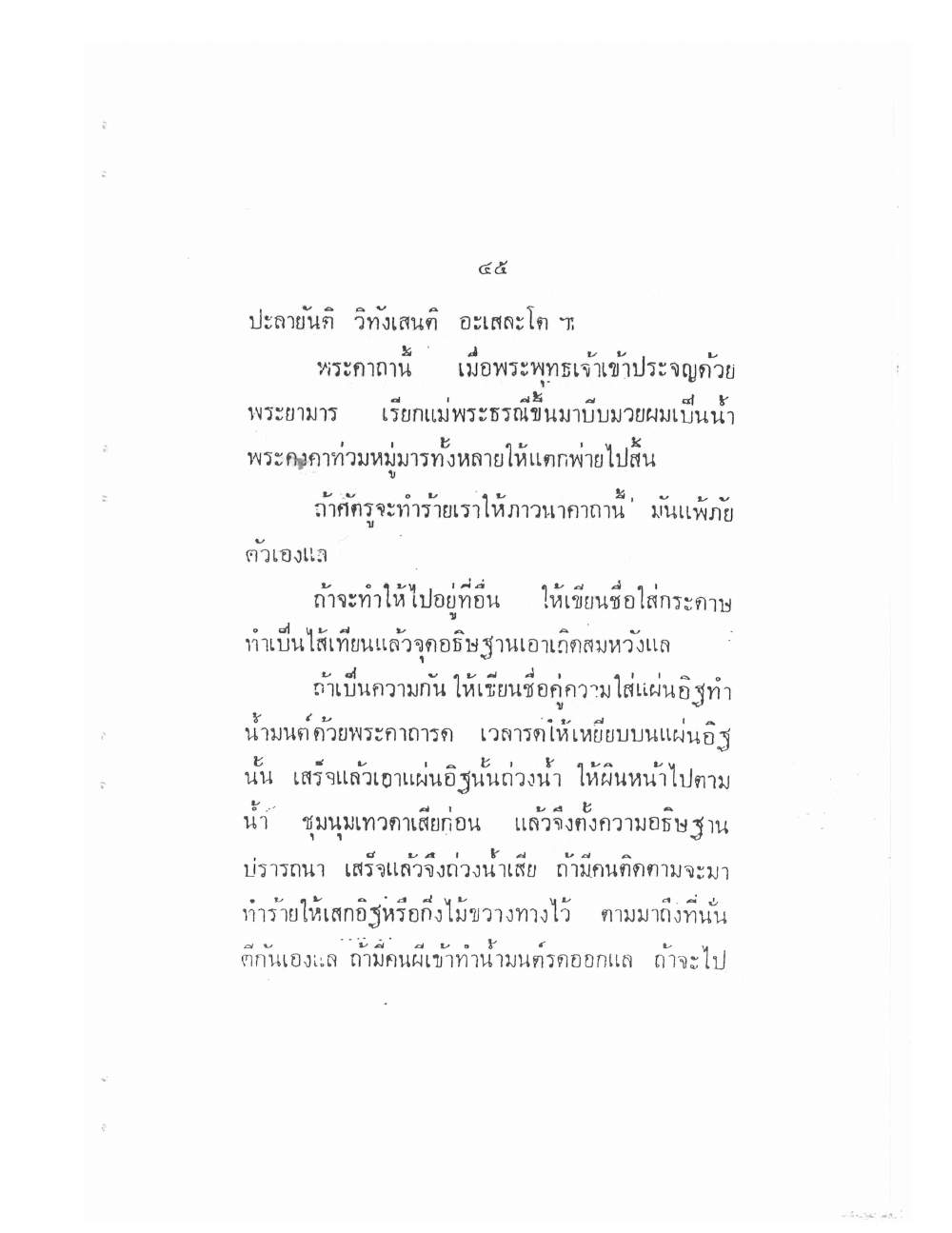
ปะลายันติ วิทังเสนติ อะเสสะโต ๚ะ พระคาถานี้ เมื่อพระพุทธเจ้าเข้าประจญด้วยพระยามาร เรียกแม่พระธรณีขึ้นมาบีบมวยผมเป็นน้ำพระคงคาท่วมหมู่มารทั้งหลายให้แตกพ่ายไปสิ้น ถ้าศัตรูจะทำร้ายเรา ให้ภาวนาคาถานี้ มันแพ้ภัยตัวเองแล ถ้าจะทำให้ไปอยู่ที่อื่น ให้เขียนชื่อใส่กระดาษทำเป็นไส้เทียน แล้วจุดอธิษฐานเอาเถิดสมหวังแล ถ้าเป็นความกัน ให้เขียนชื่อคู่ความใส่แผ่นอิฐทำน้ำมนต์ด้วยพระคาถารด เวลารดให้เหยียบบนแผ่นอิฐนั้น เสร็จแล้วเอาแผ่นอิฐนั้นถ่วงน้ำ ให้ผินหน้าไปตามน้ำ ชุมนุมเทวดาเสียก่อน แล้วจึงตั้งความอธิษฐานบ่รารถนา เสร็จแล้วจึงถ่วงน้ำเสีย ถ้ามีคนคิดตามจะมาทำร้ายให้เสกอิฐหรือกิ่งไม้ขวางทางไว้ ตามมาถึงที่นั้นตกลงเองแล ถ้ามีคนผีเข้าทำน้ำมนต์รดออกแล ถ้าจะไป
'...they flee, are destroyed, without remainder.' [end mark]
This incantation [recalls that] when the Buddha was assailed by Māra, he called Mother Earth to rise up and wring her hair-knot into a flood of water that swept away the whole host of Māra, defeating and scattering them completely.
If enemies mean to harm us, recite this incantation and they will be defeated by their own doing.
If you wish to drive someone away to live elsewhere, write their name on paper, form it into a candle-wick, then light it and make your wish — it will come true.
If it concerns a lawsuit [between two parties], write both litigants' names on a brick and make lustral water by reciting the incantation while sprinkling; while sprinkling, stand upon that brick. When done, take the brick and sink it in water, letting it face downstream; first assemble/invoke the deities, then set your petition and wish; when done, sink it in the water. If someone plots to come and harm you, chant over a brick or a branch and lay it across their path — when they reach that spot they will stumble and fall on their own. If someone is possessed by a spirit, use this consecrated lustral water, sprinkled, to drive it out. If you are about to travel...
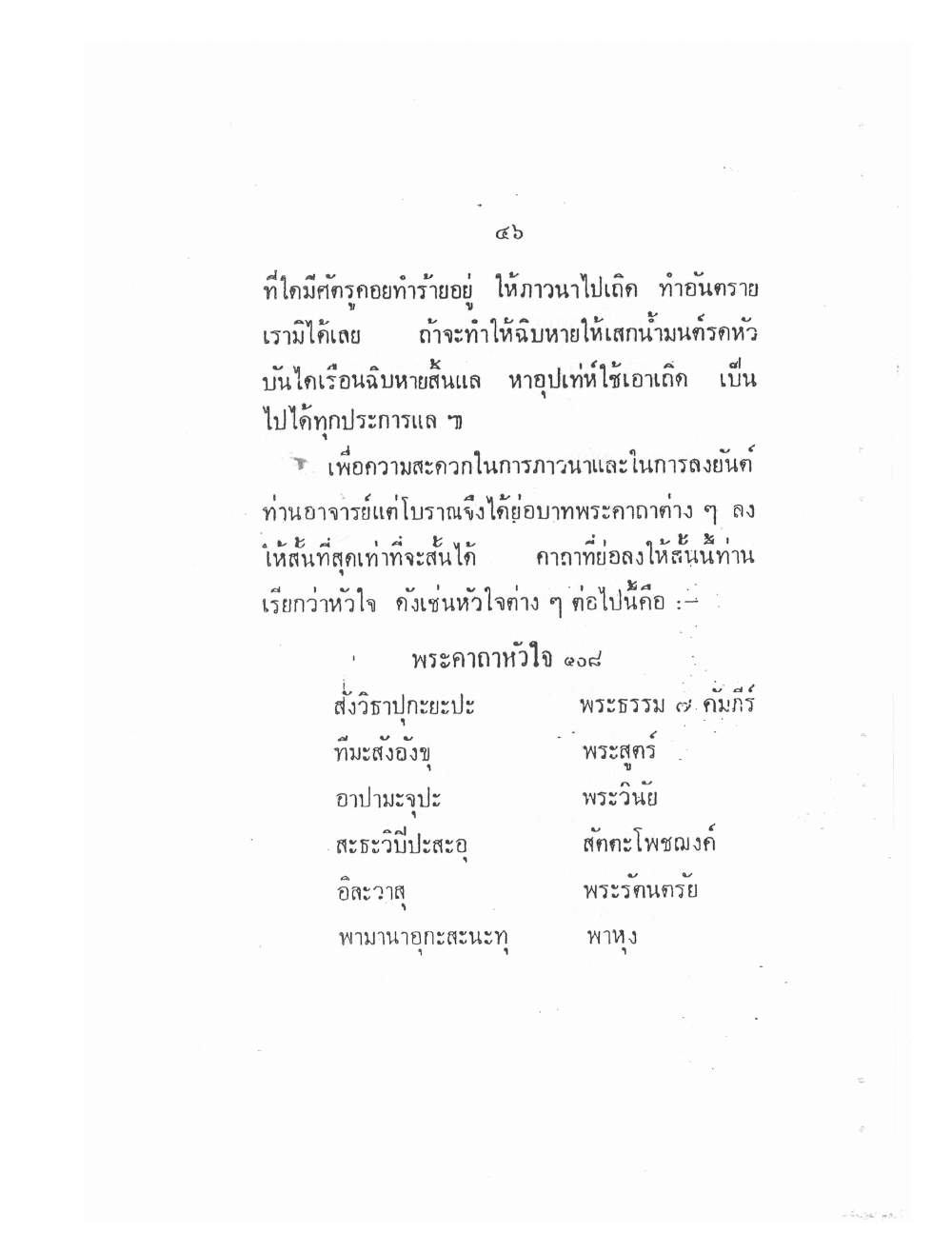
ที่ใดมีศัตรูคอยทำร้ายอยู่ ให้ภาวนาไปเถิด ทำอันตรายเรามิได้เลย ถ้าจะทำให้ฉิบหายให้เสกน้ำมนต์รดหัวบันไดเรือนฉิบหายสิ้นแล หาอุปเท่ห์ใช้เอาเถิด เป็นไปได้ทุกประการแล ๚ เพื่อความสะดวกในการภาวนาและในการลงยันต์ ท่านอาจารย์แต่โบราณจึงได้ย่อบทพระคาถาต่าง ๆ ลงให้สั้นที่สุดเท่าที่จะสั้นได้ คาถาที่ย่อลงให้สั้นนี้ท่านเรียกว่าหัวใจ ดังเช่นหัวใจต่าง ๆ ต่อไปนี้คือ:-
พระคาถาหัวใจ ๑๐๘ สังวิธาปุกะยะปะ พระธรรม ๗ คัมภีร์ ทีมะสังอังขุ พระสูตร อาปามะจุปะ พระวินัย สะธะวิปีปะสะอุ สัตตะโพชฌงค์ อิละวาสุ พระรัตนตรัย พามานาอุกะสะนะทุ พาหุง
Wherever an enemy lies in wait to harm us, recite the incantation as you go — they will be utterly unable to harm us. If you wish to bring ruin upon someone, chant over lustral water and sprinkle it on the top of the stairway leading to their house — their house will be entirely destroyed. Seek out and use this method — it can accomplish every purpose. [end mark]
For convenience in reciting and in inscribing yantras, the teachers of old condensed the various incantations down to the shortest form possible. These shortened incantations are called 'hearts' (hua jai) — such as the various 'hearts' that follow:
The 108 Heart-Formulas 'Saṃvidhāpukayapa' — the Seven Books of the Dhamma [Abhidhamma] 'Timasaṅgaṅkhu' — the Suttas 'Āpāmacupa' — the Vinaya 'Sadhavipipasa-u' — the Seven Factors of Enlightenment (Sattabojjhaṅga) 'Ilavāsu' — the Triple Gem 'Pāmānā-ukasanathu' — the Bāhuṃ [victory verses]
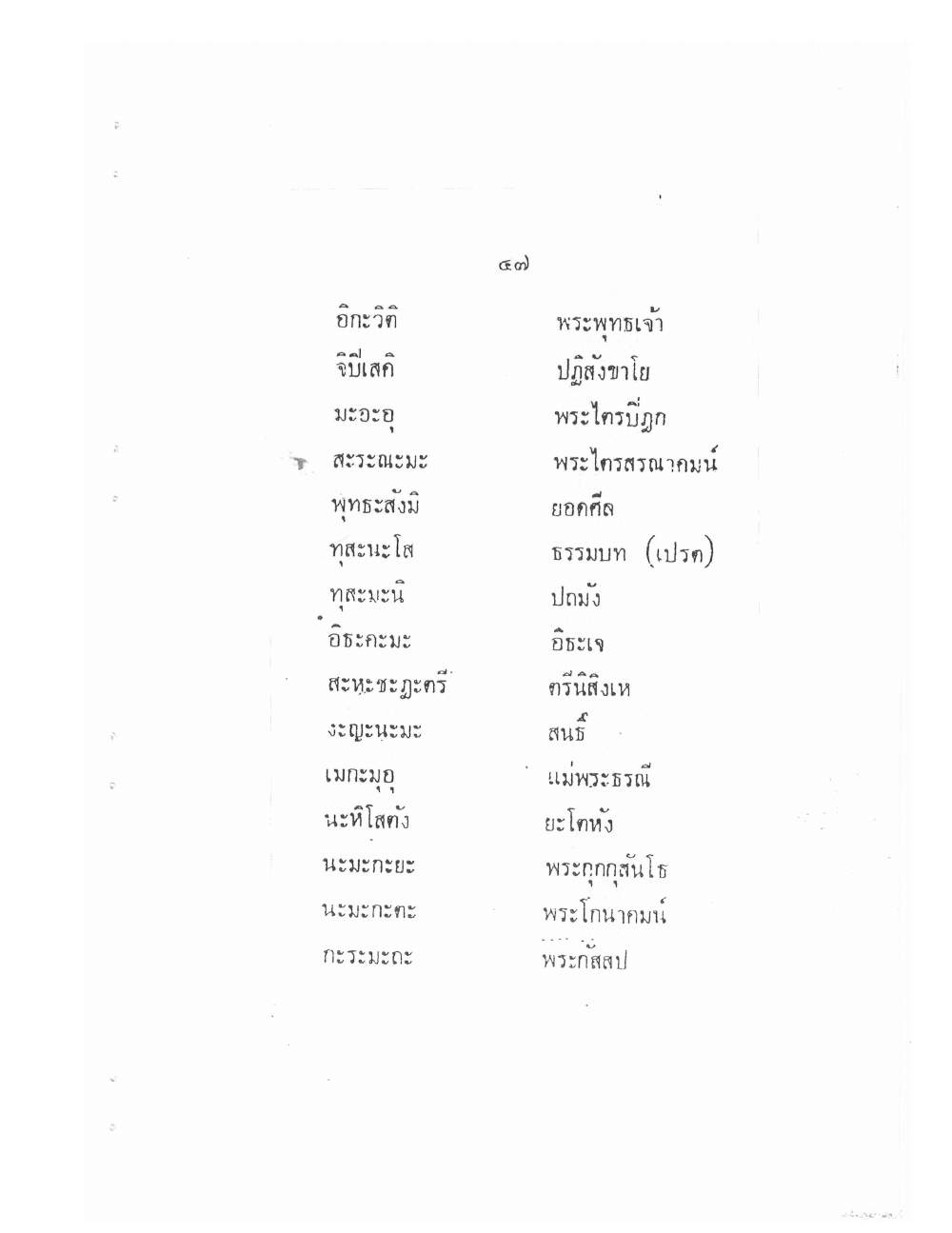
อิกะวิติ พระพุทธเจ้า จิบิเสติ ปฏิสังขาโย มะอะอุ พระไตรปิฎก สะระณะมะ พระไตรสรณาคมน์ พุทธะสังมิ ยอดศีล ทุสะนะโส ธรรมบท (เปรต) ทุสะมะนิ ปถมัง อิถะกะมะ อิถะเจ สะหะชะฏะตรี ตรีนิสิงเห งะญะนะมะ สนธิ์ เมกะมุอุ แม่พระธรณี นะหิโสคัง ยะโกหัง นะมะกะยะ พระกุกกุสันโธ นะมะกะตะ พระโกนาคมน์ กะระมะถะ พระกัสสป
[A vertical two-column table of 'heart'-formula mnemonics (left) and the full text or entity each stands for (right):] Ikawiti — the Buddha Jibiseti — Paṭisaṅkhāyo [the reflection-formula] Ma-a-u — the Tipiṭaka Saranama — the Threefold Refuge (Tisaraṇāgamana) Buddhasangmi — the summit of morality (Sīla) Tusanaso — the Dhammapada (Peta [verses]) Tusamani — Pathamaṃ [the first verse] Ithakama — Ithaje Sahachataṭri — the Three Lions [Trinisiṅgha] Ngayanama — Sandhi [the junction/connective formula] Mekamu-u — Mother Earth (Mae Phra Thoranī) Nahisokhang — Yakohang Namakaya — Phra Kakusandha [first Buddha of this aeon] Namakata — Phra Konāgamana [second Buddha of this aeon] Karamatha — Phra Kassapa [third Buddha of this aeon]
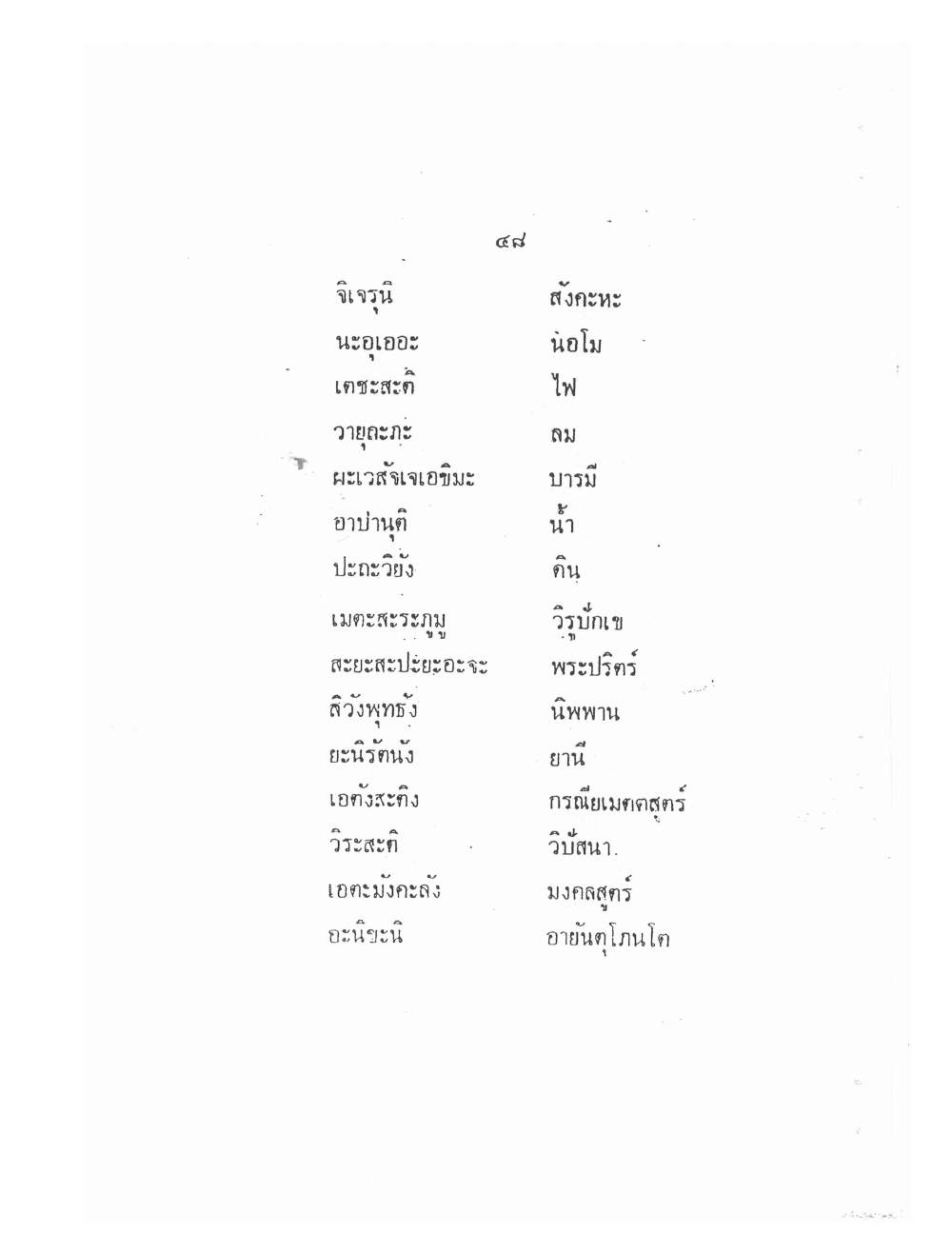
จิเจรุนิ สังคะหะ นะอุเออะ นะโม เตชะสะติ ไฟ วายุถะภะ ลม ผะเวสัจเจเอขิมะ บารมี อาปานุติ น้ำ ปะถะวิยัง ดิน เมตะสะระภูม วิรูปักเข สะยะสะปะยะอะจะ พระปริตร ลิวังพุทธัง นิพพาน ยะนิรัตนัง ยานี เอตังสะติง กรุณิยเมตตสูตร วิระสะติ วิปัสสนา เอตะมังคะลัง มงคลสูตร อะนิจะนิ อายันตุโภนโต
[Continuing the table of 'heart'-mnemonics and what they stand for:] Chicharuni — the Compendium (Saṅgaha) Na-u-e-a — Namo Techasati — Fire Vayuthapha — Wind Phawesajje-ekhima — the Perfections (Pāramī) Apanuti — Water Pathawiyang — Earth Metasaraphum — Virūpakkha [one of the Four Great [Guardian] Kings] Sayasapayaacha — the Paritta [protective chants] Liwang-Buddhang — Nibbāna Yaniratanang — Yani Etangsating — the Karaṇīyamettā Sutta Wirasati — Vipassanā [insight meditation] Etamangkalang — the Maṅgala Sutta Anichani — 'Āyantu bhonto' [the opening invocation]
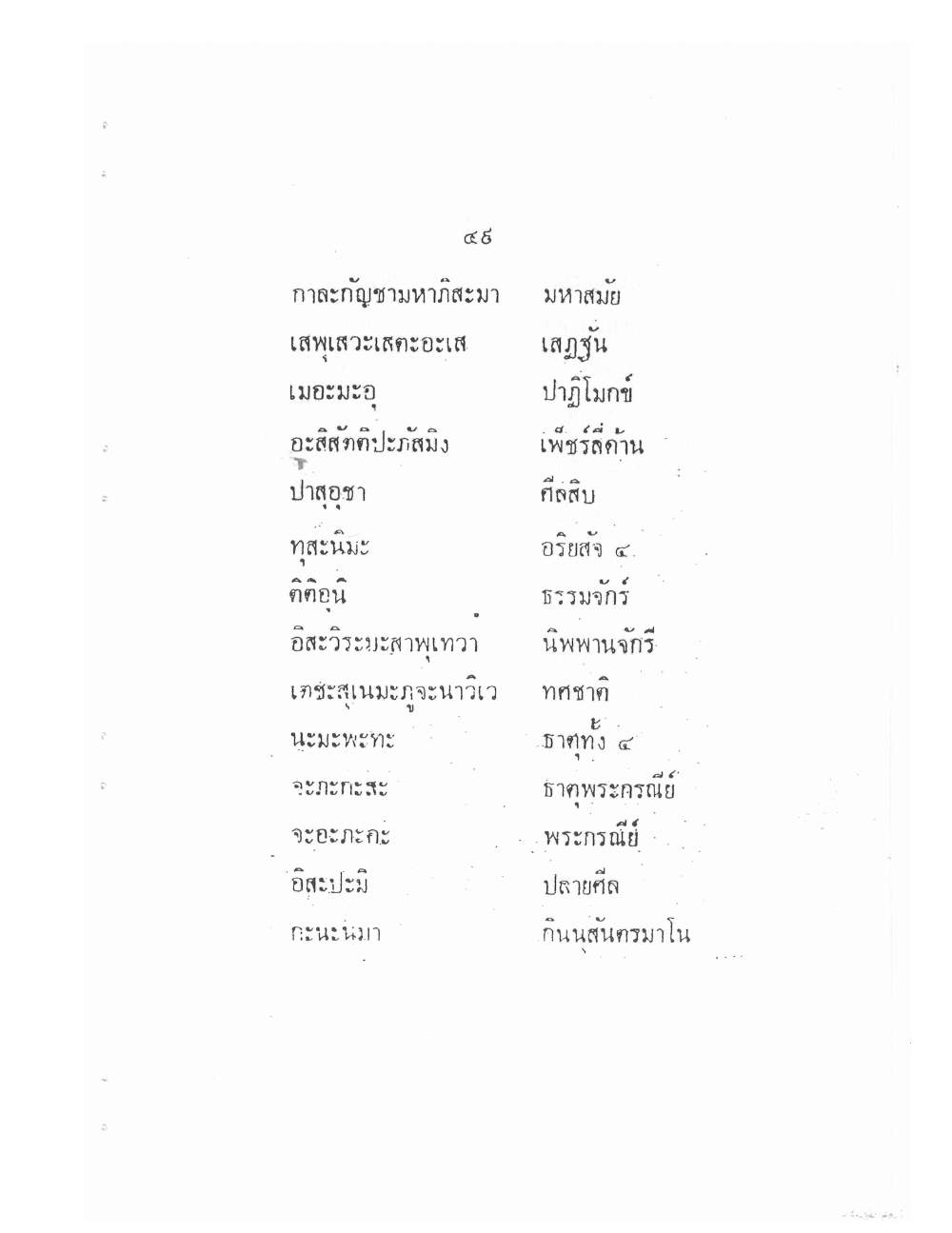
กาละกัญชามหาภิสะมา มหาสมัย เสพุเสวะเสตะอะเส เสฏฐัน เมอะมะอุ ปาฏิโมกข์ อะสิสัทติปะภัสมิง เพชรสีด้าน ปาสุอุชา ศีลสิบ ทุสะนิมะ อริยสัจ ๔ ติติอุนิ ธรรมจักร์ อิสะวิระมะสาพุเทวา นิพพานจักรี เภชะสุเนมะภูจะนาวิเว ทศชาติ นะมะพะทะ ธาตุทั้ง ๔ จะภะกะสะ ธาตุพระกรณีย์ จะอะภะกะ พระกรณีย์ อิสะปะมิ ปลายศีล กะนะนมา กินนุสันตมาโน
[Continuing the mnemonic table:] Kalakanchamahaphisama — the Great Assembly (Mahāsamaya [Sutta]) Sephusewasetaase — the Foremost [Setthan] Mo-amaou — the Pāṭimokkha Asisattipaphasming — [gloss: something like 'the unfading diamond' — the precise sense of this compound term is unclear] Pasu-ucha — the Ten Precepts Tusanima — the Four Noble Truths Titiuni — the Wheel of the Dhamma Isawiramasaphutewa — the Wheel of Nibbāna Phechasunemaphuchanawiwe — the Ten [Birth] Jātaka tales Namaphatha — the Four Elements Chaphakasa — the Elements of the Buddha's Compassionate Works Chaaphaka — [His] Compassionate Works Isapami — the Culmination of Morality (Sīla) Kananama — 'Kiṃ nu santaṃ mano' [an opening verse-phrase]
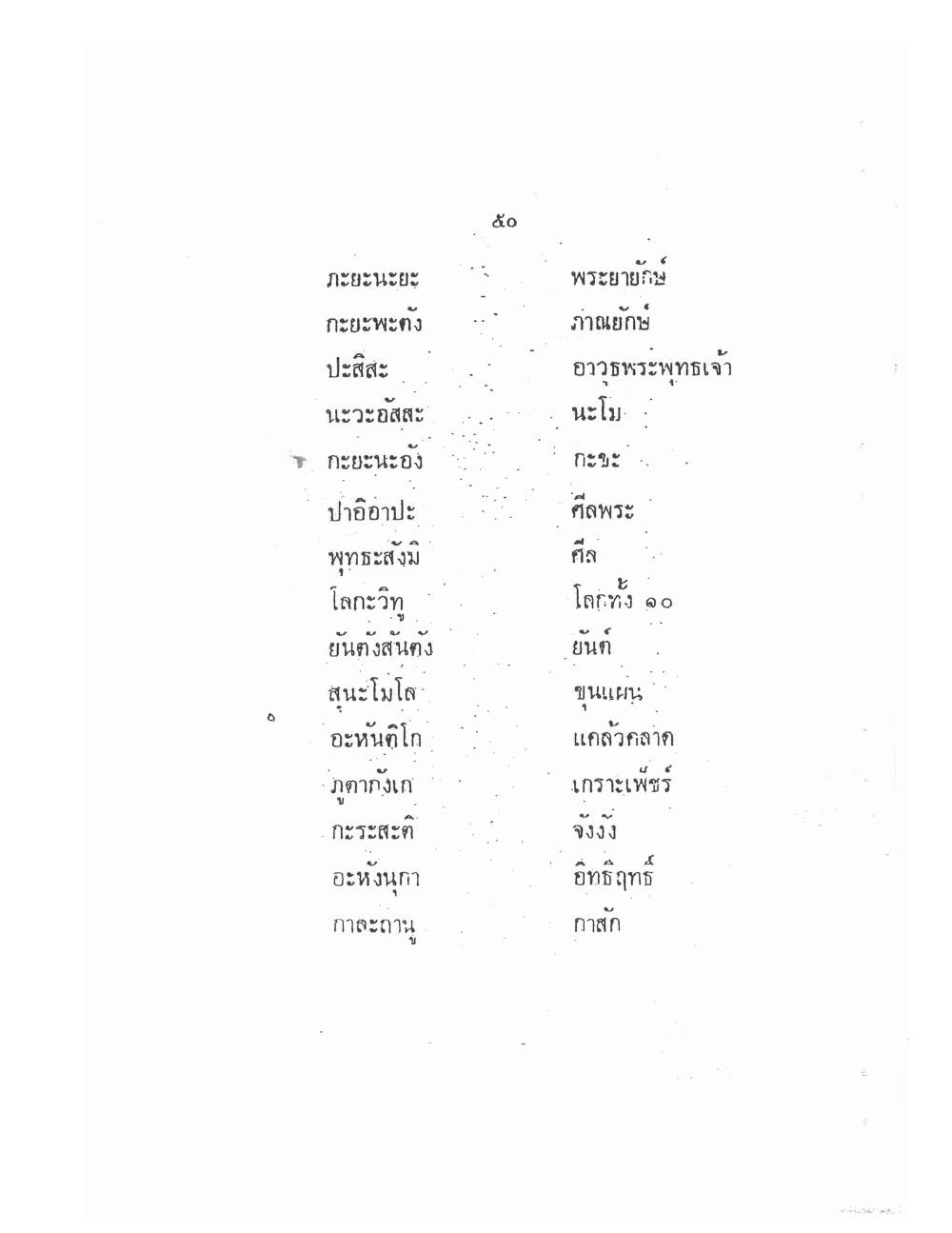
ภะยะนะยะ พระยายักษ์ กะยะพะดัง ภาณยักษ์ ปะสิสะ อาวุธพระพุทธเจ้า นะวะอัสสะ นะโม กะยะนะอัง กะขะ ปาอิอาปะ ศีลพระ พุทธะสังมิ ศีล โลกะวิทู โลกทั้ง ๑๐ ยันตังสันตัง ยันต์ สุนะโมโล ขุนแผน อะหันติโก แกล้วกลาด ภูตากังเก เกราะเพชร กะระสะติ จังงัง อะหังนุกา อิทธิฤทธิ์ กาละถานุ กาสัก
[Continuing the mnemonic table:] Phayanaya — the Yaksha King Kayaphadang — Yaksha-utterance Pasisa — the Buddha's weapon Nawaassa — Namo Kayanaang — Kakha [uncertain gloss] Pa-i-apa — the Precepts of the Lord Buddhasangmi — morality (Sīla) Lokawithu — all Ten Worlds Yantangsantang — Yantra Sunamolo — Khun Phaen [the legendary invulnerable hero] Ahantiko — valiant and unafraid Phutakangke — the Diamond Armor Karasati — the paralysis-charm (chang-ngang) Ahangnuka — supernatural power (iddhirit) Kalathanu — Kasak [a proper name, referent unclear]
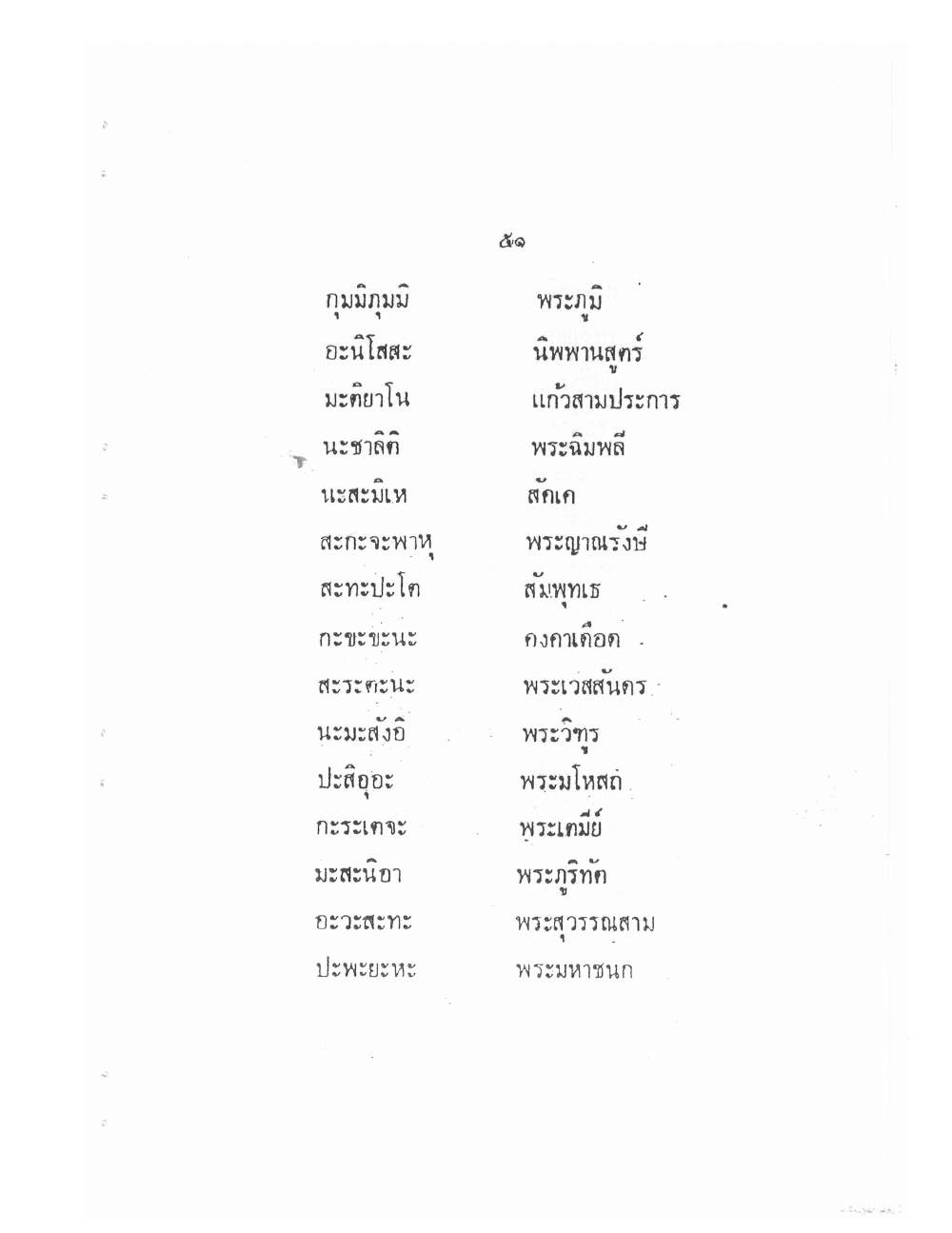
กุมมิภุมมิ พระภูมิ อะนิโสสะ นิพพานสูตร มะติยาโน แก้วสามประการ นะชาลิติ พระฉิมพลี นะสะมิเห สักเค สะกะจะพาหุ พระญาณรังษี สะทะปะโค สัมพุทเธ กะชะขะนะ คงคาเดือด สะระตะนะ พระเวสสันดร นะมะสังอิ พระวิทูร ปะสิอุอะ พระมโหสถ กะระเตจะ พระเตมีย์ มะสะนิอา พระภูริทัต อะวะสะทะ พระสุวรรณสาม ปะพะยะหะ พระมหาชนก
[Continuing the mnemonic table:] Kummiphummi — the Guardian Spirit of the Land (Phra Phum) Anisosa — the Nibbāna Sutta Matiyano — the Three Gems Nachaliti — Phra Chimphli Nasamihe — Sakke [Sakka/Indra] Sakachaphahu — Phra Yanarangsi Sathapako — Sambuddhe [a victory verse] Kachakhana — the Boiling Ganges Sarattana — the Vessantara Jātaka Namasang-i — the Vidhura Jātaka Pasi-u-a — the Mahosadha Jātaka Karateja — the Temiya Jātaka Masania — the Bhuridatta Jātaka Awasatha — the Suvaṇṇasāma Jātaka Paphayaha — the Mahājanaka Jātaka
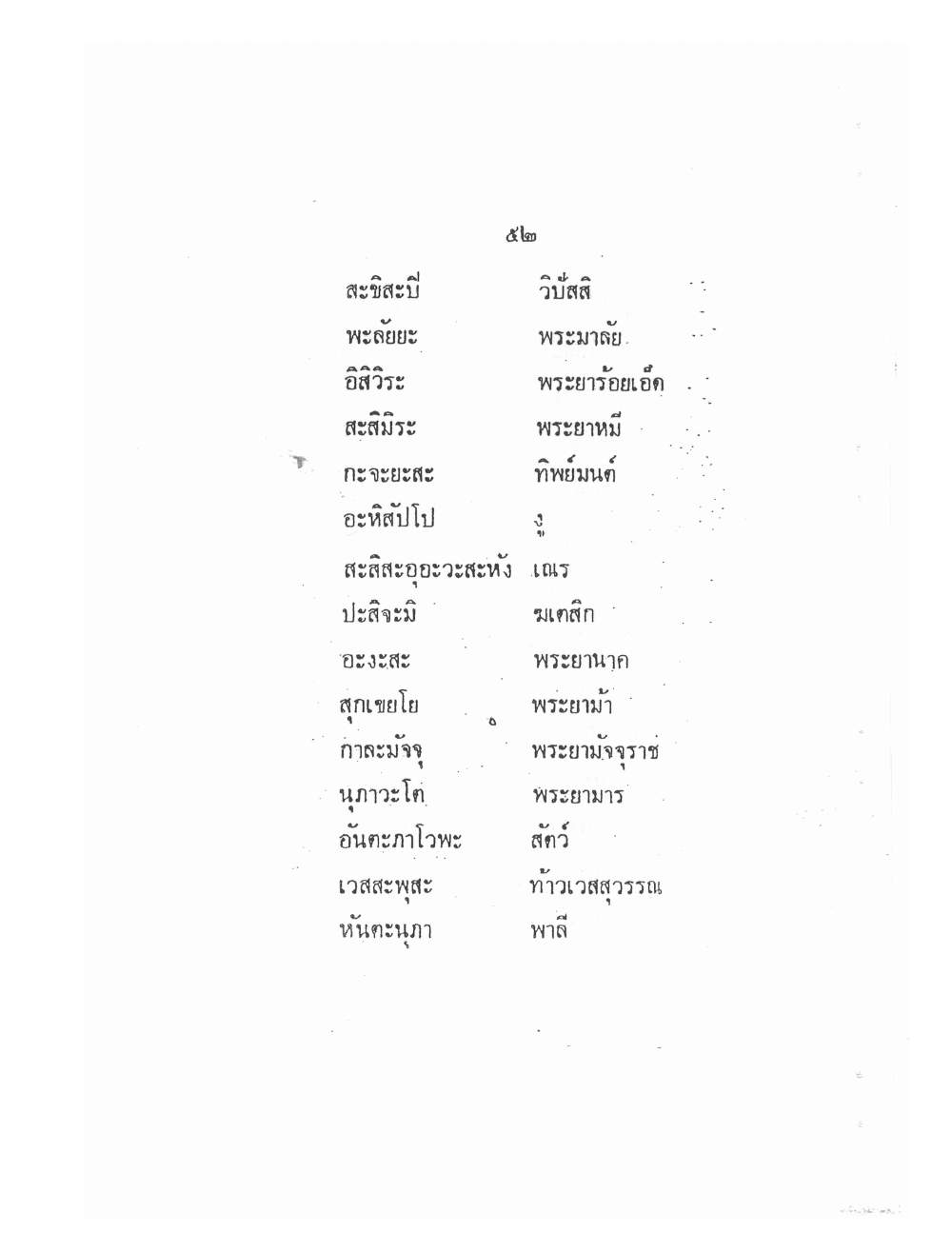
สะชิสะบี วิปัสสิ พะลัยยะ พระมาลัย อิสิวิระ พระยาร้อยเอ็ด สะสิมิระ พระยาหมี กะจะยะสะ ทิพย์มนต์ อะหิสัปโป งู สะสิสะอุอะวะสะหัง เณร ปะสิจะมิ ฆเตสิก อะงะสะ พระยานาค สุกเขยโย พระยาม้า กาละมัจจุ พระยามัจจุราช นุภาวะโค พระยามาร อันตะภาโวพะ สัตว์ เวสสะพุสะ ท้าวเวสสุวรรณ หันตะนุภา พาลี
[Continuing and concluding the mnemonic table:] Sachisabi — Vipassī [a past Buddha] Phalaiya — Phra Malai [the monk-traveler of hell and heaven] Isiwira — the Lord of the Hundred-and-One [referent unclear] Sasimira — the Bear-King Kachayasa — the Divine Mantra Ahisappo — the Snake Sasisaawasahang — the Novice Monk Pasichami — [gloss unclear] Angasa — the Nāga King Sukkheiyo — the Horse King Kalamatchu — the Lord of Death (Phraya Matchurat) Nuphawako — Lord Māra Antaphapopha — Beings (Sattva) Wessaphusa — Lord Wetsuwan [King of the Yakshas] Hantanupha — Bali [the monkey king]
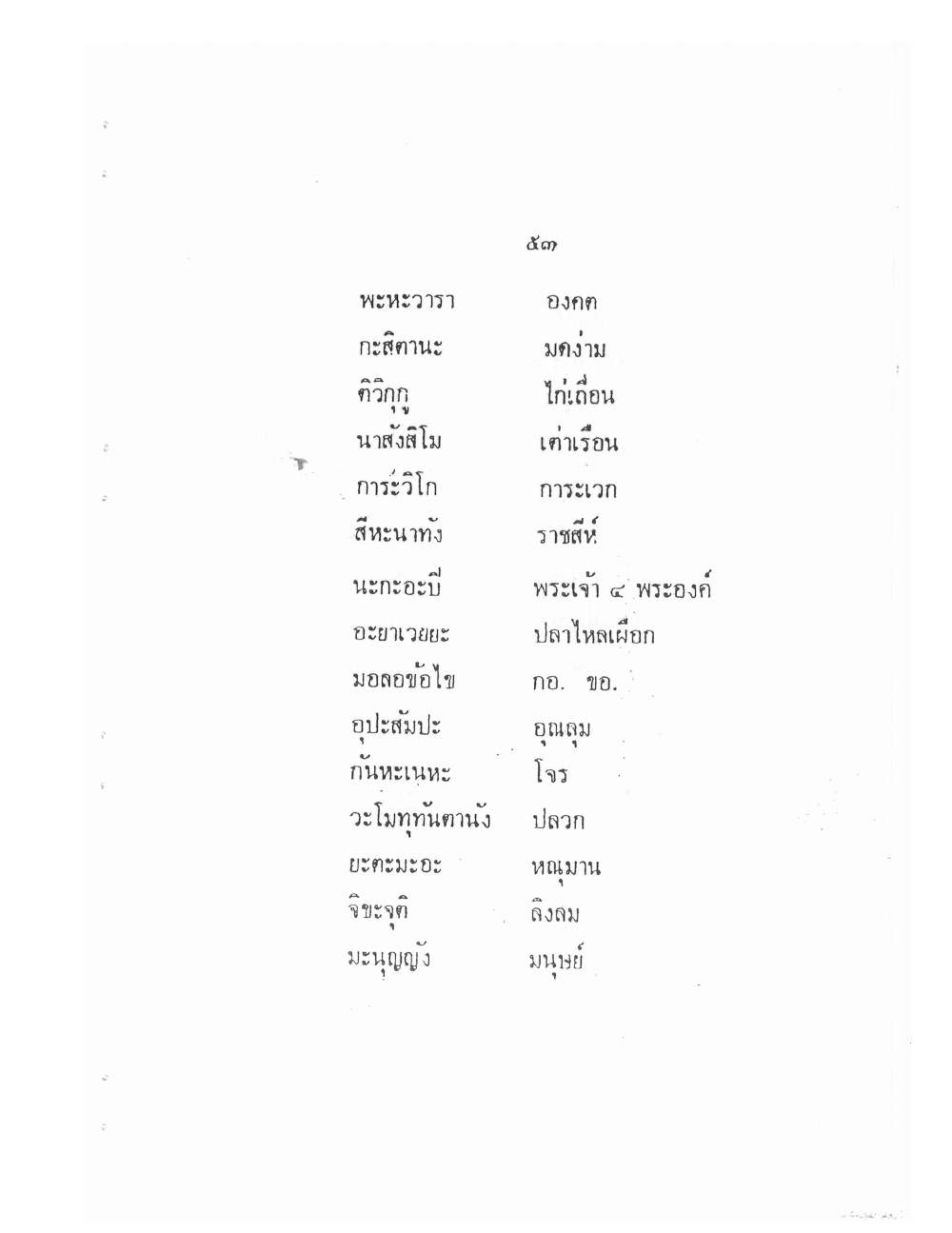
๕๓
พะหะวารา องคต กะสิตานะ มดง่าม ติวิกู ไก่เถื่อน นาสังสิโม เต่าเรือน การะวิโก การะเวก สีหนาทัง ราชสีห์ นะกะอะบี่ พระเจ้า ๔ พระองค์ อะยาเวยยะ ปลาไหลเผือก มอลอข้อไข กอ. ขอ. อุปะสัมปะ อุณลุม กันหะเนหะ โจร วะโมทุทันตานัง ปลวก ยะตะมะอะ หนุมาน จิชะจุติ ลิงลม มะนุญญัง มนุษย์
[p. 53]
[A continuing list pairing coded "heart" syllables with the plain being or thing each stands for:] phahawara — Ongkhot [Ongkhot, a monkey commander of the Ramakien] kasitana — black ant tiwiku — jungle fowl na sang simo — tortoise karawiko — the karavika bird sihanathang — lion naka-abi — the Four Lords [four Buddhas/sovereigns] ayaweyya — white/albino eel mo lo kho khai — the letters กอ (ko) and ขอ (kho) upasampa — un-lum [term of uncertain referent, transcribed as printed] kanhaneha — a thief wamothuthantang — a termite yatamaa — Hanuman chichachuti — flying lemur (colugo) manuññang — a human being
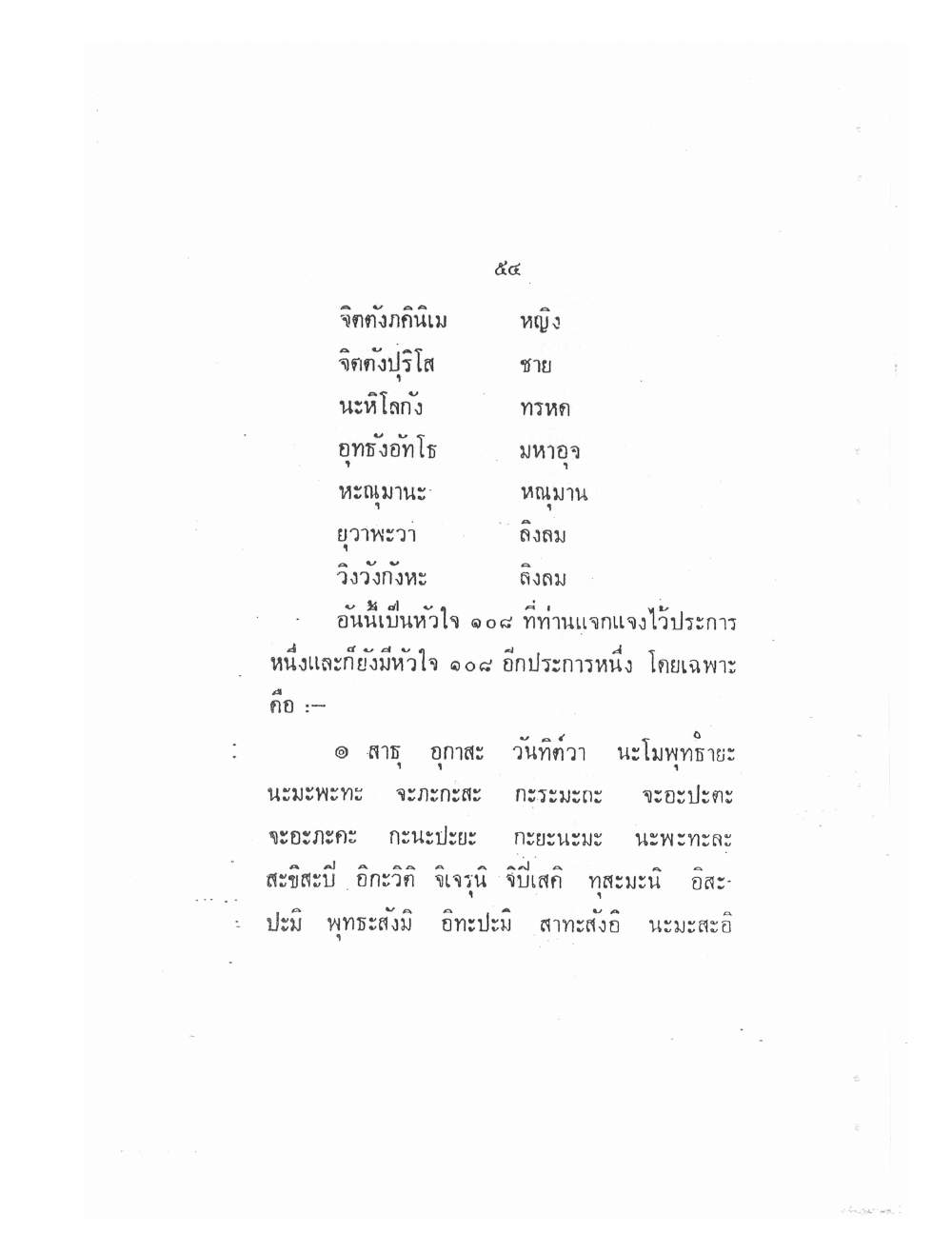
๕๔
จิตตังภคินิเม หญิง จิตตังปุริโส ชาย นะหิโลกัง ทรหด อุทธังอัทโธ มหาอุจ หะณุมานะ หนุมาน ยุวาพะวา ลิงลม วิงวังกังหะ ลิงลม
อันนี้เป็นหัวใจ ๑๐๘ ที่ท่านแจกแจงไว้ประการ หนึ่ง และก็ยังมีหัวใจ ๑๐๘ อีกประการหนึ่ง โดยเฉพาะ คือ:-
◎ สาธุ อุกาสะ วันทิสวา นะโมพุทธายะ นะมะพะทะ จะภะกะสะ กะระมะถะ จะอะปะตะ จะอะภะคะ กะนะปะยะ กะยะนมะ นะพะทะละ สะขิสะบี่ อิกะวิคิ จิเจรุนิ จิบิเสคิ ทุสะมะนิ อิสะ- ปะมิ พุทธะสังมิ อิทะปะมิ สาทะสังอิ นะมะสะอิ
[p. 54]
chittang phakhinime — woman chittang puriso — man na hi lokang — hardy/tough [uncertain] uthang atho — [term of uncertain referent, transcribed as printed] hanumana — Hanuman yuwaphawa — flying lemur (colugo) wingwangkangha — flying lemur (colugo)
This is one of the 108 "hearts" that the masters have set out and classified; and there is a further, separate set of 108 hearts as well, specifically as follows:—
[A recitation opening with a homage formula — "Sādhu, ukāsa: having paid reverence, Namo Buddhāya" — followed by strings of coded mantra syllables carrying no independent semantic meaning, phonetically:] Sādhu ukāsa vandissavā namo Buddhāya, namaphatha chaphakasa karamatha cha-apata cha-aphakha kanapaya kayanama naphathala sakhisapi ikawiki chicheruni chipiseki thusamani isapami phutthasangmi ithapami sāthasang-i namasa-i — [continues on the next page]
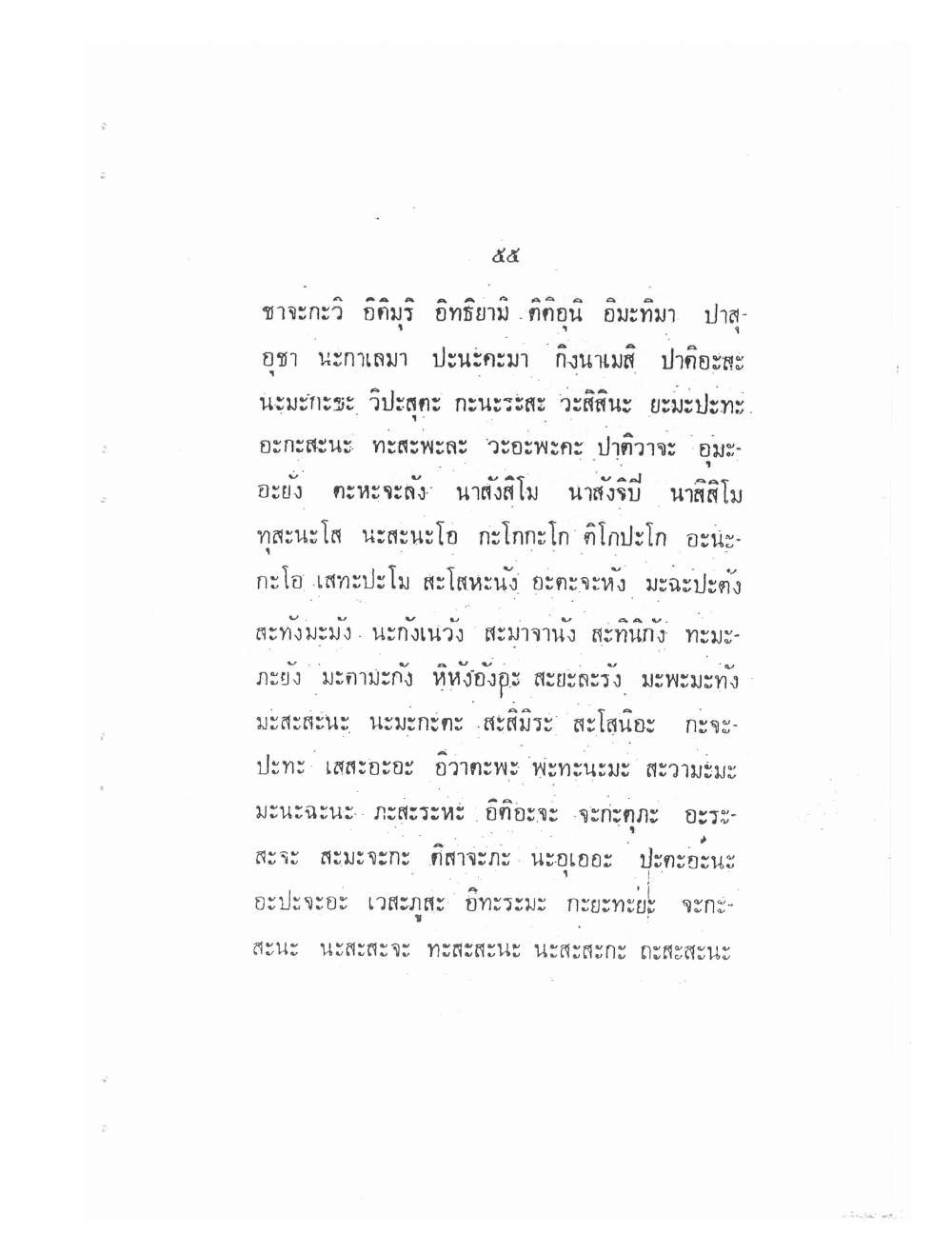
๕๕
ชาจะกะวิ อิคิมุริ อิทธิยามิ ติคิอุนิ อิมะทิมา ปาสุ- อุชา นะกาเลมา ปะนะคะมา กิงนาเมสิ ปาคิอะสะ นะมะกะชะ วิปะสุคะ กะนะระสะ วะสิสินะ ยะมะปะทะ อะกะสะนะ ทะสะพะละ วะอะพะคะ ปาติวาจะ อุมะ- อะยัง คะหะจะลัง นาสังสิโม นาสังจิบี นาสิสิโม ทุสะนะโส นะสะนะโอ กะโกกะโก คิโกปะโก อะนะ- กะโอ เสทะปะโม สะโสหนัง อะคะจะหัง มะฉะปะตัง สะทังมะมัง นะกังเนวัง สะมาจานัง สะทินภัง ทะมะ- ภะยัง มะคามะกัง หิหังอังอุะ สะยะละรัง มะพะมะทัง มะสะสะนะ นะมะกะตะ สะสิมิระ สะโสนิอะ กะจะ- ปะทะ เสสะอะอะ อิวาตะพะ พะทะนะมะ สะวามะมะ มะนะฉะนะ ภะสะระหะ อิติอะจะ จะกะคุภะ อะระ- สะจะ สะมะจะกะ คิสาจะภะ นะอุเออะ ปะคะอะนะ อะปะจะอะ เวสะภูสะ อิทะระมะ กะยะทะยะ จะกะ- สะนะ นะสะสะจะ ทะสะสะนะ นะสะสะกะ ถะสะสะนะ
[p. 55 — continuation of the mantra syllable-string from the previous page, without any separate gloss on the page; given here as a phonetic transliteration of the printed Thai:] Chachakawi ikimuri itthiyami tikiuni imathima pasu-ucha nakalema panakhama kingnamesi pakhiasa namakacha wipasukha kanarasa wasisina yamapatha akasana thasaphala waaphakha patiwacha uma-ayang khahachalang nasangsimo nasangchipi nasisimo thusanaso nasanao kakokako khikopako ana-kao sethapamo sasohnang akhachahang machapatang sathangmamang nakangnewang samachanang sathinphang thama-phayang makhamakang hihangang-ua sayalarang maphamathang masasana namakata sasimira sasonia kacha-patha sesaa-a iwatapha phathanama sawamama mana-chana phasaraha itiacha chakakhupha ara-sacha samachaka khisachapha na-ueua pakhaana apacha-a wesaphusa itharama kayathaya chaka-sana nasasacha thasasana nasasaka thasasana — [continues on the next page]
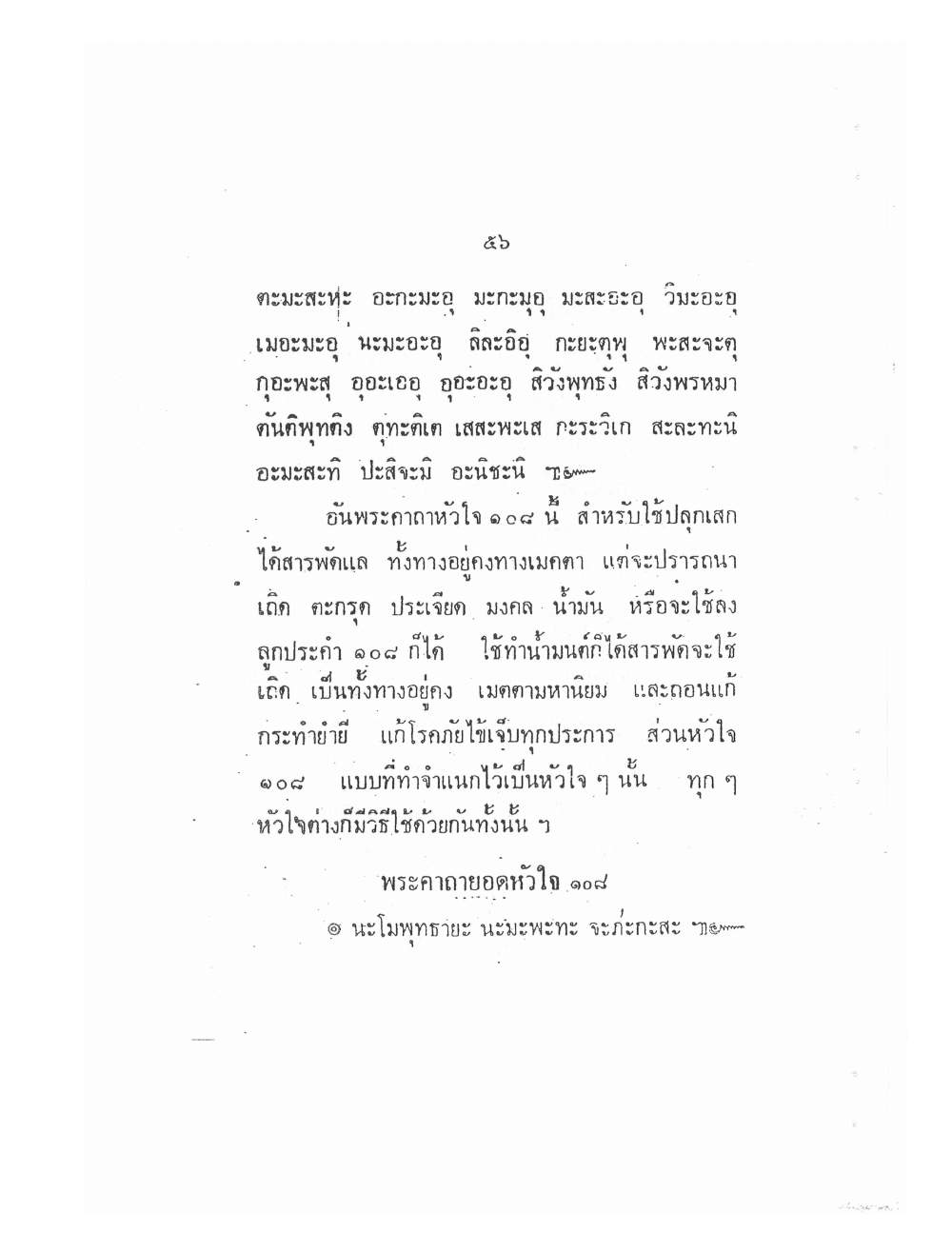
๕๖
ตะมะสะหุะ อะกะมะอุ มะกะมุอุ มะสะอะอุ วิมะอะอุ เมอะมะอุ นะมะอะอุ ลิละอิอุ กะยะกุพุ พะสะจะตุ กุอะพะสุ อุอะเออุ อุอะอะอุ สิวังพุทธัง สิวังพรหมา ศันติพุทติง ตุทะติเต เสสะพะเส กะระวิเก สะละทะนิ อะมะสะทิ ปะสิจะมิ อะนิชะนิ ๚ะ๛
อันพระคาถาหัวใจ ๑๐๘ นี้ สำหรับใช้ปลุกเสก ได้สารพัดแล ทั้งทางอยู่คงทางเมตตา แต่จะปรารถนา เถิด ตะกรุด ประเจียด มงคล น้ำมัน หรือจะใช้ลง ลูกประคำ ๑๐๘ ก็ได้ ใช้ทำน้ำมนต์ก็ได้สารพัดจะใช้ เถิด เป็นทั้งทางอยู่คง เมตตามหานิยม และถอนแก้ กระทำย่ำยี แก้โรคภัยไข้เจ็บทุกประการ ส่วนหัวใจ ๑๐๘ แบบที่ทำจำแนกไว้เป็นหัวใจ ๆ นั้น ทุก ๆ หัวใจต่างก็มีวิธีใช้ด้วยกันทั้งนั้น ฯ
พระคาถายอดหัวใจ ๑๐๘
◎ นะโมพุทธายะ นะมะพะทะ จะภะกะสะ ๚ะ๛
[p. 56]
[Continuation and close of the mantra syllables begun on the previous page, phonetically:] Tamasahu akamau makamu-u masaa-u wimaa-u mea-amau namaau lilaiu kayakuphu phasachatu kuaphasu ua-eu ua-au — Sivang Buddhang, Sivang Brahma, Santi Phutting, Tuthatite, Sesaphase, Karawike, Salathani, Amasathi, Pasichami, Anichani.
As for this 108-syllable heart-formula: it can be used to consecrate absolutely anything — whether for the invulnerability line or the loving-kindness (mettā) line — whatever one desires: a takrut amulet, a cloth talisman, an auspicious charm, or oil; or it may be recited over a 108-bead rosary; it can be used to make holy water; it serves every purpose — invulnerability, loving-kindness and popularity (mettā-mahaniyom), and undoing and countering harmful workings done against one, and curing every kind of sickness and affliction. As for the "108" that has been organized and classified into these separate individual "hearts," every single heart-formula has its own method of use.
The Katha that is the Crown of the 108 Hearts
Namo Buddhāya, namaphatha, chaphakasa.
๕๗
พระคาถานี้เป็นหัวใจของหัวใจ ๑๐๘ อีกทีหนึ่ง ไม่ว่าจะใช้พระคาถาบทใด ก็ยิ่งจำเป็น ต้องเอาพระ คาถาบทนี้แทรกด้วยทั้งสิ้น สุดแต่จะกล่าวอุปเท่ห์วิธีใช้ ได้มากมายสุดจะพรรณนา สารพัดจะใช้เถิด จะปลุก เสกหรือจะกระทำการใด ๆ ก็ดี ทั้งทางอยู่คง ทาง เมตตา ใช้ได้ทั้งนั้น ท่านเปรียบเหมือนยาดำที่เข้าแทรก ยาทุกขนาน ฉะนั้นเมื่อจะใช้คาถาบทใด ๆ จะเป็นใน ทางใดก็ตาม ให้เอายอดพระคาถานี้กำกับไปด้วยเสมอ ไป จะเกิดความขลังเหมือนใจนึกแล ฯ
พระคาถายอดศีล
◎ พุทธะสังมิ ๚ะ๛ พระคาถายอดศีลนี้ ท่านวางอุปเท่ห์วิธีใช้ไว้มาก มาย เป็นไปได้รอบด้าน เป็นยอดพระคาถาทางเมตตา ทางอยู่คงก็ใช้ได้ ตลอดจนจะใช้เป็นล่องหนกำบังก็ได้ ท่านเรียกว่าฝอยท่วมหลังช้างแล ฯ
[p. 57]
This formula is, once again, "the heart of the [108] hearts." Whatever katha one is using, it becomes all the more necessary to insert this formula into it as well. There is no end to the many methods for its use — it can be used for anything at all: to consecrate, or to carry out any working whatsoever, whether for the invulnerability line or the loving-kindness line, it serves in either case. The masters compare it to the black purgative resin blended into every kind of medicine. Therefore, whichever katha one uses, in whatever line of working, one should always add this crowning formula in together with it, and potency will arise just as intended.
The Katha that is the Crown of Virtue (Sīla)
Buddhasangmi. For this crown-of-virtue katha, the masters have set out very many methods of use, applicable on every side. It is the crown formula for the loving-kindness line, and it serves the invulnerability line as well; it can even be used to vanish from sight and conceal oneself. The masters call it 'chaff enough to bury an elephant's back.'
๕๘
พระคาถาหัวใจพระยาเต่าเรือน
◎ นาสังสิโม ๚ะ๛
สิทธิการิยะ พระอาจารย์ท่านกล่าวไว้ว่า ถ้า หากผู้ใดได้พบหัวใจ พระยาเต่าเรือน มีอยู่ ๔ ตัวแลท่าน ให้ทดลองดู ให้ภาวนาจับตัวเด็ก ถ้าเด็กไม่โกรธ เป็น หัวใจพระยาเต่าเรือนแล ถ้าจะทำสตรีภาพให้รัก ให้ เขียนชื่อเขาใส่ลงในผ้ามือ แล้วให้เขียนเลข ๗ ลงทับ ชื่อ จึงเอาน้ำมันหอมใส่ลงในมือแล้วเสกให้ได้ ๗ คาบ เอาน้ำมันหอมทาตัวไปให้เขาแลเห็นหน้า รักเรานักแล สำเร็จสมความปรารถนาตามเรามาแล
ถ้าจะทำให้เป็นกำบังหายตัว ให้ออกไปนั่งกลาง แดด แล้วให้ภาวนาสำรวมอินทรีย์ให้ตรงบริกรรมไป กว่าเงาจะหาย แล้วให้เดินไปเถิดคนมิเห็นตัวเราเลย พระคาถานี้ให้ภาวนาไว้ แม้ศัตรูจะล้อมเรา
[p. 58]
The Katha for the Heart of the Great Tortoise
Nāsangsimo.
May it succeed. The teacher-masters have said: if anyone comes upon the "heart of the Great Tortoise" — of which there are four kinds — one is to test it thus: recite it and take hold of a child; if the child does not become upset, that confirms it as the heart of the Great Tortoise. If one wishes to make a woman love one, write her name onto the palm of the hand, then write the numeral 7 over the name, then put fragrant oil into the hand and consecrate it, [reciting] seven times; rub the fragrant oil on the body and go where she can see one's face — she will love one deeply, and the wish will be fulfilled, and she will come after one.
If one wishes to conceal and vanish one's body, go out and sit in the open sun, then recite while restraining the senses, keeping the recitation steady until the shadow disappears; then walk out and no one at all will be able to see one's body. This katha is to be recited even while enemies surround one—
๕๙
จังงังไปสิ้น พระคาถานี้ใช้เป็นมหาแคล้วคลาดวิเศษ นักแล ฯ
ถ้าจะประจญด้วยศัตรูหรือคู่ความ ให้นั่งเหนือ ลมบริกรรมเบ่าไปเถิด ศัตรูงวยงงเลอะเลือนไปสิ้น ภาวนาพ่นควันบุหรี่ก็ได้
ถ้าเขาหาความแก่เรา ให้เขียนชื่อเขาใส่หัวแม่ เท้า แล้วเอาหัวแม่เท้ากดดิน บริกรรมพระคาถาพระยา เต่าเรือน เพ่งดูก้อนเมฆ อันเกลื่อนกลุ้มใน อากาศ บริกรรมจนเมฆกระจายสูญสิ้นหายไป ความที่หานั้นก็ สูญหายไปสิ้นแล ฯ
อุปเท่ห์คาถาหัวใจพระยาเต่าเรือนนี้ใช้ได้ทุกประ- การ ภาวนาให้งวยงงหลงใหลดีนักแล เขียนใส่อาสน์ สงฆ์แล้วบริกรรมไป พระสวดมนต์จับต้นชนปลายมิถูก แล ฯ
[p. 59]
...becomes entirely still and dazed. This katha serves as a supreme, wondrous charm against harm.
If one must confront an enemy or an opposing party in a lawsuit, sit upwind and murmur the recitation softly; the enemy becomes dazed and utterly confused, muddled. One may also recite it while blowing out cigarette smoke.
If someone brings a legal case against one, write his name on the ball of one's big toe, then press the big toe into the earth and recite the Katha of the Great Tortoise, gazing at a mass of cloud scattered and massed in the sky; keep reciting until the cloud disperses and vanishes entirely — the case being brought against one will likewise vanish and come to nothing.
The method of this heart-formula of the Great Tortoise can be used for every purpose. Reciting it causes [an opponent] to become thoroughly dazed and confused. Write it onto a monk's seat and recite over it, and a monk chanting scripture there will lose his place and be unable to find the beginning or the end.
๖๐
พระคาถาหัวใจพระรัตนตรัย
◎ อิสาวาสุ ๚ะ๛ พระคาถานี้ถ้าจะจับเหล็กแดง ให้เสกมะกรูด ส้มบ่อย ๗ คาบ ทาบมือแล้วจับมิร้อนแล ถ้าจะกำหราบ ศัตรูให้ว่า ๑๔ คาบ ถ้าจะผูกปากสัตว์ทั้งหลายให้ว่า ๑๘ คาบ อ้าปากมิออกเลย ให้เขียนอักษรนี้ใส่ผ้ามือ เสก ๑๑ คาบ เป่าลง ยกมือตวาดหอกดาบก็หลุดจาก มือแล ฯ
พระคาถาหัวใจพระพุทธเจ้า
◎ อิกะวิติ ๚ะ๛ พระคาถานี้ มีอุปเท่ห์วิธีใช้มากมายนัก ภาวนา ไว้เป็นคงกะพันชาตรี กันเป็นก็ได้ เสกของกินเช่นเสก ขมิ้นกิน อยู่คงทนวิเศษนัก สะเดาะโซ่ตรวนก็ได้ เสก น้ำมนต์สะเดาะลูกก็ได้ ถึงตายในท้องก็ออกแล ภาวนา เดินไปที่สุนัขคุมันไม่เห่าเลย เสกขมิ้นทาเท้าอยู่แก่ขวาก
[p. 60]
The Katha for the Heart of the Triple Gem
Isāwāsu. With this katha, if one is to grip red-hot iron, recite it over a kaffir-lime seven times, rub it on the hand, and one may grip [the iron] without being burned. To subdue an enemy, recite it fourteen times. To bind shut the mouths of any animals, recite it eighteen times, and they will be unable to open their mouths at all. Write this script onto the palm of the hand, recite eleven times, then blow on it; raise the hand and shout at a spear or sword, and it will fall from the hand [of the attacker].
The Katha for the Heart of the Buddha
Ikawiti. This katha has an enormous number of methods of application. Recited [over oneself], it grants invulnerability (khongkraphan-chatri) and can protect one all around. It can be cast over food — such as reciting it over turmeric to be eaten — for extraordinary endurance and invulnerability. It can also loosen chains and shackles; holy water consecrated with it can free a child stuck [in labor] — even if it has died in the womb it will come out. Reciting it while walking past a fierce dog will keep it from barking at all. Cast over turmeric rubbed on the feet, it protects against thorns—
๖๑
หนาม เสกน้ำมนต์ถอนคุณก็ได้ ถ้าจะเข้าต่อสู้ หรือ ชกมวยให้เสกขมิ้นกิน เสกดินสอพองทาตัว คงทน ทรหดวิเศษนัก ฯ
พระคาถาหัวใจศีล
◎ ปาสุอุชา ๚ะ๛ พระคาถาหัวใจศีลนี้ ใช้ได้หลายประการถ้าจะไป เทศนาสวดร้องที่ใจ ๆ ก็ดี ให้เสกชุบสีปาก เสกแบ่ง ผัดหน้าเป็นที่ชอบเนื้อพึงใจแก่คนทั้งหลาย ให้ภาวนา คาถานี้ไว้ ถึงจะถูกมัดก็หลุดได้ ภาวนาไปเอ่ยขอของ สิ่งไรเขาให้ทุกอย่างแล ฯ
พระคาถาหัวใจหมี
◎ สะสิมิระ ๚ะ๛ พระคาถาหัวใจพระยาหมีนี้ ใช้ทางคงทนทรหก ดีนักแล ให้ภาวนาจับข้อมือผู้หญิงร้องมิออกเลย ให้ เขียนอักษร ๔ ตัว ใส่มือเสียก่อนเสกแล้วจึงจับแล ฯ
[p. 61]
...and thorns. Consecrated holy water can also undo/reverse a [harmful] working done against one. If one is to enter combat or box, recite it over turmeric and eat it; recite it over white chalk powder and rub it on the body — for outstanding toughness and endurance.
The Katha for the Heart of Virtue (Sīla)
Pāsu-ucha. This heart-of-virtue katha can be used for many things. If going to preach or chant scripture, whatever is on one's mind, it serves well. Recite it while applying color to the lips, or while applying powder to the face, and one becomes pleasing and agreeable to everyone. Keep this katha in mind through recitation; even if bound with rope, one will be able to slip free. Recite it while asking anyone for anything at all, and they will grant it.
The Katha for the Heart of the Bear
Sasimira. This katha for the heart of the Lord Bear is excellent for the endurance/toughness line. Recite it and grip a woman's wrist and she will not be able to cry out at all. Write four letters into the hand before reciting, then grip [her wrist].
๖๒
พระคาถาหัวใจ ๔ เกลอ
◎ กะระมะถะ ๚ะ๛ พระคาถานี้บางฉบับเรียกว่า หัวใจพระกัสสป ใช้ได้หลายประการ ทางคงกะพันให้เสกพริกไทยกิน เสกขมิ้นกินก็ได้ เสกเหล้ากินก็ได้ ถ้าจะมัดผีให้ใช้คาถา นี้มัดไปมิได้แล เวลาจะใช้ทางคงกระพัน ท่านให้ถอด เป็นดังนี้ กะระมะถะ กิริมิถิ กุรุมุถุ เกรเมเถ ให้ เสกด้วยคาถานี้คงทนดีนักแล ฯ
พระคาถาหัวใจอิธะเจ
◎ อิธะกะมะ ๚ะ๛ พระคาถาหัวใจอิธะเจนี้ ให้ใช้ในทางเสน่ห์วิเศษ นัก ภาวนาเป่าไปเป็นมหาละลวยก็ได้ เสกชุบสีปาก เสกแบ่งผัดหน้าก็ได้ หรือจะใช้เสกของกินก็ได้ พ่นควัน บุหรี่ก็ได้ เสกจับมือหญิงมิร้องเลย สตรีรักเป็นเที่ยงแท้ อย่าสนเท่ห์เลย ฯ
[p. 62]
The Katha for the Heart of the Four Companions
Karamatha. Some editions call this katha the Heart of [the Elder] Kassapa. It can be used for many purposes. For the invulnerability line, recite it over peppercorns and eat them; recite it over turmeric and eat it; or recite it over liquor and drink it. This katha cannot be used to bind a ghost — it does not hold for that. When it is used for the invulnerability line, it is to be drawn out [expanded] as follows: Karamatha, Kirimithi, Kurumuthu, Kremethe — recite with this and it gives excellent endurance.
The Katha for the Heart of Itha-che
Ithakama. This katha for the heart of Itha-che is to be used for the love-charm line, and it is exceptionally potent. Recited and breathed out, it becomes a great enchantment; it can be recited over rouge for the lips, or over powder for the face, or it can be recited over food, or breathed out through cigarette smoke. Recited while gripping a woman's hand, she will be unable to cry out at all — her love becomes certain and true; have no doubt of it.
๖๓
พระคาถาหัวใจคงกาเดือด
◎ กะชะชะนะ ๚ะ๛ พระคาถาหัวใจคงกาเดือด ถ้าจะต่อยมวย ให้เสก รากทนดี รากทองแดง ผ่นทามือชกมวยดีนัก แล ฯ
พระคาถาหัวใจปฏิสังขาโย
◎ จิบีเสคิ ๚ะ๛ พระคาถาหัวใจปฏิสังขาโยนี้ มีคุณค่าวิเศษมาก นัก ท่านให้เสกข้าวกินเป็นประจำ สารพัดอยู่คง ดี นักแล หรือจะเสกของอย่างอื่นกินก็ได้ เช่นเสกบรเพ็ด หรือขมิ้นกิน ให้ทางอยู่คงวิเศษนัก ทางเมตตามหานิยม ก็ใช้ได้ พระคาถานี้ใช้ได้สารพัดทุกประการแล ฯ
พระคาถาหัวใจพระธรรม
◎ ทีมะสังอังขุ อาปามะจุปะ สังวิราปุกะยะ ปะ ๚ะ๛
[p. 63]
The Katha for the Heart of the Boiling Crow
Kachachana. The katha for the heart of the boiling crow: if one is going to box, recite it over the root of "root-that-endures-well" and the root of copper-vine, [make into a] paste and rub it on the hands — excellent for boxing.
The Katha for the Heart of Patisankhayo
Chipiseki. This katha for the heart of Patisankhayo has an especially wondrous value. The masters say to recite it over rice and eat it as a regular practice, and it is excellent for invulnerability of every kind; or one may recite it over other things and eat them, such as boraphet [a bitter medicinal vine] or turmeric, giving exceptional invulnerability; it also serves the mettā-mahaniyom (charm and popularity) line. This katha can be used for absolutely every purpose.
The Katha for the Heart of the Dhamma
Thimasang-angkhu, apamachupa, sangwirapukayapa...
๖๕
พระคาถาหัวใจพระธรรม ๗ คัมภีร์ พระสูตร พระวินัยนี้ ท่านใช้รวมกันเสมอ ตีค่าไว้ ค่าควรเมือง ใช้ได้ทุกประการ ถ้าจะให้เป็นเสน่ห์ให้เสกหมากกิน ๓ ที เป็นที่รักแก่คนทั้งปวง เสกแบ่งหอมน้ำมันหอมทาตัว ทั่วผมก็ได้ ไปเจรจากับใครเป็นเสน่ห์นิยมดีนักแล เสก น้ำมันทาตัวอยู่คงวิเศษนัก
ท่านน้ำมนต์พ่นแก้พิษต่าง ๆ แก้ไข้ก็ได้ ถอนแก้ กระทำคุณไสยกุณคนก็ได้ ถ้าจะให้สตรีมาหาให้เขียนชื่อ ใส่ใบพลูเสก ๓ ที เราถือเองอยู่มิได้เลย ถ้ามิมาให้เขียน ชื่อใส่กระดาษ เสกด้วยคาถานี้แล้วเอาหินทับไว้อยู่มิได้ มาหาเราแล ตามแต่จะใช้เถิดคาถานี้วิเศษนัก ฯ
พระคาถาหัวใจปถมัง
◎ ทุสะมานิ ๚ะ๛ พระคาถาหัวใจปถมังบทนี้ ใช้ทางอยู่คงวิเศษนัก ให้ภาวนาถอดเป็น ๑๖ อักขระด้วยกันคือ ◎ ทุสะมะนิ
[p. 65 — page number as printed]
The Katha for the Heart of the Dhamma, [drawn from] the Seven Books [of the Abhidhamma], the Suttas, and this Vinaya — the masters always use these together, and its worth has been reckoned as worth a kingdom. It can be used for every purpose. If it is to serve as a love-charm, recite it over betel-nut and chew it three times, and one becomes beloved by everyone; recite it over fragrant oil and rub it over the whole body including the hair, and it may be used when negotiating with anyone, as an excellent charm for winning favor. Recite it over oil and rub it on the body for outstanding invulnerability.
The masters' holy water, sprayed [over a patient], cures various poisons and can cure fever; it can also undo and counter black magic worked against one. If one wishes a woman to come seeking one out, write her name on a betel leaf and recite over it three times — but one must not keep hold of it oneself at all. If she still does not come, write her name on paper, recite this katha over it, then weight it down under a stone — she will be unable to stay away, and will come seeking one. Use it as one wishes; this katha is exceptionally potent.
The Katha for the Heart of Pathamang
Thusamani. This katha for the heart of Pathamang is excellent for the invulnerability line. Recite it, drawing it out together into 16 syllables, namely: Thusamani...
สะมะนิทุ มะนิทุสะ นิทุสะมะ ๛ เสกเหล้ากินก็ได้ เสกน้ำมันทาตัวก็ได้ อยู่คงแก่หอกดาบทั้งปวง เสกมือลูบคมดาบได้ และฝ่ายของเกจิอาจารย์บางท่านว่า ใช้ภาวนาเอามือผ่าไม้กระบอกได้ไม่เป็นอันตรายเลย ภาวนาไปกันศัตรูทำอันตรายมิได้เลย แม้เขาล้อมไว้ก็ไปได้ ถ้าจะเดินมิให้เหนื่อย ให้ภาวนาคาถาหัวใจพระปถมนี้ เดินไม่เหนื่อย และเดินไปรวดเร็วจนคนอื่นตามมิทัน เสก ๑๐๘ หน ลงกระหม่อมคงทนยิ่งนัก ทางเมตตาก็ใช้ได้ มีผ่อยใช้มากมายนักแล ฯ
พระคาถาหัวใจสังคะหะ
๏ จิจรุนิ ๛
พระคาถาหัวใจพระสังคะหะนี้ ท่านให้ลงใส่ใบลานแล้วยัดใส่เข้าไปในปากผีตาย ผีนั้นไม่เน่าเหม็นเลย ใช้ในทางปลุกภูตก็ได้
[continuing from previous page] Mantra (สะมะนิทุ มะนิทุสะ นิทุสะมะ): it can be used to enchant liquor for drinking, or to enchant oil for anointing the body — either way it renders one invulnerable to all spears and swords. One can enchant the hand to stroke the blade's edge [safely], and as for the view of some other teachers, reciting it lets one split a bamboo tube with the bare hand without any harm at all. Reciting it wards off enemies so they cannot cause harm at all; even if surrounded, one can still get through. If one wishes to walk without tiring, recite this Heart-Mantra of the Prathom [the "First/Primordial" Buddha] — one will walk without fatigue, and travel so swiftly that others cannot keep up. Chant it 108 times onto the crown of the head for extreme endurance. It can also be used for loving-kindness [charm]; it has very many applications.
The Heart-Mantra of Preservation (Sangkhaha)
Mantra: จิจรุนิ
This Heart-Mantra of Preservation is to be inscribed on a palm-leaf and then stuffed into the mouth of a corpse — the corpse will not rot or smell at all. It can also be used for the raising/animating of spirits.
อนึ่ง ท่านให้เสกปูนทาเท้ากันขวากหนามดีนัก เมื่อถึงคราวอับจนให้จับต้นไม้ไว้ ภาวนาอย่าขาดปากเลย ศัตรูทำอันตรายมิได้ ให้เสกหมากกินติดมิแตกเลย ๆ
พระคาถาหัวใจโจร
๏ กันหะเนหะ ๛
พระคาถาหัวใจโจรนี้ ใช้ได้สารพัดทางอยู่คง เสกเหล้ากินก็ได้ เสกว่านกินก็ได้ อยู่คงยิ่งนักแล ๆ
พระคาถาหัวใจนิพพานสูตร
๏ อะนิโสสะ ๛
พระคาถาหัวใจนิพพานสูตร์นี้ ใช้ในทางภูตผีดีนักแล ท่านถอดแบ่งออกเป็นดังนี้ ๏ อะนิโสสะ ๛ ใช้ผูกผี ๏ นิโสสะอะ ๛ ใช้ขับผี ๏ โสสะอะนิ ๛ ใช้ปลุกผี ๏ สะอะนิโส ๛ ใช้เรียกผี
Furthermore, one is to enchant lime paste and rub it on the feet — very good protection against thorns and spikes. When brought to a desperate pass, grasp a tree trunk and recite without letting the mantra leave your mouth — enemies will be unable to harm you. Enchant betel-nut for chewing so that it will never crack.
The Heart-Mantra of the Thief
Mantra: กันหะเนหะ
This Heart-Mantra of the Thief serves every purpose of invulnerability on the road. One may enchant liquor to drink, or enchant medicinal roots [ว่าน] to eat — it grants very great invulnerability.
The Heart-Mantra of the Nibbana Sutta
Mantra: อะนิโสสะ
This Heart-Mantra of the Nibbana Sutta is very good for use in matters concerning spirits and ghosts. It may be broken apart and rearranged as follows: - อะนิโสสะ — used to bind a ghost - นิโสสะอะ — used to drive out a ghost - โสสะอะนิ — used to rouse/awaken a ghost - สะอะนิโส — used to summon a ghost
พระคาถาหัวใจกรุณีย์เมตตสูตร์
๏ เอตังสะติง ๛
พระคาถาบทนี้ให้ใช้ภาวนาเรียกขมิ้นเข้าตัว ให้เอาขมิ้นผงใส่ผ่ามือ แล้วบริกรรมเรียกเข้าไปในตัว อยู่คงนักถึงนอนหลับก็ปืนแทงมิเข้าแล ๆ
พระคาถาพระยาปลาไหลเผือก
๏ วิเวสุเว อะยาเวยยะ เสพุเสวะ เสตะอะเส ๛
พระคาถาพระยาปลาไหลเผือกนี้ ให้เสกน้ำมันทาตัวจับมิอยู่เลย วิเศษนักแล คงทนสารพัดอาวุธทั้งปวง ๆ
พระคาถาหนุมานคลุกฝุ่น
๏ โอ้ผงเผ้าเถ้าธุลี คงกระพันชาตรี สวาหะ หนุมานะ คลุกคลีตีมะอะ ๛
The Heart-Mantra of the Karuniya-Metta Sutta
Mantra: เอตังสะติง
This mantra verse is used, when recited, to call turmeric into the body: take turmeric powder and place it in the palm of the hand, then chant, calling it into the body. One becomes very resistant — even while asleep, a gun or blade will not pierce.
The Mantra of the Lord of the White Eels
Mantra: วิเวสุเว อะยาเวยยะ เสพุเสวะ เสตะอะเส
This Mantra of the Lord of the White Eels: enchant oil and anoint the body — one cannot be grasped or held at all. Truly extraordinary — it grants resistance against every kind of weapon.
The Mantra of Hanuman Rolling in the Dust
Mantra ("Oh dust, ash, cinders, and grime — invulnerability of the warrior, svaha, Hanuman, mixing and rolling, ti-ma-a"): โอ้ผงเผ้าเถ้าธุลี คงกระพันชาตรี สวาหะ หนุมานะ คลุกคลีตีมะอะ
พระคาถานี้ให้เสกฝุ่นทาตัว เกิดกำลังขึ้น ทั้งเป็นคงทน อยู่คงแก่สารพัดอาวุธทั้งปวงแล ๆ
พระคาถามหาอำนาจ
๏ คะมัตถังปะกาเสนโต สัตถา อาหะ ไกรสรราชสีห์ วิยะ อิมัง คาถะมาหะ ๛
พระคาถามหาอำนาจบทนี้ ให้ภาวนาไปเกิดช้าง ม้า วัว ควาย ธนูหน้าไม้ อย่ากลัวเลย เป็นที่เกรงขามแก่ฝูงชนทั้งหลาย ๆ
พระคาถาพระยาราชสีห์
๏ พุทธะเสฏโฐ มหานาถัง วัณณะโก สิงหะนากะกัง พุทธสิระสาเตเชนะ มาระเสนา ปะราเชยยัง ชัยยะภะวันตุเม ๛
พระคาถาพระยาราชสีห์นี้ ถ้าจะเข้าหาขุนนางท้าวพระยาทั้งปวง หรือจะไปประจญด้วยศัตรูก็ดี ให้เสกเมี่ยงหมากอมไป เสกแบ่งน้ำมันทาตัว คนทั้งหลาย
This mantra: enchant powder and rub it on the body — it produces strength and great endurance, resisting every kind of weapon.
The Mantra of Great Authority
Mantra: คะมัตถังปะกาเสนโต สัตถา อาหะ ไกรสรราชสีห์ วิยะ อิมัง คาถะมาหะ [approx.: "The Teacher, expounding the meaning, spoke; like the lion, king of beasts, he uttered this verse."]
This Mantra of Great Authority: recite it and one will, wherever elephants, horses, cattle, buffalo, bows and crossbows appear, have no fear — one becomes an object of awe to all people.
The Mantra of the Lion King
Mantra: พุทธะเสฏโฐ มหานาถัง วัณณะโก สิงหะนากะกัง พุทธสิระสาเตเชนะ มาระเสนา ปะราเชยยัง ชัยยะภะวันตุเม [approx.: "The Buddha, most excellent, the great protector, likened to the lion and the elephant — by the splendor of the Buddha's crown, Mara's army is defeated; may victory be mine."]
This Mantra of the Lion King: if you are to approach noblemen, lords, or princes of any rank, or to go and confront an enemy, enchant a wad of betel-quid and keep it in the mouth, and enchant oil, dividing it, to anoint the body — [continues] all people...
กลัวเรานัก บังเกิดสง่าราศี มีตะบะเดชะ ถ้าจะไปรบให้ภาวนาไปเถิด มีชัยชนะแล ๆ
ถ้าจะเป็นความกันก็ดี ให้ภาวนาไปเถิดคนครั่นคร้ามอำนาจเราแล คาถานี้ของหลวงพ่อปานวัดบางเหี้ย ใช้สำหรับเสกเสือที่แกะด้วยเขี้ยวเสือ ใช้ทางอำนาจดีนักแล ๆ
พระคาถามหาจังงัง
๏ นะหิจังงัง นะบังคัง นะบังจิตคัง นะโมหิจังงัง โมบังคัง โมบังจิตคังโม พุทหิจังงัง พุทบังคัง พุทบังจิตคังพุท ธาหิจังงัง ธาบังคัง ธาบังจิตคังธา ยะหิจังงัง ยะบังคัง ยะบังจิตคังยะ ๛
พระคาถานี้ ภาวนาไว้เป็นมหาจังงังอย่างประเสริฐ ศัตรูมิอาจจะทำร้ายเราได้เลย อ้าปากมิออก ยกมือยกเท้ามิขึ้นแล พระคาถานี้ของพระอาจารย์ผู้เฒ่าแต่ครั้งกรุงศรีอยุธยาแตก ได้บริกรรมพาลูกหลานบังตาพวกพม่าข้าศึกออกมาได้ ๆ
[continuing] ...will fear us greatly; one gains radiant charisma, endowed with ascetic power and majesty. If going into battle, recite it and go forth — victory is assured.
Likewise if it is a dispute or quarrel: recite it and go — people will be cowed by our power. This mantra belongs to Luang Pho Pan of Wat Bang Hia; it is used to enchant tiger-fang carvings, and is very good for the way of power.
The Great Stilling Mantra
Mantra (built by joining each syllable of "na-mo-phut-tha-ya" with the endings -hi-changngang / -bang-khang / -bang-jit-khang): นะหิจังงัง นะบังคัง นะบังจิตคัง นะโมหิจังงัง โมบังคัง โมบังจิตคังโม พุทหิจังงัง พุทบังคัง พุทบังจิตคังพุท ธาหิจังงัง ธาบังคัง ธาบังจิตคังธา ยะหิจังงัง ยะบังคัง ยะบังจิตคังยะ
This mantra, held in mind, serves as an excellent Great Stilling spell: enemies cannot harm us at all — their mouths cannot open, and they cannot raise a hand or a foot. This mantra belonged to an elderly master-teacher from the time Ayutthaya fell; he recited it to conceal his children and grandchildren from the sight of the invading Burmese enemy, so that they could escape.
พระคาถาอาพัดหมาก
๏ พุทธแลแล ปะแลยันธิ เชิญครูบาปัฏฐยาย ขอกรรมสิทธิ์อยู่กับลูกด้วย อะนะโมพุทธายะ มะอะอุ มัตติยา บิ๊ตติภะเว เนหะกันหะ แม่ธรณีเอ่ย อยู่แล้วหรือยัง อยู่สังฆังโลกะวิทู พุทธังอัด ธัมมังอัด สังฆังอัด อัดด้วยนะโมพุทธายะ ๛
พระคาถานี้เสกหมากกิน เมื่อเสกแล้วกินเข้าไป อย่าคายชาน ให้กลืนเข้าไปด้วย อยู่ได้ชั่วฤทธิ์หมากคงทนนัก แทงพื้นมิเข้าเลย พระคาถานี้ของพระยาพิศาล ปลัดทัพเมืองอุตรดิตถ์ ได้ใช้เสกหมากให้พวกทหารกินออกรบศึกชนะแก่พวกฮ่อ หรือพวกเงี้ยวแล ๆ
พระคาถาอาพัดปูน
๏ อิติมัตติยา มัตติภะเว ๛
พระคาถาบทนี้ให้เสกปูนคาดคอ อยู่คงยิ่งนัก แทงพื้นมิเข้าเลย
The Mantra for Charming Betel-Quid
Mantra: พุทธแลแล ปะแลยันธิ เชิญครูบาปัฏฐยาย ขอกรรมสิทธิ์อยู่กับลูกด้วย อะนะโมพุทธายะ มะอะอุ มัตติยา บิ๊ตติภะเว เนหะกันหะ แม่ธรณีเอ่ย อยู่แล้วหรือยัง อยู่สังฆังโลกะวิทู พุทธังอัด ธัมมังอัด สังฆังอัด อัดด้วยนะโมพุทธายะ [gloss: an invocation inviting the teacher-preceptors, asking that their power/authority remain with this child; calling upon Mother Earth, and sealing the charm with the Buddha, the Dhamma, and the Sangha, closed with "Namo Buddhaya."]
This mantra is for enchanting betel-quid to chew. Once enchanted, chew it and swallow — do not spit out the quid, swallow it down. It grants the potency of the betel-quid, making one very resistant; blades will not pierce the skin at all. This mantra belonged to Phraya Phisan, deputy army commander of Uttaradit, who used it to enchant betel-quid for his soldiers to chew before battle, winning victory over the Ho or the Ngiao [northern raiders].
The Mantra for Charming Lime Paste
Mantra: อิติมัตติยา มัตติภะเว
This mantra verse is for enchanting lime paste to smear around the neck — it grants very great endurance; blades will not pierce the skin at all.
พระคาถาบทนี้ ของท่านอาจารย์วัดมะขามเฒ่า ใช้เสกหมากเสกปูนคาดคอ ทางคงทนดีนักแล ๆ
พระคาถาอาพัดยาสูบ
๏ นะมะพะทะ พุทธังอุดชุ ธัมมังอุดชู สังฆังอุดชู พุทธังอุด ธัมมังอุด สังฆังอุด อิอะอุ เมตตัญจะ ๛
พระคาถาบทนี้ให้เสกยาสูบ ต้องเป็นยาฉุน สูบแล้วบริกรรม อัดลมบุหรี่กลืนควันเข้าไป อยู่คงอาวุธทั้งปวง ๆ
พระคาถาพรหมสี่หน้า
๏ สะหัสสะสีเห บีเจ โปโสสีเส สีเสสะคัง มุขามุเข มุเขสะคัง ชิวหาชีวะ กับโป มะหิทธิ โกนะสักโกติ จะ วัณเณตุง นิสเสสัง สัตถุโนคุณันติ ๛
พระคาถานี้ให้เสกทรายโปรยในกองทัพ ข้าศึกจะเห็นเป็นคนมากแล เสกแบ่งผัดหน้าแปลงตัวก็ได้
This mantra verse belongs to the teacher of Wat Makham Thao; it is used to enchant betel-quid and lime paste smeared around the neck, and is excellent for endurance.
The Mantra for Charming Tobacco
Mantra: นะมะพะทะ พุทธังอุดชุ ธัมมังอุดชู สังฆังอุดชู พุทธังอุด ธัมมังอุด สังฆังอุด อิอะอุ เมตตัญจะ
This mantra verse is for enchanting tobacco — it must be strong/harsh tobacco. Smoke it while chanting, drawing the smoke in and swallowing it — this grants resistance against every weapon.
The Mantra of the Four-Faced Brahma
Mantra: สะหัสสะสีเห บีเจ โปโสสีเส สีเสสะคัง มุขามุเข มุเขสะคัง ชิวหาชีวะ กับโป มะหิทธิ โกนะสักโกติ จะ วัณเณตุง นิสเสสัง สัตถุโนคุณันติ [approx. closing sense: "...none is able to describe in full the virtues of the Teacher."]
This mantra: enchant sand and scatter it over the army — the enemy will perceive it as a far greater number of soldiers than it truly is. Enchanted and divided, it can also be used as a powder to disguise one's face and appearance.
เสกทรายโปรยรอบบ้านกันสรรพภัยอันตรายทั้งปวง พระคาถานี้มีอยู่ในโบราณคัมภีร์ ได้รับมาจากสมเด็จพระวันรัต (แดง) วัดสุทัศน์ ๛
พระคาถากำลังหนุมาน
๏ หนุมานะ นะสังสะคัง ๛
พระคาถานี้ชื่อว่ากำลังหนุมาน ให้ภาวนาไว้เกิดกำลังดีนักแล จะใช้เสกฝุ่นเสกผงทาตัวก็ได้ ภาวนาเข้าสู้ศัตรู ๆ อ่อนกำลังลง พระคาถานี้ของท่านอาจารย์หรุ่น ครูสักยันต์ ๙ ยอด ๆ
พระคาถามหาทรหด
๏ นะสะจะกะ กะจะสะนะ ๛
พระคาถาบทนี้ให้ใช้เสกฝุ่น เสกผงทาตัวหรือภาวนาเป็นอาพัด เป็นมหาคงทนทรหดยิ่งนักแล ๆ พระคาถาทรหดบทนี้บางครูเรียกว่าหัวใจ พระ-
Enchant sand and scatter it around the house to ward off all manner of danger and harm. This mantra is found in an ancient scripture, received from Somdet Phra Wannarat (Daeng) of Wat Suthat.
The Mantra of Hanuman's Strength
Mantra: หนุมานะ นะสังสะคัง
This mantra is named "Hanuman's Strength." Recite it and one gains great strength. It can also be used to enchant dust or powder to apply to the body. Recite it while entering battle against an enemy, and the enemy's strength will drain away. This mantra belongs to Achan Run, teacher of the Nine-Peak Yantra tattoo tradition.
The Mantra of Great Endurance
Mantra: นะสะจะกะ กะจะสะนะ
This mantra verse is used to enchant dust or powder to apply to the body, or recited as a bound charm [อาพัด]. It grants exceedingly great endurance. This endurance-mantra is, by some teachers, called the "heart" of the... [continues on next page]
อังการ (เจ้าแห่งการรบ) ได้รับมาจากท่านอาจารย์หรุ่น ครูสักยันต์ ๙ ยอด ๆ
พระคาถาเพชรหลีก
๏ ยะมิอิสะพุทโธ ๛
พระคาถาบทนี้ ชื่อพระคาถาเพชรหลีก ให้บริกรรมจับชายพกไว้ แทงมิถูกเลย พระคาถาบทนี้ได้รับมาจากท่านอาจารย์หลวงปู่ทอง วัดราชโยธา ทางคลาดแคล้วดีนักแล ๆ
พระคาถาคลาดแคล้ว
๏ อะสิสัตติ ธนุเจวะ สัพเพเต อาวุธานิ จะ ภักกะภักคา วิจุณณานิ โลมัง มา เม นะผุส สันติ ๛
พระคาถานี้ให้บริกรรมเอาไว้เกิดแคล้วคลาดอาวุธทุกประการ ถึงถูกก็ไม่เป็นอันตราย ท่านได้ประจญกันมามากแล้ว
พระคาถานี้ของท่านอาจารย์วัดท่าฉลอม จังหวัดภูเก็ต ได้ลงเป็นประเจียดแล้วปลุกเสกแจกให้ลูกศิษย์
[continuing] ..."Angkara" [Lord of Battle], received from Achan Run, teacher of the Nine-Peak Yantra tradition.
The Mantra of the Evading Diamond
Mantra: ยะมิอิสะพุทโธ
This mantra verse is named "the Evading Diamond." Recite it while grasping the hem/fold of one's clothing, and one will never be struck. This verse was received from Achan Luang Pu Thong of Wat Ratchayotha, and is very good for evading harm.
The Mantra of Evading Harm
Mantra: อะสิสัตติ ธนุเจวะ สัพเพเต อาวุธานิ จะ ภักกะภักคา วิจุณณานิ โลมัง มา เม นะผุส สันติ ["Sword, spear, and bow, and all these weapons — let them be shattered and ground to dust; let them not touch even a hair of mine."]
This mantra: recite it and hold it in mind, and one becomes immune to every kind of weapon. Even if struck, one comes to no harm — this has been tested in real combat many times.
This mantra belongs to the teacher of Wat Tha Chalom, Phuket province, who inscribed it onto an amulet-cloth [ประเจียด], consecrated it, and distributed it to his students.
ตั้งเป็นกองรบกับพวกอั้งยี่ พวกอั้งยี่ยิงไม่ออก ฟันไม่เข้า เลยแตกพ่ายไปแล ๆ
พระคาถาพระเจ้าห้ามอาวุธ
๏ สัตถาธะนุง อากัฑฒิตัง ทัตวา วิสัชเชตุง นาทาสิ ๛
พระคาถาบทนี้ให้ภาวนาไว้ อาวุธทั้งหลายมิสามารถจะทำอันตรายได้ ทั้งเป็นมหาจังงังดีนักแล
เมื่อพระพุทธเจ้าห้ามนายขมังธนู
พระคาถาบทนี้ เป็นพระคาถาที่กรมหลวงชุมพร ๆ ทรงนับถือนักในการที่ทรงใช้เป็นคาถาทางอยู่คง โดยได้รับมอบมาจากท่านอาจารย์วัดมะขามเฒ่า (หลวงพ่อศุข)
ซึ่งท่านเจ้าคุณภัทรมุขมุนี อดีตเจ้าอาวาสวัดพิชัยญาติ เคยกรุณาเล่าให้ผู้เขียนฟังว่า ได้เห็นในสมุดพระตำราของเสด็จในกรม ๆ ซึ่งสมเด็จเจ้าฟ้ากรมพระ-
[continuing] ...formed a fighting force against the Ang Yi [Chinese secret-society bandits]; the Ang Yi's guns would not fire and their blades would not cut, and they were routed and fled.
The Mantra of the Buddha Halting Weapons
Mantra: สัตถาธะนุง อากัฑฒิตัง ทัตวา วิสัชเชตุง นาทาสิ [approx.: "The Teacher, though the bow was drawn and offered, would not allow it to be released."]
This mantra verse is to be held in mind; no weapon whatsoever will be able to cause harm — it also serves excellently as a Great Stilling spell.
[Recalling the episode] when the Buddha halted the archer.
This mantra verse is the one that Krom Luang Chumphon held in especially high regard, using it as his own invulnerability mantra, having received it from the teacher of Wat Makham Thao (Luang Pho Sukh).
The writer was told of this by the kindness of the Venerable Chao Khun Phatramukhamuni, former abbot of Wat Phichai Yat, who related that he had seen it in the notebook of scriptures belonging to the Prince, which the Prince... [continues on next page]
นครสวรรค์ ๆ ได้ ทรงนำเอามาจากวังกรมหลวงชุมพร ๆ เมื่อกรมหลวงชุมพร ๆ สิ้นพระชนม์แล้ว และเมื่อสมเด็จเจ้าฟ้ากรมพระนครสวรรค์ ๆ เสด็จนิวัติไปจากกรุงเทพ ๆ เจ้าคุณภัทรมุขมุนีได้รับพระตำราเหล่านี้มา จึงได้มีโอกาสเห็นพระคาถาดังกล่าวนี้ ๆ
พระคาถามหาอุด
๏ อะนิทัสสะนะอัปปะฏิ ๛ บทนี้ลั่นไกมิออกแล
๏ อะนิทัสสะนะอัปปะฏิฆมา ๛ บทนี้ลูกมิออกจากลำกล้อง
๏ อะนิทัสสะนะอัปปะฏิฆมาฆายะ ๛ บทนี้ลำกล้องแตก
พระคาถาทั้งสามบทนี้ กันเป็นวิเศษนัก ท่านตีค่าไว้ค่าควรเมือง ๆ หนึ่งแล ๆ
[continuing] ...of Nakhon Sawan, who had brought it from the palace of Krom Luang Chumphon, after Krom Luang Chumphon passed away. And when Somdet Chao Fa Krom Phra Nakhon Sawan withdrew from Bangkok, Chao Khun Phatramukhamuni came into possession of these scriptures, and so had the opportunity to see the mantra described above.
The Great Warding (Mahā-ut) Mantra
Mantra: อะนิทัสสะนะอัปปะฏิ This verse causes the trigger to fail to release/fire.
Mantra: อะนิทัสสะนะอัปปะฏิฆมา This verse causes the bullet to fail to leave the barrel.
Mantra: อะนิทัสสะนะอัปปะฏิฆมาฆายะ This verse causes the gun barrel to burst/break.
These three mantra verses are all exceptionally effective safeguards; they were valued as worth an entire city.
พระคาถาเรียกแม่พระธรณี
๏ นางแม่พระธรณีเจ้าเอ่ย อยู่แล้วหรือยังสังขากังโลกกังวิทู ๛
พระคาถานี้ให้ภาวนาเรียกแม่พระธรณี ๏ ตันนิพุทติง ๛
จึงเอาขี้ใส่ไว้บนกลางกระหม่อม แล้วจึงให้เอาคาถานี้เสกฝุ่นทาตัวทาหน้า ถ้าจะเข้าต่อสู้หรือชกมวย คงทนทรหดนัก หาฟกช้ำมิได้เลย ๆ
พระคาถาธนูมือ
๏ โอมตรีเพชร์เทพยดา ให้กรรมสิทธิ์แก่ข้าสะวาหะ จะฉะ สัพพัง สะระณัง ภะเว ๛
คาถานี้ให้เสกเมื่อเข้าต่อสู้ด้วยศัตรู ๛
พระคาถาอาวุธ ๔ ประการ
๏ สักกัสสะ วะชิราวุธัง ยมมัสสะ นัยนาวุธัง อาพะวะกัสสะ ทุสาวุธัง เวสสุวัณณัสสะ คะธาวุธัง
The Mantra for Calling Mother Earth
Mantra ("O Lady Mother Earth, are you there or not — [she who is] the very body and Knower of the World"): นางแม่พระธรณีเจ้าเอ่ย อยู่แล้วหรือยังสังขากังโลกกังวิทู
This mantra is recited to call upon Mother Earth. Mantra: ตันนิพุทติง
Then take ash [inference — the text has "ขี้," likely short for ash/soot] and place it atop the crown of the head; then use this mantra to enchant powder to rub on the body and face. If entering a fight or a boxing match, one becomes exceedingly resistant and enduring — one will not bruise at all.
The Mantra of the Bow-Hand
Mantra ("Om, Triple Diamond deities, grant power and authority unto me, svaha..."): โอมตรีเพชร์เทพยดา ให้กรรมสิทธิ์แก่ข้าสะวาหะ จะฉะ สัพพัง สะระณัง ภะเว
This mantra is to be recited when entering combat against an enemy.
The Mantra of the Four Weapons
Mantra ("Sakka's weapon is the thunderbolt; Yama's weapon is the eye; [Varuna's] weapon is the noose; Vessuvana's weapon is the mace" — the traditional weapons of the four guardian deva-kings): สักกัสสะ วะชิราวุธัง ยมมัสสะ นัยนาวุธัง อาพะวะกัสสะ ทุสาวุธัง เวสสุวัณณัสสะ คะธาวุธัง
จัตตาโร อาวุธานัง เอเตสัง อานุภาเวนะ สัพเพยักขา ปลายันติ ๚
พระคาถาอาวุธ ๔ ประการนี้ เสกมือก็ได้ เสก อาวุธก็ได้ เมื่อเข้าประจญด้วยศัตรู หรือจะใช้เสกมีด เสกต้นข่าต้นไพร สำหรับเฆี่ยนขับผีก็ได้แล ๚
พระคาถาอาพัดเหล้า
๏ โอมตึก ๆ ตัก ๆ หินผาหักอยู่ข้างในหัวกู หัวกูคือหมวกเหล็ก ตัวกูยังเหล็กเพชร์ ตัวกูคงแก่ไม้ รวก ฉมวก แหลน หลาว หอกและคาบ หน้าไม้ ปืน ไฟ ครูกูชื่อมหาทมึน คือพื้นพระมหาธรณีบ่มิ สะเทือนหวาดไหว โอมนะโมพุทธายะ โอมนะโม- ธัมมายะ โอมนะโมสังฆายะ อะวาอิอิสวาหะ โอมเพชร แตก เพชรทลวง เพชรสำแดง แสงพระหนุมาน แสนขวานถากขวานก็หัก แสนหอกบั้กหอกก็ย่อย แสน ค้อนต่อยค้อนก็เยิน แสนพะเนินตีก็บ่มิครั่น แสนคาบ
[Continuing from the previous page:] "...by the power of these four weapons, may all yaksha demons be destroyed." [end of verse]
This four-weapon katha may be used to consecrate the hand or to consecrate a weapon when going into battle against an enemy; or it may be used to consecrate a knife, or galangal and turmeric roots, for whipping ghosts away. [end]
Katha for Whirling Liquor (Aphat Lao)
Om teuk teuk, tak tak — a rock lies broken inside my head; my head is an iron helmet, my body is still diamond-hard iron, my body endures against bamboo spears, tridents, javelins, lances, spears and daggers, crossbows, guns, and fire. My teacher's name is Mahathamuen, who is the very ground of the great earth [goddess], unshaken and untrembling. Om namo buddhaya, om namo dhammaya, om namo sanghaya, awa-i-isawaha. Om, diamond that shatters, diamond that pierces, diamond that shows its power, the radiance of Hanuman — a hundred thousand axes that hack, [yet] the axe breaks; a hundred thousand spears that stab, the spear splinters; a hundred thousand hammers that strike, the hammer bends; a hundred thousand sledges that pound do not make [me] flinch; a hundred thousand strikes—
ขวานพื้นกูก็บ่มิลง ตนกูคง ทุสะมะนิ สะมะนิทุ มะนิ- ทุสะ นิมะสะทุ อิสะวาสุ สุสะวาอิ ๚
พระคาถานี้อาพัดเหล้ากินอยู่คงดีนักแล ๚
พระคาถาอาพัดใบพลู
๏ เทาะพ่อ ๚
พระคาถานี้ให้เสกใบพลูกิน อยู่คงยิ่งนัก แล รู้ แล้วอย่าบอกใครเลย เป็นของศักดิ์สิทธิ์ยิ่งนัก ๚
พระคาถามงคลสามสาย
๏ พุทธะสัง มังคะลังโลเก นะโมพุทธายะ อุมะอะบิ๊ก ๚ (บางแบบว่า อุมะอะมิ) มงคลสายที่ ๑
๏ ธัมมะสัง มังคะลัง โลเก มะอะอุ อุมะอะ บิ๊ก ๚ (บางแบบว่า อุมะอะมิ) มงคลสายที่ ๒
...of an axe cannot fell my body; my body endures. Tusamani, samanithu, mani-thusa, nimasathu, isawasu, suswa-i. [end]
This katha, [used] to whirl liquor before drinking, gives very great endurance. [end]
Katha for Whirling a Betel Leaf
Om, thao pho. [end]
This katha is used to consecrate a betel leaf for chewing; it grants very great endurance. Once you have learned it, do not tell anyone else — it is exceedingly sacred. [end]
Katha of the Three-Stranded Auspicious Cord (Mongkhon Sam Sai)
[Mantra:] Phutthasang mangkhalang loke namo phutthaya umaobik. [end] (some versions say umaomi) Auspicious cord, strand 1.
[Mantra:] Thammasang mangkhalang loke maou umaobik. [end] (some versions say umaomi) Auspicious cord, strand 2.
๏ สังฆะสัง มังคะลัง โลเก อิสะวาสุ อุมะ อะบิ๊ก ๚ (บางแบบว่า อุมะอะมิ) มงคลสายที่ ๓
พระคาถามงคล ๓ สายนี้ สายที่ ๑ ให้บริกรรม คาดที่ศีรษะ แล้วลากต่อมาคาดสายที่ ๒ ที่ทรวงอก ลาก ไปข้างหลังจดกระดูกสันหลัง แล้วลากกลับมาคาดที่ตรง สะดือ (คาดที่ ๑ คือให้หัวแม่มือทั้ง ๒ บรรจบกันที่ คาดสายที่ ๑ บรรจบกันตรงหน้าผาก คาดสายที่ ๒ ที่ ทรวงอก คาดสายที่ ๓ ที่สะดือ) เป็นคงทนแคล้วคลาด ดียิ่งนัก ทำคราวหนึ่งคุ้มไปได้ตลอดวันแล ๚
พระคาถามหาปลุก
๏ โอมปลุกปลุกลารพัดกูจะปลุก กูจะปลุกพระ ภูมิเจ้าที่ ปลุกทั้งกรุงพาลี กูจะปลุกทั้งนางพระธรณี กูจะปลุกทั้งพระคาบสฤษดิ์ ๔ พระองค์ เธอจึงให้กูปลุก มนต์และคาถาทั้ง ๑๐๐ พระคัมภีร์ กูจะปลุกทั้งพระฤาษี
[Mantra:] Sanghasang mangkhalang loke isawasu umaobik. [end] (some versions say umaomi) Auspicious cord, strand 3.
For this three-stranded auspicious-cord katha: for strand 1, recite it while binding it around the head; then draw it down and bind strand 2 across the chest, carrying it around the back to the spine; then draw it back and bind it at the navel. (Binding 1: have both thumbs meet — binding strand 1 meets at the forehead, binding strand 2 at the chest, binding strand 3 at the navel.) This grants excellent endurance and escape from danger; done once, it protects the wearer for the whole day. [end]
Great Awakening Katha (Maha Pluk)
Om, wake, wake, all things — I shall awaken [them]: I shall awaken the guardian spirit of the land, awaken the whole city of Bali [the underworld realm], I shall awaken Lady Mother Earth [Phra Mae Thoranee] too, I shall awaken the four sacred [Phra Kap Sarit — term as printed], so that she lets me awaken the mantras and katha of all one hundred sacred texts; I shall awaken all the hermit-sages—
ประไลยโกฏ เธอจึงออกพระโอษฐ์ให้ปลุกผีโขมด และ พรายมายา กูจะปลุกทั้งเทวดา แลอินทร์พรหม กูจะ ปลุกทั้งพระยมแล พระกาฬ กูจะปลุกทั้งพระจตุโลกบาล ทั้ง ๔ พระองค์ กูจะปลุกทั้งพระอิศวรและพระนารายณ์ กูจะปลุกทั้งพระพุทธคีเนศ กูจะปลุกทั้งพระพุทธคีนาย กูจะปลุกทั้งนางอุมาควดี กูจะปลุกทั้งพระมาตุลีให้มี ฤทธิ์กล้าหาญ กูจะปลุกทั้งหนุมาน กูจะปลุกได้ถ้วนทุก ประการ ปลุกทั้งพระประธาน กูจะปลุกทั้งพระเกษร แลพระปรอท กูจะปลุกทั้งพระฤาษีนารอด อันเธอทรง ยอดพระบิฏกกันไตร เธอจึงให้กูปลุกเครื่องบริสุทธิ์ ตะกรุดและพิศมร กูจะปลุกทั้งผ้าประเจียดแลมงคลให้ คงทนแคล้วคลาด กูจะปลุกเครื่องเหล็กไหล แลทอง แดง ด้วยศาสตราคมอมสิทธิฤทธิ์ กูจะปลุกทั้งหินผา แลเขี้ยวงา กูจะปลุกแหลนปลุกหอกปลุกคาบ ปลุกทั้ง ธนูกำชาบแลมีดพร้า กูจะปลุกไม้ตำตาก กูจะปลุกได้
...the myriad hells [Pralai Kot]; she therefore opens her mouth and lets me awaken the khamot ghosts, and the phantom prai spirits; I shall awaken the devas, Indra and Brahma; I shall awaken Lord Yama and Phra Kan [the god of death]; I shall awaken all Four Guardian Kings of the world; I shall awaken Lord Shiva and Lord Vishnu; I shall awaken Phra Phutthakhinet [Ganesha]; I shall awaken Phra Phutthakhinai; I shall awaken Lady Uma-khwadi [Uma]; I shall awaken Phra Matuli [Matali], so that he becomes bold and mighty in power; I shall awaken Hanuman; I shall awaken everything, every single thing — awaken the principal Buddha image, I shall awaken the sacred stamens and mercury [alchemical substances], I shall awaken the hermit sage Narot, who himself holds the very summit of the Three Baskets [Tipitaka]; she therefore lets me awaken all pure implements, the takrud amulets and phitsamon charms; I shall awaken the sacred cloth prajiat and auspicious items so they grant endurance and escape from danger; I shall awaken lek-lai metal and red copper, with mastered magical craft and power; I shall awaken rock and stone, and tusks and ivory; I shall awaken javelins, awaken spears, awaken daggers, awaken taut-strung bows and knives and machetes; I shall awaken pestles for pounding; I shall awaken—
สารพัด ให้เป็นพระขรรค์ไชยศรี กูจะปลุกลูกประคำทั้ง พระภควัมบดี กูจะปลุกทั้งฝูงผีทุกบ่าช้าสารพัด กูจะ ปลุกให้ลุกขึ้นทุกประการ โอมปลุกลุกขึ้นมารองรับ พระราชโองการ สะวาหะสะวาโหม ๚
พระมนต์บทนี้ใช้ปลุกเลขยันต์ ประเจียดตะกรุด ได้สารพัดทุกประการแล ๚
พระคาถามหาชาตรีขุนแผน
๏ กะขะนะมะงะ นะมะพะทะ กะระมะถะ อิกะ วิติ จิบิเสคิ นะเชาลีติ จะภะกะสะ สะสิมิระ ทสะนะ โส กะนะนิมะ ทุสะมะนิ สังวิธาปุกะยะปะอะสังวิสุโล ปุสะพุภะ มะอะอุ สิวังพรมหา ขะเขยยะ อิสะวาสุ นะโมพุทธายะ พุทธะคุณัง ธัมมะคุณัง สังฆะคุณัง อิติ พระเทวยะ ๚
...all these implements, so they become the victorious sword; I shall awaken the string of prayer-beads together with the Great Guardian Deity [Phra Phrakhomwanbodi]; I shall awaken all the hosts of ghosts of every cremation ground, all of them; I shall wake all of them up, every single thing. Om, wake, arise, come to receive the royal command! Sawaha sawahom. [end]
This mantra text is used to awaken sacred numeral-yantras, prajiat cloths, and takrud amulets, and works for every purpose. [end]
Great Warrior Katha of Khun Phaen (Maha Chatri Khun Phaen)
[Mantra:] Kakhanamanga namaphata karamattha ika-witi chibiseki nachaoliti chaphakasa sasimira thasana so kananima thusamani sangwithapukayapa-asangwisulo pusaphupha maou siwangphrommaha khakhoeiya isawasu namophutthaya, phutthakhunang thammakhunang sanghakhunang, iti phra thewaya. [end]
[A chanted string of mantra syllables invoking the qualities of the Buddha, Dhamma, and Sangha, associated with the Khun Phaen warrior tradition.]
พระคาถานี้สารพัดคงทน ให้เสกของกินเสกแบ่ง หอม น้ำมันหอมหรือน้ำมันงาดิบทาตัวคงทนยิ่งนัก ให้ ลองเอาขวานถากดูเถิด บื้นไฟมิสามารถจะทำอันตราย ได้เลย ใช้ได้ทางอยู่คงทุกประการ เป็นคาถาของ ขุนแผนแล ๚
พระคาถาทัพหน้าแลทัพหลวง
๏ นะกะอะบิ๊ นะมะพะทะ จะภะกะสะ กะระ มะถะ จิเจรุนิ จะอะภะกะ ติติอุนิ อะนาคามิ อะระ หัง ๚ คาถานี้ทัพหน้าแล
๏ มะอะอุ อิสะวาสุ นะมะพะทะ จิเจรุนิ จะภะกะสะ กะระมะถะ ๚ คาถาบทนี้ทัพหลวงแล
พระคาถาทั้งทัพหน้าและทัพหลวงนี้ ท่านประสม กันเข้าไว้ด้วยกัน แก้วหาค่ามิได้เลย แก่แล้ว เหลือง แล้ว งอมแล้ว สุกแล้ว ล้นแล้ว กินได้ทั้งสิ้นอย่า สนเท่ห์เลย ถ้าแลจะกระทำสิ่งใดก็เป็นได้ทั้งนั้น ภาวนา
This katha grants endurance in all things: have something to eat, or a portion of it, consecrated; fragrant oil or raw sesame oil consecrated and applied to the body gives very great endurance. Try hacking at it with an axe as a test — the blade will be unable to do any harm at all. It works and grants endurance in every case. It is a katha of Khun Phaen. [end]
Katha of the Vanguard and the Royal Army
[Mantra:] Nakaobi namaphata chaphakasa karamattha chicherunit chaophaka titiunit anakhami arahang. [end] This katha is for the vanguard.
[Mantra:] Maou isawasu namaphata chicherunit chaphakasa karamattha. [end] This katha text is for the royal (main) army.
These katha, both for the vanguard and for the royal army, are to be blended together as one; they are beyond price, like a priceless jewel. Old already, ripened [yellow] already, mellowed already, ripe already, overflowing already — all may be used [eaten] without any doubt. Whatever one wishes to accomplish can be done by them. Recite—
เสกน้ำมัน ๑๐๘ ที อยู่คงแคล้วคลาด เมื่อจะไปทัพให้ เสกน้ำมัน (เสกบทละขวด) ให้เอาขวดน้ำมันประสม กันเข้า กลั้นใจหยิบดินบนจอมปลวกหน่อยหนึ่ง ใส่ลง ในน้ำมันแล้วเสกเถิด แต่งคนไปทัพวิเศษนัก พระคาถา บทนี้ ได้สืบกันต่อ ๆ มาจาก จอมพลท่านเจ้าพระยา บดินทร์เดชา (สิงห์) แม่ทัพใหญ่ฝ่ายสยาม ท่านได้ เสกทาน้ำมันด้วยพระคาถานี้ ใช้แต่งคนไปทัพแล้ว ประสมสร้างพระผงบรรจุไว้ที่วัดสามปลื้ม ซึ่งได้เปิดกรุ ออกแจกเมื่อสงครามที่แล้วมา ๚
พระคาถาของสมเด็จพระบัณฑูรวังหน้า (ลั่นดำ)
๏ กะจะภะสะ สะกะจะภะ ภะสะกะจะ จะกะ สะกะ ๚
พระคาถาบทนี้ใช้ได้สารพัด ท่านว่าใช้เสกใบ มะขามเป็นตัวต่อตัวแตนก็ได้ ถ้าจะใช้ให้เป็นคงกระพัน ท่านให้เสกน้ำมันงาดิบให้ได้ ๑๐๘ คาบ เอาหินเหล็กไม้
...consecrate the oil 108 times, and it grants endurance and escape from harm. When going to war, consecrate the oil (consecrate it bottle by bottle): blend the bottled oil together, hold the breath and take a small pinch of earth from the top of a termite mound, put it into the oil, then consecrate it. It is excellent for equipping men going to war. This katha text has been handed down from the Field Marshal Chao Phraya Bodindecha (Sing), commander-in-chief of the Siamese forces. He consecrated and applied oil with this katha, using it to equip men going to war; he later had it blended to make sacred powder images enshrined at Wat Sam Pluem, which were opened from the crypt and distributed during the last war. [end]
Katha of His Highness the Front-Palace Regent (Lan Dam)
[Mantra:] Kachaphasa sakachapha phasakacha chakasaka. [end]
This katha text can be used for all purposes. It is said that when used to consecrate a tamarind leaf, it can turn it into a wasp. If it is to be used to grant invulnerability, one is to consecrate raw sesame oil 108 times, take flint stone and wood—
แหลนแช่ลงในน้ำมันเวลาเสก แล้วให้เอาน้ำมันทาตัว ได้เคยลองถวายหน้าพระที่นั่งมาแล้ว คงกระพันยิ่งนัก ๚
พระคาถาของพระยาสีหราชเดโช
๏ พุทธังบังโสด ธัมมังบังโสด สังฆังบังโสด พุทธังบังจักขุ ธัมมังบังจักขุ สังฆังบังจักขุ นะอิสะวาสุ สุสะวาอินะ อิกะวิติ ติวิกะอิ อะระหัง สุคะโต ภะคะวา นะโมพุทธายะ นะมิเห็นอิ ๚
พระคาถานี้เป็นพระคาถาของพระยาสีหราชเดโช (นายทหารเอกของสมเด็จพระนารายณ์มหาราช ที่ประวัติ- ศาสตร์จารึกไว้ว่า ได้หายตัวเข้าทำการรบพุ่งกับพม่า จนกระทั่งเหนื่อยอ่อนไม่สามารถจะกลั้นลมอัสสาสะไว้อยู่ พม่าจึงกลุ้มรุมจับไว้ได้พร้อมทั้งทหารร่วมใจ ต่อมา ภายหลังเมื่อหายเหนื่อยแล้วได้สะเดาะโซ่ตรวนที่พม่าจอง จำไว้หลุดออก (แหกค่ายพม่ามาได้) พระคาถานี้จะใช้ ภาวนาเป็นล่องหนกำบังก็ได้ หรือจะใช้เสกน้ำมันทาตัว ก็ได้ บังได้ทั้งคนและม้าแล ๚
...steep the spear-point in the oil while consecrating, then use the oil to anoint the body. This has been tested before, presented before His Majesty's throne — it grants very great invulnerability. [end]
Katha of Phraya Siharatchadecho
[Mantra:] Phutthang bangsot, thammang bangsot, sangkhang bangsot, phutthang bangchakkhu, thammang bangchakkhu, sangkhang bangchakkhu, na isawasu suswa-ina, ikawiti tiwika-i, arahang sukhato phakhawa, namophutthaya, namihen-i. [end]
This katha is the katha of Phraya Siharatchadecho (chief warrior of His Majesty King Narai the Great, of whom history records that he made himself vanish to engage the Burmese in battle, until he grew so exhausted he could no longer hold his breath; the Burmese then swarmed and captured him together with his loyal soldiers. Afterward, once he had recovered from exhaustion, he loosened the chains and shackles the Burmese had bound him with and broke free — [breaking out of the Burmese camp]). This katha may be recited to become invisible and concealed, or it may be used to consecrate oil for anointing the body; it can conceal both men and horses. [end]
พระคาถาพระนารายณ์แผลงฤทธิ์
๏ ภะคะวาติ พุทโธ มะนุสสานัง สัตถาเทวะ สาระถิ ปุริสะทัมมะสาระถิ โลกะวิทูสุกะโธสัมปั่น โน จะระณะวิชชา สัมมาสัมพุทโธ อะระหัง ภะคะวา บีโสถิอิ ๚
พระคาถาพระนารายณ์แผลงฤทธิ์บทนี้ ทรงคุณ วิเศษยิ่งนักสารพัดที่จะใช้ได้ทุกประการ ภาวนาไว้แล้ว คนเห็นเป็น ๔ มือ เป็นคาถาของสมเด็จพระนารายณ์แล ๚
พระคาถาฤาษีแปลงสาร
๏ ภะคะวา สุกะโธ อะระหัง ๚
พระคาถานี้ถ้าจะเดินทางบก เพื่อมิให้คนทั้ง หลายเห็นเรา ท่านให้เอาใบไม้รู้นอน ๔ สิ่งเสกแล้วให้ เหน็บสีข้างทั้งสอง เหน็บข้างหน้า เหน็บข้างหลัง ภาวนา ไปเถิดมิเห็นตัวเราเลย คุ้มได้ทั้งคนที่ตามเรามาด้วย แม้ จะไม่ได้ใบไม้รู้นอน จะเป็นใบไม้อย่างอื่นก็เสกได้ หรือ
Katha of Vishnu Unleashing His Power
[Mantra:] Bhagavati buddho manussanang satthathewa saratthi purisathammasaratthi lokawithusukhathosampanno characanawitcha sammasamphuttho arahang bhagawa bisothi-i. [end]
[This appears to be the well-known "Iti pi so" formula recited in a reordered/reversed form, a technique used in this genre to charge a katha with special power.]
This katha of Vishnu unleashing his power carries extraordinary special virtue and can be used for absolutely every purpose. Once it has been recited, the practitioner will be seen by others as having four arms; it is a katha of His Majesty Narai. [end]
Katha of the Hermit Sage's Disguise (Ruesi Plaeng San)
[Mantra:] Bhagawa sukhato arahang. [end]
For this katha, if one is to travel overland and wishes to prevent others from seeing oneself: consecrate four leaves of the "leaf that knows how to sleep," then tuck them at both sides, in front, and behind. Recite it while walking, and one will not be seen at all — it protects everyone following along as well. Even if the "leaf that knows how to sleep" cannot be obtained, another kind of leaf may be consecrated instead; or—
จะนั่งภาวนาอิงต้นไม้ไว้ก็ได้ ให้นั่งเอาตีนจุกทวารไว้ (เข้าใจว่านั่งคุกเข่า) ภาวนาอย่าขาดปาก คนมิเห็นตัว เราเลย หรือถ้าเราถูกเขาไล่มาหลาย ๆ คนด้วยกัน ให้ นั่งซ้อน ๆ กันขึ้นไป ตัวเรานั่งขี่บนหลังคุ้มได้หมดเลย ถ้าจะไปทางเรือให้เสกใบไม้รู้นอน ๓ กิ่ง บั๊กหัวเรือ กลางเรือ ท้ายเรือ ภาวนาไปเถิดเขามิเห็นเราเลย ถึง ผ่านขนอน (ด่าน) เขาก็มิทักแล เวลาจะเสกให้หลับตา เสก (เมื่อครั้งขวาดพาณรจิ๋วหลบหนีจากกรุงศรีอยุธยา ไปเชียงใหม่ ในเรื่องขุนช้างขุนแผน ก็ใช้พระคาถา บทนี้เสกใบหิงหายผีพลางตาคนไป จนถึงเชียงใหม่แล่)
พระคาถาประกาศิตพระร่วง
๏ อิมัง สัจจะวาจัง อธิฏฐามิ ทุติอิมัง สัจจะ วาจัง อธิฏฐามิ ตะติอิมัง สัจจะวาจัง อธิฏฐามิ ๚
เมื่อจะทำการสิ่งไร หรือจะพูดจาอย่างใดให้เป็น ประสิทธิ ให้ภาวนาคาถานี้สามหน เอานิ้วชี้มือขวาสีปาก
...one may also sit reciting while leaning against a tree trunk — sit with the feet drawn in to close the body's openings (understood to mean sitting kneeling), and recite without stopping the mouth; people will not see the body at all. Or, if being chased by several people together, sit stacked one above another — the one riding on top will be shielded completely as well. If traveling by boat, consecrate three sprigs of the "leaf that knows how to sleep" and fix them at the bow, the middle, and the stern of the boat; recite while going and no one will see you at all — even passing a customs checkpoint (border post), the officers will not challenge you. When about to consecrate it, close the eyes and recite. (In the episode where [name as printed: Khwat Phanon Chio] fled the capital of Ayutthaya for Chiang Mai, in the story of Khun Chang Khun Phaen, this very katha was used, consecrating a hing leaf to blind pursuers' eyes all the way to Chiang Mai.)
Proclamation Katha of Phra Ruang
[Mantra:] Imang sacchawachang athitthami, dutiimang sacchawachang athitthami, tatiimang sacchawachang athitthami. [end]
When about to do anything, or to speak in any way so that it will succeed, recite this katha three times, using the index finger of the right hand to touch the mouth—
ไปข้างขวาสามหน ทำประสิทธิ์แลเมื่อจะถอนให้ว่า ๏ อิมัง สัจจะวาจัง บัจจุทะรามิ ทุติอิมัง สัจจะวาจัง บัจจุทะรามิ ตะติอิมัง สัจจะวาจัง บัจจุทะรามิ ๚
ให้เอานิ้วชี้มือขวาสีปากกลับไป ทางซ้ายสามหน เป็นอันว่าถอนหมด ถ้าระหว่างที่ยังไม่ถอนอย่าได้ว่า กล่าวแช่งด่าใคร เป็นไปตามปากว่าทั้งนั้น
องการพระมหาทมึน
๏ โอมนะโมพุทธายะ กูจะกล่าวกำเนิดพระ- มหาทมึน กูจะโยนตัวกูขึ้นไปเป็นกง ไม้ไล่ก็หักแหลก เป็นผุยผง ทั่วทั้งเมืองสกลชมภู กูจะรำลึก-- ถึงครูกูใครจะสู้ก็มิได้ ครูกูจึงให้เล่าพระคาถา พุทธังสะระณังกัจฉามิ ธัมมังสะระณังกัจฉามิ สังฆังสะระณังกัจฉามิ ภะคะวาไชยยะมังคะลัง อะระหังสุคะโต นโมพุทธายะ วันทะนัง ปาสุอุชา อิสะ ปะมิ พุทธะสังมิ อิสะวาสุ นะมะอะอุ อิกะวิติวิสุทธิ เสฏโฐ อะสังวิสุโลปุสะพุภะ อะระหังสุคะโต ภะคะวา
...toward the right, three times, to make it take effect; and when it is to be withdrawn, say:
[Mantra:] Imang sacchawachang bacchutharami, dutiimang sacchawachang bacchutharami, tatiimang sacchawachang bacchutharami. [end]
Touch the index finger of the right hand to the mouth again, moving toward the left three times; this counts as fully withdrawing it. While it has not yet been withdrawn, one must not curse or scold anyone, for whatever is said with the mouth will come to pass.
Proclamation of the Great Mahathamuen
Om namo buddhaya — I shall tell of the origin of the Great Mahathamuen. I shall hurl my body up to become a spinning wheel; any tree in my path shatters into fine dust, throughout the whole city of the world [Sakon Chomphu, i.e. Jambudvipa]. I shall call to mind — my teacher, whom no one can withstand. My teacher then had me recite this katha:
[Mantra:] Buddhang saranang gacchami, dhammang saranang gacchami, sanghang saranang gacchami, bhagawa chaiyamangkhalang arahang sukhato namo buddhaya wantanang pasu-ucha isapami buddhasangmi isawasu namaou ikawitiwisutthi settho asangwisulopusaphupha arahang sukhato bhagawa—
สังวิธาปุกะยะปะ อาปามะจุปะ ทีมะสังอังขุ ทุสะมะนิ สะธะวิบี้ปะสะอุ ทุสะนะโส จิเจรุนิ ตันนิพุทติง นะ มะนะอะ นอ. กอ. นะกะ กอ. ออ นอ. อะ. นะ อะกะอัง ตัตถะมะถะ อุมะอะยัง จิบีเสคิ คิเสบี้จิ กันหะเนหะ นิระมะหะสะตัง จะภะกะสะ นะมะพะทะ กะระมะถะ จะอะภะกะ นะมะกะยะ สุลิโมพุทโธภะคะวา สุลิโมธัมโม ภะคะวา สุลิโมสังโฆภะคะวา โลกะนาโถ มะหิทธิโธ นาสังสิโม ยะถาพะลัง จังงังเหยหาย เดชะ ครูบาธิบาย จึงให้เป็นกำแพงเพชรทั้ง ๗ ชั้น กันตนกู คือพระวิภังค์ พระสังคณี พระปรมัตถ์ อัตถกถาจารย์ เจ้า จึงให้คงแก่หอกดาบ แหลนหลาว ธนูธน้าว ทั้ง หน้าไม้ปืนไฟอย่าได้ต้องตัวกู เพชรคงแก่หอกเหล็ก หอกหล่อ หอกซ้อเงิน หอกข้อทอง หอกสัมฤทธิ์ กริชทองแดง คงแก่แสงพร่ำผ่าวัง คงทั้งข้างซ้าย คง ทั้งข้างขวา คงทั้งข้างหน้า คงทั้งข้างหลัง คงทั้งยืน คงทั้งหลับ คงทั้งตื่น คงทั้งกลางคืน คงทั้งกลางวัน
[Continuing the mantra:] Sangwithapukayapa apamachupa thimasangangkhu thusamani sathawibipasa-u thusanaso chicherunit tanniphutthing namanaa. No. Ko. Naka. Ko. O. No. A. Na akaang tatthamattha umaoyang chibiseki kisebichi kanhaneha niramahasatang chaphakasa namaphata karamattha chaophaka namakaya sulimo phuttho bhagawa, sulimo dhammo bhagawa, sulimo sangkho bhagawa, lokanatho mahitthitho nasangsimo yathaphalang changngangheiyahai.
By the power of my teacher's instruction, may this become a diamond wall of seven layers protecting my body — that is, [the power of] the Phra Wiphang [the Vibhanga], the Phra Sangkhani [the Dhammasangani], the Phra Poramat [the Paramatthadhamma], and the commentator-teachers, who thereby grant endurance against spear and sword, javelin and lance, drawn bow, and crossbow and firearm — let them never touch my body. Let it endure against the iron spear, the cast spear, the silver-hafted spear, the gold-ringed spear, the bronze spear, the copper kris — endure against the flashing blade that would cleave the body. Endure on the left side, endure on the right side, endure in front, endure behind, endure while standing, endure while sleeping, endure while waking, endure by night, endure by day—
ศรีเพ็ชรกงคาสวาหะ อมเอิกเกริก ไตรภพ ตลบบาดาล เหาะทะยานบนอากาศ หมู่สูรขยาดมือมัวกลัวกูอยู่ระย่อ ฤๅษีเร้นซุกซ่อนนอนหลับอยู่กลางป่า ทั้งโขมดมายา ทะยานเหาะมาช่วยกูหนุมานหลาน พระวายุบุตร สับประ- ยุทธ์ด้วยอินทรชิต ประสิทธิสรรพางค์ล้างมาร มัดตน ได้เอาไปถวายแก่ราพย์เจ้ากรุงลงกา หมู่สูรยักษาจะฆ่า กูก็บ่ตาย ด้วยเดชพระนารายณ์ จุติลงมาบังเกิด นะโม พุทธายะ ศรีเพ็ชรกงกง อิติปิโสภะคะวา เกษาผมอยู่ ทั่วในกายตนกู คงศรีเพ็ชรกงคา อิติปิโสภะคะวา โลมา ขนอยู่ทั่วในกายตนกู คงศรีเพ็ชรกงกง อิติปิโสภะคะวา นักชาเล็บอยู่ทั่วในกายตนกู คงศรีเพ็ชรกงกง อิติปิโส ภะคะวาทันตาพื้นอยู่ทั่วในกายตนกูคงศรีเพ็ชรกงกง อิติ ปิโสภะคะวาตะโจหนังห่มตนกู คงศรีเพ็ชรกงกง อิติปิโสภะคะวามังสังเนื้ออยู่ทั่วในกายตนกู คงศรีเพ็ชร กงกง อิติปิโสภะคะวานหารูเอ็นอยู่ทั่วในกายตนกู คง ศรีเพ็ชรกงกง อิติปิโสภะคะวาอัฏฐิกระดูกอยู่ทั่วในกาย
Glorious diamond-wheel [Sri Petch Kongka], svaha — renowned throughout the three worlds, down to the underworld. [I] soar and leap through the sky; the hosts of asura demons shrink back, hands trembling, afraid, keeping their distance. The hermits hide away, sleeping deep in the forest, while every phantom and illusion-spirit leaps and flies to my aid — Hanuman my kinsman, son of the Wind God — doing battle with Indrajit, perfecting my whole body, destroying Mara. [Indrajit] was bound and delivered to Ravana, lord of the city of Lanka; though the hosts of yaksha demons sought to kill me, I did not die, by the power of Phra Narayana, who descended and took birth. Namo Buddhaya. Glorious diamond-wheel, itipiso bhagavā — may the hairs of the head cover my whole body entirely. Ever the glorious diamond-wheel, itipiso bhagavā — may the body-hairs cover my whole body entirely. Ever the glorious diamond-wheel, itipiso bhagavā — may the nails cover my whole body entirely. Ever the glorious diamond-wheel, itipiso bhagavā — may the teeth cover my whole body entirely. Ever the glorious diamond-wheel, itipiso bhagavā — may the skin clothe my body. Ever the glorious diamond-wheel, itipiso bhagavā — may the flesh cover my whole body entirely. Glorious diamond-wheel, itipiso bhagavā — may the tendons and sinews cover my whole body entirely. Ever the glorious diamond-wheel, itipiso bhagavā — may the bones cover my whole [body — continues next page].
ตนกู คงศรีเพ็ชรกงกง กงด้วยนะโมพุทธายะ พุทธัง รักษา ธัมมังรักษา สังฆังรักษา บิดารักษา มารดา รักษา พระพรหมรักษา ครูบาอาจารย์รักษา อิมัง กายพันธนัง อธิฏฐามิ ฯ
พระคาถาพระมหาทมื่นนี้ ใช้สารพัดทางคงกระ พันชาตรี ใช้ปลุกเสกเครื่องกีได้เสกเหล้ากินก็ได้ เสก ของกินได้สารพัดแล อยู่คงแก่อาวุธทุกประการ เสกน้ำ มันทา เสกฝุ่นทาก็ได้ คงทนยิ่งนักแล
พระคาถาขุนแผนชมตลาด
๏ โอมสิทธิฟ้าพื้นจำเริญศรี ศรีกูงามคือฟ้า หน้ากูงามคือพระแมน แขนกูงามคือพระนารายณ์ ฉาย กูงามคือพระอาทิตย์ ฤทธิ์กูงามคือพระจันทร์ สาวใน เมืองสวรรค์มิเห็นหน้ากูอยู่บ่อมิได้ นะ มะ พะ ทะ กูจะรำลึกถึงต้นไม้ให้งวยงง นะ มะ พะ ทะ กูจะ รำลึกถึงพระยาหงษ์กลืนน้ำ นะ มะ พะ ทะ กูจะรำลึก ถึงพระยาปลาในน้ำก็มาลืมแม่พระคงคา นะ มะ พะ ทะ
...my whole body. Ever the glorious diamond-wheel, complete with Namo Buddhaya — may the Buddha protect [me], may the Dhamma protect [me], may the Sangha protect [me], may father protect [me], may mother protect [me], may the great Brahma protect [me], may my teachers and masters protect [me]. I so bind this body [with the spell] — thus I resolve.
This 'Great Thamuen' spell is used for every purpose of invulnerability and warrior's protection. It may be used to consecrate objects, to charm liquor for drinking, or to charm any food to eat — it remains proof against every kind of weapon. It may charm oil for anointing, or charm powder for dusting on — its power holds exceedingly well.
The Spell of Khun Phaen Admiring the Marketplace
Om, may I succeed! Foundation of the sky, ever-flourishing glory — my glory is as beautiful as the sky, my face is as beautiful as the Wind God, my arms are as beautiful as Phra Narayana, my radiance is as beautiful as the sun, my power is as beautiful as the moon; not one maiden in the heavenly city can help but [long for] my face. Na Ma Pha Tha. May they recall the trees until they are dazed and confused — Na Ma Pha Tha. May they recall the tale of the swan-king who swallowed water [and lost himself] — Na Ma Pha Tha. May they recall the tale of the great fish in the water who forgot Mother Ganges [in its longing] — Na Ma Pha Tha.
กูจะรำลึกถึงท้าวพระยาก็มาลืมแท่นที่นอน นะ มะ พะ ทะ กูจะรำลึกถึงแม่ไก่อ่อนก็จะมาละลูกแล่นตาม นะ มะ พะ ทะ กูจะรำลึกสาวใช้ก็มาลืมแม่ นะ มะ พะ ทะ กูจะรำลึกถึงสาวแก่ก็มาหลงใหล นะ มะ พะ ทะ กู จะมารำลึกถึงเจ้าไทยก็มาลืมสวดมนต์ นะ มะ พะ ทะ กูจะรำลึกถึงฝูงชนทั้งหลายก็มารักกูทุกถ้วนหน้า นะ มะ พะ ทะ กูจะรำลึกถึงทุกชั้นฟ้าแลเทวดาทุกวิมาน นะ มะ พะ ทะ โอมประสิทธิสวาหะ ๆ๚
พระคาถาขุนแผนชมตลาดบทนี้ ใช้เสกแป้งผัด หน้าก็ได้ เสกน้ำมันหอมทาก็ได้ ใส่ผมก็ได้ เสกขี้ผึ้ง สีปากก็ได้ เป็นเมตตามหานิยมดีนักแล ทั้งทางเจ้านาย และทางสตรีเพศแล.
ขอให้คู่ตำรา
เล่มสำคัญของอาจารย์เทพย์ สาริกบุตร จากพระ- คัมภีร์พระเวทย์ ๑๑ เล่ม ซึ่งจัดพิมพ์โดยศิลปาบรรณาคาร
May they recall kings and lords until they forget their own beds — Na Ma Pha Tha. May they recall the young hen until she abandons her chicks and comes running after [me] — Na Ma Pha Tha. May they recall the servant girl until she forgets her mistress — Na Ma Pha Tha. May they recall the old woman until she becomes infatuated — Na Ma Pha Tha. May they recall the devout man until he forgets his prayers — Na Ma Pha Tha. May they recall the multitudes of people until every one of them comes to love me — Na Ma Pha Tha. May they recall every heaven and every deva in every celestial mansion — Na Ma Pha Tha. Om, may it succeed, svaha, svaha!
This verse, the Khun Phaen Admiring-the-Marketplace spell, may be used to charm face powder, to charm perfumed oil for anointing or for the hair, and to charm lip-rouge. It is an excellent charm for loving-kindness and popularity, effective both toward noble patrons and toward women.
May This Accompany the Textbook
An important volume by Ajarn Thep Sarikabutr, drawn from the eleven-volume Phra Wet [sacred formula] scripture, published by Sinlapa Bannakhan.
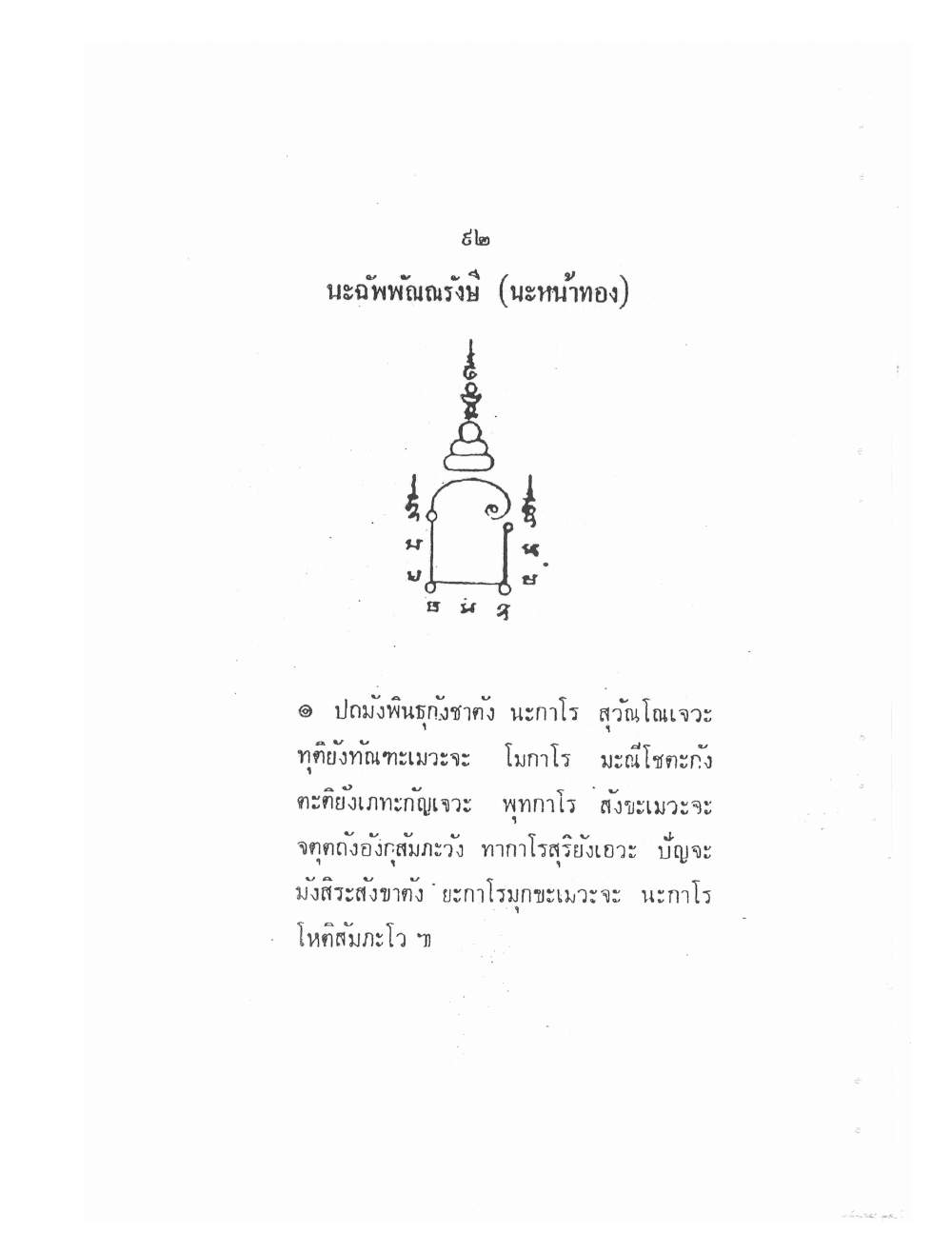
นะฉัพพัณณรังษี (นะหน้าทอง)
[ยันต์: ซุ้มโค้งคล้ายทรงเจดีย์ มีปลียอดเป็นแท่งอักขระขอมเรียงซ้อนกันขึ้นไป ด้านซ้ายและขวาของซุ้มมีอักขระขอมกำกับเป็นคู่อยู่เหนือแนวเส้น ที่มุมล่างทั้งสี่มีวงกลมเล็กเป็นจุดเชื่อมเส้น และมีอักขระขอมกำกับใต้แต่ละจุด — อักขระขอมในยันต์ อ่านไม่ชัด]
๏ ปถมัง พินธุกังชาตัง นะกาโร สุวัณโณเจวะ ทุติยังทัณฑะเมวะจะ โมกาโร มะณีโชตะกัง ตะติยังเภทะกัญเจวะ พุทกาโร สังขะเมวะจะ จตุตถังอังกุสัมภะวัง ทากาโรสุริยังเอวะ บั้ญจะ มังสิระสังขาตัง ยะกาโรมุกขะเมวะจะ นะกาโร โหติสัมภะโว ๚
Na Chappannarangsi ('Golden-Face Na')
[Yantra: an arched niche shaped like a stupa spire, its finial formed of a stack of Khom-script characters rising upward. To the left and right of the arch, pairs of Khom characters mark the flanking sides above the frame-lines. At the four lower corners are small circles linking the connecting lines, each accompanied below by a Khom character — the Khom akkhara in the yantra are not confidently legible.]
First, the point (bindu) that is born is the letter Na — indeed, it is gold. Second, likewise, the rod (danda) is the letter Mo — a shining gem. Third, likewise, the cleft (bheda) is the letter Phut — a conch. Fourth, the origin of the hook (ankusa) is the letter Tha — indeed, the sun. Fifth, what is reckoned the head (sira) is the letter Ya — indeed, the mouth. The letter Na is thus the source of becoming. [Inference — this verse describes the mystic anatomy of the sacred syllable Na, matching the five syllables of 'Namo Buddhaya' (Na-Mo-Phut-Tha-Ya) each to a cosmic substance; the corner akkhara of the yantra above likely correspond to these five syllables, though the individual glyphs could not be confidently read.]
สูตร์สำหรับลงตัวนะแล
๏ ศรีนิกัตวานะ นะการังบัญจะสัมภะวัง ๚ คาถานนัสการและให้ว่า ๓ หน
๏ นามะนัง สะมาโส ยุกตะโถ แห่งนามะ ทั้งหลาย พระอาจาริยะพึงหมายให้ชื่อนะฉัพพัณรังษี นะกาโรโหติสัมภะโว ๚
สูตร์เรียกนามแล
๏ นะรานะระหิตังเทวัง นะระเทเวหิปูชิตังนะรา นังกามะบังเกิด นะมามิสุคะตังชินัง ๚
คาถานปลุกนะแล
๏ มะ คือตัวเรา อะ คือตัวเขา อุ เมตตา เห็นหน้ารักเรา ๚
สูตร์ให้ว่าเมื่อลง มะอะอุ ที่ลงข้างล่างตัวนะ
๏ มะ เมตตา อะ กรุณา อุ ปราณี ๚
Formula for Inscribing the Na Character
Sri nikatvana, na-karam bañca sambhavam. [Recite this] homage-verse, given three times.
Namanam samaso yuktattho — 'of all names,' the teacher should intend that this be named 'Chappannarangsi'; the letter Na is thus the source of becoming.
Formula for Invoking the Name
Narā narahitaṃ devaṃ, narā devehi pūjitaṃ, narānaṃ kāma-bankoet, namāmi sugataṃ jinaṃ.
Spell for Animating the Na
Ma is myself, A is the other person, U is loving-kindness — so that on seeing my face, they love me.
Formula to be recited when inscribing Ma-A-U beneath the Na character:
Ma is loving-kindness, A is compassion, U is tender regard.
สูตร์ให้ว่าเมื่อลง มะ อะ อุ ที่ข้างซ้ายและ ข้างขวาตัวนะ
๏ มะ อะ อุ เมตตา กรุณา จิตตัง ๚ สูตร์ให้ว่าเมื่อลงอุณาโลมบนมะอะอุทั้ง ๒ ข้าง
๏ มะกาโร ศีรษะพุทธาปะนะชายะเต ๚ ลงศีรษะพระ
๏ อะกาโร องคะพุทธาปะนะชายะเต ๚ ลงองค์พระ
๏ อุกาโร ปาทะพุทธาปะนะชายะเต ๚ ลงบาทพระ
สูตร์ให้ลงองค์พระบนตัวนะ ลงเป็นสามทีด้วย กัน คือ ลงวงกลมข้างบนสมมุติเป็นพระเศียร เป็นครั้ง แรก และลงวงท่อนกลางสมมุติเป็นองค์พระเป็นครั้งที่ สอง ลงวงท่อนสุดท้ายเบื้องล่างสุดท้ายเบื้องล่างสุด สมมุติเป็นพระบาทเป็นครั้งที่สาม
Formula to be recited when inscribing Ma-A-U to the left and right of the Na character:
Ma A U — loving-kindness, compassion, and [pure] mind.
Formula to be recited when inscribing the unalom [spiral topknot mark] above the Ma-A-U on both sides:
Ma-karo — the head-of-the-Buddha is thereby produced. Inscribe the sacred head.
A-karo — the body-of-the-Buddha is thereby produced. Inscribe the sacred body.
U-karo — the feet-of-the-Buddha are thereby produced. Inscribe the sacred feet.
Formula for inscribing the Buddha's body upon the Na character: it is inscribed in three parts together — the upper circle is inscribed first, taken to be the sacred head; the middle section is inscribed as the sacred body, as the second stroke; and the very last, lowest section is inscribed [as printed: 'the last, lowest, last, lowest part'], taken to be the sacred feet, as the third stroke.
๏ มะอะอุอะทิกะมูลัง ศรีเทวานัง มหาสาตรา อุอุอะอะ มะมะมันตรา อุอะสะวา มะหามันตัง มะอะอุ โลปะเกญยัง องการะเสวะราชิโน ๚ สูตร์ให้ลงอุ บนเศียรพระ
๏ ศรีอักขรานิ อัฏฐะจันทาประนะชายะเต ๚ ลงพระจันทร์ครึ่งซีกบน อุ
๏ ชาตานิ พินธุสุริยาประนะชายะเต ๚ ลงสูริย์บนจันทร์
๏ อุนาโลมาปะนะชายะเต อะสังวิสุโล ปุสะ พุภะ ๚ ลงอุนาโลม
พระคาถาเสกนะฉัพพัณณรังษี
๏ นะสุวัณโณนะมัสสิ์กว่า โมกาโรมะณี โช ตะกัง พุทกาโรสังขะเมวะจะ ทากาโรสุริยังเอวะ ยะกา โรมุกขะเมวะจะ สะทะมะมัง มังมะทะสะ กะระณียะ เมตตังสัตตา เมตตา กรุณา มุทิตา อุเบกขา จิตตัง ๆ
Ma-A-U, the origin-root, glorious among the devas, the great scripture. U-U-A-A, the Ma-Ma mantra, U-A-sava, the great mantra. Ma-A-U, whose meaning is left implicit — the sovereign lord's formula. Formula for inscribing the U above the Buddha's head.
Sirī akkharāni — the upper half-moon is thereby produced. Inscribe the upper half-moon [with] U.
Jātāni bindu — the sun upon [the moon] is thereby produced. Inscribe the sun upon the moon.
The unaloma is thereby produced, asaṃvisulo pusa bhūpa. Inscribe the unalom [spiral topknot mark].
The Spell for Charming the Na Chappannarangsi
Na is gold, homage is paid to it; the letter Mo is the shining gem; the letter Phut is likewise the conch; the letter Tha is likewise the sun; the letter Ya is likewise the mouth. [Grant] good fortune upon good fortune, all that should be accomplished through loving-kindness for all beings — loving-kindness, compassion, sympathetic joy, and equanimity of mind.
เชยยะนารี จักกะวัตติราชา มะโนโจรัง ไมตรีจิตตัง ๚ นะ ฉัพพัณณรังษีหน้าทองนี้ ใช้ลงผงหรือจะ ลงใส่ผ้ามือก็ได้ แล้วให้เอาผงทาหน้าไปเป็นเมตตามหา นิยมประเสริฐยิ่งนัก แก้วหาค่ามิได้เลย นะอันนี้เป็น ฉบับวัดประคู่โรงธรรมอยุธยา สืบมาแต่สมัยสมเด็จ พระนารายณ์มหาราชได้ต้นฉบับมาจากท่านวัดมะขามเฒ่า ฉบับหนึ่ง จากต้นฉบับของสมเด็จกรมพระราชวังบวร วิชัยชาญ (พระบัณฑูร) อีกฉบับหนึ่ง สอบถามตรง กันแล ๚
พระคาถาช้างประสมโขลง
๏ โอมประสิทธิพระฤๅษีทั้ง ๔ ตน เธอจึงประ- สาทพระมนต์ มอบประสิทธิไว้ให้แก่กู หญิงชายทั่ว สกลชมพู เห็นหน้ากูงามคือดังเทวดา อิติปิโสภะคะวา ฯลฯ พุทโธภะคะวาติ พุทธังสิทธิชนาจิตตัง ธัมมัง สิทธิชนาจิตตัง สังฆังสิทธิชนาจิตตัง นะโมพุทธายะ
[May I be] victorious over women, [like] a universal monarch, a captor of hearts, possessed of a mind of loving friendship. This 'Na Chappannarangsi, Golden Face' may be inscribed as a powder, or inscribed onto a handkerchief; then take the powder and anoint the face with it — it becomes an excellent charm of loving-kindness and great popularity, a treasure beyond price. This is the version from Wat Pra Khu, the Dharma Hall of Ayutthaya, handed down since the reign of the great King Narai, who obtained one original copy from the teacher of Wat Makham Thao, and another original copy from the collection of the Supreme Prince of the Front Palace, Wichaichan (Phra Bandun) — the two having been cross-checked and found to agree.
The Spell for [Drawing] Elephants to Join the Herd
Om, may I succeed! The four holy hermits bestow their sacred mantra, granting its power to me, so that men and women throughout the whole Rose-Apple continent, on seeing my face, find it as beautiful as a deva's. Itipiso bhagavā [...] Buddho bhagavāti — may the Buddha grant success to [my] captivating mind, may the Dhamma grant success to [my] captivating mind, may the Sangha grant success to [my] captivating mind. Namo Buddhaya.
มะอะอ อะระหัง สัพเพชะนานัง พะหูชะนานัง คน ทั้งหลายเอ่ยมึงเห็นหน้ากู จิตมึงก็ผูกพันหกพะว้าพะวัง มิได้ตั้งคำรง ทรงตะลึงหลงทุกราตรี โอมสิทธิ อาคัจ เฉยยะ อาคัจฉาหิ ศิวัตถัพโพ อาคัจฉาหิ ตะมัตถัง ปะกาเสนโต สัตถา อาหะ กูมีตะบะเดชะดังพระยา ไกรสรราชสีห์สิงหะชาติ โอมสิทธิ จิตติจิตตัง จิตติตะวัง พุทธะรักนัง ธัมมะรักนัง สังฆะรักนัง อิธะเจตะโส ทัพหัง คัณหาหิ ถามะสา นะชาลิติ อะอุอุอิ โอม สิทธิกูจะทรงราศี ให้ผ่องเพียงเสมือนพระจันทร์เมื่อวัน เพ็ญ ใครเห็นหน้ากูก็ครั่นเกรงครั้นคร้ามพิศวงหลงใหล ทุกถ้วนหน้า นะมะพะทะ นะมะนะอะ นอ. กอ. นะกะ กอ. ธอ. นอ อะ นะอะกะอัง ให้จิตมึงคลุ้มคลั่ง ตะลึงหลงด้วยเดชะ พระฤๅษีทั้ง ๔ องค์ เธอมาประสิทธิ ให้แก่กู อะ อา อิ อี อุ อู สวาหะ ๚๛
Ma-A-U, Arahaṃ, [lord] of all beings, of the multitudes — all you people, when you see my face, your hearts will be bound and thrown into confusion, unable to hold themselves steady, dazed and infatuated every night. Om, may it succeed! Come here, come here, O Sivatthappo, come here — the Teacher, proclaiming that meaning, declared: I possess ascetic power and majesty like the lion-king, born of the lion race. Om, may it succeed! Mind upon mind, thought upon thought — may all love the Buddha, love the Dhamma, love the Sangha. Firmly rooted in this intent, seize and hold with strength — Na-cha-li-ti, A-u-u-i. Om, may I succeed in bearing splendor, radiant as the full moon; whoever sees my face shall be struck with awe, overcome, dazzled and infatuated, every one without exception. Na Ma Pha Tha, Na Ma Na A, No Ko Na-ka, Ko Tho No A, Na-a-ka-ang — may your mind be thrown into wild confusion, dazed and lost, through the power of the four holy hermits, who now grant their success to me. A Ā I Ī U Ū, svaha!
พระคาถาบทนี้ทรงคุณค่าวิเศษนัก ใช้ปลุกเสก สิ่งของทางเมตตามหานิยมได้สารพัด เสกแป้ง เสกขี้ผึ้ง น้ำมันหอมได้ทั้งนั้น ถ้าจะเสกน้ำมันหอมให้เสก ๑๐๘ จบ ทาลูกไก่ตามมาแล
สุดแต่จะใช้เถิด ทางเมตตาดีนักเป็นมนต์ที่ ครอบมนต์ทางเมตตาทั้งปวง ๚
พระคาถาบทนี้ ท่านอาจารย์มหาโต๊ะวัดเลียบ ผู้ขลังทางอาคมเมตตาได้ใช้อยู่เป็นนิจสิน
พระคาถาพระยาเครัว
๏ นะโมพุทธายะ ภะคะวะโต อิติปิโสภะคะวา อิติปาระมิตาติงสา อิติสัพพัญญมาคะตา อิติโพธิมะนุป บั้นโต อิติปิโสจะเตนะโม คนทั้งหลายรักกู พิศวาส หลงใหล พิสมัยแนบเนื้อใจจิตคิดถึงคนึงวิญญา วิชชา จะระณะสัมปันโน อิติปิโสภะคะวะ นะเมตตา โมกรุณา พุทเป็นที่รัก ธาให้เห็นประจักษ์ ยะให้ยินดี ยะละลวย
This spell is of exceptionally great worth; it can be used to charm all manner of things for loving-kindness and popularity — it may charm face powder, wax, or perfumed oil, all alike. If charming perfumed oil, recite it 108 times, then anoint a young chick with it and let it run off [as an omen of the charm's effect].
Use it as you will — it is exceptionally good for loving-kindness, a master-spell that overrides every other loving-kindness spell.
This spell is the one that the venerable Ajarn Maha To of Wat Liap, a master of the arts of loving-kindness magic, used constantly in his daily practice.
The Spell of Phraya Khrua [name uncertain in the source]
Namo Buddhaya, bhagavato, itipiso bhagavā, iti pāramitā tiṃsā, iti sabbaññu-māgatā, iti bodhi-manuppanto, itipiso ca te namo — may all people love me, be enthralled and infatuated with me, be enamored, cleave to me in heart and mind, longing and yearning [for me]. Vijjācaraṇasampanno, itipiso bhagavā — Na is loving-kindness, Mo is compassion, Phut is what is beloved, Tha makes [it] plainly manifest, Ya brings delight, Ya brings intoxicating enchantment...
หันตะวา ธาเมามัว พุทพาหัวมาหากู โมมาสมสู่ นะ รักอยู่จนวันตาย โอมละลวยมหาละลวย หญิงชายเห็น หน้ากูงวยงงจงใจรักทักปราศรัย อ่อนละมัยมาหากู สูรู้ ว่ากูมาเนื้อ เออรักสวาหะ ฤ ฤๅ ภ ภๅ เอหิ พรหม จิตตัง มาด้วยพระวินัยยัง เดตังคิดตัง กะระณียัง เมต ตังจิตตัง ขันติ มะอิตถีโก อะปุริสา อุมัจจา สะมะ ณะพราหมณา เมตตา จะ มหาราชาสัพพะสิเนหา จะ ปูชิโต สัพพะสุขัง มหาลาภังราชา โกรธัง วินาสสันติ สัพพะโกรธัง วินาสสันติ บีโย เทวะมะนุสสานัง บีโย พรหมานะมุตตะโม บีโยนาคะสุบั้นนานัง บีนินทริยัง นมามิหัง ๚๛
พระคาถาบทนี้ทางเมตตามหานิยมประเสริฐนักแล ใช้เสกเครื่องหอมทาตัวก็ได้เสกสิ่งของต่าง ๆ ให้เขากิน ก็ได้
...Tha makes [them] dizzy and intoxicated; the Buddha[-syllable] leads their heads to me; Mo makes them come and unite [with me]; Na, [and so] they love me until the day they die. Om, intoxicate them, greatly intoxicate them — let women and men, on seeing my face, become dazed and confused, earnestly desiring, loving, greeting me kindly; let them come to me gentle and yielding. May you know that I am [made] of tender flesh — oh, love [me], svaha! Ru Rū Bha Bhā — come, O Brahma-mind, come by the sacred discipline; this resolve, this deed to be done, is a mind of loving-kindness and forbearance — whether woman or man, commoner or minister, ascetic or brahmin — [let all feel] loving-kindness; and the great king, beloved by all with affection, is honored, [possessed of] every happiness and great fortune; wrath is destroyed, all wrath is destroyed. Dear to gods and men, dear and supreme to the Brahmas, dear to the nagas and garudas, dear to the senses — I pay homage to this.
This spell is an excellent one for loving-kindness and great popularity; it may be used to charm perfumed items for anointing the body, or to charm various things to give to people to eat.
แม้คนใจแข็งสักเท่าไรก็ดี ถ้ากินแล้วกลับใจรัก เราแล แม้นท่านโกรธ ให้ภาวนาเข้าไปหาหายโกรธสิ้น แล เป็นคาถาเสกผงมหาราช ของท่านพระอาจารย์เลียบ (เจ้าคุณเทพสิทธินายก) วัดเลา ใช้ทางเมตตาดีนักแล ๚
พระคาถาแร้งถามข่าว
๏ ฤ ฤๅ ภ ภๅ ๚
๏ ผิจะใช้แร้งถามข่าว อาจารย์ท่านกล่าวให้เอา พลูร่วมใจมา ได้แล้วให้ลงคาถาลงชื่ออิตถียา ชื่อเรา ปรารถนาด้วยกัน บรรจุลงลูกสะบ้าพลันเราไม้รักนั้น อุดไว้ให้แน่นเกิดหนา แล้วใส่ก้อนเส้าอย่าช้า ตั้งสัจจา ธิษฐาน หม้อพลุ่งให้พลุ่งเหมือนกัน อย่าทันถึงวัน มึงเร่งมาพลัน อย่าทันถึง ๗ ราตรี พ้นนัดมึงจะเป็นผี ฤ ฤๅ ภ ภๅ มนต์นี้เสกหนา คาถานี้ของท่าน อาจารย์คล้ายปักษ์ได้แล ๚
However hard-hearted a person may be, once they consume [something charmed by this], their heart will turn to love us. And should someone be angry, chant this while approaching them, and their anger will vanish entirely. This is the spell for charming 'Great King' powder, from the venerable Ajarn Liap (Chao Khun Thep Sitthinayok) of Wat Lao — very good for use in matters of loving-kindness.
The Spell for [Sending] the Vulture to Ask for News
Ru Rū Bha Bhā.
If one wishes to use the vulture to ask for news, the teacher instructs thus: take a betel leaf folded together with the heart's intent; once obtained, write the spell upon it together with the woman's name and one's own name, [expressing] their shared wish. Place it promptly inside a tamarind-seed [game piece] of 'love-wood,' sealed in tightly and thickly; then set it upon the hearthstones without delay, and make a solemn vow: 'As the pot boils and bubbles over, so may you likewise boil over [with longing] — before the day comes, hurry to me at once; should seven nights pass and the appointed time lapse, you shall become a ghost.' Ru Rū Bha Bhā — charm this mantra thoroughly. This spell of the teacher's is said to resemble [the way of] a bird, indeed.
พระคาถานะหน้าทอง
๐ นะกาโรกุกกุสันโธ สีโรมัชเฌ ขออัญเชิญพระกุกกุสันโธ สัมมาสัมพุทธเจ้าเสด็จมาอยู่เบื้องศีรษะข้าพเจ้า ขอพระบารมีเป็นที่พึ่ง นะกาโรสุวัณโณเจวะ นะงามคือดังแสงทองรัศมีส่องไปทั่วสกลกายา เป็นที่เสน่หาแก่คนทั้งหลาย เดชะพระกุกกุสันโธสัมพุทธเจ้าประสิทธิวิชายะเถ โมกาโรโกนาคะ มะโนนะลาทิเต ขออัญเชิญพระโกนาคมสัมมาสัมพุทธเจ้า เสด็จมาอยู่ที่หน้าผากข้าพเจ้า ขอพระบารมีเป็นที่พึ่ง โมกาโรมะณีโชตะกัง โมงามคือแสงแก้วมณีโชติ ส่องแสงโปรดอยู่เบื้องหน้าผากหญิงเห็นให้หลงใหล ชายเห็นให้หลงรัก เห็นหน้าให้ทายทักเป็นมหานิยม เดชะพระโกนาคมสัมมาสัมพุทธเจ้า ประสิทธิวิชายะเถ พุทธาโรกัสสะโปทเวกัณเณ ขออัญเชิญพระกัสสะโปสัมมาสัมพุทธเจ้าเสด็จมาอยู่ในโสตร์ทั้งสองของข้าพเจ้า ขอพระบารมี
Vedic Katha of the Golden Face
Om — na-karo Kakusandho, siromajjhe [Pali: 'in the middle of the head']. I invite the Lord Buddha Kakusandha, the Fully Self-Enlightened One, to come and dwell at the crown of my head; may his grace be my refuge. Na-karo suvanno c'eva — the beauty of the syllable 'na' is like the light of gold, its radiance shining over my whole body, making me charming to all people. By the power of the Lord Buddha Kakusandha, may this spell succeed. Mo-karo Konagamana, manonalāṭe — I invite the Lord Buddha Konagamana, the Fully Self-Enlightened One, to come and dwell upon my forehead; may his grace be my refuge. Mo-karo maṇijotakaṃ — the beauty of the syllable 'mo' is like the light of a shining gem, gracing my forehead so that women who see it fall into infatuation and men who see it fall in love; whoever sees my face and greets me finds it deeply auspicious. By the power of the Lord Buddha Konagamana, may this spell succeed. Buddharo Kassapo dve-vakaṇṇe — I invite the Lord Buddha Kassapa, the Fully Self-Enlightened One, to come and dwell in both my ears; may his grace...
เป็นที่พึ่ง พุทกาโรสังขะเมวะจะ พุทธงามคือแสงสังข์อยู่ในโสตร์ทั้งสองของข้าพเจ้า ป้องกันบำบัดโรคโรคาพยาธิทั้งหลาย เดชะ พระกัสสะโป สัมมาสัมพุทธเจ้าประสิทธิ วิชายะเถ ธากาโรโคตะโมทะเวเนตเต ขออัญเชิญพระศรีสากยะมุนีโคดมสัมมาสัมพุทธเจ้า เสด็จมาอยู่ในเนตรทั้งสองของข้าพเจ้า ขอพระบารมีเป็นที่พึ่ง ธากาโรสุริยังเอวะ ธางามคือดังแสงอาทิตย์ สมณะชีพราหมณ์ มนุษย์บุรุษหญิงชายทั้งหลายเห็นเนตรทั้งสองของข้าพเจ้า ให้มีจิตคิดเมตตายินดี เดชะพระศรีศากยะมุนีโคดมบรมครู ประสิทธิวิชายะเถ ยะกาโรอะริยะเมตไตโยชิวหาทิเต ขออัญเชิญพระศรีอริยะไมตรีสัมมาสัมพุทธเจ้าเสด็จมาอยู่ในลิ้นของข้าพเจ้า ขอพระบารมีเป็นที่พึ่ง ยะกาโรมุกขะเมวะจะ ยะงามคือดังแสงมุกข์ส่องแสงสุขอยู่ในลิ้นของข้าพเจ้า จะเจรจาพาทีด้วยสมณะพราหมณาจารย์ มนุษย์บุรุษ หญิงชายด้วยถ้อยคำ
...be my refuge. Buddhakāro saṅkha m'eva ca — the beauty of the Buddha-syllable is like the light of a conch, dwelling in both my ears, warding off and curing every sickness and disease. By the power of the Lord Buddha Kassapa, may this spell succeed. Dhākāro Gotamo dve-nette — I invite the Lord Sri Sakyamuni Gotama, the Fully Self-Enlightened One, to come and dwell in both my eyes; may his grace be my refuge. Dhākāro suriyaṅ eva — the beauty of the syllable 'dha' is like the light of the sun; may monks, ascetics, brahmins, and all people, men and women, who see my two eyes be filled with loving-kindness and delight. By the power of the Lord Sri Sakyamuni Gotama, the Great Teacher, may this spell succeed. Yakāro Ariya-Metteyyo jivhādite — I invite the Lord Sri Ariya Maitreya, the Fully Self-Enlightened One, to come and dwell upon my tongue; may his grace be my refuge. Yakāro mukham eva ca — the beauty of the syllable 'ya' is like the light of a pearl, shining with happiness upon my tongue; so that when I converse in words with monks, brahmin teachers, and all people, men and women...
ให้มีจิตเมตตากรุณาแก่ข้าพเจ้านี้เถิด เดชะพระศรีอาริยะไมตรีสัมมาสัมพุทธเจ้า ประสิทธิวิชายะเถ สัพเพชะนานัง พะหูชะนานัง คือคนทั้งหลายเอ่ย มึงเห็นหน้ากูให้มึงรักกูทั้งหลับทั้งตื่น ทั้งกลางวันกลางคืน ชะยังสุขัง ลาภัง พุทโธ โสภะคะวา บุญจะพุทธา นะมามิหัง บีโย เทวะมนุสสานัง บีโย พรหมานะมุกตะโม บีโย นาคะริสุบันนานัง บีนินทยัง นะมามิหัง ฯ
พระคาถานะหน้าทองนี้ ให้ใช้ภาวนาทางเมตตาดีนักแล เมื่อจะภาวนานั้น เมื่อถึงบทว่าตัวนะ ก็ให้เอานิ้วมือเขียนที่กลางศีรษะเป็นอักขระตัวนะ ถึงบทโม ก็เขียนอักขระตัวโมลงบนหน้าผาก ถึงบทพุทก็ให้เขียนพุทลงที่หูทั้งสองข้าง ๆ ละตัว ถึงบทธาก็ให้เขียนธาลงที่ตาทั้งสองข้าง ๆ ละตัว ถึงบทยะก็ให้เขียนยะลงที่ลิ้น น้อมจิตอธิษฐานให้หน้าของเราเป็นหน้าทอง เข้าหาเจ้านายเป็นมหาเมตตาอย่างประเสริฐสุด สารพัดจะใช้เถิดวิเศษยิ่งนักแล ใช้เสกหน้าทองก็ได้ ฯ
...may they be moved to loving mercy and compassion toward me. By the power of the Lord Sri Ariya Maitreya, may this spell succeed. Sabbe janānaṃ, bahujanānaṃ [Pali: 'of all beings, of many beings'] — thus, all you people: when you see my face, may you love me, whether asleep or awake, by day or by night. Jayaṃ sukhaṃ lābhaṃ, buddho sobhagavā, puñña ca buddhā namāmihaṃ, piyo devamanussānaṃ, piyo brahmāna-m-uttamo, piyo nāgarissu-bannānaṃ, pinindayaṃ namāmihaṃ [Pali blessing: 'victory, happiness, and gain; the Awakened One is glorious; by the merit of the Buddhas I pay homage; beloved of gods and men, beloved and foremost among the Brahmas, beloved among the nāgas and the noble, ever honored, I pay homage'].
This Golden Face katha should be chanted for the purpose of loving-kindness — it works very well. When reciting it: at the word 'na,' trace the letter 'na' with a finger on the crown of the head. At the word 'mo,' trace the letter 'mo' on the forehead. At the word 'phut,' trace 'phut' on both ears, one letter on each side. At the word 'tha,' trace 'tha' on both eyes, one letter on each side. At the word 'ya,' trace 'ya' on the tongue. Then focus the mind and resolve that one's face become a golden face. Approaching a superior with it becomes a supreme and excellent act of loving-kindness; it may be used for any purpose and is truly extraordinary. It may also be used to enchant a golden face [charm].
พระคาถามหาละลวย
๐ โอมนะโมพุทธายะ เพชชะละลวยมหาละลวย ชายเห็นชายงวย หญิงเห็นหญิงหลง เห็นหน้างวยงง หลงพิศวาทกรวญหา นั่งท่าพึ่งข่าว นั่งเฝ้าปากทาง นั่งเยี่ยมหน้าต่าง กอดอกร่ำพึง มะอะอุ คนึงบ่มินอน อิสะวาสุ สุดสวาทอารมณ์ ร้อนรนทนอยู่มิได้ พุทธังสะระคิจิตตัง สะมาเรมะมะเอหิ ธัมมังสะระคิจิตตัง สะมาเรมะมะเอหิ สังฆังสะระคิจิตตัง สะมาเรมะมะเอหิ นะมิเห็นหน้ากูอยู่มิได้ โมร้องให้ครวญคราง พุทกอดไว้มิใคร่จะว่าง ธาครวญครางสะอื้นไห้ ยะหลงใหลในจิต หญิงใดชายใดได้เพ่งพิศ ก็อยู่มิได้ร้องให้มาหากู โอมสิทธิแก่กู สวาหะ เอหิชัยยะ เอหิสัพเพชะนา พหูชะนาเอหิ ฯ
คาถามหาละลวยนี้ สารพัดจะใช้ได้ทางเมตตา ผูกใจให้รัก เสกเครื่องหอมแบ่งชะผงน้ำมันทาตัวก็ได้ เสกสรรพสิ่งทั้งปวงให้กินก็ได้ วิเศษนักแล ฯ
Katha of the Great Bewitchment
Om namo buddhāya. Diamond bewitchment, great bewitchment: let men who see me be dazed with longing for men, let women who see women be infatuated; let whoever sees my face be dazed and confused, love-sick and pining, sitting and waiting for news of me, watching by the roadside, peering from the window, clasping their chest and sighing. Ma-a-u — restless, unable to sleep. I-sa-wā-su — consumed with longing, burning with feeling, unable to bear it. Buddhaṃ sara-cit-cittaṃ, samāre-mama-ehi. Dhammaṃ sara-cit-cittaṃ, samāre-mama-ehi. Saṅghaṃ sara-cit-cittaṃ, samāre-mama-ehi [Pali-styled formula: 'remembering the Buddha/Dhamma/Sangha in mind and heart, unite and come to me'] — 'na': if they do not see my face they cannot bear it; 'mo': let them weep and moan; 'phut': let them embrace and be unwilling to let go; 'tha': let them moan and sob; 'ya': let them be lost in longing of heart. Any woman, any man who gazes upon [my face] shall be unable to bear it and shall come weeping in search of me. Om, grant me success, svāhā. Come, victory! Come, all beings! Come, many people!
This Great Bewitchment katha may be used for every purpose of loving-kindness, to bind the heart in love. It may be used to enchant scented powder or oil to divide and apply to the body, or to enchant any food or drink for consumption — it is truly extraordinary.
พระคาถาเทพรำลึก
๐ โอมสิทธิพระฤาษีมุนี ธะจึงชุบมนต์สรานี้ให้แก่กู ธะจึงให้กูรำลึกถึง (ชื่อที่ปรารถนา) ก็มารำลึกถึงกู ธะจะให้กูรำลึกถึงพระยม พระยมก็มารำลึกถึงกู ธะจึงให้กูรำลึกถึงพระกาฬ พระกาฬก็มารำลึกถึงกู ธะจึงให้กูรำลึกถึงพระจตุโลกบาล พระจตุโลกบาลก็มารำลึกถึงกู ธะจึงให้กูรำลึกถึงพระภูมิ พระภูมิก็มารำลึกถึงกู ธะจึงให้กูรำลึกถึงพระพาย พระพายก็มารำลึกถึงกู ธะจึงให้กูรำลึกถึงพระนารายณ์ พระนารายณ์ก็มารำลึกถึงกู ธะจึงให้กูรำลึกถึงพระเสื้อเมือง ครูหมอปริยายประสิทธิ สวาหะ อมพระรำลึกมหารำลึก รำจิตรำจวนใจ พระพายพัดไป มึงอยู่มิได้ ร้องให้มาหากู อยู่วันละ ๗ หน ฯ
พระคาถาเทพรำลึกนี้ ให้ภาวนาตามกำลังวันดีนักแล รำลึกถึงผู้ใดผู้นั้นก็มาหาเรา เป็นพระมนต์ที่
Katha of the Remembering Deity
Om, by the power of the hermit-sage, may [the deity] infuse this spell and grant it to me, that I may cause [name of the desired person] to remember me, and they shall come to remember me. May I cause the Lord Yama to remember me, and Lord Yama shall come to remember me. May I cause the Lord Kala [deity of death/time] to remember me, and Lord Kala shall come to remember me. May I cause the Four Guardian Kings of the World to remember me, and they shall come to remember me. May I cause the Earth Deity to remember me, and the Earth Deity shall come to remember me. May I cause the Wind Deity to remember me, and the Wind Deity shall come to remember me. May I cause Lord Narayana to remember me, and Lord Narayana shall come to remember me. May I cause the Guardian Spirit of the City to remember me — teachers and physicians, may this spell succeed, svāhā. Om, remembrance, great remembrance, stirring the mind and stirring the heart with longing; let the Wind blow, so that you cannot bear to remain, and you shall come weeping to seek me. Recite seven times a day.
This Katha of the Remembering Deity should be chanted according to the strength of the day — it is very effective. Whoever one thinks of will come to seek them out. This is the mantra that...
พระฤๅษีให้แก่นางแก่นจันทน์ไว้ เมื่อนางว่าพระคาถา พระฤๅษีก็ต้องมาหานางทุกทีไป ฯ
พระคาถาเทพรำจวน
๐ โอมรำจวนรำพึง รำจวนพิศดาร พระพายพัดพาน พัดต้อง (ชื่อ) รำจวนรำลึกสะท้านพระทัย พระพายพัดไปพัดต้อง (ชื่อ) รำลึก มะเมตตา อะกรุณา อุ สเนหา สัพพัตถะ ปูชิตา สัพพะโกรธาวินาส สันติ มะอยู่มิได้ อะร่ำไห้ อุมาหากู โอวัตติสงสาร เอหิจงมาถึง มะมะแห่งกู อิธะเจตะโส ทัพหัง คัณหาหิ ถามะสา ฯ
พระคาถานี้ตามแต่จะใช้เถิด จะใช้บริกรรมเวลากลางคืนก็ได้ จะเป่าไปให้ต้องตัวก็ได้ พ่นลมบุหรี่ก็ได้ ตามแต่จะใช้เถิด ทางสตรีดีนักแล ฯ
พระคาถาเมตตาหลวง
๐ อิติปิโส ภควา อรหัง สัมมาสัมพุทโธ
...the hermit-sage gave to Lady Kaen Chan; whenever she recited the katha, the hermit-sage was compelled to come to her every single time.
Katha of the Longing Deity
Om, longing and yearning, longing in great detail. May the Wind blow and strike upon [name], causing longing and remembrance that shakes the heart. May the Wind blow and strike upon [name], causing remembrance. Loving-kindness, compassion, affection, revered everywhere; may all anger be destroyed; may there be no peace [for them]; may they weep and cry out, come to seek me. Oh sorrow of saṃsāra, come, arrive here, to me. [Pali: 'idha cetaso daḷhaṃ gaṇhāhi' — 'here, take firm hold of this mind.']
This katha may be used as one wishes: it may be recited silently at night, or blown so as to touch the body, or exhaled with cigarette smoke — as one wishes. It is especially effective for use upon women.
Great Loving-Kindness Katha
Itipi so bhagavā arahaṃ sammāsambuddho [Pali, opening of the standard recollection of the Buddha's virtues: 'Such indeed is the Blessed One: worthy, perfectly self-enlightened...']
วิชชาจรณสัมปันโน สุคโต โลกวิทู อนุตตะโร ปุริสทัมมสารถิ สัตถา เทวมนุสสานัง พุทโธภควาติ ฯ
๐ อะ ให้เมตตา กิ ให้กรุณา บี ให้ปรานี โส ให้ยินดี ภะ ให้ปลื้มใจ คะ ให้เอ็นดู วา ให้สะท้านดวงใจ อะ ให้หวั่นไหว ระ ให้เรียกนาม หังให้เรียกภูติทั้ง ๔ สัม ให้เรียกจิต มา ให้ลืมตน สัม ให้เรียกขวัญ พุท ให้ราพึง โธ ให้คิดถึง วิช ให้ร้องไห้ เขาให้ร่ำไรถามหา จะ ให้รำลึกจิต ระ ให้รำลึกใจ ณะ ให้รำจวน สัม คือไฟให้เผาธาตุทั้ง ๔ บั่น ให้อยู่มิได้ โน ให้ร้องไห้มาหากู สุ ให้ลืมกายบ่นเพ้อ คะ ให้ลืมที่นอน โต ให้จับกลอนจ้องไว้ โล ให้ดับโกรธโกรธา กะ ให้ขมาโทษอภัย วิ ให้มีรัศมีใสส่อง ทู ให้มีอำนาจ อะ ให้หวาดตกใจกลัว นุ ให้ลืมพี่น้อง ตะ ให้ลืมพวกพ้องวงศา โร ให้ลืมมิตรสหาย ปุ ให้ลืมบิดามารดา ริ ให้ลืมบุตรและนัดดา สะ ให้ลืมภรรยาสามี ทัม ให้
...vijjācaraṇasampanno sugato lokavidū anuttaro purisadammasārathi satthā devamanussānaṃ buddho bhagavā ti [Pali, continuation of the recollection: '...endowed with knowledge and conduct, well-gone, knower of the world, unsurpassed trainer of persons to be tamed, teacher of gods and humans, awakened, blessed'].
Om — [a syllable-by-syllable charm assigning a power to each sound of the Itipiso formula:] 'A' brings loving-kindness; 'Ki' brings compassion; 'Bi' brings tenderness; 'So' brings delight; 'Pha' brings gladness of heart; 'Kha' brings pity; 'Wa' brings a thrill to the heart; 'A' brings trembling; 'Ra' brings the calling of one's name; 'Haṃ' brings the summoning of all four classes of spirits; 'Saṃ' brings the calling of the mind; 'Ma' brings forgetting oneself; 'Saṃ' brings the calling of the khwan [soul-essence]; 'Phut' brings pondering; 'Tho' brings longing thought; 'Wich' brings weeping — they shall cry out asking after you; 'Ja' brings remembrance of mind; 'Ra' brings remembrance of heart; 'Na' brings yearning; 'Saṃ' is like fire burning the four elements, so they cannot remain still; 'No' brings weeping and coming to seek me; 'Su' brings forgetting the body, muttering deliriously; 'Kha' brings forgetting one's bed; 'To' brings clutching the door-latch, staring fixedly; 'Lo' brings the quenching of anger and wrath; 'Ka' brings the seeking of forgiveness and pardon; 'Wi' brings a bright, shining radiance; 'Thu' brings power; 'A' brings fear and fright; 'Nu' brings forgetting one's siblings; 'Ta' brings forgetting one's kin and clan; 'Ro' brings forgetting friends; 'Pu' brings forgetting parents; 'Ri' brings forgetting children and grandchildren; 'Sa' brings forgetting spouse; 'Tham' brings...
ลืมแก้วอัครมเหษี มะ ให้ลืมท่านอนค้าง สา ให้อยู่มิได้ ระ ให้พิราบรำพันกราบบาทา ถิ ให้กระดิกกายมิได้ สัต ให้พึ่งคำกู ถา ให้วิงวอนนมัสการ เท ให้ตามใจกู วะ ให้มีสง่าราศี มะ ให้อ่อนน้อมทั่วจักรวาล นุ ให้มีอภินิหารศักดิ์สิทธิ์ สา ให้มีฤทธิ์ดังพระธรรมเจ้า นัง ให้มีเดชเดชา พุท ให้มีฤทธาดังพระสาวก โธ ให้มีอานุภาพ ภะ ให้กำจัดศัตรูมาเป็นมิตร คะ ให้มีจิตฤๅชา วา ให้ปรากฏ ติ ให้สว่างทั่วทวีปทั้ง ๔ พุทธังสว่าง ธัมมังสว่าง สังฆังสว่าง ฯ
พระคาถาเมตตาหลวงนี้ใช้ได้ทุกประการ เสกแบ่งผัดหน้าก็ได้ เสกสีผึ้งทาปากก็ได้ ตามแต่จะใช้เถิด ฯ
มนต์พระเพทยาธร
๐ อมพระเพทยาธร เสด็จจรอยู่บนเวหา กูจะเรียกให้มึงมา กูจะใช้ให้มึงไปสู่ห้อง (ชื่อ....) ที่นอน
...forgetting one's chief consort; 'Ma' brings forgetting to sleep elsewhere; 'Sa' brings being unable to stay still; 'Ra' brings pining and lamenting, prostrate at my feet; 'Thi' brings being unable to move the body; 'Sat' brings relying upon my words; 'Tha' brings pleading and paying homage; 'Te' brings following my will; 'Wa' brings radiance and majesty; 'Ma' brings humbling oneself throughout the universe; 'Nu' brings miraculous, sacred power; 'Sa' brings power like the Lord Dhamma; 'Naṃ' brings might and majesty; 'Phut' brings power like the arahant disciples; 'Tho' brings great authority; 'Pha' brings the turning of enemies into friends; 'Kha' brings a mind of goodwill; 'Wa' brings manifestation; 'Ti' brings brightness across all four continents — may the Buddha shine, may the Dhamma shine, may the Sangha shine.
This Great Loving-Kindness katha may be used for every purpose: to enchant face powder for anointing, or to enchant lip-wax — as one wishes.
Mantra of the Deva Phetyathon
Om, Lord Phetyathon, who travels and dwells in the sky, I shall call you to come; I shall send you to go to the room of [name...], to her bed...
กูจะให้มึงไปสมจรกันด้วย (ชื่อ....) ที่กำลังหลับสนิทนิทรา เมามัวนิมิต คิดว่ากูมาสมสู่อยู่ด้วย จงรีบไปข้ามห้วย ข้ามหนอง ข้ามคลอง ข้ามท่า ข้ามคืน ข้ามพี่ำ ข้ามมหาสมุทรสายสินธุ์ ข้ามคีรินทร์มนต์ ข้ามผ้าพยนต์ และอาถรรพณ์ ไปเถิดพ่อไป ชัยยะ ชัยยะประสิทธิเม โอมจิตตัง มาเรโส โสมาเรอากัจฉาหิ โอมเทพรำลึก มหาเทพรำลึก ตรึกจิตตรึกใจ ตรึกในพระทัย (ชื่อ....) ให้สะดุ้งยังรุ่งยังค่ำ อย่าหลับอย่านอน บนฟูกบนหมอน รำลึกตรึกถึง รำพึงจงมา นั่งท่าคอยลม คอยชมแต่เงา นั่งแอบคลึงเคล้าภิรมย์ชมเชย พระพายเจ้าเอ่ย จงมาพัดเอาดวงจิต (ชื่อ....) มาสู่ดวงจิตกู พัดเอาดวงจิตกูไปสู่ดวงจิต (ชื่อ....) นะผูกจิต โม ผูกใจ พุท ผูกอาลัย ธา ให้คร่ำครวญ ยะ ให้รัญจวน บ่นบ่วงถึงกู อยู่เรือนมิได้
I shall send you to go and lie together with [name...], who is now sound asleep, deep in slumber, lost in a hazy dream, thinking that I have come to lie together with her. Go swiftly — cross streams, cross swamps, cross canals, cross landings, cross by night, cross [obstacles], cross the great ocean's currents, cross mountain-charms and spells, cross cloth-effigies and black magic — go, go, my son, go! Victory, victory, grant me success. Om citta, mā-re-so, so-mā-re, āgacchāhi [Pali: 'come']. Om, remembering deity, great remembering deity, ponder in mind, ponder in heart, ponder within the heart of [name...]; make her start awake from dusk until dawn; let her not sleep, let her not lie down upon mattress or pillow; let her remember, ponder, and long for me, and come. Let her sit waiting for the breeze, watching only shadows, sit secretly caressing and embracing in delight and pleasure. Oh Lord Wind, come and blow, carrying the heart of [name...] to unite with my heart; blow my heart to unite with the heart of [name...]. 'Na' binds the mind; 'Mo' binds the heart; 'Phut' binds longing; 'Tha' brings weeping; 'Ya' brings restlessness, murmuring and yearning for me, unable to remain at home...
ร้องให้มาหากู เอหิจิตตัง บี้ยังมะมะ โอมสิทธิสวาโหม ฯ
คาถานี้ให้ลงชื่อเขากับชื่อเรา ลงใส่ในกระดาษก็ได้ ลงใส่ใบรักซ้อนก็ได้ เอาประกบกันเข้า เอาชื่อเขาไว้ล่าง ชื่อเราไว้บน เอามนต์นี้บริกรรม ให้ทำเวลาดึกสงัด เอาชื่อนั้นใส่ไว้ใต้หมอนหนุนหัว เขาฝันเห็นเราแล ฯ
พระคาถาพระวิสัชชนู
๐ จิตตังวา ปุปผังวา คันธังวา ราชกุมาโรวา ราชกุมารีวา ราชาวา สะมะโณวา พราหมโณวา อิตถีวา ปุริโสวา พานิชโชวา พานิชชาวา เอหิ เอหิอาคัจฉันติ ปริเทวันติ ฯ
พระคาถาพระวิสัชชนูนี้ ให้เสกแบ่งผัดหน้า เสกสีผึ้งสีปาก เสกน้ำมันหอมใส่ผม เสกน้ำล้างหน้าก็ได้ เป็นเมตตามหานิยมประเสริฐแล ฯ
...crying out, coming to seek me. Ehi cittaṃ, biya maṃ mama, om, may this succeed, svāhā, om.
For this katha: write his/her name together with your own name; it may be set down on paper, or placed inside a folded love-letter. Press the two together, placing the other person's name below and your own name above. Recite this mantra over it; do this in the deep, silent hour of night. Place that name-paper beneath the pillow one rests one's head on; then that person will dream and see you.
Katha of the Phra Wisatchanu
Cittaṃ vā, puppaṃ vā, gandhaṃ vā, rājakumāro vā, rājakumārī vā, rājā vā, samaṇo vā, brāhmaṇo vā, itthī vā, puriso vā, vāṇijjo vā, vāṇijjā vā — ehi, ehi āgacchanti, paridevanti [Pali: 'whether mind, or flower, or fragrance, or prince, or princess, or king, or ascetic, or brahmin, or woman, or man, or merchant-man, or merchant-woman — come, come, they arrive, they lament for you'].
This Phra Wisatchanu katha should be used to enchant face powder for applying, to enchant lip-wax, to enchant scented oil for the hair, or to enchant water for washing the face — it is an excellent charm for loving-kindness and great popularity.
มนต์เทพรำเพย
๐ โอมรำเพยมหารำเพย พระพายเจ้าเอ่ยรำเพยพัดไป ต้องที่หัวใจ หฤทัยรำจวน พระพายพัดชวนพัดกวนใจมา นิ่งอยู่มิได้ ร้องให้โหยหา มาเร็วมารา มาร่วมมารัก มาสู่อยู่สม มาชมมาทัก มาแนบเนื้ออ่อน มานอนเหนือตัก มารักเร็วรา จิตติมิตตา สะมาคะมะ อิมังจิตติ พันธะนัง อธิฏฐามิ อิมัง กายะพันธะนัง อธิฏฐามิ อิมัง อังคะพันธะนัง อธิฏฐามิ ฯ
พระมนต์นี้ ให้เขียนชื่อเขาลงบนใบตองกล้วยตานี เขียนชื่อเราทับลงไป แล้วให้เขียนเป็นตัวยันต์สามมุมล้อมชื่อนั้นเสีย จึงม้วนยาเข้าเสกด้วยมนต์นี้ พ่นสาวรักแล ฯ
พระคาถาแก้วสามโลก
๐ อิติปาระมิตาติงสา อิติสัพพัญญูมาคะตา อิติโพธิมะนุปปัตโต อิติปีโสจะเตนะโม กะระณียะเมตตัง
Mantra of the Deity of Longing Wind
Om, longing, great longing! Oh Lord Wind, blow with longing, striking the heart, the heart pining. Lord Wind, blow and stir, stirring the heart to come; unable to remain still, crying out and calling. Come quickly, come; come to unite, come to love, come to dwell together, come to admire and greet, come to caress soft flesh, come to lie upon my lap, come to love quickly. Cittaṃ mittā samāgamā [Pali: 'mind and friend, come together'] — imaṃ cittabandhanaṃ adhiṭṭhāmi, imaṃ kāyabandhanaṃ adhiṭṭhāmi, imaṃ aṅgabandhanaṃ adhiṭṭhāmi [Pali: 'I resolve upon this bond of mind, I resolve upon this bond of body, I resolve upon this bond of limb'].
For this mantra: write the other person's name upon a leaf of the tani-banana, write your own name over it, then draw it as a yantra, enclosing that name within three corners. Then roll it into a quid/cigarette, enchant it with this mantra, and blow the smoke upon the young woman you love.
Katha of the Triple-World Gem
Iti pāramitā tiṃsā, iti sabbaññū māgatā, iti bodhi-manuppatto, iti pīso ja te namo, karaṇīyam-etaṃ [Pali-styled invocation opening: 'thus the thirty perfections, thus the all-knowing one has come, thus he attained enlightenment, thus to him homage; this loving-kindness should be practiced...']
สัตตา เมตตา กรุณา มุทิตา อุเปกขา จิตตัง จิตตัง ชัยยะนารี รักกะวัตติราชา นะโมโจรัง ไมตรีจิตตัง ฯ
พระคาถาบทนี้สารพัดใช้ทางเมตตา ให้เสกเครื่องหอมทาตัวก็ได้แล ถ้าจะให้เมตตาแก่ขุนนางท้าวพระยาทั้งปวง ให้เขียนชื่อผู้ที่พึงประสงค์ใส่กระดาษว่าว ทำเป็นไส้เทียนขี้ผึ้งหนัก ๑ บาท จึงเอาคิดเข้าที่ปากขันสัมริด ทำน้ำมนต์ด้วยพระคาถานี้จนสิ้นเทียน เอาน้ำมนต์อาบเถิดดีนักแล ถึงเป็นไพร่ก็ได้เป็นนาย ฯ
พระคาถาสาลิกาลิ้นทอง
๐ ชิวหายังมะธุรัง วาจัง ชิวหา วาจันติ ผูสสัตวา จะสุนทะรัง บียาเยวะบียันตุนา ฯ
พระคาถานี้ใช้เสกสีผึ้งสีปาก เสกหมากเสกน้ำกิน หญิงชายทั้งหลายได้ยินเสียงเราไพเราะนักรักเราแล ฯ
...beings, loving-kindness, compassion, sympathetic joy, equanimity — mind, mind, victorious lady, wheel-turning protector-king, homage upon the thief [obstacle], a mind of loving friendship. [A Pali-styled formula invoking the four sublime abodes — loving-kindness, compassion, sympathetic joy, equanimity — together with a protective, loving mind.]
This katha may be used for every purpose of loving-kindness; it may be used to enchant a fragrant substance for anointing the body. If one wishes to bring loving-kindness upon officials, lords, and princes of every rank, write the name of the desired person on a piece of kite-paper, form it into a candle-wick of beeswax weighing one baht, then place it at the mouth of a bronze bowl, and make consecrated water by reciting this katha until the candle is entirely spent. Bathe with that consecrated water — it is very good indeed; even a commoner may thereby become a master.
Katha of the Golden-Tongued Myna
Jivhāyaṃ madhuraṃ vācaṃ, jivhā vācanti, phussa satvā ca sundaraṃ, biyā yeva biyantunā [Pali: 'the tongue speaks sweet speech; whatever the tongue utters, those who hear it find it beautiful; may they be ever beloved, dearly beloved'].
This katha is used to enchant face powder for the lips, to enchant betel-nut, and to enchant drinking water; men and women who hear the sound of my voice will find it beautiful, and will come to love me.
พระคาถามหาเมตตา
๏ มะ เมตตา จะ มหาราชา อะ เมตตา จะ มหาเสนา อุ เมตตา จะ มหาชะนา สัพพะเสน่หา จะปูชิตัง สัพพะสุขัง จะ มหาลาภัง ราชาโกรธัง วินาสสันติ เสนาโกรธัง วินาสสันติ ชนาโกรธัง วินาสสันติ สัพพะโกรธัง วินาสสันติ ๚ะ๛
พระคาถานี้ใช้ทางเมตตาดีนัก ถึงโกรธเท่าไรก็หายโกรธแล ๚
พระคาถาเมตตาจิต
๏ เมตตัญจะ สัพพะโลกัสมิง มานะสัมภาวะเย พุทโธละลวย ธัมโมหาย สังโมสูญ นะจังงัง โมจังงัง ๐ พุทละลวย ราชะลวย ยะสูญหายกลายจิต ๚ะ๛
พระคาถาบทนี้ ถ้าเจ้านายท่านโกรธให้ภาวนา ไปเถิดหายสิ้นแล ๚
The Great Loving-Kindness Katha
Om. Ma metta, for the great king; a metta, for the great ministers; u metta, for the great multitude — may there be affection for all, worship for all, happiness for all, great fortune for all. The king's anger — let it perish. The ministers' anger — let it perish. The people's anger — let it perish. All anger — let it perish.
This katha is very good for the way of loving-kindness (metta). However angry a person is, their anger will vanish.
The Katha of the Loving Mind
Om. "Mettañ ca sabbalokasmiṃ, mānasaṃ bhāvaye" [let one cultivate a heart of loving-kindness toward the whole world] — Buddho dissolves, Dhammo vanishes, Sangho becomes empty, na-changngang, mo-changngang. [The anger] dissolves, the lord dissolves, it is emptied and gone, the mind is transformed.
This katha — if your master or superior is angry, recite it [silently]; the anger will go and vanish completely.
พระคาถามหารำลึก
๏ มุทุจิตตัง ภัทเท เอหิ โมกขัง โมหันต์วา นะระคเณนะ มัยหัง ทิสสานะ สามิวิยะ ภัทเทเอหิ ปริเทวันติ ๚ะ๛
คาถาบทนี้ใช้ได้ทุกอย่างทางเสน่ห์ ถ้าจะทำให้เขารำลึกถึง ให้เอาใบรักมาสองใบ ลงชื่อเขาใบหนึ่ง ลงชื่อเราใบหนึ่ง แล้วเอาใบรักนั้นประกบกันเข้า เอาชื่อเราไว้ข้างบน เสกด้วยพระมนต์ตามกำลังวัน แล้วใส่ไว้ใต้ที่นอน เขารำลึกถึงเราแล ๚
เมื่อลงชื่อให้เรียกดังนี้ ๏ นามานังสมาโส ยุตะโต ยุตะถะ แห่งนามทั้งหลาย พระอาจาริยะเจ้าพึงหมายให้เรียกชื่อ (........) ๚ แล้ว[อ่านไม่ออก]ชื่อนั้นเสียว่า ๏ เอหิ นามะ ทิน ฐาเน นามะวิกรึงคะเน ๚
The Great Katha of Recollection
Om. "Mudu-cittaṃ bhadde ehi, mokkhaṃ mohantvā, nara-gaṇena mayhaṃ dissānaṃ sāmiviya bhadde ehi paritevanti" [gentle-hearted one, come to release, bewildered by the crowd of people, may she see me as her own lord and come to me, longing and grieving].
This katha can be used for anything to do with charm and attraction. To make someone think of you, take two rak leaves; write her name on one, write your own name on the other, then press the two leaves face to face, with your own name on top. Consecrate them with the sacred mantra according to the power of the day, then place them beneath [your] sleeping mat. She will then think of you.
When writing the names, recite as follows: Om. "Nāmānaṃ samāso yutato yutatha" [of names, the joining and binding] — of all such names, the teacher-master should mark and call out the name (........). Then [illegible] the name, saying: Om. "Ehi nāma dina ṭhāne nāma vikiṃ-gaṇe" [come, name, to this place, name, gathered together].
ให้เรียกจิตด้วยคาถานี้
๏ จิตติจิตตัง จิตติพันธัง โอมจิตติ มะหาจิตตัง จิตติพันธัง จิตติจิตตังจิต (ชื่อ........) มาสู่จิตกู จิตติมามา อาคัจฉายะ อาคัจฉาหิ เอหิมามา ๚ะ๛
ให้เรียกเจตภูตด้วยคาถานี้
๏ เอหิ เอหิ จัตุระภูเต อิตถิโย สะมาคะโม เอหิปถวี เอหิอาโป เอหิเตโช เอหิวาโย สะมาคะมะ นะเยปะรังยุตเถ นะมะพะทะ สัพพะปะรัง ยุตะวา เอหิภูตะ ภูตะ ภูตา เอหิสัมมะเนริน เอหิสัมมะเนรัน เอหิสัมมะนั้นตะโก นะเมตตัง นางเอื้อยอารี นางอี-อาราม นางงามกาหลง นางจงควกี มาสู่แห่งนาม ชื่อ (........) อาคัจฉายะ อาคัจฉาหิ เอหิ สะมาคะมา ๚ะ๛
แล้วผูกเสียด้วยคาถาบทนี้
๏ เอหิ จิตตัง อิตถิมานัง อะจิตติ อะจิตตัง
Recite This Katha to Summon the Mind
Om. "Jitti-cittaṃ, jitti-bandhaṃ" — Om jitti, great mind, bound tight, jitti-cittaṃ-jit — (name........) come to my mind. Jitti, come to me, come, approach, come here, come to me.
Recite This Katha to Summon the Spirit-Double
Om. Come, come, the four elemental spirits, the woman, assembled — come earth, come water, come fire, come wind, assemble... [a string of invocatory syllables]... come spirits, spirits, spirits. Come, novice-spirit, come, novice-spirit, come to that gathered assembly — with loving-kindness, lady Ueai-aree, lady Ee-aram, lady Ngam-kalong, lady Chong-khwakee — come to the one named (........). Approach, come, come, assemble.
Then Bind It with This Katha
Om. Come, mind of the woman, a-jitti, a-jittang...
จิตติมุระนัง จิตตังมะมะ จิตติสุหินิมา นิมามา อิสัพเพชนา ก็มา อิพหูชนา ก็มา อิจิตติ (ชื่อ) ก็มา อิใจ (ชื่อ) ก็มา อชีวิต (ชื่อ) ก็มา อิทะ อิตะ อิมะ อิอะ อิอุ อุตือ (ชื่อ) พุทธังกรึงกะระนัง ธัมมังกรึงกะระนัง สังฆังกรึงกะระนัง นะผูก โมมัด พุทรัด ทารึง ยะกรึงคะเร โสทายะ ๚ะ๛
คาถาเรียกจิตเรียกภูตนี้ แม้จะทำด้วยคาถาใดก็ตาม ให้เรียกจิตเรียกภูตดังนี้
มนต์เทพรำจวน
๏ อิตถีจิตตัง จะ มหาวาโย มุกโข เมโมมัยหัง ภคนิ ตะวัง (ชื่อ) อาคัจเฉยยะ อาคัจฉาหิ เอหิ เอหิ ปริเทวันติ บี่ยัง มะมะ ๚ะ๛
พระคาถาเทพรำจวนบทนี้ ใช้ภาวนาเบ่ากี้ได้ ท่านให้เอาดอกจำปามาลงชื่อหญิงที่พึงประสงค์ ลงที่กลีบจำปา แล้วเสกด้วยคาถานี้ ๗ คาบ แล้วถือไปให้
...come, mind, entering fully, the mind is mine, the sleeping mind, dreaming, come to me — all people, come; the multitude, come; the mind of (name), come; the heart of (name), come; the life of (name), come; i-tha, i-ta, i-ma, i-a, i-u, u-tue (name) — Buddha binds it tight, Dhamma binds it tight, Sangha binds it tight — bind it, seal it fast, the Buddha's seal ties it firm, may it be accomplished.
This katha for summoning the mind and the spirit-double — even when performing it with any other katha, one should still summon mind and spirit as above.
The Charmed-Deity Mantra
Om. "The woman's mind, by the great wind, foremost, comes to me — sister, you (name), may you come, come, come here, come, longing and grieving for me alone."
This Charmed-Deity katha may also be recited [on its own]. To use it: take a champa blossom, write on one of its petals the name of the desired woman, then consecrate it with this katha seven times; then take it and give it...
หญิงนั้นเห็น ถ้าเขาเอ่ยปากขอให้ ๆ เขาไป อยู่มิได้เลยต้องมาหาเราแล
อนึ่งท่านให้ทำเป็นรูปหุ่นแทนตัวเขาขึ้น แล้วลงชื่อเขาที่อกหุ่นนั้น บริกรรมด้วยคาถานี้ หยิกหยอกพูดจาทำมิดีตามแต่ประเพณี ตามแต่ใจปรารถนา ให้บริกรรมกอดหุ่นนั้นไว้กับอกจนกว่าเราจะหลับ เขานั้นเห็นดังที่เรากระทำ อยู่มิได้เลยมาหาเราแล ๚
พระคาถากวางเหลียวหลัง
๏ อิตถิโย ตะรุโณ ชาโต สัมมาจิตตัง สะมะกะโม จิตตังสะมาคะมะ ๚ะ๛
คาถานี้ให้เดินตามหลังภาวนา เขาหันหน้ามาแล ชื่อกวางเหลียวหลัง ๆ
พระคาถาเรียกหัวใจ
๏ อิตถิโย ตะรุโณ ชาโต เอหิ สะมาคะมะ อาคัจฉาหิ ๚ะ๛
...to that woman to see. If she speaks up to ask for it, [give it to her — then] she will be unable to stay away and must come to us.
Furthermore, one may make an effigy in her likeness, write her name on the effigy's chest, then recite this katha over it — teasing, playing, speaking, and acting freely as custom allows, following one's heart's desire. Recite while holding the effigy embraced against your chest until you fall asleep. She will then see [in a vision] what you have done, and will be unable to stay away, and will come to you.
The "Deer Glancing Back" Katha
Om. "The woman, the youth, is born; the right mind, the meeting; the mind, the meeting."
This katha should be recited while walking behind her; she will then turn to look — hence its name, "Deer Glancing Back."
The Heart-Summoning Katha
Om. "The woman, the youth, is born; come, meet, approach."
ถ้าปรารถนาผู้ใด ให้เขียนชื่อใส่ผ้ามือ จึงเสกลงที่ผ้ามือนั้นเสก ๑๑ ที เอามือทับหน้าอกไว้ บริกรรมด้วย
๏ อาคัจฉาหิ ๚ พอได้ที่ดีมาหาเราแล คาถานี้อยู่เรือนเดียวกันจึงค่อยทำ ๚
พระคาถาประสบเนตร
๏ โอมพระเนตร เล็งแลไปต้อง เป็นบ่วงคล้องต้องตานาง เนตรจะพันธัง จิตจะพันธัง อาคัจฉายะ อาคัจฉาหิ ๚ะ๛
คาถาบทนี้ภาวนาประสบเนตรดีแล ๚
พระคาถาเบ่าตา
๏ โอมพระแรงจับแสงพระลักษณ์ พระจันทร์ถือจักร พระลักษณ์จับตา อิ จงมาเข้าดาสวาหะ โอมพระเนตรมึงแลมา จักษุยันตา ชิวหายัน ๚ะ๛
If you desire someone, write their name on a handkerchief, then consecrate the handkerchief 11 times; place your hand over your chest and recite:
Om. "Approach, come." Once well done, they will come to us. This katha should only be practiced once already living in the same house [as them].
The Katha for Meeting Eyes
Om. "The eyes gaze wherever they look, becoming a snare that catches the woman's eyes. The eyes shall be bound, the mind shall be bound. Approach. Come."
This katha, when recited, is very good for making eyes meet.
The Eye-Dimming Katha
Om. "The power seizes the light of Phra Lak; the moon holds the discus; Phra Lak seizes the eyes — i, come now, enter, svāhā. Om, my eyes, look this way — the pupils are bound, the tongue is bound." [Phra Lak = Lakshmana of the Ramakien, invoked here for his power.]
พระคาถานี้ให้บริกรรม เอามือบังหน้าพ่นลม ให้เข้าตาเรา แล้วเมื่อจะใช้ประสบเนตรก็ให้ภาวนาดังนี้ดีนักแล ๚
ยอดพระคาถาทางสตรี
๏ ภคินิ ดูกรน้องหญิง กะวังอันว่าเจ้า กัณหาหิ ถือเอา ควังซึ่งข้อมือ ทัพหังจงรัก มะมาตามมาถามะสาด้วยกำลัง เจตะโสแห่งจิตรักกูอยู่ อิธะกาเลในกาลบัดนี้ อิธะ เจตะโสทัพหัง กัณหาหิ ถามะสา ๚ ให้เอาคาถานี้เสกมือเสีย ๖ ที แล้วจึงเสกด้วยพระคาถานี้อีก ๗ ที
๏ มุทุจิตตัง ภัทเท เอหิ ๚ จึงกำมือไว้และภาวนาไว้ในใจ เมื่อจะจับจึงแบออกแล จับมือเขามีร้องเลย ๚
๏ ปุบผัง สา อุปัชชะคิ ๚ คาถาบทนี้นั่งกระดานแผ่นเดียวกัน คลึงมะนาวก็ได้ คัดกามหญิงแล ถ้าหญิงขับระคูให้เสกน้ำมนต์ให้กินมีออกมาแล ๚
This katha should be recited while covering your face with your hand and blowing your breath so that it enters our eyes; then when you wish to use the "meeting of eyes" charm, recite as above — it is very effective.
The Supreme Katha of the Way of Women
Om. "Sister, O little sister — behold, you, O Kanha [dark-eyed one], take hold of the bracelet upon your wrist. Bind her with love, may she come, may she come seeking, with all the power of the heart's love that dwells within me, in this time, at this very moment — here, the heart's fetter, O Kanha, seek [me]." Recite this katha over your hand 6 times, then recite this further katha over it 7 more times:
Om. "Gentle-hearted one, come." Then close your hand into a fist and recite it silently in your mind; when about to take hold [of her hand], open your hand and grasp hers — she will cry out at once.
Om. "The flower, she, arises." This katha [may be used while] sitting together on the same plank, or by rubbing a lime — it draws out a woman's desire. If a woman is menstruating, consecrate holy water and give it to her to drink; it will come out [ease/stop] as well.
๏ อิธะเจตะโสทัพหัง กัณหาหิ ถามะสา ๚ ๏ มุทุจิตตัง ภัทเท เอหิ ๚ ๏ ปุบผัง สา อุปัชชะคิ ๚
พระคาถาสามบทนี้ให้ใช้เรียงกันไปเถิดทางสตรีดีนักแล เสกน้ำหอม เสกผงกิด ชายผ้าก็ได้ รักเรานักแล เป็นที่สุดของคาถาทางสตรี ๚
พระมหามณีจินดามนต์
๏ สิทธิวิชา มหามันตัง จินดามณีทิวากะรัง ภูมิยาโจระปาคัสมิง ทิพพะจักขุง ถาวะทิสสะเร จันทาเทวี อัสสะมุกขี ทุติยาปะทะลักขะณา มะณีจินดา บุญจะทานัง ยะสังทาสิทาสัง มาตาปุตตังวะ โอรสัง ๚
๏ มะณีจินดา สะหัสสะโกฏิเทวานัง มะนุสสะเทวานัง สะมะณะจิตตัง ปุริสะจิตตัง อาคัจฉาหิ ปะริเทวันติ บี่ยังมะมะ สัพเพชะนา พะหุชะนา มหามณี-จินดา เอหิพุทธัง บี่โยเทวะ มะนุสสานัง มหามณีจินดา เอหิธัมมัง บี่โยพรหมานะมุตตะโม มหามณีจินดา
Om. "Here, the heart's fetter, O Kanha, seek [me]." Om. "Gentle-hearted one, come." Om. "The flower, she, arises."
These three kathas should be used together, one after another; they are very good for the way of women. Use them to consecrate perfume, to consecrate charm-powder, or [apply them to] the hem of a garment — she will love you greatly. This is the culmination of the katha of women.
The Great Wish-Fulfilling Jewel Mantra
Om. "Accomplished knowledge, great mantra, wish-fulfilling jewel that shines like the sun; in the realm where thieves roam upon the earth, the divine eye ever sees; Chanthathewi with the face of a horse, second in mark and sign — wish-fulfilling jewel, bestowing merit and gifts, bestowing fortune and servants, as mother to child, as one's own offspring."
Om. "Wish-fulfilling jewel, [beloved] of thousands upon millions of gods, of human and divine beings, of the minds of ascetics, of the minds of men — come, longing and grieving for me alone, all people, the multitude — great wish-fulfilling jewel, come as the Buddha, beloved of gods and of men. Great wish-fulfilling jewel, come as the Dhamma, beloved and supreme among the Brahma gods. Great wish-fulfilling jewel...
เอหิสังฆัง บี่โยนาคะสุบั่นนัน บี่นินทรียัง นะมามิหัง พุทโธโสภะคะวา ธัมโมโสภะคะวา สังโฆโสภะคะวา อินทะเสน่หา พรหมะเสน่หา อิตถีเสน่หา ราชาเทวี มะณีรักขัง จิตตัง บี่ยัง มะมะ ๚ะ๛
๏ พระคาถามหามณีจินดามนต์นี้ ใช้ได้สารพัด ถ้าจะเรียกเนื้อเรียกปลา ให้เอาศิลาลองเท้าเสียก่อน ถ้าจะให้เป็นเมตตาให้ใช้เสกเครื่องหอม เสกเครื่องนุ่งห่มทาตัวแต่งตัว ถ้าจะเรียกให้มาหาเอาใบรักซ้อนเขียนชื่อหญิงชายคนละใบ เอาประกบกันเข้า ถ้าจะให้ใครมาหาใครให้เอาคนที่ต้องการให้มาไว้ข้างล่าง แล้วเสกด้วยมนต์นี้ ๗ ที เอาใส่ใต้ที่นอนไว้ เวลาค่ำให้ภาวนา ๗ ที เที่ยงคืน ๑๑ ที ใกล้รุ่ง ๑๕ ที อยู่มิได้มาแล ทำน้ำมนต์รดทางเมตตามหานิยมก็ได้ พระคาถานี้ใช้ได้ทั้งหญิงและชาย ประสิทธิ์นัก ๚
"...come as the Sangha, beloved of nāgas and of the vast multitude, beloved of all senses. I pay homage. The Buddha is glorious and blessed, the Dhamma is glorious and blessed, the Sangha is glorious and blessed. The affection of Indra, the affection of Brahma, the affection of women, of queens and kings — the jewel that guards the mind — longing for me alone."
This Great Wish-Fulfilling Jewel Mantra can be used for anything. If you wish to call game or fish, first test it upon your own sandal. If you wish it to bring loving-kindness, use it to consecrate perfumes, or to consecrate clothing worn on the body. If you wish to summon someone to come to you, take two rak leaves layered together, write the man's and woman's names each on one leaf, then press them together. If you wish one person to come to another, place the one who is desired underneath, then consecrate it with this mantra 7 times, and place it beneath the sleeping mat. In the evening recite it 7 times, at midnight 11 times, near dawn 15 times — [the desired person] will be unable to stay away and will come. It may also be made into lustral water for the path of great loving-kindness and popularity. This katha may be used by both women and men; it is extremely efficacious.
พระคาถาพระยาพาลี
๏ นะระงับดับโทโส โมละลายความคิด พุทละลายน้ำจิต ธาให้ลุ่มหลง ยะงวยงงพิศวาท ตัวกูสวาหะ พุทธังปราบถึงหัวใจ ธัมมังปราบทุกข์ขุมขน สังฆังปราบถึงมันสมอง โอมจิตตังพาลีลูบหลังนางแก้วดาราสวาหะ อิตถีสะจิตตัง เอหิพันธัง บี่ยังมะมะ ๚ะ๛
คาถานี้ให้ภาวนาลูบหลังสตรีดีนักแล ถึงโกรธเท่าใดก็หายสิ้น ๚
พระคาถาทำสตรี
๏ อิธะเจตะโสทัพหัง กัณหาหิ ถามะสา ภคินิตะวัง อิตถิโย บี่ยังมะมะ ๚ะ๛
พระคาถานี้ให้เอาขี้ผึ้งหนัก ๑ บาท เอากระดาษมาเขียนชื่อเรา เขียนชื่อเขาเข้าด้วยกัน ทำเป็นไส้เทียน แล้วเสก ๑๐๘ คาบ เอาไปจุดถวายพระ แล้วเอาผงเทียนไปใส่ให้ผู้หญิงกิน อยู่มิได้เลยตามมาหาเราเลย ๚
The Katha of Phraya Phali
Om. "Man, quell and extinguish your anger; let confusion dissolve his thoughts; let the Buddha dissolve the waters of his mind, causing him to become infatuated and lost, bewildered and enchanted with longing — I myself, svāhā. Buddha subdues down to the heart, Dhamma subdues every pore of suffering, Sangha subdues down to the very brain. Om, as [Phali] stroking the back of Nang Kaeo Dara, svāhā — the woman's mind, come, be bound, longing for me alone."
This katha should be recited while stroking a woman's back — it is very effective. However angry she is, it will vanish completely. [Phraya Phali is the monkey-king Phali of the Ramakien, invoked here for his power to subdue.]
The Katha for "Making" [Subduing] a Woman
Om. "Here, the heart's fetter, O Kanha, seek [me]; sister, you, the woman, longing for me alone."
For this katha, take one baht-weight of beeswax; take paper and write our name together with her name; form it into a candle wick; then consecrate it 108 times; take it and light it as an offering before the Buddha image; then take the residue from the candle and give it to the woman to eat. She will be unable to resist and will come following after us.
พระคาถาช้างประสมโขลง
๏ โอมจิตคิดถึงลำโพง กูจะเสกให้ช้างกินช้างก็ลืมโขลง กูจะเสกให้โขลงกิน โขลงก็ลืมไพร (ชื่อผู้ที่ต้องการ) ก็อยู่มิได้ร้องไห้มาหากู โอมสวาหะ ๚ะ๛
คาถาให้เอาไคลบันไดเสมา ไคลเสาตะลุงช้าง ขี้เหงื่อขี้ไคลตัวเรา เอาเท่า ๆ กัน เอาประสมกันเข้า แล้วยัดใส่ในลูกสวาท (ซึ่งล้วงเอาไส้ในออกเสียแล้วเอากลั่งอุดให้แน่น) จึงกลืนกินเข้าไปในท้อง เมื่อถ่ายออกมาจึงเอาลูกสวาทนั้นล้างเสียให้สะอาด เผาไฟเสียให้ไหม้ บดให้ละเอียดจึงเสกด้วยมนต์นี้ให้ได้สามเสาร์ จะใส่คุ่มน้ำหรือเต้าปูนก็ได้ให้กินรักเรานักแล ๚
พระคาถามหานิยมใหญ่
๏ ทิวาจะรัตโตจะหรันติเยพะลิง นะการโรกุกกุสันโธ ไมกาโร โกนาคะมะโนพุทโธ พุทกาโร กัสสะโปพุทโธ ธากาโร โคตะโมพุทโธ ยะกาโร อะริยะเมตไตยโยพุทโธ บุญจะพุทธา นะมามิหัง องการพินธุ
The Katha of "Elephant Joins the Herd"
Om. "Mind, think of Lamphong — I shall consecrate it so that elephant eats elephant, and forgets the herd; I shall consecrate it so that the herd eats, and the herd forgets the wild. (Name of the desired person) will be unable to stay, and will come to me crying. Om, svāhā."
For this katha, take grime from a boundary-stone stairway, grime from an elephant's tethering post, and the sweat and grime of your own body, in equal amounts. Mix them together, then stuff them into a sawat fruit [luk sawat, used in love magic] (having first hollowed out and removed its inner flesh, then packed and sealed it tight). Swallow it whole into the stomach. When it passes [in excrement], wash the sawat fruit clean, burn it thoroughly in fire, grind it fine, then consecrate it with this mantra across three Saturdays. It may then be mixed into drinking water or placed in a lime-container and given to someone to eat or drink — they will love you greatly.
The Great Katha of Popularity
Om. "By day and by night, may [misfortune] be driven off and destroyed — na is the syllable of Kakusandha Buddha, mai is the syllable of Konagamana Buddha, phut is the syllable of Kassapa Buddha, tha is the syllable of Gotama Buddha, ya is the syllable of Ariya Metteyya Buddha — by the merit of the Buddhas, I pay homage; the sacred circle and dot...
นาถังอุปบั่นนัน พรหมาสะหะปติมมะ อาทิกัปเปสุ อาคะโต บุญจะปะทุมัง ทิสวานะโมพุทธายะวันทะนัง อิทธิฤทธิ์ชัยยะลาภะ สัพพะกัมมาประสิทธิเม สิทธิพุทธาชะนาจิตตัง สิทธิธัมมาชะนาจิตตัง สิทธิสังฆาชะนาจิตตัง เอหิพุทธาชะนาจิตตัง เอหิธัมมาชะนาจิตตัง เอหิสังฆาชะนาจิตตัง สิทธิอินทราชะนาจิตตัง สิทธิพรหมาชะนาจิตตัง สิทธิยักขาชะนาจิตตัง สิทธิภูตาชะนาจิตตัง เอหิอินทราชะนาจิตตัง เอหิพรหมาชะนาจิตตัง เอหิยักขาชะนาจิตตัง เอหิภูตาชะนาจิตตัง โอมพะลังวา ราชะกุมาโรวา ราชะกุมารีวา อัคคะมะเหสีวา เทวีว่าราชาวา ราชาเศรษฐีวา สมณะวา พราหมณะวา อิตถีวา ปุริโสวา พาณิชโชวา พาณิชชาวา มะมังทิ สะวาบี่ยันติ มณีจินดา อิทธิฤทธิ์ ชัยยะ ชัยยะ ลาภะลาภะ สัพพะกัมมาประสิทธิเม นะมาลาภังภะวันตุเม ๚ะ๛
พระคาถาบทนี้ ถ้าปรารถนาจะให้เป็นที่รักแก่คน
"...the refuge arose; Brahma Sahampati, from the beginning of the aeon, came; by the merit of the lotus, having seen [it], homage to the Buddha; magical power, victory, and fortune — may all my undertakings succeed. May the minds of the Buddha's people be won. May the minds of the Dhamma's people be won. May the minds of the Sangha's people be won. Come, minds of the Buddha's people. Come, minds of the Dhamma's people. Come, minds of the Sangha's people. May the minds of Indra's people be won. May the minds of Brahma's people be won. May the minds of the yakkhas be won. May the minds of the spirits be won. Come, minds of Indra's people. Come, minds of Brahma's people. Come, minds of the yakkhas. Come, minds of the spirits. Om — whether a strongman, or a prince, or a princess, or a chief queen, or a queen, or a king, or a wealthy lord, or an ascetic, or a brahmin, or a woman, or a man, or a merchant man, or a merchant woman — may they all be devoted to me. Wish-fulfilling jewel, magical power, victory, victory, fortune, fortune — may all my undertakings succeed; may fortune come to be mine."
This katha — if you wish to be loved by people, [continues on the following page]
ทั้งหลายให้ภาวนาคาถานี้ ตั้งความอธิษฐานต่อพระพุทธเจ้า พระธัมม์เจ้า พระสังม์เจ้า คนทั้งหลายมารักเรามาบูชาเราแล ฯ
พระคาถาฉิมพลี (สิวลี)
◎ สิมพะลีจะมหาเถโร ยักขาเทวาภิปูชิโต โสระโหบั้จยาทิมหิ อหังวันทามิ สัพพะทา ๚
◎ สิมพะลีจะมหาเถโร เทวคานะระปูชิโต โสระโหบั้จยาทิมหิ มหาลาภัง กะโรนตุ เม ลาเภนะ อุตตโมโหติ โสระโหบั้จยาทิมหิ มหาลาภัง สะทาโสตถี ภวันตุเม ๚
๑ ราชปุตโค จะโยเถโร สิมพะลีอิติวิสสุโคลาเภนะ อุตตะโม โหติ ยังยัง ชนะปะทัง ยาตินิคะเม ราชธานิโย สัพพัตถะ ปูชิโต โหติ เถรัสสะปาเท วันทามิ เถรัสสะ อานุภาเวนะ สัพพะลาโภภวันตุเม ๚
◎ สิมพะลีนันทะ สิมพะลีเถรัสสะ เอตถะตัง
[Continuing from the previous page:] ...all of you, recite this katha, and make a solemn vow before the Buddha, the Dhamma, and the Sangha, so that everyone will come to love us and make offerings to us.
Katha of Phra Chimphli (Sivali)
Sivali the great elder, honoured by yakkhas and devas, ever dwelling apart amid the [four] requisites — I pay homage to him always.
Sivali the great elder, honoured by hosts of devas, ever dwelling apart amid the requisites — may he grant me great gain; by that gain may I attain the highest. Ever dwelling apart amid the requisites — may great gain and lasting well-being be mine.
[Verse:] The Elder called Rajaputta, that is Sivali, is renowned for his special gain; wherever he goes — in country, town, or capital — he is everywhere honoured. I pay homage at the Elder's feet; by the Elder's power, may every gain be mine.
Sivali rejoices; of the Elder Sivali, this much [virtue]...
คุณณัง สัพพะธะนัง สุบั้ตติถัง สาริกาธาตุ พุทธรูปัง อะหังวันทามิ สัพพะทา ๚๛
คาถาพระฉิมพลีนี้ ให้สวดบูชาพระเกิดลาภสักการะดีนักแล ฯ
พระคาถาภวัมบดี
๑ ธัมมะจักกัง ปะทัง สุต์วา พุชณิต์วา อัตตังปะทัง สันติเก อะระหา โลเก โลกานัง หิตะการะณา ภันเต ควัมปะตินามะติ สุโลเก สุปากะโต พรหมะปุตโค มหาเถโร อะระโห เชฏฐะโก มุนิ นัตถิเถโร สโม อินทะกันทัพพา อสุรา เทวา สักโก พรหมาภิปูชิโต นะโมพุทธัสสะ กะวัมปะติสสะ นะโมธัมมัสสะ กะวัมปะติสสะ นะโมสังฆัสสะ กะวัมปะติสสะ สุกขา สุขะวะรัง ธัมมัง ธัมมะจักกัง ปะวะรังวะรัง ๚๛
พระคาถาพระควัมบดี (พระกัจจะยะนะ) นี้ให้สวดคู่กันกับพระคาถาฉิมพลี ขอลาภสักการะดีนักแล ทั้งกันภัยได้ด้วย ฯ
...[his] virtue, and all wealth well established; sacred relics, Buddha images — I pay homage to always.
This katha of Phra Chimphli (Sivali), if chanted in worship, produces excellent gain and offerings.
Katha of Phra Kwamphadi
[Verse:] Having heard and understood the word of the Wheel of the Dhamma, he attained his own state, close [to liberation] — an Arahant in the world, working for the welfare of all worlds. Venerable one, named Kwampati, well known throughout the world, son of Brahma, the great elder, an Arahant, foremost, a sage; there is no elder his equal; gandhabbas, asuras, devas, Sakka [Indra], and Brahma all honour him. Homage to the Buddha, and to Kwampatissa; homage to the Dhamma, and to Kwampatissa; homage to the Sangha, and to Kwampatissa. Well-being, the excellent happiness of the Dhamma, the Wheel of Dhamma, most excellent.
This katha of Phra Kwamphadi (Phra Kaccayana) should be chanted together with the katha of Phra Chimphli [Sivali], to obtain excellent gain and offerings, and it also wards off danger.
พระคาถาบูชาขอลาภ ๗ วัน
◎ สิมพะลี จะมหานามัง สัพพะลาภัง ภะวิสสติ เถรัสสานุภาเวนะ สะทาโหนติ บิยังมะมะ ๚๛ วันอาทิตย์ให้ภาวนา ๖ จบ
◎ ยังยังปริโสวา อิตถีวา ทุเรหิวา สมิเปหิวา เถรัสสานุภาเวนะ สะทาโหนติบิยังมะมะ ๚๛ วันจันทร์ให้ภาวนา ๑๕ จบ
◎ สีมพะลีจะมหาเถโร โสระโหบั้จจยาทิมหิ ไชยะลาโก มหาลาโก สัพพะลาภา ภวันตุสัพพะทา ๚๛ วันอังคารภาวนา ๘ จบ
๓ ทัตติตถะภะเวราชา บียาจะ กะระตุเม เยสะรันติ นิรันตะรัง สัพพะสุขาวะหา ๚๛ วันพุธภาวนา ๗ จบ
◎ สิมพะลีจะ มหาเถโร ยักขาเทวาภิปูชิโต โสระโหบั้จจยาทิห์มิ อะหัง วันทะมิ สัพพะทา ๚๛ วันพฤหัสภาวนา ๑๙ จบ
Katha of Worship for Seeking Gain, One for Each of the 7 Days
Sivali, of great renown — may every gain come to be; by the Elder's power, may it ever be so, and may I be dear to all. — On Sunday, recite 6 times.
Whoever it may be — man or woman, far or near — by the Elder's power, may it ever be so, and may I be dear to all. — On Monday, recite 15 times.
Sivali the great elder, ever dwelling apart amid the requisites — victory and great gain; may every gain be mine, always. — On Tuesday, recite 8 times.
[A Pali-styled formula invoking a lord's favour, asking that welfare come continually and bring every happiness.] — On Wednesday, recite 7 times.
Sivali the great elder, honoured by yakkhas and devas, ever dwelling apart amid the requisites — I pay homage to him always. — On Thursday, recite 19 times.
◎ สิมพะลีจะมหาเถโร เถวะตานะระปูชิโต โสระโหบั้จจะยาทิมหิ มหาละภังกะโรนตุเมลาเภนะ อุตตะโม โหติ สัพพะลาภา ภวันตุเม สัพพะทา ๚๛ วันศุกร์ภาวนา ๒๑ จบ
สิมพะลีจะมหานามัง อินทรา พรหมาจะปูชิตัง สัพภะลาภังประสิทธิเม เถรัสสาอานุภาเวนะ สทาสุขีบิยังมะมะ ๚๛ วันเสาร์ภาวนา ๑๐ จบ
พระคาถานี้ให้สวดมนต์บูชาเป็นประจำ ให้ทำทั้ง ๗ วันเถิด เกิดลาภสักการะดีนักแล ฯ
หัวใจพระฉิมพลี
◎ นะชาลีติ ประสิทธิลาภา ประสันนะจิตตา สะทาโหนตี บิยัง มะมะ สัพเพชนา พหูชนา สัพเพทิสา สะมาคะตา กาละโภชนา วิกาละโภชนา อาคัจฉันติ บิยังมะมะ ๚๛
พระคาถานี้ถ้าจะออกไปหาลาภที่ไหน ให้ภาวนา
Sivali the great elder, honoured by hosts of deities, ever dwelling apart amid the requisites — may he grant me great gain; by that gain may I attain the highest; may every gain be mine, always. — On Friday, recite 21 times.
Sivali, of great renown, honoured by Indra and Brahma — may he grant me success in every gain; by the Elder's power, may I be ever happy and dear to all. — On Saturday, recite 10 times.
This katha should be chanted in worship regularly; do this all seven days, and it will bring excellent gain and offerings.
Heart-Mantra of Phra Chimphli
Na-cha-li-ti — may there be accomplished gain, a mind at peace, ever so, and may I be dear to all; may all people, the multitude, from every direction, gather together; those who eat at proper times and those who eat at improper times alike shall come, finding me dear to them.
This katha: if you are going out anywhere to seek gain, recite it...
...ไปเถิด ได้ลาภแล ให้หมั่นสวดไว้ทุกวัน เกิดลาภสักการะอาหารกินแล ฯ
พระคาถามหาเศรษฐี
◎ จัตตาโร สะติปัฏฐานา จัตตาโร อิทธิปาทา สัมมาอาชีโว ฯ ว่าสามที
◎ มะณีจินดา บิยังบั่นจะทานัง ยะสังทาสา ทาสี โกมัง ปะสันติ เสน่หัง มาตาปุตตังระโอระสัง สัพเพชนา พหูชนา สัพเพปุริสา พะหูปุริสา สัพเพอิตถี พะหูอิตถี สาริงเจนัง ภวันตุเม ฯ ว่าสามที
เวทาสากุ กุสาทาเว ทายะสาตะ ตะสายะทา สาสาทิกุ กุทิสาสา กุตะกูกูกุตะกู ๚ ว่าสามที
พระคาถาสามบทนี้ให้ว่าตามลำดับกัน สำหรับใช้ทำน้ำมนต์ เอายอดสวาด ๓ ยอด ยอดกาหลง ๓ ยอด ยอดรัก ๓ ยอด มัดเข้าด้วยกันตัดหัวตัดท้ายเสีย
...go, then, and gain will come; recite it faithfully every day, and food, gain, and offerings will result.
Katha of the Great Rich Man (Maha Setthi)
The Four Foundations of Mindfulness; the Four Bases of Success; right livelihood. — Say three times.
Mani-chinda [the wishing-jewel of the mind] — let giving flow ceaselessly to me; may servants and slaves, male and female, be pleased and feel affection for me; may mother and child, all people, the multitude, all men and the multitude of men, all women and the multitude of women, gather round and cling to me. — Say three times.
[A string of mystic syllables:] veda-sagu, kusa-tave, taya-sata, ta-saya-ta, sa-sathiku, kutisasa, kutakukukutaku. — Say three times.
These three katha verses are to be recited in this order, for use in making holy water: take three shoots of the sawat plant, three shoots of the kalong plant, and three shoots of the rak plant; bind them together and cut off the head and tail ends of the bundle...
...สำหรับจุ่มน้ำมนต์ปะพรม พรมสินค้าก็ได้ พรมบุคคลก็ได้ ไปเถิดสำเร็จความปรารถนาแล ผู้ใดได้ทำอยู่เสมอๆ จะเกิดลาภเป็นเศรษฐีแล ฯ
พระคาถาทำน้ำมนต์ขายของดี
◎ พุทธะสังมิ สังสิโมนา ธัมมะสังมิ โมนาสังสิ สังมะสังมิ สิโมนาสัง ๚๛
คาถานี้ทำน้ำมนต์พรมขายของดีนักแล ฯ
◎ พุทธังพหูชนานัง เอหิจิตตัง เอหิ มนุสสานัง เอหิลาภัง เอหิเมตตา ชมภูทีเป มนุสสานัง อิตถีโย ปุริโส จิตตัง พันธังเอหิ ๚๛
คาถานี้ทำน้ำมนต์ประพรมขายของดีนักแล ฯ
พระคาถาเรียกคน
◎ มะ อะ อุ สิวังพรหมา จิตตัง จิตมนุษย์หญิงชายทั้งหลายทั่วทั้งแผ่นดิน มานิมามา อาคัจฉาหิ มีจิตมารักกูทุกผู้ทุกคน อุ อะ มะ เกลื่อนกล่นกันมา
...for dipping to make holy water for sprinkling — one may sprinkle it on merchandise, or on a person; go, and one's wish will be fulfilled. Whoever does this regularly will gain wealth and become a rich man (setthi).
Katha for Making Holy Water to Sell Goods Well
[A mantra-like formula built from the words "Buddha" and "Dhamma" rearranged and echoed in a chant-like pattern; its power lies in the sound rather than in plain sense.]
This katha, used to make holy water for sprinkling, makes goods sell exceedingly well.
Homage of the Buddha to the many people; come, minds; come, humans; come, gain; come, loving-kindness. In the Rose-Apple Continent [the human world], may the minds of women and men come and bind themselves to me.
This katha, used to make holy water for sprinkling, makes goods sell exceedingly well.
Katha for Summoning People
Ma-a-u — Siwa, Brahma, my mind, the minds of human beings — women and men everywhere across the whole earth — come, come, arrive; may every single person have a mind to love me. U-a-ma — may they throng together and come...
อะ มะ อุ บูชากูอย่าได้ขาด สัพพะบูชา มหาลาภัง ภวันตุเม ๚
◎ มะ อะ อุ สิงวังพรหมา จิตตัง มานิมาจิตตังวา บุปผังวา คันธังวา ราชกุมาโรวา ราชกุมารีวา อัครมเหสีวา เทวีวา ราชาวา เสฏฐีวา สมโณวา พราหมโณวา อิตถีวา ปุริโสวา พานิชโชวา พานิชชาวา เอหิ เอหิ ปูชิตา อะหัง วันทามิ สัพพะทา ๚
พระคาถา ๒ บทนี้คู่กัน บทแรกใช้เสกธูปหอมเสียก่อนแล้วถึงจุดขึ้น เอาบทที่สองสวดบูชาพระ เรียกคนนำลาภสักการะมาให้ ใช้ทางค้าขายดีนักแล
พระคาถานางกวัก
◎ โอมศรีวิชัยกังเวี่ยน ปู่เจ้าเขาเขียว มีลูกคนเดียวให้ชื่อนางกวัก ชายเห็นชายรัก หญิงเห็นหญิงทัก ทุกถ้วนหน้า พวกพานิชชาพากูไปค้าเมืองแมน กูจะค้าหัวแหวนก็ได้วันละแสนทะนาน กูจะค้าสารพัดการก็ได้
A-ma-u — worship me without ever ceasing; every offering shall bring great gain to me.
Ma-a-u — Siwang, Brahma, my mind, come; whether it be flower, incense, or perfume, whether a prince or a princess, a chief queen or a lesser queen, a king, a rich man, an ascetic, a brahmin, a woman, a man, a merchant man or a merchant woman — come, come, and be a worshipper; I pay homage always.
These two katha go together: the first is used to consecrate fragrant incense before it is lit; the second is chanted in worship of the Buddha and calls people to bring gain and offerings. Excellent for trade.
Katha of Nang Kwak
Om, glorious, victorious, encircling one; the grandfather spirit of the green mountain has a single child, named Nang Kwak [the Beckoning Lady]. Men who see her love her, women who see her greet her, all without exception. Merchants take me [her] along to trade in distant lands. I shall trade in fine rings and gain a hundred thousand measures a day; I shall trade in every kind of goods and succeed...
โดยคล่อง กูจะค้าเงินเงินก็ได้เต็มกอง กูจะค้าทองทองก็ได้เต็มหาบมาเรือน สามเดือนเป็นเศรษฐี สามปีเป็นพ่อค้าสำเภา พระฤๅษีผู้เป็นเจ้า ประสิทธิให้แก่ลูกคนเดียวสวาหะ ๚๛
พระคาถานางกวักนี้ ใช้สวดภาวนาเวลาไปค้าขายก็ได้ ทำน้ำมนต์พรมก็ได้ ค้าขายดีแล ฯ
พระคาถาหาลาภเมตตา
◎ อะหังลาภี จะลาภานัง ลาภะสักกาโร ปูชิโต สัพเพเทวา สัพเพมนุสสา บิยังรักขันตุมัง มนุสสาเทวาภิปูชิโตอิติ ๚๛
พระคาถานี้ ถ้าปรารถนาจะหาลาภจากบุคคลใด หรือจะให้ใครเมตตาเรา ให้เขียนชื่อใส่ผ่ามือ หรือจะลงใส่ใบพลูร่วมใจก็ได้ ให้เสกด้วยคาถานี้ ๓ ที กินแล้วให้บริกรรมไปแล เห็นหน้าเราเมตตารักเราแล ย่อมใส่ลาภสักการะแก่เราแล ฯ
...smoothly. I shall trade in silver and get enough silver to fill a heap; I shall trade in gold and get enough gold to fill baskets carried home. In three months I shall become a rich man; in three years, a sea-going merchant. The venerable hermit-sage granted this power to his one and only child. Svaha.
This katha of Nang Kwak may be recited while going out to trade, or used for making holy water to sprinkle; it makes trade prosper.
Katha for Seeking Gain and Loving-Kindness
I am one who gains; may gain come to be mine; may gain and honour be paid to me; may all devas and all humans hold me dear and protect me; may I be honoured by both humans and devas. Thus.
This katha: if you wish to obtain gain from any person, or wish someone to feel affection for you, write their name on the palm of your hand, or place it on a betel leaf together with your wish; consecrate it with this katha three times, then eat it and continue murmuring the incantation afterward. When they see your face they will feel affection and love for you, and they will surely bring you gain and offerings.
อะ มะ อุ บูชากูอย่าได้ขาด สัพพะบูชา มหาลาภัง ภวันตุเม ๚
◎ มะ อะ อุ สิงวังพรหมา จิตตัง มานิมาจิตตังวา บุปผังวา คันธังวา ราชกุมาโรวา ราชกุมารีวา อัครมเหสีวา เทวีวา ราชาวา เสฏฐีวา สมโณวา พราหมโณวา อิตถีวา ปุริโสวา พานิชโชวา พานิชชาวา เอหิ เอหิ ปูชิตา อะหัง วันทามิ สัพพะทา ๚
พระคาถา ๒ บทนี้คู่กัน บทแรกใช้เสกธูปหอมเสียก่อนแล้วถึงจุดขึ้น เอาบทที่สองสวดบูชาพระ เรียกคนนำลาภสักการะมาให้ ใช้ทางค้าขายดีนักแล
พระคาถานางกวัก
◎ โอมศรีวิชัยกังเวี่ยน ปู่เจ้าเขาเขียว มีลูกคนเดียวให้ชื่อนางกวัก ชายเห็นชายรัก หญิงเห็นหญิงทัก ทุกถ้วนหน้า พวกพานิชชาพากูไปค้าเมืองแมน กูจะค้าหัวแหวนก็ได้วันละแสนทะนาน กูจะค้าสารพัดการก็ได้
A-ma-u — worship me without ever ceasing; every offering shall bring great gain to me.
Ma-a-u — Siwang, Brahma, my mind, come; whether it be flower, incense, or perfume, whether a prince or a princess, a chief queen or a lesser queen, a king, a rich man, an ascetic, a brahmin, a woman, a man, a merchant man or a merchant woman — come, come, and be a worshipper; I pay homage always.
These two katha go together: the first is used to consecrate fragrant incense before it is lit; the second is chanted in worship of the Buddha and calls people to bring gain and offerings. Excellent for trade.
Katha of Nang Kwak
Om, glorious, victorious, encircling one; the grandfather spirit of the green mountain has a single child, named Nang Kwak [the Beckoning Lady]. Men who see her love her, women who see her greet her, all without exception. Merchants take me [her] along to trade in distant lands. I shall trade in fine rings and gain a hundred thousand measures a day; I shall trade in every kind of goods and succeed...
[Note: this page's image is a duplicate scan of the leaf printed as page 131 (page_no 139); the content shown is identical to that page.]
โดยคล่อง กูจะค้าเงินเงินก็ได้เต็มกอง กูจะค้าทองทองก็ได้เต็มหาบมาเรือน สามเดือนเป็นเศรษฐี สามปีเป็นพ่อค้าสำเภา พระฤๅษีผู้เป็นเจ้า ประสิทธิให้แก่ลูกคนเดียวสวาหะ ๚๛
พระคาถานางกวักนี้ ใช้สวดภาวนาเวลาไปค้าขายก็ได้ ทำน้ำมนต์พรมก็ได้ ค้าขายดีแล ฯ
พระคาถาหาลาภเมตตา
◎ อะหังลาภี จะลาภานัง ลาภะสักกาโร ปูชิโต สัพเพเทวา สัพเพมนุสสา บิยังรักขันตุมัง มนุสสาเทวาภิปูชิโตอิติ ๚๛
พระคาถานี้ ถ้าปรารถนาจะหาลาภจากบุคคลใด หรือจะให้ใครเมตตาเรา ให้เขียนชื่อใส่ผ่ามือ หรือจะลงใส่ใบพลูร่วมใจก็ได้ ให้เสกด้วยคาถานี้ ๓ ที กินแล้วให้บริกรรมไปแล เห็นหน้าเราเมตตารักเราแล ย่อมใส่ลาภสักการะแก่เราแล ฯ
...smoothly. I shall trade in silver and get enough silver to fill a heap; I shall trade in gold and get enough gold to fill baskets carried home. In three months I shall become a rich man; in three years, a sea-going merchant. The venerable hermit-sage granted this power to his one and only child. Svaha.
This katha of Nang Kwak may be recited while going out to trade, or used for making holy water to sprinkle; it makes trade prosper.
Katha for Seeking Gain and Loving-Kindness
I am one who gains; may gain come to be mine; may gain and honour be paid to me; may all devas and all humans hold me dear and protect me; may I be honoured by both humans and devas. Thus.
This katha: if you wish to obtain gain from any person, or wish someone to feel affection for you, write their name on the palm of your hand, or place it on a betel leaf together with your wish; consecrate it with this katha three times, then eat it and continue murmuring the incantation afterward. When they see your face they will feel affection and love for you, and they will surely bring you gain and offerings.
[Note: this page's image is a duplicate scan of the leaf printed as page 132 (page_no 140); the content shown is identical to that page.]
พระคาถาชินบัญชร
◎ ชะยาสนากตา พุทธา เชตวา มารัง สวาหนัง จตุสัจจาสภัง รสัง เอ บิวิสุ นราสภา ตัณหังกราทโย พุทธา อัฏฐวีสติ นายกา สัพเพ ปติฏฐิตา มัยหัม มัตถเก เต มุนิสสรา สีเส ปติฏฐิโต มัยหัม พุทโธ ธัมโม ทวิโรจเน สังโม ปติฏฐิโต มัยหัม อุเรสัพพคุณากโร หทเย อนุรุทโธ จ สาริปุตโต จ ทักขิเณ โกณฑัญโญ ปิฏฐิภาคสมิ โมคคัลลาโน จ วามเก ทักขิเณ สวเน มัยหัม อาสุ อานันทราหุโล กัสสโป จ มหานาโม อุกาสัง จ วามโสตเก เกสันเต ปิฏฐิภาคสมิ สุริโยว ปภังกโร นิสินโน สิริสัมบันโน โสภิโต มุนิปุงคโว กุมารกัสสโป เถโร มเหสี จิตตวาทโก โส มัยหัม วทเน นิจจัง ปติฏฐาสิ คุณากโร ปุณโณ อังคุลิมาโล จ อุปาลีนันทสีวลี เถราปัญจ อิเม ชาตา นลาเต ติลกา มม เสสาสีติ มหาเถรา ชิตา จ ชินสาวกา
The Jinapanjara Katha ("Victors' Armour")
[The opening of the well-known Pali protective chant:] The Buddhas, seated upon the seat of victory, having conquered Mara and his mount, and possessed of the taste of the Four Noble Truths — these twenty-eight foremost Buddhas, leaders and bulls among men beginning with Tanhankara, are all established upon my head; the Lord of Sages [the Buddha] is enthroned at my crown; the Dhamma, doubly radiant, is established within me; the Sangha, the mine of every virtue, is established in my chest; Anuruddha and Sariputta at my right ear, Kondanna at the back of my head, Moggallana at my left; at my right ear, quickly, Ananda and Rahula; Kassapa and Mahanama at the back of my left ear; at the crown of my head, like the shining sun, seated there, glorious and resplendent, is the foremost of sages, the Elder Kumarakassapa, the great seer, eloquent of speech, ever established at my mouth; Punna the mine of virtue, and Angulimala, and Upali, Nanda, and Sivali — these five Elders are set as beauty-marks upon my brow; the remaining eighty great Elders — the Conquerors and the disciples of the Conqueror...
พระคาถาชินบัญชร
◎ ชะยาสนากตา พุทธา เชตวา มารัง สวาหนัง จตุสัจจาสภัง รสัง เอ บิวิสุ นราสภา ตัณหังกราทโย พุทธา อัฏฐวีสติ นายกา สัพเพ ปติฏฐิตา มัยหัม มัตถเก เต มุนิสสรา สีเส ปติฏฐิโต มัยหัม พุทโธ ธัมโม ทวิโรจเน สังโม ปติฏฐิโต มัยหัม อุเรสัพพคุณากโร หทเย อนุรุทโธ จ สาริปุตโต จ ทักขิเณ โกณฑัญโญ ปิฏฐิภาคสมิ โมคคัลลาโน จ วามเก ทักขิเณ สวเน มัยหัม อาสุ อานันทราหุโล กัสสโป จ มหานาโม อุกาสัง จ วามโสตเก เกสันเต ปิฏฐิภาคสมิ สุริโยว ปภังกโร นิสินโน สิริสัมบันโน โสภิโต มุนิปุงคโว กุมารกัสสโป เถโร มเหสี จิตตวาทโก โส มัยหัม วทเน นิจจัง ปติฏฐาสิ คุณากโร ปุณโณ อังคุลิมาโล จ อุปาลีนันทสีวลี เถราปัญจ อิเม ชาตา นลาเต ติลกา มม เสสาสีติ มหาเถรา ชิตา จ ชินสาวกา
The Jinapanjara Katha ("Victors' Armour")
[The opening of the well-known Pali protective chant:] The Buddhas, seated upon the seat of victory, having conquered Mara and his mount, and possessed of the taste of the Four Noble Truths — these twenty-eight foremost Buddhas, leaders and bulls among men beginning with Tanhankara, are all established upon my head; the Lord of Sages [the Buddha] is enthroned at my crown; the Dhamma, doubly radiant, is established within me; the Sangha, the mine of every virtue, is established in my chest; Anuruddha and Sariputta at my right ear, Kondanna at the back of my head, Moggallana at my left; at my right ear, quickly, Ananda and Rahula; Kassapa and Mahanama at the back of my left ear; at the crown of my head, like the shining sun, seated there, glorious and resplendent, is the foremost of sages, the Elder Kumarakassapa, the great seer, eloquent of speech, ever established at my mouth; Punna the mine of virtue, and Angulimala, and Upali, Nanda, and Sivali — these five Elders are set as beauty-marks upon my brow; the remaining eighty great Elders — the Conquerors and the disciples of the Conqueror...
[Note: this page's image is a duplicate scan of the leaf printed as page 133 (page_no 143); the content shown is identical to that page.]
เอเตสีติ มหาเถรา ชิควันโต ชินรสา ชลันดา สีลเตเชน อังคุลิมังเคสุ สัณฐิตา รตนำ ปุรโค อาสิทักขิเณ เมตตัสสุตัตกำ ธชักกำ ปจฉโต อสิวเม อังคุลิมาลกำ ขันธโมรปริตตัญจ อาฏานาฏิยสุตตักกำ อากาเส ฉทนำ อาสิ เสสา ปาการสัณฐิตา ชินา นานาพลสยุตตา สัตตัปปะการลังกตา วาตปิตตาทิสัญชาตา พหิรชฌัตตุปัททวา อเสสา วินยัง ยันตุ อนันตชินเตชสา วสโตเม สกิจเจน สทา สัมพุทธปัญชเร ชินปัญชรมชฌมหิ วิหรันตัง มหีเตเล สทา ปาเลนตุ มัง สัพเพ เต มหาปุริสาสภา อิจเจวมันโต สุคุตโต สุรักโข ชินานุภาเวน ชิตุปัททโว ธัมมานุภาเวน ชิตาริสังโค สังฆานุภาเวน ชิตันตราโย สัทธัมมานุภาวปาลิโตติ จรามิ ชินปัญชรปริตตัง ฯ
พระคาถานี้ เป็นของสมเด็จพระพุฒาจารย์ (โต พรหมรังสี) วัดระฆังฯ พระราชาคณะในรัชกาลพระบาท
[Tail end of the Pali Jinapanjara ("Victor's Armour") gatha:] ...these eighty great elders, the Victorious Ones, possessed of the taste of victory, firm through the power of virtue, are set upon my fingers. The Ratana [paritta] was in front of me, on my right the power of the Metta Sutta, the Dhajagga [Sutta] behind me, the Angulimala [paritta] as protection; the Khandhamora Paritta and the Atanatiya Sutta formed a canopy in the sky above, and the remaining [suttas] formed a surrounding wall — the Victorious Ones, endowed with manifold powers, having raised a sevenfold rampart. May all troubles born of wind, bile and the like, and all afflictions from without and within, be entirely destroyed by the boundless majesty of the Victorious Ones, as I dwell thus, ever engaged in my duties within the Awakened One's armour, abiding in the midst of the Victor's armour upon the earth; may all those great and noble beings ever protect me. Thus well-shielded and well-guarded — by the power of the Victorious Ones I overcome calamity, by the power of the Dhamma I overcome the horde of enemies, by the power of the Sangha I overcome danger; protected by the power of the True Dhamma, I go about wrapped in the paritta of the Victor's armour.
This gatha belongs to Somdet Phra Phutthachan (Toh Phrommarangsi) of Wat Rakhang, a senior ecclesiastical monk in the reign of His Majesty [continues on next page]...
สมเด็จพระจอมเกล้าเจ้าอยู่หัว ท่านเป็นรู้ทรงไว้ซึ่งอภินิหารมากมาย ได้สร้างพระผงแจกให้เป็นทานแก่บุคคลทั่วไป อำนาจของพระที่ท่านทำแจก ผู้ใดที่รับเอาไปพากันเอาไปเชื้อาราธนา ทำน้ำมนต์ ใช้บัดเบาโรคภัยไข้เจ็บได้สารพัด มีหน้าชายังมืออภินิหารทางเมตตามหานิยม แคล้วคลาดคงทนอีก ความเรื่องนี้ได้ทรงทราบไปถึงสมเด็จพระจอมเกล้าฯ ถึงกับได้ทรงทราบไปถึงเรื่องการสร้างพระว่าทำอย่างไรจึงปรากฏอภินิหาร ถึงเพียงนี้สมเด็จพระพุฒาจารย์ (โต) จึงถวายพระพรให้ทรงทราบ พร้อมกับถวายพระคาถาชินบัญชร ว่าได้กระทำขึ้นด้วยพระคาถามหาวิเศษบทนี้แล ฯ
พระคาถาบทนี้ มีคุณานุภาพมากหลาย ผู้ใดได้จำเริญภาวนาไว้เสมอ จะเจริญยิ่งด้วยลาภยศ เจริญชนมายุยืนยาว ปราศจากภัยอันตรายทั้งปวง ใช้เสกน้ำมนต์รดแก้สรรพทุกข์ โศก โรคภัย ไม่ว่าจะถูกกระทำคุณไสย คุณผี คุณคน ทั้งปวงแก้ได้ หายสิ้น
[Continuing from the previous page:] ...King Mongkut. He himself possessed many miraculous powers. He had sacred powder Buddha images made and given away as gifts to the public at large. As for the power of the images he distributed, whoever received one would take it and invoke it, using it to make holy water for curing all manner of sickness and illness. It also showed miraculous power for loving-kindness, popularity, and for warding off harm. Word of this reached His Majesty King Mongkut himself, who came to learn just how the images were made such that these miracles appeared. Upon hearing of this, Somdet Phra Phutthachan (Toh) offered a blessing to inform the King, and together with it presented the Jinabanjara gatha, saying that [the images'] power had been achieved through this most excellent and wondrous gatha.
This gatha has very great and manifold power. Whoever recites and meditates upon it regularly will prosper greatly in wealth and status, and will enjoy a long life, free from all danger and harm. It is used to consecrate holy water for sprinkling, to cure every kind of suffering, sorrow, and sickness — whether caused by black magic, by a spirit's curse, or by a person's curse — all of it can be cured, and will disappear entirely.
รดแก้ไข้ เรื้อรัง แก้โรควิกลจริต แก้อวมงคลนิมิต ได้ทุกประการตามแต่ปรารถนาติด ใช้ได้ทั้งนั้น
ใช้ปลุกเสกเครื่องรางของขลังพระเครื่อง เพิ่มพลังอิทธิปาฏิหาริย์ขึ้นแล ฯ
พระคาถาพระพุทธเจ้า ๑๐ ทิศ
◎ ปทุมุตตโร จ ปุรพายัง อาคเณย์เย จ เรวโค ทักขิเณ กัสสโป พุทโธ หรติเย จ สุมังคโล บั่จฉิเม พุทธสิขี จ พายัพเพ จ เมรังกโร อุตต์เร สากยมุนีเจวะ อีสาเณ สรณังกโร ปถวียัง กุกกุสันโธ อากาเส จ ทิบังกโร เอเตทส ทิสาพุทธา ราชธัมมัสสปูชินา นัตถิ โรคภยัง โสกัง เขมัง สัมบัตติทายกัง ทุกข์โรคภัยัง นัตถิ สัพพสัตรู วิธังเสนตุ เค สัญญาเณน สีเลน สังยเมน ทเมน จ เมตตี ตั้ง อนุรักขันตุ อาโรคเยน สุเขนจ อนาคตัสส พุทธัสส เมตเตย์ยัสส ยัสสีโน มหาเทโว มหาเตโช สัพพโสตถี ภวันตุ เม ฯ
...to sprinkle and cure fever, chronic illness, to cure madness, and to dispel inauspicious omens — for every such purpose according to one's wish, it may be used in all cases.
It is used to consecrate amulets and sacred objects, further increasing their miraculous power.
The Gatha of the Buddhas of the Ten Directions
Padumuttara [Buddha guards] the East; in the Southeast, Revata; in the South, Kassapa Buddha; in the Southwest, Sumangala; in the West, Buddhasikhi; in the Northwest, Merankara; in the North, Sakyamuni himself; in the Northeast, Saranankara; below (the nadir), Kakusandha; and above in the sky (the zenith), Dipankara. These are the Buddhas of the ten directions, worthy of royal-dhamma veneration. There is no disease, no danger — only well-being, the bestower of good fortune; there is no suffering, sickness, or peril. May all enemies be utterly destroyed. Through mindfulness, through virtue, through restraint and self-control, and through loving-kindness, may they continually protect [me], with health and happiness, by the power of the future Buddha Metteyya, of great glory and great power. May every blessing and well-being come to me.
พระคาถานี้ใช้ทำน้ำมนต์บ่ำบัดอันตรายโรคภัยทั้งปวงได้สิ้น ใช้สวดภาวนากันโรคภัยทั้ง ๑๐ ทิศ มิได้บังเกิดขึ้นเลย
ถ้าหากว่าเกิดอุบาทว์เสนียดจัญไรขึ้นที่ใด ให้สวดพระคาถานี้บัดเบาให้ความร้ายกลายเป็นความดี ห้ามกันเสียซึ่งอุบัติอันตรายต่าง ๆ แล ฯ
พระคาถาพระอรหันต์ ๘ ทิศ
◎ พุทโธ จ มัชฌิโม เสฏโฐ สาริปุตโต จ ทักขิเณ บั่จฉิเมบี้ จ อานันโท อุตตเร โมค์คัลลานโก โกณ์ทัญโญ ปุรพาเค จ พายัพเพ จ ควัมปติ อุปาลีหรติฐาเน อาคเณย์เย จ กีสโป ราหุโล เจว อีสาเณ สัพเพเต พุทธมังคลา โย ญัตวาปูชิโต โลเก นิทุกโข นิรุปัททโว มหาเทโว มหาเตโช ชยโสตถี ภวันตุเต ฯ
พระคาถาพระอรหันต์ ๘ ทิศนี้ ให้ใช้คู่กันกับพระคาถาพระเจ้า ๑๐ ทิศ ต้องใช้ควบกันไปแล ฯ
This gatha [the Ten-Direction Buddhas gatha] is used to make holy water that cures every kind of danger and disease completely. Chanted and meditated upon, it wards off sickness from all ten directions so that none can arise at all.
If an inauspicious omen or ill-fortune should arise anywhere, recite this gatha to dispel it, turning misfortune into good, and warding off every kind of calamity.
The Gatha of the Arahants of the Eight Directions
The Buddha, supreme, [is set] in the centre; Sariputta in the South; Ananda also in the West; Moggallana in the North; Kondanna in the East; Gavampati in the Northwest; Upali [is set] in the Southeast; Kisapo and Rahula together in the Northeast. All these are auspicious [disciples] of the Buddha; whoever, knowing this, reveres them will in this world be free of suffering and misfortune; by great glory and great power, may victory and well-being be theirs.
This Eight-Direction Arahants gatha is to be used together with the Ten-Direction Buddhas gatha — the two must always be recited paired together.
พระคาถาพระพุทธเจ้าประสานบาตร์
◎ จัตตาโร ปัตเต ยถา เอกปัตโต กะถา อธิฏฐาหิ ฯ
พระคาถาบทนี้ เมื่อพระพุทธองค์อธิษฐานประสานบาตร ๔ ใบให้เป็นใบเดียวกัน สำหรับใช้ประสานบาดแผล หรือประสานกระดูกที่แตกหัก จะเสกน้ำมันงาดิบทาก็ได้ จะใช้เป่าพ่นก็ได้วิเศษนักแล ฯ
พระคาถามหาสูญ
◎ นะพุทธะสูญ ผี (หรือโรค) ร้ายของ (ชื่อคนเจ็บ) ทั้งมูลสูญไปด้วยนะ โมพุทธะสูญ ผี (หรือโรค) ร้ายของ (ชื่อคนเจ็บ) ทั้งมูลสูญไปด้วยโมพุท- พุทธะสูญ ผี (หรือโรค) ร้ายของ (ชื่อคนเจ็บ) ทั้งมูลสูญไปด้วยพุทธา พุทธะสูญ ผี (หรือโรค) ร้ายของ (ชื่อคนเจ็บ) ทั้งมูล สูญไปด้วยธายะ พุทธะสูญ ผี (หรือโรค) ร้ายของ (ชื่อคนเจ็บ) ทั้งมูล สูญไปด้วยยะ
The Gatha of the Buddha's Joined Alms-Bowl
Just as [the Buddha resolved that] four bowls become one bowl, so resolve thus.
This gatha [recalls how] the Buddha resolved and joined four alms-bowls into a single bowl. It is used to mend wounds, or to knit broken bones back together. One may consecrate raw sesame oil and apply it, or blow the spell onto the injury — it works with especial excellence.
The Great Emptiness (Mahasunya) Gatha
By "Na" — [through] the Buddha's emptiness, may the evil spirit (or disease) of (the sick person's name), root and all, be emptied away with "Na." By "Mo" — [through] the Buddha's emptiness, may the evil spirit (or disease) of (the sick person's name), root and all, be emptied away with "Mo... Phut." [By "Phut"] — [through] the Buddha's emptiness, may the evil spirit (or disease) of (the sick person's name), root and all, be emptied away with "Phuttha." By "Tha" — [through] the Buddha's emptiness, may the evil spirit (or disease) of (the sick person's name), root and all, be emptied away with "Thaya." [By "Ya"] — the Buddha's emptiness, may the evil spirit (or disease) of (the sick person's name), root and all, be emptied away with "Ya..." [continues on next page]
นะสูญ โมสูญ พุทสูญ ธาสูญ ยะสูญ มะสูญ อะสูญ อุสูญ เทพสูญ อนักตาสูญ ผี (หรือโรค) ร้ายของ (ชื่อคนเจ็บ) ทั้งมวล สูญไปด้วยนะโมพุทธายะ ฯ
พระคาถาบทนี้ สำหรับเสกน้ำมนต์พ่นเป่าและกินแก้โรคหรือผีร้ายทั้งปวง ถ้าเป็นผีก็ให้ว่าผี ถ้าเป็นโรคก็ให้ว่าโรค และให้ออกชื่อคนป่วย แต่ถ้าเป็นผีก็ให้เสกปูนทา เกลื่อนพิษผีสารพัดแล ฯ
พระคาถากันตัว
◎ มะเภสิ มะเภสิ กิงการะณา มะเภสิ อะหังปิดัง ชานามิ ชานามิ ฯ
พระคาถาบทนี้เป็นคาถาสำหรับใช้ป้องกันตัว แม้จะนอนให้เสกหมอนหนุนหัว ถึงแม้จะมีภัยอันตรายต่าง ๆ ก็บังเอิญให้รู้สึกตัวก่อนแล ถ้าจะเดินทางไปป่าให้เสกปรอทติดตัวไปด้วย กันไข้ป่าดีนักแล ฯ
"Na" is empty, "Mo" is empty, "Phut" is empty, "Tha" is empty, "Ya" is empty, "Ma" is empty, "A" is empty, "U" is empty, the deva-syllable is empty, the unknowable syllable is empty — may the evil spirit (or disease) of (the sick person's name), all of it entirely, be emptied away by [the power of] "Namo Buddhaya."
This gatha is for consecrating holy water to be blown, sprayed, or drunk, to cure any illness or evil spirit. If it is a spirit, name it a spirit; if a disease, name it a disease, and give the sick person's name. But if it is a spirit, consecrate lime paste [and apply it] to disperse every kind of spirit-poison.
Self-Protection Gatha
Mabhesi, mabhesi, kingkarana mabhesi, aham pidam janami janami.
This gatha is a spell used to protect oneself. Even when lying down to sleep, consecrate the pillow one rests one's head on; then even should various dangers threaten, one will happen to become aware beforehand. If travelling into the forest, consecrate mercury to carry along — it wards off forest fever very well indeed.
พระคาถาเป่าพิษต่าง ๆ
◎ อภิสสะเมจจะ ฯ
พระคาถาบทนี้ใช้เป่าพิษแมลงป่อง พิษตะขาบ และพิษต่าง ๆ ใช้ภาวนาหยิบทั้งกี้ได้ ดีนักแล ฯ
พระคาถาอำนาจครุฑ
◎ อะหังครุฑโธ อาคะโตอัสสมิ นาคะราชอัปเปหิ อุทธังนาโค เหฏโฐ ครุฑโธ พุทธัง ธัมมัง สังฆัง สรณังอิติ ฯ
พระคาถานี้ ถ้างูขบตายไปแล้วก็ดี ให้ถอนผมบนกระหม่อมออกมาดู ถ้าแลเห็นเลือดซึมออกมาจึงบังเกิด ให้เอาหมากสามคำมาเสก ๗ คาบ แล้วพ่น ลุกขึ้นนั่งได้มิตายแล ให้เอาค่าขวัญข้าว ๓ บาท ผ้าขาว ๑ ผืน นอกจากนั้นเอามิได้ ฯ
พระคาถาทำน้ำมนต์สะเดาะ
◎ นะโมพุทธะสัง ปาสุอุชา เมอะมะอุ พุทธะ-
Gatha for Blowing Away Various Poisons
Abhissamejja.
This gatha is used to blow away scorpion venom, centipede venom, and every other kind of poison. It may be recited while pinching [the wound] — it works very well.
Gatha of the Garuda's Power
I am Garuda; I have come; O Naga-king, get away! The serpent above, Garuda below; I take refuge in the Buddha, the Dhamma, and the Sangha — thus [I declare].
This gatha: even if a person appears to have died from a snakebite, pull a hair from the crown of the head and look — if blood then seeps out, this is a sign [of remaining life]. Take three quids of betel-nut and consecrate them with seven recitations, then blow [the spell onto the victim]; they will rise and sit up, not dying. As the fee owed [to the spirit of the spell], take three baht in rice-money and one piece of white cloth — nothing more may be taken.
Gatha for Making Releasing/Untying Holy Water
Namo Buddhassang pasu ujā me a ma u Buddha- [continues on next page]
สังมิ นะ คือ พระกุกกุสันโธ โม คือพระโกนาคม พุท คือพระกัสสป ธา คือพระสมณะโคดม ยะ คือพระศรีอริยเมตไตรย ขอเดชะพระบารมีพระพุทธเจ้าทั้ง ๕ พระองค์ จงลงมาช่วย โปรดสัตว์อันขัดข้องในอุทร ให้ทุกข์ร้อนถึงอับจน เดชะพระทศพลมาประจญเสียซึ่งกายกรรม วาจากรรม มโนกรรม ซึ่งได้กระทำมาแต่หนหลัง
ขอเดชะพระพุทธคุณัง พระธัมเมคุณัง พระสังฆคุณัง ช่วยผลักใส นะไหว โมถอน พุทคลอน ธาเคลื่อน ยะเลื่อนหลุดจากที่ธาตุทั้ง ๔ เบิกเผยทวารพระธรรมบันดาลตบแต่งรูปขันธ์กาย พระพายพัดให้เคลื่อนจากที่ภูตทั้ง ๔ ช่วยกันรักษา อิติปิโสภะคะวา ยาคราเถิก ภวิสสติ เกสามะอุ โลมาจะภะกะสะ นักขานะมะพะทะ ทันตากะระมะถะ คะโจอิสวาสุ มังสังจิปิเสติ นะหารูสุวิสังอะ อัฏฐิ ทุสะมะนิ มิญ-
..."-ssang." "Na" is Lord Kakusandha; "Mo" is Lord Konagamana; "Phut" is Lord Kassapa; "Tha" is the Ascetic Gotama; "Ya" is Lord Sri Ariya Metteyya. By the power and glory of these five Buddhas, may they descend to help, to have mercy on the being obstructed in the womb, whose suffering has reached the point of desperation. By the power of the Ten-Powered One [the Buddha], may he come to overcome whatever was committed through bodily action, verbal action, and mental action done in the past.
By the power of the virtue of the Buddha, the virtue of the Dhamma, and the virtue of the Sangha, may they help push it forth: "Na" — shake, "Mo" — withdraw, "Phut" — loosen, "Tha" — shift, "Ya" — slip free from the place of the four elements; may the passage of the Dhamma be opened, may the Dhamma arrange the aggregates of the body; may the wind-spirit blow to move it from the four elemental abodes; may they together protect and heal. [The passage continues with a chain of protective invocation-syllables, opening with the familiar "iti pi so bhagavā" ("thus indeed is the Blessed One") formula, and naming flesh ("mangsang"), sinew ("naharu"), and bone ("atthi") among strings of sacred syllables that are not further glossed on the page and are transliterated here as printed, continuing onto the next page]
ชังนาสังสิโม วักกังเจตสิกังรูปัง สังวิทาปุกะยะปะ นะมะอะอุ นะมามิหัง สิทธิวาจา สิทธิเดชา นะโมพุทธายะ สัพพะสิทธิ ภวันตุเม ฯ
พระคาถานี้ให้ทำน้ำมนต์สะเคาะลูก ให้กินเข้าไป แล้วคบหัวเสียสามที ออกง่ายนักลูกตกกรกตามแล ฯ
พระคาถาถอนโบสถ์ถอนเสมา
◎ สะมุหะเนยยะ สะมุหะนะติ สะมุหะกะโต สีมากะตัง พัทธะเสมายัง สะมุหะนิตัพโพ เอวัง เอหิ ฯ
◎ นะเคลื่อน โมถอน พุทถอน ธาเคลื่อน ยะเลื่อนหลุดหาย ฯ
พระคาถาบทนี้ ให้ใช้เสกน้ำมนต์รดอาบกินแก้กระทำย่ำยีทุกชนิดทั้งคุณผีและคุณคน แก้คุณยาแฝค แก้ลมเพลมพัด ผังรูปผังรอย ใช้เสกแป้งพอกถอนคุณออกสิ้น ถอนแก้กระทำได้ทุกประการ จะถอนหรือจะเรียกเข้าไข่ หรือเรียกใส่ใบบอนได้ทั้งสิ้น เสกไพลฝน[ทา]
[Continuing the chain of protective syllables from the previous page, transliterated as printed and not further glossed]... may all success come to pass for me, [invoking] the power of true speech and the power of [magical] might, homage to the Buddha, may all accomplishment be mine.
This gatha is used to make holy water for aiding childbirth; give it to the mother to drink, then touch the crown of her head with it three times — the child comes out easily, following after the afterbirth.
Gatha for Withdrawing [the Consecration of] an Ordination Hall or Boundary Markers
[A Pali-style formula on the assembly gathering to formally withdraw a consecrated boundary marker.]
"Na" — move, "Mo" — withdraw, "Phut" — withdraw, "Tha" — shift, "Ya" — slip loose and vanish.
This gatha is used to consecrate holy water for pouring over, bathing in, or drinking, to counter every kind of harmful sorcery worked against a person, whether by spirit-magic or by human magic. It cures love-charm poisoning, cures being struck by sorcerous wind, and buried image- or footprint-curses. Consecrated flour paste may be applied to draw out and completely remove any curse — it can undo sorcery of every kind, whether it must be drawn out, called to gather into an egg, or called onto a taro leaf, all can be done. Anoint with consecrated wild ginger [continues on next page]...
ทา แก้ปวดบวมได้สารพัด พระคาถานี้สุดแต่จะใช้ในการถอนแก้ทั้งปวงแล ฯ
พระคาถาคัดเลือด
◎ อะวะสิสสะตุ เตสะรีเรมังสัง โลหิตัง ฯ
พระคาถานี้ภาวนาคัดเลือดหยุดแล ฯ
พระคาถาแก้บาดแผล
◎ วะโร วะรัญญู วะระโท วะราหะโร ฯ
พระคาถาบทนี้ ถ้าเป็นบาดแผล ให้เสกปูนทา ใช้เสกประสานห้ามเลือดก็ได้ ถูกลูกออกยากหรือรกมิออกก็ดี ให้เสกน้ำมนต์ให้กินสะเคาะออกมาแล ฯ
พระคาถาพ่นสุนัขกัด
◎ กะขะคะฆะงะ ฯ
พระคาถาบทนี้ ให้เสกหมากกินพ่นพิษสุนัขเวลาพ่นให้ว่า
◎ จะฉะ ๆ แก้พิษหมาสารพัด
...paste [on the wound]; it cures every kind of pain and swelling. This gatha may be used generally for any kind of counter-sorcery and undoing.
Gatha for Stanching Blood
Avasissatu te sarire mangsang lohitang.
This gatha, recited, stops the flow of blood.
Gatha for Healing Wounds
Varo varannu varado varaharo.
This gatha: for a wound, consecrate lime paste [and apply it]; it may also be used to consecrate and staunch bleeding. It is likewise good for a difficult birth or a retained afterbirth — consecrate holy water and give it to drink to bring about release.
Gatha for Blowing Away a Dog-Bite
Ka kha kha gha nga.
This gatha: consecrate betel-nut, eat it, and blow [the spell] onto the site of a dog's bite; when blowing, recite —
Ja cha, ja cha — cures every kind of dog-poison.
พระคาถาแก้พิษตะขาบ
◎ โอมตะงองตะงอง ตัวมันเป็นปล้อง ตีนมันสี่สิบทัส โอมระงับมหาระงับ เดชะครูบาธิยายให้กรรมสิทธิแก่กูสวาหะ ฯ
พระคาถานี้ ถ้าตะขาบมันกัด เสกหยิบที่แผลมันกัด หยิบออกมาแล้วขว้างทิ้ง ถูกคนคนร้อง ถูกหมา ๆ ร้อง วิเศษนักแล ฯ
พระคัมภีร์พระเวทย์วิเศษจบบริบูรณ์แล ฯ
Gatha for Curing Centipede Poison
Om tangong tangong, its body is jointed, its feet number forty. Om, subdue, greatly subdue; by the power of my teacher who has taught me, grant [me] mastery — svaha.
This gatha: if a centipede bites, recite the spell while pinching the bite-wound, pinch [the poison] out and fling it away — if it strikes a person, that person will cry out; if it strikes a dog, the dog will cry out. It works with especial excellence.
The Book of Wondrous Sacred Vedic Spells is here completed in full.