Contents · 1 chapter(s) · 47 entries
ตำราแพทย์แผนไทย
และยาสมุนไพร
วิธีตรวจโรค การรักษา สูตรปรุงยา
เล่มที่ ๒
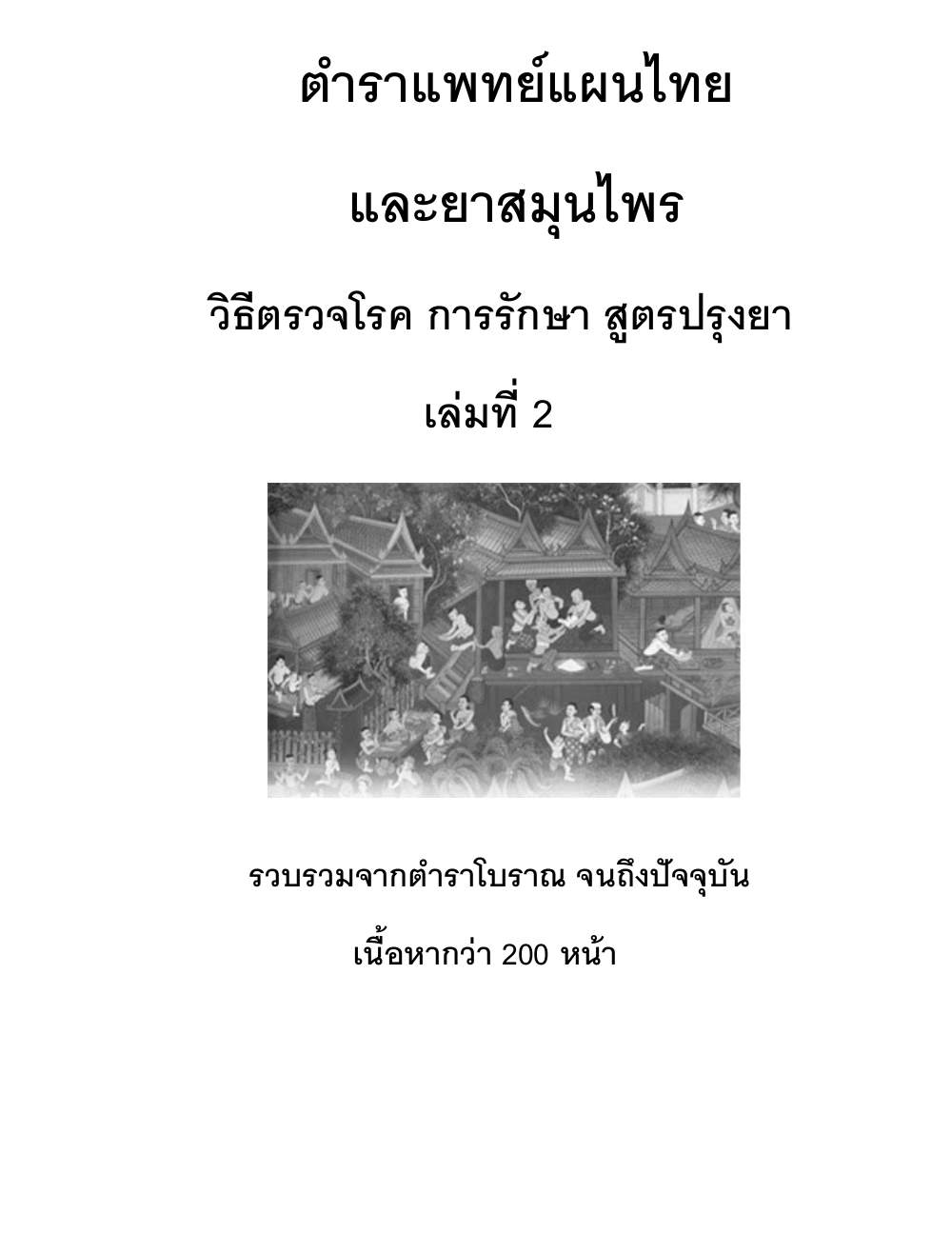
[ภาพ: ภาพวาดขาวดำแสดงหมู่บ้านไทยโบราณ เรือนไทยหลายหลังใต้ต้นไม้ มีผู้คนกำลังทำกิจกรรมต่าง ๆ เช่น นวด นั่งรับประทานอาหาร พูดคุยกัน]
รวบรวมจากตำราโบราณ จนถึงปัจจุบัน
เนื้อหากว่า 200 หน้า
Thai Traditional Medicine Textbook
and Herbal Medicine
Methods of Diagnosis, Treatment, Medicine Formulas
Volume 2
[Image: a black-and-white illustration of an old Thai village — several traditional Thai houses among trees, with people engaged in various activities such as giving massage, sitting and eating, and talking together]
Compiled from ancient texts up to the present
Over 200 pages of content
๑๒๒ โรงพิมพ์วัฒนาพานิช
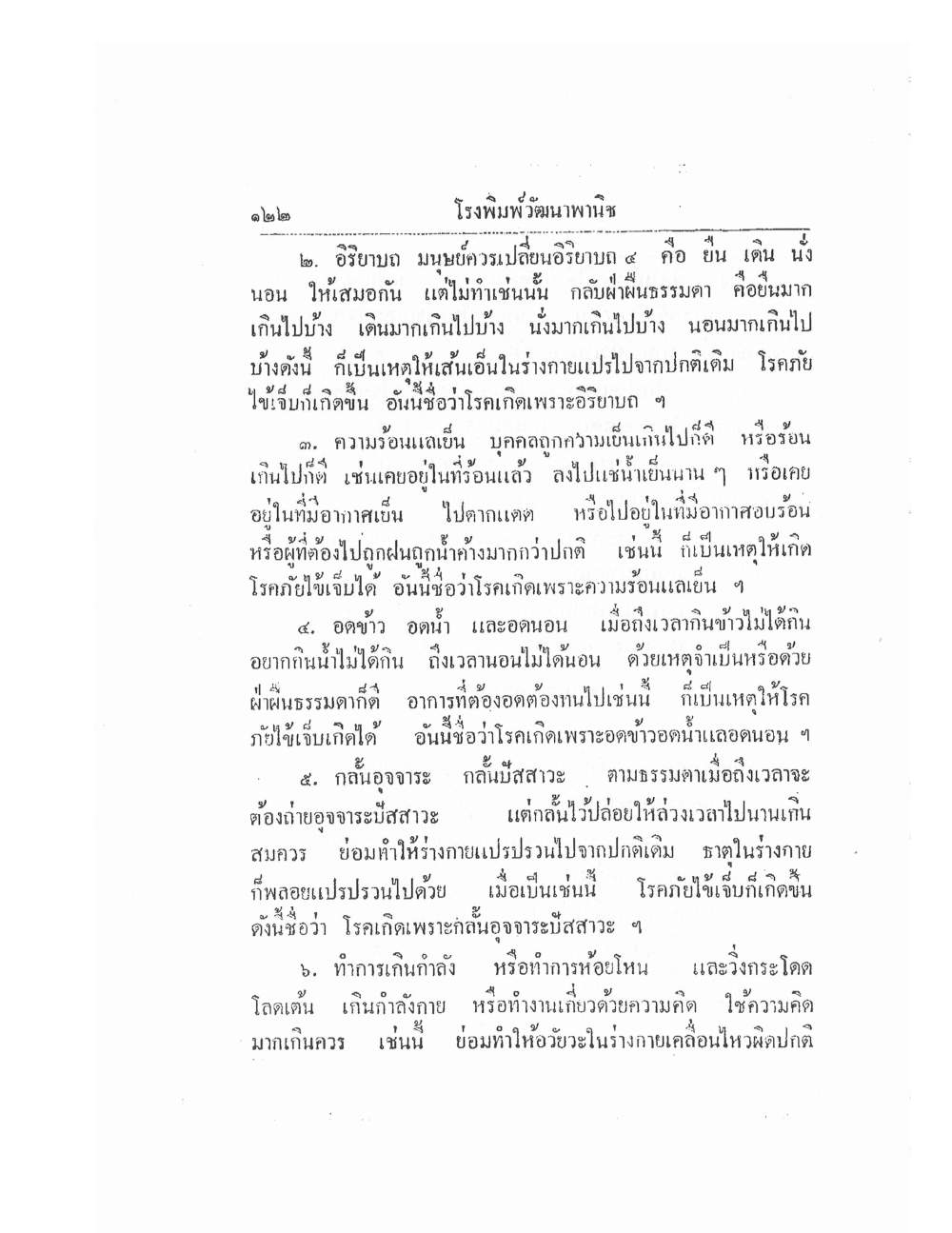
๒. อิริยาบถ มนุษย์ควรเปลี่ยนอิริยาบถ ๔ คือ ยืน เดิน นั่ง นอน ให้เสมอกัน แต่ไม่ทำเช่นนั้น กลับผ่าฝืนธรรมดา คือยืนมากเกินไปบ้าง เดินมากเกินไปบ้าง นั่งมากเกินไปบ้าง นอนมากเกินไปบ้างดังนี้ ก็เป็นเหตุให้เส้นเอ็นในร่างกายแปรไปจากปกติเดิม โรคภัยไข้เจ็บก็เกิดขึ้น อันนี้ชื่อว่าโรคเกิดเพราะอิริยาบถ ฯ
๓. ความร้อนแลเย็น บุคคลถูกความเย็นเกินไปก็ดี หรือร้อนเกินไปก็ดี เช่นเคยอยู่ในที่ร้อนแล้ว ลงไปแช่น้ำเย็นนาน ๆ หรือเคยอยู่ในที่มีอากาศเย็น ไปตากแดด หรือไปอยู่ในที่มีอากาศอบร้อน หรือผู้ที่ต้องไปถูกฝนถูกน้ำค้างมากกว่าปกติ เช่นนี้ ก็เป็นเหตุให้เกิดโรคภัยไข้เจ็บได้ อันนี้ชื่อว่าโรคเกิดเพราะความร้อนแลเย็น ฯ
๔. อดข้าว อดน้ำ และอดนอน เมื่อถึงเวลากินข้าวไม่ได้กิน อยากกินน้ำไม่ได้กิน ถึงเวลานอนไม่ได้นอน ด้วยเหตุจำเป็นหรือด้วยผ่าฝืนธรรมดาก็ดี อาการที่ต้องอดต้องทนไปเช่นนี้ ก็เป็นเหตุให้โรคภัยไข้เจ็บเกิดได้ อันนี้ชื่อว่าโรคเกิดเพราะอดข้าวอดน้ำแลอดนอน ฯ
๕. กลั้นอุจจาระ กลั้นบัสสาวะ ตามธรรมดาเมื่อถึงเวลาจะต้องถ่ายอุจจาระบัสสาวะ แต่กลั้นไว้ปล่อยให้ล่วงเวลาไปนานเกินสมควร ย่อมทำให้ร่างกายแปรปรวนไปจากปกติเดิม ธาตุในร่างกายก็พลอยแปรปรวนไปด้วย เมื่อเป็นเช่นนี้ โรคภัยไข้เจ็บก็เกิดขึ้น ดังนี้ชื่อว่า โรคเกิดเพราะกลั้นอุจจาระบัสสาวะ ฯ
๖. ทำการเกินกำลัง หรือทำการห้อยโหน และวิ่งกระโดดโลดเต้น เกินกำลังกาย หรือทำงานเกี่ยวด้วยความคิด ใช้ความคิดมากเกินควร เช่นนี้ ย่อมทำให้อวัยวะในร่างกายเคลื่อนไหวผิดปกติ
122 Watthana Phanit Press
2. Posture. A person should alternate among the four postures — standing, walking, sitting, lying down — equally. But if one does not do so, and instead departs from the natural balance — standing too much at times, walking too much at times, sitting too much at times, lying down too much at times — this causes the tendons in the body to depart from their original normal state, and sickness and illness arise. This is called "disease arising from posture."
3. Heat and cold. Whether a person is exposed to excessive cold or excessive heat — for example, having been in a hot place and then soaking a long time in cold water, or having been in a cool climate and then going out into the sun, or going into a place with hot, stifling air, or being exposed to rain or dew more than is normal — such things are a cause of sickness and illness arising. This is called "disease arising from heat and cold."
4. Abstaining from food, water, and sleep. When it is time to eat and one cannot eat, when one wants to drink water and cannot, when it is time to sleep and one cannot sleep — whether from necessity or from going against the natural order — the condition of having to endure and bear such deprivation is a cause of sickness and illness arising. This is called "disease arising from abstaining from food, water, and sleep."
5. Holding back stool and urine. Normally, when it is time to pass stool or urine, but one holds it in and lets the time pass far beyond what is proper, this causes the body to become disordered from its original normal state, and the elements (dhatu) in the body become disordered along with it. When this happens, sickness and illness arise. This is called "disease arising from holding back stool and urine."
6. Overexertion. Doing excessive physical activity, or hanging/swinging and running, jumping, and leaping beyond one's bodily strength, or working with the mind — using the mind too much — such things cause the organs in the body to move abnormally
ตำราแพทย์สงเคราะห์ ๑๒๓
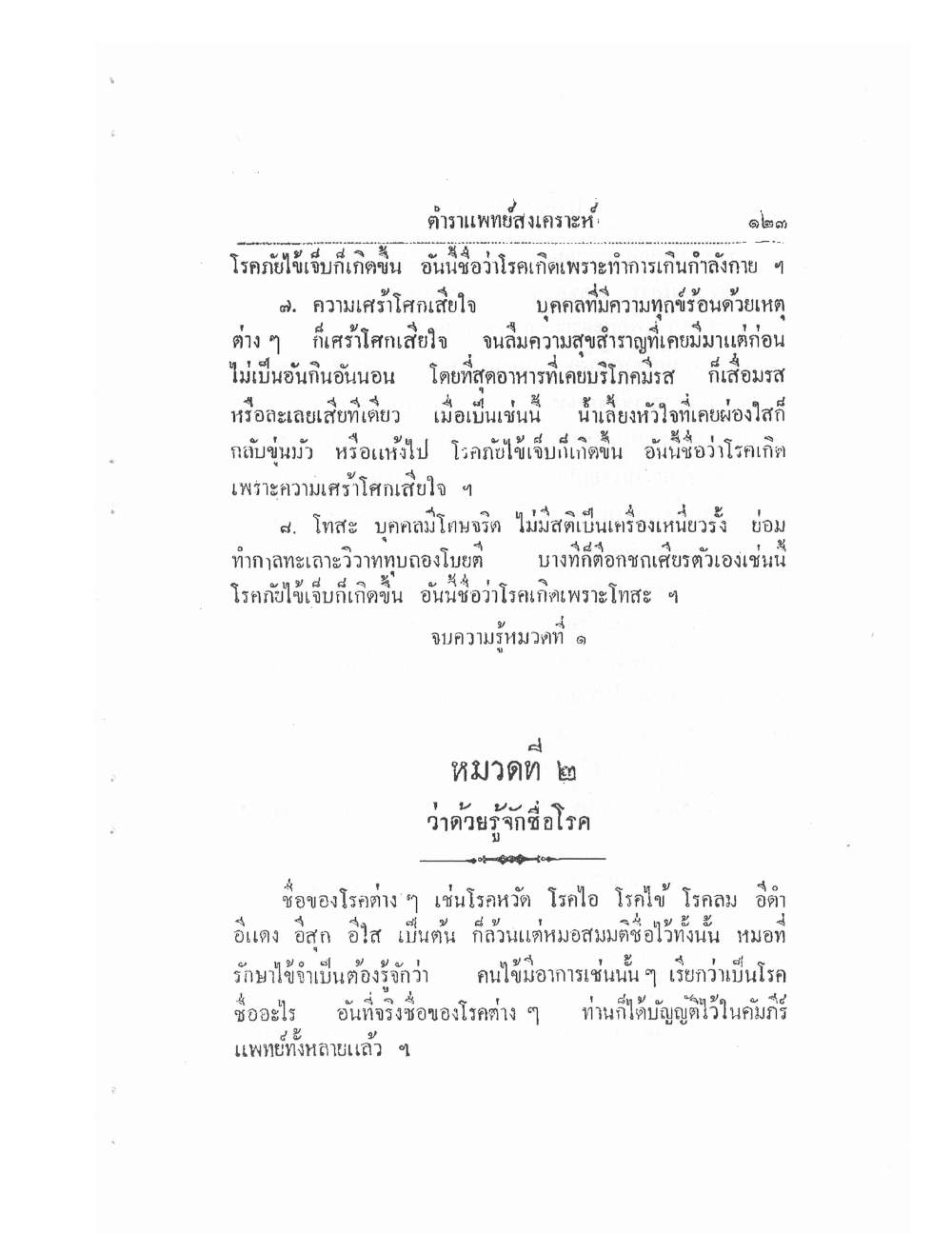
โรคภัยไข้เจ็บก็เกิดขึ้น อันนี้ชื่อว่าโรคเกิดเพราะทำการเกินกำลังกาย ฯ
๗. ความเศร้าโศกเสียใจ บุคคลที่มีความทุกข์ร้อนด้วยเหตุต่าง ๆ ก็เศร้าโศกเสียใจ จนลืมความสุขสำราญที่เคยมีมาแต่ก่อน ไม่เป็นอันกินอันนอน โดยที่สุดอาหารที่เคยบริโภคมีรส ก็เสื่อมรส หรือละเลยเสียทีเดียว เมื่อเป็นเช่นนี้ น้ำเลี้ยงหัวใจที่เคยผ่องใสก็กลับขุ่นมัว หรือแห้งไป โรคภัยไข้เจ็บก็เกิดขึ้น อันนี้ชื่อว่าโรคเกิดเพราะความเศร้าโศกเสียใจ ฯ
๘. โทสะ บุคคลมีโทษจริต ไม่มีสติเป็นเครื่องเหนี่ยวรั้ง ย่อมทำการทะเลาะวิวาททุบถองโบยตี บางทีก็ตอกชกเสียดตัวเองเช่นนี้ โรคภัยไข้เจ็บก็เกิดขึ้น อันนี้ชื่อว่าโรคเกิดเพราะโทสะ ฯ
จบความรู้หมวดที่ ๑
หมวดที่ ๒ ว่าด้วยรู้จักชื่อโรค
ชื่อของโรคต่าง ๆ เช่นโรคหวัด โรคไอ โรคไข้ โรคลม อีดำ อีแดง อีสุก อีใส เป็นต้น ก็ล้วนแต่หมอสมมติชื่อไว้ทั้งนั้น หมอที่รักษาไข้จำเป็นต้องรู้จักว่า คนไข้มีอาการเช่นนั้น ๆ เรียกว่าเป็นโรคชื่ออะไร อันที่จริงชื่อของโรคต่าง ๆ ท่านก็ได้บัญญัติไว้ในคัมภีร์แพทย์ทั้งหลายแล้ว ฯ
Tamra Phaet Songkhro (Physician's Compendium) 123
sickness and illness arise. This is called "disease arising from overexertion of the body."
7. Sorrow and grief. A person afflicted with suffering from various causes becomes sorrowful and grieving, to the point of forgetting the happiness and comfort once enjoyed. One can no longer eat or sleep properly; even food that once had good flavor loses its taste, or is neglected altogether. When this happens, the fluid that nourishes the heart, once clear, becomes turbid, or dries up, and sickness and illness arise. This is called "disease arising from sorrow and grief."
8. Anger. A person of angry temperament, lacking mindfulness to hold himself back, will quarrel, brawl, strike and beat others — sometimes even punching and injuring himself. When this happens, sickness and illness arise. This is called "disease arising from anger."
End of Section 1.
Section 2 On Knowing the Names of Diseases
The names of the various diseases — such as the common cold, cough, fever, wind-illness, black pox, red pox, chickenpox, smallpox, and so on — are all merely conventional names assigned by physicians. A doctor treating a patient must know that when a patient has such-and-such symptoms, it is called by such-and-such a disease name. In truth, the names of the various diseases have already been established by the masters in the medical treatises.
๑๒๔ โรงพิมพ์วัฒนาพานิช
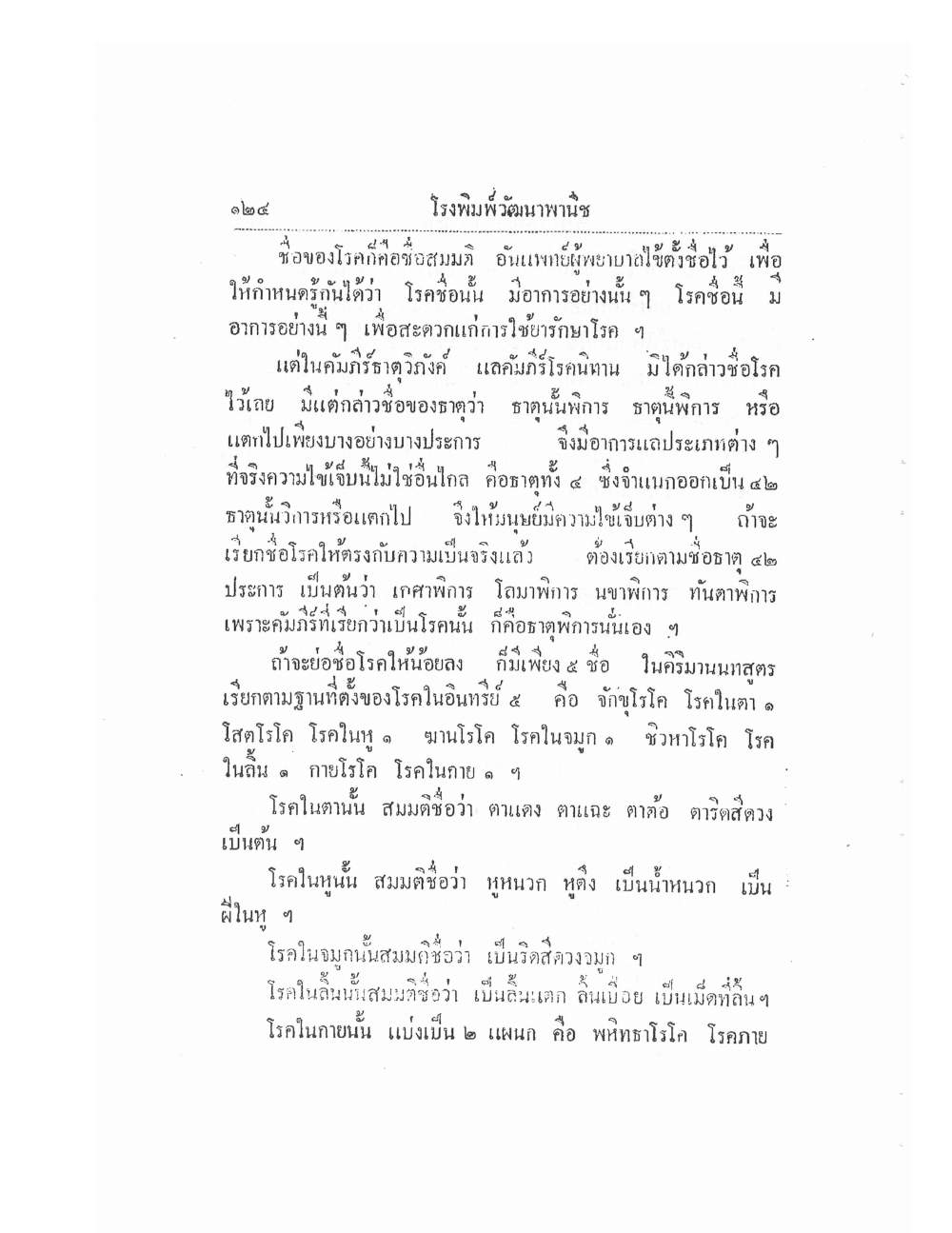
ชื่อของโรคก็คือชื่อสมมติ อันแพทย์ผู้พยาบาลใช้ตั้งชื่อไว้ เพื่อให้กำหนดรู้กันได้ว่า โรคชื่อนั้น มีอาการอย่างนั้น ๆ โรคชื่อนี้ มีอาการอย่างนี้ ๆ เพื่อสะดวกแก่การใช้ยารักษาโรค ฯ
แต่ในคัมภีร์ธาตุวิภังค์ แลคัมภีร์โรคนิทาน มิได้กล่าวชื่อโรคไว้เลย มีแต่กล่าวชื่อของธาตุว่า ธาตุนั้นพิการ ธาตุนี้พิการ หรือแตกไปเพียงบางอย่างบางประการ จึงมีอาการแลประเภทต่าง ๆ ที่จริงความไข้เจ็บนั้นไม่ใช่อื่นไกล คือธาตุทั้ง ๔ ซึ่งจำแนกออกเป็น ๔๒ ธาตุนั้นวิการหรือแตกไป จึงให้มนุษย์มีความไข้เจ็บต่าง ๆ ถ้าจะเรียกชื่อโรคให้ตรงกับความเป็นจริงแล้ว ต้องเรียกตามชื่อธาตุ ๔๒ ประการ เป็นต้นว่า เกศาพิการ โลมาพิการ นขาพิการ ทันตาพิการ เพราะคัมภีร์เรียกว่าเป็นโรคนั้น ก็คือธาตุพิการนั้นเอง ฯ
ถ้าจะย่อชื่อโรคให้น้อยลง ก็มีเพียง ๕ ชื่อ ในครินมานนทสูตร เรียกตามฐานที่ตั้งของโรคในอินทรีย์ ๕ คือ จักขุโรโค โรคในตา ๑ โสตโรโค โรคในหู ๑ ฆานโรโค โรคในจมูก ๑ ชิวหาโรโค โรคในลิ้น ๑ กายโรโค โรคในกาย ๑ ฯ
โรคในตานั้น สมมติชื่อว่า ตาแดง ตาเฉะ ตาต้อ ตาริดสีดวง เป็นต้น ฯ
โรคในหูนั้น สมมติชื่อว่า หูหนวก หูตึง เป็นน้ำหนวก เป็นผีในหู ฯ
โรคในจมูกนั้นสมมติชื่อว่า เป็นริดสีดวงจมูก ฯ โรคในลิ้นนั้นสมมติชื่อว่า เป็นลิ้นเลก ลิ้นเบื่อย เป็นเม็ดที่ลิ้น ฯ โรคในกายนั้น แบ่งเป็น ๒ แผนก คือ พหิทธาโรโค โรคภาย
124 Watthana Phanit Press
The name of a disease is a conventional name, established by attending physicians in order to make it recognizable that a disease of such-and-such a name has such-and-such symptoms, and a disease of this name has these symptoms — for the convenience of applying medicine to treat it.
But in the Dhatuvibhang treatise and the Rokanithan (disease-origins) treatise, no disease names are given at all. They speak only of the elements (dhatu), saying that such an element is disordered, or such an element is disordered, or has broken down in some particular respect — from which arise the various symptoms and categories. In truth, sickness is nothing other than this: the four elements, which are subdivided into 42 [components], become disordered or break down, and this is what causes human beings to suffer various illnesses. If disease names were to be given strictly according to the truth, they would have to follow the names of the 42 elements — for example, "hair-disorder," "body-hair-disorder," "nail-disorder," "tooth-disorder" — because what the treatises call "disease" is simply that disorder of the element itself.
If one wishes to abbreviate the names of diseases to fewer categories, there are only 5 names. In the Khrinamananthasut [Pali sutta name as printed], they are named according to the seat of the disease among the five faculties: cakkhu-roga, disease of the eye, one; sota-roga, disease of the ear, one; ghana-roga, disease of the nose, one; jivha-roga, disease of the tongue, one; kaya-roga, disease of the body, one.
Diseases of the eye are conventionally named: red eye, sore/weeping eye, cataract, eye-hemorrhoid (pterygium), and so on.
Diseases of the ear are conventionally named: deafness, dullness of hearing, discharging ear, having a "spirit" in the ear.
Diseases of the nose are conventionally named: nasal hemorrhoid (polyp). Diseases of the tongue are conventionally named: small tongue, numb tongue, having a lump on the tongue. Diseases of the body are divided into 2 categories: exterior disease, disease outside
ตำราแพทย์สงเคราะห์ ๑๒๕
นอกกาย ๑ อันตโรโค โรคภายใน ๑ โรคภายนอกนั้นสมมติชื่อว่า เป็นเกลื้อน กลาก คุดทะราด หูด ขี้เรื้อน กุฏฐัง แลแผลต่าง ๆ ซึ่งปรากฏออกมานอกกายเป็นต้น ฯ
โรคภายในนั้น สมมติชื่อว่าเป็นไข้ เป็นเถา เป็นดาน เป็นลม เป็นผื เป็นจุกเสียด เป็นบิด เป็นบ่วง เป็นต้น เพราะเหตุที่โรคเกิดขึ้นในอินทรีย์ ๕ คือ ตา หู จมูก ลิ้น กาย นั้นเอง จึงได้สมมติชื่อโรคไว้ ภายหลังหมอจึงได้เรียกตามกันต่อ ๆ มา จนตราบเท่าทุกวันนี้ ฯ
ชื่อโรคจะถือเอาเป็นชื่อแน่นอนไม่ค่อยได้ เพราะเป็นชื่อสมมติโรคอย่างเดียวกัน ชาวใต้เรียกชื่ออย่างหนึ่ง ชาวเหนือเรียกชื่ออย่างหนึ่ง ในคัมภีร์เรียกชื่ออย่างหนึ่ง อันที่จริงก็เป็นโรคอย่างเดียวกัน ข้อนี้ไม่ต้องคิดแก้ไขอย่างไร หมอควรอนุโลมตามหมู่บ้านก็เป็นอันใช้ได้ ฯ
ข้อสำคัญ ขอแนะนำว่า ผู้ศึกษาเป็นหมอ ควรดูไข้ที่ตายให้แม่นยำก่อน จึงเรียนแก้ ไข้สำคัญเช่นไข้เหนือ ไข้พิษ ไข้กาฬ ซึ่งโบราณเรียกว่าไข้ตักศิลา บัดนี้เรียกว่ากาฬโรค นั้นควรจะศึกษาให้แม่นยำ เพราะหมอจะมีชื่อเสียงเร็ว หรือเสียชื่อเสียง ก็เพราะรักษาไข้เหล่านี้หายแลตายโดยมาก ฯ
จบความรู้หมวดที่ ๒
Tamra Phaet Songkhro (Physician's Compendium) 125
disease outside the body, one category; antaroga (internal disease), disease inside, one category. External diseases are conventionally named: ringworm, tinea, yaws, warts, leprous scale, leprosy, and various sores appearing on the outside of the body, and so on.
Internal diseases are conventionally named: fever, a chronic mass, a hardened abdominal mass, wind-illness, a rash-condition, colic/stabbing pain, dysentery, a knotting ailment, and so on — because these diseases arise in the five faculties, namely the eyes, ears, nose, tongue, and body, and so these disease names were conventionally assigned. Physicians afterward came to use these names one after another, down to this very day.
The names of diseases cannot really be taken as fixed and certain, because they are merely conventional names for what is the same disease. People of the South call it by one name, people of the North call it by another name, and the treatises call it by yet another name — in truth it is the same disease. There is no need to try to correct this matter; a physician should simply defer to local village usage, and that is acceptable.
An important point, by way of advice: one studying to become a physician should first learn to recognize fatal fevers with accuracy, and only then learn to treat them. Important fevers such as "Fever of the North," "Poison Fever," and "Spotted Fever" — which the ancients called "Taksila Fever" and which is now called plague — should be studied with accuracy, because a physician's reputation is made or lost quickly, on account of how these fevers, once treated, result mostly in either recovery or death.
End of Section 2.
หมวดที่ ๓ ว่าด้วยรู้จักยาสำหรับแก้โรค
ที่ว่ารู้จักยาสำหรับแก้โรคนั้น คือรู้สรรพสิ่งต่าง ๆ ซึ่งสำหรับจะได้นำเอามาปรุงเป็นยาแก้โรคที่บังเกิดขึ้น การที่รู้จักนั้น ต้องรู้ตลอดถึงของ ๔ อย่าง คือ
๑. รู้จักตัวยา ฯ ๒. รู้จักสรรพคุณยา ฯ ๓. รู้จักเครื่องยาที่มีชื่อต่างกัน รวมเรียกเป็นชื่อเดียวกัน ฯ ๔. รู้จักปรุงยาที่ประสมใช้ตามวิธีต่าง ๆ ที่ว่ารู้จักตัวยานั้นให้รู้จักสิ่งทั้ง ๕ คือ รู้จักรูป รู้จักกลิ่น รู้จักรส แลให้รู้จักชื่อในเภสัชชวัตถุ ๓ จำพวก คือ
ก. พืชวัตถุ ให้รู้จักพรรณไม้ พรรณหญ้า เครือเขา ฯ ข. สัตว์วัตถุ ให้รู้จักเครื่องอวัยวะของสัตว์ ฯ ค. ธาตุวัตถุ ให้รู้จักแร่ธาตุต่าง ๆ ฯ
ก. พืชวัตถุนั้น ให้รู้จักว่า ไม้อย่างนี้ มีรส มีรูป มีดอก มีเกสร มีผล มีเมล็ด มีกะพี้ มีแก่น มียาง มีราก มีเปลือก เป็นอย่างนี้ ๆ จำพวกพรรณหญ้าเครือเขา ก็ให้รู้เช่นเดียวกัน ฯ
ข. สัตว์วัตถุนั้น ให้รู้จักอวัยวะของสัตว์ เป็นต้นว่า ขน หนัง เขี้ยว งา นอ ฟัน กราม กีบ กะดูก ดี มีลักษณะ รูป สี กลิ่น รส อย่างนี้ ๆ เป็นของสัตว์ชื่ออย่างนี้ ๆ ฯ
Section 3 On Knowing Medicines for Curing Disease
To "know medicine for curing disease" means to know all the various substances that can be brought together and compounded into medicine for curing an arising disease. This knowledge must extend fully to 4 matters, namely:
1. Knowing the medicinal substance itself. 2. Knowing the properties of the medicine. 3. Knowing that medicinal ingredients bearing different names are, together, called by one same name. 4. Knowing how to compound medicines that are mixed according to various methods. "Knowing the medicinal substance" means knowing 5 things [as printed], namely: knowing its form, knowing its smell, knowing its taste, and knowing its name among the three categories of medicinal substances, which are:
a. Plant substances — one should know the trees, grasses, and vines. b. Animal substances — one should know the parts of animals. c. Mineral substances — one should know the various minerals.
a. As for plant substances, one should know that such-and-such a plant has a certain taste, form, flowers, stamens, fruit, seeds, sapwood, heartwood, resin, roots, and bark, of such-and-such a kind. The categories of grasses and vines should be known in the same way.
b. As for animal substances, one should know the parts of animals — for example, fur, hide, tusks, ivory, rhinoceros horn, teeth, molars, hooves, bone, and bile — having such-and-such form, color, smell, and taste, belonging to an animal of such-and-such a name.
ตำราแพทย์สงเคราะห์ ๑๒๖
ค. แร่ธาตุต่าง ๆ นั้น ให้รู้ตลอดถึง รูป สี กลิ่น รส เช่นเดียวกัน เป็นต้นว่า กำมะถัน กรบูร ดินประสิว จุนสี สุพรรณถัน มีรูป สี กลิ่น รส เป็นอย่างนั้น ๆ ฯ
รู้จักสรรพคุณยานั้น ท่านกล่าวเอารสยา ๓ อย่างขึ้นเป็นที่ตั้ง คือ ยารสเย็นจำพวก ๑ ยารสร้อนจำพวกหนึ่ง ๑ ยารสสุขุมจำพวก ๑ ยารสเย็นนั้นได้แก่ยาที่เข้าใบไม้ที่มีรสเย็น เข้าเกสรดอกไม้ แลเข้าสัตว์เขา เนาวเขี้ยว หรือยาที่เผาเป็นถ่านแล้วปรุงเป็นยา เช่นยามหานิล ยามหากาฬ สำหรับแก้ในทางเตโชเป็นต้น ยารสร้อนนั้นได้แก่ยาที่เข้าเบญจกูล ตรีกะฏุก หัสคุณ เช่นยาเหลืองสำหรับแก้ทางวาโยเป็นต้น ยารสสุขุมนั้น ได้แก่ยาที่เข้าโกฏฐ์เทียน กฤษณา กะลำพักเนื้อไม้ ขอนดอก ชะลูด อาเชย เป็นต้น เช่นยาหอมสำหรับแก้ทางโลหิตเป็นอาทิ ฯ
อีกอย่างหนึ่ง ท่านกล่าวว่ายามี ๙ รส คือ
๑. ยารสฝาด สำหรับสมาน ฯ ๒. ยารสหวาน สำหรับซึมซาบไปตามเนื้อ ฯ ๓. ยารสเมาเบื่อ สำหรับแก้พิษ ฯ ๔. ยารสขม แก้ทางโลหิต แลดี ฯ ๕. ยารสเผ็ดร้อน แก้ลม ฯ ๖. ยารสมัน แก้ทางเส้นเอ็น ฯ ๗. ยารสหอมเย็น บำรุงหัวใจ ฯ ๘. ยารสเค็ม ซึมซาบไปตามผิวหนัง ฯ ๙. ยารสเปรี้ยว กัดเสมหะ ฯ
Tamra Phaet Songkhro (Physician's Compendium) 126
c. As for the various minerals, one should likewise know fully their form, color, smell, and taste — for example, sulfur, camphor, saltpeter, blue vitriol (copper sulfate), and suphanthan (a gold-tin alloy), each having such-and-such form, color, smell, and taste.
As for "knowing the properties of medicine," the masters set forth three medicinal tastes as the basis: cooling medicines, one category; hot medicines, one category; and mild/subtle medicines, one category. Cooling medicines are those containing leaves of cooling taste, flower pollen, and animal horn — the "nine tusks" (neaw-khiao) — or medicine that has been charred to charcoal and then compounded, such as Ya Maha Nin and Ya Maha Kan, used to treat disorders along the line of the Fire element (tejo), for example. Hot medicines are those containing benjakun (the five roots), tri-kathuk (three peppers), and hatsakhun, such as the yellow medicine used to treat disorders along the line of the Wind element (vayo), for example. Mild medicines are those containing kot-thian, agarwood (kritsana), kalampak heartwood, khon-dok, chalut, and archangel, such as the fragrant medicine (ya hom) used to treat disorders of the blood, and the like.
In another account, it is said that medicine has 9 tastes, namely:
1. Astringent taste — for healing/binding. 2. Sweet taste — for permeating through the flesh. 3. Intoxicating/poisonous taste — for counteracting poison. 4. Bitter taste — for treating disorders of the blood and bile. 5. Pungent-hot taste — for treating wind disorders. 6. Oily taste — for treating disorders of the tendons. 7. Fragrant-cooling taste — for nourishing the heart. 8. Salty taste — for permeating through the skin. 9. Sour taste — for corroding phlegm.
๑๒๙ โรงพิมพ์วัฒนาพานิช
ในตำราท่านกล่าวไว้เพียง ๕ รส แต่บางท่านกล่าวว่า ควรเติมยารสจืด แก้ทางเสมหะเข้าด้วย ฯ
อีกประการหนึ่ง ท่านจัดตามธาตุทั้ง ๔ คือ ธาตุอย่างนั้นพิการ ต้องใช้ยารสอย่างนั้น ๆ จึงจะแก้ถูกต้องกับโรคดังนี้ คือ
๑. โรคเกิดเพื่อปฐวีธาตุพิการ ชอบยารสฝาด รสเค็ม รสหวาน รสมัน ฯ ๒. โรคเกิดเพื่ออาโปธาตุพิการ ชอบยารสขม รสเปรี้ยว รสเมาเบื่อ ฯ ๓. โรคเกิดเพื่อเตโชธาตุพิการ ชอบยารสสุขุม รสเผ็ดร้อน ฯ
ผู้ศึกษาเมื่อต้องการความรู้พิสดารต่อไป ควรดูคัมภีร์สรรพคุณยา เพราะว่าจะนำมากล่าวไว้ในที่นี้ ก็เป็นสิ่งที่เหลือวิสัย ฯ
รู้จักเครื่องยาที่มีชื่อต่างกัน รวมเรียกเป็นชื่อเดียวกันนั้น ท่านจัดไว้เป็นหมวด ๆ ดังจะกล่าวไว้เป็นตัวอย่างดังนี้
ทุกะ หมวดของ ๒ อย่าง
เทฺวคันธา คือรากบุนนาค รากมะซาง ฯ เทฺวติคันธา ดอกบุนนาค แก่นบุนนาค รากบุนนาค ดอกมะซาง แก่นมะซาง ฯ
ติกะ หมวดของ ๓ อย่าง
ตรีสุคนธ์ รากอบเชยเทศ รากอบเชยไทย รากพิมเสนต้น ฯ ตรีผลา สมออัพยา สมอพิเภก มะขามป้อม ฯ ตรีกะฏุก พริกไทย ดีปลี ขิง ฯ
129 Watthana Phanit Press
In the treatises, the masters speak of only 5 tastes, but some masters say a bland taste should also be added, for treating disorders of phlegm.
Furthermore, the masters classify according to the four elements: when such-and-such an element is disordered, one must use medicine of such-and-such a taste to properly treat the disease, as follows:
1. Disease arising from disorder of the Earth element (pathavi-dhatu) responds to astringent, salty, sweet, and oily tastes. 2. Disease arising from disorder of the Water element (apo-dhatu) responds to bitter, sour, and intoxicating/poisonous tastes. 3. Disease arising from disorder of the Fire element (tejo-dhatu) responds to mild and pungent-hot tastes.
Students who wish for more detailed knowledge should consult the treatise on medicinal properties (Sappakhun Ya), for it would be beyond the scope to set it all out here.
As for "knowing medicinal ingredients that bear different names but are together called by one name," the masters have arranged these into groups, as will be given here by way of example:
Duka — Group of 2 Ingredients
Dve-gandha: root of bunnak, root of masang. Dve-ti-gandha: flower of bunnak, heartwood of bunnak, root of bunnak, flower of masang, heartwood of masang.
Tika — Group of 3 Ingredients
Tri-sukhon: root of foreign cinnamon, root of Thai cinnamon, root of young phimsen tree. Tri-phala: samo-appaya, samo-phiphek, makham-pom (Indian gooseberry). Tri-kathuk: black pepper, deepli (long pepper), ginger.
ตำราแพทย์สงเคราะห์
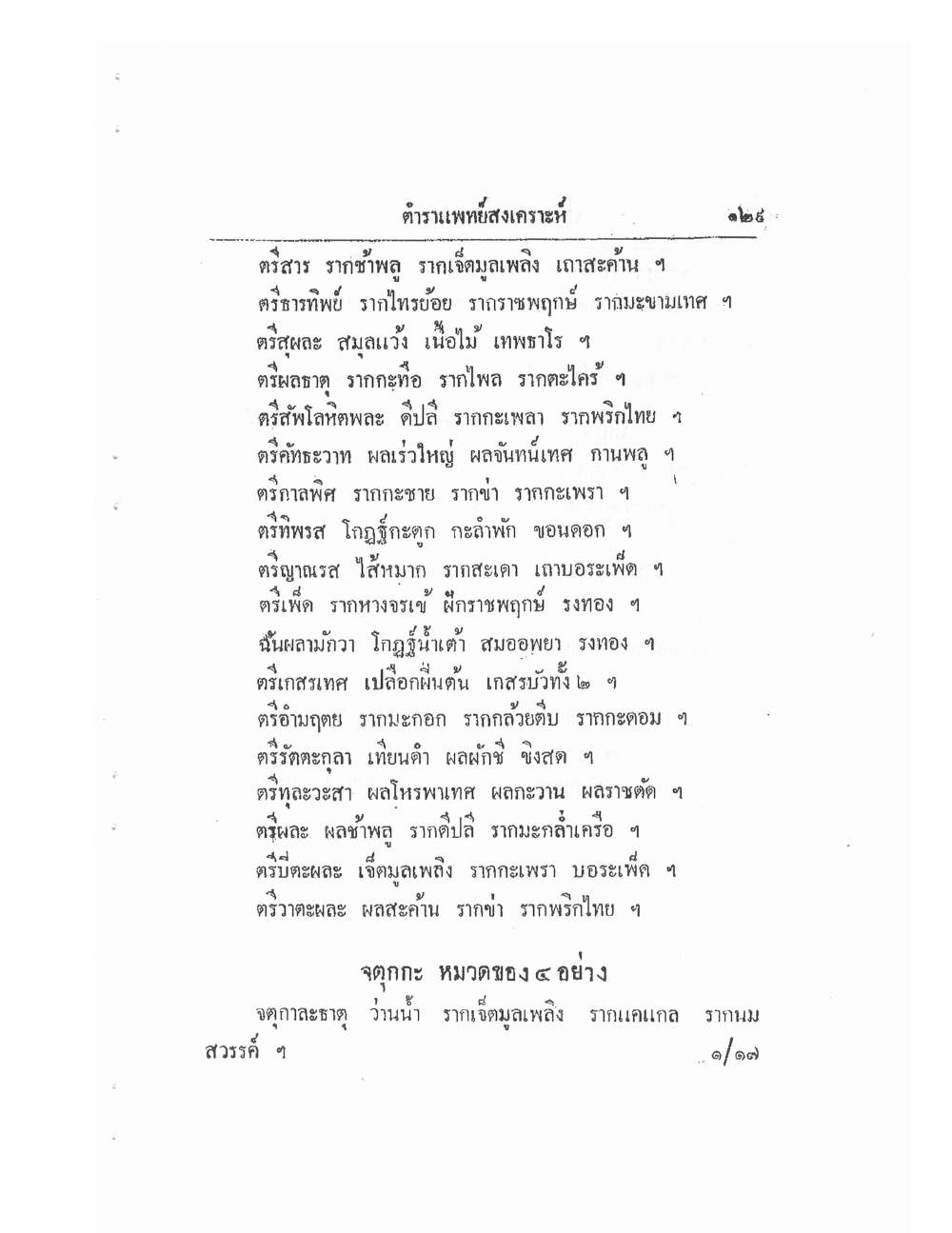
ตรีสาร รากช้าพลู รากเจ็ตมูลเพลิง เถาสะค้าน ฯ ตรีธารทิพย์ รากไทรย้อย รากราชพฤกษ์ รากมะขามเทศ ฯ ตรีสุผละ สมุลแว้ง เนื้อไม้ เทพธาโร ฯ ตรีผลธาตุ รากกะทือ รากไพล รากตะไคร้ ฯ ตรีสัพโลหิตพละ ดีปลี รากกะเพลา รากพริกไทย ฯ ตรีคัทธะวาท ผลเร่วใหญ่ ผลจันทน์เทศ กานพลู ฯ ตรีกาลพิศ รากกะชาย รากข่า รากกะเพรา ฯ ตรีทิพรส โกฏฐ์กะดูก กะลำพัก ขอนดอก ฯ ตรีญาณรส ไส้หมาก รากสะเดา เถาบอระเพ็ด ฯ ตรีเพ็ด รากหวงจรเข้ ผักราชพฤกษ์ รงทอง ฯ ฉันผลามกัว โกฏฐ์น้ำเต้า สมออัพยา รงทอง ฯ ตรีเกสรเทศ เปลือกผึ้งต้น เกสรบัวทั้ง ๒ ฯ ตรีอำมฤตย รากมะกอก รากกล้วยตีบ รากกะดอม ฯ ตรีรัตตะกุลา เทียนดำ ผลผักชี ขิงสด ฯ ตรีทุละวะสา ผลโหรพานเทศ ผลกะวาน ผลราชดัด ฯ ตรีผละ ผลช้าพลู รากดีปลี รากมะกล่ำเครือ ฯ ตรีบตะผละ เจ็ตมูลเพลิง รากกะเพรา บอระเพ็ด ฯ ตรีวาตะผละ ผลสะค้าน รากข่า รากพริกไทย ฯ
จตุกกะ หมวดของ ๔ อย่าง
จตุกาละธาตุ ว่านน้ำ รากเจ็ตมูลเพลิง รากแคนแกล รากนมสวรรค์ ฯ
๑/๑๗
Tamra Phaet Songkhro (Physician's Compendium)
Sara Tri: root of cha-phlu, root of chet-mun-phloeng, vine of sakhan. Thara-thip Tri: aerial root of the weeping banyan, root of ratchaphruek (golden shower tree), root of makham-thet. Suphala Tri: samun-waeng, heartwood, thep-thalo wood. Phaladhatu Tri: root of kathue, root of phlai, root of takhrai (lemongrass). Sapholohitphala Tri: deepli, root of kaphloe, root of black pepper. Katthawat Tri: fruit of the greater rew (cardamom), fruit of nutmeg, clove. Kanlaphit Tri: root of krachai (fingerroot), root of kha (galangal), root of kaphrao (holy basil). Thipparot Tri: kot-kadook, kalampak, khon-dok. Yanarot Tri: areca-nut pith, neem root, boraphet vine. Phet Tri: root of huang-chorakhe, ratchaphruek leaf, rong-thong (gamboge). Chanphalamkua [as printed]: kot-namtao, samo-appaya, rong-thong. Kesonthet Tri: young bee-hive bark, pollen of both kinds of lotus. Ammarittaya Tri: root of makok, root of kluai-teep, root of kadom. Rattakula Tri: black cumin, coriander fruit, fresh ginger. Thulawasa Tri: fruit of horaphan-thet, fruit of kawan (cardamom), fruit of ratchadat. Phala Tri: fruit of cha-phlu, root of deepli, root of makam-khruea. Bataphala Tri: chet-mun-phloeng, root of kaphrao, boraphet. Watapala Tri: fruit of sakhan, root of kha, root of black pepper.
Chatukka — Group of 4 Ingredients
Chatukala-dhatu: sweet flag (wan-nam), root of chet-mun-phloeng, root of khaen-klaen, root of nom-sawan.
[printer's mark: 1/17]
๑๓๐ โรงพิมพ์วัฒนาพานิช
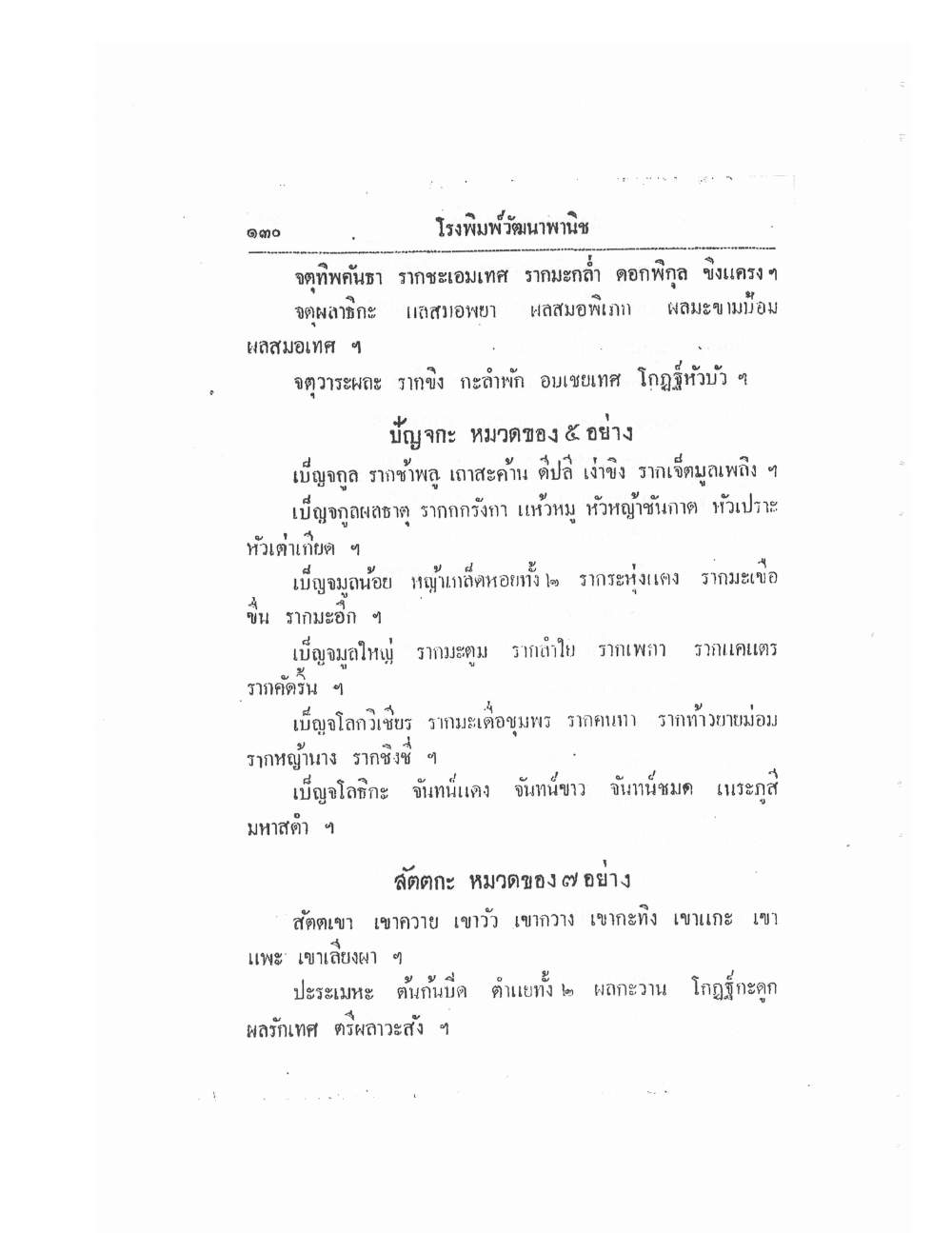
จตุทิพคันธา รากชะเอมเทศ รากมะกล่ำ ดอกพิกุล ขิงแครง ฯ จตุผลาธิกะ แลสมออัพยา ผลสมอพิเภก ผลมะขามป้อม ผลสมอเทศ ฯ
จตุวาระผละ รากขิง กะลำพัก อบเชยเทศ โกฏฐ์หัวบัว ฯ
บัญจกะ หมวดของ ๕ อย่าง
เบญจกูล รากช้าพลู เถาสะค้าน ดีปลี เง่าขิง รากเจ็ตมูลเพลิง ฯ เบญจกูลผลชาตุ รากกกรังกา แห้วหมู หัวหญ้าชันกาด หัวเปราะ หัวเต่าเกียด ฯ เบญจมูลน้อย หญ้าเกล็ดหอยทั้ง ๒ รากระหุ่งแดง รากมะเขือขื่น รากมะอึก ฯ เบญจมูลใหญ่ รากมะตูม รากคำใย รากเพกา รากแคนแตร รากคัดฝัน ฯ เบญจโลกวิเชียร รากมะเดื่อชุมพร รากคนทา รากท้าวยายม่อม รากหญ้านาง รากชิงชี่ ฯ เบญจโลธิกะ จันทน์แดง จันทน์ขาว จันทน์ชมด แก่นภูสี มหาสดำ ฯ
สัตตกะ หมวดของ ๗ อย่าง
สัตตเขา เขาควาย เขาวัว เขากวาง เขากะทิง เขาแกะ เขาแพะ เขาเลี้ยงผา ฯ ประเมหะ ต้นกันบิด ตำแยทั้ง ๒ ผลกะวาน โกฏฐ์กะดูก ผลรักเทศ ตรีผลาวะสัง ฯ
130 Watthana Phanit Press
Chatuthipphakhantha: root of cha-oem-thet (foreign licorice), root of maklam, flower of phikun, khing-khraeng. Chatuphalathika: samo-appaya, fruit of samo-phiphek, fruit of makham-pom, fruit of samo-thet.
Chatuwaraphala: root of ginger, kalampak, foreign cinnamon, kot-hua-bua.
Banchaka — Group of 5 Ingredients
Benjakun (the Five Roots): root of cha-phlu, vine of sakhan, deepli, ginger rhizome, root of chet-mun-phloeng. Benjakun-phon-chat: root of kok-rang-ka, water chestnut (haeo-mu), root of ya-chan-kat, root of prao. Benja-mun-noi (Lesser Five Roots): both kinds of ya-klet-hoi, root of ra-hung-daeng, root of ma-khuea-khuen, root of ma-euk. Benja-mun-yai (Greater Five Roots): root of matum (bael fruit), root of kham-yai, root of phekha, root of khaen-traen, root of khat-fan. Benja-lok-wichian: root of ma-dua-chumphon (cluster fig), root of khontha, root of thao-yai-mom, root of ya-nang, root of ching-chi. Benja-lothika: red sandalwood, white sandalwood, chamot sandalwood, phusi heartwood, maha-sadam.
Sattaka — Group of 7 Ingredients
Sat-khao (Seven Horns): buffalo horn, cow horn, deer antler, gaur horn, ram's horn, goat horn, serow's horn. Pramaeha [formula]: kan-bit plant, both kinds of stinging nettle, cardamom fruit, kot-kadook, foreign wax-apple fruit, tri-phala-wasang.
ตำราแพทย์สงเคราะห์ ๑๓๑
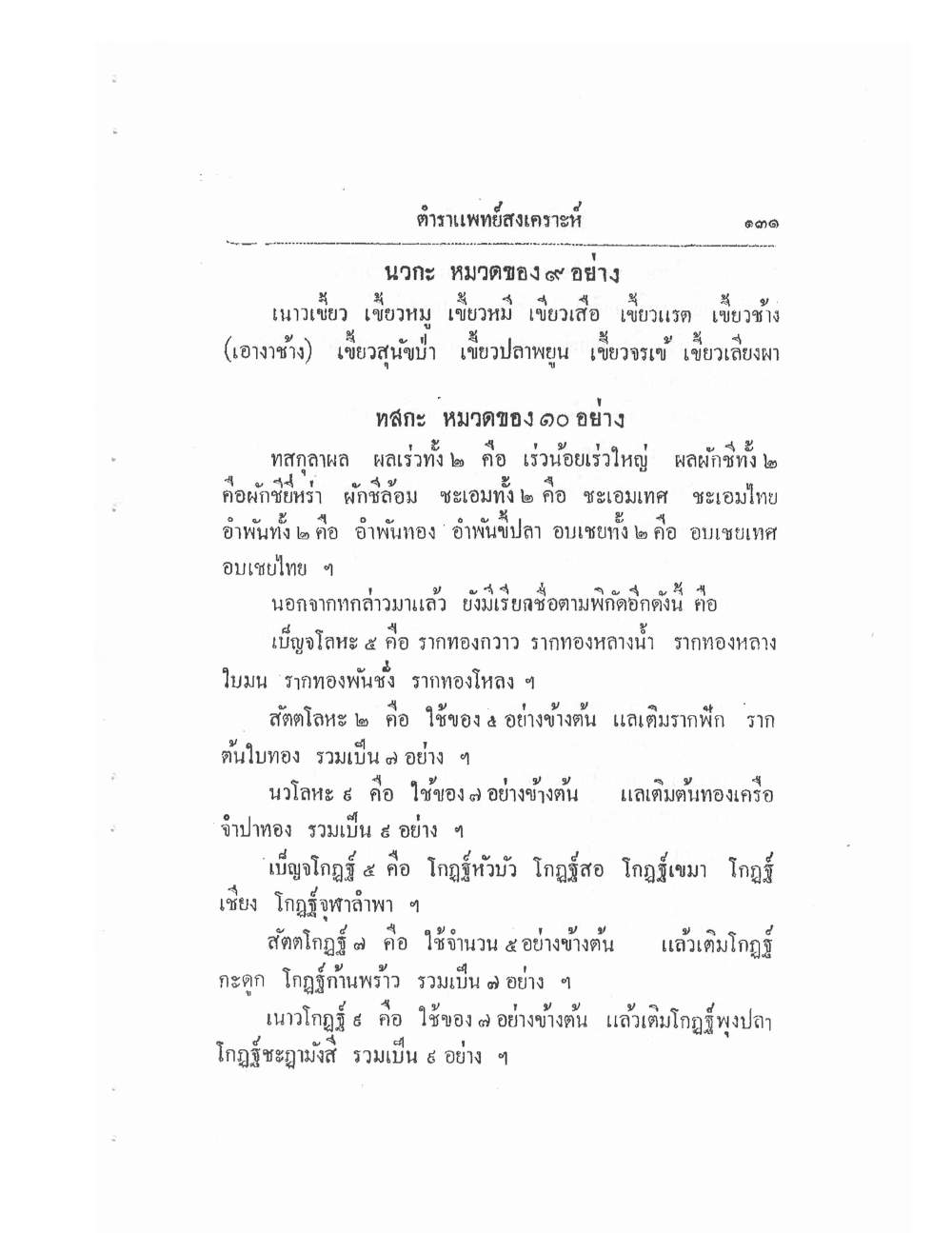
นวกะ หมวดของ ๙ อย่าง
เนาวเขี้ยว เขี้ยวหมู เขี้ยวหมี เขี้ยวเสือ เขี้ยวแรด เขี้ยวช้าง (เอางาช้าง) เขี้ยวสุนัขบ้า เขี้ยวปลาพยูน เขี้ยวจรเข้ เขี้ยวเลี้ยงผา
ทสกะ หมวดของ ๑๐ อย่าง
ทสกลาผล ผลเร่วทั้ง ๒ คือ เร่วน้อยเร่วใหญ่ ผลผักชีทั้ง ๒ คือผักชีหร่า ผักชีล้อม ชะเอมทั้ง ๒ คือ ชะเอมเทศ ชะเอมไทย อำพันทั้ง ๒ คือ อำพันทอง อำพันขี้ปลา อบเชยทั้ง ๒ คือ อบเชยเทศ อบเชยไทย ฯ
นอกจากที่กล่าวมาแล้ว ยังมีเรียกชื่อตามพิกัดอีกดังนี้ คือ
เบญจโลหะ ๕ คือ รากทองกวาว รากทองหลางน้ำ รากทองหลางใบมน รากทองพันชั่ง รากทองโหลง ฯ สัตตโลหะ ๗ คือ ใช้ของ ๕ อย่างข้างต้น แลเติมรากพัก รากต้นใบทอง รวมเป็น ๗ อย่าง ฯ นวโลหะ ๙ คือ ใช้ของ ๗ อย่างข้างต้น แลเติมต้นทองเครือ จำปาทอง รวมเป็น ๙ อย่าง ฯ เบญจโกฏฐ์ ๕ คือ โกฏฐ์หัวบัว โกฏฐ์สอ โกฏฐ์เขมา โกฏฐ์เชียง โกฏฐ์จุฬาลำพา ฯ สัตตโกฏฐ์ ๗ คือ ใช้จำนวน ๕ อย่างข้างต้น แล้วเติมโกฏฐ์กะดูก โกฏฐ์ก้านพร้าว รวมเป็น ๗ อย่าง ฯ เนาวโกฏฐ์ ๙ คือ ใช้ของ ๗ อย่างข้างต้น แล้วเติมโกฏฐ์พุงปลา โกฏฐ์ชะฎามังสี รวมเป็น ๙ อย่าง ฯ
Tamra Phaet Songkhro (Physician's Compendium) 131
Nawaka — Group of 9 Ingredients
The Nine Tusks: pig's tusk, bear's tusk, tiger's fang, rhinoceros tusk, elephant's tusk (using ivory), rabid dog's tooth, dugong's tusk, crocodile's tooth, serow's tusk
Thasaka — Group of 10 Ingredients
Thasakala-phala: fruit of both kinds of rew (lesser and greater cardamom); fruit of both kinds of coriander, namely phak-chi-ra and phak-chi-lom; both kinds of licorice, namely foreign licorice and Thai licorice; both kinds of amber, namely golden amber and fish-dropping amber; both kinds of cinnamon, namely foreign cinnamon and Thai cinnamon.
Besides what has already been described, ingredients are also named according to further fixed sets (phikat), as follows:
The Five Metals: root of thong-kwao, root of thong-lang-nam, root of thong-lang-bai-mon, root of thong-phan-chang, root of thong-lohng. The Seven Metals: uses the 5 ingredients above, and adds root of phak and root of ton-bai-thong, making 7 in all. The Nine Metals: uses the 7 ingredients above, and adds thong-khruea plant and champa-thong, making 9 in all. The Five Kot: kot-hua-bua, kot-so, kot-khemao, kot-chiang, kot-chulalampha. The Seven Kot: uses the 5 ingredients above, then adds kot-kadook and kot-kan-phrao, making 7 in all. The Nine Kot: uses the 7 ingredients above, then adds kot-phung-pla and kot-cha-da-mangsi, making 9 in all.
๑๓๒ โรงพิมพ์วัฒนาพานิช
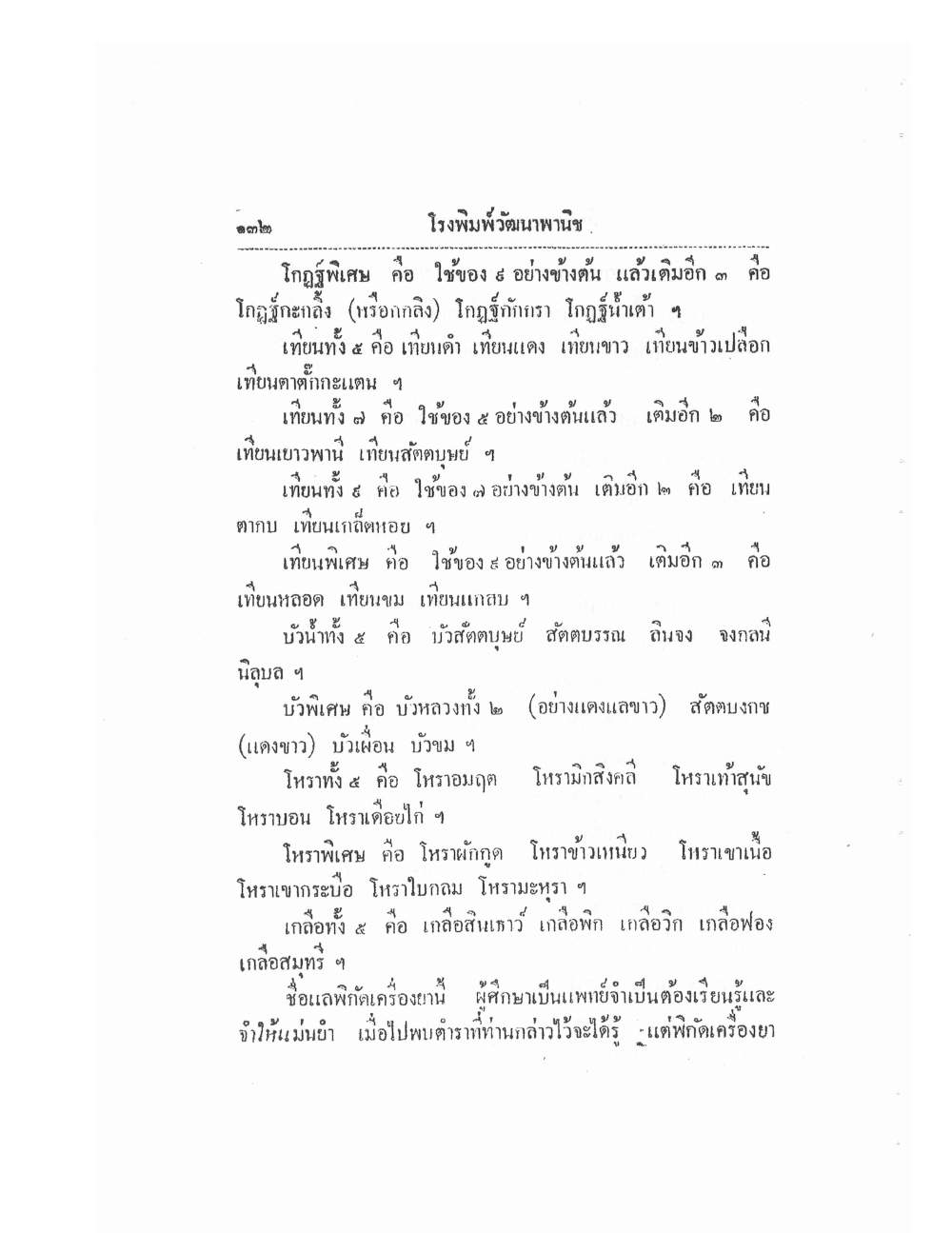
โกฏฐ์พิเศษ คือ ใช้ของ ๕ อย่างข้างต้น แล้วเติมอีก ๓ คือ โกฏฐ์กะกลิ้ง (หรือกกลิ้ง) โกฏฐ์กักกรา โกฏฐ์น้ำเต้า ฯ
เทียนทั้ง ๕ คือ เทียนดำ เทียนแดง เทียนขาว เทียนข้าวเปลือก เทียนตาตั๊กกะแตน ฯ เทียนทั้ง ๗ คือ ใช้ของ ๕ อย่างข้างต้นแล้ว เติมอีก ๒ คือ เทียนเยาวพานี เทียนสัตตบุษย์ ฯ เทียนทั้ง ๙ คือ ใช้ของ ๗ อย่างข้างต้น เติมอีก ๒ คือ เทียนตากบ เทียนเกล็ดหอย ฯ เทียนพิเศษ คือ ใช้ของ ๕ อย่างข้างต้นแล้ว เติมอีก ๓ คือ เทียนหลอด เทียนขม เทียนแกลบ ฯ
บัวน้ำทั้ง ๕ คือ บัวสัตตบุษย์ สัตตบรรณ ถินจง จงกลนี นิลุบล ฯ บัวพิเศษ คือ บัวหลวงทั้ง ๒ (อย่างแดงแลขาว) สัตตบงกช (แดงขาว) บัวเผื่อน บัวขม ฯ
โหราทั้ง ๕ คือ โหราอมฤต โหรามิกสิงคลี โหราเท้าสุนัข โหราบอน โหราเดือยไก่ ฯ โหราพิเศษ คือ โหราผักกูด โหราข้าวเหนียว โหราเขาเนื้อ โหราเขากระบือ โหราใบกลม โหรามะหุรา ฯ
เกลือทั้ง ๕ คือ เกลือสินเธาว์ เกลือพิก เกลือวิก เกลือฟอง เกลือสมุทร ฯ
ชื่อแลพิกัดเครื่องยานี้ ผู้ศึกษาเป็นแพทย์จำเป็นต้องเรียนรู้และจำให้แม่นยำ เมื่อไปพบตำราที่ท่านกล่าวไว้จะได้รู้ แต่พิกัดเครื่องยา
132 Watthana Phanit Press
Special Kot: uses the 5 ingredients above, then adds 3 more: kot-ka-kling (or kaking), kot-kakkra, kot-namtao.
The Five Thian: black thian, red thian, white thian, unhusked-rice thian, grasshopper-eye thian. The Seven Thian: uses the 5 above, then adds 2 more: thian-yaowaphani, thian-sattabut. The Nine Thian: uses the 7 above, adds 2 more: thian-takop, thian-kletho. Special Thian: uses the 5 above, then adds 3 more: thian-lot, thian-khom, thian-klaep.
The Five Water-Lotuses: bua-sattabut, sattaban, thin-chong, chongkolani, nilubon. Special Lotuses: both kinds of bua-luang (red and white), sattabongkot (red and white), bua-phuean, bua-khom.
The Five Hora: hora-amrit, hora-mik-singkhli, hora-thao-sunak, hora-bon, hora-dueai-kai. Special Hora: hora-phak-kut, hora-khao-niao, hora-khao-nuea, hora-khao-krabue, hora-bai-klom, hora-mahura.
The Five Salts: rock salt, salt phik, salt wik, foam salt, sea salt.
These names and fixed sets of medicinal ingredients must be studied and memorized with accuracy by one training to be a physician, so that upon encountering them in the treatises where the masters have set them down, one will recognize them. But the fixed sets of ingredients
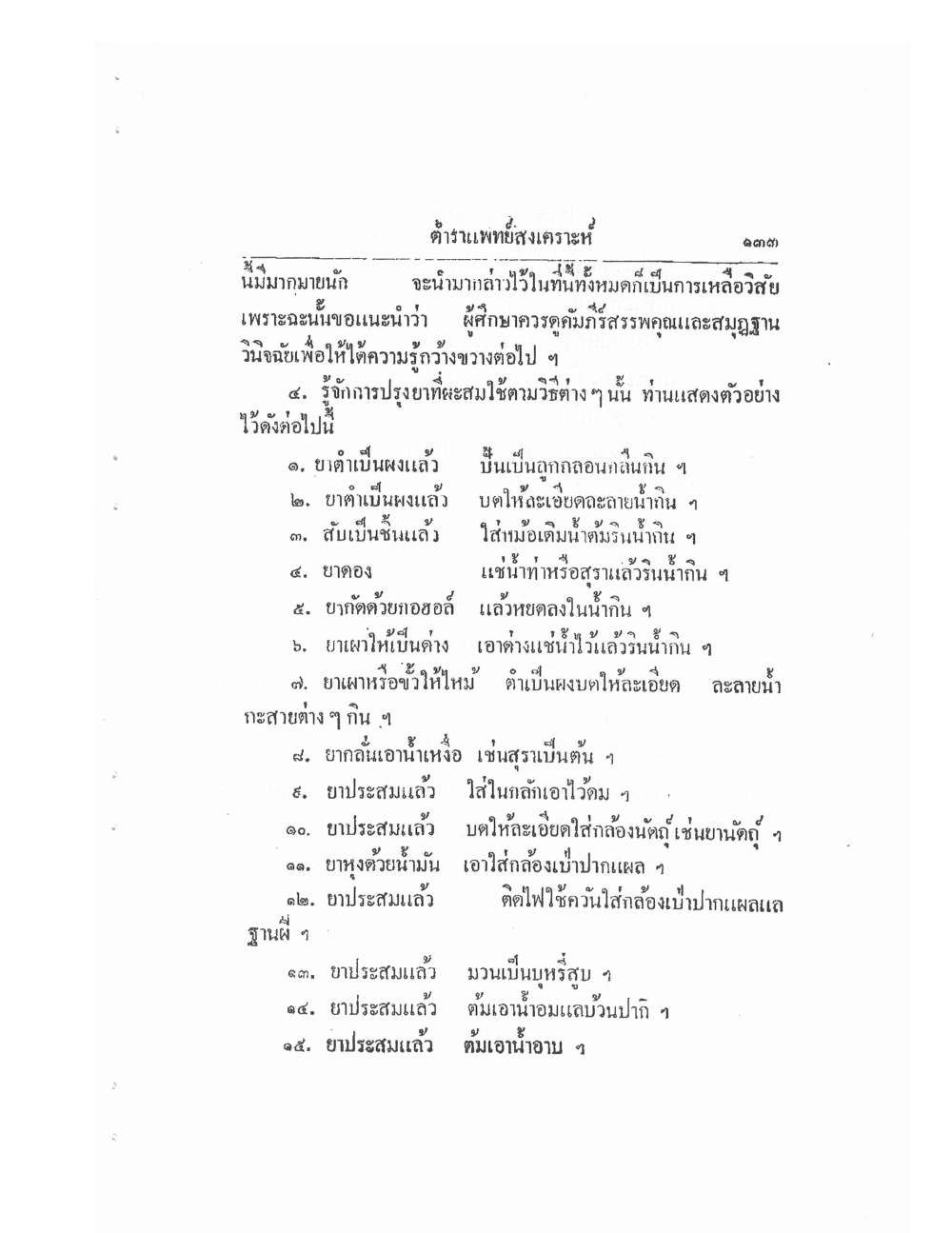
นมมากมายนัก จะนำมากล่าวไว้ในที่นี้ทั้งหมดก็เป็นการเหลือวิสัย เพราะฉะนั้นขอแนะนำว่า ผู้ศึกษาควรดูคัมภีร์สรรพคุณและสมุฏฐาน วินิจฉัยเพื่อให้ได้ความรู้กว้างขวางต่อไป ฯ ๔. รู้จักการปรุงยาที่ผสมใช้ตามวิธีต่าง ๆ นั้น ท่านแสดงตัวอย่าง ไว้ดังต่อไปนี้
๑. ยาตำเป็นผงแล้ว บั้นเป็นลูกกลอนกลืนกิน ฯ ๒. ยาตำเป็นผงแล้ว บดให้ละเอียดละลายน้ำกิน ฯ ๓. สับเป็นชิ้นแล้ว ใส่หม้อเติมน้ำต้มรินน้ำกิน ฯ ๔. ยาดอง แช่น้ำท่าหรือสุราแล้วรินน้ำกิน ฯ ๕. ยากัดด้วยกอฮอล์ แล้วหยดลงในน้ำกิน ฯ ๖. ยาเผาให้เป็นด่าง เอาด่างแช่น้ำไว้แล้วรินน้ำกิน ฯ ๗. ยาเผาหรือขั้วให้ใหม่ ตำเป็นผงบดให้ละเอียด ละลายน้ำ กะสายต่าง ๆ กิน ฯ ๘. ยากลั่นเอาน้ำเหงื่อ เช่นสุราเป็นต้น ฯ ๙. ยาประสมแล้ว ใส่ในกลักเอาไว้ดม ฯ ๑๐. ยาประสมแล้ว บดให้ละเอียดใส่กล้องนัตถุ์ เช่นยานัตถุ์ ฯ ๑๑. ยาหุงด้วยน้ำมัน เอาใส่กล้องเป่าปากแผล ฯ ๑๒. ยาประสมแล้ว ติดไฟใช้ควันใส่กล้องเป่าปากแผลแล ฐานฝี ฯ ๑๓. ยาประสมแล้ว มวนเป็นบุหรี่สูบ ฯ ๑๔. ยาประสมแล้ว ต้มเอาน้ำอมกลั้วปาก ฯ ๑๕. ยาประสมแล้ว ต้มเอาน้ำอาบ ฯ
...are very numerous indeed; to set them all down here in full would be beyond what is possible. Therefore I recommend that the student should consult the treatise on the properties [of medicines] and on constitutional diagnosis, in order to gain broader knowledge going forward. 4. Knowing how to prepare medicines that are compounded and used according to various methods — the author gives examples as follows:
1. Medicine pounded into powder, then rolled into pills and swallowed. 2. Medicine pounded into powder, then ground fine and dissolved in water to drink. 3. Medicine chopped into pieces, put in a pot with water added, boiled, and the liquid poured off to drink. 4. Steeped medicine: soaked in plain water or liquor, then the liquid poured off to drink. 5. Medicine dissolved with alcohol, then dripped into water [to drink]. 6. Medicine burned to ash/lye, the ash soaked in water, then the water poured off to drink. 7. Medicine roasted or freshly parched, pounded into powder, ground fine, dissolved in water with various diluents, and drunk. 8. Medicine distilled to obtain its condensate ("sweat-water"), such as liquor, for example. 9. Medicine compounded, then placed in a container to be inhaled/smelled. 10. Medicine compounded, then ground fine and put into a snuff tube, such as snuff medicine. 11. Medicine cooked with oil, then put into a tube to blow onto the mouth of a wound. 12. Medicine compounded, then lit, the smoke used, blown through a tube onto the mouth of a wound or the base of a boil. 13. Medicine compounded, then rolled into a cigarette and smoked. 14. Medicine compounded, then boiled and the water held in the mouth and rinsed [as a gargle]. 15. Medicine compounded, then boiled and the water used for bathing.
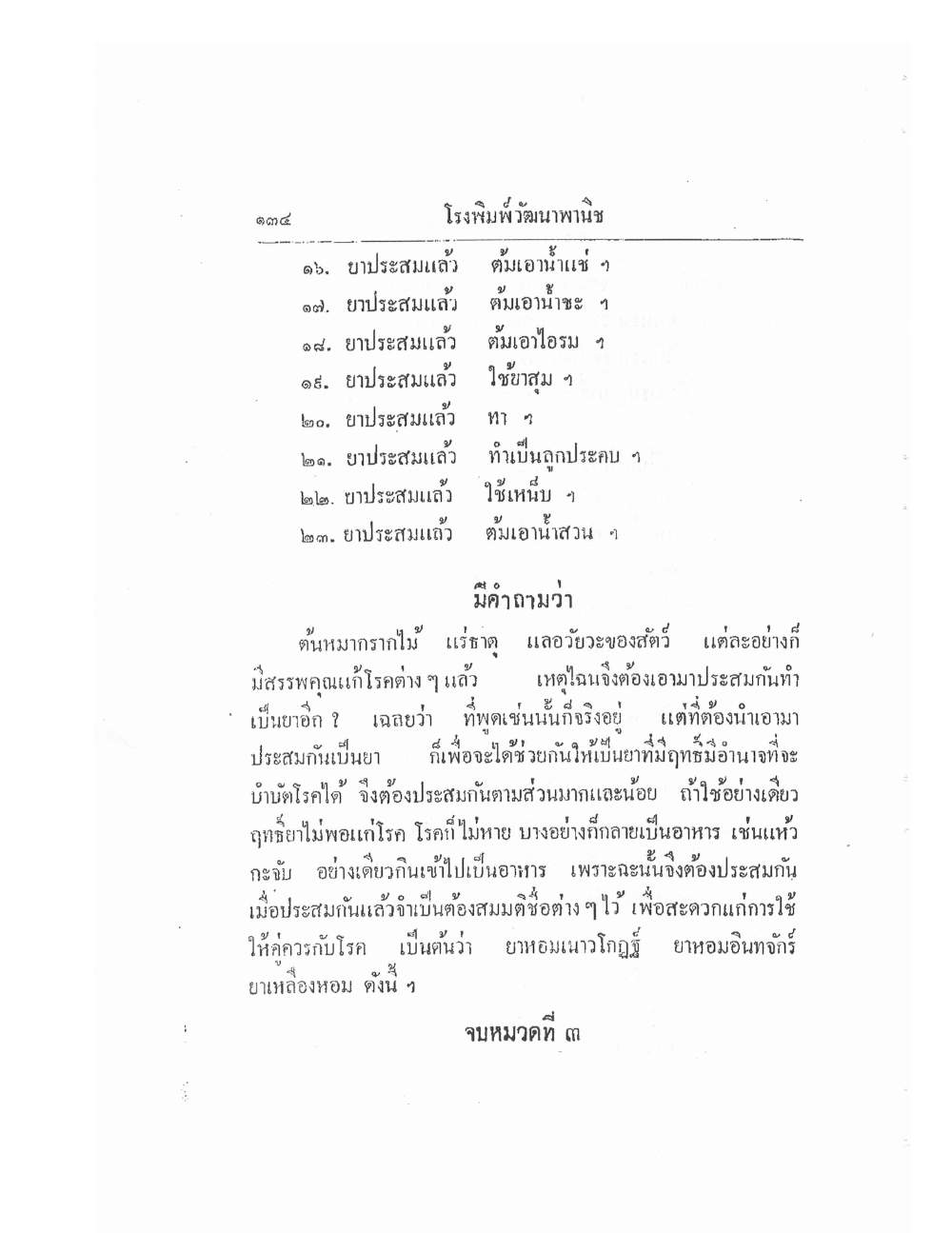
๑๓๔ โรงพิมพ์วัฒนาพานิช
๑๖. ยาประสมแล้ว ต้มเอาน้ำแช่ ฯ ๑๗. ยาประสมแล้ว ต้มเอาน้ำชะ ฯ ๑๘. ยาประสมแล้ว ต้มเอาไอรม ฯ ๑๙. ยาประสมแล้ว ใช้ยาสุม ฯ ๒๐. ยาประสมแล้ว ทา ฯ ๒๑. ยาประสมแล้ว ทำเป็นลูกประคบ ฯ ๒๒. ยาประสมแล้ว ใช้เหน็บ ฯ ๒๓. ยาประสมแล้ว ต้มเอาน้ำสวน ฯ
มีคำถามว่า
ต้นหมากรากไม้ แร่ธาตุ แลอวัยวะของสัตว์ แต่ละอย่างก็ มีสรรพคุณแก้โรคต่าง ๆ อยู่แล้ว เหตุไฉนจึงต้องเอามาประสมกันทำ เป็นยาอีก ? เฉลยว่า ที่พูดเช่นนั้นก็จริงอยู่ แต่ที่ต้องนำเอามา ประสมกันเป็นยา ก็เพื่อจะได้ช่วยกันให้เป็นยาที่มีฤทธิ์มีอำนาจที่จะ บำบัดโรคได้ จึงต้องประสมกันตามส่วนมากและน้อย ถ้าใช้อย่างเดียว ฤทธิ์ยาไม่พอแก้โรค โรคก็ไม่หาย บางอย่างก็กลายเป็นอาหาร เช่นแห้ว กะจับ อย่างเดียวกินเข้าไปเป็นอาหาร เพราะฉะนั้นจึงต้องประสมกัน เมื่อประสมกันแล้วจำเป็นต้องสมมติชื่อต่าง ๆ ไว้ เพื่อสะดวกแก่การใช้ ให้คู่ควรกับโรค เป็นต้นว่า ยาหอมเนาวโกฐ ยาหอมอินทจักร์ ยาเหลืองหอม ดังนี้ ฯ
จบหมวดที่ ๓
134 Watthana Panich Press
16. Medicine compounded, then boiled and the water used to soak [the affected part]. 17. Medicine compounded, then boiled and the water used to wash/rinse. 18. Medicine compounded, then boiled and the steam used to fume the patient. 19. Medicine compounded, then used as a smudging/fumigating medicine. 20. Medicine compounded, then applied [as a rub]. 21. Medicine compounded, then made into a compress ball. 22. Medicine compounded, then used as a suppository. 23. Medicine compounded, then boiled and the water used as an enema.
There is a question:
Trees and roots, minerals, and the organs of animals — each of these already possesses properties that cure various diseases. Why then must they be combined together to make medicine again? The answer is: what is said is indeed true, but the reason for bringing them together to compound into medicine is so that they may assist one another, becoming a medicine with the potency and power able to cure disease. They must therefore be combined in greater and lesser proportions. If used singly, the potency of the medicine is not sufficient to cure the disease, and the disease does not heal. Some [ingredients], if used alone, become merely food — for instance, water chestnut (haew) and water caltrop (ka-chap) — eaten alone they are simply food. For this reason they must be combined. Once combined, it becomes necessary to give them various names, for the convenience of use, so that they may be matched appropriately to the disease — for example: Ya Hom Nao Wa Koat, Ya Hom Inthajak, Ya Leuang Hom, and so on.
End of Category 3
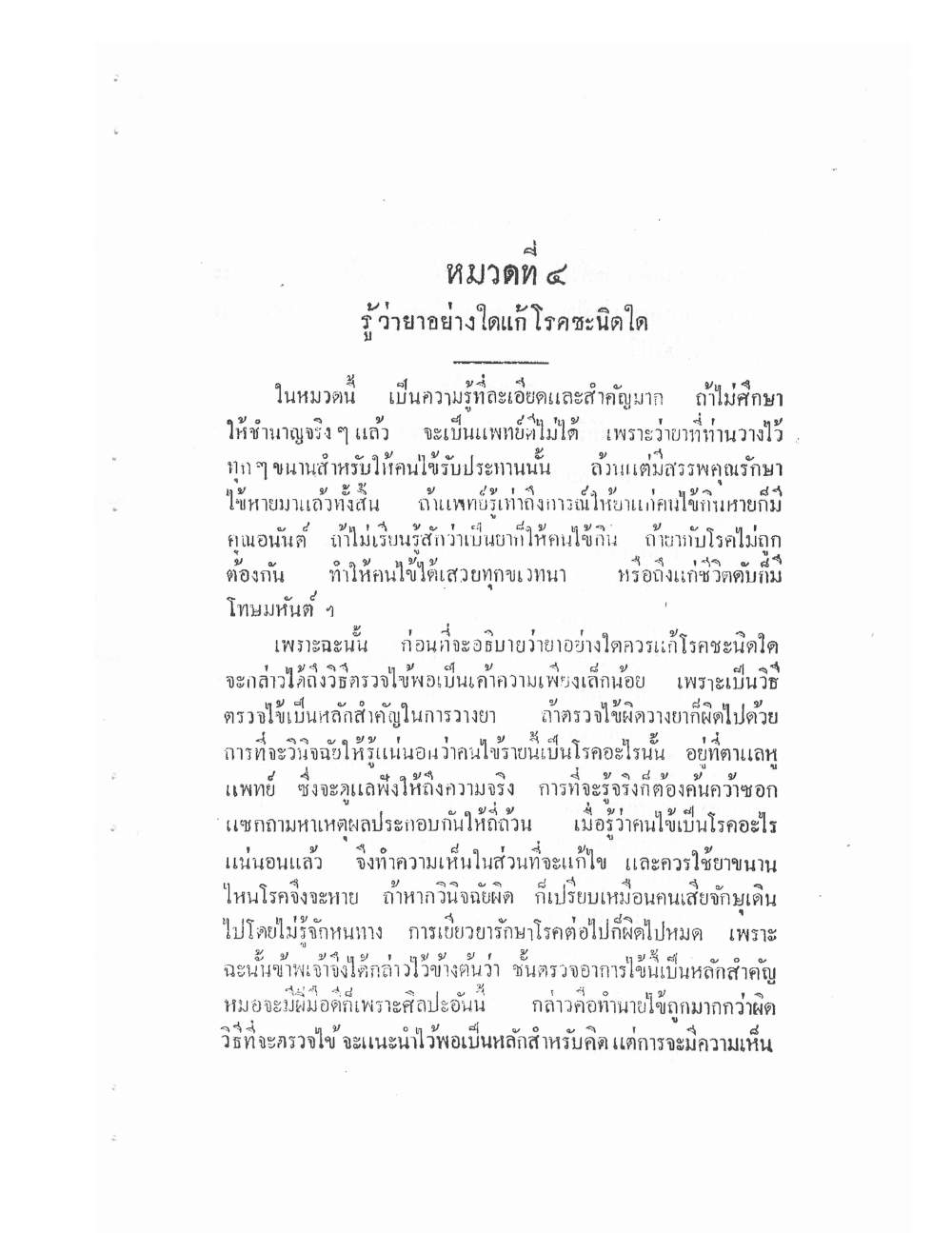
หมวดที่ ๔
รู้ว่ายาอย่างใดแก้โรคชะนิดใด _______________
ในหมวดนี้เป็นความรู้ที่ละเอียดและสำคัญมาก ถ้าไม่ศึกษา ให้ชำนาญจริง ๆ แล้ว จะเป็นแพทย์ที่ไม่ได้ เพราะว่ายาที่ท่านวางไว้ ทุก ๆ ขนานสำหรับให้คนไข้รับประทานนั้น ล้วนแต่มีสรรพคุณรักษา ไข้หายมาแล้วทั้งสิ้น ถ้าแพทย์รู้เท่าถึงการณ์ให้ยาแก่คนไข้กินหายก็มี คุณอนันต์ ถ้าไม่เรียนรู้สักว่าเป็นยาก็ให้คนไข้กิน ถ้ายากับโรคไม่ถูก ต้องกัน ทำให้คนไข้ได้เสวยทุกขเวทนา หรือถึงแก่ชีวิตดับก็มี โทษมหันต์ ฯ
เพราะฉะนั้น ก่อนที่จะอธิบายว่ายาอย่างใดควรแก้โรคชะนิดใด จะกล่าวไว้ถึงวิธีตรวจไข้พอเป็นเค้าความเพียงเล็กน้อย เพราะเป็นวิธี ตรวจไข้เป็นหลักสำคัญในการวางยา ถ้าตรวจไข้ผิดวางยาก็ผิดไปด้วย การที่จะวินิจฉัยให้รู้แน่นอนว่าคนไข้รายนั้นเป็นโรคอะไรนั้น อยู่ที่ตาแล แพทย์ ซึ่งจะดูแลพึงให้ถึงความจริง การที่จะรู้จริงก็ต้องค้นคว้าซอก แซกถามหาเหตุผลประกอบกันให้ถี่ถ้วน เมื่อรู้ว่าคนไข้เป็นโรคอะไร แน่นอนแล้ว จึงทำความเห็นในส่วนที่จะแก้ไข และควรใช้ยาขนาน ไหนโรคจึงจะหาย ถ้าหากวินิจฉัยผิด ก็เปรียบเหมือนคนเสียจักษุเดิน ไปโดยไม่รู้จักหนทาง การเยียวยารักษาโรคต่อไปก็ผิดไปหมด เพราะ ฉะนั้นข้าพเจ้าจึงได้กล่าวไว้ข้างต้นว่า ชั้นตรวจอาการไข้นี้เป็นหลักสำคัญ หมอจะมีฝีมือดีก็เพราะศิลปะอันนี้ กล่าวคือทำนายไข้ถูกมากกว่าผิด วิธีที่จะตรวจไข้ จะแนะนำไว้พอเป็นหลักสำหรับคิด แต่การจะมีความเห็น
Category 4
Knowing which medicine cures which type of disease _______________
This category contains knowledge that is detailed and very important. If one does not study it thoroughly enough to become truly skilled, one cannot be a physician. For every remedy that the masters have laid down for patients to take has, without exception, the property of curing illness — this has already been proven. If the physician understands the matter thoroughly and gives the medicine to the patient and it cures him, the merit is boundless. But if one merely learns that something is "a medicine" and gives it to the patient [without proper knowledge], and the medicine does not match the disease, it causes the patient to suffer great pain, or may even cause death — the fault [in that case] is immense.
Therefore, before explaining which medicine should cure which type of disease, I will first give an account of the method of examining an illness, at least in brief outline, because the method of examining the illness is the essential foundation for prescribing medicine. If the diagnosis of the illness is wrong, the prescribing of medicine will be wrong as well. Determining with certainty what disease a given patient has depends on the eye and skill of the physician, who must take care to arrive at the truth. To truly know, one must investigate thoroughly, inquiring into causes and effects until they are fully accounted for. Once it is certain what disease the patient has, one then forms an opinion as to how to treat it, and which remedy should be used for the disease to be cured. If the diagnosis is wrong, it is like a person who has lost their sight walking without knowing the way — all subsequent treatment goes wrong as well. This is why I stated at the outset that the step of examining the symptoms of the illness is the essential foundation; a physician's skill comes from this very art — that is, correctly predicting the illness more often than being wrong. The method for examining an illness will be given here as a guide for thinking, but the forming of an opinion [in each case]...
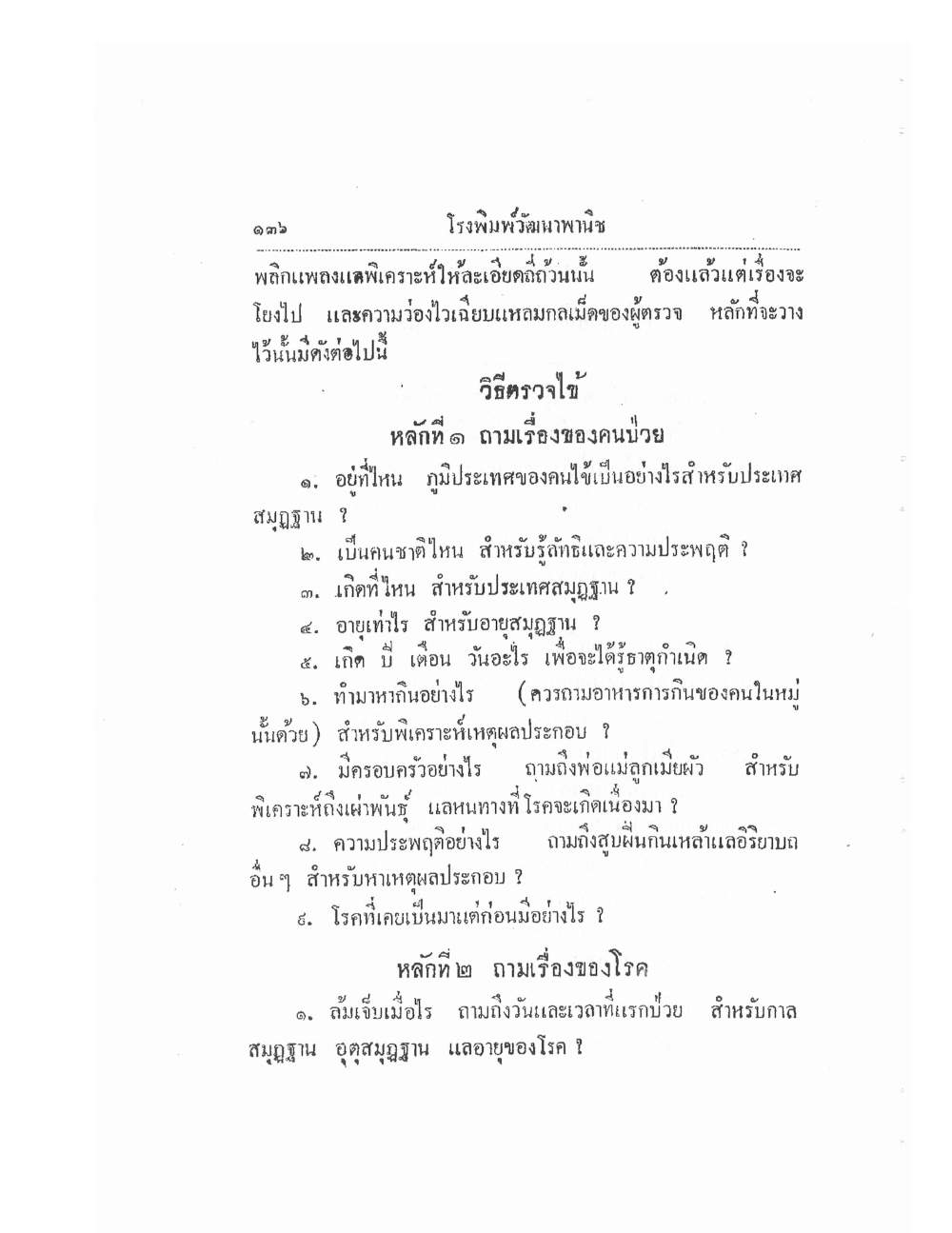
๑๓๖ โรงพิมพ์วัฒนาพานิช
พลิกแพลงและพิเคราะห์ให้ละเอียดถ้วนนั้น ต้องแล้วแต่เรื่องจะ โยงไป และความว่องไวฉับแหลมกลเม็ดของผู้ตรวจ หลักที่จะวาง ไว้นั้นมีดังต่อไปนี้
วิธีตรวจไข้
หลักที่ ๑ ถามเรื่องของคนป่วย
๑. อยู่ที่ไหน ภูมิประเทศของคนไข้เป็นอย่างไรสำหรับประเทศ สมุฏฐาน ? ๒. เป็นคนชาติไหน สำหรับรู้ลัทธิและความประพฤติ ? ๓. เกิดที่ไหน สำหรับประเทศสมุฏฐาน ? ๔. อายุเท่าไร สำหรับอายุสมุฏฐาน ? ๕. เกิดปีเดือนวันอะไร เพื่อจะได้รู้ธาตุกำเนิด ? ๖. ทำมาหากินอย่างไร (ควรถามอาหารการกินของคนในหมู่ นั้นด้วย) สำหรับพิเคราะห์เหตุผลประกอบ ? ๗. มีครอบครัวอย่างไร ถามถึงพ่อแม่ลูกเมียผัว สำหรับ พิเคราะห์ถึงเผ่าพันธุ์ แลหนทางที่โรคจะเกิดเนื่องมา ? ๘. ความประพฤติอย่างไร ถามถึงสูบฝิ่นกินเหล้าและอิริยาบถ อื่น ๆ สำหรับหาเหตุผลประกอบ ? ๙. โรคที่เคยเป็นมาแต่ก่อนมีอย่างไร ?
หลักที่ ๒ ถามเรื่องของโรค
๑. ล้มเจ็บเมื่อไร ถามถึงวันและเวลาที่แรกป่วย สำหรับกาล สมุฏฐาน อุตุสมุฏฐาน แลอายุของโรค ?
136 Watthana Panich Press
...forming an opinion by adapting and examining in full detail must depend on how the matter unfolds, and on the examiner's own quickness, sharpness, and skill. The principles to be set down are as follows:
Method of Examining an Illness
Principle 1: Asking about the patient's circumstances
1. Where does [the patient] live? What is the patient's terrain/region like — for [determining] the regional constitution? 2. What nationality is the person? — to know their customs and behavior. 3. Where was [the patient] born? — for the regional constitution. 4. What is [the patient's] age? — for the age-based constitution. 5. In what year, month, and day was [the patient] born? — in order to know the elemental origin. 6. What is [the patient's] occupation/livelihood? (One should also ask about the diet of people in that community.) — for examining contributing causes. 7. What is [the patient's] family situation? Ask about father, mother, children, wife/husband — for examining lineage and the path by which the disease may have arisen. 8. What is [the patient's] conduct? Ask about opium smoking, drinking, and other habits — for finding contributing causes. 9. What illnesses has [the patient] had before?
Principle 2: Asking about the disease
1. When did [the patient] first fall ill? Ask the day and time the illness first began — for [determining] the seasonal constitution, the climatic constitution, and the duration/age of the disease.
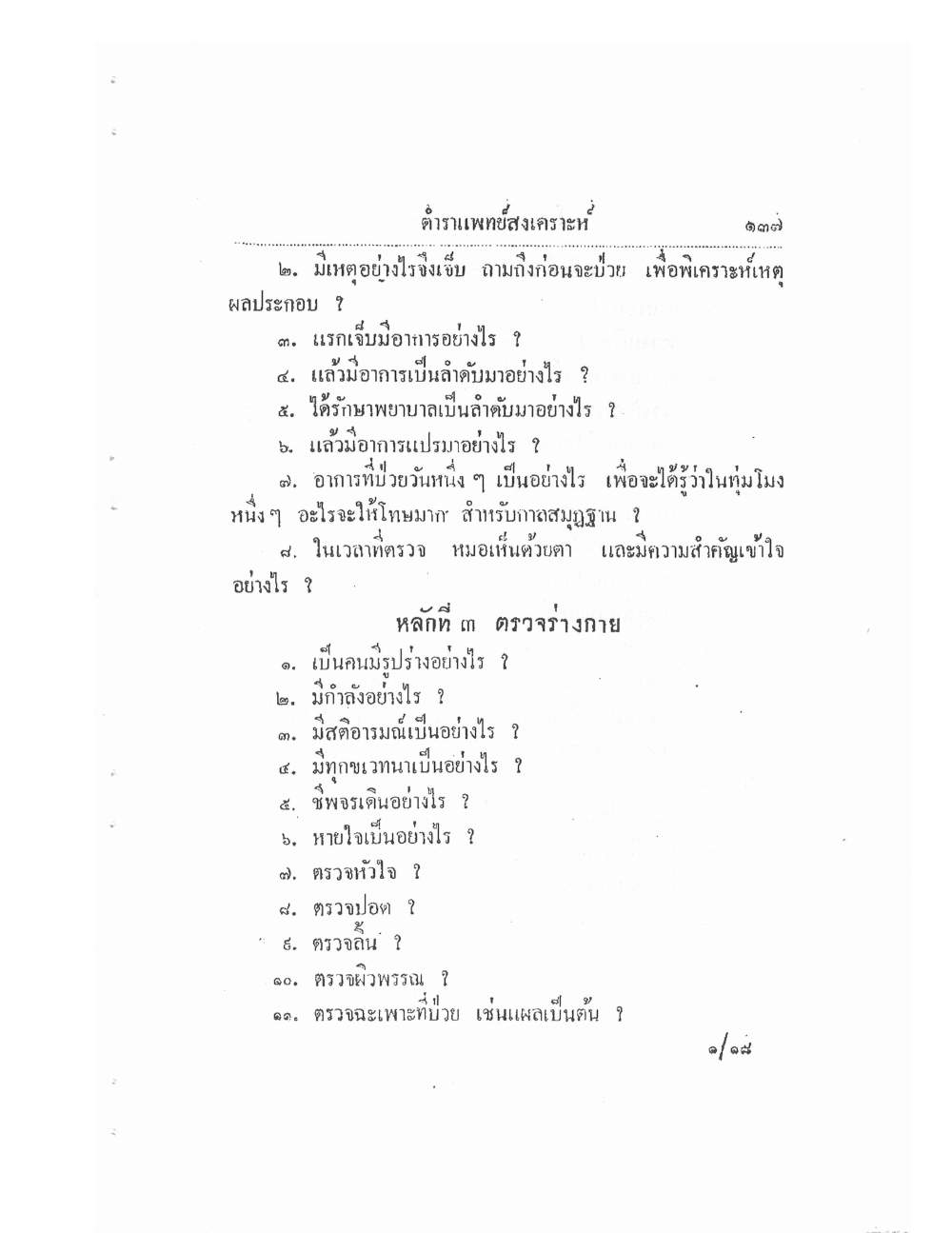
ตำราแพทย์สงเคราะห์ ๑๓๗
๒. มีเหตุอย่างไรจึงเจ็บ ถามถึงก่อนจะป่วย เพื่อพิเคราะห์เหตุ ผลประกอบ ? ๓. แรกเจ็บมีอาการอย่างไร ? ๔. แล้วมีอาการเป็นลำดับมาอย่างไร ? ๕. ได้รักษาพยาบาลเป็นลำดับมาอย่างไร ? ๖. แล้วมีอาการแปรมาอย่างไร ? ๗. อาการที่ป่วยวันหนึ่ง ๆ เป็นอย่างไร เพื่อจะได้รู้ว่าในทุ่มโมง หนึ่ง ๆ อะไรจะให้โทษมาก สำหรับกาลสมุฏฐาน ? ๘. ในเวลาที่ตรวจ หมอเห็นด้วยตา และมีความสำคัญเข้าใจ อย่างไร ?
หลักที่ ๓ ตรวจร่างกาย
๑. เป็นคนมีรูปร่างอย่างไร ? ๒. มีกำลังอย่างไร ? ๓. มีสติอารมณ์เป็นอย่างไร ? ๔. มีทุกขเวทนาเป็นอย่างไร ? ๕. ชีพจรเดินอย่างไร ? ๖. หายใจเป็นอย่างไร ? ๗. ตรวจหัวใจ ? ๘. ตรวจปอด ? ๙. ตรวจลิ้น ? ๑๐. ตรวจผิวพรรณ ? ๑๑. ตรวจฉะเพาะที่ป่วย เช่นแผลเป็นต้น ?
๑/๑๘
Handbook of Medical Assistance 137
2. What was the cause that made [the patient] ill? Ask about the time before falling ill — for examining the contributing cause and effect. 3. What were the symptoms when [the patient] first became ill? 4. How did the symptoms then proceed in sequence? 5. What treatment and care was given, in sequence? 6. How did the symptoms then change? 7. What are the symptoms like on any given day — in order to know, within each watch/hour, which factor causes the most harm — for [determining] the seasonal/time-based constitution? 8. At the time of examination, what does the physician observe with his own eyes, and what significant understanding does he form?
Principle 3: Examining the body
1. What is [the patient's] bodily form like? 2. What is [the patient's] strength like? 3. What is [the patient's] state of mind and mood like? 4. What is [the patient's] degree of suffering like? 5. How does the pulse move? 6. How does [the patient] breathe? 7. Examine the heart. 8. Examine the lungs. 9. Examine the tongue. 10. Examine the complexion/skin. 11. Examine the specific site of illness, such as a wound, for example.
[printer's signature mark: 1/18]
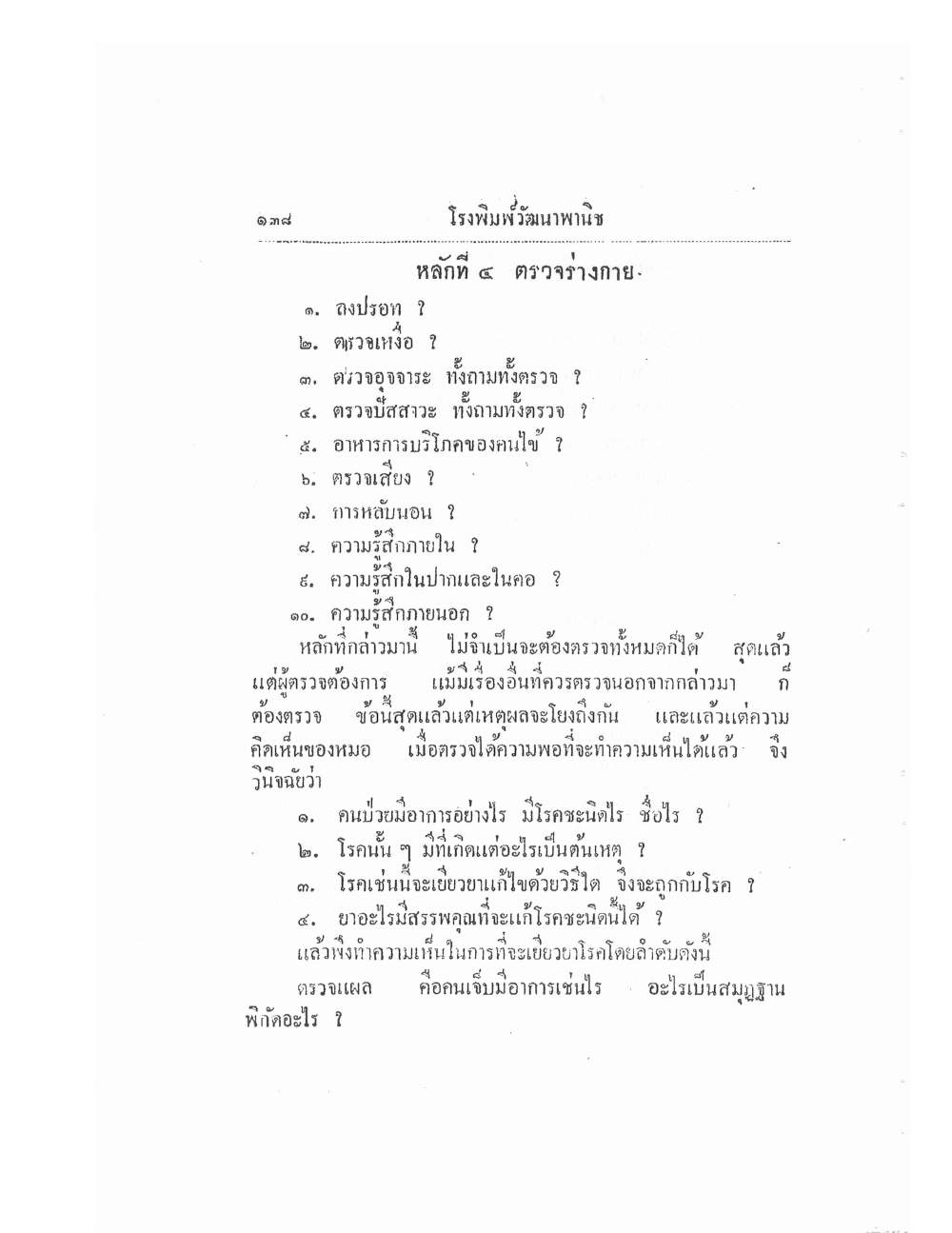
๑๓๘ โรงพิมพ์วัฒนาพานิช
หลักที่ ๔ ตรวจร่างกาย
๑. ลงปรอท ? ๒. ตรวจเหงื่อ ? ๓. ตรวจอุจจาระ ทั้งถามทั้งตรวจ ? ๔. ตรวจปัสสาวะ ทั้งถามทั้งตรวจ ? ๕. อาหารการบริโภคของคนไข้ ? ๖. ตรวจเสียง ? ๗. การหลับนอน ? ๘. ความรู้สึกภายใน ? ๙. ความรู้สึกในปากและในคอ ? ๑๐. ความรู้สึกภายนอก ?
หลักที่กล่าวมานี้ ไม่จำเป็นจะต้องตรวจทั้งหมดก็ได้ สุดแล้ว แต่ผู้ตรวจต้องการ แม้เรื่องอื่นที่ควรตรวจนอกจากกล่าวมาก็ ต้องตรวจ ข้อนสุดแล้วแต่เหตุผลจะโยงถึงกัน และแล้วแต่ความ คิดเห็นของหมอ เมื่อตรวจได้ความพอที่จะทำความเห็นได้แล้ว จึง วินิจฉัยว่า
๑. คนป่วยมีอาการอย่างไร มีโรคชะนิดไร ชื่อไร ? ๒. โรคนั้น ๆ มีที่เกิดแต่อะไรเป็นต้นเหตุ ? ๓. โรคเช่นนี้จะเยียวยาแก้ไขด้วยวิธีใด จึงจะถูกกับโรค ? ๔. ยาอะไรมีสรรพคุณที่จะแก้โรคชะนิดนี้ได้ ? แล้วพึงทำความเห็นในการที่จะเยียวยาโรคโดยลำดับดังนี้ ตรวจแผล คือคนเจ็บมีอาการเช่นไร อะไรเป็นสมุฏฐาน พิกัดอะไร ?
138 Watthana Panich Press
Principle 4: Examining the body [continued]
1. Take the temperature [with a thermometer]? 2. Examine the sweat? 3. Examine the stool — both by asking and by inspection? 4. Examine the urine — both by asking and by inspection? 5. [Examine] the patient's diet and food intake? 6. Examine the voice? 7. [Examine] the patient's sleep? 8. [Examine] internal sensations? 9. [Examine] sensations in the mouth and throat? 10. [Examine] external sensations?
The principles stated above need not all be examined — it depends on what the examiner requires. Even matters other than those mentioned, if they ought to be examined, must also be examined. This ultimately depends on how the causes and effects connect to one another, and on the physician's own judgement. Once enough has been found through examination to form an opinion, one then determines:
1. What symptoms does the patient have; what type and name of disease is it? 2. What is the origin from which that disease arises, as its root cause? 3. By what method should a disease like this be treated, so as to properly match the disease? 4. What medicine has properties able to cure this type of disease? One should then form an opinion on how to treat the disease, in the following order: Examine the affliction — that is, what are the patient's symptoms like, what is the constitutional cause, and what is the proportion formula [phikat]?
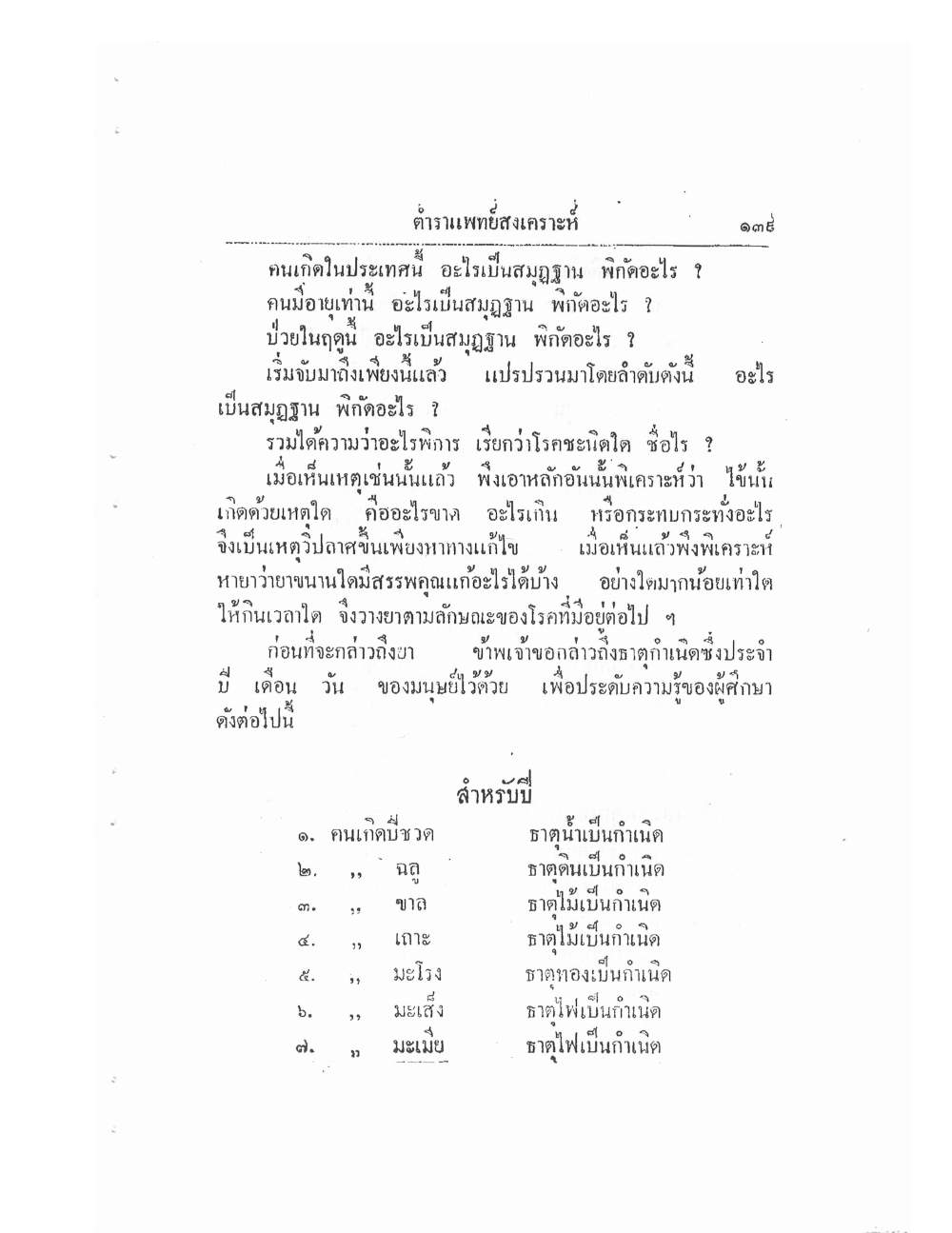
ตำราแพทย์สงเคราะห์ ๑๓๙
คนเกิดในประเทศนี้ อะไรเป็นสมุฏฐาน พิกัดอะไร ? คนมีอายุเท่านี้ อะไรเป็นสมุฏฐาน พิกัดอะไร ? ป่วยในฤดูนี้ อะไรเป็นสมุฏฐาน พิกัดอะไร ? เริ่มจับมาถึงเพียงนี้แล้ว แปรปรวนมาโดยลำดับดังนี้ อะไร เป็นสมุฏฐาน พิกัดอะไร ? รวมได้ความว่าอะไรพิการ เรียกว่าโรคชะนิดใด ชื่อไร ? เมื่อเห็นเหตุเช่นนั้นแล้ว พึงเอาหลักอันนั้นพิเคราะห์ว่า ไข้นี้ เกิดด้วยเหตุใด คืออะไรขาด อะไรเกิน หรือกระทบกระทั่งอะไร จึงเป็นเหตุวิปลาสขึ้น เพียงหาทางแก้ไข เมื่อเห็นแล้วพึงพิเคราะห์ หายาว่ายาขนานใดมีสรรพคุณแก้อะไรได้บ้าง อย่างใดมากน้อยเท่าใด ให้กินเวลาใด จึงวางยาตามลักษณะของโรคที่มีอยู่ต่อไป ฯ
ก่อนที่จะกล่าวถึงยา ข้าพเจ้าขอกล่าวถึงธาตุกำเนิดซึ่งประจำ ปี เดือน วัน ของมนุษย์ไว้ด้วย เพื่อประดับความรู้ของผู้ศึกษา ดังต่อไปนี้
สำหรับปี
๑. คนเกิดปีชวด ธาตุน้ำเป็นกำเนิด ๒. ,, ฉลู ธาตุดินเป็นกำเนิด ๓. ,, ขาล ธาตุไม้เป็นกำเนิด ๔. ,, เถาะ ธาตุไม้เป็นกำเนิด ๕. ,, มะโรง ธาตุทองเป็นกำเนิด ๖. ,, มะเส็ง ธาตุไฟเป็นกำเนิด ๗. ,, มะเมีย ธาตุไฟเป็นกำเนิด
Handbook of Medical Assistance 139
For a person born in this region, what is the constitutional cause, and what is the proportion formula? For a person of this age, what is the constitutional cause, and what is the proportion formula? For one who falls ill in this season, what is the constitutional cause, and what is the proportion formula? From the onset of the illness up to this point, having changed in the sequence described, what is the constitutional cause, and what is the proportion formula? Taken together, what [function] is impaired, and what type and name of disease is this called? Once such causes are seen, one should use that principle to examine: from what cause did this illness arise — that is, what is deficient, what is in excess, or what has been disturbed/struck — that has given rise to this derangement — merely in order to find the way to treat it. Once this is seen, one should consider which remedy has the property to cure which [symptom], in what proportion — how much or how little — and at what time it should be taken; thus medicine is prescribed according to the characteristics of the disease present, going forward.
Before speaking of medicines, I wish to first describe the elemental origins associated with a person's year, month, and day [of birth], to enrich the knowledge of the student, as follows:
For the year [of birth]
1. A person born in the Year of the Rat (chuad) — Water is the element of origin. 2. ... Year of the Ox (chalu) — Earth is the element of origin. 3. ... Year of the Tiger (khan) — Wood is the element of origin. 4. ... Year of the Rabbit (thao) — Wood is the element of origin. 5. ... Year of the Dragon (ma-rong) — Metal is the element of origin. 6. ... Year of the Snake (ma-seng) — Fire is the element of origin. 7. ... Year of the Horse (ma-mia) — Fire is the element of origin.
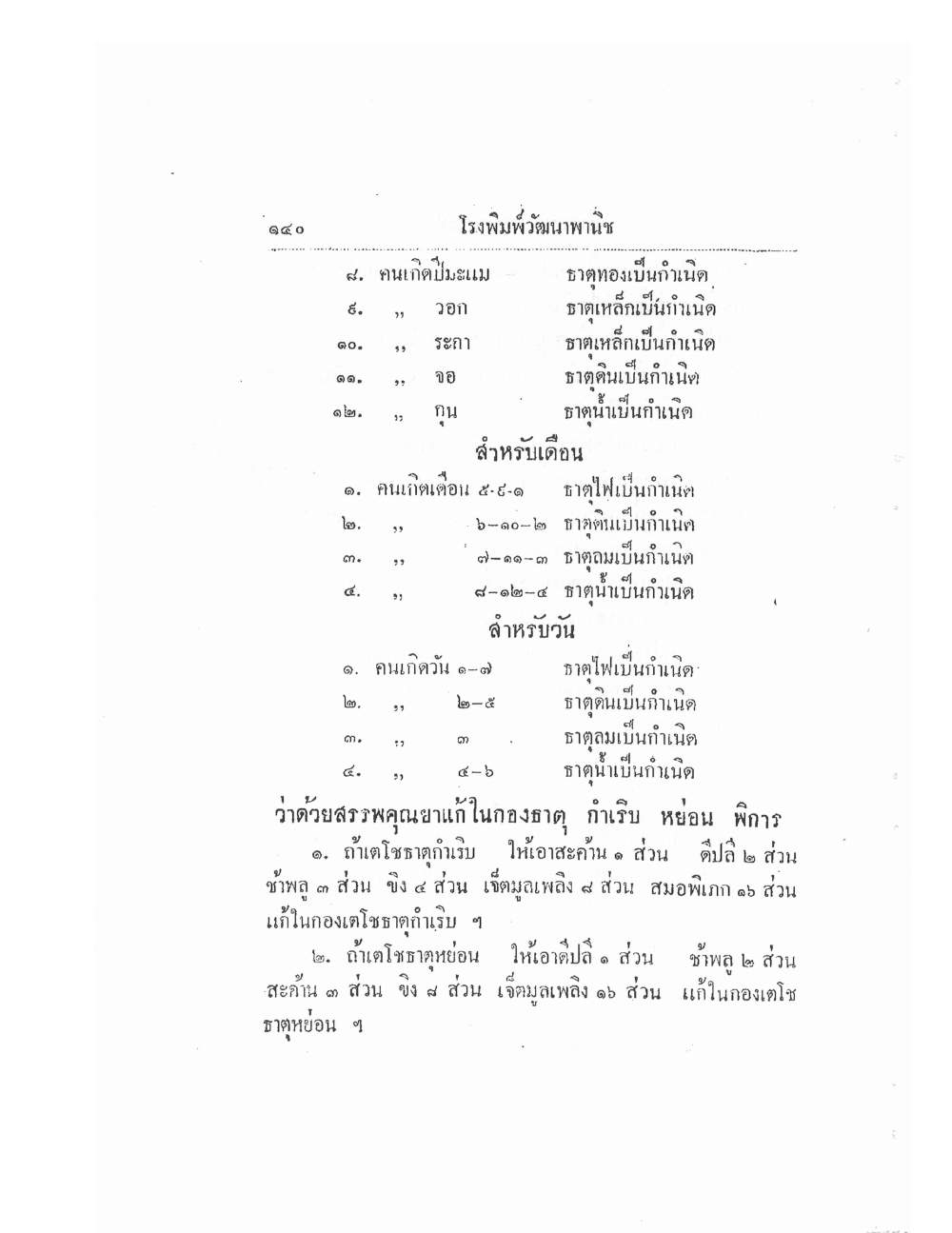
๑๔๐ โรงพิมพ์วัฒนาพานิช
๘. คนเกิดปีมะแม ธาตุทองเป็นกำเนิด ๙. ,, วอก ธาตุเหล็กเป็นกำเนิด ๑๐. ,, ระกา ธาตุเหล็กเป็นกำเนิด ๑๑. ,, จอ ธาตุดินเป็นกำเนิด ๑๒. ,, กุน ธาตุน้ำเป็นกำเนิด
สำหรับเดือน
๑. คนเกิดเดือน ๕-๙-๑ ธาตุไฟเป็นกำเนิด ๒. ,, ๖-๑๐-๒ ธาตุดินเป็นกำเนิด ๓. ,, ๗-๑๑-๓ ธาตุลมเป็นกำเนิด ๔. ,, ๘-๑๒-๔ ธาตุน้ำเป็นกำเนิด
สำหรับวัน
๑. คนเกิดวัน ๑-๗ ธาตุไฟเป็นกำเนิด ๒. ,, ๒-๕ ธาตุดินเป็นกำเนิด ๓. ,, ๓ ธาตุลมเป็นกำเนิด ๔. ,, ๔-๖ ธาตุน้ำเป็นกำเนิด
ว่าด้วยสรรพคุณยาแก้ในกองธาตุ กำเริบ หย่อน พิการ
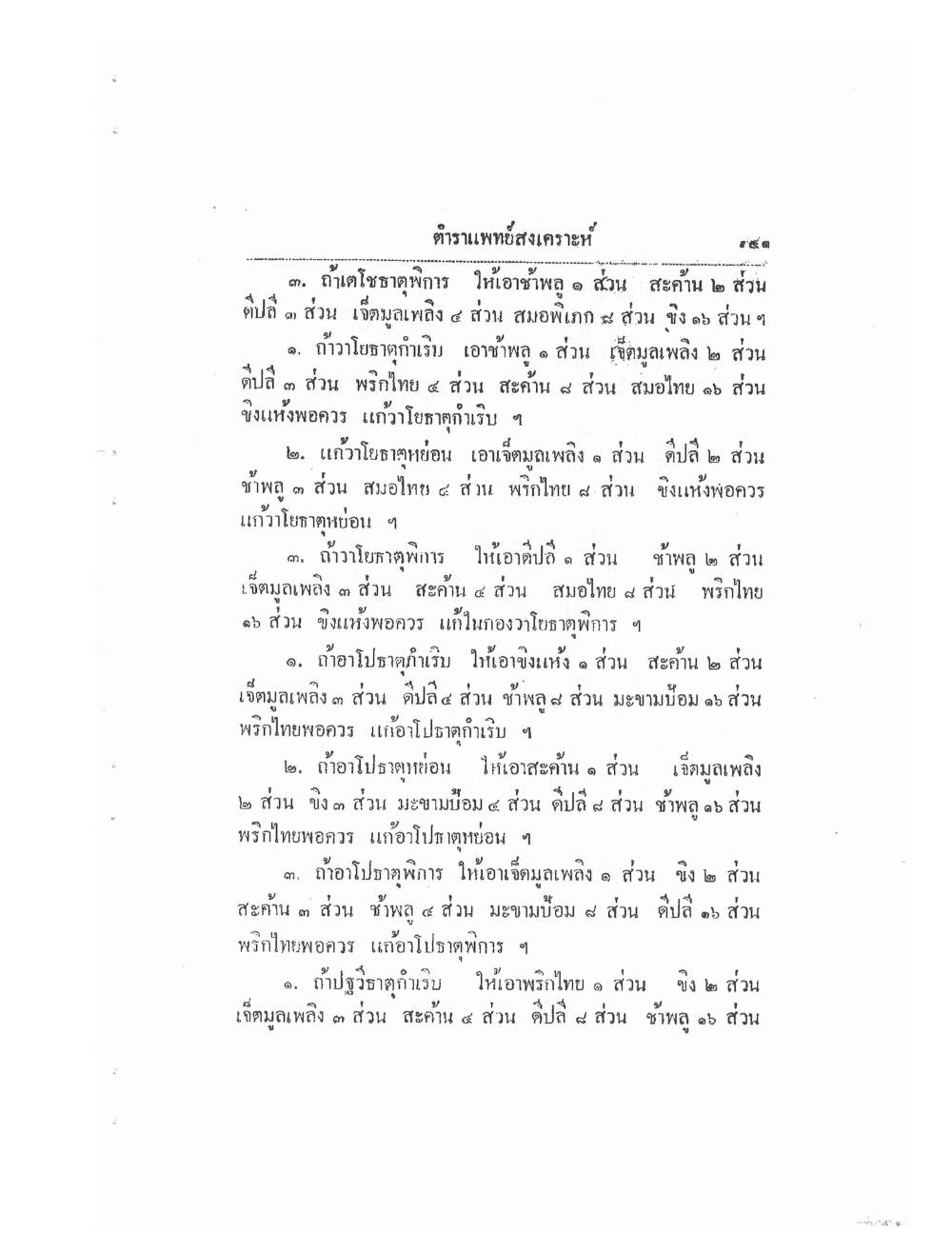
๑. ถ้าเตโชธาตุกำเริบ ให้เอาสะค้าน ๑ ส่วน ดีปลี ๒ ส่วน ช้าพลู ๓ ส่วน ขิง ๕ ส่วน เจ็ตมูลเพลิง ๘ ส่วน สมอพิเภก ๑๖ ส่วน แก้ในกองเตโชธาตุกำเริบ ฯ ๒. ถ้าเตโชธาตุหย่อน ให้เอาดีปลี ๑ ส่วน ช้าพลู ๒ ส่วน สะค้าน ๓ ส่วน ขิง ๘ ส่วน เจ็ตมูลเพลิง ๑๖ ส่วน แก้ในกองเตโช ธาตุหย่อน ฯ
140 Watthana Panich Press
8. A person born in the Year of the Goat (ma-mae) — Metal is the element of origin. 9. ... Year of the Monkey (wok) — Iron is the element of origin. 10. ... Year of the Rooster (ra-ka) — Iron is the element of origin. 11. ... Year of the Dog (cho) — Earth is the element of origin. 12. ... Year of the Pig (kun) — Water is the element of origin.
For the month [of birth]
1. A person born in month 5, 9, or 1 — Fire is the element of origin. 2. ... month 6, 10, or 2 — Earth is the element of origin. 3. ... month 7, 11, or 3 — Wind is the element of origin. 4. ... month 8, 12, or 4 — Water is the element of origin.
For the day [of birth]
1. A person born on day 1 or 7 — Fire is the element of origin. 2. ... day 2 or 5 — Earth is the element of origin. 3. ... day 3 — Wind is the element of origin. 4. ... day 4 or 6 — Water is the element of origin.
On the properties of medicines that treat the elemental humor-groups when in excess (kamroep), deficient (yon), or impaired (phikan)
1. If the Tejo (Fire) element is in excess, take sakhan 1 part, dipli 2 parts, cha-phlu 3 parts, khing 5 parts, chet-mun-phloeng 8 parts, samo-phiphek 16 parts — treats excess of the Tejo element. 2. If the Tejo element is deficient, take dipli 1 part, cha-phlu 2 parts, sakhan 3 parts, khing 8 parts, chet-mun-phloeng 16 parts — treats deficiency of the Tejo element.
ตำราแพทย์สงเคราะห์ ๑๔๑
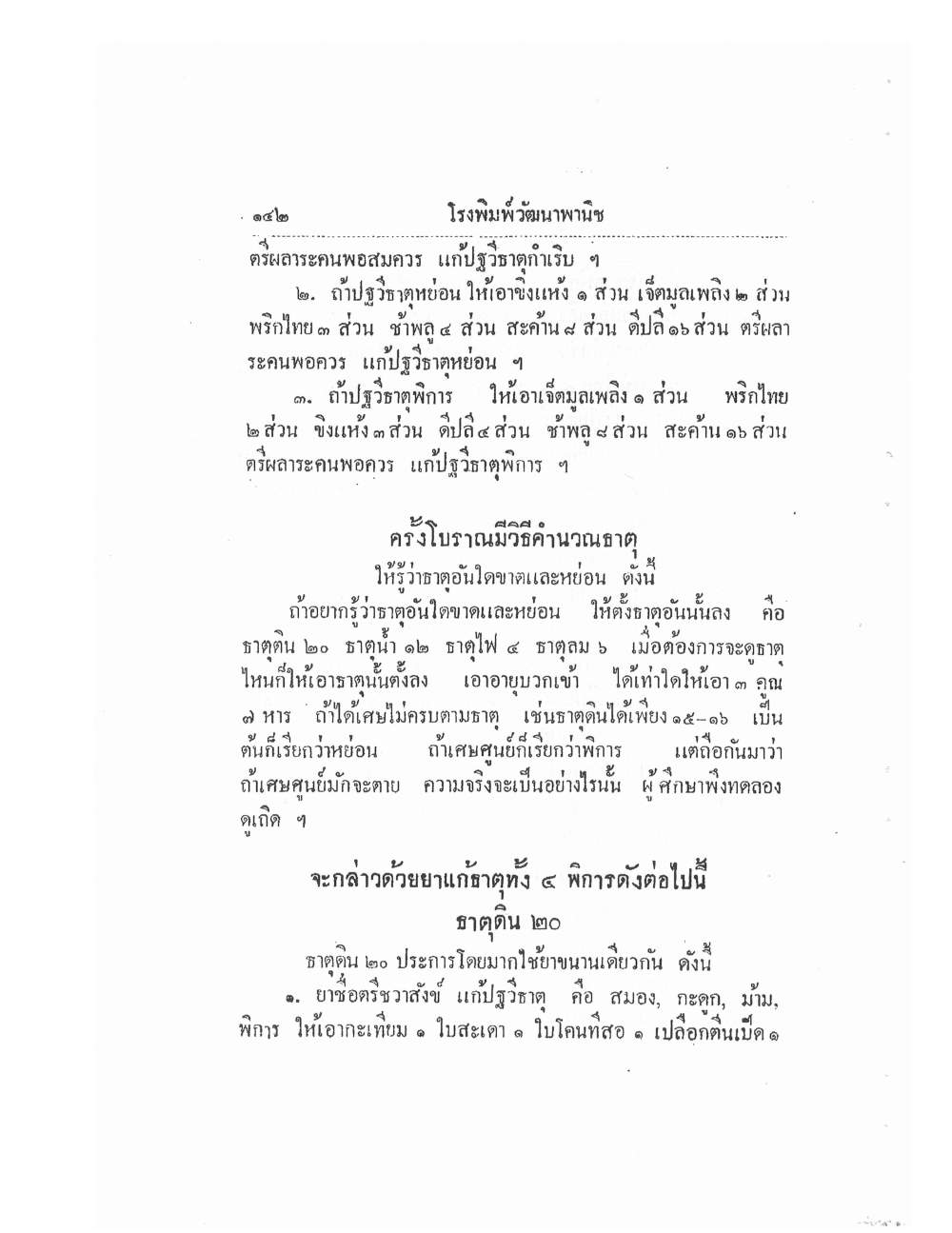
๓. ถ้าเตโชธาตุพิการ ให้เอาช้าพลู ๑ ส่วน สะค้าน ๒ ส่วน ดีปลี ๓ ส่วน เจ็ตมูลเพลิง ๕ ส่วน สมอพิเภก ๘ ส่วน ขิง ๑๖ ส่วน ฯ ๑. ถ้าวาโยธาตุกำเริบ เอาช้าพลู ๑ ส่วน เจ็ตมูลเพลิง ๒ ส่วน ดีปลี ๓ ส่วน พริกไทย ๔ ส่วน สะค้าน ๘ ส่วน สมอไทย ๑๖ ส่วน ขิงแห้งพอควร แก้วาโยธาตุกำเริบ ฯ ๒. แก้วาโยธาตุหย่อน เอาเจ็ตมูลเพลิง ๑ ส่วน ดีปลี ๒ ส่วน ช้าพลู ๓ ส่วน สมอไทย ๘ ส่วน พริกไทย ๘ ส่วน ขิงแห้งพอควร แก้วาโยธาตุหย่อน ฯ ๓. ถ้าวาโยธาตุพิการ ให้เอาดีปลี ๑ ส่วน ช้าพลู ๒ ส่วน เจ็ตมูลเพลิง ๓ ส่วน สะค้าน ๔ ส่วน สมอไทย ๘ ส่วน พริกไทย ๑๖ ส่วน ขิงแห้งพอควร แก้ในกองวาโยธาตุพิการ ฯ ๑. ถ้าอาโปธาตุกำเริบ ให้เอาขิงแห้ง ๑ ส่วน สะค้าน ๒ ส่วน เจ็ตมูลเพลิง ๓ ส่วน ดีปลี ๔ ส่วน ช้าพลู ๘ ส่วน มะขามป้อม ๑๖ ส่วน พริกไทยพอควร แก้อาโปธาตุกำเริบ ฯ ๒. ถ้าอาโปธาตุหย่อน ให้เอาสะค้าน ๑ ส่วน เจ็ตมูลเพลิง ๒ ส่วน ขิง ๓ ส่วน มะขามป้อม ๔ ส่วน ดีปลี ๘ ส่วน ช้าพลู ๑๖ ส่วน พริกไทยพอควร แก้อาโปธาตุหย่อน ฯ ๓. ถ้าอาโปธาตุพิการ ให้เอาเจ็ตมูลเพลิง ๑ ส่วน ขิง ๒ ส่วน สะค้าน ๓ ส่วน ช้าพลู ๔ ส่วน มะขามป้อม ๘ ส่วน ดีปลี ๑๖ ส่วน พริกไทยพอควร แก้อาโปธาตุพิการ ฯ ๑. ถ้าปฐวีธาตุกำเริบ ให้เอาพริกไทย ๑ ส่วน ขิง ๒ ส่วน เจ็ตมูลเพลิง ๓ ส่วน สะค้าน ๔ ส่วน ดีปลี ๘ ส่วน ช้าพลู ๑๖ ส่วน
Handbook of Medical Assistance 141
3. If the Tejo element is impaired, take cha-phlu 1 part, sakhan 2 parts, dipli 3 parts, chet-mun-phloeng 5 parts, samo-phiphek 8 parts, khing 16 parts. 1. If the Vayo (Wind) element is in excess, take cha-phlu 1 part, chet-mun-phloeng 2 parts, dipli 3 parts, phrik-thai 4 parts, sakhan 8 parts, samo-thai 16 parts, dried khing as needed — treats excess of the Vayo element. 2. To treat deficiency of the Vayo element, take chet-mun-phloeng 1 part, dipli 2 parts, cha-phlu 3 parts, samo-thai 8 parts, phrik-thai 8 parts, dried khing as needed — treats deficiency of the Vayo element. 3. If the Vayo element is impaired, take dipli 1 part, cha-phlu 2 parts, chet-mun-phloeng 3 parts, sakhan 4 parts, samo-thai 8 parts, phrik-thai 16 parts, dried khing as needed — treats impairment of the Vayo element. 1. If the Apo (Water) element is in excess, take dried khing 1 part, sakhan 2 parts, chet-mun-phloeng 3 parts, dipli 4 parts, cha-phlu 8 parts, makham-pom 16 parts, phrik-thai as needed — treats excess of the Apo element. 2. If the Apo element is deficient, take sakhan 1 part, chet-mun-phloeng 2 parts, khing 3 parts, makham-pom 4 parts, dipli 8 parts, cha-phlu 16 parts, phrik-thai as needed — treats deficiency of the Apo element. 3. If the Apo element is impaired, take chet-mun-phloeng 1 part, khing 2 parts, sakhan 3 parts, cha-phlu 4 parts, makham-pom 8 parts, dipli 16 parts, phrik-thai as needed — treats impairment of the Apo element. 1. If the Pathavi (Earth) element is in excess, take phrik-thai 1 part, khing 2 parts, chet-mun-phloeng 3 parts, sakhan 4 parts, dipli 8 parts, cha-phlu 16 parts, [continued on next page]
๑๔๒ โรงพิมพ์วัฒนาพานิช
ตรีผลาระคนพอสมควร แก้ปฐวีธาตุกำเริบ ฯ ๒. ถ้าปฐวีธาตุหย่อน ให้เอาขิงแห้ง ๑ ส่วน เจ็ตมูลเพลิง ๒ ส่วน พริกไทย ๓ ส่วน ช้าพลู ๔ ส่วน สะค้าน ๘ ส่วน ดีปลี ๑๖ ส่วน ตรีผลา ระคนพอควร แก้ปฐวีธาตุหย่อน ฯ ๓. ถ้าปฐวีธาตุพิการ ให้เอาเจ็ตมูลเพลิง ๑ ส่วน พริกไทย ๒ ส่วน ขิงแห้ง ๓ ส่วน ดีปลี ๔ ส่วน ช้าพลู ๘ ส่วน สะค้าน ๑๖ ส่วน ตรีผลาระคนพอควร แก้ปฐวีธาตุพิการ ฯ
ครั้งโบราณมีวิธีคำนวณธาตุ
ให้รู้ว่าธาตุอันใดขาดและหย่อน ดังนี้ ถ้าอยากรู้ว่าธาตุอันใดขาดและหย่อน ให้ตั้งธาตุอันนั้นลง คือ ธาตุดิน ๒๐ ธาตุน้ำ ๑๒ ธาตุไฟ ๔ ธาตุลม ๖ เมื่อต้องการจะดูธาตุ ไหนก็ให้เอาธาตุนั้นตั้งลง เอาอายุบวกเข้า ได้เท่าใดให้เอา ๓ คูณ ๗ หาร ถ้าได้เศษไม่ครบตามธาตุ เช่นธาตุดินได้เพียง ๑๕-๑๖ เป็น ต้นก็เรียกว่าหย่อน ถ้าเศษศูนย์ก็เรียกว่าพิการ แต่ถือกันมาว่า ถ้าเศษศูนย์มักจะตาย ความจริงจะเป็นอย่างไรนั้น ผู้ศึกษาพึงทดลอง ดูเถิด ฯ
จะกล่าวด้วยยาแก้ธาตุทั้ง ๔ พิการดังต่อไปนี้
ธาตุดิน ๒๐
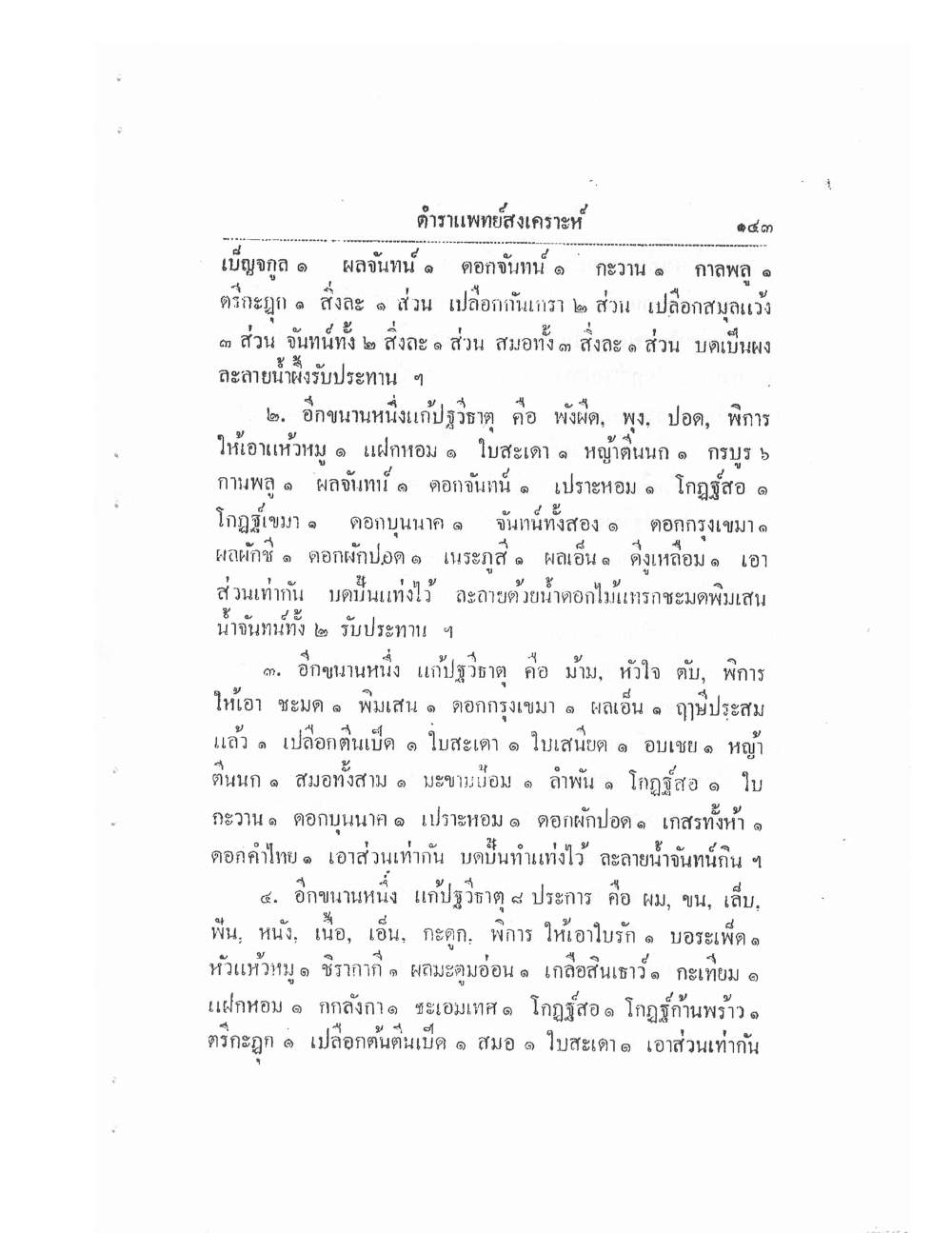
ธาตุดิน ๒๐ ประการโดยมากใช้ยาขนานเดียวกัน ดังนี้ ๑. ยาชื่อตรีชวาสังข์ แก้ปฐวีธาตุ คือ สมอง, กะดูก, ม้าม, พิการ ให้เอากะเทียม ๑ ใบสะเดา ๑ ใบโคนที่สอ ๑ เปลือกตื่นเบ็ด ๑
142 Watthana Panich Press
[continued from previous page] ...with triphala (tri-pha-la, three-fruit formula) mixed in an appropriate amount — treats excess of the Pathavi element. 2. If the Pathavi element is deficient, take dried khing 1 part, chet-mun-phloeng 2 parts, phrik-thai 3 parts, cha-phlu 4 parts, sakhan 8 parts, dipli 16 parts, triphala mixed in appropriate amount — treats deficiency of the Pathavi element. 3. If the Pathavi element is impaired, take chet-mun-phloeng 1 part, phrik-thai 2 parts, dried khing 3 parts, dipli 4 parts, cha-phlu 8 parts, sakhan 16 parts, triphala mixed in appropriate amount — treats impairment of the Pathavi element.
The ancients had a method for calculating the elements
To know which element is deficient or lacking, [proceed] as follows: If one wishes to know which element is deficient or lacking, set down that element's number — namely: Earth 20, Water 12, Fire 4, Wind 6. When one wishes to examine a particular element, set that number down, add the person's age to it, and whatever the result, multiply by 3 and divide by 7. If the remainder does not reach the full element-number — for example, if for the Earth element the result is only 15–16 or similar — this is called "deficient" (yon). If the remainder is zero, this is called "impaired" (phikan). But it has traditionally been held that if the remainder is zero, [the patient] is likely to die. Whether this is truly so, the student should test and observe for themselves.
On the medicines that treat impairment of the four elements, as follows
The Earth element, 20 [aspects]
For the twenty aspects of the Earth element, mostly the same remedy is used, as follows: 1. A medicine called Tri-chawa-sang, which treats the Pathavi (Earth) element — that is, impairment of the brain, bones, and spleen. Take kra-thiam 1, bai sadao (leaf) 1, bai khon-thi-so 1, plueak tuen-bet (bark) 1,
ตำราแพทย์สงเคราะห์ ๑๔๓
เบ็ญจกูล ๑ ผลจันทน์ ๑ ดอกจันทน์ ๑ กะวาน ๑ กานพลู ๑ ตรีกะฏุก ๑ สิ่งละ ๑ ส่วน เปลือกกันเกรา ๒ ส่วน เปลือกสมุลแว้ง ๓ ส่วน จันทน์ทั้ง ๒ สิ่งละ ๑ ส่วน สมอทั้ง ๓ สิ่งละ ๑ ส่วน บดเป็นผง ละลายน้ำผึ้งรับประทาน ฯ
๒. อีกขนานหนึ่งแก้ปฐวีธาตุ คือ พังผืด, พุง, ปอด, พิการ ให้เอาแห้วหมู ๑ แฝกหอม ๑ ใบสะเดา ๑ หญ้าตีนนก ๑ กะเบา ๖ กานพลู ๑ ผลจันทน์ ๑ ดอกจันทน์ ๑ เปราะหอม ๑ โกฐสอ ๑ โกฐเขมา ๑ ดอกบุนนาค ๑ จันทน์ทั้งสอง ๑ ดอกกรุงเขมา ๑ ผลผักชี ๑ ดอกผักปอด ๑ เนระภูสี ๑ ผลเอ็น ๑ ดังหลืด ๑ เอา ส่วนเท่ากัน บดปั้นแท่งไว้ ละลายด้วยน้ำดอกไม้เทศชมดพิมเสน น้ำจันทน์ทั้ง ๒ รับประทาน ฯ
๓. อีกขนานหนึ่ง แก้ปฐวีธาตุ คือ ม้าม, หัวใจ, ตับ, พิการ ให้เอา ชะมด ๑ พิมเสน ๑ ดอกกรุงเขมา ๑ ผลเอ็น ๑ ฤาษีประสม แล้ว ๑ เปลือกตื่นเบ็ด ๑ ใบสะเดา ๑ ใบเสนียด ๑ อบเชย ๑ หญ้า ตีนนก ๑ สมอทั้งสาม ๑ มะขามป้อม ๑ ลำพัน ๑ โกฐสอ ๑ ใบ กะวาน ๑ ดอกบุนนาค ๑ เปราะหอม ๑ ดอกผักปอด ๑ เกสรทั้งห้า ๑ ดอกคำไทย ๑ เอาส่วนเท่ากัน บดปั้นทำแท่งไว้ ละลายน้ำจันทน์กิน ฯ
๔. อีกขนานหนึ่ง แก้ปฐวีธาตุ ๘ ประการ คือ ผม, ขน, เล็บ, ฟัน, หนัง, เนื้อ, เอ็น, กะดูก, พิการ ให้เอาใบรัก ๑ บอระเพ็ด ๑ หัวแห้วหมู ๑ ชิราการี ๑ ผลมะตูมอ่อน ๑ เกลือสินเธาว์ ๑ กะเทียม ๑ แฝกหอม ๑ กกลังกา ๑ ชะเอมเทศ ๑ โกฐสอ ๑ โกฐก้านพร้าว ๑ ตรีกะฏุก ๑ เปลือกต้นตื่นเบ็ด ๑ สมอ ๑ ใบสะเดา ๑ เอาส่วนเท่ากัน
Handbook of Medical Assistance 143
[continued] ...ben-cha-kun 1, phon-chan 1, dok-chan 1, kra-wan 1, kan-phlu 1, tri-kra-tuk 1, each in 1 part; plueak kan-krao 2 parts; plueak sa-mun-waeng 3 parts; both types of chan 1 part each; all three types of samo 1 part each; ground into a powder and dissolved in honey to be taken.
2. Another remedy that treats the Pathavi element — that is, impairment of the fascia, the belly, and the lungs — take hae-wu-mu 1, faek-hom 1, bai sadao 1, ya-tin-nok grass 1, kra-bao 6, kan-phlu 1, phon-chan 1, dok-chan 1, phro-hom 1, kot-so 1, kot-khema 1, dok-bun-nak 1, both types of chan 1, dok-krung-khema 1, phon-phak-chi 1, dok-phak-pot 1, ne-ra-phu-si 1, phon-en 1, dang-luet 1 — taken in equal parts, ground and formed into blocks, dissolved with foreign flower water, musk, and camphor, together with the water of both sandalwoods, and taken.
3. Another remedy that treats the Pathavi element — that is, impairment of the spleen, heart, and liver — take cha-mot 1, phim-sen 1, dok-krung-khema 1, phon-en 1, ready-compounded ruesi-prasom 1, plueak tuen-bet 1, bai sadao 1, bai sa-niat 1, ob-choei 1, ya-tin-nok grass 1, all three samo 1, makham-pom 1, lam-phan 1, kot-so 1, bai kra-wan 1, dok-bun-nak 1, phro-hom 1, dok-phak-pot 1, all five pollens (kesorn thang ha) 1, dok-kham-thai 1 — taken in equal parts, ground and formed into blocks, dissolved in sandalwood water and taken.
4. Another remedy that treats the eight aspects of the Pathavi element — that is, impairment of the hair, body hair, nails, teeth, skin, flesh, tendons, and bones — take bai-rak leaf 1, bo-ra-phet 1, hua-hae-wu-mu 1, chi-ra-ka-ri 1, unripe ma-tum fruit 1, rock salt (kluea sin-thao) 1, kra-thiam 1, faek-hom 1, kok-lang-ka 1, cha-em-thet 1, kot-so 1, kot-kan-phrao 1, tri-kra-tuk 1, plueak-ton-tuen-bet 1, samo 1, bai sadao 1 — taken in equal parts,
๑๔๕ โรงพิมพ์วัฒนาพานิช
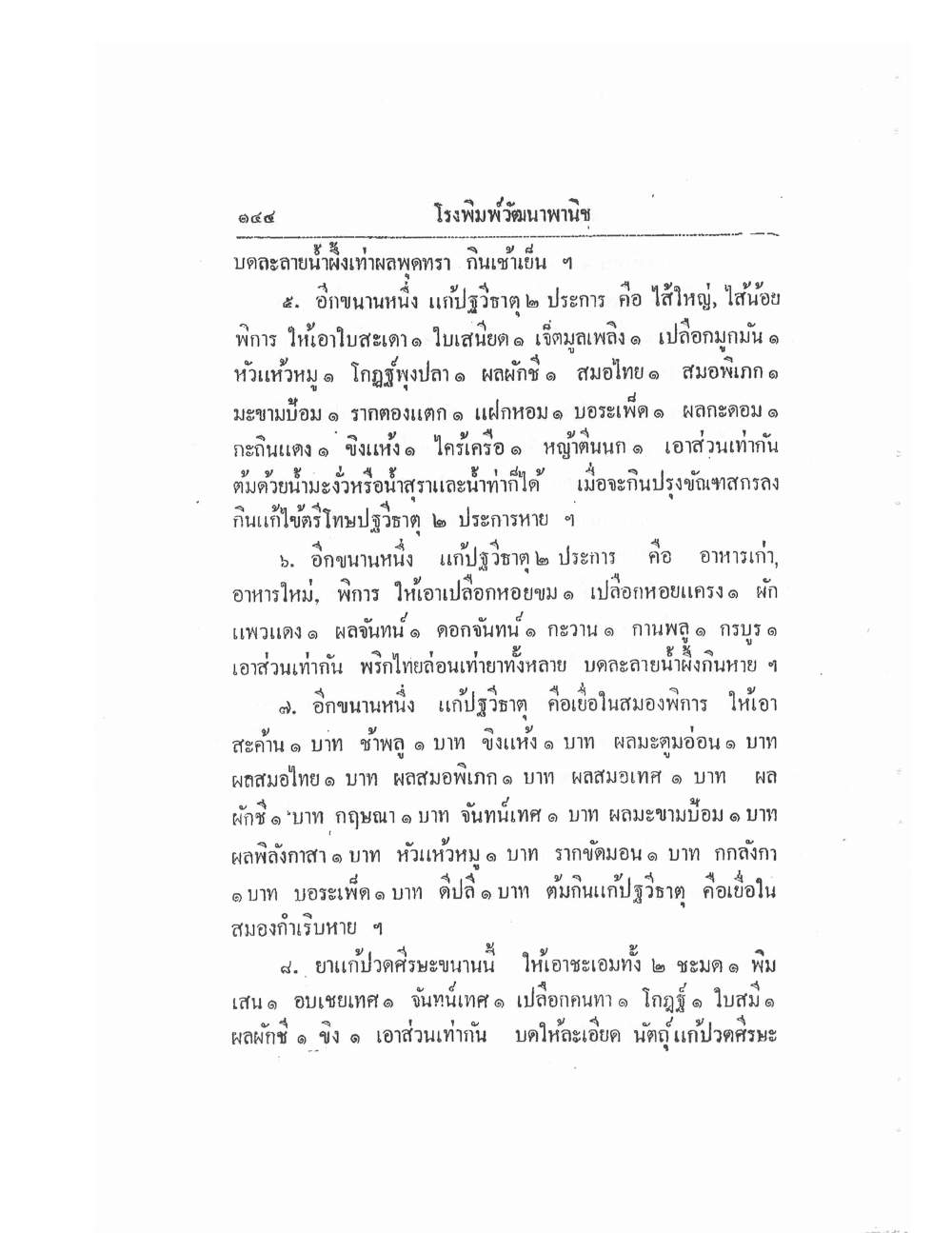
บดละลายน้ำผึ้งเท่าผลพุทรา กินเช้าเย็น ฯ
๕. อีกขนานหนึ่ง แก้ปฐวีธาตุ ๒ ประการ คือ ไส้ใหญ่, ไส้น้อย, พิการ ให้เอาใบสะเดา ๑ ใบเสนียด ๑ เจ็ตมูลเพลิง ๑ เปลือกมูกมัน ๑ หัวแห้วหมู ๑ โกฐพุงปลา ๑ ผลผักชี ๑ สมอไทย ๑ สมอพิเภก ๑ มะขามป้อม ๑ รากตองแตก ๑ แฝกหอม ๑ บอระเพ็ด ๑ ผลกะดอม ๑ กะถินแดง ๑ ขิงแห้ง ๑ ไคร้เครือ ๑ หญ้าตีนนก ๑ เอาส่วนเท่ากัน ต้มด้วยน้ำมะงั่วหรือน้ำสุราและน้ำท่าก็ได้ เมื่อจะกินปรุงขัณฑสกรลง กินแก้ไข้ตรีโทษปฐวีธาตุ ๒ ประการหาย ฯ
๖. อีกขนานหนึ่ง แก้ปฐวีธาตุ ๒ ประการ คือ อาหารเก่า, อาหารใหม่, พิการ ให้เอาเปลือกหอยขม ๑ เปลือกหอยแครง ๑ ผัก แพวแดง ๑ ผลจันทน์ ๑ ดอกจันทน์ ๑ กะวาน ๑ กานพลู ๑ กรบูร ๑ เอาส่วนเท่ากัน พริกไทยล่อนเท่ายาทั้งหลาย บดละลายน้ำผึ้งกินหาย ฯ
๗. อีกขนานหนึ่ง แก้ปฐวีธาตุ คือเยื่อในสมองพิการ ให้เอา สะค้าน ๑ บาท ช้าพลู ๑ บาท ขิงแห้ง ๑ บาท ผลมะตูมอ่อน ๑ บาท ผลสมอไทย ๑ บาท ผลสมอพิเภก ๑ บาท ผลสมอเทศ ๑ บาท ผล ผักชี ๑ บาท กฤษณา ๑ บาท จันทน์เทศ ๑ บาท ผลมะขามป้อม ๑ บาท ผลพิลังกาสา ๑ บาท หัวแห้วหมู ๑ บาท รากขัดมอน ๑ บาท กกลังกา ๑ บาท บอระเพ็ด ๑ บาท ดีปลี ๑ บาท ต้มกินแก้ปฐวีธาตุ คือเยื่อใน สมองกำเริบหาย ฯ
๘. ยาแก้ปวดศีรษะขนานนี้ ให้เอาชะเอมทั้ง ๒ ชะมด ๑ พิม เสน ๑ อบเชยเทศ ๑ จันทน์เทศ ๑ เปลือกคนทา ๑ โกฐ ๑ ใบสมี ๑ ผลผักชี ๑ ขิง ๑ เอาส่วนเท่ากัน บดให้ละเอียด นัตถุ์แก้ปวดศีรษะ
145 Watthana Panich Press
[continued] ...ground and dissolved in honey to the size of a jujube fruit; taken morning and evening.
5. Another remedy that treats two aspects of the Pathavi element — that is, impairment of the large intestine and small intestine — take bai sadao 1, bai sa-niat 1, chet-mun-phloeng 1, plueak muk-man 1, hua-hae-wu-mu 1, kot-phung-pla 1, phon-phak-chi 1, samo-thai 1, samo-phiphek 1, makham-pom 1, rak-tong-taek 1, faek-hom 1, bo-ra-phet 1, phon-ka-dom 1, kra-thin-daeng 1, dried khing 1, khrai-khruea 1, ya-tin-nok grass 1 — taken in equal parts, boiled with pomelo-flower water, or with liquor, or with plain water as suitable. When about to take it, mix in sugar; taken, it cures fever of the three humors and heals the two aspects of the Pathavi element.
6. Another remedy that treats two aspects of the Pathavi element — that is, impairment of "old food" and "new food" [digestion] — take the shell of the hoi-khom snail 1, the shell of the hoi-khraeng cockle 1, red phaeo-daeng vegetable 1, phon-chan 1, dok-chan 1, kra-wan 1, kan-phlu 1, ka-ra-boon 1 — taken in equal parts; loose (husked) black pepper in an amount equal to all the other ingredients combined; ground and dissolved in honey; taken, it cures.
7. Another remedy that treats the Pathavi element — that is, impairment of the membrane within the brain — take sakhan 1 baht, cha-phlu 1 baht, dried khing 1 baht, unripe ma-tum fruit 1 baht, samo-thai fruit 1 baht, samo-phiphek fruit 1 baht, samo-thet fruit 1 baht, phak-chi fruit 1 baht, krit-sana 1 baht, chan-thet 1 baht, makham-pom fruit 1 baht, phi-lang-ka-sa fruit 1 baht, hua-hae-wu-mu 1 baht, rak-khat-mon 1 baht, kok-lang-ka 1 baht, bo-ra-phet 1 baht, dipli 1 baht; boiled and taken, it cures the Pathavi element — that is, it heals excess of the membrane within the brain.
8. This remedy for headache: take both types of cha-em 1, cha-mot 1, phim-sen 1, foreign cinnamon (ob-choei-thet) 1, chan-thet 1, plueak khon-tha 1, kot 1, bai-sami leaf 1, phon-phak-chi 1, khing 1 — taken in equal parts, ground fine; used as snuff to cure headache [text continues beyond this page]
เพื่อเยื่อในสมองพิการหายแล้ว จึงประกอบยาสุมสำหรับกัน ให้เอาผักหนอก ๑ ขิงสดแต่น้อย ๑ หัวหอม ๕ หัว เทียนดำ ๑ ดินประสิวขาว ๑ บดสุมศีรษะเมื่อฤดูหนาวตื่นนัก ในฤดูร้อนให้เอา ใบเสนียด ๑ งาเม็ด ๑ เทียนดำ ๑ ดินประสิวขาว ๑ บดสุมกระหม่อมให้สมองยุบหายเร็ว ทั้งแก้ปวดโลหิตซึ่งตกทางจมูกและไรพื้นและอาเจียนโลหิตหาย ได้ทำมาแล้วอย่าสงสัยเลย เมื่อวสันตฤดูฝน ให้เอาหญ้าน้ำดับไฟ ๑ เทียนดำ ๑ ไพล ๑ หัวหอม ๑ ดอกพิกุล ๑ ผักขวง ๑ ใบหางนกยูง ๑ ฟ้องสามย่าน ๑ ดินประสิวขาว ๑ บดสุมแก้ปวดศีรษะจมูกตึงหาย ฯ
จบปฐวีธาตุ
เตโชธาตุ ๔ พิการ
อันว่าเตโชธาตุชื่อว่า "ปริณามัคคิ" พิการนั้น คือ ๑ ให้ร้อนในอกในใจ ๒ ให้บวมมือแลบวมเท้า ๓ ให้ไอเป็นมองคร่อ ให้ท้องขึ้นท้องพองผะอืดผะอม ถ้าจะแก้ท่านให้เอา ผักแพรวแดง ๑ โกฐสอ ๑ โกฐเขมา ๑ ชะเอมเทศ ๑ มะขามป้อม ๑ เปราะหอม ๑ รากสวาด ๑ หญ้ารังกา ๑ เอาส่วนเท่ากัน บดละลายน้ำนมโคหรือน้ำร้อนก็ได้ กินแก้เตโชธาตุชื่อว่าปริณามัคคิแตกหาย ฯ
เตโชธาตุชื่อว่า "ปริทัยหัคคิ" พิการนั้น คือให้มือแลเท้าเย็น ชีพจรไม่เดิน หรือชีพจรเดินขาดหลักเพียง ๑ หรือ ๒ หลักก็ดี บางทีให้[อ่านไม่ออก]เป็นน้ำ แต่ภายในร้อนให้พรมน้ำอยู่มิได้ขาด บางทีเย็นแล้วให้
Once the membrane inside the brain has recovered from its disorder, compound this poultice medicine accordingly. Take phak nok (ผักหนอก) 1 [part], a small amount of fresh khing (ขิง, ginger) 1, hua hom (หัวหอม, shallot) 5 bulbs, thian dam (เทียนดำ) 1, white saltpeter earth (ดินประสิวขาว) 1; grind and apply as a poultice on the head — in the cold season apply it generously; in the hot season take bai sania (ใบเสนียด) 1, sesame seed (งาเม็ด) 1, thian dam 1, white saltpeter earth 1; grind and poultice the crown of the head so that the brain-swelling subsides quickly. This also cures pain from blood flowing from the nose and along the hairline, and cures the vomiting of blood. Once you have made it, do not doubt it. During the rainy season, take ya nam dap fai (หญ้าน้ำดับไฟ) 1, thian dam 1, phlai (ไพล) 1, hua hom 1, phikun flower (ดอกพิกุล) 1, phak khuang (ผักขวง) 1, bai hang nok yung (ใบหางนกยูง) 1, fong sam yan (ฟ้องสามย่าน) 1, white saltpeter earth 1; grind and poultice to cure headache and nasal congestion.
End of the Earth Element.
The Fire Element (เตโชธาตุ), Four Disorders
As for the Fire Element called "Parinamaggi," its disorder is: (1) it causes heat in the chest and heart; (2) it causes swelling of the hands and feet; (3) it causes a cough that becomes a wheeze, and causes the belly to swell and distend with nausea. To cure this, take phak phraeo daeng (ผักแพรวแดง) 1, kot so (โกฐสอ) 1, kot khema (โกฐเขมา) 1, chaem thet (ชะเอมเทศ) 1, makham pom (มะขามป้อม) 1, pro hom (เปราะหอม) 1, rak sawat (รากสวาด) 1, ya rang ka (หญ้ารังกา) 1, in equal portions; grind and dissolve in cow's milk or hot water. Taken, it cures the Fire Element called Parinamaggi when it breaks down.
The Fire Element called "Parithaihakki," its disorder is: it makes the hands and feet cold, the pulse fails to move, or the pulse beats only weakly at one or two points. Sometimes it causes [illegible] to become watery, yet the interior stays hot, requiring water to be sprinkled on continually without stopping. Sometimes, once it has turned cold, it then...
เหงื่อตกดังเม็ดข้าวโภชน์ ถ้าจะแก้ท่านให้เอา นอแรดเผา ๑ ส่วน เขี้ยวจรเข้เผา ๑ ส่วน แก่นแสมทะเล ๑ ส่วน ผลจันทน์ ๑ ส่วน หัวแห้วหมู ๑ ส่วน รากขัดมอน ๑ ส่วน กะเทียม ๓ ส่วน พริกไทย ๕ ส่วน เปลือกหอยขมเผา ๑ ส่วน เขาควายเผือกเผา ๑ ส่วน เปลือกหอยแครงเผา ๑ ส่วน หวายตะมอยหรือหวายตะค้า ๑ ส่วน บดให้ละเอียดละลายน้ำร้อนแทรกพิมเสน กินขับไฟธาตุให้ร้อนตลอดจนปลายเท้าปลายมือ ชีพจรเดินได้ตลอดแล ฯ
ยาแก้เหงื่อตกหนักขนานนี้ ท่านให้ตัดเอานางกุ่มรุ่น ๆ นั้นมา ปอกเปลือกเสีย แล้วจึงขุดเอาเยื่อที่ติดอยู่กับต้นนั้น ๑ ผลถั่วพู ๑ แป้งสุรา ๑ ดินสอพอง ๑ เทียนดำ ๑ พิมเสนแทรกให้มาก ประสมกันเข้ากวนให้ละเอียดแล้วทาตัวคนไข้ เหงื่อหยุดตัวก็ร้อนออกมาแล ฯ
ยาแก้กระหายน้ำ ให้ร้อนภายในแลให้หอบขนานนี้ ท่านให้เอา สังข์หนามเผาไฟ ๑ รากบัวหลวง ๑ ผุ่นจีน ๑ รังหมาร่าเผาไฟ ๑ ชาดก้อน ๑ ดอกพิกุล ๑ ดอกสารภี ๑ ดอกบุนนาค ๑ เกสรบัวหลวง ๑ กรับูร ๑ รากสลอดน้ำ ๑ รากคันทรง ๑ ก้ามปูทะเล ๑ ดินประสิวขาว ๑ เอาส่วนเท่ากัน บดให้ละเอียดปั้นเม็ดไว้ ละลายน้ำดอกไม้สดทั้งพ่นแก้ร้อน แก้กระหายน้ำ เหงื่อตกหาย ฯ
เตโชธาตุชื่อว่า "ชิรณัคคิ" พิการนั้น คือ มัจจุราชให้ทูตมาประเล้าประโลมชีวิตสัตว์ทั้งหญิงทั้งชาย เมื่อชีวิตจะออกจากร่างกายก็ให้วิปริตต่าง ๆ คือ ให้หน้าผากตึง นับนัยน์ตาแลไม่เห็นแล้วกลับเห็น หูตึงแล้วกลับมาได้ยินอีก จมูกไม่ได้กลิ่นแล้วกลับมาได้กลิ่นอีก ลิ้นไม่รู้รสแล้วกลับมารู้รส กายถูกต้องสิ่งไรไม่รู้สึกแล้วกลับมารู้สึก
...sweat pours out like grains of cooked rice. To cure this, take: burnt rhinoceros horn 1 part, burnt crocodile tooth 1 part, heartwood of saem thale (แสมทะเล) 1 part, phon chan (ผลจันทน์) 1 part, hua haeo mu (หัวแห้วหมู) 1 part, rak khat mon (รากขัดมอน) 1 part, garlic 3 parts, pepper 5 parts, burnt freshwater-snail shell 1 part, burnt albino-buffalo horn 1 part, burnt cockle shell 1 part, wai ta moi or wai ta kha (หวายตะมอย/หวายตะค้า) 1 part; grind finely and dissolve in hot water mixed with camphor (พิมเสน). Taken, it drives the fire element so that heat spreads through to the very tips of the feet and hands, and the pulse can move throughout the whole body.
This formula for severe sweating: cut a young branch of nang kum (นางกุ่ม), peel off its bark, then scrape out the pith clinging to the trunk — 1 [part]; thua phu fruit (ผลถั่วพู) 1, liquor-yeast flour (แป้งสุรา) 1, chalk (ดินสอพอง) 1, thian dam 1, and add camphor generously. Mix these together, grind finely, then rub over the patient's body. The sweating will stop and the body's heat will come out.
This formula for thirst, which causes internal heat and panting: take burnt sang nam (สังข์หนาม) 1, lotus root (รากบัวหลวง) 1, phun chin (ผุ่นจีน) 1, burnt rang ma ra (รังหมาร่า) 1, a lump of cinnabar (ชาด) 1, phikun flower 1, sarapi flower (ดอกสารภี) 1, bunnak flower (ดอกบุนนาค) 1, lotus stamen 1, camphor (กรับูร) 1, rak salot nam (รากสลอดน้ำ) 1, rak khan song (รากคันทรง) 1, claw of a sea crab (ก้ามปูทะเล) 1, white saltpeter earth 1, in equal portions; grind finely and form into pills. Dissolve in fresh flower-water; both drink and spray it on, to cure heat, cure thirst, and stop the sweating.
The Fire Element called "Chiranaggi," its disorder is: the Lord of Death sends his messenger to coax and lull the life of every creature, both women and men. When life is about to leave the body it produces various distortions: it makes the forehead tighten; the eyes, having gone blind, see again; the ears, having gone deaf, hear again; the nose, having lost its sense of smell, smells again; the tongue, having lost taste, tastes again; the body, touched by something and feeling nothing, feels again...
แปรไปแปรมาดังนี้ ยังไม่แน่นอน แต่ชีวิตยังไม่ดับ เป็นแต่แตกร้าวอยู่แล้ว ถ้าจะแก้ท่านให้เอา บอระเพ็ด ๑ ผลพิลังกาสา ๑ ผักแพรวแดง ๑ ผลมูกมัน ๑ ใบย่างทราย ๑ เอาส่วนเท่ากัน ทำให้เป็นจุณ ละลายน้ำผึ้งแทรกเชือกเขามวกหรือน้ำนมโคก็ได้ กินแก้เตโชธาตุชื่อว่าชิรณัคคิแตก ฯ
เตโชธาตุชื่อว่า "สันตัปปัคคิ" พิการนั้น ถ้าแตกเมื่อใด เมื่อนั้นต้องตายเป็นทีเดียว แพทย์ทั้งหลายจะแก้มิได้เลย ฯ
จบเตโชธาตุ ๔
วาโยธาตุ ๖ พิการ
ลมอันชื่อว่า "อุทธังคมาวาตา" แตกนั้น คือให้ดิ้นรน มือเท้าขวักไขว่ ให้พลิกตัวไป ๆ มา ๆ ให้ทุรนทุราย ให้หาวให้เรอบ่อย ๆ ถ้าจะแก้ท่านให้เอา โกฐสอ ๑ โกฐเขมา ๑ ผลราชดัด ๑ ผลสาระพัดพิษ ๑ ผลมะแว้งทั้ง ๒ รากจิงจ้อทั้ง ๒ ผลจันทน์ ๑ ดอกจันทน์ ๑ เทียนดำ ๑ เทียนขาว ๑ มหาหิงคุ์ ๑ เอาส่วนเท่ากันทำเป็นจุณ ละลายน้ำมะงั่วหรือน้ำมะนาว น้ำนมโคก็ได้ แก้ลมอุทธังคมาวาตาแตก ฯ
ลมชื่อว่า "อโธคมาวาตา" แตกนั้นให้ยกมือและเท้ามิได้ ให้เมื่อยขบทุกข้อทุกกะดูก ให้เจ็บปวดเป็นกำลัง ถ้าจะแก้ท่านให้เอา เปลือกมูกหลวง ๑ พริกไทย ๑ ขิงแห้ง ๑ ใบสลอดกินลง ๑ ว่านน้ำ ๑ หัวแห้วหมู ๑ หญ้ารังกา ๑ ผักแพรวแดง ๑ สมอไทย ๑ รากไคร้เครือ ๑ เอาส่วนเท่ากัน ทำให้เป็นจุณ ละลายน้ำมูตรโคดำ หรือน้ำส้มซ่าก็ได้
...shifting back and forth in this way, still uncertain, but life has not yet gone out — it is merely cracked already. To cure this, take bo raphet (บอระเพ็ด) 1, phon philangkasa (ผลพิลังกาสา) 1, phak phraeo daeng 1, phon muk man (ผลมูกมัน) 1, bai yang sai (ใบย่างทราย) 1, in equal portions; make into a powder, dissolve in honey mixed with chueak khao mok (เชือกเขามวก) vine or cow's milk. Taken, it cures the Fire Element called Chiranaggi when it breaks.
The Fire Element called "Santappaggi," its disorder: whenever it breaks, the patient must die at once. No physician whatsoever is able to cure it.
End of the Fire Element, Four [Disorders].
The Wind Element (วาโยธาตุ), Six Disorders
The wind called "Utthangkhamavata," when it breaks, makes the patient thrash about, the hands and feet flailing wildly, causes the body to keep turning over and over, causes restlessness and distress, causes frequent yawning and belching. To cure this, take kot so 1, kot khema 1, phon ratchadat (ผลราชดัด) 1, phon saraphat phit (ผลสาระพัดพิษ) 1, ma waeng fruit (both kinds) 1, ching cho root (both kinds) 1, phon chan (ผลจันทน์) 1, mace (ดอกจันทน์) 1, thian dam 1, thian khao (เทียนขาว) 1, asafoetida (มหาหิงคุ์) 1, in equal portions, made into powder; dissolve in pomelo juice or lime juice, or cow's milk; it cures the wind Utthangkhamavata when it breaks.
The wind called "Adhokamavata," when it breaks, prevents the hands and feet from being lifted, causes aching in every joint and bone, causes intense pain. To cure this, take muk luang bark (เปลือกมูกหลวง) 1, pepper 1, dried ginger 1, bai salot kin long (ใบสลอดกินลง) 1, wan nam (ว่านน้ำ) 1, hua haeo mu 1, ya rang ka 1, phak phraeo daeng 1, samo thai (สมอไทย) 1, rak khrai khruea (รากไคร้เครือ) 1, in equal portions; make into powder, dissolve in dark cow's urine or in som sa (bitter orange) juice.
กินแก้ลมชื่อว่า อโธคมาวาตาแตกหาย ฯ
ลมชื่อว่า "กุจฉิสยาวาตา" แตกนั้น ให้เจ็บท้อง ให้ท้องขึ้นท้องพอง ให้ลั่นจ๊อก ๆ ให้เจ็บในอก ให้สวิงสวาย ให้เจ็บแดกขึ้นแดกลง ถ้าจะแก้ท่านให้เอา มหาหิงคุ์ ๑ ลำพันแดง ๑ ดีปลี ๑ เมล็ดในสวาด ๑ ผลราชดัด ๑ ชะเอมเทศ ๑ โกฐสอ ๑ โกฐเขมา ๑ ใบย่างทราย ๑ กรุงเขมา ๑ เอาส่วนเท่ากัน ทำเป็นจุณ ละลายน้ำผึ้งหรือน้ำร้อนก็ได้ กินแก้ลมชื่อกุจฉิสยาวาตาแตกหาย ฯ
ลมชื่อ "โกฏฐาสยาวาตา" แตกนั้น ให้เหม็นข้าว ให้อาเจียน ให้จุกอก ให้เสียดและแน่นหน้าอก ถ้าจะแก้ท่านให้เอา ชะเอมเทศ ๑ เจ็ตมูลเพลิง ๑ รากตองแตก ๑ รากจิงจ้อใหญ่ ๑ ขิงแห้ง ๑ ลำพันแดง ๑ พริกไทยร่อน ๑ ใบหนาด ๑ กะเบูร ๑ ใบสลอดกินลงต้มด้วยน้ำเกลือผึ่งแดดให้แห้ง ๑ เอาส่วนเท่ากัน ทำให้เป็นจุณละลายน้ำนมโคหรือน้ำร้อน น้ำมูตรโคก็ได้ กินหาย ฯ
ลมชื่อว่า "อังคมังคานุสารีวาตา" แตกนั้น ให้โสตประสาทตึง คนเจรจาไม่ได้ยิน และเป็นหินห้อยออกจากลูกตา ให้เมื่อยมือและเท้า เมื่อยแข้งและขาทั้ง ๒ ข้างเหมือนกะดูกจะแตก ให้ปวดกะดูกสันหลังดุจว่าเป็นผี ให้สะบัดร้อนสะท้านหนาว ให้คลื่นเหียนและอาเจียน ลมเปล่า กินอาหารไม่รู้จักรส ถ้าจะแก้ท่านให้เอาผักเป็ด ๑ ผักเสี้ยนผี ๑ ผักคราด ๑ หญ้ารังกา ๑ ผลผักชีทั้ง ๒ เมล็ดผักกาด ๑ ดอกจงกลนี ๑ สะค้าน ๑ เมล็ดแตงโม ๑ เอาส่วนเท่ากันทำเป็นจุณ ละลายน้ำผึ้งน้ำร้อนหรือน้ำสุรากินหาย ฯ
Taken, it cures the wind called Adhokamavata when it breaks.
The wind called "Kutchisayavata," when it breaks, causes stomach pain, causes the belly to swell and distend, causes gurgling noises, causes pain in the chest, causes faintness and distress, causes pain that surges up and down. To cure this, take asafoetida 1, lamphan daeng (ลำพันแดง) 1, dee pli (ดีปลี, long pepper) 1, seed from within a sawat (สวาด) pod 1, ratchadat fruit 1, chaem thet 1, kot so 1, kot khema 1, bai yang sai 1, krung khema (กรุงเขมา) 1, in equal portions; make into powder, dissolve in honey or hot water. Taken, it cures the wind called Kutchisayavata when it breaks.
The wind called "Kotthasayavata," when it breaks, makes food smell foul, causes vomiting, causes a lump in the chest, causes stabbing pain and tightness in the chest. To cure this, take chaem thet 1, jet mun phloeng (เจ็ตมูลเพลิง) 1, rak tong taek (รากตองแตก) 1, large ching cho root 1, dried ginger 1, lamphan daeng 1, sifted pepper 1, bai naat (ใบหนาด) 1, camphor (กะเบูร) 1, bai salot kin long boiled in salt water and sun-dried 1, in equal portions; make into powder, dissolve in cow's milk or hot water, or cow's urine. Taken, it heals.
The wind called "Angkhamangkhanusarivata," when it breaks, causes the hearing-nerve to tighten so a person cannot hear speech, and causes something like a stone to hang out of the eyeball; causes the hands and feet to ache, both shins and legs to ache as if the bones would break; causes pain along the spine as though possessed by a ghost; causes alternating fits of heat and cold; causes nausea and vomiting; is an "empty wind"; makes food taste of nothing. To cure this, take phak pet (ผักเป็ด) 1, phak sian phi (ผักเสี้ยนผี) 1, phak khraat (ผักคราด) 1, ya rang ka 1, coriander fruit (both kinds) 1, mustard seed 1, chongkolani flower (ดอกจงกลนี) 1, sa khan (สะค้าน) 1, watermelon seed 1, in equal portions; make into powder, dissolve in honey and hot water or in liquor. Taken, it heals.
ลมชื่อว่า "อัสสาสะบัสสาสะ" นั้นจะได้แตกหามิได้ ลมอันนี้คือลมธาตุอันพัดให้หายใจเข้าออก ถ้าสิ้นลมหายใจเข้าและออกเมื่อใด ก็เรียกว่าตายเมื่อนั้น แพทย์จะแก้ไขมิได้เลย ฯ
จบวาโยธาตุ ๖ พิการ
อาโปธาตุ ๑๒ พิการ
ดีพิการนั้น ทำให้ผู้นั้นหาสติมิได้ ถ้าจะแก้ท่านให้เอา เทียนดำ ๑ บาท เทียนตาตั๊กแตก ๒ บาท เปลือกมะซาง ๒ บาท เปลือกไข่เน่า ๒ บาท เทพทาโร ๒ บาท เทียนเข้าเปลือก ๒ บาท ดีจรเข้ ๑ บาท ทำให้เป็นจุณ บดทำแท่งไว้ละลายด้วยน้ำดอกไม้พิมเสน กินแก้ลมเพ้อพกคลั่งไคล้หาย ฯ
ยาแก้ลงขนานนี้ ท่านให้เอา ผลจันทน์ ๑ ผลเบ็ญกานี ๑ เปลือกมะขามเกราะ ๑ ครั่ง ๑ เปลือกผลทับทิม ๑ เปลือกมังคุด ๑ กำยาน ๑ ผลตะมูน ๑ ผิว ๑ เอาส่วนเท่ากัน ทำให้เป็นจุณ บดทำแท่งไว้ละลายด้วยน้ำเปลือกลูกทับทิม กินแก้ลงหาย ฯ
เสมหะพิการนั้น ให้สะบัดร้อนสะบัดหนาว ให้เจ็บไข้เป็นเวลา บางทีให้ลงโลหิต ถ้าจะแก้ท่านให้เอา ผลผักชีลา ๑ ลำพัน ๑ เปลือกมูกหลวง ๑ น้ำเต้าขม ๑ กะดอมทั้ง ๕ แก่นขี้เหล็ก ๑ ต้ม ๓ เอา ๑ ให้กินแก้จับเสี้ยนก่อน แล้วจึงประกอบยาแก้เสมหะต่อไป ฯ
ถ้าจะแก้เสมหะพิการ ให้ต้มยาชำระเสี้ยนก่อน ท่านให้เอา ใบมะขาม ๑ กำมือ ใบส้มป่อย ๑ กำมือ ฝางเสน ๑ กำมือ เถาวัลย์เปรียง ๑ กอบ หัวแห้วหมู ๑ หอม ๗ หัว สมอไทยเท่าอายุคนไข้
The wind called "Assasa-passasa" can never break. This wind is the elemental wind that drives the breath in and out. Whenever the breath ceases entirely to move in and out, that is what is called death. No physician can remedy it at all.
End of the Wind Element, Six Disorders.
The Water Element (อาโปธาตุ), Twelve Disorders
Disorder of the bile: it makes the afflicted person lose all awareness. To cure this, take thian dam 1 baht, thian ta takkataek (เทียนตาตั๊กแตก) 2 baht, ma sang bark (เปลือกมะซาง) 2 baht, khai nao bark (เปลือกไข่เน่า) 2 baht, thepthalo (เทพทาโร) 2 baht, thian khao plueak (เทียนเข้าเปลือก) 2 baht, crocodile bile 1 baht; make into powder, grind and form into sticks, dissolve with flower-water and camphor. Taken, it cures delirious raving and madness.
This formula for diarrhoea: take phon chan (ผลจันทน์) 1, phon benkani (ผลเบ็ญกานี) 1, ma kham kro bark (เปลือกมะขามเกราะ) 1, lac (ครั่ง) 1, pomegranate rind 1, mangosteen rind 1, benzoin (กำยาน) 1, ta mun fruit (ผลตะมูน) 1, peel/rind (ผิว) 1, in equal portions; make into powder, grind and form into sticks, dissolve with pomegranate-rind water. Taken, it cures the diarrhoea.
Disorder of the phlegm: causes alternating fits of heat and cold, causes periodic fever, sometimes causes bloody stool. To cure this, take phak chi la fruit (ผลผักชีลา) 1, lamphan (ลำพัน) 1, muk luang bark 1, bitter gourd (น้ำเต้าขม) 1, kadom (all five parts) 1, khilek heartwood (แก่นขี้เหล็ก) 1; boil down from 3 [measures] to 1. Give this to drink first to cure the underlying affliction, then compound the further medicine for the phlegm.
To cure disorder of the phlegm, first boil a medicine to cleanse the underlying affliction. Take a handful of tamarind leaf, a handful of som poi leaf (ใบส้มป่อย), a handful of fang sen (ฝางเสน), a bundle of thaowan priang (เถาวัลย์เปรียง), hua haeo mu 1, shallot 7 bulbs, samo thai in a quantity equal to the patient's age...
ต้ม ๓ เอา ๑ แทรกดีเกลือตามธาตุหนักและเบาแล้วจึงให้กินยาแก้บิด ทั้งป่วงต่อไปเถิด ฯ
ยาแก้บิดเป็นเพื่อธาตุพิการขนานนี้ ท่านให้เอา ผลเบ็ญกานี ๑ บาท ผลจันทน์ ๑ บาท ครั่ง ๓ บาท ดินกิน ๑ บาท เปลือกมังคุด ๑ บาท เทียนดำ ๑ บาท กะวาน ๑ บาท กานพลู ๑ บาท ยางตะเคียน ๑ บาท น้ำประสานทอง ๑ บาท ผิวมะกรูด ๑ บาท ผิ่น ๒ สลึง ผลมะม่วงกะล่อน ๑ บาท เปลือกมะขามขบ ๑ บาท สีเสียดทั้ง ๒ สิ่งละ ๑ บาท ทำให้เป็นจุณแล้วใส่เข้าในผลทับทิมแล้ว เอาขี้วัวพอกชั้นหนึ่ง สุมไฟแกลบให้สุกแล้ว เอาดินออกเสียบดทั้งผลทับทิม ปั้นทำแท่งไว้ละลายด้วยน้ำไพลหรือน้ำปูนใสก็ได้ กินแก้ปวดมวนแก้โลหิตหรือเสมหะเน่าหาย ถ้ามิหยุด ท่านให้เอายาแก้ดีพิการนั้นมาแก้ถัด แล้วจึงประกอบยาธาตุบรรจบให้กิน ฯ
ถ้าจะทำยาธาตุบรรจบ ท่านให้ถามตัวคนไข้ว่าเกิด ปี เดือน วันอะไร ข้างขึ้นหรือข้างแรม เมื่อเขาบอกแล้ว พึงพิจารณาดูว่า เป็นฤดูธาตุอันใด ให้เอายาประจำฤดูธาตุอันนั้นตั้งไว้เป็นประธาน แล้วให้คิดถอยหลังไปถึง วัน เดือน ฤดู ที่คนไข้ถือปฏิสนธิแล้ว ให้เอายาประจำธาตุ แลฤดูนั้นมาประสมกันเข้ากับยาประจำธาตุเมื่อแรกปฏิสนธินั้นเป็น ๒ ขนาน แล้วจึงแทรกจันทน์ทั้ง ๒ กฤษณา ๑ ชะลูด ๑ ดอกพิกุล ๑ ดอกบุนนาค ๑ ดอกสารภี ๑ เกสรบัวหลวง ๑ ขอนดอก ๑ ต้มกินหาย ฯ
หนองพิการนั้น ให้ไอเป็นกำลัง ให้กายซูบผอมหนัก ให้กินอาหารไม่รู้จักรส มักเป็นฝีในท้อง ๓ ประการ ถ้าจะแก้ท่านให้เอา
Boil down from 3 [measures] to 1, add Glauber's salt (ดีเกลือ) according to whether the patient's constitution is heavy or light, then give the dysentery medicine, and treat whatever else remains.
This formula for dysentery arising from disordered elements: take phon benkani 1 baht, phon chan 1 baht, lac 3 baht, edible clay (ดินกิน) 1 baht, mangosteen rind 1 baht, thian dam 1 baht, cardamom (กะวาน) 1 baht, clove 1 baht, takian resin (ยางตะเคียน) 1 baht, borax (น้ำประสานทอง) 1 baht, kaffir-lime rind 1 baht, opium (ผิ่น) 2 salueng, ma muang ka lon fruit (ผลมะม่วงกะล่อน) 1 baht, ma kham khop bark (เปลือกมะขามขบ) 1 baht, both kinds of see siat (สีเสียด) 1 baht each; make into powder, place it inside a pomegranate fruit, coat it with a layer of cow-dung, and roast it over a husk-fire until cooked. Remove the coating and grind it together with the pomegranate; form into sticks, dissolve with phlai-water or clear limewater. Taken, it cures cramping pain, cures putrid blood or phlegm. If it does not stop, take the medicine for disorder of the bile [described earlier] to treat next, then compound the "element-uniting medicine" for the patient to drink.
To make the element-uniting medicine, ask the patient in what year, month, and day he or she was born, and whether it was the waxing or waning [of the moon]. Once told, consider which elemental season this falls under. Take the medicine proper to that elemental season and set it as the principal ingredient. Then reckon back to the day, month, and season in which the patient was conceived, and take the medicine proper to that element and season, combining it with the medicine proper to the element at conception, making two formulas together. Then add both kinds of sandalwood, agarwood (กฤษณา) 1, chalut (ชะลูด) 1, phikun flower 1, bunnak flower 1, sarapi flower 1, lotus stamen 1, khon dok (ขอนดอก) 1; boil and drink; it heals.
Disorder of pus: causes forceful coughing, causes the body to waste away severely, makes food taste of nothing; it often becomes an abscess of the belly, of three kinds. To cure this, take...
รังมดแดง ๑ รัง ใบมะกา ๑ ตำลึง เทียนดำ ๑ ตำลึง สมอเทศ ๑ ตำลึง รากตองแตก ๑ ตำลึง หัวหอม ๑ ตำลึง ขมิ้นอ้อยยาว ๑ องคุลี ต้ม ๓ เอา ๑ แทรกดีเกลือตามธาตุหนักและเบา ชำระบุพโพร้ายเสียก่อน จึงประกอบยาประจำธาตุในเสมหะก็ได้ ถ้ามิพึงให้ประกอบยาขนานนั้น ท่านให้เอารากมูกหลวง ๑ ผลราชดัด ๑ ตรีกะฏุก ๑ ขมิ้นอ้อย ๑ รากกะพังโหม ๑ หัวข้าวเข้า ๑ หอมแห้ง ๑ เอาส่วนเท่ากัน ทำเป็นจุณละลายน้ำร้อนหรือน้ำสุราก็ได้ กินหาย ฯ
โลหิตพิการนั้น ท่านกล่าวว่าโลหิตร้าย แพทย์สมมติว่าเป็นไข้กำเดาเพราะโลหิตกำเริบ ถ้าโลหิตแตกให้ทำพิษต่าง ๆ บางทีให้ปวดศีรษะ ให้ในตาแดงเป็นสายโลหิต ให้งวงศีรษะ ให้หนักหน้าผาก ถ้าผุดขึ้นภายนอกให้เป็นวงแดง เขียว เหลือง แล้วทำพิษต่าง ๆ ให้ลิ้นกะด้างคางแข็ง แพทย์ทั้งหลายสมมติว่าเป็นไข้รากสาด คือ ปานดำ ปานแดง สายฟ้าฟาด จอมประสาท ข้าวไหม้น้อย ข้าวไหม้ใหญ่ หงส์ระทด เปลวไฟฟ้า ประกายดาด ประกายเพลิง ดาวเรือง ฟองสมุทร มหาเมฆ มหานิล ลำลาบเพลิง ไฟลามทุ่ง เพราะโลหิตแตกกระจายซ่านออกผิวหนังข้างนอก ส่วนข้างในนั้นก็ให้ทำพิษต่าง ๆ บางทีให้ลงเป็นโลหิต บางทีให้อาเจียนเป็นโลหิต บางทีโลหิตแล่นเข้าจับหัวใจ ให้คลั่งคลุ้มทุรนทุราย ให้ละเมอเพ้อพก หาสติสมปฤดีมิได้ แพทย์ทั้งหลายสมมติว่าเป็นสันนิบาตโลหิต เพราะเป็นเพื่อโลหิตสมุฏฐาน บางทีให้ร้อนให้หนาว บางทีให้ชักมือเท้ากำ บางทีให้ขัดหนักขัดเบา บางทีให้เบาเป็นสีแดง สีเหลือง สีดำก็มี ทั้งนี้เป็นเพราะโลหิตพิการอย่างเดียว ถ้าในธาตุน้ำพิการ
Red-ant nest 1 nest, ma ka leaf (ใบมะกา) 1 tamlueng, thian dam 1 tamlueng, samo thet (สมอเทศ) 1 tamlueng, rak tong taek 1 tamlueng, shallot 1 tamlueng, long turmeric (ขมิ้นอ้อย) 1 finger-length; boil down from 3 to 1, add Glauber's salt according to the patient's constitution being heavy or light — first cleanse the harmful matter, and the medicine proper to the element may then also be compounded for the phlegm. If one does not wish to compound that formula, take muk luang root (รากมูกหลวง) 1, ratchadat fruit 1, the three pungents (ตรีกะฏุก) 1, turmeric (ขมิ้นอ้อย) 1, rak kaphang hom (รากกะพังโหม) 1, hua khao khao (หัวข้าวเข้า) 1, dried shallot 1, in equal portions; make into powder, dissolve in hot water or liquor; taken, it heals.
Disorder of the blood: it is spoken of as "evil blood." Physicians hold it to be epistaxis-fever, because the blood becomes agitated. If the blood "breaks," it produces various poisons: sometimes causing headache, causing the eyes to redden with threads of blood, causing dizziness of the head, causing heaviness in the forehead. If it erupts on the outside it forms rings of red, green, and yellow, then produces further poisons, causing the tongue to stiffen and the jaw to lock. Physicians hold this to be rakasat-fever, namely: pan dam, pan daeng, sai fa fat, chom prasat, khao mai noi, khao mai yai, hong rathot, pleo fai fa, prakai dat, prakai phloeng, dao rueang, fong samut, maha mek, maha nin, lamlap phloeng, fai lam thung — [these arise] because the blood breaks and spreads out over the outer skin. As for the interior, it likewise produces various poisons: sometimes causing bloody stool, sometimes causing vomiting of blood, sometimes the blood rushes in and seizes the heart, causing madness, confusion, and restlessness, causing delirious raving, so that the patient has no awareness at all. Physicians hold this to be "blood sannibat," since it originates from the blood. Sometimes it causes heat, sometimes cold; sometimes it makes the hands and feet clench in spasm; sometimes it causes difficulty urinating or defecating; sometimes urine appears red, yellow, or even black in colour. All this arises from disorder of the blood alone. As for disorder within the water element...
ถึง ๒-๓-๔-๕ อย่างแล้ว จะแก้มิได้เลยคนไข้จะต้องตายภายใน ๓ วัน แต่ถ้าพิการเพียง ๑-๒ หรือ ๓ อย่างให้แก้ดูก่อน พิษโลหิตที่ซ่านออกมาภายนอก ท่านให้เอายาแก้ไข้เหนือแลยามหากาฬมาแก้ ห้ามมิให้เอายาที่เผ็ดร้อนมาแก้ โรคอันนี้ชอบแต่ยามีรสเย็น สุขุม หอม ฝาด ขม แก้จึงจะหาย ส่วนพิษโลหิตกระทำภายในทรวงอกให้ลงเป็นโลหิต อาเจียนเป็นโลหิต ท่านให้เอายาแก้ลักปิดลักเปิด แลยาแก้อติสารมาแก้ถัด ถ้ามิพึงให้เอายาในคัมภีร์ธาตุน้ำมาแก้ถัด อันว่ายาในคัมภีร์ธาตุนี้ ให้แก้แต่ธาตุน้ำคือโลหิตพิการ ฯ
ยาชื่อปโตพาทิคุณ
ท่านให้เอา บอระเพ็ด ๑ ข่าตาแดง ๑ กะชาย ๑ เมล็ดผักกาด ๑ ขันทน์ทั้ง ๒ มะแว้งต้น ๑ จันทนา ๑ หัวแห้วหมู ๑ ไพล ๑ รากขัดมอน ๑ สะค้าน ๑ รากช้าพลู ๑ จุกโรหิณี ๑ สนเทศ ๑ กรุงเขมา ๑ เปลือกมูกหลวง ๑ รากตองแตก ๑ แฝกหอม ๑ กฤษณา ๑ กะลำพัก ๑ ชะลูด ๑ ขอนดอก ๑ สมอทั้ง ๓ อบเชย ๑ ดอกพิกุล ๑ ดอกบุนนาค ๑ สารภี ๑ เกสรบัวหลวง ๑ เอาส่วนเท่ากัน ต้ม ๓ เอา ๑ ถ้าจะให้ระบายแทรกดีเกลือตามธาตุหนักและเบา แก้ไข้เพื่อโลหิตในคิมหันตฤดู ฯ
ยาชื่อมหาชุมนุมใหญ่สันนิบาต
ท่านให้เอา เจ็ตมูลเพลิง ๑ บาท โกฐสอ ๑ บาท โกฐพุงปลา ๑ บาท โกฐกระดูก ๑ บาท โกฐหัวบัว ๑ บาท โกฐจุฬาลำพา ๑ บาท โกฐเชียง ๑ บาท โกฐสอเทศ ๑ บาท ดีปลี ๑ บาท ผล
...reaching two, three, four, or five kinds [of disorder combined] at once, it can no longer be cured at all — the patient must die within three days. But if the disorder is confined to only one, two, or three kinds, treat and observe first. For blood-poison that spreads out to the exterior, use fever medicine and "great-black" medicine (ยามหากาฬ) to treat it; do not use pungent, hot medicines — this ailment responds only to medicines that are cooling, mild, fragrant, astringent, or bitter in taste; treated so, it will heal. As for blood-poison acting within the chest, causing bloody stool and vomiting of blood, use the medicine for "lak-pit-lak-poet" and the medicine for atisan (dysentery) to treat it next. If that is not enough, use the medicines from the Water Element treatise to treat it further. The medicines in this element-treatise cure only the water element, that is, disorder of the blood.
Medicine called Patophathikhun
Take bo raphet 1, red-eyed galangal (ข่าตาแดง) 1, ka chai (กะชาย) 1, mustard seed 1, both kinds of khanthon (ขันทน์) 1 each, mature ma waeng (มะแว้งต้น) 1, chanthana (จันทนา) 1, hua haeo mu 1, phlai 1, rak khat mon 1, sa khan 1, rak cha phlu (รากช้าพลู) 1, chuk rohini (จุกโรหิณี) 1, son thet (สนเทศ) 1, krung khema 1, muk luang bark 1, rak tong taek 1, fragrant vetiver (แฝกหอม) 1, agarwood 1, ka lam phak (กะลำพัก) 1, chalut 1, khon dok 1, the three myrobalans 1, cinnamon 1, phikun flower 1, bunnak flower 1, sarapi 1, lotus stamen 1, in equal portions; boil down from 3 to 1. If a purgative effect is desired, add Glauber's salt according to the patient's constitution. It cures fever arising from the blood during the hot season.
Medicine called the Great Gathering for Great Sannibat
Take jet mun phloeng 1 baht, kot so 1 baht, kot phung pla (โกฐพุงปลา) 1 baht, kot kraduk (โกฐกระดูก) 1 baht, kot hua bua (โกฐหัวบัว) 1 baht, kot chula lampha (โกฐจุฬาลำพา) 1 baht, kot chiang (โกฐเชียง) 1 baht, kot so thet (โกฐสอเทศ) 1 baht, dee pli 1 baht, fruit of...
มะตูมอ่อน ๑ บาท ใบกะวาน ๑ บาท ผลกะวาน ๑ บาท กานพลู ๑ บาท รากตองแตก ๑ บาท แฝกหอม ๑ บาท มะขามป้อม ๑ บาท ผลกะดอม ๑ บาท บอระเพ็ด ๑ บาท รากคนทา ๑ บาท รากมะเดื่อ ๑ บาท ผลโหรพา ๑ บาท รากหญ้านาง ๑ บาท ระย่อม ๑ บาท พิศนาด ๑ บาท ตรีผลาสิ่งละ ๑ บาท ผลพิลังกาสา ๑ บาท พญามูลเหล็ก ๑ บาท หญ้ากล่อน ๑ บาท โคกกะสุน ๑ บาท กฤษณา ๑ บาท กะลำพัก ๑ บาท ชะลูด ๑ บาท ขอนดอก ๑ บาท อบเชยเทศ ๑ บาท สมุลแว้ง ๑ บาท เทพทาโร ๑ บาท ข่าต้น ๑ บาท จุกโรหิณี ๑ บาท ผลเอ็น ๑ บาท ดอกชะลูด ๒ สลึง ดอกมะนาว ๒ สลึง ดอกมะกรูด ๒ สลึง ดอกคัดเค้า ๒ สลึง ดอกกรรณิการ์ ๒ สลึง ดอกแก้ว ๒ สลึง เกสรบัวหลวง ๒ สลึง ดอกคำไทย ๒ สลึง ดอกมะลิซ้อน ๒ สลึง ดอกมะลิลา ๒ สลึง ดอกบัวเผื่อน ๒ สลึง ดอกบัวขม ๒ สลึง ดอกลินจง ๒ สลึง ดอกจงกลนี ๒ สลึง ดอกบัวขาว ๒ สลึง ดอกบัวแดง ๒ สลึง สัตตบุษย์ ๒ สลึง สัตตบรรณ ๒ สลึง สัตตบงกช ๒ สลึง ดอกสันตวา ๒ สลึง ดอกตับเต่าน้ำ ๒ สลึง ดอกผักตบ ๒ สลึง ดอกยี่สุ่น ๒ สลึง ดอกกะทุ่มนา ๒ สลึง ดอกหางนกยูง ๒ สลึง ดอกละหุ่ง ๒ สลึง ดอกลำเจียก ๒ สลึง ดอกราชพฤกษ์ ๒ สลึง ดอกสาหร่าย ๒ สลึง ดอกมหาหงส์ ๒ สลึง ดอกจำปา ๒ สลึง ดอกกะดังงา ๒ สลึง สาระภี ๒ สลึง พิกุล ๒ สลึง บุนนาค ๒ สลึง ดอกมะกล่ำ ๒ สลึง ดอกกล้วยไม้ ๒ สลึง ดอกพุทธชาด ๒ สลึง เทียนทั้ง ๕ สิ่งละ ๑ บาท รากเท้ายายม่อม ๑ บาท รากพุมเรียงทั้ง ๒ สิ่งละ ๑ บาท ผลผักชีทั้งสองสิ่งละ ๑ บาท ผลประคำ
...young ma tum fruit (มะตูมอ่อน) 1 baht, kawan leaf (ใบกะวาน) 1 baht, kawan fruit (ผลกะวาน) 1 baht, clove 1 baht, rak tong taek 1 baht, fragrant vetiver 1 baht, ma kham pom 1 baht, kadom fruit (ผลกะดอม) 1 baht, bo raphet 1 baht, rak khon tha (รากคนทา) 1 baht, fig root (รากมะเดื่อ) 1 baht, horapha fruit (ผลโหรพา) 1 baht, ya nang root (รากหญ้านาง) 1 baht, ra yom (ระย่อม) 1 baht, pisanat (พิศนาด) 1 baht, the three fruits (ตรีผลา) 1 baht each, philangkasa fruit 1 baht, phaya mun lek (พญามูลเหล็ก) 1 baht, ya klon (หญ้ากล่อน) 1 baht, khok ka sun (โคกกะสุน) 1 baht, agarwood 1 baht, ka lam phak 1 baht, chalut 1 baht, khon dok 1 baht, foreign cinnamon (อบเชยเทศ) 1 baht, samun waeng (สมุลแว้ง) 1 baht, thepthalo 1 baht, young galangal (ข่าต้น) 1 baht, chuk rohini 1 baht, phon en (ผลเอ็น) 1 baht, chalut flower 2 salueng, lime flower 2 salueng, kaffir-lime flower 2 salueng, khat khao flower (ดอกคัดเค้า) 2 salueng, kannikan flower (ดอกกรรณิการ์) 2 salueng, kaeo flower (ดอกแก้ว) 2 salueng, lotus stamen 2 salueng, kham thai flower (ดอกคำไทย) 2 salueng, double jasmine flower 2 salueng, jasmine (มะลิลา) flower 2 salueng, bua phueun flower (ดอกบัวเผื่อน) 2 salueng, bua khom flower (ดอกบัวขม) 2 salueng, lin chong flower (ดอกลินจง) 2 salueng, chongkolani flower 2 salueng, white lotus flower 2 salueng, red lotus flower 2 salueng, sattabut (สัตตบุษย์) 2 salueng, sattaban (สัตตบรรณ) 2 salueng, sattabongkot (สัตตบงกช) 2 salueng, santawa flower (ดอกสันตวา) 2 salueng, tap tao nam flower (ดอกตับเต่าน้ำ) 2 salueng, water-hyacinth flower (ดอกผักตบ) 2 salueng, yisun flower (ดอกยี่สุ่น) 2 salueng, ka thum na flower (ดอกกะทุ่มนา) 2 salueng, hang nok yung flower (ดอกหางนกยูง) 2 salueng, la hung flower (ดอกละหุ่ง) 2 salueng, lam chiak flower (ดอกลำเจียก) 2 salueng, ratchaphruek flower (ดอกราชพฤกษ์) 2 salueng, sarai flower (ดอกสาหร่าย) 2 salueng, maha hong flower (ดอกมหาหงส์) 2 salueng, champa flower 2 salueng, kadangnga flower 2 salueng, sarapi 2 salueng, phikun 2 salueng, bunnak 2 salueng, mak lam flower (ดอกมะกล่ำ) 2 salueng, orchid flower 2 salueng, phutthachat flower (ดอกพุทธชาด) 2 salueng, all five thian (เทียน) herbs 1 baht each, thao yai mom root (รากเท้ายายม่อม) 1 baht, phum riang root (both kinds) 1 baht each, coriander fruit (both kinds) 1 baht each, prakham fruit (ผลประคำ)...
ดีควาย ๑ บาท ขี้เหล็กทั้ง ๕ สิ่งละ ๑ บาท ดอกหญ้างวงช้าง ๒ สลึง ฯ
ยาทั้ง ๑๐๐ สิ่งนี้ เมื่อจะบดปรุงด้วยชะมด พิมเสน ดีงูเหลือมหรือดีงูเห่า ดีวัวเถื่อน ดีตะพาบน้ำ ดีจระเข้ปรุงด้วย ปั้นเม็ดไว้ น้ำกะสายยักใช้ตามที่ชอบด้วยโรคนั้นเถิด ยานี้เหตุว่าเป็นที่ประชุมแห่งสรรพยาทั้งหลายพร้อมโดยสำคัญ ซึ่งสามารถแก้โรคได้ ๙๖ จำพวก จึงได้ชื่อว่า มหาชุมนุมใหญ่สันนิบาต ท่านตีค่าไว้ชั่งทองหนึ่งแล ฯ
ยาเขียวมหาพรหม
แก้โลหิตพิการ ซึ่งทำให้ร้อนทั่วสารพางค์กายดุจเปลวไฟ ให้ทุรนทุรายหาสติสมปฤดีมิได้ก็ดี ยานี้แก้ได้สิ้น ท่านให้เอา ใบขี้หนอน ๑ ใบสมี ๑ ใบชิงช้าชาลี ๑ ใบขี้เหล็ก ๑ ใบผักเค็ด ๑ ใบแคแดง ๑ ใบทองหลางใบมน ๑ ใบมะเฟือง ๑ ใบพุมเรียงทั้ง ๒ ใบนมพิจิตร ๑ ใบแพงพวย ๑ ใบพริกไทย ๑ ใบน้ำเต้าขม ๑ ใบบีบ ๑ ใบมะระ ๑ ใบหญ้านาง ๑ ใบเท้ายายม่อม ๑ ใบน้ำดับไฟ ๑ ใบระงับ ๑ ใบคำลึงตัวผู้ ๑ ใบพรหมมิ ๑ ใบ[อ่านไม่ออก] ๑ ใบหมากผู้ ๑ ใบหมากเมีย ๑ ใบพิมเสน ๑ ใบสันพร้า ๑ ใบสะเดา ๑ ใบถั่วแระ ๑ ใบบอระเพ็ด ๑ เถาวัลย์ด้วน ๑ ขมิ้นอ้อย ๑ จันทน์ขาว ๑ เอาส่วนเท่ากัน บดปั้นเม็ดไว้ น้ำกะสายยักใช้ตามควรแก้โรคทั้งกินทั้งพ่นแก้โลหิตกำเริบ ฯ
ยาชื่ออดุลย์วิตถาร
แก้พิษกำเดาอาโปธาตุกำเริบ ท่านให้เอา ชะมด ๑ พิมเสน ๑ กฤษณา ๑ กะลำพัก ๑ ขอนดอก ๑ ชะมดเชียง ๑ ชะลูด ๑ หญ้าฝรั่น ๑ อำพันทอง ๑ โกฐหัวบัว ๑ เปราะหอม ๑ จันทน์ทั้งสอง ๑
...buffalo bile 1 baht, all five kinds of khilek (ขี้เหล็ก) 1 baht each, ya nguang chang flower (ดอกหญ้างวงช้าง) 2 salueng.
As for all 100 of these ingredients: when grinding and compounding them, add civet, camphor, python bile or cobra bile, wild-ox bile, soft-shell-turtle bile, and crocodile bile; form into pills. Use whatever vehicle-liquid suits the illness. This medicine, because it is a gathering of every important ingredient assembled together, is able to cure 96 kinds of disease, and is therefore named the Great Gathering for Great Sannibat. Its value is set at one chang of gold.
The Green Medicine of the Great Brahma
Cures disorder of the blood, which causes heat throughout the whole body like flame, causing restlessness with total loss of awareness. This medicine cures it completely. Take khi non leaf (ใบขี้หนอน) 1, sami leaf (ใบสมี) 1, ching cha chali leaf (ใบชิงช้าชาลี) 1, khilek leaf 1, phak khet leaf (ใบผักเค็ด) 1, khae daeng leaf (ใบแคแดง) 1, round-leaved thonglang leaf (ใบทองหลางใบมน) 1, ma fueang leaf (ใบมะเฟือง) 1, phum riang leaf (both kinds) 1, nom phichit leaf (ใบนมพิจิตร) 1, phaengphuai leaf (ใบแพงพวย) 1, pepper leaf 1, bitter-gourd leaf 1, bip leaf (ใบบีบ) 1, bitter-melon leaf (ใบมะระ) 1, ya nang leaf 1, thao yai mom leaf 1, nam dap fai leaf 1, ra ngap leaf (ใบระงับ) 1, kham lueng tua phu leaf (ใบคำลึงตัวผู้) 1, phrommi leaf (ใบพรหมมิ) 1, [illegible] leaf 1, mak phu leaf (ใบหมากผู้) 1, mak mia leaf (ใบหมากเมีย) 1, camphor leaf (ใบพิมเสน) 1, san phra leaf (ใบสันพร้า) 1, neem leaf 1, thua rae leaf (ใบถั่วแระ) 1, bo raphet leaf 1, thaowan duan (เถาวัลย์ด้วน) 1, turmeric 1, white sandalwood 1, in equal portions; grind and form into pills. Use whatever vehicle-liquid is suitable for the illness, both drinking it and spraying it on; it cures agitated blood.
Medicine called Adunwitthan
Cures the poison of epistaxis-fever from an agitated water element. Take civet 1, camphor 1, agarwood 1, ka lam phak 1, khon dok 1, cha mot chiang (ชะมดเชียง) 1, chalut 1, saffron (หญ้าฝรั่น) 1, gold amber (อำพันทอง) 1, kot hua bua 1, pro hom 1, both kinds of sandalwood 1...
ยาเหล่านี้เอาหนักสิ่งละ ๒ สลึง กรุงเขมา ๑ กำยาน ๑ จันทนา ๑ ผลโหรพา ๑ เกล็ดหอยเทศ ๑ เกสรบัวหลวง ๑ บัวเผื่อน ๑ จงกลนี ๑ สัตตบุษย์ ๑ ดอกบุนนาค ๑ ผลเอ็นเทศ ๑ ผลผักชี ๑ ดอกมะลิ ๑ ดอกกะดังงา ๑ ดอกพิกุล ๑ โกฐเขมา ๑ ใบสะเดา ๑ หญ้ารังกา ๑ รากมะตูม ๑ ใบกะวาน ๑ ผลกะวาน ๑ ผักบุ้งล้วม ๑ ดอกอัญชันขาว ๑ ชะเอมทั้ง ๒ เนระภูสีทั้ง ๒ ใบเหงือกปลาหมอ ๑ ยาเหล่านี้เอาหนักสิ่งละ ๑ บาท ดีงูเหลือม ๑ สลึง มูลโคเถื่อน ๑ สลึง ยาเหล่านี้บดปั้นแท่งไว้ ละลายน้ำดอกไม้ทั้งกินทั้งพ่น แก้พิษไข้ทั้งปวงดื่นนัก ถ้าพิษทำภายในทำให้ลง แทรกผื่นกินหาย ฯ
ยามหาสมิทธิ์ใหญ่
เป็นยาครอบสารพัดพิษทั้งปวง พิษไข้เหนือ ไข้รากสาทสันนิบาตทุกประการ ท่านให้เอา อำพันทอง ๑ ชะมด ๑ พิมเสน ๑ จันทน์เทศ ๑ กฤษณา ๑ กะลำพัก ๑ โกฐเชียง ๑ โกฐหัวบัว ๑ ยาทั้งนี้เอาหนักสิ่งละ ๒ สลึง จันทน์แดง ๑ กรุงเขมา ๑ ผลจันทน์ ๑ ดอกจันทน์ ๑ ผลกะวาน ๑ กานพลู ๑ พริกหอม ๑ ขิงแห้ง ๑ ดีปลี ๑ เจ็ตมูลเพลิง ๑ อำพันแดง ๑ แฝกหอม ๑ หัวแห้วหมู ๑ ใบสะเดา ๑ หญ้าตีนนก ๑ เนระภูสี ๑ สัตตบงกช ๑ นิลุบล ๑ จงกลนี ๑ บัวเผื่อน ๑ บัวขม ๑ มะลิ ๑ พิกุล ๑ บุนนาค ๑ สารภี ๑ จำปา ๑ สมอไทย ๑ สมอพิเภก ๑ มะขามป้อม ๑ เทียนดำ ๑ เทียนขาว ๑ เทียนแดง ๑ เทียนตากบ ๑ เทียนตาตั๊กแตน ๑ ดอกกะดังงา ๑ โกฐเขมา ๑ โกฐน้ำเต้า ๑ โกฐพุงปลา ๑ โกฐก้านพร้าว ๑ เกสร
These medicines, taken 2 salueng weight each: krung khema 1, benzoin 1, chanthana 1, horapha fruit 1, klet hoi thet (เกล็ดหอยเทศ) 1, lotus stamen 1, bua phueun 1, chongkolani 1, sattabut 1, bunnak flower 1, en thet fruit (ผลเอ็นเทศ) 1, coriander fruit 1, jasmine flower 1, kadangnga flower 1, phikun flower 1, kot khema 1, neem leaf 1, ya rang ka 1, ma tum root 1, kawan leaf 1, kawan fruit 1, phak bung luam (ผักบุ้งล้วม) 1, white butterfly-pea flower 1, both kinds of chaem (ชะเอม) 1, both kinds of nerapusi (เนระภูสี) 1, ngueak pla mo leaf (ใบเหงือกปลาหมอ) 1 — these medicines taken 1 baht weight each; python bile 1 salueng, wild-ox dung (มูลโคเถื่อน) 1 salueng. Grind these medicines and form into sticks, dissolve in flower-water; both drink and spray it on; it cures the poison of every kind of fever, however great in number. If the poison acts internally causing diarrhoea, add a pinch of phuen (ผื่น) and it heals.
The Great Mahasamit Medicine
This medicine covers every kind of poison — the poison of epistaxis-fever, of rakasat-fever, and of every kind of sannibat. Take gold amber 1, civet 1, camphor 1, nutmeg (จันทน์เทศ) 1, agarwood 1, ka lam phak 1, kot chiang 1, kot hua bua 1 — all these taken 2 salueng weight each; red sandalwood 1, krung khema 1, nutmeg fruit 1, mace (ดอกจันทน์) 1, kawan fruit 1, clove 1, prik hom (พริกหอม) 1, dried ginger 1, dee pli 1, jet mun phloeng 1, red amber 1, fragrant vetiver 1, hua haeo mu 1, neem leaf 1, ya tin nok (หญ้าตีนนก) 1, nerapusi 1, sattabongkot 1, nilubon (นิลุบล) 1, chongkolani 1, bua phueun 1, bua khom 1, jasmine 1, phikun 1, bunnak 1, sarapi 1, champa 1, samo thai 1, samo phiphek (สมอพิเภก) 1, ma kham pom 1, thian dam 1, thian khao 1, thian daeng (เทียนแดง) 1, thian ta kop (เทียนตากบ) 1, thian ta takkataen (เทียนตาตั๊กแตน) 1, kadangnga flower 1, kot khema 1, kot nam tao (โกฐน้ำเต้า) 1, kot phung pla 1, kot kan phrao (โกฐก้านพร้าว) 1, stamen of...
บัวหลวงขาว ๑ เกสรบัวหลวงแดง ๑ ยาทั้งนี้เอาหนักสิ่งละ ๑ บาท ดีงูเหลือม ๒ สลึง ยาทั้งนี้บดปั้นเม็ดไว้ละลายน้ำดอกไม้ทั้งกินทั้งพ่น แก้สันนิบาต ๗ ประการ และแก้สารพัดพิษไข้ทั้งปวงหายสิ้น ฯ
ยาจักรวาฬฟ้าครอบ
แก้พิษไข้กาฬทั้งปวง แลสารพัดพิษอันใด ๆ ก็ดี เช่นพิษกาฬทั้งภายในทั้งภายนอก ให้กลุ้มในใจก็ดี พิษกาฬทั้ง ๗๐๐ จำพวกที่มิได้ขึ้นมาทำพิษ คุดอยู่ในหัวใจและตับปอด และหลบอยู่ภายในผิวหนัง พิษผีดาดผีหัวเดียว ตาลซางก็ดี ท่านให้เอายานี้แก้ เว้นไว้แต่บุราณกรรมและปัจจุบันกรรมเท่านั้น นอกจากนั้นหายสิ้น แพทย์ทั้งหลายจงเร่งทำยาขนานนี้ไว้ใช้เถิด จึงจะสามารถปราบกาฬ ๗๐๐ จำพวกได้ ท่านให้เอา เขี้ยวเสือ ๑ เขี้ยวหมี ๑ เขี้ยวหมู ๑ เงี้ยงปลาฉนาก ๑ เงี้ยงปลากะเบน ๑ นอแรด ๑ งาช้าง ๑ เขากวาง ๑ เขากุย ๑ เขาแพะ ๑ เขาแกะ ๑ ยาทั้งนี้ควรให้เกรียม หวายตะค้า ๑ หวายตะมอย ๑ เจ็ตพังคี ๑ สังกรณี ๑ ดอกสัตตบุษย์ ๑ สัตตบงกช ๑ สัตตบรรณ ๑ บัวหลวง ๑ บัวขม ๑ บัวเผื่อน ๑ จงกลนี ๑ พิกุล ๑ บุนนาค ๑ สารภี ๑ มะลิซ้อน ๑ ดอกจำปา ๑ ดอกกะดังงา ๑ กฤษณา ๑ กะลำพัก ๑ ใบพิมเสน ๑ พิมเสนเกล็ด ๑ กรุงเขมา ๑ น้ำประสานทอง ๑ โกฐทั้ง ๕ เทียนทั้ง ๕ ผลจันทน์ ๑ ดอกจันทน์ ๑ กระวาน ๑ กานพลู ๑ สมุลแว้ง ๑ เห็ดกะถินขาว ๑ เห็ดกะถินพิมาน ๑ เห็ดมะพร้าว ๑ เห็ดกาล ๑ เห็ดงูเห่า ๑ เห็ดมะขาม ๑ เห็ดไม้รัง ๑ เห็ดไม้แดง ๑ เห็ดตับเต่า ๑ หัวมหากาฬทั้ง ๕ ฯ
White lotus stamen 1, red lotus stamen 1 — all these taken 1 baht weight each; python bile 2 salueng. Grind all these medicines and form into pills, dissolve in flower-water; both drink and spray it on; it cures sannibat of seven kinds, and cures every manner of feverish poison completely.
The Universe-Sky-Covering Medicine
Cures the poison of all kala-fevers, and every sort of poison whatsoever — such as kala-poison both inside and outside the body, causing oppression of the heart/mind. Of the 700 kinds of kala-poison that have not yet risen up to cause harm, but lie coiled in the heart and in the liver and lungs, and lurk hidden within the skin — the poison of phi dat, phi hua diao, and tan sang alike — take this medicine to cure them. Excepted only are [afflictions from] deeds of the distant past and deeds of the present life; apart from those, it heals completely. Physicians should hasten to prepare this formula and keep it ready for use; only then will one be able to subdue all 700 kinds of kala-poison. Take: tiger fang 1, bear fang 1, boar tusk 1, sawfish rostrum-spine 1, stingray spine 1, rhinoceros horn 1, elephant ivory 1, deer antler 1, kui-deer antler (เขากุย) 1, goat horn 1, sheep horn 1 — all these should be charred; wai ta kha 1, wai ta moi 1, jet phangkhi (เจ็ตพังคี) 1, sangkoni (สังกรณี) 1, sattabut flower 1, sattabongkot 1, sattaban 1, lotus 1, bua khom 1, bua phueun 1, chongkolani 1, phikun 1, bunnak 1, sarapi 1, double jasmine 1, champa flower 1, kadangnga flower 1, agarwood 1, ka lam phak 1, camphor leaf (ใบพิมเสน) 1, flaked camphor (พิมเสนเกล็ด) 1, krung khema 1, borax 1, all five kot herbs 1 each, all five thian herbs 1 each, nutmeg fruit 1, mace 1, cardamom (กระวาน) 1, clove 1, samun waeng 1, [fungi:] het ka thin khao (เห็ดกะถินขาว) 1, het ka thin phiman (เห็ดกะถินพิมาน) 1, het ma phrao (เห็ดมะพร้าว) 1, het kan (เห็ดกาล) 1, het ngu hao (เห็ดงูเห่า) 1, het ma kham (เห็ดมะขาม) 1, het mai rang (เห็ดไม้รัง) 1, het mai daeng (เห็ดไม้แดง) 1, het tap tao (เห็ดตับเต่า) 1, all five hua maha kan (หัวมหากาฬ) 1 each.
ตำราแพทย์สงเคราะห์ ๑๕๗
ยาทั้ง ๖๕ สิ่งนี้ เอาส่วนเท่ากัน [อ่านไม่ออก] บดปั้น ทำเม็ดไว้ น้ำกะสายยักใช้โดยควรแก่โรค ยานี้ท่านว่าใช้แก้ไข้ใน วสันตฤดู คือฤดูฝน ฯ
ยาชื่อ นันทไกรวาต
แก้พิษไข้ทำให้ชัก ลิ้นกะด้างคางแข็ง และชักให้สั่นไปทั้งกาย และทำพิษต่างๆ ถ้าจะแก้ท่านให้เอา กะดูกงูเหลือม๑ กะดูกงูทับ สมิงคลา๑ คางปลาช่อน๑ งาช้าง๑ กรามแรต๑ ยาทั้งนี้ควั่วให้เกรียม โกฐหัวบัว๑ โกฐสอ๑ โกฐกะดูก๑ เทียนดำ๑ ผลโหระพา๑ ผลผักชี๑ น้ำประสานทอง๑ ใบพิมเสน๑ ใบสันพร้าหอม๑ ใบ ผักหวาน๑ ใบทองหลางน้ำ๑ รากถั่วพลู๑ รากตำลึงตัวผู้๑ ดอก บุนนาค๑ ดอกพิกุล๑ ฯ
ยา ๒๐ สิ่งนี้ เอาส่วนเท่ากัน ทำเป็นจุณ บดปั้นทำแท่งไว้ ละลายน้ำซาวข้าวหรือน้ำดอกไม้ก็ได้ แทรกดีงูและพิมเสน กินแก้แดก แก้ชัก แก้เซื่องมัว แก้ลิ้นกะด้างคางแข็ง ทั้งกินทั้งชโลมหาย วิเศษนักแล ฯ
ยามหากำลัง (ตำราหลวง)
แก้หิวหอบระเหี่ยหาแรงมิได้ อันจะถึงแก่สัญกรรม จึง ประกอบพระโอสถขนานนี้ขึ้นถวาย ท่านให้เอา รากถั่วพลู๑ ผลบัว๑ รากบัว๑ แห้วสด๑ กระจับสด๑ หัวบัวขม๑ หัวบัวเผื่อน๑ ราก หญ้านาง๑ หัวข่า๑ กฤษณา๑ ขอนดอก๑ ชะเอมเทศ๑ ชะมด๑ อมเชยทั้ง๒ โกฐหัวบัว๑ โกฐเชียง๑ เปราะหอม๑ ดอกบุนนาค๑
Handbook of Curative Medicine — page 157
These 65 ingredients: take equal parts, [illegible], grind and roll into pills. Vary the water vehicle according to what best suits the disease being treated. This remedy is said to be used for fevers of the rainy season (vasanta ritu), that is, the rainy season.
Medicine named Nanthai Kraiwat
Cures the poison of a fever that causes convulsions, a stiffened tongue and locked jaw, and shaking through the whole body, and cures poisons of various kinds. To treat it, take: python bone 1, banded-cobra bone 1, snakehead-fish jaw 1, elephant tusk 1, rhinoceros molar 1 — roast these until charred. Then add: Hua Bua costus 1, So costus 1, Kraduk costus 1, black caraway-seed 1, sweet-basil fruit 1, coriander fruit 1, refined borax (prasan thong) 1, cardamom leaf (bai pimsen) 1, sanphra-hom leaf 1, phak-wan leaf 1, water-thonglang leaf 1, winged-bean root 1, male ivy-gourd root 1, bunnak flower 1, phikun flower 1.
These 20 ingredients, taken in equal parts, made into a fine powder, ground and formed into sticks. Dissolve in rice-rinse water or flower water as suits, mixing in snake bile and cardamom (pimsen). Taken, it cures indigestion, cures convulsions, cures dullness/stupor, cures a stiffened tongue and locked jaw; taken internally and also rubbed on the body, it cures — most excellent indeed.
Maha Kamlang ("Great Strength") Medicine — Royal Textbook
Cures hunger, panting, and exhaustion where no strength remains, when the patient is close to death; this royal remedy was therefore compounded and offered up. Take: winged-bean root 1, lotus seed 1, lotus root 1, fresh water-chestnut 1, fresh water-caltrop 1, bitter-lotus rhizome 1, faded-lotus rhizome 1, ya-nang vine root 1, galangal 1, agarwood 1, khon-dok (fragrant heartwood) 1, licorice 1, musk 1, both kinds of cinnamon (om-choei), Hua Bua costus 1, Chiang costus 1, fragrant cyperus (proh hom) 1, bunnak flower 1 — [continues on next page]
๑๕๘ โรงพิมพ์วัฒนาพานิช
เกสรบัวหลวง๑ บัวขม๑ บัวเผื่อน๑ จงกลนี๑ พิกุล๑ สาระภี๑ มะลิ๑ สัตตบุษย์๑ สัตตบงกช๑ กรุงเขมา๑ อำพันทอง๑ ชะมด เชียง๑ พิมเสน๑ ฯ
ยา ๓๒ สิ่งนี้บดปั้นเม็ดไว้ ละลายด้วยน้ำดอกไม้ เมื่อจะกินแทรก น้ำตาลกรวด แก้พิษกลุ้มในอกในทรวง ให้สวิงสวายให้หิวโหยหา กำลังมิได้ กินหาย ฯ
ยาชื่อ จิตรมหาวงศ์
แก้คอเบื่อ ลิ้นเบื่อ ปากเบื่อ และไอขนานนี้ ท่านให้เอา รากมะกล่ำต้น๑ รากมะกล่ำเครือ๑ รากมะขามป้อม๑ เนระภูสี๑ เขากวาง๑ เขากุย๑ นอแรต๑ งาช้าง๑ จันทน์ทั้ง๒ น้ำประสาน- ทองสะตุ๑ ฯ
ยา ๑๑ สิ่งนี้ เอาส่วนเท่ากัน บดปั้นเม็ดละลายด้วยน้ำผึ้งทาหาย ฯ
ยาแก้ร้อนและคลั่ง
ท่านให้เอา เบื่อแคเตร๑ รากคันทรง๑ เบื่อเพกา๑ รากมะตูม๑ ต้มกินหาย ฯ
ยาชื่อ สุริยจันทร์
แก้พิษกำเดาและพิษกาฬซึ่งทำพิษต่างๆ แพทย์สมมติเรียกว่า ไข้เหนือ ไข้รากสาด และไข้สันนิบาตก็ดี ท่านให้เอา จันทน์แดง๑ จันทน์ขาว๑ เถามวกทั้ง๒ คุคะ๑ มหาสะดำ๑ รากปลาไหลเผือก๑ รากหญ้านาง๑ รากพิกข้าว๑ รากตำลึง๑ รากสลอดน้ำ๑ รากพุม เรียงทั้ง๒ คงคาเดือด๑ เหมือดคน๑ รากพุงดอ๑ รากโมง๑ ราก
158 — Watthana Phanit Press
[Continuing the Maha Kamlang formula:] lotus stamens 1, bitter-lotus 1, faded-lotus 1, chongkolni-lotus 1, phikun flower 1, sarapi flower 1, jasmine 1, sattabut-lotus 1, sattabongkot-lotus 1, krung-khema 1, ampan-thong 1, chamot-chiang (musk) 1, cardamom (pimsen) 1.
These 32 ingredients, ground and rolled into pills, are dissolved in flower water; when taken, mix in rock sugar. It cures poison that oppresses the chest and heart, and cures exhaustion and hunger with no strength left — taken, it cures.
Medicine named Chit Maha Wong
Cures a numb/bitter throat, a numb tongue, a numb mouth, and coughing. For this remedy, take: mai-klam tree root 1, mai-klam vine root 1, ma-kham-pom (emblic myrobalan) root 1, nerapusi 1, deer antler 1, sambar antler 1, rhinoceros horn 1, elephant tusk 1, both kinds of sandalwood, refined borax (prasan thong) 1.
These 11 ingredients, taken in equal parts, ground and rolled into pills, dissolved in honey, and applied — it cures.
Medicine for heat and delirium
Take: bitter caeter-bark 1, khan-song root 1, bitter pekaa-bark 1, bael-fruit (ma-tum) root 1. Boil and drink — it cures.
Medicine named Suriya Chan ("Sun and Moon")
Cures the poison of head-heat (kamdao) and of the pestilential poison that produces various afflictions, which physicians commonly call "northern fever," "typhoid-like fever," and "sannibat fever" (a compound fever of all three humours) alike. Take: red sandalwood 1, white sandalwood 1, both kinds of muak-vine 1, khukha 1, maha-sadam 1, white pla-lai-pheuak root 1, ya-nang root 1, phik-khao root 1, ivy-gourd root 1, sa-lot-nam root 1, both kinds of phum-riang root, khongkha-deuad 1, meuad-khon 1, phung-dor root 1, mong root 1, root — [continues on next page]
ตำราแพทย์สงเคราะห์ ๑๕๙
กะทุงหมาบ้า๑ เกสรบัวหลวง๑ เขากวาง๑ งาช้าง๑ เขากุย๑ นอแรต๑ เขี้ยวเสือ๑ เขี้ยวจรเข้๑ กรามแรต๑ กรามช้าง๑ ฯ
ยา ๒๗ สิ่งนี้ เอาส่วนเท่ากัน บดปั้นทำเม็ดไว้ แก้สาระพัดพิษ ไข้ทั้งปวงหาย ฯ
ยาหม้อใหญ่
ยาขนานนี้เป็นยาตำราหลวง สำหรับแก้กำเดาพิการ ธาตุน้ำ พิการทำพิษต่างๆ แก้พิษผีดาษและผีหัวคว่ำ และผีหัวเล็กหาฐาน มิได้ มีสัณฐานดังเม็ดข้าวโพดน์ และเม็ดถั่วเขียวถั่วดำก็ดี ทำพิษ อยู่ในตับและขั้วดี ให้ดีซ่านจากผัก และพิษกลุ้มหัวใจมีประการต่างๆ ให้แพทย์ปรุงยาขนานนี้แก้ ท่านให้เอาคงคาเดือด ๖ สลึง แซม้า- ทะลาย ๖ สลึง หญ้าใต้ใบ ๒ บาท แก่นขี้เหล็ก ๑ บาท มานประลัย ๖ สลึง ระย่อม ๓ สลึง ไคร้เครือ ๑ บาท ว่านร่อนทอง ๒ สลึง ว่าน กีบแรด ๒ สลึง พญารากดำ ๒ บาท พญารากขาว ๖ สลึง เนระภูสี ๖ บาท มหาสะดำเหนือ ๑ บาท มหาสะดำใต้ ๑ บาท รากไก่ให้ ๑ บาท ยาห้ารากสิ่งละ ๑ บาท ขมิ้นเครือ ๑ บาท ปลาไหลเผือก ๑ บาท ราก ตาลดำ ๑ บาท รากมะเดื่อดิน ๑ บาท กันเกรา ๑ บาท แก่นปรู ๑ บาท ไม้สัก ๑ บาท สักขี ๑ บาท ตรีผลาสิ่งละ ๒ สลึง จันทน์หอม ๓ บาท เนื้อไม้ ๒ บาท ผลจันทน์ ๒ สลึง ดอกจันทน์ ๒ สลึง กานพลู ๑ สลึง อบเชยเทศ ๖ สลึง ชะเอมเทศ ๑ บาท ชะเอมไทย ๑ บาท กำแพง ๗ ชั้น ๑ บาท ตุมกาแดง ๑ บาท ตุมกาขาว ๑ บาท มะคังแดง ๑ บาท มะคังขาว ๑ บาท ผลกะดอม ๑ บาท ดอกบุนนาค ๑ บาท เกสรบัว หลวง ๑ บาท สาระภี ๑ บาท สะค้าน ๑ บาท รากช้าพลู ๑ สลึง ราก
Handbook of Curative Medicine — page 159
[Continuing the Suriya Chan formula:] rabid-dog-repellent (ka-thung-ma-ba) root 1, lotus stamens 1, deer antler 1, elephant tusk 1, sambar antler 1, rhinoceros horn 1, tiger fang 1, crocodile fang 1, rhinoceros molar 1, elephant molar 1.
These 27 ingredients, taken in equal parts, ground and rolled into pills, cure every kind of feverish poison entirely.
The Great Pot Remedy
This remedy belongs to the Royal Textbook, for curing disorders of head-heat (kamdao) and disorders of the water element that produce poisons of various kinds. It cures the poison of smallpox and of the "head-down ghost" and "small-head-with-nowhere-to-rest ghost" fevers, which have the form of maize kernels or of green- and black-bean seeds, and which work their poison in the liver and gall-duct, causing jaundice from vegetable matter, and poison that oppresses the heart in various ways. Let the physician compound this remedy to cure it. Take: khongkha-deuad 6 salueng, sae-ma-thalai 6 salueng, yah-tai-bai leaf 2 baht, khi-lek heartwood 1 baht, man-pralai 6 salueng, rayom 3 salueng, khrai-khruea 1 baht, wan-ron-thong 2 salueng, wan-kip-raet 2 salueng, black phaya-rak 2 baht, white phaya-rak 6 salueng, nerapusi 6 baht, northern maha-sadam 1 baht, southern maha-sadam 1 baht, kai-hai root 1 baht, the "five roots" medicine, each 1 baht, khamin-khruea 1 baht, swamp-eel-vine 1 baht, black-palm root 1 baht, ground-fig root 1 baht, kan-krao 1 baht, pru heartwood 1 baht, teak wood 1 baht, sakkhi 1 baht, the triphala fruits, each 2 salueng, fragrant sandalwood 3 baht, wood flesh 2 baht, nutmeg fruit 2 salueng, mace flower 2 salueng, clove 1 salueng, foreign cinnamon 6 salueng, foreign licorice 1 baht, Thai licorice 1 baht, kamphaeng-chet-chan 1 baht, red tum-ka 1 baht, white tum-ka 1 baht, red ma-khang 1 baht, white ma-khang 1 baht, ka-dom fruit 1 baht, bunnak flower 1 baht, lotus stamens 1 baht, sarapi 1 baht, sa-khan 1 baht, cha-phlu root 1 salueng, root — [continues on next page]
๑๖๐ โรงพิมพ์วัฒนาพานิช
พุงแก ๑ สลึง เหมือดคน ๑ บาท แฝกหอม ๑ บาท คุยแดง ๑ บาท คุยขาว ๑ บาท รากพยาฆา ๑ บาท จันทน์แดง ๑ บาท กะตังใบ ๑ บาท รากพักข้าว ๑ บาท รากนางนูน ๑ บาท รากพุงดอ ๑ บาท ฝางเสน ๒ บาท ชะลูด ๒ สลึง ดีปลี ๑ บาท เลือดแรต ๑ บาท ครั่ง ๑ บาท ดอก คำไทย ๑ บาท ดอกคำจีน ๑ บาท ฝนแสนห่า ๑ บาท หางนกกะลิง ๑ บาท โพประสาท ๑ บาท ราชมาณพ ๑ บาท เชือกเขานาง ๑ บาท คุคะ ๑ สลึง โกฐทั้ง ๕ สิ่งละ ๓ สลึง มะเกลือเลือด ๒ สลึง รากไม้ รวก ๑ บาท กำลังวัวเถลิง ๑ บาท มหาละลาย ๑ บาท พญารากเดี่ยว ๑ บาท จันทนา ๖ สลึง รากสลอดน้ำ ๒ บาท เทียนทั้ง ๕ สิ่งละ ๓ สลึง เถาวัลย์เปรียงแดง ๑ บาท สากกะเบือละว้า ๑ บาท กำลังกระบือ ๗ ตัว ๑ บาท หญ้าแพรกเผือก ๑ บาท รากพุมเรียงทั้งสองสิ่งละ ๖ สลึง ฯ
ยา ๖๘ สิ่งนี้ เอาสารขึ้นก ๒ สลึง ใส่ลงไปก้นหม้อ ต้มกินแก้ สาระพัดพิษและธาตุน้ำพิการทำพิษต่างๆ หายสิ้น ให้แพทย์พิจารณา ดูเถิด ธาตุน้ำพิการนี้ ๑๐๐ คนก็ไม่รอดสักคนหนึ่ง ถ้ากินยานี้ถึง ๕-๑๐ วันแล้ว โลหิตที่กำเริบอยู่ในทรวงอกนั้นผุดเป็นวงดำแดงหรือเขียว ออกมาข้างนอกได้ ให้แพทย์แก้ต่อไป รอดบ้าง ตายบ้าง ถ้าไม่ผุด ออกมาข้างนอกอย่ารักษาเลย ผู้นั้นจะต้องตายแน่ ฯ
เหงื่อพิการ คือให้เหงื่อตกหนัก ให้ตัวเย็นและตัวขาวซีดสาก ชาไปทั้งตัว ให้สวิงสวายหากำลังมิได้ ถ้าจะแก้ท่านให้เอา เจ็ตมูล- เพลิง๑ โกฐสอ๑ ผลผักชี๑ ขิงแห้ง๑ ดีปลี๑ ผลมะตูมอ่อน๑ เปลือกกุ่มน้ำ๑ รากทองหลางน้ำ๑ รากถั่วพู๑ ฯ
160 — Watthana Phanit Press
[Continuing the Great Pot Remedy list:] phung-kae 1 salueng, meuad-khon 1 baht, fragrant vetiver 1 baht, red khui 1 baht, white khui 1 baht, phayakha root 1 baht, red sandalwood 1 baht, katang-bai 1 baht, phak-khao root 1 baht, nang-nun root 1 baht, phung-dor root 1 baht, sappan wood 2 baht, chalut 2 salueng, long pepper (dee-plee) 1 baht, dragon's-blood resin (leuad-raet) 1 baht, lac resin 1 baht, safflower (dok-kham-thai) 1 baht, Chinese safflower 1 baht, fon-saen-ha 1 baht, hang-nok-kaling 1 baht, pho-prasat 1 baht, ratchamanop 1 baht, cheuak-khao-nang vine 1 baht, khukha 1 salueng, the five Goht costus roots, each 3 salueng, mueng-kleua-leuad 2 salueng, ruak-wood root 1 baht, kamlang-wua-thaloeng 1 baht, maha-la-lai 1 baht, single-rooted phaya-rak 1 baht, chandana 6 salueng, sa-lot-nam root 2 baht, the five Thian (candle-seeds), each 3 salueng, red thao-wan-priang vine 1 baht, la-wa pestle-wood 1 baht, seven-buffalo kamlang-krabue 1 baht, white creeping-grass 1 baht, both kinds of phum-riang root, each 6 salueng.
These 68 ingredients: add refined saltpetre (san-khuen-ko) 2 salueng, place it at the bottom of the pot, boil and drink. It cures every kind of poison and disorders of the water element that produce various poisons, all cured completely. Let the physician observe carefully: of this water-element disorder, not one person in a hundred survives. If this medicine is taken for 5 to 10 days, the disturbed blood within the chest will surface as black-red or green blotches that emerge on the skin's surface; the physician should then continue treatment — some survive, some die. If the blotches do not surface on the outside, do not treat at all — that person will certainly die.
Disorder of sweat: this causes heavy sweating, makes the body cold and pale, numb and tingling all over, exhausted with no strength remaining. To treat it, take: chetmun-phloeng (plumbago) root 1, So costus 1, coriander fruit 1, dried ginger 1, long pepper 1, young bael fruit 1, kum-nam bark 1, water-thonglang root 1, winged-bean root 1 —
ตำราแพทย์สงเคราะห์ ๑๖๑
ยา ๘ สิ่งนี้เอาส่วนเท่ากัน ต้ม๓เอา๑ กินแก้เหงื่อตกหนักหาย ฯ
ยาชะโลมแก้เหงื่อ
ท่านให้เอาหัวหอม๑ แป้งเหล้า๑ ดินสอพอง๑ รากเหมือดคน๑ รากถั่วพู๑ เม็ดขนุนละมุด๑ ฯ
ยา ๖ สิ่งนี้ เอาส่วนเท่ากัน บดปั้นเม็ดไว้ละลายน้ำดอกไม้ให้ กิน ห้ามเหงื่อตกและผิวหนังสากชา ตัวซีด ผิวหนังหดหู่หายสิ้น ฯ
มันขึ้นพิการ มืออาการเหมือนโลหิตพิการ ให้ผุดออกตามผิว หนังเป็นวง บางทีแตกเป็นน้ำเหลือง ให้ปวดแสบปวดร้อนเป็นกำลัง ถ้าจะแก้ท่านให้เอา ผักปลังแดง๑ส่วน ใบกะเม็งแดง๑ส่วน ใบ ถั่วเระ๑ส่วน เทียนดำ๑ส่วน เทียนขาว๑ส่วน เปลือกกันเกรา๗ ส่วน ยาข้าวเย็นเหนือ๗ส่วน ต้มกินหาย ฯ
ยาทาภายนอกขนานนี้ ท่านให้เอา ใบผักปลังแดง๑ หรือใบ กะเม็งแดงก็ได้ ข้าวสาร๑ ขมิ้นอ้อย๑ ดินสอพอง๑ ตำทาตัวหาย ฯ
น้ำตาพิการ คือให้น้ำตาตกหนักแล้วก็แห้งไป ลูกตานั้นเป็น ดังเยื่อลำไย ถ้าจะแก้ท่านให้เอา รากคนทีสอ๑ รากเส้นยึด๑ ผล มะตูมอ่อน๑ ขิงแห้ง๑ ฯ
เอาส่วนเท่ากัน ต้ม๓เอา๑ ให้กิน แล้วจึงประกอบยาให้ หยอดตา ฯ
ท่านให้เอา หินในหัวปลาช่อน๑ หินส้ม๑ บัลลังก์ศิลา๑ พิมเสน๑ ฝนหยอดตาดู ถ้ามีน้ำตาไข้นั้นจะหาย ถ้าไม่มีน้ำตาไข้นั้น รักษามิได้แล ฯ
๑/๒๑
Handbook of Curative Medicine — page 161
These 8 ingredients, taken in equal parts, boiled down from 3 parts water to 1: taken, it cures heavy sweating.
Rub-on Medicine for Sweating
Take: shallot 1, liquor yeast-cake 1, chalk powder (din-so-phong) 1, meuad-khon root 1, winged-bean root 1, sapodilla seed 1.
These 6 ingredients, taken in equal parts, ground and rolled into pills, dissolved in flower water and taken. It prevents sweating and numb, tingling skin, a pale body — it cures dulled, shrunken skin completely.
Disorder of subcutaneous fat: the symptoms resemble a blood disorder, causing eruptions in rings across the skin's surface, sometimes bursting into clear fluid, causing burning and stinging pain with force. To treat it, take: red Malabar-spinach 1 part, red ka-meng leaf 1 part, thua-re leaf 1 part, black candle-seed 1 part, white candle-seed 1 part, kan-krao bark 7 parts, northern kao-yen medicine 7 parts. Boil and drink — it cures.
This remedy is applied externally: take red Malabar-spinach leaf 1, or red ka-meng leaf, uncooked rice 1, turmeric-vine 1, chalk powder 1; pound and rub on the body — it cures.
Disorder of the tears: this causes the tears to fall heavily and then dry up; the eyeball then becomes like the flesh of a longan fruit. To treat it, take: khonthisor root 1, sen-yuet root 1, young bael fruit 1, dried ginger 1.
Take equal parts, boil down from 3 parts to 1, and give to drink; then compound a further medicine as eye-drops.
Take: the stone within the head of a snakehead fish 1, orange stone (hin-som) 1, ban-lang-sila stone 1, cardamom (pimsen) 1; grind and use as eye-drops. If tears are present, that fever/condition will be cured; if there are no tears at all, it cannot be treated.
[printer's mark] 1/21
๑๖๒ โรงพิมพ์วัฒนาพานิช
มันเหลวพิการ ให้แตกกระจายออกทั่วตัว ให้ตัวเหลือง ตา เหลือง เว้นแต่ปัสสาวะและอุจจาระไม่เหลือง ตำราหนึ่งว่าปัสสาวะ อุจจาระก็เหลือง บางทีให้ลงให้อาเจียนดังบ้วง ถ้าจะแก้ให้แก้ด้วย ยามื้อสะฝาด ถ้ามิหยุด ให้ชำระน้ำเหลืองเสียก่อน จึงประกอบยา บำรุงธาตุต่อไป ท่านให้เอา ตรีกะฏุก๑ ตรีผลา๑ ผลสมอเทศ๑ รากช้าพลู๑ ข่าแห้ง๑ สะค้าน๑ ผลจันทน์๑ เอาส่วนเท่ากัน บด ให้ละเอียดละลายด้วยน้ำใบมะระหรือน้ำกล้วยดิบก็ได้ แก้มันเหลว พิการหาย ฯ
น้ำลายพิการ ให้ปากเบื่อ คอเบื่อ น้ำลายเหนียว บางที เป็นเม็ดยอดขึ้นในลิ้นในคอทำพิษต่างๆ ถ้าจะแก้ท่านให้เอา จันทน์ ทั้ง๒ ผลจันทน์๑ ดอกจันทน์๑ ว่านกีบแรด๑ ว่านร่อนทอง๑ ผลประคำดีควาย๑ รากทนดี๑ สมอเทศ๑ โกฐสอ๑ โกฐเขมา๑ ดีงูเหลือม๑ ฯ
ยา ๑๒ สิ่งนี้ เอาส่วนเท่ากัน บดละลายน้ำมะนาวเป็นกะสายทา และกินเท่าผลพุทรา แล้วจึงประกอบยาอมต่อไป ท่านให้เอากราม แรต๑ส่วน กรามช้าง๑ส่วน นอแรต๑ส่วน เขี้ยวเสือ๑ส่วน เขี้ยวปลาพยูน๑ส่วน ผลเบญกานี๑ส่วน ผลจันทน์๑ส่วน ใบหว้าอ่อน๑ส่วน ยาทั้งนี้ควั่วให้เกรียม น้ำประสานทองสะตุ๒ส่วน สีเสียดทั้ง๒สิ่งละ๔ส่วน บดให้ละเอียด เอาน้ำหมากดิบเป็นกะสาย บดปั้นทำเม็ดไว้ ฝนด้วยน้ำปูนใสระคนน้ำหมากดิบกวาดหาย ฯ
162 — Watthana Phanit Press
Disorder of subcutaneous fluid: this causes it to burst and spread throughout the whole body, turning the body and the eyes yellow — except that the urine and stool do not turn yellow; one textbook, however, states that the urine and stool do turn yellow. Sometimes it causes purging and vomiting like foam. To treat it, treat first with the "one-dose astringent" medicine; if it does not stop, first purge the clear fluid (lymph), and only then compound a medicine to restore the elements. Take: tri-katuk (the three pungents) 1, triphala 1, terminalia fruit 1, cha-phlu root 1, dried galangal 1, sa-khan 1, nutmeg fruit 1; take equal parts, grind finely, and dissolve in bitter-gourd-leaf water or unripe-banana water as suits. It cures the disorder of subcutaneous fluid.
Disorder of the saliva: this causes a numb mouth, a numb throat, sticky saliva, and sometimes small growths rising on the tongue and in the throat, producing various poisons. To treat it, take: both kinds of sandalwood, nutmeg fruit 1, mace flower 1, wan-kip-raet 1, wan-ron-thong 1, soap-nut fruit (prakham-dee-khwai) 1, thon-dee root 1, terminalia fruit 1, So costus 1, Khema costus 1, python bile 1.
These 12 ingredients, taken in equal parts, ground and dissolved in lime juice as the vehicle, applied and also taken in an amount the size of a jujube fruit; then a further lozenge medicine is compounded. Take: rhinoceros molar 1 part, elephant molar 1 part, rhinoceros horn 1 part, tiger fang 1 part, dugong tusk 1 part, gall-nut fruit 1 part, nutmeg fruit 1 part, young jambolan leaf 1 part — roast these until charred; refined borax (prasan-thong) 2 parts, both kinds of catechu, 4 parts each; grind finely, take unripe areca-nut water as the vehicle, grind and roll into pills. Rub with clear lime-water mixed with unripe areca-nut water and use as a throat-swab — it cures.
ตำราแพทย์สงเคราะห์ ๑๖๓
ยาบ้วนปาก
ท่านให้เอา เปลือกตะเคียน๑ ใบขัดมอน๑ เปลือกหว้า๑ ทางตาล๑ สลอดน้ำ๑ ใบทับทิม๑ เปลือกมะกล่ำต้น (ตำราหนึ่ง ว่าเปลือกกระท่ำต้น) ฯ
เอาส่วนเท่ากัน ต้มใส่เกลือให้มากหน่อย อมบ้วนปาก๑ เวลาหาย ฯ
น้ำมูกพิการ ให้ปวดในสมอง น้ำมูกไหลตามัว ให้ปวด ศีรษะ ให้วิงเวียนศีรษะ ถ้าจะแก้ให้ประกอบยาสุม ท่านให้เอาใบ หญ้าน้ำดับไฟ๑ เทียนดำ๑ หัวหอม๑ ดินประสิวขาว๑ เม็ดผ้าย- คั่ว๑ ใบพลูแก๑ ขมิ้นอ้อย๑ บดกับสุราน้ำมันหอม สุมกระหม่อม ๓วันหาย ฯ
ถ้ายังไม่หายให้ประกอบยาดม ท่านให้เอาหัวหอม๑ ปูนผง๑ น้ำประสานดีบุก๑ พิมเสน๑ เองส่วนเท่ากัน บดให้ละเอียดนัตถุ์ก็ ได้ ห่อผ้าขาวบางดมก็ได้ หาย ฯ
แล้วให้ประกอบยากินภายใน ท่านให้เอา สะค้าน๑ รากช้าพลู๑ เจ็ตมูลเพลิง๑ ขิงแห้ง๑ ผลมะตูมอ่อน๑ แฝกหอม๑ สมอไทย๑ สมอเทศ๑ ผลผักชี๑ กฤษณา๑ จันทน์หอม๑ ผลมะขามป้อม๑ เปราะหอม๑ ว่านน้ำ๑ เกสรบัวหลวง๑ ดอกบุนนาค๑ เอาส่วนเท่า กัน ต้ม๓เอา๑ กินแก้น้ำมูกพิการหาย ฯ
ไข้ข้อพิการ มักให้เมื่อยในข้อกะดูกดังว่าจะคลาดออกจากกัน ให้ขัดตึงทุกข้อ จะแก้ยากนัก เพราะว่าอยู่ในกะดูก แต่ให้กินยาแก้ ไปตามบุญตามกรรมเถิด ท่านให้เอา โกฐกะดูก๑ส่วน โกฐ
Handbook of Curative Medicine — page 163
Mouthwash medicine
Take: takhian bark 1, khat-mon leaf 1, jambolan bark 1, sugar-palm frond 1, sa-lot-nam bark 1, pomegranate leaf 1, mai-klam-tree bark (one textbook says kra-tam-tree bark instead).
Take equal parts, boil with a good amount of salt added; hold in the mouth and rinse — cures in due time.
Disorder of nasal mucus: this causes pain within the brain, blurred and running mucus, headache, and dizziness. To treat it, compound a fumigating medicine. Take: ya-nam-dap-fai leaf 1, black candle-seed 1, shallot 1, white saltpetre 1, roasted cotton-seed 1, betel leaf 1, turmeric-vine 1; grind with liquor and fragrant oil, and fumigate the crown of the head for 3 days — it cures.
If it is still not cured, compound an inhalant medicine. Take: shallot 1, lime powder 1, refined tin-borax 1, cardamom (pimsen) 1, equal parts; grind finely and use as snuff, or wrap in fine white cloth and inhale — it cures.
Then compound a medicine to be taken internally. Take: sa-khan 1, cha-phlu root 1, chetmun-phloeng 1, dried ginger 1, young bael fruit 1, fragrant vetiver 1, Thai terminalia 1, foreign terminalia 1, coriander fruit 1, agarwood 1, fragrant sandalwood 1, emblic myrobalan fruit 1, proh-hom 1, sweet flag (wan-nam) 1, lotus stamens 1, bunnak flower 1; take equal parts, boil down from 3 parts to 1, and drink — it cures the disorder of nasal mucus.
Disorder-fever of the joints: this usually causes aching in the joints as if the bones were about to come apart, causing stiffness and tightness in every joint; it is very difficult to cure, because it lies within the bone, but one should take medicine to treat it and let the outcome follow one's own merit and karma. Take: Kadook costus 1 part, [Goht —continues]
กัดกลิ้ง๑ส่วน โกฐกัดกรา๓ส่วน รากแฝก๑ส่วน แก่นมะหาด๒ ส่วน แก่นปรู๒ส่วน สมอเทศ๒ส่วน สักขี๒ส่วน ผลเบื่อย๒ส่วน รากมะดัน๒ส่วน กะดูกงูเหลือม๒ส่วน เหมือดคน๒ส่วน สัมเสี้ยว ๒ส่วน สัมสันดาน๓ส่วน พริกไทย๓ส่วน จิง๓ส่วน รากคนทา๕ส่วน ยาข้าวเย็น๑๐ส่วน รากประดงข้อ๒ส่วน (คือรากดีปลี) ยา๑๕ส่วน นี้ต้มให้กินหาย ฯ
มูตรพิการ ให้บิสสาวะวิปลาส คือให้มีสีแดงสีเหลืองดังขมิ้น บางทีขาวดังน้ำข้าวเช็ด ให้ขัดเบาขัดหัวเหน่า หัวเหน่าฟก บางทีเป็น มูตกิมูตฆาต การขึ้นในมูตร ให้มูตรพิการแปรไปต่างๆ ถ้าจะแก้ ท่านให้เอา สะค้าน๑ส่วน ผลมะตูมอ่อน๑ส่วน แฝกหอม๑ส่วน สมอเทศ๓ผล ผลผักชี๑ส่วน โคกกระสุน๑ส่วน แห้วหมู๑ส่วน รากช้าพลู๒ส่วน เจ็ตมูลเพลิง๔ส่วน ดีปลี๔ส่วน ขิง๕ส่วน ยา ข้าวเย็น๑๐ส่วน จันทน์ทั้ง๒สิ่งละ๑ส่วน อ้อยแดง๓ปล้อง ทุบใส่ ลงในหม้อต้ม๓เอา๑ กินหาย ฯ
ยาต้มแก้ขัดเบา
ท่านให้เอา ใบมะขาม๑กำมือ ใบส้มป่อย๑กำมือ ใบมะนาว ๑ใบ หอม๓หัว สารส้ม๑สลึง ดินประสิวขาว๑สลึง น้ำอ้อยงบ ๑หัก๔ ทั้งข้างตะวันตกชิ้น๑ ต้มกินเบาออก ถ้าไม่ออกให้แก้ตาม คัมภีร์ประระเมหะต่อไปเถิด ฯ
จบธาตุน้ำพิการ ———————
[Continuing the joint-fever formula:] kat-kling 1 part, Kadkra costus 3 parts, vetiver root 1 part, ma-had heartwood 2 parts, pru heartwood 2 parts, terminalia fruit 2 parts, sakkhi 2 parts, beuai fruit 2 parts, ma-dan root 2 parts, python bone 2 parts, meuad-khon 2 parts, sam-siao 2 parts, sam-san-dan 3 parts, pepper 3 parts, ginger 3 parts, khontha root 5 parts, kao-yen medicine 10 parts, pradong-kho root 2 parts (that is, long-pepper root); these 15-part [sic] ingredients are boiled and given to drink — it cures.
Disorder of the urine: this causes the urine to become abnormal — coloured red or yellow like turmeric, sometimes white like rice-rinse water, causing painful, obstructed urination, swelling of the groin, and sometimes obstruction of the urinary passage with growths within the urine, causing the urinary disorder to vary in different ways. To treat it, take: sa-khan 1 part, young bael fruit 1 part, fragrant vetiver 1 part, terminalia fruit 3, coriander fruit 1 part, land-caltrop (khok-kra-sun) 1 part, nut-grass tuber 1 part, cha-phlu root 2 parts, chetmun-phloeng 4 parts, long pepper 4 parts, ginger 5 parts, kao-yen medicine 10 parts, both kinds of sandalwood, 1 part each, red sugarcane 3 joints; crush and place into the pot, boil down from 3 parts to 1, and drink — it cures.
Decoction for painful, obstructed urination
Take: tamarind leaf, 1 handful, som-poi leaf, 1 handful, lime leaf, 1 leaf, shallot, 3 bulbs, alum 1 salueng, white saltpetre 1 salueng, a lump of palm sugar broken into 4 pieces, together with one piece from the western side [of the lump]; boil and drink to bring on urination. If it does not come, treat further according to the Treatise on Urinary Disease.
Here ends [the chapter on] disorders of the water element. ———————
ตำราแพทย์สงเคราะห์ ๑๖๕
คัมภีร์สมุฏฐานวินิจฉัย
———————
(อหํ) อันว่าข้า (อภิวนฺทิย) นมัสการแล้ว (พุทฺธเสฏฺฐํ) ซึ่งสมเด็จ พระพุทธเจ้าผู้ประเสริฐ (จ) หนึ่งโสด (อหํ) อันว่าข้า (อภิวนฺทิย) นมัส การแล้ว (ธมฺมํ) ซึ่งพระปริยัติธรรมและพระนวโลกุตรธรรมเจ้า (จ) อนึ่งโสดแลข้านั้น (อภิวนฺทิย) นมัสการแล้ว (สงฺฆํ) ซึ่งหมู่พระ อริยสงฆ์ (อุตฺตมํ) อันอุดม (ปวกฺขามิ) จักกล่าว (คนฺถํ) ซึ่ง คัมภีร์ (เวชฺชปกรณํนาม) ชื่อคัมภีร์แพทย์ (โลกหิตํ) อันเป็น ประโยชน์แก่โลก (อยํ รตนปณาโม) อันว่าประณามแห่งพระรัตนตรัย นี้ (มยา) อันข้า (กโต) กระทำแล้ว (สิรสา) ด้วยเศียรเกล้า (สกฺกจฺจํ) โดยเคารพแท้จริง (ปฏิวารณตฺถํ) เพื่อจะห้ามเสีย (อนฺตราเย) ซึ่งอุปัทวันตรายทั้งหลาย (อเสสโต) โดยหาเศษมิได้ (อาจริโย) อันว่าพระอาจารย์เจ้า (รจยิตวาน) พิจารณาตรึกตรอง แล้ว (วินิจฺฉยปเภทํ) ซึ่งประเภทแห่งวินิจฉัย (ทีปยติ) สำแดง แล้ว (อุตฺตมคนฺถํ) ซึ่งคัมภีร์อันอุดม (ปวรํ) อันประเสริฐ (ธาตุ สมุฏฐานนาม) ชื่อว่าธาตุสมุฏฐาน (หิตสุขาวฒฺฒนตฺถาย) เพื่อจะ ให้เจริญขึ้นซึ่งประโยชน์และความสุข (นานาลกฺขณสญฺชานเนน) ด้วยรู้ซึ่งลักษณะต่างๆ (โรคสมุฏฐานานํ) แห่งที่กำเนิดโรคทั้งหลาย (อเนกปเภทานํ) อันมีประเภทเป็นอันมาก (อุปฺปนฺนานํ) อันบังเกิด (โลกานํ) แก่สัตว์โลกทั้งหลาย (อนาคเต) ในอนาคต (อิทํ สมุฏฺฐาน วินิจฺฉยํ) อันว่าสมุฏฐานวินิจฉัยนี้ (ปรมฺปรายเภทํ) มีประเภทอัน อาจารย์เจ้านำมา (ปฺสุทฺธิปรมฺปราย) ด้วยสืบๆ แห่งนักปราชญ์มา
Handbook of Curative Medicine — page 165
The Treatise on Diagnosis by Origin (Samutthan Winitchai)
———————
[This is the opening homage, in the traditional Pali-with-Thai-gloss style — each Pali phrase in parentheses is followed by its Thai gloss.]
(Ahaṃ) I, (abhivandiya) having paid homage (buddhaseṭṭhaṃ) to the Blessed Buddha, the most excellent one — (ca) and, (ahaṃ) I, (abhivandiya) having likewise paid homage (dhammaṃ) to the Scriptural Teaching and the nine supramundane states of the Dhamma — (ca) and, (abhivandiya) having also paid homage (saṅghaṃ) to the community (uttamaṃ) of noble (Ariya) monks — (pavakkhāmi) shall now expound (ganthaṃ) the treatise (vejjapakaraṇaṃ nāma) called the Physician's Manual, (lokahitaṃ) which is of benefit to the world. (Ayaṃ ratanapaṇāmo) This act of homage to the Triple Gem (mayā) has been performed by me, (kato) (sirasā) with head bowed, (sakkaccaṃ) in true reverence, (paṭivāraṇatthaṃ) so as to ward off entirely (antarāye) every kind of danger and misfortune, (asesato) leaving nothing remaining. (Ācariyo) The teacher, (racayitvāna) having deliberated and reflected, (dīpayati) has now set forth (vinicchayapabhedaṃ) the classifications of diagnosis, (uttamaganthaṃ) [composing] this excellent (pavaraṃ) and noble treatise (dhātusamuṭṭhānanāma) named "Dhātu-samuṭṭhāna" (Origin of the Elements), (hitasukhāvaḍḍhanatthāya) so as to increase benefit and happiness (nānālakkhaṇasañjānanena) through knowledge of the various characteristics (rogasamuṭṭhānānaṃ) of the origins of diseases, (anekapabhedānaṃ) which are of many kinds, (uppannānaṃ) that shall arise (lokānaṃ) among the beings of the world (anāgate) in time to come. (Idaṃ samuṭṭhānavinicchayaṃ) This Samuṭṭhāna-vinicchaya (paramparāyabhedaṃ) has its classifications (ācariyajānamā) handed down by the teachers, (pasuddhiparamparāya) through the unbroken succession of the learned —
๑๖๖ โรงพิมพ์วัฒนาพานิช
แต่ก่อน (ทุชฺชานํ) อันบุคคลรู้โดยยาก (โหติ) มี (เวชฺชเภทา) อันว่าประเภทแห่งแพทย์ทั้งหลาย (อวิชานิ) มิได้รู้แจ้ง (อิมํ สมุฏฐานปกรณํ) ซึ่งคัมภีร์สมุฏฐานนี้ (ยุชฺฌนฺติ) ประกอบ (เภสช ชานิ) ซึ่งยาทั้งหลาย (โรคอุปสมนตฺถาย) เพื่อจะให้ระงับเสียซึ่งโรค (สมุฏฐานปเภทนเขน) โดยนัยประเภทแห่งที่เกิด (โรคนิทานานํ) แห่งโรคนิทานทั้งหลาย (สมุฏฐานโรโค) อันว่าโรคอันบังเกิดขึ้น (เอกจิ สมุฏฐาเนน) ด้วยสมุฏฐานอันใดอันหนึ่ง (ปวทฺฒนฺโต) เจริญขึ้น (เหตุมูลอวิญฺญาเณน) ด้วยมิได้รู้มูลแห่งเหตุ (เกวลํเอว) ด้วยแท้ (โส ปุคฺคโล) อันว่าบุคคลผู้นั้น (อาพาธิโก) เป็นอาพาธ (พาฬฺหคิลาโน) ลุกนั่งมิได้ (ทุกฺขิโต) เป็นทุกข์ (อเตกิจฺโฉ) รักษามิได้ (โหติ) มี (อปรํการณํ) อันว่าเหตุอันอื่น (อตฺถิ) แลมี (ปุน) อีกเล่า (อหํ) อันว่าข้า (ปวกฺขามิ) จักกล่าว (จตุธาตุววตฺถานํ) ซึ่งกำหนดธาตุทั้ง๔ (ปเภทกาลวเสน) ด้วยอำนาจ แห่งกาลประเภท (ธาตุสมุฏฐานววตฺถานํ) อันว่ากำหนดซึ่งสมุฏฐาน แห่งธาตุ (จตุพิธ) มีประการ๔ (ธาตุสมุฏฐานญฺจ) คือธาตุสมุฏฐาน ก็ดี (อุตุสมุฏฐานญฺจ) คือฤดูสมุฏฐานก็ดี (อายุสมุฏฐานญฺจ) คือ อายุสมุฏฐานก็ดี (กาลสมุฏฐานญฺจ) คือกาลสมุฏฐานก็ดี (เย เวชฺชา) อันว่าหมอทั้งหลายใด (วิจารณตา) พิจารณา (โภคชาสมุฏฐานํ) ซึ่งส่วนแห่งที่เกิด (จตุสมุฏฐานธาตูนํ) แห่งธาตุอันมีสมุฏฐาน๔ (วิปสฺสมานา) พิจารณาเห็น (โยชยํ) ซึ่งประกอบ (เภสชฺชํ) ซึ่ง ยา (เกวลํ เอว) ด้วยประการดังนี้แท้จริง (เต เวชฺชา) อันว่า แพทย์ทั้งหลายนั้น (มิจฺฉาญาณเวชฺชา นาม) ชื่อว่ามิจฉาญาณแพทย์
166 — Watthana Phanit Press
[Continuing the homage and preamble:] — of former times. (Tujjānaṃ) [This treatise] is difficult for people to understand. (Hoti) There exist (vejjabhedā) divisions among physicians: (avijāni) some do not truly understand (imaṃ samuṭṭhānapakaraṇaṃ) this treatise on origins, (yujjhanti) yet they compound (bhesajjāni) medicines (rogupasamanatthāya) in order to suppress disease, (samuṭṭhānapabhedanakhena) merely by the outward classification of where it arises, (roganidānānaṃ) among the causes of disease. (Samuṭṭhānarogo) A disease arising (ekaci samuṭṭhānena) from any one origin (pavaḍḍhanto) increases (hetumūlaviññāṇena) through not knowing the root cause, (kevalaṃ eva) purely and simply. (So puggalo) That person (ābādhiko) becomes afflicted, (bāḷhagilāno) unable to rise or sit, (dukkhito) in suffering, (atekiccho) beyond cure — (hoti) so it happens. (Aparaṃkāraṇaṃ) There is (atthi) also another reason (puna) besides this. (Ahaṃ) I (pavakkhāmi) shall now explain (catudhātuvavatthānaṃ) the determination of the four elements (pabhedakālavasena) by the power of their divisions in time — (dhātusamuṭṭhānavavatthānaṃ) that is, the determination of the origin of the elements, (catubbidha) which is of four kinds: (dhātusamuṭṭhānañca) element-origin, (utusamuṭṭhānañca) season-origin, (āyusamuṭṭhānañca) age-origin, and (kālasamuṭṭhānañca) time-origin. (Ye vejjā) Whatever physicians (vicāraṇatā) give careful consideration (bhogajāsamuṭṭhānaṃ) to the part from which a disease arises, (catusamuṭṭhānadhātūnaṃ) among the elements having these four origins, (vipassamānā) and perceive clearly, (yojayaṃ) and thereby compound (bhesajjaṃ) medicine (kevalaṃ eva) truly in this manner — (te vejjā) such physicians, [if they do so] without [understanding this treatise], (micchāñāṇavejjā nāma) are called "physicians of false knowledge."
ตำราแพทย์สงเคราะห์ ๑๖๗
(เย เวชฺชา) อันว่าหมอทั้งหลายใด (วิจารณฺญาเตสมนุนาคตา) ประ กอบไปด้วยวิจารณ์ (โยเชนฺตา) ประกอบ (เภสชฺชวิธานํ) ซึ่งวิธี แห่งโอสถ (ตํ โรคุปฺปตฺตึ) ยังที่เกิดแห่งโรคนั้น (อนฺตรธาเปสุ) ให้เสื่อมศูนย์ (เต เวชฺชา) อันว่าแพทย์ทั้งหลายนั้น (เสฏฺฐญาณ เวชฺชานาม) ชื่อว่าเสฏฐญาณแพทย์ สิ้นคำในบาลีแต่เท่านี้
(อาจริเยน) อันพระอาจารย์เจ้า ผู้แต่งพระคัมภีร์อันชื่อว่าสมุฏ- ฐานวินิจฉัย ว่าด้วยกองพิกัดแห่งสมุฏฐานทั้งหลาย๔ประการ ซึ่งพระ บาลีมิได้แก้ไว้นั้นมีลักษณะต่างๆ เพื่อจะสงเคราะห์แก่แพทย์สืบต่อไป เบื้องหน้า หวังจะให้รู้ในประเภทสมุฏฐานโรคทั้งปวง อันจะบังเกิด โดยลำดับแลพระคัมภีร์สมุฏฐานวินิจฉัยนี้เป็นตราชู แห่งคัมภีร์เวชช- ศาสตร์ทั้งหลายเป็นหลักเป็นประธานอันยิ่งใหญ่ ลึกซึ้งคัมภีร์ภาพนัก มิอาจที่บุคคลจะหยั่งรู้โดยง่าย
ถ้าแลแพทย์ผู้ใด มิได้เรียนคัมภีร์นี้ แลจะวางยา ก็มิอาจที่จะ ให้ต้องซึ่งโรคโดยแท้ เหตุมิได้รู้ในกองสมุฏฐานพิกัดอันนี้ แพทย์ ผู้นั้นได้ชื่อว่ามิจฉาญาณแพทย์ เพราะว่ารู้ด้วยตกเอง โดยคาดมิได้ต้องผิด จากเวชพิกัด แลแพทย์ซึ่งมีวิจารณ์ปัญญาตรึกตรองศึกษา ในเวชช- ศาสตร์ทั้งหลายแลสมุฏฐานวินิจฉัยอันนี้ให้ปรีชา จึงจะวางยาต้องตาม สมุฏฐานพิกัดอันควรแก่โรค เหตุว่ารู้ในกองสมุฏฐานโดยแท้ แพทย์ ผู้นั้นจึงได้ชื่อเสฏฐญาณแพทย์ ด้วยอรรถว่ารู้ยิ่งกว่าแพทย์ทั้งหลาย มิ ได้ผิดต้องในคัมภีร์ฉันทศาสตร์ทั้งปวง โดยนัยท่านตราไว้ ซึ่งจะมิไป ข้างหน้านั้น
ลำดับนี้จักได้แสดงในกองพิกัดสมุฏฐาน๔ประการนั้น คือ ธาตุ
Handbook of Curative Medicine — page 167
(Ye vejjā) But whatever physicians (vicāraññātasamanuāgatā) are endowed with careful consideration and understanding, (yojentā) and apply (bhesajjavidhānaṃ) the correct method of medicine (taṃ rogupattiṃ) so as to make the very arising of that disease (antaradhāpesuṃ) vanish entirely — (te vejjā) such physicians (seṭṭhañāṇavejjānāma) are called "physicians of excellent knowledge." Here ends the Pali portion.
(Ācariyena) The teacher who composed this treatise called the Samuṭṭhāna Vinicchai, dealing with the fourfold category of the classification of origins, which the Pali text itself did not elaborate upon in its various particulars, [wrote this] in order to be of benefit to physicians who come after, in the hope that they should know the classifications of the origins of every disease as they arise in due sequence. This Treatise on Diagnosis by Origin is the very measuring-scale of all the treatises of the medical sciences, the foundation and the great and preeminent authority — a treatise of such profundity that no person can easily fathom it.
If any physician has not studied this treatise and yet prescribes medicine, he cannot truly treat the disease correctly, because he does not know this category of origin-classification; such a physician is called a "physician of false knowledge," because he succeeds only by chance guesswork, without being bound to the correct medical classification. But the physician who possesses careful judgement, deliberation, and learning in the medical sciences, and who studies this Treatise on Diagnosis by Origin until true wisdom is attained, will then prescribe medicine in accordance with the origin-classification appropriate to the disease, because he truly knows this category of origins; such a physician is therefore called a "physician of excellent knowledge," in the sense that he knows more than other physicians, and does not err in any part of the whole treatise of the medical sciences, according to what has been laid down, so that he shall not go astray hereafter.
Next will be set forth the four categories of the classification of origins, namely: the element—
๑๖๘ โรงพิมพ์วัฒนาพานิช
สมุฏฐาน๑ ฤดูสมุฏฐาน๑ อายุสมุฏฐาน๑ กาลสมุฏฐาน๑ สมุฏฐานทั้ง๔ประการนี้ แพทย์ทั้งหลายพึงเรียนไว้ให้แจ้งในมหาพิกัด สมุฏฐาน เป็นที่ตั้งแห่งภูมิโรคแลภูมิแพทย์ทั้งหลาย
อันว่าสมุฏฐานนั้น ว่าด้วยสมุฏฐานธาตุทั้ง๔ มีเตโชธาตุเป็นต้น มีปถวีธาตุเป็นที่สุดดังนี้ อันว่าสมุฏฐานเตโชธาตุพิกัดนั้นเป็นที่ตั้งแห่ง จตุกาลเตโช ซึ่งจะวิปริตเป็นชาติจลนะเป็นภินนะ ก็อาศัยแห่งพัทธ- ปิตตะกำเดาทั้ง๓นี้เป็นอาทิ ให้เป็นเหตุในกองเตโชพิกัดสมุฏฐาน กอง๑
๒. อันว่าสมุฏฐานวาโยธาตุพิกัดนั้น เป็นที่ตั้งแห่งฉกาลวาโย ซึ่ง จะวิปริตเป็นชาติจลนะภินนะ ก็อาศัยแห่งหทัยวาตสัตถวาตสุมนาทั้ง สามนี้เป็นอาทิให้เป็นเหตุในกองวาโยธาตุพิกัดสมุฏฐานกอง๑
(๓) อันว่าสมุฏฐานอาโปธาตุพิกัดนั้น เป็นที่ตั้งแห่งทวาทสอาโป ซึ่งจะวิปริตเป็นชาติจลนะภินนะ ก็อาศัยแห่งสอเสมหะอุระเสมหะ กูฐเสมหะทั้ง๓นี้ เป็นอาทิให้เป็นเหตุในกองอาโปธาตุพิกัดสมุฏฐาน กองหนึ่ง
(๔) อันว่าปถวีธาตุพิกัดนั้น เป็นที่ตั้งแห่งวีสติปถวี ซึ่งวิปริต เป็นชาติจลนะภินนะ ก็อาศัยแห่งหทัยอุทริยะกรีสะทั้งสามนี้ ให้เป็น เหตุเป็นอาทิในกองปถวีธาตุพิกัดสมุฏฐานกองหนึ่ง ทั้ง๔กองนี้เป็น มหาพิกัดสมุฏฐานธาตุหมวดหนึ่ง แพทย์พึงรู้ไว้ดังนี้
ลำดับนี้จักได้สำแดงในกองฤดูสมุฏฐานต่อไป ว่าด้วยสมุฏฐานฤดู ๓ฤดู๖ดังนี้ คือคิมหสมุฏฐาน๑ วัสสานสมุฏฐาน๑ เหมันตสมุฏ- ฐาน๑ อันนี้ฤดู๓ ฤดูหนึ่ง๔เดือน๓ฤดูเป็นปี๑ อันว่าสมุฏฐาน
168 — Watthana Phanit Press
[Continuing:] element-origin, season-origin, age-origin, time-origin. These four kinds of origin physicians should study and understand clearly within the Great Classification of Origins, which is the foundation of the domain of disease and the domain of all physicians.
As for "origin": it concerns the origin of the four elements, beginning with the fire element (tejo-dhatu) and ending with the earth element (pathavi-dhatu), as follows. The classification of the fire-element origin is the basis of the "four fire-times" (chatu-kala tejo); when these go awry they become movement or disruption in nature, depending upon bound bile, free bile, and fever-heat (kamdao), these three being the primary causes within this fire-element category of origin, one category.
2. The classification of the wind-element origin is the basis of the "six wind-times" (cha-kala vayo); when these go awry they become movement or disruption in nature, depending upon heart-wind, sinew/joint-wind, and diffuse wind (sumana), these three being the primary causes within this wind-element category of origin, one category.
(3) The classification of the water-element origin is the basis of the "twelve waters" (thawathot-apo); when these go awry they become movement or disruption in nature, depending upon oral phlegm, chest phlegm, and bowel phlegm, these three being the primary causes within this water-element category of origin, one category.
(4) The classification of the earth-element origin is the basis of the "twenty earths" (wisati-pathavi); when disordered they become movement or disruption in nature, depending upon the heart, undigested food, and faeces, these three being the causes and primary factors within this earth-element category of origin, one category. These four categories together form one group of the Great Classification of Elemental Origins; physicians should retain this knowledge.
Next will be shown the category of the season-origin: concerning the origin by season, three seasons [subdivided into] six, as follows — the hot-season origin, the rainy-season origin, and the cool-season origin; this makes three seasons, one season being four months, three seasons making one year. As for the origin—
ตำราแพทย์สงเคราะห์ ๑๖๙
ฤดู ๖ นั้นเล่า คือคิมหันตสมุฏฐาน ๑ วสันตสมุฏฐาน ๑ วัสสานสมุฏฐาน ๑ สะระทะสมุฏฐาน ๑ เหมันตสมุฏฐาน ๑ สิสิระสมุฏฐาน ๑ อันนี้สมุฏฐานฤดู ๖ ฤดูหนึ่ง ๒ เดือน ๖ ฤดูเป็นปี ๑ ท่านแบ่งออกจากฤดู ๓ โดยวิเศษ จะให้แพทย์พึงรู้โดยลักษณะวันจะขนาบคาบเกี่ยว ซึ่งมีอยู่ในคัมภีร์ธาตุวินิจฉัยมัชฌิมธาตุนั้น ในนี้จะว่าแต่สมุฏฐานเป็นอาทิ คือ
(๑) คิมหันตฤดูสมุฏฐานนั้น เป็นพิกัดแห่งปิตตสมุฏฐานให้เป็นเหตุ
(๒) วัสสานสมุฏฐานนั้น เป็นพิกัดแห่งวาตสมุฏฐานให้เป็นเหตุ
(๓) เหมันตสมุฏฐานนั้น เป็นพิกัดแห่งเสมหะสมุฏฐานให้เป็นเหตุ อันนี้พิกัดสมุฏฐานฤดู ๓ โดยย่อดังนี้ คือ
(๑) คิมหันตสมุฏฐานนั้น เป็นพิกัดแห่งปิตตสมุฏฐานวาตสมุฏฐานระคนให้เป็นเหตุ
(๒) วสันตสมุฏฐาน เป็นพิกัดแห่งปิตตสมุฏฐานวาตสมุฏฐานระคนให้เป็นเหตุ
(๓) วัสสานสมุฏฐาน เป็นพิกัดแห่งวาตสมุฏฐานปิตตสมุฏฐานระคนให้เป็นเหตุ
(๔) สะระทะสมุฏฐานนั้น เป็นพิกัดแห่งวาตสมุฏฐานเสมหะสมุฏฐานระคนให้เป็นเหตุ
(๕) เหมันตสมุฏฐาน เป็นพิกัดแห่งเสมหะสมุฏฐานวาตสมุฏฐานระคนให้เป็นเหตุ
(๖) สิสิระสมุฏฐานนั้น เป็นพิกัดเสมหะสมุฏฐานปิตตสมุฏฐานระคนให้เป็นเหตุ อันนี้พิกัดกองสมุฏฐานฤดู ๖ โดยย่อ ที่นี้จะว่าให้
๑/๒๒
Medical Textbook Compendium, p. 169
As for the six seasons: the summer basis is one, the spring basis is one, the rainy-season basis is one, the autumn basis is one, the cool basis is one, and the cold basis is one — these are the six seasonal bases; one season is 2 months, and six seasons make one year. The teachers divide this specially out of the three [main] seasons so that physicians will know it by the character of the days where they overlap and interlock, as found in the Treatise on Diagnosis of the Elements, the Middle Elements chapter. Here it will speak only of the bases as a start, namely:
(1) The summer-season basis is the allotment of the pitta (bile) basis as its cause.
(2) The rainy-season basis is the allotment of the vata (wind) basis as its cause.
(3) The cool-season basis is the allotment of the semha (phlegm) basis as its cause. This is the allotment of the three seasonal bases in brief, as follows:
(1) The summer basis is the allotment where pitta basis and vata basis combine as the cause.
(2) The spring basis is the allotment where pitta basis and vata basis combine as the cause.
(3) The rainy-season basis is the allotment where vata basis and pitta basis combine as the cause.
(4) The autumn basis is the allotment where vata basis and semha basis combine as the cause.
(5) The cool-season basis is the allotment where semha basis and vata basis combine as the cause.
(6) The cold-season basis is the allotment of semha basis and pitta basis combining as the cause. This is, in brief, the allotment of the group of six seasonal bases. Now it will go on to explain—
[gathering mark: 1/22]
โรงพิมพ์วัฒนาพานิช ๑๗๐
พิศดารในสมุฏฐานทั้ง ๓ นั้นก่อนเป็นอาทิ
๑. อันว่าคิมหันตสมุฏฐานนั้น คือแรมค่ำหนึ่งเดือน ๔ ไปถึงเพ็ญเดือน ๘ สมุฏฐานฤดู ๑ เป็นพิกัดแห่งบิตตะใช่จะเต็มทั้ง ๔ เดือนนั้นหามิได้ แบ่งออกโดยพิเศษสมุฏฐานแล ๓ แล ๓ ดังนี้
(๑) คือแรมค่ำหนึ่งเดือน ๔ ไปจนแรม ๑๐ ค่ำเดือน ๕ เป็นตำแหน่งพัทธปิตตสมุฏฐาน แลพัทธปิตตะจะได้ทำเองนั้นหามิได้ อาศัยจตุกาลเตโชกองใดกองหนึ่งก็ดี ระคนพัทธปิตตสมุฏฐานเหตุว่าเป็นเจ้าของ ถ้าจะแก้อย่าให้เสียเดิมเป็นอาทิโดยพิกัด
(๒) แรม ๑๑ ค่ำเดือน ๕ ไปจนถึงขึ้น ๕ ค่ำเดือน ๗ เป็นตำแหน่งอพัทธบิตตสมุฏฐาน แต่อพัทธบิตตะจะได้เป็นเต็มที่นั้นหามิได้ อพัทธบิตตะกระทำถึงกาลเตโชกระทั่งระคนกัน จะแก้อย่าให้เสียเดิมโดยพิกัด
(๓) ขึ้น ๖ ค่ำเดือน ๗ ไปจนถึงเพ็ญเดือน ๘ เป็นตำแหน่งกำเดาสมุฏฐาน แลกำเดาจะได้ระคนด้วยกาลเตโชกองใดกองหนึ่งหามิได้ ด้วยเหตุว่ากำเดานั้นทั่วไปในสมุฏฐานทั้ง ๓ คือพัทธบิตตะ อพัทธบิตตะ กำเดา แลว่าจะให้กายบริบูรณ์เพราะกำเดา จะมิให้กายบริบูรณ์เพราะกำเดา ถ้าจะแก้อย่าให้เสียกำเดาโดยพิกัด ท่านจึงจัดไว้ว่าใน ๔ เดือนนี้เป็นกำหนดคิมหันตสมุฏฐานกำเดา ด้วยว่ากำเดานั้นคือเปลวแห่งวาโยโลหิตเสมหะแลสรรพด้วยสมุฏฐานทั้งปวง ซึ่งจะวิบัติแลมิได้วิบัติดังนั้น ก็อาศัยแห่งสมุฏฐานนั้นเป็นที่บำรุงว่าจะให้วัฒนะแลหายนะโดยแท้ ดุจพิกัดกล่าวไว้ดังนี้
๒. อันว่าวัสสานสมุฏฐานนั้น คือแรมค่ำหนึ่งเดือน ๘ ไปจนเพ็ญเดือน ๑๒ สมุฏฐานฤดู ๑ เป็นพิกัดวาโยใช่จะเต็มทั้ง ๔ เดือนนั้นหามิได้ แบ่งออกโดยพิเศษแล ๓ แล ๓ ดังนี้
p. 170
Elaboration on the three bases, taking them first, as a beginning.
1. As for the summer basis: it runs from the first day of the waning moon of the 4th month to the full moon of the 8th month — one seasonal basis — being the allotment of pitta (bile); but it is not the case that it fills the whole 4 months. It is divided specially into three portions, as follows:
(1) From the first day of the waning moon of the 4th month to the 10th day of the waning moon of the 5th month is the position of the "bound pitta" basis. Bound pitta does not act by itself; it depends on any one of the four seasonal-fire groups, combining with the bound-pitta basis, for the reason that it is its "owner." If one is to treat it, one should not let the original be lost, as a foundation, according to the allotment.
(2) From the 11th day of the waning moon of the 5th month to the 5th day of the waxing moon of the 7th month is the position of the "unbound pitta" basis. But unbound pitta is not present in full measure; unbound pitta acts together with the season of fire, mixing together. If one is to treat it, one should not let the original be lost, according to the allotment.
(3) From the 6th day of the waxing moon of the 7th month to the full moon of the 8th month is the position of the "kamdao" (heat/fever) basis. Kamdao is not combined with any single one of the seasonal-fire groups, because kamdao pervades generally throughout all three bases — bound pitta, unbound pitta, kamdao — and it is said that the body becomes whole because of kamdao, and the body fails to be whole because of kamdao. If one is to treat it, one should not let kamdao be lost, according to the allotment. The teachers therefore established that within these 4 months lies the determination of the summer basis's kamdao, because kamdao is the flame of wind, blood, and phlegm, and of all the bases together, whose failing or not failing depends on that basis as its nourishment, truly bringing about growth or decline, exactly as stated in the allotment.
2. As for the rainy-season basis: it runs from the first day of the waning moon of the 8th month to the full moon of the 12th month — one seasonal basis — being the allotment of vayo (wind); but it is not the case that it fills the whole 4 months. It is divided specially into three portions, as follows:
ตำราแพทย์สงเคราะห์ ๑๗๑
(๑) คือแรมค่ำหนึ่งเดือน ๘ ไปจนแรม ๑๐ ค่ำเดือน ๙ เป็นตำแหน่งหทัยวาตสมุฏฐาน แต่หทัยวาตะจะได้ทำเองนั้นหามิได้ อาศัยแห่งกาลวาโยกองใดกองหนึ่งก็ดี ระคนหทัยวาตสมุฏฐานเหตุเป็นเจ้าของ ถ้าจะแก้อย่าให้เสียเดิมโดยพิกัด
(๒) อนึ่งแรม ๑๑ ค่ำเดือน ๘ ไปจนขึ้น ๕ ค่ำเดือน ๑๑ เป็นตำแหน่งสัตถกวาตสมุฏฐาน กระทำกึ่งกาลวาโยกระทำกึ่งระคนกัน ถ้าจะแก้อย่าให้เสียเจ้าของเดิมโดยพิกัด
(๓) อนึ่งขึ้น ๖ ค่ำเดือน ๑๑ ไปจนเพ็ญเดือน ๑๒ เป็นตำแหน่งสุมนาสมุฏฐาน จะได้ระคนด้วยกาลวาโยกองใดกองหนึ่งนั้นหามิได้ ด้วยเหตุว่าสุมนานี้ทั่วไปในสมุฏฐานทั้ง ๓ คือหทัยวาตะ สัตถกวาตะ สุมนา แลอาจให้กระวนกระวายก็เพราะสุมนา มิให้กระวนกระวายก็เพราะสุมนา ถ้าจะแก้อย่าให้เสียสุมนาสมุฏฐานเป็นอาทิโดยพิกัด ท่านจึงจัดไว้ว่าใน ๔ เดือนนี้เป็นกำหนดวัสสานสมุฏฐาน คือสมุฏฐานแห่งวาโยกล่าวคือสุมนา ด้วยว่าสุมนานี้เป็นหลักแห่งสมุฏฐานจะวิบัติแลมิได้วิบัตินั้น ก็อาศัยสมุฏฐานนี้เป็นที่บำรุง อาจวัฒนะแลหายนะได้โดยแท้ ดุจในพิกัดกล่าวไว้ดังนี้
๓. อันว่าเหมันตสมุฏฐานนั้น คือแรมค่ำหนึ่งเดือน ๑๒ ไปจนเพ็ญเดือน ๔ สมุฏฐานฤดูหนึ่ง เป็นพิกัดเสมหะใช่จะเป็นเต็มทั้ง ๔ เดือนนั้นหามิได้ ท่านแบ่งออกเป็นพิเศษแล ๓ แล ๓ ดังนี้
(๑) คือแรมค่ำหนึ่งเดือน ๑๒ ไปจนแรม ๑๐ ค่ำเดือนอ้าย เป็นตำแหน่งสอเสมหะจะได้กระทำเองนั้นหามิได้ อาศัยกาลประเมหะคืออาโปเตโชอะลงมาระคน สอเสมหะสมุฏฐานเหตุว่าเป็นเจ้าของ ถ้าจะแก้อย่าให้เสียเดิมโดยพิกัด
Medical Textbook Compendium, p. 171
(1) From the first day of the waning moon of the 8th month to the 10th day of the waning moon of the 9th month is the position of the "heart-wind" (hathai vata) basis. But heart-wind does not act by itself; it depends on any one of the season-of-wind groups, combining as the heart-wind basis, for the reason that it is its "owner." If one is to treat it, one should not let the original be lost, according to the allotment.
(2) Furthermore, from the 11th day of the waning moon of the 8th month to the 5th day of the waxing moon of the 11th month is the position of the "piercing-wind" (satthaka vata) basis, acting half by the season of wind and half combined together. If one is to treat it, one should not let the original owner be lost, according to the allotment.
(3) Furthermore, from the 6th day of the waxing moon of the 11th month to the full moon of the 12th month is the position of the "sumana" basis; it is not combined with any single one of the season-of-wind groups, because this sumana pervades generally throughout all three bases — heart-wind, piercing-wind, sumana — and it may cause restlessness because of sumana, or prevent restlessness because of sumana. If one is to treat it, one should not let the sumana basis be lost, as a foundation, according to the allotment. The teachers therefore established that within these 4 months lies the determination of the rainy-season basis, that is, the basis of wind, namely sumana, because this sumana is the pillar of the basis, whose failing or not failing depends on this basis as its nourishment, truly able to bring growth or decline, exactly as stated in the allotment.
3. As for the cool-season basis: it runs from the first day of the waning moon of the 12th month to the full moon of the 4th month — one seasonal basis — being the allotment of phlegm; but it is not the case that it is full for all 4 months. The teachers divide it specially into three portions, as follows:
(1) From the first day of the waning moon of the 12th month to the 10th day of the waning moon of the 1st month is the position of "so-semha" (stomach phlegm); it does not act by itself, but depends on the season of moisture, that is, water and fire descending and combining, as the so-semha basis, for the reason that it is its owner. If one is to treat it, one should not let the original be lost, according to the allotment.
โรงพิมพ์วัฒนาพานิช ๑๗๒
(๒) อนึ่งแรม ๑๑ ค่ำเดือนอ้ายไปจนขึ้น ๕ ค่ำเดือน ๓ เป็นตำแหน่งอุระเสมหะสมุฏฐาน กระทำกึ่งกาลประเมหะกระทำกึ่งระคนกัน ถ้าจะแก้อย่าให้เสียเจ้าของเดิมโดยพิกัด
(๓) อนึ่งขึ้น ๖ ค่ำเดือน ๓ ไปจนเพ็ญเดือน ๕ เป็นตำแหน่งคูถเสมหะสมุฏฐาน จะได้ระคนด้วยกาลประเมหะคืออาโปกองใดกองหนึ่งนั้นหามิได้ ด้วยว่าคูถเสมหะนี้ทั่วไปในสมุฏฐานทั้ง ๓ คือสอเสมหะ อุระเสมหะ คูถเสมหะ แลอาจให้กายบริบูรณ์ก็เพราะคูถเสมหะ มิให้บริบูรณ์ก็เพราะคูถเสมหะ ถ้าจะแก้อย่าให้เสียคูถสมุฏฐานเป็นอาทิโดยพิกัด ท่านจึงจัดไว้ว่าใน ๔ เดือนนี้เป็นกำหนดเหมันตสมุฏฐาน เป็นสมุฏฐานแห่งเสมหะคูถเสมหะ ด้วยว่าคูถเสมหะนี้เป็นหลักแห่งสมุฏฐาน ซึ่งจะวิบัติมิให้วิบัตินั้น ก็อาศัยแห่งสมุฏฐานนั้นเป็นที่ตั้งบำรุง อาจให้วัฒนะแลหายนะได้โดยแท้ ดุจท่านตราลงไว้ให้แจ้งเป็นพิกัดในสมุฏฐานแห่งฤดู ๓ สิ้นความแต่เพียงนี้
ตั้งแต่แรมค่ำ ๑ เดือน ๔ จนถึงเพ็ญเดือน ๘ เป็นพิกัดในคิมหันตสมุฏฐานกำเดา แบ่งออกแล ๓ แล ๓ ดังนี้ เป็นพัทธบิตตะ ๔๐ วัน เป็นอพัทธบิตตะ ๔๐ วัน เป็นกำเดา ๔๐ วัน ตั้งแต่แรมค่ำหนึ่งเดือน ๘ จนถึงเพ็ญเดือน ๑๒ เป็นพิกัดในวัสสานสมุฏฐานวาโย แบ่งออกแล ๓ แล ๓ ดังนี้ หทัยวาต ๔๐ วัน สัตถกวาต ๔๐ วัน สุมนา ๔๐ วัน ตั้งแต่แรมค่ำหนึ่งเดือน ๑๒ จนถึงเพ็ญเดือน ๔ เป็นพิกัดในเหมันตสมุฏฐาน เสมหะแบ่งออกแล ๓ แล ๓ ดังนี้เป็นสอเสมหะ ๔๐ วัน อุระเสมหะ ๔๐ วัน คูถเสมหะ ๔๐ วัน หมวดละ ๔ เดือนคือ ๑๒๐ วัน เป็นพิกัดสมุฏฐาน ร้อน ฝน หนาว, ร้อน หนาว ฝน, ทั้งสามสมุฏฐานนี้ ๓๖๐ วัน ๑๒ เดือนแบ่ง ๓ ฤดูๆ ละ
p. 172
(2) Furthermore, from the 11th day of the waning moon of the 1st month to the 5th day of the waxing moon of the 3rd month is the position of the "chest phlegm" (ura semha) basis, acting half by the season of moisture and half combined together. If one is to treat it, one should not let the original owner be lost, according to the allotment.
(3) Furthermore, from the 6th day of the waxing moon of the 3rd month to the full moon of the 5th month is the position of the "fecal phlegm" (khut semha) basis; it is not combined with any single one of the season-of-moisture groups, that is, water, because this fecal phlegm pervades generally throughout all three bases — stomach phlegm, chest phlegm, fecal phlegm — and it may make the body whole because of fecal phlegm, or fail to be whole because of fecal phlegm. If one is to treat it, one should not let the fecal-phlegm basis be lost, as a foundation, according to the allotment. The teachers therefore established that within these 4 months lies the determination of the cool-season basis, being the basis of phlegm, namely fecal phlegm, because this fecal phlegm is the pillar of the basis, whose failing or not failing depends on that basis as its foundation of nourishment, truly able to bring growth or decline, exactly as the teachers have set down clearly as the allotment within the bases of the three seasons. This concludes this portion.
From the first day of the waning moon of the 4th month to the full moon of the 8th month is the allotment within the summer basis of kamdao, divided into three parts as follows: bound pitta 40 days, unbound pitta 40 days, kamdao 40 days. From the first day of the waning moon of the 8th month to the full moon of the 12th month is the allotment within the rainy-season basis of wind, divided into three parts as follows: heart-wind 40 days, piercing-wind 40 days, sumana 40 days. From the first day of the waning moon of the 12th month to the full moon of the 4th month is the allotment within the cool-season basis of phlegm, divided into three parts as follows: so-semha 40 days, chest-phlegm 40 days, fecal-phlegm 40 days. Each group covers 4 months, that is 120 days, as the allotment of the bases: hot, rainy, cold; hot, cold, rainy. These three bases together total 360 days, 12 months, divided into 3 seasons, each season having—
ตำราแพทย์สงเคราะห์ ๑๗๓
๔ เดือนเป็นปีหนึ่งดุจกล่าวมาดังนี้ ลำดับนี้จะให้พิสดารความในสมุฏฐานฤดู ๖ สืบต่อไป
คือตั้งแต่แรมค่ำหนึ่งเดือน ๔ ไปจนเพ็ญเดือน ๖ ฤดูหนึ่งคือคิมหันตสมุฏฐาน ด้วยว่าเป็นที่ร้อนกระวนกระวาย เป็นปริวาหสมัยพิกัดแห่งปิตตสมุฏฐานเสมหะสมุฏฐานระคนกัน ใช่จะเป็นปิตตะทั้งฤดูนั้นหามิได้ จัดแบ่งออกโดยพิเศษสมุฏฐานแล ๓ แล ๓ ดังนี้
(๑) คือแรมค่ำหนึ่งเดือน ๔ ไปจนขึ้น ๕ ค่ำเดือน ๕ เป็นอำเภอพัทธบิตตสมุฏฐานแต่จะได้จลนะนั้นหามิได้ อาศัยเสมหะสมุฏฐานกล้าระคนส่วนหนึ่ง อพัทธบิตตะกล้าระคน ๒ ส่วนเป็น ๓ ส่วน จตุกาลเตโชเจือกระทบให้พัทธบิตตะสมุฏฐานเจ้าเรือนเป็นจลนะ ถ้าจะแก้อย่าให้เสียเจ้าของเดิม ๓ ส่วนแก้เจือตามระคนโดยพิกัด
(๒) อนึ่งขึ้น ๖ ค่ำเดือน ๕ ไปจนแรม ๑๐ ค่ำเดือน ๕ เป็นอำเภออพัทธบิตตสมุฏฐานจลนะกล้าเสมหะสมุฏฐาน เป็นกลางระคนส่วน ๑ กำเดากล้าระคน ๒ ส่วนเป็น ๓ ส่วน จตุกาลเตโชเจือกระทบอพัทธบิตตะเจ้าเรือนยิ่งขึ้น ถ้าจะแก้อย่าให้เสียเจ้าของเดิม ๓ ส่วนแก้เจือตามระคนโดยพิกัด
(๓) อนึ่งแรม ๑๑ ค่ำเดือน ๕ ไปจนเพ็ญเดือน ๖ เป็นอำเภอกำเดาสมุฏฐานจลนะกล้า เสมหะสมุฏฐานอ่อนระคนส่วน ๑ อพัทธบิตตะกล้าระคน ๒ ส่วนเป็น ๓ ส่วน จตุกาลเตโชเจือกระทบกำเดาเจ้าเรือนให้จลนะยิ่งนัก ถ้าจะแก้อย่าให้เสียเจ้าของเดิม ๓ ส่วนแก้เจือตามระคนโดยพิกัด สิ้นสมุฏฐานฤดูหนึ่ง ๒ เดือน คือคิมหันตะสิสิระระคน ดุจกำหนดไว้ดังนี้
Medical Textbook Compendium, p. 173
4 months make one grouping, as stated above. Following this, it will elaborate further on the six seasonal bases.
That is: from the first day of the waning moon of the 4th month to the full moon of the 6th month is one season, namely the summer basis, being a time of heat and restlessness, a "flowing" period, the allotment of pitta basis and semha basis combined; but it is not the case that it is pitta for the whole season. It is specially divided into three parts, as follows:
(1) From the first day of the waning moon of the 4th month to the 5th day of the waxing moon of the 5th month is the district of the bound-pitta basis, but it is not fully agitated; it depends on the semha basis being strong, combined in one part, while unbound pitta is strong, combined in 2 parts, making 3 parts total. The four seasonal fires mix in and strike, causing the bound-pitta basis, the master of the house, to become agitated. If one is to treat it, one should not let the original owner's 3 parts be lost; treat by mixing according to the combination, per the allotment.
(2) Furthermore, from the 6th day of the waxing moon of the 5th month to the 10th day of the waning moon of the 5th month is the district of the unbound-pitta basis, strongly agitated; the semha basis is medium, combined in 1 part, kamdao is strong, combined in 2 parts, making 3 parts total. The four seasonal fires mix in and strike, making unbound pitta, the master of the house, even more so. If one is to treat it, one should not let the original owner's 3 parts be lost; treat by mixing according to the combination, per the allotment.
(3) Furthermore, from the 11th day of the waning moon of the 5th month to the full moon of the 6th month is the district of the kamdao basis, strongly agitated; the semha basis is weak, combined in 1 part, unbound pitta is strong, combined in 2 parts, making 3 parts total. The four seasonal fires mix in and strike kamdao, the master of the house, making it extremely agitated. If one is to treat it, one should not let the original owner's 3 parts be lost; treat by mixing according to the combination, per the allotment. This concludes one seasonal basis of 2 months, namely the mixture of summer and cold-season [elements], as determined here.
โรงพิมพ์วัฒนาพานิช ๑๗๔
๒. อนึ่งตั้งแต่แรมค่ำหนึ่งเดือน ๖ ไปจนเพ็ญเดือน ๘ ฤดูหนึ่ง วสันตสมุฏฐาน ด้วยว่าเป็นที่อยู่แห่งความยินดี เพราะกาลเมื่อดอกไม้อับเบ่งเป็นพิกัดแห่งพัทธบิตตสมุฏฐานวาตสมุฏฐานระคน ใช่จะเป็นพัทธบิตตะทั้งฤดูนั้นหามิได้ จัดออกแบ่งโดยพิกัดเศษสมุฏฐานแล ๓ แล ๓ ดังนี้
(๑) คือแรมค่ำหนึ่งเดือน ๖ ไปจนถึง ๕ ค่ำเดือน ๗ เป็นอำเภออพัทธบิตตสมุฏฐานวาตสมุฏฐานระคน ๒ ส่วน อพัทธบิตตะระคน ๑ ส่วนเป็น ๓ ส่วน จตุกาลเตโชกระทบ พัทธบิตตะเจ้าเรือนให้จลนะ ถ้าจะแก้อย่าให้เสียเจ้าของเดิม ๓ ส่วน แก้เจือตามระคนโดยพิกัด
(๒) อนึ่งขึ้น ๑ ค่ำเดือน ๗ ไปจนแรม ๑๐ ค่ำเดือน ๗ เป็นอำเภอพัทธบิตตสมุฏฐานวาตสมุฏฐาน ๒ ส่วน กำเดาระคน ๑ ส่วนเป็น ๓ ส่วน จตุกาลเตโชกระทบอพัทธบิตตะเจ้าเรือนให้จลนะ ถ้าจะแก้อย่าให้เสียเจ้าของเดิม ๓ ส่วน แก้เจือตามระคนโดยพิกัด
(๓) อนึ่งแรม ๑๑ ค่ำเดือน ๗ ไปจนเพ็ญเดือน ๘ เป็นอำเภอกำเดาสมุฏฐานวาตสมุฏฐานระคน ๓ ส่วน อพัทธบิตตะระคนบมิควรแก้ วสันตจตุกาลเตโชเจือกระทบกำเดาเจ้าเรือนให้จลนะ ถ้าจะแก้อย่าให้เสียเจ้าของเดิม ๓ ส่วน แก้เจือตามระคนโดยพิกัด สิ้นสมุฏฐานฤดูหนึ่งสองเดือน คือวสันตวัสสานระคน สมุฏฐานแล ๒ เดือน แล ๒ เดือน ทั้งสมุฏฐานซึ่งกล่าวมานี้เป็น ๔ เดือนด้วยกัน จัดเป็นหมวด ๑ โดยพิกัดกองกำเดาสมุฏฐานให้เป็นเหตุ
๓. อนึ่งตั้งแต่แรมค่ำหนึ่งเดือน ๘ ไปจนเพ็ญเดือน ๑๐ ฤดูหนึ่ง วัสสานสมุฏฐานด้วยว่าฝนตกชุก เป็นพิกัดแห่งวาตสมุฏฐานพัทธสมุฏฐานระคนใช่จะเป็นวาตะทั้งฤดูนั้นหามิได้ แบ่งออกโดยพิเศษสมุฏฐานแล ๓ แล ๓ ดังนี้
p. 174
2. Furthermore, from the first day of the waning moon of the 6th month to the full moon of the 8th month is one season, the spring basis, being a place of joy, because it is the time when flowers bud and bloom — the allotment of the bound-pitta basis and the vata basis combined; but it is not the case that it is bound-pitta for the whole season. It is divided by allotment into remaining bases, three and three, as follows:
(1) From the first day of the waning moon of the 6th month to the 5th day [of the waxing moon] of the 7th month is the district of the unbound-pitta basis, combined with vata basis in 2 parts, unbound pitta combined in 1 part, making 3 parts total. The four seasonal fires strike, making the bound-pitta master of the house become agitated. If one is to treat it, one should not let the original owner's 3 parts be lost; treat by mixing according to the combination, per the allotment.
(2) Furthermore, from the 1st day of the waxing moon of the 7th month to the 10th day of the waning moon of the 7th month is the district of the bound-pitta basis, [combined with] vata basis 2 parts, kamdao combined 1 part, making 3 parts total. The four seasonal fires strike, making unbound pitta, the master of the house, become agitated. If one is to treat it, one should not let the original owner's 3 parts be lost; treat by mixing according to the combination, per the allotment.
(3) Furthermore, from the 11th day of the waning moon of the 7th month to the full moon of the 8th month is the district of the kamdao basis, combined with vata basis in 3 parts; the unbound-pitta combination should not be treated. In this season the four seasonal fires mix in and strike kamdao, the master of the house, making it agitated. If one is to treat it, one should not let the original owner's 3 parts be lost; treat by mixing according to the combination, per the allotment. This concludes one seasonal basis of two months, namely the mixture of spring and rainy-season [elements] — 2 months and 2 months. Together, the bases mentioned here make 4 months; they are arranged as one group, by the allotment of the kamdao-basis group as the cause.
3. Furthermore, from the first day of the waning moon of the 8th month to the full moon of the 10th month is one season, the rainy-season basis, because rain falls abundantly — the allotment of the vata basis and the bound basis combined; but it is not the case that it is vata for the whole season. It is divided specially into three parts, three and three, as follows:
ตำราแพทย์สงเคราะห์ ๑๗๕
(๑) แรมค่ำหนึ่งเดือน ๘ ไปจนขึ้น ๕ ค่ำเดือน ๙ เป็นอำเภอหทัยวาตสมุฏฐาน พัทธบิตตสมุฏฐานระคนส่วน ๑ สัตถกวาตระคน ๒ ส่วน เป็น ๓ ส่วน ฉกาลวาโยเจือกระทบหทัยวาตะเจ้าเรือนให้จลนะ ถ้าจะแก้อย่าให้เสียเจ้าของเดิม ๓ ส่วน แก้เจือตามระคนโดยพิกัด
(๒) อนึ่งขึ้น ๖ ค่ำเดือน ๙ เป็นอำเภอสัตถกวาตสมุฏฐาน พัทธสมุฏฐานระคน ๑ ส่วน สุมนาระคน ๒ ส่วนเป็น ๓ ส่วน ฉกาลวาโยเจือกระทบสัตถกวาตะเจ้าเรือนให้จลนะ ถ้าจะแก้อย่าให้เสียเจ้าเดิม ๓ ส่วน แก้เจือระคนตามโดยพิกัด
(๓) อนึ่งแรม ๑๑ ค่ำเดือน ๙ ไปจนเพ็ญเดือน ๑๐ เป็นอำเภอสุมนาสมุฏฐานกล้า ปิตตสมุฏฐานอ่อนระคนส่วนหนึ่ง สัตถกวาตะ ๒ ส่วน เป็น ๓ ส่วน ฉกาลวาโยเจือกระทบให้สุมนาเจ้าสมุฏฐานจลนะ ถ้าจะแก้อย่าให้เสียเจ้าของเดิม ๓ ส่วน แก้เจือตามระคนโดยพิกัด สิ้นสมุฏฐานฤดูหนึ่ง ๒ เดือน คือวัสสานะวสันตะระคนสมุฏฐานซึ่งกำหนดไว้ดังนี้
๔. อนึ่งตั้งแต่แรมค่ำหนึ่งเดือน ๑๐ ไปจนเพ็ญเดือน ๑๒ ฤดูหนึ่ง สะระทะสมุฏฐาน ด้วยว่าจะยังสัตว์ให้ตะครั่นตะครอกายไม่สู้จะสบาย เป็นพิกัดแห่งวาตสมุฏฐาน เสมหะสมุฏฐานระคน ใช่จะเป็นวาตะทั้งฤดูนั้นหามิได้ จัดแบ่งโดยพิเศษออกสมุฏฐานแล ๓ แล ๓ ดังนี้
(๑) คือแรมค่ำหนึ่งเดือน ๑๐ ไปจนขึ้น ๕ ค่ำเดือน ๑๑ เป็นหทัยวาตสมุฏฐาน เสมหะสมุฏฐานระคน ๒ ส่วน สัตถกวาตะระคน ๑ ส่วนเป็น ๓ ส่วน ฉกาลวาโยเจือกระทบหทัยวาตะให้จลนะ ถ้าจะแก้อย่าให้เสียเจ้าของเดิม ๓ ส่วนแก้เจือตามระคนโดยพิกัด
(๒) อนึ่งขึ้น ๖ ค่ำเดือน ๑๑ ไปจนแรม ๑๐ ค่ำเดือน ๑๑ เป็นอำเภอสัตถกวาต สมุฏฐานเสมหะสมุฏฐานระคน ๒ ส่วน สุมนาระคน ๑ ส่วน
Medical Textbook Compendium, p. 175
(1) From the first day of the waning moon of the 8th month to the 5th day of the waxing moon of the 9th month is the district of the heart-wind basis, combined with the bound-pitta basis in 1 part, piercing-wind combined in 2 parts, making 3 parts total. The six seasonal winds mix in and strike heart-wind, the master of the house, making it agitated. If one is to treat it, one should not let the original owner's 3 parts be lost; treat by mixing according to the combination, per the allotment.
(2) Furthermore, from the 6th day [of the waxing moon] of the 9th month [onward] is the district of the piercing-wind basis, combined with the bound basis in 1 part, sumana combined in 2 parts, making 3 parts total. The six seasonal winds mix in and strike piercing-wind, the master of the house, making it agitated. If one is to treat it, one should not let the original owner's 3 parts be lost; treat by mixing according to the combination, per the allotment.
(3) Furthermore, from the 11th day of the waning moon of the 9th month to the full moon of the 10th month is the district of the sumana basis, strong; the pitta basis is weak, combined in one part, piercing-wind in 2 parts, making 3 parts total. The six seasonal winds mix in and strike, making sumana, the owner of the basis, agitated. If one is to treat it, one should not let the original owner's 3 parts be lost; treat by mixing according to the combination, per the allotment. This concludes one seasonal basis of 2 months, namely the mixture of rainy-season and spring [elements], as determined here.
4. Furthermore, from the first day of the waning moon of the 10th month to the full moon of the 12th month is one season, the autumn basis, because it causes living beings to shiver and feel unwell, not at ease — the allotment of the vata basis and the semha basis combined; but it is not the case that it is vata for the whole season. It is specially divided into three parts, as follows:
(1) From the first day of the waning moon of the 10th month to the 5th day of the waxing moon of the 11th month is the heart-wind basis, combined with the semha basis in 2 parts, piercing-wind combined in 1 part, making 3 parts total. The six seasonal winds mix in and strike heart-wind, making it agitated. If one is to treat it, one should not let the original owner's 3 parts be lost; treat by mixing according to the combination, per the allotment.
(2) Furthermore, from the 6th day of the waxing moon of the 11th month to the 10th day of the waning moon of the 11th month is the district of the piercing-wind basis, combined with the semha basis in 2 parts, sumana combined in 1 part [text continues on next page]...
โรงพิมพ์วัฒนาพานิช ๑๗๖
เป็น ๓ ส่วน ฉกาลวาโยเจือกระทบให้สัตถกวาตะเป็นจลนะ ถ้าจะแก้อย่าให้เสียเจ้าของเดิม ๓ ส่วน แก้เจือตามระคนโดยพิกัด
(๓) อนึ่งแรม ๑๑ ค่ำเดือน ๑๑ ไปจนเพ็ญเดือน ๑๒ เป็นอำเภอแห่งสุมนาสมุฏฐาน เสมหะสมุฏฐานระคน ๓ ส่วน สัตถกวาตะระคนมิควรแก้ ฉกาลวาโยเจือกระทบสุมนาเจ้าเรือนให้จลนะยิ่งนัก ถ้าจะแก้อย่าให้เสียเจ้าของเดิม ๓ ส่วนแก้เจือตามระคนโดยพิกัด สิ้นสมุฏฐานฤดูหนึ่ง ๒ เดือน คือสระทะเหมันตะระคน สมุฏฐานละ ๒ เดือน ๒ เดือน ทั้ง ๒ สมุฏฐานที่กล่าวมานี้เป็น ๔ เดือนด้วยกันจัดเป็นหมวด ๑ เป็นมหาพิกัดกองวาตสมุฏฐานให้เป็นเหตุดังนี้
๕. อนึ่งตั้งแต่แรมค่ำหนึ่งเดือน ๑๒ ไปจนเพ็ญเดือนยี่ ฤดูหนึ่ง เป็นพิกัดเหมันตสมุฏฐาน ด้วยว่าน้ำค้างตกลงเป็นพิกัดแห่งเสมหะสมุฏฐาน วาตสมุฏฐานระคน ใช่จะเป็นเสมหะทั้งฤดูนั้นหามิได้ จัดออกโดยพิเศษแบ่งสมุฏฐานแล ๓ แล ๓ ดังนี้
(๑) คือแรมค่ำหนึ่งเดือน ๑๒ ไปจนขึ้น ๕ ค่ำเดือนอ้ายเป็นอำเภอสอเสมหะสมุฏฐาน วาตสมุฏฐานระคน ๒ ส่วน อุระเสมหะระคน ๑ ส่วนเป็น ๓ ส่วน กาลวาทสอาโปเจือกระทบสอเสมหะเจ้าเรือนให้จลนะ ถ้าจะแก้อย่าให้เสียเจ้าของเดิม ๓ ส่วน แก้เจือตามระคนโดยพิกัด
(๒) อนึ่งขึ้น ๖ ค่ำเดือนอ้ายไปจนแรม ๑๐ ค่ำเดือนอ้าย เป็นอำเภออุระเสมหะสมุฏฐาน วาตสมุฏฐานระคน ๒ ส่วน คูถเสมหะระคน ๑ ส่วนเป็น ๓ ส่วน กาลทวาทสอาโปเจือกระทบให้เจ้าสมุฏฐาน คืออุระเสมหะนั้นให้จลนะ ถ้าจะแก้อย่าให้เสียเจ้าของเดิม ๓ ส่วน แก้เจือตามระคนโดยพิกัด
p. 176
...making 3 parts total. The six seasonal winds mix in and strike, causing piercing-wind to become agitated. If one is to treat it, one should not let the original owner's 3 parts be lost; treat by mixing according to the combination, per the allotment.
(3) Furthermore, from the 11th day of the waning moon of the 11th month to the full moon of the 12th month is the district of the sumana basis, combined with semha basis in 3 parts; the piercing-wind combination should not be treated. The six seasonal winds mix in and strike sumana, the master of the house, making it very agitated. If one is to treat it, one should not let the original owner's 3 parts be lost; treat by mixing according to the combination, per the allotment. This concludes one seasonal basis of 2 months, namely the mixture of autumn and cool-season [elements], each basis 2 months and 2 months. Together, these two bases mentioned here make 4 months; arranged as one group, this is the great allotment of the vata-basis group as the cause, as follows.
5. Furthermore, from the first day of the waning moon of the 12th month to the full moon of the 2nd month is one season, the allotment of the cool-season basis, because dew falls — the allotment of the semha basis and the vata basis combined; but it is not the case that it is semha for the whole season. It is specially divided into three parts, as follows:
(1) From the first day of the waning moon of the 12th month to the 5th day of the waxing moon of the 1st month is the district of the "so-semha" basis, combined with vata basis in 2 parts, chest-phlegm combined in 1 part, making 3 parts total. The season of water mixes in and strikes so-semha, the master of the house, making it agitated. If one is to treat it, one should not let the original owner's 3 parts be lost; treat by mixing according to the combination, per the allotment.
(2) Furthermore, from the 6th day of the waxing moon of the 1st month to the 10th day of the waning moon of the 1st month is the district of the chest-phlegm basis, combined with vata basis in 2 parts, fecal-phlegm combined in 1 part, making 3 parts total. The season of water mixes in and strikes the owner of the basis, that is, chest-phlegm, making it agitated. If one is to treat it, one should not let the original owner's 3 parts be lost; treat by mixing according to the combination, per the allotment.
ตำราแพทย์สงเคราะห์ ๑๗๗
(๓) อนึ่งแรม ๑๑ ค่ำเดือนอ้ายไปจนเพ็ญเดือนยี่ เป็นอำเภอคูถสมุฏฐานกล้า วาตสมุฏฐานอ่อนระคนส่วนหนึ่ง อุระเสมหะกล้าระคน ๒ ส่วนเป็น ๓ ส่วน กาลทวาทสอาโปเจือกระทบคูถเสมหะเจ้าสมุฏฐานให้จลนะ ถ้าจะแก้อย่าให้เสียเจ้าของเดิม ๓ ส่วน แก้เจือตามระคนโดยพิกัด สิ้นสมุฏฐานฤดูหนึ่ง ๒ เดือน คือคิมหันตสระทะระคนดุจสมุฏฐานกำหนดไว้ดังนี้
๖. อนึ่งตั้งแต่แรมค่ำหนึ่งเดือนยี่ ไปจนเพ็ญเดือน ๔ ฤดูหนึ่งสิสิระสมุฏฐาน ด้วยอากาศว่าเย็นนักเป็นพิกัดแห่งเสมหะสมุฏฐานปิตตสมุฏฐานระคน ใช่จะเป็นเสมหะนั้นหามิได้ จัดแบ่งออกโดยพิเศษให้พิสดารสมุฏฐานแล ๓ แล ๓ ดังนี้
(๑) คือแรมค่ำหนึ่งเดือนยี่ไปจนขึ้น ๕ ค่ำเดือน ๓ เป็นอำเภอสอเสมหะสมุฏฐาน ปิตตสมุฏฐานระคนส่วน ๑ อุระเสมหะระคน ๒ ส่วนเป็น ๓ ส่วน กาลทวาทสอาโปเจือกระทบสอเสมหะเจ้าเรือนให้จลนะ ถ้าจะแก้อย่าให้เสียเจ้าของสมุฏฐานเดิม ๓ ส่วน แก้เจือตามระคนโดยพิกัด
(๒) อนึ่งขึ้น ๖ ค่ำเดือน ๓ ไปจนแรม ๑๐ ค่ำเดือน ๓ เป็นอำเภออุระเสมหะสมุฏฐานปิตตสมุฏฐานระคน ๒ ส่วน คูถเสมหะส่วน ๑ เป็น ๓ ส่วน กาลทวาทสอาโปเจือกระทบอุระเสมหะเจ้าเรือนให้จลนะ ถ้าจะแก้อย่าให้เสียเจ้าของเดิม ๓ ส่วน แก้เจือตามระคนโดยพิกัด
(๓) อนึ่งแรม ๑๑ ค่ำเดือน ๓ ไปจนเพ็ญเดือน ๔ เป็นอำเภอคูถเสมหะสมุฏฐานปิตตสมุฏฐานระคน ๓ ส่วน อุระเสมหะระคนมิควรแก้ กาลทวาทสอาโปเจือกระทบคูถเสมหะเจ้าเรือนให้จลนะ ถ้าจะแก้อย่าให้
๑/๒๓
Medical Textbook Compendium, p. 177
(3) Furthermore, from the 11th day of the waning moon of the 1st month to the full moon of the 2nd month is the district of the fecal-phlegm basis, strong; the vata basis is weak, combined in one part, chest-phlegm strong, combined in 2 parts, making 3 parts total. The season of water mixes in and strikes fecal-phlegm, the owner of the basis, making it agitated. If one is to treat it, one should not let the original owner's 3 parts be lost; treat by mixing according to the combination, per the allotment. This concludes one seasonal basis of 2 months, namely the mixture of summer and autumn [elements], as the bases are determined here.
6. Furthermore, from the first day of the waning moon of the 2nd month to the full moon of the 4th month is one season, the cold-season basis, because the air is very cool — the allotment of the semha basis and the pitta basis combined; but it is not the case that it is semha [for the whole season]. It is specially divided, in elaboration, into three parts, as follows:
(1) From the first day of the waning moon of the 2nd month to the 5th day of the waxing moon of the 3rd month is the district of the "so-semha" basis, combined with the pitta basis in 1 part, chest-phlegm combined in 2 parts, making 3 parts total. The season of water mixes in and strikes so-semha, the master of the house, making it agitated. If one is to treat it, one should not let the original basis-owner's 3 parts be lost; treat by mixing according to the combination, per the allotment.
(2) Furthermore, from the 6th day of the waxing moon of the 3rd month to the 10th day of the waning moon of the 3rd month is the district of the chest-phlegm basis, combined with the pitta basis in 2 parts, fecal-phlegm in 1 part, making 3 parts total. The season of water mixes in and strikes chest-phlegm, the master of the house, making it agitated. If one is to treat it, one should not let the original owner's 3 parts be lost; treat by mixing according to the combination, per the allotment.
(3) Furthermore, from the 11th day of the waning moon of the 3rd month to the full moon of the 4th month is the district of the fecal-phlegm basis, combined with the pitta basis in 3 parts; the chest-phlegm combination should not be treated. The season of water mixes in and strikes fecal-phlegm, the master of the house, making it agitated. If one is to treat it, one should not [let it be lost]...
[gathering mark: 1/23]
โรงพิมพ์วัฒนาพานิช ๑๗๘
เสียเจ้าของสมุฏฐานเดิม ๓ ส่วน แก้เจือตามระคนโดยพิกัด สิ้นสมุฏฐานฤดูหนึ่ง ๒ เดือน คือสิสิระคิมหันตะระคนสมุฏฐานแล ๒ เดือน ๒ เดือนทั้ง ๒ สมุฏฐานนี้เป็น ๔ เดือน โดยกำหนดจัดเป็นหมวด ๑ ในมหาพิกัดกองเสมหะสมุฏฐานให้เป็นเหตุ ก็พอครบสมุฏฐานฤดู ๖ พอได้ ๑๒ เดือน ถ้าจัดเป็น ๓ ฤดูก็ได้ฤดูละ ๔ เดือน ๔ เดือน ๑ ปี ดุจท่านตราลงไว้ดังนี้
คิมหันตสมุฏฐาน แบ่งแล ๓ ออกดังนี้ พัทธปิตตสมุฏฐาน ๒๐ วัน อพัทธปิตตสมุฏฐาน ๒๐ วัน กำเดาสมุฏฐาน ๒๐ วัน
วสันตสมุฏฐาน แบ่งแล ๓ ออกดังนี้ พัทธปิตตสมุฏฐาน ๒๐ วัน อพัทธปิตตสมุฏฐาน ๒๐ วัน กำเดาสมุฏฐาน ๒๐ วัน
วัสสานสมุฏฐาน แบ่งแล ๓ ออกดังนี้ หทัยวาตสมุฏฐาน ๒๐ วัน สัตถกวาตสมุฏฐาน ๒๐ วัน สุมนาสมุฏฐาน ๒๐ วัน
สระทะสมุฏฐาน แบ่งแล ๓ ออกดังนี้ หทัยวาตสมุฏฐาน ๒๐ วัน สัตถกวาตสมุฏฐาน ๒๐ วัน สุมนาสมุฏฐาน ๒๐ วัน
เหมันตสมุฏฐาน แบ่งแล ๓ ออกดังนี้ สอเสมหะสมุฏฐาน ๒๐ วัน อุระเสมหะสมุฏฐาน ๒๐ วัน คูถเสมหะสมุฏฐาน ๒๐ วัน
สิสิระสมุฏฐาน แบ่งแล ๓ ออกดังนี้ สอเสมหะสมุฏฐาน ๒๐ วัน อุระเสมหะสมุฏฐาน ๒๐ วัน คูถเสมหะสมุฏฐาน ๒๐ วัน
หมวดละ ๒ เดือนคือ ๖๐ วันเป็นพิกัดสมุฏฐาน ร้อน หนาว ฝน, ร้อน หนาว ฝน, ทั้ง ๖ สมุฏฐานนี้ ๓๖๐ วัน ๑๒ เดือนดุจกัน แบ่ง ๖ ฤดูๆ ละ ๒ เดือนเป็นปีหนึ่ง ดุจกล่าวมานี้
ลำดับนี้จะได้สำแดงในกองอายุสมุฏฐาน โรคอันบังเกิดขึ้นตามใน มหาพิกัด ซึ่งเป็นพาลทารกแลปานกลาง ผู้เฒ่านั้นสืบต่อไป ถ้าแล
p. 178
...the original basis-owner's 3 parts should not be lost; treat by mixing according to the combination, per the allotment. This concludes one seasonal basis of 2 months, namely the mixture of cold-season and summer [elements], each basis 2 months and 2 months. These two bases together make 4 months, arranged by determination into one group within the great allotment of the semha-basis group as the cause. This exactly completes the six seasonal bases, amounting to 12 months. If arranged as 3 seasons, each season gets 4 months, 4 months [each], one year, as the teachers have set down as follows:
The summer basis divides into three as follows: bound-pitta basis 20 days, unbound-pitta basis 20 days, kamdao basis 20 days.
The spring basis divides into three as follows: bound-pitta basis 20 days, unbound-pitta basis 20 days, kamdao basis 20 days.
The rainy-season basis divides into three as follows: heart-wind basis 20 days, piercing-wind basis 20 days, sumana basis 20 days.
The autumn basis divides into three as follows: heart-wind basis 20 days, piercing-wind basis 20 days, sumana basis 20 days.
The cool-season basis divides into three as follows: so-semha basis 20 days, chest-phlegm basis 20 days, fecal-phlegm basis 20 days.
The cold-season basis divides into three as follows: so-semha basis 20 days, chest-phlegm basis 20 days, fecal-phlegm basis 20 days.
Each group is 2 months, that is 60 days, as the allotment of the bases: hot, cold, rainy; hot, cold, rainy. All six of these bases total 360 days, likewise 12 months, divided into 6 seasons, each season 2 months, making one year, as stated here.
Following this, [the text] will demonstrate the group concerning the age-basis — the diseases that arise according to the great allotment — for the young child, the middle-aged, and the elderly, continuing next. If...
ตำราแพทย์สงเคราะห์ ๑๗๙
บุคคลผู้ใดจะเป็นแพทย์ ให้พึงรู้ในกองอายุสมุฏฐานโรคโดยในพิกัดกล่าวไปข้างหน้านั้น อันว่ากุมารผู้ใดคลอดจากครรภ์มารดามีอายุได้วันหนึ่งขึ้นไปอยู่ในพิกัดเสมหะ เป็นกำหนดแห่งโทษ ครั้นถึงกึ่งอายุแล้วอยู่ในพิกัดพัทธสมุฏฐานเป็นที่ตั้งแห่งโทษ ครั้นล่วงเข้าอวสานอายุแล้วอยู่ในพิกัดวาตสมุฏฐานเป็นที่ตั้งแห่งโทษ ถ้าแพทย์เห็นในกองอายุสมุฏฐานโรค ๓ ประการ ดังนี้แล้ว ก็พึงประกอบโอสถให้ต้องในสมุฏฐานดังกล่าวมานี้
(๑) อนึ่งอันว่าบุคคลผู้ใดคลอดจากครรภ์มารดามีอายุได้ วันหนึ่งขึ้นไป ถึง ๑๖ ปีเป็นกำหนด ถ้าจะเป็นโทษในสมุฏฐานอันใดอันหนึ่งก็ดี เสมหะเป็นเจ้าเรือนเจือไปในสมุฏฐานทั้งปวง ถ้าจะให้โทษก็มีกำลังกว่าสมุฏฐานทั้งหลาย
(๒) อนึ่งบุคคลผู้มีอายุล่วง ๑๖ ปีขึ้นไปจนถึง ๓๐ ปีเป็นกำหนด ถ้าจะเป็นโทษในสมุฏฐานอันใดก็ดี พัทธะเจ้าสมุฏฐานย่อมเจือไปในกองสมุฏฐานทั้งปวง ถ้าจะให้โทษก็มีกำลังกว่าสมุฏฐานทั้งหลาย
(๓) อนึ่งบุคคลผู้ใดมีอายุล่วงพ้น ๓๐ ปีขึ้นไป ตราบเท่าอายุขัยเป็นกำหนด ถ้าจะให้เป็นโทษในสมุฏฐานอันใดก็ดี วาตะเป็นเจ้าสมุฏฐานย่อมเจือไปในสมุฏฐานทั้งปวง ถ้าจะให้โทษก็มีกำลังกว่าสมุฏฐานทั้งหลาย
ถ้าแพทย์รู้แก่ในกองสมุฏฐานโรคทั้ง ๓ ประการดังนี้แล้ว ก็พึงประกอบซึ่งโอสถตามอายุโรคอันควรแก่สมุฏฐานพิกัด แพทย์ผู้นั้นจึงจะอาจยังโรคพยาธิให้ฉิบหายโดยเร็วพลันยิ่งนัก แลอายุสมุฏฐานทั้ง ๓ นี้ยังไปมิได้วิตถารในบท ว่าอายุเสมหะพัทธวาตสมุฏฐานอันใดจะก่อน
Medical Textbook Compendium, p. 179
Any person who would be a physician should know the group concerning the age-basis of disease, as stated further ahead in the allotment. As for a child, however born from its mother's womb, once it has lived one day and onward, it lies within the allotment of phlegm, which is the determinant of its affliction. Once it reaches the midpoint of its lifespan, it lies within the allotment of the bound basis, which is the seat of its affliction. Once it has passed into the final stretch of its lifespan, it lies within the allotment of the vata basis, which is the seat of its affliction. If the physician recognizes these three conditions within the group of age-bases of disease, he should then compound medicine to match the basis as described above.
(1) Furthermore, as for any person born from the mother's womb, from the age of one day onward up to 16 years is the determined period: whatever basis the affliction may be in, phlegm is the master of the house, mixing into all the bases; if it is to cause harm, it has more strength than all the other bases.
(2) Furthermore, for a person whose age has passed 16 years up to 30 years, this is the determined period: whatever basis the affliction may be in, the bound [basis], as owner of the basis, mixes into all the groups of bases; if it is to cause harm, it has more strength than all the other bases.
(3) Furthermore, for any person whose age has passed beyond 30 years, up until the end of the natural lifespan, this is the determined period: whatever basis the affliction may be caused in, vata, as owner of the basis, mixes into all the bases; if it is to cause harm, it has more strength than all the other bases.
If the physician thoroughly understands these three conditions of the disease-basis group, he should then compound medicines according to the age of the disease appropriate to the basis-allotment; that physician will then be able to make the disease and affliction perish very swiftly indeed. And these three age-bases have not yet been elaborated in the text as to which of the phlegm, bound, or vata basis comes first...
โรงพิมพ์วัฒนาพานิช ๑๘๐
จะกลางจะหลัง แลกำลังสมุฏฐานที่จะให้โทษนั้นอันใดจะมีกำลังเท่าใด ยังไปบมิได้แจ้งในมหาพิกัดก่อน
(๑) พระอาจารย์เจ้าจึงออกในบทว่าตั้งแต่อายุ ๑๖ ปีลงมาเป็นอายุ เสมหะมีกำลัง ๑๒ องศาเป็นกำหนด ถ้าบังเกิดพยาธิโรคสิ่งใดๆ ลงในระหว่างอายุสมุฏฐานนี้ ให้ตั้งเสมหะเป็นอาทิดุจในพิกัดกล่าวไว้
(๒) อนึ่งตั้งแต่อายุ ๓๐ ปีลงมาเป็นพัทธะมีกำลัง ๗ องศา เป็นกำหนด ถ้าบังเกิดพยาธิโรคสิ่งใดๆ ลงในระหว่างอายุสมุฏฐานนั้น ให้ตั้งพัทธะเป็นอาทิดุจในพิกัดกล่าวไว้ดังนี้
(๓) อนึ่งตั้งแต่อายุขัยลงมาเป็นอายุวาตะมีกำลัง ๑๐ องศา มีกำหนด ถ้าบังเกิดพยาธิโรคสิ่งใดๆ ในระหว่างอายุสมุฏฐานนี้ ให้ตั้งวาตะเป็นอาทิดุจในพิกัดกล่าวดังนี้
(๑) นัยหนึ่งท่านกล่าวซ้ำไว้ให้แจ้งโดยพิสดารว่า ถ้าบุคคลผู้ใดไข้ลงอายุอยู่ในระหว่างเสมหะสมุฏฐานให้ตั้งเสมหะเป็นอาทิ วาตะเป็นที่สุด
(๒) ถ้าบุคคลผู้ใดไข้ลงอายุตกอยู่ในระหว่างวาตสมุฏฐาน ให้ตั้งวาตะเป็นต้นพัทธะเป็นที่สุด
(๓) ถ้าบุคคลผู้ใดไข้ลงอายุตกอยู่ในระหว่างพัทธสมุฏฐาน ให้ตั้งพัทธะเป็นต้นเสมหะเป็นที่สุด
สมุฏฐานทั้ง ๓ นี้จะได้ยืนอยู่นั้นหามิได้ เป็นอนุโลม ปฏิโลม มิได้เที่ยงผ่อนตามอายุโรคโดยพิกัดดังนี้
จึงมีคำปุจฉาถามว่าซึ่งกล่าวไว้ว่า เสมหะสมุฏฐานมีกำลัง ๑๒ องศา พัทธสมุฏฐานมีกำลัง ๗ องศา วาตสมุฏฐานมีกำลัง ๑๐ องศานั้น ควรอยู่แล้ว แต่อายุสมุฏฐานกับกำลังสมุฏฐาน จะได้ควรแก่กันนั้น
p. 180
...whether in the middle or toward the end, and however much strength the afflicting basis will have, has not yet been made clear beforehand in the great allotment.
(1) The revered teacher therefore states in the text that from age 16 downward [i.e., birth to 16] is the age of phlegm, having a strength of 12 degrees as its measure. If any disease or affliction arises during this age-basis, phlegm should be taken as the primary basis, exactly as stated in the allotment.
(2) Furthermore, from age 30 downward [i.e., 16 to 30] is the age of the bound [basis], having a strength of 7 degrees as its measure. If any disease or affliction arises during that age-basis, the bound [basis] should be taken as the primary basis, exactly as stated in the allotment, as follows.
(3) Furthermore, from the end of the lifespan downward [i.e., 30 to the end of life] is the age of vata, having a strength of 10 degrees as its measure. If any disease or affliction arises during this age-basis, vata should be taken as the primary basis, exactly as stated in the allotment.
(1) In one account, the teachers restate it to make it elaborately clear: if any person falls ill at an age within the semha basis, semha should be taken as the primary and vata as the final.
(2) If any person falls ill at an age within the vata basis, vata should be taken as the first and the bound [basis] as the final.
(3) If any person falls ill at an age within the bound basis, the bound [basis] should be taken as the first and semha as the final.
These three bases are not fixed in place; they proceed forward and in reverse, not being constant, adjusting according to the age of the disease, by the allotment, as follows.
Thus a question arises, asking: it has been stated that the semha basis has a strength of 12 degrees, the bound basis has a strength of 7 degrees, and the vata basis has a strength of 10 degrees — this seems proper; but as to whether the age-basis and the strength-basis correspond to each other...
หามิได้ ด้วยอายุสมาอันกำลังสิ่งน้อย ก็สมจริงกันเป็นดังฤๅ วิสัชนา ว่าใช่ดังที่กล่าวด้วยอายุสมุฏฐานนั้น ท่านสงเคราะห์เอาซึ่งอายุ ให้เป็น เหตุ ๓ ประการ คือปฐมวัย ๑ มัชฌิมวัย ๑ ปัจฉิมวัย ๑ ทั้ง ๓ นี้เป็น ที่ตั้งแห่งสมุฏฐานซึ่งกล่าวมาแล้ว เพื่อจะให้แพทย์ประกอบโอสถให้ ต้องตามกาลอายุทั้งนี้ แลกำลังสมุฏฐานนั้นท่านสงเคราะห์เอากำลังแห่ง โรคที่จะบังเกิดโดยประเภทสมุฏฐานทั้งหลาย ให้แพทย์พึงรู้ในกำหนด กำลังโทษว่าสมุฏฐานนั้นมีกำลังเท่านั้น กำลังทั้ง ๓ นี้ไปบมิแจ้งในกาล ใดแพทย์ก็บมิรู้ในกำลังแห่งไข้ในกาลนั้น
เหตุดั้งนี้จึงกล่าวระคนเข้าไว้ในกองอายุสมุฏฐาน หวังจะให้แจ้งไป ในกำลังไข้ ๓๐ วัน ที่แพทย์สมมติว่าไข้สันนิบาต ใช่แต่เท่านั้นหามิได้ อันกำลังสมุฏฐานนี้มิได้ผ่อนตามอายุ ถ้าแลพยาธิโรคบังเกิดขึ้นใน ระหว่างสมุฏฐานอันใด ๆ ก็ดี ให้ตั้งบิตตสมุฏฐานเป็นต้นวาตสมุฏฐาน เป็นที่สุด คือให้นับแต่วันแรกล้มไข้ลงนั้นเป็นกำหนดให้เที่ยงโดยกำลัง สมุฏฐานนั้น คือบิตตะกำลัง ๗ องศาเสมหะกำลัง ๑๒ องศา วาตะกำลัง ๑๐ องศา ผสมเข้าด้วยกันทั้ง ๓ สมุฏฐานเป็น ๒๙ องศา มีเศษ ๑ บมิควรแก่นับ ด้วยเหตุว่าเป็นองศาอดีตอนาคตครบ ถ้าจะนับก็ ๓๐ องศา คือเดือน ๑ สงเคราะห์ให้แจ้งในโทษ อันจะประชุมกล่าวคือ กองสันนิบาต ถ้ากำลังสมุฏฐานทั้ง ๓ นี้ระคนกันเข้าเมื่อใด จัดได้ชื่อว่า พิกัดกองสันนิบาตเมื่อนั้น ถ้ายังไปบมิพร้อมกันขณะใด ก็ยังมิได้ชื่อว่า พิกัดแห่งกองสันนิบาตขณะนั้น เหตุว่าเจือระคนพร้อมกันทั้ง ๓ ถึง กำหนดแลหย่อนกว่ากำหนดจะมิไปข้างหน้านั้น อนึ่งอันว่ากำลังบิตตะ สมุฏฐานโรคบังเกิด แต่วันล้มไข้ถึงองศา ๑ ไป ๗ องศาเป็นกำหนด แลไปบมิได้ถอยแลคลายรุ่งขึ้นเป็น ๘ องศา ตกเข้าในระหว่างเสมหะ
It is not so. Because when age matches an already diminished [bodily] strength, could it truly correspond to what has just been said? The answer is: yes, it is as stated regarding the age-based origin (samutthana). The teacher classifies age so as to give three causal periods: early life, middle life, and late life. These three are the basis of the aforementioned samutthana, so that the physician may compound remedies appropriate to these periods of age. As for the strength of the samutthana, the teacher classifies the strength of the disease that will arise according to the various types of samutthana, so that the physician should know, within the fixed measure of disorder, how much strength that samutthana holds. If a physician is unclear about these three strengths at any time, he will not know the strength of the fever at that time.
For this reason they are described mingled together within the age-samutthana group, in the hope of making clear, within a fever's course of 30 days — what physicians customarily call sannibat (compound) fever. But it is not only that: the strength of the samutthana does not simply follow age in fixed proportion. If a disease arises during any samutthana period whatsoever, one should set bile (pitta) samutthana as the first and wind (vata) samutthana as the last — that is, counting from the first day the fever strikes as the fixed starting point, according to the strength of each samutthana: bile has a strength of 7 degrees, phlegm has a strength of 12 degrees, wind has a strength of 10 degrees; combined, the three total 29 degrees with a remainder of 1, which need not be counted since it represents degrees already spent between past and future. If counted fully it would be 30 degrees, that is, one month. This is classified to make the disorder clear — namely, when they gather together it is called the sannibat group. Whenever the strengths of these three samutthana mingle together, it is properly named the fixed measure of the sannibat group; if they have not yet come together at some moment, it is not yet named the fixed measure of the sannibat group at that moment — because the mingling of all three together, whether reaching or falling short of the fixed measure, will not go further. Furthermore, as for the strength of the bile samutthana, disease arises: from the day the fever strikes, counting from 1 degree up to 7 degrees is the fixed measure, proceeding without retreating or abating; the next day it becomes 8 degrees, falling within the phlegm [period].
สมุฏฐาน โรคบังเกิดบิตตะเจือไป ๒ ส่วนจนถึง ๑๒ องศาเข้ากัน ทั้ง บิตตะเสมหะสมุฏฐาน ๑๙ องศา เป็นกำหนดไปบมิได้ถอยแลคลายรุ่งขึ้น เป็น ๒๐ องศาตกเข้าในระหว่างวาตสมุฏฐาน โรคบิตตะเจือติดไปส่วน ๑ เสมหะเจือไป ๒ ส่วน จนถึง ๑๐ องศาเข้ากันทั้งบิตตะเสมหะสมุฏฐาน ๒๕ องศา เป็นกำหนดไปบมิถอยแลคลาย รุ่งขึ้น ๑๐ องศา แล้วจึงตก ไปะหว่างสันนิบาตซึ่งท่านกล่าวไว้ในคัมภีร์ทั้งหลาย มีปฐมสันนิบาต เป็นที่สุดแพทย์พิจารณาบัญญาศึกษาให้แจ้ง ในคัมภีร์สมุฏฐานนี้ท่าน กล่าวไว้ว่า แต่กองมหาพิกัดสมุฏฐานอันจะบังเกิดนั้น โดยในอายุ โรคจะสังเขปไว้ตามวิธี ก็จบแต่เพียงนี้
ลำดับนี้จะได้สำแดงในกองสมุฏฐานสืบต่อไป ว่าด้วยเวลาวัน อันเจือระคนกำเริบในกำหนดทุ่มแลโมงทั้งปวง คือวันหนึ่ง ๑๒ ชั่วโมง คืนหนึ่ง ๑๒ ชั่วทุ่มแบ่งแต่ ๓ แล ๓ เป็น ๖ สมุฏฐานดุจกัน ด้วย คือแต่รุ่งแล้วไปจน ๔ โมงเป็นสมุฏฐานหนึ่ง แต่ ๕ โมงไปจนบ่าย ๒ โมงเป็นสมุฏฐานหนึ่ง แต่บ่าย ๓ โมงจนย่ำค่ำเป็นสมุฏฐานหนึ่ง แต่ ย่ำค่ำแล้วไปจน ๔ ทุ่มเป็นสมุฏฐานหนึ่ง แต่ ๕ ทุ่มไปจน ๙ ทุ่มเป็น สมุฏฐานหนึ่ง แต่ ๘ ทุ่มไปจนย่ำรุ่งเป็นสมุฏฐานหนึ่ง กลางวันกลางคืน เป็น ๖ สมุฏฐานแบ่งดุจกันดังนี้
(๑) ตั้งแต่ย่ำรุ่งแล้วไปจนถึง ๔ โมงนั้น เป็นพนักงานแห่งเสมหะ พิกัดกระทำ
(๒) ตั้งแต่ ๕ โมงไปจนถึงบ่าย ๒ โมงนั้น เป็นพนักงานแห่งบิตตะ พิกัดกระทำ
(๓) ตั้งแต่บ่าย ๓ โมงไปจนถึงย่ำค่ำนั้น เป็นพนักงานวาตะพิกัด กระทำ กลางคืนก็ให้แบ่งดุจกลางวันโดยกำหนดไว้ดังนี้
...samutthana. In disease, bile mingles in by 2 parts, until reaching 12 degrees combined; the combined bile-and-phlegm samutthana [totals] 19 degrees as the fixed measure, proceeding without retreating or abating; the following day it becomes 20 degrees, falling within the wind samutthana. In disease, bile still remains mingled in by 1 part, phlegm mingled in by 2 parts, until reaching 10 degrees combined; the combined bile-and-phlegm samutthana [totals] 25 degrees as the fixed measure, proceeding without retreating or abating; the following day, 10 degrees, and then it falls into the sannibat [period] described in the various treatises, with the primary sannibat as its final stage — physicians should examine and study this thoroughly to make it clear. In this samutthana treatise it is stated that, as for the great fixed-measure samutthana group that will arise according to age, the disease [course] is here summarized according to method — this concludes only this much.
Next, continuing in the samutthana group, it will be shown regarding the time of day when the [humors] mingle and become aggravated within the fixed periods of night-watches and day-hours altogether: that is, one day has 12 hours, one night has 12 watch-hours, divided into 3 and 3, forming 6 samutthana divisions likewise. Namely: from dawn until the 4th hour is one samutthana; from the 5th hour until 2 o'clock in the afternoon is one samutthana; from 3 o'clock in the afternoon until dusk is one samutthana; from dusk until the 4th night-watch is one samutthana; from the 5th watch until the 9th watch is one samutthana; from the 8th watch until dawn is one samutthana. Day and night thus form 6 samutthana, divided as follows:
(1) From after dawn until the 4th hour is the office in which the fixed measure of phlegm acts.
(2) From the 5th hour until 2 o'clock in the afternoon is the office in which the fixed measure of bile acts.
(3) From 3 o'clock in the afternoon until dusk is the office in which the fixed measure of wind acts. The night is likewise divided as the day, according to this fixed schedule.
อันว่ากาลสมุฏฐานทั้ง ๓ นี้เป็นสาธารณะทั่วไปในกองโรคทั้งปวง ถ้าโรคอันใดบังเกิดขึ้นในระหว่างธาตุสมุฏฐานอันใด ๆ ก็ดี ให้ตั้งเสมหะ ในกาลเมื่อย่ำรุ่งแล้วนั้นเป็นอาทิตามในพิกัดกล่าวไว้
(๑) หนึ่งอันว่าเสมหะกำเริบนั้น ในกาลเมื่อเช้าก็ดี เมื่อบริโภค อาหารแล้วก็ดี ในเมื่อพลบค่ำก็ดี เป็นกระทรวงกาลสมุฏฐานเสมหะ กระทำ
(๒) หนึ่งอันว่าบิตตะกำเริบนั้น ในกาลเมื่อตะวันเที่ยงก็ดี ในกาล เมื่ออาหารยังไปบมิย่อยยับนั้นก็ดี ในกาลเมื่อเที่ยงคืนก็ดี ทั้ง ๓ นี้เป็น กระทรวงกาลสมุฏฐานบิตตะกระทำ
(๓) หนึ่งอันว่าวาตะกำเริบนั้น ในกาลเมื่อตะวันบ่ายก็ดี ในกาล เมื่ออาหารย่อยยับแล้วก็ดี แลในกาลเมื่อนอนหลับก็ดี ทั้ง ๓ นี้เป็น กระทรวงกาลสมุฏฐานวาตะกระทำ ให้แพทย์พึงจำกำหนดไว้จะได้วางยา ให้ควรแก่กาล สมุฏฐานเวลาอันกำเริบนั้นโดยนัยพิกัดกล่าวไว้ดังนี้
หนึ่งซึ่งว่าไว้ว่าเสมหะบิตตวาตสมุฏฐาน กระทำตามในเวลาอัน กล่าวแล้วแต่หลังนั้น ก็ต้องกันกับที่กล่าวไว้ในคัมภีร์เวชศาสตร์ ทั้งหลาย แต่จะเอาเป็นประมาณนั้นยังไม่ได้ก่อน ด้วยเหตุว่าสมุฏฐาน ซึ่งกล่าวแล้วนั้น เป็นธรรมดายังไปบมิสำเร็จในกาล สมุฏฐานโทษทั้ง ๓ อันจะเจือระคนกันเป็นชาติอันภินนะ ให้แพทย์พึงรู้ในสมุฏฐานวิธี อธิบายว่าโทษนั้นมีอยู่ ๓ ภาค คือเอกโทษถานหนึ่ง ทุวรรณโทษ ถานหนึ่ง ตรีโทษถานหนึ่ง เป็น ๓ ถานดังนี้ จะสำแดงในสมุฏฐานชาติ เอกโทษนั้นก่อน
(จบสมุฏฐานวินิจฉัยเล่ม ๑)
As for these three periods of samutthana, they apply generally throughout the whole group of diseases. If any disease arises during any elemental samutthana period whatsoever, one should set phlegm as beginning at the time after dawn, as the starting point, according to the fixed measure stated.
(1) One rule: as for phlegm becoming aggravated — whether in the morning, or after eating food, or at dusk — these are the governing periods in which the phlegm samutthana acts.
(2) One rule: as for bile becoming aggravated — whether at midday, or when food has not yet been digested, or at midnight — these three are the governing periods in which the bile samutthana acts.
(3) One rule: as for wind becoming aggravated — whether in the afternoon, or when food has already been digested, or during sleep — these three are the governing periods in which the wind samutthana acts. Physicians should keep this fixed measure in mind so as to prescribe medicine appropriate to the time — the period during which the samutthana becomes aggravated — according to the fixed measure stated here.
It is also stated that phlegm, bile, and wind samutthana act according to the times described above, which agrees with what is stated in the various medical treatises; but this cannot yet be taken as an absolute standard, because the samutthana described is, by nature, not yet fixed within a single time — the three disease-disorders that mingle together form a mixed category. Physicians should understand, in the method of samutthana, that disorder has 3 divisions: single disorder as one category, double disorder as one category, and triple disorder as one category — 3 categories thus. [The text] will now describe the single-disorder samutthana category first.
(End of Volume 1 of the Samutthana Vinicchai)
(๑) ย่ำรุ่งแล้วบาท ๑ ไปจนโมง ๑ เสมหะสมุฏฐานเป็นเจ้าของ กระทำอยู่ ๒ ส่วน วาตะเวลาใกล้รุ่งเจือระคนมากระทำอยู่ส่วน ๑ สิ้นกำลัง วาตะระคนแต่ ๒ โมง ไปจน ๓ โมงเสมหะกระทำเต็มทั้งสมุฏฐานจะ ได้เจือระคนอันใดหามิได้ แต่ ๓ โมงแล้วไปจน ๔ โมงเสมหะเจ้าของ สมุฏฐานทำอยู่ ๒ ส่วน บิตตะเวลากลางวันเจือระคนมาทำอยู่ส่วน ๑ อันนี้เป็นพิกัดสมุฏฐานเสมหะในเวลาเช้า ๔ โมงเป็นอาทิ
(๒) หนึ่งตั้งแต่ ๔ โมงแล้วบาท ๑ ไปจน ๕ โมง บิตตสมุฏฐาน เจ้าของกระทำ ๒ ส่วน เสมหะเวลาเช้าเจือระคนมาทำอยู่ส่วน ๑ แต่ ๕ โมงไปจน ๖ โมง ที่โหราจารย์เรียกว่าเที่ยงนั้น คือกึ่งวันไปจนบ่าย โมง ๑ บิตตะเจ้าของสมุฏฐานกระทำเต็มไม่ได้เจือระคนอันใด แต่บ่าย โมง ๑ แล้วกับบาท ๑ ไปจนบ่าย ๒ โมง บิตตะเจ้าของกระทำ ๒ ส่วน วาตะเวลาเย็นเจือระคนมาทำอยู่ส่วน ๑ อันนี้เป็นพิกัดสมุฏฐานบิตตะ ในเวลากลางวัน ๔ โมงเป็นอาทิ
(๓) หนึ่งตั้งแต่บ่าย ๒ โมงแล้วบาท ๑ ไปจนบ่าย ๓ โมง วาตะเจ้า ของสมุฏฐานกระทำอยู่ ๒ ส่วน บิตตะเวลากลางวันเจือมาระคน กระทำอยู่ส่วน ๑ สิ้นกำลังบิตตะแต่บ่าย ๔ โมงไปจนบ่าย ๕ โมง วาตะ เจ้าของกระทำเต็มทั้งสมุฏฐาน ไม่ได้เจือระคนอันใดอันหนึ่ง แต่บ่าย ๕ โมงไปจนบ่าย ๖ โมง ที่โหราจารย์เรียกว่าย่ำค่ำคือสิ้นวัน ๑ วาตะเจ้า ของสมุฏฐานกระทำอยู่ ๒ ส่วน เสมหะเวลาค่ำเจือมาระคนส่วน ๑ อันนี้ เป็นพิกัดสมุฏฐานวาตะในเวลาเย็น ๔ โมงเป็นอาทิ หนึ่งแต่ย่ำค่ำแล้วไป จน ๑๒ ทุ่ม ที่โหราจารย์เรียกว่าย่ำรุ่งนั้นคือ สิ้นคืน ๑ ไปบมิได้กล่าว ด้วยแบ่งออก ๓ สมุฏฐานเจือระคนดุจกัน มิได้คลาดเคลื่อนดุจกลางวัน
(1) From after dawn plus a quarter-hour until 1 o'clock: phlegm samutthana is the owner, acting for 2 parts; wind, near dawn, mingles in and acts for 1 part. Wind's mingled strength ends; from 2 o'clock until 3 o'clock, phlegm acts fully throughout the samutthana, with no mingling of anything at all. But from 3 o'clock until 4 o'clock, phlegm the owner of the samutthana acts for 2 parts, while bile, in the daytime, mingles in and acts for 1 part. This is the fixed measure of the phlegm samutthana in the morning, beginning at 4 o'clock.
(2) One rule: from 4 o'clock plus a quarter-hour until 5 o'clock, bile samutthana is the owner, acting for 2 parts; phlegm, in the morning time, mingles in and acts for 1 part. But from 5 o'clock until 6 o'clock — which astrologers call noon, that is, midday — until 1 o'clock in the afternoon, bile the owner of the samutthana acts fully, with no mingling of anything. But from 1 o'clock plus a quarter-hour until 2 o'clock in the afternoon, bile the owner acts for 2 parts, while wind, in the evening time, mingles in and acts for 1 part. This is the fixed measure of the bile samutthana in the daytime, beginning at 4 o'clock.
(3) One rule: from 2 o'clock in the afternoon plus a quarter-hour until 3 o'clock in the afternoon, wind the owner of the samutthana acts for 2 parts, while bile, in the daytime, mingles in and acts for 1 part. Bile's strength ends; from 4 o'clock in the afternoon until 5 o'clock in the afternoon, wind the owner acts fully throughout the samutthana, with no mingling of anything whatsoever. But from 5 o'clock in the afternoon until 6 o'clock in the afternoon — which astrologers call dusk, that is, the end of one day — wind the owner acts for 2 parts, while phlegm, in the evening time, mingles in for 1 part. This is the fixed measure of the wind samutthana in the evening, beginning at 4 o'clock. One rule: from dusk onward until the 12th night-watch — which astrologers call dawn, that is, the end of one night — it is not further described, since it divides into 3 samutthana mingled in the same manner, without deviating from the pattern of the daytime.
เป็นอันสำเร็จ ก็เข้าเป็น ๖ สมุฏฐานท่านจัดเป็นกองชาติเอกภาลโทษ สมุฏฐานพิกัด หมวด ๑ ดุจท่านลงไว้ดังนี้
(๑) หนึ่งอันว่าจลนสมุฏฐานทุวรรณโทษนั้น คือย่ำรุ่งแล้วบาท ๑ ไปจนโมง ๑ เสมหะเจ้าของสมุฏฐานกระทำอยู่ส่วน ๑ วาตะใกล้รุ่งเจือ มากระทำอยู่ ๒ ส่วน แต่โมง ๑ ไปจนถึง ๒ โมง เสมหะกระทำขึ้น ๒ ส่วน วาตะผ่อนเจือทำอยู่แต่ส่วน ๑ สิ้นกำลังวาตะแต่ ๒ โมงไปจนถึง ๓ โมง เสมหะเจ้าของสมุฏฐานทำอยู่ ๒ ส่วน บิตตะในเวลากลางวัน เจือระคนเข้ามาทำอยู่ส่วน ๑ แต่บ่าย ๓ โมงไปจนถึง ๔ โมงเสมหะถอย กระทำอยู่แต่ส่วน ๑ บิตตะเจือกระทำขึ้น ๒ ส่วน อันนี้เป็นพิกัดเสมหะ ในกาลรุ่งเช้าสมุฏฐาน ๑ ใน ๔ โมงเป็นอาทิ
(๒) หนึ่งตั้งแต่ ๔ โมงแล้ว ๑ บาทไปจนถึง ๕ โมง บิตตะเจ้าของ สมุฏฐานกระทำอยู่แต่ส่วน ๑ เสมหะในเช้ายังติดเจือมาทำอยู่ ๒ ส่วน แต่ ๕ โมงไปถึง ๖ โมงคือเที่ยงนั้น บิตตะเจ้าของสมุฏฐานกระทำขึ้น ๒ ส่วน เสมหะยังติดไปเจือระคนอยู่แต่ส่วน ๑ สิ้นกำลังเสมหะแต่ ๖ โมง คือ เที่ยงนั้น ไปจนบ่าย ๑ โมง บิตตะเจ้าของสมุฏฐานกระทำอยู่แต่ ๒ ส่วน วาตะในเวลาเย็นเจือระคนมาทำเข้าส่วน ๑ แต่บ่ายโมง ๑ ไป จนบ่าย ๒ โมง บิตตะเจ้าของสมุฏฐานถอยกระทำอยู่แต่ส่วน ๑ วาตะ เจือทำขึ้น ๒ ส่วน อันนี้เป็นพิกัดบิตตะในกาลเมื่อกลางวัน สมุฏฐาน หนึ่งใน ๔ โมงเป็นอาทิ
(๓) หนึ่งตั้งแต่บ่าย ๒ โมงแล้ว ๑ บาทไปจนถึงบ่าย ๓ โมง วาตะเจ้า ของสมุฏฐานกระทำอยู่ส่วน ๑ บิตตะในกลางวันยังติดเจือมาทำอยู่ ๒ ส่วน แต่บ่าย ๓ โมงไปจนถึงบ่าย ๔ โมง วาตะเจ้าของสมุฏฐานกระทำขึ้น ๒ ส่วน (๑/๒๙)
Thus it is complete, forming 6 samutthana altogether, classified as the group of single-category disorder samutthana, fixed measure, one set, as recorded thus:
(1) One rule: as for the moving (chalana) samutthana of double disorder — from after dawn plus a quarter-hour until 1 o'clock, phlegm the owner of the samutthana acts for 1 part, while wind, near dawn, mingles in and acts for 2 parts. But from 1 o'clock until 2 o'clock, phlegm's action rises to 2 parts, while wind's mingled action diminishes to only 1 part; wind's strength ends. From 2 o'clock until 3 o'clock, phlegm the owner acts for 2 parts, while bile, in the daytime, mingles in and acts for 1 part. From 3 o'clock in the afternoon until 4 o'clock, phlegm recedes, acting for only 1 part, while bile's mingled action rises to 2 parts. This is the fixed measure of phlegm in the morning period, one samutthana, beginning at 4 o'clock.
(2) One rule: from 4 o'clock plus a quarter-hour until 5 o'clock, bile the owner of the samutthana acts for only 1 part, while phlegm, still lingering from the morning, mingles in and acts for 2 parts. From 5 o'clock until 6 o'clock, that is noon, bile the owner's action rises to 2 parts, while phlegm still lingers, mingling in for only 1 part; phlegm's strength ends at 6 o'clock, that is noon. From noon until 1 o'clock in the afternoon, bile the owner acts for 2 parts, while wind, in the evening time, mingles in for 1 part. From 1 o'clock until 2 o'clock in the afternoon, bile the owner recedes, acting for only 1 part, while wind's mingled action rises to 2 parts. This is the fixed measure of bile in the daytime period, one samutthana, beginning at 4 o'clock.
(3) One rule: from 2 o'clock in the afternoon plus a quarter-hour until 3 o'clock in the afternoon, wind the owner of the samutthana acts for 1 part, while bile, still lingering from the daytime, mingles in and acts for 2 parts. From 3 o'clock in the afternoon until 4 o'clock in the afternoon, wind the owner's action rises to 2 parts. [printed marker: 1/29]
บิตตะยังไปเจือระคนทำอยู่แต่ส่วน ๑ สิ้นกำลังแต่บ่าย ๔ โมง ไปจนบ่าย ๕ โมง วาตะเจ้าของสมุฏฐานกระทำอยู่แต่ ๒ ส่วน เสมหะในเวลาค่ำ เจือมาระคนทำเข้าส่วน ๑ แต่บ่าย ๕ โมง ไปจนบ่าย ๖ โมง คือย่ำค่ำ นั้น วาตะเจ้าของสมุฏฐานถอยกระทำอยู่แต่ส่วน ๑ เสมหะเจือมาระคน ทำขึ้น ๒ ส่วน อันนี้เป็นพิกัดสมุฏฐานวาตะในเวลาเย็นสมุฏฐานหนึ่ง ๔ โมงเป็นอาทิ ทั้งทิวาราตรีให้แบ่งดุจกันเป็น ๖ สมุฏฐาน จัดเป็นกอง จลนสมุฏฐานทุวรรณโทษ หมวด ๑ ดุจตราไว้ดังนี้
(๑) หนึ่งอันว่าภินนะสมุฏฐานตรีโทษนั้น คือย่ำรุ่งแล้วบาท ๑ ไป จนถึงเช้าโมง ๑ เสมหะเจ้าของสมุฏฐานกระทำอยู่ส่วน ๑ วาตะในเวลา ใกล้รุ่งเจือมาระคนทำอยู่ด้วย ๔ ส่วน บิตตะในกลางวันเจือระคนมาทำอยู่ แต่ส่วน ๑ แต่เช้าโมง ๑ ไปจนถึง ๒ โมง เสมหะเจ้าของสมุฏฐานกระ ทำขึ้น ๒ ส่วน วาตะถอยลงมาเจือระคนอยู่แต่ ๓ ส่วน บิตตะเจือมาทำ ขึ้น ๒ ส่วน แต่ ๒ โมงเช้าไปจน ๓ โมงเช้าเสมหะเจ้าของสมุฏฐาน กระทำอยู่แต่ ๒ ส่วน วาตะเจือมาระคนทำอยู่ด้วย ๒ ส่วน บิตตะเจือ ระคนมาทำขึ้น ๓ ส่วน แต่ ๓ โมงเช้าไปจนถึง ๔ โมงเช้า เสมหะเจ้า สมุฏฐานถอยลงมากระทำอยู่แต่ส่วน ๑ วาตะถอยเจือระคนส่วน ๑ บิตตะในกลางวันเจือระคนมาทำ ๔ ส่วน อันนี้เป็นพิกัดในกองเสมหะ สมุฏฐาน ๔ โมงเป็นอาทิ
(๒) หนึ่งตั้งแต่ ๔ โมงเช้าแล้วจนถึง ๕ โมงเช้า บิตตะเจ้าของ สมุฏฐานกระทำอยู่ส่วน ๑ เสมหะเจือระคนกระทำ ๔ ส่วน วาตะเจือ กระทำส่วน ๑ แต่ ๕ โมงเช้าไปจนถึง ๖ โมงเที่ยง บิตตะเจ้าของสมุฏฐาน กระทำ ๒ ส่วน เสมหะเจือระคนกระทำ ๓ ส่วน วาตะเจือระคนกระทำ
...while bile still mingles in and acts for only 1 part; [bile's] strength ends. From 4 o'clock in the afternoon until 5 o'clock in the afternoon, wind the owner of the samutthana acts for only 2 parts, while phlegm, in the evening time, mingles in and acts for 1 part. From 5 o'clock in the afternoon until 6 o'clock in the afternoon, that is dusk, wind the owner recedes, acting for only 1 part, while phlegm's mingled action rises to 2 parts. This is the fixed measure of the wind samutthana in the evening period, one samutthana, beginning at 4 o'clock. Both day and night are likewise divided into 6 samutthana altogether, classified as the group of moving samutthana of double disorder, one set, as recorded thus:
(1) One rule: as for the mixed (phinna) samutthana of triple disorder — from after dawn plus a quarter-hour until 1 o'clock in the morning, phlegm the owner of the samutthana acts for 1 part; wind, near dawn, mingles in and acts together for 4 parts; bile, in the daytime, mingles in and acts for only 1 part. From 1 o'clock in the morning until 2 o'clock, phlegm the owner's action rises to 2 parts, wind recedes and mingles in for only 3 parts, bile's mingled action rises to 2 parts. From 2 o'clock in the morning until 3 o'clock in the morning, phlegm the owner acts for only 2 parts, wind mingles in and acts together for 2 parts, bile's mingled action rises to 3 parts. From 3 o'clock in the morning until 4 o'clock in the morning, phlegm the owner recedes, acting for only 1 part, wind's mingled action recedes to 1 part, bile, in the daytime, mingles in and acts for 4 parts. This is the fixed measure within the phlegm samutthana group, beginning at 4 o'clock.
(2) One rule: from 4 o'clock in the morning until 5 o'clock in the morning, bile the owner of the samutthana acts for 1 part, phlegm mingles in and acts for 4 parts, wind mingles in and acts for 1 part. From 5 o'clock in the morning until 6 o'clock, noon, bile the owner of the samutthana acts for 2 parts, phlegm mingles in and acts for 3 parts, wind mingles in and acts for...
๒ ส่วน แต่ ๖ โมงเที่ยงแล้วไปจนถึงบ่ายโมง ๑ บิตตะเจ้าของสมุฏฐาน กระทำ ๒ ส่วน เสมหะเจือระคนกระทำ ๒ ส่วน วาตะเจือระคนกระทำ ๓ ส่วน ไปจนถึงบ่าย ๒ โมง บิตตะเจ้าของสมุฏฐานกระทำส่วน ๑ เสมหะ เจือระคนกระทำส่วน ๑ วาตะเจือระคนกระทำ ๔ ส่วน อันนี้เป็นพิกัดใน กองบิตตะสมุฏฐาน ๔ โมงเป็นอาทิ
(๓) หนึ่งตั้งแต่บ่าย ๒ โมงแล้วบาท ๑ ไปจนถึงบ่าย ๓ โมง วาตะ เจ้าของสมุฏฐานกระทำอยู่ส่วน ๑ บิตตะในกลางวันเจือมากระทำอยู่ด้วย ๔ ส่วน เสมหะในค่ำเจือมากระทำอยู่แต่ส่วน ๑ แต่บ่าย ๓ โมงไปจน บ่าย ๔ โมง วาตะเจ้าของสมุฏฐานกระทำขึ้น ๒ ส่วน บิตตะถอยระคน ทำอยู่แต่ ๓ ส่วน เสมหะเจือระคนมาทำขึ้น ๒ ส่วน แต่บ่าย ๔ โมงไปจน ถึงบ่าย ๕ โมง วาตะเจ้าของสมุฏฐานกระทำอยู่แต่ ๒ ส่วน บิตตะยังเจือ ระคนมาทำอยู่ ๒ ส่วน เสมหะทวีขึ้น ๓ ส่วน แต่บ่าย ๕ โมงไปจนบ่าย ๖ โมงคือย่ำค่ำนั้น วาตะเจ้าของสมุฏฐานถอยกระทำแต่ส่วน ๑ บิตตะ ถอยระคนมาทำอยู่ส่วน ๑ เสมหะทวีเจือระคนทำขึ้น ๔ ส่วนเป็นกำหนด อันนี้เป็นพิกัดกองสมุฏฐานวาตะในกาลเวลาเย็น สมุฏฐานหนึ่ง ๔ โมง อาทิ ทั้งทิวาราตรีก็ให้แบ่งดุจกล่าวแล้วหนหลัง ประสมกันเป็น ๖ สมุฏ- ฐาน ท่านจึงจัดเข้าเป็นกองภินนะสมุฏฐานตรีโทษหมวดหนึ่ง โดยนัย ท่านตราลงไว้สิ้นแต่เพียงนี้ นัยหนึ่งท่านกล่าวลงไว้ว่าในกาลสมุฏฐาน โทษทั้ง ๓ ซึ่งกล่าวมาแล้วนั้น ไปบมิสำเร็จในระหว่างทุ่มโมงบาทนั้น ด้วยกาลสมุฏฐานนี้ผ่อนผันตามสุริยเทวบุตรอันเสด็จโดยทวาทสราศี ซึ่ง จะเอาเป็นประมาณนั้นยังไม่ได้ก่อน เหตุว่าในที่นี้จะได้ปรากฏนั้นหามิได้ แจ้งอยู่ในคัมภีร์อังคาพยพธาตุบัญจกโน้น พระอาจารย์เจ้าท่านยกออก
...2 parts. From 6 o'clock, noon, until 1 o'clock in the afternoon, bile the owner of the samutthana acts for 2 parts, phlegm mingles in and acts for 2 parts, wind mingles in and acts for 3 parts. Continuing until 2 o'clock in the afternoon, bile the owner of the samutthana acts for 1 part, phlegm mingles in and acts for 1 part, wind mingles in and acts for 4 parts. This is the fixed measure within the bile samutthana group, beginning at 4 o'clock.
(3) One rule: from 2 o'clock in the afternoon plus a quarter-hour until 3 o'clock in the afternoon, wind the owner of the samutthana acts for 1 part, bile, in the daytime, mingles in and acts together for 4 parts, phlegm, in the evening, mingles in and acts for only 1 part. From 3 o'clock in the afternoon until 4 o'clock in the afternoon, wind the owner's action rises to 2 parts, bile recedes and mingles in for only 3 parts, phlegm's mingled action rises to 2 parts. From 4 o'clock in the afternoon until 5 o'clock in the afternoon, wind the owner acts for only 2 parts, bile still mingles in and acts for 2 parts, phlegm increases to 3 parts. From 5 o'clock in the afternoon until 6 o'clock in the afternoon, that is dusk, wind the owner recedes, acting for only 1 part, bile recedes and mingles in for 1 part, phlegm increases and mingles in, acting for 4 parts, as the fixed measure. This is the fixed measure of the wind samutthana group in the evening period, one samutthana, beginning at 4 o'clock. Both day and night are likewise divided as described previously, combining together to form 6 samutthana; this is classified as the group of mixed samutthana of triple disorder, one set, according to what is recorded, ending only at this point. It is also stated that these three periods of disorder-samutthana described above do not become fully fixed within the exact interval of a night-watch-hour-quarter-hour, because this timing of samutthana varies according to the course of the sun-deity as it proceeds through the twelve zodiac signs, which cannot yet be taken as an absolute standard, because it does not clearly appear here; it is set forth in that treatise, the Khamphi Angkhaphayop Thatu Banchok [Treatise of the Bodily-Element Groups]. The teacher-master has drawn it out...
มาสาธกลงไว้ ในคัมภีร์สมุฏฐานวินิจฉัยนี้โดยสังเขปแต่ละน้อย เพื่อ จะสงเคราะห์แพทย์ให้แจ้งจะได้ตรึกตรอง สอบสวนตามอนุมาน ปัญญา อันปรีชาให้เห็นในห้องจักรราศีแลห้องสมุฏฐานทั้งหลายโดยแท้ แล้ว จึงจะได้เห็นในโรคพิบัติที่จะแปรปรวนนั้น แม่นยำจะได้ประกอบซึ่ง โอสถที่บำบัดพยาธิโรค ให้ต้องในมหาพิกัดสมุฏฐานทั้งปวง แลอันสมุฏ- ฐานทั้ง ๔ คือ ธาตุ, ฤดู, อายุ, กาล, สมุฏฐานซึ่งมาแล้วนั้น จะ ยกเอาแต่สมุฏฐานอันใดสมุฏฐานอันหนึ่ง ขึ้นเป็นประมาณยังมิได้ ด้วยเป็นที่อาศัยซึ่งกันแลกันแต่สมุฏฐานนั้น จะได้ผ่อนผันตามสมุฏฐาน ทั้งปวงนั้นหามิได้ อาศัยแต่กระทบเป็นจลนสมุฏฐานพิบัติทั้ง ๓ ตั้งแต่ กาลสมุฏฐานนั้น ท่านยกออกจัดเป็นกาลสมุฏฐานโทษ ถ้าจะประกอบ ซึ่งโอสถแก้ให้ต้องในกาลสมุฏฐานโทษทั้ง ๓ ดุจสำแดงไว้แต่หลังจึง จะควร แล้วจึงแก้ตามลำดับสมุฏฐานทั้งปวงต่อภายหลัง แพทย์ทั้ง หลายพึงรู้ตามพิกัดกล่าวไว้ หนึ่งกล่าวไว้ในสมุฏฐานทั้ง ๔ ประการ แต่ หนหลังซึ่งกำเริบแลหย่อนพิการนั้นยังไปบมิได้แจ้ง พระอาจารย์เจ้าจึง สำแดงในสมุฏฐานวิธีโดยพิเศษ ตามสุริยคติดำเนินในห้องจักรราศีเป็น กำหนดดังนี้
(๑) อันว่าพระอาทิตย์สถิตในราศี เมษ, สิงห์, ธนู, เป็นราศีเตโช
(๒) อันว่าพระอาทิตย์สถิตในราศี พฤษภ, กันย์, มังกร, เป็น ราศีปฐวี
(๓) อันว่าพระอาทิตย์สถิตในราศี เมถุน, ดุลย์, กุมภ์, เป็นราศี วาโย
(๔) อันว่าพระอาทิตย์สถิตในราศี กรกฎ, พิจิก, มีน, เป็นราศี อาโป
...and set it down here, in this Samutthana Vinicchai treatise, in a brief summary only, so as to instruct physicians to be clear, so they may reason and investigate by inference, with wise discernment, seeing truly into the sphere of the zodiac and the sphere of the various samutthana. Then they will come to see the disease disorders that vary and change, and will be able to compound accurately the medicine that treats the disease, in accordance with the great fixed measure of all the samutthana. As for the four samutthana — element, season, age, and time — the samutthana described so far — one should not yet take any single one of these samutthana alone as the standard, because they are mutually dependent upon one another; it is not that they will vary according to the samutthana as a whole taken separately. It is only through contact/impact that the three disturbed (moving) samutthana of disorder arise. Beginning from that time-samutthana, the teacher has drawn it out and classified it as the time-samutthana of disorder. If one is to compound medicine to treat according to the three time-samutthana of disorder, as shown previously, it is proper to do so; then one treats according to the sequence of all the samutthana afterward. Physicians should all know according to the fixed measure stated. It has been stated regarding the four samutthana previously, but the aggravation and diminished disorder within them has not yet been made clear. The teacher-master therefore expounds a special method of samutthana, following the course of the sun as it proceeds through the sphere of the zodiac, as a fixed schedule, as follows:
(1) As for the sun residing in the signs Aries, Leo, Sagittarius — these are the Fire (Tejo) signs.
(2) As for the sun residing in the signs Taurus, Virgo, Capricorn — these are the Earth (Pathavi) signs.
(3) As for the sun residing in the signs Gemini, Libra, Aquarius — these are the Wind (Vayo) signs.
(4) As for the sun residing in the signs Cancer, Scorpio, Pisces — these are the Water (Apo) signs.
(๑) ตั้งแต่แรมค่ำหนึ่งเดือน ๕ ไปจนเพ็ญเดือน ๕ เป็นกำหนด พระอาทิตย์อยู่ในเมษราศี เตโชสมุฏฐานกำเริบพัทธบิตตะระคนให้ เป็นเหตุ
(๒) ตั้งแต่แรมค่ำหนึ่งเดือน ๘ ไปจนถึงเพ็ญเดือน ๙ เป็นกาล กำหนด พระอาทิตย์อยู่ในสิงห์ราศี เตโชสมุฏฐานหย่อน อพัทธบิตตะ ระคนให้เป็นเหตุ
(๓) ตั้งแต่แรมค่ำหนึ่งเดือน ๑๒ ไปจนเพ็ญเดือนอ้าย เป็นกาล กำหนดพระอาทิตย์อยู่ในธนูราศี เตโชสมุฏฐานพิการกำเดาระคนให้เป็น เหตุ สมุฏฐานนี้พิกัดราศีเตโชโดยนัยกล่าวดังนี้
(๑) ตั้งแต่แรมค่ำหนึ่งเดือน ๕ ไปจนเพ็ญเดือน ๖ เป็นกาล กำหนดพระอาทิตย์อยู่ในราศีพฤษภ ปฐวีเจ้าสมุฏฐานกำเริบหทัยระคน ให้เป็นเหตุ
(๒) ตั้งแต่แรมค่ำหนึ่งเดือน ๘ ไปจนเพ็ญเดือน ๑๐ เป็นกาล กำหนดพระอาทิตย์สถิตในราศีกันย์ ปฐวีสมุฏฐานหย่อนอุทริยะระคน ให้เป็นเหตุ
(๓) ตั้งแต่แรมค่ำหนึ่งเดือนอ้าย ไปจนเพ็ญเดือนยี่ เป็นกาล กำหนดพระอาทิตย์อยู่ในราศีมังกร ปฐวีสมุฏฐานพิการกรีสระคนให้ เป็นเหตุทั้ง ๓ สมุฏฐานนี้พิกัดราศีปฐวีโดยนัยกล่าวดังนี้
(๑) ตั้งแต่แรมค่ำหนึ่งเดือน ๖ ไปจนเพ็ญเดือน ๗ เป็นกาล กำหนดพระอาทิตย์สถิตในราศีเมถุน วาโยสมุฏฐานกำเริบ หทัยวาตะ ระคนให้เป็นเหตุ
(๒) ตั้งแต่แรมค่ำเดือน ๑๐ ไปจนเพ็ญเดือน ๑๑ เป็นกำหนด
(1) From the first day of the waning moon of the 5th month until the full moon of the 5th month is the fixed period when the sun is in Aries. The Fire samutthana becomes aggravated, causing bound bile disturbance as the cause.
(2) From the first day of the waning moon of the 8th month until the full moon of the 9th month is the fixed period when the sun is in Leo. The Fire samutthana diminishes, causing unbound bile disturbance as the cause.
(3) From the first day of the waning moon of the 12th month until the full moon of the 1st month is the fixed period when the sun is in Sagittarius. The Fire samutthana becomes disordered, causing feverish-heat disturbance as the cause. These three samutthana are the fixed measure of the Fire sign, stated according to this method as follows:
(1) From the first day of the waning moon of the 5th month until the full moon of the 6th month is the fixed period when the sun is in the sign Taurus. The Earth samutthana, the governing element, becomes aggravated, causing heart-related disturbance as the cause.
(2) From the first day of the waning moon of the 8th month until the full moon of the 10th month is the fixed period when the sun resides in the sign Virgo. The Earth samutthana diminishes, causing digestive-tract disturbance as the cause.
(3) From the first day of the waning moon of the 1st month until the full moon of the 2nd month is the fixed period when the sun is in the sign Capricorn. The Earth samutthana becomes disordered, causing stool/excretory disturbance as the cause. These three samutthana are the fixed measure of the Earth sign, stated according to this method as follows:
(1) From the first day of the waning moon of the 6th month until the full moon of the 7th month is the fixed period when the sun resides in the sign Gemini. The Wind samutthana becomes aggravated, causing heart-wind disturbance as the cause.
(2) From the first day of the waning moon of the 10th month until the full moon of the 11th month is the fixed period...
พระอาทิตย์สถิตในราศีดุลย์ วาโยเจ้าของสมุฏฐานหย่อนสัตถกะวาตระ คนให้เป็นเหตุ
(๓) ตั้งแต่แรมค่ำหนึ่งเดือนยี่ ไปจนเพ็ญเดือน ๓ เป็นกาล กำหนดพระอาทิตย์สถิตอยู่ในราศีกุมภ์ วาโยสมุฏฐานพิการสุมนะระคนให้ เป็นเหตุ ทั้ง ๓ สมุฏฐานนี้พิกัดราศีวาโยโดยนัยกล่าวไว้ดังนี้
(๑) ตั้งแต่แรมค่ำหนึ่งเดือน ๗ ไปจนถึงเพ็ญเดือน ๘ เป็นกาล กำหนดพระอาทิตย์สถิตในกรกฎราศี อาโปสมุฏฐานกำเริบ สอเสมหะ ระคนให้เป็นเหตุ
(๒) ตั้งแต่แรมค่ำหนึ่งเดือน ๑๑ ไปจนเพ็ญเดือน ๑๒ เป็นกาล กำหนดพระอาทิตย์สถิตในพิจิกราศี อาโปสมุฏฐานหย่อน อุระเสมหะ ระคนให้เป็นเหตุ
(๓) ตั้งแต่แรมค่ำหนึ่งเดือน ๓ ไปจนเพ็ญเดือน ๔ เป็นกาล กำหนดพระอาทิตย์สถิตอยู่ในราศีมีน อาโปเจ้าของสมุฏฐานพิการคูถ เสมหะระคนให้เป็นเหตุ ทั้ง ๓ สมุฏฐานนี้พิกัดราศีอาโป ก็ครบทวาทศ ราศีตามกำหนดใน ๑๒ เดือน ที่สมุฏฐานจะกำเริบหย่อนพิการนั้น ให้แจ้งโดยสังเขป ด้วยเหตุว่าจะได้มีอยู่ในพระคัมภีร์สมุฏฐานวินิจฉัย นี้หามิได้ แจ้งอยู่ในพระคัมภีร์อังคาพยพธาตุบัญจกโน้น ท่านยกออก มาสาธกตราลงไว้ดังนี้
อนึ่งอันว่าบุคคลผู้ใดจะเรียนเป็นแพทย์ ให้ศึกษาคัมภีร์เวชช- ศาสตร์ทั้งหลาย มีปฐมมัชฌิมปัจฉิมธาตุทั้ง ๓ นี้ให้แม่นยำ จึงจะควร แก่ธาตุโดยแท้ ดุจดังบุคคลมิจักษุอันสว่างแลเดินไปมีราวอันวิด ถ้า แลแพทย์ผู้ใดมิได้เรียนศึกษาในคัมภีร์ทั้งหลายต่าง ๆ นี้ ผู้นั้นดุจดัง
...when the sun resides in the sign Libra. The Wind samutthana, the governing element, diminishes, causing weakened-strength wind disturbance as the cause.
(3) From the first day of the waning moon of the 2nd month until the full moon of the 3rd month is the fixed period when the sun resides in the sign Aquarius. The Wind samutthana becomes disordered, causing sumana [a wind-type] disturbance as the cause. These three samutthana are the fixed measure of the Wind sign, stated according to this method as follows:
(1) From the first day of the waning moon of the 7th month until the full moon of the 8th month is the fixed period when the sun resides in the sign Cancer. The Water samutthana becomes aggravated, causing sediment-phlegm disturbance as the cause.
(2) From the first day of the waning moon of the 11th month until the full moon of the 12th month is the fixed period when the sun resides in the sign Scorpio. The Water samutthana diminishes, causing chest-phlegm disturbance as the cause.
(3) From the first day of the waning moon of the 3rd month until the full moon of the 4th month is the fixed period when the sun resides in the sign Pisces. The Water samutthana, the governing element, becomes disordered, causing foul-phlegm disturbance as the cause. These three samutthana are the fixed measure of the Water sign, thereby completing the full twelve zodiac signs according to the schedule across the 12 months. That the samutthana becomes aggravated, diminished, or disordered is here made known in summary, because it is not to be found within this Samutthana Vinicchai treatise itself; it is set forth in that treatise, the Khamphi Angkhaphayop Thatu Banchok. The teacher-master has drawn it out and set it down here as follows.
Furthermore, as for any person who would study to become a physician: let him study all the medical treatises, and be thoroughly certain of these three [aspects] — primary, middle, and final elements — so that he may be truly proficient regarding the elements. [Otherwise he is] like a person with sighted eyes walking along a path with no rail to hold. If any physician has not studied these various treatises, that person is like...
บุคคลมิจักษุอันมืด แลเดินไปมิได้เห็นซึ่งทาง แลมิได้ยึดซึ่งราวหา พะยานบมิได้ อันเวชชศาสตร์นี้ ยากที่จะหยั่งรู้เห็นในเวชชศาสตร์ดุจ แพทย์มิได้รู้ในวิธีแห่งแพทย์ ก็ดังฤๅจะประกอบโอสถให้เบาใจคนไข้ ได้ดังนั้น แลแพทย์ผู้ใดมีวิจารณ์ปัญญาอันละเอียดลงศึกษาในคัมภีร์ ให้ชัดเจนแม่นยำแล้วเมื่อใด จึงจะเห็นในกองสมุฏฐานโรคอันบังเกิด แก่บุคคลได้โดยแท้ แลจะประกอบโอสถก็แก้โรคนั้น ก็จะสำเร็จได้ ชัยชนะโดยเร็วพลันยิ่งนัก ซึ่งกล่าวมานี้แต่ต้นจนที่สุดยังบมิแจ้งแต่ ในลักษณะอาการแลประเภท ด้วยไม่ได้วิสตารลงไว้ในที่นี้ มีอยู่ใน คัมภีร์ฉันทศาสตร์ต่าง ๆ ในคัมภีร์นี้ว่าแต่กองมหาพิกัดสมุฏฐาน ซึ่ง จะผ่อนผันตามธาตุ, ฤดู, อายุ, กาล, สมุฏฐานนั้นให้แพทย์สำคัญ ไว้เป็นภูมิ จึงจะแจ้งในกองโรคแลพิกัดแห่งโอสถ กล่าวคือ ตรีผลา ตรีกะฏุก เบญจกูล สำหรับจะได้แก้ในกองสมุฏฐานทั้ง ๔ ซึ่งกล่าว มาแล้วนั้น ให้แพทย์สำคัญโดยนัยดังนี้ แลจะมีไปข้างหน้า จง พิจารณาโอสถ ดุจกำหนดในกองสมุฏฐานมหาพิกัดสำแดงไว้ ในลำดับ นี้จักได้สำแดงพิกัดโอสถสำหรับกองสมุฏฐานโดยวิสตาร ดังนี้สืบต่อไป แต่จะได้แก้ในบทว่าเบญจกูลนั้นก่อนเป็นอาทิ อันว่าลักษณะเบญจกูลนั้น ท่านกล่าวไว้ในคัมภีร์เบญจสรรพคุณว่ายังมีดาบส ๕ พระองค์ มาประชุม กันฉันรากไม้ทั้ง ๕ ประการ อันมีคุณต่าง ๆ กัน คุณนั้นอาจจะนับจะ ประมาณมิได้ แลเธอพระองค์นั้นจึงจัดเข้าประกอบกันทั้ง ๕ ประการ โดยส่วนมิได้มีในมหาพิกัด สมบัติสิ่งละเสมอกันจึงได้นามบัญญัติว่า เบญจกูลเสมอภาคนั้นก็ควรอยู่แล้ว แก้ในสาธารณธาตุโรควิเศษนัก แต่ในคัมภีร์นี้ท่านค้านเสียว่านั้นก็จริงอยู่แล้ว แต่ยังไปบมิสมจริง ใน ห้องสมุฏฐานแลกองธาตุทั้งปวง พระอาจารย์เจ้าจึงกล่าวพิสดารความ
...a person with blind, darkened eyes, walking without seeing the way, and without anything to hold onto for support. Such is this medical science: it is difficult to gain insight and understanding in medical science when a physician does not know the proper method of a physician — how then could he compound medicine to relieve a patient's suffering in that way? But whichever physician possesses discerning wisdom and studies the treatises in fine detail until it is clear and certain, will then come truly to see the group of disease-samutthana that arise in a person, and will be able to compound medicine to cure that disease, achieving victory very swiftly indeed. What has been said here, from beginning to end, has not yet made clear the characteristics, symptoms, and categories [of disease], since these have not been elaborated here; they exist in the various Chandasat treatises. This treatise concerns only the group of the great fixed-measure samutthana, which varies according to element, season, age, and time — this samutthana physicians should regard as foundational knowledge, so as to be clear about the disease group and the fixed measure of remedies — namely: Triphala, Trikatuk, [and] Benjakul — for treating the four samutthana groups described above. Physicians should take note according to this method. And going further ahead, one should consider the remedies as fixed within the great fixed-measure samutthana group as shown. In what follows, the fixed measure of remedies for the samutthana group will be shown in detail, continuing thus; but the section on Benjakul will be addressed first, as the starting point. As for the nature of Benjakul, it is stated in the Benjasapphakhun [Five Properties] treatise that there were once 5 hermit-sages who gathered together, each partaking of one of 5 kinds of roots, having differing properties, whose virtues could not be counted or measured. And so these 5 [sages/roots] were combined together into all 5 ingredients, in a proportion not found within the great fixed measure; being equal portions of substance, it thus received the designation "Benjakul, equal-portion" — which is indeed fitting. It cures ordinary elemental disease very excellently. But although this treatise's claim about it is indeed true, it is still not fully accurate within the sphere of samutthana and the whole group of elements. The teacher-master therefore explains this at length...
ตามพระบาลีว่าดังนี้ อธิบายว่ากายแห่งบุคคลทั้งหลายนี้ เป็นที่ตั้งแห่ง กองสมุฏฐาน สมุฏฐานเป็นที่ตั้งแห่งธาตุ ธาตุเป็นที่ตั้งแห่งกองโรค โรคเป็นที่ตั้งแห่งอาหารดังนี้ ถ้าจะแก้ให้แก้ในกองสมุฏฐานเป็นอาทิ ด้วยอรรถว่าสมุฏฐานนี้เป็นรากแก้วแห่งโรคทั้งหลาย ท่านจึงจัดแยก เบญจกูลนั้นออกแล ๓ แล ๓ เอาพริกไทยแทรกเข้า ๑ เป็น ๖ เหตุว่า พริกไทยนั้นแก้ในกองลม สรรพคุณสิ่งอื่นที่จะแก้ลม ที่จะยิ่งกว่า พริกไทยนั้นหามิได้ พระอาจารย์เจ้าจึงประกอบเข้าไว้ในเบญจกูลจึงได้ นามบัญญัติดังนี้
(๑) คือ พริกไทย ๑ ขิงแห้ง ๑ ดีปลี ๑ ทั้ง ๓ นี้ตรีกะฏุกใน พิกัดวสันตฤดู
(๒) คือ เจตมูลเพลิง ๑ สะค้าน ๑ รากช้าพลู ๑ ทั้ง ๓ นี้ตรี สารในพิกัดเหมันตฤดู
(๓) คือ สมอไทย ๑ สมอพิเภก ๑ มะขามป้อม ๑ ทั้ง ๓ นี้ ตรีผลาในพิกัดคิมหันตฤดู อันนี้ท่านสงเคราะห์แก้ในกองสมุฏฐานโรค ฤดู ๓ ดังนี้
(๑) คือ สมอพิเภก ๑ ขิงแห้ง ๑ เจตมูลเพลิง ๑ ทั้ง ๓ นี้แก้ ในกองบิตตสมุฏฐานพิกัด
(๒) คือ สมอไทย ๑ พริกไทย ๑ สะค้าน ๑ ทั้ง ๓ นี้แก้ใน กองวาตสมุฏฐานพิกัด
(๓) คือ มะขามป้อม ๑ รากช้าพลู ๑ ดีปลี ๑ ทั้ง ๓ นี้แก้ใน กองเสมหะสมุฏฐานพิกัด ให้ประกอบตามส่วนโดยนัยมีไปข้างหน้านั้น อนึ่งท่านจึงจัดสรรพยาในกองสมุฏฐาน กล่าวคือตรีผลาตรีกะฏุก ตรีสาร ทั้ง ๓ นี้ มาระคนกันเข้าไว้ จะให้แจ้งไปในพิกัดค่อยทวา เบญจกูลนั้น
...according to the Pali text, as follows: it is explained that the body of all persons is the seat of the samutthana group; samutthana is the seat of the elements; the elements are the seat of the disease group; disease is the seat of [what is caused by] food — thus. If one is to treat, one should treat starting from the samutthana group as the foundation, in the sense that samutthana is the taproot of all diseases. The teacher therefore divided Benjakul into a group of 3 and a group of 3, and inserted pepper in as one more, making 6 — because pepper treats the wind group; no other substance's property surpasses pepper in treating wind. The teacher-master therefore incorporated it into the Benjakul, and it thus received the following designation:
(1) Namely: pepper 1, dried ginger 1, long pepper 1 — these three are the Trikatuk, within the fixed measure for the spring season.
(2) Namely: plumbago root 1, sakhan (Piper) 1, chaphlu root 1 — these three are the Trisan, within the fixed measure for the winter season.
(3) Namely: Thai myrobalan 1, belliric myrobalan 1, Indian gooseberry (ma-kham-pom) 1 — these three are the Triphala, within the fixed measure for the summer season. These are classified to treat the disease-samutthana group of the 3 seasons, as follows:
(1) Namely: belliric myrobalan 1, dried ginger 1, plumbago root 1 — these three treat the fixed measure of the bile samutthana.
(2) Namely: Thai myrobalan 1, pepper 1, sakhan 1 — these three treat the fixed measure of the wind samutthana.
(3) Namely: Indian gooseberry 1, chaphlu root 1, long pepper 1 — these three treat the fixed measure of the phlegm samutthana. These should be compounded according to proportion, as will be shown further ahead. Furthermore, the teacher then classified the medicinal groups within the samutthana group — namely Triphala, Trikatuk, and Trisan — these three, gathered together and combined, so as to make clear the fixed measure, leading gradually on to [the section on] Benjakul.
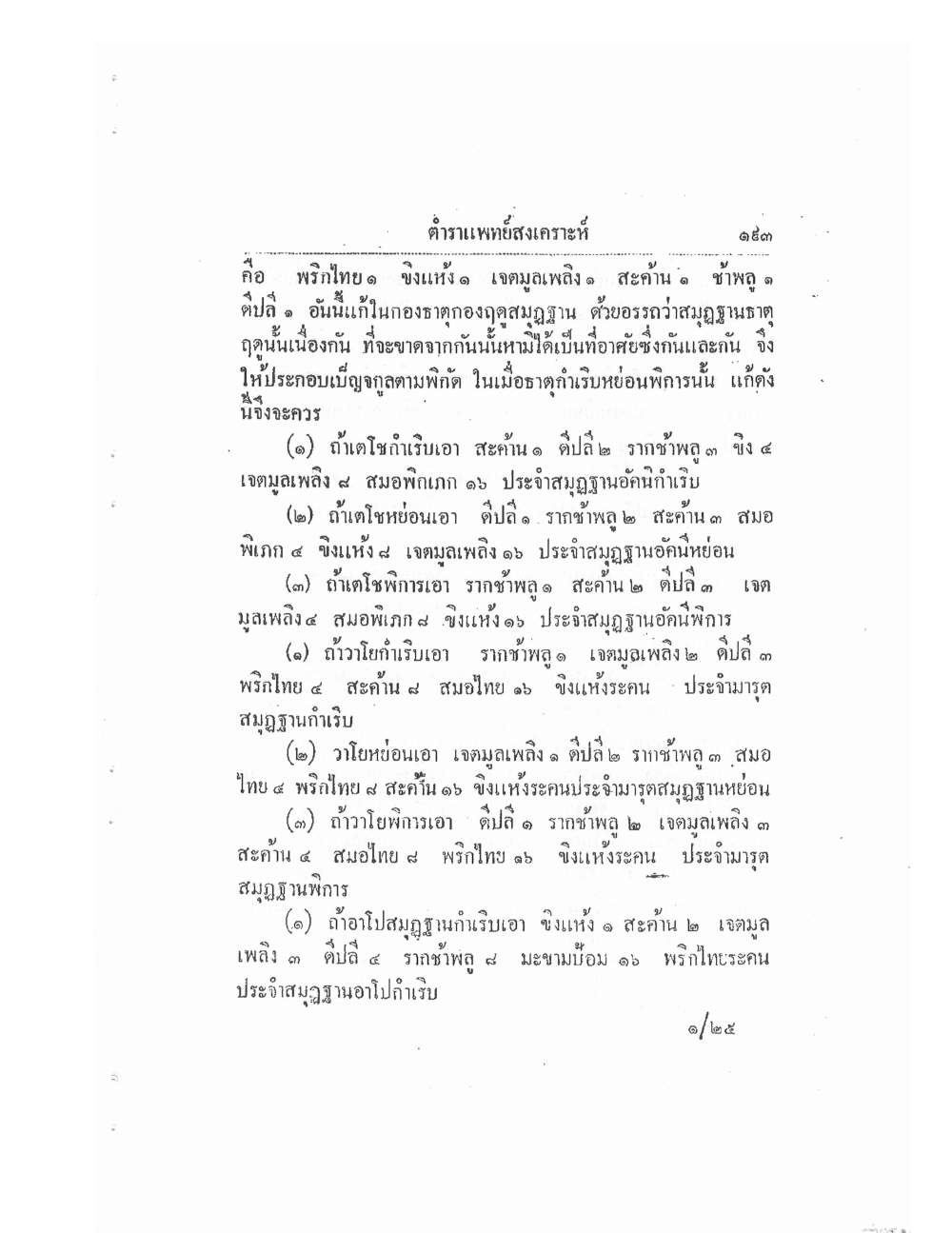
คือ พริกไทย๑ ขิงแห้ง๑ เจตมูลเพลิง๑ สะค้าน๑ ช้าพลู๑ ดีปลี๑ อันนี้แก้ในกองธาตุกองฤดูสมุฏฐาน ด้วยอรรถว่าสมุฏฐานธาตุฤดูนั้นเนื่องกัน ที่จะขาดจากกันนั้นหามิได้เป็นที่อาศัยซึ่งกันและกัน จึงให้ประกอบเบ็ญจกูลตามพิกัด ในเมื่อธาตุกำเริบหย่อนพิการนั้น แก้ดังนี้จึงจะควร
(๑) ถ้าเตโชกำเริบเอา สะค้าน๑ ดีปลี๒ รากช้าพลู๓ ขิง๔ เจตมูลเพลิง๘ สมอพิเภก๑๖ ประจำสมุฏฐานอัคนีกำเริบ
(๒) ถ้าเตโชหย่อนเอา ดีปลี๑ รากช้าพลู๒ สะค้าน๓ สมอพิเภก๔ ขิงแห้ง๘ เจตมูลเพลิง๑๖ ประจำสมุฏฐานอัคนีหย่อน
(๓) ถ้าเตโชพิการเอา รากช้าพลู๑ สะค้าน๒ ดีปลี๓ เจตมูลเพลิง๔ สมอพิเภก๘ ขิงแห้ง๑๖ ประจำสมุฏฐานอัคนีพิการ
(๑) ถ้าวาโยกำเริบเอา รากช้าพลู๑ เจตมูลเพลิง๒ ดีปลี๓ พริกไทย๔ สะค้าน๘ สมอไทย๑๖ ขิงแห้งระคน ประจำมารุตสมุฏฐานกำเริบ
(๒) วาโยหย่อนเอา เจตมูลเพลิง๑ ดีปลี๒ รากช้าพลู๓ สมอไทย๔ พริกไทย๘ สะค้าน๑๖ ขิงแห้งระคนประจำมารุตสมุฏฐานหย่อน
(๓) ถ้าวาโยพิการเอา ดีปลี๑ รากช้าพลู๒ เจตมูลเพลิง๓ สะค้าน๔ สมอไทย๘ พริกไทย๑๖ ขิงแห้งระคน ประจำมารุตสมุฏฐานพิการ
(๑) ถ้าอาโปสมุฏฐานกำเริบเอา ขิงแห้ง๑ สะค้าน๒ เจตมูลเพลิง๓ ดีปลี๔ รากช้าพลู๘ มะขามป้อม๑๖ พริกไทยระคน ประจำสมุฏฐานอาโปกำเริบ
That is: black pepper 1, dried ginger 1, plumbago 1, sacan 1, cha phlu 1, long pepper 1. This remedies [disorders] within the group of elements and seasonal bases, on the principle that the elemental and seasonal bases are interlinked — that they cannot be separated from one another is because they depend upon and support each other. One must therefore compound the 'five roots' (bencha-kun) according to the prescribed proportions. When an element is in excess, deficient, or disordered, the remedy is as follows, and this is proper:
(1) If Fire (Tejo) is in excess, take: sacan 1, long pepper 2, cha phlu root 3, ginger 4, plumbago 8, belleric myrobalan 16 — for the excess-fire basis.
(2) If Fire is deficient, take: long pepper 1, cha phlu root 2, sacan 3, belleric myrobalan 4, dried ginger 8, plumbago 16 — for the deficient-fire basis.
(3) If Fire is disordered, take: cha phlu root 1, sacan 2, long pepper 3, plumbago 4, belleric myrobalan 8, dried ginger 16 — for the disordered-fire basis.
(1) If Wind (Vayo) is in excess, take: cha phlu root 1, plumbago 2, long pepper 3, black pepper 4, sacan 8, chebulic myrobalan 16, dried ginger mixed in — for the excess-wind basis.
(2) If Wind is deficient, take: plumbago 1, long pepper 2, cha phlu root 3, chebulic myrobalan 4, black pepper 8, sacan 16, dried ginger mixed in — for the deficient-wind basis.
(3) If Wind is disordered, take: long pepper 1, cha phlu root 2, plumbago 3, sacan 4, chebulic myrobalan 8, black pepper 16, dried ginger mixed in — for the disordered-wind basis.
(1) If the Water (Apo) basis is in excess, take: dried ginger 1, sacan 2, plumbago 3, long pepper 4, cha phlu root 8, Indian gooseberry 16, black pepper mixed in — for the excess-water basis.
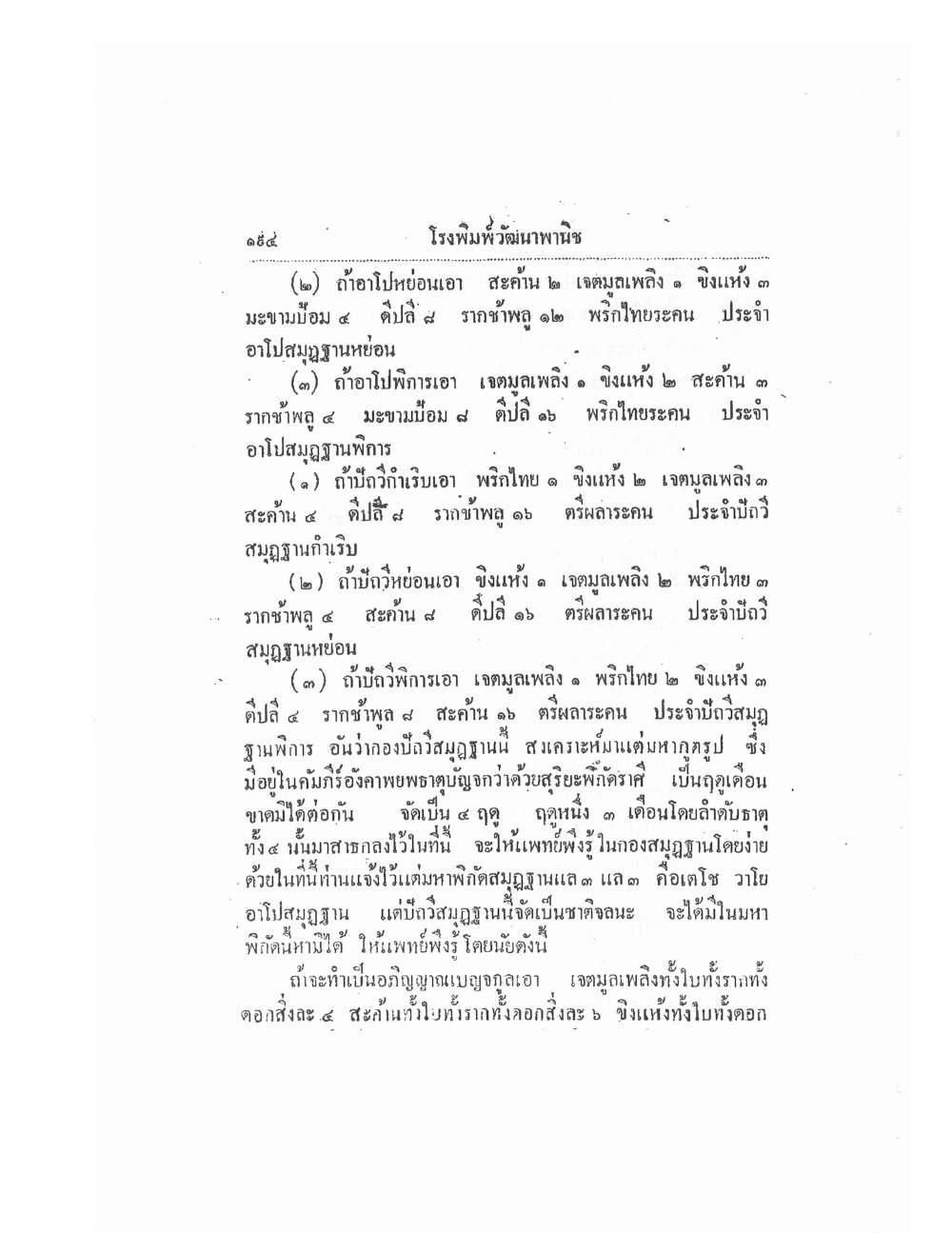
(๒) ถ้าอาโปหย่อนเอา สะค้าน๒ เจตมูลเพลิง๑ ขิงแห้ง๓ มะขามป้อม๔ ดีปลี๘ รากช้าพลู๑๒ พริกไทยระคน ประจำอาโปสมุฏฐานหย่อน
(๓) ถ้าอาโปพิการเอา เจตมูลเพลิง๑ ขิงแห้ง๒ สะค้าน๓ รากช้าพลู๔ มะขามป้อม๘ ดีปลี๑๖ พริกไทยระคน ประจำอาโปสมุฏฐานพิการ
(๑) ถ้าปถวีกำเริบเอา พริกไทย๑ ขิงแห้ง๒ เจตมูลเพลิง๓ สะค้าน๔ ดีปลี๘ รากช้าพลู๑๖ ตรีผลาระคน ประจำปถวีสมุฏฐานกำเริบ
(๒) ถ้าปถวีหย่อนเอา ขิงแห้ง๑ เจตมูลเพลิง๒ พริกไทย๓ รากช้าพลู๔ สะค้าน๘ ดีปลี๑๖ ตรีผลาระคน ประจำปถวีสมุฏฐานหย่อน
(๓) ถ้าปถวีพิการเอา เจตมูลเพลิง๑ พริกไทย๒ ขิงแห้ง๓ ดีปลี๔ รากช้าพลู๘ สะค้าน๑๖ ตรีผลาระคน ประจำปถวีสมุฏฐานพิการ อันว่ากองปถวีสมุฏฐานนี้ สงเคราะห์เอาแต่มหาภูตรูป ซึ่งมีอยู่ในคัมภีร์องคาพยพธาตุบัญจก ว่าด้วยสุริยะพิกัดราศี เป็นฤดูเดือน ขาดมิได้ต่อกัน จัดเป็น๔ฤดู ฤดูหนึ่ง๓เดือนโดยลำดับธาตุทั้ง๔นั้นมาสาธกลงไว้ในนี้ จะให้แพทย์พึงรู้ในกองสมุฏฐานโดยง่าย ด้วยในนี้ท่านแจ้งไว้แต่มหาพิกัดสมุฏฐานแล๓แล๓ คือเตโช วาโย อาโปสมุฏฐาน แต่ปถวีสมุฏฐานนี้จัดเป็นชาติจลนะ จะได้มีในมหาพิกัดนั้นหามิได้ ให้แพทย์พึงรู้โดยนัยดังนี้
ถ้าจะทำเป็นอภิญญาณเบญจกูลเอา เจตมูลเพลิงทั้งใบทั้งรากทั้งดอกสิ่งละ๔ สะค้านทั้งใบทั้งรากทั้งดอกสิ่งละ๖ ขิงแห้งทั้งใบทั้งดอก
(2) If Water is deficient, take: sacan 2, plumbago 1, dried ginger 3, Indian gooseberry 4, long pepper 8, cha phlu root 12, black pepper mixed in — for the deficient-water basis.
(3) If Water is disordered, take: plumbago 1, dried ginger 2, sacan 3, cha phlu root 4, Indian gooseberry 8, long pepper 16, black pepper mixed in — for the disordered-water basis.
(1) If Earth (Pathavi) is in excess, take: black pepper 1, dried ginger 2, plumbago 3, sacan 4, long pepper 8, cha phlu root 16, Triphala mixed in — for the excess-earth basis.
(2) If Earth is deficient, take: dried ginger 1, plumbago 2, black pepper 3, cha phlu root 4, sacan 8, long pepper 16, Triphala mixed in — for the deficient-earth basis.
(3) If Earth is disordered, take: plumbago 1, black pepper 2, dried ginger 3, long pepper 4, cha phlu root 8, sacan 16, Triphala mixed in — for the disordered-earth basis. As for this Earth-basis group, it draws only on the great physical elements found in the scripture of the fivefold bodily constituents, which concerns the sun's reckoning through the zodiac signs, forming the months of the seasons, inseparably linked, arranged into 4 seasons, each season 3 months, following the order of these 4 elements set forth here, so that physicians may easily understand the group of bases. For here it is stated only as the great reckoning of the bases, three and three — that is, the Fire, Wind, and Water bases — but this Earth basis is classed as an inherently active/changeable category, and so it does not appear within that great reckoning. Physicians should understand it by the following principle:
If one is to make the 'clairvoyant five-roots,' take plumbago — leaf, root, and flower — 4 of each; sacan — leaf, root, and flower — 6 of each; dried ginger — leaf and flower —
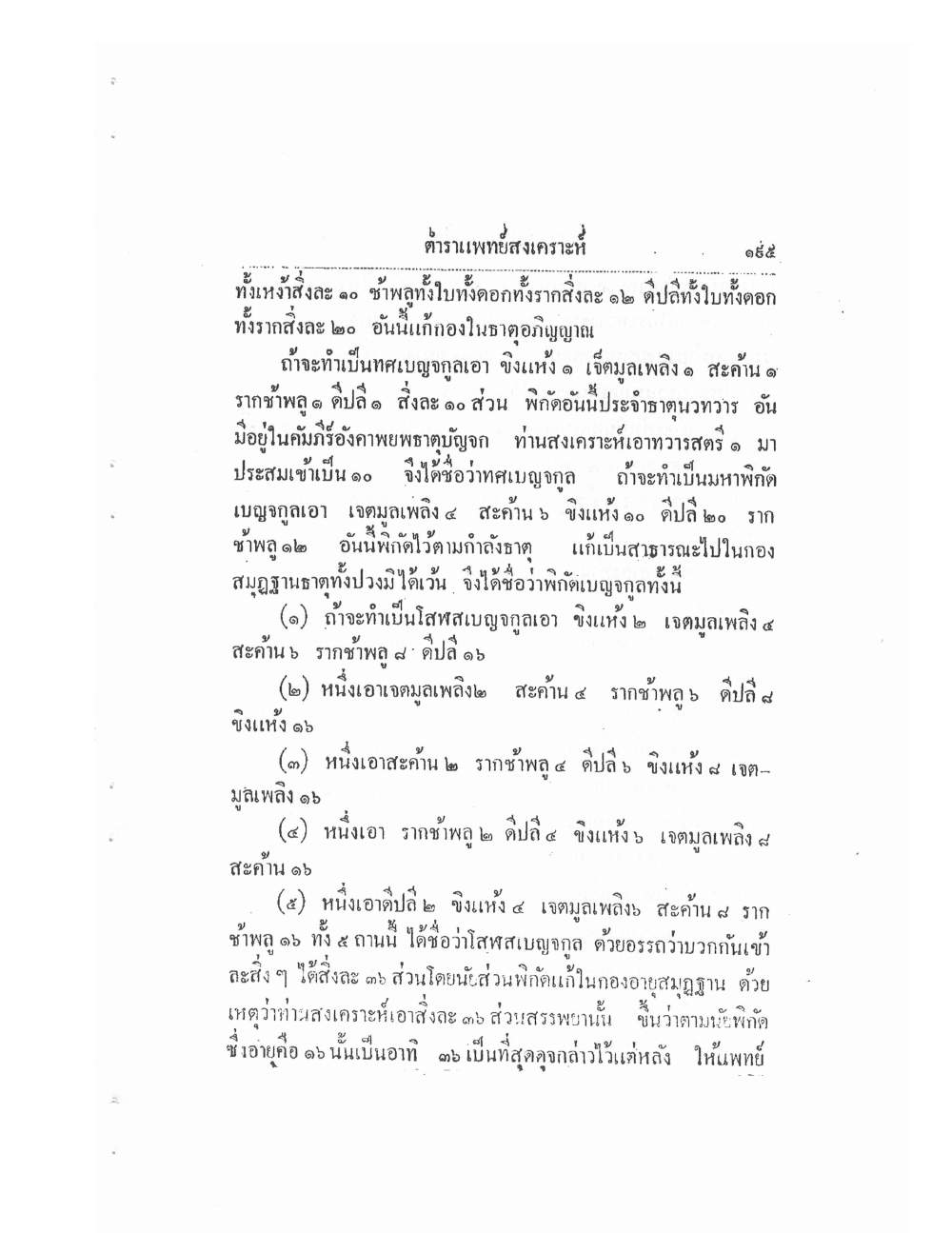
ทั้งเหง้าสิ่งละ๑๐ ช้าพลูทั้งใบทั้งดอกทั้งรากสิ่งละ๑๒ ดีปลีทั้งใบทั้งดอกทั้งรากสิ่งละ๒๐ อันนี้แก้กองในธาตุอภิญญาณ
ถ้าจะทำเป็นทศเบญจกูลเอา ขิงแห้ง๑ เจตมูลเพลิง๑ สะค้าน๑ รากช้าพลู๑ ดีปลี๑ สิ่งละ๑๐ส่วน พิกัดอันนี้ประจำธาตุนวทวาร อันมีอยู่ในคัมภีร์องคาพยพธาตุบัญจก ท่านสงเคราะห์เอาทวารสตรี๑ มาประสมเข้าเป็น๑๐ จึงได้ชื่อว่าทศเบญจกูล ถ้าจะทำเป็นมหาพิกัดเบญจกูลเอา เจตมูลเพลิง๔ สะค้าน๖ ขิงแห้ง๑๐ ดีปลี๒๐ รากช้าพลู๑๒ อันนี้พิกัดไว้ตามกำลังธาตุ แก้เป็นสาธารณะไปในกองสมุฏฐานธาตุทั้งปวงมิได้เว้น จึงได้ชื่อว่าพิกัดเบญจกูลทั้งนี้
(๑) ถ้าจะทำเป็นโสฬสเบญจกูลเอา ขิงแห้ง๒ เจตมูลเพลิง๔ สะค้าน๖ รากช้าพลู๘ ดีปลี๑๖
(๒) หนึ่งเอาเจตมูลเพลิง๒ สะค้าน๔ รากช้าพลู๖ ดีปลี๘ ขิงแห้ง๑๖
(๓) หนึ่งเอาสะค้าน๒ รากช้าพลู๔ ดีปลี๖ ขิงแห้ง๘ เจตมูลเพลิง๑๖
(๔) หนึ่งเอา รากช้าพลู๒ ดีปลี๔ ขิงแห้ง๖ เจตมูลเพลิง๘ สะค้าน๑๖
(๕) หนึ่งเอาดีปลี๒ ขิงแห้ง๔ เจตมูลเพลิง๖ สะค้าน๘ รากช้าพลู๑๖ ทั้ง๕ถานนี้ ได้ชื่อว่าโสฬสเบญจกูล ด้วยอรรถว่าบวกกันเข้าแต่ละสิ่งๆ ได้สิ่งละ๓๖ส่วน โดยนัยส่วนพิกัดแก้ในกองอายุสมุฏฐาน ด้วยเหตุว่าท่านสงเคราะห์เอาสิ่งละ๓๖ส่วน สรรพยานั้น ชื่อว่าตามนัยพิกัด ซึ่งเอาอายุคือ๑๖นั้นเป็นอาทิ ๓๖เป็นที่สุดดุจกล่าวไว้แต่หลัง ให้แพทย์
...root and rhizome, 10 of each; cha phlu — leaf, flower, and root — 12 of each; long pepper — leaf, flower, and root — 20 of each. This remedies [disorders] in the group belonging to the 'clairvoyant' elements.
If one is to make the 'tenfold five-roots' (dasa-bencha-kun), take: dried ginger 1, plumbago 1, sacan 1, cha phlu root 1, long pepper 1, 10 parts of each. This reckoning belongs to the element of the nine bodily doors, which is found in the scripture of the fivefold bodily constituents; the compilers added in the tenth, the female organ, combining them to make 10 — hence it is called the 'tenfold five-roots.' If one is to make the 'great reckoning of the five-roots,' take: plumbago 4, sacan 6, dried ginger 10, long pepper 20, cha phlu root 12. This reckoning is set according to the strength of the elements, and serves generally throughout the whole group of elemental bases without exception; hence it is called the reckoning of the five-roots.
(1) If one is to make the 'sixteenfold five-roots' (solot-bencha-kun), take: dried ginger 2, plumbago 4, sacan 6, cha phlu root 8, long pepper 16.
(2) One [version]: take plumbago 2, sacan 4, cha phlu root 6, long pepper 8, dried ginger 16.
(3) One [version]: take sacan 2, cha phlu root 4, long pepper 6, dried ginger 8, plumbago 16.
(4) One [version]: take cha phlu root 2, long pepper 4, dried ginger 6, plumbago 8, sacan 16.
(5) One [version]: take long pepper 2, dried ginger 4, plumbago 6, sacan 8, cha phlu root 16. All these 5 formulas are called the 'sixteenfold five-roots,' on the principle that when each ingredient's amounts are added together they come to 36 parts each. By this reckoning it remedies [disorders] in the group of age-related bases, because the compilers took 36 parts of each. The remedy substances are named according to this reckoning, in which age 16 is taken as the beginning and 36 as the end, as stated previously. Physicians [should]...
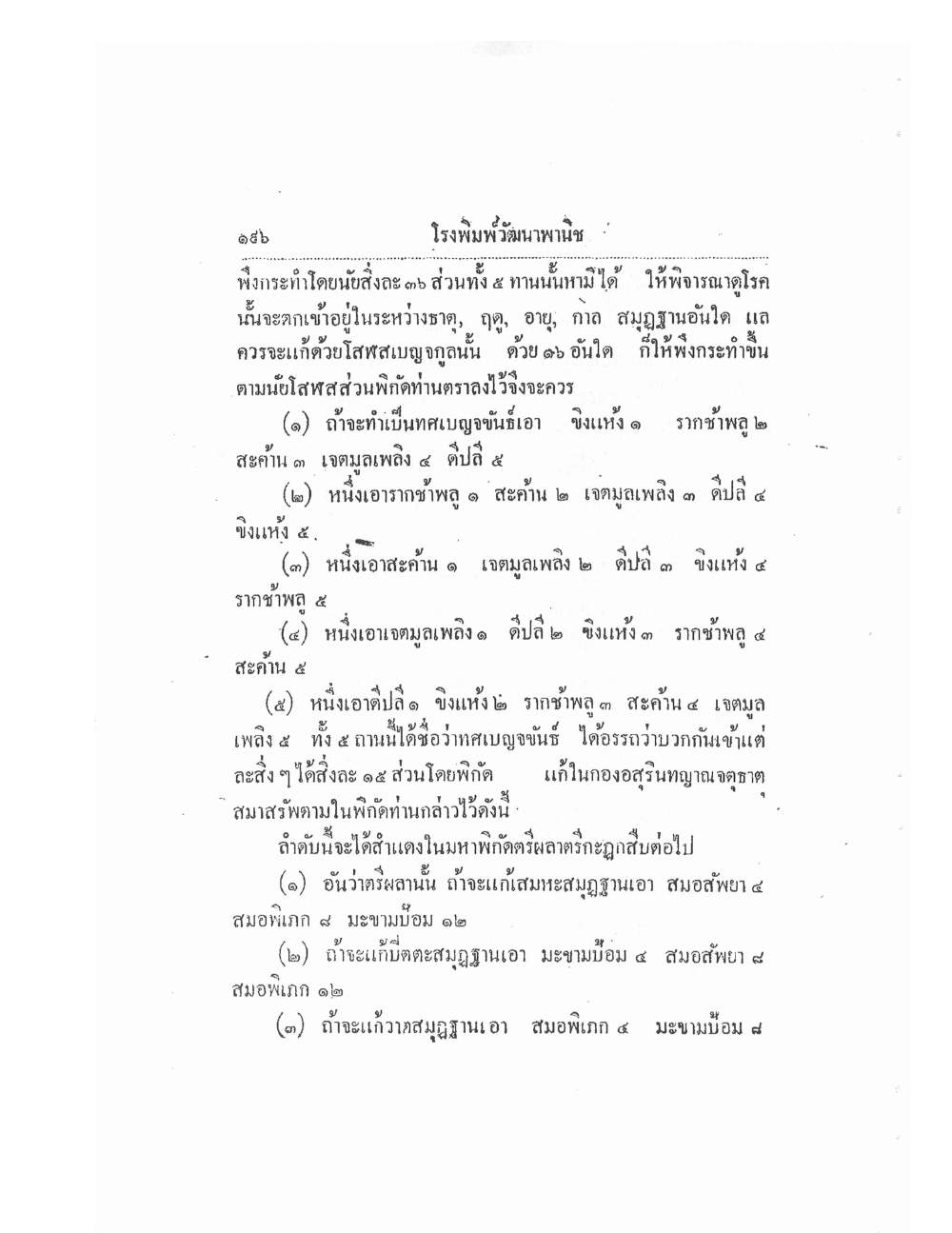
พึงกระทำโดยนัยสิ่งละ๑๖ส่วนทั้ง๕ทานนั้นหามิได้ ให้พิจารณาดูโรคนั้นจะตกเข้าอยู่ในระหว่างธาตุ, ฤดู, อายุ, กาล สมุฏฐานอันใด แลควรจะแก้ด้วยโสฬสเบญจกูลนั้น ด้วย๑๖อันใด ก็ให้พึงกระทำขึ้นตามนัยโสฬสส่วนพิกัดท่านตราลงไว้จึงจะควร
(๑) ถ้าจะทำเป็นทศเบญจขันธ์เอา ขิงแห้ง๑ รากช้าพลู๒ สะค้าน๓ เจตมูลเพลิง๔ ดีปลี๕
(๒) หนึ่งเอารากช้าพลู๑ สะค้าน๒ เจตมูลเพลิง๓ ดีปลี๔ ขิงแห้ง๕
(๓) หนึ่งเอาสะค้าน๑ เจตมูลเพลิง๒ ดีปลี๓ ขิงแห้ง๔ รากช้าพลู๕
(๔) หนึ่งเอาเจตมูลเพลิง๑ ดีปลี๒ ขิงแห้ง๓ รากช้าพลู๔ สะค้าน๕
(๕) หนึ่งเอาดีปลี๑ ขิงแห้ง๒ รากช้าพลู๓ สะค้าน๔ เจตมูลเพลิง๕ ทั้ง๕ถานนี้ได้ชื่อว่าทศเบญจขันธ์ ได้อรรถว่าบวกกันเข้าแต่ละสิ่งๆได้สิ่งละ๑๕ส่วนโดยพิกัด แก้ในกองอสุรินทญาณจตุธาตุสมาสรรพตามในพิกัดท่านกล่าวไว้ดังนี้
ลำดับนี้จะได้สำแดงในมหาพิกัดตรีผลาตรีกะฏุกสืบต่อไป
(๑) อันว่าตรีผลานั้น ถ้าจะแก้เสมหะสมุฏฐานเอา สมอไทย๔ สมอพิเภก๘ มะขามป้อม๑๒
(๒) ถ้าจะแก้บิตตะสมุฏฐานเอา มะขามป้อม๔ สมอไทย๘ สมอพิเภก๑๒
(๓) ถ้าจะแก้วาตสมุฏฐานเอา สมอพิเภก๔ มะขามป้อม๘
...are not to be made by the reckoning of 16 parts for all 5 formulas [together]. One should consider which basis — among element, season, age, or time — the illness falls under, and with which of the 16 [proportions] it should be treated by means of this 'sixteenfold five-roots'; one should then compound it according to the sixteen-part reckoning as the compilers have prescribed, and this will be proper.
(1) If one is to make the 'tenfold five-constituents' (dasa-bencha-khan), take: dried ginger 1, cha phlu root 2, sacan 3, plumbago 4, long pepper 5.
(2) One [version]: take cha phlu root 1, sacan 2, plumbago 3, long pepper 4, dried ginger 5.
(3) One [version]: take sacan 1, plumbago 2, long pepper 3, dried ginger 4, cha phlu root 5.
(4) One [version]: take plumbago 1, long pepper 2, dried ginger 3, cha phlu root 4, sacan 5.
(5) One [version]: take long pepper 1, dried ginger 2, cha phlu root 3, sacan 4, plumbago 5. All these 5 formulas are called the 'tenfold five-constituents,' meaning that when added together, each comes to 15 parts by the reckoning. It remedies [disorders] in the group [connected with] the four elements combined with the faculty of insight, in accordance with the reckoning as stated here.
Next will be shown the great reckoning of Triphala and Trikatu.
(1) As for Triphala: if treating a phlegm-basis [disorder], take: chebulic myrobalan 4, belleric myrobalan 8, Indian gooseberry 12.
(2) If treating a bile-basis [disorder], take: Indian gooseberry 4, chebulic myrobalan 8, belleric myrobalan 12.
(3) If treating a wind-basis [disorder], take: belleric myrobalan 4, Indian gooseberry 8...
สมอไทย๑๒ ทั้ง๓นี้ชื่อพิกัดตรีผลาสมุฏฐาน
(๑) อันว่าตรีกะฏุกนั้น ถ้าจะแก้เสมหะสมุฏฐานเอาพริกไทย๔ ขิงแห้ง๘ ดีปลี๑๒
(๒) ถ้าจะแก้บิตตะสมุฏฐานเอา ดีปลี๔ พริกไทย๘ ขิงแห้ง๑๒
(๓) ถ้าจะแก้วาตสมุฏฐานเอา ขิงแห้ง๔ ดีปลี๘ พริกไทย๑๒ ทั้ง๓นี้ ได้ชื่อว่าพิกัดตรีกะฏุกสมุฏฐาน อันว่าตรีผลาตรีกะฏุกทั้ง๒นี้ จะได้จำเพาะแต่สมุฏฐานอันใดหามิได้ เป็นสาธารณะไปในกองสมุฏฐานทั้งปวง ให้แพทย์พิจารณาเห็นควรแก่กันแล้วพึงให้ประกอบขึ้นตามนัยท่านตราไว้
หนึ่ง อันว่าลักษณะสมุฏฐานนั้นจะได้พ้นจาก๓ออกไปหามิได้ แต่ยังไปบมิได้สำเร็จ ด้วยเถียงอยู่ในกองธาตุปถวีสมุฏฐานหนึ่งด้วยเกิน๓เข้ามาเป็น๔ ดุจกล่าวมาแล้ว เหตุว่าจะได้แจ้งลงไว้ในนี้หามิได้ คือ หทัย, อุทริย, กรีส. ทั้ง๓นี้จัดเป็นปถวีสมุฏฐานสงเคราะห์เอาชาติจลนะ ถ้าจะประกอบตรีผลาตรีกะฏุกก็ดี แก้ในกองปถวีสมุฏฐานนั้น ในพระคัมภีร์ท่านประกอบโดยส่วนเสมอภาค ด้วยปถวีนี้เป็นที่ตั้งแห่งภูมิสมุฏฐานทั้งปวง ดุจในพระคัมภีร์จลนสังคหะกล่าวไว้ให้แพทย์พึงรู้โดยนัยดังนี้
นัยหนึ่งอันว่าลักษณะพิกัดส่วนสรรพยานั้น ท่านพิกัดลงไว้๓ถาน คือส่วนบาทถาน๑ ส่วนสลึงถาน๑ ส่วนเฟื้องถาน๑ แลพึงกำหนดเอาโดยกำลังส่วน ว่าจะควรแก่ส่วนใดให้เอาส่วนนั้นตั้งเป็นอาทิ จงลดทวีกันไปตามในมหาพิกัดนั้น หนึ่งอันว่าโรคอันใดก็ดี บังเกิดขึ้นในสมุฏฐานอันใดก็ดี แลสรรพยาที่จะแก้นั้นขนานใดๆก็ดี ในท้องตำรานั้นมีตรีผลาหรือตรีกะฏุกก็ดี แลทั้งตรีผลาตรีกะฏุกทั้ง๒ก็ดี ให้พิจารณาในกอง
chebulic myrobalan 12. These 3 together are called the reckoning of the Triphala basis.
(1) As for Trikatu: if treating a phlegm-basis [disorder], take: black pepper 4, dried ginger 8, long pepper 12.
(2) If treating a bile-basis [disorder], take: long pepper 4, black pepper 8, dried ginger 12.
(3) If treating a wind-basis [disorder], take: dried ginger 4, long pepper 8, black pepper 12. These 3 together are called the reckoning of the Trikatu basis. As for both Triphala and Trikatu, they are not specific to any one basis alone, but serve generally throughout the whole group of bases; physicians should judge what is fitting between them and then compound accordingly, following the principle the compilers have prescribed.
Furthermore, as for the character of the bases, they cannot go beyond three, yet the matter is not fully settled, since there remains a dispute within the elemental group concerning the Earth basis — [namely] whether a fourth is added beyond the three, as mentioned. Because it is not stated clearly here, [we note]: the heart, the stomach, and the faeces — these three are classed as the Earth basis, drawn from the category of the 'inherently active.' Whether one compounds Triphala or Trikatu to treat within this Earth basis, in the scripture the compilers combine them in equal parts, because Earth is the foundation of all the bases, as is stated in the Scripture of the Chalana-Sangaha; physicians should understand it by this principle.
Furthermore, as for the character of the reckoned proportions of remedy substances, the compilers set them down in 3 grades: the baht-grade, the salueng-grade, and the fueang-grade [traditional weight units], and one should determine by the strength of the proportion — whichever proportion is fitting, take that as the base, and increase or decrease accordingly within that great reckoning. Furthermore, whatever illness arises, in whatever basis it arises, and whatever remedy formula is to treat it — whether the text of the formula includes Triphala or Trikatu, or both Triphala and Trikatu together — one should consider [these] within the group...
สมุฏฐานแลกองโรคว่าจะควรแก่ตรีอันใด ก็ให้เอาตรีอันนั้นมากระทำโดยส่วนพิกัดใส่เข้า ถ้ามีแต่ตรีกะฏุกตรีผลานั้นไม่มี แต่กองโรคสมุฏฐานควรแก่ตรีผลา ก็ให้เอาตรีผลามาทำขึ้นให้เต็มส่วนพิกัด ลดตรีกะฏุกในท้องตำราลงตามส่วนพิกัด ถ้ากองโรคแลสมุฏฐานควรกับตรีกะฏุก ก็ให้เอาตรีกะฏุกในท้องตำรานั้นมากระทำขึ้นให้เต็มส่วนพิกัด ตรีผลาที่มิได้มีในท้องตำรานั้น ควรใส่จึงใส่โดยพิกัด ถ้ามิควรใส่อย่าใส่ แต่อย่าให้เสียสมุฏฐานเป็นอาทิ ถ้าท้องตำรานั้นมีทั้งตรีผลาตรีกะฏุก แต่โรคแลสมุฏฐานควรกับตรีอันใดก็ดี พิจารณาแล้วให้กระทำทวีขึ้นแลลดลงโดยส่วนพิกัดดุจกล่าวแล้วแต่หลัง หนึ่งอันว่าสรรพยาสิ่งอันใดก็ดี ที่ท่านตราลงไว้ในท้องตำราขนานใดๆก็ดี แลจะเอามาแก้กองโรคแลสมุฏฐานนั้นจะได้มีในมหาพิกัดนั้นหามิได้ พึงให้แพทย์ประกอบขึ้นตามนัยท่านตราลงไว้นั้นแต่อย่าให้เสียสรรพคุณแลส่วนบาทเป็นต้น ส่วนเฟื้องเป็นที่สุด ควรจะลดจึงลด ควรจะทวีจึงทวี ควรจะขาดจึงให้ขาด ควรจะเหลือจึงให้เหลือ สุดแต่โรคกับสรรพคุณเป็นอาทิ แต่อย่าให้เสียสมุฏฐานกล่าวคือตรีผลาตรีกะฏุก พึงให้แพทย์ประกอบตามในพิกัด อันควรกับสมุฏฐานโรคนั้นเจือเข้าจงนัยกล่าวไว้ดังนี้
หนึ่งอันว่าตรีผลาตรีกะฏุกเบญจกูลก็ดี ถ้าจะกระทำวิธีต้มประกอบให้เต็มส่วนบาท ถ้าจะกระทำส่วนสลึงให้ประกอบวิธีทำเป็นผง ถ้าจะวิธีแทรกประกอบเต็มส่วนเฟื้อง ถ้าจะกระทำวิธีลดให้ลดลงกึ่งส่วนแทรกจึงจะควร
(๑) นัยหนึ่งถ้าจะแก้ในคิมหันตสมุฏฐานเอา ตรีสาร๔ส่วนตรีผลาเต็มส่วนพิกัด ตรีกะฏุกกึ่งส่วน
...basis and group of illness — whichever triad is fitting, use that triad, compounded and added according to the reckoned proportion. If only Trikatu is present and Triphala is not, but the group of illness and its basis calls for Triphala, then one should make up Triphala to fill the reckoned proportion, and reduce the Trikatu specified in the formula text according to the proportion. If the group of illness and basis calls for Trikatu, then one should make up the Trikatu specified in the formula text to fill the reckoned proportion; the Triphala not present in the formula text — if it should be added, add it according to the reckoning; if it should not be added, do not add it — but do not thereby spoil the basis being treated as the foundation. If the formula text contains both Triphala and Trikatu, but the illness and basis call for one or the other, having considered, one should increase or decrease according to the reckoned proportion as said before. Furthermore, whatever remedy substance the compilers have set down in whatever formula, and it is to be used to treat a group of illness and basis not covered by that great reckoning, the physician should compound it following the principle the compilers have laid down, but must not thereby spoil its medicinal virtue — the baht-portion being the greatest and the fueang-portion the least: reduce where it should be reduced, increase where it should be increased, omit where it should be omitted, retain where it should be retained, entirely according to the illness and its medicinal virtue as the guiding principle — but do not thereby spoil the basis, that is, the Triphala or Trikatu; the physician should compound according to the reckoning that fits the basis of that illness, blending it in following the principle stated here.
Furthermore, as for Triphala, Trikatu, or the five-roots, if preparing by decoction, compound to the full baht-portion; if preparing the salueng-portion, compound by the method of making a powder; if preparing by the method of admixture, compound to the full fueang-portion; if preparing by the method of reduction, reduce by half the admixture portion — this is proper.
(1) One principle: if treating the hot-season (khimhan) basis, take Trisan 4 parts, Triphala to the full reckoned portion, Trikatu half a portion.
(๒) ถ้าจะแก้ในวสันตสมุฏฐานเอา ตรีผลา๔ส่วน ตรีกะฏุกเต็มส่วนพิกัด ตรีสารกึ่งส่วน
(๓) ถ้าจะแก้ในเหมันตสมุฏฐานเอา ตรีกะฏุก๔ส่วน ตรีสารเต็มส่วนพิกัด ตรีผลากึ่งส่วน ดุจท่านตราไว้ หนึ่งจะกล่าวพิกัดโกฐเทียนสืบต่อไปดังนี้
ถ้าโกฐทั้ง๕คือ โกฐสอ๑ โกฐเขมา๑ โกฐหัวบัว๑ โกฐเชียง๑ โกฐจุฬาลำพา๑ อันนี้เป็นพิกัดเบญจโกฐ
ถ้าโกฐทั้ง๗คือ โกฐสอ๑ โกฐเขมา๑ โกฐหัวบัว๑ โกฐเชียง๑ โกฐจุฬาลำพา๑ โกฐกะดูก๑ โกฐก้านพร้าว๑ อันนี้พิกัดสัตตโกฐ
ถ้าโกฐทั้ง๙คือ โกฐสอ๑ โกฐเขมา๑ โกฐหัวบัว๑ โกฐเชียง๑ โกฐจุฬาลำพา๑ โกฐกะดูก๑ โกฐก้านพร้าว๑ โกฐพุงปลา๑ โกฐชะฏามังษี๑ อันนี้พิกัดนวโกฐ
อันว่านอกกว่านี้คือ โกฐกัดตรา๑ โกฐกะกลิ้ง๑ โกฐน้ำเต้า๑ ทั้ง๓นี้เป็นโกฐพิเศษ ให้แพทย์ดูแต่ควร จะแทรกเข้าในยาขนานใดๆก็ได้ สุดแต่โรคกับสรรพคุณจะบอกนั้น
หนึ่งถ้าเทียนทั้ง๕ คือ เทียนดำ๑ เทียนแดง๑ เทียนขาว๑ เทียนข้าวเปลือก๑ เทียนตาตั๊กแตน๑ อันนี้พิกัดเบญจเทียน
ถ้าเทียนทั้ง๗ คือ เทียนดำ๑ เทียนแดง๑ เทียนขาว๑ เทียนข้าวเปลือก๑ เทียนตาตั๊กแตน๑ เทียนเยาวภาณี๑ เทียนสัตตบุษย์๑ อันนี้พิกัดสัตตเทียน
ถ้าเทียนทั้ง๙คือ เทียนดำ๑ เทียนแดง๑ เทียนขาว๑ เทียนข้าว
(2) If treating the spring (wasan) basis, take: Triphala 4 parts, Trikatu to the full reckoned portion, Trisan half a portion.
(3) If treating the cold-season (haiman) basis, take: Trikatu 4 parts, Trisan to the full reckoned portion, Triphala half a portion, as the compilers have prescribed. Next, the reckoning of the Kot [roots] and Tian [seeds] will be given, as follows:
If there are 5 Kot, namely: Kot So 1, Kot Khema 1, Kot Hua Bua 1, Kot Chiang 1, Kot Chulalampha 1 — this is the reckoning of the 'Five Kot.'
If there are 7 Kot, namely: Kot So 1, Kot Khema 1, Kot Hua Bua 1, Kot Chiang 1, Kot Chulalampha 1, Kot Kraduk 1, Kot Kan Phrao 1 — this is the reckoning of the 'Seven Kot.'
If there are 9 Kot, namely: Kot So 1, Kot Khema 1, Kot Hua Bua 1, Kot Chiang 1, Kot Chulalampha 1, Kot Kraduk 1, Kot Kan Phrao 1, Kot Phung Pla 1, Kot Chatamangsi 1 — this is the reckoning of the 'Nine Kot.'
Beyond these there are also: Kot Kattra 1, Kot Kaklin 1, Kot Namtao 1 — these 3 are 'special Kot.' The physician should judge as is fitting whether to mix them into any formula, entirely according to what the illness and the [desired] medicinal virtue indicate.
Furthermore, if there are 5 Tian, namely: Tian Dam (black) 1, Tian Daeng (red) 1, Tian Khao (white) 1, Tian Khao Plueak (unhusked rice) 1, Tian Ta Takkataen (grasshopper-eye) 1 — this is the reckoning of the 'Five Tian.'
If there are 7 Tian, namely: Tian Dam 1, Tian Daeng 1, Tian Khao 1, Tian Khao Plueak 1, Tian Ta Takkataen 1, Tian Yaowaphani 1, Tian Sattabut 1 — this is the reckoning of the 'Seven Tian.'
If there are 9 Tian, namely: Tian Dam 1, Tian Daeng 1, Tian Khao 1, Tian Khao...
เปลือก๑ เทียนตาตั๊กแตน๑ เทียนเยาวภาณี๑ เทียนสัตตบุษย์๑ เทียนเกล็ดหอย๑ เทียนตากบ๑ อันนี้พิกัดนวเทียน
อันว่านอกกว่านี้คือ เทียนหลอด๑ เทียนขม๑ เทียนแกลบ๑ เทียนทั้ง๓นี้เป็นเทียนพิเศษ ให้ดูแต่ควร จะเจือแทรกเข้าในยาขนานใดๆสุดแต่โรคสมควร
หนึ่งจะกล่าวพิกัดบัวน้ำทั้ง๕ คือ สัตตบุษย์๑ สัตตบรรณ๑ ลินจง๑ จงกลนี๑ นิลบล๑ อันนี้พิกัดเบญจอุบล
อันว่านอกกว่านี้คือ บัวหลวงทั้ง๒ สัตตบงกชทั้ง๒ บัวเผื่อน๑ บัวขม๑ บัวทั้ง๖สิ่งนี้เป็นบัวพิเศษ จะประกอบเข้าในยาขนานใดๆก็ดี สุดแต่ควรกับโรคโดยสรรพคุณอันกล่าวไว้
หนึ่งจะกล่าวพิกัดเกลือทั้ง๕ คือ เกลือสินเธาว์๑ เกลือพิก๑ เกลือวิก๑ เกลือผ่อ๑ เกลือสมุทร๑ อันนี้พิกัดเบญจเกลือ
อันว่านอกจากนี้คือ เกลือสูญจละ๑ เกลือเยาวกาษา๑ เกลือวิชุ๑ เกลือด่างคลี๑ เกลือสุวรรษา๑ เกลือกะดัง๑ เกลือสมุทร๑ เกลือทั้ง๗นี้เป็นเกลือพิเศษ ถ้าจะประกอบเข้าในยาขนานใดๆก็ดี ดูแต่ควรกับโรคตามสรรพคุณสำแดงไว้
หนึ่งจะกล่าวพิกัดโหรานั้นเล่า ถ้าโหราทั้ง๕คือ โหราอำมฤตย์๑ โหรามิกสิงคลี๑ โหราบอน๑ โหราเท้าสุนัข๑ โหราเดือยไก่๑ อันนี้พิกัดเบญจโหรา
อันว่านอกจากนี้คือ โหราผักกูด๑ โหราข้าวเหนียว๑ โหราเขากระบือ๑ โหราเขาเนื้อ๑ โหราใบกลม๑ มโหรา๑ มหุรา๑ มังโหรา๑ ทั้ง๘นี้เป็นโหราพิเศษ จะประกอบเข้าในยาขนานใดๆก็ดี
...husk 1, Tian Ta Takkataen 1, Tian Yaowaphani 1, Tian Sattabut 1, Tian Klet Hoi (shell-scale) 1, Tian Ta Kop (frog-eye) 1 — this is the reckoning of the 'Nine Tian.'
Beyond these there are: Tian Lot 1, Tian Khom (bitter) 1, Tian Klaep (husk) 1 — these 3 are 'special Tian.' One should judge as is fitting whether to blend and mix them into any formula, entirely according to what suits the illness.
Furthermore, the reckoning of the 5 water lilies will be given: Sattabut 1, Sattaban 1, Lin Chong 1, Chongkonlani 1, Nin Bon 1 — this is the reckoning of the 'Five Ubon.'
Beyond these there are: 2 kinds of Bua Luang (great lotus), 2 kinds of Sattabongkot, Bua Phuean 1, Bua Khom 1 — these 6 lotuses are 'special lotuses,' to be compounded into any formula entirely as fitting the illness according to the medicinal virtue stated.
Furthermore, the reckoning of the 5 salts will be given: Kluea Sinthao (rock salt) 1, Kluea Phik 1, Kluea Wik 1, Kluea Pho 1, Kluea Samut (sea salt) 1 — this is the reckoning of the 'Five Salts.'
Beyond these there are: Kluea Sunchala 1, Kluea Yaowakasa 1, Kluea Wichu 1, Kluea Dang Khli 1, Kluea Suwansa 1, Kluea Kadang 1, Kluea Samut 1 — these 7 salts are 'special salts.' If they are to be compounded into any formula, judge only according to what fits the illness, following the medicinal virtue stated.
Furthermore, the reckoning of the Hora [roots] will now be given. If there are 5 Hora: Hora Ammarit 1, Hora Mik Singkhli 1, Hora Bon 1, Hora Thao Sunak (dog's-paw) 1, Hora Dueai Kai (cock's-spur) 1 — this is the reckoning of the 'Five Hora.'
Beyond these there are: Hora Phak Kut (fern) 1, Hora Khao Niao (sticky rice) 1, Hora Kha Krabue (buffalo horn) 1, Hora Kha Nuea 1, Hora Bai Klom (round leaf) 1, Mahora 1, Mahura 1, Mangahora 1 — these 8 are 'special Hora,' to be compounded into any formula...
ให้แพทย์พึงพิจารณาสุดแต่ควรแก่โรคนั้นเถิด สำแดงมาในคัมภีร์สมุฏฐานวินิจฉัยเล่ม๒ ว่าด้วยกาลสมุฏฐานเป็นอาทิมหาพิกัดที่สุด ก็จบแต่เพียงนี้โดยสังเขป
คัมภีร์สมุฏฐานวินิจฉัย สังคหปกรณ์เวชชศาสตร์ จบบริบูรณ์แต่เพียงนี้
คัมภีร์จลนสังคหะ
อาทิโต คนถํ กโรติ อันว่าอาชวกโกมารภัจจ์แท้จริง อันตกแต่งพระคัมภีร์จลนสังคหะปกรณ์ อันท่านสงเคราะห์ด้วยอุจจาระธาตุทั้ง๔ประการ ซึ่งวิปริตระคนด้วยพิษ เป็นระหว่างแห่งมหาสันนิบาต นอกจากสันนิบาตทั้งหลายต่างๆ มีปฐมสันนิบาตเป็นต้น มีติยภินนสันนิบาตเป็นที่สุด แลลักษณะธาตุนั้นคือสีอุจจาระ ดำ, แดง, ขาว, เขียว, ก็ดี เป็นเมือก, มัน, เปลว, ไต, มีโลหิตแลหาโลหิตมิได้ก็ดี มารยาทไปวันละ๒, ๓, ๔, ๕, ๖, ๗, ๘, ครั้ง เวลากลางวันกลางคืนก็ดี แต่จะได้ลงดังอติสารวรรคแลลามกนั้นหามิได้ อันประเภทอุจจาระธาตุนอกจากอติสารทั้งหลายมีอติสารวรรคเป็นต้น มีบุพพรูปอติสารเป็นที่สุด เพื่อจะสงเคราะห์ซึ่งวิปริตธาตุเป็นชวนะอุจจาระมหาสันนิบาต ไว้เป็นตราชูแห่งแพทย์ พึงรู้เที่ยงในลักษณะดุจจะกล่าวในข้างหน้านั้น อันว่าลักษณะธาตุทั้ง๔ประการนั้น บังเกิดขึ้นเพื่อกองปถวี คือ กำเริบ, หย่อน, พิการ, มีพิกัดสมุฏฐานให้เป็นเหตุ คือว่า บุคคลผู้ใดไข้ก็ดี มิไข้ก็ดี แลมีอุจจาระออกมา ดำ, แดง, ขาว, เขียว, มีสัณฐานดังมูลไก่, แมว, เต่า, แลหยาบ, ละเอียด, ก็ดี มีลักษณะดุจนั้น โดยประเภทนั้น
Physicians should judge entirely by what is fitting to that illness. This is set out in the Scripture of Diagnosis by Bases, Book 2, concerning the temporal basis as the final great reckoning; it ends here, in summary, at this point.
The Scripture of Diagnosis by Bases, a compendium of medical science, is complete and ends here.
THE SCRIPTURE OF THE CHALANA-SANGAHA
'Ādito ganthaṃ karoti' [Pali, glossed as:] 'From the beginning he composes the treatise' — This is truly [the work of] the sage Āchīvaka Komārabhacca, who composed the Scripture of the Chalana-Sangaha. In it he classifies the four kinds of excretory elements, which become disordered and mixed with poison, occurring amid the great convergences [of disorder], aside from the various other convergences, beginning with the first convergence and ending with the 'twice-broken' convergence. As for the character of these elements, it is the color of the stool — black, red, white, or green — whether mucoid, oily, foamy, or watery, whether containing blood or not; occurring 2, 3, 4, 5, 6, 7, or 8 times a day, whether by day or by night — yet this shall not be reckoned as belonging to the category of dysentery or filth. As for the types of excretory elements aside from the various dysenteries, beginning with the dysentery category and ending with the 'premonitory-sign dysentery' — [this scripture] classifies the disordered elements constituting the excretory great convergence, set down here as a standard for physicians, who should know with certainty the characteristics to be described hereafter. As for the character of these 4 kinds of elements, they arise in connection with the Earth (Pathavi) group — that is, excess, deficiency, or disorder — having the reckoning of the basis as their cause; that is to say, whether a person is ill or not ill, and the stool that comes out is black, red, white, or green, having a form like chicken droppings, cat droppings, or tortoise droppings, or being coarse or fine — having such characteristics, according to that type...
มี๑๕ประการ คือให้ป่วดอุทร, บริโภคอาหารมิได้, อาเจียน, ให้นอนมิหลับ, เป็นพิษ, อุจจาระบัสสาวะมิสะดวก, ให้ป่วดถ่วง, เสียวไปทั้งกาย, เมื่อยไปทุกข้อทุกลำ, ให้ร้อนกะวนกะวาย, เจรจาพร่ำพรู, ร้อนกระหาย, ให้กายซูบผอมระคนด้วยละอองสามประการ, ให้แน่นอกคับใจ, ให้เสียดชายโครงแลท้อง, โทษทั้ง๑๕ประการนี้ เป็นอุจจาระมหาสันนิบาตระคน เหตุว่าประชุมมหาภูตรูปในกองสมุฏฐานโทษแล๓แล๓ จึงให้กำเริบ, หย่อน, พิการ, นั้นต่างๆโดยพระเคราะห์ทั้ง๘แลพระสุริยเทวบุตรสถิตในทวาทศราศี เป็นกำหนดใจความให้แจ้งในลักษณะอุจจาระธาตุโดยย่อ จึงมีคำปุจฉาถามว่าลักษณะโทษทั้ง๑๕ประการ แลมหาภูตรูปในกองสมุฏฐานประชุม๓แล๓ให้กำเริบ, หย่อน, พิการ, นั้นด้วยเหตุดังฤๅ วิสัชนาว่า สมุฏฐานมหาภูตรูปนั้นคือ พัทธปิตตะ อพัทธปิตตะ กำเดา ทั้ง๓นี้เป็นพิกัดกองสมุฏฐานเตโช คือ หทัยวัตถุ, สัตตวัตถุ, สุมนา, ทั้ง๓นี้เป็นพิกัดกองสมุฏฐาน คือ สอเสมหะ, อุระเสมหะ, คูถเสมหะ, ทั้ง๓นี้เป็นพิกัดกองสมุฏฐานอาโป คือ หทัย, อุทริยะ, กรีส, ทั้ง๓นี้เป็นพิกัดกองสมุฏฐานปถวี แต่สมุฏฐานปถวีนี้จะได้เป็นชาติจลนะขึ้นนั้นหามิได้ ต่อเมื่อใดสมุฏฐานทั้ง๓สิ่งใดสิ่งหนึ่ง ก็ดีเป็นชาติจลนะขึ้นแล้ว สมุฏฐานปถวีก็พลอยมีกำลังขึ้น แลสมุฏฐานทั้งปวงก็กำเริบแรงขึ้นกว่าเก่า เหตุว่าปถวีเป็นที่ตั้งแห่งภูมิโรคทั้งหลาย แลเป็นที่ค้ำชูอุดหนุนอุปถัมภ์แห่งโรคขึ้นให้จำเริญดังนี้ นามชื่อว่ามหาสันนิบาต คือสันนิบาตกองใหญ่ เหตุว่าจตุสมุฏฐานธาตุนั้นพร้อมโดยลำดับดุจกล่าวมาแล้วนั้น แพทย์พึงเข้าใจสำคัญในกองพิกัดสมุฏฐาน แลมหาภูตรูปเต็มหมู่หมวดโดยย่อ นัยหนึ่งท่านชำระลงไว้ว่า ในลักษณะ
...there are 15 kinds, namely: causing abdominal pain, inability to eat, vomiting, sleeplessness, being poisonous, difficulty urinating or defecating, causing a bearing-down pain, numbness throughout the body, aching in every joint and limb, causing agitated heat, incessant delirious speech, heat and thirst, causing the body to waste away mixed with three kinds of pallor, causing tightness and oppression in the chest, causing pain in the flank and belly — these 15 kinds of affliction constitute the excretory great convergence, mixed together. This is because the great physical elements converge within the group of afflicted bases, three and three, thereby causing excess, deficiency, and disorder in various ways, according to the 8 planets and the Sun-deity residing in the twelve zodiac signs — this sets forth, in brief, the meaning to clarify the character of the excretory elements. Hence there arises the question: by what cause do the 15 kinds of affliction, and the great physical elements converging three-and-three within the group of bases, produce excess, deficiency, and disorder? The answer is: the great physical elements of the bases are: bound bile, unbound bile, and vapor — these 3 are the reckoning of the Fire (Tejo) basis group; the heart-organ, the seven organs, and 'sumana' — these 3 are the reckoning of [another] basis group; phlegm-of-the-head, phlegm-of-the-chest, phlegm-of-the-stool — these 3 are the reckoning of the Water (Apo) basis group; the heart, the stomach, and the faeces — these 3 are the reckoning of the Earth (Pathavi) basis group. But this Earth basis alone does not become an 'inherently active' category; only when any one of the [other] three bases becomes an inherently active category does the Earth basis also gain in strength, and all the bases become more excessive than before — because Earth is the foundation of the ground of all illnesses, and is that which supports, sustains, and nourishes illnesses so that they flourish, as described. It is named the 'great convergence,' that is, the great group of convergence, because the four elemental bases are all complete in sequence as has been described. Physicians should understand and give importance to the group reckoning of the bases and the great physical elements, complete in their categories, in brief. Furthermore, it is recorded that, as to the character...
กองโทษอันบังเกิดต่างๆ มีประเภท๑๕ประการ ซึ่งกล่าวมาแล้วนั้น จัดเป็นหมวดเข้ามีลักษณะ๖ประการดังนี้ อันว่าอาการซึ่งกระทำมิได้วิปริตไปต่างๆ ระคนด้วยองคมังคานุสาริวาตประการหนึ่ง อนึ่งให้ป่วดอุทรให้ป่วดชายโครงแลท้องนั้น โทษแห่งบิตฆาต, สันทฆาต, รัตฆาต, กระทำมิให้เป็นปกติ ระคนกันเป็นเถาวัลลี้เกี่ยวประการหนึ่ง อนึ่งให้บริโภคอาหารมิได้แลอาเจียน โทษแห่งบิ่งคลากระทำประการหนึ่ง หนึ่งให้ร้อนกระหายน้ำกะวนกะวายแลเจรจาพร่ำพรู โทษในสุมนากระทำกำเริบขึ้น พัดดวงหทัยให้ระส่ำระสายมิได้เป็นปกติประการหนึ่ง อนึ่งให้นอนมิหลับจับเป็นพิษนั้น โทษแห่งอำมพฤกกระทำตลอดถึง สุมนากำเริบ, หย่อน, พิการ, ก็ดี มิได้เป็นปกติประการหนึ่ง อนึ่งอุจจาระบัสสาวะมิสะดวก แลให้แคบอกคับใจ โทษแห่งกุจฉิสยาวาตแลโกฐาสยาวาตกำเริบขึ้น พัดในลำไส้มิได้เป็นปกติประการหนึ่ง อันเป็นหมวดแห่งชินธาตุให้บังเกิดมีลักษณะ๖ประการดุจกล่าวมาดังนี้
บัดนี้จะได้สำแดงในลักษณะอุจจาระธาตุ ซึ่งจะให้วิปริตต่างๆนั้น เหตุว่า มูลนั้นเสียด้วยโกฐาสยาวาตมิได้พัดชำระประเมหะแลเมือกในลำไส้ให้ตก เป็นกรันติดคราบไส้อยู่ระคนด้วยอุจจาระ ครั้นเดินสู่ลำซ่วงลำลาบแตกออกเป็นโลหิต บางทีเป็นเม็ดยอดขึ้นตามขอบทวารให้ เจ็บ, แสบ, ขบ, บางทีขึ้นที่ต้นไส้ต่อลำกรีสมรรคนั้นก็มี ทำอาการดุจนิ้วไส้ด้วนไส้ลาม แลสตรีมีครรภ์ตกลงไปนั้น ถ้าแพทย์มิรู้ถึงมิได้แจ้งในอุจจาระธาตุวิธีอธิบาย ก็สมมติเรียกต่างๆ บางทีก็ว่าดานเถา บางทีก็ว่ามุตฆาต บางทีก็ว่านิ่วเป็นประเมหะ บางทีก็ว่ากะสายกล่อน บางทีก็ว่าเป็นริดสีดวง บางทีก็ว่าลามกอติสาร ซึ่งว่ามาทั้งนี้จะผิดจากชาติโรค
The various afflictions that arise, of 15 kinds, as already stated, are grouped into a class having 6 characteristics, as follows: firstly, the condition that produces various disorders mixed with the 'wind that follows the body's limbs and channels'; secondly, causing abdominal pain and pain in the flank and belly — the affliction of Bitkhat, Santhakhat, and Ratkhat, which prevents the normal state, mingling together like entwined vines; thirdly, causing inability to eat and vomiting — the affliction of 'Bingkhla' acting; fourthly, causing heat, thirst, agitation, and incessant speech — the affliction acting within the 'sumana,' causing excess, disturbing the heart so it becomes unsettled and not normal; fifthly, causing sleeplessness and seizing as poison — the affliction of paralysis-wind acting throughout, [affecting] the 'sumana' whether in excess, deficiency, or disorder, none being normal; sixthly, difficulty urinating or defecating, and causing tightness and oppression in the chest — the affliction of 'kutchi-saya-wat' and 'kotha-saya-wat' in excess, blowing within the intestines abnormally. This is the class belonging to the group of the bodily elements, giving rise to 6 characteristics as described.
Now will be shown the character of the excretory elements, as to how they become variously disordered: it is because the stool is spoiled by the 'kotha-saya-wat' wind failing to cleanse away the discharge and phlegm in the intestines so it falls away, becoming crusted matter clinging to the intestinal lining, mixed together with the stool. When it travels through the intestinal channel, the channel ruptures and blood appears; sometimes small pustules arise around the rim of the anus causing pain, burning, and gnawing sensations; sometimes they arise at the beginning of the intestine near the passage of the faeces — producing symptoms like a severed finger of gut, or a spreading gut condition, and in a pregnant woman [this can cause] miscarriage. If the physician does not understand and is not clear on the explanation of the excretory elements, then it gets called by various assumed names — sometimes called 'dan thao,' sometimes 'mutkhat,' sometimes 'stone-discharge,' sometimes 'kasai klon,' sometimes 'hemorrhoids,' sometimes 'filthy dysentery' — all these names given are mistaken as to the true nature of the illness...
นั้นหามิได้ แต่ว่าเป็นนิสสัยแห่งแพทย์ จะประมาณเอาเป็นเที่ยงนั้นมิได้ ให้พึงสำคัญสัญญาเอาในคัมภีร์จลนสังคหะนี้จึงจะควร แลโทษดังนี้เกิดแต่กองลามกแต่จะได้ถึงลามกอติสารนั้นหามิได้ โดยเหตุว่าลามกเป็นมลทินในมูลโรคทั้งปวงดุจกล่าวมาดังนี้
อนึ่งอันว่าลักษณะและประเภทซึ่งแจ้งมาแล้วนั้น ก็ระคนกลั้วไปในธาตุอภิญญาณ แลสุรินทญาณธาตุเป็นจตุสมาธาตุเป็น ดาน, เถา, ในสมุฏฐานพิกัดตกในระหว่างอชินธาตุวิธี อันนี้แจ้งอยู่ในคัมภีร์ธาตุวินิจฉัยแลสมุฏฐานพิกัดโน้นแล้ว ในพระคัมภีร์นี้ท่านสงเคราะห์เอาแต่ที่เป็นแก่นสาร คือใจความว่าพอเป็นที่สังเกตแห่งแพทย์ทั้งหลายจะได้พยาบาลโรคสืบไปเบื้องหน้า ให้พิจารณาจงเที่ยงแท้โดยนัยท่านกล่าวสงเคราะห์ไว้ดังนี้ นัยหนึ่งแพทย์ผู้ใด จะพยาบาลในวิธีอุจจาระธาตุทั้ง๔นี้ พึงให้สอบสวนในคัมภีร์เวชชศาสตร์ทั้งหลายให้แม่นยำจึงจะอาจอง แลซึ่งจะประกอบสาตราคมแลว่านยาสรรพสิ่งใดสิ่งหนึ่งก็ดี ให้ต้องเวชพิกัดในประเภทโรค แลธาตุโรคสมุฏฐานโรคอายุโรคกาลโรคฤดู โรคกำเนิดทั้งหลายนี้ จึงพยาบาลอุจจาระธาตุได้ด้วยเป็นภูมิกว่าโรคทั้งปวง มีฉันทวดิโรคเป็นอาทิ โรคอันเศษเป็นที่สุด ถ้าวางยามิถอยมูลนั้นคงอยู่นานเข้า ก็จะแปรถึงอสาทิยอุจจาระคันธาตุ จะบังเกิดประเมหะ๒๐ ทุลาวสา๑๒ เป็นอสาทิยลามกพิกัดภินธาตุโดยแท้ ถ้าจะวางยาต้องด้วยโรคก็จะบรรเทาหาย โดยประมาณด้วยพระคัมภีร์นี้กำหนดมิได้ เป็นแต่เค้าแห่งโรค อนึ่งซึ่งจะวางยานั้นอย่าให้เสีย ยาพรหมพักตร์ทั้ง๓ เป็นยาชำระประเมหะแลเมือกมันให้สำเร็จ ให้สิ้นเชิงแล้วจึงวางยาอัน ชื่อว่าอัศฏาธิวรรค, บุษราคิคุณ. สังขสุวรรณ, มหานที, สรรพรัตนาธิคุณ,
...that is not [so] — it is merely the habit of physicians, [but] to take it as certain would not do; one should rather rely with confidence on this Scripture of the Chalana-Sangaha, and this is proper. And afflictions of this kind arise from the category of 'filth,' but they do not reach the level of 'filthy dysentery,' because filth is [merely] a contaminant within the root of all illnesses, as has been described.
Furthermore, as for the characteristics and types already made clear, they are also mixed and blended within the elements of insight and the elements of Surin-insight, forming the fourfold compounded elements, as 'dan' and 'thao,' falling within the basis-reckoning between the methods of the unfamiliar elements; this is set out in the Scripture of Elemental Diagnosis and that basis-reckoning already [discussed]. In this scripture the compilers have included only the essential substance, that is, the gist of it, sufficient as a point of observation for physicians so that they may go on to treat illness hereafter; one should consider it with full certainty according to the principle the compilers have classified here. Furthermore, whichever physician is to treat by the method of these 4 excretory elements should study thoroughly in all the scriptures of medicine so as to be accurate, and thus be capable. And in compounding any charm or medicinal preparation whatsoever, it must accord with the medical reckoning as to the category of the illness — the elemental illness, the basis illness, the age illness, the time illness, the seasonal illness, and all the congenital illnesses — only then can one treat the excretory elements, since this is a foundation above all other illnesses, ranging from the mildest illness as the first to the most residual illness as the last. If the medicine given does not clear the underlying matter, and it persists for a long time, it will transform into an unwholesome excretory-element condition, giving rise to 20 kinds of urinary discharge and 12 kinds of 'thulawasa,' becoming truly an unwholesome, filthy, elementally-disordered condition. If the medicine given is appropriate to the illness, it will subside and be cured; as to the [precise] measure, this scripture cannot determine it — it provides only the outline of the illness. Furthermore, as to administering medicine, one must not omit the three Phrom Phak formulas, which are medicines that thoroughly cleanse away the discharge and mucus/fat completely; only after that is done in full should one administer the medicine named: Atthathiwak, Butsarakhikhun, Sangkhasuwan, Mahanathi, Sappharattanathikhun,
มหาอนันตคุณ, โอสถมาตาธิคุณ, มหาบิดโตศาธิคุณ บิดโตศาธิงวาด บิดโตศาธิคุณ ธาณจักร สังขสุวรรณแพทย์ ยา ๑๒ ขนานนี้แจ้งอยู่ในพระคัมภีร์ตติยภินสันนิบาตเสร็จแล้ว จึงประกอบขึ้นให้ว่างต่อไปตามลำดับโรคอันเป็นจลนะธาตุเสียก่อนจึงเสื่อมหาย แล้วจึงแต่งยาชื่อว่าอินทรีย์ธาตุนั้นต่างๆ สำหรับได้เข้าในกองมหาภูตรูป และสมุฏฐานรูปซึ่งเป็นชาตินั้น ให้บริบูรณ์โดยแท้ต่อภายหลังจุณนัยท่านกล่าวไว้ดังนี้
ยาชื่อพรหมพักตร์
เอาโกฏฐ์ทั้ง ๕ เทียนทั้ง ๕ สิ่งละส่วน ตรีผลา ตรีกะฏุก เปราะหอม ผลเอ็น สิ่งละ ๒ ส่วน ผลจันทน์ กานพลู กระบูร ขิง ยาดำ สิ่งละ ๔ ส่วน ยางสลัดไดประสะตามวิธี ๒๐ ส่วน ทำเป็นจุณ เอาน้ำเบือกมะรุมต้มเป็นกะสาย บดเป็นเม็ดไว้ให้กินตามกำลัง ชำระประเมหะเมือก แลขับทั้งลมคูถวาตให้เบื่ออุจจาระเสียนั้นให้เป็นปกติ แก้ปวดมวนหายวิเศษนัก
ยาชื่อมหาพรหมพักตร์
เอาโกฏฐ์สอ๑ โกฏฐ์เขมา๑ โกฏฐ์บัว๑ โกฏฐ์ชะฎามังสี๑ เทียนดำ๑ เทียนขาว๑ สิ่งละส่วน เปราะหอม๑ ผลเอ็น๑ ผลผักชีทั้ง๒ ผลโหระพานเทศ๑ สิ่งละ๒ส่วน รากส้มกุ้งน้อย๑ เปล้าน้อย๑ สิ่งละ๓ส่วน สหัสคุณเทศประสะ๑ ยาดำ๑ สิ่งละ๔ส่วน ตรีกะฏุก๑ มหาหิงคุ์๑ กานพลู๑ กระบูร๑ สิ่งละ๕ส่วน สมอไทย๘ส่วน ยางสลัดไดประสะ๒๔ส่วน ทำเป็นจุณ เอาน้ำโสพสบัญจกูลเป็นกะสาย บดทำเป็นเม็ดไว้กินตามกำลัง ชำระอุจจาระธาตุซึ่งวิปริต อันเกิดแก่กองวาโยธาตุเป็นอาทิ
ยาชื่อมหิทธิมหาพรหมพักตร์
เอาโกฏฐ์กะดูก๑ โกฏฐ์เชียง๑ โกฏฐ์จุฬาลำพา๑ โกฏฐ์จุฬาเจศ๑ เทียนดำ๑ สิ่งละส่วน ผลราชคัด๑ ผลโหระพานเทศ๑ ผลผักชีทั้ง๒ สิ่งละ๒ส่วน เปราะหอม๑ สมุลแว้ง๑
[Continuing from the previous page] ...Maha-anantakhun, Osathamatathikhun, Maha-bidotasathikhun, Bidotasathingwat, Bidotasathikhun, Thanajak, Sangkhasuwannaphaet — these twelve remedies are recorded in the scripture on the Third-Rank Combined Humoral Disorder (Tatiyaphin Sannibat); having finished that, [the text] now proceeds in order through the disease that is a disturbance of the elements causing decline, until it is cured. Thereafter remedies are named variously for each element of the sense-faculties (indriya-dhatu), for use with the Great Elements (mahabhuta-rupa) and the elements of origin (samutthana-rupa) of that class, so that they may be complete in full. Hereafter it is stated as follows:
Remedy named "Phrahma Phak" (Brahma's Face)
Take the five Kot [aromatic roots] and the five Candles (Tian), one part each; Triphala, Trikatuk, fragrant galangal (praohom), Phon-en fruit, two parts each; nutmeg fruit, cloves, camphor, ginger, black resin-purge (ya-dam), four parts each; Yang-salat-dai purged by the standard method, twenty parts. Make into powder; use boiled moringa-mucilage water as the liquid vehicle, form into pills, and give according to strength. It purges phlegmy discharge and expels wind of the bowel, letting stagnant stool be voided and restored to normal. It excellently cures griping, colicky pain.
Remedy named "Maha Phrahma Phak" (Great Brahma's Face)
Take Kot-so 1, Kot-khema 1, Kot-bua 1, Kot-chadamangsi 1, black candle 1, white candle 1, one part each; fragrant galangal 1, Phon-en fruit 1, coriander fruit of both kinds 2, foreign basil fruit 1, two parts each; small som-kung root 1, small plao 1, three parts each; purged foreign sahatsakhun 1, ya-dam 1, four parts each; Trikatuk 1, asafoetida 1, cloves 1, camphor 1, five parts each; Thai myrobalan 8 parts; purged Yang-salat-dai 24 parts. Make into powder; use purged-Benjakul water as the liquid, form into pills, take according to strength. It purges the stool-element that has gone awry, arising chiefly from the wind-element (vayo-dhatu).
Remedy named "Mahitthi Maha Phrahma Phak"
Take Kot-kraduk 1, Kot-chiang 1, Kot-chulalampha 1, Kot-chulachet 1, black candle 1, one part each; Ratchakhat fruit 1, foreign basil fruit 1, coriander fruit of both kinds 2, two parts each; fragrant galangal 1, Samun-waeng 1... [continues on next page]
จันทน์ทั้ง๒ สิ่งละ๓ส่วน ตรีกะฏุก๑ มหาหิงคุ์๑ ยาดำ๑ สหัสคุณเทศประสะ๑ รากจิงจ้อประสะ๑ รากส้มกุ้ง๑ สิ่งละ๔ส่วน สมอไทย๑ กานพลู๑ ผลจันทน์๑ การบูร๑ สิ่งละ๘ส่วน ยางสลัดไดประสะ๓๒ส่วน ทำเป็นจุณตามพิกัดเบญจกูลเป็นกะสาย บดทำเป็นเม็ดไว้ให้กินตามกำลังชำระอุจจาระธาตุ อันบังเกิดแต่กองมหาภูตรูปนั้นให้อันตรธานหาย แลชำระธาตุโรคทั้งปวงวิเศษนัก ยาทั้ง๓ขนานนี้ ให้ละลายน้ำผึ้งให้กินโดยวิธีอันมีในพิกัด หนักแลหย่อนทั้งปวงนั้น อาจารย์ท่านสรรเสริญว่ามีคุณยิ่งนัก
ยาชื่ออัศฎาธิวรรค
เอาดอกบุนนาค๑ เกสรบัวหลวง๑ เทียนดำ๑ สิ่งละ๒ส่วน เบญจกูล๑ กะทือ๑ ไพล๑ ข่า๑ กะชาย๑ หอม๑ กะเทียม๑ ขมิ้นอ้อย๑ ผลมะตูมอ่อน๑ สิ่งละ๔ส่วน ยาดำ๕ส่วน สมอเทศ๑ สมอพิเภก๑ สิ่งละ๘ส่วน สมอไทย๒๔ส่วน เปลือกต้นไข่เน่า๑ รากเล็บมือนาง๑ รากอ้ายเหนียว๑ กะพังโหม๑ สิ่งละกำมือ ชุมเห็ดไทยทั้ง๕ กะเพราทั้ง๕ ผักราชพฤกษ์๑๐ผัก ขยำเอาน้ำเป็นกะสาย ต้มตามวิธีให้กิน แก้อุจจาระธาตุลามกอติสารวรรค แก้วาโยอุทาวารรัดรึงมิให้เดิน แก้จุกเสียดแก้อาเจียนบริโภคอาหารมิได้ แก้ปวดท้องให้อุจจาระระหย่อนย้อยเหม็นเน่าเหม็นโขง ไปวันละ๓,๔,๕,๖,เวลาแลครอบมูลริดสีดวงทั้งปวง
ยาชื่ออินทรีย์ธาตุเตโช
เอาโกฏฐ์ทั้ง๕ เปราะหอม๑ ผลเอ็น๑ ผลผักชีทั้ง๒ ผลชะพลู๑ หญ้าเท้านก๑ กกลังกา๑ น้ำตาลกรวด๑ เอาสิ่งละส่วน เถาสะค้าน๑ ดีปลี๑ รากช้าพลู๑ ขิงแห้ง๑ เอาสิ่งละ๒ส่วน รากเจตมูลเพลิง๔ส่วน ทำเป็นจุณบดด้วยน้ำดอกไม้
...both sandalwoods, three parts each; Trikatuk 1, asafoetida 1, ya-dam 1, purged foreign sahatsakhun 1, purged jing-jo root 1, som-kung root 1, four parts each; Thai myrobalan 1, cloves 1, nutmeg 1, camphor 1, eight parts each; purged Yang-salat-dai 32 parts. Make into powder with Benjakul decoction as the vehicle by the standard measure, form into pills, take according to strength; it purges the stool-element arising from the Great Elements, making it vanish and be cured, and purges all elemental diseases excellently. All three of these remedies are to be dissolved in honey and taken by the method given in the dosage table, whether the dose be heavy or light; the teachers praised them as being of very great virtue.
Remedy named "Atsadathiwak"
Take Bunnak flower 1, lotus stamen 1, black candle 1, two parts each; Benjakul 1, kathue 1, phlai 1, galangal 1, fingerroot 1, shallot 1, garlic 1, turmeric-oi 1, unripe bael fruit 1, four parts each; ya-dam 5 parts; foreign myrobalan 1, beleric myrobalan 1, eight parts each; Thai myrobalan 24 parts; bark of the khai-nao tree 1, lep-mue-nang root 1, ai-niao root 1, kaphang-hom 1, a handful each; five kinds of Thai chum-het, five kinds of holy basil, ten leaves of golden-shower — pound and take the juice as the liquid; boil by the method and give to drink. It cures foul disorders of the stool of the dysenteric class; cures wind of the bowel that binds and will not pass; cures colic, cures vomiting when food cannot be taken; cures abdominal pain, loosening the stool so it drops with a foul, rotten stench, three, four, five, or six times a day, and covers all cases of piles and hemorrhoids.
Remedy named "Indriya-dhatu Tejo" (Fire-element of the sense faculties)
Take the five Kot, fragrant galangal 1, Phon-en fruit 1, coriander fruit of both kinds, chaphlu fruit 1, ya-thao-nok 1, kok-langka 1, rock sugar 1, one part each; sakhan vine 1, long pepper 1, chaphlu root 1, dried ginger 1, two parts each; chetamun-phloeng root 4 parts. Make into powder, grind with flower-water... [continues on next page]
เป็นกะสาย บดทำแท่งไว้ ละลายน้ำดอกมะลิสดแทรกพิมเสน รับประทานแก้อินทรีย์ธาตุเตโช ซึ่งกระทำให้บริโภคอาหารไม่มีรส ให้หิวโหยหาแรงมิได้ แลแก้จุกาลเตโช ในอสุรินทัญญาณธาตุให้ตก
ยาชื่ออินทรีย์ธาตุวาโย
เอาผลจันทน์๑ ดอกจันทน์๑ สิ่งละส่วน ตรีกะฏุก๑ รากช้าพลู๑ รากเจตมูลเพลิง๑ สิ่งละ๔ส่วน เถาสะค้าน๑ส่วน ทำเป็นจุณบดละลายน้ำผึ้ง น้ำร้อนก็ได้ รับประทานแก้อินทรีย์ธาตุวาโย ซึ่งเป็นวิสมาคินี, มันทาคินี, ลักขาคินีนั้น แลแก้สรรพลมทั้งปวงต่างๆ แก้ริดสีดวงผอมเหลือง แก้ลมแน่นอก ลมส่ง แลลมขึ้นกระหม่อม แก้ลมจรทั้งปวง
ยาชื่ออินทรีย์ธาตุอาโป
เอารากพุดซ้อน๑ รากคัดเค้า๑ รากประคำดีกระบือ๑ รากส้มกุ้ง๑ รากส้มป่อย๑ รากชุมเห็ดทั้ง๒ ชะเอมไทย๑ ผลมะเกลือ๑ กะเพรา๑ บอระเพ็ด๑ เทียนดำ๑ สิ่งละส่วน ดีปลี๑ เถาสะค้าน๑ รากเจตมูลเพลิง๑ ขิงแห้ง๑ สิ่งละ๒ส่วน รากช้าพลู๑๒ส่วน ต้มตามวิธีให้รับประทาน แก้อินทรีย์ธาตุอาโป อันบังเกิดในอสุรินทัญญาณธาตุ ให้เจริญอาหารแลให้ตั้งซึ่งสุคติธาตุ แก้อาเจียน๕ประการ ในสมุฏฐานพิกัดนั้นหาย
ยาชื่ออินทรีย์ธาตุบัถวี
เอาตรีผลา๑ ผลมะตูมอ่อน๑ เมล็ดในโคกกะออม๑ เทพทาโร๑ แก่นกันเกรา๑ ใบสะเดา๑ ใบเสนียด๑ ตูมกาแดง๑ กะเทียม๑ เอาสิ่งละส่วน เถาสะค้าน๑ รากช้าพลู๑ รากเจตมูลเพลิง๑ ขิงแห้ง๑ เอาสิ่งละ๒ส่วน ดีปลี๒๐ส่วน ทำเป็นจุณเอาน้ำกะเทียมเป็นกะสาย บดทำแท่งไว้ ละลายน้ำร้อนกินได้ น้ำส้มซ่าก็กิน แก้อินทรีย์ธาตุบัถวี ซึ่งกระทำให้บริโภค
...as the liquid; grind and form into sticks, dissolve in fresh jasmine-flower water mixed with camphor (phimsen), and take to cure the fire-element of the sense faculties, which makes food eaten have no taste, leaves one hungry with no strength gained, and cures the accumulation of that fire-heat, subduing it within the "asurin" faculty-knowledge element.
Remedy named "Indriya-dhatu Vayo" (Wind-element of the sense faculties)
Take nutmeg fruit 1, mace 1, one part each; Trikatuk 1, chaphlu root 1, chetamun-phloeng root 1, four parts each; sakhan vine 1 part. Make into powder, dissolve in honey or hot water, and take to cure the wind-element of the sense faculties known as Visama-khini, Manta-khini, and Lakkha-khini; and it cures all manner of winds, cures piles with wasting and jaundice, cures wind that fills the chest, wind that shoots through the body, and wind that rises to the crown of the head; it cures all wandering winds.
Remedy named "Indriya-dhatu Apo" (Water-element of the sense faculties)
Take phut-son root 1, khat-kao root 1, pra-kham-di-krabue root 1, som-kung root 1, som-poi root 1, roots of both kinds of chum-het 1, Thai licorice 1, ebony fruit 1, holy basil 1, heart-leaf moonseed 1, black candle 1, one part each; long pepper 1, sakhan vine 1, chetamun-phloeng root 1, dried ginger 1, two parts each; chaphlu root 12 parts. Boil by the method and take, to cure the water-element of the sense faculties arising within the "asurin" faculty-knowledge element, to promote appetite and establish the well-faring element (sukkati-dhatu); it cures the five kinds of vomiting occurring within that elemental dosage.
Remedy named "Indriya-dhatu Pathavi" (Earth-element of the sense faculties)
Take Triphala 1, unripe bael fruit 1, kok-ka-om kernel 1, thepthaaro 1, kan-krao heartwood 1, neem leaf 1, sa-niat leaf 1, red tum-ka bud 1, garlic 1, one part each; sakhan vine 1, chaphlu root 1, chetamun-phloeng root 1, dried ginger 1, two parts each; long pepper 20 parts. Make into powder, use garlic juice as the vehicle, grind and form into sticks; dissolve in hot water and drink, or take with lime-orange water — it cures the earth-element of the sense faculties, which causes what is eaten... [continues on next page]
อาหารไม่มีรสให้ผอมเหลือง ให้บวมมือบวมท้องแลบวมเท้า แก้อุจจาระบิดสาวะวิปริตด้วยเตโชเป็นมันทาคินธาตุ ให้อ่อนหิวหาแรงมิได้ แลกระทำให้เจริญอาหารเจริญอัคนีผลให้วัฒนะโดยปกติ
ยาชื่ออินทรีย์ธาตุประชุม
เอาโกฏฐ์ทั้ง๕ เทียนทั้ง๕ สิ่งละ๑ส่วน ผลจันทน์๑ ดอกจันทน์๑ กระวาน๑ กานพลู๑ เอาสิ่งละ๒ส่วน อบเชย๑ ชะเอม๑ แก่นกันเกรา๑ กระเทียม๑ ไพล๑ ข่า๑ พริกไทย๑ กกลังกา๑ เอาสิ่งละ๕ส่วน ผลมะตูมอ่อน๑ เปลือกมูกมัน๑ รากส้มกุ้ง๑ แห้วหมู๑ บอระเพ็ด๑ เอาสิ่งละ๗ส่วน ชุมเห็ดไทย๑๐ส่วน รากเจตมูลเพลิง๔ส่วน ขิงแห้ง๑๐ส่วน รากช้าพลู๓๒ส่วน ดีปลี๒๐ส่วน กะเพราแห้ง๕๒ส่วน ทำผงก็ได้ต้มก็ได้ ให้รับประทานตามพิกัด ประชุมมหาภูตรูปแลสมุฏฐานรูปมิให้วิปริต แก้ธาตุโรคแลธาตุกำเนิด แลโรคเกิดแต่ฤดู๔ฤดู๖นั้นหาย
ยาชื่อทศเบญจกูล
เอาปูนผงส่วน๑ สมอร่องแร่ง๑ ข่าตาแดง๑ พริกล่อน๑ กะเทียม๑ ไพล๑ สิ่งละส่วน เบญจกูลตามพิกัด๑๑ ทำเป็นจุณ บดละลายน้ำขิงน้ำข่าน้ำผึ้งน้ำร้อนน้ำไพลก็ได้ ให้กินเป็นยาแผ่ธาตุทั้ง๔ อันพิกล ซึ่งทำให้ร้อนกะสับกะส่ายแลแปรให้ผิดแปลกต่างๆ คือลมอำมพฤกษ์ ลมอำมพาธ ลมบิดตะฆาด ลมราหูกินธาตุนั้นเป็นต้น ทำให้มือเท้าสั่น แลลมจุกเสียด ลมสตักเพชร ลมอัคนีวาต ซึ่งกล่าวมานั้น
ยาชื่อมหาพิกัดเบญจกูล
เอาเบญจมูลเหล็ก วัลลี่เปรียง แห้วหมู สิ่งละกำมือ๑ ตรีผลาสิ่งละ๑๕ผล พริกล่อน ข่าสิ่งละ๔บาท เบญจกูล...
...eaten to have no taste, causing wasting and jaundice, and swelling of the hands, abdomen, and feet; it cures dysenteric, muddied stool disorder from fire turned into a "manta-khin" element, leaving one weak and hungry with no strength; and it makes the appetite and digestive fire grow, bringing normal healthy development.
Remedy named "Indriya-dhatu Prachum" (Gathering of the sense-faculty elements)
Take the five Kot, the five Candles, one part each; nutmeg fruit 1, mace 1, cardamom 1, cloves 1, two parts each; cinnamon 1, licorice 1, kan-krao heartwood 1, garlic 1, phlai 1, galangal 1, pepper 1, kok-langka 1, five parts each; unripe bael fruit 1, mook-man bark 1, som-kung root 1, nut-grass 1, heart-leaf moonseed 1, seven parts each; Thai chum-het 10 parts; chetamun-phloeng root 4 parts; dried ginger 10 parts; chaphlu root 32 parts; long pepper 20 parts; dried holy basil 52 parts. May be made into powder or boiled; take according to the dosage table to keep the Great Elements and elements of origin from going awry; it cures elemental disease and the elements of one's constitution, and cures illness arising from the four seasons and the six seasons.
Remedy named "Totsa-Benjakul" (Fifteenfold Benjakul)
Take lime powder 1 part, som-rong-raeng 1, red-eyed galangal 1, plain pepper 1, garlic 1, phlai 1, one part each; Benjakul by the standard dosage, eleven [ingredients in all]. Make into powder, grind and dissolve in ginger water, galangal water, honey, hot water, or phlai water as desired; give as a medicine that spreads through the four disturbed elements, which cause heat, restlessness, and various abnormal changes — namely paralytic wind, hemiplegic wind, twisting-jaw wind, and "Rahu-devouring-the-element" wind, among others, which make the hands and feet tremble; also colicky wind, "diamond-piercing" wind, and fire-wind, as described above.
Remedy named "Maha-Phikat Benjakul" (Great-dosage Benjakul)
Take Benjamun-lek [five iron-roots], wanli-priang, nut-grass, a handful each; Triphala, 15 fruits each; plain pepper, galangal, 4 baht each; Benjakul... [continues on next page]
๕ประการ แลบวมทั้งกาย บวมเพื่อบุพโพ โลหิต กำเดาในกองสมุฏฐาน
ยาชื่อเทพประสิทธิ์
เอาเบญจกูล ตรีผลา โกฏฐ์ทั้ง๕ เทียนทั้ง๗ ผลจันทน์ ดอกจันทน์ สิ่งละส่วน ผิวมะกรูด ผิวมะนาว ผิวส้มซ่า ผิวมะงั่ว สิ่งละ๒ส่วน กฤษณา กะลำพัก ชะลูด ขอนดอก จันทน์แดง ดอกพิกุล เกสรบุนนาค เกสรสารภี อบเชย สิ่งละ๕ส่วน การบูร กะเฉด ตะนาว ชะมดเชียง สิ่งละ๕ส่วน จันทน์เทศ พิมเสน เกล็ด สิ่งละ๘ส่วน ดอกมะลิ๓๒ส่วน ทำเป็นจุณ น้ำดอกไม้เทศเป็นกะสาย บดทำแท่งไว้ ละลายน้ำกะสายอันควร แก้วาโยในกองสมุฏฐาน ชาติ, จลนะ, ภินนธาตุ อันระคนด้วยพิษในบัจฉิมที่สุด ซึ่งตกเข้าระหว่างมหาสันนิบาต กล่าวมาในลักษณะอุจจาระธาตุทั้ง๔ประการ จบคัมภีร์จลนะสังคหะแต่เพียงเท่านี้
คัมภีร์ธาตุวิวรณ์
รตนตฺตยํ นมิตวาน เวชฺชคนฺถํ ปกาสิตุํ เวชฺชคนฺถํ ปวกฺขามิ ธาตุวิวรณนามกํ สพฺเพ สุณนฺตุ เวชฺชา ตํ เวชฺชคนฺถํ ปกาสิตํ โปราณิโก เวชฺชคนฺโถ สกเฏน ปกาสิโต ทุชฺชานิโย ชนตานํ ตสฺมา หิ สกฏฺวินา วเท ตํ มาคธิกาย เวชฺชานมฺปิ หิตงฺกรํ ฯ
อนึ่งตั้งอัญชลี นบพระศรีศาสดา เป็นบ่อในโลกา อีกธรรมทั้งหมู่สงฆ์ เป็นประทีปส่องหมู่สัตว์ ให้เห็นชัดมิให้หลง แนะนำในทาง
...five kinds, and swelling of the whole body — swelling from pus, blood, and rising heat within the elemental disorder.
Remedy named "Thep Prasit" (Divine Success)
Take Benjakul, Triphala, the five Kot, the seven Candles, nutmeg fruit, mace, one part each; kaffir-lime peel, lime peel, bitter-orange peel, pomelo peel, two parts each; eaglewood, kalampak, chalut, khon-dok, red sandalwood, bullet-wood flower, bunnak stamen, sarapi stamen, cinnamon, five parts each; camphor, ka-chet, sappanwood, civet musk, five parts each; nutmeg-tree wood, camphor crystal (phimsen), scale [ingredient], eight parts each; jasmine flower 32 parts. Make into powder, use foreign flower-water as the vehicle, grind and form into sticks; dissolve in a suitable liquid. It cures wind within the elemental disorder — of the "birth," "movement," and "broken-element" kinds — mixed with poison at the very last stage, which falls in among the Great Concurrence (maha-sannibata). Thus concludes the account of the four kinds of stool-element disorder. Here ends the Chapter on the Compendium of Movement-Disorders (Chalana-sangaha).
Chapter: Elucidation of the Elements (Dhatu-vivarana)
[Pali homage verse, kept as printed:] "Rattanattayam namitvana vejjagantham pakasitum vejjagantham pavakkhami dhatuvivaranamakam sabbe sunantu vejja tam vejjagantham pakasitam poraniko vejjagantho sakatena pakasito dujjaniyo janatanam tasma hi sakatvina vade tam magadhikaya vejjanampi hitankaram." — [Gloss:] Having paid homage to the Three Jewels, in order to proclaim a medical treatise, I shall speak forth this medical treatise named "Elucidation of the Elements." Let all physicians hear it — that medical treatise now proclaimed. The ancient medical treatise, proclaimed [only] in verse, is hard for people to understand; therefore let it be spoken together with an exposition in the Magadhi (Pali) tongue, for the benefit of physicians as well.
Further, with hands joined in homage, I bow to the glorious Teacher [the Buddha], who is a wellspring in the world; also to the Dhamma and to the whole community of the Sangha, who are a lamp lighting the way for beings, letting them see clearly and not go astray, guiding them onto the... [continues on next page]
ตรง ควรจำนงเป็นสรณา ปกเกศกันอุบาทว์ อันประมาทมากนิทรา สรรพโทษอย่าพาธ ด้วยพระเดชจงเกียดกัน บิดาคุณมารดา ครูบูชามัยอันสอนธรรม์ อีกคุณกษัตริย์อันทรงเดชล้นพ้นประมาณ เทพะพระสยม ทั้งอินทร์พรหมทุกสถาน จงสรรค์บันดาลญาณ โปรดประทานแต่โดยดี
ด้วยข้าจะขอกล่าว ในเรื่องราวพระคัมภีร์ สืบไว้ในธาษตรี จนถึงที่สูญกัลปา ชื่อธาตุวิวรณ์ อุทาหรณ์แห่งโรคา เป็นมูลโรคนานา มีทุกท่าทุกประการ ให้แพทย์พึงสะกด ตั้งตำรับเราโวหาร ตรองตรึกนึกชำนาญ กำหนดแน่อย่ากังขา คัมภีร์แพทย์ข่อมสูญหาย ระส่ำระสายช้านานมา เพราะมารผลาญพารา อยุธยาด้วยกุณฑ์กาล แพทย์เก่าเล่าก็ตาย ก็เสื่อมหายวิชาชาญ ยังแต่ผู้เยาว์ญาณ ตั้งโวหารกำเริบรู้ ดังกาอันเทียมหงส์ ใครจะปลงว่าเคียงคู่ ตู่หมิ่นประมาทครู ตู่ตำราว่าฉุยไป รู้น้อยพลอยพูดโป้ง ดุจโอ่งน้ำครึ่งใบ แบกกลอนกะฉอกไหว รู้โรคว่าถูกผิด จิตต์โลกเห็นแก่ลาภ บเกรงบาปทุจริต งมแก้ตันจิตต์ วางยาผิดลงเรือนไป เรียนรู้บ้างเรียน รู้ผิดเพี้ยนไม่เข้าใจ รู้ประเภทไข้ ซึ่งตายเป็นงมรักษา อวดโอ้ล้วนแต่หาย จึงความตายมาตำหนา รู้แต่ตำรับพา ประเภทไข้บ่ได้เรียน โรคเป็นกับโรคตาย เล่ห์ดังหนามมาบ่งเสียด รู้บ่งเห็นแนบเนียน บ่รู้บ่งส่งหัวหนาม เวชศาสตร์เสื่อมสูญหาย ยังแต่เกร็ดบ่อยข่นความ ผู้รู้ก็เสื่อมทราม ย่อมเบาความประมาทหมิ่น เกทโรคมิบิดริก อย่าพึงนึกว่าหายสิ้น โรคเป็นตามแม่นดิน วางยาพลั้งซ้ำพลอยตาย ผู้แพทย์จิตต์โลภทรัพย์ กำหนดรับว่าเพลาหาย ตายเป็นบ่ใช่ตาย คังคีรแพ้ว่งเสื่อมไป ดุจดวง
...path that is straight, worthy to be taken as one's refuge, sheltering the head against calamity, against every fault brought on by excessive heedlessness and sleep — by that power may all harms be warded off. [I also honour] the virtue of father and mother, the merit of teachers who taught the Dhamma, and further the virtue of kings of boundless, overflowing might; the gods, the Self-Existent One, and Indra and Brahma in every abode — may they grant wisdom and bestow their favour graciously.
For I would now speak of the matter of this treatise, handed down in the scriptures until the world's dissolution, named "Elucidation of the Elements," an illustration concerning disease and the root of every kind of sickness in all its forms, so that physicians may fix it firmly in mind. In composing this exposition of ours, ponder it with skill and be certain of it, without doubt. The medical scriptures were nearly lost, scattered and in disorder for a long time, because Mara ravaged the realm of Ayutthaya through calamity and time. The old physicians of former times died, and with them their learned skill declined and was lost; there remain only the young and inexperienced, who set up pretentious talk and claim knowledge prematurely — like a crow decked out as a swan, thinking none would say it does not compare. They twist and slight their teachers, twist the texts and boast that they excel. Knowing little, they yet speak boldly, like a jar half full of water that sloshes and splashes when carried. They pronounce on disease as right or wrong while their minds are set only on worldly gain, not fearing the sin of wrongdoing; groping blindly and stubborn of mind, they prescribe medicine wrongly and send the patient home [to die]. Some have studied a little, but what they learned is muddled and not understood; they do not know the kinds of illness that are fatal, and yet blindly attempt to cure them, boasting only of cures — so death comes upon [the patient] all the more. They know only the recipe but have not studied the types of fever; they cannot tell a curable disease from a fatal one — like a thorn that pricks in a deceptive way, not knowing how to lance it properly, not knowing how to draw out the barb. Medical science has thereby declined and been lost, leaving only scattered scraps, further worn down by dispute; those who do know have also grown corrupt, and grow careless, heedless, and contemptuous. Do not think that when a disease's signs turn back it means it is entirely cured — disease follows its own true course; a slip in prescribing medicine can bring about the very death [it was meant to prevent]. A physician whose heart is greedy for wealth will pronounce a cure near just to collect his fee — such "recovery" is no true recovery, but a corpse's glow, fading away like a fading lustre...
วิเชียรรัตน์ ที่มัวหมองบ่ผ่องใส จักสืบให้ทรงไว้ หวังแผ่เผื่อเพื่อเมตตา เพื่อแพทย์อนาคต ผู้รู้น้อยถอยบัญญา รู้แจ้งแห่งโรคา ดังแว่นตาสอดส่องเห็น ให้รู้นิสสัยโลก ทั้งหมู่โรคเวลาเป็น ฤดูที่ร้อนเย็น แพทย์พึงเห็นดังกล่าวมา
ข้าขอนมัสการ แพทย์โบราณท่านบัญชา สุณาตุสวนา ซึ่งถ้อยคำปราชญ์ปางก่อน จงตั้งจิตต์กำหนด อย่าผิดเพี้ยนซึ่งคำสอน จำได้จะถาวร เป็นที่พึ่งพำนัก
จะกล่าวธาตุทั้ง๔ ตามคัมภีร์วิสุทธิมรรค บาลีมีประจักษ์ พระสรรเพชญ์เทศนา สำแดงธาตุวิกล แห่งนรชนผู้โรคา ธาตุส่วนวิการา ภินทนาหากร้ายแรง ให้การคนผู้ไข้ ตึงชาไปกะด้างแข็ง มังสังหนังเหี่ยวแห้ง แข็งดังขอนก็ปานกัน เปรียบดังอสรพิษ กัฏฐมุขจำพวกนั้น ขบตอดผู้ใดพลัน ยังผู้นั้นนอนกลิ้งแข็ง ดุจไม้ที่คนตัด ถูกแดดจัดให้ไหม้แห้ง โทษธาตุดินสำแดง แพทย์พึงแจ้งดังกล่าวมา
หนึ่งเล่าอาโปธาตุ วิปลาสอันธการ์ ยังชนผู้โรคา ย่อมพรุนเปื่อยเป็นหิดผี บางทีเป็นเม็ดคัน ทั่วกายนั้นก็ย่อมมี น้ำเหลืองย่อมไหลปรี้ กอบด้วยกลิ่นเหม็นเน่าร้าย ดังปูติมุข อันขบตอดคนทั้งหลาย พิษซ่านทั่วทั้งกาย ย่อมพรุนเปื่อยเน่าเป็นหนอง น้ำเหลืองไหลซึมซาบ โทษอาโปให้หม่นหมอง ป่วงแพทย์พึงตรึกตรอง เห็นแม่นแล้วจึงวางยา
จะกล่าวธาตุเตโช วิการโภนทนา ยังชนผู้ไข้กาฬ ให้รุ่มร้อนเป็นกำลัง ฉวีสิ้นหม่นไหม้ ด้านดำไปดูพึงชัง มีพิษฤทธิ์เพียงดัง อัคคีมุขงูตัวร้าย อันขบเอาบุคคล ดังไฟลนกรุ่นทั้งกาย เตโชพิการกลาย พิษงูร้ายก็เหมือนกัน
...like a diamond gem grown clouded and dull, which I shall restore to brightness, hoping to spread and share its light out of loving-kindness, for the sake of physicians yet to come — those of little learning and failing understanding — that they may clearly know disease, as though looking through spectacles, understanding the world's nature, all the classes of disease, the times they occur, and the hot and cool seasons; let physicians perceive it as set out below.
I pay homage to the ancient physicians who set this down; may they hear and grant leave. As for the words of the sages of former times, let the mind be firmly fixed upon them, without distorting the teaching; what is well remembered will endure, and become a lasting refuge.
I shall now speak of the four elements according to the Visuddhimagga scripture, plainly evident in the Pali, taught by the Omniscient One [the Buddha], showing the disorder of the elements in the body of a sick person. When the portion of a given element is disturbed and the disruption is severe, it makes the sick person stiff and numb, hardened and rigid; the flesh and skin shrivel and dry, becoming as hard as a log — comparable to the venomous "wood-mouth" (kattha-mukha) class of serpent, which, when it bites anyone, at once leaves that person lying rigid and rolling, like wood felled by men and scorched dry by fierce sunlight. This is the sign of disorder of the earth-element; physicians should understand it as described.
Further, as for the water-element: when derangement and darkness afflict a sick person, the body tends to rot and fester into "ghost-scabies" [a putrid skin disease]; sometimes itchy pustules appear all over the body; lymph fluid tends to run freely, carrying a foul, rotten stench, like the bite of the "putrid-mouth" creature that bites people everywhere; the poison spreads through the whole body, which tends to rot and fester into sores, with lymph seeping and oozing — this is the harm of the water-element bringing gloom and darkening. The attending physician should reflect carefully, and only when certain of the diagnosis should he prescribe medicine.
I shall now speak of the fire-element: when its disorder afflicts a person with a plague-fever [kala/black fever], it causes intense burning heat; the complexion turns entirely dull and scorched, dark and repulsive to look at; its venomous power is like that of the fierce "fire-mouth" serpent, which when it bites a person is as if fire were scorching the whole body — the disorder of the fire-element is just the same as the venom of that fierce serpent.
หนึ่งเล่าวาโยธาตุ เมื่ออาพาธโทษมากครัน กว่าธาตุทั้ง๓นั้น อาการพิษให้เปื่อยพัง ให้ขาดเป็นชิ้นๆ ดังมีดเชือดไม่รอรั้ง วาโยวิการ ดังสัตถมุ่งร้ายกาจ แม้ขบเอาใครเข้า ให้เบื่อเน่าทั่วทั้งอาตม์ พวกแพทย์อย่าประมาท อาการธาตุให้รอบรู้
หนึ่งเล่าจักสำแดง ให้รู้แจ้งเดือนฤดู ทั้งสามตามแบบครู คิมหะวสันต์เหมันต์ เดือนสิบแรมค่ำหนึ่ง ถึงเดือนแปดเพ็ญคิมหันต์ โรคเกิดฤดูนั้น เตโชธาตุวิการา โลหิตเป็นต้นไข้ มักทำให้โทษนานา วสันต์แต่แรมมา จนวันเพ็ญเดือนสิบสอง วาโยพิการกล้า กำเริบกว่าธาตุทำกอง เหมันต์เดือนสิบสอง แรมค่ำหนึ่งกลางเดือนสี่ สี่เดือนสิ้นฤดู โรคเกิดคิมหันต์มี เสมหะปะทะหมี่ อาโปธาตุพิการกลาย ฤดูตามฉลอง เป็นมูลโรคแห่งหญิงชาย ผู้แพทย์พึงกฎหมาย อธิบายให้สำเร็จ
หนึ่งกล่าวฤดูสี่ ในวิธีธาตุเบ็ดเสร็จ เดือนห้าจนเดือนเจ็ด คิมหันต์เพศเพื่อเตโช สันต์ปิตักดิกล โลหิตนวิกาโร เกิดเหตุด้วยภุญโช สูปะพยัญชน์เกิดแสลง มักอยากอาหารบ่อย บทันย่อยให้ซาบแรง พลันอิ่มอาเจียนแสยง ย่อมขัดอกเย็นอุรา หนึ่งโสดให้แสบไส้ จุกเสียดในเวียนหน้าตา เป็นลมในครรภา ให้ปวดมวนกำเริบท้อง ตื่นมือสั่นระรัว เมื่อทั้งตัวมักเศร้าหมอง หายใจย่อมขัดข้อง ดุจหืดระส่ำระสาย ทั้งนี้เพื่อเตโช สันต์ปิตักดิกลกลาย จึงเกิดซึ่งลมร้าย หากจำพวกสำแดงแรง ผู้แพทย์พึงเยียวยา เตโชนาอย่าพึงแคลง ลูกเอ็นลำพันแดง ทั้งโกฏฐ์สอโกฏฐ์พุงปลา ดีปลีขิงแห้งหมู เปลือกมูกมันลูกชีลา อบเชยสะค้านนา เสมอภาคต่ากทำผง ละลายน้ำท่ากิน แก้โรคดังประสงค์ หายพลันเป็นมั่นคง ชื่อกาลาธิรแสง
Further, as for the wind-element: when its disorder is far more severe than that of the other three elements, its venomous action causes the flesh to rot and collapse, breaking off in pieces as though cut by a knife without pause; the disorder of wind is like a weapon bent on cruel destruction — should it "bite" into anyone, it leaves the whole body foul and rotten. Physicians must not be careless, but should know the signs of each element's disorder thoroughly.
I shall now further set out, so it be clearly known, the months of the three seasons according to the teachers' system — hot season, rainy season, and cold season. From the first waning-moon day of the tenth month to the full moon of the eighth month, disease arising in that period is a disorder of the fire-element, with blood-disease as its chief symptom, commonly producing many kinds of harm. From the waning moon of the rainy season until the full-moon day of the twelfth month, wind-disorder grows severe and predominates over the other elements' workings. In the cold season, from the first waning-moon day of the twelfth month to the middle of the fourth month — four months making up that season — disease arising is one of phlegm colliding [with other humours], a disorder of the water-element. According to this seasonal round, these are the root causes of disease in both women and men; physicians should follow this rule and explain it fully.
I shall now speak of the four seasons in the complete system of the elements. From the fifth month to the seventh month is the hot season proper, belonging to fire. When bile becomes disturbed together with blood, illness arises from the food eaten — improper dishes and seasonings causing harm. One craves food often but it is not yet digested before being forcibly absorbed, so that one becomes suddenly full and vomits violently; the chest feels obstructed and the heart-region turns cold. Further, it causes a burning sensation in the gut, colic, dizziness and blurred vision, and wind lodging in the abdomen causing griping pain and a swollen, rumbling belly; the hands tremble upon waking, the whole body feels wretched, and breathing becomes laboured, like asthma, restless and gasping. All this, because the fire-element's bile-portion has become disordered, gives rise to this harmful wind. Should such strong symptoms appear, the physician should treat them — do not doubt that it is of the fire-element. Take look-en-lamphan-daeng [a red-veined seed], together with kot-so and kot-phung-pla, long pepper, dried ginger, mook-man bark, seed of look-chi-la, cinnamon, and sakhan vine, in equal proportion, made into powder; dissolve in [the appropriate] water and drink — it cures the disease as intended, giving a swift and lasting cure; this remedy is named "Kala-thira-saeng."
ตำราแพทย์สงเคราะห์ ๒๑๓
วิเชียรรัตน์ ที่มัวหมองบ่ผ่องใส จักสืบให้ทรงไว้ หวังแผ่เผื่อเพื่อเมตตา เพื่อแพทย์อนาคต ผู้รู้น้อยถอยบัญญา รู้แจ้งแห่งโรคา ดังแว่นตาสอดส่องเห็น ให้รู้นิสสัยโลก ทั้งหมู่โรคเวลาเป็น ฤดูที่ร้อนเย็น แพทย์พึงเห็นดังกล่าวมา
ข้าขอนมัสการ แพทย์โบราณท่านบัญชา สุณาตุสวนา ซึ่งถ้อยคำปราชญ์ปางก่อน จงตั้งจิตต์กำหนด อย่าผิดเพี้ยนซึ่งคำสอน จำได้จะถาวร เป็นที่พึงทีพำนัก
จะกล่าวธาตุทั้ง ๔ ตามคัมภีร์วิสุทธิมรรค บาลีมีประจักษ์ พระสรรเพชญเทศนา สำแดงธาตุวิกล แห่งนรชนผู้โรคา ธาตุวิการาภินทนาหากร้ายแรง ให้การคนผู้ไข้ ตึงชาไปกะด้างแข็ง มังสังหนังเหี่ยวแห้ง แข็งดังขอนก็ปานกัน เปรียบดังอศรพิษ กัฏฐมุขจำพวกนั้น ขบตอดผู้ใดพลัน ยังผู้นั้นนอนกลิ้งแข็ง ดุจไม้ที่คนตัด ถูกแดดจัดให้แห้งเหี่ยว โทษธาตุดินสำแดง แพทย์พึงแจ้งดังกล่าวมา
หนึ่งเล่าอาโปธาตุ วิปลาสอันธการ์ ยังชนผู้โรคา ย่อมพรุนเบื่อยเป็นหิดผี บางทีเป็นเม็ดคัน ทั่วกายนั้นก็ย่อมมี น้ำเหลืองย่อมไหลปรี่ กอบด้วยกลิ่นเหม็นเน่าร้าย ดังปูติมุข อันขบตอดคนทั้งหลาย พิษซ่านทั่วทั้งกาย ย่อมพรุนเบื่อยเน่าเป็นหนอง น้ำเหลืองไหลซึมซาบ โทษอาโปให้หม่นหมอง ป่วยแพทย์พึงตรึกตรอง เห็นแม่นแล้วจึ่งวางยา
จะกล่าวธาตุเตโช วิการโภินทนา ยังชนผู้คิลาน์ ให้รุ่มร้อนเป็นกำลัง ฉวีสั่นไหม ด้านดำไปดูพึงชัง มีพิษฤทธิ์เพียงดัง อัคคีมุขงูตัวร้าย อันขบเอาบุคคล ดังไฟลนกรุ่นทั้งกาย เตโชพิการกลาย พิษงูร้ายก็เหมือนกัน
Treatise of Medical Assistance, p. 213
The Diamond-Gem [Treatise], whose clouded parts I now make bright, I shall carry forward and preserve, wishing to spread it out of compassion for physicians of the future — those whose knowledge is scant and whose learning has ebbed — so that they may clearly know disease, as though a lens laid over their sight, letting them understand the nature of the world, all the classes of disease, their timing, and the hot and cool seasons. Physicians should perceive it as told above.
I pay homage to the physicians of old who set down and transmitted this well; by the words of the sages of former times, let the mind be fixed upon it — let none stray from the teaching. Committing it to memory makes it lasting, a true place of refuge.
Now to speak of the Four Elements, according to the Visuddhimagga scripture, attested in the Pali; the All-Knowing Buddha's own teaching reveals the disordered elements of a sick person. When the earth-element (pathavī) is disturbed and turns severe, it makes the patient's body go numb, stiff and hard; the flesh and skin wither and dry, as hard as a fallen log; like a venomous serpent — of the "wood-mouth" viper kind — whoever it bites suddenly falls, rolling rigid on the ground, like a tree that has been felled and left in the fierce sun to wither dry. This is the fault of the earth element as described; physicians should recognize it as told.
Next, the water element (āpo): when deranged and darkened, it causes the sick person's flesh to rot and crumble, becoming like scabies-sores, sometimes appearing as itchy pustules over the whole body; lymph fluid flows freely, carrying a foul, rotten stench, like pus-mouthed sores that gnaw at people everywhere; poison spreads through the whole body, the flesh rotting into festering sores, lymph seeping and soaking through. This fault of the water element leaves [the body] clouded and dull; the physician must weigh it carefully, and only once certain of the diagnosis should medicine be given.
Now to speak of the fire element (tejo): when its disorder is destructive, it makes the patient burn with feverish heat and strength, the complexion trembling as if scorched, the skin turning dark and repellent to look at; its poisonous force is like the fire-mouthed serpent, a vicious snake — whoever it bites is set alight as if by fire consuming the whole body. When the fire element turns disordered, it is just like the poison of that venomous snake.
๒๑๔ โรงพิมพ์วัฒนาพานิช
หนึ่งเล่าวาโยธาตุ เมื่ออาพาธโทษมากครัน กว่าธาตุทั้ง ๓ นั้น อาการพิษให้เบื่อยพัง ให้ขาดเป็นชิ้นๆ ดังมีดเชือดไม่รอรั้ง วาโยวิการดัง สัตถมุ่งร้ายกาจ แม้ขบเอาใครเข้า ให้เบื่อยเน่าทั่วทั้งอาตม์ พวกแพทย์อย่าประมาท อาการธาตุให้รอบรู้
หนึ่งเล่าจักสำแดง ให้รู้แจ้งเดือนฤดู ทั้งสามตามแบบครู คิมหะวะสันต์เหมันต์ เดือนสิบแรมค่ำหนึ่ง ถึงเดือนแปดเพ็ญคิมหันต์ โรคเกิดฤดูนั้น เตโชธาตุวิการา โลหิตเป็นต้นไข้ มักทำให้โทษนานา วสันต์แต่แรมมา จนวันเพ็ญเดือนสิบสอง วาโยพิการกล้า กำเริบกว่าธาตุทำกอง เหมันต์เดือนสิบสอง แรมค่ำหนึ่งกลางเดือนสี่ สี่เดือนสิ้นฤดู โรคเกิดค่าเหมันต์มี เสมหะปะทะหมี่ อาโปธาตุพิการกลาย ฤดูตามโฉลก เป็นมูลโรคแห่งหญิงชาย ผู้แพทย์พึงกฎหมาย อธิบายให้สำเร็จ
หนึ่งกล่าวฤดูสี่ ในวิธธาตุเบ็ดเสร็จ เดือนห้าจนเดือนเจ็ด คิมหันต์เพศเพื่อเตโช สันต์[อ่านไม่ออก] โลหิตดนวิกาโร เกิดเหตุด้วยภุญโช สูปะพยัญชน์เกิดแสลง มักอยากอาหารบ่อย บทันย่อยให้ซาบแรง พลันอิ่มอาเจียนแสยง ย่อมขัดอกเย็นอุรา หนึ่งโสดให้แสบไส้ จุกเสียดในเวียนหน้าตา เป็นลมในครรภา ให้ปวดมวนกำเริบท้อง ตื่นมือสั่นระรัว เมื่อทั้งตัวมักเศร้าหมอง หายใจย่อมขัดข้อง ดุจหืดระส่ำระสาย ทั้งนี้เพื่อเตโช สันต์[อ่านไม่ออก]วิกลกลาย จึงเกิดซึ่งลมร้าย หากจำพวกสำแดงแรง ผู้แพทย์พึงเยียวยา เตโชนาอย่าพึงแคลง ลูกเอ็นลำพันแดง ทั้งโกฐสอโกฐพุงปลา ดีปลีจิงแห้หมู เปลือกมูกมักลูกซีลา อบเชยสะค้านนา เสมอภาคทำผง ละลายน้ำท่ากิน แก้เตโชดังประสงค์ หายพลันเป็นมั่นคง ชื่อกาลาธิรแสง
214 Watthana Phanit Press
Next, the wind element (vāyo): when its affliction is far worse than the other three elements, its poisonous symptom causes the body to rot and break apart, splitting into pieces as though cut by a knife without pause. The wind element's disorder is like a weapon bent on ruin — whatever it strikes and enters, it makes the whole self rot away. Physicians must not be careless; they should know the symptoms of the elements thoroughly.
Next I shall explain, so as to make clear the months of the three seasons according to the teachers' tradition: kimha [hot] and hemanta [cold] — from the first day of the waning moon of the tenth month until the full moon of the eighth month is kimhanta [the hot season]; disease arising in that season comes from disorder of the fire element (tejo), with blood disorders as the chief ailment, often causing many kinds of affliction. From the waning of vasanta [rainy season] until the full moon of the twelfth month, the wind element (vāyo) grows severe, flaring up worse than the combined action of the [other] elements. Hemanta, the twelfth month, from the first waning day to the middle of the fourth month — four months make up that season; disease arising in the cold season comes with phlegm colliding [with other humors], the water element (āpo) turning disordered. According to the astrological reckoning of the seasons, this is the root of disease for men and women alike; physicians should explain it thoroughly and correctly.
Speaking further of the four seasons within the complete system of the elements: from the fifth month to the seventh month is the kimhanta period belonging to tejo; [term illegible] — a blood disorder arises. It occurs on account of eating: cooked dishes and seasonings cause harm, one craves food often, and before it is digested it is forced down heavily; soon after eating one vomits with revulsion, the chest feels blocked and cold within. It also causes burning pain in the gut, stabbing pain, dizziness, wind rising in the abdomen causing griping pain and a swollen, cramping stomach; the hands tremble on waking, the whole body grows wretched, breathing becomes difficult like asthma, restless and disturbed. All this is on account of tejo; [term illegible] turning deranged, and so dangerous wind [disorders] arise. If these symptoms show themselves strongly, the physician should treat them — do not doubt that this is from tejo. [Remedy:] red "len-lamphan" root, both Kot Sor and Kot Phungpla roots, long pepper, dried ginger, mook bark, saw-tooth seed, cinnamon, and sakhan root — in equal parts, made into a powder, dissolved in water and drunk; it cures the tejo disorder as intended, and recovery is swift and firm. [This formula] is called Kala Thirasaeng.
เดือน๘ถึงเดือน๑๐ วสันต์หยิบขึ้นแสดง วาโยกำเริบแรง เพราะอาหารอันชุ่มมัน ให้เกิดโรคผอมเหลือง มักครั่นตัวหายใจสั้น ในท้องก็ให้ร้องลั่น อยู่โครกๆแดกขึ้นลง หนึ่งเล่าให้หาวเรอ ทั้งหน้าตาวิงเวียนงวง อาหารอันบรรจง ที่จะกินบ่รู้รส หูหนักปากเหม็นหวาน บังเกิดกากเลือดไหลหยด โสตมานโอษฐ์ออกหมด โทษวาโยเข้าย่ำยี ผิแพทย์จะแก้ลม ในวสันต์ฤดูสี่ แฝกหอมพริกไทยมี ทั้งเปราะหอมแลแห้วหมู ว่านน้ำเลือดปลี เสมอภาคด้วยตราชู รากกะเทียมอันขาวฟู หนักเท่ายาสิ้นทั้งหลาย ผึ่งแดดกระทำผง เอาน้ำร้อนเป็นกะสาย กินแก้วาโยหาย ชื่อฤทธิเจริญดี
เดือน๑๑เดือนอ้าย เป็นวสันต์เหมันต์มีแกมกันทั้ง๒นี้ จึงอาโปกำเริบแรง เหตุด้วยกินอาหารอันเย็นหวานผิดสำแลง อาโปวิการแรง บังเกิดโทษ๑๒เพลง กระหายมักขึ้งโกรธ ดุจบ้าบังเกิดเอง วิบัติทำโฉงเฉง เป็นไข้จับอยากของมัน ไข้ขบข้อกะดูก ตื่นมือบวมเป็นสำคัญ ให้ลงโลหิตนั้น แล้วให้ไอให้ผอมเหลือง ขัดทรวงให้ลงท้อง ปวดมวนร้องอยู่เนื่องๆ อาหารย่อมผิดเคือง กินมิได้นอนมิหลับ ทั้งนี้อาโปธาตุ อันร้ายกาจวิกลกลับ แปรปรวนที่ในครรภ์ แพทย์พึงรู้ดังกล่าวมา ผิแพทย์จะแก้พลัน อาโปอันวิการา เจตมูลโกฐสอมา ลูกผักชีดีปลีขิง มะตูมอ่อนกกลังกา จันทน์ทั้ง๒อย่างดิ่ง พิกุลบุนนาคจริง สารภีดอกบัวหลวง สมุลแว้งเปลือกมูกมัน รากค้างคาวพร้อมทั้งปวง ต้มด้วยน้ำค้างตวง สามเอาหนึ่งอย่าพึงเว้น กินแก้อาโปธาตุ ทั้งสิบสองวิบัติเป็น หายพลันดังนี้เห็น เหมือนกับตื่นเมื่อลืมตา เดือนหกจนเดือน๔ เป็นเหมันต์คิมหันต์ตรา เจือกันทั้ง๒นา ในสามเดือนโทษบัถวี เป็นเหตุด้วยตนนอน ผิดเวลาถ่วงมิดี
[Note: the source image file for this page is, as far as can be determined, identical in content to the image supplied for page 93 of this chunk — the same text appears twice under two different filenames/page numbers. Transcribed and translated faithfully from what the image actually shows, without invention.] From the eighth to the tenth month, the rainy season shows its character; wind grows strong because of rich, oily food, giving rise to a wasting, jaundiced disease; one commonly feels feverish with short breath, the belly rumbles and growls, food churns up and down inside. One also yawns and belches, the eyes grow dizzy and drowsy; carefully prepared food, when eaten, has no taste; the ears feel heavy, the mouth tastes foul-sweet, blood-tinged discharge drips out, and matter comes out fully from the ears and mouth — this is the harm of wind trampling the body. Should a physician wish to cure this wind in the four months of the rainy season: fragrant vetiver-root and pepper, together with fragrant galangal and nut-grass, sweet-flag and plantain-flower pith, in equal weight measured on a balance, together with fluffy white garlic root weighed equal to all the other ingredients combined — sun-dry and make into powder, use hot water as the vehicle, drink to cure the wind; this remedy is named "Rit-charoen-di" (Well-Thriving Potency).
In the eleventh month and the first month, being a mixture of rainy and cold seasons together, the water-element grows strong because of eating food that is cold and over-sweet, against what is proper; severe water-disorder brings on twelve kinds of harm — thirst, irritability and anger as though gone mad of itself, chaotic disorder, fever with cravings, fever gnawing at the joints and bones, waking with swollen hands as a notable sign, passing blood, then coughing and wasting away jaundiced, chest obstruction, diarrhoea, griping pain with constant groaning, loss of appetite, inability to eat or sleep — all this is the vicious, deranged, and reversed disorder of the water-element, disturbing what lies within the womb-region; physicians should know it as described. Should a physician wish to cure this quickly, for water-element disorder: chetamun root, kot-so, coriander seed, long pepper, ginger, unripe bael, kok-langka, both kinds of sandalwood without fail, bullet-wood, bunnak, sarapi, and lotus flower, samun-waeng, mook-man bark, and khang-khao root together — boil in dew-measured water down to one third, without omission, and drink to cure all twelve of these water-element afflictions; the cure comes swiftly, as sudden as opening one's eyes upon waking. From the sixth month to the fourth month is marked as cold season mixed with hot season together; within these three months the harm is of the earth-element, caused by sleeping at the wrong hour, poorly regulated.
๒๑๖ โรงพิมพ์วัฒนาพานิช
บัถวีสิบนี้ เกิดโทษสิบสามสถาน ให้ตื่นแลอยากน้ำ มักให้ร้อนไม่สำราญ ให้เสียดสองข้างปาน ดุจบ้ามักโกรธขึ้ง ให้เจ็บแข็งคอมือ ทั้งปากหวานเจ็บอกตึง ให้ลงมูลหูนัถขึง เบาบดตกน้ำลายไหล ท้องลั่นให้บิ่นบ่วน ทำเสียงครวญอยู่ภายใน บัถวีสิบไซร้ กำเริบเพื่อเจือปนกัน ให้แพทย์พึงสังเกต โรคเพื่อเหตุสิ่งใดนั้น พิเคราะห์จงแม่นมั่น จึงวางยาตามคัมภีร์ ผิแพทย์จะแก้พลัน ซึ่งมูลโทษบัถวี ใบสะเดา เทียนดำดี ตรึกะฏูกโกฏฐ์ก้านพร้าว โกฏฐ์สอชะเอมเทศ เปลือกตื่นเบ็ดเกลือสินเธาว์ มะตูมอ่อนสมอไทย ในรักมี บรเพ็ดแลเห้วหมู ทั้งชลาตุมกากี เสมอภาคทำผงดี ละลายน้ำผึ้งเร่งภุญชา แก้โทษบัถวีเกิดกาลดีหนักหนา หายพลันอย่ากังขา โทษวิบัติกำจัดศูนย์
หนึ่งเล่าฤดูหก อาจารย์ยกเป็นเค้ามูล เดือนห้าเดือนหกพูน ชื่อคิมหันต์ฤดูเดิม ผิไข้ในสองเดือน กำเดาย่อมเพิ่มเติม โทษเจ็ดหากฮึกเหิม ให้แสบอกเมื่อตื่นมือ เสียดแทงนอนมิหลับ มักมวนท้องร้องครางฮือ อาเจียนแลรากรื้อ ทั้งสะอึกวิกลร้าย ผิแพทย์ผู้จะแก้ กำหนดแน่ดังกล่าวหมาย จันทน์สองอย่าเคลื่อนคลาย ทั้งแห้วหมูแลแฝกหอม หญ้าตีนนกแลคัดมอน ทั้งหกสิ่งปรุงให้พร้อม ต้มกินอย่าให้อ่อน กำเดาดีเลือดดับศูนย์ คิมหันต์แลเตโช ให้เกิดโรคสิ้นทั้งมูลวินาศเปรียบปานปูน มฤคเห็นสิงหะหาย
เดือนเจ็ดแลเดือนแปด สองเดือนนี้ท่านภิปราย คิมหันต์ฤดูหมาย เพื่อเตโชแลวาโย คิมหันต์แลวสันต์ เพื่อกำเดาโลหิตป่วนมวนในกาโย ทั้ง ๔ สิ่งกล้านักหนา เกิดโรคในศีรษะ ให้มีพิษบนิทรา อาหารที่ภุญชา บริสระสำระสาย คลั่งไคล้ลืมอินทรีย์ โทษโลหิตกำเดาดาย แพทย์
216 Watthana Phanit Press
These ten [disturbances] of the earth element (pathavī) give rise to thirteen kinds of disorder: causing one to wake and thirst for water, often feverish and uneasy, with a stabbing pain along both sides as if maddened, quick to anger; causing pain and stiffness in the neck and hands, a sweet taste in the mouth with tightness in the chest; causing loose watery stools, blocked/ringing ears, frequent urination, drooling, rumbling and distension in the belly, with groaning felt within. These ten earth-element [disorders] flare up when mixed together with one another. The physician should observe carefully what the cause of the disease is, examine it with certainty, and only then prescribe medicine according to the scriptures. If a physician wishes to quickly cure this root affliction of the earth element: neem leaf, good black cumin, the three pungents [trikatuk], costus root with the banana-stem-like variety, costus-sor root and licorice, awakening bark, rock salt, young bael fruit, Thai myrobalan, rak-tree resin, tinospora and wild taro, together with pond-moss dregs — in equal parts made into a fine powder, dissolved in honey-water and taken; it cures the earth-element affliction however severe and long-standing. Recovery is swift — have no doubt; the ruin of the disease is utterly destroyed.
Next, of the six seasons the teachers take as the foundation: the fifth month extending through the sixth is called the original kimhanta [hot] season. If illness occurs within these two months, the heat-humor increases further; the seventh affliction, if it flares violently, causes burning pain in the chest on waking, stabbing pain that prevents sleep, a griping, groaning stomach, vomiting and retching along with severe, deranged hiccupping. If the physician wishes to treat it, let it be prepared exactly as told: two sandalwoods without fail, together with nutgrass tuber and fragrant vetiver root, cockscomb grass and cardamom — all six ingredients prepared together, boiled and drunk, not made weak; it settles the heat-humor well and stops the blood [disorder]. Kimhanta and tejo, when they give rise to disease at its very root, bring ruin as great as [a landslide] — vanishing as a deer flees at the sight of a lion.
The seventh and eighth months — these two months, the teachers explain, are reckoned as the kimhanta season on account of tejo and vāyo together; kimhanta and vasanta together on account of the heat-humor, causing the blood to churn and roil within the body. When all four of these factors grow very severe, disease arises in the head, bringing a poison that disturbs sleep; the food that is eaten turns foul, disordered and disturbed; [the patient] grows delirious, losing awareness of the senses, from the affliction of blood and wild heat-humor. The physician [text continues on next page]...
ตำราแพทย์สงเคราะห์ ๒๑๗
แก้ให้พลันคลาย บรเพ็ดแลแห้วหมู เอารากผักโหมหิน สมอไทย ทนดีคู หญ้าตีนนก โอชาชู อีกหนึ่งโสดโกฏฐ์ก้านพร้าว พร้อมแล้ว กระทำผง พึงกรองลงด้วยผ้าขาว สมุลแว้งดีปลียาว ต้มเป็นน้ำกระสาย แก้ฤดูให้แทรกดี กำเดาหน้าวาโยหาย โลหิตวิกลร้าย อาจระงับพลันดับศูนย์
เดือนเก้าเดือนสิบนั้น ชื่อวสันตฤดูพูน ผิไข้เป็นเค้ามูล ด้วยวาโยพิษกล้าแข็ง เกิดโรคเพื่อเสมหะ ติดอุระอันยิ่งแรง หนักอกดังหนึ่งแกล้ง มากลิ้งทับประกับไว้ หายใจมักขัดอก บังเกิดโรคต่าง ๆ ไป คันตัวมีพิษไซร้ โทษทั้ง ๒ หากเจือกัน วาโยและเสมหะ บังเกิดกล้ากว่าทุกอัน แพทย์พึงประกอบพลัน สรรพยาอย่าดูหมิ่น คนที่สอเอาเอาเจ็ดใบ พริกไทยเจ็ดขิงเจ็ดชิ้น ตำละลายน้ำร้อนกิน แก้วสันต์ฤดูหาย เดือนสิบเอ็ดสิบสอง ฤดูเจือกำเริบร้าย ชื่อสารทฤดูหมาย เจือวสันต์แลเหมันต์ ผิไข้เกิดเพื่อลม เสมหะมูตรเป็นสำคัญ ร้อนทรวงแลอกนั้น ร้อนในไส้ในกายเอง บังเกิดโรคในอก ให้เจ็บฟกเป็นหลายเพลง เจ็บกะดูกสันหลังเอง ดังหลุดลุ่ยแลเจ็บคอ แพทย์ท่านมียาแก้ จำให้แน่ตรีสมอ ตรึกฏูกไคร้เครือพอ โกฏฐ์ก้านพร้าวใบสะเดา กะเทียมเสมอภาค ทำแท่งตากเมื่อกินเอา น้ำร้อนแลน้ำหล้า ละลายเข้ากะสายกิน แก้สารทฤดูโทษ วาโยโหดดับหายสิ้น ผู้แพทย์อย่าพึงหมิ่น จงประกอบให้ชอบกาล
เดือนอ้ายแลเดือนยี่ สองเดือนนี้เหมันต์ขาน อาโปย่อมมันหวาน บิถวีแทรกทำเข็ญ ผิไข้เพื่อเสมหะ กำเดาเลือดเจือปนเป็น โทษมากหากให้เห็น ยิ่งกว่าสิ่งสิ้นทั้งปวง ให้เจ็บซึ่งสันหลัง แลปั้นเอวเป็น
๑/๒๙
Medical Compendium — 217
To bring quick relief: brapet (บรเพ็ด) and haeo mu (nut-grass tuber); take the root of pak-hom-hin, Thai myrobalan, thon-di-khu, dtin-nok grass, o-cha-chu; also dried kot-kan-phrao alone. When these are prepared and made into a powder, strain it through white cloth; boil sumun-waeng and long pepper into a liquid vehicle. This cures the season's fever when mixed in, relieves headache from wind-disorder, and any evil disorder of the blood — it can quell and extinguish them at once.
In the ninth and tenth months, called the full rainy (wasan) season: if a fever has this as its root cause, it is due to fierce, hardened wind-poison (วาโย), giving rise to a phlegm disease that clings to the chest with great severity — the chest feels weighed down as if deliberately pinned beneath something, the breath grows obstructed in the chest, and various other ailments arise. If the whole body itches with poison, and the two disorders — wind and phlegm — mix together, they become more violent than any other; the physician must at once compound remedies, and not underestimate the ingredients. Take khon-thi-so, seven leaves; Thai pepper, seven; ginger, seven pieces — pound, dissolve in hot water, and drink; this cures the rainy-season fever.
In the eleventh and twelfth months, when the seasons mix and grow more violent, called the sarot (autumn) season, blending wasan and hemant (cold season): if fever arises from wind, phlegm and urine become the key factors, with heat in the chest and breast, heat within the belly and the body itself; disease arises in the chest causing pain and swelling in many places, pain along the very spine as though it were coming loose, and sore throat. Physicians have a remedy for this — be sure to use triphala (ตรีสมอ), trik-kot-kai-khrua in sufficient measure, kot-kan-phrao leaf, neem (sadao) leaf, and garlic in equal parts; make into dried cakes, and when taking, dissolve with hot water or plain water mixed as the vehicle, and drink. This cures the disorders of the sarot season; the cruel wind will be extinguished entirely. Physicians should not slight this — compound it to suit the season.
In the first and second months — these two months being called hemant (cold season) — the water element (อาโป) grows rich and sweet, and the earth element (บิถวี) intrudes to cause hardship. If fever arises from phlegm, headache and blood mixed together appear — a great disorder indeed when it shows, worse than all others — causing pain in the spine and swelling of the waist to occur…
[printer's signature mark: ๑/๒๙]
๒๑๘ โรงพิมพ์วัฒนาพานิช
ใหญ่หลวง ดังจะลุ่ยหลุดล่วง ทั้งต้นคอสลักขึง ประดุจตรีโทษ ในเนื้อมัจฉุริง ผู้แพทย์เร่งคำนึง แต่งยาให้ได้โดยควร บรเพ็ดทั้งแห้วหมู นมตำเรียเร่งประมวญ หญ้าตีนกริบโดยด่วน มะกรูดขิง เร่งปรุงหา ผึ่งแดดกระทำผง บดด้วยน้ำเปลือกเพกา มะแว้งเครือกะสายยา กินดับโรคในเหมันต์
เดือนสามแลเดือนสี่ สิสิระฤดูพลัน บิถวีธาตุนั้น เป็นมูลโรคาธิบดี เกิดโรคด้วยเลือดลม กำเดาเจือเสลดมั่น แปรปรวนกำเริบมี วิการโรคต่าง ๆ เป็น เกิดโรคให้ฟกบวม ทั้งสองเป็นหนองเหม็น เลือดเน่าตกให้เป็น ย่อมไหลออกจากโสตา ผู้แพทย์พึงประกอบ ซึ่งโอสถเร่งเยียวยา ลูกกะดอมะเทียมมา ไพลว่านน้ำเยาวภานั้น ตุมกาว่าเร่อนทอง เนระภูสีสนสังกรณี ตำให้ละเอียดดี แล้วละลายน้ำขิงกิน แก้สะพ้านแทรกพริกไทย ลงเก้าเม็ดตำให้สิ้น แก้ร้อนเอาหญ้าตีนนกคู่กันจันทน์ทั้ง ๒ ต้มเป็นกะสายริน แก้ร้อนได้ดังใจปอง แก้ดีเสลดม้ต้อง น้ำมะงั่วน้ำส้มซ่า แก้โทษบิถวี คือสิสิระฤดูนา เสร็จสิ้นดังกล่าวมา ฤดูหกจบสมบูรณ์
๑. ทีนี้จะกล่าวธาตุ วิปลาสเป็นเค้ามูล ธาตุสี่มีสมบูรณ์ กำเริบหย่อนย่อมกล้าแข็ง แพทย์จงเร่งพิเคราะห์ ดังอาจารย์ท่านสำแดง จะกล่าวให้เห็นแจ้ง ในกลธาตุสิ้นทั้งสี่ กำเริบแลหย่อนกล้า ในกองธาตุบ่ถ้วน วิบัติย่อมมากมี โทษสิบสามตามอาการ เกิดเหาแลเลื้อนมาก ย่อมไข้ครุ่นเป็นประมาณ ท้องลั่นแลพลุกพล่าน ให้ท้องขึ้นแลเจ็บคอ เจ็บท้องบหายเหือด ให้ตกเลือดเหม็นเน่าหนอง เสียดแทงที่ในท้อง ขัดตะโพกดังถูกชก เป็นปานโรคกระษัย แลให้เจ็บที่ในเนื้อ ย่อมชาฟก เล็บตีนมือเป็นสีเขียว ผิแพทย์เห็นอาการ ที่เป็นไข้ดังนี้
218 — Watthana Phanit Press
…great, as though loosening and coming apart at the throat and neck, as if the three disorders (ตรีโทษ) were tearing through the flesh — the physician must think quickly and compound the medicine as is proper. Brapet and haeo mu; pounded milk-vine (นมตำเรีย), quickly gathered; hastily-gathered dtin-krip grass; kaffir lime and ginger — prepare these swiftly, sun-dry and grind into powder, mix with the juice of pouring pekha-bark; add mawaeng-khruea as the liquid vehicle. Taken, this extinguishes disease in the cold (hemant) season.
In the third and fourth months, the sisira season arrives suddenly; the earth element (บิถวี) becomes the root cause and chief lord of disease. Disease arises from blood and wind, headache mixed firmly with phlegm, deranged and aggravated, giving rise to many kinds of disorder — swelling and inflammation occur, both [eyes/ears] fill with foul-smelling pus, rotten blood falls and flows out from the ear canal. The physician should compound a remedy to treat this: take kadom fruit, garlic, phlai, sweet-flag (ว่านน้ำ), yaophani root, tumka called rern-thong, nerapoosi, sansangkarani; pound to a fine powder, then dissolve in ginger juice and drink. To treat trembling, add pepper, nine grains pounded in fully. To treat fever, take dtin-nok grass together with sandalwood of both kinds, boil into a liquid vehicle and pour out — this cures the heat as desired. To treat disordered bile-phlegm, use pomelo juice and som-sa (bitter orange) juice — this cures the disorder of the earth element, that is, of the sisira season. Thus concludes what has been said; the six seasons are now complete.
1. Now to speak of the elements (ธาตุ): derangement is the root cause. When the four elements are full, if aggravated or deficient they become forceful. The physician must examine carefully, as the masters have taught, and it will be explained clearly regarding the mechanism of all four elements: aggravation and deficiency in the mass of elements are without limit, and disorders arise abundantly. Thirteen kinds of symptom follow: lice and scabies arise in plenty, a lingering low fever tends to occur, the belly rumbles and churns, causing bloating and sore throat; stomach pain does not cease, causing foul rotten-smelling blood and pus to pass; stabbing pain in the belly, an aching in the hip as though struck, resembling wasting disease (kasai); and pain within the flesh itself, numbness and swelling, the nails of hands and feet turning a greenish colour. If the physician observes symptoms of fever as described here…
ตำราแพทย์สงเคราะห์ ๒๑๙
เจียว พึงอาจอย่าหวาดเสี่ยว แก้ชำระปถวี กะเทียมแลกันเกรา ใบสะเดากะเพราดี ตรีผลาขิงแห้งมี เทพทาโรเท่ากันไซร้ ทำผงน้ำมะงั่ว แลน้ำร้อนก็กินได้ บ่ถ้วนวิการไซร้ อาจจะดับระงับศูนย์ ๆ มีเหื่อเอาอย่างทราย แลดีปลีกะเทียม หนุนสะค้านเจตมูล กะดอมอ่อนสมอไทย ขิงแห้งแล่ว่านน้ำ บดทำแท่งจงฉับไว มูตรโคละลายใส่ น้ำมะนาวเร่งให้กิน เสมหะอันทำโทษ บ่ถ้วนเหื่อดหายสิ้น ผู้แพทย์อย่าเมินหมิ่น โอสถนี้ดีนักหนา
๒. ภาคหนึ่งบรเพ็ด กะพังโหมช้าพลูมา มะแว้งทั้งสามหา รากคัดมอนทั้งพริกไทย อีกทั้งเชื้อเขาพรวน แลเปลือกกวดจิงจ้อไซร้ ทำแท่งน้ำดอกไม้ น้ำจันทน์ให้ดื่มพ่นกิน ดีเดือดด้วยบ่ถ้วน แก้ได้ดี อย่าพึงหมิ่น โทษร้ายหายหมดสิ้น ในระบิลบ่ถ้วน
๓. ภาคหนึ่งดีหมูเถื่อน ลูกทุลังกาสาดี ลูกมะตูมเติมตามที สัตตะบุษย์กลิ่นหอม กะพังโหมดอกบุนนาค เปลือกทองหลางทั้งสองพร้อม ใบมะงั่วรวบรวมรอม ตากทำผงจงเร่งกรอง น้ำร้อนเป็นกะสาย แก้เลือดร้าย น้ำเหลืองหนอง บ่ถ้วนโทษทั้งผอง ก็จำต้องเสื่อมศูนย์หาย
๔. ภาคหนึ่งหนังจรเข้ หนังโคเผาเอามากหลาย หอยขมหอยแครงหมาย ทั้งนอแรดรวบรวมเผา ลูกจักทันตอกดีปลี กะเทียมกรอบแห้วหมูเอา สมอชั่งอย่าหนักเบา แล้วตำผงชงน้ำร้อน เจ็บท้องอำมพฤกษ์ ทั้งพรรดึกบรรเทาหย่อน บ่ถ้วนโทษสังหรณ์ ซึ่งวิบัติดังกล่าวมา ยาทั้ง ๕ ขนานนี้ ถ้ามิหายอย่ากังขา ๕ วันจักมรณา ดังกล่าวมาแม่นจริงแท้
หนึ่งเล่าเตโชธาตุ วิปลาสกำเริบแปร อาการดังนี้แน่ มักให้ร้อนปลายตีนมือ ดุจดังปลาดุกยอก ให้รุ่มร้อนดังเพลิงฮือ ในท้องในไส้คือ
Medical Compendium — 219
…this indeed; one should proceed without fear or hesitation. To purge and treat the earth element (ปถวี): garlic and kan-krao; sadao leaf and good kaphrao (holy basil) leaf; triphala and dried ginger; thepthaaro in equal measure — make into a powder, and it may be taken with pomelo juice or hot water. Disorders without limit can thereby be quelled and extinguished entirely. Also take betel-nut-like sweat-herb (เหื่อเอาอย่างทราย), long pepper and garlic, backed by sakhan and chettamun; young kadom and Thai myrobalan; dried ginger and sweet-flag — grind and quickly form into cakes; dissolve in cattle urine mixed with lime juice and give to drink promptly. This treats phlegm that causes disorder without limit; the sweating stops entirely. Physicians should not disdain or neglect this remedy — it is exceedingly good.
2. One formula: brapet, kaphang-hom, chaphlu; the three kinds of mawaeng; kat-mon root and Thai pepper; also khao-phruan vine and jing-jo bark scraped off — make into cakes with flower-water, and drink dissolved in sandalwood water, spat-drunk. This treats bile that boils without limit; it cures well — do not slight it. Evil disorders are cured entirely, of every kind without limit.
3. One formula: wild pig's gall, thulangkasa fruit, bael fruit added as appropriate, fragrant sattabut, kaphang-hom, bunnak flower, the bark of both kinds of thonglang, pomelo leaf gathered together — dry and grind into powder, then sieve carefully; use hot water as the vehicle. This treats evil blood, watery discharge and pus — every disorder of this kind must diminish and be extinguished.
4. One formula: crocodile hide, much burnt ox hide, freshwater mussel and cockle shell, rhinoceros horn all burnt together, jak-than seeds, long pepper, crisp garlic, haeo mu, myrobalan weighed neither too heavy nor too light — pound into powder and steep in hot water. This relieves stomach pain, paralysis (amphruek), and constipation, treating disorder without limit as described. Of these five formulas, if the patient is not cured, have no doubt — within five days he will surely die, exactly as stated, and this is entirely true.
Now to speak of the fire element (เตโช): when deranged and aggravated it changes thus, with these symptoms for certain — it commonly causes heat at the tips of the hands and feet, as if stung by a catfish, causing a roaring heat like fire within the belly and gut…
๒๒๐ โรงพิมพ์วัฒนาพานิช
น้ำที่เดือดพลุ่งพล่านร้อน บวมหน้าแลบวมหลัง แลบวมท้องบได้หย่อน เป็นเม็ดย่อมแสบร้อน ดังหัวผดขึ้นทั้งตัว มันจมกลับหลบเข้า กระทำเอาพึงเร่งกลัว เจ็บท้องมิใช่ชั่ว ตกมูกเลือดเน่าเป็นหนอง ผู้ไข้เป็นดังนี้ เตโชธาตุให้หม่นหมอง ผู้แพทย์เร่งตรึกตรอง ซึ่งยาแก้จงฉับพลัน มหาหิงคุ์ดีปลีเจตมูลว่านน้ำหั่น ช้าพลูพริกไทยขยัน ย่างทรายทุลังกาสา ขิงแห้งมะแว้งคู่ ลูกราชดัดเร่งเร็วหา บรเพ็ดขมโสภา เสมอภาคดากตำผง ละลายน้ำอ้อยแดง แลน้ำร้อนชาวข้าวลง มูตรโคอย่าได้หลง ไฟดินร้ายย่อมหายศูนย์
ภาคหนึ่งมหาหิงคุ์ แต่ส่วนหนึ่งเป็นเค้ามูล ว่านน้ำสองส่วนพูน ลูกช้าพลูเป็นส่วนสาม ขิงแห้งเยาภานี้ ดังตำราท่านกล่าวความ เจตมูล ๖ ส่วนงาม โกฏฐ์สอเจ็ดสมอไทย แปดดีปลีเอาเท่าส่วน เข้าประมวญเอาผึ่งแดด ตำผงแล้วผู้แพทย์ ละลายมูตรโคชะเอม กินแก้โทษในเตโช วิการโรบันเทาสิ้น ผู้แพทย์อย่าพึงหมิ่น ตำรานี้ดีนักหนา
ภาคหนึ่งเอาโกฏฐ์สอ โกฏฐ์เขมาลูกจันทน์นา เทียนเทศที่ตำรา ลูกราชดัดมหาหิงคุ์ สารพัดพิษกรุงเขมา จุกะโรหินยิ่ง รากพลับพลึงแดงดีจริง มะแว้งเครือรากสวาด น้ำมะงั่วมะนาวกิน แก้ระบิลเตโชธาตุ ซึ่งเทพนิมิตประสาท แก้โทษธาตุเตโชหาย
หนึ่งแก้วาโยธาตุ กำเริบหย่อนทั้งปวงคลาย อากรวิกาลกายกระทำ โทษสิบสามเพลง เป็นตะคิวเมื่อยตื้นมือ หูอื้อตึงหนักเอง สันหลังย่อมขัดเคร่ง รากลมเปล่าแลเจ็บอก ให้ขัดซึ่งหัวเข่า เป็นบุ่มเป่าจะโป่งฟก หายใจย่อมขัดอก เป็นหวัดไอให้หอบหืด ตาพรายวิงเวียนหน้า โทษเพราะว่าวาโยผิด แพทย์เห็นอย่าจางจืด จงประกอบให้ชอบยา ดีปลีแลแฝกหอม ทั้งว่านน้ำพริกไทยมา แห้วหมูว่านเปราะหา เอนท่ากัน
220 — Watthana Phanit Press
…like water boiling and surging with heat, swelling of the face and back, and swelling of the belly that will not subside, breaking out in burning, stinging bumps like small pustules all over the body which then sink back in and hide — this should be feared and taken seriously; stomach pain that is not mild, passing of mucus and rotten bloody pus. When a patient shows this, the fire element (เตโช) has become disturbed. The physician must think carefully and prepare the remedy at once: asafoetida (มหาหิงคุ์), long pepper, chettamun, sweet-flag chopped; chaphlu and pepper diligently gathered; roasted sand and thulangkasa; dried ginger and paired mawaeng; ratchadat gathered quickly; bitter, fine-smelling brapet — in equal parts, pound into powder, dissolve in red sugarcane syrup and hot water with rice-washing water added, together with cattle urine without fail — the evil ground-fire will be extinguished entirely.
One formula: asafoetida, one part as the base; sweet-flag, two parts added; chaphlu fruit, three parts; dried ginger in this proportion, as the textbook states; chettamun, six parts; kot-so, seven; Thai myrobalan and long pepper, eight parts each — gather these together, sun-dry, and the physician grinds them into powder, dissolving in cattle urine and licorice water. Taken, this cures disorder of the fire element; derangement and disease are entirely relieved. Physicians should not disdain this — this formula is exceedingly good.
One formula: kot-so, kot-khema, nutmeg, foreign tien (candle-spice), ratchadat, asafoetida, all manner of krung-khema poison, chu-ka-ro-hin abundantly, red crinum lily root truly good, mawaeng-khruea and rak-sawat root, taken with pomelo and lime juice — this cures disorders of the fire element by which divine visions are granted; it removes the disorder of the fire element entirely.
Now to treat the wind element (วาโย): when aggravated or deficient, all such conditions are relieved. Its abnormal, disordered symptoms number thirteen kinds: cramps, aching numbness in the hands, ringing and heaviness in the ears, stiffness along the spine, empty retching and chest pain, stiffness in the knees, swelling that bulges and festers, breath that becomes obstructed in the chest, cold and coughing leading to wheezing and asthma, dizziness and blurred vision — these disorders are due to derangement of wind. When the physician observes this, he should not delay, but compound the proper medicine: long pepper and fragrant vetiver (แฝกหอม), together with sweet-flag and pepper; haeo mu and wan-phrao gathered in equal proportion…
ตำราแพทย์สงเคราะห์ ๒๒๑
ตำเป็นผง ละลายด้วยน้ำมะนาว วงโยธาตุเสื่อมหายลง ผู้ไข้จะกินจง อย่าดูหมิ่นดังกล่าวมา
๑. ภาคหนึ่ง เปลือกมูกหลวง รากสลอดหญ้าลังกา ว่านน้ำพริกไทยมา ขิงแห้งหมูเจตมูล สมอไทยรากไคร้เครือ ตากตำผงให้เป็นจุณ มูตรโคสุราภูญช์ บรรเทาโทษวาโยหาย
๒. หนึ่งโสตมหาหิงคุ์ ว่านน้ำสะค้านย่างทราย ดีปลีชะเอมหมาย ทั้งโกฏฐ์ขิงกรุงเขมา ตำผงละลายน้ำผึ้ง หนึ่งมูตรโคชะเอมเอา ขิงพลันจะบรรเทา โทษวาโยระงับศูนย์
๓. ภาคหนึ่งเอาชะเอม ทั้งใบหนาดเจตมูล จิงจ้อใหญ่การบูน รากทนดีดีปลีจริง ว่านน้ำใบสลอด เกลือตำผงละเอียดจริง มูตรโคน้ำร้อนยิ่ง กินแก้โทษวาโยพลัน
๔. ภาคหนึ่งเอาดีปลี เจตภังคีขิงเร่งหั่น บรเพ็ดหัสคุณนั้น ทั้งพริกไทยแลแมงลัก เจตมูลข่ามหาหิงคุ์ สังกระนีเท่ากันหนัก ตำละลายอย่าได้ขาด กับมูตรโคน้ำร้อนกิน น้ำซาวข้าวก็แก้ได้ ยักกะสายอย่าดูหมิ่น บางเบาบรรเทาสิ้น ในกองธาตุโทษวาโย
๕. หนึ่งเล่าเอาผักคราด ลูกผักกาดผักชีโห สะค้านกัญเหาโรค ทั้งหอมแดงผักเสี้ยนผี ผักเป็ดเมล็ดแตงโม ตำเป็นผงละเอียดดี นมโคน้ำผึ้งมี ทำกะสายละลายกิน แก้วาโยโทษหย่อน แลกำเริบหายศูนย์สิ้น ผู้ใดได้ชิมกิน ซึ่งยานี้จะพ้นศูนย์
๖. หนึ่งโสตธาตุอุโบ วิ:โรโทษมากมูล จุกอกเสลดวน เลือดแปรเป็น เกะสังกล่อน ขัดหน้าแลแข้งเบา ตึงหัวเหน่ามิได้หย่อน ท้องน้อยมักเป็นก้อน ย่อมเป็นลูกกลงขึ้นลง ตกเลือดหนองพรรดึก ร้อน
Medical Compendium — 221
…pound into a powder and dissolve with lime juice — the wind element's disorder will subside and be cured. Let the patient take it and not disdain it, as stated above.
1. One formula: bark of the great muk tree, sadot root, langka grass, sweet-flag and pepper, dried ginger, garlic, chettamun, Thai myrobalan and khrai-khruea root — dry, pound into a fine powder, and drink with cattle urine and liquor. This relieves the disorder of the wind element.
2. One formula: asafoetida, sweet-flag, sakhan, roasted sand, long pepper and licorice, kot, ginger and krung-khema — pound into a powder and dissolve in honey; also with cattle urine and licorice, ginger will quickly relieve the disorder of wind, and quell it entirely.
3. One formula: licorice, nat-grass leaf and chettamun, large jing-jo and camphor, tondi root and true long pepper, sweet-flag and sadot leaf, salt — pound into a truly fine powder, and drink with cattle urine and very hot water. This cures the disorder of wind at once.
4. One formula: long pepper, chet-phangkhi, ginger quickly sliced, brapet and hatsakhun, together with pepper and hairy basil, chettamun, kham, asafoetida, sangkarani in equal weight — pound and dissolve without fail, drink with cattle urine and hot water; rice-washing water may also serve. Vary the vehicle as needed, do not disdain it — it relieves both the mild and severe forms of wind-element disorder.
5. Another formula: phak-khrat, radish seed and coriander seed, sakhan and kan-hao herb, together with red shallot and phak-siean-phi, water-spinach and watermelon seed — pound into a fine powder, mix with cow's milk and honey as the vehicle and drink. This cures both deficiency and excess disorders of wind, and extinguishes them entirely; whoever tastes and takes this medicine will be freed of the affliction entirely.
6. One [more] element-disorder, the u-bo type: disorder in great abundance — congestion in the chest, phlegm swirling, blood turned to keh-sang-klon, obstruction of the face and weakness of the shins, tightness in the pubic region that will not ease, the lower belly often forming lumps that rise and fall like balls, passing bloody, festering discharge and constipation, heat…
๒๒๒ โรงพิมพ์วัฒนาพานิช
หน้าหลังดังเพลิงส่ง เหลืองซึ่งผลมแห้งลง เกิดเสลดมันเมื่อเย็น ชายขัดสีข้างขวา ผู้หญิงนาแสบทรวงเข็ญ สีข้างข้างซ้ายเป็น ให้ยอกซัดบสบาย เกิดเลือดระสายซ้ำ เป็นไข้จับวิบัติกลาย อาโปกำเริบร้าย เกิดโทษสิบสองประการ ผู้แพทย์จะแก้โทษ ในอาโปสมุฏฐาน ประกอบให้ควรการ ตามคัมภีร์โทษหนักเบา เปลือกมูกหลวงมะตูมอ่อน เจตมูลพริกไทยเอา ลูกผักชีว่านน้ำเล่า หญ้าลังกาน้ำเต้าขม ผิไข้เอากะดอม ขิงจิงจ้อดีปลีสม ตำผงโดยนิยม ลายมูตรโคด่างสะแก แก้โทษในอาโป วิการโรพลันหายแน่ มีคุณยิ่งจริงแล ดังคัมภีร์ท่านกล่าวมา
๑. หนึ่งเล่าเอาจิงจ้อ ทั้งดีปลีหัวข้าวค่า กะพังโหมพริกไทยมา ลูกราชดัดขมิ้นอ้อย หัวหอมแลยาดำ ตากตำผงอย่าให้น้อย ละลายกะสายปลอย น้ำตาลทรายน้ำแตงกวา แก้อาโปพรรดึก บรรเทาหายอย่ากังขา ผู้ไข้พึงภุญชา โอสถนี้อย่าดูหมิ่น
๒. หนึ่งโสดโกฏฐ์ก้านพร้าว บรเพ็ดหั่นเป็นชิ้น เมล็ดในแตงกวากิน เปลือกกลุ่มน้ำรากจันทน์ดี มะตูมอ่อนใบสลอด เร่งทำผงละเอียดซี้ น้ำร้อนสุรามี เร่งภุญช์ชื่ออาโปหาย
๓. หนึ่งเล่าตรีกะฏุก มะขามป้อมดังภิปราย ตรีผลาสะค้านหมาย ทั้งไพลข่าแลลูกจันทน์ เสมอภาคตากตำผง น้ำกล้วยตึบกะสายสัน อาโปวิการนั้น กินพลันดับระงับหาย
๔. หนึ่งเล่าจิงจ้อหลวง ตรีกะฏุกแห้วหมูหมาย ขมิ้นอ้อยข้าวค่าราย ราชดัดกะชายไพล กะพังโหมบรเพ็ด ข่าตาแอ่งมะแว้งไทย กะดอมจันทน์อันหอมไซร้ ทั้งผักกาดแตะแก่เสน เสมอภาคตากตำผง น้ำมวกเข้ากินบัดดล อาโปกำเริบวน อาจดับระงับศูนย์ (จบธาตุสี่)
222 — Watthana Phanit Press
…front and back like sent flame, a yellowing of dried-up flesh, phlegm forming when cold; in men, pain along the right side; in women, painful burning in the chest, pain along the left side that stabs and gives no ease, blood repeatedly disturbed, becoming a recurring fever — this is the disorder of the water element (อาโป) turning severe, giving rise to twelve kinds of disorder. The physician who would treat disorder rooted in the water element should compound the remedy properly, following the texts as to whether the disorder is mild or severe: bark of the great muk tree, young bael fruit, chettamun and pepper, coriander seed and sweet-flag, langka grass and bitter gourd — if fever, add kadom, ginger, jing-jo and long pepper in suitable amount; pound into powder as customary, and dissolve in cattle urine mottled with sa-kae bark. This cures disorder in the water element; derangement and disease will surely and quickly be cured — it is of great and true benefit, as the texts have stated.
1. One formula: jing-jo, together with long pepper, khao-kha tuber, kaphang-hom and pepper, ratchadat and turmeric, shallot and yaa-dam — dry and pound into powder, not too little; dissolve in a suitable vehicle of sugar and cucumber juice. This cures constipation from water-element disorder and relieves it surely, with no doubt; let the patient take this remedy — do not disdain it.
2. One formula: kot-kan-phrao, brapet cut into pieces, cucumber seed kernels, klum bark water and good sandalwood root, young bael fruit and sadot leaf — pound quickly into a very fine powder; take with hot water or liquor. This cures the named disorder of the water element.
3. One formula: trikatuk, myrobalan as stated, triphala and sakhan, together with phlai, galangal and nutmeg, in equal parts — dry and pound into powder, with banana-stem juice as the vehicle. This cures derangement of the water element — taken, it quells and extinguishes it at once.
4. One formula: great jing-jo, trikatuk and haeo mu, turmeric and khao-kha, ratchadat, krachai and phlai, kaphang-hom and brapet, galangal, ta-aeng, and Thai mawaeng, fragrant kadom-jan, together with radish and old sen leaf — in equal parts, dry and pound into powder; drink with muak-water at once. This quells and extinguishes disordered, swirling water element. (End of the Four Elements)
ตำราแพทย์สงเคราะห์ ๒๒๓
จะกล่าวธาตุทั้งสี่ อันตรีโทษตามเค้ามูล มรดังบังเกิดพูน ธาตุกำเริบออกจากกาย ผู้แพทย์พึงสังเกต มีประเภทอันมากมาย ประเภทสิบสองอย่างหลาย ย่อมให้รากทรวงอกแห้ง กายแข็งท่อนไม้ปาน บทราบรสอาหารแรง จึงเค็มก็มิแจ้ง มักเป็นไข้นั้นร่ำไป เจ็บอกเป็นใหญ่หลวง หนึ่งอาหารกินไปใน อุทรประเดี๋ยวใจ พอหยุดกินก็แสบท้อง ในอกดังเพลิงสุม ย่อมร้อนรุ่มเร่งเศร้าหมอง ท้องขึ้นแลท้องพอง ย่อมเขียวช้ำทั่วทั้งกาย ผู้แพทย์จะเยียวยา เอาตรีผลากระเทียมหาย ว่านน้ำร้อนทองพราย ไพลกะดอมคนทีสอ ตากแห้งตำผงไว้ น้ำร้อนไซร้กะสายพอ น้ำขิงเร่งกินหนอ แก้บ่ถ้วนในตรีโทษ จะคลายไม่ช้านัก ก็จงจักเป็นประโยชน์ มิหายอย่าได้โกรธ อีกห้าวันพลันม้วยมรณ์
หนึ่งเล่าอาโปธาตุ ปราศจากกายจร ตรีโทษที่ย่อมวิบัติกำเริบทวี อาการสิสามเพลง กายตนเองซูบเศร้าศรี เสโทย่อมมากมี ให้ซึมซาบทั่วสรรพางค์ ตึงตัวทั้งหน้าตา อาหารกินก็เบาบาง ร้อนรุ่มกมลหมาง กระหายน้ำแลขัดอก ในท้องเป็นลมลั่น อยากของมันมักโกรธงก ให้ร้อนแลเย็นอก เป็นไข้จับดังเลือดพูน ปากซุมแลขมร้อน กลับเผ็ดหวานโทษทั้งมูล อาโปตรีโทษหนุน แก้คนไข้ผู้ใดเป็น ผู้แพทย์จะเยียวยา ตามกุศลาหาเคืองเข็ญ จะแจ้งความให้เห็น ซึ่งโอสถเร่งปรุงหา พึงเอาเจตมูลเปลือกมูกมงมูกมันมา ลูกผักชีเปลือกลูกลา หญ้ารังกามะตูมอ่อน ขิงแลรากเสนียด หัวว่านน้ำเร่งสังวรณ์ ตำผงใส่น้ำร้อน เร่งกินแก้อาโปหาย มิเหือดด้วยฉวัน คือชีวจะยางวาย เจ็ดวันจะพลันตาย ในเพลาอาลางคืนแล
หนึ่งโสตธาตุเตโช จากตาโภวิบัติแปร ตรีโทษที่ถึงแท้ กลเภทสิบสองประการ ให้ร้อนขึ้นในท้อง แลไส้พุงให้พลุ่งพล่าน น้ำเดือด
Medical Compendium — 223
Now to speak of the four elements as the three disorders (ตรีโทษ) proceed from their root cause: as they arise and swell, the elements become aggravated and burst forth from the body. The physician should observe that there are many categories — as many as twelve varieties. They cause the chest to retch and become dry, the body to grow stiff like a log; strong-flavoured food, and salt not properly avoided, tend to cause repeated fever; chest pain becomes severe. When food is eaten, within the belly there is a sudden unease, and as soon as one stops eating the stomach burns as if fire were smouldering in the chest; the body grows hot, agitated, and troubled; the belly swells and distends, and bruised, greenish patches appear over the whole body. The physician treating this should take triphala and garlic in full, sweet-flag with hot thong-phrai, phlai, kadom and khonthiso — dry and pound into powder, dissolved in hot water as vehicle, with ginger water to drink promptly. This cures the disorder of the three humors without limit; relief will not be long delayed and will prove beneficial. If it does not cure, do not be angered — within another five days death will swiftly follow.
Now to speak of the water element (อาโป): when it departs from proper regulation of the body, the three disorders become deranged and increasingly aggravated, showing thirteen kinds of symptom: the body itself grows wasted and dull in complexion, sweat is excessive and seeps throughout the whole frame, the face and body feel taut, appetite grows weak, there is heat and agitation of the heart, thirst and chest obstruction, rumbling wind in the belly, craving for things yet easily angered, alternating heat and cold in the chest, recurring fever as if blood were pooling, a foul, bitter taste in the mouth that turns to spicy-sweet — all these disorders are rooted in and reinforced by the water element's three-humor disorder. Whichever patient suffers this, the physician should treat him with compassion, without vexation, and explain plainly, hastening to prepare the remedy: take chettamun, the bark of the great muk and the oily muk, coriander seed, the husk of la fruit, rangka grass, young bael fruit, ginger and senīat root, sweet-flag bulb attentively gathered — pound into powder, add hot water, and give promptly to cure the water-element disorder. If it does not abate within the appointed span, life will surely waste away — within seven days death will come swiftly, in the depth of some night.
Now to speak of the fire element (เตโช): when it departs from its proper base and becomes deranged, the three disorders truly manifest in twelve distinct kinds, causing heat to rise in the belly, the gut and stomach to seethe and churn as if boiling water…
๒๒๔ โรงพิมพ์วัฒนาพานิช
ไม่เปรียบปาน แล้วก็ให้ตื่นมือตาย ให้ไอดังขลุก ๆ ในลำคอหรวงอกหมาย เมื่อขบทั่วทั้งกาย ให้ผอมแห้งปวดมวนท้อง ร้อนรุ่มกายสกล ซึ่งกายในดังเพลิงกอง เวียนวิงหน้าตาหมอง ย่อมแสบไส้มักเป็นลม มือสั่นแลตื่นสั่น ให้ร้อนเสี้ยวดังเพลิงรม โทษสิบสี่ย่อมนิยม ด้วยเตโชวิการสลาย ผู้แพทย์เห็นอาการ แห่งผู้ไข้อย่าห่างหาย ตรีโทษมาถึงกาย วิบัติโรคให้เคืองเข็ญ ผู้แพทย์ผู้ใดแก้ เอาโกฏฐ์สอแลลูกเอ็น ลูกผักชีว่านน้ำเห็น ทั้งดีปลีโกฏฐ์พุงปลา แห้วหมูแลว่านเปราะ สะค้านตงเร่งปรุงหา เปลือกมูกมันเท่ากันนา ตำผงกินกับน้ำเย็น ย่อมวินาศให้ธาตุศูนย์ ๆ ภาคหนึ่งลูกช้าพลู ลูกจิงจ้อเจตมูล รากเสนียดไคร้เครือพูน สมอไทยหญ้ารังกา ว่านเปราะดีปลีขิง มะขามป้อมชะเอมหา ใบกะเพราเท่ากันมา ตากตำผงจงละลาย แก้โทษแห่งเตโช เมื่อกินเจือน้ำตาลทราย มิพึงจะถึงตาย ในเจ็ดวันเป็นมั่นคง
หนึ่งเล่าวาโยธาตุ ภินทะโกบดำรง วิการออกจากองค์ ดังตรีโทษหากแปรปรวน โทษสิบหกสถาน ดังอาการท่านประมวญ ผอมเหลืองบมิควร แห่งซูบเศร้าฉวีหมอง จุกอกเป็นก้อนอยู่ ในอุระแลในท้อง ให้รากอาหารกอง ให้สะอึกให้เรอเหี้ยน หายใจย่อมให้สั้น ให้หวานปากมักอาเจียน ร้อนอกทั้งปวดเสียร ให้เจ็บอกให้คันตัว ผุดแดงดังสีเลือด ไอมีเหือดดังหืดมัว หนักหน้าตาสลัว ย่อมวิบัติเป็นมากหลาย ผู้แพทย์ผู้จะแก้ วาโยแปรระส่ำระสาย ว่านเปราะพริกไทยหมาย ทั้งแห้วหมูแลดีปลี อีกข่าแลว่านน้ำ ตากตำผงให้จงดี น้ำร้อนเร่งภุญช์ แก้วาโยกำเนิดศูนย์ มิหายด้วยยานี้ ย่อมทวีอาการพูน โรคเกิดเป็นเค้ามูล ถอยกำลังขัดหนักหนา ไม่มักพอใจกิน ของมี่มันจืดเค็มเล่า พึงอย่า
224 — Watthana Phanit Press
…beyond compare; then the hands feel numb as if dying, causing a dry cough within the throat as though hollowed at the chest. When it gnaws through the whole body, it causes emaciation and griping stomach pain, feverish agitation throughout the whole body, the interior burning like a heap of fire, dizziness and dimness of vision, a burning sensation in the gut and frequent faintness, trembling and shaking hands, a burning, twisting sensation as though smoked by fire. Fourteen kinds of disorder commonly arise through derangement and dissolution of the fire element. When the physician observes such symptoms in a patient, he should not delay — the three humors have reached the body, and disease-derangement causes great affliction. The physician who would treat this should take kot-so and luk-en, coriander seed and sweet-flag, together with long pepper and kot-phung-pla, haeo mu and wan-phrao, sakhan and dong hastily gathered, and equal parts of oily muk bark — pound into powder and take with cold water. This will surely destroy the disorder and extinguish it entirely. One formula: chaphlu fruit, jing-jo fruit, chettamun, senīat root and khrai-khruea in plenty, Thai myrobalan and rangka grass, wan-phrao, long pepper and ginger, myrobalan fruit and licorice, kaphrao leaf in equal amount — dry, pound into powder and dissolve. This cures the disorder of the fire element; when taken mixed with sugar, death will not come within seven days, this being certain.
Now to speak of the wind element (วาโย): when its foundation is broken and disturbed, derangement issues from the body just as the three humors, if deranged, produce sixteen kinds of disorder, with symptoms as the texts have gathered: an unbecoming pallor and yellowing, a wasted, sorrowful, dull complexion, a lump congesting the chest within the breast and belly, causing retching after eating, hiccups and empty belching, breathing that grows short, a sweetish taste in the mouth with frequent vomiting, heat in the chest together with pain, itching of the body with red eruptions like the colour of blood, coughing with a wheeze like asthma, heaviness and dimness of face and eyes — derangement of this kind is manifold. The physician who would cure this disturbed and disordered wind should take wan-phrao and pepper, together with haeo mu and long pepper, also galangal and sweet-flag — dry and pound thoroughly into powder, and give with hot water promptly. This cures the wind element's affliction, extinguishing it entirely. If this medicine fails to cure, the symptoms will only increase and multiply; the disease, having taken root, will sap the strength greatly and cause much obstruction; the patient will have no appetite for food, whether bland, oily, or salted — one should not…
ตำราแพทย์สงเคราะห์ ๒๒๕
ได้ดูเบา ในเจ็ดวันสามยามศูนย์ (จบธาตุตรีโทษ)
หนึ่งเล่าจะกล่าวบท ธาตุบรรจบนามกระมูล ธาตุสี่มีบริบูรณ์ ภินทะนาวิการหย่อน ให้คงดำรงเก่า มิให้ร้าวกำเริบจร อาจตั้งให้ถาวร ร้อนวิบัติกำเริบแปร ขิงแห้งโกฏฐ์เขมา โกฏฐ์พุงปลาโกฏฐ์เชียงแท้ โกฏฐ์สอเทียนดำแล เทียนขาวเทียนสัตตบุษย์ เทียนเยาวภานี เทียนแดงลูกจันทน์สุก ตอกจันทน์อันเหมรุด การระบมอุดมดี สมุลแว้งลูกกะวาน ทั้งกานพลูลูกผักชี ประสานทองผ่องขาวดี ใบพิมเสนแลไคร้เครือ ดีปลีแลปราะหอม ทั้งขมดเอาเข้าเจือ สิ่งละสลึงเผื่อ โกฏฐ์ก้านพร้าว ๒ สลึง สมอไทยเอาแต่เนื้อ ชั่งไว้เผื่อหนักบาทหนึ่ง ตำผงบดแล้วผึ่ง เก็บใส่ขวดดังกล่าวหมาย กินแก้กองเสมหะ เช้าน้ำขิงบดละลาย กลางวันน้ำหอมเป็นกะสาย แก้กำเดากำเริบร้อน เวลาเย็นน้ำข่า น้ำส้มซ่าแก้ลมจร คุมธาตุให้ถาวร จงเร่งกินทุกวันคืน เบญจกูลธาตุดำรง ธาตุพิร้ายกลายกลั้นชื่น ลมถอยจึงค่อยพ้น แก้สะอึกแลแก้ราก ลูกยอน้ำผึ้งย้อย พิมเสนน้อยอย่าให้มาก อาจข่มลมร้ายผาก แก้คอแห้งลูกมะปราง ดั่งเข้าแทรกด้วยชุบสำลีเข้าอมวาง ชุ่มคอสำเนียงสว่าง แก้กระหายมะลิเข้า แก้จุกร้องสุดเสียง น้ำกะเทียมส้มซ่าเอา ระบายธาตุเบญจกูลเคล้า ตรีกฏุกตรีผลา แก้ล้างธาตุวิการ เปลือกมะเดื่อจันทน์ ๒ นา ลูกจันทน์เอาปุ่มทา บ่งไฟใส่ระชับคาย ลูกเบญกานี อาจจะแก้ให้ล้งหาย ตกเลือดใบเสนียดวาย น้ำกะเทียมเที่ยนดำริน กะวานกะวายให้ น้ำรอกไม้พิมเสนกิน แก้ไข้น้ำร้อนสิ้น ผ่อนบรรเทาซึ่งโรคา กำเดาอันเจ็บโทษ
๑/๒๘
Medical Compendium — 225
…be underestimated — within seven days and three watches, death may come. (End of the Elements' Three-Humor Disorders)
Now to speak further of a formula that reconciles the elements at their very root: when the four elements are complete but disturbed and deranged in weakness, this restores them to their former steady state, preventing further cracking or renewed aggravation, and may establish them permanently, [curing] heat, derangement and aggravated change. Take: dried ginger, kot-khema, kot-phung-pla, true kot-chiang, kot-so, black tien (candle-spice), white tien, tien-sattabut, tien-yaowapha, red tien, ripe nutmeg, fragrant nutmeg-mace of the finest quality, sumun-waeng, cardamom, clove, coriander seed, prasan-thong of bright white quality, cinnamon leaf and khrai-khruea, long pepper and fragrant pra-hom, together with khamot — combine, one part (salueng) of each; kot-kan-phrao, two parts; Thai myrobalan flesh only, weighed to one part (baht) — pound into powder, sift, and keep stored in a bottle as described. Taken, it cures accumulated phlegm: in the morning dissolved in ginger water, at midday with perfumed water as the vehicle to cure aggravated feverish headache, and in the evening with galangal water or bitter-orange water to cure wandering wind. To keep the elements permanently balanced, take it every day and night. The Benjakul formula sustains the elements; a deranged element is transformed and soothed, and wind subsides and gradually departs. It cures hiccups and vomiting — noni fruit dripped with honey; a little camphor, not too much, can suppress evil, drying wind; it cures a parched throat — take mapraang fruit as if steeped, soaked in cotton and held in the mouth, moistening the throat and clearing the voice. It cures thirst — jasmine rice; it cures choking that cuts off the voice — garlic and bitter-orange water. It purges the elements when combined with the Benjakul formula, trikatuk, and triphala, cleansing deranged elements. Fig bark and sandalwood, two kinds; take nutmeg-knot paste, apply by fire until it releases its scent sharply; benjakani fruit can cure until fully well; to stop bleeding, senīat leaf; garlic water and black tien poured together, cardamom and kawai given, wood-resin water and camphor taken — this cures fever, ends the heat entirely, and relieves the disease of painful, aggravated headache…
[printer's signature mark: ๑/๒๘]
๒๒๖ โรงพิมพ์วัฒนาพานิช
ทั้งเลือดลมศูนย์หายนา ผู้ใดที่ภุญชา โอสถนี้ไม่เห็นคุณ ผู้นั้นย่อมไข้หนัก กรรมเข้าหักให้สิ้นบุญ ภาวนาให้ใจคุณ จะค่อยเบาบรรเทาครัน เทียน ๕ สิ่ง ๒ สลึง กะเทียมบาทหนึ่งหั่น เทพทาโรนั้น ๕ บาท สิบใบสะเดา ใบมะตูมใบคนทา ใบคนทีสอ คนทีขมา ตรีกะฏุกชั่งอย่าเบา ทั้งน้ำเอาสิ่งละบาท ตากตำแล้วแท่ง น้ำกะทือกินอย่าขาด ปวดบ่ถ้วนธาตุ อาจระงับพลันดับหาย
ภาคหนึ่งแก้เตโช ลูกกะเบาว่านเปราะหมาย ลูกหุลังกาสาลาย รากไคร้เครือหญ้ารังกา สมอไทยมะขามป้อม รากช้าพลูชะเอมมา รากผักแผ้วแดงโสภา เสมอภาคตากตำผง ให้กินกับน้ำร้อน แก้เตโชหายมั่นคง หายตามความประสงค์ ซึ่งเรื่องธาตุจบบริบูรณ์
หนึ่งโสดจะกล่าวการ สมุฏฐานเป็นเค้ามูล พุทธรัตน์ตรัสบัณฑูร ซึ่งมูลโรคสามประการ บิตะแลเสมหะ แลวาตะสมุฏฐาน ทั้งสามโดยประมาณ เป็นอาทิให้วิกล สรรเพชญ์ตรัสพาที โปรดพระคิริมานนท์ คิลานกำเริบรน วิกลกายเวทนา อาพาธทั้ง ๔ นั้น หากเจื้อกันในสามนา พาหิระโรคา หากวิบัติตามเหตุเป็น สันนิปาติกา เสลศลมกำเริบเข็ญ พร้อมสามตามเภทเป็น สันนิบาตประชุมกัน อุตุปรินาม ฤดูสามแปรปรวนผัน วิสะมะหาระนั้น ด้วยอาการแลวิริยา หนึ่งโอปักกมิก คือบิดพลิกพลาดแขนขา หนึ่งทำวิปากา ไข้เพื่อกรรมกระทำผล อาพาธทั้ง ๔ นี้ ในคัมภีร์คิริมานนท์ จากโอษฐ์พระทศพล แพทย์พึงยลดังกล่าวมา อาพาธทั้งสี่นั้น จะรำพันแต่ต้นมา กลมุตรเกิดคิลาน ด้วยบิตะสมุฏฐาน ฤดูที่กายตน ให้วิกลกำเริบ
226 — Watthana Phanit Press
…both blood and wind disorders will be extinguished and cured. Whoever partakes of this remedy and does not see its benefit will only grow more gravely ill; his own karma has broken off his store of merit — let him chant to steady his heart, and gradually the affliction will lessen. [Formula:] tien of five kinds, two salueng; garlic, one baht, sliced; thepthaaro, five baht; ten sadao leaves; bael leaf, khonthaa leaf, khonthiso leaf, khonthi-khama; trikatuk weighed without stinting; water, one part each — dry, pound and form into cakes. Drink with galangal water without fail; pain without limit in the elements can thus be quelled at once and cured.
One formula to cure the fire element: kabao fruit, wan-phrao, hulangkasa fruit dried, khrai-khruea root and rangka grass, Thai myrobalan and myrobalan fruit, chaphlu root and licorice, phak-phaeo root, fine red [herb], in equal parts, dry and pound into powder. Taken with hot water, it cures the fire element steadily and surely, curing according to intent. Thus the account of the elements is concluded in full.
Now to speak of another matter: the origin (สมุฏฐาน) as the root cause. The Buddha-jewel himself has proclaimed the threefold root of disease: bile (บิตะ), phlegm, and wind (วาตะ) as origins — these three, taken together, are the primary causes of derangement. The Omniscient One spoke, teaching the venerable Girimananda: [when] illness becomes aggravated and painful, causing bodily derangement and suffering, these four kinds of affliction, if they mix together within the same body — external disease, if it becomes deranged according to its cause, is called sannipatika (compound disorder), when phlegm and wind become aggravated together, combining according to their three kinds, is called sannibata, meeting together. Utuparinama is the name for when the three seasons change and turn awry. Visama-hara is that [affliction arising] through action and effort. Opakkamika is dislocation or injury of the limbs. Vipaka is illness arising as the fruit of past karma. These four kinds of affliction are recorded in the Girimananda Sutta, from the mouth of the Ten-Powered One [the Buddha] — physicians should observe them as stated. Of these four afflictions, to recount from the beginning: illness arising in the urinary tract from the bile-origin, [caused by] the season acting upon the body itself, causing derangement and aggravation…
ตำราแพทย์สงเคราะห์ ๒๒๗
ซ่าน ด้วยเหตุแลอาการ สังคหะกล่าวไว้มี กล่าวเหตุเมื่อก่อผล แห่งบุคคลชายหญิงนี้ เมื่อเหตุกำเริบมี จะก่อโรคอาเพศเป็น ให้กินอาหารร้อน บมิชอบอาหารเย็น สิ่งเปรี้ยวอยากบ่เว้น ย่อมพอใจเผ็ดร้อนบูด ของเน่ามักพอใจ มักผิงไฟบ่ได้หยุด น้ำร้อนมักตื่มดูด มักโกรธเมื่อตะวันเที่ยง มักกรนในกลางคืน ซบตื่นยังกรนเสีย อาบน้ำเมื่อดึกเที่ยง ราตรีร้อนบนอนหลับ อาเพศทั้ง ๑๐ นี้ เป็นเพศกำเริบกล่าวเหตุก็เสร็จสรรพ จะจับกล่าวโรคเพื่อดี วิบัติอาการโรคสิบห้าสิ่งมักย่อมมี ผู้ใดเป็นแช่นนี้ มักสะท้านให้ร้อนหนาว หลงไหลนอนไม่หลับ ย่อมมักรากเป็นคราว ๆ คอแห้งร้อนผ่าว ๆ ทั้งร้อนปากขี้จมูก ร้อนหน้าเหงื่อตก ย่อมพร่ำพรูดผิดถูก เพ้อพกมิสุข ย่อมไหลหลงมัวเมาหนัก จักษุนั้นก็แหลม เห็นสิ่งของมักรู้จัก ตาเหลืองเบาเหลืองนัก มักวิงเวียนแสบร้อนหน้า ให้ร้อนระส่ำระสาย เพดานทั้งหลายซึ่งกล่าวมา หมู่แพทย์อย่ากังขา โรคดังนี้ทำเข็ญ ผู้แพทย์จะเยียวยา ไข้เพื่อดีวิบัติเป็น ชิงชาชาลีเล่น มะตูมอ่อนรากดีปลี แห้วหมูแลขิงแห้ง ใส่หม้อต้มให้สุกดี ครั้นเย็นจึงภุญชี โรคเพื่อดีหายฉับพลัน
๑. ภาคหนึ่งรากมะตูม หญ้าเกล็ดหอยแฝกหอมนั้น รากกะดอมเอาเท่ากัน ต้มไว้เย็นเร่งดื่มกิน
๒. หนึ่งโสดจันทน์ทั้ง ๒ กะพังโหมแห้วหมูสั้น ต้มเย็นให้เร่งริน กินก่อนข้าวเช้าดับหาย
๓. หนึ่งโสดหญ้าเกล็ดหอย แต่สิ่งเดียวคุ้มมากหลาย ต้มกิน
Medical Compendium — 227
…spreads through the body, through such causes and symptoms, as the Sangkhaha [compendium] has recorded — stating the causes that give rise to results in the case of a person, whether man or woman: when a cause becomes aggravated, it will produce an aberrant disease, [shown by] eating hot food and disliking cold food; craving sour things without restraint; taking pleasure in spicy, hot, or fermented-sour foods; often fond of rotten things; often warming oneself by the fire without stopping; often gulping down hot water; often angry at midday; often snoring at night, waking with a start yet still snoring badly; bathing late at night; feeling hot at night and unable to sleep. These ten aberrant signs are signs of aggravation — having thus fully stated the causes, we now turn to the disease itself, that is, disorder of bile. Fifteen kinds of symptom commonly occur. Whoever has this condition commonly shudders with alternating heat and cold, becomes delirious and cannot sleep, tends to vomit repeatedly, has a dry, burning-hot throat, heat at the mouth, nose and excretions, a hot face with sweating, babbles confusedly right and wrong, raves unhappily, tends to drift into heavy confusion and stupor; the eyes become sharp, quick to notice things; the eyes turn yellow, faintly or strongly so; there is dizziness and a burning, stinging sensation on the face, causing restlessness and agitation, and [dryness of] the palate — all these as described. Physicians, have no doubt: this disease causes great affliction. The physician who would treat fever from deranged bile should use ching-cha-cha-li, young bael fruit, long pepper root, haeo mu and dried ginger — place in a pot and boil until well cooked; once cooled, let the patient drink it, and the bile-disease will be cured at once.
1. One formula: bael root, ya-klet-hoi grass and fragrant vetiver, kadom root in equal amount — boil, let cool, and drink promptly.
2. One formula: sandalwood of both kinds, kaphang-hom and a little haeo mu — boil, let cool, and pour out promptly; drink before breakfast to cure it.
3. One formula: ya-klet-hoi grass alone covers a great many [ailments] — boil and drink…
๒๒๘ โรงพิมพ์วัฒนาพานิช
ดับโรคหาย แพทย์ทั้งหลายอย่าพึงหมิ่น
๔. ภาคหนึ่งหญ้าเกล็ดหอย บรเพ็ดหั่นเป็นชิ้น ชิงช้าชาลีชิน มะขามป้อมพร้อมเร่งต้ม ครั้นเย็นให้คนไข้ ดื่มเข้าไปอย่าได้อม ครั้นคลายหายระบม ดีวิบัติกำจัดศูนย์
๕. หนึ่งเอาบรเพ็ด ทั้งคุคะเถามวกมูล เกสรบัวหลวงพูน ทั้งรากโสตจงต้มพลัน เมื่อกินรินแต่น้ำ จงค่อยตื่มให้ขยัน โรคาวิเศษสัน เพราะขานตึหนักหนา มิหายหญ้าเกล็ดหอย เอาใส่ลงในหม้อยา กำจัดซึ่งโรคา เป็นเพื่อดีกำเดาหาย
๖. ภาคหนึ่งรากคัดมอน รากขี้กาผักขวงหมาย เครือขายอดด้วนปลาย ต้นผีเสื้อหญ้าเกล็ดหอย แก้ไข้เพื่อดีถอย ดังตำรับท่านกล่าวมา
๗. ภาคหนึ่งมะขามป้อม สะเดาดินดีหนักหนา ชะลูดหอมพร้อมปรุงยา ต้มไว้เย็นแล้วก็กิน ผู้ไข้เป็นเพื่อดี เอายานี้ให้ดื่มกิน โทษร้ายหายเหือดสิ้น แก้ปากเผ็ดปากร้อนหาย
๘. หนึ่งเอาชะเอมเครือ ชะลูดหอมดังภิปราย แก่นสะเดาเท่ากันหมาย ต้มให้เย็นจึงดื่มกิน แก้ดวบดิ้นนั้น หายแม่นมั่นอย่าดูหมิ่น โรคร้ายหายเหือดสิ้น แผ้วมลทินให้สิ้นศูนย์
๙. ภาคหนึ่งรากขี้กา หญ้าเกล็ดหอยท่านให้หนุน รากหวายขมก้านตาลพูน ทั้งรากเขาเถายอดด้วน เท่ากันต้มให้เย็น น้ำผึ้งหยดแต่พอควร ผู้ไข้ร้อยจวน เร่งดื่มกินสนศูนย์ไกล
๑๐. ภาคหนึ่งเอาก้านตาล ลูกส้มอเอาเท่าใบ ผักบุ้งขันอันเลื้อย
228 — Watthana Phanit Press
…this will extinguish and cure the disease; let physicians everywhere not disdain it.
4. One formula: ya-klet-hoi grass, brapet cut into pieces, ching-cha-cha-li-chin, myrobalan fruit — boil all together promptly. Once cool, let the patient drink it in — do not merely hold it in the mouth. Once relief and healing come, the derangement of bile will be entirely eliminated.
5. One formula: brapet, together with khukha vine and muak root, abundant lotus stamens, and so-root — boil promptly. When drinking, pour off only the liquid, and take it steadily and diligently. This is an especially excellent remedy, for it is said to be very effective. If it does not cure, add ya-klet-hoi grass into the medicine pot as well, to eliminate the disease of bile-derangement and cure headache.
6. One formula: khat-mon root, khi-ka root, phak-khuang, cut vine-tips of khai-yot, phi-suea plant, and ya-klet-hoi grass. This cures fever from receding bile-derangement, as the formula texts have stated.
7. One formula: myrobalan fruit, very good sadao-din, fragrant chalut prepared together as medicine — boil, let cool, and then drink. For a patient suffering from bile-derangement, give this remedy to drink; the evil disorder will be cured entirely, and it cures a hot, peppery-tasting mouth.
8. One formula: licorice vine, fragrant chalut as stated, sadao heartwood in equal amount — boil, let cool, then drink. This cures convulsive twitching; the cure is certain and sure — do not disdain it. The evil disease will be cured entirely, clearing away all impurity completely.
9. One formula: khi-ka root, ya-klet-hoi grass to reinforce it, bitter rattan root and abundant sugar-palm stalk, together with the cut tips of khao-thao vine, in equal amounts — boil and let cool, with honey dripped in as appropriate. For a patient near death, give this to drink promptly, to drive the affliction far away.
10. One formula: sugar-palm stalk, som-o fruit taken by the leaf-equivalent, creeping water-spinach…
ตำราแพทย์สงเคราะห์ ๒๒๕
ไป ปานพระร่วงสามลูกทราบ มะขามบ้อมรากคัดมอน เขายอดด้วน อันเลื้อยทาบ หญ้าเกล็ดหอยรื่นราบ เร่งต้มทำให้ชอบกล แก้ไข้เป็น เพื่อดี มักเซาซึมคลั่งไคล้บ่น กระหายน้ำซ้ากะวน ทั้งวิงเวียนเสียด แทงมวน ผิโรคเกิดเพื่อดี เพราะดังนี้อย่าลามลวน ผู้แพทย์เร่งสอบสวน ยารักษาด้วยการุญ
๑๑. หนึ่งเล่าพระตำรา ชื่อโลกาทิจรคุณ แก้ดีพลุ่งหัวใจขุ่น แก้จุกเสียดสันนิบาต แก้เลือดลมแลไข้ แก้จับหายเสื่อมศูนย์ขาด สิ่ง สิ่งๆ ละบาท ลูกกะดอม ๒ สลึง จุกโรหินีจันทน์ กรุงเขมาพังโหม พึง ต้ำกินอย่าค้ำนึง ย่อมมีคุณศูนย์ทันใจ
๑๒. หนึ่งเล่ากล่าวบิดตั้ง เมื่อวิกลแตกซึมไหล อาพาธมักคลั้ง ไคล้ ให้พกเพ้อละเมอหลง นอนหวาดสะดุ้งหวั่น บางทีนั้นกลับงวย งง กินยาประจุส่ง ลงแดงเหลืองเป็นสีเขียว บ่มีสติตั้ง ผิอาการ ดังนี้เจียว แพทย์อย่าพึงเฉลียว ว่าเพศอื่นอย่ากังขา จะแก้ท่านให้ เอา เทียนตั๊กแตนข้าวเปลือกมา เปลือกมะปรางเร็วรา เปลือกไข่ เน่าเทพทาโร เสมอภาคแล้วเอาบด แทรกดีจรเข้โข ดอกไม้แช่ใส่ โถ พิมเสนแทรกลงเมื่อกิน แก้คลั่งแลเพ้อพก ทั้งหลงไหลหายเหือด สิ้น โทษดีอันร่วรื้น กินยานี้อย่างเดิม
๑๓. ภาคหนึ่งจะแก้ลง เอาครั่งผึ้นลูกจันทน์เดิม เบญกานีกำยาน เพิ่ม เปลือกแมงคุดลูกตะบูน เปลือกทับทิมเปลือกมะขาม ตำผงตาก ด้วยแสงสุริย์ น้ำเปลือกทับทิมพูน แก้โทษลงตำลงไป
๑๔. หนึ่งเล่ากล่าวมูตรธาตุ แก้คร่วดังไฟซร ให้ลงดังน้ำไหล
Textbook of Medicine Compilation, page 225.
...like Phra Ruang's [remedy of] three [ingredients], tamarind-soaked crushed root, the topmost broken shoot of a trailing vine, together with layered snail-shell grass in plenty — boil it quickly to make it effective; it cures fever caused by bile-affliction, [in which the patient] tends to be drowsy, dazed, raving and muttering, thirsty and irritable, dizzy, with stabbing, twisting pain. If the disease arises from bile in this way, it must not be let run wild; the physician must hasten to investigate and treat with compassion.
11. Another royal formula, called Lokathijara-khun, cures a surging bile-fire that clouds the heart, cures griping pain from sannibat [tri-humor derangement], cures blood-and-wind disorders and fever, cures fainting fits that leave the patient drained — of each ingredient one baht, gadom seed two salueng, together with Rohini-jan, krung-khema, and phang-hom — pound and drink; have no doubt, it will surely take effect at once.
12. One more account tells of seizures: when the patient becomes deranged, foaming and drooling, the illness tends to bring on delirium and wandering, raving, sleeping in fright and startling awake; some instead grow dazed and dull. Give a purgative; if the stool passed is yellow-green, with no awareness at all — if the symptoms are as described, the physician should not hesitate or doubt that it is some other type. To treat: take candle-plant, grasshopper, unhusked rice grain, quickly-gathered mango bark, rotten eggshell, and thep-thaaro, in equal parts; grind them, mix in crocodile bile, soak flowers in a bowl, add camphor when giving it to drink — it cures madness, raving, and delirium; all wandering-mindedness is cured. The aggravated bile-affliction is cured by taking this medicine as before.
13. One part cures diarrhea: take lac-resin, nutmeg as before, gall-nut and benzoin added, mangosteen peel, taboon seed, pomegranate peel, tamarind peel; pound to powder and dry it in sunlight; [take with] pomegranate-peel water — it cures the affliction of diarrhea entirely.
14. Another account concerns the urinary element: cures cramping pain as if burning, making it flow down like water...
โรงพิมพ์วัฒนาพานิช ๒๓๐
อติสารสีขมิ้น บิดปวดนอนสะดุ้ง มักโกรธขึ้งใจเดือดดั้น ต้มยาให้ เร่งกิน แก้ดีรั่วดังกล่าวมา จันทน์หอมสมอไทย รากสะอึกกะดอมหา สิ่งละบาทอย่าคลาดคลา บรเพ็ด ๒ สลึง ปรุงต้มเคี่ยวให้งวด ดังท่าน กล่าว ๓ เอา ๑ คลายโทษที่อันถึง อติสารวิการหาย
๑๕. ภาคหนึ่งแก้ดิ้นรน พ้นจากผักรั้วกระจาย ให้ลงระส่ำระสาย ให้คลั่งไคล้ดังเป็นบ้า พูดพลอดกับผีสาง บ่ใส่บาตรสักทิวา จะแก้ พึงแต่งยา จันทน์ทั้ง ๒ กรุงเขมา กะพังโหมสมอไทย ใส่หม้อต้ม ตั้งบนเตา ขันทศกรเอา ริ้นออกกินถ้วยเดียวศูนย์
๑๖. หนึ่งโสดแก้ดีรั่ว ดีกะตุกสองตระกูล มักเคียดแค้นมากมูล มักให้นอนหลับสนิท ดุจชนเดินทาง แลตกหลุมสะดุ้งจิตต์ ย่อมไข้ ให้เป็นนิตย์ สันนิบาตทั้ง ๔ นา สันนิบาตพุทธยักษ์ เพื่อโลหิตนั้นก็ว่า ผู้แพทย์เร่งแต่งยา ตรีผลาจันทน์กะดอม ลูกช้าพลูรากสะอึก อึกแก่น จันทน์อันกลิ่นหอม ลูกขี้กาแดงงอม สิ่งตำลึงพึงให้กิน ดีรั่วแลกะตุก อติสารศูนย์เสื่อมสิ้น ผู้ไข้อย่าดูหมิ่น ว่าโทษดีจะมิหาย
กล่าวดีดังนี้หยุด สมมุติจบตำราหมาย เบื้องนี้จะบรรยาย ใน เรื่องลมสืบต่อมา ผู้แพทย์จงสดับ ดังตำรับสาโรชนา สมดังคำฏีกา พระสรรเพชญ์ตรัสบรรยาย วาตะสมุฏฐาน เมื่อวิการกำเริบร้าย เดือน เก้าเดือนสิบหมาย เดือนสิบเอ็ดสิบสองมี
ผิลมกำเริบไซร้ ในวาระเดือนทั้งสี่ วิบัติอยากภุญชี ซึ่งเผ็ด ร้อนแลฝาดขม กินเนื้อแลปลาแห้ง ย่อมมีจิตต์คิดนิยม มักตริซึ่งการ ชม ในราตรีอันนานนัก มักกล่าวเครื่องเศร้าโศก นอนหลับลืมแต่
Watthana Panich Press, page 230.
...turmeric-colored dysentery, with griping pain, restless sleep, and a tendency toward anger with the mind burning hot — boil the medicine and give it quickly to cure the leaking of bile as described above: fragrant sandalwood, Indian myrobalan, sa-euk root, gadom, of each one baht, boraphet [tinospora] two salueng — prepare and boil down as directed, three parts reduced to one; it relieves the affliction reached, and the disorder of dysentery is cured.
15. One part cures restlessness arising from a certain fence-vegetable scattered about, causing loose, turbulent diarrhoea, causing madness as if insane, babbling with spirits and ghosts, unable even to offer alms for days. To cure it: prepare a medicine of both sandalwoods, krung-khema, kaphang-hom, and Indian myrobalan; put into a pot, set it on the stove, measure with a coconut-shell dipper, strain, and drink a single cup — it clears entirely.
16. One further formula cures the leaking of bile, of two kinds of bile-twitching, tending to bring great resentment, tending to bring deep sleep as if walking a long road and startling as though falling into a pit, causing perpetual illness, [related to] all four sannibat, the sannibat called Phutthayak said to concern the blood. The physician should hasten to prepare: triphala, sandalwood, gadom, betel-fruit, sa-euk root, fragrant sandalwood heartwood, ripe red bitter-gourd seed, and balsam-pear — give it to drink; leaking bile and twitching, and dysentery, are entirely cleared. Let the patient not doubt that the bile-affliction will fail to be cured.
Having spoken of bile, let it stop here — this concludes that section as intended. Hereafter shall be told the matter of wind [disorders] that follows. Let physicians listen, according to the manual of Sarochana, in accordance with the sub-commentary the Lord Buddha himself expounded: the origin of wind-disorders. When the derangement flares up severely, it is in the ninth and tenth months, and marked also in the eleventh and twelfth months.
If wind flares up, in the season of these four months, the affliction craves food that is spicy-hot and astringent-bitter, eating dried meat and dried fish; the mind inclines to such fondness, tends to dwell on pleasures through the long night, tends to speak of sorrowful things, sleeps and forgets...
ตำราแพทย์สงเคราะห์ ๒๓๑
จักษุ อาหารกินมากนัก จนอิ่มเพื่อเรอประมาณ กระทำสิ่งใดๆ ไม่สำเร็จเลยสักการ มีจิตต์กำเริบซ่าน จะทำอื่นนั้นต่อไป มีลมนั้น กำเริบ เมื่อเวลาเย็นนั้นไซร้ กินข้าวเข้าไปใน ท้องผะอืดย่อยยับ ลมขึ้นสูงเสียดแทง ขึ้นเบื้องบนนอนไม่หลับ ในกายแลที่ลับ เป็นลม พิษผันแผ่นทั่ว ผิวดำดูคร่ำคร่า แลเป็นผดขึ้นทั้งตัว แสบคันเป็นน่ากลัว ดังไม้ขอนลงนอนขึง เหตุนี้เพราะเพื่อลม สมุฏฐานวาโยรึง เหตุสิบ สามวิการกึ่ง เมื่อแรกก่อให้เกิดลม ผู้แพทย์พึงวิจารณ์ มนะสิการ อย่าโง่งม จงแจ้งว่าเพศลม ดังนี้ก่อนวิบัติมา ที่นั้นจึงล้มไข้ ให้ วิกลเมื่อคิลาน สะท้านทั่วกายา บางคราวนามักให้หิว บางทีมีกำลัง ให้คอแห้งเป็นผงปลิว ปากแห้งชักยั้งริว ไข้มักขึ้นในคอ หายใจ หน้าอกขัด หลับก็ไม่สนิทพอ ไม่เรอจามซ้ำเจ็บสอ ให้คันกายไปทุก แห่ง ปวดเสียรเจ็บอุระ เห็นนาภีพื้นท้องแข็ง กินได้ไม่มีแรง กิน เข้าไปไม่มีรส เจรจาบ่ได้ศัพท์ ซึ่งถ้อยคำปรากฏ หาวเนื่องๆ ไม่ กำหนด มักเสียดแทงในเบื้องต่ำ ทั้งโทษวาโยวิกาโรรุมร่ำทำ ผู้แพทย์ พึงจดจำ ซึ่งอาการสิบแปดนา สถานหนึ่งนั้นไซร้ ย่อมคลั่งไคล้โทษ วาตา อาจารย์ท่านกล่าวมา ในตำราสังคหะ อาการย่อมคลั่งไคล้ สมุฏฐานแห่งคำพระ จงวิจารณ์อย่าลืมละ คัมภีร์สองให้ต้องกัน กล่าว ออกบอกอาการ สังคหะคัมภีร์นั้น ขนลุกแลขนชัน ย่อมให้หนาว สะท้านเย็น ปวดเสียรเวียนหน้าตา ปวดเจ็บกายบ่ได้เว้น ในใจให้เคือง เข็ญ ด้วยเสียดแทงมิสบาย อยากน้ำบหยุดหย่อน ทั้งเป็นก้อนบกะจาย ทุรนทุรายกาย ทั้งหายใจเข้าออกขัด จักขุแลเล็บเหลือง ทั้งให้ไอ
Textbook of Medicine Compilation, page 231.
...eyes. Eating too much food, until full to the point of excessive belching, whatever is attempted never succeeds at all; the mind grows agitated and scattered, wanting to move on to something else. That wind flares up in the evening: having eaten, in the stomach it churns and digests poorly, wind rises high, stabbing and piercing, rising upward so that one cannot sleep; within the body and in the private parts it becomes a poison-wind spreading everywhere, the skin turns dark and withered, rashes break out over the whole body, stinging and itching fearfully, the body lying rigid like a log. This is because of wind — the vayo [wind] origin extends through thirteen causes and half-conditions. When wind first arises to cause affliction, the physician should examine carefully, applying attention and not being ignorant, clearly recognizing the type of wind — only then does the illness truly manifest, causing derangement when the patient falls gravely ill, shivering through the whole body. Sometimes it causes hunger; sometimes, though strength remains, it dries the throat to dust that seems to blow away, dries the mouth, causes twitching, fever tends to rise into the throat, breathing is obstructed in the chest, sleep is never quite sound, no belching or sneezing though pain persists, causing itching all over the body, aching pain in the chest, the navel and belly feeling hard, able to eat but without strength, food eaten having no taste, speech coming out unintelligibly so that words are unclear, constant unending yawning, tending to feel stabbing pain in the lower body — all these are the afflictions of vayo-derangement massing together. The physician should commit to memory these eighteen symptoms. In one condition it causes madness from vata affliction, as the teachers have said in the Sangkaha text; the symptoms of madness [arise] from the origin according to the sacred word — examine carefully and do not forget, so the two scriptures agree. As stated in the Sangkaha scripture: goosebumps and hair standing on end, causing cold and shivering chill, headache and dizziness, bodily pain without respite, distress and vexation in the heart from stabbing discomfort, unrelenting thirst, swellings forming as lumps and scattering, restlessness of body, breathing in and out obstructed, the eyes and nails turning yellow, and causing coughing...
โรงพิมพ์วัฒนาพานิช ๒๓๒
ดังเป็นหวัด ปากฝาดเจ็บคางคัด เมื่อยตะไกรมักไอแห้ง สิบห้าโทษ ทั้งนี้ ดังคัมภีร์ท่านสำแดง ผู้แพทย์จึงรู้แจ้ง เอกโทษลมสิ่งเดียว บมี อันอื่นเจือ เพื่อแต่ลมดังนี้เจียว พึงองอาจฉลาดเฉลียว แต่งยาแก้แต่ เพื่อลม ให้เอารากอบเชย รากมะนาวชะลูดต้ม ดอกอุบลมูกหลวงผสม กินร้อนๆ น้ำผึ้งหยด แก้ลมอันวิการ อันตธานเสื่อมหายหมด ตาม คัมภีร์สาโรชบท ท่านบอกมายาตำรา
๑. ภาคหนึ่งเอากำลัง หนุมานสะค้านหา บรเพ็ดรากขี้กา มะแว้ง กะมะเขือขื่น เทียนดำเล็บมือลิง ทั้งเก้าสิ่งต้มด้วยพื้น รินกินพลันแช่ม ชื่น ไข้เพศลมระทมหาย
๒. หนึ่งเล่าเอาบรเพ็ด กับทั้งขิงต้มกินคลาย แก้ไข้เพื่อลมร้าย
๓. หนึ่งโสดซ้องแมวคราย รากมะแว้งทั้งสองนั้น รากผักเบี้ย บรเพ็ดหั้น รากอบเชยกำลังหนุมาน เสมอภาคเร่งปรุงต้ม กินอุ่นๆ อย่าเกียจคร้าน ไข้ลมอรธาน ร้อนศีรษะเสื่อมศูนย์
๔. หนึ่งเล่าตรีกะฏูก หอมกะเทียมเป็นเค้ามูล ใบสะเดาให้เอา คุณ คือเท่ายาสิ้นทั้งนั้น ละลายด้วยน้ำร้อน กินแก้ไข้ลมหายพลัน กำหนดจงแม่นมั่น สรรพยาอย่าดูหมิ่น
๕. หนึ่งโสดหนอนตายอยาก รากมะรุมร้อนมีกลิ่น รากพักข้าว ทั้งเกลือสิน เธาว์เค็มโกรกโคกกะสุน ขิงแห้งอันร้อนเผ็ด เจตมูลด ปลีหนุน เท่ายาทั้งหลายจุณ เป็นผลภุญช์ด้วยน้ำร้อน มีคุณอันมาก มาย ลมกระจายในอุทร อกใจไม่อาวรณ์ แพทย์ทั้งหลายจงจำเอา
๖. หนึ่งโสดรากสัตตบรรณ บรเพ็ดใบสะเดา รากมูลหลวงเร่ง
Watthana Panich Press, page 232.
...it becomes like a cold, the mouth astringent and painful, the jaw stiff and aching, the neck wrung with pain, coughing dry — fifteen such afflictions in all, as the scriptures show. The physician should thus recognize clearly when it is a single primary affliction of wind alone, with nothing else mixed in — only wind, exactly so. One should be bold and clever, preparing medicine to treat wind alone: take cinnamon root, lime root, cha-lood, boiled, mixed with blue-lotus flower and mook-luang; drink it hot with honey dripped in — it cures the derangement caused by wind, causing it to vanish and be entirely cured, following the Sarocha section, as the masters have taught in the medical canon.
1. One part: take kamlang-hanuman, sa-khan-ha, boraphet, khi-ka root, mawaeng and makheua-khuen, black cumin, monkey's-claw fern — all nine ingredients boiled together in one pot; strain and drink promptly, and one feels refreshed at once — the fever caused by wind, with its distress, is cured.
2. One more: take boraphet together with ginger, boil and drink to relieve — cures fever caused by severe wind.
3. One more remedy: cat's-whisker plant, both kinds of mawaeng root, purslane root, boraphet as well, cinnamon root, kamlang-hanuman — equal parts, hasten to prepare and boil, drink warm, do not neglect it — the wind-fever vanishes, the burning head is entirely cured.
4. One more: tri-kadook, together with garlic as the base, take neem leaf for its virtue, in equal measure of all the medicines; dissolve in hot water, drink to cure wind-fever swiftly — measure it out precisely, do not disdain any of the ingredients.
5. One more: non-tai-yak, fragrant hot morunga root, rice-plant root together with salt, a salty preparation, khrok-khok-kasun, dried hot chili-like ginger, chettamun root with long pepper added — equal parts of all the medicines ground to powder, taken as a preparation with hot water — it has very great virtue, disperses wind in the abdomen, relieves distress of chest and heart. Let all physicians remember this.
6. One more: sattaban root, boraphet, neem leaf, mun-luang root, hasten to...
ตำราแพทย์สงเคราะห์ ๒๓๓
เอา ตำเป็นผงจงฉับไว จงเอาซึ่งน้ำผึ้ง เปรียงพระโคเคล้าตั้งไฟ กวน ยาหกสิ่งไซร้ ไข้เพื่อลมก็สิ้นศูนย์ กล่าวด้วยสมุฏฐาน เดือนอ้ายแล เดือนยี่ เดือนสามสิ้นกล่าวอาการ เสมหะมักบันดาล วิการธาตุอาเพศทำ ฤดูเหมันตา วิการาให้ระส่ำ ผู้แพทย์จงเร่งจำ วิบัติเหตุจะก่อการ มักกินอาหารร้อน มีรสเค็มแลเปรี้ยวหวาน ชอบใจให้ซาบซ่าน ชอบ อารมณ์นิยมกลิ่น พอใจซึ่งสิ่งของ อารมณ์ต้องกันขึ้นๆ มักกินเมื่อ ค่ำคืน กินข้าวน้ำเหลือประมาณ มักอยากซึ่งเนื้อพล่า แลปลาย่างกิน สำราญ มักฝันให้บันดาล ได้ว่ายน้ำอนสระน้ำ มักฝันว่าดูดดื่ม ซึ่ง วารินอันเย็นฉ่ำ มักเป็นตุ่มตัวระยำ ชำเฟกบวกที่ในกาย ง่วงเหงา หาวนอนนัก มักหลับนิ่งผ่อนสบาย เสมหะกำเริบร้าย ให้เป็นเหตุดัง นั้นนา ทั้งนี้ย่อมเกิดโรค เป็นเสมหะสมุฏฐาน มีอาการถึง ๑๕ มี กายย้ายเชื้อเย็น ขนลุกแลขนชัน หลับเซื่องมัวจวิบัติเป็น บอยาก น้ำบิดตัวเล่น รู้สึกว่ารุ่งค่ำ บ่สาวะเป็นสีเขียว แลเบาขันเป็นน้ำ ผิวเผือดไม่ผ่องคล้ำ หมดกำลังซึ่งแรงเรี่ยว เหงื่อตกจากกายนัก ให้มัก ร้อนอยู่คนเดียว เป็นหวัดปวดเสียรเสียว บชอบใจสิ่งใดๆ ปากหวาน ปานน้ำอ้อย โทษเสลษม์กระทำไซร้ ผู้แพทย์จงแจ้งใจ พึงแต่งยา ประกอบแก้ รากมะตูมรากสะเดา แก่นจวงเอาที่แท้ๆ บรเพ็ด เปราะหอมแล รากมะแว้งทั้งว่านน้ำ รากสะเดาดินดีปลี จุกโรหินีดำ เท่ากันต้มจงงวดน้ำ รินกินแก้เสลษม์หาย
๑. หนึ่งเล่าลูกกะดอม ลูกโมกหลวงโกฐสอหมาย จงต้มอย่า
Textbook of Medicine Compilation, page 233.
...take, pound into powder quickly, then take honey and clarified ghee mixed and set over fire, stir together six ingredients — the fever caused by wind is thereby entirely cured. As for the origin: in the first, second, and third lunar months, this concludes the account of [wind]; phlegm tends to be the cause, disorder of the elements working its mischief. In the cold season, disorder causes agitation; physicians should hasten to remember the causes that give rise to the affliction. [The patient] tends to eat hot food with salty, sour, and sweet flavours, delighting in what pleases the palate, fond of aroma, satisfied with things, the mood constantly shifting. Tends to eat at night, taking rice and drink in excess, tends to crave minced raw meat and enjoys eating grilled fish. Tends to dream vividly, dreaming of swimming in a pool, dreams of drinking cool refreshing water, tends to develop unsightly boils on the body, swellings appearing within the body, feeling drowsy and yawning often, tends to sleep soundly and rest comfortably. Phlegm flares up severely, causing this to occur. All this arises as an illness with phlegm as its origin, having as many as 15 symptoms: the body moves with a cold humour through it, goosebumps and hair standing on end, sleeping in a dull, clouded state as the affliction sets in, no thirst, tossing the body about, sensing day and night confusedly, stool that is greenish, and urine that is watery, the complexion pale and dull, without strength or vigour, sweating heavily from the body, tending to feel hot while alone, as if catching cold with aching pain, pleased by nothing at all, the mouth sweet as sugarcane juice — this is the effect wrought by phlegm-affliction. Physicians should understand this clearly and prepare a remedy to treat it: bael root, neem root, true cinnamon heartwood, boraphet, fragrant galangal, mawaeng root together with sweet-flag, neem-earth root, long pepper, black rohini fruit — equal parts, boil down until reduced, strain and drink to cure the phlegm-affliction.
1. One more: gadom fruit, big moke fruit, and kot-so — boil, do not...
๒๓๕
เคลื่อนคลาย รินออกไว้ให้อุ่นๆ จึงเอาซึ่งพริกไทย ใส่ครกให้ละ เอียดจุณ โรยลงในน้ำอุ่น น้ำผึ้งหยดซดดื่มกิน เสลษม์จะระงับให้บรรเทา เบาบางสิ้น ต้มยา ๕ สิ่งกิน ย่อมมีคุณยิ่งนักหนา
๒. ภาคหนึ่งรากพึกข้าว รากตะคล้อรากยอบ้า เปลือกโลดราก รกฟ้า ลูกมะขามบ้อมรากเกด เท่ากันเร่งต้มกิน กินแก้ไข้เพื่อเสลษม์ เสื่อมศูนย์คุณวิเศษ โรคเสลษม์บรรเทาหาย
๓. หนึ่งโสดรากมะตูม อึกขมิ้นทั้งหามกราย ผักปอดแห้วหมาย หมาย รากช้าเบี้ยนแลแก่นจวง เสมอภาคต้มกินพลัน เสมหะนั้นบัา บัดร่วง เสร็จสิ้นตำรับหลวง ในสาโรชบอกหมดยา
๔. ภาคหนึ่งโรคนิทาน กล่าวตำนานเสมหะมา เสลษม์จงวิการ กินทะนาวิบัติแปร ให้จับสะบัดร้อน ให้หนาวนอนสะท้านแท้ บ้างลง โลหิตแล เสมหะเน่าให้ป่วยมวน ผู้แพทย์จะแก้จับ เพื่อเสลษม์ที่ลาม ลวน เปลือกมูกหลวงลำพันควร น้ำเต้าขมระบมใส่ ผักชีและกะดอม พร้อมรากต้นแลลูกใบ แก่นขี้เหล็กถากใส่ ในหม้อต้มระคนกิน แก้ จับโทษเสมหะ อันวิบัติบรรเทาสิ้น มียาอื่นจึงให้กิน สืบต่อไปตามตำรา
๕. หนึ่งโสดผิชำระ โทษเสมหะวิการนา ใบส้มบ่อยเอามา สิ่ง ละกำสิ้นทั้งผอง หัวหอมกีบท้าว เถาวัลย์เปรียงถากลงกอง สมอไทยก็ จำต้อง เท่าอายุคนไข้นั้น ต้มสามเอาหนึ่งกิน แทรกดีเกลือตามธาตุ วัน หนักเบาจงดื่มพลัน ประจุให้เสมหะคลาย
๖. ภาคหนึ่งจะแก้บิด ติดเพื่อธาตุเสมหะร้าย เมล็ดในกะดอม หมาย เบญกานีแลลูกจันทน์ ดินกินครั่งผึ้งกวาน ยางตะเคียนการ
Page 235.
...move and loosen. Pour it out and let it cool to warm, then take pepper, pound in a mortar to fine powder, sprinkle into the warm decoction, drip in honey and drink — phlegm will be quelled, lessened, and reduced entirely. Boil these five ingredients and drink; it has very great virtue.
2. One part: rice-plant root, takhlo root, yop-ba root, lot bark, rokfa root, tamarind-soaked seed, ket root — equal parts, hasten to boil and drink; drink to cure fever caused by phlegm; it vanishes with special virtue, and the phlegm-disease is relieved and cured.
3. One more: bael root, turmeric together with ha-mkrai, phak-pot and water-chestnut together, cha-bian root and cinnamon heartwood — equal parts, boil and drink at once; the phlegm falls away at once. This completes the royal formula as given in the Sarocha [section], all the medicine given.
4. One part concerns the origin-story: it tells the tale of how phlegm arises, phlegm becomes deranged, eating at the wrong time causes affliction to change, causing intermittent fever with shivering, causing true chill and trembling in sleep, sometimes with blood passing, phlegm putrefying and causing distressing sickness. The physician, to treat the intermittent fever caused by rampant phlegm, [uses]: mook-luang bark, lam-phan as appropriate, bitter gourd-shell soaked and added, coriander and gadom together with root, stem, and leaf, kheelek heartwood shaved and added — into a pot, boil together and drink; it cures the intermittent-fever affliction of phlegm, the derangement entirely relieved. Other medicines are then given, following in sequence according to the text.
5. One more, to purge the affliction of deranged phlegm: take citrus leaf repeatedly, one handful of each ingredient in full, shallot, kip-thao, priang vine shaved and piled together, and Indian myrobalan as well, in a measure equal to the patient's age — boil three parts down to one and drink, mixed with salt-bile according to the day of the [patient's] element; drink promptly whether the dose be heavy or light — it purges to relieve the phlegm.
6. One part cures dysentery caused by the affliction of severe phlegm-element: gadom seed-kernel, together with gall-nut and nutmeg, ground and mixed with lac-resin and wild honey, resin of the takian tree...
ตำราแพทย์สงเคราะห์ ๒๓๕
พลูพลัน สีเสียดทั้งสองนั้น ประสานทองทั้งเทียนดำ มะขามขบเปลือก แมงคุด ยุติเอาเท่ากันตำ เป็นผงดั่งร่อนน้ำ ซ่านไส้ทับทิมสิ้น ให้ เอาชะโคพอก ที่ข้างนอกซ้ำพอกดิน ไฟแกลบสุมสุดสิ้น ดินขี้โคออก ทั้งพลัน ตัวยากับทับทิม บดปั้นแท่งตากละวัน ปั้นใส่น้ำไพลนั้น กิน แก้ป่วยเสมหะหาย แก้เลือดเสลษม์เน่า ศูนย์สิ้นโทษเสมหะคลาย จบ สิ้นดังบรรยาย สมุฏฐานเสมหะยา
เบื้องนี้จะกล่าวแจ้ง ในตำแหน่งมูลโรคา กำหนดวันและเวลา ที่ เกิดไข้ไตรวิธี วาตะสมุฏฐาน กำหนดกาลเจ็ดราตรี สิบวันอายุติ เสมหะที่สิบสองวัน สมุฏฐานทั้งสามนี้ กำหนดประมาณปืน ผิล่วง ไปจากนั้น คือล่วงวันแต่เจ็ดไป ล่วงสิบแลสิบสอง ตามทำนองกำหนด ไว้ โรคพลันกำเริบใหญ่ บ่เสื่อมส่างบางบรรเทา โทษเดิมเพิ่มทวี มีอื่นปนระคนเคล้า เลือดลมแลกำเดา เสมหะแทรกวิกลใน ถ้าพร้อม ด้วยโทษ ๔ ดังเช่นที่กล่าวมาไซร้ อาการท่านขานไข้ สันนิบาตประ ภาศนาม เหตุล่วงอายุเดิม โทษหากเพิ่มเป็นสองสาม โทษสี่ก็มีตาม มรณะโทษหากแปรปรวน เหตุลมกำเดาดิ อุบัติแทรกให้รัญจวน เสมหะ เลือดมิบังควร หากแซงแทรกดังนี้มา เป็นเอกทุวรรณโทษ แลตรี โทษตามโรคา โทษสี่ย่อมมีมา มรณะโทษหากให้เป็น เหตุนี้อาจารย์ กล่าว สันนิบาตคือตัวเข็ญ ผู้แพทย์พึงตรองเห็น ซึ่งมูลโรคอย่าดูเบา
เบื้องนี้จะสำแดง ในโทษสองระคนเคล้า ผู้แพทย์จงจำเอา ดัง คัมภีร์ท่านกล่าวมา โทษสองเสมหะลม ย่อมนิยมให้พาธา ประเภท ในกายา ถึงสิบฐานวิการมี ผู้ไข้มีกายชุ่ม ไปด้วยเหงื่อมักไหลรี่
Textbook of Medicine Compilation, page 235.
...betel, both kinds of astringent tin-siat, prasan-thong together with black cumin, tamarind, bitten mangosteen peel — equal measures, pound into a fine sifted powder, insert it entirely into a pomegranate, coat it with clay [wrapped] cow-dung on the outside also, burn it thoroughly with rice-husk fire until the dung coating comes off entirely; grind the medicine with the pomegranate, form into sticks, dry day by day; mix with cassumunar-ginger water and drink — it cures phlegm-sickness, cures putrid blood-phlegm; the phlegm-affliction is entirely relieved and cured. This concludes as recounted the origin-section on phlegm remedies.
Hereafter shall be clearly told the location of the root of disease, the day and time fever arises by three modes: the wind-origin is fixed at a span of seven nights; the bile[-origin] at ten days as its term; the phlegm[-origin] at twelve days. These three origins are the approximate fixed measure. If it passes beyond that — passing beyond seven days, passing ten and twelve — according to the manner prescribed, the disease flares up greatly, without abating or easing at all; the original affliction increases and multiplies, with others mixed in — blood, wind, and epistaxis-humor, phlegm intruding to derange within. If all four afflictions occur together as described above, the condition is termed by the masters a sannibat of a given name. Because it has passed beyond its original span, the affliction may increase to two or three combined, or all four may occur together, and a fatal affliction may result from its turning awry. Because wind and epistaxis-humor arise and intrude to cause distress, phlegm and blood improperly intruding and mixing in this way, it becomes a single or dual affliction, or a triple affliction according to the disease; a quadruple affliction also occurs, and a fatal affliction may result. For this the teachers have said: sannibat is itself the danger. The physician should consider carefully and not regard the root of the disease lightly.
Hereafter shall be shown the affliction of two [humors] mixed together. Physicians should remember, as the scriptures state: the dual affliction of phlegm-and-wind tends to cause distress; the types within the body reach as many as ten conditions. The patient's body becomes damp, with sweat tending to flow continuously...
โรงพิมพ์วัฒนาพานิช ๒๓๖
เจ็บทั่วทั้งอินทรีย์ สิ้นทุกแห่งบ่ได้เว้น มักเป็นหวัดอยู่อัตรา ให้ร้อน อลวน เหงื่อไหลล้นโทรมหน้าตา แรงกายมัชฌิมามักให้ไออยู่เนืองนิตย์ เพศไข้ดังนิยม เสลษม์ระคนติด เจือให้วิปริต แพทย์พึงรู้ดังกล่าวมา ผิแพทย์จะใคร่แก้ ไข้เพื่อลมเสลษม์นา เอารากกำจายมา รากงวนหมู รากสะเดา ทั้งรากผีเสื้อใหญ่ รากพันงูจงเร่งเอา ลูกทุลังกาสาเถา ยอดด้วนทั้งเปลือกหิงคุ์ ลูกมูกมันเท่ากันตำ กินแล้วลมเสมหะยิ่ง มี คุณอย่าพึงกริ่ง แก้โรคสองคลองเหือดหาย
๑. ภาคหนึ่งรากตาเสือ มะแว้งเครือมะเขื่อหมาย รากกล้าข้าว เหนียวกลาย รากถั่วแปบรากเบิ่งป่า หนึ่งเล่ารากข้าวสาร รากมะเขือขื่น เร่งหา รากแตงหนูขึ้นกลางนา ทั้งลูกเอ็นเปลือกมูกหลวง เท่ากันต้มให้ กินเสลษม์ลมโทษทั้งป่วง เสื่อมศูนย์ใหญ่หลวง โอสถนี้หนักหนา
๒. ภาคหนึ่งเอารากแสก แลไทรใหญ่นั้นก็ว่า รากเครือเขามัน หมูป่า รากสัตตบรรณรากหวายขม รากงอนหมูกุ่มน้ำ ทั้งโกฐสอ ดังนิยม จะกินเท่ากันต้ม ทั้งโรคลมเสมหะหาย
๓. หนึ่งกล่าวเสมหะดี อันเจือกันวิกลร้าย โทษสองระส่ำระสาย ให้วิบัติการร้าว ผู้ไข้ให้ขมปาก มักตัวสั่นดังลงผี หลงเพ้อพูดพาที มักมิชอบชื่นน้ำใจ ให้เป็นครู่หนึ่งร้อน ครู่หนึ่งเย็นมักให้ไอ อาการ ทั้งเจ็ดไซร้ เพราะเสมหะเลือดดีทำ ผู้แพทย์จะแก้โทษ จงกำหนดโอสถคำ รากมะปรางแฝกหอมทำ ขมิ้นอ้อยขมิ้นชัน รากน้ำนองมะแว้งเครือ มะเขื่อขื่นต้นขยัน เมื่อจะกินหายพลัน เอาน้ำผึ้งเป็นกะสาย
๔. ภาคหนึ่งรากขัดมอน ขิงแห้งร้อนแลรากหวาย ชิงช้าชาลีสาย
Watthana Panich Press, page 236.
...pain throughout all the bodily faculties, everywhere without exception, tending to feel constantly as if catching cold, causing heat and disturbance, sweat pouring down drenching the face, bodily strength moderate, tending to have a lingering cough constantly. Such is the type of fever recognized: phlegm mixing in and adhering causes further derangement. The physician should know this as described. If the physician wishes to treat fever caused by wind-and-phlegm, take: kamjai root, nguan-mu root, neem root, together with large phi-suea-yai root, and pan-ngu root — hasten to gather these — thulangkasa seed, cut vine-shoot together with hing bark, mook-man fruit, equal parts, pound together; after taking it, wind-and-phlegm is greatly relieved. It has great virtue, have no doubt — it cures both conditions, causing them to dry up and vanish.
1. One part: ta-suea root, mawaeng vine and makheua-mai together, sticky-rice-seedling root as well, thua-paep root and boeng-pa root; one more: rice-grain root, makheua-khuen root — hasten to find; taeng-nu root growing in the middle of the field, together with len fruit and mook-luang bark — equal parts, boil and give to drink; it cures every affliction of phlegm-and-wind entirely, causing them to vanish greatly — this remedy is very potent.
2. One part: take saek root, and also great banyan-fig, together with khruea-khao-man root, sattaban root and bitter rattan root, ngon-mu and kum-nam root, together with kotso as customary — equal parts, boil and drink; it cures both the wind and the phlegm disease.
3. One account tells of the derangement of bile-and-phlegm mixed together, causing severe derangement; the dual affliction in turmoil causes the illness to worsen and break out. The patient's mouth turns bitter, the body tends to tremble as if possessed, becoming delirious and talking deliriously, tending to feel displeased and joyless, feeling hot for a while and cold for a while, with a tendency to cough. These seven symptoms in all arise because bile-and-phlegm cause them. The physician, to treat this affliction, should prescribe the following medicine: mapraang root, fragrant vetiver, turmeric [two kinds], namnong root, mawaeng vine, makheua-khuen root of a vigorous plant — when taken it will be cured swiftly; use honey as the vehicle.
4. One part: khat-mon root, dried hot ginger together with rattan root, ching-cha-chali vine...
ตำราแพทย์สงเคราะห์ ๒๓๗
มะแว้งต้นเอาราก ต้ม เสมหะระคนดี เพศดังนี้พึงนิยม โทษร้ายหาย ระบม แพทย์พึงต้มดังกล่าวมา
๒. หนึ่งเล่าเอากะดอม บรเพ็ดงอนหมู่บ้า กรุงเขมาอึกรากหญ้า คาตั๊กแตนต้มเร็วพลัน แก้ไข้เป็นเพื่อดี แก้เสมหะอันเจือกัน แก้ราก อาเจียนนั้น ไข้เป็นพิษวุ่งตุ่มหาย
๓. หนึ่งลูกสมอไทย มะขามบ้อมพิเภกหมาย แก้ดีเสลษม์ร้าย แก้จักษุสัมปะชวน ให้เห็นสว่างพลัน แก้บ้านั้นหายป่วยมวน เจริญ ธาตุอันแปรปรวน อีกโรคเลื่อนเคลื่อนศูนย์
๔. หนึ่งเอาครินลา ทั้งดีปลีเจตมูล ลูกผักชีล้อมเทียนขาวหนุน เร่งประสมต้มให้กิน แก้ไข้ดีเสมหะ อันให้เหงื่อตกไหลริน บ่วงจะขึ้น ย่อมหายสิ้น ไฟธาตุย่อมผ่อนเจริญ
จะกล่าวถึงโลหิต วิปริตให้ฉุกเฉิน ผู้แพทย์อย่าหมิ่นเมิน จง รอบรู้ดูอาการ มักไข้ใจระทด มักรุ่มร้อนไม่สำราญ หมองจิตต์คิด รำคาญ มักก่อการสะดุ้งใจ อาการทั้งสิ่งเจียว พึงเฉลียวคิดแก้ไข เจือระคนให้บั่นไป ทุกวันคืนได้เคืองเข็ญ ผู้แพทย์จะรักษา โกฐสอ จุฬาลำพาเพ็ญ หญ้าเกล็ดหอยผักเบี้ยเบ็ญจ์ ทั้งรากเอื้องสะเดาต้น จงเอาถายอดด้วน เร่งประมวลตำแหลกสิ้น ละลายน้ำเย็นกิน มลทิน เหือดโลหิตศูนย์
๑. ภาคหนึ่งรากอัญชัน เปลือกโมกหลวงผักปอดมูล เกสรบัว หลวงหนุน ดอกบุนนาครากมะทราง รากสามสิบกะดังงา อีกทั้งเถาวัลย์ หญ้านาง ต้มกินโลหิตจาง ที่หมองหมางกลับกลายหาย
Textbook of Medicine Compilation, page 237.
...take mawaeng-ton root, boil; the dual affliction of bile-and-phlegm — such a type is customarily recognized to be cured, the severe aching affliction relieved. The physician should boil the medicine as described.
2. One more: take gadom, boraphet, ngon-mu-ba, krung-khema together with grass root, and grasshopper — boil quickly; cures fever caused by bile, cures phlegm mixed in, cures vomiting of bile; fever caused by poison, and boils, are cured.
3. One more: Indian myrobalan fruit, tamarind-soaked, together with phibek — cures severe affliction of bile-and-phlegm, cures the eyes' clarity of vision, causing sight to become bright at once, cures madness, relieves distressing sickness, restores the deranged elements to balance, and also cures the disease of prolapse/displacement.
4. One more: take khrin-la, together with long pepper and chettamun root, coriander seed together with white candle-plant — hasten to mix, boil, and give to drink; cures fever of bile-and-phlegm that causes sweat to pour down continuously; a swelling about to rise will surely subside entirely, and the digestive fire will gradually improve.
Now shall be told of the blood, when it becomes deranged and turns acute. The physician must not disregard or neglect this, but should thoroughly know and observe the symptoms: [the patient] tends to be despondent at heart, tends to feel feverish and restless without ease, the mind clouded and troubled, tending to be anxious and easily startled. All these symptoms — one should carefully consider how to treat, the mixing together causing decline day and night, bringing distress. The physician, to treat this, uses: kotso, chulalampha-phen, snail-shell grass, purslane together, together with euang root and neem-tree root — take the cut shoot-tip, hasten to gather and grind to a fine paste, dissolve in cold water and drink — impurity and blood-affliction vanish entirely.
1. One part: butterfly-pea root, moke-luang bark, phak-pot fruit, together with lotus stamen, bunnak flower, mathrang root, sam-sip root and kang-dang-nga, and also priang vine and ya-nang vine — boil and drink; anaemic, discoloured blood is restored and cured...
โรงพิมพ์วัฒนาพานิช ๒๓๘
๒. หนึ่งเล่าเอาถามวก จันทน์ทั้งสองแฝกหอมหมาย เกสรบัว หลวงหนุน รากมะทรางรากรกฟ้า ชะเอมเทศเท่ากัน ต้มหรือแท่งตาม บัญญา ละลายน้ำบุบผา น้ำอ้อยแดงน้ำจันทน์กิน แก้ไข้เพื่อโลหิต ติดเจือดับศูนย์สิ้น อยากน้ำบดให้กิน แก้พิษผีแก้ตัวเบา แก้ไข้ถึง ตรีโทษ ทั้งแก้รากดับบรรเทา แก้ร้อนแก้ง่วงเหงา ชื่อสารถิจรนาม
๓. ภาคหนึ่งเอาดีปลี ตรีผลาผักปอดงาม รากกล้าวตับมะรุม ตาม รากหมากลิงจิงจ้อหลวง ต้มตั้งน้ำผึ้งกิน สิ้นโทษดีเดือด ทั้งป่วง สันนิบาตนิราสร่วง ทั้งโรคบวมเสื่อมศูนย์เบา
๔. หนึ่งโสดระคนโรค เพื่อดีลมแลกำเดา เจือกันทั้งสามเล่า ย่อมเป็นไข้วิการนา มักให้อยากน้ำ และอกเสียดเป็นเวลา มักวิง เวียนหน้าตา มักให้กะวนกะวาย ให้คัดซึ่งนาสิก เจ็บศีรษะมิสบาย ร้อนคอสท้านกาย ทั้งโลมชาติชื่นชูชัน มิให้น้ำใจชื่น สบายจิตต์แต่ สักวัน หนึ่งโสดทั้งกายนั้น ย่อมให้เจ็บทั่วทุกแห่ง ให้หนาวเป็นพัน นัก ไข้ดังนี้ท่านสำแดง โทษดีกำเดาแปลง ทั้งโทษลมระดมลาม ผู้ แพทย์พิจารณา ซึ่งโรคาให้เห็นความ แต่งยาประกอบตาม ทั้งโอสถ กำหนด ให้เอารากขัดมอน รากมะแว้งเอื้องควายดี บรเพ็ดหนอน ตายอยากมี เท่ากันต้มระดมไฟ เอาอุ่นให้ภุญชี ไข้เพื่อดีกำเดาไซร้ ลมร้ายที่ภายใน ย่อมบรรลัยวินาศศูนย์
๑. หนึ่งโสดมะขามบ้อม สมอไทยพิเภกพูน ทั้งราชพฤกษ์หนุน หนอนตายอยากข้าดาแดง รากมะกรูดเอาเท่ากัน ต้มเร็วพลันอย่าพึง แคลง แก้ดีกำเดาเพลง ฤทธิ์ร้ายลมระดมหาย
Watthana Panich Press, page 238.
2. One more: take tham-wok, both kinds of sandalwood together with fragrant vetiver, lotus stamens together, mathrang root, rokfa root, foreign liquorice, equal parts; boil, or [form into] sticks as prescribed, dissolve in flower-water, drink with red sugarcane juice and sandalwood water; cures fever caused by blood-affliction, so that the sticking [malady] is extinguished entirely; give it to drink for thirst, cures poison from spirits, cures lightness of the body, cures fever reaching the triple affliction, and also cures and relieves vomiting, cures heat and cures drowsiness. It is named Sarathijara.
3. One part: take long pepper, triphala, fine phak-pot, klao-tap-marum root, monkey-fruit root and jing-jo-luang — boil, set with honey and drink; entirely relieves the affliction of boiling bile in all its forms, [cures] the wasting sannibat, and cures swelling-disease, causing it to subside lightly.
4. One more, concerning the mixed disease of bile, wind, and epistaxis-humour blended all three together, it becomes a deranging fever: tends to cause thirst, and chest pain occurring at times, tends to cause dizziness, tends to cause restlessness, causes nasal congestion, headache and discomfort, heat in the throat and trembling of the body, together with goosebumps standing on end, giving no cheer of mind, comfort of spirit lasting but a single day. One further point: the whole body tends to ache everywhere, causing intense chill by the thousandfold — such is the fever the masters describe: the affliction of bile turned to epistaxis-humour, together with the affliction of wind massing and spreading. The physician should examine the disease to see it clearly, and prepare medicine accordingly, with the remedy prescribed as follows: take khat-mon root, mawaeng root, euang-khwai-di, boraphet, non-tai-yak — equal parts, boil vigorously over fire, and give it warm to drink; the fever caused by bile-and-epistaxis-humour, together with the severe wind within, will be utterly destroyed and vanish.
1. One more: tamarind-soaked, Indian myrobalan and phibek added, together with ratchaphruek, non-tai-yak, and red khadaeng, lime root — equal parts, boil quickly without doubting; it cures the affliction of bile turned to blazing epistaxis-humour, and the fierce force of massed wind is cured...
ตำราแพทย์สงเคราะห์ ๒๓๙
๒. ภาคหนึ่งชิงช้าลิ สิ่งเดียวตี้ต้มอย่าคลาย ขันทศกรละลาย น้ำยงตี่เร่งดื่มกิน แก้ไข้เพื่อดีลม ดังนิยมเสื่อมศูนย์สิ้น ไข้เพื่อ เสมหะกิน ซึ่งยานี้บางเบา
เบื้องนี้จะนิพนธ์ โทษระคนทั้งสามเล่า ตรีโทษมิใช่เบา เคล้า ระคนโทษทั้งสาม บิดกะเสมหะลม ระดมเจือให้เกิดความ มหาสันนิ บาตตาม คัมภีร์แพทย์แต่ก่อนมา เหตุโรคประชุมพร้อม บมี แพทย์พึงรักษา ผู้นั้นจะมรณา เพราะอาการฉะนี้ ให้ร้อนกะวน กะวาย ให้เจ็บกายทั่วอินทรีย์ เชื่อมมึนไม่สมปฤดี เย็นสะท้านทั้ง กายา พักตร์มึนฉวยชวล ให้รัญจวนเวียนหน้าตา อาหารที่ภุญชา ก็ ย่อมถอยน้อยลงนัก หน้าตาปรากฏแดง ดังสีเลือดเห็นประจักษ์ สี กายย่อมแดงนัก ดังโลหิตกิ่ปุ่นป่าน เจ็บคอแลเจ็บหัว ให้เจ็บเห็น ประมาณ เจ็บเร้าคำเริบซ่าน ทั่วทั้งกายไม่สเบย ไม่อยากซึ่งข้าว ปลา จะนิทราหลับเลย ชิวหาที่นเคย กระหวัดได้ให้กะด้าง ซบ เฉาเช่นหาวนอน ให้เย็นร้อนเป็นต่างๆ ตัวแดงแลเหลืองอย่าง ทา ขมิ้นละลายสี ให้สุกแตกกระแหง ดังหนึ่งแกล้งอังอัคคี หายใจไม่ คล่องดี ทั้งเข้าออกขัดเคืองนัก ผู้ใดไข้เช่นนี้ โทษถึงตรีเห็นประจักษ์ วางยาย่อมยากนัก แพทย์พึงรู้ดังพรรณนา
หนึ่งโรคจะบังเกิด ด้วยเหตุหกเป็นมูลนา อาหารผิดเวลา แล อิ่มนักจนเหลือการณ์ หนึ่งเสพซึ่งเมถุน มันมากมุ่นเหลือประมาณ กลาง วันบวจารณ์ นอนมากนักย่อมมิดี กลางคืนนอนมิหลับ หนึ่งมักโกรธ มักโกรธ มูตรคูถผูกกลั้นมิ พ้นเวลาโทษมหันต์ เหตุหกมิใคร่มี โรค
Textbook of Medicine Compilation, page 239.
2. One part: ching-cha-li alone, boiled without weakening its strength, dissolved with a coconut-shell measure of water, drink it promptly; cures fever caused by bile-and-wind as is customary, causing it to vanish entirely; fever caused by phlegm is also eased somewhat by this medicine.
Hereafter shall be composed [an account of] the affliction of three humors mixed together — the triple affliction, which is no light matter, blending together all three: bile, phlegm, and wind, massed and mingled to cause this condition — the great sannibat, according to the medical scriptures of old. When the causes of disease all converge together, if there is no physician to treat it, that person will die, because of symptoms such as these: causing heat and restlessness, causing pain throughout the whole body, drowsy confusion without full consciousness, coldness and shivering through the whole body, the face dazed and reeling, causing distress and dizziness; the food that is eaten steadily decreases; the face appears red, plainly like the colour of blood; the colour of the body becomes very red, like blood scattered about; pain in the throat and pain in the head, aching felt throughout, aching that spreads and flares over the whole body without comfort, no desire for rice or fish, wishing only to sleep, the tongue unusually coated, becoming stiff when curled, drooping as if yawning to sleep, alternating hot and cold, the body red and yellow in patches as though painted with turmeric dissolved as dye, the skin cracking as if scorched deliberately by fire, breathing not smooth, both inhaling and exhaling badly obstructed. Whoever suffers such a fever, the affliction reaching the triple [humors] is plainly seen — administering medicine becomes very difficult indeed. The physician should know this as described.
One [kind of] disease arises from six causes as its root: eating at the wrong time and to excess beyond capacity; one, indulging in sexual intercourse to great excess beyond measure; sleeping too much during the day is not good; not sleeping at night; one, being prone to anger, prone to anger; holding back urine and faeces beyond their proper time is a grave fault. If these six causes are scarcely present, disease...
โรงพิมพ์วัฒนาพานิช ๒๔๐
จะมิเป็นแม่นมั่น ผู้แพทย์พึงสำคัญ เหตุเกิดโรคหกสถาน
หนึ่งเล่าเมื่อกล่าวความ โทษห้ามสิบเอ็ดประการ แพทย์ผู้พยาบาล บอกผู้ไข้พึงเว้น แรกไข้ประถมเหตุ แต่วันหนึ่งเมื่อเดิมเป็น ค่ำ มิใช่เมื่อยามเย็น ห้ามผู้ไข้อย่าอาบน้ำ อย่าทาซึ่งของหอม เมถุน การอย่าพึงทำ อย่าขัดสีระร่ำ ระบมช้ำกำเริบกาย อย่าให้นอนกลาง วัน ซึ่งการหนักอย่าพึงกลาย อย่ากอกโลหิตร้าย ออกจากกายย่อม มิดี อย่าโกนซึ่งศีรษะ หนวดเคราให้กรมฉวี อย่าโกรธพิโรธมี อย่าให้ นอนตากแดดลม อย่ากินคาวมัน ห้ามพึงเว้นอย่านิยม จากโทษ อย่าพึงชม ผิเยียวยาจะพลันหาย ผิเว้นทิฐิถือ ประมาทหมิ่นจะใกล้ ตาย จะเสียกำเริบร้าย วิบัติโรคจะพูนทวี เป็นไข้ทุวรรณโทษ แล ตรีโทษย่อมจะมี ผู้แพทย์กล่าวคดี บอกผู้ไข้ให้พึงเว้น
หนึ่งกล่าวกำลังโรค แห่งสัตว์โลกให้พึงเห็น ซึ่งวันที่เกิดเป็น วรรณโทษทุกหญิงชาย ทารกแรกวันเกิด สิบหกขวบให้พึงหมาย เสมหะระส่ำระสาย วิการกล้ากว่าทุกสิ่ง พึงรู้ในเหตุการณ์ สิบหก ปีแห่งชายหญิง จนสามสิบยิ่ง กำเดาลมก็วิการ โลหิตระคนทำ กล้ากว่าโรคทุกสถาน อุดหนุนเช่นชลธาร ผู้แพทย์พิจารณา สามสิบ จนแก่เฒ่า วาตะเข้ากะพื้อพา ดุจชนอันลิลา นำหน้าศึกสิ้นทั้งหลาย วาตะนำหน้าโรค ให้วิกลวิการกลาย วางยากำหนดหมาย นิสสัยโรค ดังนี้เอง
หนึ่งแพทย์พึงฉลาด จงองอาจอย่ากลัวเกรง วิจารณ์ด้วยญาณ เอง ให้แม่นยำประจักษ์ใจ ซึ่งวัยนั้นมีสาม ตามวิสัยสังเกตไว้
Watthana Panich Press, page 240.
...will not surely arise. The physician should recognize these six causes that give rise to disease.
One more account: eleven prohibitions the attending physician tells the patient to observe. From the very first onset of fever, from the first day it begins, in the evening — not at dusk — the patient is forbidden to bathe, must not apply perfumed substances, must not engage in sexual intercourse, must not scrub or rub the body vigorously causing bruising and inflammation of the body; must not sleep in the daytime; heavy work must not be undertaken; must not have blood drawn from the body, as it is not good; must not shave the head, and must let the beard and moustache grow untidy; must not become angry or enraged; must not sleep exposed to sun or wind; must not eat raw or fatty food. These prohibitions must be observed and not disregarded; do not delight in disregarding the affliction — if observed, the cure will come quickly; but if one clings to stubborn views, disregards and neglects them, death draws near, the affliction worsens and flares up, the disease's calamity multiplies, becoming a fever of double affliction, and a triple affliction will indeed occur. The physician, stating this, tells the patient what must be observed.
One more account tells of the strength of disease among living beings, to be understood: according to the day one is born, the type of affliction [varies] for every man and woman. From the day of birth as an infant up to sixteen years of age, phlegm is turbulent, its derangement fiercer than anything else — this should be known. From sixteen years of age for both men and women up to past thirty, epistaxis-humour and wind become deranged, blood mingling in and acting fiercer than any other disease, nourishing [the body] like a river-stream — the physician should consider this. From thirty until old age, wind [vata] enters and predominates, like a person departing, leading the way as all afflictions come to an end; wind leads the disease, causing derangement and affliction to change. Prescribing medicine according to this schedule is simply the nature of disease, just as described.
One more: the physician should be clever, bold and unafraid, examining with his own insight, so as to be accurate and clear in mind — as for that age, there are three [stages], to be observed according to custom...
ตำราแพทย์สงเคราะห์ ๒๕๑
ประถมมัชฌิมวัย จนที่สุดปัจฉิมา วิจารณ์แจ้งโรคโสด จึงโอสถ แต่งตามหมา ประถมวัยทารกา สิบหกปีจนวันเดียว ผู้ไข้อย่าภุญชา รสหวานแลขมเปรี้ยว จะไว้อย่าดุจเดียว โรคพลันดับระงับศูนย์ เป็นโรคเพราะเสมหะกำเริบกล้าเป็นเค้ามูล รู้แม่นจะพลันศูนย์ เพราะ ผู้แพทย์ฉลาดยา หนึ่งมัชฉิมวัย สิบหกไปอย่าภุญชา สรรพรสทั้งปวงนา อันเปรี้ยวฝาดแลเปรี้ยวเค็ม วางยาต้องหย่อนลด จงถอยถดอย่าเติมเต็ม กำเดาดื้ออันและเล็ม ทั้งโลหิตก็พลันหาย หนึ่งปัจฉิมวัย สามสิบปีจน แก่ตาย ห้ามกินสิ่งทั้งหลาย รสขมร้อนแลเค็มฝาด ว่าตานั้นกำเริบ ย่อมพิกลด้วยกองธาตุ ผู้แพทย์พึงฉลาด แต่งโอสถดูอาชา รู้ไว้ทั้ง สามนี้ ตั้งคดีท่านกล่าวมา หมู่โรคประดุจกา เห็นธนูก็ศูนย์หาย
หนึ่งโสดให้รู้แม่น รสซ่านซาบทั่วในกาย จงจำคำภิปราย จง เงี่ยโสตสดับพึง รสขมทั้งปวงไซร้ ย่อมซาบไปในผิวหนัง รสฝาด ซาบมังสัง รสเค็มหวังซาบเส้นเอ็น รสเผ็ดแลรสร้อน ซาบกระดูก บ่ได้เว้น รสหวานพึงให้เป็น ย่อมซึมซาบลำไส้ใหญ่ รสเปรี้ยวซาบ ไส้น้อย รสเย็นหอมซาบหัวใจ รสมันนั้นเล่าไซร้ ซาบที่ต่อข้อทั้งปวง แต่งตามต้องคล่องพลันหาย ผู้แพทย์อันวิจารณ์ สมุฏฐานโรคทั้งหลาย อันเกิดแก่หญิงชาย เมื่อทารกปานกลางแล ทารกเพื่อเสมหะ สมุฏฐาน ให้ปรวนแปร ที่อยู่เสมหะแท้ อบอยู่เนื้ออาหารใน ขย้อนที่คอหอย ในอุรากระหม่อมไป ผู้แพทย์วางยาไซร้ ด้วยประจุสำรอกหาย
ปานกลางเกิดเพื่อดี ที่อยู่ดังกล่าวหมาย อันดีคนทั้งหลาย ตั้ง อยู่เหนืออาหารเก่า ผิแพทย์จะให้เหื้อด โรคเพื่อเลือดดีกำเดา ด้วย
๑/๓๑
Textbook of Medicine, Compiled — 251
From early youth, through middle age, to the last stage of old age: examine clearly what the disease is, and only then compound the medicine to suit. In the first stage of life, an infant of up to sixteen days [old], the patient must not eat sweet, bitter, and sour tastes — keep to a single plain diet, and the disease will quickly cease and settle. It is a disease because phlegm has grown excited and strong and become its root cause; know this clearly and it will quickly cease, through the physician's skill with medicine. In middle age, from sixteen [years] onward, do not eat the full range of tastes — sour, astringent, and sour-salty; dose the medicine to reduce and lessen these, withdrawing rather than adding or filling up further, and the stubborn heat/nosebleed-fever will diminish, and blood trouble too will quickly be cured. In old age, from thirty years until death, forbid eating all things bitter-hot and salty-astringent; say that it is the [element of] wind that becomes excited, and disorder arises properly through the bodily elements. The physician should be skilled and prepare medicine with care and good judgement. Know these three stages well — this is the doctrine as the masters have taught — and the host of diseases will vanish like [a bird struck down] at the sight of a bow.
First, understand this clearly: taste spreads and pervades throughout the body — keep this teaching in mind, listen carefully to what is taught. Every bitter taste pervades the skin. Astringent taste pervades the flesh. Salty taste pervades the sinews and tendons. Pungent and hot tastes pervade the bones without exception. Sweet taste should properly seep into and pervade the large intestine. Sour taste pervades the small intestine. Cool, fragrant taste pervades the heart. Oily taste, in turn, pervades all the joints. Treat accordingly so that the cure comes swiftly. The physician who examines the origin of all diseases arising in men and women: when the infant is of middle stage, the origin is phlegm, which causes disturbance; where phlegm truly resides is steeping among the food within, [rising as] retching at the throat, up through the chest to the crown of the head. The physician should give medicine to purge and induce vomiting, and it is cured.
In the middle stage arises disease from bile, which resides as stated — [the seat of] bile lies above the old food. If the physician is to treat it, [the disease] from blood [and] good bile, with...
๒๕๒ โรงพิมพ์วัฒนาพานิช
รสยาหอมเอา ซึ่งรสขมรสสุขุม ผู้เฒ่าเพื่อวาโย อันที่อยู่ตั้งประชุม เหนือคูถทวารรุม เป็นที่อยู่แห่งวาโย ผิแพทย์จะสังหรณ์ ด้วยยาร้อน สุขุโม วาตาวินาโส เพราะแพทย์ฉลาดเหมือนตาเห็น
หนึ่งแพทย์จะวิจารณ์ ซึ่งสถานประเภทเป็น ทั้งสามให้พึงเห็น แห่งที่เกิดคนทั้งหลาย คือว่าบุคคลเกิด ที่น้ำจืดน้ำเค็มหมาย เบือก ตมเป็นมากมาย ชื่อว่ากัณห์ประเทศมี เกิดโรคเพราะเสมหะ แลลม แล่นล่วงวิถี กล้ากว่ากำเดาดี แลโลหิตสิ้นทั้งปวง ผู้แพทย์พึงแต่งยา แก้วาตาเสมหะล่วง โทษเป็น[อ่านไม่ออก]ใหญ่หลวง ก็จะดับไปพลันศูนย์
ถ้าแม้นบุคคลเกิด ที่กรวดทรายศิลาพูน น้ำน้อยบไพบูลย์ หมู่ ที่ตั้งเร่งสังเกต มีนามพึงบัญญัติ ซึ่งสาครประเทศ ผิไข้บ่ออาเพศ เพื่อโลหิตกำเดาทำ กล้ากว่าเสมหะลม แลหมุ่นจงจำ แพทย์ดื่มยานำ แก้โลหิตกำเดาหาย
หนึ่งโสดบุคคลเกิด ประเทศเลิศด้วยกรวดทราย เบือกตมศิลาลาย ทั้งน้ำจืดน้ำเค็มหนอง ชื่อสาธารณประเทศ ประเภทโรคย่อมมูลมอง ระคนเจือทั้งผอง ทั้งเลือดลมกำเดาดี เจือโทษทั้งเสมหะ วิบัติโรค ทั้งปวงมี สรรพโรคย่อมมยาย ยิ่งกว่านักลำบากกาย รู้แม่นประเทศ สาม แต่งยาตามจะพลันหาย ผู้แพทย์พึงกฎหมาย แน่แก่โรคจะ พลันศูนย์
หนึ่งแพทย์พึงรอบรู้ ให้ยาผู้คลานภุญช์ วิจารณ์โรคทั้งมูล จง พินิจโลหิตฉวี ผู้ไข้ผิวเนื้อขาว โลหิตราวรสหวานดี กอบยากำหนดมี เผ็ดร้อนขมจึงพลันหาย
252 — Watthanaphanit Press
...use a mild, bitter-tasting fragrant medicine. For the old, on account of Wind, it gathers and settles above the passage of excretion — that is the seat of Wind. If the physician means to subdue it, use a warming medicine — "sukhumo vata vinaso" [Pali: subtle, the destruction of wind] — because a skilled physician sees it as if with his own eyes.
The physician should also examine the kind of place, of which there are three to note, according to where people are born. That is: a person born where the water — fresh or salty — and mud are abundant is said to belong to the "Kanha" [dark] country; disease there arises from phlegm and wind coursing along their paths, stronger than heat/nosebleed-fever and blood combined. The physician should compound medicine to treat the excess of wind and phlegm; when the disorder is [illegible] great, it will subside and vanish quickly.
If instead a person is born where there is gravel, sand, and heaped stone, with little abundant water — take note of this — such a place is properly named the "Sagara" [ocean] country. If the illness there is not from misfortune, it is caused by blood and heat/nosebleed-fever being stronger than phlegm and wind; remember this well. The physician gives medicine to drink that cures the blood/nosebleed-fever ailment.
Further, a person born in a country excellent for its gravel and sand, mixed with mud and patterned stone, with both fresh and salty stagnant water, is named the "common" [Sadharana] country; the type of disease there has a mingled root — mixed together with blood, wind, and good [i.e. ordinary] nosebleed-fever, and also mixed with the fault of phlegm. Every disorder may occur there, all manner of disease may appear, harder still on the body to bear. Knowing these three kinds of country well, prescribe medicine accordingly and it will be cured swiftly. The physician should hold this as a rule, certain that the disease will vanish at once.
The physician should also know fully how to give medicine to a crawling infant; examine the disease at its root, and inspect the complexion of the blood. If the patient's skin is pale, the blood tends toward a good, sweet taste; compound the medicine with pungent, hot, and bitter [ingredients], and it will be cured quickly.
ตำราแพทย์สงเคราะห์ ๒๕๓
๑. ขาวเหลืองนั้นเลือดเปรี้ยว ใส่เกลือเจือให้มากหลาย ชอบ โรคจะพลันหาย เพราะรู้แก้ประกอบนา ๒. ดำแดงเลือดนั้นเค็ม ห้ามซึ่งยาประกอบยา หายพลันอย่ากังขา พิเคราะห์แก้ให้ควรการณ์ ๓. คนดำเลือดเค็มนัก แลเย็นนักพ้นประมาณ โอสถอันรสหวาน จึงชอบโรคเร็วพลันศูนย์
จะกล่าวเวลาไข้ โรควิสัยเป็นเค้ามูล ผิโรคบังเกิดพูน กำเริบ แรงเวลาใด ให้เจ็บให้จับจุก ให้เมื่อยขบตามนิสสัย ผู้แพทย์สังเกต ไว้ เวลานั้นเป็นเค้ามูล จำได้เป็นโฉลก แก้หมู่โรคพลันเสื่อมศูนย์ พลันหายพลันเห็นคุณ เพราะแพทย์รู้เพศไข้เป็น แต่รุ่งไปจนเที่ยง เสมหะแลหากทำเข็ญ เที่ยงแล้วไปจนเย็น ยอแสงค่ำเพื่อโลหิต ค่ำ แล้วไปจนดึก วาตากล้าพัดเป็นนิตย์ เที่ยงคืนจนอาทิตย์ อุทัยสว่าง อัมพรดี ธรรมดาโลกวิสัย ดังนี้แล้วทั่วธาษตรี หญิงชายในโลกีย์ ทั้งหนุ่มแก่แลปานกลาง เรี่ยงกายเดิมเป็นนิตย์ ทุกหญิงชายอ้างว้าง ปกติบมองหมาง เป็นจำเพาะก็เหมือนกัน โรคเกิดให้วิบัติ ธาตุแล หากให้แปรผัน เจือปนระคนกัน ที่นั้นแลโรคกลับกลาย สมมุติตาม คัมภีร์ โรคย่อมมีประเภทหลาย อาการมีมากมาย หากจะแจ้งตาม เพลาเป็น ถ้าเช้าไปจนรุ่ง เหมือนทรางโรคคือเข็ญ โทษไข้หากให้เป็น มรณะโทษยากนักหนา เป็นแพทย์จงพินิจ กำหนดจิตต์ตามเวลา รู้แจ้ง จึงแต่งยา ประกอบแก้ตามคัมภีร์ แพทย์จงกรุณา ผู้โรคาเข้ายาย ตรวจตราอย่าให้มี เหตุด้วยเผลอสติน ผู้แพทย์จงวิจารณ์ พยาบาล
Textbook of Medicine, Compiled — 253
1. If [the complexion is] pale-yellow, the blood is sour; mix in a good deal of salt, and the disease will readily and quickly be cured, since [the physician] knows the correct treatment. 2. If [the complexion is] dark-red, the blood is salty; certain medicines are forbidden in the compounding — have no doubt it will be cured quickly if examined and treated properly. 3. If a person is very dark, the blood very salty, and exceedingly cool beyond measure, then a medicine of sweet taste is fitting, and the disease will swiftly vanish.
Now to speak of the timing of fever, whose nature has its root cause: if the disease arises and grows, whatever hour it flares up strongly — causing pain, causing choking spasms, causing aching according to its nature — the physician should note that hour, for it is the root cause; knowing it as an omen cures the host of diseases so they quickly diminish and vanish, are cured quickly and their benefit seen quickly, because the physician knows the nature of the fever. From dawn until noon, if anything troubles, it is phlegm. From noon until evening, as the light of dusk gathers, it concerns the blood. From evening until deep night, wind blows strongly as is its habit. From midnight until sunrise, when dawn brightens the sky well — such is the ordinary course of the world. So it holds throughout the three [periods] — men and women in this world, young, old, and of middle age alike; the body's constitution remains ever the same, for every man and woman without exception; it is naturally so, uniformly. When disease arises there is disorder, and the elements are made to shift and change, becoming mixed and mingled together — that is when the disease turns and worsens. According to the treatises, disease is of many kinds with many symptoms; to explain according to when it occurs: if from morning until dawn again, it is like the affliction of the thraang [infant] disease, a grievous harm; if the fever proves fatal, it is a most difficult affliction. As a physician, examine carefully, fix the mind upon the time, and knowing clearly, compound the medicine and treat according to the treatises. Let the physician be compassionate toward the sick who come for medicine, and examine thoroughly, so that nothing goes wrong through carelessness. Let the physician examine and attend to the patient...
๒๕๔ โรงพิมพ์วัฒนาพานิช
ให้หนักหนา ดูเกล็ดมักลานตา หลงละเลิงหยิบหลักลอย รู้คัมภีร์ รู้จักโรค รู้จักเกล็ดเหมือนรู้ฝอย เรื่องเกล็ดอาการน้อย บอกแต่ยา ว่าร่ำไป คัมภีร์ท่านบอกโรค ทั้งมูลเหตุประเภทไข้ เป็นแพทย์อย่า เบาใจ ด้วยเพศไข้คล้ายคลึงกัน
หนึ่งจะกล่าวประเภทไข้ ลักษณะสามหากแปรผัน มีนามบัญญัติ นั้น เรียกเอกโทตรีเป็นสาม ผิไข้เอกโทษ เพื่อเสมหะท่านกล่าวความ ให้หนาวให้ครั่นคร้าม ให้ขนลุกขนแสยง จุกอกให้หลับไหล กิน บ่ได้ระหวยแรง ผ่าตื่นมือ[อ่านไม่ออก]แดง มักซีดเพื่อดมักเบาขาว ให้ราก แลปากหวาน ดุจอาการดังท่านกล่าว เสมหะเข้าเป็นเจ้าของ พึงรู้ ในอาการ
หนึ่งไข้เพื่อกำเดา ให้ขมปากเป็นประธาน ให้ร้อนยิ่งประมาณ ทั้งละเมอให้เพ้อคลั่ง ปวดเศียรดังจะแตก ให้อยากน้ำเป็นกำลัง ตา ตัวก็เหลืองทั้ง พักตร์ก็เหลืองแลเบาแดง ผิปากแลหน้าตา ให้ตึง ชานแตกกระแหง พิษไข้ให้พื้นแห้ง นอนมิหลับในกลางคืน กำเดาเอก โทษ พึงสังเกตจงยั่งยืน อย่าหลงว่าเพศอื่น วางยาผิดไข้มักตาย
หนึ่งไข้เพื่อโลหิต ร้อนเป็นพิษเร่งกระหาย ปวดหัวดังแตกตาย หน้าตาแดงแลเบาเหลือง มีหน้าแตกกระแหง คือปื้นแห้งแลท้องเพื่อง โลหิตให้ขุ่นเคือง เป็นเอกโทษดังกล่าวมา
หนึ่งไข้เพื่อเพดลม โดยนิยมพึงวิจารณ์ อาการทั้งป่วงนา บังเกิด โทษเมื่อไข้พลัน เพดลมเป็นดังนี้ เอกโทษเป็นสำคัญ ขนลุกแลขน ชัน ย่อมให้หนาวสะท้านเย็น ปวดเศียรเวียนหน้าตา มักโกรธาไม่
254 — Watthanaphanit Press
...with great care; do not merely skim over the fine points until dazed, straying and grasping at loose notions. Know the treatises, know the disease; know its fine points as one would know a fine thread. When the symptoms are slight, and one only keeps repeating what medicine [to give] — the treatises tell of disease, both its underlying cause and its type of fever; as a physician do not be complacent, for different fevers can closely resemble one another.
Now to speak of the types of fever: there are three categories, which may vary; they are given the names "primary," "secondary," and "tertiary" fault. If the fever is of the primary kind, caused by phlegm, the texts describe it thus: it causes chills and dread, gooseflesh and shivering, oppression in the chest and drowsiness, inability to eat, weakness and exhaustion; on waking the hands are [illegible] red, the complexion is often pale from faintness and often ashen-white, it causes vomiting and a sweet taste in the mouth — such are the symptoms as described; phlegm is the ruling cause, and one should know it by these signs.
Fever from heat/nosebleed [กำเดา] causes above all a bitter mouth, extreme heat, delirium and raving, headache as if splitting, intense thirst; the eyes and body turn yellow, the face is yellow and faintly red, the mouth, face, and eyes feel tight, the skin chaps and cracks, the poison of the fever dries the body, and one cannot sleep at night. This is the primary type of heat/nosebleed fever; observe it steadily, do not mistake it for another kind — giving the wrong medicine for this fever often causes death.
Fever from blood causes a burning like poison and urgent thirst, headache as if splitting, a red face and faintly yellow body, cracked and chapped skin on the face, meaning dried patches and a bloated belly — the blood becomes turbid and disturbed. This is the primary type as described.
Fever from wind lodged in the chest, as is customary to examine, has these symptoms among all the afflicted: when this fever flares suddenly, wind-in-the-chest is as follows — the essential primary fault: the hairs stand on end and bristle, causing chills and a cold shivering, headache and dizziness, and a tendency to anger, unwilling...
ตำราแพทย์สงเคราะห์ ๒๕๕
ใคร่เว้น ในอกให้เคืองเข็ญ ให้เคืองเข็ญมิสบาย อย่ากลั้นน้ำบหยุดหย่อน ท้องเป็นก้อนมกระจาย ทุรนทุรายกาย ทั้งหายใจเข้าออกขัด จักษุแล เล็บเหลือง ไอแข็กๆ ดังเป็นหวัด ปากฝาดเจ็บคางจัด เมื่อยตะไกร แลไอแห้ง โทษทั้งสิบห้าน ดังคัมภีร์ท่านสำแดง ผู้แพทย์พึงรู้แจ้ง เอกโทษลมวิการ
หนึ่งกล่าวเพลาไข้ เอกโทษพึงวิจารณ์ รุ่งพระสุริยฉาน บ่ายสามโมง บรรเทาคลาย โทษบ่ายจนสองทุ่ม จึงค่อยส่างเบาบางหาย โทษ สามหากจะร้าย จนไก่ขันล่วงสามยาม โทษสี่ชื่อมรณา ผิดเพลา อย่าพึงยาม อาการหากมีนาม คัมภีร์แพทย์สังเกตไว้
หนึ่งกล่าวทุวรรณโทษ อันเป็นสองให้เกิดไข้ กำเดาเจือลมไซร้ ย่อมให้หนาวนอนสะท้าน ป่วดหัวดังจะแตก ย่อมรุ่มร้อนเป็นอาการ ต้องพรมชลธาร ให้เหงื่อออกกระส่ำระสาย วิงเวียนบมิสุข เพศดังนี้ พึงกฎหมาย รู้แม่นจะพลันคลาย เพราะวางยาฉะเพาะเป็น เสมหะแล กำเดา โทษสองนี้ให้เคืองเข็ญ ให้หนาวแลให้เย็น ให้ขนลุกเสียงขน จุกอกหายใจขัด ให้กระหายให้ร้อนรน เหงื่อออกวิงเวียนวน ปวดเศียร ระส่ำระสาย โทษเลือดแลกำเดา ทุวรรณโทษดังกล่าวหมาย วิจารณ์ แจ้งภิปราย หากแปรผันพลันปลดเปลื้อง
หนึ่งลมเสมหะ ให้ป่วดเศียรเสโทเพื่อง หนาวสะท้านอยู่เนื่องๆ ยิ่งด้วยร้อนให้วิงเวียน อาหารกินบได้ โทษนี้ไซร้หากเบียดเบียน ผู้ แพทย์พึงเพียร ประกอบแก้ให้พองาม
หนึ่งเลือดแลกำเดา โทษทั้งสองให้เกิดความ ให้ร้อนดังเพลิงลาม
Textbook of Medicine, Compiled — 255
...to be still. It causes distress in the chest, discomfort throughout; one cannot hold the breath, [restlessness] does not let up; the belly forms into scattered lumps, the body is agitated and restless, breathing in and out is obstructed; the eyes and nails turn yellow; a hard, dry cough as with a cold; the mouth feels puckered, the jaw aches severely, the neck aches, and there is a dry cough. Fifteen [symptoms of] this fault, as the treatises describe; the physician should know clearly this primary wind-disorder fault.
Now to speak of the timing of the primary fault, to be examined: from sunrise until three in the afternoon it eases and abates; the fault [continues] into the afternoon until two "thum" [about 8 pm], when it gradually grows light and mild; the third stage, should it turn severe, lasts until the cock crows past the third watch; the fourth stage is called "mortal" — if the hour is missed, do not administer at the wrong watch. These symptoms have their names as the physicians' treatises have noted.
Now to speak of the "dual fault" [ทุวรรณโทษ], being the second [category] that produces fever: heat/nosebleed mixed with wind causes chills while lying down and shivering, headache as if splitting, a feeling of pervasive heat as symptom; one must be sprinkled with water, sweat breaks out amid restless agitation, and dizziness without ease — this nature should be noted by rule; know it well and it will quickly abate, because the medicine is given specifically for it. Phlegm and heat/nosebleed together, this second fault, cause distress: chills and cold, gooseflesh and bristling hair, chest oppression and difficulty breathing, thirst and burning restlessness, sweating and dizziness, headache and agitation — the fault of blood and heat/nosebleed, this "dual fault" as described; examine and explain it clearly, and if it changes it will quickly be relieved.
Then wind and phlegm together cause headache with streaming sweat, continual chills and shivering, and also dizziness from the heat; unable to eat — this fault, if it afflicts, the physician should strive diligently to compound the cure properly.
Then blood and heat/nosebleed, these two faults together, cause a heat like a spreading fire...
๒๕๖ โรงพิมพ์วัฒนาพานิช
ป่วดหัวระส่ำระสาย ไม่หลับมักคลั่งเพ้อ ทิ้งอาหารก็กินคลาย เห็น น้ำมักกระหาย โทษโลหิตกำเดาทำ ผู้แพทย์พึงสังเกต คุณประเวส วิเศษล้ำ เกียรติยศระบือซ้ำ สรรเสริญคุณบ่ศูนย์หาย
เบื้องนี้จะบอกยา ทั้งเพลาบอกภิปราย กุลบุตรแพทย์ทั้งหลาย จงเงี่ยโสตสดับพึง ผู้ไข้ทั้งหลายใด กำเริบกล้าทั้งป่วงหวัง แต่รุ่งพระ สุริยัง จนสามโมงจึงบางเบา เกิดโทษเพราะเสมหะ พึงให้แก้ให้บรรเทา ตรีผลามักน่าเอา ใบสะเดาผักราชพฤกษ์ ยาดำเทรกพอควร ประมวลต้มกินแต่ดึก เสมหะอันโหมฮึก เพลาเช้าเบาบางหาย
๓. ผู้ไข้สี่โมงเช้า จนเที่ยงเล่าจึงเสื่อมคลาย โลหิตระส่ำระสาย แพทย์ทั้งหลายพึงเยียวยา เอาลูกมะตูมอ่อน ทั้งจันทน์ขาวแห้วหมูนา หญ้าตีนนกขิงแห้งหา ผักราชพฤกษ์เปลือกมูกมัน แก้ไข้เพื่อโลหิต วิปริตสี่โมงนั้น หายพลันเป็นแม่นมั่น ดังโอสถกำหนดมา
๒. หนึ่งไข้ตั้งแต่บ่าย จนสามโมงอย่ากังขา กำเดาให้พาธา ย่อม ข้องขัดวิบัติเป็น ให้เอาหัวแห้วหมู ลูกสมอพิเภกเพ้น ขิงแห้งจันทน์ หอมเย็น จุกโรกโกฐพุงปลาจุฬา รากเสนียดหญ้าตีนนก ผักราชพฤกษ์ กะดอมมา ต้มแก้ไข้ในเพลา บ่ายสามโมงคงเหือดหาย
๓. หนึ่งไข้บ่ายสี่โมง จนเย็นค่ำท่านภิปราย โทษลมระส่ำระสาย จำเริญแก้ด้วยสรรพยา ให้เอาสมอไทย รากช้าพลูขิงแห้งหา โรคนี้ ดีปลี ผักราชพฤกษ์ต้มให้กิน แก้ไข้บ่ายสี่โมง เกิดเพื่อลมระคนสิ้น ผู้แพทย์จงประคิน สิ้นเอกโทษดังกล่าวมา
หนึ่งกล่าวทุวรรณโทษ เสมหะลมทั้งสองนา ย่อมไข้เว้นเวลา
256 — Watthanaphanit Press
...headache and restlessness, sleeplessness with delirium; refusing food, though [forced] eating eases it somewhat; a craving for water and frequent thirst — this is the fault caused by blood and heat/nosebleed. The physician should observe it well. [This teaching's] excellent, distinguished merit, its renown ever spreading, its praised virtue never fading.
Here follows the medicine, together with the timing, to be explained: let all physicians' sons listen carefully and attend. For any patient in whom [the illness] flares up strongly with the fullness of suffering, from sunrise until nine in the morning, when it then lightens — this trouble is caused by phlegm; treat and relieve it: take triphala, neem leaf, and ratchaphruek leaf, with a suitable measure of yadam [dark purgative resin], gather and boil, drink in the night; the surging phlegm will, by morning, be lightened and eased.
3. For a patient [whose fever runs] from ten in the morning, easing by noon — this is disordered blood; physicians should treat it: take young bael fruit, together with white sandalwood, nutgrass tuber, hairy-foot grass, dried ginger, ratchaphruek, and mook man bark; this cures the fever from blood disorder at the ten-o'clock hour, curing it swiftly and reliably, as the medicine prescribes.
2. Fever running from afternoon until three o'clock, without doubt, is caused by heat/nosebleed causing suffering, resulting in disorder: take nutgrass tuber, terminalia bellirica fruit, dried ginger, cool fragrant sandalwood, chuk-rok, koht-phung-pla, koht-chula, rak-saniat root, hairy-foot grass, ratchaphruek, and kadom; boil to treat the fever at this hour, and it will surely subside by three in the afternoon.
3. Fever from four in the afternoon until evening dusk, as explained, is the fault of disordered wind; treat promptly with the full remedy: take Thai myrobalan, betel-vine root, dried ginger; for this ailment, long pepper and ratchaphruek boiled and given to drink cure the fever of the late-afternoon hour, arising from mingled wind entirely. Let the physician attend to this, curing the whole of this primary fault as described.
Now to speak of the "dual fault" of phlegm and wind together: the fever comes without a fixed hour...
ตำราแพทย์สงเคราะห์ ๒๕๗
สิ้งวันจับกลับนอนคราง แห้วหมูลูกชะล้อม ทั้งแฝกหอมอย่าได้หมาง รากเสนียดเร่งชุดพลาง บรเพ็ดมะตูมอ่อน เปลือกประคำดีควาย ทั้ง จันทน์ขาวเร่งสังวร กะถอมอย่าได้หย่อน สิ่งละสลึงอย่าพึงเว้น ตรี ผลาแลสะค้าน สิ่งละสามสลึงเป็น เนื้อราชพฤกษ์หวานเย็น หนักสอง สลึงเพื่องต้ม แก้ไข้เว้นสองวัน ย่อมหายพลันดังนิยม ชื่อปะโคลาริ อุดม นิยมโทษที่จับหาย
๒. หนึ่งชื่อปะโคลา ธิวาตะพึงภิปราย แก้ไข้เว้นวันหาย โทษ เสลษม์กำเดาทำ ทุวรรณโทษอันยายี ย่อมมีวิเศษล้ำ ตรีผลาขิงกำ ทั้ง ขิงแห้งมะแว้งเครือ บรเพ็ดมะขามป้อม ท้าวยายม่อมจันทน์หอมเหลือ ผักราชพฤกษ์กลิ่นเบื้อ ใบมะกาต้มปลูกต้ม แก้ไข้เว้นวันหาย แพทย์ ทั้งหลายอย่าโง่งม โทษร้ายหายระทม โอสถนี้ดีนักหนา
๓. หนึ่งเล่าเอาขิงแห้ง ใบสะเดาหญ้าตีนนก กรุงเขมาแฝกหอมหา ผักราชพฤกษ์รากเสนียด ปรุงต้มข่มขื่นกิน แผ่วมลทินอันเบียดเบียด เว้นวันอันเวียนเวียด ชื่อพิมพาธิคุณนา
๔. อัศฎางคุลีนาม ท่านกล่าวความบอกยามา ลมกำเดาให้พาธา ทุวรรณโทษให้ย้าย ขิงแห้งแลโกฐสอ โกฐพุงปลาจุฬาดี เทียน คำลำพันมี ทั้งดีปลีเปลือกข้าวขาว ต้มแก้โทษทั้งสอง ถ้นหม่น หมองกำเริบร้าว หายพลันดังท่านกล่าว เช้าเย็นอุ่นมื่นหมกกิน
๕. หนึ่งเล่ากำเดาเสลษม์ อาโปเพศเพิ่มมลทิน ขิงแห้งแห้วหมู กิน หญ้าตีนนกจุกโรหิน จันทน์ขาวขี้กาแดง มะขามป้อมเสลดปี ใบมะการาชพฤกษ์ พึงเก็บต้มเร่งกินหาย
Textbook of Medicine, Compiled — 257
...through the day it seizes and then subsides by night. [The remedy:] nutgrass tuber, chalom fruit, and fragrant vetiver — do not omit; rak-saniat root added continually; boraphet and young bael fruit, prakhamdi-khwai bark, and white sandalwood carefully measured; katom without stinting; one salueng of each without exception; triphala and sakhan, three salueng of each; sweet cool ratchaphruek flesh, two salueng, all brewed together; treat the fever with two days' abstinence and it is cured quickly, as is customary — named the formula "Pakolari," excellent and reliable at curing this seizing fault.
2. This one is named "Pakola," to be examined by day, curing the fever within a day's abstinence — the fault caused by phlegm and heat/nosebleed together, a most excellent "dual fault" remedy: triphala, dried ginger, dried ginger [again] and ma-waeng vine, boraphet and tamarind, thao-yai-mom and abundant fragrant sandalwood, ratchaphruek leaf for its scent, boiled together with makaa leaf; cures the fever within a day's abstinence — physicians, do not be foolish about it — the severe affliction is relieved, this medicine is truly excellent.
3. This one uses dried ginger, neem leaf, hairy-foot grass, krung-khemao, and fragrant vetiver, ratchaphruek and rak-saniat root, brewed and drunk though bitter; it clears away the afflicting impurity through the recurring days of abstinence; named "Phimpha Thikhun."
4. Named "Atsadangkhuli," as the masters explain, telling of medicine for when wind and heat/nosebleed cause suffering and shift the "dual fault": dried ginger and koht-so, koht-phung-pla and fine koht-chula, thian-kham and lamphan, together with long pepper and white rice-husk peel; boiled to cure both faults, when [the patient] is dull, gloomy, and worsening with pain; cured quickly as described, taken warm morning and evening, steeped and drunk.
5. This one, for heat/nosebleed and phlegm, when the water element adds to the impurity: dried ginger, nutgrass tuber to drink, hairy-foot grass and chuk-rohin, white sandalwood and khi-ka-daeng, tamarind and phlegm-clearing herb of the year, and ratchaphruek leaf — gather, boil, and drink promptly to cure.
๒๕๘ โรงพิมพ์วัฒนาพานิช
๖. หนึ่งไข้เพื่อเตโช วิการโรมิสบาย ตรีโทษวิการร้าย เสลษม์ ลมกำเดาป่วน โกฐสอโกฐพุงปลา โกฐจุฬาก้านพร้าวควร เทียน ห้าเร่งประมวญ น้ำประสานทองว่านน้ำ ขิงแห้งรากไคร้เครือ สมอทั้ง วิเศษล้ำ ดีปลีเปลือกกว้าวดำ จันทน์ขาวพิมเสนชะมด ทำแทงฝน ให้กิน แผ่วมลทินที่ปรากฏ ศูนย์หายคลายเสื่อมหมด ชื่ออัศฎาง คุลีนาม
๗. หนึ่งเล่าพึงเร่งต้ม ดังนิยมท่านกล่าวความ ตรีโทษอันลุก ลาม ด้วยเสลษม์กำเดาร้าย ให้เอารากขัดมอน เกสรบัวหลวงทวาย บุนนาคแห้วหมูหมาย หญ้าตีนนกขี้กาแดง รากมะแว้งท้าวยายม่อม ทั้งจันทน์หอมแลขิงแห้ง ลูกผักชีอย่าแคลง ตรีผลาแลแฝกหอม โกฐก้านพร้าวโกฐจุฬา ประสานทองปรุงให้พร้อม ราชพฤกษ์อย่า ได้ถ่อม ทั้งสามผักรากเสนียด มะตูมอ่อนใส่หม้อต้ม โดยนิยมจงเร่ง เจือด ตรีโทษอันเบียดเบียด เจือดต้มกินหายสิ้นศูนย์
๘. หนึ่งโสดอาการธาตุ วิปลาสไม่สมบูรณ์ พิมพาธิคุณคูณ อันอุดมเร่งต้มกิน ให้เอาใบสะเดา กรุงเขมาแฝกหอมกลิ่น โกฐจุฬา พึงประคิน หญ้าตีนนกโกฐก้านพร้าว รากเสนียดแลกะดอม ทั้ง ราชพฤกษ์ผักยาว ขิงแห้งเพชสามหาว ต้มกินพลันทันที่หาย
(จบธาตุวิวรณ์ สิ้นฉะบับเท่านี้)
258 — Watthanaphanit Press
6. Fever caused by the Fire [Tejo] element causes discomfort of the body's pores/hair; the triple fault turns severe — phlegm, wind, and heat/nosebleed all in turmoil: koht-so and koht-phung-pla, koht-chula and koht-kan-phrao as needed, five kinds of thian gathered together; prasan-thong and wan-nam, dried ginger and khrai-khruea root, myrobalan of excellent quality, long pepper and dark kwao bark, white sandalwood, phimsen [camphor] and musk; grind to a paste and give to drink; it clears away the impurity that has appeared, and it vanishes, easing until fully gone — named "Atsadangkhuli."
7. This one, too, should be boiled promptly, as is customary, as the masters explain: for the triple fault flaring severely with phlegm and heat/nosebleed: take khat-mon root, lotus stamens of Thawai, bunnak flower and nutgrass tuber, hairy-foot grass and khi-ka-daeng, ma-waeng root and thao-yai-mom, together with fragrant sandalwood and dried ginger, coriander seed without fail, triphala and fragrant vetiver, koht-kan-phrao and koht-chula, prasan-thong prepared in full measure; do not skimp on the ratchaphruek; all three herbs and rak-saniat root, young bael fruit placed in the pot to boil; as is customary, treat it promptly and thoroughly — the afflicting triple fault, once brewed and drunk, is entirely cured and vanishes.
8. Also, when the condition of the bodily elements is disordered and imperfect, the excellent formula "Phimpha Thikhun Khun" should be boiled and drunk promptly: take neem leaf, krung-khemao, and fragrant vetiver; koht-chula should be added carefully; hairy-foot grass and koht-kan-phrao, rak-saniat root and kadom, together with ratchaphruek and long bean leaf, dried ginger and phet-sam-hao; boil and drink, and it is cured at once, immediately.
(Here ends the Exposition of the Elements. The volume ends here.)