Contents · 1 chapter(s) · 23 entries
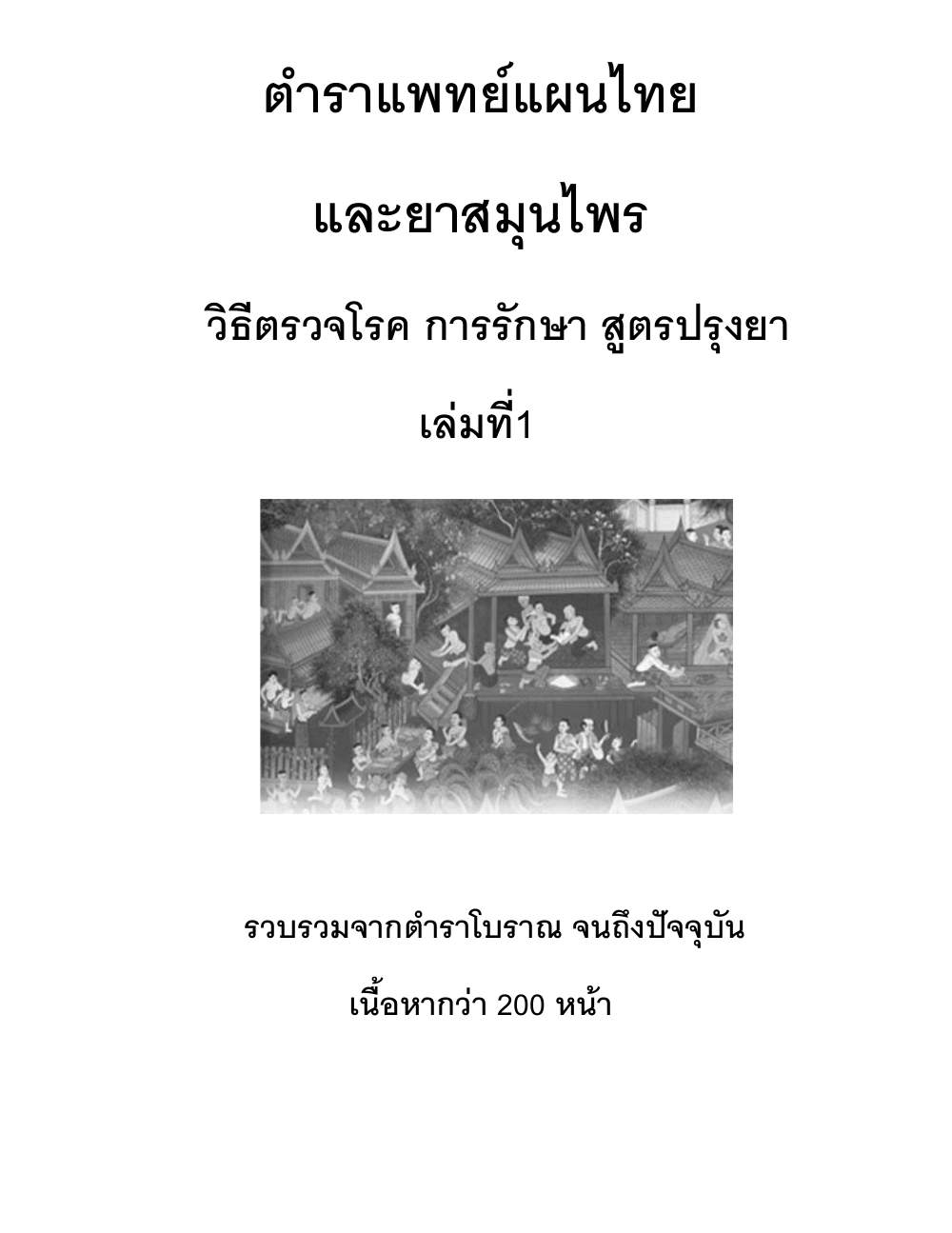
ตำราแพทย์แผนไทย
และยาสมุนไพร
วิธีตรวจโรค การรักษา สูตรปรุงยา
เล่มที่ 1
[diagram: black-and-white illustration of a Thai scene with several ornate roofed pavilions; groups of people in traditional dress, including a pair of men grappling/wrestling, a seated bride, children playing, and figures gathered beneath trees in front of the buildings]
รวบรวมจากตำราโบราณ จนถึงปัจจุบัน
เนื้อหากว่า 200 หน้า
Textbook of Thai Traditional Medicine
and Herbal Medicine
Methods of Diagnosis, Treatment, Compounding Formulas
Volume 1
[diagram: black-and-white illustration of a Thai scene with several ornate roofed pavilions; groups of people in traditional dress, including a pair of men grappling/wrestling, a seated bride, children playing, and figures gathered beneath trees in front of the buildings]
Compiled from ancient texts up to the present
Over 200 pages of content
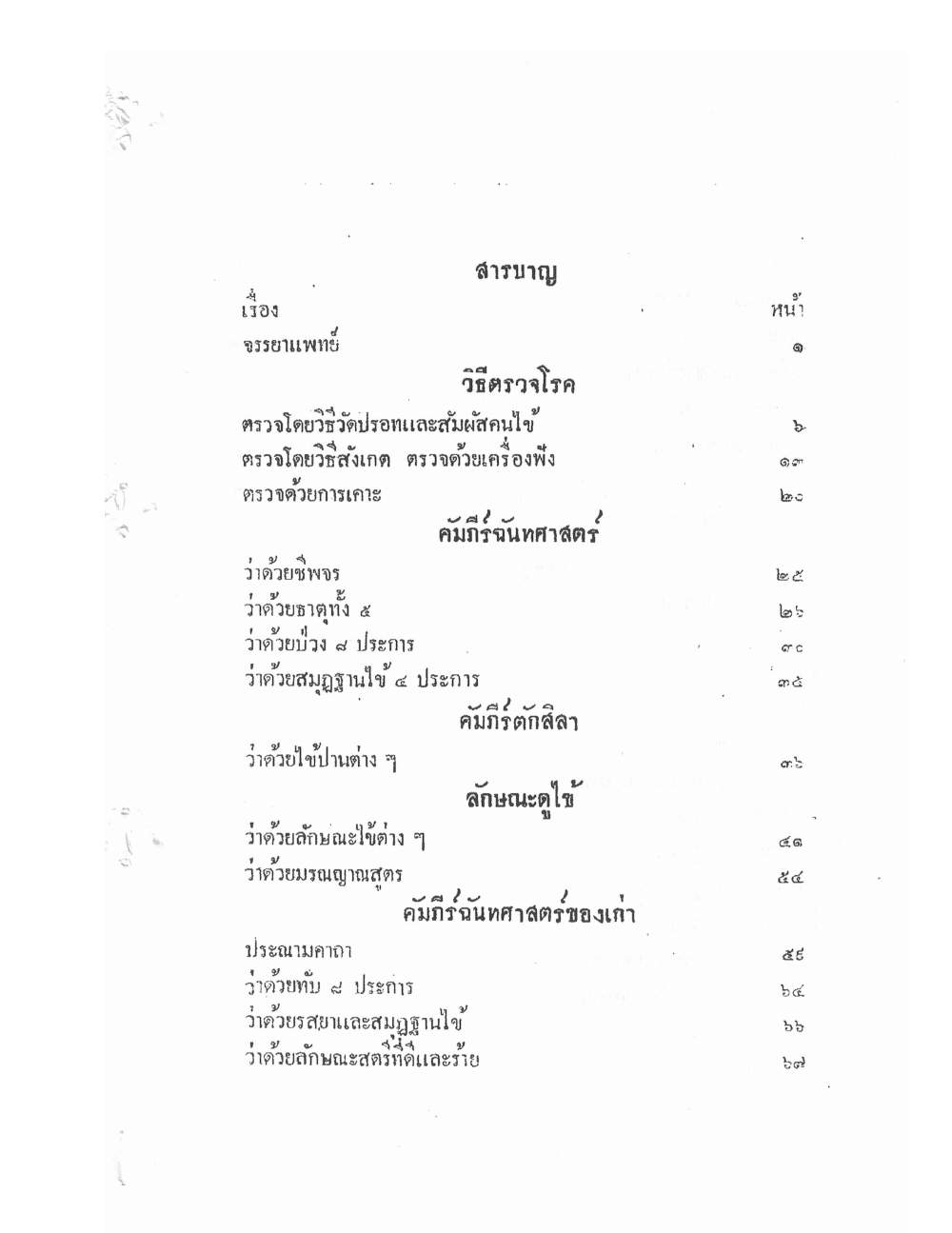
สารบาญ
เรื่อง หน้า จรรยาแพทย์ ๑
วิธีตรวจโรค
ตรวจโดยวิธีวัดปรอทและสัมผัสคนไข้ ๖ ตรวจโดยวิธีสังเกต ตรวจด้วยเครื่องพึง ๑๓ ตรวจด้วยการเคาะ ๒๐
คัมภีร์ฉันทศาสตร์
ว่าด้วยชีพจร ๒๕ ว่าด้วยธาตุทั้ง ๕ ๒๖ ว่าด้วยบ่วง ๘ ประการ ๓๐ ว่าด้วยสมุฏฐานไข้ ๔ ประการ ๓๘
คัมภีร์ตักศิลา
ว่าด้วยไข้ป่าต่าง ๆ ๓๖
ลักษณะดูไข้
ว่าด้วยลักษณะไข้ต่าง ๆ ๔๑ ว่าด้วยมรณญาณสูตร ๕๔
คัมภีร์ฉันทศาสตร์ของเก่า
ประณามคาถา ๕๕ ว่าด้วยทับ ๘ ประการ ๖๔ ว่าด้วยรสยาและสมุฏฐานไข้ ๖๖ ว่าด้วยลักษณะสตรีที่ดีและร้าย ๖๗
Table of Contents
Subject Page Code of conduct of the physician 1
Methods of Diagnosis
Examination by thermometer and touching the patient 6 Examination by observation, examination with instruments 13 Examination by percussion (tapping) 20
Scripture of Prognostics (Chanthasat)
On the pulse 25 On the five elements 26 On the eight snares [buang] 30 On the four causes of fever 38
Scripture of Taksila
On the various jungle fevers 36
Characteristics for Examining Fever
On the characteristics of various fevers 41 On the formula for the sign of death (marananayana) 54
Old Scripture of Prognostics
Opening verse of homage 55 On the eight kinds of overpowering (thap) 64 On the taste of medicines and the causes of fever 66 On the characteristics of good and bad women 67
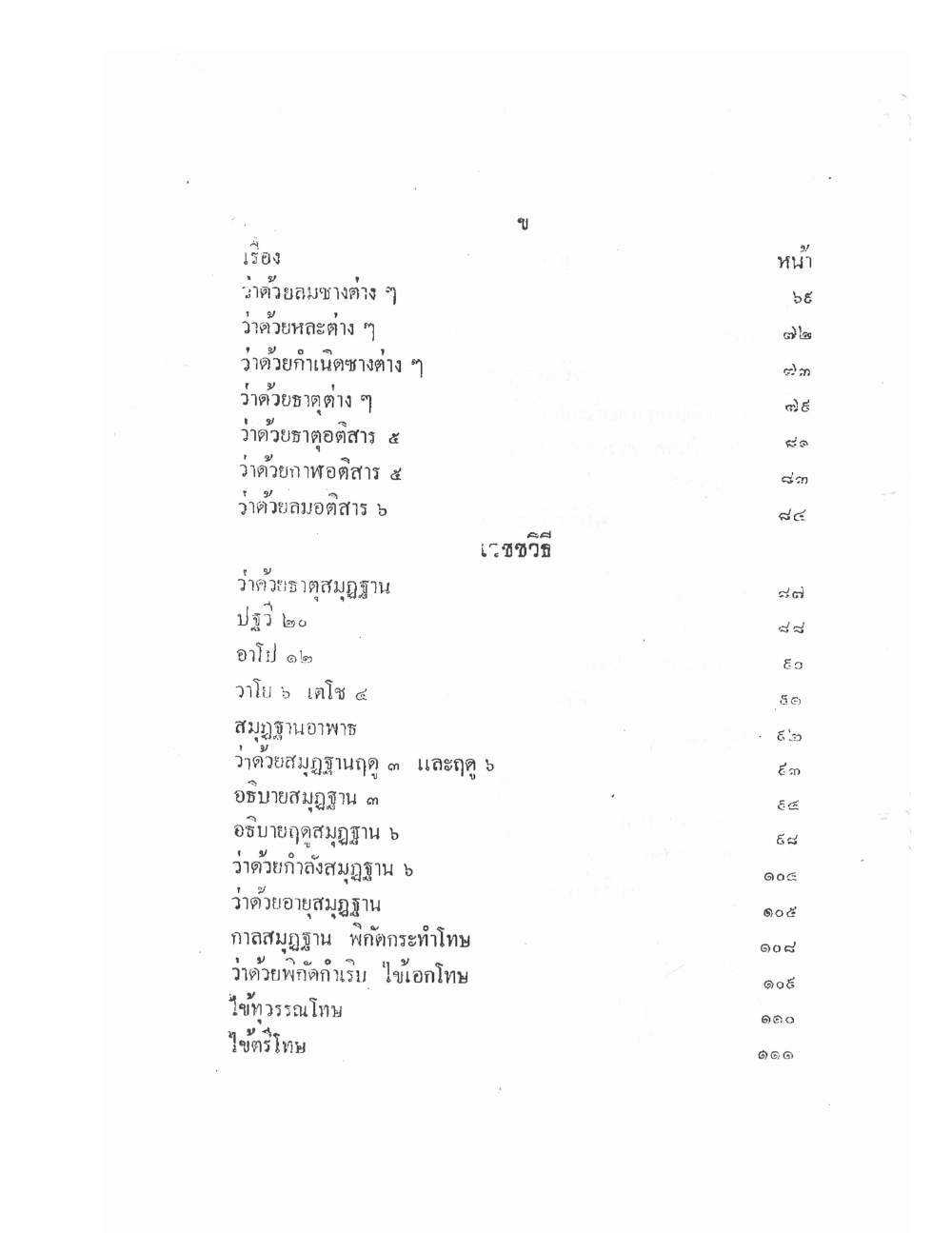
ข
เรื่อง หน้า ว่าด้วยลมซางต่าง ๆ ๖๕ ว่าด้วยหละต่าง ๆ ๗๒ ว่าด้วยกำเนิดซางต่าง ๆ ๗๓ ว่าด้วยธาตุต่าง ๆ ๗๕ ว่าด้วยธาตุอติสาร ๕ ๘๑ ว่าด้วยกาฬอติสาร ๕ ๘๓ ว่าด้วยลมอติสาร ๖ ๘๔
เวชวิธี
ว่าด้วยธาตุสมุฏฐาน ๘๗ ปฐวี ๒๐ ๘๘ อาโป ๑๒ ๙๐ วาโย ๖ เตโช ๔ ๙๑ สมุฏฐานอาพาธ ๙๒ ว่าด้วยสมุฏฐานฤดู ๓ และฤดู ๖ ๙๓ อธิบายสมุฏฐาน ๓ ๙๔ อธิบายฤดูสมุฏฐาน ๖ ๙๘ ว่าด้วยกำลังสมุฏฐาน ๖ ๑๐๔ ว่าด้วยอายุสมุฏฐาน ๑๐๕ กาลสมุฏฐาน พิกัดกระทำโทษ ๑๐๘ ว่าด้วยพิกัดกำเริบ ไข้เอกโทษ ๑๐๙ ไข้ทุวรรณโทษ ๑๑๐ ไข้ตรีโทษ ๑๑๑
kh [2]
Subject Page On the various zang-related winds 65 On the various forms of la (childhood eruptions) 72 On the origin of the various zang [pediatric ailments] 73 On the various elements 75 On the five element-related dysenteries 81 On the five kala dysenteries 83 On the six wind dysenteries 84
Methods of Medicine
On the causes rooted in the elements 87 Earth element, 20 [kinds] 88 Water element, 12 [kinds] 90 Wind element 6, Fire element 4 91 Causes of affliction 92 On the causes of the 3 seasons and the 6 seasons 93 Explanation of the 3 causes 94 Explanation of the 6 seasonal causes 98 On the strength of the 6 causes 104 On the age-related causes 105 Time-related causes, the scope of the offenses 108 On the scope of flare-ups, single-fault fevers 109 Double-fault fevers 110 Triple-fault fevers 111
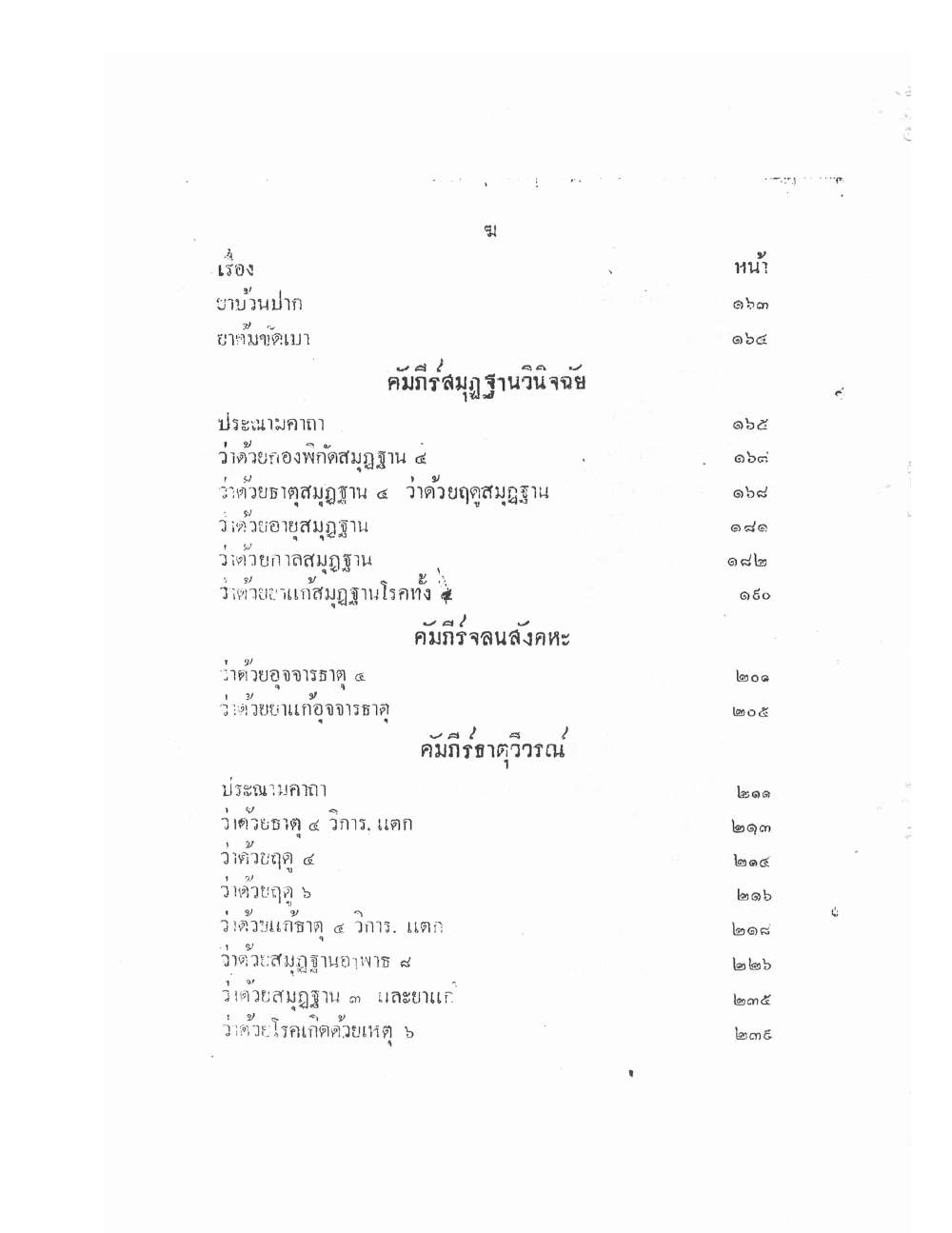
ค
เรื่อง หน้า ว่าด้วยกำเริบ. หย่อน, พิการ ๑๓๘ ปฐวีธาตุพิการ ๑๓๖ อาโปธาตุพิการ ๑๓๘ วาโยธาตุพิการ, เตโชธาตุพิการ ๑๓๙ อธิบายประเทศสมุฏฐาน ๑๒๐ ว่าด้วยรู้จักชื่อโรคต่าง ๆ ๑๒๓ ว่าด้วยรู้จักยาสำหรับแก้โรค ๑๒๖ ว่าด้วยรู้ว่ายาอย่างใดแก้โรคชนิดใด ๑๓๕ ความเรื่องของคนป่วย, เรื่องของโรค ๑๓๖ ตรวจร่างกาย ๑๓๗ ธาตุต่าง ๆ สำหรับปี ๑๓๙ ธาตุต่าง ๆ สำหรับเดือน ว่าด้วยสรรพคุณยาแก้ในกองธาตุ ๑๔๐ วิธีคำนวณธาตุและยาแก้ธาตุทั้ง ๔ พิการ ๑๔๒ ยาชื่อโปตะทาลิคุณ ยาชื่อมหาชุมนุมใหญ่สันนิบาต ๑๕๒ ยาเขี้ยวมหาพรหม, ยาอดุลย์วิตถาร ๑๕๔ ยามหาสมิทธิใหญ่ ๑๕๕ ยาจักรวาฬพัดครอบ ๑๕๖ ยานันทไกรวาต, ยามหากำลัง ๑๕๗ ยาจิตรมหาวงศ์, ยาสุริยจันทร์ ๑๕๘ ยาหม้อใหญ่ ๑๕๙ ยาชะโลมแก้เหงื่อ ๑๖๑
kh [3]
Subject Page On flare-up, weakening, and derangement 138 Derangement of the earth element 136 Derangement of the water element 138 Derangement of the wind element, derangement of the fire element 139 Explanation of local/regional causes 120 On recognizing the names of the various diseases 123 On recognizing medicines for curing disease 126 On knowing which medicine cures which kind of disease 135 Account of the patient's condition, account of the disease 136 Physical examination 137 The various elements for the years [zodiac cycle] 139 The various elements for the months, on the properties of remedies within the elements 140 Method for calculating the elements and remedies for the four kinds of elemental derangement 142 Medicine called Pota Thalikhun, medicine called the Great Assembly of Sannibat 152 Medicine "Fang of the Great Brahma," medicine Adun Wittha 154 Great Mahasamit medicine 155 Jakrawan Phat Khrop medicine 156 Nanthai Kraiwat medicine, Great Strength medicine 157 Chit Maha Wong medicine, Suriyachan medicine 158 Great Pot medicine 159 Sweat-relief liniment medicine 161
ง
เรื่อง หน้า ยาบ้วนปาก ๑๖๓ ยาทาผดเบา ๑๖๔
คัมภีร์สมุฏฐานวินิจฉัย
ประณามคาถา ๑๖๕ ว่าด้วยกองพิกัดสมุฏฐาน ๔ ๑๖๗ ว่าด้วยธาตุสมุฏฐาน ๔ ว่าด้วยฤดูสมุฏฐาน ๑๖๘ ว่าด้วยอายุสมุฏฐาน ๑๘๑ ว่าด้วยกาลสมุฏฐาน ๑๘๒ ว่าด้วยยาแก้สมุฏฐานโรคทั้ง ๔ ๑๙๐
คัมภีร์จลนสังคหะ
ว่าด้วยอุจจาระธาตุ ๔ ๒๐๑ ว่าด้วยยาแก้อุจจาระธาตุ ๒๐๕
คัมภีร์ธาตุวิวรณ์
ประณามคาถา ๒๑๑ ว่าด้วยธาตุ ๔ วิการ. แตก ๒๑๓ ว่าด้วยฤดู ๔ ๒๑๔ ว่าด้วยฤดู ๖ ๒๑๖ ว่าด้วยแก้ธาตุ ๔ วิการ. แตก ๒๑๘ ว่าด้วยสมุฏฐานอาพาธ ๘ ๒๒๖ ว่าด้วยสมุฏฐาน ๓ และยาแก้ ๒๓๕ ว่าด้วยโรคเกิดด้วยเหตุ ๖ ๒๓๖
ng [4]
Subject Page Mouthwash medicine 163 Ointment for mild rashes 164
Scripture on Diagnosis of Causes
Opening verse of homage 165 On the four categories of causes 167 On the four causes of the elements, on the seasonal causes 168 On the age-related causes 181 On the time-related causes 182 On medicines curing all four causes of disease 190
Scripture of Jalanasangkaha (Constriction Compendium)
On the four excretory elements 201 On medicines curing the excretory elements 205
Scripture of Elemental Manifestation
Opening verse of homage 211 On the derangement and rupture of the four elements 213 On the four seasons 214 On the six seasons 216 On curing the derangement and rupture of the four elements 218 On the eight causes of affliction 226 On the three causes and their remedies 235 On diseases arising from the six causes 236
ตำราแพทย์สงเคราะห์ เล่ม ๑
จรรยาแพทย์แผนโบราณ
ของ
นายร้อยเอกขุนโยธาพิทักษ์
[decorative divider ornament]
ความดื่มกลิ่นฟุ้ง โลกัย รุ่งโรจน์โชติเฉกไถง เงื้อมฟ้า ความชั่วประหนึ่งภัย พาลพราก ชื่อลับดับจากหล้า ล่มล้างโลกลาญ สลายแล ฯ
จรรยาแพทย์แผนโบราณที่จะได้กล่าวต่อไปนี้ โดยมากได้อาศัย จากตำหรับตำรา และข้อบัญญัติต่าง ๆ จากข้อความเก่าแก่แต่โบราณบ้าง จากคำสั่งสอนของครูบาอาจารย์ ตั้งแต่บรรพกาลบ้าง เป็นบรรทัดฐาน และทั้งได้อาศัยเทียบจากจรรยาของแพทย์ที่ปฏิบัติอยู่ในสมัยนั้น เพื่อ ให้สมกับกาลสมัยแห่งยุคกาลอันควรจะเป็นไป.
จรรยาแพทย์แผนโบราณ เป็นสิ่งประเสริฐและจำเป็นยิ่งที่แพทย์ จะพึงปฏิบัติ โดยเหตุว่าผู้ที่จะเป็นแพทย์นั้น หาใช่จะเป็นเพียงแต่ ตนเป็นผู้รู้แต่วิชาแพทย์ และรู้จักยารักษาโรค ๆลๆ อย่างเดียว แล้วหาได้ไม่ เพราะแพทย์ต้องเป็นผู้มีจรรยา และจรรยาเป็นเครื่อง ประดับประหนึ่งอาภรณ์อันชูส่งราศรีเลิศยิ่งให้แก่แพทย์นั้น ๆ เสมอ แม้ในคัมภีร์เก่า ๆ แต่ก่อน ๆ ก็ได้บรรยายทางจรรยาไว้อย่างแน่วแน่
Textbook of Medical Compilation, Volume 1
Code of Conduct of the Traditional Physician
by
Captain Khun Yothaphithak
[decorative divider ornament]
The fragrance of a good name pervades the world; Its brilliance shines like the sun against the vault of heaven. Wickedness, like a peril, severs and destroys; A name extinguished falls from the earth, bringing the world to ruin and collapse, perishing utterly.
The code of conduct of the traditional physician to be set out below has for the most part been drawn from textbooks and various rules — partly from old sayings handed down from antiquity, partly from the teachings of teachers and masters since ancient times — taken as a foundation, and has also been drawn by comparison from the conduct of physicians who practiced in that era, so as to suit the demands of whatever age it should apply to.
The code of conduct of the traditional physician is an excellent thing, and most necessary for a physician to observe, because one who is to be a physician cannot be merely one who possesses medical knowledge and knows how to use medicine to treat diseases, etc., alone — that is not sufficient. For a physician must be a person of conduct, and conduct is an ornament, like a jewel that always lends the finest radiance to that physician. Even in the old scriptures of former times, the way of conduct was set forth with great firmness...
๒ โรงพิมพ์วัฒนาพานิช
ให้นามว่า "แพทยาลังการ" บ้าง และ "วินัยแพทย์" บ้าง ๆลๆ ต่าง ๆ กัน แต่ก็มีความหมายเป็นข้อเตือนใจในจรรยาเท่านั้น. จรรยานี้ แม้แต่แพทย์แผนปัจจุบันเขาก็ต้องได้เล่าเรียนมาตั้งแต่ อยู่ที่โรงเรียนแพทย์ ทั้งถือเป็นวิชาหนึ่ง ๆ ที่จำเป็นต้องเรียนให้รู้จริง ๆ และทั่วโลกทุกชาติทุกภาษาย่อมมีหลักการเรียนจรรยาไว้ทั้งนั้น ยิ่งใน ไพร่ชประเทศตามที่ข้าพเจ้าได้ทราบจากผู้ที่ได้ไปศึกษามา ก่อนอื่นเขา นั้น ๆ จะเป็นแพทย์จะต้องทำการปฏิญาณสาบานตนสำหรับจรรยา ก่อน หน้าที่จะออกไปประกอบการแพทย์โดยลำพังเสมอไป ๆลๆ ดังกล่าวแล้ว ฉะนั้นจำเป็นยิ่งที่แพทย์จะต้องเป็นผู้ที่เรียนรู้และ ปฏิบัติในจรรยาให้มีในตนอย่างพร้อมมูล. จรรยาแพทย์แผนโบราณมีบรรทัดฐานดังต่อไปนี้. ๑. มีเมตตาจิตต์ การมีเมตตาจิตต์นี้เป็นข้อสำคัญข้อหนึ่ง กล่าวคือ คนไข้ทุกรายย่อมจะต้องได้รับทุกขเวทนาอยู่แล้ว และ ย่อมจะต้องมีน้ำใจคิดหวังที่จะเอาแพทย์เป็นที่พึ่ง เหนี่ยวรั้งชีพของเขาไว้ ดังนี้เมื่อเขาได้เห็นแพทย์เป็นผู้มีเมตตากรุณา ก็บังเกิดความพาก พูมใจหมายฝากชีพและร่างกาย ทำให้น้ำเลี้ยงหัวใจของเขาสดชื่นผ่องใส ทั้งมีความเชื่อเคารพนับถือ ผลที่แพทย์จะได้ก็คืออาการคลายและ การหาย คล้ายกับแพทย์ได้วางยาด้วยอำนาจทางใจไว้แล้วขนานหนึ่ง และเป็นขนานวิเศษ. ๒. ไม่เห็นแก่ลาภ ลาภ, ผล, ทุกคนย่อมปรารถนาด้วยกัน ทั้งสิ้น แพทย์จะต้องเพ่งเล็งดูว่า เราจะทำเพื่อความสุจริต มิคิด หลอกลวงโดยอุบาย หรือแกล้งหน่วงเหนี่ยวไข้ไว้เพื่อขวัญข้าวและเงิน สินบล ทั้งต้องมีจิตต์คิดเผื่อแผ่ แม้ว่าคนไข้จะเป็นผู้ที่ขัดสน ยากจน
2 Watthana Panich Press
It is also given the name "Phaettayalangkan" in some places, and "Winai Phaet" (the Physician's Discipline) in others, etc. — different names, but all carrying the same meaning as reminders within conduct. This code of conduct — even physicians of present-day (modern) medicine must study it from the time they are at medical school; it is held to be a distinct subject that must be studied and truly mastered, and throughout the whole world, every nation and every language alike has principles for teaching conduct. Especially in foreign countries, as I have learned from those who went to study there — before anything else, one who is to become a physician must first take an oath and swear to uphold the code of conduct, before ever going out to practice medicine independently, etc. As stated above, it is therefore most necessary that a physician be one who studies and practices conduct so as to possess it fully within himself. The code of conduct of the traditional physician has the following standards. 1. Possess a compassionate heart (metta). Having a compassionate heart is one important point — namely, every patient is bound already to be suffering pain, and is bound to hope in his heart to take the physician as a refuge, to hold onto his life. Thus, when he sees the physician as one who possesses compassion and kindness, there arises in him a determination to entrust his life and body [to the physician], which makes the blood nourishing his heart fresh and clear, and he also comes to have faith, respect, and reverence. The result the physician obtains is that the patient's symptoms ease and he recovers — as if the physician had already administered one dose of medicine by the power of the mind, and it were an excellent dose indeed. 2. Not be greedy for gain. Gain and profit are things everyone alike desires. The physician must scrutinize himself as to whether he acts with honesty, without intending to deceive by trickery, or deliberately prolonging an illness in order to obtain payment-in-rice and money as bribes. He must also have a heart inclined to generosity, even when the patient is one who is poor and destitute...
ตำราแพทย์สงเคราะห์ ๓
อนาถา แพทย์ก็ต้องจัดทำไปให้โดยเต็มใจ ในทางเสมอกับผู้ที่ มั่งมีทรัพย์ ให้ได้รับผลเสมอภาคเท่ากัน ในเมื่อคนไข้นั้น ๆ ได้อุตส่าห์ พากเพียรเข้ามาขอความช่วยเหลือ. ๓. ไม่เป็นคนโอ้อวด การแสดงตนโอ้อวด เป็นมหันต์ พิบัติแก่แพทย์ เป็นต้นว่าตนได้รักษาไข้หายสักรายหนึ่ง ก็เที่ยว คุยฟุ้งอยู่ร่ำไป ไปพบไข้รายใหม่ก็คุยแต่รายที่ตนเคยรักษาหายรายนั้น ฟุ้งอยู่ทั่วบ้านทั่วเมือง แต่ความจริงไข้และตำราคัมภีร์ต่าง ๆ ตนหาม ความรู้ไม่ หากแต่ว่าเผอิญตนได้รับโชค สวรรค์บันดาลให้ไข้นั้นหาย ขึ้นโดยธรรมชาติธรรมดาของมันเท่านั้น. ๔. ไม่ปิดบังความเขลาของตน การรักษาไข้ต่าง ๆ ก่อน รักษา แพทย์ต้องตรวจดูอาการโรคก่อน ถ้าเห็นว่าตนไม่รู้และตน รักษาไม่ได้ แพทย์ต้องแจ้งให้คนไข้หรือเจ้าของไข้ทราบโดยเร็ว และหากแม้ตนทราบว่า มีแพทย์ที่ตนรู้จัก มีความรู้ดีกว่าตน ควร บอกแนะนำให้เจ้าของไข้เขาไปหาแพทย์ผู้นั้นแทนตน อย่าปิดบัง เขลาของตนไว้. ๕. ไม่ปิดบังความดีของผู้อื่น เมื่อตนทราบ ได้ยินได้ฟัง คำสรรเสริญคุณวิชาความดีของผู้อื่น ตนควรจะยินดี และสรรเสริญตาม โดยน้ำใสใจจริง. ๖. ไม่หวงกันลาภ ในข้อนี้แพทย์ควรพิเคราะห์ให้จงหนัก กล่าวคือ เช่นว่ามีไข้รายหนึ่ง ที่ตนไม่สามารถจะกระทำเพียงลำพัง คนเดียวได้ ก็ต้องเรียกร้องแพทย์ผู้อื่นเขาเข้าช่วยเหลือร่วมมืออย่าถือว่า ถ้าเรียกเขามาแล้ว ตนจะต้องถูกแบ่งลาภไม่ได้เป็นอันขาด.
Textbook of Medical Compilation 3
...and destitute, the physician must still see to it wholeheartedly, in the same manner as for those who are wealthy, so that they receive an equal, matching benefit, whenever such a patient has made the effort and taken pains to come seeking help. 3. Not be a boastful person. Displaying oneself boastfully is a great calamity for a physician — for example: having cured one single case of illness, then going about endlessly boasting of it; on meeting a new patient, speaking only of that one case one once cured, boasting throughout the whole town and country — when in truth one has no real knowledge of the illness or of the various medical texts and scriptures, but it merely happened that one was fortunate, that heaven caused that illness to recover by its own natural course alone. 4. Not conceal one's own ignorance. In treating various illnesses, before treating, the physician must first examine the symptoms of the disease. If he sees that he does not know [the illness] and cannot treat it, the physician must inform the patient or the patient's family promptly. And if he happens to know of another physician of his acquaintance who has better knowledge than himself, he should advise and recommend that the patient's family go to that physician instead of him. He must not conceal his own ignorance. 5. Not conceal the goodness of others. When one comes to know, to hear, or to listen to words of praise for the skill and goodness of another, one should feel glad and join in praising accordingly, with a pure and sincere heart. 6. Not begrudge sharing gain. On this point the physician should consider very carefully — namely, suppose there is a case of illness that he alone cannot manage single-handedly; he must call upon other physicians to come and assist and cooperate, and must never hold that, having called them in, he must by no means be made to share the gain [payment] with them.
๔ โรงพิมพ์วัฒนาพานิช
๗. ไม่ถืออำนาจอคติ ๔ ประการ คือ ก. ฉันทาคติ ความรักใคร่พอใจ มีน้ำใจลำเอียง ทำความ รักใคร่ในคนไข้ไม่เสมอกัน ถือความเกลียด ความชัง ความพยาบาท. ข. โทสาคติ คือความโกรธ คือถือโทสะจริตบังหน้าเข้ามา ครอบงำ ถือโกรธแก่คนไข้ไม่เอาใจ. ค. โมหาคติ คือความหลง ถือว่าตนดีแต่ผู้เดียว เมื่อตน รักษาไม่ได้ หรือไร้ความรู้ ก็ยังอวดดีว่าตนรักษาไข้ได้ อย่าหนึ่ง หรือหลงเชื่อความสามารถ ทำการรักษาไป. ง. ภยาคติ คือความกลัว กลัวในสิ่งที่ผิดทางจรรยา เช่น กลัวไม่ได้ขวัญข้าวค่ายา กลัวหมด กลัวเปลือง ๆลๆ. ๘. ถือความสันโดษ กล่าวคือไม่ยินดียินร้าย ในลาภผล การนินทา การสรรเสริญเยินยอ เหยียดหยามศักดิ์. ๙. มีหิริโอตตัปปะ คือ ละอายต่อบาป ละเว้นการอาฆาต พยาบาท จองเวร อิจฉา ริษยา ในปวงเพื่อนแพทย์ด้วยกัน. ๑๐. ไม่เกียจคร้าน คือการหมั่นต่อคนไข้ ไม่วางใจ. ๑๑. ไม่มักง่าย คือการไม่มักง่าย เช่นปราศจากการพินิจ พิจารณา หรือวางยาโดยการตรวจไม่ถ่องแท้ และใช้ยาที่ไม่ครบ ตามพิกัด และตำรา. ๑๒. มีดุลยวินิจอันแน่วแน่ คือการวิเคราะห์โรคภัยต่าง ๆ โดยถ้วนละเอียดไม่สะเพร่า ใช้ปัญญาสุขุมตามคัมภีร์ภาพ,
4 Watthana Panich Press
7. Not be swayed by the power of the four kinds of bias, namely: a. Chandagati — bias of affection and liking, having a partial heart, showing unequal affection among patients; harboring hatred, aversion, or vengefulness. b. Dosagati — bias of anger, that is, holding a wrathful disposition that comes to the fore and dominates one, holding anger against a patient who does not comply with one's wishes. c. Mohagati — bias of delusion, holding that only oneself is good; when one is unable to treat [a case], or lacks knowledge, still boasting that one is able to cure the illness anyway, or, deluded by confidence in one's own ability, proceeding to treat regardless. d. Bhayagati — bias of fear, fearing things that are wrong according to the code of conduct, such as fearing not to receive payment for the medicine, fearing running short, fearing waste, etc. 8. Hold to contentment — that is, being neither pleased nor displeased over gain and profit, gossip, flattering praise, or scornful contempt of one's standing. 9. Possess hiri and ottappa (moral shame and moral dread) — that is, shame before wrongdoing, and abstaining from malice, vengeance, feuding, envy, and jealousy toward one's fellow physicians. 10. Not be lazy — that is, being diligent toward patients, never being complacent. 11. Not be careless or hasty — that is, not being slipshod, such as lacking careful examination and consideration, or prescribing medicine based on an inexact examination, and using medicine that does not fully match the prescribed formula and the texts. 12. Possess firm and resolute judgment — that is, analyzing the various illnesses thoroughly and in detail without carelessness, applying prudent wisdom in accordance with the scriptures,
๕ โรงพิมพ์วัฒนาพานิช
๑๓. ไม่สูบฝิ่น, กัญชา, สุรา และเล่นการพะนัน. อันเป็นเหตุให้ก่อการเสื่อมความนับถือ. ๑๔. รักชีวิตคนไข้เท่ากับชีวิตของตน. ๑๕. ให้เกียรติยศคนไข้เพศหญิง ยิ่งกว่าเพศชาย. ๑๖. ไม่เป็นคนเจ้าชู้. ๑๗. มีวาจาอันสุภาพอ่อนโยน. ๑๘. ไม่พูดเท็จ ล่อลวงให้คนอื่นหลงเชื่อ. ๑๙. ไม่หวงวิชาความรู้ ต้องเป็นผู้ที่เผยแพร่ ความรู้ วิชาที่ถูกต้องเสมอ. ๒๐. ถือว่าตนเป็นผู้อุปการะคนไข้ โดยไม่เลือกวันเวลา ค่ำคืนอย่างใด. รวม ๒๐ ข้ออันเป็นหลักสำคัญข้อ ๆ ของแพทย์ที่ดีงาม จะพึง ปฏิบัติไว้เป็นเกียรติยศเกียรติศักดิ์ สนองคุณความดีแห่งตนให้เป็น ที่ชื่นชมนิยมในเกียรติคุณความดี ในทางจรรยาแก่บรรดามหาชน ทั้งหลาย จะได้ซ้องศัพท์สรรเสริญ เกริ่นความดีความงามตามแผน จรรยาของเรา ตราบเท่าอวสานต์.
นายร้อยเอก ขุนโยธาพิทักษ์ (แท้น ประทีปะจิตติ) อนุกรรมการแพทย์เชลยศักดิ์ เรียบเรียง ๑๕ ตุลาคม พ.ศ. ๒๔๗๓
5 Watthana Panich Press
13. Not smoke opium or cannabis, drink liquor, or gamble — as these cause a loss of respect. 14. Love the patient's life as much as one's own life. 15. Give honor to female patients even more than to male patients. 16. Not be a philanderer. 17. Speak with polite and gentle words. 18. Not tell lies or deceive others into false belief. 19. Not be stingy with one's knowledge — one must always be a person who spreads correct knowledge. 20. Regard oneself as one who supports and cares for patients, without choosing any particular day, time, or night.
These twenty points together are the important principles for a good physician, to be observed and practiced as honor and dignity, repaying the goodness within oneself so as to be admired and esteemed for one's honorable virtue and conduct among the whole of the people, who will proclaim and praise the goodness and beauty according to our code of conduct, until the very end.
Captain Khun Yothaphithak (true name: Thaen Prathipachitti) Sub-committee member, licensed traditional medicine Compiled by 15 October, B.E. 2473 [1930 CE]
วิธีตรวจโรค
ของ
นายร้อยเอก ขุนโยธาพิทักษ์
[decorative divider ornament]
การตรวจโรคทั่วไป
๑. การตรวจโรคด้วยวิธีใช้วัดปรอทและสัมผัสคนไข้ ร่างกายของมนุษย์ทุก ๆ คนในโลกนี้ ล้วนแล้วแต่มีเส้นของ เส้นโลหิต ดำ, แดง, เล็กใหญ่ก่ายระเกะระกะทั่วสรรพางค์กาย มีโลหิตไหลเล่นตามท่อโลหิตไปทั่วทุกแห่งตลอดร่าง. การตรวจไข้ด้วยวิธีสัมผัสนั้น กล่าวคือ สัมผัสดูการเปลี่ยนแปลง ความร้อนของโลหิต และดูการเต้นของชีพจร ดังต่อไปนี้.
ก. ดูความร้อนของร่างกาย มีที่จะทราบได้คือ ๑. ใช้มือแตะที่หน้าผากและข้างคอ เพื่อทราบกำลังความร้อน ว่าพิษไข้ทำให้มีความร้อนเท่าใด. ๒ ใช้ปรอทวัด เพราะเป็นวิธีที่แม่นยำกว่าใช้มือแตะ.
การตรวจความร้อนด้วยปรอท
การตรวจไข้ต่าง ๆ ด้วยปรอทนั้น แม้ว่าจะเป็น วิธีอย่างสมัยใหม่ ก็ตาม แต่ก็มีประโยชน์ควรใช้อย่างยิ่ง ดังจะแนะนำต่อไปนี้.
Methods of Diagnosis
by
Captain Khun Yothaphithak
[decorative divider ornament]
General Examination of Disease
1. Examining disease by the method of using a thermometer and touching the patient The body of every human being in this world consists entirely of blood vessels — black, red, small and large, interwoven throughout every part of the body — with blood flowing along the blood vessels to every place, throughout the whole body. Examining a fever by the method of touch means: feeling for changes in the heat of the blood, and observing the beating of the pulse, as follows.
a. Observing the heat of the body This may be known by: 1. Using the hand to touch the forehead and the sides of the neck, in order to gauge the degree of heat — how much heat the fever-poison has produced. 2. Using a thermometer, because this is a more accurate method than touching with the hand.
Examining Heat with a Thermometer
Examining the various fevers with a thermometer, even though it is a modern method, is nevertheless extremely useful and worth using, as will be explained below.
ตำราแพทย์สงเคราะห์ ๗
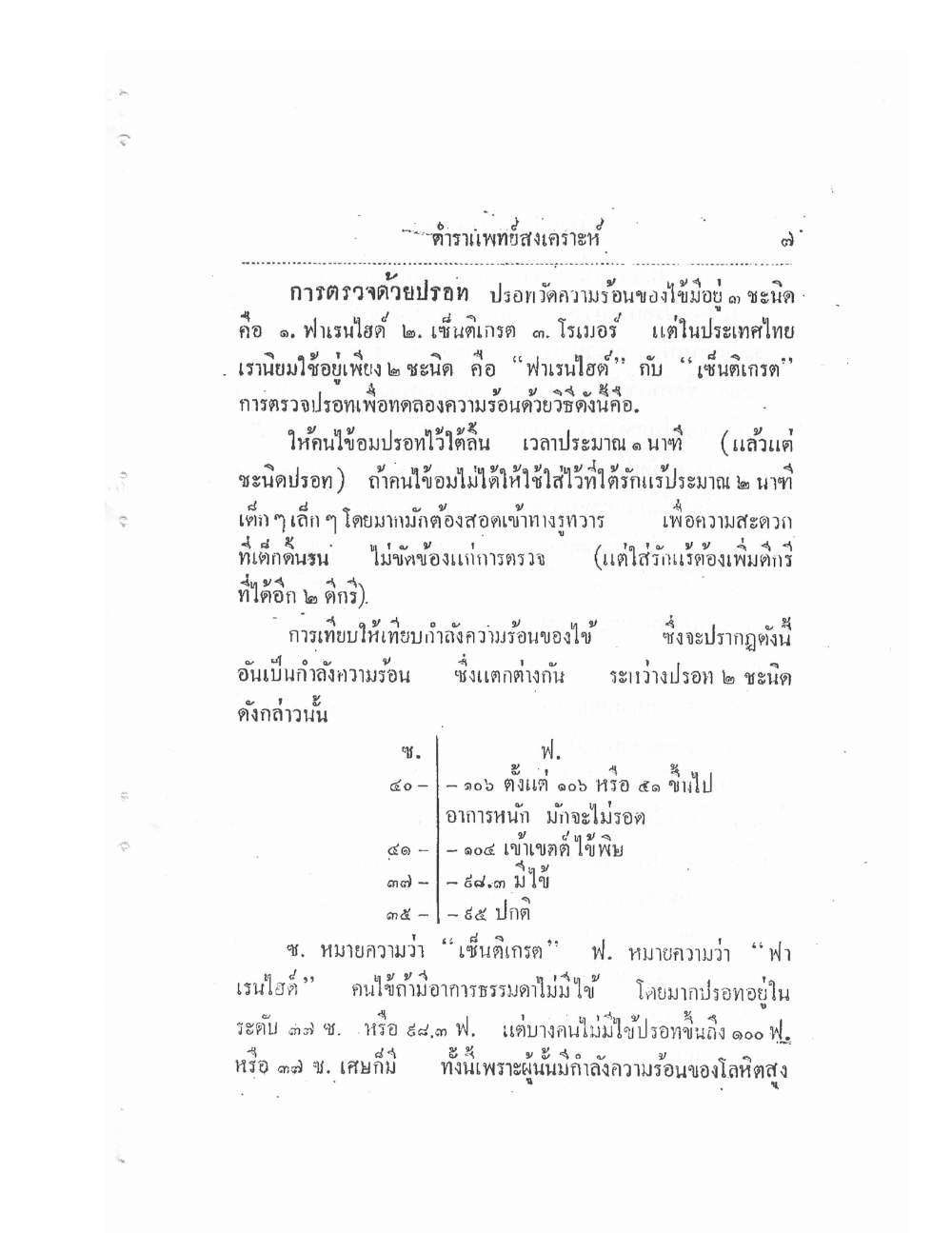
การตรวจด้วยปรอท ปรอทวัดความร้อนของไข้มีอยู่ ๓ ชะนิด คือ ๑. ฟาเรนไฮต์ ๒. เซ็นติเกรต ๓. โรเมอร์ แต่ในประเทศไทย เรานิยมใช้อยู่เพียง ๒ ชะนิด คือ "ฟาเรนไฮต์" กับ "เซ็นติเกรต" การตรวจปรอทเพื่อทดลองความร้อนด้วยวิธีดังนี้คือ. ให้คนไข้อมปรอทไว้ใต้ลิ้น เวลาประมาณ ๑ นาที (แล้วแต่ ชะนิดปรอท) ถ้าคนไข้อมไม่ได้ให้ใช้ใส่ไว้ที่ใต้รักแร้ประมาณ ๒ นาที เด็ก ๆ เล็ก ๆ โดยมากมักต้องสอดเข้าทางรูทวาร เพื่อความสะดวก ที่เด็กดิ้นรน ไม่ขัดข้องแก่การตรวจ (แต่ใส่รักแร้ต้องเพิ่มดีกรี ที่ได้อีก ๒ ดีกรี). การเทียบให้เทียบกำลังความร้อนของไข้ ซึ่งจะปรากฏดังนี้ อันเป็นกำลังความร้อน ซึ่งแตกต่างกัน ระหว่างปรอท ๒ ชะนิด ดังกล่าวนั้น
ซ. | ฟ. ๔๐ - | - ๑๐๖ ตั้งแต่ ๑๐๖ หรือ ๔๑ ขึ้นไป อาการหนัก มักจะไม่รอด ๔๑ - | - ๑๐๔ เข้าเขตไข้พิษ ๓๗ - | - ๙๘.๓ มีไข้ ๓๕ - | - ๙๕ ปกติ
ซ. หมายความว่า "เซ็นติเกรต" ฟ. หมายความว่า "ฟา เรนไฮต์" คนไข้ถ้ามีอาการธรรมดาไม่มีไข้ โดยมากปรอทอยู่ใน ระดับ ๓๗ ซ. หรือ ๙๘.๓ ฟ. แต่บางคนไม่มีไข้ปรอทขึ้นถึง ๑๐๐ ฟ. หรือ ๓๗ ซ. เศษก็มี ทั้งนี้เพราะผู้นั้นมีกำลังความร้อนของโลหิตสูง
Textbook of Medical Compilation 7
Examination with a thermometer. There are 3 kinds of thermometer for measuring the heat of a fever, namely: 1. Fahrenheit, 2. Centigrade, 3. Réaumur. But in Thailand we generally use only 2 kinds, namely "Fahrenheit" and "Centigrade." The method of examining with a thermometer to test the heat is as follows. Have the patient hold the thermometer under the tongue for about 1 minute (depending on the type of thermometer). If the patient cannot hold it [in the mouth], place it under the armpit for about 2 minutes. For small children, it is usually necessary to insert it through the anus, for the convenience of a struggling child, so as not to interfere with the examination (but when placed under the armpit, 2 degrees must be added to the reading obtained). To compare and match the degree of heat of the fever, it will appear as follows — being the degree of heat, which differs between the two kinds of thermometer mentioned above:
C. | F. 40 - | - 106 From 106, or 41, upward: severe condition, usually will not survive 41 - | - 104 entering the range of toxic fever 37 - | - 98.3 has a fever 35 - | - 95 normal
C. means "Centigrade," F. means "Fahrenheit." A patient who has ordinary symptoms with no fever will generally have a thermometer reading at the level of 37°C or 98.3°F. But in some people who have no fever, the thermometer reading rises to as much as 100°F, or a little over 37°C — this is because that person has a naturally high degree of heat in the blood...
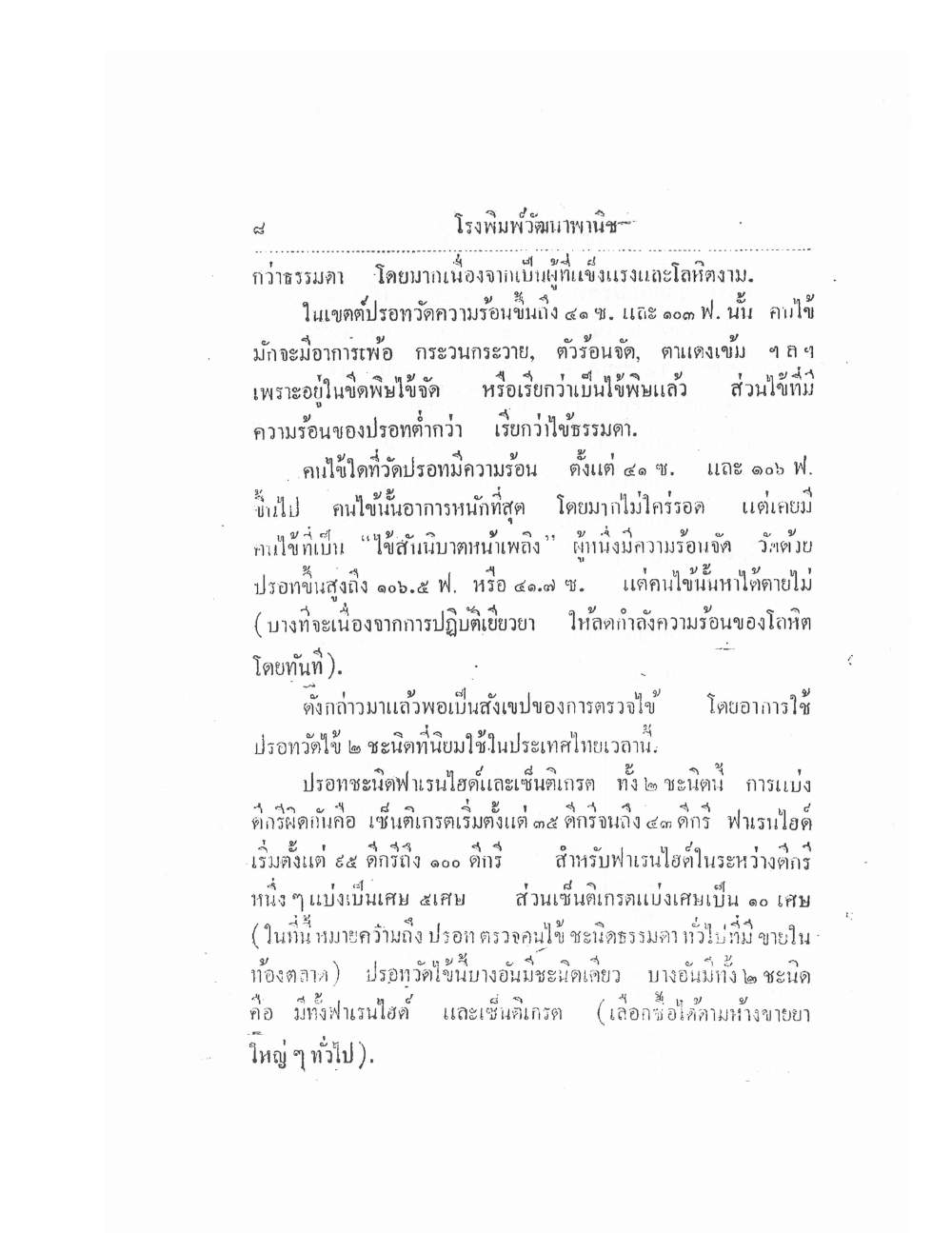
๘ โรงพิมพ์วัฒนาพานิช -------------------------------------------------- กว่าธรรมดา โดยมากเนื่องจากเป็นผู้ที่แข็งแรงและโลหิตงาม.
ในเขตปรอทวัดความร้อนขึ้นถึง ๔๑ ซ. และ ๑๐๓ ฟ. นั้น คนไข้ มักจะมีอาการเพ้อ กระวนกระวาย, ตัวร้อนจัด, ตาแดงเข้ม ฯลฯ เพราะอยู่ในขีดพิษไข้จัด หรือเรียกว่าเป็นไข้พิษแล้ว ส่วนไข้ที่มี ความร้อนของปรอทต่ำกว่า เรียกว่าไข้ธรรมดา.
คนไข้ใดที่วัดปรอทมีความร้อน ตั้งแต่ ๔๑ ซ. และ ๑๐๖ ฟ. ขึ้นไป คนไข้นั้นอาการหนักที่สุด โดยมากไม่ใคร่รอด แต่เคยมี คนไข้ที่เป็น "ไข้สันนิบาตหน้าเพลิง" ผู้หนึ่งมีความร้อนจัด วัดด้วย ปรอทขึ้นสูงถึง ๑๐๖.๕ ฟ. หรือ ๔๑.๓ ซ. แต่คนไข้นั้นหาได้ตายไม่ (บางทีจะเนื่องจากการปฏิบัติเยียวยา ให้ลดกำลังความร้อนของโลหิต โดยทันที).
ดั่งกล่าวมาแล้วพอเป็นสังเขปของการตรวจไข้ โดยอาการใช้ ปรอทวัดไข้ ๒ ชนิดที่นิยมใช้ในประเทศไทยเวลานี้.
ปรอทชนิดฟาเรนไฮต์และเซนติเกรต ทั้ง ๒ ชนิดนี้ การแบ่ง ดีกรีผิดกันคือ เซนติเกรตเริ่มตั้งแต่ ๒๕ ดีกรีจนถึง ๔๓ ดีกรี ฟาเรนไฮต์ เริ่มตั้งแต่ ๕๕ ดีกรีถึง ๑๐๐ ดีกรี สำหรับฟาเรนไฮต์ในระหว่างดีกรี หนึ่งๆแบ่งเป็นเศษ ๕เศษ ส่วนเซนติเกรตแบ่งเศษเป็น ๑๐ เศษ (ในที่นี้หมายความถึง ปรอทตรวจคนไข้ ชนิดธรรมดาทั่วไปที่มีขายใน ท้องตลาด) ปรอทวัดไข้นี้บางอันมีชนิดเดียว บางอันมีทั้ง ๒ ชนิด คือ มีทั้งฟาเรนไฮต์ และเซนติเกรต (เลือกซื้อได้ตามห้างขายยา ใหญ่ๆทั่วไป).
8 Watthana Phanit Press -------------------------------------------------- ...than normal, mostly because they are strong and have good blood.
In the range where the thermometer's heat reaches up to 41°C and 103°F, patients often show symptoms of delirium, restlessness, a very hot body, deeply red eyes, etc., because they are within the range of severe fever-poison, or what is already called a "poison fever." As for a fever whose thermometer heat is lower than that, it is called an ordinary fever.
Any patient whose thermometer reading of heat is 41°C and 106°F or above — that patient's condition is the most severe, and for the most part does not survive. But there was once a patient with "sannibat na phloeng fever" (a traditional term, literally "fire-facing sannibat fever") who had very high heat, measured by thermometer as high as 106.5°F, or 41.3°C, yet that patient did not die (perhaps due to treatment that immediately reduced the strength of the blood's heat).
As stated above, this is a brief summary of examining a fever, by the method of using the 2 kinds of fever thermometers commonly used in Thailand at present.
The Fahrenheit and Centigrade types of thermometer — for both these 2 kinds, the division of degrees differs: Centigrade begins at 25 degrees and goes up to 43 degrees; Fahrenheit begins at 55 degrees and goes up to 100 degrees. For Fahrenheit, between each degree it is divided into 5 parts, while Centigrade divides each degree into 10 parts (here this refers to the ordinary type of fever thermometer generally sold in the marketplace). Some of these fever thermometers have only one scale; some have both scales, that is, having both Fahrenheit and Centigrade (one may choose to buy them at any large pharmacy in general).
๙ ตำราแพทย์สงเคราะห์ -------------------------------------------------- ข. ดูชีพจร
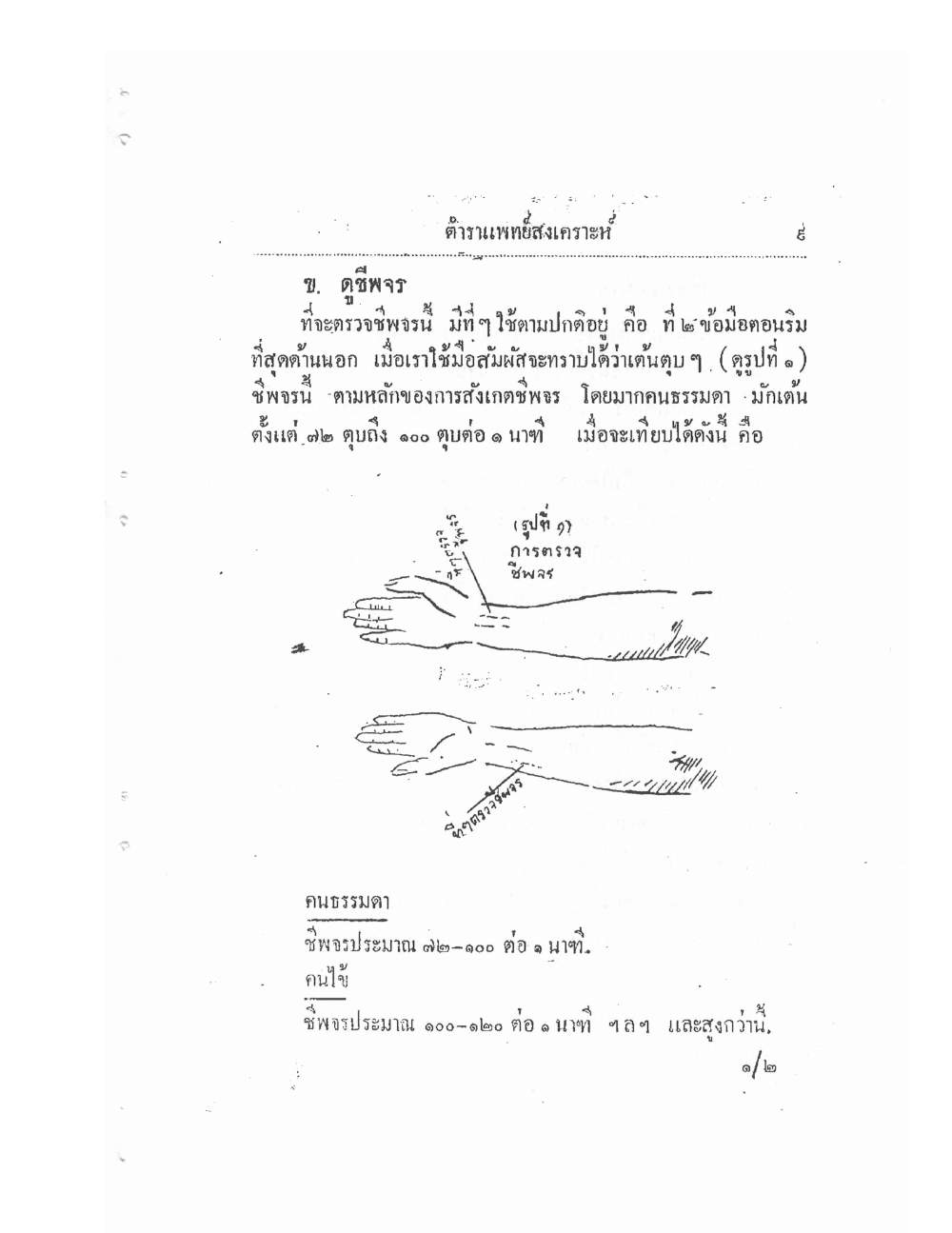
ที่จะตรวจชีพจรนี้ มีที่ๆใช้ตามปกติอยู่ คือ ที่ ๒ ข้อมือตอนริม ที่สุดด้านนอก เมื่อเราใช้มือสัมผัสจะทราบได้ว่าเต้นตุบๆ (ดูรูปที่ ๑) ชีพจรนี้ ตามหลักของการสังเกตชีพจร โดยมากคนธรรมดา มักเต้น ตั้งแต่ ๗๒ ตุบถึง ๑๐๐ ตุบต่อ ๑ นาที เมื่อจะเทียบได้ดังนี้ คือ
[diagram: (รูปที่ ๑) การตรวจชีพจร — two forearms with hands are shown, dotted lines pointing to the pulse-taking spot at the outer wrist; a small rotated caption runs along each arm but is too faint to read with confidence [อ่านไม่ออก]]
คนธรรมดา ชีพจรประมาณ ๗๒-๑๐๐ ต่อ ๑ นาที. คนไข้ ชีพจรประมาณ ๑๐๐-๑๒๐ ต่อ ๑ นาที ฯลฯ และสูงกว่านี้. ๑/๒
9 Textbook of Medical Aid [ตำราแพทย์สงเคราะห์] -------------------------------------------------- b. Observing the pulse
For examining this pulse, there is a customary place used, namely: at the 2nd, at the outermost edge of the wrist. When we touch it with the hand we will know it beats "thub-thub" (see Figure 1). As for this pulse, according to the principles of pulse observation, for the most part an ordinary person usually beats from 72 beats to 100 beats per 1 minute; one may compare as follows:
[diagram: (Figure 1) Examining the pulse — two forearms with hands are shown, with dotted lines pointing to the pulse-taking spot at the outer wrist; a small rotated caption runs along each arm but is too faint to read with confidence [illegible]]
An ordinary person pulse about 72-100 per 1 minute. A patient pulse about 100-120 per 1 minute, etc., and higher than this. [printer's signature mark: 1/2]
๑๐ โรงพิมพ์วัฒนาพานิช -------------------------------------------------- ค. วิธีตรวจชีพจร
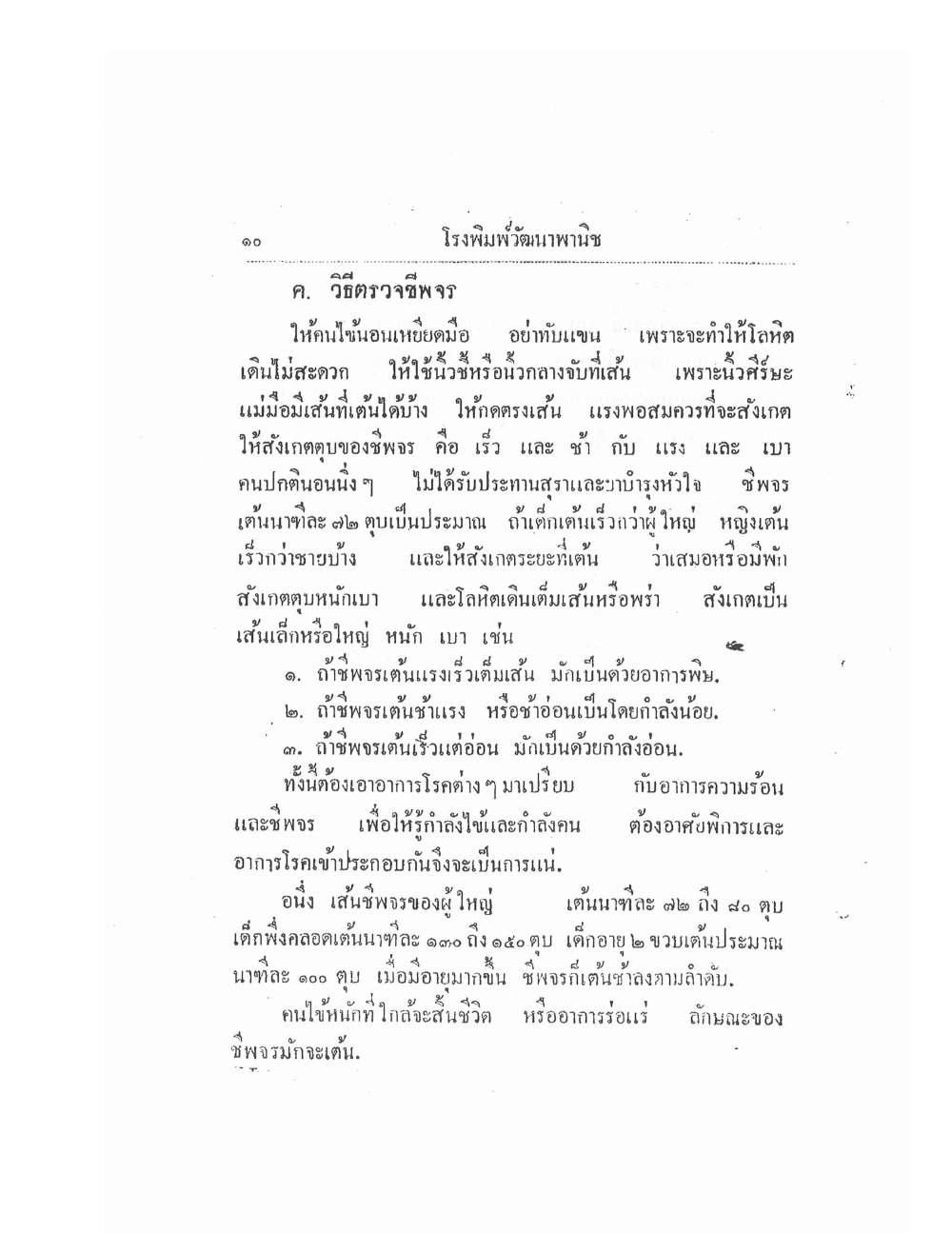
ให้คนไข้นอนเหยียดมือ อย่าทับแขน เพราะจะทำให้โลหิต เดินไม่สะดวก ให้ใช้นิ้วชี้หรือนิ้วกลางจับที่เส้น เพราะนิ้วหัวแม่มือ มีเส้นที่เต้นได้บ้าง ให้กดตรงเส้น แรงพอสมควรที่จะสังเกต ให้สังเกตตุบของชีพจร คือ เร็ว และช้า กับ แรง และ เบา คนปกตินอนนิ่งๆ ไม่ได้รับประทานสุราและยาบำรุงหัวใจ ชีพจร เต้นนาทีละ ๗๒ ตุบเป็นประมาณ ถ้าเด็กเต้นเร็วกว่าผู้ใหญ่ หญิงเต้น เร็วกว่าชายบ้าง และให้สังเกตระยะที่เต้น ว่าเสมอหรือมีพัก สังเกตตุบหนักเบา และโลหิตเดินเต็มเส้นหรือพร่า สังเกตเป็น เส้นเล็กหรือใหญ่ หนัก เบา เช่น
๑. ถ้าชีพจรเต้นแรงเร็วเต็มเส้น มักเป็นด้วยอาการพิษ. ๒. ถ้าชีพจรเต้นช้าแรง หรือช้าอ่อนเป็นโดยกำลังน้อย. ๓. ถ้าชีพจรเต้นเร็วแต่อ่อน มักเป็นด้วยกำลังอ่อน. ทั้งนี้ต้องเอาอาการโรคต่างๆ มาเปรียบ กับอาการความร้อน และชีพจร เพื่อให้รู้กำลังไข้และกำลังคน ต้องอาศัยพิการและ อาการโรคเข้าประกอบกันจึงจะเป็นการแน่.
อนึ่ง เส้นชีพจรของผู้ใหญ่ เต้นนาทีละ ๗๒ ถึง ๘๐ ตุบ เด็กพึ่งคลอดเต้นนาทีละ ๑๓๐ ถึง ๑๕๐ ตุบ เด็กอายุ ๒ ขวบเต้นประมาณ นาทีละ ๑๐๐ ตุบ เมื่ออายุมากขึ้น ชีพจรก็เต้นช้าลงตามลำดับ.
คนไข้หนักที่ใกล้จะสิ้นชีวิต หรืออาการร่อแร่ ลักษณะของ ชีพจรมักจะเต้น.
10 Watthana Phanit Press -------------------------------------------------- c. Method of examining the pulse
Have the patient lie down with the arm extended; [the examiner] must not press on the arm, because it will make the blood flow with difficulty. Use the index finger or middle finger to press on the vessel, because the thumb has a vessel that can beat somewhat on its own [and would confuse the reading]. Press directly on the vessel, with force sufficient to make an observation. Observe the beat of the pulse, that is: fast and slow, together with strong and weak. For a normal person lying still, who has not taken alcohol or heart-stimulating medicine, the pulse beats about 72 beats per minute. Children beat faster than adults; women beat somewhat faster than men. Also observe the rhythm of the beat, whether it is steady or has pauses. Observe whether the beat is heavy or light, and whether the blood travels the full length of the vessel or is faint/scattered. Observe whether the vessel [feels] small or large, heavy, [or] light, for example:
1. If the pulse beats strong, fast, and full along the vessel, it is often due to a poisoned condition. 2. If the pulse beats slow and strong, or slow and weak, it is due to little strength. 3. If the pulse beats fast but weak, it is often due to weak strength. All of this must be compared against the various symptoms of the disease, together with the symptoms of heat and the pulse, in order to know the strength of the fever and the strength of the person; one must rely on the disorder and the symptoms of the disease together for it to be certain.
Furthermore, the pulse of an adult beats 72 to 80 beats per minute; a newborn beats 130 to 150 beats per minute; a child of 2 years beats about 100 beats per minute. As age increases, the pulse beats slower in due order.
For a gravely ill patient near death, or in a failing condition, the character of the pulse tends to beat [as follows].
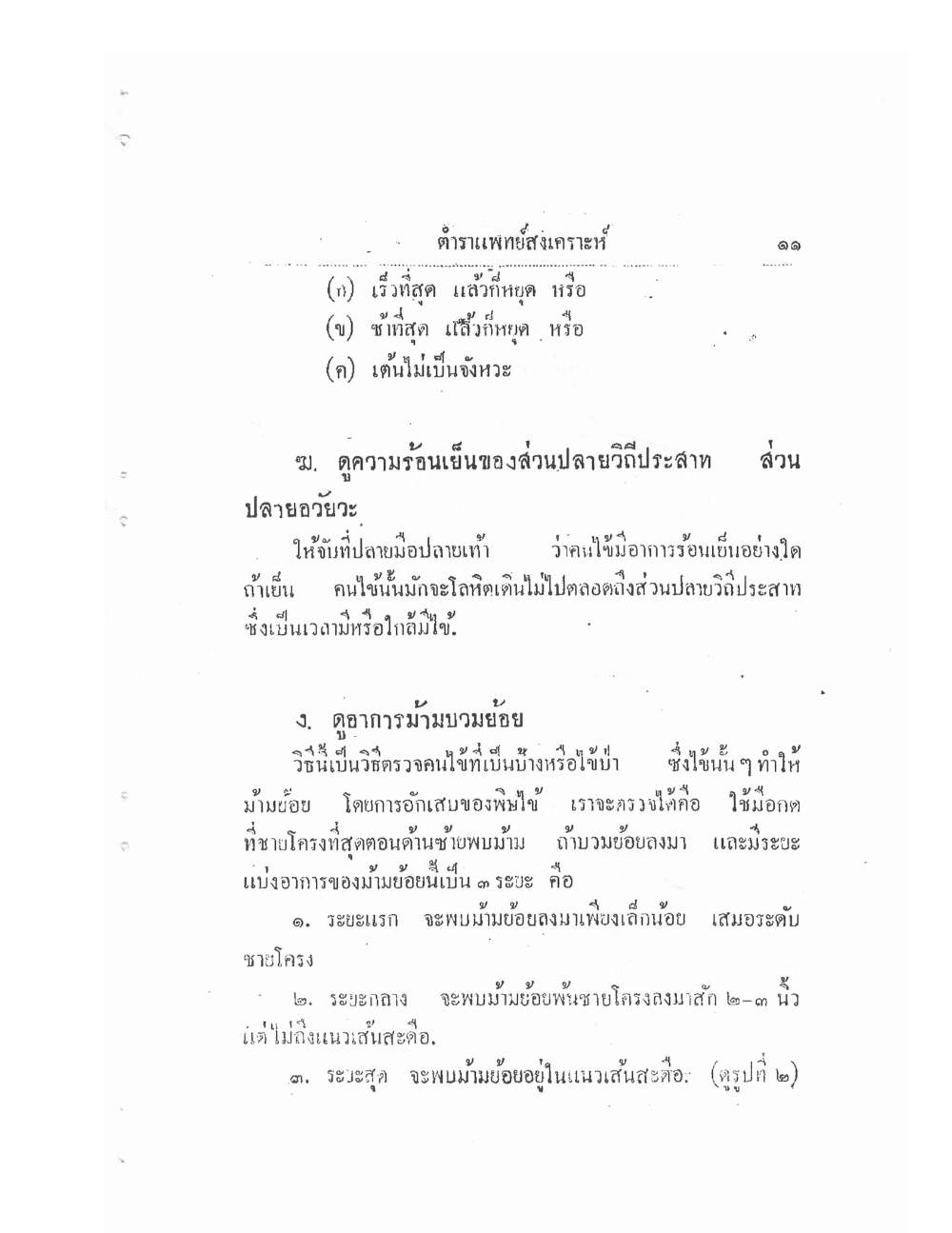
๑๑ ตำราแพทย์สงเคราะห์ -------------------------------------------------- (ก) เร็วที่สุด แล้วก็หยุด หรือ (ข) ช้าที่สุด แล้วก็หยุด หรือ (ค) เต้นไม่เป็นจังหวะ
ฆ. ดูความร้อนเย็นของส่วนปลายวิถีประสาท ส่วน ปลายอวัยวะ
ให้จับที่ปลายมือปลายเท้า ว่าคนไข้มีอาการร้อนเย็นอย่างใด ถ้าเย็น คนไข้นั้นมักจะโลหิตเดินไม่ไปตลอดถึงส่วนปลายวิถีประสาท ซึ่งเป็นเวลาใกล้หรือใกล้มีไข้.
ง. ดูอาการม้ามบวมย้อย
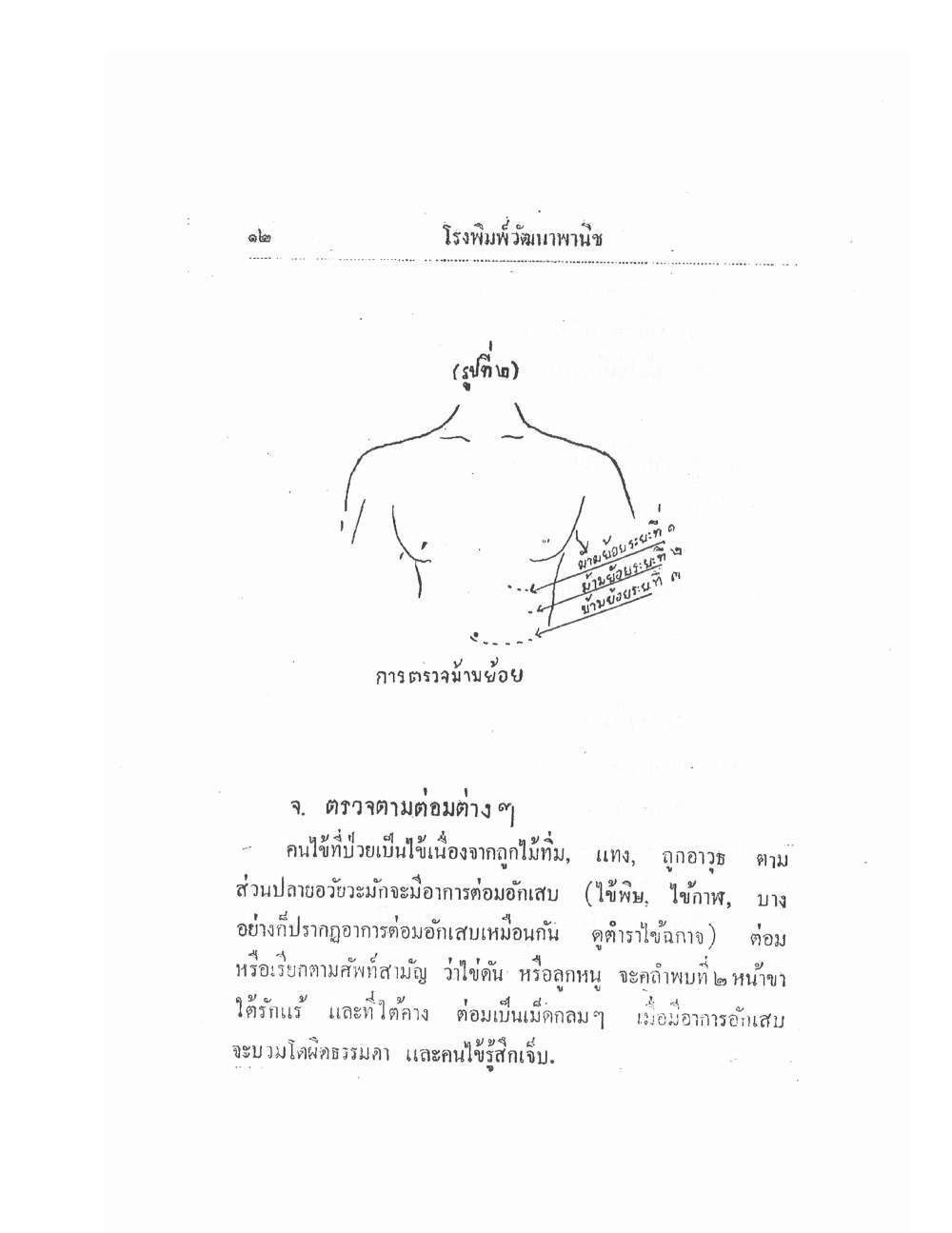
วิธีนี้เป็นวิธีตรวจคนไข้ที่เป็นบ้างหรือไข้บ่า ซึ่งไข้นั้นๆทำให้ ม้ามย้อย โดยการอักเสบของพิษไข้ เราจะตรวจให้คือ ใช้มือกด ที่ชายโครงที่สุดตอนด้านซ้ายพบม้าม ถ้าบวมย้อยลงมา และมีระยะ แบ่งอาการของม้ามย้อยนี้เป็น ๓ ระยะ คือ
๑. ระยะแรก จะพบม้ามย้อยลงมาเพียงเล็กน้อย เสมอระดับ ชายโครง
๒. ระยะกลาง จะพบม้ามย้อยพ้นชายโครงลงมาสัก ๒-๓ นิ้ว แต่ไม่ถึงแนวเส้นสะดือ.
๓. ระยะสุด จะพบม้ามย้อยอยู่ในแนวเส้นสะดือ (ดูรูปที่ ๒)
11 Textbook of Medical Aid [ตำราแพทย์สงเคราะห์] -------------------------------------------------- (a) fastest, and then stops, or (b) slowest, and then stops, or (c) beats without a [regular] rhythm
Fourth. Observing the heat or coolness of the ends of the nerve pathways [and] the extremities of the limbs
Hold the tips of the hands and feet, [to check] what kind of hot or cool sensation the patient has. If cold, that patient's blood usually is not flowing all the way to the ends of the nerve pathways, which occurs near [death], or near [a worsening] fever.
Fifth. Observing the sign of spleen swelling/ptosis
This method is a way of examining a patient who has malaria or an intermittent fever, which fever causes the spleen to droop, through inflammation from the fever's poison. We shall examine as follows: use the hand to press at the lowest edge of the ribs on the left side to find the spleen; if it droops down, there is a range — the condition of this spleen ptosis is divided into 3 stages, namely:
1. First stage: the spleen is found to droop down only slightly, level with the edge of the ribs.
2. Middle stage: the spleen is found to droop past the edge of the ribs by about 2-3 inches, but not reaching the line of the navel.
3. Final stage: the spleen is found to droop down as far as the line of the navel. (See Figure 2)
๑๒ โรงพิมพ์วัฒนาพานิช --------------------------------------------------
[diagram: (รูปที่ ๒) rear view of the upper back and shoulders, with three dashed arcs on the left side below the ribs, labeled with arrows "ม้ามย้อยระยะที่ ๑", "ม้ามย้อยระยะที่ ๒", "ม้ามย้อยระยะที่ ๓" (spleen-ptosis stage 1, 2, 3), captioned below "การตรวจม้ามย้อย"]
จ. ตรวจตามต่อมต่างๆ
คนไข้ที่ป่วยเป็นไข้เนื่องจากถูกไม้ทิ่ม, แทง, ถูกอาวุธ ตาม ส่วนปลายอวัยวะมักจะมีอาการต่อมอักเสบ (ไข้พิษ, ไข้กาฬ, บาง อย่างก็ปรากฏอาการต่อมอักเสบเหมือนกัน ดูตำราไข้ฉกาจ) ต่อม หรือเรียกตามศัพท์สามัญ ว่าไข้ดัน หรือลูกหนู จะคลำพบที่ขาหนีบ ใต้รักแร้ และที่ใต้คาง ต่อมเป็นเม็ดกลมๆ เมื่ออาการอักเสบ จะบวมโตผิดธรรมดา และคนไข้รู้สึกเจ็บ.
12 Watthana Phanit Press --------------------------------------------------
[diagram: (Figure 2) rear view of the upper back and shoulders, with three dashed arcs on the left side below the ribs, labeled with arrows "spleen-ptosis stage 1", "spleen-ptosis stage 2", "spleen-ptosis stage 3", captioned below "Examining spleen ptosis"]
Sixth. Examining the various glands
A patient who is ill with a fever from having been pierced by wood [a splinter], stabbed, or struck by a weapon often has inflamed glands at the extremities (poison fever, purpuric/spotted fever; in some cases inflamed glands appear as well — see the textbook on acute fevers). The glands, or as commonly called, "raised fever" or "little rat" [ลูกหนู, a folk term for a swollen lymph node], can be felt by palpation at the groin, under the armpit, and under the chin. The glands are small round lumps; when inflammation occurs, they swell abnormally large, and the patient feels pain.
๑๓ ตำราแพทย์สงเคราะห์ -------------------------------------------------- ๒. ตรวจโดยวิธีสังเกต
ในวิธีตรวจไข้ โดยวิธีสังเกตนี้ แพทย์พึงใช้ประกอบเพื่อ วินิจฉัยเหตุผลให้แน่นแน่น และเพื่อประกอบกับการตรวจโดยวิธีต่างๆ ที่ได้อธิบายมาแล้ว และที่จะได้บรรยายต่อๆไป กล่าวเป็นข้อสังเขป สำหรับการสังเกต เพื่อวินิจฉัยและใช้ยาดังต่อไปนี้
ก. ถ้าคนไข้มีผิวซีดเหลือง ตาเหลืองเขียว - เนื่องจากน้ำดี ซ่านพิการ.
ข. ผิวหนังเหลืองแห้ง ริมฝีปากแห้ง เนื่องจากโลหิตพิการ.
ค. เส้นโลหิตในสายตามีน้อย เปลือกตาซีด ตาโรย เนื่องจาก เส้นประสาทพิการ และนอนไม่หลับ มักจะเป็นลม และอุจจาระผูก.
ง. การหายใจขัดๆ และสะท้อน เนื่องจากหลอดลมหรือปอด พิการ.
จ. ตามผิวหนัง มีผื่นแดงและเดงทั้งตัว เนื่องจากโลหิตทำพิษ หรือโลหิตซ่าน.
ฉ. ตามปลายอวัยวะเช่น มือ, เท้า, ริมฝีปาก ฯลฯ ชื้น เนื่องจากเส้นประสาทพิการ.
๓. การตรวจด้วยเครื่องพึง
เครื่องพึงเป็นหลอด เพื่อนำเสียงให้ชัด แต่จะเอาหูเปล่าพึงก็ได้ ใช้ในโรคที่เกิดแก่ปอดและหัวใจ หรือโรคที่เกิดแก่เส้นโลหิตพอง เช่นเป็นผีเส้นโลหิต ในการพึงนั้นให้สังเกตเสียงข้างในจะเป็นเสียง เกิดขึ้นผิดธรรมดาอย่างไร เช่นพึงปอดสังเกตเสียงลมเดินในปอด
13 Textbook of Medical Aid [ตำราแพทย์สงเคราะห์] -------------------------------------------------- 2. Examination by the method of observation
In examining a fever by this method of observation, the physician should use it together [with other methods] to diagnose the cause with certainty, and to supplement the examination by the various methods already explained, and those to be described further on. [The following] is stated as a brief summary for observation, in order to diagnose and prescribe medicine, as follows:
a. If the patient has pale, yellowish skin, and yellow-green eyes — due to the bile spreading/diffusing disorder [jaundice].
b. Dry, yellow skin, dry lips — due to a blood disorder.
c. Few blood vessels visible in the eyes, pale eyelids, withered/sunken eyes — due to a nerve disorder, and unable to sleep, tends to faint, and is constipated.
d. Labored, catching breath and sighing — due to a disorder of the windpipe or lungs.
e. Red spots/rash all over the body on the skin — due to blood poisoning or blood extravasation [purpura].
f. At the extremities such as hands, feet, lips, etc., there is dampness, due to a nerve disorder.
3. Examination with a listening instrument [stethoscope]
The listening instrument is a tube, meant to carry sound clearly, though one may also listen with the bare ear. It is used in diseases occurring in the lungs and heart, or diseases occurring in a swollen blood vessel, such as what is called a "ghost of the blood vessel" [a folk term, likely for an aneurysm]. In listening, one should observe what sound occurs abnormally inside, such as: when listening to the lungs, observe the sound of air moving in the lungs
๑๔ โรงพิมพ์วัฒนาพานิช -------------------------------------------------- ถุงลมในปอดยืดตัวหุบตัว และปอดเบียดซี่โครงด้วย หรือพึงหัวใจ สังเกตลิ้นหัวใจปิดกัน โลหิตและกำลังเนื้อหัวใจบีบสูบโลหิต เสียง ต่างๆในโรคนั้นจะมีแจ้งอยู่ทุกๆโรคที่ใช้เครื่องพึง ในเวลาที่ใช้ กล้องพึง ให้จดปากกล้องสนิทกับหนัง ถ้ามีรูลมรั่วเสียงจะไม่แน่ หรือที่สายและกระบอกต้องไม่มีสิ่งใดมากระทบ เช่นผ้า เป็นต้น ย่อมทำให้เสียงผิดคลาดเคลื่อน.
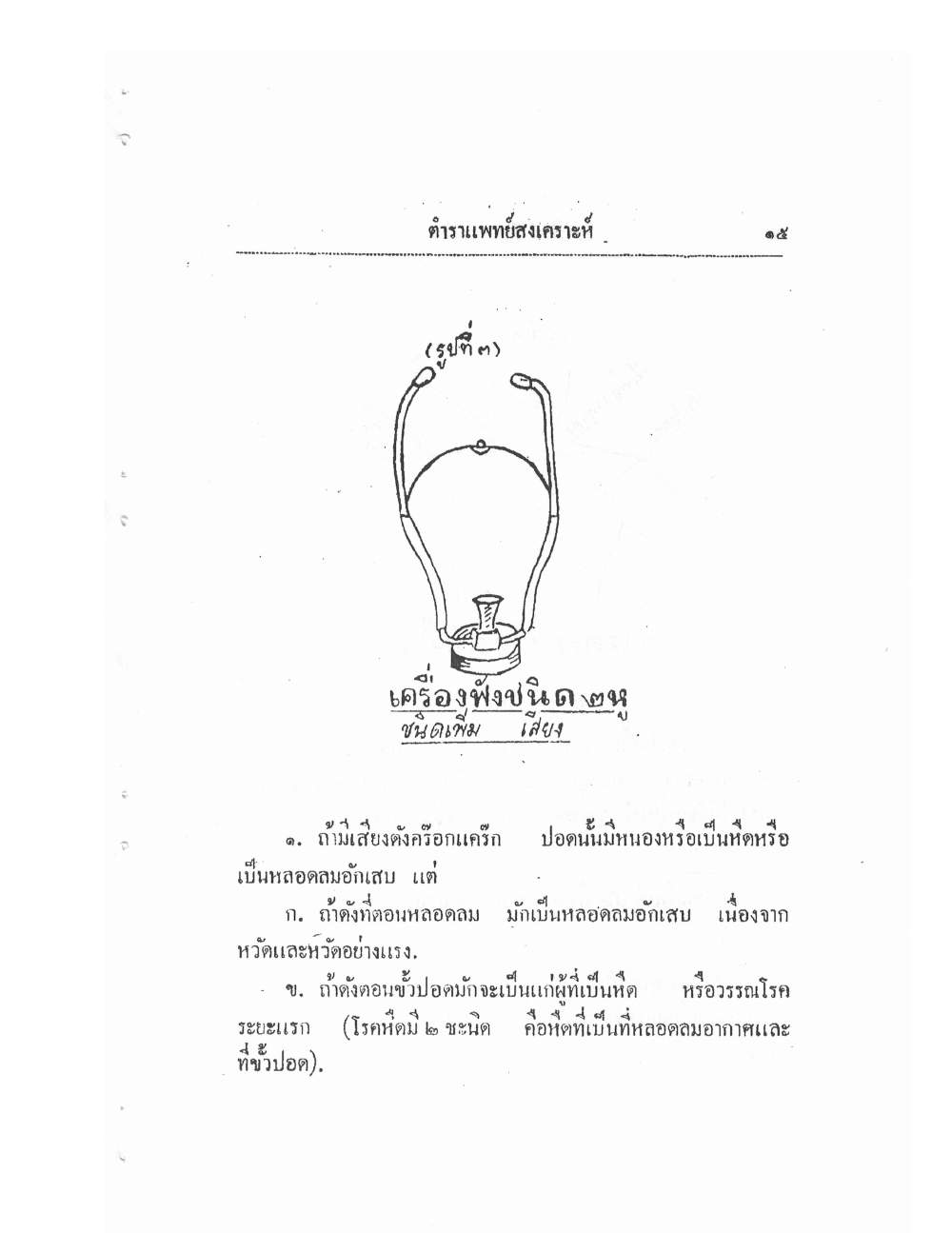
แพทย์ทุกๆคนจำเป็นยิ่ง ที่จะต้องมีเครื่องพึง เครื่องพึงนี้ มี ๒ ชนิด
ก. ชนิด หูเดียว.
ข. ชนิด สองหู.
แต่ชนิด ๒ หู ยังมีชนิดเพิ่มเสียง และชนิดที่มีกราฟบันทึก การเต้นของหัวใจได้.
ประโยชน์ของมันคือ เพื่อพึงอาการชำรุด หรือการเปลี่ยนแปลง ของปอดและหัวใจ พึงดูอาการบวมที่มีหนอง พึงหัวใจทารกในครรภ์ เพื่อทราบความเป็นอยู่ของทารกในครรภ์.
ก. ตรวจปอด
เราใช้เครื่องพึงๆปอด เพื่อพึงให้ทราบว่าปอดปกติดีหรือไม่ เพราะปอดของมนุษย์ประกอบด้วยถุงลมจำนวนมิใช่น้อย การตรวจ ให้ใช้เครื่องพึงๆที่หน้าอก ด้านข้างซ้าย ขวา ข้างหลังที่ใต้สะบัก และที่ซอกไหปลาร้า และให้คนไข้หายใจยาวๆสั้นๆ ฉะนั้น. (ดูรูปที่ ๓)
14 Watthana Phanit Press -------------------------------------------------- ...the air sacs in the lungs expand and contract, and the lungs press against the ribs as well; or when listening to the heart, observe the closing of the heart valves; the blood, and the strength of the heart muscle as it pumps the blood — sounds of various kinds for that condition will be made evident for every disease in which the listening instrument is used. At the time of using the listening tube, press the mouth of the tube snugly against the skin; if there is an air leak the sound will not be reliable, and the tubing and chest-piece must have nothing touching them, such as cloth, for example, which would certainly cause the sound to be distorted.
It is very necessary for every physician to have a listening instrument. This instrument comes in 2 kinds:
a. The single-ear type.
b. The two-ear type.
But besides the 2-ear type, there is also a sound-amplifying type, and a type that can graph/record the beating of the heart.
Its uses are: to listen for signs of deterioration, or changes, in the lungs and heart; to listen for a swelling that has pus; to listen to the heartbeat of a fetus in the womb, in order to know the wellbeing of the fetus in the womb.
a. Examining the lungs
We use the listening instrument on the lungs, in order to listen and find out whether the lungs are normal or not, because the lungs of a human being are made up of no small number of air sacs. For the examination, use the listening instrument at the chest, on the left and right sides, on the back below the shoulder blades, and at the hollow of the collarbone, and have the patient breathe in long and short breaths accordingly. (See Figure 3)
๑๕ ตำราแพทย์สงเคราะห์ --------------------------------------------------
[diagram: (รูปที่ ๓) a two-eared (binaural) listening instrument — two earpieces at the top connected by curved tubes down to a single chest-piece at the bottom; captioned "เครื่องฟังชนิด ๒หู" / "ชนิดเพิ่มเสียง"]
๑. ถ้ามีเสียงดังครืดแคร็ก ปอดนั้นมีหนองหรือเป็นหืดหรือ เป็นหลอดลมอักเสบ แต่
ก. ถ้าดังที่ตอนหลอดลม มักเป็นหลอดลมอักเสบ เนื่องจาก หวัดและหวัดอย่างแรง.
ข. ถ้าดังตอนขั้วปอดมักจะเป็นแก่ผู้ที่เป็นหืด หรือวรรณโรค ระยะแรก (โรคหืดมี ๒ ชนิด คือหืดที่เป็นที่หลอดลมอากาศและ ที่ขั้วปอด).
15 Textbook of Medical Aid [ตำราแพทย์สงเคราะห์] --------------------------------------------------
[diagram: (Figure 3) a two-eared (binaural) listening instrument [stethoscope] — two earpieces at the top connected by curved tubes down to a single chest-piece at the bottom; captioned "Two-eared type listening instrument" / "Sound-amplifying type"]
1. If there is a crackling, rattling sound, that lung has pus, or is asthmatic, or is bronchitis; however:
a. If it sounds at the bronchial-tube area, it is usually bronchitis, due to a cold or a severe cold.
b. If it sounds at the root of the lung, it is usually found in one who has asthma, or has consumption [tuberculosis] in its first stage. (There are 2 kinds of asthma: asthma at the air passages, and [asthma] at the root of the lung.)
๑๖ โรงพิมพ์วัฒนาพานิช --------------------------------------------------
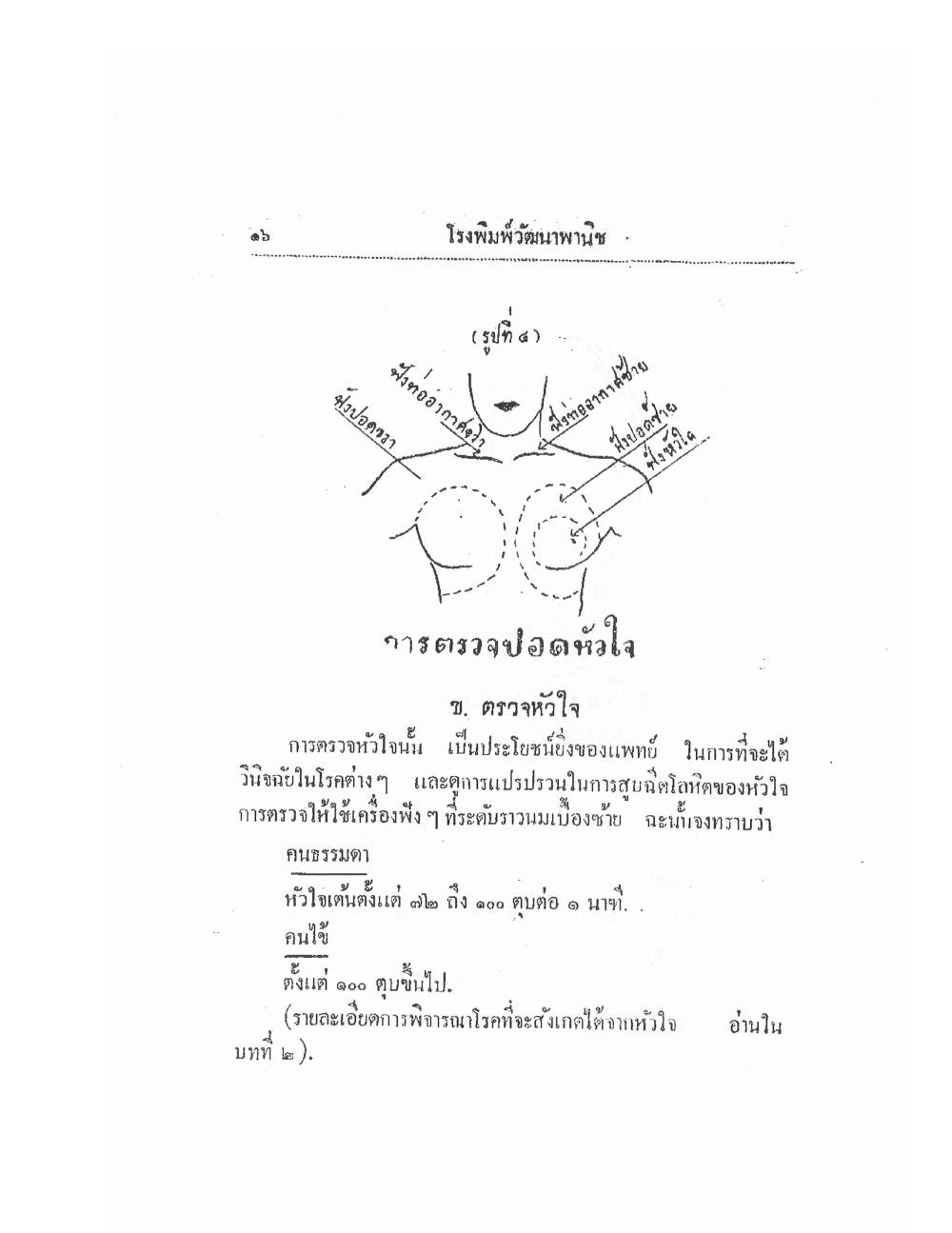
[diagram: (รูปที่ ๔) front view of the chest and shoulders, with lines pointing to labeled listening positions on the chest — right lung, left air passage, left lung, and the heart — captioned below "การตรวจปอดหัวใจ"]
ข. ตรวจหัวใจ
การตรวจหัวใจนั้น เป็นประโยชน์ยิ่งของแพทย์ ในการที่จะได้ วินิจฉัยในโรคต่างๆ และดูการแปรปรวนในการสูบฉีดโลหิตของหัวใจ การตรวจให้ใช้เครื่องพึงๆที่ระดับราวนมเบื้องซ้าย ฉะนี้จะทราบว่า
คนธรรมดา หัวใจเต้นตั้งแต่ ๗๒ ถึง ๑๐๐ ตุบต่อ ๑ นาที. คนไข้ ตั้งแต่ ๑๐๐ ตุบขึ้นไป. (รายละเอียดการพิจารณาโรคที่จะสังเกตได้จากหัวใจ อ่านใน บทที่ ๒).
16 Watthana Phanit Press --------------------------------------------------
[diagram: (Figure 4) front view of the chest and shoulders, with lines pointing to labeled listening positions on the chest — right lung, left air passage, left lung, and the heart — captioned below "Examining the lungs and heart"]
b. Examining the heart
Examining the heart is of great use to the physician, in being able to diagnose various diseases, and to observe irregularities in the heart's pumping of blood. For the examination, use the listening instrument at the level of the left nipple line; in this way one will know that:
An ordinary person the heart beats from 72 to 100 beats per 1 minute. A patient from 100 beats upward. (For details on the diseases that can be observed from the heart, read in Chapter 2).
๑๗ ตำราแพทย์สงเคราะห์ --------------------------------------------------
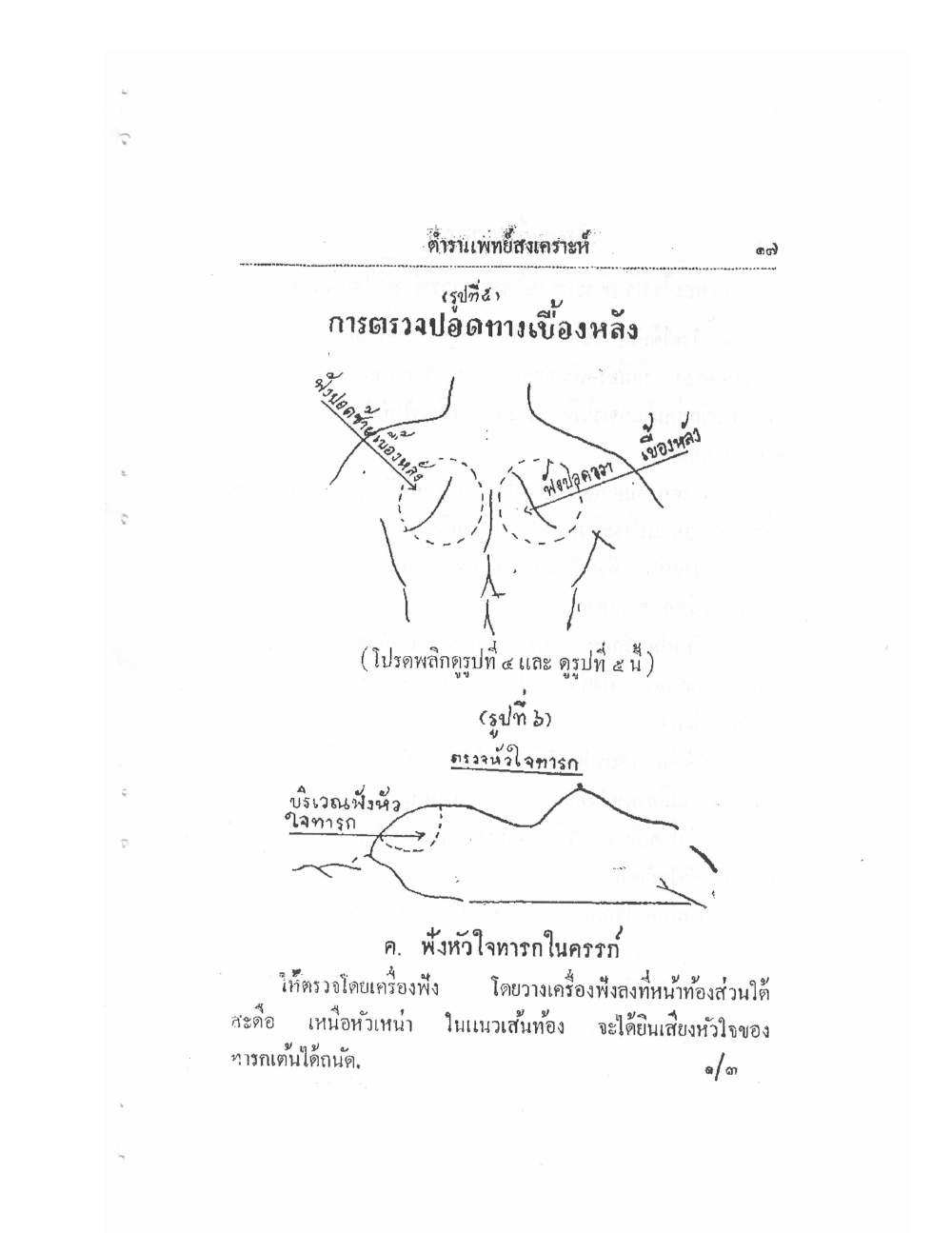
[diagram: (รูปที่ ๕) การตรวจปอดทางเบื้องหลัง — rear view of the shoulders and upper back, with dashed circles below each shoulder blade and arrows labeled for listening to the right lung from behind and the left lung]
(โปรดพลิกดูรูปที่ ๔ และดูรูปที่ ๕ นี้)
[diagram: (รูปที่ ๖) ตรวจหัวใจทารก — side profile of a pregnant abdomen, with a dashed circle near the top of the curve labeled "บริเวณฟังหัวใจทารก" (area for listening to the fetal heart), an arrow pointing to it]
ค. พึงหัวใจทารกในครรภ์
ให้ตรวจโดยเครื่องพึง โดยวางเครื่องพึงลงที่หน้าท้องส่วนใต้ สะดือ เหนือหัวเหน่า ในแนวเส้นท้อง จะได้ยินเสียงหัวใจของ ทารกเต้นได้ถนัด. ๑/๓
17 Textbook of Medical Aid [ตำราแพทย์สงเคราะห์] --------------------------------------------------
[diagram: (Figure 5) Examining the lungs from behind — rear view of the shoulders and upper back, with dashed circles below each shoulder blade and arrows labeled for listening to the right lung from behind and the left lung]
(Please turn back and look at Figure 4, and also look at this Figure 5)
[diagram: (Figure 6) Examining the fetal heart — side profile of a pregnant abdomen, with a dashed circle near the top of the curve labeled "area for listening to the fetal heart," with an arrow pointing to it]
c. Listening to the fetal heart in the womb
Examine using the listening instrument, by placing it on the front of the abdomen, below the navel, above the pubic bone, along the midline of the abdomen; one will clearly hear the sound of the fetus's heart beating. [printer's signature mark: 1/3]
๑๘ โรงพิมพ์วัฒนาพานิช -------------------------------------------------- โรคอะไรบ้างที่จะทราบได้จากการฟังหัวใจและปอด
๑. โรคไข้หัด, ไข้หวัด, ไข้รากสาด, จะมีเสียงที่ปอดในเวลา ฟังด้วยเครื่อง มีเสียงคล้ายท่อลม และจะได้ยินเสียงหวีดๆอยู่ทั่วไป เคาะด้วยมือที่หน้าอกจะมีเสียงดังก้อง เสียงฟังหัวใจเวลาหายใจออก จะยาวกว่าปกติ.
๒. โรคถุงลมหย่อน เวลาไอ เสมหะยังไม่ออกจะมีเสียงทึบ เมื่อเสมหะออกแล้วจะมีเสียงโปร่งเหมือนเป็นโพรง.
๓. โรคหืด ฟังจะได้ยินเสียงเวลาหายใจเข้าถี่ หายใจออกยาว เสียงปอดครืดแคร็กเสมอ.
๔. โรคปอดอักเสบ โรคผอมแห้ง. ไตอักเสบ, โรคหัวใจ พิการ, โรคสมอง, ฟังหัวใจจะมีเสียงลมหายใจ เป็นเสียงดังฟุดๆ และเสียงเบียกๆ.
๕. ไข้พิษ เสียงปอดดังทึบ หัวใจเต้นรัว แต่เสียงลมหายใจ ดังผิดปกติ มีเสียงหายใจออกยาว หายใจเข้าสั้น.
๖. ไข้ปวดเมื่อย ไข้อีดำอีแดง เสียงหัวใจเต้นไม่สม่ำเสมอ เสียงล้นในหัวใจรัวสั่น.
๗. ถุงหุ้มหัวใจอักเสบ มักจะเป็นแก่คนไข้ในโรค (๑) วรรณโรค. (๒) ไข้ปวดเมื่อย. (๓) ไข้ตะวันออก. (๔) ไตอักเสบ.
18 Watthana Phanit Press -------------------------------------------------- What diseases can be recognized from listening to the heart and lungs
1. Measles, cold/flu fever, typhoid fever — there will be a sound in the lungs when listening with the instrument; the sound resembles [air in] a tube, and one will hear wheezing sounds throughout. Tapping with the hand on the chest will produce a resonant sound. The sound of the heart, when heard on breathing out, will be longer than normal.
2. Emphysema ["loose air-sac" disease] — when coughing, before the phlegm comes out there is a dull sound; once the phlegm has come out there will be a hollow, resonant sound as if there were a cavity.
3. Asthma — listening, one will hear on breathing in a rapid sound, on breathing out a long sound; the lung sound is a constant crackling/rattling.
4. Pneumonia, wasting disease [consumption/emaciation], nephritis, heart disease, brain disease — listening to the heart there will be a breath sound, a puffing sound, and a rasping sound.
5. Poison fever — the lung sound is dull, the heart beats rapidly, but the breath sound is abnormal, with a long exhale and a short inhale.
6. Aching fever [rheumatic fever], the "black-and-red" fever [a traditional term for a measles/scarlet-fever-type rash illness] — the heart beats irregularly, with a fluttering, trembling, overflowing sound in the heart.
7. Pericarditis [inflammation of the sac around the heart] usually occurs in patients with the disease: (1) Consumption [tuberculosis]. (2) Aching fever. (3) "Eastern-sun" fever [a named traditional fever]. (4) Nephritis.
๑๙ ตำราแพทย์สงเคราะห์ -------------------------------------------------- คนไข้จะรู้สึกอกที่ช่องซี่โครง ๓-๔ ด้านตรงหัวใจ ความร้อนสูง ฟังดูจะได้ยินเสียงติดขัดเสียดสีกัน เสียงหัวใจเต้นเบาอ่อน.
๘. โรคปวดเมื่อยของสตรี, โรคลมขัดข้อ, บวม, บิดสวาะ เป็นหนอง ใช้มือคลำที่หน้าอกด้านซ้ายตรงหัวใจ จะรู้สึกสะเทือน ครืดๆ ใช้มือเคาะจะมีเสียงร้องกินบริเวณทางขวาของกระดูกหน้าอก ใช้เครื่องพึงที่ปลายหัวใจ (ใต้ราวนม) จะได้ยินเสียงครืดๆ ชีพจร อ่อนเบา ไม่สม่ำเสมอ เสียงปอดขัดๆ.
๙. โรคถุงหัวใจอักเสบ เป็นแก่คนไข้ที่เป็นไข้พิษบางอย่าง เนื่องจาก บุหรี่, สุรา, โรคขลาดกลัว, ชีพจรเต้นเร็วไม่สม่ำเสมอ เสียงปอดฟังขัดๆ.
๑๐. โรคต่อไปนี้ ที่จะตรวจได้ทางชีพจร ว่าผิดปกติ คือ
(๑) โรคปวดศีรษะและโรคสมอง และโรคสมองถูก กะทบกะเทือน.
(๒) ธาตุเสีย.
(๓) โรคหัวใจพิการ.
(๔) ถูกยาพิษ หรือเสพยาเสพติด.
๑๑. สาเหตุที่หัวใจเต้นเร็วมาก เนื่องจาก
(๑) ไข้ธรรมดา.
(๒) โรคต่อมอักเสบ.
(๓) โรคขลาดกลัว.
ฯลฯ
19 Textbook of Medical Aid [ตำราแพทย์สงเคราะห์] -------------------------------------------------- The patient will feel [pain in] the chest, at the 3rd-4th intercostal space, on the side over the heart; with a high fever, listening one will hear a catching, rubbing sound; the heart sound beats faint and weak.
8. Women's aching-pain disease [rheumatism], joint-obstruction wind disease, swelling, dysentery with pus — using the hand to palpate the chest on the left side over the heart, one will feel a rubbing vibration; tapping with the hand will produce a sound that carries over the area to the right of the breastbone. Using the listening instrument at the apex of the heart (below the nipple line), one will hear a rubbing sound; the pulse is faint and weak, irregular; the lung sound is catching/obstructed.
9. Endocarditis [inflammation within the heart] occurs in patients who have certain kinds of poison fever, due to tobacco, alcohol, [or] a fear-related disorder [neurosis]; the pulse beats fast and irregularly, the lung sound on listening is catching/obstructed.
10. The following diseases can be detected as abnormal through the pulse, namely:
(1) Headache disease and brain disease, and brain [disorder from] being struck/concussed.
(2) A disordered constitution/humors [ธาตุเสีย].
(3) Heart disease/disorder.
(4) Being poisoned, or using addictive drugs.
11. Causes of a very rapid heartbeat, due to:
(1) An ordinary fever.
(2) Glandular inflammation disease.
(3) A fear-related disorder [neurosis].
etc.
๓๒. สาเหตุที่หัวใจเต้นช้า.
(๑) คนคลอดบุตร. (๒) แรกหายจากไข้พิษ หรือไข้อย่างแรง. (๓) โรคน้ำดีสร้าน. (๔) โรคสมอง. (๕) โลหิตจาง โลหิตน้อย โลหิตปกติโทษต่าง ๆ. (๖) เหนื่อยอ่อน.
ฯลฯ
๔. ตรวจด้วยการเคาะ
วิธีเคาะนั้น ให้เอานิ้วมือซ้ายคว่ำมือลงบนหนัง แล้วเอานิ้วกลางมือขวาเคาะบนหลังมือของตน จะได้ยินเสียงทึบโปร่งตามที่ใต้นิ้วตรงนั้น ใช้เคาะท้องเสียงโปร่งเป็นลมอยู่ข้างใน รู้ว่าท้องขึ้นเป็นต้น.
ตรวจอุจจาระ, บัสสาวะ,
ก. อุจจาระ ๑. สีดำ, แดง, เป็นเมือกคาว, มักเป็นด้วยโรคไข้รากสาด, บิดทุกชะนิด, ไข้พิษ, ไข้กาฬ, อธิสาร, ธาตุพิการ. ๒. สีขาวเถ้า เป็นมูลโค เนื่องจากธาตุหย่อน โรคทรางเด็ก โรคไข้กาฬ,
32. Causes of a slow heartbeat.
(1) A woman who has just given birth. (2) One newly recovered from a poison-fever, or from a severe fever. (3) A disorder of leaking/overflowing bile. (4) A brain disorder. (5) Various disorders of thin blood, low blood, or blood of abnormal character. (6) Fatigue and weakness.
Etc.
4. Examination by tapping
The method of tapping: lay the left hand palm-down on the skin, then tap the back of one's own hand with the middle finger of the right hand. One hears a dull or hollow sound depending on what lies beneath the finger at that spot. Tapping the abdomen and hearing a hollow sound shows there is wind (gas) inside — this tells that the belly is distended, and so on.
Examining the stool and urine,
A. Stool 1. Black or red in color, mucus-like and foul-smelling — usually occurring with typhoid-type fever, every kind of dysentery, poison-fever, black/plague fever, diarrhea, or disordered bodily elements. 2. Ash-white in color, like cow dung, due to weakened elements — in children's thrush-disease, in plague fever,
๓. สีเหลือง เขียว เนื่องจากดีพิการ ในโรคไข้ป่า, ไข้บ้าง, อธิสาร.
ฯลฯ ฯลฯ
ข. บัสสาวะ ๑. สีแดงจัด เนื่องจากไข้เพื่อดีและโลหิต เช่น ไข้ป่า, บ้าง. ๒. สีเหลืองแก่ เนื่องจากไตพิการ ในโรคไตพิการ, ไข้รากสาด, ไข้พิษ, และโรคเบาหวาน ฯลฯ.
ตรวจดูลิ้น, ตา, ปาก.
ก. ลิ้น ๑. ลิ้นเป็นฝ้าละออง มักเนื่องจากไข้ธรรมดา โรคลำไส้พิการ กะเพาะอาหารและธาตุพิการ และในไข้พิษ. ๒. ลิ้นแตกแห้งเป็นเม็ดเป็นขุม เนื่องจากธาตุพิการ ไข้พิษ, ไข้ป่า, ไข้บ้าง, ไข้รากสาด. ๓. ไข้กาฬ ที่ลิ้นจะเห็นเม็ดกาฬ. ๔. น้ำลายพิการ ทำให้ลิ้น, ปากเปื่อย.
ข. ตาทั่วไปสำหรับคนไข้ ๑. ตาซีดขาวโรย ที่เปลือกตาเผือดดำ บางรายตาเขียวขุ่นมัว เนื่องจากโลหิตน้อย น้ำดีพิการ และวิ่งประสาทพิการ โรคนอนไม่หลับ ไข้จับทุกชะนิด.
3. Yellow or green [stool], due to a disordered gall/bile — in malarial fever, intermittent fever, diarrhea.
Etc. Etc.
B. Urine 1. Deep red in color, due to a fever affecting the bile and blood, such as malarial fever, intermittent fever. 2. Deep yellow, due to disordered kidneys — in kidney disorder, typhoid-type fever, poison-fever, and diabetes, etc.
Examining the tongue, eyes, mouth.
A. Tongue 1. The tongue is coated with a fine film, usually due to an ordinary fever, disordered intestines, disordered stomach and bodily elements, and in poison-fever. 2. The tongue is cracked and dry, forming small nodules or pits, due to disordered bodily elements, poison-fever, malarial fever, intermittent fever, typhoid-type fever. 3. In plague fever, black spots will be seen on the tongue. 4. Disordered saliva causes the tongue and mouth to become sore/ulcerated.
B. The eyes generally, in a patient 1. Eyes pale, white, and wasted, the eyelids discolored dark; in some cases the eyes are cloudy, murky green — due to low blood, disordered bile, and disordered nerves, insomnia, and every kind of intermittent fever.
ค. ปาก ๑. ปากเหม็น เนื่องจากโรคฟัน โรคอาหาร และธาตุพิการ น้ำลายพิการ. ๒. ปากแตกระแหง เนื่องจากธาตุพิการ ลมเบาหวาน โลหิตน้อย และไข้ทุกชะนิด.
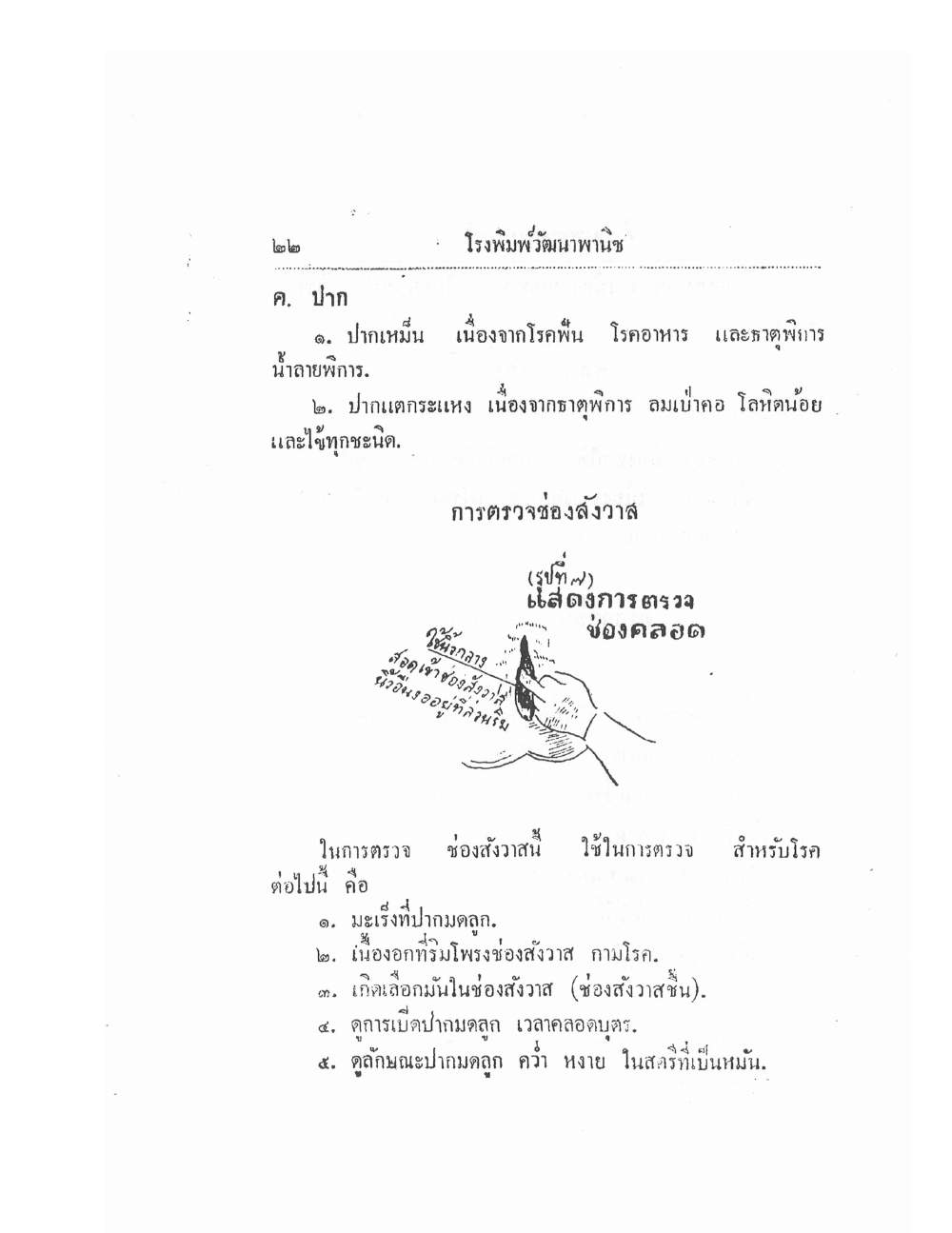
การตรวจช่องสังวาส
(รูปที่ ๗) แสดงการตรวจ ช่องคลอด
[รูปภาพ: มือขวา นิ้วกลางสอดเข้าไปในช่องเปิดสีเข้มรูปรี มีเส้นชี้บอกพร้อมข้อความกำกับว่า "ใช้นิ้วกลาง" ชี้ที่นิ้ว และ "สอดเข้าช่องสังวาสที่นิ้วนางออกอยู่ที่ในริม" ชี้ที่ช่องเปิด]
ในการตรวจ ช่องสังวาสนี้ ใช้ในการตรวจ สำหรับโรคต่อไปนี้ คือ ๑. มะเร็งที่ปากมดลูก. ๒. เนื้องอกที่ริมโพรงช่องสังวาส กามโรค. ๓. เกิดเลือกมันในช่องสังวาส (ช่องสังวาสชื้น). ๔. ดูการเบิดปากมดลูก เวลาคลอดบุตร. ๕. ดูลักษณะปากมดลูก คว่ำ หงาย ในสตรีที่เป็นหมัน.
C. Mouth 1. A foul-smelling mouth, due to dental disease, disease of diet, and disordered bodily elements, disordered saliva. 2. A cracked, chapped mouth, due to disordered bodily elements, "diabetic wind," low blood, and every kind of fever.
Examination of the vaginal canal
(Figure 7) Showing the examination of the birth canal
[figure: a right hand with the middle finger inserted into a dark, oval-shaped opening; caption lines read "use the middle finger," pointing to the finger, and "insert into the vaginal canal, with the ring finger resting at the rim," pointing to the opening]
This examination of the vaginal canal is used to check for the following conditions: 1. Cancer at the mouth of the womb (cervix). 2. A growth at the rim of the vaginal-canal cavity, venereal disease. 3. Formation of a mucus-like discharge in the vaginal canal (a "moist" vaginal canal). 4. Observing the dilation of the cervix at the time of childbirth. 5. Observing the position of the cervix — inverted or upturned — in a woman who is infertile.
ในการตรวจนี้ แพทย์ต้องให้คนไข้นอนหงายชันเข่า และแบะออกพอสมควร ถ้าแพทย์เข้าทางซ้ายคนไข้ จะเป็นการสะดวกดีมาก โดยเอื้อมมือขวาข้ามถานเนิน ที่ตั้งของช่องสังวาส ใช้นิ้วกลางสอดเข้าไปในช่องสังวาส ส่วนที่เหลืออยู่ ๔ นิ้วนั้นงออยู่ในแถวบริเวณส่วนริมของช่องสังวาส และอย่าลืมว่าแพทย์ต้อง
(๑) ตัดเล็บให้สั้นและไม่คมคาย. (๒) ทาน้ำมันลื่น (แวซลิน) เล็กน้อย. (๓) ควรโกนขน ที่ขึ้นอยู่รอบบริเวณช่องสังวาส ในการคลอดบุตร หรือ ฯลฯ.
(ดูรูปที่ ๗)
เมื่อสอดนิ้วกลางเข้าไปนั้น จะรู้สึกสัมผัส ก. เนื้องอกเป็นเนื้อแข็งกว่าเนื้อในช่องสังวาส อยู่ริมภายในช่องสังวาส มักกลิ่นเน่าจัด ใน โรคเนื้องอกในช่องสังวาส และกามโรคเรื้อรัง. ข. พบเนื้องอกแข็ง และเยิ้มด้วยน้ำเหลือง หนอง ตอนที่ปากมดลูกกลิ่นเหม็นเน่าจัด มีน้ำเหลืองตกมาก ใน โรคมะเร็งที่ปากมดลูก. ค. กลิ่นคาวจัด จนเกือบเน่าเป็นเลือกลื่นคล้ายมุตกิด แต่ไม่มีแผลที่ปากมดลูก ใน โรคเลือกมันในช่องสังวาส หรือช่องสังวาสชื้น. ง. จะพบปากมดลูกเบิดกว้าง ประมาณเท่าเงินเหรียญขนาดใหญ่ หรือประมาณ ๔ เซ็นติเมตร ในการตรวจ การคลอดทารก แสดงว่า
For this examination, the physician must have the patient lie face-up with the knees bent and the legs spread apart to a reasonable degree. If the physician approaches from the patient's left side, this will be very convenient, reaching the right hand across the mound where the vaginal canal is located, and using the middle finger to insert into the vaginal canal; the remaining four fingers curl and rest around the rim area of the vaginal canal. And the physician must not forget to:
(1) Cut the fingernails short and not sharp. (2) Apply a little lubricating oil (vaseline). (3) Shave the hair growing around the area of the vaginal canal, for childbirth, or etc.
(See Figure 7)
When the middle finger is inserted, one will feel by touch: A. A growth of tissue harder than the tissue of the vaginal canal, at the inner rim of the vaginal canal, usually with a strong rotten smell — in a case of a growth in the vaginal canal, or chronic venereal disease. B. A hard growth found, oozing with clear fluid and pus, at a time when the cervix has a strong foul, rotten smell with heavy discharge — in cancer of the cervix. C. A strong fishy smell, almost rotten, like a slippery discharge resembling leucorrhoea, but with no wound at the cervix — in the condition of a mucus-like discharge in the vaginal canal, or a "moist" vaginal canal. D. One finds the cervix dilated wide, about the size of a large coin, or about 4 centimeters, on examination during childbirth — this indicates that
ทารกจะคลอดในไม่ช้า (๕-๑๐ นาที)
จ. ดูลักษณะปากมดลูก คว่ำ หงาย ในสตรีที่เป็นหมัน! จะพบมดลูกคว่ำลงหรือหงายขึ้น แต่โดยมากคว่ำงอจะงอยปากมดลูก ไม่ทำการรับการสืบพันธุ์ โดยเต็มตัว,
ลักษณะส่วนช่องสังวาส
ช่องสังวาสเป็นช่องล้อมรอบไปด้วยส่วนกล้ามเนื้อ และส่วนริมเป็นช่องกลมพุ่งตรงไปยังปากมดลูก เนื้อภายในช่องสังวาสเป็นเนื้อกลับ ๆ ซับซ้อน และเต็มไปด้วยประสาท รู้สึกอย่างรวดเร็วอยู่ทั่วไป ที่ปากช่องคลอดจะมีเนื้อ ๑ ก้อน. เป็นที่ขวางทางของช่องสังวาสในระยะแรก และเป็นที่นำความรู้สึกในระยะต้น.
ส่วนปากมดลูก เมื่อใช้นิ้วคลำจะรู้สึกกลมแข็งพอสมควร คล้ายปลายจมูก มดลูกนี้มีการเคลื่อนไหวตัวได้ มีความรู้สึกโดยว่องไว คลายปากมดลูกเผยออกได้อย่างรวดเร็ว ลักษณะเกือบคล้ายขนมจีบ.
ตามปกติภายในช่องสังวาส หล่อเข้มไปด้วยน้ำ หล่อชุ่มพอสมควร
วิธีตรวจโรค จบ
~~~~~~~~
the infant will be born soon (5–10 minutes).
E. Observing the position of the cervix — inverted or upright — in a woman who is infertile! One may find the womb tilted down or tilted up, but mostly, when tilted, the cervix curls in such a way that it does not fully receive/undergo reproduction.
Features of the parts of the vaginal canal
The vaginal canal is a passage surrounded by muscular tissue, its rim forming a round passage leading straight to the cervix. The tissue inside the vaginal canal is folded and complex, and full of nerves, sensing very quickly throughout. At the mouth of the birth canal there is a single lump of tissue — this obstructs the passage of the vaginal canal in its early portion, and is what conveys sensation in that early portion.
As for the cervix, when probed by finger it feels reasonably round and firm, similar to the tip of a nose. This part of the womb is capable of movement and has quick sensation, and the cervix can open/dilate rapidly — its character is almost like a folded dumpling.
Normally, the interior of the vaginal canal is kept moist with fluid, sufficiently lubricated.
End of the methods of examination
~~~~~~~~
คัมภีร์ฉันทศาสตร์
พระยาวิชยาธิบดี (กล่อม) เจ้าเมืองจันทบุรี เรียบเรียงขึ้นใหม่
·ํ·<•◇◈◇•>·ํ·
จะกล่าวเภทซึ่งพจรจำ เตือนขึ้นค่ำฝ่าบาทา เร่งรีบให้กินยา ตามตำราสะดวกดี ๒ ค่ำอยู่หลังบาท อาจสามารถแก้โรคี กินยาสะดวกดี ตามคัมภีร์ที่มีมา ๓ ค่ำอยู่ศีรษะ ชัยชนะแก่โรคา เร่งถ่ายเร่งผายยา ดินักหนาอย่าสงสัย ๔ ค่ำประจำแขน ตามแบบแผนอันพึงใจ ผายยามิเป็นไร โรคใด ๆ อันตรธาน ๕ ค่ำประจำลิ้น ยาที่กินเล่นเฉี่ยวฉาน วาโยย่อมกล้าหาญ ขึ้นตามตนราเอาเจียน ๖ ค่ำย่อมเรียงราย ทั่วทั้งกายให้คลื่นเหียน ป่วนปั่นให้วิงเวียน ย่อมคลี่เตียนตำรายา ๗ ค่ำประจำเช้ง ตามลำแหน่งให้ผายยา ระงับดับวาตา ในอุราไม่แดกดัน ๘ ค่ำอยู่ห้องน้อย ระย่ำย่อยห้ามกวดขัน กำเริบทุกสารพัน ตำรานั้นว่ามีค่า ๙ ค่ำประจำมือ เร่งนับถือเป็นสุขขี ระงับดับโรคี จำเริญศรีอายุนา ๑๐ ค่ำประจำก้น ดิ้นพ้นต้องตำรา ชนะแก่โรคา ตับวาตาถอยลงไป ๑๑ ค่ำประจำพื้น ซึ่งห้ามนั้นอย่าสงสัย มักรากลำบากใจ โรคภายในกำเริบมา ๑๒ ค่ำประจำคาง อย่าระวางในตำรา กำเริบรายโรคา อย่าวางยาจะถอยแรง ๑๓ ค่ำอยู่ขาดี อันโรคีอย่าระแวง ทั้งโรคร้ายก็หน่ายแหนง อย่าควรแคลงเร่งวางยา ๑๔ ค่ำประจำหลัง อย่าพลาดพลั้งเร่งศึกษา ๑๕ ค่ำประจำใจ ท่านกล่าวไว้สำหรับชาย อย่าประจุอย่ารุถ่าย อย่า
๑/๔
The Treatise of Metrical Medicine (Khamphi Chandasat)
By Phraya Wichayathibodi (Klom), Lord of the City of Chanthaburi Newly compiled
·ํ·<•◇◈◇•>·ํ·
Let it be told of the fevers reckoned by night-watch: as evening darkens toward the feet, hasten to give medicine according to the convenient treatise. The 2nd watch lies behind the foot — able to cure illness; give medicine conveniently according to the treatise handed down. The 3rd watch lies at the head — victory over illness; hasten to purge, hasten strongly to give a laxative, without doubt. The 4th watch is assigned to the arms, following the pattern that is fitting; giving the medicine will do no harm — any illness whatsoever will vanish. The 5th watch is assigned to the tongue — medicine taken carelessly goes astray; the Wind-element grows bold and rises of its own course, cutting off [normal function]. The 6th watch spreads through the whole body, causing nausea, churning and dizziness; one should lay the treatise's medicine out plainly. The 7th watch is assigned to [เช้ง, an uncertain bodily site] — give medicine according to its place, to quell and extinguish the Wind so it does not thrust in the chest. The 8th watch lies in the small chamber [of the body] — restrain it firmly, for every disorder tends to flare; the treatise says this watch has great value. The 9th watch is assigned to the hand — hasten to hold it in honor as bringing well-being, quelling illness, and prospering glory and long life. The 10th watch is assigned to the buttocks — struggling free requires the treatise; victory over illness, as the liver-Wind recedes. The 11th watch is assigned to the sole [of the foot], which is forbidden without doubt — it tends to cause difficult vomiting, and internal disease will flare. The 12th watch is assigned to the chin — do not neglect this in the treatise; when illness flares, do not give medicine, or its strength will recede. The 13th watch lies at the sound leg — do not be suspicious of the patient, and even with a severe illness do not grow weary of it — do not hesitate, hasten to give medicine. The 14th watch is assigned to the back — do not err, hasten to study it. The 15th watch is assigned to the heart/mind — it is said to apply to men — do not overload, do not force purgation, do not
1/4
[Note: this page is classical verse using archaic pharmacological vocabulary (e.g. เช้ง); uncertain terms are kept in Thai alongside an approximate sense rather than a invented precise identification.]
มักง่ายว่าตามมี้ แรม ๑ ค่ำจำใส่ใจ ประจำใต้ฝ่าตีนดี ๒ ค่ำประจำที่หลังตีนมือายุนา ๓ ค่ำอยู่สะดือ อย่านับถือมักรากรา ๔ ค่ำอยู่ทันตา จะมรณาม้วยบรรลัย ๕ ค่ำประจำลิ้น ห้ามยากินรากพ้นไป ๖ ค่ำอยู่เศียรไซร้ ดับโรคภัยสิ้นทั้งปวง ๗ ค่ำประจำตัว ย่อมเกรงกลัวป่ะทะทรวง ๘ ค่ำว่าหนักหน่วง อยู่ในทรวงย่อมจะตาย ๙ ค่ำประจำคาง เป็นปานกลางกลืนถงสาย ๑๐ ค่ำอยู่แขนสะบาย ลงง่ายดายเร็วหนักหนา ๑๑ ค่ำประจำมือ เร่งนับถือตามตำรา ๑๒ ค่ำอยู่นาสา หายโรคาอย่าสงสัย ๑๓ ค่ำประจำกรรณ พยาธินั้นสิ้นศูนย์ไป ๑๔ ค่ำอยู่ปากไซร้ ห้ามมากไว้สิ้นชีวี ๑๕ ค่ำอยู่คอ จงรั้งรอตามวิธี กินยาว่ามิดี ห้ามทั้งนี้ตามตำรา ชีพจรนี้สำคัญ ทั้งขึ้นนั้นแลแรมหนา เหมือนกันดังกล่าวมา จะผายยาตูให้ดี โบราณท่านตั้งไว้ คัมภีร์ไซร้สำหรับมี้ ดับพยาธิโรคี อายุยืนเจริญเอย ฯ
บัดนี้จะกล่าวแถลง ให้รู้แจ้งแห่งธาตุหนอ สังเขปไว้แต่ย่อ ๆ พอเป็นอย่างทางเล่าเรียน ผู้ใดได้พบเห็น อย่าล้อเล่นแลติเตียน ด้วยข้าอุตส่าห์เพียร จึงได้เขียนเป็นตำรา จักกล่าวตามลักษณะ ชื่อรัตนธาตุทั้งห้า อาจารย์ท่านพรรณนา คัดออกมาจากโรคนิทาน ลักษณะนั้นมีห้า เป็นธรรมดาแต่โบราณ คือธาตุนั้นพิการ กำเริบแลหย่อนไป หนึ่งเล่าคือธาตุแตก เป็นแผนกนับออกไว้ ธาตุออกจากกายไซร้ สังเขปได้ ๕ ประการ ฯ
จะกล่าวธาตุปถวี โทษยี่สิบสองสถาน อาพาธนั้นบันดาลให้เจ็บปากแลเจ็บฟัน ผมร่วงเจ็บในสมอง หนังหัวพองขนลุกชัน เจ็บหุละแห่งกระดูกใน นาภีนั้นปวดเจ็บไป ปถวีไซร้หย่อนแลนา หนึ่งเล่า
It is easily told as follows: the 1st night-watch, remember it well, is fixed under the sole of the foot. The 2nd watch is fixed at the back of the hand — [for] long life. The 3rd watch lies at the navel — do not trust it, it tends to cause vomiting. The 4th watch is at the eyes/teeth — [neglect] will bring death. The 5th watch is fixed at the tongue — forbid giving medicine, lest vomiting follow. The 6th watch lies at the head — it extinguishes illness entirely. The 7th watch is fixed at the body — one should fear it striking the chest. The 8th watch is said to be heavy, lodging in the chest — one may well die. The 9th watch is fixed at the chin — of middling severity, causing choking. The 10th watch is at the easeful arm — [purgation] descends easily and very quickly. The 11th watch is fixed at the hand — hasten to honor it according to the treatise. The 12th watch is at the nose — illness is cured, without doubt. The 13th watch is fixed at the ear — disease vanishes entirely. The 14th watch is at the mouth — do not give too much, or life will end. The 15th watch is at the throat — hold back according to the method; taking medicine [at this time] is said to be bad — this is forbidden according to the treatise. This pulse-timing is important, in both the waxing and the waning [of the moon] alike, as has been told; one should administer the purgative medicine well. The ancients established this; the treatise indeed serves so as to extinguish disease and illness, and bring long life and prosperity.
Now let it be told, to make known about the elements — summarized only briefly, enough as a manner of instruction. Whoever comes upon this, let him not mock or find fault, for I have labored diligently to write it as a treatise. I shall tell, according to their characteristics, the names of the five precious elements, as the teachers have described them, excerpted from the case-histories of disease. These characteristics are five, as has been customary since ancient times — namely, an element becoming disordered, flaring up or diminishing; and also an element fracturing/breaking, which is classified separately. The elements departing from the body are, in summary, of five kinds.
Let it be told of the earth-element: its disorders number twenty-two. Such affliction causes pain in the mouth and pain in the teeth, hair falling out, pain within the skull, the scalp swelling and the hair standing on end, deep aching in the bones, and pain in the navel area — [these occur] when the earth-element is deficient. Also,
กองปถวี กำเริบมีกำลังมา สิบสามตามสังขยา คือนิทราไม่หลับไหล ให้คลั่งให้เจ็บอก น้ำลายตกกระหายไป ให้เศียรร้าวณภายใน มักโกรธใจให้เจ็บหลัง ขัดหนักแลขัดเบา ท้องนั้นเล่าลั่นเสียงดัง ต่าง ๆ ให้พึงพัง เจ็บกระทั่งถึงทวารเบา ข้อมือแลข้อแขน ตลอดแล่นเมื่อยขบเอา โทษนี้ปถวีเล่า อย่าเบาสุขุมา นัยหนึ่งเมื่อพิการ ให้เจ็บซ่านทั้งกายา ท้องนั้นเจ็บหนักหนา ให้วาตาติขึ้นไป ท้องลั่นเสียงต่าง ๆ เสียดแทงข้างขบตอดใน โทษนี้ปถวีให้ พิการไซร้จึงพิกล นัยหนึ่งปถวีธาตุ เมื่อนิราสออกจากตน เจ็บท้องเป็นสาละวน ท้องขึ้นพ้นผอมเหลืองไป สมมุติว่าริดสีดวง เพศนี้ล่วงจักแปรไป เป็นองค์สูตรไซร้ น้ำมูตรในเป็นเลือดหนอง ให้เสียดสันหลังไป อาหารไซร้มิอยู่ท้อง ป่วนดินคะนอง ให้เร่งยาในหว้าวัน นับหนึ่งปถวีแตก ท่านยกแยกไว้สำคัญ คือโสตทั้งสองนั้น ห่อนได้ยินเสียงเจรจา จักทั้งสองไซร้ รูปสิ่งใดห่อนเห็นนา ผิวเนื้อนั้นเหยียบช้ำ ซีดสากซาเป็นอนิจจัง มีโทษทั้งสามนี้ บังเกิดมีเร่งระวัง ห้าวันจะมรณัง ผู้เป็นแพทย์อย่านอนใจ จักแจ้งอาโปธาตุ เห็นประหลาดก็หย่อนไป อาการสิบเอ็ดให้ ดีพลุ่งไซร้แลเสมหะ บุพโพก้ลามไหล โลหิตไซร้บังเกิดมา ขนชั้นทั่วกายา เกิดน้ำตาให้ลามไหล เสโทแล่น้ำเบา เขฬะเล่าเกิดมากไป ให้สะอึกนอนไม่สนิท หวาดหวั่นจิตต์สะดุ้งไหว คำนึงถึงดอกไม้ รำพึงไปถึงกิเลสกาม เท่านี้เป็นสิบเอ็ด กล่าวสำเร็จแต่ใจความ เรียนรู้เรื่องได้ตาม จึงควรนับว่าแพทย์ดี หนึ่งเมื่อจะพิการ สามสถานให้โทษมี ขัดเบาแลนากี ขึ้นพองแลน้ำกาฬ อาโปเมื่ออันตราย ออกจากกายเปรสถาน ให้จุกแน่นเป็นดาน ส่วนที่ลงก็ไป ขัดหนักแล
When the mass of the earth-element flares up with force, it manifests, according to the reckoning, in thirteen ways — namely: unable to sleep or drift into slumber; causing delirium and chest pain; saliva running and thirst; the head splitting inside; often causing anger together with back pain; difficult urination and difficult defecation; the belly rumbling loudly in various ways such that it can be heard; pain reaching down to the urinary passage; aching and cramping running right through the wrists and forearms. This disorder of the earth-element must not be taken lightly or for granted. In another instance, when it becomes disordered, it causes pain spreading through the whole body; the belly aches severely, wind rises up within, the belly rumbles with various sounds, stabbing and gnawing pain within the sides. This disorder of the earth-element thus causes such strange affliction. In another instance of the earth-element, when it withdraws/departs from the body, it causes recurring stomach-ache, the belly swells while the body grows thin and yellow — presumed to be piles/hemorrhoids, this condition will in time transform into a discharge condition, where the urine becomes mixed with blood and pus, causing shooting pain along the spine; food will not remain in the stomach, churning turbulently, requiring urgent medicine within the day. Count also: when the earth-element fractures, the teachers set this apart as significant — namely, both ears no longer hear any speech at all; and likewise the eyes can no longer perceive any shape; the skin, when pressed, bruises, turns pale, rough, and lifeless — impermanence. When these three symptoms arise together, one must be very careful, for within five days death will follow — let the physician not be complacent. Now to make known the water-element: when it appears strangely diminished, there are eleven symptoms: bile surging up together with phlegm, pus spreading and flowing, blood appearing, the body hair standing on end all over the body, tears flowing forth, sweat and urine [flowing], excessive saliva being produced, hiccupping, restless and unsound sleep, a frightened and startled mind, thoughts turning to flowers, and musing upon sensual desire. These, in total, are the eleven — told here in essence; one who learns and masters these matters thoroughly should indeed be counted a good physician. Also, when it becomes disordered, there are three conditions that produce harm: difficult urination and [an uncertain condition, นากี], swelling, and black/plague-fever discoloration. When the water-element is endangered and departs from the body abnormally, it causes a firm, choking fullness [in the chest]; as for the portion that descends, [it causes] severe difficulty and
ขัดเบา เจ็บหัวเหน่าให้หลงไหล ตกเลือดตกหนองใน ปวดมวนไป เป็นนานา บางคนท้องนั้นผูก กลิ้งเป็นลูกเดกขึ้นมา ให้เสียดสองซ้ายขวา ยากที่จะแก้ไข โรคนี้โบราณกรรม เพศนั้นทำจักแปรไป จะขัดหัวเข่า ให้เจ็บน่องคู่ทั้งสองเป็น หนึ่งธาตุอาโปแตก ท่านยกแยกไว้ให้เห็น อาการฉะเพาะเป็น เกิดวิบัติให้ขัดเบา ลิ้นแข็งลิ้นแห้งไป ตัวเย็นไซร้พร้อมกันเข้า ทั้งสี่ประการเล่า ยังห้าวันจะมรณา ฯ
ลักษณะวาโยไซร้ เมื่อหย่อนไปให้โทษมา สิบสามตามสังขยา คือวาตาวิบัติไป มักถอนใจให้ใหญ่นัก หาวเรอมักผายลมใน เป็นลมทั้นท้องให้ กระบัดไปร้อนหนาวนา ให้ร้อนในทรวงอก กายสั่นงกเท้าหัตถา ลมเล่นทั่วกายา เท้าหัตถานั้นเย็นไป ลมพัดต้องดวงจิตต์ ลมทำพิษให้คลั่งไคล้ สิบสามโทษนี้ให้ วาโยไซร้ผ่อนหย่อนลง วาโยกำเริบคะนอง โทษสิบสองอาการตรง ลิ้นแข็งคอแห้งผง กระหายน้ำเขม่นตา ขนพองสยองเกล้า พันคลอนเล่าขัดนาสา อาหารไม่นำพา เท้าหัตถานั้นเย็นไป ปากแห้งฟันแห้งเล่า จักนับเข้าสิบสองไซร้ วาโยกำเริบให้ เร่งแก้ไขกำเริบมา วาโยพิการเล่า เมื่อท้องเปล่าอาเจียนนา บางคาบอิ่มข้าวปลา จึงอาเจียนคลื่นเหียนไป ท้องนั้นคลอนลมอยู่ พิเคราะห์ดูโทษนั้นไซร้ วาโยพิการให้ ท่านกล่าวไว้เป็นสำคัญ วาโยออกจากตน เกิดพิกลสองหน้นั้น ให้หนักและตึงครัน หนึ่งห้อยนั้นออกจากตา ให้เมื่อยสองหัวเข่า จะเป็นเล่าตะคริวมา จับโป่งโบ่งขึ้นมา เจ็บขัดทรวงเสี้ยวปวดไป มักแปรเป็นผีเอิ้น ร้อนแลเย็นกระบัดให้ สิ้นหลังเมื่อขบไป่ วาโยไซร้ออกจากกาย วาโยเมื่อแตกเล่า หายใจเข้าน้อยหายไป ใจออกมากระบาย ห่อนรู้จักสมปฤถิ์ กลางคืนแลกลางวัน จักมูลนั้นมิสม่ำเสมอ โทษสองประการนี้ ยังสองวันจะมรณา ฯ
...difficulty urinating, pain at the pubic area causing confusion, discharge of blood and pus, colicky pain of various kinds. In some, the belly becomes constipated, rolling up as though a lump has formed, causing stabbing pain on both left and right — difficult to remedy. This disease is of ancient karmic origin; the sexual organ will in time be transformed. It causes soreness in the knee, and pain in both calves as well. This is one instance of the water-element fracturing, which the teachers set apart to make plain; the specific symptoms are: a crisis arises causing difficult urination, the tongue stiffens and dries, the body turns cold all at once — when these four occur together, death follows within five days.
As for the characteristics of the wind-element: when it weakens and produces harm, there are thirteen according to the reckoning — namely, the wind in crisis: frequent, heavy sighing, yawning, belching, and passing wind within, bloating and cramping of the belly, alternating hot and cold spells, heat within the chest, the body trembling, the hands and feet [affected], wind moving throughout the body, the hands and feet growing cold, wind striking the heart/mind, wind causing poison that brings on madness. These thirteen symptoms show the wind-element subsiding and weakening. When the wind-element flares up violently, there are twelve corresponding symptoms: the tongue stiffens, the throat parches and dries, thirst for water, twitching of the eyes, the body hair standing on end and the scalp prickling, dizziness together with nasal congestion, no desire for food, the hands and feet growing cold, the mouth and teeth drying — these are counted among the twelve. When the wind-element flares, hasten to treat the flare-up. As for wind-element disorder: when the stomach is empty, one vomits; at other times, having eaten one's fill of rice and fish, one then vomits with nausea; the belly is disturbed by trapped wind — examine this disorder carefully, for the teachers have declared wind-disorder to be of great significance. When the wind departs from the body, two strange manifestations occur in the face: one causes heaviness and severe tightness; the other issues forth from the eyes, causing aching in both knees, becoming like cramp, swelling up, pain and tightness in the chest and flank, often turning into what is called the "calling ghost," alternating hot and cold spells, wasting away at the back as it gnaws — this is the wind departing from the body. When the wind-element fractures: the in-breath grows shallow and fades, while the out-breath is excessive and dispersing, so that one no longer knows proper balance, day or night; the bodily humor becomes irregular. These two symptoms mean that within two days death will follow.
พรรณนาเตโชไซร้ เมื่อหย่อนไปให้โทษมา ให้ขัดในอุรา ให้แสบไส้ให้ตัวเย็น จะนอนไม่สบาย พลิกขวาซ้ายวิบัติเห็น ต่าง ๆ เพื่อให้เป็น มิใคร่หลับสนิทนาน ครั้นหลับสะดุ้งไหว กายนั้นให้มักรำคาญ มักอยากกินอาหาร ของสดคาวเป็นนานา กินอาหารน้อย ๆ หิวบ่อย ๆ หลายเพลา อาการสิบนี้นา เร่งรู้ไว้ให้ชัดเจน ในเมื่อเตโชธาตุ วิปลาศกำเริบเป็น โทษสิบประการเห็น ให้พื้นแห้งปากแห้งไป ไม่นึกอยากอาหาร นอนแล้วคร้านลุกขึ้นให้ เจ็บสูงมืดมัวไป น้ำตาไหล ไอแห้งเปล่า พอใจอยู่ที่เปลี่ยว อยู่ผู้เดียวอย่าลืมเล่า เจรจาแล้วลืมเล่า ให้เจ็บเร้าระบมกาย เตโชเมื่อพิการ ท้องขึ้นพล่านไม่สบาย ทั้นท้องมิรู้หาย เป็นมองคร่อและไอ ขัดกบวมมือเท้า โทษนี้เล่าเหตุเพราะไฟ พิการเร่งแก้ไข ตามท่านไว้สรรพยา เตโชออกจากกาย ให้ร้อนปลายเท้าหัตถา เจ็บปวดเป็นพิษมา ดังเขี้ยวงาขบตอดตน แปรไปให้บวมเล่า หลังมือเท้าปวดสุดทน แปรไปผุดทั้งตน เป็นเม็ดแดงแลดำมี้ แล้วจมลงทำท้อง ตนเลือดหนองแก่จังดี มือเท้าทั้งสองนี้ ให้เป็นเหน็บชาตายไป โรคนี้ให้เร่งแก้ ดูให้แน่อย่านอนใจ จะเสียมากกว่าได้ เร่งแก้ไขแต่อ่อนมา หนึ่งเล่าเตโชแตก ท่านยกแยกโทษไว้ท้า ปากแห้งแข็งชิวหา เหื่อตกหน้าตาแห้งไป ห่อนรู้จักหน้ากัน หายใจสั้นสะท้อนใน ผิโทษเช่นนี้ไซร้ ยังสามวันจะมรณา อากาศธาตุแตกนั้น ให้หูลั่นกรอกกลอกตา แลดูนิ้วแลหัตถา ห่อนปรากฏจักษุตน โทษสองประการนั้น ยังสองวันชีวาตน จักดับถึงอับจน กล่าวไว้แท้แน่ตำรา กลหนึ่งลักษณะธาตุ เมื่อนิราสจากอาตมา เตโชเจ็ดวารา เร่งวางยาแก้ไขกัน ปถวีเมื่อออกจาก แก้ไขยากแต่ห้าวัน มีพังพัน
Now to describe the fire-element: when it weakens and produces harm, it causes discomfort in the chest, a burning gut, and the body growing cold; one cannot sleep comfortably, turning to the right and left, visibly in distress in various ways because of it, unable to sleep soundly for long; and when one does fall asleep, one startles and stirs, the body generally irritable; one tends to crave food — raw, strong-smelling foods of various kinds — yet eats only small amounts, growing hungry again and again over the course of the day. These ten symptoms should be hastily and clearly recognized. When the fire-element becomes deranged and flares up, ten further symptoms appear: the mouth and gums grow dry, no desire for food, weary and reluctant to rise after lying down, pain and dimness [of vision], tears flowing, a dry, empty cough, contentment only in solitude, being alone yet forgetful, forgetting even what one has just said, and a constant gnawing ache through the body. When the fire-element becomes disordered, the belly swells and churns uncomfortably, persistent bloating that does not resolve, becoming phlegm-cough and coughing, with stiffness and swelling of the hands and feet — this disorder, it is said, is caused by fire; one must hasten to treat the disorder with the full range of medicines as the teachers have set down. When the fire-element departs from the body, it causes heat at the tips of the hands and feet, a poisoned pain as though bitten and gnawed by fangs and tusks; this then turns to swelling, with unbearable pain on the backs of the hands and feet; this then turns into an eruption over the whole body, appearing as red and black spots, which then sink inward and affect the belly, becoming a severe condition of blood and pus; both the hands and feet become numb and die off. This disease must be treated urgently — examine it carefully and do not be complacent, for the loss will exceed the gain if not treated while it is still mild. Also, when the fire-element fractures, the teachers set apart these symptoms as a challenge: the mouth grows dry, the tongue stiffens, sweat appears on the face, the eyes grow dry, one no longer recognizes faces, breathing becomes short and labored within — if these symptoms occur, death follows within three days. When the air/space-element fractures, it causes ringing in the ears and the eyes rolling about; looking at one's own fingers and hands, one's own eyes fail to perceive them — with these two symptoms, life will end within two days, reaching its final extremity; this is stated truly and firmly in the treatise. As yet another characteristic of the elements: when they depart from the self, the fire-element [departs] over seven watches — hasten to administer medicine to treat it. When the earth-element departs, it is difficult to treat, taking only five days, being much entangled
กว่านั้น โรคแปรผันเข้าอวสาน วาโยออกเล่าไซร้ เร่งแก้ไขแต่เจ็ดวาร มีทุเลาเบาอาการ เข้าอวสานท่านกล่าวไว้ อาโปเมื่อออกสร้าน สิบเอ็ดวาร เร่งแก้ไข โดยที่คัมภีร์ใน ท่านกล่าวไว้ให้แจ้งใจ อากาศธาตุเมื่อออกนั้น แก้แต่วันเดียวนั้นไซร้ ยามหนึ่งพึงจำไว้ เป็นฉบับโบราณมา จะกล่าวลักษณะธาตุ ท่านกล่าวคาดถึงอวสาน ล้มไข้ได้ตีวาร ให้เชื่อมมึนไม่สมปฤถิ์ อาหารกินมิได้ บี้ดหนักไว้ถ่ายหลายที ไม่ลงสะดวกดี กลับอาเจียนไม่พึงยา ลักษณะโทษทั้งนี้ ธาตุปถวีเป็นมหา อาการสิบวารา สิบเอ็ดวันเข้าอวสาน ล้มไข้ได้สามวัน แลสามวันมีอาการ หาวเรอรากอาหาร นอนสะดุ้งไม่สมปฤถิ์ ให้เพ้อละเมอคว้า มักเจรจาพูดด้วยผี เท้าเย็นมือเย็นมี้ โทษทั้งนี้เพราะวาตา เก้าวันตัดอวสาน ล้มไข้ได้สามวัน แลสามวันทั้งอาหาร ให้ลงมากเหลือการ อยู่ดี ๆ ฉุดลงไป ถ่างที่ตกเสมหัง โลหิตังตกลามไหล ทั้งสองทวารใน แล้วให้รากโลหิตมา ลักษณะธาตุอาโป ย่อมร้ายกาจไม่พึงยา เจ็ดวันอย่าฉันทา อาการคาดถึงอวสาน ล้มไข้ได้สามวัน แลสามวันมีอาการ ให้ร้อนสองสถาน ร้อนภายนอกแลภายใน พรมน้ำอยู่บจาย ให้ระหายน้ำเหลือใจ คอแห้งถึงทรวงใน ให้คลั่งไคล้ไม่สมปฤถิ์ ให้เมื่อยทั่วทั้งตน ดุจคนมารยามี กิริยาเหมือนหนึ่งผี ภูตแลพรายประจำใน ให้อยากของแสลง ผิดสำแดงแล้วหนักไป ห้าวันอย่าอาลัย โทษนี้ไซร้ไม่พึงยา เข้าอวสานเร่งพินิจ แพทย์พึงพิจารณา ตัดเสียอย่ารักษา เตโชชาตุสำแดงการ หนึ่งอากาศธาตุนั้น ในสองวันเป็นประมาณ มิพึงเข้าอวสาน แพทย์พิจารณ์ชำนาญเอย ฯ
ตำราบ่วงประการเปด บอกให้แพทย์พึงรู้ พิจารณาดูโดยกิริยา ไข้มีมาต่าง ๆ กัน อย่าสำคัญว่าปีศาจ เหตุเพราะต้องสำแดง ท่านให้
beyond that, the disease turns toward its final stage. As for the wind-element departing, hasten to treat it within only seven watches — the symptoms will ease and lighten; this is what is stated as the final stage. When the water-element departs and disperses, within eleven watches hasten to treat it, as the inner treatise makes clear. When the air/space-element departs, it must be treated within a single day only — one watch should be kept in mind — this is according to the ancient tradition. Now to describe the characteristics of the elements: the teachers speak in anticipation of the final stage. Falling ill for a period, causing confusion and dizziness, imbalance, unable to eat, severely constipated yet passing stool many times without relief, and instead vomiting, unresponsive to medicine — these characteristics of disorder belong to the earth-element as the major one; with ten periods of symptoms, within eleven days it reaches its final stage. Falling ill for three days, and for those three days having symptoms of yawning, belching, and vomiting up food, restless and unbalanced sleep, raving and delirious grasping, often speaking as though conversing with spirits, the feet and hands turning cold — these symptoms are due to the wind. Within nine days it is cut off at its final stage. Falling ill for three days, and for those three days, together with [inability to keep down] food, excessive uncontrolled diarrhea occurs, suddenly and forcefully pulled down, discharging phlegm mixed with blood flowing copiously from both lower passages, and then also vomiting blood — these characteristics of the water-element are indeed severe and unresponsive to medicine; within seven days do not delay, for the symptoms anticipate the final stage. Falling ill for three days, and for those three days having symptoms of heat in two places — heat both outside and within the body, which sprinkling with water does not relieve, causing excessive thirst, a dry throat reaching into the chest, causing delirium and imbalance, aching throughout the whole body, behaving as though possessed, acting as if by a ghost, with spirits and phantoms residing within, craving forbidden foods, and once symptoms worsen after such error, within five days there is no more hope — this disorder does not respond to medicine. As the final stage approaches, hasten to examine carefully; the physician should consider whether to cease treatment rather than continue — this is how the fire-element manifests. As for the air/space-element, within about two days it should not be allowed to reach the final stage — let the physician examine this with skill.
The treatise on the eight kinds of snares [uncertain reading] tells the physician what he ought to know, to examine and observe by behavior, for fevers arise in various different forms — one should not simply assume it to be a demon/spirit, since the cause must be shown by proper examination, as the teachers instruct
แบ่งเป็นสี่ ตามคัมภีร์พระอภิธรรม คือดินน้ำลมไฟ แยกออกไปเป็นสอง กระแสคลองธรรมดา สังขาราชัยแลวัย จึงนับได้แปดประการ ชื่อของท่านจงรู้ คือบ่วงงูมักกะฏา ลมสิลานกโลหิต น้ำโกฏฐาสติด เป็นแปด แม้นผู้แพทย์จะรักษา ดูกิริยาอาการ ฯ
๑. บ่วงงูท่านให้เร่งกลัว มักบิดตัวตาปรอย ๆ รากลงบ่อยไม่หยุด สียามทรุดโทรมไป ม้วยบรรลัยเป็นแม่นมั่น มิฉะนั้นกรรมสนอง เป็นสองคลองสันนิบาต แปดยามขาดคงตาย แก้ยักย้ายดูลอง ให้เอากล้วยบิ้นไป น้ำร้อนไว้สักครู่ เหออกดูได้ไอดิน มาให้กินดูสักหน เดชะกุศลก็พลันหาย ฯ
๒. บ่วงลิงย้ายให้ยิ่งพื้น หาวคางสั่นแน่นหน้าอก รากลงปรกไปอย่างเดียว ผีปากเขียวขอบตาซีด ทำจริตดังงานร เอามือซ่อนกอดอก สียามตกสันนิบาต ในอำนาจมรณา เม็ดมะกอกผ่าซีก เปลือกผลส้มโอถีกเท่ากัน สุพรรณถันบาทหนึ่ง ต้มเคี่ยวกึ่งวารี กินสองทีหายแล ฯ
๓. บ่วงลมแปรหลายอย่าง เสียดสีข้างลงไม่มาก จุกอกรากออกน้ำลาย กระวนกระวายร้อนร้อง สียามต้องตามตำแหน่ง ข่าตาแดงฝนไว้ น้ำปูนใสเป็นกระสาย ถ้วยเดียวหายเหมือนว่า ฯ
๔. บ่วงสิลารักษายาก ให้ถ่ายรากเป็นเดิม แล้วมันเพิ่มอาการแรง เมื่อยข้อแขงเสียดยอดอก มือเท้าเฟกดหนังบู้ นั่งสักครู่แล้วกลับเหี้ยน มักอาเจียนลมเปล่า พูดเสียงเบากลอกหน้าตา ทั้งข้าวปลาไม่รู้รส ลิ้นไก่หดพูดร่อแร่ ทรวงที่แท้บ่าสิ่ง แล้วกลับนิ่งนอนแน่ ลองให้แก้ถึงสามวัน สุพรรณถันบาทหนึ่งดี รากซิงชี่เอาห้าอัน ต้มด้วยกันเคี่ยวน้ำ ให้กินซ้ำสักสองถ้วย ถ้าบุญช่วยก็หายหก ๆ
[The elements] are divided into four, according to the Abhidhamma treatise — that is, earth, water, wind, and fire — and further separated into two streams: the ordinary natural course, and the course of karmic formation, fortune, and age; thus reckoned as eight kinds in total. Know their names: the Snake-snare, the Monkey-snare, the Stone-wind-snare, the Blood-bird-snare, and the Bowel-obstruction-water-snare — these make eight. Should the physician wish to treat these, he must observe the behavior and symptoms.
1. The Snake-snare: one must be quick to fear it. [The patient] tends to writhe the body, the eyes half-closed and flickering, vomiting repeatedly without stopping; within the hour the condition deteriorates, and death is all but certain — otherwise it becomes a karmic consequence, turning into a two-channel sannibāt [compound humoral crisis]; within eight watches, if unresolved, death follows. To treat it, vary the approach and try this: take a slice of banana, [steep] in hot water a short while, then take it out and check whether it has the smell of earth, then give it to the patient to eat, try this once — by the power of merit, it will then quickly be cured.
2. The Monkey-snare: it shifts and spreads further — yawning, the chin trembling, tightness in the chest, continuous vomiting in one unbroken manner, the mouth turning a ghostly green, the rims of the eyes pale, behaving oddly like a performer, hands drawn in to hug the chest; within the hour it turns into sannibāt, under the power of death. [Remedy:] olive kernel split in half, together with an equal amount of pomelo-fruit peel, and one baht-weight of gold [สุพรรณถัน], boiled down by half in water; taken twice, it is cured.
3. The Wind-snare: it changes in many ways — stitching pain along the side, though little is passed in stool, tightness in the chest, vomiting, drooling saliva, restlessness, heat, and crying out; within the hour it must be treated according to its location. Grind red-eyed galangal as an adjuvant with clear limewater; a single cup is said to cure it.
4. The Stone-snare: difficult to treat — first induce purging/vomiting as usual, yet the symptoms only grow more severe: aching and stiffness of the joints, stitching pain at the top of the chest, the hands and feet becoming numb with wrinkled skin, sitting a short while and then going completely limp, often retching up wind alone, speaking faintly with the eyes rolling, unable to taste rice or fish at all, the uvula retracted, speech faltering, the chest truly burdened, then falling still and lying motionless. Attempt treatment for up to three days: one good baht-weight of gold [สุพรรณถัน], together with five pieces of ginger root, boiled together and decocted in water; give it to drink twice, [about] two cups; if fortune assists, it will be entirely cured.
[Note: several archaic pharmacological and folk-nosological terms on this page — สุพรรณถัน, มักกะฏา, สิลา, โกฏฐาสติด, ซิงชี่, บ่วงประการเปด — are retained in Thai alongside an approximate sense, as their precise identities cannot be confirmed from the printed page alone; no specific botanical or clinical identification has been invented.]
๕. บ่วงลูกนกลงเหมือนกัน โลมชันกะสั่นสยอง ให้ปวดท้อง ๆ ถั่งโครก หาวเรอโยกดูลำบาก หงายอ้าปากรากครางไป หอบหายใจ คล่อแคล่ อาการแซเซ่นลูกนก สี่ยามตกสันนิบาต เอาสวาดเจ็ดเมล็ด เผาไฟเสร็จเป็นถ่านดำ ละลายน้ำปูนแดงใส กินเข้าไปถ้วยเดียวเหือด ๆ
๖. อีกบ่วงเลือดหลงไหลเจื้อย หาวหอบเหนื่อยบ่นเพ้อพึม ในตาซึมผิวกายเหลือง ทำหงอยเงื่องให้วางใจ เหมือนเป็นไข้สันนิบาต คลั่ง เป็นที่ตั้งเจ็ดวันตาย เร่งขวนขวายแรกเป็น เอาฝางเสนแก่นไม้สัก ไม้เอาหนักสิ่งละกำมือ เมล็ดมะกอกจำไว้ห้าเมล็ด เผาไฟเสร็จวางไว้ แล้วเอาไส้ขนุนละมุด อย่าไปขุดเอาที่ต้น เอาไส้ผลที่สุกแล้ว สารส้ม แก้วหนักกึ่งบาท ห้าสิ่งขาดอย่าเฉลี่ย ต้มสามเคี่ยวเอาหนึ่ง กินบั้ง ก็พลันหาย ๆ
๗. บ่วงน้ำชายจะทำฤทธิ์ ลงแล้วติดข้างคลื่นเหียน ให้อาเจียน ไม่หายเหื้อด ผิวกายเผือดพึงยล หนาวสกลกายอุ่นดี กาพสิงคลี้เป็น เจ้าของ ล่วงเข้าสองยามตาย สี่ยามกลายเป็นสันนิบาต อย่าประมาท เร่งแก้ทำ เปลือกกุ่มน้ำกุ่มบกนั้น อีกหญ้าพันงูแดง สามสิ่งแรง เสมอภาค เปลือกมะกอกถากเอากิ่งยา ต้มแล้วหากบมาก หงาย อ้าปากพอระจั่น ยังมิทันจะหลุดหล่น เผาไฟบั่นเป็นถ่านดำ ใส่ในน้ำ ยาต้ม กินสองอมรากลงหยุด ๆ
๘. บ่วงที่ชื่อบ่วงโกฏฐ์ เกิดเพราะโทษลมกระษัยกล่อน ลงราก ร้อนทั้งลำคอ มือเท้าผ่อซีดเหี่ยว เส้นเหนียวกลายเป็นเหน็บ ดูต้น ลื่บโลหิตคล้ำ โรครันทำเร่งรักษา จะวางยาให้ติดร้อน พริกไทยล่อน ข่ากะชาย บดละลายน้ำลูกยอ ต้มแต่พอได้รส อาการงดพอสบาย
5. The 'fledgling noose' [convulsion type] descends the same way: the hair stands on end and the body shudders in dread, causing the belly to ache repeatedly; the child gulps, gags, yawns, belches, and moves with difficulty, lying with mouth open, retching and groaning, breathing heavily and wheezing — symptoms resembling a fledgling bird. By the fourth watch it turns into sannibat (a compound humoral crisis). Take seven sawat seeds, burn to black charcoal, dissolve in clear red limewater, and give one cupful to drink; it will subside again and again.
6. Another noose, 'wandering blood,' brings constant yawning, panting exhaustion, muttering delirium, dull sunken eyes, and yellowed skin, making the child listless and drowsy so one is lulled into false ease — it resembles sannibat fever. Left unchecked, on the seventh day the child dies; treatment must be pursued urgently as soon as it appears. Take sappan-wood, mesua heartwood, and teak heartwood, one handful of each; set aside five hog-plum (makok) seeds, burn to ash. Then take the pith of jackfruit and sapodilla — not dug from the base of the tree but from a ripe fruit — and rock alum weighing half a baht. All five ingredients must be complete, none omitted; boil down to one-third and give in small doses; it will recover quickly, quickly.
7. The 'male-fluid noose' shows its force: once it descends it brings flank discomfort and nausea, inducing unrelenting vomiting; the skin looks pale, the body feels cold while the belly stays warm — a possessing spirit takes hold. By the second watch the child may die; by the fourth watch it turns to sannibat. Do not be negligent, treat it urgently. Take the bark of water-kum and land-kum trees, and phan-ngu-daeng grass, three ingredients in equal parts, with hog-plum bark scraped from a branch; boil until frothing, then prop the mouth open before it can clamp shut. Burn some to black charcoal and add to the boiled medicine water; give two mouthfuls to hold and the retching will stop, stop.
8. The noose called 'noose of the bowels' arises from the fault of wind, wasting (kasai), and piles: it causes purging, heat throughout the throat, hands and feet turn pale, thin and withered, the sinews grow taut and numb; observe that the base and blood look dark — a severe disease needing urgent treatment. Prescribe medicine to fix the heat: peeled black pepper, galangal, and fingerroot, pounded and dissolved in noni juice; boil only until the flavor comes through, and the condition will ease and become comfortable.
สี่ยามกลายจับหัวเหน่า บีดหนักเบาร้อนภายใน สำคัญว่าไข้หลงแก้ เตโชแปรระส่ำระสาย สำแดงผ่ายเทวทูต มรณญาณสูตรกำหนดแน่ หมอเร่งแก้อย่าช้า ใบขี้เหล็กมาประมาณกำ อีกฟองน้ำปูนผง ใส่หม้อ ลงต้มเคี่ยว กินถ้วยเดียวหนักเบาคลาย ถ้าไม่หายย้ายเหน็บล่าง จึงจะวางยาต่อไป นี้บอกไว้ตามสถาน บ่วงแปดประการดังนี้ ฯ
หนึ่งยามแก้ต้นสันนิบาต สองคลองธาตุระส่ำระสาย ประคำ ดีควายเอาแต่เนื้อ ชั่งอย่าเผื่อสองบาทเผา เมล็ดมะกอกเล่าเอาตำลึง เผาแล้วจึงบด ใบทองหลางสดใบมนแท้ ใส่ลงแต่พอควร สีดำนวล อย่าให้เขียว บดที่เดียวปั้นแท่งไว้ กินเมื่อใดจึงละลาย น้ำกระสาย อีกกี้ กะบือเถ่าเม็ดบัว เผาไฟทั่วสุกโชน หัวหอมโทนสามศีรษะ ถั่วเขียวกะสามหยิบงาม ข้ออ้อยสามเอาที่แดง ใส่ไฟแรงต้มกระสาย น้ำละลายยากิน สามถ้วยรินหายขาด แก้สันนิบาตสองคลอง ฯ
ขนานสองแก้ชัก เขากวางหักหกบาท เผาโชนชาดใส่ครกตำ หัวว่านน้ำหนักตำลึง สองสิ่งจึงขึ้นบด ทาอย่างมือเท้าทั้ง คอสันหลัง ให้ทั่วกาย ตะคิวหายทันตา ตามตำราท่านบอกไว้ อีกเล่าไซร้จะให้ง่าย พอลงปลายหนสองหน เร่งเอาผลสมอไทย ต้มเคี่ยวไว้พอประจุ ดี เกลือสะตุพอกำลัง ถ่ายแรกตั้งเป็นเดิม ให้ลงเพิ่มสักสี่หน อย่าร้อนรน คงหายขาด เอายาธาตุต้มตั้งรับ ตามบังคับในคัมภีร์ คือดีปลี ขิงเจตมูล สะค้านหนุนรากชะพลู กินเข้าตูแม้นทำฤทธิ์ มันให้บีดหนักเบา น้ำ สมออีกเกลือแทรก ครู่เดียวแตกเบื้องล่าง แม้นยักทางไปข้างร้อน เอายาก่อนแก้สันนิบาต กระสายพาดด้วยน้ำคร่ำ วางประจำเป็นที่ตั้ง
By the fourth watch [the illness] shifts to seize the groin, causing pressure and internal heat; take care not to mistake it and lose the moment to treat. The fire-element turns disordered and agitated, showing the messenger of death; the sutra on the knowledge of death fixes this certainly. The physician must treat urgently: about a handful of khilek leaves with powdered lime-froth, put in a pot and boil down; drink one cupful and the pressure eases. If it does not clear and moves down to numb the lower body, further medicine must be given. This is set out according to the case — these are the eight kinds of 'noose' described above.
Formula one, for the root of sannibat, the two channels of the elements in disorder: take pra-kham-di-khwai flesh only, weigh exactly two baht and roast; also one tamlueng of hog-plum seed, roast then grind. Add fresh thong-lang leaves and true mon leaves in suitable amount — the mixture should turn smooth black, not green; grind together and form into sticks. Dissolve in a liquid vehicle when taken. Also roast buffalo-horn shavings and lotus seed thoroughly; three heads of shallot, three pinches of fine green beans, three joints of red sugarcane — put on a strong fire and boil the vehicle, dissolve the medicine and drink; three cups poured will cure completely — this treats sannibat of the two channels.
Formula two, for convulsions: deer antler, six baht, roasted and ground with cinnabar in a mortar; sweet-flag root, one tamlueng — the two ground together. Rub on hands, feet, neck and spine over the whole body, and cramping will vanish before your eyes, as the texts instruct. Here is another, easier method: after passing stool two or three times, take Thai myrobalan fruit, boil down enough to purge; add calcined salt in sufficient strength. The first purge restores balance; let it purge four more times without anxiety — it will be cured for certain. Take the element-tonic decoction as prescribed: long pepper, ginger, jetsamun root, sakhan, and cha-phlu root together; taken with rice it shows its power. It causes pressure; add myrobalan water and salt, and within a moment it breaks through from below. If it veers toward heat instead, take the sannibat medicine first, the vehicle mixed with fermented rice-water, and keep it as the standing prescription.
ทั้งกินทั้งชะโลมกาย โรคนั้นหายไปบ้าง ฯ
ขนานหนึ่งเคยนับถือ ยาชื่อมหาระงับ แก้สำหรับอหิวาตะกะโรคา หายเหื้อด ลูกสะบ้าเบี้ยจักกระจั่น ประคำดีควายนั้นเอาทั้งลูก อีก กระดูกงูเหลือมใหญ่ ให้เผาไฟเท่ากันหมด เมล็ดมะนาวสดใส่ไป บดระดมป่นแท่งไว้ กินเมื่อใดจึงยักย้าย น้ำกระสายตามโรค แก้ลง โกรกน้ำผึ้งฝาด อาเจียนพาดน้ำลูกยอ ทาก้างคอน้ำมะกรูด แก้เพื่อ พูดน้ำดีปลี กาฬสิงคลี้มูตรน้ำคร่ำ แก้เพื่อผ่านน้ำลอกไม้ บีดเบาไซร้น้ำ หญ้าคา บีดหนักมาน้ำลูกสมอ ตุ่มเกลื้อพอประมาณแหรก แก้ลูกแดก น้ำกำมะถัน อุประเทศันตามตำรา ตีราคาเม็ดยาหนึ่ง ทองตำลึงเนื้อเปิด หนัก ความเรารักไม่อยากขาย ยังแยบคายอีกขนาน ชื่อสุริยฉานอุทัย ยาแก้ไข้สันนิบาต สองคลองการร้ายแรง เอานมกระเช้าจั่นทั้งสอง อีกกระดองปูบ่าเหมือง ดอกมะเฟืองเต็มกำมือ ซัดนกระบือทั้งกล้วยดิบ สองสิ่งรับขุดรากมา ตุ้มกาฝากหญ้าพันงู ให้เลือกดูเอาที่แดง สาม สิ่งแรงขุดเอาราก เสมอภาคบดประสม บีดแท่งกลมตากแห้งแล้ว เหมือนมีแก้วสาระพัดนึก แก้สะอึกบีดหนักเบา หนึ่งเล่าจะภิปราย น้ำกระสายตามฤดู ซึ่งท่านรู้มาแต่ก่อน เย็นแลร้อนเป็นประมาณ ถ้า อาการเห็นเป็นคลาย จึงค่อยถ่ายเสียอีกที ตามในสารวิลาสินี กล่าวมา นท่านเอย ยาประจุไข้คลาย นามภิปรายแก้วมณีโชติ มะละล้างโทษ ให้เสื่อมศูนย์ เบี้ยเหล็กผักคูนใบมะกา ตรีผลาจันทน์แดงเอา หญ้า นางอีกถามวก สิบสามพวกพันพฤกษาชาติ ดีเกลือขาดหกบาทตรา อีกทั้งยาดำ ดินประสิวไว้ สองสิ่งใส่สิ่งละสลึง สามเอาหนึ่งเคี่ยวให้ได้
Taken internally and rubbed over the body, the disease recedes in part.
One long-esteemed formula, called 'Great Pacifier,' treats cholera-type illness so it recedes: kneecap bone and cracked bone, whole fruits of pra-kham-di-khwai, and large python bone, all burnt to equal amounts; fresh lime seeds are added, ground and pounded into sticks. Vary the liquid vehicle according to the illness when taken: astringent honey-water to stop purging; noni juice for vomiting; kaffir-lime water rubbed on the throat for speech trouble; long-pepper water; fermented-urine water for jaundice/kala-singkhli; bark-scraping water for treating wounds. Cogon-grass water for light griping, myrobalan-fruit water for heavy griping. A measured pinch of sulfur powder dissolved in gamma-sulfur water treats indigestion, following the ancient prescription. The price set for one pill is one tamlueng weight of gold — so dearly prized one does not wish to sell it.
There is another skillful formula, named 'Sun and Dawn,' for treating sannibat fever of the two severe channels: take the sap of both kinds of palm-blossom, rice-field crab shell, a handful of star-fruit flowers, mixed with buffalo [ingredient] and unripe banana; two roots dug up together, mistletoe-lump and snake-vine grass, choosing the red kind; three strong roots dug up, mixed in equal parts and ground, formed into round sticks and sun-dried — like having a wish-fulfilling gem for hiccups and both light and heavy pressure. Now further on the liquid vehicle by season, as the ancients knew: cold and heat are the measure; if symptoms appear to ease, then gradually purge again, following what is said in the Saravilasini text, sir.
As for medicine to purge and clear fever, called 'Radiant Gem,' it clears illness utterly: coin-vine, iron-wood, khun leaf, mahogany leaf, the triphala fruits and red sandalwood, ya-nang creeper and thamwok — thirteen kinds of plants in all; Glauber's salt weighed to six baht, with black resin and saltpeter, two ingredients each one salueng; boil down to one-third and it is ready.
กินล้างในสันนิบาต จึงบำรุงธาตุธรรมดามิ เจ็ดมูลดีปลีขิงชะพลู หัว แห้วหมูเถาสะค้าน เร่งคิดอ่านเอามะตูมอ่อน ทั้งเกษรประทุมมา ขมิ้นอ้อยหาบรเพ็ดผลกระออม ดอกพิกุลหอมมาประสม แล้วจึงต้ม กินเถิด อาหารเกิดกินได้ไม่ผ่ายผอม ขนานนามตามคำรบนบประนอม ชื่อว่าจอมจัตุชาโอตุสถเอย ฯ
จะสำแดงสมุฏฐาน กำหนดที่เกิดไข้ ท่านตั้งไว้ประการสี่ ตาม คัมภีร์ครินิมานท์ ให้นรชนพึงรู้ สังเกตดูเพลากาล วันหนึ่งท่านแบ่ง สี่ยาม คืนหนึ่งตามยามมีสี่ กลางวันมีโมงสิบสอง กลางคืนร้องเรียก ว่าทุ่ม แม้นประชุมทุ่มเข้าสาม เรียกว่ายามเหมือนกัน ถ้ากลางวัน สามโมงเล่า ท่านนับเข้าว่ายามหนึ่ง ขอท่านพึงกำหนดเถิด ยามเช้าเกิด แต่เสมหะ ยามสองตั้งด้วยโลหิต ยามสามติดเพื่อดี ตกยามสี่เพื่อวาตา ครั้นเพลาพลบค่ำ ยามหนึ่งทำด้วยกองลม ยามสองระดมดีซึมซาบ ยามสามอาบด้วยโลหิต ยามสี่ชิดด้วยเสมหะ สมุฏฐานดังกล่าวมา จะวางยาแรกกระสาย เสมหะร้ายแทรกน้ำเกลือ น้ำนมเสือใส่ประกอบ โลหิตชอบกระสายเปรี้ยว ดีสิ่งเดียวชอบรสขม ฝ่ายข้างลมชอบเผ็ดร้อน แพทย์จงผ่อนตามเพลา กระสายยาแทรกพลันหาย จะอภิปรายใน เรื่องรส เปรี้ยวปรากฏเคยสำเหนียก ส้มมะขามเบี้ยกผักส้มบ่อย เปรี้ยวอร่อยน้ำส้มซ่า ขมธรรมดาบรเพ็ดกระดอม ขมเป็นจอม ดังเหลือม เผ็ดพออื้อมขิงดิปลี พิมเสนมีขอใส่แทรก หนึ่งเค็มแปลก นอกจากเกลือ รู้ไว้เพื่อแก้ไม่หยุด มูตรมนุษย์เปลือกลำภู สองสิ่งรู้ เถิดเค็มกร่อย อ่านบ่อยๆให้จำได้ จะได้ใช้แทรกจงยา ในตำราบ่วง แปดประการ ตามคัมภีร์โบราณ ซึ่งท่านแต่ก่อนกล่าวเอย ฯ
Taken as a wash within sannibat, it restores the ordinary balance of the elements: seven roots — long pepper, ginger, cha-phlu, nut-grass tuber, sakhan vine — think carefully and add young bael fruit, lotus stamens, turmeric-ginger, boraphet vine, kra-om fruit, and fragrant phikun flowers mixed in; boil and drink. Food will then be taken in and the body will not waste away. This formula, named in due order, is called 'Chom Chatucha Otusatha.'
Now to set forth the origins that mark where fever arises, the masters established four kinds, according to the Karinimant text, for people to know. Observe the reckoning of time: one day is divided by the masters into four watches, one night likewise four watches. Daytime is counted in twelve mong hours, nighttime called by thum; when the thum count reaches three, that too is called a yam. If in daytime three mong have passed, the masters also count that as one yam. Note this well: the morning watch, fever arises from phlegm; the second watch is founded in blood; the third watch clings to bile; the fourth watch falls to wind. Then from evening to dusk: the first watch is caused by a mass of wind, the second watch bile permeates strongly, the third watch is steeped in blood, the fourth watch is close to phlegm. Given these origins, in prescribing the first medicine vehicle: for malignant phlegm add salt-water and tiger's-milk sap; blood favors a sour vehicle; bile alone favors bitter taste; wind favors spicy-hot. The physician should adjust by the hour, adding the vehicle so recovery comes swiftly. Let me expound further on tastes: sour is known in tamarind, mafueang, and pickled vegetables; delicious sour in pomelo-flower water; ordinary bitterness in boraphet and kradom vines, utmost bitterness like that of a python; spicy enough in ginger and long pepper; camphor may be added; one strange salty taste apart from salt should be known for treating what will not stop: human urine and lamphu bark — know these two as brackish-salty. Read this over and over to remember it, so it can be added to the medicine, in the treatise of the eight kinds of 'noose,' following the ancient scripture as the elders of old have spoken.
คัมภีร์ตักกสิลา
ข้าไหว้พระพุทธ พระธรรมบริสุทธิ์ พระสงฆ์บริพาร บิดามารดา ครูบาอาจารย์ ขอแต่งตำนาน เมืองตักกสิลา ขอให้มีชัย ชนะแก่ภัย โรคะโรคา กล่าวกลอนสอนไว้ มีในตำรา เมืองตักกสิลา ครั้ง ห่าลงเมือง พระฤๅษีเมตตา เห็นเวทนา ฝูงคนตายเปลือง จึงไว้ ตำรา มีมาตามเรื่อง เป็นบุญไปเบื้อง หน้าทั่วกาลปา ถ้าแรก ล้มไข้ ท่านมากล่าวไว้ ให้พิจารณา ภายนอกภายใน ให้ร้อน นักหนา เมื่อยขบกายา ตาแดงเป็นสาย บ้างเย็นบ้างร้อน เป็นบั้น เป็นท่อน ไปทั่วทั้งกาย ขึ้นมาให้เห็น เป็นวงเป็นลาย บางคาบเป็นสาย รุ่ยยาวรี ลางบางไม่ขึ้น เป็นวงฝกลิ่น กายหมดดิบดี หมอนั้นมักว่า สันนิบาตก็มี ให้ยาผิดที่ แก้กันไม่ทัน อย่าเพิ่งกินยา ร้อน แรงแข็งกล้า สัมเหล้าน้ำมัน เอาโลหิตออก กอกเลือดนวดพื้น ปล่อยปลิงมิทัน แก้กันเลยนา ถ้ายังไม่รู้ ให้แก้กันดู แต่พันฝุ่งยา เย็นเป็นอย่างยิ่ง ขมจริงโอชา ฝาดจืดพืชยา ตามอาจารย์สอน อยากจะใคร่รู้ เอาเทียนส่องดู ให้รู้แน่นอน ถ้ายังมิขึ้น ให้กินยาถอน กระทุ้งเสียก่อน อาบพ่นจนเห็น กระทำสิ้นจบ มิขึ้นก็หลบ กินตับ ซ่อนเร้น ต่อเมื่อมรณา ขึ้นมาให้เห็น ดังก้านผักเป็น เขียวขาว แตงกวา ลางบางเล่าไซร้ ไม่เจ็บไม่ไข้ อยู่ๆดีๆ ขึ้นมาให้เห็น สอง สามราตรี จึงเป็นไข้ก็มี อย่าได้รักษา ถ้าว่าล้มไข้ ลงก่อนเล่าไซร้ สองสามวันมา จึงผุดให้เห็น ดำเขียวขึ้นมา ท่านให้รักษา แต่งยา
The Treatise of Takkasila
I bow to the Buddha, the pure Dhamma, the Sangha and its retinue, my father and mother, my teachers and preceptors, and ask leave to compose the account of the city of Takkasila, that I may gain victory over the peril of disease and sickness. These verses of instruction, found in the text of the city of Takkasila, come from a time when plague fell upon the city. The compassionate hermit-sage, seeing the suffering as crowds of people died wastefully, therefore set down this treatise, passed down according to the account, as a merit for the future for as long as the world endures.
If a patient first falls ill with fever, the masters have said this: examine, outside and within, for intense heat, aching and cramping of the body, the eyes red and streaked, sensations alternating hot and cold in patches and segments over the whole body. Marks may then rise up appearing as rings and patterns; sometimes as long frayed streaks; in some cases nothing rises but instead foul-smelling swellings appear, the whole body raw and unwell. Physicians often say this too is a form of sannibat; if the wrong medicine is given it cannot be countered in time. Do not yet give hot, strong, potent medicine, or liquor and oil. Draw out blood — cup and massage the area, release leeches without delay, and treat it thoroughly, sir. If it is still not understood, counter it using only mild medicines, extremely cooling, truly bitter in savor, astringent and bland in their plant nature, as the teachers instruct. If you wish to know for certain, take a candle and examine by its light. If the marks have still not risen, give purgative medicine, induce it first, then bathe and fumigate the patient until they appear; if this is done fully and they still do not rise, the disease hides, lodging concealed in the liver, only showing itself at the moment of death — rising up to appear like the stem of a live vegetable, green-and-white like a cucumber. In some cases the patient is neither in pain nor feverish, seemingly quite well, and then the marks rise up to be seen after two or three nights, only then becoming feverish — do not attempt treatment before that. If instead the patient falls ill with diarrhea first, then after two or three days the marks break out to be seen, rising up black-green — the masters direct that this be treated, and medicine prepared.
ติดตาม ถ้าว่าออกดำ ขึ้นมาเขียวช้ำ ดุจดังสงคราม ลายทั่วทั้ง กายา ดังสีห์ว่าห้าม ลางคาบขึ้นคร่ำ สีอย่างจึงจำ เติบเท่านิ้ว สองนิ้วก็มี เรียกว่าออกดำ พิเคราะห์ให้แน่แท้แล้วจึงทำ ยาแก้ออก ดำ ทำตามตำรา ถ้าว่าออกแดง สิ่งนั้นเป็นแสง ดุจชาดหยอดทา ผุด ขึ้นมาเล่า เม็ดเท่าถั่วงา สองนิ้วหัตถา นิ้วหนึ่งก็มี บางไข้สะท้าน ร้อนหนาวครั่นคร้าน มิได้ยืนที่ ถ้าผุดขึ้นมา เท่าลูกสะบ้าก็มี ลักษณะ ดังนี้ เรียกว่าปานดำแดง เป็นวงกลมอยู่ บอกไว้ให้รู้ ปานดำทำพิษ แรง ขึ้นแต่ครึ่งขา บอกไว้ให้แจ้ง เป็นตายคลางแคลง แบ่งเท่า กันนา ถ้าตลอดถึงเท้า เป็นกรรมของเรา แล้วอย่าสงกา ร้อย หนึ่งรอดคน เป็นพ้นบุญญา ปานแดงท่านว่า ลักษณะเหมือนกัน ขึ้นซ้ายชายหย่อน พิษนั้นอ่อนกว่า ปานดำนั้นนา ให้เร่งรักษา หา แพทย์ขยัน เร่งเยียวยากัน อย่าได้ไว้ใจ ถ้าไข้ครั่นตัว แล้วให้ ปวดหัว อย่าได้สงสัย ว่าไข้ดาวเรือง มันกินอยู่ใน เหมือนโคม ตามไว้ ให้พิจารณา เห็นดังยอดปราสาท พร้อยๆประหลาด ไป ทั่วกายา พิเคราะห์เห็นแท้ แน่แล้วจึงยา ตามในตำรา ท่านมา กล่าวไว้ ถ้าไข้สะท้าน ร้อนหนาวครั่นคร้าน เสียวซ่านทั่วไป ละเมอ เพ้อพร่ำ บ่นราพึงไร ดุจดังผีไพร ถูกต้องแลนา ตัวตื่นเย็นฉ่ำ มือกำตีนกำ บิดเบือนกายา เป็นสายโลหิต ติดในลูกตา ให้ร้อน หนักหนา ดุจดังไฟลน ว่าไข้ราคสาด ผุดขึ้นประหลาด ดำแดง ขาวปน ดุจดังก้านเผือก กลิ้งเกลือกสบสน ยากินยาพ่น แก้ให้ถูกที่ ถ้าเห็นปรากฏ ดังก้านเผือกสด ดำแดงขาวมี ถ้าดำพิษแรง กว่าแสง ขาวสี พิเคราะห์ให้ดี แต่งยาตามทาง ยอดดำเชิงขาว อาจารย์ ท่านกล่าว ไว้เล่าหลายอย่าง ชื่อว่าตะมอย พิษค่อยเบาหน่อย ถ้า
...to be tracked further. If it breaks out black, then rises up bruise-green like a battlefield, marked all over the body like the marks of a warning lion — in some cases rising black-purple, of a size that grows to one or two finger-widths, this is called the 'black eruption.' Examine it carefully, and only then prepare the medicine to treat the black eruption, following the treatise.
If it breaks out red, that mark shines like a dab of vermilion, rising up in grains the size of sesame seed, one to two finger-widths across. In some fevers there is shivering, alternating heat and cold, restless and unable to stay still. If the eruption rises to the size of a kneecap, marked this way, it is called the 'black-red birthmark,' appearing as a round ring — set down so it may be known. The black birthmark carries strong poison; if it rises only halfway up the leg, this is a case of uncertain life or death, the chances divided evenly. If it spreads all the way down to the foot, that is one's karma and one should have no more doubt — only one in a hundred survives, due to exceeding merit. The red birthmark, it is said, has the same form; if it appears loosely on the left side, its poison is milder than that of the black mark. Treatment must be pursued urgently — seek a diligent physician and treat without delay, do not be complacent.
If the fever brings shivering of the body and then headache, do not doubt this is 'star fever,' for it feeds within like a lamp kept burning; examine and one will see marks like the spire of a palace, speckled strangely all over the body. Once confirmed for certain, only then give medicine, following what the masters have set down in the treatise.
If the fever brings shivering, alternating heat and cold, a prickling sensation spreading throughout, delirious raving, muttering nonsense as though touched by a forest spirit — the body wakes damp and cold, hands and feet clenched, the body twisted, a thread of blood lodged in the pupil of the eye causing intense heat as if scorched by fire — this is called 'raksat fever.' It erupts strangely, black, red and white mixed, like a taro stalk rolling in confusion; medicine to drink and medicine to blow on must be given to treat it correctly. If seen like a fresh taro stalk, black, red, and white — if the black is stronger in poison than the white, examine carefully and prepare medicine accordingly. 'Black tip, white base' — the teachers have described several kinds of this, one called 'tamoi,' whose poison is somewhat milder. If...
ฝีกบวมบ้าง ชื่อมะเร็งทูมนา ถ้าเห็นเป็นแถว ริ้วๆเป็นแนว เกี่ยว กันไปมา ชื่อสังวาลย์พระอินทร์ หญิงซ้ายชายขวา ขึ้นต้องตำรา ตายอย่างสงสัง ชายซ้ายหญิงขวา อาจารย์ท่านว่า มิพอเป็นไร พอเยียวยาคลาย ค่อยหายค่อยไป หยูกยาเตรียมไว้ ให้ถูกทำนอง ไข้ หนึ่งเล่านา ขึ้นสองต้นขา เขียวขึ้นเป็นหนอง ลางบางอย่างสี ลูกหว้า งอมๆ พิษนั้นพลันถ่อม ชื่อว่าไข้กระดานหิน ยังไม่ปอกก่อน แก้ ได้โดยถวิล ถ้าลอกปอกเล ตายแท้อย่าหมิ่น บอกไว้ให้สิ้น อย่าได้ ฉงน ถ้าดูเห็นคล้ำ ดังลูกจิกจำ เป็นเงาในตน ชื่อมหาเมฆ แล เร่งแก้ขวายขวน เห็นจะอับจน ตามแต่บุญนา อาจารย์ กำหนด ชื่อไข้หงส์รันทด มันผุดขึ้นมา ดังไข่ปลากราย ลาย ทั่วกายา ลิ้นกระด้างปากอ้า คางแข็งสลบไป ถ้ายังอ่อนอยู่ หาท่านผู้รู้ ช่วยแปรแก้ไข ถลอกปอกหมู สุดรู้จนใจ เกรียม ตั้งไฟใหม่ ประกายดาดเหมือนกัน จันทสูตรกำหนด ผุดขึ้นดังผด แขนทั้งสองนั้น ท่านให้เร่งแก้ ยาแปรจงพลัน ถ้ารู้เท่ามัน มิพอ เป็นไร ถ้าขึ้นยอดเหลม เล็กๆขึ้นแซม เป็นเหล่าๆไป นิ้ว หนึ่งสองนิ้ว อย่าได้สงสัย จะบอกชื่อไว้ ชื่อไข้ระบุธาตุแลนา ถ้า เห็นเป็นแถว ริ้วๆเป็นแนว ดำแดงลงมา ชื่อสายฟ้าฟาด ร้าย กาจนักหนา เร่งรัดหยูกยา ตามบุญตามกรรม ไข้ชื่อไฟเดือนห้า พิษแรงแข็งกล้า แดงแล้วกลับดำ ชื่อนั้นแปรไป ไฟฟ้าจงจำ แก้ สีทดำ แดงได้ไม่ตาย ให้เป็นต่างๆ ชักปากคางค้าง ให้คาง คลาดคลาย ชักตาแหกเหิน ให้เร่งขวนขวาย แปรยาให้ผาย เห็น ไม่มรณา ถ้าเป็นแผ่นไป หัวเล็กๆไซร้ เป็นเหล่าขึ้นมา ให้เมื่อย กระดูก ทุกทั่วกายา บิดกายซ้ายขวา เขฬะให้เหนียว ให้กระหายน้ำ
There may also be swollen boils, called the 'tumor cancer' type. If seen in rows, striped in interweaving lines, it is called 'Indra's sash' — for a woman on the left, a man on the right, this matches the texts and means an ill-omened death; for a man on the left, a woman on the right, the masters say it does not much matter, it will ease with treatment and gradually recede — medicine should be prepared to suit the case.
Another fever rises on both thighs, turning green and forming pus-boils, in places resembling the color of an over-ripe wa berry — its poison quickly subsides; called 'stone-slab fever.' Before it is scraped, it can still be treated with care; but if it peels and sloughs off, death is certain, do not underestimate it — stated plainly so there is no doubt.
If it appears dark, like a jik-fruit seed, casting a shadow within the body, it is called 'great cloud' fever — treat it urgently, for it may prove hopeless otherwise; leave the rest to one's merit.
The masters designate a fever called 'grieving swan,' erupting like the roe of a featherback fish, marking the whole body; the tongue stiffens, the mouth gapes, the jaw locks and the patient faints. If still mild, seek a knowledgeable person to help change the treatment; if it has already peeled like pig's skin, one is at a total loss — apply fresh cauterizing heat, gleaming the same way. The Chanthasut text designates a fever erupting like a heat-rash over both arms; the masters direct urgent treatment, changing the medicine swiftly — if caught in time it need not be serious.
If sharp little points erupt, scattered in clusters one to two finger-widths, do not doubt — I will name it: 'element-designating fever.' If seen in rows, striped black-red descending, it is called 'lightning-strike,' extremely vicious — hasten to apply medicine, according to one's fortune and karma. The fever called 'fifth-month fire' has strong potent poison; the marks turn from red back to black — that change is called 'lightning fire,' remember it. To treat: if color remains black-red without the patient dying, it appears in various forms — jaw locked with mouth drawn, then loosening; eyes rolled back and staring, hasten to treat and it need not be fatal. If it spreads as a sheet with small heads clustering, it causes aching in the bones throughout the whole body, twisting the body left and right, saliva turns thick, and causes thirst...
ชื่อไข้ข้าวใหม่น้อย พิษพานจะถอย พอเยียวยาคลาย ถ้าเห็นสีเหลือง มือเท้าขวาซ้าย หน้านั้นเหลืองคล้าย เหมือนดอกบัวขม มักให้เป็น บิด ปวดมวนโลหิต เน่าในสะสม จำจะบรรลัย เพราะภาษะมูตร จม กินตับทับถม มิรู้ว่าเป็นบิดแลนา บางไข้วิปริต ตกเป็นโลหิต ทั้งเก้าทวารา มิได้ไข้เจ็บ ตกเลือดออกมา จงเร่งรักษา อย่าได้ ไว้ใจ ลางบางเป็นขด ให้เห็นปรากฏ ชักกลมเข้าไป แล้วให้ หงายแหงน หลังแอ่นขึ้นให้ ล้มลงทันใจ เพศไข้นานา ไข้สี่ ประการ โดยดังอาจารย์ ท่านไว้ตำรา มันย่อมแกมไข้ ผุดผื่นขึ้นมา ประดงศิลา ประดงน้ำประดงไฟ ประดงแกลบครบสี่ จะบอกตามที่ ยังมิเข้าใจ ประดงหินให้เชื่อม นอนนิ่งแน่ไป มิลุกขึ้นได้ ทั้งวันทั้งคืน ประดงไฟลนพื้น ดังเอาไฟลน ร้อนมิเท่ากัน ประดงแกลบนั้น คัน พ้นอภิปราย เหลืออดเหลือนอ้น เกาจนเลือดนั้น ติดเล็บบหาย ประดงน้ำนั้น กลางคืนกลางวัน มิรู้สึกกาย อายุวันหนึ่ง จะถึง ความตาย ให้แพทย์ทั้งหลาย พึงรู้เล่ห์กล ชื่อฟองสมุทรา ถ้า ผุดขึ้นมา สีเขียวม่วงมน ถ้าขึ้นจากอก ตกที่อับจน ชายขวาหญิงซ้าย ให้เร่งขวายขวน เห็นจะอับจน อย่าได้ไว้ใจ ชายซ้ายหญิงขวา อาจารย์ท่านว่า มิพอเป็นไร ถ้าเห็นดำๆ ดุจดังถ่านไฟ เทียม เนื้อไรๆ เติบเท่าเมล็ดงา ชื่อมหานิล อย่าได้ดูหมิ่น เร่งแปร หยูกยา แต่บรรดาไข้ ในตัวศิลา ให้พิจารณา ขึ้นร้ายขึ้นดี ขึ้น นอกขึ้นหน้า ตกที่ร้ายนา แปรยาให้ดี แก้ตามทำนอง ให้ต้อง คัมภีร์ แปรร้ายเป็นดี ก่อนอย่านอนใจ อาจารย์กำหนด ให้แต่ง โอสถ กระทุ้งภายใน แล้วพ่นภายนอก ให้ออกจงได้ ปรากฏ เล่าไซร้ พิษจึงระเหย จึงไม่กินไส้ กินตับป่อตได้ ท้องไม่ร่วงเลย
There is a fever called 'young new rice,' whose poison recedes with just some treatment. If yellow color is seen on hands, feet, right and left, and the face turns yellow like a bitter lotus flower, it tends to bring dysentery, griping pain and bloody stool, rotting and accumulating within, leading to death because urine becomes blocked and backs up, damaging the liver — without realizing it is dysentery.
Some fevers turn abnormal, with blood passing from all nine bodily orifices though the patient feels no pain or fever, simply bleeding out — treat this urgently, do not be complacent. In some cases it coils, visibly curling, then causes the patient to throw the head back, the back arching, and collapse suddenly — such are the many kinds of fever.
There are four kinds, as the masters set down in the treatise, that appear mixed in with fever, breaking out as a rash: pradong-sila (stone rash), pradong-nam (water rash), pradong-fai (fire rash), and pradong-klaep (husk rash) — four complete types; let me explain for those who do not yet understand. The stone-type causes drowsiness, the patient lying still and quiet, unable to rise day or night. The fire-type scorches as though touched by flame, with uneven heat. The husk-type itches beyond description, unbearably, so the patient scratches until it bleeds under the nails without relief. The water-type, day and night, leaves the patient with no bodily sensation at all — within a single day death will come; all physicians should know this trick of recognition — it is called 'sea foam.'
If it breaks out in a greenish-purple round shape, rising from the chest and settling in a difficult spot — for a man on the right, a woman on the left, treat urgently, for it may prove hopeless; for a man on the left, a woman on the right, the masters say it does not much matter. If it appears black like burning charcoal, resembling flesh, growing to the size of a sesame seed, it is called 'great black-stone' — do not underestimate it, hasten to change the medicine.
For all fevers involving stone-marks on the body, examine carefully whether they rise for ill or for good, whether outward or on the face, and where they settle for the worse — change the medicine appropriately, treating according to the proper method, in accordance with the treatise, turning bad into good; do not be complacent beforehand. The masters direct that medicine be prepared: dosed internally first, then blown on externally, so the poison can escape and show itself outwardly — only then does the poison evaporate away, so it does not settle into the intestines and damage the liver, and the belly does not suffer diarrhea at all.
ประทับสำคัญ ก่อนนั้นอย่าเฉย กินยาตามเคย แปรร้ายเป็นดี พิเคราะห์ ตามไข้ หนักเบาอย่างไร อย่าให้เสียที แก้ตามทำนอง ให้ต้อง คัมภีร์ พิเคราะห์ให้ดี จะมีเดชา เอารากเท้ายายม่อม รากมะเดื่อ ชุมพร อีกรากคนทา ชิงชี่น้ำนอง ให้ต้องตำรา ปู่เจ้าขาเขียว หญ้านางแลนา สิริสรรพยา ให้เอาเสมอกัน ต้มให้กินก่อน ตกถึงอุทร ออกสิ้นทุกพรรณ ท่านตีค่าถึง ตำลึงทองนั้น ทำถึง ขยัน กลั้นแกล้งกล่าวมา ยาพ่นภายนอก กระทุ้งให้ออก มานอก กายา หญ้านางใบมะขาม เถาวัลย์เปรียงเอามา ดินประสิวแทรกยา พ่นผุดทันใจ เห็นแท้แล้วเล่า เอารากผักข้าว ขี้กาแดงใส่ แทรก ดินประสิว พ่นผิวลงไป กินยาภายใน เสียก่อนแลนา เอาใบหมาก ผู้ หมากเมียทั้งคู่ มะยมใบหา มะเฟืองมะนาว มะกรูดแลนา ใบโคนดินสอมา หญ้าแพรกปากควาย มะตูมเอาใบ ขมิ้นอ้อยไซร้ สิริยาทั้งหลาย เสมอภาคหมด บดปั้นละลาย น้ำซาวข้าวกินหาย แปรร้ายเป็นดี ยาพ่นนอกนา เอารังหมาร่า ที่ร้างแรมบี้ หญ้า แพรกปากควาย ใบมะเฟืองมีสี สิริยาทั้งนี้ เท่ากันบรรจง บี้น แท่งละลาย น้ำซาวข้าวเป็นกระสาย ขวนขวายใส่ลง พ่นแปรแก้ย้าย หายดังจำนง เป็นดีโดยจะ ให้พ้นสามครา แล้วแต่งยาครอบไข้ สารพัดแก้ได้ ไข้ตักกสิลา จันทน์แดงจันทน์ขาว ใบสวาดหัวคล้า งวนหมูคงคา สะแกจึงจำ ผักข้าวๆใหม่ ผักหวานบ้านไซร้ พิมเสนแทรกน้ำ หญ้านางมะนาว สู่เจ้าจงจำ เสมอภาคเอาน้ำ ซาวข้าวละลาย กินประจำไข้ กว่าจะถอยคลาย ระวังแต่ทาศ มาเกิดมากมาย ทั้งหญิงทั้งชาย อย่าได้ไว้ใจ ฯ
จบคัมภีร์ตักกสิลา
Take special note of this: do not be careless — take medicine consistently, so as to turn the bad into good. Examine according to the fever, whether mild or severe, and do not let the moment slip; treat according to the proper method, in accordance with the treatise, examining carefully, and it will have full effect. Take root of tao-yaimom, root of chumphon fig, root of khontha, and chingchi vine soaked in water, following the treatise — pu-chao-kha-khiao and ya-nang as well: gather all these in equal measure, boil, and give to drink first, so everything is completely expelled from the belly. This is valued as worth a tamlueng of gold — apply it diligently, I say this without exaggeration.
As for medicine to blow on the outside, to induce the poison to come out onto the surface: take ya-nang leaves, tamarind leaves, and pheang vine, add saltpeter to the medicine, blow it on and the rash will erupt at once, made clearly visible.
Then take root of phak-khao, red khi-ka plant, adding saltpeter, and blow it onto the skin. Take internal medicine beforehand as well: areca-palm leaves of both kinds, mayom leaves, star-fruit, lime, and kaffir lime; leaves of khonot-dinso, phraek-pak-khwai grass, bael leaves, and turmeric-ginger — all combined in equal parts, ground and dissolved in rice-rinse water, drink to be cured, turning bad into good.
As for the external blowing medicine: take a mud-dauber wasp's nest from an abandoned place, crushed, together with phraek-pak-khwai grass and colored star-fruit leaves — combine all equally with care, crush into a stick and dissolve in rice-rinse water as the vehicle; apply diligently, blow it on to shift the ailment, and it will be cured as intended — it will go well within three applications. Then prepare a general medicine to cover all fevers, able to cure every kind of Takkasila fever: red and white sandalwood, sawat leaves, hua-khla, nguan-mu-khongkha, and sa-kae, remember these; fresh phak-khao leaves, phak-wan-ban, camphor mixed with water, ya-nang and lime — remember these well, sirs — combine in equal parts, dissolve in rice-rinse water, and drink regularly for fever until it fully recedes. Beware only of the many kinds of curse/affliction that arise in great numbers, afflicting both women and men — do not be complacent.
End of the Treatise of Takkasila
ลักษณะดูไข้
จะกล่าวลักษณะไข้ เมื่อเจ็บไซร้เวลามัน แลทั้งกำลังวัน ที่เป็น นั้นกำหนดหมาย
จะกล่าวตรีเพศเข้า จับรุ่งเช้าจนถึงบ่าย สองโมงจึงค่อยคลาย ค่อยสะบายในกายพลัน ไข้ที่ชื่อเอกโทษ แต่รุ่งโสดจนสายัณห์ ถึง คำสองทุ่มนั้น ชื่อทุวรรณโทษา แต่รุ่งจนถึงค่ำ แปดทุ่มช้ารัตติยา จึงสร่างไข้ขึ้นนา เรียกชื่อว่าโทษเป็นตรี
ลักษณะเพศทั้งหลาย กำเริบร้ายกำลังมี กำเดาสี่ราตรี เสมหะมี ในเก้าวัน โลหิตกำลังให้ เจ็ดวันไซร้เป็นสำคัญ วาโยสิบสามวัน กำหนดนั้นเป็นประธาน
กำลังธาตุทั้งหลาย กำเริบร้ายสี่สถาน ทั้งสามฤดูกาล ดุจ ดังท่านกล่าวไว้ แรกไข้สวาระ ชื่อตติยะจำเนียรไป ห้าวันถึง เจ็ดไซร้ ชื่อตรุณถ้ามิคลาย แปดวันถึงห้า นั้นชื่อว่ามัธยมหมาย โทษสองจำเนียรปลาย สิบเจ็ดหมายชื่อโบราณ โทษสามถ้าพ้นนั้น กำหนดวันไม่ประมาณ เพราะธาตุนั้นพิการ ชื่อจัตตุนันทะชวรแล
จะกล่าวลักษณะไข้ ท่านกล่าวไว้สามประการ กำเดาสมุฏฐาน เดือดพลุ่งซ่านจึงเป็นไป เจ็บสูงเป็นกำลัง ให้คลุ้มคลั่งดวงจิตต์ไหว ตัวร้อนดังเผลวไฟ ตัวเหลืองไปให้เบาแดง รากเหลืองกระหายน้ำ ปากขมช้ำน้ำลายแห้ง ผิวเนื้อแตกกระเหง ผิวหน้าแดงตัวเหลืองไป กลางคืนหลับไม่สนิท เจ็บดวงจิตต์เคลิ้มหลงไหล น้ำตามักตกไป กำเดาให้โทษแลนา
Signs for Diagnosing Fever
Let us describe the signs of fever: note when the pain occurs, its timing, and the strength of the day on which it occurs — these fix and mark the diagnosis.
Let us speak of the three-fold type: if it seizes from dawn until afternoon, easing gradually by two o'clock, the body soon feeling comfortable, this fever is called 'single fault' (ek-thot). If from dawn continuing until evening, up to two thum [8 pm], it is called 'double fault' (thuwan-thotsa). If from dawn all the way to nightfall, slow until eight thum [2 am], only then does the fever abate — this is called the triple fault.
As for the character of these types when they flare up severely: heat-fever (kamdao) lasts four nights; phlegm-fever lasts nine days; blood-fever's strength shows over seven days as the critical mark; wind-fever (wayo) over thirteen days — this reckoning is the governing rule.
The strength of the elements, when they flare severely, falls into four categories across the three seasons, as the masters have stated. The first fever, sawara, continuing steadily, is called 'tatiya'; from five to seven days it is called 'taruna' if it does not abate; from eight to five days, that is called 'matthayama' (medium); the second fault continuing to the end, marked at seventeen days, is called the 'ancient' type; if the third fault exceeds that, the number of days cannot be fixed at all, because the elements themselves have become disordered — this is called 'chattunanta chawara' (the fourfold unending fever).
Let us describe the signs of fever; the masters have stated three kinds. From the origin of heat-fever (kamdao): it boils up and spreads through the body; the pain is at its height as the strongest symptom, causing the patient to become deranged, the mind trembling; the body is hot as a flame, the body turns yellow tending toward light red; there is yellow vomiting and thirst; the mouth is bitter and sore, the saliva dries; the skin cracks and peels; the face turns red while the body turns yellow; at night sleep is not sound, the mind is dazed and confused, tears tend to fall — such is the harm caused by heat-fever, sir.
ลักษณะไข้เพื่อเสลด ให้อาเภทหนาวหนักหนา ชูชันทั่วกายา จุกอุราเสียงขน อาหารกินมิได้ ปากหวานไปเห็นพิกล ผ่าเท้าผ่า มือตน ขาวเผือดจนมูลหนักเบา ให้รากถอยอาหาร จับสท้าน ให้เหม็นข้าว เป็นแพทย์อย่าดูเบา เสมหะเล่าให้โทษนา
ลักษณะไข้เพื่อโลหิต ย่อมทำพิษตัวร้อนกล้า กระหายน้ำ ปวดศิรา เจ็บกายาแทบทำลาย เบาเหลืองผิวตัวแดง ลิ้นคางแข็งพื้น แห้งหาย ปากแห้งเหนียวน้ำลาย ธาตุภายในชักให้หลง เพศไข้ทั้งสามนี้ ในคัมภีร์ท่านกล่าวตรง เป็นแพทย์อย่าได้หลง ดูให้ตรงอย่าใจเบา
ลักษณะอนึ่งโสต เมื่อทุวรรณโทษกำเดา จับหนาวสท้านเล่า ให้ร้อนเล่ากระหายชล เหงื่อตกกระส่ำระสาย ไม่สบายในกายตน วิ่งเวียนเป็นสาระวน ปวดศูนย์พ้นจะทนทาน
ในเมื่อทุวรรณโทษ กำเดาโสตเสมหะฐาน สองนี้มีอาการ หนาวสท้านแสยงขน จุกอกหายใจขัด เหงื่อวิบติกทั้งตน ให้ร้อน อยู่สับสน ร้อนทั่วตนปวดศิรา
ในเมื่อทุวรรณโทษ วาโยโสตกับเสมหะ ราตรีไม่นิทรา ครั้น หลับตาลงเพ้อไป ปวดเมื่อยสุดจะทน ให้สาระวนในดวงใจ ระหาย น้ำ ให้ร้อนใน อาหารไซร้ไม่นำพา
ในเมื่อโทษเข้าตรี ทั้งสามนี้คือเสมหา กำเดาแลวาตา กำเริบมา วิบัติไป ให้เจ็บทุกข้อลำ กระหายน้ำให้ร้อนใน ระส่ำระสายใจ เสโทไหลโทรมทั้งกาย ให้ง่วงดุจดังบ้า ในอุราไม่สบาย โทษนี้ เป็นตรีปลาย แพทย์หลายจงรู้นา
ในเมื่อโทษกำเดา โลหิตเข้ากับวาตา ทั้งสามกำเริบมา จึง
The signs of fever from phlegm: it causes an intense abnormal chill, with gooseflesh standing over the whole body, a lump at the chest, hoarseness; the patient cannot eat, the mouth turns oddly sweet-tasting; the palms and soles turn pale, urination and defecation become sluggish, vomiting reduces appetite, chills seize the patient causing an aversion to the smell of rice. A physician must not take this lightly — phlegm too causes harm, sir.
The signs of fever from blood: it produces poison, the body burning fiercely, with thirst and headache, the body aching almost to collapse; urine turns yellow, the skin reddens, the tongue and jaw stiffen and dry completely, the mouth is dry with thick saliva, and the internal elements become deranged, causing confusion. These three types of fever are stated plainly in the treatise — a physician must not be led astray, but examine correctly and not be complacent.
Another sign, concerning the ear/channel (sot): when the double-fault fever involving heat (kamdao) arises, it seizes with cold and shivering, then brings heat and thirst, sweating that comes in disordered bursts, discomfort throughout the body, dizziness and restlessness, with pain at the crown of the head beyond endurance.
When the double-fault fever involves heat and the ear-phlegm base together, these two produce chill, shivering, and gooseflesh, a lump at the chest with difficulty breathing, sweat breaking out disastrously over the whole body, causing confused heat throughout, heat all over the body, and headache.
When the double-fault fever involves wind (wayo), the ear-channel, and phlegm together: at night there is no sleep; when the eyes do close, delirium follows, aching beyond endurance, causing restlessness in the heart, thirst, internal heat, and no interest in food at all.
When the fault enters triply — these three being phlegm, heat (kamdao), and wind (wata) — flaring up and becoming disordered together, it causes pain in every joint, thirst, internal heat, mental disturbance, sweat pouring over the whole body, causing drowsiness as though mad, discomfort in the chest. This fault is the final triple type — many physicians should know this, sir.
When the fault of heat (kamdao) enters together with blood and wind, all three flaring up together, then...
เรียกว่าโทษเป็นตรี ให้เมื่อยทั่วทั้งตัว เจ็บปวดหัวดังเป็นผี วิ่งเวียน ไม่สมปฤดี หนักเกษียรให้ชุนไป ให้จับหนาวสท้าน เหม็นอาหารกินมิได้ เชื่อมมึนมักง่วงไป ท่านกล่าวไว้เร่งเรียนเอา
ในเมื่อโทษโลหิต เสมหะพิษแลกำเดา ทั้งสามเจือกันเข้า ให้ร้อนเร่ากระหายชล กลางคืนนอนไม่สนิท จับดวงจิตต์ร่ำสับสน เสโทตกทั่วตน ผิวหน้าคนนั้นเหลืองไป รากเหลืองติดโลหิต ตาแดง พิษร้อนเหมือนไฟ โทษตรีอันมีใน ท่านกล่าวไว้สุขุมา
ในเมื่อโทษทั้ง ๔ ย่อมผันแปรเป็นนานา กระด้างทั้งกายา หายใจ ขัดชักคางแข็ง ชิวหานั้นกระด้าง เพศต่างๆดังแสดง อาจารย์ ท่านกล่าวแจ้ง เรียกว่าโทษมรณะชวร
จะกล่าวกำเนิดไข้ โดยนัยที่มีอาการ แพทย์จงสดับสาร อัน ควรทำจะสำแดง
ไข้ใดให้ร้อนรน กระหายน้ำนั้นเรี่ยวแรง ปากไหม้แตกกระแหง จักษุแดงพิการกล ให้เจ็บมิเว้นว่าง ทั่วสรรพางค์ไปทั้งตน ที่ใด อันเย็นยล ที่อันนั้นก็พึงใจ
ไข้ใดให้เย็นนัก แลมันมักให้นอนไป อาหารเห็นเบื่อใจ ให้ เจ็บคอเจ็บลูกตา ตาแดงดูดังเลือด แลเจ็บทั้งซ้ายขวา กระดูกเจ็บ ทั่วกายา ให้อยากน้ำในราตรี หนึ่งนอนหย่อนหลับ หายใจคับอึ่มดี ขัดข้องอุระทวี ให้รากเหลืองพิการกล
ไข้ใดสะบัดหนาว แลสะบัดให้ร้อนรน หน้าผากศีรษะทนต์ ให้ปวด ร้ากระหน่ำไป เจ็บคอแลขัดคอ กระหายน้ำบคลายใจ เรี่ยวแรงบมีใน ให้ระทมระทวยกาย บิสาวะให้ขัดข้อง ไม่แคล่วคล่องในทางระบาย
...this is called the triple fault. It causes aching throughout the whole body, headache as though possessed by a spirit, dizziness and loss of consciousness, exhaustion draining the body, chills seizing the patient, aversion to the smell of food so it cannot be eaten, drowsiness and a tendency to doze off — the masters have set this down; one should study it diligently.
When the fault of blood, the poison of phlegm, and heat (kamdao) all three mix together, it causes burning heat and thirst; at night sleep is not sound, the mind is seized and thrown into confusion, sweat breaks out over the whole body, the face turns yellow, vomit is tinged yellow with blood, the eyes turn red, the poison burning like fire — this triple fault is described by the masters in fine detail.
When all four faults combine, they change and manifest in various ways: the whole body stiffens, breathing becomes obstructed, the jaw locks stiff, the tongue stiffens — these various manifestations, as described, the masters have stated clearly, is called 'fever unto death' (marana-chawara).
Let us now speak of the origin of fever, according to the manner of its symptoms; physicians should attend carefully to what ought to be shown.
Whichever fever causes burning restlessness and intense thirst, the mouth scorched and cracked, the eyes red and impaired, causing pain without respite throughout the entire body — wherever coolness is felt, that is where relief is sought.
Whichever fever causes extreme cold, and tends to make the patient want to lie down, food becomes repugnant, causing pain in the throat and eyeballs, the eyes appearing red as blood, pain on both left and right sides, aching in the bones throughout the body, causing thirst for water at night; sleep is fitful and shallow, breathing labored and full, the chest feels obstructed and swollen, and vomit turns yellow, impaired.
Whichever fever causes alternating shivering cold and then burning heat, the forehead and skull throb with pain repeatedly, sore and obstructed throat, thirst that will not ease, no strength remaining, causing the body to feel wretched and weak, urination becomes obstructed, not flowing freely in its passage...
แพทย์จงกำหนดหมาย ให้สถิตเสถียรใจ ไข้สามประการนี้ กำหนดมิใช่อื่นไกล สันนิบาตจงแจ้งใจ กระทำให้พิการกล ฯ
ไข้ใดเจ็บสะดือ กระพือขึ้นไปเบื้องบน หน้าตานั้นวิงวน ให้มืดมนแลพรั่งพราย ให้เจ็บกำเดา ตลอดจนกระหม่อมหมาย สะบัดร้อนทรนทุราย แล้วสะท้านให้เยือกเย็น ไส้พุงนั้นพลุ่งพล่าน ในอาการจงเล็งเห็น สันนิบาตโลหิตเป็น ประจักษ์แจ้งอย่าเคลงใจ ฯ
ไข้ใดพิศดูรูป พิเคราะห์ทราบว่าตัวร้าย แม้นเหมือนดังเรือนราย แลมันเพ้อละเมอไป คนอื่นจะพูดด้วย มิได้ยินสำเนียกใน โรคนี้ใช่อื่นไกล คือตรีโทษเข้าเบียดเบียฬ ฯ
ไข้ใดให้หนาวสะท้าน ย่อมบิดคร้านหน้าวิงเวียน แสยงขนแลปวดเสี้ยว กระหายหอบซึ่งวารี บั้นเอวแลท้องน้อย ประจำเจ็บมากทวี ปวดคอนั้นเคยมี น้ำลายเล่าก็ขาดไป นิทราก็ตาค้าง ด้วยทางลมเสมหะใน มักปนระคนไป กำเนิดให้ซึ่งโรคา ฯ
ไข้ใดให้ตาแดง ผิวหนังแห้งอยู่โรยรา กระหายน้ำแลใสยา มิให้หลับระงับกาย ให้รากแลมูตรนั้น ดูสัณฐี้เหลืองหลาย อาการเที่ยงดูเชิงชาย เป็นสุดสิ้นสมปฤดี อาการนั้นบอกแจ้ง เป็นตำแหน่งเสมหะมี เข้าปนระคนดี เป็นสองท่ำประจำกาย ฯ
ไข้ใดให้ท้องขึ้น แลวิงเวียนศีร์ษะสลาย ให้สะอึกให้รากร้าย ด้วยโทษลมกำเดาทำ ฯ
ไข้ใดขัดอกจาม ตลอดถึงนาภีนำ เสมหะกำเดาทำ เข้าปะปนระคนกัน ฯ
ไข้ใดให้คลื่นเหียน แลอาเจียนน้ำลายครัน ลมเลือดน้ำเหลืองนั้น ทั้งสามพวกเข้าพันพัว ฯ
The physician must fix this firmly in mind and hold it steady: these three kinds of fever are none other than what is described here; sannibāt (the tridoshic crisis) must be clearly understood, for it produces disability and deformity.
Whichever fever causes pain at the navel that flutters upward, causes the eyes to spin and vision to darken and shimmer, causes pain from kamdao (the wind-fire humor) all the way to the crown of the head, causes hot restless shaking followed by chills that turn the body clammy and cold, with the intestines and belly churning — from such symptoms one should recognize clearly that this is sannibāt of the blood; be certain of it, do not doubt.
Whichever fever causes deluded visions, found on examination to be malignant, as if the house itself were spinning, causing the patient to rave and mutter deliriously so that when others speak to him he cannot make out their voices — this illness is none other than the triple fault (ตรีโทษ) tormenting him.
Whichever fever causes chills and shivering, makes the body writhe and the head spin, the hair to stand on end and the sides to ache, thirst and panting for water, pain increasing steadily in the loins and lower belly, habitual throat pain, saliva ceasing to flow, and sleep with the eyes fixed and staring — this arises from wind and phlegm mixing together to produce the disease.
Whichever fever causes red eyes, dry withered skin, thirst and craving for water, restless inability to sleep, vomit and urine appearing yellowish, the condition steadily worsening toward the groin until full consciousness is lost — such signs declare clearly that this is the province of phlegm, combined together as a second seat that regularly afflicts the body.
Whichever fever causes the belly to swell, dizziness and a feeling that the head is breaking apart, hiccups and violent vomiting — this is the fault of wind and kamdao acting together.
Whichever fever obstructs the chest and causes sneezing, extending down to the navel — phlegm and kamdao mix and combine.
Whichever fever causes nausea and vomiting of much saliva — wind, blood, and lymph, all three entangled together.
ไข้ใดให้นอนมาก ให้ขมปากให้เจ็บหัว หนึ่งนั้นให้เจ็บตัว กำเนิดเกิดไข้เพื่อดี ฯ
ไข้ใดมิให้หลับ ให้รากปวดศีร์ษะมี ให้กระหายซึ่งวารี ให้เจ็บคอปากแห้งไป ฯ
ไข้ใดให้เจ็บตา กระอายหัวดังพื้นไฟ ทั้ง ๒ ไข้จงแจ้งใจ คือกำเดาให้โทษา ฯ
ไข้ใดมันให้เจ็บ แต่ฝ่าเท้านั้นขึ้นมา ให้ร้อนจนสิ้นสาระพางค์กาย ไม่คลายใจ ในราตรีให้เร่งยา อย่าให้ทันอุทัยไชย กำเดาโทษนี้ไซร้ เร่งระมัดประหยัดกาย ไข้เพื่อโลหิตนั้น สำคัญเจ็บหน้ามากหลาย ใจมักกระสับกระส่าย จงแจ้งจำที่คำครู ฯ
ไข้ใดให้นอนฝัน มักคลั่งไคล้คล้ายปากดู น้ำลายมากพราวพรู แลมือเท้าให้เยือกเย็น มีมายาอยากอาหาร เนื้อคาวหวานจงเล็งเห็น ข้อมือข้อเท้าเป็น ให้ขัดข้องไม่ว่องไว หนึ่งให้สะบัดหนาว แลสะบัดให้ร้อนไป โทษนี้เสมหะใน มากระทำให้ย่ำยี ฯ
ไข้ใดกินอาหาร ให้ขมปากนั้นมากมี ให้อยากของมิดี อันแสลงซึ่งโรคา ให้สะท้านเนื้อระริก ทั้งเสียวซ่านทั้งอาตมา หนึ่งเจ็บทั่วกายา ให้จุกเสียดไม่สมปฤดี ฯ
ไข้ใดหนาวสะท้าน แลบิดคร้านยอกเสียดมี ลักษณะของไข้นี้ เป็นไข้เพื่อธาตุวาตา ฯ
ไข้ใดหนาวสะท้าน ปากหวานแลให้อาเจียน แสยงขนแลโลมา หนึ่งตัวหัวแลลำคอ ทั่วทั้งสรรพางค์เนื้อ ให้เจ็บล้นไม่เหลือหลอ นอนขึงไม่พึงพอ หนึ่งอาหารไม่นำพา ฯ
Whichever fever causes excessive sleeping, causes a bitter mouth and headache, and one kind causes bodily pain — such is the nature and origin of this fever, for good measure.
Whichever fever prevents sleep causes vomiting and headache, causes thirst for water, causes throat pain and a dry mouth.
Whichever fever causes eye pain, causes the head to feel scorched as though on a bed of fire — these two fevers, understand clearly, are caused by kamdao (the wind-fire humor) doing harm.
Whichever fever causes pain beginning at the sole of the foot and rising upward, causing heat throughout the entire frame of the body without relief — at night hasten to give medicine, do not let it wait until dawn; this fault of kamdao must be treated with careful haste and the body guarded. A fever due to blood is marked by much pain in the face, and the mind tends toward restlessness and agitation; know this and remember the teacher's words well.
Whichever fever causes one to sleep and dream, often becoming delirious as if babbling at the mouth, with much frothing saliva, hands and feet turning cold and clammy, false cravings for food, imagining fishy, sweet meats, the wrists and ankles becoming stiff and sluggish, at times shivering with cold and at times flushing with heat — this fault is due to phlegm within, causing such affliction.
Whichever fever, upon eating, causes great bitterness in the mouth, causes craving for unwholesome things harmful to the illness, causes trembling and twitching of the flesh, tingling throughout the self, and pain throughout the whole body, with choking, stabbing pain, and loss of full consciousness.
Whichever fever causes chills and shivering along with stiffness and stabbing pains — the character of this fever is a fever due to the wind element (vāta dhātu).
Whichever fever causes chills and shivering, a sweet taste in the mouth and vomiting, hair standing on end, pain in the head, body, and neck, throughout the whole frame of the flesh, causing pain beyond measure, lying rigid without comfort, and having no interest in food.
ไข้ใดให้สะอึก แลรากร้อนในวิญญา ทั้ง ๒ ไข้คือวาตา ให้โทษแท้ประจักษ์ใจ คัมภีร์สารสงเคราะห์ ท่านจัดเจาะประจงไข้ ด้วยลักษณะใน สัมประชวร ๕ ประการ เพื่อเลือดแลกำเดา จักษุแดงโลหิตปาน เพื่อเสมหะสัณฐาน จักษุดังขมิ้นทา หนึ่งเกิดเพื่อดีนั้น จักษุเขียวดังแว่นเขียวเข้าปะตา หนึ่งเกิดเพื่อลมกล้า จักษุคล้ำให้มัวไป จำพวกหนึ่งจักษุนั้น ไม่สู้แดงประการใด เพื่อเส้นอำมะพฤกใน ให้เกิดกับสำหรับชาย ถ้าแลสตรีนั้น แพทย์จงได้สำคัญหมาย เพื่อเส้นบัสมาฏท้าย เกิดสำหรับกับสตรี ฯ
ไข้ใดให้กายนั้น ดูเศร้าดำไม่มีศรี ให้ไอแห้งอยากวารี ให้ฝาดปากเจ็บอกไป หายใจให้ขัดข้อง ด้วยในท้องเป็นก้อนใหญ่ แพทย์จงกำหนดใจ เป็นด้วยลมสิ่งเดียวดาย ฯ
ไข้ใดให้เจ็บหนัง บัสสาวะนั้นเหลืองหลาย ให้ร้อนกระวนกระวาย ให้พึงใจที่อันเย็น ตาแดงแลลงท้อง ให้ยากนั้นวิบัติเป็น ไข้เพื่อกำเดาเห็น ประจักษ์จิตต์อย่าคิดฉงน ฯ
ไข้ใดศีร์ษะนั้น ให้ปวดเหลือกำลังทน ให้สะท้านบิดคร้านตน ให้ไอให้หาวนอน หนึ่งให้เสโทตก จะหยิบยกอธิกรณ์ เพื่อลมเสมหะจร เข้าทับทำประจำเป็น ฯ
ไข้ใดให้ซึมมัว กระหายน้ำสะท้านเย็น ขมปากวิบากเป็น หนึ่งท้องให้ร้องไป ให้เจ็บตัวเสโทตก หนึ่งให้กำเริบไอ เพื่อเสมหะกำเดาใน กระทำให้พิการกาย หนึ่งไข้ตรีโทษนั้น เป็นโทษสามประการหมาย หนึ่งเจ็บไปทั่วกาย หนึ่งนอนไม่หลับไหล หนึ่งเล่าอาหารเคย ก็ละเลยไม่อาลัย แต่อาการที่เกิดใน เป็นทุวรรณโทษา ถ้าแพทย์ใด
Whichever fever causes hiccups and a burning, vomit-like sensation deep within — these two fevers are of wind (vāta), and truly bring real harm; be certain of it. The Sāra Saṅgroh (Compendium) treatise has classified fever precisely by the marks found in the "five conjoined afflictions": from blood and kamdao, the eyes turn red with blood-like spots; from a phlegm condition, the eyes turn as yellow as if smeared with turmeric; one arising from bile makes the eyes green like green glass set into the sockets; one arising from strong wind makes the eyes dark and blurred; and one type where the eyes are not particularly red at all arises from the paralysis-channel (เส้นอำมะพฤก) within, occurring specifically in men. As for women, the physician should note specially that it is the basmāt channel at the base that governs it, occurring specifically in women.
Whichever fever makes the body appear dull and blackened, without lustre, causes a dry cough and thirst, an astringent taste, mouth and chest pain, and difficulty breathing because a large mass has formed in the belly — the physician should determine this to be caused by wind alone.
Whichever fever causes pain in the skin, with the urine turning very yellow, causes heat and restlessness, a longing for coolness, red eyes and diarrhea, with medicine turning to disaster — this is clearly a fever due to kamdao; be certain in your mind, do not doubt it.
Whichever fever causes the head to ache beyond endurance, causes shivering and stiffness of the body, coughing and drowsy yawning, and sweating — one should conclude this is due to wind and phlegm lodging together and becoming chronic.
Whichever fever causes dullness and torpor, thirst with cold shivering, bitterness and distress in the mouth, and the belly to rumble, causes bodily pain and sweating, and worsening cough — this is due to phlegm and kamdao within, causing bodily disability. As for the fever of the triple fault (ตรีโทษ), it is marked by three things: pain throughout the whole body, inability to sleep, and complete indifference to food once relished. But when the manifestation shows only [some of these], it is the double fault (ทุวรรณโทษ). If any physician...
สำนักครู เรียนรอบรู้ในโรคา ยังพอจะเยียวยา ไว้สำนวนกระบวนทำ ฯ
ไข้ใดให้ไอแห้ง แลให้หอบเสมหะนำ ตั้งอยู่ในคอทำ ให้แพทย์พึงกำหนดใน เล็บมือแลเล็บเท้า แลลิ้นนั้นก็เขียวไป ตานั้นก็เขียวไซร้ ดังตาแมวมาติดตา สาบกลิ่นดังสุนัข แพะแร้งแลนกกา นำพร้อมด้วยโทษา โทษนั้นเที่ยงอย่าเกลี่ยงใจ นามชื่อสันนิบาต มาตัดชาติทุกข์ไป ไม่พร้อมดังกล่าวไข ไข้แพทย์พอได้จะตามทัน ฯ
ไข้ใดล้มไข้ลง ในวันหนึ่งแลสองวัน ให้เชื่อมมึนอาการนั้น ไม่รู้สมปฤดีใด ให้บิดอุจจาระ ยาถ่ายก็มิไป ทั้งอาหารบพานได้ แลให้รากนั้นมากครัน ถ้าอาการนั้นยืนไป ถึง ๑๐ วัน ๑๑ วัน โทษตัดอย่าตามมัน ไปลักษณะแห่งบัดวี ฯ
ไข้ใดล้มไข้ลง ในสามวันสี่วันมี นอนสะดุ้งไม่สมปฤดี สติพลั้งไม่ยั้งกาย ให้เพ้อให้เรอราก แลรากมีแต่น้ำลาย มือเท้าทั้งขวาซ้าย ให้ผิดเพศสังเกตเย็น ได้หนึ่งจะเสียสอง ในทำนองจงเล็งเห็น อาการที่มันเป็น คือโทษธาตุชาติวาตา ถ้าแก้มือแลเท้า มิได้เรียบให้ร้อนมา ให้อาการบันดาลตา ให้คลุมเครือรื้อรังไป ถึง ๘ วัน ๑๐ วัน จะอาสัญอย่าสงสัย เที่ยงแท้อย่าอาลัย เพราะโทษกายนั้นมีมา ฯ
ไข้ใดล้มไข้ลง ถึง ๓ วัน ๔ วันมา ให้ร้อนทั่วกายา ทั้งภายนอกแลภายใน ให้ทนทุรนราย กระสับกระส่ายในหัวใจ ให้ประพรมน้ำไป มิได้ขาดที่กายา ให้ลิ้นแห้งคอแห้ง แห้งจนถึงในอุรา อยากน้ำไม่เป็นครา ให้คลั่งไคล้ไม่สมปฤดี ให้เจ็บนั้นต่างๆ ดังหนึ่งคนมารยามี อยากของดังต้องผี กำหนดห้ามยิ่งหยามใจ ดุจดังฉมบป่อบ เข้าล้วงลอบกินอยู่ใน โทษนี้คือธาตุไฟ กระทำวิบัติกาย กะได้สักส่วนหนึ่ง แล
At the schools of teachers, learned and thoroughly versed in disease, there still remains a means to treat it, preserved here in this manner of formula.
Whichever fever causes a dry cough and gasping led by phlegm settled in the throat — the physician should note this: if the fingernails and toenails, and the tongue too, turn greenish, and the eyes likewise turn green, fixed like a cat's eyes, with a stench like that of a dog, goat, vulture, or crow accompanying the affliction — that affliction is certain; do not be at ease about it. Its name is sannibāt, which comes to sever the sufferer's life. If not all the signs described are present together, the physician may still be able to keep pace with (treat) the fever.
Whichever fever strikes a person down for one or two days, causing grogginess and confusion, with no full awareness at all, causing constipation such that purgative medicine has no effect and food cannot be taken, and causing much vomiting — if that condition persists for ten or eleven days, cut off treatment of the affliction; do not keep following it as it takes its further course.
Whichever fever strikes a person down for three or four days, causing one to lie startled and without full awareness, losing composure and unable to control the body, causing delirium and retching, with the vomit consisting only of saliva, the hands and feet on both sides losing their natural warmth and turning cold to observation — one symptom lost leads to a second lost; by this pattern recognize that the cause is the fault of the wind element. If, on checking the hands and feet, they are found not smooth but instead hot, and this condition confuses the vision and drags on for eight to ten days, the patient will surely die — do not doubt it, be certain and do not cling to false hope, for the fault has already taken hold of the body.
Whichever fever strikes a person down for three or four days, causing heat throughout the whole body, both outward and inward, causing agony and restlessness in the heart, requiring water to be sprinkled on the body continuously without let-up, causing the tongue and throat to dry out, dry even down into the chest, incessant craving for water, causing delirium and loss of full awareness, causing pain of various kinds as though possessed by a malevolent spirit, craving things as if possessed by a ghost, restrained and treated with contempt as if by a chamob or pob spirit that has crept in and is feeding within — this affliction is of the fire element, causing ruin to the body, and it may claim...
จะเสียสองส่วนทาย แก้ร้อนมิวายคลาย อาการนั้นยังยืดยัน ถึงเจ็ดวันแปดวัน อย่าหมายมั่นจะผ่อนผัน โทษนี้ไม่ได้คืน ชีวิตมรณา ฯ
นัยหนึ่งจะขอไข้ โดยนัยท่านได้กล่าวมา แพทย์จงเร่งศึกษา สำเหนียกไว้ให้แม่นยำ เอกโทษทุวรรณโทษ แลตรีโทษให้โทษจำ เปลี่ยนแปลกแผนกทำ อาการทับสลับกัน ฯ
หนึ่งลมเป็นเอกโทษ จงเงี่ยโสตสดับพลัน กำหนดอายุนั้น ๕๐ ปีทวีไป บังเกิดซึ่งโรคา ในวัสสานฤดูใน ไข้แต่หัวค่ำไป มิได้มีความสะบาย หนึ่งให้สะท้านหนาว สะท้านร้อนไปทั้งกาย ปากคอเพดานหาย น้ำลายขาดที่เคยมี ให้เจ็บระบมตัว ทุกเส้นเอ็นในอินทรีย์ พรรดึกก็เกิดมี หนึ่งให้นอนบ่เป็นนอน จับแต่หัวค่ำไป กำหนดไข้ประจำจร ถึง ๔ นาฬิกา แลไข้นั้นจึงวายคลาย เรียกว่าเป็นเอกโทษ เราจับโจทย์ให้เห็นกาย ดังเราจะบรรยาย ให้สันข้อเท้าขนาง ถึงคราวมิสร้างจับ ยังขยับไปยาวทวง ถึงยามเที่ยงคืนกลาง ว่าเสมหะกับวาตา เรียกว่าทุวรรณโทษ ทั้งสองโสตให้โทษา มาตรแม้นมิโรยรา อาการจับขยับไป ถึงรุ่งตลอดเที่ยง จึงสำเนียงสำเหนียกใจ ตรีโทษประชุมใน สันนิบาตไม่คลาดคลา ถ้าว่าเอกโทษลม โดยนิยมท่านกล่าวมา ๗ วันจึงวาย ท่านว่าไว้ในคัมภีร์ ถ้าไม่ถึง ๗ วัน ไข้นั้นอาการทวี จับเกินซึ่งนาฬิ ให้ผิดที่สังเกตมา อาการนั้นไม่สม ดังที่ลมเอกโทษา ให้แพทย์พึงเยียวยา อย่าเลยละให้ช้าที่ ฯ
หนึ่งดีเป็นเอกโทษ ประมวลโทษให้เกิดมี อายุนั้นถึง ๓๐ ปี ถึง ๔๐ ถอยลงมา ไข้เกิดในคิมหันต์ ทั้งตะวันเที่ยงลงเวลา ลักษณะแห่งโรคา ให้ร้อนเกล้าสกลกาย เหี่ยนราคให้เพ้อพร่ำ กระหายน้ำ
...it will lose two of the remaining reckonings; treating the heat does not make it fully subside, and the condition still persists, lasting seven or eight days — do not hold out hope that it will ease, for this affliction will not be reversed: it means death, the end of life.
Another account gives the diagnosis of fever, according to what has been said: the physician must diligently study and memorize precisely the single fault (เอกโทษ), double fault (ทุวรรณโทษ), and triple fault (ตรีโทษ), for their manner of manifestation changes and overlaps with one another.
One kind: wind as a single fault — listen closely and attentively. Its typical age of onset is from fifty years upward. It arises during the rainy season; the fever comes on from early evening and brings no comfort, causing chills and shivering, then heat throughout the whole body, the mouth, throat, and palate becoming parched, the saliva that used to flow now ceasing, causing aching pain in every sinew of the body, with constipation also occurring. It disturbs sleep so one cannot truly rest; it seizes from early evening and continues, by the clock, until the fourth hour, at which point the fever subsides — this is called the single fault. We take this as the diagnostic marker so the body's condition may be seen, as we shall describe: observe at the ankle joint. When it does not resolve as expected but the seizure extends further, lasting until the middle of the night, it is said to be phlegm combined with wind, and is called the double fault, afflicting both [channels]. If it still does not subside but the seizure continues through to dawn and lasts until noon, then take heed and understand: the triple fault gathers together as sannibāt without fail. As for the wind single-fault fever, according to what is customarily recorded in the scriptures, it subsides within seven days. If it does not resolve within seven days, and the fever's severity increases, seizing beyond its usual hour, this indicates a departure from the expected pattern — the condition no longer matches that of the wind single-fault fever, and the physician must administer treatment without delay.
One kind: bile as a single fault — this combines to produce affliction. Its typical age of onset is from thirty down to forty years. The fever arises in the hot season, from midday onward. The character of this illness: heat throughout the whole head and body, delirious raving from lust/desire, and thirst for water...
ระส่ำระสาย หนึ่งให้มืนตึงกาย ทั้งปากคอก็เลือดไป ทุกข์สัตว์ทั้งเบาหนัก ให้เหลืองแดงพิการใน หนึ่งให้เสโทไหล เรียกว่าเอกโทษดี จับแต่ตะวันเที่ยง ไปถึงบ่าย ๕ นาฬิ แม้นยังไม่สมปฤดี อาการเกินสังเกตไป จนถึงเวลาค่ำ กำหนดย่ำจึงคลายใจ ทุวรรณโทษบังเกิดใน คือลมปนระคนดี ถึงกำหนดไม่สร่างไข้ จับไปจนราตรี ยามหนึ่งสองยามมี ก็ไม่สร่างสว่างวาย จับจนประจวบแจ้ง อาทิตย์แสงจำรัสฉาย อาการทั้งนี้ทาย ถึงสันนิบาตตรีโทษา แพทย์ใดถ้าได้เห็น อาการเป็นลำดับมา เร่งระมัดระเมียนยา ให้เร็วพลันจะเสียที ยาที่แก้เอกโทษ ทุวรรณโทษแลตรี ตำรับบังคับมี ให้เรียงเรียบระเบียบไป ถ้าจับเอกโทษดี อาการมีแต่เที่ยงไป สี่ห้านาฬิใน ก็สร่างเสมอทุกเวลา กำหนดถึงเก้าวัน จะผ่อนผันให้วางยา กล่าวตามท่านกล่าวมา สันโดษโดยแต่โทษดี เสมหะประกอบเกิด ในกำเนิดซึ่งโรคี อายุ ๑๕ ปี ฤดูนั้นก็เหมันต์ รุ่งขึ้นเช้าสรรพ ประจวบจับถึงไก่ขัน ลักษณะอาการนั้น ข้างนอกทั่วทั้งตัวตน ให้ร้อนกำลังกล้า ในกายาวิกลยล เยือกเย็นแสยงขน ทั้งหวัดไอก็มีมา ลำคอให้ตีบตัน อาหารกลืนบ่ลงนา เชื่อมมึนหนักกายา ทั้งปากนั้นก็หวานไป หนึ่งให้อุจจาระ บัสสาวะจักษุใน ดูสีนั้นขาวไป มิได้ปกติมี ไข้จับแต่รุ่งเช้า ไปถึงห้าหกนาฬิ อาการเช่นนี้มี ว่าเอกโทษเสมหะทำ ถ้าแม้นมิสร่างเสื่อม ยังเลื่อนๆ เวลาประจำ ถึงเที่ยงตลอดค่ำ ไปจนบ่าย ๕ นาฬิ ดิจรมาระคน เข้าปะปนเสมหะมี แม้นจับยังทับทวี จนเย็นย่ำสุริยัณห์ โทษคลุ้มประชุมให้ ตลอดไปจนถึงสันนิบาตโทษนั้น จงรู้แจ้งอย่าแคลงใจ เอกโทษอาการต้น โดยนิพนธ์บังคับไข้
...restlessness. It also causes a feeling of tightness and numbness through the body, and blood appears at the mouth and throat; the sufferer, whether mildly or severely affected, shows a yellowish, reddish, deformed discoloration within, and sweating occurs. This is called the bile single fault. It seizes from midday until five in the afternoon; if it still does not resolve and the symptoms exceed what is normally observed, continuing until evening, then only at dusk does it ease. If the double fault arises within, it is wind combined with bile; if the fixed hour passes and the fever does not abate but seizes on through the night, one or two watches, and still does not clear, continuing until it meets the dawn with the sun's rays shining bright — such symptoms foretell the triple-fault sannibāt. Any physician who observes symptoms progressing in this sequence should hasten to be careful and precise with medicine, and act quickly, or the chance will be lost. The medicines that cure the single, double, and triple faults are prescribed in the manual in proper, orderly sequence. If it is the bile single fault that seizes, with symptoms occurring only from midday to four or five o'clock, easing regularly at that hour, allow up to nine days before adjusting the medicine given — this, as stated, is a mild case, from the single fault of bile alone.
Phlegm likewise combines to produce disease; at the age of fifteen years, in the cold season, seizing from early morning until cockcrow, its symptoms are: outwardly, over the whole body, intense heat, while inwardly the body feels disordered, chilled with hair standing on end, accompanied also by cold and cough, the throat becoming constricted so food cannot be swallowed, drowsiness and heaviness of body, and the mouth tasting sweet; also the stool, urine, and eyes appear pale in colour, not as they normally are. The fever seizes from dawn until five or six o'clock — such symptoms indicate the phlegm single fault. If it does not ease and instead the timing shifts later and later, continuing from noon through evening until five in the afternoon, with other faults mixing in combined with the phlegm, and if the seizure intensifies until sunset, the affliction gathers and combines, continuing on until it becomes that sannibāt affliction — know this clearly and do not doubt. [This concludes] the opening symptoms of the single faults, as set down and prescribed governing the fever...
อายุฤดูยาม กระทู้โทษแห่งโรคี กล่าวในไข้เอกโทษ ทุวรรณโทษลำดับมี เพลายามแลนาฬิ กำหนดเนื่องเป็นเรื่องมา แม้นจับนั้นนับทวี เกินนาฬิแลเวลา ให้โทษถึงโทษา สันนิบาตจงแจ้งความ สันนิบาตจะก่อเกิด กำหนดหว่างฤดูสาม ฤดูหกนั้นก็ตาม ให้กำหนดแต่เวลา รุ่งขึ้นแต่เช้าไข้ กำเริบไปมิโรยรา จนสิ้นสุริยา เข้าสองยามเป็นสำคัญ ในตำรับบังคับขาด ว่าสันนิบาตเป็นเที่ยงธรรม์ ดูเพศสังเกตมัน ในอาการที่เกิดมี ให้จับสะท้านร้อน สะท้านหนาวทั้งอินทรีย์ จักษุทั้งสองมี ให้ปวดเคืองน้ำตาไหล ให้เจ็บทุกลำข้อ ถึงสมองกระดูกใน เหงื่อนั้นออกเอิบไป ทั่วทั้งในสกลตน ลูกตาทั้งสองนั้น ให้เหลืองทั่วทั้งมณฑล บางทีให้แดงยล ลูกตาล้นจากเบ้าตา จะแลดูสิ่งใด ไม่เที่ยงตามธรรมเนียมมา ปะหลับปะเหลือกตา ดังหนึ่งบ้าเข้าสิงใจ สองหูให้ตึงปวด ทั้งเพดานก็คันไป ให้หอบแลหายใจ สะอื้นอ้อมสะท้อนทำ ลิ้นปากก็เน่าเหม็น เป็นเม็ดพรึงให้พึงจำ ให้ลิ้นบวมแลลิ้นดำ แลให้เจ็บในอุรา ให้เหี่ยนและเสียวนั้น ดุจกันน้ำเวทนา หนึ่งนั้นจะนิทรา ให้ตาหลับบหลับใจ ลุกนั่งสกลตน ดูพิกลพิการไป หนึ่งนั้นปากคอให้ แลเจรจารู้คำ ทุกข์สัตว์บังเกิดมี บางที่เขียวบางที่ดำ ให้กะปริบกะปรอยทำ ให้สะดวกอย่าพึงแคลง รอบข้อทุกข้อนั้น เป็นสายเขียวแลสายแดง เป็นแห่งหนึ่งสองแห่ง แลสามแห่งสำคัญมี ฯ
หนึ่งเส้นนั้นให้เขียว ดูกายเกี่ยวทั้งอินทรีย์ หนึ่งท้องบังเกิดมี ให้ผะอืดผะอมลง ถ้าพร้อมดังกล่าวมา บขาดทุกสิ่งสม ธาตุเพลิงทั้งสกลม นั้นดับสิ้นจากอาตมา ฯ
หนึ่งผู้เป็นอาพาธ สันนิบาตให้โทษา อาการนั้นจรมา ให้แพทย์
As to age, season, and hour — the accounting of the faults of disease — spoken of concerning the single-fault and double-fault fevers, their sequence follows: hour, watch, and time are fixed as a recurring matter. If the seizure keeps increasing, exceeding the normal hour and time, it becomes a fault leading to sannibāt — understand this clearly. Sannibāt arises when reckoned across three (or as some say six) seasons; determine it by the hour: if from early morning the fever intensifies without abating, continuing until the sun has fully set and into the second watch, this is significant — the manual strictly states that this constitutes true sannibāt. Observe carefully the character of the symptoms that arise: seizure with alternating hot flush and cold shivering throughout the body; both eyes ache and are irritated with tears flowing; pain in every joint down to the very marrow and bone within; sweat breaking out and spreading over the whole body; both eyeballs turn yellow all over, sometimes appearing red, seeming to bulge from their sockets; whatever one looks at appears unsteady, not as it normally should; the eyes blink and roll as though possessed by madness; both ears feel tight and aching, the palate itches, breathing becomes laboured and gasping, with sobbing and sighing; the tongue and mouth become foul and rotten, forming small pustules — remember this; the tongue swells and turns black, and there is pain within the chest, a hollow gnawing, tingling sensation like a painful affliction; also, in sleep, the eyes will not properly close nor rest; rising and sitting, the whole body appears deformed and disordered; also the mouth and throat affect speech and the understanding of words — such suffering arises, sometimes with a green discolouration, sometimes black, causing intermittent twitching — understand this without doubt. Around every joint appear green streaks and red streaks, in one, two, or as many as three significant places.
If such a streak turns green, observe that it involves the whole body and its faculties; and if the belly is affected, causing repeated nausea and retching — if all the aforesaid signs are present together without exception, then the fire element throughout the whole body will be extinguished, and life departs from the self.
As for one who suffers illness, when sannibāt inflicts its affliction, its progression must be tracked, and the physician...
ไข้ถึงสองไป จงพึงพังให้ตั้งยา เอกโทษนั้นมีสาม ประการนาม แสดงมา กำหนดอันเวลา ก็เสร็จสิ้นในอาการ หนึ่งโสดจะกล่าวอ้าง โดยเป็นทางพิสดาร เรื่องระเบียบสาร ทุวรรณโทษนั้นสืบไป กำหนดพึงสังเกต ที่มีเพศปฐมวัย ๑๖ ปีบังเกิดไข้ ในคิมหันต์ฤดูกาล เสมหะนั้นเป็นต้น ดีเข้าปนเป็นสองฐาน ระคนกันบันดล วิบัติเกิดซึ่งโรคี หนึ่งให้สะท้านหนาว สะท้านร้อนไม่สมปฤดี ปากคอนั้นเลือดมี ระหายน้ำแลหอบไอ ให้เชื่อมมัวตัวหนัก จะลุกนั่งบ่ว่องไว กำหนดไข้แต่เช้าไป จนบ่ายสร่าง ๓ นาฬิ ฯ
หนึ่งโสดอายุนั้น โดยสำคัญสามสิบทวี ไปถึง ๔๐ ปี ว่าดังนั้นกำลังครัน ฯ
หนึ่งเป็นฤดูฝน ให้พิกลพิการพลัน บังเกิดซึ่งโรคนั้น ทุวรรณโทษนั้นมีมา ตั้งแต่ตะวันเที่ยง จับไปจนถึงเวลา เย็นย่ำพระสุริยา จึงสร่างสิ้นได้สมปฤดี ให้เชื่อมมึนมัวเมา และเมื่อยขัดทุกข้อมี ให้หาวเหี้ยนอาเจียนทวี ให้ปากคอนั้นแห้งไป ขนพองสยองกาย ระส่ำระสายในหัททัย หนึ่งให้สะดุ้งใจ ทั้งศีรษะก็ปวดครัน อาการพิกลเกิดเป็น กำเนิดแห่งโรคนั้น ดังลมระคนกัน ให้แพทย์พึงวิจารณ์จำ ฯ
หนึ่งอายุสี่สิบ ถึงห้าสิบให้เกิดกรรม กำลังลมระคนทำ เป็นไข้ลงในเหมันต์ ให้หนักในเนื้อตัว เป็นหวัดไอปวดหัวครัน ข้อมือข้อเท้านั้น ให้เมื่อยขบบวายคลาย ฯ
หนึ่งไซร้ในกายตน ให้ร้อนรนนั้นมากมาย เสโทออกบวาย ข้างนอกเย็นบเว้นวัน แต่ค่ำประจำจับ จนรุ่งสรรพก็สร่างพลัน เสลดลมระดมกัน เป็นสองแจ้งตำแหน่งนาม ทุวรรณโทษก่อเกิด ประชุมเชิดไว้เป็นสาม
The fever running through two [periods] — take heed and administer medicine accordingly. This single fault (เอกโทษ) has three named categories, now set forth; once its timing is determined, the matter of symptoms is complete. Now one account shall be given in fuller detail, in an orderly explanation, going on to the double fault (ทุวรรณโทษ). Note that its typical age of onset is sixteen years, the fever arising in the hot season; phlegm is the primary cause, with bile mixing in as a second base, combining together to produce the disease. It causes chills alternating with heat and loss of full consciousness, blood at the mouth and throat, thirst for water and gasping, heavy dullness of the body so that rising and sitting become sluggish; the fever seizes from morning and subsides by three in the afternoon.
As for the age typical of this fault, it is chiefly from thirty up to forty years, when it is strongest.
In the rainy season it causes sudden deformity and disability, giving rise to that disease; the double fault then arises, seizing from midday and continuing until the sun sets, only then subsiding with consciousness regained. It causes dullness and intoxication-like confusion, aching in every joint, yawning, gagging, and repeated vomiting, the mouth and throat drying up, the hair standing on end in fright, and restlessness within the chest. It also causes fright and trembling, and the head aches severely. Such deformed symptoms arise from the origin of that disease, being wind combined with the others — the physician should study and remember this well.
From age forty to fifty, this combination arises with wind predominating, producing a fever that comes down in the cold season, causing heaviness in the flesh, cold and cough with severe headache, and the wrists and ankles becoming achingly stiff, easing only gradually.
Also, within the body itself it causes great burning restlessness, with sweat pouring out excessively; outwardly the body stays cold without let-up, but every evening the seizure regularly returns, only subsiding again by full morning. Phlegm and wind combine together, forming a second clearly named category; thus the double fault arises and is gathered here as a third [category].
พึงกำหนดใจ ถ้าบวมต้นหูนั้น ในเจ็ดวันจะบรรลัย ถ้าบวมลูกตาใน กำหนดไว้ห้าวันวาร ถ้าบวมถึงปากนั้น ในเจ็ดวันจะอวสาน แพทย์เยาว์ปัญญาญาณ จงแจ้งจำที่ราพรรณ นัยหนึ่งจะแจ้งเหตุ โดยประเภทซึ่งโรคนั้น เรียกว่าเป็นทุวรรณโทษทางระหว่างทำ คือลมแลเสมหะ เข้าปนประคนประจำ แพทย์จงสำเหนียกนำ จะกล้าใครจะหย่อนใคร ถ้าสมกำลังแรง สำแดงท้องให้ผูกไป ทุกข้อทุกลำใน ให้มืนเมื่อยบวายคลาย หนึ่งดูให้กังวล ศีร์ษะนั้นก็ปวดหลาย ลักษณะดังนี้ทาย ว่าลมนั้นกำลังมี เสมหะบอกอาการ ให้โทษพาลกำลังทวี ให้หวัดแลไอมี จะนั่งลุกลำบากกาย ให้หนักซึ่งเนื้อตัว ทั้งเชื่อมมัวก็มากมาย เป็นตำแหน่งในเชิงชาย เสมหะกล้าบอกอาการ หนึ่งดีกับเสมหะ เข้าปนเป็นสองฐาน ติกล้ามือกาการ ให้จับตั้งแต่เที่ยงไป ถึงบ่าย ๓ นาฬิ จึงค่อยมีความสุขใจ แต่ ๓ นาฬิไป จนพลบค่ำจึงค่อยคลาย ฯ
ไข้นั้นให้เชื่อมมัว เหมือนรากระส่ำระสาย อาการดังนี้หมาย คือดีกำลังครัน ถ้าไข้แต่เช้ามืด ถึง ๓ โมงเป็นสำคัญ เชื่อมมัวหัวใจครัน ให้กายตึงไปทั้งกาย นั่งลุกไม่พลุกพลัก เนื้อตัวหนักดังดินทราย จะนอนก็เคลิ้มคลาย ให้หลับๆ ตื่นๆ ไป หนึ่งนั้นให้เกิดเหี้ยน ทั้งอาเจียนแลให้ไอ คือดวงเสมหะใน ให้โทษกล้ามากกว่าดี ฯ
อนึ่งดีกับลมโสด ถ้าลมโทษนั้นกล้ามี อาการจับทวี ตั้งแต่บ่าย ๓ โมงไป ให้เชื่อมมัวแลหาว เป็นคราวๆ ครุ่นไป อาการจะนอนไซร้ ก็ไม่หลับระงับลง พลบค่ำจึงจับสร่าง คนไข้สว่างอารมณ์ปลง จึงหลับสนิทลง จงรู้แจ้งอย่าแคลงใจ ถ้าดีกำลังเกิด ไข้กำเนิดแต่เที่ยงไป ดูเพศสังเกตใน อาการนั่งไม่ทรงกาย จะลุกก็ซวนเซ ให้บั่นบ่วน
One should take heed: if the base of the ear swells, death will occur within seven days. If the eyeball swells, it is fixed at five days. If swelling reaches the mouth, death will come within seven days. Physicians still immature in wisdom, take heed and remember what is being told. Another matter to make clear concerns the classification of illness called the double fault (ทุวรรณโทษ), which acts between two — that is, wind and phlegm combining and regularly mixing together. The physician must observe carefully which is stronger and which weaker. If [wind] is strong, it manifests by binding up the belly, causing every joint and every part within to feel numb and achingly weary, easing only gradually; also note a sense of unease, with much headache — such characteristics indicate that wind predominates. Phlegm's symptoms indicate the fault growing more severe: colds and coughing occur, sitting and rising become difficult, the body feels heavy with much drowsiness and confusion — this marks the case where phlegm predominates.
Also, bile combined with phlegm form a second category: when strong, symptoms seize from midday onward until three in the afternoon, after which comfort gradually returns; from three o'clock onward until dusk it then gradually eases.
Such fever causes dullness and confusion like vomiting and turmoil — these symptoms indicate that bile predominates. If the fever begins at dawn and continues significantly until nine o'clock, causing heavy dullness of mind, the whole body feeling taut, unable to sit or rise restfully, the flesh feeling as heavy as sand, and when trying to sleep only drifting in and out, sleeping and waking fitfully — also causing an empty gnawing sensation, vomiting and coughing — this indicates phlegm within, whose fault is stronger than that of bile.
Also, bile combined with wind alone: if the wind fault is strong, symptoms increase from three in the afternoon onward, causing dullness and recurrent yawning; sleep will not come or settle, only easing at dusk, when the patient's mind clears and settles, and then falls into deep sleep — know this clearly, do not doubt. If bile predominates, the fever arises from midday onward; observe the manner of the symptoms: the patient cannot sit steadily, and on rising staggers unsteadily, causing distress...
ระส่ำระสาย ตัวร้อนก็มากมาย จับถึงบ่าย ๕ นาฬิ สร่างสิ้นกำหนดไข้ ก็ค่อยได้ความสุขมี แพทย์จงกำหนดวิธี สำเหนียกไว้ให้ชำนาญ ลักษณะสันนิบาต อาพาธมี ๓ ประการ ดีกับเสมหะฐาน ทั้งวาโยระคนปน ทั้งสาม ใครยิ่งใคร จะนำไข้ให้เร่งรน แพทย์จงสำเหนียกกล เราจะแจ้งแห่งอาการ ถ้าดีกับเสมหะ เข้าคละเป็นสมุฏฐาน ยังอายุบันดาล มาแทรกซ้ำให้เรี่ยวแรง แต่บ่าย ๕ นาฬิ ไม่คลายคลี่ประจำแปลง ๓ ยาม อย่าแคลง เป็นกำหนดอาการกล หนึ่งนั้นให้เชื่อมมัว แลมึนตึงทั่วกายน หลับหรือจะตื่นตน ไม่รู้สึกซึ่งกายา หนึ่งนั้นให้สะดุ้งหวาด สะดุ้งไปทั้งอาตมา ประสาทโสตจะเรียกหา ไม่ได้ยินว่ากลใจ ด้วยลมนั้นแกล้วกล้า มันประดาพัดขึ้นไป ออกตาหูลำคอไซร้ จงดูเพศสังเกตจำ ลักษณะเสมหะกล้า แต่บ่าย ๕ นาฬิทำ จับไปจนพลบค่ำ ค่ำจนถึงสว่างวัน ถึง ๓ นาฬิเช้า ค่อยสร่างเมาอาการมัน ลักษณะซึ่งไข้นั้น จะนั่งลุกเป็นสุขกาย ให้หอบนั้นบ่อยๆ ให้เหี้ยนเป็นกำลังคลาย ให้ถ่มซึ่งน้ำลาย แลหนักตัวมึนตึงไป ผิวเนื้อนั้นเย็นครัน ทั้งกลางคืนกลางวันใน ปากกลิ่นให้เลือกไป สังเกตเหตุเพศมัน หนึ่งนั้นเล่าโสดไข้ มานำให้ซึ่งโทษทัณฑ์ แกล้วกล้ายิ่งกว่ากัน ให้จับแต่เช้าไป จนถึงเวลาค่ำ กำหนดย่ำค่อยคลายใจ ในเมื่ออาการใน จะนั่งนอนไม่สบาย ร้อนเป็นกำลังกล้า นอกกายาแลในกาย ลิ้นคอก็แห้งหาย น้ำลายขาดที่เคยมี ทุกข์สัตว์ทั้งเบาหนัก ก็พิกลพิการมี ดูเหลืองประเทืองสี ทั้งจักษุก็แดงไป บางทีจักษุนั้น ดูผิวพรรณนั้นเหลืองใน หน้าอกให้เต้นไป มิได้ขาดในอาการ ฯ
กล่าวสันนิบาตโสด เป็นตรีโทษบรรหารสาร แพทย์ใดได้พบพาน
...restlessness, the body running very hot, seizing until five in the afternoon, after which the fever fully subsides and comfort gradually returns. The physician should determine the method and study carefully to become skilled. As for the character of sannibāt, there are three kinds of affliction: bile combined with phlegm as base, together with wind mixed among all three; whichever predominates will drive the fever more fiercely. The physician should study this thoroughly; we will now set out the symptoms. If bile and phlegm combine as the origin, and age adds further force intensifying it, then from five in the afternoon it does not ease, persisting steadily through three watches without fail — this is the fixed pattern of the condition. It also causes dullness and a tight, numb feeling throughout the body; whether asleep or awake one is unaware of one's own body; it also causes fright and trembling throughout the self, so that when the senses are called upon they do not respond as the mind wishes, because the wind is fierce and forces its way upward, emerging through the eyes, ears, and throat — observe and note this character carefully. The character of phlegm being strong: from five in the afternoon it seizes and continues until dusk, and from dusk until dawn, until three in the morning, only then does the intoxicated confusion gradually ease. The character of this fever: sitting and rising bring some comfort, but gasping occurs frequently, an empty gnawing sensation partly eases, spitting of saliva occurs, and the body feels heavy and numb; the skin feels quite cold both day and night; the breath carries a particular odour — note this characteristic. As for wind fever alone bringing its affliction, it is the fiercest of all: it seizes from morning until evening, only easing at dusk. During its course, sitting or lying brings no comfort; heat is extremely intense both outside and inside the body; the tongue and throat dry up, the saliva that used to flow ceases; the sufferer, whether mildly or severely affected, becomes deformed and disordered; the complexion appears sallow, and the eyes turn red; sometimes the eyes show a yellowish hue in the skin around them; the chest heaves continuously without ceasing.
Speaking of sannibāt alone [arising from wind], this constitutes the account of the triple fault (ตรีโทษ). Any physician who encounters...
จงเล่าท่านให้จำเอย ประเภทไข้เท่านี้ เราบอกซึ่งผ่อนเฉลย ข้อคำที่ร่ำเอย เสร็จสมมุติยุตติกา ฯ
มรณญาณสูตรนั้น สำคัญวันแลเวลา ผู้นั้นจะมรณา นิมิตรแจ้งประจักษ์ใจ อยู่ดีเลยเป็นไข้ ได้ยินสำเนียงใน รูปเสียงอันใดๆ บรรดาโทษที่มีมา คือกาลมัจจุราช สำแดงธาตุให้เป็นปรากฏใจ ประจักษ์ตา อย่าได้ลืมประมาทตน ถ้าเห็นเป็นโชติช่วง ดังดวงจันทร์มณฑล กลิ้งออกไปจากตน คือพลธาตุนั้นขาดไป หนึ่งเห็นเป็นนารี แลมือนั้นถือไฟ ออกตามหน้าต่างไป คือไฟธาตุนิราศกาย หนึ่งเห็นเป็นรูปหญิง อันเพริดพริ้งประเพราพราย แหวกช่องหลังคาหมาย จะรักถามบเจรจา หนึ่งเห็นบุรุษร่าง ดรุณรูปวรามา นุ่งห่มล้วนถาสาวพัสตร์พันอาภรณ์แดง มาเยี่ยมพิไรร่ำ ร้องเรียกซ้ำด้วยคำแรง กลับกลายสำแดงแปลง เป็นนารีนิราศหาย เหตุเห็นเป็นวันสั่ง ชีวาวังจะวางวาย หนึ่งไซร้จะใกล้ตาย วิบัติเบื้องอาการครัน ดวงเนตรแลแข็งขาว ให้มัวมืดไม่เห็นอันใดๆ ที่สำคัญ อันเคยเห็นแต่ก่อนมา เอยากที่แสบร้อน เข้าขอนหยอดแล้บ่ายทา น้ำเนตรไม่มีมา ให้ควีวดนลาตติง หูแข็งกระด้างเพิด สำเนียงเสียงที่ออออง เคยแล่นกระโดดถึง ก็ขาดค้างบร้างยิน นาสาเคยสูบรส กำหนดกลิ่นเป็นอาจิณ เพิดชักไม่ยักยิน ทั้งเหมื่นหอบนำพา คางแข็งผีปากเผิด ให้ลิ้นสั้นเมื่อเจรจา รอเริ่มไม่ปรากฏแจ้งประจักษ์คำ ปลายเท้าเข่มนชัก ทั้งปลายมือเข่มนกำ เส้นชีพจรจำ ให้คลาดคนที่อยู่หาย ถ้าชายคุยหะหด กำหนดหญิงนั้นชักกาย เบิดเผยทวารผาย วิมากดูด้วยจำเป็น ให้ตกมูลเทาดำ ทั้งซากกลิ่นแลสาบเหม็น นานหน่อยอาหารเห็น กลักกิน
Remember well what has been told: this covers the categories of fever. We have set them forth and explained them; the matters spoken of here are now concluded and settled by reasoned agreement.
As for the Sutra of the Knowledge of Death (มรณญาณสูตร), it concerns the significant day and hour when a person will die; the signs will manifest clearly to the mind. While one still lives, though ill, one may hear a sound, or [see] some form or sound of any kind — these are all portents brought by Time, the Lord of Death, revealing the elements so that they appear plainly to the mind and eye; do not forget this or be careless. If one sees a shining brilliance like the orb of the moon rolling away out of oneself, this means the earth element is departing. If one sees a woman with fire in her hand going out through the window, this means the fire element is departing from the body. If one sees the form of a woman, exquisitely beautiful and radiant, parting through a gap in the roof, intending to speak but not doing so — [or] if one sees the figure of a man, young and handsome, dressed entirely in fine cloth wound with red ornaments, coming to visit, wailing and calling out repeatedly in a loud voice, then transforming into a woman who then vanishes — such a sight signifies that the day is fixed, that life will soon come to its end. As for signs that death is near, deterioration becomes severe: the eyes turn hard and white, dim and dark, unable to see anything once familiar and significant. [figure/gloss uncertain: description of a burning, stinging sensation about the eyes, applied and dabbed, with no tears coming]; there is trembling of the temple, the ears become stiff and hard and distant, so that sounds once easily heard and answered are now unheard and missed entirely; the nose, which once perceived scents, can no longer perceive familiar smells at all, and there is panting and gasping for breath; the chin becomes stiff, the mouth twisted, the tongue shortened when trying to speak, hesitant, unable to form clear, distinct words; the toes twitch and curl, the fingers likewise curl and clench, the pulse becomes irregular so that one loses the sense of who is present. If it is a man, the genitals shrink and wither; if a woman, the body convulses, the orifices open wide, and one must observe [the discharge] as necessary — dark blackish matter is passed, along with a foul, corpse-like stench; after some time, when food is offered...
ได้มากครัน สั่นทนทุรนร้อน ให้หิวหอบผมขนชัน เหงื่อตกเขฬะพัน ให้พัวเหนี่ยวจะพลันตาย หนึ่งไข้เห็นทารก เดินเกลี้ยดบให้กราย หนึ่งปากเคยเราะร้าย ให้หวานเพราะเสนาะคำ หนึ่งไอไม่หย่อนตน ทั้งลิ้นแห้งจงควรจำ จามถอนใจใหญ่นำ จะบอกเพศอาการตาย ไม่ล่วงถึงสองวัน เป็นมั่นคงจงควรทาย หนึ่งเห็นเป็นแสงพราย ระยับเหลืองแลแดงเป็น เหลี่ยมกลมก็ดูกลิ้ง ไปจากตนนิมิตรเห็น ไฟธาตุนั้นขาดเป็น กำหนดตายในสามวัน หนึ่งเห็นเป็นสีขาว แลกลมกลิ้งออกไปพลัน ขาดธาตุวาโยอัน จะดับศูนย์ในสี่วัน หนึ่งสิ่งนั้นเห็นเขียว ดังลูกปลังเป็นสำคัญ ลูกม่วงก็เหมือนกัน แล้วกลับกลิ้งไปจากตน ธาตุน้ำนั้นขาดศูนย์ หนึ่งเห็นมนเป็นสามมน ดังสายละอองชล คือปุ่มเปลือกแลกลิ้งไป ดินธาตุนั้นขาดศูนย์ ในห้าวันจะบรรลัย มั่นคงอย่าสงสัย ทั้งธาตุน้ำก็เหมือนกัน หนึ่งนั้นให้ดูเงา เมื่อยามเที่ยงเป็นสำคัญ ถ้าเงาพิการอัน มีกระจัดไปจากตน รุ่งขึ้นถึงขวบเห็น จักสิ้นชีพวายชนม์ นัยหนึ่งถ้าเงาตน มิได้เห็นประจักษ์ตา หนึ่งพร้อมทั้งไอจาม แลหาวเรอในครั้งครา เดี๋ยวเคยได้เห็นนา สิ้นก็ดับหน่อเห็น หนึ่งกายประสาทฌาน ประสาทขาดวิบัติเป็น เคยรู้ว่าร้อนเย็น แลมาขาดรู้ตน หนึ่งให้เอามือขวา มาบังตาข้างซ้ายยล ตาขวาถ้ามืดมน ที่ควรเห็นไม่เห็นหา ยกมือขึ้นหว่างคิ้ว ให้ดูข้อทั้งสองตา เห็นขาดจะมรณา แลยลใหญ่ก็เหมือนกัน หนึ่งถ่ายอุจจาระ ให้บิดหูเข้าพึงอัน อึงเสียงในช่องกรรณ์ ถ้าขาดหายบได้ยิน หนึ่งนั้นถ้าดูรูป ในวงแว่นเป็นอาจิณ ยาวเรียวพิถีฉินท์ อันตรธานไม่เห็นหาย หนึ่งลิ้นไม่รู้รส ทั้งมวลหมดกำหนดตาย ขวบเป็นไม่เห็นหาย ในกึ่งเดือนไม่เคลื่อนคลา
...though much is offered, [it is not eaten]. There is trembling, distress, and burning agony, hunger and gasping, hair standing on end, sweat and copious saliva pouring together, a clinging weakness signalling imminent death. Also, if the dying person sees an infant walking gracefully approaching; if the mouth, once harsh, now speaks sweetly and pleasantly; if there is persistent unrelenting coughing along with a dry tongue — remember this; sneezing and heaving great sighs — these signs foretell the manner of death, certain to occur within no more than two days; take this as reliable.
If one sees a shimmering, dazzling light, yellow and red, square or round, seen rolling away from oneself as a vision, this means the fire element has been cut off, fixing death within three days. If one sees a white, round light rolling swiftly away, this means the wind element (vāyu) is cut off, and life will be extinguished within four days. If one sees something green, like a bilberry — significant — or like a small plum likewise, then rolling away from oneself, this means the water element is cut off. If one sees something round in three parts, like a trail of water droplets, that is, like knots of bark, rolling away, this means the earth element is cut off, and death will occur within five days — be certain, do not doubt; the water element follows the same pattern.
Also, observe one's own shadow at midday, which is significant: if the shadow appears deformed or fragmented, separated from the body, then by the following day the person will surely die. Alternatively, if one's own shadow cannot be seen clearly at all; together with persistent coughing, sneezing, yawning, and belching occurring repeatedly — what one used to perceive suddenly fades and ceases. Also, if the sensory faculties and perception become impaired and lost — one who used to know hot from cold no longer perceives anything of the self. Also, take the right hand and cover the left eye, looking with the right: if it is dark and dim, unable to see what should be seen; raise the hand between the eyebrows and observe the condition of both eyes — if sight is lost, death will follow; and the same holds for seeing at a distance. Also, when passing stool, twist the ear and listen for a ringing sound in the ear canal; if it is absent and cannot be heard [this is a sign]. Also, if looking at forms within a round frame habitually appears elongated, narrow, and fragmented, fading without fully vanishing [figure: description uncertain]; also if the tongue no longer perceives taste at all, this altogether fixes death; if this state does not resolve within half a month, it will not shift or change...
๕๖ โรงพิมพ์วัฒนาพานิช
หนึ่งนั้นถ้าเงาตน แปรต่อสุริยา ไฟน้ำระวิวา ศศิมูตรสกลดำ เที่ยง แท้กำหนดตาย ในสองเดือนจงควรจำ เปรียบด้วยลูกกาดำ ครั้นขน ชุ่มก็บินไป นัยหนึ่งก็เดินไป ไม่ว่าใกล้ไม่ว่าไกล เห็นคนมาแกว่งไกว อาวุธมาจะฆ่าฟัน หนึ่งเห็นเป็นงูไซร้ แลเสือหมีก็เหมือนกัน หนึ่ง เห็นอาวุธอัน มาตกลงก็หายไป จะตายด้วยเขี้ยวงา แลอาวุธบำหยัด ใจ บุญยังมีบรรลัย จะไข้แทบบรรดาตาย หนึ่งลิงค์บุรุษใด ให้ แรงคบเหือดหาย เจ็ดเดือนไม่เคลื่อนคลาย จะวายชีพชีวา หนึ่ง ลิงค์บุรุษใด ไม่เกิดราคตัณหา ผู้นั้นจะมรณา กำหนดในสิบเจ็ดปี หนึ่งกายไม่เหนื่อยการ สำราญร้อนบ่หอนมี โทรมเหงื่อเมื่อดีๆ คือ ธาตุน้ำนั้นขาดไป หนึ่งคนแลใจดี มาเร่งโกรธพิโรธใจ หนึ่งนั้นกำเนิดใน สันดานใจมักโกรธา เปลี่ยนใจมันมากใจ อันโทษในที่กล่าวมา จงรู้ว่า ชั่วา ในปีหนึ่งจะถึงกาล หนึ่งเล่ากระดูกขา ข้างขวานั้นให้เจ็บป่วน จะแตกหักเป็นสาธารณ์ ในสองปีจะบรรลัย หนึ่งถ้ากระดูกแข้งข้างขวา เจ็บพิการไป ผู้นั้นจะบรรลัย กำหนดในสิบเจ็ดปี กล่าวมาพอสังเขป นิเทศแจ้งในคัมภีร์ มรณญาณสูตรนี้ ท่านเปรียบเทียบเป็นทางธรรม เรื่องราวในคัมภีร์ นั้นยากที่สะดับจำ รักเรียนจึงเพียรทำ เป็นกลอน กล่าวแต่ความมา อ่านเล่นเป็นลำๆ พอจำได้ไม่เคลื่อนคลา แพทย์รู้ ชำนาญยา ไม่รู้ในมรณญาณ ไม่เรียนคัมภีร์สา ระวัดว่าด้วยอติสาร แลธาตุบรรจบปาน ดังคนตาบอดอันเดินชล ไข้ให้แต่ยาไป จะเสี่ยงไป ไม่เห็นหน ทางตายเหมือนเดินชล ต่อเจ็บแล้วจึงรู้ตัว เรียนรู้ต่อครูไว้ เหมือนใส่แว่นเมื่อตามัว อย่าควรทะนงตัว ว่าไม่เรียนจะยาทำ เรียบเรียง เป็นเรื่องกลอน บำรุงสอนให้ง่ายจำ ท่องทานให้แม่นยำ กำหนดไว้ ฯ
[page header: "56 — Watthana Phanit Press"]
If one's own shadow changes against the sun — turning fire-red on water, or ash-grey, or wholly black — that is a sure and certain sign of death: reckon it will come within two months. It is like a black crow's chick: once its feathers are soaked through, it flies away. Another sign: as the patient walks, near or far, he sees people brandishing weapons coming to kill him; or he sees what appears to be a snake, or a tiger, or a bear the same way; or he sees a weapon fall down before him and vanish — such a person will die by tusk or fang, or be struck down by a weapon. If merit still remains to him, he will only fall gravely ill, short of death. If a man's member loses all vigor and does not recover for seven months, his life will end. If a man's member no longer stirs with desire at all, that person will die, the term reckoned at seventeen years. If the body never tires from labor, feels at ease, is never overheated, yet sweats heavily even when in good health — that is because the Water element is failing. If a person of normally good temper suddenly grows quick to anger — one whose nature was never inclined to anger, now changed and grown short-tempered — know that this fault, as described, means that within one year the time [of death] will come. Another: if the right leg-bone aches and throbs, threatening to break, within two years he will die. Another: if the right shin-bone aches and becomes disabled, that person will die, the term reckoned at seventeen years.
This has been told in brief, expounded from the scripture — this Maranayana Sutra [Treatise on the Knowledge of Death] — which the masters likened to a path of Dhamma. The matter in the scripture is hard to commit to memory by ear, so out of love of learning it has been diligently rendered into verse, telling only the substance, to be read as a chant, easy enough to remember without slipping. A physician skilled in medicines but ignorant of the knowledge of death, who has not studied the scripture on dysentery/fevers and the balancing of the elements, is like a blind man wading through water: he gives medicine at random, gambling without seeing where he goes, walking toward death as though wading through water — only after harm is done does he come to realize it. Learn well from a teacher; it is like putting on spectacles when the eyes have grown dim. One should not be so arrogant as to think that without study he can still practice medicine. This has been arranged into verse to nurture and teach for easy memorization — recite and rehearse it precisely, as it has been set down.
ตำราแพทย์สงเคราะห์ ๕๗
ในสันดาน คัมภีร์กำเนิดไข้ลิขิตไว้ในทางทาน ตัวเราผู้แต่งสาร ได้ ครองจันทร์บุรีเมือง กรุงศรีนคามา อยู่บ้านสาระพัดเหลือง สิ้นญาติ นิราศเมือง มาอยู่พระนครธม เมี้ยบุตรแลนัดดา แต่ไข้มาไม่นับหน หาหมอวิบากตน ด้วยยากพ้นระกำใจ จึงเพียรเป็นแพทย์บ้าง ประสม สร้างคัมภีร์ไป เจ็ดปีนิยมใจ ให้ตรึกตรองทุกเวลา ยังห่อนจะจำได้ จึง คิดให้เป็นกลอนมา ผู้ใดจะศึกษา ประสิทธิ์ให้ขึ้นใจ หนึ่งไข้จะใช้ยา ให้ต้องตามฤดูไป ตามรสยามีใน ที่กล่าวไว้แต่หลังมา ฯ
หมอเอ๋ยจงฟังสาร บูราณท่านได้กล่าวมา เป็นแพทย์ไม่ศึกษา ฉันทศาสตร์ให้เรืองรมย์ ไม่รู้กำเนิดไข้ แต่ยาได้ก็ชื่นชม รักษาด้วย อารมณ์ ประโยชน์ลาภอันพึงใจ หมอนั้นท่านเปรียบปาน ดังตาบอด กำเนิดใน อันถือทิฏฐิใจ ไม่เห็นโทษในกองกรรม วางยาต่อ คราวเดียว ไม่ต้องโรคยับระยำ ดังโตมะราตำ ตลอดยอดอุระใน ยาผิดเป็นสองครั้ง ดังยกทุ่มเข้ากองไฟ ถ้าวางยานั้นผิดไป คำรบ ถ้วนเป็นสามครา ดังต้องสุนีสาย มาฟาดกายให้มรณา กายยับด้วย พิษยา กำเริบโรคทวีไป หมอนั้นครั้นสิ้นชนม์ จะไปทนกำเนิดใน นรกอันยิ่งใหญ่ ทั้งหม้อน้ำทองแดงมี หม่นายนระยะบาล ประชุม เชิญด้วยยินดี เครื่องโทษบรรดามี จะยกให้เป็นรางวัล เป็นแพทย์ จงเพียรเรียน ให้รอบรู้จครบครัน ที่อยู่ฤดูวัน อายุบั้นแลเพลา สำแลงแสลงไข้ โรคอันใดจะเป็นมา รู้โรคให้รู้ยา รักษาตามกำเนิด ใน กาดำประจำโรค โรคดังกาอันตาไว้ เงื่อดเงื้อธนูไป ก็หลีก หลบด้วยเร็วพลัน ยายิงธนูปาน สิงหราชก็เพียงกัน โรคดังฤดูวัน
[page header: "Tamra Phaet Songkhro — 57"]
... it is set down in his nature. This scripture on the origin of fevers has been set down as an act of giving. I myself, the author of this text, once ruled over the city of Chanthaburi, the kingdom of Sri Nakhon; I lived in the village of Saraphat Lueang. When my relatives had all passed and I left that town, I came to dwell in Phra Nakhon Thom, leaving my children and grandchildren behind. But illness came upon me over and over beyond counting; I sought out doctors at great cost to myself, since it was so hard and my heart was in such distress, so I strove to become something of a physician myself. I gathered and composed this treatise; for seven years I devoted my mind to it, pondering constantly — yet still I could not commit it fully to memory. So I resolved to render it into verse, so that whoever studies it may fix it firmly in the heart. As for using medicine in illness, it must be matched to the season, following the [medicinal] flavors set out earlier in this text.
Listen, O physician, to what the ancients have told: a physician who has not studied the Chanthasat so as to make his learning bright, who does not know the origin of a fever but merely happens upon a medicine that seems to please, treating purely by feeling, for the sake of profit and gain that suits his own heart — such a doctor is likened to one born blind, who clings to his own view and does not see the fault in his actions. If he gives the wrong medicine once and it does not bring ruin, it merely grazes the surface, touching only the very top of the chest. If he errs a second time, it is like throwing fuel onto a fire. And if he gives the wrong medicine a third time in all, it is as if struck by a bolt of lightning, killing the body outright — the body destroyed by the poison of wrong medicine, and the sickness grows ever worse. When such a doctor dies, he will be reborn to suffer in a great hell, where there are cauldrons of molten copper, and the wardens of hell will gather with delight, welcoming him, and every manner of punishment there will be given to him as his reward. Let one who is to be a physician study diligently, to know thoroughly and completely: the seasons, the stages and hours of a patient's life and age, the manifestations and changes of illness, whatever disease may arise — know the disease so as to know the medicine, and treat according to its origin. As for the crow ever attending disease — an illness like a crow with its eye fixed on you: if it draws back to strike, dodge quickly aside; medicine shot like an arrow works the same, as with a lion-king; a disease is like the seasons of the year...
๕๘ โรงพิมพ์วัฒนาพานิช
จะสับหลบลงไปเอง โรคมีตามพงศา เป็นเวลาบูราณเพลง โทษนี้ กำหนดแคลง จะยายากด้วยแรงกรรม แพทย์ใดชำนาญรู้ กำเนิด โรคแลยายำ ยาไข้ด้วยใจทำ เที่ยงแน่แท้ในทางบุญ ทั้งลาภก็ยิ่งลาภ แลทั้งคุณก็ยิ่งคุณ ทำบุญก็ได้บุญ ประเสริฐเลิศวิชาชาญ จักเป็น ที่เสน่หา ถ้วนทุกหน้าย่อมกราบกราน ใกล้ไกลก็ไม่นาน จะไปสู่ ไปง้องอน เป็นที่จะสรรเสริญ เจริญใจทั้งให้พร ครั้นถึงซึ่งม้วยมรณ์ จะได้ไปในเมืองสวรรค์ เสวยทิพย์สิ่งสุข แสนสนุกทุกวี่วัน คัมภีร์ ท่านรำพรรณ ประกาศไว้แต่หลังมา เสร็จสิ้นข้าขอพร ทุกไทเทพ เทวา สุรารักษ์อันรักษา สถิตทั่วทุกขอบขัณฑ์ สาครสิงขรรุก- ขชาติเครือลดาวัลลิ์ ภูมิพื้นพนาสัณฑ์ ทุกถิ่นถ้ำลำเนาธาร เชิญช่วย ข้าดับเข็ญ ให้เย็นสุขเกษมสานต์ ศัตรูที่ภัยพาล ให้เสื่อมศูนย์ครรลัยไกล ใครเห็นให้จงพิศ สวาทชิดภิรมย์ใจ รักยิ่งเสมือนใน สนิทเนื้อ
แลพงศ์พันธุ์ ผลข้าได้ ทรง{แต่ง...ไว้} ไปภายหน้าข้าขอทัน องค์พระ เมตไตยอัน ได้โปรดข้าในชาติควร ข้ามผั่งยังห้องแก้ว พระนิพพาน อย่าแปรปรวน เมื่อยังจะเที่ยวทวน อยู่ในชาติกันดาร ขอให้บิดา มารดา ยิ่งด้วยสถุงฆาร เมี้ยมิตรแลบุตรหลาน ให้รักร่วมหฤทัยกัน ขอข้าอย่ามีโรค ทั้งหนวกบอดพิการอัน บ้าใบ้ทุกสิ่งสรรพ กระเทย ง่อยแลสตรี เป็นชายให้เรืองรู้ รสธรรมพระคัมภีร์ พุทธฉันทศาสตร์ ศรี ให้เจนจบชำนาญใจ ข้าขอกำลังยิ่ง อายุยืนบั้นให้มี ให้มี เมตตาไป แก่สัตว์ทั่วทุกสารพรรณ เกิดไหนให้เป็นแพทย์ อย่ารู้มี
[page header: "58 — Watthana Phanit Press"]
... it will slip away and subside on its own. Disease follows one's lineage — so it has been taught since ancient times. Such an affliction is fixed by uncertainty and worsens only through the force of past karma. Whatever physician is skilled and knows the origin of disease, and prepares and gives medicine with a sincere heart, walks a sure and true path of merit: his gain grows ever greater, his virtue ever greater; doing merit, he gains merit, being excellent and supreme in his art. He becomes someone beloved — everyone everywhere bows to him in respect; near or far, it is not long before people seek him out, come to pay respects, praise him, gladden his heart and bless him. When at last he comes to die, he will go to the heavenly realm, to enjoy divine pleasures, delighted every single day. The scripture, as its authors have recounted, has proclaimed this from ancient times.
Having finished [my composition], I ask for blessings from every celestial being and deva, every guardian spirit who dwells throughout every region — of ocean, mountain, tree and creeping vine, every land, cave, and stream — please help extinguish my afflictions, granting me coolness, happiness, and peace; may enemies and every danger fade and vanish far away; may whoever sees me look upon me with affection and delight, loving me as dearly as their own flesh
and kin. As for the fruit of what I have {composed...set down}, may it stand me in good stead in future lives; I ask that the Lord Maitreya graciously accept me into a fitting birth, that I may cross over to the Jewelled Hall of Nibbana, without wavering, while I must still wander through difficult existences. May my father and mother, and all the more so my ancestors, my friends, children and grandchildren, love one another with one united heart. I ask to be free of disease — deafness, blindness, and every disability, madness, muteness, and all such — and free from being a kathoey, crippled, or a woman; may I be born a man, understanding clearly the taste of the Dhamma of the sacred scriptures, thoroughly skilled in the glorious Buddhist Chanthasat. I ask for still greater strength and a long span of life, and that I have compassion toward all creatures of every kind; wherever I am reborn, may I become a physician, and never know...
๖๐ โรงพิมพ์วัฒนาพานิช
ผู้มาเทียมทัน โรคสิ้นทุกสิ่งสรรพ์ ให้รอบรู้กำเนิดนา สรรพคุณทั้ง พันภพ ทุกสิ่งจบบรรดายา ให้บอกด้วยภาษา จะแก้โรคอันใดๆ หนึ่งไข้จะตายแล้ว มาหาข้าจงแคล้วไป จิตข้าเจตนาใน ให้สำเร็จ ทุกครั้งครา หนึ่งคนพยศถ้อย หฤหัยโทษอันพาลา ให้พ้นในพงศา เป็นญาติมิตรสนิทเรียง เกิดไหนให้ไกลห่าง ประเทศต่างภาษาเสี่ยง รูปรอยแลนามเรียง อย่าได้ยลได้ยินมา หนึ่งข้าขอมีศีล แลศรัทธา ทุกเพลา ขอเกิดในศาสนา ตราบเท่าพระนฤพานเอย ฯ
คัมภีร์ฉันทศาสตร์ (ของเก่า) ๏—๏๏๏—๏
กฤษดาคุณชุลีประณม ประนตบาทบรม พิชิตมารโมลี นบธรรม สุขุมคัมภีร์ ดุจดวงมณี ประทีปประเทืองสากล นบสงฆ์สราพกทศพล ศีลสุทธินิรมล วิโมกขมุ่งผะดุงธรรม นบทั้งเทพไทไกวัล ไอศเลอสวรรค์ เสวยภิรมย์ชมฌาน นบกฤษณฤทธิไกรเกรียงหาญ จอมเมรุมัฒวาน แลวิษณุเทพยสุริ ขอคุณอดุลย์เดชพระศรี รัตนไตรยอย่ามิ จัญไรภัยมาแผ้วพาน สรวมเทพยไตรภพสบสถาน วรเดชอันชาญ อัญเชิญช่วยอวยสวัสดิ์ สถาพร
จะกล่าวฉันทศาสตร์อัน นักปราชญ์ท่านกล่าวสอน ดังดวงพระ ทินกร แลพระจันทร์อันโสภา สอนแพทย์ให้สว่าง กระจ่างแจ้งในโรคา หมอนวดแลหมอยา อันเรียนรู้คัมภีร์ไสย เรียนรู้ให้แจ้งหมด จน ครบบทคัมภีร์ใน โดยฉันทศาสตร์ท่านกล่าวไว้ ๑๔ บทแต่เบื้องบรรพ์ เป็นแพทย์นี้ยากนัก จะรู้จักซึ่งกองกรรม ตัดเสียซึ่งบาปธรรม ๑๔ ตัว
[page header: "60 — Watthana Phanit Press"]
...may every disease that I encounter leave nothing whole; may I have full knowledge of the origin of illness, and of the properties of remedies throughout the whole of existence, down to every last medicine, and may I be able to explain in words how to cure any disease whatsoever. If a patient already dying comes to me, let him yet be saved — my intention is that this succeed every single time. As for any person of quarrelsome, contrary temper, harboring wickedness in the heart, may I be kept apart from such in my lineage; may my relatives and close friends stand aligned in goodness. Wherever I am born, may I be kept far from lands of foreign tongue and custom — their forms, traces, and names — may I never see or hear of them. I ask to keep the precepts and to have faith at all times; may I be born within the religion until the very attainment of Nibbana.
Chanthasat Scripture (the ancient version) [decorative divider]
With reverence I bow in homage to the excellent virtue, prostrating at the feet of the Supreme One who conquered Mara's crown; I pay homage to the profound Dhamma-scripture, like a jewel, a lamp illuminating the whole universe; I pay homage to the Sangha, endowed with the ten powers, pure and spotless in virtue, devoted to liberation and the upholding of the Dhamma; I pay homage to all the gods dwelling in the heavens, enjoying bliss in contemplation of jhāna; I pay homage to the mighty and valorous one of great power, lord of Mount Meru and its groves, and to the god Vishnu, radiant one; I ask for the immeasurable power and glory of the Triple Gem, that no calamity or danger come near to touch me; I invoke the gods of the three worlds in every abode, of excellent and skillful power, to come grant blessings and lasting well-being.
Now I shall speak of the Chanthasat, which the wise sages have taught, [likening it] to the orb of the sun and the beautiful moon, teaching physicians to become bright and clear, illuminated in matters of disease. Both masseurs and herbalists who study the sacred scripture must learn it thoroughly until they master every chapter within it. According to the Chanthasat, the sages set down fourteen chapters from ancient times. To become a physician is very difficult indeed — one must come to know the workings of karma, and cut away the fourteen [kinds of] sinful conduct...
ตำราแพทย์สงเคราะห์ ๖๑
จึงเที่ยงตรง เป็นแพทย์ไม่แจ้งใน คัมภีร์ไสยอันบรรจง รู้แต่ยาทำอาจอง รักษาไข้ไม่เข็ดขาม บางหมอก็กล่าวคำ มุสากระหน่ำความ อวดอ้าง ในกลางสนาม ว่าแม่นยำเคยทำมา บางหมอก็เกียดกัน เพื่อนแพทย์อัน จะรักษา แกล้งกล่าวเป็นมารยา เขาเจ็บน้อยว่ามากครัน บางหมออุบายให้ แก่คนไข้นั้นหลายพัน หวังลาภให้เกิดพลัน ให้เชื่อถือในอาตมา บางที ไปเยี่ยมไข้ บ่มีใครจะเชิญหา สรรเสริญซึ่งคุณเยา นุภาพตนให้เชื่อฟัง บางทีก็หลงเล่ห์ ด้วยกาเมเข้าเบียดบัง รักษาโดยลำพัง กิเลสโลภเจตนา บางหมอก็ถือตน ว่าไข้คนนอนาถา ให้ยาจะเสียยา บ่หอนลาภจะเกิดมี บ้างถือตัวเป็นผู้เฒ่า เป็นหมอเก่าชำนาญดี รู้ยาบ่รู้ที รักษาไข้บ่ได้การ แก่กายไม่แก่รู้ ประมาทผู้ปรีชาญาณ ถึงเด็กก็เด็กชาญ มิควรหมิ่น อย่าหมิ่นใจ เรียนรู้ให้เจนจัด จบจังหวัดคัมภีร์ไสย ตั้งแรกปฐมไป โดยฉันทศาสตร์ดังพรรณนา ฯ
สิทธิการศรีสวัสดิ์ โชตรัตปถมจินดา อภัยสันตา อติสารนันทบัษ ครรภ์รักษาอาทิสารอวสาน มรณะญาณยิ่งคัมภีร์ สรรพคุณรสอันมี ธาตุวินิจฉัยโรคนิทาน สาโรชราชสาธก ท่านแยกยกไว้หลายสถาน ทิพย์ มาลาชะวาดาร สมุฏฐานวินิจฉัย มุจนาบิดขันธิกา ทุลาวสาโรคภายใน ไข้เหนือแลไข้ใต้ สันนิบาต สัมประชวร ฉันทวาตปฏิสนธิ กำเนิดต้นลม ทั้งมวล กล่าวชื่อบมิถ้วน คัมภีร์แพทย์พิสดาร ฤดูแลเดือนวัน อยู่ใน นั้นหลายสถาน ลักษณะธาตุวิการ กำเริบขึ้นแลหย่อนไป ทั้งนี้เป็นต้น แรก ยกยักแยกขยายไข้ สังเขปสมยาไว้ ให้แพทย์เรียนตำหรับจำ ไม่รู้ ไสยเพท ห่อนเห็นเหตุโรคครั้นทำ หมอเอ๋ยอย่ามัวคลำ เหมือนตาบอด บ เห็นหน แพทย์ใดจะหนีทุกข์ เสวยสุขศุภผล จงตั้งสติมั่น ทั้งปรีชา
[page header: "Tamra Phaet Songkhro — 61"]
...only then is one truly upright. A physician not versed in the elaborate sacred scripture, knowing only how to give medicine boldly, treats illness without fear or caution. Some doctors speak falsely, piling up lies, boasting openly in public that they are always accurate, that they have done this before. Some doctors are jealous of a fellow physician about to treat a patient, deceitfully spreading rumor, claiming the patient's illness — though minor — is actually severe. Some doctors use tricks on the many patients who come to them, hoping for quick profit, wanting people to trust in their own power. Sometimes a doctor visits a sick person uninvited by anyone, praising his own youthful vigor so that people will believe and heed him. Sometimes a doctor is led astray, using lust to take advantage in secret, treating a patient alone, driven by greed and evil intent. Some doctors think to themselves that a poor, destitute patient is not worth giving medicine to, since it would only waste the medicine with no profit ever to come of it. Some hold themselves to be an elder, an old and highly skilled doctor, but know the medicines without knowing their proper use, and so fail to treat illness effectively — old in body but not old in knowledge, disdaining those with true wisdom. Even a child, if skilled, should not be despised — do not look down on him in your heart. Study until thoroughly proficient, mastering every part of the sacred scripture from the very first, according to the Chanthasat, as has been described.
[Verse:] Auspicious success and glory, the shining first gem — freedom and peace, treatment of dysentery/fevers, pregnancy care, treatment of fevers from onset to conclusion, the knowledge of death surpassing all in the scripture, all properties and flavors [of remedies], diagnosis of disease by the elements and its origin — the masters have set these out separately in many sections: the celestial garland [chapter-name], diagnosis of cause, delivery and the bodily constituents, the various internal diseases, upper and lower fevers, sannibat [combined-humor] fever, complicated illness, gestation and conception, the origin of all the winds [humors] — too many chapter-names to fully recount, [spread] throughout the vast medical scriptures. The seasons and months occupy many sections within it, describing the nature and disorder of the elements, their aggravation and diminishment. All this is only the beginning — the disease is separated out and expanded upon in outline, with remedies set down, for the physician to study and commit to memory. One who does not know the sacred lore will never perceive the cause of a disease when it occurs. O physician, do not grope about blindly like one who cannot see the way ahead. Whatever physician wishes to escape suffering and enjoy happiness and good fortune, let him establish firm mindfulness and wisdom...
ตำราแพทย์สงเคราะห์ ๖๒
เร่งพิจารณ์ สรณาคมน์ ควรรักษา ทั้งศีลห้าสมาทาน ศีลแปดมีประมาณ สิ้นทุกเดือนอย่าเคลื่อนคลา เห็นลาภอย่าโลภนัก อย่าหาญหักด้วยมายา ไข้น้อยว่าหนักหนา อุบายกล่าวให้พึงกลัว โทษประทุษฐจิตต์ อย่าได้คิด อยู่กับตัว คนใจมักมืดมัว อย่าพิโรธจงอดใจ โมหะอย่าหลงเล่ห์ ด้วย กาเมมิจฉาใน พยาบาลแลผู้ไข้ อย่าลวงล่อเกลี้ยกล่อม วิจิกิจฉา อย่าสนเท่ห์ อุปเท่ห์อาจารย์ตน อย่าระแวงโรคอันแรงรน เห็นแม่นแล้ว เร่งวางยา อุทธัจจังอย่าอุทธัจ เห็นถนัดในโรคา ตั้งตนเป็นพระยา ไกรสร ราชสีห์ ถิ่นอย่าซบเซา อย่าง่วงเหงาเป็นมิดี เห็นโรคบำราศหนี เร่ง กระหน่ำอย่าละเมิน ทิฏฐิจงอย่าได้ ถือใส่ใจว่ารู้เกิน ทางใดไม่เคยเดิน ถึงเตียนรกอย่าควรไป มานะอย่าถือดี ยังจะมีขึ้นไป อย่าถือว่าผู้ใด อายุเยาว์ย่อมเชี่ยวชาญ ผู้ใดรู้ทางธรรม์ จงสำคัญอย่าอาจหาญ ศึกษา ดังอาจารย์ เร่งโอนอ่อนอัญชุลี ครูพักแลครูเรียน อุตส่าห์เพียรให้ เต็มที่ ศึกษากว่าจะดี ให้ชำนาญการวิชชา วิตก โกอย่าวิตก สิ่งลามก คือกามา พยาบาทวิหิงสา อย่าระคนในสันดาน วิจโรเร่งวินิจ จะทำผิด ฤๅชอบการ ดูโรคกับยาหวาน เห็นควรกันจึงพลันหาย หริอายแก่บาป หนัก อันจะพักจะพาผาย ไปสู่จัตราบาย อย่ามืดมนจนเมามัว โอตตัปปะ จงจิตต์มุ่ง ดาลสะดุ้งตกใจกลัว บาปมวลแต่ชั่วชั่ว พึงมาละสละวาง อย่าเคืองแก่คนไข้ อันเข็ญใจแลขัดขวาง บนบานพานเบาบาง อย่า เกียดทั้งคนพยาบาล เท่านี้กล่าวในฉัน ทศาสตร์อันเป็นประธานกล่าว ไว้โดยวิตถาร เรียนรู้แน่แท้ว่าชาย อนึ่งท่านได้กล่าวสอน กายนคร มีมากหลาย ประเทียบเปรียบในกาย ทุกหญิงชายในโลกา ดวงจิตต์ คือกษัตริย์ ครองสมบัติอันโอฬาร สัตรูคือโรคา เกิดรบราในกายเรา
[page header: "Tamra Phaet Songkhro — 62"]
Hasten to consider taking refuge [in the Triple Gem] as a remedy; keep the Five Precepts, and observe also the Eight Precepts without fail throughout every month. When you see profit, do not be too greedy; do not exaggerate through trickery, calling a minor illness serious to frighten [the patient] into fear. Do not harbor thoughts of malice in your heart. To a person of confused mind, do not lose your temper — be patient. Do not let delusion lead you astray through lust and wrongdoing toward those you are nursing and your patients; do not deceive or seduce them. Do not be doubtful about your own teacher's instruction. Do not be suspicious when facing a severe disease — once you have seen it clearly, hasten to give medicine. Do not let restlessness make you restless; once you clearly perceive the illness, set yourself up like a lion-king; do not be listless or drowsy, for that is no good. When you see a disease receding, press on and do not neglect it. Do not hold to conceit, thinking you know more than you do; there may be a path you have never walked — even to the Wasteland of Hell, do not venture there rashly. Do not hold to pride, as if there were nothing more to learn; do not assume that because someone is young he cannot be skilled. Whoever knows the way of the Dhamma, regard him properly and do not be so bold [as to disregard him]. Study as your teacher would have you: bow humbly to both your resident teacher and your instructing teacher; strive diligently to the utmost, studying until truly proficient, mastering the art. As for worry — do not worry over base things such as lust; do not let malice and cruelty mix into your nature. In examining illness, hasten to diagnose clearly whether an action would be wrong or right. Weigh the disease together with a gentle remedy; if judged fitting, the cure follows swiftly. As for one heavily burdened with sin, about to be swept into the four states of woe [after death], do not remain in darkness and confusion. Set the heart toward moral shame and fear of wrongdoing — let it startle you away from sin. All manner of evil, however slight, should be renounced and set aside. Do not be irritated with a patient who is poor and troublesome; whether the fee vowed is generous or meager, do not show contempt toward either the patient or those nursing them.
This much has been told from the Chanthasat, the principal text, expounded here at length; study it thoroughly and truly, as befits a man [physician]. Furthermore, the masters have taught: within the body there are many 'cities,' likened and compared within the body, in every man and woman in the world. The heart-mind is like a king ruling over a grand domain; the enemy is disease, arising and warring within our body...
โรงพิมพ์วัฒนาพานิช ๖๓
พวกแพทย์คือทวยหาญ อันชำนาญรู้ลำเนา ตรึกตราอย่าใจเบา หาอาวุธ คือหยูกยา ดำรงกษัตริย์ไว้ คือดวงใจเร่งรักษา อย่าเคียดเดียดฉันทา ข้าศึกมาจะอันตราย บีดตั้งคือวังหน้า เร่งรักษาอย่าเมินหมาย อาหาร อยู่ในกาย คือสะเบียงเลี้ยงโยธา วิถีทั้งสามแห่ง รีบจัดแจงอยู่รักษา เร่งป้องกันศัตรูมา บีดทางได้จะเสียที หนึ่งเล่ามีคำโจทย์ กล่าวยกโทษ แพทย์อันมี บรรดารู้คัมภีร์ เหตุฉันใดแก้มิพึง กล่าวแก้คำมุสา รู้รักษา อยู่จริงจัง เพื่อโรคเหลือกำลัง จึงมิพึงกำลังยา เมื่ออ่อนรักษาได้ แก่แล้วไซร้ยากนักหนา โรคนั้นถึงมรณา เปรียบคือไฟกองใหญ่ลาม เป็นแพทย์พึงสำคัญ โอกาสนั้นมีอยู่สาม เคราะห์ร้ายขัดโชคนาม บางที รู้เกินรู้ บางทีรู้มิทัน ซึ่งโรคอันใช่วิสัย ตนถือทิฏฐิไป ถือว่ารู้ขึ้นกระทำ จับเล่าที่เรียนรู้ โรคนั้นสู้คือแรงกรรม ฤทธิ์ยาบ่เกรงยำ สุดมือม้วย ไม่เสียดาย บางหมอไม่รู้อะไร รักษาไข้นั้นก็หาย เพราะเคราะห์ดี ซึ่งมิตาย พอชอบโรคชมว่าดี ผู้ใดกล่าวคำชอบ ตามระบอบแบบบาลี กุศลผลจะมี เอ่นกนับเบื้องหน้าไป เรียนรู้กระจ่างชัด เห็นโรคสัตว์ สิ้นสงสัย วางยาอย่ากลัวไข้ อย่าหมายใจว่าลองยา จักหนึ่งๆ ให้ไกล เมื่อจวนใกล้สิ้นชีวา จึงหนีแพทย์นั้นว่า มิรู้แท้ในท่าทาง อำไว้จนแก่กล้า แพทย์อื่นมาก็ขัดขวาง ต่อโรคเข้าระวาง โทษโทษตรีวิ่งหนีตัว เห็นชาติ แพทย์เหล่านี้ กระมลมัวมืดมัวเมา บุกบาปบเกรงกลัว พอชีพสิ้นสู่อบาย ผิเรียนรู้คัมภีร์ไสย สุขุมไว้อย่าแพร่งพราย ไม่ควรจะไขขยาย เปรียบ ดังแก้วกับวานร ไม่รักจักทำยับ พาตำหรับพุ่งขว้าง เสียแรงเป็นครูสอน ทั้งบุญคุณก็เสื่อมศูนย์ รู้แล้วอ้างอวดโอ้ ให้คนโง่จับเค้ามูล ตำรา จักอากูล เพราะลำพองลำพังพาส ผู้ใดจะเรียนรู้ พิเคราะห์ดูผู้อาจารย์
[page header: "Watthana Phanit Press — 63"]
Physicians are like an army, skilled and knowing their terrain; think carefully, do not be careless — find your weapon, which is medicine. To sustain the king [the patient's vital force] is like tending the very heart — hasten to treat it and never harbor grudge or partisan feeling. When the enemy [disease] comes to threaten harm, the [body's] stronghold is like the front palace — hasten to treat it, do not turn away. The food within the body is like provisions feeding the troops; along the three pathways [of the body], hasten to arrange and maintain proper care, hurrying to defend against the coming enemy, or the way will be lost and you will suffer defeat. There is also a saying that raises accusation against physicians who claim to know all the scriptures — asking why then they cannot cure — calling out their falsehood. To truly know how to treat is [to recognize] when a disease is beyond one's strength, and not force medicine beyond what is fitting. When still mild it can be treated; once it has taken firm hold it becomes very difficult; when a disease reaches the point of death, it is like a great fire spreading and engulfing all. A physician should understand there are three such occasions: misfortune and ill luck sometimes make one think one knows more than one does, and sometimes one fails to recognize in time a disease beyond one's ability, clinging to one's own view, believing oneself to know enough to act. Recalling what one has studied, [if] the disease overpowers it — that is the force of karma; the medicine's power carries no respect for it, and death results at the very last, with no regret. Some doctors, knowing nothing at all, treat a fever and it happens to be cured merely by good fortune — the patient simply did not die — yet people praise it as good, fitting the disease. Whoever speaks rightly, according to the proper Pali method, will reap merit accordingly hereafter. Study until thoroughly clear, until you see the animal of disease with no doubt remaining; give medicine without fear of the illness; do not treat it as though merely testing a medicine, [an error] that will drive [the patient] ever further from cure. When death draws near, [the family] flees from that physician, saying he did not truly know his method; if [a disease] is concealed until it grows severe, other physicians who then come are hindered by it, and once the illness has taken hold, its punishment triples, and [the physician] flees in shame. Physicians of this kind, their hearts clouded and intoxicated, transgress into sin without fear, and once their life ends they fall into states of misery. If you have studied the sacred scripture, keep it discreetly — do not spread it about carelessly; it should not be disclosed indiscriminately, for it is like [giving] a jewel to a monkey — one who does not cherish it will only ruin it, flinging the manual carelessly aside, wasting the effort of the teacher who taught it, so that even the merit of that kindness is lost. Having learned it, to boast and show off, letting a fool grasp at its essentials, will only bring confusion to the treatise, through arrogance and self-importance. Whoever wishes to study should carefully examine and consider their teacher...
ตำราแพทย์สงเคราะห์ ๖๔
รู้แท้ชำนาญชาญ ฉันทศาสตร์พึงพากเพียร แต่สักว่าเป็นแพทย์ เวชช กรรมไม่ชำเนียร ครูนั้นไม่ควรเรียน จะนำตนให้หลงทาง เราแจ้ง คัมภีร์ฉัน ทศาสตร์อันบูราณปาง ก่อนกล่าวไว้เป็นทาง นิพพานลุสิวาลัย อย่าหมิ่นว่ารู้ง่าย ตำหรับรายอยู่ถมไป รีบด่วนประมาทใจ ดังนั้นแท้มิ เป็นการ ลอกได้แต่ตำรา เที่ยวรักษาโดยโวหาร อวดรู้ว่าชำนาญ จะ แก้ไขให้พลันหาย โรคคือกรุกรรม บรรจบจำอย่าพึงทาย กล่าวเล่ห์ อุบายหมาย ด้วยโรคหลงในลาภา บ้างจำแต่เพศไข้ สิ่งเดียวได้สังเกตมา กองเลือดว่าเสมหา กองวาตาว่ากำเดา คัมภีร์กล่าวไว้หมด ใยมิจด มิจำเอา ทายโรคแต่โดยเดา ให้เชื่อถือในอาตมา รู้น้อยอย่าบังอาจ หมิ่นประมาทในโรคา แรงโรคว่าแรงยา มิควรถือคือแรงกรรม หนึ่ง ท่านท่านได้กล่าวถาม อย่ากล่าวความบังอาจอำ เภอใจว่าตนจำ เพศ ไข้นั้นอันเคยยา ใช่โรคสิ่งเดียวดาย จะพลันหายในโรคา ต่างเนื้อก็ต่างยา จะชอบโรคอันแปรปรวน บางที่ก็ยาชอบ แต่เคราะห์ครอบจึงหันหวน จะโทษยาก็ผิดที อวดยาครั้นให้ยา เห็นโรคาไม่ถอยหนี กลับกล่าวว่า แรงผี ที่แท้ทำไม่รู้ทำ เห็นลาภจะใคร่ได้ นิยมใจไม่เกรงกรรม รู้น้อย บังอาจทำ ทำระยำเพราะแรงยา โรคนั้นคืนโทโส จะภิญโญเร่งวัฒนา แพทย์เร่งกระหน่ำยา จะยิ่งยับระยำเยิน รู้แล้วอย่าอวดรู้ พินิจดูอย่า หมิ่นเมิน ควรยาหรือยาเกิน ว่าโรคนั้นพึงกลับกลาย จะเสียท่าด้วยผิดที บ้างได้แต่ยาผาย บรรจุถ่ายจนถึงดี เห็นโทษเข้าเป็นตรี จึ่งออกตัว ด้วยตกใจ บ้างรู้แต่ยากวาด เที่ยวอวดอาจไม่เกรงภัย โรคน้อยให้ หนักไป ดังก่อกรรมให้ติดกาย ฯ
[page header: "Tamra Phaet Songkhro — 64"]
To know truly and be genuinely skilled, one must diligently pursue the Chanthasat. But one who is merely called a physician in name, without true skill in the medical art — that person's teaching should not be studied, for it will only lead one astray. We have made clear this Chanthasat scripture, taught since ancient times, which has set out a path even to the attainment of Nibbana. Do not be so contemptuous as to think it easy to know — its formulas are endless; to be hasty and careless is truly of no use. Merely copying from the text and going about treating patients by clever talk, boasting of skill so as to cure quickly, while disease is in truth the working of karma and must not be guessed at randomly — speaking with deceptive tricks aimed at those confused by an illness for the sake of profit. Some know only how to distinguish a single sign of fever, one thing they have observed: calling a mass of blood 'phlegm,' calling a mass of wind 'fever-heat' — the scripture states all this clearly, why not note and commit it to memory? To diagnose a disease merely by guessing, expecting others to trust in oneself — knowing little, one should not be so bold as to be careless toward disease. The strength of the illness or of the medicine should not simply be attributed to 'the force of karma.' Also, as the masters have asked: do not speak with reckless presumption, claiming from one's own conceit to recognize a type of fever merely because a certain medicine was used before — it is not the case that one medicine will quickly cure every illness; different constitutions require different medicines, and a changeable disease [needs different treatment accordingly]. Sometimes the medicine happens to suit, but misfortune intervenes and matters turn for the worse; to blame the medicine then would be wrong. Having boasted of one's medicine and given it, and seeing the disease not recede, [such a doctor] instead claims it is the power of a spirit — when in truth he simply does not know what he is doing. Seeing the chance for profit and eager for gain, indulging his own desire without fear of karmic consequence, knowing little yet acting boldly, he brings ruin through the wrongly given medicine's power. That disease then turns worse, growing and intensifying; the more the physician piles on medicine, the more it collapses into ruin. Having learned, do not boast of knowledge; examine closely, do not be dismissive — consider whether the medicine given is fitting or excessive, for a disease may reverse and change. Failing through such error — some give only a purgative, dosing and purging until it seems to improve, but on seeing the fault has tripled, they withdraw in fright. Some know only sweeping/cleansing remedies, going about boasting recklessly without fear of danger, turning a minor illness into a serious one — as if committing an act whose karma will forever cling to one's own body.
โรงพิมพ์วัฒนาพานิช ๖๕
นมัตถุ รัตนัตยัสส สิทธิการิยะ ตั้งแต่นี้ไปว่าด้วยทับ ๘ ประการ โดยสังเขป ฯ
๑. นัยหนึ่งนั้นเด็กไข้ แม่ซางใดมากระทำ เข้าประจำสองโทษ กุมารโสดให้ท้องขึ้น เท้ามือมันเยือกเย็น อุจจาระเหมือนพิการ พอมาพาน สำรอกทับ อาการกลับแรงร้าย ให้ลงท้องกระหายน้ำ มีกำลังด้วยเชื่อมมัว ให้ปวดหัวตัวร้อน ตื่นมือท่อนปลายเย็น อาการเป็นดังนี้ เอายาตรีให้กิน เช้า ยามเที่ยงเอาหอมผักหนอก ยามเย็นบอกประสระนิล น้อยให้กิน สำหรับ ฯ
๒. หนึ่งซางทับสำรอก อาจารย์บอกไว้แจ้ง สำรอกแห่งกุมาร มีอาการ ๔ อย่าง เหลืองเขียวบ้างเสมหะ เป็นเม็ดมะเขือก็มียังทวีด้วย ซางแทรก อาการแปลกต่อไป ขึ้นคอไอนอนผวา ไม่นำพาซึ่งนมข้าว ตัวนั้นเล่าบางที่ร้อน บางที่ผ่อนให้หนาว แลบางที่คราวเป็นท่อน เย็น แลร้อนไม่เหมือนกัน หนึ่งลามันมักดูบน ซางระคนกับสำรอก อาการ บอกจะแจ้งใจ ฯ
๓. หนึ่งนั้นไซร้ซางทำ เจ็บประจำอยู่ก่อน ให้อธิกรณ์แก่เด็กใด ท้องลงไหลเป็นมูกคละ อุจจาระพิการเป็น เปรี้ยวคาวเหม็น ๒ อย่าง ซางละอองขึ้นคอใน กำเริบไอเป็นหมู่ๆ กำเดาจู่มาช้ำเข้า ให้ซึมเซา เชื่อมมัว หัวตัวเป็นเปลวร้อน โดยอธิกรณ์สังเกตมา แพทย์ให้ยา อย่าดูเบา ฯ
๔. หนึ่งกำเดาเป็นต้นไข้ ทำให้ไอปวดหัว ทั่วตัวเป็นเปลวร้อน นอนสะท้อนถอนใจใหญ่ ดูหายใจติดจะสั้น ปากคอนั้นแห้งสามารถ
[page header: "Watthana Phanit Press — 65"]
Homage to the Triple Gem; may this undertaking succeed. From this point on, [this section] deals with the Eight Kinds of Thap [a class of childhood convulsive-fever ailment], briefly.
1. One kind: when a sick child is struck by a certain 'sang' [childhood ailment], it settles in as two afflictions together. In a lone child it causes the belly to swell, the hands and feet turn cold, and the stool becomes abnormal. When this meets with vomiting and 'thap,' the condition turns sharply worse: the child has diarrhea and is thirsty, growing weak with delirium and clouded senses; the head aches and the body is hot, yet the hands and lower limbs turn cold on waking. When symptoms appear thus, give the remedy 'ya tri' to drink in the morning; at midday give 'hom phak nok'; in the evening give 'prasa nin' — only a small dose, as appropriate.
2. One kind: 'sang' combined with vomiting. The teachers have clearly stated that a child's vomit shows itself in four forms: yellow, or greenish phlegm, sometimes appearing as pellets like eggplant seeds, intensifying further when accompanied by an underlying 'sang.' Further symptoms: rising to the throat causing coughing, restless sleep with sudden starts, and refusing milk or rice. The body sometimes runs hot, sometimes turns cold, and sometimes alternates by spells — hot and cold unevenly. In this kind the child tends to roll the eyes upward; this is 'sang' mixed with vomiting, its symptoms clear as described.
3. One kind: this 'sang' has already been causing pain beforehand, becoming an aggravating cause in the child. The stool runs loose mixed with mucus, becoming abnormal in two ways — sour and foul-smelling. 'Dust-sang' rises into the throat, provoking coughing fits in clusters; fever comes on suddenly and worsens, leaving the child listless, delirious, and clouded, with head and body burning like flame. Diagnosing by these aggravating signs observed, the physician must give medicine — do not treat it lightly.
4. One kind: fever as the root of the illness, causing coughing and headache, the whole body burning like flame; the child lies restless, sighing heavily, breathing seeming to catch and grow short, the mouth and throat utterly dry...
ตำราแพทย์สงเคราะห์ ๖๖
หลับๆ หวาดผวาให้ ซางนั้นไซร้พลอยเกิด เม็ดกำเนิดในคออก ข้าวนม ยกบพานต้อง หลังดานท้องขึ้นแข็ง อาการแสดงเป็นสองโทษ อาจารย์ โจทย์ให้เห็น ให้ยาเย็นและสุขุม ฯ
๕. หนึ่งซางกุมโทษให้ ยังอยู่ในระหว่างทำ มูกเลือดดำสดกี่มี ปวดเบ่งทวีเป็นกำลัง กำเดาบังเกิดจรมา ทั่วกายร้อนตลอด เชื่อมมัว ทอดไม่สมปฤดี หื่นวารีให้อยาก หายใจกระดากให้ข้องขัด โทษอุบัติ ดังนี้ไซร้ มีเป็นไรพอกระทำ เช้ายาน้ำสมอไทย ยาเที่ยงให้หอมผักหนอก อาจารย์บอกอย่าพลั้งฯ
๖. หนึ่งกำลังเด็กกำเดา ให้ซึมเซาเชื่อมมัว ปวดหัวตัวร้อนกล้า แต่บาทาตลอดบน บางทีทั้งท้องขึ้นแรง หอบไอแห้งท่าต่างๆ มูก เลือดขวางมาทับให้ ลงมิได้เป็นเพลา ให้เวทนากระหายน้ำ ปวดเบ่ง ซ้ำเป็นกำลัง อาการดังที่กล่าวมา พอเยียวยาไว้ได้ ฯ
๗. หนึ่งซางไซร้กระทำก่อน มันเบียฬบ่อนกินปอดตับ โดยตำหรับ ท่านกล่าวว่า ลงออกมาเป็นสำเหล้า น้ำไข่เน่าคาวขื่นเหม็น ปลาย มือเย็นมูกเลือดสด ให้ละทดเบ่งป่วนมวน หิวโหยหวนกระหายน้ำ ดับ นั้นซ้ำซุดลงมา ให้เวทนายิ่งมากเข้า เลือดเสลดเน่าพิการกล ตัวร้อน ทั้งท้องขึ้น ตื่นมือมึนเยือกเย็น หนึ่งจงเห็นหายใจขัด อาการขัด ดังกล่าวอ้าง เหลือแพทย์อ้างให้คืนกลับ ฯ
๘. หนึ่งบังคับไว้ว่า กุมารกุมารี ล้มอกตีสีข้างพืด ชอกช้ำ ขัดในกายา อยู่นานมาจับไข้ ตัวร้อนไม่เป็นเพลา ดูหน้าตาไม่มีศรี
[page header: "Tamra Phaet Songkhro — 66"]
...sleeping fitfully, startled awake with fright — 'sang' then further arises, with pustules forming in the mouth and throat, so that the child cannot take milk or rice; the back and belly become swollen and hard. This shows the symptoms of two afflictions combined, as the masters point out — give cooling, gentle medicine.
5. One kind: 'sang kum' afflicts the child while still in the midst of another ailment: dark, fresh blood mixed with mucus appears, with straining pain growing stronger; fever arises spontaneously, spreading heat through the whole body, leaving the child delirious, listless, and not fully conscious; there is craving thirst for water, and breathing grows awkward and obstructed. When the affliction manifests thus, little more can be done than: in the morning give a decoction of myrobalan [somthai]; at midday give 'hom phak nok'; the masters caution not to be careless.
6. One kind: when fever strongly grips a child, it brings listlessness and clouded senses, severe headache, and the body burning hot from feet to crown; sometimes the belly also swells hard, with panting and a dry cough of various kinds; blood mixed with mucus obstructs so the bowels cannot move for a time, causing suffering and thirst, with straining pain intensifying repeatedly. When symptoms are as described, it can still be treated and eased.
7. One kind: this 'sang' acts first, gnawing away at the lungs and liver; according to the manuals, the masters say the stool comes out resembling dregs of liquor, with a foul, rank, rotten-egg smell; the fingertips turn cold, with fresh blood and mucus; the child suffers with straining, churning pain, is famished yet thirsty, and grows ever weaker; suffering intensifies further, with rotten and abnormal blood and phlegm; the body is hot and the belly swollen; on waking, the hands are numb and cold. One will further see that breathing becomes obstructed. With symptoms as described, once beyond a physician's help, one can only hope for improvement.
8. One kind, as it is laid down: in boys and girls alike, from falling and striking the chest or ribs, causing bruising and pain within the body, followed after some time by fever taking hold, the body remaining hot without remission, the face appearing lusterless...
ตำราแพทย์สงเคราะห์ ๖๗
ยังทวีด้วยอาการ ตับบันดาลตกจากที่ สองโทษทวีระคนกัน ให้ท้องนั้น ร่วงลงมา เป็นสำเหล้าแลไข่เน่า เบื้องปลายเล่าเป็นมูกเลือด ไม่ห่าง เหือดเวลา นอนเหลือบตาเบ่งปวด ตัวร้อนรวดรุ่มไป หนึ่งหายใจสั้นขัด ตื่นมือสะบัดเย็นแลร้อน ทำยอกย้อนให้ฉงน อาการกลุ้มนานา เห็นชัด ดังเช่นว่า โทษแท้เที่ยงตาย อาการทับแปดประการ พระอาจารย์เจ้า กล่าวไว้ โดยสังเขปแต่เท่านี้ ฯ
จักขอกล่าวกำเนิด ทั้งที่เกิดที่อยู่ ทั้งฤดูเดือนวัน อายุบั้นเพลา อาหารฝ่าสำแลง โรคร้ายแรงต่างๆ ยาหลายอย่างหลายพัน สิ้นด้วย กันเกร้ส จงกำหนดอย่าคลาด ยารสฝาดชอบสมาน ยารสหวาน ชอบเนื้อ ยาเมาเบื่อแก้พิษ ดีโลหิตชอบขม เผ็ดร้อนลมถอยถด เอ็นชอบรสแห่งมัน หอมเย็นนั้นชอบชื่นใจ เค็มซาบในผิวหนัง เสมหะ ยังส้มใส่ ประเทศใดเบื่อตม เสมหะพานโชติกล้า ประเทศอาโปนั้น อาจารย์ท่านบังคับ สันนิบาตจับตรีโทษ นัยหนึ่งโสดท่านกล่าวมา ฤดู ว่าเป็นหก ท่านยกแยกกล่าวไป เดือนหกในคิมหันต์ ควรแบ่งปันเอา กึ่ง แรมค่ำหนึ่งถึงเพ็ญ เดือนสิบเป็นคิมหันต์ กับวสันตะฤดู เป็น สองอยู่ด้วยกัน อย่าหมายมั่นว่าฝน กำเริบยิ่งร้อน พระทินกร เสด็จใกล้ มาตรแม้นไข้สำคัญ เลือดดินั้นเป็นต้น แรมล่วงพ้นล่วงไป ถึงเพ็ญในเดือนยี่ พระอาทิตย์ลีลาศห่าง ฤดูกลางเหมันต์ กับวสันต์ เป็นเป็นสอง น้ำค้างต้องเยือกเย็น เสมหะเป็นต้นไข้ แรมลงไปเพียงกึ่ง เดือนหกถึงเพ็ญนั้น เข้าคิมหันตระคน เหมันต์เป็นสี่บทข์ ลมพัดหนัก แม้ไข้ กำเนิดในวาตา เบี่ยงแบ่งมาทั้งนี้ ต้นปลายบิ่บรรจบ ฤดู ครบเป็นหก สี่เดือนยกควบไว้ ฤดูใดไข้เกิด เอากำเนิดอันนั้น เป็น
[page header: "Tamra Phaet Songkhro — 67"]
...worsening further with the liver disturbed and dropping from its place. The two afflictions combine and intensify together, making the belly purge continually, [the stool] resembling dregs of liquor and rotten egg, and toward the end resembling mucus and blood without ceasing. The child lies with eyes rolled back, straining in pain, the body burning without let-up; breathing grows short and obstructed; on waking the hands twitch, alternating cold and hot, causing puzzling jerking movements. With symptoms so numerous and distressing, seen thus clearly, it is truly a sign of certain death. These are the symptoms of the Eight Kinds of Thap, as the revered teachers have set down, briefly, to this extent only.
I shall now speak of origins — the place of birth, the place of dwelling, the season, month and day, the span and hour of life, food and its variations, severe and differing diseases, and the many thousands of kinds of medicine — all these must be reckoned together without error. Astringent-flavored medicine suits binding/healing; sweet-flavored medicine suits the flesh; intoxicating, poisonous-tasting medicine cures venom; bitter medicine suits bile and blood; pungent, hot medicine reduces wind [humor]; oily-flavored medicine suits the sinews; cool, fragrant medicine is pleasing and refreshing; salty medicine penetrates the skin. Phlegm, moreover, favors sour flavor. In whichever region [the earth element predominates and one dislikes damp/mud], phlegm becomes especially strong; in a region of the water element... The masters have laid down that sannibat [triple combined-humor disease] seizes the three afflictions together. As for one further point they describe: the seasons are reckoned as six, distinguished separately as follows — the sixth lunar month within the hot season should be divided in half: from the first waning day to the full moon, [that stretch, with] the tenth month, belongs to the hot season together with the rainy season, forming a pair; do not assume it must be raining [for it to count] — the heat only intensifies as the sun draws near. If a significant illness occurs then, it originates chiefly from blood. Continuing past the waning moon onward to the full moon of the second month, the sun withdraws further; the season is deep within the cold season together with the rainy season, forming a second pairing — dew grows bitterly cold, and phlegm becomes the root of illness. Continuing through half of the sixth month up to its full moon, it enters mixed with the hot season; the cold season thus totals four periods. If wind blows strongly and illness arises, it originates from wind [humor] — divided in this way, joining beginning and end, the seasons total six, with four months counted together. Whatever season an illness arises in, take that as its origin...
ตำราแพทย์สงเคราะห์ ๖๘
สำคัญเจ้าเรือน กำเริบเดือนนับว่า ในเดือนห้าเดือนเก้า เดือนนามน บัดวี เดือนหกมีกำหนด เดือนสิบหมดเดือนยี่ สามเดือนนี้ธาตุไฟ หนึ่งนั้นในเดือนเจ็ด เดือนสิบเอ็ดแลเดือนสาม เดือนนั้นนามธาตุลม เดือน แปดสมเคราะห์เดือน สิบสองเลื่อนเดือนสี่ สามเดือนนี้อาโป กำ เริบโรคามี ธาตุทั้งสี่กล่าวมา หลายเดือนว่าเหมือนกัน หนึ่งสำคัญ ลมดี สันนิบาตตรีโทษา หนึ่งคลอดมาจากครรภ์ ระวีวันเสาร์ เต โชมีเป็นอาทิ ศศิครูธาตุบัดวี อังคารมิวาโย พุธอาโปศุกร์ด้วย ธาตุ ม้วยกับตน โรคระคนทั่วไป ปรึกษาไข้จงมั่น ฤดูนั้นเข้าจับ อายุ กับเพลา เดือนวันมาประมวล จึงใคร่ครวญด้วยโทษ นัยหนึ่งโสด ไข้นั้น แทรกซ้ำกันบางที วาโยดีเจือกัน เสมหะนั้นกับดี เสมหะ มีกับลม ใครให้สมอย่างเบา อย่าพึงเขาผู้อื่น คัมภีร์ยืนเป็นแน่ กำหนด แก่เจ้าเรือน อายุเดือนเพลา กำเริบมาเป็นแทรก ไข้มาแขกข้าง อย่ากลัว ถึงเมามัวซบเซา ถ้าไข้เจ้าเรือนไป ไข้แขกไม่อาจ อยู่ หนึ่งเล่งดูในไข้ พอยาได้จึงยา ไม่รู้อย่าควรทำ จะเกิดกรรม เกิดโทษ อย่างหนึ่งโสดท่านกล่าวมา เพศพงศาสตร์ ในคัมภีร์ท่าน ว่าไว้ ดีร้ายไม่ปรากฏ รูปนมรสต่างๆ กัน ถ้าหญิงนั้นมีกาย อก ไหล่ผายเมตรน้อย พักตร์แช่มช้อยยาวควร นิ่มเนื้อนวลเอวรัด นาสา ตัดนาสิกสิงห์ หลับราบยิ่งถันตั้ง เต้ากลมดังดอกบัว หวนมเล็กขอบแดง กล้องแกล้งมือเท้าเรียว น้ำนมเขี้ยวรสหวาน รูปหนึ่งพานไหล่สอบ หน้า กลมขอบเนตรน้อย พักตร์แช่มช้อยดวงถัน ดังบั้นบัวตูมตั้ง พิศผิวหนัง เหลืองสี การะเกดมีกลิ่นกาย หอมรวยคล้ายเหมือนกลิ่น การะเกด ยินนานมา เบญจกัลยาปรากฏ น้ำนมรสขั้นหวาน หนึ่งนงคราญผิวพรรณ
[page header: "Tamra Phaet Songkhro — 68"]
...the dominant 'house-lord' [governing element for that period]. Reckoning the aggravating months: in the fifth month, the ninth, and [named — text unclear] the sixth month is fixed [as belonging to this group], through the tenth and up to the twelfth; these three months belong to the Fire element. Then the seventh month, the eleventh, and the third month — these are named for the Wind element. The eighth month falls under the same reckoning, shifting to the twelfth and the fourth month — these three months belong to Water; illness aggravated within them arises from these. The four elements have thus been described; across many months they behave alike. Further, note: when Wind is favorable, sannibat [triple affliction] does not arise. As for the day one is born — Sunday's root is chiefly Fire; Monday's root is Water; Tuesday, Wind; Wednesday and Friday also, [have] their own governing element. Illness mingles throughout in this way; consult the fever with certainty according to it. The season determines its onset; combine this with the patient's age and the hour, the month and day together, and only then deliberate on the affliction. As for a further point: sometimes an illness is compounded, entering in together with another — Wind mixing favorably [with the body], Phlegm together with Bile, Phlegm together with Wind — whoever treats this lightly should not do so; do not merely follow what others say — the scripture stands firm and certain, fixed according to the 'house-lord' [governing element], the month, and the hour. When an aggravation arises as a secondary, 'guest' affliction alongside [the primary one], do not fear it, even amid confusion and heaviness; if the 'house-lord' [primary] illness persists, the 'guest' illness cannot remain. One must look carefully into the illness — only once the proper medicine is determined should it be given; if not understood, one should not act, for it will create karma and fault. As for another matter the masters have told — concerning physiognomy [bodily signs foretelling character/fortune] — the scripture states that good and bad fortune are not obvious from outward appearance; form, breast, and even scent differ from case to case. If a woman's body has a full chest, gently sloping shoulders of modest span, a graceful elongated face, soft smooth flesh and a slender waist, a nose shaped like a lion's, gently downcast eyes, breasts standing full and round like a lotus flower, small nipples with red areolas, delicately tapering hands and feet, and milk of sweet taste — this is one type. Another type has sloping shoulders, a round face with small eyes, a graceful face and breasts like a budding lotus; her skin, closely observed, has a yellowish hue, and her body carries the scent of pandan (kara-ket) — a fragrance lingering long like the scent of pandan blossoms. [Such is called] the appearance of the 'Five Fair Maidens,' whose milk is of sweet taste. Another type of beautiful woman, of [such] complexion...
งามเกษกัณฐ์งามวง งามคิ้วก่งขนตา อ่อนนาสาสูงสม เต้านมกลม ปลายงอน งามผิวอ่อนเอวกลึง น้ำนมพึงใจคน รสหวานพ้นมังสะ มันสักหน่อย หนึ่งแช่มช้อยดวงพักตร์ วิลาศลักษณ์นารี เนตรฤๅคึ่งงามคม งามโอษฐ์ผมเขื่องชัน งามเบื้องบั้นนาภี กาบกล้วยมีสัณฐาน ตะโพก พานผายผึ่ง อกไหล่ขึงเพลาพร้อม น้ำนมย่อมมีสี สังข์ขาวดื่มรส อันปรากฏยิ่งนัก หนึ่งยศศักดิ์ตระกูล ในประยูรสุริวงศ์ กษัตริย์พงศ์ เศรษฐี ปะโรหิตมีเสนา เผ่าพ่อค้ามีซื้อขาย ชาวนาหมายรูปร่าง สรรพสรรพางค์กล่าวมา หาโรคามิได้ เป็นเอกในสตรี คุณมีดังกล่าวมา มาตรแม้นว่ากุมาร เกิดบันดานต้องแผน ซางร้ายแม้นได้กิน มลทินสิ้น เป็นดี รูปนมมีโทษนั้น เท้ามือสั้นภายยาว เนื้อเหลืองขาวสองสี ไม่พ่วงพี่ผายผอม นมยาวย่อมหัวนม น้อยไม่สมนาสิกใหญ่ หนัง ริมนัยน์เนตรหย่อน โลภกินห่อนบัญญัติ สำเนียงทัดเทียมกา กลิ่น กายาแรงราว น้าล้างคาวเนื้อมี นามยักขิณีกล่าวมา หญิงใดถ้าผิวพรรณ ขาวสำคัญดำแดง กลิ่นกายแรงเหมือนชาย สำเนียงหมายเหมือนเสียง แพะร้องเริงริมโอษฐ์ กลมแท้โทษเท้าใหญ่ ผ่าเท้าไม่เสมอกัน เดิน เหินหันมักสะดุด รูปนมดุจหนึ่งคอ น้ำเต้าศอสำคัญ ในนามหัศด์นั้น หญิงหนึ่งมืออาการ ตาเหลือกลานไหล่ลู่ หน้าแข้งทู่ต้นแขน ใหญ่ยิ่งเม้น แม่มือ หญิงใจดื้อใจร้าย นมห่างปลายนมแบน เสียงกาแสนเส้นผม หยักโศกนมมีรส เปรี้ยวปรากฏสำคัญ หญิงหนึ่งนั้นสันทัด ขาวเหลือง สัทสำเนียง แม้นเหมือนเสียงบุษย์ พิลาปมีกลิ่นกาย สาบแพะแรง ร้ายครัน เต้านมนั้นเป็นคอ น้ำเต้าพอรู้รส นมปรากฏเผื่อนฝาด ขมคาว ชาติจืดจาง คือรูปร่างกล่าวมา ในตำราล้วนโทษ อึกหนึ่งโสดโทษลม
Fair the crown of hair, fair the arch of brow and lash; soft the nose, held high and well-formed; the breasts round with upturned tips; fair the soft skin and turned waist; the breast-milk pleases all who taste it, its flavor sweeter than flesh could give. A graceful, lovely face; the aspect of a true beauty; eyes keen and lustrous as a blade. Fair lips, thick straight hair; fair the curve of the navel, shaped like a banana-leaf sheath; the hips broad and well-set; chest and shoulders evenly proportioned; the milk itself has good color, white as conch-shell and pleasant to drink — all this is truly renowned. Likewise, if she is of noble rank and lineage, descended from royal stock — of kings, of the wealthy, of priests with retainers, of trading merchant families, or of farming folk — matching in every bodily respect what has been described, free of disease, she is foremost among women; such are the virtues set out above. But should a child be born marked by ill fate, struck by evil sang-disease, only when free of such taint is it auspicious. As for the faulty forms of breasts: hands and feet too short or uneven in length, flesh mottled yellow-and-white, neither plump nor gracefully thin, breasts long with small nipples out of proportion to a large nose, the skin of the eyelids loose and slack, insatiably greedy for food, a voice like a crow's, a body-smell as strong as fish-rinsing water — such a woman is called "yakkhini" (ogress-type). Any woman whose complexion is blotched white, black, and red, whose body smells strong as a man's, whose voice resembles a goat bleating merrily at the lips, who though round-bodied has overly large feet, an uneven gait, and stumbles often when walking briskly, whose breasts are shaped like a gourd at the neck, is named "hatsadi" (elephant-type). A woman whose hands move restlessly, whose eyes roll and stare, whose shoulders droop, whose shins and upper arms are thick, larger even than her own hand, is stubborn and cruel-hearted; her breasts sit wide apart with flat tips, her voice is like a crow's, her hair frizzled and mournful, and the taste of her milk is notably sour. Another type of woman is of moderate build, fair-yellow in complexion, her voice resembling a cuckoo's mournful cry, her body smelling strongly of goat, her breasts shaped like a gourd at the neck, and the taste of her milk faint, astringent, bitter, fishy, and weak. Such are the bodily forms described — in the treatise, all faults. There follows now another matter — the fault of wind-humor...
กำเริบนมรสเปรี้ยว สีขุ่นเขียวคาวแรง น้ำหอมแมงภู่ต้น เหมือนหนึ่ง นมนั้นไซร้ รสฝาดให้กำเดา โทษนั้นเหล่าเตโช กำเริบโรคามี นมหนึ่ง สีเขียวขาว กลิ่นสาบราวแพะเพศ เสมหะเหตุบัถวี กำเริบมีสองโทษ นมหนึ่งโสดจางไส หลั่งลงในน้ำนั้น ไม่คุมกันเป็นสาย ลอยกระจาย ทั่วไป โทษนั้นไร้โลหิต กำเริบติดพัวพัน นัยหนึ่งนั้นมารดา นอน เพลิงถ้าโลหิต มีครรภ์อยู่ทั้งสาม โทษนมตามกล่าวมา แต่หลังอย่าพึง ให้ ทารกได้ดื่มกิน เป็นมลทินเหมือนชาติ เอาไปพาดไปทา รักเบี้ยกพา ดำไป กินนมไซร้อาหาร นมนั้นปานยาพิษ เหตุโลหิตมารดา กำเนิด วาตะภักษ์ เร่งลุหักโทษใน มารดาให้สิ้นร้าย เห็นคลายหายแล้วลอง ให้ถูกต้องตำรา ตักน้ำมาที่ใส หลั่งนมใส่ในน้ำ กลมจมล้ำอย่างดี ไม่กลมมีเป็นสาย แต่จมคล้ายเป็นกลาง นมสองอย่างเป็นดี นอกกว่านี้ ส่วนโทษ นัยหนึ่งโสดมารดา รูปยักษาพานร อาดูรร้อนแรงราค เลี้ยงลูก ยากห่อนคง ถึงเผ่าพงศ์สมบูรณ์ ตำตระกูลเซ็ญใจ รูปนมดังกล่าวมา ทั้งมวลว่าเหมือนกัน โทษหนึ่งนั้นโรคา ตามพงศาพืชพันธุ์ เลือดร้าย นั้นติดมา บุตรนัดขายยาก เสียโดยมากแรงกรรม เราเพียรทำบอกไว้ หนึ่งนั้นไซร้ล้มซาง มีต่าง ๆ หลายชาติ อุทรวาตมันตั้ง ทารกยังอยู่ใน ครรภ์มันให้มารดา จุกเสียดหน้าแทงหลัง ลมนั้นตั้งติดพัน คลอดจน ครรภ์มารดา อยู่ในนาภีนั้น นามสำคัญลมกอง พัดในท้องในเส้น ตามแถวเอวสันหลัง ขึ้นไปยังกระหม่อม เลี้ยงยากย่อมแสนเข็ญ เวลาเย็นร้องให้ ยาห่อนได้ห่อนคลาย สามเดือนหายหยุดเอง ลมน เกรงสืบไป มันจักให้ชูบผอม ท้องขึ้นข่อมอาเจียน จุกเสียดเวียนช้อนตา ชะงาภากำหมึง สมมุติชื่อต่าง ๆ แพทย์ลางบางก็เรียกว่า ลำบองราหูจับ
When the milk turns sour, cloudy and greenish, and smells sharply fishy like the scent of a beetle's nest, that same milk, astringent in taste, gives rise to nosebleed and disorders of the Fire element. Another kind of milk, greenish-white in color, smelling like a goat, disturbs the Phlegm humor with two associated faults. Yet another milk, pale and thin, when poured into water does not gather into a thread but floats and scatters everywhere — this kind lacks the quality of blood and gives rise to a clinging, chronic disease. Furthermore, if the mother, while lying in during any of the three trimesters of pregnancy, has a blood-flow, the milk-faults just described apply; afterward it must never be given for the infant to drink, for it is impure like a foul thing — wipe it away, smear it off; do not let it touch [the child], since taking such milk as food is like taking poison, its origin being the mother's harmful blood, from which wind-humor arises. Hasten to resolve the fault within the mother so it is entirely cured; once it seems to have eased and healed, test it according to the proper method: draw clear water, let fall drops of the milk into it. If it forms a round drop and sinks true, that is good; if it does not round but forms a thread, or sinks in a cloudy, middling way, both these two kinds are acceptable; anything else is faulty. One further fault: if the mother's own bearing resembles a demon or a monkey — restless, overheated, and full of lust — she will scarcely manage to raise her child; even from a full and prosperous lineage, the family grows anguished. All the forms of milk described above are alike in being at fault. One disease follows the hereditary line: evil blood passed down, causing children to be lost through much accumulated karma — we have taken pains to record this. Another is called "collapsing sang," of which there are many different kinds. Abdominal wind forms while the infant is still in the womb, causing the mother pain, stabbing at the front and piercing through to the back; this wind attaches and clings from conception onward, remaining while the child is in the mother's womb, in the navel region; this notable wind is called "the wind-mass," blowing through the belly and along the vessels of the waist and spine, rising up to the crown of the head. Raising [such a child] is exceedingly difficult and pitiful; it cries in the evening, and no medicine ever relieves or eases it; only after three months does it cease and heal on its own. This lingering wind must be watched for afterward: it causes wasting and emaciation, bloating of the belly with vomiting, griping pain and rolling of the eyes, staring with a knitted brow — it goes by various names; some physicians call it "Rahu's grip."
บ้างเนื่องนับเข้าใน สะพั้นไฟให้โทษ นามหนึ่งโสดกุมาร ขลุงสันดาน มันจับ ข้างขึ้นนับแต่ตาย ข้างแรมคลายพอรอด ลมหนึ่งครอดจากครรภ์ วาตภักษ์นั้นมักเกิด ด้วยกำเนิดทารก เมื่อแรกตกฟากหงาย โลหิตร้าย มารดา โนโอษฐ์อ้าร้องให้ ไหลเข้าไปนาภี โรคจึงมีต่าง ๆ กระเหม่าซาง หลายพัน โทษหนึ่งนั้นกุมาร เหตุดานเสมหะใน นาภีให้ตัวร้อน ลงท้อง นอนเชื่อมมึน ทั้นท้องขึ้นหอบพัก อาเจียนชักช้อนตา ดูสูงหน้าเขียว คร่ำ เท้ามือกำหลังแข็ง โรคเกิดแห่งกุมาร เหตุด้วยดาลเลือดร้าย โทษ นี้ตายเป็นต้น ไปไม่พ้นในสาม สัตตาหะตามคัมภีร์ กล่าวมานี้เป็นมั่น หนึ่งกมภัณฑ์ลมบาท ทะยักษ์ติดสองเพศ เมื่อจับเหตุกุมาร ไข้บันดาล เพื่อพิษ เสี้ยมหนามติดบาดแผล ตกอ่างแคร่แลบันได วิ่งเล่นไล่ไม้ลัด ล้มหน้าพื้นอกช้ำ มันจึงทำเมื่อนั้น ให้กัดฟันเหลือกตา ชักเท้างอมือกำ มันแทรกช้าทั่วไป ทุก ๆ ไข้ทุกอย่าง จับปลายพางพิษงู ขบกัดดูเพศนั้น เมื่อจับนั้นดิ้นรน กายเย็นขนกลายกลับ เขี้ยวคล้ำสรรพสรรพางค์ ชักคอ คางแหงนหงาย หลังเอ่นปลายบาทา จดเกศาตามพรรณ ยามทันขาดใจ โลหิตในขุมขน จักไหลล้นออกมา หนึ่งเรียกว่าบ่วงงู เห่าให้ดูอาการ มีสัณฐานเหมือนกัน พิษสำคัญกายแดง ลงรากแรงดิ้นรน ลมหนึ่งยล ยามมี หัสจีนนั้นให้ เสโทไหลท้องขึ้น เท้าเย็นมันถึงข้อเท้า จับชักเท้า มือกำ ขนลุกซ้ำหลังแข็ง โรคนี้แรงถึงวัน จับเช้านั้นโทษตาย จับบ่าย คลายยาได้ เร่งแพทย์ให้เร่งยา ผู้รักษาจงจำ ห้ามอาบน้ำเช้าเย็น วางยา เป็นสุขุม ยาร้อนรุมแรงกล่าว ละลายสุรากลั้วน้ำมัน สลอดนั้นท่านห้าม โรคทั้งสามกล่าวมา ชอบรสยาเหมือนกัน จำปรามพันธุ์บ่วงงู เรียนรู้ จงแน่ ยากินแก้พ่นทา น้ำอาบยาเช็ดไว้ เสถมนต์ใส่ให้กัน สะพั้น
Some [physicians] count this among "fire convulsions" (sapan fai) as a fault. One further name for a child's affliction is "khlung santan," which seizes the child: during the waxing moon it worsens toward death, during the waning moon it eases and the child may survive. One wind arises straight from the womb, called "watapak," commonly occurring right at the infant's birth, when it is first born lying face-up: the mother's harmful blood, from her open, crying mouth, flows in and enters the infant's navel; from this various diseases arise — the many thousand kinds of infant-sang. One fault of infants comes from phlegm gathering in the navel region, giving the body fever, causing diarrhea, drowsy stupor, a bloated belly with panting breath, vomiting with rolling eyes, a face that looks pinched and bluish, hands and feet clenched stiff — this disease, arising in infants from disturbed and harmful blood, is typically fatal, not lasting beyond three seven-day cycles according to the texts — this is stated as certain. One further affliction is "kommaphan wind of the foot," a demon of dual nature: when it seizes a child, fever arises from poison — as if from a splinter or thorn caught in a wound, or from falling into a basin, off a bench, or down stairs, from running about chasing a stick, or falling face-down and bruising the chest — under such circumstances it acts, making the child grit its teeth, roll back its eyes, jerk its legs, and clench its fists; it spreads quickly through every kind of fever, seizing like the venom at a snake's tail-tip, biting — observe this type: when it seizes, the body writhes, the skin turns cold, the body-hair reverses, the gums darken all over the body, the neck jerks, the chin tilts back, the back arches, the toes curl, and the hair bristles according to its kind; at the moment breath fails, blood will flow out from the pores of the skin — this is called "the snake's noose"; its hissing reveals the symptom, of the very same form; the poison is severe, the body reddens, with heavy diarrhea and thrashing. One further wind, seen from time to time, is "hatsajin": it causes sweat to pour out, the belly to swell, the feet to turn cold up to the ankle, seizing and jerking the feet, clenching the fists, the body-hair standing and the back stiffening — this disease grows severe according to the day: if it seizes in the morning, that is a sign of death; if it seizes in the afternoon, medicine may relieve it. Physicians must hasten to give medicine — let the caretaker remember well: forbid bathing morning and evening; give a mild, gentle medicine; strong, hot medicines are said to aggravate it; dissolving medicine in liquor mixed with oil, and the purgative croton seed, are both forbidden by the masters. For all three diseases described, the same kind of remedy applies; commit firmly to memory the binding of the snake's noose — learn it well: medicine to be taken, blown on, and rubbed on; bathing-water and wiping-medicine prepared; consecrated water sprinkled to ward off — against convulsions...
พันธุ์บ๊กษ์ สื่อนมีต่าง ๆ ยักย้ายอย่างทำไป จับในไฟท้องขึ้น ให้ เชื่อมมื่นท้องหลังร้อน แน่นอนถอนใจราก ไหลออกปากออกจมูก โทษ นี้ถูกบ๊กษ์ แต่ล้วนมีนามทำ เข้าตามลำในไส้ ปะปนในเสมหะ เมื่อ จะเข้าจะเป็น เดียรฉานเข่นเขี้ยวร้อง ออกตามช่องทวารหนัก เมื่อ มันจักออกนั้น สัตว์รบกันกัด เมื่อเช้านั้นชัดเช้าตรู่ มุดเมี้ยนอยู่ทั้งวัน สิ้นแสงฉันจึงไป มันกลัวใบหนาดหิงคุ์ สองสิ่งนี้เป็นยา ทั้งลมทาบัดพ่น เทพืนหนึ่งนั้น เภทมันทำเมื่อออกไฟ สามเดือนให้ช้อนตา เหลือก ซ้ายขวาท้องขึ้น เท้ามือมันเยือกเย็น นอนดูเห็นเงื่องง่า เสียงลมพ้าฟ้อง กลอง ตกใจร้องมันเข้า ออกเมื่อเช้าก่อนงาย เข้าเมื่อบ่ายสายัณห์ เสียง โศกศัลย์ร้องไห้ มันจึงไปเมื่อนั้น เข้าทางกรรณมันออก ทางเท้าบอก โบกควัน สุพรรณถันอีกใบ พลับพลึงใส่ประสม เป็นยารมยาทา มันกลัวยามันหนี หนึ่งบ๊กษ์ชื่อกาฬ ออกไฟนานห้าเดือน บิศาจเลื่อน เข้าอยู่ นอกไส้คู่อำนาจ นอนหลับหวาดร้องไห้ ถอนใจใหญ่ไส้พอง รากออกช่องนาสา เมื่อมันมาทางปาก ทางไปจากทวารเบา ย่ำค่ำ เข้ายามนอน ออกทินกรไขสี เสียงสัตว์มี่รบกัน ไม้ลั่นครั่นครานหัก ตกใจดักแด้เข้า ยินสัตว์เล่าร้องไห้ สาบแร้งใส่สาบกา เผาเขาเผ่าเบาะรม หญูกยาพรมเร่งขับ อะสูรนันทะจับเข้าอยู่ ในตับดูเพทย์มัน ทางเข้า นั้นนาสา ออกตามภาตามพื้น เข้ากลางวันเมื่อเที่ยง สองยามเลี่ยงหลีกไป แขกทางไกลมาสู่ คำนับผู้มาให้ สัตว์น้อยใหญ่ไม่ว่า สี่บาทาสองเท้า มันเข้าไม่กิน ไม่ยินนมยินน้ำ ตัวร้อนล้ารำคาญ ดิ้นแดดานเมื่อนอน หวาดไหวห่อนให้หลับ มันได้ศัพท์สำเนียง คนทุ่มเถียงกันไป กลัว ขมิ้นอกกา เร่งรีบมาใส่เผา เบาะผ้าเหย้าเรือนรม หญูกยาพรมแก้ร้อน
The convulsion-fits are of various kinds, changing their manner of action: when it seizes as fire-fever, the belly swells, causing drowsy stupor, the belly and back growing hot and tight, sighing and retching, fluid flowing out from mouth and nose — this is a convulsion-fault, though bearing various names. It enters along the intestines, mingling with the phlegm; when it is about to enter and manifest, the child snarls and grits its teeth like a wild animal, exiting through the anus; when it is about to come out, it is as if creatures fight and bite one another. In the early dawn hours it lurks hidden throughout the day, only emerging once the daylight fades; it fears the leaves of "bai naat" and asafoetida — these two serve as medicine, together with wind-charms, applied and blown on and spat over. One kind, called "thephuen," acts by emerging as fire: after three months it makes the eyes roll left and right, the belly swell, the hands and feet turn icy cold, the child lying about listlessly, with a wind-sound like a beaten drum; startled, it cries out and enters; it exits in the early morning before daybreak and enters again in the late afternoon at dusk, with a sorrowful, wailing cry; it then departs, entering by the ear and leaving by the foot — treated by fanning smoke, using golden-orchid leaf together with another leaf, and crinum-lily mixed in as fumigating and rubbing medicine; fearing this medicine, it flees. One kind, called "kan" (black), emerges as fire for as long as five months; a shifting demon-spirit dwells alongside it in power; the child sleeps startled and crying, sighing deeply with a swollen belly, vomiting through the nostrils; when it comes by way of the mouth, it departs by way of the urinary passage; at dusk, as sleep begins, it exits with the fading daylight; the clash of creatures' cries, the cracking and breaking of wood, startle it like a chrysalis stirring; hearing the cries of creatures, using vulture-carrion and crow-carrion smell, burning on the hillside, and pig-fat medicine sprinkled to drive it out urgently — an asura-demon seizes and dwells within the liver; observe this carefully. Its path of entry is the nose, its exit follows the surface of the body; it enters at midday noon and at the second watch retreats and departs, like a traveler from afar arriving to pay respects to its host. No creature, small or large, four-legged or two-legged, is spared. When it enters, the child will not eat, will not respond to milk or water, the body burning with weary irritation, thrashing about when trying to sleep, startled and unable to rest, disturbed by sounds and voices as of people quarreling loudly; it fears turmeric and crow[-smoke]; hasten to apply fumigation, with cushions and bedding perfumed, and pig-fat medicine sprinkled to relieve the fever.
เด็กนั้นอ่อนนับเดือน สิบเอ็ดเลื่อนลงมา ตามตำราท่านว่าไว้ กำหนด ในบ๊กษ์ สองขวบมีแต่ซาง ร้ายต่าง ๆ จักเกิด กำเนิดน้อยอย่างเบา โทษหนึ่งเล่าหละนั้น มีสีพรรณสัณฐาน อุทัยกาลสีแดง ขึ้นร้อนแรง ถีบเท้า บิดหนักเบาไม่ออก ดิ้นรนกลอกกลับตา ชักบาทากำมือ หละ หนึ่งชื่อไฟฟ้า สีแดงดาดังชาด พิษมันสาดแสงสา หัตถ์ชิวหากระด้าง ช้อนตาค้างคางแข็ง ตัวร้อนแรงรุมทำ เท้ามือกำพันชิด ถ้าแก้พิษมิทัน เช้าถึงวันขาดใจ หละหนึ่งในยามมี เนียระคันถีสีเขียว สายเลือดเขียว ผ่านไป อยู่ที่ใบยอดนั้น ขึ้นห้าวันมันให้ เสียงแหบไปปากแห้ง ท้อง ขึ้นแรงลงท้อง ละอองแก้วมรกต สีเขียวสดใบไม้ ขึ้นเขียวไปทั้งหน้า ให้ลิ้นตาคางแข็ง โทษร้ายแรงยิ่งนัก ปากชิดชักมือกำ ยามยา มิหัน ครึ่งกึ่งวันขาดใจ หละหนึ่งไซร้นามมัน แสงพระจันทร์เหลือง ใส แรกขึ้นให้ถึงท้อง ตัวเย็นร้องร่ำไห้ น้ำตาไม่มีมา คางแข็ง หน้าผากติ้ง ละอองหนึ่งชื่อกาฬ สิงคลีพาลเพศพรรณ แรกขึ้นนั้นสี ขาว วันหนึ่งราสองวัน สีมันนั้นกลับเหลือง สีหาเรื่องรายวัน อาการ ผันแปรไป ลงเหลืองให้กระหาย เชื่อมมื่นกลายผิวพักตร์ เหลืองยิ่ง หนักจนใน กระดูกให้เหลืองสิ้น ดังขมิ้นราดรด ยามใกล้ถอยหาย เจ็ดวันตายเป็นมั่น หละหนึ่งนั้นชื่อว่านิล กาฬยินยอดดำ ขึ้นพิษทำ ต่าง ๆ สรรพสรรพางค์เจ็บหนัก หายใจมักหลังแข็ง สองวันแรมรุม โทษ ยอดหนึ่งโสดขึ้นมา ในต้นขากรรไกร สลักเพชร์ได้คู่กัน ถ้วนสามวันมันให้ ตายแน่ไปถึงตน จักดิ้นรนห่อนได้ มันไม่ให้ร้องออก ละอองนอกหนึ่งนาม มหาเมฆตามตำรา สีแดงดาดังดอก ตะแบก ชอกไซร้ช้ำ มันขึ้นทำพิษให้ หน้าดำไปปิดมูล ท้องขึ้นพุ่นขัดเบา
A child, while still young by the count of months — from the eleventh month onward, as the texts state, is the determined period for convulsion-fits. From two years old on, only "sang" of various evil kinds arise, appearing small and mild at first. One fault, in shape and color, resembles the reddish glow of dawn; it rises hot and fierce, kicking the legs, causing constipation whether severe or mild, writhing, rolling the eyes, jerking the legs and clenching the fists. Another, called "fai fa" (lightning-fire), is red as vermilion; its poison spreads like radiating light; the hand and tongue grow stiff, the eyes fixed and staring, the chin locked and hard, the body burning fiercely, the hands and feet clenched tightly together — if the poison is not treated in time, by the next morning the child will have died. Another, appearing at certain times, is "niarakhanthi," green in color: a green vein of blood runs through, showing at the tip of the tongue-leaf; after five days it causes a hoarse voice, a dry mouth, and severe bloating with diarrhea, the color like emerald dust, green as fresh leaves, spreading green over the whole face, causing the tongue and chin to stiffen — this fault is exceedingly severe; the mouth clamps shut and the fists clench; within half a day to a full day the child dies. Another, known by its own name, "the pale moonlight": when it first rises it reaches the belly, the body turns cold, the child cries and wails without tears, the chin stiffens and the forehead twitches. Another mote-fault called "kan" (black), resembling "singkhli phan" in variegated form: when it first appears it is white; after one or two days its color turns yellow, changing day by day; the symptoms shift — turning yellow it causes thirst and a dazed, altered complexion; as the yellow deepens, even the bones turn wholly yellow as if doused in turmeric; as it nears its ebb, within seven days death is certain. Another, called "nin" (black-ink): a black-topped growth whose poison causes pain throughout the whole body in various ways, labored breathing, and a stiffening back; within two to three days the affliction worsens further. One further growth arises at the base of the jaw, appearing in a pair like a precious gem; within exactly three days it brings certain death; the child cannot even writhe, for it will not be allowed to cry out. One further mote-fault, called "maha mek" (great cloud): red as the "tabaek" blossom, bruised and sore; its rising poison blackens the face, blocks the passage of stool, swells the belly, and obstructs urination...
ชักมือเท้าช้อนตา มิรู้ยามิทัน จักตายพลันเที่ยงแท้จึงจำ ๆ (ฉันท์) จักกล่าวกำเนินซาง ร้ายต่าง ๆ ตามตำรา มีครรภ์ใน เดือนห้า หกเจ็ดว่ากำเนิดใน ให้แพทย์พึงสังเกต พิเคราะห์เหตุให้ แจ้งใจ สามเดือนนี้ทายไป ถ้าออกในระวิวัน อังคารพุทธเสาร์ พระ สุริย์ศรีบ่ายแสงฉัน ทารกคลอดมานั้น เลี้ยงยากครันอย่าไว้ใจ กำเนิด โทษบ๊กษ์ ทั้งสี่เพศเหตุซางไฟ ซางแดงขึ้นแกมใน นิลบทม์เป็น คู่กัน ซางโจรต่าง ๆ ร้ายหลายพรรค์ มันย่อมแทรกซ้ำกัน เกิดเด็ก นั้นย่อมแรงกรรม กำเนิดแห่งซางไฟ มีแม่ใหญ่สี่ประจำ บริวารสิบ สี่ชา แทรกไปขึ้นทั้งทั่วกาย เมื่ออายุกุมาร สามเดือนดานหกเดือน ปลาย เก้าเดือนนั้นท่านทาย สามขนอนคาดสำคัญ บริวารซางทั้ง หลาย เดิมนั้นรายอยู่ใกล้กัน ครั้นถึงกำหนดมัน กลับประชุมรอบ นาภี ให้รากให้ลงท้อง เป็นเลือดหนองบ้างลางที เสมหะตกมากมี เป็นน้ำข้าวน้ำคาวปลา บ้างเป็นน้ำสาเหล้า น้ำไข่เน่าตกออกมา นอก กายาแดงดาษไป ยอดเกรียมดังถูกไฟ ผ่ามือเท้าทวารแดง ถ้าพร้อม โทษดังนั้น สิบห้าวันอย่าได้แคลง อาการนั้นสำแดง ออกให้เห็นเหตุ ความตาย ซางแดงหกแม้นั้น บริวารมันมีมากหลาย ถึงเจ็ดสิบสอง ทาย รายเป็นเรื่องอายุมา สามเดือนแลหกเดือน สิบเอ็ดเดือนตาม ตำรา ถึงยี่สิบเดือนตรา ขนอนคาดกำหนดใน บริวารซางทั้งหลาย มันจักรายขึ้นทั่วไป แต่เท้าสุดถึงใน กระหม่อมย่อมเห็นอาการ ผม สองหูสองนั้น เป็นเสียนชันเสียงแหบปาน วิศารดาซมซาน หางตา เหลืองแง่งงไป ขี้ตาไม่รู้ขาด ปากแดงดาษผอมหอบใจ ข้าวนม ไม่อาลัย ไอหิวแห้งเชื่อมมึนมัว ตกเลือดตกหนองน้ำ ผิวหนังคร่ำ
...jerking hands and feet, rolling the eyes — there being no time to act in time, death follows at once, certainly — so remember it well. (Verse-meter:) Now to speak of the origin of the various evil forms of sang according to the texts: pregnancy occurring in the fifth, sixth, or seventh lunar month is said to be its origin. Physicians should observe carefully and examine the cause to make it clear in their minds. These three months foretell it: if the child is born on a Sunday, Tuesday, Wednesday, or Saturday, as the sun's light slants toward afternoon, that infant, once born, will be very difficult to raise — do not be complacent. The origin of the fault lies in the four forms caused by "sang fai" (fire-sang); "sang daeng" (red-sang) rises together with it, and "nilabot" (black-sang) is paired with it. The various "sang chon" (robber-sang) are evil and numerous, tending to intermingle with one another, and the child born under them bears great karmic burden. "Sang fai" originates with four principal "mother" forms and fourteen attendant forms, spreading over the entire body. When the child's age reaches three months, again at six months, and at nine months, the texts predict these as the three critical watch-points. The attendant forms of sang, originally scattered close together, gather again around the navel once their appointed time arrives, causing vomiting and diarrhea — sometimes blood and pus, with heavy discharge of phlegm, appearing as rice-water, fish-brine water, sometimes fermented liquor-water, or rotten-egg water. Outwardly, the body reddens all over, the tips of sores scorched as if burnt by fire, palms, soles and the anus reddened. If all these faults occur together, within fifteen days — have no doubt — the symptoms will manifest, revealing the signs of impending death. "Sang daeng hok" (six red-sangs) likewise has very many attendant forms, up to seventy-two counted, occurring according to age: three months, six months, eleven months, per the texts, up to twenty months mark the critical watch-points. The attendant forms of sang spread everywhere, from the very feet up to the crown of the head, and show these symptoms: the hair of the head and around both ears becomes bristly, the voice grows hoarse, the child is restless and wandering, the corners of the eyes turn yellow and droop, discharge from the eyes never ceases, the lips redden while the body grows thin and gasps for breath, indifference to food and milk, coughing, thirst, drowsiness and confusion, bleeding and discharge of pus, the skin scorched...
เกรียมทั่วตัว บ้างผุดออกเป็นหัว สีลูกหว้าดาดายไป ให้ต้องดูแข้ง ขา ถ้าซาด้านกำหนดใน เจ็ดวันอย่าได้อาลัย หยูกยาอกพ้น ประมาณ ยอดยิ่งคุณยาหนัก จักเลื่อนไปในอาการ เพียงสิบห้าวัน วาร ตายเป็นแท้อย่าสงกา ซางโจรแปดแม่นั้น บริวารมันท่านกล่าวมา ร้อยห้าสิบปรา กฏกำเนิดเภทแห่งมัน สามเดือนหกเดือนเลื่อน สิบ สองเดือนเขตต์สำคัญ ถึงสิบเอ็ดเดือนนั้น หัวซางเอกทั้งบริวาร มันจัก รายกันทั่วไป ขึ้นที่ใต้ให้อาการ เจ็บปวดแม้เหมือนปาน ซางข้างหลัง ดังกล่าวมา เพศซางทั้งหลายนั้น มันอยากเค็ม กินกุ้งปลา กินข้าว ผิดเพลา ไม่รู้อิ่มผอมแห้งไป ท้องลงไม่รู้หยุด สุดยากยาจะแก้ไข แข้งขาคมคายไป ตกมูกมากดากออกมา สำแดงความตายนั้น มันย่อม ขึ้นในลูกตา ฝีบวมแตกออกมา ซางสำคัญจึงขึ้นใน ลำคอสามดวงการ ขาดอาหารไม่อาลัย ตัวชื้นขุมคาดใจ เก้าวันให้กำหนดมา จงดูเถิด เมื่อตาย จักเป็นลายทั่วกายา สำแดงผุดออกมา กำหนดไว้เป็นสำคัญ ซางทั้งสามแม่นี้ มีโทษร้ายตายเหมือนกัน รักษาอย่าสำคัญ ไว้วางใจ ให้เร่งยา ฯ จักกล่าวลูกทารก ท่านย่อมยกโทษเรียงมา ดูรูปเทียบตำรา จัก รักษาโรคกุมาร มะหัสรูปกระหม่อมใหญ่ มักหวาดไหวหวั่นทะยาน อยู่ ในเรือนไฟกาล ซางกระเหม่าบ่อนเป็น ด้วยกินน้ำนมแม่ รสร้อนแล จึงดับเข็ญ อาการที่มันเป็น รากน้ำนมตามนาสา ออกไฟได้ห้าเดือน โรคาเดือนประมวญมา เสียงร้องดังวิศาร ไส้พองท้องขึ้นบวาย เสมหะ โลหิตธาตุ ชาติกำเนิดนี้ซางไฟ นี่แหละมาเกิดกับกาย เด็กให้ร้ายอย่า รักษา อาทิตยรูปนั้น มีสำคัญอยู่เป็นตรา จงดูเมื่อเกิดมา กระหม่อมลึก
...scorched all over the body; some erupt into pustules the color of "wa"-berries, spreading widely, so that one must examine the shins as well. If it proves the fixed [fatal] form, within seven days there is no hope; medicine will be applied beyond all measure, and even the very best, strongest medicine will only delay the course; within about fifteen days death is certain — have no doubt. "Sang chon paet" (eight robber-sangs) is said to have attendant forms numbering one hundred fifty, manifesting according to its kind at three months, at six months, and marking the important boundary at twelve months; up to the eleventh month, the chief sang together with all its attendants will spread everywhere, rising beneath the surface with symptoms of pain resembling those of the back-sang described earlier. All these varieties of sang cause craving for salty food, eating shrimp and fish, eating at improper times, never feeling full, growing thin and wasted, uncontrolled diarrhea most difficult to cure, the shins and legs becoming rough and cracked, thick mucus discharging heavily — a sign showing that death is near. It rises up into the eyes, causing swollen sores that burst; the important sang then rises into the throat at three points, the child losing all interest in food, the body clammy at the pores; nine days mark the appointed time — watch carefully, for at death it will appear as markings spread over the whole body, erupting outward — this is set down as the determining sign. All three of these mother-sangs carry the same fatal danger in treatment; never be overconfident or complacent — hasten to administer medicine. Now to speak of infant afflictions, the faults are listed in order, comparing their form against the texts, in order to treat childhood disease. The "Mahat" form: the fontanelle is large, prone to startling and restless trembling, as though dwelling in a house of fire-time; "sang kamao" nests and develops from drinking the mother's milk when its flavor runs too hot, so that quenching it becomes urgent. Its manifest symptoms: vomiting of milk through the nostrils, the fire-affliction persisting up to five months, accumulating month by month; the cry sounds loud and far-reaching, the intestines swollen and the belly bloated with vomiting; phlegm and blood-humor are the very origin of this "sang fai" — this is indeed how it arises in the body; do not neglect treating a child so afflicted. The "Aathit" (sun) form bears its own distinguishing mark: observe at birth whether the fontanelle is deeply sunken...
เป็นสำคัญ คือซางแดงตัวผู้ แพทย์พึงรู้กำเนิดมัน เมื่ออยู่เรือนไฟนั้น กระเหม่าขึ้นพอประมาณ ซางขึ้นสุดปลายลิ้น ครั้นหล่นสิ้นในสถาน เรือนไฟให้บันดาล เห็นเสมหะคละอาจม เสมหะก้อนเป็นธาตุ ดาษ ดานทรวงเร่งปรารมภ์ รักษาอย่าชิ้นชม พึงรีบยาให้ถึงใจ หะริรูป นั้นเห็น กระหม่อมเป็นร่องลงไป เมื่อคลอดอยู่เรือนไฟ กระเหม่า ขึ้นดาษดา แต่อกสุดปลายลิ้น ครั้นหล่นสิ้นตกออกมา ลำไส้จึงให้ปรา กฏด้วยรากลงกี่ โลหิตนี้เป็นธาตุ ชาติซางร้ายแสนหวี นิลบทม์มายาย จะรักษาอย่าดูเบา หนึ่งรูปอมนุษย์ สุดแสนร้ายโทษกำเดา ซางโจร กำเนิดเข้า เมื่อแรกยังอยู่ในครรภ์ ของคาวเนื้อปลาพล่า มารดาอยาก เป็นนิรันดร์ ตั้งแต่คลอดจากครรภ์ ซางเกิดขึ้นแปดประการ แต่หวง ถึงกระหม่อม ผอมอกรัดรูปสาธารณ์ โรคนี้เป็นโบราณ กรรมทารก ติดตัวมา ฯ จักกล่าวซางตั้งให้ปรา กฏด้วยโทษา อันเกิดแก่เด็กทั้งปวง ขึ้นตาๆ แดงดูดวง จักษุคือยวง และเยื่อลำไยพะพาน เป็นต้อเป็น เกล็ดซมซาน หมอกมัวงมงาย บ้างเหลืองแลลายทั้งตา ขึ้นหูหนวก หนองไหลมา ซับซึมดูตา ด้วยเบื่อและเน่าอาเกียรณ์ ขึ้นกระหม่อม เวียน ให้ฝีให้บวมน่วมไป ขึ้นนาสิกแทรกข้างใน เพดานหายใจ ให้คัดจมูกเหลือทน ปวดหัวหลับตาร้อนรน ดูดนมเวียนนวล แต่อ้าโอษฐ์ ร้องหายใจ กินนมไม่ได้ขัดใจ ปากคอแห้งไป และเพศดังหวัดรำคาญ ขึ้นปากๆ ร้อนร้าวราน เบื่อยเน่าแดงดาน เป็นเม็ดขุมขาวไป ขึ้นคอ ขึ้นลิ้นให้ไอ อึดอัดครุ่นไป ย่อมตัดอาหารน้ำนม ขึ้นหลังไหล่รวบ ระหม ตัวร้อนระงม ขึ้นทรวงให้ซึมมึนมัว ขึ้นไส้แก่ทวารหนักกลัว
...that is the important mark of "sang daeng tua phu" (male red-sang); the physician should know its origin: while dwelling in the "fire-house" period, the "kamao" swelling rises moderately; the sang rises all the way to the tip of the tongue; once it has fully descended and settled into the "fire-house," it causes phlegm mixed with filth to appear; the phlegm clots into a solid mass, spreading over the chest and causing urgent distress — do not treat this lightly, but hasten to give medicine that truly reaches the affliction. The "Hariroop" (lion) form is recognized by a sunken groove in the fontanelle; when the child is born during the "fire-house" period, the "kamao" spreads widely, from the chest all the way to the tip of the tongue; once it has fully descended and come out, the intestines then reveal themselves through vomiting and repeated diarrhea; this blood is of the very nature that gives rise to the most evil kind of sang — "nilabot," ten-thousandfold severe — do not treat it carelessly. One form has an inhuman appearance, the most evil, causing nosebleed-fever; "sang chon" (robber-sang) originates even while the child is still in the womb, when the mother constantly craves raw, smelly meat and fish; from the moment of birth, sang arises in eight forms, from the fontanelle down to the chest, causing emaciation and a generally pinched, wasted form — this disease is ancient, karma from a past life clinging to the infant's body. Now to speak of the sang that manifests through faults affecting the eyes, which occur in children generally: the eyes redden, and looking at the orbs, the pupil appears clustered and the membrane like tangled longan-pulp obstructing sight; it becomes cataract, becomes scaly and disoriented, foggy and confused; sometimes the whole eye turns yellow and streaked. It rises to cause deafness, with pus flowing and seeping, clouding the vision, through decay and putrefaction. It rises to the crown of the head, causing dizziness, swelling, and soft abscesses; it rises into the nostrils, spreading inward to the palate and breath, causing unbearable nasal congestion, headache, closed eyes, and restlessness; suckling milk brings dizziness and grogginess, the child merely gasping with open mouth for breath; unable to take milk, distressed, mouth and throat parched, resembling a troublesome cold. It rises to the mouth, causing burning and cracking, decay and redness, forming white pustules in the pores; it rises to the throat and tongue causing coughing, tightness and congestion, cutting off food and milk. It rises to the back and shoulders, drawing them tight, the body burning with fever; it rises into the chest, causing dullness and confusion; it rises into the intestines and toward the anus, to be feared...
จุกเสียดบิดตัว ให้ท้องนั้นผูกพัน ขึ้นในลำไส้อ่อนนั้น ให้ลงสำคัญ เป็นเม็ดราย ๆ ขึ้นหัวเหน่าเพราะน้ำทาย ขัดเบามั่นหมาย ทั้งมูตรก็ ขึ้นขาวไป ขึ้นเพราะข้าว ๆ ตกใน แล้วกลับรากไป อาหารบ่ได้นำพา ขึ้นม้าม ๆ หย่อนลงมา จับเป็นเพลา ให้ตกเสมหะนองเนือง มูตรคูถ ในเนตรเนื้อเหลือง ปวดมวนขัดเคือง ให้ซูบให้ผอมหงอยไป ขึ้นปอด กระหายหอบบอกใจ ถ้าขึ้นสันใน ให้ตกโลหิตสดมา ขึ้นตับซ้าย ตับนั้นอา จมที่ลงมา เป็นเลือดเน่าล้าดำไป ซางโจรอีรินนั้นใน อาการต่างไป ทั้งเพศก็ผิดเพี้ยนกัน ขึ้นเพาะข้าวคูถโทษมัน เหม็น โฉงคาวอัน ขาวหยาบเป็นสาเหล้าไป กินข้าวจำเจชอบใจ เค็มคาว ตับไต ทั้งเนื้อสดแลกุ้งปลา ขึ้นทรวงอกรัดกายา แข้งลายคือปลา กระทิงเป็นเกล็ดเพศพรรณ ขึ้นพุงให้ลงหนักครัน ขึ้นแข้งขาคัน ให้ คมให้คายสากไป ขนกับมีตัวกินใน ผิวหนังสร้างไป ทุกขุมขนและ เส้นเอ็น หนึ่งคูถอาจมเหลวเป็น สายเลือดให้เห็น นรกก็ให้ทายไป ว่าตั้งเสมหะขึ้นใน นาภีนานไป จะจับให้เท้ามือเย็น ตัวร้อนตาดูสูง เป็น ล่วงสามเดือนเห็น จะชักเท้ามือกำ ที่ตั้งซางนั้นเราทำ อ่านให้ ง่ายจำ กำหนดสำเนียงอักขรา คัมภีร์อภัยสันตา ปถมจินดา ที่กล่าวนี้เหมือนกัน ล้วนแต่ใจความแกล้งสรรค์ ไว้เป็นพวกพรรค์ ผู้ เรียนมิให้ยากใจ บรรดาซางกล่าวมาใน นี้จงแจ้งใจ ถ้าพร้อมด้วย โทษยากยา ไม่พร้อมตามโรคในกล่าวมา น้อยโทษพอยา รักษาไปตาม เพศมัน หนึ่งตานโจรท่านรำพรรณ์ กล่าวมาสำคัญ กำหนดด้วยอายุ กุมาร ห้าขวบสิ้นซางจึงฐาน โจรเกิดอาการ กำหนดด้วยซางเจ็ดวัน อาทิวร์ซางไฟสำคัญ ซางน้ำวันจันทร์ ซางแดงวันอังคาร วันพุธ
...causing griping pain and writhing, binding the belly tight; it rises within the small intestine, producing diarrhea in small clotted pellets. It rises to the pubic area because of discharge, causing painful, insistent, difficult urination, the urine turning white and cloudy. It rises because of [poorly digested] rice entering, then being brought back up by vomiting, the child losing interest in food. It rises in the spleen, causing weakness and lethargy, seizing periodically, causing abundant phlegm discharge, the whites of the eyes turning yellowish, griping pain and irritation, wasting the body thin and listless. It rises to the lungs, causing thirst and gasping for breath, as if speaking of it; if it rises within the ribs, fresh blood will be passed. It rises to the left side of the liver — that liver then sinks and settles, turning to rotten, sluggish, blackened blood. "Sang chon irin" differs in its manifestations, its forms varying in kind: it rises because of [spoiled] rice, producing foul, fishy-smelling stool, coarse and white like fermented liquor-lees; yet the child persists in wanting to eat rice, craving salty, fishy foods — liver and kidney, fresh raw meat, shrimp and fish. It rises to the chest, binding the body tight; the shins show streaked scales like those of a "krathing" fish. It rises to the stomach, causing severe diarrhea; it rises to the shins and legs, causing itching and a rough, prickling sensation like splinters; hairy creatures breed within, spreading through the skin in every pore and sinew. In one case the stool turns runny, showing streaks of blood — this too may be read as an omen of "the hell-affliction," meaning phlegm has been accumulating for a long time in the navel; it will seize the child, making the hands and feet cold while the body burns and the eyes roll upward; after three months, it will cause the hands and feet to jerk and clench. This account of where sang settles we have set down so it may be read and remembered easily, following the wording and spelling of the texts "Aphaisanta" and "Pathomjinda" — what is said here agrees with those; it is all composed with deliberate care, gathered here for the benefit of students, so that they need not struggle. All the sangs described above should now be clear: if they occur together with other faults, they are difficult to treat with medicine; if not accompanied by the other diseases described, the fault is minor and may be treated according to its type with ordinary medicine. One further account concerns "tan chon" (robber-wasting disease), as the elders have described it, of great importance, determined by the child's age: sang persists until age five, after which "chon" then arises, its manifestation determined by sang over a seven-day cycle: Sunday — "sang fai" is the important one; Monday — "sang nam" (water-sang); Tuesday — "sang daeng" (red-sang); Wednesday...
ซางสะกอก่อการ ครูวันบันดาล กำเนินนั้นซางคาวี วันศุกร์ซางช้างเสาร์ ซางโจรนั้นมี กำหนดประจำตามวัน ครั้นกินอาหารหวานมัน เนื้อ ปลาสารพรรณ อันหยาบอันช้าสาธารณ์ ธาตุนั้นแปรปรวนบันดาล ซางเสียเพศพาน ที่เกิดประจำตามวัน ธาตุแปรซางแปรทุกข์พรรณ์ ซางโจรนั้นมัน ไปเกิดในวันระวิวา ซางไฟนั้นกลับโจรมา จากวัน ระวิวา มาเกิดในวันเสาร์ หละซางละอองอันมี เภทมันดังนี้ จึงรู้ ทั้งสิ้นเหมือนกัน ตานโจรรักเพศผิดเพี้ยนวัน ทุกซางทุกพรรณ์ กำเนิด จึงเรียกตานโจร ธาตุแปรเป็นพฤกษาโกร่น รดน้ำชุ่มโชน ก็ยากที่ พ้นคืนงาม จักเรียงเรื่องธาตุไปตาม คัมภีร์หนึ่งนาม มูลธาตุนั้น ซางไฟ เบื้องต้นมันให้ลงไป เป็นน้ำเหลวไหล โลหิตระคนปนกัน อยากสดอยากคาวมิ่งมัน อาการเพศพรรณ์ ให้ซูบให้ผอมตัวตา โรย กำลังน้อยถอยถ้า ล่วงหลายเดือนมา จึงฒานะธาตุต่อไป เบื้องปลายเป็น ยอดขึ้นใน นาสิกหนองไหล ดูน่าสมเพชเวทนา ขึ้นในต้นปลายชิวหา น้ำลายตกมา ในคอให้แห้งผากไป ตัดอาหารไม่อาลัย จะยาต่อไป ให้แก้แต่ลิ้นกับคอ ตกสิ้นกินอาหารพอ มีกำลังต่อ อายุให้ยืดยาวไป จึงวางยาล้างข้างใน ถ้าไส้ลงไป สิ้นร้ายจึงหน่วงปลายมือ สรรพตาธาตุ นั้นคือ ซางน้ำปลายมือ ให้ท้องขึ้นแต่ตัวเย็น ผูกหนักขัดเบาเบื้องเป็น นวลน้ำนมเห็น วิบัติวิบากนานา มูตรขุ่นขาวเรื่อรังมา นมน้ำข้าวปลา ไม่เอื้อไม่เพื่ออาลัย โทษนี้ล่วงสามเดือนไป มักกินภายใน ให้ลงเป็น โลหิตมา ตับโตผอมผิดพักตรา ลมหนึ่งเกิดมา อุทรวาตนามมัน จับใจไส้พองขนชัน เชื่อมมื่นหนักมัน ให้หอบกระหายยากยา พลพา หนะ ซางแดงตรา ขึ้นต้นลิ้นรักษา ไม่ขาดจึงเกิดติดพัน ดานเสมหะ
..."sang sakok" arises; Thursday brings it forth, its origin then being "sang khawi" (cattle-sang); Friday — "sang chang" (elephant-sang); Saturday — "sang chon" (robber-sang) occurs. "Sang chon" is thus determined day by day. When the child eats sweet, rich food, and various kinds of fish and meat that are coarse and stale, the bodily elements are thrown into disorder, causing the sang to change its manifestation according to the day it originally arose; as the element shifts, the sang shifts its type and its suffering accordingly. If "sang chon" happens to arise on a Sunday, it turns instead into "sang fai"; from a Sunday origin it may shift and appear instead on a Saturday. As for the many kinds of "la-ong" (mote) sang, their varieties are as described — thus one should understand all of them together. "Tan chon" changes its character according to the day, appearing in every kind and variety of sang, whatever its origin — hence it is called "tan chon." The bodily elements turn like a withered, blighted tree — even watered abundantly, it is hard to restore it to health. Now to set out the account of the elements in order, following a text called "the root elements": "sang fai," at its outset, causes diarrhea, a watery discharge mixed with blood; the child craves raw and strongly fishy food; its symptoms cause the body to waste and grow thin, its strength diminishing steadily. After several months pass, the affliction advances to the next stage of the element; toward the end it forms a growth in the nostril, discharging pus — a truly pitiable sight; it rises to the base and tip of the tongue, saliva dripping, the throat growing parched and dry, all interest in food cut off. As for further medicine: treat first the tongue and throat; once the child can eat adequate food again and regains strength, its lifespan may then be prolonged; only then administer medicine to cleanse the interior. If the diarrhea persists, once the worst subsides it settles at the fingertips — this belongs to the element called "sang nam plai mue" (water-sang of the fingertips), causing the belly to swell while the body stays cold, constipation alternating with painful, scanty urination, the milk appearing pale and curdled — various complications arise; the urine grows cloudy-white and murky over time; the child shows no interest in milk, rice, or fish. This fault, after three months, if it feeds within, will cause blood to be passed in the stool; the liver enlarges, the face grows disfigured. One further wind arises, called "uthon wat" (abdominal wind), seizing the heart, causing the intestines to swell and the body-hair to stand on end, drowsy stupor worsening, gasping and thirst, difficult to treat with ordinary medicine. Further, "sang daeng tra" rises at the base of the tongue; if not treated without fail, it becomes chronic and persistent, together with accumulated phlegm...
จับไข้อัน เท้ามือเย็นมัน ให้ตัวนั้นร้อนรุ่มไป จึงผอมสัตว์เกิดกินใน ลำไส้ดังไร เป็นกลุ่มเป็นก้อนปากดำ กินอาหารไม่เป็นคำ เค็มคาวเจ้า อาจมเป็นสาเหล้าไป หน้าซีดเผือดผิวหิวใจ ล่วงสามเดือนไป กำหนด ให้ล่วงลงมา เป็นน้ำล้างเนื้อคาวปลา แล้วมันแปรมา เป็นเลือดเสลด ปวดมวน ดาก ออกร่างร้ายเรรวน แข้งขาคายควร และคมเป็นเสี้ยน หนังปลา แล้วผุดเป็นเม็ดขึ้นมา ทั่วทั้งกายา ดังผดและหัดเต็มไป เป็นต้อเป็นเกล็ดขึ้นใน ตามีดฝางไป ในหูก็ขึ้นพุพอง เป็นน้ำหนวก ไหลนอง ท้องใหญ่ไส้พอง กำลังนั้นน้อยถอยแรง แม่ซางต้นลิ้นสำแดง กำเริบร้ายแรง ให้ตัดอาหารน้ำนม แก่ค่อลิ้นแข็งคายคม ตกได้ขวบชม กุมารจะรอดสืบไป ธาตุหนึ่งนามคือสถานไป สะกอเกิดใน นาภีกำหนด แปดวัน โทษดังผีอัคเนสัน กลับเข้าในนั้น ให้ลงโลหิตตัมมา บ้างเป็นแต่ น้ำคาวปลา ล้างที่ตกมา เป็นเลือดเสลดปนกัน ถ้ายืดยาวไปหลายวัน ยากินแก้กัน ไม่ถอยจะเน่าปวดมวน เชื่อมมื่นกระหายหอบรวน ตัดอาหารชวน กำลังให้น้อยถอยไป มันกินตับปอดหัวใจ ล่วงพ้นเดือนไป จะยานั้นยากควรจำ กาละธาตุซางโคขึ้นทำ ยอดไม่มีน้ำ ดังหัดทั้งตัว ทั่วไป เก้าวันจมเข้าข้างใน ทำท้องลงไป ดังน้ำล้างเนื้อจางๆ อยากเค็ม อยากคาวครวญคราง ล่วงสามเดือนซาง อันหนึ่งจะเกิดขึ้นมา ต้นลิ้น แข็งดังตาปลา ถ้ากวาดมลายยา มิถอยไปถึงหกเดือน ซางที่จมไป เป็นเรื้อน จักกลับขึ้นเหมือน ดังก่อนแต่ยอดแดงไป เชื่อมมื่นกระหาย หอบใจ ตัวร้อนรุ่มไป ให้จับแล้วเท้ามือเย็น กุมารผู้ใดถ้าเป็น ดังนั้น จงเห็น กำเนิดที่โทษยากยา อสุจิมุขะนั้นอา จมที่ลงมา พิการให้ หยาบขาวไป อาหารเค็มคาวชอบใจ ถูกยาหยุดไป สักน้อยแล้วกลับ ลงมา เวียนลงเวียนหยุดหลายครา เมื่อปลายมือมา ให้ผุดเป็นหัว
...it seizes as a fever in which the hands and feet turn cold while the body burns and grows feverish, causing wasting; creatures breed and feed within the intestines, forming into clumps and lumps, blackening the mouth; the child cannot chew food properly, the stool salty, fishy and smelling like fermented liquor-lees, the face pale and drawn, the complexion sallow and hungry-looking. After three months, as determined, symptoms then descend further, resembling water used to rinse raw fish and meat; then it turns further into blood mixed with phlegm, causing griping pain, straining at stool, the body weak and unsteady, the shins and legs rough with sharp, splinter-like scales like fish-skin forming. Then it erupts into pustules all over the body, filling it like a rash and measles; it becomes cataracts and scaly growths in the eyes, as if smeared with dye; in the ears too it forms suppurating sores, discharging deafness-fluid; the belly grows large, the intestines swollen, strength waning steadily. The mother-sang at the base of the tongue manifests with severe worsening, cutting off food and milk; the base of the tongue stiffens, sharp and rough; if the child survives to reach one year old, it may yet continue to live. One element, whose name is "the seat," gives rise to "sakok" originating in the navel, determined at eight days; the fault resembles an agni-demon's affliction, turning back inward, causing the passage of clotted blood; sometimes it is only fish-brine-like water rinsing down, mixed as blood and phlegm together. If it drags on for many days, medicine may counter it, though it does not fully recede, and putrefaction with griping pain continues; drowsy stupor, thirst, gasping, and restlessness follow, cutting off further food, the strength growing weaker; it feeds on the liver, lungs, and heart. Once a month has passed, medicine becomes very difficult, one should be mindful. The elemental "sang kho" (ox-sang) arises, forming growths without discharge, like measles over the whole body; after nine days it sinks inward, causing diarrhea resembling thin, pale water used to rinse meat; craving salty and fishy food, groaning and moaning. After three months, a further sang may arise: the base of the tongue stiffens like a fish's eye; if swept away by medicine in time it will not recur; if not, it persists up to six months. A sang that had sunk away and become a chronic sore will return as before, its tip reddening, causing drowsy stupor, thirst, and gasping breath, the body hot and feverish, seizing so that the hands and feet turn cold. Any child afflicted in this way should be recognized as having an origin difficult to treat. "Asuci-mukha" (impure-mouth type) sinks down, causing deformity, roughness, and pallor; craving salty, fishy food; when treated with medicine it may stop for a while, then return again, cycling repeatedly between subsiding and recurring; when it reaches the fingertips, it causes eruptions to form as growths...
ทั่วกาย ขึ้นตาเป็นเกล็ดเรี่ยราย มืดฟางมงงาย ให้ซูบให้ผอมหงอยไป ท้องใหญ่ไส้เดือนเกิดใน ลำไส้เต็มไป ให้จุกให้เสียดขบแทง หน้าซีด เผือดผิวโรยแรง สายตาดูแดง ครั้นตัวมันแก่พร้อมกัน รากออก ตามปากพัวพัน บางทีตัวมัน ออกตามทวารเรี่ยราย ถ้าออกดังนี้ มากมาย เที่ยงแท้โทษตาย กำหนดแต่ในสิบวัน อาคันตุกะโทษมัน ล้มถูกสำคัญ ไข้อภิมาฏจึงเป็น จับตัวร้อนเท้ามือเย็น ผุดดังหัดเห็น เป็นยอดทั้งตัวทั่วไป แล้วจมกลับเข้าทำใน ท้องร่วงลงไป ให้เน่าเป็น บิดปวดมวน ให้ไอให้กระหายหอบรวน ข้าวนมเชยชวน ให้กินบ่ได้ นำพา กำลังน้อยโทษยากยา อาการกล่าวมา จะได้นั้นน้อยกว่าตาย สรรพกระเหม่าไข้ตาย ซูบผอมหอบกาย สยองทุกเส้นโลมา ยอดขน แตกออกในนา สิงหูไหลมา เป็นเลือดและหนองปนกัน เป็นไปหลาย เดือนหลายวัน ดังนี้โทษมัน ขึ้นกินสมองซอนไป แล้วจักตกกลับตามใน ถ้าไส้ลงไป ดังหนึ่งสมองเหมือนกัน ตัดอาหารตัดโทษมัน เมื่อตายสำคัญ เลือดจะตกทุกทวาร กล่าวมาถ้วนแต่โทษฐาน โจรถ้าอาการ ละไว้ดังนี้ ยากยา ฯ จักกล่าวธาตุทั้งสี่ โดยคัมภีร์อันมีมา กุลบุตรผู้มีปัญญา อันอ่อน ค่อยกำหนดพึง เตโชธาตุวิการ กำเนิดโทษวาโยบัง เกิดจุกและเสียดหลัง จะหายใจอิ่มใจ บวมมือแลบวมเท้า อาหารเก่าบ่ได้ไว้ ตั้งแต่จะลงไป จนสุดสิ้นกำลังโรย ครั้นสิ้นอาหารใน อุทรนอนกระหายโหย หิวน้ำ ระย่ำโดย อุจจาระพิการเป็น ดังหนึ่งกลิ่นน้ำล้าง เนื้อกลิ่นก็แม้เหม็น ตะพาบน้ำอันคาวเป็น กำเนิดไฟอันสิ้นไป ปากแห้งแลคอแห้ง เหตุ เพื่ออาหารใน อุทรนั้นสิ้นไป น้ำลายขาดติดคอ เอามื้อนั้นบ่นยา ล้วงดูน้ำในลำคอ ถ้าเย็นเป็นเหน็บคอ จะตายในเมื่อวันเย็น วาโยธาตุ
...all over the body; the eyes develop scattered scaly patches, dim and blurred like fading straw-light, causing wasting and listless emaciation. The belly grows large, intestinal worms breed within, filling the intestines, causing griping, stabbing, gnawing pain; the face pale, the complexion drained and weak, the eyes appearing bloodshot. Once the worms have fully matured, they emerge entangled through the mouth by vomiting; sometimes they emerge scattered through the anus. If they emerge in such great quantity, it is certainly a fatal sign, determined to occur within ten days. "Akhantuka" (visiting/external) affliction strikes as a critical, sudden collapse, giving rise to "khai aphimat" fever: it seizes with the body hot and the hands and feet cold, erupting like measles, forming growths over the whole body, then sinking back inward, causing diarrhea, painful dysentery with griping pain, coughing, thirst and labored, uneven breathing; rice and milk are coaxed but the child cannot be persuaded to take them; strength diminishes and the fault becomes difficult to treat — yet, as described, this fault is somewhat less than fatal [compared to the others]. All the varieties of "kamao"-fever leading to death cause wasting, gasping for breath, every hair on the body standing on end in dread; growths erupt on the scalp, discharging through the ears a mixture of blood and pus; persisting for many months and days in this way, this fault rises to feed upon and penetrate the brain, and will then fall back down within; if it descends into the intestines, it resembles the affliction of the brain in just the same way. Once food and the fault are both cut off, at the moment death draws near blood will flow from every orifice. This concludes the full account of these faults belonging to "chon" (robber-type); if the symptoms remain as described, this affliction is left as one very difficult to treat with medicine. Now to speak of the four elements, according to the ancient texts, so that gifted young students may gradually come to understand and apply them: disorder of the Fire Element (Tejo-dhatu) gives rise as well to faults of the concealed Wind Element (Vayo), causing griping and stabbing pain in the back; the breath seems full yet is distressed, the hands and feet swell, old food is not retained — from this onset the strength gradually wastes away entirely. Once all food within the belly is exhausted, the child lies famished and thirsty, hungering for water and growing weak by degrees; the stool becomes disordered, smelling like water used to wash meat, foul-smelling even like a turtle steeped in fishy water — this marks the exhaustion of the origin of the Fire Element; the mouth and throat grow dry, because all food within the belly has been exhausted, and the saliva dries and sticks in the throat. At that moment, without delay, reach in to check the moisture of the throat: if it feels cold, the throat has gone numb, and death will occur that same evening. The Wind Element...
วิการนั้น ให้หนึ่งกำเนิดเป็น น้ำหนวกอันไหลเหม็น ไม่เห็นไฟในตาฟาง มือเมื่อยแลเมื่อยเท้า สันหลังฝกก็ดูฟาง ผีเอิ๊นกำเริบราง บ้างก็ออก อาเจียนลม บ้างก็ลงจนสิ้น อาหารแดงในอาจม สิ้นไส้ก็เพื่อลม ในลำไส้จะหนึกกาย ครั้นหน่วงด้วยคุณยา ให้ลงซาบันเทาคลาย กลับราก ลำบากกาย ดังนี้ย่อมด้วยแรงกรรม อาการที่กล่าวมา แต่เจ็ดวันจง ควรจำ ยากยาจะยายำ โทษนี้แท้กำหนดตาย ฯ
อาโปธาตุแท้โดยหมาย ดีเลือดเสลดทาย ทั้งสามนี้ท่านกล่าวมา จักกล่าวดีก่อนให้ปรา กฏด้วยโทษา ให้แจ้งประจักษ์โดยมี จักตาย เหตุนั้นคือดี แต่กลัวบางที ซึมสร้านและล้นไหลไป ล้นนั้นล้นโทษ แห่งไฟ กำเริบหนึ่งใน อสรพิษกฤษดียา ต้องกาย ๆ ร้อนหนึ่งกา ยาต้องอาชญา วิบากด้วยท่านโบยตี ตกต้นไม้สูงตับตี แตกบ้างลางที ผีร้ายแลโทษซางกาพ ขันขวดลงอะติสาร ดิ้นมืออาการ ให้ลงและ เหลืองทั้งกาย คนไข้ให้ปากเราะร้าย โทโสมากมาย ให้บ่นให้เพ้อ พึมไป โทษนี้ยากยาแก้ไข เต็มช้าจักไป กำหนดแต่เจ็ดวันวาร ดีแตกดีนั้นคือกาล จักสิ้นสุดปราณ เมื่อแตกอย่าได้ควรแคลง โทษ โลหิตนั้นสำแดง อาหารแสลง ผะเอิญให้ล่วงลงไป ครั้นสิ้นสุดอาหารใน ท้องเป็นน้ำใส ระคนด้วยเลือดจางๆ บ้างให้ปวดมวนครวญคราง แน่น หน้าอกพาง พินาศด้วยรากลมทำ จับนิ่งแน่นเท้ามือกำ ตัดอาหารทำ ให้ชักให้ช้อนเหลือกตา ถ้าพร้อมโทษดังกล่าวมา ยากแพทย์จะรักษา จักยานั้นยากควรจำ เสมหะหนึ่งอยู่ลำคอประจำ อยู่ในทรวงและย่อมเต็ม ทรวง อยู่ทวารหนักหนึ่งทั้งปวง ทั้งสามคือยวง ยากเยื้อและย่อมพัวพัน ถ้าไฟลมกล้านักมัน ขึ้นแข็งขัดครัน ให้ย่อนให้ย่อยลงไป จาก
This affliction: first it arises as a foul-smelling discharge that runs; the eyes grow dim and cannot see light, hands and feet grow weary, the back and flanks look wasted, phantom-wasting flares up faintly. Some vomit up wind, some pass stool until nothing is left, the food turns red in the stool, the bowels are cut off because wind lodges within the intestines and stiffens the body. When it is checked by the power of medicine the discharge eases and abates, but vomiting and bodily distress return — thus it goes, by the force of past karma. The symptoms described above should be reckoned within seven days: however hard medicine may try, this affliction is truly fated to end in death.
As for the true water element in this regard: bile, blood, and phlegm-fluid — these three are what is spoken of here. Bile will be told of first, so its morbid signs may be made plainly evident, for it can cause death. The cause is bile itself, yet there is danger that at times it oozes, spreads, and overflows; when it overflows it becomes the fault of fire, flaring as one of the venomous afflictions, making the body burn hot; one form comes from being beaten and punished by another, from falling from a high tree, the liver struck and cracked in places; evil spirits and the sāng-kāp affliction; the hands writhe, symptoms cause discharge and turn the whole body yellow; the sick person becomes foul-tempered and very wrathful, muttering and raving deliriously. This affliction is hard for medicine to cure; it runs its course slowly, fixed within a term of seven days. When the bile bursts, that is the fatal hour; life will end — when it bursts one should not doubt it. The blood affliction shows itself: forbidden food, by mischance, causes it to pass through and out. Once the food in the belly is exhausted, what remains becomes clear water mixed with thin, pale blood; some suffer aching, griping, groaning pain, tightness pressing the chest, ruined by wind-driven vomiting; the body seizes rigid, feet and hands clenched, food is cut off, causing convulsions and the eyes to roll back. If all these afflictions occur together, it is hard for a physician to treat; the medicine needed is hard to determine. Phlegm dwells constantly in the throat, dwells in the chest and fills it, and dwells also in the rectum — all three seats of phlegm are entangled and hard to separate. If fire and wind grow especially fierce, rising up stiff and obstructed, one must loosen it and let it pass down and out. From
ทรวงตั้งอยู่ยังใน ท้องมานกระษัย ดังบ้างแลม้าตัวมี ให้จับเชื่อมมึน บางที จับเป็นเพลามี ให้จุกให้เสียดขบแทง เสมหะในทวารสำแดง โทษนั้นมันแรง ให้ลงเป็นบิดปวดมวน เสมหะในลำคอควร กิน อาหารชวน ให้เหี้ยนให้รากรุ่นไป โทษพร้อมดังกล่าวมาใน นึ่งแจ้งใจ จักยานั้นยากสุดยา ปถวีโทษกล่าวมา ออกจากกายา กระดูกแลเนื้อหนัง เอ็น อาหารเก่าหากให้เห็น อาการที่เป็น วิบัติในอาหาร ถึงป่วยไข้มาช้า นานห่อนถึงอาหาร อันเก่าแต่ก่อนเดิมมา เมื่อจักสิ้นอายุปรา กฏลงออก มา ให้เน่าและเหม็นสาธารณ์ เลือดหนองนองเนื่องพิการ เสมหะสัณ- ฐาน คือมูลมูสิกร่วงราย บ้างดำบ้างเขียวเหลืองลาย สิ้นนั้นย่อมทาย ว่ามูลเท่าตกลง เนื้อนั้นคือปลิ้นเขนชงฆ์ เมื่อจับปลดปลง ชีวิต ก็ห่อนเห็นหาย กระดูกย่อมอยู่ในกาย ครั้นเมื่อจักตาย ก็ผอม เหี่ยวแห้งรูปทรง บังเกิดเห็นอัฐิปลง สังเวชดูคง สัณฐานแลกลม เหลี่ยมแบน เทพจรแต่ก่อนเคยเล่น เดินอยู่ตามแผน ระริกกระรัวพัวพัน สิ้นแรงเมื่อจักอาสัญ สิ้นเส้นสำคัญ เทพจรนั้นบ่ห่อนเดิน โทษใคร ดังนี้ผะเอิญ จักตายไม่เกิน กำหนดเมื่อสามราตรี
จักกล่าวอติสาร ห้าประการบังเกิดมี อวสานสุดชีวี ธาตุทั้งสี่ จึงแปรไป
๑. อะมุธาตุอติสาร เป็นตัวการนั้นธาตุไฟ สำหรับเผาอาหารใน วิบัติไปให้พิการ ท้องขึ้นเพื่อลมนั้น จุกแดกดันแน่นเป็นดาน ลงถึง อติสาร สิ้นอาหารเก่าประจำ เป็นดำแดงขาว เหม็นคาวดังตะพาบน้ำ ให้จุกให้แดกช้ำ กระหายน้ำคอแห้งไป ปากแห้งคอลิ้นแห้ง ปากแตก
It resides within, in the abdominal condition of kasai-wasting, appearing at times like a horse's body, causing fainting and grogginess; sometimes it seizes intermittently, causing choking, stabbing, gnawing pain. Phlegm shows itself in the excretory passages; that affliction is severe, causing dysenteric discharge with griping pain. Phlegm proper in the throat: eating rich food causes wasting and repeated vomiting. When all the afflictions described occur together, one should clearly understand that this illness is exceedingly hard to treat with any medicine.
The earth-element affliction, as told, departs from the body — the bones, flesh, skin, and sinews. Old retained food reveals the disordered condition of the food. Even when the illness has lingered long, eventually the old food from before, when life is about to end, comes forth, rotten and universally foul-smelling; blood and pus overflow continuously in disorder; the form of the phlegm is like scattered mouse droppings, some black, some green-yellow streaked; when it is spent, one may divine that the stool has run its course. The flesh becomes like torn calf-flesh. Once this takes hold, life will never again be seen to recover. The bones remain within the body; but when death comes, the body grows thin, withered, its form shriveled, the bones appear laid bare — a pitiable sight, angular and flat in form. The vital spirit that once moved and played, walking along its accustomed course, trembling and entangled, when its strength is spent as death nears, the vital channel is severed and the spirit walks no more. Whoever, by chance, suffers this affliction will die within a term not exceeding three nights.
I shall now speak of the five kinds of ati-san [fatal dysenteric conditions] that arise, ending life, as the four elements then change:
1. Amu-dhātu-atisāra: the agent is the fire element, meant for cooking food; when it goes wrong it causes disability — the belly swells from wind, causing choking, colic, pressing tight like a solid mass, descending into ati-san, exhausting the customary old food, turning black, red, [and] white, smelling foul like a soft-shelled turtle, causing choking and bruising pain, thirst and a parched throat, a dry mouth, dry throat and tongue, cracked lips
กำเริบไป เพราะเปลวไฟถึงเพดาน ให้บวมทั่วทั้งตน สามวันคนนั้น ใกล้กาล เตโชแตกสมุฏฐาน เป็นอวสานดังพรรณนา
๒. ปะฉันเนะธาตุอติสาร เกิดเป็นดานเพราะวาตา ชื่อลมกุจฉิยา เมื่อแตกฉานอาการมี ลงถึงน้ำชานหมาก จุกรากแน่นนาภี เป็นน้ำ แดงโลมี ลมกองผีหากเป็นไป แน่นคอแน่นอุระ แดกปะทะกินมิได้ กินข้าวกลืนลงไป กินยาไซร้รากออกมา อาเจียนแต่ลมเปล่า อาการ เล่าเป็นอนัตตา ให้ดูผิวพักตรา เขียวเป็นผ้าตายทันที
๓. รัตนะธาตุอติสาร คือตัวการณ์กองบิดหวี เมื่อเข้าจากอินทรีย์ วิบัติมิให้ลงไป ลงถึงอาหารเก่า ลงนั้นเล่าเป็นเลือดไหล เสมหะปวด มวนไป เน่าภายในปวดสุดทน ฯ
๔. โทษดีนั้นสีเหลือง ลงเนื่องๆ เป็นฟองยล กลิ่นเหม็นเช่น หนองปน ใช่ดีล้วนว่าขี้เท่า เพราะโทษอาหารใหม่ ลมหมดไปทั้งใหม่ เก่า สมมุติว่าขี้เท่า โทษนี้เล่าถึงมรณา ฯ
๕. มุศะกายะธาตุอติสาร มีอาการกำเนิดมา อาโปคือเสมหา โลหิตแลกองดี สามกองเป็นตัวการณ์ ด้วยสมุฏฐานแตกจากที่ จะ กล่าวกองต้นนี้ กองเดียวมีมากคณนา ดีแตกมีสามสถาน เพราะเกิด กาฬในดีมา ให้ลงเป็นมหา พันที่ยาจะแก้ไข ดีล้นให้ลงเล่า ถ้า บีดเข้าราหยุดไป แล้วกลับลงไปใหม่ เลือดเน่าไหลปวดสุดทน ให้ คลั่งดังผีเข้า เชื่อมมึนเมาทำสับสน ยาดื้อรอดแต่ละคน ยากเหลือล้น จะแก้ไข เสมหะโทษสามสถาน กลัดทวารกลัดอกใน กลัดคออกสิ่ง ใด กลืนลงไปกลัดไว้นา ติดทรวงแล้วให้จับ ร้อนหนาวกลับเป็นเพลา ดุจดังผีเข้าม้ายอมา ผิวกายานั้นเหลืองไป หน้าซีดมีสีเหลือง ลง
flares up because the flame reaches the palate, causing the whole body to swell; within three days that person nears his time — this is the fire element bursting at its origin, an ending as described.
2. Pachanne-dhātu-atisāra: arises as a solid mass because of wind, called the kuchiya wind; when it bursts forth the symptoms are: descent down to the areca-chewing fluid, choking and cramping tight in the navel, becoming a reddish watery fluid, caused by a wind-spirit group; tightness in the throat and chest, choking so that one cannot eat; food swallowed down, and medicine taken only brings vomiting; vomiting only empty wind; the condition is beyond self-control [anatta]; one should observe the complexion — greenish like a shroud, meaning death is immediate.
3. Ratana-dhātu-atisāra: the agent of the twisting dysentery group; when it enters through the faculties, disability results and does not pass; it descends to the old food, and what descends becomes flowing blood; phlegm causes griping pain; there is rot within, pain beyond endurance.
4. The bile affliction is yellow, discharging continuously as visible froth, smelling like mixed pus — not pure bile, [what is meant] is stale stool; because of the affliction from new food, the wind is entirely spent, both new and old; it is presumed to be stale excrement; this affliction, it is told, leads to death.
5. Musaka-kāya-dhātu-atisāra: has symptoms that arise from the water element — namely phlegm, blood, and the bile group; these three groups are the agents, differing in origin according to place. Speaking of the first group here: though a single group, it has many varieties. Bile-bursting has three forms, because black-bile [kāla] arises within the bile; it causes great discharge — a thousand remedies are needed for medicine to cure it. When bile overflows it causes discharge; if checked by binding it will pause, then resume discharging anew, rotten blood flowing, pain beyond endurance, causing madness as though possessed by a spirit, dazed and confused; medicine may succeed for some individuals, but for most it is beyond cure. Phlegm's affliction has three forms: lodging in the passage, lodging within the chest, lodging in the throat — whatever is swallowed down lodges there; it clings to the chest and then seizes, alternating hot and cold spells, as though possessed by a horse-spirit; the body's complexion turns yellow, the face pale with a yellowish tinge, discharging
เนื่องๆ ดุจกาฬใน ถ้าแก้มิพึงไซร้ จะแปรเป็นกระษัยมาน ให้ลง เป็นเลือดหนอง เน่าในท้องถึงอติสาร ท้องใหญ่ใครจักปาน สุด อาการจะเขียวยา กาละธาตุวิปริต ย่อมกินผิดอาหารนา สำแดงนั้น แรงกล้า สมมุติว่าเป็นบิดไป ลงเลือดแลเลงเสลด ปวดมวนเหตุกลับ ทำใน ให้ชักตาช้อนไซร้ ปะทะในแน่นอุระ ให้รากน้ำลายเปล่า อาหารเล่าเหม็นหนักหนา ลุกนั่งมืดหน้าตา ลมจับชักต่างๆ มี ถ้า พร้อมทั้งสามสถาน เป็นอวสานแก่ชีวี อาจมเหม็นคือผี โทษถึงที่จะ มรณา ฯ
จักกล่าวถึงอติสาร ห้าประการตามขยา ย่อมจะแหวกเทรกเข้ามา ในเมื่อถึงอติสาร เป็นไข้แลเป็นผี ย่อมเกิดมีในสันดาน ในอกร้า สถาน แต่ชื่อกาฬนั้นต่างไป กาฬพิพิธเกิดขั้วตับ ให้ลงนับหนไม่ได้ เพราะตับนั้นทรุดไซร้ อาการไข้จึงลามมา ให้ลงเลือดสดๆ ต้องยา งดคอยหยุดตรา เน่าในให้เหม็นสา หัสซ้ำกระหน่ำมวล แน่นอกแล เวียนราก แล้วสะอึกไม่ห่างหวล หายจากสะอึกชวน ให้ลำร่ำกระ หน่ำไป ครั้นแกล้งที่ห่าง สะอึกพางจะขาดใจ ให้ร้อนทุรนใน กาฬ ก็ผุดเป็นแว่นวง เขียวแดงไปทั่วกาย เมื่อจะตายก็กลับลง เลือดสด กำหนดปลง ชีพนั้นวันเดียวตัด กาฬหนึ่งท่านกล่าวสาร เรียกชื่อว่า กาลพิพัฒน์ เกิดชายตับให้วิบัติ ให้ลงหยัดยากยายำ เหม็นดังน้ำล้างเนื้อ แลศพเรื่ออยู่แรมคืน ให้หอบสุดผ่าผัน สติตั้งยั้งอินทรีย์ อาการสุด บัญญา เพราะเหตุว่าชะร็อคี แตกฉานอาการมี ร้อนบตกในอกใจ ให้หอบหายใจพัก พิษกล้านักกลุ้มภายใน ร้อยคนจะแก้ได้ จะรอด ไซร้สักเอกา หนึ่งกาฬสิงคลี ขึ้นชั่วดีพิษหนักหนา ให้ดูสองข้างตา
continuously, like the black-bile condition within; if not properly treated it will turn into kasai-māna [wasting-swelling disease], causing discharge of blood and pus, rot within the belly leading to ati-san, the belly greatly distended beyond compare, the symptoms turning to a greenish colour — medicine [fails]. The time-element goes wrong when one eats improper food; its manifestation is severe, presumed to be dysentery, discharging blood and streaked phlegm, griping pain causing the eyes to roll upward, tightness pressing the chest, vomiting only empty saliva, the food smelling very foul, rising or sitting causes dizziness and dimmed vision, wind seizes causing various convulsions. If all three conditions occur together, it is the end of life; the stool smells like a corpse — the affliction has reached the point of death.
I shall now speak of the five kinds of kāla affliction according to their spread; they tend to intrude and infiltrate. When ati-san occurs it becomes a fever and becomes kāla, arising within the constitution, in the chest — a fearsome condition — though the names for kāla differ. Kāla-phiphit arises at the edge of the liver, causing discharge beyond counting, because the liver has given way; the feverish symptoms then spread, causing discharge of fresh blood — medicine must be withheld, watching and waiting for it to stop; it rots within and smells foul, striking repeatedly in waves; tightness in the chest with dizziness and retching, then hiccupping without cease; when the hiccupping eases it soon returns in force; if deliberately suppressed the hiccupping nearly cuts off the breath, causing burning restlessness within; kāla then erupts as round spots, greenish-red over the whole body; as death nears it reverts to discharge of fresh blood, and life is cut off within a single day. One kāla, as the sages have recorded, is called kāla-phiphat; it arises at the side of the liver causing collapse, causing discharge that is very hard to treat, smelling like water used for washing meat, and the corpse lingers rotting for days; it causes gasping and breathlessness, the mind losing its hold on the faculties, a condition beyond description, because of advanced illness [charok]; when it bursts forth its symptoms are heat that will not settle in the chest, gasping for breath, fierce poison roiling within — of a hundred people, [perhaps] one may be cured and survive. One kind, kāla-singkhli, rises to affect the bile, its poison very severe; one should look at both sides of the eyes
ทั้งซ้ายขวาถ้าเหลืองไป มูตรหนักแลน้ำเบา ถ้าเหลืองเล่าทั้งสามไซร้ คือกาฬขึ้นดีใน ดีแตกไซร้สามวันตาย เมื่อตายจะปรากฏ เลือดทั้ง หมดสิ้นทั้งกาย อาจารย์ท่านภิปราย แพทย์ทั้งหลายเห็นมรณา อนึ่ง ชื่อกาฬสมุทร ลงไม่หยุดไม่ฟังยา ระบายน้ำเป็นมหา ผิวกายนั้นให้ เย็นไป เหงื่อตกดังเม็ดฝน ยาเหลือพ้นจะแก้ไข ข้าวน้ำกินลงไป กินยาไซร้รากเสียพลัน เส้นท้องแข็งเป็นดาน โทษสามประการนี้สำคัญ ถ้าหยุดที่ลงนั้น ขาดชีวันถึงมรณา กาฬมูตรเกิดแก่จิตต์ ย่อมทำพิษ ร้ายหนักหนา ให้ลงหลายเพลา เป็นเลือดสดหยดลามไหล กาฬลามกิน ตับเล่า ตับขาดเน่าดุจถ่านไฟ เป็นก้อนเป็นลิ่มไป มูลนั้นไซร้เป็นขี้เท่า ให้แห้งแผ่นเสมหะ ติปะทะเนื่องๆ เข้า ให้มึนมัวเมา หายใจเข้า สะท้อนใจ ระส่ำระสายจิตต์ เนตรมัวมิดไม่เห็นไฟ หลังตานั้นแข็งไป ก้มหน้าไซร้ไม่ดูคน สมมุติว่ากระสือ ผีเข้าถือในตัวตน ใช่ผีคือโรค คน กาฬมูตรกินหัวใจ ให้คลั่งไม่สมปฤดี เพศกาลนี้หากเป็นไป แม้นเกิดแก่ผู้ใด ท่านกล่าวไว้ตัดอาการ ทั้งห้าสถานนี้ กล่าวมามีใน อวสาน คือคนนั้นถึงกาล เป็นอวสานสุดจะยา ฯ
๖. จะกล่าวอติสาร หกประการน้อยลงมา บัจจุบันแก่ชีวา เร่ง เยียวยามิเป็นไร คือลมอุทรวาต ย่อมให้หวาดผันแปรไป ลงเหลว เป็นน้ำใส กินยาไซร้หยุดหายไป ต้องเย็นเป็นมาใหม่ ปวดขบไปบิ่ม ป่างตาย ให้ท้องลงไม่วาย ให้ชักเท้าแลมือกำ หน้าเขียวชักตากลับ ลมให้จับเพศให้ทำ ลมนี้เกิดประจำ สำหรับกายสี่สิบปี หนึ่งชื่อสุน ทรวาต เป็นอำนาจวาโยมี ให้ลงเจ็บนาภี มูตรหลากเหลืองปวดมวนไป กินยามื่ดหยุดคลาย ครั้นรู้หายกลับลงใหม่ มักกลายเป็นมานไป ทั้ง
both left and right — if they have turned yellow, and the urine, both the heavy and the light, has also turned yellow — all three together mean kāla has risen into the bile within; when the bile bursts, death follows within three days. When death comes it is evident: all the blood is drained from the whole body; the teachers have discoursed on this, and all physicians recognize it as death. Also there is one called kāla-samut [ocean kāla]: discharge that will not stop and does not respond to medicine, purging water in great quantity, the skin of the body turning cold, sweat falling like raindrops — medicine is entirely beyond remedy; whatever food or drink is taken in comes straight back down [and out], and taking medicine brings immediate vomiting, the abdominal muscles growing rigid as a solid mass. These three signs are of great importance: if the discharge should stop, life is cut off unto death. Kāla-mūt [urinary kāla] arises affecting the mind, causing severe and terrible poisoning, causing discharge many times over, as fresh blood dripping and streaming; kāla spreads and consumes the liver as well, the liver decaying and rotting like burning charcoal, forming clots and lumps; the stool becomes like stale excrement, drying into flat sheets of phlegm, striking again and again, causing dizziness and stupor, the breath drawn in with sighing, the mind disturbed and scattered, the eyes clouded and dark, unable to see light, the back of the eyes stiffening, the head bowed, unable to look at anyone; it is presumed to be a krasue-spirit possessing the person — but it is not a spirit, it is a disease of the human body: kāla-mūt devouring the heart, causing madness and loss of consciousness — should this condition, by chance, occur in anyone, the sages have described it as cutting off vital function. All five conditions described above mark the point where that person's time has come — an ending beyond any remedy.
6. I shall now speak of six lesser forms of ati-san, of present concern to life, where prompt treatment need not be hopeless: namely the wind called udara-vāta [abdominal wind], which causes trembling and change, discharging as a clear watery fluid; taking medicine may stop and relieve it, but exposure to cold brings it back anew, with griping, colicky pain nearly unto death; causing continuous diarrhea, causing the feet and hands to seize and clench, the face turning green, the eyes rolling back as the wind seizes and takes its characteristic form; this wind commonly arises in the body around the age of forty. One is called sunthara-vāta, a manifestation of the power of the wind element, causing pain in the navel, the urine varied and yellow, with griping pain; taking medicine may relieve and stop it for a time, but once seemingly cured it returns anew, often turning into māna [swelling-wasting disease]; all
ห้าไซร้มักมรณา มานเลือดมานกระษัย มานลมไซร้มานศิลา มานน้ำ มานทั้งห้า เพราะวาตาให้ไส้พอง ฯ
๒. หนึ่งลมบัสสวาตา กำเริบมาให้ลงท้อง ดุจหนึ่งกินผิดของ ท้องดีๆ ให้ลงไป ให้รากเขียวรากเหลือง เป็นเนื้อๆ น้ำลายใส คือ บ่วงทั้งห้าไซร้ ชื่อต่างกันมีห้าประการ หนึ่งเล่าชื่อบ่วงน้ำ ให้ลงซ้ำ รากร่ำคาญ ในอกร้อนพุ่งสร้าน ระบายน้ำตัวเย็นไป บ่วงลมนั้นให้ หนาว หน้าตาพราวท้องขึ้นไป ให้ลงถ้าปิดไว้ ขัดหนักเบามิออกมา จะเหน็บจะสวนแก้ โรคนั้นแปรมิพึงยา ถ้าเป็นแต่เพลา เช้าถึงเที่ยง ตัดอาการ ฯ
๓. บ่วงลิงให้ลงไป เจ็ดแปดไซร้ถึงอติสาร ผิวเนื้อมืออาการ ผุดขึ้นสร้านทั่วทั้งตน เป็นเม็ดดังมดกัด ปวดเจ็บขัดแสนเหลือทน ปวด ขบในท้องตน ให้สาละวนไม่สบาย ผุดนอนแลผุดนั่ง เพศนั้นดัง วานรหมาย ยาดื้อรอดไม่ตาย เพศทั้งหลายดังวานร ฯ
๔. หนึ่งเล่าบ่วงสุนัข ให้หอบพักรากหนักหนา ให้จุกแดกขึ้นมา ให้ลงหนักแก่จงใจ รู้แก้จะรอดอยู่ ถ้ามิรู้ตายทันที ท่านว่าลมอันนี้ ปัจจุบันพัดเวไว ฯ
๕. บ่วงหินให้ลงราก ตัวคือทากเป็นเหน็บไป สวิงสวายใจ เหงื่อ ตกไหลไม่ขาดสาย ดวงใจดุจคนควัก ถ้ารู้จักแก้ไม่ตาย บอกไว้แพทย์ ทั้งหลาย เร่งขวนขวายจำใส่ใจ ฯ
หนึ่งลมกุจฉิยาวาต พัดไม่ขาดตามลำไส้ ปกติอยู่ถ้าไซร้ เสียง สัตว์ไว้ให้สบาย ถ้าพัดไม่สะดวกดี ย่อมเกิดมีโรคทั้งหลาย ลมนั้นมัก กลับกลาย ให้ลมไหลไส้ตรงไป โกฏฐาสยาวาต พัดให้ขาดอยู่นอกไส้
five [forms] tend to lead to death: māna of blood, māna of kasai [wasting], māna of wind, māna of stone, and māna of water — the five mānas, because wind causes the intestines to swell.
2. One wind, bat-savāta, flares up causing diarrhea, as though one had eaten something wrong even with an otherwise healthy stomach, causing discharge, vomiting of green and yellow matter, in lumps, with clear saliva — this is [one of] the five buang [snares], differently named, five kinds in all. One is called buang-nam, the water-snare, causing repeated discharge and distressing vomiting, heat surging and spreading in the chest, purging water while the body turns cold. The wind-snare causes cold, the face and eyes pale, the belly swelling; it causes discharge — if suppressed, urination and defecation become blocked and will not pass; one must resort to enema or suppository treatment — that disorder, once it changes, is beyond ordinary medicine. If it occurs only in the period from morning to noon, the condition can be cut short.
3. The monkey-snare causes discharge for seven or eight [days] until it becomes ati-san; the skin and hands show symptoms, erupting in a rash over the whole body, in spots like ant-bites, aching and irritated beyond endurance, griping pain within the belly, causing restless discomfort; erupting whether lying down or sitting, its character resembling a monkey's; even if medicine is stubborn [and slow] the patient survives without dying, its character throughout resembling that of a monkey.
4. Also, the dog-snare causes gasping and heavy repeated retching, causing choking and blockage rising up, causing severe discharge, deliberately [threatening life]; if one knows how to treat it, the patient may survive; if not, death comes at once. It is said this wind strikes suddenly and swiftly at the present moment.
5. The stone-snare causes discharge and vomiting; the body feels like a leech, becoming numb, the heart racing with anxiety, sweat pouring without ceasing, the heart feeling as though scooped out; if one recognizes it, it need not be fatal — this is recorded here for all physicians; make haste to bear it well in mind.
One wind, kuchiya-vāta, blows without ceasing along the intestines; when it flows normally, the body's functions remain comfortable; if it does not flow smoothly, various diseases arise; this wind tends to reverse itself, making the wind flow straight through the intestines. Kotthasa-vāta blows, cut off, outside the intestine
แต่ต้นคอนั้นลงไป จนทสุดทรวงทวาร พัดอยู่เป็นธรรมดา เมื่อชีวาจะ สังขาร กลับพัดกลัดเป็นดาน ให้พิการพิกลไป บางทีก็สันนิษฐาน เรียก ว่าดานลมกระษัย โรคนั้นยืดยาวไป เป็นปลาไหลปลาหมอนา อีก เป็นตะพาบน้ำ รูปดำดังพรรณนา ทั้งสามนี้เกิดมา เพื่อโลหิตตกหมกนาน มักเป็นกระษัยหน้า เรียกชื่อว่ากระษัยมาน ชื่อหนึ่งกระษัยดาน กระษัย ถมทั้งสามนี้ เกิดเพื่อชาติบุคคล คืออกุศลหากยั่วยี ด้วยกรรมของตัวมี เป็นวิถีทางมรณา เป็นแพทย์ให้เรียนรู้ สำนักครูอันปรีชา จะแจ้งใน มรณา โรคสิ่งไรจะเกิดเป็น รู้โรคจึงวางยา คือแว่นตาจะส่องเห็น โรค ร้อนจะผ่อนเย็น เปรียบดังกากลัวธนู จะกล่าวไข้เป็นต้น ตามนุสนธิ์ ได้ดู ไข้นี้เหมือนตราชู แม้ใครรู้เที่ยงนักหนา ฯ
from the base of the throat downward, all the way to the end at the rectal passage; it blows there normally in the natural course of things; but when life is about to pass away, it reverses and lodges as a solid mass, causing disability and distortion. Sometimes it is diagnosed and called dān-lom-kasai [obstructive wind-wasting]; that disease drags on at great length, taking the form of an eel or a climbing-perch fish; or again the form of a soft-shelled turtle, dark in colour as described. All three of these arise because blood has pooled and stagnated for a long time; it commonly becomes the frontal kasai, called kasai-māna; one is named kasai-dān; and kasai-thom — these three arise according to the nature of the individual's past life, that is, unwholesome [karma] provoking illness, through the working of one's own deeds, being the path toward death. As a physician one must study, under the tutelage of a wise teacher, so as to be clear about death: what disease will arise as what; knowing the disease, one then prescribes the medicine — it is like a pair of spectacles through which one may see clearly; a hot disease is relieved by cooling — comparable to a crow's fear of the bow. I shall now speak of fever as the first topic, following the thread of the discussion, as may be observed; this matter of fever is like a balance-scale — would that everyone understood it thoroughly.
สิทธิการิยะ
ดำเนินความในเวชวิธีดังต่อไปนี้
กุลบุตรผู้ได้ศึกษาในวิชาแพทย์ ซึ่งเรียกกันว่าหมอๆ นั้น จะเป็นผู้รู้ผู้ชำนาญในการรักษาโรคได้นั้น จะต้องรู้กิจ ๔ ประการใน เบื้องต้นเสียก่อน กิจ ๔ ประการนั้นแบ่งออกเป็นหมวดดังนี้ คือ ๚
หมวดที่ ๑ ให้รู้ที่ตั้งแรกเกิดของโรค ฯ หมวดที่ ๒ ให้รู้จักชื่อโรค ฯ หมวดที่ ๓ ให้รู้จักยาสำหรับแก้โรค ฯ หมวดที่ ๔ ให้รู้ว่ายาอย่างใดจะควรแก้โรคชนิดใด ฯ ต่อไปนี้จะได้อธิบายกิจ ๔ ประการโดยลำดับ ดังนี้ หมวดที่ ๑ ที่ว่าให้รู้ที่ตั้งที่แรกเกิดของโรคนั้น ได้แก่ให้รู้ สมุฏฐาน ๕ อย่าง คือ ๚
๑. ธาตุสมุฏฐาน ฯ ๒. อุตุสมุฏฐาน ฯ ๓. อายุสมุฏฐาน ฯ ๔. กาลสมุฏฐาน ฯ
และยังมีพิเศษออกไปอีกสมุฏฐานหนึ่ง เรียกว่าประเทศสมุฏ- ฐาน คำว่าสมุฏฐานแปลว่าที่ตั้งหรือที่เกิด อธิบายว่าโรคภัยไข้เจ็บ ทั้งมวลเกิดขึ้นก็เพราะสมุฏฐานเป็นที่ตั้ง จะได้จำแนกสมุฏฐานออก เป็นส่วนๆ ดังนี้ ฯ
The Method of Success (Sitthikāriya)
The discourse proceeds according to the following medical method:
For a young man who has studied the science of medicine — one who is commonly called a doctor — to become a person knowledgeable and skilled in treating disease, he must first know four essential matters as a foundation. These four matters are divided into the following categories, namely:
Category 1: To know the origin, the first place where the disease arises. Category 2: To know the name of the disease. Category 3: To know the medicine for curing the disease. Category 4: To know which kind of medicine is suitable for which kind of disease.
Next, these four matters will be explained in order, as follows: Category 1, that is, knowing the origin, the first place where the disease arises, means knowing the five kinds of basis (samutthāna), namely:
1. The elemental basis (dhātu-samutthāna). 2. The seasonal basis (utu-samutthāna). 3. The age basis (āyu-samutthāna). 4. The temporal basis (kāla-samutthāna).
And there is furthermore one additional, special basis, called the local/regional basis (prathēt-samutthāna). The word samutthāna means "the place of establishment" or "the place of origin." It is explained that all illness and disease arise because the samutthāna is their foundation. The samutthāna will now be classified into its parts, as follows:
ธาตุสมุฏฐาน
ธาตุสมุฏฐาน แปลว่าที่ตั้งแห่งธาตุ หรือแปลว่าธาตุเป็นที่ตั้ง ก็ได้ จำแนกเป็น ๔ กอง คือ ๚
๑. ปฐวีสมุฏฐาน ดินเป็นที่ตั้ง แจกเป็น ๒๐ ฯ ๒. อาโปสมุฏฐาน น้ำเป็นที่ตั้ง แจกออกเป็น ๑๒ อย่าง ฯ ๓. วาโยสมุฏฐาน ลมเป็นที่ตั้ง แจกออกเป็น ๖ อย่าง ฯ ๔. เตโชสมุฏฐาน ไฟเป็นที่ตั้ง แจกออกเป็น ๔ อย่าง ฯ
จึงรวมเป็นธาตุสมุฏฐาน ๔๒ อย่าง หรือจะเรียกธาตุสมุฏฐาน ทั้ง ๔ ว่า ธาตุดิน ธาตุน้ำ ธาตุลม ธาตุไฟ ดังนี้ก็ได้ ท่านจำแนกไว้ โดยละเอียดดังจะกล่าวต่อไป ฯ
จำแนกปฐวีธาตุ ๒๐
๑. เกสา ผม ซึ่งเป็นเส้นงอกอยู่บนศีรษะ ฯ ๒. โลมา ขน ที่เป็นเส้นงอกอยู่ทั่วกาย เช่นขนคิ้วหนวดเครา เป็นต้น และขนอ่อนตามตัวทั่วไป ฯ ๓. นขา เล็บ ที่งอกอยู่ตามปลายมือแลปลายเท้า มีสัณฐาน เหมือนเกล็ดปลา ฯ ๔. ทันตา ฟัน แยกเป็นฟันอย่าง ๑ เขี้ยวอย่าง ๑ กรามอย่าง ๑ แต่ก็รวมเรียกว่า เป็นฟันน้ำนมผลัดหนึ่งมี ๒๐ ซี่ เป็นฟันแก่ผลัด หนึ่ง ๓๒ ซี่ ฯ
๕. ตะโจ หนัง ตามตำรามีเพียงที่หุ้มกายกายนอก ๓ ชั้น คือ หนังหนา หนังชั้นกลาง และหนังกำพร้า แต่ที่จริงหนังในปาก เป็น หนังเยื่อกชะนิดหนึ่ง ก็ควรนับเข้าด้วย ฯ
The Elemental Basis (Dhātu-samutthāna)
The elemental basis means the place where the elements are grounded, or may be translated as "the elements being the foundation." It is classified into 4 groups, namely:
1. Earth-element basis (pathavī-samutthāna): earth is the foundation, divided into 20 [parts]. 2. Water-element basis (āpo-samutthāna): water is the foundation, divided into 12 kinds. 3. Wind-element basis (vāyo-samutthāna): wind is the foundation, divided into 6 kinds. 4. Fire-element basis (tejo-samutthāna): fire is the foundation, divided into 4 kinds.
Thus altogether the elemental basis totals 42 kinds; or the four elemental bases may simply be called the earth element, the water element, the wind element, and the fire element. The sages have classified these in detail, as will be told next.
Classification of the Twenty [Parts of the] Earth Element
1. Kesā, hair: the strands that grow on the head. 2. Lomā, body hair: the strands that grow all over the body, such as the eyebrows, moustache, and beard, and also the fine down-hair over the body generally. 3. Nakhā, nails: those that grow at the tips of the fingers and toes, having a form resembling fish scales. 4. Dantā, teeth: divided into incisors, one kind; canines, one kind; and molars, one kind; but together they are called: the milk teeth, one set, numbering 20; the adult teeth, one set, numbering 32.
5. Tacho, skin: according to the texts, only the skin that covers the outside of the body has 3 layers — the thick skin, the middle-layer skin, and the outer/scarf skin; but in truth the skin inside the mouth is also a kind of mucosal skin, and it too should properly be counted.
๖. มังสัง เนื้อที่เป็นก้อนและเป็นแผ่นมีในกายทั่วไป ฯ ๗. นหารู เอ็น ได้แก่เส้นและเอ็นทั่วไป ฯ ๘. อัฏฐิ กระดูก คือกระดูกอ่อนอย่าง ๑ กระดูกแข็งอย่าง ๑ ฯ ๙. อัฏฐิมิญชัง แปรกันมาว่าเยื่อในกระดูก แต่ที่จริงควรเรียก ว่าไข เพราะเป็นน้ำมัน ส่วนเยื่อหุ้มอยู่นอกกระดูก ฯ ๑๐. วักกัง ม้าม เกาะอยู่ข้างกะเพาะอาหาร สำหรับช่วยกะเพาะ ย่อยอาหาร ฯ
๑๑. หทัยัง หัวใจ ตั้งอยู่ในทรวงอกข้างซ้าย มีสัณฐานคล้าย ดอกบัวตูม สำหรับฉีดโลหิตไปเลี้ยงร่างกาย ฯ ๑๒. ยกนัง ตับ มี ๒ อย่าง คือ ตับแก่และตับอ่อน ตั้งอยู่ ชายโครงเบื้องขวา ฯ ๑๓. กิโลมกัง พังผืด เป็นเนื้อยืดหดได้ มีอยู่ทั่วกาย ฯ ๑๔. ปิหกัง ไต มีอยู่ ๒ ข้างคือ ข้างซ้ายแลข้างขวา สำหรับ ขับน้ำปัสสาวะ ฯ ๑๕. ปัปผาสัง ปอด มีอยู่ในทรวงอกซ้ายขวา สำหรับสูบลม หายใจเข้าออก ฯ ๑๖. อันตัง ไส้ใหญ่ เข้าใจว่าน่าจะนับทั้ง ๒ ตอน ตอนบนคง รวมกะเพาะอาหารเข้าด้วย และตอนล่างที่ต่อจากไส้ไปหาทวารหนัก อีกตอนหนึ่ง ฯ ๑๗. อันตคุณัง ไส้น้อย ได้แก่ไส้เล็กที่ขดต่อจากกะเพาะอาหาร ไปต่อกับไส้ใหญ่ตอนล่าง บางตำราเรียกว่าสายรัดไส้ (เห็นว่าน่าจะถูก ต้องเหมือนกัน) ฯ
6. Maṅsaṅ, flesh: the flesh that forms in lumps and sheets throughout the body generally. 7. Nahārū, sinews: comprising the cords and tendons found throughout the body generally. 8. Aṭṭhi, bones: that is, soft bone, one kind, and hard bone, one kind. 9. Aṭṭhimiñjaṅ: traditionally rendered as "the marrow within the bone," but in truth it ought properly to be called fat/grease, since it is oily; the membrane, meanwhile, covers the outside of the bone. 10. Vakkaṅ, the spleen: attached beside the stomach, serving to help the stomach digest food.
11. Hadayaṅ, the heart: situated in the chest cavity on the left side, having a form resembling a lotus bud, serving to pump blood to nourish the body. 12. Yakanaṅ, the liver: there are two kinds, the mature liver and the young/soft liver [liver and pancreas], situated at the right side beneath the ribs. 13. Kilomakaṅ, fascia/membrane: flesh capable of stretching and contracting, present throughout the body. 14. Pihakaṅ, the kidneys: there are two, the left side and the right side, serving to expel urine. 15. Papphāsaṅ, the lungs: located in the chest cavity, left and right, serving to draw the breath in and out. 16. Antaṅ, the large intestine: it is understood that this should probably be counted as having two sections — the upper section, likely including the stomach as well, and a further, lower section that continues from the intestine to the rectum. 17. Antaguṇaṅ, the small intestine: that is, the small intestine that coils onward from the stomach and connects to the lower part of the large intestine; some texts call it "the intestine-binding cord" (this seems likely to be correct, referring to the same thing).
๑๘. อุทริยัง อาหารใหม่ ได้แก่อาหารที่อยู่ในกะเพาะอาหาร และในไส้น้อย ฯ ๑๙. กรีสัง อาหารเก่า ได้แก่กากอาหารที่ตกจากลำไส้น้อย มาอยู่ลำไส้ใหญ่ตอนล่าง และตกไปทวารหนัก ฯ ๒๐. มัตถเกมัตถลุงคัง มันสมองซึ่งเป็นก้อนอยู่ในศีรษะ แล ลามตลอดกระดูกสันหลังติดเนื่องกับเส้นประสาททั่วไป ฯ
จำแนกอาโปธาตุ ๑๒
๑. บิตตัง น้ำดี แบ่งเป็น ๒ อย่าง คือ พัทธบิตตะ น้ำดีใน ฝัก ๑ อพัทธบิตตะ น้ำดีนอกฝัก ๑ ฯ ๒. เสมหัง เสลษม์ ท่านแจกไว้เป็น ๓ คือ ศอเสมหะ เสมหะ ในลำคอ ๑ อุระเสมหะ เสมหะในอกหรือในหลอดลม ๑ คูถเสมหะ เสมหะที่ออกทางอุจจาระ ๑ อันที่จริงเกิดจากที่อื่นก็ยังมี ฯ ๓. ปุพโพ หนอง เกิดขึ้นเพราะมีเหตุช้ำชอก และออกตามแผล ต่างๆ เป็นต้น ฯ ๔. โลหิตัง เลือด คือโลหิตแดง ๑ โลหิตขาว ๑ โลหิตดำ ๑ ฯ ๕. เสโท เหงื่อ ได้แก่เหงื่อที่ออกตามขุมขนในร่างกายทั่วไป ฯ ๖. เมโท มันข้น ซึ่งเป็นไขมันมีสีขาวออกเหลืองอ่อน มี ในกาย ฯ ๗. อัสสุ น้ำตา เป็นน้ำใสๆ ไหลออกมาจากตาทั้ง ๒ ข้าง ฯ ๘. วะสา มันเหลว ได้แก่หยัดมันแลน้ำเหลืองในร่างกาย ฯ ๙. เขโล น้ำลาย ซึ่งเป็นฟองไหลออกจากปาก ฯ
18. Udariyaṅ, new food: that is, the food located in the stomach and in the small intestine. 19. Karīsaṅ, old food: that is, the food-waste that falls from the small intestine into the lower part of the large intestine, and then passes out through the rectum. 20. Matthake-matthaluṅkaṅ, the brain: the mass located in the skull, extending along and connected to the spinal column, linked with the nerves throughout the body.
Classification of the Twelve [Parts of the] Water Element
1. Pittaṅ, bile: divided into 2 kinds — bound bile, bile within the [gall] bladder, one kind; unbound bile, bile outside the bladder, one kind. 2. Semhaṅ, phlegm: the sages have divided it into 3: throat-phlegm, phlegm in the throat, one; chest-phlegm, phlegm in the chest or in the windpipe, one; stool-phlegm, phlegm that comes out through the feces, one — though in truth it may also arise from other places. 3. Pupphō, pus: arises due to bruising or injury, and comes out through various wounds and so on. 4. Lohitaṅ, blood: that is, red blood, one; white blood [lymph], one; dark blood, one. 5. Sedō, sweat: that is, the sweat that comes out through the pores of the body generally. 6. Medō, fat: the fatty substance, whitish tending toward pale yellow, present in the body. 7. Assu, tears: a clear watery fluid that flows out from both eyes. 8. Vasā, grease: that is, the fatty deposits and the lymph fluid in the body. 9. Khēlō, saliva: the froth that flows out from the mouth.
๑๐. สิงฆาณิกา น้ำมูก บางทีเป็นน้ำใส บางสมัยก็ข้น ไหล ออกมาทางจมูก ฯ ๑๑. ลสิกา ไขข้อ ได้แก่น้ำมันที่อยู่ตามข้อทั่วไป ฯ ๑๒. มูตตัง น้ำปัสสาวะที่ออกจากกะเพาะเข้าสู่กะเพาะน้ำเบา ฯ
จำแนกวาโยธาตุ ๖
๑. อุทธังคมาวาตา ลมพัดไปแต่เบื้องบน หรือลมพัดขึ้นเบื้อง บน ได้แก่ลมพัดตั้งแต่ศีรษะตลอดปลายเท้า บางอาจารย์ว่าพัดตั้งแต่ กะเพาะอาหารถึงลำคอ ได้แก่เรอเป็นต้น ฯ ๒. อโธคมาวาตา ลมพัดไปแต่เบื้องต่ำ หรือลมพัดลงเบื้องต่ำ ได้แก่ลมพัดตั้งแต่ปลายเท้าตลอดถึงศีรษะ บางอาจารย์กล่าวว่าพัดตั้ง แต่ลำไส้น้อยถึงทวารหนัก ได้แก่ผายลมเป็นต้น ฯ ๓. กุจฉิสยาวาตา ลมในท้อง ได้แก่ลมพัดนอกลำไส้ นอก กะเพาะอาหาร ฯ ๔. โกฏฐาสยาวาตา ลมในไส้ ได้แก่ลมพัดในลำไส้ แลใน กะเพาะอาหาร ฯ ๕. อังคมังคานุสารีวาตา ลมพัดไปทั่วสรรพางค์กาย (น่าจะเป็น โลหิต บางที่สมัยก่อนจะเรียกว่าลมกระมัง) ฯ ๖. อัสสาสะปัสสาสะ ลมหายใจเข้าออก ฯ
จำแนกเตโชธาตุ ๔
๑. สันตัปปัคคี ไฟสำหรับอบอุ่น ซึ่งทำให้ตัวมนุษย์เราอุ่นเป็น ปกติอยู่ ฯ
10. Siṅghāṇikā, mucus: sometimes it is a clear fluid, sometimes it thickens, flowing out through the nose. 11. Lasikā, joint fluid: that is, the oily fluid present at the joints generally. 12. Mūttaṅ, urine: the fluid that passes out from the [main] stomach into the bladder ["lesser-water stomach"].
Classification of the Six [Parts of the] Wind Element
1. Uddhaṅgamavātā: wind that blows from below upward, or wind that blows upward; that is, the wind that blows from the head down to the tips of the feet. Some teachers say it blows from the stomach up to the throat, as in belching, for example. 2. Adhogamavātā: wind that blows from above downward, or wind that blows downward; that is, the wind that blows from the tips of the feet up to the head. Some teachers say it blows from the small intestine to the rectum, as in the passing of gas, for example. 3. Kucchisayavātā: wind in the belly; that is, the wind that blows outside the intestines, outside the stomach. 4. Koṭṭhāsayavātā: wind in the bowels; that is, the wind that blows within the intestines and within the stomach. 5. Aṅgamaṅgānusārīvātā: wind that blows throughout the whole body (this is likely [related to] the blood; in earlier times it may have been called "blood-wind"). 6. Assāsapassāsa: the breath, in-breath and out-breath.
Classification of the Four [Parts of the] Fire Element
1. Santappaggi: the fire that provides warmth, which keeps the human body normally warm.
๒. ปริทัยหัคคี ไฟที่ทำให้ร้อนกะวนกะวาย ซึ่งทำให้ต้องพัดวี และอาบน้ำ ฯ ๓. ชิรณัคคี ไฟที่เผาร่างกายให้คร่ำคร่าและทรุดโทรม ซึ่งทำ ให้ร่างกายเหี่ยวแห้งชราทุพลภาพไป ฯ ๔. ปริณามัคคี ไฟสำหรับย่อยอาหาร ซึ่งทำให้อาหารที่กลืน ลงไปนั้นย่อยแหลกละเอียดไป ฯ
จบธาตุทั้ง ๔
รวมธาตุดิน ๒๐ ธาตุน้ำ ๑๒ ธาตุลม ๖ ธาตุไฟ ๔ ดังกล่าวมา แล้วนี้แลเป็นที่ตั้งที่เกิดของโรค เพราะธาตุทั้ง ๔ วิการไปแต่ละอย่างๆ มนุษย์จึงมีความไข้เจ็บต่างๆ ฉะนั้นพึงให้แพทย์ทั้งหลายรู้จักที่ตั้งที่เกิด ของโรคตามอาการของธาตุทั้ง ๔ กับทั้งตัวยาสำหรับแก้โรคโดย พิสดาร ซึ่งมีแจ้งอยู่ในคัมภีร์ธาตุวิภังค์และคำภีร์โรคนิทานนั้นแล้ว แต่ในคิริมานนทสูตรกล่าวว่าธาตุ ๔๒ ประการนั้นมีอยู่ ๓ อย่างซึ่งมักวิการ บ่อยๆ ไม่ค่อยเว้นตัวคน คือ ๚
๑. บิตตสมุฏฐานอาพาธา อาพาธเกิดเพราะดี ฯ ๒. เสมหสมุฏฐานอาพาธา อาพาธเกิดเพราะเสมหะ ฯ ๓. วาตสมุฏฐานอาพาธา อาพาธเกิดเพราะลม ฯ เมื่อประชุมพร้อมกันทั้ง ๓ อย่าง คือ ดี เสมหะ ลม เรียกว่า สันนิปาติกอาพาธา อาพาธเกิดเพราะโทษประชุมกัน ซึ่งเรียกว่า สันนิบาต ฯ
2. Paridaiyahakkhi — the fire that causes heat and restlessness, which makes one need to fan oneself and bathe. 3. Chiranakkhi — the fire that burns the body, making it wither and decline, causing the body to grow dry, wrinkled, aged, and infirm. 4. Parinamakkhi — the fire for digesting food, which makes food that has been swallowed break down and become finely digested.
[End of the Four Elements]
Altogether: earth element 20 [kinds], water element 12, wind element 6, fire element 4, as stated above — these are the basis where disease originates, because when each of the Four Elements becomes disordered in its own way, human beings come to suffer various illnesses. Therefore physicians should all know the basis and origin of disease according to the symptoms of the Four Elements, together with the medicines for curing disease in full detail, which are set out at length in the Dhatuvibhanga scripture and in the aforementioned Rokanidana text. But in the Girimananda Sutta it is said that of the 42 kinds of elements, there are 3 which tend to become disordered often, rarely sparing anyone, namely:
1. Pittasamutthana-abadha — sickness arising because of bile. 2. Semhasamutthana-abadha — sickness arising because of phlegm. 3. Vatasamutthana-abadha — sickness arising because of wind.
When all three — bile, phlegm, and wind — occur together at once, it is called sannipatika-abadha, sickness arising from the combined fault [of all three], which is called sannibat (concurrence).
อุตุสมุฏฐาน
คำว่า "อุตุสมุฏฐาน" แปลว่าฤดูเป็นที่ตั้ง ฤดูนี้เป็นของมีอยู่ สำหรับโลกในปี ๑ ย่อมแปรไปตามปกติของเดือนว่าอันโลกได้สมมติ สืบมาโดยกาลนิยมจนตราบเท่าทุกวันนี้ ความแปรไปแห่งฤดูนี้ ย่อมทำ ให้มนุษย์เกิดมีความไข้เจ็บต่างๆ สมอย่างที่ท่านกล่าวไว้ในคิริมานนท สูตรว่า "อุตุปริณามชาอาพาธา" อาพาธเกิดเพราะฤดูแปรไปดังนี้ เพราะฉะนั้น ท่านจึงจัดเอาฤดูขึ้นเป็นสมุฏฐานของโรคอีกอย่างหนึ่ง ซึ่งจะกล่าวต่อไปนี้
ว่าด้วยสมุฏฐานฤดู ๓ แลฤดู ๖
ฤดู ๓ นั้นคือ คิมหันตะสมุฏฐาน ๑ วัสสานสมุฏฐาน ๑ เหมันตะสมุฏฐาน ๑ อันนี้แลเรียกว่าฤดู ๓ ฤดูหนึ่งแบ่งเป็น ๔ เดือน ๓ ฤดูเป็นปีหนึ่ง ฯ
ฤดู ๖ นั้นคือ คิมหันตะสมุฏฐาน ๑ วสันตะสมุฏฐาน ๑ วัสสานสมุฏฐาน ๑ สรทสมุฏฐาน ๑ เหมันตะสมุฏฐาน ๑ ศิศิรสมุฏฐาน ๑ อันนี้แลเรียกว่า ฤดู ๖ ฤดูหนึ่งแบ่งเป็น ๒ เดือน ๖ ฤดูเป็นปีหนึ่ง ฤดู ๖ นั้นแบ่งออก จากฤดู ๓ โดยพิเศษ เพื่อจะให้แพทย์กำหนดรู้ในลักษณะอันขนาบ คาบเกี่ยวกัน ซึ่งแจ้งอยู่ในคัมภีร์ธาตุวินิจฉัยมัชฌิมาธาตุนั้นแล้ว แต่ ในที่นี้จะกล่าวฉะเพาะสมุฏฐานเป็นอาทิ ดังนี้คือ ๚
๑. คิมหันตสมุฏฐานนั้น เป็นพิกัดแห่งบิตตสมุฏฐานให้เป็นเหตุ ๒. วัสสานสมุฏฐานนั้น เป็นพิกัดแห่งวาตสมุฏฐานให้เป็นเหตุ
The Basis of the Seasons
The term "utu-samutthana" means "the season is the basis." This season is something that exists for the world within one year, and naturally changes according to the ordinary course of the months, which the world has taken as agreed and followed by custom down to the present day. This changing of the seasons naturally causes human beings to suffer various illnesses, just as it is said in the Girimananda Sutta: "Utu-parinamaja-abadha" — sickness arises because the season changes, thus. For this reason, [the ancient authors] therefore established the season as yet another basis of disease, which will be discussed as follows.
On the Basis of the Three Seasons and the Six Seasons
The Three Seasons are: Grishma (summer) basis — 1; Vassana (rainy) basis — 1; Hemanta (winter) basis — 1. These together are called the Three Seasons. One season is divided into 4 months; the three seasons make one year.
The Six Seasons are: Grishma basis — 1; Vasanta (spring) basis — 1; Vassana (rainy) basis — 1; Sarada (autumn) basis — 1; Hemanta (winter) basis — 1; Sisira (cool) basis — 1. These together are called the Six Seasons. One season is divided into 2 months; six seasons make one year. These Six Seasons are divided out from the Three Seasons specially, so that physicians may determine the overlapping characteristics [between seasons], as is explained in the Dhatuvinicchaya, Majjhima-dhatu texts. But here [we] shall discuss only the bases as an introduction, as follows:
1. The Grishma basis is the proportion [determinant] of the Pitta basis, making it the cause. 2. The Vassana basis is the proportion [determinant] of the Vata basis, making it the cause.
๓. เหมันตสมุฏฐานนั้น เป็นพิกัดแห่งเสมหสมุฏฐานให้เป็นเหตุ อันนี้คือพิกัดแห่งสมุฏฐาน ๓ โดยย่อ
๑. คิมหันตะสมุฏฐาน เป็นพิกัดแห่งบิตตะสมุฏฐาน เสมหะ สมุฏฐานระคนให้เป็นเหตุ ฯ ๒. คิมหันตะสมุฏฐาน เป็นพิกัดแห่งเสมหะสมุฏฐาน บิตตะ สมุฏฐานระคนให้เป็นเหตุ ฯ ๓. วสันตสมุฏฐาน เป็นพิกัดแห่งบิตตสมุฏฐาน วาตสมุฏฐาน ระคนให้เป็นเหตุ ฯ ๔. วัสสานสมุฏฐาน เป็นพิกัดแห่งวาตสมุฏฐาน บิตตะสมุฏ- ฐานระคนให้เป็นเหตุ ฯ ๕. สรทสมุฏฐาน เป็นพิกัดแห่งวาตสมุฏฐาน เสมหสมุฏฐาน ระคนให้เป็นเหตุ ฯ ๖. เหมันตสมุฏฐาน เป็นพิกัดแห่งเสมหสมุฏฐาน วาตะ สมุฏฐานระคนให้เป็นเหตุ ฯ
อันนี้คือพิกัดแห่งกองสมุฏฐานฤดู ๖ โดยย่อ
ที่นี้จะอธิบายข้อความพิสดารในสมุฏฐานฤดู ๓ สืบไป
๑. คิมหันตสมุฏฐาน
อันว่าคิมหันตะสมุฏฐานนั้น คือตั้งแต่แรม ๑ ค่ำ เดือน ๔ ไปถึง เพ็ญเดือน ๘ เป็นสมุฏฐานฤดู ๑ เป็นพิกัดแห่งบิตตสมุฏฐาน มิ ใช่ว่าบิตตสมุฏฐานจะทำเต็มทั้ง ๔ เดือนนั้นหามิได้ แบ่งออกเป็น สมุฏฐานละ ๓ ละ ๓ ดังนี้
3. The Hemanta basis is the proportion [determinant] of the Semha (phlegm) basis, making it the cause. This is the proportion of the three bases, in brief.
1. The Grishma basis is the proportion of the Pitta basis, with the Phlegm basis mixed in as a cause. 2. The Grishma basis is the proportion of the Phlegm basis, with the Pitta basis mixed in as a cause. 3. The Vasanta (spring) basis is the proportion of the Pitta basis, with the Vata basis mixed in as a cause. 4. The Vassana (rainy) basis is the proportion of the Vata basis, with the Pitta basis mixed in as a cause. 5. The Sarada (autumn) basis is the proportion of the Vata basis, with the Phlegm basis mixed in as a cause. 6. The Hemanta basis is the proportion of the Phlegm basis, with the Vata basis mixed in as a cause.
This is the proportion of the group of six seasonal bases, in brief.
Now the matter shall be explained in detail concerning the Three Seasonal Bases, continuing on.
1. The Grishma (Summer) Basis
As for the Grishma basis, it runs from the 1st day of the waning moon of the 4th month up to the full moon of the 8th month — this is one seasonal basis, and is the proportion of the Pitta basis. It is not that the Pitta basis acts throughout the full 4 months — that is not so. It is divided into sub-bases of 3 [periods] each, as follows:
๑. ตั้งแต่แรมค่ำ ๑ เดือน ๔ ไปถึงแรม ๑๐ ค่ำ เดือน ๕ เป็น ตำแหน่งแห่งพัทธบิตตสมุฏฐาน แต่พัทธบิตตะจะได้ทำเองนั้นหามิ ได้ อาศัยจตุกาละเตโชกองใดกองหนึ่งระคนพัทธบิตตะสมุฏฐาน เหตุ ว่าเป็นเจ้าของ ถ้าจะแก้อย่าให้เสียพัทธบิตตะสมุฏฐานเดิมโดยพิกัด ฯ
๒. ตั้งแต่แรม ๑๑ ค่ำ เดือน ๕ ไปถึงขึ้น ๕ ค่ำ เดือน ๗ เป็น ตำแหน่งแห่งอพัทธบิตตะสมุฏฐาน แต่อพัทธบิตตะจะได้กระทำเต็มที่ นั้นหามิได้ อาศัยพัทธบิตตะกระทำกึ่งหนึ่ง และกาละเตโชกระทำกึ่ง หนึ่งระคนกัน ถ้าจะแก้อย่าให้เสียอพัทธบิตตะสมุฏฐานเดิมโดยพิกัด ฯ
๓. ตั้งแต่ขึ้น ๖ ค่ำ เดือน ๗ ไปจนถึงเพ็ญเดือน ๘ เป็นตำแหน่ง แห่งกำเดา แต่กำเดาจะได้ระคนด้วยกาละเตโชกองใดกองหนึ่งหามิได้ ด้วยเหตุว่ากำเดานี้ทั่วไปในสมุฏฐานทั้ง ๓ คือ พัทธบิตตะ อพัทธบิตตะ และกำเดา จะให้ร่างกายบริบูรณ์ก็เพราะกำเดา จะมิให้ร่างกาย บริบูรณ์ก็เพราะกำเดา ถ้าจะแก้อย่าให้เสียกำเดาสมุฏฐานเดิมโดย พิกัด ฯ
ท่านจัดไว้ว่า ๔ เดือนนี้เป็นคิมหันตสมุฏฐานแห่งกำเดา ด้วย ว่ากำเดานี้คือเปลวแห่งวาโย โลหิต เสมหะ และสรรพสมุฏฐานทั้ง ปวง ซึ่งจะวิบัติแลมิได้วิบัตินั้น ก็อาศัยแห่งสมุฏฐานเป็นที่บำรุง ว่า จะให้วัฒนะแลหายนะโดยแท้ ดุจพิกัดกล่าวไว้ดังนี้ ฯ
๒. วัสสานะสมุฏฐาน
อันว่าวัสสานะสมุฏฐานนั้น คือตั้งแต่แรมค่ำ ๑ เดือน ๘ ไปจน ถึงเพ็ญเดือน ๑๒ เป็นสมุฏฐานฤดู ๑ เป็นพิกัดแห่งวาโย แต่มิใช่ จะเป็นเต็มทั้ง ๔ เดือนหามิได้ แบ่งออกเป็นสมุฏฐานละ ๓ ละ ๓ ดังนี้
1. From the 1st day of the waning moon of the 4th month to the 10th day of the waning moon of the 5th month is the position of the Bound-Pitta basis. But the Bound Pitta does not act on its own; it depends on one or another group of the Four Fire-times mixing with the Bound-Pitta basis, because [the fire] is, as it were, its owner. If treating it, the original Bound-Pitta basis proportion must not be disturbed.
2. From the 11th day of the waning moon of the 5th month to the 5th day of the waxing moon of the 7th month is the position of the Unbound-Pitta basis. But the Unbound Pitta does not act at full strength; it depends on the Bound Pitta acting for half, and the fire-time acting for the other half, mixed together. If treating it, the original Unbound-Pitta basis proportion must not be disturbed.
3. From the 6th day of the waxing moon of the 7th month to the full moon of the 8th month is the position of Kamdao (fever-heat). But Kamdao does not mix with any particular group of fire-times, because this Kamdao is common to all three bases — Bound Pitta, Unbound Pitta, and Kamdao. Whether the body becomes whole [healthy] is because of Kamdao; whether the body fails to become whole is also because of Kamdao. If treating it, the original Kamdao basis proportion must not be disturbed.
The masters have set down that these 4 months are the Grishma basis of Kamdao, because this Kamdao is the flame of wind, blood, phlegm, and all the other bases together — whether they fall into disorder or not depends on the basis as their support; that it will bring about growth or decline is truly so, exactly as stated in the proportions above.
2. The Vassana (Rainy Season) Basis
As for the Vassana basis, it runs from the 1st day of the waning moon of the 8th month to the full moon of the 12th month — this is one seasonal basis, and is the proportion of Wind (Vayo). But it is not that it lasts the full 4 months — that is not so. It is divided into sub-bases of 3 [periods] each, as follows:
๑. ตั้งแต่แรมค่ำ ๑ เดือน ๘ ไปจนถึงแรม ๑๐ ค่ำ เดือน ๘ เป็น ตำแหน่งแห่งหทัยวาตสมุฏฐาน แต่หทัยวาตะจะได้กระทำเองนั้นหา มิได้ อาศัยแห่งกาละวาโยกองใดกองหนึ่งระคนกับหทัยวาตสมุฏฐาน เหตุว่าเป็นเจ้าของ ถ้าจะแก้อย่าให้เสียหทัยวาตสมุฏฐานเดิมโดยพิกัด ฯ
๒. ตั้งแต่แรม ๑๑ ค่ำ เดือน ๘ ไปจนถึงขึ้น ๕ ค่ำ เดือน ๑๑ เป็น ตำแหน่งแห่งสัตถกะวาตสมุฏฐาน แต่สัตถกะวาตะจะได้กระทำเอง นั้นหามิได้ อาศัยสัตถกะกระทำกึ่งหนึ่ง และกาละวาโยกระทำกึ่งหนึ่ง ระคนกัน ถ้าจะแก้อย่าให้เสียสัตถกะวาตสมุฏฐานเดิมโดยพิกัด ฯ
๓. ตั้งแต่ขึ้น ๖ ค่ำ เดือน ๑๑ ไปจนถึงเพ็ญเดือน ๑๒ เป็นตำแหน่ง แห่งสุมนาสมุฏฐาน แต่สุมนาจะได้ระคนด้วยกาละวาโยกองใดกอง หนึ่งหามิได้ ด้วยว่าสุมนานี้ทั่วไปในสมุฏฐานทั้ง ๓ คือ หทัยวาตะ สัตถกะวาตะ แลสุมนา อาจให้กะวนกะวายก็เพราะสุมนา มิให้ กะวนกะวายก็เพราะสุมนา ถ้าจะแก้อย่าให้เสียสุมนาสมุฏฐานเดิม โดยพิกัด ฯ
ท่านจัดไว้ว่า ๔ เดือนนี้ เป็นวัสสานะฤดูสมุฏฐาน คือสมุฏฐาน แห่งวาโย กล่าวคือสุมนา ด้วยว่าสุมนานี้เป็นหลักแห่งสมุฏฐาน ซึ่งจะวิบัติแลมิได้วิบัตินั้น ก็อาศัยแห่งสมุฏฐานนี้เป็นที่บำรุง อาจ ให้วัฒนะแลหายนะได้โดยแท้ ดุจพิกัดกล่าวไว้ดังนี้ ฯ
๓. เหมันตฤดูสมุฏฐาน
อันว่าเหมันตฤดูสมุฏฐานนั้น คือตั้งแต่แรมค่ำ ๑ เดือน ๑๒ ไป จนถึงเพ็ญเดือน ๔ เป็นสมุฏฐานฤดู ๑ เป็นพิกัดเสมหะ แต่ใช่จะเป็น ให้เต็มทั้ง ๔ เดือนนั้นหามิได้ จัดแบ่งออกเป็นสมุฏฐานละ ๓ ละ ๓ ดังนี้
1. From the 1st day of the waning moon of the 8th month to the 10th day of the waning moon of the 8th month is the position of the Heart-Wind basis. But the Heart-Wind does not act on its own; it depends on some group of the wind-times mixing with the Heart-Wind basis, because [the wind] is, as it were, its owner. If treating it, the original Heart-Wind basis proportion must not be disturbed.
2. From the 11th day of the waning moon of the 8th month to the 5th day of the waxing moon of the 11th month is the position of the Cutting-Wind basis. But the Cutting-Wind does not act on its own; it depends on the Cutting-Wind acting for half, and the wind-time acting for the other half, mixed together. If treating it, the original Cutting-Wind basis proportion must not be disturbed.
3. From the 6th day of the waxing moon of the 11th month to the full moon of the 12th month is the position of the Sumana basis. But Sumana does not mix with any particular group of wind-times, because this Sumana is common to all three bases — Heart-Wind, Cutting-Wind, and Sumana. It may cause restlessness because of Sumana; it may not cause restlessness, also because of Sumana. If treating it, the original Sumana basis proportion must not be disturbed.
The masters have set down that these 4 months are the Vassana seasonal basis, that is, the basis of Wind — namely Sumana — because this Sumana is the foundation of the basis; whether it falls into disorder or not depends on this basis as its support; it may truly bring about growth or decline, exactly as stated in the proportions above.
3. The Hemanta (Winter) Seasonal Basis
As for the Hemanta seasonal basis, it runs from the 1st day of the waning moon of the 12th month to the full moon of the 4th month — this is one seasonal basis, and is the proportion of Phlegm. But it is not that it lasts the full 4 months — that is not so. It is divided into sub-bases of 3 [periods] each, as follows:
๑. ตั้งแต่แรมค่ำ ๑ เดือน ๑๒ ไปจนถึงแรม ๑๐ ค่ำ เดือน ๑ เป็น ตำแหน่งแห่งศอเสมหะสมุฏฐาน แต่ศอเสมหะจะได้กระทำเองนั้น หามิได้ อาศัยกาละปรเมหะ คืออาโปเกรอะลงมาระคนกับศอเสมหะ สมุฏฐาน เหตุว่าเป็นเจ้าของ ถ้าจะแก้อย่าให้เสียศอเสมหะสมุฏฐาน เดิมโดยพิกัด ฯ
๒. ตั้งแต่แรม ๑๑ ค่ำ เดือน ๑ ไปจนถึงขึ้น ๕ ค่ำ เดือน ๓ เป็น ตำแหน่งแห่งอุระเสมหะสมุฏฐาน แต่อุระเสมหะจะได้กระทำเองนั้น หามิได้ อาศัยอุระเสมหะกระทำกึ่งหนึ่ง และกาละปรเมหะกระทำกึ่งหนึ่ง ระคนกัน ถ้าจะแก้อย่าให้เสียอุระเสมหะสมุฏฐานเดิมโดยพิกัด ฯ
๓. ตั้งแต่ขึ้น ๖ ค่ำ เดือน ๓ ไปจนถึงเพ็ญเดือน ๔ เป็นตำแหน่ง แห่งคูถะเสมหะสมุฏฐาน แต่คูถะเสมหะจะได้ระคนด้วยกาละปรเมหะ คืออาโปกองใดกองหนึ่งหามิได้ ด้วยว่าคูถะเสมหะนี้ทั่วไปในสมุฏฐาน ทั้ง ๓ คือ ศอเสมหะ อุระเสมหะ และคูถะเสมหะ อาจให้ร่างกาย บริบูรณ์ก็เพราะคูถะเสมหะ มิให้ร่างกายบริบูรณ์ก็เพราะคูถะเสมหะ ถ้าจะแก้อย่าให้เสียคูถะสมุฏฐานเดิมโดยพิกัด ฯ
ท่านจัดไว้ว่า ๔ เดือนนี้ เป็นเหมันตฤดูสมุฏฐาน เป็นสมุฏฐาน แห่งเสมหะ คือ คูถะเสมหะ ด้วยว่าคูถะเสมหะนี้เป็นหลักแห่งสมุฏฐาน ซึ่งจะวิบัติและมิได้วิบัตินั้น ก็อาศัยแห่งสมุฏฐานนี้เป็นที่บำรุง อาจ ให้วัฒนะและหายนะได้โดยแท้ ดุจท่านตราลงไว้ให้แจ้งเป็นมหาพิกัด ในสมุฏฐานแห่งฤดู ๓ สิ้นแต่เพียงนี้ ฯ
๑/๑๓
1. From the 1st day of the waning moon of the 12th month to the 10th day of the waning moon of the 1st month is the position of the Throat-Phlegm basis. But Throat-Phlegm does not act on its own; it depends on the water-time, that is, water seeping down and mixing with the Throat-Phlegm basis, because [the water] is, as it were, its owner. If treating it, the original Throat-Phlegm basis proportion must not be disturbed.
2. From the 11th day of the waning moon of the 1st month to the 5th day of the waxing moon of the 3rd month is the position of the Chest-Phlegm basis. But Chest-Phlegm does not act on its own; it depends on Chest-Phlegm acting for half, and the water-time acting for the other half, mixed together. If treating it, the original Chest-Phlegm basis proportion must not be disturbed.
3. From the 6th day of the waxing moon of the 3rd month to the full moon of the 4th month is the position of the Excretory-Phlegm basis. But Excretory-Phlegm does not mix with any particular group of the water-time, that is, water, because this Excretory-Phlegm is common to all three bases — Throat-Phlegm, Chest-Phlegm, and Excretory-Phlegm. Whether the body becomes whole [healthy] is because of Excretory-Phlegm; whether the body fails to become whole is also because of Excretory-Phlegm. If treating it, the original Excretory-Phlegm basis proportion must not be disturbed.
The masters have set down that these 4 months are the Hemanta seasonal basis, the basis of Phlegm, namely Excretory-Phlegm, because this Excretory-Phlegm is the foundation of the basis; whether it falls into disorder or not depends on this basis as its support; it may truly bring about growth or decline, exactly as the masters have inscribed to make clear as the great proportion in the basis of the Three Seasons. This concludes only this much.
[page mark: 1/13]
ตั้งแต่แรมค่ำ ๑ เดือน ๔ ไปจนถึงเพ็ญเดือน ๘ เป็นพิกัดใน คิมหันตสมุฏฐานกำเดา แบ่งออกเป็นสมุฏฐานละ ๓ ละ ๓ ดังนี้ คือ พัทธบิตตะสมุฏฐาน ๔๐ วัน อพัทธบิตตะสมุฏฐาน ๔๐ วัน กำเดา สมุฏฐาน ๔๐ วัน ฯ
ตั้งแต่แรมค่ำ ๑ เดือน ๘ ไปจนถึงเพ็ญเดือน ๑๒ เป็นพิกัดใน วัสสานะสมุฏฐานวาโย แบ่งออกเป็นสมุฏฐานละ ๓ ละ ๓ ดังนี้ คือ หทัยวาตสมุฏฐาน ๔๐ วัน สัตถกวาตสมุฏฐาน ๔๐ วัน สุมนาสมุฏฐาน ๔๐ วัน ฯ
ตั้งแต่แรมค่ำ ๑ เดือน ๑๒ ไปจนถึงเพ็ญเดือน ๔ เป็นพิกัดใน เหมันตะสมุฏฐานเสมหะ แบ่งออกเป็นสมุฏฐานละ ๓ ละ ๓ ดังนี้ คือ ศอเสมหะสมุฏฐาน ๔๐ วัน อุระเสมหะสมุฏฐาน ๔๐ วัน คูถะเสมหะ สมุฏฐาน ๔๐ วัน ฯ
หมวดละ ๔ เดือน คือ ๑๒๐ วัน เป็นพิกัดสมุฏฐานฤดูร้อน ฤดู ฝนและฤดูหนาว ทั้ง ๓ สมุฏฐานนี้ ๓๖๐ วัน ๑๒ เดือนแบ่ง ๓ ฤดูๆ ละ ๔ เดือน เป็นหนึ่งปี ฯ
สมุฏฐานฤดู ๖
ในลำดับนี้จะกล่าวในสมุฏฐานฤดู ๖ ให้พิสดารต่อไป
๑. คิมหันตฤดูสมุฏฐาน
อันว่าคิมหันตฤดูสมุฏฐานนั้น ตั้งแต่แรมค่ำ ๑ เดือน ๔ ไปจนถึง เพ็ญเดือน ๖ ฤดูหนึ่ง เป็นพิกัดคิมหันตสมุฏฐาน ด้วยว่าเป็นที่ร้อน กะวนกะวาย เป็นปริพาหะสมัย (อากาศร้อน) พิกัดแห่งบิตตะ สมุฏฐานและเสมหะสมุฏฐานระคนกัน ใช่จะเป็นบิตตะทั้งฤดูนั้นหามิได้
From the 1st day of the waning moon of the 4th month to the full moon of the 8th month is the proportion within the Grishma basis of Kamdao (fever-heat), divided into sub-bases of 3 [periods] each, as follows: Bound-Pitta basis — 40 days; Unbound-Pitta basis — 40 days; Kamdao basis — 40 days.
From the 1st day of the waning moon of the 8th month to the full moon of the 12th month is the proportion within the Vassana basis of Wind (Vayo), divided into sub-bases of 3 [periods] each, as follows: Heart-Wind basis — 40 days; Cutting-Wind basis — 40 days; Sumana basis — 40 days.
From the 1st day of the waning moon of the 12th month to the full moon of the 4th month is the proportion within the Hemanta basis of Phlegm, divided into sub-bases of 3 [periods] each, as follows: Throat-Phlegm basis — 40 days; Chest-Phlegm basis — 40 days; Excretory-Phlegm basis — 40 days.
Each group of 4 months, that is 120 days, is the proportion of the basis for the hot season, the rainy season, and the cold season. These three bases together make 360 days; 12 months divided into 3 seasons of 4 months each make one year.
The Basis of the Six Seasons
Next, the Basis of the Six Seasons shall be explained in detail as follows.
1. The Grishma (Summer) Seasonal Basis
As for the Grishma seasonal basis, it runs from the 1st day of the waning moon of the 4th month to the full moon of the 6th month — one season — and is the proportion of the Grishma basis, because it is a time of heat and restlessness, being the paribaha period (hot weather), the proportion where the Pitta basis and the Phlegm basis are mixed together. It is not that it is entirely Pitta throughout that season — that is not so.
จัดแบ่งออกเป็นสมุฏฐานละ ๓ ละ ๓ ดังนี้
๑. ตั้งแต่แรมค่ำ ๑ เดือน ๔ ไปจนถึงขึ้น ๕ ค่ำ เดือน ๕ เป็น ตำแหน่งพัทธบิตตะสมุฏฐาน แต่จะได้จลนะ (กำเริบ) นั้นหามิได้ อาศัยเสมหะสมุฏฐานกล้าระคนส่วน ๑ อพัทธบิตตกล้าระคน ๒ ส่วน เป็น ๓ ส่วน จตุกาละเตโชเจือกะทบให้พัทธบิตตะสมุฏฐานเจ้าเรือน เป็นจลนะ ถ้าจะแก้อย่าให้เสียสมุฏฐานเดิม ๓ ส่วน แก้เจือตามระคน โดยพิกัด ฯ
๒. ตั้งแต่ขึ้น ๖ ค่ำ เดือน ๕ ไปจนถึงแรม ๑๐ ค่ำ เดือน ๕ เป็น ตำแหน่งอพัทธบิตตะสมุฏฐานจลนะกล้า เสมหะสมุฏฐานเป็นกลาง ระคนส่วน ๑ กำเดากล้าระคน ๒ ส่วน เป็น ๓ ส่วน จตุกาละเตโช เจือกะทบให้อพัทธบิตตะเจ้าเรือนให้จลนะยิ่งขึ้น ถ้าจะแก้อย่าให้เสีย สมุฏฐานเดิม ๓ ส่วน แก้เจือตามระคนโดยพิกัด ฯ
๓. ตั้งแต่แรม ๑๑ ค่ำ เดือน ๕ ไปจนถึงเพ็ญเดือน ๖ เป็นตำแหน่ง กำเดาสมุฏฐานจลนะกล้า เสมหะสมุฏฐานอ่อนระคนส่วน ๑ อพัทธะ บิตตะกล้าระคน ๒ ส่วน เป็น ๓ ส่วน จตุกาละเตโชเจือกะทบกำเดา เจ้าเรือนให้จลนะยิ่งขึ้น ถ้าจะแก้อย่าให้เสียสมุฏฐานเดิม ๓ ส่วน แก้ เจือตามระคนโดยพิกัด ฯ
สิ้นสมุฏฐานฤดูหนึ่ง ๒ เดือน คือคิมหันตศิศิระระคนสมุฏฐาน ดุจกำหนดไว้ดังนี้ ฯ
๒. วสันตฤดูสมุฏฐาน
อันว่าวสันตฤดูสมุฏฐานนั้น คือตั้งแต่แรมค่ำ ๑ เดือน ๖ ไปจน ถึงเพ็ญเดือน ๘ ฤดูหนึ่ง เป็นพิกัดวสันตสมุฏฐาน ด้วยว่าเป็นที่อยู่
It is divided into sub-bases of 3 [periods] each, as follows:
1. From the 1st day of the waning moon of the 4th month to the 5th day of the waxing moon of the 5th month is the position of the Bound-Pitta basis. But it does not become "chalana" (aroused/flaring) [on its own]; it depends on the Phlegm basis, strong, mixed in for 1 part, and Unbound Pitta, strong, mixed in for 2 parts, making 3 parts; the Four Fire-times mix in and strike the Bound-Pitta basis, the ruling house, causing it to flare. If treating it, the 3 parts of the original basis must not be disturbed; treat by mixing according to the proportion of mixture.
2. From the 6th day of the waxing moon of the 5th month to the 10th day of the waning moon of the 5th month is the position of the Unbound-Pitta basis, strongly flaring; the Phlegm basis, moderate, mixed in for 1 part; Kamdao, strong, mixed in for 2 parts, making 3 parts; the Four Fire-times mix in and strike the Unbound Pitta, the ruling house, making it flare even more. If treating it, the 3 parts of the original basis must not be disturbed; treat by mixing according to the proportion of mixture.
3. From the 11th day of the waning moon of the 5th month to the full moon of the 6th month is the position of the Kamdao basis, strongly flaring; the Phlegm basis, mild, mixed in for 1 part; Unbound Pitta, strong, mixed in for 2 parts, making 3 parts; the Four Fire-times mix in and strike Kamdao, the ruling house, making it flare even more. If treating it, the 3 parts of the original basis must not be disturbed; treat by mixing according to the proportion of mixture.
This concludes one seasonal basis of 2 months, that is, the Grishma-Sisira mixed basis, as set out above.
2. The Vasanta (Spring) Seasonal Basis
As for the Vasanta seasonal basis, it runs from the 1st day of the waning moon of the 6th month to the full moon of the 8th month — one season — and is the proportion of the Vasanta basis, because it is a time of...
แห่งความยินดี เพราะกาลนั้นเป็นสมัยดอกไม้อันบาน เป็นพิกัดแห่ง บิตตะสมุฏฐาน และวาตสมุฏฐานระคนกัน ใช่จะเป็นบิตตะทั้งฤดูนั้น หามิได้ แบ่งออกเป็นสมุฏฐานละ ๓ ละ ๓ ดังนี้
๑. ตั้งแต่แรมค่ำ ๑ เดือน ๖ ไปจนถึงขึ้น ๕ ค่ำ เดือน ๗ เป็น อำเภอพัทธบิตตะสมุฏฐาน วาตสมุฏฐานระคน ๒ ส่วน อพัทธบิตตะ ระคน ๑ ส่วน เป็น ๓ ส่วน จตุกาละเตโชเจือกะทบพัทธบิตตะเจ้าเรือน ให้จลนะ ถ้าจะแก้อย่าให้เสียสมุฏฐานเดิม ๓ ส่วน แก้เจือตามระคน โดยพิกัด ฯ
๒. ตั้งแต่ขึ้น ๖ ค่ำ เดือน ๗ ไปจนถึงแรม ๑๐ ค่ำ เดือน ๗ เป็น อำเภออพัทธบิตตะสมุฏฐาน วาตะสมุฏฐาน ๒ ส่วน กำเดาระคน ๑ ส่วน เป็น ๓ ส่วน จตุกาละเตโชเจือกะทบอพัทธบิตตะเจ้าเรือนให้จลนะ ถ้า จะแก้อย่าให้เสียสมุฏฐานเดิม ๓ ส่วน แก้เจือตามระคนโดยพิกัด ฯ
๓. ตั้งแต่แรม ๑๑ ค่ำ เดือน ๗ ไปถึงเพ็ญเดือน ๘ เป็นอำเภอ กำเดาสมุฏฐาน วาตสมุฏฐานระคน ๓ ส่วน อพัทธบิตตะระคนไม่ควร แก้ วสันตจตุกาละเตโชเจือกระทบกำเดาเจ้าเรือนให้จลนะ ถ้าจะแก้ อย่าให้เสียสมุฏฐานเดิม ๓ ส่วน แก้เจือตามระคนโดยพิกัด ฯ
สิ้นสมุฏฐานฤดูหนึ่ง ๒ เดือน คือวสันตวัสสานะระคน สมุฏฐาน ละ ๒ เดือนๆ ทั้ง ๒ สมุฏฐานซึ่งกล่าวมานี้เป็น ๔ เดือนด้วยกัน จัด เป็นหมวด ๑ เป็นมหาพิกัดกองกำเดาสมุฏฐานให้เป็นเหตุ ฯ
๓. วัสสานะฤดูสมุฏฐาน
อันว่าวัสสานะฤดูสมุฏฐานนั้น คือตั้งแต่แรมค่ำ ๑ เดือน ๘ ไปจน ถึงเพ็ญเดือน ๑๐ ฤดูหนึ่ง เป็นพิกัดวัสสานะสมุฏฐาน ด้วยว่าฝนตก
...of joy, because that time is the season when flowers bloom, being the proportion where the Pitta basis and the Vata basis are mixed together. It is not that it is entirely Pitta throughout that season either. It is divided into sub-bases of 3 [periods] each, as follows:
1. From the 1st day of the waning moon of the 6th month to the 5th day of the waxing moon of the 7th month is the domain of the Bound-Pitta basis; the Vata basis mixed in for 2 parts, Unbound Pitta mixed in for 1 part, making 3 parts; the Four Fire-times mix in and strike the Bound-Pitta, the ruling house, causing it to flare. If treating it, the 3 parts of the original basis must not be disturbed; treat by mixing according to the proportion of mixture.
2. From the 6th day of the waxing moon of the 7th month to the 10th day of the waning moon of the 7th month is the domain of the Unbound-Pitta basis; the Vata basis for 2 parts, Kamdao mixed in for 1 part, making 3 parts; the Four Fire-times mix in and strike the Unbound Pitta, the ruling house, causing it to flare. If treating it, the 3 parts of the original basis must not be disturbed; treat by mixing according to the proportion of mixture.
3. From the 11th day of the waning moon of the 7th month to the full moon of the 8th month is the domain of the Kamdao basis; the Vata basis mixed in for 3 parts; Unbound Pitta is mixed in but should not be treated [addressed]; the Vasanta Four Fire-times mix in and strike Kamdao, the ruling house, causing it to flare. If treating it, the 3 parts of the original basis must not be disturbed; treat by mixing according to the proportion of mixture.
This concludes one seasonal basis of 2 months, that is, the Vasanta-Vassana mixed basis, [each] basis of 2 months each — these two bases mentioned together make 4 months in all, forming one group, being the great proportion of the Kamdao basis group as the cause.
3. The Vassana (Rainy) Seasonal Basis
As for the Vassana seasonal basis, it runs from the 1st day of the waning moon of the 8th month to the full moon of the 10th month — one season — and is the proportion of the Vassana basis, because rain falls...
ชุกชุม เป็นพิกัดแห่งวาตสมุฏฐานบิตตะสมุฏฐานระคน ใช่จะเป็น วาตะทั้งฤดูนั้นหามิได้ จัดแบ่งออกเป็นสมุฏฐานละ ๓ ละ ๓ ดังนี้
๑. ตั้งแต่แรมค่ำ ๑ เดือน ๘ ไปจนถึงขึ้น ๕ ค่ำ เดือน ๙ เป็น ตำแหน่งแห่งหทัยวาตสมุฏฐาน บิตตะสมุฏฐานระคนส่วน ๑ สัตถกะ วาตะระคน ๒ ส่วน เป็น ๓ ส่วน ฉกาละวาโยเจือกะทบหทัยวาตะเจ้าเรือน ให้จลนะ ถ้าจะแก้อย่าให้เสียสมุฏฐานเดิม ๓ ส่วน แก้เจือตามระคน โดยพิกัด ฯ
๒. ตั้งแต่ขึ้น ๖ ค่ำ เดือน ๙ ไปจนถึงแรม ๑๐ ค่ำ เดือน ๙ เป็น ตำแหน่งสัตถกะวาตะสมุฏฐาน บิตตะสมุฏฐานระคนส่วน ๑ สุมนาระคน ๒ ส่วนเป็น ๓ ส่วน ฉกาละวาโยเจือกะทบสัตถกะวาตะเจ้าเรือนให้จลนะ ถ้าจะแก้อย่าให้เสียสมุฏฐานเดิม ๓ ส่วน แก้เจือตามระคนโดยพิกัด ฯ
๓. ตั้งแต่แรม ๑๑ ค่ำ เดือน ๙ ไปจนถึงเพ็ญเดือน ๑๐ เป็น ตำแหน่งสุมนาสมุฏฐานกล้า บิตตะสมุฏฐานระคนส่วน ๑ สัตถกะวาตะ ระคน ๒ ส่วน เป็น ๓ ส่วน ฉกาละวาโยเจือกระทบให้สุมนาเจ้าสมุฏ- ฐานจลนะ ถ้าจะแก้อย่าให้เสียสมุฏฐานเดิม ๓ ส่วน แก้เจือตามระคน โดยพิกัด ฯ
สิ้นสมุฏฐานฤดูหนึ่ง ๒ เดือน คือ วัสสานะวสันตระคนสมุฏฐาน ดุจกำหนดไว้ดังนี้ ฯ
๔. สรทะฤดูสมุฏฐาน
อันว่าสรทะฤดูสมุฏฐานนั้น คือตั้งแต่แรมค่ำ ๑ เดือน ๑๐ ไปจน ถึงเพ็ญเดือน ๑๒ ฤดูหนึ่ง เป็นพิกัดสรทะสมุฏฐาน ด้วยว่าจะให้ตะครั้น ตะครอกายไม่สู้สบาย เป็นพิกัดแห่งวาตสมุฏฐาน เสมหสมุฏฐาน
...abundantly, being the proportion where the Vata basis and the Pitta basis are mixed together. It is not that it is entirely Vata throughout that season either. It is divided into sub-bases of 3 [periods] each, as follows:
1. From the 1st day of the waning moon of the 8th month to the 5th day of the waxing moon of the 9th month is the position of the Heart-Wind basis; Pitta basis mixed in for 1 part, Cutting-Wind mixed in for 2 parts, making 3 parts; the Six Wind-times mix in and strike the Heart-Wind, the ruling house, causing it to flare. If treating it, the 3 parts of the original basis must not be disturbed; treat by mixing according to the proportion of mixture.
2. From the 6th day of the waxing moon of the 9th month to the 10th day of the waning moon of the 9th month is the position of the Cutting-Wind basis; Pitta basis mixed in for 1 part, Sumana mixed in for 2 parts, making 3 parts; the Six Wind-times mix in and strike the Cutting-Wind, the ruling house, causing it to flare. If treating it, the 3 parts of the original basis must not be disturbed; treat by mixing according to the proportion of mixture.
3. From the 11th day of the waning moon of the 9th month to the full moon of the 10th month is the position of the Sumana basis, strong; Pitta basis mixed in for 1 part, Cutting-Wind mixed in for 2 parts, making 3 parts; the Six Wind-times mix in and strike the Sumana, the ruling basis, causing it to flare. If treating it, the 3 parts of the original basis must not be disturbed; treat by mixing according to the proportion of mixture.
This concludes one seasonal basis of 2 months, that is, the Vassana-Vasanta mixed basis, as set out above.
4. The Sarada (Autumn) Seasonal Basis
As for the Sarada seasonal basis, it runs from the 1st day of the waning moon of the 10th month to the full moon of the 12th month — one season — and is the proportion of the Sarada basis, because it causes shivering and general discomfort of the body, being the proportion of the Vata basis, the Phlegm basis...
ระคน ใช่จะเป็นวาตะทั้งฤดูนั้นก็หามิได้ จัดแบ่งออกเป็นสมุฏฐานละ ๓ ละ ๓ ดังนี้ ฯ
๑. ตั้งแต่แรมค่ำ ๑ เดือน ๑๐ ไปจนถึงขึ้น ๕ ค่ำ เดือน ๑๑ เป็น ตำแหน่งแห่งหทัยวาตสมุฏฐาน เสมหะสมุฏฐานระคนกัน ๒ ส่วนสัตถกะ วาตะระคนส่วน ๑ เป็น ๓ ส่วน ฉกาละวาโยเจือกะทบหทัยวาตะให้จลนะ ถ้าจะแก้อย่าให้เสียสมุฏฐานเดิม ๓ ส่วน แก้เจือตามระคนโดยพิกัด ฯ
๒. ตั้งแต่ขึ้น ๖ ค่ำ เดือน ๑๑ ไปจนถึงแรม ๑๐ ค่ำเดือน ๑๑ เป็น ตำแหน่งสัตถกะสมุฏฐาน เสมหะสมุฏฐานระคน ๒ ส่วน สุมนาระคน ๑ ส่วน เป็น ๓ ส่วน ฉกาละวาโยเจือกะทบให้สัตถกะวาตะเป็นจลนะ ถ้าจะแก้อย่าให้เสียสมุฏฐานเดิม ๓ ส่วน แก้เจือตามระคนโดยพิกัด ฯ
๓. ตั้งแต่แรม ๑๑ ค่ำ เดือน ๑๑ ไปจนถึงเพ็ญเดือน ๑๒ เป็น ตำแหน่งแห่งสุมนาสมุฏฐาน เสมหะสมุฏฐานระคน ๓ ส่วน สัตถกะ วาระระคนไม่ควรแก้ ฉกาละวาโยเจือกระทบสุมนาเจ้าเรือนให้จลนะ ถ้าจะแก้อย่าให้เสียสมุฏฐานเดิม ๓ ส่วน แก้เจือตามระคนโดยพิกัด ฯ
สิ้นสมุฏฐานฤดูหนึ่ง ๒ เดือน คือ วัสสานะเหมันตะ ระคนสมุฏฐาน ละ ๒ เดือนๆ ทั้ง ๒ สมุฏฐานซึ่งกล่าวมานี้เป็น ๔ เดือนด้วยกัน จัดเป็น หมวด ๑ เป็นมหาพิกัดกองสมุฏฐานให้เป็นเหตุดังนี้ ฯ
๕. เหมันตฤดูสมุฏฐาน
อันว่าเหมันตฤดูสมุฏฐานนั้น คือตั้งแต่แรมค่ำ ๑ เดือน ๑๒ ไปจน ถึงเพ็ญเดือนยี่ ฤดูหนึ่ง เป็นพิกัดเหมันตสมุฏฐาน ด้วยว่าน้ำค้างตกลง เป็นพิกัดแห่งเสมหะสมุฏฐานระคน ใช่จะเป็นเสมหะทั้งฤดูนั้นหามิได้ จัดแบ่งออกเป็นสมุฏฐานละ ๓ ละ ๓ ดังนี้ ฯ
...mixed together. It is not that it is entirely Vata throughout that season either. It is divided into sub-bases of 3 [periods] each, as follows:
1. From the 1st day of the waning moon of the 10th month to the 5th day of the waxing moon of the 11th month is the position of the Heart-Wind basis; Phlegm basis mixed together for 2 parts, Cutting-Wind mixed in for 1 part, making 3 parts; the Six Wind-times mix in and strike the Heart-Wind, causing it to flare. If treating it, the 3 parts of the original basis must not be disturbed; treat by mixing according to the proportion of mixture.
2. From the 6th day of the waxing moon of the 11th month to the 10th day of the waning moon of the 11th month is the position of the Cutting-Wind basis; Phlegm basis mixed in for 2 parts, Sumana mixed in for 1 part, making 3 parts; the Six Wind-times mix in and strike, causing the Cutting-Wind to flare. If treating it, the 3 parts of the original basis must not be disturbed; treat by mixing according to the proportion of mixture.
3. From the 11th day of the waning moon of the 11th month to the full moon of the 12th month is the position of the Sumana basis; Phlegm basis mixed in for 3 parts; Cutting-Wind is mixed in but should not be treated; the Six Wind-times mix in and strike Sumana, the ruling house, causing it to flare. If treating it, the 3 parts of the original basis must not be disturbed; treat by mixing according to the proportion of mixture.
This concludes one seasonal basis of 2 months, that is the Vassana-Hemanta mixed basis, [each] basis of 2 months each — these two bases mentioned together make 4 months in all, forming one group, being the great proportion of the basis group as the cause, as follows.
5. The Hemanta (Winter) Seasonal Basis
As for the Hemanta seasonal basis, it runs from the 1st day of the waning moon of the 12th month to the full moon of the 2nd month — one season — and is the proportion of the Hemanta basis, because dew falls, being the proportion where the Phlegm basis is mixed in. It is not that it is entirely Phlegm throughout that season either. It is divided into sub-bases of 3 [periods] each, as follows:
๑. ตั้งแต่แรมค่ำ ๑ เดือน ๑๒ ไปจนถึงขึ้น ๕ ค่ำ เดือนอ้าย เป็น ตำแหน่งศอเสมหะสมุฏฐาน วาตสมุฏฐานระคน ๒ ส่วน อุระเสมหะ ระคน ๑ ส่วน เป็น ๓ ส่วน กาละทวาทสะอาโปเจือกะทบศอเสมหะ เจ้าเรือนให้จลนะ ถ้าจะแก้อย่าให้เสียสมุฏฐานเดิม ๓ ส่วน แก้เจือตาม ระคนโดยพิกัด ฯ
๒. ตั้งแต่ขึ้น ๖ ค่ำ เดือนอ้ายไปจนถึงแรม ๑๐ ค่ำ เดือนอ้าย เป็น ตำแหน่งอุระเสมหะสมุฏฐาน วาตสมุฏฐานระคน ๒ ส่วน คูถะเสมหะ ระคนส่วน ๑ เป็น ๓ ส่วน กาละทวาทสะอาโปเจือกะทบให้เจ้าสมุฏฐาน คืออุระเสมหะนั้นจลนะ ถ้าจะแก้อย่าให้เสียสมุฏฐานเดิม ๓ ส่วน แก้ เจือตามระคนโดยพิกัด ฯ
๓. ตั้งแต่แรม ๑๑ ค่ำ เดือนอ้าย ไปจนถึงเพ็ญเดือนยี่ เป็น ตำแหน่งคูถะเสมหะกล้า วาตสมุฏฐานอ่อนระคนส่วน ๑ อุระเสมหะ กล้าระคน ๒ ส่วน เป็น ๓ ส่วน กาละทวาทสะอาโปเจือกะทบคูถะเสมหะ เจ้าสมุฏฐานให้จลนะ ถ้าจะแก้อย่าให้เสียสมุฏฐานเดิม ๓ ส่วน แก้ เจือตามระคนโดยพิกัด ฯ
สิ้นสมุฏฐานฤดูหนึ่ง ๒ เดือน คือ คิมหันตสรทะ ระคนดุจสมุฏฐาน กำหนดไว้ดังนี้ ฯ
๖. ศิศิระฤดูสมุฏฐาน
อันว่าศิศิระฤดูสมุฏฐานนั้น คือตั้งแต่แรม ๑ ค่ำเดือนยี่ ไปจนถึง เพ็ญเดือน ๔ ฤดูหนึ่ง ด้วยว่าเยือกนัก พิกัดแห่งเสมหสมุฏฐาน บิตตะสมุฏฐานระคน ใช่จะเป็นเสมหะทั้ง ๓ ฤดูนั้นหามิได้ จัดแบ่ง ออกเป็นสมุฏฐานละ ๓ ละ ๓ ดังนี้ ฯ
1. From the 1st day of the waning moon of the 12th month to the 5th day of the waxing moon of the 1st (Ai) month is the position of the Throat-Phlegm basis; Vata basis mixed in for 2 parts, Chest-Phlegm mixed in for 1 part, making 3 parts; the Twelve Water-times mix in and strike the Throat-Phlegm, the ruling house, causing it to flare. If treating it, the 3 parts of the original basis must not be disturbed; treat by mixing according to the proportion of mixture.
2. From the 6th day of the waxing moon of the 1st (Ai) month to the 10th day of the waning moon of the 1st (Ai) month is the position of the Chest-Phlegm basis; Vata basis mixed in for 2 parts, Excretory-Phlegm mixed in for 1 part, making 3 parts; the Twelve Water-times mix in and strike the ruling basis, that is, the Chest-Phlegm, causing it to flare. If treating it, the 3 parts of the original basis must not be disturbed; treat by mixing according to the proportion of mixture.
3. From the 11th day of the waning moon of the 1st (Ai) month to the full moon of the 2nd (Yi) month is the position of Excretory-Phlegm, strong; Vata basis, mild, mixed in for 1 part, Chest-Phlegm, strong, mixed in for 2 parts, making 3 parts; the Twelve Water-times mix in and strike the Excretory-Phlegm, the ruling basis, causing it to flare. If treating it, the 3 parts of the original basis must not be disturbed; treat by mixing according to the proportion of mixture.
This concludes one seasonal basis of 2 months, that is, the Grishma-Sarada mixed basis, exactly as the basis was set out above.
6. The Sisira (Cool) Seasonal Basis
As for the Sisira seasonal basis, it runs from the 1st day of the waning moon of the 2nd (Yi) month to the full moon of the 4th month — one season — because it is very cold and chilling, being the proportion where the Phlegm basis and the Pitta basis are mixed together. It is not that it is entirely Phlegm throughout all three of these seasons — that is not so. It is divided into sub-bases of 3 [periods] each, as follows:
๑๐๔ โรงพิมพ์วัฒนาพานิช
๑. ตั้งแต่แรมค่ำ ๑ เดือนยี่ ไปจนถึงขึ้น ๕ ค่ำเดือน ๓ เป็น ตำแหน่งศอเสมหะสมุฏฐาน บี้ตตะสมุฏฐานระคนส่วน ๑ อุระเสมหะ ระคน ๒ ส่วน เป็น ๓ ส่วน กาละทวาทสะอาโปเจื้อกะทบศอเสมหะ เจ้าเรือนให้จลนะ ถ้าจะแก้อย่าให้เสียสมุฏฐานเดิม ๓ ส่วน แก้เจือ ตามระคนโดยพิกัด ฯ
๒. ตั้งแต่ขึ้น ๖ ค่ำเดือน ๓ ไปจนถึงแรม ๑๐ ค่ำเดือน ๓ เป็น ตำแหน่งอุระเสมหะสมุฏฐาน บี้ตตะสมุฏฐานระคน ๒ ส่วน คูถะ เสมหะระคน ๑ ส่วน เป็น ๓ ส่วน กาลาทวาทสะอาโปเจื้อกะทบอุระ เสมหะเจ้าเรือนให้จลนะ ถ้าจะแก้อย่าให้เสียสมุฏฐานเดิม ๓ ส่วน แก้ เจือตามระคนโดยพิกัด ฯ
๓. ตั้งแต่แรม ๑๑ ค่ำเดือน ๓ ไปจนถึงเพ็ญเดือน ๔ เป็น ตำแหน่งคูถเสมหะสมุฏฐาน คูถเสมหะระคน ๓ ส่วน อุระเสมหะระคน มิควรแก้ กาละทวาทสะอาโปเจื้อกะทบคูถเสมหะเจ้าเรือนให้จลนะ ถ้าจะแก้อย่าให้เสียสมุฏฐานเดิม ๓ ส่วน แก้เจือตามระคนโดยพิกัด ฯ
สิ้นสมุฏฐานฤดูหนึ่ง ๒ เดือน คือ ศิศิระคิมหันตะระคนสมุฏฐาน ละ ๒ เดือนๆ ทั้ง ๒ สมุฏฐานนี้เป็น ๔ เดือนด้วยกัน จัดเป็นหมวด ๑ เป็นมหาพิกัดกองเสมหะสมุฏฐานให้เป็นเหตุ ก็พอครบสมุฏฐานฤดู ๖ บรรจบเป็น ๑๒ เดือน ถ้าจัดเป็น ๓ ฤดูก็ได้ฤดูละ ๔ เดือน ๓ ฤดูเป็น ๑ ปีดุจกล่าวมาแล้ว ฯ
กำลังสมุฏฐานฤดู ๖
คิมหันตะสมุฏฐานแบ่งออกเป็น ๓ คือ พัทธบี้ตสมุฏฐาน ๒๐ วัน อพัทธบี้ตสมุฏฐาน ๒๐ วัน กำเดาสมุฏฐาน ๒๐ วัน ฯ
104 Watthana Panich Press
1. From the 1st day of the waning moon of the 2nd lunar month until the 5th day of the waxing moon of the 3rd month is the position of the throat-phlegm basis. The bile basis mixes in as 1 part, chest-phlegm mixes in as 2 parts, making 3 parts. When time, wind, and water come to strike the throat-phlegm house-ruler, it becomes agitated. If one is to treat it, one must not disturb the original basis of 3 parts; treat by blending according to the mixture, by the prescribed proportion.
2. From the 6th day of the waxing moon of the 3rd month until the 10th day of the waning moon of the 3rd month is the position of the chest-phlegm basis. The bile basis mixes in as 2 parts, gut-phlegm mixes in as 1 part, making 3 parts. When time, wind, and water come to strike the chest-phlegm house-ruler, it becomes agitated. If one is to treat it, one must not disturb the original basis of 3 parts; treat by blending according to the mixture, by the prescribed proportion.
3. From the 11th day of the waning moon of the 3rd month until the full moon of the 4th month is the position of the gut-phlegm basis. Gut-phlegm mixes in as 3 parts; the chest-phlegm mixture should not be disturbed. When time, wind, and water come to strike the gut-phlegm house-ruler, it becomes agitated. If one is to treat it, one must not disturb the original basis of 3 parts; treat by blending according to the mixture, by the prescribed proportion.
That concludes one season's basis of 2 months, namely the cool season and the hot season, each basis lasting 2 months; these 2 bases together make 4 months, forming one group — the great prescribed proportion of the phlegm-basis category as the cause. This just completes the 6 seasonal bases, totaling 12 months. If arranged into 3 seasons, each season gets 4 months; 3 seasons make 1 year, as already described.
The Strength of the Six Seasonal Bases
The hot-season basis divides into 3: bound-bile basis, 20 days; unbound-bile basis, 20 days; and fever basis, 20 days.
ตำราแพทย์สงเคราะห์ ๑๐๕
วสันตะสมุฏฐาน แบ่งออกเป็น ๓ คือ พัทธบี้ตสมุฏฐาน ๒๐ วัน อพัทธบี้ตสมุฏฐาน ๒๐ วัน กำเดาสมุฏฐาน ๒๐ วัน ฯ
วัสสานะสมุฏฐาน แบ่งออกเป็น ๓ คือ หทัยวาตสมุฏฐาน ๒๐ วัน สัตถกะวาตะสมุฏฐาน ๒๐ วัน สุมนาสมุฏฐาน ๒๐ วัน ฯ
สรทะสมุฏฐาน แบ่งออกเป็น ๓ คือ หทัยวาตสมุฏฐาน ๒๐ วัน สัตถกะวาตสมุฏฐาน ๒๐ วัน สุมนาสมุฏฐาน ๒๐ วัน ฯ
เหมันตะสมุฏฐาน แบ่งออกเป็น ๓ คือ ศอเสมหะสมุฏฐาน ๒๐ วัน อุระเสมหะสมุฏฐาน ๒๐ วัน คูถเสมหะสมุฏฐาน ๒๐ วัน ฯ
ศิศิระสมุฏฐาน แบ่งออกเป็น ๓ คือ ศอเสมหะสมุฏฐาน ๒๐ วัน อุระเสมหะสมุฏฐาน ๒๐ วัน คูถเสมหะสมุฏฐาน ๒๐ วัน ฯ
สมุฏฐานละ ๒ เดือน คือ ๖๐ วัน เป็นพิกัดสมุฏฐานฤดูร้อน ฤดูหนาว ฤดูฝน และฤดูร้อน ฤดูหนาว ฤดูฝน ทั้ง ๖ สมุฏฐานนี้ ๓๖๐ วัน ๑๒ เดือนแบ่งเป็น ๖ ฤดู ฤดูละ ๒ เดือน รวมเป็นปีหนึ่ง ดุจกล่าวมานี้ ฯ
อายุสมุฏฐาน
ลำดับนี้จะได้แสดงในกองอายุสมุฏฐานนั้นสืบต่อไป คำว่า "อายุ สมุฏฐาน" แปลว่าอายุเป็นที่ตั้ง อายุนี้จัดเป็น ๓ วัย คือ ปฐมวัย มัชฌิมวัย ปัจฉิมวัย ถ้ากุมารและกุมารีคลอดจากครรภ์มารดามี อายุได้ ๑ วันขึ้นไป อยู่ในพิกัดเสมหะสมุฏฐานเป็นที่ตั้งแห่งโทษ ครั้น ถึงกึ่งอายุแล้วอยู่ในพิกัดวาตะสมุฏฐานเป็นที่ตั้งแห่งโทษ เมื่อแพทย์ ๑/๑๔
Textbook of Medical Aid 105
The spring-season basis divides into 3: bound-bile basis, 20 days; unbound-bile basis, 20 days; and fever basis, 20 days.
The rainy-season basis divides into 3: heart-wind basis, 20 days; knife-wind basis, 20 days; and sumana basis, 20 days.
The autumn basis divides into 3: heart-wind basis, 20 days; knife-wind basis, 20 days; and sumana basis, 20 days.
The winter basis divides into 3: throat-phlegm basis, 20 days; chest-phlegm basis, 20 days; and gut-phlegm basis, 20 days.
The cool basis divides into 3: throat-phlegm basis, 20 days; chest-phlegm basis, 20 days; and gut-phlegm basis, 20 days.
Each basis lasts 2 months, that is 60 days, as the prescribed proportion of the seasonal bases — hot season, cold season, rainy season, and again hot season, cold season, rainy season. These 6 bases together make 360 days; 12 months divided into 6 seasons, each season 2 months, totaling one year, as described.
Age Basis
Next will be shown, in continuation, the category of age-basis. The term "age-basis" means that age is the foundation. This age is divided into 3 stages of life: the first stage, the middle stage, and the last stage. If a boy or girl, once born from the mother's womb, has lived 1 day or more, he or she is within the phlegm-basis proportion as the seat of affliction. Once half of that age is reached, he or she is within the wind-basis proportion as the seat of affliction. When the physician 1/14
๑๐๖ โรงพิมพ์วัฒนาพานิช
เห็นในกองโรค ๓ ประการนี้แล้ว พึงประกอบโอสถให้ต้องในสมุฏฐาน ดุจกล่าวมานี้ ฯ
๑. ปฐมวัย นับแต่แรกเกิดถึง ๑๖ ปี จะเป็นโทษอันใดอันหนึ่ง ก็ดี เสมหะเป็นเจ้าสมุฏฐาน ย่อมเจือไปในสมุฏฐานทั้งปวง ถ้าให้ โทษก็มีกำลังกล้ากว่าอย่างอื่น ฯ
๒. มัชฌิมวัย นับแต่ ๑๖ ปีไปถึง ๓๐ ปี จะเป็นโทษอันใดอัน หนึ่งก็ดี บี้ตตะเป็นเจ้าสมุฏฐาน ย่อมเจือไปในสมุฏฐานทั้งปวง ถ้า ให้โทษก็มีกำลังกล้ากว่าอย่างอื่น ฯ
๓. ปัจฉิมวัย นับตั้งแต่อายุพ้น ๓๐ ปีไปจนถึงอายุขัย จะเป็น โทษอันใดอันหนึ่ง วาตะเป็นเจ้าสมุฏฐาน ย่อมเจือไปในสมุฏฐานทั้ง ปวง ถ้าให้โทษก็มีกำลังกล้ากว่าอื่น ฯ
อีกตำราหนึ่งกล่าวว่า ปฐมวัยนับอายุตั้งแต่แรกคลอดถึง ๑๖ ปี แต่แบ่งเป็นสองตอน คือ แรกเกิดถึง ๘ ขวบตอน ๑ ตั้งแต่ ๘ ขวบถึง ๑๖ ขวบตอน ๑ ว่ามีโลหิตเป็นเจ้าเรือน เสมหะยังเจือยู่ ฯ
มัชฌิมวัย นับตั้งแต่อายุ ๓๒ ปีถึง ๖๔ ปี สมุฏฐานวาโย เมื่อพ้น ๖๔ ปีไปแล้ว สมุฏฐานวาโยเป็นเจ้าเรือน อาโปแทรก พิกัดเสมหะ กับเหงื่อ ฯ
เมื่อแพทย์รู้ในกองโรคดังกล่าวมาแล้ว และประกอบโอสถตาม อายุโรค ก็สามารถบำบัดโรคให้หายโดยเร็ว แต่อายุสมุฏฐานนั้น ท่านยังมิได้กล่าวไว้แน่นอนว่า เสมหะ บี้ตตะ วาตะ อย่างไหนจะ ก่อน จะกลาง จะหลัง และกำลังสมุฏฐานที่จะให้โทษนั้นอย่างไหนจะมี กำลังเท่าไร ท่านจึงกล่าวไว้ว่า
106 Watthana Panich Press
Having seen these 3 categories of disease, one should compound remedies to fit the basis, as described above.
1. First stage of life: counted from birth to 16 years. Whatever affliction may occur, phlegm is the ruling basis and it mingles into all the bases; if it causes affliction, it has stronger force than the others.
2. Middle stage of life: counted from 16 years to 30 years. Whatever affliction may occur, bile is the ruling basis and it mingles into all the bases; if it causes affliction, it has stronger force than the others.
3. Last stage of life: counted from past 30 years until the end of the lifespan. Whatever affliction may occur, wind is the ruling basis and it mingles into all the bases; if it causes affliction, it has stronger force than the others.
Another textbook states: the first stage of life is counted from birth to 16 years, but divided into two parts — from birth to 8 years old is one part, from 8 years to 16 years old is the other part — saying that blood is the house-ruler, with phlegm still mingled in.
The middle stage of life is counted from age 32 to 64 years, the wind basis. Once past 64 years, the wind basis becomes the house-ruler, with water intermixed, in proportion with phlegm and sweat.
When the physician knows the categories of disease as described, and compounds remedies according to the age of the disease, he is able to cure the disease quickly. But regarding the age-basis, it has not been stated definitely which of phlegm, bile, or wind comes first, which in the middle, which last, and how strong the basis that will cause affliction may be, nor to what degree its strength. Therefore it is stated as follows:
ตำราแพทย์สงเคราะห์ ๑๐๗
๑. ตั้งแต่อายุ ๑๖ ปีลงมาเป็นอายุเสมหะ ถ้าบังเกิดโรคมีกำลัง ๑๒ องศา ถ้าบังเกิดโรคสิ่งใดในระหว่างอายุนี้ให้ตั้งเสมหะเป็นอาทิ ฯ
๒. ตั้งแต่อายุ ๓๐ ปีลงมาเป็นอายุบี้ตตะ มีกำลัง ๗ องศา ถ้า บังเกิดโรคสิ่งใดในระหว่างอายุนี้ ให้ตั้งบี้ตตะเป็นอาทิ ฯ
๓. ตั้งแต่อายุขัยลงมาเป็นอายุวาตะ มีกำลัง ๑๐ องศา ถ้า บังเกิดโรคสิ่งใดในระหว่างอายุนี้ให้ตั้งวาตะเป็นอาทิ ฯ
อีกนัยหนึ่งท่านกล่าวว่า ถ้าไข้ตกอยู่ในระหว่างเสมหะ ให้ตั้ง เสมหะเป็นอาทิ วาตะเป็นที่สุด ถ้าไข้ตกอยู่ในระหว่างวาตะ ให้ตั้ง วาตะเป็นอาทิ บี้ตตะเป็นที่สุด ถ้าไข้ตกอยู่ในระหว่างบี้ตตะ ให้ตั้ง บี้ตตะเป็นอาทิ เสมหะเป็นที่สุด ฯ
อันว่ากำลังบี้ตตะนับแต่วันล้มไข้ลงไปองศา ๑ ถึง ๗ องศา ฯ
ถ้าไข้ยังมิถอย รุ่งขึ้นเป็น ๘ องศา ตกเข้าในระหว่างเสมหะ บี้ตตะเจือไป ๒ ส่วน จนถึง ๑๒ องศา รวมทั้งบี้ตตะเสมหะเป็น ๑๕ องศา ฯ
ถ้ายังมิถอย รุ่งขึ้นเป็น ๒๐ องศา ตกเข้าในระหว่างวาตะบี้ตตะ เจือไปส่วน ๑ เสมหะเจือไป ๒ ส่วน จนถึง ๑๐ องศา รวมทั้งบี้ตตะ เสมหะ วาตะ ๒๕ องศา ฯ
ถ้ายังมิถอย รุ่งขึ้นเป็น ๓๐ องศา แล้วจึงตกไปในระหว่าง สันนิบาต ฯ
เรื่องสันนิบาตนี้ ท่านกล่าวไว้ในคัมภีร์ มีปฐมสันนิบาตเป็นต้น ตติยะภินนะสันนิบาตเป็นที่สุด ฯ
Textbook of Medical Aid 107
1. From age 16 downward is the age of phlegm, having a strength of 12 degrees. If any disease occurs within this age, phlegm should be set as the primary cause.
2. From age 30 downward is the age of bile, having a strength of 7 degrees. If any disease occurs within this age, bile should be set as the primary cause.
3. From the end of the lifespan downward is the age of wind, having a strength of 10 degrees. If any disease occurs within this age, wind should be set as the primary cause.
Another explanation states: if the fever falls within the domain of phlegm, set phlegm as the primary cause and wind as the final one. If the fever falls within the domain of wind, set wind as the primary cause and bile as the final one. If the fever falls within the domain of bile, set bile as the primary cause and phlegm as the final one.
As for the strength of bile, counted from the day the fever strikes, it runs from 1 degree up to 7 degrees.
If the fever has not yet subsided, the next day it becomes 8 degrees, falling within the domain of phlegm; bile mixes in as 2 parts, up to 12 degrees, so that bile and phlegm together make 15 degrees.
If it still has not subsided, the next day it becomes 20 degrees, falling within the domain of wind and bile; wind mixes in as 1 part, phlegm mixes in as 2 parts, up to 10 degrees, so that bile, phlegm, and wind together make 25 degrees.
If it still has not subsided, the next day it becomes 30 degrees, and then falls into the state of sannibāt (triple-humor crisis).
Regarding this matter of sannibāt, it is stated in the scriptures that there is the first sannibāt as the beginning, up to the third/split sannibāt as the last.
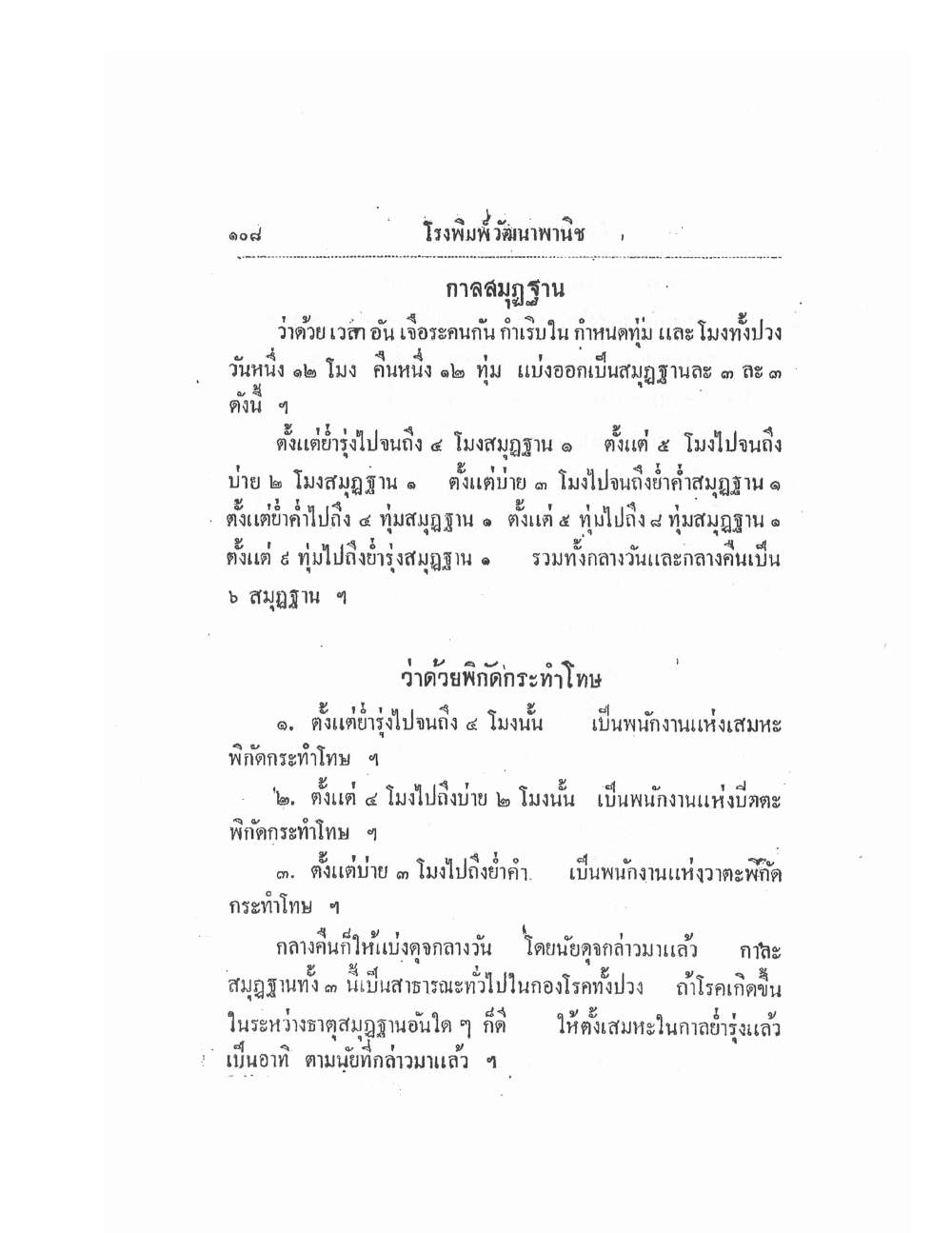
๑๐๘ โรงพิมพ์วัฒนาพานิช
กาลสมุฏฐาน
ว่าด้วยเวลาอันเจือระคนกัน กำเริบในกำหนดทุ่ม และโมงทั้งปวง วันหนึ่ง ๑๒ โมง คืนหนึ่ง ๑๒ ทุ่ม แบ่งออกเป็นสมุฏฐานละ ๓ ละ ๓ ดังนี้ ฯ
ตั้งแต่ย่ำรุ่งไปจนถึง ๔ โมงสมุฏฐาน ๑ ตั้งแต่ ๕ โมงไปจนถึง บ่าย ๒ โมงสมุฏฐาน ๑ ตั้งแต่บ่าย ๓ โมงไปจนถึงย่ำค่ำสมุฏฐาน ๑ ตั้งแต่ย่ำค่ำไปถึง ๔ ทุ่มสมุฏฐาน ๑ ตั้งแต่ ๕ ทุ่มไปถึง ๘ ทุ่มสมุฏฐาน ๑ ตั้งแต่ ๘ ทุ่มไปถึงย่ำรุ่งสมุฏฐาน ๑ รวมทั้งกลางวันและกลางคืนเป็น ๖ สมุฏฐาน ฯ
ว่าด้วยพิกัดกระทำโทษ
๑. ตั้งแต่ย่ำรุ่งไปจนถึง ๔ โมงนั้น เป็นพนักงานแห่งเสมหะ พิกัดกระทำโทษ ฯ
๒. ตั้งแต่ ๔ โมงไปถึงบ่าย ๒ โมงนั้น เป็นพนักงานแห่งบี้ตตะ พิกัดกระทำโทษ ฯ
๓. ตั้งแต่บ่าย ๓ โมงไปถึงย่ำค่ำ เป็นพนักงานแห่งวาตะพิกัด กระทำโทษ ฯ
กลางคืนก็ให้แบ่งดุจกลางวัน โดยนัยดุจกล่าวมาแล้ว กาละ สมุฏฐานทั้ง ๓ นี้เป็นสาธารณะทั่วไปในกองโรคทั้งปวง ถ้าโรคเกิดขึ้น ในระหว่างธาตุสมุฏฐานอันใดๆ ก็ดี ให้ตั้งเสมหะในกาละย่ำรุ่งแล้ว เป็นอาทิ ตามนัยที่กล่าวมาแล้ว ฯ
108 Watthana Panich Press
Time Basis
This concerns the periods that intermingle and grow acute within the appointed night-watches and day-hours, all of them. In one day there are 12 mong (day-hours), in one night there are 12 thum (night-watches), divided into bases of 3 and 3 as follows:
From dawn until 4 mong is 1 basis; from 5 mong until 2 mong in the afternoon is 1 basis; from 3 mong in the afternoon until dusk is 1 basis; from dusk until 4 thum is 1 basis; from 5 thum until 8 thum is 1 basis; from 8 thum until dawn is 1 basis. Together, day and night make 6 bases.
On the Proportion for Causing Affliction
1. From dawn until 4 mong is the duty of phlegm's proportion for causing affliction.
2. From 4 mong until 2 mong in the afternoon is the duty of bile's proportion for causing affliction.
3. From 3 mong in the afternoon until dusk is the duty of wind's proportion for causing affliction.
The night is likewise to be divided as the day, by the same principle already stated. These 3 time-bases are common to all categories of disease in general. If disease arises during any of the element-bases whatsoever, phlegm should be set as the primary cause in the period beginning at dawn, following the principle already stated.
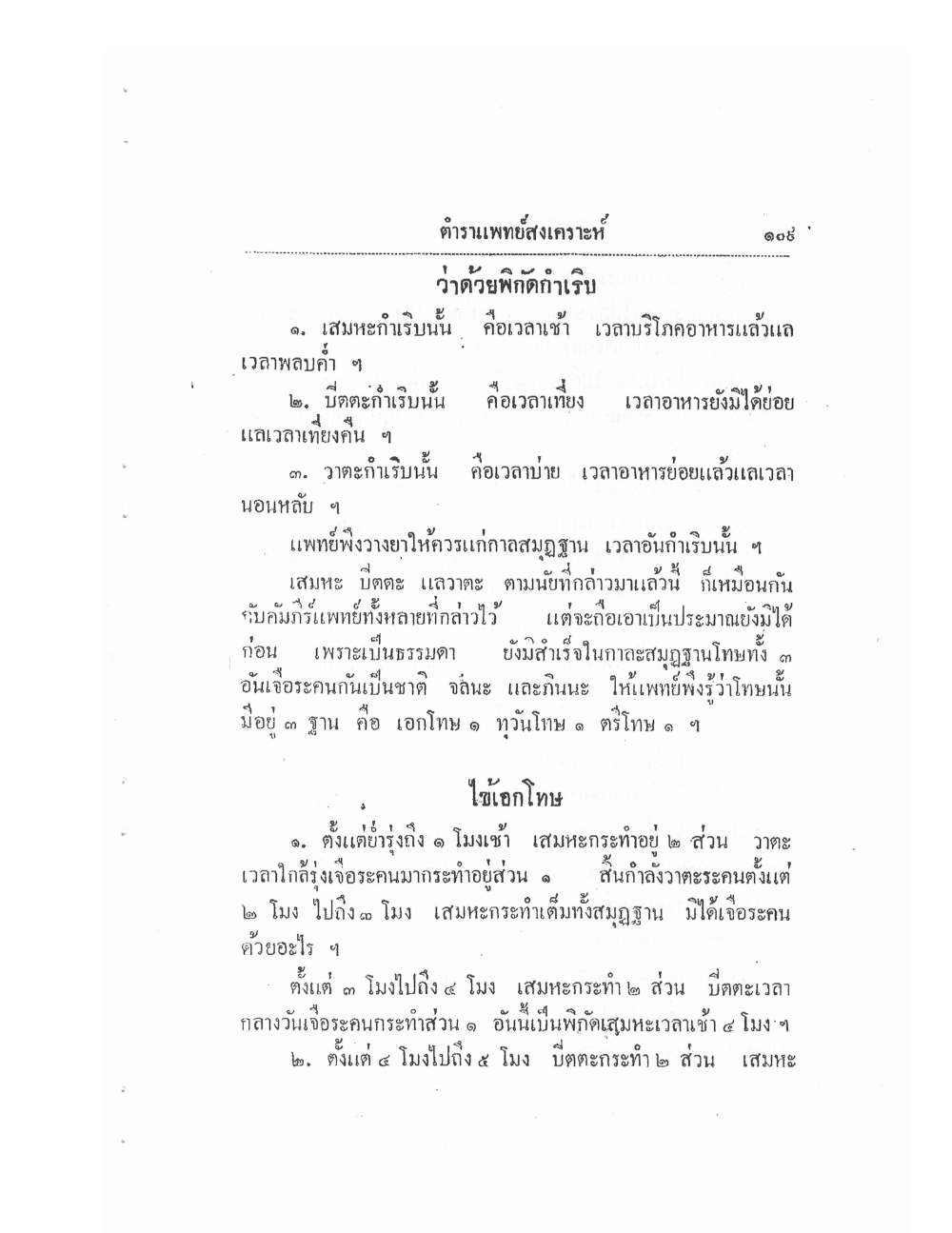
ตำราแพทย์สงเคราะห์ ๑๐๙
ว่าด้วยพิกัดกำเริบ
๑. เสมหะกำเริบนั้น คือเวลาเช้า เวลาบริโภคอาหารแล้วแล เวลาพลบค่ำ ฯ
๒. บี้ตตะกำเริบนั้น คือเวลาเที่ยง เวลาอาหารยังมิได้ย่อย แลเวลาเที่ยงคืน ฯ
๓. วาตะกำเริบนั้น คือเวลาบ่าย เวลาอาหารย่อยแล้วแลเวลา นอนหลับ ฯ
แพทย์พึงวางยาให้ควรแก่กาลสมุฏฐาน เวลาอันกำเริบนั้น ฯ
เสมหะ บี้ตตะ แลวาตะ ตามนัยที่กล่าวมาแล้วนี้ ก็เหมือนกัน กับคัมภีร์แพทย์ทั้งหลายที่กล่าวไว้ แต่จะถือเอาเป็นประมาณยังมิได้ ก่อน เพราะเป็นธรรมดา ยังมิสำเร็จในกาละสมุฏฐานโทษทั้ง ๓ อันเจือระคนกันเป็นชาติ จลนะ และภินนะ ให้แพทย์พึงรู้ว่าโทษนั้น มีอยู่ ๓ ฐาน คือ เอกโทษ ๑ ทุวันโทษ ๑ ตรีโทษ ๑ ฯ
ไข้เอกโทษ
๑. ตั้งแต่ย่ำรุ่งถึง ๑ โมงเช้า เสมหะกระทำอยู่ ๒ ส่วน วาตะ เวลาใกล้รุ่งเจือระคนมากระทำอยู่ส่วน ๑ สิ้นกำลังวาตะระคนตั้งแต่ ๒ โมง ไปถึง ๓ โมง เสมหะกระทำเต็มทั้งสมุฏฐาน มิได้เจือระคน ด้วยอะไร ฯ
ตั้งแต่ ๓ โมงไปถึง ๔ โมง เสมหะกระทำ ๒ ส่วน บี้ตตะเวลา กลางวันเจือระคนกระทำส่วน ๑ อันนี้เป็นพิกัดเสมหะเวลาเช้า ๔ โมง ฯ
๒. ตั้งแต่ ๔ โมงไปถึง ๕ โมง บี้ตตะกระทำ ๒ ส่วน เสมหะ
Textbook of Medical Aid 109
On the Proportion of Aggravation
1. Phlegm's aggravation is at: morning time, the time after eating food, and dusk.
2. Bile's aggravation is at: midday, the time when food has not yet been digested, and midnight.
3. Wind's aggravation is at: afternoon, the time when food has been digested, and the time of falling asleep.
The physician should prescribe medicine appropriate to the time-basis, that time of aggravation.
Phlegm, bile, and wind, according to the principle stated above, agree with what is stated in all the medical scriptures; but it should not yet be taken as a fixed rule, because it is natural that it is not always accomplished within the 3 time-bases of affliction, which intermingle as various kinds — agitation and splitting. The physician should know that affliction has 3 grades: single affliction, double affliction, and triple affliction.
Fever of Single Affliction
1. From dawn until 1 mong in the morning, phlegm acts as 2 parts; wind, near dawn, mixes in and acts as 1 part. Once wind's mixed-in strength ends, from 2 mong to 3 mong, phlegm acts fully throughout the basis, not mixed with anything.
From 3 mong to 4 mong, phlegm acts as 2 parts; bile, in the daytime, mixes in and acts as 1 part. This is the proportion of phlegm at 4 mong in the morning.
2. From 4 mong to 5 mong, bile acts as 2 parts, phlegm...
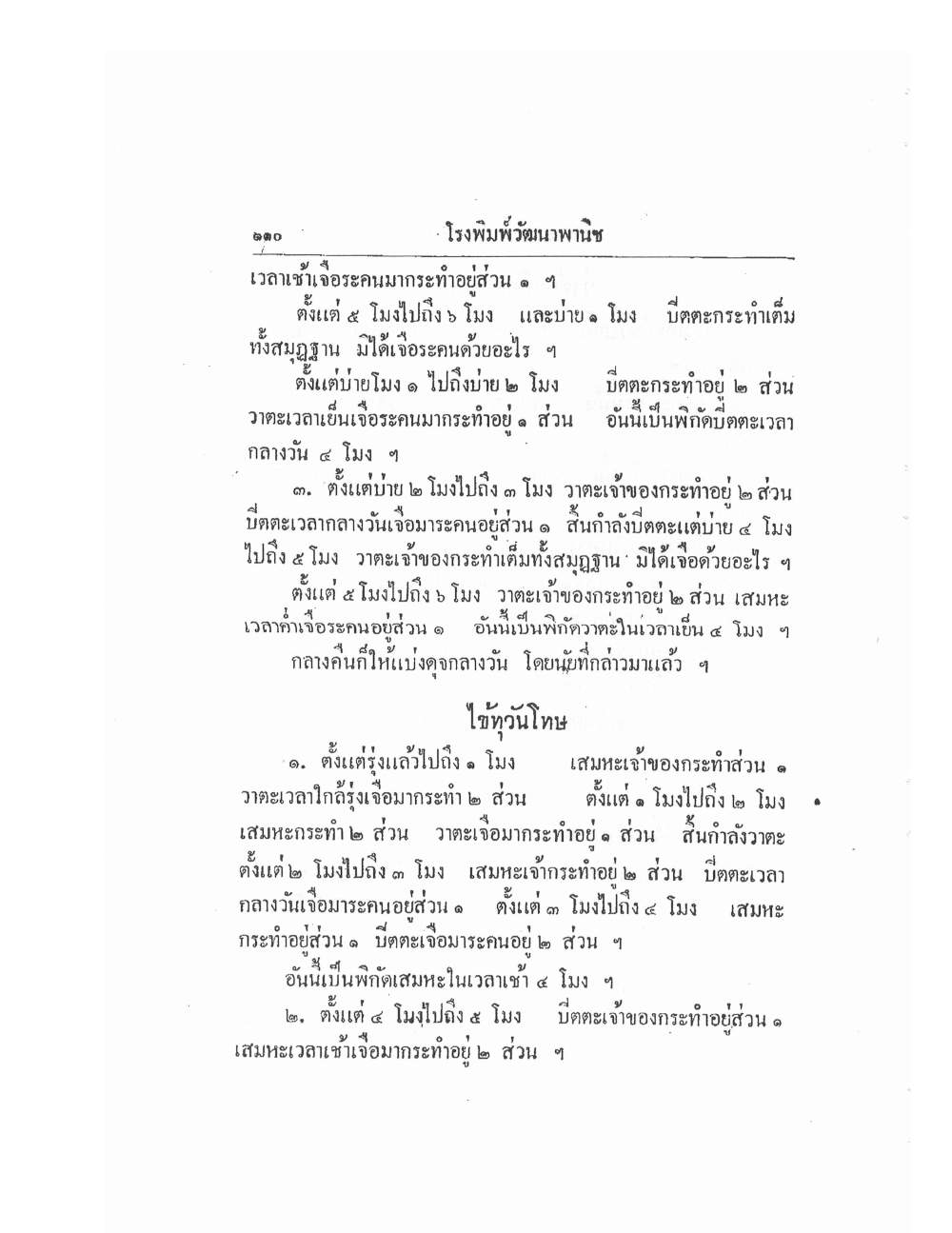
๑๑๐ โรงพิมพ์วัฒนาพานิช
เวลาเช้าเจือระคนมากระทำอยู่ส่วน ๑ ฯ
ตั้งแต่ ๕ โมงไปถึง ๖ โมง และบ่าย ๑ โมง บี้ตตะกระทำเต็ม ทั้งสมุฏฐาน มิได้เจือระคนด้วยอะไร ฯ
ตั้งแต่บ่ายโมง ๑ ไปถึงบ่าย ๒ โมง บี้ตตะกระทำอยู่ ๒ ส่วน วาตะเวลาเย็นเจือระคนมากระทำอยู่ ๑ ส่วน อันนี้เป็นพิกัดบี้ตตะเวลา กลางวัน ๔ โมง ฯ
๓. ตั้งแต่บ่าย ๒ โมงไปถึง ๓ โมง วาตะเจ้าของกระทำอยู่ ๒ ส่วน บี้ตตะเวลากลางวันเจือมาระคนอยู่ส่วน ๑ สิ้นกำลังบี้ตตะแต่บ่าย ๔ โมง ไปถึง ๕ โมง วาตะเจ้าของกระทำเต็มทั้งสมุฏฐาน มิได้เจือด้วยอะไร ฯ
ตั้งแต่ ๕ โมงไปถึง ๖ โมง วาตะเจ้าของกระทำอยู่ ๒ ส่วน เสมหะ เวลาค่ำเจือระคนอยู่ส่วน ๑ อันนี้เป็นพิกัดวาตะในเวลาเย็น ๔ โมง ฯ
กลางคืนก็ให้แบ่งดุจกลางวัน โดยนัยที่กล่าวมาแล้ว ฯ
ไข้ทุวันโทษ
๑. ตั้งแต่รุ่งแล้วไปถึง ๑ โมง เสมหะเจ้าของกระทำส่วน ๑ วาตะเวลาใกล้รุ่งเจือมากระทำ ๒ ส่วน ตั้งแต่ ๑ โมงไปถึง ๒ โมง เสมหะกระทำ ๒ ส่วน วาตะเจือมากระทำอยู่ ๑ ส่วน สิ้นกำลังวาตะ ตั้งแต่ ๒ โมงไปถึง ๓ โมง เสมหะเจ้ากระทำอยู่ ๒ ส่วน บี้ตตะเวลา กลางวันเจือมาระคนอยู่ส่วน ๑ ตั้งแต่ ๓ โมงไปถึง ๔ โมง เสมหะ กระทำอยู่ส่วน ๑ บี้ตตะเจือมาระคนอยู่ ๒ ส่วน ฯ
อันนี้เป็นพิกัดเสมหะในเวลาเช้า ๔ โมง ฯ
๒. ตั้งแต่ ๔ โมงไปถึง ๕ โมง บี้ตตะเจ้าของกระทำอยู่ส่วน ๑ เสมหะเวลาเช้าเจือมากระทำอยู่ ๒ ส่วน ฯ
110 Watthana Panich Press
morning-time mixes in and acts as 1 part.
From 5 mong to 6 mong, and to 1 mong in the afternoon, bile acts fully throughout the basis, not mixed with anything.
From 1 mong in the afternoon to 2 mong in the afternoon, bile acts as 2 parts; wind, in the evening, mixes in and acts as 1 part. This is the proportion of bile in the daytime, over 4 mong.
3. From 2 mong in the afternoon to 3 mong, wind, its own master, acts as 2 parts; bile, daytime, mixes in as 1 part. Once bile's strength ends, from 4 mong in the afternoon to 5 mong, wind, its own master, acts fully throughout the basis, not mixed with anything.
From 5 mong to 6 mong, wind, its own master, acts as 2 parts; phlegm, evening-time, mixes in as 1 part. This is the proportion of wind in the evening, over 4 mong.
The night is likewise to be divided as the day, following the principle already stated.
Fever of Double Affliction
1. From dawn onward until 1 mong, phlegm, its own master, acts as 1 part; wind, near-dawn time, mixes in and acts as 2 parts. From 1 mong to 2 mong, phlegm acts as 2 parts; wind mixes in and acts as 1 part. Once wind's strength ends, from 2 mong to 3 mong, phlegm, its own master, acts as 2 parts; bile, daytime, mixes in as 1 part. From 3 mong to 4 mong, phlegm acts as 1 part; bile mixes in as 2 parts.
This is the proportion of phlegm in the morning, over 4 mong.
2. From 4 mong to 5 mong, bile, its own master, acts as 1 part; phlegm, morning-time, mixes in and acts as 2 parts.
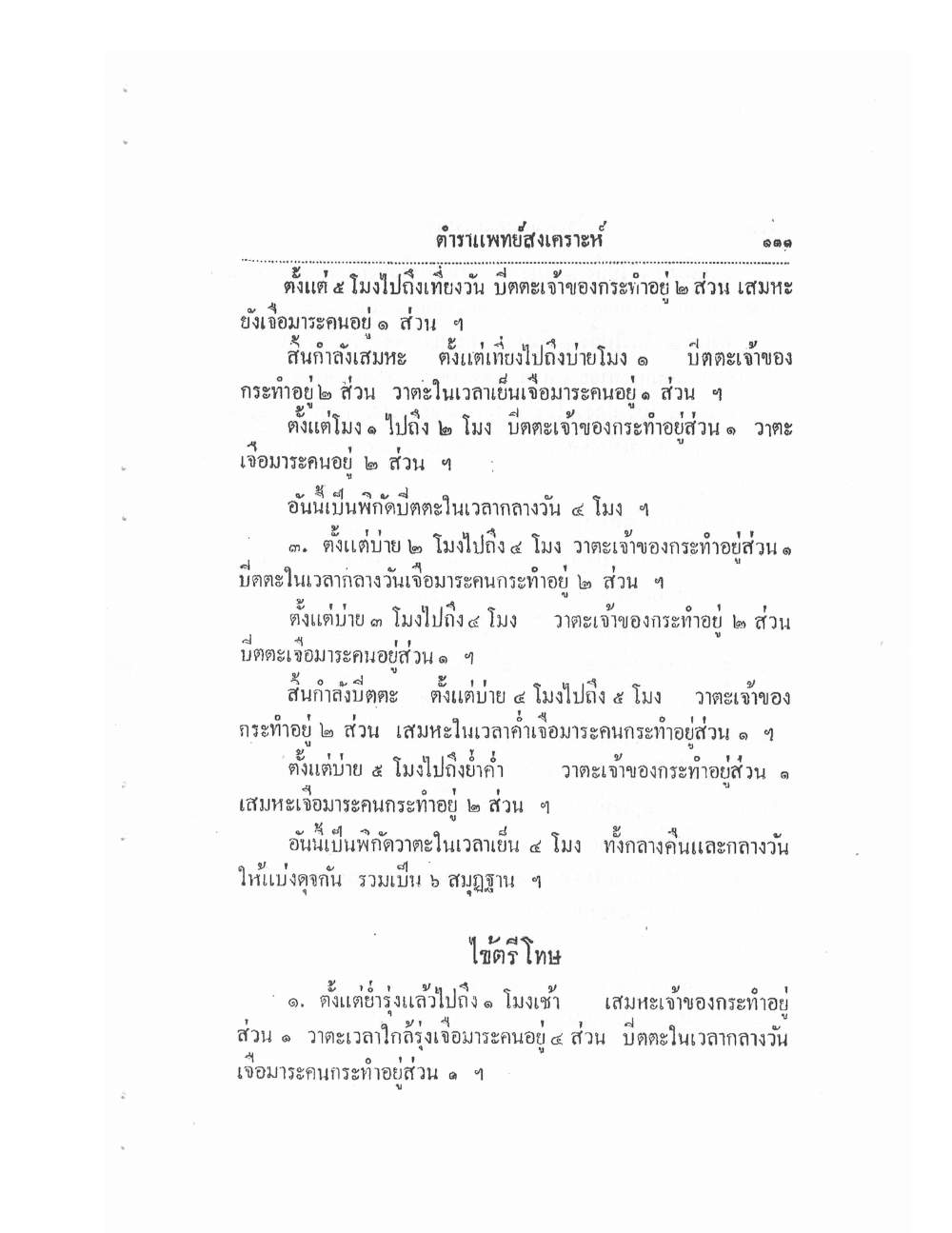
ตำราแพทย์สงเคราะห์ ๑๑๑
ตั้งแต่ ๕ โมงไปถึงเที่ยงวัน บี้ตตะเจ้าของกระทำอยู่ ๒ ส่วน เสมหะ ยังเจือมาระคนอยู่ ๑ ส่วน ฯ
สิ้นกำลังเสมหะ ตั้งแต่เที่ยงไปถึงบ่ายโมง ๑ บี้ตตะเจ้าของ กระทำอยู่ ๒ ส่วน วาตะในเวลาเย็นเจือมาระคนอยู่ ๑ ส่วน ฯ
ตั้งแต่โมง ๑ ไปถึง ๒ โมง บี้ตตะเจ้าของกระทำอยู่ส่วน ๑ วาตะ เจือมาระคนอยู่ ๒ ส่วน ฯ
อันนี้เป็นพิกัดบี้ตตะในเวลากลางวัน ๔ โมง ฯ
๓. ตั้งแต่บ่าย ๒ โมงไปถึง ๓ โมง วาตะเจ้าของกระทำอยู่ส่วน ๑ บี้ตตะในเวลากลางวันเจือมาระคนกระทำอยู่ ๒ ส่วน ฯ
ตั้งแต่บ่าย ๓ โมงไปถึง ๔ โมง วาตะเจ้าของกระทำอยู่ ๒ ส่วน บี้ตตะเจือมาระคนอยู่ส่วน ๑ ฯ
สิ้นกำลังบี้ตตะ ตั้งแต่บ่าย ๔ โมงไปถึง ๕ โมง วาตะเจ้าของ กระทำอยู่ ๒ ส่วน เสมหะในเวลาค่ำเจือมาระคนกระทำอยู่ส่วน ๑ ฯ
ตั้งแต่บ่าย ๕ โมงไปถึงย่ำค่ำ วาตะเจ้าของกระทำอยู่ส่วน ๑ เสมหะเจือมาระคนกระทำอยู่ ๒ ส่วน ฯ
อันนี้เป็นพิกัดวาตะในเวลาเย็น ๔ โมง ทั้งกลางคืนและกลางวัน ให้แบ่งดุจกัน รวมเป็น ๖ สมุฏฐาน ฯ
ไข้ตรีโทษ
๑. ตั้งแต่ย่ำรุ่งแล้วไปถึง ๑ โมงเช้า เสมหะเจ้าของกระทำอยู่ ส่วน ๑ วาตะเวลาใกล้รุ่งเจือมาระคนอยู่ ๔ ส่วน บี้ตตะในเวลากลางวัน เจือมาระคนกระทำอยู่ส่วน ๑ ฯ
Textbook of Medical Aid 111
From 5 mong until midday, bile, its own master, acts as 2 parts; phlegm still mixes in and acts as 1 part.
Once phlegm's strength ends, from midday until 1 mong in the afternoon, bile, its own master, acts as 2 parts; wind, in the evening, mixes in as 1 part.
From 1 mong to 2 mong, bile, its own master, acts as 1 part; wind mixes in and acts as 2 parts.
This is the proportion of bile in the daytime, over 4 mong.
3. From 2 mong in the afternoon to 3 mong, wind, its own master, acts as 1 part; bile, in the daytime, mixes in and acts as 2 parts.
From 3 mong in the afternoon to 4 mong, wind, its own master, acts as 2 parts; bile mixes in as 1 part.
Once bile's strength ends, from 4 mong in the afternoon to 5 mong, wind, its own master, acts as 2 parts; phlegm, in the evening, mixes in and acts as 1 part.
From 5 mong in the afternoon to dusk, wind, its own master, acts as 1 part; phlegm mixes in and acts as 2 parts.
This is the proportion of wind in the evening, over 4 mong. Both night and day are to be divided alike, making 6 bases in total.
Fever of Triple Affliction
1. From dawn onward until 1 mong in the morning, phlegm, its own master, acts as 1 part; wind, near-dawn time, mixes in and acts as 4 parts; bile, in the daytime, mixes in and acts as 1 part.
๑๑๒ โรงพิมพ์วัฒนาพานิช
ตั้งแต่โมง ๑ ไปถึง ๒ โมง เสมหะเจ้าของกระทำอยู่ ๒ ส่วน วาตะถอยเจือมาระคนอยู่ ๓ ส่วน บี้ตตะเจือมาระคนอยู่ ๒ ส่วน ฯ
ตั้งแต่ ๒ โมงไปถึง ๓ โมง เสมหะเจ้าของกระทำอยู่ ๒ ส่วน วาตะเจือมาระคนกระทำอยู่ ๒ ส่วน บี้ตตะเจือมาระคนกระทำอยู่ ๓ ส่วน ฯ
ตั้งแต่ ๓ โมงไปถึง ๔ โมง เสมหะเจ้าของถอยมากระทำอยู่ส่วน ๑ วาตะเจือมาระคนกระทำอยู่ส่วน ๑ บี้ตตะในเวลากลางวันเจือมาระคน กระทำอยู่ ๔ ส่วน ฯ
อันนี้เป็นพิกัดเสมหะ ๔ โมง ฯ
๒. ตั้งแต่ ๔ โมงไปถึง ๕ โมง บี้ตตะเจ้าของกระทำอยู่ส่วน ๑ เสมหะเจือมาระคนอยู่ ๔ ส่วน วาตะเจือมาระคนอยู่ส่วน ๑ ฯ
ตั้งแต่ ๕ โมงไปถึงเที่ยง บี้ตตะเจ้าของกระทำอยู่ ๒ ส่วน เสมหะ เจือมาระคนกระทำอยู่ ๓ ส่วน วาตะเจือมาระคนกระทำอยู่ ๒ ส่วน ฯ
ตั้งแต่เที่ยงแล้วไปถึง ๑ โมง บี้ตตะเจ้าของกระทำอยู่ ๒ ส่วน เสมหะเจือมาระคนอยู่ ๒ ส่วน วาตะเจือมาระคน ๓ ส่วน ฯ
ตั้งแต่บ่ายโมง ๑ ไปถึง ๒ โมง บี้ตตะเจ้าของกระทำอยู่ส่วน ๑ เสมหะเจือมาระคนกระทำอยู่ส่วน ๑ วาตะเจือมาระคนกระทำอยู่ ๔ ส่วน ฯ
อันนี้เป็นพิกัดบี้ตตะ ๔ โมง ฯ
๓. ตั้งแต่บ่าย ๒ โมงไปถึง ๓ โมง วาตะเจ้าของกระทำอยู่ส่วน ๑ บี้ตตะในเวลากลางวันเจือมาระคนอยู่ ๔ ส่วน เสมหะเวลาค่ำเจือมา ระคนอยู่ส่วน ๑ ฯ
ตั้งแต่ ๓ โมงไปถึง ๔ โมง วาตะเจ้าของกระทำอยู่ ๒ ส่วน บี้ตตะ ในเวลากลางวันเจือมาระคนอยู่ ๓ ส่วน เสมหะเจือมาระคนกระทำอยู่ ๒ ส่วน ฯ
112 Watthana Panich Press
From 1 mong to 2 mong, phlegm, its own master, acts as 2 parts; wind, receding, mixes in as 3 parts; bile mixes in as 2 parts.
From 2 mong to 3 mong, phlegm, its own master, acts as 2 parts; wind mixes in and acts as 2 parts; bile mixes in and acts as 3 parts.
From 3 mong to 4 mong, phlegm, its own master, recedes and acts as 1 part; wind mixes in and acts as 1 part; bile, in the daytime, mixes in and acts as 4 parts.
This is the proportion of phlegm, over 4 mong.
2. From 4 mong to 5 mong, bile, its own master, acts as 1 part; phlegm mixes in as 4 parts; wind mixes in as 1 part.
From 5 mong to noon, bile, its own master, acts as 2 parts; phlegm mixes in and acts as 3 parts; wind mixes in and acts as 2 parts.
From noon onward to 1 mong, bile, its own master, acts as 2 parts; phlegm mixes in as 2 parts; wind mixes in as 3 parts.
From 1 mong in the afternoon to 2 mong, bile, its own master, acts as 1 part; phlegm mixes in and acts as 1 part; wind mixes in and acts as 4 parts.
This is the proportion of bile, over 4 mong.
3. From 2 mong in the afternoon to 3 mong, wind, its own master, acts as 1 part; bile, in the daytime, mixes in as 4 parts; phlegm, in the evening, mixes in as 1 part.
From 3 mong to 4 mong, wind, its own master, acts as 2 parts; bile, in the daytime, mixes in as 3 parts; phlegm mixes in and acts as 2 parts.
ตำราแพทย์สงเคราะห์ ๑๑๓
ตั้งแต่ ๔ โมงไปถึง ๕ โมง วาตะเจ้าของกระทำอยู่ ๒ ส่วน บี้ตตะ เจือมากระทำอยู่ ๒ ส่วน เสมหะเจือมากระทำอยู่ ๓ ส่วน ฯ
ตั้งแต่ ๕ โมงไปถึงย่ำค่ำ วาตะเจ้าของถอยมากระทำอยู่ส่วน ๑ บี้ตตะถอยมากระทำอยู่ส่วน ๑ เสมหะทวีเจือมากระทำอยู่ ๓ ส่วน ฯ
อันนี้เป็นพิกัดวาตะในเวลาเย็น ๔ โมง ฯ
ทั้งกลางวันแลกลางคืนให้แบ่งดุจเดียวกัน โดยนัยที่กล่าวมาแล้ว จึงรวมเป็น ๖ สมุฏฐานด้วยประการฉะนี้ ฯ
ในกาละสมุฏฐานโทษทั้ง ๓ ซึ่งกล่าวมาแล้วนั้น มิได้สำเร็จใน ระหว่างทุ่มโมง ว่าด้วยกาละสมุฏฐานนี้ผ่อนผันตามสุริยเทวบุตร อัน เสด็จโดยทวาทศราศี จึงยังถือเอาเป็นประมาณมิได้ เพราะยังมิได้ ปรากฏในคัมภีร์ แต่มีแจ้งอยู่ในพระคัมภีร์องคาพยพธาตุบัญจกะโน้น ที่ท่านสาธกไว้ในคัมภีร์สมุฏฐานวินิจฉัยเพียงเล็กน้อย ก็เพื่อให้แพทย์ เห็นแจ้ง จะได้ตรึกตรองสอบสวนตามอนุมานปัญญา ให้เห็นในห้อง จักราศีแลสมุฏฐานทั้งหลาย จึงจะเห็นกองโรคแม่นยำ จะได้ปรุงยา แก้โรคให้ถูกต้องตามมหาพิกัดสมุฏฐานทั้งปวง ฯ
อนึ่ง สมุฏฐาน ๔ คือ ธาตุ ฤดู อายุ กาละ ซึ่งกล่าวมาแล้ว จะยกเอาอย่างใดอย่างหนึ่งขึ้นเป็นประมาณยังมิได้ เพราะเป็นที่อาศัย ซึ่งกันและกัน แต่ฤดูสมุฏฐานมิได้ผ่อนผันตามสมุฏฐานอื่น แต่อาศัย กะทบให้สมุฏฐานต่างๆ เป็นจลนะ ถ้าจะประกอบยาให้ต้องกับโรค ควรแก้ในกาละสมุฏฐานโทษทั้ง ๓ ก่อน แล้วจึงแก้ตามลำดับสมุฏฐาน ทั้งปวงต่อภายหลัง ฯ ๑/๑๕
Textbook of Medical Aid 113
From 4 mong to 5 mong, wind, its own master, acts as 2 parts; bile mixes in and acts as 2 parts; phlegm mixes in and acts as 3 parts.
From 5 mong until dusk, wind, its own master, recedes and acts as 1 part; bile recedes and acts as 1 part; phlegm increasingly mixes in, acting as 3 parts.
This is the proportion of wind in the evening, over 4 mong.
Both day and night are to be divided in the same way, following the principle already described, thus totaling 6 bases altogether in this manner.
Within these 3 time-bases of affliction described above, the effect is not [strictly] completed within each individual watch-hour; this time-basis follows and accommodates the course of the Sun-deva as he travels through the twelve zodiac signs. It cannot yet be taken as a fixed rule, because it has not yet appeared explicitly in the scriptures; but it is stated in the scripture of the Five Bodily Elements, which the sages have expounded only briefly in the scripture of Diagnosis by Basis, so that physicians may see clearly and may deliberate and investigate by inferential reason, so as to perceive the chambers of the zodiac and all the bases; then they will see the categories of disease accurately, and will be able to compound medicine to cure disease correctly according to the great prescribed proportions of all the bases.
Furthermore, the 4 bases — element, season, age, and time — as described above, none can be taken alone as the fixed rule, because they depend mutually upon one another. But the seasonal basis does not accommodate the other bases; rather it relies on striking them, causing the various bases to become agitated. If one is to compound medicine to fit the disease, one should first treat within the 3 time-bases of affliction, and only afterward treat according to the sequence of all the other bases. 1/15
๑๑๔ โรงพิมพ์วัฒนาพานิช
ในสมุฏฐานทั้ง ๔ ซึ่งกล่าวมาแล้ว ยังมิได้แจ้งในกองสมุฏฐาน กำเริบ หย่อน พิการ ท่านจึงสำแดงในสมุฏฐานวิธีโดยพิเศษ ตาม สุริยคติดำเนินในห้องจักราศีเป็นกำหนดดังนี้
๑. พระอาทิตย์สถิตในราศี เมษ สิงห์ ธนู เป็นราศีเตโช ๒. พระอาทิตย์สถิตในราศี พฤษภ กันย์ มังกร เป็นปฐวี ๓. พระอาทิตย์สถิตในราศี เมถุน ดุล กุมภ์ เป็นวาโย ๔. พระอาทิตย์สถิตในราศี กรกฎ พิจิก มีน เป็นเอาโป
ว่าด้วยกำเริบ หย่อน พิการ
๑. ตั้งแต่แรมค่ำ ๑ เดือน ๔ ไปจนถึงเพ็ญเดือน ๕ เป็นกาล กำหนดแห่งพระอาทิตย์สถิตในราศีเมษ เตโชเจ้าสมุฏฐานกำเริบ พัทธบี้ตตะระคนให้เป็นเหตุ ฯ
๒. ตั้งแต่แรมค่ำ ๑ เดือน ๘ ไปจนถึงเพ็ญเดือน ๕ เป็นกาล กำหนดแห่งพระอาทิตย์สถิตในราศีสิงห์ เตโชเจ้าสมุฏฐานหย่อน อพัทธบี้ตตะระคนให้เป็นเหตุ ฯ
๓. ตั้งแต่แรมค่ำ ๑ เดือน ๑๒ ไปจนถึงเพ็ญเดือนอ้าย เป็นกาล กำหนดแห่งพระอาทิตย์สถิตในราศีธนู เตโชเจ้าสมุฏฐานพิการ กำเดาระคนให้เป็นเหตุ ฯ
ทั้ง ๓ สมุฏฐานนี้เป็นราศีเตโช
๑. ตั้งแต่แรม ๑ ค่ำเดือน ๕ ไปจนถึงเพ็ญเดือน ๖ เป็นกาล กำหนดแห่งพระอาทิตย์สถิตในราศีพฤษภ ปฐวีเจ้าสมุฏฐานกำเริบ หทัยระคนให้เป็นเหตุ ฯ
114 Watthana Panich Press
Among the 4 bases described above, the category of aggravation, deficiency, and impairment of the basis has not yet been explained. The sages therefore expound a special method of the basis, following the Sun's course as it travels through the chambers of the zodiac, appointed as follows:
1. When the Sun resides in the signs Aries, Leo, and Sagittarius, it is the Fire sign. 2. When the Sun resides in the signs Taurus, Virgo, and Capricorn, it is Earth. 3. When the Sun resides in the signs Gemini, Libra, and Aquarius, it is Wind. 4. When the Sun resides in the signs Cancer, Scorpio, and Pisces, it is Water.
On Aggravation, Deficiency, and Impairment
1. From the 1st day of the waning moon of the 4th month until the full moon of the 5th month is the appointed time of the Sun residing in Aries; Fire is the ruler of the basis, causing aggravation, with bound-bile mixture as the cause.
2. From the 1st day of the waning moon of the 8th month until the full moon of the 5th month is the appointed time of the Sun residing in Leo; Fire is the ruler of the basis, causing deficiency, with unbound-bile mixture as the cause.
3. From the 1st day of the waning moon of the 12th month until the full moon of the 1st month is the appointed time of the Sun residing in Sagittarius; Fire is the ruler of the basis, causing impairment, with fever mixture as the cause.
These 3 bases together belong to the Fire sign.
1. From the 1st day of the waning moon of the 5th month until the full moon of the 6th month is the appointed time of the Sun residing in Taurus; Earth is the ruler of the basis, causing aggravation, with heart mixture as the cause.
ตำราแพทย์สงเคราะห์ ๑๑๕
๒. ตั้งแต่แรมค่ำ ๑ เดือน ๙ ไปจนถึงเพ็ญเดือน ๑๐ เป็นกาล กำหนดแห่งพระอาทิตย์สถิตในราศีกันย์ ปฐวีเจ้าสมุฏฐานหย่อนอุทริยะ ระคนให้เป็นเหตุ ฯ
๓. ตั้งแต่แรมค่ำ ๑ เดือนอ้ายไปจนถึงเพ็ญเดือนยี่ เป็นกาล กำหนดแห่งพระอาทิตย์สถิตในราศีมังกร ปฐวีเจ้าสมุฏฐานพิการ กรีสะระคนให้เป็นเหตุ ฯ
ทั้ง ๓ สมุฏฐานนี้เป็นพิกัดราศีปถวี
๑. ตั้งแต่แรมค่ำ ๑ เดือน ๖ ไปจนถึงเพ็ญเดือน ๗ เป็นกาล กำหนดแห่งพระอาทิตย์สถิตในราศีเมถุน วาโยเจ้าสมุฏฐานกำเริบ หทัยวาตะระคนให้เป็นเหตุ ฯ
๒. ตั้งแต่แรมค่ำ ๑ เดือน ๑๐ ไปจนถึงเพ็ญเดือน ๑๑ เป็นกาล กำหนดแห่งพระอาทิตย์สถิตในราศีดุล วาโยเจ้าสมุฏฐานหย่อนสัตถะ กะวาตระคนให้เป็นเหตุ ฯ
๓. ตั้งแต่แรมค่ำ ๑ เดือนยี่ ไปจนถึงเพ็ญเดือน ๓ เป็นกาล กำหนดแห่งพระอาทิตย์สถิตในราศีกุมภ์ วาโยเจ้าสมุฏฐานพิการ สุมนาระคนให้เป็นเหตุ ฯ
๑. ตั้งแต่แรมค่ำ ๑ เดือน ๗ ไปจนถึงเพ็ญเดือน ๘ เป็นกาล กำหนดแห่งพระอาทิตย์สถิตในราศีกรกฎ อาโปเจ้าสมุฏฐานกำเริบ ศอเสมหะระคนให้เป็นเหตุ ฯ
๒. ตั้งแต่แรมค่ำ ๑ เดือน ๑๑ ไปจนถึงเพ็ญเดือน ๑๒ เป็นกาล กำหนดแห่งพระอาทิตย์สถิตในราศีพิจิก อาโปเจ้าสมุฏฐานหย่อนอุระ เสมหะระคนให้เป็นเหตุ ฯ
Textbook of Medical Aid 115
2. From the 1st day of the waning moon of the 9th month until the full moon of the 10th month is the appointed time of the Sun residing in Virgo; Earth is the ruler of the basis, causing deficiency, with digestive-residue mixture as the cause.
3. From the 1st day of the waning moon of the 1st month until the full moon of the 2nd month is the appointed time of the Sun residing in Capricorn; Earth is the ruler of the basis, causing impairment, with feces mixture as the cause.
These 3 bases together belong to the proportion of the Earth sign.
1. From the 1st day of the waning moon of the 6th month until the full moon of the 7th month is the appointed time of the Sun residing in Gemini; Wind is the ruler of the basis, causing aggravation, with heart-wind mixture as the cause.
2. From the 1st day of the waning moon of the 10th month until the full moon of the 11th month is the appointed time of the Sun residing in Libra; Wind is the ruler of the basis, causing deficiency, with knife-wind mixture as the cause.
3. From the 1st day of the waning moon of the 2nd month until the full moon of the 3rd month is the appointed time of the Sun residing in Aquarius; Wind is the ruler of the basis, causing impairment, with sumana mixture as the cause.
1. From the 1st day of the waning moon of the 7th month until the full moon of the 8th month is the appointed time of the Sun residing in Cancer; Water is the ruler of the basis, causing aggravation, with throat-phlegm mixture as the cause.
2. From the 1st day of the waning moon of the 11th month until the full moon of the 12th month is the appointed time of the Sun residing in Scorpio; Water is the ruler of the basis, causing deficiency, with chest-phlegm mixture as the cause.
๓. ตั้งแต่แรมค่ำ ๑ เดือน ๓ ไปจนถึงเพ็ญเดือน ๔ เป็นกาลกำหนดแห่งพระอาทิตย์สถิตในราศีมิน อาโปเจ้าสมุฏฐานพิการคูถะเสมหะระคนให้เป็นเหตุ ฯ ทั้ง ๓ สมุฏฐานนี้เป็นพิกัดราศีอาโป กุลบุตรผู้ศึกษาเป็นแพทย์ ให้ศึกษาคัมภีร์เวชชศาสตร์ทั้งหลาย มีปฐม มัชฌิม ปัจฉิมธาตุทั้ง ๓ นี้เป็นต้นให้แม่นยำ จึงจะสมควรเป็นแพทย์ ดุจบุทคลมีตาอันสว่าง เดินทางมีราวยึดไว้ ถ้าไม่เรียบให้รู้เหมือนคนตาบอด เดินทางไม่มีราวยึดไว้ สุดแล้วแต่เท้าจะพาไป ดังฤๅจะประกอบยาให้เบาใจคนไข้ได้เล่า เมื่อแพทย์ผู้มีปัญญาศึกษาให้ละเอียดจึงเห็นกองโรค แลปรุงยาให้ควรแก่โรค จึงจะปราบโรคให้ได้ชัยชำนะโดยเร็วพลัน แต่ลักษณะและประเภทแห่งอาการไข้มีแจ้งอยู่ในคัมภีร์ฉันทศาสตร์ แต่ในนี้ได้กล่าวไว้แต่กองมหาพิกัด ซึ่งผ่อนผันตามธาตุ ฤดู อายุ กาล ให้แพทย์สำคัญไว้เป็นภูมิ ฯ ต่อไปนี้จะกล่าวด้วยธาตุสมุฏฐานพิการ ตามคัมภีร์ธาตุวิภังค์และคัมภีร์โรคนิทาน พอเป็นที่สังเกต ฯ
๑. ปฐวีธาตุพิการ ๑. เกศาพิการ ให้มีอาการเจ็บตามหนังหัวแลผมร่วง ฯ ๒. โลมาพิการ ให้มีอาการเจ็บตามผิวหนังแลขนร่วง ฯ ๓. นขาพิการ ให้มีอาการปวดที่โคนเล็บ บางทีทำให้เล็บถอด บางทีเป็นเม็ดเป็นหนองที่โคนเล็บ ฯ ๔. ทันตาพิการ ให้เป็นรำมะนาด เป็นฝีรำมะนาด เป็นฝีกราม ปวดตามรากฟันแรงกินฟัน ฯ
3. From the first night of the waning moon of the 3rd month until the full moon of the 4th month is the period when the sun resides in the sign of Pisces (Mina). The Water Element (Āpo) governs the origin of disorders of stool and phlegm mixed together as their cause. All three of these origins are classified under the sign of Āpo (Water). Sons who study to become physicians should study all the medical treatises thoroughly — the Primary, Middle, and Final stages of these three elements as fundamentals — until truly proficient; only then is one fit to be a physician. It is like a person with clear sight walking a road that has a rail to hold; if not well-versed, one is like a blind person walking a road with no rail, left entirely to wherever the feet may carry him. How then could such a person compound medicine to ease a patient's suffering? When a physician of wisdom studies in detail, he comes to see the root of the disease clearly, and compounds medicine fitting the disease; thus he will overcome the disease and gain victory swiftly. But the characteristics and categories of feverish symptoms are set out fully in the Chanthasat (Chandra Sat) treatise; here only the great classifications have been given, which vary according to element, season, age, and time, for the physician to keep firmly in mind as his foundation. What follows will discuss the derangements of the elemental origins, according to the Dhatuvibhanga treatise and the Rokanidana (Origin of Diseases) treatise, sufficient for observation.
1. Derangement of the Earth Element (Pathavī) 1. Derangement of Kesa (hair): causes pain on the scalp and hair loss. 2. Derangement of Loma (body hair): causes pain on the skin and loss of body hair. 3. Derangement of Nakha (nails): causes pain at the base of the nail; sometimes causes the nail to come loose; sometimes produces lumps or pus at the base of the nail. 4. Derangement of Danta (teeth): causes gum disease (rammanat), periodontal abscess, molar abscess, and pain along the tooth root that severely eats into the tooth.
๕. ตะโจพิการ ให้คันตามผิวหนัง ให้รู้สึกกายซาบตามผิวหนัง ให้แสบร้อนตามผิวหนัง ฯ ๖. มังสังพิการ ให้เนื้อเป็นผื่นแดงช้ำ และแสบร้อน เนื้อเป็นแผลเป็นฝีเป็นพรายน้ำ ฯ ๗. นหารูพิการ ให้รู้สึกตึงรัดผูกดวงใจ ให้สวิงสวายและอ่อนหิว ฯ ๘. อัฏฐิพิการ ให้เจ็บปวดในแห่งกะดูก ฯ ๙. อัฏฐิมิญชังพิการ ให้ขึ้นเป็นไข้แล้วมีอาการเป็นเหน็บชา ฯ ๑๐. วักกังพิการ ให้มีอาการสะท้อนร้อนสะท้านหนาวและเป็นโรคเช่นกระษัยลมเป็นต้น ฯ ๑๑. หทัยพิการ ให้เสียอารมณ์ ให้ใจน้อยมักขึ้งโกรธ ให้หิวโหย ฯ ๑๒. ยกะนังพิการ ให้ตับโต ตับย้อย เป็นฝีตับ ตับช้ำ ฯ ๑๓. กิโลมกังพิการ ให้อกแห้ง ให้กระหายน้ำ แลเป็นโรคเช่นริดสีดวงแห้ง ฯ ๑๔. ปิหกังพิการ ให้ขัดในอก ให้แน่นในอก ให้ท้องพอง ให้อ่อนเพลียกำลังน้อย ฯ ๑๕. ปัปผาสังพิการ ให้กระหายน้ำ ให้ร้อนในอก ให้หอบหนัก เรียกว่าการขึ้นที่ปอด ฯ ๑๖. อันตังพิการ ให้ถ่ายเป็นกำลัง ให้แน่น ให้ไส้ดืบ ฯ ๑๗. อันตคุณังพิการ ให้หาวให้เรอ ให้ตกอุจจาระเป็นโลหิต ให้มืดหน้ามัวตา ให้เมื่อยบั้นเอว ให้เสียดสองราวข้าง ให้ร้อนท้อง
5. Derangement of Taco (skin): causes itching of the skin, a tingling sensation pervading the skin, and burning heat over the skin. 6. Derangement of Maṃsa (flesh): causes the flesh to develop red, bruised rashes and burning heat; the flesh becomes wounded, forms abscesses, and forms weeping sores. 7. Derangement of Nahāru (sinews/tendons): causes a feeling of tightness gripping the heart, faintness, and weakness from hunger. 8. Derangement of Aṭṭhi (bone): causes pain within the bones. 9. Derangement of Aṭṭhimiñja (bone marrow): causes fever to arise, followed by numbness and tingling. 10. Derangement of Vakka (kidneys): causes alternating chills and fever, and diseases such as wasting/wind-affliction (kasai lom). 11. Derangement of Hadaya (heart): causes emotional disturbance, makes one petty and quick to anger, and causes hunger. 12. Derangement of Yakana (liver): causes the liver to enlarge, to prolapse, to develop abscesses, and to bruise. 13. Derangement of Kilomaka (membrane): causes the chest to feel dry, causes thirst, and diseases such as dry hemorrhoids. 14. Derangement of Pihaka (spleen): causes obstruction and tightness in the chest, a swollen abdomen, and weakness with little strength. 15. Derangement of Papphāsa (lungs): causes thirst, heat in the chest, and heavy wheezing — called a rising affliction of the lungs. 16. Derangement of Anta (large intestine): causes forceful purging, bloating, and rumbling of the gut. 17. Derangement of Antaguṇa (mesentery): causes yawning and belching, blood in the stool, dim and blurred vision, an aching lower back, stabbing pain along both flanks, and heat in the belly
ร้อนคอ ให้ตกอุจจาระเป็นหนอง ฯ ๑๘. อุทริยังพิการ ให้ลงท้องให้จุกเสียดให้พะอืดพะอมให้สะอึก ฯ ๑๙. กรีสังพิการ ให้อุจจาระไม่ปกติ ธาตุเสียมักเนื่องมาแต่ [อ่านไม่ออก] แลเป็นโรคเช่นริดสีดวง ฯ ๒๐. มัตถเกมัตถลุงคังพิการ ให้หูตึง ให้มัวตา ให้ลิ้นกระด้าง ให้คางแข็ง ฯ
๒. อาโปธาตุพิการ ๑. พัทธะปิตตะพิการ ให้มีอาการคลุ้มคลั่งเป็นบ้า อพัทธะปิตตะพิการ ให้ตัวร้อน ให้ปวดศีรษะ เป็นไข้สะท้านร้อนสะท้านหนาว ตาเหลือง บัสสาวะเหลือง ฯ ๒. เสมหะพิการ ให้ไอเจ็บคอ คอแห้งเป็นหืด อุระเสมหะพิการ ให้ผอมเหลือง เป็นดานเป็นเถา ให้แสบในอก อกแห้ง คูถเสมหะพิการ ให้ตกอุจจาระเป็นเสมหะ และโลหิต เช่นเป็นบิดเป็นมูกเลือด ฯ ๓. ปุพโพพิการ ทำให้ไอเบื่ออาหาร ให้รูปร่างซูบผอม ฯ ๔. โลหิตพิการ ให้ตัวร้อนเป็นไข้ ให้คลั่งเพ้อ ให้บัสสาวะแดง ให้เป็นเม็ดตามผิวหนัง เช่นเป็นประดงต่างๆ เป็นปานดำ ปานแดง แลกาฬโรคเป็นต้น ฯ ๕. เสโทพิการ ให้สวิงสวาย ให้ตัวเย็น ให้อ่อนอกอ่อนใจ ฯ ๖. เมโทพิการ ให้ผุดเป็นแผ่นตามผิวหนังเป็นนวง เป็นดวง ให้ปวดแสบปวดร้อนผิวหนัง และเป็นน้ำเหลืองไหล ฯ ๗. อัสสุพิการ ให้ตาเป็นผ้า น้ำตาไหล ตาเฉะ ตาแดง ตาเป็นต้อ ๘. วสาพิการ ให้ผิวเหลือง ให้ตาเหลือง ให้ลงท้อง ฯ
...heat in the throat, and causes the stool to be passed mixed with pus. 18. Derangement of Udariya (stomach contents): causes diarrhea, stabbing pain, nausea, and hiccups. 19. Derangement of Karīsa (feces): causes irregular bowel movements; the element disorder often stems from [illegible], and manifests as diseases such as hemorrhoids. 20. Derangement of the skull and brain (Matthaka-Matthaluṅga): causes hearing impairment, blurred vision, a stiff tongue, and a stiffened jaw.
2. Derangement of the Water Element (Āpo) 1. Derangement of bound bile (Baddha-pitta): causes raving madness. Derangement of unbound bile (Abaddha-pitta): causes fever in the body, headache, fever with alternating chills and heat, yellow eyes, and yellow urine. 2. Derangement of general phlegm (Semha): causes coughing and sore throat, a dry throat that becomes asthma-like. Derangement of chest phlegm (Ura-semha): causes emaciation with a yellowish complexion, forms hardened lumps and chronic masses, causes burning in the chest and a dry chest. Derangement of bowel phlegm (Kūtha-semha): causes the stool to be passed mixed with phlegm and blood, such as in dysentery with mucus and blood. 3. Derangement of pus (Pubbo): causes coughing, loss of appetite, and a wasted, emaciated body. 4. Derangement of blood (Lohita): causes fever in the body, delirious raving, red urine, and eruptions on the skin, such as various rashes, black birthmarks, red birthmarks, and diseases such as the black plague (kala-roka). 5. Derangement of sweat (Sedo): causes faintness, a cold body, and listless despondency. 6. Derangement of fat (Medo): causes patches to erupt on the skin forming rings and spots, causes stinging, burning pain of the skin, and weeping discharge. 7. Derangement of tears (Assu): causes the eyes to become clouded, tears to flow, sore inflamed eyes, red eyes, and cataracts. 8. Derangement of grease/lymph (Vasā): causes yellow skin, yellow eyes, and diarrhea.
๙. เขโฬพิการ ให้เจ็บคอ เป็นเม็ดในคอและโคนลิ้น ฯ ๑๐. สิงฆานิกาพิการ ให้ปวดในสมอง ให้ตามัว ให้น้ำมูกตก ฯ ๑๑. ลสิกาพิการ ให้เจ็บตามข้อ แลแห่งกะดูกทั่วตัว ฯ ๑๒. มุตตังพิการ ให้บัสสาวะสีขาวดุจน้ำข้าวเช็ด สีเหลืองดุจน้ำขมิ้น สีดำดุจน้ำหมึก สีแดงดุจน้ำฝาง ฯ
๓. วาโยธาตุพิการ ๑. อุทธังคมาวาตาพิการ ให้มือเท้าขวักไขว่ ร้อนในท้อง ทุรนทุรายหาวเรอเสมหะเฟื้อ ฯ ๒. อโธคมาวาตาพิการ ให้ยกมือยกเท้าไม่ไหว ให้เมื่อยขบไปทุกข้อทั่วสรรพางค์กาย ฯ ๓. กุจฉิสยาวาตาพิการ ให้ท้องลั่น ให้ดวงจิตต์สวิงสวาย ให้เมื่อยขบไปทุกข้อ ฯ ๔. โกฏฐาสยาวาตาพิการ ให้ขัดในอก ให้จุกเสียด ให้อาเจียน ให้คลื่นเหียน ให้เหม็นข้าว ฯ ๕. อังคมังคานุสารีวาตาพิการ ให้ในตาฝาง ให้วิงเวียน ให้เจ็บ ๒ หน้าขา ให้เจ็บตามกะดูกสันหลัง อาเจียนแต่ลมเปล่า กินอาหารมิได้ สะบัดร้อนสะบัดหนาว ฯ ๖. อัสสาสะปัสสาสะพิการ ให้หายใจสั้นเข้าจนไม่ออกไม่เข้า ฯ
๔. เตโชธาตุพิการ ๑. สันตัปปัคคิพิการ ทำให้กายเย็นชืด ฯ ๒. ปริณามัคคิพิการ ให้ขัดข้อมือข้อเท้า เป็นมงคร่อ เป็นหวัด
9. Derangement of Kheḷa (spittle): causes sore throat, forms lumps in the throat and at the root of the tongue. 10. Derangement of Siṅghānikā (mucus): causes pain in the head/brain, blurred vision, and runny nose. 11. Derangement of Lasikā (joint fluid): causes pain in the joints and throughout the bones of the whole body. 12. Derangement of Mutta (urine): causes urine to be white like rice-rinsing water, yellow like turmeric water, black like ink, or red like sappan-wood dye water.
3. Derangement of the Wind Element (Vāyo) 1. Derangement of the upward-moving wind (Uddhaṅgama-vāta): causes the hands and feet to flail, heat in the belly, restlessness and agitation, yawning, belching, and excess phlegm. 2. Derangement of the downward-moving wind (Adhogama-vāta): causes inability to raise the hands or feet, aching soreness in every joint throughout the body. 3. Derangement of the wind coursing in the abdomen (Kucchisaya-vāta): causes rumbling of the belly, faintness of mind, and aching soreness in every joint. 4. Derangement of the wind coursing in the bowels (Koṭṭhāsaya-vāta): causes obstruction in the chest, stabbing pain, vomiting, nausea, and aversion to the smell of food. 5. Derangement of the wind coursing along the limbs (Aṅgamaṅgānusārī-vāta): causes hazy/blurred vision, dizziness, pain in both thighs, pain along the spine, dry retching, inability to eat, and alternating chills and fever. 6. Derangement of inhalation and exhalation (Assāsa-passāsa): causes breathing to become so short that air can neither leave nor enter.
4. Derangement of the Fire Element (Tejo) 1. Derangement of the warming fire (Santappaggi): causes the body to become cold and clammy. 2. Derangement of the metabolic fire (Pariṇāmaggi): causes stiffness of the wrists and ankles, becomes wheezing [mongkro], becomes a cold
ให้ไอ ให้ปวดฝ่ามือฝ่าเท้า ให้ร้อนอก ให้พะอืดพะอม ฯ ๓. ชิรณัคคิพิการ ทำให้กายไม่รู้สึกสัมผัสส์ ลิ้นไม่รู้รส หูตึง หน้าผากตึง อาการเหล่านี้เปลี่ยนไปเปลี่ยนมาได้ ฯ ๔. ปริทัยหัคคิพิการ ทำให้ร้อนภายในภายนอก มือเย็น เท้าเย็น แข็งออก ฯ
จบธาตุพิการ
อธิบายประเทศสมุฏฐาน ตามที่กล่าวมา คงได้ความว่า สมุฏฐานทั้ง ๔ คือ ธาตุ ฤดู อายุ กาล เป็นที่ตั้งของโรคตามคัมภีร์สมุฏฐานวินิจฉัย แต่อันที่จริงไม่ใช่มีแต่เพียงเท่านี้ ด้วยว่าประเทศที่เกิดแลที่อยู่ ก็เป็นที่ตั้งที่เกิดของโรคภัยไข้เจ็บได้เหมือนกัน เพราะฉะนั้นท่านจึงยกเอาประเทศเข้าไว้ด้วยประการ ๑ โดยอธิบายว่าบุทคลเคยอยู่ในประเทศดอนหรือเนินเขาซึ่งปราศจากเปือกตมก็ดี เคยอยู่ในประเทศอันมีเปือกตมก็ดี เคยอยู่ในประเทศร้อนหรือประเทศหนาวก็ดี เคยอยู่ในประเทศใด ธาตุในร่างกายก็คุ้นเคยกับอากาศในประเทศนั้น ถ้าบุทคลเคยอยู่ในที่ดอน มาอยู่ในที่มีเปือกตมก็ดี หรือเคยอยู่ในประเทศหนาวไปอยู่ในประเทศร้อนเช่นนี้ เมื่อธาตุในร่างกายยังไม่คุ้นเคยกับประเทศ ก็ย่อมมีความเจ็บไข้เป็นธรรมดา ซึ่งเรียกว่าไข้ป่าๆ ไข้ผิดน้ำผิดอากาศ แม้แต่ซึ่งเคยอยู่มาแท้ๆ แต่เมื่อเปือกตมขึ้นบางครั้ง บางคราวก็เป็นเหตุให้เกิดโรคได้ การที่หมอแนะนำให้คนไข้หาที่อยู่ให้สะอาดนั้น ก็เพื่อเป็นทางป้องกันโรคได้อย่างหนึ่ง ฯ
...causes coughing, pain in the palms and soles, heat in the chest, and nausea. 3. Derangement of the aging fire (Jiraṇaggi): causes the body to lose the sense of touch, the tongue to lose taste, deafness, and tightness of the forehead; these symptoms come and go, changing back and forth. 4. Derangement of the consuming fire (Pariḍayhaggi): causes heat both inside and outside the body, while the hands and feet are cold, and [the limbs] stiffen outward.
End of the Element Derangements
Explanation of Regional Origin From what has been said, it may be understood that the four origins — element, season, age, and time — are the grounds of disease according to the Samuṭṭhāna-vinicchaya treatise. But in truth it is not only these; for the region where one is born and where one dwells is likewise a ground giving rise to sickness and disease. Therefore the sages also included 'region' as a further factor, explaining that: whether a person has been accustomed to living in an upland or hilly region free of mud and mire, or has been accustomed to living in a region with mud and mire; whether accustomed to a hot region or a cold region — whatever region one has lived in, the elements within the body become accustomed to the climate of that region. If a person accustomed to upland comes to live in a muddy region, or one accustomed to a cold region goes to live in a hot region, then, since the elements of the body are not yet accustomed to that region, illness naturally arises — this is called 'jungle fever' or 'fever from unfamiliar water and air,' even for one who has genuinely lived there before. But when mud and mire well up at certain times, this too can sometimes be a cause of disease. The reason physicians advise patients to seek out a clean place to live is likewise one way of preventing disease.
อนึ่ง เพื่อให้แพทย์ได้เป็นที่สังเกตว่า ที่อยู่กับธาตุในร่างกายซึ่งเป็นของอิงอาศัยกันแลกัน คนที่เกิดในประเทศหนึ่งๆ มีสมุฏฐานต่างกันอย่างไร ท่านจัดไว้เป็น ๔ ดังนี้
๑. คนเกิดในประเทศที่สูง เช่นชาวเขาเรียกประเทศร้อน ที่ตั้งแห่งโรคของคนในประเทศนั้น เป็นสมุฏฐานเตโช ฯ ๒. คนเกิดในประเทศที่เป็นน้ำกรวดทรายเรียกประเทศอุ่น ที่ตั้งของคนในประเทศนั้น เป็นสมุฏฐานอาโป ฯ ๓. คนเกิดในประเทศที่เป็นน้ำฝนเปือกตมเรียกประเทศเย็น ที่ตั้งแห่งโรคของคนประเทศนั้น เป็นสมุฏฐานวาโย ฯ ๔. คนเกิดในประเทศที่เป็นน้ำเค็มเปือกตม เรียกประเทศหนาว ที่ตั้งแห่งโรคของคนประเทศนั้น เป็นสมุฏฐานปฐวี ฯ
จบประเทศสมุฏฐาน
สมุฏฐานทั้ง ๔ ดังที่กล่าวมาแล้ว เป็นที่ตั้งของโรค แต่กิริยาอาการ คือความประพฤติของมนุษย์ที่ผ่าผืนร่างกาย ก็เป็นเหตุให้เกิดโรคได้ เพราะฉะนั้นมนุษย์ต้องประพฤติในธาตุซึ่งมีประจำกายให้สม่ำเสมอ ไม่ควรผ่าผืนร่างกาย ที่ว่าผ่าผืน ท่านจัดไว้ ๘ ข้อ คือ ๑. อาหาร บุคคลผู้ไม่รู้จักประมาณในการกิน คือบริโภคมากเกินไปบ้าง น้อยเกินไปบ้าง บริโภคของบูดของเสียบ้าง บริโภคไม่ตรงกับเวลาบ้าง เช่นนี้เป็นต้นย่อมทำให้ปกติในร่างกายแปรไป โรคก็เกิดขึ้นในกาย อันนี้จัดได้ชื่อว่าโรคเกิดเพราะอาหาร ฯ
๑/๑๖
Furthermore, so that the physician may take note of how the place one dwells relates to the elements of the body — which depend upon and interact with one another — [it is explained] how people born in a given region differ in their bodily origin (samuṭṭhāna). The sages have classified this into four, as follows:
1. People born in an elevated region, such as hill-dwelling peoples, call it a 'hot region'; the ground of disease for people of that region is the Fire-element origin (Tejo). 2. People born in a region of gravel-and-sand water call it a 'warm region'; the ground [of disease] for people of that region is the Water-element origin (Āpo). 3. People born in a region of rainwater and mire call it a 'cool region'; the ground of disease for people of that region is the Wind-element origin (Vāyo). 4. People born in a region of salt water and mire call it a 'cold region'; the ground of disease for people of that region is the Earth-element origin (Pathavī).
End of Regional Origin
The four origins described above are the grounds of disease. But conduct — that is, human behavior that violates the body — is likewise a cause of disease. Therefore people must behave toward the elements constantly present in the body with regularity, and should not violate the body. As to what constitutes such 'violation,' the sages set out eight items, namely: 1. Food. A person who does not know moderation in eating — consuming too much at times, too little at other times, consuming spoiled or rotten food, or eating at irregular times, and so on — will cause what is normal in the body to become disturbed, and disease will then arise in the body. This is classified as disease arising from food.
[gathering mark: 1/16]