Contents · 1 chapter(s) · 112 entries
การจัดตั้งพิธีการ
พิธีกรรมต่าง ๆ ทางศาสนา
ของประเทศไทย
ลำดับเนื้อหา ในพิธีการ-พิธีกรรมทั่วไป
เรื่อง
พิธีทำบุญทั่วไป พิธีการจัดตั้งโต๊ะหมู่บูชา พิธีการจุดธูปไหว้บูชาสิ่งที่เคารพ พิธีการใช้พวงมาลา พิธีการใช้พานพุ่ม พิธีการใช้ธูปเทียนแพกรวยดอกไม้ พิธีการใช้เครื่องทองน้อย พิธีการใช้ภูษาโยง-รองโยง พิธีตั้งศาลพระภูมิ พิธีบวงสรวงพระภูมิและเจ้าที่ พิธีวางศิลาฤกษ์ พิธียกเสาเอก พิธีเปิดอาคาร พิธีอัญเชิญพระบรมรูป/พระรูปขึ้นประดิษฐาน พิธีเปิดศาล/พระบรมราชานุสาวรีย์/พระอนุสาวรีย์/อนุสาวรีย์ พิธีพุทธาภิเษก พิธีทำบุญทอดกฐิน พิธีทำบุญทอดผ้าป่า
The Establishment of Ceremonial Procedure
Various Religious Rites
of Thailand
Order of Contents In Ceremonial Procedure - General Rites
Topic
General merit-making ceremony Ceremony of setting up the altar table (โต๊ะหมู่บูชา) Ceremony of lighting incense in reverence to objects of respect Ceremony of using garlands Ceremony of using floral bouquet trays (พานพุ่ม) Ceremony of using incense-candle-cone floral offerings (ธูปเทียนแพ) Ceremony of using the lesser gold ceremonial set (เครื่องทองน้อย) Ceremony of using the sacred cloth sash, main and secondary (ภูษาโยง-รองโยง) Ceremony of erecting the spirit house (ศาลพระภูมิ) Ceremony of making offerings to the guardian spirits of the land (พระภูมิและเจ้าที่) Foundation-stone laying ceremony Ceremony of raising the principal post Building-opening ceremony Ceremony of enshrining a royal image or statue Ceremony of opening a hall / royal monument / memorial / statue Buddha-image consecration ceremony (พุทธาภิเษก) Kathin robe-offering merit ceremony Pha Pa robe-offering merit ceremony
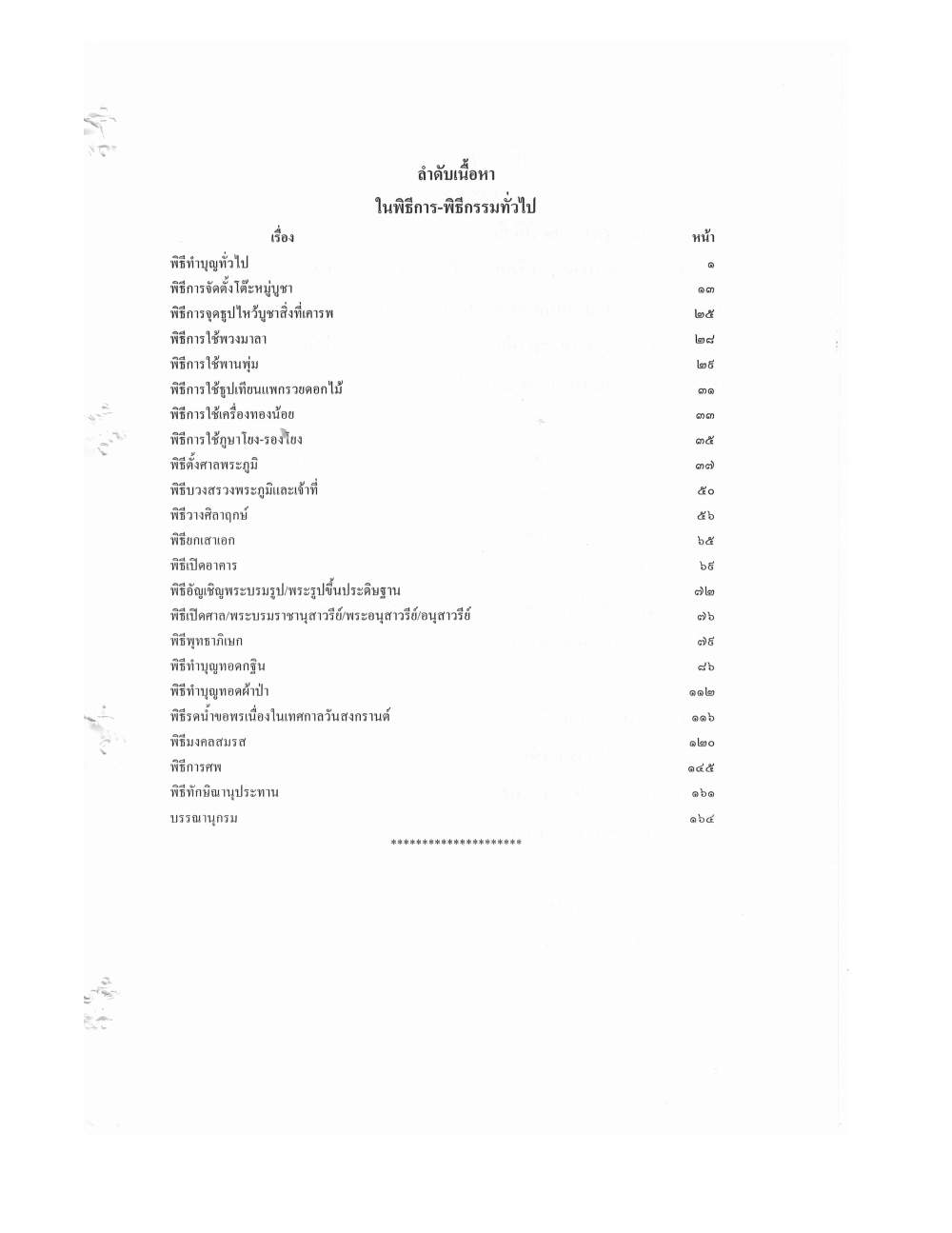
ลำดับเนื้อหา ในพิธีการ-พิธีกรรมทั่วไป
เรื่อง หน้า
พิธีทำบุญทั่วไป ๑ พิธีการจัดตั้งโต๊ะหมู่บูชา ๑๓ พิธีการจุดธูปไหว้บูชาสิ่งที่เคารพ ๒๕ พิธีการใช้พวงมาลา ๒๘ พิธีการใช้พานพุ่ม ๒๙ พิธีการใช้ธูปเทียนแพกรวยดอกไม้ ๓๑ พิธีการใช้เครื่องทองน้อย ๓๓ พิธีการใช้ภูษาโยง-รองโยง ๓๕ พิธีตั้งศาลพระภูมิ ๓๗ พิธีบวงสรวงพระภูมิและเจ้าที่ ๕๐ พิธีวางศิลาฤกษ์ ๕๖ พิธียกเสาเอก ๖๕ พิธีเปิดอาคาร ๖๙ พิธีอัญเชิญพระบรมรูป/พระรูปขึ้นประดิษฐาน ๗๒ พิธีเปิดศาล/พระบรมราชานุสาวรีย์/พระอนุสาวรีย์/อนุสาวรีย์ ๗๖ พิธีพุทธาภิเษก ๗๙ พิธีทำบุญทอดกฐิน ๘๖ พิธีทำบุญทอดผ้าป่า ๑๑๒ พิธีรดน้ำขอพรเนื่องในเทศกาลวันสงกรานต์ ๑๑๖ พิธีมงคลสมรส ๑๒๐ พิธีการศพ ๑๔๕ พิธีทักษิณานุประทาน ๑๖๑ บรรณานุกรม ๑๖๔
**********************
Order of Contents In Ceremonial Procedure - General Rites
Topic Page
General merit-making ceremony 1 Ceremony of setting up the altar table 13 Ceremony of lighting incense in reverence to objects of respect 25 Ceremony of using garlands 28 Ceremony of using floral bouquet trays 29 Ceremony of using incense-candle-cone floral offerings 31 Ceremony of using the lesser gold ceremonial set 33 Ceremony of using the sacred cloth sash, main and secondary 35 Ceremony of erecting the spirit house 37 Ceremony of making offerings to the guardian spirits of the land 50 Foundation-stone laying ceremony 56 Ceremony of raising the principal post 65 Building-opening ceremony 69 Ceremony of enshrining a royal image or statue 72 Ceremony of opening a hall / royal monument / memorial / statue 76 Buddha-image consecration ceremony 79 Kathin robe-offering merit ceremony 86 Pha Pa robe-offering merit ceremony 112 Ceremony of pouring water for blessings during the Songkran festival 116 Auspicious wedding ceremony 120 Funeral rites 145 Merit-dedication (Dakkhinanupradan) ceremony 161 Bibliography 164
**********************
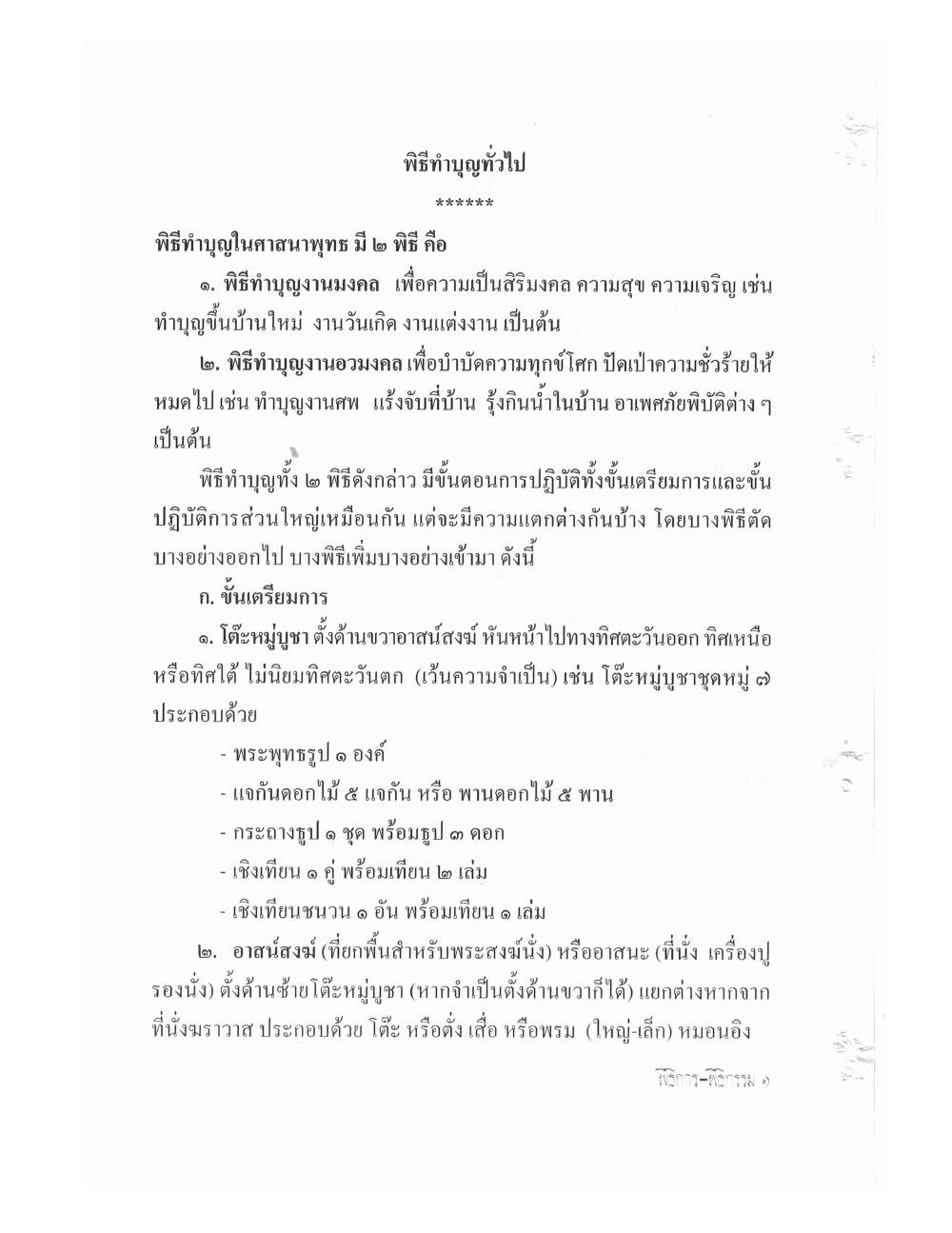
พิธีทำบุญทั่วไป
******
พิธีทำบุญในศาสนาพุทธ มี ๒ พิธี คือ
๑. พิธีทำบุญงานมงคล เพื่อความเป็นสิริมงคล ความสุข ความเจริญ เช่น ทำบุญขึ้นบ้านใหม่ งานวันเกิด งานแต่งงาน เป็นต้น
๒. พิธีทำบุญงานอวมงคล เพื่อบำบัดความทุกข์โศก ปัดเป่าความชั่วร้ายให้หมดไป เช่น ทำบุญงานศพ แร้งจับที่บ้าน รุ้งกินน้ำในบ้าน อาเพศภัยพิบัติต่าง ๆ เป็นต้น
พิธีทำบุญทั้ง ๒ พิธีดังกล่าว มีขั้นตอนการปฏิบัติทั้งขั้นเตรียมการและขั้นปฏิบัติการส่วนใหญ่เหมือนกัน แต่จะมีความแตกต่างกันบ้าง โดยบางพิธีตัดบางอย่างออกไป บางพิธีเพิ่มบางอย่างเข้ามา ดังนี้
ก. ขั้นเตรียมการ
๑. โต๊ะหมู่บูชา ตั้งด้านขวาอาสน์สงฆ์ หันหน้าไปทางทิศตะวันออก ทิศเหนือ หรือทิศใต้ ไม่นิยมทิศตะวันตก (เว้นความจำเป็น) เช่น โต๊ะหมู่บูชาชุดหมู่ ๗ ประกอบด้วย
- พระพุทธรูป ๑ องค์ - แจกันดอกไม้ ๕ แจกัน หรือ พานดอกไม้ ๕ พาน - กระถางธูป ๑ ชุด พร้อมธูป ๓ ดอก - เชิงเทียน ๑ คู่ พร้อมเทียน ๒ เล่ม - เชิงเทียนชนวน ๑ อัน พร้อมเทียน ๑ เล่ม
๒. อาสน์สงฆ์ (ที่ยกพื้นสำหรับพระสงฆ์นั่ง) หรืออาสนะ (ที่นั่ง เครื่องปูรองนั่ง) ตั้งด้านซ้ายโต๊ะหมู่บูชา (หากจำเป็นตั้งด้านขวาก็ได้) แยกต่างหากจากที่นั่งฆราวาส ประกอบด้วย โต๊ะ หรือตั่ง เสื่อ หรือพรม (ใหญ่-เล็ก) หมอนอิง
[พิธีการ-พิธีกรรม ๑]
General Merit-Making Ceremony
******
There are two kinds of merit-making ceremony in the Buddhist religion:
1. The auspicious (mangala) merit-making ceremony, held for the sake of good fortune, happiness, and prosperity - for example, house-warming merit-making, birthday ceremonies, wedding ceremonies, and the like.
2. The inauspicious (avamangala) merit-making ceremony, held to relieve suffering and grief and to entirely dispel misfortune - for example, funeral merit-making, [rites performed when] a vulture perches on the house, a rainbow touches down at the house, various ominous calamities, and the like.
Both of these kinds of merit-making ceremony share largely the same procedure in both the preparatory and operational stages, though there are some differences: some ceremonies omit certain items while others add certain items, as follows:
A. Preparatory stage
1. The altar table (โต๊ะหมู่บูชา) is placed to the right of the monks' seat, facing east, north, or south; facing west is not customary (except when necessary). For example, a seven-piece altar table set consists of:
- 1 Buddha image - 5 flower vases, or 5 trays of flowers - 1 set of incense pots with 3 incense sticks - 1 pair of candle holders with 2 candles - 1 taper candle holder with 1 candle
2. The monks' seat (อาสน์สงฆ์ - a raised platform for the monks to sit on) or seating cushion (อาสนะ - the seat, seating cover) is placed to the left of the altar table (it may be placed to the right if necessary), kept separate from the seating for laypeople. It consists of a table or a low bench, a mat or a carpet (large or small), and a backrest cushion.
[page marker: Ceremonial Procedure-Rites, page 1]
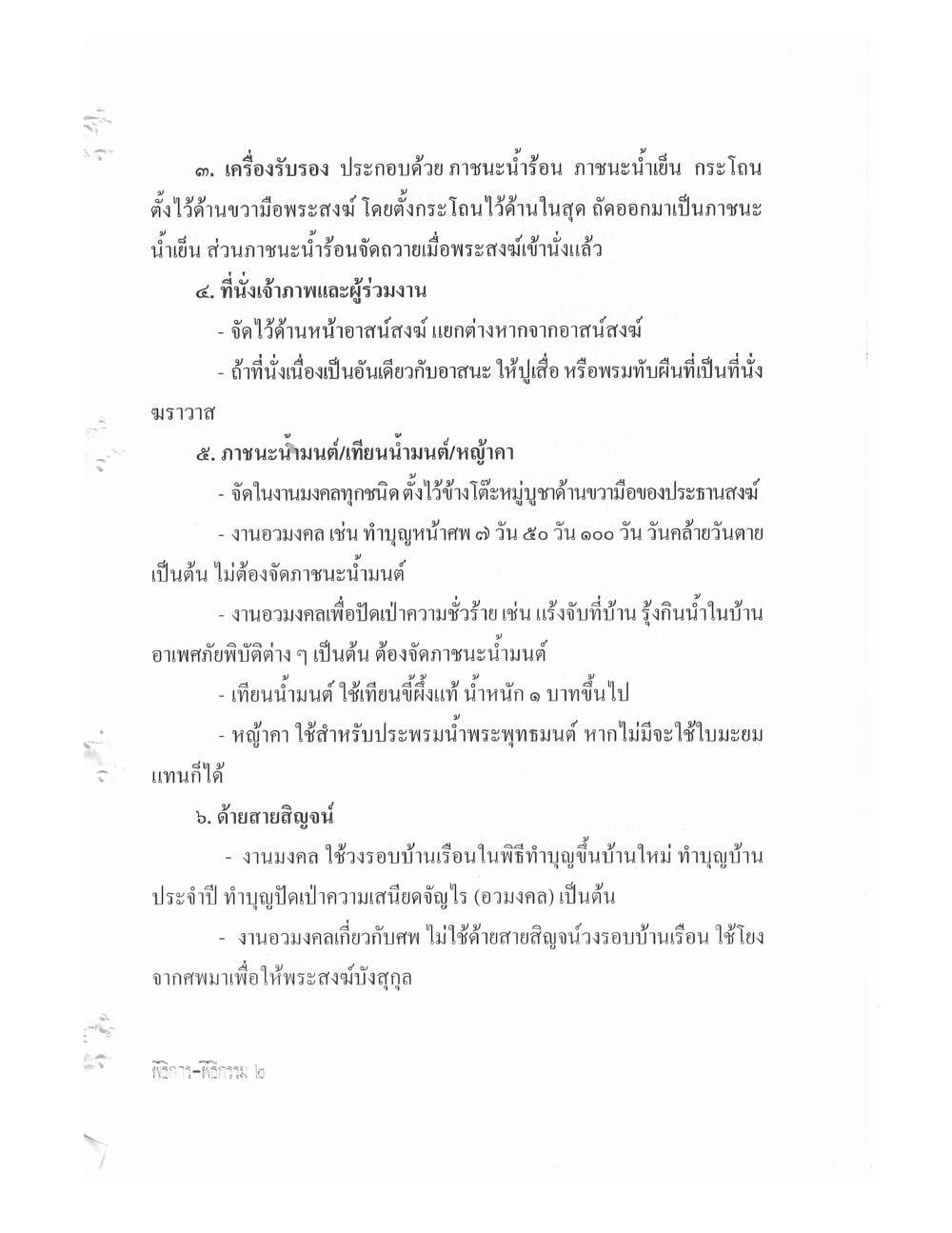
๓. เครื่องรับรอง ประกอบด้วย ภาชนะน้ำร้อน ภาชนะน้ำเย็น กระโถน ตั้งไว้ด้านขวามือพระสงฆ์ โดยตั้งกระโถนไว้ด้านในสุด ถัดออกมาเป็นภาชนะน้ำเย็น ส่วนภาชนะน้ำร้อนจัดถวายเมื่อพระสงฆ์เข้านั่งแล้ว
๔. ที่นั่งเจ้าภาพและผู้ร่วมงาน - จัดไว้ด้านหน้าอาสน์สงฆ์ แยกต่างหากจากอาสน์สงฆ์ - ถ้าที่นั่งเนื่องเป็นอันเดียวกับอาสนะ ให้ปูเสื่อ หรือพรมทับผืนที่เป็นที่นั่งฆราวาส
๕. ภาชนะน้ำมนต์/เทียนน้ำมนต์/หญ้าคา - จัดในงานมงคลทุกชนิด ตั้งไว้ข้างโต๊ะหมู่บูชาด้านขวามือของประธานสงฆ์ - งานอวมงคล เช่น ทำบุญหน้าศพ ๗ วัน ๕๐ วัน ๑๐๐ วัน วันคล้ายวันตาย เป็นต้น ไม่ต้องจัดภาชนะน้ำมนต์ - งานอวมงคลเพื่อปัดเป่าความชั่วร้าย เช่น แร้งจับที่บ้าน รุ้งกินน้ำในบ้าน อาเพศภัยพิบัติต่าง ๆ เป็นต้น ต้องจัดภาชนะน้ำมนต์ - เทียนน้ำมนต์ ใช้เทียนขี้ผึ้งแท้ น้ำหนัก ๑ บาทขึ้นไป - หญ้าคา ใช้สำหรับประพรมน้ำพระพุทธมนต์ หากไม่มีจะใช้ใบมะยมแทนก็ได้
๖. ด้ายสายสิญจน์ - งานมงคล ใช้วงรอบบ้านเรือนในพิธีทำบุญขึ้นบ้านใหม่ ทำบุญบ้านประจำปี ทำบุญปัดเป่าความเสนียดจัญไร (อวมงคล) เป็นต้น - งานอวมงคลเกี่ยวกับศพ ไม่ใช้ด้ายสายสิญจน์วงรอบบ้านเรือน ใช้โยงจากศพมาเพื่อให้พระสงฆ์บังสุกุล
[พิธีการ-พิธีกรรม ๒]
3. Refreshment vessels, consisting of a hot-water container, a cold-water container, and a spittoon, are placed to the right of the monks. The spittoon is placed innermost, with the cold-water container placed next to it; the hot-water container is presented once the monks have taken their seats.
4. Seating for the host and guests - Arranged in front of the monks' seating, kept separate from the monks' seating. - If the seating happens to share the same platform as the monks' seating, a mat or carpet should be laid over the portion used as lay seating.
5. The holy-water vessel / holy-water candle / cogon grass (หญ้าคา) - Arranged for every kind of auspicious ceremony, placed beside the altar table to the right of the presiding monk. - For inauspicious ceremonies such as merit-making before the body on the 7th, 50th, or 100th day, the anniversary of death, and the like, a holy-water vessel is not needed. - For inauspicious ceremonies held to dispel misfortune - such as a vulture perching on the house, a rainbow touching down at the house, various ominous calamities, and the like - a holy-water vessel is needed. - The holy-water candle should be made of genuine beeswax, weighing 1 baht [approx. 15 g] or more. - Cogon grass (หญ้าคา) is used for sprinkling the consecrated water; if unavailable, mayom (star gooseberry) leaves may be used instead.
6. The sacred thread (ด้ายสายสิญจน์) - For auspicious ceremonies, it is looped around the house in house-warming merit ceremonies, annual house merit ceremonies, ceremonies to dispel misfortune (inauspicious rites), and the like. - For inauspicious ceremonies concerning a corpse, the sacred thread is not looped around the house; instead it is run from the corpse so the monks may perform the bangsukul robe-offering [for the dead].
[page marker: Ceremonial Procedure-Rites, page 2]
วิธีวงด้ายสายสิญจน์ - งานมงคล เช่น ทำบุญขึ้นบ้านใหม่ ฯลฯ เริ่มต้นที่พระพุทธรูป ที่โต๊ะหมู่บูชาหรือหิ้งพระในบ้าน หรือในที่ประกอบพิธีสงฆ์ วงเวียนขวารอบอาคารบ้านเรือน หรือรอบบริเวณงานแล้วนำมาวงเวียนขวารอบฐานพระพุทธรูป ๑ หรือ ๓ รอบ วางกลุ่มด้ายสายสิญจน์ใส่พานไว้ด้านซ้ายโต๊ะหมู่บูชา - งานมงคลอื่น ๆ ให้วงรอบที่ฐานพระพุทธรูป แล้วโยงมาวงรอบภาชนะน้ำมนต์เลย
วิธีใช้ด้ายสายสิญจน์บังสุกุล - งานมงคล หากเชิญโกศอัฐิบรรพบุรุษมาร่วมบำเพ็ญกุศลด้วย จะใช้ด้ายสายสิญจน์อีกกลุ่มหนึ่ง หรือกลุ่มเดียวกันนั้น เด็ดให้ขาดจากพระพุทธรูป แล้วเชื่อมโยงโกศอัฐิให้พระสงฆ์บังสุกุล - งานอวมงคล โยงจากศพ จากโกศอัฐิ จากรูปผู้ตาย หรือจากรายนามผู้ตาย มาให้พระสงฆ์บังสุกุล
๗. เทียนชนวน อุปกรณ์ประกอบด้วย - เชิงเทียนทองเหลืองขนาดกลาง ๑ อัน - เทียนขี้ผึ้ง/เทียนไข ไส้ใหญ่ ๆ ๑ เล่ม - น้ำมันชนวน (เทียนขี้ผึ้ง/เทียนไข ผสมน้ำมันเบนซิน)
๘. ภาชนะกรวดน้ำ ใส่น้ำสะอาดเตรียมไว้ให้พร้อมก่อนถึงเวลาใช้
๙. การนิมนต์พระสงฆ์
งานมงคล - พิธีหลวง นิมนต์ ๑๐ รูป ส่วนพิธีทางราชการ นิยมนิมนต์ ๑๐ รูป ตามพิธีหลวง - พิธีราษฎร์ทุกประเภท รวมทั้งงานมงคลสมรส นิมนต์ ๕ รูป
[พิธีการ-พิธีกรรม ๓]
Method of looping the sacred thread - For auspicious ceremonies, such as house-warming merit-making, etc., begin at the Buddha image on the altar table or the household shrine, or at the place where the monks' ceremony is held; loop it clockwise around the building or house, or around the ceremony grounds, then bring it back to loop clockwise around the base of the Buddha image once or three times. Place the coiled sacred thread on a tray to the left of the altar table. - For other auspicious ceremonies, loop it around the base of the Buddha image, then run it directly to loop around the holy-water vessel.
Method of using the sacred thread for bangsukul (robe-offering for the dead) - For an auspicious ceremony, if the urn containing ancestral remains is invited to join in the merit-making, a separate set of sacred thread - or the same set - is used: it is cut off from [the loop connected to] the Buddha image, then linked to the urn so the monks may perform bangsukul. - For an inauspicious ceremony, the thread is run from the corpse, from the urn of ashes, from the portrait of the deceased, or from the list of names of the deceased, to the monks for bangsukul.
7. The taper candle (เทียนชนวน) - equipment consists of: - 1 medium-sized brass candle holder - 1 beeswax or paraffin candle with a thick wick - Taper fuel (beeswax or paraffin candle mixed with gasoline)
8. The water-libation vessel - filled with clean water, prepared and ready before the time it is needed.
9. Inviting the monks
For auspicious ceremonies - For royal ceremonies, 10 monks are invited; for official government ceremonies, it is customary to invite 10 monks in accordance with royal ceremony. - For all kinds of ceremonies held by the general public, including auspicious wedding ceremonies, 5 monks are invited.
[page marker: Ceremonial Procedure-Rites, page 3]
งานอวมงคลเกี่ยวกับพิธีศพทั้งพิธีหลวงและพิธีราษฎร์ นิมนต์พระสงฆ์เหมือนกัน คือ - สวดพระอภิธรรม ๔ รูป - สวดหน้าไฟ ๔ รูป - สวดพระพุทธมนต์ ๕ ๗ ๙ ๑๐ รูป ตามศรัทธา (พิธีหลวง นิมนต์ ๑๐ รูป) - สวดแจง ๒๐ ๒๕ ๕๐ ๑๐๐ ๕๐๐ รูป หรือทั้งวัด - สวดมาติกาบังสุกุล นิยมนิมนต์เท่าอายุผู้ตาย หรือตามศรัทธา
ข. ขั้นปฏิบัติการ
๑. การใช้เทียนชนวน
- การถือเทียนชนวน พิธีกรถือด้วยมือขวา โดยหงายฝ่ามือ ใช้นิ้วมือสี่นิ้ว (เว้นนิ้วหัวแม่มือ) รองรับฐานเชิงเทียน แล้วใช้หัวแม่มือกดฐานเชิงเทียนเข้าไว้ ไม่นิยมจับกึ่งกลางเชิงเทียน เพราะจะทำให้ประธานในพิธีรับไม่สะดวก
- การส่งเทียนชนวน พิธีกรจุดเทียนชนวนถือด้วยมือขวาเดินเข้าไปหาประธานในพิธี ยืนตรงโค้งคำนับ เดินตามประธานในพิธีไปยังที่บูชา โดยเดินเยื้องทางด้านขวามือประธานในพิธี ถ้าประธานในพิธีหยุดยืนหน้าที่บูชา พิธีกรน้อมตัวลงเล็กน้อยส่งเทียนชนวน ถ้าประธานในพิธีนั่งคุกเข่า พิธีกรก็นั่งคุกเข่าตาม แล้วส่งเทียนชนวนด้วยมือขวา มือซ้ายห้อยอยู่ข้างตัว
- การรับเทียนชนวน เมื่อประธานในพิธีจุดธูปเทียนเสร็จแล้ว พิธีกรรับเทียนชนวน โดยยื่นมือขวาแบมือเข้าไปรองรับ ถอยหลังห่างออกไปเล็กน้อย โค้งคำนับแล้วกลับหลังหันเดินออกมา
[พิธีการ-พิธีกรรม ๔]
For inauspicious ceremonies concerning a funeral, both royal and public ceremonies invite the same number of monks, namely: - 4 monks to chant the Abhidhamma - 4 monks to chant before the [cremation] fire - 5, 7, 9, or 10 monks to chant the Buddhist blessing texts, according to one's faith (for royal ceremonies, 10 monks are invited) - 20, 25, 50, 100, or 500 monks for the sawotchaeng chanting, or the entire monastery - For the matika-bangsukul chanting, it is customary to invite a number of monks equal to the age of the deceased, or according to one's faith.
B. Operational stage
1. Use of the taper candle
- Holding the taper candle: the master of ceremonies holds it with the right hand, palm facing upward, using four fingers (excluding the thumb) to support the base of the candle holder, then pressing the thumb against the base of the holder to secure it. It is not customary to grip the middle of the candle holder, as this would make it inconvenient for the presiding officiant to receive it.
- Presenting the taper candle: the master of ceremonies, holding the lit taper candle in the right hand, walks up to the presiding officiant, stands upright and bows in greeting, then follows the presiding officiant to the place of worship, walking slightly to the right of the presiding officiant. If the presiding officiant stops and stands in front of the place of worship, the master of ceremonies leans forward slightly to present the taper candle. If the presiding officiant kneels, the master of ceremonies kneels as well, then presents the taper candle with the right hand, keeping the left hand at the side.
- Receiving the taper candle back: once the presiding officiant has finished lighting the incense and candles, the master of ceremonies receives the taper candle back by extending the right hand, palm open, to receive it, then steps back slightly, bows in greeting, and turns to walk away.
[page marker: Ceremonial Procedure-Rites, page 4]
๒. การปฏิบัติของประธานในพิธีที่โต๊ะหมู่บูชา
เมื่อเริ่มพิธีการ
- พร้อมที่หน้าโต๊ะหมู่บูชา รับเทียนชนวนจากพิธีกรด้วยมือขวา - จุดเทียนเล่มซ้ายมือของประธานในพิธีก่อน แล้วจุดเทียนเล่มขวามือ - จุดธูปดอกซ้ายมือของประธานในพิธีก่อน แล้วจุดธูปดอกที่ ๒ และ ๓ ตามลำดับ - ส่งเทียนชนวนคืนให้พิธีกร - กราบบนที่กราบพระ ๓ ครั้ง ลำดับการปฏิบัติ คือ - คุกเข่า - ตั้งลำตัวตรง (๑. ประนมมือ ๒. น้อมศีรษะลง ๓. แนบฝ่ามือทั้งสองบนที่กราบ ๔. จรดหน้าผากลงระหว่างมือ (ให้หน้าผากสัมผัสที่กราบ) ๕. ยกศีรษะขึ้นพร้อมยกมือประนมขึ้นตาม ๖. ตั้งลำตัวตรง) รวม ๖ จังหวะ นับเป็น ๑ ครั้ง
หมายเหตุ การก้มศีรษะลง แล้วแบะฝ่ามือใส่ที่กราบ ๑ ครั้ง ไม่ใช่วิธีที่ถูกต้อง ไม่พึงปฏิบัติเช่นนั้น
๓. พิธีกรอาราธนาศีล/พระปริตร
- เมื่อประธานในพิธี หรือเจ้าภาพจุดธูปเทียนบูชาพระรัตนตรัยเสร็จแล้ว กลับนั่งที่เดิม พิธีกรเริ่มกล่าวคำอาราธนาต่อไป
- ถ้าอาสนะอยู่ระดับพื้น ผู้ร่วมพิธีทั้งหมดนั่งกับพื้น พิธีกรพึงนั่งคุกเข่าประนมมือกราบ ๓ ครั้ง แล้วจึงกล่าวคำอาราธนา ถ้าอาสน์สงฆ์ยกขึ้นสูงจากพื้น แต่ผู้ร่วมพิธีทั้งหมดนั่งอยู่กับพื้น พิธีกรก็นั่งคุกเข่าอาราธนาเช่นกัน
[พิธีการ-พิธีกรรม ๕]
2. Conduct of the presiding officiant at the altar table
At the start of the ceremony
- Stand ready in front of the altar table and receive the taper candle from the master of ceremonies with the right hand. - Light the candle on the officiant's own left first, then the candle on the right. - Light the incense stick on the officiant's own left first, then the 2nd and 3rd incense sticks in order. - Return the taper candle to the master of ceremonies. - Prostrate at the prostration cushion 3 times. The sequence of the prostration is as follows: - Kneel - Sit upright (1. Press the palms together, 2. Lower the head, 3. Place both palms flat on the prostration cushion, 4. Lower the forehead to touch between the hands [so the forehead touches the cushion], 5. Raise the head while raising the pressed palms together, 6. Sit upright) - a total of 6 motions counts as 1 prostration.
Note: Lowering the head and then spreading the palms open onto the cushion in a single motion is not the correct method and should not be practiced.
3. The master of ceremonies invites the precepts / the protective chants (พระปริตร)
- Once the presiding officiant or the host has finished lighting the incense and candles in reverence to the Triple Gem and has returned to the seat, the master of ceremonies begins to recite the invitation.
- If the seating is at floor level, with all participants seated on the floor, the master of ceremonies should kneel, press the palms together, and prostrate 3 times before reciting the invitation. If the monks' seating is raised above the floor but all participants remain seated on the floor, the master of ceremonies likewise kneels to recite the invitation.
[page marker: Ceremonial Procedure-Rites, page 5]
- ถ้าอาสน์สงฆ์ยกสูง ผู้ร่วมพิธีทั้งหมดนั่งเก้าอี้ พิธีกรพึงยืนทางท้ายอาสน์สงฆ์ ข้างหน้าพระสงฆ์รูปที่ ๑ หรือที่ ๒ จากท้ายแถว หรือที่อันเหมาะสม ทำความเคารพประธานในพิธี แล้วหันหน้าไปทางประธานสงฆ์ประนมมือ กล่าวคำอาราธนาศีล โดยหยุดทอดเสียงเป็นจังหวะ ๆ ดังนี้
คำอาราธนาศีล
มะยัง ภันเต วิสุง วิสุง รักขะณัตถายะ/ ติสะระเณนะ สะหะ/ ปัญจะ สีลานิ ยาจามะ/
ทุติยัมปิ มะยัง ภันเต วิสุง วิสุง รักขะณัตถายะ/ ติสะระเณนะ สะหะ/ ปัญจะ สีลานิ ยาจามะ/
ตะติยัมปิ มะยัง ภันเต วิสุง วิสุง รักขะณัตถายะ/ ติสะระเณนะ สะหะ/ ปัญจะ สีลานิ ยาจามะ/
- เมื่อรับศีลเสร็จแล้วพึงอาราธนาพระปริตรต่อไป จบแล้ว ถ้านั่งคุกเข่าก็กราบ ๓ ครั้ง ถ้ายืนก็ยกมือไหว้ เสร็จแล้วทำความเคารพประธานในพิธีอีกครั้งหนึ่ง
คำอาราธนาพระปริตร
วิปัตติปะฏิพาหายะ/ สัพพะสัมปัตติสิทธิยา/ สัพพะทุกขะวินาสายะ/ ปะริตตัง พรูถะ มังคะลัง/
วิปัตติปะฏิพาหายะ/ สัพพะสัมปัตติสิทธิยา/ สัพพะภะยะวินาสายะ/ ปะริตตัง พรูถะ มังคะลัง/
วิปัตติปะฏิพาหายะ/ สัพพะสัมปัตติสิทธิยา/ สัพพะโรคะวินาสายะ/ ปะริตตัง พรูถะ มังคะลัง/
[พิธีการ-พิธีกรรม ๖]
- If the monks' seating is raised, and all participants are seated in chairs, the master of ceremonies should stand at the end of the monks' seating, in front of the 1st or 2nd monk from the end of the row, or wherever appropriate, pay respect to the presiding officiant, then turn to face the presiding monk, press the palms together, and recite the invitation for the precepts, pausing to draw out the tone rhythmically, as follows:
The Words of Invitation for the Precepts
Mayaṃ bhante visuṃ visuṃ rakkhaṇatthāya / tisaraṇena saha / pañca sīlāni yācāma / [We, venerable sirs, request the Three Refuges together with the Five Precepts, to be observed separately.]
Dutiyampi mayaṃ bhante visuṃ visuṃ rakkhaṇatthāya / tisaraṇena saha / pañca sīlāni yācāma / [For the second time, we make this same request.]
Tatiyampi mayaṃ bhante visuṃ visuṃ rakkhaṇatthāya / tisaraṇena saha / pañca sīlāni yācāma / [For the third time, we make this same request.]
- Once the precepts have been received, the invitation for the protective chants (พระปริตร) should follow. When finished, if kneeling, prostrate 3 times; if standing, raise the hands in respect (wai). Afterward, pay respect to the presiding officiant once more.
The Words of Invitation for the Protective Chants
Vipatti-paṭibāhāya / sabba-sampatti-siddhiyā / sabba-dukkha-vināsāya / parittaṃ brūtha maṅgalaṃ / [For the warding off of misfortune, for the accomplishment of all prosperity, for the destruction of all suffering, recite the protective blessing.]
Vipatti-paṭibāhāya / sabba-sampatti-siddhiyā / sabba-bhaya-vināsāya / parittaṃ brūtha maṅgalaṃ / [...for the destruction of all danger, recite the protective blessing.]
Vipatti-paṭibāhāya / sabba-sampatti-siddhiyā / sabba-roga-vināsāya / parittaṃ brūtha maṅgalaṃ / [...for the destruction of all sickness, recite the protective blessing.]
[page marker: Ceremonial Procedure-Rites, page 6]
๔. การจุดเทียนน้ำมนต์
- ประธานในพิธี หรือเจ้าภาพต้องรอคอยจุดเทียนน้ำมนต์อีกครั้งหนึ่ง
- เมื่อพระสงฆ์เจริญพระพุทธมนต์ถึงบท นโมการอัฏฐกะ คือ นะโม ๘ บท ประมาณบทที่ ๕ (เริ่ม นะโม โอมะกาตี ตัสสะ ฯลฯ) พิธีกรจุดเทียนชนวนเข้าไปเชิญประธานในพิธี หรือเจ้าภาพไปจุดเทียนน้ำมนต์แล้วยกภาชนะน้ำมนต์ประเคนประธานสงฆ์ ยกมือไหว้แล้วกลับไปนั่งที่เดิม
๕. การบูชาข้าวพระพุทธ/ถวายภัตตาหารพระสงฆ์
เมื่อเจ้าหน้าที่เตรียมสำรับอาหารเพื่อบูชาพระพุทธและภัตตาหารถวายพระสงฆ์เรียบร้อยแล้ว
ประธานในพิธี
- พร้อมที่โต๊ะวางสำรับอาหาร (ไม่ต้องจุดธูป เพราะถือเป็นพิธีต่อเนื่องจากการจุดธูปเทียนตอนเริ่มพิธีการ)
- นั่งคุกเข่า ประนมมือกล่าวคำบูชาข้าวพระพุทธโดยว่า "นะโม ตัสสะ ภะคะวะโต อะระหะโต สัมมาสัมพุทธัสสะ" (๓ จบ) แล้วกล่าวคำบูชาข้าวพระพุทธดังนี้
"อิมัง/ สูปะพะยัญชะนะ/ สัมปันนัง/ สาลีนัง/ โอทะนัง/ อุทะกัง วะรัง/ พุทธัสสะ/ ปูเชมิ" (เพียง ๑ จบ)
- กราบ ๓ ครั้ง หรือยกมือไหว้ ๑ ครั้ง ตามความเหมาะสมของสถานที่
๖. การลาข้าวพระพุทธ
เมื่อพระสงฆ์ฉันภัตตาหารเสร็จแล้ว เจ้าภาพหรือพิธีกรเข้าไปนั่งคุกเข่าประนมมือกล่าวคำลาข้าวพระพุทธ แล้วยกอาหารไปได้
[พิธีการ-พิธีกรรม ๗]
4. Lighting the holy-water candle
- The presiding officiant or the host must wait to light the holy-water candle a second time.
- When the monks' chanting of the Buddhist blessing reaches the Namokāra-aṭṭhaka verses - that is, the eight Namo verses - at approximately the 5th verse (beginning "Namo omakāti tassa..." etc.), the master of ceremonies lights the taper candle and goes to invite the presiding officiant, or the host, to light the holy-water candle, then lifts the holy-water vessel and presents it to the presiding monk. [The officiant] raises the hands in respect and returns to the original seat.
5. Offering rice to the Buddha image / presenting the meal to the monks
Once the staff have finished preparing the meal set for the Buddha offering and the food to be offered to the monks
The presiding officiant
- Stands ready at the table where the meal set is placed (no need to light incense, as this is considered a continuation of the incense- and candle-lighting done at the start of the ceremony).
- Kneels, presses the palms together, and recites the words for offering rice to the Buddha, saying "Namo tassa bhagavato arahato sammāsambuddhassa" (3 times), then recites the following words of offering:
"Imaṃ / sūpa-byañjana / sampannaṃ / sālīnaṃ / odanaṃ / udakaṃ varaṃ / buddhassa / pūjemi" [I offer this fine rice together with its accompanying dishes and pure water to the Buddha.] (only 1 time)
- Prostrates 3 times, or raises the hands in respect (wai) once, as appropriate to the location.
6. Taking leave of the offering to the Buddha
Once the monks have finished eating the meal, the host or the master of ceremonies kneels, presses the palms together, recites the words for taking leave of the Buddha's offering, and then may remove the food.
[page marker: Ceremonial Procedure-Rites, page 7]
หมายเหตุ การลาข้าวพระพุทธเป็นภาระของเจ้าหน้าที่ ซึ่งมีคำลาข้าวพระพุทธดังนี้
"เสสัง มังคะลัง ยาจามิ"
(ข้าพเจ้าขอส่วนที่เหลืออันเป็นมงคลนี้)
๗. กล่าวคำถวายสังฆทาน
- การถวายภัตตาหาร (อาหารสด) งานทำบุญพิธีหลวง ไม่มีการกล่าวคำถวายสังฆทาน (พิธีทางราชการ นิยมปฏิบัติตามพิธีหลวง)
- การถวายภัตตาหาร (อาหารสด) งานทำบุญพิธีราษฎร์ มีทั้งกล่าว และไม่กล่าว (ตามความประสงค์เจ้าภาพ)
- การถวายอาหารแห้ง ทั้งพิธีหลวง และพิธีราษฎร์ นิยมกล่าวคำถวายสังฆทาน
๗.๑ คำถวายสังฆทานแบบมีภัตตาหารเป็นหลัก (ถวายก่อนเที่ยง)
นะโม ตัสสะ/ ภะคะวะโต/ อะระหะโต/ สัมมาสัมพุทธัสสะ (ว่า ๓ จบ)
อิมานิ มะยัง ภันเต/ ภัตตานิ/ สะปะริวารานิ/ ภิกขุสังฆัสสะ/ โอโณชะยามะ/ สาธุ โน ภันเต/ ภิกขุสังโฆ/ อิมานิ/ ภัตตานิ/ สะปะริวารานิ/ ปะฏิคคัณหาตุ/ อัมหากัง/ ทีฆะรัตตัง/ หิตายะ/ สุขายะ
ข้าแต่พระภิกษุสงฆ์ผู้เจริญ/ ข้าพเจ้าทั้งหลาย/ ขอน้อมถวาย/ ซึ่งภัตตาหาร/ พร้อมทั้งของบริวารเหล่านี้/ แด่พระภิกษุสงฆ์/ ขอพระภิกษุสงฆ์จงรับ/ ซึ่งภัตตาหาร/ พร้อมทั้งของบริวารเหล่านี้/ ของข้าพเจ้าทั้งหลาย/ เพื่อประโยชน์/ เพื่อความสุข/ แก่ข้าพเจ้าทั้งหลาย/ ตลอดกาลนาน เทอญ
๗.๒ คำถวายสังฆทานแบบมีเฉพาะของใช้สอยหลายชนิด (ถวายได้ตลอดวัน)
[พิธีการ-พิธีกรรม ๘]
Note: Taking leave of the offering to the Buddha is the duty of the staff member, who recites the following words of leave-taking:
"Sesaṃ maṅgalaṃ yācāmi" [I ask for the remainder as this blessing.]
(I ask for the remaining portion, as this auspicious blessing.)
7. Reciting the words of offering the Sangha gift (สังฆทาน)
- For offering fresh food at a royal merit-making ceremony, there is no recitation of the sangha-gift offering words (official government ceremonies customarily follow royal ceremonial practice).
- For offering fresh food at a public (ราษฎร์) merit-making ceremony, the words may or may not be recited, according to the host's wishes.
- For offering dried food, in both royal and public ceremonies, it is customary to recite the words of the sangha-gift offering.
7.1 Words for offering the sangha gift primarily consisting of a meal (offered before noon)
Namo tassa / bhagavato / arahato / sammāsambuddhassa (recited 3 times)
Imāni mayaṃ bhante / bhattāni / saparivārāni / bhikkhu-saṅghassa / oṇojayāma / sādhu no bhante / bhikkhu-saṅgho / imāni / bhattāni / saparivārāni / paṭiggaṇhātu / amhākaṃ / dīgharattaṃ / hitāya / sukhāya [We, venerable sirs, offer this meal together with its accompaniments to the community of monks. Well, venerable sirs, may the community of monks accept this meal together with its accompaniments, for our long-lasting benefit and happiness.]
Venerable community of monks, we wish to respectfully offer this meal together with these accompanying items to the community of monks. May the community of monks kindly accept this meal together with these accompanying items from us, for our benefit and happiness, for a long time to come.
7.2 Words for offering the sangha gift consisting specifically of various articles of use (may be offered at any time of day)
[page marker: Ceremonial Procedure-Rites, page 8]
นะโม ตัสสะ/ ภะคะวะโต/ อะระหะโต/ สัมมาสัมพุทธัสสะ (ว่า ๓ จบ)
อิมานิ มะยัง ภันเต/ กัปปิยะภัณฑานิ/ ภิกขุสังฆัสสะ/ โอโณชะยามะ/ สาธุ โน ภันเต/ ภิกขุสังโฆ/ อิมานิ/ กัปปิยะภัณฑานิ/ ปะฏิคคัณหาตุ/ อัมหากัง/ ทีฆะรัตตัง/ หิตายะ/ สุขายะ
ข้าแต่พระภิกษุสงฆ์ผู้เจริญ/ ข้าพเจ้าทั้งหลาย/ ขอน้อมถวาย/ ซึ่งกัปปิยภัณฑ์เหล่านี้/ แด่พระภิกษุสงฆ์/ ขอพระภิกษุสงฆ์จงรับ/ ซึ่งกัปปิยภัณฑ์เหล่านี้/ ของข้าพเจ้าทั้งหลาย/ เพื่อประโยชน์/ เพื่อความสุข/ แก่ข้าพเจ้าทั้งหลาย/ ตลอดกาลนาน เทอญ
๗.๓ คำถวายสังฆทานอุทิศ (ถวายเจาะจง)
นะโม ตัสสะ/ ภะคะวะโต/ อะระหะโต/ สัมมาสัมพุทธัสสะ (ว่า ๓ จบ)
อิมานิ มะยัง ภันเต/ มะตะกะภัตตานิ/ สะปะริวารานิ/ ภิกขุสังฆัสสะ/ โอโณชะยามะ/ สาธุ โน ภันเต/ ภิกขุสังโฆ/ อิมานิ/ มะตะกะภัตตานิ/ สะปะริวารานิ/ ปะฏิคคัณหาตุ/ อัมหากัญเจวะ/ มาตาปิตุอาทีนัญจะ/ ญาตะกานัง/ กาละกะตานัง/ ทีฆะรัตตัง/ หิตายะ/ สุขายะ
ข้าแต่พระภิกษุสงฆ์ผู้เจริญ/ ข้าพเจ้าทั้งหลาย/ ขอน้อมถวาย/ ซึ่งมะตะกะภัตตาหาร/ พร้อมทั้งของบริวารเหล่านี้/ แด่พระภิกษุสงฆ์/ ขอพระภิกษุสงฆ์จงรับ/ ซึ่งมะตะกะภัตตาหาร/ พร้อมทั้งของบริวารเหล่านี้/ ของข้าพเจ้าทั้งหลาย/ เพื่อประโยชน์/ เพื่อความสุข/ แก่ข้าพเจ้าทั้งหลายด้วย/ แก่ญาติทั้งหลาย/ มีมารดาบิดา เป็นต้น/ ที่ล่วงลับไปแล้วด้วย/ ตลอดกาลนานเทอญ.
๘. การจัดเครื่องไทยธรรมถวายพระ
- เครื่องไทยธรรม คือ วัตถุสิ่งของต่าง ๆ ที่สมควรถวายพระสงฆ์ ได้แก่ ปัจจัย ๔ และสิ่งของที่นับเนื่องในปัจจัย ๔
[พิธีการ-พิธีกรรม ๙]
Namo tassa / bhagavato / arahato / sammāsambuddhassa (recited 3 times)
Imāni mayaṃ bhante / kappiya-bhaṇḍāni / bhikkhu-saṅghassa / oṇojayāma / sādhu no bhante / bhikkhu-saṅgho / imāni / kappiya-bhaṇḍāni / paṭiggaṇhātu / amhākaṃ / dīgharattaṃ / hitāya / sukhāya [We, venerable sirs, offer these allowable articles to the community of monks. Well, venerable sirs, may the community of monks accept these allowable articles, for our long-lasting benefit and happiness.]
Venerable community of monks, we wish to respectfully offer these allowable articles to the community of monks. May the community of monks kindly accept these allowable articles from us, for our benefit and happiness, for a long time to come.
7.3 Words for offering the sangha gift dedicated [to the deceased] (offered for a specific purpose)
Namo tassa / bhagavato / arahato / sammāsambuddhassa (recited 3 times)
Imāni mayaṃ bhante / matakabhattāni / saparivārāni / bhikkhu-saṅghassa / oṇojayāma / sādhu no bhante / bhikkhu-saṅgho / imāni / matakabhattāni / saparivārāni / paṭiggaṇhātu / amhākañceva / mātāpitu-ādīnañca / ñātakānaṃ / kālakatānaṃ / dīgharattaṃ / hitāya / sukhāya [We, venerable sirs, offer this meal for the deceased together with its accompaniments to the community of monks. Well, venerable sirs, may the community of monks accept this meal for the deceased together with its accompaniments, for the long-lasting benefit and happiness of ourselves, and of our departed relatives beginning with mother and father.]
Venerable community of monks, we wish to respectfully offer this meal for the deceased together with these accompanying items to the community of monks. May the community of monks kindly accept this meal for the deceased together with these accompanying items from us, for our benefit and happiness, and also for the benefit of our relatives - beginning with mother and father - who have passed away, for a long time to come.
8. Preparing offertory articles (เครื่องไทยธรรม) to present to the monks
- Offertory articles are the various objects suitable to be offered to the monks, namely the Four Requisites and items falling within the category of the Four Requisites.
[page marker: Ceremonial Procedure-Rites, page 9]
- สิ่งของที่ประเคนพระได้ในเวลาช่วงเช้าถึงเที่ยง ได้แก่ อาหารคาวหวานทุกชนิด ทั้งอาหารสด อาหารแห้ง และอาหารเครื่องกระป๋องทุกประเภท (หากนำสิ่งของเหล่านี้ไปถวายในเวลาหลังเที่ยงแล้วไม่ต้องประเคน เพียงแต่แจ้งให้พระรับทราบ แล้วมอบให้ศิษย์เก็บรักษาไว้จัดทำถวายในวันต่อไป)
- สิ่งของที่ประเคนพระได้ตลอดเวลา ได้แก่ ประเภทเครื่องดื่ม เครื่องยารักษาโรค และประเภทเภสัช เช่น น้ำตาล น้ำผึ้ง น้ำอ้อย หมากพลู ฯลฯ หรือสิ่งของไม่ใช่สำหรับขบฉัน
- สิ่งของที่ไม่สมควรประเคนพระ ได้แก่ เงิน และวัตถุสำหรับใช้แทนเงิน เช่น ธนบัตร (ในการถวาย ควรใช้ใบปวารณาแทนตัวเงิน ส่วนตัวเงินมอบไว้แก่ไวยาวัจกรของพระนั้น)
๙. การประเคนของพระ
- ถ้าเป็นชาย ยกส่งให้ถึงมือพระ ถ้าเป็นหญิง วางลงบนผ้าที่พระทอดรับประเคน
- ถ้าพระสงฆ์นั่งกับพื้น พึงนั่งคุกเข่าประเคน ถ้าพระสงฆ์นั่งเก้าอี้ พึงยืนหรือนั่งคุกเข่าประเคน
- ภัตตาหารทุกชนิดที่ประเคนแล้ว ห้ามคฤหัสถ์จับต้องอีก ถ้าเผลอไปจับต้องเข้าต้องประเคนใหม่
ลักษณะการประเคนที่ถูกต้อง ประกอบด้วยองค์ ๕ คือ
๑. สิ่งของที่จะประเคนไม่ใหญ่โตหรือหนักเกินไป ขนาดคนปานกลางคนเดียวยกได้และต้องยกสิ่งนั้นพ้นจากพื้นที่สิ่งของนั้นตั้งอยู่
๒. ผู้ประเคนอยู่ห่างจากพระ ประมาณ ๑ ศอก เป็นอย่างมาก (ไม่เกิน ๒ ศอก)
[พิธีการ-พิธีกรรม ๑๐]
- Items that may be handed directly to a monk (ประเคน) during the period from morning until noon include all kinds of savory and sweet food, whether fresh, dried, or canned food of every type. (If such items are to be offered after noon, they need not be handed directly; it suffices to inform the monk, who will then have them kept by an attendant to be prepared and offered on a later day.)
- Items that may be handed directly to a monk at any time include beverages, medicines, and pharmaceutical items such as sugar, honey, sugarcane juice, betel and areca nut, etc., or items not intended for eating.
- Items not appropriate to hand directly to a monk include money and objects used in place of money, such as banknotes. (When offering such things, a dedication note [ใบปวารณา] should be used in place of the money itself, while the money is given to the monk's lay attendant, ไวยาวัจกร.)
9. The manner of handing an offering directly to a monk
- If the giver is male, the item is lifted and handed directly into the monk's hand. If the giver is female, the item is placed onto a cloth that the monk extends to receive it.
- If the monk is seated on the floor, the offering should be handed while kneeling. If the monk is seated in a chair, the offering should be handed while standing or kneeling.
- Once any kind of food has been handed to a monk, a layperson must not touch it again; if touched by mistake, it must be handed over again.
The correct manner of handing an offering consists of five elements:
1. The item to be offered must not be too large or too heavy - it should be of a size that an average person can lift alone, and it must be lifted clear of the surface it was resting on.
2. The person offering it should stand no more than about 1 sok [cubit] from the monk, at most (not exceeding 2 sok).
[page marker: Ceremonial Procedure-Rites, page 10]
๓. ผู้ประเคนน้อมสิ่งของเข้าไปด้วยกิริยาอาการแสดงความเคารพอ่อนน้อม
๔. กิริยาอาการที่น้อมสิ่งของเข้าไป จะส่งด้วยมือก็ได้ ด้วยของเนื่องด้วยกาย เช่น ใช้ทัพพีตักถวาย ฯลฯ ก็ได้
๕. พระผู้รับประเคนนั้น จะรับด้วยมือก็ได้ ด้วยของเนื่องด้วยกาย เช่นจะใช้ผ้าทอดรับ ใช้บาตรรับ หรือ ใช้ภาชนะรับ ฯลฯ ก็ได้
๑๐. การกรวดน้ำ
- งานทำบุญทุกชนิด ต้องมีการอุทิศส่วนกุศลให้แก่ผู้ล่วงลับไปด้วย
- ใช้น้ำที่ใสสะอาดบริสุทธิ์ ไม่มีสีหรือสิ่งอื่นใดเจือปน
- ใช้ภาชนะ (เต้า) กรวดน้ำโดยเฉพาะ ถ้าไม่มี ก็ใช้แก้วน้ำหรือขันน้ำแทน โดยจัดเตรียมไว้ก่อนถึงเวลาใช้
- เมื่อพระสงฆ์เริ่มอนุโมทนาว่า ยถา... ก็เริ่มกรวดน้ำโดยจับภาชนะกรวดน้ำด้วยมือทั้งสอง รินน้ำให้ไหลลงเป็นสาย ไม่ให้ขาดตอนเป็นระยะ โดยไม่ต้องใช้นิ้วมือรองรับสายน้ำ
- เมื่อพระสงฆ์ขึ้นอนุโมทนาว่า สัพพีติโย... พึงเทน้ำให้หมดภาชนะกรวดน้ำแล้วประนมมือรับพรต่อไป
- พิธีกร เข้าไปนำภาชนะกรวดน้ำพร้อมทั้งน้ำที่กรวดแล้วออกมาทันที เทลงพื้นดินที่สะอาด ในที่กลางแจ้ง หรือที่โคนต้นไม้ใหญ่ ภายนอกตัวอาคารบ้านเรือน ห้ามเทลงในกระโถน หรือในที่สกปรก เป็นอันขาด
3. The presenter offers the item forward with a gesture expressing humble respect.
4. The gesture of offering an item forward may be by handing it over directly, or by an implement connected to the body — for instance, using a serving spoon/ladle to offer it, etc.
5. The monk receiving the offering may receive it directly by hand, or by an implement connected to the body — for instance, spreading a cloth to receive it, using the alms bowl to receive it, or using a vessel to receive it, etc.
10. The Water-Pouring Rite
- Every kind of merit-making event must include dedicating the merit to the deceased.
- Use water that is clear, clean, and pure, with no color or anything else mixed into it.
- Use a vessel made specifically for pouring water; if none is available, use a water glass or bowl instead, prepared in advance before it is needed.
- When the monks begin chanting the anumodana "Yathā...", begin pouring the water, holding the vessel with both hands and letting the water flow down in an unbroken stream, without using a finger to guide the stream.
- When the monks reach the chant "Sabbītiyo...", pour out all the water from the vessel, then raise the hands in añjali to receive the blessing that follows.
- The master of ceremonies should immediately take away the water-pouring vessel together with the poured water, and pour it onto clean ground in an open area, or at the base of a large tree, outside the building or house. It must never, under any circumstances, be poured into a spittoon or into a dirty place.
คำกรวดน้ำ
อิทัง เม ญาตีนัง โหตุ/ สุขิตา โหนตุ ญาตะโย.
อิทัง เม มาตาปิตูนัง โหตุ/ สุขิตา โหนตุ มาตาปิตะโร.
อิทัง เม เทวะตานัง โหตุ/ สุขิตา โหนตุ เทวะตาโย.
อิทัง เม สัพเพสัง สัตตานัง โหตุ/ สุขิตา โหนตุ สัพเพ สัตตา.
ขอส่วนบุญของข้าพเจ้านี้ จงสำเร็จแก่ญาติ มารดาบิดา เทวดา และสรรพสัตว์ทั้งหลาย ขอให้ญาติ มารดาบิดา เทวดา และสรรพสัตว์ทั้งหลาย จงเป็นสุขเถิด
**********
Words for the Water-Pouring Rite
May this be for my relatives; may [my] relatives be happy.
May this be for my mother and father; may [my] mother and father be happy.
May this be for the deities; may the deities be happy.
May this be for all beings; may all beings be happy.
May the merit of this deed of mine be accomplished for my relatives, mother and father, the deities, and all beings. May my relatives, mother and father, the deities, and all beings be happy indeed.
**********
พิธีการจัดตั้งโต๊ะหมู่บูชา
********
การจัดตั้งโต๊ะหมู่บูชาสำหรับตั้งพระพุทธรูปพร้อมทั้งเครื่องสักการบูชา นับว่าเป็นสิ่งสำคัญซึ่งขาดมิได้ ทั้งในพระราชพิธี รัฐพิธีหรือพิธีทั่วไป ไม่ว่าจะเป็นงานมงคลหรืองานอวมงคล เพราะการทำบุญของชาวพุทธในครั้งพุทธกาลนิยมนิมนต์พระพุทธเจ้าเป็นประธาน พร้อมด้วยพระภิกษุสงฆ์ตามจำนวนที่ต้องการ ดังนั้นการทำบุญที่มีพิธีสงฆ์ในปัจจุบันจึงนิยมอัญเชิญพระพุทธรูปซึ่งถือว่าเป็นเครื่องหมายแทนองค์พระพุทธเจ้ามาประดิษฐานไว้ในพิธีนั้น เพื่อให้พระรัตนตรัย คือพระพุทธ พระธรรม และพระสงฆ์ครบบริบูรณ์ แม้ในการทำพิธีอื่นที่ไม่มีพระสงฆ์ เช่น การประชุมสัมมนา การประดับยศ การมอบประกาศนียบัตร ก็นิยมจัดโต๊ะหมู่บูชาแสดงความเคารพพระรัตนตรัย เพื่อทำใจให้สงบอันเป็นจุดเริ่มต้นที่จะทำการต่าง ๆ ให้เป็นสิริมงคลต่อไป
การจัดโต๊ะหมู่บูชาถือเป็นเอกลักษณ์ของชาติไทย ทั้งยังเป็นวัฒนธรรมประเพณีที่สำคัญและเป็นมรดกของชาติส่วนหนึ่ง นิยมกระทำ ๒ กรณี คือ
๑. จัดในพิธีทั่วไป เช่น การบำเพ็ญกุศลทางพระพุทธศาสนา การจัดกิจกรรมต่าง ๆ ของส่วนราชการ เป็นต้น
๒. จัดเพื่อเป็นเครื่องถวายสักการะเคารพพระมหากษัตริย์
การจัดโต๊ะหมู่บูชาในพิธีทั่วไป
ในพิธีทั่วไปนิยมจัดโต๊ะหมู่บูชา จะเป็นหมู่ ๕ หมู่ ๗ หมู่ ๙ อยู่ในดุลยพินิจของเจ้าของงานและความสะดวก ทั้งนี้ การจัดให้เหมาะสมแก่สถานที่นับว่าเป็นการจัดที่ดีที่สุด
The Rite of Setting Up the Group-Altar Table
********
Setting up the group-altar table for enshrining the Buddha image together with the items of worship is considered essential and indispensable, whether in a royal ceremony, a state ceremony, or an ordinary rite — whether an auspicious occasion or an inauspicious one — because in the time of the Buddha, Buddhists' merit-making customarily invited the Buddha as the presiding figure, together with however many monks were needed. Therefore, in present-day merit-making ceremonies that include a monks' rite, it is customary to invite a Buddha image — regarded as a symbol standing in for the Buddha himself — to be enshrined at the ceremony, so that the Three Jewels, namely the Buddha, the Dhamma, and the Sangha, are all complete. Even in other ceremonies without monks, such as meetings and seminars, rank-conferring ceremonies, or the presentation of certificates, it is customary to set up a group-altar table to show respect to the Three Jewels, so as to calm the mind as a starting point for carrying out further activities auspiciously.
Setting up the group-altar table is regarded as a distinctive feature of the Thai nation, and is also an important cultural tradition and part of the nation's heritage. It is customarily done on two occasions:
1. Set up for general ceremonies, such as performing Buddhist merit-making rites, activities held by government agencies, and so on.
2. Set up as an offering of homage and respect to the monarch.
Setting Up the Group-Altar Table for General Ceremonies
In general ceremonies, it is customary to set up the group-altar table as a set of 5, 7, or 9, at the discretion of the host of the event and according to convenience. Arranging it to suit the venue is considered the best way to arrange it.
หลักในการจัดโต๊ะหมู่บูชา
โต๊ะหมู่บูชาที่จัดในพิธีต่าง ๆ มีหลักอยู่ว่า ให้ตั้งไว้ต้นแถวด้านขวามือของพระสงฆ์ที่เป็นประธานและให้พระพุทธรูปอยู่บนโต๊ะกลางสูงสุดหันพระพักตร์ออกทางเดียวกับพระสงฆ์ ถือเสมือนว่าพระพุทธเจ้าเป็นประธานสงฆ์ ตามความนิยมมักจะให้หันพระพักตร์ไปทางทิศเหนือด้วยถือว่าพระพุทธเจ้าเป็นโลกอุดรหรือหันไปทางทิศตะวันออกเพราะในคราวตรัสรู้นั้นพระพุทธองค์ทรงผินพระพักตร์ทางทิศตะวันออก แต่ถ้าสถานที่ไม่อำนวย จะหันพระพักตร์ทางทิศใด ๆ ก็ไม่เกิดโทษและไม่มีข้อห้าม และจะเป็นพระพุทธรูปปางใดก็ได้ ยกเว้นปางไสยาสน์ซึ่งไม่เป็นที่นิยม
การจัดเครื่องบูชาบนโต๊ะหมู่บูชา ถือว่ามีความสำคัญที่ผู้จัดมักทำด้วยความประณีตบรรจง เพื่อแสดงความเคารพต่อพระรัตนตรัย และเป็นการแสดงศิลปะ ในการจัดด้วยเครื่องบูชาทุกชนิดจะต้องไม่สูงกว่าพระพุทธรูป เครื่องประกอบที่ใช้ในการจัดโต๊ะหมู่บูชาได้แก่ เชิงเทียน ๑ คู่ เชิงเทียนชนวน ๑ อัน กระถางธูป ๑ ชุด พานประดับพุ่มดอกไม้หรือแจกันดอกไม้จำนวนมากหรือน้อยตามลักษณะชุดโต๊ะหมู่บูชา
การจัดโต๊ะหมู่บูชาในพิธีหรือกิจกรรมต่าง ๆ ของส่วนราชการ องค์การ บริษัท แบ่งได้เป็น ๒ ลักษณะ คือ
๑. ในพิธีที่ไม่มีการบำเพ็ญกุศลทางศาสนา เช่น การประชุม อบรม สัมมนา หรือพิธีที่ไม่ใช่พิธีเกี่ยวกับนานาชาติ นิยมจัดตั้งธงชาติและพระบรมฉายาลักษณ์ของพระบาทสมเด็จพระเจ้าอยู่หัว โดยจัดโต๊ะหมู่ ๕ หมู่ ๗ หรือหมู่ ๙ ประดิษฐานพระพุทธรูปไว้บนโต๊ะกลางสูงสุด ประดับพุ่มดอกไม้หรือแจกันดอกไม้ เชิงเทียนปักเทียน ๑ คู่ กระถางธูปสำหรับประธานในพิธีจุดบูชา
Principles for Setting Up the Group-Altar Table
The group-altar table set up for various ceremonies follows the principle that it should be placed at the head of the row, on the right hand of the presiding monk, with the Buddha image on the highest central table, its face turned in the same direction as the monks, as though the Buddha were the presiding figure of the Sangha. By custom, the Buddha's face is usually turned to face north, since the Buddha is regarded as Lord of the Northern Realm, or turned to face east, because at the moment of Enlightenment the Buddha's own face was turned toward the east. But if the venue does not allow this, facing any other direction incurs no fault and is not prohibited, and the Buddha image may be of any posture, except the reclining posture, which is not customary [for this purpose].
Arranging the offering items on the group-altar table is considered important, and those who arrange it usually do so with great care and refinement, both to express respect for the Three Jewels and to display artistry. In arranging it, every kind of offering item must not stand taller than the Buddha image. The components used in setting up the group-altar table include: 1 pair of candlesticks, 1 taper candlestick [for lighting others], 1 set of incense burners, and a tray adorned with a flower arrangement or a vase of flowers, in a greater or lesser quantity depending on the particular group-altar set.
Setting up the group-altar table for ceremonies or activities of government agencies, organizations, or companies can be divided into 2 types:
1. In ceremonies without any religious merit-making, such as meetings, training sessions, or seminars, or ceremonies not concerned with international matters, it is customary to set up the national flag and the royal portrait of His Majesty the King, arranging the table as a set of 5, 7, or 9, enshrining the Buddha image on the highest central table, adorned with a flower arrangement or vase of flowers, with 1 pair of lit candlesticks, and an incense burner for the presiding officer of the ceremony to light in worship of
พระรัตนตรัย ด้านข้างของโต๊ะหมู่บูชาซ้ายมือของผู้ร่วมพิธีตั้งธงชาติ ขวามือประดิษฐานพระบรมฉายาลักษณ์ของพระบาทสมเด็จพระเจ้าอยู่หัว
๒. ในพิธีที่มีการบำเพ็ญกุศลและถวายภัตตาหารแด่พระสงฆ์ จัดโต๊ะหมู่บูชาและปฏิบัติตามข้อ ๑ และเพิ่มหม้อน้ำมนต์ เทียนน้ำมนต์ เพื่อให้ประธานสงฆ์ทำน้ำมนต์ประพรมผู้ร่วมงานและอาคารสถานที่เพื่อเป็นสิริมงคลเมื่อเสร็จพิธีก่อนพระสงฆ์กลับ
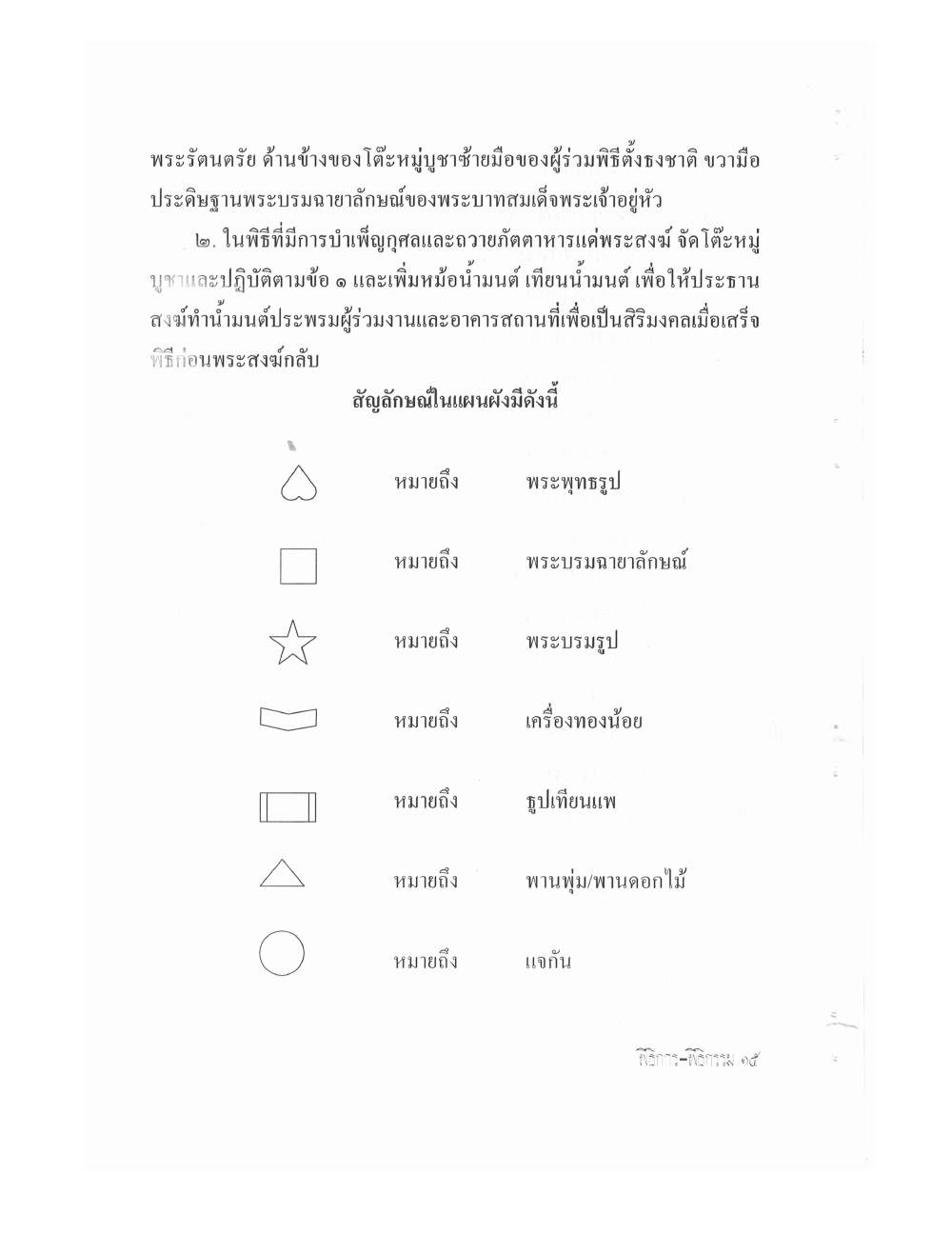
สัญลักษณ์ในแผนผังมีดังนี้
[รูปคล้ายหัวใจ] หมายถึง พระพุทธรูป
[รูปสี่เหลี่ยมจัตุรัส] หมายถึง พระบรมฉายาลักษณ์
[รูปดาวห้าแฉก] หมายถึง พระบรมรูป
[รูปคล้ายริบบิ้นหรือปีกนก] หมายถึง เครื่องทองน้อย
[รูปสี่เหลี่ยมผืนผ้ามีแถบขอบหัวท้าย] หมายถึง ธูปเทียนแพ
[รูปสามเหลี่ยม] หมายถึง พานพุ่ม/พานดอกไม้
[รูปวงกลม] หมายถึง แจกัน
the Three Jewels. At the side of the group-altar table, on the left hand of those attending the ceremony, set up the national flag; on the right hand, enshrine the royal portrait of His Majesty the King.
2. In ceremonies that include religious merit-making and the offering of food to the monks, set up the group-altar table following item 1, and add a pot of blessed water and a blessed-water candle, so that the presiding monk may make blessed water to sprinkle on the participants and the building as an act of auspiciousness when the ceremony ends, before the monks leave.
The Symbols Used in the Diagrams Are as Follows
[diagram: a heart-like outline] means the Buddha image
[diagram: a square] means the royal portrait
[diagram: a five-pointed star] means the royal statue/likeness
[diagram: a ribbon- or wing-like chevron shape] means the small gold ceremonial set (khrueang thong noi)
[diagram: a rectangle with banded end-pieces] means the incense-and-candle offering set (thup thian phae)
[diagram: a triangle] means the flower tray / flower arrangement
[diagram: a circle] means a vase
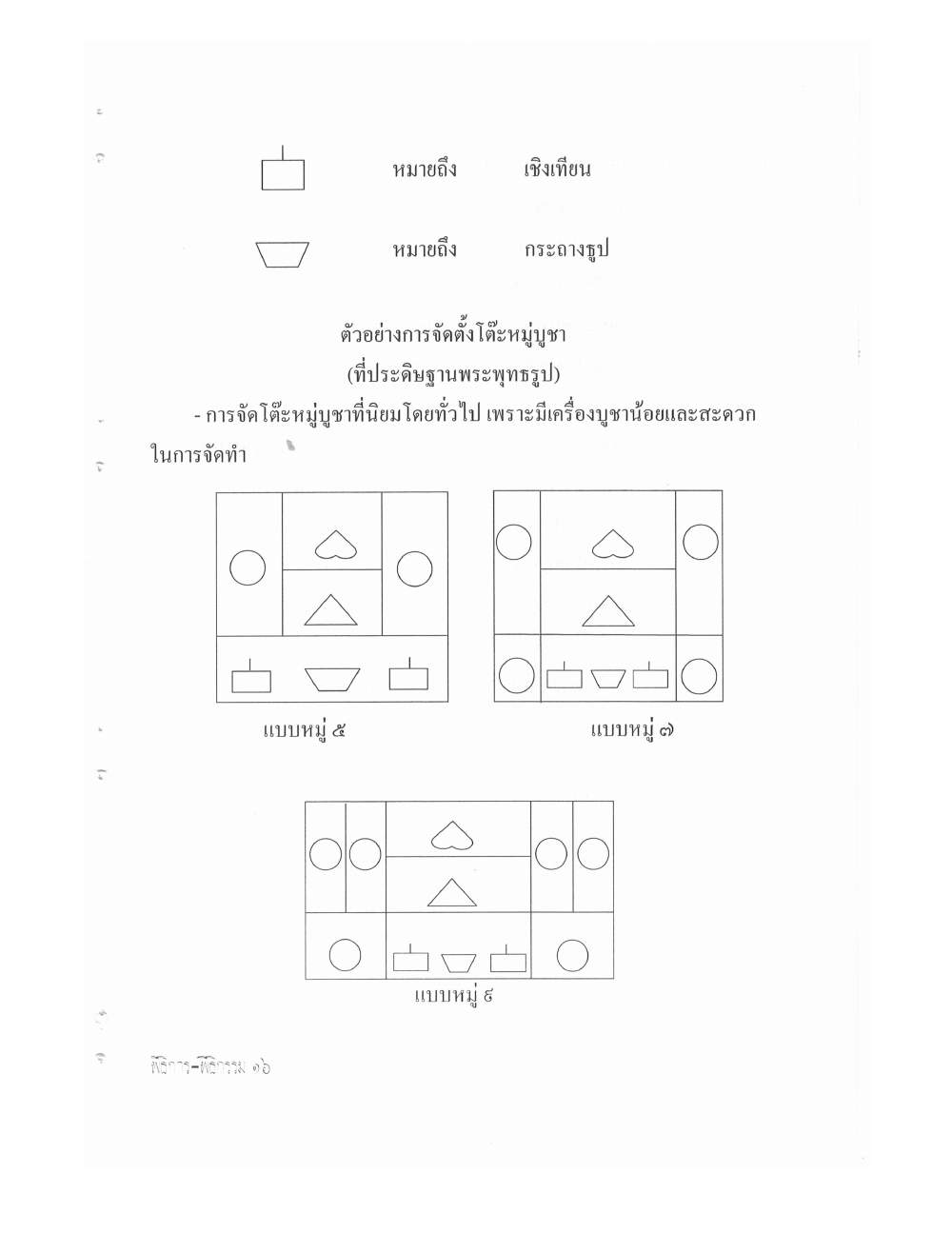
[รูปสี่เหลี่ยมเล็กมีก้านตั้งด้านบน] หมายถึง เชิงเทียน
[รูปคางหมูปากกว้างด้านบน] หมายถึง กระถางธูป
ตัวอย่างการจัดตั้งโต๊ะหมู่บูชา
(ที่ประดิษฐานพระพุทธรูป)
- การจัดโต๊ะหมู่บูชาที่นิยมโดยทั่วไป เพราะมีเครื่องบูชาน้อยและสะดวกในการจัดทำ
[แผนผัง: โต๊ะหมู่บูชาสามช่อง ช่องซ้ายและขวามีวงกลม (แจกัน) ช่องกลางมีรูปหัวใจ (พระพุทธรูป) อยู่เหนือรูปสามเหลี่ยม (พานพุ่ม) แถวล่างมีเชิงเทียน กระถางธูป เชิงเทียน เรียงกัน] แบบหมู่ ๕
[แผนผัง: คล้ายแบบหมู่ ๕ แต่เพิ่มวงกลม (แจกัน) ที่ริมซ้ายและขวาทั้งแถวบนและแถวล่าง] แบบหมู่ ๗
[แผนผัง: คล้ายแบบหมู่ ๗ แต่เพิ่มวงกลม (แจกัน) อีกชั้นที่ริมซ้ายและขวาทั้งแถวบนและแถวล่าง] แบบหมู่ ๙
[diagram: a small rectangle with an upright stem on top] means a candlestick
[diagram: a trough-like shape, wider at the top] means an incense burner
Example of Setting Up the Group-Altar Table
(where the Buddha image is enshrined)
- The arrangement most commonly favored in general, because it requires few offering items and is convenient to set up
[diagram: a group-altar table in three sections — the left and right sections each hold a vase (circle); the center section holds the Buddha image (heart shape) above a flower tray (triangle); a lower row holds a candlestick, an incense burner, and a candlestick, in order] Group-of-5 pattern
[diagram: similar to the group-of-5 pattern, but with an added vase (circle) at each outer edge, both top and bottom] Group-of-7 pattern
[diagram: similar to the group-of-7 pattern, but with a further vase (circle) added at each outer edge, both top and bottom] Group-of-9 pattern
การจัดโต๊ะหมู่บูชาเพื่อเป็นเครื่องถวายสักการะเคารพพระมหากษัตริย์
งานพิธีที่จัดขึ้นเพื่อถวายสักการะ ถวายพระพรชัยมงคล เฉลิมพระเกียรติพระบาทสมเด็จพระเจ้าอยู่หัว นิยมจัดโต๊ะหมู่บูชาด้วยเช่นกัน แต่ตามหลักการบูชาปูชนียบุคคลผู้ยังมีชีวิตอยู่นั้น จะไม่มีการจุดธูปเทียนบูชา ดังนั้น ในการจัดโต๊ะหมู่บูชาจึงใช้ธูปเทียนแพแทนกระถางธูปและเชิงเทียน
การจัดโต๊ะหมู่บูชาในพิธีต่าง ๆ เพื่อถวายสักการะเคารพพระมหากษัตริย์มีดังนี้
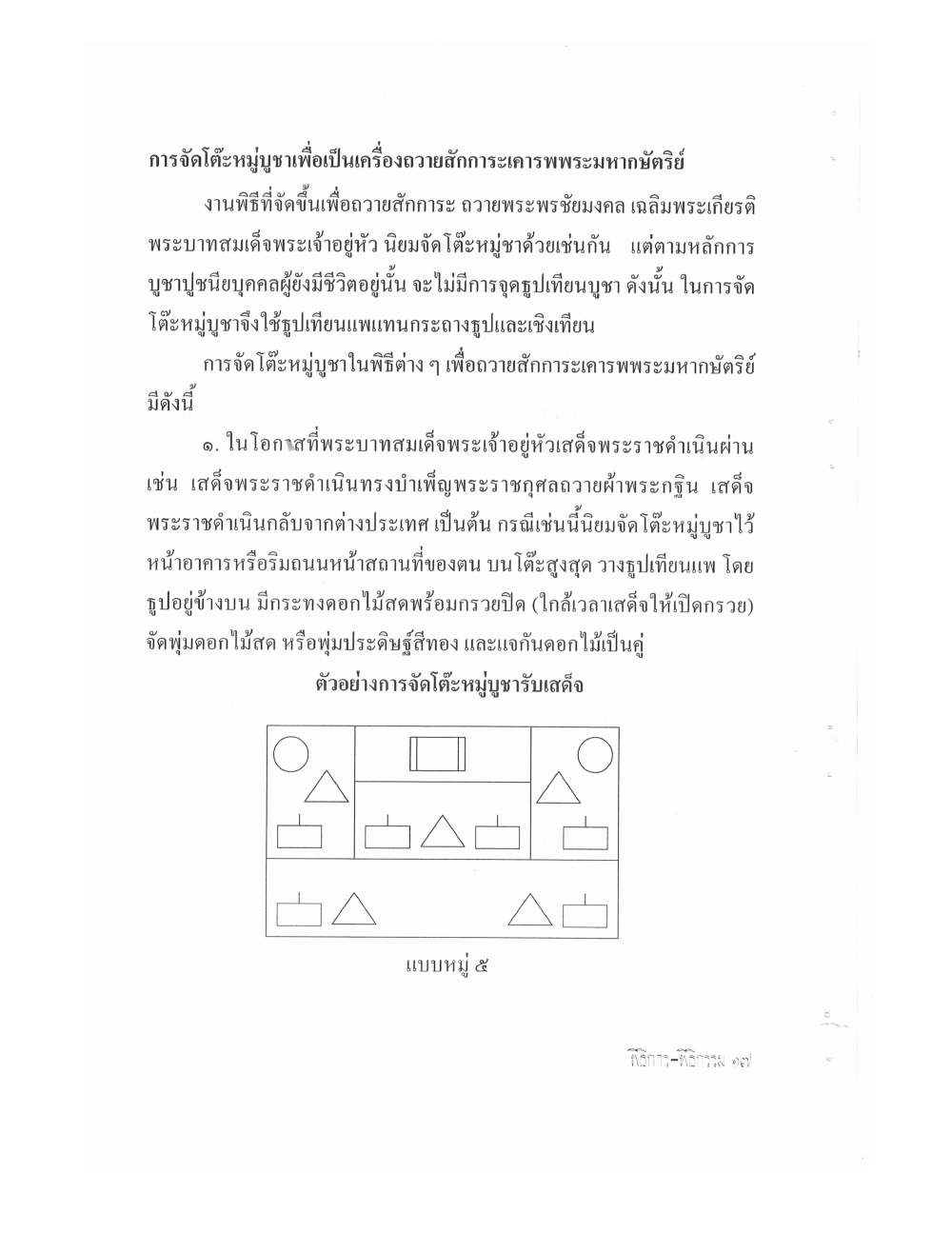
๑. ในโอกาสที่พระบาทสมเด็จพระเจ้าอยู่หัวเสด็จพระราชดำเนินผ่าน เช่น เสด็จพระราชดำเนินทรงบำเพ็ญพระราชกุศลถวายผ้าพระกฐิน เสด็จพระราชดำเนินกลับจากต่างประเทศ เป็นต้น กรณีเช่นนี้นิยมจัดโต๊ะหมู่บูชาไว้หน้าอาคารหรือริมถนนหน้าสถานที่ของตน บนโต๊ะสูงสุด วางธูปเทียนแพ โดยธูปอยู่ข้างบน มีกระทงดอกไม้สดพร้อมกรวยปิด (ใกล้เวลาเสด็จให้เปิดกรวย) จัดพุ่มดอกไม้สด หรือพุ่มประดิษฐ์สีทอง และแจกันดอกไม้เป็นคู่
ตัวอย่างการจัดโต๊ะหมู่บูชารับเสด็จ
[แผนผัง: ด้านซ้ายมีวงกลม (แจกัน) เหนือสามเหลี่ยม (พานพุ่ม) กลางบนสุดมีสี่เหลี่ยมจัตุรัส (พระบรมฉายาลักษณ์) ใต้ลงมาเป็นแถวเชิงเทียน-สามเหลี่ยม-เชิงเทียน ด้านขวามีสามเหลี่ยมเหนือวงกลม (แจกัน) แถวล่างสุดเรียงเชิงเทียน สามเหลี่ยม รูปสี่เหลี่ยมผืนผ้ามีแถบขอบ (ธูปเทียนแพ) สามเหลี่ยม เชิงเทียน] แบบหมู่ ๕
Setting Up the Group-Altar Table as an Offering of Homage to the Monarch
Ceremonies held to pay homage, offer blessings, and honor His Majesty the King customarily also set up a group-altar table. However, according to the principle of venerating a living person of reverence, incense and candles are not lit in worship. Therefore, in setting up the group-altar table for this purpose, an incense-and-candle offering set is used in place of the incense burner and candlesticks.
Setting up the group-altar table in various ceremonies to pay homage and respect to the monarch is done as follows:
1. On occasions when His Majesty the King passes by in a royal procession — such as a royal procession to perform the royal merit-making of offering the Kathin robes, or a royal procession returning from abroad, and so on — it is customary in such cases to set up the group-altar table in front of the building or along the roadside in front of one's premises. On the highest table, place the incense-and-candle offering set with the incense on top, together with a tray of fresh flowers with a closed cone covering (to be opened as the procession nears), and arrange a fresh flower arrangement or an artificial gold-colored one, with a pair of flower vases.
Example of Setting Up the Group-Altar Table to Receive a Royal Procession
[diagram: on the left, a vase (circle) above a flower tray (triangle); at the top center, a square (the royal portrait), with a row of candlestick–flower tray–candlestick beneath it; on the right, a flower tray (triangle) above a vase (circle); the bottom row holds, in order, a candlestick, a flower tray, the incense-and-candle offering set (banded rectangle), a flower tray, and a candlestick] Group-of-5 pattern
๒. ในกรณีที่พระบาทสมเด็จพระเจ้าอยู่หัวมิได้เสด็จพระราชดำเนินผ่าน เช่น ในงานพิธีถวายผ้าพระกฐินพระราชทาน ซึ่งได้พระราชทานให้ส่วนราชการ กระทรวง ทบวง กรม รัฐวิสาหกิจ สมาคม มูลนิธิ บริษัทห้างร้าน หรือเอกชนนำไปถวายพระอารามหลวง หรือในงานพิธีเฉลิมพระชนมพรรษาที่หน่วยราชการจัดในต่างจังหวัด เป็นต้น กรณีเช่นนี้นิยมจัดเป็นโต๊ะหมู่บูชาเช่นเดียวกับข้อ ๑ แต่ต้องจัดตั้งพระบรมฉายาลักษณ์ หรือพระบรมสาทิสลักษณ์ หรืออักษรพระปรมาภิไธย ภปร ประกอบด้วย
๒.๑ วิธีจัดตั้งพระบรมฉายาลักษณ์ หรือพระบรมสาทิสลักษณ์ หรืออักษรพระปรมาภิไธย ภปร นั้น หากสิ่งดังกล่าวมีฐานสำหรับตั้ง และฐานนั้นไม่ใหญ่ไม่กว้างกว่าโต๊ะหมู่ตัวบนก็ให้ตั้งไว้บนโต๊ะตัวบน แล้วตั้งพานธูปเทียนแพพร้อมกระทงดอกไม้สดไว้บนโต๊ะตัวรองแถวกลาง หรือจะตั้งไว้บนโต๊ะตัวต่ำสุดแถวกลางก็ได้ ส่วนโต๊ะตัวอื่น ๆ ก็ตั้งพานพุ่มดอกไม้หรือแจกันดอกไม้ให้ครบทุกตัว แต่ถ้าพระบรมฉายาลักษณ์หรือพระบรมสาทิสลักษณ์ หรืออักษรพระปรมาภิไธย ภปร นั้น ใหญ่และกว้างกว่าโต๊ะหมู่บูชาตัวบน จะใช้ขาหยั่งตั้งสิ่งดังกล่าวไว้ด้านหลังโต๊ะหมู่บูชาก็ได้ แต่ขาหยั่งนั้นจะต้องสูงกว่าโต๊ะหมู่บูชากะให้มองเห็นภาพได้เด่นชัด หากจัดในกรณีเช่นนี้โต๊ะหมู่บูชาตัวบนก็ต้องวางพานธูปเทียนแพ และกระทงดอกไม้สดเช่นเดียวกับที่กล่าวมาแล้วในกรณีแรก แต่ธูปเทียนแพดังกล่าวจะต้องไม่บดบังพระบรมฉายาลักษณ์ให้เสียความโดดเด่น หากตั้งแล้วสิ่งที่ตั้งนั้นบดบังพระบรมฉายาลักษณ์ ก็ให้ปล่อยว่างไว้
2. In cases where His Majesty the King does not pass by in a royal procession — such as at a ceremony of offering a royally-bestowed Kathin robe, which His Majesty has granted to a government agency, ministry, department, state enterprise, association, foundation, company, or private individual to present at a royal monastery, or at a ceremony celebrating the King's birthday held by a government unit in the provinces, and so on — it is customary in such cases to set up a group-altar table as in item 1, but a royal portrait, a royal painted likeness, or the royal cipher "ภปร" must also be set up.
2.1 As for the method of setting up the royal portrait, the royal painted likeness, or the royal cipher "ภปร": if the item has its own base for standing, and that base is not larger or wider than the top table of the group-altar set, it should be placed on the top table, with a tray of the incense-and-candle offering set together with a tray of fresh flowers placed on the middle table of the row below, or it may instead be placed on the lowest table of the middle row. The other tables should each hold a flower-arrangement tray or vase of flowers, filling every table. But if the royal portrait, painted likeness, or cipher "ภปร" is larger and wider than the top table of the group-altar set, an easel/stand may be used to hold it behind the group-altar table instead, though the stand must be taller than the group-altar table so that the image is clearly visible. If arranged this way, the top table of the group-altar set must still hold the tray of the incense-and-candle offering set and the tray of fresh flowers as described in the first case, but this incense-and-candle offering set must not obscure the royal portrait or diminish its prominence. If, once placed, the item obscures the royal portrait, it should be left out entirely.
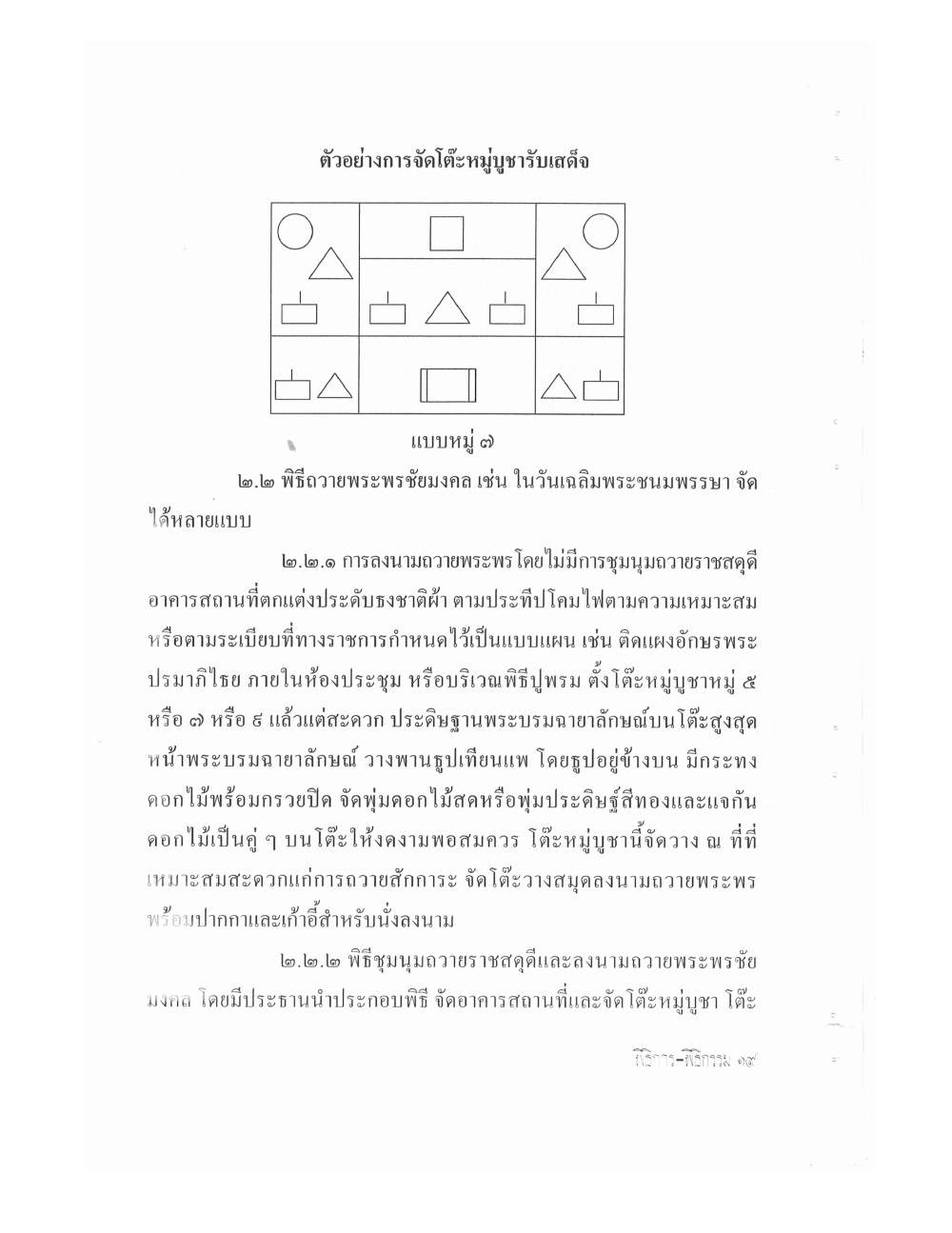
ตัวอย่างการจัดโต๊ะหมู่บูชารับเสด็จ
[แผนผัง: คล้ายแบบหมู่ ๕ ในหน้าก่อน แต่เพิ่มวงกลม (แจกัน) ที่ริมซ้ายและขวาของแถวล่างสุด] แบบหมู่ ๗
๒.๒ พิธีถวายพระพรชัยมงคล เช่น ในวันเฉลิมพระชนมพรรษา จัดได้หลายแบบ
๒.๒.๑ การลงนามถวายพระพรโดยไม่มีการชุมนุมถวายราชสดุดี อาคารสถานที่ตกแต่งประดับธงชาติผ้า ตามประทีปโคมไฟตามความเหมาะสม หรือตามระเบียบที่ทางราชการกำหนดไว้เป็นแบบแผน เช่น ติดแผงอักษรพระปรมาภิไธย ภายในห้องประชุม หรือบริเวณพิธีปูพรม ตั้งโต๊ะหมู่บูชาหมู่ ๕ หรือ ๗ หรือ ๙ แล้วแต่สะดวก ประดิษฐานพระบรมฉายาลักษณ์บนโต๊ะสูงสุด หน้าพระบรมฉายาลักษณ์ วางพานธูปเทียนแพ โดยธูปอยู่ข้างบน มีกระทงดอกไม้พร้อมกรวยปิด จัดพุ่มดอกไม้สดหรือพุ่มประดิษฐ์สีทองและแจกันดอกไม้เป็นคู่ ๆ บนโต๊ะให้งดงามพอสมควร โต๊ะหมู่บูชานี้จัดวาง ณ ที่ที่เหมาะสมสะดวกแก่การถวายสักการะ จัดโต๊ะวางสมุดลงนามถวายพระพรพร้อมปากกาและเก้าอี้สำหรับนั่งลงนาม
๒.๒.๒ พิธีชุมนุมถวายราชสดุดีและลงนามถวายพระพรชัยมงคล โดยมีประธานนำประกอบพิธี จัดอาคารสถานที่และจัดโต๊ะหมู่บูชา โต๊ะ...
Example of Setting Up the Group-Altar Table to Receive a Royal Procession
[diagram: similar to the group-of-5 pattern on the previous page, but with a vase (circle) added at each outer edge of the bottom row] Group-of-7 pattern
2.2 Ceremonies for offering blessings, such as on the King's birthday, may be arranged in several ways.
2.2.1 Signing a book of blessings without a gathering to offer royal eulogies: the building is decorated with the national flag, cloth, lanterns, or lights as appropriate, or according to the official regulations set as a standard pattern — such as posting the royal cipher inside the meeting room or in the carpeted ceremony area, setting up the group-altar table as a set of 5, 7, or 9 as convenient, enshrining the royal portrait on the highest table, and placing a tray of the incense-and-candle offering set in front of the royal portrait, with the incense on top, along with a tray of flowers with a closed cone covering. Arrange a fresh flower arrangement or artificial gold-colored one, and vases of flowers in pairs, on the table to make it reasonably beautiful. This group-altar table should be placed wherever is suitable and convenient for paying homage, with a table set up nearby holding the book for signing blessings, together with a pen and a chair for sitting to sign.
2.2.2 A ceremony with a gathering to offer royal eulogies and sign a book of blessings, led by a presiding officer: arrange the building and set up the group-altar table. The table...
ลงนาม ตามแบบในข้อ ๒.๒.๑ ควรตั้งโต๊ะหมู่บูชาบนเวที ถ้าจัดในเต็นท์ ควรตั้งโต๊ะหมู่บูชาบนยกพื้น จัดให้ผู้ชุมนุมนั่งเก้าอี้หรือยืนเป็นระเบียบตามตำแหน่งหรือตามความเหมาะสม
๒.๒.๓ พิธีที่มีการบำเพ็ญกุศลอุทิศถวายพระราชกุศล ถวายราชสดุดีและลงนามถวายพระพรชัยมงคล จัดอาคารสถานที่และโต๊ะหมู่บูชาพระบรมฉายาลักษณ์ ตามข้อ ๒.๑ ตั้งไว้ด้านหน้าตรงกลางแถวผู้ร่วมงาน โต๊ะหมู่บูชาพระรัตนตรัย หมู่ ๕ หรือ ๗ หรือ ๙ ตามสะดวก โดยตั้งพระพุทธรูปไว้บนโต๊ะกลางสูงสุด ประดับพุ่มและแจกันดอกไม้เป็นคู่ วางเชิงเทียนปักเทียน ๑ คู่ กลางเชิงเทียนตั้งกระถางธูป มีที่กราบพระรัตนตรัย โต๊ะหมู่บูชานี้ตั้งไว้ต้นอาสน์สงฆ์สำหรับพระสงฆ์ ๕ หรือ ๑๐ รูป จัดไว้ด้านข้าง
๒.๓ ในพิธีอื่น ๆ ที่เป็นพิธีเฉลิมพระเกียรติ เช่น พิธีปลูกป่า พิธีจัดงานจัดนิทรรศการ พิธีเปิดอาคารเพื่อเฉลิมพระเกียรติ เป็นต้น ควรจัดโต๊ะหมู่บูชาพระบรมฉายาลักษณ์ตามแบบในข้อ ๒.๑ คือประดิษฐานพระบรมฉายาลักษณ์บนโต๊ะกลางสูงสุด จัดพุ่มทองพุ่มเงิน พุ่มดอกไม้ แจกันดอกไม้ ตั้งพานธูปเทียนแพ และกระทงกรวยดอกไม้สดไว้ตรงกลางหน้าพระบรมฉายาลักษณ์ ในตำแหน่งที่ประธานในพิธีเอื้อมเปิดกรวยถึง ตั้งโต๊ะหมู่บูชานี้ไว้บนเวทีหรือบนยกพื้น
๓. การจัดโต๊ะหมู่บูชาสมเด็จพระบุรพมหากษัตริยาธิราชเจ้า เช่น การจัดโต๊ะหมู่บูชาในงานสมโภชกรุงรัตนโกสินทร์ ๒๐๐ ปี หรืองานพิธีบำเพ็ญกุศลอุทิศถวายอดีตพระมหากษัตริย์พระองค์หนึ่งพระองค์ใด เป็นต้น นิยมจัดตั้งเป็นโต๊ะหมู่บูชาเช่นเดียวกับการจัดโต๊ะหมู่บูชาพระบาทสมเด็จพระเจ้าอยู่หัวแต่มีข้อแตกต่างกัน ๒ ประการ คือ
for signing books, as in item 2.2.1, the group-altar table should be set up on a stage; if held in a tent, the group-altar table should be set up on a raised platform, with those attending seated in chairs or standing in orderly fashion by position or as appropriate.
2.2.3 A ceremony that includes merit-making dedicated to the royal merit, offering royal eulogies, and signing a book of blessings: arrange the building and the group-altar table for the royal portrait as in item 2.1, placed at the front, centered before the row of attendees. The group-altar table for the Three Jewels, as a set of 5, 7, or 9 as convenient, should have the Buddha image on the highest central table, adorned with a flower arrangement and a pair of vases of flowers, with 1 pair of lit candlesticks, and an incense burner placed between the candlesticks, with a place to prostrate before the Three Jewels. This group-altar table is placed at the head of the monks' seating area for 5 or 10 monks, arranged at the side.
2.3 In other ceremonies that honor the King, such as tree-planting ceremonies, exhibition ceremonies, or building-opening ceremonies held in his honor, and so on, the group-altar table for the royal portrait should be arranged as in item 2.1 — that is, the royal portrait enshrined on the highest central table, with gold and silver flower arrangements, flower arrangements, and vases of flowers, and a tray of the incense-and-candle offering set together with a tray of fresh flowers with a cone placed directly in front of the royal portrait, at the position the presiding officer can reach to open the cone. This group-altar table is set up on a stage or a raised platform.
3. Setting up the group-altar table for a former sovereign monarch — such as setting up the group-altar table for the 200th anniversary celebration of the founding of Rattanakosin, or a merit-making ceremony dedicated to any one former monarch, and so on — is customarily arranged as a group-altar table in the same way as for setting up one for His Majesty the reigning King, but with 2 points of difference, namely:
๓.๑ บนโต๊ะหมู่ตัวบน คือตัวสูงสุด ต้องตั้งพระบรมฉายาลักษณ์หรือพระบรมสาทิสลักษณ์ หรือพระบรมรูปไว้ให้สง่างาม เพื่อจะได้รู้ว่าจัดโต๊ะหมู่บูชาเพื่อบูชารัชกาลใดในอดีต
๓.๒ บนโต๊ะหมู่ตัวล่างสุด จัดตั้งเชิงเทียน ๒ อัน ไม่ต้องใช้กระถางธูป เชิงเทียนต้นหนึ่งปักธูปไม้ระกำ ๑ ดอก อีกต้นหนึ่งปักเทียน ๑ เล่ม หรือหากจะไม่ใช้เชิงเทียนปักธูปและปักเทียนดังกล่าวจะใช้ตั้งเครื่องทองน้อยแทนก็ได้ บนพานเครื่องทองน้อยจะมีพานพุ่มดอกไม้เล็ก ๆ ๓ พุ่ม และมีเชิงเทียนเล็ก ๆ ๒ อัน อันหนึ่งปักธูปไม้ระกำ ๑ ดอก อีกอันหนึ่งปักเทียน ๑ เล่ม ทั้งนี้สุดแต่จะมีเครื่องใช้อย่างใด
วิธีตั้งเครื่องทองน้อย
ให้ตั้งหันด้านพุ่มดอกไม้เข้าด้านใน และหันด้านธูปเทียนออกด้านนอกโดยมีหลักในการตั้งอยู่ว่า จะบูชาใครก็ให้ตั้งหันด้านพุ่มดอกไม้เข้าหาผู้ที่เราจะบูชา สำหรับธูปเทียนที่ตั้งบูชาก็ดีหรือเครื่องทองน้อยที่ตั้งบูชาก็ดี ไม่ต้องจุดบูชา เว้นแต่จะได้ประกอบพิธีพิเศษโดยเฉพาะ เช่น จะกระทำพิธีสดับปกรณ์ (บังสุกุล) หรือจะกระทำพิธีบวงสรวงพระวิญญาณจึงจะจุดเพื่อการนั้น
ตัวอย่างการจัดโต๊ะหมู่บูชาสมเด็จพระบุรพมหากษัตริยาธิราชเจ้า
แบบพานพุ่มดอกไม้
[แผนผัง: แถวบนมีสามเหลี่ยม (พานพุ่ม) - ดาว (พระบรมรูป) - สามเหลี่ยม (พานพุ่ม) ใต้ดาวมีรูปคล้ายริบบิ้น (เครื่องทองน้อย) แถวล่างสุดมีสามเหลี่ยมสามอัน (พานพุ่ม) เรียงกัน] แบบหมู่ ๕
3.1 On the top table of the set — the highest one — the royal portrait, the royal painted likeness, or the royal statue must be set up in a dignified manner, so that it is clear which past reign the group-altar table honors.
3.2 On the lowest table of the set, set up 2 candlesticks; an incense burner is not needed. One candlestick holds 1 stick of aloeswood incense, the other holds 1 candle. Or, if candlesticks with incense and a candle are not to be used, the small gold ceremonial set (khrueang thong noi) may be set up instead. On the tray of the small gold ceremonial set there will be 3 small flower-arrangement trays, and 2 small candlesticks — one holding 1 stick of aloeswood incense, the other holding 1 candle — depending on what equipment is available.
Method for Setting Up the Small Gold Ceremonial Set
It should be set up facing the flower-arrangement side inward and the incense-and-candle side outward, following the principle that whoever is being honored, the flower-arrangement side should face toward that person. As for the incense and candle set up in worship, or the small gold ceremonial set up in worship, they need not be lit, except when a special rite is being performed specifically — such as the sadap pakon (bangsukul) rite, or a rite invoking the spirit — in which case they are lit for that purpose.
Example of Setting Up the Group-Altar Table for a Former Sovereign Monarch
Flower-Tray Style
[diagram: the top row has a flower tray (triangle) – a star (the royal statue) – a flower tray (triangle); below the star is a ribbon-like shape (the small gold ceremonial set); the bottom row has three flower trays (triangles) in a row] Group-of-5 pattern
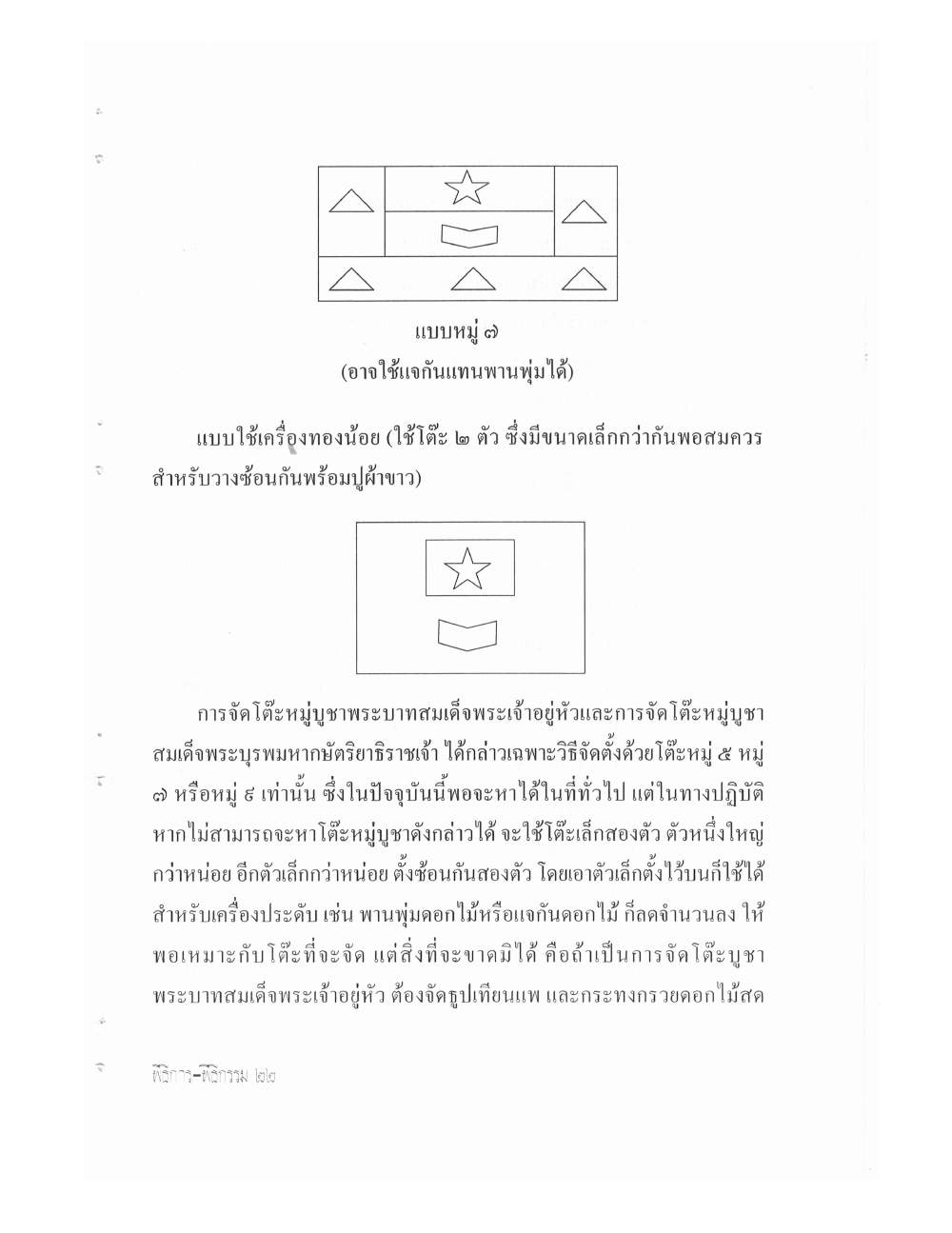
[แผนผัง: คล้ายแบบหมู่ ๕ ในหน้าก่อน] แบบหมู่ ๗
(อาจใช้แจกันแทนพานพุ่มได้)
แบบใช้เครื่องทองน้อย (ใช้โต๊ะ ๒ ตัว ซึ่งมีขนาดเล็กกว่ากันพอสมควร สำหรับวางซ้อนกันพร้อมปูผ้าขาว)
[แผนผัง: สี่เหลี่ยมผืนผ้าซ้อนกันสองชั้นแทนโต๊ะสองตัว ชั้นบนมีกรอบสี่เหลี่ยมเล็กบรรจุดาว (พระบรมรูป) และใต้ลงมามีรูปคล้ายริบบิ้น (เครื่องทองน้อย)]
การจัดโต๊ะหมู่บูชาพระบาทสมเด็จพระเจ้าอยู่หัวและการจัดโต๊ะหมู่บูชาสมเด็จพระบุรพมหากษัตริยาธิราชเจ้า ได้กล่าวเฉพาะวิธีจัดตั้งด้วยโต๊ะหมู่ ๕ หมู่ ๗ หรือหมู่ ๙ เท่านั้น ซึ่งในปัจจุบันนี้พอจะหาได้ในที่ทั่วไป แต่ในทางปฏิบัติหากไม่สามารถจะหาโต๊ะหมู่บูชาดังกล่าวได้ จะใช้โต๊ะเล็กสองตัว ตัวหนึ่งใหญ่กว่าหน่อย อีกตัวเล็กกว่าหน่อย ตั้งซ้อนกันสองตัว โดยเอาตัวเล็กตั้งไว้บนก็ใช้ได้ สำหรับเครื่องประดับ เช่น พานพุ่มดอกไม้หรือแจกันดอกไม้ ก็ลดจำนวนลง ให้พอเหมาะกับโต๊ะที่จะจัด แต่สิ่งที่จะขาดมิได้ คือถ้าเป็นการจัดโต๊ะบูชาพระบาทสมเด็จพระเจ้าอยู่หัว ต้องจัดธูปเทียนแพ และกระทงกรวยดอกไม้สด
[diagram: similar to the group-of-5 pattern on the previous page] Group-of-7 pattern
(a vase may be used in place of the flower-arrangement tray)
Style Using the Small Gold Ceremonial Set (using 2 tables, one noticeably smaller than the other, to be stacked together with a white cloth spread over them)
[diagram: two rectangles stacked to represent the two tables; the upper one has a small framed square containing a star (the royal statue), with a ribbon-like shape (the small gold ceremonial set) below it]
The setting up of the group-altar table for His Majesty the King, and the setting up of the group-altar table for a former sovereign monarch, have been described only for the method of arranging it as a set of 5, 7, or 9 tables, which nowadays can generally be found. But in practice, if such a group-altar set cannot be found, two small tables may be used instead — one somewhat larger, the other somewhat smaller — stacked one on top of the other, with the smaller one placed on top; this is acceptable. As for the decorative items, such as the flower-arrangement trays or vases of flowers, their number should be reduced to suit the table being arranged. But what must never be omitted, if arranging the altar table for His Majesty the King, is the incense-and-candle offering set and the tray of fresh flowers with a cone.
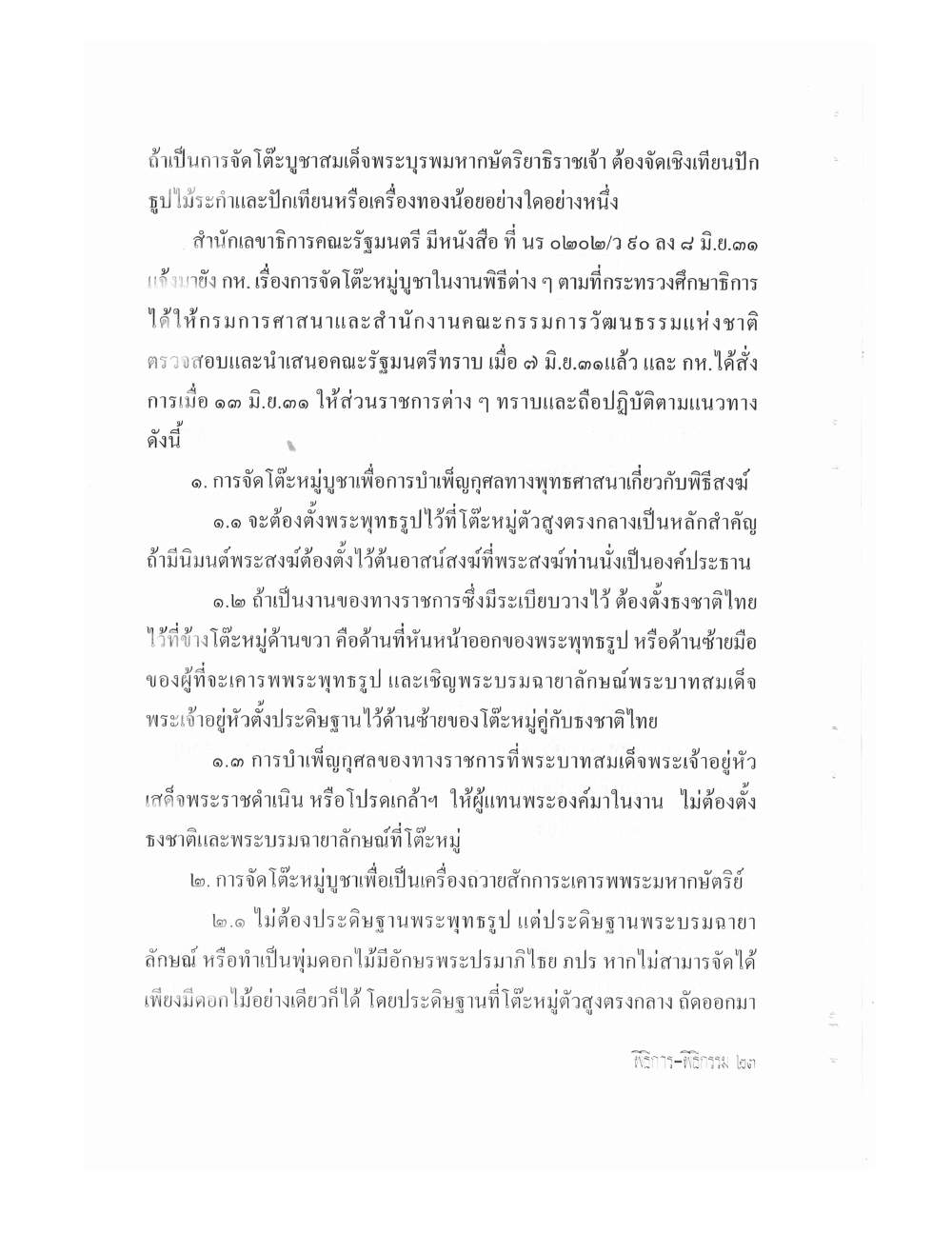
ถ้าเป็นการจัดโต๊ะบูชาสมเด็จพระบุรพมหากษัตริยาธิราชเจ้า ต้องจัดเชิงเทียนปักธูปไม้ระกำและปักเทียนหรือเครื่องทองน้อยอย่างใดอย่างหนึ่ง
สำนักเลขาธิการคณะรัฐมนตรี มีหนังสือ ที่ นร ๐๒๐๒/ว ๕๐ ลง ๘ มิ.ย.๓๑ แจ้งมายัง กห. เรื่องการจัดโต๊ะหมู่บูชาในงานพิธีต่าง ๆ ตามที่กระทรวงศึกษาธิการได้ให้กรมการศาสนาและสำนักงานคณะกรรมการวัฒนธรรมแห่งชาติตรวจสอบและนำเสนอคณะรัฐมนตรีทราบ เมื่อ ๗ มิ.ย.๓๑แล้ว และ กห.ได้สั่งการเมื่อ ๑๓ มิ.ย.๓๑ ให้ส่วนราชการต่าง ๆ ทราบและถือปฏิบัติตามแนวทางดังนี้
๑. การจัดโต๊ะหมู่บูชาเพื่อการบำเพ็ญกุศลทางพุทธศาสนาเกี่ยวกับพิธีสงฆ์ ๑.๑ จะต้องตั้งพระพุทธรูปไว้ที่โต๊ะหมู่ตัวสูงตรงกลางเป็นหลักสำคัญ ถ้ามีนิมนต์พระสงฆ์ต้องตั้งไว้ต้นอาสน์สงฆ์ที่พระสงฆ์ท่านนั่งเป็นองค์ประธาน ๑.๒ ถ้าเป็นงานของทางราชการซึ่งมีระเบียบวางไว้ ต้องตั้งธงชาติไทยไว้ที่ข้างโต๊ะหมู่ด้านขวา คือด้านที่หันหน้าออกของพระพุทธรูป หรือด้านซ้ายมือของผู้ที่จะเคารพพระพุทธรูป และเชิญพระบรมฉายาลักษณ์พระบาทสมเด็จพระเจ้าอยู่หัวตั้งประดิษฐานไว้ด้านซ้ายของโต๊ะหมู่คู่กับธงชาติไทย ๑.๓ การบำเพ็ญกุศลของทางราชการที่พระบาทสมเด็จพระเจ้าอยู่หัวเสด็จพระราชดำเนิน หรือโปรดเกล้าฯ ให้ผู้แทนพระองค์มาในงาน ไม่ต้องตั้งธงชาติและพระบรมฉายาลักษณ์ที่โต๊ะหมู่
๒. การจัดโต๊ะหมู่บูชาเพื่อเป็นเครื่องถวายสักการะเคารพพระมหากษัตริย์ ๒.๑ ไม่ต้องประดิษฐานพระพุทธรูป แต่ประดิษฐานพระบรมฉายาลักษณ์ หรือทำเป็นพุ่มดอกไม้มีอักษรพระปรมาภิไธย ภปร หากไม่สามารถจัดได้เพียงมีดอกไม้อย่างเดียวก็ได้ โดยประดิษฐานที่โต๊ะหมู่ตัวสูงตรงกลาง ถัดออกมา
พิธีการ-พิธีกรรม ๒๓
If arranging an altar table to honor past sovereign kings, one must set up a candlestick with fragrant-wood incense sticks planted in it and candles lit, or else a Lesser Gold Set — either of the two.
The Secretariat of the Cabinet, in letter no. Nor 0202/W 50 dated 8 June 31, notified the Ministry of Defense regarding the arrangement of altar tables at various ceremonies, as the Ministry of Education had had the Department of Religious Affairs and the Office of the National Culture Commission examine the matter and report it to the Cabinet, which acknowledged it on 7 June 31; the Ministry of Defense then issued an order on 13 June 31 for all government offices to be informed and to observe the following guidelines:
1. Arranging an altar table for merit-making ceremonies in Buddhism connected with monastic rites 1.1 A Buddha image must be placed at the center, on the tallest tier of the altar table, as the principal focus. If monks have been invited, it must be placed at the head of the monks' seating platform where the presiding monk sits. 1.2 If it is an official government function for which regulations have been set, the Thai national flag must be placed at the right side of the altar table — that is, the side the Buddha image faces outward toward, or the left-hand side of the person paying respect to the Buddha image — and a royal portrait of His Majesty the King must be brought and enshrined on the left side of the altar table, paired with the Thai national flag. 1.3 For official merit-making ceremonies which His Majesty the King attends in person, or for which he graciously sends a royal representative, it is not necessary to set up the national flag or the royal portrait at the altar table.
2. Arranging an altar table as an offering of homage and respect to the monarch 2.1 It is not necessary to enshrine a Buddha image; instead, a royal portrait is enshrined, or a floral arrangement bearing the royal cipher "Phor Por Ror" is made. If this cannot be arranged, flowers alone will suffice. It is enshrined at the tallest, central tier of the altar table, with what follows set further out.
Ceremonies–Rites 23
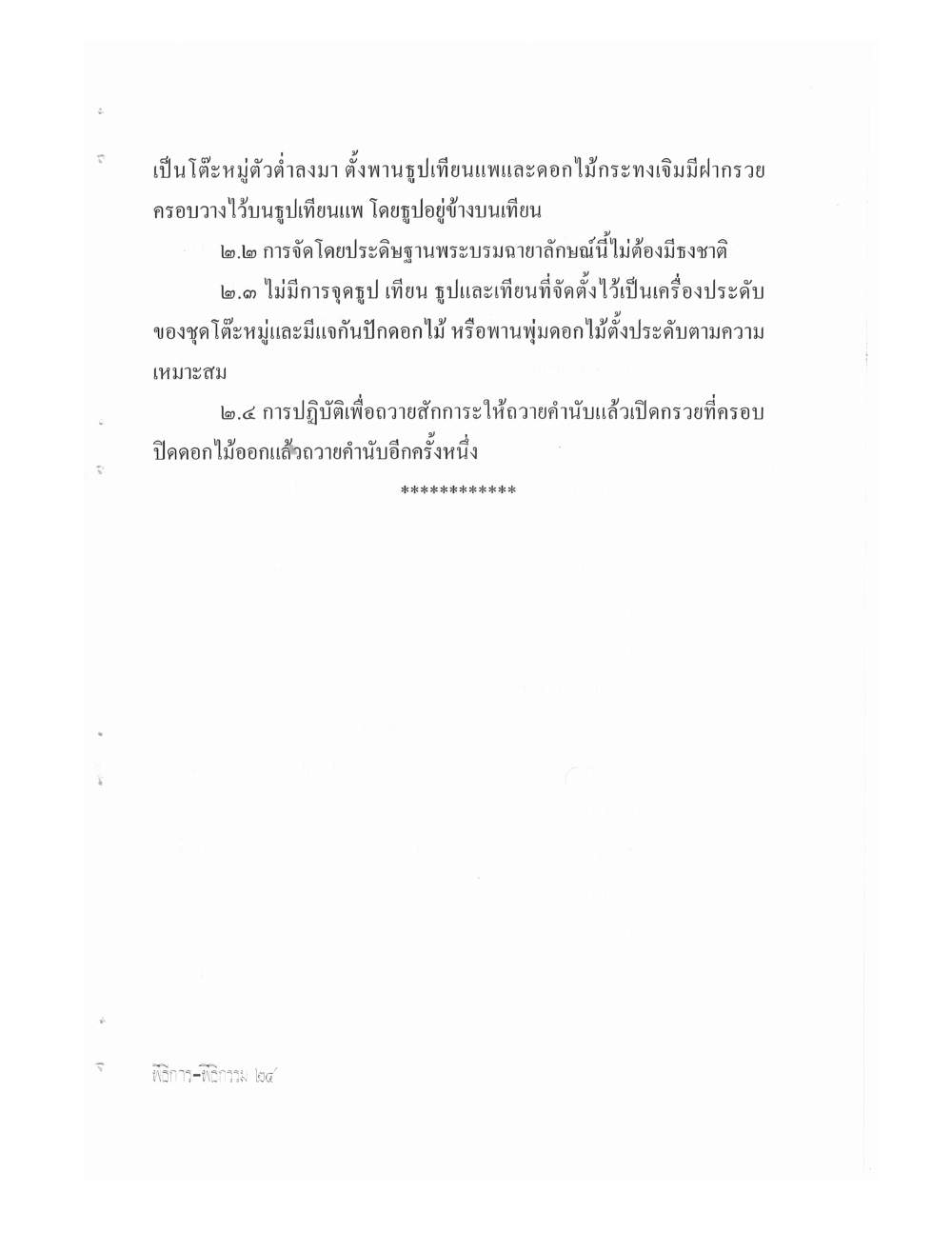
เป็นโต๊ะหมู่ตัวต่ำลงมา ตั้งพานธูปเทียนแพและดอกไม้กระทงเจิมมีฝากรวยครอบวางไว้บนธูปเทียนแพ โดยธูปอยู่ข้างบนเทียน ๒.๒ การจัดโดยประดิษฐานพระบรมฉายาลักษณ์นี้ไม่ต้องมีธงชาติ ๒.๓ ไม่มีการจุดธูป เทียน ธูปและเทียนที่จัดตั้งไว้เป็นเครื่องประดับของชุดโต๊ะหมู่และมีแจกันปักดอกไม้ หรือพานพุ่มดอกไม้ตั้งประดับตามความเหมาะสม ๒.๔ การปฏิบัติเพื่อถวายสักการะให้ถวายคำนับแล้วเปิดกรวยที่ครอบปิดดอกไม้ออกแล้วถวายคำนับอีกครั้งหนึ่ง
**********
พิธีการ-พิธีกรรม ๒๔
[continuing from the tier above] on the lower tier of the altar table is placed a tray of paired incense-and-candles together with a floral offering bowl and an anointing bowl, covered with a cone-shaped cover placed over the incense-and-candle tray, with the incense sticks positioned above the candles. 2.2 Where a royal portrait is enshrined in this manner, it is not necessary to have the national flag. 2.3 No incense or candles are lit; the incense and candles that are set out serve only as decoration for the altar table set, together with a vase of arranged flowers, or a floral pedestal tray set out as decoration, as appropriate. 2.4 To pay homage, one bows in respect, then opens and removes the cone-cover that covers the flowers, and bows in respect once more.
**********
Ceremonies–Rites 24
พิธีการจุดธูปบูชาสิ่งที่เคารพ
********
เครื่องสักการะต่าง ๆ มี ธูป เทียน ดอกไม้ เป็นต้น เป็นเครื่องสักการะสำหรับไหว้บูชาสิ่งที่เคารพ เช่น พระรัตนตรัย เทวดา ผี บรรพบุรุษ บิดามารดา ครูบาอาจารย์ เป็นต้น โดยเฉพาะเครื่องสักการะ คือ ธูป มีข้อกำหนดแตกต่างกันไปตามคุณลักษณะของสิ่งที่เคารพ ซึ่งมีการจุดธูปให้บูชาด้วยจำนวนธูปไม่เท่ากัน คือ
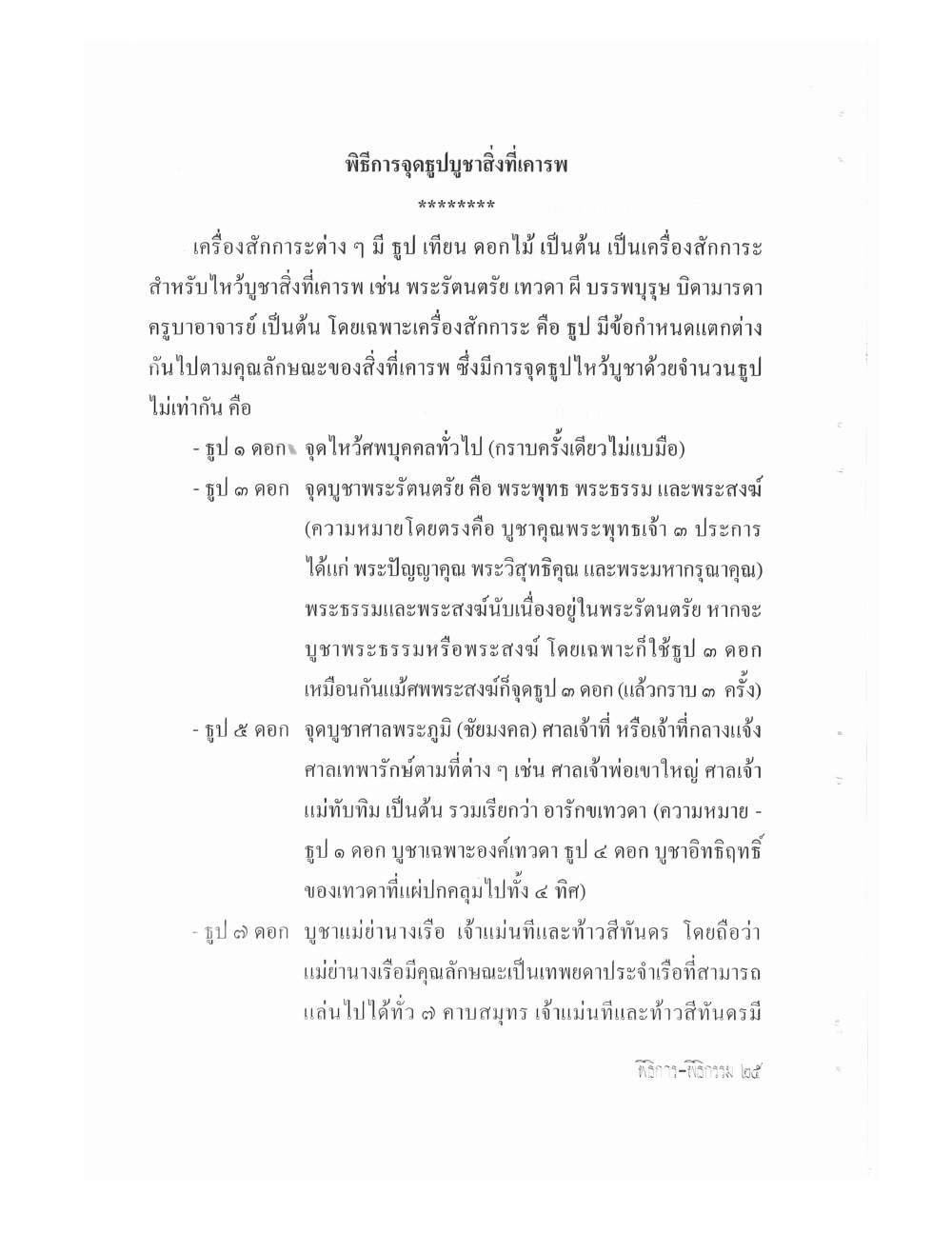
- ธูป ๑ ดอก จุดไหว้ศพบุคคลทั่วไป (กราบครั้งเดียวไม่แบมือ) - ธูป ๓ ดอก จุดบูชาพระรัตนตรัย คือ พระพุทธ พระธรรม และพระสงฆ์ (ความหมายโดยตรงคือ บูชาคุณพระพุทธเจ้า ๓ ประการ ได้แก่ พระปัญญาคุณ พระวิสุทธิคุณ และพระมหากรุณาคุณ) พระธรรมและพระสงฆ์นับเนื่องอยู่ในพระรัตนตรัย หากจะบูชาพระธรรมหรือพระสงฆ์ โดยเฉพาะก็ใช้ธูป ๓ ดอกเหมือนกันแม้ศพพระสงฆ์ก็จุดธูป ๓ ดอก (แล้วกราบ ๓ ครั้ง) - ธูป ๕ ดอก จุดบูชาศาลพระภูมิ (ชัยมงคล) ศาลเจ้าที่ หรือเจ้าที่กลางแจ้ง ศาลเทพารักษ์ตามที่ต่าง ๆ เช่น ศาลเจ้าพ่อเขาใหญ่ ศาลเจ้าแม่ทับทิม เป็นต้น รวมเรียกว่า อารักขเทวดา (ความหมาย - ธูป ๑ ดอก บูชาเฉพาะองค์เทวดา ธูป ๔ ดอก บูชาอิทธิฤทธิ์ของเทวดาที่แผ่ปกคลุมไปทั้ง ๔ ทิศ) - ธูป ๗ ดอก บูชาแม่ย่านางเรือ เจ้าแม่นทีและท้าวสีทันดร โดยถือว่าแม่ย่านางเรือมีคุณลักษณะเป็นเทพยดาประจำเรือที่สามารถแล่นไปได้ทั่ว ๗ คาบสมุทร เจ้าแม่นทีและท้าวสีทันดรมี
พิธีการ-พิธีกรรม ๒๕
The Rite of Lighting Incense to Honor Objects of Reverence
********
Offerings of homage such as incense, candles, and flowers are items used to pay respect to objects of reverence — for example, the Triple Gem, spirits (devas), ghosts, ancestors, parents, and teachers. In particular, the incense offering has requirements that differ according to the nature of the object being revered, such that the number of incense sticks lit for the offering differs. Namely:
- 1 incense stick: lit to pay respects at the funeral of an ordinary person (one prostration, without raising the palms together) - 3 incense sticks: lit to worship the Triple Gem — the Buddha, the Dhamma, and the Sangha (the direct meaning is to honor the three virtues of the Buddha: the virtue of wisdom, the virtue of purity, and the virtue of great compassion). Since the Dhamma and the Sangha are counted as part of the Triple Gem, if one wishes to worship the Dhamma or the Sangha specifically, 3 incense sticks are likewise used; even at the funeral of a monk, 3 incense sticks are lit (followed by 3 prostrations) - 5 incense sticks: lit to worship the spirit house (for good fortune), the house-guardian spirit shrine or open-air guardian spirit shrine, and various local deity shrines, such as the shrine of Chao Pho Khao Yai or the shrine of Chao Mae Thap Thim, collectively called "guardian devas" (meaning: 1 incense stick worships the deva alone; 4 incense sticks worship the deva's power extending in all 4 directions) - 7 incense sticks: to worship Mae Ya Nang Ruea [guardian spirit of boats], Chao Mae Nathi, and Thao Sithandon, it being held that Mae Ya Nang Ruea has the character of a deity attending boats able to sail across all 7 seas [khap samut — peninsulas]; Chao Mae Nathi and Thao Sithandon have
Ceremonies–Rites 25
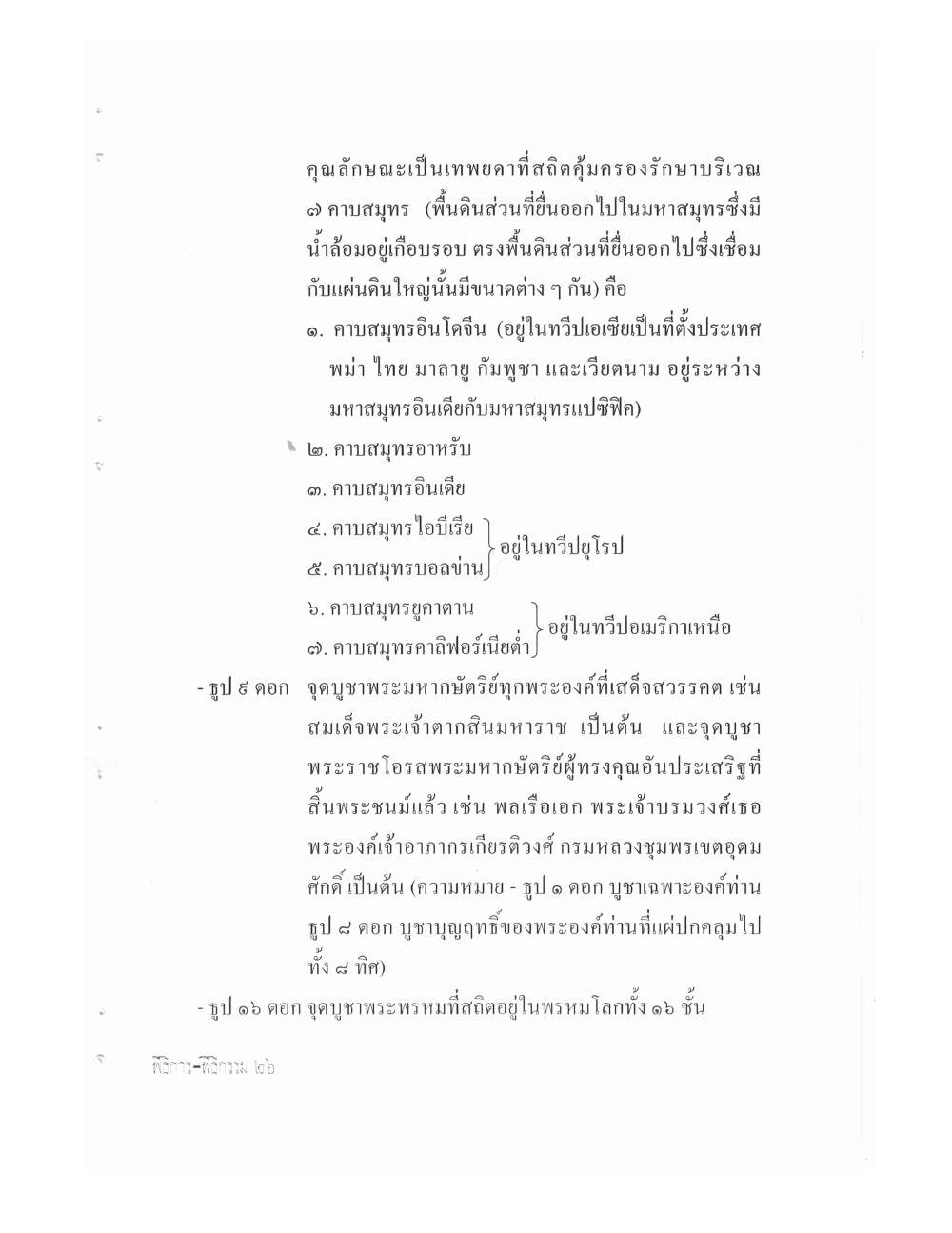
คุณลักษณะเป็นเทพยดาที่สถิตคุ้มครองรักษาบริเวณ ๗ คาบสมุทร (พื้นดินส่วนที่ยื่นออกไปในมหาสมุทรซึ่งมีน้ำล้อมอยู่เกือบรอบ ตรงพื้นดินส่วนที่ยื่นออกไปซึ่งเชื่อมกับแผ่นดินใหญ่นั้นมีขนาดต่าง ๆ กัน) คือ ๑. คาบสมุทรอินโดจีน (อยู่ในทวีปเอเซียเป็นที่ตั้งประเทศพม่า ไทย มาลายู กัมพูชา และเวียตนาม อยู่ระหว่างมหาสมุทรอินเดียกับมหาสมุทรแปซิฟิค) ๒. คาบสมุทรอาหรับ ๓. คาบสมุทรอินเดีย ๔. คาบสมุทรไอบีเรีย }อยู่ในทวีปยุโรป ๕. คาบสมุทรบอลข่าน } ๖. คาบสมุทรยูคาตาน }อยู่ในทวีปอเมริกาเหนือ ๗. คาบสมุทรคาลิฟอร์เนียต่ำ} - ธูป ๘ ดอก จุดบูชาพระมหากษัตริย์ทุกพระองค์ที่เสด็จสวรรคต เช่น สมเด็จพระเจ้าตากสินมหาราช เป็นต้น และจุดบูชาพระราชโอรสพระมหากษัตริย์ผู้ทรงคุณอันประเสริฐที่สิ้นพระชนม์แล้ว เช่น พลเรือเอก พระเจ้าบรมวงศ์เธอ พระองค์เจ้าอาภากรเกียรติวงศ์ กรมหลวงชุมพรเขตอุดมศักดิ์ เป็นต้น (ความหมาย - ธูป ๑ ดอก บูชาเฉพาะองค์ท่าน ธูป ๘ ดอก บูชาบุญฤทธิ์ของพระองค์ท่านที่แผ่ปกคลุมไปทั้ง ๘ ทิศ) - ธูป ๑๖ ดอก จุดบูชาพระพรหมที่สถิตอยู่ในพรหมโลกทั้ง ๑๖ ชั้น
พิธีการ-พิธีกรรม ๒๖
the character of deities who dwell guarding and protecting the area of the 7 khap samut [peninsulas] (a portion of land jutting out into the ocean nearly surrounded by water on all sides; the sizes of these projecting landmasses, which connect to a larger continent, vary), namely: 1. The Indochinese Peninsula (located in the continent of Asia, the location of Burma, Thailand, Malaya, Cambodia, and Vietnam, lying between the Indian Ocean and the Pacific Ocean) 2. The Arabian Peninsula 3. The Indian Peninsula 4. The Iberian Peninsula } located in the continent of Europe 5. The Balkan Peninsula } 6. The Yucatán Peninsula } located in the continent of North America 7. The Baja California Peninsula } - 8 incense sticks: lit to worship every monarch who has passed away, such as Somdet Phra Chao Taksin Maharat [King Taksin the Great], among others, and lit to worship royal sons of monarchs of especially excellent virtue who have died, such as Admiral Prince Abhakara Kiartivongse, Krommaluang Chumphon Khet Udomsak, among others (meaning: 1 incense stick worships that person alone; 8 incense sticks worship the meritorious power of that person extending in all 8 directions) - 16 incense sticks: lit to worship the Brahma deities who dwell in all 16 levels of the Brahma world
Ceremonies–Rites 26
- ธูปหาง คือธูปเครื่องสังเวย เป็นส่วนหนึ่งของเครื่องสังเวย สำหรับจุดปักที่เครื่องสังเวยจำนวนเท่าเครื่องสังเวย เพื่อเป็นสื่อเชื่อมถวายเครื่องสังเวยทุกชิ้นให้เทวดาได้รับทั่วถึง หากไม่ปักธูปหาง เทวดาก็จะไม่รับเครื่องสังเวย
**********
พิธีการ-พิธีกรรม ๒๗
- "Trailing incense" (thup hang): this is incense belonging to the sacrificial offering, forming part of the offering, lit and planted into the offering itself in a number equal to the items of the offering, so as to serve as a medium connecting every single item of the offering so that the deity receives it fully. If the trailing incense is not planted, the deity will not accept the offering.
**********
Ceremonies–Rites 27
พิธีการใช้พวงมาลา
**********
พวงมาลา คือดอกไม้ที่ผูกเป็นวงสำหรับสักการะศพ และสิ่งที่เป็นอนุสรณ์ของปูชนียบุคคลผู้ล่วงลับ
วาระที่ใช้
- สักการะศพในโอกาสแรกที่เสียชีวิต (เฉพาะราชวงศ์) เช่น พระบาทสมเด็จพระเจ้าอยู่หัว พระราชทานพวงมาลา วางหน้าศพทหารผู้เสียชีวิตในการสู้รบ ฯลฯ - สักการะวีรชนของชาติในวันสำคัญ เช่น กองทัพเรือ จัดพิธีวางพวงมาลาในพิธีสดุดีวีรชนกองทัพเรือ ๑๗ ม.ค. ของทุกปี ฯลฯ - สักการะพระบรมรูป พระบรมราชานุสาวรีย์ พระราชานุสาวรีย์ พระรูป พระอนุสาวรีย์ อนุสาวรีย์เนื่องในวันคล้ายวันสวรรคต สิ้นพระชนม์ ถึงแก่อนิจกรรม เช่น พิธีวางพวงมาลา ในวันปิยมหาราช ของทุกปี ฯลฯ - สักการะพระบรมรูป พระบรมราชานุสาวรีย์ พระราชานุสาวรีย์ พระรูป พระอนุสาวรีย์ อนุสาวรีย์ เนื่องในโอกาสพิเศษ เช่น ผู้นำประเทศไปเยือนประเทศต่าง ๆ หรือผู้นำหน่วยไปเยี่ยมหน่วยต่าง ๆ ฯลฯ
------------
พิธีการ-พิธีกรรม ๒๘
The Rite of Using Floral Wreaths (Phuang Mala)
**********
A phuang mala is flowers bound into a ring, used to pay homage to the dead and to memorials of departed venerable persons.
Occasions of use
- Paying homage to the deceased at the first occasion after death (royalty only): for example, His Majesty the King grants a wreath to be placed before the body of a soldier who has died in combat, etc. - Paying homage to the nation's fallen heroes on important days: for example, the Royal Thai Navy holds a wreath-laying ceremony honoring its fallen heroes on 17 January every year, etc. - Paying homage to royal statues, royal monuments, statues, images, and monuments on the anniversary of a royal death, passing, or decease: for example, the wreath-laying ceremony on Chulalongkorn Day [Piyamaharat Day] every year, etc. - Paying homage to royal statues, royal monuments, statues, images, and monuments on special occasions: for example, when a head of state visits other countries, or when a unit commander visits other units, etc.
------------
Ceremonies–Rites 28
พิธีการใช้พานพุ่ม
********
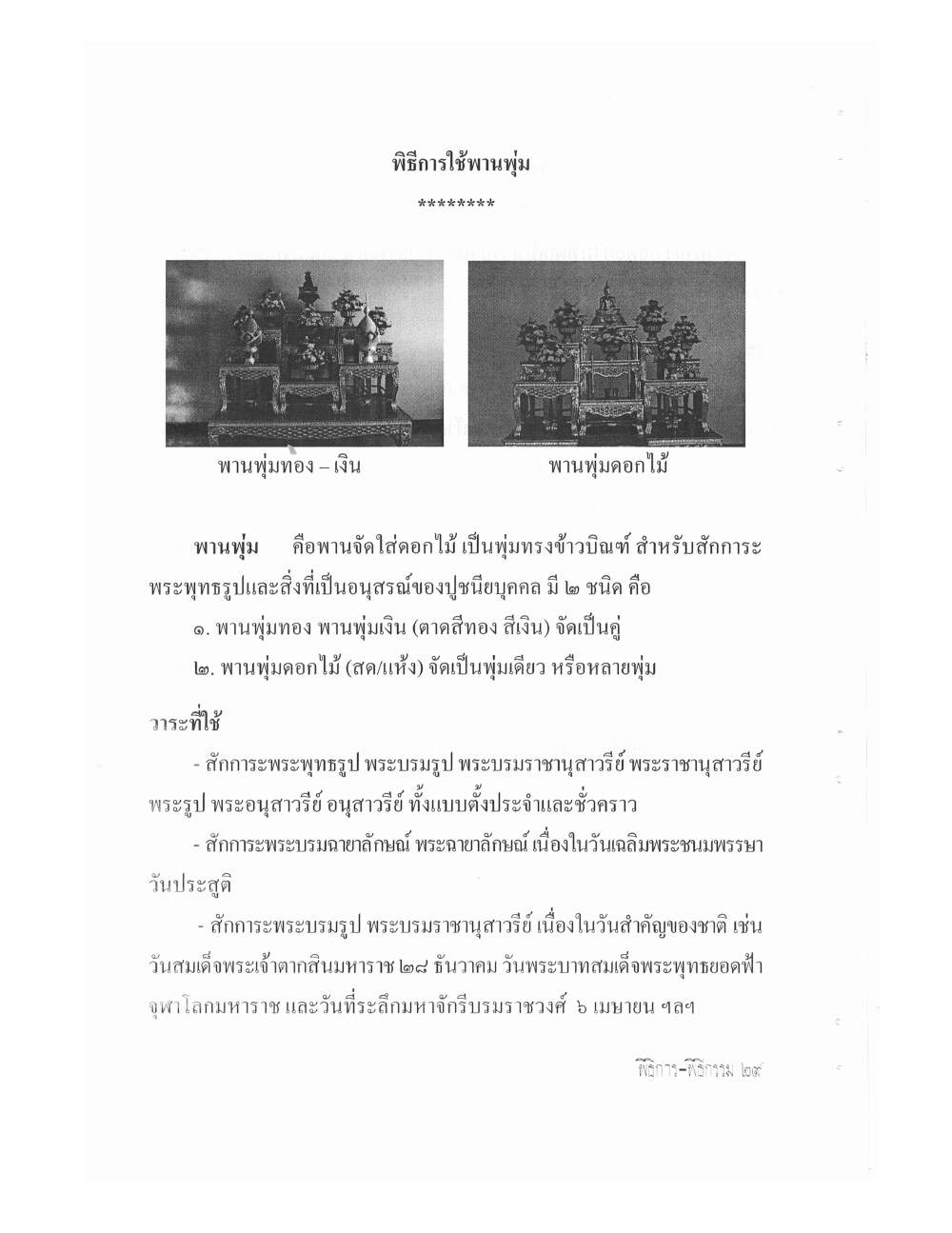
[ภาพ: ภาพถ่ายขาวดำสองภาพวางคู่กัน แสดงชุดโต๊ะหมู่พานพุ่มหลายชั้น มีแจกันและพุ่มดอกไม้ตั้งอยู่บนแท่นลดหลั่นกัน]
พานพุ่มทอง – เงิน พานพุ่มดอกไม้
พานพุ่ม คือพานจัดใส่ดอกไม้ เป็นพุ่มทรงข้าวบิณฑ์ สำหรับสักการะพระพุทธรูปและสิ่งที่เป็นอนุสรณ์ของปูชนียบุคคล มี ๒ ชนิด คือ ๑. พานพุ่มทอง พานพุ่มเงิน (ตาดสีทอง สีเงิน) จัดเป็นคู่ ๒. พานพุ่มดอกไม้ (สด/แห้ง) จัดเป็นพุ่มเดียว หรือหลายพุ่ม
วาระที่ใช้
- สักการะพระพุทธรูป พระบรมรูป พระบรมราชานุสาวรีย์ พระราชานุสาวรีย์ พระรูป พระอนุสาวรีย์ อนุสาวรีย์ ทั้งแบบตั้งประจำและชั่วคราว - สักการะพระบรมฉายาลักษณ์ พระฉายาลักษณ์ เนื่องในวันเฉลิมพระชนมพรรษา วันประสูติ - สักการะพระบรมรูป พระบรมราชานุสาวรีย์ เนื่องในวันสำคัญของชาติ เช่น วันสมเด็จพระเจ้าตากสินมหาราช ๒๘ ธันวาคม วันพระบาทสมเด็จพระพุทธยอดฟ้าจุฬาโลกมหาราช และวันที่ระลึกมหาจักรีบรมราชวงศ์ ๖ เมษายน ฯลฯ
พิธีการ-พิธีกรรม ๒๙
The Rite of Using Floral Pedestal Trays (Phan Phum)
********
[Image: two black-and-white photographs placed side by side, each showing a multi-tiered floral-tray altar set, with vases and floral mounds arranged on stepped platforms]
Gold-and-Silver Floral Trays Flower-Only Floral Trays
A phan phum is a tray arranged with flowers formed into a mound shaped like an alms-bowl mound, used to pay homage to Buddha images and to memorials of venerable persons. There are 2 kinds: 1. Gold floral tray and silver floral tray (with gold-colored and silver-colored brocade trim), arranged as a pair 2. Flower-only floral tray (fresh or dried), arranged as a single tray or as multiple trays
Occasions of use
- To pay homage to Buddha images, royal statues, royal monuments, statues, images, and monuments, whether permanently installed or temporary - To pay homage to royal portraits and photographic portraits on the occasion of a royal birthday or birth anniversary - To pay homage to royal statues and royal monuments on important national days, such as the day of Somdet Phra Chao Taksin Maharat (28 December), the day of King Rama I (Phra Phutthayotfa Chulalok Maharat), and Chakri Memorial Day (6 April), etc.
Ceremonies–Rites 29
- สักการะพระบรมรูป พระบรมราชานุสาวรีย์ พระราชานุสาวรีย์ พระรูป พระอนุสาวรีย์ อนุสาวรีย์ เนื่องในโอกาสต่าง ๆ เช่น บุคคลหรือคณะบุคคลเยี่ยมหน่วย พิธีเปิดงานสมโภช นิทรรศการ มหกรรมต่าง ๆ ฯลฯ
หมายเหตุ - พานพุ่มทอง พานพุ่มเงิน ใช้เป็นคู่ตั้งขวา-ซ้าย (ทองตั้งขวา เงินตั้งซ้าย) ของสิ่งที่เคารพ
- พานพุ่มเดียว ตั้งตรงกลางของสิ่งที่เคารพ
- พานพุ่มหลายพุ่ม ตั้งประดับโต๊ะหมู่บูชาของสิ่งที่เคารพ
------------
พิธีการ-พิธีกรรม ๓๐
- To pay homage to royal statues, royal monuments, statues, images, and monuments on various occasions, such as a visit by an individual or delegation to a unit, the opening ceremony of a celebration, an exhibition, a fair, etc.
Note — Gold and silver floral trays are used as a pair, set to the right and left (gold set to the right, silver set to the left) of the object of reverence.
- A single floral tray is set directly in front of the object of reverence.
- Multiple floral trays are set to decorate the altar table of the object of reverence.
------------
Ceremonies–Rites 30
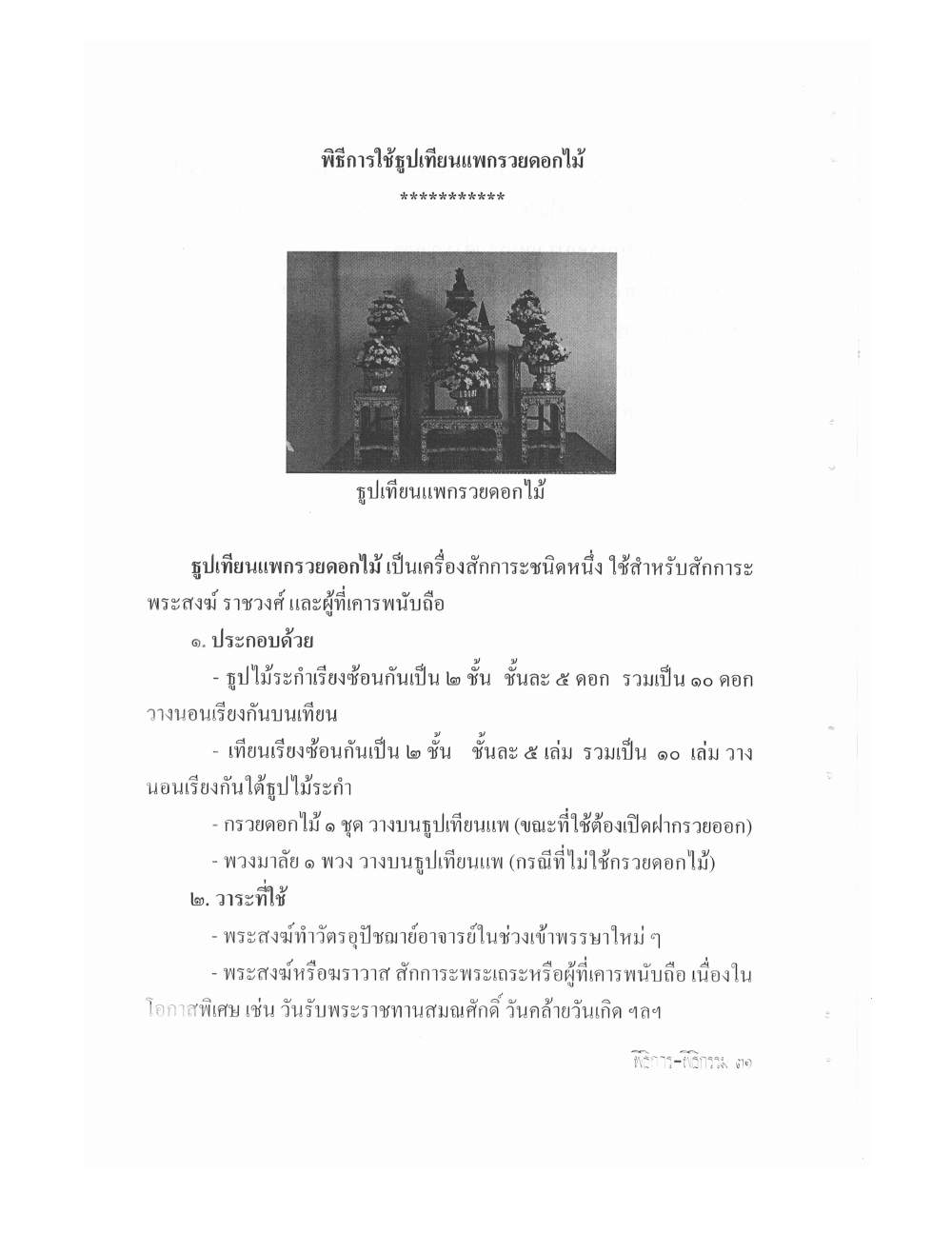
พิธีการใช้ธูปเทียนแพกรวยดอกไม้
***********
[ภาพ: ภาพถ่ายขาวดำแสดงแท่นตั้งเชิงเทียนหลายกิ่งพร้อมเทียนสามเล่ม ขนาบด้วยพุ่มดอกไม้ทรงกรวยสองข้างบนแท่นเล็ก]
ธูปเทียนแพกรวยดอกไม้
ธูปเทียนแพกรวยดอกไม้ เป็นเครื่องสักการะชนิดหนึ่ง ใช้สำหรับสักการะพระสงฆ์ ราชวงศ์ และผู้ที่เคารพนับถือ
๑. ประกอบด้วย - ธูปไม้ระกำเรียงซ้อนกันเป็น ๒ ชั้น ชั้นละ ๕ ดอก รวมเป็น ๑๐ ดอก วางนอนเรียงกันบนเทียน - เทียนเรียงซ้อนกันเป็น ๒ ชั้น ชั้นละ ๕ เล่ม รวมเป็น ๑๐ เล่ม วางนอนเรียงกันใต้ธูปไม้ระกำ - กรวยดอกไม้ ๑ ชุด วางบนธูปเทียนแพ (ขณะที่ใช้ต้องเปิดฝากรวยออก) - พวงมาลัย ๑ พวง วางบนธูปเทียนแพ (กรณีที่ไม่ใช้กรวยดอกไม้)
๒. วาระที่ใช้ - พระสงฆ์ทำวัตรอุปัชฌายอาจารย์ในช่วงเข้าพรรษาใหม่ ฯ - พระสงฆ์หรือฆราวาส สักการะพระเถระหรือผู้ที่เคารพนับถือ เนื่องในโอกาสพิเศษ เช่น วันรับพระราชทานสมณศักดิ์ วันคล้ายวันเกิด ฯลฯ
พิธีการ-พิธีกรรม ๓๑
The Rite of Using the Paired Incense-and-Candle Stand with Flower Cones
***********
[Image: a black-and-white photograph showing a stand bearing a multi-branched candle holder with three candles, flanked by two cone-shaped floral arrangements on small pedestals]
Paired Incense-and-Candle Stand with Flower Cones
The paired incense-and-candle stand with flower cones is one kind of offering of homage, used to pay respect to monks, royalty, and persons who are respected and revered.
1. It is composed of: - Fragrant-wood incense sticks arranged in 2 tiers, 5 sticks per tier, 10 sticks in total, laid lengthwise together on top of the candles - Candles arranged in 2 tiers, 5 candles per tier, 10 candles in total, laid lengthwise together beneath the incense sticks - 1 set of cone-shaped flower arrangements, placed on the incense-candle stand (the cone's cover must be opened while it is in use) - 1 floral garland, placed on the incense-candle stand (in the case where flower cones are not used)
2. Occasions of use - When monks perform the observance of paying respect to their preceptor and teacher at the start of the new Buddhist Lent retreat - When a monk or a layperson pays homage to a senior monk or a respected and revered person on a special occasion, such as the day of receiving a royally-granted ecclesiastical title, a birthday anniversary, etc.
Ceremonies–Rites 31
- สักการะพระบาทสมเด็จพระเจ้าอยู่หัว และราชวงศ์ในคราวเข้าเฝ้าโอกาสต่าง ๆ - สักการะพระบาทสมเด็จพระเจ้าอยู่หัว ในคราวที่เสด็จพระราชดำเนินผ่าน - สักการะพระบรมฉายาลักษณ์พระบาทสมเด็จพระเจ้าอยู่หัว ในโอกาสอันเป็นมงคล เช่น รับผ้าพระกฐินพระราชทาน รับสิ่งของพระราชทาน ฯลฯ - สักการะพระบรมฉายาลักษณ์ พระฉายาลักษณ์ เนื่องในวันเฉลิมพระชนมพรรษา วันประสูติ - สักการะผู้ใหญ่เพื่อขอขมาในโอกาสลาอุปสมบท
หมายเหตุ ธูปเทียนแพกรวยดอกไม้ใช้สักการะเฉพาะผู้ที่มีชีวิตอยู่
พิธีการ-พิธีกรรม ๓๒
- To pay homage to His Majesty the King and to royalty on occasions of royal audience - To pay homage to His Majesty the King on occasions when he travels in royal procession - To pay homage to a royal portrait of His Majesty the King on auspicious occasions, such as receiving the royally-bestowed Kathin robes, receiving royally-bestowed gifts, etc. - To pay homage to royal portraits and photographic portraits on the occasion of a royal birthday or birth anniversary - To pay homage to an elder in order to ask forgiveness on the occasion of leaving lay life to be ordained
Note: the paired incense-and-candle stand with flower cones is used to pay homage only to those who are still living.
Ceremonies–Rites 32
พิธีการใช้เครื่องทองน้อย
********
เครื่องทองน้อย เป็นเครื่องบูชาชนิดหนึ่ง ใช้สำหรับบูชาธรรม บูชาศพ หรือบูชาอัฐิ
๑. ประกอบด้วย - พุ่มดอกไม้บนกรวย ๓ พุ่ม - ธูปไม้ระกำบนเชิง ๑ ดอก ตั้งอยู่บนพานปากเรียบใบเดียว - เทียนบนเชิง ๑ เล่ม
๒. วาระที่ใช้ - การทรงธรรมของพระบาทสมเด็จพระเจ้าอยู่หัว - บูชาพระธาตุ - บูชาพระบรมศพ พระบรมอัฐิ พระบรมรูป และพระบรมฉายาลักษณ์ (ในรัชกาลก่อน) พระศพ พระอัฐิ พระรูป และพระฉายาลักษณ์ (ผู้ถึงชีพิตักษัย) - บูชาศพ - ให้ศพบูชาธรรม - นำขบวนแห่ศพเวียนเมรุ
หมายเหตุ - ไม่ใช้บูชาพระพุทธรูป - ใช้บูชาเฉพาะผู้ที่เสียชีวิตแล้ว (พระสงฆ์ ราชวงศ์ และผู้มีเกียรติ) - ถ้าจุดบูชาศพ หันพุ่มกรวยดอกไม้เข้าหาศพ - ถ้าจะให้ศพบูชาธรรมกรณีมีเทศน์หน้าศพ หันพุ่มกรวยดอกไม้ไปทางพระเทศน์ - ตั้งเชิงธูปไว้ขวา เชิงเทียนไว้ซ้าย ของสิ่งที่เคารพ
พิธีการ-พิธีกรรม ๓๓
The Rite of Using the Lesser Gold Set (Khrueang Thong Noi)
********
The Lesser Gold Set is one kind of object of worship, used to worship the Dhamma, to worship a corpse, or to worship cremated remains.
1. It is composed of: - 3 floral mounds on cones - 1 fragrant-wood incense stick on a candlestick base set together on a single plain-rimmed tray - 1 candle on a candlestick base
2. Occasions of use - When His Majesty the King observes and upholds the Dhamma - To worship a relic of the Buddha - To worship a royal corpse, royal cremated remains, a royal statue, and a royal portrait (of a previous reign); or the corpse, cremated remains, statue, and portrait (of a deceased person of note) - To worship a corpse - To have a corpse "worship" the Dhamma [placed facing a sermon given in its honor] - To lead a funeral procession circling the crematory pyre
Note - It is not used to worship a Buddha image - It is used only for those who have already died (monks, royalty, and persons of honor) - If lighting it to worship a corpse, the floral cones are turned to face the corpse - If having the corpse "worship" the Dhamma, in the case where a sermon is given before the corpse, the floral cones are turned to face the direction of the sermon - The incense-candlestick is set to the right, the candle-candlestick to the left, of the object of reverence
Ceremonies–Rites 33
- เวลาจุด ต้องจุดธูปก่อน
[ภาพ: ภาพถ่ายขาวดำแสดงแท่นเล็กมีเชิงเทียนหลายกิ่งปักเทียนที่จุดไฟอยู่ ขนาบด้วยพุ่มดอกไม้สองข้าง ตั้งอยู่บนโต๊ะเตี้ย]
เครื่องทองน้อย บูชาศพ (หันกรวยเข้าหาศพ)
[ภาพ: ภาพถ่ายขาวดำแสดงแท่นแบบเดียวกัน มีเชิงเทียนและพุ่มดอกไม้ ตั้งอยู่บนโต๊ะเตี้ย]
เครื่องทองน้อย ศพบูชาธรรม (หันกรวยไปทางพระเทศน์)
พิธีการ-พิธีกรรม ๓๔
- At the time of lighting, the incense must be lit first.
[Image: a black-and-white photograph showing a small stand with a multi-branched candlestick holding lit candles, flanked by floral arrangements on both sides, set on a low table]
Lesser Gold Set for Worshipping a Corpse (cones turned to face the corpse)
[Image: a black-and-white photograph showing the same style of stand, with a candlestick and floral arrangements, set on a low table]
Lesser Gold Set for the Corpse "Worshipping" the Dhamma (cones turned to face the direction of the sermon)
Ceremonies–Rites 34
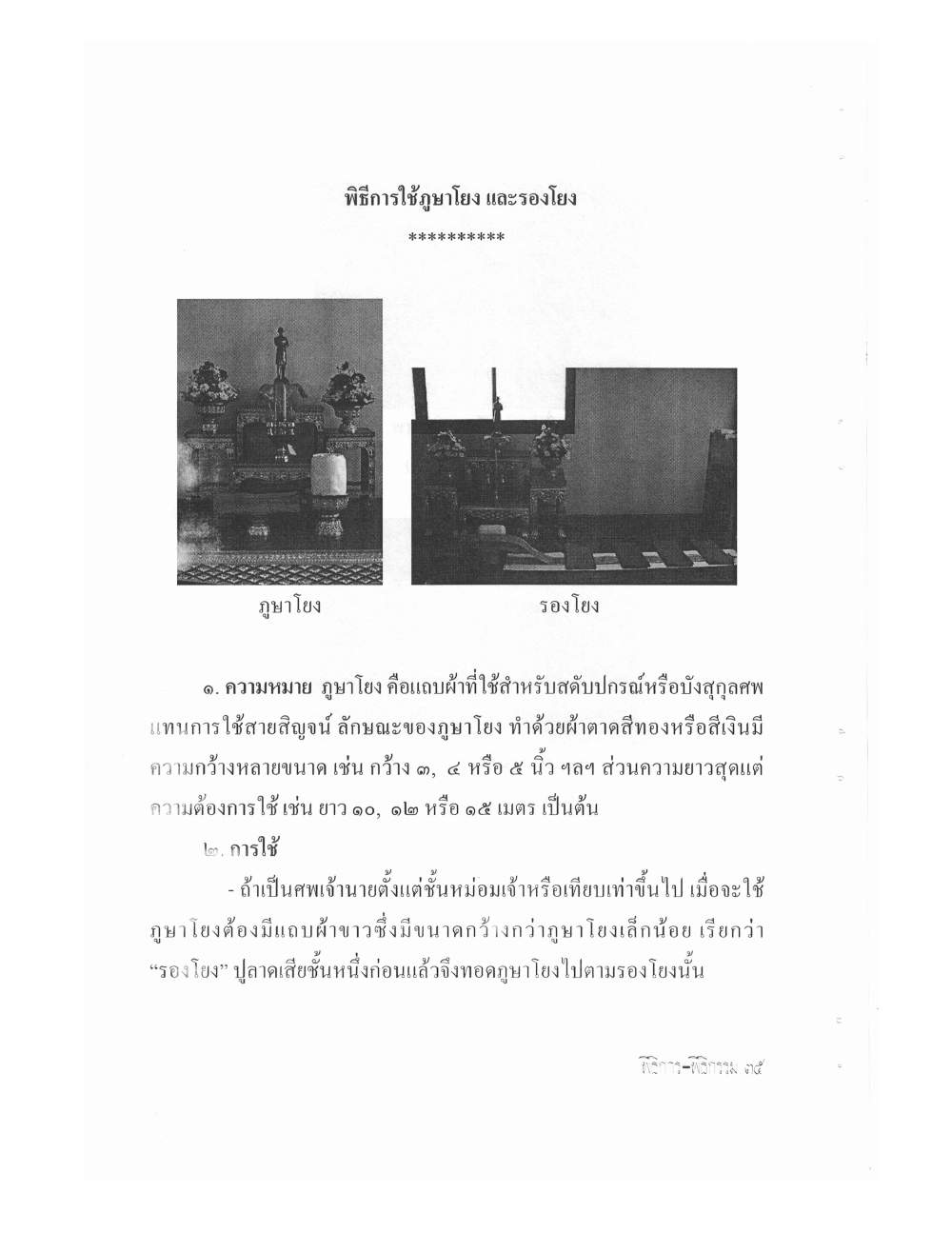
พิธีการใช้ภูษาโยง และรองโยง
*********
[ภาพถ่าย: สองภาพขาวดำของแท่นบูชาศพ ภาพซ้ายมีรูปปั้นยืนถือของอยู่บนแท่นสูง ขนาบข้างด้วยแจกันดอกไม้สองใบ และผ้าขาวพันไว้บนแท่นทรงกระบอก ภาพขวาเป็นแท่นบูชาลักษณะคล้ายกันแต่มีโครงไม้ตั้งขึ้นและแผ่นไม้เรียงเป็นทางพาดจากแท่นออกมา] ภูษาโยง รองโยง
๑. ความหมาย ภูษาโยง คือแถบผ้าที่ใช้สำหรับสดับปกรณ์หรือบังสุกุลศพ แทนการใช้สายสิญจน์ ลักษณะของภูษาโยง ทำด้วยผ้าตาดสีทองหรือสีเงินมีความกว้างหลายขนาด เช่น กว้าง ๓, ๔ หรือ ๕ นิ้ว ๆลๆ ส่วนความยาวสุดแต่ความต้องการใช้ เช่น ยาว ๑๐, ๑๒ หรือ ๑๕ เมตร เป็นต้น ๒. การใช้ - ถ้าเป็นศพเจ้านายตั้งแต่ชั้นหม่อมเจ้าหรือเทียบเท่าขึ้นไป เมื่อจะใช้ภูษาโยงต้องมีแถบผ้าขาวซึ่งมีขนาดกว้างกว่าภูษาโยงเล็กน้อย เรียกว่า "รองโยง" ปูลาดเสียชั้นหนึ่งก่อนแล้วจึงทอดภูษาโยงไปตามรองโยงนั้น
พิธีการ-พิธีกรรม ๗๕
The Rite of Using the Phusa Yong and Rong Yong (Bier-Connecting Cloths)
*********
[Photographs: two black-and-white photographs of a funeral altar. The left photo shows a standing figure holding an object atop a tall stand, flanked by two flower vases, with a white cloth wound around a cylindrical pedestal. The right photo shows a similar altar with a wooden frame raised above it and wooden slats laid out in a row extending from the stand.] Phusa Yong Rong Yong
1. Meaning. The phusa yong is a cloth strip used for the sadap pakorn (chanting/robe-offering) rite or for offering bangsukul robes over a corpse, used in place of the sacred thread (sai sin). The phusa yong is typically made of gold- or silver-colored brocade cloth (pha tat), available in several widths — for example 3, 4, or 5 inches wide, and so on — while its length depends on the need, for example 10, 12, or 15 meters long, and so forth. 2. Use - If the deceased is of royal rank from Mom Chao (Prince/Princess) or equivalent and above, when the phusa yong is used there must also be a white cloth strip somewhat wider than the phusa yong, called the "rong yong." This is laid down as an underlying layer first, and the phusa yong is then laid out along it.
[Section: Ceremonies and Rites, p. 75]
- ถ้าเป็นศพที่มีศักดิ์ต่ำกว่าชั้นหม่อมเจ้าลงมาไม่ต้องใช้รองโยง ให้ทอดภูษาโยงไปตามพื้นอาสน์สงฆ์ เช่นเดียวกับการใช้สายสิญจน์ ๓. การเชื่อมต่อภูษาโยง แยกได้เป็น ๒ พิธี คือพิธีราษฎร์กับพิธีหลวง - พิธีราษฎร์ คือพิธีศพที่เอกชนจัดขึ้นตามวัดทั่วไปหรือที่บ้านของผู้ถึงแก่กรรมเอง นิยมต่อภูษาโยงไว้ล่วงหน้า คือนำสายสิญจน์หรือสายแถบซึ่งโยงไว้ที่หีบศพ มาเชื่อมต่อกับภูษาโยงที่จะใช้ทอดผ้าบังสุกุลให้เรียบร้อยก่อนเริ่มพิธี - พิธีหลวง คือพิธีศพที่อยู่ในพระบรมราชานุเคราะห์ซึ่งจัดพิธีขึ้น ณ สถานที่ใด ๆ ก็ตามจะมีภูษาโยง ๒ สาย คือ สายหนึ่งโยงมาจากหีบหรือโกศศพเบื้องบนลาดตรงลงมาเบื้องล่างด้านหน้าแล้วพักส่วนที่เหลือวางไว้บนพานตั้งอยู่ที่หน้าที่บูชาศพ สายนี้เรียกว่าสายหนึ่ง อีกสายหนึ่งพับวางไว้บนพานตั้งอยู่ที่หน้าโต๊ะหมู่บูชาบนอาสน์สงฆ์ สายนี้เรียกกว่าสายสอง เมื่อจะเริ่มพิธีสดับปกรณ์ ให้ทอดภูษาโยงสายสองไปบนอาสน์สงฆ์ แล้วไปเคารพศพด้วยการโค้งคำนับหรือน้อมไหว้ (ส่วนมากนิยมโค้งคำนับ) ต่อจากนั้นนำภูษาโยงสายหนึ่งมาต่อกับสายสองที่หน้าโต๊ะหมู่บูชาเรียบร้อยแล้ว จึงเชิญเจ้าภาพทอดผ้า เมื่อพระสงฆ์สดับปกรณ์เสร็จให้รีบเก็บภูษาโยงทันที วิธีเชื่อมต่อภูษาโยงก่อน/หลัง - ถ้าผู้ทอดผ้าบังสุกุล มีฐานันดรศักดิ์สูงกว่าผู้ตายให้เชื่อมต่อภูษาโยงก่อนทอดผ้าบังสุกุล - ถ้าผู้ทอดผ้าบังสุกุลมีฐานันดรศักดิ์ต่ำกว่าผู้ตายให้เชื่อมต่อภูษาโยงหลังทอดผ้าบังสุกุล --------------------
พิธีการ-พิธีกรรม ๗๖
- If the deceased holds a rank lower than Mom Chao, the rong yong need not be used; the phusa yong is simply laid out along the floor of the monks' seating platform, in the same way the sacred thread is used. 3. Connecting the phusa yong. This falls into two kinds: the commoners' rite (phithi ratsadon) and the royal rite (phithi luang). - The commoners' rite is a funeral rite that private individuals hold at an ordinary temple or at the home of the deceased. It is customary to connect the phusa yong in advance — that is, the sacred thread or cloth strip already tied to the coffin is joined beforehand to the phusa yong to be used for the bangsukul cloth offering, so everything is ready before the rite begins. - The royal rite is a funeral rite held under royal patronage, wherever it takes place; it uses two lengths of phusa yong. One length runs down from the coffin or urn above, sloping down to the front, with the remaining slack rested on a tray placed before the place of homage to the deceased — this length is called "the first length." The other length is folded and rested on a tray placed before the offering table on the monks' platform — this length is called "the second length." When the sadap pakorn rite is about to begin, the second length of phusa yong is laid out onto the monks' platform, and homage is paid to the deceased with a bow or a wai (a bow is more commonly used). After that, the first length of phusa yong is joined to the second length in front of the offering table; once this is properly done, the sponsor is invited to make the cloth offering. As soon as the monks finish the sadap pakorn rite, the phusa yong must be gathered up at once. Method of connecting the phusa yong before or after - If the person offering the bangsukul cloth holds a rank higher than the deceased, the phusa yong should be connected before the cloth offering. - If the person offering the bangsukul cloth holds a rank lower than the deceased, the phusa yong should be connected after the cloth offering. --------------------
[Section: Ceremonies and Rites, p. 76]
พิธีตั้งศาลพระภูมิ
********
ตามธรรมเนียมไทย ศาลพระภูมิย่อมมีอยู่แทบทุกบ้าน โดยบ้าน ๑ หลังก็มีศาลพระภูมิ ๑ ที่ บางแห่งที่เป็นหมู่บ้าน ซึ่งมีหลายสิบหลายร้อยหลังคาเรือน อาจจะไม่มีศาลพระภูมิทุกหลังคาเรือน เนื่องจากไม่มีสถานที่จะสร้างศาลพระภูมิที่เหมาะสม ก็ใช้ศาลพระภูมิประจำหมู่บ้านร่วมกัน ที่นิยมเรียก "ศาลเจ้าปู่" ได้ มีความเชื่อถือว่า การบูชาพระภูมิเป็นการดี เพื่อเป็นที่ช่วยป้องกันภัยพิบัตินานาประการ กำจัดภูตผีปีศาจที่จะมาเบียดเบียน พร้อมทั้งป้องกันสิ่งอัปมงคลทั้งปวง ให้เกิดความสุขสงบร่มเย็น เจริญรุ่งเรืองแก่เจ้าของบ้านหรือหมู่บ้านนั้น ๆ ด้วยเหตุนี้ คนไทยจึงนับถือพระภูมิด้วยการสักการบูชาเป็นประจำ โดยไม่กระทำการใด ๆ ที่แสดงถึงขาดความเคารพ เช่น เอาอะไรไปพิงหรือปาศาลพระภูมิ เอาของปฏิกูลไปเทไว้ ณ บริเวณศาลพระภูมิ เป็นต้น
ประวัติพระภูมิ ตามตำนาน "นารายณ์สิบปาง" กล่าวไว้ว่า ในอดีตกาลโน้น พระเจ้าทศราชผู้ครองกรุงพาลี (สมเด็จพระมหาธีรราชเจ้าทรงสันนิษฐานว่า กรุงพาลี คือกรุงพาราณสี เพราะเดิมกรุงพาราณสีมีนามว่า กรุงภาศี) ทรงมีพระมเหสีทรงนามว่า พระนางสันทาทุกข์ และทรงมีพระราชโอรส ๘ พระองค์ คือพระชัยมงคล พระนครราช พระเทเพน พระชัยสพ พระคนธรรพ์ พระธรรมโหรา พระวัยทัต พระธรรมิกราช และพระทายธารา
พิธีการ-พิธีกรรม ๗๗
The Rite of Erecting the Spirit House (San Phra Phum)
********
By Thai custom, a spirit house is found in almost every home — each single house has one spirit house. In some places that form a village of many dozens or hundreds of houses, not every house may have its own spirit house, since there is no suitable place to build one; in that case a spirit house shared by the whole village is used instead, commonly called a "San Chao Pu" (grandfather-spirit shrine). It is believed that worshipping Phra Phum (the guardian spirit of the land) is a good thing, serving to ward off all manner of calamity, to drive away spirits and demons that would cause harm, and to prevent every kind of misfortune, bringing peace, coolness, and prosperity to the householder or the village. For this reason, Thai people revere Phra Phum with regular acts of homage, and refrain from any act that shows disrespect — such as leaning things against the spirit house or throwing things at it, or dumping refuse in the area around the spirit house, and so on.
The History of Phra Phum According to the legend of the "Ten Avatars of Narayana" (Narai Sip Pang), it is told that in ages past there was King Thodsarat, ruler of the city of Phali (His Majesty Somdet Phra Maha Thirarachao — the Wise Sovereign — surmised that the city of Phali was Varanasi, since Varanasi had originally been named the city of Phasi). He had a queen named Phra Nang Santhathuk, and had eight royal sons, namely: Phra Chaimongkhon, Phra Nakhon Ratcha, Phra Thepphen, Phra Chaisop, Phra Khonthan, Phra Thammahora, Phra Waithat, Phra Thammikarat, and Phra Thaithara.
[Section: Ceremonies and Rites, p. 77]
เมื่อพระราชโอรสเจริญวัยแล้ว พระเจ้ากรุงพาลี ทรงมอบให้พระราชโอรสไปครอบครองภูมิสถานต่าง ๆ คือ ๑. พระชัยมงคล ครอบครองดูแลเคหสถาน บ้านเรือน โรงร้านต่าง ๆ ๒. พระนครราช ครอบครองดูแลประตู ป้อมค่าย บันได หอรบ ๓. พระเทเพน ครอบครองดูแลคอกสัตว์ต่าง ๆ ๔. พระชัยสพ ครอบครองดูแลคลังเสบียง ยุ้ง ฉาง ๕. พระคนธรรพ์ ครอบครองดูแลโรงพิธีการแต่งงานและเรือนหอ ๖. พระธรรมโหรา ครอบครองดูแลภูเขา ป่า นา ท้องทุ่ง ๗. พระวัยทัต ครอบครองดูแลวัดวาอาราม ปูชนียสถาน ๘. พระธรรมิกราช ครอบครองดูแลพืชพันธุ์ธัญญาหาร อุทยาน สวนต่าง ๆ ๙. พระทายธารา ครอบครองดูแลห้วย หนอง คลอง บึง แม่น้ำ ลำธาร ครั้งนั้น พระเจ้ากรุงพาลีทรงประพฤติผิดขัตติยราชประเพณีไม่ตั้งอยู่ในทศพิธราชธรรม มีความโลภเห็นแก่ได้สิ่งต่าง ๆ ไม่มีที่สิ้นสุด เที่ยวคดโกงเบียดเบียนประชาชนให้ได้รับความเดือดร้อนกันไปทั่วทุกมุมเมือง ไม่เพียงเท่านั้น ยังสนับสนุนให้พระราชโอรสทั้ง ๘ พระองค์ กระทำการหยาบช้าเยี่ยงพระองค์ด้วย ต่อมาเรื่องดังกล่าวรู้ไปถึงพระนารายณ์ ด้วยความสงสารประชาชนและคิดที่จะลงโทษ หรือดัดสันดานพระเจ้ากรุงพาลีให้กลับประพฤติตนให้ดีเสียใหม่ พระนารายณ์จึงปลอมแปลงรูปเป็นพราหมณ์ผู้ทรงศีล เหาะตรงลงมายังกรุงพาลีแล้วเข้าเฝ้าพระเจ้าทศราชตามเจตนาที่ตั้งไว้
พิธีการ-พิธีกรรม ๗๘
When the royal sons had grown to maturity, the King of the city of Phali granted them each dominion over different domains, namely: 1. Phra Chaimongkhon — oversees dwellings, houses, and shops of every kind 2. Phra Nakhon Ratcha — oversees gates, forts and encampments, stairways, and watchtowers 3. Phra Thepphen — oversees animal pens of every kind 4. Phra Chaisop — oversees provision stores, granaries, and barns 5. Phra Khonthan — oversees wedding-ceremony halls and bridal chambers 6. Phra Thammahora — oversees mountains, forests, rice fields, and open plains 7. Phra Waithat — oversees temples, monasteries, and venerated sites 8. Phra Thammikarat — oversees crops and grain, parks, and gardens of every kind 9. Phra Thaithara — oversees streams, marshes, canals, swamps, rivers, and brooks At that time, the King of Phali came to violate the customs proper to a righteous king and no longer upheld the Ten Kingly Virtues. He grew greedy for gain without limit, and went about cheating and oppressing the people, so that suffering spread to every corner of the realm. Not only that, but he also encouraged all eight of his royal sons to behave as basely as he did. In time, word of this reached Phra Narai (Narayana), who, pitying the people and wishing to punish the King of Phali, or else to reform his character so that he would return to good conduct, transformed himself into a precept-keeping brahmin and flew directly down to the city of Phali, where he presented himself before King Thodsarat as he had intended.
[Section: Ceremonies and Rites, p. 78]
อะไร จึงตอบตกลงอนุญาตให้กับพราหมณ์นั้น เมื่อได้โอกาสพราหมณ์จำแลงก็ขอให้พระเจ้าทศราชหลั่งน้ำอุทกธารา เพื่อให้เป็นสิทธิ์ขาดตามพระดำรัส พระเจ้าทศราชก็มิได้ขัดข้องแต่ประการใด เมื่อหลั่งน้ำอุทกธาราให้เป็นที่เรียบร้อยแล้ว พระนารายณ์พราหมณ์จึงกลับกลายร่างเป็นพระนารายณ์เหมือนเดิม ใช้อภินิหารของพระองค์ทำการก้าวย่างลงไปบนผืนแผ่นดินของกรุงพาลีได้เพียง ๒ ก้าวเท่านั้นก็สุดสิ้นเขตพระธรณีของกรุงพาลี พระเจ้าทศราชเห็นดังนั้นก็ทรงตกตะลึงและทรงเสียพระทัยอย่างมากที่รู้เท่าไม่ถึงการณ์เสียรู้หลงกลพระนารายณ์ ตัวสั่นงันงกก้มลงกราบไหว้ทูลขอว่าจงอย่าขับไล่พระองค์ไปจากที่นี้เลย ขอเพียงให้มีที่อยู่ที่อาศัยบ้างเท่าที่พระนารายณ์จะทรงเมตตา แต่ถึงจะอ้อนวอนอย่างไรก็ไร้ผล พระนารายณ์ไม่ฟังเสียง เพราะต้องการจะสอนให้รู้ถึงบาปบุญ คุณโทษ และจะได้สำนึกผิดที่ตนได้กระทำบาปหยาบช้าไว้มาก จึงขับไล่เนรเทศพระเจ้าทศราชพร้อมครอบครัวทั้งหมดให้ออกไปอยู่นอกเขตป่าหิมพานต์อย่างแสนทรมานเป็นที่สุด ไม่มีข้าวจะกิน ไม่มีผ้าจะนุ่งห่ม ไม่มียาจะรักษาโรค ไม่มีแม้แต่ที่จะซุกหัวนอน เมื่อพระเจ้าทศราชพร้อมด้วยบริวารได้รับความลำบากยากแค้นแสนสาหัสเช่นนั้น จึงเกิดความสำนึกผิดและเสียใจในการกระทำของพวกตนอย่างมาก อีกทั้งประสบกับความทุกข์ยากที่ถูกเนรเทศออกจากกรุงพาลีไปอยู่นอกเขตป่าหิมพานต์ จึงพากันขึ้นไปเฝ้าองค์พระนารายณ์ โดยกราบทูลว่าตนได้สำนึกในความผิดแล้ว จึงขอประทานอภัยโทษ ขอที่ดินกลับคืนเพื่อให้มีที่อยู่อาศัยด้วยเถิด และต่อจากนี้ไปก็จะตั้งอยู่ในศีลในธรรมไม่ทำให้ใครได้รับความเดือดร้อนอีกแล้ว พร้อมทั้งจะช่วยเฝ้าและดูแลรักษาตามสถานที่ต่าง ๆ ให้อยู่ร่มเย็นเป็นสุขโดยทั่วกัน พระนารายณ์เมื่อเห็นสภาพเช่นนั้นมีความสงสาร จึงทรงอนุญาตให้กลับมาอยู่ในกรุงพาลีได้เหมือนอย่างเดิม แต่จะไม่ยกแผ่นดินให้ทั้งหมด ให้ปัก
พิธีการ-พิธีกรรม ๗๙
...anything, and so agreed and granted permission to the brahmin. Once he had the opportunity, the disguised brahmin asked King Thodsarat to pour a stream of consecrated water, so that the grant would be made absolute according to the king's own spoken word; King Thodsarat raised no objection whatsoever. Once the water had been duly poured, the brahmin reverted to his true form as Phra Narai (Narayana). Using his divine power, he took just two strides across the land of Phali — and with those two steps alone he had covered the entire territory of the kingdom of Phali. Seeing this, King Thodsarat was utterly stunned and deeply grieved at having failed to foresee this and at having been outwitted and deceived by Phra Narai. Trembling, he prostrated himself and begged that he not be driven from that place, asking only for whatever small dwelling place Phra Narai might mercifully allow. But no matter how he pleaded, it was of no avail — Phra Narai would not listen, for he intended to teach the king to understand sin and merit, right and wrong, so that he would truly repent of the many base sins he had committed. He therefore banished King Thodsarat and his entire family to live outside the bounds of the Himmaphan forest in the most extreme misery — with no rice to eat, no cloth to wear, no medicine to treat illness, not even a place to lay their heads. When King Thodsarat and his retinue had suffered such extreme hardship and deprivation, they came to feel deep remorse and sorrow over what they had done. Suffering greatly from having been banished from the city of Phali to live outside the bounds of the Himmaphan forest, they went together to pay homage to Phra Narai, telling him they had come to realize their wrongdoing, and begging his forgiveness and the return of the land so that they might have a place to live; and that from then on they would abide in virtue and righteousness and cause no one further suffering, and would help watch over and maintain the various places so that all might live in peace and happiness. Seeing their condition, Phra Narai took pity on them, and so allowed them to return to live in the city of Phali as before — but he would not grant them the whole land back. He would let [King Thodsarat] plant
[Section: Ceremonies and Rites, p. 79]
เสาลงดินได้เพียงเสาเดียว แล้วก็ต้องคอยคุ้มครองดูแลความเรียบร้อย อาคารบ้านเรือน ที่อยู่อาศัย และสถานที่ต่าง ๆ ให้ประชาชนอยู่กันอย่างมีความร่มเย็นเป็นสุขตลอดไป
ข้อกำหนดในการจัดตั้งศาลพระภูมิ ๑. ดิถีสำหรับตั้งศาลพระภูมิ ดิถี คือวันค่ำขึ้นแรมนั่นเอง มี ๒ อย่าง คือดิถีนครอย่างหนึ่ง ดิถียี่อย่างหนึ่ง ดิถีนคร คือวันขึ้น ๒, ๔, ๖, ๙, ๑๑ ค่ำ (วันแรมก็เป็นค่ำอย่างข้างขึ้นเหมือนกัน) ท่านกำหนดให้เป็นวันทำการตั้งศาลพระภูมิได้ นอกจากที่กล่าวนี้เป็นดิถียี่ทั้งสิ้น เป็นวันที่ท่านห้ามทำการตั้งศาลพระภูมิ ๒. ฤกษ์ที่ทำการตั้งศาลพระภูมิ ฤกษ์ที่ดีนั้นท่านกำหนดไว้ ๔ ฤกษ์ คือ - ภูมิปาโลฤกษ์ (ผู้รักษาแผ่นดิน เป็นฤกษ์ของพระภูมิโดยเฉพาะ) - มหัทธโนฤกษ์ (คฤหบดี ผู้มั่งคั่ง) - เทวีฤกษ์ (นางพระยา เสน่ห์นิยม) - ราชาฤกษ์ (ผู้ยิ่งใหญ่ สูงส่ง) ๓. วันที่ห้ามตั้งศาลพระภูมิประจำเดือน เดือน ห้ามตั้งศาล วัน ๑, ๕, ๙ " วันพฤหัสบดี และวันเสาร์ ๒, ๖, ๑๐ " วันพุธ และวันศุกร์ ๓, ๗, ๑๑ " วันอังคาร ๔, ๘, ๑๒ " วันจันทร์ วันที่ห้ามทำการตั้งศาลพระภูมิยังไม่เพียงพอ ควรจะต้องตรวจดูกาลโยคประจำปีของปีที่จะทำการตั้งศาลพระภูมินั้นอีกด้วย
พิธีการ-พิธีกรรม ๘๐
...only a single post in the ground, and thereafter he must watch over and maintain order in the buildings, houses, dwellings, and various places, so that the people could live in peace and happiness forever.
Requirements for Establishing a Spirit House 1. The lunar phase (dithi) for erecting a spirit house The dithi is simply the day counted in the waxing or waning of the moon. There are two kinds: the "city dithi" (dithi nakhon) and the "yi dithi" (dithi yi). The city dithi refers to the waxing-moon days 2, 4, 6, 9, and 11 (waning-moon days are counted the same way as waxing-moon days). These are the days prescribed as suitable for erecting a spirit house. Any day not listed here falls under the yi dithi, and erecting a spirit house on such days is forbidden. 2. Auspicious moments (reuk) for erecting a spirit house. Four good reuk are prescribed: - Phumipalo Reuk ("guardian of the land" — the reuk belonging to Phra Phum specifically) - Mahatthano Reuk ("wealthy householder") - Thewi Reuk ("noble lady, charm and popularity") - Racha Reuk ("the great and exalted one") 3. Days forbidden for erecting a spirit house, by month Month Forbidden Day 1, 5, 9 " Thursday and Saturday 2, 6, 10 " Wednesday and Friday 3, 7, 11 " Tuesday 4, 8, 12 " Monday The forbidden days alone are not sufficient; one must also check the yearly kan yok (astrological configuration) for the year in which the spirit house is to be erected.
[Section: Ceremonies and Rites, p. 80]
๔. ลักษณะนิยมการตั้งศาลพระภูมิ ๔.๑ สถานที่ตั้งศาลพระภูมิ ห้ามมิให้เงาบ้านทับศาลพระภูมิหรือเงาศาลพระภูมิทับบ้าน ๔.๒ ทิศทางเจว็ด (รูปเทพารักษ์) ห้ามมิให้หันหน้าเจว็ดตรงต่อประตูเข้าบ้าน เพราะถ้าหันไปทางนั้น เวลาพระภูมินอนหันศีรษะออกไปทางประตู คือเอาศีรษะทอดไปตามทิศที่เจว็ดหันหน้าไป เอาเท้าเข้ามาในศาล เมื่อเจ้าของบ้านหรือคนอื่น ๆ เดินเข้าออกทางประตูย่อมเหยียบศีรษะพระภูมิ ๔.๓ หน้าศาล ต้องหันไปตามทิศต่าง ๆ ดังนี้ - ตั้งศาลพระภูมิบ้านผู้มียศฐาบรรดาศักดิ์ ราชสกุล ต้องหันหน้าศาลไปทางทิศอุดร (เหนือ) - ตั้งศาลพระภูมิบ้านคฤหบดี เศรษฐี พ่อค้าพาณิชย์ ต้องหันหน้าศาลไปทางทิศทักษิณ (ใต้) - ตั้งศาลพระภูมินา ทุ่ง ลาน ต้องหันหน้าศาลไปทางทิศประจิม (ตะวันตก) - ตั้งศาลพระภูมิวัด ปูชนียวัตถุ สาธารณสถาน ต้องหันหน้าศาลไปทางทิศบูรพา (ตะวันออก) อนึ่ง บางท่านนิยมกันในปัจจุบันว่า บ้านคนสามัญ หน้าศาลหันไปทางทิศอีสาน (ตะวันออกเฉียงเหนือ) และทิศอาคเนย์ (ตะวันออกเฉียงใต้) ทิศใดทิศหนึ่งเท่านั้น ๕. เครื่องประดับศาลพระภูมิ ๕.๑ เจว็ด (รูปเทพารักษ์) ๑ องค์ ๕.๒ ฉัตรทอง ฉัตรเงิน ๑ คู่
พิธีการ-พิธีกรรม ๘๑
4. Customary features of erecting a spirit house 4.1 The site of the spirit house. The shadow of the house must never fall across the spirit house, nor may the shadow of the spirit house fall across the house. 4.2 The orientation of the chawet (the image of the guardian deity). The chawet must never face directly toward the entrance of the house, because if it does, when Phra Phum "lies down" his head would point out toward the door — that is, his head lies in the direction the chawet faces, with his feet toward the back of the shrine. When the householder or others walk in and out through the door, they would then be stepping over Phra Phum's head. 4.3 The front of the shrine must face the following directions: - For a spirit house at the home of a person of rank and title, or of royal lineage, the shrine must face north. - For a spirit house at the home of a householder, a wealthy person, or a merchant, the shrine must face south. - For a spirit house set in rice fields, open fields, or threshing grounds, the shrine must face west. - For a spirit house at a temple, a site of veneration, or a public place, the shrine must face east. In addition, some people nowadays favor the custom that for an ordinary person's home, the front of the shrine should face either the northeast or the southeast direction only. 5. Ornaments of the spirit house 5.1 One chawet (image of the guardian deity) 5.2 One pair of gold and silver ceremonial umbrellas (chat thong, chat ngoen)
[Section: Ceremonies and Rites, p. 81]
๕.๓ แจกันประดับดอกไม้ ๑ คู่ ๕.๔ กระถางธูป และเชิงเทียน ๑ ชุด ๕.๕ ม่านประดับหน้าศาล ๑ ผืน ๕.๖ ตุ๊กตาชาย ๑ คู่ ตุ๊กตาหญิง ๑ คู่ ๕.๗ ช้าง ๑ คู่ ม้า ๑ คู่ ๕.๘ ละครยก ๒ โรง ๕.๙ โต๊ะพร้อมปูผ้าขาวขนาดพอวางเครื่องประดับศาลได้หมด ๖. เครื่องสักการะและสังเวยศาลพระภูมิ ๖.๑ ขันน้ำมนต์ ใส่น้ำสะอาด ใบทอง ใบนาก ใบเงิน อย่างละ ๓ ใบ ๖.๒ กระแจะเจิม แป้งหอม น้ำอบไทย ๑ ชุด ๖.๓ เทียนน้ำมนต์ ใช้เทียนขี้ผึ้งหนัก ๔ บาท ไส้ ๑๒ เส้น ๖.๔ ธูปเทียนรายประจำทิศ (ธูป ๘ ดอก เทียน ๘ เล่ม) ใช้เทียนขี้ผึ้งหนัก ๑ บาท ไส้ ๑๒ เส้น ๖.๕ ธูปเทียนพิเศษสำหรับเจ้าหน้าที่/พราหมณ์และเจ้าของบ้านบูชาพอสมควร ๖.๖ ข้าวตอก + ดอกไม้ ๑ พาน ๖.๗ งาสุกและถั่วสุก อย่างละ ๑ ถ้วย ๖.๘ งาดิบ ถั่วดิบ อย่างละ ๑ ถ้วย ๖.๙ บายศรีปากชาม ๑ คู่ ๖.๑๐ หัวหมูเครื่องครบ ๑ หัว ๖.๑๑ เป็ด ๑ ตัว ๖.๑๒ ไก่ ๑ ตัว
พิธีการ-พิธีกรรม ๘๒
5.3 One pair of vases with decorative flowers 5.4 One set of incense holder and candle holders 5.5 One curtain to decorate the front of the shrine 5.6 One pair of male dolls, one pair of female dolls 5.7 One pair of elephant statuettes, one pair of horse statuettes 5.8 Two lakhon yok (votive dance-drama troupe) sets 5.9 A table, spread with a white cloth, large enough to hold all the shrine's ornaments 6. Items of homage and offering for the spirit house 6.1 A bowl of consecrated water, filled with clean water, with gold leaf, alloy-gold (nak) leaf, and silver leaf, three pieces of each 6.2 One set of turmeric-paste anointing powder, scented powder, and Thai perfumed water 6.3 Beeswax candles for the consecrated water, weighing 4 baht [about 60 g] each, with 12-strand wicks 6.4 Incense and candles set out for each direction (8 incense sticks, 8 candles), using beeswax candles weighing 1 baht [about 15 g] each, with 12-strand wicks 6.5 Special incense and candles, a suitable quantity, for the officiant/brahmin and the householder to offer 6.6 One tray of puffed rice and flowers 6.7 One cup each of cooked sesame and cooked beans 6.8 One cup each of raw sesame and raw beans 6.9 One pair of bai sri pak cham (rice-and-banana-leaf offering cones set in a bowl) 6.10 One pig's head with full trimmings 6.11 One duck 6.12 One chicken
[Section: Ceremonies and Rites, p. 82]
๖.๑๓ ปลาช่อนนึ่ง ๑ ตัว ๖.๑๔ ปู ๑ จาน ๖.๑๕ กุ้ง ๑ จาน ๖.๑๖ ขนมทองหยิบ ทองหยอด ฝอยทอง ถ้วยฟู อย่างละ ๑ จาน ๖.๑๗ ขนมต้มแดง ขนมต้มขาว อย่างละ ๑ จาน ๖.๑๘ แกงบวดฟักทอง หรือมันเทศ ๑ ถ้วย ๖.๑๙ เผือกต้ม มันต้ม อย่างละ ๑ จาน ๖.๒๐ กล้วยน้ำว้า ๒ หวี ๖.๒๑ มะพร้าวอ่อน ๒ ผล ๖.๒๒ อ้อย ๑ จาน (ใช้อ้อย ๔ ท่อน ท่อนละ ๑ คืบ ควั่นรอบ ๆ เป็นข้อ ๆ อย่าให้ขาดจากกัน) ๖.๒๓ เนยและนมข้น อย่างละ ๑ ถ้วย ๖.๒๔ หมากพลูบุหรี่ ๑ พาน ๖.๒๕ น้ำชา ๑ แก้ว ๖.๒๖ จาน + ช้อน ๑ ชุด ๖.๒๗ กระถางธูป เชิงเทียน ๑ ชุด ๖.๒๘ โต๊ะพร้อมปูผ้าขาวขนาดพอวางเครื่องสักการะและสังเวยได้หมด
วิธีปฏิบัติในการตั้งศาลพระภูมิ ๑. ปรับพื้นดิน ก่อนจะถึงวันยกศาลพระภูมิ ให้เตรียมการปรับพื้นที่ให้เรียบร้อย พูนดินให้สูงกว่าธรรมดา จะกว้างยาวเท่าไรตามความประสงค์ ปรับพื้นให้แน่นและให้สะอาด ไม่มีสิ่งสกปรกอันเป็นที่น่ารังเกียจ
พิธีการ-พิธีกรรม ๘๓
6.13 One steamed snakehead fish 6.14 One plate of crab 6.15 One plate of shrimp 6.16 One plate each of thong yip, thong yot, foi thong, and thuai fu sweets (traditional Thai egg-yolk sweets) 6.17 One plate each of red and white boiled rice-flour balls (khanom tom) 6.18 One bowl of pumpkin or sweet potato in sweet coconut cream 6.19 One plate each of boiled taro and boiled yam 6.20 Two hands of namwa bananas 6.21 Two young coconuts 6.22 One plate of sugarcane (four sections of cane, each one khuep [about 25 cm] long, scored around into segments without letting them come apart) 6.23 One cup each of butter and condensed milk 6.24 One tray of betel nut, betel leaf, and cigarettes 6.25 One glass of tea 6.26 One set of plate and spoon 6.27 One set of incense holder and candle holder 6.28 A table, spread with a white cloth, large enough to hold all the items of homage and offering
Procedure for Erecting a Spirit House 1. Preparing the ground. Before the day the spirit house is to be raised, prepare the ground properly. Mound the earth up higher than the surrounding level; the width and length may be whatever is desired. Make the ground firm and clean, free of any filth that would be offensive.
[Section: Ceremonies and Rites, p. 83]
๒. ขุดหลุม การขุดหลุมเสาพระภูมินั้นให้กะระยะหลุมเสาอยู่กึ่งกลางพื้นที่ดินที่เตรียมไว้ ครั้นได้เวลาเจ้าหน้าที่/พราหมณ์ก็จุดธูปเทียนรายทั้ง ๘ ทิศ เริ่มทำน้ำมนต์ธรณีสาร เสร็จแล้ว เอาน้ำมนต์ลูบหน้าเสยผมของตนแล้วประพรมทั่วบริเวณเนินดินที่พูนเตรียมไว้นั้น เอาเสียมมากระทุ้งหรือขุดดินพอเป็นพิธี ๓ ที โดยให้ภาวนาคาถากำกับว่า "สะมุหะคะติ สะมุหะคะตา สะมุหะเสนา สะมุหะเนยยะ ยะลุ่ย ยะหลุด ยะถอนออกมา เอสา ญัตติ นะมะพะทะ ปะติสิทธิ พุทธัง ปัจจักขามิ ธัมมัง ปัจจักขามิ สังฆัง ปัจจักขามิ" ต่อแต่นั้นให้เป็นหน้าที่ของคนขุดจะเป็นใครก็ได้ ๓. สิ่งของมงคลใส่ในหลุม เมื่อขุดหลุมเสร็จแล้ว ก่อนจะปักเสาให้ใส่สิ่งของอันเป็นมงคลต่าง ๆ ไว้ก้นหลุม ดังนี้ ๓.๑ เหรียญทอง เหรียญเงิน อย่างละ ๕ เหรียญ ๓.๒ ใบทอง ใบนาก ใบเงิน อย่างละ ๕ ใบ ๓.๓ ใบมะยม ๕ ใบ ๓.๔ ดอกดาวเรือง ๕ ดอก ๓.๕ ดอกโป๊ยเซียน ๕ ดอก ๓.๖ ดอกบานไม่รู้โรย ๕ ดอก ๓.๗ ดอกพุทธรักษา ๕ ดอก ๔. กรณีมีศาลพระภูมิเก่า ให้ดำเนินการ ดังนี้ ๔.๑ กระทำพิธีถอนศาลพระภูมิเก่าโดยให้นำดอกไม้ธูปเทียนมาจุดที่ศาลเก่าแล้วสาธยายคาถา ดังนี้ ตั้งนะโม ๓ จบ
พิธีการ-พิธีกรรม ๘๔
2. Digging the hole. When digging the hole for the spirit-house post, the position of the hole should be measured to fall at the center of the prepared ground. Once the appointed time arrives, the officiant/brahmin lights incense and candles set out in all eight directions and begins preparing the tho-rani-san consecrated water. When this is done, he wipes the water over his own face and hair, then sprinkles it over the whole mounded area that has been prepared. He then strikes or digs the earth with a spade a symbolic three times, reciting the following incantation: "samuha khati samuha khata samuha sena samuha neyya, ya lui, ya lut, ya thon ok ma, esa yatti, na ma pha tha, patisitthi, phutthang pajjakkhami, thammang pajjakkhami, sangkhang pajjakkhami." After that, the actual digging may be done by anyone. 3. Auspicious items to place in the hole. Once the hole has been dug, before the post is planted, the following auspicious items are placed at the bottom of the hole: 3.1 Five gold coins and five silver coins 3.2 Five pieces each of gold leaf, alloy-gold (nak) leaf, and silver leaf 3.3 Five mayom (star gooseberry) leaves 3.4 Five marigold flowers 3.5 Five "Poi Sian" (crown-of-thorns) flowers 3.6 Five globe amaranth flowers 3.7 Five canna lily flowers 4. If there is an old spirit house already, proceed as follows: 4.1 Perform the rite of decommissioning the old spirit house: bring flowers, incense, and candles, light them at the old shrine, and recite the following incantation: Begin with three recitations of the Namo [homage verse]
[Section: Ceremonies and Rites, p. 84]
โอม ! พระชัยมงคลภูมิเทวา พระธรณีกรุงพาลี วิปัสสิสสะ นะมัตถุ จักขุมันตัสสะ สิรีมะโต สิขิสสะปิ นะมัตถุ สัพพะภูตานุกัมปิโน สะมุหะคะติ สะมุหะคะตัง พัทธะเสมายัง เอวัง เอหิ นะ เคลื่อน โม ถอน พุท คลอน ธา เคลื่อน ยะ เลื่อน หลุดลอย ด้วย นะโมพุทธายะ แล้วกล่าวเป็นภาษาไทยว่า "ข้าพเจ้าได้ทำการตั้งศาลให้ใหม่แล้ว โดยศาลเก่าชำรุดทรุดโทรมไปในกาลครั้งนี้ ขออัญเชิญพระชัยมงคลภูมิเทวาเสด็จไปประทับที่ศาลหลังใหม่ และได้โปรดอนุโมทนาดลบันดาลให้พิธีการตั้งศาลใหม่สำเร็จเรียบร้อยด้วยดีเถิด" จบภาษาไทยแล้ว ก็ให้สวดคาถาบาลีดังกล่าวอีกครั้งหนึ่ง ต่อจากนั้นก็ให้นำน้ำมาปลุกเสกทำเป็นน้ำมนต์ด้วยคาถาดังต่อไปนี้อีกวาระหนึ่ง ซึ่งเป็นคาถาปราบภูตผีปีศาจยักษ์มาร ถอนคุณไสย สิ่งอาเพศ อาถรรพณ์ สิ่งไม่ดีเป็นอัปมงคลทุกประการให้อันตรธานไปจากพื้นที่ พื้นบ้าน ให้เจ้าของบ้านได้อยู่เย็นเป็นสุขตลอดไป
คาถาทำน้ำมนต์ถอนศาลเก่า (โดยใช้เทียนปักปากขัน) ตั้งนะโม ๓ จบ
พระคาถาที่ ๑ ยานีธะ ภูตานิ สะมาคะตานิ ภุมมานิ วา ยานิ วะ อันตะลิกเข ตะถาคะตัง เทวะมะนุสสะปูชิตัง พุทธัง นะมัสสามิ สุวัตถิ โหตุ ยานีธะ ภูตานิ สะมาคะตานิ ภุมมานิ วา ยานิ วะ อันตะลิกเข ตะถาคะตัง เทวะมะนุสสะปูชิตัง ธัมมัง นะมัสสามิ สุวัตถิ โหตุ ยานีธะ ภูตานิ สะมาคะตานิ ภุมมานิ วา ยานิ วะ อันตะลิกเข ตะถาคะตัง เทวะมะนุสสะปูชิตัง สังฆัง นะมัสสามิ สุวัตถิ โหตุ
พิธีการ-พิธีกรรม ๘๕
Om! Phra Chaimongkhon Bhumideva, guardian spirit of the earth of the city of Phali — vipassissa namatthu, cakkhumantassa sirimato, sikhissa pi namatthu, sabbabhutanukampino; samuha khati samuha khatang, patthasemayang, evang ehi. Na, move. Mo, withdraw. Phut, loosen. Tha, move. Ya, shift — come loose and drift free, by the power of Namo Buddhaya. Then say, in Thai: "I have now erected a new shrine, as the old shrine has become worn and dilapidated at this time. I respectfully invite Phra Chaimongkhon Bhumideva to come and reside in the new shrine, and beg that you rejoice and grant your blessing that the rite of erecting the new shrine be accomplished smoothly and well." After finishing the Thai passage, chant the above Pali incantation once more. After that, bring water to be consecrated as holy water using the following incantation, on another occasion — this being an incantation to subdue spirits, ghosts, demons, and evil forces, to dispel black magic, ill omens, and curses, and to banish every kind of misfortune from the site and the home, so that the householder may live in peace and happiness forever.
Incantation for Making Holy Water to Decommission an Old Shrine (using a candle fixed in the mouth of the bowl) Begin with three recitations of the Namo
Sacred Verse 1 Yanidha bhutani samagatani bhummani va yani va antalikkhe Tathagatam devamanussapujitam Buddham namassami suvatthi hotu Yanidha bhutani samagatani bhummani va yani va antalikkhe Tathagatam devamanussapujitam Dhammam namassami suvatthi hotu Yanidha bhutani samagatani bhummani va yani va antalikkhe Tathagatam devamanussapujitam Sangham namassami suvatthi hotu (Gloss: Whatever spirits are gathered here, whether of the earth or of the sky, I pay homage to the Buddha/Dhamma/Sangha, the Tathagata honored by gods and men — may there be safety and wellbeing.)
[Section: Ceremonies and Rites, p. 85]
พระคาถาที่ ๒ ยัสสานุภาวะโต ยักขา เนวะ ทัสเสนติ ภิงสะนัง ยัมหิ เจวานุยุญชันโต รัตตินทิวะมะตันทิโต สุขัง สุปะติ สุตโต จะ ปาปัง กิญจิ นะ ปัสสะติ เอวะมาทิคุณูเปตัง ปะริตตันตัมภะณามะ เห
พระคาถาที่ ๓ อังการะพินทุนาถัง อุปปันนัง สะหะพรัหมะ อะทิคะโต ปัญจะมัง ทิสวานัง นะโมพุทธายะ วันทะนัง นะโม นะมะ สิโรเม พุทธะเทวัญจะ นะลาเต จะ พรัหมเทวะตา หะทะยัง นะรายะกัญเจวะ เทวะหัตถะ ประเมสุระปาเท วิสสะนุเจวะ สัพพะกัมมัง ปะสิทธิ เต สัพพะพุทธานุภาเวนะ สัพพะธัมมานุภาเวนะ สัพพะสังฆานุภาเวนะ สะทา โสตถี ภะวันตุ เต
พระคาถาที่ ๔ สัมพุทเธ อัฏฐะวีสัญจะ ทะวาทะสัญจะ สะหัสสะเก ปัญจะสะตะสะหัสสานิ นะมามิ สิระสา อะหัง เตสัง ธัมมัญจะ สังฆัญจะ อาทะเรนะ นะมามิหัง นะมะการานุภาเวนะ หันตวา สัพเพ อุปัททะเว อะเนกา อันตะรายาปิ วินัสสันตุ อะเสสะโต สัมพุทเธ ปัญจะปัญญาสัญจะ จะตุวีสะติสะหัสสะเก ทะสะสะตะสะหัสสานิ นะมามิ สิระสา อะหัง เตสัง ธัมมัญจะ สังฆัญจะ อาทะเรนะ นะมามิหัง นะมะการานุภาเวนะ หันตวา สัพเพ อุปัททะเว อะเนกา อันตะรายาปิ วินัสสันตุ อะเสสะโต สัมพุทเธ นะวุตตะระสะเต อัฏฐะจัตตาฬีสะสะหัสสะเก
พิธีการ-พิธีกรรม ๘๖
Sacred Verse 2 By whose power the yakkhas show no terror at all, and whoever, applying himself thereto, tireless by night and day, sleeps happily and, sleeping, sees no evil at all — this protective chant, endowed with such virtues and more, let us recite.
Sacred Verse 3 (An invocation blending Buddhist and Brahmanic elements): homage arisen together with Brahma, having attained the fifth; having seen this, homage to Namo Buddhaya, salutation, homage — upon the head, to the Buddha and the devas; upon the brow, to Brahma and the devata; upon the heart, to Narayana; upon the hands, to the deva; upon the feet, to Isvara (Shiva) and Vishnu. May every undertaking be accomplished for you, by the power of all the Buddhas, the power of all the Dhamma, the power of all the Sangha; may there always be safety and wellbeing for you.
Sacred Verse 4 To the twenty-eight Fully Enlightened Ones, and the twelve thousand, and the five hundred thousand [Buddhas] — I pay homage with my head. To their Dhamma and their Sangha I pay homage with reverence. By the power of this homage, may all calamities be struck down; may the many perils, too, be utterly destroyed without remainder. To the fifty-five Fully Enlightened Ones, and the twenty-four thousand, and the ten hundred thousand [Buddhas] — I pay homage with my head. To their Dhamma and their Sangha I pay homage with reverence. By the power of this homage, may all calamities be struck down; may the many perils, too, be utterly destroyed without remainder. To the Fully Enlightened Ones, one hundred and ninety, and the forty-eight thousand [more, the verse continues onto the next page]...
[Section: Ceremonies and Rites, p. 86]
วีสะติสะตะสะหัสสานิ นะมามิ สิระสา อะหัง เตสัง ธัมมัญจะ สังฆัญจะ อาทะเรนะ นะมามิหัง นะมะการานุภาเวนะ หันตะวา สัพเพ อุปัททะเว อะเนกา อันตรายาปิ วินัสสันตุ อะเสสะโต
------------
เมื่อทำน้ำมนต์สวดถอนศาลเก่า น้ำมนต์ธรณีสาร น้ำมนต์สัพพอันตรายจะวินาสเมนตุ เสร็จแล้วก็ให้ประพรมไปให้ทั่วบริเวณที่ตั้งศาลเก่าทันที แล้วก็นำไปประพรมที่ตั้งศาลใหม่ด้วย
๔.๒ ประพรมน้ำมนต์ที่ตั้งศาลใหม่ ขณะประพรมที่ตั้งศาลใหม่ให้ภาวนาว่า สุนักขัตตัง สุมังคะลัง สุปะภาตัง สุหุฏฐิตัง สุขะโณ สุมุหุตโต จะ สุยิฏฐัง พรัหมะจาริสุ ปะทักขิณัง กายะกัมมัง วาจากัมมัง ปะทักขิณัง ปะทักขิณัง มะโนกัมมัง ปะณิธีเต ปะทักขิณา ปะทักขิณานิ กัตวานะ ละกันตัตเถ ปะทักขิเณ
- ให้ปลุกเสกน้ำมนต์ (เพิ่ม) ด้วยมงคลจักรวาลน้อย "สัพพะพุทธานุภาเวนะ สัพพะธัมมานุภาเวนะ สัพพะสังฆานุภาเวนะ พุทธะระตะนัง ธัมมะระตะนัง สังฆะระตะนัง ฯลฯ เสร็จแล้วให้เอารูปเจว็ดหรือรูปเทพารักษ์จากพานมาทำพิธีเจิม ลงยันต์ หรือทำพิธีปลุกเสกด้วยพระคาถา
- เมื่อเสร็จจากการเขียนยันต์ หรือเจิมหรือปลุกเสกรูปเจว็ดแล้วก็ให้ถือรูปเจว็ดหันหน้าไปทางศาลพระภูมิ
๕. อัญเชิญเจว็ดขึ้นศาล ผู้ตั้งศาลและเจ้าของบ้านนำรูปเจว็ดเดินเวียนขวา ๑ รอบ ขณะเดินเวียนศาลพระภูมิ ให้ผู้ตั้งศาลกล่าวคำภาวนาดัง ๆ พอได้ยินกันทั่วดังนี้
Twenty hundred-thousand [of them] — I bow my head in homage; to their Dhamma and Sangha, I pay homage with devotion. By the power of this act of homage, having struck down all misfortunes, may the many dangers, too, be utterly destroyed without remainder.
------------
When making the holy water for chanting to decommission the old shrine — the ground-spirit holy water, and the water for "may all dangers be destroyed" — once finished, sprinkle it at once over the whole area of the old shrine site, then also carry it to sprinkle at the site of the new shrine.
4.2 Sprinkling holy water at the new shrine site. While sprinkling at the new shrine site, recite the following (Pali, as printed): "sunakkhattaṃ sumaṅgalaṃ supabhātaṃ suhuṭṭhitaṃ, khaṇo ca sumuhutto ca suyiṭṭhaṃ brahmacārisu; padakkhiṇaṃ kāyakammaṃ vācākammaṃ padakkhiṇaṃ, padakkhiṇaṃ manokammaṃ paṇidhī te padakkhiṇā; padakkhiṇāni katvāna labhantatthe padakkhiṇe" — a blessing invoking a good constellation, an auspicious dawn hour, and rightly-directed deeds of body, speech, and mind.
- Also further empower the holy water with the "Lesser Universe Blessing": "By the power of all Buddhas, by the power of all the Dhamma, by the power of all the Sangha — the Jewel of the Buddha, the Jewel of the Dhamma, the Jewel of the Sangha," and so on. When finished, take the spirit-house image or guardian-deity image from the tray and perform the anointing rite, inscribe the sacred yantra, or perform the empowerment rite with the sacred verses.
- Once the writing of the yantra, the anointing, or the empowering of the spirit image is complete, hold the spirit image facing toward the shrine of the Land Guardian (Phra Phum).
5. Inviting the spirit-image up onto the shrine. The one setting up the shrine and the house owner carry the spirit image, walking clockwise around the shrine once. While circling the shrine, the one setting up the shrine should recite the invocation aloud, loud enough for everyone present to hear, as follows:
"โอม ! พระชัยมงคล ชัยยะมังคะลัง ภุมมะเทวา พระธรณีกรุงพาลี ตังเปยยะปะริวารายะ เอหิ สะถายะ สุขะสัมปัตติ สัพพะทา"
- เมื่อเวียนศาลครบ ๑ รอบแล้ว ให้มายืนหน้าศาลแล้วอัญเชิญรูปเจว็ดขึ้นวางบนศาลได้เลย ขณะอัญเชิญรูปเจว็ดขึ้นตั้งบนศาล ให้กล่าวพระคาถาว่า
"สิโร เม พระชัยมงคล ชัยยะมังคะลัง ภุมมะเทวัง สะระณัง คัจฉามิ ติฏฐัง วา นิสินนัง วา สะยัง วา รัตติง วา ทิวัง วา สัพพะทา ตัง รักขันตุ มะหาเทวาติ"
- เมื่ออัญเชิญรูปเจว็ดขึ้นวางไว้บนศาลเรียบร้อยแล้ว ผู้ตั้งศาลประพรมน้ำมนต์อีกครั้งหนึ่ง แล้วกล่าวโองการเป็นภาษาไทยว่า
"ข้าพเจ้าขออัญเชิญ พระภูมิเทวาชัยมงคล ซึ่งสถิตในภูมิประเทศ เขตพระธรณีสถาน อันท่านเจ้าของบ้านคือ .................................... ตั้งศาลอัญเชิญมาสถิตประดิษฐาน ขอพระภูมิเทวาผู้เป็นเจ้าพิทักษ์รักษา โปรดเสด็จมาสถิต ณ ศาลนี้
ช่วยอนุเคราะห์รักษาสรรพสิ่งในเขตปริมณฑล และเคหะสถาน โดยท่านเจ้าของบ้าน คือ .................................... มีใจภักดีตั้งเครื่องพลีภักษาสังเวย และบูชาด้วยสุคนธชาติมาลาระเบียบของหอม อย่างบรรจงตั้งใจเป็นพิเศษ
ขออัญเชิญพระภูมิเทเวศร์วิเศษศรี เสด็จมารับเครื่องบูชาสังเวยอันบริสุทธิ์อุดมเลิศ ที่ข้าเจ้าจัดไว้อย่างบรรเจิดน้อมถวาย ขอพระภูมิเทวาโปรดกรุณารับด้วยความยินดี พร้อมกับประสิทธิ์ประสาทสำแดงศักดานุภาพ ปราบปรามกำจัดผีภูตพราย สัตว์ร้ายเปรตอสุรกาย อมนุษย์ทั้งหลายและเหล่ามนุษย์กักขฬะจัญไร ตลอดถึงแรงอาเพศเหตุอุบาทว์ให้หลีกกลี้ อันตรธานไปจากเคหะสถานบ้านนี้ อีกทั้งอัคคีภัย ราชภัย โจรภัย และอสุนีบาต อย่าได้ตกต้องพ้องพาน ด้วยอานุภาพอิทธิพรชัย แห่งพระเจ้ากรุงพาลีและชัยมงคล จงอภิบาลบันดาลดล...
"Oṃ! Phra Chai Mongkhon, victorious blessing, land deities, Lord of the Earth of Krung Phali, together with your retinue, come and abide here — may there be happiness and prosperity always."
- Once the shrine has been circled a full time, come and stand in front of the shrine and invite the spirit-image up to be placed on the shrine at once. While inviting the spirit-image up onto the shrine, recite the sacred verse:
"My head [I offer] to Phra Chai Mongkhon, victorious blessing; I go for refuge to the land deity. Whether standing or sitting, whether by night or by day, at all times, may the great deity protect it."
- Once the spirit-image has been properly placed on the shrine, the one who set up the shrine sprinkles holy water once more, then recites the following proclamation in Thai:
"I hereby invite Phra Phum Thewa Chai Mongkhon, who resides in this land, within the domain of the Earth, whose house owner is .................................... , to come and dwell in this shrine that has been set up and dedicated. May Phra Phum Thewa, the guardian lord, graciously descend to reside at this shrine.
Please help watch over and protect everything within this precinct and dwelling, on behalf of the house owner, .................................... , who with a devoted heart has set up offerings of food and sacrifice, and worships with fragrant garlands and perfumes arranged with special care.
I invite the wondrous and glorious Phra Phum Thewet to descend and receive these pure and supremely excellent offerings, which I have prepared and splendidly present. May Phra Phum Thewa graciously accept them with delight, and grant and manifest divine power, to suppress and drive away spirits, ghosts, and phrai; savage beasts, hungry ghosts, and demons; all inhuman beings and coarse, ill-omened people; as well as all evil omens and misfortune, causing them to vanish and depart far from this dwelling. May fire hazards, hazards from the law, hazards from thieves, and lightning strikes never befall it. By the power and blessing of victory of the Lord of Krung Phali and Chai Mongkhon, may they watch over and bring about...
...ให้ท่านเจ้าของบ้าน .................................... พร้อมลูกหลานญาติมิตรในบ้านนี้ เจริญสุขเจริญศรี สวัสดีวัฒนาสถาพรตลอดไปเทอญ"
๖. วางเครื่องสักการะบนศาล เมื่อกล่าวจบแล้ว ให้เจ้าของบ้านเอาช้าง ม้า ตุ๊กตา เป็นต้น ขึ้นวางบนศาล และจุดธูปเทียนบูชา
- เมื่อจุดธูปเทียนบูชาเสร็จแล้ว ผู้ตั้งศาลออกมายืนหน้าศาล เอามือขวาจับหน้าศาล เท้าซ้ายยืนอยู่กับที่ เท้าขวาไขว่ห้างทับที่หัวเข่าซ้ายแบบยืนเท้าเดียว แล้วสาธยายพระคาถาต่อไปนี้ จำนวน ๘ จบ
"ยัสสานุสสะระเณนาปิ อันตะลิกเขปิ ปาณิโน ปะติฏฐะมะธิคัจฉันติ ภูมิยัง วิยะ สัพพะทา สัพพูปัททะวะชาลัมหา ยักขะโจราทิสัมภะวา คะณะนา นะ จะ มุตตานัง ปะริตตันตัมภณามะ เห"
๗. ให้พรสุดท้าย
สาธุ ด้วยกุศลบุญราศี ที่ข้าพเจ้าและ ................ผู้เป็นเจ้าของบ้าน พร้อมด้วยญาติมิตร กระทำบำเพ็ญในครั้งนี้ ซึ่งเป็นการบำเพ็ญสักการบูชาพระคุณและสิ่งศักดิ์สิทธิ์ในสากลโลกที่สหรคตด้วยอานุภาพพระรัตนตรัยและเดชบารมีแห่งเทพไทเทวาทั่วพรหมโลก และเทวโลกที่ได้น้อมจิตอาราธนาอัญเชิญมา ขอได้โปรดประสิทธิ์พรสวัสดี เจริญศรี เจริญชนม์ เจริญสุข เจริญผล เจริญพรรณ เสมอสมัย ขอให้ท่านเจ้าของบ้านพร้อมลูกหลานญาติมิตร นิราศทุกข์ นิราศโศก นิราศโรค นิราศภัย แม้นประสงค์ จำนงใด สมฤดี ปรีดิ์เปรม เกษมสุขทุกท่านเทอญ
--------------
...may the house owner, .................................... , together with the descendants, relatives, and friends in this house, prosper in happiness and glory, and enjoy well-being and lasting flourishing forever."
6. Placing the offerings upon the shrine. Once the recitation is finished, the house owner places figures such as an elephant, a horse, a doll, and the like upon the shrine, and lights incense and candles in worship.
- Once the incense and candles have been lit, the one who set up the shrine comes and stands in front of the shrine, grips the front of the shrine with the right hand, keeps the left foot planted in place, and crosses the right foot to rest on the left knee, standing on one leg. He then recites the following sacred verse a total of 8 times:
"Even by recollecting it, beings that move through the sky attain a firm footing, just as if on the earth, at all times; from the net of all calamities, arising from yakkhas, thieves, and the like, let us recite this protective discourse for those not yet freed by count."
7. Giving the final blessing.
By the merit and store of goodness that I and ................, the house owner, together with relatives and friends, have performed on this occasion — this being an act of homage and worship to the virtue and to all sacred and holy things throughout the universe, accompanied by the power of the Triple Gem and by the majesty and merit of the various deities throughout the Brahma-world and the deva-world who have been humbly invited and invoked — may they graciously grant blessings of well-being, glory, long life, happiness, prosperity, and flourishing at all times. May the house owner, together with descendants, relatives, and friends, be free from suffering, free from sorrow, free from illness, and free from danger; whatever they wish for and aspire to, may it be fulfilled to their heart's content, with joy, delight, and comfort, for everyone.
--------------
พิธีบวงสรวงพระภูมิ และเจ้าที่
**********
สังคมไทยมีความเชื่อถือว่า พระภูมิ นั้นเป็นเทพารักษ์หรือเทพยดาประจำพื้นที่ มีหน้าที่รักษาอาณาเขตที่ดินตลอดถึงเคหสถานบ้านเรือน โรงร้านต่าง ๆ ที่เจ้าของสถานที่อัญเชิญมาสิงสถิตบนศาลซึ่งมีลักษณะรูปทรงเป็นปราสาทหรือบ้านทรงไทยมีเสาเดียวที่เตรียมการไว้ เทพารักษ์ดังกล่าวนี้ได้รับการขนานนามว่า พระชัยมงคล
ส่วนเจ้าที่ หมายถึง เทพารักษ์หรือเทพยดาที่สถิตและรักษาอยู่ตามสถานที่ต่าง ๆ เช่น ตามภาคพื้นดิน ภูเขา ต้นไม้ อากาศ เป็นต้น รวมเรียกว่า อารักขเทวดา บางแห่งเจ้าของสถานที่สร้างเป็นศาลเจ้าที่ ซึ่งมีรูปลักษณะเป็นปราสาทหรือเรือนทรงไทย มีเสา ๔ เสา ตั้งชื่อเรียกตามสถานที่บ้าง ตามสมมติบ้าง เช่น เจ้าพ่อเขาใหญ่ เจ้าแม่ทับทิม เป็นต้น เจ้าที่อีกประเภทหนึ่งไม่มีศาลตั้งปรากฏอยู่เป็นที่ถาวร แต่จะสถิตและรักษาอยู่ตามสถานที่ทั่วไปก็เรียกเทพยดาเหล่านี้ว่า เจ้าที่ หรืออารักขเทวดาเหมือนกัน เมื่อประสงค์จะบวงสรวงเจ้าที่ ให้จัดตั้งโต๊ะปูผ้าขาว ณ บริเวณที่กลางแจ้งนอกชายคาอาคารบ้านเรือน วางเครื่องสังเวยแล้วประกอบพิธีบวงสรวงสักการบูชาต่อไป
การทำพิธีบวงสรวงพระภูมิและเจ้าที่ ก็เพื่อหวังว่าท่านจะช่วยป้องกันภัยพิบัตินานาประการ ซึ่งจะมาเบียดเบียนพร้อมทั้งป้องกันกาลกิณีทั้งปวง อีกทั้งเพื่อบังเกิดความสุขสวัสดีมีชัย เจริญสุขสถาพร แก่เจ้าของบ้านเรือนหรือสถานที่นั้น ๆ ด้วย
The Ceremony of Homage to the Land Guardian (Phra Phum) and the Local Guardian Spirit (Chao Thi)
**********
Thai society holds the belief that Phra Phum is the guardian deity in charge of a given area, whose duty is to protect the boundaries of the land as well as the dwelling, house, and various shops and buildings that the site's owner invites to dwell upon a shrine — a shrine shaped like a palace or a single-pillared Thai-style house prepared for the purpose. This guardian deity is given the title Phra Chai Mongkhon.
As for Chao Thi ("Lord of the Place"), this refers to guardian deities who dwell in and protect various locations, such as the ground, mountains, trees, the sky, and so on; collectively they are called Arak Khathewada ("guardian deities"). In some places, the site's owner builds a shrine for the Chao Thi, shaped like a palace or Thai-style house with four pillars, named either after the location or by convention — for example, Chao Pho Khao Yai, Chao Mae Thap Thim, and so on. There is another category of Chao Thi that has no permanent shrine set up, but instead dwells and protects general locations; these deities are likewise called Chao Thi or Arak Khathewada. When one wishes to make an offering to the Chao Thi, a table should be set up and covered with white cloth in an open-air area outside the eaves of the building, offerings placed upon it, and the rite of homage and worship then performed.
The purpose of performing the ceremony of homage to Phra Phum and Chao Thi is in the hope that they will help ward off the many kinds of calamity that may afflict one, and prevent all manner of ill omen, as well as to bring about happiness, well-being, victory, and lasting prosperity to the owner of that house or place.
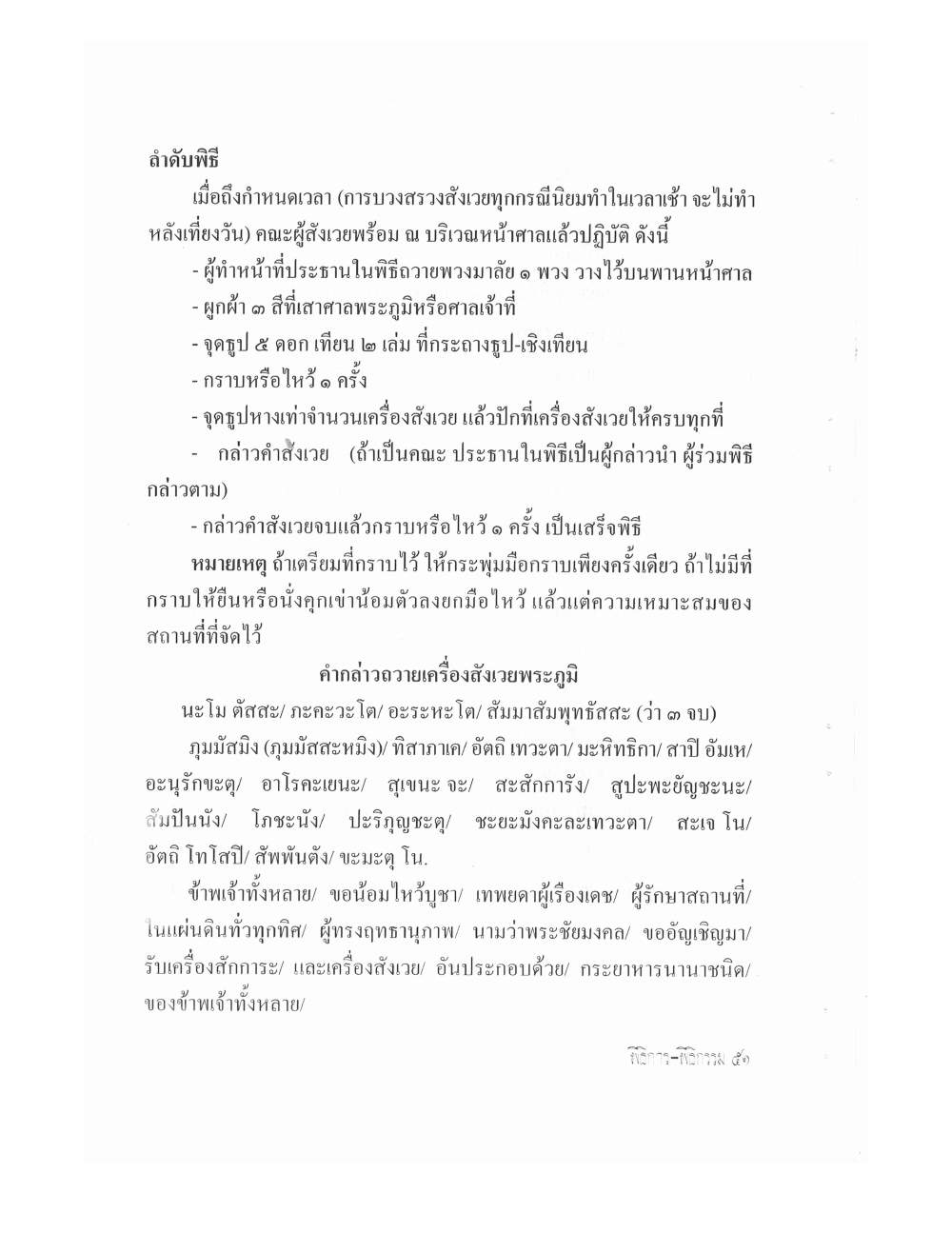
ลำดับพิธี
เมื่อถึงกำหนดเวลา (การบวงสรวงสังเวยทุกกรณีนิยมทำในเวลาเช้า จะไม่ทำหลังเที่ยงวัน) คณะผู้สังเวยพร้อม ณ บริเวณหน้าศาลแล้วปฏิบัติ ดังนี้
- ผู้ทำหน้าที่ประธานในพิธีถวายพวงมาลัย ๑ พวง วางไว้บนพานหน้าศาล - ผูกผ้า ๓ สีที่เสาศาลพระภูมิหรือศาลเจ้าที่ - จุดธูป ๕ ดอก เทียน ๒ เล่ม ที่กระถางธูป-เชิงเทียน - กราบหรือไหว้ ๑ ครั้ง - จุดธูปหางเท่าจำนวนเครื่องสังเวย แล้วปักที่เครื่องสังเวยให้ครบทุกที่ - กล่าวคำสังเวย (ถ้าเป็นคณะ ประธานในพิธีเป็นผู้กล่าวนำ ผู้ร่วมพิธีกล่าวตาม)
- กล่าวคำสังเวยจบแล้วกราบหรือไหว้ ๑ ครั้ง เป็นเสร็จพิธี
หมายเหตุ ถ้าเตรียมที่กราบไว้ ให้กระพุ่มมือกราบเพียงครั้งเดียว ถ้าไม่มีที่กราบให้ยืนหรือนั่งคุกเข่าน้อมตัวลงยกมือไหว้ แล้วแต่ความเหมาะสมของสถานที่ที่จัดไว้
คำกล่าวถวายเครื่องสังเวยพระภูมิ
นะโม ตัสสะ/ ภะคะวะโต/ อะระหะโต/ สัมมาสัมพุทธัสสะ (ว่า ๓ จบ)
ภุมมัสมิง (ภุมมัสสะหมิง)/ ทิสาภาเค/ อัตถิ เทวะตา/ มะหิทธิกา/ สาปิ อัมเห/ อะนุรักขะตุ/ อาโรคะเยนะ/ สุเขนะ จะ/ สะสักการัง/ สูปะพะยัญชะนะ/ สัมปันนัง/ โภชะนัง/ ปะริภุญชะตุ/ ชะยะมังคะละเทวะตา/ สะเจ โน/ อัตถิ โทโสปิ/ สัพพันตัง/ ขะมะตุ โน.
ข้าพเจ้าทั้งหลาย/ ขอน้อมไหว้บูชา/ เทพยดาผู้เรืองเดช/ ผู้รักษาสถานที่/ ในแผ่นดินทั่วทุกทิศ/ ผู้ทรงฤทธานุภาพ/ นามว่าพระชัยมงคล/ ขออัญเชิญมา/ รับเครื่องสักการะ/ และเครื่องสังเวย/ อันประกอบด้วย/ กระยาหารนานาชนิด/ ของข้าพเจ้าทั้งหลาย/
Order of the Ceremony
When the appointed time arrives (offering ceremonies of every kind are customarily performed in the morning; they are not performed after midday), the group making the offering assembles in front of the shrine and proceeds as follows:
- The one acting as officiant offers one garland, placing it on the tray in front of the shrine. - Three-coloured cloth is tied around the pillar of the Phra Phum shrine or the Chao Thi shrine. - Five incense sticks and two candles are lit at the incense burner and candle-holder. - One prostration or wai is performed. - "Tail" incense sticks, equal in number to the offering dishes, are lit and planted in every offering dish. - The offering invocation is recited (if performed as a group, the officiant leads and the other participants recite along).
- Once the offering invocation is finished, one prostration or wai is performed, and the ceremony is complete.
Note: If a place for prostration has been prepared, join the palms and prostrate only once. If there is no place to prostrate, stand or kneel, bow the body, and raise the hands in a wai instead, according to whatever suits the place provided.
The Words for Offering the Sacrifice to Phra Phum
Namo tassa bhagavato arahato sammāsambuddhassa (recite 3 times)
[Pali, as printed:] Bhummasmiṃ (bhummassahmiṃ) disābhāge atthi devatā mahiddhikā, sāpi amhe anurakkhatu ārogyena sukhena ca; sasakkāraṃ sūpabyañjanasampannaṃ bhojanaṃ paribhuñjatu jayamaṅgaladevatā; sace no atthi doso pi sabbantaṃ khamatu no. — [meaning:] "In this region there is a mighty deity; may that deity protect us with health and ease; may the deity of victory and blessing partake of this food, complete with offerings and good seasoning; if we have committed any fault, may that deity forgive us all of it."
We, [the offerers], humbly bow in worship to the deity of great glory, guardian of this place upon the earth in every direction, possessed of great power, named Phra Chai Mongkhon. We invite you to come and receive the offerings and the sacrifice, consisting of various kinds of food, from all of us —
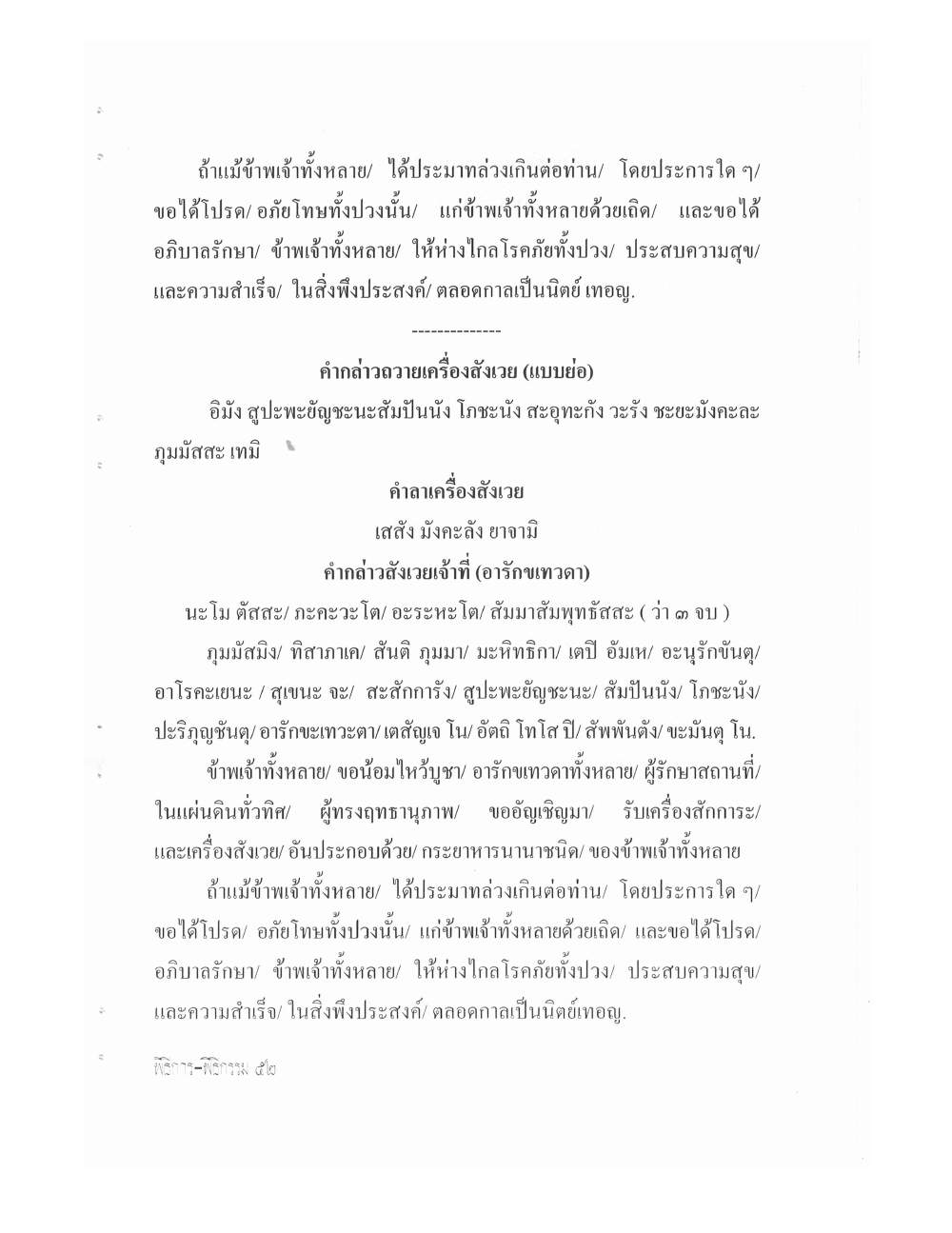
ถ้าแม้ข้าพเจ้าทั้งหลาย/ ได้ประมาทล่วงเกินต่อท่าน/ โดยประการใด ๆ/ ขอได้โปรด/ อภัยโทษทั้งปวงนั้น/ แก่ข้าพเจ้าทั้งหลายด้วยเถิด/ และขอได้อภิบาลรักษา/ ข้าพเจ้าทั้งหลาย/ ให้ห่างไกลโรคภัยทั้งปวง/ ประสบความสุข/และความสำเร็จ/ ในสิ่งพึงประสงค์/ตลอดกาลเป็นนิตย์ เทอญ.
--------------
คำกล่าวถวายเครื่องสังเวย (แบบย่อ)
อิมัง สูปะพะยัญชะนะสัมปันนัง โภชะนัง สะอุทะกัง วะรัง ชะยะมังคะละภุมมัสสะ เทมิ
คำลาเครื่องสังเวย
เสสัง มังคะลัง ยาจามิ
คำกล่าวสังเวยเจ้าที่ (อารักขเทวดา)
นะโม ตัสสะ/ ภะคะวะโต/ อะระหะโต/ สัมมาสัมพุทธัสสะ ( ว่า ๓ จบ )
ภุมมัสมิง/ ทิสาภาเค/ สันติ ภุมมา/ มะหิทธิกา/ เตปิ อัมเห/ อะนุรักขันตุ/ อาโรคะเยนะ / สุเขนะ จะ/ สะสักการัง/ สูปะพะยัญชะนะ/ สัมปันนัง/ โภชะนัง/ ปะริภุญชันตุ/ อารักขะเทวะตา/ เตสัญเจ โน/ อัตถิ โทโส ปิ/ สัพพันตัง/ ขะมันตุ โน.
ข้าพเจ้าทั้งหลาย/ ขอน้อมไหว้บูชา/ อารักขเทวดาทั้งหลาย/ ผู้รักษาสถานที่/ ในแผ่นดินทั่วทิศ/ ผู้ทรงฤทธานุภาพ/ ขออัญเชิญมา/ รับเครื่องสักการะ/ และเครื่องสังเวย/ อันประกอบด้วย กระยาหารนานาชนิด/ ของข้าพเจ้าทั้งหลาย
ถ้าแม้ข้าพเจ้าทั้งหลาย/ ได้ประมาทล่วงเกินต่อท่าน/ โดยประการใด ๆ/ ขอได้โปรด/ อภัยโทษทั้งปวงนั้น/ แก่ข้าพเจ้าทั้งหลายด้วยเถิด/ และขอได้โปรด/อภิบาลรักษา/ ข้าพเจ้าทั้งหลาย/ ให้ห่างไกลโรคภัยทั้งปวง/ ประสบความสุข/และความสำเร็จ/ ในสิ่งพึงประสงค์/ตลอดกาลเป็นนิตย์เทอญ.
— if we have in any way been careless or have offended against you, please forgive us entirely for it all, and please watch over and protect us, keeping us far from all sickness and danger, so that we may find happiness and success in whatever we rightly wish for, forever and always.
--------------
The Words for Offering the Sacrifice (Short Form)
[Pali, as printed:] Imaṃ sūpabyañjanasampannaṃ bhojanaṃ sa-udakaṃ varaṃ jayamaṅgala-bhummassa demi. — "I give this excellent food, complete with good seasoning and accompanied by water, to the Land Guardian of Victory and Blessing."
The Words for Taking Leave of the Offering
[Pali:] Sesaṃ maṅgalaṃ yācāmi. — "I ask for the remaining blessing."
The Words for Offering to the Local Guardian Spirit (Arak Khathewada)
Namo tassa bhagavato arahato sammāsambuddhassa (recite 3 times)
[Pali, as printed:] Bhummasmiṃ disābhāge santi bhummā mahiddhikā, te pi amhe anurakkhantu ārogyena sukhena ca; sasakkāraṃ sūpabyañjanasampannaṃ bhojanaṃ paribhuñjantu ārakkhadevatā; tesañ ce no atthi doso pi sabbantaṃ khamantu no. — [meaning:] "In this region there are mighty land deities; may they too protect us with health and ease; may the guardian deities partake of this food, complete with offerings and good seasoning; if we have committed any fault against them, may they forgive us all of it."
We, [the offerers], humbly bow in worship to all the guardian deities who protect this place upon the earth in every direction, possessed of great power. We invite you to come and receive the offerings and the sacrifice, consisting of various kinds of food, from all of us.
If we have in any way been careless or have offended against you, please forgive us entirely for it all, and please watch over and protect us, keeping us far from all sickness and danger, so that we may find happiness and success in whatever we rightly wish for, forever and always.
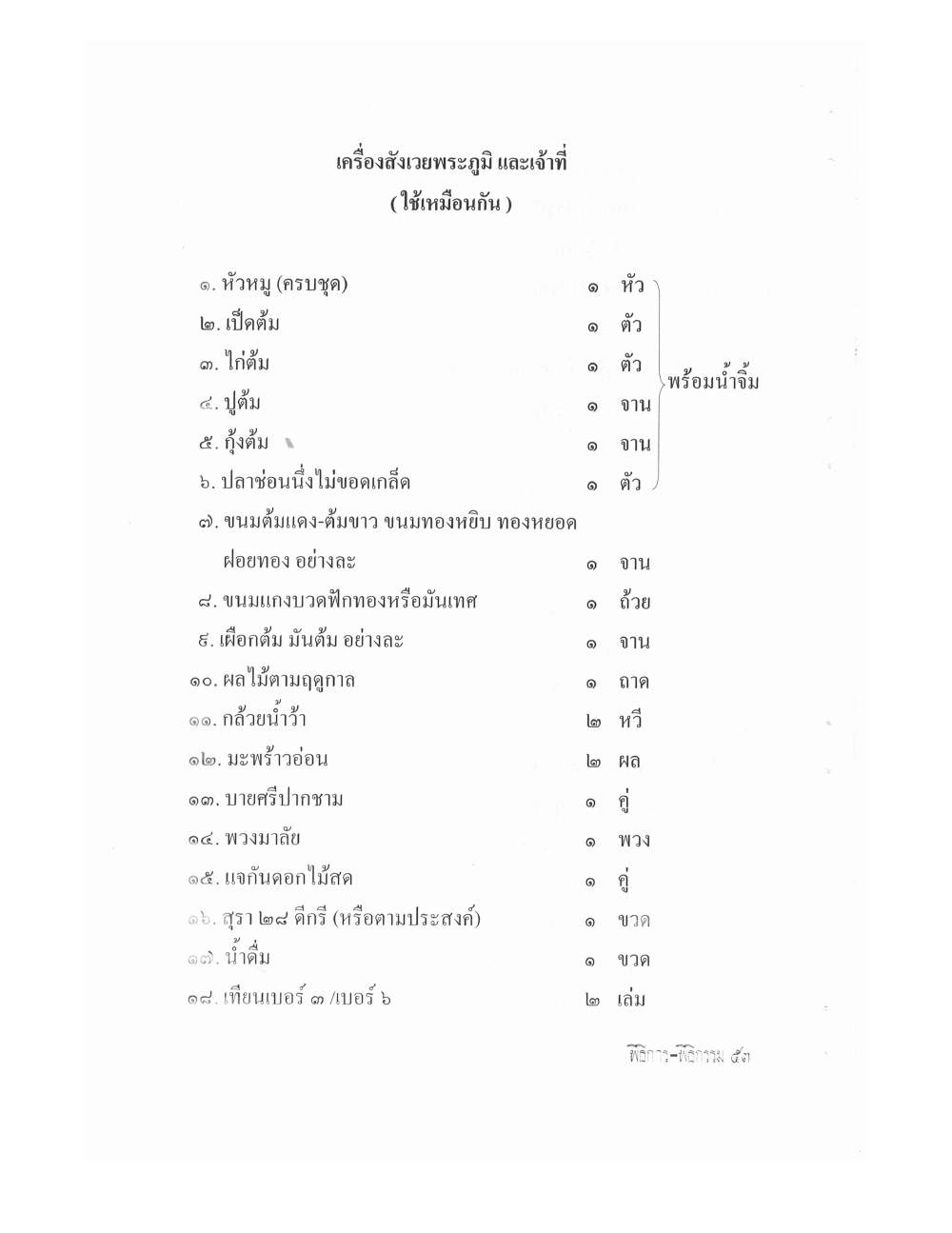
เครื่องสังเวยพระภูมิ และเจ้าที่
( ใช้เหมือนกัน )
๑. หัวหมู (ครบชุด) ๑ หัว ๒. เป็ดต้ม ๑ ตัว ๓. ไก่ต้ม ๑ ตัว ๔. ปูต้ม ๑ จาน ๕. กุ้งต้ม ๑ จาน ๖. ปลาช่อนนึ่งไม่ขอดเกล็ด ๑ ตัว [bracket: items ๑–๖ joined with a brace labelled "พร้อมน้ำจิ้ม"] ๗. ขนมต้มแดง-ต้มขาว ขนมทองหยิบ ทองหยอด ฝอยทอง อย่างละ ๑ จาน ๘. ขนมแกงบวดฟักทองหรือมันเทศ ๑ ถ้วย ๙. เผือกต้ม มันต้ม อย่างละ ๑ จาน ๑๐. ผลไม้ตามฤดูกาล ๑ ถาด ๑๑. กล้วยน้ำว้า ๒ หวี ๑๒. มะพร้าวอ่อน ๒ ผล ๑๓. บายศรีปากชาม ๑ คู่ ๑๔. พวงมาลัย ๑ พวง ๑๕. แจกันดอกไม้สด ๑ คู่ ๑๖. สุรา ๒๘ ดีกรี (หรือตามประสงค์) ๑ ขวด ๑๗. น้ำดื่ม ๑ ขวด ๑๘. เทียนเบอร์ ๓ /เบอร์ ๖ ๒ เล่ม
Offerings for Phra Phum and the Chao Thi
(The same offerings are used for both)
1. Pig's head (complete set) — 1 head 2. Boiled duck — 1 bird 3. Boiled chicken — 1 bird 4. Boiled crab — 1 plate 5. Boiled shrimp — 1 plate 6. Steamed snakehead fish, scales not scraped off — 1 fish [bracket: items 1–6 are joined by a brace labelled "served with dipping sauce"] 7. Red and white boiled sweets, thong-yip, thong-yot, and foi-thong sweets, one plate of each — 1 plate 8. Pumpkin or sweet-potato sweet curry — 1 bowl 9. Boiled taro and boiled yam, one plate of each — 1 plate 10. Seasonal fruit — 1 tray 11. Namwa bananas — 2 hands 12. Young coconuts — 2 fruits 13. Bai sri in a bowl — 1 pair 14. A garland — 1 garland 15. A pair of vases of fresh flowers — 1 pair 16. 28-proof liquor (or as desired) — 1 bottle 17. Drinking water — 1 bottle 18. No. 3 / No. 6 candles — 2 candles
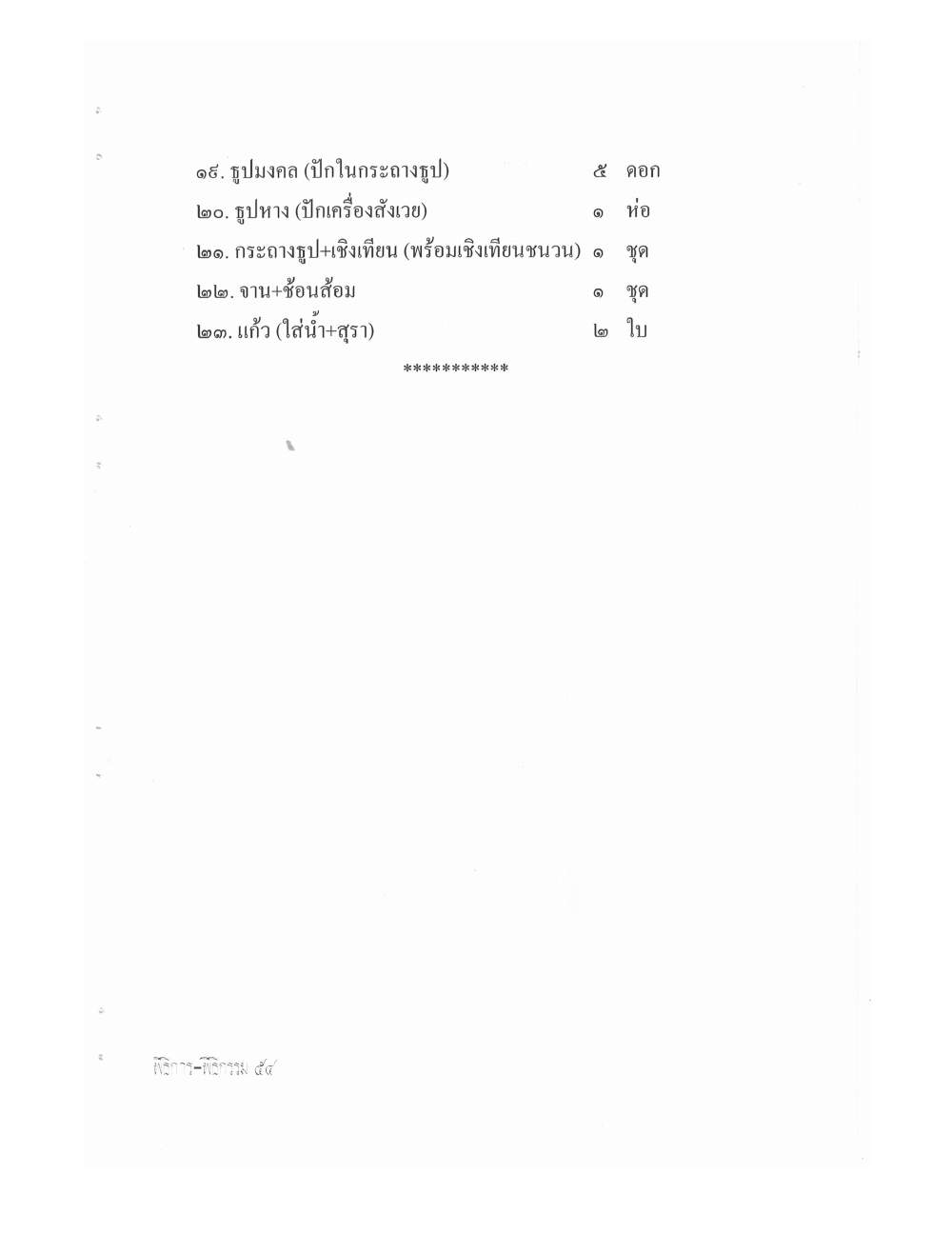
๑๙. ธูปมงคล (ปักในกระถางธูป) ๕ ดอก ๒๐. ธูปหาง (ปักเครื่องสังเวย) ๑ ห่อ ๒๑. กระถางธูป+เชิงเทียน (พร้อมเชิงเทียนชนวน) ๑ ชุด ๒๒. จาน+ช้อนส้อม ๑ ชุด ๒๓. แก้ว (ใส่น้ำ+สุรา) ๒ ใบ
**********
19. Auspicious incense sticks (planted in the incense burner) — 5 sticks 20. "Tail" incense sticks (planted in the offering dishes) — 1 bundle 21. Incense burner and candle-holder (with a lighting taper) — 1 set 22. Plate with knife and fork — 1 set 23. Glasses (for water and liquor) — 2 glasses
**********
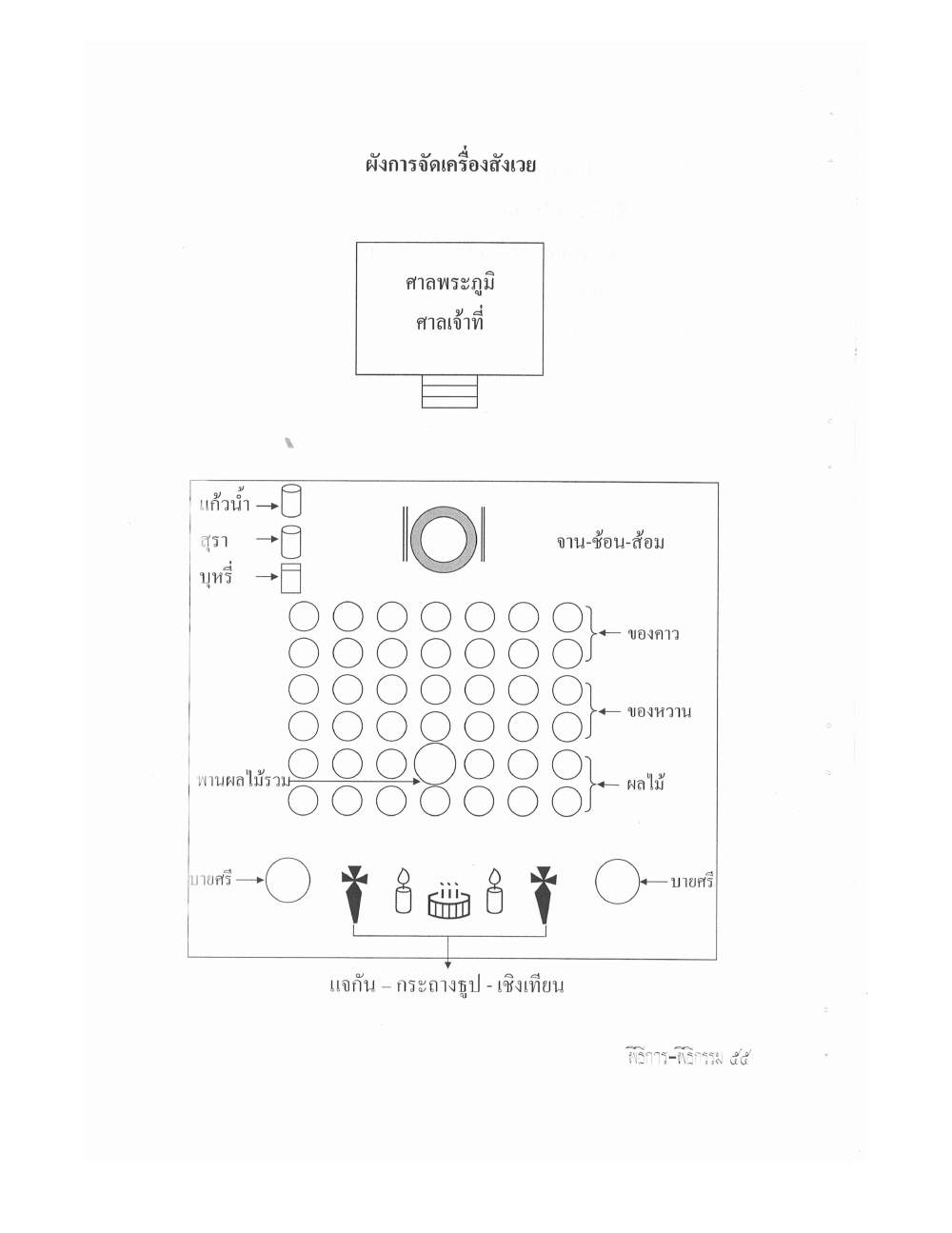
ผังการจัดเครื่องสังเวย
[diagram: a floor plan. At the top, a box labelled "ศาลพระภูมิ / ศาลเจ้าที่" with a small stepped base beneath it, showing the shrine standing above the offering table. Below it is a large square representing the offering table, bearing the following labels —]
แก้วน้ำ → สุรา → บุหรี่ →
[a shaded ring shape, apparently a garland, positioned at the top centre of the table] จาน-ช้อน-ส้อม
[a grid of six columns by six rows of circles representing the offering dishes, bracketed on the right into three groups labelled:] ของคาว ของหวาน ผลไม้
พานผลไม้รวม → [an arrow pointing into the row of fruit dishes]
บายศรี [circle] [circle] บายศรี
[two candle/incense-stand icons flanking a small round item, with lines converging downward to an arrow]
แจกัน – กระถางธูป - เชิงเทียน
Diagram of the Offering Arrangement
[diagram: a floor plan. At the top, a box labelled "Phra Phum shrine / Chao Thi shrine" with a small stepped base beneath it, showing the shrine standing above the offering table. Below it is a large square representing the offering table, bearing the following labels —]
Water glass → Liquor → Cigarettes →
[a shaded ring shape, apparently a garland, positioned at the top centre of the table] Plate – spoon – fork
[a grid of six columns by six rows of circles representing the offering dishes, bracketed on the right into three groups labelled:] Savoury dishes Sweet dishes Fruit
Combined tray of fruit → [an arrow pointing into the row of fruit dishes]
Bai sri [circle] [circle] Bai sri
[two candle/incense-stand icons flanking a small round item, with lines converging downward to an arrow]
Vase – incense burner - candle-holder
พิธีวางศิลาฤกษ์
**********
พิธีวางศิลาฤกษ์ คือพิธีวางแผ่นศิลาจารึกเวลา วัน เดือน ปี อันเป็นมงคลที่เรียกว่า ดวงฤกษ์ แห่งการก่อสร้างไว้ ณ บริเวณสถานที่ก่อสร้างอาคารถาวรต่าง ๆ เช่นอาคารทางศาสนา มีโบสถ์ ศาลาการเปรียญ อนุสาวรีย์ เป็นต้น อาคารของทางราชการ มีศาลากลางจังหวัด ศาลาเทศบาล อาคารกองบังคับการของหน่วยทหาร เป็นต้น อาคารของเอกชน มีธนาคาร ภัตตาคาร เป็นต้น จุดประสงค์ของการทำพิธีก็เพื่อให้อาคารเหล่านั้นเกิดความถาวรมั่นคงกิจการเจริญก้าวหน้าและผู้อาศัยอยู่เย็นเป็นสุขตลอดไป
ไม้เข็มมงคล
การทำพิธีวางศิลาฤกษ์เช่นว่านี้ ตามประเพณีโบราณมักนิยมตอกไม้เข็มมงคลด้วย ไม้เข็มนั้น ประกอบด้วยไม้มงคล ๙ ชนิด คือ
- ไม้ขนุน ถือเคล็ดว่าหนุนให้เกิดพลังอานุภาพ - ไม้ชัยพฤกษ์ ถือเคล็ดว่ามีโชคชัย - ไม้ราชพฤกษ์ ถือเคล็ดว่าเป็นใหญ่เป็นโต - ไม้สัก ถือเคล็ดว่าเกิดความศักดิ์สิทธิ์ - ไม้ไผ่สีสุก ถือเคล็ดว่าเกิดความสงบสุข - ไม้พะยูง ถือเคล็ดว่าพยุงให้เกิดความมั่นคง - ไม้ทองหลาง ถือเคล็ดว่ามีเงินมีทอง - ไม้กันเกรา ถือเคล็ดว่าป้องกันภัยอันตรายมิให้เกิดขึ้น - ไม้ทรงบาดาล ถือเคล็ดว่าบันดาลให้เกิดความร่มเย็น
The Ceremony of Laying the Foundation Stone
**********
The ceremony of laying the foundation stone is the ceremony of placing a stone slab inscribed with an auspicious hour, day, month, and year — known as the "auspicious moment" (duang rerk) — for the construction, at the site where various permanent buildings are to be built. These include religious buildings such as ordination halls, sermon halls, and monuments; government buildings such as provincial halls, municipal halls, and military headquarters buildings; and privately owned buildings such as banks and restaurants. The purpose of performing the ceremony is so that these buildings will become stable and enduring, their affairs will prosper and advance, and those who dwell within them will live in peace and happiness forever.
The Auspicious Peg-Woods
In performing this ceremony of laying the foundation stone, ancient tradition customarily also favours driving in auspicious wooden pegs. These pegs are made from nine kinds of auspicious wood, namely:
- Jackfruit wood — held as a token that it will support and generate power and majesty. - Chai Phruek (Cassia) wood — held as a token of victorious fortune. - Racha Phruek (Golden Shower) wood — held as a token of greatness and high rank. - Teak wood — held as a token that sanctity will arise. - Si Suk bamboo — held as a token that peace and happiness will arise. - Phayung (Rosewood) — held as a token that it will bolster and bring about stability. - Thong Lang wood — held as a token of wealth in money and gold. - Kan Krao wood — held as a token that it will prevent dangers from arising. - Song Badan wood — held as a token that it will bring about coolness and peace.
ไม้แต่ละชนิดดังกล่าวทำเป็นท่อน แต่ละท่อนความยาวประมาณ ๑๒ นิ้ว เส้นผ่าศูนย์กลางประมาณ ๑ นิ้วครึ่ง เสี้ยมปลายให้แหลมเล็กน้อย เพื่อตอกลงดินได้สะดวก (ไม้เข็มมงคลนี้ สามารถหาซื้อได้ตามร้านค้าที่ขายเครื่องประกอบพิธี หรือร้านสังฆภัณฑ์ทั่วไป)
หลุมวางศิลาฤกษ์
หลุมสำหรับวางศิลาฤกษ์นิยมทำกันเป็น ๒ แบบ แบบหนึ่งขุดลงไปในดิน หลุมกว้างยาวประมาณ ๑ เมตร ลึกประมาณครึ่งเมตร ทำเป็นรูปสี่เหลี่ยมจัตุรัส หลุมแบบนี้นิยมทำกันมาแต่โบราณ แต่เป็นความลำบากของประธานในพิธีที่จะต้องนั่งชันเข่าก้มลงไปตอกไม้เข็มมงคลและโบกปูนซีเมนต์ เพื่อให้แผ่นอิฐกับแผ่นศิลาเกาะกัน วิธีนี้ปัจจุบันจึงไม่ค่อยนิยมกระทำกัน
อีกแบบหนึ่งใช้ก่อปูนซีเมนต์ให้สูงจากพื้นดินประมาณครึ่งเมตรทำเป็นรูปสี่เหลี่ยมจัตุรัส ลักษณะเดียวกับหลุมแบบแรก แต่ก้นหลุมที่เทปูนซีเมนต์แล้วจะต้องเจาะรูไว้ ๙ แห่ง เพื่อประธานในพิธีจะได้ตอกไม้เข็มมงคลลงดินตามช่องนั้นได้สะดวก
ปักราชวัติ - ฉัตร - ธง ให้เป็นปริมณฑล
เมื่อได้จัดทำหลุมวางศิลาฤกษ์เรียบร้อยแล้ว จะต้องตกแต่งบริเวณรอบหลุมด้วยการปักราชวัติ ฉัตร ธง พร้อมด้วยหน่อกล้วยหน่ออ้อย ตามทางเข้าออกทั้งสี่ด้าน และจะต้องโยงสายสิญจน์จากโต๊ะบูชาที่พระสงฆ์เจริญพระพุทธมนต์ มาวนที่ราชวัติ ฉัตร ธง โดยรอบด้วย (ขั้นตอนนี้โดยปกติเจ้าพิธีหรือผู้ชำนาญพิธีที่เจ้าภาพเชิญมาจะเป็นผู้ดำเนินการเอง)
Each of the above kinds of wood is made into a length, each piece about 12 inches long and about 1½ inches in diameter, with the end whittled to a slight point so that it can be driven into the ground easily. (These auspicious peg-woods can be bought at shops selling ceremonial supplies, or at general monastic-supply shops.)
The Pit for Laying the Foundation Stone
The pit for laying the foundation stone is customarily made in one of two styles. One style is dug down into the ground, the pit being about 1 metre wide and long and about half a metre deep, made in a square shape. This style of pit has been favoured since ancient times, but it is difficult for the officiant of the ceremony, who must sit with knees bent, leaning down to drive in the auspicious peg-woods and to plaster on cement so that the brick and the stone slab adhere to one another. For this reason, this method is nowadays not much favoured.
The other style uses cement built up to a height of about half a metre above the ground, made into a square shape in the same manner as the first style of pit, but the bottom of the pit, once the cement has been poured, must have 9 holes bored into it, so that the officiant of the ceremony can conveniently drive the auspicious peg-woods down into the ground through those holes.
Planting the Ceremonial Fence, Canopies, and Flags to Form the Sacred Precinct
Once the pit for laying the foundation stone has been properly prepared, the area around the pit must be decorated by planting the ceremonial fence (ratchawat), canopies (chat), and flags (thong), together with young banana and sugarcane shoots, at all four entrances and exits. A sacred thread (sai sin) must also be run from the worship table where the monks chant the Buddhist blessing, looping all the way around the ceremonial fence, canopies, and flags. (This step is normally carried out by the ceremony master or the ritual specialist invited by the host.)
บูชาฤกษ์ก่อนวางศิลาฤกษ์
ในวันที่จะทำพิธีวางศิลาฤกษ์ ในช่วงเช้าก่อนพระสงฆ์เจริญพระพุทธมนต์ตามประเพณีต้องทำการบูชาฤกษ์เสียก่อน ผู้ที่จะทำพิธีบูชาฤกษ์จะต้องเป็นผู้รู้ในพิธีต่าง ๆ ที่ดี เช่นพวกโหรหรือบัณฑิต หรือผู้ชำนาญพิธีทั่วไป สุดแต่จะเชิญมาเป็นเจ้าพิธี การบูชาฤกษ์มีเครื่องประกอบพิธีดังนี้
- บายศรีปากชาม ๑ คู่ - มะพร้าวอ่อน ๒ ผล - หัวหมูต้ม ๑ หัว ถ้าราคาแพงจะใช้หมูนอนตองแทนก็ได้ - ไก่ต้ม เป็ดต้ม กุ้งต้ม ปลาช่อนนึ่ง อย่างละจาน พร้อมด้วยน้ำจิ้ม - ขนมต้มแดงต้มขาว อย่างละ ๑ จาน อาจมีขนมถ้วยฟูและฝอยทองเพื่อถือเคล็ดว่ามีเงินมีทองและเจริญเฟื่องฟูด้วยก็ได้ - มันต้ม เผือกต้ม อย่างละ ๑ จาน - กล้วยน้ำไท ๑ หวี ถ้าหาไม่ได้ใช้กล้วยน้ำว้าหรือกล้วยหอมแทน - ถั่วคั่ว งาคั่ว ถ้าหาไม่ได้จะใช้ขนมจันอับที่มีถั่วมีงาผสมแทนก็ได้ - ผลไม้ต่าง ๆ ตามแต่จะหาได้ใส่รวมกัน ๑ จาน - น้ำเย็น ๑ แก้ว หมากพลูบุหรี่ ๑ พาน - ดอกไม้สด ๒ แจกัน เทียน ๑ คู่ กระถางธูป ๑ ชุด พร้อมด้วยธูป เพื่อใช้จุดบูชา ๑ ซองใหญ่
ของเครื่องบูชาฤกษ์ดังกล่าวนี้ จัดตามประเพณีที่ทำสืบกันมา ถ้าของบางอย่างหาไม่ได้ในท้องตลาด เช่น กุ้ง ปู อาจจะไม่ใช้ก็ได้ ถือเอาความสะดวกในท้องถิ่นตามแต่จะหาได้เป็นหลัก อนึ่ง เพื่อความสะดวกจะมอบให้เจ้าพิธีที่เชิญมาเป็นผู้จัดเครื่องบูชาฤกษ์ให้ด้วยก็ได้
Honouring the Auspicious Time Before Laying the Foundation Stone
On the day the foundation-stone ceremony is to be held, in the morning before the monks chant the Buddhist blessing, tradition requires that the auspicious time first be honoured with offerings. The one who performs this rite must be someone knowledgeable in proper ceremonial matters, such as an astrologer or scholar, or a general ritual specialist — whoever is invited to serve as the ceremony master. Honouring the auspicious time requires the following ceremonial items:
- Bai sri in a bowl — 1 pair - Young coconuts — 2 fruits - Boiled pig's head — 1 head (if too expensive, boiled pork loin may be used instead) - Boiled chicken, boiled duck, boiled shrimp, and steamed snakehead fish, one plate of each, together with dipping sauce - Red and white boiled sweets, 1 plate of each; steamed cup cakes (khanom thuai fu) and foi-thong sweets may also be included, as a token of wealth in money and gold and of flourishing prosperity - Boiled yam and boiled taro, 1 plate of each - Nam Thai bananas — 1 hand; if unavailable, Namwa bananas or Hom bananas may be substituted - Roasted peanuts and roasted sesame; if unavailable, Chinese candy (khanom chan-ap) containing peanuts and sesame may be substituted instead - Various fruits, whatever can be found, combined on 1 plate - Cool water — 1 glass; betel, areca nut, and cigarettes — 1 tray - Fresh flowers — 2 vases; candles — 1 pair; incense burner — 1 set, together with incense for lighting in worship — 1 large packet
These items for honouring the auspicious time are arranged according to tradition handed down over time. If certain items cannot be found in the local market, such as shrimp or crab, they may be omitted; the guiding principle is simply convenience and whatever can be found locally. Also, for convenience, the invited ceremony master may be entrusted with arranging the offerings for honouring the auspicious time as well.
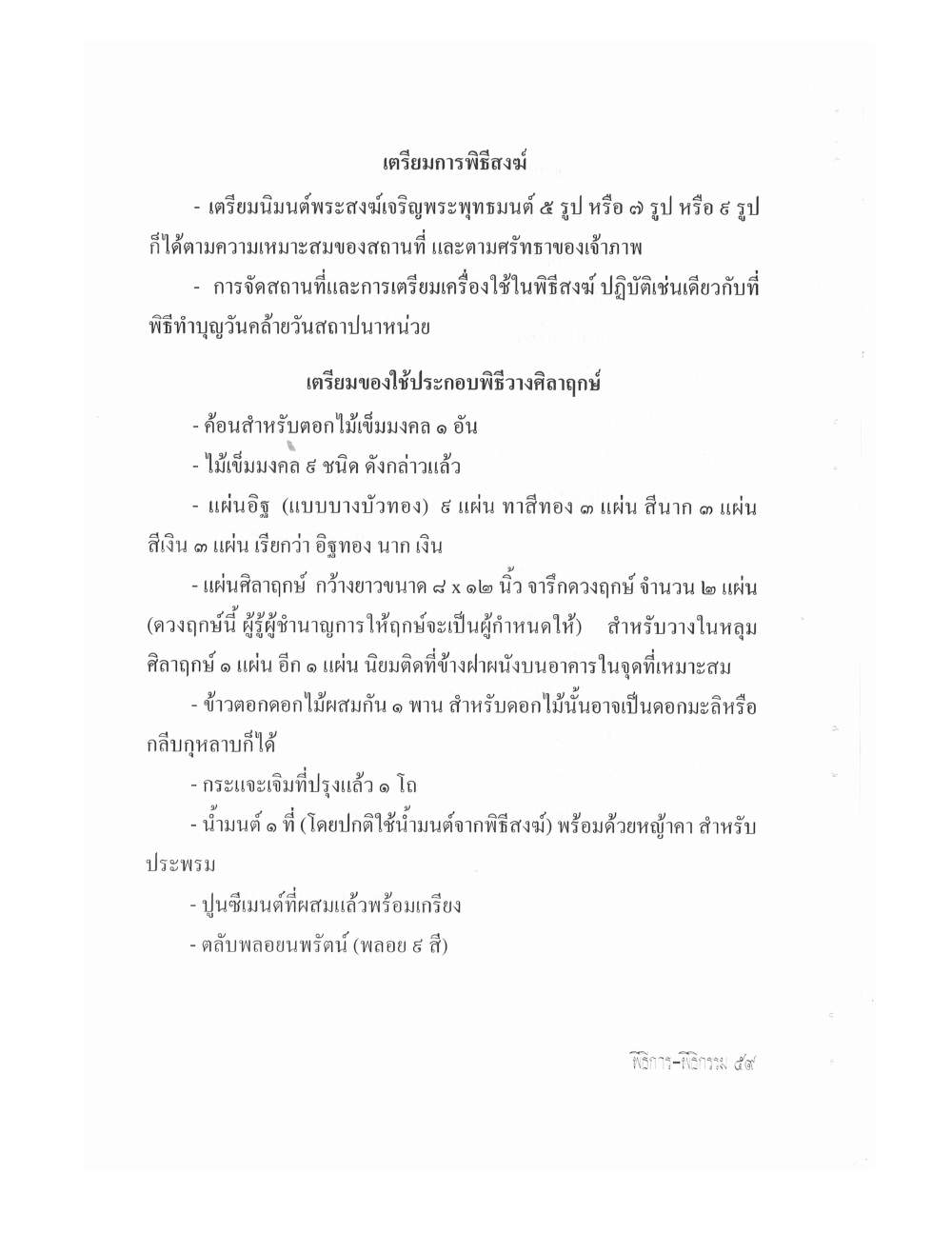
เตรียมการพิธีสงฆ์
- เตรียมนิมนต์พระสงฆ์เจริญพระพุทธมนต์ ๕ รูป หรือ ๗ รูป หรือ ๙ รูป ก็ได้ตามความเหมาะสมของสถานที่ และตามศรัทธาของเจ้าภาพ
- การจัดสถานที่และการเตรียมเครื่องใช้ในพิธีสงฆ์ ปฏิบัติเช่นเดียวกับที่ พิธีทำบุญวันคล้ายวันสถาปนาหน่วย
เตรียมของใช้ประกอบพิธีวางศิลาฤกษ์
- ค้อนสำหรับตอกไม้เข็มมงคล ๑ อัน - ไม้เข็มมงคล ๘ ชนิด ดังกล่าวแล้ว - แผ่นอิฐ (แบบบางบัวทอง) ๙ แผ่น ทาสีทอง ๓ แผ่น สีนาก ๓ แผ่น สีเงิน ๓ แผ่น เรียกว่า อิฐทอง นาก เงิน - แผ่นศิลาฤกษ์ กว้างยาวขนาด ๘ x ๑๒ นิ้ว จารึกดวงฤกษ์ จำนวน ๒ แผ่น (ดวงฤกษ์นี้ผู้รู้ผู้ชำนาญการให้ฤกษ์จะเป็นผู้กำหนดให้) สำหรับวางในหลุม ศิลาฤกษ์ ๑ แผ่น อีก ๑ แผ่น นิยมติดที่ข้างฝาผนังบนอาคารในจุดที่เหมาะสม - ข้าวตอกดอกไม้ผสมกัน ๑ พาน สำหรับดอกไม้นั้นอาจเป็นดอกมะลิหรือ กลีบกุหลาบก็ได้ - กระแจะเจิมที่ปรุงแล้ว ๑ โถ - น้ำมนต์ ๑ ที่ (โดยปกติใช้น้ำมนต์จากพิธีสงฆ์) พร้อมด้วยหญ้าคา สำหรับ ประพรม - ปูนซีเมนต์ที่ผสมแล้วพร้อมเกรียง - ตลับพลอยนพรัตน์ (พลอย ๙ สี)
Preparations for the Monks' Ceremony
- Arrange to invite monks to chant blessings — 5 monks, or 7 monks, or 9 monks, as suits the venue and according to the sponsor's faith.
- Arranging the venue and preparing the items used in the monks' ceremony follows the same practice as for the ceremony marking the unit's founding anniversary.
Preparing the Items for the Foundation Stone-Laying Ceremony
- 1 hammer for driving the auspicious wooden pegs - The 8 kinds of auspicious wooden pegs as mentioned above - Brick tablets (Bang Bua Thong type), 9 tablets — 3 tablets painted gold, 3 tablets painted nak (rose-gold), 3 tablets painted silver; called the gold, nak, and silver bricks - A foundation-stone tablet, 8 x 12 inches, inscribed with the auspicious horoscope, 2 tablets (this horoscope is set by the knowledgeable expert who determines the auspicious time) — 1 tablet is for placing in the foundation-stone pit; the other tablet is customarily affixed to a wall of the building at a suitable spot - 1 tray of popped rice mixed with flowers, the flowers being either jasmine or rose petals - 1 bowl of prepared anointing paste - 1 vessel of holy water (normally the holy water from the monks' ceremony), together with cogon grass, for sprinkling - Cement already mixed, with a trowel ready - A case of nine-gem jewels (nine colors of gems)
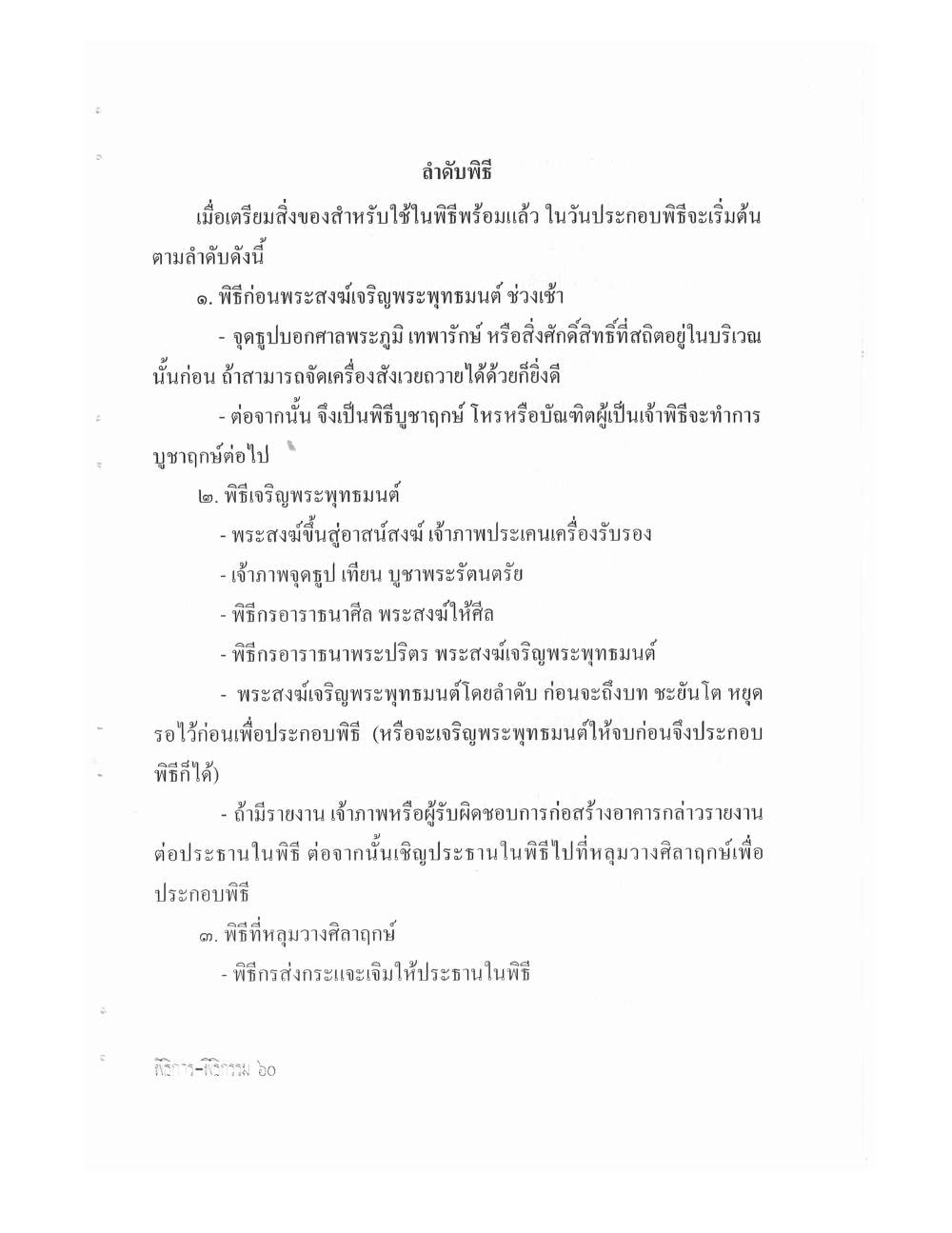
ลำดับพิธี
เมื่อเตรียมสิ่งของสำหรับใช้ในพิธีพร้อมแล้ว ในวันประกอบพิธีจะเริ่มต้น ตามลำดับดังนี้
๑. พิธีก่อนพระสงฆ์เจริญพระพุทธมนต์ ช่วงเช้า
- จุดธูปบอกศาลพระภูมิ เทพารักษ์ หรือสิ่งศักดิ์สิทธิ์ที่สถิตอยู่ในบริเวณ นั้นก่อน ถ้าสามารถจัดเครื่องสังเวยถวายได้ด้วยก็ยิ่งดี - ต่อจากนั้น จึงเป็นพิธีบูชาฤกษ์ โหรหรือบัณฑิตผู้เป็นเจ้าพิธีจะทำการ บูชาฤกษ์ต่อไป
๒. พิธีเจริญพระพุทธมนต์
- พระสงฆ์ขึ้นสู่อาสน์สงฆ์ เจ้าภาพประเคนเครื่องรับรอง - เจ้าภาพจุดธูป เทียน บูชาพระรัตนตรัย - พิธีกรอาราธนาศีล พระสงฆ์ให้ศีล - พิธีกรอาราธนาพระปริตร พระสงฆ์เจริญพระพุทธมนต์ - พระสงฆ์เจริญพระพุทธมนต์โดยลำดับ ก่อนจะถึงบท ชะยันโต หยุด รอไว้ก่อนเพื่อประกอบพิธี (หรือจะเจริญพระพุทธมนต์ให้จบก่อนจึงประกอบ พิธีก็ได้) - ถ้ามีรายงาน เจ้าภาพหรือผู้รับผิดชอบการก่อสร้างอาคารกล่าวรายงาน ต่อประธานในพิธี ต่อจากนั้นเชิญประธานในพิธีไปที่หลุมวางศิลาฤกษ์เพื่อ ประกอบพิธี
๓. พิธีที่หลุมวางศิลาฤกษ์
- พิธีกรส่งกระแจะเจิมให้ประธานในพิธี
Order of the Ceremony
Once the items for use in the ceremony are all prepared, on the day the ceremony is performed it begins in the following order:
1. The ceremony before the monks chant the blessing, morning session
- First light incense to inform the spirit house, the guardian deities, or any sacred presences residing in the area; it is even better if offerings can also be arranged and presented to them. - After that comes the ceremony of honoring the auspicious moment; the astrologer or the scholar who serves as master of the ceremony proceeds to honor the auspicious time.
2. The ceremony of chanting the blessing
- The monks ascend to the monks' seats; the sponsor presents refreshments. - The sponsor lights incense and candles to venerate the Triple Gem. - The master of ceremonies invites the taking of precepts; the monks bestow the precepts. - The master of ceremonies invites the Paritta chanting; the monks chant the blessing. - The monks chant the blessing in sequence; before reaching the "Chayanto" verse, they pause and wait so the ceremony can be performed (or the blessing chanting may instead be completed in full before the ceremony is performed). - If there is a report, the sponsor or the person responsible for the building's construction delivers the report to the presiding officiant; after that the presiding officiant is invited to the foundation-stone pit to perform the ceremony.
3. The ceremony at the foundation-stone pit
- The master of ceremonies hands the anointing paste to the presiding officiant.
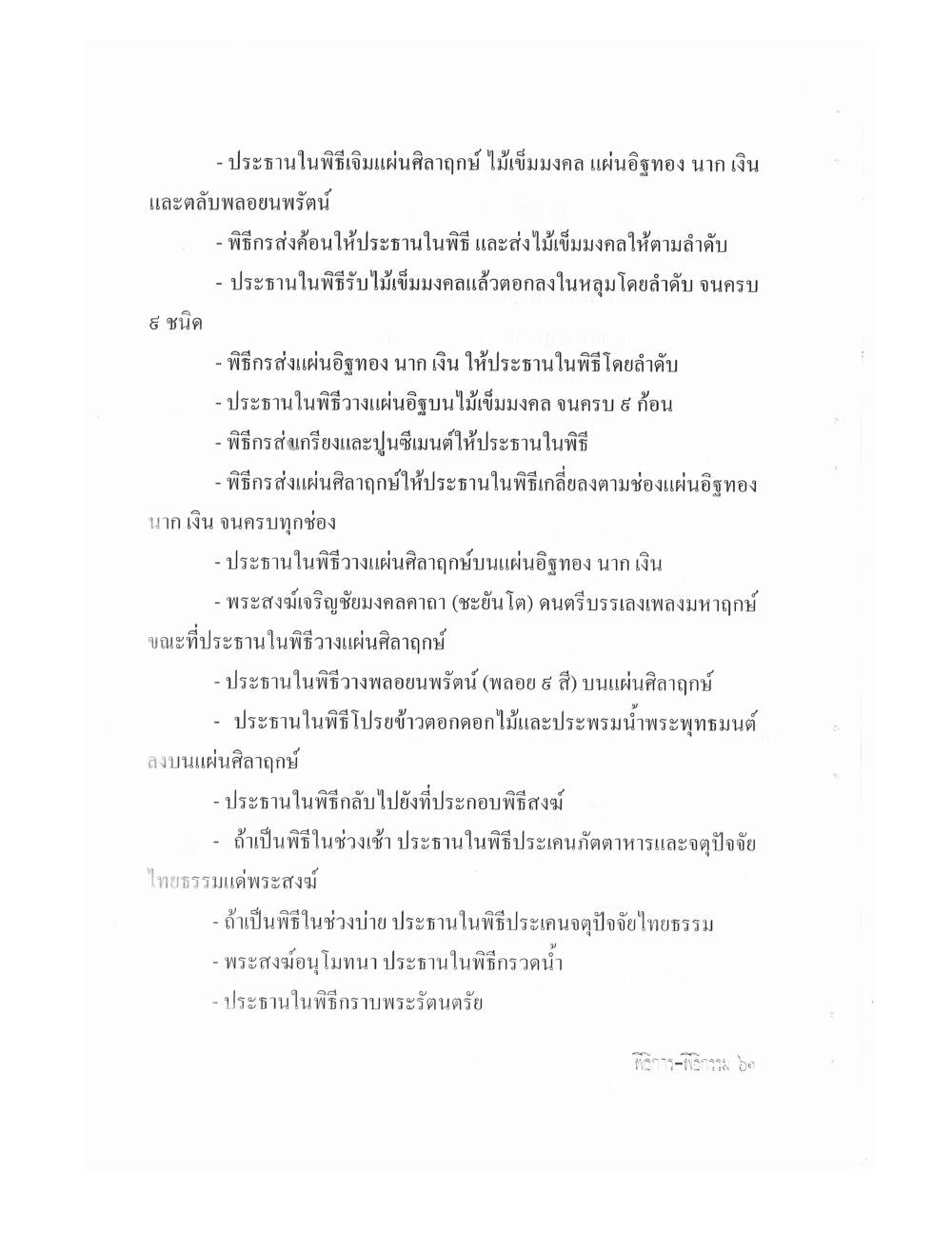
- ประธานในพิธีเจิมแผ่นศิลาฤกษ์ ไม้เข็มมงคล แผ่นอิฐทอง นาก เงิน และตลับพลอยนพรัตน์ - พิธีกรส่งค้อนให้ประธานในพิธี และส่งไม้เข็มมงคลให้ตามลำดับ - ประธานในพิธีรับไม้เข็มมงคลแล้วตอกลงในหลุมโดยลำดับ จนครบ ๘ ชนิด - พิธีกรส่งแผ่นอิฐทอง นาก เงิน ให้ประธานในพิธีโดยลำดับ - ประธานในพิธีวางแผ่นอิฐบนไม้เข็มมงคล จนครบ ๙ ก้อน - พิธีกรส่งเกรียงและปูนซีเมนต์ให้ประธานในพิธี - พิธีกรส่งแผ่นศิลาฤกษ์ให้ประธานในพิธีเกลี่ยลงตามช่องแผ่นอิฐทอง นาก เงิน จนครบทุกช่อง - ประธานในพิธีวางแผ่นศิลาฤกษ์บนแผ่นอิฐทอง นาก เงิน - พระสงฆ์เจริญชัยมงคลคาถา (ชะยันโต) ดนตรีบรรเลงเพลงมหาฤกษ์ ขณะที่ประธานในพิธีวางแผ่นศิลาฤกษ์ - ประธานในพิธีวางพลอยนพรัตน์ (พลอย ๙ สี) บนแผ่นศิลาฤกษ์ - ประธานในพิธีโปรยข้าวตอกดอกไม้และประพรมน้ำพระพุทธมนต์ ลงบนแผ่นศิลาฤกษ์ - ประธานในพิธีกลับไปยังที่ประกอบพิธีสงฆ์ - ถ้าเป็นพิธีในช่วงเช้า ประธานในพิธีประเคนภัตตาหารและจตุปัจจัย ไทยธรรมแด่พระสงฆ์ - ถ้าเป็นพิธีในช่วงบ่าย ประธานในพิธีประเคนจตุปัจจัยไทยธรรม - พระสงฆ์อนุโมทนา ประธานในพิธีกรวดน้ำ - ประธานในพิธีกราบพระรัตนตรัย
- The presiding officiant anoints the foundation-stone tablet, the auspicious wooden pegs, the gold/nak/silver brick tablets, and the case of nine-gem jewels. - The master of ceremonies hands the hammer to the presiding officiant, and hands over the auspicious wooden pegs in order. - The presiding officiant receives each peg and drives it into the pit in sequence, until all 8 kinds are complete. - The master of ceremonies hands the gold, nak, and silver brick tablets to the presiding officiant in order. - The presiding officiant places the brick tablets on the wooden pegs, until all 9 pieces are complete. - The master of ceremonies hands the trowel and cement to the presiding officiant. - The master of ceremonies hands over the foundation-stone tablet, and the presiding officiant spreads [cement] into the gaps of the gold, nak, and silver brick tablets until every gap is filled. - The presiding officiant places the foundation-stone tablet on top of the gold, nak, and silver brick tablets. - The monks chant the verse of auspicious victory (Chayanto) while the band plays the "Maharoek" (Great Auspicious Moment) tune, as the presiding officiant sets the foundation-stone tablet in place. - The presiding officiant places the nine-gem jewels (nine colors of gems) on the foundation-stone tablet. - The presiding officiant scatters popped rice and flowers and sprinkles holy water onto the foundation-stone tablet. - The presiding officiant returns to the place where the monks' ceremony is held. - If the ceremony is held in the morning, the presiding officiant presents food and the four requisites as Thai offerings to the monks. - If the ceremony is held in the afternoon, the presiding officiant presents only the four requisites as Thai offerings. - The monks give the blessing of appreciation; the presiding officiant pours the water of dedication. - The presiding officiant pays respect to the Triple Gem.
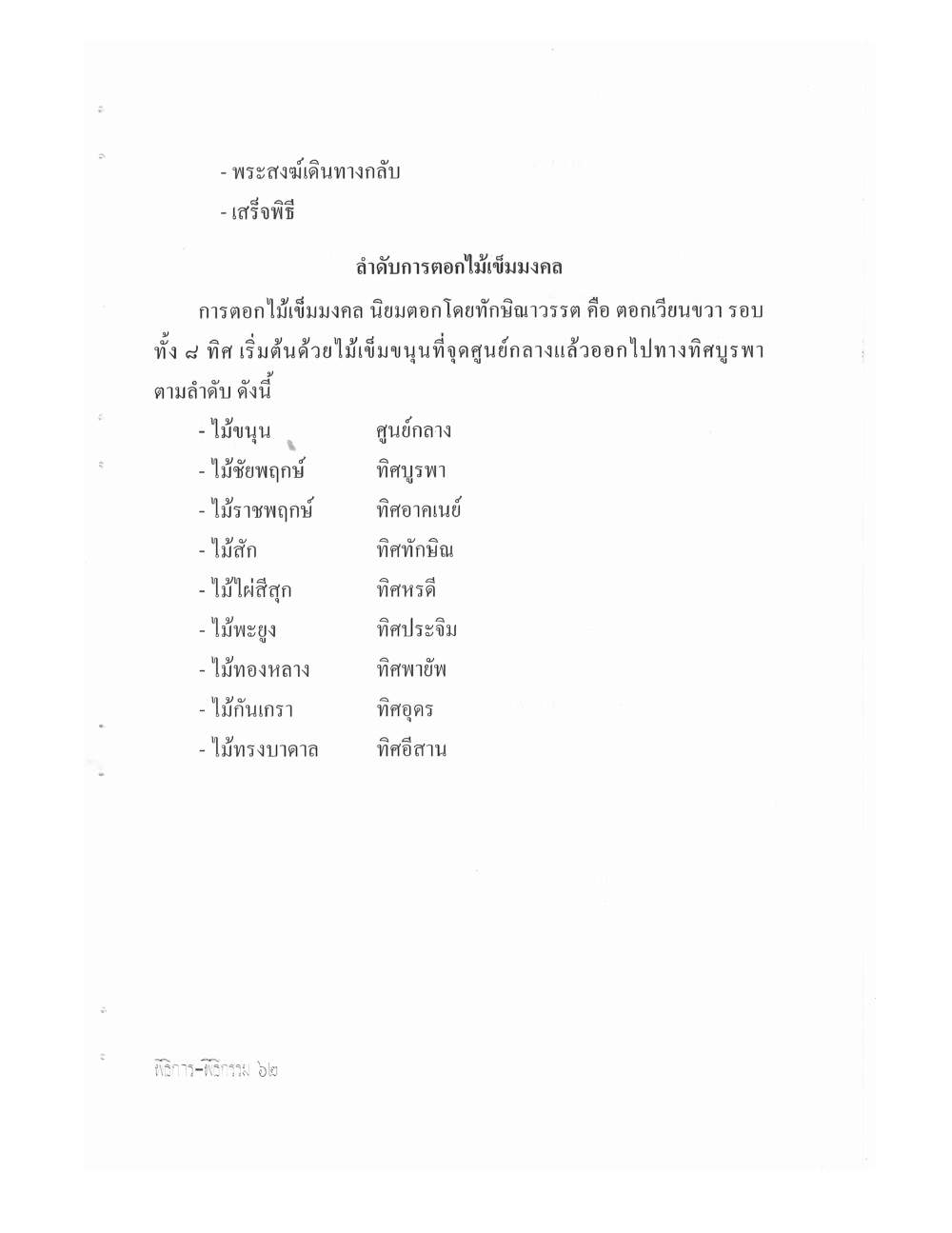
- พระสงฆ์เดินทางกลับ - เสร็จพิธี
ลำดับการตอกไม้เข็มมงคล
การตอกไม้เข็มมงคล นิยมตอกโดยทักษิณาวรรต คือ ตอกเวียนขวา รอบ ทั้ง ๘ ทิศ เริ่มต้นด้วยไม้เข็มขนุนที่จุดศูนย์กลางแล้วออกไปทางทิศบูรพา ตามลำดับ ดังนี้
- ไม้ขนุน ศูนย์กลาง - ไม้ชัยพฤกษ์ ทิศบูรพา - ไม้ราชพฤกษ์ ทิศอาคเนย์ - ไม้สัก ทิศทักษิณ - ไม้ไผ่สีสุก ทิศหรดี - ไม้พะยูง ทิศประจิม - ไม้ทองหลาง ทิศพายัพ - ไม้กันเกรา ทิศอุดร - ไม้ทรงบาดาล ทิศอีสาน
- The monks travel back. - The ceremony ends.
Order of Driving the Auspicious Wooden Pegs
The auspicious wooden pegs are customarily driven in the clockwise (sunwise) direction — that is, driven around all 8 directions in a clockwise circuit, beginning with the jackfruit-wood peg at the center point and then proceeding toward the east, in the following order:
- Jackfruit wood (khanun) — center - Chai Phruek wood — east - Racha Phruek wood (golden shower tree) — southeast - Teak wood — south - Yellow bamboo (phai si suk) — southwest - Phayung wood (Siamese rosewood) — west - Thonglang wood (Indian coral tree) — northwest - Kan Krao wood (ironwood) — north - Song Badan wood — northeast
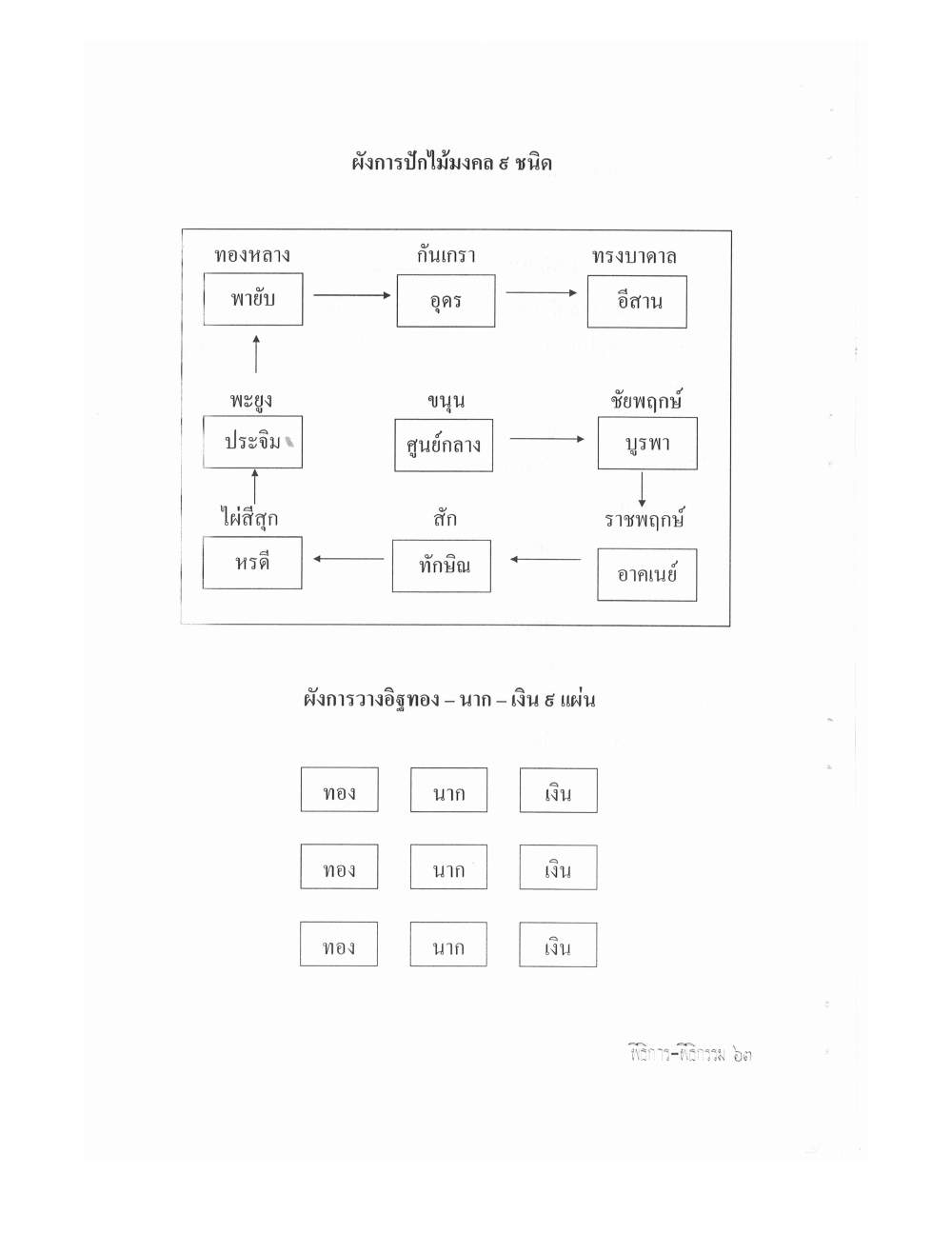
ผังการปักไม้มงคล ๘ ชนิด
[แผนภาพ: กรอบสี่เหลี่ยมแบ่งเป็นตาราง ๙ ช่องตามทิศ แถวบน (ซ้ายไปขวา) กล่องมีข้อความกำกับด้านบนและในกรอบ — "ทองหลาง / พายัพ", ลูกศรชี้ขวาไปยัง "กันเกรา / อุดร", ลูกศรชี้ขวาไปยัง "ทรงบาดาล / อีสาน"; แถวกลาง — "พะยูง / ประจิม" มีลูกศรชี้ขึ้นไปยังกล่อง "ทองหลาง/พายัพ" ด้านบน, ตรงกลาง "ขนุน / ศูนย์กลาง" มีลูกศรชี้ขวาไปยัง "ชัยพฤกษ์ / บูรพา"; แถวล่าง — "ไผ่สีสุก / หรดี" มีลูกศรชี้ขึ้นไปยังกล่อง "พะยูง/ประจิม" ด้านบน, "สัก / ทักษิณ" มีลูกศรชี้ซ้ายมาจากกล่อง "ราชพฤกษ์/อาคเนย์" ด้านขวา, และมีลูกศรชี้ลงจากกล่อง "ชัยพฤกษ์/บูรพา" ไปยัง "ราชพฤกษ์ / อาคเนย์"]
ผังการวางอิฐทอง – นาก – เงิน ๙ แผ่น
[แผนภาพ: ตาราง ๓ แถว ๓ ช่อง แต่ละแถวมีกล่องข้อความเรียงจากซ้ายไปขวาว่า "ทอง" "นาก" "เงิน" ซ้ำกันทั้ง ๓ แถว]
Diagram of the Placement of the 8 Kinds of Auspicious Wooden Pegs
[diagram: a rectangular frame divided into a 9-box grid arranged by direction. Top row (left to right), each box labeled above and inside — "Thonglang / Northwest", an arrow pointing right to "Kan Krao / North", an arrow pointing right to "Song Badan / Northeast"; middle row — "Phayung / West" with an arrow pointing up to the "Thonglang/Northwest" box above it, the center box "Khanun (jackfruit) / Center" with an arrow pointing right to "Chai Phruek / East"; bottom row — "Phai Si Suk (yellow bamboo) / Southwest" with an arrow pointing up to the "Phayung/West" box above it, "Teak / South" with an arrow pointing left from the "Racha Phruek/Southeast" box on its right, and an arrow pointing down from the "Chai Phruek/East" box to "Racha Phruek / Southeast"]
Diagram of the Placement of the 9 Gold – Nak – Silver Brick Tablets
[diagram: a 3-row, 3-column grid; each row has boxes reading left to right "Gold", "Nak", "Silver", repeated identically across all 3 rows]
ข้อสังเกต
- เรื่องการประพรมน้ำพระพุทธมนต์นั้น ประธานบางรายประพรมถึง ๒ ครั้ง คือครั้งแรกประพรมหลุมวางศิลาฤกษ์ก่อนเริ่มพิธีเพื่ออธิษฐานให้การประกอบพิธี ปราศจากอุปสรรคข้อขัดข้องทั้งปวงและอีกครั้งหนึ่งประพรมหลังจากการ ประกอบพิธีเสร็จแล้ว เพื่ออธิษฐานให้อาคารที่จะก่อสร้างมีความมั่นคงถาวร สืบไป
- เรื่องการเจิมแผ่นศิลาฤกษ์ จะเห็นได้ว่าประธานในพิธีบางรายก็เจิม บางรายก็ไม่เจิม ทั้งนี้มีข้อปฏิบัติว่า ถ้าแผ่นศิลาฤกษ์นั้น พระสงฆ์หรือผู้ทรง วิทยาคมอื่นได้เจิมมาก่อนแล้ว ประธานในพิธีจะไม่เจิมทับอีก ถ้าแผ่นศิลาฤกษ์นั้น ยังไม่เคยเจิมมาก่อน ประธานในพิธีก็จะเจิมเพื่อให้พิธีสมบูรณ์และเป็นมงคล ต่อไป
********
Observations
- Regarding the sprinkling of holy water: some presiding officiants sprinkle it as many as 2 times — the first time sprinkling the foundation-stone pit before the ceremony begins, to pray that performing the ceremony will be free of all obstacles and hindrances; and a second time sprinkling after the ceremony has been completed, to pray that the building to be constructed will remain firm and enduring thereafter.
- Regarding the anointing of the foundation-stone tablet: it can be seen that some presiding officiants anoint it while others do not. The practice in this matter is that if the tablet has already been anointed beforehand by monks or other practitioners of sacred knowledge, the presiding officiant will not anoint over it again; if the tablet has never been anointed before, the presiding officiant will then anoint it so that the ceremony is complete and auspicious.
********
พิธียกเสาเอก
*******
พิธียกเสาเอก คือพิธียกเสาต้นใดต้นหนึ่งที่กำหนดให้เป็นเสาเอกลงหลุม ตามเวลาฤกษ์อันเป็นมงคลแห่งการสร้างอาคารบ้านพักอาศัย โดยส่วนมากใช้ ประกอบพิธีในการสร้างอาคารบ้านพักอาศัยของเอกชน ไม่ใช้ประกอบพิธีใน การสร้างอาคารขนาดใหญ่ (จะใช้ประกอบพิธีวางศิลาฤกษ์) ของทางศาสนา หรือทางราชการ เช่น ศาลาการเปรียญ ศาลากลางจังหวัด เป็นต้น (บางแห่งนิยม ประกอบพิธียกเสาเอกด้วยก็มี) จุดประสงค์ของการทำพิธีก็เพื่อให้อาคาร เหล่านั้นเกิดความถาวรมั่นคงและผู้อยู่อาศัยอยู่เย็นเป็นสุขตลอดไป โดยมีการ เตรียมการและปฏิบัติการ ดังนี้
ขั้นที่ ๑ เตรียมการ
๑. เครื่องสังเวยเทพยดา ๑ ชุด (ชุดย่อ) ประกอบด้วย - หมูนอนตอง ๑ ชิ้น - ไก่และเป็ดต้ม อย่างละ ๑ ตัว พร้อมน้ำจิ้ม - ปลา กุ้ง ปู อย่างละ ๑ จาน - ขนมหวาน (ทองหยิบ ทองหยอด ฝอยทอง เม็ดขนุน ถ้วยฟู ฯลฯ) อย่างละ ๑ จาน - ฟักทองแกงบวด ๑ ถ้วย - ผลไม้ตามฤดูกาล ๑ ถาด - ถั่วเขียว งาดำ อย่างละ ๑ ถุง - กล้วยน้ำว้า ๒ หวี มะพร้าวอ่อน ๒ ผล - บายศรีปากชาม ๑ คู่
The Raising of the Principal Post Ceremony
*******
The raising-of-the-principal-post ceremony is a ceremony of raising one particular post, designated to be the principal post, down into its hole at the auspicious moment marking the building of a dwelling house. It is used mostly for ceremonies in the construction of private individuals' dwelling houses; it is not used for the construction of large buildings (for which the foundation-stone-laying ceremony is used instead) belonging to religious institutions or government offices, such as sermon halls or provincial halls, for instance (though in some places it is also customary to hold the principal-post-raising ceremony as well). The purpose of performing the ceremony is so that such buildings attain lasting stability and so that those who dwell in them live in coolness and happiness forever. The preparations and procedures are as follows:
Stage 1: Preparation
1. One set (a reduced/minor set) of offerings for the deities, consisting of: - 1 piece of pork lying on banana leaf (mu non tong) - Boiled chicken and boiled duck, 1 of each, with dipping sauce - Fish, shrimp, crab, 1 plate of each - Sweets (thong yip, thong yot, foi thong, met khanun, thuai fu, etc.), 1 plate of each - 1 bowl of pumpkin stewed in sweet coconut syrup - 1 tray of seasonal fruit - Mung beans, black sesame, 1 bag of each - 2 hands of namwa bananas, 2 young coconuts - 1 pair of bai sri pak cham (rimmed banana-leaf offering trays)
- สุรา ๑ ขวด น้ำเย็น ๑ แก้ว พวงมาลัย ๑ พวง - กระถางธูป เชิงเทียน ๑ ชุด
๒. เครื่องบูชาเสาเอก - พวงทอง พวงเงิน (ห่อทอง – เงิน หรือพวงมาลัยประดิษฐ์สีทอง – เงิน) - ผ้าสามสี [สีประจำเดือน ๑๒ เดือน (ในเดือนประกอบพิธี) คือ เดือน ๑ (อ้าย) เดือน ๒ (ยี่) เดือน ๓ ฯลฯ เดือนใดเดือนหนึ่ง สีประจำวัน ๗ วัน (ในวันประกอบพิธี) คือวันอาทิตย์ - วันเสาร์ วันใดวันหนึ่ง และสีประจำวันเกิด ของผู้เป็นเจ้าของบ้าน รวมเป็น ๓ สี] - หน่อกล้วย อ้อย อย่างละ ๑ ต้น - ผ้าขาวม้า ๑ ผืน (บางรายนิยมยกเสาโทด้วย ให้จัดเครื่องบูชาเสาโทเหมือนเครื่อง บูชาเสาเอก แต่ไม่ต้องจัดเครื่องมงคลใส่ก้นหลุม) ๓. ขุดหลุมลึกประมาณ ๑ เมตร กว้าง x ยาว ๑ เมตร ๔. เครื่องมงคลใส่ก้นหลุม - ไม้มงคล ๙ ชนิด คือ ไม้ขนุน ไม้ชัยพฤกษ์ ไม้ราชพฤกษ์ ไม้สัก ไม้ไผ่สีสุก ไม้พะยูง ไม้ทองหลาง ไม้กันเกรา ไม้ทรงบาดาล - ใบทอง – นาก – เงิน อย่างละ ๙ ใบ - เหรียญทอง – เงิน อย่างละ ๙ เหรียญ - ข้าวตอก ดอกไม้ ๑ พาน
ขั้นที่ ๒ การทำน้ำมนต์ธรณีสาร พิธีกรเป็นผู้ปฏิบัติ
๑. จุดธูปเทียนบูชาคุณพระรัตนตรัย บิดามารดา ครูบาอาจารย์ ครูพักลักจำ เชิญมาบริหารพิธีการให้ประสบความสำเร็จ
- 1 bottle of liquor, 1 glass of cold water, 1 garland - 1 set of incense-pot and candlesticks
2. Offerings for venerating the principal post - Gold garland, silver garland (a wrapped gold-and-silver bundle, or artificial garlands colored gold and silver) - Three-colored cloths [the color for the month, from among 12 months (the month the ceremony is performed) — month 1 (Ai), month 2 (Yi), month 3, etc., whichever month it is; the color for the day, from among 7 days (the day the ceremony is performed) — from Sunday through Saturday, whichever day it is; and the color for the birth-day of the house's owner — totaling 3 colors] - 1 banana shoot, 1 sugarcane stalk - 1 length of pha khao ma (checked cotton cloth) (In some cases it is also customary to raise a secondary post; the offerings for the secondary post should be arranged the same as those for the principal post, but auspicious items need not be placed at the bottom of its hole) 3. Dig a hole approximately 1 meter deep, 1 meter wide by 1 meter long 4. Auspicious items to place at the bottom of the hole - 9 kinds of auspicious wood, namely: jackfruit wood, Chai Phruek wood, Racha Phruek wood, teak wood, yellow bamboo, Phayung wood, Thonglang wood, Kan Krao wood, Song Badan wood - Gold, nak, and silver leaves, 9 pieces of each - Gold and silver coins, 9 coins of each - 1 tray of popped rice and flowers
Stage 2: Making the Dharani-Sara Holy Water. The Master of Ceremonies Performs This
1. Light incense and candles to venerate the virtues of the Triple Gem, one's parents, teachers and mentors, and remembered instructors, inviting them to preside over the ceremony so that it may succeed.
๒. ทำน้ำมนต์ธรณีสาร (ตามบททำน้ำมนต์ในตอนท้าย) ๓. ประพรมผู้ทำน้ำมนต์เอง ๓ หยด และดื่มเล็กน้อย ๔. ประพรมเครื่องสังเวย เสาเอก และบริเวณสถานที่ทั้งหมด
ขั้นที่ ๓ เจ้าภาพ-พิธีกรปฏิบัติ
๑. เจ้าภาพจุดธูปเทียน (ธูป ๑๖ ดอก เทียน ๑ คู่) และธูปหางเท่าจำนวน เครื่องสังเวย ๒. พิธีกรกล่าวโองการบวงสรวงเทพยดา จบแล้ว ๓. เจ้าภาพคล้องพวงทอง – พวงเงิน ปลายเสาเอก ผูกผ้าสามสี ผูกหน่อกล้วย อ้อย ผูกผ้าขาวม้า ตอกไม้มงคล ๙ ชนิด วางใบทอง – นาก – เงิน และเหรียญ ทอง – เงิน ก้นหลุม เมื่อถึงกำหนดเวลาฤกษ์ ให้ยกเสาเอกลงหลุม พร้อมกับ เป่งเสียงโห่ ๓ ครั้ง ต่อด้วยโปรยข้าวตอกดอกไม้ เป็นอันเสร็จพิธี ฯ
หมายเหตุ
๑. นำหน่อกล้วย อ้อย ไปปลูกในเวลาเย็น ๒. การกำหนดจุดเสาเอก เสาเอกควรอยู่ด้านทิศตะวันออกหรือทิศตะวันออก เฉียงเหนือ ห้ามเป็นจุดที่ใกล้กับบันไดหรือใกล้ห้องน้ำ ถ้าอยู่บริเวณเดียวกับ ห้องนอนของเจ้าของบ้านหรือห้องรับแขกเป็นดีที่สุด ๓. การประกอบพิธีผูกผ้าสามสี กำหนดให้ใช้ ๓.๑ สีประจำวันของการประกอบพิธี ๓.๒ สีประจำเดือนของการประกอบพิธี ๓.๓ สีประจำวันเกิดของประธานในพิธี หากสีตามข้อ ๑, ๒, ๓ ซ้ำกัน ให้พิจารณาเลือกใช้สีธงไตรรงค์ คือสีแดง สีขาว สีน้ำเงิน แทนก็ได้
2. Make the Dharani-Sara holy water (following the water-consecration text given at the end) 3. Sprinkle the person who made the holy water himself with 3 drops, and drink a little 4. Sprinkle the offerings, the principal post, and the entire ceremony site
Stage 3: Performed by the Sponsor and the Master of Ceremonies
1. The sponsor lights incense and candles (16 incense sticks, 1 pair of candles) and joss-stick tapers equal in number to the offerings 2. The master of ceremonies recites the invocation summoning the deities. When finished, 3. The sponsor drapes the gold and silver garlands on the tip of the principal post, ties on the three-colored cloths, ties on the banana shoot and sugarcane, ties on the pha khao ma cloth, drives in the 9 kinds of auspicious wood, and places the gold, nak, and silver leaves and the gold and silver coins at the bottom of the hole. When the auspicious moment arrives, the principal post is raised and lowered into the hole together with a triple cheer, followed by scattering popped rice and flowers — this concludes the ceremony.
Notes
1. Take the banana shoot and sugarcane to be planted [in the ground] in the evening. 2. Regarding the placement of the principal post: the principal post should be situated to the east or northeast side. It must not be at a spot near a staircase or near a bathroom. It is best if it is located in the same area as the owner's bedroom or the reception room. 3. For tying the three-colored cloths, the colors used are set as: 3.1 The color for the day the ceremony is performed 3.2 The color for the month the ceremony is performed 3.3 The color for the birth-day of the presiding officiant If the colors under items 1, 2, and 3 repeat, one may instead consider using the colors of the tricolor flag — namely red, white, and blue.
น้ำมนต์ธรณีสารน้อย
(ให้กระทำก่อนประกอบพิธีการใด ๆ) ****************
จุดธูปเทียนบูชาพระรัตนตรัย คุณบิดามารดา ครูบาอาจารย์ ครูพักลักจำ ขอให้มาบริหารพิธีการในวันนี้จงสำเร็จทุกประการ
- (สาธุ) สัคเค กาเม จะ รูเป ฯลฯ (อัญเชิญเทวดามา) - นะโม ๓ จบ ไตรสรณคมน์ พุทธคุณ ธรรมคุณ สังฆคุณ เสร็จแล้วให้หยดเทียนน้ำมนต์ และบริกรรมคาถา ดังนี้
"สิโร เม พุทธะเทวัญจะ, นะลาฏ พรัหมะเทวะตา, หะทะยัง นารายะกัญเจวะ, ทะเว หัตเถ ประเม สุราปาเท, วิสสะนุกัญเจวะ, สัพพะกัมมา ปะสิทธิ เม, สิทธิกิจจัง, สิทธิกัมมัง, สิทธิการิยะตะถาคะโต, สิทธิเตโช, ชะโย นิจจัง, สัพพะสิทธิ ภะวันตุ เม"
- ภะวะตุ สัพพะมังคะลัง รักขันตุ สัพพะเทวะตา, สัพพะพุทธานุภาเวนะ สะทา โสตถี ภะวันตุ เมฯ
- ภะวะตุ สัพพะมังคะลัง รักขันตุ สัพพะเทวะตา, สัพพะธัมมานุภาเวนะ สะทา โสตถี ภะวันตุ เมฯ
- ภะวะตุ สัพพะมังคะลัง รักขันตุ สัพพะเทวะตา, สัพพะสังฆานุภาเวนะ สะทา โสตถี ภะวันตุ เมฯ
- ใช้น้ำมนต์ประพรมศีรษะตัวเอง ๓ หยด แล้วดื่มนิดหน่อย ต่อจากนั้น ประพรมเครื่องสังเวยทั้งหมด เสร็จแล้วอัญเชิญเทวดากลับ ด้วยบทว่า ทุกขัปปัตตา จะ นิททุกขา ฯลฯ
***********
Minor Dharani-Sara Holy Water
(To be performed before conducting any ceremony) ****************
Light incense and candles to venerate the Triple Gem, the virtue of one's parents, teachers and mentors, and remembered instructors, requesting that they come to preside over today's ceremony so that it may succeed in every respect.
- (Sadhu) Sagge kāme ca rūpe, etc. (inviting the deities to descend) - Namo, recited three times; the Threefold Refuge; the virtues of the Buddha, the Dhamma, and the Sangha. When finished, drip candle wax into the holy water and recite the following incantation:
"Siro me phutthathewanja, nalāt phrommathewata, hathayang nārāyakanjeva, thawe hatthe prame surāpāthe, wissanukanjeva, sappakamma pasitthi me, sitthikitcang, sitthikammang, sitthikāriyatathākhato, sitthiteho, chayo nicjang, sappasitthi phawantu me" — [a devotional formula correlating parts of the body with deities — the head with the Buddha-deva, the forehead with the Brahma deity, the heart with Narayana, the two hands and feet with the presiding gods — asking that all undertakings succeed, that every task and every deed succeed, that the Tathagata's power and glory of accomplishment be constant, and that all success come to be for me]
- "May all blessings be; may all deities protect me; by the power of the Buddha, may there forever be well-being for me."
- "May all blessings be; may all deities protect me; by the power of the Dhamma, may there forever be well-being for me."
- "May all blessings be; may all deities protect me; by the power of the Sangha, may there forever be well-being for me."
- Use the holy water to sprinkle one's own head, 3 drops, then drink a little. After that, sprinkle all of the offerings. When finished, see the deities off with the verse beginning "Dukkhappattā ca nidukkhā," etc.
***********
พิธีเปิดอาคาร
**********
อาคารสถานที่ทำงานของหน่วยราชการหรืออาคารที่พักอาศัยของเจ้าหน้าที่ ผู้ปฏิบัติงานในหน่วย นับว่ามีความสำคัญในด้านขวัญเป็นอย่างมากต่อ ผู้ปฏิบัติงานหรือผู้อยู่อาศัย เพราะเป็นนิมิตหมายถึงการอยู่เย็นเป็นสุขและความ เจริญก้าวหน้า ซึ่งก็เปรียบเสมือนบ้านหลังที่สอง ดังนั้น ส่วนราชการที่ได้สร้าง อาคารหลังใหม่ขึ้นในหน่วยงานเสร็จแล้ว ก่อนจะเข้าปฏิบัติงานหรืออยู่อาศัย จึงมีประเพณีว่า ต้องทำบุญหรือทำพิธีเปิดอาคารนั้นเป็นอันดับแรกก่อน เหมือนกับเมื่อเราสร้างบ้านเรือนเสร็จแล้ว ก็ต้องทำบุญขึ้นบ้านใหม่ก่อนเข้าอยู่อาศัย ถาวรต่อไป ทั้งนี้เพื่อความสวัสดีมีชัยในการปฏิบัติงานและการอยู่อาศัยนั้นเอง
ลำดับพิธี
- ผู้ร่วมพิธีพร้อม ณ สถานที่ประกอบพิธี - พระสงฆ์ขึ้นสู่อาสน์สงฆ์ - ประธานในพิธีมาถึง แล้วจุดธูปเทียนบูชาพระรัตนตรัย - พิธีกรอาราธนาศีล - ประธานสงฆ์ให้ศีล - พิธีกรอาราธนาพระปริตร - พระสงฆ์เจริญพระพุทธมนต์ - ประธานดำเนินการก่อสร้างกล่าวรายงานและเรียนเชิญประธานในพิธี ประกอบพิธีเปิดอาคาร - ประธานในพิธีไปยังจุดที่กำหนด กดปุ่มเปิดแพรคลุมป้าย - แตรวงบรรเลงเพลงมหาฤกษ์
The Building-Opening Ceremony
**********
A building housing the workplace of a government unit, or a building providing residential quarters for staff working in the unit, is considered to matter greatly to the morale of those who work there or reside there, because it is a sign portending well-being, happiness, and progress — it is, in effect, comparable to a second home. Therefore, when a government department has finished constructing a new building within its unit, before entering into work or residing there it is customary that merit-making or a building-opening ceremony must be performed first — just as, when we finish building a house, we must perform the house-warming merit-making before permanently moving in to live there. This is done for the sake of well-being and success in the work performed and in the dwelling itself.
Order of the Ceremony
- Participants assemble at the ceremony site - The monks ascend to the monks' seats - The presiding officiant arrives, then lights incense and candles to venerate the Triple Gem - The master of ceremonies invites the taking of precepts - The presiding monk bestows the precepts - The master of ceremonies invites the Paritta chanting - The monks chant the blessing - The officer in charge of the construction delivers a report and invites the presiding officiant to perform the building-opening ceremony - The presiding officiant proceeds to the designated spot and presses the button to open the cloth covering the signboard - The brass band plays the "Maharoek" tune
- พระสงฆ์เจริญชัยมงคลคาถา - ประธานสงฆ์เจิม + ปิดทองป้ายอาคาร และประพรมน้ำพระพุทธมนต์ - ประเคนภัตตาหารแด่พระสงฆ์ - ประเคนเครื่องไทยธรรม - พระสงฆ์อนุโมทนา ประธานในพิธีกรวดน้ำ - เสร็จพิธี
หมายเหตุ กรณีประกอบพิธีช่วงบ่าย ไม่มีลำดับประเคนภัตตาหารแด่พระสงฆ์
(ตัวอย่าง) กำหนดการ พิธีน้อมเกล้าฯ ถวายอาคารที่ประทับ ณ ค่ายจุฬาภรณ์ จังหวัดนราธิวาส ๑๐ ธันวาคม ๒๕๓๖
เวลา ๑๒๐๐ - สมเด็จพระเจ้าลูกเธอ เจ้าฟ้าจุฬาภรณวลัยลักษณ์อัครราชกุมารี เสด็จ ถึงอาคารที่ประทับหลังเก่า (ทร.จัดพระกระยาหารกลางวันถวาย เป็นการส่วนพระองค์)
- ผู้บัญชาการหน่วยบัญชาการนาวิกโยธิน เฝ้ารับเสด็จ เวลา ๑๔๐๐ - เสด็จถึงอาคารที่ประทับหลังใหม่ - ผู้บัญชาการทหารเรือ ผู้บัญชาการหน่วยบัญชาการนาวิกโยธิน ผู้ว่าราชการจังหวัดนราธิวาส และผู้บังคับการกรมทหารราบที่ ๓ เฝ้ารับเสด็จ - ภริยาผู้บัญชาการทหารเรือ ภริยาผู้บัญชาการหน่วยบัญชาการ นาวิกโยธิน และภริยาผู้ว่าราชการจังหวัดนราธิวาส ทูลเกล้าฯ ถวายพวงมาลัยข้อพระกร
- The monks chant the verse of auspicious victory - The presiding monk applies the anointing paste and gilds the building's signboard with gold leaf, and sprinkles holy water - Food is presented to the monks - Thai offering-items are presented - The monks give the blessing of appreciation; the presiding officiant pours the water of dedication - The ceremony concludes
Note: In the case where the ceremony is held in the afternoon, there is no step of presenting food to the monks
(Example) Schedule Ceremony of Humbly Presenting the Residential Building At Chulabhorn Camp, Narathiwat Province 10 December 2536 [1993]
12:00 hours — Her Royal Highness Princess Chulabhorn Walailak, Crown Princess, arrives at the old residential building (the Royal Thai Navy arranges a midday meal to be offered to Her as a personal gesture)
- The Commander of the Marine Corps Command awaits and receives Her Royal Highness 14:00 hours — Her Royal Highness arrives at the new residential building - The Commander-in-Chief of the Royal Thai Navy, the Commander of the Marine Corps Command, the Governor of Narathiwat Province, and the Commander of the 3rd Infantry Regiment await and receive Her Royal Highness - The wife of the Commander-in-Chief of the Royal Thai Navy, the wife of the Commander of the Marine Corps Command, and the wife of the Governor of Narathiwat Province present garlands to Her Royal Highness's wrist
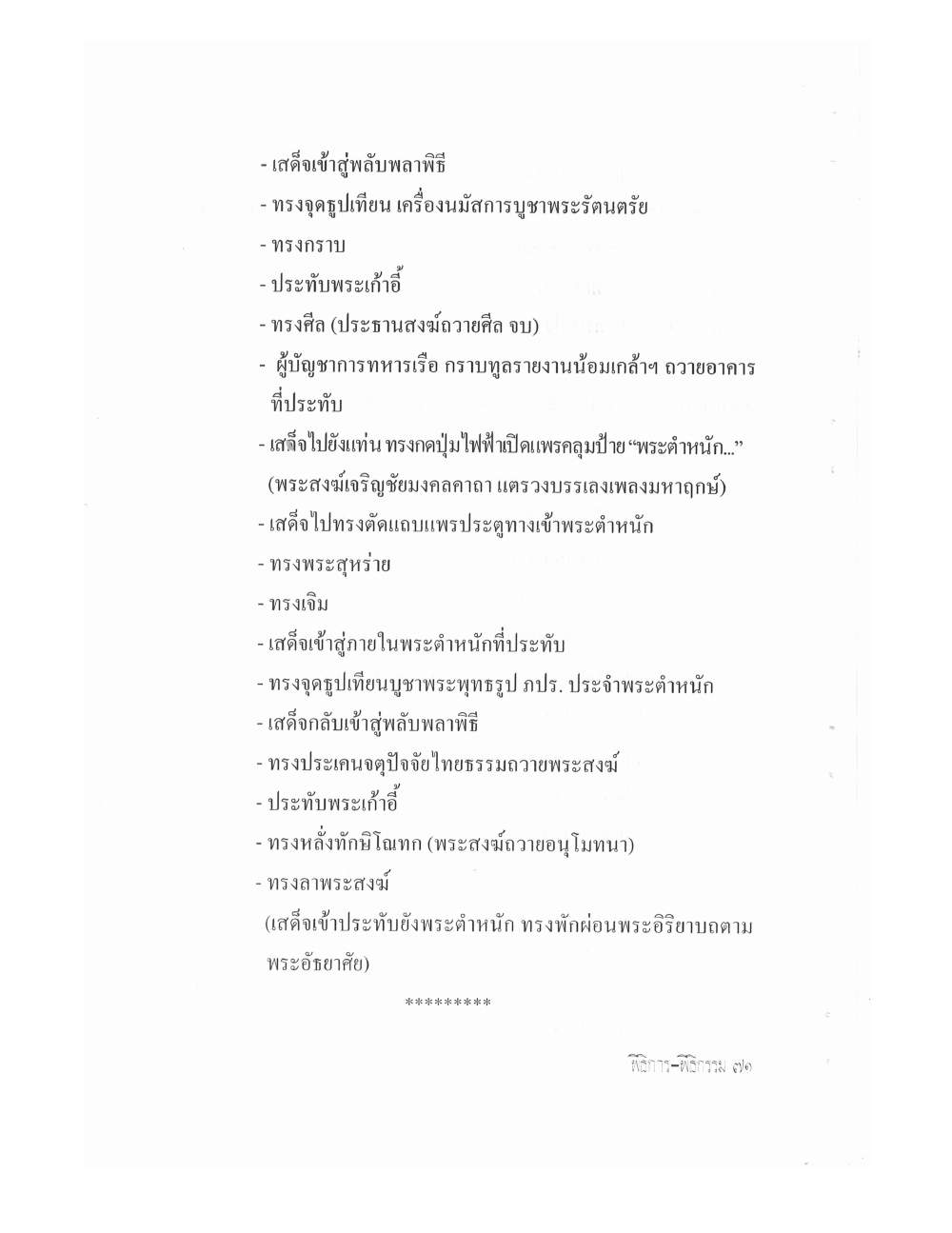
- เสด็จเข้าสู่พลับพลาพิธี - ทรงจุดธูปเทียน เครื่องนมัสการบูชาพระรัตนตรัย - ทรงกราบ - ประทับพระเก้าอี้ - ทรงศีล (ประธานสงฆ์ถวายศีล จบ) - ผู้บัญชาการทหารเรือ กราบทูลรายงานน้อมเกล้าฯ ถวายอาคารที่ประทับ - เสด็จไปยังแท่น ทรงกดปุ่มไฟฟ้าเปิดแพรคลุมป้าย "พระตำหนัก..." (พระสงฆ์เจริญชัยมงคลคาถา แตรวงบรรเลงเพลงมหาฤกษ์) - เสด็จไปทรงตัดแถบแพรประตูทางเข้าพระตำหนัก - ทรงพระสุหร่าย - ทรงเจิม - เสด็จเข้าสู่ภายในพระตำหนักที่ประทับ - ทรงจุดธูปเทียนบูชาพระพุทธรูป ภปร. ประจำพระตำหนัก - เสด็จกลับเข้าสู่พลับพลาพิธี - ทรงประเคนจตุปัจจัยไทยธรรมถวายพระสงฆ์ - ประทับพระเก้าอี้ - ทรงหลั่งทักษิโณทก (พระสงฆ์ถวายอนุโมทนา) - ทรงลาพระสงฆ์ (เสด็จเข้าประทับยังพระตำหนัก ทรงพักผ่อนพระอิริยาบถตามพระอัธยาศัย) ******** พิธีการ-พิธีกรรม ๗๑
- He proceeds to enter the ceremonial pavilion. - He lights incense and candles, the offerings for venerating the Triple Gem. - He pays homage. - He is seated in the chair. - He receives the precepts (the presiding monk finishes conferring the precepts). - The Commander-in-Chief of the Royal Thai Navy respectfully reports and presents the residence for his stay. - He proceeds to the dais and presses the electric button to open the cloth covering the sign "[Royal Residence]..." (The monks chant the auspicious victory verses; the brass band plays the Maha Reuk anthem.) - He proceeds to cut the ribbon at the entrance gate of the residence. - He sprinkles lustral water. - He applies the anointing mark. - He enters the interior of the residence where he will stay. - He lights incense and candles to venerate the Buddha image (the Phor Por Ror emblem image) kept in the residence. - He returns to the ceremonial pavilion. - He presents the four requisites and offerings to the monks. - He is seated in the chair. - He pours the libation water (the monks give the blessing of anumodana). - He takes leave of the monks. (He proceeds to the residence and rests at his own leisure.) ******** (Ceremonies and Rites, p. 71)
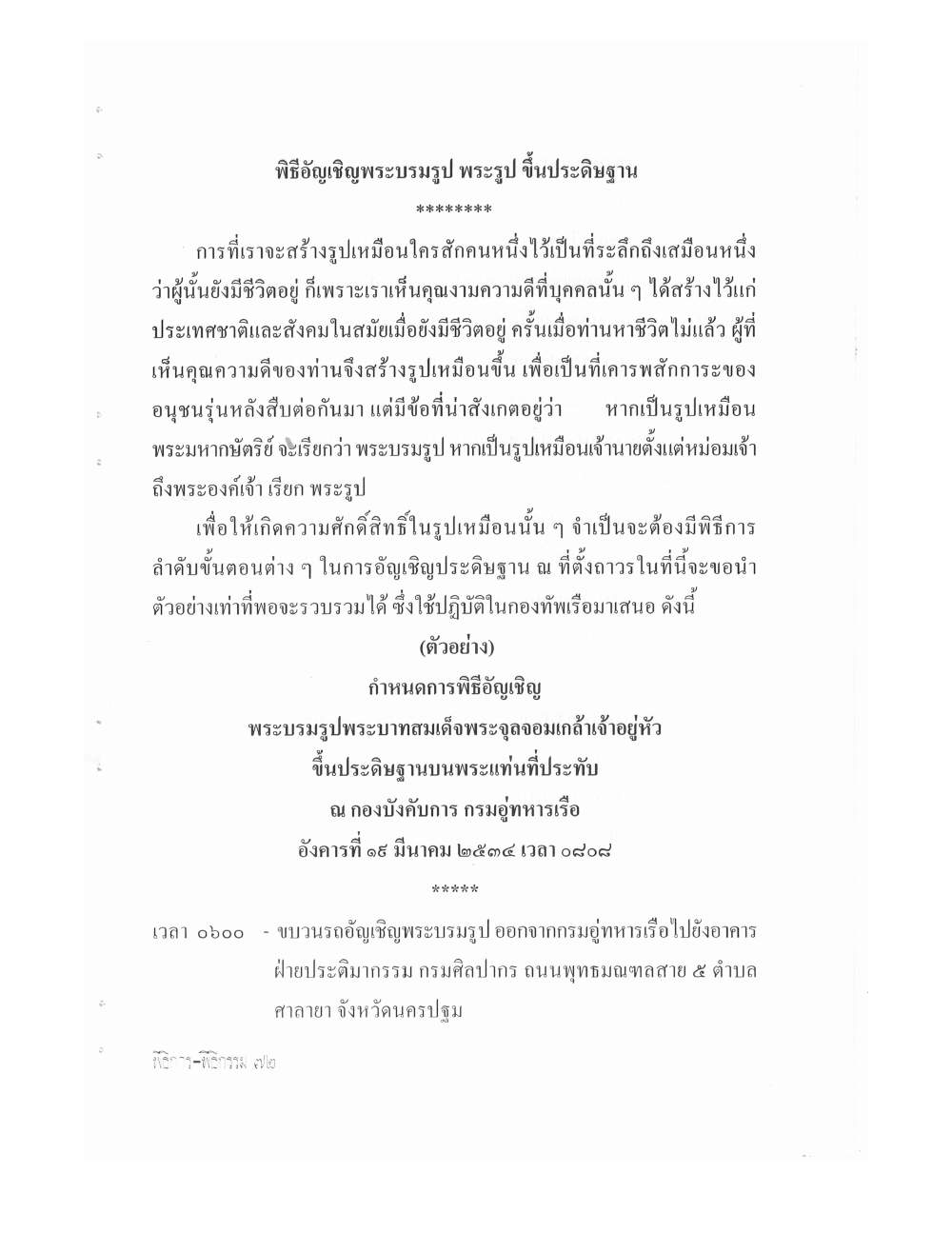
พิธีอัญเชิญพระบรมรูป พระรูป ขึ้นประดิษฐาน
******** การที่เราจะสร้างรูปเหมือนใครสักคนหนึ่งไว้เป็นที่ระลึกถึงเสมือนหนึ่งว่าผู้นั้นยังมีชีวิตอยู่ ก็เพราะเราเห็นคุณงามความดีที่บุคคลนั้น ๆ ได้สร้างไว้แก่ประเทศชาติและสังคมในสมัยเมื่อยังมีชีวิตอยู่ ครั้นเมื่อท่านหาชีวิตไม่แล้ว ผู้ที่เห็นคุณความดีของท่านจึงสร้างรูปเหมือนขึ้น เพื่อเป็นที่เคารพสักการะของอนุชนรุ่นหลังสืบต่อกันมา แต่มีข้อที่น่าสังเกตอยู่ว่า หากเป็นรูปเหมือนพระมหากษัตริย์ จะเรียกว่า พระบรมรูป หากเป็นรูปเหมือนเจ้านายตั้งแต่หม่อมเจ้าถึงพระองค์เจ้า เรียก พระรูป เพื่อให้เกิดความศักดิ์สิทธิ์ในรูปเหมือนนั้น ๆ จำเป็นจะต้องมีพิธีการลำดับขั้นตอนต่าง ๆ ในการอัญเชิญประดิษฐาน ณ ที่ตั้งถาวรในที่นี้จะขอนำตัวอย่างเท่าที่พอจะรวบรวมได้ ซึ่งใช้ปฏิบัติในกองทัพเรือมาเสนอ ดังนี้ (ตัวอย่าง) กำหนดการพิธีอัญเชิญ พระบรมรูปพระบาทสมเด็จพระจุลจอมเกล้าเจ้าอยู่หัว ขึ้นประดิษฐานบนพระแท่นที่ประทับ ณ กองบังคับการ กรมอู่ทหารเรือ อังคารที่ ๑๕ มีนาคม ๒๕๓๔ เวลา ๐๘๐๘ ***** เวลา ๐๖๐๐ - ขบวนรถอัญเชิญพระบรมรูป ออกจากกรมอู่ทหารเรือไปยังอาคารฝ่ายประติมากรรม กรมศิลปากร ถนนพุทธมณฑลสาย ๕ ตำบลศาลายา จังหวัดนครปฐม พิธีการ-พิธีกรรม ๗๒
The Ceremony of Inviting a Royal Image or Princely Image to Be Enshrined
******** When we create a likeness of someone as a memento, as though that person were still alive, it is because we recognise the virtuous deeds that person performed for the nation and society during their lifetime. Once that person has passed away, those who recognise their virtue create a likeness of them, so that it may become an object of reverence for later generations. It is worth noting, however: if it is a likeness of a monarch it is called a "phra borommarup" (royal image); if it is a likeness of a member of the royal family from the rank of Mom Chao up to Phra Ong Chao, it is called a "phra rup" (princely image). In order for such a likeness to acquire sanctity, it is necessary to hold a ceremony with its various steps for enshrining it at its permanent site. Here, as far as could be gathered, is offered an example of the practice used in the Royal Thai Navy, as follows. (Example) Schedule of the Ceremony of Inviting the Royal Image of King Chulalongkorn (Rama V) to Be Enshrined on the Pedestal at His Seat at the Headquarters, Naval Dockyard Department Tuesday 15 March 2534 [1991 CE], at 0808 hours ***** 0600 hrs — The motorcade bearing the royal image departs from the Naval Dockyard Department for the Fine Arts Department's Sculpture Division building, Phutthamonthon Sai 5 Road, Salaya Sub-district, Nakhon Pathom Province. (Ceremonies and Rites, p. 72)
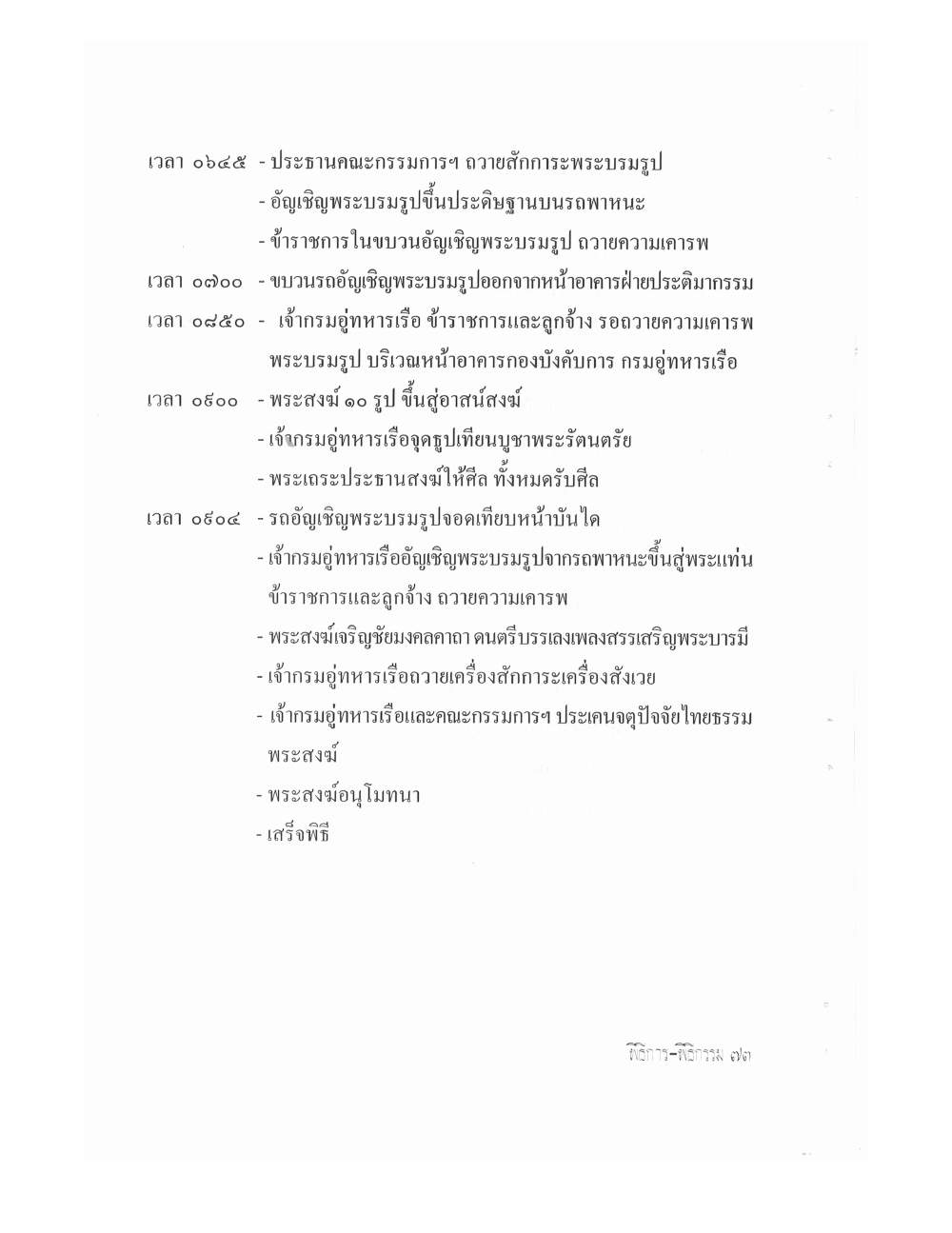
เวลา ๐๖๔๕ - ประธานคณะกรรมการฯ ถวายสักการะพระบรมรูป - อัญเชิญพระบรมรูปขึ้นประดิษฐานบนรถพาหนะ - ข้าราชการในขบวนอัญเชิญพระบรมรูป ถวายความเคารพ เวลา ๐๗๐๐ - ขบวนรถอัญเชิญพระบรมรูปออกจากหน้าอาคารฝ่ายประติมากรรม เวลา ๐๘๕๐ - เจ้ากรมอู่ทหารเรือ ข้าราชการและลูกจ้าง รอถวายความเคารพ พระบรมรูป บริเวณหน้าอาคารกองบังคับการ กรมอู่ทหารเรือ เวลา ๐๖๐๐ - พระสงฆ์ ๑๐ รูป ขึ้นสู่อาสน์สงฆ์ - เจ้ากรมอู่ทหารเรือจุดธูปเทียนบูชาพระรัตนตรัย - พระเถระประธานสงฆ์ให้ศีล ทั้งหมดรับศีล เวลา ๐๘๐๘ - รถอัญเชิญพระบรมรูปจอดเทียบหน้าบันได - เจ้ากรมอู่ทหารเรืออัญเชิญพระบรมรูปจากรถพาหนะขึ้นสู่พระแท่น ข้าราชการและลูกจ้าง ถวายความเคารพ - พระสงฆ์เจริญชัยมงคลคาถา ดนตรีบรรเลงเพลงสรรเสริญพระบารมี - เจ้ากรมอู่ทหารเรือถวายเครื่องสักการะเครื่องสังเวย - เจ้ากรมอู่ทหารเรือและคณะกรรมการฯ ประเคนจตุปัจจัยไทยธรรม พระสงฆ์ - พระสงฆ์อนุโมทนา - เสร็จพิธี พิธีการ-พิธีกรรม ๗๓
0645 hrs — The committee chairman pays homage to the royal image. - The royal image is placed onto the vehicle for the procession. - Officials in the procession pay their respects. 0700 hrs — The motorcade bearing the royal image departs from in front of the Sculpture Division building. 0850 hrs — The Director-General of the Naval Dockyard Department, officials, and staff wait to pay their respects to the royal image at the front of the Headquarters building, Naval Dockyard Department. 0600 hrs — Ten monks take their seats on the monks' dais. - The Director-General of the Naval Dockyard Department lights incense and candles to venerate the Triple Gem. - The presiding elder monk administers the precepts; all present receive them. 0808 hrs — The vehicle bearing the royal image stops at the foot of the stairs. - The Director-General of the Naval Dockyard Department brings the royal image from the vehicle up onto the pedestal; officials and staff pay their respects. - The monks chant the auspicious victory verses; the band plays "Sansoen Phra Barami" [the Royal Anthem]. - The Director-General of the Naval Dockyard Department offers homage items and votive offerings. - The Director-General of the Naval Dockyard Department and the committee present the four requisites and offerings to the monks. - The monks give the blessing. - The ceremony concludes. (Ceremonies and Rites, p. 73)
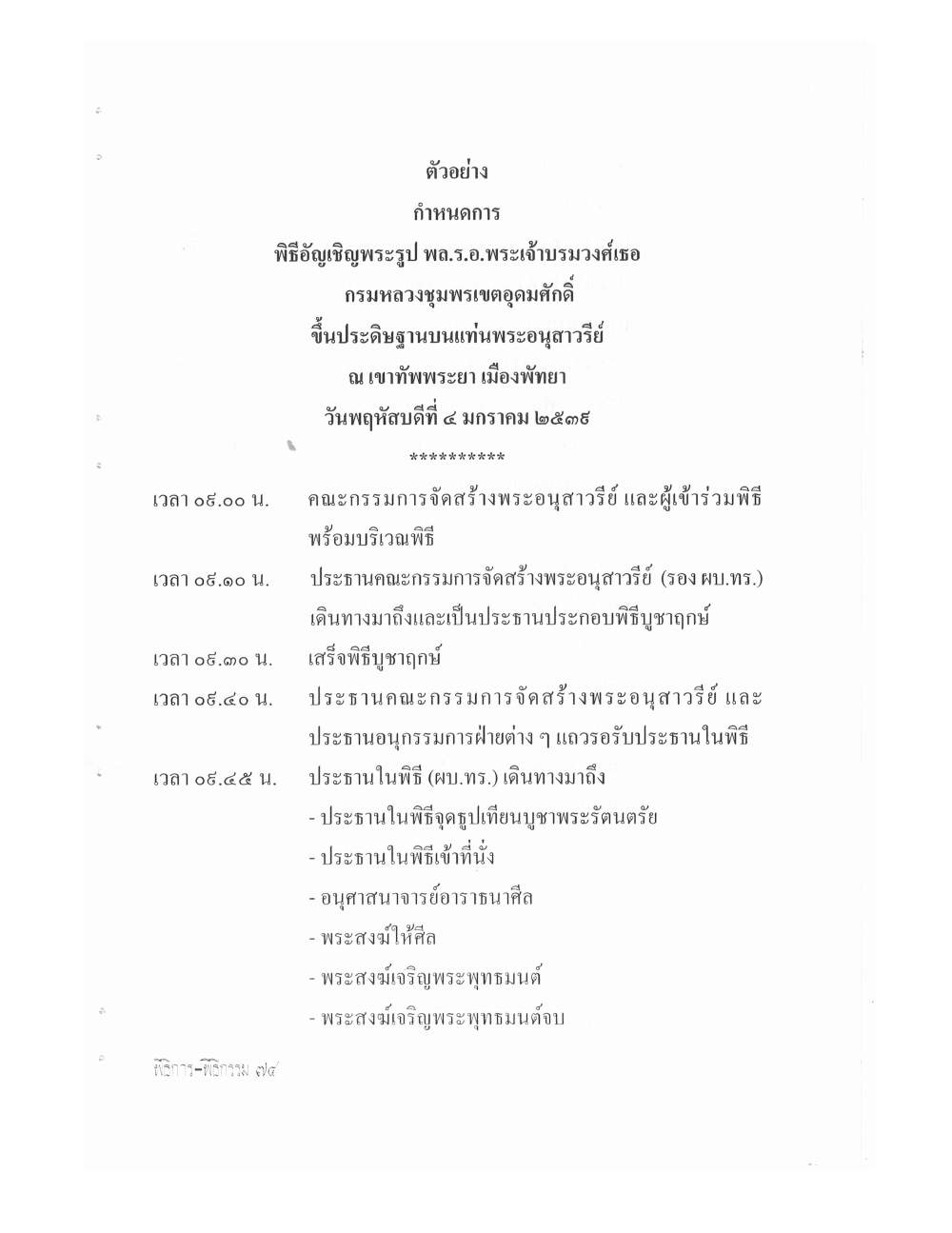
(ตัวอย่าง) กำหนดการ พิธีอัญเชิญพระรูป พล.ร.อ.พระเจ้าบรมวงศ์เธอ กรมหลวงชุมพรเขตอุดมศักดิ์ ขึ้นประดิษฐานบนแท่นพระอนุสาวรีย์ ณ เขาทัพพระยา เมืองพัทยา วันพฤหัสบดีที่ ๔ มกราคม ๒๕๓๙ ********** เวลา ๐๖.๐๐ น. คณะกรรมการจัดสร้างพระอนุสาวรีย์ และผู้เข้าร่วมพิธี พร้อมบริเวณพิธี เวลา ๐๖.๑๐ น. ประธานคณะกรรมการจัดสร้างพระอนุสาวรีย์ (รอง ผบ.ทร.) เดินทางมาถึงและเป็นประธานประกอบพิธีบูชาฤกษ์ เวลา ๐๖.๓๐ น. เสร็จพิธีบูชาฤกษ์ เวลา ๐๖.๔๐ น. ประธานคณะกรรมการจัดสร้างพระอนุสาวรีย์ และ ประธานอนุกรรมการฝ่ายต่าง ๆ แถวรอรับประธานในพิธี เวลา ๐๖.๔๕ น. ประธานในพิธี (ผบ.ทร.) เดินทางมาถึง - ประธานในพิธีจุดธูปเทียนบูชาพระรัตนตรัย - ประธานในพิธีเข้าที่นั่ง - อนุศาสนาจารย์อาราธนาศีล - พระสงฆ์ให้ศีล - พระสงฆ์เจริญพระพุทธมนต์ - พระสงฆ์เจริญพระพุทธมนต์จบ พิธีการ-พิธีกรรม ๗๔
(Example) Schedule Ceremony of Inviting the Image of Admiral H.R.H. Prince, Krom Luang Chumphon Khet Udomsak, to Be Enshrined on the Pedestal of the Monument at Khao Thap Phraya, Pattaya City Thursday, 4 January 2539 [1996 CE] ********** 0600 hrs The monument-building committee and participants assemble at the ceremony site. 0610 hrs The chairman of the monument-building committee (Deputy Commander-in-Chief of the Royal Thai Navy) arrives and presides over the auspicious-timing rite. 0630 hrs The auspicious-timing rite concludes. 0640 hrs The chairman of the monument-building committee and the chairmen of the various sub-committees line up to receive the presiding officiant. 0645 hrs The presiding officiant (Commander-in-Chief of the Royal Thai Navy) arrives. - The officiant lights incense and candles to venerate the Triple Gem. - The officiant takes his seat. - The chaplain invites the precepts. - The monks confer the precepts. - The monks chant the Buddhist blessing. - The monks finish chanting the blessing. (Ceremonies and Rites, p. 74)
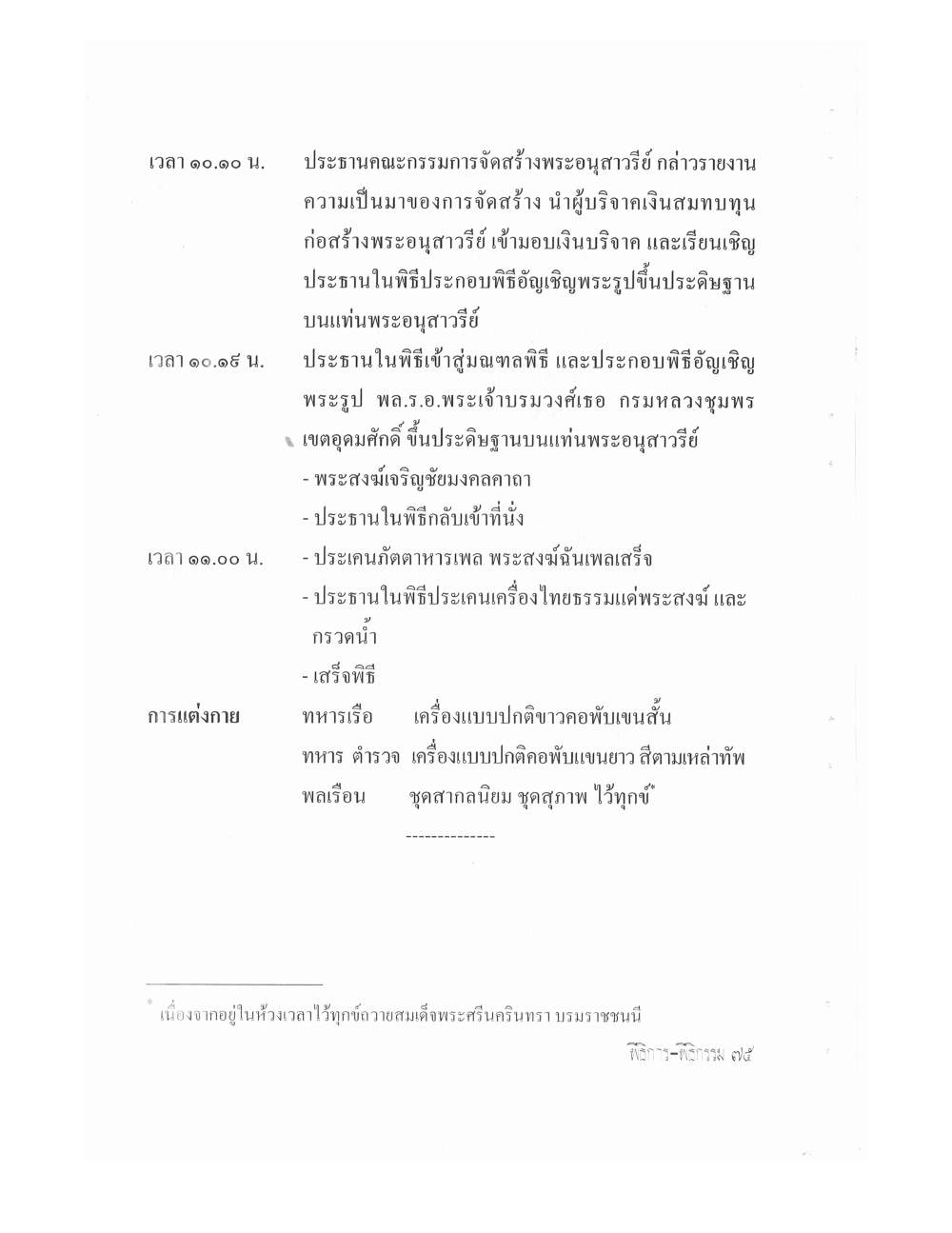
เวลา ๑๐.๑๐ น. ประธานคณะกรรมการจัดสร้างพระอนุสาวรีย์ กล่าวรายงาน ความเป็นมาของการจัดสร้าง นำผู้บริจาคเงินสมทบทุน ก่อสร้างพระอนุสาวรีย์ เข้ามอบเงินบริจาค และเรียนเชิญ ประธานในพิธีประกอบพิธีอัญเชิญพระรูปขึ้นประดิษฐาน บนแท่นพระอนุสาวรีย์ เวลา ๑๐.๑๖ น. ประธานในพิธีเข้าสู่มณฑลพิธี และประกอบพิธีอัญเชิญ พระรูป พล.ร.อ.พระเจ้าบรมวงศ์เธอ กรมหลวงชุมพร เขตอุดมศักดิ์ ขึ้นประดิษฐานบนแท่นพระอนุสาวรีย์ - พระสงฆ์เจริญชัยมงคลคาถา - ประธานในพิธีกลับเข้าที่นั่ง เวลา ๑๑.๐๐ น. - ประเคนภัตตาหารเพล พระสงฆ์ฉันเพลเสร็จ - ประธานในพิธีประเคนเครื่องไทยธรรมแด่พระสงฆ์ และ กรวดน้ำ - เสร็จพิธี การแต่งกาย ทหารเรือ เครื่องแบบปกติขาวคอพับเขนสั้น ทหาร ตำรวจ เครื่องแบบปกติคอพับแขนยาว สีตามเหล่าทัพ พลเรือน ชุดสากลนิยม ชุดสุภาพ ไว้ทุกข์* -------------- * เนื่องจากอยู่ในห้วงเวลาไว้ทุกข์ถวายสมเด็จพระศรีนครินทรา บรมราชชนนี พิธีการ-พิธีกรรม ๗๕
1010 hrs The chairman of the monument-building committee delivers a report on the background of the project, presents the donors who contributed funds toward building the monument to hand over their donations, and invites the presiding officiant to perform the rite of enshrining the image on the monument's pedestal. 1016 hrs The presiding officiant enters the ceremonial area and performs the rite of enshrining the image of Admiral H.R.H. Prince, Krom Luang Chumphon Khet Udomsak, on the pedestal of the monument. - The monks chant the auspicious victory verses. - The presiding officiant returns to his seat. 1100 hrs - The midday meal is offered; the monks finish eating. - The presiding officiant presents offerings to the monks and pours the libation water. - The ceremony concludes. Dress code: Navy personnel White service uniform, folded collar, short sleeves. Army/Police personnel Service uniform, folded collar, long sleeves, colour per branch of service. Civilians Lounge suit or respectable attire, in mourning.* -------------- * Because this falls within the period of mourning for Her Royal Highness the Princess Mother, Somdet Phra Srinagarindra Boromarajajonani. (Ceremonies and Rites, p. 75)
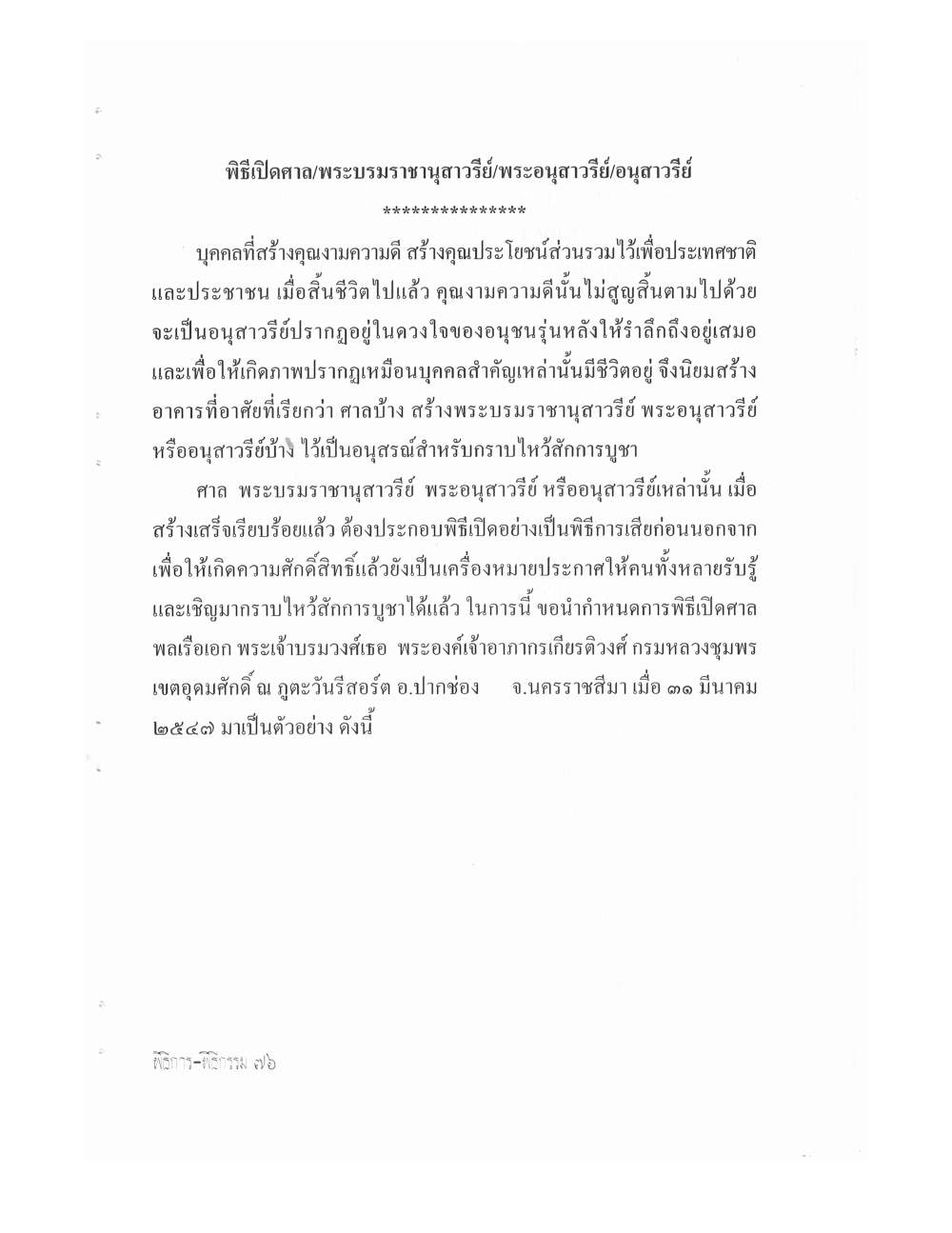
พิธีเปิดศาล/พระบรมราชานุสาวรีย์/พระอนุสาวรีย์/อนุสาวรีย์
*************** บุคคลที่สร้างคุณงามความดี สร้างคุณประโยชน์ส่วนรวมไว้เพื่อประเทศชาติ และประชาชน เมื่อสิ้นชีวิตไปแล้ว คุณงามความดีนั้นไม่สูญสิ้นตามไปด้วย จะเป็นอนุสาวรีย์ปรากฏอยู่ในดวงใจของอนุชนรุ่นหลังให้รำลึกถึงอยู่เสมอ และเพื่อให้เกิดภาพปรากฏเหมือนบุคคลสำคัญเหล่านั้นมีชีวิตอยู่ จึงนิยมสร้าง อาคารที่อาศัยที่เรียกว่า ศาลบ้าง สร้างพระบรมราชานุสาวรีย์ พระอนุสาวรีย์ หรืออนุสาวรีย์บ้าง ไว้เป็นอนุสรณ์สำหรับกราบไหว้สักการะบูชา ศาล พระบรมราชานุสาวรีย์ พระอนุสาวรีย์ หรืออนุสาวรีย์เหล่านั้น เมื่อ สร้างเสร็จเรียบร้อยแล้ว ต้องประกอบพิธีเปิดอย่างเป็นพิธีการเสียก่อนนอกจาก เพื่อให้เกิดความศักดิ์สิทธิ์แล้วยังเป็นเครื่องหมายประกาศให้คนทั้งหลายรับรู้ และเชิญมากราบไหว้สักการะบูชาได้แล้ว ในการนี้ขอนำกำหนดการพิธีเปิดศาล พลเรือเอก พระเจ้าบรมวงศ์เธอ พระองค์เจ้าอาภากรเกียรติวงศ์ กรมหลวงชุมพร เขตอุดมศักดิ์ ณ ภูตะวันรีสอร์ต อ.ปากช่อง จ.นครราชสีมา เมื่อ ๓๑ มีนาคม ๒๕๔๗ มาเป็นตัวอย่างดังนี้ พิธีการ-พิธีกรรม ๗๖
The Ceremony of Opening a Shrine / Royal Memorial / Princely Memorial / Monument
*************** When a person who has built up virtue and worked for the common good of the nation and the people passes away, that virtue does not vanish along with them. It becomes a monument living on in the hearts of later generations, who are ever reminded of it. And in order to produce an image as though such eminent persons were still alive, it has become customary to build a dwelling-like structure called a "shrine" (san), or to build a royal memorial (phra borommaracha-anusawari), a princely memorial (phra anusawari), or a monument (anusawari), as a memorial for paying homage and reverence. Once such a shrine, royal memorial, princely memorial, or monument has been completed, an opening ceremony must first be formally performed. Besides imbuing it with sanctity, this also serves as a public announcement inviting everyone to come and pay homage and reverence. Here, as an example, is the schedule of the ceremony opening the shrine of Admiral H.R.H. Prince Aphakorn Kiattiwongse, Krom Luang Chumphon Khet Udomsak, at Phutawan Resort, Pak Chong District, Nakhon Ratchasima Province, on 31 March 2547 [2004 CE], as an example, as follows. (Ceremonies and Rites, p. 76)
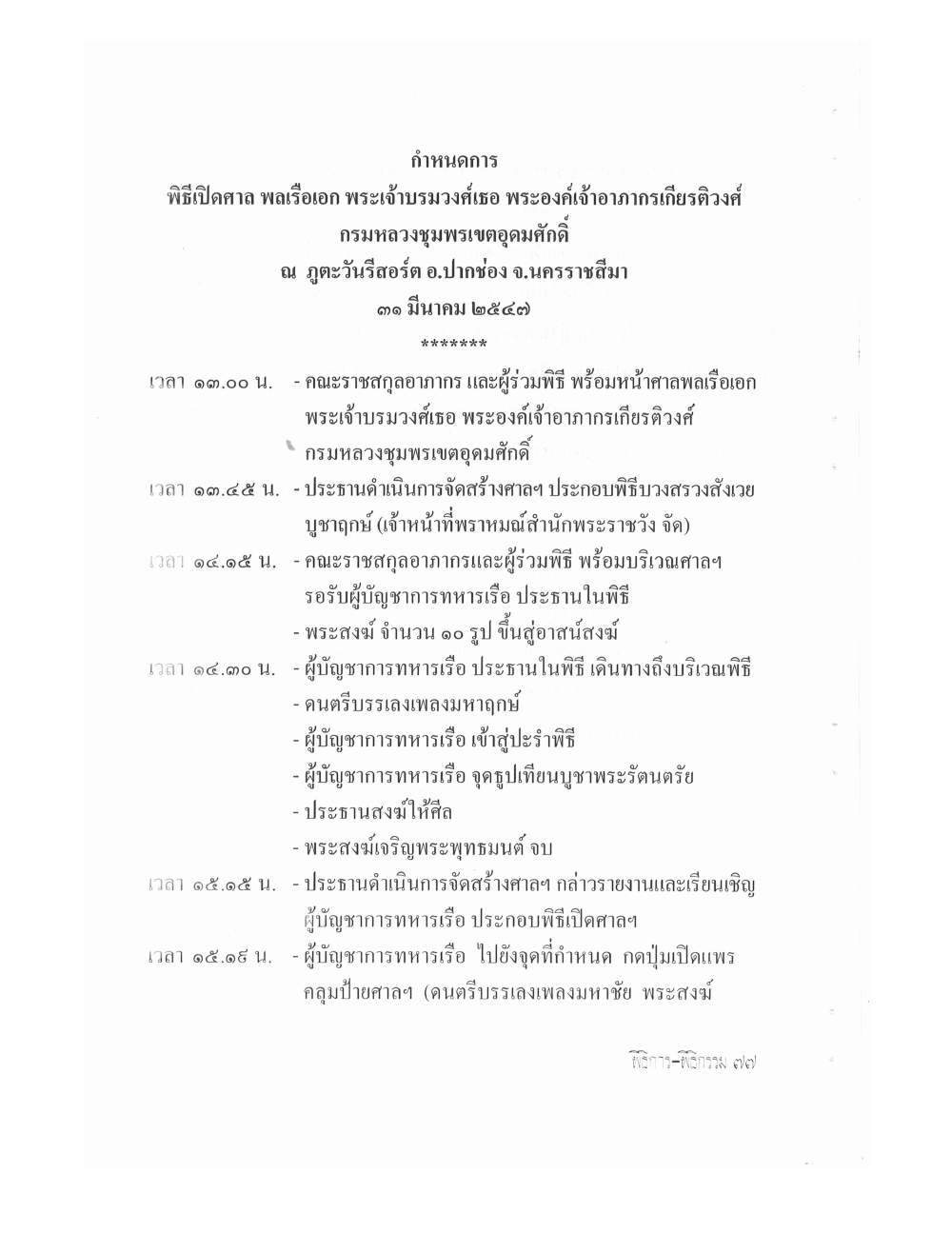
กำหนดการ พิธีเปิดศาล พลเรือเอก พระเจ้าบรมวงศ์เธอ พระองค์เจ้าอาภากรเกียรติวงศ์ กรมหลวงชุมพรเขตอุดมศักดิ์ ณ ภูตะวันรีสอร์ต อ.ปากช่อง จ.นครราชสีมา ๓๑ มีนาคม ๒๕๔๗ ******* เวลา ๑๓.๐๐ น. - คณะราชสกุลอาภากร และผู้ร่วมพิธี พร้อมหน้าศาลพลเรือเอก พระเจ้าบรมวงศ์เธอ พระองค์เจ้าอาภากรเกียรติวงศ์ กรมหลวงชุมพรเขตอุดมศักดิ์ เวลา ๑๓.๔๕ น. - ประธานดำเนินการจัดสร้างศาลฯ ประกอบพิธีบวงสรวงสังเวย บูชาฤกษ์ (เจ้าหน้าที่พราหมณ์สำนักพระราชวัง จัด) เวลา ๑๔.๑๕ น. - คณะราชสกุลอาภากรและผู้ร่วมพิธี พร้อมบริเวณศาลฯ รอรับผู้บัญชาการทหารเรือ ประธานในพิธี - พระสงฆ์ จำนวน ๑๐ รูป ขึ้นสู่อาสน์สงฆ์ เวลา ๑๔.๓๐ น. - ผู้บัญชาการทหารเรือ ประธานในพิธี เดินทางถึงบริเวณพิธี - ดนตรีบรรเลงเพลงมหาฤกษ์ - ผู้บัญชาการทหารเรือ เข้าสู่ปะรำพิธี - ผู้บัญชาการทหารเรือ จุดธูปเทียนบูชาพระรัตนตรัย - ประธานสงฆ์ให้ศีล - พระสงฆ์เจริญพระพุทธมนต์ จบ เวลา ๑๕.๑๕ น. - ประธานดำเนินการจัดสร้างศาลฯ กล่าวรายงานและเรียนเชิญ ผู้บัญชาการทหารเรือ ประกอบพิธีเปิดศาลฯ เวลา ๑๕.๑๖ น. - ผู้บัญชาการทหารเรือ ไปยังจุดที่กำหนด กดปุ่มเปิดแพร คลุมป้ายศาลฯ (ดนตรีบรรเลงเพลงมหาชัย พระสงฆ์ พิธีการ-พิธีกรรม ๗๗
Schedule The Ceremony of Opening the Shrine of Admiral H.R.H. Prince Aphakorn Kiattiwongse, Krom Luang Chumphon Khet Udomsak at Phutawan Resort, Pak Chong District, Nakhon Ratchasima Province 31 March 2547 [2004 CE] ******* 1300 hrs — The Aphakorn royal lineage and participants assemble in front of the shrine of Admiral H.R.H. Prince Aphakorn Kiattiwongse, Krom Luang Chumphon Khet Udomsak. 1345 hrs — The chairman overseeing the shrine's construction performs the rite of invocation and offering for an auspicious time (arranged by Brahmin officiants of the Bureau of the Royal Household). 1415 hrs — The Aphakorn royal lineage and participants assemble at the shrine, awaiting the arrival of the Commander-in-Chief of the Royal Thai Navy, the presiding officiant. - Ten monks take their seats on the monks' dais. 1430 hrs — The Commander-in-Chief of the Royal Thai Navy, the presiding officiant, arrives at the ceremony site. - The band plays the Maha Reuk anthem. - The Commander-in-Chief enters the ceremonial pavilion. - The Commander-in-Chief lights incense and candles to venerate the Triple Gem. - The presiding monk confers the precepts. - The monks finish chanting the Buddhist blessing. 1515 hrs — The chairman overseeing the shrine's construction delivers a report and invites the Commander-in-Chief to perform the shrine-opening rite. 1516 hrs — The Commander-in-Chief goes to the designated spot and presses the button to open the cloth covering the shrine's sign (the band plays the Maha Chai anthem; the monks (Ceremonies and Rites, p. 77)
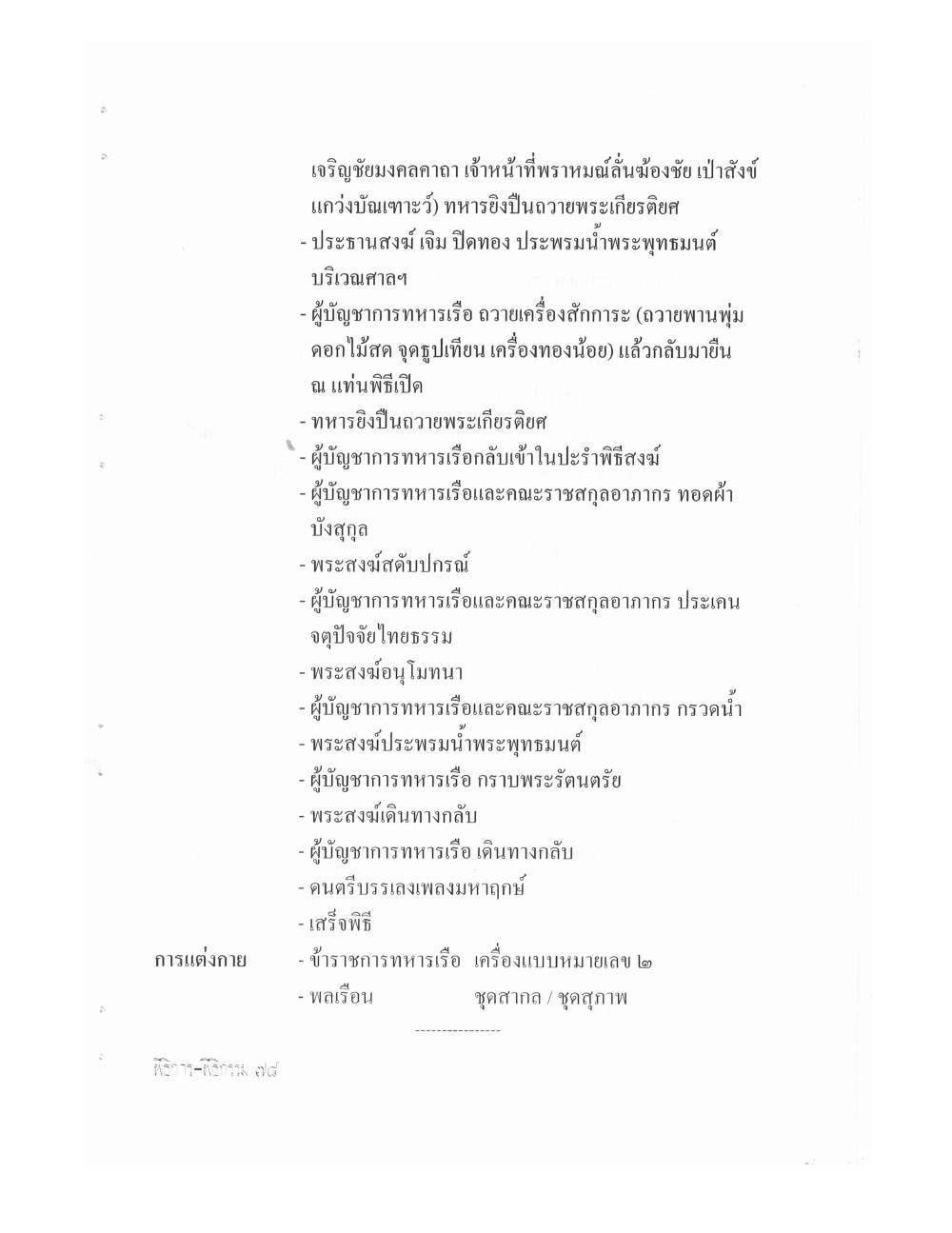
เจริญชัยมงคลคาถา เจ้าหน้าที่พราหมณ์ลั่นฆ้องชัย เป่าสังข์ แกว่งบัณเฑาะว์) ทหารยิงปืนถวายพระเกียรติยศ - ประธานสงฆ์ เจิม ปิดทอง ประพรมน้ำพระพุทธมนต์ บริเวณศาลฯ - ผู้บัญชาการทหารเรือ ถวายเครื่องสักการะ (ถวายพานพุ่ม ดอกไม้สด จุดธูปเทียน เครื่องทองน้อย) แล้วกลับมายืน ณ แท่นพิธีเปิด - ทหารยิงปืนถวายพระเกียรติยศ - ผู้บัญชาการทหารเรือกลับเข้าในปะรำพิธีสงฆ์ - ผู้บัญชาการทหารเรือและคณะราชสกุลอาภากร ทอดผ้า บังสุกุล - พระสงฆ์สดับปกรณ์ - ผู้บัญชาการทหารเรือและคณะราชสกุลอาภากร ประเคน จตุปัจจัยไทยธรรม - พระสงฆ์อนุโมทนา - ผู้บัญชาการทหารเรือและคณะราชสกุลอาภากร กรวดน้ำ - พระสงฆ์ประพรมน้ำพระพุทธมนต์ - ผู้บัญชาการทหารเรือ กราบพระรัตนตรัย - พระสงฆ์เดินทางกลับ - ผู้บัญชาการทหารเรือ เดินทางกลับ - ดนตรีบรรเลงเพลงมหาฤกษ์ - เสร็จพิธี การแต่งกาย - ข้าราชการทหารเรือ เครื่องแบบหมายเลข ๒ - พลเรือน ชุดสากล / ชุดสุภาพ ---------------- พิธีการ-พิธีกรรม ๗๘
...chant the auspicious victory verses; the Brahmin officiant strikes the victory gong, blows the conch shell, and swings the bandhausadha rattle) — soldiers fire a salute in the prince's honour. - The presiding monk applies the anointing mark, affixes gold leaf, and sprinkles the shrine area with lustral water. - The Commander-in-Chief offers homage items (a bouquet of fresh flowers, lit incense and candles, a small set of gold ceremonial vessels), then returns to stand at the opening dais. - Soldiers fire a salute in the prince's honour. - The Commander-in-Chief returns to the monks' ceremonial pavilion. - The Commander-in-Chief and the Aphakorn royal lineage spread the "bangsukul" cloth [a funeral-merit robe offering]. - The monks perform the sadap pakorn rite [chanting over the bangsukul cloth]. - The Commander-in-Chief and the Aphakorn royal lineage present the four requisites and offerings. - The monks give the blessing. - The Commander-in-Chief and the Aphakorn royal lineage pour the libation water. - The monks sprinkle lustral water. - The Commander-in-Chief pays homage to the Triple Gem. - The monks depart. - The Commander-in-Chief departs. - The band plays the Maha Reuk anthem. - The ceremony concludes. Dress code: - Naval personnel Uniform No. 2. - Civilians Lounge suit / respectable attire. ---------------- (Ceremonies and Rites, p. 78)
พิธีพุทธาภิเษก
****** พิธีพุทธาภิเษก คือพิธีการปลุกเสกประจุพุทธคุณลงในวัตถุมงคล (ตามพจนานุกรมฉบับราชบัณฑิตยสถาน พ.ศ.๒๕๔๒ หน้า ๗๖๕ และ พจนานุกรม เพื่อการศึกษาพุทธศาสตร์ ชุด "คำวัด" โดยพระธรรมกิตติวงศ์ หน้า ๗๐๐) โดย ใช้พุทธคุณซึ่งมีอยู่ในบทพระปริตรหรือบทพุทธมนต์ หรือโดยใช้สมาธิจิตที่เกิด จากปฏิบัติกรรมฐาน ประจุลงในวัตถุมงคลต่าง ๆ เช่น พระพุทธรูปจำลอง รูปจำลองพระเกจิอาจารย์ พระบรมรูปจำลองพระมหากษัตริย์-ราชวงศ์ รูปเทพเจ้า รูปผู้ที่ควรสักการะบูชา ปูชนียวัตถุต่าง ๆ ฯลฯ มิได้หมายถึงพิธีการปลุกเสก เฉพาะพระพุทธรูปจำลองอย่างเดียว ดังนั้น ไม่ว่าจะปลุกเสกวัตถุมงคลประเภทใด เรียกว่า พิธีพุทธาภิเษก เหมือนกันหมด โดยเรียกชื่อพิธีตามวัตถุมงคลนั้น ๆ เช่น พิธีพุทธาภิเษกพระพุทธพรประทานราชนาวี พิธีพุทธาภิเษกพระบรมรูปจำลอง สมเด็จพระเจ้าตากสินมหาราช พิธีพุทธาภิเษกรูปจำลององค์จตุคามรามเทพ ฯลฯ และมีความเชื่อว่าวัตถุมงคลที่ผ่านพิธีพุทธาภิเษกแล้วย่อมกลายเป็นวัตถุมงคลที่ ศักดิ์สิทธิ์สามารถป้องกันภัยอันตรายและให้เกิดความสวัสดีมีชัยได้ ปัจจุบันมีศัพท์เรียกพิธีกรรมดังกล่าวเพิ่มขึ้นใหม่และนำมาเรียกใช้กัน ทั่วไป เช่น พิธีมังคลาภิเษก พิธีเทวาภิเษก เป็นต้น โดยอาจมีความประสงค์ให้ เรียกชื่อพิธีตรงตามวัตถุมงคลนั้น ๆ ดังนี้ - พิธีพุทธาภิเษก คือพิธีปลุกเสกพระพุทธรูปจำลอง และรูปจำลอง พระเกจิ อาจารย์ทั้งหลาย - พิธีมังคลาภิเษก คือพิธีปลุกเสกพระบรมรูปจำลองพระมหากษัตริย์ราชวงศ์ เช่น สมเด็จพระปิย-มหาราช พลเรือเอก พระเจ้าบรมวงศ์เธอ พระองค์เจ้าอาภากร เกียรติวงศ์ กรมหลวงชุมพรเขตอุดมศักดิ์ เป็นต้น พิธีการ-พิธีกรรม ๗๙
The Buddhabhiseka (Buddha-Consecration) Ceremony
****** The Buddhabhiseka ceremony is the rite of consecrating and infusing the Buddha's virtues into sacred objects (according to the Royal Institute Dictionary, B.E. 2542 [1999], p. 765, and the dictionary for Buddhist studies, "Words of the Temple" series, by Phra Dhammakittivongs, p. 700), by using the power of the Buddha's virtues found in the paritta texts or Buddhist-blessing verses, or by using the concentrated mind arising from the practice of meditation, to infuse it into various sacred objects, such as cast Buddha images, cast images of revered monks (kecha achan), cast royal images of monarchs and the royal family, images of deities, images of persons worthy of veneration, various sacred relics, and so on. It does not refer to the rite of consecration solely for cast Buddha images. Therefore, no matter what type of sacred object is being consecrated, it is alike called a "Buddhabhiseka" ceremony, though named after that particular sacred object, such as "the Buddhabhiseka of the Phra Phuttha Phon Prathan Rachanawi," "the Buddhabhiseka of the cast royal image of King Taksin the Great," "the Buddhabhiseka of the cast image of Chatukham Rammathep," and so on, and it is believed that sacred objects that have undergone the Buddhabhiseka ceremony become sanctified objects able to ward off danger and bring good fortune and victory. At present, new terms for such rites have come into general use, such as "Mangkhalabhiseka" and "Thewabhiseka," reflecting perhaps a wish to name the ceremony to match the particular sacred object concerned, as follows: - "Buddhabhiseka" is the rite of consecrating cast Buddha images and cast images of revered monks. - "Mangkhalabhiseka" is the rite of consecrating cast royal images of monarchs and the royal family, such as King Chulalongkorn the Great [Somdet Phra Piyamaharat], Admiral H.R.H. Prince Aphakorn Kiattiwongse, Krom Luang Chumphon Khet Udomsak, and so on. (Ceremonies and Rites, p. 79)
- พิธีเทวาภิเษก คือพิธีปลุกเสกรูปจำลองเทพเจ้าต่าง ๆ เช่น พระพรหม องค์จตุคามรามเทพ พระพิฆเนศเป็นต้น บางกรณีนำวัตถุมงคลต่าง ๆ มาปลุกเสกในคราวเดียวกันก็มักเรียกพิธี รวมกันก็มี เช่น พิธีพุทธมังคลาภิเษก พิธีพุทธเทวาภิเษก พิธีมังคลเทวาภิเษก เป็นต้น ศัพท์ที่ใช้เรียกพิธีตามวัตถุมงคลต่าง ๆ ดังกล่าวแม้จะไม่ตรงกับคำเดิมที่ ให้ใช้คำว่า พิธีพุทธาภิเษก แต่พิธีการปฏิบัติเหมือนกันทุกพิธี พิธีพุทธาภิเษกวัตถุมงคลทุกประเภท มีหลักการปฏิบัติดังนี้ ๑. เครื่องใช้ในพิธี ๑.๑ โต๊ะหมู่บูชา พร้อมดอกไม้ธูปเทียน ๑.๒ เครื่องใช้สำหรับพระสงฆ์ - เครื่องรับรองพระสงฆ์เช่นเดียวกับงานมงคลทั่วไป - ตั่ง/ที่นั่งพระมหาเถระประธานฝ่ายสงฆ์ - อาสน์สงฆ์พระเจริญพระพุทธมนต์ ๘ รูป (พิธีหลวงหรือพิธีทาง ราชการ ๑๐ รูป) - อาสน์สงฆ์พระสวดภาณวาร ๔ รูป - ตั่ง / ที่นั่งพระเกจิอาจารย์ / พระเถระภาวนาจารย์ ๘ รูป (หรือ ตามความประสงค์) จัดให้นั่งรอบวัตถุมงคล ๑.๓ เครื่องประกอบพิธีพุทธาภิเษก - เทียนวิปัสสี ไส้เกินอายุผู้จุด ๑ เล่ม - เทียนมหามงคล หนัก ๘ บาท ๒ เล่ม - เทียนนวหรคุณ หนัก ๑ บาท ๙ เล่ม - เทียนเงินเทียนทอง ๒ เล่ม พิธีการ-พิธีกรรม ๘๐
- "Thewabhiseka" is the rite of consecrating cast images of various deities, such as Brahma, Chatukham Rammathep, and Ganesha, among others. In some cases various sacred objects are brought to be consecrated on the same occasion, and the rite is then often given a combined name, such as "Buddhamangkhalabhiseka," "Buddhathewabhiseka," "Mangkhalathewabhiseka," and so on. Even though the terms used to name the rite after these various sacred objects do not match the original word prescribed, "Buddhabhiseka," the ceremonial practice is the same in every case. The Buddhabhiseka ceremony for every type of sacred object follows these principles of practice: 1. Equipment used in the ceremony 1.1 A tiered altar table, together with flowers, incense, and candles. 1.2 Equipment for the monks: - Reception furnishings for the monks, the same as for ordinary auspicious ceremonies. - A stand/seat for the presiding senior monk on the monks' side. - A monks' dais for 8 monks chanting the Buddhist blessing (10 monks for a royal or official state ceremony). - A monks' dais for 4 monks chanting the parittabhanavara. - A stand/seat for 8 revered monks/meditation-master elders (or as desired), arranged seated around the sacred objects. 1.3 Equipment for conducting the Buddhabhiseka rite: - 1 vipassi candle, with a wick exceeding the age of the one who lights it. - 2 mahamongkhon candles, weighing 8 baht each. - 9 navaharakhun candles, weighing 1 baht each. - 2 silver-and-gold candles. (Ceremonies and Rites, p. 80)
- เทียนชัย ไส้ ๑๐๘ เส้น หนัก ๔๐ บาท สูงเท่ากับเจ้าของพิธี ๑ เล่ม (ปักในตู้เทียนชัย) - เทียนพุทธาภิเษก หนัก ๑๒ บาท ๒ เล่ม - เทียนที่เครื่องกระบะมุก ๑ ชุด - ขันสาครใส่น้ำมนต์ ๒ ใบ (ปักเทียนพุทธาภิเษกไว้ตรงกลาง) - สายสิญจน์รอบปริมณฑล ขึงเป็นตาข่ายห่างกัน ๑ ช่วงแขน - ฉัตรขาว ๕ ชั้น ๖ ต้น ขนาดความสูงตามความเหมาะสม ปัก ๔ มุม และซุ้มประตูทางเข้า - ราชวัติ ๔ มุม (๘ ข้าง ยาวข้างละ ๑ เมตร) - โต๊ะวางวัตถุมงคลพร้อมปูผ้าขาว ขนาดโต๊ะสูงกว่าที่นั่งพระสงฆ์ ตามสมควร - พลู ๗ ใบ ซ้อนกันสำหรับดับเทียนชัย - บาตรใส่น้ำมนต์สำหรับพระเกจิอาจารย์/พระเถระภาวนาจารย์ นั่งปรกครบทุกรูป ๑.๔ เครื่องไทยธรรมประเคนพระสงฆ์ในพิธีทั้งหมด ๒. ลำดับพิธี การกำหนดลำดับพิธีแต่ละพิธีนั้นอาจจะแตกต่างกันบ้าง ขึ้นอยู่กับ สถานที่และผู้เป็นประธานในพิธี แต่ลำดับพิธีการปฏิบัติส่วนใหญ่เป็นไปใน แนวทางเดียวกันหรือใกล้เคียงกัน ในที่นี้ขอนำกำหนดการพิธีมังคลาภิเษก พระบรมรูปจำลองสมเด็จพระเจ้าตากสินมหาราช (ขณะนั้นเรียกพิธีมังคลาภิเษก) เมื่อวันเสาร์ที่ ๑๑ ธันวาคม ๒๕๔๒ ณ ท้องพระโรง พระราชวังเดิม มาเป็นตัวอย่าง ดังนี้ พิธีการ-พิธีกรรม ๘๑
- 1 victory candle (thian chai), with 108 wicks, weighing 40 baht, as tall as the officiant of the ceremony (pinned in the victory-candle cabinet). - 2 Buddhabhiseka candles, weighing 12 baht each. - 1 set of candles for the mother-of-pearl-inlay tray. - 2 large bowls (khan sakhon) holding lustral water (with the Buddhabhiseka candle set upright in the centre of each). - Sacred thread (sai sinjana) strung around the ceremonial precinct as a lattice, one arm's span apart. - 5-tiered white ceremonial umbrellas (chattra), 6 poles, of a suitable height, planted at the 4 corners and at the entrance archway. - Ceremonial boundary cords (ratchawat) at the 4 corners (8 sides, each 1 metre long). - A table for the sacred objects, covered with white cloth, of a height suitably taller than the monks' seats. - 7 betel leaves, stacked, for extinguishing the victory candle. - Alms bowls holding lustral water for every revered monk/meditation-master elder who sits in meditation (nang prok). 1.4 Offerings presented to all the monks throughout the ceremony. 2. The Order of the Ceremony The order of proceedings for each ceremony may vary somewhat, depending on the venue and the presiding officiant, but the sequence of practice is for the most part the same or similar. Here, as an example, is the schedule of the Mangkhalabhiseka ceremony for the cast royal image of King Taksin the Great (at that time called the Mangkhalabhiseka ceremony), held on Saturday, 11 December 2542 [1999 CE], at the Audience Hall, Phra Racha Wang Derm [the Old Royal Palace / Thonburi Palace], as an example, as follows. (Ceremonies and Rites, p. 81)
กำหนดการ สมเด็จพระญาณสังวร สมเด็จพระสังฆราช สกลมหาสังฆปริณายก เสด็จเป็นองค์ประธานในพิธีมังคลาภิเษก พระบรมรูปจำลองสมเด็จพระเจ้าตากสินมหาราช ในวันเสาร์ที่ ๑๑ ธันวาคม ๒๕๔๒ เวลา ๑๔.๐๐ น. ณ ท้องพระโรง พระราชวังเดิม กรุงเทพมหานคร ---------------- เวลา ๑๔.๐๐ น. - ผู้ร่วมพิธีและผู้มีเกียรติพร้อมบริเวณท้องพระโรงชั้นนอก - พระสงฆ์ทรงสมณศักดิ์ ๑๐ รูป ขึ้นสู่อาสน์สงฆ์ เวลา ๑๔.๐๕ น. - ประธานในพิธีฝ่ายฆราวาส ถึงบริเวณพิธี เวลา ๑๔.๑๐ น. - ประธานในพิธีฝ่ายฆราวาส ประธานมูลนิธิอนุรักษ์ โบราณสถานในพระราชวังเดิม ข้าราชการชั้นผู้ใหญ่ และ ผู้เกี่ยวข้องเฝ้ารับเสด็จฯ เวลา ๑๔.๒๐ น. - สมเด็จพระสังฆราช เสด็จถึงบริเวณพิธี แล้วเสด็จไปประทับ ณ ที่รับรองบริเวณท้องพระโรงชั้นนอก - ประธานในพิธีฝ่ายฆราวาสจุดธูปเทียนบูชาพระรัตนตรัย แล้วเข้าเฝ้าถวายเครื่องสักการะ แด่สมเด็จพระสังฆราช - พระเถระประธานสงฆ์ให้ศีล จบ - ประธานมูลนิธิอนุรักษ์โบราณสถานในพระราชวังเดิม กล่าว ถวายรายงานแล้วกราบทูลอาราธนาสมเด็จพระสังฆราช ทรงเจิมและทรงจุดเทียนชัย พิธีการ-พิธีกรรม ๘๒
Schedule His Holiness Somdet Phra Nyanasamvara, the Supreme Patriarch, Head of the Sangha of the Whole Kingdom, Proceeds as Presiding Officiant in the Mangkhalabhiseka Ceremony for the Cast Royal Image of King Taksin the Great on Saturday, 11 December 2542 [1999 CE], at 1400 hours, at the Audience Hall, Phra Racha Wang Derm [the Old Royal Palace], Bangkok ---------------- 1400 hrs - Participants and dignitaries assemble at the outer section of the Audience Hall. - Ten monks holding ecclesiastical rank take their seats on the monks' dais. 1405 hrs - The lay presiding officiant arrives at the ceremony site. 1410 hrs - The lay presiding officiant, the chairman of the Foundation for the Conservation of the Historic Site at the Old Royal Palace, senior officials, and those concerned wait to receive His Holiness. 1420 hrs - The Supreme Patriarch arrives at the ceremony site, then proceeds to be seated at the reception area in the outer section of the Audience Hall. - The lay presiding officiant lights incense and candles to venerate the Triple Gem, then approaches to present homage items to the Supreme Patriarch. - The presiding elder monk finishes conferring the precepts. - The chairman of the Foundation for the Conservation of the Historic Site at the Old Royal Palace delivers a report, then respectfully invites the Supreme Patriarch to apply the anointing mark and light the victory candle. (Ceremonies and Rites, p. 82)
- สมเด็จพระสังฆราช ทรงเจิมและทรงจุดเทียนชัย (ประธานมูลนิธิอนุรักษ์โบราณสถานในพระราชวังเดิม ถวายกระปุกแป้งเจิมและเทียนชนวน ขณะทรงจุดเทียนชัย พระสงฆ์สวดคาถาจุดเทียนชัย พนักงานพราหมณ์ประโคมฆ้องชัย สังข์ แตร ดุริยางค์) - พระสงฆ์เจริญพระพุทธมนต์ และสวดธัมมจักกัปปวัตนสูตร - ประธานมูลนิธิอนุรักษ์โบราณสถานในพระราชวังเดิม จุดเทียนวิปัสสี เทียนมหามงคลและเทียนนวหรคุณ (ขณะพระสงฆ์เจริญพระพุทธมนต์ขึ้นบท พุทธํ สรณํ คจฉามิ ฯลฯ) - สมเด็จพระสังฆราช ทรงนั่งอธิษฐานจิต เจริญบริกรรมภาวนา - พระสงฆ์เจริญพระพุทธมนต์ จบ - ประธานในพิธีฝ่ายฆราวาส ถวายเครื่องไทยธรรมแด่สมเด็จพระสังฆราช - ประธานมูลนิธิอนุรักษ์โบราณสถานในพระราชวังเดิม ประเคนเครื่องไทยธรรมแด่พระสงฆ์ทรงสมณศักดิ์ทั้ง ๑๐ รูป - พระสงฆ์อนุโมทนา ประธานในพิธีฝ่ายฆราวาส และประธานมูลนิธิอนุรักษ์โบราณสถานในพระราชวังเดิม กรวดน้ำ - ประธานมูลนิธิอนุรักษ์โบราณสถานในพระราชวังเดิม กราบทูลอาราธนาเสด็จประพรมน้ำพระพุทธมนต์
- The Supreme Patriarch anoints [the image] and lights the victory candle (the chairman of the Foundation for the Conservation of Ancient Monuments in the Former Royal Palace presents the container of anointing powder and the kindling candle; while the victory candle is being lit, the monks chant the verse for lighting the victory candle, and the Brahmin officials sound the victory gong, conch shells, trumpets, and orchestra). - The monks chant the Buddhist blessings and recite the Dhammacakkappavattana Sutta. - The chairman of the Foundation for the Conservation of Ancient Monuments in the Former Royal Palace lights the Vipassi candle, the Mahamongkol candle, and the Nawaharakhun candle (while the monks chant the verse beginning "Buddham saranam gacchami," etc.). - The Supreme Patriarch sits in meditative resolve, cultivating recollection and contemplation. - The monks' chanting of the blessing concludes. - The lay chairman of the ceremony presents monastic requisites to the Supreme Patriarch. - The chairman of the Foundation for the Conservation of Ancient Monuments in the Former Royal Palace presents monastic requisites to all 10 monks holding ecclesiastical rank. - The monks give the blessing of appreciation; the lay chairman of the ceremony and the chairman of the Foundation for the Conservation of Ancient Monuments in the Former Royal Palace pour the water of dedication. - The chairman of the Foundation for the Conservation of Ancient Monuments in the Former Royal Palace respectfully invites [the Supreme Patriarch] to come forth and sprinkle the blessed water.
- สมเด็จพระสังฆราช ทรงประพรมน้ำพระพุทธมนต์ ทรงโปรยข้าวตอก ดอกไม้ และเสด็จกลับ (ประธานมูลนิธิอนุรักษ์โบราณสถานในพระราชวังเดิม และผู้เกี่ยวข้องส่งเสด็จ) - พระสวดภาณวาร ๔ รูป และพระเถระภาวนาจารย์ ๘ รูป เข้านั่งประจำที่ - ประธานมูลนิธิอนุรักษ์โบราณสถานในพระราชวังเดิม จุดเทียนที่เครื่องกระบะมุก และเทียนพุทธาภิเษกที่ขันสาคร ข้างตู้เทียนชัย - พระสวดภาณวาร สวดคาถาพุทธาภิเษก - พระเถระภาวนาจารย์ นั่งปรก จบ เวลา ๑๕.๒๘ น. - พระเถระภาวนาจารย์อาวุโส ประกอบพิธีดับเทียนชัย (พระสงฆ์สวดคาถาดับเทียนชัย) - ประเคนเครื่องไทยธรรมแด่พระสวดภาณวารและพระเถระภาวนาจารย์ - พระสงฆ์อนุโมทนา ผู้ร่วมพิธีกรวดน้ำ - เสร็จพิธี --------------
- The Supreme Patriarch sprinkles the blessed water, scatters popped rice and flowers, and departs (the chairman of the Foundation for the Conservation of Ancient Monuments in the Former Royal Palace and those concerned see him off). - The four monks who chant the Bhanavara and the eight elder meditation masters take their seats. - The chairman of the Foundation for the Conservation of Ancient Monuments in the Former Royal Palace lights the candle at the mother-of-pearl offering tray and the consecration candle at the water vessel beside the cabinet holding the victory candle. - The Bhanavara-chanting monks chant the consecration verses. - The elder meditation masters, seated in meditative vigil, conclude. Time 15:28 - The senior elder meditation master performs the rite of extinguishing the victory candle (the monks chant the verse for extinguishing the victory candle). - Monastic requisites are presented to the Bhanavara-chanting monks and the elder meditation masters. - The monks give the blessing of appreciation; those present at the ceremony pour the water of dedication. - The ceremony concludes. --------------
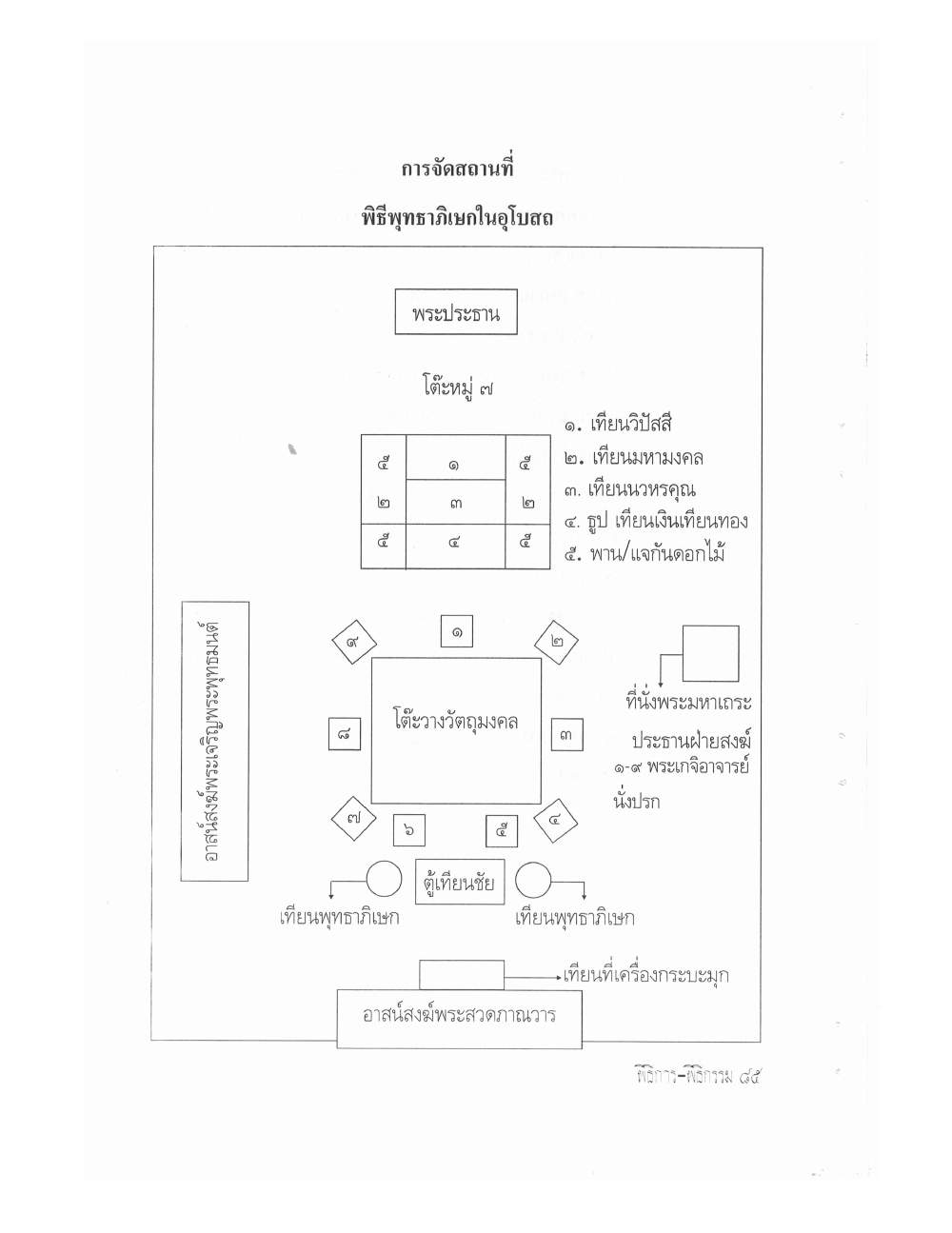
การจัดสถานที่ พิธีพุทธาภิเษกในอุโบสถ
[แผนผังแสดงผังที่นั่งและโต๊ะวางเครื่องพิธีในอุโบสถ]
พระประธาน
โต๊ะหมู่ ๗ [ตาราง ๓x๓ ช่อง มีตัวเลขกำกับแต่ละช่อง: ๕ ๑ ๕ / ๒ ๓ ๒ / ๕ ๔ ๕] ๑. เทียนวิปัสสี ๒. เทียนมหามงคล ๓. เทียนนวหรคุณ ๔. ธูป เทียนเงินเทียนทอง ๕. พาน/แจกันดอกไม้
อาสน์สงฆ์ผู้เจริญพระพุทธมนต์ [ข้อความเขียนแนวตั้ง]
[แผนภาพวงกลมและสี่เหลี่ยมล้อมรอบกล่องกลาง มีหมายเลข ๑-๙ กำกับตำแหน่งโดยรอบ]
โต๊ะวางวัตถุมงคล
ที่นั่งพระมหาเถระ ประธานฝ่ายสงฆ์ ๑-๔ พระเกจิอาจารย์ นั่งปรก
ตู้เทียนชัย
เทียนพุทธาภิเษก [ลูกศรชี้จากวงกลม] เทียนพุทธาภิเษก [ลูกศรชี้จากวงกลม]
[สี่เหลี่ยมมีลูกศรชี้ไปข้อความ] เทียนที่เครื่องกระบะมุก
อาสน์สงฆ์พระสวดภาณวาร
Arrangement of the Venue The Buddha Image Consecration Ceremony (Phutthaphisek) in the Ubosot
[Diagram showing the seating and table layout for the ceremony in the ordination hall]
Principal Buddha Image
Group-of-Seven Offering Table [a 3x3 grid, each cell numbered: 5, 1, 5 / 2, 3, 2 / 5, 4, 5] 1. Vipassi candle 2. Mahamongkol candle 3. Nawaharakhun candle 4. Incense, silver candle, gold candle 5. Tray/vase of flowers
Seating for the monks chanting the Buddhist blessings [text written vertically]
[Diagram of circles and squares surrounding a central box, with positions 1-9 numbered around it]
Table for placing the sacred objects
Seating for the senior monk, chairman of the monastic side; seats 1-4 for the meditation-master monks (ajarn) sitting in meditative vigil
Cabinet for the victory candle
Consecration candle [arrow pointing from a circle] Consecration candle [arrow pointing from a circle]
[A box with an arrow pointing to the label] Candle at the mother-of-pearl offering tray
Seating for the Bhanavara-chanting monks
พิธีทำบุญทอดกฐิน
********
การทอดกฐิน
กฐิน เป็นงานบุญใหญ่ที่มีปีละครั้ง จัดเป็น กาลทาน แปลว่า ถวายตามกาลสมัย กำหนดทำกันตั้งแต่วันแรม ๑ ค่ำ เดือน ๑๑ ถึงวันขึ้น ๑๕ ค่ำ เดือน ๑๒ คำว่า กฐิน แปลว่า กรอบไม้ หรือสะดึง สำหรับขึงผ้าเย็บจีวรของภิกษุ การทอดกฐิน คือการนำผ้ากฐินไปวางไว้ต่อหน้าพระสงฆ์อย่างน้อย ๕ รูป แล้วให้พระสงฆ์รูปใดรูปหนึ่งที่ได้รับมอบหมายจากคณะสงฆ์เป็นเอกฉันท์เป็นผู้รับผ้ากฐินนั้น
ประวัติกฐิน
ในคัมภีร์วินัยปิฎก กฐินขันธกะ กล่าวไว้เป็นใจความว่า สมัยหนึ่งภิกษุชาวเมืองปาฐา ประมาณ ๓๐ รูป เดินทางจากเมืองปาฐาไปเฝ้าพระพุทธเจ้า ณ เมืองสาวัตถี พอไปถึงเมืองสาเกต ซึ่งอยู่ห่างเมืองสาวัตถี ประมาณ ๖ โยชน์ (๙๖ ก.ม.) ก็พอดีถึงวันเข้าพรรษา จึงต้องพักจำพรรษาที่เมืองสาเกต พอออกพรรษาแล้วก็รีบเดินทางต่อไป เวลานั้นฝนยังชุกอยู่ ทางเดินจึงเป็นตมเป็นโคลนเปรอะเปื้อน ต้องกรำแดดกรำฝนจนจีวรเปียกชุ่ม พระพุทธเจ้าจึงทรงอนุญาตให้รับกฐินเพื่อเปลี่ยนจีวรใหม่ได้ เริ่มตั้งแต่วันแรม ๑ ค่ำ เดือน ๑๑ ถึงขึ้น ๑๕ ค่ำ เดือน ๑๒ โดยมีกำหนดว่า เมื่อได้ผ้ามาแล้ว จะต้องช่วยกันทำพิธีกรานกฐินให้เสร็จภายในวันนั้น (คือก่อนรุ่งอรุณที่จะมาถึง) เรื่องกฐินนี้ในชั้นเดิมเป็นเรื่องของภิกษุสงฆ์โดยเฉพาะ เป็นสังฆกรรม ภิกษุสงฆ์ต้องจัดการขวนขวายหาผ้าเองซึ่งเป็นการลำบากอยู่มาก ภายหลังคฤหัสถ์ผู้มีศรัทธาปรารถนาจะอนุเคราะห์
The Merit-Making Ceremony of Offering the Kathin Robe
********
Offering the Kathin
Kathin is a great annual merit-making event held once a year. It is classified as a "time-bound offering" (kalathan), meaning an offering made according to the proper season. It is set to be performed from the first day of the waning moon of the 11th lunar month to the 15th day of the waxing moon of the 12th lunar month. The word "kathin" means a wooden frame, or embroidery frame, used for stretching cloth to sew a monk's robe. Offering the kathin means bringing the kathin cloth to place before at least five monks, after which one monk unanimously appointed by the assembly of monks becomes the recipient of that kathin cloth.
History of the Kathin
In the Vinaya Pitaka, in the Kathina-khandhaka, it is recorded in essence that: once, about 30 monks from the city of Patha traveled from Patha to pay homage to the Buddha at the city of Savatthi. When they reached the city of Saketa, about 6 yojanas (96 km) from Savatthi, it happened to be the start of the Rains Retreat, so they had to stay and observe the retreat at Saketa. When the retreat ended, they hurried onward; at that time it was still the rainy season, so the road was mired in mud, and they had to endure sun and rain until their robes were soaked through. The Buddha therefore permitted them to receive the kathin in order to obtain new robes, to be observed from the first day of the waning moon of the 11th month to the 15th day of the waxing moon of the 12th month, on the condition that once the cloth was received, [the monks] must together complete the robe-making rite (kathin-kranta) within that same day (that is, before the next dawn arrives). This matter of kathin was originally a matter for the monks alone, a formal monastic act (sanghakamma); the monks themselves had to make the effort to find the cloth, which was quite difficult. Later, lay devotees who wished to assist
ภิกษุสงฆ์ ประกอบทั้งหวังบุญกุศลด้วย จึงถือเป็นหน้าที่จัดถวาย มิใช่แต่คฤหัสถ์เท่านั้น แม้พระภิกษุสงฆ์ด้วยกันเองจะทอดกฐินก็ได้ ไม่เป็นการขัดข้องแต่อย่างใด (แต่จะทอดในวัดที่ตนเองจำพรรษาอยู่มิได้)
ประเภทกฐิน
กฐินมี ๒ ประเภท คือกฐินหลวง และกฐินราษฎร์ กฐินที่ใช้ผ้าองค์กฐินของหลวงทอด ณ พระอารามหลวง เรียกว่า กฐินหลวง กฐินที่ราษฎรทำกันทั่ว ๆ ไป เรียกว่า กฐินราษฎร์
กฐินหลวง
มีประวัติว่า เมื่อพระพุทธศาสนาได้แพร่หลายเข้ามาประดิษฐานอยู่ในประเทศไทย และประชาชนคนไทยที่ตั้งหลักแหล่งอยู่บนผืนแผ่นดินไทยได้ยอมรับนับถือพระพุทธศาสนาว่าเป็นศาสนาประจำชาติแล้ว การทอดกฐินก็ได้กลายเป็นประเพณีของบ้านเมืองมาโดยลำดับ พระเจ้าแผ่นดินผู้ปกครองบ้านเมือง ได้ทรงรับเรื่องกฐินนี้ขึ้นเป็นพระราชพิธีอย่างหนึ่งซึ่งทรงบำเพ็ญเป็นการประจำเมื่อถึงเทศกาลทอดกฐิน การที่พระเจ้าแผ่นดินทรงบำเพ็ญพระราชกุศลเกี่ยวกับกฐินเป็นพระราชพิธีดังกล่าวนี้ เป็นเหตุให้เรียกกันว่า กฐินหลวง วัดใดก็ตามไม่ว่าจะเป็นวัดหลวงหรือวัดราษฎร์ หากพระเจ้าแผ่นดินเสด็จพระราชดำเนินไปทรงถวายผ้าพระกฐินแล้ว เรียกว่า กฐินหลวงทั้งสิ้น สมัยต่อมา เรื่องของกฐินหลวงได้เปลี่ยนไปตามภาวการณ์ของบ้านเมือง เช่น ประชาชนมีศรัทธาเจริญรอยตามพระราชศรัทธาของพระเจ้าแผ่นดิน ได้รับพระมหากรุณาธิคุณให้ถวายผ้าพระกฐินได้ตามสมควรแก่ฐานะเป็นต้น เป็นเหตุให้แบ่งกฐินหลวงออกเป็น ๓ ประเภท คือ
the monks, hoping also for merit, took it upon themselves to prepare and offer [the cloth] as well. This is not a matter for laypeople alone — even monks may offer kathin to one another, and this is in no way improper (however, one may not offer kathin at the very monastery where one has kept the Rains Retreat oneself).
Types of Kathin
There are two types of kathin: royal kathin and public kathin. Kathin in which the royal set of cloth is offered at a royal monastery is called royal kathin (kathin luang). Kathin performed by the general public everywhere is called public kathin (kathin rat).
Royal Kathin
It is recorded that when Buddhism spread and became established in Thailand, and the Thai people who settled on Thai soil had come to accept and revere Buddhism as the national religion, the offering of kathin gradually became a custom of the land. The sovereign, as ruler of the kingdom, took up the matter of kathin as one of the royal ceremonies, performing it regularly whenever the kathin season arrived. Because the sovereign performed this royal merit-making regarding kathin as such a royal ceremony, it came to be called "royal kathin" — any monastery at all, whether a royal monastery or a public one, if the sovereign proceeded there in person to offer the kathin robe, was said to have received "royal kathin." In later times, the matter of royal kathin changed according to the circumstances of the kingdom; for example, as the people's faith grew in step with the sovereign's own royal faith, they were granted the royal favor of being allowed to offer the kathin robe according to their respective standing, and so on. This led to royal kathin being divided into three types, namely:
๑. พระกฐินที่กำหนดเป็นพระราชพิธี ๒. พระกฐินต้น ๓. พระกฐินพระราชทาน
พระกฐินที่กำหนดเป็นพระราชพิธี (พระกฐินเสด็จพระราชดำเนิน)
พระกฐินดังกล่าวนี้ พระเจ้าแผ่นดินเสด็จพระราชดำเนินไปถวายด้วยพระองค์เองเป็นประจำ ณ วัดสำคัญ ๆ ซึ่งทางราชการกำหนดขึ้น มีหมายกำหนดการเสด็จพระราชดำเนินไว้อย่างเรียบร้อย ปัจจุบันพระบาทสมเด็จพระเจ้าอยู่หัวเสด็จพระราชดำเนินไปทรงถวายผ้าพระกฐิน ณ วัดต่าง ๆ ทั้งในกรุงเทพมหานครและส่วนภูมิภาค ๑๖ วัด ซึ่งล้วนแล้วแต่เป็นพระอารามหลวง ๑. วัดพระเชตุพนวิมลมังคลาราม กรุงเทพมหานคร ๒. วัดมหาธาตุยุวราชรังสฤษฏิ์ กรุงเทพมหานคร ๓. วัดสุทัศนเทพวราราม กรุงเทพมหานคร ๔. วัดบวรนิเวศวิหาร กรุงเทพมหานคร ๕. วัดเบญจมบพิตรดุสิตวนาราม กรุงเทพมหานคร ๖. วัดราชบพิธสถิตมหาสีมาราม กรุงเทพมหานคร ๗. วัดราชประดิษฐสถิตมหาสีมาราม กรุงเทพมหานคร ๘. วัดเทพศิรินทราวาส กรุงเทพมหานคร ๙. วัดราชาธิวาส กรุงเทพมหานคร ๑๐. วัดมกุฏกษัตริยาราม กรุงเทพมหานคร ๑๑. วัดอรุณราชวราราม กรุงเทพมหานคร ๑๒. วัดราชโอรสาราม กรุงเทพมหานคร ๑๓. วัดพระปฐมเจดีย์ นครปฐม
1. Royal kathin designated as a royal ceremony 2. Kathin Ton (the sovereign's personal kathin) 3. Royally-granted kathin
Royal Kathin Designated as a Royal Ceremony (Kathin of the Royal Procession)
This kathin is one to which the sovereign proceeds in person on a regular basis, at important monasteries designated by the government, with an official schedule for the royal procession arranged in good order. At present, His Majesty the King proceeds in person to offer the kathin robe at various monasteries, both in Bangkok and in the provinces, at 16 monasteries, all of which are royal monasteries: 1. Wat Phra Chetuphon Wimon Mangkhalaram, Bangkok 2. Wat Mahathat Yuwaratrangsarit, Bangkok 3. Wat Suthat Thepwararam, Bangkok 4. Wat Bowon Niwet Wihan, Bangkok 5. Wat Benchamabophit Dusitwanaram, Bangkok 6. Wat Ratchabophit Sathit Maha Simaram, Bangkok 7. Wat Ratchapradit Sathit Maha Simaram, Bangkok 8. Wat Thepsirintharawat, Bangkok 9. Wat Ratchathiwat, Bangkok 10. Wat Makut Kasattriyaram, Bangkok 11. Wat Arun Ratchawararam, Bangkok 12. Wat Ratchaorasaram, Bangkok 13. Wat Phra Pathom Chedi, Nakhon Pathom
๑๔. วัดสุวรรณดาราราม พระนครศรีอยุธยา ๑๕. วัดนิเวศน์ธรรมประวัติ พระนครศรีอยุธยา ๑๖. วัดพระศรีรัตนมหาธาตุ พิษณุโลก
พระอารามหลวงเหล่านี้ พระบาทสมเด็จพระเจ้าอยู่หัว จะเสด็จพระราชดำเนินไปถวายผ้าพระกฐินด้วยพระองค์เอง แต่มิได้เสด็จไปทั้ง ๑๖ วัด จะเสด็จพระราชดำเนินเพียงปีละ ๘ หรือ ๙ วัดเท่านั้น นอกนั้นทรงพระกรุณาโปรดเกล้าฯ ให้พระบรมวงศานุวงศ์ หรือองคมนตรี หรือผู้ทรงเห็นสมควรเป็นผู้แทนพระองค์ไปถวาย พระกฐินที่กำหนดเป็นพระราชพิธีนี้ ทรงพระกรุณาโปรดเกล้าฯ ให้สำนักพระราชวังออกหมายกำหนดการเป็นประจำปี จึงไม่มีการจองล่วงหน้า
พระกฐินต้น (พระกฐินส่วนพระองค์)
พระกฐินดังกล่าวนี้ พระเจ้าแผ่นดินเสด็จพระราชดำเนินไปถวาย ณ วัดที่มิใช่วัดหลวง และมิได้เสด็จไปอย่างเป็นทางราชการหรืออย่างเป็นพระราชพิธี แต่เป็นการบำเพ็ญพระราชกุศลส่วนพระองค์อีกด้วย พลตรี หม่อมทวีวงศ์ถวัลยศักดิ์ (ม.ร.ว.เฉลิมลาภ ทวีวงศ์) ได้เล่าประวัติเรื่องการเกิดขึ้นของกฐินต้นนี้ไว้ว่า "กฐินส่วนพระองค์นี้ ในสมัยก่อนรัชกาลที่ ๕ จะเรียกว่าอย่างไรนั้น ยังไม่พบหลักฐาน มาเรียกกันว่า กฐินต้น ในรัชกาลที่ ๕ ภายหลังที่ได้มีการเสด็จประพาสหัวเมืองต่าง ๆ เมื่อ พ.ศ. ๒๔๔๗ การเสด็จประพาสครั้งนั้น โปรดให้จัดให้ง่ายกว่าการเสด็จประพาสเพื่อสำราญพระราชอิริยาบถอย่างสามัญ คือ โปรดไม่ให้มีท้องตราสั่งหัวเมืองให้จัดทำที่ประทับแรม ณ ที่ใด ๆ พอพระราชหฤทัยจะประทับที่ไหนก็ประทับที่นั่น บางคราวก็ทรงเรือเล็กหรือเสด็จรถไฟ
14. Wat Suwannadararam, Phra Nakhon Si Ayutthaya 15. Wat Niwet Thammaprawat, Phra Nakhon Si Ayutthaya 16. Wat Phra Si Rattana Mahathat, Phitsanulok
Of these royal monasteries, His Majesty the King proceeds in person to offer the kathin robe, but he does not visit all 16 monasteries; he proceeds in person to only about 8 or 9 monasteries per year. For the rest, he graciously has members of the royal family, privy councillors, or others deemed suitable act as his representatives to make the offering. For this kathin designated as a royal ceremony, he graciously has the Bureau of the Royal Household issue the schedule annually, so there is no advance reservation [by others].
Kathin Ton (the Sovereign's Personal Kathin)
This kathin is one to which the sovereign proceeds in person to offer at a monastery that is not a royal monastery, and the visit is not made in an official capacity or as a royal ceremony, but is rather the sovereign's own personal act of merit-making. Major General Mom Thawiwongse Thawanyasak (M.R.W. Chalermlarp Thawiwongse) recounted the history of the origin of Kathin Ton as follows: "As for what this personal kathin was called before the reign of King Rama V, no record has been found; it came to be called 'Kathin Ton' in the reign of King Rama V, after his incognito tours of the provinces in 1904 (B.E. 2447). On that particular tour, he had it arranged more simply than an ordinary pleasure excursion for royal recreation — that is, he had no official orders sent ahead to the provinces to prepare places for him to stay; wherever he wished to stop, he stopped there. Sometimes he traveled by small boat or by train,
ไปโดยมิให้ใครรู้ การประพาสครั้งนั้นเรียกกันว่า เสด็จประพาสต้น เหตุที่เรียกว่าประพาสต้นก็เพราะเมื่อวันที่ ๑๘ กรกฎาคม ๒๔๔๗ เสด็จทรงเรือมาด ๔ แจว ประพาสในแม่น้ำอ้อม ได้ทรงกรุณาโปรดเกล้าฯ ให้เรือมาด ๔ แจว เพิ่มขึ้นอีกลำหนึ่งสำหรับแจวตามเรือมาดพระที่นั่ง เวลามีพระราชประสงค์ที่จะเสด็จพระราชดำเนินโดยมิให้มีใครรู้จักพระองค์ เมื่อซื้อเรือมาดได้ดังพระราชประสงค์แล้ว ก็ทรงพระราชทานชื่อเรือลำนั้นว่า เรือต้น ในวันนั้นกว่าจะเสด็จพระราชดำเนินกลับถึงที่ประทับแรมที่เมืองราชบุรีเกือบ ๓ ทุ่ม เพราะน้ำเชี่ยว ผู้คนในขบวนเสด็จเหนื่อยหอบตามกัน และได้เริ่มเรียกการเสด็จประพาสในวันที่กล่าวนี้ว่า ประพาสต้น จึงเป็นมูลเหตุ ให้เรียกการเสด็จพระราชดำเนินถวายผ้าพระกฐินเป็นการส่วนพระองค์ว่า พระกฐินต้น เรียกแบบเรือนไทยที่ทรงสร้างสำหรับประทับอย่างชาวบ้านว่า เรือนต้น กันต่อมา" พระบาทสมเด็จพระเจ้าอยู่หัวรัชกาลปัจจุบัน ทรงดำเนินตามพระยุคลบาทพระบาทสมเด็จพระจุลจอมเกล้าเจ้าอยู่หัวโปรดเสด็จพระราชดำเนินไปทรงบำเพ็ญ พระราชกุศลถวายผ้าพระกฐินต้นเป็นประจำทุกปี การจะเสด็จฯ ไปถวายผ้าพระกฐินต้นที่วัดใดนั้นมีหลักเกณฑ์ ดังนี้ ๑. เป็นวัดที่ยังไม่เคยเสด็จพระราชดำเนินถวายผ้าพระกฐินมาก่อน ๒. ประชาชนมีความเลื่อมใสในวัดนั้นมาก ๓. ประชาชนในท้องถิ่นนั้นไม่ค่อยมีโอกาสได้เฝ้าทูลละอองธุลีพระบาท เมื่อเสด็จพระราชดำเนินไป จะได้มีโอกาสเข้าเฝ้าทูลละอองธุลีพระบาทอย่างใกล้ชิดด้วย
traveling without letting anyone know [who he was]. That excursion came to be called "Prapat Ton" (the original incognito tour). The reason it was called "Prapat Ton" is that on 18 July 1904 (B.E. 2447), while traveling by a four-oared mad-boat on an excursion along the Om River, he graciously had another four-oared mad-boat added to row alongside the royal boat, for use whenever he wished to travel without anyone recognizing him. Once the mad-boat had been purchased as he wished, he graciously bestowed on that boat the name "Ruea Ton" (the original boat). On that day, it was nearly 9 p.m. before the royal procession returned to the resting place at Ratchaburi, because the current was swift and the people in the retinue grew breathless trying to keep up. From then on, that particular excursion came to be called "Prapat Ton," and this became the origin for calling the sovereign's personal offering of the kathin robe "Kathin Ton" — just as the Thai-style house he had built for himself to reside in like an ordinary villager came afterward to be called "Ruean Ton" (the original house)." The King of the present reign follows in the royal footsteps of King Chulalongkorn, graciously proceeding each year to perform the royal merit of offering the Kathin Ton robe. The criteria for deciding at which monastery to offer the Kathin Ton robe are as follows: 1. It must be a monastery where the sovereign has never before proceeded to offer the kathin robe. 2. The people must have great devotion to that monastery. 3. The local people rarely have the opportunity for an audience with the sovereign; when he proceeds there, they will have the chance for a close audience as well.
พระกฐินพระราชทาน
เป็นพระกฐินที่พระเจ้าแผ่นดินพระราชทานผ้าของหลวงแก่ผู้ที่กราบบังคมทูลขอพระราชทานเพื่อไปถวายยังวัดหลวง นอกจากวัดสำคัญที่ทรงกำหนดไว้ว่าจะเสด็จพระราชดำเนินด้วยพระองค์เอง ปัจจุบันก็เว้น ๑๖ วัดดังกล่าวแล้ว เหตุที่เกิดพระกฐินพระราชทานก็เพราะว่าปัจจุบันวัดหลวงมีเป็นจำนวนมาก จึงเปิดโอกาสให้กระทรวง ทบวง กรมต่าง ๆ ตลอดจนคณะบุคคลหรือบุคคลที่สมควรรับพระราชทานผ้าพระกฐินไปถวายได้ และผู้ที่ได้รับพระราชทานจะเพิ่มไทยธรรมเป็นส่วนตนโดยเสด็จพระราชกุศลด้วยตามกำลังศรัทธาก็ได้ ปัจจุบันกระทรวง ทบวง กรม คณะบุคคลหรือบุคคลใดมีความประสงค์จะรับพระราชทานผ้าพระกฐินไปถวาย ณ วัดหลวงวัดใดก็ติดต่อไปยังกรมการศาสนา กระทรวงวัฒนธรรม ตามระเบียบซึ่งเท่ากับเป็นการจองกฐินไว้ก่อน
กฐินราษฎร์
กฐินราษฎร์ เป็นกฐินที่ราษฎร หรือประชาชน ผู้มีศรัทธานำผ้ากฐินของตนไปทอด ณ วัดต่าง ๆ เว้นไว้แต่วัดที่ได้กล่าวมาแล้วในเรื่องกฐินหลวง การทอดกฐินของราษฎรตั้งแต่สมัยกรุงสุโขทัยเป็นต้นมาจนกระทั่งปัจจุบัน มีชื่อเรียกแตกต่างกันตามลักษณะของวิธีการทอด คือ ๑. กฐิน หรือมหากฐิน ๒. จุลกฐิน ๓. กฐินสามัคคี ๔. กฐินตกค้าง
Royally-Granted Kathin
This is kathin in which the sovereign grants royal cloth to those who petition for it, to be offered at a royal monastery. Apart from the important monasteries designated for the sovereign's own personal visits — at present the 16 monasteries mentioned above are excluded — the reason royally-granted kathin arose is that there are now a great many royal monasteries, so the opportunity is opened for ministries, bureaus, departments, and other suitable groups or individuals to receive royally-granted kathin cloth to offer. Those who receive it may add their own monastic requisites as a personal contribution, dedicating the merit to the sovereign according to their own devotion. At present, any ministry, bureau, department, group, or individual wishing to receive royally-granted kathin cloth to offer at any royal monastery may apply to the Religious Affairs Department, Ministry of Culture, following the established procedure, which amounts to reserving the kathin in advance.
Public Kathin
Public kathin is kathin that the general public, out of their own devotion, brings to offer at various monasteries, excluding those already mentioned under royal kathin. The offering of kathin by the public, from the Sukhothai period down to the present, has various names according to the manner in which it is performed, namely: 1. Kathin, or Maha Kathin 2. Chula Kathin (minor/rushed kathin) 3. Kathin Samakkhi (unity kathin) 4. Kathin Tokkhang (unclaimed/leftover kathin)
กฐินหรือมหากฐิน
เป็นกฐินที่ราษฎรนำไปทอด ณ วัดใดวัดหนึ่งซึ่งตนมีศรัทธาเป็นเจ้าภาพเพียงคนเดียว กล่าวคือ ท่านผู้ใดมีศรัทธาจะทอดกฐิน ณ วัดใด ก็นำผ้าบางครั้งเรียกว่า ผ้าที่เป็นองค์กฐินซึ่งจะเป็นผ้าผืนเดียวก็ได้ หลายผืนก็ได้ เป็นผ้าขาวซึ่งยังมิได้ตัดก็ได้ ตัดออกเป็นชิ้น ๆ พอที่จะประกอบเข้าเป็นจีวรผืนใดผืนหนึ่งก็ได้ ทำเสร็จแล้วยังมิได้ย้อมหรือย้อมแล้วก็ได้ อย่างใดอย่างหนึ่งจัดเป็นองค์กฐิน ความนิยมที่นำกฐินไปทอด ณ วัดต่าง ๆ ของราษฎรนั้นมิใช่จะมีแต่องค์กฐินดังกล่าวมาแล้วเท่านั้น เจ้าภาพบางรายอาจมีศรัทธาถวายของอื่น ๆ ไปพร้อมกับองค์กฐิน เรียกกันว่า บริวารกฐิน ตามที่นิยมกันนั้นมีปัจจัย ๔ คือเครื่องอาศัยของพระภิกษุสามเณร มีไตรจีวร บริขารอื่น ๆ ที่จำเป็น หรือเครื่องใช้ประจำที่มี มุ้ง หมอน ที่นอน เตียงตั่ง โต๊ะ เก้าอี้ โอ่งน้ำ กระถาง กระทะ กระโถน เตา ภาชนะสำหรับใส่อาหารคาวหวาน เครื่องซ่อมเสนาสนะมีมีด ขวาน กบ สิ่วเลื่อย ไม้กวาด จอบ เสียม เครื่องคิลานเภสัช มียารักษาโรค ยาสีฟัน แปรงสีฟัน ตลอดจนเครื่องครัวมีข้าวสาร ผลไม้ เป็นต้น หรือจะมีอย่างอื่นนอกจากกล่าวถึงนี้ก็ได้ ขอให้เป็นของที่สมควรแก่พระภิกษุสามเณรจะบริโภคเท่านั้น หากจะมีของสำหรับแจกจ่ายแก่คนที่อยู่ในวัดหรือคนที่มาร่วมงานกฐินด้วยก็ได้ สุดแต่กำลังศรัทธาและอัธยาศัยไมตรี นอกจากที่ได้กล่าวมานั้น ยังมีธรรมเนียมที่เจ้าภาพผู้ทอดกฐินจะต้องมีผ้าห่มพระประธานอีกหนึ่งผืน เทียนสำหรับจุดในเวลาที่พระภิกษุสวดพระปาติโมกข์ที่เรียกกันสั้น ๆ ว่า เทียนปาติโมกข์ จำนวน ๒๔ เล่ม และมีธงผ้าขาวเขียนรูปจระเข้หรือสัตว์น้ำอย่างอื่น ๆ เช่น ปลา นางเงือก เป็นต้น สำหรับปักหน้าวัดที่อยู่
Kathin or Maha Kathin
This is kathin brought by a member of the public to offer at a particular monastery, where that person alone, out of devotion, serves as the sole sponsor. That is, whoever has the devotion to offer kathin at a monastery brings the cloth — sometimes called the "kathin cloth proper" — which may be a single piece or several pieces; it may be white cloth not yet cut, or cut into pieces enough to be assembled into a robe; it may be finished but not yet dyed, or already dyed — any of these qualifies as the kathin cloth proper. The custom of the public offering kathin at various monasteries is not limited to the kathin cloth proper alone; some sponsors may also have the devotion to offer other items along with it, called the "kathin retinue" (briwan kathin). According to custom, these consist of the four requisites — items needed by monks and novices, namely the triple robe, other necessary requisites, or regular household items such as mosquito nets, pillows, bedding, beds, tables, chairs, water jars, pots, pans, spittoons, stoves, containers for savory and sweet food, tools for repairing monastic dwellings such as knives, axes, planes, chisels, saws, brooms, hoes, spades, medicinal supplies including medicine, toothpaste, and toothbrushes, as well as kitchen supplies such as rice and fruit, and so on — or other items besides these, provided they are suitable for the monks and novices to use. There may also be items to distribute to those living at the monastery or those who join the kathin ceremony, according to the sponsor's devotion and generosity. In addition to the above, there is also the custom that the sponsor offering the kathin must provide one further robe to drape over the principal Buddha image, as well as candles to be lit while the monks recite the Patimokkha, commonly called "Patimokkha candles," numbering 24, and a white cloth banner painted with a crocodile or other water creature such as a fish or mermaid, to be planted at the front of the monastery, for those situated
ตามริมน้ำ เมื่อทอดกฐินเสร็จแล้ว และมีธงผ้าขาวเขียนเป็นรูปตะขาบ ปักไว้หน้าวัดสำหรับวัดที่ตั้งอยู่บนดอยไกลแม่น้ำ ที่ใช้ปักนี้เป็นเครื่องแสดงให้ทราบว่าวัดนั้น ๆ ได้รับกฐินแล้วและอนุโมทนาร่วมกุศลด้วยได้ อนึ่ง ยังมีประเพณีนิยมอีกอย่างหนึ่งเกี่ยวกับเวลาของการทอดกฐิน ถ้าเป็นเวลาเช้าจะมีการทำบุญถวายอาหารเพลแก่ภิกษุสามเณรในวัด กฐินที่ราษฎรผู้เป็นเจ้าภาพนำองค์กฐินและบริวารกฐินไปทอดยังวัดต่าง ๆ ดังกล่าวนี้เรียกกันว่า กฐินหรือมหากฐิน เป็นลักษณะของกฐินที่ราษฎรทอดกันเป็นส่วนใหญ่อยู่ในปัจจุบัน แต่เหตุที่เรียกว่ามหากฐินนั้น อาจเป็นเพราะจะให้เห็นแตกต่างจากกฐินอีกชนิดหนึ่งที่เรียกว่าจุลกฐินก็ได้
จุลกฐิน
เป็นกฐินที่ต้องทำด้วยความเร่งรีบ เดิมเรียกกันเป็นแบบไทย ๆ ว่า กฐินแล่น เจ้าภาพผู้ที่จะทอดกฐินเช่นนี้ได้ต้องมีพวกมากมีกำลังมากเพราะต้องเริ่มตั้งแต่การทำผ้าที่นำไปทอดตั้งแต่ต้น กล่าวคือเริ่มตั้งแต่นำฝ้ายที่แก่ใช้ได้แล้วแต่ยังอยู่ในฝักมีปริมาณให้พอแก่การที่จะทำเป็นผ้าจีวรผืนใดผืนหนึ่งได้ แล้วทำพิธีสมมติว่าฝ้ายจำนวนนั้นได้มีการหว่านแตกงอกออกต้น เติบโต ผลิดอก ออกฝัก แก่ สุก แล้วเก็บมาอิ้วเอาเมล็ดออกดีดเป็นผง ทำเป็นเส้นด้ายเปียออกเป็นไจ กรอออกเป็นเข็ดแล้วฆ่าด้วยน้ำข้าว ตากให้แห้ง ใส่กงปั่นเส้นหลอด ใส่กระสวยเครือแล้วทอเป็นแผ่นผ้าตามขนาดที่ต้องการนำไปทอดเป็นผ้ากฐิน เมื่อพระสงฆ์รับผ้านั้นแล้ว มอบแก่พระภิกษุผู้เป็นองค์ครองซึ่งพระองค์ครองจะจัดการต่อไปตามพระวินัย
along the riverbank. Once the kathin offering is completed, [there is] also a white cloth banner painted with a centipede design, planted at the front of monasteries situated on a hill far from a river. These banners serve to show that that particular monastery has received the kathin and that others may join in and rejoice in the merit. There is also another popular custom concerning the timing of the kathin offering: if it takes place in the morning, there will also be a merit-making offering of the midday meal to the monks and novices of the monastery. This kind of kathin, in which a lay sponsor brings the kathin cloth proper and its retinue to offer at various monasteries as described above, is called "Kathin" or "Maha Kathin." It is the form of kathin most commonly offered by the public today. It may be called "Maha Kathin" (Great Kathin) in order to show its difference from another kind of kathin called "Chula Kathin" (Minor Kathin).
Chula Kathin
This is kathin that must be made in great haste. Originally, in Thai vernacular, it was called "Kathin Laen" (running kathin). A sponsor undertaking to offer this kind of kathin must have many helpers and great manpower, because the process must begin from making the cloth to be offered from the very start — that is, beginning with cotton that has already matured and is usable but is still in the boll, in a quantity sufficient to make a robe. A rite is then performed treating that quantity of cotton as though it had just been sown, sprouted into a plant, grown, flowered, formed bolls, matured, and ripened; it is then gathered, ginned to remove the seeds, carded into fluff, made into thread, braided into skeins, reeled into hanks, then sized with rice water, dried, wound onto bobbins, threaded onto the shuttle, and woven into a piece of cloth of the size needed to be offered as the kathin robe. Once the monks receive that cloth, it is given to the monk who is the "robe-keeper" (ongkhrong), who then proceeds according to the monastic discipline.
หลังจากนั้นผู้ทอดต้องช่วยทำต่อ คือนำผ้านั้นมาขยำทุบซักแล้วเอาไปตากแห้ง แล้วนำมาตัดเป็นจีวรผืนใดผืนหนึ่ง แล้วเย็บ ย้อม ตากแห้ง พับ ทับรีดเสร็จเรียบร้อยแล้วนำไปถวายองค์ครองอีกครั้งหนึ่ง เพื่อให้ท่านทำพินทุอธิษฐาน เสร็จการพินทุอธิษฐานแล้วจะมีการประชุมสงฆ์แจ้งให้ทราบ พระภิกษุสงฆ์ทั้งหมดจะอนุโมทนา เป็นเสร็จพิธีจุลกฐิน แต่อย่างไรก็ตาม ในกรณีที่ผู้ทอดจุลกฐินไม่มีกำลังคนมากพอ จะตัดพิธีการในตอนต้น ๆ ออกเสียก็ได้ โดยเริ่มด้วยการเอาผ้าขาวผืนใหญ่มากะประมาณให้พอที่จะตัดเป็นจีวรผืนใดผืนหนึ่งแล้วนำไปทอด เมื่อพระภิกษุสงฆ์ท่านนำไปดำเนินการตามพระวินัยแล้วก็ช่วยทำต่อจากท่าน คือซัก กะ ตัด เย็บ ย้อมให้เสร็จ แล้วนำกลับไปถวายองค์ครอง เพื่อพินทุอธิษฐานต่อไป เหมือนวิธีทำที่กล่าวมาแล้วในการทำจุลกฐินเต็มตามรูปแบบ อนึ่ง ข้อที่ควรกำหนดจดจำไว้ ก็คือจุลกฐินจะเป็นวิธีใดวิธีหนึ่งก็ตาม จะต้องทำให้เสร็จในวันเดียว เริ่มต้นตั้งแต่เวลาเช้าถึงย่ำรุ่งของวันรุ่งขึ้น คือต้องทำให้เสร็จก่อนรุ่งอรุณของวันใหม่ ไม่เช่นนั้นแล้วกฐินนั้นไม่เป็นกฐิน ส่วนบริวารของจุลกฐิน ผ้าห่มประธานและเทียนปาติโมกข์ตลอดจนธงจระเข้ ธงตะขาบ ก็คงเป็นเช่นที่กล่าวมาแล้วในเรื่องกฐินหรือมหากฐิน
กฐินสามัคคี
เป็นกฐินที่มีเจ้าภาพหลายคนร่วมกัน มิใช่มีเจ้าภาพเพียงคนเดียวอย่างเรื่องกฐินหรือมหากฐิน ทุกคนเป็นเจ้าภาพทั้งหมด ใครบริจาคมากน้อยอย่างไรไม่เป็นประมาณ แต่เพื่อไม่ให้การจัดงานกฐินยุ่งยากสับสนมากเกินไป ก็มักจะตั้งคณะกรรมการขึ้นคณะหนึ่งดำเนินการแล้วมีหนังสือบอกบุญไปยังผู้อื่นด้วย เมื่อได้ปัจจัยมาเท่าไรก็จัดผ้าอันเป็นองค์กฐิน รวมทั้งบริวารดังกล่าวแล้วนั้น เมื่อมี
After that, the sponsor must continue helping — kneading, pounding, and washing the cloth, then drying it, then cutting it into a robe, and then sewing, dyeing, drying, folding, and pressing it, and finally offering it once more to the robe-keeper so that he may perform the formal marking and determination (pinthu-athitthan). Once the pinthu-athitthan is complete, a meeting of the monks is held to inform them, and all the monks rejoice in the merit — this concludes the Chula Kathin ceremony. However, in cases where the sponsor of a Chula Kathin does not have enough manpower, the earlier steps of the ceremony may be omitted; one may begin instead with a large piece of white cloth, roughly measured to be enough to cut into a robe, and bring it directly to offer. Once the monks have processed it according to the monastic discipline, [the sponsor] continues by washing, measuring, cutting, sewing, and dyeing it to completion, then brings it back to offer to the robe-keeper for the pinthu-athitthan, following the same procedure described above for the full traditional form of Chula Kathin. It should also be remembered that, whichever method is used, a Chula Kathin must be completed within a single day, beginning in the morning and continuing until dawn of the following day — that is, it must be finished before the dawn of the new day; otherwise, that kathin does not count as a valid kathin. As for the retinue accompanying a Chula Kathin — the robe for the principal Buddha image, the Patimokkha candles, as well as the crocodile and centipede banners — these remain the same as described earlier under "Kathin or Maha Kathin."
Kathin Samakkhi (Unity Kathin)
This is kathin sponsored jointly by many people together, not by a single sponsor as with "Kathin" or "Maha Kathin." Everyone involved is a co-sponsor; however much or little each person contributes is not fixed. However, in order to keep the organization of the kathin from becoming too complicated and confusing, a committee is usually formed to manage it, and letters soliciting donations are also sent out to others. Whatever funds are raised are used to prepare the cloth that constitutes the kathin proper, together with the retinue described above. When there is...
ปัจจัยเหลือก็ถวายวัดไว้เพื่อทางวัดจะนำไปใช้จ่ายในทางที่ควร เช่น การก่อสร้างศาสนสถาน การบูรณปฏิสังขรณ์ กุฏิ โบสถ์ เจดีย์ เป็นต้น กฐินสามัคคีนี้ มักจะนำไปทอดยังวัดที่กำลังมีการก่อสร้างหรือกำลังบูรณปฏิสังขรณ์เพื่อเป็นการสมทบทุนให้สิ่งอันพึงประสงค์ของวัดให้สำเร็จเสร็จสิ้นไปโดยเร็ว
เรื่องของกฐินสามัคคีเป็นเรื่องที่นิยมกันอย่างแพร่หลาย เพราะนอกจากจะถือกันว่าเป็นบุญเป็นกุศลแล้วยังเป็นการช่วยทะนุบำรุงวัดตลอดจนเป็นเรื่องเพิ่มความสนุกครึกครื้นให้แก่งานเป็นสามัคคีรสอันเนื่องมาจากการทอดกฐินสามัคคี
กฐินตกค้าง
กฐินประเภทนี้มีชื่อเรียกอย่างอื่นอีกว่า กฐินตก กฐินโจร ศาสตราจารย์พระยาอนุมานราชธน ได้กล่าวถึงเหตุผลที่เกิดกฐินชนิดนี้ตลอดจนชื่อที่เรียกไปเป็นต่าง ๆ กันของกฐินประเภทนี้ไว้ในเรื่องเทศกาลออกพรรษาว่า
“แต่ที่ทำกันเช่นนี้ ทำกันอยู่ในท้องถิ่นที่มีวัดมาก ซึ่งอาจมีวัดตกค้าง ไม่มีใครทอดก็ได้ จึงมักมีผู้ศรัทธาไปสืบเสาะหาวัดอย่างนี้เพื่อทอดกฐินตามปกติในวันใกล้ ๆ จะสิ้นหน้าทอดกฐิน หรือในวันสุดท้ายคือวันก่อนแรมค่ำหนึ่งของเดือน ๑๒ ทอดกฐินอย่างนี้ เรียกกันว่า กฐินตกค้าง หรือเรียกว่า กฐินตก บางถิ่นก็เรียกว่า กฐินโจร เพราะกิริยาอาการที่ไปทอดอย่างไม่รู้เนื้อไม่รู้ตัว จู่ ๆ ก็ไปทอด ไม่บอกกล่าวเล่าสิบล่วงหน้าไว้ให้วัดรู้ เพื่อเตรียมตัวกันได้พร้อม และเรียบร้อย การทอดกฐินตกถือว่าได้บุญอานิสงส์แรงกว่าทอดกฐินตามธรรมดา บางทีเตรียมข้าวของไปทอดกฐินหลาย ๆ วัดแต่ได้วัดทอดน้อยวัด เครื่องไทยธรรมที่ตระเตรียมเอาไปทอด ยังมีเหลืออยู่ หรือทางวัดทอดไม่ได้ก็เอาเครื่องไทยธรรมเหล่านั้นจัดทำเป็นผ้าป่า เรียกกันว่า “ผ้าป่าแถมกฐิน””
Any remaining funds are also donated to the temple, so that the temple may use them for suitable purposes — such as constructing religious buildings, restoring monks' quarters (kuti), the ordination hall (bot), and stupas (chedi), among others. This kind of communal kathin (kathin samakkhi) is often brought to offer at temples that are currently under construction or restoration, in order to help fund the swift completion of the temple's needed projects.
Communal kathin is a widely popular practice, because besides being considered an act of merit and virtue, it also helps support and maintain the temple, and adds to the festive, joyful spirit of the event through the communal feeling that comes from offering kathin together.
Stray / Leftover Kathin (Kathin Tok Khang)
This type of kathin also goes by other names, such as "fallen kathin" (kathin tok) and "thief's kathin" (kathin chon). Professor Phraya Anuman Rajadhon discussed the reasons this kind of kathin came about, as well as the various names given to it, in his work on the Ok Phansa (end-of-Vassa) festival, writing:
"But this is done in localities that have many temples, where there may be a temple left over with no one to offer kathin to it. So there are often devotees who go searching out such a temple in order to offer kathin in the ordinary way, in the days close to the very end of the kathin season, or on the last day — the day before the first day of the waning moon of the twelfth month. Offering kathin in this way is called 'stray kathin' (kathin tok khang), or 'fallen kathin' (kathin tok); in some localities it is called 'thief's kathin' (kathin chon), because of the manner of going to make the offering suddenly and without any prior notice at all — going all at once, without informing the temple beforehand so that it can prepare and make everything ready. Offering a 'fallen kathin' is held to yield a stronger merit and blessing than an ordinary kathin offering. Sometimes people prepare goods to offer kathin at several temples, but manage to actually make the offering at only a few of them; the religious gifts (khrueang thai tham) prepared for the offering that are left over — or that could not be offered because the temple had already received its kathin — are then made up into a forest-robe offering (pha pa), called 'forest robes added to kathin' (pha pa thaem kathin)."
กฐินประเภทนี้ เรื่ององค์กฐินบริวารกฐิน เป็นต้น คงเป็นเช่นที่กล่าวมาแล้วในตอนต้น
ส่วนข้อแตกต่างของกฐินประเภทนี้ คือไม่มีการจองวัดล่วงหน้า การทอดเฉพาะวัดที่ยังไม่มีใครทอด และอาจทอดหลายวัดได้ ตลอดจนสามารถเอาเครื่องไทยธรรมที่เหลือทำเป็นการบุญอีกชนิดหนึ่ง เรียกว่า ผ้าป่าแถมกฐิน
การจองกฐิน
๑. วัดราษฎร์ บุคคลหรือคณะบุคคลทั่วไป จะไปทอดหรือรวมกันไปทอดโดยการจองล่วงหน้าไว้ก่อนตั้งแต่ในพรรษา วัดใดถ้าไม่มีผู้จอง เมื่อใกล้เทศกาลกฐิน ประชาชน ทายกทายิกาแห่งวัดนั้นก็จะรวมกันจัดการทอดกฐิน ณ วัดนั้น วิธีการจองนิยมทำเป็นหนังสือจองกฐินไปติดประกาศไว้ ณ วัดที่จะทอดถวาย เป็นการเผดียงสงฆ์ให้ทราบ วัน เวลา ที่จะไปทอด หรือจะไปนมัสการท่านเจ้าอาวาสให้ทราบไว้ก็ได้ ในการนี้ขอนำกำหนดการพิธีทอดกฐินสามัคคีกองทัพเรือ ณ วัดปากคลองมะขามเฒ่า ปี ๒๕๔๗ มาเป็นตัวอย่าง ดังนี้
กำหนดการงานทอดกฐินสามัคคีกองทัพเรือ
ณ วัดปากคลองมะขามเฒ่า อำเภอวัดสิงห์ จังหวัดชัยนาท
๒๐ - ๒๑ พ.ย.๔๗
--------------
กำหนดการ
วันเสาร์ที่ ๒๐ พ.ย.๔๗
เวลา ๑๕๐๐ - ตั้งองค์กฐิน ณ โรงเรียนพระปริยัติธรรม
เวลา ๑๖๓๐ - การแสดงของวงดนตรี ดย.ทร. และของทางจังหวัดชัยนาท
For this type of kathin, matters such as the kathin robe set and its accompanying offerings remain as described earlier.
What sets this type of kathin apart is that there is no advance reservation of a temple; the offering is made specifically to a temple that no one has yet offered kathin to, and one may offer at several temples. Furthermore, any leftover religious gifts (khrueang thai tham) can be turned into another kind of merit-offering, called "forest robes added to kathin" (pha pa thaem kathin).
Reserving Kathin
1. Public (raatsadon) temples: individuals or groups who wish to go and offer kathin, whether alone or together, do so by reserving the temple in advance, starting from within the Vassa (rains retreat). If any temple has no one who has reserved it, then as the kathin season draws near, the laypeople and lay temple officers (thayok-thayika) of that temple will join together to arrange the kathin offering there themselves. The customary method of reserving is to draw up a written notice of reservation and post it at the temple where the offering will be made, so as to formally inform the sangha of the day and time the offering will take place; alternatively, one may go and pay respects to the abbot to inform him directly. As an example, the schedule for the Royal Thai Navy's communal kathin ceremony at Wat Pak Khlong Makham Thao in the year 2547 (2004) is given below:
Schedule of the Royal Thai Navy Communal Kathin Ceremony
at Wat Pak Khlong Makham Thao, Wat Sing District, Chai Nat Province
20–21 November 2547 (2004)
--------------
Schedule
Saturday, 20 November 2547
1500 hrs — The kathin robe set is set up at the Phra Pariyattitham School
1630 hrs — Performance by the Royal Thai Navy Music Division band and by performers from Chai Nat Province
วันอาทิตย์ที่ ๒๑ พ.ย.๔๗
เวลา ๐๖๓๐ - ขบวนรถคณะกรรมการฯ และผู้ร่วมพิธีออกจาก ฐท.กท.
เวลา ๐๙๔๕ - คณะกรรมการฯ ผู้ร่วมพิธีพร้อมบริเวณพิธี
เวลา ๐๙๕๕ - คณะกรรมการฯ เตรียมรอรับ ผบ.ทร. ประธานในพิธี ณ บริเวณหน้าอุโบสถวัดปากคลองมะขามเฒ่า
เวลา ๑๐๐๐ - ผบ.ทร. เดินทางถึงบริเวณหน้าอุโบสถวัดปากคลองมะขามเฒ่า
- ประธานกรรมการฯ (จก.ยศ.ทร.) และคณะกรรมการฯ ต้อนรับ และเชิญ ผบ.ทร. เข้าสู่อุโบสถ
- ผบ.ทร. จุดธูปเทียนบูชาพระประธานแล้วชมภาพเขียนในอุโบสถ
- ผบ.ทร. ไปถวายเครื่องสักการะรูปหล่อหลวงปู่ศุข และถวายเครื่องสักการะพระรูป พล.ร.อ.พระเจ้าบรมวงศ์เธอ พระองค์เจ้าอาภากรเกียรติวงศ์ กรมหลวงชุมพรเขตอุดมศักดิ์ ณ ศาลฯ
- ผบ.ทร.พร้อมคณะ ปล่อยปลาที่ท่าน้ำหน้าวัด/ปลูกต้นไม้ที่ระลึก
เวลา ๑๐๔๐ - ผบ.ทร. เข้าสู่สถานที่ประกอบพิธีถวายผ้ากฐินสามัคคี ทร. (โรงเรียนพระปริยัติธรรม)
- จุดธูปเทียนบูชาพระรัตนตรัย แล้วนั่ง ณ ที่รับรอง
- พระสงฆ์ทั้งวัด เจริญพระพุทธมนต์ จบ
เวลา ๑๑๐๐ - ถวายภัตตาหารเพลแด่พระภิกษุ สามเณรทั้งวัด จำนวน ๓๓ รูป
เวลา ๑๑๑๕ - ผู้ร่วมพิธีรับประทานอาหาร
เวลา ๑๒๓๐ - พิธีถวายผ้ากฐิน
Sunday, 21 November 2547
0630 hrs — The motorcade of committee members and ceremony participants departs from Navy Headquarters (Tho.Tho.Ko.Tho.)
0945 hrs — Committee members and ceremony participants are gathered and ready at the ceremony site
0955 hrs — Committee members stand ready to receive the Commander-in-Chief of the Royal Thai Navy, presiding officer of the ceremony, at the front of the ordination hall (ubosot) of Wat Pak Khlong Makham Thao
1000 hrs — The Commander-in-Chief of the Royal Thai Navy arrives at the front of the ordination hall of Wat Pak Khlong Makham Thao
- The chairman of the organizing committee (Director-General of the Navy Education Department) and the committee members welcome and escort the Commander-in-Chief into the ordination hall
- The Commander-in-Chief lights incense and candles to venerate the principal Buddha image, then views the mural paintings within the ordination hall
- The Commander-in-Chief goes to offer reverential gifts before the cast image of Luang Pu Sukh, and offers reverential gifts before the image of Admiral H.R.H. Prince Abhakara Kiartivongse, Prince of Chumphon (Krommaluang Chumphon Khet Udomsak), at the shrine hall
- The Commander-in-Chief and party release fish at the landing in front of the temple / plant a commemorative tree
1040 hrs — The Commander-in-Chief enters the venue for the Navy's communal kathin robe-offering ceremony (Phra Pariyattitham School)
- Lights incense and candles to venerate the Triple Gem, then sits in the reception area
- The monks of the whole temple chant the Buddhist blessing (Phra Phutthamon), concluding
1100 hrs — The midday meal offering is presented to the monks and novices of the whole temple, numbering 33
1115 hrs — Ceremony participants take their meal
1230 hrs — Kathin robe-offering ceremony
- ประธานกรรมการฯ กล่าวรายงาน และเรียนเชิญ ผบ.ทร. ประกอบพิธีถวายผ้ากฐินสามัคคี ทร.
- ผบ.ทร. รับผ้ากฐินจากเจ้าหน้าที่ ยืนประนมมือ หันหน้าไปทางพระพุทธรูป (บนโต๊ะหมู่บูชา) กล่าว นะโม ๓ จบ แล้วหันหน้ามาทางพระสงฆ์ กล่าวนำถวายผ้ากฐิน ว่า “อิมัง ภันเต, สะปะริวารัง, กะฐินะทุสสัง, สังฆัสสะ, โอโณชะยามะ, สาธุ โน ภันเต, สังโฆ, อิมัง สะปะริวารัง, กะฐินะทุสสัง, ปะฏิคคัณหาตุ, ปะฏิคคะเหตวา จะ, อิมินา ทุสเสนะ, กะฐินัง อัตถะระตุ, อัมหากัง, ทีฆะรัตตัง, หิตายะ, สุขายะ.
ข้าแต่พระสงฆ์ผู้เจริญ, ข้าพเจ้าทั้งหลาย, ขอน้อมถวาย, ผ้ากฐิน, พร้อมทั้งของบริวารนี้, แด่พระสงฆ์, ขอพระสงฆ์จงรับ, ผ้ากฐิน, พร้อมทั้งของบริวารนี้, ของข้าพเจ้าทั้งหลาย, และครั้นรับแล้ว, ขอจงกรานกฐิน, ด้วยผ้านี้, เพื่อประโยชน์, เพื่อความสุข, แก่ข้าพเจ้าทั้งหลาย, ตลอดกาลนาน เทอญ.”
- นำผ้ากฐินไปวางบนพานแว่นฟ้า หยิบผ้าห่มพระประธานส่งให้เจ้าหน้าที่แล้วยกผ้ากฐินประเคนพระสงฆ์รูปที่ ๒ พร้อมทั้งประเคนเทียนพระปาติโมกข์ เสร็จแล้วกลับไปนั่ง ณ ที่รับรอง
- พระสงฆ์กระทำพิธีอปโลกนกรรม (ประกาศมอบให้พระภิกษุรูปหนึ่งรูปใดครองผ้ากฐิน)
- ผบ.ทร. ถวายเครื่องบริวารกฐินแด่พระภิกษุรูปครองผ้า (ผู้ร่วมพิธีถวายเครื่องไทยธรรมแด่พระสงฆ์)
- The committee chairman gives a report and formally invites the Commander-in-Chief of the Royal Thai Navy to perform the Navy's communal kathin robe-offering ceremony
- The Commander-in-Chief receives the kathin robe from an official, stands with palms joined, faces the Buddha image (on the group-shrine table), recites the Namo formula three times, then turns to face the monks and recites the leading words for offering the kathin robe: "Imaṃ bhante, saparivāraṃ, kathinadussaṃ, saṅghassa, onojayāma, sādhu no bhante, saṅgho, imaṃ saparivāraṃ, kathinadussaṃ, paṭiggaṇhātu, paṭiggahetvā ca, iminā dussena, kathinaṃ atthara tu, amhākaṃ, dīgharattaṃ, hitāya, sukhāya." [Gloss:] "Venerable Sangha, we present this kathin robe together with its accompanying gifts to the Sangha. May the Sangha kindly accept this kathin robe together with its accompanying gifts, and, having accepted it, please spread the kathin rite with this cloth, for the benefit and happiness of us all, for a long time to come."
"Venerable and worthy Sangha, we, the assembled donors, humbly wish to offer this kathin robe, together with these accompanying gifts, to the Sangha. We ask that the Sangha kindly accept this kathin robe, together with these accompanying gifts, from us; and having accepted it, may you perform the kathin-conferral rite with this cloth, for the benefit and for the happiness of us all, for a long time to come."
- The kathin robe is brought and placed on the crystal offering tray (phan waen fa); the cloth for draping the principal Buddha image is taken and handed to an official, then the kathin robe is lifted and presented (prakhen) to the second-ranking monk, together with the presentation of the Patimokkha candle; this done, [the presiding officer] returns to sit in the reception area
- The monks perform the aplokanakam rite (the formal announcement designating a particular monk to receive and wear the kathin robe)
- The Commander-in-Chief offers the accompanying kathin gifts to the monk who is to wear the robe (ceremony participants offer religious gifts, khrueang thai tham, to the monks)
- ผบ.ทร. กล่าวคำถวายเงินบำรุงวัด แล้วนำไปถวายพระเถระประธานสงฆ์
- พระสงฆ์อนุโมทนา
- ผบ.ทร. กรวดน้ำ
- ผบ.ทร.มอบเงินสนับสนุนการศึกษาแก่โรงเรียนอนุบาลวัดสิงห์
- นายกสมาคมภริยา ทร.มอบเงินสนับสนุนโครงการอาหารกลางวันแก่โรงเรียนอนุบาลวัดสิงห์
- ประธานสงฆ์มอบของที่ระลึกแก่ ผบ.ทร.และคณะกฐินสามัคคี
- ผวจ.ชัยนาท มอบของที่ระลึกแก่ ผบ.ทร. (ผบ.ทร. มอบของที่ระลึกตอบแก่ ผวจ.ฯ)
- ภริยา ผวจ.ชัยนาท มอบของที่ระลึกแก่นายกสมาคมภริยา ทร. (นายกสมาคมภริยา ทร. มอบของที่ระลึกตอบแก่ ภริยา ผวจ.ฯ)
- สภาวัฒนธรรม อ.วัดสิงห์ จ.ชัยนาท มอบของที่ระลึกแก่ ผบ.ทร. และนายกสมาคมภริยา ทร.
- ผบ.ทร. กราบพระรัตนตรัย และประธานสงฆ์
- เสร็จพิธี เดินทางกลับ
**********
การแต่งกาย - ข้าราชการทหาร แต่งเครื่องแบบหมายเลข ๒
- ผู้ร่วมพิธี ชุดสุภาพ
- The Commander-in-Chief recites the words offering funds for the temple's upkeep, then presents them to the senior monk presiding over the Sangha
- The monks give their blessing (anumodana)
- The Commander-in-Chief pours the water of dedication
- The Commander-in-Chief presents funds in support of education to Wat Sing Kindergarten
- The president of the Navy Wives' Association presents funds in support of the school lunch program to Wat Sing Kindergarten
- The presiding monk presents commemorative gifts to the Commander-in-Chief and the communal kathin group
- The Governor of Chai Nat presents a commemorative gift to the Commander-in-Chief (the Commander-in-Chief presents a commemorative gift in return to the Governor)
- The Governor's wife presents a commemorative gift to the president of the Navy Wives' Association (the president of the Navy Wives' Association presents a commemorative gift in return to the Governor's wife)
- The Cultural Council of Wat Sing District, Chai Nat Province, presents commemorative gifts to the Commander-in-Chief and the president of the Navy Wives' Association
- The Commander-in-Chief pays respects to the Triple Gem and to the presiding monk
- Ceremony concludes; departure
**********
Dress code: - Military officials: wear Uniform No. 2
- Ceremony participants: formal/polite dress
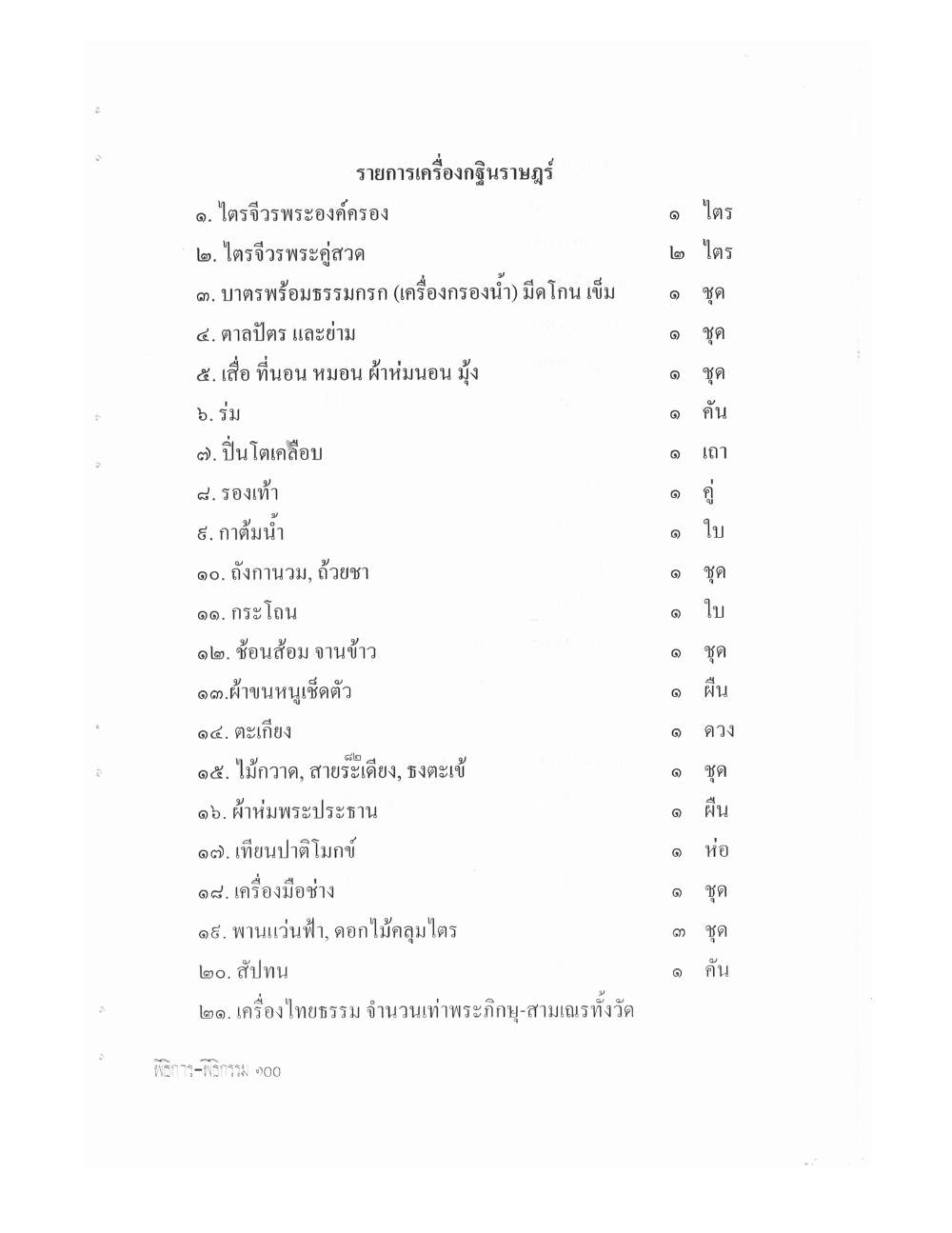
รายการเครื่องกฐินราษฎร์
๑. ไตรจีวรพระองค์ครอง ๑ ไตร ๒. ไตรจีวรพระคู่สวด ๒ ไตร ๓. บาตรพร้อมธรรมกรก (เครื่องกรองน้ำ) มีดโกน เข็ม ๑ ชุด ๔. ตาลปัตร และย่าม ๑ ชุด ๕. เสื่อ ที่นอน หมอน ผ้าห่มนอน มุ้ง ๑ ชุด ๖. ร่ม ๑ คัน ๗. ปิ่นโตเคลือบ ๑ เถา ๘. รองเท้า ๑ คู่ ๙. กาต้มน้ำ ๑ ใบ ๑๐. ถังกานวม, ถ้วยชา ๑ ชุด ๑๑. กระโถน ๑ ใบ ๑๒. ช้อนส้อม จานข้าว ๑ ชุด ๑๓.ผ้าขนหนูเช็ดตัว ๑ ผืน ๑๔. ตะเกียง ๑ ดวง ๑๕. ไม้กวาด, สายระเดียง, ธงตะเข้ ๑ ชุด ๑๖. ผ้าห่มพระประธาน ๑ ผืน ๑๗. เทียนปาติโมกข์ ๑ ห่อ ๑๘. เครื่องมือช่าง ๑ ชุด ๑๙. พานแว่นฟ้า, ดอกไม้คลุมไตร ๓ ชุด ๒๐. สัปทน ๑ คัน ๒๑. เครื่องไทยธรรม จำนวนเท่าพระภิกษุ-สามเณรทั้งวัด
List of Items for a Public (Raatsadon) Kathin
1. Triple robe for the monk who is to wear it — 1 set 2. Triple robes for the two chanting monks — 2 sets 3. Alms bowl with water filter, razor, needle — 1 set 4. Fan (talapat) and shoulder bag — 1 set 5. Mat, mattress, pillow, blanket, mosquito net — 1 set 6. Umbrella — 1 7. Lacquered tiered food carrier (pinto) — 1 8. Sandals — 1 pair 9. Kettle — 1 10. Thermos flask, tea cups — 1 set 11. Spittoon — 1 12. Spoon and fork, rice plate — 1 set 13. Bath towel — 1 14. Lamp — 1 15. Broom, hanging cord, crocodile-tail pennant flag — 1 set 16. Cloth for draping the principal Buddha image — 1 17. Patimokkha candle — 1 bundle 18. Set of craftsman's tools — 1 set 19. Crystal offering trays, flowers to cover the robe set — 3 sets 20. Long-handled sun umbrella (sapathon) — 1 21. Religious gifts (khrueang thai tham), one set for each monk and novice of the whole temple
(เจ้าภาพตัดหรือเติมได้ตามความเหมาะสม)
๒. พระอารามหลวง การขอพระราชทานผ้าพระกฐินไปทอดให้แจ้งกรมการศาสนา ซึ่งกรมการศาสนาจะได้ขึ้นบัญชีผู้ขอพระราชทานไว้กราบบังคมทูล และแจ้งให้ทางวัดทราบ ในทางปฏิบัติ ผู้ขอพระราชทานจะไปติดต่อกับทางวัดในการกำหนดวันนำผ้าพระกฐินพระราชทานไปถวาย และรายละเอียดต่าง ๆ จนถึงก่อนวันกำหนดวันทอด จึงมารับผ้าพระกฐินและเครื่องกฐินพระราชทานจากกรมการศาสนาหรือกรมการศาสนาจัดส่งไปให้ สุดแท้แต่จะตกลงกัน
ข้อแนะนำแนวปฏิบัติ ในการถวายผ้าพระกฐินพระราชทาน
๑. โดยพระราชประเพณี การพระราชทานทรงบำเพ็ญพระราชกุศลถวายผ้าพระกฐิน ณ พระอารามหลวง (จำนวน ๑๖ อาราม) จะเริ่มในวันแรม ๖ ค่ำ เดือน ๑๑ หลังจากออกพรรษาแล้ว ๖ วัน การถวายผ้าพระกฐินพระราชทานควรถวายภายหลังจากพระกฐินที่กำหนดเป็นพระราชพิธีวันแรกแล้ว แต่ในกรณีที่มีความจำเป็นสำคัญ จะถวายผ้าพระกฐินพระราชทานตั้งแต่วันแรม ๑ ค่ำ เดือน ๑๑ ซึ่งเป็นวันแรกของกฐินกาลก็ได้
๒. ธรรมเนียมของพระอารามหลวงทุกพระอาราม เวลารับผ้าพระกฐินจะจัดประกอบพิธีในพระอุโบสถและตั้งอาสน์สงฆ์ทางด้านขวาพระหัตถ์พระประธานเสมอ
๓. ใช้เพลงสรรเสริญพระบารมีบรรเลงในขณะที่ผู้เป็นประธานในพิธีรับผ้าพระกฐินพระราชทานที่หน้าพระอุโบสถ
๔. การรับผ้าพระกฐินพระราชทาน ก่อนที่จะเชิญเข้าไปทำพิธีถวายในพระอุโบสถ มีวิธีปฏิบัติ ๒ วิธี คือ
(The host may reduce or add to this list as appropriate.)
2. Royal Temples (Phra Aram Luang): To request a royally-granted kathin robe (pha phra kathin) for offering, one must notify the Department of Religious Affairs, which will register the request in a list to be submitted respectfully to the King, and will inform the temple concerned. In practice, the party requesting the royal kathin will contact the temple to arrange the date for bringing the royally-granted kathin robe to be offered, along with other details, until, shortly before the appointed offering date, they receive the royal kathin robe and its accompanying items either from the Department of Religious Affairs or have them delivered by the Department — whichever arrangement is agreed upon.
Guidelines for Practice in Offering the Royally-Granted Kathin Robe
1. By royal tradition, the royal merit-making ceremony of offering the royal kathin robe at the Royal Temples (16 temples in total) begins on the sixth day of the waning moon of the eleventh month, six days after the end of Vassa. The offering of the royally-granted kathin robe should take place after the kathin designated as the first day of the royal ceremony; however, in cases of important necessity, the royally-granted kathin robe may be offered starting from the first day of the waning moon of the eleventh month, which is the first day of the kathin season.
2. By the custom of every Royal Temple, when the royal kathin robe is received, the ceremony is arranged within the ordination hall (ubosot), with the monks' seating always set up to the right hand of the principal Buddha image.
3. The Royal Anthem (Phleng Sansoen Phra Barami) is played while the presiding officer of the ceremony receives the royally-granted kathin robe in front of the ordination hall.
4. For receiving the royally-granted kathin robe, before it is brought in to perform the offering ceremony within the ordination hall, there are two methods of practice, namely:
๔.๑ จัดเจ้าหน้าที่ซึ่งแต่งเครื่องแบบปกติขาว คอยส่งผ้าพระกฐินให้ประธานในพิธีที่เชิงบันไดพระอุโบสถหรือหน้าประตูเข้าพระอุโบสถ
๔.๒ จัดโต๊ะหมู่บูชาที่หน้าพระอุโบสถหรือเชิงบันไดพระอุโบสถตามความเหมาะสม โดยตั้งพระบรมฉายาลักษณ์หรือพระบรมสาทิสลักษณ์ของพระบาทสมเด็จพระเจ้าอยู่หัว มีแจกันดอกไม้สดหรือพานพุ่มดอกไม้ ๑ คู่ (จัดประดับได้ตามความเหมาะสมของโต๊ะหมู่) ตัวกลางที่ ๒ วางพานแว่นฟ้าหรือตะลุ่มมุกสำหรับวางผ้าพระกฐินตัวกลางล่างวางธูปเทียนแพและกรวยดอกไม้ ๑ ชุด เมื่อใกล้ถึงเวลาตามกำหนดการ ให้นำผ้าพระกฐินไปวางบนพานแว่นฟ้าที่จัดไว้นั้นไม่ต้องใช้พุ่มครอบไตร
๕. การแต่งกาย
๕.๑ ข้าราชการ - พนักงานรัฐวิสาหกิจ
- ผู้เป็นประธานในพิธี แต่งเครื่องแบบปกติ
- ผู้ร่วมพิธี แต่งเครื่องแบบปกติขาว ชุดเครื่องแบบปฏิบัติงาน ชุดพระราชทาน ชุดสากลนิยม หรือชุดสุภาพ
๕.๒ หน่วยงานเอกชน
- ผู้เป็นประธานในพิธี สุภาพบุรุษ แต่งชุดขาวคอขอเข้าเฝ้าฯ ชุดพระราชทานแขนยาว ชุดสูทแบบฟอร์มประจำหน่วยงาน/สถานศึกษา ชุดสากลนิยม สุภาพสตรี แต่งชุดไทยแขนยาว - แขนสั้น ชุดสูท แบบฟอร์มประจำหน่วยงาน/สถานศึกษา
- ผู้ร่วมพิธี แต่งชุดพระราชทานแขนยาว – แขนสั้น ชุดสูทแบบฟอร์มประจำหน่วยงาน/ สถานศึกษา ชุดสากลนิยม หรือชุดสุภาพ
๕.๓ พ่อค้า คหบดี ประชาชนผู้มีเกียรติ
4.1 An official dressed in the standard white uniform is assigned to hand the royal kathin robe to the presiding officer of the ceremony at the foot of the ordination hall steps or at the entrance door of the ordination hall.
4.2 A group-shrine table is set up in front of the ordination hall or at the foot of its steps, as suitable, with a royal photographic portrait or painted portrait of His Majesty the King placed on it, and a vase of fresh flowers or a pair of flower arrangements (decoration may be arranged as suitable for the group-shrine table). On the second, middle tier, a crystal offering tray or mother-of-pearl inlaid stand is placed to hold the royal kathin robe; on the lower middle tier, a set of incense, paired candles, and a flower cone is placed. When the appointed time draws near, the royal kathin robe is brought and placed on the crystal offering tray that has been prepared; there is no need to use a flower bouquet to cover the robe set.
5. Dress Code
5.1 Government officials — state enterprise employees
- The presiding officer of the ceremony wears standard uniform
- Ceremony participants wear the standard white uniform, working uniform, royally-granted attire (chut phrarachathan), international formal dress, or formal/polite dress
5.2 Private organizations
- The presiding officer of the ceremony: for men, white attire with stand-up collar suitable for a royal audience, long-sleeved royally-granted attire, a suit in the organization's/institution's uniform style, or international formal dress; for women, Thai dress with long or short sleeves, or a suit in the organization's/institution's uniform style
- Ceremony participants wear long- or short-sleeved royally-granted attire, a suit in the organization's/institution's uniform style, international formal dress, or formal/polite dress
5.3 Merchants, notable persons, and members of the public of standing
- ผู้เป็นประธานในพิธี สุภาพบุรุษ แต่งชุดขาวคอขอเข้าเฝ้าฯ ชุดพระราชทานแขนยาว ชุดสากลนิยม สุภาพสตรี แต่งชุดไทยแขนยาว - แขนสั้น
- ผู้ร่วมพิธี แต่งกายชุดพระราชทานแขนยาว - แขนสั้น ชุดไทย ชุดสากลนิยม หรือชุดสุภาพ
๕.๔ ผู้ร่วมพิธีที่เป็นข้าราชการ ให้แต่งเครื่องแบบปกติขาวชุดเครื่องแบบปฏิบัติงาน ชุดพระราชทานแขนยาว - แขนสั้น ชุดสากลนิยมหรือชุดสุภาพ
๖. พิธีถวายผ้าพระกฐินพระราชทาน ไม่มีการสมาทานศีล
๗. พระสงฆ์ใช้พัดยศทำพิธีกฐินกรรมมือปโลกน์เป็นต้น ตลอดทั้งอนุโมทนาให้พรและถวายอดิเรก (พระราชาคณะประธานสงฆ์กล่าวคำถวายพระพรเป็นพิเศษเฉพาะแต่พระบาทสมเด็จพระเจ้าอยู่หัวเป็นภาษาบาลี) ในขณะที่พระสงฆ์ถวายอดิเรก ไม่ต้องประนมมือ
๘. ในกรณีที่เจ้าภาพจัดทำตาลปัตร (พัดรอง) เป็นการโดยเสด็จพระราชกุศลในพิธีถวายผ้าพระกฐินพระราชทานด้วย ประธานสงฆ์จะใช้พัดรองนั้นตั้งอนุโมทนา ยะถา...สัพพีติโย...ก็ได้ เพื่อเป็นการฉลองศรัทธาให้ปีติปราโมทย์ในการบุญพระกฐินทานยิ่งขึ้น แต่เมื่อจะกล่าวคำถวายอดิเรกจะต้องใช้พัดยศและใช้ไปจนจบ ภะวะตุ สัพพะมังคะลังฯ
๙. ผู้มีความประสงค์จะรับพระราชทานผ้าพระกฐิน (ขอจองพระกฐิน) ติดต่อแจ้งความจำนงได้ที่กรมการศาสนา หรือเจ้าอาวาสพระอารามหลวงนั้นโดยตรงก็ได้ ซึ่งทางวัดจะแจ้งมายังกรมการศาสนาเพื่อทราบและดำเนินการต่อไป การขอรับพระราชทานผ้าพระกฐินสามารถแจ้งความจำนงได้ตลอดทั้งปี
๑๐. เมื่อถวายผ้าพระกฐินพระราชทานแล้ว ให้ส่งแบบฟอร์มบัญชีรายงานถวายพระราชกุศลคืนกรมการศาสนาภายใน ๑๕ วัน เพื่อจะได้รวบรวมและ
- The presiding officer of the ceremony: for men, white attire with a stand-up collar suitable for a royal audience, long-sleeved royally-granted attire, international formal dress; for women, Thai dress with long or short sleeves
- Ceremony participants wear long- or short-sleeved royally-granted attire, Thai dress, international formal dress, or formal/polite dress
5.4 Ceremony participants who are government officials should wear the standard white uniform, working uniform, long- or short-sleeved royally-granted attire, international formal dress, or formal/polite dress
6. In the ceremony of offering the royally-granted kathin robe, there is no taking of the precepts (sila).
7. The monks use their rank fans (phat yot) to perform the kathin rite, including the aplokana announcement, as well as throughout the giving of the blessing (anumodana) and the recitation of the Adireka (special royal blessing) — only the senior ecclesiastical dignitary presiding over the Sangha recites the words offering the special blessing exclusively to His Majesty the King, in the Pali language. While the monks recite the Adireka, they need not hold their palms joined.
8. In cases where the host has also had fans (talapat, i.e. "phat rong") made as an act of merit accompanying the offering of the royal kathin robe, the presiding monk may use that fan while delivering the blessing beginning "Yathā... Sabbītiyo...", so as to honor the donors' faith and increase their joy and delight in the merit of the kathin offering; however, when reciting the words of the Adireka, the rank fan (phat yot) must be used, continuing with it all the way through to the end at "Bhavatu sabbamaṅgalaṃ..."
9. Anyone wishing to receive a royally-granted kathin robe (to request/reserve a royal kathin) may contact the Department of Religious Affairs to state their wish, or may contact the abbot of that Royal Temple directly, in which case the temple will inform the Department of Religious Affairs so that it may be noted and processed further. Requests to receive a royally-granted kathin robe may be submitted at any time throughout the year.
10. After the royally-granted kathin robe has been offered, the report form recording the offering of royal merit must be returned to the Department of Religious Affairs within 15 days, so that it may be gathered together and...
ดำเนินการนำความกราบบังคมทูลพระกรุณาทราบฝ่าละอองธุลีพระบาท ขอพระราชทานถวายพระราชกุศล
การจัดผ้าไตรพระกฐินพระราชทาน
๑. ผ้าไตรพระกฐิน ให้แกะพลาสติกออกเสียก่อนแล้วจึงติดแผ่นคำถวายบนผ้าไตรพระกฐินและวางผ้าห่มพระประธานบนคำถวายนั้น ควรใช้เทปใสติดยึดไว้ เพื่อกันไม่ให้เลื่อนหล่นในขณะหยิบยกให้ติดแต่พออยู่ เพราะประธานในพิธีจะต้องหยิบผ้าห่มพระประธานส่งให้ไวยาวัจกรก่อนที่จะกล่าวคำถวายผ้าพระกฐิน เมื่อจัดเสร็จเรียบร้อยแล้ววางบนพานแว่นฟ้าตั้งไว้ ณ ที่อันสมควร
๒. วัดที่มีผ้าไตรจีวรและผ้าขาวด้วย (ผ้ากฐินทุสสะ - ธรรมยุตทุกวัดและมหานิกาย ๕ วัด) วิธีจัดเมื่อแกะพลาสติกออกแล้ว ให้วางผ้าขาวบนไตรจีวรควรใช้ริบบิ้นสีเหลืองผูกรวมกันไว้ให้เรียบร้อย ต่อมาติดแผ่นคำถวายบนผ้าขาว และสุดท้ายให้วางผ้าห่มพระประธานบนคำถวายนั้น (ควรใช้เทปใสติดยึดไว้) จัดเสร็จเรียบร้อยแล้ววางบนพานแว่นฟ้าตั้งไว้ ณ ที่อันสมควร
การจัดเครื่องบริวารพระกฐินพระราชทาน
๑. ควรแกะออกจากกล่องหรือเอาพลาสติกออกเสียก่อนแล้วจัดใส่ตะลุ่มหรือภาชนะที่เหมาะสม โดยสิ่งไหนที่พอจะจัดไว้ในชุดเดียวกันได้ก็ควรจัดใส่พานเดียวกัน หรือจัดไว้ด้วยกันแล้วผูกด้วยริบบิ้น ซึ่งจะทำให้ดูเรียบร้อยสวยงามและง่ายต่อการหยิบยกในพิธีถวาย
๒. ในวันถวาย ควรจัดโต๊ะปูด้วยผ้าขาว ตั้งไว้ทางท้ายอาสน์สงฆ์ สำหรับวางเครื่องบริวารพระกฐินและไทยธรรมที่จัดมาเพื่อถวายพระภิกษุ สามเณร
...processed for submission, respectfully reporting to His Majesty the King, so as to request that the royal merit be granted.
Preparing the Royal Kathin Robe Set
1. For the triple robe of the royal kathin: first remove the plastic wrapping, then attach the offering-text placard onto the robe set, and place the cloth for draping the principal Buddha image on top of the placard. Clear tape should be used to secure it in place, so that it does not slip or fall while being lifted, while still being attached loosely enough to be removed — because the presiding officer of the ceremony must take the cloth for draping the principal image and hand it to the temple steward (waiyawatchakon) before reciting the words offering the royal kathin robe. Once everything is properly arranged, place it on the crystal offering tray set in a suitable location.
2. For temples that also have a set of plain white cloth along with the triple robes (kathin robe-cloth — for every Thammayut temple and 5 Mahanikai temples): once the plastic is removed, the method is to place the white cloth on top of the triple robes, and it is advisable to tie them neatly together with yellow ribbon; next, attach the offering-text placard onto the white cloth, and finally place the cloth for draping the principal image on top of the placard (clear tape should be used to secure it). Once properly arranged, place it on the crystal offering tray set in a suitable location.
Preparing the Accompanying Gifts for the Royal Kathin
1. These should first be taken out of their boxes or plastic wrapping, then arranged into trays or suitable containers. Items that can suitably be grouped together as one set should be placed on the same tray, or arranged together and tied with ribbon, which makes them look neat and attractive and makes them easy to lift and carry during the offering ceremony.
2. On the day of the offering, a table covered with white cloth should be set up behind the monks' seating area, to hold the accompanying royal kathin gifts and the religious gifts (khrueang thai tham) prepared to be offered to the monks and novices.
๓. การวางตะลุ่มหรือพานเครื่องบริวารพระกฐิน ควรจัดเรียงตามลำดับสิ่งของใช้สอย คือเริ่มจากบาตร หมอนหนุน ผ้าห่ม พรมภาชนะใส่อาหารคาวหวาน กระติกน้ำ และสุดท้ายเป็นเครื่องมือโยธา หากสถานที่จำกัดจะตั้งเรียงเป็น ๒ แถว ก็ได้ เมื่อยกส่งให้ประธานในพิธีประเคนพระเถระองค์ครอง ก็ให้ยกบาตรไปก่อน แล้วจึงยกสิ่งอื่นไปตามลำดับที่จัดไว้ (ยกทั้งตะลุ่มหรือพาน)
เครื่องไทยธรรม
เครื่องไทยธรรม ที่ทางผู้ขอรับพระราชทานผ้าพระกฐินจัดมาเพื่อถวายพระภิกษุ สามเณร ซึ่งเป็นการบริจาคเพิ่มเติมโดยเสด็จพระราชกุศล ให้วางต่อจากเครื่องบริวารพระกฐินพระราชทาน แต่ให้จัดเป็นสัดส่วน ไม่ให้ปะปนรวมกัน
(ตัวอย่าง)
พิธีถวายผ้าพระกฐินพระราชทาน
เวลา น. - ข้าราชการ สาธุชนผู้มีเกียรติ อุบาสก อุบาสิกา พร้อมกัน ณ พระอุโบสถ
- ประธานในพิธีเดินทางมาถึงหน้าพระอุโบสถ ไปที่ตั้งโต๊ะหมู่ซึ่งตั้งผ้าพระกฐินไว้ (ผู้ร่วมพิธีลุกขึ้นยืน)
- ยืนถวายความเคารพพระบรมฉายาลักษณ์
- เปิดกรวยดอกไม้ ถวายความเคารพพระบรมฉายาลักษณ์หรือพระบรมสาทิสลักษณ์พระบาทสมเด็จพระเจ้าอยู่หัว (โดยวิธีคำนับถอนสายบัวหรือประนมมือไหว้) อีกครั้งหนึ่ง
3. In placing the trays or containers of accompanying kathin gifts, they should be arranged in order according to their use — starting with the alms bowl, pillow, blanket, rug/carpet, containers for savory and sweet dishes, water flask, and finally the craftsman's tools. If space is limited, they may be set out in two rows. When lifting them to present to the presiding officer of the ceremony for offering to the senior monk who is to wear the robe, the alms bowl should be lifted first, and the other items lifted afterward in the order arranged (lifting the whole tray or container together).
Religious Gifts (Khrueang Thai Tham)
The religious gifts that the party requesting the royally-granted kathin robe prepares to offer to the monks and novices — being an additional donation given as an act of royal merit — should be placed following the accompanying royal kathin gifts, but arranged as a distinct group, not mixed together with them.
(Example)
Ceremony of Offering the Royally-Granted Kathin Robe
Time [__:__] — Government officials, respected devotees, laymen and laywomen assemble together at the ordination hall (ubosot)
- The presiding officer of the ceremony arrives at the front of the ordination hall and proceeds to the group-shrine table where the royal kathin robe has been placed (ceremony participants rise to their feet)
- Stands to pay respects to the royal portrait
- Opens the flower cone, paying respects once more to the royal photographic portrait or painted portrait of His Majesty the King (by the method of a bow with a lotus-bud gesture, or with palms joined in a wai)
- ยกผ้าพระกฐินขึ้นอุ้มประคองไว้ตรงอกยืนตรงแสดงความเคารพพระบาทสมเด็จพระเจ้าอยู่หัว (ขณะที่ประธานยกผ้าพระกฐินอุ้มประคอง ดนตรีบรรเลงเพลงสรรเสริญพระบารมี ถ้าไม่มีให้ใช้เทปแทน) จบแล้ว
- อุ้มประคองผ้าพระกฐินเดินเข้าสู่พระอุโบสถ ตรงไปวางผ้าพระกฐินที่พานแว่นฟ้า ซึ่งตั้งอยู่ชิดอาสน์สงฆ์ตรงหน้าพระสงฆ์รูปที่ ๒
- ประธานจุดธูปเทียนบูชาพระรัตนตรัยกราบแล้วไปที่พานแว่นฟ้า หยิบผ้าห่มพระประธานที่วางอยู่บนผ้าไตรพระกฐินส่งให้เจ้าหน้าที่หรือไวยาวัจกร
- ยกผ้าพระกฐินขึ้นประคอง หันหน้าทางพระประธานประนมมือว่า นะโม ตัสสะ ภะคะวะโต อะระหะโต สัมมาสัมพุทธัสสะ (๓ จบ) แล้วหันหน้ามาทางพระสงฆ์ กล่าวคำถวายผ้าพระกฐิน “ผ้าพระกฐินทานกับทั้งผ้าอานิสงสบริวารทั้งปวงนี้ ของพระบาทสมเด็จพระปรมินทรมหาภูมิพลอดุลยเดช มหิตลาธิเบศรามาธิบดี จักรีนฤบดินทร สยามินทราธิราช บรมนาถบพิตร ผู้ทรงพระคุณอันประเสริฐ กอปรด้วยพระราชศรัทธา โปรดเกล้าฯ ให้ (ระบุนามบุคคลหรือหน่วยงานที่ได้รับพระราชทาน) น้อมนำมาถวายแด่พระสงฆ์ซึ่งจำพรรษากาลถ้วนไตรมาส ในอาวาสวิหารนี้ ขอพระสงฆ์จงรับผ้าพระกฐินทานนี้ กระทำกฐินัตถารกิจ ตามพระบรมพุทธานุญาตนั้น เทอญ” (พระสงฆ์รับสาธุพร้อมกัน)
- Lifts the royal kathin robe, cradling it against the chest, standing upright to show respect to His Majesty the King (while the presiding officer holds the royal kathin robe cradled in this way, music plays the Royal Anthem — Phleng Sansoen Phra Barami; if there is no live music, a recording is used instead), until it concludes
- Carries the royal kathin robe cradled in the arms, walking into the ordination hall, going directly to place the royal kathin robe on the crystal offering tray, which is set close to the monks' seating, directly in front of the second-ranking monk
- The presiding officer lights incense and candles to venerate the Triple Gem, pays respects (grab), then goes to the crystal offering tray, takes the cloth for draping the principal Buddha image that rests atop the royal kathin robe set, and hands it to an official or to the temple steward (waiyawatchakon)
- Lifts the royal kathin robe up, cradling it, faces the principal Buddha image, joins palms and recites: "Namo tassa bhagavato arahato sammāsambuddhassa" (three times), then turns to face the monks and recites the words offering the royal kathin robe: "This offering of the kathin robe, together with all its accompanying gifts of merit, belonging to His Majesty King Bhumibol Adulyadej the Great — Mahitalathibet Ramathibodi, Chakri Naruebodindra, Siam Mindrathiraj, the Supreme Sovereign Protector, possessed of excellent and noble virtue — who, moved by royal faith, has graciously commanded that (here the name of the person or organization receiving the royal grant is stated) humbly bring and present it to the Sangha who have completed the full three months of the rains retreat in this monastery: may the Sangha please accept this offering of the kathin robe, and perform the kathin-conferral rite in accordance with the Buddha's own permission." (The monks together respond "Sādhu.")
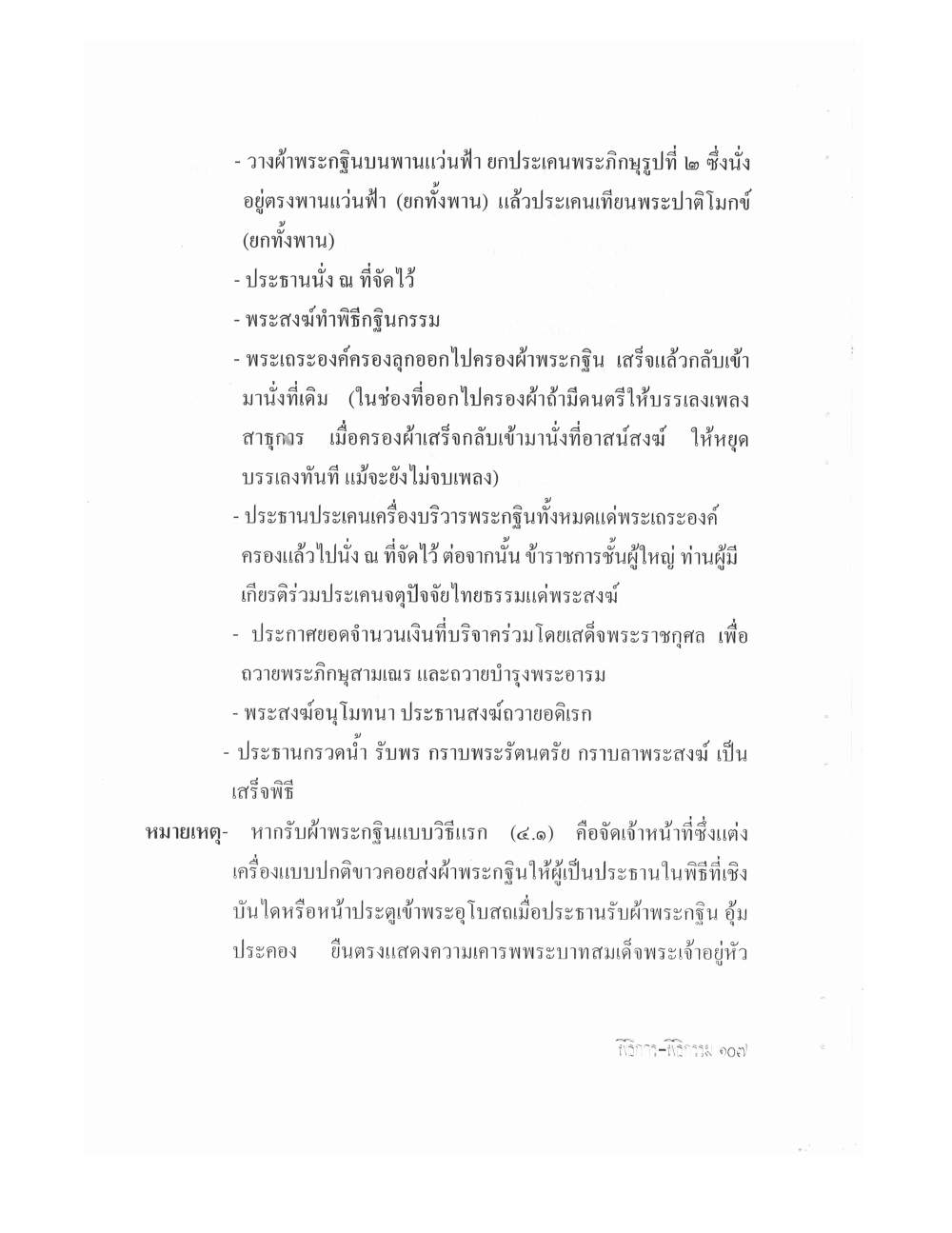
- วางผ้าพระกฐินบนพานแว่นฟ้า ยกประเคนพระภิกษุรูปที่ ๒ ซึ่งนั่งอยู่ตรงพานแว่นฟ้า (ยกทั้งพาน) แล้วประเคนเทียนพระปาติโมกข์ (ยกทั้งพาน) - ประธานนั่ง ณ ที่จัดไว้ - พระสงฆ์ทำพิธีกฐินกรรม - พระเถระองค์ครองลุกออกไปครองผ้าพระกฐิน เสร็จแล้วกลับเข้ามานั่งที่เดิม (ในช่วงที่ออกไปครองผ้าถ้ามีดนตรีให้บรรเลงเพลงสาธุการ เมื่อครองผ้าเสร็จกลับเข้ามานั่งที่อาสน์สงฆ์ ให้หยุดบรรเลงทันที แม้จะยังไม่จบเพลง) - ประธานประเคนเครื่องบริวารพระกฐินทั้งหมดแด่พระเถระองค์ครองแล้วไปนั่ง ณ ที่จัดไว้ ต่อจากนั้น ข้าราชการชั้นผู้ใหญ่ ท่านผู้มีเกียรติร่วมประเคนจตุปัจจัยไทยธรรมแด่พระสงฆ์ - ประกาศยอดจำนวนเงินที่บริจาคร่วมโดยเสด็จพระราชกุศล เพื่อถวายพระภิกษุสามเณร และถวายบำรุงพระอาราม - พระสงฆ์อนุโมทนา ประธานสงฆ์ถวายอดิเรก - ประธานกรวดน้ำ รับพร กราบพระรัตนตรัย กราบลาพระสงฆ์ เป็นเสร็จพิธี หมายเหตุ- หากรับผ้าพระกฐินแบบวิธีแรก (๔.๑) คือจัดเจ้าหน้าที่ซึ่งแต่งเครื่องแบบปกติขาวคอยส่งผ้าพระกฐินให้ผู้เป็นประธานในพิธีที่เชิงบันไดหรือหน้าประตูเข้าพระอุโบสถ เมื่อประธานรับผ้าพระกฐิน อุ้มประคอง ยืนตรงแสดงความเคารพพระบาทสมเด็จพระเจ้าอยู่หัว
- Place the kathin robe on the tiered offering tray (phan waen fa), lift it and present it to the second monk seated at the phan waen fa (lift the whole tray), then present the Patimokkha candle (lift the whole tray). - The presiding officer sits at the place arranged for him. - The Sangha performs the kathin rite. - The senior monk who is to wear the robe rises and goes to robe himself in the kathin cloth; when finished he returns to sit in his original place. (While he is out robing, if there is music, the ensemble should play the Sathukan hymn; once he finishes robing and returns to sit on the monks' seat, the music must stop immediately, even if the piece is not yet finished.) - The presiding officer presents all the kathin accessory offerings to the senior monk who wore the robe, who then goes to sit at the place arranged for him. After that, senior officials and other honored guests join in presenting the four requisites and Thai offerings to the monks. - The total amount of money donated is announced, given on behalf of the royal merit-making, to be offered to the monks and novices and for the upkeep of the temple. - The monks give the anumodana blessing; the presiding monk recites the Adireka blessing. - The presiding officer pours the water of dedication, receives the blessing, pays respect to the Triple Gem, and takes leave of the Sangha with a bow — the ceremony is complete. Note — If receiving the kathin robe by the first method (4.1), an official dressed in the standard white uniform is arranged to hand the kathin robe to the presiding officer at the foot of the stairs or at the entrance to the ordination hall. When the presiding officer receives the kathin robe, he holds it cradled in his arms and stands at attention to show respect for His Majesty the King
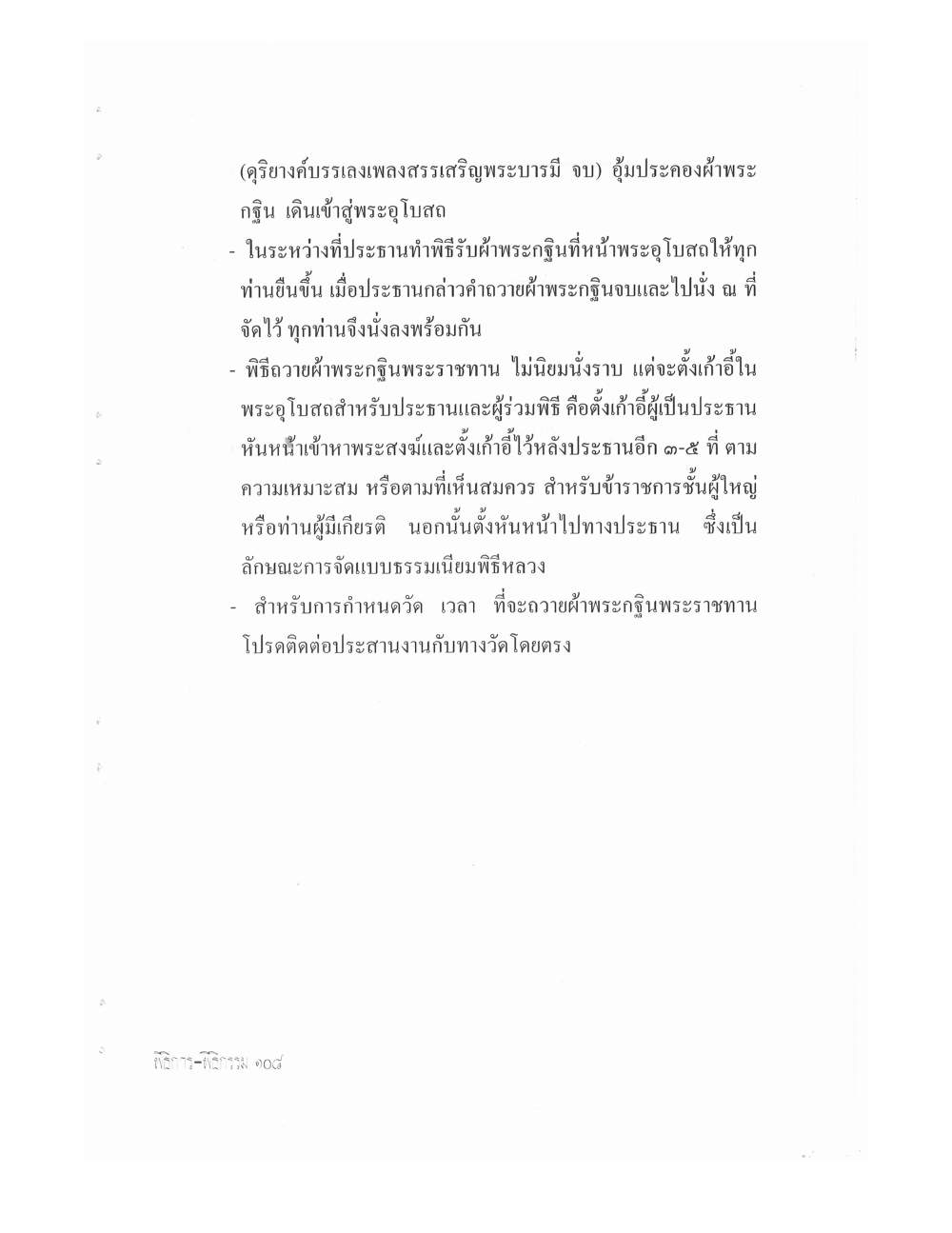
(ดุริยางค์บรรเลงเพลงสรรเสริญพระบารมี จบ) อุ้มประคองผ้าพระกฐิน เดินเข้าสู่พระอุโบสถ - ในระหว่างที่ประธานทำพิธีรับผ้าพระกฐินที่หน้าพระอุโบสถให้ทุกท่านยืนขึ้น เมื่อประธานกล่าวคำถวายผ้าพระกฐินจบและไปนั่ง ณ ที่จัดไว้ ทุกท่านจึงนั่งลงพร้อมกัน - พิธีถวายผ้าพระกฐินพระราชทาน ไม่นิยมนั่งราบ แต่จะตั้งเก้าอี้ในพระอุโบสถสำหรับประธานและผู้ร่วมพิธี คือตั้งเก้าอี้ผู้เป็นประธานหันหน้าเข้าหาพระสงฆ์และตั้งเก้าอี้ไว้หลังประธานอีก ๓-๕ ที่ ตามความเหมาะสม หรือตามที่เห็นสมควร สำหรับข้าราชการชั้นผู้ใหญ่หรือท่านผู้มีเกียรติ นอกนั้นตั้งหันหน้าไปทางประธาน ซึ่งเป็นลักษณะการจัดแบบธรรมเนียมพิธีหลวง - สำหรับการกำหนดวัด เวลา ที่จะถวายผ้าพระกฐินพระราชทาน โปรดติดต่อประสานงานกับทางวัดโดยตรง
(the band finishes playing the Royal Anthem) He holds the kathin robe cradled in his arms and walks into the ordination hall. - While the presiding officer performs the rite of receiving the kathin robe in front of the ordination hall, everyone is to stand. Once the presiding officer finishes reciting the words of offering the kathin robe and goes to sit in the place arranged for him, everyone then sits down together. - For the ceremony of offering a royally-bestowed kathin robe, sitting on the floor is not customary; instead chairs are set up inside the ordination hall for the presiding officer and participants — that is, a chair for the presiding officer facing the monks, with another 3-5 chairs set behind the presiding officer's chair as appropriate or as deemed fitting, for senior officials or honored guests. The rest are arranged facing toward the presiding officer, which is characteristic of the arrangement used in royal ceremonial custom. - For arranging which temple and what time the royally-bestowed kathin robe will be offered, please liaise directly with the temple.
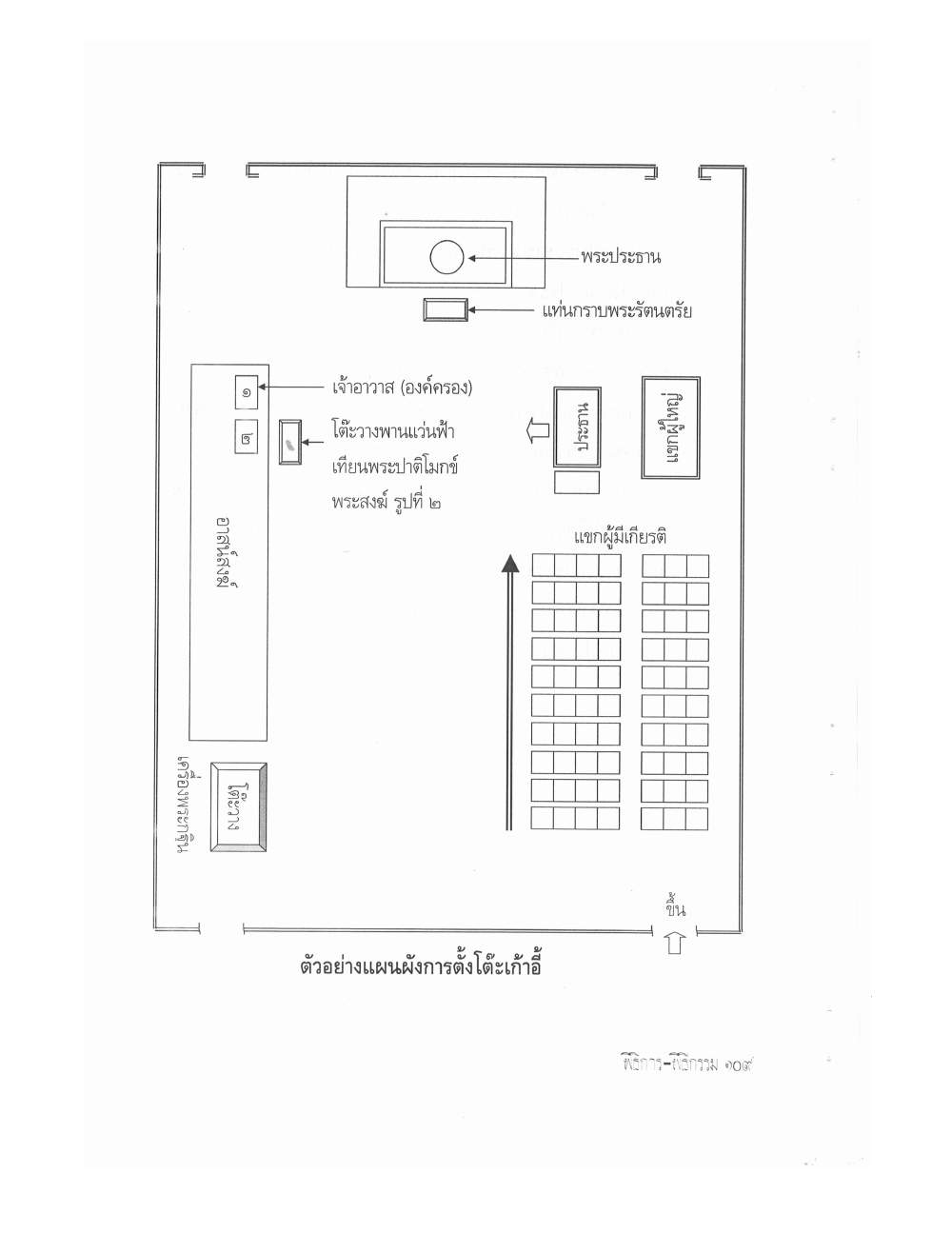
[แผนผัง: แผนผังห้องประชุมพิธีถวายผ้าพระกฐิน แสดงตำแหน่งโต๊ะและเก้าอี้] พระประธาน (วงกลมในซุ้ม ด้านบนกลางผัง) แท่นกราบพระรัตนตรัย (สี่เหลี่ยมเล็กใต้พระประธาน) เจ้าอาวาส (องค์ครอง) — กล่องหมายเลข ๑ โต๊ะวางพานแว่นฟ้า เทียนพระปาติโมกข์ พระสงฆ์ รูปที่ ๒ — กล่องหมายเลข ๒ อาสน์สงฆ์ (แถบสี่เหลี่ยมยาวแนวตั้งด้านซ้าย) [ตัวอักษรแนวตั้งมุมล่างซ้าย อ่านไม่ออก] ประธาน (กล่องกลางผัง มีลูกศรชี้ไปทางซ้าย) แขกผู้ใหญ่ (กล่องด้านขวา) แขกผู้มีเกียรติ (ตารางที่นั่งจำนวนมากด้านล่าง มีลูกศรชี้ขึ้นตรงกลาง) ขึ้น (มีลูกศรชี้ขึ้น มุมล่างขวา) ตัวอย่างแผนผังการตั้งโต๊ะเก้าอี้
[Diagram: floor plan of the hall for the kathin-robe offering ceremony, showing the placement of tables and chairs] พระประธาน (main Buddha image) — a circle within a shrine, top center of the plan แท่นกราบพระรัตนตรัย (pedestal for paying respect to the Triple Gem) — small rectangle below the Buddha image เจ้าอาวาส (องค์ครอง) (the abbot, the robe-wearer) — box 1 โต๊ะวางพานแว่นฟ้า เทียนพระปาติโมกข์ พระสงฆ์ รูปที่ ๒ (table holding the tiered tray and the Patimokkha candle, monk no. 2) — box 2 อาสน์สงฆ์ (monks' seating bench) — the long vertical rectangle on the left [vertical text in the bottom-left corner, illegible] ประธาน (the presiding officer) — box at the center of the plan, with an arrow pointing left แขกผู้ใหญ่ (senior guests) — box on the right แขกผู้มีเกียรติ (honored guests) — a grid of many seats below, with an arrow pointing up through the center ขึ้น (up / entrance) — with an upward arrow, bottom right corner ตัวอย่างแผนผังการตั้งโต๊ะเก้าอี้ (example floor plan for the arrangement of tables and chairs)
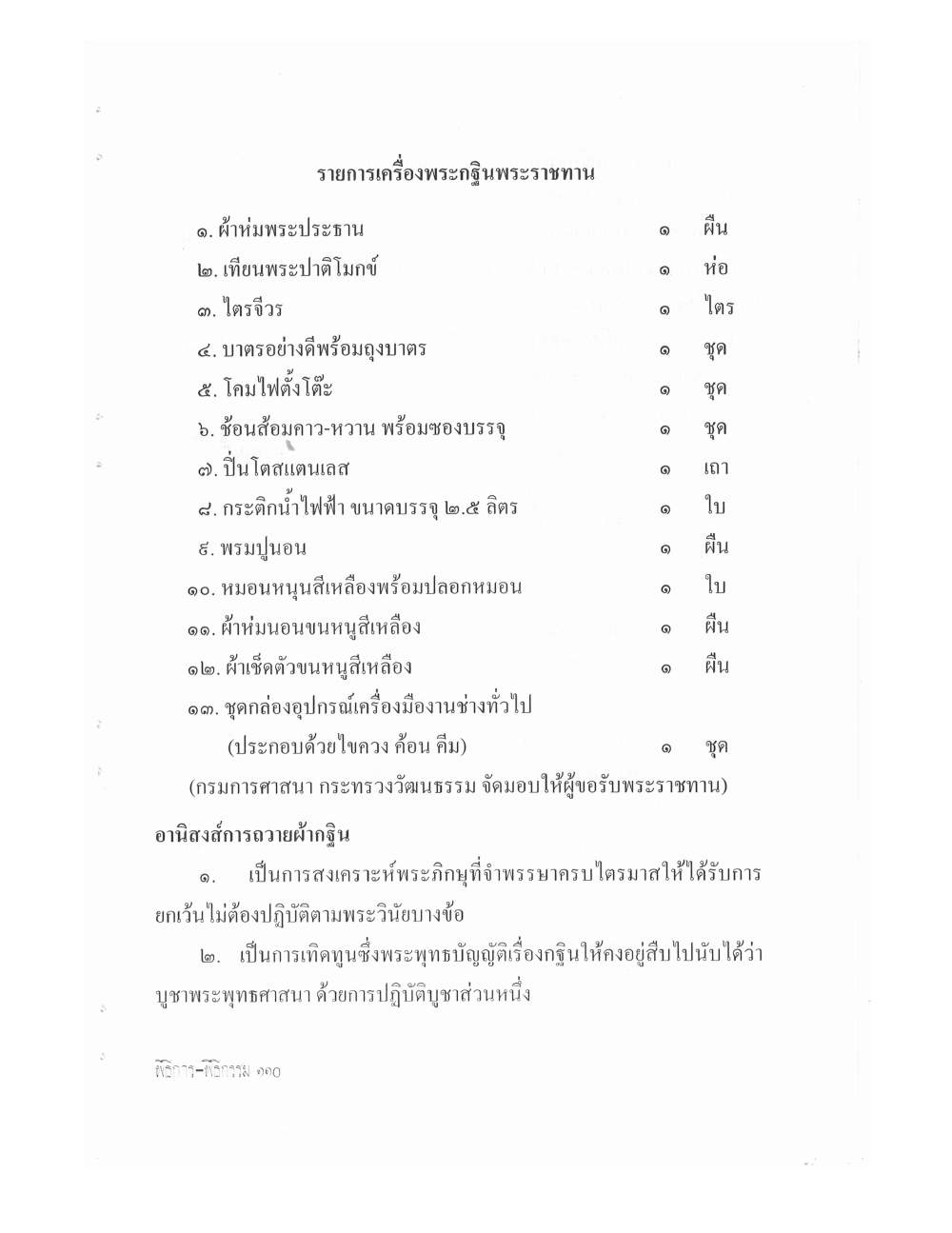
รายการเครื่องพระกฐินพระราชทาน
๑. ผ้าห่มพระประธาน ๑ ผืน ๒. เทียนพระปาติโมกข์ ๑ ห่อ ๓. ไตรจีวร ๑ ไตร ๔. บาตรอย่างดีพร้อมถุงบาตร ๑ ชุด ๕. โคมไฟตั้งโต๊ะ ๑ ชุด ๖. ช้อนส้อมคาว-หวาน พร้อมซองบรรจุ ๑ ชุด ๓. ปิ่นโตสแตนเลส ๑ เถา ๘. กระติกน้ำไฟฟ้า ขนาดบรรจุ ๒.๕ ลิตร ๑ ใบ ๔. พรมปูนอน ๑ ผืน ๑๐. หมอนหนุนสีเหลืองพร้อมปลอกหมอน ๑ ใบ ๑๑. ผ้าห่มนอนขนหนูสีเหลือง ๑ ผืน ๑๒. ผ้าเช็ดตัวขนหนูสีเหลือง ๑ ผืน ๑๓. ชุดกล่องอุปกรณ์เครื่องมืองานช่างทั่วไป (ประกอบด้วยไขควง ค้อน คีม) ๑ ชุด (กรมการศาสนา กระทรวงวัฒนธรรม จัดมอบให้ผู้ขอรับพระราชทาน)
อานิสงส์การถวายผ้ากฐิน
๑. เป็นการสงเคราะห์พระภิกษุที่จำพรรษาครบไตรมาสให้ได้รับการยกเว้นไม่ต้องปฏิบัติตามพระวินัยบางข้อ ๒. เป็นการเทิดทูนซึ่งพระพุทธบัญญัติเรื่องกฐินให้คงอยู่สืบไปนับได้ว่าบูชาพระพุทธศาสนา ด้วยการปฏิบัติบูชาส่วนหนึ่ง
List of Items in the Royally-Bestowed Kathin Robe Set
1. Cloth to drape the principal Buddha image — 1 piece 2. Patimokkha candle — 1 bundle 3. Set of three robes (triple robe) — 1 set 4. Fine-quality alms bowl with bowl bag — 1 set 5. Table lamp — 1 set 6. Savory- and sweet-course spoon and fork with carrying pouch — 1 set 7. Stainless steel tiered food carrier — 1 stack 8. Electric water flask, 2.5-litre capacity — 1 unit 9. Sleeping mat/rug — 1 piece 10. Yellow pillow with pillowcase — 1 piece 11. Yellow terrycloth blanket — 1 piece 12. Yellow terrycloth towel — 1 piece 13. Boxed set of general craftsman's tools (comprising a screwdriver, hammer, and pliers) — 1 set (Provided by the Department of Religious Affairs, Ministry of Culture, to be given to the recipient of the royal bestowal.)
Merits of Offering the Kathin Robe
1. It is an act of support for monks who have completed the full three-month rains retreat, granting them exemption from certain minor monastic disciplinary rules. 2. It upholds the Buddha's ordinance concerning the kathin robe so that it continues to be observed, counting as a form of veneration of the Buddhist religion through practice.
๓. สืบต่อประเพณีกฐินทานมิให้เสื่อมสลายไปจากวัฒนธรรมประเพณีของคนไทย ซึ่งบรรพบุรุษนำสืบต่อกันมามิขาดสาย ๔. ลักษณะการทอดกฐิน เป็นการบริจาคโดยมิเจาะจงบุคคลใดโดยเฉพาะ แต่เจาะจงหมู่สงฆ์เป็นส่วนรวม จึงเข้าลักษณะเป็น "สังฆทาน" ที่พระพุทธองค์สรรเสริญว่ามีผลานิสงส์มาก ๕. การร่วมบำเพ็ญกุศลกฐินทาน เป็น "กาลทาน" ให้ในคราวที่ผู้รับต้องการ ภายในเวลาที่มีพระพุทธานุญาตกำหนด จึงมีอานิสงส์เป็นพิเศษ ๖. ในการทอดกฐิน ส่วนใหญ่เป็นการร่วมมือร่วมใจกันระหว่างคนจำนวนมากเพื่อสร้างความดีงาม จึงเป็นการเสริมสร้างพลังสามัคคีขึ้นในสังคม ซึ่งเป็นผลให้เกิดความเจริญก้าวหน้าได้ทางหนึ่ง ๗. เงินทุกบาททุกสตางค์ที่บริจาคจะแปรสภาพเป็นโบสถ์วิหาร ศาลาการเปรียญ ตลอดจนสถานศึกษา ฯลฯ ของอนุชนสืบไป (ตัวอย่าง)
คำกล่าวถวายปัจจัยบำรุงพระอาราม
นมัสการ ท่านเจ้าอาวาส วัด........... ในการถวายผ้าพระกฐินพระราชทานครั้งนี้ มีข้าราชการ ลูกจ้างและคนงาน พร้อมครอบครัวในกองทัพเรือ รวมทั้งบรรดาสาธุชนผู้มีจิตศรัทธานอกกองทัพเรือ ได้ร่วมกันบริจาคจตุปัจจัยโดยเสด็จพระราชกุศล เป็นมูลค่า ..................... บาท ...........................สตางค์ เพื่อบูรณะบำรุงพระอารามนี้ กระผมในนามของผู้บริจาค ขอถวายจตุปัจจัยจำนวนนี้แด่พระคุณท่าน เพื่อพิจารณาดำเนินการบูรณะพระอาราม ตามที่เห็นสมควรต่อไป และได้มอบไว้แก่ไวยาวัจกรแล้ว พลเรือเอก............................................ ผู้บัญชาการทหารเรือ
3. It continues the kathin-donation tradition so that it does not decline or vanish from Thai culture and custom, a practice handed down unbroken by our ancestors. 4. The nature of offering the kathin robe is that of a donation not directed at any one particular individual, but directed to the community of monks as a whole; it therefore has the character of a "Sangha-dana" (gift to the Sangha), which the Buddha praised as bearing great merit. 5. Joining in the meritorious act of the kathin donation is a "timely gift" (kala-dana), given at the occasion when the recipient needs it, within the period the Buddha permitted; it therefore carries special merit. 6. The offering of the kathin robe is, for the most part, an act of cooperation and unity among a great many people working together to create goodness; it therefore strengthens the bonds of solidarity within society, which is one path leading to progress. 7. Every baht and every satang donated will be transformed into ordination halls, viharas, sermon halls, and even places of education, and so on, for the benefit of future generations. (Example)
Words for Offering Funds for the Upkeep of the Temple
Homage, Venerable Abbot of Wat ........... On this occasion of offering the royally-bestowed kathin robe, officials, employees and workers together with their families in the Royal Thai Navy, as well as devout persons of faith outside the Navy, have jointly donated the four requisites on behalf of the royal merit-making, in the amount of ..................... baht ........................... satang, for the restoration and upkeep of this temple. I, on behalf of the donors, respectfully offer this sum of the four requisites to Your Reverence, for consideration in carrying out the restoration of the temple as deemed appropriate, and it has already been entrusted to the temple's lay steward (waiyavaccakara). Admiral ............................................ Commander-in-Chief of the Royal Thai Navy
พิธีทำบุญทอดผ้าป่า
*********
ประวัติการทอดผ้าป่า (ผ้าบังสุกุลจีวร)
เนื่องจากประเพณีการนุ่งห่มของพระภิกษุสงฆ์ในสมัยต้นพุทธกาล เมื่อพระผู้มีพระภาคเจ้ายังมิได้ทรงอนุญาตให้ภิกษุสงฆ์รับผ้าจีวรจากชาวบ้าน พระภิกษุสงฆ์ต้องเก็บผ้าเปรอะเปื้อนที่เขาไม่ต้องการซึ่งเรียกว่า ผ้าบังสุกุล (แปลว่า ผ้าเปื้อนฝุ่น โดยความหมายคือ ผ้าที่ไม่มีเจ้าของ) ที่ชาวบ้านทิ้งไว้ในป่าช้า กองขยะหรือสถานที่ต่าง ๆ เป็นชิ้นเล็กบ้าง ใหญ่บ้าง นำมาซัก ตัด เย็บ ย้อม ทำเป็นจีวร ต่อมา ชาวบ้านเห็นความลำบากของพระภิกษุสงฆ์ จึงนำผ้าไปทอดทิ้งไว้ ณ สถานที่ต่าง ๆ โดยไม่จำกัดฤดูกาล ให้พระภิกษุสงฆ์ไปพบแล้ว นำมาทำจีวรตามประสงค์ จึงเป็นประเพณีการทอดผ้าป่าสืบมา ภายหลัง เมื่อบ้านเมืองเจริญขึ้นก็มีการเปลี่ยนแปลงไปบ้าง โดยมีผู้มีจิตศรัทธาเห็นว่า การแสวงหาท่อนผ้าเช่นนั้นเป็นการลำบากแก่พระภิกษุสงฆ์ แม้หาได้มาแล้วก็เป็นภาระในการเย็บ ย้อม จึงได้นำผ้าสีเหลืองสำเร็จรูปไปถวายเป็นผ้าป่า และมีวิวัฒนาการเรื่อยมา เช่น วัตถุคือผ้าประณีตขึ้น มีสิ่งของสำหรับพระภิกษุสงฆ์ใช้สอยร่วมถวายเป็นบริวารผ้าป่าด้วย และนิยมถวายในวัดเป็นต้น แต่ก็มีหลักการและวัตถุประสงค์ดังกล่าวแล้วนั่นเอง
พิธีการทอดผ้าป่า
การทอดผ้าป่าจัดเป็นพิธีทำบุญอีกชนิดหนึ่ง สามารถทำได้โดยไม่มีกำหนดเวลาเหมือนการทอดกฐิน จุดประสงค์เดิมเพื่อเป็นการถวายผ้าให้พระสงฆ์นำไปใช้สอย ในปัจจุบันมักมีจุดประสงค์เพื่อถวายสิ่งของเครื่องใช้สำหรับพระสงฆ์และจตุปัจจัยเพื่อบำรุงวัดพร้อมกันไปด้วย
The Ceremony of Making Merit by Offering the Forest Robe (Pha Pa)
*********
History of the Pha Pa Offering (the Bangsukul Robe)
Because of the custom of robing among monks in the early period of the Buddha's dispensation — when the Blessed One had not yet permitted monks to receive robe-cloth directly from lay people — monks had to collect soiled cloth that people did not want, called "bangsukul cloth" (meaning "dust-soiled cloth," i.e., cloth with no owner), which villagers had discarded in cemeteries, rubbish heaps, or various places, in pieces both small and large, and then wash, cut, sew, and dye it to make robes. Later, villagers, seeing the hardship this caused the monks, began to leave cloth deliberately at various places, at no fixed season, for the monks to find and make into robes as needed; this became the enduring tradition of the pha pa offering. Afterward, as society grew more prosperous, some changes took place: those with faith saw that searching for such pieces of cloth was troublesome for the monks, and that even once obtained it was a burden to sew and dye; they therefore began offering ready-made yellow cloth as the pha pa. This practice continued to evolve — for instance, the cloth itself became finer, articles for the monks' use were offered together as accompanying items of the pha pa, and it became customary to offer it at the temple, and so on — though the underlying principle and purpose remained as described above.
The Rite of Offering the Pha Pa
Offering the pha pa is another type of merit-making ceremony. It can be performed at any time, unlike the offering of the kathin robe, which has a fixed period. Its original purpose was to offer cloth for the monks to use; nowadays it commonly also has the purpose of offering articles of daily use for the monks and the four requisites for the upkeep of the temple at the same time.
ผู้มีศรัทธาประสงค์จะทำบุญทอดผ้าป่า จะทำตามลำพังคนเดียวหรือมีผู้อื่นร่วมด้วย เป็นหมู่คณะก็ตาม มีวิธีปฏิบัติดังนี้ ๑. การจัดเตรียมสิ่งของ ควรจัดเตรียมสิ่งของเพื่อให้เหมาะสมแก่ธรรมเนียมปฏิบัติดังนี้ ๑.๑ ผ้าสบงหรือจีวร ๑ ผืน ๑.๒ ถังหรือภาชนะอื่นใดสำหรับปักกิ่งไม้ ๑ ถัง ๑.๓ ข้าวสาร อาหารแห้ง หรือผลไม้ตามเหมาะสม ๑.๔ ของใช้ประจำวัน เช่น ผงซักฟอก สบู่ ยาสีฟัน ยาสามัญประจำบ้าน ฯลฯ ๑.๕ จตุปัจจัยสำหรับถวายวัดมากหรือน้อยตามแต่ศรัทธา ๑.๖ สิ่งของอื่น ๆ ที่เห็นว่าเป็นประโยชน์แก่พระสงฆ์ หรือเป็นประโยชน์แก่กิจการภายในวัด (ถ้ามี) ๒. การนิมนต์พระ การถวายผ้าป่าเป็นการถวายแก่สงฆ์ (ไม่เจาะจงภิกษุรูปใดรูปหนึ่ง) มีวิธีปฏิบัติในการนิมนต์พระดังนี้ ๒.๑ จำนวนพระภิกษุสงฆ์ที่จะรับผ้าป่าไม่มีกำหนดแน่นอน พระภิกษุแม้รูปเดียวก็สามารถรับผ้าป่าได้ เพราะถือว่าเป็นผู้แทนสงฆ์โดยปกติ เมื่อแจ้งความประสงค์แก่เจ้าอาวาสหรือพระภิกษุผู้มีหน้าที่รับผิดชอบ ว่าจะนำผ้าป่ามาถวาย ทางวัดจะจัดพระภิกษุสงฆ์ให้เอง หรือแจ้งให้ทางวัดจัดมาตามความประสงค์ก็ได้ ๒.๒ ถ้าเป็นการถวายที่บ้านหรือสำนักงาน จำเป็นต้องนิมนต์พระภิกษุสงฆ์มารับ จะนิมนต์กี่รูปก็ได้ ยกเว้น ๔ รูปไม่ควร เพราะจำนวนพระ ๔ รูป นิยมใช้ในพิธีสวดพระอภิธรรม ถือเป็นงานอวมงคล
Those with faith who wish to make merit by offering the pha pa, whether doing so alone or together with others as a group, follow this method of practice: 1. Preparing the articles: articles should be prepared as appropriate to customary practice, as follows: 1.1 One sabong (lower robe) or jivara (robe) cloth 1.2 One pail or other vessel to hold the planted branch 1.3 Rice, dried food, or fruit as appropriate 1.4 Daily-use items such as laundry powder, soap, toothpaste, household medicines, etc. 1.5 The four requisites for offering to the temple, more or less according to one's faith 1.6 Any other items deemed useful to the monks or useful to the affairs within the temple (if any) 2. Inviting the monks: offering the pha pa is an offering to the Sangha (not directed to any particular monk); the method of practice for inviting monks is as follows: 2.1 There is no fixed number of monks required to receive the pha pa; even a single monk can receive it, since he is ordinarily regarded as a representative of the Sangha. Once one informs the abbot or the monk responsible of the intention to bring the pha pa to offer, the temple will arrange the monk(s) itself, or one may ask the temple to arrange them according to one's wishes. 2.2 If the offering is to be made at a home or an office, it is necessary to invite monks to come and receive it; any number of monks may be invited, except that 4 monks should be avoided, because a group of 4 monks is customarily used for the Abhidhamma-chanting rite, which is considered an inauspicious occasion.
๓. การเตรียมการ ๓.๑ สถานที่ หากจัดทอดที่วัด จะมีสถานที่ซึ่งทางวัดจัดให้ เจ้าภาพไม่ต้องจัดการ หากจัดทอดที่บ้านหรือสำนักงาน ให้ตั้งโต๊ะหมู่บูชาพร้อมเครื่องสักการะ จัดอาสนะพร้อมเครื่องรับรองตามจำนวนพระภิกษุสงฆ์ที่นิมนต์ไว้ ๓.๒ สิ่งของจัดองค์ผ้าป่า โดยนำผ้าสบงหรือจีวรพาดไว้บนกิ่งไม้ นอกจากนั้น สิ่งของบริวารผ้าป่าเป็นต้นว่า จตุปัจจัยหรือของใช้เล็ก ๆ น้อย ๆ จะติดไว้กับพุ่มกิ่งไม้ด้วยก็ได้ แล้วปักยึดไว้บนถังหรือภาชนะ ส่วนของบริวารผ้าป่าที่มีอีกเป็นจำนวนมากหรือมีขนาดใหญ่ให้วางรวมไว้กับพุ่มผ้าป่าเป็นแห่งเดียวกัน ๓.๓ จตุปัจจัยไทยธรรมสำหรับถวายพระภิกษุสงฆ์ที่มารับผ้าป่า (ไม่ใช่ถวายวัดหรือส่วนรวม) ไม่มีกำหนดแน่นอน จะจัดถวายหรือไม่แล้วแต่ศรัทธาของเจ้าภาพ ๔. ลำดับพิธี เมื่อพระภิกษุสงฆ์และผู้ร่วมพิธีพร้อมกันแล้ว เริ่มดำเนินการทอดผ้าป่าดังนี้ - เจ้าภาพจุดธูปเทียนบูชาพระรัตนตรัย - อาราธนาศีล ประธานสงฆ์ให้ศีล - กล่าวคำถวายผ้าป่า - ประธานสงฆ์พิจารณาองค์ผ้าป่า - เจ้าภาพและผู้ร่วมพิธีถวายเครื่องไทยธรรม (ถ้ามี) แด่พระภิกษุสงฆ์ และถวายเครื่องบริวารผ้าป่า (หากมีจำนวนมาก ควรประเคนถวายพอเป็นพิธี ไม่ต้องยกถวายทั้งหมด) - หากมีจตุปัจจัยสมทบด้วย ควรกล่าวถวายโดยประกาศเป็นยอดเงิน หรือถวายเป็นใบปวารณา (สำหรับบำรุงวัด) แล้วมอบจตุปัจจัยให้ไวยาวัจกรของวัด
3. Preparations 3.1 Venue: if the offering is held at the temple, the temple will provide a location, and the sponsor need not arrange anything. If held at a home or an office, a group-worship table should be set up with items of veneration, and seats prepared with refreshments according to the number of monks invited. 3.2 Assembling the pha pa items: the sabong or jivara robe is draped over a branch. In addition, accompanying items of the pha pa — such as the four requisites or small everyday items — may also be attached to the leafy branch, and then the branch is planted and fixed into a pail or vessel. Any additional accompanying items of the pha pa that are numerous or large should be placed together at the same spot as the pha pa branch. 3.3 The four-requisite Thai offerings for the monks who come to receive the pha pa (as distinct from what is offered to the temple or the community as a whole) have no fixed amount; whether to prepare such an offering, and how much, is left to the sponsor's own faith. 4. Order of the ceremony: once the monks and participants have all assembled, the offering of the pha pa proceeds as follows: - The sponsor lights incense and candles to venerate the Triple Gem. - The precepts are requested, and the presiding monk administers the precepts. - The words of offering the pha pa are recited. - The presiding monk considers the pha pa offering. - The sponsor and participants offer Thai requisites (if any) to the monks, and offer the accompanying items of the pha pa (if there are many, it is sufficient to formally present a representative portion — it is not necessary to lift and offer everything). - If a contribution of the four requisites in money is included, it should be announced by stating the total sum, or offered as a pledge slip (for the temple's upkeep), after which the money is handed to the temple's lay steward (waiyavaccakara).
- พระภิกษุสงฆ์อนุโมทนา เจ้าภาพและผู้ร่วมพิธีกรวดน้ำ รับพรเป็นอันเสร็จพิธี
คำถวายผ้าป่า
(ตั้ง นะโม ๓ จบ) อิมานิ มะยัง ภันเต, ปังสุกูละจีวะรานิ, สะปะริวารานิ, ภิกขุสังฆัสสะ, โอโณชะยามะ, สาธุ โน ภันเต, ภิกขุสังโฆ, อิมานิ, ปังสุกูละจีวะรานิ, สะปะริวารานิ, ปะฏิคคัณหาตุ, อัมหากัง, ทีฆะรัตตัง, หิตายะ, สุขายะ ข้าแต่พระภิกษุสงฆ์ผู้เจริญ ข้าพเจ้าทั้งหลาย ขอน้อมถวายผ้าบังสุกุลจีวรพร้อมทั้งของบริวารเหล่านี้ แด่พระภิกษุสงฆ์ ขอพระภิกษุสงฆ์จงรับผ้าบังสุกุลจีวรพร้อมทั้งของบริวารเหล่านี้ ของข้าพเจ้าทั้งหลาย เพื่อประโยชน์ เพื่อความสุขแก่ข้าพเจ้าทั้งหลาย ตลอดกาลนาน เทอญ.
อานิสงส์ของการทอดผ้าป่า
๑. เป็นผู้ได้ชื่อว่าบำรุงพระภิกษุสงฆ์ผู้สืบทอดพระพุทธศาสนา ๒. เป็นผู้สมบูรณ์ด้วยวรรณะ (มีผิวพรรณงาม) ๓. เป็นผู้สมบูรณ์ด้วยโภคทรัพย์ ๔. เป็นที่รักของมนุษย์ทั้งหลาย ๕. เป็นที่รักของเทวดาทั้งหลาย ๖. ปราศจากโรคภัยไข้เจ็บ ๗. เป็นเหตุให้ได้มนุษย์สมบัติ สวรรค์สมบัติ และนิพพานสมบัติ **********
- The monks give the anumodana blessing; the sponsor and participants pour the water of dedication and receive the blessing, and the ceremony is thereby complete.
Words for Offering the Pha Pa
(First recite the Namo formula three times) Imani mayam bhante, pamsukula-civarani, saparivarani, bhikkhu-sanghassa, onojayama, sadhu no bhante, bhikkhu-sangho, imani, pamsukula-civarani, saparivarani, patiganhatu, amhakam, digharattam, hitaya, sukhaya. Venerable and worthy monks, we humbly offer these bangsukul robes together with these accompanying items to the community of monks. May the community of monks accept these bangsukul robes together with these accompanying items of ours, for the benefit and happiness of us all, for a long time to come.
Merits of Offering the Pha Pa
1. One earns the name of a supporter of the monks who carry on the Buddhist religion. 2. One becomes endowed with fine complexion (a beautiful appearance). 3. One becomes endowed with wealth and possessions. 4. One becomes beloved among human beings. 5. One becomes beloved among the deities. 6. One is free from illness and disease. 7. It is a cause for attaining the fortunes of human birth, heavenly birth, and Nibbana. **********
พิธีรดน้ำขอพรเนื่องในเทศกาลวันสงกรานต์
*********** เทศกาลวันสงกรานต์ เป็นประเพณีที่สำคัญอย่างหนึ่งของคนไทย โดยถือเอาวันที่ ๑๓ เมษายน ของทุกปี ซึ่งเป็นวันสงกรานต์ เป็นวันขึ้นปีใหม่ของไทย เมื่อเทศกาลวันสงกรานต์เวียนมาถึง คนไทยส่วนมากจะจัดกิจกรรมเกี่ยวกับการทำบุญและการรื่นเริงจนเป็นประเพณี เช่น ทำบุญตักบาตร บังสุกุลอุทิศผลบุญให้ผู้ตาย สรงน้ำพระ เล่นสาดน้ำดำหัว เล่นสนุกสนานรื่นเริงต่าง ๆ ตามประเพณีท้องถิ่น เป็นต้น นอกจากกิจกรรมดังกล่าวแล้ว มีพิธีสำคัญที่นิยมจัดคือพิธีรดน้ำขอพรผู้ใหญ่ หรือผู้บังคับบัญชา เพื่อแสดงความกตัญญูกตเวที แสดงความยินดีต่อท่านที่ผ่านชีวิตในรอบปีมาด้วยความราบรื่น และขอศีลขอพรจากท่านเพื่อความเป็นสิริมงคลแก่ตนเอง พิธีรดน้ำขอพรมีทั้งจัดแบบไม่เป็นพิธีการ ซึ่งไม่มีขั้นตอนอะไรมาก และจัดแบบเป็นพิธีการ จัดเป็นส่วนรวมเป็นหมู่เป็นคณะ หากเป็นหน่วยงานราชการแล้วจะจัดแบบเป็นพิธีการ ในที่นี้ ขอนำพิธีรดน้ำขอพร จก.ยศ.ทร. เนื่องในเทศกาลวันสงกรานต์ปี ๒๕๔๓ มาเป็นตัวอย่าง ดังนี้
The Water-Pouring Ceremony to Ask for Blessings during the Songkran Festival
*********** The Songkran festival is one of the important traditions of the Thai people, observed on the 13th of April each year, which is Songkran Day, the Thai New Year. When the Songkran festival comes around, most Thai people arrange activities related to merit-making and festivity that have become customary — such as making merit by offering alms, dedicating merit to the deceased through bangsukul offerings, bathing Buddha images, splashing water and pouring water over elders' hands (dam hua), and various other joyful festivities according to local custom, and so on. In addition to these activities, there is an important ceremony that is commonly held: the water-pouring ceremony to ask for blessings from elders or superiors, to express gratitude, to convey good wishes to them for having passed through the year smoothly, and to ask for their blessing so as to bring good fortune to oneself. The water-pouring blessing ceremony may be held either informally, with few set steps, or formally, held collectively as a group. If it is a government agency, it will be organized formally. Here, the water-pouring blessing ceremony of จก.ยศ.ทร. (a Royal Thai Navy directorate), held for the Songkran festival of the year 2543 B.E. (2000 CE), is offered as an example, as follows:
กำหนดการพิธีรดน้ำ จก.ยศ.ทร. เนื่องในเทศกาลวันสงกรานต์
วันอังคารที่ ๑๘ เม.ย.๔๓ ********** เวลา ๐๘๒๐ ผู้เข้าร่วมพิธี พร้อม ณ ห้องประชุม ๒ บก.ยศ.ทร. ตามผนวก ก เวลา ๐๘๓๐ - จก.ยศ.ทร.มาถึงห้องประชุม - จก.ยศ.ทร. จุดธูปเทียนบูชาพระรัตนตรัย แล้วนั่งที่รับรอง - รอง จก.ยศ.ทร. กล่าวรายงานถึงความประสงค์ในการจัดพิธีฯ ตามผนวก ข - รอง จก.ยศ.ทร. มอบพวงมาลัย และรดน้ำขอพร - ผู้ร่วมพิธี รดน้ำขอพรตามลำดับ - จก.ยศ.ทร. กล่าวขอบคุณ และอวยพรให้ผู้ร่วมพิธี - จก.ยศ.ทร. กราบพระรัตนตรัย - เสร็จพิธี ********** หมายเหตุ - การแต่งกาย เครื่องแบบหมายเลข ๑ - บางแห่งมีจัดสรงน้ำพระด้วย - คำอธิษฐานสรงน้ำพระ ตามผนวก ค
Schedule for the จก.ยศ.ทร. Water-Pouring Blessing Ceremony for the Songkran Festival
Tuesday, 18 April [25]43 ********** 0820 hrs Participants assemble in Meeting Room 2, จก.ยศ.ทร. headquarters (บก.ยศ.ทร.), per Appendix A 0830 hrs - จก.ยศ.ทร. (the directorate head) arrives at the meeting room - จก.ยศ.ทร. lights incense and candles to venerate the Triple Gem, then takes the seat of honor - The Deputy จก.ยศ.ทร. delivers a report on the purpose of holding the ceremony, per Appendix B - The Deputy จก.ยศ.ทร. presents a garland and pours water to ask for blessing - Participants pour water to ask for blessing in turn - จก.ยศ.ทร. gives thanks and gives a blessing to the participants - จก.ยศ.ทร. pays respect to the Triple Gem - Ceremony concludes ********** Note — Attire: Uniform No. 1 - Some locations also arrange the bathing of a Buddha image - The prayer for bathing the Buddha image is given in Appendix C
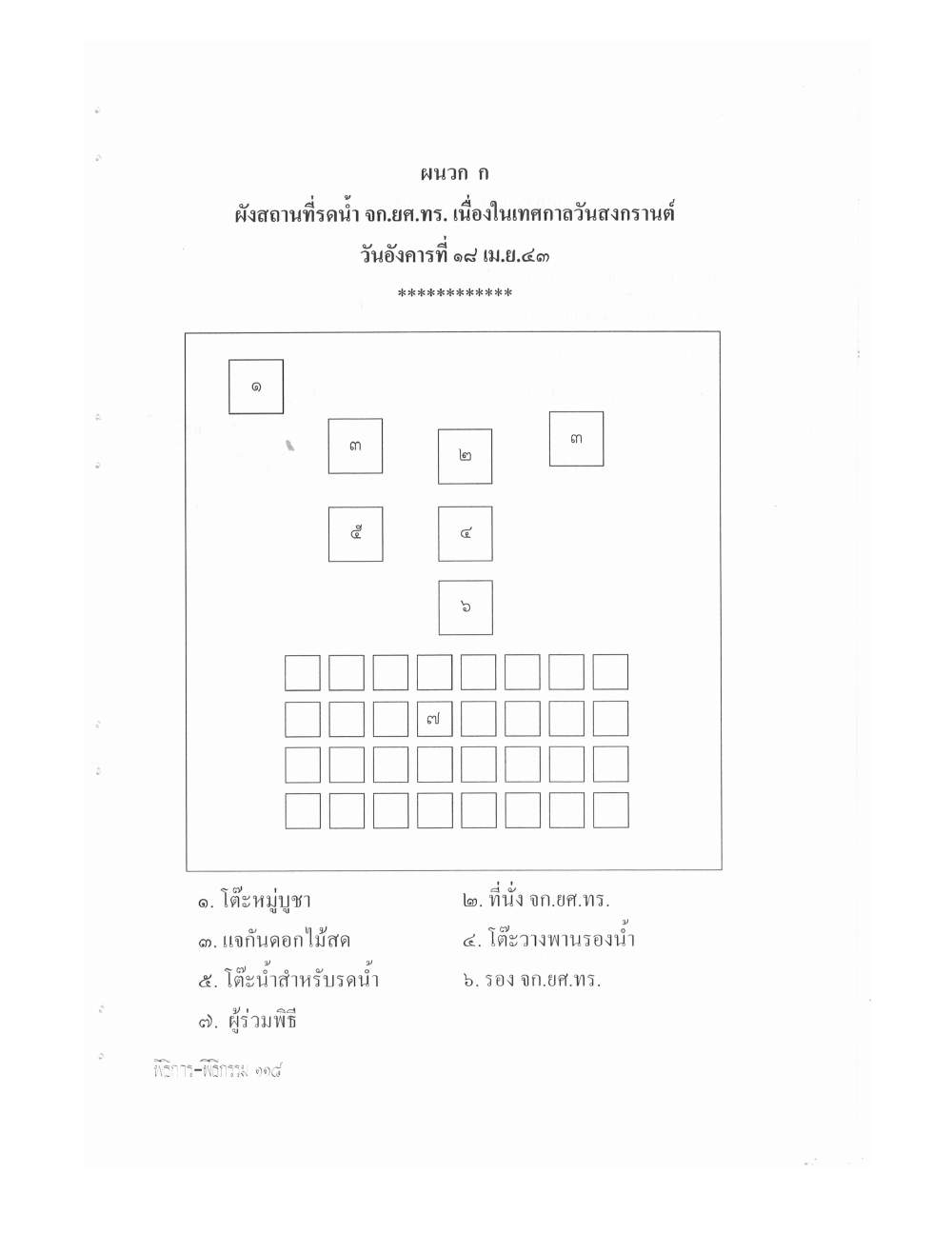
ผนวก ก
ผังสถานที่รดน้ำ จก.ยศ.ทร. เนื่องในเทศกาลวันสงกรานต์ วันอังคารที่ ๑๘ เม.ย.๔๓ ************* [แผนผัง: ผังห้องประชุมแสดงตำแหน่งโต๊ะและที่นั่งสำหรับพิธีรดน้ำขอพร มีกล่องหมายเลข ๑ (มุมบนซ้าย), กล่องหมายเลข ๓ และ ๒ และ ๓ (แถวถัดมา), กล่องหมายเลข ๕ และ ๔ (แถวถัดมา), กล่องหมายเลข ๖ (แถวถัดมา), และตารางที่นั่งจำนวนมากด้านล่างซึ่งมีกล่องหมายเลข ๗ อยู่ในแถวที่สอง] ๑. โต๊ะหมู่บูชา ๒. ที่นั่ง จก.ยศ.ทร. ๓. แจกันดอกไม้สด ๔. โต๊ะวางพานรองน้ำ ๕. โต๊ะน้ำสำหรับรดน้ำ ๖. รอง จก.ยศ.ทร. ๗. ผู้ร่วมพิธี
Appendix A
Floor Plan of the Venue for the จก.ยศ.ทร. Water-Pouring Blessing Ceremony for the Songkran Festival Tuesday, 18 April [25]43 ************* [Diagram: a floor plan of the meeting room showing the placement of tables and seats for the water-pouring blessing ceremony. It shows box 1 (top left), boxes 3, 2, and 3 (next row), boxes 5 and 4 (next row), box 6 (next row), and a large grid of seats below with box 7 marked in the second row] 1. Group-worship table 2. Seat of จก.ยศ.ทร. 3. Vase of fresh flowers 4. Table holding the water-bowl tray 5. Water table for pouring water 6. Deputy จก.ยศ.ทร. 7. Participants
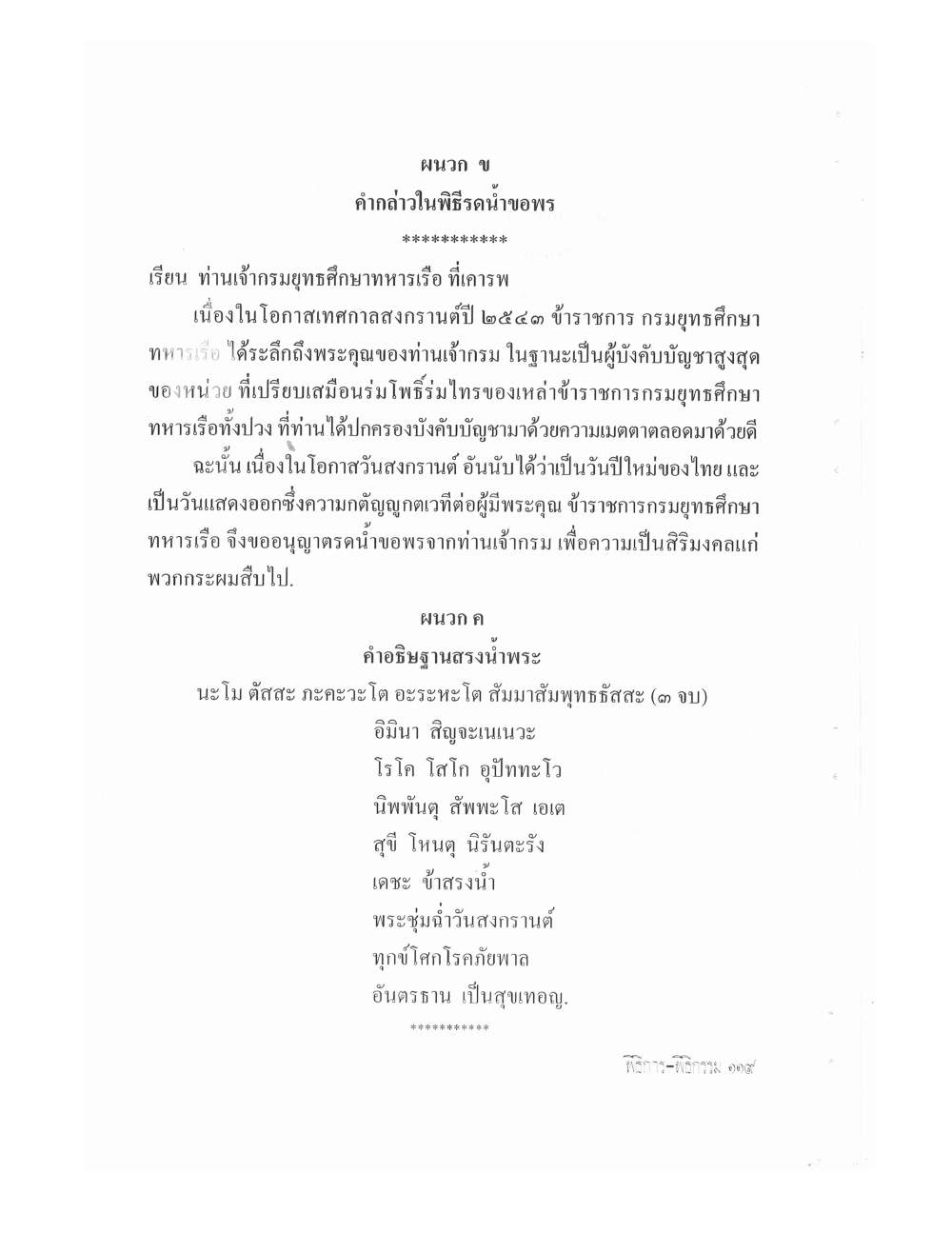
ผนวก ข คำกล่าวในพิธีรดน้ำขอพร
**********
เรียน ท่านเจ้ากรมยุทธศึกษาทหารเรือ ที่เคารพ เนื่องในโอกาสเทศกาลสงกรานต์ปี ๒๕๔๓ ข้าราชการ กรมยุทธศึกษาทหารเรือ ได้ระลึกถึงพระคุณของท่านเจ้ากรม ในฐานะเป็นผู้บังคับบัญชาสูงสุดของหน่วย ที่เปรียบเสมือนร่มโพธิ์ร่มไทรของเหล่าข้าราชการกรมยุทธศึกษาทหารเรือทั้งปวง ที่ท่านได้ปกครองบังคับบัญชามาด้วยความเมตตาตลอดมาด้วยดี ฉะนั้น เนื่องในโอกาสวันสงกรานต์ อันนับได้ว่าเป็นวันปีใหม่ของไทย และเป็นวันแสดงออกซึ่งความกตัญญูกตเวทีต่อผู้มีพระคุณ ข้าราชการกรมยุทธศึกษาทหารเรือ จึงขออนุญาตรดน้ำขอพรจากท่านเจ้ากรม เพื่อความเป็นสิริมงคลแก่พวกกระผมสืบไป.
ผนวก ค คำอธิษฐานสรงน้ำพระ นะโม ตัสสะ ภะคะวะโต อะระหะโต สัมมาสัมพุทธัสสะ (๓ จบ) อิมินา สิญจะเนเนวะ โรโค โสโก อุปัททะโว นิพพันตุ สัพพะโส เอเต สุขี โหนตุ นิรันตะรัง เดชะ ข้าสรงน้ำ พระชุ่มฉ่ำวันสงกรานต์ ทุกข์โศกโรคภัยพาล อันตรธาน เป็นสุขเทอญ.
**********
Appendix B Words Spoken in the Water-Pouring Blessing Ceremony
**********
Dear Respected Director of the Naval Education Department, On the occasion of the Songkran festival of the year 2543 [2000 CE], the civil servants of the Naval Education Department recall with gratitude the kindness of the Director, as the highest commanding officer of the unit, who is like the sheltering bodhi and banyan tree for all the civil servants of the Naval Education Department, and who has governed and commanded us with kindness throughout. Therefore, on the occasion of Songkran, which may be counted as the Thai New Year and is a day for expressing gratitude toward those who have shown kindness, the civil servants of the Naval Education Department therefore request permission to pour water and ask for blessings from the Director, for the auspiciousness of us all going forward.
Appendix C Words of Aspiration for Bathing the Buddha Image Namo tassa bhagavato arahato sammasambuddhassa (recited 3 times) By this act of sprinkling, may illness, sorrow, and misfortune, all be extinguished entirely; may there be happiness unceasingly. By the power of my bathing the Buddha image, cool and refreshed on Songkran day, may suffering, sorrow, illness, danger, and evil vanish, and may there be happiness.
**********
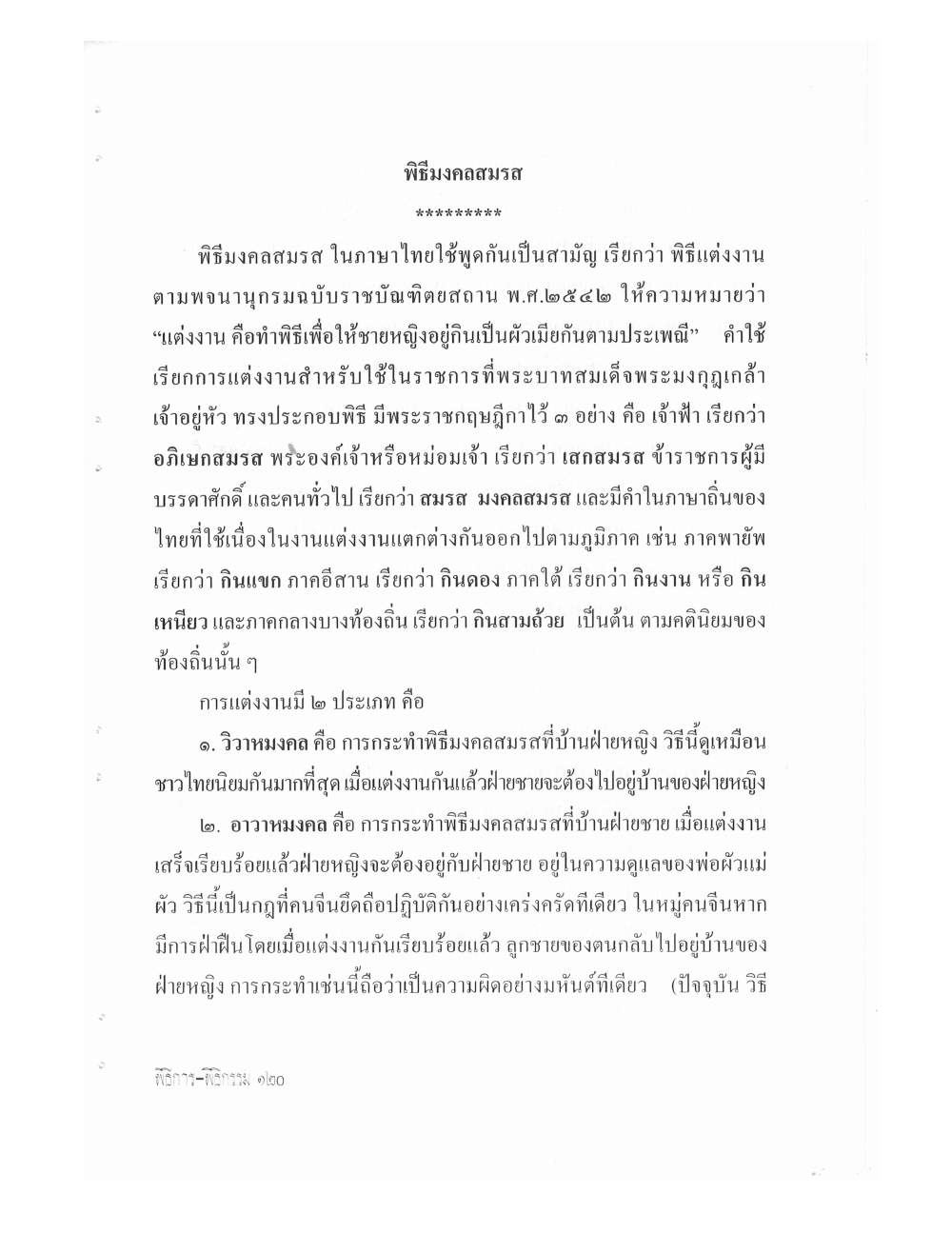
พิธีมงคลสมรส
********
พิธีมงคลสมรส ในภาษาไทยใช้พูดกันเป็นสามัญ เรียกว่า พิธีแต่งงาน ตามพจนานุกรมฉบับราชบัณฑิตยสถาน พ.ศ.๒๕๔๒ ให้ความหมายว่า “แต่งงาน คือทำพิธีเพื่อให้ชายหญิงอยู่กินเป็นผัวเมียกันตามประเพณี” คำใช้เรียกการแต่งงานสำหรับใช้ในราชการที่พระบาทสมเด็จพระมงกุฎเกล้าเจ้าอยู่หัว ทรงประกอบพิธี มีพระราชกฤษฎีกาไว้ ๓ อย่าง คือ เจ้าฟ้า เรียกว่า อภิเษกสมรส พระองค์เจ้าหรือหม่อมเจ้า เรียกว่า เสกสมรส ข้าราชการผู้มีบรรดาศักดิ์และคนทั่วไป เรียกว่า สมรส มงคลสมรส และมีคำในภาษาถิ่นของไทยที่ใช้เนื่องในงานแต่งงานแตกต่างกันออกไปตามภูมิภาค เช่น ภาคพายัพ เรียกว่า กินแขก ภาคอีสาน เรียกว่า กินดอง ภาคใต้ เรียกว่า กินงาน หรือ กินเหนียว และภาคกลางบางท้องถิ่น เรียกว่า กินสามถ้วย เป็นต้น ตามคตินิยมของท้องถิ่นนั้น ๆ
การแต่งงานมี ๒ ประเภท คือ
๑. วิวาหมงคล คือ การกระทำพิธีมงคลสมรสที่บ้านฝ่ายหญิง วิธีนี้ดูเหมือนชาวไทยนิยมกันมากที่สุด เมื่อแต่งงานกันแล้วฝ่ายชายจะต้องไปอยู่บ้านของฝ่ายหญิง
๒. อาวาหมงคล คือ การกระทำพิธีมงคลสมรสที่บ้านฝ่ายชาย เมื่อแต่งงานเสร็จเรียบร้อยแล้วฝ่ายหญิงจะต้องอยู่กับฝ่ายชาย อยู่ในความดูแลของพ่อผัวแม่ผัว วิธีนี้เป็นกฏที่คนจีนยึดถือปฏิบัติกันอย่างเคร่งครัดทีเดียว ในหมู่คนจีนหากมีการฝ่าฝืนโดยเมื่อแต่งงานกันเรียบร้อยแล้ว ลูกชายของตนกลับไปอยู่บ้านของฝ่ายหญิง การกระทำเช่นนี้ถือว่าเป็นความผิดอย่างมหันต์ทีเดียว (ปัจจุบัน วิธี
Marriage Ceremony
********
In Thai, the marriage ceremony (phithi mongkhon somrot) is commonly called by the ordinary term ‘phithi taengngan’ (wedding ceremony). According to the Royal Institute Dictionary of 2542 B.E. [1999 CE], it is defined as: ‘To marry means to perform a ceremony so that a man and woman may live together as husband and wife according to custom.’ The term used for marriage in official usage, as performed by His Majesty King Mongkut Klao Chao Yu Hua [Rama VI], has three grades fixed by royal decree: for a Chao Fa (prince/princess of the highest rank) it is called abhisek somrot; for a Phra Ong Chao or Mom Chao it is called sek somrot; for titled officials and ordinary people it is called somrot or mongkhon somrot. There are also different terms used in Thailand's regional dialects for weddings, differing by region, such as: in the northern region, it is called kin khaek; in the northeastern region, kin dong; in the southern region, kin ngan or kin niao; and in some localities of the central region, kin sam thuai, and so on, according to the customs of each locality.
There are two types of marriage:
1. Wiwaha Mongkhon: this is when the marriage ceremony is performed at the woman's house. This method appears to be the most favored among Thai people; once married, the man must go to live at the woman's house.
2. Awaha Mongkhon: this is when the marriage ceremony is performed at the man's house. Once the marriage is complete, the woman must live with the man, under the care of her father-in-law and mother-in-law. This is a rule that Chinese people hold to very strictly indeed; among the Chinese, should this be violated — that is, if after the marriage is complete the son instead goes to live at the woman's house — such an act is considered an extremely grave offense. (At present, this
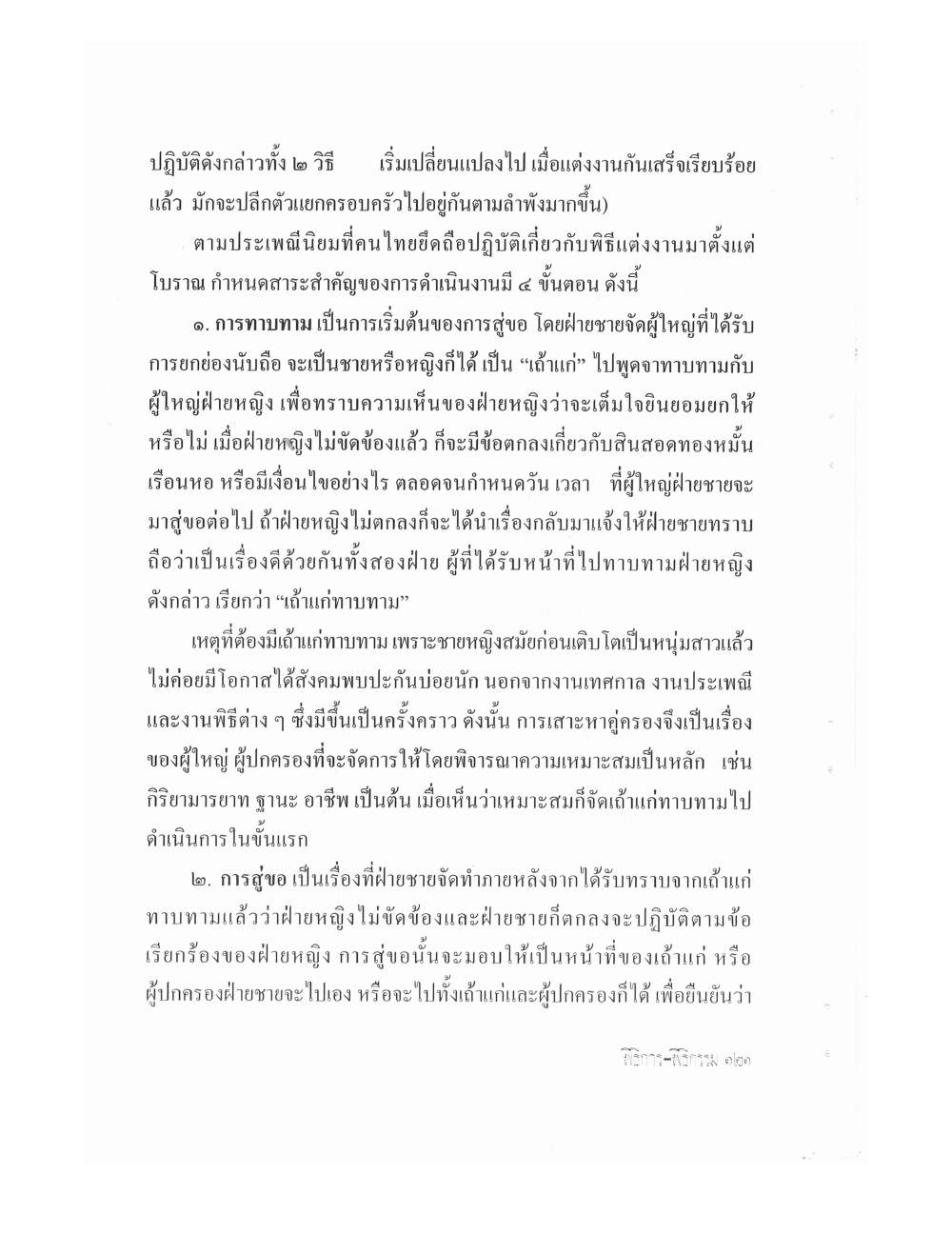
ปฏิบัติดังกล่าวทั้ง ๒ วิธี เริ่มเปลี่ยนแปลงไป เมื่อแต่งงานกันเสร็จเรียบร้อยแล้ว มักจะปลีกตัวแยกครอบครัวไปอยู่กันตามลำพังมากขึ้น)
ตามประเพณีนิยมที่คนไทยยึดถือปฏิบัติเกี่ยวกับพิธีแต่งงานมาตั้งแต่โบราณ กำหนดสาระสำคัญของการดำเนินงานมี ๔ ขั้นตอน ดังนี้
๑. การทาบทาม เป็นการเริ่มต้นของการสู่ขอ โดยฝ่ายชายจัดผู้ใหญ่ที่ได้รับการยกย่องนับถือ จะเป็นชายหรือหญิงก็ได้ เป็น “เถ้าแก่” ไปพูดจาทาบทามกับผู้ใหญ่ฝ่ายหญิง เพื่อทราบความเห็นของฝ่ายหญิงว่าจะเต็มใจยินยอมยกให้หรือไม่ เมื่อฝ่ายหญิงไม่ขัดข้องแล้ว ก็จะมีข้อตกลงเกี่ยวกับสินสอดทองหมั้น เรือนหอ หรือมีเงื่อนไขอย่างไร ตลอดจนกำหนดวัน เวลา ที่ผู้ใหญ่ฝ่ายชายจะมาสู่ขอต่อไป ถ้าฝ่ายหญิงไม่ตกลงก็จะได้นำเรื่องกลับมาแจ้งให้ฝ่ายชายทราบ ถือว่าเป็นเรื่องดีด้วยกันทั้งสองฝ่าย ผู้ที่ได้รับหน้าที่ไปทาบทามฝ่ายหญิงดังกล่าว เรียกว่า “เถ้าแก่ทาบทาม”
เหตุที่ต้องมีเถ้าแก่ทาบทาม เพราะชายหญิงสมัยก่อนเติบโตเป็นหนุ่มสาวแล้วไม่ค่อยมีโอกาสได้สังคมพบปะกันบ่อยนัก นอกจากงานเทศกาล งานประเพณี และงานพิธีต่าง ๆ ซึ่งมีขึ้นเป็นครั้งคราว ดังนั้น การเสาะหาคู่ครองจึงเป็นเรื่องของผู้ใหญ่ ผู้ปกครองที่จะจัดการให้โดยพิจารณาความเหมาะสมเป็นหลัก เช่น กิริยามารยาท ฐานะ อาชีพ เป็นต้น เมื่อเห็นว่าเหมาะสมก็จัดเถ้าแก่ทาบทามไปดำเนินการในขั้นแรก
๒. การสู่ขอ เป็นเรื่องที่ฝ่ายชายจัดทำภายหลังจากได้รับทราบจากเถ้าแก่ทาบทามแล้วว่าฝ่ายหญิงไม่ขัดข้องและฝ่ายชายก็ตกลงจะปฏิบัติตามข้อเรียกร้องของฝ่ายหญิง การสู่ขอนั้นจะมอบให้เป็นหน้าที่ของเถ้าแก่ หรือผู้ปกครองฝ่ายชายจะไปเอง หรือจะไปทั้งเถ้าแก่และผู้ปกครองก็ได้ เพื่อยืนยันว่า
Both of these practices have begun to change: once the marriage is complete, [the couple] increasingly tend to separate off and set up their own household to live on their own.)
According to the traditional customs that Thai people have upheld regarding wedding ceremonies since ancient times, the essential proceedings are fixed at 4 stages, as follows:
1. Thap Tham (the initial approach): this is the start of the courtship proposal. The man's side arranges for a respected elder — who may be either a man or a woman — to act as the ‘thao kae’ (go-between) and speak with the elders of the woman's side, in order to learn whether the woman's side is willing to consent or not. Once the woman's side raises no objection, an agreement is then made regarding the bride price and betrothal gold, the marital home, and any other conditions, as well as the date and time when the elders of the man's side will come to formally propose. If the woman's side does not agree, the matter is brought back to inform the man's side; this is considered a good outcome for both sides either way. The person given the duty of approaching the woman's side in this way is called the ‘thao kae thap tham’ (go-between for the initial approach).
The reason a go-between is needed for this initial approach is that, in former times, once a young man and woman grew up, they had few opportunities to meet socially, apart from festivals, traditional events, and various ceremonies, which occurred only occasionally. Therefore, seeking a spouse was a matter for the elders and guardians to arrange, considering suitability as the main criterion — such as manners and conduct, social standing, and occupation. When it was seen to be suitable, a go-between would then be sent to carry out this first step.
2. Su Kho (the formal proposal): this is arranged by the man's side after learning from the go-between that the woman's side has no objection, and the man's side has agreed to meet the woman's side's requirements. The formal proposal may be entrusted to the go-between, or the guardians of the man's side may go themselves, or both the go-between and the guardians may go together, in order to confirm that
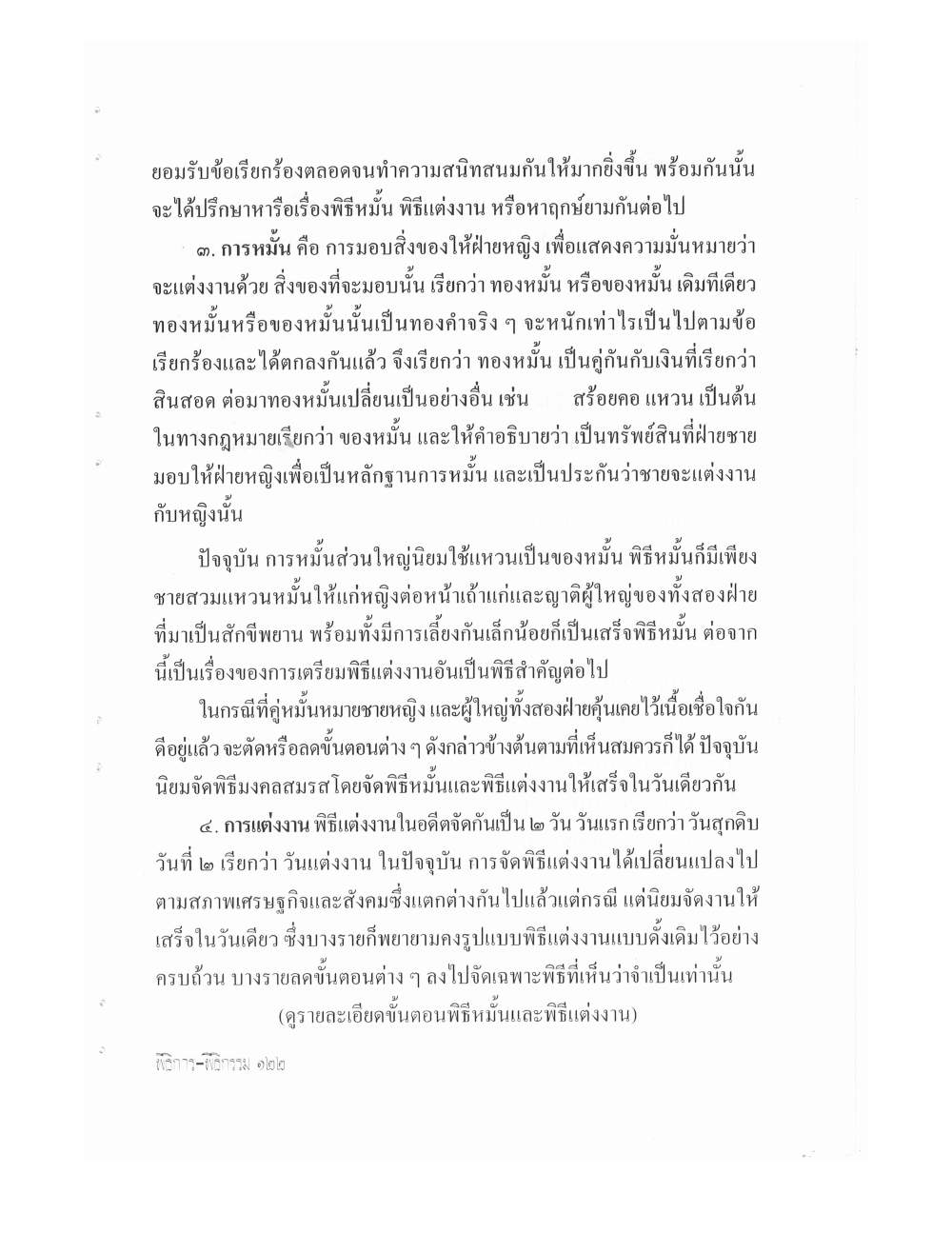
ยอมรับข้อเรียกร้องตลอดจนทำความสนิทสนมกันให้มากยิ่งขึ้น พร้อมกันนั้นจะได้ปรึกษาหารือเรื่องพิธีหมั้น พิธีแต่งงาน หรือหาฤกษ์ยามกันต่อไป
๓. การหมั้น คือ การมอบสิ่งของให้ฝ่ายหญิง เพื่อแสดงความมั่นหมายว่าจะแต่งงานด้วย สิ่งของที่จะมอบนั้น เรียกว่า ทองหมั้น หรือของหมั้น เดิมทีเดียวทองหมั้นหรือของหมั้นนั้นเป็นทองคำจริง ๆ จะหนักเท่าไรเป็นไปตามข้อเรียกร้องและได้ตกลงกันแล้ว จึงเรียกว่า ทองหมั้น เป็นคู่กันกับเงินที่เรียกว่า สินสอด ต่อมาทองหมั้นเปลี่ยนเป็นอย่างอื่น เช่น สร้อยคอ แหวน เป็นต้น ในทางกฏหมายเรียกว่า ของหมั้น และให้คำอธิบายว่า เป็นทรัพย์สินที่ฝ่ายชายมอบให้ฝ่ายหญิงเพื่อเป็นหลักฐานการหมั้น และเป็นประกันว่าชายจะแต่งงานกับหญิงนั้น
ปัจจุบัน การหมั้นส่วนใหญ่นิยมใช้แหวนเป็นของหมั้น พิธีหมั้นก็มีเพียงชายสวมแหวนหมั้นให้แก่หญิงต่อหน้าเถ้าแก่และญาติผู้ใหญ่ของทั้งสองฝ่ายที่มาเป็นสักขีพยาน พร้อมทั้งมีการเลี้ยงกันเล็กน้อยก็เป็นเสร็จพิธีหมั้น ต่อจากนี้เป็นเรื่องของการเตรียมพิธีแต่งงานอันเป็นพิธีสำคัญต่อไป
ในกรณีที่คู่หมั้นหมายชายหญิง และผู้ใหญ่ทั้งสองฝ่ายคุ้นเคยไว้เนื้อเชื่อใจกันดีอยู่แล้ว จะตัดหรือลดขั้นตอนต่าง ๆ ดังกล่าวข้างต้นตามที่เห็นสมควรก็ได้ ปัจจุบันนิยมจัดพิธีมงคลสมรสโดยจัดพิธีหมั้นและพิธีแต่งงานให้เสร็จในวันเดียวกัน
๔. การแต่งงาน พิธีแต่งงานในอดีตจัดกันเป็น ๒ วัน วันแรกเรียกว่า วันสุกดิบ วันที่ ๒ เรียกว่า วันแต่งงาน ในปัจจุบัน การจัดพิธีแต่งงานได้เปลี่ยนแปลงไปตามสภาพเศรษฐกิจและสังคมซึ่งแตกต่างกันไปแล้วแต่กรณี แต่นิยมจัดงานให้เสร็จในวันเดียว ซึ่งบางรายก็พยายามคงรูปแบบพิธีแต่งงานแบบดั้งเดิมไว้อย่างครบถ้วน บางรายลดขั้นตอนต่าง ๆ ลงไปจัดเฉพาะพิธีที่เห็นว่าจำเป็นเท่านั้น (ดูรายละเอียดขั้นตอนพิธีหมั้นและพิธีแต่งงาน)
[the woman's side] accepts the requirements, and also to build greater familiarity between the two families. At the same time, they will discuss the betrothal ceremony, the wedding ceremony, or the setting of an auspicious date, going forward.
3. Kan Man (the betrothal): this is the giving of gifts to the woman's side, to signify the intention to marry her. The item given is called thong man (betrothal gold) or khong man (betrothal gift). Originally, the betrothal gold or gift was genuine gold; however much it weighed depended on the requirement that had been agreed upon — hence it was called thong man, paired with the money known as sin sot (bride price). Later, the betrothal gold changed into other forms, such as necklaces or rings. In legal terms it is called khong man, explained as property that the man's side gives to the woman's side as evidence of the betrothal, and as a guarantee that the man will marry that woman.
At present, betrothals mostly use a ring as the betrothal gift. The betrothal ceremony now consists simply of the man placing the betrothal ring on the woman in front of the go-between and the senior relatives of both families who come as witnesses, together with a small feast, and the betrothal ceremony is then complete. After this comes the preparation of the wedding ceremony, which is the next important ceremony.
In cases where the engaged man and woman, and the elders of both families, are already well acquainted and trust one another, the various steps mentioned above may be cut or reduced as deemed appropriate. At present it is common to hold the marriage ceremony by combining the betrothal ceremony and the wedding ceremony to be completed on the same day.
4. Kan Taengngan (the wedding): in the past, the wedding ceremony was held over 2 days. The first day was called wan suk dip (the eve day), and the second was called wan taengngan (the wedding day). At present, the arrangement of the wedding ceremony has changed according to economic and social conditions, varying from case to case; but it is now common to hold the event to be completed in a single day. In some cases effort is made to preserve the traditional form of the wedding ceremony in full; in others the various steps are reduced, holding only the ceremonies deemed necessary. (See details of the steps of the betrothal ceremony and the wedding ceremony.)
การกำหนดวัน เดือน และฤกษ์ยามแต่งงาน
เรื่องนี้เป็นหน้าที่ของโหรหรือท่านผู้รู้เป็นผู้กำหนดให้ ผู้ที่จะไปติดต่อกับโหรหรือท่านผู้รู้ ส่วนใหญ่เป็นเรื่องของฝ่ายหญิง แต่จะให้ฝ่ายชายไปก็ได้ สุดแต่จะตกลงกัน
เกี่ยวกับวัน วันอันเป็นสิริมงคลที่นิยมกัน ได้แก่ วันจันทร์ กับ วันศุกร์ โดยเฉพาะวันศุกร์นั้นนิยมกันมาก เพราะเสียงของคำว่า “ศุกร์” ตรงกับเสียงคำว่า “สุข” หรือ “สุขสบาย” วันดังกล่าวกำหนดไว้เป็นวันสิริมงคลโดยส่วนรวม แต่เมื่อประสงค์วันสิริมงคลเป็นการเฉพาะควรนำวัน เดือน ปี ของคู่บ่าวสาวไปให้โหรหรือท่านผู้รู้คำนวณกำหนดฤกษ์ยามจะเหมาะสมที่สุด
เกี่ยวกับเดือน นิยมแต่งงานในเดือนคู่ โดยถือเคล็ดคำว่า “คู่” เพราะชีวิตของผู้แต่งงานเป็นชีวิตคู่ แต่เดือนคู่ที่ไม่นิยมแต่งคือ เดือน ๘ และเดือน ๑๒ เปลี่ยนไปใช้เดือน ๙ ซึ่งเป็นเดือนคี่แทน และถ้าเป็นเดือน ๙ ข้างขึ้น จะนิยมกันมาก เพราะเสียงของคำว่า “๙ ขึ้น” คล้ายกับคำว่า “ก้าวขึ้น”
เกี่ยวกับปี โดยปกติไม่มีปีใดห้ามการแต่งงาน นอกจากครอบครัวที่มีบุตรสาวหลายคน ไม่นิยมให้แต่งงานในปีเดียวกัน คงเป็นเพราะจะสิ้นเปลืองหรืออาจไม่สะดวกในการจัดงานก็เป็นได้
ข้อพิจารณา ในเรื่องนี้จะปฏิบัติตามความนิยมดังกล่าวหรือจะใช้เหตุผลโดยยึดหลักความสะดวกตามคำสอนของพระพุทธศาสนาก็ได้ตามอัธยาศัย
Determining the Date, Month, and Auspicious Time for the Wedding
This matter is the duty of the astrologer or a knowledgeable person to determine. The one who goes to consult the astrologer or knowledgeable person is generally from the woman's side, but the man's side may go instead; it depends on what is agreed.
Regarding the day: the auspicious days that are commonly favored are Monday and Friday. Friday in particular is very popular, because the sound of the word ‘suk’ [Friday] matches the sound of the word ‘sukh’ [happiness] or ‘sukhsabai’ [well-being]. These days are set as auspicious in general; but when a specifically auspicious day is desired, it is best to bring the birth date, month, and year of the bride and groom to the astrologer or knowledgeable person, who will calculate and determine the most suitable auspicious time.
Regarding the month: it is customary to marry in an even-numbered month, following the auspicious association of the word ‘khu’ [pair], because the life of a married couple is a paired life. However, the even months that are not favored for marriage are the 8th and 12th months; these are changed to the 9th month instead, which is an odd month. And if it falls in the waxing period of the 9th month, it is especially favored, because the sound of the phrase ‘9th [month], waxing’ resembles the word for ‘stepping up/advancing.’
Regarding the year: ordinarily there is no year in which marriage is forbidden, except that families with several daughters do not favor having them marry in the same year — probably because it would be too costly, or it might be inconvenient to arrange the events.
Consideration: on this matter, one may follow the customary preferences described above, or one may use reasoning based on convenience, in accordance with the teachings of Buddhism, as one sees fit.
รายละเอียดขั้นตอนพิธีหมั้นและพิธีแต่งงาน พิธีหมั้น
การเตรียมการ
๑. กำหนดวันที่จะหมั้น
๒. ขันหมากหมั้น มีจำนวน ๒ ขัน คือ ขันหมาก และขันหมั้น
ขันหมาก บรรจุหมาก ๘ คู่ (ฝานก้นหมากทุกผล ทาด้วยปูนแดงหรือชาดแดง) พลู ๘ เรียง เรียงละ ๘ ใบ (ก้านทาด้วยปูนแดงหรือชาดแดง) ใบพลูวางรอบขันหันปลายพลูขึ้นปากขัน หมากวางไว้ตรงกลาง (บางตำราบอกว่าหมากพลูใช้เท่าไรก็ได้ แต่ขอให้เป็นคู่ ๆ) แล้วใช้ผ้าแพรคลุมขัน
ขันหมั้น บรรจุดอกรัก ๗ ดอก ดอกบานไม่รู้โรย ๗ ดอก ดอกดาวเรือง ๓ ดอก ยอดใบเงิน ใบทอง ใบนาก อย่างละ ๓ ยอด ข้าวเปลือก ๑ ถุง ถั่วเขียว ๑ ถุง งาดำ ๑ ถุง ข้าวตอก ๑ ถุง (ถุงเล็ก ๆ พองาม) และแหวน ทองหมั้น วางบนของเหล่านั้น แล้วใช้ผ้าแพรคลุมขัน
การปฏิบัติ
- ผู้ใหญ่ฝ่ายชาย (เถ้าแก่) เดินออกหน้า (เวลานำขบวนไปหมั้น) ถัดไปเป็นเจ้าบ่าว ญาติผู้ใหญ่เจ้าบ่าว และผู้ที่ถือขันหมาก
(ฝ่ายเจ้าสาว) จัดคนเชิญขันหมากและรับขันหมากไปวางไว้ที่กำหนด (คนเชิญขันหมากมักใช้เด็กหญิงอายุประมาณ ๖ - ๘ ขวบ)
- ผู้ใหญ่ทั้งสองฝ่ายนั่งล้อมขันหมาก
- ผู้ใหญ่ฝ่ายชายกล่าวคำขอหมั้นว่า (ตัวอย่าง) “ผม/ดิฉัน ได้ทราบว่า คุณ.....ซึ่งเป็นบุตรของ.....ได้สมัครรักใคร่กับ..........ซึ่งเป็นบุตรสาวของ.........และทั้งสองมีความประสงค์จะครองเรือนร่วมชีวิตกันตามประเพณี
Details of the Steps of the Betrothal Ceremony and the Wedding Ceremony Betrothal Ceremony
Preparation
1. Set the date for the betrothal.
2. The betrothal trays: there are 2 trays, namely the areca-nut tray and the betrothal-items tray.
The areca-nut tray: contains 8 pairs of areca nuts (the base of each nut sliced and coated with red lime paste or red lac dye), and betel leaves in 8 rows of 8 leaves each (the stems coated with red lime paste or red lac dye); the betel leaves are arranged around the tray with their tips turned up toward the rim, and the areca nuts placed in the center (some texts say any quantity of areca and betel may be used, so long as it is in pairs). The tray is then covered with a silk cloth.
The betrothal-items tray: contains 7 rak flowers, 7 globe amaranth flowers, 3 marigold flowers, 3 sprigs each of silver leaf, gold leaf, and rose-gold leaf (auspicious foil ornaments), 1 bag of unhusked rice, 1 bag of mung beans, 1 bag of black sesame, 1 bag of puffed rice (each in a small, appropriately sized bag), with the betrothal ring and betrothal gold placed on top of these items. The tray is then covered with a silk cloth.
Procedure
- The senior man of the groom's side (the go-between) walks in front (when leading the procession to the betrothal), followed by the groom, the groom's senior relatives, and those carrying the areca-nut tray.
(The bride's side) arranges people to invite in and receive the areca-nut tray, placing it in the designated spot. (The person who invites in the areca-nut tray is usually a young girl about 6-8 years old.)
- The elders of both sides sit around the areca-nut tray.
- The senior man of the groom's side speaks the words asking for the betrothal, for example: ‘I have learned that you [name], who are the child of [name], have come to love [name], who is the daughter of [name], and the two of you wish to establish a household and share your lives together according to custom.
อันดีงาม ดังนั้นวันนี้ถือว่าเป็นวันมงคล ฤกษ์ดี ยามดี จึงมาสู่ขอและหมั้น คุณ......ให้กับคุณ.......ขอได้โปรดพิจารณาเพื่อทั้งสองจะได้สมรัก สมปรารถนา เป็นทองแผ่นเดียวกัน”
- ผู้ใหญ่ฝ่ายหญิงกล่าวตอบว่า (ตัวอย่าง) “ผม/ดิฉัน รู้สึกยินดีเป็นอย่างยิ่งที่ท่านได้ให้เกียรติมาสู่ขอตามประเพณี จึงขอต้อนรับด้วยความเต็มใจและปีติอย่างสูง ก็ขอให้วันมงคลนี้จงเป็นนิมิตหมายอันดีสำหรับความรักของทั้งสองตลอดไป”
- ผู้ใหญ่ฝ่ายชายมอบขันหมากแก่ผู้ใหญ่ฝ่ายหญิง
- ผู้ใหญ่ฝ่ายหญิงเปิดขันหมากและตรวจดู พร้อมกับกล่าวคำที่เป็นสิริมงคล เช่น “ทุกอย่างล้วนแล้วแต่สวยสดงดงาม ทองสุกใสหลายหลาก เงินมากมายก่ายกอง คงจะอำนวยความสุขสดชื่นตลอดชั่วนิรันดร์ทีเดียว ฯลฯ”
- ผู้ใหญ่ทั้งสองฝ่ายร่วมกันโปรยสิ่งของมงคล (ถั่ว งา ข้าวตอก ดอกไม้) ลงบนของหมั้น พร้อมกับกล่าวคำที่เป็นสิริมงคล เช่นว่า “เงินทองเหล่านี้คงจะงอกเงยยิ่งขึ้นเหมือนถั่วงาที่หว่านไว้ในไร่สวนทีเดียว” (ถั่วงาหลังจากเสร็จพิธีแล้วนำไปโรยไว้ในสวนหรือที่เหมาะสม)
- ฝ่ายหญิงนำเจ้าสาวออกมาและน้อมไหว้ผู้ใหญ่ฝ่ายชายจนครบทุกคน แล้วนั่งในที่กำหนด
เวลาฤกษ์
- ผู้ใหญ่ฝ่ายหญิงมอบแหวนหมั้นให้เจ้าบ่าวเพื่อสวมนิ้วเจ้าสาวต่อไป - เจ้าบ่าวเจ้าสาวไปกราบผู้ใหญ่ทั้งสองฝ่าย (กราบ ๑ ครั้ง ไม่แบมือ) - ฝ่ายหญิงแจกของชำร่วย เลี้ยงอาหารผู้ร่วมพิธี (ถ้ามี) - เสร็จพิธี
...good and virtuous. Therefore, today is deemed an auspicious day, a good time, a good hour; we have thus come to propose and betroth [name] to [name]. Please be so kind as to consider it, so that the two of them may find mutual love and the fulfillment of their wishes, becoming as one sheet of gold together.’
- The senior of the bride's side replies, for example: ‘I am extremely delighted that you have done us the honor of coming to propose according to custom; we therefore welcome you with full willingness and the greatest joy. May this auspicious day be a good omen for the love of the two of them forever.’
- The senior of the groom's side hands over the areca-nut tray to the senior of the bride's side.
- The senior of the bride's side opens the areca-nut tray and inspects it, while speaking auspicious words, such as: ‘Everything is indeed beautiful and lovely; the gold shines brightly in abundance, the silver is piled up in great quantity; surely this will bring happiness and freshness forever and ever, etc.’
- The seniors of both sides together sprinkle auspicious items (beans, sesame, puffed rice, flowers) onto the betrothal gifts, while speaking auspicious words, such as: ‘May this wealth grow and flourish ever more, just like beans and sesame sown in a field or garden.’ (After the ceremony, the beans and sesame are taken to be scattered in a garden or other suitable place.)
- The bride's side brings the bride out, and she makes a respectful wai to every one of the groom's side elders, then sits in the designated place.
At the Auspicious Time
- The senior of the bride's side gives the betrothal ring to the groom, for him to place it on the bride's finger next. - The groom and bride go to pay respects (krap) to the elders of both sides (bowing once, without pressing the palms flat). - The bride's side distributes small favors and serves food to those participating in the ceremony (if any). - The ceremony is complete.
[ภาพถ่าย: ขบวนขันหมากเดินในยามค่ำคืนหน้าอาคารสองชั้น มีต้นกล้วยประดับตั้งอยู่สองข้าง] ขบวนขันหมาก
[ภาพถ่าย: เจ้าบ่าวสวมชุดสูทสีขาวกำลังสวมแหวนหมั้นที่นิ้วเจ้าสาว ซึ่งสวมชุดยาว มีแขกนั่งเป็นสักขีพยานอยู่ด้านหลัง] การสวมแหวนหมั้น
[Photograph: the wedding-tray procession walking at night in front of a two-story building, with decorative banana-tree stalks standing on either side] Caption: The wedding-tray procession
[Photograph: the groom, wearing a white suit, placing the betrothal ring on the finger of the bride, who wears a long gown, with guests seated as witnesses in the background] Caption: Putting on the betrothal ring
พิธีแต่งงาน
การเตรียมการ
๑. กำหนดวันที่จะแต่งงาน
๒. ขันหมากแต่ง ประกอบด้วย ขันหมากเอก และขันหมากรอง (บางแห่งเรียกขันหมากโท)
ขันหมากเอก จัดเป็น ๓ ขัน ขันหมากพลู ๑ ขัน ขันเงินทุน ๑ ขัน และขันเงินสินสอด ๑ ขัน
ขันหมากพลู ๑ ขัน บรรจุหมาก ๘ คู่ (ฝานก้นหมากทุกผลทาด้วยปูนแดงหรือชาดแดง) พลู ๘ เรียง เรียงละ ๘ ใบ (ก้านทาด้วยปูนแดง หรือชาดแดง) ยอดใบเงิน ใบทอง ใบนาก อย่างละ ๓ ยอด ข้าวเปลือก ๑ ถุง ถั่วเขียว ๑ ถุง งาดำ ๑ ถุง ข้าวตอก ๑ ถุง (ถุงเล็ก ๆ พองาม)
ขันเงินทุน บางทีเรียกเงินกองทุนที่ทั้งสองฝ่ายตกลงกันว่าจะให้ฝ่ายละเท่าไรเพื่อมอบให้คู่บ่าวสาวเป็นทุนในการประกอบอาชีพ เฉพาะฝ่ายชายมักจะให้มากกว่าที่ตกลงกันไว้ เพื่อเอาเคล็ดตรงที่ว่าเงินงอก (ขันนี้ปรับเปลี่ยนเป็นขันใส่ของหมั้นได้ในกรณีที่จัดพิธีหมั้นและพิธีแต่งงานในวันเดียวกัน) โดยใช้ใบเงิน ใบทอง ใบนาก รองก้นขัน และประดับด้วยดอกรัก ดอกบานไม่รู้โรย ดอกดาวเรือง หรือดอกไม้อื่น ๆ
ขันเงินสินสอด เป็นเงินที่ฝ่ายชายจะมอบให้บิดามารดาหรือผู้ปกครองฝ่ายหญิงเป็นค่าเลี้ยงดูหรือค่าน้ำนม เงินส่วนนี้บิดามารดาหรือผู้ปกครองฝ่ายหญิงจะเก็บไว้เป็นของตนหรือจะมอบให้คู่บ่าวสาวก็ได้ โดยใช้ใบเงิน ใบทอง ใบนาก รองก้นขันและประดับด้วยดอกรัก ดอกบานไม่รู้โรย ดอกดาวเรือง หรือดอกไม้อื่น ๆ
Wedding Ceremony
Preparation
1. Set the date for the wedding.
2. The wedding trays: consist of the principal tray and the secondary tray (in some places called the second-order tray).
The principal tray is arranged as 3 trays: 1 areca-and-betel tray, 1 fund-money tray, and 1 bride-price-money tray.
The areca-and-betel tray: contains 8 pairs of areca nuts (the base of every nut coated with red lime paste or red lac dye), and betel leaves in 8 rows of 8 leaves each (the stems coated with red lime paste or red lac dye), 3 sprigs each of silver leaf, gold leaf, and rose-gold leaf, 1 bag of unhusked rice, 1 bag of mung beans, 1 bag of black sesame, and 1 bag of puffed rice (each in a small, appropriately sized bag).
The fund-money tray: sometimes called the fund that both sides agree each will contribute, to be given to the bride and groom as capital for their livelihood; the man's side in particular tends to give more than what was agreed, as an auspicious gesture so that ‘the money will grow.’ (This tray may be converted into the tray holding the betrothal gifts, in cases where the betrothal ceremony and the wedding ceremony are held on the same day.) It is lined at the bottom with silver leaf, gold leaf, and rose-gold leaf, and decorated with rak flowers, globe amaranth flowers, marigold flowers, or other flowers.
The bride-price-money tray: this is the money that the man's side gives to the parents or guardians of the woman's side, as compensation for raising her, or as ‘milk money.’ The parents or guardians of the woman's side may keep this money for themselves, or may give it to the bride and groom instead. It is lined at the bottom with silver leaf, gold leaf, and rose-gold leaf, and decorated with rak flowers, globe amaranth flowers, marigold flowers, or other flowers.
ขันหมากรอง (ขันหมากโท) คือ จัดขนม (ส่วนมากเป็นขนมแห้ง) ส้ม กล้วย มะพร้าว และผลไม้ต่าง ๆ ใส่พานหรือถาด ประมาณ ๘ ที่ ๒๐ ที่ ๔๐ ที่ หรือตามที่ตกลงกันไว้ แล้วปักธงกระดาษสีแดงเล็ก ๆ ตรงกลางถาดทุก ๆ ที่
การปฏิบัติ
ผู้ใหญ่ฝ่ายชายนำขบวนขันหมาก ติดตามด้วยเจ้าบ่าว ญาติผู้ใหญ่เจ้าบ่าว คนถือต้นกล้วย ๒ ต้น ๒ คน คนถือต้นอ้อย ๒ ต้น ๒ คน คนถือพานสิ่งของมงคล (ข้าวตอกดอกไม้ต่าง ๆ) ๑ คน คนถือพานดอกไม้รับไหว้ ๑ คน คนถือพานผ้าไหว้ผี (ผ้าขาว ๖ ศอก) ๑ คน คนถือขันหมากเอก ๓ คน คนถือขวดเหล้า ๒ คน คนถือถาดมะพร้าวอ่อน ๒ ผล ๑ คน คนถือถาดกล้วยน้ำว้า ๒ หวี ๑ คน คนถือถาดใส่หมู คนถือถาดใส่หมี่ คนถือถาดใส่ขนม และอื่น ๆ จำนวนมากน้อยตามความประสงค์
The secondary tray: consists of preparing sweets (mostly dry sweets), oranges, bananas, coconuts, and various fruits, placed on trays or salvers, about 8, 20, or 40 salvers, or as agreed; a small red paper flag is then planted in the center of every salver.
Procedure
The senior man of the groom's side leads the wedding-tray procession, followed by the groom, the groom's senior relatives, 2 people carrying 2 banana-tree stalks, 2 people carrying 2 sugarcane stalks, 1 person carrying the tray of auspicious items (puffed rice, various flowers), 1 person carrying the tray of flowers to receive the wai, 1 person carrying the tray of cloth for paying respects to the spirits (6 sok of white cloth), 3 people carrying the principal wedding tray, 2 people carrying bottles of liquor, 1 person carrying a tray of 2 young coconuts, 1 person carrying a tray of 2 hands of nam wa bananas, a person carrying a tray of pork, a person carrying a tray of noodles, a person carrying a tray of sweets, and others, in quantities according to preference.
ตัวอย่าง ผังขบวนขันหมาก
[แผนผัง: กรอบสี่เหลี่ยมใหญ่ล้อมรอบช่องสี่เหลี่ยมเล็กเรียงเป็นแถวรูปขบวนตามลำดับ บรรจุหมายเลข ๑ ถึง ๑๒ ดังนี้ แถวบนสุดมีช่องหมายเลข ๑ ช่องเดียวอยู่กึ่งกลาง ถัดลงมาเป็นแถวมีหมายเลข ๒ และ ๓ ถัดลงมาเป็นแถวมีหมายเลข ๔, ๕, ๖, ๗ ถัดลงมาเป็นแถวมีหมายเลข ๘, ๙, ๑๐ ถัดลงมาเป็นแถวมีหมายเลข ๑๑, ๑๑, ๑๑ สามช่อง ถัดลงมาเป็นสี่แถว แถวละสองช่อง หมายเลข ๑๒ ทุกช่อง]
๑ เถ้าแก่ ๒ เจ้าบ่าว ๓ ญาติผู้ใหญ่เจ้าบ่าว ๔ และ ๖ คนถือต้นกล้วย ๕ และ ๗ คนถือต้นอ้อย ๘ คนถือพานสิ่งของมงคล ๙ คนถือพานดอกไม้รับไหว้ ๑๐ คนถือพานผ้าไหว้ผี ๑๑ คนถือขันหมากเอก ๑๒ คนถือขันหมากรอง (จำนวนมากน้อยตามความประสงค์)
Example Diagram of the Wedding-Tray Procession
[Diagram: a large bordered rectangle enclosing small numbered boxes arranged in rows in a procession-like formation, numbered 1 through 12, as follows: the topmost row has a single box numbered 1 in the center; the next row has boxes numbered 2 and 3; the next row has boxes numbered 4, 5, 6, 7; the next row has boxes numbered 8, 9, 10; the next row has three boxes all numbered 11; below that, four rows of two boxes each, all numbered 12]
1. Go-between 2. Groom 3. Groom's senior relative 4 and 6. People carrying banana-tree stalks 5 and 7. People carrying sugarcane stalks 8. Person carrying the tray of auspicious items 9. Person carrying the tray of flowers to receive the wai 10. Person carrying the tray of cloth for paying respects to the spirits 11. People carrying the principal wedding tray 12. People carrying the secondary wedding tray (Quantities according to preference)
- ฝ่ายเจ้าสาวจัดคนถือพานหมากไปคอยรับที่ประตูบ้าน (มักนิยมใช้เด็กหญิง)
- เมื่อขบวนขันหมากมาถึง ก่อนเข้าบ้าน เด็กหญิงที่ถือพานหมากมาต้อนรับจะพูดว่า “ไปยังไงมายังไงค่ะ มากันมากมายจริง ๆ”
- ผู้นำขบวนขันหมากจะพูดตอบว่า “วันนี้มาดีนะ ไม่ได้มาร้าย มาเพื่อจะนำแก้วแหวนเงินทองและนำคนดีมีสิริมงคลมาให้ เพื่อเป็นทองแผ่นเดียวกัน ขอผ่านหน่อยนะจ๊ะ” (พร้อมกับวางซองเงินไว้บนพานหมากของเด็กด้วย)
- ฝ่ายเด็กหญิงก็จะพูดว่า “ถ้าอย่างนั้นขอเชิญค่ะ ด้วยความยินดีค่ะ”
- ญาติฝ่ายเจ้าสาวที่จัดไว้เพื่อรับขบวนขันหมาก นำขันหมากไปวางไว้ในที่กำหนด ต่อหน้าญาติทั้งสองฝ่าย
- นำพานสิ่งของมงคลไปวางไว้รวมกับขันหมากเอก ของนอกนั้นวางไว้ในที่เหมาะสม วางเป็นแถวคู่กัน ส่วนต้นกล้วยต้นอ้อยรับไปวางพิงไว้ที่ประตูบ้านทั้ง ๒ ข้าง
- ผู้ใหญ่ฝ่ายเจ้าสาวร่วมกันเปิดขันหมาก นับสินสอดและโปรยสิ่งของมงคลบนสินสอด
- นำเจ้าสาวออกมานั่งข้างซ้ายเจ้าบ่าว น้อมไหว้ผู้ใหญ่ฝ่ายเจ้าบ่าว ถ้ามีการสวมแหวนหมั้นก็ทำตอนนี้และปฏิบัติเหมือนที่กล่าวไว้ในตอนหมั้น
- เจ้าบ่าวเจ้าสาวไปกราบผู้ใหญ่ทั้งสองฝ่าย (กราบ ๑ ครั้ง ไม่แบมือ)
- เสร็จพิธี
- The bride's side arranges for someone to carry the areca-nut tray and wait to receive [the procession] at the front gate of the house (usually a young girl is used for this).
- When the wedding-tray procession arrives, before entering the house, the young girl carrying the areca-nut tray who comes to receive them will say: ‘How did you all come, how did you get here? So many of you have really come!’
- The leader of the wedding-tray procession will reply: ‘Today we come with good intent, not with ill will; we have come to bring jewels, rings, silver, and gold, and to bring good, auspicious people, so that we may become one sheet of gold together. Please allow us to pass.’ (While saying this, he also places an envelope of money on the child's areca-nut tray.)
- The young girl will then say: ‘In that case, please come in. We welcome you gladly.’
- The relatives of the bride's side assigned to receive the wedding-tray procession take the trays and place them in the designated spot, in front of the relatives of both sides.
- The tray of auspicious items is placed together with the principal wedding tray; the other items are placed in a suitable spot, arranged in paired rows. The banana-tree and sugarcane stalks are taken and placed leaning against the front gate of the house on both sides.
- The elders of the bride's side together open the wedding trays, count the bride price, and sprinkle auspicious items over the bride price.
- The bride is brought out to sit at the groom's left side, and makes a respectful wai to the elders of the groom's side. If the betrothal ring is to be put on, it is done at this point, following the same procedure as described in the betrothal section.
- The groom and bride go to pay respects (krap) to the elders of both sides (bowing once, without pressing the palms flat).
- The ceremony is complete.
พิธีสงฆ์เนื่องในพิธีมงคลสมรส
การเตรียมการ - เครื่องพิธีสงฆ์ (เหมือนที่ทำบุญทั่วไป) - ด้ายมงคลแฝดและแป้งเจิม (ใส่พานตั้งไว้ข้างหม้อน้ำมนต์และเอาด้ายสายสิญจน์วงรอบด้วย) - หมอนกราบ ๒ ใบ (หน้าโต๊ะหมู่บูชา)
การปฏิบัติ - เมื่อถึงเวลาสมควรแล้ว เจ้าบ่าวและเจ้าสาวนั่งหน้าโต๊ะหมู่บูชา (หญิงซ้ายชายขวา) - รับเทียนชนวนจากพิธีกร จับด้วยกัน จุดเทียนจากซ้ายไปขวา (ของผู้จุด) แล้วจุดธูป เสร็จแล้วส่งเทียนชนวนคืนพิธีกร - พนมมือเสมออก กล่าวคำบูชาและอธิษฐานดังนี้.- "ข้าพเจ้าขอน้อมบูชาสักการะคุณพระศรีรัตนตรัยด้วยเครื่องสักการะนี้ ข้าพเจ้าทั้งสองจะซื่อสัตย์ต่อกันอย่างมั่นคง ดำรงชีวิตด้วยความถูกต้องดีงามทุกประการ ด้วยสัจวาจานี้ขออานุภาพคุณพระศรีรัตนตรัยพร้อมทั้งอำนาจคุณงามความดีทั้งหลายที่ข้าพเจ้าทั้งสองได้บำเพ็ญมา ได้โปรดดลบันดาลให้ข้าพเจ้าทั้งสอง ประสบแต่ความสุขความเจริญ ความก้าวหน้าในชีวิตยิ่ง ๆ ขึ้นไป เทอญ" - กราบลงที่หมอนพร้อมกัน ๓ ครั้ง แล้วหันไปกราบพระสงฆ์ ๑ ครั้ง เสร็จแล้วนั่งพับเพียบพนมมือรับศีล ฟังพระสงฆ์เจริญพระพุทธมนต์ต่อไป จนกว่าจะถึงเวลาจุดเทียนน้ำมนต์ - คุกเข่า รับเทียนชนวนจากพิธีกร จับด้วยกัน จุดเทียนน้ำมนต์ที่หม้อน้ำมนต์ แล้วส่งเทียนชนวนคืนพิธีกร
พิธีการ-พิธีกรรม ๑๓๑
Monastic Rite Held as Part of the Auspicious Marriage Ceremony
Preparations - Monastic ceremony implements (the same as for an ordinary merit-making) - Twin auspicious cotton thread and anointing powder (placed on a tray set beside the holy-water pot, with the sacred thread also wound around it) - 2 prostration cushions (in front of the altar table)
Procedure - When the proper time arrives, the groom and bride sit in front of the altar table (woman on the left, man on the right) - Receive the lighting taper from the officiant, hold it together, light the candles from left to right (as the lighter faces them), then light the incense; afterward return the taper to the officiant - Raise the joined palms level with the chest and recite this offering and vow: "I humbly offer worship to the virtue of the Triple Gem with this offering. We two shall be faithful to one another steadfastly, and shall conduct our lives rightly and well in every respect. By this truthful word, may the power of the virtue of the Triple Gem, together with the power of all the good deeds we two have performed, grant that we two encounter only happiness, prosperity, and ever-greater progress in life." - Prostrate together at the cushions 3 times, then turn and prostrate to the monks once; then sit with legs folded to the side, palms joined, receive the precepts, and continue listening as the monks chant the blessing, until it is time to light the candle for the holy water - Kneel, receive the lighting taper from the officiant, hold it together, light the candle at the holy-water pot, then return the taper to the officiant
(running header: Ceremonies–Rites, page 131)
- ยกหม้อน้ำมนต์ด้วยกัน ประเคนพระรูปแรก (ยกพอพ้นพื้นวางลงบนผ้าที่พระท่านถือรองรับ) แล้วนั่งพับเพียบพนมมือฟังพระสงฆ์เจริญพระพุทธมนต์ต่อจนกว่าจะถึงเวลาตักบาตร (พระสวด "พาหุง") - ลุกไปตักบาตร (จับทัพพีด้วยกัน หยิบของใส่บาตรด้วยกัน) - กลับมาที่พระสงฆ์เพื่อประเคนภัตตาหารเมื่อพระสงฆ์เจริญพระพุทธมนต์จบ (ยกภัตตาหารประเคนด้วยกันทุกอย่าง) เสร็จแล้วกราบพระสงฆ์ ๓ ครั้ง แล้วลุกไปพักผ่อนต้อนรับแขก ญาติมิตร ตามอัธยาศัยจนกว่าพระสงฆ์จะฉันภัตตาหารเสร็จ - กลับมาที่พระสงฆ์เพื่อประเคนไทยธรรม ยกประเคนด้วยกันจนครบทุกรูป - กลับมานั่งพับเพียบที่เดิม ถือที่กรวดน้ำด้วยกัน เตรียมกรวดน้ำ เริ่มรินน้ำเมื่อพระเริ่ม "ยถา...." โดยตั้งใจอุทิศกุศลดังนี้ "ข้าพเจ้าขออุทิศส่วนกุศลที่ได้บำเพ็ญร่วมกันในวันนี้ ให้แก่ท่านที่มีพระคุณ มีมารดา บิดา ครูอาจารย์ เป็นต้น ขอทุกคนที่ได้รับส่วนบุญของข้าพเจ้า จงเป็นสุขโดยทั่วกันเถิด" และรินน้ำให้หมดเมื่อพระรูปแรกว่าจบลง แล้วพนมมือรับพรต่อไปจนกว่าพระสงฆ์จะอนุโมทนาจบ - น้อมศีรษะพนมมือเข้ารับประพรมน้ำพระพุทธมนต์จากพระสงฆ์ทีละรูปจนครบทุกรูป เสร็จแล้วกลับมานั่งที่เดิม คุกเข่ากราบพระพุทธรูป ๑ ครั้ง หันไปกราบพระสงฆ์อีก ๓ ครั้ง แล้วลุกไปรอส่งพระสงฆ์ เสร็จพิธี
พิธีการ-พิธีกรรม ๑๓๒
- Lift the holy-water pot together and present it to the first monk (lift it just clear of the floor and set it on the cloth the monk holds out to receive it), then sit with legs folded to the side, palms joined, and continue listening to the monks chant the blessing until it is time to offer alms food (the monks chant the "Pahung") - Rise and go to offer alms food (hold the serving spoon together, place items into the bowl together) - Return to the monks to present the meal once the monks finish chanting the blessing (lift and present every dish of the meal together); afterward prostrate to the monks 3 times, then go rest and receive guests and relatives as is fitting, until the monks finish eating - Return to the monks to present the monastic requisites, lifting and presenting them together until every monk has received them - Return to sit with legs folded to the side in the same place, hold the water-pouring vessel together, prepare to pour the water, and begin pouring when the monk begins "Yathā....", dedicating the merit with this intention: "I dedicate the merit that we have made together today to those to whom we owe gratitude — our mothers, fathers, teachers, and so on. May everyone who receives a share of my merit be happy, one and all." Finish pouring the water when the first monk's recitation ends, then keep the palms joined to receive the blessing until the monks finish the anumodanā - Bow the head with palms joined to receive the sprinkling of holy water from each monk in turn until all have finished; then return to sit in the same place, kneel and prostrate to the Buddha image once, turn and prostrate to the monks 3 more times, then rise to wait and see the monks off The rite is complete
(running header: Ceremonies–Rites, page 132)
พิธีหลั่งน้ำพระพุทธมนต์และประสาทพร
การเตรียมการ - โต๊ะหมู่บูชา ๑ ชุด พร้อมเครื่องสักการะ - โต๊ะน้ำสังข์ พร้อมทั้งอุปกรณ์หลั่งน้ำ ๑ ชุด - พวงมาลัย ๒ ชาย ๒ พวง - ด้ายมงคลแฝด ๑ ชุด - แป้งกระแจะสำหรับเจิม ๑ ที่ - น้ำพระพุทธมนต์ ๑ ขัน พร้อมขันเล็กสำหรับตักน้ำใส่สังข์ ๑ ที่
การปฏิบัติ เมื่อถึงกำหนดเวลา - เจ้าบ่าวและเจ้าสาวไปนั่งคุกเข่าที่โต๊ะหมู่บูชา (หญิงซ้าย ชายขวา) - รับเทียนชนวนจากพิธีกร จุดธูปเทียนเช่นเดียวกับตอนพิธีสงฆ์ - พนมมืออธิษฐานจิต หรือกล่าวคำบูชาอธิษฐานตามพิธีกรเพื่อความสุขความเจริญ - กราบลงที่หมอนพร้อม ๆ กัน ๓ ครั้ง - ไปนั่งที่ตั้งรอรับน้ำสังข์ (หญิงซ้าย ชายขวา) - พนมมือยื่นพาดโต๊ะวางแขนข้างหน้า น้อมปลายมือลงเล็กน้อย (เพื่อไม่ให้น้ำสังข์ไหลเข้าหาตัว) และให้มืออยู่เหนือพานดอกไม้รองรับน้ำสังข์ - น้อมศีรษะเล็กน้อยให้กับทุกคนที่ไปหลั่งน้ำสังข์และประสาทพร - ยื่นมือซ้อนกันรับด้ายมงคลจากประธานที่ถอดมงคลให้แล้วลุกขึ้นยืนพร้อมกัน (เมื่อประธานจับมือบอกลุกขึ้น) เจ้าสาวเก็บด้ายมงคลไว้ในที่เหมาะสม - ไปกราบพระที่โต๊ะหมู่บูชา ๓ ครั้ง
พิธีการ-พิธีกรรม ๑๓๓
The Rite of Pouring Holy Water and Bestowing Blessings
Preparations - 1 altar table set with offerings - 1 conch-water table complete with the water-pouring implements - 2 garlands, each with 2 tails - 1 set of twin auspicious cotton thread - 1 container of anointing powder - 1 bowl of holy water, with a small dipper for ladling water into the conch shell
Procedure When the appointed time arrives - The groom and bride go and kneel at the altar table (woman on the left, man on the right) - Receive the lighting taper from the officiant and light the incense and candles just as in the monastic rite - Join the palms and pray silently, or recite the offering-vow as the officiant leads, for happiness and prosperity - Prostrate together at the cushions 3 times - Go and sit at the place prepared to receive the conch water (woman on the left, man on the right) - Join the palms and extend them resting on the table, arms in front, tilting the fingertips down slightly (so the conch water does not run back toward the body), keeping the hands above the flower tray that will catch the water - Bow the head slightly to everyone who comes to pour the conch water and bestow blessings - Extend the joined hands together to receive the twin auspicious thread as the presiding elder removes it, then rise together (when the presiding elder takes their hands and signals to rise); the bride keeps the thread in a fitting place - Go and prostrate to the Buddha image at the altar table 3 times
(running header: Ceremonies–Rites, page 133)
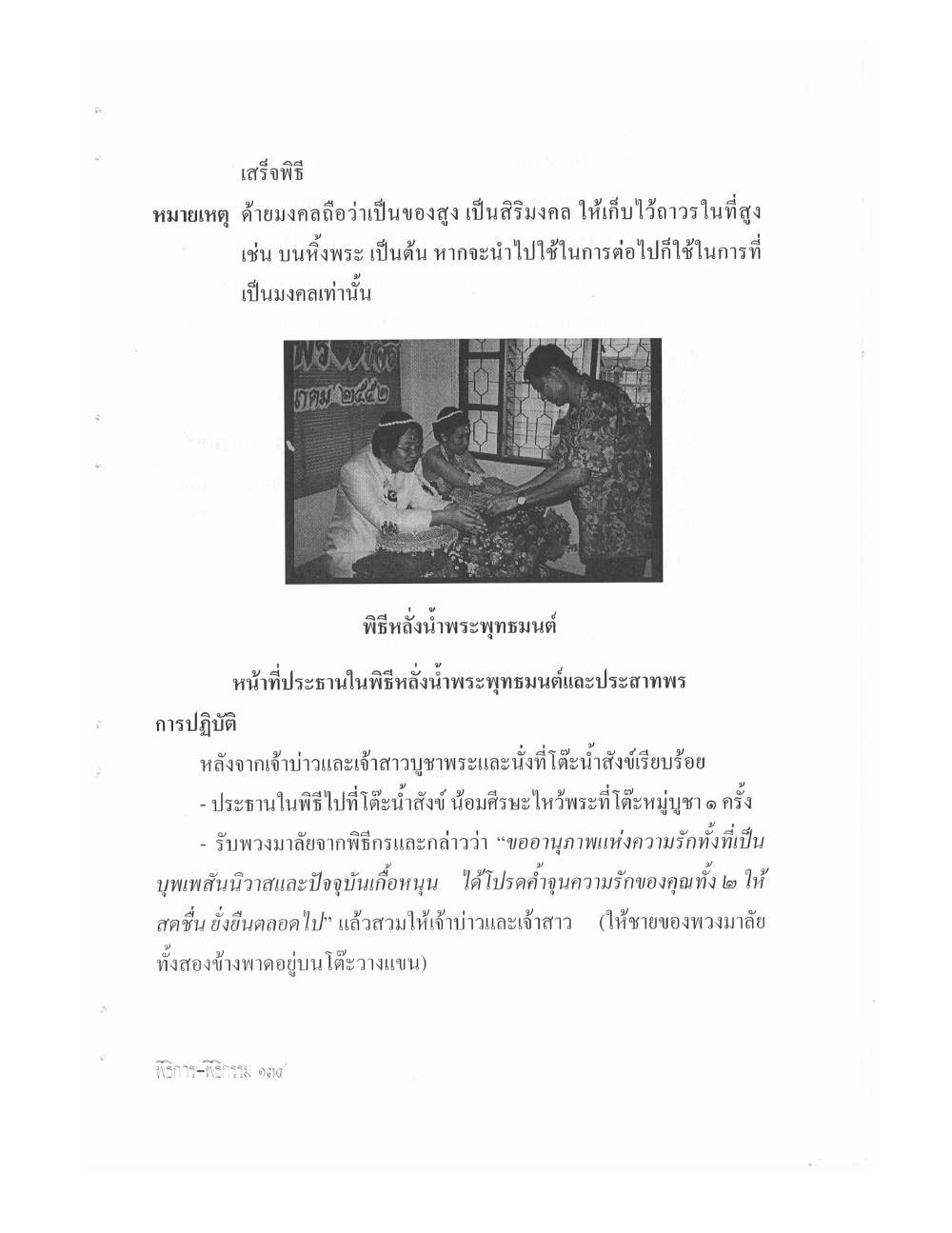
เสร็จพิธี หมายเหตุ ด้ายมงคลถือว่าเป็นของสูง เป็นสิริมงคล ให้เก็บไว้ถาวรในที่สูง เช่น บนหิ้งพระ เป็นต้น หากจะนำไปใช้ในการต่อไปก็ใช้ในการที่เป็นมงคลเท่านั้น
[ภาพถ่ายขาวดำ: เจ้าบ่าวและเจ้าสาวนั่งคุกเข่าอยู่หน้าหน้าต่างบานกระจกลายตาราง พิธีกรยืนหลั่งน้ำพระพุทธมนต์ลงบนมือที่ประนมของทั้งคู่ ด้านบนมีป้ายผ้าอ่านได้บางส่วนว่า "...เดช ๒๕๕๒"]
พิธีหลั่งน้ำพระพุทธมนต์
หน้าที่ประธานในพิธีหลั่งน้ำพระพุทธมนต์และประสาทพร การปฏิบัติ หลังจากเจ้าบ่าวและเจ้าสาวบูชาพระและนั่งที่โต๊ะน้ำสังข์เรียบร้อย - ประธานในพิธีไปที่โต๊ะน้ำสังข์ น้อมศีรษะไหว้พระที่โต๊ะหมู่บูชา ๑ ครั้ง - รับพวงมาลัยจากพิธีกรและกล่าวว่า "ขออานุภาพแห่งความรักทั้งที่เป็นบุพเพสันนิวาสและปัจจุบันเกื้อหนุน ได้โปรดค้ำจุนความรักของคุณทั้ง ๒ ให้สดชื่น ยั่งยืนตลอดไป" แล้วสวมให้เจ้าบ่าวและเจ้าสาว (ให้ชายของพวงมาลัยทั้งสองข้างพาดอยู่บนโต๊ะวางแขน)
พิธีการ-พิธีกรรม ๑๓๔
The rite is complete Note: The auspicious thread is regarded as a lofty, sacred object; keep it permanently in a high place, such as on the Buddha shelf. If it is to be used again afterward, it should only be used for an auspicious purpose.
[black-and-white photograph: the bride and groom kneel before a latticed glass window while an officiant stands pouring holy water over their joined, upraised hands; a banner overhead is partly legible, reading "...decha 2552" (a year in the Buddhist Era)]
The Rite of Pouring Holy Water
The Duties of the Presiding Elder in the Rite of Pouring Holy Water and Bestowing Blessings
Procedure After the groom and bride have paid homage to the Buddha image and are properly seated at the conch-water table - The presiding elder of the rite goes to the conch-water table and bows the head to the Buddha image at the altar table once - Receives the garland from the officiant and says: "May the power of love, both that destined from past lives and that which sustains you now, support the love of you two, keeping it fresh and everlasting," then places it on the groom and bride (with both tails of the garland laid across the table where the arms rest)
(running header: Ceremonies–Rites, page 134)
- รับด้ายมงคลจากพิธีกร พนมมือกล่าวว่า "พระพุทธเจ้า พระธรรม พระสงฆ์ เป็นมงคลในโลก ด้วยอานุภาพแห่งคุณพระศรีรัตนตรัย ขอความสุขสวัสดีมงคลจงบังเกิดแก่คุณทั้งสองตลอดกาลทุกเมื่อเทอญ" แล้วใช้มือแต่ละข้างกางคลี่บ่วงด้ายมงคลแต่ละบ่วงออก สวมศีรษะของเจ้าบ่าวและเจ้าสาวพร้อม ๆ กัน (มือซ้ายสวมเจ้าบ่าว มือขวาสวมเจ้าสาว) โดยให้ปมด้ายอยู่ด้านหลังศีรษะ (ถ้าไม่เรียบร้อยให้จัดอีกครั้งหนึ่ง) - รับแป้งเจิมจากพิธีกร (หรือพิธีกรถือไว้ให้) ใช้นิ้วชี้จุ่มแป้ง จุดที่กลางหน้าผากเจ้าบ่าวและเจ้าสาวเป็น ๓ จุด [แผนภาพเล็ก: จุดสามจุดมีเลขกำกับ ๑ ๒ ๓ แสดงลำดับการจุด] วนเป็นทักษิณาวรรต คือวนขวา เริ่มจุด ๑ ซ้ายมือ ภาวนาว่า พุทโธ จุด ๒ ขึ้นบน ภาวนาว่า ธัมโม จุด ๓ ขวามือ ภาวนาว่า สังโฆ หรือจะภาวนาว่า "อะ อุ มะ" หรือ "อิ สุวา สุ" ก็ได้ (ความหมายเหมือนกัน) - รับน้ำสังข์จากพิธีกร รินลงที่มือเจ้าบ่าวและเจ้าสาวที่พนมอยู่พร้อมกับกล่าวว่า "ขอให้ทั้งสองจงครองรักกันด้วยความซื่อสัตย์ สมัครสมานเป็นอันเดียวกัน ดุจน้ำที่รินลงมารวมกันอยู่นี้" - เวลาถอดด้ายมงคล ไปที่โต๊ะน้ำสังข์ น้อมศีรษะไหว้พระ ๑ ครั้ง แล้วหันมาทางเจ้าบ่าวและเจ้าสาวกล่าวว่า "ขอสรรพมิ่งมงคลความสุขสวัสดีทั้งหลาย จงมีแก่คุณทั้งสองตลอดกาลทุกเมื่อเทอญ" แล้วใช้มือทั้งสองปลดด้ายมงคล (มือซ้ายปลดเจ้าบ่าว มือขวาปลดเจ้าสาว) พร้อม ๆ กัน แล้วรวมด้ายมงคลใส่ไว้ในมือเจ้าบ่าวและเจ้าสาวที่ยื่นออกมารับ แล้วจับมือเจ้าบ่าวและเจ้าสาวเชิญยืนขึ้น (ให้เจ้าบ่าวและเจ้าสาวไปกราบพระ) เสร็จพิธี
พิธีการ-พิธีกรรม ๑๓๕
- Receive the auspicious thread from the officiant, join the palms and say: "The Buddha, the Dhamma, the Sangha are auspicious in the world; by the power of the virtue of the Triple Gem, may happiness, well-being, and good fortune arise for you both, for all time, always." Then with each hand spread open each loop of the auspicious thread and place it on the heads of the groom and bride at the same time (left hand on the groom, right hand on the bride), with the knot at the back of the head (if it sits untidily, adjust it once more) - Receive the anointing powder from the officiant (or have the officiant hold it), dip the index finger in the powder, and mark the middle of the forehead of the groom and bride with 3 dots [small diagram: the three dots numbered ① ② ③, showing the order in which they are applied], moving in a clockwise, sunwise circuit: begin dot 1 on the left, reciting "Buddho"; dot 2 above, reciting "Dhammo"; dot 3 on the right, reciting "Saṅgho" — or one may instead recite "A U Ma" or "I Suwa Su" (the meaning is the same) - Receive the conch water from the officiant and pour it into the joined hands of the groom and bride, saying: "May you both preserve your love for one another in faithfulness, united as one, just as this water now poured flows together" - When it is time to remove the auspicious thread, go to the conch-water table, bow the head to the Buddha image once, then turn to the groom and bride and say: "May every manner of auspiciousness, happiness, and well-being be yours, for all time, always," then use both hands to remove the auspicious thread (left hand from the groom, right hand from the bride) at the same time, gather the thread and place it into the hands the groom and bride extend to receive it, then take their hands and invite them to rise (the groom and bride then go to prostrate to the Buddha image) The rite is complete
(running header: Ceremonies–Rites, page 135)
พิธีไหว้วิญญาณบรรพบุรุษ (ไหว้ผี)
การเตรียมการ - เก็บของกินที่มากับขันหมากอย่างละเล็กละน้อย ใส่ในถาดหรือจาน ๒ ใบ - รินเหล้าใส่แก้ว ๒ ใบ จาก ๒ ขวด และน้ำดื่ม ๒ แก้ว - เทียน ๒ เล่ม และธูป ๒ ดอก สำหรับเจ้าบ่าวและเจ้าสาว
การปฏิบัติ หลังจากเสร็จพิธีมอบขันหมากแล้ว - ปูผ้าขาวบนโต๊ะหรือที่พื้นภายในบ้านมุมใดมุมหนึ่งที่เห็นว่าเหมาะสม - วางถาดหรือจานของกินที่เก็บจากขันหมาก พร้อมทั้งแก้วเหล้า ๒ แก้ว และน้ำดื่ม ๒ แก้ว บนผ้าขาวที่ปูบนโต๊ะหรือที่พื้น - จุดธูป เทียน ให้เจ้าบ่าวและเจ้าสาวปักไว้ ณ ที่ปักหรือบนถาดหรือจานของไหว้ - กล่าวบูชาวิญญาณของบรรพบุรุษว่า "วันนี้นาย.....และนางสาว....ได้เข้าพิธีมงคลสมรสตามประเพณี จึงขอนอบน้อมแด่ดวงวิญญาณของบรรพบุรุษที่ล่วงลับไป เพื่อเป็นการบอกกล่าวขออนุญาตและขอให้ดวงวิญญาณและพระคุณของท่านได้โปรดอวยพรให้ลูกหลานมีความสุขความเจริญในชีวิตสมรสยิ่ง ๆ ขึ้นไปเทอญ" (กราบ ๑ ครั้ง ไม่แบมือ) เสร็จพิธี
พิธีการ-พิธีกรรม ๑๓๖
The Rite of Paying Homage to the Ancestral Spirits (Wai Phi)
Preparations - Collect a small portion of each food item that came with the betrothal tray, placed in 2 trays or plates - Pour liquor into 2 glasses from 2 bottles, and 2 glasses of drinking water - 2 candles and 2 incense sticks, for the groom and bride
Procedure After the rite of presenting the betrothal tray is complete - Spread a white cloth on a table or on the floor, in whichever corner of the house seems fitting - Set the trays or plates of food collected from the betrothal tray, together with the 2 glasses of liquor and 2 glasses of drinking water, on the white cloth spread on the table or floor - Light the incense and candles for the groom and bride to plant at the place for planting, or on the tray or plate of offerings - Recite these words of homage to the ancestral spirits: "Today, Mr. ..... and Miss .... have entered into the auspicious marriage rite according to custom. We therefore humbly pay homage to the spirits of the ancestors who have passed away, to inform you and ask your leave, and to ask that your spirits and your virtue grant a blessing that your descendants have happiness and ever-greater prosperity in their married life." (Prostrate once, without opening the palms flat) The rite is complete
(running header: Ceremonies–Rites, page 136)
การไหว้และการรับไหว้
กระทำหลังจากเสร็จพิธีมอบขันหมากแล้ว เฉพาะที่เกี่ยวกับญาติผู้ใหญ่หรือผู้เคารพนับถือใกล้ชิดเท่านั้น การไหว้ คู่บ่าวสาวจะนำพานธูปเทียนแพกรวยดอกไม้สด หรือพานดอกไม้ธูปเทียน และผ้าไหว้หรือของที่ระลึกไปกราบแสดงความเคารพญาติผู้ใหญ่หรือผู้ที่เคารพนับถือ การรับไหว้ ผู้ใหญ่จะกล่าวคำอวยพร (บางแห่งมีด้ายขาวผูกข้อมือคู่บ่าวสาวด้วย) และมอบของรับไหว้ เช่น เงิน ทอง หรือทรัพย์สินอื่น ๆ ฯลฯ
พิธีปูที่นอนเรียงหมอน
ก่อนจะทำพิธีส่งตัวเจ้าสาว ต้องมีพิธีปูที่นอนเรียงหมอน โดยนิยมเชิญคู่สามีภรรยาผู้เป็นที่เคารพนับถือที่อยู่กินด้วยกันมาด้วยความรักสามัคคี มีความผาสุกราบรื่น ให้เป็นผู้ปูที่นอน วิธีปูให้จับชายผ้าพร้อมกันและปูพร้อมกัน หยิบสิ่งของอันเป็นมงคล เช่น ฟักเขียว ๑ ลูก หม้อใหม่ใส่น้ำสะอาด ๑ หม้อ หินบดยา ๑ อัน ถั่วเขียว ๑ ถุง งาดำ ๑ ถุง เป็นต้น วางไว้ข้างที่นอน แล้วทั้งคู่จะลงนอนพอเป็นพิธีเอาฤกษ์ก่อน เรียกว่า ฤกษ์เรียงหมอน สามีนอนบนที่นอนเจ้าบ่าว ภรรยานอนบนที่นอนเจ้าสาว สนทนาด้วยคำอันเป็นมงคล เช่น ฝ่ายสามีอาจพูดว่า "แหม ! ที่นอนนี้สบายดีจริง ใครได้นอนก็ต้องอยู่เป็นสุข" ฝ่ายภรรยาอาจต่อท้ายว่า "เราคงมีความเจริญยิ่ง ๆ ขึ้นไป" ต่อจากนั้น คู่สามีภรรยาทำเป็นนอนหลับพอเป็นพิธี แล้วตื่นขึ้นสนทนาเป็นเชิงทำนายฝันกัน เช่น ภรรยาอาจพูดว่า "เมื่อกี้นี้ฝันว่ามีเทพเจ้ามาคุ้มครองรักษาและนำเงินทองมาให้" สามีก็แก้ฝันว่า "เป็นฝันดี จะทำให้เราทั้งสองมั่งมีศรีสุขตลอดไป" เป็นต้น แล้วทั้งคู่ลุกจากที่นอน โปรยข้าวตอกดอกไม้และ
พิธีการ-พิธีกรรม ๑๓๗
Paying Homage and Receiving Homage
This is done after the rite of presenting the betrothal tray is complete, and applies only to elder relatives or close, respected persons. Paying homage: the bride and groom carry a tray of incense, candles, folded cloth, and cones of fresh flowers, or a tray of flowers, incense and candles, along with a cloth of homage or a keepsake, and go to prostrate in respect to their elder relatives or those they hold in esteem. Receiving homage: the elder recites words of blessing (in some places a white thread is also tied around the wrists of the bride and groom) and gives a gift in return for the homage, such as money, gold, or other property, etc.
The Rite of Laying the Bed and Arranging the Pillows
Before the rite of sending the bride is performed, there must first be the rite of laying the bed and arranging the pillows. It is customary to invite a married couple held in respect, who live together in love and harmony and enjoy a smooth, happy life, to be the ones who lay the bed. The method: both take hold of a corner of the cloth together and spread it together, then take auspicious objects — such as 1 winter melon, 1 new pot filled with clean water, 1 grinding stone, 1 bag of mung beans, 1 bag of black sesame, and so on — and set them beside the bed. The couple then lie down briefly, merely as a matter of form, to take the auspicious moment, called "the auspicious moment of arranging the pillows." The husband lies on the side that will be the groom's, the wife on the side that will be the bride's, and they converse in auspicious words; for example, the husband might say, "My, this bed is truly comfortable — whoever sleeps here is sure to live happily," and the wife might add, "May we grow ever more prosperous." After that, the couple pretend to fall asleep, merely as a matter of form, then wake and converse as though interpreting a dream; for example, the wife might say, "Just now I dreamed that a deity came to protect and watch over us, and brought us money and gold," and the husband interprets the dream, saying, "That is a good dream — it will bring the two of us prosperity and blessing forever," and so on. The couple then rise from the bed, scatter puffed rice and flowers, and
(running header: Ceremonies–Rites, page 137)
ประพรมน้ำพระพุทธมนต์ที่นอนและห้องนอน พร้อมกับกล่าวคำอวยพรให้แก่คู่บ่าวสาวว่า "ขอให้คู่บ่าวสาวผู้ใช้ที่นอนอันเป็นมงคลนี้ได้อยู่กินกันอย่างมีความสุขราบรื่นตลอดไป" เสร็จพิธีปูที่นอนเรียงหมอนเพียงนี้
พิธีส่งตัวเจ้าสาว
เมื่อทำพิธีปูที่นอนเรียงหมอนเสร็จแล้ว เจ้าบ่าวพร้อมบิดามารดาหรือผู้ปกครองเข้าไปรอเจ้าสาวอยู่ในห้อง ถึงเวลาฤกษ์ เถ้าแก่ฝ่ายเจ้าสาวหรือบิดามารดาหรือผู้ปกครองที่เข้าใจในพิธีดี จะนำเจ้าสาวเข้ามาส่งให้เจ้าบ่าว ผู้ใหญ่ทั้งสองฝ่ายจะกล่าวให้โอวาทและให้พรแก่บุตรหลานของตน เจ้าสาวจะกราบฝากตัวกับเจ้าบ่าว ผู้ใหญ่ทั้งหมดจะออกจากห้องหอ ปล่อยให้เจ้าบ่าวกับเจ้าสาวอยู่กันตามลำพัง พิธีแต่งงานก็สิ้นสุดลงเพียงเท่านี้
เบ็ดเตล็ด
การจัดเตียบ
เตียบ ได้แก่ ตะลุ่มปากผาย มีฝาครอบ เป็นส่วนหนึ่งของขันหมากเอก การจัดเตียบจะจัด ๑ คู่ ๒ คู่ ๓ คู่ ๔ คู่ หรือมากกว่า ๔ คู่ก็ได้ ตามปกติแล้วจัดเป็น ๔ คู่ ใส่ห่อหมก ๑ คู่ ขนมจีน ๑ คู่ หมูต้ม ๑ คู่ และขนมต้ม ๑ คู่ บรรดาเตียบที่จัดของใส่เหล่านั้น ห่อด้วยผ้าลายทองและใช้ไหมทองผูกแบบเดียวกับขันหมากเอก ยกไปพร้อมกับขันหมากเอก จุดประสงค์เพื่อเสริมขันหมากเอกให้มีความสวยงามมากยิ่งขึ้น และถือเป็นเคล็ดแสดงถึงความสมบูรณ์พูนสุข มั่งคั่งด้วยทรัพย์สินเงินทอง (ปัจจุบัน การจัดเตียบมีน้อยลง)
พิธีการ-พิธีกรรม ๑๓๘
sprinkle holy water on the bed and the bedroom, together with words of blessing for the bride and groom: "May the bride and groom who use this auspicious bed live together happily and smoothly forever." The rite of laying the bed and arranging the pillows ends here.
The Rite of Sending the Bride
Once the rite of laying the bed and arranging the pillows is finished, the groom, together with his parents or guardians, goes to wait for the bride in the room. When the auspicious moment arrives, the matchmaker on the bride's side, or her parents or guardian who understands the rite well, brings the bride in and gives her to the groom. The elders of both sides give counsel and blessings to their own child. The bride prostrates to entrust herself to the groom. All the elders then leave the bridal chamber, leaving the groom and bride alone together. The wedding rite ends at this point.
Miscellaneous
Arranging the Tiap (Covered Trays)
The tiap are flare-mouthed covered boxes with lids, forming part of the principal betrothal tray. In arranging the tiap, 1, 2, 3, 4, or more than 4 pairs may be set out; ordinarily 4 pairs are arranged: 1 pair of steamed fish curry (ho mok), 1 pair of rice noodles, 1 pair of boiled pork, and 1 pair of boiled sweets. All the tiap holding these items are wrapped in gold-patterned cloth and tied with gold thread in the same manner as the principal betrothal tray, and carried along with it. The purpose is to enhance the beauty of the principal betrothal tray, and it is held as a token signifying abundance, prosperity, and wealth in money and gold. (Nowadays the arranging of tiap has become less common.)
(running header: Ceremonies–Rites, page 138)
วิธีผ่านประตูเงิน นาก ทอง
เมื่อขบวนขันหมากถึงบ้านเจ้าสาว ผู้ใหญ่ฝ่ายหญิงซึ่งรอต้อนรับอยู่ โดยจัดเด็กหญิงอายุประมาณ ๗-๘ ขวบ ถือพานหมากพลูรอต้อนรับอยู่ด้วย (หมากพลูจัดเป็นจำนวนคู่) และกล่าวต้อนรับว่า "วันนี้ฤกษ์งามยามดี พวกท่านมาดีหรือมาร้าย ใคร่ขอทราบ" ผู้ใหญ่ฝ่ายชายก็ตอบไปว่า "วันนี้ฤกษ์งามยามดี ท่านผู้ปรารถนาดีผู้ใหญ่จะนำเอาแก้วเข้ามาเกย จะนำเอาเขยเข้ามาฝาก จะนำเอาขันหมากเข้ามาให้ หากไม่ขัดข้องขอให้รับไว้ด้วย" แล้วก็วางซองเงินบนพานหมากพลูให้เด็กหญิง เมื่อขบวนขันหมากจะเข้าไปในบ้านจะต้องผ่านนายประตู ๓ ประตู คือ ประตูเงิน ประตูนาก และประตูทอง ให้เจ้าบ่าวเตรียมเงินใส่ซองเพื่อขอผ่านประตู คนเฝ้าประตูเงินจะใช้เข็มขัดเงินกั้นไว้ไม่ยอมให้เข้า จะพูดว่า "บ้านนี้เป็นบ้านใหญ่บ้านโต มีผู้คนมากมาย การจะผ่านเข้าออกจะต้องแจ้งให้นายประตูทราบก่อน จึงจะผ่านเข้าไปได้" เมื่อเจ้าบ่าวให้รางวัลนายประตูแล้วก็ผ่านเข้าไปได้ ผู้เฝ้าประตูอื่น ก็พูดและปฏิบัติเช่นเดียวกันนี้
วิธีเปิดขันหมาก
เมื่อขบวนขันหมากเข้าไปในบ้านเรียบร้อยแล้ว ให้นำขันหมากไปวางไว้ ณ ที่ที่เจ้าของบ้านจัดเตรียมไว้ หลังจากผู้ใหญ่ทั้งสองฝ่ายได้เจรจาพาทีสู่ขอและมอบ-รับขันหมากกันเรียบร้อยแล้ว ผู้ใหญ่ฝ่ายหญิงก็จะพูดว่า "เพื่อเป็นสิริมงคลและเป็นที่ทราบทั่วกัน ขอให้เปิดขันหมากดูด้วย" ผู้ใหญ่ฝ่ายชายก็ทำการเปิดขันหมากทั้งหมด เปิดขันที่ ๑ ขันหมากพลูก่อน โดยปูผ้าห่อขันหมากที่พื้น หยิบใบพลูวางเรียงบนผ้าก่อนแล้ววางหมาก ถุงข้าวเปลือก ถุงถั่วเขียว ถุงงาดำ ถุงข้าวตอก ลงบนใบพลู เปิดขันที่ ๒ ขันเงินทุน ปูผ้าห่อขันเงินทุนที่พื้น
พิธีการ-พิธีกรรม ๑๓๙
The Method of Passing Through the Silver, Rose-Gold, and Gold Gates
When the betrothal procession reaches the bride's house, the elders on the woman's side, waiting to receive them, arrange for a girl of about 7-8 years old to hold a tray of areca nut and betel leaf ready to welcome them (the areca and betel are arranged in even numbers), and to say in greeting: "Today is an auspicious day and hour — do you come, sirs, with good or ill intent? We should like to know." The elders on the man's side answer: "Today is an auspicious day and hour. Kind well-wishers, the elders have come to bring a jewel to shore, to bring a son-in-law to be entrusted to you, and to bring the betrothal tray to present; if there is no objection, please accept it." Then they place an envelope of money on the tray of areca and betel for the girl. When the betrothal procession is about to enter the house, it must pass through 3 gatekeepers, namely the Silver Gate, the Rose-Gold Gate, and the Gold Gate. The groom must prepare money in envelopes to request passage through the gates. The keeper of the Silver Gate bars the way with a silver belt and refuses entry, saying: "This is a great and important house, with very many people in it. To pass in or out, the gatekeeper must first be informed — only then may you pass through." Once the groom rewards the gatekeeper, he may pass through; the other gatekeepers speak and act in exactly the same way.
The Method of Opening the Betrothal Tray
Once the betrothal procession has entered the house properly, the betrothal tray is set down at the place the hosts have prepared. After the elders of both sides have negotiated the proposal of marriage and formally given and received the betrothal tray, the elders on the woman's side say: "For the sake of auspiciousness, and so that all may know, please also open the betrothal tray for us to see." The elders on the man's side then open every tray. The first tray to be opened is the areca-and-betel tray: the cloth wrapping the tray is spread on the floor, the betel leaves are taken out and laid in rows on the cloth first, then the areca nuts and the bags of unhusked rice, mung beans, black sesame, and puffed rice are placed on top of the betel leaves. The second tray to be opened is the dowry-capital tray: the cloth wrapping the dowry-capital tray is spread on the floor
(running header: Ceremonies–Rites, page 139)
หยิบใบเงิน ใบนาก ใบทอง วางเรียงบนผ้า วางเรียงดอกไม้ต่าง ๆ ไว้รอบนอก วางเงินทุนไว้ตรงกลางแล้วตรวจนับ (หากเป็นขันหมั้นให้แก้ผ้าห่อขันหมั้นออกอย่างเดียว) เปิดขันที่ ๓ ขันสินสอดปูผ้าห่อขันสินสอดที่พื้น หยิบใบเงิน ใบนาก ใบทอง วางเรียงบนผ้า วางเรียงดอกไม้ต่าง ๆ ไว้รอบนอก วางเงินสินสอดไว้ตรงกลาง แล้วตรวจนับ (ปัจจุบัน มีเฉพาะเปิดขันหมากแล้วโปรยสิ่งของมงคลเท่านั้นเป็นส่วนมาก ไม่ค่อยมีการนับเงินสินสอดเหมือนในอดีต) เมื่อเปิดขันหมากตรวจนับดูเสร็จเรียบร้อยแล้วก็ห่อมอบส่งให้ฝ่ายหญิงไป โดยเฉพาะห่อเงินสินสอด ฝ่ายหญิงรับไปแล้วให้แบกขึ้นบ่าพร้อมเปล่งเสียงด้วยความปีติว่า "เงินทองมากมายหนักจริง ๆ" โดยถือเอาเคล็ดเป็นนิมิตหมายถึงความมั่งมีศรีสุขทรัพย์สินเงินทองมากมายตามคติโบราณ ส่วนหมากพลูก็ห่อมอบส่งให้ฝ่ายหญิงเช่นกัน เก็บไว้ ๓, ๗ วัน แล้วนำไปพลีใต้ต้นไม้ใหญ่
ความหมายสิ่งของสิริมงคล
- ข้าวเปลือก ถั่วเขียว งาดำ หมายถึง ความเจริญงอกงาม - ข้าวตอก หมายถึง ฐานะใหญ่โต - ใบเงิน ใบนาก ใบทอง หมายถึง แก้วแหวนเงินทอง - พลูเรียง หมายถึง ความเป็นญาติเรียงพี่เรียงน้องกัน - หมาก มีรสฝาด มีคุณสมบัติในทางประสานแผล หมายถึง เมื่อมีการผิดพลาดล่วงเกินกันก็ให้อภัยกันประสานกันดีดังเดิม - ฟักเขียว หมายถึง ให้อยู่เย็นเป็นสุขเหมือนฟัก - หม้อใหม่ใส่น้ำ หมายถึง ให้กลมเกลียวไม่แตกแยกเหมือนน้ำ - หินบดยา หมายถึง ให้หนักแน่นเหมือนหิน
พิธีการ-พิธีกรรม ๑๔๐
Take out the silver leaves, rose-gold leaves, and gold leaves and lay them in rows on the cloth, lay various flowers around the outside, place the dowry capital in the middle, then count it. (If this is the betrothal tray, only the cloth wrapping the betrothal tray is undone, nothing more.) The third tray to be opened is the bride-price tray: the cloth wrapping the bride-price tray is spread on the floor, the silver leaves, rose-gold leaves, and gold leaves are taken out and laid in rows on the cloth, various flowers are laid around the outside, and the bride price is placed in the middle, then counted. (Nowadays, in most cases only the betrothal tray is opened and the auspicious items scattered; the bride price is seldom counted as it was in the past.) Once the betrothal tray has been opened and counted, it is wrapped and handed over to the woman's side; in particular, the bundle of bride-price money is taken by the woman's side, who hoist it onto their shoulder and cry out joyfully, "The money and gold are so plentiful, so heavy indeed!" This is taken as an omen signifying great wealth, prosperity, and abundance of money and gold, according to ancient custom. The areca and betel are likewise wrapped and given to the woman's side, kept for 3 or 7 days, then offered beneath a large tree.
The Meaning of the Auspicious Objects
- Unhusked rice, mung beans, and black sesame mean growth and prosperity - Puffed rice means great and lofty standing - Silver leaves, rose-gold leaves, and gold leaves mean jewels, rings, silver and gold - Rows of betel leaves mean being as close as siblings, elder and younger, among relatives - Areca nut, being astringent and having the property of closing wounds, means that when there has been some fault or offense between the two families, they forgive one another and are reconciled as before - Winter melon means living in comfort and ease like the melon - A new pot filled with water means being harmonious and unbroken, like water - The grinding stone means being firm and steadfast, like stone
(running header: Ceremonies–Rites, page 140)
การกล่าวอวยพร
พิธีเลี้ยงฉลองมงคลสมรส ถือว่าเป็นพิธีใหญ่ที่สำคัญพิธีหนึ่ง ในพิธีนี้ขั้นตอนสำคัญที่ขาดไม่ได้คือ การกล่าวอวยพรคู่บ่าวสาว บางงานที่มีแขกผู้ใหญ่หรือญาติมิตรมาร่วมงานมาก มักจะเชิญให้กล่าวอวยพรกันหลาย ๆ คน ทางปฏิบัติที่เหมาะสม คือควรเชิญผู้ที่เป็นผู้ใหญ่ที่สุดหรือผู้ที่เจ้าภาพพิจารณาเห็นสมควรเป็นผู้แทนแขกที่มาร่วมงานทั้งหมดกล่าวอวยพรเพียงคนเดียว หรือบางงานเชิญผู้กล่าวอวยพร ๒ คน ก็ได้ โดยเชิญผู้ใหญ่ทางฝ่ายเจ้าบ่าวกล่าว ๑ คน และเชิญผู้ใหญ่ทางฝ่ายเจ้าสาวกล่าว ๑ คน และตอนท้ายหลังจากกล่าวอวยพรคู่บ่าวสาวแล้ว ควรให้คู่บ่าวสาวกล่าวขอบคุณผู้มาร่วมงานด้วย
ตัวอย่างคำกล่าวอวยพรในฐานะผู้ใหญ่ของทั้งสองฝ่าย
ท่านผู้มีเกียรติ ที่เคารพ ผมรู้สึกเป็นเกียรติที่ได้รับเชิญจากเจ้าภาพ ให้เป็นผู้แทนแขกผู้มีเกียรติขึ้นมากล่าวให้โอวาทและอวยพรคู่บ่าวสาว ในโอกาสงานมงคลสมรสระหว่างคุณ.........................และคุณ......................... เจ้าภาพ คือคุณ.......................ให้โอกาสนี้แก่ผม เนื่องจากเราได้เคยร่วมชั้นเรียนกันมาในระดับมัธยมศึกษา ที่โรงเรียน.........................และยังคงติดต่อสนิทสนมกันมาโดยตลอดจนถึงทุกวันนี้ ผมรู้สึกชื่นชมยินดีแทนเจ้าภาพและคู่บ่าวสาว ที่มีแขกมาร่วมงานมงคลสมรสแสดงความยินดีและอวยพรกันอย่างคับคั่ง แขกผู้มีเกียรติทุกท่าน คงมีความเห็นสอดคล้องกับผมที่คู่บ่าวสาวในวันนี้มีความเหมาะสมกันทุกประการ ทั้งคุณสมบัติและรูปสมบัติ การศึกษา เจ้าบ่าวจบ.........................เจ้าสาวจบ .........................
พิธีการ-พิธีกรรม ๑๔๑
Giving the Blessing Speech
The wedding banquet is regarded as one important major rite. In this rite, an essential step that cannot be omitted is giving a blessing speech to the bride and groom. At some events where many senior guests, relatives, or friends attend, several people may be invited to speak blessings in turn. The fitting practice is to invite the most senior person present, or whomever the host judges suitable, to act as the representative of all the guests and give a single blessing speech; or at some events, two speakers may be invited — a senior person from the groom's side to speak, and a senior person from the bride's side to speak. Afterward, once the blessing speech to the bride and groom is finished, the bride and groom should thank the guests who came to the event.
A Sample Blessing Speech, Given by an Elder Representing Both Sides
Honored and respected guests, I feel it an honor to have been invited by the host to serve as representative of the honored guests, coming forward to offer counsel and blessing to the bride and groom, on the occasion of the auspicious marriage between Khun ......................... and Khun ......................... The host, Khun ......................., gave me this opportunity because we were once classmates at the secondary-school level, at ......................... School, and we have remained close and in touch right up to this day. I feel joy and pride on behalf of the host and the bride and groom, that so many guests have come to this wedding celebration to express their joy and offer blessings in such great numbers. All you honored guests must surely share my view that the bride and groom today are well matched in every respect, both in character and in appearance. Education: the groom graduated from ......................... the bride graduated from .........................
(running header: Ceremonies–Rites, page 141)
ฐานะ เจ้าบ่าวเป็นบุตร.........................เจ้าสาวเป็นบุตร ......................... รูปสมบัติ เจ้าบ่าวก็หล่อ เจ้าสาวก็สวย นับว่าเป็นปัจจัยพื้นฐานในการครองคู่กันด้วยความราบรื่นต่อไป ความปรารถนาสูงสุดในการดำรงชีวิตสมรส ก็คือความสุขในครอบครัว การที่จะมีความสุขได้มากน้อยเพียงใด ในฐานะที่เจ้าบ่าวเจ้าสาวเป็นพุทธศาสนิกชน ควรได้อาศัยหลักธรรมคำสั่งสอนของพระพุทธเจ้า เพื่อยึดถือเป็นแนวปฏิบัติประจำใจ ๔ ประการ คือ ๑. คู่สมรสต้องมีความจริงใจ ซื่อสัตย์ ซื่อตรงต่อกัน ทั้งต่อหน้าและลับหลัง ๒. รู้จักยับยั้งอารมณ์ ข่มความรู้สึกทั้งดีและไม่ดีไว้ได้ ไม่แสดงออกให้ปรากฏจนเสียกิริยา ๓. มีความอดทน ไม่ท้อถอย ตั้งใจทำหน้าที่การงานด้วยความขยันหมั่นเพียร เข้มแข็ง อดทน ไม่หวั่นไหว เพื่อบรรลุจุดมุ่งหมายของการครองเรือน ๔. รู้จักเสียสละความสุขและผลประโยชน์ส่วนตนเพื่อครอบครัว พร้อมที่จะรับฟังความคิดเห็นของกันและกัน โดยอย่าคิดว่าตนเป็นฝ่ายเสียเปรียบ แต่ควรทำตนให้เป็นผู้แพ้เสมอ เพื่อประคองชีวิตคู่ให้อยู่อย่างราบรื่นและมั่นคง ในโอกาสอันเป็นสิริมงคลนี้ ผมขอตั้งจิตอธิษฐานขออานุภาพคุณพระศรีรัตนตรัย และสิ่งศักดิ์สิทธิ์ทั้งหลายในสากลโลก อีกทั้งพระบารมีของพระบาทสมเด็จพระเจ้าอยู่หัว และสมเด็จพระนางเจ้าฯ พระบรมราชินีนาถ ได้โปรดดลบันดาลประทานพร ให้คู่บ่าวสาว ครองคู่กันด้วยความสุข ความราบรื่น มีความมั่งคั่ง มั่นคง มีบุตรหลานเป็นศรีสง่าแก่วงศ์ตระกูล มีอายุยืนนาน เป็นร่มโพธิ์ร่มไทรแก่บุตรหลานในอนาคตต่อไป
พิธีการ-พิธีกรรม ๑๔๒
Family standing: the groom is the child of ......................... the bride is the child of ......................... Appearance: the groom is handsome, the bride is beautiful. These may be counted as basic conditions for the couple to live together smoothly hereafter. The highest aspiration in married life is happiness within the family. As to how much happiness they will be able to attain, since the groom and bride are Buddhists, they should rely on the principles taught by the Buddha, holding to them as guiding practices for the heart, in four respects, namely: 1. The married couple must have sincerity, honesty, and integrity toward one another, both to each other's face and behind each other's back. 2. They must know how to restrain their emotions, holding back both good and bad feelings so as not to let them show and spoil their conduct. 3. They must have patience and not lose heart, attending diligently and steadfastly to their duties and work, remaining strong and enduring, unshaken, in order to achieve the aims of married life together. 4. They must know how to sacrifice their own happiness and personal interests for the sake of the family, and be ready to listen to one another's views, never thinking of themselves as the one who has lost out, but rather making themselves always willing to be the one who "loses," so as to preserve their life together smoothly and securely. On this auspicious occasion, I wish to set my mind and pray, invoking the power of the virtue of the Triple Gem and all sacred and holy powers throughout the universe, together with the grace of His Majesty the King and Her Majesty the Queen, that they may grant a blessing that the bride and groom live together in happiness and harmony, achieve wealth and stability, have children and grandchildren who bring honor to the family line, live long lives, and be a shelter and shade for their descendants far into the future.
(running header: Ceremonies–Rites, page 142)
ท้ายที่สุดนี้ ผมใคร่ขอเรียนเชิญแขกผู้มีเกียรติทุกท่านได้โปรดยืนขึ้น เพื่อร่วมดื่มอวยพรให้คู่บ่าวสาวประสบความสุข สดชื่น สมหวังในชีวิตสมรส ณ บัดนี้ครับ
ตัวอย่างคำกล่าวอวยพรในฐานะผู้ใหญ่ฝ่ายเจ้าบ่าว
"ท่านผู้มีเกียรติที่เคารพ ก่อนอื่นผมต้องขอขอบคุณทุกท่านที่ได้กรุณามา ให้เกียรติแก่เจ้าภาพและคู่สมรสอย่างพร้อมเพรียงกัน เป็นความอบอุ่นและ ประทับใจที่เจ้าภาพต้องรำลึกไว้ตลอดไป หากจะมีบางสิ่งบางอย่างขาดตกบกพร่องไปบ้าง ก็ขอกราบอภัยไว้ ณ ที่นี้ด้วย ผมมองดูเจ้าบ่าวเจ้าสาวแล้ว มีความรู้สึกว่าทั้งสองเป็นคู่บุพเพสันนิวาสที่ แท้จริง ผมได้พบเห็นเจ้าบ่าวมาตั้งแต่เริ่มมีชีวิตอยู่ในโลก จนเติบใหญ่ มีคุณลักษณะพิเศษอยู่หลายอย่าง จึงมั่นใจได้ว่าเจ้าสาวเลือกคู่ไม่ผิดแน่ เคล็ดลับ ของการครองเรือนมีอยู่นิดเดียวคือ ความรัก ความเข้าใจ และความจริงใจต่อกัน มีสิ่งนี้แล้วชีวิตคู่ก็มีแต่ความสุข สดชื่น และยั่งยืนมั่นคงตลอดไป จึงขอให้ทั้งสองรักกันให้มั่น เข้าใจกันให้ดี มีความจริงใจเป็นเยี่ยม ด้วย อำนาจความดีเหล่านี้ และอำนาจสิ่งอันควรเคารพบูชาทั้งหลายที่ทั้งสองยึดมั่น ได้เป็นพลังส่งเสริมให้คุณทั้งสองประสบแต่ความสุข ความเจริญ ความก้าวหน้าในชีวิตสมรสยิ่ง ๆ ขึ้นไป สวัสดี"
ตัวอย่างคำกล่าวอวยพรในฐานะผู้ใหญ่ฝ่ายเจ้าสาว
"ท่านผู้มีเกียรติที่เคารพ ในนามเจ้าภาพฝ่ายหญิง ใคร่ขอขอบพระคุณท่าน ผู้มีเกียรติที่เคารพรักทั้งหลาย ที่กรุณาเสียสละเวลามาร่วมพิธี เพื่อเป็นเกียรติแก่คู่ บ่าวสาวตลอดจนญาติผู้ใหญ่ทั้งสองฝ่าย ภาพแห่งผู้มาร่วมเป็นสักขีพยานในงาน วันนี้คงจะประทับใจแก่คู่สมรสอย่างหาที่สุดมิได้
[พิธีการ-พิธีกรรม ๑๔๕]
Finally, I would like to invite all honored guests to please stand to join in a toast wishing the couple happiness, freshness, and fulfillment in married life. Now, please.
Sample toast in the capacity of a senior elder representing the groom's side
"Respected honored guests, first of all I must thank everyone who kindly came to honor the hosts and the couple, all together. This is a warmth and an impression that the hosts will remember forever. Should anything have been lacking or deficient, I ask forgiveness for it here. Looking at the groom and bride, I feel that the two are truly a couple bound by destiny from a past life (บุพเพสันนิวาส). I have known the groom since he began his life in this world, until he grew up, possessing many special qualities, so I am confident the bride has not chosen wrongly. The secret of married life is just one small thing: love, understanding, and sincerity toward one another. With this, married life will hold only happiness, freshness, and lasting stability forever. So may the two of you love each other firmly, understand each other well, and hold excellent sincerity. By the power of these virtues, and the power of all things worthy of respect and worship that the two of you hold to, may it be a force that helps you both meet with only happiness, prosperity, and ever-greater progress in married life. Farewell."
Sample toast in the capacity of a senior elder representing the bride's side
"Respected honored guests, on behalf of the hosts on the bride's side, I would like to thank all respected and beloved honored guests who kindly gave up their time to join this ceremony, to honor the bride and groom as well as the senior relatives on both sides. The sight of those who came to witness today's event will surely leave an impression on the couple beyond measure.
[Footer, running head: "Ceremonial Affairs–Rites," page 145]
ผู้หญิงนั้นถึงแม้จะได้รับสิทธิทุกอย่างเท่าเทียมชาย แต่โดยประเพณีอันดี งามของเราแล้ว ผู้หญิงก็คือผู้หญิงที่ต้องธำรงไว้ซึ่งความอ่อนช้อยละมุนละม่อม สงบเสงี่ยม จึงจะน่ารักและงดงามไม่จืดจาง จึงขอฝากให้เจ้าสาวได้จำไว้ตลอด กาล และขอฝากให้เป็นสมบัติอันล้ำค่าของเจ้าบ่าว ตั้งแต่วันนี้ มีหน้าที่อะไรก็ให้ ร่วมกันบริหารด้วยเหตุผลและคุณธรรมทุกอย่างจะเรียบร้อยและราบรื่นเอง สุดท้ายนี้ขออำนาจคุณพระศรีรัตนตรัยและอำนาจคุณงามความดีทั้งหลาย ได้ดลบันดาลให้คุณทั้งสองประสบแต่ความสุข ความเจริญความสำเร็จในชีวิต ยิ่ง ๆ ขึ้นไป สวัสดี"
ตัวอย่างคำกล่าวขอบคุณของคู่บ่าวสาว
"กระผมและเจ้าสาวของกระผม ขอกราบขอบพระคุณทุกท่านที่ได้กรุณา ให้ความเมตตามาร่วมเป็นเกียรติในพิธีวันนี้ หากจะมีบางสิ่งบางอย่างบกพร่อง ไปบ้าง ก็กราบขออภัย โอวาทและคำอวยพรที่ทุกท่านกรุณามอบให้กระผม และเจ้าสาวในวันนี้ กระผมและเจ้าสาวของกระผมขอน้อมรับด้วยความซาบซึ้งใจ และถือว่าเป็นสิริมงคลยิ่งแก่ชีวิตอย่างหาที่สุดมิได้ ขอกราบขอบพระคุณครับ" ฝ่ายเจ้าสาว อาจจะกล่าวเพียงว่า "ขอกราบขอบพระคุณทุกท่านค่ะ" ก็ได้ แล้วแต่บรรยากาศและความเหมาะสม หมายเหตุ - คำกล่าวต่าง ๆ ที่ว่ามานั้น เป็นเพียงแนวทางหนึ่งเท่านั้น การกล่าว ให้ไพเราะ ลึกซึ้งคมคายอย่างไร แล้วแต่ความคิดและลีลา วาทศิลป์ของแต่ละคน
**********
[พิธีการ-พิธีกรรม ๑๔๖]
Although women receive every right equal to men, according to our good tradition, a woman is still one who must uphold gentleness, softness, calm and modesty — only then will she remain lovable and beautiful, never fading. So I ask the bride to remember this always, and I entrust her as a precious treasure of the groom. From today, whatever duties there are, let the two of you manage them together with reason and virtue, and all will go smoothly and well on its own. Finally, may the power of the virtue of the Triple Gem and the power of all good deeds bestow upon you both only happiness, prosperity, and success in life, ever more. Farewell."
Sample words of thanks from the bride and groom
"My bride and I would like to respectfully thank everyone who kindly showed such kindness in joining to honor this ceremony today. Should anything have been lacking, we ask forgiveness. The guidance and blessings that everyone has kindly given to me and my bride today, my bride and I accept with deep gratitude, and consider them the greatest blessing to our lives, beyond measure. We respectfully thank you." The bride's side may simply say, "We respectfully thank everyone" [feminine polite form], which is also acceptable, depending on the atmosphere and what is appropriate. Note — The various speeches given above are merely one approach. How eloquently, deeply, and cleverly one speaks depends on each person's own thinking and rhetorical style.
**********
[Footer, running head: "Ceremonial Affairs–Rites," page 146]
พิธีศพ
******** ความตายเป็นสิ่งที่ไม่มีใครหนีไปได้เลย จะต่างกันก็เพียงแต่จะเร็วหรือช้า เท่านั้น เมื่อบุคคลหมดลมหายใจแล้ว ก็เป็นหน้าที่ของผู้ที่ยังมีชีวิตอยู่จะ ดำเนินการเกี่ยวกับศพตามลัทธิประเพณีนิยม เพื่อเป็นการให้เกียรติแก่ผู้ตายและ เป็นการไว้อาลัยเป็นครั้งสุดท้าย มีขั้นตอนที่ควรทราบดังต่อไปนี้ ๑. การแจ้งตาย ๑.๑ ถึงแก่กรรมที่โรงพยาบาล ทางโรงพยาบาลจะออกใบรับรองแพทย์ ให้เพื่อเป็นหลักฐานแสดงเหตุการณ์ตาย แล้วนำใบรับรองแพทย์พร้อมบัตร ประจำตัวประชาชนของผู้เสียชีวิตไปยังสำนักทะเบียนท้องถิ่น หรือที่ทำการเขต (อำเภอ) ในเขตที่โรงพยาบาลนั้นตั้งอยู่ เพื่อขอรับมรณบัตร แต่โรงพยาบาลบางแห่ง จะออกมรณบัตรให้เอง หรือช่วยดำเนินการให้เพื่ออำนวยความสะดวก โดย ญาติของผู้เสียชีวิตจะต้องนำทะเบียนบ้านไปให้โรงพยาบาลด้วย ๑.๒ ถึงแก่กรรมที่บ้าน เจ้าของบ้านจะต้องแจ้งต่อเจ้าหน้าที่สำนัก ทะเบียนท้องถิ่น แพทย์ประจำตำบล ผู้ใหญ่บ้าน หรือ กำนัน ผู้ที่มีหน้าที่รับผิดชอบ ในเขตที่บ้านเรือนนั้นตั้งอยู่ ภายใน ๒๔ ชั่วโมง นับแต่เวลาตาย หรือพบศพ ๑.๓ ถึงแก่กรรมเนื่องจากอุบัติเหตุ ฆาตกรรม เจ้าของบ้านจะต้องแจ้ง ให้เจ้าหน้าที่ตำรวจมาชันสูตรศพ ทำหลักฐานการเสียชีวิตในโอกาสแรก ภายใน ๒๔ ชั่วโมง นับแต่เวลาตายหรือพบศพ ในระหว่างเจ้าหน้าที่ตำรวจ หรือแพทย์ยังไม่ได้ตรวจศพ ห้ามเคลื่อนย้ายศพ หรือทำให้ศพเปลี่ยนสภาพ หรือนำยามาฉีดศพ
[พิธีการ-พิธีกรรม ๑๔๗]
Funeral Rites
******** Death is something no one can escape; the only difference is whether it comes sooner or later. When a person's breath has ceased, it becomes the duty of those still living to carry out the customary rites concerning the body, in order to honor the deceased and to pay final respects. There are steps one should know, as follows: 1. Reporting the death 1.1 Death at a hospital. The hospital will issue a medical certificate as evidence of the cause of death. The medical certificate, together with the deceased's national identity card, is then taken to the local registration office or district office (amphoe) in the area where the hospital is located, to request the death certificate. However, some hospitals will issue the death certificate themselves, or help process it for convenience, provided the relatives of the deceased bring the house registration document to the hospital as well. 1.2 Death at home. The householder must report to officials of the local registration office, the sub-district doctor, the village headman, or the sub-district headman (kamnan) — whoever is responsible for the area where the house is located — within 24 hours of the time of death or discovery of the body. 1.3 Death due to accident or homicide. The householder must notify police officers to come and perform a forensic examination of the body, establishing evidence of death at the earliest opportunity, within 24 hours of the time of death or discovery of the body. While the police officers or a doctor have not yet examined the body, it is forbidden to move the body, alter its condition, or inject any preservative fluid into it.
[Footer, running head: "Ceremonial Affairs–Rites," page 147]
เมื่อเจ้าหน้าที่ตำรวจ หรือแพทย์ได้ตรวจชันสูตรศพแล้ว ญาติผู้เสียชีวิต จะต้องไปขอหลักฐานจากเจ้าหน้าที่ตำรวจท้องที่ที่รับผิดชอบพร้อมทั้งขอใบ ชันสูตรศพจากแพทย์ เพื่อนำไปแสดงต่อเจ้าหน้าที่สำนักทะเบียนท้องถิ่นใน การขอมรณบัตร โดยแจ้งด้วยว่าจะนำศพไปบำเพ็ญกุศล ณ วัดใด โดยระบุใน ช่องที่ว่า เผา ฝัง เก็บ หรือ อุทิศ เมื่อได้มรณบัตรมาแล้ว ควรถ่ายสำเนาเอกสารที่สำนักทะเบียนท้องถิ่นที่ ออกมรณบัตรให้แล้วให้เจ้าหน้าที่รับรองสำเนาเอกสารด้วยเพื่อเก็บไว้เป็น หลักฐาน ส่วนมรณบัตรตัวจริงต้องนำไปแจ้งต่อสำนักทะเบียนท้องถิ่นที่ ผู้เสียชีวิตมีภูมิลำเนาอยู่ พร้อมนำทะเบียนบ้านฉบับเจ้าบ้านไปด้วย เพื่อ เจ้าหน้าที่จะได้จำหน่ายได้ว่าเสียชีวิตเมื่อใด ทั้งนี้จะต้องแจ้งให้เจ้าหน้าที่ทราบ ภายใน ๑๕ วัน สำหรับข้าราชการทหารเรือ ที่เป็นสมาชิกฌาปนกิจสงเคราะห์ของ กองทัพเรือ เมื่อถึงแก่กรรมให้ญาติแจ้งกรมสวัสดิการทหารเรือ เพื่อจะได้ ดำเนินการเกี่ยวกับพิธีศพ เช่น การขอพระราชทานน้ำอาบศพ และการจัดพิธีศพ เป็นต้น โดยให้ปฏิบัติดังนี้ ก. แจ้งนายทะเบียนท้องถิ่นของตำบลที่ตาย เพื่อขอมรณบัตรการแจ้งตาย ขอให้ระวัง การแจ้งชื่อ นามสกุล และอายุของผู้ตายให้ถูกต้อง ตรงกับหลักฐาน ทะเบียนบ้าน ข. นำมรณบัตรฉบับที่นายทะเบียนออกให้ ทะเบียนบ้าน และบัตรประจำตัว สมาชิก และ/หรือเอกสารรับรองการเป็นสมาชิกไปแสดงต่อเจ้าหน้าที่แผนกฌาปนกิจ กองการสงเคราะห์ กรมสวัสดิการทหารเรือ เพื่อขอรับเงินค่าจัดการศพ
[พิธีการ-พิธีกรรม ๑๔๘]
Once the police officers or doctor have completed the forensic examination of the body, relatives of the deceased must go to obtain documentation from the responsible local police officers, and also request the forensic examination report from the doctor, in order to present it to officials of the local registration office when requesting the death certificate. They must also state at that time which temple the body will be taken to for merit-making, indicating in the box provided whether it is to be cremated, buried, kept, or donated. Once the death certificate is obtained, one should photocopy the documents at the local registration office that issued the death certificate, and have the officials certify the copies as well, to keep as evidence. As for the original death certificate, it must be taken to report to the local registration office where the deceased was registered as a resident, along with the house registration document in the householder's name, so that officials can record when the death occurred. This must be reported to officials within 15 days. For naval officials who are members of the Royal Thai Navy's cremation welfare society, when they die, relatives should notify the Naval Welfare Department, so that matters relating to the funeral rites can be arranged, such as requesting royally-bestowed bathing water for the deceased and organizing the funeral, among other things, by proceeding as follows: a. Notify the local registrar of the sub-district where the death occurred, to request the death registration certificate. Please take care that the name, surname, and age of the deceased are reported correctly, matching the house registration records. b. Take the death certificate issued by the registrar, the house registration document, and the membership identification card and/or documents certifying membership, to present to the officials of the cremation section, Welfare Affairs Division, Naval Welfare Department, to request the funeral management funds.
[Footer, running head: "Ceremonial Affairs–Rites," page 148]
ค. เงินค่าจัดการศพ จะจ่ายให้แก่ผู้มีสิทธิ์ที่สมาชิกผู้ตายได้ระบุไว้ในใบสมัคร และให้เป็นไปตามระเบียบกองทัพเรือ ว่าด้วยการฌาปนกิจสงเคราะห์แห่งราชนาวี ส่วนผู้ที่ไม่ได้เป็นสมาชิกฌาปนกิจสงเคราะห์ของกองทัพเรือ เจ้าภาพต้อง ดำเนินการเอง หรืออาจจะขอปรึกษากรมสวัสดิการทหารเรือก็ได้ สถานที่ตั้ง การฌาปนกิจสงเคราะห์แห่งราชนาวี ตั้งอยู่ที่แผนกฌาปนกิจ กองการสงเคราะห์ กรมสวัสดิการทหารเรือ ติดต่อสอบถามรายละเอียดต่าง ๆ ได้ดังนี้ พื้นที่กรุงเทพฯ ๐ ๒๔๗๕ ๓๒๘๓ ๐ ๒๔๔๖ ๘๑๒๑ พื้นที่สัตหีบ ๐ ๒๔๖๖ ๑๑๘๐ ต่อ ๗๓๑๕๖ ๐ ๓๘๔๓ ๘๖๕๒ การให้บริการ - วันราชการตั้งแต่เวลา ๐๘.๓๐ - ๑๖.๓๐ น. - วันหยุดราชการและวันหยุดนักขัตฤกษ์ เฉพาะพื้นที่กรุงเทพฯ ตั้งแต่เวลา ๐๘.๓๐ - ๑๕.๓๐ น. ๒. การนำศพไปวัด - ญาติจะต้องนำมรณบัตรไปแสดงกับทางวัด เพื่อให้วัดจัดเจ้าหน้าที่ ไปรับศพ หรือนำศพไปเองแล้วแต่จะสะดวก - ก่อนที่จะนำศพไปวัดควรจัดเตรียมเสื้อผ้าจากบ้านหรือโรงพยาบาล ให้เรียบร้อยก่อนพร้อมจัดเตรียมสิ่งของดังนี้ - ผ้าแพรสำหรับคลุมศพ - รูปภาพที่จะตั้งหน้าศพ
[พิธีการ-พิธีกรรม ๑๔๙]
c. Funeral management funds will be paid to the person entitled, as designated by the deceased member in the application form, and shall be in accordance with Royal Thai Navy regulations governing the Royal Navy Cremation Welfare Society. As for those who are not members of the Navy's cremation welfare society, the host family must handle matters themselves, or may consult the Naval Welfare Department. Location: The Royal Navy Cremation Welfare Society is located at the Cremation Section, Welfare Affairs Division, Naval Welfare Department. For inquiries and details, contact as follows: Bangkok area: 0 2475 3283 0 2446 8121 Sattahip area: 0 2466 1180 ext. 73156 0 3843 8652 Service hours: - Business days, from 08:30 to 16:30 hrs. - On public holidays and traditional holidays, Bangkok area only, from 08:30 to 15:30 hrs. 2. Taking the body to the temple - Relatives must present the death certificate to the temple, so the temple can assign staff to collect the body, or bring the body themselves, whichever is more convenient. - Before taking the body to the temple, clothing should be prepared from home or the hospital in advance, along with preparing the following items: - A fine cloth for covering the body - A photograph to be placed at the head of the body
[Footer, running head: "Ceremonial Affairs–Rites," page 149]
๓. การอาบน้ำศพ เป็นการชำระร่างกายศพให้สะอาด และแต่งตัวให้ ผู้เสียชีวิต ถือว่าเป็น เรื่องภายในครอบครัว เป็นหน้าที่ของบุตรธิดาโดยเฉพาะ ไม่นิยมเชิญคนภายนอก การอาบน้ำให้ศพกระทำด้วยน้ำอุ่นก่อนแล้วล้างด้วย น้ำเย็น ฟอกสบู่ขัดถูร่างกายศพให้สะอาด เมื่ออาบน้ำศพเสร็จแล้ว ก็เอาน้ำขมิ้นทาตามร่างกายตลอดถึงฝ่ามือฝ่าเท้า แล้วประพรมด้วยน้ำหอม ถ้าเป็นศพที่ตนเคารพนับถืออย่างยิ่ง เช่น บิดามารดา ฯลฯ ก็นิยมเอาผ้าขาว หรือผ้าเช็ดหน้า ซับใบหน้า ฝ่ามือทั้งสองและฝ่าเท้าทั้งสอง เพื่อถอดเอารอยหน้า รอยฝ่ามือ และฝ่าเท้า ไว้กราบไหว้บูชา หรือใช้เป็นผ้าประเจียด ต่อจากนั้นก็แต่งตัวศพ ตามฐานะของผู้ตาย เช่น เป็นข้าราชการก็แต่งเครื่องแบบ เป็นต้น เมื่อแต่งตัวศพเสร็จเรียบร้อย จึงนำศพขึ้นนอนบนเตียงสำหรับรอการ รดน้ำต่อไป ๔. การตั้งเตียงรดน้ำศพ นิยมตั้งเตียงไว้ด้านซ้ายของโต๊ะหมู่บูชาพระรัตนตรัย โดยตั้งโต๊ะหมู่บูชาไว้ด้านบนศีรษะของศพ นิยมให้ศพนอนหงายหันด้าน ขวามือของศพ หรือด้านปลายเท้าของศพให้อยู่ทางผู้ที่มาแสดงความเคารพ และใช้ผ้าใหม่ ๆ หรือผ้าแพรคลุมตลอดร่างศพนั้น โดยเปิดหน้าและมือขวาไว้ เท่านั้น ๕. การรดน้ำศพ เวลาที่นิยมในการรดน้ำศพโดยทั่วไป คือ เวลา ๑๖.๐๐ - ๑๗.๐๐ น. - เจ้าภาพควรเตรียมน้ำอบน้ำหอมพร้อมขันใส่น้ำผสมน้ำอบน้ำหอม ขันเล็กสำหรับตักน้ำยื่นให้แขก และขันขนาดใหญ่มีพานรองรับน้ำที่รดมือศพด้วย หรือจะขอร้องให้เจ้าหน้าที่ฌาปนสถานจัดเตรียมให้ก็ได้ แล้วแต่จะตกลงกัน - ก่อนจะเริ่มพิธีรดน้ำศพนั้น นิยมให้เจ้าภาพ หรือเชิญผู้มีอาวุโสเป็น ประธานในพิธี จุดเครื่องบูชาพระรัตนตรัยก่อน แล้วจุดเครื่องทองน้อย (หรือ
[พิธีการ-พิธีกรรม ๑๕๐]
3. Bathing the body. This is the act of cleansing the body of the deceased and dressing them. It is considered a family matter, specifically the duty of the sons and daughters; it is not customary to invite outsiders. Bathing the body is done with warm water first, then rinsed with cool water, using soap to scrub the body clean. Once the bathing is finished, turmeric water is applied over the body, including the palms and soles of the feet, and then sprinkled with perfume. If the deceased is someone greatly respected and revered, such as one's own father or mother, etc., it is customary to use a white cloth or a handkerchief to blot the face, both palms, and both soles of the feet, in order to take an impression of the face, palm prints, and footprints, to be kept for veneration and worship, or to be used as a protective amulet cloth (ผ้าประเจียด). After that, the body is dressed according to the deceased's status; for example, if a government official, they are dressed in official uniform, and so on. Once dressing of the body is complete, the body is then placed to lie on a bed to await the water-pouring rite that follows. 4. Setting up the bed for the water-pouring rite. It is customary to place the bed to the left of the altar table for the Triple Gem, with the altar table positioned above the head of the deceased. It is customary for the body to lie face up, turned so that either the right hand of the deceased, or the end where the feet are, faces those who come to pay respects, and new cloth or fine cloth is used to cover the entire body, leaving only the face and right hand exposed. 5. The water-pouring rite. The generally preferred time for the water-pouring rite is 16:00–17:00 hrs. - The host should prepare scented water together with a bowl of water mixed with perfume — a small bowl for scooping water to hand to guests, and a large bowl with a tray to catch the water poured onto the hand of the deceased, or one may ask the crematorium officials to prepare these, as agreed upon. - Before beginning the water-pouring rite, it is customary for the host, or an invited senior person acting as chairperson of the ceremony, to first light the offerings to the Triple Gem, then light the small gold ceremonial set (or
[Footer, running head: "Ceremonial Affairs–Rites," page 150]
ธูปเทียน) ทางด้านศีรษะศพ แล้วจึงเริ่มพิธีรดน้ำศพต่อไป (บางงานไม่มีการจุด เครื่องบูชาพระรัตนตรัย ให้รดน้ำศพได้เลย) - นิยมให้ลูกหลาน ผู้ใกล้ชิด ทำการรดน้ำศพเสียก่อนถึงเวลาเชิญแขก เพื่อมิให้คับคั่งเสียเวลาของแขก - เจ้าภาพควรจัดคนให้ทำหน้าที่คอยรับรองแขก และเรียนเชิญแขก เข้ารดน้ำศพ - เมื่อแขกรดน้ำศพหมดแล้ว จึงเชิญท่านผู้มีอาวุโสสูงสุดที่อยู่ในที่นั้น เป็นผู้แทนรดน้ำศพ ด้วยน้ำหลวงอาบน้ำศพ หรือเป็นผู้รดน้ำศพเป็นคนสุดท้าย - เมื่อท่านผู้มีอาวุโสสูงสุดที่อยู่ที่นั้นได้รดน้ำหลวงอาบศพ หรือได้รด น้ำศพแล้ว ถือกันว่าเป็นเสร็จพิธีรดน้ำศพ ไม่นิยมให้ผู้ใดผู้หนึ่งรดน้ำศพอีกต่อไป
หน้าที่ประธานในพิธีรดน้ำหลวงอาบศพ
๑. ประธานในพิธี หันหน้าไปทางทิศที่พระบาทสมเด็จพระเจ้าอยู่หัวประทับ ถวายคำนับ ๒. รับหม้อน้ำหลวงจากเจ้าหน้าที่ รดน้ำหลวงอาบศพตรงบริเวณทรวงอกศพ แล้วจึงรดน้ำขมิ้นกับน้ำอบไทย ๓. ถวายความเคารพในทิศทางเดิม เป็นเสร็จพิธี - ต่อจากนั้น มอบให้เป็นหน้าที่ของสัปเหร่อ หรือเจ้าหน้าที่ เพื่อให้เกิด ความเรียบร้อยในการบรรจุศพลงหีบ แล้วจะได้ตั้งบำเพ็ญกุศลต่อไป
วิธีปฏิบัติในการรดน้ำศพคฤหัสถ์
- ถ้าเป็นคฤหัสถ์ ซึ่งมีอาวุโสสูงกว่าตน ก่อนจะทำพิธีรดน้ำศพ นิยม นั่งคุกเข่า น้อมตัวลงยกมือไหว้พร้อมกับนึกขอขมาโทษต่อศพนั้นว่า "กายะกัมมัง วะจีกัมมัง มะโนกัมมัง อะโหสิกัมมัง โหตุ"
[พิธีการ-พิธีกรรม ๑๕๑]
incense and candles) at the head end of the body, and only then begins the water-pouring rite proper. (At some events, there is no lighting of the offerings to the Triple Gem, and the water-pouring proceeds directly.) - It is customary for children, grandchildren, and close relatives to perform the water-pouring rite before the time set for inviting guests, so as not to crowd or waste the guests' time. - The host should assign people to receive guests and to invite guests to come and perform the water-pouring rite. - Once the guests have finished pouring water, the most senior person present is then invited to act as representative in pouring the royally-bestowed bathing water onto the body, or to be the last person to pour the water. - Once the most senior person present has poured the royal bathing water, or has poured the water, this is considered the completion of the water-pouring rite; it is not customary for anyone else to pour water afterward.
Duties of the chairperson in the royal water-bathing rite
1. The chairperson of the ceremony faces the direction where His Majesty the King resides, and pays respects (bows). 2. Receives the vessel of royal water from the officials, pours the royal bathing water onto the body at the chest area, then pours turmeric water together with Thai scented water. 3. Pays respects facing the same direction as before; this completes the rite. - After this, it is entrusted to the undertaker (สัปเหร่อ) or officials, so that placing the body into the coffin proceeds properly, after which the merit-making ceremonies may then be held.
Method for performing the water-pouring rite for a lay person
- If the deceased was a layperson senior in age to oneself, before performing the water-pouring rite, it is customary to kneel, bow the body down, raise the hands in a wai, and while doing so mentally ask forgiveness of the body, saying: "Kāyakammaṃ vacīkammaṃ manokammaṃ ahosikammaṃ hotu" [may bodily, verbal, and mental deeds be forgiven]
[Footer, running head: "Ceremonial Affairs–Rites," page 151]
"ข้าพเจ้าได้ล่วงเกินต่อท่าน ทางกายก็ดี ทางวาจาก็ดี ทางใจก็ดี ขอท่านโปรด อโหสิกรรมให้แก่ ข้าพเจ้าด้วยเถิด" - เมื่อยกมือไหว้ขอขมาโทษต่อศพจบแล้ว ก็ถือภาชนะสำหรับรดน้ำ ด้วยมือทั้งสอง เทน้ำลงที่ฝ่ามือขวาของศพพร้อมกับนึกในใจว่า "อิทัง มะตะกะสะรีรัง อิสิญจิโตทะกัง วิยะ อะโหสิกัมมัง" (ร่างกายที่ตาย ไปแล้วนี้ ย่อมเป็นอโหสิกรรม ไม่มีโทษ เหมือนน้ำที่รดแล้ว ฉะนั้น) - เมื่อรดน้ำศพเสร็จแล้ว นิยมน้อมตัวลงยกมือไหว้พร้อมกับนึกอธิษฐานว่า "ขอจงไปสู่สุคติ ๆ เถิด" เป็นเสร็จพิธี ๖. การสวดพระอภิธรรม การจัดพิธีบำเพ็ญกุศลสวดพระอภิธรรมนั้น นิยม เริ่มจัดทำตั้งแต่วันตั้งศพเป็นต้นไปทุกคืน นิยมสวด ๑ คืน ๓ คืน ๕ คืน ๗ คืน บางรายหลังจากทำบุญ ๗ วันแล้ว อาจจะสวดพระอภิธรรม สัปดาห์ละ ๑ วัน จนครบ ๑๐๐ วัน หรือจนถึงวันพระราชทานเพลิงศพ หรือวันฌาปนกิจศพ สำหรับศพข้าราชการทหารในกรณีที่หน่วยต้นสังกัดเป็นเจ้าภาพ ควรแจ้ง ให้อนุศาสนาจารย์ประจำหน่วยนั้น ๆ เป็นพิธีกรทางศาสนา หรือถ้าไม่มี อนุศาสนาจารย์ประจำหน่วย ควรขอรับการสนับสนุนอนุศาสนาจารย์จาก หน่วยใกล้เคียง หรือจากกองอนุศาสนาจารย์ กรมยุทธศึกษาทหารเรือโดยตรงก็ได้ เพื่อให้งานดำเนินไปอย่างเรียบร้อยสมเกียรติแก่เจ้าภาพ และผู้ถึงแก่กรรมด้วย ๗. การบรรจุศพ หลังจากสวดพระอภิธรรมตามกำหนดแล้ว ถ้าญาติ ประสงค์จะเก็บศพไว้ก่อน จะต้องเตรียมผ้าไตร ดอกไม้ ธูป เทียน ลูกดินห่อ ด้วยกระดาษสีขาว-ดำ และนิมนต์พระสงฆ์พิจารณาผ้าบังสุกุล ๑ รูป ไว้ใน วันสุดท้ายของการสวดพระอภิธรรม เพื่อดำเนินการบรรจุศพไว้โดย ประสานงานกับเจ้าหน้าที่ฌาปนสถานให้เรียบร้อยก่อน
[พิธีการ-พิธีกรรม ๑๕๒]
"I have offended against you, whether by body, speech, or mind; may you kindly grant me forgiveness." - Once the raising of hands in a wai to ask forgiveness of the body is finished, one holds the vessel for pouring water with both hands, and pours the water onto the right palm of the deceased while silently thinking: "Idaṃ matakasarīraṃ isiñcitodakaṃ viya ahosikammaṃ" (This body that has died is now forgiven of all offense, without fault, just like the water that has been poured.) - Once the water-pouring is finished, it is customary to bow the body down and raise the hands in a wai while silently making the wish: "May you go to a good rebirth" — this completes the rite. 6. Chanting the Abhidhamma. The arrangement of the merit-making rite of Abhidhamma chanting is customarily begun from the day the body is laid out, every night thereafter. It is customary to chant for 1 night, 3 nights, 5 nights, or 7 nights. In some cases, after 7 days of merit-making, the Abhidhamma may be chanted once a week until 100 days have passed, or until the day of the royal cremation or the cremation rite. For the body of a military official, in cases where the parent unit is the host, one should notify the chaplain (อนุศาสนาจารย์) attached to that unit to serve as the religious master of ceremonies; or if there is no chaplain attached to the unit, one should request the support of a chaplain from a nearby unit, or directly from the Chaplaincy Division, Naval Education Department, so that the proceedings run smoothly and befit the honor of the host and of the deceased. 7. Coffining the body. After the Abhidhamma chanting as scheduled, if the relatives wish to keep the body for a while first, they must prepare a set of monk's robes, flowers, incense, candles, and small packets of soil wrapped in black-and-white paper, and invite one monk to receive the pall cloth (ผ้าบังสุกุล) on the last day of the Abhidhamma chanting, in order to proceed with coffining the body, having coordinated properly with the crematorium officials beforehand.
[Footer, running head: "Ceremonial Affairs–Rites," page 152]
การปฏิบัติ - เจ้าหน้าที่จัดสถานที่ประกอบพิธีบรรจุศพ ณ บริเวณหน้าที่ตั้งศพนั่นเอง - เชิญประธานในพิธีทอดผ้าบังสุกุล ๑ ไตร (บางงานไปทอดผ้าบังสุกุล ณ สถานที่เก็บศพ) แล้วนิมนต์พระสงฆ์พิจารณาผ้าบังสุกุล - เชิญประธานในพิธีวางห่อดินด้วยกระดาษสีขาว-ดำ และช่อดอกไม้บนพาน หน้าศพเป็นอันดับแรก - เชิญผู้ร่วมพิธีวางห่อดินด้วยกระดาษสีขาว-ดำ และช่อดอกไม้บนพาน หน้าศพ ตามลำดับ - เมื่อทุกคนวางห่อดินและช่อดอกไม้เสร็จแล้ว เจ้าหน้าที่จะดำเนินการ เคลื่อนศพไปยังสถานที่ เก็บศพ - บรรดาญาติและผู้ที่เคารพนับถือ จะจุดธูปเทียนวางพวงมาลัยหรือช่อ ดอกไม้ เป็นอันดับสุดท้าย ๘. การบำเพ็ญกุศลหน้าศพ ในวันที่จะมีพิธีพระราชทานเพลิงศพ หรือ ฌาปนกิจศพนั้น นิยมบำเพ็ญกุศลอุทิศให้ผู้ตายก่อน เช่น - จัดพิธีบวชลูกหลานเป็นพระภิกษุหรือสามเณรที่เรียกว่า "บวชหน้าไฟ" - จัดให้มีพระธรรมเทศนา ๑ กัณฑ์ - นิมนต์พระสงฆ์ ๑๐ รูปสวดพระพุทธมนต์ และถวายภัตตาหารเพล (อาจจะเลี้ยงพระเพิ่มจำนวนเท่าใดก็ได้) - นิมนต์พระสงฆ์สวดมาติกา – บังสุกุล (จำนวนพระสงฆ์นิยมเท่าอายุ ผู้ตาย หรือตามศรัทธา) - ถวายเครื่องไทยธรรม กรวดน้ำ เป็นเสร็จพิธีบำเพ็ญกุศลหน้าศพ
[พิธีการ-พิธีกรรม ๑๕๓]
Practice - Officials arrange the venue for the coffining rite right at the place where the body has been laid out. - The chairperson of the ceremony is invited to drape one set of monk's robes as the pall cloth (some events instead drape the pall cloth at the place where the body will be kept), and then monks are invited to receive the pall cloth. - The chairperson of the ceremony is invited to be the first to place a packet of soil wrapped in black-and-white paper, together with a bouquet of flowers, on the tray in front of the body. - Participants in the ceremony are invited to place packets of soil wrapped in black-and-white paper, together with bouquets of flowers, on the tray in front of the body, in turn. - Once everyone has finished placing their soil packets and flowers, officials proceed to move the body to the place where it will be kept. - The relatives and those who respected the deceased light incense and candles and place garlands or bouquets of flowers, last of all. 8. Merit-making before the body. On the day the royal cremation ceremony or cremation rite is to be held, it is customary to perform merit-making dedicated to the deceased beforehand, such as: - Holding an ordination for children/grandchildren as monks or novices, called "ordination before the fire" (บวชหน้าไฟ). - Arranging for one session of Dhamma sermon. - Inviting 10 monks to chant Buddhist blessings and offering them the midday meal (additional monks may be hosted in any number desired). - Inviting monks to chant the Mātikā and receive the pall cloth (the number of monks customarily equals the age of the deceased, or is set according to one's faith/means). - Offering ceremonial gifts (เครื่องไทยธรรม) and pouring libation water — this completes the rite of merit-making before the body.
[Footer, running head: "Ceremonial Affairs–Rites," page 153]
๙. พระราชทานเพลิงศพ หรือฌาปนกิจศพ - หลังจากบำเพ็ญกุศลอุทิศให้ผู้ตาย ก่อนจะเคลื่อนศพไปตั้งที่เมรุนั้น นิยมให้ลูกหลานคนใกล้ชิดผู้ตายได้ทำพิธีขอขมาศพ เพื่อเป็นการอภัยโทษที่ เคยล่วงเกินต่อกัน โดยตั้งจิต หรือกล่าวคำขอขมาต่อศพนั้นว่า "กายะกัมมัง วะจีกัมมัง มะโนกัมมัง อะโหสิกัมมัง โหตุ" ข้าพเจ้าได้ล่วงเกินต่อท่าน (อาจจะออกนามผู้ตายก็ได้) ทางกายก็ดี ทางวาจาก็ดี ทางใจก็ดี ขอท่านได้โปรดอโหสิกรรมด้วยเถิด - ต่อจากนั้น เจ้าหน้าที่จะดำเนินการเคลื่อนศพไปตั้งที่เมรุ เพื่อทำพิธี พระราชทานเพลิงศพ หรือฌาปนกิจศพต่อไป
หน้าที่พิธีกร
พิธีกรดำเนินการตามลำดับพิธีที่กำหนดไว้ ดังนี้ ก. งานพระราชทานเพลิงศพ ๑. เชิญแขกทอดผ้าบังสุกุลตามจำนวนที่เจ้าภาพกำหนด โดยเชิญ ตามลำดับจากอาวุโสน้อยไปหาผู้อาวุโสมาก เว้นประธานในพิธี เสร็จแล้ว เชิญ คณะเจ้าภาพเตรียมตั้งแถวรอรับเพลิงพระราชทาน ๒. คณะเจ้าภาพตั้งแถวรอรับเพลิงพระราชทาน ๓. พนักงานพระราชพิธี สำนักพระราชวัง หรือเจ้าหน้าที่หน่วยงานต่าง ๆ (แทนพนักงานพระราชพิธีฯ) เชิญเพลิงพระราชทานขึ้นสู่เมรุ ๔. อ่านหมายรับสั่ง แสดงถึงการได้รับพระราชทานเพลิง ๕. อ่านประวัติผู้วายชนม์ เพื่อประกาศเกียรติคุณ (จะมีคติธรรมเสริม สรุปตอนท้ายก็ได้)
[พิธีการ-พิธีกรรม ๑๕๔]
9. The royal cremation or the cremation rite - After the merit-making dedicated to the deceased, before the body is moved to be set up at the crematorium (เมรุ), it is customary for the children, grandchildren, and those close to the deceased to perform a rite of asking forgiveness of the body, as an act of pardon for past offenses against one another, by silently intending, or reciting to the body, words of apology such as: "Kāyakammaṃ vacīkammaṃ manokammaṃ ahosikammaṃ hotu" "I have offended against you (the deceased's name may be spoken here), whether by body, by speech, or by mind; may you kindly forgive me." - After this, officials proceed to move the body to be set up at the crematorium, to carry out the royal cremation ceremony or the cremation rite that follows.
Duties of the master of ceremonies
The master of ceremonies proceeds according to the prescribed order of the rite, as follows: a. The royal cremation ceremony 1. Invite guests to drape the pall cloth, in the number designated by the host, inviting them in order from least senior to most senior, excluding the chairperson of the ceremony. Once finished, invite the host party to prepare to form a line to receive the royally-bestowed flame. 2. The host party forms a line to receive the royally-bestowed flame. 3. Royal ceremonial officials of the Bureau of the Royal Household, or officials of various units (acting in place of the royal ceremonial officials), carry the royally-bestowed flame up to the crematorium. 4. Read the royal directive (หมายรับสั่ง), indicating that the royally-bestowed flame has been received. 5. Read the biography of the deceased, to proclaim their honor and virtues (a supplementary moral teaching may be added as a concluding summary).
[Footer, running head: "Ceremonial Affairs–Rites," page 154]
ตัวอย่างคติธรรม
ท่านผู้มีเกียรติที่เคารพ มีคำพระกล่าวไว้ว่า "รูปัง ชีระติ มัจจานัง นามะโคตตัง นะ ชีระติ" ดินจะกลบ ลบกาย วยสังขาร ไฟจะผลาญ ชีพให้ มลายสูญ แต่ความดี ที่ทำ ได้ค้ำคูณ ย่อมเทิดทูน แทนซาก เมื่อจากไป ธรรมดามนุษย์ทุกคนเมื่อถึงคราวสิ้นชีวิตแล้ว สรีระร่างกายจะถูกฝังหรือ ถูกเผาไหม้จนหมดสิ้นไป ไม่มีอะไรเหลืออยู่เลย คงเหลือแต่คุณงามความดีที่ได้ สร้างสมไว้ จะปรากฏอยู่ในดวงใจ ของคนในครอบครัว ญาติมิตร และผู้ที่ เคารพนับถือเท่านั้น (ชื่อผู้ตาย)........................................ก็เช่นเดียวกัน ท่านจะ ได้รับพระราชทานเพลิง/การประชุมเพลิง ในอีกไม่กี่นาทีข้างหน้า เพลิงก็จะเผาไหม้ สรีระร่างกายของท่านให้หมดสิ้นไป ไม่มีอะไรเหลืออยู่เลย คงเหลือแต่กุศลกรรม คุณงามความดี (พรรณนาคุณความดีอื่น ๆ ถ้ามี) ............................................. ที่ท่านได้สร้างสมไว้ จะปรากฏอยู่ในดวงใจของคนในครอบครัว ญาติมิตร และ ผู้ที่เคารพนับถือ ตราบชั่วกาลนาน เพื่อเป็นการแสดงความเคารพ รำลึกถึง และอาลัย (ชื่อผู้ตาย).................... เป็นครั้งสุดท้าย จึงขออนุญาตเรียนเชิญผู้มีเกียรติทุกท่าน ได้โปรดยืนไว้อาลัย เป็น เวลาประมาณ ๑ นาที ขออนุญาตเรียนเชิญครับ ๖. เชิญแขกยืนไว้อาลัย ประมาณ ๑ นาที หมายเหตุ - พิธีพระราชทานเพลิงศพหรือพิธีฌาปนกิจศพของทหารที่ไม่มี กองทหารเกียรติยศ ให้ยืนไว้อาลัยภายหลังจากการอ่านคำ ไว้อาลัยจบ (หลังอ่านประวัติ)
[พิธีการ-พิธีกรรม ๑๕๕]
Sample moral teaching (eulogy text)
Respected honored guests, There is a saying of the Buddha: "Rūpaṃ jīrati maccānaṃ, nāmagottaṃ na jīrati" [The body of mortals decays; name and lineage do not decay.] The earth will cover, will erase the body, the aggregates of life; Fire will consume, will let life vanish into nothingness; But the good one has done will support and sustain, And will be honored in place of the remains, once one has departed. It is the nature of every human being that, when their life comes to an end, the physical body will be buried or burned until nothing remains at all. Only the good and virtuous deeds that were accumulated will remain, appearing in the hearts of the family, relatives and friends, and those who respected and revered them. (Name of deceased)........................................ is likewise. He/she will receive the royally-bestowed flame / the gathering of the flame in a few minutes from now; the flame will burn his/her physical body until nothing remains at all. Only the meritorious deeds and good virtues (describe other virtues here, if any) ............................................. that he/she accumulated will remain, appearing in the hearts of the family, relatives and friends, and those who respected and revered him/her, for a very long time. In order to show respect, remembrance, and mourning for (name of deceased).................... for the last time, may I now ask permission to invite all honored guests to please stand in mourning for approximately 1 minute. May I now ask you to please rise. 6. Invite guests to stand in a moment of silence, for approximately 1 minute. Note — For the royal cremation ceremony or cremation rite of a military person who does not have a military honor guard, the standing moment of silence is held after the reading of the eulogy has finished (after the biography is read).
[Footer, running head: "Ceremonial Affairs–Rites," page 155]
- พิธีพระราชทานเพลิงศพหรือพิธีฌาปนกิจศพของทหารที่มี กองทหารเกียรติยศ ให้ยืนไว้อาลัยเพียงครั้งเดียวเมื่อแตร เดี่ยวเริ่มเป่าแตรนอน ๗. อ่านสำนึกในพระมหากรุณาธิคุณ (ตัวอย่าง) สำนึกในพระมหากรุณาธิคุณ พระบาทสมเด็จพระเจ้าอยู่หัว ทรงพระกรุณาโปรดเกล้าโปรดกระหม่อม พระราชทานเพลิงศพ (นาย, นาง, นางสาว, ยศ. ซึ่งนับเป็นพระมหากรุณาธิคุณ ล้นเกล้าล้นกระหม่อม เป็นเกียรติอันสูงสุดแก่ผู้วายชนม์ และวงศ์ตระกูลอย่าง หาที่สุดมิได้ หากความทราบโดยญาณวิถีถึงดวงวิญญาณของ (นาย, นาง, นางสาว, ยศ. ได้ด้วยประการใดในสัมปรายภพ คงจะมีความปลาบปลื้มซาบซึ้งเป็นล้นพ้นใน พระมหากรุณาธิคุณที่ได้รับพระราชทานเกียรติยศอันสูงยิ่งในวาระสุดท้ายแห่งชีวิต ข้าพระพุทธเจ้าผู้เป็นบุตร ธิดา และหลาน ๆ ขอพระราชทานพระบรมราชวโรกาส กราบถวายบังคมแทบเบื้องพระยุคลบาท ด้วยความสำนึกในพระมหากรุณาธิคุณ อย่างหาที่สุดมิได้ และจะเทิดทูนไว้เหนือเกล้าเหนือกระหม่อม เป็นสรรพสิริมงคล แก่ข้าพระพุทธเจ้าและวงศ์ตระกูลตลอดไป ด้วยเกล้าด้วยกระหม่อม ขอเดชะ ข้าพระพุทธเจ้า ครอบครัว (นามสกุล)................................................ ๘. เชิญประธานในพิธีทอดผ้ามหาบังสุกุล และประกอบพิธีจุดเพลิง พระราชทาน
[พิธีการ-พิธีกรรม ๑๕๖]
- For the royal cremation ceremony or cremation rite of a military person who does have a military honor guard, the moment of silence is observed only once, when the lone bugle begins to sound "Taps" (the lights-out call). 7. Read the statement of gratitude for the royal grace. (Example) Gratitude for the Royal Grace
His Majesty the King has graciously bestowed his kindness in granting the royally-bestowed cremation flame for (Mr./Mrs./Miss, rank) — which is counted as royal grace beyond all measure, the highest honor to the deceased and to the family lineage, beyond compare. Should it become known, by spiritual means, to the soul of (Mr./Mrs./Miss, rank) in the afterlife, in whatever manner, he/she would surely feel overwhelming joy and deep gratitude for the royal grace of having received such a supremely high honor at the final moment of life. We, your servants, being the sons, daughters, and grandchildren, humbly request the royal grace to prostrate at the soles of the royal feet, with boundless gratitude for the royal grace, and shall honor it above our heads, as a blessing of good fortune to us, your servants, and to our family lineage forever. With utmost devotion, we beg to submit, Your servants, The (surname) family................................................ 8. Invite the chairperson of the ceremony to drape the great pall cloth (ผ้ามหาบังสุกุล), and to perform the rite of lighting the royally-bestowed flame.
[Footer, running head: "Ceremonial Affairs–Rites," page 156]
หน้าที่ประธานในพิธี
งานพระราชทานเพลิงศพ
- ประธานในพิธีเดินขึ้นสู่เมรุ คำนับหรือไหว้ศพหนึ่งครั้งทอดผ้ามหาบังสุกุล และประนมมือขณะพระภิกษุพิจารณาผ้ามหาบังสุกุล
- ประธานในพิธีหันหน้าไปทางทิศที่พระบาทสมเด็จพระเจ้าอยู่หัวประทับ ถวายคำนับหนึ่งครั้ง
- หยิบกระทงข้าวตอก กระทงดอกไม้ (เครื่องขมา) จากพนักงานพระราชพิธี วางที่ฐานพื้นหน้าหีบศพ แล้วหยิบธูปเทียนดอกไม้จันทน์จุดเพลิงพระราชทานจากโคมเพลิงหลวง ไปสอดวางลงใต้หีบศพ และหยิบธูปเทียนดอกไม้จันทน์อีกชุดหนึ่งสำหรับตนไปสอดวางลงใต้หีบศพ คำนับหรือไหว้ศพอีกครั้งหนึ่ง
- ก่อนลงจากเมรุ หันหน้าไปทางทิศที่พระบาทสมเด็จพระเจ้าอยู่หัวประทับ ถวายคำนับอีกครั้งหนึ่ง เสร็จพิธีพระราชทานเพลิงศพ
หมายเหตุ - กรณีทหาร ตำรวจ ที่ได้กองเกียรติยศ เมื่อประธานในพิธีวางกระทงข้าวตอก กระทงดอกไม้ (เครื่องขมา) ให้เป่าแตรนอนจบแล้ว ประธานในพิธีหยิบธูปเทียน ดอกไม้จันทน์ จุดเพลิงพระราชทานจากโคมเพลิงหลวง แล้ววางที่กลางฐานใต้หีบศพ ให้ทำเพลงคำนับ หรือเพลงมหาฤกษ์ จบแล้ว ลงจากเมรุ
- กรณีพระราชทานเพลิงศพในต่างจังหวัดระยะทางไกลจากสำนักพระราชวัง เกิน ๕๐ กิโลเมตรขึ้นไป จะได้รับหีบเพลิงพระราชทาน ไม่มีเครื่องขมา ประธานในพิธีเปิดหีบเพลิง หยิบเทียนชนวนมอบให้เจ้าหน้าที่ผู้เชิญถือไว้ หยิบกล่องไม้ขีดไฟจุดที่เทียนชนวนรอจนเทียนลุกไหม้ดีแล้ว ถวายบังคม
พิธีการ-พิธีกรรม ๑๕๕
Duties of the Presiding Officer in the Ceremony
The Royal Cremation Ceremony
- The presiding officer walks up onto the crematory platform (meru). Bow or pay respects to the body once, present the great bangsukul cloth, and place the hands together in añjali while the monk considers the great bangsukul cloth.
- The presiding officer turns to face the direction where His Majesty the King resides, and offers a bow once.
- Take the popped-rice tray and flower tray (the "khama" offering set) from the royal ceremonial officer and place it at the base in front of the coffin. Then take incense, candle, and sandalwood flowers, light the royally-granted flame from the royal lantern, and place them, inserted, beneath the coffin. Take a second set of incense, candle, and sandalwood flowers for oneself and place them, inserted, beneath the coffin. Bow or pay respects to the body once more.
- Before descending from the meru, turn to face the direction where His Majesty the King resides and offer a bow once more. This concludes the royal cremation ceremony.
Note - In the case of military or police personnel who received a guard of honor: when the presiding officer places the popped-rice tray and flower tray (the offering set), have the "sleeping bugle" call played to its end. Then the presiding officer takes the incense, candle, and sandalwood flowers, lights the royally-granted flame from the royal lantern, and places them at the center of the base beneath the coffin; a salute tune or the "Maha Reuk" tune is played. When finished, descend from the meru.
- In the case of a royally-granted cremation held in another province, at a distance from the Bureau of the Royal Household exceeding 50 kilometers, a royally-granted casket of flame is received instead, without the khama offering set. The presiding officer opens the flame casket, takes the taper and hands it to the officer appointed to hold it, takes the matchbox and strikes a light at the taper, waits until it is burning well, then pays homage (thawai bangkhom)
Ceremonial Procedure - Rites, p. 155
(ไหว้) ไปที่หน้าหีบเพลิงหนึ่งครั้งหยิบธูปเทียนดอกไม้จันทน์ จุดเพลิงพระราชทานจากเทียนชนวนแล้ววางที่กลางฐานใต้ หีบศพ เป็นอันเสร็จพิธี
๕. ขณะผู้ร่วมพิธีวางดอกไม้จันทน์ พิธีกรในนามของคณะเจ้าภาพจะ กล่าว ขอบคุณ ขออภัย ผู้ร่วมพิธีตามสมควรก็ได้
ตัวอย่างคำขอบคุณ ขออภัย
(ขอบคุณ) - คณะเจ้าภาพมีความซาบซึ้งเป็นอย่างยิ่งที่ท่านผู้มีเกียรติ ทั้งหลายได้กรุณามาร่วมงานพระราชทานเพลิงศพ/ งานฌาปนกิจศพ (ชื่อผู้ตาย)............................................ ในวันนี้ โดยเฉพาะ (ชื่อผู้เป็นประธาน ในพิธี)................................. ได้กรุณาเป็นอย่างมากที่ให้เกียรติมาเป็นประธาน ในพิธีพระราชทานเพลิง/ ประชุมเพลิง จึงขอขอบพระคุณท่านประธานในพิธี และขอบคุณผู้มีเกียรติทุกท่านเป็นอย่างสูง
(ขออภัย ) - หากการต้อนรับไม่ทั่วถึง หรือมีข้อบกพร่องประการใด คณะ เจ้าภาพกราบขออภัยมา ณ โอกาสนี้ด้วย
ในนามของคณะเจ้าภาพ ขอขอบพระคุณผู้มีเกียรติทุกท่านอีกครั้งหนึ่งครับ สวัสดีครับ
ข. งานฌาปนกิจศพ
๑. เชิญผู้ร่วมพิธีทอดผ้าบังสุกุลตามจำนวนที่เจ้าภาพกำหนด โดยเชิญ ตามลำดับ จากผู้อาวุโสน้อยไปหาผู้อาวุโสมาก เว้นประธานในพิธี
๒. อ่านประวัติผู้วายชนม์ เพื่อประกาศเกียรติคุณ (จะมีคติธรรมเสริม สรุปตอนท้ายก็ได้)
พิธีการ-พิธีกรรม ๑๕๖
(Bow in respect) go to the front of the flame casket once, take the incense, candle, and sandalwood flowers, light the royally-granted flame from the taper, then place them at the center of the base beneath the coffin. This concludes the ceremony.
5. While participants are placing sandalwood flowers, the master of ceremonies, on behalf of the host party, may speak words of thanks and apology to the participants as appropriate.
Example of Words of Thanks and Apology
(Thanks) - The host party is deeply moved that all the distinguished guests have kindly come to join in the Royal Cremation / Cremation ceremony of (name of deceased)............................................ today. In particular, (name of the presiding officer)................................. has been so very kind as to do us the honor of serving as presiding officer of the royal cremation / fire-assembly ceremony. We therefore thank the presiding officer, and thank all distinguished guests, most highly.
(Apology) - Should our reception have fallen short in any respect, or should there be any shortcoming, the host party humbly begs your forgiveness on this occasion.
On behalf of the host party, we thank all distinguished guests once again. Goodbye [sir].
B. The Cremation Ceremony
1. Invite the participants to lay the bangsukul cloth, in the number set by the host, inviting them in order from the least senior to the most senior in age, excluding the presiding officer.
2. Read the biography of the deceased to proclaim their merits (a concluding moral teaching may be added at the end).
Ceremonial Procedure - Rites, p. 156
๓. เชิญผู้ร่วมพิธียืนไว้อาลัย ประมาณ ๑ นาที (ขณะยืนพิธีกรจะกล่าว คำอธิษฐานจิต โดยกล่าวคนเดียว คือแสดงความปรารถนาให้ผู้วายชนม์ได้เสวยสุข ในสัมปรายภพ ก็ได้)
๔. เชิญประธานในพิธีทอดผ้าบังสุกุล และประกอบพิธีประชุมเพลิง
๕. ขณะผู้ร่วมพิธีวางดอกไม้จันทน์ พิธีกรในนามของคณะเจ้าภาพจะ กล่าวขอบคุณ ขออภัยผู้ร่วมพิธีตามสมควรก็ได้
หมายเหตุ - หากได้รับผ้าไตรพระราชทาน เชิญประธานในพิธีเพียงผู้เดียว ทอดผ้าไตรพระราชทาน
- พระสงฆ์พิจารณาผ้าไตรพระราชทาน ใช้พัดยศ
- ประธานในพิธี ถ้าเป็นข้าราชการ ตามหลักนิยมควรแต่งเครื่องแบบ ปกติขาวไว้ทุกข์ (สำหรับศพทหารและตำรวจ ถ้าประธานในพิธี เป็นทหารหรือตำรวจ และแต่งเครื่องแบบปกติขาวไว้ทุกข์ กำหนดให้คาดกระบี่ด้วย แต่ถ้าเป็นศพพลเรือน ประธานในพิธี เป็นทหารหรือตำรวจ และแต่งเครื่องปกติขาวไว้ทุกข์ ไม่ต้องคาด กระบี่)
- การเดินขึ้นเมรุ ถ้าเป็นประธานในพิธี นิยมขึ้นและลงทางด้าน หน้าเมรุ ส่วนผู้ร่วมพิธีอื่น ๆ นิยมขึ้นบันไดด้านข้างของเมรุแล้ว ลงทางบันไดกลาง คือด้านหน้าเมรุ เพื่อเคารพผู้เป็นประธานใน พิธีนั้น
วิธีการปฏิบัติการเผาศพ
- เมื่อขึ้นไปถึงเมรุแล้วนิยมยืนตรงห่างจากศพ ประมาณ ๑ ก้าว ถ้าแต่ง เครื่องแบบข้าราชการนิยมยืนตรงโค้งคำนับ ถ้ามิได้แต่งเครื่องแบบข้าราชการ
พิธีการ-พิธีกรรม ๑๕๗
3. Invite the participants to stand in silent tribute for about 1 minute (while standing, the master of ceremonies may recite a wish, speaking alone, expressing the wish that the deceased attain happiness in the next existence).
4. Invite the presiding officer to lay the bangsukul cloth and carry out the fire-assembly rite.
5. While participants are placing sandalwood flowers, the master of ceremonies, on behalf of the host party, may speak words of thanks and apology to the participants as appropriate.
Note - If a royally-granted set of monk's robes has been received, invite only the presiding officer to present the royally-granted robes.
- The monk considers the royally-granted robes using a fan of rank.
- If the presiding officer is a government official, custom holds that he should wear the normal white mourning uniform. (For military or police funerals: if the presiding officer is military or police and wears the normal white mourning uniform, he is required to wear a sword as well. But if it is a civilian funeral and the presiding officer happens to be military or police wearing the normal white mourning uniform, no sword need be worn.)
- Regarding ascending the meru: the presiding officer customarily ascends and descends by the front stairs of the meru. Other participants customarily ascend by the side stairs of the meru and descend by the central stairs, i.e. the front of the meru, out of respect for the one serving as presiding officer.
Method of Performing the Cremation
- Once one reaches the top of the meru, one customarily stands upright about 1 pace from the body. If wearing an official uniform, one customarily stands upright and bows. If not wearing an official uniform,
Ceremonial Procedure - Rites, p. 157
นิยมน้อมไหว้ พร้อมทั้งธูป เทียน ดอกไม้จันทน์ที่อยู่ในมือ (เฉพาะศพนั้นมี อาวุโสสูงกว่าตน หรือมีอาวุโสรุ่นราวคราวเดียวกัน)
- ขณะที่ยืนตรงโค้งคำนับ หรือน้อมไหว้นั้น นิยมตั้งจิตขอขมาต่อศพนั้นว่า
“กายะกัมมัง วะจีกัมมัง มะโนกัมมัง อะโหสิกัมมัง โหตุ ข้าพเจ้าได้ล่วงเกินต่อท่าน ทางกายก็ดี ทางวาจาก็ดี ทางใจก็ดี ขอท่านได้โปรด อโหสิกรรมให้แก่ข้าพเจ้าด้วยเถิด”
- เมื่อขอขมาต่อศพเสร็จแล้ว นิยมน้อมตัวลงวางธูป เทียน ดอกไม้จันทน์ ที่เชิงตะกอน พร้อมกับพิจารณาตัวเองถึงความตายว่า
“อะยัมปิ โข เม กาโย เอวัง ธัมโม เอวัง ภาวี เอวัง อะนะตีโต ร่างกายของเราแม้นี้แล ย่อมมีความตายเป็นธรรมดาอย่างนี้ มีปรกติเป็น อย่างนี้ ไม่ล่วงพ้นความตายอย่างนี้ไปได้”
- เมื่อพิจารณาตัวเองถึงความตายจบแล้ว ยืนตรง โค้งคำนับ หรือยกมือ ไหว้ศพอีกครั้ง พร้อมกับนึกอธิษฐานในใจว่า “ของจงไปสู่สุคติ ๆ เถิด” ดังนี้แล้ว เป็นเสร็จพิธี
- การที่ท่านผู้มีเกียรติทั้งหลายไปวางธูปเทียน ดอกไม้จันทน์ ที่หน้าหรือ ใต้หีบศพ แสดงความเคารพศพ เป็นการทำพิธีเผาศพโดยสมมติ ยังไม่ใช่พิธีการ เผาศพจริง
- เมื่อผู้ร่วมพิธีที่ได้รับเชิญมาไปทำความเคารพศพเผาศพโดยสมมติ หมดแล้ว นิยมให้วงศาคณาญาติสนิทมิตรสหายผู้ใกล้ชิดกับผู้ตายขึ้นไปทำการ เผาศพจริง อีกครั้งหนึ่ง จึงเสร็จพิธีเผาศพบริบูรณ์
พิธีการ-พิธีกรรม ๑๕๘
one customarily bows in respectful salutation, together with the incense, candle, and sandalwood flowers held in one's hand. (This applies only if the deceased was senior in age to oneself, or of roughly the same age generation.)
- While standing upright bowing, or bowing in respectful salutation, one customarily sets one's mind to ask forgiveness of the deceased, saying:
"Kāyakammaṃ vacīkammaṃ manokammaṃ ahosikammaṃ hotu — I have transgressed against you, whether by body, by speech, or by mind; may you please grant me forgiveness for this."
- After asking forgiveness of the deceased is complete, one customarily bends down and places the incense, candle, and sandalwood flowers at the pyre, while contemplating one's own mortality, saying:
"Ayampi kho me kāyo evaṃ dhammo evaṃ bhāvī evaṃ anatīto — This body of mine, too, has death as its nature in just this way, has this as its normal course, and cannot escape death of this kind."
- Once one has finished contemplating one's own mortality, stand upright, bow, or raise the hands in respect to the body once more, while silently wishing in one's heart, "May you go to a good rebirth, a good rebirth" — and with that, the ceremony is complete.
- When the distinguished guests go to place incense, candles, and sandalwood flowers in front of or beneath the coffin as a show of respect for the deceased, this is a symbolic performance of the cremation rite, and is not yet the actual act of cremation.
- Once all the invited participants have finished paying their respects to the body in this symbolic cremation, it is customary for the family, relatives, and close friends of the deceased to go up once more and carry out the actual cremation, at which point the cremation ceremony is fully complete.
Ceremonial Procedure - Rites, p. 158
การเก็บอัฐิ
- ในพิธีการเก็บอัฐินั้น นิยมจัดเตรียมอุปกรณ์เครื่องใช้ไว้ให้พรักพร้อม ก่อนถึงเวลา คือ
๑. โกศสำหรับใส่อัฐิ
๒. ลุ้งหรือหีบไม้ สำหรับใส่อัฐิและอังคารที่เหลือ
๓. ผ้าขาวสำหรับห่อลุ้งหรือหีบไม้
๔. ผ้าสำหรับทอดบังสุกุล ก่อนเก็บอัฐิ
๕. อาหารคาวหวานสำหรับถวายพระสงฆ์
๖. นิมนต์พระสงฆ์พิจารณาผ้าบังสุกุลก่อนเก็บอัฐิ
- การกำหนดเวลาเก็บอัฐินั้น นิยมปฏิบัติกันโดยแบ่งเป็น ๒ แบบ คือ
๑. ทำพิธีเก็บอัฐิในตอนเย็นวันเผานั้น นิยมปฏิบัติในงานพระราชทาน เพลิงศพ หรืองานฌาปนกิจศพที่จัดให้มีการทำบุญฉลองอัฐิติดต่อกันไปจากงาน เผาศพ เพื่อให้แล้วเสร็จภายในวันเผานั้นเลยทีเดียว
๒. ทำพิธีเก็บอัฐิในตอนเช้าวันรุ่งขึ้นนั้น นิยมปฏิบัติในงานเผาศพที่ เจ้าภาพมีความประสงค์จะบำเพ็ญกุศลทำบุญอัฐิในวันรุ่งขึ้น และนิยมจัดสิ่งของ ถวายพระเป็นสามหาบ ในหาบหนึ่ง ๆ ใส่หม้อข้าว เชิงกรานหรืออั้งโล่ ข้าวสาร พริก หอม กระเทียม กะปิ น้ำปลา ฯลฯ ในสาแหรกข้างหนึ่ง และใส่อาหารคาว หวานในสาแหรกอีกข้างหนึ่ง จัดเหมือนกันทั้งสามหาบ ใช้สีขาวทาทั้งไม้คาน และสาแหรก ให้ลูกหลานหรือญาติ ๑ คน แต่งกายชุดขาวเป็นผู้หาบคนละหาบ และจัดคนถือผ้าไตรจีวรเดินนำหน้าอีกหาบละคน ให้เดินเวียนซ้ายรอบเมรุ หรือ กองฟอน ๓ รอบ ขณะเดินก็ร้องกู่กันเหมือนชาวป่าว่า “วู้ ๆ ๆ” คนละ ๓ ครั้ง เมื่อคนข้างหน้ากู่แล้วคนข้างหลังต้องกู่รับกัน (การเดินเวียนรอบเมรุหรือกองฟอน
พิธีการ-พิธีกรรม ๑๕๙
Collecting the Ashes/Relics
- In the rite of collecting the ashes, it is customary to prepare the equipment and utensils so that everything is fully ready before the time comes, namely:
1. An urn to hold the ashes/relics.
2. A wooden basket or chest to hold the remaining ashes and cinders.
3. White cloth to wrap the basket or wooden chest.
4. Cloth for offering as bangsukul before the ashes are collected.
5. Savory and sweet food to offer the monks.
6. Invite the monks to consider the bangsukul cloth before the ashes are collected.
- The timing for collecting the ashes is customarily handled in one of 2 ways:
1. Performing the ash-collection rite on the evening of the cremation day itself: this is customary for royal cremations, or for cremation ceremonies arranged so that the merit-making celebration of the ashes follows directly on from the cremation, so that everything is completed within the cremation day itself.
2. Performing the ash-collection rite on the morning of the following day: this is customary for cremations where the host wishes to make merit for the ashes on the following day. It is also customary to prepare offerings for the monks as "three carrying-loads." In each load: one basket holds a rice pot, a stove-tripod or charcoal brazier, rice, chili, shallots, garlic, shrimp paste, fish sauce, etc.; the other basket holds savory and sweet food. All three loads are arranged the same way, with both the carrying pole and the baskets painted white. One child or relative per load, dressed in white, serves as the carrier for each load, and a person carrying a set of monk's robes walks in front of each carrier. They walk counter-clockwise around the meru or the pyre three times. While walking, they call out to each other like forest-dwellers, crying "Wuu, wuu, wuu," three times each; when the person in front calls out, the person behind must call back in answer. (The walking in a circuit around the meru or pyre
Ceremonial Procedure - Rites, p. 159
๓ รอบ เปรียบเหมือนสัตว์ทั้งหลายที่ต้องเวียนว่ายตายเกิดอยู่ในภพทั้ง ๓ คือ กามภพ รูปภพ และอรูปภพ ที่กู่เรียกว่า วู้ ๆ ๆ ๓ ครั้งนั้น แสดงว่าไม่รู้ว่าผู้ตาย ไปเกิดในภพไหน จึงได้กู่เรียกเพื่อให้รู้ว่าได้อุทิศส่วนบุญไปให้แล้ว) เสร็จแล้ว นำหาบสิ่งของไปตั้งเรียงไว้ที่อาสน์สงฆ์ เจ้าภาพนำเอาผ้าไตรจีวรไปทอดที่กองอัฐิ นิมนต์พระสงฆ์ ๑ รูป พิจารณาผ้าบังสุกุลเสร็จแล้วถวายสิ่งของสามหาบ พระสงฆ์อนุโมทนา เจ้าภาพกรวดน้ำอุทิศกุศลให้ผู้ตาย พิธีอย่างนี้เรียกว่า “พิธีสามหาบ” ในปัจจุบันพิธีสามหาบมีจัดน้อยลง แต่นิยมจัดอาหารใส่ปิ่นโต ถวายพระแทนเพราะไม่ยุ่งยาก สะดวกต่อการปฏิบัติ
- ในการเก็บอัฐินั้น สัปเหร่อนิยมทำพิธีแปรธาตุ คือนำเอาอัฐิของผู้ตายที่ เผาแล้วมาวางเป็นรูปร่างคน โดยวางโครงร่างให้หันหัวไปทางทิศตะวันตก แล้วนิมนต์พระสงฆ์ให้พิจารณาบังสุกุลตายก่อน แล้วแปรธาตุโครงร่างกระดูก ให้หันหัวไปทางทิศตะวันออกแล้วนิมนต์พระสงฆ์ให้พิจารณาบังสุกุลเป็น อีกครั้งหนึ่ง ต่อจากนั้นจึงให้เจ้าภาพเก็บอัฐิใส่โกศจนพอแก่ความต้องการ โดยเลือกเก็บอัฐิจากส่วนแห่งร่างกาย ๖ แห่ง คือ
๑. กระดูกกะโหลกศีรษะ ๑ ชิ้น
๒. กระดูกซี่โครงหน้าอก ๑ ชิ้น
๓. กระดูกแขนทั้งสองข้าง ๒ ชิ้น
๔. กระดูกขาทั้งสองข้าง ๒ ชิ้น
- ส่วนอัฐิที่เหลือรวมทั้งอังคาร (ขี้เถ้า) ทั้งหมดนิยมกวาดรวมเก็บใส่ลุ้ง หรือหีบไม้ แล้วเอาผ้าขาวห่อเก็บไว้ นำไปบรรจุในที่อันเหมาะสม หรือนำไป ลอยในทะเล
********
พิธีการ-พิธีกรรม ๑๖๐
three times, is likened to how all beings must cycle through death and rebirth in the three realms of existence — the realm of sensuous desire, the realm of form, and the formless realm. The calling out "wuu, wuu, wuu" three times signifies not knowing which realm the deceased was reborn into, so the call is made so that it is known the dedication of merit has been carried out.) Once this is done, the loads of goods are brought and set out in order at the monks' seating area. The host brings a set of monk's robes to lay as bangsukul at the pile of ashes, invites one monk to consider the bangsukul cloth, then offers the three loads of goods. The monks give the anumodana blessing, and the host pours water to dedicate the merit to the deceased. This rite is called the "Three-Load Rite." Nowadays the Three-Load Rite is arranged less often; it is more common to prepare food in tiered lunch-carriers to offer the monks instead, since it is less complicated and more convenient to carry out.
- In collecting the ashes, the undertaker customarily performs the rite of "transforming the elements": that is, taking the deceased's cremated bone-ash and arranging it in the shape of a human figure, laying out the skeleton with the head turned toward the west. Then the monks are invited to consider the bangsukul-of-the-dead cloth first. Then the bone-figure is "transformed," turned so the head faces east, and the monks are invited to consider the bangsukul cloth once more. After that, the host is permitted to collect the ashes into the urn as much as required, choosing to collect the remains from 6 parts of the body, namely:
1. Skull bone — 1 piece
2. Rib/chest bone — 1 piece
3. Arm bones, both sides — 2 pieces
4. Leg bones, both sides — 2 pieces
- The remaining ashes, together with all the cinders, are customarily swept up together and placed in the basket or wooden chest, then wrapped and kept in white cloth, to be interred in a suitable place, or scattered at sea.
********
Ceremonial Procedure - Rites, p. 160
พิธีทักษิณานุประทาน
********
ทักษิณานุประทาน แปลว่า การเพิ่มให้ซึ่งทักษิณา (ของทำบุญ) หมายถึง การทำบุญอุทิศส่วนกุศลให้แก่ผู้ตาย เพื่อให้ผู้ตายได้รับผลเป็นความสุขความ เจริญพ้นจากภาวะที่ทุกข์ทรมานในทุคติ มีวิธีทำ คือตักบาตร เลี้ยงพระ ถวาย สังฆทาน บังสุกุล เป็นต้น แล้วกรวดน้ำอุทิศส่วนกุศลไปให้แก่ผู้ตาย ซึ่งเป็นวิธี ทำบุญในงานอวมงคลทั้งหมด เช่น ทำบุญหน้าศพ ทำบุญ ๗ วัน ๕๐ วัน ๑๐๐ วัน หรือทำบุญวันคล้ายวันตาย เป็นต้น เรียกว่า ทักษิณานุประทาน ทั้งนั้น
พิธีทักษิณานุประทาน นิยมปฏิบัติแทรกอยู่ในพิธีทำบุญงานมงคลจำนวน มาก เช่น พิธีทำบุญวันเกิด พิธีทำบุญฉลองยศตำแหน่ง พิธีทำบุญวันคล้ายวัน สถาปนาหน่วย เป็นต้น ก็นิยมทำพิธีทักษิณานุประทาน อุทิศส่วนกุศลให้ บรรพบุรุษของตน หรือของหน่วยงานนั้น ๆ ด้วย โดยปฏิบัติได้ ๓ แบบ (แบบใดแบบหนึ่ง) คือ
๑. ก่อนพระสงฆ์เจริญพระพุทธมนต์ โดยอาราธนาพระสงฆ์พิจารณาผ้า บังสุกุล อนุโมทนา (ยถา...สัพพี...) ให้เสร็จเรียบร้อยเสียก่อน จึงเจริญพระพุทธมนต์ ต่อไป
๒. หลังพระสงฆ์เจริญพระพุทธมนต์ โดยอาราธนาพระสงฆ์เจริญพระพุทธมนต์ และฉันภัตตาหารเสร็จแล้ว จึงอาราธนาพิจารณาผ้าบังสุกุลต่อไป
๓. หลังเสร็จพิธีทำบุญมงคลแล้ว จึงอาราธนาพระสงฆ์พิจารณาผ้าบังสุกุล ตามเวลาที่เหมาะสม
พิธีการ-พิธีกรรม ๑๖๑
The Dedication-of-Merit Ceremony (Thaksinanuprathan)
********
Thaksinanuprathan means "the act of augmenting the dakkhina (the merit offering)." It refers to making merit and dedicating the resulting merit to the deceased, so that the deceased receives the fruit of it as happiness and prosperity, freed from a state of suffering in an unfortunate realm. The methods used include giving alms food, hosting monks for a meal, offering sangha-dana, offering bangsukul cloth, and so on, followed by pouring water to dedicate the merit to the deceased. This is the method of merit-making used in all funerary/inauspicious observances — such as merit-making in front of the body, merit-making on the 7th day, the 50th day, the 100th day, or merit-making on the anniversary of the death, and so on — all of these are called thaksinanuprathan.
The thaksinanuprathan rite is customarily performed interspersed within many auspicious merit-making ceremonies as well — such as birthday merit-making ceremonies, ceremonies celebrating a promotion in rank or position, ceremonies marking the anniversary of a unit's founding, and so on — it is also customary in these to perform the thaksinanuprathan rite, dedicating merit to one's own ancestors, or to those of the organization concerned. This can be carried out in one of 3 ways (any one of them):
1. Before the monks chant the scriptures: by inviting the monks to consider the bangsukul cloth and give the anumodana blessing (Yathā... Sabbī...) to completion first, and only then continuing on with the chanting of scripture.
2. After the monks chant the scriptures: by inviting the monks to chant the scriptures and finish the meal offering first, and only then inviting them to consider the bangsukul cloth.
3. After the auspicious merit-making ceremony is entirely finished: then inviting the monks to consider the bangsukul cloth at a suitable time.
Ceremonial Procedure - Rites, p. 161
ลำดับการปฏิบัติ
๑. พิธีทักษิณานุประทานก่อนพระสงฆ์เจริญพระพุทธมนต์
- ประธานในพิธีจุดธูปเทียนบูชาพระรัตนตรัย
- ประธานในพิธี จุดธูปเทียนที่โต๊ะบูชาพิธีทักษิณานุประทาน
- พิธีกรอาราธนาศีล
- ประธานสงฆ์ให้ศีล
- ประธานในพิธี และหรือ ผู้ร่วมพิธีทอดผ้าบังสุกุล
- พระสงฆ์พิจารณาผ้าบังสุกุล
- พระสงฆ์อนุโมทนา ประธานในพิธีกรวดน้ำ
- เสร็จพิธีทักษิณานุประทาน
- พิธีกรอาราธนาพระปริตร
- พระสงฆ์เจริญพระพุทธมนต์ จบ
- ประเคนภัตตาหาร หรือประเคนอาหารปิ่นโต
- พระสงฆ์ฉันภัตตาหาร หรือ รับอาหารปิ่นโต
- ประเคนจตุปัจจัยไทยธรรม
- พระสงฆ์อนุโมทนา ประธานในพิธีกรวดน้ำ
- พระสงฆ์ประพรมน้ำพระพุทธมนต์
- เสร็จพิธี
๒. พิธีทักษิณานุประทานหลังพระสงฆ์เจริญพระพุทธมนต์
- ประธานในพิธีจุดธูปเทียนบูชาพระรัตนตรัย
- พิธีกรอาราธนาศีล
- ประธานสงฆ์ให้ศีล
พิธีการ-พิธีกรรม ๑๖๒
Order of Procedure
1. The thaksinanuprathan rite before the monks chant the scriptures
- The presiding officer lights incense and candles to venerate the Triple Gem.
- The presiding officer lights incense and candles at the table set for the thaksinanuprathan rite.
- The master of ceremonies requests the precepts.
- The senior monk administers the precepts.
- The presiding officer and/or participants lay the bangsukul cloth.
- The monks consider the bangsukul cloth.
- The monks give the anumodana blessing; the presiding officer pours water.
- The thaksinanuprathan rite is complete.
- The master of ceremonies invites the chanting of the paritta (protective verses).
- The monks finish chanting the scriptures.
- The meal offering, or the tiered lunch-carrier meal, is presented.
- The monks eat the meal, or receive the tiered lunch-carrier meal.
- The four requisites and other offerings are presented.
- The monks give the anumodana blessing; the presiding officer pours water.
- The monks sprinkle blessed water.
- The ceremony is complete.
2. The thaksinanuprathan rite after the monks chant the scriptures
- The presiding officer lights incense and candles to venerate the Triple Gem.
- The master of ceremonies requests the precepts.
- The senior monk administers the precepts.
Ceremonial Procedure - Rites, p. 162
- พิธีกรอาราธนาพระปริตร
- พระสงฆ์เจริญพระพุทธมนต์ จบ
- ประเคนภัตตาหาร หรือประเคนอาหารปิ่นโต
- พระสงฆ์ฉันภัตตาหาร หรือรับอาหารปิ่นโต
- ประธานในพิธีจุดธูปเทียนที่โต๊ะบูชาพิธีทักษิณานุประทาน
- ประธานในพิธี และหรือ ผู้ร่วมพิธี ทอดผ้าบังสุกุล
- พระสงฆ์พิจารณาผ้าบังสุกุล
- ประเคนจตุปัจจัยไทยธรรม
- พระสงฆ์อนุโมทนา ประธานในพิธีกรวดน้ำ
- พระสงฆ์ประพรมน้ำพระพุทธมนต์
- เสร็จพิธี
๓. พิธีทักษิณานุประทานหลังเสร็จพิธีทำบุญมงคลแล้ว
- ประกอบพิธีทำบุญมงคลเสร็จแล้ว
- ประธานในพิธีจุดธูปเทียนบูชาพระรัตนตรัยแล้วจุดธูปเทียนที่โต๊ะ บูชาพิธีทักษิณานุประทาน
- ประธานในพิธี และหรือ ผู้ร่วมพิธีทอดผ้าบังสุกุล
- พระสงฆ์พิจารณาผ้าบังสุกุล
- พระสงฆ์อนุโมทนา ประธานในพิธี กรวดน้ำ
- เสร็จพิธี
ข้อสังเกต - ลำดับการปฏิบัติ ตามข้อ ๑ และ ข้อ ๓ พระสงฆ์อนุโมทนา ๒ ครั้ง และประธานในพิธีกรวดน้ำ ๒ ครั้ง
********
พิธีการ-พิธีกรรม ๑๖๓
- The master of ceremonies invites the chanting of the paritta.
- The monks finish chanting the scriptures.
- The meal offering, or the tiered lunch-carrier meal, is presented.
- The monks eat the meal, or receive the tiered lunch-carrier meal.
- The presiding officer lights incense and candles at the table set for the thaksinanuprathan rite.
- The presiding officer and/or participants lay the bangsukul cloth.
- The monks consider the bangsukul cloth.
- The four requisites and other offerings are presented.
- The monks give the anumodana blessing; the presiding officer pours water.
- The monks sprinkle blessed water.
- The ceremony is complete.
3. The thaksinanuprathan rite after the auspicious merit-making ceremony is entirely finished
- Once the auspicious merit-making ceremony has been conducted and finished.
- The presiding officer lights incense and candles to venerate the Triple Gem, then lights incense and candles at the table set for the thaksinanuprathan rite.
- The presiding officer and/or participants lay the bangsukul cloth.
- The monks consider the bangsukul cloth.
- The monks give the anumodana blessing; the presiding officer pours water.
- The ceremony is complete.
Observation - Following the order of procedure in items 1 and 3, the monks give the anumodana blessing twice, and the presiding officer pours water twice.
********
Ceremonial Procedure - Rites, p. 163