Contents · 1 chapter(s) · 117 entries
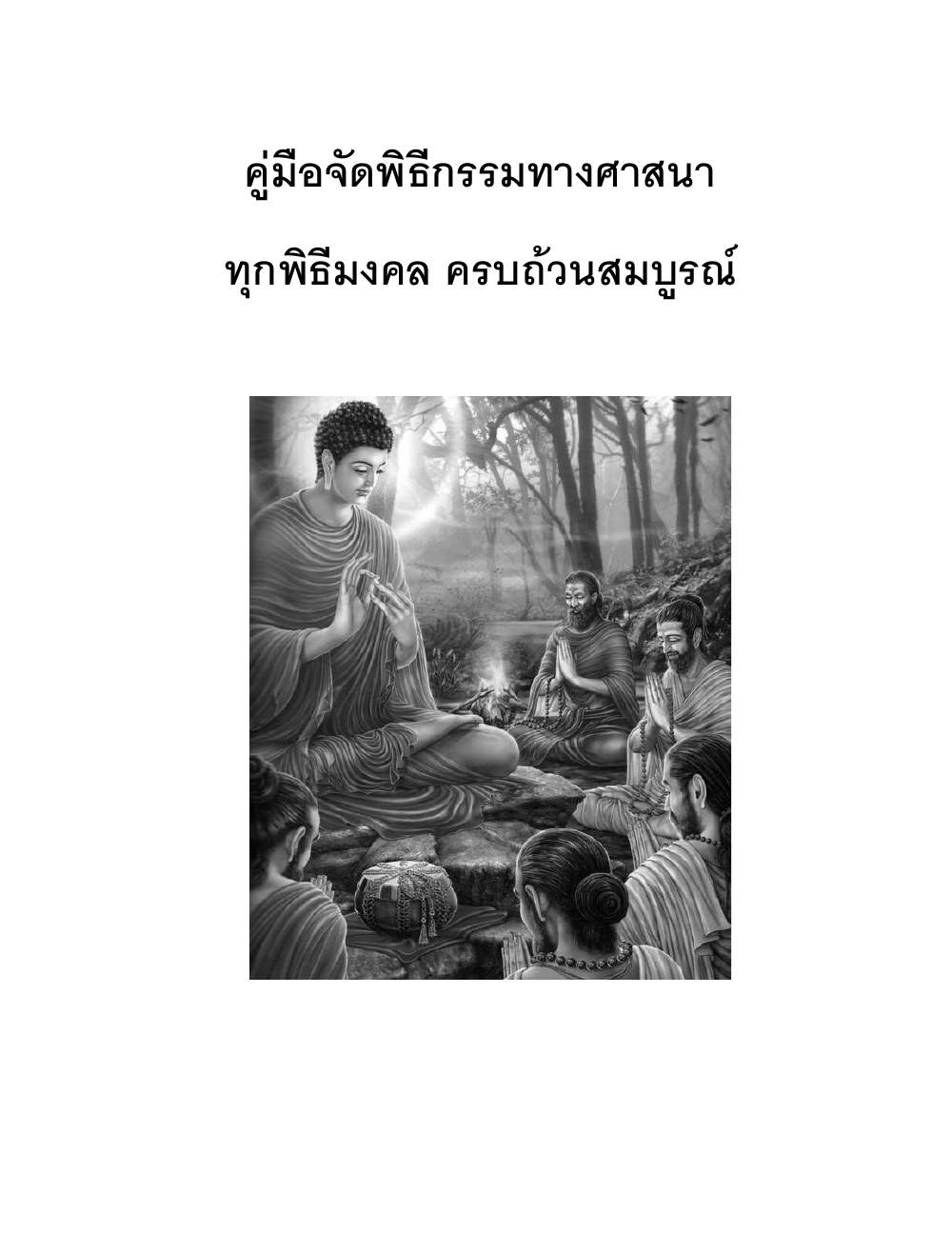
คู่มือจัดพิธีกรรมทางศาสนา
ทุกพิธีมงคล ครบถ้วนสมบูรณ์
[ภาพ: ภาพวาดขาวดำ พระพุทธเจ้าประทับนั่งท่ามกลางป่า ทรงแสดงธรรมแก่หมู่ฤๅษีชฎิลที่นั่งพนมมือฟังอยู่โดยรอบ มีกองไฟและภาชนะอยู่เบื้องหน้า]
Handbook for Conducting Religious Rituals
Every Auspicious Rite, Complete in Full
[Image: black-and-white illustration of the Buddha seated in a forest, teaching the Dhamma to a group of matted-hair ascetics (jaṭila) who sit with palms pressed together listening around him; a fire and a vessel are in the foreground]
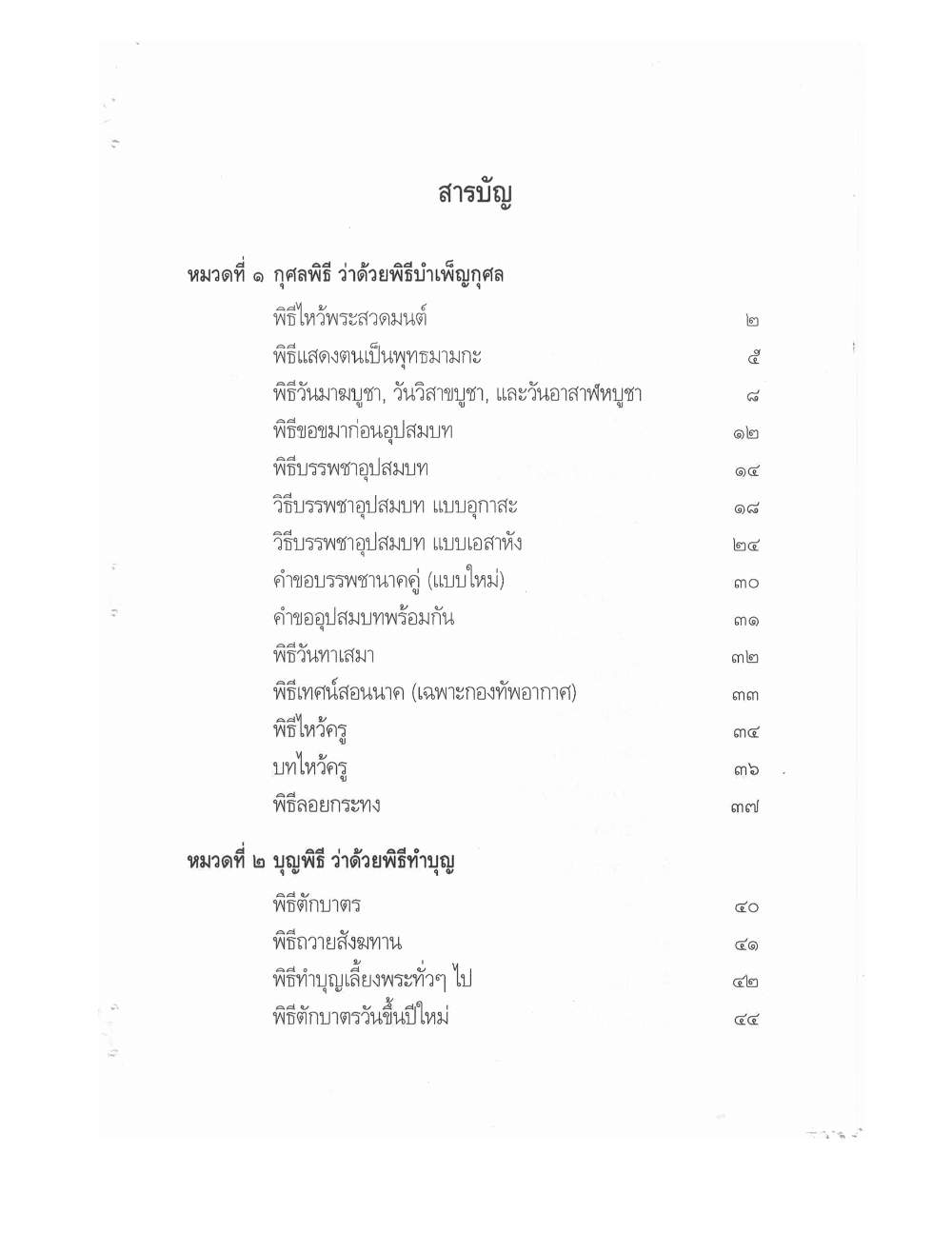
สารบัญ
หมวดที่ ๑ กุศลพิธี ว่าด้วยพิธีบำเพ็ญกุศล พิธีไหว้พระสวดมนต์ ๒ พิธีแสดงตนเป็นพุทธมามกะ ๕ พิธีวันมาฆบูชา, วันวิสาขบูชา, และวันอาสาฬหบูชา ๘ พิธีขอขมาก่อนอุปสมบท ๑๒ พิธีบรรพชาอุปสมบท ๑๔ วิธีบรรพชาอุปสมบท แบบอุกาสะ ๑๘ วิธีบรรพชาอุปสมบท แบบเอสาหัง ๒๔ คำขอบรรพชานาคคู่ (แบบใหม่) ๓๐ คำขออุปสมบทพร้อมกัน ๓๑ พิธีวันทาเสมา ๓๒ พิธีเทศน์สอนนาค (เฉพาะกองทัพอากาศ) ๓๓ พิธีไหว้ครู ๓๔ บทไหว้ครู ๓๖ พิธีลอยกระทง ๓๗
หมวดที่ ๒ บุญพิธี ว่าด้วยพิธีทำบุญ พิธีตักบาตร ๔๐ พิธีถวายสังฆทาน ๔๑ พิธีทำบุญเลี้ยงพระทั่วๆ ไป ๔๒ พิธีตักบาตรวันขึ้นปีใหม่ ๔๔
Table of Contents
Section 1: Meritorious Rites — On Rites of Performing Merit Rite of Paying Homage to the Buddha and Chanting 2 Rite of Declaring Oneself a Buddhamamaka (Buddhist Devotee) 5 Rite of Magha Puja, Visakha Puja, and Asalha Puja Days 8 Rite of Asking Forgiveness Before Ordination 12 Rite of Going Forth and Higher Ordination 14 Method of Going Forth and Higher Ordination, Ukāsa Form 18 Method of Going Forth and Higher Ordination, Esāhaṃ Form 24 Words for Requesting Ordination of a Pair of Candidates (New Form) 30 Words for Requesting Simultaneous Higher Ordination 31 Rite of the Boundary-Stone (Sīmā) Circumambulation Day 32 Rite of Sermon Instructing the Ordinand (Air Force Only) 33 Rite of Paying Homage to Teachers 34 Verses for Paying Homage to Teachers 36 Rite of Loi Krathong 37
Section 2: Merit-Making Rites — On Rites of Making Merit Rite of Offering Alms Food 40 Rite of Offering Sangha-dana 41 Rite of General Merit-Making Meals for Monks 42 Rite of Offering Alms on New Year's Day 44
(๙)
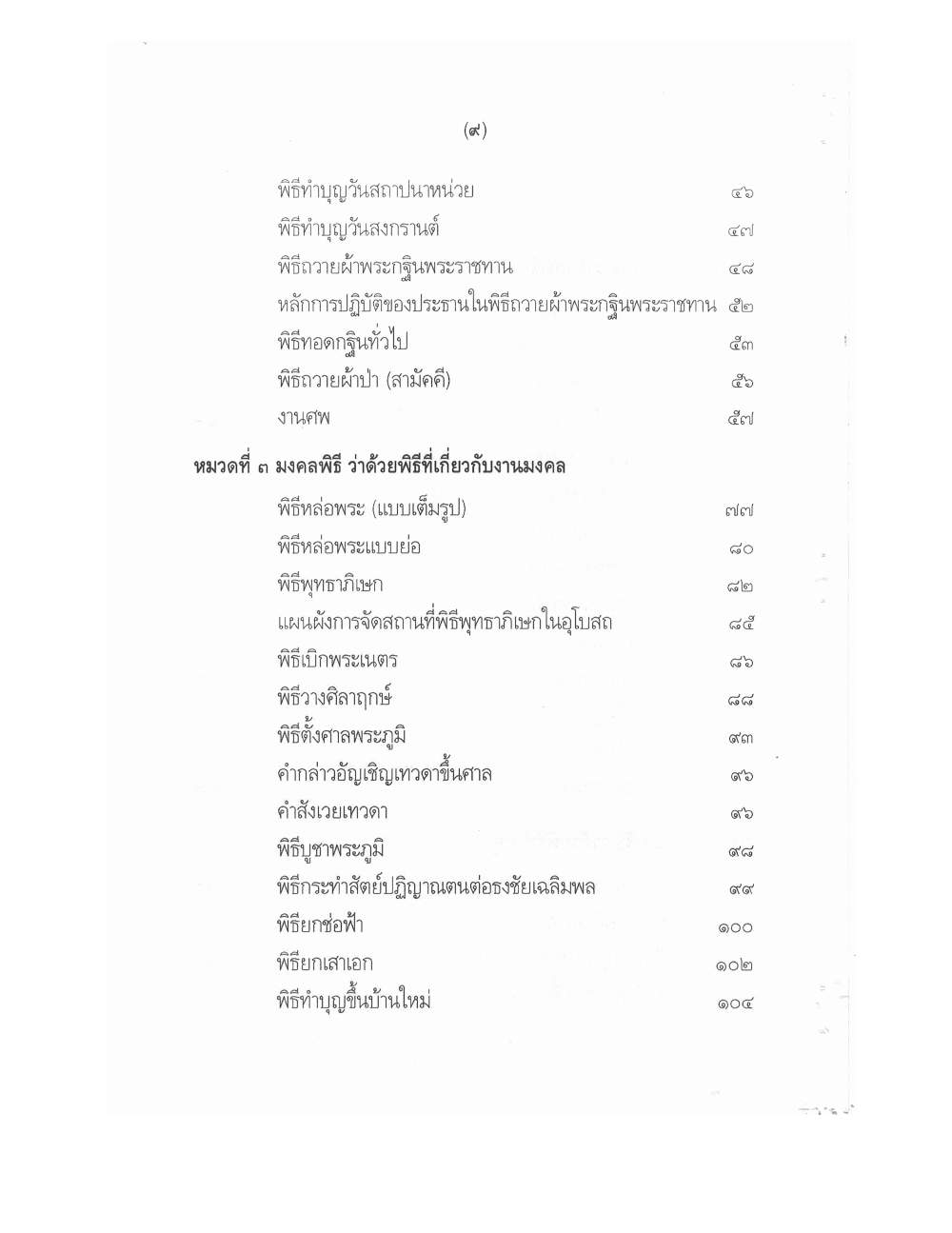
พิธีทำบุญวันสถาปนาหน่วย ๔๖ พิธีทำบุญวันสงกรานต์ ๔๗ พิธีถวายผ้าพระกฐินพระราชทาน ๔๘ หลักการปฏิบัติของประธานในพิธีถวายผ้าพระกฐินพระราชทาน ๕๒ พิธีทอดกฐินทั่วไป ๕๓ พิธีถวายผ้าป่า (สามัคคี) ๕๖ งานศพ ๕๗
หมวดที่ ๓ มงคลพิธี ว่าด้วยพิธีที่เกี่ยวกับงานมงคล
พิธีหล่อพระ (แบบเต็มรูป) ๗๗ พิธีหล่อพระแบบย่อ ๘๐ พิธีพุทธาภิเษก ๘๒ แผนผังการจัดสถานที่พิธีพุทธาภิเษกในอุโบสถ ๘๕ พิธีเบิกพระเนตร ๘๖ พิธีวางศิลาฤกษ์ ๘๘ พิธีตั้งศาลพระภูมิ ๙๓ คำกล่าวอัญเชิญเทวดาขึ้นศาล ๙๖ คำสังเวยเทวดา ๙๖ พิธีบูชาพระภูมิ ๙๘ พิธีกระทำสัตย์ปฏิญาณตนต่อธงชัยเฉลิมพล ๙๙ พิธียกช่อฟ้า ๑๐๐ พิธียกเสาเอก ๑๐๒ พิธีทำบุญขึ้นบ้านใหม่ ๑๐๔
(9)
Rite of Merit-Making on the Unit's Founding Anniversary 46 Rite of Merit-Making for Songkran Day 47 Rite of Offering the Royally Bestowed Kathina Robes 48 Principles for the Presiding Officer in the Rite of Offering the Royally Bestowed Kathina Robes 52 Rite of General Kathina Robe Offering 53 Rite of Offering Forest Robes (Communal/Sāmakkhī) 56 Funeral Rites 57
Section 3: Auspicious Rites — On Rites Connected with Auspicious Occasions
Rite of Buddha-Image Casting (Full Form) 77 Rite of Buddha-Image Casting, Abbreviated Form 80 Rite of Buddha Consecration (Buddhābhiseka) 82 Floor Plan for Arranging the Consecration Site in the Ordination Hall 85 Rite of Opening the Eyes of the Buddha Image 86 Rite of Laying the Foundation Stone 88 Rite of Erecting the Guardian Spirit Shrine 93 Words for Inviting the Deity Up to the Shrine 96 Words for the Offering to the Deity 96 Rite of Worshipping the Guardian Spirit of the Land 98 Rite of Taking the Oath of Allegiance to the Regimental Colours 99 Rite of Raising the Roof Finial (Chofa) 100 Rite of Raising the Principal Post 102 Rite of Merit-Making for a Housewarming 104
(๑๐)
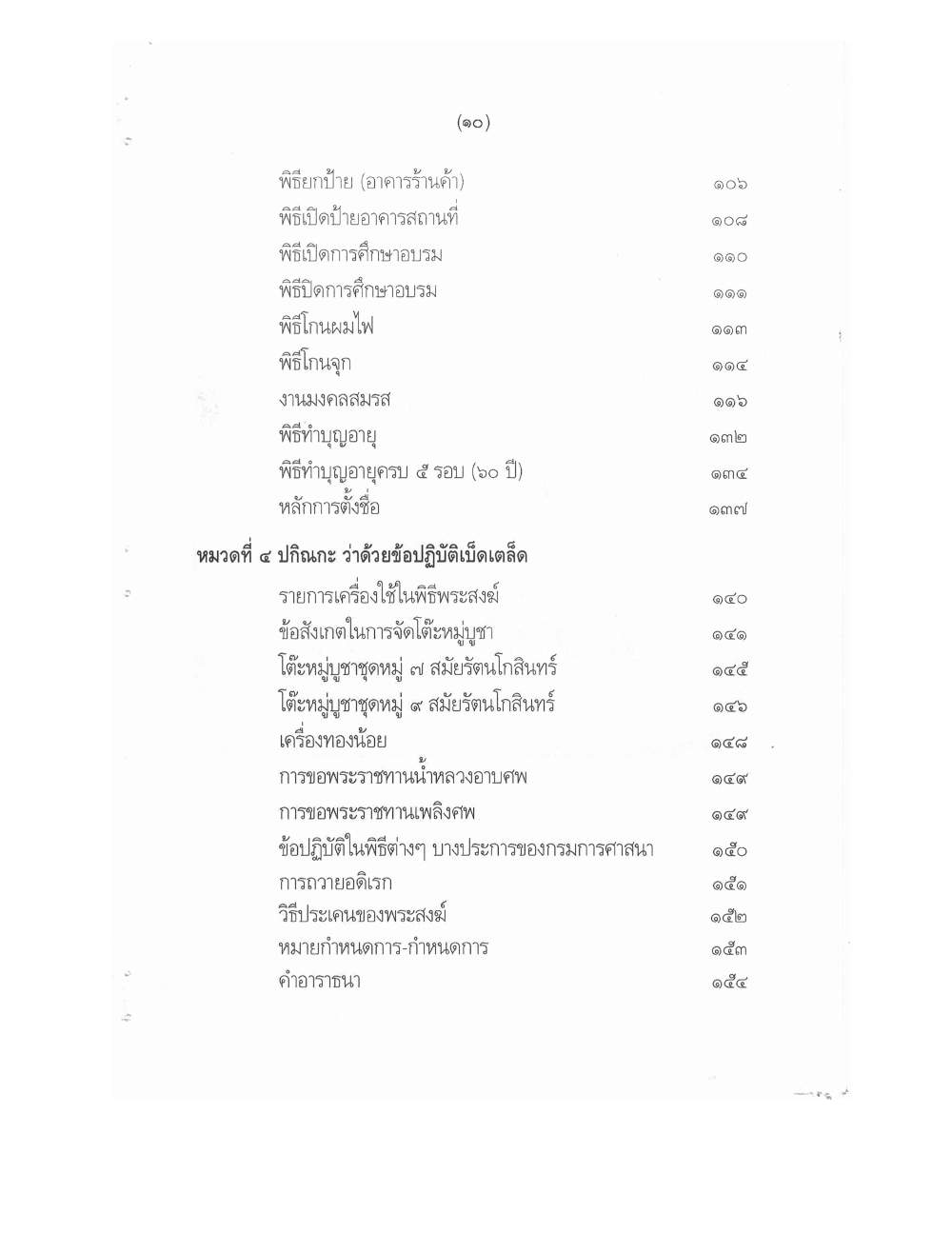
พิธียกป้าย (อาคารร้านค้า) ๑๐๖ พิธีเปิดป้ายอาคารสถานที่ ๑๐๘ พิธีเปิดการศึกษาอบรม ๑๑๐ พิธีปิดการศึกษาอบรม ๑๑๑ พิธีโกนผมไฟ ๑๑๓ พิธีโกนจุก ๑๑๔ งานมงคลสมรส ๑๑๖ พิธีทำบุญอายุ ๑๓๒ พิธีทำบุญอายุครบ ๕ รอบ (๖๐ ปี) ๑๓๔ หลักการตั้งชื่อ ๑๓๗
หมวดที่ ๔ ปกิณกะ ว่าด้วยข้อปฏิบัติเบ็ดเตล็ด
รายการเครื่องใช้ในพิธีพระสงฆ์ ๑๔๐ ข้อสังเกตในการจัดโต๊ะหมู่บูชา ๑๔๑ โต๊ะหมู่บูชาชุดหมู่ ๗ สมัยรัตนโกสินทร์ ๑๔๕ โต๊ะหมู่บูชาชุดหมู่ ๙ สมัยรัตนโกสินทร์ ๑๔๖ เครื่องทองน้อย ๑๔๘ การขอพระราชทานน้ำหลวงอาบศพ ๑๔๙ การขอพระราชทานเพลิงศพ ๑๔๙ ข้อปฏิบัติในพิธีต่างๆ บางประการของกรมการศาสนา ๑๕๐ การถวายอดิเรก ๑๕๑ วิธีประเคนของพระสงฆ์ ๑๕๒ หมายกำหนดการ-กำหนดการ ๑๕๓ คำอาราธนา ๑๕๔
(10)
Rite of Raising the Signboard (Shophouse/Store Building) 106 Rite of Unveiling a Building or Site Signboard 108 Rite of Opening a Course of Study/Training 110 Rite of Closing a Course of Study/Training 111 Rite of the First Hair-Cutting (Fire-Singed Hair) 113 Rite of the Topknot-Cutting 114 Auspicious Wedding Ceremony 116 Rite of Merit-Making for a Birthday 132 Rite of Merit-Making for the 5th Twelve-Year Birthday Cycle (Age 60) 134 Principles of Naming 137
Section 4: Miscellaneous — On Sundry Practices
List of Equipment Used in Monastic Rites 140 Points to Note in Arranging the Group Offering Table 141 Group Offering Table, Set of 7, Rattanakosin Style 145 Group Offering Table, Set of 9, Rattanakosin Style 146 The Lesser Gold Regalia (Khrueang Thong Noi) 148 Requesting the Royally Bestowed Water for Bathing the Corpse 149 Requesting the Royally Bestowed Cremation Fire 149 Certain Practices in Various Rites, per the Religious Affairs Department 150 The Offering of the Adireka (Royal Blessing Verses) 151 Method of Presenting Offerings to Monks 152 Programme of Events – Schedule 153 Words of Invitation (to Chant/Officiate) 154
[ภาพ: กรอบลายไทยประดับมุมทั้งสี่ ภายในกรอบมีข้อความอักษรลายมือแบบไทยประดิษฐ์] หมวดที่ ๑ กุศลพิธี ว่าด้วยพิธีบำเพ็ญกุศล
[Image: a decorative Thai-motif border ornamented at all four corners; within the frame, text in an ornamental calligraphic Thai script] Section 1 Meritorious Rites On Rites of Performing Merit
๒
พิธีไหว้พระสวดมนต์ (แบบสมบูรณ์)
การเตรียมการ ที่บูชาเป็นหิ้งบูชาหรือโต๊ะหมู่บูชาก็ได้ ประกอบด้วย พระพุทธรูป, แจกัน ดอกไม้ ๑ คู่, เชิงเทียน ๑ คู่, กระถางธูป ๑ ที่ ตั้งอยู่ในที่เหมาะสม หัน พระพักตร์พระพุทธรูปไปทางทิศตะวันออก หรือทิศเหนือ
เริ่มพิธี - จุดเทียนที่เชิงเทียนทั้ง ๒ เล่ม (นิยมจุดเทียนเล่มขวาพระหัตถ์ของ พระพุทธรูปก่อน) - จุดธูป ๓ ดอก ที่กระถางธูป
บทไหว้พระ พนมมือกล่าวคำไหว้พระด้วยจิตเป็นสมาธิดังนี้.- อะระหัง สัมมาสัมพุทโธ ภะคะวา, พุทธัง ภะคะวันตัง อะภิวาเทมิ (กราบ) สวากขาโต ภะคะวะตา ธัมโม, ธัมมัง นะมัสสามิ (กราบ) สุปะฏิปันโน ภะคะวะโต สาวะกะสังโฆ, สังฆัง นะมามิ (กราบ)
บทนมัสการพระพุทธเจ้า นะโม ตัสสะ ภะคะวะโต อะระหะโต สัมมาสัมพุทธัสสะ (๓ จบ)
บทสรรเสริญคุณพระรัตนตรัย อิติปิ โส ภะคะวา อะระหัง สัมมาสัมพุทโธ, วิชชาจะระณะสัมปันโน สุคะโต โลกะวิทู, อะนุตตะโร ปุริสะทัมมะสาระถิ สัตถา เทวะมะนุสสานัง พุทโธ ภะคะวาติ
สวากขาโต ภะคะวะตา ธัมโม, สันทิฏฐิโก อะกาลิโก เอหิปัสสิโก
2
Rite of Paying Homage to the Buddha and Chanting (Full Form)
Preparation The object of worship may be a household shrine shelf or a group offering table. It should include a Buddha image, one pair of flower vases, one pair of candle-holders, and one incense-pot, set up in a suitable place. The Buddha image's face should be turned to face east or north.
Beginning the Rite - Light both candles in the candle-holders (it is customary to light the candle on the Buddha image's right hand first). - Light 3 incense sticks in the incense-pot.
Verses of Homage to the Buddha: With palms pressed together, recite the words of homage with a mind in concentration, as follows:— Arahaṃ sammāsambuddho bhagavā, buddhaṃ bhagavantaṃ abhivādemi (prostrate) Svākkhāto bhagavatā dhammo, dhammaṃ namassāmi (prostrate) Supaṭipanno bhagavato sāvakasaṅgho, saṅghaṃ namāmi (prostrate)
Verse of Veneration of the Buddha Namo tassa bhagavato arahato sammāsambuddhassa (recite 3 times)
Verse in Praise of the Virtues of the Triple Gem Itipi so bhagavā arahaṃ sammāsambuddho, vijjācaraṇasampanno sugato lokavidū, anuttaro purisadammasārathi satthā devamanussānaṃ buddho bhagavāti
Svākkhāto bhagavatā dhammo, sandiṭṭhiko akāliko ehipassiko
๓
โอปะนะยิโก, ปัจจัตตัง เวทิตัพโพ วิญญูหิติ สุปะฏิปันโน ภะคะวะโต สาวะกะสังโฆ, อุชุปะฏิปันโน ภะคะวะโต สาวะกะสังโฆ, ญายะปะฏิปันโน ภะคะวะโต สาวะกะสังโฆ, สามีจิปะฏิปันโน ภะคะวะโต สาวะกะสังโฆ, ยะทิทัง จัตตาริ ปุริสะยุคานิ, อัฏฐะ ปุริสะปุคคะลา, เอสะภะคะวะโต สาวะกะสังโฆ, อาหุเนยโย ปาหุเนยโย ทักขิเณยโย อัญชลิกะระณีโย, อะนุตตะรัง ปุญญักเขตตัง โลกัสสาติ
บทพิจารณาความจริงของชีวิต ชะราธัมโมมหิ ชะรัง อะนะตีโต ข้าพเจ้ามีความแก่เป็นธรรมดา ไม่ล่วงพ้นความแก่ไปได้ พะยาธิธัมโมมหิ พะยาธิง อะนะตีโต ข้าพเจ้ามีความเจ็บไข้เป็นธรรมดา ไม่ล่วงพ้นความเจ็บไข้ไปได้ มะระณะธัมโมมหิ มะระณัง อะนะตีโต ข้าพเจ้ามีความตายเป็นธรรมดา ไม่ล่วงพ้นความตายไปได้ สัพเพหิ เม ปิเยหิ มะนาเปหิ นานาภาโว วินาภาโว ข้าพเจ้าจำต้องพลัดพรากจากของรักของชอบใจทั้งสิ้นไป กัมมัสสะโกมหิ กัมมะทายาโท กัมมะโยนิ กัมมะพันธุ กัมมปฏิสะระโณ, ยัง กัมมัง กะริสสามิ, กัลยาณัง วา ปาปะกัง วา, ตัสสะ ทายาโท ภะวิสสามิ ข้าพเจ้ามีกรรมเป็นของตน เป็นทายาทของกรรม มีกรรมเป็นกำเนิด มี กรรมเป็นเผ่าพันธุ์ มีกรรมเป็นที่พึ่งอาศัย ข้าพเจ้าทำกรรมใดไว้ จะดีก็ตาม ชั่ว ก็ตาม ข้าพเจ้าจะต้องรับผลของกรรมนั้น
บทแผ่เมตตาจิต สัพเพ สัตตา อะเวรา โหนตุ, อัพยาปัชฌา โหนตุ อะนีฆา โหนตุ, สุขี อัตตานัง ปะริหะรันตุ
3
Opanayiko, paccattaṃ veditabbo viññūhī ti Supaṭipanno bhagavato sāvakasaṅgho, ujupaṭipanno bhagavato sāvakasaṅgho, ñāyapaṭipanno bhagavato sāvakasaṅgho, sāmīcipaṭipanno bhagavato sāvakasaṅgho, yadidaṃ cattāri purisayugāni, aṭṭha purisapuggalā, esa bhagavato sāvakasaṅgho, āhuneyyo pāhuneyyo dakkhiṇeyyo añjalikaraṇīyo, anuttaraṃ puññakkhettaṃ lokassāti
Verse for Reflecting on the Truth of Life Jarādhammomhi jaraṃ anatīto I am of a nature to age; I cannot escape ageing. Byādhidhammomhi byādhiṃ anatīto I am of a nature to fall ill; I cannot escape illness. Maraṇadhammomhi maraṇaṃ anatīto I am of a nature to die; I cannot escape death. Sabbehi me piyehi manāpehi nānābhāvo vinābhāvo I must be separated and parted from all that is dear and pleasing to me. Kammassakomhi kammadāyādo kammayoni kammabandhu kammapaṭisaraṇo, yaṃ kammaṃ karissāmi, kalyāṇaṃ vā pāpakaṃ vā, tassa dāyādo bhavissāmi I have kamma as my own, I am heir to my kamma, kamma is my origin, kamma is my kin, kamma is my refuge. Whatever kamma I do, good or evil, I shall be heir to it.
Verse of Spreading Loving-Kindness Sabbe sattā averā hontu, abyāpajjhā hontu anīghā hontu, sukhī attānaṃ pariharantu
๔
สัตว์ทั้งหลายที่เป็นเพื่อนทุกข์ เกิดแก่เจ็บตายด้วยกันหมดทั้งสิ้น จง เป็นสุขเป็นสุขเถิด อย่าได้มีเวรแก่กันและกันเลย จงเป็นสุขเป็นสุขเถิด อย่าได้ เบียดเบียนซึ่งกันและกันเลย จงเป็นสุขเป็นสุขเถิดอย่าได้มีความทุกข์กายทุกข์ ใจเลย จงมีความสุขกายสุขใจ รักษาตนให้พ้นจากทุกข์ภัยทั้งสิ้นเถิด
บทอุทิศส่วนกุศล อิทัง เม ญาตินัง โหตุ สุขิตา โหนตุ ญาตะโย ข้าพเจ้าขออุทิศส่วนบุญกุศลที่ได้บำเพ็ญด้วยกายวาจาใจนี้ถวาย พระบาทสมเด็จพระเจ้าอยู่หัวองค์พระประมุขของชาติไทยและให้แก่ท่านที่มี พระคุณมีมารดาบิดา ครูอาจารย์ ท่านที่ได้ทำนุบำรุงประเทศชาติศาสนา เจ้า กรรมนายเวร และสรรพสัตว์ไม่มีประมาณ ขอทุกผู้ทุกคนที่ได้รับส่วนบุญกุศล ของข้าพเจ้า จงเป็นสุขโดยทั่วกันเถิด
บทอธิษฐานตน ข้าพเจ้าเป็นผู้นับถือพระพุทธศาสนาอย่างแท้จริงและได้ปฏิบัติตามคำ สั่งสอนของพระพุทธองค์ ตามกำลังความสามารถ ข้าพเจ้าจะตั้งใจปฏิบัติหน้าที่ ด้วยความวิริยะอุตสาหะ ซื่อสัตย์สุจริตไม่คิดริษยาอาฆาตพยาบาทต่อผู้ใดด้วย สัจวาจานี้ ขออานุภาพแห่งคุณพระศรีรัตนตรัยซึ่งเป็นมงคลอันประเสริฐในโลก ขจัดเสียได้ซึ่งความทุกข์ทั้งปวง พร้อมทั้ง เทวานุภาพและอำนาจแห่งคุณงาม ความดีทั้งหลาย ได้โปรดปกปักรักษาข้าพเจ้าพร้อมทั้งครอบครัวทุกคนให้ แคล้วคลาดจากภยันตรายทั้งปวง ตลอดกาลทุกเมื่อ ขอให้ข้าพเจ้ามีสุขภาพกายสุขภาพจิตสมบูรณ์แข็งแรงเพื่อสามารถบำเพ็ญ ประโยชน์ให้กับส่วนรวม ประเทศชาติ ศาสนา พระมหากษัตริย์โดยสมบูรณ์ และ ขอให้ประสบแต่ความสุข ความเจริญยิ่งๆขึ้นไปเทอญ(กราบ ๓ ครั้ง)
4
May all beings who are fellow-sufferers, who are all alike born, age, sicken, and die, be happy, be happy indeed. May they never bear enmity toward one another; be happy, be happy indeed. May they never oppress one another; be happy, be happy indeed. May they be free of bodily and mental suffering; may they have bodily and mental happiness, and keep themselves free from every suffering and danger.
Verse of Dedicating Merit Idaṃ me ñātinaṃ hotu, sukhitā hontu ñātayo I dedicate the merit I have performed with body, speech, and mind to His Majesty the King, sovereign of the Thai nation, and to those to whom I owe gratitude — my parents, my teachers, those who have nurtured the nation and the religion, my creditors of karma, and all beings without limit. May every single person who receives a share of my merit be happy, one and all.
Verse of Self-Resolution I am a true adherent of the Buddhist religion and have practised according to the Buddha's teachings to the best of my ability. I resolve to carry out my duties with diligence and effort, honestly and uprightly, harbouring no envy, enmity, or ill will toward anyone. By this truthful word, may the power of the virtue of the Triple Gem, the noblest blessing in the world, dispel all suffering; and together with the power of the devas and the strength of every good virtue, may I and my entire family be protected and kept free from every danger, at all times forever. May I have complete and robust health of body and mind, that I may be able to render benefit fully to the collective good, the nation, the religion, and the monarchy; and may I meet with only happiness and ever-increasing prosperity. (Prostrate 3 times)
๕
หมายเหตุ - หลังจากไหว้พระสวดมนต์แล้วควรทำกรรมฐาน โดยนั่งขัดสมาธิ กำหนดลมหายใจเข้าออก เพื่อให้จิตเป็นสมาธิ ไม่ฟุ้งซ่าน และเป็น ภาวนากุศล อำนวยผลให้เป็นคนมีเหตุผล และสติปัญญาสมบูรณ์ขึ้น ทำได้มากน้อยเท่าใด ก็เป็นผลดีเท่านั้น - การไหว้พระสวดมนต์ ควรทำเป็นกิจวัตรประจำวัน ทั้งก่อนเข้านอน และเมื่อโอกาสอำนวย ทำมากน้อยเท่าใด ก็ยังดีกว่าไม่ทำเลย
*************************
พิธีแสดงตนเป็นพุทธมามกะ ๑. คำชี้แจง
บิดามารดาหรือผู้ใหญ่ในสกุล ปรารถนาจะให้บุตรหลานของตนเป็น พุทธมามกะ คือผู้รับพระพุทธเจ้าเป็นที่นับถือของตนโดยหลักฐาน พึงแนะนำให้ เขาน้อมใจเชื่อในพระพุทธเจ้า ผู้เป็นเจ้าของพระพุทธศาสนา จนยอมรับเอาเป็น ที่นับถือของตนได้แล้ว พึงแจ้งความนั้นแก่พระเถระที่จะถือเอาเป็นพระ อาจารย์ในการนั้น ขอความอนุเคราะห์ของท่าน เพื่อเป็นผู้อำนวยการนั้น เมื่อ ถึงวันเวลากำหนดนัด ท่านผู้อำนวยการพึงประชุมสงฆ์ตั้งแต่ ๔ รูปขึ้นไป ฝ่าย กุลบดีพึงพาบุตรหลานของตนไปสู่อาราม พร้อมด้วยญาติพวกพ้องให้ผลัด เครื่องนุ่งห่มขาวแล้วพาเข้าในอุโบสถ ผู้ปฏิญาณพึงเข้าไปที่พุทธอาสน์ บูชาพระ รัตนตรัย กราบด้วยเบญจางคประดิษฐ์ ๓ หนแล้ว พึงเข้าไปสู่ที่ประชุมสงฆ์ ถวาย เครื่องสักการะแก่พระอาจารย์แล้ว กราบพระอาจารย์และพระสงฆ์ด้วยอาการ อย่างนั้น ๓ หนแล้วนั่งคุกเข่า ประณมมือกล่าววาจาเป็นคำบาลีปฏิญาณตนเป็น พุทธมามกะ คือ ผู้รับเอาพระพุทธเจ้าเป็นที่นับถือของตน ตามระเบียบแล้วนั่งราบ
5
Note - After paying homage to the Buddha and chanting, one should practise meditation, sitting cross-legged, observing the in-and-out breath so that the mind becomes concentrated and unagitated, which is a wholesome meditative practice yielding the fruit of a person with sound reasoning and increasingly complete wisdom. Whatever amount one is able to do brings that much benefit. - Paying homage and chanting should be made a daily practice, both before going to sleep and whenever opportunity allows; however much one does is still better than not doing it at all.
*************************
Rite of Declaring Oneself a Buddhamamaka 1. Explanation
When parents or elders of a family wish their children or descendants to become Buddhamamaka — that is, one who takes the Buddha as the object of one's reverence on proper grounds — they should guide the child to incline the heart to believe in the Buddha, the owner of the Buddhist religion, until the child willingly accepts him as the object of his own reverence. They should then inform the senior monk who is to be taken as preceptor for the occasion, and request his assistance to preside over it. When the appointed day and time arrive, the presiding monk should assemble a congregation of at least 4 monks. The head of the family should then bring the child to the monastery, together with relatives and companions, having the child change into white garments, and bring him into the ordination hall. The one making the declaration should proceed to the Buddha's seat, pay homage to the Triple Gem, prostrate with the five-point prostration 3 times, then proceed to the assembly of monks, present offerings to the preceptor, and prostrate to the preceptor and the assembly of monks in the same manner 3 times, then kneel, press the palms together, and recite in Pali words declaring oneself a Buddhamamaka — that is, one who takes the Buddha as the object of one's own reverence — according to the prescribed order, and then sit in the ordinary seated position.
๖
ในลำดับนั้น พระอาจารย์พึงให้โอวาท เพื่อรู้หัวข้อแห่งพระพุทธศาสนา จบแล้วพึงให้ผู้นั้นนั่งคุกเข่า ว่าเบญจศีล ให้สมาทานตามทีละสิกขาบท จบแล้ว ผู้นั้นพึงกราบ ๓ หน แล้วนั่งราบ ถ้ามีสักการะหรือไทยธรรมสำหรับพระสงฆ์ พึงถวายในเวลานั้น ในลำดับนั้น พระสงฆ์ พึงสวดอำนวยพร ด้วยคำบาลีว่า
โส อัตถะลัทโธ หรือ เต อัตถะลัทธา ฯ โดยสมควรแก่จำนวนผู้เข้ามาปฏิญญา ผู้นั้นถึงประณมมือรับพรจบ แล้วพึงนั่งคุกเข่ากราบอีก ๓ หน ถอยจากที่ประชุมสงฆ์เป็นเสร็จการเพียงเท่านี้
๒. การทำโดยตนเอง คนผู้ใหญ่ผู้ปรารถนาจะปฏิญญาอย่างนั้น ตามลำพังตนเองพึงขอ อนุเคราะห์ต่อพระเถระและพึงไปสู่อารามด้วยตนเอง ไม่ต้องมีผู้พา แต่นั้นพึง ปฏิบัติโดยอาการอันกล่าวแล้ว เทียบการแสดงตนเป็นอุบาสิกา หญิงจักปฏิญาณตนเป็นพุทธมามกา บ้างก็ได้เหมือนกัน เป็นแต่เมื่อแสดง พึงอยู่เฉพาะหน้าสงฆ์ห่างจากหัตถบาส
๓. เบญจางคประดิษฐ์คือ ให้หน้าผาก ๑ ให้ฝ่ามือทั้ง ๒ ให้เข่าทั้ง ๒ รวมเป็น ๕ จดพื้น เมื่อ กราบอย่างนั้น พึงนั่งคุกเข่า เป็นอันว่าเข่าทั้ง ๒ จดพื้น พึงหมอบลง ทอด ฝ่ามือที่พื้นแหวกช่องให้ห่างสักหน่อย พึงก้มศีรษะลงตรงช่องนั้น ให้หน้าผาก จดพื้นนี้เรียกว่า "การกราบด้วยเบญจางคประดิษฐ์ หรือ การกราบประกอบ ด้วยองค์ห้า"
๔. คำบูชาพระรัตนตรัย เมื่อจุดธูปเทียนบูชาพระเสร็จแล้ว พึงพร้อมกันนั่งคุกเข่าประณมมือ
6
Following that, the preceptor should give exhortation so that the candidate knows the main points of the Buddhist religion. When finished, he should have the candidate kneel and recite the Five Precepts, taking each precept in turn. When finished, the candidate should prostrate 3 times and then sit in the ordinary seated position. If there are offerings or requisites for the monks, they should be presented at that time. Following that, the monks should chant a blessing in Pali, saying:
So atthaladdho, or (for several) te atthaladdhā. As appropriate to the number of those who have made the declaration, the candidate presses the palms together to receive the blessing to its end, then kneels and prostrates again 3 times, and withdraws from the assembly of monks — this alone completes the rite.
2. Doing It Oneself An adult who personally wishes to make such a declaration should, on his own, request the assistance of a senior monk and go to the monastery himself, without needing anyone to bring him; thereafter he should carry out the procedure as described above. By comparison, in the rite of declaring oneself an upāsikā (laywoman devotee), a woman may likewise vow herself a Buddhamamaka; only, when making the declaration, she should remain directly in front of the assembly of monks, at a distance beyond arm's reach (hatthapāsa).
3. The Five-Point Prostration Is: Placing the forehead (1), both palms (2), and both knees (2) — five points in all — upon the ground. When prostrating in this way, one should kneel, so that both knees touch the ground; then bend forward, laying the palms upon the ground with a small gap left open between them, and lower the head down into that gap so that the forehead touches the ground. This is called "prostrating with the five-point prostration," or "the prostration made up of five members."
4. Words for Worshipping the Triple Gem When the incense and candles offered to the Buddha have been lit, all should together kneel and press their palms together.
๗
หัวหน้านำกราบพระรัตนตรัยแล้ว ให้ว่าตามเป็นวรรคๆ ดังนี้
ก. บทกราบพระ อะระหัง สัมมา สัมพุทโธ ภะคะวา, พุทธัง ภะคะวันตัง อะภิวาเทมิ กราบหนหนึ่ง สวากขาโต ภะคะวะตา ธัมโม, ธัมมัง นะมัสสามิ กราบหนสอง สุปะฏิปันโน ภะคะวะโต สาวะกะสังโฆ, สังฆัง นะมามิ กราบหนสาม
ข. บทบูชาพระรัตนตรัย (หัวหน้าว่าคนเดียว) ยะมัมหะ โข มะยัง ภะคะวันตัง สะระณัง คะตา, โย โน ภะคะวา สัตถา, ยัสสะ จะ มะยัง ภะคะวะโต ธัมมัง โรเจมะ เอเตหิ สักกาเรหิ ตัง ภะคะวันตัง สะสัทธัมมัง สะสาวะกะสังฆัง อะภิปูชะยามะ (ถ้าคนเดียวเปลี่ยนคำว่า - มะยัง เป็น อะหัง - คะตา เป็น คะโต - โน เป็น เม - โรเจมะ เป็น โรเจมิ - อะภิปูชะยามะ เป็น อะภิปูชะยามิ)
๕. คำปฏิญาณตนเป็นพุทธมามกะ เอสาหัง ภันเต, สุจิระปะรินิพพุตัมปิ, ตัง ภะคะวันตัง สะระณัง คัจฉามิ ธัมมัญจะ ภิกขุสังฆัญจะ พุทธมามะโกติ มัง สังโฆ ธาเรตุ (นี้สำหรับคนเดียว) ถ้าหลายคนว่าดังนี้ เอเต มะยัง ภันเต สุจิระปะรินิพพุตัมปิ, ตัง ภะคะวันตัง สะระณัง คัจฉามะ ธัมมัญจะ ภิกขุสังฆัญจะ พุทธมามกาติ โน สังโฆ ธาเรตุฯ ถ้าเป็นหญิงให้เปลี่ยนคำว่า
7
The leader first prostrates to the Triple Gem, then recites in sections as follows:
a. Verses of Prostration to the Buddha Arahaṃ sammā sambuddho bhagavā, buddhaṃ bhagavantaṃ abhivādemi — first prostration Svākkhāto bhagavatā dhammo, dhammaṃ namassāmi — second prostration Supaṭipanno bhagavato sāvakasaṅgho, saṅghaṃ namāmi — third prostration
b. Verses of Worshipping the Triple Gem (The leader recites alone) Yamamha kho mayaṃ bhagavantaṃ saraṇaṃ gatā, yo no bhagavā satthā, yassa ca mayaṃ bhagavato dhammaṃ rocema etehi sakkārehi taṃ bhagavantaṃ sasaddhammaṃ sasāvakasaṅghaṃ abhipūjayāma (if a single person, change the words: - mayaṃ to ahaṃ - gatā to gato - no to me - rocema to rocemi - abhipūjayāma to abhipūjayāmi)
5. Words of Vowing Oneself a Buddhamamaka Esāhaṃ bhante, suciraparinibbutampi, taṃ bhagavantaṃ saraṇaṃ gacchāmi, dhammañca bhikkhusaṅghañca buddhamāmakoti maṃ saṅgho dhāretu (this is for a single person) If several people, recite as follows: Ete mayaṃ bhante suciraparinibbutampi, taṃ bhagavantaṃ saraṇaṃ gacchāma dhammañca bhikkhusaṅghañca buddhamāmakāti no saṅgho dhāretu. If female, change the words to:
๘
- คำว่า เอเต เป็น เอตา - คำว่า พุทธมามกาติ เป็น พุทธมามิกาติ คำแปลเป็นไทย ท่านเจ้าข้า ข้าพเจ้าถึงพระผู้มีพระภาคเจ้านั้น แม้ปรินิพพานมานาน แล้วและพระธรรมพระสงฆ์เป็นสรณะ (คือที่ระลึกนับถือ) ขอพระสงฆ์จงจำ ข้าพเจ้าไว้ว่า "เป็นผู้รับเอาพระพุทธเจ้าเป็นของตน"
*************************
พิธีวันมาฆบูชา, วันวิสาขบูชา, และวันอาสาฬหบูชา
การเตรียมการ - ตั้งโต๊ะหมู่บูชาพร้อมเครื่องสักการะ - ดอกไม้ธูปเทียนหรือโคมไฟ (สำหรับผู้ใหญ่ใช้เวียนเทียน)
สถานที่ - บริเวณหน้าพระอุโบสถ หน้าอุโบสถ หน้าวิหาร บริเวณลานพระเจดีย์ หรือหอพระ - บริเวณที่เกี่ยวข้องกับสังเวชนียสถานอื่นๆ
การปฏิบัติ เมื่อถึงกำหนดเวลา ผู้ร่วมพิธี - พร้อม ณ บริเวณที่กำหนด (ยืนเป็นแถวให้ เหมาะสมกับสถานที่) ประธานในพิธี - จุดธูปเทียนบูชาพระรัตนตรัย
8
- the word ete to etā - the word buddhamāmakāti to buddhamāmikāti Thai Translation Venerable Sirs, I go for refuge to that Blessed One, even though he attained final Nibbāna long ago, and to the Dhamma and the Sangha (that is, as the object of remembrance and reverence). May the Sangha bear me in mind as "one who has taken the Buddha as his own."
*************************
Rite of Magha Puja, Visakha Puja, and Asalha Puja Days
Preparation - Set up the group offering table together with offerings. - Flowers, incense, candles, or lanterns (for adults to use in the candlelit circumambulation).
Location - The area in front of the ordination hall, in front of the vihara, the area of the chedi courtyard, or the shrine hall. - Areas connected with other sites of pilgrimage (saṅgevanīyasathāna).
Procedure When the appointed time arrives: Participants — assemble at the designated area (standing in rows appropriate to the location). Presiding officer — lights incense and candles to worship the Triple Gem.
๙
- กราบพระ ถวายไทยธรรม แล้วกลับไปยืนหน้าแถว อศจ. - นิมนต์พระให้โอวาทโดยสังเขป เมื่อจบแล้ว ผู้ร่วมพิธีทั้งหมดเปล่งเสียง "สาธุ" พร้อมกัน - นำไหว้พระสวดมนต์ อะระหัง สัมมาสัมพุทโธ ภะคะวา... อิติปิโส ภะคะวา...สวากขาโต..สุปฏิปันโน. - นำกล่าวคำบูชา (กล่าว นโม ๓ จบก่อน) - นำกล่าวแผ่เมตตา สัตว์ทั้งหลายที่เป็นเพื่อนทุกข์ เกิดแก่เจ็บตายด้วยกันทั้งหมดทั้งสิ้น จงเป็นสุขเป็นสุขเถิด อย่าได้มีเวรแก่กันและกันเลย จงเป็นสุขเป็นสุขเถิด อย่าได้เบียดเบียนซึ่งกันและกันเลย จงเป็นสุขเป็นสุขเถิดอย่าได้มีความทุกข์กายทุกข์ใจเลย จงมีความสุขกายสุขใจรักษาตนให้พ้นจากทุกข์ภัยทั้งสิ้นเถิด
คำบูชาวันมาฆบูชา
วันนี้เป็นวันมาฆบูชา ตรงกับวันที่พระผู้มีพระภาคเจ้า ทรงแสดงโอวาทปาติโมกข์ ในที่ประชุมสงฆ์ ๑๒๕๐ รูป ซึ่งประกอบด้วยองค์ ๔ คือภิกษุ๑๒๕๐ รูป ที่มาประชุมกันนั้น ล้วนเป็นพระอรหันต์ทั้งสิ้น ๑ ล้วนเป็นเอหิภิกษุคือได้รับการอุปสมบทจากพระพุทธเจ้าทั้งสิ้น ๑ มาประชุมพร้อมกันโดยมิได้นัดหมาย ๑ วันนั้นเป็นวันเพ็ญมาฆะ ๑ การประชุมอันอัศจรรย์อย่างนี้ ได้มีครั้งเดียวเท่านั้น บัดนี้เราทั้งหลายมีชีวิตมาถึงวันมาฆบูชานี้ ได้น้อมระลึกถึงพระพุทธเจ้าและพระอรหันต์สาวกเหล่านั้น จึงมาประชุมพร้อมกัน ณ ที่นี้ ถือ
9
- Bow to the Buddha image, present the offerings (thai tham), then return to stand at the front of the row. Chaplain (อศจ.) - Invites a monk to give a brief admonition. When finished, all participants chant "Sadhu" together. - Lead the assembly in paying homage and chanting. Arahaṃ sammāsambuddho bhagavā... ["The Blessed One is worthy, perfectly self-enlightened..."] Itipi so bhagavā...svākkhāto...suppaṭipanno. ["Thus indeed is the Blessed One... well-taught... well-practiced..."] - Lead the words of offering (recite Namo three times first) - Lead the spreading of loving-kindness May all beings who are companions in suffering, born, aging, and dying together, all of them, be happy, be happy. May they bear no enmity toward one another; be happy, be happy. May they not oppress one another; be happy, be happy. May they be free of bodily and mental suffering; may they have bodily and mental happiness and keep themselves free from all suffering and danger.
Words of Offering for Magha Puja Day
Today is Magha Puja Day, the day the Blessed One delivered the Ovada-Patimokkha (fundamental exhortation) before an assembly of 1,250 monks, an assembly endowed with four special qualities: first, that all 1,250 monks who gathered were arahants; second, that all were ehi-bhikkhus, meaning all had been ordained by the Buddha himself; third, that they assembled together spontaneously without having been summoned; and fourth, that the day was the full-moon day of Magha. Such a wondrous assembly occurred only this once. Now that we have lived to reach this Magha Puja day, we call to mind the Buddha and those arahant disciples, and so have gathered together here. We hold...
๑๐
เครื่องสักการะ ทำกายของตนให้เป็นดุจภาชนะ รองรับเครื่องสักการะ ระลึกถึงคุณพระรัตนตรัยเป็นอารมณ์ กระทำประทักษิณปูชนียสถานแห่งนี้ ๓ รอบ ทำการบูชาด้วยเครื่องสักการะที่ถือไว้นี้ ขอพระพุทธเจ้าและพระอรหันต์สาวกเหล่านั้น แม้จะปรินิพพานไปแล้ว แต่ยังดำรงอยู่โดยพระคุณทั้งหลายอันบัณฑิตพึงรู้ได้ โปรดได้รับเครื่องสักการะ ของข้าพเจ้าทั้งหลาย เพื่อประโยชน์ เพื่อความสุขแก่ข้าพเจ้าทั้งหลาย ตลอดกาลนานเทอญ
คำบูชาวันวิสาขบูชา
วันนี้เป็นวันวิสาขบูชา พระจันทร์เพ็ญโคจรผ่านดาววิสาขฤกษ์เป็นอภิลักขิตกาล ท่านกำหนดว่าเป็นวันคล้ายวันประสูติ วันตรัสรู้ และวันเสด็จปรินิพพานของพระสัมมาสัมพุทธเจ้า ผู้เป็นสรณะสูงสุดของเราทั้งหลาย เราทั้งหลายมีชีวิตมาถึงวันวิสาขบูชานี้ อันพระคุณของพระองค์เตือนใจให้เกิดอุตสาหะ จึงมาพร้อมกัน ณ เบื้องหน้าปูชนียสถานแห่งนี้ ถือเครื่องสักการะมีธูปเทียนเป็นต้น กระทำกายของตนๆ ให้เป็นดุจภาชนะ รองรับเครื่องสักการะ จักระลึกถึงคุณพระรัตนตรัยเป็นอารมณ์ กระทำประทักษิณปูชนียสถานแห่งนี้ ๓ รอบ ทำการบูชาด้วยเครื่องสักการะที่ถือไว้นี้ ขอพระพุทธเจ้าพระองค์นั้น แม้เสด็จปรินิพพานไปนานแล้วแต่ยังดำรงอยู่โดยพระคุณทั้งหลายอันบัณฑิตพึงรู้ได้ โปรดได้รับเครื่องสักการะของข้าพเจ้าทั้งหลาย เพื่อประโยชน์ เพื่อความสุข แก่ข้าพเจ้าทั้งหลาย ตลอดกาลนานเทอญ
คำบูชาวันอาสาฬหบูชา
วันนี้วันอาสาฬหบูชา เป็นวันคล้ายกับวันที่พระพุทธเจ้า ทรงเริ่มประกาศพระศาสนาขึ้นในโลก ทรงแสดงพระธรรมจักรอันประเสริฐ แก่พระเบญจวัคคีย์ และวันนั้นได้มีพระอริยสงฆ์องค์แรกอุบัติขึ้นในโลก เป็นวันที่พระรัตนตรัยสมบูรณ์ครบทั้ง ๓ ประการ
10
...the offerings, making our own bodies into vessels to receive the offerings, bearing in mind the virtues of the Triple Gem, and circumambulating this sacred site three times. We perform worship with the offerings we hold. May the Buddha and those arahant disciples, though they have already attained final Nibbana, still abide through their virtues, which the wise can know; may they graciously accept our offerings, for our benefit and happiness, for a long time to come.
Words of Offering for Visakha Puja Day
Today is Visakha Puja Day, the day the full moon passes through the Visakha constellation, a commemorative occasion. It is reckoned as the anniversary of the birth, the enlightenment, and the parinibbana (final passing) of the Buddha, our supreme refuge. Now that we have lived to reach this Visakha Puja day, the virtue of the Blessed One rouses in us diligence, and so we have gathered together before this sacred site, holding offerings such as incense and candles, making our own bodies into vessels to receive the offerings, bearing in mind the virtues of the Triple Gem, and circumambulating this sacred site three times. We perform worship with the offerings we hold. May that Buddha, though he passed into final Nibbana long ago, still abide through his virtues, which the wise can know; may he graciously accept our offerings, for our benefit and happiness, for a long time to come.
Words of Offering for Asalha Puja Day
Today is Asalha Puja Day, the day resembling the day the Buddha began to proclaim his religion to the world, delivering the noble Wheel of the Dhamma (Dhammacakka) to the group of five monks (Pañcavaggiya), and the day the first Noble member of the Sangha arose in the world — the day the Triple Gem became complete with all three components.
๑๑
บัดนี้เราทั้งหลายมีชีวิตมาถึงวันอาสาฬหบูชา ซึ่งคล้ายวันอุบัติขึ้นของพระสังฆรัตนะ จึงมาพร้อมกัน ณ ที่นี้ ถือเครื่องสักการะมีธูปเทียน เป็นต้น กระทำกายของตนๆ ให้เป็นดุจภาชนะ รองรับเครื่องสักการะ จักระลึกถึงคุณพระรัตนตรัยเป็นอารมณ์ กระทำประทักษิณปูชนียสถานแห่งนี้ ๓ รอบ ทำการบูชาด้วยเครื่องสักการะที่ถือไว้นี้ ขอพระพุทธเจ้าพระองค์นั้นกับพระสงฆ์สาวก แม้ปรินิพพานไปนานแล้วแต่ยังดำรงอยู่โดยพระคุณทั้งหลายอันบัณฑิตพึงรู้ได้โปรดได้รับเครื่องสักการะของข้าพเจ้าทั้งหลายเพื่อประโยชน์เพื่อความสุข แก่ข้าพเจ้าทั้งหลาย ตลอดกาลนานเทอญ
- นำกล่าวคำอุทิศส่วนกุศล ขออุทิศส่วนบุญกุศลที่ได้บำเพ็ญด้วยกายวาจาใจนี้ ถวายแด่พระบาทสมเด็จพระเจ้าอยู่หัว องค์พระประมุขของชาติไทย ซึ่งเป็นอัครศาสนูปถัมภก และให้แก่ท่านผู้มีพระคุณ มีมารดาบิดา ครูอาจารย์ ตลอดจนท่านที่ได้ทำนุบำรุงประเทศชาติ ศาสนา เป็นต้น จบแล้วเชิญประธานเดินนำเวียนเทียนรอบปูชนียสถาน ประธาน - ออกเดินนำขบวนเวียนเทียนรอบพระอุโบสถหรือปูชนียสถานนั้นๆจนครบ ๓ รอบ วางเครื่องสักการะ ณ ที่จัดเตรียมไว้แล้วตักบาตรพระสงฆ์ เสร็จพิธี
หมายเหตุ
- พิธีประกอบการบูชาทั้ง ๓ วันจัดเหมือนกัน จะต่างกันก็เฉพาะคำบูชาใน วันนั้นๆ เท่านั้น - คำบูชาที่พิมพ์ในหนังสือเล่มนี้ เป็นภาษาไทยที่แปลจากภาษาบาลีคำต่อคำ หากจะย่อให้สั้นเอาเฉพาะใจความสำคัญ เพื่อให้เหมาะสม
11
Now that we have lived to reach this Asalha Puja day, which resembles the day of the arising of the Sangha Jewel, we have gathered together here, holding offerings such as incense and candles, making our own bodies into vessels to receive the offerings, bearing in mind the virtues of the Triple Gem, and circumambulating this sacred site three times. We perform worship with the offerings we hold. May that Buddha together with his disciple Sangha, though they passed into final Nibbana long ago, still abide through their virtues, which the wise can know; may they graciously accept our offerings, for our benefit and happiness, for a long time to come.
- Lead the dedication of merit We dedicate the merit accomplished through body, speech, and mind to His Majesty the King, the sovereign head of the Thai nation and chief patron of religion, and to those of great kindness — our mothers and fathers, our teachers, and all those who have maintained and supported the nation and religion. When finished, invite the presiding officer to lead a candlelit circumambulation around the sacred site. Presiding officer - Leads the procession in candlelit circumambulation around the ordination hall or sacred site until three full circuits are completed, places the offerings at the prepared spot, then offers alms food to the monks. End of ceremony
Note
- The ceremonies of offering on all three days are conducted in the same way; they differ only in the words of offering specific to each day. - The words of offering printed in this book are Thai translations rendered word-for-word from the Pali. If one wishes to abbreviate them, keeping only the essential meaning, this may be done as appropriate
๑๒
กับเวลาประกอบพิธีก็ได้ - การประกอบพิธีให้ครบทุกขั้นตอน ต้องสวดมนต์สรรเสริญคุณพระรัตนตรัยทั้งภาษาบาลีและสวดทำนองสรภัญญะในภาษาไทยโดยประธานฯจะนำสวดหรือจะให้พิธีกรนำสวดก็ได้ - การประกอบพิธีจะทำเวลาใดก็ได้ไม่มีข้อกำหนด แต่กองทัพอากาศนิยมประกอบพิธีในเวลาเช้า - ขณะเวียนเทียน จะจุดธูปเทียนหรือไม่ก็ได้ ถ้าจุดจะต้องระมัดระวังทั้งในขณะเดินและในขณะปักธูปเทียนหลังจากการเวียนเทียนด้วย เพราะอาจเกิดอันตรายต่อบุคคลข้างเคียงหรือสถานที่ได้ - การประเคนเครื่องไทยธรรมแด่พระสงฆ์ผู้ให้โอวาทจะประเคนถัดจากประธานฯ จุดธูปเทียนบูชาพระ กราบพระแล้ว หรือหลังจากเสร็จพิธีเวียนเทียนแล้วก็ได้ ตามโอกาสและจังหวะที่จะอำนวยและเหมาะสม
************************
พิธีขอขมาก่อนอุปสมบท
การเตรียมการ
- โต๊ะหมู่บูชาพร้อมเครื่องสักการะ - พานธูปเทียนแพ พร้อมกระทงดอกไม้สดมีระบายรอบ - ปูพรมหรือเสื่อที่พื้นห้อง - จัดเก้าอี้รับแขกและเก้าอี้สำหรับผู้เข้าร่วมพิธีตามสมควร
การปฏิบัติ
ก่อนถึงกำหนดเวลาเล็กน้อยผู้เข้าร่วมพิธีพร้อม ผู้เข้าขอขมานั่งพับเพียบ
12
...or coordinate with the time the ceremony is held. - To carry out the ceremony through every step, one must chant in praise of the virtues of the Triple Gem both in Pali and in the Thai sorapanyaya (sepha-style) chant, which the presiding officer may lead or may delegate to the master of ceremonies. - The ceremony may be held at any time; there is no fixed requirement, though the Royal Thai Air Force customarily holds it in the morning. - During the candlelit circumambulation, one may or may not light the incense and candles. If lit, care must be taken both while walking and while planting the incense and candles afterward, since it could endanger nearby persons or the venue. - The presenting of offerings (thai tham) to the monk who gives the admonition may be done right after the presiding officer lights the incense and candles in worship and bows, or after the candlelit circumambulation is finished, according to whatever occasion and timing is convenient and appropriate.
************************
Ceremony of Asking Forgiveness Before Ordination
Preparation
- An altar table set with offerings - A tray with paired incense and candles, together with a cone of fresh flowers with a decorative border - Carpet or mat laid on the floor of the room - Chairs arranged for guests and for those attending the ceremony as appropriate
Procedure
Shortly before the appointed time, those attending the ceremony, together with the one asking forgiveness, sit in the polite kneeling position (phap phiap)
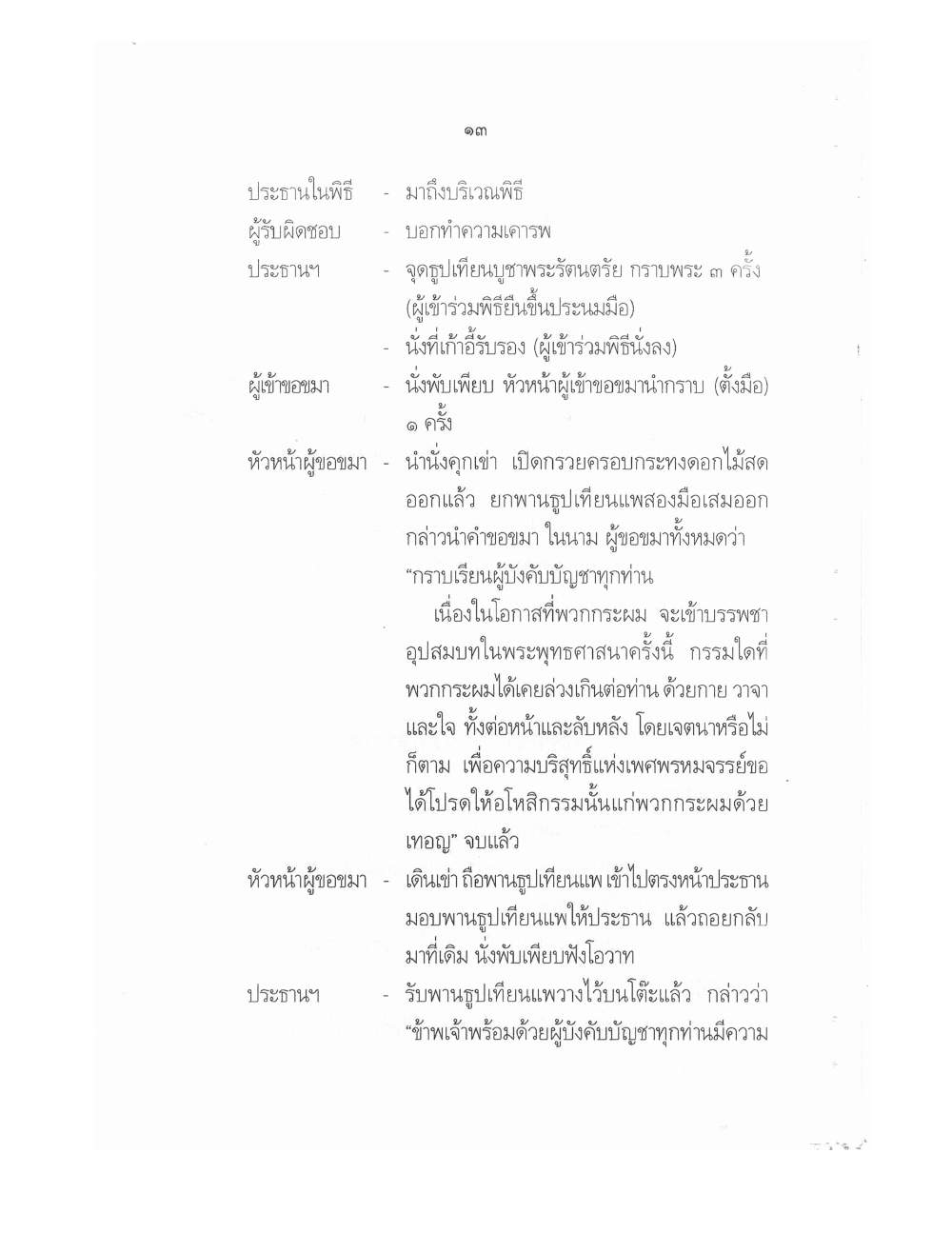
๑๓
ประธานในพิธี - มาถึงบริเวณพิธี ผู้รับผิดชอบ - บอกทำความเคารพ ประธานฯ - จุดธูปเทียนบูชาพระรัตนตรัย กราบพระ ๓ ครั้ง (ผู้เข้าร่วมพิธียืนขึ้นประนมมือ) - นั่งที่เก้าอี้รับรอง (ผู้เข้าร่วมพิธีนั่งลง) ผู้เข้าขอขมา - นั่งพับเพียบ หัวหน้าผู้เข้าขอขมานำกราบ (ตั้งมือ) ๑ ครั้ง หัวหน้าผู้ขอขมา - นำนั่งคุกเข่า เปิดกรวยครอบกระทงดอกไม้สดออกแล้ว ยกพานธูปเทียนแพสองมือเสมออก กล่าวนำคำขอขมา ในนาม ผู้ขอขมาทั้งหมดว่า "กราบเรียนผู้บังคับบัญชาทุกท่าน เนื่องในโอกาสที่พวกกระผม จะเข้าบรรพชาอุปสมบทในพระพุทธศาสนาครั้งนี้ กรรมใดที่พวกกระผมได้เคยล่วงเกินต่อท่าน ด้วยกาย วาจา และใจ ทั้งต่อหน้าและลับหลัง โดยเจตนาหรือไม่ก็ตาม เพื่อความบริสุทธิ์แห่งเพศพรหมจรรย์ขอได้โปรดให้อโหสิกรรมนั้นแก่พวกกระผมด้วยเทอญ" จบแล้ว หัวหน้าผู้ขอขมา - เดินเข่า ถือพานธูปเทียนแพ เข้าไปตรงหน้าประธาน มอบพานธูปเทียนแพให้ประธาน แล้วถอยกลับมาที่เดิม นั่งพับเพียบฟังโอวาท ประธานฯ - รับพานธูปเทียนแพวางไว้บนโต๊ะแล้ว กล่าวว่า "ข้าพเจ้าพร้อมด้วยผู้บังคับบัญชาทุกท่านมีความ
13
Presiding officer of the ceremony - arrives at the ceremony area Person in charge - announces the paying of respects Presiding officer - lights incense and candles to worship the Triple Gem, bows to the Buddha image three times (those attending the ceremony stand and press palms together) - sits in the reception chair (those attending the ceremony sit down) Those asking forgiveness - sit in the polite kneeling position; the leader of those asking forgiveness leads a bow with hands raised, once Leader of those asking forgiveness - leads them to kneel, opens and removes the cone covering the fresh flower offering, then raises the tray of paired incense and candles with both hands to shoulder level, and speaks the words asking forgiveness on behalf of all those asking forgiveness, saying: "Respectfully addressing all our superiors, On the occasion of our entering into ordination in the Buddhist religion, whatever offense we may have committed against you by body, speech, or mind, whether in your presence or behind your back, whether intentionally or not, for the sake of the purity of our monastic life we ask that you kindly grant us forgiveness for that offense." — end Leader of those asking forgiveness - walks on his knees holding the tray of paired incense and candles, goes directly before the presiding officer, presents the tray to him, then withdraws back to his place and sits in the polite kneeling position to listen to the admonition Presiding officer - receives the tray of paired incense and candles, places it on the table, then says: "I, together with all the superiors present, have...
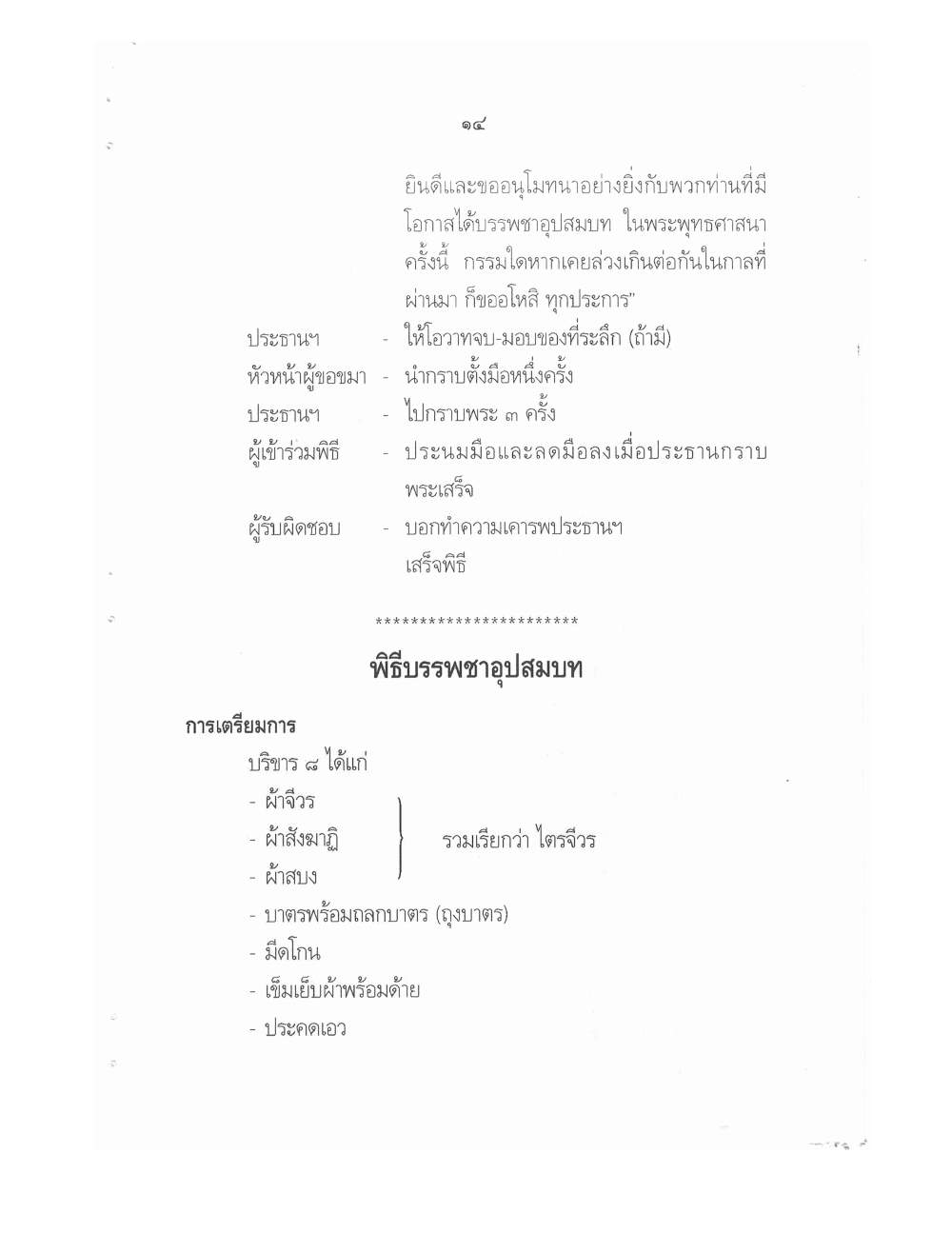
๑๔
ยินดีและขออนุโมทนาอย่างยิ่งกับพวกท่านที่มีโอกาสได้บรรพชาอุปสมบท ในพระพุทธศาสนาครั้งนี้ กรรมใดหากเคยล่วงเกินต่อกันในกาลที่ผ่านมา ก็ขออโหสิ ทุกประการ" ประธานฯ - ให้โอวาทจบ-มอบของที่ระลึก (ถ้ามี) หัวหน้าผู้ขอขมา - นำกราบตั้งมือหนึ่งครั้ง ประธานฯ - ไปกราบพระ ๓ ครั้ง ผู้เข้าร่วมพิธี - ประนมมือและลดมือลงเมื่อประธานกราบพระเสร็จ ผู้รับผิดชอบ - บอกทำความเคารพประธานฯ เสร็จพิธี
************************
พิธีบรรพชาอุปสมบท
การเตรียมการ
บริขาร ๘ ได้แก่ - ผ้าจีวร - ผ้าสังฆาฏิ } รวมเรียกว่า ไตรจีวร - ผ้าสบง - บาตรพร้อมถลกบาตร (ถุงบาตร) - มีดโกน - เข็มเย็บผ้าพร้อมด้าย - ประคดเอว
14
...delight and offer our deepest rejoicing (anumodana) with you, who now have the opportunity to be ordained in the Buddhist religion at this time. Whatever offense may have been committed between us in times past, we ask forgiveness for it in every respect." Presiding officer - finishes giving the admonition, presents a memento (if any) Leader of those asking forgiveness - leads a bow with hands raised, once Presiding officer - goes and bows to the Buddha image three times Those attending the ceremony - press palms together and lower their hands when the presiding officer finishes bowing Person in charge - announces the paying of respects to the presiding officer End of ceremony
************************
Ceremony of Going Forth into Ordination
Preparation
The Eight Requisites (aṭṭha-parikkhāra), namely: - The outer robe (civara) - The double robe (sanghati) } collectively called the triple robe (traicivara) - The under robe (sabong) - An alms bowl with its cloth cover (bag) - A razor - A sewing needle with thread - A waist cord/belt
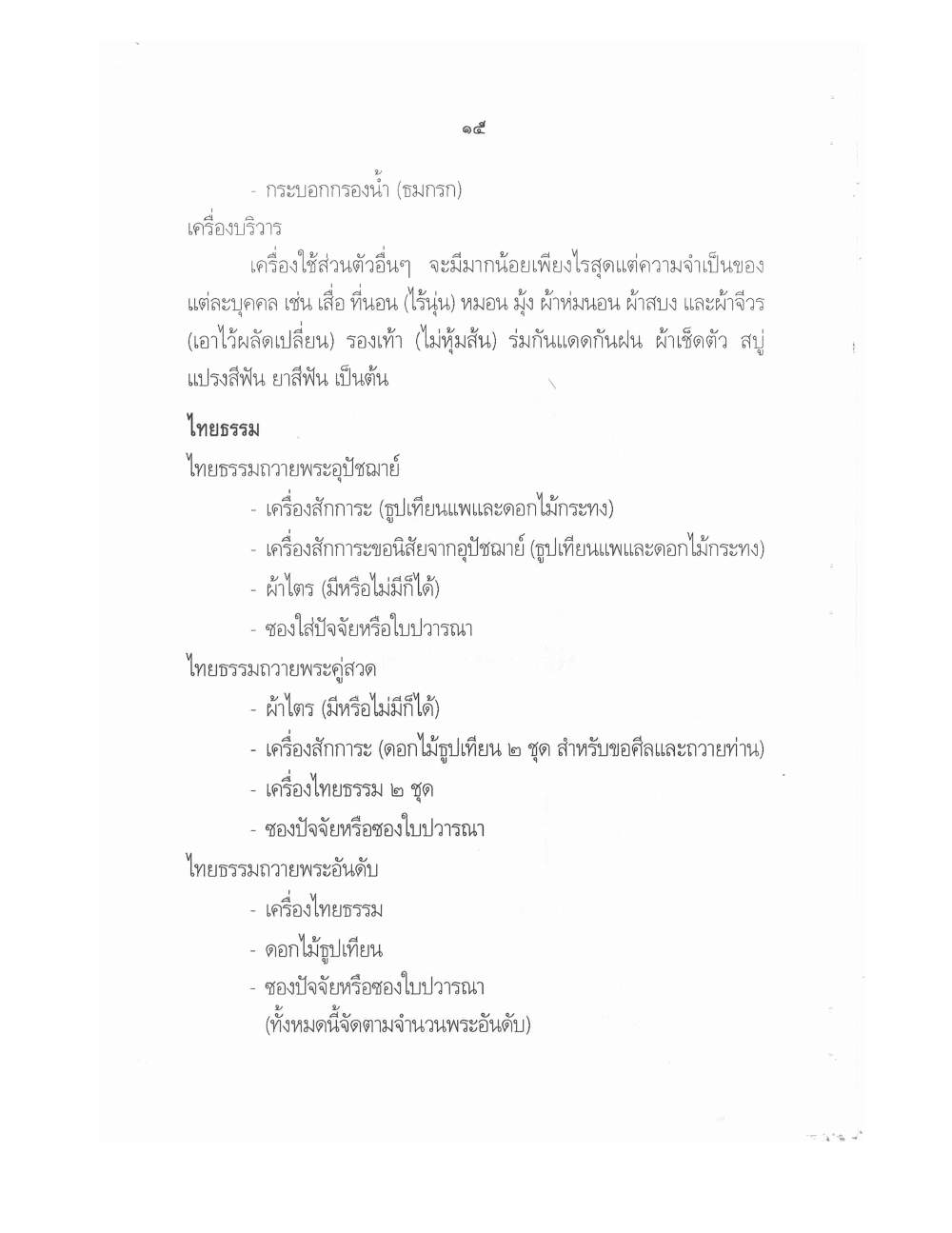
๑๕
- กระบอกกรองน้ำ (ธมกรก)
เครื่องบริวาร
เครื่องใช้ส่วนตัวอื่นๆ จะมีมากน้อยเพียงไรสุดแต่ความจำเป็นของแต่ละบุคคล เช่น เสื่อ ที่นอน (ไร้นุ่น) หมอน มุ้ง ผ้าห่มนอน ผ้าสบง และผ้าจีวร (เอาไว้ผลัดเปลี่ยน) รองเท้า (ไม่หุ้มส้น) ร่มกันแดดกันฝน ผ้าเช็ดตัว สบู่ แปรงสีฟัน ยาสีฟัน เป็นต้น
ไทยธรรม
ไทยธรรมถวายพระอุปัชฌาย์ - เครื่องสักการะ (ธูปเทียนแพและดอกไม้กระทง) - เครื่องสักการะขอนิสัยจากอุปัชฌาย์ (ธูปเทียนแพและดอกไม้กระทง) - ผ้าไตร (มีหรือไม่มีก็ได้) - ซองใส่ปัจจัยหรือใบปวารณา ไทยธรรมถวายพระคู่สวด - ผ้าไตร (มีหรือไม่มีก็ได้) - เครื่องสักการะ (ดอกไม้ธูปเทียน ๒ ชุด สำหรับขอศีลและถวายท่าน) - เครื่องไทยธรรม ๒ ชุด - ซองปัจจัยหรือซองใบปวารณา ไทยธรรมถวายพระอันดับ - เครื่องไทยธรรม - ดอกไม้ธูปเทียน - ซองปัจจัยหรือซองใบปวารณา (ทั้งหมดนี้จัดตามจำนวนพระอันดับ)
15
- A water-straining cylinder (dhammakaraka)
Auxiliary Items
Other personal effects may be more or fewer depending on each individual's necessity, such as a mat, bedding (kapok-free), a pillow, a mosquito net, a sleeping blanket, a spare under robe and outer robe (for changing), sandals (without covering the heel), an umbrella for sun and rain, a bath towel, soap, a toothbrush, toothpaste, and so on.
Offerings (Thai Tham)
Offerings presented to the preceptor (upajjhaya) - Ceremonial offering (paired incense and candles, and a flower cone) - Offering to request guidance (nissaya) from the preceptor (paired incense and candles, and a flower cone) - A set of triple robes (optional) - An envelope of money offering or a letter of invitation (pavarana) Offerings presented to the pair of chanting monks - A set of triple robes (optional) - Ceremonial offering (two sets of flowers, incense and candles, for requesting the precepts and for presenting to them) - Two sets of offerings (thai tham) - An envelope of money offering or a letter of invitation (pavarana) Offerings presented to the assembled witnessing monks - Offerings (thai tham) - Flowers, incense, candles - An envelope of money offering or a letter of invitation (pavarana) (All of these are arranged according to the number of witnessing monks)
๑๖
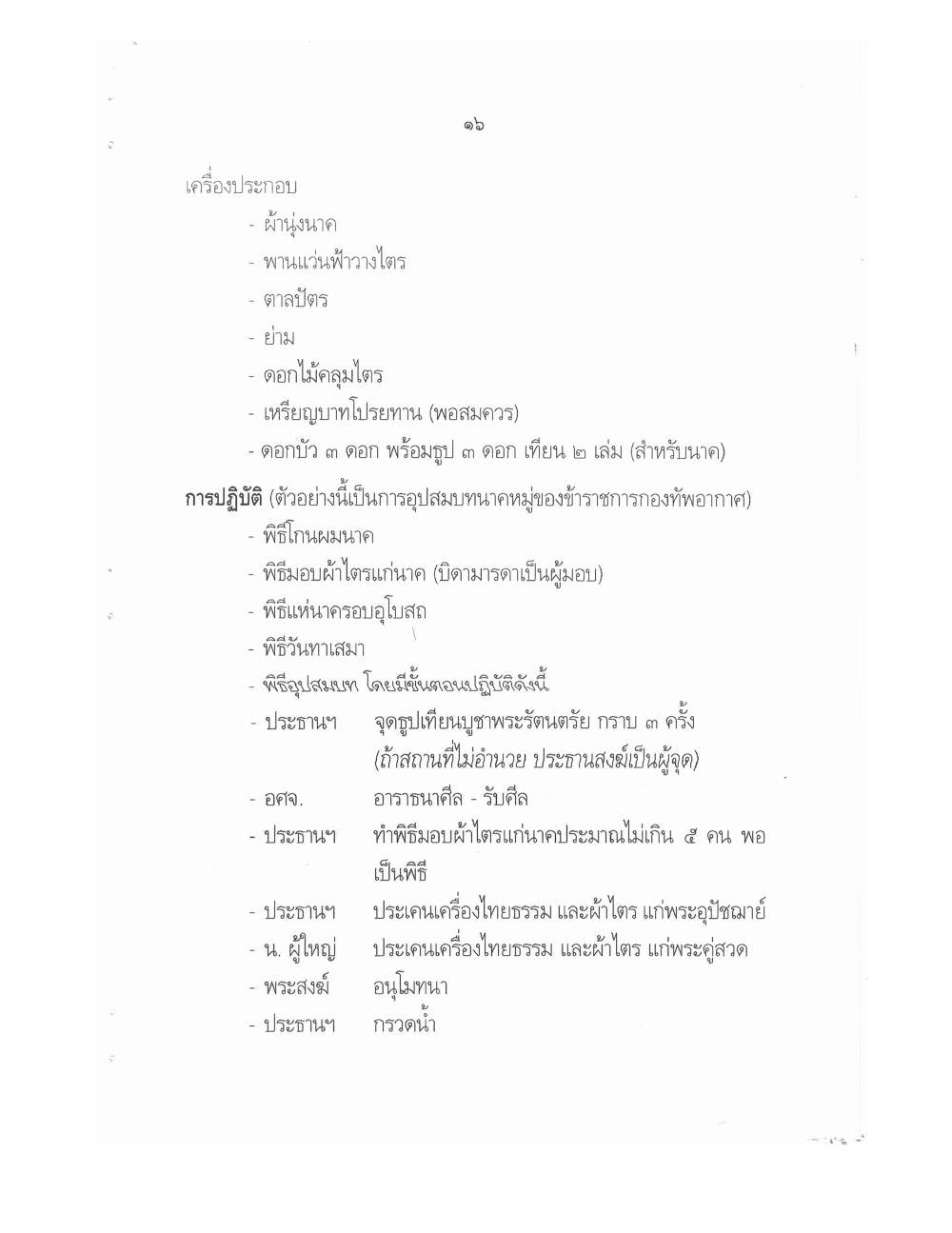
เครื่องประกอบ
- ผ้านุ่งนาค - พานแว่นฟ้าวางไตร - ตาลปัตร - ย่าม - ดอกไม้คลุมไตร - เหรียญบาทโปรยทาน (พอสมควร) - ดอกบัว ๓ ดอก พร้อมธูป ๓ ดอก เทียน ๒ เล่ม (สำหรับนาค)
การปฏิบัติ (ตัวอย่างนี้เป็นการอุปสมบทนาคหมู่ของข้าราชการกองทัพอากาศ)
- พิธีโกนผมนาค - พิธีมอบผ้าไตรแก่นาค (บิดามารดาเป็นผู้มอบ) - พิธีแห่นาครอบอุโบสถ - พิธีวันทาเสมา - พิธีอุปสมบท โดยมีขั้นตอนปฏิบัติดังนี้ - ประธานฯ จุดธูปเทียนบูชาพระรัตนตรัย กราบ ๓ ครั้ง (ถ้าสถานที่ไม่อำนวย ประธานสงฆ์เป็นผู้จุด) - อศจ. อาราธนาศีล - รับศีล - ประธานฯ ทำพิธีมอบผ้าไตรแก่นาคประมาณไม่เกิน ๕ คน พอเป็นพิธี - ประธานฯ ประเคนเครื่องไทยธรรม และผ้าไตร แก่พระอุปัชฌาย์ - น. ผู้ใหญ่ ประเคนเครื่องไทยธรรม และผ้าไตร แก่พระคู่สวด - พระสงฆ์ อนุโมทนา - ประธานฯ กรวดน้ำ
16
Accompanying Items
- Cloth for the ordinand (naga) to wear - A raised tray to hold the triple robe - A ceremonial fan (talapat) - A shoulder bag - Flowers to drape over the triple robe - One-baht coins for scattering as alms (a suitable amount) - Three lotus flowers, with three incense sticks and two candles (for the ordinand)
Procedure (this example is a group ordination of naga among Royal Thai Air Force officials)
- Ceremony of shaving the ordinand's hair - Ceremony of presenting the triple robe to the ordinand (the parents are the ones who present it) - Ceremony of the procession carrying the ordinand around the ordination hall - Ceremony of paying respect to the boundary stones (sema) - Ordination ceremony, with the following steps: - Presiding officer: lights incense and candles to worship the Triple Gem, bows three times (if the venue does not permit, the presiding monk lights them instead) - Chaplain (อศจ.): requests the precepts to be given - receives the precepts - Presiding officer: performs the ceremony of presenting the triple robe to the ordinands, not exceeding about 5 people, sufficient for the ceremony - Presiding officer: presents the offerings (thai tham) and triple robe to the preceptor - Senior official: presents the offerings (thai tham) and triple robe to the pair of chanting monks - The monks: give anumodana (blessing) - Presiding officer: pours the water of dedication (kruat nam)
๑๗
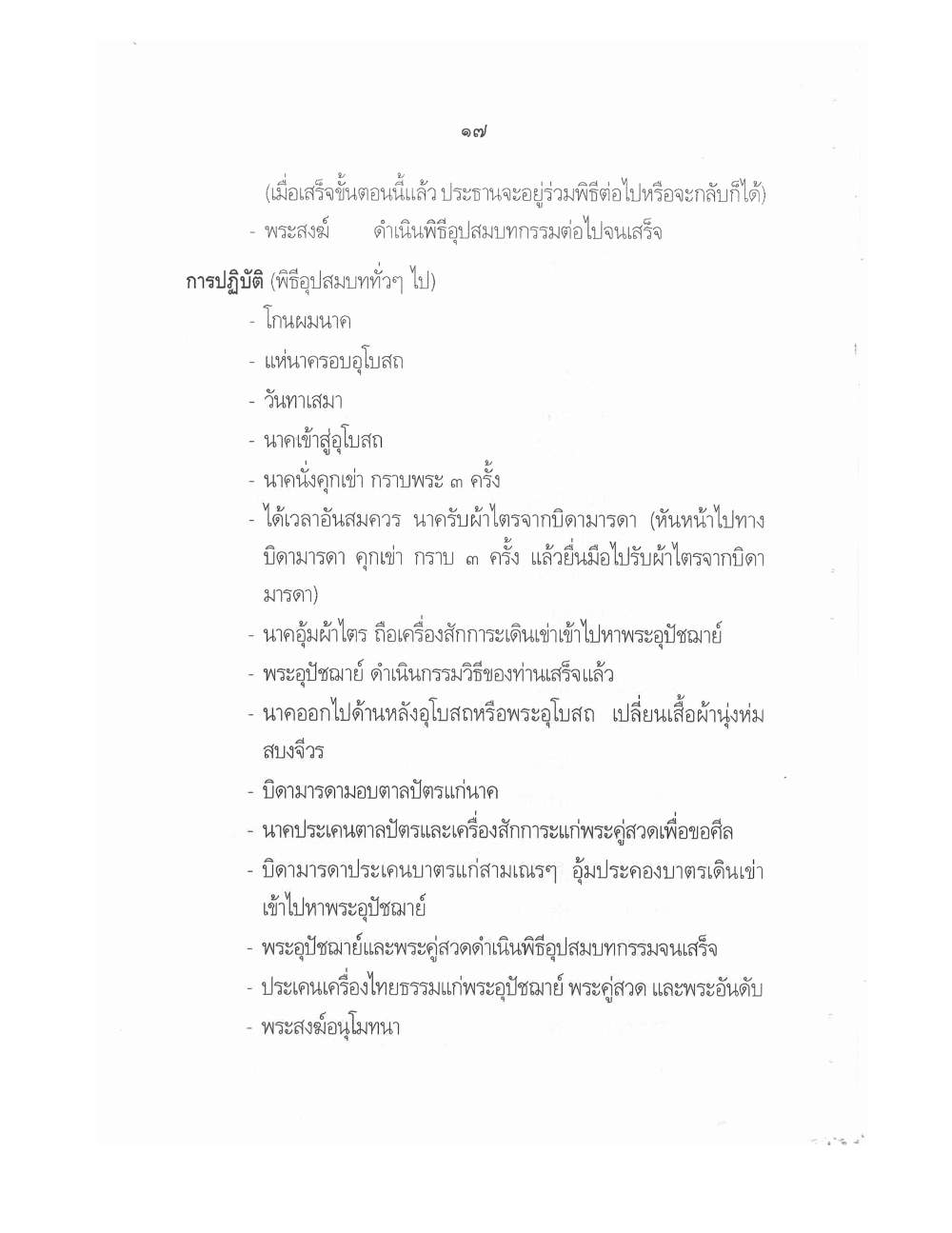
(เมื่อเสร็จขั้นตอนนี้แล้ว ประธานจะอยู่ร่วมพิธีต่อไปหรือจะกลับก็ได้) - พระสงฆ์ ดำเนินพิธีอุปสมบทกรรมต่อไปจนเสร็จ
การปฏิบัติ (พิธีอุปสมบททั่วๆ ไป)
- โกนผมนาค - แห่นาครอบอุโบสถ - วันทาเสมา - นาคเข้าสู่อุโบสถ - นาคนั่งคุกเข่า กราบพระ ๓ ครั้ง - ได้เวลาอันสมควร นาครับผ้าไตรจากบิดามารดา (หันหน้าไปทางบิดามารดา คุกเข่า กราบ ๓ ครั้ง แล้วยื่นมือไปรับผ้าไตรจากบิดามารดา) - นาคอุ้มผ้าไตร ถือเครื่องสักการะเดินเข่าเข้าไปหาพระอุปัชฌาย์ - พระอุปัชฌาย์ ดำเนินกรรมวิธีของท่านเสร็จแล้ว - นาคออกไปด้านหลังอุโบสถหรือพระอุโบสถ เปลี่ยนเสื้อผ้านุ่งห่มสบงจีวร - บิดามารดามอบตาลปัตรแก่นาค - นาคประเคนตาลปัตรและเครื่องสักการะแก่พระคู่สวดเพื่อขอศีล - บิดามารดาประเคนบาตรแก่สามเณรๆ อุ้มประคองบาตรเดินเข่าเข้าไปหาพระอุปัชฌาย์ - พระอุปัชฌาย์และพระคู่สวดดำเนินพิธีอุปสมบทกรรมจนเสร็จ - ประเคนเครื่องไทยธรรมแก่พระอุปัชฌาย์ พระคู่สวด และพระอันดับ - พระสงฆ์อนุโมทนา
17
(Once this step is finished, the presiding officer may remain for the rest of the ceremony or may leave) - The monks: proceed with conducting the ordination act (kamma) to completion
Procedure (Ordination Ceremony in General)
- Shaving the ordinand's hair - Procession carrying the ordinand around the ordination hall - Paying respect to the boundary stones (sema) - The ordinand enters the ordination hall - The ordinand kneels and bows to the Buddha image three times - At the appropriate time, the ordinand receives the triple robe from his parents (facing his parents, kneeling, bowing three times, then reaching out to receive the triple robe from them) - The ordinand, holding the triple robe and the ceremonial offering, walks on his knees toward the preceptor - The preceptor completes his procedure - The ordinand goes out behind the ordination hall to change into the under robe and outer robe - The parents present the ceremonial fan to the ordinand - The ordinand presents the fan and the ceremonial offering to the pair of chanting monks to request the precepts - The parents present the alms bowl to the novice, who holds and cradles the bowl and walks on his knees toward the preceptor - The preceptor and the pair of chanting monks conduct the ordination act (kamma) to completion - The offerings (thai tham) are presented to the preceptor, the pair of chanting monks, and the assembled witnessing monks - The monks give anumodana (blessing)
๑๘
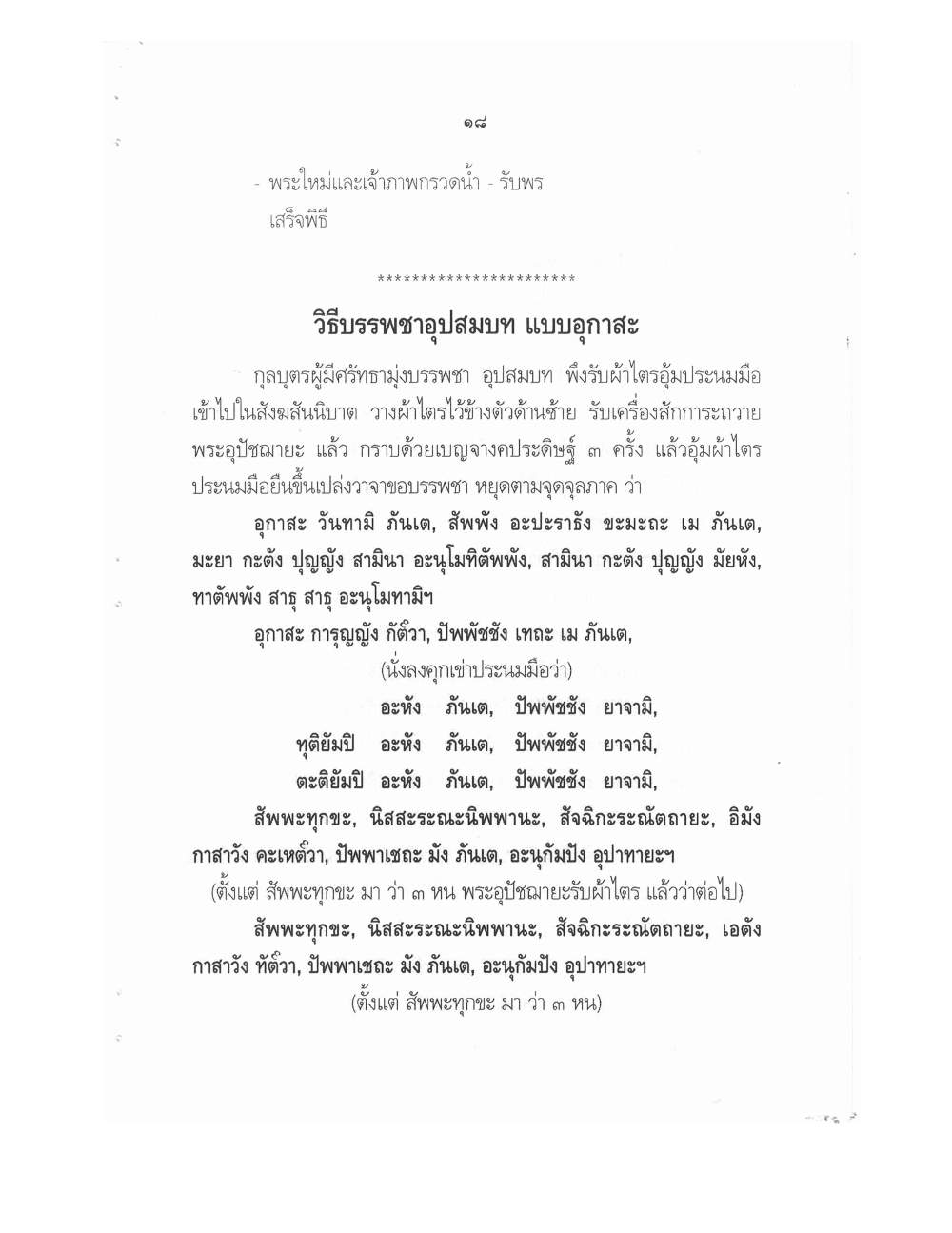
- พระใหม่และเจ้าภาพกรวดน้ำ - รับพร เสร็จพิธี
************************
วิธีบรรพชาอุปสมบท แบบอุกาสะ
กุลบุตรผู้มีศรัทธามุ่งบรรพชา อุปสมบท พึงรับผ้าไตรอุ้มประนมมือเข้าไปในสังฆสันนิบาต วางผ้าไตรไว้ข้างตัวด้านซ้าย รับเครื่องสักการะถวายพระอุปัชฌายะ แล้ว กราบด้วยเบญจางคประดิษฐ์ ๓ ครั้ง แล้วอุ้มผ้าไตรประนมมือยืนขึ้นเปล่งวาจาขอบรรพชา หยุดตามจุดจุลภาค ว่า
อุกาสะ วันทามิ ภันเต, สัพพัง อะปะราธัง ขะมะถะ เม ภันเต, มะยา กะตัง ปุญญัง สามินา อะนุโมทิตัพพัง, สามินา กะตัง ปุญญัง มัยหัง, ทาตัพพัง สาธุ สาธุ อะนุโมทามิฯ อุกาสะ การุญญัง กัต๎วา, ปัพพัชชัง เทถะ เม ภันเต, (นั่งลงคุกเข่าประนมมือว่า) อะหัง ภันเต, ปัพพัชชัง ยาจามิ, ทุติยัมปิ อะหัง ภันเต, ปัพพัชชัง ยาจามิ, ตะติยัมปิ อะหัง ภันเต, ปัพพัชชัง ยาจามิ, สัพพะทุกขะ, นิสสะระณะนิพพานะ, สัจฉิกะระณัตถายะ, อิมัง กาสาวัง คะเหต๎วา, ปัพพาเชถะ มัง ภันเต, อะนุกัมปัง อุปาทายะฯ (ตั้งแต่ สัพพะทุกขะ มา ว่า ๓ หน พระอุปัชฌายะรับผ้าไตร แล้วว่าต่อไป) สัพพะทุกขะ, นิสสะระณะนิพพานะ, สัจฉิกะระณัตถายะ, เอตัง กาสาวัง ทัต๎วา, ปัพพาเชถะ มัง ภันเต, อะนุกัมปัง อุปาทายะฯ (ตั้งแต่ สัพพะทุกขะ มา ว่า ๓ หน)
18
- The newly ordained monk and the sponsor pour the water of dedication - receive the blessing End of ceremony
************************
Method of Going Forth and Ordination, the Ukāsa Form
A young man of faith who intends to go forth into ordination should take up the triple robe, hold it with palms pressed together, and enter the assembly of the Sangha. He places the triple robe at his left side, receives the ceremonial offering and presents it to the preceptor, then bows in the five-point prostration (bencha-ngakha-pradit) three times. He then holds the triple robe, presses his palms together, stands, and utters the words requesting the going-forth, pausing at each comma, as follows:
Ukāsa vandāmi bhante, sabbaṃ aparādhaṃ khamatha me bhante, mayā kataṃ puññaṃ sāminā anumoditabbaṃ, sāminā kataṃ puññaṃ mayhaṃ, dātabbaṃ sādhu sādhu anumodāmi. ["With your leave, I pay homage, Venerable sir. Forgive me all my offenses, Venerable sir. May the merit I have made be shared with you, my lord; may the merit made by you, my lord, be given to me. Sādhu, sādhu, I rejoice."] Ukāsa kāruññaṃ katvā, pabbajjaṃ detha me bhante, ["With your leave, out of compassion, please grant me the going-forth, Venerable sir,"] (Kneel down, press palms together, and say:) Ahaṃ bhante, pabbajjaṃ yācāmi, ["Venerable sir, I ask for the going-forth,"] Dutiyampi ahaṃ bhante, pabbajjaṃ yācāmi, ["a second time, Venerable sir, I ask for the going-forth,"] Tatiyampi ahaṃ bhante, pabbajjaṃ yācāmi, ["a third time, Venerable sir, I ask for the going-forth,"] Sabbadukkha-nissaraṇanibbānasacchikaraṇatthāya, imaṃ kāsāvaṃ gahetvā, pabbājetha maṃ bhante, anukampaṃ upādāya. ["For the purpose of realizing Nibbana, the escape from all suffering, please take this ochre robe and ordain me, Venerable sir, out of compassion."] (Recite the passage beginning "sabbadukkha" three times; the preceptor then takes the triple robe, after which one continues:) Sabbadukkha-nissaraṇanibbānasacchikaraṇatthāya, etaṃ kāsāvaṃ datvā, pabbājetha maṃ bhante, anukampaṃ upādāya. ["For the purpose of realizing Nibbana, the escape from all suffering, having given this ochre robe, please ordain me, Venerable sir, out of compassion."] (Recite the passage beginning "sabbadukkha" three times)
๑๙
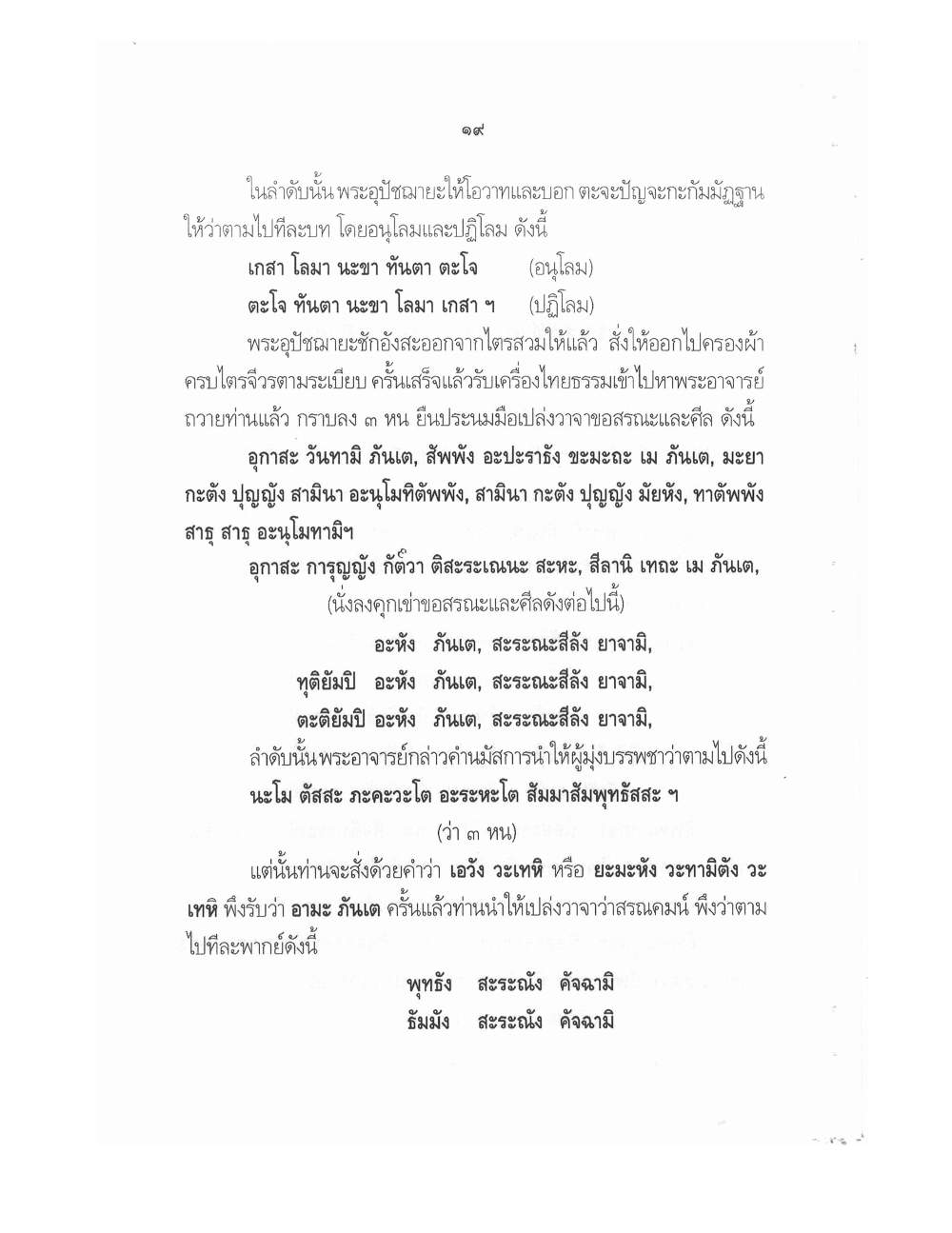
ในลำดับนั้น พระอุปัชฌายะให้โอวาทและบอก ตะจะปัญจกะกัมมัฏฐานให้ว่าตามไปทีละบท โดยอนุโลมและปฏิโลม ดังนี้ เกสา โลมา นะขา ทันตา ตะโจ (อนุโลม) ตะโจ ทันตา นะขา โลมา เกสา ฯ (ปฏิโลม) พระอุปัชฌายะชักอังสะออกจากไตรสวมให้แล้ว สั่งให้ออกไปครองผ้าครบไตรจีวรตามระเบียบ ครั้นเสร็จแล้วรับเครื่องไทยธรรมเข้าไปหาพระอาจารย์ ถวายท่านแล้ว กราบลง ๓ หน ยืนประนมมือเปล่งวาจาขอสรณะและศีล ดังนี้ อุกาสะ วันทามิ ภันเต, สัพพัง อะปะราธัง ขะมะถะ เม ภันเต, มะยา กะตัง ปุญญัง สามินา อะนุโมทิตัพพัง, สามินา กะตัง ปุญญัง มัยหัง, ทาตัพพัง สาธุ สาธุ อะนุโมทามิฯ อุกาสะ การุญญัง กัต๎วา ติสะระเณนะ สะหะ, สีลานิ เทถะ เม ภันเต, (นั่งลงคุกเข่าขอสรณะและศีลดังต่อไปนี้) อะหัง ภันเต, สะระณะสีลัง ยาจามิ, ทุติยัมปิ อะหัง ภันเต, สะระณะสีลัง ยาจามิ, ตะติยัมปิ อะหัง ภันเต, สะระณะสีลัง ยาจามิ, ลำดับนั้นพระอาจารย์กล่าวคำมัสการนำให้ผู้มุ่งบรรพชาว่าตามไปดังนี้ นะโม ตัสสะ ภะคะวะโต อะระหะโต สัมมาสัมพุทธัสสะ ฯ (ว่า ๓ หน) แต่นั้นท่านจะสั่งด้วยคำว่า เอวัง วะเทหิ หรือ ยะมะหัง วะทามิตัง วะเทหิ พึงรับว่า อามะ ภันเต ครั้นแล้วท่านนำให้เปล่งวาจาว่าสรณคมน์ พึงว่าตามไปทีละพากย์ดังนี้ พุทธัง สะระณัง คัจฉามิ ธัมมัง สะระณัง คัจฉามิ
19
Following this, the preceptor gives instruction and teaches the fivefold meditation on the bodily parts (taca-pañcaka), to be repeated phrase by phrase, both forward and in reverse order, as follows: Kesā lomā nakhā dantā taco (forward order) ["hair, body-hair, nails, teeth, skin"] Taco dantā nakhā lomā kesā. (reverse order) ["skin, teeth, nails, body-hair, hair"] The preceptor removes the shoulder-cloth after fitting it over the robe, and instructs the ordinand to go and put on the complete triple robe according to proper form. Once this is done, he takes the offering (thai tham) and goes to the teacher (acariya), presents it to him, bows down three times, stands with palms pressed together, and utters the words requesting the refuges and precepts, as follows: Ukāsa vandāmi bhante, sabbaṃ aparādhaṃ khamatha me bhante, mayā kataṃ puññaṃ sāminā anumoditabbaṃ, sāminā kataṃ puññaṃ mayhaṃ, dātabbaṃ sādhu sādhu anumodāmi. [same request for forgiveness and sharing of merit as before] Ukāsa kāruññaṃ katvā tisaraṇena saha, sīlāni detha me bhante, ["With your leave, out of compassion, please grant me the precepts together with the three refuges, Venerable sir,"] (Kneel down and ask for the refuges and precepts as follows:) Ahaṃ bhante, saraṇasīlaṃ yācāmi, ["Venerable sir, I ask for the refuges and precepts,"] Dutiyampi ahaṃ bhante, saraṇasīlaṃ yācāmi, ["a second time, Venerable sir, I ask for the refuges and precepts,"] Tatiyampi ahaṃ bhante, saraṇasīlaṃ yācāmi, ["a third time, Venerable sir, I ask for the refuges and precepts,"] Next, the teacher recites the words of homage for the one seeking ordination to repeat after him, as follows: Namo tassa bhagavato arahato sammāsambuddhassa. ["Homage to the Blessed One, the Worthy One, the Perfectly Self-Enlightened One."] (Recited three times) After that, he will instruct with the words "evaṃ vadehi" or "yamahaṃ vadāmi taṃ vadehi" ("say it thus" / "say what I say"), to which one should reply "āma bhante" ("yes, Venerable sir"). He then leads the utterance of taking the refuges, to be repeated phrase by phrase as follows: Buddhaṃ saraṇaṃ gacchāmi ["I go to the Buddha for refuge"] Dhammaṃ saraṇaṃ gacchāmi ["I go to the Dhamma for refuge"]
๒๐
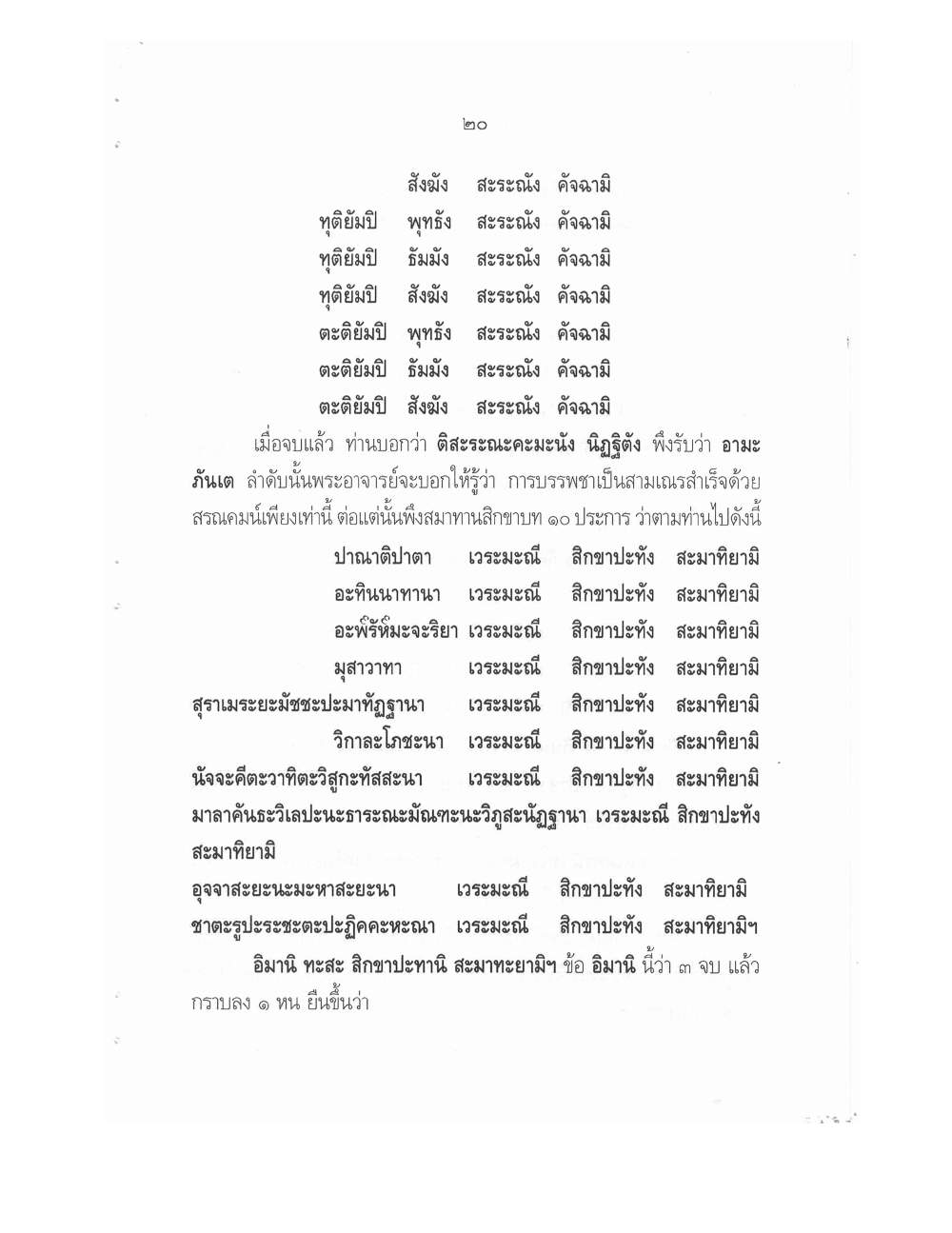
สังฆัง สะระณัง คัจฉามิ ทุติยัมปิ พุทธัง สะระณัง คัจฉามิ ทุติยัมปิ ธัมมัง สะระณัง คัจฉามิ ทุติยัมปิ สังฆัง สะระณัง คัจฉามิ ตะติยัมปิ พุทธัง สะระณัง คัจฉามิ ตะติยัมปิ ธัมมัง สะระณัง คัจฉามิ ตะติยัมปิ สังฆัง สะระณัง คัจฉามิ เมื่อจบแล้ว ท่านบอกว่า ติสะระณะคะมะนัง นิฏฐิตัง พึงรับว่า อามะ ภันเต ลำดับนั้นพระอาจารย์จะบอกให้รู้ว่า การบรรพชาเป็นสามเณรสำเร็จด้วยสรณคมน์เพียงเท่านี้ ต่อแต่นั้นพึงสมาทานสิกขาบท ๑๐ ประการ ว่าตามท่านไปดังนี้ ปาณาติปาตา เวระมะณี สิกขาปะทัง สะมาทิยามิ อะทินนาทานา เวระมะณี สิกขาปะทัง สะมาทิยามิ อะพรัห๎มะจริยา เวระมะณี สิกขาปะทัง สะมาทิยามิ มุสาวาทา เวระมะณี สิกขาปะทัง สะมาทิยามิ สุราเมระยะมัชชะปะมาทัฏฐานา เวระมะณี สิกขาปะทัง สะมาทิยามิ วิกาละโภชะนา เวระมะณี สิกขาปะทัง สะมาทิยามิ นัจจะคีตะวาทิตะวิสูกะทัสสะนา เวระมะณี สิกขาปะทัง สะมาทิยามิ มาลาคันธะวิเลปะนะธาระณะมัณฑะนะวิภูสะนัฏฐานา เวระมะณี สิกขาปะทัง สะมาทิยามิ อุจจาสะยะนะมะหาสะยะนา เวระมะณี สิกขาปะทัง สะมาทิยามิ ชาตะรูปะระชะตะปะฏิคคะหะณา เวระมะณี สิกขาปะทัง สะมาทิยามิฯ อิมานิ ทะสะ สิกขาปะทานิ สะมาทะยามิฯ ข้อ อิมานิ นี้ว่า ๓ จบ แล้วกราบลง ๑ หน ยืนขึ้นว่า
20
Saṅghaṃ saraṇaṃ gacchāmi ["I go to the Sangha for refuge"] Dutiyampi buddhaṃ saraṇaṃ gacchāmi ["a second time, I go to the Buddha for refuge"] Dutiyampi dhammaṃ saraṇaṃ gacchāmi ["a second time, I go to the Dhamma for refuge"] Dutiyampi saṅghaṃ saraṇaṃ gacchāmi ["a second time, I go to the Sangha for refuge"] Tatiyampi buddhaṃ saraṇaṃ gacchāmi ["a third time, I go to the Buddha for refuge"] Tatiyampi dhammaṃ saraṇaṃ gacchāmi ["a third time, I go to the Dhamma for refuge"] Tatiyampi saṅghaṃ saraṇaṃ gacchāmi ["a third time, I go to the Sangha for refuge"] When this is finished, the teacher says "tisaraṇagamanaṃ niṭṭhitaṃ" ("the going for the threefold refuge is completed"), to which one should reply "āma bhante." The teacher then explains that the going-forth as a novice is accomplished simply by this taking of the refuges. After that, one should undertake the ten precepts, repeating after him as follows: Pāṇātipātā veramaṇī sikkhāpadaṃ samādiyāmi ["I undertake the precept of abstaining from killing living beings"] Adinnādānā veramaṇī sikkhāpadaṃ samādiyāmi ["I undertake the precept of abstaining from taking what is not given"] Abrahmacariyā veramaṇī sikkhāpadaṃ samādiyāmi ["I undertake the precept of abstaining from unchastity"] Musāvādā veramaṇī sikkhāpadaṃ samādiyāmi ["I undertake the precept of abstaining from false speech"] Surāmerayamajjapamādaṭṭhānā veramaṇī sikkhāpadaṃ samādiyāmi ["I undertake the precept of abstaining from intoxicating drinks and drugs that cause heedlessness"] Vikālabhojanā veramaṇī sikkhāpadaṃ samādiyāmi ["I undertake the precept of abstaining from eating at improper times"] Naccagītavāditavisūkadassanā veramaṇī sikkhāpadaṃ samādiyāmi ["I undertake the precept of abstaining from dancing, singing, music, and watching shows"] Mālāgandhavilepanadhāraṇamaṇḍanavibhūsanaṭṭhānā veramaṇī sikkhāpadaṃ samādiyāmi ["I undertake the precept of abstaining from wearing garlands, using perfumes, and adorning oneself with cosmetics"] Uccāsayanamahāsayanā veramaṇī sikkhāpadaṃ samādiyāmi ["I undertake the precept of abstaining from using high and luxurious seats and beds"] Jātarūparajatapaṭiggahaṇā veramaṇī sikkhāpadaṃ samādiyāmi. ["I undertake the precept of abstaining from accepting gold and silver (money)."] Imāni dasa sikkhāpadāni samādiyāmi. ["I undertake these ten precepts."] This passage beginning "imāni" is recited three times, then one bows down once and stands up saying:
วันทามิ ภันเต, สัพพัง อะปะราธัง ขะมะถะ เม ภันเต, มะยา กะตัง ปุญญัง สามินา อะนุโมทิตัพพัง, สามินา กะตัง ปุญญัง มัยหัง, ทาตัพพัง สาธุ สาธุ อะนุโมทามิฯ
คุกเข่ากราบ ๓ หน
ในลำดับนั้น สามเณรพึงรับบาตรอุ้มเข้าไปหาพระอุปัชฌายะในสังฆสันนิบาต วางไว้ข้างตัวด้านซ้าย รับเครื่องไทยธรรมถวายท่านแล้วกราบลง ๓ หน ยืนประนมมือกล่าวคำขอนิสัย ว่าดังนี้
อุกาสะ วันทามิ ภันเต, สัพพัง อะปะราธัง ขะมะถะ เม ภันเต, มะยา กะตัง ปุญญัง สามินา อะนุโมทิตัพพัง, สามินา กะตัง ปุญญัง มัยหัง, ทาตัพพัง สาธุ สาธุ อะนุโมทามิฯ,
อุกาสะ การุญญัง กัตวา นิสสะยัง เทถะ เม ภันเต,
(นั่งคุกเข่า)
อะหัง ภันเต, นิสสะยัง ยาจามิ, ทุติยัมปิ อะหัง ภันเต, นิสสะยัง ยาจามิ ตะติยัมปิ อะหัง ภันเต, นิสสะยัง ยาจามิฯ
อุปัชฌาโย เม ภันเต โหหิฯ วรรคนี้ว่า ๓ หน เมื่อพระอุปัชฌาย์ว่า โอปายิกัง, ปะฏิรูปัง, ปาสาทิเกนะ สัมปาเทหิ, แล้วสามเณรพึงกล่าวรับว่า อุกาสะ สัมปะฏิจฉามิฯ ในระหว่างๆ ๓ หน แล้วว่าต่อ
อัชชะตัคเคทานิ เถโร, มัยหัง ภาโร, อะหัมปิ เถรัสสะ ภาโร วรรคนี้ว่า ๓ หน แล้วกราบลง ๑ หน ยืนขึ้นว่าต่อ
วันทามิ ภันเต, สัพพัง อะปะราธัง ขะมะถะ เม ภันเต, มะยา กะตัง ปุญญัง สามินา อะนุโมทิตัพพัง, สามินา กะตัง ปุญญัง มัยหัง ทาตัพพัง สาธุ สาธุ อะนุโมทามิฯ,
"I pay homage, Venerable Sir. Forgive me all my faults, Venerable Sir. May the merit made by me be rejoiced in by the Master; may the merit made by the Master be given to me. Sādhu, sādhu, I rejoice."
Kneel and prostrate 3 times.
Next, the novice should take up the alms bowl, carry it to the preceptor in the assembled Sangha, place it at his left side, receive the offering (thai dhamma) and present it to him, then prostrate 3 times, stand with hands folded in añjali, and say the request for dependence (nissaya) as follows:
"By your leave, I pay homage, Venerable Sir. Forgive me all my faults, Venerable Sir. May the merit made by me be rejoiced in by the Master; may the merit made by the Master be given to me. Sādhu, sādhu, I rejoice,"
"By your leave, out of compassion, please grant me dependence, Venerable Sir,"
(Kneeling)
"Venerable Sir, I ask for dependence, A second time, Venerable Sir, I ask for dependence, A third time, Venerable Sir, I ask for dependence."
"Venerable Sir, be my preceptor." This phrase is said 3 times. When the preceptor says, "It is fitting, it is proper, accomplish it with confidence," the novice should reply, "By your leave, I accept," each time, 3 times in between, then continue:
"From this day forth, the Elder is my responsibility; I too am the Elder's responsibility." This phrase is said 3 times, then prostrate once, stand up, and continue:
"I pay homage, Venerable Sir. Forgive me all my faults, Venerable Sir. May the merit made by me be rejoiced in by the Master; may the merit made by the Master be given to me. Sādhu, sādhu, I rejoice,"
คุกเข่ากราบ ๓ หน
ตั้งแต่ อุปัชฌาโย ฯลฯ เถรัสสะ ภาโร ๓ วรรค นี้ พระอุปัชฌายะบางองค์ให้ว่ารวดเดียวตามแบบนั้นก็มี ให้ว่าเป็นตอนๆ ดังนี้คือ เมื่อสามเณรว่า อุปัชฌาโย เม ภันเต โหหิ ๓ หน แล้วพระอุปัชฌายะกล่าวรับว่า โอปายิกัง, ปะฏิรูปัง, ปาสาทิเกนะ สัมปาเทหิ, บทใดบทหนึ่งพึงรับว่า อุกาสะ สัมปะฏิจฉามิ ทุกบทไปแล้วสามเณรพึงกล่าวรับเป็นธุระให้ท่านว่า อัชชะตัคเคทานิ ฯลฯ ภาโร ๓ หนๆ ก็มี ลำดับนั้น พระอุปัชฌายะหรือ พระกรรมวาจาจารย์เอาบาตรมีสายโยกคล้องตัวผู้มุ่งอุปสมบทแล้วบอกบาตรและจีวร ผู้มุ่งอุปสมบทพึงรับว่า อามะ ภันเต, ๔ หน ดังนี้
ปะฐะมัง อุปัชฌัง คาหาเปตัพโพ อุปัชฌัง คาหาเปต๎วา ปัตตะจีวะรัง อาจิกขิตัพพัง
คำบอกบาตรจีวร คำรับ ๑. อะยันเต ปัตโต อามะ ภันเต ๒. อะยัง สังฆาฏิ อามะ ภันเต ๓. อะยัง อุตตราสังโค อามะ ภันเต ๔. อะยัง อันตะระวาสะโก อามะ ภันเต
ต่อจากนั้น พระอาจารย์ท่านบอกให้ออกไปข้างนอกว่า คัจฉะ อะมุมหิ โอกาเส ติฏฐาหิ พึงถอยออกลุกขึ้นเดินไปยืนอยู่ในที่ที่กำหนดไว้ พระอาจารย์ท่านสวดสมมติตนเป็นผู้สอนซ้อม แล้วออกไปสวดถามอันตรายิกธรรม พึงรับว่า นัตถิ ภันเต ๕ หน อามะ ภันเต ๘ หน ดังนี้
ถาม ตอบ ๑. กุฏฐัง นัตถิ ภันเต ๒. คัณโฑ นัตถิ ภันเต
Kneel and prostrate 3 times.
From "Upajjhāyo... [etc.]... therassa bhāro," these 3 phrases — some preceptors have them recited straight through in that one manner; others have them recited in stages, as follows: when the novice says "Upajjhāyo me bhante hohi" 3 times, the preceptor then replies "It is fitting, it is proper, accomplish it with confidence," and for each and every phrase [the novice] should reply "By your leave, I accept"; after every phrase the novice then declares taking on the duty [as pupil] to him, saying "From this day forth... [etc.]... responsibility," 3 times — this manner also exists. Next, the preceptor or the reciting teacher (kammavācācariya) takes the strapped bowl and hangs it on the body of the one seeking ordination, then announces the bowl and robes; the one seeking ordination should reply "Yes, Venerable Sir," 4 times, as follows:
"First he should be made to take hold of the bowl; having made him take hold of the bowl, the bowl and robe should be pointed out to him."
Words announcing the bowl and robe Reply 1. This is your bowl Yes, Venerable Sir 2. This is the outer robe Yes, Venerable Sir 3. This is the upper robe Yes, Venerable Sir 4. This is the inner robe Yes, Venerable Sir
After that, the teacher tells him to go outside, saying "Go, stand in that place"; he should withdraw, rise, and go stand in the place indicated. The teacher recites, taking on the role of instructor/examiner, then goes out and chants asking about the obstructing conditions (antarāyika-dhamma); he should reply "No, Venerable Sir," 5 times, and "Yes, Venerable Sir," 8 times, as follows:
Question Answer 1. Leprosy? No, Venerable Sir 2. Boils/tumors? No, Venerable Sir
๓. กิลาโส นัตถิ ภันเต ๔. โสโส นัตถิ ภันเต ๕. อะปะมาโร นัตถิ ภันเต ๑. มะนุสโสสิ อามะ ภันเต ๒. ปุริโสสิ อามะ ภันเต ๓. ภุชิสโสสิ อามะ ภันเต ๔. อะนะโณสิ อามะ ภันเต ๕. นะสิ ราชะภะโฏ อามะ ภันเต ๖. อะนุญญาโตสิ มาตาปิตูหิ อามะ ภันเต ๗. ปะริปุณณะวีสะติวัสโสสิ อามะ ภันเต ๘. ปะริปุณณันเต ปัตตะจีวะรัง อามะ ภันเต ๑. กินนาโมสิ อะหัง ภันเต................ นามะ ๒. โก นามะ เต อุปัชฌาโย อุปัชฌาโย เม ภันเต อายัสมา..................... นามะ
ช่องที่..........ไว้ พระอุปัชฌายะ หรืออาจารย์ท่านจะตั้งชื่อของอุปสัมปทาเปกขะ กรอกลงช่องให้ไว้ก่อนวันบวช
และช่องที่........ไว้ในช่องชื่อของพระอุปัชฌายะก็เช่นเดียวกัน ให้กรอกตามชื่อของพระอุปัชฌายะ ซึ่งท่านจะบอกและกรอกให้ไว้ก่อนวันบวช
ครั้นสวดสอนซ้อมแล้ว ท่านกลับเข้ามาสวดขอเรียกอุปสัมปทาเปกขะเข้ามา อุปสัมปทาเปกขะพึงเข้ามาในสังฆสันนิบาต กราบลงตรงหน้าพระอุปัชฌายะ ๓ หน แล้วนั่งคุกเข่าประนมมือ เปล่งวาจาขออุปสมบทว่าดังนี้
สังฆัมภันเต, อุปะสัมปะทัง ยาจามิ, อุลลุมปะตุ มัง ภันเต, สังโฆ อะนุกัมปัง อุปาทายะ
3. Skin disease/scabs? No, Venerable Sir 4. Consumption/asthma? No, Venerable Sir 5. Epilepsy? No, Venerable Sir 1. Are you a human being? Yes, Venerable Sir 2. Are you a man? Yes, Venerable Sir 3. Are you a free man (not a bonded servant)? Yes, Venerable Sir 4. Are you free of debt? Yes, Venerable Sir 5. Are you not in the king's service? Yes, Venerable Sir 6. Have you been permitted by your mother and father? Yes, Venerable Sir 7. Are you fully twenty years of age? Yes, Venerable Sir 8. Are your bowl and robes complete? Yes, Venerable Sir 1. What is your name? I, Venerable Sir, am named .................. [name] 2. What is your preceptor's name? My preceptor, Venerable Sir, is the Venerable .................. [name]
The blank marked ".........." is where the preceptor or teacher will fill in the name of the ordination candidate (upasampadā-pekkha); it is to be entered before the ordination day.
And the blank marked "........" for the name of the preceptor is likewise to be filled in with the preceptor's name, which he will state and have entered before the ordination day.
Once the rehearsal chanting is finished, he returns and chants to call the ordination candidate in; the candidate should enter the assembled Sangha, prostrate before the preceptor 3 times, then kneel with hands folded, and utter the request for ordination as follows:
"Venerable Sangha, I request ordination; may the Sangha lift me up, out of compassion."
ทุติยัมปิ ภันเต, สังฆัง อุปะสัมปะทัง ยาจามิ, อุลลุมปะตุมัง ภันเต, สังโฆ อะนุกัมปัง อุปาทายะ,
ตะติยัมปิ ภันเต, สังฆัง อุปะสัมปะทัง ยาจามิ, อุลลุมปะตุมัง ภันเต, สังโฆ อะนุกัมปัง อุปาทายะ,
ในลำดับนั้น พระอุปัชฌายะกล่าวเผดียงสงฆ์แล้ว พระอาจารย์สวดสมมติตนถามอันตรายิกธรรม อุปสัมปทาเปกขะพึงรับว่า นัตถิ ภันเต ๕ หน อามะ ภันเต ๘ หน บอกชื่อตนและชื่อพระอุปัชฌายะรวม ๒ หน เหมือนที่กล่าวแล้วในหนหลังฯ แต่นั้นพึงนั่งฟังท่านสวดกรรมวาจา อุปสมบทไปจนจบ ครั้นจบแล้วท่านเอาบาตรออกจากตัว แล้วพึงกราบลง ๓ หน แต่นั้นพึงนั่งพับเพียบประนมมือฟังพระอุปัชฌายะบอกอนุศาสน์ไปจนจบ แล้วรับว่า อามะ ภันเต เป็นเสร็จพิธีอุปสมบท แล้วกราบพระอุปัชฌายะ ๓ หน ถ้ามีไทยธรรมถวายก็ให้รับไทยธรรมถวายพระอันดับ เสร็จแล้วคอยฟังพระท่านอนุโมทนาต่อไป เมื่อพระอนุโมทนา พึงกรวดน้ำ ตั้งใจอุทิศบุญกุศลส่วนนี้ให้แก่ท่านผู้มีพระคุณ เมื่อพระว่า ยะถา จบ ก็เทน้ำโกรกลงให้หมด ต่อนั้นประนมมือฟังอนุโมทนาไปจนจบ เป็นอันเสร็จพิธี
จบพิธีอุปสมบทแบบอุกาสะ
*********************
วิธีบรรพชาอุปสมบท แบบเอสาหัง
กุลบุตรผู้มีศรัทธามุ่งอุปสมบท พึงรับผ้าไตรอุ้มประนมมือเข้าไปในสังฆสันนิบาต วางผ้าไตรข้างตัวด้านซ้าย รับเครื่องสักการะถวายพระอุปัชฌายะ แล้วกราบลงด้วยเบญจางคประดิษฐ์ ๓ ครั้ง แล้วนั่งคุกเข่าอุ้มผ้าไตร ประนมมือเปล่งวาจา ถึงสรณะและขอบรรพชาด้วยคำมคธ หยุดตามจุดจุลภาค ว่า
"A second time, Venerable Sir, I request ordination from the Sangha; may the Sangha lift me up, out of compassion,"
"A third time, Venerable Sir, I request ordination from the Sangha; may the Sangha lift me up, out of compassion,"
Next, once the preceptor has formally addressed the Sangha, the teacher chants, taking on the role of examiner, and asks about the obstructing conditions; the candidate should reply "No, Venerable Sir," 5 times, and "Yes, Venerable Sir," 8 times, and state his own name and his preceptor's name, 2 times total, as already described above. After that, he should sit and listen while the formal act (kammavācā) of ordination is chanted through to the end. Once it is finished, the bowl is removed from his body, and he should then prostrate 3 times. After that, he should sit in the polite kneeling posture with hands folded, listening to the preceptor giving the instructions (anusāsanā) through to the end, then reply "Yes, Venerable Sir" — this completes the ordination ceremony. He then prostrates to the preceptor 3 times. If there is an offering (thai dhamma) to present, it is presented to the ranked monks. Once finished, he should wait and listen as the monks give the blessing. When the monks give the blessing, he should pour the water of dedication, intending to dedicate this portion of merit to those who have shown him kindness. When the monks reach the word "yathā," he pours out all the water until it is gone. After that, keep the hands folded and listen to the blessing chant through to the end — this completes the ceremony.
End of the ordination ceremony, ukāsa form
*********************
Method of Going-Forth and Ordination, the Esāhaṃ Form
A son of good family who has faith and intends to be ordained should take up the triple robe, hold it with hands folded, and enter the assembled Sangha; place the robe at his left side, receive the offering items and present them to the preceptor, then prostrate with the five-point prostration 3 times; then kneel holding the robe, hands folded, and utter, in the Magadha [Pali] language, going for refuge and requesting the going-forth, pausing at each comma, as follows:
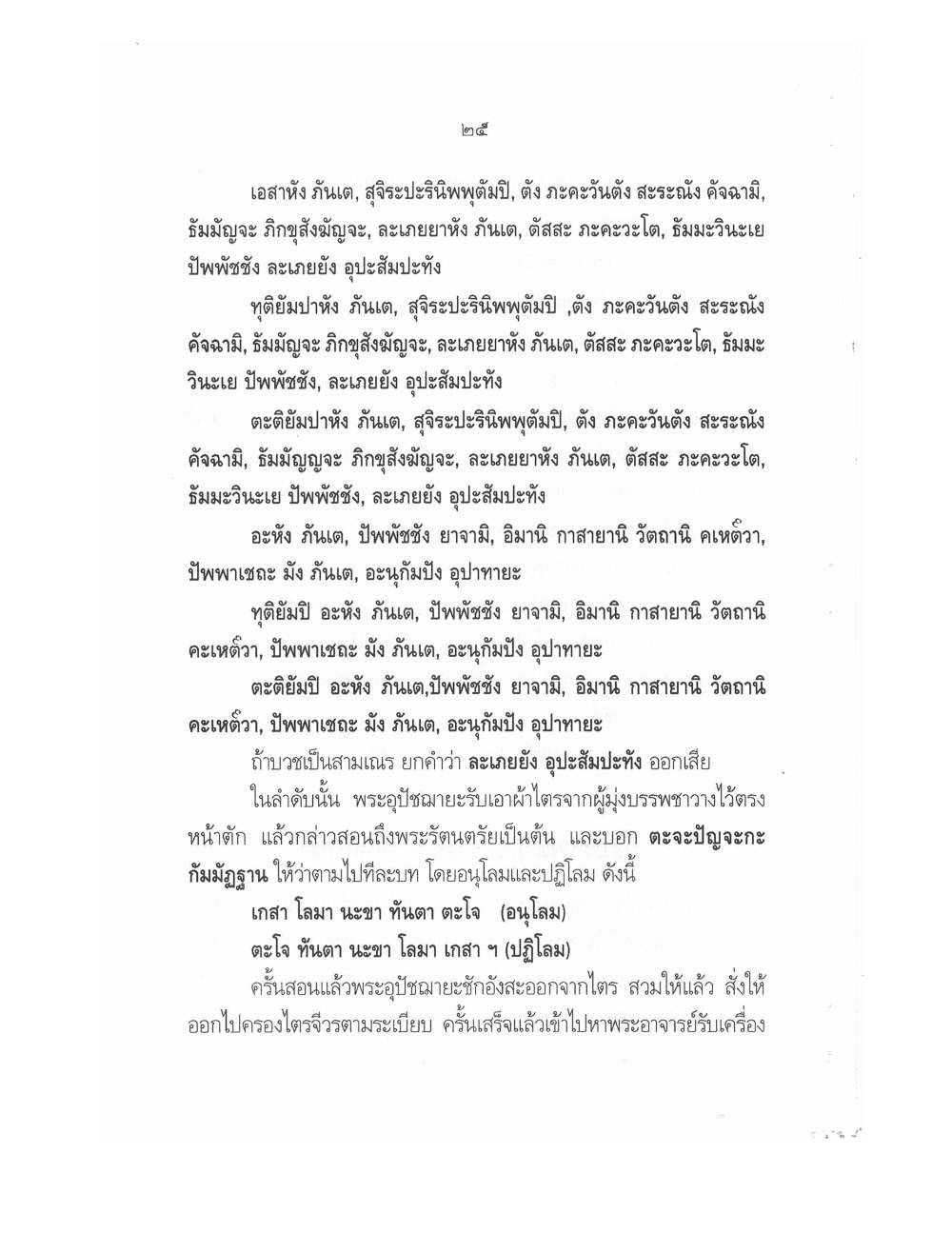
เอสาหัง ภันเต, สุจิระปะรินิพพุตัมปิ, ตัง ภะคะวันตัง สะระณัง คัจฉามิ, ธัมมัญจะ ภิกขุสังฆัญจะ, ละเภยยาหัง ภันเต, ตัสสะ ภะคะวะโต, ธัมมะวินะเย ปัพพัชชัง ละเภยยัง อุปะสัมปะทัง
ทุติยัมปาหัง ภันเต, สุจิระปะรินิพพุตัมปิ ,ตัง ภะคะวันตัง สะระณัง คัจฉามิ, ธัมมัญจะ ภิกขุสังฆัญจะ, ละเภยยาหัง ภันเต, ตัสสะ ภะคะวะโต, ธัมมะวินะเย ปัพพัชชัง, ละเภยยัง อุปะสัมปะทัง
ตะติยัมปาหัง ภันเต, สุจิระปะรินิพพุตัมปิ, ตัง ภะคะวันตัง สะระณัง คัจฉามิ, ธัมมัญจะ ภิกขุสังฆัญจะ, ละเภยยาหัง ภันเต, ตัสสะ ภะคะวะโต, ธัมมะวินะเย ปัพพัชชัง, ละเภยยัง อุปะสัมปะทัง
อะหัง ภันเต, ปัพพัชชัง ยาจามิ, อิมานิ กาสายานิ วัตถานิ คเหต๎วา, ปัพพาเชถะ มัง ภันเต, อะนุกัมปัง อุปาทายะ
ทุติยัมปิ อะหัง ภันเต, ปัพพัชชัง ยาจามิ, อิมานิ กาสายานิ วัตถานิ คะเหต๎วา, ปัพพาเชถะ มัง ภันเต, อะนุกัมปัง อุปาทายะ
ตะติยัมปิ อะหัง ภันเต,ปัพพัชชัง ยาจามิ, อิมานิ กาสายานิ วัตถานิ คะเหต๎วา, ปัพพาเชถะ มัง ภันเต, อะนุกัมปัง อุปาทายะ
ถ้าบวชเป็นสามเณร ยกคำว่า ละเภยยัง อุปะสัมปะทัง ออกเสีย
ในลำดับนั้น พระอุปัชฌายะรับเอาผ้าไตรจากผู้มุ่งบรรพชาวางไว้ตรงหน้าตัก แล้วกล่าวสอนถึงพระรัตนตรัยเป็นต้น และบอก ตะจะปัญจะกะกัมมัฏฐาน ให้ว่าตามไปทีละบท โดยอนุโลมและปฏิโลม ดังนี้
เกสา โลมา นะขา ทันตา ตะโจ (อนุโลม)
ตะโจ ทันตา นะขา โลมา เกสา ฯ (ปฏิโลม)
ครั้นสอนแล้วพระอุปัชฌายะชักอังสะออกจากไตร สวมให้แล้ว สั่งให้ออกไปครองไตรจีวรตามระเบียบ ครั้นเสร็จแล้วเข้าไปหาพระอาจารย์รับเครื่อง
"I, Venerable Sir, go for refuge to that Blessed One, long since fully liberated, and to the Dhamma, and to the community of monks; may I, Venerable Sir, obtain the going-forth in the Dhamma and Discipline of that Blessed One, may I obtain ordination.
A second time, I, Venerable Sir, go for refuge to that Blessed One, long since fully liberated, and to the Dhamma, and to the community of monks; may I, Venerable Sir, obtain the going-forth in the Dhamma and Discipline of that Blessed One, may I obtain ordination.
A third time, I, Venerable Sir, go for refuge to that Blessed One, long since fully liberated, and to the Dhamma, and to the community of monks; may I, Venerable Sir, obtain the going-forth in the Dhamma and Discipline of that Blessed One, may I obtain ordination.
Venerable Sir, I request the going-forth; having taken these ochre robes, please ordain me as a renunciant, Venerable Sir, out of compassion.
A second time, Venerable Sir, I request the going-forth; having taken these ochre robes, please ordain me as a renunciant, Venerable Sir, out of compassion.
A third time, Venerable Sir, I request the going-forth; having taken these ochre robes, please ordain me as a renunciant, Venerable Sir, out of compassion."
If ordaining as a novice (sāmaṇera), omit the phrase "may I obtain ordination."
Next, the preceptor takes the triple robe from the one seeking to go forth and places it in front of his lap, then gives teaching on the Three Jewels and so forth, and instructs him in the five meditation subjects on the skin (taca-pañcaka), having him repeat each phrase in turn, in forward and reverse order, as follows:
"Hair of the head, hair of the body, nails, teeth, skin" (forward order)
"Skin, teeth, nails, hair of the body, hair of the head" (reverse order)
Once this instruction is finished, the preceptor removes the shoulder-cloth from the set of robes and puts it on him; he is then told to go out and put on the triple robe properly according to custom. Once this is done, he goes to the teacher to receive the [remaining] items.
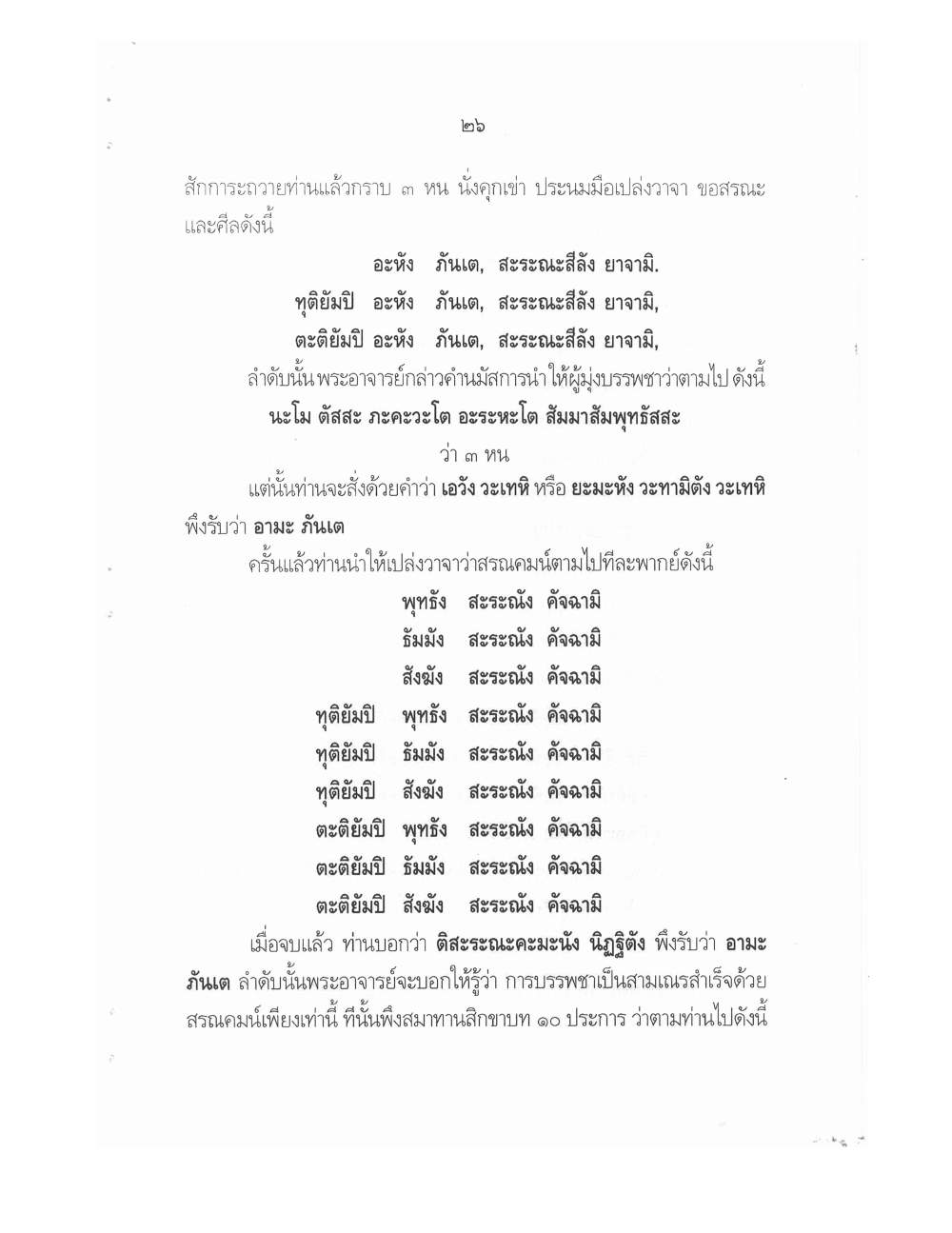
สักการะถวายท่านแล้วกราบ ๓ หน นั่งคุกเข่า ประนมมือเปล่งวาจา ขอสรณะและศีลดังนี้
อะหัง ภันเต, สะระณะสีลัง ยาจามิ.
ทุติยัมปิ อะหัง ภันเต, สะระณะสีลัง ยาจามิ,
ตะติยัมปิ อะหัง ภันเต, สะระณะสีลัง ยาจามิ,
ลำดับนั้นพระอาจารย์กล่าวคำนมัสการนำให้ผู้มุ่งบรรพชาว่าตามไป ดังนี้
นะโม ตัสสะ ภะคะวะโต อะระหะโต สัมมาสัมพุทธัสสะ
ว่า ๓ หน
แต่นั้นท่านจะสั่งด้วยคำว่า เอวัง วะเทหิ หรือ ยะมะหัง วะทามิตัง วะเทหิ พึงรับว่า อามะ ภันเต
ครั้นแล้วท่านนำให้เปล่งวาจาว่าสรณคมน์ตามไปทีละพากย์ดังนี้
พุทธัง สะระณัง คัจฉามิ ธัมมัง สะระณัง คัจฉามิ สังฆัง สะระณัง คัจฉามิ ทุติยัมปิ พุทธัง สะระณัง คัจฉามิ ทุติยัมปิ ธัมมัง สะระณัง คัจฉามิ ทุติยัมปิ สังฆัง สะระณัง คัจฉามิ ตะติยัมปิ พุทธัง สะระณัง คัจฉามิ ตะติยัมปิ ธัมมัง สะระณัง คัจฉามิ ตะติยัมปิ สังฆัง สะระณัง คัจฉามิ
เมื่อจบแล้ว ท่านบอกว่า ติสะระณะคะมะนัง นิฏฐิตัง พึงรับว่า อามะ ภันเต ลำดับนั้นพระอาจารย์จะบอกให้รู้ว่า การบรรพชาเป็นสามเณรสำเร็จด้วยสรณคมน์เพียงเท่านี้ ทีนั้นพึงสมาทานสิกขาบท ๑๐ ประการ ว่าตามท่านไปดังนี้
Having presented the offering to him, [the candidate] prostrates 3 times, kneels, and with hands folded utters a request for the refuges and precepts, as follows:
"Venerable Sir, I ask for the refuges and precepts."
"A second time, Venerable Sir, I ask for the refuges and precepts,"
"A third time, Venerable Sir, I ask for the refuges and precepts,"
Next, the teacher leads with the words of homage for the candidate to repeat after him, as follows:
"Homage to that Blessed One, the Worthy One, the Perfectly Self-Enlightened One."
Said 3 times.
After that he instructs with the words "Say it thus" or "Say what I say"; [the candidate] should reply, "Yes, Venerable Sir."
Then he leads him to utter the going for refuge, phrase by phrase, as follows:
"I go for refuge to the Buddha I go for refuge to the Dhamma I go for refuge to the Sangha A second time, I go for refuge to the Buddha A second time, I go for refuge to the Dhamma A second time, I go for refuge to the Sangha A third time, I go for refuge to the Buddha A third time, I go for refuge to the Dhamma A third time, I go for refuge to the Sangha"
When it is finished, he says, "The going for the three refuges is complete"; [the candidate] should reply, "Yes, Venerable Sir." Next, the teacher will explain that ordination as a novice is accomplished by this going for refuge alone. Then he should undertake the ten precepts, repeating after him as follows:
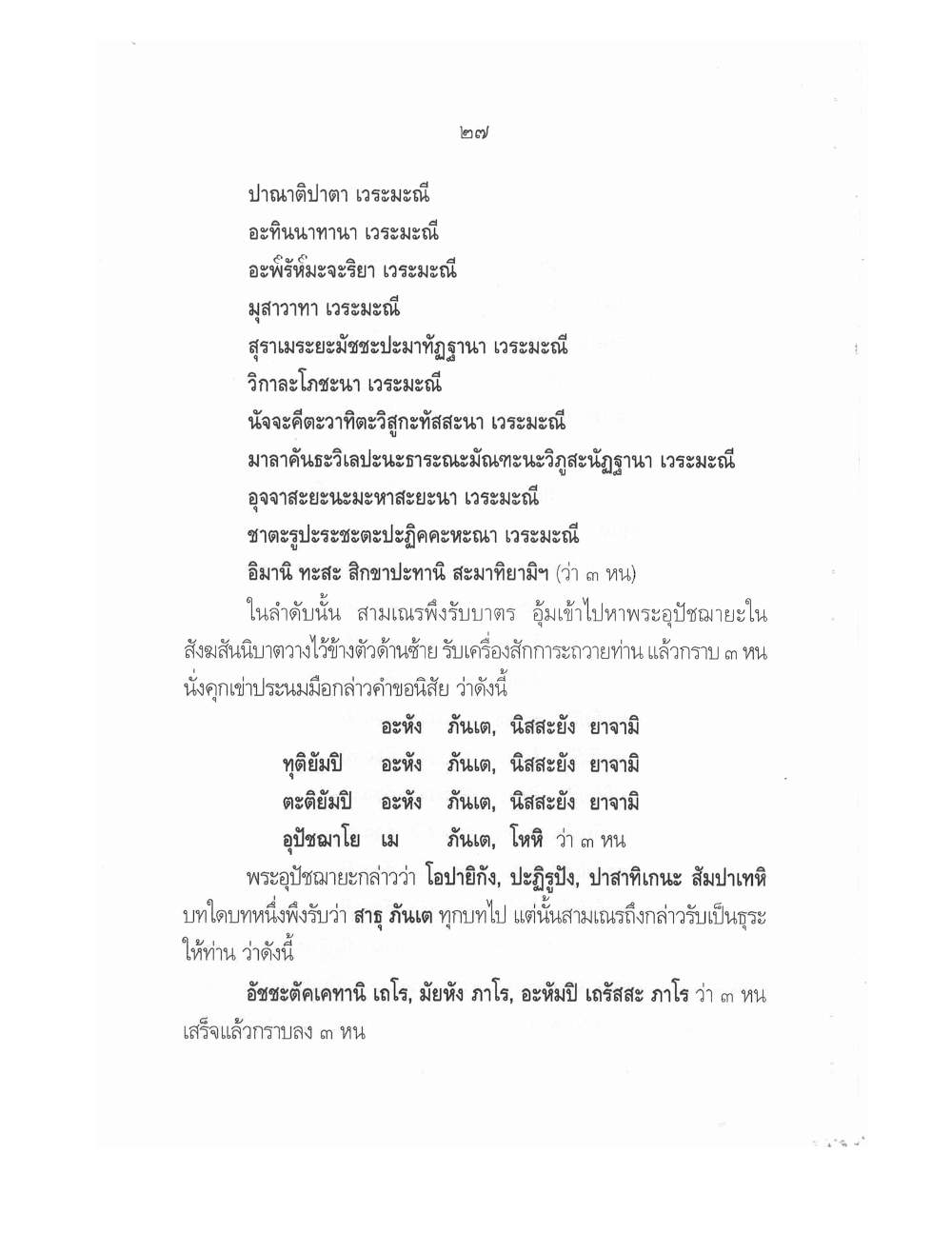
ปาณาติปาตา เวระมะณี อะทินนาทานา เวระมะณี อะพรัหมะจริยา เวระมะณี มุสาวาทา เวระมะณี สุราเมระยะมัชชะปะมาทัฏฐานา เวระมะณี วิกาละโภชนา เวระมะณี นัจจะคีตะวาทิตะวิสูกะทัสสะนา เวระมะณี มาลาคันธะวิเลปะนะธาระณะมัณฑะนะวิภูสะนัฏฐานา เวระมะณี อุจจาสะยะนะมะหาสะยะนา เวระมะณี ชาตะรูปะระชะตะปะฏิคคะหะณา เวระมะณี อิมานิ ทะสะ สิกขาปะทานิ สะมาทิยามิฯ (ว่า ๓ หน)
ในลำดับนั้น สามเณรพึงรับบาตร อุ้มเข้าไปหาพระอุปัชฌายะในสังฆสันนิบาตวางไว้ข้างตัวด้านซ้าย รับเครื่องสักการะถวายท่าน แล้วกราบ ๓ หน นั่งคุกเข่าประนมมือกล่าวคำขอนิสัย ว่าดังนี้
อะหัง ภันเต, นิสสะยัง ยาจามิ ทุติยัมปิ อะหัง ภันเต, นิสสะยัง ยาจามิ ตะติยัมปิ อะหัง ภันเต, นิสสะยัง ยาจามิ อุปัชฌาโย เม ภันเต, โหหิ ว่า ๓ หน
พระอุปัชฌายะกล่าวว่า โอปายิกัง, ปะฏิรูปัง, ปาสาทิเกนะ สัมปาเทหิ บทใดบทหนึ่งพึงรับว่า สาธุ ภันเต ทุกบทไป แต่นั้นสามเณรถึงกล่าวรับเป็นธุระให้ท่าน ว่าดังนี้
อัชชะตัคเคทานิ เถโร, มัยหัง ภาโร, อะหัมปิ เถรัสสะ ภาโร ว่า ๓ หน เสร็จแล้วกราบลง ๓ หน
"Abstaining from killing living beings Abstaining from taking what is not given Abstaining from unchastity Abstaining from false speech Abstaining from fermented and distilled liquors that are a basis for heedlessness Abstaining from eating at the wrong time [after noon] Abstaining from dancing, singing, music, and watching shows Abstaining from wearing garlands, perfumes, and beautifying oneself with cosmetics Abstaining from high and luxurious seats and beds Abstaining from accepting gold and silver I undertake these ten precepts." (said 3 times)
Next, the novice should take the alms bowl, carry it to the preceptor in the assembled Sangha, place it at his left side, receive the offering items and present them to him, then prostrate 3 times, kneel with hands folded, and say the request for dependence, as follows:
"Venerable Sir, I ask for dependence A second time, Venerable Sir, I ask for dependence A third time, Venerable Sir, I ask for dependence Venerable Sir, be my preceptor," said 3 times
The preceptor says, "It is fitting, it is proper, accomplish it with confidence"; for each and every phrase, [the novice] should reply, "Sādhu, Venerable Sir." After that, the novice then declares taking on the duty [as pupil] to him, saying as follows:
"From this day forth, the Elder is my responsibility, I too am the Elder's responsibility," said 3 times. When finished, prostrate 3 times.
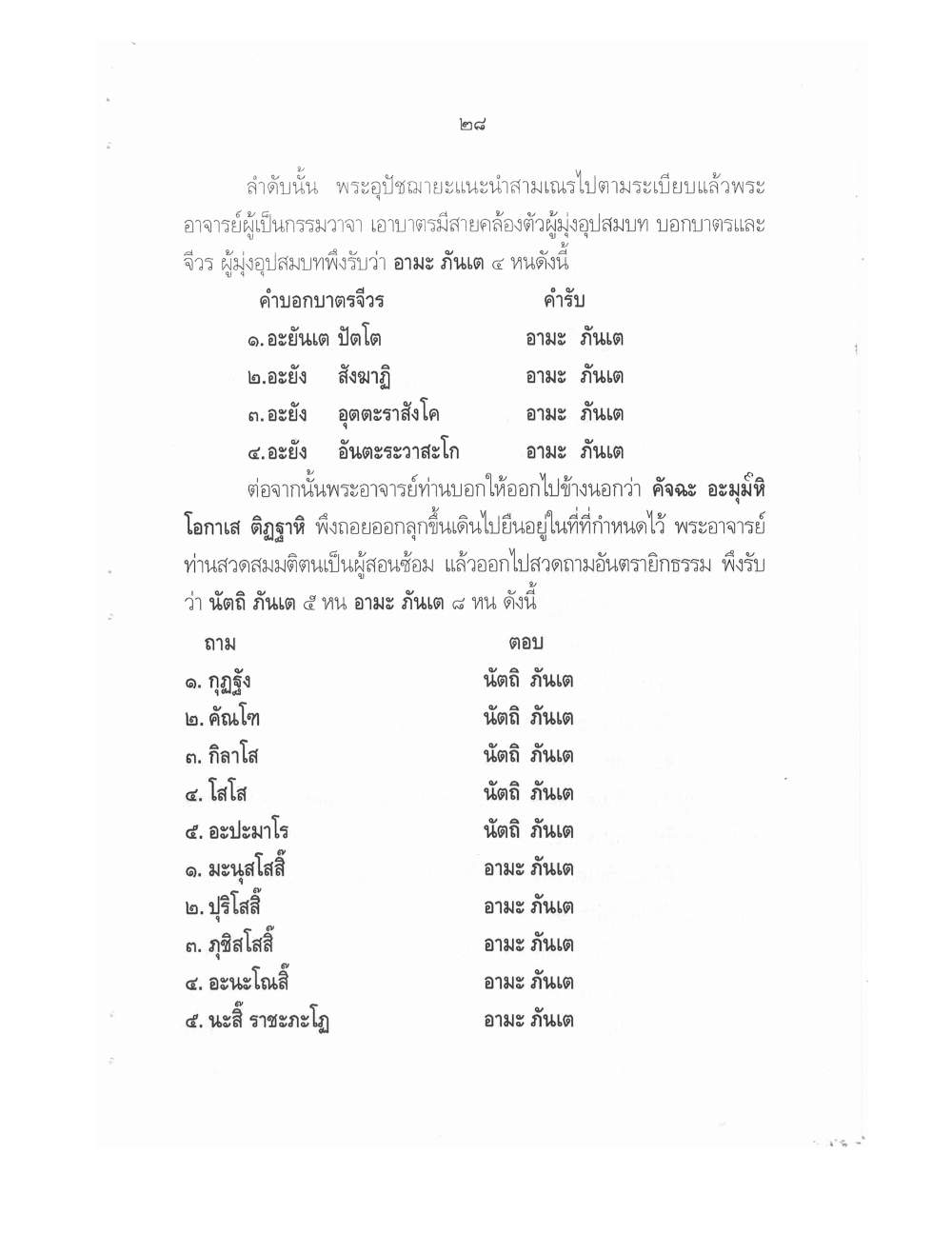
ลำดับนั้น พระอุปัชฌายะแนะนำสามเณรไปตามระเบียบแล้วพระอาจารย์ผู้เป็นกรรมวาจา เอาบาตรมีสายคล้องตัวผู้มุ่งอุปสมบท บอกบาตรและจีวร ผู้มุ่งอุปสมบทพึงรับว่า อามะ ภันเต ๔ หนดังนี้
คำบอกบาตรจีวร คำรับ ๑.อะยันเต ปัตโต อามะ ภันเต ๒.อะยัง สังฆาฏิ อามะ ภันเต ๓.อะยัง อุตตะราสังโค อามะ ภันเต ๔.อะยัง อันตะระวาสะโก อามะ ภันเต
ต่อจากนั้นพระอาจารย์ท่านบอกให้ออกไปข้างนอกว่า คัจฉะ อะมุมหิ โอกาเส ติฏฐาหิ พึงถอยออกลุกขึ้นเดินไปยืนอยู่ในที่ที่กำหนดไว้ พระอาจารย์ท่านสวดสมมติตนเป็นผู้สอนซ้อม แล้วออกไปสวดถามอันตรายิกธรรม พึงรับว่า นัตถิ ภันเต ๕ หน อามะ ภันเต ๘ หน ดังนี้
ถาม ตอบ ๑. กุฏฐัง นัตถิ ภันเต ๒. คัณโฑ นัตถิ ภันเต ๓. กิลาโส นัตถิ ภันเต ๔. โสโส นัตถิ ภันเต ๕. อะปะมาโร นัตถิ ภันเต ๑. มะนุสโสสิ อามะ ภันเต ๒. ปุริโสสิ อามะ ภันเต ๓. ภุชิสโสสิ อามะ ภันเต ๔. อะนะโณสิ อามะ ภันเต ๕. นะสิ ราชะภะโฏ อามะ ภันเต
Next, the preceptor gives instructions to the novice according to the procedure, then the teacher who serves as the reciter of the formal act (kammavācācariya) takes the strapped bowl and hangs it on the body of the one seeking ordination, then announces the bowl and robes; the one seeking ordination should reply "Yes, Venerable Sir," 4 times, as follows:
Words announcing the bowl and robe Reply 1. This is your bowl Yes, Venerable Sir 2. This is the outer robe Yes, Venerable Sir 3. This is the upper robe Yes, Venerable Sir 4. This is the inner robe Yes, Venerable Sir
After that, the teacher tells him to go outside, saying "Go, stand in that place"; he should withdraw, rise, and go stand in the place indicated. The teacher recites, taking on the role of instructor/examiner, then goes out and chants asking about the obstructing conditions; he should reply "No, Venerable Sir," 5 times, and "Yes, Venerable Sir," 8 times, as follows:
Question Answer 1. Leprosy? No, Venerable Sir 2. Boils/tumors? No, Venerable Sir 3. Skin disease/scabs? No, Venerable Sir 4. Consumption/asthma? No, Venerable Sir 5. Epilepsy? No, Venerable Sir 1. Are you a human being? Yes, Venerable Sir 2. Are you a man? Yes, Venerable Sir 3. Are you a free man? Yes, Venerable Sir 4. Are you free of debt? Yes, Venerable Sir 5. Are you not in the king's service? Yes, Venerable Sir
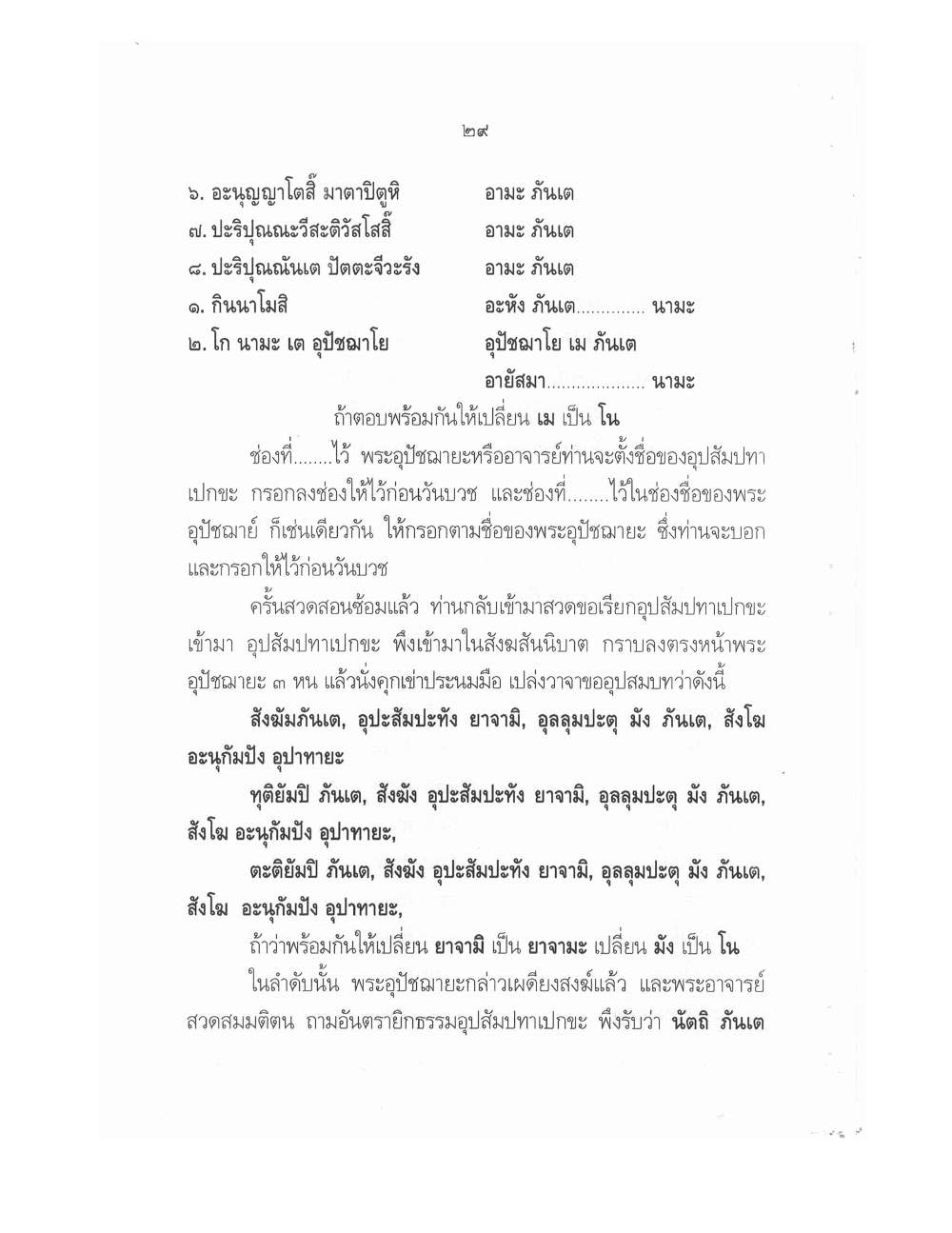
๖. อะนุญญาโตสิ มาตาปิตูหิ อามะ ภันเต ๗. ปะริปุณณะวีสะติวัสโสสิ อามะ ภันเต ๘. ปะริปุณณันเต ปัตตะจีวะรัง อามะ ภันเต ๑. กินนาโมสิ อะหัง ภันเต................ นามะ ๒. โก นามะ เต อุปัชฌาโย อุปัชฌาโย เม ภันเต อายัสมา..................... นามะ
ถ้าตอบพร้อมกันให้เปลี่ยน เม เป็น โน
ช่องที่.......ไว้ พระอุปัชฌายะหรืออาจารย์ท่านจะตั้งชื่อของอุปสัมปทาเปกขะ กรอกลงช่องให้ไว้ก่อนวันบวช และช่องที่........ไว้ในช่องชื่อของพระอุปัชฌาย์ ก็เช่นเดียวกัน ให้กรอกตามชื่อของพระอุปัชฌายะ ซึ่งท่านจะบอกและกรอกให้ไว้ก่อนวันบวช
ครั้นสวดสอนซ้อมแล้ว ท่านกลับเข้ามาสวดขอเรียกอุปสัมปทาเปกขะเข้ามา อุปสัมปทาเปกขะพึงเข้ามาในสังฆสันนิบาต กราบลงตรงหน้าพระอุปัชฌายะ ๓ หน แล้วนั่งคุกเข่าประนมมือ เปล่งวาจาขออุปสมบทว่าดังนี้
สังฆัมภันเต, อุปะสัมปะทัง ยาจามิ, อุลลุมปะตุ มัง ภันเต, สังโฆ อะนุกัมปัง อุปาทายะ
ทุติยัมปิ ภันเต, สังฆัง อุปะสัมปะทัง ยาจามิ, อุลลุมปะตุ มัง ภันเต, สังโฆ อะนุกัมปัง อุปาทายะ
ตะติยัมปิ ภันเต, สังฆัง อุปะสัมปะทัง ยาจามิ, อุลลุมปะตุ มัง ภันเต, สังโฆ อะนุกัมปัง อุปาทายะ
ถ้าว่าพร้อมกันให้เปลี่ยน ยาจามิ เป็น ยาจามะ เปลี่ยน มัง เป็น โน
ในลำดับนั้น พระอุปัชฌายะกล่าวเผดียงสงฆ์แล้ว และพระอาจารย์สวดสมมติตน ถามอันตรายิกธรรมอุปสัมปทาเปกขะ พึงรับว่า นัตถิ ภันเต
6. Have you been permitted by your mother and father? Yes, Venerable Sir 7. Are you fully twenty years of age? Yes, Venerable Sir 8. Are your bowl and robes complete? Yes, Venerable Sir 1. What is your name? I, Venerable Sir, am named .................. [name] 2. What is your preceptor's name? My preceptor, Venerable Sir, is the Venerable .................. [name]
If answering together [as a group], change "me" [my] to "no" [our].
The blank marked "......." is where the preceptor or teacher will fill in the name of the ordination candidate; it is entered before the ordination day. And the blank marked "........" for the name of the preceptor is likewise filled in with the preceptor's name, which he will state and have entered before the ordination day.
Once the rehearsal chanting is finished, he returns and chants to call the ordination candidate in; the ordination candidate should enter the assembled Sangha, prostrate before the preceptor 3 times, then kneel with hands folded, and utter the request for ordination, as follows:
"Venerable Sangha, I request ordination; may the Sangha lift me up, out of compassion."
"A second time, Venerable Sir, I request ordination from the Sangha; may the Sangha lift me up, out of compassion."
"A third time, Venerable Sir, I request ordination from the Sangha; may the Sangha lift me up, out of compassion."
If [candidates speak] together, change "yācāmi" [I request] to "yācāma" [we request], and change "maṃ" [me] to "no" [us].
Next, once the preceptor has formally addressed the Sangha, and the teacher chants, taking on the role of examiner, he asks the ordination candidate about the obstructing conditions; [the candidate] should reply "No, Venerable Sir"
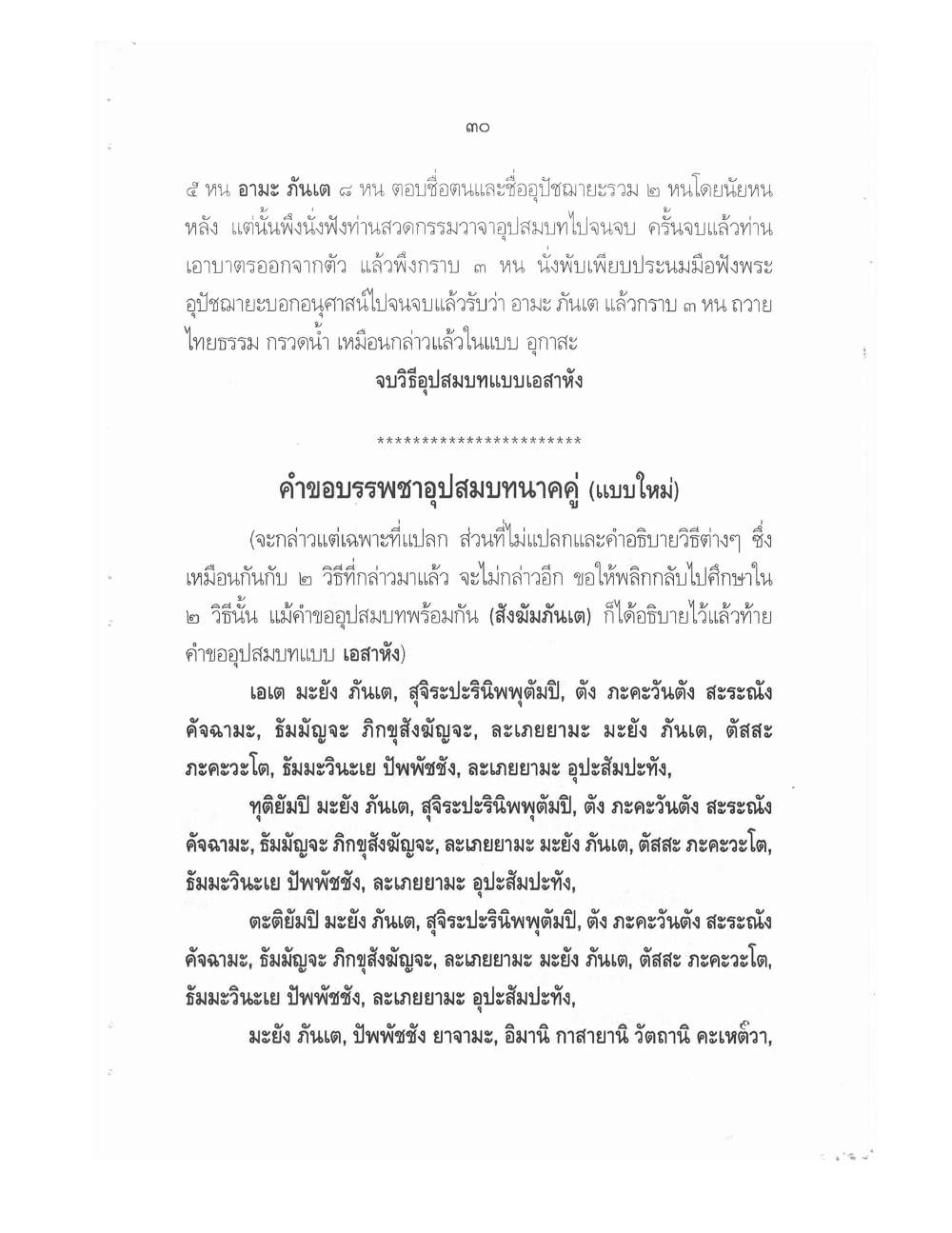
๕ หน อามะ ภันเต ๘ หน ตอบชื่อตนและชื่ออุปัชฌายะรวม ๒ หนโดยนัยหนหลัง แต่นั้นพึงนั่งฟังท่านสวดกรรมวาจาอุปสมบทไปจนจบ ครั้นจบแล้วท่านเอาบาตรออกจากตัว แล้วพึงกราบ ๓ หน นั่งพับเพียบประนมมือฟังพระอุปัชฌายะบอกอนุศาสน์ไปจนจบแล้วรับว่า อามะ ภันเต แล้วกราบ ๓ หน ถวายไทยธรรม กรวดน้ำ เหมือนกล่าวแล้วในแบบ อุกาสะ
จบวิธีอุปสมบทแบบเอสาหัง
*********************
คำขอบรรพชาอุปสมบทนาคคู่ (แบบใหม่)
(จะกล่าวแต่เฉพาะที่แปลก ส่วนที่ไม่แปลกและคำอธิบายวิธีต่างๆ ซึ่งเหมือนกันกับ ๒ วิธีที่กล่าวมาแล้ว จะไม่กล่าวอีก ขอให้พลิกกลับไปศึกษาใน ๒ วิธีนั้น แม้คำขออุปสมบทพร้อมกัน (สังฆัมภันเต) ก็ได้อธิบายไว้แล้วท้ายคำขออุปสมบทแบบ เอสาหัง)
เอเต มะยัง ภันเต, สุจิระปะรินิพพุตัมปิ, ตัง ภะคะวันตัง สะระณัง คัจฉามะ, ธัมมัญจะ ภิกขุสังฆัญจะ, ละเภยยามะ มะยัง ภันเต, ตัสสะ ภะคะวะโต, ธัมมะวินะเย ปัพพัชชัง, ละเภยยามะ อุปะสัมปะทัง,
ทุติยัมปิ มะยัง ภันเต, สุจิระปะรินิพพุตัมปิ, ตัง ภะคะวันตัง สะระณัง คัจฉามะ, ธัมมัญจะ ภิกขุสังฆัญจะ, ละเภยยามะ มะยัง ภันเต, ตัสสะ ภะคะวะโต, ธัมมะวินะเย ปัพพัชชัง, ละเภยยามะ อุปะสัมปะทัง,
ตะติยัมปิ มะยัง ภันเต, สุจิระปะรินิพพุตัมปิ, ตัง ภะคะวันตัง สะระณัง คัจฉามะ, ธัมมัญจะ ภิกขุสังฆัญจะ, ละเภยยามะ มะยัง ภันเต, ตัสสะ ภะคะวะโต, ธัมมะวินะเย ปัพพัชชัง, ละเภยยามะ อุปะสัมปะทัง,
มะยัง ภันเต, ปัพพัชชัง ยาจามะ, อิมานิ กาสายานิ วัตถานิ คะเหต๎วา,
5 times, and "Yes, Venerable Sir," 8 times; he answers his own name and his preceptor's name, 2 times total, in the same manner as before. After that, he should sit and listen while the formal act of ordination is chanted through to the end. Once it is finished, the bowl is removed from his body, and he should then prostrate 3 times, sit in the polite kneeling posture with hands folded, listen to the preceptor giving the instructions through to the end, then reply "Yes, Venerable Sir," then prostrate 3 times, present the offering, and pour the water of dedication, as already described in the ukāsa form.
End of the ordination ceremony, esāhaṃ form
*********************
Request for Going-Forth and Ordination for a Pair of Candidates (nāga khu), New Form
(Only what is different will be stated here; the parts that are not different, and the explanations of the various procedures, which are the same as in the 2 methods already described, will not be repeated — please turn back and study those 2 methods. Even the request for simultaneous ordination ["Saṅghaṃ bhante"] has already been explained at the end of the request for ordination in the esāhaṃ form.)
"We, Venerable Sir, go for refuge to that Blessed One, long since fully liberated, and to the Dhamma, and to the community of monks; may we, Venerable Sir, obtain the going-forth in the Dhamma and Discipline of that Blessed One, may we obtain ordination,
A second time, we, Venerable Sir, go for refuge to that Blessed One, long since fully liberated, and to the Dhamma, and to the community of monks; may we, Venerable Sir, obtain the going-forth in the Dhamma and Discipline of that Blessed One, may we obtain ordination,
A third time, we, Venerable Sir, go for refuge to that Blessed One, long since fully liberated, and to the Dhamma, and to the community of monks; may we, Venerable Sir, obtain the going-forth in the Dhamma and Discipline of that Blessed One, may we obtain ordination,
We, Venerable Sir, request the going-forth; having taken these ochre robes,"
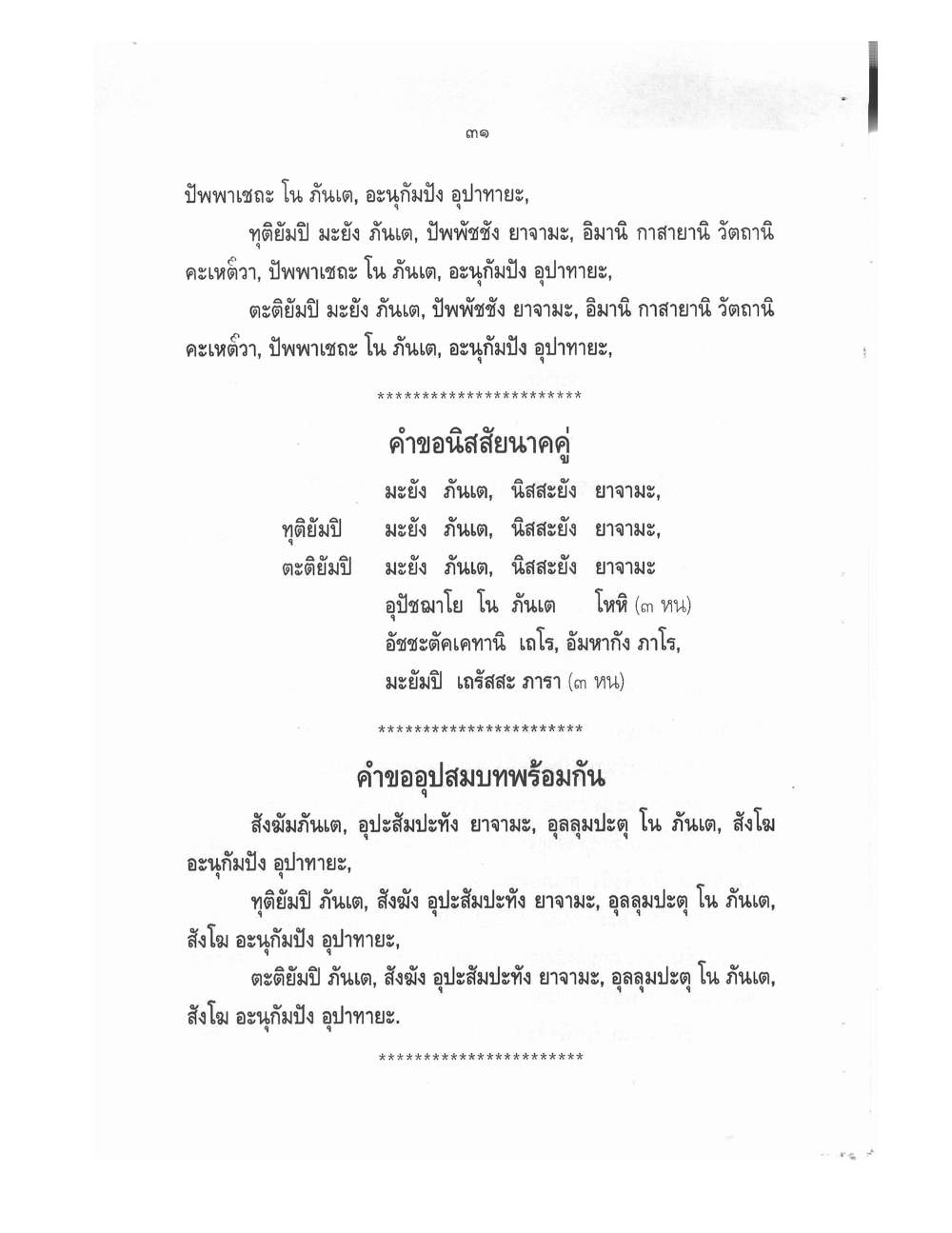
ปัพพาเชถะ โน ภันเต, อะนุกัมปัง อุปาทายะ,
ทุติยัมปิ มะยัง ภันเต, ปัพพัชชัง ยาจามะ, อิมานิ กาสายานิ วัตถานิ คะเหต๎วา, ปัพพาเชถะ โน ภันเต, อะนุกัมปัง อุปาทายะ,
ตะติยัมปิ มะยัง ภันเต, ปัพพัชชัง ยาจามะ, อิมานิ กาสายานิ วัตถานิ คะเหต๎วา, ปัพพาเชถะ โน ภันเต, อะนุกัมปัง อุปาทายะ,
*********************
คำขอนิสสัยนาคคู่
มะยัง ภันเต, นิสสะยัง ยาจามะ, ทุติยัมปิ มะยัง ภันเต, นิสสะยัง ยาจามะ, ตะติยัมปิ มะยัง ภันเต, นิสสะยัง ยาจามะ อุปัชฌาโย โน ภันเต โหหิ (๓ หน) อัชชะตัคเคทานิ เถโร, อัมหากัง ภาโร, มะยัมปิ เถรัสสะ ภารา (๓ หน)
*********************
คำขออุปสมบทพร้อมกัน
สังฆัมภันเต, อุปะสัมปะทัง ยาจามะ, อุลลุมปะตุ โน ภันเต, สังโฆ อะนุกัมปัง อุปาทายะ,
ทุติยัมปิ ภันเต, สังฆัง อุปะสัมปะทัง ยาจามะ, อุลลุมปะตุ โน ภันเต, สังโฆ อะนุกัมปัง อุปาทายะ,
ตะติยัมปิ ภันเต, สังฆัง อุปะสัมปะทัง ยาจามะ, อุลลุมปะตุ โน ภันเต, สังโฆ อะนุกัมปัง อุปาทายะ.
*********************
"please ordain us as renunciants, Venerable Sir, out of compassion,
A second time, we, Venerable Sir, request the going-forth; having taken these ochre robes, please ordain us as renunciants, Venerable Sir, out of compassion,
A third time, we, Venerable Sir, request the going-forth; having taken these ochre robes, please ordain us as renunciants, Venerable Sir, out of compassion,"
*********************
Request for Dependence, for a Pair of Candidates
"We, Venerable Sir, ask for dependence, A second time, we, Venerable Sir, ask for dependence, A third time, we, Venerable Sir, ask for dependence Venerable Sir, be our preceptor" (3 times) "From this day forth, the Elder is our responsibility, we too are the Elder's responsibility" (3 times)
*********************
Request for Simultaneous Ordination
"Venerable Sangha, we request ordination; may the Sangha lift us up, out of compassion,
A second time, Venerable Sir, we request ordination from the Sangha; may the Sangha lift us up, out of compassion,
A third time, Venerable Sir, we request ordination from the Sangha; may the Sangha lift us up, out of compassion."
*********************
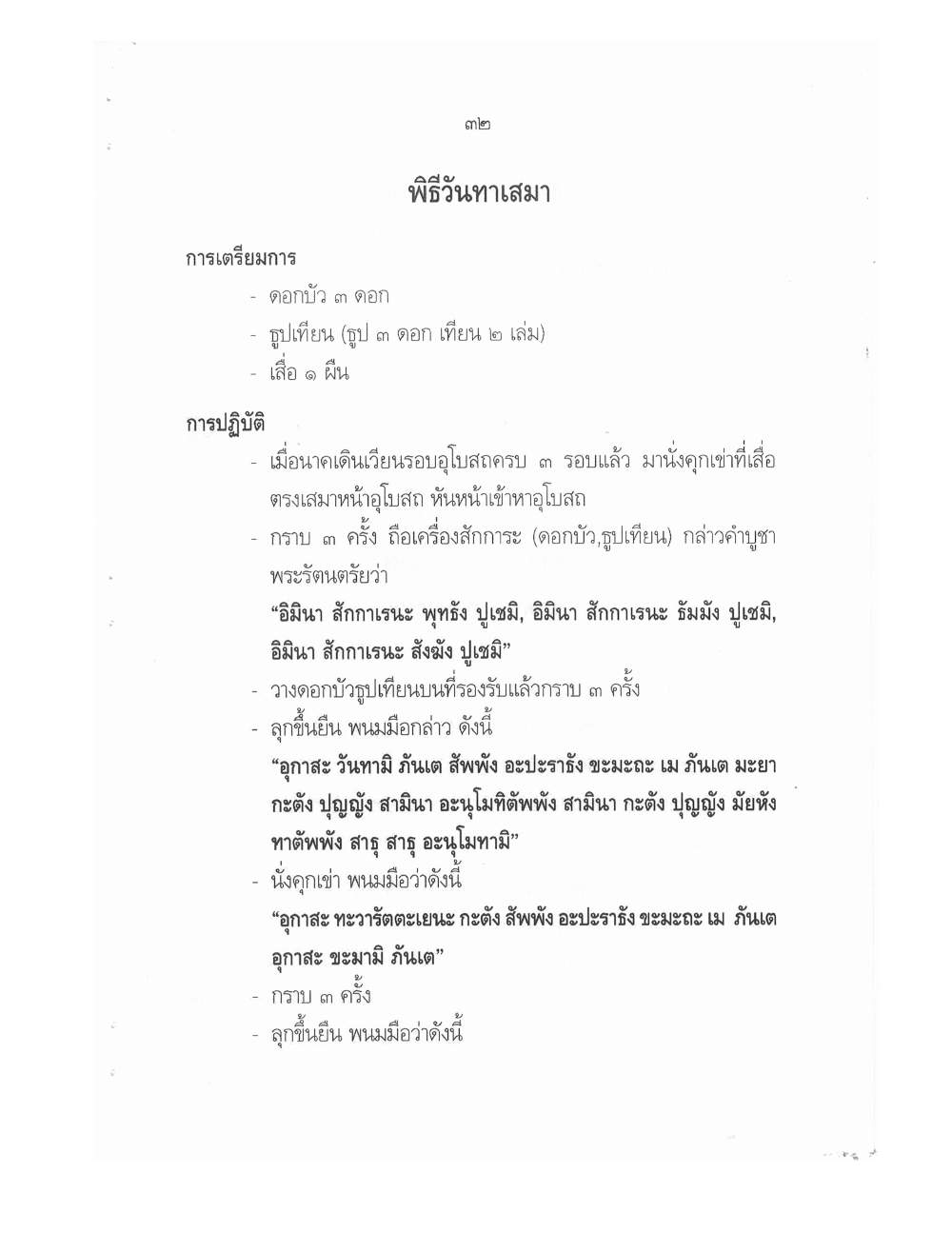
พิธีวันทาเสมา
การเตรียมการ
- ดอกบัว ๓ ดอก - ธูปเทียน (ธูป ๓ ดอก เทียน ๒ เล่ม) - เสื่อ ๑ ผืน
การปฏิบัติ
- เมื่อนาคเดินเวียนรอบอุโบสถครบ ๓ รอบแล้ว มานั่งคุกเข่าที่เสื่อ ตรงเสมาหน้าอุโบสถ หันหน้าเข้าหาอุโบสถ - กราบ ๓ ครั้ง ถือเครื่องสักการะ (ดอกบัว,ธูปเทียน) กล่าวคำบูชาพระรัตนตรัยว่า
"อิมินา สักกาเรนะ พุทธัง ปูเชมิ, อิมินา สักกาเรนะ ธัมมัง ปูเชมิ, อิมินา สักกาเรนะ สังฆัง ปูเชมิ"
- วางดอกบัวธูปเทียนบนที่รองรับแล้วกราบ ๓ ครั้ง - ลุกขึ้นยืน พนมมือกล่าว ดังนี้
"อุกาสะ วันทามิ ภันเต สัพพัง อะปะราธัง ขะมะถะ เม ภันเต มะยา กะตัง ปุญญัง สามินา อะนุโมทิตัพพัง สามินา กะตัง ปุญญัง มัยหัง ทาตัพพัง สาธุ สาธุ อะนุโมทามิ"
- นั่งคุกเข่า พนมมือว่าดังนี้
"อุกาสะ ทะวารัตตะเยนะ กะตัง สัพพัง อะปะราธัง ขะมะถะ เม ภันเต อุกาสะ ขะมามิ ภันเต"
- กราบ ๓ ครั้ง - ลุกขึ้นยืน พนมมือว่าดังนี้
Rite of Paying Homage to the Sīmā (Boundary Markers)
Preparations
- 3 lotus flowers - Incense and candles (3 sticks of incense, 2 candles) - 1 mat
Procedure
- Once the ordinand (nāga) has walked around the ordination hall (ubosot) 3 times, he comes to kneel on the mat, at the boundary marker (sīmā) in front of the hall, facing toward the hall. - Prostrate 3 times, holding the offering items (lotus, incense, and candles), and say the words of homage to the Three Jewels:
"With this offering I honor the Buddha, with this offering I honor the Dhamma, with this offering I honor the Sangha."
- Place the lotus and the incense and candles on the stand, then prostrate 3 times. - Stand up, place the hands together, and say as follows:
"By your leave, I pay homage, Venerable Sir; forgive me all my faults, Venerable Sir; may the merit made by me be rejoiced in by the Master; may the merit made by the Master be given to me; sādhu, sādhu, I rejoice."
- Kneel, hands together, and say as follows:
"By your leave, whatever fault has been committed through the three doors [of body, speech, and mind], please forgive me, Venerable Sir; by your leave, I ask forgiveness, Venerable Sir."
- Prostrate 3 times. - Stand up, hands together, and say as follows:
"วันทามิ ภันเต สัพพัง อะปะราธัง ขะมะถะ เม ภันเต มะยา กะตัง ปุญญัง สามินา อะนุโมทิตัพพัง สามินา กะตัง ปุญญัง มัยหัง ทาตัพพัง สาธุ สาธุ อะนุโมทามิ" - กราบ ๓ ครั้ง (เสร็จพิธีวันทาเสมา) - เดินขึ้นไปยืนที่หน้าอุโบสถหรือพระอุโบสถหันหน้าออกแล้วโปรยทาน (ถ้ามี)
หมายเหตุ การวันทาเสมาที่กล่าวนี้เป็นแบบพิสดาร ท่านจะย่อเอาเฉพาะข้อแรกเท่านั้นก็ได้
************************
พิธีเทศน์สอนนาค
(เฉพาะกองทัพอากาศ)
การเตรียมการ - โต๊ะหมู่บูชา (หมู่ ๕ หรือหมู่ ๗ หรือหมู่ ๙) - เครื่องไทยธรรมถวายพระเทศน์ - ธรรมาสน์ (ที่นั่งสำหรับพระเทศน์) - เทียนบูชาธรรม (จุดดูหนังสือเทศน์แบบธรรมเนียมโบราณ)
การปฏิบัติ - ก่อนถึงกำหนดเวลา นาคและผู้เข้าร่วมพิธีพร้อม - นาคนั่งพับเพียบตรงด้านหน้า ประธานในพิธี - ถึงบริเวณพิธี - จุดธูปเทียนบูชาพระรัตนตรัย กราบ ๓ ครั้ง อศจ. - อาราธนาศีล - รับศีล
"I pay homage, Venerable Sir. Please forgive me all offences. Venerable Sir, may the merit I have made be rejoiced in by you; may the merit you have made be given to me. Excellent, excellent, I rejoice." - Prostrate 3 times (this completes the rite of paying respect to the sema/boundary stones) - Walk up to stand in front of the ordination hall, or have the ordination hall face outward, then scatter alms/coins (if any).
Note: The paying-of-respect-to-the-sema described here is the elaborate form; one may abbreviate it to only the first item if preferred.
************************
Rite of the Sermon Instructing the Ordinand (Nak) (Air Force only)
Preparations - An altar table set (a set of 5, 7, or 9 items) - Offerings (requisites) to present to the preaching monk - A preaching seat/pulpit (seat for the preaching monk) - A candle for venerating the Dhamma (lit for viewing the sermon text, in the old traditional manner)
Procedure - Before the appointed time, the ordinand (nak) and participants are ready. - The ordinand sits kneeling directly in front. Presiding officiant - Arrives at the ceremony site - Lights incense and candles to venerate the Triple Gem, prostrates 3 times Chaplain (อศจ.) - Invites the precepts - receives the precepts
ประธานฯ - จุดเทียนบูชาธรรมแล้วน้อมไหว้ อศจ. - อาราธนาธรรม พระสงฆ์ - แสดงธรรม (เมื่อพระสงฆ์แสดงธรรมจบแล้วอนุโมทนา) ประธานฯ - กรวดน้ำ - รับพร - ประเคนจตุปัจจัยไทยธรรมกัณฑ์เทศน์ - กราบพระ ๓ ครั้ง เสร็จพิธี
************************
พิธีไหว้ครู
การเตรียมการ - ตั้งโต๊ะหมู่บูชา ประดิษฐานพระพุทธรูป จัดเครื่องสักการะบูชา ดอกไม้ธูปเทียน และพานดอกไม้สด มีธงชาติ และพระบรมฉายาลักษณ์ - ตั้งโต๊ะเล็กหน้าที่บูชา สำหรับวางพานดอกไม้ธูปเทียนที่นักเรียนนำมาบูชา - ตั้งโต๊ะเล็กสำหรับวางหนังสือตำรา - จัดเครื่องเจิม พร้อมด้วยแป้งหอม - จัดที่นั่งของผู้เป็นประธานในพิธี และ ครู อาจารย์ ข้างที่บูชาบนเวที - พานดอกไม้ ประกอบด้วย หญ้าแพรก ข้าวตอก และดอกมะเขือจัดให้สวยงาม สำหรับนักเรียน ถือ ๑ พาน - พานธูปเทียนแพ พร้อมกรวยดอกไม้สด สำหรับนักเรียน ถือ ๑ พาน (จะจัดเฉพาะพานธูปเทียนแพอย่างเดียวก็ได้)
Presiding officiant - Lights the candle to venerate the Dhamma, then bows in reverence Chaplain (อศจ.) - Invites the Dhamma teaching The monk(s) - Deliver the sermon (when the sermon ends, the congregation rejoices/anumodana) Presiding officiant - Pours water to dedicate merit - receives the blessing - Presents the four requisites (offerings) for the sermon - Prostrates before the Buddha image 3 times Rite ends
************************
Rite of Paying Respect to Teachers (Wai Khru)
Preparations - Set up the altar table, enshrine a Buddha image, arrange offerings for veneration - flowers, incense, candles - and a tray of fresh flowers; include the national flag and a royal portrait - Set up a small table in front of the altar, for placing the trays of flowers, incense and candles that students bring to make offerings - Set up a small table for placing textbooks - Prepare the anointing kit, together with fragrant powder - Arrange seating on the stage beside the altar for the presiding officiant and for the teachers/instructors - A tray of flowers - made up of Bermuda grass (หญ้าแพรก), popped rice (ข้าวตอก), and eggplant flowers (ดอกมะเขือ) arranged attractively - one tray per student to hold - A tray of paired incense and candles (ธูปเทียนแพ), together with a cone of fresh flowers - one tray per student to hold (only the tray of paired incense and candles need be prepared, if preferred)
การปฏิบัติ เวลา..................... - นักเรียนทั้งหมดพร้อมที่ประกอบพิธี เวลา..................... - ผู้บังคับบัญชา และอาจารย์เข้าที่นั่งซึ่งจัดเตรียมไว้ เวลา..................... - ประธานในพิธีถึงที่ประกอบพิธี หัวหน้านักเรียนบอกทำความเคารพประธานในพิธี - พิธีกร เชิญประธานในพิธีจุดธูปเทียนบูชาพระรัตนตรัย เคารพธงชาติ และถวายคำนับพระบรมฉายาลักษณ์ - เมื่อประธานในพิธีบูชาพระรัตนตรัยแล้วเข้านั่ง ณ ที่รับรอง - หัวหน้านักเรียนเปิดฝากรวยดอกไม้สดแล้วนำกล่าวคาถาบทไหว้ครู ปาเจราจริยา โหนฺติ (ทำนองสรภัญญะ) ไปจนจบ - หัวหน้านักเรียนนำธูปเทียนแพไปมอบแก่ประธานในพิธี - ผู้แทนนักเรียนคนที่ ๒ นำพานดอกไม้มอบแก่ ประธานในพิธี (จะจัด ๑ พาน ธูปเทียนแพอย่างเดียวก็ได้) - พิธีกร เชิญประธานในพิธีเจิมตำรา - ผู้แทนนักเรียนรับตำราจากประธานในพิธี (จะวางไว้บนโต๊ะก่อนก็ได้) - ประธานในพิธีให้โอวาท
Procedure Time..................... - All students are ready to begin the ceremony Time..................... - Commanding officers and teachers take the seats prepared for them Time..................... - The presiding officiant arrives at the ceremony site; the head student calls for everyone to pay respect to the presiding officiant - The master of ceremonies invites the presiding officiant to light incense and candles to venerate the Triple Gem, salute the national flag, and bow to the royal portrait - Once the presiding officiant has venerated the Triple Gem, he/she takes the seat of honor - The head student opens the cone of fresh flowers and leads the recitation of the Wai Khru verse, Pacariya honti (chanted in sorapanyo style), through to the end - The head student brings the paired incense and candles to present to the presiding officiant - The second student representative brings a tray of flowers to present to the presiding officiant (only the tray of paired incense and candles need be prepared, if preferred) - The master of ceremonies invites the presiding officiant to anoint the textbook - A student representative receives the textbook from the presiding officiant (it may also be placed on the table beforehand) - The presiding officiant gives a word of guidance/admonition
- ประธานในพิธีกราบพระรัตนตรัย เคารพธงชาติ ถวายคำนับพระบรมฉายาลักษณ์ เป็นเสร็จพิธี
************************
บทไหว้ครู
หัวหน้านักเรียนนำกล่าวคาถา (สวดทำนองสรภัญญะ) (นำ) ปาเจราจริยา โหนฺติ (รับพร้อมกัน) คุณุตตรานุสาสกา (นำ) ข้าขอประณตน้อมสักการ (รับ) บูรพคณาจารย์ ผู้ก่อประโยชน์ศึกษา ทั้งท่านผู้ประสาทวิชา อบรมจริยา แก่ข้าในกาลปัจจุบัน ข้าขอเคารพอภิวันท์ ระลึกคุณอนันต์ ด้วยใจนิยมบูชา ขอเดชกตเวทิตา อีกวิริยะพา ปัญญาให้เกิดแตกฉาน ศึกษาสำเร็จทุกประการ อายุยืนนาน อยู่ในศีลธรรมอันดี ให้ได้เป็นเกียรติเป็นศรี ประโยชน์ทวี แก่ชาติและประเทศไทย เทอญฯ
(นำสรุป) ปญฺญาวุฑฺฒิกเรเตเต ทินฺโนวาเท นมามิหํฯ
************************
- The presiding officiant prostrates to the Triple Gem, salutes the national flag, and bows to the royal portrait This concludes the rite.
************************
The Wai Khru Verse (Verse of Homage to Teachers) The head student leads the chant (recited in sorapanyo style) (Leader) Pacariya honti (All together) Gunuttaranusasaka (Leader) I humbly bow in reverent homage (All) to the teachers of old who founded the benefit of learning, and to those who bestowed knowledge and trained virtuous conduct upon me in the present time. I offer my respect and homage, recalling their boundless kindness, with a heart devoted to veneration. May the merit of this gratitude, together with diligence, bring forth wisdom and understanding. May my studies succeed in every way, may I live long, abiding in good moral virtue. May I attain honor and glory, and ever-increasing benefit for my nation and for Thailand, forever.
(Leader, concluding) Pannavuddhikaretete dinnovate namamiham.
************************
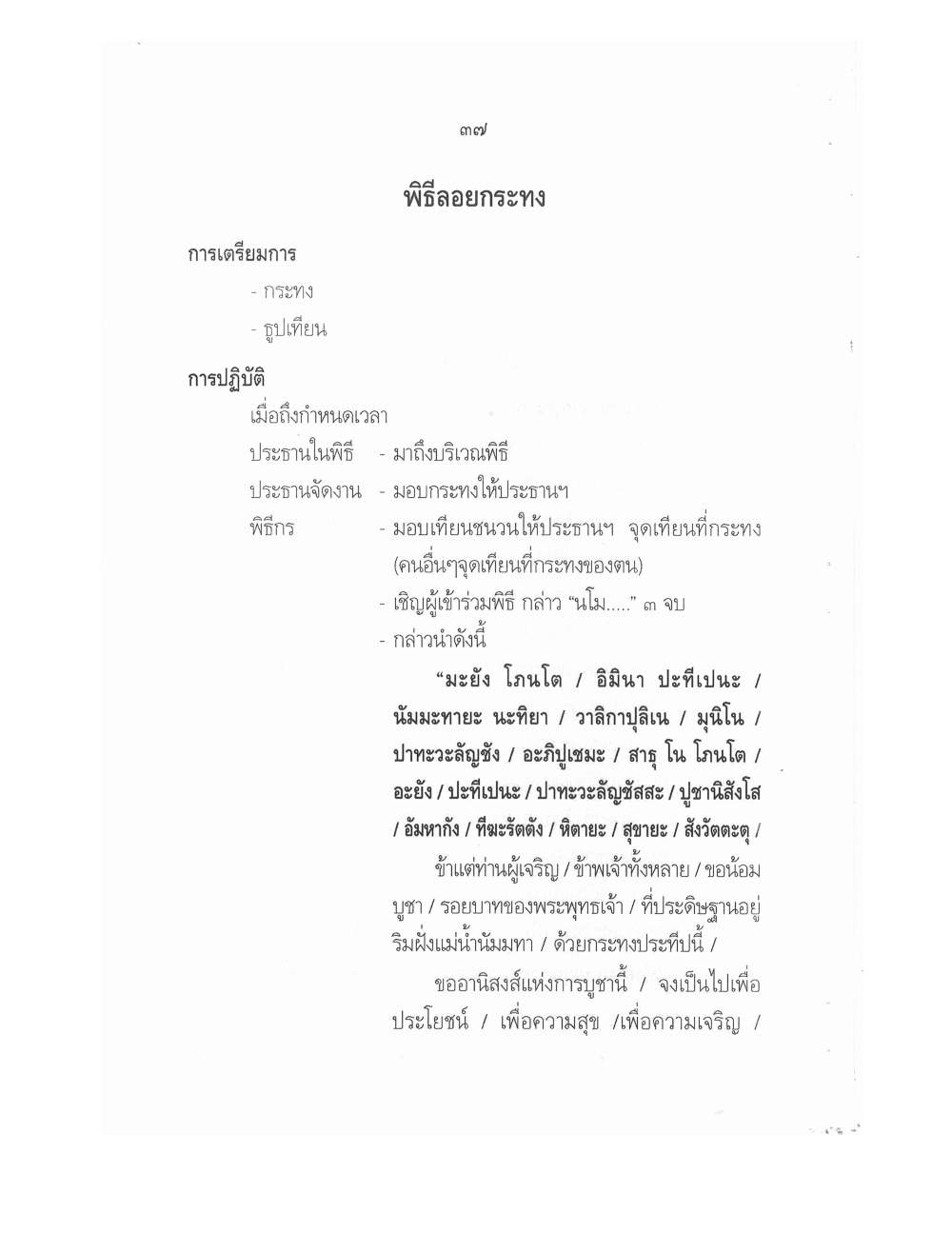
พิธีลอยกระทง
การเตรียมการ - กระทง - ธูปเทียน
การปฏิบัติ เมื่อถึงกำหนดเวลา ประธานในพิธี - มาถึงบริเวณพิธี ประธานจัดงาน - มอบกระทงให้ประธานฯ พิธีกร - มอบเทียนชนวนให้ประธานฯ จุดเทียนที่กระทง (คนอื่นๆจุดเทียนที่กระทงของตน) - เชิญผู้เข้าร่วมพิธี กล่าว "นโม....." ๓ จบ - กล่าวนำดังนี้
"มะยัง โภนโต / อิมินา ปะทีเปนะ / นัมมะทายะ นะทิยา / วาลิกาปุลิเน / มุนิโน / ปาทะวะลัญชัง / อะภิปูเชมะ / สาธุ โน โภนโต / อะยัง / ปะทีเปนะ / ปาทะวะลัญชัสสะ / ปูชานิสังโส / อัมหากัง / ทีฆะรัตตัง / หิตายะ / สุขายะ / สังวัตตะตุ / ข้าแต่ท่านผู้เจริญ / ข้าพเจ้าทั้งหลาย / ขอน้อมบูชา / รอยบาทของพระพุทธเจ้า / ที่ประดิษฐานอยู่ริมฝั่งแม่น้ำนัมมทา / ด้วยกระทงประทีปนี้ / ขออานิสงส์แห่งการบูชานี้ / จงเป็นไปเพื่อประโยชน์ / เพื่อความสุข /เพื่อความเจริญ /
Loi Krathong Ceremony
Preparations - A krathong (floating float) - Incense and candles
Procedure When the appointed time arrives Presiding officiant - Arrives at the ceremony site Event organizer/chair - Presents the krathong to the presiding officiant Master of ceremonies - Presents a lighting taper to the presiding officiant, who lights the candle on the krathong (others light the candles on their own krathongs) - Invites participants to recite "Namo....." three times - Leads the following recitation:
"Mayam bhonto imina padipena / nammadaya nadiya / valikapuline / munino / padavalanjam / abhipujema / sadhu no bhonto / ayam / padipena / padavalanjassa / pujanisamso / amhakam / dighharattam / hitaya / sukhaya / samvattatu / O venerable ones, we the assembled offer this lamp / and worship / the Buddha's footprint / enshrined on the sandy bank of the Nammada River / with this offering of a lit krathong / May the merit of this act of worship / be for our benefit / for our happiness / for our prosperity /
แก่ข้าพเจ้าทั้งหลาย / ตลอดกาลนานเทอญ/"
กล่าวคำบูชาจบแล้ว พิธีกร - เชิญประธานฯ ลอยกระทง ประธานฯ - ลอยกระทง ผู้เข้าร่วมพิธี - ร่วมลอยกระทง เสร็จพิธี
คำบูชาในพิธีลอยกระทงอีกแบบหนึ่ง อิมินา จะ ปะทีเปนะ สัมพุทธัสสะ ปะทัง วะรัง นัมมะทานะทิยา ตีเร อะภิปูเชมะ ทูระโต อิทัง โน ปูชะนัง โหตุ สะทา หิตะสุขาวะหัง
หมายเหตุ นำพิธีลอยกระทงของกองทัพอากาศมาเป็นเพียงตัวอย่าง พิธีลอยกระทงของหน่วยงานอื่นๆ ไม่ว่าจะเป็นภาครัฐหรือภาคเอกชน ก็มีขั้นตอนคล้ายๆ กัน
************************
[ภาพ: ภาพถ่ายดอกบัว/บัวสายสีขาวสองดอก]
for us / for evermore."
After reciting the words of worship Master of ceremonies - Invites the presiding officiant to float the krathong Presiding officiant - Floats the krathong Participants - Join in floating their krathongs Rite ends
An alternative verse of worship for the Loi Krathong ceremony "With this lamp, we worship from afar / the excellent footprint of the Fully Enlightened One, / on the bank of the Nammada River; / may this act of worship of ours / always bring benefit and happiness."
Note The Royal Thai Air Force's Loi Krathong ceremony is given here merely as an example. Loi Krathong ceremonies held by other organizations, whether government or private, follow largely similar steps.
************************
[photograph: two white lotus/water-lily blossoms]
หมวดที่ ๒ บุญพิธี ว่าด้วยพิธีทำบุญ
Section 2 Merit-Making Rites Concerning the Rites of Making Merit
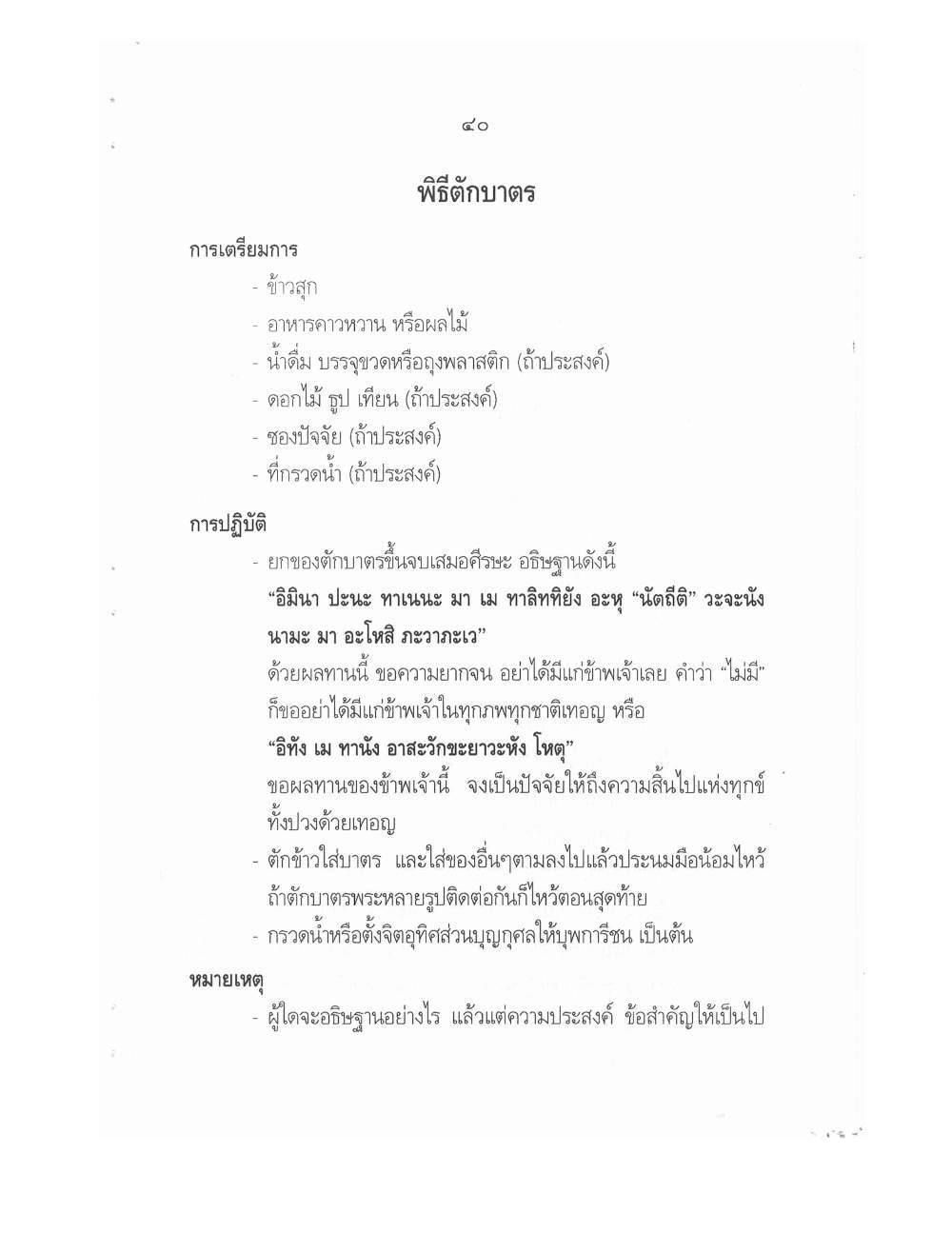
พิธีตักบาตร
การเตรียมการ - ข้าวสุก - อาหารคาวหวาน หรือผลไม้ - น้ำดื่ม บรรจุขวดหรือถุงพลาสติก (ถ้าประสงค์) - ดอกไม้ ธูป เทียน (ถ้าประสงค์) - ซองปัจจัย (ถ้าประสงค์) - ที่กรวดน้ำ (ถ้าประสงค์)
การปฏิบัติ - ยกของตักบาตรขึ้นจบเสมอศีรษะ อธิษฐานดังนี้ "อิมินา ปะนะ ทาเนนะ มา เม ทาลิททิยัง อะหุ "นัตถิติ" วะจะนัง นามะ มา อะโหสิ ภะวาภะเว" ด้วยผลทานนี้ ขอความยากจน อย่าได้มีแก่ข้าพเจ้าเลย คำว่า "ไม่มี" ก็ขออย่าได้มีแก่ข้าพเจ้าในทุกภพทุกชาติเทอญ หรือ "อิทัง เม ทานัง อาสะวักขะยาวะหัง โหตุ" ขอผลทานของข้าพเจ้านี้ จงเป็นปัจจัยให้ถึงความสิ้นไปแห่งทุกข์ทั้งปวงด้วยเทอญ - ตักข้าวใส่บาตร และใส่ของอื่นๆตามลงไปแล้วประนมมือน้อมไหว้ ถ้าตักบาตรพระหลายรูปติดต่อกันก็ไหว้ตอนสุดท้าย - กรวดน้ำหรือตั้งจิตอุทิศส่วนบุญกุศลให้บุพการีชน เป็นต้น
หมายเหตุ - ผู้ใดจะอธิษฐานอย่างไร แล้วแต่ความประสงค์ ข้อสำคัญให้เป็นไป
Rite of Almsgiving (Tak Bat)
Preparations - Cooked rice - Savory and sweet dishes, or fruit - Drinking water, in bottles or plastic bags (if desired) - Flowers, incense, candles (if desired) - An envelope of money (if desired) - Water for pouring the merit-dedication (if desired)
Procedure - Raise the offerings to the level of the head and make this resolve/wish: "Imina pana danena ma me dalidddiyam ahu 'natthi' ti vacanam nama ma ahosi bhavabhave" By the fruit of this offering, may poverty never be mine; may the word 'I have none' never be spoken of me, in any existence or birth, forever. Or: "Idam me danam asavakkhayavaham hotu" May the fruit of my offering be a cause leading to the ending of all suffering. - Spoon rice into the alms bowl and add the other items, then place the palms together in reverence; if giving alms to several monks in succession, pay respect only at the end. - Pour the merit-dedication water, or mentally dedicate the merit to one's parents and ancestors, and so on.
Note - However one wishes to make the resolve is a matter of personal preference; the important thing is that it be directed
ในทางดีเป็นอันใช้ได้ - ตักบาตรแล้ว ถ้าทำได้ควรกรวดน้ำอุทิศส่วนบุญกุศล ถ้าไม่มีเวลาพอ ก็ขอให้ตั้งจิตอุทิศส่วนบุญกุศลก็ได้
************************
พิธีถวายสังฆทาน
(ถวายได้ก่อนเที่ยง)
การเตรียมการ ของหลัก - อาหารคาวหวาน น้ำดื่ม ดอกไม้ ธูปเทียน ซองปัจจัย จัดเป็นชุดๆ ตามจำนวนพระที่นิมนต์มารับ อาหารจะจัดบรรจุปิ่นโต หรือบรรจุภาชนะอื่นที่เหมาะสมก็ได้ ของบริวาร - เครื่องกระป๋อง ของแห้ง ของที่พระฉันได้ ของใช้ต่างๆ ที่ไม่ผิดวินัยสงฆ์
การปฏิบัติ - นิมนต์พระมาที่บ้านหรือไปถวายที่วัดก็ได้ เมื่อถึงกำหนดเวลาตั้งของสังฆทานเรียงไว้ข้างหน้าพระสงฆ์ - จุดธูปเทียนบูชาพระรัตนตรัย แล้วกราบ ๓ ครั้ง - อาราธนาศีล - รับศีลเสร็จแล้ว - กล่าว "นะโม......" ๓ จบ แล้วกล่าวคำถวายดังนี้ "อิมานิ มะยัง ภันเต / ภัตตานิ / สะปะริวารานิ / ภิกขุสังฆัสสะ / โอโณชะยามะ / สาธุ โน ภันเต / ภิกขุสังโฆ / อิมานิ / ภัตตานิ / สะปะริวารานิ / ปะฏิคคัณหาตุ / อัมหากัง / ทีฆะรัตตัง / หิตายะ / สุขายะ /"
in a good direction; that is acceptable. - After giving alms, if possible, one should pour water to dedicate the merit; if there is not enough time, it is also acceptable simply to mentally dedicate the merit.
************************
Rite of Offering Sangha-dana (Requisites to the Monastic Community) (May be offered before noon)
Preparations Main items - Savory and sweet food, drinking water, flowers, incense and candles, and envelopes of money, arranged into sets according to the number of monks invited to receive them. The food may be packed in tiered carriers (pinto) or in any other suitable container. Accompanying items - Canned goods, dried goods, anything the monks are permitted to eat, and various articles of use that do not violate monastic discipline (Vinaya).
Procedure - The monks may be invited to the home, or the offering may be brought to the temple; when the appointed time arrives, arrange the sangha-dana items in front of the monks. - Light incense and candles to venerate the Triple Gem, then prostrate 3 times. - Invite and receive the precepts. - Recite "Namo......" three times, then say the following words of offering: "Imani mayam bhante bhattani saparivarani bhikkhusanghassa onojayama; sadhu no bhante bhikkhusangho imani bhattani saparivarani patiggahnatu amhakam dighharattam hitaya sukhaya /" (We, Venerable Sirs, offer these meals together with their accompaniments to the community of monks. Venerable Sirs, may the community of monks kindly accept these meals together with their accompaniments, for our long-lasting welfare and happiness.)
ข้าแต่พระสงฆ์ผู้เจริญ / ข้าพเจ้าทั้งหลาย / ขอน้อมถวาย / ซึ่งภัตตาหาร / กับทั้งของบริวารเหล่านี้ / แด่พระภิกษุสงฆ์ / ขอพระภิกษุสงฆ์จงรับ / ซึ่งภัตตาหาร / กับทั้งของบริวารเหล่านี้ / เพื่อประโยชน์ / เพื่อความสุข / แก่ข้าพเจ้าทั้งหลาย / ตลอดกาลนานเทอญ" - เมื่อพระกล่าวรับว่า "สาธุ" แล้ว ยกของสังฆทานถวายพระพร้อมดอกไม้ธูปเทียน และซองปัจจัย (ถ้าวัดที่ไม่รับปัจจัยก็ถวายใบปวารณาแทน ส่วนปัจจัยมอบให้ศิษย์วัดไป) - กรวดน้ำ - รับพร เริ่มรินน้ำเมื่อพระสวด "ยถา....." และเทน้ำให้หมดเมื่อพระสวดถึง ".....มณีโชติระโส ยถา" แล้วพนมมือไหว้จนกว่าพระจะให้พรจบ - เมื่อพระให้พรจบแล้ว กราบ ๓ ครั้ง เสร็จพิธี
************************
พิธีทำบุญเลี้ยงพระทั่วๆไป
การเตรียมการ นิมนต์พระตามจำนวนที่ประสงค์ มักนิยม ๕ หรือ ๙ รูป - โต๊ะหมู่บูชาพร้อมเครื่องสักการะ - พานด้ายสายสิญจน์ ๒ พาน (ตั้งที่พระสงฆ์รูปแรกและรูปสุดท้าย) - อาสนะพระสงฆ์ - เครื่องดื่ม - อาหาร - ไทยธรรม ถวายพระสงฆ์ - สำรับบูชาพระพุทธให้มีปริมาณพอหนึ่งคนอิ่ม
"Venerable monks, we humbly offer this food together with these accompanying items to the community of monks. May the community of monks kindly accept this food together with these accompanying items, for the benefit and happiness of us all, forever." - When the monks respond "Sadhu," raise the sangha-dana offerings to present to the monks, together with flowers, incense, candles, and the envelope of money (at temples that do not accept money directly, present a pledge/donation slip instead, and give the money itself to a temple attendant). - Pour the water of merit-dedication and receive the blessing; begin pouring the water when the monks chant "Yatha....." and finish pouring when they reach "...manijotiraso yatha," then keep the palms together in reverence until the monks finish the blessing. - When the blessing is finished, prostrate 3 times. Rite ends
************************
General Rite of Merit-Making by Feeding Monks
Preparations Invite monks in the desired number; 5 or 9 is customary. - An altar table with offerings for veneration - Two trays of sacred thread (sai sin) (placed by the first and last monk in the row) - Seating (asana) for the monks - Beverages, food, and requisites (Thai dhamma) to offer the monks - A tray for venerating the Buddha, with enough food for one person's meal
- สำรับบูชาพระภูมิเจ้าที่ - ซองปัจจัย หรือซองใบปวารณา แยกปัจจัย (เงิน)ใส่ซองต่างหาก - ที่กรวดน้ำ - กำหญ้าคาพรมน้ำมนต์
การปฏิบัติ เมื่อถึงกำหนดเวลา - จุดธูปเทียนบูชาพระรัตนตรัยแล้วกราบ ๓ ครั้ง - อาราธนาศีล - รับศีล - อาราธนาพระปริตร - พนมมือฟังพระเจริญพระพุทธมนต์ - จุดเทียนน้ำมนต์เมื่อพระเจริญพระพุทธมนต์ถึงบท "อะเสวนา..."แล้วยกบาตรน้ำมนต์ประเคนพระ - ถวายสำรับบูชาพระพุทธ (เมื่อพระเจริญพระพุทธมนต์จบ) - ถวายภัตตาหารพระสงฆ์ - ถวายสำรับบูชาพระภูมิเจ้าที่ - ประเคนจตุปัจจัยไทยธรรม (เมื่อพระสงฆ์ฉันเสร็จ) - กรวดน้ำ - รับพร เมื่อพระสงฆ์เริ่มอนุโมทนา - รับประพรมน้ำพระพุทธมนต์จากพระสงฆ์ เสร็จพิธี
หมายเหตุ น้ำที่กรวดแล้วควรนำไปเทในที่สะอาด เช่น ที่พุ่มดอกไม้ หรือ กระถางต้นไม้ เป็นต้น
- A tray for venerating the guardian spirit of the land (Phra Phum) - An envelope of money, or a donation-pledge envelope; keep the money in a separate envelope - Water for pouring the merit-dedication - A handful of cogon grass (ya kha) for sprinkling holy water
Procedure When the appointed time arrives - Light incense and candles to venerate the Triple Gem, then prostrate 3 times - Invite and receive the precepts - Invite the monks to chant the protective verses (Paritta) - Sit with palms together listening as the monks chant the Buddhist blessing - Light the holy-water candle when the monks' chanting reaches the verse "Asevana...", then present the bowl of holy water to the monks - Offer the tray venerating the Buddha (once the monks finish chanting) - Offer the meal to the monks - Offer the tray venerating the guardian spirit of the land - Present the four requisites (offerings) (once the monks have finished eating) - Pour the water of merit-dedication and receive the blessing, when the monks begin the anumodana chant - Receive the sprinkling of holy water from the monks Rite ends
Note The water that has been poured for merit-dedication should be poured out in a clean place, such as at the base of a flower bush or a potted plant, and so on.
พิธีตักบาตรวันขึ้นปีใหม่
ส่วนกลางที่ดอนเมือง
การเตรียมการ - อาหาร ควรเป็นข้าวสารหรืออาหารแห้ง (เสบียงกรัง) - ดอกไม้ธูปเทียน
การปฏิบัติ เมื่อถึงกำหนดเวลา ประธานในพิธี - ถึงบริเวณพิธี (บรรเลงเพลงมหาฤกษ์) คณก. - เรียนเชิญประธานขึ้นแท่น แล้วกล่าวรายงานการจัดงานและกล่าวอวยพรปีใหม่ในนามข้าราชการ ประธานฯ - กล่าวตอบและอวยพรแก่ผู้มาร่วมพิธี (เมื่อประธานกล่าวจบบรรเลงเพลงมหาฤกษ์) พระสงฆ์ - ออกรับบิณฑบาต เสร็จแล้วขึ้นรถกลับวัด (นิมนต์ไว้ ๙ - ๑๐ รูป เพื่อเจริญพระพุทธมนต์และรับสังฆทานบนประรำพิธี) ประธานฯ - จุดธูปเทียนบูชาพระรัตนตรัย อศจ. - อาราธนาศีล - รับศีล - อาราธนาพระปริตร พระสงฆ์ - เจริญพระพุทธมนต์ อศจ. - นำกล่าวถวายสังฆทาน ประธานฯ และ นายทหารชั้นผู้ใหญ่ - ร่วมถวายสังฆทาน พระสงฆ์ - อนุโมทนา
New Year's Day Almsgiving Ceremony
Central Command, Don Mueang
Preparations - Food should be uncooked rice or dry provisions (dry rations) - Flowers, incense, candles
Procedure When the appointed time arrives Presiding officiant - Arrives at the ceremony site (the Maharuek anthem is played) Committee (คณก.) - Invites the presiding officiant to the dais, then reports on the arrangement of the event and delivers New Year's greetings on behalf of the officials/civil servants Presiding officiant - Replies and offers New Year's blessings to those attending (when the presiding officiant finishes speaking, the Maharuek anthem is played) The monks - Go out to receive alms, then afterward board vehicles to return to the temple (9-10 monks are invited, to chant the Buddhist blessing and receive sangha-dana under the ceremonial pavilion) Presiding officiant - Lights incense and candles to venerate the Triple Gem Chaplain (อศจ.) - Invites and receives the precepts - Invites the monks to chant the protective verses (Paritta) The monks - Chant the Buddhist blessing Chaplain (อศจ.) - Leads the words of offering the sangha-dana Presiding officiant and senior military officers - Join in offering the sangha-dana The monks - Chant the anumodana (rejoicing in merit)
๔๕
ประธานฯ - กรวดน้ำ รับพร พระสงฆ์ - ประพรมน้ำพระพุทธมนต์ เสร็จพิธี
หน่วย ทอ. อื่นๆ
การปฏิบัติ เมื่อถึงกำหนดเวลา ประธานในพิธี - ถึงบริเวณพิธี - จุดธูปเทียนบูชาพระรัตนตรัย อศจ. - อาราธนาศีล - รับศีล คณก. - เชิญประธานฯขึ้นยืนบนแท่น - กล่าวรายงานการจัดงาน และอวยพรปีใหม่ ในนามข้าราชการ ประธานฯ - กล่าวตอบและอวยพรแก่ข้าราชการ และครอบครัวผู้มาร่วมพิธี อศจ. - นิมนต์พระสงฆ์ออกรับบิณฑบาต เสร็จแล้วนิมนต์เข้านั่งที่เดิม พระสงฆ์ - อนุโมทนา และประธานสงฆ์ประพรมน้ำพระพุทธมนต์ พระสงฆ์นอกนั้นเจริญชัยมงคลคาถา เสร็จพิธี
*************************
45
Chairman - Pours the water of dedication (kruat nam), receives the blessing Monks - Sprinkle holy water End of ceremony
Other Royal Thai Air Force Units
Procedure When the appointed time arrives Presiding officer - Arrives at the ceremony area - Lights incense and candles in homage to the Triple Gem Chaplain (อศจ.) - Invites the giving of precepts - receives the precepts Committee (คณก.) - Invites the chairman to stand on the dais - Delivers the report on organizing the event and extends New Year blessings on behalf of the officials Chairman - Responds and extends blessings to the officials and the families attending the ceremony Chaplain - Invites the monks to go out to receive alms; once finished, invites them back to their original seats Monks - Give the anumodana blessing, and the presiding monk sprinkles holy water; the remaining monks chant the verses of victorious blessing (chai mongkhon khatha) End of ceremony
*************************
๔๖
พิธีทำบุญวันสถาปนาหน่วย
การเตรียมการ - โต๊ะหมู่บูชาพร้อมเครื่องสักการะ - ของรับรองพระสงฆ์ - จตุปัจจัยไทยธรรมถวายพระสงฆ์ - พานรายชื่ออดีตข้าราชการที่เสียชีวิต ตั้งไว้บนโต๊ะปูผ้าขาวเพื่อบังสุกุลอุทิศส่วนบุญกุศล
การปฏิบัติ เมื่อถึงกำหนดเวลา ประธานในพิธี - เข้าสู่ห้องพิธี - จุดธูปเทียนบูชาพระรัตนตรัย - กราบพระ ๓ ครั้ง - ไปนั่ง ณ ที่จัดไว้ พิธีกร - อาราธนาศีล - รับศีล - อาราธนาพระปริตร ผู้ร่วมพิธี - ฟังพระเจริญพระพุทธมนต์ - ประเคนภัตตาหารแด่พระสงฆ์ (เมื่อพระเจริญพระพุทธมนต์จบ) พิธีกร - ลาดภูษาโยง หรือด้ายสายสิญจน์ ประธานฯ - ทอดผ้าบังสุกุล ผู้ร่วมพิธี - ประเคนจตุปัจจัยไทยธรรม พระสงฆ์ - อนุโมทนา ประธานฯ - กรวดน้ำ รับพร
46
Ceremony for Merit-Making on the Unit's Founding Day
Preparations - A shrine table (toh mu bucha) set with offerings - Refreshments to receive the monks - The four requisites and religious gifts (thai tham) to offer the monks - A tray with the names of deceased former officials, placed on a table draped in white cloth, for the offering of the bangsukun robe dedicating the merit to them
Procedure When the appointed time arrives Presiding officer - Enters the ceremony hall - Lights incense and candles in homage to the Triple Gem - prostrates 3 times - Goes to sit at the place arranged Master of ceremonies - Invites the giving of precepts - receives the precepts - Invites the chanting of the paritta (protective verses) Participants - Listen to the monks chanting the holy blessing - Offer the meal to the monks (when the chanting is finished) Master of ceremonies - Lays out the funerary cloth strip or the sacred thread (sai sinjana) Chairman - Offers the bangsukun cloth Participants - Together offer the four requisites and religious gifts Monks - Give the anumodana blessing Chairman - Pours the water of dedication, receives the blessing
๔๗
ประธานสงฆ์ - ประพรมน้ำพระพุทธมนต์ พระสงฆ์นอกนี้ เจริญชัยมงคลคาถา เสร็จพิธี
*************************
พิธีทำบุญวันสงกรานต์
การเตรียมการ (สำหรับการทำบุญเลี้ยงพระเพล) - โต๊ะหมู่บูชาพร้อมเครื่องสักการะ - อาสนะพระสงฆ์ - เครื่องดื่ม อาหาร จตุปัจจัยไทยธรรม - น้ำหอมสรงพระพุทธรูป พระสงฆ์และรดน้ำดำหัวขอพรผู้ใหญ่ - โกศบรรจุอัฐิบรรพชน ตั้งไว้ ณ ที่เหมาะสม (ถ้าไม่มี อาจจะเขียนชื่อสกุลของผู้วายชนม์ใส่พานแทนก็ได้)
การปฏิบัติ เมื่อถึงกำหนดเวลา ประธานในพิธี - จุดธูปเทียนบูชาพระรัตนตรัย กราบพระ ๓ ครั้ง - รับศีล ฟังพระเจริญพระพุทธมนต์ - ประเคนภัตตาหารพระสงฆ์ - ทอดผ้าบังสุกุลหรือบังสุกุลอัฐิบรรพชน เพื่ออุทิศส่วนบุญกุศลแก่บรรพชน (การทอดผ้าจะทอดผู้เดียวหรือให้ผู้อื่นร่วมทอดก็ได้) - ประเคนไทยธรรม ซองปัจจัย - ใบปวารณา - รับประพรมน้ำพระพุทธมนต์จากพระสงฆ์
47
Presiding monk - Sprinkles holy water; the other monks chant the verses of victorious blessing End of ceremony
*************************
Ceremony for Merit-Making on Songkran Day
Preparations (for the merit-making meal offering to the monks in the afternoon) - A shrine table set with offerings - Seats for the monks - Drinks, food, and the four requisites/religious gifts - Scented water for bathing the Buddha image and the monks, and for pouring over the hands of elders to ask their blessing - An urn containing ancestors' ashes, placed in a suitable spot (if there is none, the surnames of the deceased may instead be written and placed on a tray)
Procedure When the appointed time arrives Presiding officer - Lights incense and candles in homage to the Triple Gem, prostrates 3 times - Receives the precepts, listens to the monks chanting the holy blessing - Offers the meal to the monks - Offers the bangsukun cloth, or the bangsukun for the ancestors' ashes, to dedicate merit to the ancestors (the offering may be done alone or jointly with others) - Offers religious gifts, an envelope of money - a letter of dedication - Receives the sprinkling of holy water from the monks
๔๘
- สรงน้ำพระพุทธรูป พระสงฆ์ ผู้ร่วมพิธี - รดน้ำดำหัวขอพรผู้ใหญ่ สาดน้ำกันตามประเพณีอันดีงาม - ปล่อยนก ปล่อยปลา เสร็จพิธี
หมายเหตุ - ถ้าจัดงาน ๒ วัน อาจมีพิธีแห่พระในวันที่ ๑๒ เม.ย. ตั้งพระพุทธรูปให้ผู้มีจิตศรัทธาสรงน้ำ จัดมหรสพฉลอง และอาจมีการประกวดนางสงกรานต์ด้วยในตอนค่ำ - บางแห่งอาจมีเพียงทำบุญตักบาตรในเช้าวันที่ ๑๓ เม.ย. และนิมนต์พระประพรมน้ำพระพุทธมนต์ให้ (โดยนำน้ำพระพุทธมนต์มาจากวัด)
*************************
พิธีถวายผ้าพระกฐินพระราชทาน
การเตรียมการ - โต๊ะหมู่บูชา (นิยมจัดหมู่ ๙) ตั้งข้างประตูด้านหน้าพระอุโบสถ (ด้านขวามือหรือด้านซ้าย แล้วแต่ความเหมาะสมของสถานที่) - ประดิษฐานพระบรมฉายาลักษณ์ของพระบาทสมเด็จพระเจ้าอยู่หัวบนขาหยั่งด้านหลังโต๊ะหมู่บูชา โดยให้อยู่กึ่งกลาง และเหนือโต๊ะหมู่บูชาพอสมควร - ตั้งพุ่มทองและพุ่มเงินบนโต๊ะหมู่บูชาด้านขวาและซ้าย ตามลำดับ - ตั้งพานธูปเทียนแพพร้อมกรวยดอกไม้สด บนโต๊ะหมู่บูชาตัวกลาง
48
- Bathes the Buddha image and the monks Participants - Pour water over the hands of elders to ask their blessing, splash water on each other according to the fine tradition - Release birds, release fish End of ceremony
Note - If the event runs 2 days, there may be a procession of the Buddha image on 12 April; the image is set up for the faithful to bathe, festive entertainment is arranged, and there may also be a Nang Songkran (Songkran Queen) beauty contest in the evening. - At some places there may simply be merit-making by giving alms on the morning of 13 April, and monks are invited to sprinkle holy water (the holy water being brought from the temple)
*************************
Ceremony of Offering the Royally-Granted Kathin Robes
Preparations - A shrine table (a set of 9 is customary) placed beside the door in front of the ubosot - on the right or left, whichever suits the location - Enshrine the royal photographic portrait of His Majesty the King on a stand behind the shrine table, positioned at the centre and appropriately above the shrine table - Place a gold flower tree and a silver flower tree on the right and left of the shrine table respectively - Place a tray of incense, a pair of candles, and a cone of fresh flowers on the central shrine table
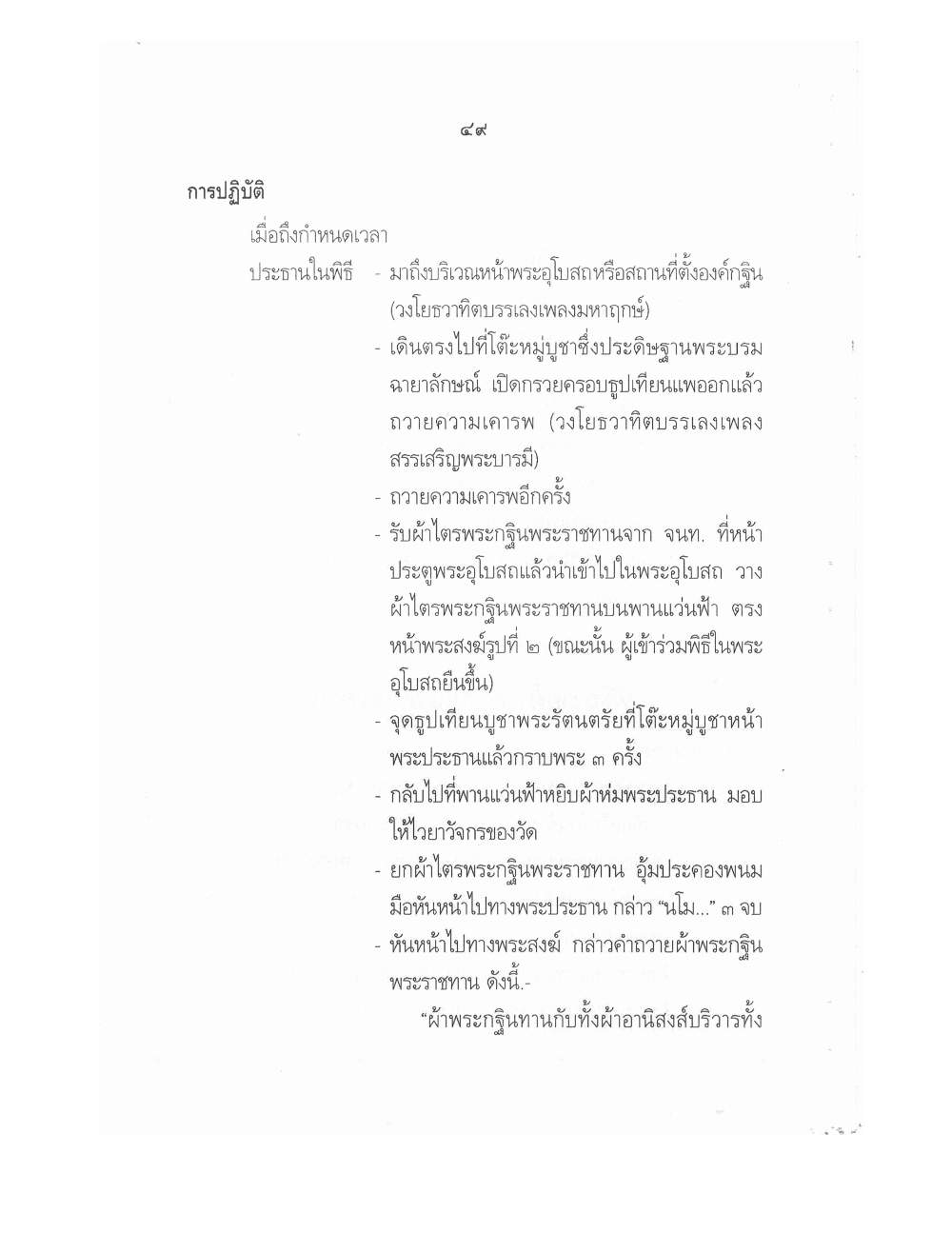
๔๙
การปฏิบัติ เมื่อถึงกำหนดเวลา ประธานในพิธี - มาถึงบริเวณหน้าพระอุโบสถหรือสถานที่ตั้งองค์กฐิน (วงโยธวาทิตบรรเลงเพลงมหาฤกษ์) - เดินตรงไปที่โต๊ะหมู่บูชาซึ่งประดิษฐานพระบรมฉายาลักษณ์ เปิดกรวยครอบธูปเทียนแพออกแล้วถวายความเคารพ (วงโยธวาทิตบรรเลงเพลงสรรเสริญพระบารมี) - ถวายความเคารพอีกครั้ง - รับผ้าไตรพระกฐินพระราชทานจาก จนท. ที่หน้าประตูพระอุโบสถแล้วนำเข้าไปในพระอุโบสถ วางผ้าไตรพระกฐินพระราชทานบนพานแว่นฟ้า ตรงหน้าพระสงฆ์รูปที่ ๒ (ขณะนั้น ผู้เข้าร่วมพิธีในพระอุโบสถยืนขึ้น) - จุดธูปเทียนบูชาพระรัตนตรัยที่โต๊ะหมู่บูชาหน้าพระประธานแล้วกราบพระ ๓ ครั้ง - กลับไปที่พานแว่นฟ้าหยิบผ้าห่มพระประธาน มอบให้ไวยาวัจกรของวัด - ยกผ้าไตรพระกฐินพระราชทาน อุ้มประคองพนมมือหันหน้าไปทางพระประธาน กล่าว "นโม..." ๓ จบ - หันหน้าไปทางพระสงฆ์ กล่าวคำถวายผ้าพระกฐินพระราชทาน ดังนี้.- "ผ้าพระกฐินทานกับทั้งผ้าอานิสงส์บริวารทั้ง
49
Procedure When the appointed time arrives Presiding officer - Arrives at the area in front of the ubosot or the place where the Kathin robes are set up (the brass band plays the "Maharuek" fanfare) - Walks directly to the shrine table where the royal photographic portrait is enshrined, opens the flower cone covering the incense-and-candle tray, then pays respect (the brass band plays the Royal Anthem, "Sansoen Phra Barami") - Pays respect once more - Receives the royally-granted Kathin robe set from the official at the door of the ubosot and carries it inside; places the robe set on the crystal tray stand, directly before the second monk (at this point, those attending inside the ubosot stand up) - Lights incense and candles in homage to the Triple Gem at the shrine table before the principal Buddha image, then prostrates 3 times - Returns to the crystal tray stand, takes the robe meant to drape over the principal Buddha image, and hands it to the temple's lay attendant (waiyawatchakon) - Lifts the royally-granted Kathin robe set, cradling it with palms pressed together, faces the principal Buddha image, and recites "Namo..." 3 times - Turns to face the monks and recites the words of offering the royally-granted Kathin robes, as follows:- "This offering of the Kathin robe, together with all its accompanying meritorious gifts, all of...
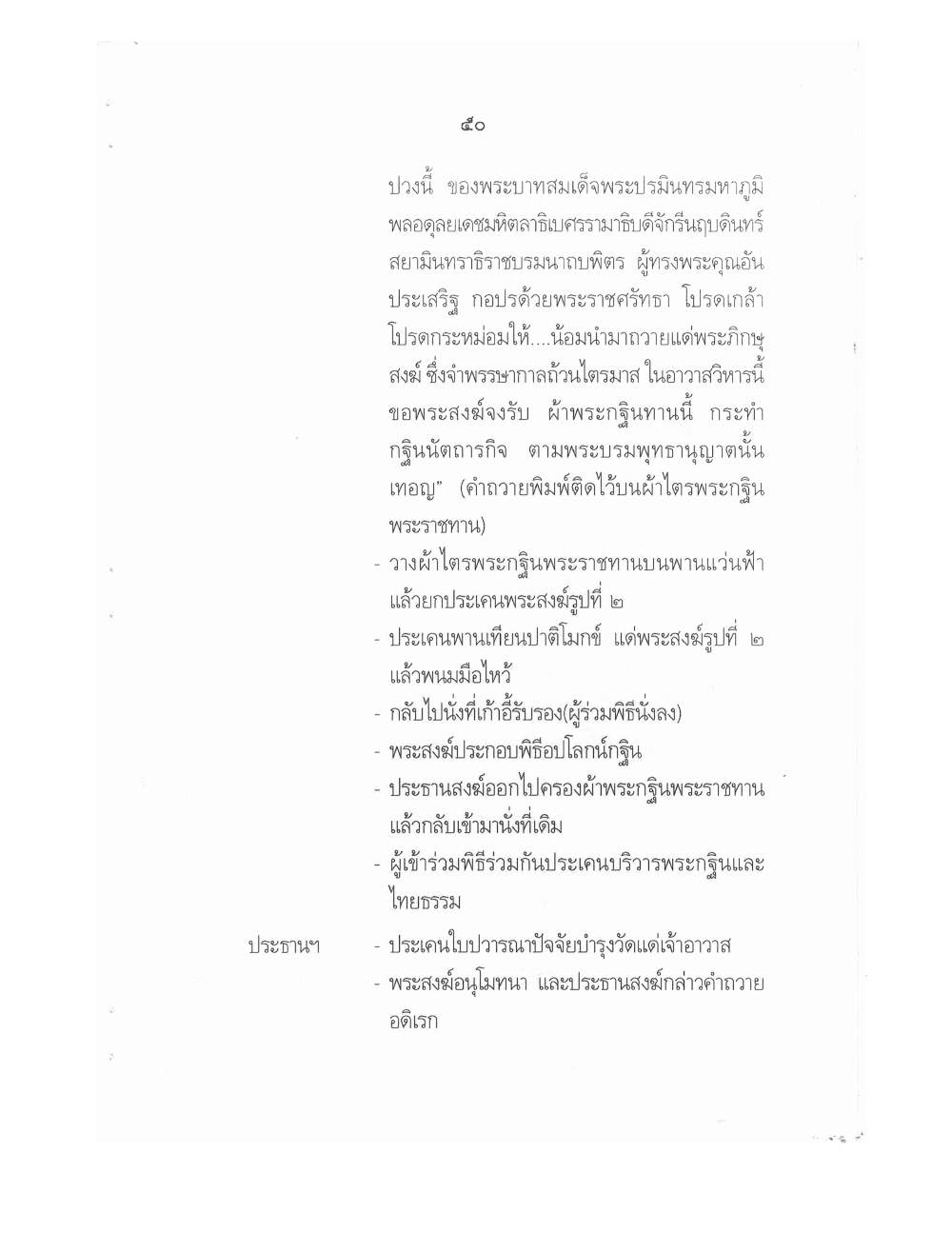
๕๐
ปวงนี้ ของพระบาทสมเด็จพระปรมินทรมหาภูมิพลอดุลยเดชมหิตลาธิเบศรรามาธิบดีจักรีนฤบดินทร์สยามินทราธิราชบรมนาถบพิตร ผู้ทรงพระคุณอันประเสริฐ กอปรด้วยพระราชศรัทธา โปรดเกล้าโปรดกระหม่อมให้....น้อมนำมาถวายแด่พระภิกษุสงฆ์ ซึ่งจำพรรษากาลถ้วนไตรมาส ในอาวาสวิหารนี้ ขอพระสงฆ์จงรับ ผ้าพระกฐินทานนี้ กระทำกฐินนัตถารกิจ ตามพระบรมพุทธานุญาตนั้นเทอญ" (คำถวายพิมพ์ติดไว้บนผ้าไตรพระกฐินพระราชทาน) - วางผ้าไตรพระกฐินพระราชทานบนพานแว่นฟ้า แล้วยกประเคนพระสงฆ์รูปที่ ๒ - ประเคนพานเทียนปาติโมกข์ แด่พระสงฆ์รูปที่ ๒ แล้วพนมมือไหว้ - กลับไปนั่งที่เก้าอี้รับรอง (ผู้ร่วมพิธีนั่งลง) - พระสงฆ์ประกอบพิธีอปโลกน์กฐิน - ประธานสงฆ์ออกไปครองผ้าพระกฐินพระราชทาน แล้วกลับเข้ามานั่งที่เดิม - ผู้เข้าร่วมพิธีร่วมกันประเคนบริวารพระกฐินและไทยธรรม ประธานฯ - ประเคนใบปวารณาปัจจัยบำรุงวัดแด่เจ้าอาวาส - พระสงฆ์อนุโมทนา และประธานสงฆ์กล่าวคำถวายอดิเรก
50
...belong to His Majesty King Bhumibol Adulyadej Mahitalathibet Ramathibodi Chakrinaruebodindra Sayamindrathiraja Borommanathabophit, who, endowed with excellent virtue and royal faith, has graciously commanded that .... [name of the giver] humbly bring and present them to the community of monks, who have completed the full three-month rains retreat in this monastery. May the Sangha please accept this offering of the Kathin robe and perform the Kathin-laying rite in accordance with the Buddha's permission." (This offering formula is printed and affixed to the royally-granted Kathin robe cloth) - Places the robe set on the crystal tray stand, then lifts and presents it to the second monk - Presents the tray of Patimokkha candle to the second monk, then presses palms together in respect - Returns to sit in the reception chair (the participants sit down) - The monks perform the rite of deliberating on the Kathin (apalokana kathin) - The presiding monk goes out to don the royally-granted Kathin robe, then returns to sit in his original place - The participants together present the accompanying Kathin gifts and religious offerings Chairman - Presents the letter dedicating funds for the temple's upkeep to the abbot - The monks give the anumodana blessing, and the presiding monk recites the "Adireka" words of blessing
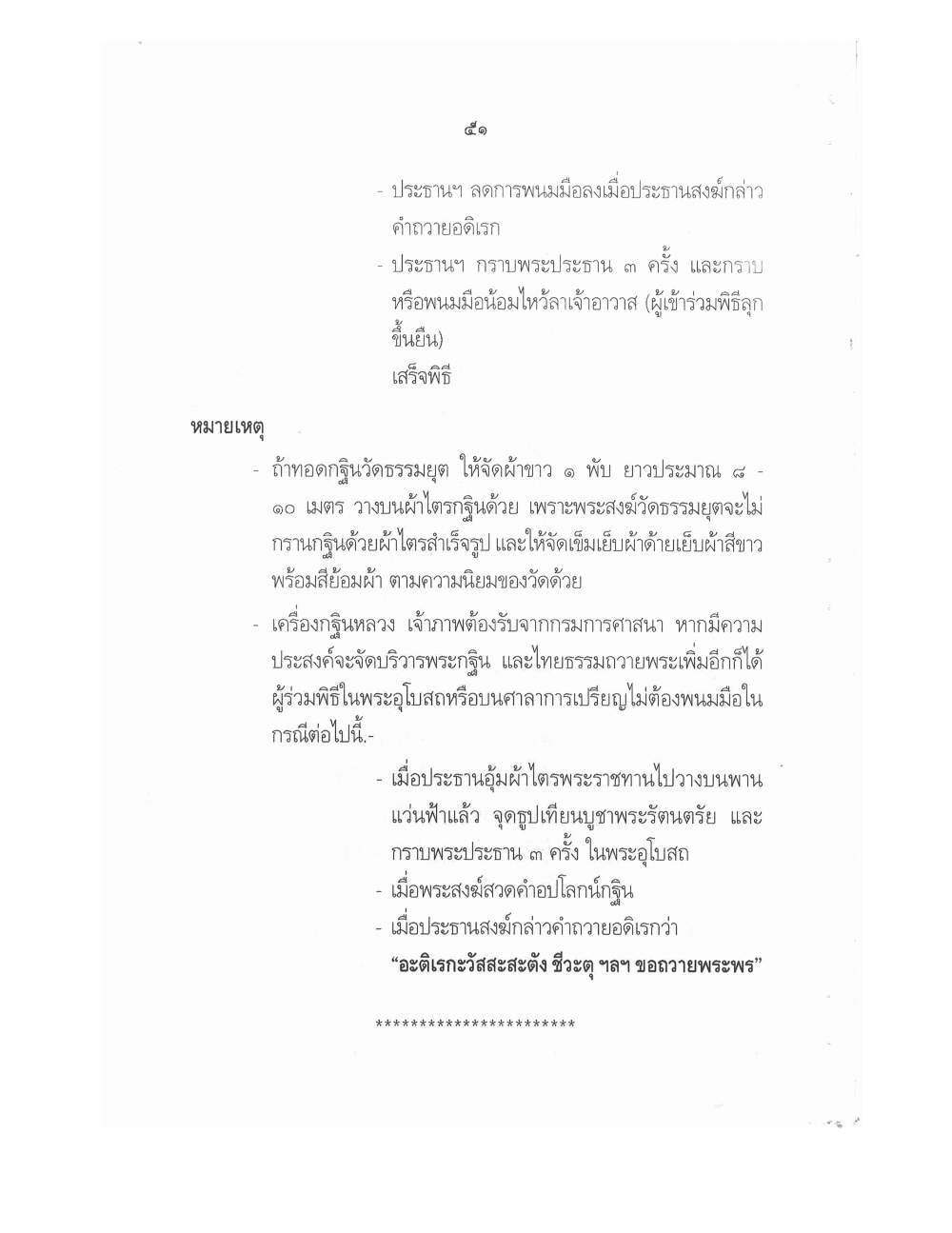
๕๑
- ประธานฯ ลดการพนมมือลงเมื่อประธานสงฆ์กล่าวคำถวายอดิเรก - ประธานฯ กราบพระประธาน ๓ ครั้ง และกราบหรือพนมมือน้อมไหว้ลาเจ้าอาวาส (ผู้เข้าร่วมพิธีลุกขึ้นยืน) เสร็จพิธี
หมายเหตุ - ถ้าทอดกฐินวัดธรรมยุต ให้จัดผ้าขาว ๑ พับ ยาวประมาณ ๘-๑๐ เมตร วางบนผ้าไตรกฐินด้วย เพราะพระสงฆ์วัดธรรมยุตจะไม่กรานกฐินด้วยผ้าไตรสำเร็จรูป และให้จัดเข็มเย็บผ้าด้ายเย็บผ้าสีขาวพร้อมสีย้อมผ้า ตามความนิยมของวัดด้วย - เครื่องกฐินหลวง เจ้าภาพต้องรับจากกรมการศาสนา หากมีความประสงค์จะจัดบริวารพระกฐิน และไทยธรรมถวายพระเพิ่มอีกก็ได้ ผู้ร่วมพิธีในพระอุโบสถหรือบนศาลาการเปรียญไม่ต้องพนมมือในกรณีต่อไปนี้.- - เมื่อประธานอุ้มผ้าไตรพระราชทานไปวางบนพานแว่นฟ้าแล้ว จุดธูปเทียนบูชาพระรัตนตรัย และกราบพระประธาน ๓ ครั้ง ในพระอุโบสถ - เมื่อพระสงฆ์สวดคำอปโลกน์กฐิน - เมื่อประธานสงฆ์กล่าวคำถวายอดิเรกว่า "อะติเรกะวัสสะสะตัง ชีวะตุ ฯลฯ ขอถวายพระพร"
*************************
51
- The chairman lowers his pressed palms when the presiding monk recites the "Adireka" words - The chairman prostrates to the principal Buddha image 3 times, and either prostrates or presses palms in a bow to take leave of the abbot (the participants stand up) End of ceremony
Note - If offering Kathin at a Dhammayut temple, prepare one folded length of white cloth, about 8-10 metres long, and place it on top of the Kathin robe set as well, because the monks of Dhammayut temples will not accept the Kathin with a ready-made robe set; also prepare needle and white sewing thread together with cloth dye, according to that temple's custom. - As for the royal Kathin set, the host must receive it from the Department of Religious Affairs. Should there be a wish to arrange additional accompanying Kathin gifts and religious offerings, this may also be done. Participants in the ubosot or on the sermon hall need not press their palms together in the following cases:- - When the chairman, having carried the royally-granted robe set to place it on the crystal tray stand, lights incense and candles in homage to the Triple Gem, and prostrates to the principal Buddha image 3 times, inside the ubosot - When the monks chant the words of Kathin deliberation - When the presiding monk recites the "Adireka" words, saying: "Atireka-vassa-satam jivatu, etc. - I offer this blessing." [gloss printed with the Pali formula]
*************************
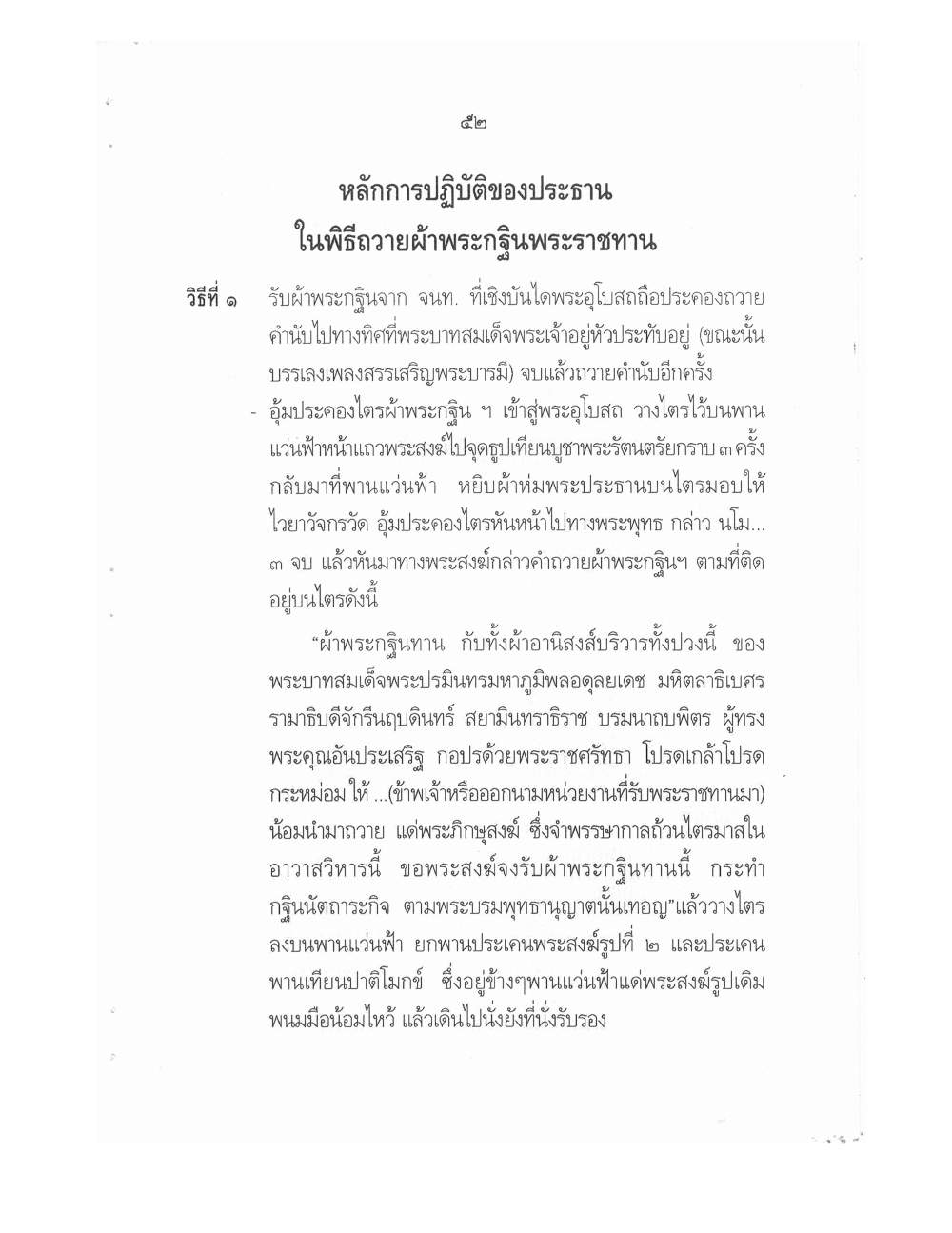
๕๒
หลักการปฏิบัติของประธาน
ในพิธีถวายผ้าพระกฐินพระราชทาน
วิธีที่ ๑ รับผ้าพระกฐินจาก จนท. ที่เชิงบันไดพระอุโบสถถือประคองถวายคำนับไปทางทิศที่พระบาทสมเด็จพระเจ้าอยู่หัวประทับอยู่ (ขณะนั้นบรรเลงเพลงสรรเสริญพระบารมี) จบแล้วถวายคำนับอีกครั้ง - อุ้มประคองไตรผ้าพระกฐินฯ เข้าสู่พระอุโบสถ วางไตรไว้บนพานแว่นฟ้าหน้าแถวพระสงฆ์ไปจุดธูปเทียนบูชาพระรัตนตรัยกราบ ๓ ครั้ง กลับมาที่พานแว่นฟ้า หยิบผ้าห่มพระประธานบนไตรมอบให้ไวยาวัจกรวัด อุ้มประคองไตรหันหน้าไปทางพระพุทธ กล่าว นโม... ๓ จบ แล้วหันมาทางพระสงฆ์กล่าวคำถวายผ้าพระกฐินฯ ตามที่ติดอยู่บนไตรดังนี้
"ผ้าพระกฐินทาน กับทั้งผ้าอานิสงส์บริวารทั้งปวงนี้ ของพระบาทสมเด็จพระปรมินทรมหาภูมิพลอดุลยเดช มหิตลาธิเบศรามาธิบดีจักรีนฤบดินทร์ สยามินทราธิราช บรมนาถบพิตร ผู้ทรงพระคุณอันประเสริฐ กอปรด้วยพระราชศรัทธา โปรดเกล้าโปรดกระหม่อม ให้...(ข้าพเจ้าหรือออกนามหน่วยงานที่รับพระราชทานมา) น้อมนำมาถวาย แด่พระภิกษุสงฆ์ ซึ่งจำพรรษากาลถ้วนไตรมาสในอาวาสวิหารนี้ ขอพระสงฆ์จงรับผ้าพระกฐินทานนี้ กระทำกฐินนัตถาระกิจ ตามพระบรมพุทธานุญาตนั้นเทอญ" แล้ววางไตรลงบนพานแว่นฟ้า ยกพานประเคนพระสงฆ์รูปที่ ๒ และประเคนพานเทียนปาติโมกข์ ซึ่งอยู่ข้างๆพานแว่นฟ้าแด่พระสงฆ์รูปเดิม พนมมือน้อมไหว้ แล้วเดินไปนั่งยังที่นั่งรับรอง
52
Principal Procedure for the Chairman
in the Ceremony of Offering the Royally-Granted Kathin Robes
Method 1 - Receives the Kathin robe set from the official at the foot of the ubosot staircase, holds it cradled, and bows in the direction where His Majesty the King resides (the Royal Anthem is played at this point); once finished, bows once more. - Carries the robe set, cradled, into the ubosot, places it on the crystal tray stand in front of the row of monks, goes to light incense and candles in homage to the Triple Gem and prostrates 3 times, returns to the crystal tray stand, takes the robe meant to drape over the principal Buddha image and hands it to the temple's lay attendant, cradles the robe set, faces the Buddha image, recites "Namo..." 3 times, then turns to face the monks and recites the words of offering the Kathin robe as printed on the robe set, as follows:
"This offering of the Kathin robe, together with all its accompanying meritorious gifts, belong to His Majesty King Bhumibol Adulyadej Mahitalathibet Ramathibodi Chakrinaruebodindra Sayamindrathiraja Borommanathabophit, who, endowed with excellent virtue and royal faith, has graciously commanded that ...(I, or naming the unit that received the royal grant) humbly bring and present them to the community of monks who have completed the full three-month rains retreat in this monastery. May the Sangha please accept this offering of the Kathin robe and perform the Kathin-laying rite in accordance with the Buddha's permission." Then places the robe set down on the crystal tray stand, lifts the tray and presents it to the second monk, and presents the tray of Patimokkha candle, beside the crystal tray stand, to the same monk, presses palms together in a bow, then walks to sit in the reception seat.
๕๓
วิธีที่ ๒ (มีโต๊ะตั้งพระบรมฉายาลักษณ์ มีพานผ้าไตรพระกฐินฯ ตั้งอยู่ข้างหน้า) ประธานถวายคำนับพระบรมฉายาลักษณ์ หยิบผ้าไตรเองมาอุ้มประคอง (ขณะนั้นบรรเลงเพลงสรรเสริญพระบารมี) จบแล้วถวายคำนับอีกครั้ง เดินเข้าสู่พระอุโบสถ แล้วปฏิบัติตามวิธีที่ ๑ โดยตลอด (โดยหนังสือแนะนำกรมการศาสนา)
*************************
พิธีทอดกฐินทั่วไป
การเตรียมการ - ผ้าไตรกฐิน ๑ ไตร - ของบริวารอื่นๆ (ตามความเหมาะสม) - ไตรคู่สวด ๒ ไตร - ไทยธรรมถวายภิกษุสามเณรทุกรูป - เทียนปาติโมกข์ ๑ ชุด (๒๔ เล่ม) - เครื่องดื่ม อาหาร (ถ้ามีการเลี้ยงพระด้วย) - พานแว่นฟ้าและพานเทียนปาติโมกข์ (ตั้งไว้ตรงหน้าพระสงฆ์รูปที่ ๒)
การปฏิบัติ เมื่อถึงกำหนดเวลา ประธานในพิธี - จุดธูปเทียนบูชาพระรัตนตรัย กราบพระ ๓ ครั้ง - มอบผ้าห่มพระประธานให้ไวยาวัจกรของวัด - ประเคนตาลปัตรกฐินแด่พระสงฆ์รูปที่ ๑ (กลับไปนั่งที่รับรอง)
53
Method 2 - (A table is set with the royal photographic portrait, with a tray holding the Kathin robe set placed in front of it.) The chairman bows to the royal portrait, personally takes up the robe set and cradles it (the Royal Anthem is played at this point); once finished, bows once more, walks into the ubosot, then follows Method 1 throughout. (As recommended by the pamphlet of the Department of Religious Affairs)
*************************
Ceremony of Offering Kathin in General
Preparations - 1 Kathin robe set - Other accompanying items (as appropriate) - 2 robe sets for the pair of chanting monks - Religious gifts to offer every monk and novice - 1 set of Patimokkha candles (24 candles) - Drinks, food (if a meal is also to be offered to the monks) - A crystal tray stand and a tray for the Patimokkha candle (placed directly in front of the second monk)
Procedure When the appointed time arrives Presiding officer - Lights incense and candles in homage to the Triple Gem, prostrates 3 times - Hands the robe meant to drape over the principal Buddha image to the temple's lay attendant - Presents the Kathin fan (talapat) to the first monk (returns to sit in the reception seat)
๕๔
- รับศีล - หยิบผ้าไตรที่พานแว่นฟ้า (หรือมีผู้มอบให้) อุ้มประคองพนมมือหันหน้าไปทางพระประธานกล่าว "นโม..." ๓ จบ - หันหน้าไปทางพระสงฆ์ กล่าวคำถวายผ้ากฐิน (หรือกล่าวตามพิธีกร) ดังนี้.-
"อิมัง ภันเต / สะปะริวารัง / กะฐินะทุสสัง / สังฆัสสะ / โอโณชะยามะ / สาธุ โน ภันเต / สังโฆ / อิมัง / สะปะริวารัง / กะฐินะทุสสัง / ปฏิคคัณหาตุ / ปะฏิคคะเหตตะวา จะ / อิมินา / ทุสเสนะ / กะฐินัง / อัตถะระตุ / อัมหากัง / ทีฆะรัตตัง / หิตายะ / สุขายะ /
ข้าแต่พระสงฆ์ผู้เจริญ / ข้าพเจ้าทั้งหลาย / ขอน้อมถวาย / ผ้ากฐิน กับของบริวารนี้ / แด่พระสงฆ์ / ขอพระสงฆ์ จงรับ / ผ้ากฐิน กับทั้งของบริวารนี้ / ครั้นรับแล้ว / ขอจงกรานกฐินด้วยผ้านี้ / เพื่อประโยชน์ / เพื่อความสุข / แก่ข้าพเจ้าทั้งหลาย / ตลอดกาลนานเทอญ /" - วางผ้าไตรบนพานแว่นฟ้าหน้าพระสงฆ์ แล้วยกประเคนพระสงฆ์รูปที่ ๒ - ยกพานเทียนปาติโมกข์วางข้างพานแว่นฟ้าประเคนพระสงฆ์รูปที่ ๒ - กลับไปนั่งที่เดิม
54
- Receives the precepts - Takes up the robe set from the crystal tray stand (or if someone hands it over), cradles it with palms pressed together, faces the principal Buddha image, and recites "Namo..." 3 times - Turns to face the monks and recites the words of offering the Kathin robe (or repeats after the master of ceremonies), as follows:-
"Imaṃ, bhante, saparivāraṃ / kaṭhinadussaṃ / saṅghassa / onojayāma / sādhu no bhante / saṅgho / imaṃ / saparivāraṃ / kaṭhinadussaṃ / paṭiggaṇhātu / paṭiggahetvā ca / iminā / dussena / kaṭhinaṃ / attharatu / amhākaṃ / dīgharattaṃ / hitāya / sukhāya /" [Pali formula of offering the Kathin robe]
Gloss, as printed: "Venerable Sangha, we humbly offer this Kathin cloth together with its accompanying gifts to the Sangha. May the Sangha please accept this Kathin cloth together with these accompanying gifts; and having accepted it, may you please spread the Kathin with this cloth, for the benefit and happiness of us all, for a long time to come." - Places the robe set on the crystal tray stand in front of the monks, then lifts and presents it to the second monk - Lifts the tray of Patimokkha candle placed beside the crystal tray stand and presents it to the second monk - Returns to sit in the original place
๕๕
- พระสงฆ์ประกอบพิธีอปโลกน์กฐิน (ตอนนี้ผู้ร่วมพิธีไม่ต้องพนมมือ ด้วยเหตุผลเช่นเดียวกับการถวายผ้ากฐินพระราชทาน) - ผู้เข้าร่วมพิธีร่วมกันประเคนบริวารกฐินและไทยธรรม ประธานฯ - ประเคนใบปวารณาปัจจัยบำรุงวัดแด่เจ้าอาวาส - มอบปัจจัยบำรุงวัดให้ผู้แทนวัดรับไว้อย่างเป็นทางการ - พระสงฆ์อนุโมทนา - ประธานกรวดน้ำ รับพร - ประธานฯ กราบพระประธาน ๓ ครั้งและกราบ ๓ ครั้งลาเจ้าอาวาส (ผู้เข้าร่วมพิธีลุกขึ้นยืน) เสร็จพิธี
หมายเหตุ - ถ้าทอดกฐินวัดธรรมยุต ให้จัดผ้าขาว ๑ พับ ยาวประมาณ ๘-๑๐ เมตรวางบนผ้าไตรกฐินด้วย เพราะพระสงฆ์วัดธรรมยุตจะไม่กรานกฐินด้วยผ้าไตรสำเร็จรูปและให้จัดเข็มเย็บผ้า ด้ายเย็บผ้าสีขาว พร้อมสีย้อมผ้า ตามความนิยมของวัดนั้นด้วย - ถ้ามีการเลี้ยงพระหลังจากทอดกฐิน เมื่อพระอปโลกน์กฐินแล้วให้นิมนต์สวดถวายพรพระแล้วจึงถวายภัตตาหาร เมื่อพระฉันเสร็จก็ถวายผ้าป่า (ถ้ามี) แล้วร่วมกันถวายบริวารกฐินและไทยธรรมจึงกรวดน้ำรับพร
*************************
55
- The monks perform the rite of deliberating on the Kathin (at this point the participants need not press their palms together, for the same reason as in offering the royally-granted Kathin robe) - The participants together present the accompanying Kathin gifts and religious offerings Chairman - Presents the letter dedicating funds for the temple's upkeep to the abbot - Hands over the funds for the temple's upkeep to the temple's representative, who receives it formally - The monks give the anumodana blessing - The chairman pours the water of dedication, receives the blessing - The chairman prostrates to the principal Buddha image 3 times, and prostrates 3 times to take leave of the abbot (the participants stand up) End of ceremony
Note - If offering Kathin at a Dhammayut temple, prepare one folded length of white cloth, about 8-10 metres long, and place it on top of the Kathin robe set as well, because the monks of Dhammayut temples will not accept the Kathin with a ready-made robe set; also prepare needle, white sewing thread, together with cloth dye, according to that temple's custom. - If a meal is to be offered to the monks after the Kathin offering, once the monks have performed the Kathin deliberation, invite them to chant the blessing, then offer the meal. Once the monks have finished eating, offer the forest robe (pha pa), if any, then together offer the accompanying Kathin gifts and religious offerings, and then pour the water of dedication to receive the blessing.
*************************
๕๖
พิธีถวายผ้าป่า (สามัคคี)
การเตรียมการ - จัดโต๊ะหมู่บูชาพร้อมเครื่องสักการะ (หมู่ ๕, ๗ หรือหมู่ ๙) - ต้นผ้าป่าหรือกองผ้าป่าซึ่งมีผ้าไตรหรือจีวรสบงหรือผ้าเช็ดตัวสีเหลือง พาดที่กิ่งไม้ ปักที่กระถางหรือกระป๋องบรรจุข้าวสารและอาหารแห้งตามศรัทธา - ปัจจัยตามศรัทธา - ที่กรวดน้ำ ๑ ที่
การปฏิบัติ เมื่อถึงกำหนดเวลา ประธานในพิธี - จุดธูปเทียนบูชาพระรัตนตรัย กราบ ๓ ครั้ง หากไม่มีโต๊ะหมู่บูชาก็จุดธูปเทียนปักที่กระถางต้นผ้าป่า แล้วพนมมือน้อมไหว้ พิธีกร - อาราธนาศีล - ทุกคนรับศีล - เชิญผู้เข้าร่วมพิธี กล่าว "นโม..." ๓ จบ - กล่าวนำถวายผ้าป่าดังนี้.-
"อิมานิ มะยัง ภันเต / ปังสุกูละจีวะรานิ / สะปะริวารานิ / ภิกขุสังฆัสสะ / โอโณชะยามะ / สาธุ โน ภันเต / ภิกขุสังโฆ / อิมานิ / ปังสุกูละจีวะรานิ / สะปะริวารานิ / ปฏิคคัณหาตุ / อัมหากัง / ทีฆะรัตตัง / หิตายะ / สุขายะ
56
Ceremony of Offering the Forest Robe (Communal / "Samakkhi")
Preparations - Arrange a shrine table with offerings (a set of 5, 7, or 9) - A forest-robe "tree" or pile of forest-robe offerings, hung with a robe set, or a lower/upper robe, or a yellow towel, draped on a branch, stuck into a pot or can filled with rice and dried food according to one's faith - Monetary offerings according to one's faith - 1 vessel of water for the libation
Procedure When the appointed time arrives Presiding officer - Lights incense and candles in homage to the Triple Gem, prostrates 3 times; if there is no shrine table, lights the incense and candles and sticks them into the pot at the base of the forest-robe tree instead, then presses palms together in a bow Master of ceremonies - Invites the giving of precepts - Everyone receives the precepts - Invites the participants to recite "Namo..." 3 times - Leads the offering of the forest robe, as follows:-
"Imāni mayaṃ, bhante / paṃsukūla-cīvarāni / saparivārāni / bhikkhu-saṅghassa / onojayāma / sādhu no bhante / bhikkhu-saṅgho / imāni / paṃsukūla-cīvarāni / saparivārāni / paṭiggaṇhātu / amhākaṃ / dīgharattaṃ / hitāya / sukhāya" [Pali formula of offering the forest-robe cloth; page ends here, mid-formula]
ข้าแต่พระสงฆ์ผู้เจริญ / ข้าพเจ้าทั้งหลาย / ขอน้อมถวาย / ผ้าบังสุกุลจีวร / กับทั้งสิ่งของบริวารเหล่านี้ / แด่พระภิกษุสงฆ์ / ขอพระภิกษุสงฆ์ / จงรับ ผ้าบังสุกุลจีวร / กับทั้งสิ่งของบริวารเหล่านี้ / เพื่อประโยชน์ / เพื่อความสุข / แก่ข้าพเจ้าทั้งหลาย / ตลอดกาลนานเทอญ /"
พระสงฆ์ - พิจารณาชักผ้าป่า ผู้เข้าร่วมพิธี - ประเคนไทยธรรมแด่พระสงฆ์ (ถ้ามี) พระสงฆ์ - อนุโมทนา ประธานฯ - กรวดน้ำ รับพร - กราบพระอีก ๓ ครั้ง เสร็จพิธี
***********************
งานศพ
พิธีอาบน้ำศพ
การเตรียมการ - โต๊ะเครื่องทองน้อย (หรือจะใช้เชิงเทียน ๑ ที่ พร้อมเทียน ๑ เล่ม กระถางธูป ๑ ที่ พร้อมธูป ๑ ดอก) ตั้งไว้ด้านศีรษะศพ - โต๊ะขันน้ำผสมน้ำอบไทย ๑ ชุด พร้อมขันเล็กหรือภาชนะอื่นที่เหมาะสม ๑ ที่ (อาจใช้หลายที่แล้วแต่ลักษณะงาน)
การปฏิบัติ (เมื่อถึงกำหนดเวลา)
"Venerable Sangha, we the assembled all respectfully wish to offer these forsaken-cloth robes together with these accompanying articles to the community of monks. May the community of monks accept these forsaken-cloth robes together with these accompanying articles, for the benefit and for the happiness of us all, for a long time to come."
Sangha — considers and draws the forest-cloth (pha pa) Participants — present lay-offerings (thai tham) to the Sangha (if any) Sangha — chants the blessing of appreciation (anumodana) Chairperson — pours the libation water, receives the blessing - prostrates before the Buddha image again 3 times The ceremony ends.
***********************
FUNERAL RITES
The Corpse-Bathing Ceremony
Preparations - A small gold-vessel table (or a single candlestick with 1 candle and 1 incense pot with 1 stick of incense may be used instead) set at the head of the corpse. - A table with a bowl of water mixed with Thai perfumed water, together with 1 small bowl or other suitable vessel (several such vessels may be used depending on the nature of the event).
Procedure (When the appointed time arrives)
ประธานในพิธี - จุดธูปเทียนที่เครื่องทองน้อยหรือจุดธูปเทียน (ตามที่จัดไว้) แล้วเคารพศพ - รับขันหรือเต้าน้ำหอมเทลงบนมือศพที่ยื่นออกมา แล้วเคารพศพอีกครั้งหนึ่ง - นั่งพักสักครู่ เพื่อเป็นขวัญและกำลังใจแก่เจ้าภาพ ถ้าไม่มีที่นั่งหรือรีบด่วน ก็ลาเจ้าภาพกลับได้) ผู้ร่วมพิธี - ทยอยกันเข้าอาบน้ำศพจนกว่าจะหมด
หมายเหตุ - ถ้าเป็นศพที่ได้รับพระราชทานน้ำอาบศพ เจ้าภาพและแขกอื่นๆ จะอาบน้ำศพไปก่อนจนเสร็จสิ้น น้ำหลวงจะอาบหลังสุด และยุติเพียงเท่านี้ - ประธานในพิธีอาบน้ำหลวง ก่อนจะรับน้ำหลวงจากเจ้าหน้าที่สำนักพระราชวัง ต้องถวายคำนับไปทางทิศที่พระบาทสมเด็จพระเจ้าอยู่หัวประทับอยู่ ๑ ครั้ง น้ำพระราชทานอาบศพ มีเต้าน้ำธรรมดา น้ำขมิ้นและน้ำอบไทย เมื่อประธานในพิธีรับจากเจ้าหน้าที่สำนักพระราชวังแล้ว ให้เทลงตรงทรวงอกศพ
พิธีสวดพระอภิธรรมศพ
การเตรียมการ - เครื่องประดับหน้าศพ (ตามสมควรแก่ฐานะ) - เครื่องทองน้อยหน้าศพ ๑ ชุด (ถ้ามี) - เชิงเทียน ๒ ชุด, กระถางธูป ๑ ชุด (สำหรับจุดบูชา)
Chairperson of the ceremony — lights incense and candles at the small gold vessel, or lights incense and candles (as arranged), then pays respect to the corpse. - receives a bowl or ewer of scented water and pours it onto the hand of the corpse that is extended out, then pays respect to the corpse once more. - sits and rests for a while, to give moral support and encouragement to the host family. If there is no seat, or if pressed for time, one may take leave of the host and depart.) Participants — take turns entering to bathe the corpse until all have finished.
Note - If the corpse has been granted royally bestowed bathing water, the host and other guests bathe the corpse first until finished; the royal water is applied last, and the ceremony ends there. - The chairperson of the royal-water bathing ceremony, before receiving the royal water from the Royal Household Bureau officer, must pay respects once toward the direction where His Majesty the King resides. The royally bestowed bathing water consists of an ordinary water ewer, turmeric water, and Thai perfumed water. Once the chairperson has received it from the Royal Household Bureau officer, it is to be poured directly onto the chest of the corpse.
The Chanting of the Abhidhamma for the Corpse
Preparations - Ornaments for the face of the corpse (as befits the deceased's status) - 1 set of small gold vessels before the corpse (if available) - 2 sets of candlesticks, 1 set of incense pot (for lighting in worship)
- โต๊ะหมู่บูชา พร้อมเครื่องสักการะ - โต๊ะตู้พระธรรม พร้อมเครื่องสักการะ ๑ ชุด (แจกันดอกไม้ ๒, เชิงเทียน ๒ และกระถางธูป ๑) - อาสนะสำหรับพระสวดอภิธรรม ๔ ที่ - ด้ายสายสิญจน์ หรือภูษาโยง ที่โยงจากศพ ๑ ชุด - เครื่องดื่มถวายพระ - ไทยธรรม ๔ ชุด - สบงหรือไตร ๔ ชุด - ที่กรวดน้ำ ๑ ที่
การปฏิบัติ (เมื่อถึงกำหนดเวลา) ประธานในพิธี - จุดธูปเทียนบูชาพระรัตนตรัย กราบพระ ๓ ครั้ง - จุดธูปเทียนที่โต๊ะพระอภิธรรม (ถ้ามีที่กราบให้กราบ ๓ ครั้ง ถ้าไม่มีที่กราบ น้อมไหว้ ๑ ครั้งก็พอ) - จุดธูปเทียนเครื่องทองน้อยหน้าศพ คำนับ หรือกราบตั้งมือ ๑ ครั้ง (ตามฐานะศพ) แล้วกลับไปนั่ง (ไม่นิยมกราบศพที่มีอาวุโสน้อยกว่าตน เช่น ระดับผู้ใต้บังคับบัญชาและลูกหลาน เพียงยืนตรงสำรวมจิตก็พอ) - พนมมือรับศีล ฟังพระสวดพระอภิธรรมจนจบ
- An altar table set with Buddha images, together with offering implements - A cabinet table for the Dhamma texts, together with 1 set of offering implements (2 flower vases, 2 candlesticks, and 1 incense pot) - 4 seats for the monks chanting the Abhidhamma - 1 set of sacred thread (sai sin) or connecting cloth (phusa yong) run from the corpse - Beverages to offer the monks - 4 sets of lay-offerings (thai tham) - 4 sets of lower robes or triple robes - 1 water-libation vessel
Procedure (when the appointed time arrives) Chairperson of the ceremony — lights incense and candles in worship of the Triple Gem, prostrates before the Buddha image 3 times. - lights incense and candles at the Abhidhamma table (if there is a place to prostrate, prostrate 3 times; if there is no place to prostrate, a single respectful bow suffices). - lights incense and candles at the small gold vessel before the corpse, pays respect with a bow or a single prostration with joined hands (according to the status of the deceased), then returns to sit. (It is not customary to prostrate before a corpse of lesser seniority than oneself, such as a subordinate or a descendant — simply standing upright with a composed mind is sufficient.) - joins palms to receive the precepts, listens to the monks chant the Abhidhamma until it is finished.
- ไปทอดผ้าบังสุกุล (วางผ้าเสร็จแล้วนั่งพนมมือ) - ประเคนไทยธรรม (ถ้าทอดผ้าทีหลังวางผ้าแล้วน้อมไหว้แล้วไปนั่งยังที่นั่งเดิม) - กรวดน้ำ (โดยเริ่มรินน้ำเมื่อพระสงฆ์อนุโมทนาเริ่ม "ยะถา..." และเทน้ำให้หมดเมื่อถึง..."ยะถา") - พนมมือรับพรต่อไปจนกว่าพระจะอนุโมทนาจบลง - ไปกราบพระพุทธรูป ๓ ครั้ง กราบพระสงฆ์ ๓ ครั้ง - เคารพศพ ลาเจ้าภาพกลับ
พิธีวางพวงมาลา (หรีด)
การเตรียมการ - พวงมาลา (หรีด) ๑ พวง
การปฏิบัติ - ยืนถือพวงมาลา (หรือมีผู้ถือให้) คำนับศพ ๑ ครั้ง - วางพวงมาลาที่ขาหยั่ง เสร็จแล้วคำนับ ๑ ครั้ง
ถ้าวางเป็นคณะ ประธานในพิธี - ยืนข้างหน้าคณะ ผู้ร่วมคณะยืนต่อหลังเป็นแถวตอนหรือแถวหน้ากระดานตามความเหมาะสมของจำนวนคน และสถานที่จะอำนวย
- goes to offer the forsaken-cloth robe (having laid down the cloth, sits with palms joined) - presents the lay-offering (thai tham) (if the cloth is offered afterward, having laid the cloth, one bows respectfully, then returns to the original seat) - pours the libation water (beginning to pour when the monks' blessing of appreciation begins with "yathā..." and finishing pouring the water when it reaches "...yathā") - continues with palms joined to receive the blessing until the monks finish the anumodana - goes to prostrate before the Buddha image 3 times, prostrates to the Sangha 3 times - pays respect to the corpse, takes leave of the host family and returns
The Wreath-Laying Ceremony
Preparations - 1 wreath
Procedure - stands holding the wreath (or has someone hold it for them), bows once to the corpse - places the wreath on its stand, then bows once more when finished
If placed as a group Chairperson of the ceremony — stands at the front of the group, the other members of the group stand behind in a column or a line abreast, as suits the number of people and what the venue allows
- คำนับ ๑ ครั้งพร้อมกัน - ประธานฯ วางพวงมาลาที่ขาหยั่งแล้ว ถอยออกมายืนที่เดิม นำคณะคำนับอีก ๑ ครั้ง เสร็จพิธี
หมายเหตุ (ถ้าเป็นพวงมาลาพระราชทาน) ผู้วาง - หันหน้าไปทางทิศที่พระบาทสมเด็จพระเจ้าอยู่หัวประทับอยู่ ถวายคำนับแล้ววาง (เจ้าหน้าที่สำนักพระราชวังเป็นผู้เชิญมามอบให้วาง) - วางแล้วถวายคำนับไปทางทิศเดิมอีก ๑ ครั้งเสร็จพิธี
พิธีบรรจุศพ
บรรจุที่สุสาน การเตรียมการ - นิมนต์พระสงฆ์นำศพตามจำนวนที่ต้องการ (นิยม ๑ รูป) - ผ้าบังสุกุลตามจำนวนพระสงฆ์ (มักใช้ผ้าสบง) - ห่อดินทอง - ดินเงิน (ตามจำนวนผู้เข้าร่วมพิธี) - ช่อดอกกุหลาบ - พวงดอกมะลิ (ตามจำนวนผู้เข้าร่วมพิธี บางแห่งไม่ใช้)
การปฏิบัติ (เมื่อสอดโลงศพเข้าซอง เหลือประมาณ ๑ ใน ๓) ประธานในพิธี - ทอดผ้าบังสุกุล (วางพาดไว้บนโลงศพที่ยื่นออกมา) พระสงฆ์ - ชักผ้าบังสุกุล
- all bow once together - the chairperson, having placed the wreath on the stand, steps back to stand in the original place and leads the group in bowing once more The ceremony ends.
Note (if the wreath is royally bestowed) The one placing it — faces the direction where His Majesty the King resides, pays respects, then places the wreath (an official of the Royal Household Bureau brings it and hands it over to be placed) - having placed it, pays respects once more toward the same direction; the ceremony ends.
The Interment Ceremony
Interment at the Cemetery Preparations - invite the required number of monks to lead the corpse (customarily 1 monk) - forsaken-cloth robes according to the number of monks (a lower robe/sabong is usually used) - packets of gold-leaf and silver-leaf earth (according to the number of participants) - bouquets of roses — strings of jasmine (according to the number of participants; not used in some places)
Procedure (When the coffin is slid into the burial niche, with about 1/3 remaining exposed) Chairperson of the ceremony — offers the forsaken-cloth robe (laid draped over the protruding end of the coffin) Sangha — draws the forsaken-cloth robe
ประธานฯ - วางห่อดินทอง - ดินเงินบนโลงและช่อดอกไม้ ผู้ร่วมพิธี - วางดินทอง - ดินเงินตามลำดับ เจ้าหน้าที่ - เคลื่อนศพเข้าเก็บ ปิดซองหีบศพ เจ้าภาพ - จุดธูปบูชาศพ เสร็จพิธี
บรรจุที่ศาลา การเตรียมการ - ผ้าบังสุกุล - ห่อดินทอง - ดินเงิน - ช่อดอกกุหลาบ - มะลิ
การปฏิบัติ ประธานในพิธี - จุดธูปเทียนเครื่องทองน้อยหน้าศพเคารพศพ - ทอดผ้าบังสุกุลบนพานหน้าศพ (พนมมือเมื่อพระมาชักผ้าบังสุกุล) - วางห่อดินทอง - ดินเงินและช่อดอกไม้บนพานที่ตั้งไว้บนโต๊ะหน้าศพ ผู้ร่วมพิธี - ทยอยกันเข้าวางห่อดินทอง - ดินเงินจนเสร็จ เสร็จพิธี
พิธีแห่ศพเวียนเมรุ การเตรียมการ - นิมนต์พระสงฆ์อย่างน้อย ๑ รูป - คนถือกระถางธูปหรือเครื่องทองน้อย
Chairperson — places the packet of gold-leaf and silver-leaf earth on the coffin, together with the bouquet of flowers Participants — place the gold-leaf and silver-leaf earth in turn Officer — moves the corpse in for storage, seals the coffin casing Host — lights incense in worship of the corpse The ceremony ends.
Interment at the Pavilion (Sala) Preparations - forsaken-cloth robe - packets of gold-leaf and silver-leaf earth - bouquets of roses and jasmine
Procedure Chairperson of the ceremony — lights incense and candles at the small gold vessel before the corpse, pays respect to the corpse - offers the forsaken-cloth robe on the tray before the corpse (joins palms when the monk comes to draw the forsaken-cloth robe) - places the packet of gold-leaf and silver-leaf earth and the bouquet of flowers on the tray set on the table before the corpse Participants — take turns coming forward to place the gold-leaf and silver-leaf earth packets until finished The ceremony ends.
The Procession of the Corpse Around the Crematorium Preparations - invite at least 1 monk - a person to hold the incense pot or the small gold vessel
- คนถือรูปภาพผู้ตาย - รถบรรทุกศพหรือคนหามศพ
ลำดับการแห่ศพ (ถือหลัก พระ-กระถางธูป-รูปภาพศพ) - พระสงฆ์เดินนำหน้า (ไม่ต้องถือสายสิญจน์หรือจูงศพก็ได้) - ถัดมาคนถือกระถางธูป (จุดธูป ๑ ดอก) หรือเครื่องทองน้อย - ถัดมาคนถือรูปภาพผู้ตาย - ถัดมาเป็นรถบรรทุกศพหรือคนหามศพ - ต่อจากนั้น เป็นญาติมิตรของผู้ตายเดินเกาะหีบศพหรือเดินตามศพ - เดินเวียนซ้ายเมรุ (เมรุอยู่ทางซ้ายของผู้เดิน) เริ่มจากบันไดหน้าเมรุ เวียนจนครบ ๓ รอบ - ยกหีบศพขึ้นบันไดหน้าเมรุ ตั้งบนเชิงตะกอน - เคารพศพ ลงจากเมรุ
พิธีฌาปนกิจศพ การเตรียมการ - ผ้าไตรทอดบังสุกุล - ดอกไม้จันทน์ (ตามจำนวนผู้เข้าร่วมพิธี) - พระสงฆ์ ๔ รูป (สวดหน้าไฟ) - ไทยธรรมถวายพระสวดหน้าไฟ
การปฏิบัติ ประธานในพิธี - ขึ้นไปทอดผ้าไตรบนเมรุ (เมื่อได้รับเชิญ)
- a person to hold a photograph of the deceased - a hearse or corpse-bearers
Order of the Procession (following the principle: monk – incense pot – photograph of the deceased) - the monk walks in front (there is no need to hold the sacred thread or lead the corpse) - next, the person holding the incense pot (with 1 stick of incense lit) or the small gold vessel - next, the person holding the photograph of the deceased - next, the hearse or the corpse-bearers - following that, the relatives and friends of the deceased walk alongside the coffin or follow behind the corpse - walk counterclockwise around the crematorium (the crematorium remains on the walker's left), beginning from the stairs in front of the crematorium, circling until 3 rounds are complete - lift the coffin up the stairs in front of the crematorium, set it on the pyre - pay respect to the corpse, descend from the crematorium
The Cremation Ceremony Preparations - triple robes to be offered as a forsaken-cloth offering - sandalwood flowers (according to the number of participants) - 4 monks (to chant before the fire) - lay-offerings to present to the monks chanting before the fire
Procedure Chairperson of the ceremony — goes up to offer the triple robes on the crematorium (when invited)
- เคารพศพ - รับผ้าไตรจากเจ้าภาพหรือเจ้าหน้าที่ วางขวางบนภูษาโยงบนพานแล้วยืนเลี่ยงอยู่ข้างๆ - พนมมือ เมื่อพระสงฆ์มาชักผ้าบังสุกุล - รับกระทงขมาศพวางไว้ใต้หีบศพด้านศีรษะศพ (ถ้ามี) - รับดอกไม้จันทน์ จุดไฟที่ตะเกียงแล้ว วางไว้ใต้หีบศพ (พระสงฆ์สวดหน้าไฟ) - เคารพศพแล้วลงจากเมรุ ผู้ร่วมพิธี - ทยอยขึ้นไปวางดอกไม้จันทน์ จนเสร็จสิ้น เจ้าภาพ - รอเผาจริง
หมายเหตุ - ขณะผู้เข้าร่วมพิธีทยอยกันขึ้นไปวางดอกไม้จันทน์และลงมาที่บันได เจ้าภาพนิยมไปยืนขอบคุณแขกที่เชิงบันไดด้วย หรือบางทีก็ไปเดินขอบคุณแขกตามที่นั่งก่อนถึงกำหนดเวลาประกอบพิธีฌาปนกิจ - ถ้าเป็นศพมีกองเกียรติยศ ให้ปฏิบัติตามขั้นตอนเช่นเดียวกับพิธีพระราชทานเพลิงศพ
พิธีพระราชทานเพลิงศพ (ส่วนกลาง)
การเตรียมการ เหมือนพิธีฌาปนกิจศพทั่วๆ ไป มีเครื่องขมาศพ ไฟ
- pays respect to the corpse - receives the triple robes from the host or an officer, lays them crosswise on the connecting cloth strip on the tray, then stands aside to one side - joins palms when the monks come to draw the forsaken-cloth robe - receives the tray of apology-offerings to the corpse and places it under the coffin at the head end (if there is one) - receives the sandalwood flower, lights it at the lamp, then places it beneath the coffin (the monks chant before the fire) - pays respect to the corpse, then descends from the crematorium Participants — take turns going up to place sandalwood flowers until all have finished Host — waits for the actual cremation
Note - While participants take turns going up to place the sandalwood flowers and coming back down the stairs, the host commonly stands at the foot of the stairs to thank the guests as well, or sometimes walks around thanking guests at their seats before the appointed time for the cremation ceremony arrives. - If the corpse has a guard of honor, follow the same steps as for the Royally Bestowed Cremation Ceremony.
The Royally Bestowed Cremation Ceremony (Central)
Preparations Same as the general cremation ceremony, with the apology-offerings to the corpse, fire,
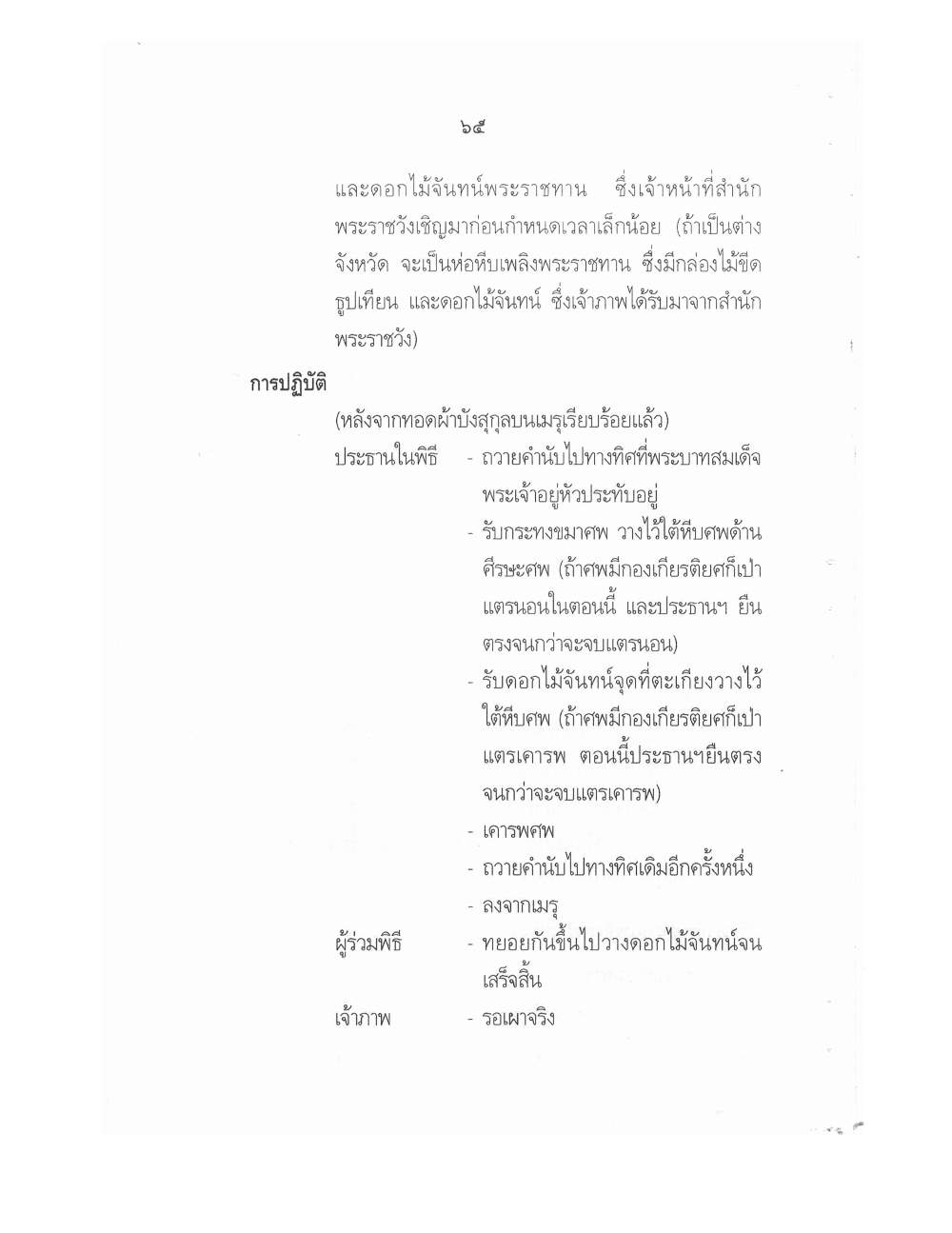
และดอกไม้จันทน์พระราชทาน ซึ่งเจ้าหน้าที่สำนักพระราชวังเชิญมาก่อนกำหนดเวลาเล็กน้อย (ถ้าเป็นต่างจังหวัด จะเป็นห่อหีบเพลิงพระราชทาน ซึ่งมีกล่องไม้ขีดธูปเทียน และดอกไม้จันทน์ ซึ่งเจ้าภาพได้รับมาจากสำนักพระราชวัง)
การปฏิบัติ (หลังจากทอดผ้าบังสุกุลบนเมรุเรียบร้อยแล้ว) ประธานในพิธี - ถวายคำนับไปทางทิศที่พระบาทสมเด็จพระเจ้าอยู่หัวประทับอยู่ - รับกระทงขมาศพ วางไว้ใต้หีบศพด้านศีรษะศพ (ถ้าศพมีกองเกียรติยศก็เป่าแตรนอนในตอนนี้ และประธานฯ ยืนตรงจนกว่าจะจบแตรนอน) - รับดอกไม้จันทน์จุดที่ตะเกียงวางไว้ใต้หีบศพ (ถ้าศพมีกองเกียรติยศก็เป่าแตรเคารพ ตอนนี้ประธานฯยืนตรงจนกว่าจะจบแตรเคารพ) - เคารพศพ - ถวายคำนับไปทางทิศเดิมอีกครั้งหนึ่ง - ลงจากเมรุ ผู้ร่วมพิธี - ทยอยกันขึ้นไปวางดอกไม้จันทน์จนเสร็จสิ้น เจ้าภาพ - รอเผาจริง
and the royally bestowed sandalwood flower, which an official of the Royal Household Bureau brings a short while before the appointed time. (If the ceremony takes place in the provinces, it will instead be a packet of royally bestowed cremation fire, containing a box of matches, incense and candles, and a sandalwood flower, which the host receives from the Royal Household Bureau.)
Procedure (After the forsaken-cloth robe has been duly offered on the crematorium) Chairperson of the ceremony — pays respects toward the direction where His Majesty the King resides - receives the tray of apology-offerings to the corpse, places it under the coffin at the head end (if the corpse has a guard of honor, the "reclining" bugle call is sounded at this point, and the chairperson stands at attention until the call ends) - receives the sandalwood flower, lights it at the lamp, places it beneath the coffin (if the corpse has a guard of honor, the "salute" bugle call is sounded; the chairperson now stands at attention until the call ends) - pays respect to the corpse - pays respects toward the same direction once more - descends from the crematorium Participants — take turns going up to place sandalwood flowers until all have finished Host — waits for the actual cremation
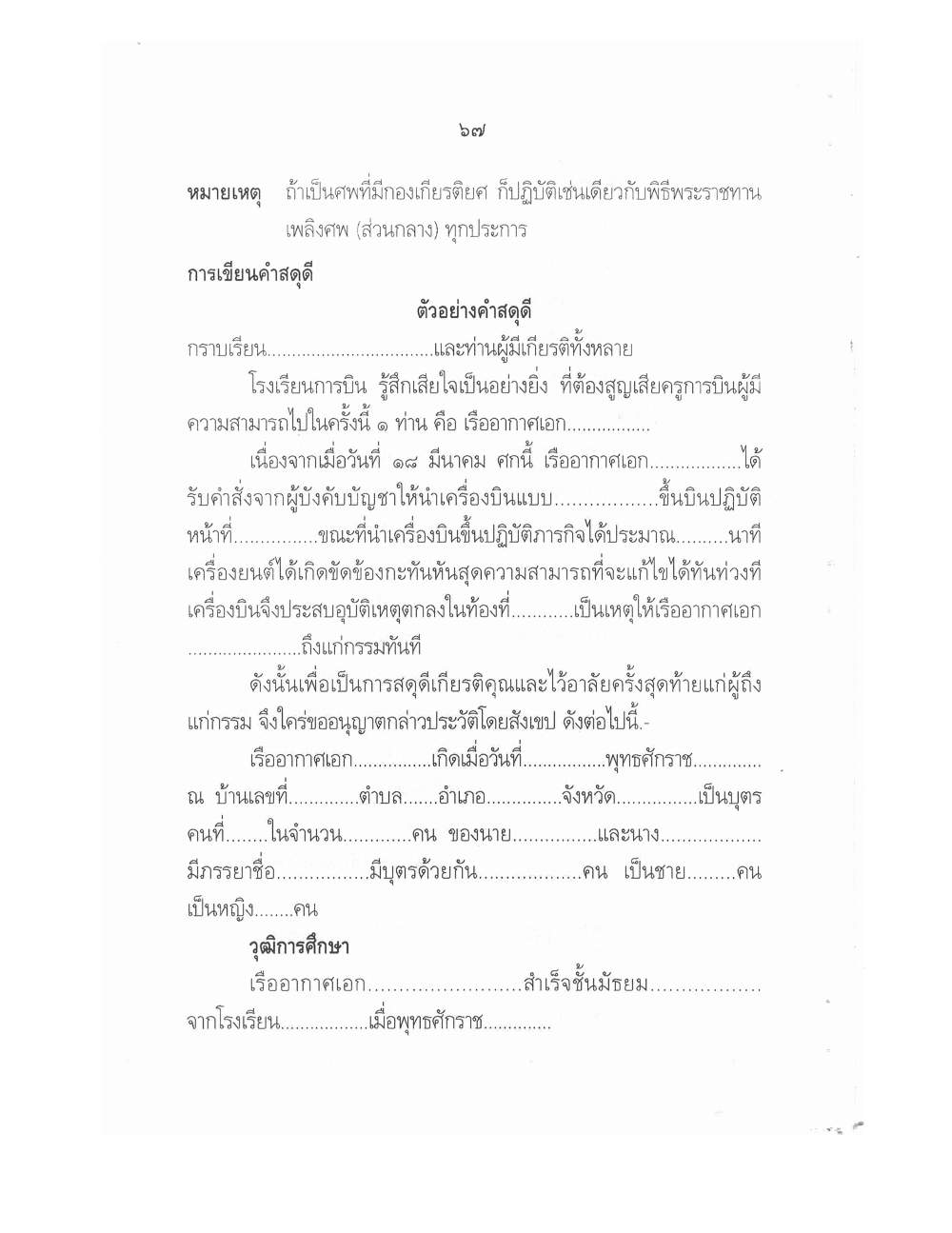
หมายเหตุ ถ้าเป็นศพที่มีกองเกียรติยศ ก็ปฏิบัติเช่นเดียวกับพิธีพระราชทานเพลิงศพ (ส่วนกลาง) ทุกประการ
การเขียนคำสดุดี
ตัวอย่างคำสดุดี
กราบเรียน..................................และท่านผู้มีเกียรติทั้งหลาย
โรงเรียนการบิน รู้สึกเสียใจเป็นอย่างยิ่ง ที่ต้องสูญเสียครูการบินผู้มีความสามารถไปในครั้งนี้ ๑ ท่าน คือ เรืออากาศเอก.................
เนื่องจากเมื่อวันที่ ๑๘ มีนาคม ศกนี้ เรืออากาศเอก..................ได้รับคำสั่งจากผู้บังคับบัญชาให้นำเครื่องบินแบบ..................ขึ้นบินปฏิบัติหน้าที่..............ขณะที่นำเครื่องบินขึ้นปฏิบัติภารกิจได้ประมาณ..........นาที เครื่องยนต์ได้เกิดขัดข้องกะทันหันสุดความสามารถที่จะแก้ไขได้ทันท่วงที เครื่องบินจึงประสบอุบัติเหตุตกลงในท้องที่..........เป็นเหตุให้เรืออากาศเอก......................ถึงแก่กรรมทันที
ดังนั้นเพื่อเป็นการสดุดีเกียรติคุณและไว้อาลัยครั้งสุดท้ายแก่ผู้ถึงแก่กรรม จึงใคร่ขออนุญาตกล่าวประวัติโดยสังเขป ดังต่อไปนี้.-
เรืออากาศเอก...............เกิดเมื่อวันที่...............พุทธศักราช............. ณ บ้านเลขที่.............ตำบล.......อำเภอ..............จังหวัด................เป็นบุตรคนที่.......ในจำนวน.............คน ของนาย.................และนาง...................มีภรรยาชื่อ................มีบุตรด้วยกัน..................คน เป็นชาย..........คน เป็นหญิง.........คน
วุฒิการศึกษา เรืออากาศเอก...........................สำเร็จชั้นมัธยม..................จากโรงเรียน..................เมื่อพุทธศักราช............
Note: If the corpse has a guard of honor, proceed in every respect the same as the Royally Bestowed Cremation Ceremony (Central).
Writing a Eulogy
Example Eulogy
Respectfully addressed to.................................. and all honored guests,
The Flying Training School feels the deepest sorrow at having to lose, on this occasion, one capable flight instructor, namely Flight Lieutenant.................
On the 18th of March this year, Flight Lieutenant.................. received orders from his commanding officer to take an aircraft of type.................. up on a flight to carry out the duty of..............While carrying out the mission for approximately..........minutes, the engine suddenly malfunctioned beyond any possibility of timely correction, and the aircraft consequently crashed in the area of..........causing Flight Lieutenant......................to pass away instantly.
Therefore, in order to pay tribute to his merits and to bid a final farewell to the deceased, permission is requested to give a brief account of his life, as follows: -
Flight Lieutenant...............was born on...............,Buddhist Era............. at house number.............,Tambon.......,Amphoe..............,Province................,the.......th child of.............children born to Mr.................and Mrs...................He had a wife named................and.................. children together, ..........boys and.........girls.
Educational Qualifications Flight Lieutenant...........................completed secondary school..................from.................. School in Buddhist Era............
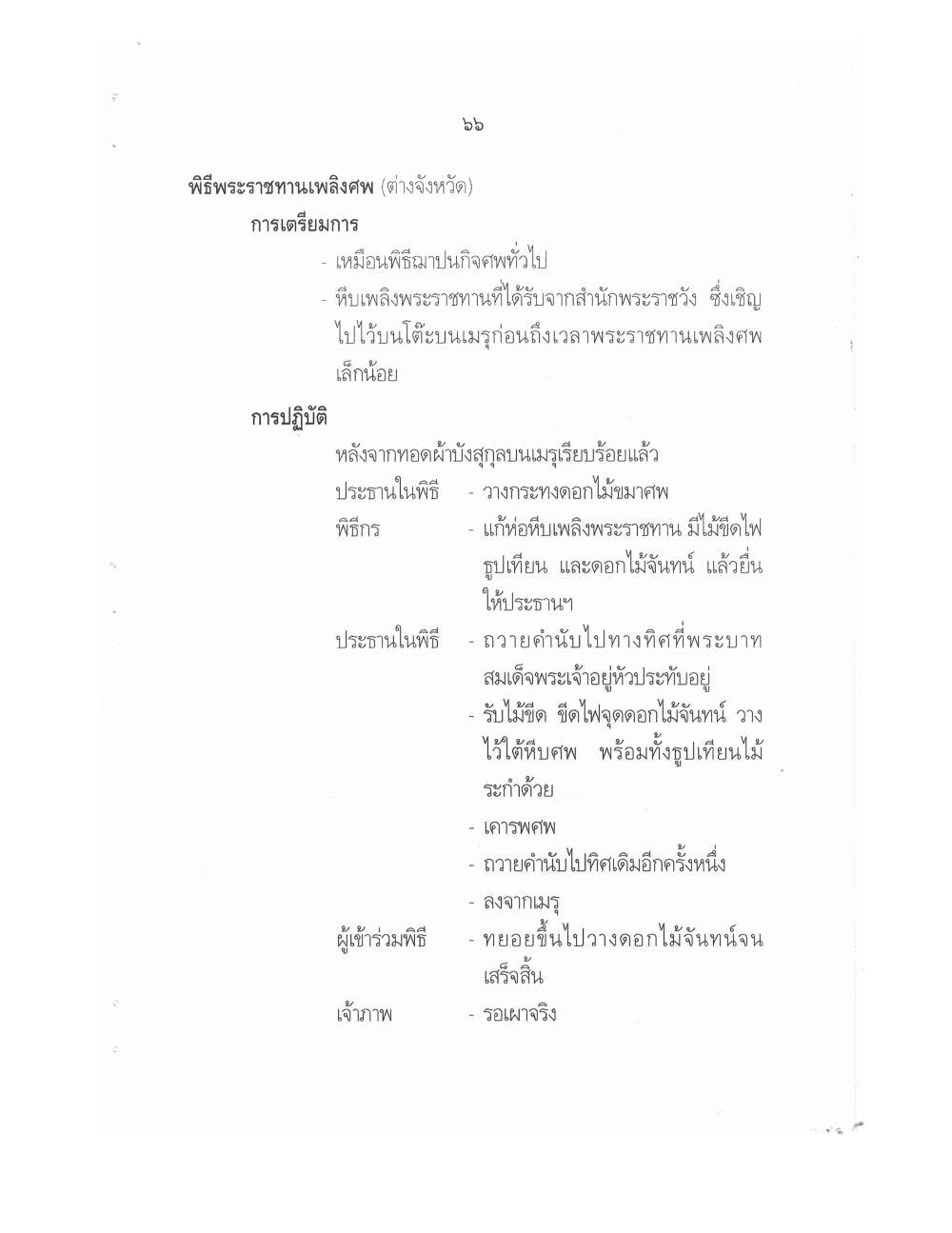
พิธีพระราชทานเพลิงศพ (ต่างจังหวัด)
การเตรียมการ - เหมือนพิธีฌาปนกิจศพทั่วๆไป - หีบเพลิงพระราชทานที่ได้รับจากสำนักพระราชวัง ซึ่งเชิญไปไว้บนโต๊ะบนเมรุก่อนถึงเวลาพระราชทานเพลิงศพเล็กน้อย
การปฏิบัติ หลังจากทอดผ้าบังสุกุลบนเมรุเรียบร้อยแล้ว ประธานในพิธี - วางกระทงดอกไม้ขมาศพ พิธีกร - แก้ห่อหีบเพลิงพระราชทาน มีไม้ขีดไฟ ธูปเทียน และดอกไม้จันทน์ แล้วยื่นให้ประธานฯ ประธานในพิธี - ถวายคำนับไปทางทิศที่พระบาทสมเด็จพระเจ้าอยู่หัวประทับอยู่ - รับไม้ขีด ขีดไฟจุดดอกไม้จันทน์ วางไว้ใต้หีบศพ พร้อมทั้งธูปเทียนไม้ระกำด้วย - เคารพศพ - ถวายคำนับไปทิศเดิมอีกครั้งหนึ่ง - ลงจากเมรุ ผู้เข้าร่วมพิธี - ทยอยขึ้นไปวางดอกไม้จันทน์จนเสร็จสิ้น เจ้าภาพ - รอเผาจริง
The Royally Bestowed Cremation Ceremony (Provincial)
Preparations - the same as the general cremation ceremony - the royally bestowed fire-casket received from the Royal Household Bureau, which is brought and placed on the table on the crematorium a short while before the time of the royally bestowed cremation
Procedure After the forsaken-cloth robe has been duly offered on the crematorium Chairperson of the ceremony — places the tray of apology-flowers for the corpse Master of ceremonies — unwraps the royally bestowed fire-casket, containing matches, incense and candles, and a sandalwood flower, then hands them to the chairperson Chairperson of the ceremony — pays respects toward the direction where His Majesty the King resides - takes the match, strikes it to light the sandalwood flower, places it beneath the coffin, together with the fragrant rakam-wood incense and candles as well - pays respect to the corpse - pays respects toward the same direction once more - descends from the crematorium Participants — take turns going up to place sandalwood flowers until all have finished Host — waits for the actual cremation
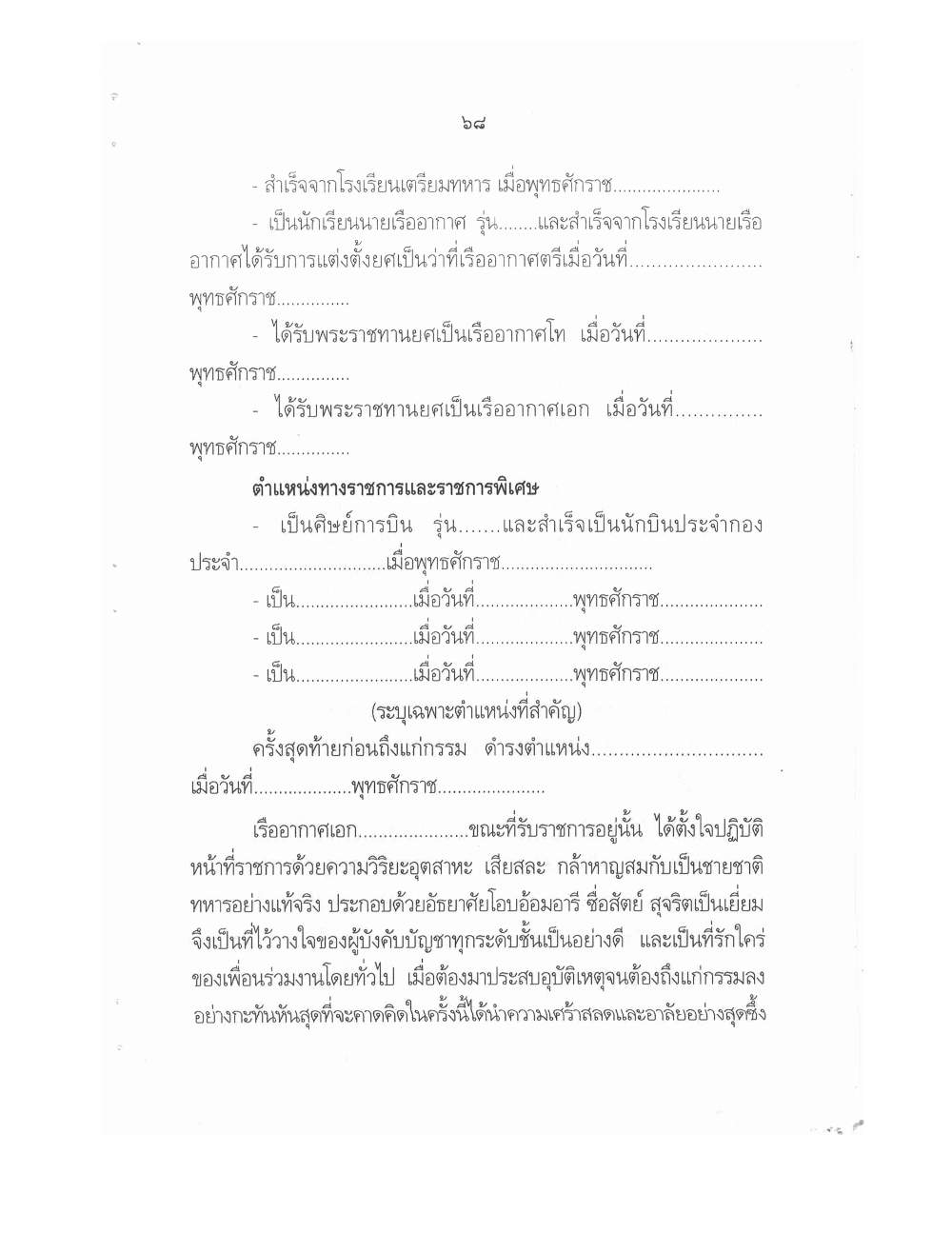
- สำเร็จจากโรงเรียนเตรียมทหาร เมื่อพุทธศักราช...................... - เป็นนักเรียนนายเรืออากาศ รุ่น........และสำเร็จจากโรงเรียนนายเรืออากาศได้รับการแต่งตั้งยศเป็นว่าที่เรืออากาศตรีเมื่อวันที่.......................... พุทธศักราช.............. - ได้รับพระราชทานยศเป็นเรืออากาศโท เมื่อวันที่..................... พุทธศักราช.............. - ได้รับพระราชทานยศเป็นเรืออากาศเอก เมื่อวันที่.............. พุทธศักราช..............
ตำแหน่งทางราชการและราชการพิเศษ - เป็นศิษย์การบิน รุ่น.......และสำเร็จเป็นนักบินประจำกอง ประจำ..............................เมื่อพุทธศักราช............................. - เป็น........................เมื่อวันที่..................พุทธศักราช.................... - เป็น........................เมื่อวันที่..................พุทธศักราช.................... - เป็น........................เมื่อวันที่..................พุทธศักราช.................... (ระบุเฉพาะตำแหน่งที่สำคัญ) ครั้งสุดท้ายก่อนถึงแก่กรรม ดำรงตำแหน่ง.................................... เมื่อวันที่....................พุทธศักราช.......................
เรืออากาศเอก......................ขณะที่รับราชการอยู่นั้น ได้ตั้งใจปฏิบัติหน้าที่ราชการด้วยความวิริยะอุตสาหะ เสียสละ กล้าหาญสมกับเป็นชายชาติทหารอย่างแท้จริง ประกอบด้วยอัธยาศัยโอบอ้อมอารี ซื่อสัตย์ สุจริตเป็นเยี่ยม จึงเป็นที่ไว้วางใจของผู้บังคับบัญชาทุกระดับชั้นเป็นอย่างดี และเป็นที่รักใคร่ของเพื่อนร่วมงานโดยทั่วไป เมื่อต้องมาประสบอุบัติเหตุจนต้องถึงแก่กรรมลงอย่างกะทันหันสุดที่จะคาดคิดในครั้งนี้ได้นำความเศร้าสลดและอาลัยอย่างสุดซึ้ง
- graduated from the Armed Forces Academy Preparatory School in Buddhist Era...................... - was a cadet at the Air Force Academy, Class........, and upon graduating from the Air Force Academy was appointed to the rank of Acting Pilot Officer on.......................... Buddhist Era.............. - was granted the rank of Flying Officer on..................... Buddhist Era.............. - was granted the rank of Flight Lieutenant on.............. Buddhist Era..............
Official Positions and Special Duties - was a flying cadet, Class......., and upon graduating became a pilot attached to the unit stationed at..............................in Buddhist Era............................. - served as........................on..................Buddhist Era.................... - served as........................on..................Buddhist Era.................... - served as........................on..................Buddhist Era.................... (State only the important positions) The last position held before death was.................................... as of....................Buddhist Era.......................
Flight Lieutenant......................, while in service, carried out his official duties with diligence, dedication, and courage, truly worthy of a soldier's calling. Possessed of a generous, honest, and thoroughly upright disposition, he was held in the highest trust by commanding officers at every level, and was well loved by his fellow officers generally. When he came to meet with this accident and passed away so suddenly and unexpectedly on this occasion, it has brought the deepest sorrow and most profound grief
มาให้แก่ผู้บังคับบัญชา มารดาบิดา บุตร ภรรยา และญาติมิตร ตลอดจนเพื่อนร่วมงานใกล้ชิดทั้งหลาย
เรืออากาศเอก....................ขณะที่ถึงแก่กรรมนี้ (นั้น) อายุยังน้อย หากไม่ประสบอุบัติเหตุจนต้องถึงแก่กรรมลงดังกล่าว ก็จะสามารถสร้างความก้าวหน้าให้กับชีวิต และเจริญรุ่งโรจน์ในหน้าที่ราชการ เป็นกำลังสำคัญให้กับกองทัพและประเทศชาติ นำเกียรติประวัติมาสู่วงศ์ตระกูลต่อไปอีกเป็นอันมาก แต่ความตายก็เป็นกฎธรรมดาของชีวิต เมื่อถึงคราวแล้วก็ไม่มีใครจะสามารถหลีกพ้นไปได้
ฉะนั้น ณ โอกาสนี้ เพื่อเป็นเกียรติและเป็นการไว้อาลัยสุดท้ายแก่เรืออากาศเอก...........จึงใคร่ขอเรียนเชิญท่านผู้มีเกียรติทั้งหลายได้โปรดยืนขึ้น สำรวมจิต ๑ นาที (ยืนตรงชั่วขณะหนึ่ง และกล่าวว่า "ขอบคุณ")
(ต่อไปนี้ผู้อ่านหันหน้าไปทางศพ กล่าว)
"เรืออากาศเอก.............
กรรมใดหากทุกคน ณ ที่นี้ ได้เคยล่วงเกินต่อท่านด้วยกาย วาจา ใจ ทั้งต่อหน้าและลับหลัง โดยมีเจตนาหรือหาไม่ก็ตาม ขอได้โปรดอโหสิกรรมนั้นแก่ทุกคนด้วย
อนึ่ง ผู้บังคับบัญชา มารดาบิดา บุตรธิดา และญาติมิตรได้ร่วมกันบำเพ็ญกุศลแก่ท่านแล้วตามประเพณีเป็นลำดับมาโดยสมบูรณ์ทุกประการ ขออำนาจบุญกุศลอุทิศเหล่านี้ และอำนาจคุณความดีทั้งมวลของท่านที่ได้สร้างสมไว้ขณะที่ยังมีชีวิตอยู่ได้โปรดรวมกันเป็นปัจจัยส่งเสริมให้ดวงวิญญาณของท่านได้ไปสถิตยังสุคติภพ ประสบสุขอันไพบูลย์ เพิ่มพูนในสัมปรายภพยิ่งๆขึ้นไปเทอญ"
[continuing from a preceding page — the following comes] to the commanding officer, mother and father, children, spouse, and relatives and friends, as well as all close colleagues.
Flight Lieutenant .................. at the time of his/her death (that time) was still young in years. Had he/she not met with the accident that led to this death, he/she could have gone on to build great progress in life and flourish in official duties, becoming an important pillar of strength for the armed forces and the nation, bringing much further honor to the family lineage. But death is the ordinary law of life; when the time comes, no one can escape it.
Therefore, on this occasion, in honor of and as a final tribute to Flight Lieutenant ..........., we would like to invite all honored guests present to please rise and observe one minute of silent reflection. (Stand still for a moment, and say "Thank you.")
(From here, the reader turns to face the body and says:)
"Flight Lieutenant .............
Whatever wrong any of us here may have done against you, in body, speech, or mind, whether openly or behind your back, whether intentionally or not, may you please forgive that transgression toward everyone.
Furthermore, your commanding officers, mother and father, children, and relatives and friends have together performed merit-making for you in due traditional order, completely and in every respect. May the power of this dedicated merit, together with the power of all the goodness you accumulated while you were alive, combine as a supporting factor so that your spirit may abide in a fortunate realm, experience abundant happiness, and flourish ever more in the next existence."
การอ่านคำสดุดี
ลำดับการปฏิบัติ (ผู้อ่าน) - เดินออกไป คำนับประธานในพิธี - เดินขึ้นบนเมรุ คำนับศพแล้วยืนที่ไมโครโฟน - คำนับประธานฯ แล้วอ่านหมายรับสั่ง (ถ้ามี) - อ่านสำนึกในพระมหากรุณาธิคุณ - อ่านประวัติย่อและคำสดุดี
หมายเหตุ อ่านตามลำดับขั้นตอนที่สำนักพระราชวังชี้แนะ - จบแล้วคำนับศพ แล้วหันมาคำนับประธานฯ - ลงจากเมรุ เสร็จพิธี (ต่อไป ประธานในพิธีขึ้นทอดผ้าบังสุกุล พระสงฆ์ชักผ้าบังสุกุล แล้วประชุมเพลิงหรือพระราชทานเพลิง)
พิธีเก็บอัฐิ
การเตรียมการ - เครื่องทองน้อย ๑ ที่ - ผ้าบังสุกุล (นิยมใช้ผ้าสบง ๓ ผืน หรือตามจำนวนพระสงฆ์) - นิมนต์พระสงฆ์ ๓ รูป (บางแห่งใช้ ๑ รูป) - น้ำอบไทย ๑ ขวด - ดอกมะลิ เหรียญเงิน เหรียญทอง (สำหรับโรยบนอัฐิ) - โกศ ๑ อัน, ลุ้ง ๑ ที่ หรือผ้าขาว ๑ ผืน (ประมาณ ๒ เมตร) - ปิ่นโตอาหาร ๓ เถา
Reading the eulogy
Sequence of actions (the reader): - Walk out and bow to the chairperson of the ceremony - Walk up onto the cremation platform (meru), bow to the body, then stand at the microphone - Bow to the chairperson, then read the royally-issued order (if there is one) - Read the expression of gratitude for the royal grace - Read the brief biography and the eulogy
Note: read following the sequence advised by the Bureau of the Royal Household - When finished, bow to the body, then turn and bow to the chairperson - Step down from the platform End of ceremony (Next, the chairperson of the ceremony offers the bangsukul cloth, the monks draw the cloth, and then the fire is lit or the royally-granted fire is offered.)
Rite of gathering the remains
Preparations: - One set of small gold ceremonial implements (khrueang thong noi) - Bangsukul cloth (customarily three lower-robe cloths, or according to the number of monks) - Invite three monks (in some places, one monk is used) - One bottle of Thai perfumed water - Jasmine flowers, silver coins, gold coins (for scattering onto the remains) - One urn, one lung basket, or one white cloth (about 2 meters) - Three tiered food containers (pinto)
- ดอกไม้ธูปเทียน ไทยธรรม ตามจำนวนพระสงฆ์
การปฏิบัติ (เมื่อถึงกำหนดเวลา) เจ้าภาพ - จุดธูปเทียนเครื่องทองน้อยสักการะอัฐิ - โปรยดอกมะลิ เหรียญเงิน เหรียญทอง ลงบนอัฐิ - พรมน้ำหอมลงบนอัฐิ - ทอดผ้าบังสุกุล (วางผ้าบนอัฐิด้านที่สมมติเป็นศีรษะ) พระสงฆ์ชักผ้า (บังสุกุลตาย) แล้วกลับหัวท้ายอัฐิ - ทอดผ้าบังสุกุล (ใช้ผ้าผืนเดิม) พระสงฆ์ชักผ้าบังสุกุล (บังสุกุลเป็น) - เลือกเก็บอัฐิส่วนที่สำคัญลงในโกศ เจ้าหน้าที่ - ห่ออัฐิและอังคาร (เถ้าถ่านของศพที่เผาแล้ว) ส่วนที่เหลือแล้วบรรจุลงในลุ้งหรือห่อผ้าขาวมัดปาก เจ้าภาพ - ยกโกศและลุ้งไปตั้งบนศาลา (ที่พระสงฆ์ ๓ รูป นั่งรออยู่) - ประเคนปิ่นโต และไทยธรรมแด่พระสงฆ์ พระสงฆ์อนุโมทนา - กรวดน้ำ รับพร - นำโกศอัฐิไปเก็บไว้ที่บ้านหรือนำไปบรรจุต่อไป
- Flowers, incense and candles, and Thaidham offerings, according to the number of monks.
Practice: (When the appointed time arrives) Host — Light incense and candles from the small gold implements to pay respect to the remains. - Scatter jasmine flowers, silver coins, and gold coins onto the remains. - Sprinkle perfumed water onto the remains. - Offer the bangsukul cloth (lay the cloth over the end of the remains taken to represent the head); the monks draw the cloth (bangsukul for the dead), then the remains are turned head to foot. - Offer the bangsukul cloth again (using the same cloth); the monks draw the cloth (bangsukul for the living). - Select and gather the significant pieces of the remains into the urn. Officials — Wrap the remains and the ash (the cinders of the cremated body); the leftover portion is placed into the lung basket or wrapped in white cloth with the mouth tied shut. Host — Lift the urn and the basket and set them on the pavilion (where the three monks are sitting and waiting). - Present the tiered food containers and the Thaidham offerings to the monks; the monks give their blessing. - Pour the water of dedication and receive the blessing. - Take the urn of remains to keep at home, or proceed to enshrine it.
หมายเหตุ - ทำแบบย่อก็ได้ กล่าวคือ หลังจากพระสงฆ์ชักผ้าบังสุกุล แล้วก็ประเคนไทยธรรมบนเมรุเลย - พิธีเก็บอัฐินี้ โบราณเรียก "พิธี ๓ หาบ" คือ หาบของนุ่ง (สบงจีวร) หาบของกิน (คาวหวาน ถวายพระ) และหาบของใช้ (เตา หม้อ ถ้วยชาม เป็นต้น) ญาติพี่น้องช่วยกันหาบเดินเวียนเมรุ ๓ รอบ ก่อนเก็บอัฐิ เรียกกันว่า "พิธีเดิน ๓ หาบ"
พิธีลอยอังคาร
การเตรียมการ - ห่ออังคารหรือลุ้งที่จะนำไปลอย - ธูป ๑ ดอก (หรือแจกผู้เข้าร่วมพิธีคนละดอกก็ได้)
การปฏิบัติ - นำห่ออังคารหรือลุ้งลงเรือไปห่างฝั่ง (ทะเลหรือแม่น้ำ) พอสมควร (ถ้าเป็นพิธีราชการทางราชการก็บรรทุกเครื่องบินบินผ่านทะเลแล้วหย่อนลงทะเล) - จุดธูป แก้ห่ออังคาร หรือเปิดลุ้ง อธิษฐานว่า "สังขารร่างกายของคนเราย่อมแตกดับและสลายไปเป็นธรรมดา แต่เกียรติคุณความดีจะคงอยู่กับโลกตลอดไป ขอคุณงามความดีของท่านให้ได้ไปสถิตยังสุคติภพ ประสบสุข อดิศัยในสัมปรายภพด้วยเทอญ" แล้วหย่อนลงน้ำ พร้อมหย่อนธูปลงไปด้วย เสร็จพิธี
Note: - It may also be done in an abbreviated form, that is, after the monks draw the bangsukul cloth, the Thaidham offerings are presented right there on the cremation platform. - This rite of gathering the remains is traditionally called the "Rite of the Three Loads" (phithi sam hap): the load of clothing (lower robe and upper robe), the load of food (savory and sweet dishes offered to the monks), and the load of utensils (stove, pots, cups, bowls, and so on). Relatives help carry these loads and walk in procession around the cremation platform three times before the remains are gathered; this is called the "Rite of Walking the Three Loads."
Rite of scattering the ashes upon the water
Preparations: - The wrapped ashes or basket to be taken out for scattering - One stick of incense (or one may be distributed to each participant in the rite)
Practice: - Take the wrapped ashes or basket out by boat to a suitable distance from the shore (sea or river). (If it is an official government ceremony, the ashes may instead be carried by aircraft, flown out over the sea, and dropped into the sea.) - Light the incense, untie the wrapped ashes or open the basket, and make the aspiration: "The physical body of a person naturally breaks apart and dissolves — this is ordinary. But honor and goodness remain with the world forever. May your virtue and goodness bring you to abide in a fortunate realm, to encounter happiness, and to flourish exceedingly in the next existence." Then lower it into the water, releasing the incense stick along with it. End of ceremony.
พิธีบรรจุอัฐิ
การเตรียมการ - เครื่องทองน้อย หรือแจกันดอกไม้-เชิงเทียน-กระถางธูป (ใช้ธูป ๑ ดอก) มีโต๊ะรองรับ ตั้งไว้หน้าโต๊ะโกศอัฐิ - น้ำหอม - ดอกไม้ (ดอกมะลิ) - ผ้าไตร หรือสบง (ตามจำนวนพระสงฆ์) - ไทยธรรม (ตามจำนวนพระสงฆ์) - ที่กรวดน้ำ - โกศอัฐิที่จะบรรจุ (ตั้งไว้บนโต๊ะปูผ้าขาว) - ด้ายสายสิญจน์ หรือภูษาโยง (โยงจากโกศอัฐิไปที่โต๊ะทอดผ้า)
การปฏิบัติ เจ้าภาพ - เปิดโกศอัฐิ โรยดอกมะลิลงบนอัฐิ พรมน้ำหอม - จุดธูปเทียนเครื่องทองน้อย หรือธูปเทียนที่จัดไว้สักการะ - ทอดผ้าบังสุกุล (พระสงฆ์ชักผ้าบังสุกุล) - ประเคนไทยธรรม - กรวดน้ำ รับพร (เมื่อพระสงฆ์อนุโมทนา) - ปิดโกศ-นำโกศอัฐิบรรจุในเจดีย์หรือที่เตรียมไว้ ปิดผนึกให้เรียบร้อย เสร็จพิธี
Rite of enshrining the remains
Preparations: - A set of small gold ceremonial implements, or a flower vase, candlestick, and incense pot (using one stick of incense), with a supporting table set in front of the table holding the urn of remains - Perfumed water - Flowers (jasmine) - Sets of monk's robes, or lower robes (according to the number of monks) - Thaidham offerings (according to the number of monks) - A vessel for the water of dedication - The urn of remains to be enshrined (set on a table covered with white cloth) - Sacred thread, or a length of connecting cloth (running from the urn to the table where the cloth is offered)
Practice: Host — Open the urn, scatter jasmine flowers onto the remains, sprinkle with perfumed water. - Light the incense and candles of the small gold implements, or the incense and candles prepared for veneration. - Offer the bangsukul cloth (the monks draw the cloth). - Present the Thaidham offerings. - Pour the water of dedication and receive the blessing (when the monks give their blessing). - Close the urn — take the urn of remains and enshrine it in the stupa or the place prepared for it, sealing it properly. End of ceremony.
พิธีทำบุญครบวันมรณะ ( ๗ - ๕๐ - ๑๐๐ วัน )
การเตรียมการ นิมนต์พระสงฆ์ มักใช้ ๕ รูป, ๙ รูป (ถ้าทำที่บ้าน) และ ๔ รูป, ๑๐ รูป (ถ้าทำที่วัด) - โต๊ะหมู่บูชา พร้อมเครื่องสักการะ (เหมือนพิธีทำบุญทั่วไป) - โกศอัฐิหรือรูปผู้ตาย ตั้งไว้ที่โต๊ะต่างหาก ข้างโต๊ะหมู่บูชา หรือตั้งไว้ด้านใดด้านหนึ่งที่เห็นว่าเหมาะสมแต่ต้องไม่สูงกว่าโต๊ะหมู่บูชา - ผ้าบังสุกุล - ภัตตาหาร - ไทยธรรม (ตามจำนวนพระสงฆ์) - สำรับพระพุทธ - สำรับพระภูมิ - สำรับผู้ตาย
การปฏิบัติ (เมื่อถึงกำหนดเวลา) - จุดธูปเทียนบูชาพระรัตนตรัย กราบพระ ๓ ครั้ง - รับศีล ฟังพระสวดพระพุทธมนต์ - บูชาสำรับพระพุทธ - ประเคนภัตตาหารแด่พระสงฆ์ - บูชาสำรับพระภูมิเจ้าที่ - บูชาข้าวผู้ตาย
Rite of merit-making on the anniversary of death (7th, 50th, 100th day)
Preparations: Monks are invited — usually 5 or 9 monks (if held at home), and 4 or 10 monks (if held at the temple). - A tiered altar table with items of veneration (the same as for an ordinary merit-making rite) - The urn of remains or a photograph of the deceased, set on a separate table beside the altar table, or placed on whichever side is deemed suitable, but it must not be set higher than the altar table - Bangsukul cloth - Food offerings for the monks - Thaidham offerings (according to the number of monks) - A tray of offerings for the Buddha - A tray of offerings for the guardian spirit of the land (Phra Phum) - A tray of offerings for the deceased
Practice: (When the appointed time arrives) - Light incense and candles to pay homage to the Triple Gem; prostrate to the Buddha three times - Receive the precepts; listen to the monks chanting the Buddhist blessing - Make an offering to the tray for the Buddha - Present the food offerings to the monks - Make an offering to the tray for the guardian spirit of the land - Make an offering of rice to the deceased
- (พระสงฆ์ฉันเสร็จ) ลาดภูษาโยงหรือสายสิญจน์ที่โยงมาจากโกศหรือรูปภาพ - ทอดผ้าบังสุกุล (ถ้ามี) พระสงฆ์ชักผ้าบังสุกุล - ประเคนไทยธรรม - กรวดน้ำ รับพร - รับประพรมน้ำพระพุทธมนต์ เสร็จพิธี
หมายเหตุ - อาจทำพิธีย่อยๆ เช่น ถวายสังฆทานธรรมดาก็ได้ - บางครอบครัว ทายาทของผู้ตายจัดให้มีการทำบุญครบวันตายเป็นประจำทุกปี กรณีนี้การจัดและการปฏิบัติพิธีก็คงเหมือนกับการทำบุญนั่นเอง
************************** [ภาพถ่ายขาวดำ ดอกบัวสองดอกบาน]
- (Once the monks have finished the meal) Lay out the connecting cloth or sacred thread running from the urn or photograph. - Offer the bangsukul cloth (if there is one); the monks draw the cloth. - Present the Thaidham offerings. - Pour the water of dedication and receive the blessing. - Receive the sprinkling of blessed water. End of ceremony.
Note: - A simpler version of the rite may also be done, such as simply offering sangha-dana (general offerings to the monks). - In some families, the heirs of the deceased arrange for the merit-making on the anniversary of death to be held every year; in this case the arrangement and performance of the rite are the same as for the merit-making described above.
************************** [photograph, black and white: two lotus flowers in bloom]
หมวดที่ ๓ มงคลพิธี ว่าด้วยพิธีที่เกี่ยวกับงานมงคล [กรอบลวดลายไทยประดับรอบข้อความ]
Section 3
Auspicious Rites On the rites pertaining to auspicious ceremonies [decorative Thai ornamental border framing the text]
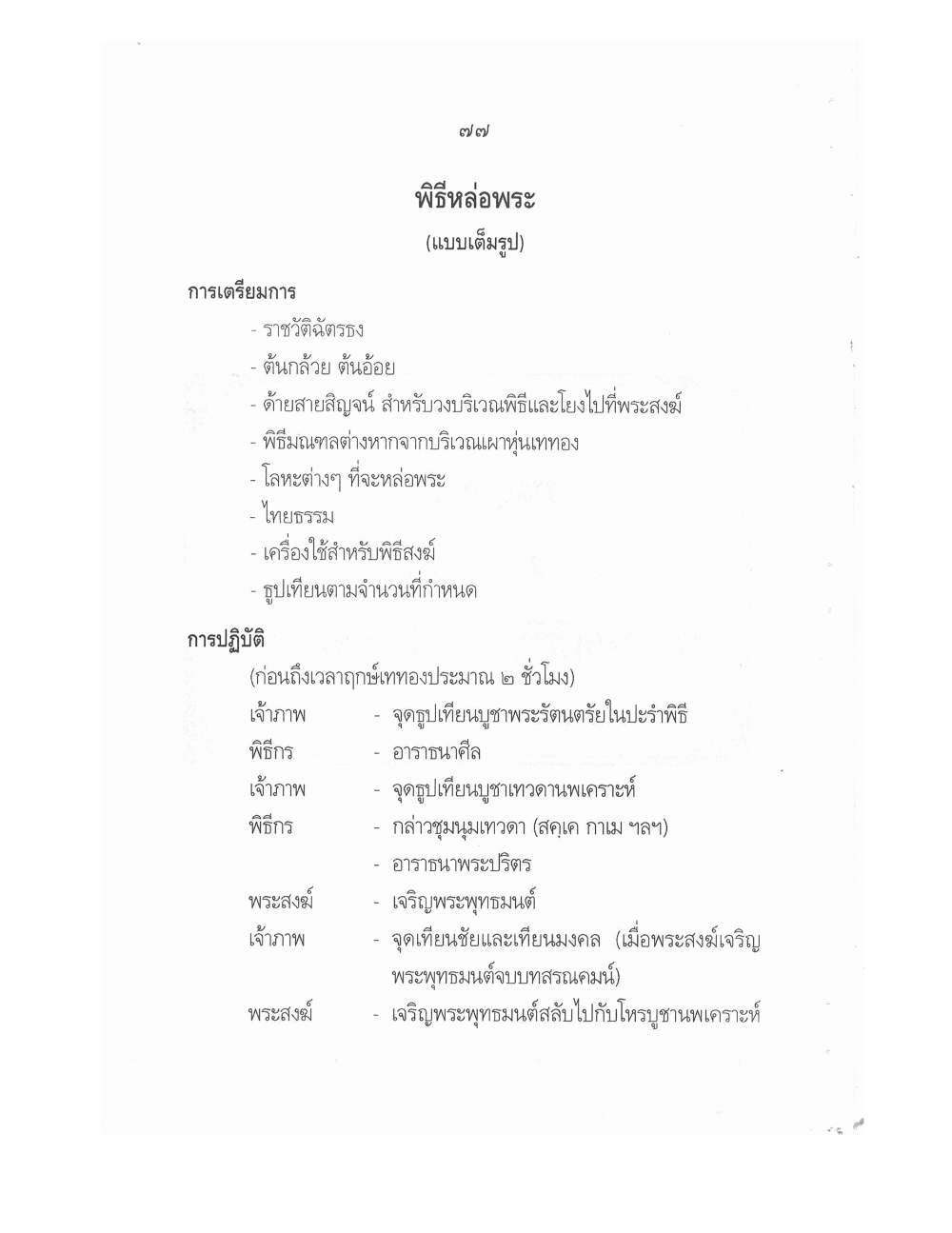
พิธีหล่อพระ (แบบเต็มรูป)
การเตรียมการ - ราชวัติฉัตรธง - ต้นกล้วย ต้นอ้อย - ด้ายสายสิญจน์ สำหรับวงบริเวณพิธีและโยงไปที่พระสงฆ์ - พิธีมณฑลต่างหากจากบริเวณเผาหุ่นเททอง - โลหะต่างๆ ที่จะหล่อพระ - ไทยธรรม - เครื่องใช้สำหรับพิธีสงฆ์ - ธูปเทียนตามจำนวนที่กำหนด
การปฏิบัติ (ก่อนถึงเวลาฤกษ์เททองประมาณ ๒ ชั่วโมง) เจ้าภาพ - จุดธูปเทียนบูชาพระรัตนตรัยในปะรำพิธี พิธีกร - อาราธนาศีล เจ้าภาพ - จุดธูปเทียนบูชาเทวดานพเคราะห์ พิธีกร - กล่าวชุมนุมเทวดา (สคฺเค กาเม ฯลฯ) - อาราธนาพระปริตร พระสงฆ์ - เจริญพระพุทธมนต์ เจ้าภาพ - จุดเทียนชัยและเทียนมงคล (เมื่อพระสงฆ์เจริญพระพุทธมนต์จบบทสรณคมน์) พระสงฆ์ - เจริญพระพุทธมนต์สลับไปกับโหรบูชานพเคราะห์
Rite of casting a Buddha image
(Full form)
Preparations: - Ceremonial fence-poles with tiered umbrellas and flags (ratchawat chattra thong) - Banana plants and sugarcane stalks - Sacred thread for encircling the ceremony area and connecting to the monks - The ritual mandala area, kept separate from the area where the mold is fired for pouring the metal - Various metals to be used for casting the image - Thaidham offerings - Implements for the monks' ceremony - Incense and candles in the specified quantity
Practice: (About two hours before the auspicious time for pouring the metal) Host — Light incense and candles to pay homage to the Triple Gem in the ceremonial pavilion Master of ceremonies — Invite the precepts Host — Light incense and candles to pay homage to the planetary deities Master of ceremonies — Recite the invocation gathering the deities ("Sagge kame..." etc.) - Invite the recitation of the protective chants (Paritta) Monks — Chant the Buddhist blessing Host — Light the victory candle and the auspicious candle (when the monks finish chanting the passage on taking refuge) Monks — Chant the Buddhist blessing, alternating with the astrologer's veneration of the planetary deities
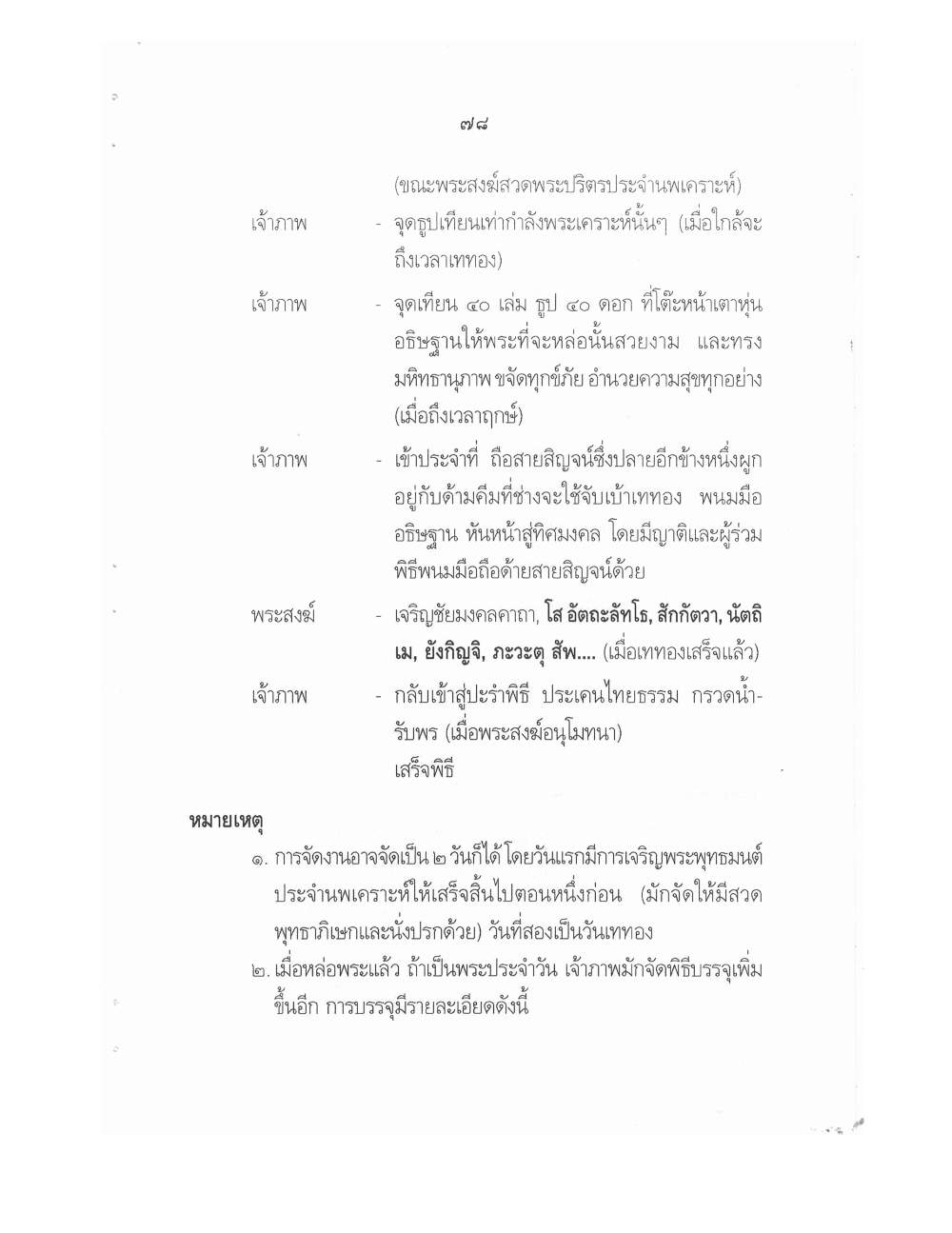
(ขณะพระสงฆ์สวดพระปริตรประจำนพเคราะห์) เจ้าภาพ - จุดธูปเทียนเท่ากำลังพระเคราะห์นั้นๆ (เมื่อใกล้จะถึงเวลาเททอง) เจ้าภาพ - จุดเทียน ๔๐ เล่ม ธูป ๔๐ ดอก ที่โต๊ะหน้าเตาหุ่น อธิษฐานให้พระที่จะหล่อนั้นสวยงาม และทรงมหิทธานุภาพ ขจัดทุกข์ภัย อำนวยความสุขทุกอย่าง (เมื่อถึงเวลาฤกษ์) เจ้าภาพ - เข้าประจำที่ ถือสายสิญจน์ซึ่งปลายอีกข้างหนึ่งผูกอยู่กับด้ามคีมที่ช่างจะใช้จับเบ้าเททอง พนมมืออธิษฐาน หันหน้าสู่ทิศมงคล โดยมีญาติและผู้ร่วมพิธีพนมมือถือด้ายสายสิญจน์ด้วย พระสงฆ์ - เจริญชัยมงคลคาถา, โส อัตถะลัทโธ, สักกัตวา, นัตถิเม, ยังกิญจิ, ภะวะตุ สัพ.... (เมื่อเททองเสร็จแล้ว) เจ้าภาพ - กลับเข้าสู่ปะรำพิธี ประเคนไทยธรรม กรวดน้ำ-รับพร (เมื่อพระสงฆ์อนุโมทนา) เสร็จพิธี
หมายเหตุ ๑. การจัดงานอาจจัดเป็น ๒ วันก็ได้ โดยวันแรกมีการเจริญพระพุทธมนต์ประจำนพเคราะห์ให้เสร็จสิ้นไปตอนหนึ่งก่อน (มักจัดให้มีสวดพุทธาภิเษกและนั่งปรกด้วย) วันที่สองเป็นวันเททอง ๒. เมื่อหล่อพระแล้ว ถ้าเป็นพระประจำวัน เจ้าภาพมักจัดพิธีบรรจุเพิ่มขึ้นอีก การบรรจุมีรายละเอียดดังนี้
(While the monks are chanting the protective verses for the nine planetary deities) Host — Light incense and candles equal in number to the strength (kamlang) of that particular planetary deity (as the time for pouring the metal draws near) Host — Light 40 candles and 40 sticks of incense at the table in front of the mold-firing kiln, making the aspiration that the image to be cast will be beautiful and possess great supernatural power, dispel suffering and danger, and bestow every kind of happiness (when the auspicious moment arrives) Host — Take one's place, holding the sacred thread whose other end is tied to the handle of the tongs the craftsman will use to grip the crucible for pouring the metal; join the palms in prayer, face the auspicious direction, while relatives and other participants also join their palms and hold the sacred thread Monks — Chant the verses of victory and auspiciousness: "So atthaladdho, sakkatva, natthime, yankinci, bhavatu sabb...." (once the pouring of the metal is complete) Host — Return to the ceremonial pavilion, present the Thaidham offerings, pour the water of dedication and receive the blessing (when the monks give their blessing) End of ceremony.
Note: 1. The event may also be arranged over two days: on the first day, the chanting of the Buddhist blessing for the nine planetary deities is completed in one session first (this is often arranged together with a Buddhabhiseka consecration chanting and meditators keeping vigil as well); the second day is the day of pouring the metal. 2. Once the Buddha image has been cast, if it is an image for a day-of-the-week deity, the host will often additionally arrange a rite for inserting items into the image. The details of this insertion are as follows:
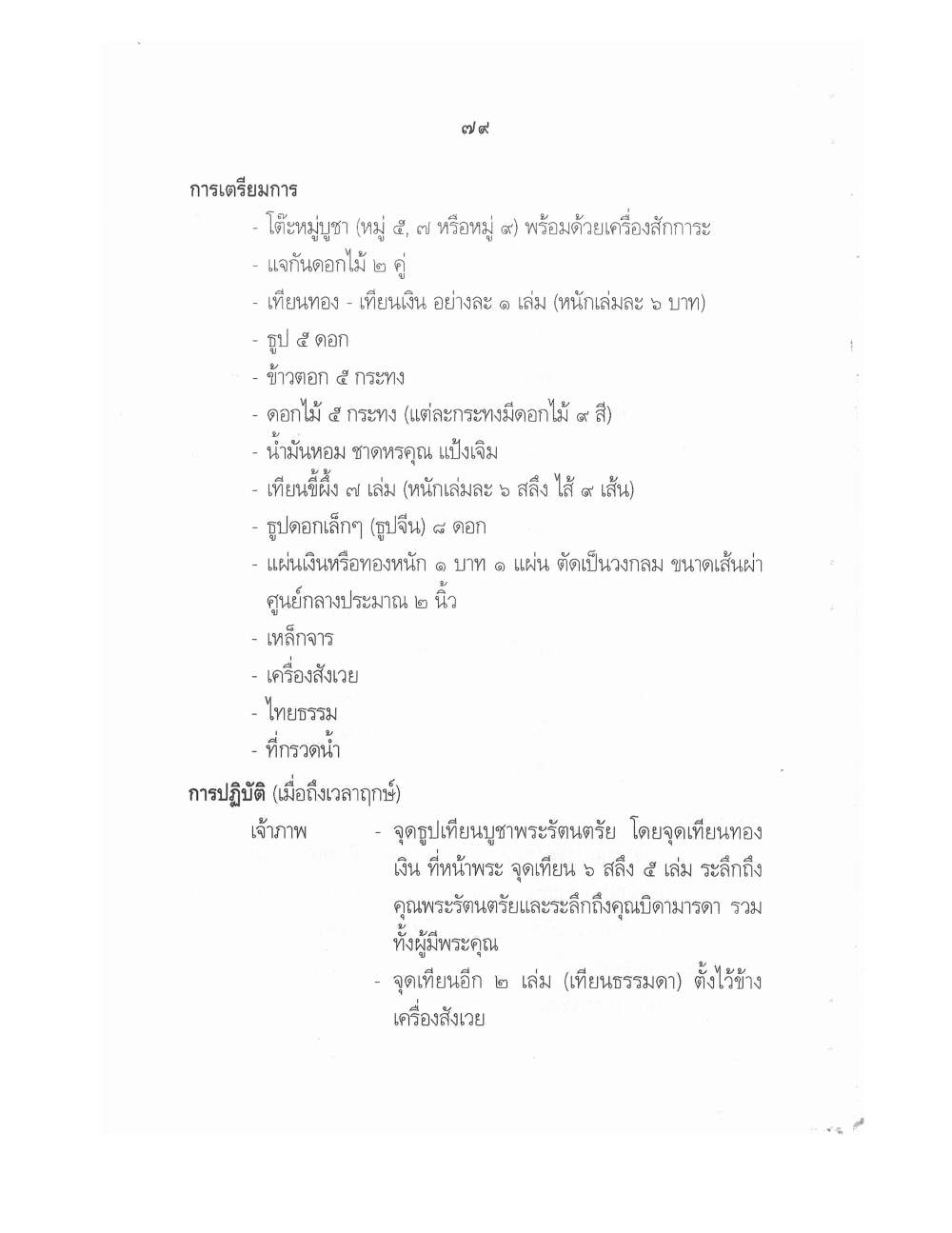
การเตรียมการ - โต๊ะหมู่บูชา (หมู่ ๕, ๗ หรือหมู่ ๙) พร้อมด้วยเครื่องสักการะ - แจกันดอกไม้ ๒ คู่ - เทียนทอง - เทียนเงิน อย่างละ ๑ เล่ม (หนักเล่มละ ๖ บาท) - ธูป ๕ ดอก - ข้าวตอก ๕ กระทง - ดอกไม้ ๕ กระทง (แต่ละกระทงมีดอกไม้ ๙ สี) - น้ำมันหอม ชาดหรคุณ แป้งเจิม - เทียนขี้ผึ้ง ๗ เล่ม (หนักเล่มละ ๖ สลึง ไส้ ๙ เส้น) - ธูปดอกเล็กๆ (ธูปจีน) ๘ ดอก - แผ่นเงินหรือทองหนัก ๑ บาท ๑ แผ่น ตัดเป็นวงกลม ขนาดเส้นผ่าศูนย์กลางประมาณ ๒ นิ้ว - เหล็กจาร - เครื่องสังเวย - ไทยธรรม - ที่กรวดน้ำ
การปฏิบัติ (เมื่อถึงเวลาฤกษ์) เจ้าภาพ - จุดธูปเทียนบูชาพระรัตนตรัย โดยจุดเทียนทองเงิน ที่หน้าพระ จุดเทียน ๖ สลึง ๕ เล่ม ระลึกถึงคุณพระรัตนตรัยและระลึกถึงคุณบิดามารดา รวมทั้งผู้มีพระคุณ - จุดเทียนอีก ๒ เล่ม (เทียนธรรมดา) ตั้งไว้ข้างเครื่องสังเวย
Preparations: - A tiered altar table (in a set of 5, 7, or 9 Buddha images) together with items of veneration - Two pairs of flower vases - One gold candle and one silver candle (each weighing 6 baht by weight) - 5 sticks of incense - 5 trays of popped rice - 5 trays of flowers (each tray containing flowers of 9 colors) - Perfumed oil, cinnabar/haragun pigment, and anointing powder - 7 beeswax candles (each weighing 6 salueng, with 9-strand wicks) - 8 small incense sticks (Chinese-style incense) - One sheet of silver or gold weighing 1 baht, cut into a circle about 2 inches in diameter - An inscribing stylus (lek jarn) - Offerings for the spirits - Thaidham offerings - A vessel for the water of dedication
Practice (when the auspicious moment arrives): Host — Light incense and candles to pay homage to the Triple Gem, lighting the gold and silver candles in front of the Buddha image; light 5 candles of 6 salueng each, calling to mind the virtue of the Triple Gem and the virtue of one's mother and father, as well as all benefactors. - Light 2 more candles (ordinary candles) and set them beside the offerings for the spirits.
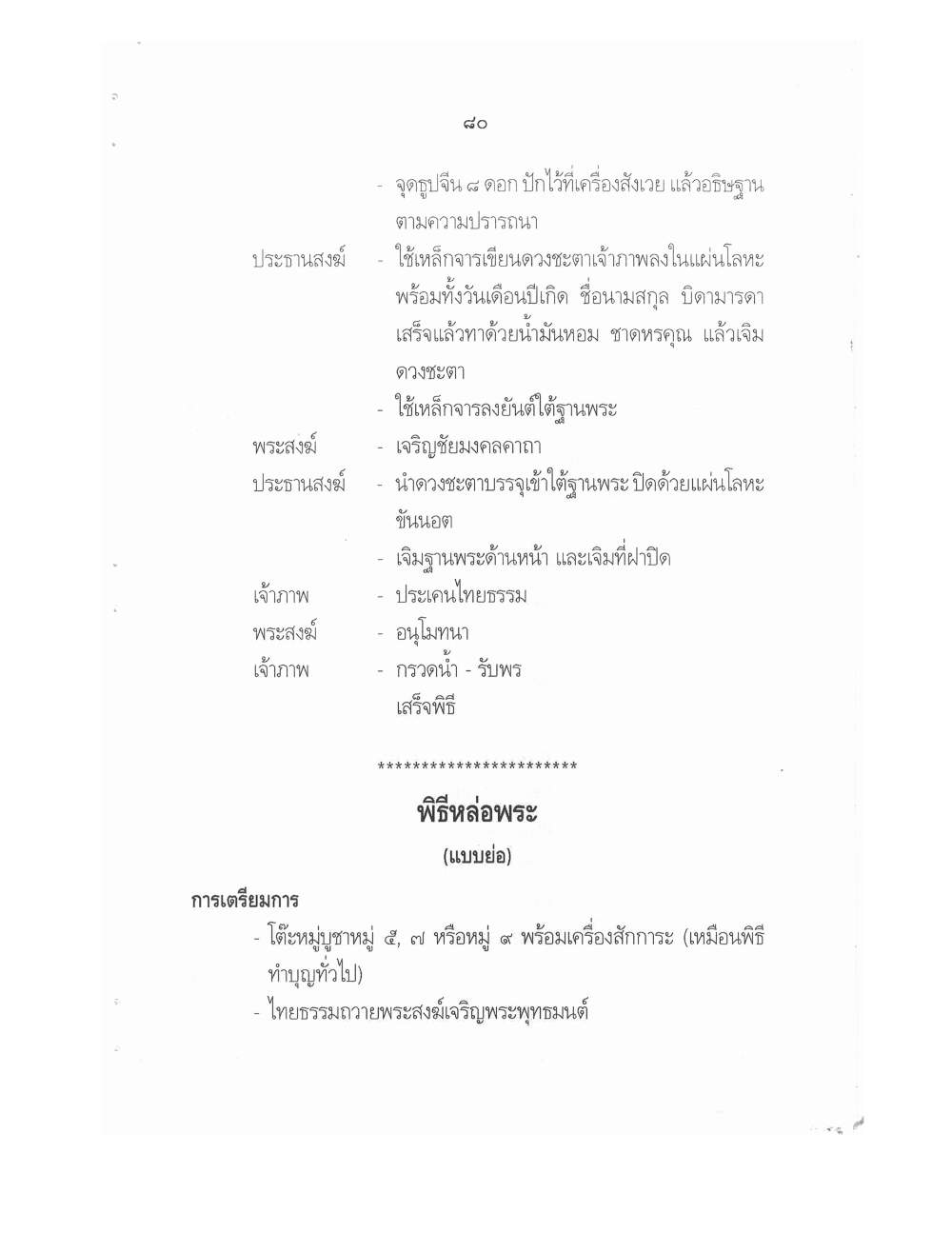
- จุดธูปจีน ๘ ดอก ปักไว้ที่เครื่องสังเวย แล้วอธิษฐานตามความปรารถนา ประธานสงฆ์ - ใช้เหล็กจารเขียนดวงชะตาเจ้าภาพลงในแผ่นโลหะ พร้อมทั้งวันเดือนปีเกิด ชื่อนามสกุล บิดามารดา เสร็จแล้วทาด้วยน้ำมันหอม ชาดหรคุณ แล้วเจิมดวงชะตา - ใช้เหล็กจารลงยันต์ใต้ฐานพระ พระสงฆ์ - เจริญชัยมงคลคาถา ประธานสงฆ์ - นำดวงชะตาบรรจุเข้าใต้ฐานพระ ปิดด้วยแผ่นโลหะขันนอต - เจิมฐานพระด้านหน้า และเจิมที่ฝาปิด เจ้าภาพ - ประเคนไทยธรรม พระสงฆ์ - อนุโมทนา เจ้าภาพ - กรวดน้ำ - รับพร เสร็จพิธี
**************************
พิธีหล่อพระ (แบบย่อ)
การเตรียมการ - โต๊ะหมู่บูชาหมู่ ๕, ๗ หรือหมู่ ๙ พร้อมเครื่องสักการะ (เหมือนพิธีทำบุญทั่วไป) - ไทยธรรมถวายพระสงฆ์เจริญพระพุทธมนต์
- Light 8 sticks of Chinese incense, plant them in the offerings for the spirits, then make one's wished-for aspiration. Presiding monk — Use the inscribing stylus to write the host's horoscope onto the metal sheet, together with the date, month, and year of birth, full name, and the names of the parents; when finished, anoint it with perfumed oil and cinnabar/haragun pigment, then bless the horoscope. - Use the inscribing stylus to inscribe a yantra beneath the base of the Buddha image. Monks — Chant the verses of victory and auspiciousness. Presiding monk — Insert the horoscope into the base of the Buddha image, and seal it with a metal plate and screws/nuts. - Anoint the front of the base of the image, and anoint the sealing plate. Host — Present the Thaidham offerings. Monks — Give the blessing (anumodana). Host — Pour the water of dedication — receive the blessing. End of ceremony.
**************************
Rite of casting a Buddha image
(Abbreviated form)
Preparations: - A tiered altar table in a set of 5, 7, or 9 Buddha images, with items of veneration (the same as for an ordinary merit-making rite) - Thaidham offerings to present to the monks who will chant the Buddhist blessing
๘๑
- โต๊ะบูชาฤกษ์ - สังเวยเทวดา (ตั้งนอกเต็นท์พิธี) - โต๊ะหมู่บูชาหมู่ ๔ (แจกันดอกไม้ ๔, เชิงเทียน ๔, ตั้งอยู่บนโต๊ะเดียวกันนอกเต็นท์พิธีสงฆ์เพื่อบูชาเทวดา) - แท่นประธานในพิธียืนเททอง (ข้างหน้าเตาเผาหุ่นพระ) - เตาหุ่นพระ มีด้ายสายสิญจน์วงรอบ (ช่างหล่อเป็นผู้ดำเนินการ) - ปิ่นโตภัตตาหาร
การปฏิบัติ
(เมื่อพระสงฆ์พร้อมบนอาสนะแล้ว)
ประธานในพิธี - จุดธูปเทียนบูชาพระรัตนตรัย กราบพระ ๓ ครั้ง - รับศีล - ฟังพระเจริญพระพุทธมนต์ - จุดเทียนน้ำมนต์ (เมื่อพระสงฆ์เจริญพระพุทธมนต์ถึงบท "อเสวนา") - จุดธูปเทียนบูชาฤกษ์ - สังเวยเทวดา - ประเคนไทยธรรมและปิ่นโตภัตตาหาร (เมื่อพระสงฆ์เจริญพระพุทธมนต์จบถ้าไม่ถวายภัตตาหารในพิธี)
พระสงฆ์ - อนุโมทนา ประธานฯ - กรวดน้ำ - รับพร - จุดเครื่องบูชาที่โต๊ะหมู่บูชาหมู่ ๔ ข้างนอกเต็นท์พิธี อธิษฐานขออานุภาพบุญกุศล และอำนาจเทวดาบันดาลให้การหล่อพระสำเร็จเรียบร้อยงดงามโดยสวัสดี
81
- Auspicious-time altar table – offering to the deities (set up outside the ceremony tent) - Group-of-4 worship table (4 flower vases, 4 candlesticks, set on the same table outside the monks' ceremony tent, for worshipping the deities) - Presiding officiant's stand for the metal-pouring (in front of the furnace for casting the Buddha image) - Furnace for the Buddha-image mold, encircled by a sacred thread (sai sin) (the caster/founder is in charge of this) - Tiered food container (pinto) of food offerings
Procedure
(When the monks are ready, seated on their seats)
Presiding officiant of the ceremony - Lights incense and candles to worship the Triple Gem, prostrates before the Buddha 3 times - Receives the precepts - Listens to the monks chanting the Buddha's blessing - Lights the holy-water candle (when the monks' chanting reaches the "Asevana" verse) - Lights incense and candles at the auspicious-time altar – offering to the deities - Presents the offerings (Thai dhamma gifts) and the tiered food container (when the monks finish chanting, if the meal was not offered during the ceremony)
Monks - Give the blessing (anumodana) Presiding officiant - Pours the water (kruat nam) – receives the blessing - Lights the offerings at the group-of-4 worship table outside the ceremony tent, praying for the power of merit and the power of the deities to make the casting of the Buddha image succeed smoothly, beautifully, and auspiciously
๘๒
พระสงฆ์ - ประพรมน้ำพระพุทธมนต์ที่หุ่นพระ-ช่าง-และผู้ร่วมพิธี ประธานฯ - ไปยืนบนแท่น หย่อนแผ่นทอง เงิน นาก ชิ้นทอง ชิ้นเงิน ลงบนช้อนคันยาวที่ช่างหล่อยื่นให้แล้วถือด้ามช้อนพร้อมด้ายสายสิญจน์ที่โยงมา เทลงในเบ้าหล่อพระโดยมีญาติและผู้ร่วมพิธีพนมมือถือด้ายสายสิญจน์ด้วย (ขณะนั้นพระสงฆ์เจริญชัยมงคลคาถาจนเททองเสร็จ)
หมายเหตุ - ถ้ามีการเลี้ยงพระในพิธีด้วย ก็ประเคนไทยธรรม กรวดน้ำรับพร หลังจากพระฉันเสร็จแล้ว
************************
พิธีพุทธาภิเษก
การเตรียมการ - เทียนชัย ๑ เล่ม หนัก ๘๐ บาท (ไส้ ๑๐๘ เส้น สูงเท่าความสูงของประธานในพิธีหรือเจ้าภาพ) - เทียนมงคล ๑ เล่ม หนัก ๑๐ บาท (ไส้มีจำนวนเส้นเกินกว่าอายุประธานฯ หรือเจ้าภาพ สูงเท่าความยาวรอบศีรษะของประธานฯ หรือเจ้าภาพ) - เทียนพุทธาภิเษก ๒ เล่ม หนักเล่มละ ๓๒ บาท (ไส้ ๕๖ เส้น สูงประมาณกึ่งหนึ่งของเทียนชัย) - เทียนนวหรคุณ ๙ เล่ม หนักเล่มละ ๒ บาท (ไส้ ๙ เส้น)
82
Monks - Sprinkle holy water on the Buddha-image mold, the craftsmen, and the ceremony participants Presiding officiant - Goes to stand on the platform, drops pieces of gold, silver, and nak (gold-silver-copper alloy) leaf/plate onto the long-handled spoon that the caster hands over, then holds the spoon handle together with the sacred thread that has been passed to him, and pours [the metal] into the crucible for casting the Buddha image, while relatives and ceremony participants also hold the sacred thread with palms pressed together (during this the monks chant the Chai Mongkhon verses until the pouring of the metal is finished)
Note - If a meal is also offered to the monks as part of the ceremony, then present the offerings (Thai dhamma gifts) and pour water to receive the blessing after the monks have finished eating
************************
The Buddhabhiseka (Buddha-Image Consecration) Ceremony
Preparations - 1 main/victory candle (thian chai), weighing 80 baht [a traditional weight unit] (108 wicks, as tall as the presiding officiant or the sponsor) - 1 auspicious candle (thian mongkhon), weighing 10 baht (wicks numbering more than the age of the presiding officiant or sponsor, as long as the circumference of the head of the presiding officiant or sponsor) - 2 Buddhabhiseka candles, weighing 32 baht each (56 wicks, about half the height of the main candle) - 9 navagraha [nine-planet] candles, weighing 2 baht each (9 wicks)
๘๓
- เทียนหน้าพระพุทธาภิเษก ๒ เล่ม (ขนาดและน้ำหนักเหมือนเทียนนวหรคุณ) - เทียนโต๊ะหมู่บูชาพระประธาน ๒ เล่ม (ขนาดพองาม น้ำหนักประมาณเล่มละ ๕ บาท) - ธูปหอม ๓ ดอก - เทียนหนัก ๖ สลึง ๒๘ เล่ม (ไส้ ๙ เส้น) - ธูปจีนดอกเล็กสำหรับปักเครื่องสังเวยเท่าจำนวนสิ่งของ - เทียนบูชาพระรัตนตรัย ๑๐๘ เล่ม หนักเล่มละ ๒ สลึง - ธูป ๑๐๘ ดอก - กำหญ้าคาพรมน้ำมนต์ ๑ กำ - ใบพลู ๗ ใบ (สำหรับดับเทียนชัย ใส่พานเตรียมไว้) - แป้งเจิม ๑ ที่ - เครื่องสังเวย - ตู้ใส่เทียนชัย (กันลม มิให้เทียนชัยดับ)
การปฏิบัติ วันแรก เมื่อใกล้จะถึงเวลาฤกษ์จุดเทียนชัย (มักเป็นเวลาบ่าย) ประธานสงฆ์ - เจิมเทียนชัย เทียนพุทธาภิเษกและเทียนมงคล เจ้าภาพ - จุดเทียนหน้าพระประธาน รับศีล ประธานสงฆ์ - จุดเทียนชัยเมื่อถึงเวลาฤกษ์ พระสงฆ์ - สวดคาถาจุดเทียนชัย พิธีกร - อาราธนาพระปริตร พระสงฆ์ - เจริญพระพุทธมนต์ เจ้าภาพ - จุดเทียนมงคลและเทียนนวหรคุณ (เมื่อจบบทนโม
83
- 2 candles for in front of the image for the Buddhabhiseka (same size and weight as the navagraha candles) - 2 candles for the group-worship table of the principal Buddha image (of moderate size, weighing about 5 baht each) - 3 fragrant incense sticks - 28 candles weighing 6 salueng each (9 wicks) - Small Chinese-style incense sticks for sticking into the offering trays, one for each item offered - 108 candles for worshipping the Triple Gem, weighing 2 salueng each - 108 incense sticks - 1 handful of khaa grass for sprinkling holy water - 7 betel leaves (for extinguishing the main candle, placed ready on a tray) - 1 set of anointing powder - Offering items - A cabinet to hold the main candle (windproof, so the main candle does not go out)
Procedure First day: As the auspicious time for lighting the main candle approaches (usually in the afternoon) Presiding monk - Anoints the main candle, the Buddhabhiseka candles, and the auspicious candle Sponsor - Lights the candle in front of the principal Buddha image, receives the precepts Presiding monk - Lights the main candle when the auspicious time arrives Monks - Chant the verse for lighting the main candle Master of ceremonies - Invites the monks to chant the Paritta Monks - Chant the Buddha's blessing Sponsor - Lights the auspicious candle and the navagraha candles (when the Namo verse is finished
๘๔
จะเริ่มบทสรณคมน์) - จุดธูปอย่างละ ๑ เรื่อยไปในระหว่างที่พระสงฆ์เจริญพระพุทธมนต์จนครบ ๑๐๘ - จุดเทียนที่เตียงสวดพุทธาภิเษก (เมื่อพระสงฆ์เจริญพระพุทธมนต์จบ) - จุดเทียนพุทธาภิเษกทั้ง ๒ เล่มข้างเทียนชัย พระ ๔ รูป - สวดพุทธาภิเษกเรื่อยไป (อาจเปลี่ยนกันสวดเป็นสำรับๆ ก็ได้) จนกว่าเทียนจะหมดเล่ม (ประมาณตลอดคืน) พระนั่งปรก - ขึ้นสู่ธรรมาสน์ นั่งขัดสมาธิบริกรรมภาวนา วันที่สอง (เมื่อพร้อมแล้ว) เจ้าภาพ - ดับเทียนชัย โดยใช้ใบพลู ๗ ใบที่เตรียมไว้ดับ พระสงฆ์ - สวดคาถาดับเทียนชัย เสร็จพิธี
************************
[ภาพ: ภาพถ่ายขาวดำดอกบัวสาย ๒ ดอกพร้อมใบ พื้นหลังสีเข้ม เป็นภาพคั่นตอนไม่มีข้อความ]
84
—right before beginning the Refuge (Sarana) verse) - Lights one incense stick of each kind continuously while the monks chant the Buddha's blessing, until 108 are lit - Lights the candles at the platform where the Buddhabhiseka chanting takes place (when the monks finish chanting the Buddha's blessing) - Lights both of the 2 Buddhabhiseka candles beside the main candle 4 monks - Continue chanting the Buddhabhiseka verses (they may take turns chanting in relays) until the candle is used up (approximately all night) Monk(s) sitting in meditation (nang prok) - Ascend to the dhamma seat, sit cross-legged in meditative recitation Second day (when ready) Sponsor - Extinguishes the main candle, using the 7 betel leaves prepared for that purpose Monks - Chant the verse for extinguishing the main candle End of ceremony
************************
[image: black-and-white photograph of two water-lily blossoms with leaves against a dark background; a decorative section-break image with no text]
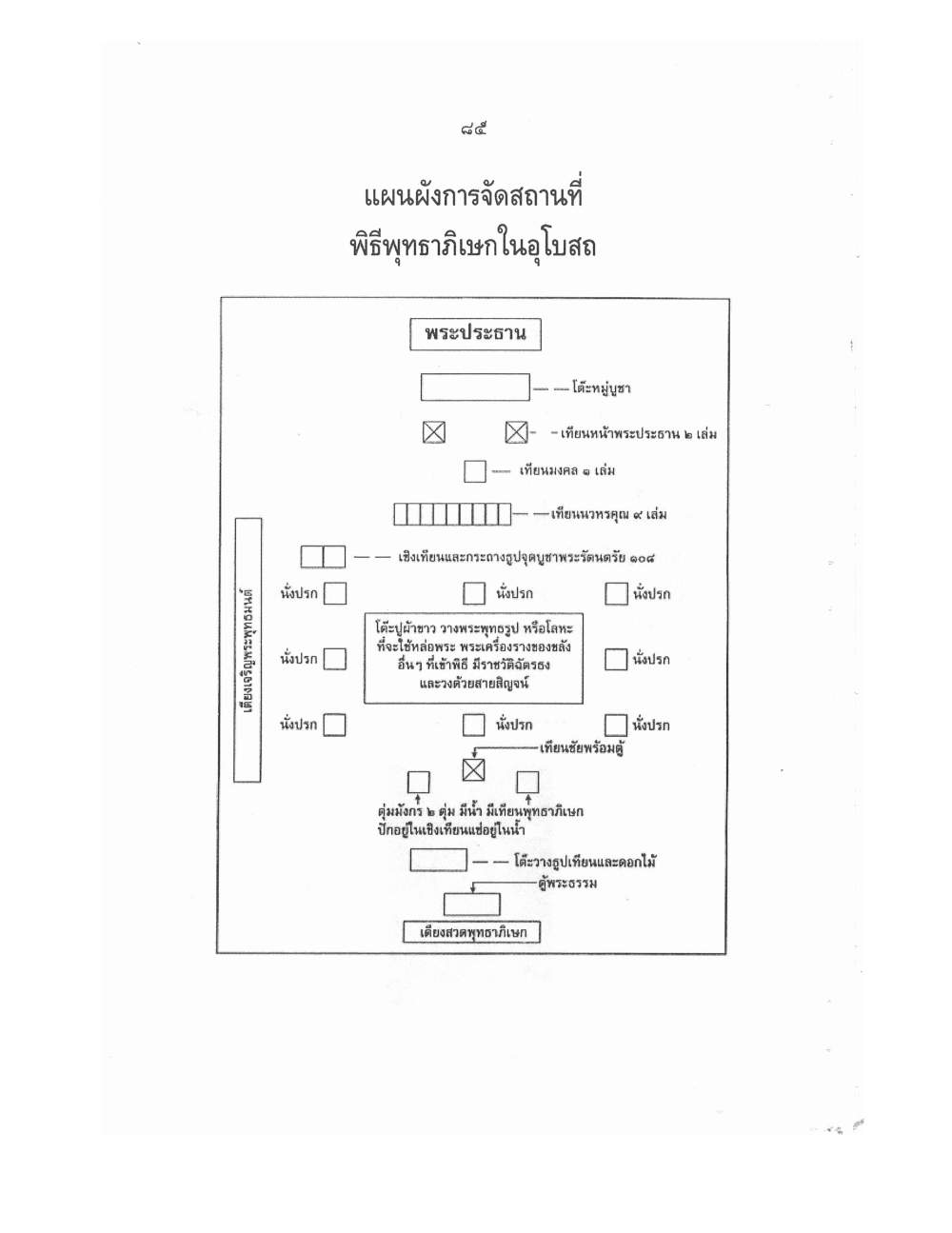
๘๕
แผนผังการจัดสถานที่
พิธีพุทธาภิเษกในอุโบสถ
[แผนภาพ: กรอบสี่เหลี่ยมแสดงผังการจัดสถานที่ในอุโบสถ เรียงจากบนลงล่าง ประกอบด้วยกล่องข้อความดังนี้ — พระประธาน / โต๊ะหมู่บูชา / เทียนหน้าพระประธาน ๒ เล่ม (๒ กล่องมีเครื่องหมายกากบาท) / เทียนมงคล ๑ เล่ม / เทียนนวหรคุณ ๙ เล่ม (แถวกล่องเล็ก ๙ กล่อง) / เชิงเทียนและกระถางธูปจุดบูชาพระรัตนตรัย ๑๐๘ / นั่งปรก (๓ กล่อง เรียงซ้าย-กลาง-ขวา) / โต๊ะปูผ้าขาว วางพระพุทธรูป หรือโลหะที่จะใช้หล่อพระ พระเครื่องรางของขลังอื่นๆ ที่เข้าพิธี มีราชวัติฉัตรธง และวงด้วยสายสิญจน์ / นั่งปรก (อีก ๓ กล่อง) / เทียนชัยพร้อมตู้ (มีเครื่องหมายกากบาท) / ตุ่มมังกร ๒ ตุ่ม มีน้ำ มีเทียนพุทธาภิเษกปักอยู่ในเชิงเทียนแช่อยู่ในน้ำ / โต๊ะวางธูปเทียนและดอกไม้ / ตู้พระธรรม / เตียงสวดพุทธาภิเษก — ด้านซ้ายของผังมีข้อความแนวตั้งกำกับว่า เตียงเจริญพระพุทธมนต์]
85
Floor Plan for Setting Up the Site
The Buddhabhiseka Ceremony in the Ubosot (Ordination Hall)
[diagram: a rectangular frame showing the floor plan of the ubosot, arranged from top to bottom, containing the following labeled boxes — the principal Buddha image / the group-worship table / 2 candles in front of the principal image (2 boxes marked with an X) / 1 auspicious candle / 9 navagraha candles (a row of 9 small boxes) / candlesticks and incense-pot for the 108 lights worshipping the Triple Gem / meditating monks (nang prok) (3 boxes arranged left-center-right) / a table spread with white cloth, holding the Buddha image or the metal to be used for casting, other sacred amulets and talismans entering the ceremony, bordered by ceremonial flag-poles and banners and encircled with the sacred thread / meditating monks (3 more boxes) / the main candle with its protective cabinet (marked with an X) / 2 dragon jars containing water, each with a Buddhabhiseka candle stuck in a candlestick standing in the water / a table for incense, candles, and flowers / the dhamma-scripture cabinet / the platform for Buddhabhiseka chanting — along the left side of the diagram runs a vertical label reading "platform for chanting the Buddha's blessing"]
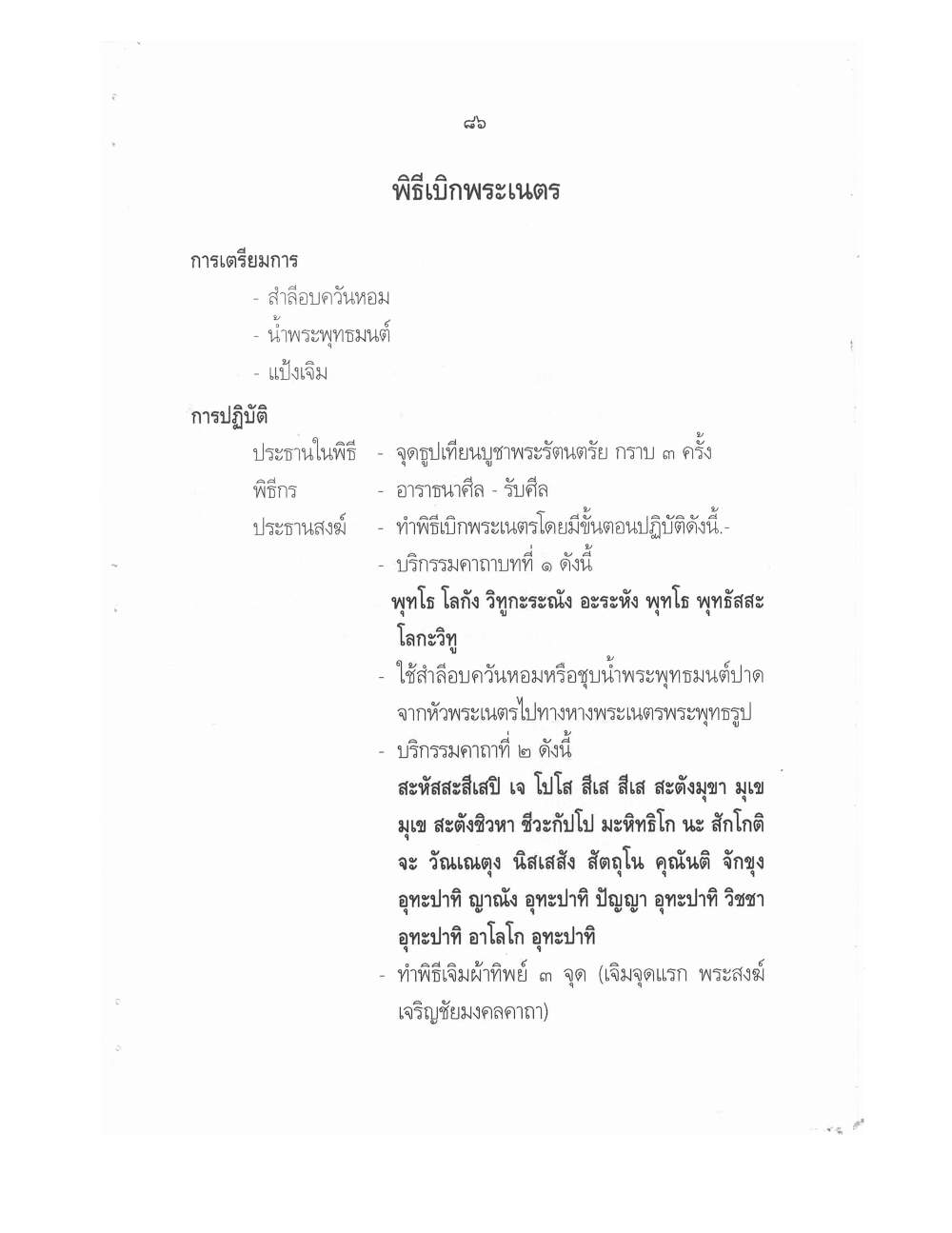
๘๖
พิธีเบิกพระเนตร
การเตรียมการ - สำลีอบควันหอม - น้ำพระพุทธมนต์ - แป้งเจิม
การปฏิบัติ ประธานในพิธี - จุดธูปเทียนบูชาพระรัตนตรัย กราบ ๓ ครั้ง พิธีกร - อาราธนาศีล - รับศีล ประธานสงฆ์ - ทำพิธีเบิกพระเนตรโดยมีขั้นตอนปฏิบัติดังนี้.- - บริกรรมคาถาบทที่ ๑ ดังนี้ พุทโธ โลกัง วิทูกะระณัง อะระหัง พุทโธ พุทธัสสะ โลกะวิทู - ใช้สำลีอบควันหอมหรือชุบน้ำพระพุทธมนต์ปาดจากหัวพระเนตรไปทางหางพระเนตรพระพุทธรูป - บริกรรมคาถาที่ ๒ ดังนี้ สะหัสสะสีเสปิ เจ โปโส สีเส สีเส สะตังมุขา มุเข มุเข สะตังชิวหา ชีวะกัปโป มะหิทธิโก นะ สักโกติ จะ วัณเณตุง นิสเสสัง สัตถุโน คุณันติ จักขุง อุทะปาทิ ญาณัง อุทะปาทิ ปัญญา อุทะปาทิ วิชชา อุทะปาทิ อาโลโก อุทะปาทิ - ทำพิธีเจิมผ้าทิพย์ ๓ จุด (เจิมจุดแรก พระสงฆ์เจริญชัยมงคลคาถา)
86
The Eye-Opening Ceremony (Phithi Boek Phra Net)
Preparations - Cotton wool scented with fragrant smoke - Holy water (blessed by the monks) - Anointing powder
Procedure Presiding officiant of the ceremony - Lights incense and candles to worship the Triple Gem, prostrates 3 times Master of ceremonies - Invites the precepts - receives the precepts Presiding monk - Performs the eye-opening rite, following these steps: - Recites the first verse as follows: Buddho lokaṃ vidūkaraṇaṃ arahaṃ buddho buddhassa lokavidū [a Pali formula praising the Buddha as "the one who makes the world understood, the Worthy One, the Buddha, knower of the world"] - Uses the fragrant-smoke-scented cotton wool, or cotton wool dipped in holy water, to wipe from the inner to the outer corner of the Buddha image's eye - Recites the second verse as follows: Sahassasīsepi ce poso sīse sīse sataṃmukhā mukhe mukhe sataṃjivhā jīvakappo mahiddhiko na sakkoti ca vaṇṇetuṃ nissesaṃ satthuno guṇanti cakkhuṃ udapādi ñāṇaṃ udapādi paññā udapādi vijjā udapādi āloko udapādi [a Pali verse: even a person with a thousand heads, each with a hundred mouths, each mouth with a hundred tongues, living for an aeon and possessed of great power, could not fully describe the Teacher's virtues — "the eye has arisen, knowledge has arisen, wisdom has arisen, insight has arisen, light has arisen"] - Performs the anointing of the celestial cloth (pha thip) at 3 points (at the first anointing, the monks chant the Chai Mongkhon verses)
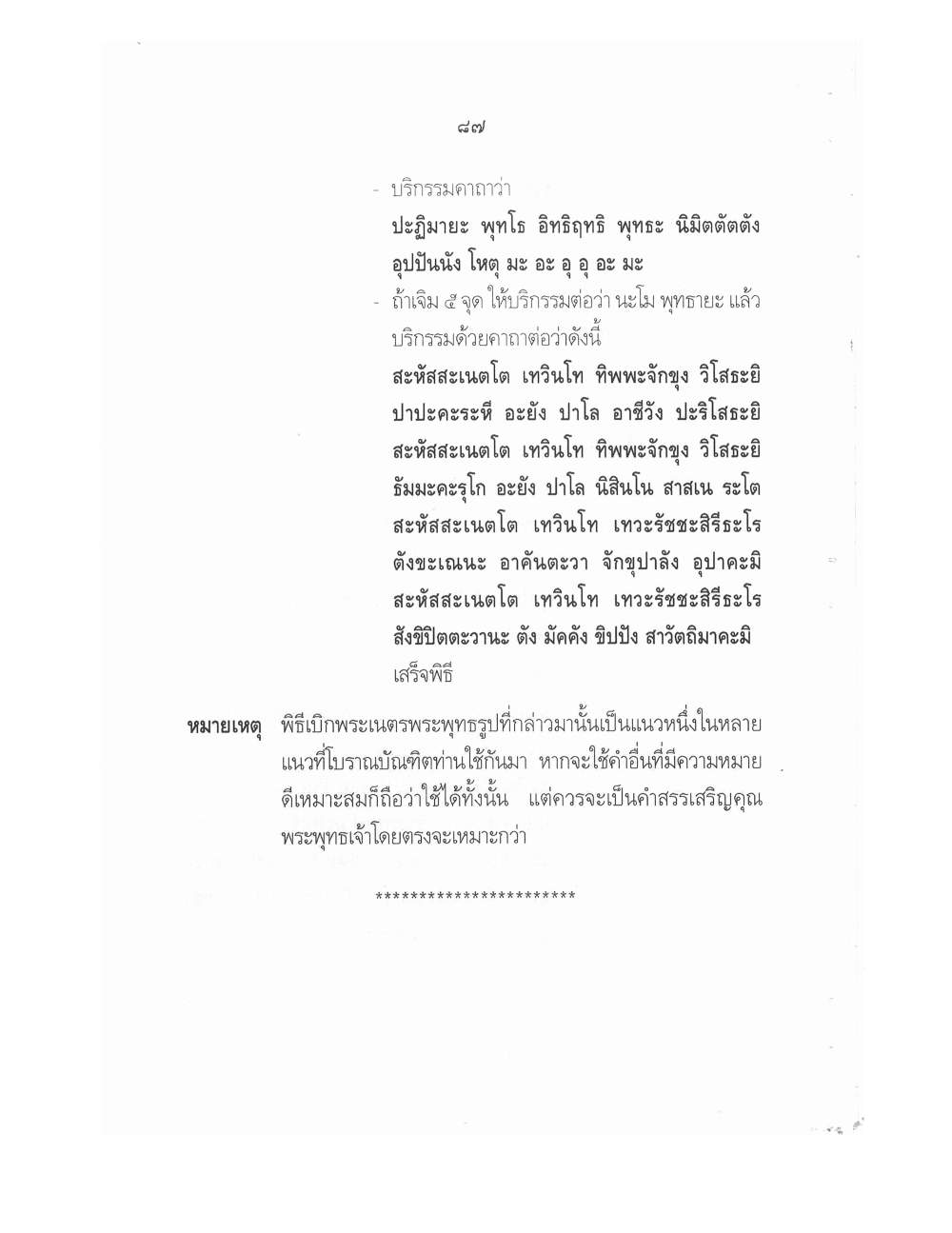
๘๗
- บริกรรมคาถาว่า ปฏิมายะ พุทโธ อิทธิฤทธิ พุทธะ นิมิตตัตตัง อุปปันนัง โหตุ มะ อะ อุ อุ อะ มะ - ถ้าเจิม ๕ จุด ให้บริกรรมต่อว่า นะโม พุทธายะ แล้วบริกรรมด้วยคาถาต่อว่าดังนี้ สะหัสสะเนตโต เทวินโท ทิพพะจักขุง วิโสธะยิ ปาปะคะระหี อะยัง ปาโล อาชีวัง ปะริโสธะยิ สะหัสสะเนตโต เทวินโท ทิพพะจักขุง วิโสธะยิ ธัมมะคะรุโก อะยัง ปาโล นิสินโน สาสเน ระโต สะหัสสะเนตโต เทวินโท เทวะรัชชะสิรีธะโร ตังขะเณนะ อาคันตะวา จักขุปาลัง อุปาคะมิ สะหัสสะเนตโต เทวินโท เทวะรัชชะสิรีธะโร สังขิปิตตะวานะ ตัง มัคคัง ขิปปัง สาวัตถิมาคะมิ เสร็จพิธี
หมายเหตุ พิธีเบิกพระเนตรพระพุทธรูปที่กล่าวมานั้นเป็นแนวหนึ่งในหลายแนวที่โบราณบัณฑิตท่านใช้กันมา หากจะใช้คำอื่นที่มีความหมายดีเหมาะสมก็ถือว่าใช้ได้ทั้งนั้น แต่ควรจะเป็นคำสรรเสริญคุณพระพุทธเจ้าโดยตรงจะเหมาะกว่า
************************
87
- Recites the verse: Paṭimāya buddho iddhiṛddhi buddha nimittattaṃ uppannaṃ hotu ma a u u a ma [a Pali formula invoking the arising of the Buddha's miraculous power as a sign within the image] - If anointing at 5 points, continue reciting: Namo buddhāya, then continue with the following verse: Sahassanetto devindo dibbacakkhuṃ visodhayi pāpagarahī ayaṃ pālo ājīvaṃ parisodhayi sahassanetto devindo dibbacakkhuṃ visodhayi dhammagaruko ayaṃ pālo nisinno sāsane rato sahassanetto devindo devarajjasirīdharo taṅkhaṇena āgantvā cakkhupālaṃ upāgami sahassanetto devindo devarajjasirīdharo saṅkhipitvāna taṃ maggaṃ khippaṃ sāvatthimāgami [a Pali verse invoking the thousand-eyed lord of the gods to purify the divine eye] End of ceremony
Note: The above eye-opening ceremony for the Buddha image is one of many traditions that learned elders of old have followed. If other words of good and fitting meaning are used, these too may be considered acceptable, but it is more fitting that they be words that directly praise the virtues of the Buddha.
************************
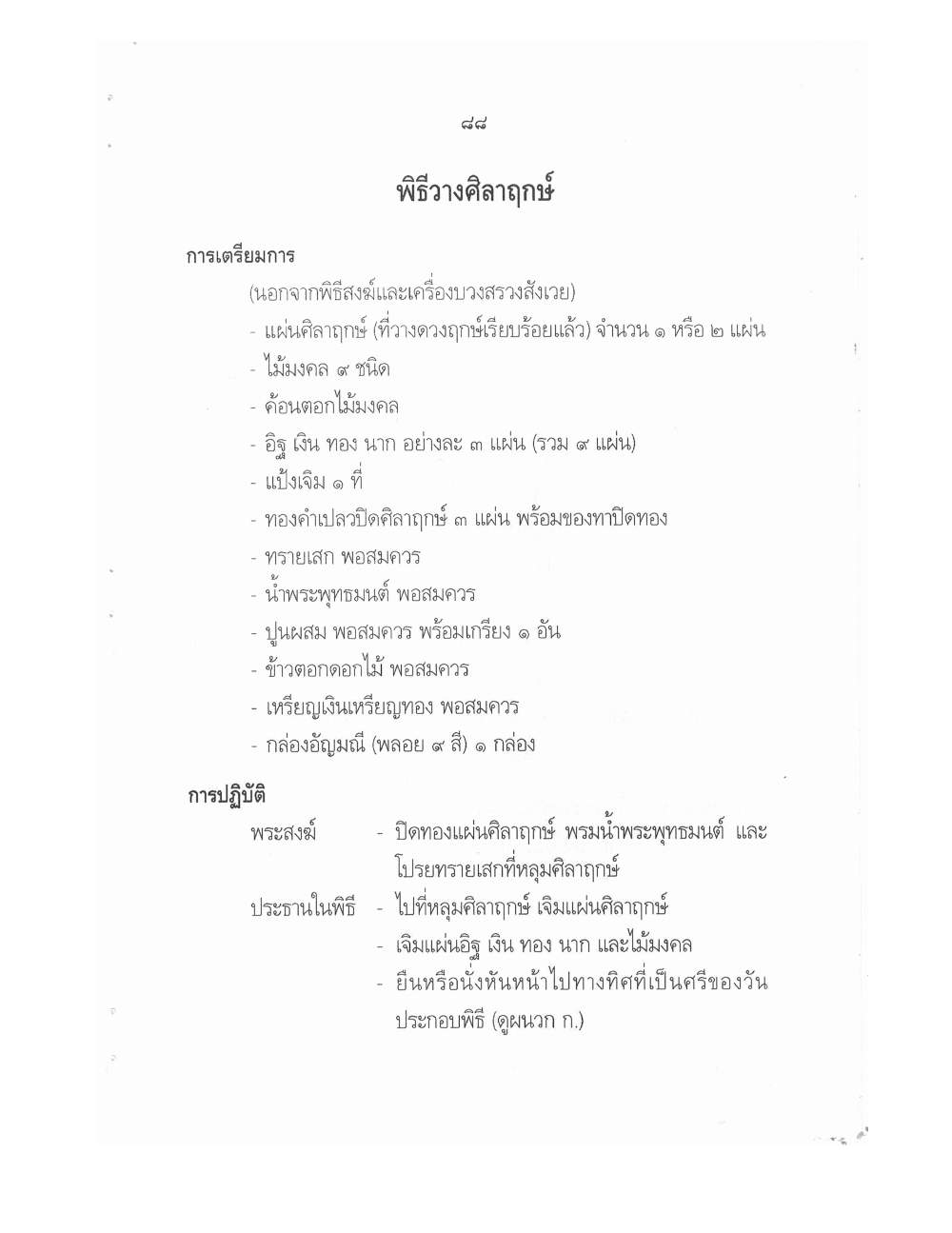
๘๘
พิธีวางศิลาฤกษ์
การเตรียมการ (นอกจากพิธีสงฆ์และเครื่องบวงสรวงสังเวย) - แผ่นศิลาฤกษ์ (ที่วางดวงฤกษ์เรียบร้อยแล้ว) จำนวน ๑ หรือ ๒ แผ่น - ไม้มงคล ๙ ชนิด - ค้อนตอกไม้มงคล - อิฐ เงิน ทอง นาก อย่างละ ๓ แผ่น (รวม ๙ แผ่น) - แป้งเจิม ๑ ที่ - ทองคำเปลวปิดศิลาฤกษ์ ๓ แผ่น พร้อมของทาปิดทอง - ทรายเสก พอสมควร - น้ำพระพุทธมนต์ พอสมควร - ปูนผสม พอสมควร พร้อมเกรียง ๑ อัน - ข้าวตอกดอกไม้ พอสมควร - เหรียญเงินเหรียญทอง พอสมควร - กล่องอัญมณี (พลอย ๙ สี) ๑ กล่อง
การปฏิบัติ พระสงฆ์ - ปิดทองแผ่นศิลาฤกษ์ พรมน้ำพระพุทธมนต์ และโปรยทรายเสกที่หลุมศิลาฤกษ์ ประธานในพิธี - ไปที่หลุมศิลาฤกษ์ เจิมแผ่นศิลาฤกษ์ - เจิมแผ่นอิฐ เงิน ทอง นาก และไม้มงคล - ยืนหรือนั่งหันหน้าไปทางทิศที่เป็นศรีของวันประกอบพิธี (ดูผนวก ก.)
88
The Foundation-Stone-Laying Ceremony
Preparations (In addition to the monks' rite and the offerings) - Foundation-stone tablet(s) (with the auspicious horoscope already inscribed), 1 or 2 tablets - 9 kinds of auspicious wood - A hammer for driving in the auspicious wood [pegs] - Brick, silver, gold, and nak plates, 3 of each (9 plates total) - 1 set of anointing powder - 3 sheets of gold leaf for covering the foundation stone, together with gilding adhesive - A sufficient amount of consecrated sand - A sufficient amount of holy water - A sufficient amount of mixed mortar, with 1 trowel - A sufficient amount of puffed rice and flowers - A sufficient number of silver and gold coins/medallions - 1 box of gemstones (9 colors)
Procedure Monks - Apply gold leaf to the foundation-stone tablet, sprinkle it with holy water, and scatter consecrated sand into the foundation-stone pit Presiding officiant of the ceremony - Goes to the foundation-stone pit, anoints the foundation-stone tablet - Anoints the brick, silver, gold, and nak plates, and the auspicious wood - Stands or sits facing the direction that is auspicious for the day the ceremony is held (see Appendix A)
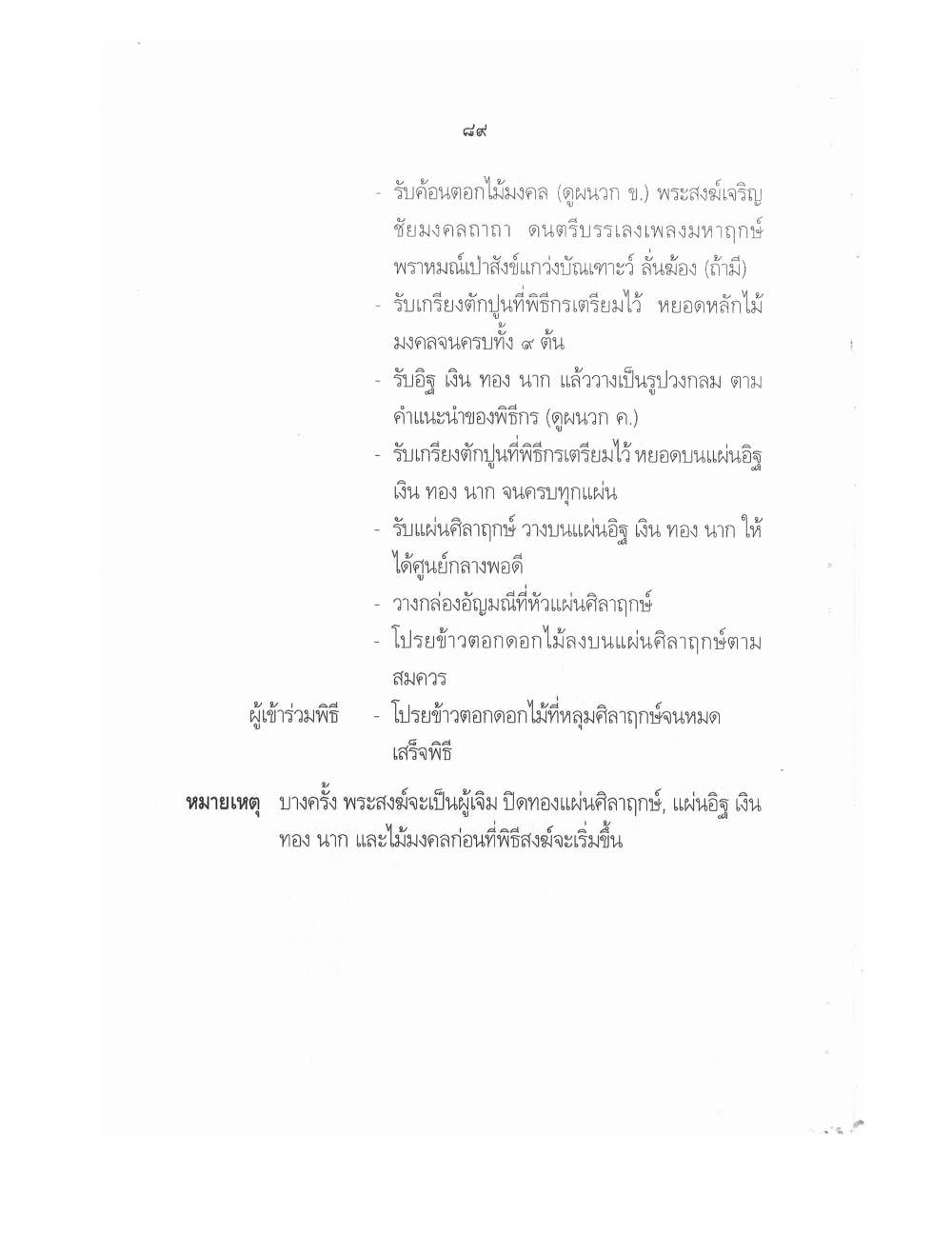
๘๙
- รับค้อนตอกไม้มงคล (ดูผนวก ข.) พระสงฆ์เจริญชัยมงคลคาถา ดนตรีบรรเลงเพลงมหาฤกษ์ พราหมณ์เป่าสังข์แกว่งบัณเฑาะว์ ลั่นฆ้อง (ถ้ามี) - รับเกรียงตักปูนที่พิธีกรเตรียมไว้ หยอดหลักไม้มงคลจนครบทั้ง ๙ ต้น - รับอิฐ เงิน ทอง นาก แล้ววางเป็นรูปวงกลม ตามคำแนะนำของพิธีกร (ดูผนวก ค.) - รับเกรียงตักปูนที่พิธีกรเตรียมไว้ หยอดบนแผ่นอิฐ เงิน ทอง นาก จนครบทุกแผ่น - รับแผ่นศิลาฤกษ์ วางบนแผ่นอิฐ เงิน ทอง นาก ให้ได้ศูนย์กลางพอดี - วางกล่องอัญมณีที่หัวแผ่นศิลาฤกษ์ - โปรยข้าวตอกดอกไม้ลงบนแผ่นศิลาฤกษ์ตามสมควร ผู้เข้าร่วมพิธี - โปรยข้าวตอกดอกไม้ที่หลุมศิลาฤกษ์จนหมด เสร็จพิธี
หมายเหตุ บางครั้ง พระสงฆ์จะเป็นผู้เจิม ปิดทองแผ่นศิลาฤกษ์, แผ่นอิฐ เงิน ทอง นาก และไม้มงคลก่อนที่พิธีสงฆ์จะเริ่มขึ้น
89
- Receives the hammer for driving in the auspicious wood (see Appendix B); the monks chant the Chai Mongkhon verses, the band plays the Maha Rerk (Great Auspicious) tune, the brahmin priest blows the conch shell and shakes the hand-drum, the gong is struck (if available) - Receives the trowel of mortar prepared by the master of ceremonies, and drops it onto the auspicious wood pegs until all 9 posts are done - Receives the brick, silver, gold, and nak plates, then arranges them in a circular pattern according to the master of ceremonies' instructions (see Appendix C) - Receives the trowel of mortar prepared by the master of ceremonies, and drops it onto the brick, silver, gold, and nak plates until every plate is done - Receives the foundation-stone tablet, places it on top of the brick, silver, gold, and nak plates so that it sits exactly at the center - Places the gemstone box at the head of the foundation-stone tablet - Scatters puffed rice and flowers onto the foundation-stone tablet as appropriate Ceremony participants - Scatter puffed rice and flowers into the foundation-stone pit until it is full End of ceremony
Note: Sometimes the monks are the ones who anoint and apply gold leaf to the foundation-stone tablet, the brick, silver, gold, and nak plates, and the auspicious wood before the monks' rite begins
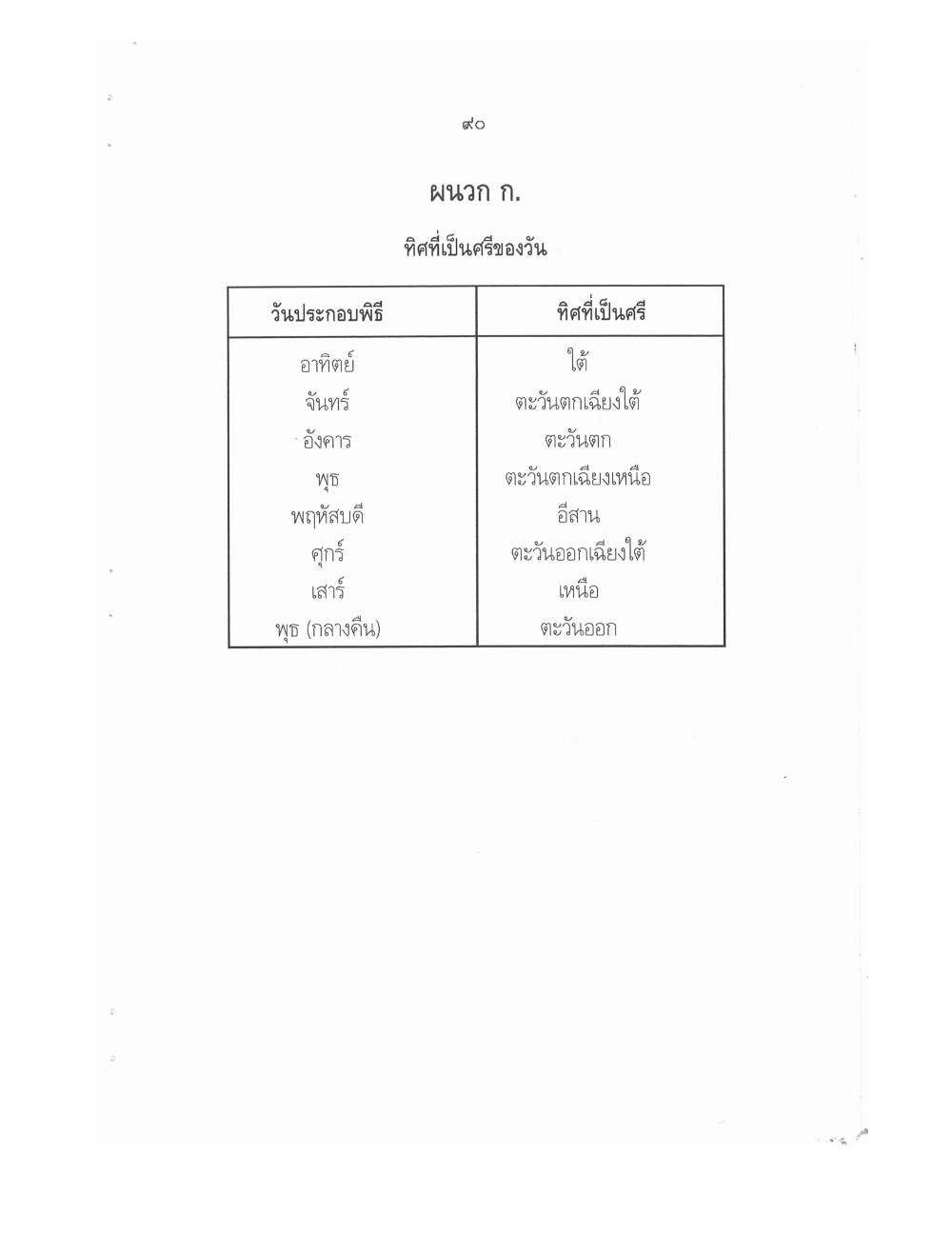
๙๐
ผนวก ก.
ทิศที่เป็นศรีของวัน
[ตาราง] วันประกอบพิธี | ทิศที่เป็นศรี อาทิตย์ | ใต้ จันทร์ | ตะวันตกเฉียงใต้ อังคาร | ตะวันตก พุธ | ตะวันตกเฉียงเหนือ พฤหัสบดี | อีสาน ศุกร์ | ตะวันออกเฉียงใต้ เสาร์ | เหนือ พุธ (กลางคืน) | ตะวันออก
90
Appendix A.
The Auspicious Direction of Each Day
[table] Day of the ceremony | Auspicious direction Sunday | South Monday | Southwest Tuesday | West Wednesday | Northwest Thursday | Northeast Friday | Southeast Saturday | North Wednesday (night) | East
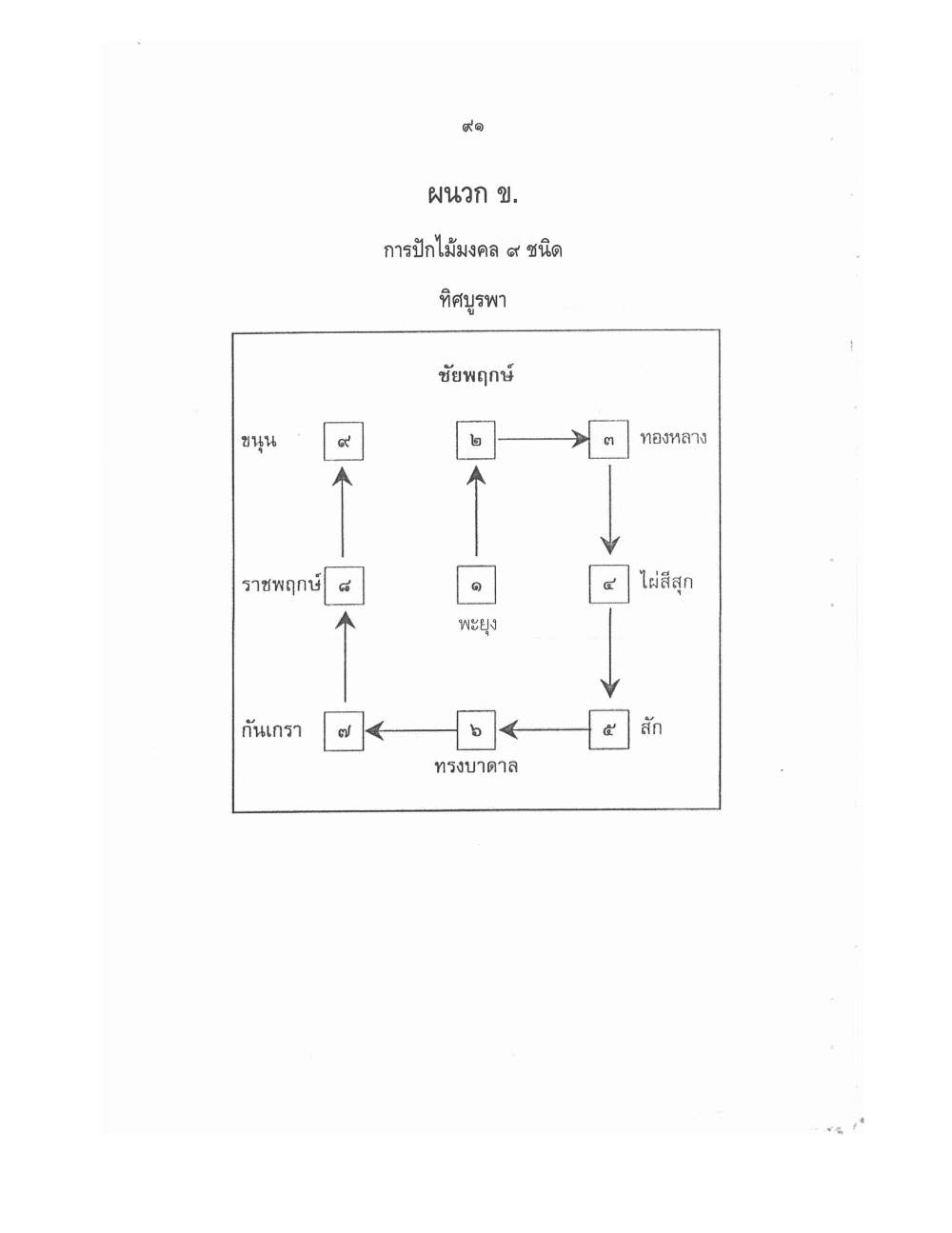
๙๑
ผนวก ข.
การปักไม้มงคล ๙ ชนิด ทิศบูรพา
[แผนภาพ: กรอบสี่เหลี่ยมหัวกรอบเขียนว่า "ชัยพฤกษ์" ภายในมีกล่องหมายเลข ๑-๙ เชื่อมกันด้วยลูกศรแสดงลำดับ แต่ละกล่องกำกับด้วยชื่อไม้มงคล ได้แก่ ขนุน (๙), ราชพฤกษ์ (๘), กันเกรา (๗), พะยุง (๑), ทรงบาดาล (๖), สัก (๕), ทองหลาง (๓), ไผ่สีสุก (๔) และกล่องกลางบนไม่มีชื่อกำกับ (๒) — ลูกศรโยงจากกล่อง ๒ ไปกล่อง ๓ (ทองหลาง) ไปกล่อง ๔ (ไผ่สีสุก) ไปกล่อง ๕ (สัก) ไปกล่อง ๖ (ทรงบาดาล) ไปกล่อง ๗ (กันเกรา) ไปกล่อง ๘ (ราชพฤกษ์) ไปกล่อง ๙ (ขนุน) และจากกล่อง ๑ (พะยุง) ไปกล่อง ๘ (ราชพฤกษ์)]
91
Appendix B.
Driving In the 9 Kinds of Auspicious Wood [Pegs] Eastern Direction
[diagram: a rectangular frame headed "Chaiphruek" (Cassia fistula, the tree of victory), containing boxes numbered 1-9 connected by arrows showing the sequence, each box labeled with the name of an auspicious tree: Khanun/jackfruit (9), Ratchaphruek/golden shower tree (8), Kankrao (7), Phayung/Siamese rosewood (1), Songbadan (6), Sak/teak (5), Thonglang/coral tree (3), Phaisisuk/a lucky bamboo (4), and an unlabeled center-top box (2) — arrows run from box 2 to box 3 (Thonglang), to box 4 (Phaisisuk), to box 5 (Sak), to box 6 (Songbadan), to box 7 (Kankrao), to box 8 (Ratchaphruek), to box 9 (Khanun), and from box 1 (Phayung) to box 8 (Ratchaphruek)]
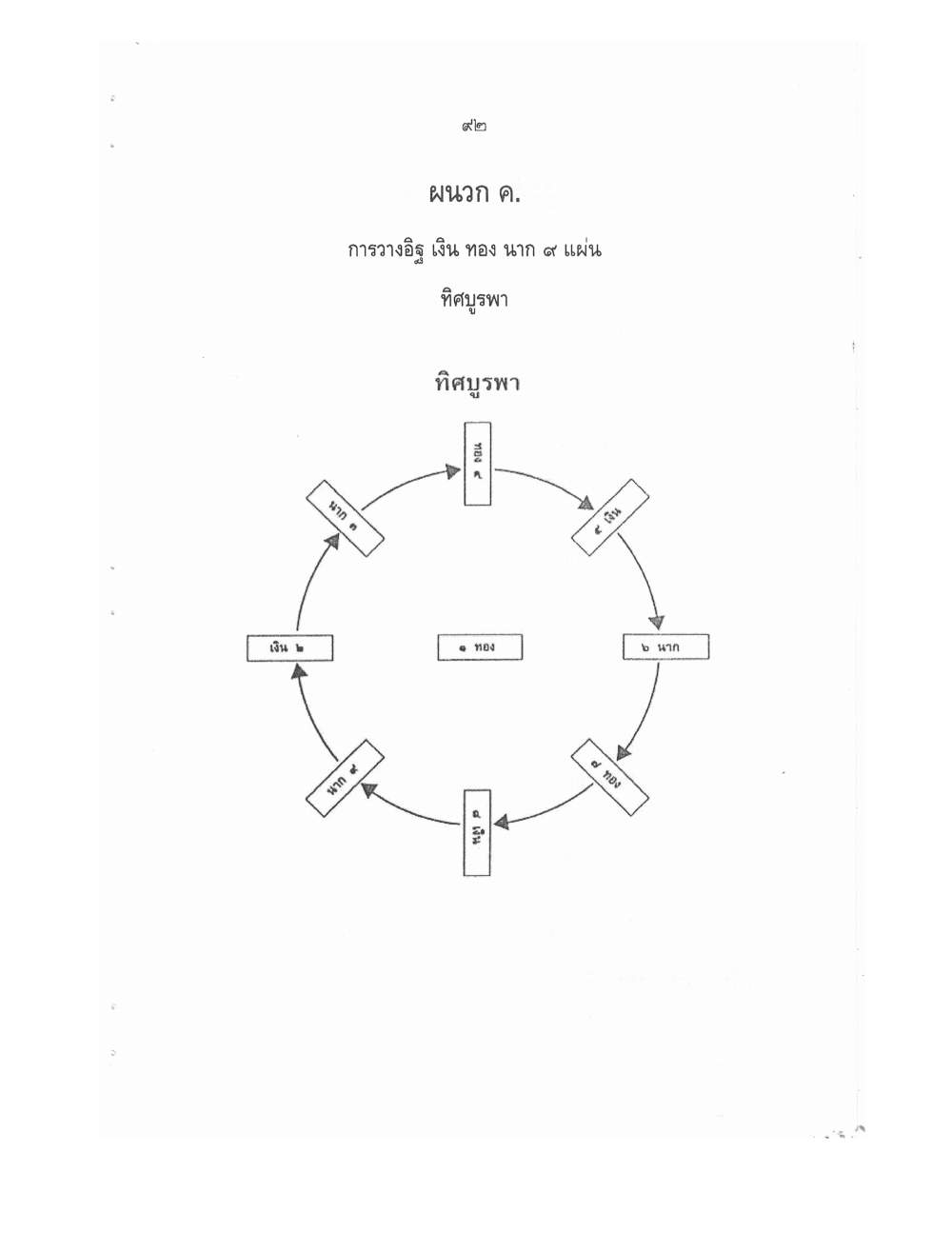
๙๒
ผนวก ค.
การวางอิฐ เงิน ทอง นาก ๙ แผ่น ทิศบูรพา
ทิศบูรพา
[แผนภาพ: วงกลมมีกล่องสี่เหลี่ยมเรียงรอบวง ๘ กล่อง เชื่อมกันด้วยลูกศรตามเข็มนาฬิกา และมีกล่องสี่เหลี่ยมอยู่ตรงกลางวง ๑ กล่อง (รวม ๙ กล่อง) แต่ละกล่องกำกับด้วยชื่อโลหะ/วัสดุ (ทอง, เงิน, นาก) และหมายเลขกำกับลำดับ ๑-๙ กล่องกลางมีข้อความ "๑ ทอง" ส่วนกล่องโดยรอบมีข้อความเช่น "นาก ๓", "เงิน ๒", "๔ เงิน", "๖ นาก", "๙ ..." [อ่านไม่ออก] เรียงตามเข็มนาฬิกา]
92
Appendix C.
Placing the 9 Plates of Brick, Silver, Gold, and Nak Eastern Direction
Eastern Direction
[diagram: a circle with 8 rectangular boxes arranged around its circumference, connected by clockwise arrows, and 1 rectangular box at the center (9 boxes in all). Each box is labeled with the name of a metal/material (gold, silver, nak) and a sequence number 1-9. The center box reads "1, gold"; the surrounding boxes bear labels such as "nak, 3", "silver, 2", "4, silver", "6, nak", "9, ..." [illegible], arranged clockwise]
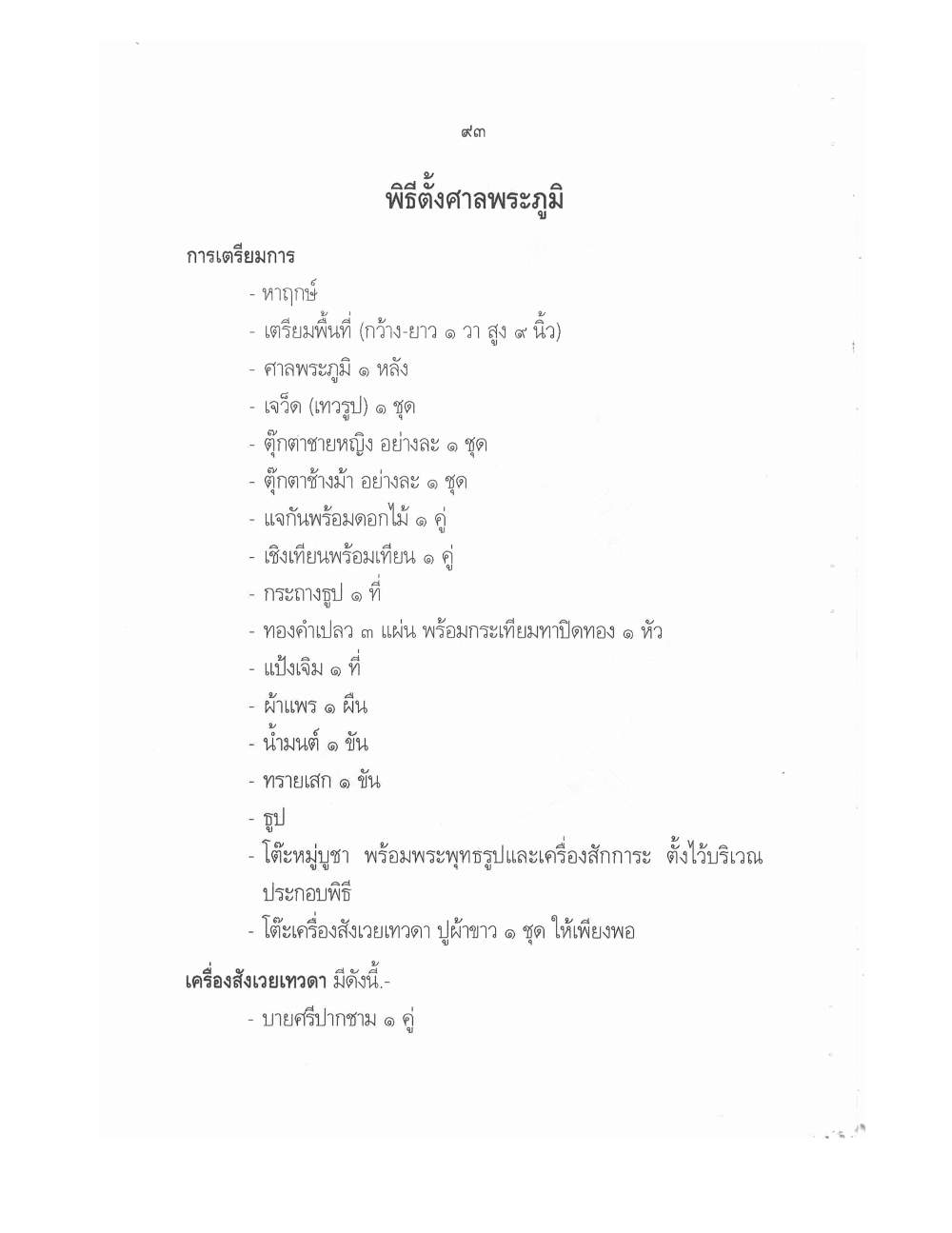
๙๓
พิธีตั้งศาลพระภูมิ
การเตรียมการ
- หาฤกษ์ - เตรียมพื้นที่ (กว้าง-ยาว ๑ วา สูง ๙ นิ้ว) - ศาลพระภูมิ ๑ หลัง - เจว็ด (เทวรูป) ๑ ชุด - ตุ๊กตาชายหญิง อย่างละ ๑ ชุด - ตุ๊กตาช้างม้า อย่างละ ๑ ชุด - แจกันพร้อมดอกไม้ ๑ คู่ - เชิงเทียนพร้อมเทียน ๑ คู่ - กระถางธูป ๑ ที่ - ทองคำเปลว ๓ แผ่น พร้อมกระเทียมทาปิดทอง ๑ หัว - แป้งเจิม ๑ ที่ - ผ้าแพร ๑ ผืน - น้ำมนต์ ๑ ขัน - ทรายเสก ๑ ขัน - ธูป - โต๊ะหมู่บูชา พร้อมพระพุทธรูปและเครื่องสักการะ ตั้งไว้บริเวณประกอบพิธี - โต๊ะเครื่องสังเวยเทวดา ปูผ้าขาว ๑ ชุด ให้เพียงพอ
เครื่องสังเวยเทวดา มีดังนี้.-
- บายศรีปากชาม ๑ คู่
93
Ceremony for Erecting the Spirit House (San Phra Phum)
Preparation
- Determine an auspicious time - Prepare the site (1 wa wide by 1 wa long, 9 inches high) - 1 spirit house - 1 set of jaovet (deity effigy plaques) - 1 set each of male and female dolls - 1 set each of elephant and horse figurines - 1 pair of vases with flowers - 1 pair of candle holders with candles - 1 incense burner - 3 sheets of gold leaf, together with 1 head of garlic for applying the gold leaf - 1 tray of anointing powder - 1 piece of silk cloth - 1 bowl of holy water - 1 bowl of consecrated sand - Incense - An altar table with a Buddha image and items of veneration, set up at the ceremony site - A table for offerings to the deities, covered with white cloth, 1 set, in sufficient quantity
The offerings to the deities are as follows:
- 1 pair of rice-offering trays (bai sri pak cham)
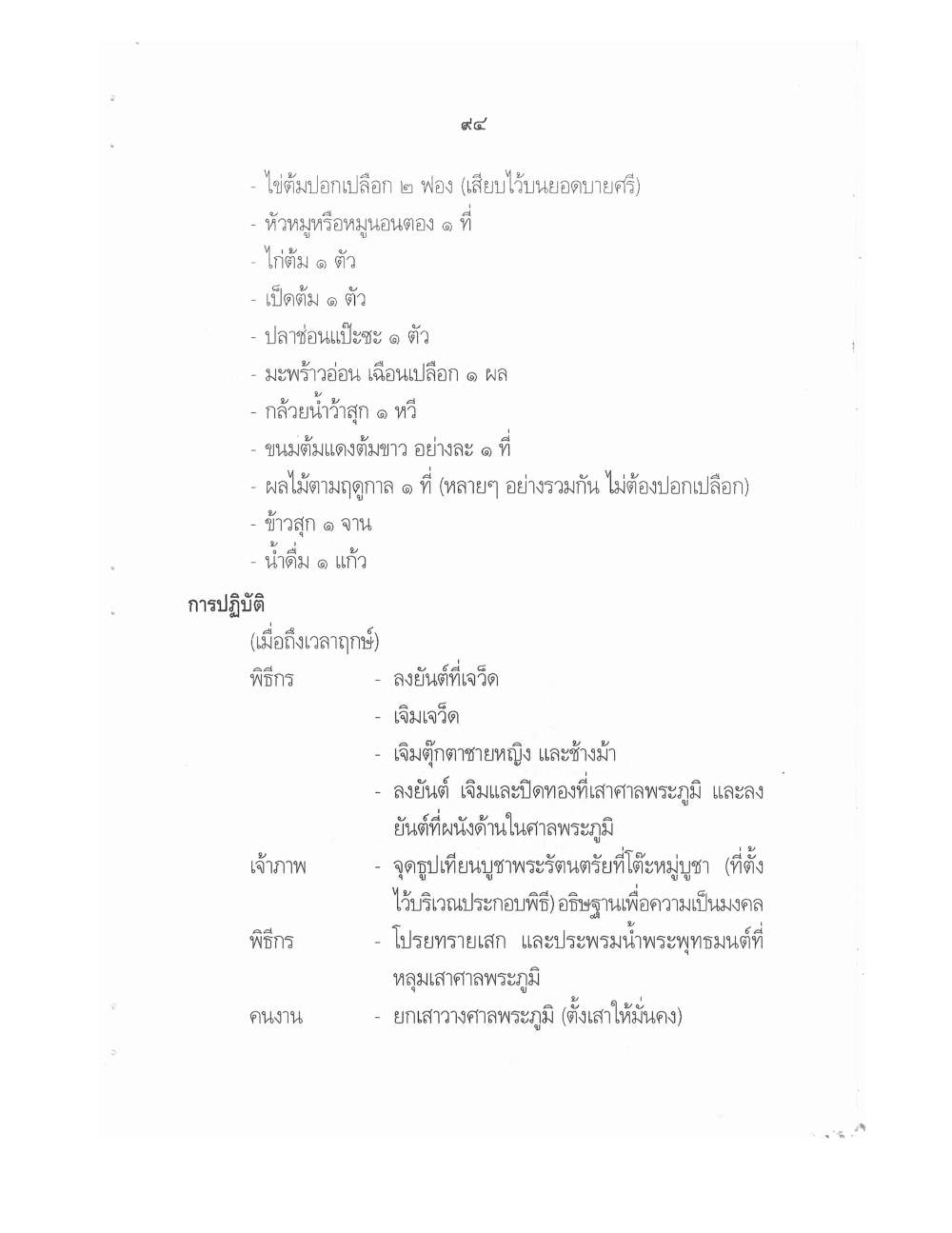
๙๔
- ไข่ต้มปอกเปลือก ๒ ฟอง (เสียบไว้บนยอดบายศรี) - หัวหมูหรือหมูนอนตอง ๑ ที่ - ไก่ต้ม ๑ ตัว - เป็ดต้ม ๑ ตัว - ปลาช่อนแป๊ะซะ ๑ ตัว - มะพร้าวอ่อน เฉือนเปลือก ๑ ผล - กล้วยน้ำว้าสุก ๑ หวี - ขนมต้มแดงต้มขาว อย่างละ ๑ ที่ - ผลไม้ตามฤดูกาล ๑ ที่ (หลายๆ อย่างรวมกัน ไม่ต้องปอกเปลือก) - ข้าวสุก ๑ จาน - น้ำดื่ม ๑ แก้ว
การปฏิบัติ
(เมื่อถึงเวลาฤกษ์)
พิธีกร - ลงยันต์ที่เจว็ด - เจิมเจว็ด - เจิมตุ๊กตาชายหญิง และช้างม้า - ลงยันต์ เจิมและปิดทองที่เสาศาลพระภูมิ และลงยันต์ที่ผนังด้านในศาลพระภูมิ เจ้าภาพ - จุดธูปเทียนบูชาพระรัตนตรัยที่โต๊ะหมู่บูชา (ที่ตั้งไว้บริเวณประกอบพิธี) อธิษฐานเพื่อความเป็นมงคล พิธีกร - โปรยทรายเสก และประพรมน้ำพระพุทธมนต์ที่หลุมเสาศาลพระภูมิ คนงาน - ยกเสาวางศาลพระภูมิ (ตั้งเสาให้มั่นคง)
94
- 2 boiled eggs, shelled (skewered atop the bai sri) - 1 pig's head, or a whole pig laid on banana leaf - 1 boiled chicken - 1 boiled duck - 1 snakehead fish (prepared pae sa-style) - 1 young coconut, husk sliced open - 1 bunch of ripe nam wa bananas - 1 portion each of red and white boiled sweets - 1 portion of seasonal fruits (several kinds together, unpeeled) - 1 plate of cooked rice - 1 glass of drinking water
Procedure
(When the auspicious time arrives)
Officiant - Inscribes the yantra on the jaovet - Anoints the jaovet - Anoints the male and female dolls, and the elephant and horse figures - Inscribes the yantra, anoints, and applies gold leaf to the post of the spirit house, and inscribes the yantra on the inner wall of the spirit house Host - Lights incense and candles to venerate the Triple Gem at the altar table (set up at the ceremony site), and prays for auspiciousness Officiant - Scatters consecrated sand and sprinkles holy water into the post-hole of the spirit house Workmen - Raise the post and set the spirit house in place (fixing the post firmly)
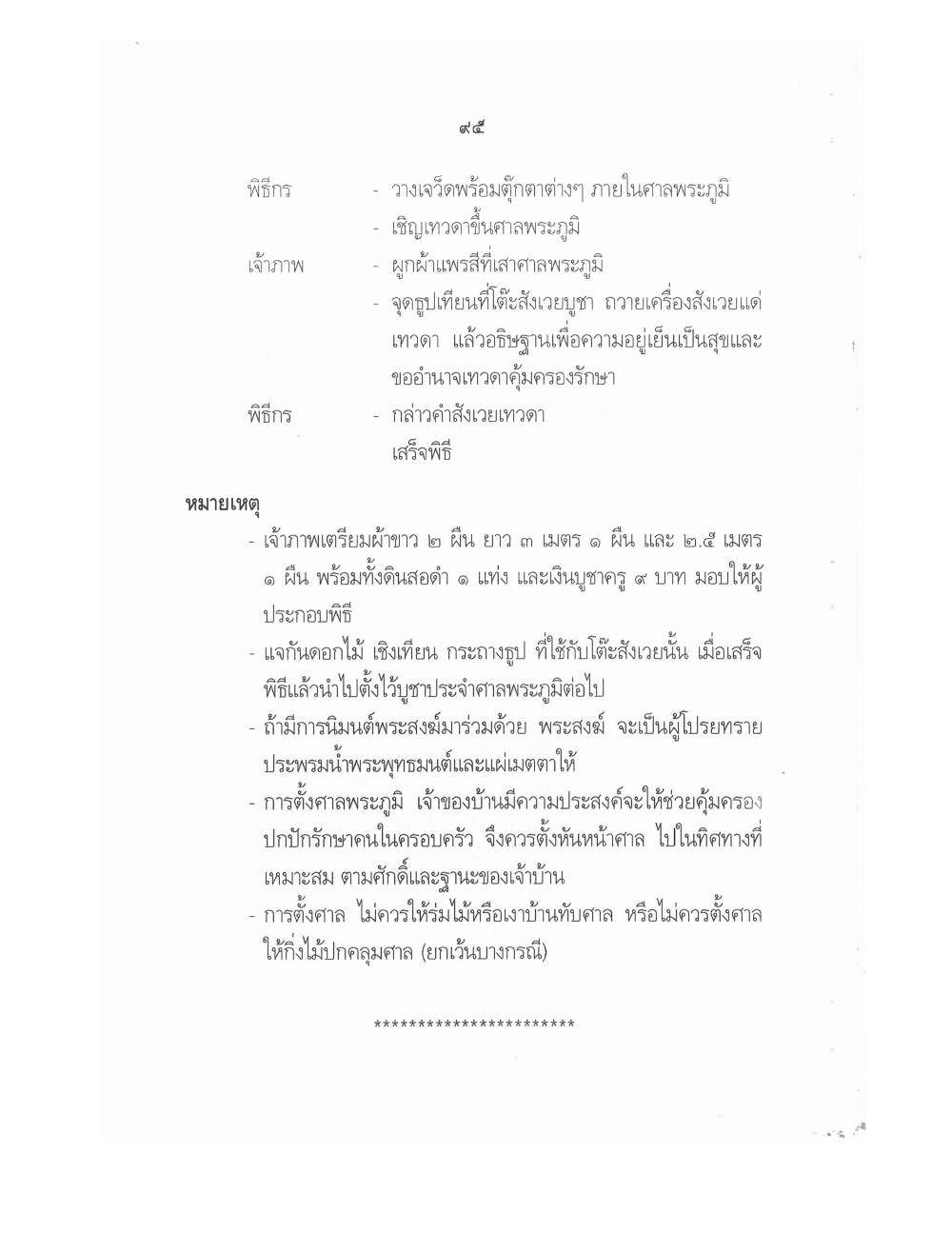
๙๕
พิธีกร - วางเจว็ดพร้อมตุ๊กตาต่างๆ ภายในศาลพระภูมิ - เชิญเทวดาขึ้นศาลพระภูมิ เจ้าภาพ - ผูกผ้าแพรสีที่เสาศาลพระภูมิ - จุดธูปเทียนที่โต๊ะสังเวยบูชา ถวายเครื่องสังเวยแด่เทวดา แล้วอธิษฐานเพื่อความอยู่เย็นเป็นสุขและขออำนาจเทวดาคุ้มครองรักษา พิธีกร - กล่าวคำสังเวยเทวดา เสร็จพิธี
หมายเหตุ
- เจ้าภาพเตรียมผ้าขาว ๒ ผืน ยาว ๓ เมตร ๑ ผืน และ ๒.๕ เมตร ๑ ผืน พร้อมทั้งดินสอดำ ๑ แท่ง และเงินบูชาครู ๙ บาท มอบให้ผู้ประกอบพิธี - แจกันดอกไม้ เชิงเทียน กระถางธูป ที่ใช้กับโต๊ะสังเวยนั้น เมื่อเสร็จพิธีแล้วนำไปตั้งไว้บูชาประจำศาลพระภูมิต่อไป - ถ้ามีการนิมนต์พระสงฆ์มาร่วมด้วย พระสงฆ์ จะเป็นผู้โปรยทรายเสกและประพรมน้ำพระพุทธมนต์และแผ่เมตตาให้ - การตั้งศาลพระภูมิ เจ้าของบ้านมีความประสงค์จะให้ช่วยคุ้มครองปกปักรักษาคนในครอบครัว จึงควรตั้งหันหน้าศาล ไปในทิศทางที่เหมาะสม ตามศักดิ์และฐานะของเจ้าบ้าน - การตั้งศาล ไม่ควรให้ร่มไม้หรือเงาบ้านทับศาล หรือไม่ควรตั้งศาลให้กิ่งไม้ปกคลุมศาล (ยกเว้นบางกรณี)
************************
95
Officiant - Places the jaovet together with the various dolls inside the spirit house - Invites the deity to ascend into the spirit house Host - Ties colored silk cloth to the post of the spirit house - Lights incense and candles at the offering table, presents the offerings to the deity, then prays for peace and happiness and asks for the deity's protective power Officiant - Recites the words offering to the deity End of ceremony
Note
- The host prepares 2 pieces of white cloth — one 3 meters long, one 2.5 meters long — together with 1 stick of black chalk and 9 baht as a fee to honor the teacher, given to the officiant - The vase of flowers, candle holder, and incense burner used at the offering table are, once the ceremony ends, thereafter kept set up as the permanent offering to the spirit house - If monks are invited to take part, the monks will scatter the consecrated sand, sprinkle holy water, and extend loving-kindness - In erecting a spirit house, since the household head wishes it to help protect and watch over the family, the shrine should be set facing a direction suitable to the rank and status of the household head - The shrine should not be placed where a tree's shade or a house's shadow falls upon it, nor should it be set where branches overhang it (except in certain cases)
************************
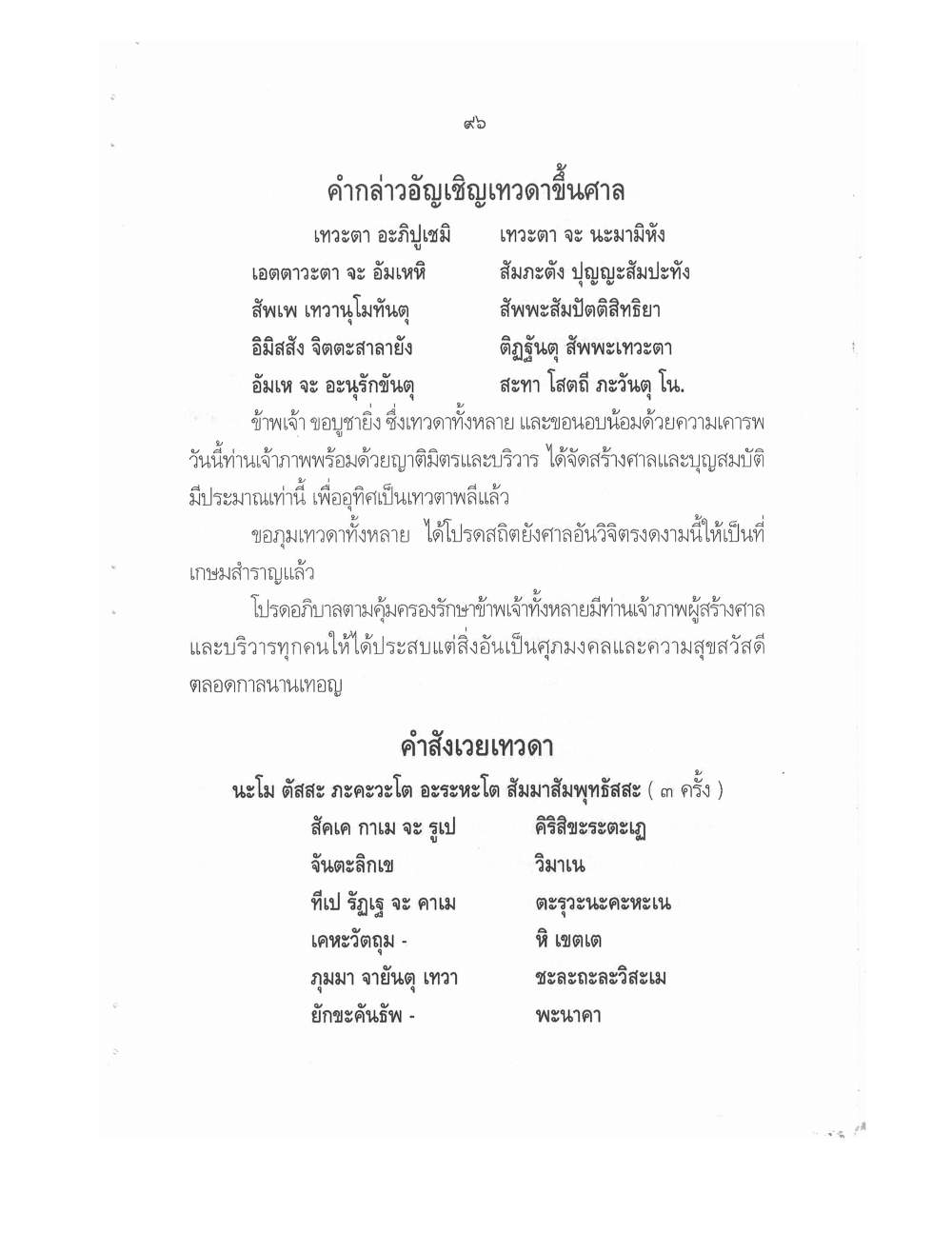
๙๖
คำกล่าวอัญเชิญเทวดาขึ้นศาล
เทวะตา อะภิปูเชมิ เทวะตา จะ นะมามิหัง เอตตาวะตา จะ อัมเหหิ สัมภตัง ปุญญะสัมปะทัง สัพเพ เทวานุโมทันตุ สัพพะสัมปัตติสิทธิยา อิมิสสัง จิตตะสาลายัง ติฏฐันตุ สัพพะเทวะตา อัมเห จะ อะนุรักขันตุ สะทา โสตถี ภะวันตุ โน.
ข้าพเจ้า ขอบูชายิ่ง ซึ่งเทวดาทั้งหลาย และขอนอบน้อมด้วยความเคารพ วันนี้ท่านเจ้าภาพพร้อมด้วยญาติมิตรและบริวาร ได้จัดสร้างศาลและบุญสมบัติมีประมาณเท่านี้ เพื่ออุทิศเป็นเทวตาพลีแล้ว
ขอภุมเทวดาทั้งหลาย ได้โปรดสถิตยังศาลอันวิจิตรงดงามนี้ให้เป็นที่เกษมสำราญแล้ว
โปรดอภิบาลตามคุ้มครองรักษาข้าพเจ้าทั้งหลายมีท่านเจ้าภาพผู้สร้างศาลและบริวารทุกคนให้ได้ประสบแต่สิ่งอันเป็นศุภมงคลและความสุขสวัสดี ตลอดกาลนานเทอญ
คำสังเวยเทวดา
นะโม ตัสสะ ภะคะวะโต อะระหะโต สัมมาสัมพุทธัสสะ (๓ ครั้ง)
สัคเค กาเม จะ รูเป คิริสิขระตะเฏ จันตะลิกเข วิมาเน ทีเป รัฏเฐ จะ คาเม ตะรุวะนะคะหะเน เคหะวัตถุม - หิ เขตเต ภุมมา จายันตุ เทวา ชะละถะละวิสะเม ยักขะคันธัพ - พะนาคา
96
Words for Inviting the Deity to Ascend to the Shrine
[Pali verse of invocation and homage to the devas, calling on them to rejoice in the merit made, to dwell within this hall, and to ever protect and grant well-being]
I offer the highest reverence to all the devas, and bow with respect. Today the host, together with relatives, friends, and household, has built this shrine and this measure of meritorious offering, in order to dedicate it as a gift to the devas.
May all the earth-deities be pleased to dwell in this splendid and finely-wrought shrine, and find it a place of comfort and delight.
Please watch over and protect all of us — the host who built the shrine, and every member of the household — so that we may meet only with good fortune and happiness and well-being, for a long time to come.
Words of Offering to the Deities
Homage to the Blessed One, the Worthy One, the Perfectly Self-Awakened One (3 times)
[Pali verse invoking the devas dwelling in the heavens, in the realms of sense-desire and of form, on mountain peaks and cliffs, in the sky, in celestial mansions; on islands, in kingdoms, in villages, in dense groves and forests, in houses and fields — the earth-bound devas, in water, on land, in difficult terrain, the yakkhas, gandhabbas —]
๙๗
ติฏฐันตา สันติเก ยัง มะมะ วะระวะจะนัง สาธะโว ตัง สุณันตุ อายาจะนะกาโล อะยัมภะทันตา อายาจะนะกาโล อะยัมภะทันตา อายาจะนะกาโล อะยัมภะทันตา
ข้าพเจ้า ขอนอบน้อมสมเด็จพระสัมมาสัมพุทธเจ้า ผู้ทรงไว้ซึ่งพระวิสุทธิคุณ พระปัญญาคุณ และพระมหากรุณาคุณ เป็นศาสดาของเทวดาและมนุษย์ทั้งหลาย พร้อมด้วยพระธรรมและพระสงฆ์ผู้เป็นมงคลในโลก
ด้วยวันนี้เป็นศุภวารดิถีอันเป็นมงคลเจ้าภาพได้ดำเนินการจัดสร้างคฤหาสน์อันสวยงามวิจิตรตระการตาถวายแด่ภุมเทวดาผู้สิงสถิต ณ สถานที่อาณาบริเวณแห่งนี้ จึง ณ โอกาสอันเป็นมงคลนี้ เจ้าภาพได้จัดเครื่องสังเวยเป็นเทวตาพลีไว้แล้วจึงขออัญเชิญเทวดาทั้งหลาย มีพระสยามเทวาธิราช พระเสื้อเมือง พระทรงเมือง พระหลักเมือง พระภูมิเจ้าที่ ตลอดถึงเทวดาผู้สิงสถิตทั่วแว่นแคว้นแดนภูเขา พื้นเมทนี มวลนที และท้องนภากาศทุกแห่งหน ได้โปรดเสด็จมารับเครื่องสังเวยที่ได้จัดถวายไว้นี้
ด้วยเดชะบารมีแห่งคุณพระศรีรัตนตรัย อันเป็นมิ่งมงคลของเทวดาและมนุษย์ทั้งหลายและพลานุภาพแห่งบุญกุศลที่เจ้าภาพได้บำเพ็ญมาจึงขอเทวดาทั้งหลายดังที่ได้เอ่ยนามมานี้ ได้โปรดอภิบาลรักษาและอำนวยอวยชัยให้ (ออกชื่อและนามสกุลเจ้าภาพ) พร้อมทั้งบริวารให้มีความสุขเกษมศานต์ ประสบแต่สิ่งอันเป็นสรรพมิ่งมงคลตลอดกาลทุกเมื่อเทอญ
************************
97
[Pali continued: — who abide nearby, hear these good words of mine; good beings, hear them. It is now the time to make this petition — may the venerable ones grant this, may the venerable ones grant this, may the venerable ones grant this.]
I pay homage to the Blessed Lord, the Perfectly Self-Awakened Buddha, who possesses the virtue of purity, the virtue of wisdom, and the virtue of great compassion, teacher of devas and human beings, together with the Dhamma and the Sangha, who are the auspicious ones of this world.
As today is an auspicious and blessed occasion, the host has undertaken the building of a beautiful and finely-wrought dwelling to offer to the earth deity residing in this place and area. So, on this auspicious occasion, having prepared the offerings as a gift to the devas, the host now invites all the deities — the Great Guardian Deity of Siam, the City Guardian Spirit, the Ruling Guardian Spirit, the City Pillar Spirit, the Land Guardian Spirit — together with all the devas dwelling throughout the realm, the mountains, the earth, the rivers, and the sky everywhere — to please come and receive the offerings prepared and presented here.
By the power and glory of the virtue of the Triple Gem, the great blessing of devas and human beings, and by the power of the merit the host has accumulated, may all the devas named herein watch over, protect, and bestow victory upon (state the host's given name and surname) together with the household, granting happiness and contentment, and may they meet with every manner of good fortune for all time.
************************
๙๘
พิธีบูชาพระภูมิ
การเตรียมการ
- สำรับอาหารคาว - หวาน ๑ สำรับ (เหมือนสำรับพระพุทธ) - เครื่องสังเวย (ตามความเหมาะสม) - ดอกไม้ ธูป เทียน (เหมือนบูชาพระ นอกจากธูปใช้ ๑ ดอก)
การปฏิบัติ
- ตั้งโต๊ะปูผ้าขาว หน้าศาล บริเวณบ้านที่สะอาดเหมาะสม เพื่อวางสำรับอาหาร (หรือวางสำรับบนศาล ถ้ามีที่ว่างพอ) - จุดธูปเทียน - พนมมือกล่าวคำบูชา ดังนี้ "อิมินา โสทะเกนะ โภชะเนนะ ภุมมะเทวะ ปูเชมิ" ข้าพเจ้าขอบูชาภุมเทวดาด้วยโภชนะพร้อมทั้งน้ำนี้ (ถ้าบูชาด้วยดอกไม้รูปเทียน ไม่มีอาหารกล่าวคำบูชาดังนี้ "อิมินา สักกาเรนะ ภุมมะเทวะ ปูเชมิ" ข้าพเจ้าขอบูชาภุมเทวดาด้วยเครื่องสักการะนี้) - ลาสำรับพระภูมิ (เมื่อธูปหมดดอก) ดังนี้.- "อิมัง เสสัง มังคะลัง ยาจามิ" ข้าพเจ้าขอส่วนที่เหลืออันเป็นมงคลนี้ (แล้วยกสำรับเก็บได้)
หมายเหตุ
- คำบูชาที่ว่าไว้นั้น เป็นเพียงแนวหนึ่ง ผู้บูชาอาจใช้คำอื่นๆ ที่บ่งถึงภุมเทวดา ตามที่ตนถนัด - การบูชาด้วยเครื่องสักการะกระทำได้ทุกโอกาส (ถ้ามีการบูชาพระด้วย ให้กระทำหลังจากการบูชาพระเสร็จแล้ว)
************************
98
Ceremony of Worshipping the Earth Deity (Phra Phum)
Preparation
- 1 set of savory and sweet food (like a set offered to the Buddha) - Offerings (as appropriate) - Flowers, incense, candles (as for worshipping the Buddha, except only 1 incense stick is used)
Procedure
- Set up a table covered with white cloth in front of the shrine, in a clean, suitable spot on the property, to hold the food offering (or place the offering on the shrine itself, if there is enough room) - Light the incense and candles - Press the palms together and recite the words of offering: "Iminā sodhakena bhojanena bhummadeva pūjemi" — I offer this food together with water to the earth deity (if offering only flowers and candles, with no food, recite instead: "Iminā sakkārena bhummadeva pūjemi" — I offer this act of veneration to the earth deity) - Take leave of the offering to the earth deity (once the incense has burned down), as follows: "Imaṃ sesaṃ maṅgalaṃ yācāmi" — I ask for this remaining portion as a blessing (the offering may then be gathered up and put away)
Note
- The words of offering given here are only one approach; the one making the offering may use other words referring to the earth deity, as they see fit - Offering with items of veneration may be performed on any occasion (if the Buddha is also being worshipped, this should be done after the worship of the Buddha is complete)
************************
๙๙
พิธีกระทำสัตย์ปฏิญาณตน
ต่อธงชัยเฉลิมพล
การเตรียมการ
- นิมนต์พระสงฆ์ทรงสมณศักดิ์ ๑๐ รูป เจริญพระพุทธมนต์ (ใช้พัดยศเนื่องจากเป็นรัฐพิธี) - โต๊ะหมู่บูชา พร้อมเครื่องสักการะ - ธงชาติและพระบรมฉายาลักษณ์ - เครื่องดื่มสำหรับพระสงฆ์ และไทยธรรม ๑๐ ชุด - ด้ายสายสิญจน์ ๒ ม้วน (สำหรับคล้องคันธงชัยเฉลิมพล ๑ ม้วน และสำหรับพระสงฆ์เจริญพระพุทธมนต์ ๑ ม้วน)
การปฏิบัติ
เมื่อหมู่เชิญธงชัยเฉลิมพลเข้าตั้งในประรำพิธีเรียบร้อยแล้ว
อศจ. - คล้องด้ายสายสิญจน์ที่คันธงให้ด้ายอยู่ใต้ผืนธงพอสมควร - เชิญประธานในพิธีจุดธูปเทียนบูชาพระรัตนตรัย (เมื่อ ผบ.กองผสมบอกถอดหมวก) - อาราธนาศีล - รับศีล - อาราธนาพระปริตร พระสงฆ์ - เจริญพระพุทธมนต์ตามบทที่กำหนดดังนี้.- นโม ๓ จบ, ไตรสรณคมน์, นโม ๘ บท (จบ) ประธานฯ - จุดเทียนน้ำมนต์ พระสงฆ์ขึ้นบท "อิติปิ โส สวากขาโต สุปฏิปันโน...โลกัสสาติ, ทุกขัปปัตตา...
99
Ceremony of Taking the Oath of Allegiance
to the Regimental Colours (Chai Chalermphon)
Preparation
- Invite 10 monks holding ecclesiastical rank to chant the paritta (ceremonial fans are used, since this is a state ceremony) - An altar table with items of veneration - The national flag and the Royal Portrait - Refreshments for the monks, and 10 sets of monastic gifts (thai tham) - 2 rolls of sacred thread (1 roll for tying around the staff of the regimental colours, 1 roll for the monks' chanting of the paritta)
Procedure
Once the party bearing the regimental colours has taken its place in the ceremonial pavilion
Ecclesiastical affairs officer - Ties the sacred thread to the flagstaff, letting it hang appropriately beneath the flag's cloth - Invites the presiding officer to light incense and candles in veneration of the Triple Gem (when the commander of the composite unit gives the order to remove headgear) - Requests and administers the precepts - Requests the chanting of the paritta Monks - Chant the paritta according to the prescribed texts, as follows: Namo (3 times), the Three Refuges, the 8 verses of Namo (end) Presiding officer - Lights the candle for the holy water; the monks begin the verse "Itipi so... svākkhāto supaṭipanno... lokassāti, dukkhappattā..." [the beginning of the traditional recollection of the virtues of the Buddha, Dhamma and Sangha; the chant continues on the following page]
๑๐๐
เทวะตาคะตา, ภะวะตุ สัพพะมังคะลัง...ภะวันตุ เต อศจ. - เทียบไทยธรรม เชิญประธานฯ และนายทหารชั้นผู้ใหญ่ประเคนจตุปัจจัยไทยธรรม พระสงฆ์ - อนุโมทนา ยถา ฯลฯ (สัพพีติโย หนเดียว, ต่อ ภะวะตุ สัพพะมังคะลัง...ภะวันตุ เต ประธานฯ - กรวดน้ำรับพร อศจ. - ปลดด้ายสายสิญจน์จากคันธงชัยเฉลิมพล - นิมนต์ประธานสงฆ์ขึ้นที่แท่น ประพรมน้ำพระพุทธมนต์แก่กองผสม เมื่อกองผสมเดินสวนสนามผ่านประรำพิธีจนครบทุกขบวน - นำรถส่งพระเข้าเทียบหน้าประรำพิธีเพื่อรับพระสงฆ์กลับ (เมื่อกองผสมกลับเข้าประจำที่เชิญธงประจำพิธีลงและจบเสียงเพลง) เสร็จพิธี
************************
พิธียกช่อฟ้า
การเตรียมการ
(นอกจากพิธีสงฆ์) - บาตรน้ำมนต์ พร้อมหญ้าคา ๑ กำ - แป้งเจิม ๑ ที่ - ทองคำเปลว ๓ แผ่น - ผ้าสีชมพู ๑ ผืน (หรือตามต้องการ)
100
[Pali continued: — the devas who have come; may all blessings be...may they have...] (the closing lines of the paritta chant)
Ecclesiastical affairs officer - Arranges the monastic gifts; invites the presiding officer and senior officers to present the four requisites and monastic gifts Monks - Give the anumodana blessing, etc. (Sabbītiyo once, followed by "Bhavatu sabbamaṅgalaṃ...bhavantu te") Presiding officer - Pours the water of dedication and receives the blessing Ecclesiastical affairs officer - Removes the sacred thread from the staff of the regimental colours - Invites the presiding monk up onto the platform to sprinkle holy water on the composite unit, as the unit marches past the ceremonial pavilion in review, until every column has passed - Brings the car around to the front of the ceremonial pavilion to receive the monks and take them back (once the composite unit has returned to its position, the ceremonial flag is lowered and the music ends) End of ceremony
************************
Ceremony of Raising the Cho Fa (Roof Finial)
Preparation
(In addition to the monastic ceremony items) - A bowl of holy water together with 1 bundle of cogon grass - 1 tray of anointing powder - 3 sheets of gold leaf - 1 piece of pink cloth (or as desired)
๑๐๑
- พวงมาลัย ๒ ชาย ๑ พวง - ด้ายสายสิญจน์ ๑ ม้วน
การปฏิบัติ
(เมื่อถึงกำหนดเวลา)
ประธานในพิธี - จุดธูปเทียนบูชาพระรัตนตรัย กราบพระ ๓ ครั้ง - รับศีล พิธีกร - นิมนต์พระสงฆ์ประพรมน้ำพระพุทธมนต์ช่อฟ้า แล้วผูกด้ายสายสิญจน์ ประธานฯ - ฟังการกล่าวรายงาน (จากผู้แทนของวัด) - ออกจากประรำพิธีไปยังแท่นที่ตั้งช่อฟ้า (เมื่อได้รับเชิญ) - เจิมช่อฟ้า (ตรงฐานช่อฟ้า) - ปิดทอง ๓ แผ่น (ตรงฐานช่อฟ้า) - ผูกผ้าสีชมพู ๑ ผืน (ตรงระหว่างกลางหรือส่วนโค้งของช่อฟ้าโดยผูกแล้วทิ้งชายหรือผูกเป็นเงื่อนรูปโบ) - คล้องพวงมาลัย ๒ ชาย (ตรงส่วนที่คล้องแล้วจะไม่หลุด) - ถือสายสิญจน์เพื่อยกช่อฟ้าขึ้น โดยผ่อนตามช่อฟ้าไปเรื่อยๆจนช่อฟ้าถึงที่ประดิษฐาน (ขณะนั้นพระสงฆ์เจริญชัยมงคลคาถา ดนตรีบรรเลงเพลงมหาฤกษ์) - กลับเข้าสู่ประรำพิธี
101
- 1 garland with 2 tails - 1 roll of sacred thread
Procedure
(When the appointed time arrives)
The presiding officer - Lights incense and candles to venerate the Triple Gem, prostrates before the Buddha image 3 times - Receives the precepts Officiant - Invites the monks to sprinkle holy water on the cho fa, then ties the sacred thread to it Presiding officer - Listens to the report (delivered by the temple's representative) - Leaves the ceremonial pavilion for the platform where the cho fa stands (once invited) - Anoints the cho fa (at its base) - Applies 3 sheets of gold leaf (at its base) - Ties on the 1 piece of pink cloth (at the middle or curved part of the cho fa, tied so the ends hang loose, or tied in a bow) - Hangs the 2-tailed garland on it (at the point where it is hung, so that it will not slip off) - Holds the sacred thread in order to raise the cho fa, paying it out gradually as the cho fa rises, until it reaches its final resting place (during this the monks chant the verses of victory and blessing, while the music plays the "Maha Roek" tune) - Returns to the ceremonial pavilion
๑๐๒
- ประเคนจตุปัจจัยไทยธรรมแด่พระสงฆ์ - กรวดน้ำ รับพร เสร็จพิธี
หมายเหตุ
- บางงานมีการเจริญพระพุทธมนต์ย่อๆ แล้วจึงประกอบพิธียกช่อฟ้า
************************
พิธียกเสาเอก
การเตรียมการ
- โต๊ะหมู่บูชา (หมู่ ๕, ๗ หรือหมู่ ๙) พร้อมเครื่องสักการะ - เครื่องไทยธรรมถวายพระ ๑ ชุด (กรณีนิมนต์พระมาร่วมประกอบพิธี) - เครื่องบูชาฤกษ์หรือเครื่องสังเวยเทวดา (ตามความเหมาะสม) - ใบเงิน ทอง นาก อย่างละ ๓ ใบ - เหรียญทอง เงิน อย่างละ ๙ เหรียญ ๑๐ บาท ๙ เหรียญ - ทรายเสก ๑ ขันเล็ก - น้ำมนต์ ๑ ขัน พร้อมหญ้าคา ๑ กำ - ด้ายสายสิญจน์ ๑ ม้วน - แป้งเจิม ๑ ที่ - ทองคำเปลว ๓ แผ่น - ผ้าแพรห่มเสา ๓ สี หรือผ้าขาวม้า ๑ ผืน - หน่อกล้วยหน่ออ้อย อย่างละ ๑ หน่อ - ไม้มงคล ๙ ชนิด
102
- Present the four requisites and monastic gifts to the monks - Pour the water of dedication and receive the blessing End of ceremony
Note
- In some cases a brief chanting of the paritta is held before the ceremony of raising the cho fa is carried out
************************
Ceremony of Raising the Principal Post (Sao Ek)
Preparation
- An altar table (grouped in 5, 7, or 9 items) with items of veneration - 1 set of monastic gifts to offer the monks (in case monks are invited to take part in the ceremony) - Items for the auspicious-time offering or offering to the deities (as appropriate) - 3 leaves each of silver, gold, and rose-gold foil - 9 coins each of gold and silver, and 9 ten-baht coins - 1 small bowl of consecrated sand - 1 bowl of holy water with 1 bundle of cogon grass - 1 roll of sacred thread - 1 tray of anointing powder - 3 sheets of gold leaf - 3-colored silk cloth to wrap the post, or 1 checked cotton cloth (pha khao ma) - 1 banana shoot and 1 sugarcane shoot, each - 9 kinds of auspicious wood
๑๐๓
- แผ่นเงิน ทอง นาก อย่างละ ๑ แผ่น - ข้าวตอกดอกไม้ ๑ ขัน
การปฏิบัติ
(ก่อนถึงเวลาฤกษ์เล็กน้อย วงสายสิญจน์เริ่มจากโต๊ะหมู่บูชาไปโต๊ะสังเวยเทวดาเวียนขวารอบบริเวณสถานที่เข้าสู่เสาเอก)
เจ้าภาพ - จุดธูปเทียนที่โต๊ะหมู่บูชา อธิษฐานในทางที่ดี เพื่อเป็นสิริมงคล - จุดธูปเทียนที่โต๊ะสังเวย บูชาเทวดาเพื่อรักษาคุ้มครอง พิธีกร - กล่าวคำสังเวยบูชาเทวดา ประธานสงฆ์ - ประพรมน้ำพระพุทธมนต์และโปรยทรายเสกที่หลุมเสาเอก และประพรมน้ำพระพุทธมนต์ที่ช่าง (กรณีนิมนต์พระมาร่วมประกอบพิธี) เจ้าภาพ - ตอกไม้มงคล ๙ ชนิด ในหลุมเสาเอก - วางแผ่นเงิน ทอง นาก ในหลุมเสาเอก - นำใบเงิน ทอง นาก และเหรียญเงิน ทอง ลงก้นหลุมเสาเอก - เจิมและปิดทองเสาเอก (บางกรณีเจ้าภาพนิมนต์พระสงฆ์ทำให้) - ผูกหน่อกล้วยหน่ออ้อยและผ้าแพร ๓ สีที่เสาเอก - ถือด้ายสายสิญจน์พร้อมทั้งญาติมิตรผู้ร่วมพิธี
เมื่อถึงเวลาฤกษ์
ช่าง - ทำการยกเสาเอกจนตั้งเรียบร้อย (พระสงฆ์เจริญ
103
- 1 sheet each of silver, gold, and rose-gold foil - 1 bowl of puffed rice and flowers
Procedure
(Shortly before the auspicious time, the sacred thread is laid out starting from the altar table to the offering table for the deities, circling clockwise around the site, and leading in to the principal post)
Host - Lights incense and candles at the altar table, makes a wish in an auspicious direction, for good fortune - Lights incense and candles at the offering table, venerating the deities for their protection Officiant - Recites the words of offering to the deities Presiding monk - Sprinkles holy water and scatters consecrated sand into the post-hole of the principal post, and sprinkles holy water on the workmen (in case monks are invited to take part in the ceremony) Host - Drives the 9 kinds of auspicious wood into the post-hole - Places the sheets of silver, gold, and rose-gold into the post-hole - Places the leaves of silver, gold, and rose-gold, and the silver and gold coins, at the bottom of the post-hole - Anoints and applies gold leaf to the principal post (in some cases the host has the monks do this) - Ties the banana shoot, sugarcane shoot, and the 3-colored silk cloth onto the principal post - Holds the sacred thread together with the relatives and friends taking part in the ceremony
When the auspicious time arrives
Workmen - Raise the principal post until it stands properly in place (the monks chant
๑๐๔
ชัยมงคลคาถา) เจ้าภาพ - โปรยข้าวตอกดอกไม้ที่หลุมเสาเอก พร้อมผู้ร่วมพิธี เสร็จพิธี
************************
พิธีทำบุญขึ้นบ้านใหม่
การเตรียมการ
- ที่บูชา (หิ้งบูชาหรือโต๊ะหมู่บูชา หมู่ ๕, ๗ หรือหมู่ ๙) - พระพุทธรูปประจำบ้าน ๑ องค์ - แจกันดอกไม้ ๑ คู่ เชิงเทียน ๑ คู่ และกระถางธูป ๑ ที่ (ธูป ๓ ดอก เทียน ๒ เล่ม) - ภาชนะใส่เงิน ทอง ข้าวสาร และน้ำ (ดูพองาม) - เครื่องพิธีสงฆ์และเครื่องทำบุญอื่นๆ (เหมือนทำบุญทั่วๆ ไป) - สำรับพระภูมิเจ้าที่ (ตั้งไว้บนโต๊ะปูผ้าขาวหน้าบ้านในที่ๆ เหมาะสม) - ทรายเสก - ข้าวตอกดอกไม้
การปฏิบัติ
(เมื่อถึงเวลาฤกษ์)
เจ้าของบ้าน - อุ้มอัญเชิญพระพุทธรูป (หันหน้าพระเข้าทางบ้าน) เดินเข้าบ้านด้วยอาการสำรวม รำลึกถึงคุณพระรัตนตรัยเพื่อความเป็นสิริมงคล ติดตามด้วยผู้ใกล้ชิดถือเครื่องบูชาสักการะ ภาชนะใส่เงิน ทอง ข้าวสาร และน้ำ
104
verses of victory and blessing) Host - Scatters puffed rice and flowers into the post-hole of the principal post, together with the participants End of ceremony
************************
Ceremony of Merit-Making for Moving into a New House
Preparation
- A place of worship (a shelf altar or altar table, grouped in 5, 7, or 9 items) - 1 Buddha image for the household - 1 pair of flower vases, 1 pair of candle holders, and 1 incense burner (3 incense sticks, 2 candles) - Containers holding money, gold, uncooked rice, and water (arranged pleasingly) - Items for the monastic ceremony and other merit-making items (as for ordinary merit-making occasions) - An offering set for the Land Guardian Spirit (placed on a table covered with white cloth in front of the house, in a suitable spot) - Consecrated sand - Puffed rice and flowers
Procedure
(When the auspicious time arrives)
Householder - Carries in the Buddha image (facing it toward the interior of the house), walking into the house in a composed manner, reflecting on the virtues of the Triple Gem for auspiciousness, followed by close family members carrying the items of veneration and the containers of money, gold, uncooked rice, and water
๑๐๕
- อัญเชิญพระพุทธรูปตั้งบนหิ้งหรือโต๊ะหมู่บูชาและวางภาชนะใส่เงิน ทอง ข้าวสาร และน้ำ ข้างๆ โต๊ะหมู่บูชา - จุดธูปเทียนบูชาพระ อธิษฐานเพื่อความสุขในชีวิตแล้วกราบ ๓ ครั้ง - อาราธนาศีล - ประธานสงฆ์ให้ศีล - อาราธนาพระปริตร - พระสงฆ์เจริญพระพุทธมนต์ - จุดเทียนน้ำมนต์ เมื่อพระสวดถึงบท "อเสวนา..." - ประเคนภัตตาหารแด่พระสงฆ์ (เมื่อพระเจริญพระพุทธมนต์จบแล้ว) - จุดธูปเทียนบูชาพระภูมิเจ้าที่ อธิษฐานเพื่อให้คุ้มครองป้องกันภัย และเพื่อความเป็นสิริมงคลตลอดไป (เมื่อธูปหมดดอก ลาพระภูมิเจ้าที่ได้) - ประเคนไทยธรรม (เมื่อพระสงฆ์ฉันเสร็จเรียบร้อยแล้ว) - กรวดน้ำ รับพร ประธานสงฆ์ - ประพรมน้ำพระพุทธมนต์ (พระสงฆ์เจริญชัยมงคลคาถา) - เจิมประตูบ้าน ประตูเรือน ประตูห้องนอน - โปรยทรายเสก ข้าวตอกดอกไม้รอบๆบ้าน หมายเหตุ ถ้าเป็นพิธีขึ้นบ้านใหม่โดยย่อ ปฏิบัติดังนี้.-
105
- Invite the Buddha image onto the shelf or the offering table, and place vessels of money, gold, rice, and water beside the offering table. - Light incense and candles to venerate the Buddha, wish for happiness in life, then prostrate three times. - Invite the precepts. - The presiding monk gives the precepts. - Invite the Paritta chanting. - The monks chant the Buddhist blessing. - Light the holy-water candle when the monks reach the passage beginning "Asevana..." - Offer the meal to the monks (once the monks have finished chanting the blessing). - Light incense and candles to venerate the guardian spirit of the land (Phra Phum), praying for protection from danger and lasting good fortune (once the incense has burned down, the guardian spirit may be taken leave of). - Offer the requisites (once the monks have finished eating). - Pour the libation water and receive the blessing. Presiding monk - sprinkles holy water (the monks chant the verses of victory and blessing). - Anoints the house door, the room doors, and the bedroom door. - Scatters consecrated sand, popped rice, and flowers around the house. Note: If this is an abbreviated house-warming ceremony, proceed as follows:-
๑๐๖
เจ้าของบ้าน - อุ้มอัญเชิญพระพุทธรูปประจำบ้านเดินเข้าบ้าน - อัญเชิญพระพุทธรูปตั้งบนหิ้งหรือโต๊ะหมู่บูชาที่เตรียมไว้ - วางเครื่องสักการะ - จุดธูปเทียนบูชาพระอธิษฐานเพื่อความเป็นสิริมงคลแล้วกราบ ๓ ครั้ง - บูชาพระภูมิเจ้าที่ - นำสิ่งของอื่นๆ ขึ้นบ้านตามสะดวก (จะนิมนต์พระมา ๑ รูป เพื่อประพรมน้ำพระพุทธมนต์และโปรยทรายเสกให้ก็ได้)
**********************
พิธียกป้าย
(อาคารร้านค้า)
การเตรียมการ
- ป้ายที่เขียนชื่อเรียบร้อยแล้ว (ตั้งไว้ข้างโต๊ะหมู่บูชา) - แป้งเจิม ๑ ที่ - ทองคำเปลว ๓ แผ่น พร้อมขี้ผึ้งหรือกระเทียมทาปิดทอง - ดินสอดำ ๑ แท่ง (สำหรับลงยันต์) - ด้ายสายสิญจน์ ๑ ม้วน - โต๊ะหมู่บูชา พร้อมเครื่องสักการะ - นิมนต์พระสงฆ์ ๙ รูป (กรณีมีพิธีเจริญพระพุทธมนต์)
106
Homeowner - carries the household Buddha image and walks into the house. - Invites the Buddha image onto the shelf or the prepared offering table. - Sets out the offering items. - Lights incense and candles to venerate the Buddha, wishes for good fortune, then prostrates three times. - Venerates the guardian spirit of the land (Phra Phum). - Brings other belongings into the house at convenience (a monk may also be invited to sprinkle holy water and scatter consecrated sand, if desired).
**********************
Ceremony for Raising the Signboard
(for a shop building)
Preparations
- The signboard with the name already written (set beside the offering table). - One bowl of sacred anointing powder. - Three sheets of gold leaf, with beeswax or garlic paste for applying the gold. - One stick of black chalk (for inscribing the yantra). - One roll of sacred thread (sai sin). - The offering table with offering items. - Invite nine monks (if there is to be a blessing-chanting ceremony).
๑๐๗
การปฏิบัติ (ถ้ามีพิธีเจริญพระพุทธมนต์) เจ้าภาพ - จุดธูปเทียนบูชาพระรัตนตรัย กราบพระ ๓ ครั้ง - อาราธนาศีล - ประธานสงฆ์ให้ศีล - อาราธนาพระปริตร - พระสงฆ์เจริญพระพุทธมนต์
เมื่อถึงเวลาฤกษ์ ประธานสงฆ์ - ประพรมน้ำพระพุทธมนต์ป้าย เจิม ปิดทอง ลงยันต์ และผูกด้ายสายสิญจน์ที่ป้าย เจ้าภาพ - ยกป้ายขึ้นประดิษฐานที่อาคาร ผู้ร่วมพิธีถือด้ายสายสิญจน์ พระสงฆ์ - เจริญชัยมงคลคาถา (ดนตรีบรรเลงเพลงมหาฤกษ์) เจ้าภาพ - ประเคนภัตตาหารแด่พระสงฆ์ (พระสงฆ์ฉันเสร็จ) - ประเคนไทยธรรม ร่วมกับญาติมิตร - กรวดน้ำ รับพร ประธานสงฆ์ - ประพรมน้ำพระพุทธมนต์แก่เจ้าภาพ และผู้ร่วมพิธี เสร็จพิธี
หมายเหตุ
- ถ้าไม่มีพิธีเจริญพระพุทธมนต์ นิมนต์พระ ๑ รูป หรือเชิญประธานที่ไม่ใช่พระสงฆ์มาประกอบพิธียกตามขั้นตอนดังกล่าวก็ได้
**********************
107
Procedure (if there is a blessing-chanting ceremony) Host - lights incense and candles to venerate the Triple Gem, prostrates three times. - Invites the precepts. - The presiding monk gives the precepts. - Invites the Paritta chanting. - The monks chant the Buddhist blessing.
When the auspicious moment arrives Presiding monk - sprinkles holy water on the signboard, anoints it, applies gold leaf, inscribes the yantra, and ties the sacred thread onto the signboard. Host - raises the signboard and installs it on the building; participants hold the sacred thread. Monks - chant the verses of victory and blessing (music plays the "Mahareuk" auspicious tune). Host - offers the meal to the monks (the monks finish eating). - Offers the requisites together with relatives and friends. - Pours the libation water and receives the blessing. Presiding monk - sprinkles holy water on the host and the participants. The ceremony is complete.
Note
- If there is no blessing-chanting ceremony, one monk may be invited, or a presiding person who is not a monk may be invited, to perform the signboard-raising following the steps above.
**********************
๑๐๘
พิธีเปิดป้ายอาคารสถานที่
การเตรียมการ
- โต๊ะหมู่บูชาพร้อมเครื่องสักการะ (หมู่ ๕, ๗ หรือหมู่ ๙) - แป้งเจิม ๑ ที่ - ทองคำเปลว ๓ แผ่น พร้อมขี้ผึ้งหรือกระเทียมทาปิดทอง - ผ้าคลุมป้าย มีสายชักหรือกดปุ่ม - เครื่องดื่ม - ไทยธรรมถวายพระ - ภัตตาหาร (กรณีมีการทำบุญเลี้ยงพระ)
การปฏิบัติ
แบบที่ ๑ พระสงฆ์ให้ศีลอย่างเดียว (เมื่อถึงกำหนดเวลา) ประธานในพิธี - จุดธูปเทียนบูชาพระรัตนตรัย กราบพระ ๓ ครั้ง - อาราธนาศีล - ประธานสงฆ์ให้ศีล เจ้าภาพ - กล่าวรายงาน และเชิญประธานเปิดป้าย ประธานฯ - กดปุ่มหรือชักผ้าคลุมเปิดป้าย พระสงฆ์ - เจริญชัยมงคลคาถา (ดนตรีบรรเลงเพลงมหาฤกษ์ถ้ามี) - ประพรมน้ำพระพุทธมนต์ - เจิมป้าย ประธานฯ - ประเคนไทยธรรมแด่พระสงฆ์ - กรวดน้ำ รับพร
108
Ceremony for Unveiling a Building or Site Sign
Preparations
- Offering table with offering items (in a set of 5, 7, or 9). - One bowl of sacred anointing powder. - Three sheets of gold leaf, with beeswax or garlic paste for applying the gold. - A cloth covering the sign, fitted with a pull-cord or push-button. - Beverages. - Requisites to offer the monks. - A meal (if there is a merit-making meal for the monks).
Procedure
Form 1: The monks give the precepts only (when the appointed time arrives) Presiding officiant - lights incense and candles to venerate the Triple Gem, prostrates three times. - Invites the precepts. - The presiding monk gives the precepts. Host - delivers the report speech and invites the presiding officiant to unveil the sign. Presiding officiant - presses the button or pulls the cloth to unveil the sign. Monks - chant the verses of victory and blessing (music plays the "Mahareuk" tune, if available). - Sprinkle holy water. - Anoint the sign. Presiding officiant - offers the requisites to the monks. - Pours the libation water and receives the blessing.
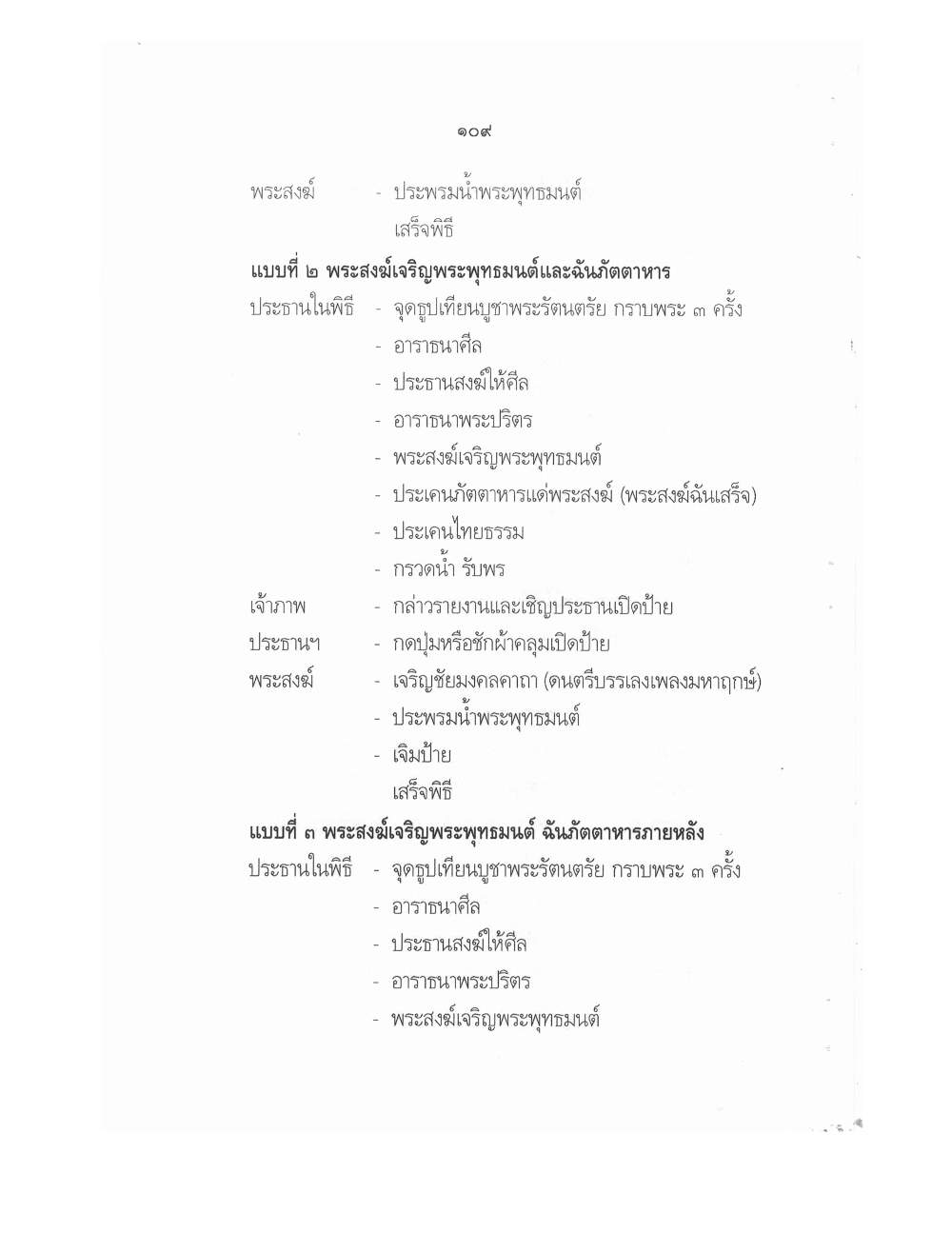
๑๐๙
พระสงฆ์ - ประพรมน้ำพระพุทธมนต์ เสร็จพิธี
แบบที่ ๒ พระสงฆ์เจริญพระพุทธมนต์และฉันภัตตาหาร ประธานในพิธี - จุดธูปเทียนบูชาพระรัตนตรัย กราบพระ ๓ ครั้ง - อาราธนาศีล - ประธานสงฆ์ให้ศีล - อาราธนาพระปริตร - พระสงฆ์เจริญพระพุทธมนต์ - ประเคนภัตตาหารแด่พระสงฆ์ (พระสงฆ์ฉันเสร็จ) - ประเคนไทยธรรม - กรวดน้ำ รับพร เจ้าภาพ - กล่าวรายงานและเชิญประธานเปิดป้าย ประธานฯ - กดปุ่มหรือชักผ้าคลุมเปิดป้าย พระสงฆ์ - เจริญชัยมงคลคาถา (ดนตรีบรรเลงเพลงมหาฤกษ์) - ประพรมน้ำพระพุทธมนต์ - เจิมป้าย เสร็จพิธี
แบบที่ ๓ พระสงฆ์เจริญพระพุทธมนต์ ฉันภัตตาหารภายหลัง ประธานในพิธี - จุดธูปเทียนบูชาพระรัตนตรัย กราบพระ ๓ ครั้ง - อาราธนาศีล - ประธานสงฆ์ให้ศีล - อาราธนาพระปริตร - พระสงฆ์เจริญพระพุทธมนต์
109
Monks - sprinkle holy water. The ceremony is complete.
Form 2: The monks chant the blessing and take their meal Presiding officiant - lights incense and candles to venerate the Triple Gem, prostrates three times. - Invites the precepts. - The presiding monk gives the precepts. - Invites the Paritta chanting. - The monks chant the Buddhist blessing. - Offers the meal to the monks (the monks finish eating). - Offers the requisites. - Pours the libation water and receives the blessing. Host - delivers the report speech and invites the presiding officiant to unveil the sign. Presiding officiant - presses the button or pulls the cloth to unveil the sign. Monks - chant the verses of victory and blessing (music plays the "Mahareuk" tune). - Sprinkle holy water. - Anoint the sign. The ceremony is complete.
Form 3: The monks chant the blessing, taking their meal afterward Presiding officiant - lights incense and candles to venerate the Triple Gem, prostrates three times. - Invites the precepts. - The presiding monk gives the precepts. - Invites the Paritta chanting. - The monks chant the Buddhist blessing.
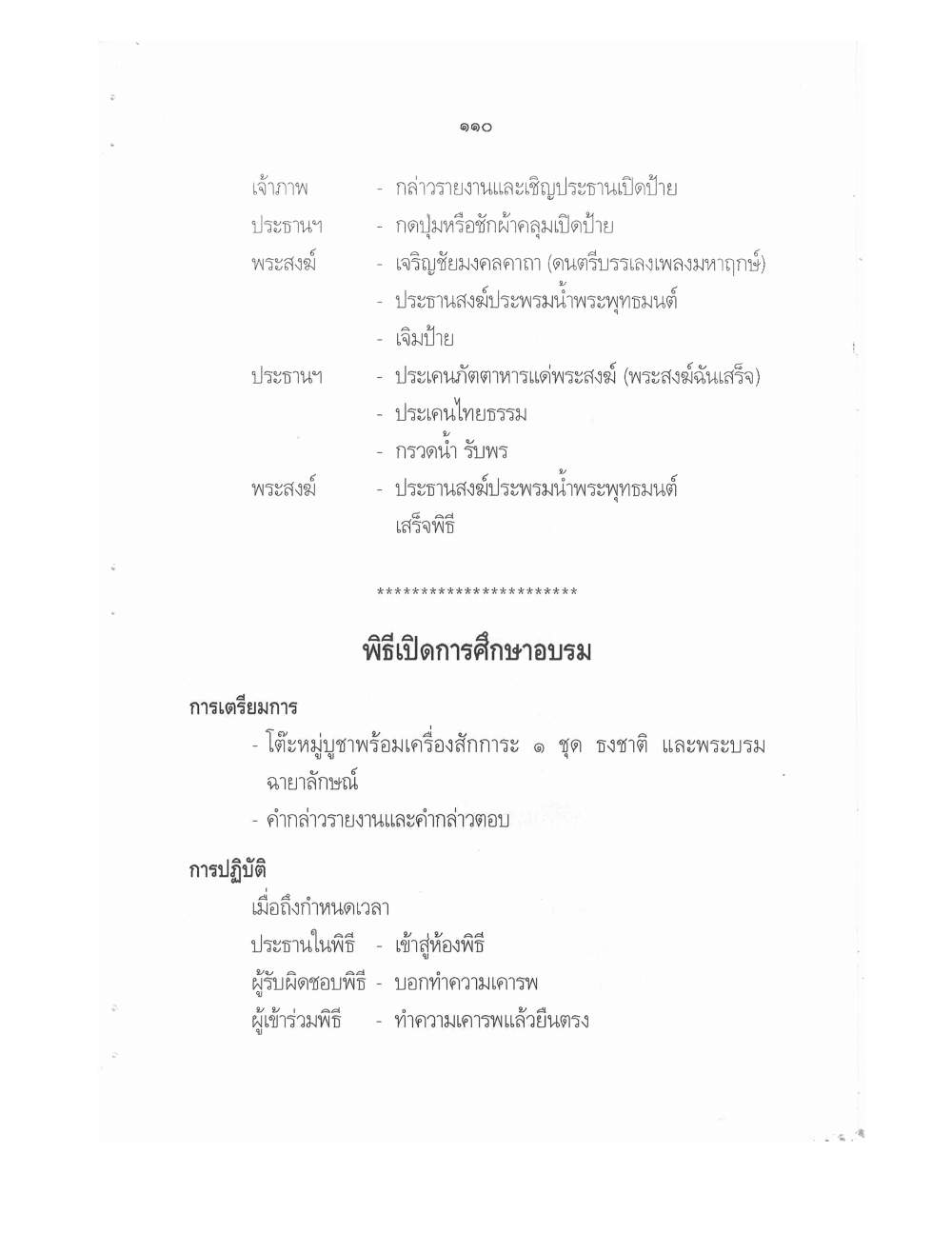
๑๑๐
เจ้าภาพ - กล่าวรายงานและเชิญประธานเปิดป้าย ประธานฯ - กดปุ่มหรือชักผ้าคลุมเปิดป้าย พระสงฆ์ - เจริญชัยมงคลคาถา (ดนตรีบรรเลงเพลงมหาฤกษ์) - ประธานสงฆ์ประพรมน้ำพระพุทธมนต์ - เจิมป้าย ประธานฯ - ประเคนภัตตาหารแด่พระสงฆ์ (พระสงฆ์ฉันเสร็จ) - ประเคนไทยธรรม - กรวดน้ำ รับพร พระสงฆ์ - ประธานสงฆ์ประพรมน้ำพระพุทธมนต์ เสร็จพิธี
**********************
พิธีเปิดการศึกษาอบรม
การเตรียมการ
- โต๊ะหมู่บูชาพร้อมเครื่องสักการะ ๑ ชุด ธงชาติ และพระบรมฉายาลักษณ์ - คำกล่าวรายงานและคำกล่าวตอบ
การปฏิบัติ
เมื่อถึงกำหนดเวลา ประธานในพิธี - เข้าสู่ห้องพิธี ผู้รับผิดชอบพิธี - บอกทำความเคารพ ผู้เข้าร่วมพิธี - ทำความเคารพแล้วยืนตรง
110
Host - delivers the report speech and invites the presiding officiant to unveil the sign. Presiding officiant - presses the button or pulls the cloth to unveil the sign. Monks - chant the verses of victory and blessing (music plays the "Mahareuk" tune). - The presiding monk sprinkles holy water. - Anoints the sign. Presiding officiant - offers the meal to the monks (the monks finish eating). - Offers the requisites. - Pours the libation water and receives the blessing. Monks - the presiding monk sprinkles holy water. The ceremony is complete.
**********************
Ceremony for Opening a Training Course
Preparations
- One set of offering table with offering items, the national flag, and a royal portrait. - The report speech and the reply speech.
Procedure
When the appointed time arrives Presiding officiant - enters the ceremonial room. The one responsible for the ceremony - calls for the salute of respect. Participants - pay respect, then stand at attention.
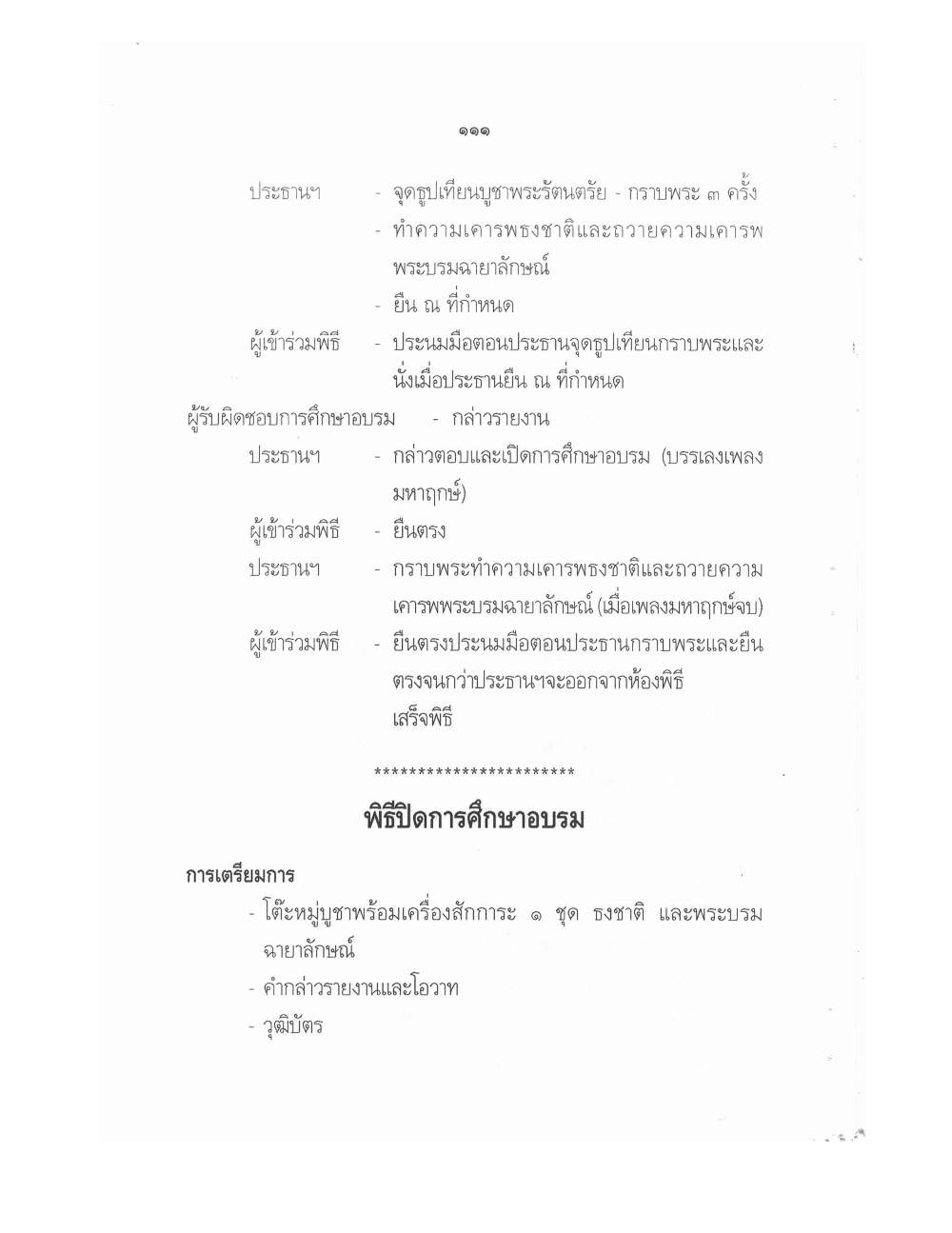
๑๑๑
ประธานฯ - จุดธูปเทียนบูชาพระรัตนตรัย - กราบพระ ๓ ครั้ง - ทำความเคารพธงชาติและถวายความเคารพพระบรมฉายาลักษณ์ - ยืน ณ ที่กำหนด ผู้เข้าร่วมพิธี - ประนมมือตอนประธานจุดธูปเทียนกราบพระและนั่งเมื่อประธานยืน ณ ที่กำหนด ผู้รับผิดชอบการศึกษาอบรม - กล่าวรายงาน ประธานฯ - กล่าวตอบและเปิดการศึกษาอบรม (บรรเลงเพลงมหาฤกษ์) ผู้เข้าร่วมพิธี - ยืนตรง ประธานฯ - กราบพระทำความเคารพธงชาติและถวายความเคารพพระบรมฉายาลักษณ์ (เมื่อเพลงมหาฤกษ์จบ) ผู้เข้าร่วมพิธี - ยืนตรงประนมมือตอนประธานกราบพระและยืนตรงจนกว่าประธานฯจะออกจากห้องพิธี เสร็จพิธี
**********************
พิธีปิดการศึกษาอบรม
การเตรียมการ
- โต๊ะหมู่บูชาพร้อมเครื่องสักการะ ๑ ชุด ธงชาติ และพระบรมฉายาลักษณ์ - คำกล่าวรายงานและโอวาท - วุฒิบัตร
111
Presiding officiant - lights incense and candles to venerate the Triple Gem - prostrates three times. - Salutes the national flag and pays respect to the royal portrait. - Stands at the designated place. Participants - press their palms together while the presiding officiant lights incense and candles and prostrates, and sit when the officiant stands at the designated place. The one responsible for the training course - delivers the report speech. Presiding officiant - replies and declares the training course open (the "Mahareuk" tune is played). Participants - stand at attention. Presiding officiant - prostrates to the Buddha, salutes the national flag, and pays respect to the royal portrait (when the Mahareuk tune ends). Participants - stand at attention with palms pressed together while the officiant prostrates, and remain standing at attention until the officiant leaves the ceremonial room. The ceremony is complete.
**********************
Ceremony for Closing a Training Course
Preparations
- One set of offering table with offering items, the national flag, and a royal portrait. - The report speech and the closing address. - Certificates.
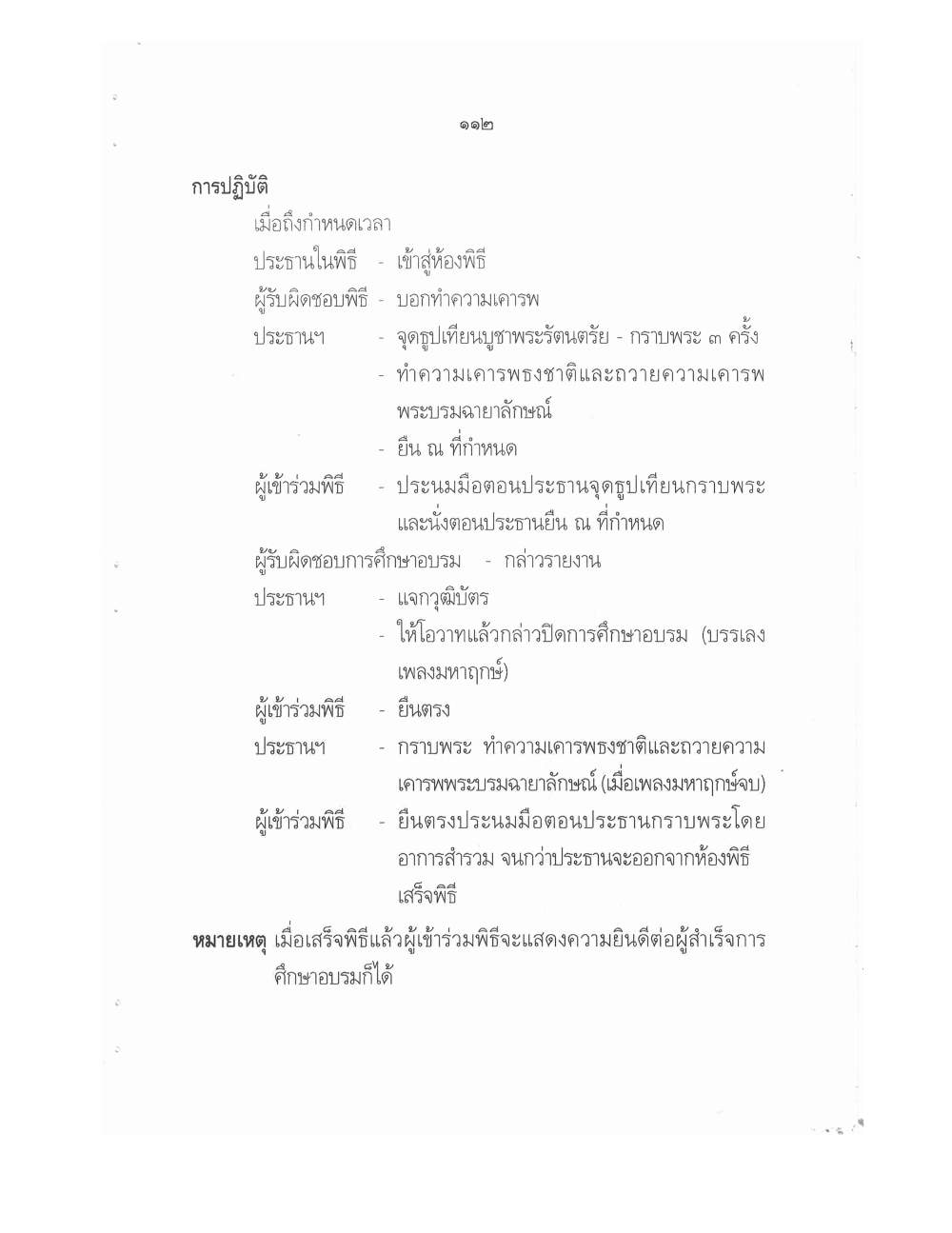
๑๑๒
การปฏิบัติ เมื่อถึงกำหนดเวลา ประธานในพิธี - เข้าสู่ห้องพิธี ผู้รับผิดชอบพิธี - บอกทำความเคารพ ประธานฯ - จุดธูปเทียนบูชาพระรัตนตรัย - กราบพระ ๓ ครั้ง - ทำความเคารพธงชาติและถวายความเคารพพระบรมฉายาลักษณ์ - ยืน ณ ที่กำหนด ผู้เข้าร่วมพิธี - ประนมมือตอนประธานจุดธูปเทียนกราบพระและนั่งตอนประธานยืน ณ ที่กำหนด ผู้รับผิดชอบการศึกษาอบรม - กล่าวรายงาน ประธานฯ - แจกวุฒิบัตร - ให้โอวาทแล้วกล่าวปิดการศึกษาอบรม (บรรเลงเพลงมหาฤกษ์) ผู้เข้าร่วมพิธี - ยืนตรง ประธานฯ - กราบพระ ทำความเคารพธงชาติและถวายความเคารพพระบรมฉายาลักษณ์ (เมื่อเพลงมหาฤกษ์จบ) ผู้เข้าร่วมพิธี - ยืนตรงประนมมือตอนประธานกราบพระโดยอาการสำรวม จนกว่าประธานจะออกจากห้องพิธี เสร็จพิธี
หมายเหตุ เมื่อเสร็จพิธีแล้วผู้เข้าร่วมพิธีจะแสดงความยินดีต่อผู้สำเร็จการศึกษาอบรมก็ได้
112
Procedure When the appointed time arrives Presiding officiant - enters the ceremonial room. The one responsible for the ceremony - calls for the salute of respect. Presiding officiant - lights incense and candles to venerate the Triple Gem - prostrates three times. - Salutes the national flag and pays respect to the royal portrait. - Stands at the designated place. Participants - press their palms together while the presiding officiant lights incense and candles and prostrates, and sit while the officiant stands at the designated place. The one responsible for the training course - delivers the report speech. Presiding officiant - distributes the certificates. - Gives a closing address, then declares the training course closed (the "Mahareuk" tune is played). Participants - stand at attention. Presiding officiant - prostrates to the Buddha, salutes the national flag, and pays respect to the royal portrait (when the Mahareuk tune ends). Participants - stand at attention with palms pressed together in a composed manner while the officiant prostrates, until the officiant leaves the ceremonial room. The ceremony is complete.
Note: Once the ceremony is complete, participants may also offer their congratulations to those who have completed the training course.
๑๑๓
พิธีโกนผมไฟ
การเตรียมการ
(นิมนต์พระสงฆ์ ๕ หรือ ๙ รูป) - โต๊ะหมู่บูชาพร้อมเครื่องสักการะ เหมือนทำบุญทั่วไป) - พาน ๑ ใบ (ใส่ใบบัว ๑ ใบ, กรรไกร ๑ ปาก, มีดเล็ก สีทอง - สีเงิน อย่างละ ๑ เล่ม, ด้ายผูกข้อมือเด็กและแป้งเจิม ๑ ที่) ตั้งไว้ข้างบาตรน้ำมนต์ วงด้วยด้ายสายสิญจน์ - เครื่องดื่ม ภัตตาหารและไทยธรรมถวายพระ - ที่กรวดน้ำ ๑ ที่
การปฏิบัติ
(เมื่อถึงกำหนดเวลา) เจ้าภาพ - จุดธูปเทียนบูชาพระรัตนตรัย กราบพระ ๓ ครั้ง - อาราธนาศีล รับศีล - อาราธนาพระปริตร ฟังพระสงฆ์เจริญพระพุทธมนต์ - จุดเทียนน้ำมนต์ (เมื่อพระสงฆ์เจริญพระพุทธมนต์ถึงบท "อะเสวนา...") - นำเด็กเข้าอยู่ในวงด้ายสายสิญจน์ (เมื่อพระสวดถึงบท มะหาการุณิโก...ก่อนเวลาฤกษ์เล็กน้อย) ประธานสงฆ์ - (เมื่อถึงเวลาฤกษ์) ประพรมน้ำพระพุทธมนต์ที่ศีรษะเด็ก จุ่มกรรไกรลงในบาตรน้ำมนต์ แล้วตัดหรือขริบปลายผมพอเป็นพิธี (ขณะนั้นพระสงฆ์เจริญชัยมงคลคาถา)
113
Ceremony for the First Hair-Shaving ("Fire-Hair" Rite)
Preparations
(Invite 5 or 9 monks) - Offering table with offering items, as for a general merit-making occasion. - One tray (containing 1 lotus leaf, 1 pair of scissors, 1 small gold-colored knife and 1 small silver-colored knife, thread for tying the child's wrist, and 1 bowl of anointing powder), placed beside the holy-water bowl, encircled with the sacred thread. - Beverages, food, and requisites to offer the monks. - One libation-water vessel.
Procedure
(When the appointed time arrives) Host - lights incense and candles to venerate the Triple Gem, prostrates three times. - Invites and receives the precepts. - Invites the Paritta chanting, listens to the monks chant the Buddhist blessing. - Lights the holy-water candle (when the monks reach the passage beginning "Asevana..."). - Brings the child into the circle of sacred thread (when the chanting reaches the passage "Mahakaruniko...", shortly before the auspicious moment). Presiding monk - (when the auspicious moment arrives) sprinkles holy water on the child's head, dips the scissors into the holy-water bowl, then cuts or trims the ends of the hair as a token gesture (at that moment the monks chant the verses of victory and blessing).
๑๑๔
- เจิมหน้า ผูกข้อมือเด็ก (ถ้าเป็นเด็กหญิงให้ผู้ปกครองปฏิบัติแทน ประธานสงฆ์จะประพรมน้ำพระพุทธมนต์เท่านั้น) เจ้าภาพ - (เมื่อพระสงฆ์เจริญพระพุทธมนต์จบ) นำเด็กออกจากด้ายสายสิญจน์มาข้างนอกให้ญาติผู้ใหญ่พ่อแม่และผู้ที่นับถืออื่นๆ ตัดผมเด็กออกพอเป็นพิธี ใช้มีดทอง มีดเงินแตะที่ศีรษะเด็กเสมือนว่าโกนผม - ผูกข้อมือ ให้พรเด็ก - ประเคนไทยธรรม (เมื่อพระสงฆ์ฉันเสร็จ) พระสงฆ์ - อนุโมทนา เจ้าภาพ - กรวดน้ำ รับพร - รับประพรมน้ำพระพุทธมนต์ เสร็จพิธี
หมายเหตุ
- ผมที่โกนหรือตัดนั้นให้นำใส่ใบบัวไปลอยน้ำตามที่เห็นสมควร
**********************
พิธีโกนจุก
การเตรียมการ
(นิมนต์พระสงฆ์ ๕ หรือ ๙ รูป ตามประสงค์) - โต๊ะหมู่บูชาพร้อมเครื่องสักการะ (เหมือนทำบุญทั่วไป) - พานใส่ใบบัว มีมีดโกนและกรรไกร
114
- Anoints the forehead and ties the child's wrist (if the child is a girl, the guardian performs this in her stead; the presiding monk will only sprinkle holy water). Host - (when the monks finish chanting the blessing) brings the child out of the circle of sacred thread, so that elder relatives, parents, and other respected persons may cut the child's hair as a token gesture, touching the child's head with the gold and silver knives as if shaving the hair. - Ties the wrist and blesses the child. - Offers the requisites (once the monks finish eating). Monks - give the anumodana (blessing of appreciation). Host - pours the libation water and receives the blessing. - Receives the sprinkling of holy water. The ceremony is complete.
Note
- The hair that has been shaved or cut should be placed on a lotus leaf and set afloat on water as deemed appropriate.
**********************
Ceremony for Shaving the Topknot (Jook)
Preparations
(Invite 5 or 9 monks, as desired) - Offering table with offering items (as for a general merit-making occasion). - A tray holding a lotus leaf, with a razor and scissors.
๑๑๕
- ด้ายผูกข้อมือ แป้งเจิม - เครื่องดื่ม ภัตตาหารถวายพระ - ไทยธรรม
การปฏิบัติ (ก่อนกำหนดพิธีสงฆ์) - โกนผมเด็กให้เกลี้ยงเหลือไว้แต่จุก - แบ่งจุกออกเป็น ๓ ปอย ประดับจุกตามสมควร - แต่งตัวเด็กด้วยชุดเสื้อผ้าใหม่ (เมื่อถึงกำหนดเวลาพิธีสงฆ์) เจ้าภาพ - นำเด็กเข้าอยู่ในวงสายสิญจน์ โยงสายสิญจน์มาที่จุกเด็ก - อาราธนาศีล รับศีล - อาราธนาพระปริตร ฟังพระเจริญพระพุทธมนต์ - จุดเทียนน้ำมนต์ (เมื่อพระเจริญพระพุทธมนต์ถึงบท "อะเสวนา...") ประธานสงฆ์ - ประพรมน้ำพระพุทธมนต์ที่จุกเด็ก (เมื่อพระสงฆ์เจริญพระพุทธมนต์ถึงบท "ชะยันโต...") แล้วใช้กรรไกรขริบจุกเด็ก ๑ ปอย เจ้าภาพ - นำเด็กออกมาข้างนอก นั่ง ณ ที่จัดไว้ (เมื่อพระสงฆ์เจริญพระพุทธมนต์จบ) - ผู้ใหญ่ในตระกูลตัดจุกเด็ก ๑ ปอย และบิดาเด็กตัด ๑ ปอย แล้วโกนจนเกลี้ยง - รดน้ำให้เด็ก (ใช้น้ำพระพุทธมนต์ผสม) ผู้อาวุโสรดก่อน แล้วคนอื่นๆ รดต่อๆ กันไปจนเสร็จสิ้น
115
- Thread for tying the wrist, anointing powder. - Beverages, food to offer the monks. - Requisites.
Procedure (before the monastic ceremony begins) - Shave the child's hair clean, leaving only the topknot. - Divide the topknot into 3 locks, decorated as appropriate. - Dress the child in new clothing. (When the time for the monastic ceremony arrives) Host - brings the child into the circle of sacred thread, extending the thread to the child's topknot. - Invites and receives the precepts. - Invites the Paritta chanting, listens to the monks chant the blessing. - Lights the holy-water candle (when the monks reach the passage beginning "Asevana..."). Presiding monk - sprinkles holy water on the child's topknot (when the monks reach the passage "Jayanto..."), then uses the scissors to trim one lock of the child's topknot. Host - brings the child outside to sit at the prepared place (when the monks finish chanting the blessing). - An elder of the family cuts one lock of the topknot, and the child's father cuts one lock, then shaves the head completely clean. - Pours water over the child (mixed with holy water); the most senior person pours first, then the others pour in turn until finished.
๑๑๖
- ประแป้ง แต่งตัว เจิมหน้า ผูกข้อมือเด็ก - ประเคนภัตตาหารแด่พระสงฆ์ (พระสงฆ์ฉันเสร็จ) - ประเคนจตุปัจจัยไทยธรรมให้เด็กประเคนด้วยมือเขาเอง พระสงฆ์ - อนุโมทนา เจ้าภาพ - กรวดน้ำ รับพร รับประพรมน้ำพระพุทธมนต์ เสร็จพิธี
หมายเหตุ
- จุกที่ตัดให้ใส่ในใบบัว นำไปลอยน้ำตามที่เห็นสมควร
**********************
งานมงคลสมรส
พิธีหมั้น
การเตรียมการ
ขันหมากประกอบด้วย - ขันที่ ๑ บรรจุหมาก ๘ คู่ (ก้านทาด้วยชาดแดง) พลู ๘ เรียง เรียงละ ๘ ใบ (ก้านทาด้วยชาดแดง) ใบพลูวางรอบขัน หันปลายพลูขึ้นปากขันหมากวางไว้ตรงกลาง(บางตำราบอกว่าหมากพลูใช้เท่าไรก็ได้ แต่ขอให้เป็นคู่ๆ) - ขันที่ ๒ บรรจุขนมจีน ๘ จับ และห่อหมก ๘ ห่อ (บางตำราว่าขันนี้ไม่จำเป็นต้องจัดก็ได้) - ขันที่ ๓ บรรจุดอกรัก ๗ ดอก, ดอกบานไม่รู้โรย ๗ ดอก, ดอกดาวเรือง ๗ ดอก, ยอดใบเงินใบทองอย่างละ ๓ ยอด,
116
- Applies powder, dresses, anoints the forehead, and ties the child's wrist. - Offers the meal to the monks (the monks finish eating). - Offers the four requisites (dhamma-gifts); the child receives them with his or her own hands. Monks - give the anumodana (blessing of appreciation). Host - pours the libation water, receives the blessing, and receives the sprinkling of holy water. The ceremony is complete.
Note
- The cut lock of hair should be placed on a lotus leaf and set afloat on water as deemed appropriate.
**********************
Auspicious Wedding Rites
Engagement Ceremony
Preparations
The betrothal trays (khan mak) consist of: - Tray 1: contains 8 pairs of areca nuts (stems painted with red lac dye), 8 rows of betel leaves, 8 leaves per row (stems painted with red lac dye); the betel leaves are arranged around the tray with the leaf tips pointing toward the rim, and the areca-nut tray is placed in the center (some manuals say any number of areca nuts and betel leaves may be used, provided they are in pairs). - Tray 2: contains 8 handfuls of rice vermicelli (khanom jeen) and 8 wrapped fish-curry parcels (haw mok) (some manuals say this tray need not be prepared). - Tray 3: contains 7 rak flowers, 7 everlasting (bandum-mai-roo-roi) flowers, 7 marigold flowers, and 3 sprigs each of silver-leaf and gold-leaf plants,
ข้าวเปลือก ๑ ถุง, ถั่วเขียว ๑ ถุง, งาดำ ๑ ถุง (ถุงเล็กๆ พองาม) และแหวน ทองหมั้น วางบนของเหล่านั้น คลุมปากขันด้วยผ้าสีชมพูหรือผ้าแดง
การปฏิบัติ - ผู้ใหญ่ฝ่ายชาย (เฒ่าแก่) เดินออกหน้า (เวลานำขบวนไปหมั้น) ถัดไปเป็นผู้ที่ถือขันหมาก เจ้าบ่าว ญาติอื่น - (ฝ่ายเจ้าสาว) จัดคนเชิญขันหมากและรับขันหมากไปวางไว้ในที่กำหนด (คนเชิญขันหมากมักใช้เด็กหญิงอายุประมาณ ๗ - ๘ ขวบ) - ผู้ใหญ่ทั้งสองฝ่ายนั่งล้อมขันหมาก - ผู้ใหญ่ฝ่ายชายกล่าวคำขอหมั้นว่า (ตัวอย่าง) "ผม/ดิฉันได้ทราบว่าคุณ...ซึ่งเป็นบุตรของ...ได้สมัครรักใคร่กับ...ซึ่ง เป็นบุตรสาวของ...และทั้งสองมีความประสงค์จะครองเรือนร่วมชีวิตกันตามประเพณีอันดีงาม ดังนั้นวันนี้ถือว่าเป็นวันมงคล ฤกษ์ดียามดี จึงใคร่ขอสู่ขอและหมั้นคุณให้กับคุณ..... ขอได้โปรดพิจารณา เพื่อทั้งสองจะได้สมรักสมปรารถนาเป็นทองแผ่นเดียวกัน" - ผู้ใหญ่ฝ่ายหญิงกล่าวตอบว่า (ตัวอย่าง) "ผม/ดิฉัน รู้สึกยินดีเป็นอย่างยิ่งที่ท่านได้ให้เกียรติมาสู่ขอตามประเพณี จึงขอต้อนรับด้วยความเต็มใจและปีติอย่างสูง ก็ขอให้วันมงคลนี้จงเป็นนิมิตหมายอันดีสำหรับความรักของทั้งสองตลอดไป" - ผู้ใหญ่ฝ่ายชายมอบขันหมากแก่ผู้ใหญ่ฝ่ายหญิง
1 bag of unhusked rice, 1 bag of mung beans, 1 bag of black sesame (small bags, of a fitting size), and the engagement gold ring, placed on top of these; cover the mouth of the tray with pink or red cloth.
Procedure - The senior man of the groom's side (the go-between elder) walks in front (when leading the procession to the engagement); next comes the person carrying the betel-nut tray, the groom, and other relatives. - (Bride's side) arranges people to welcome and receive the betel-nut tray and set it down in the designated place (the child who welcomes the betel-nut tray is usually a girl about 7-8 years old). - The elders of both sides sit around the betel-nut tray. - The senior man of the groom's side speaks the words asking for the engagement, for example: "I have learned that you..., child of..., have fallen in love with..., daughter of..., and that the two of you wish to build a household and life together according to good tradition. Therefore today is held to be an auspicious day, a good hour and season, so I wish to ask for [her] hand and to engage you to.... Please consider this, so that the two may be joined in mutual love and desire as one piece of gold." - The senior woman of the bride's side answers, for example: "I am extremely pleased that you have honored us by coming to ask according to tradition, so I welcome you wholeheartedly and with great joy. May this auspicious day be a good omen for the love of the two of them forever." - The senior man of the groom's side hands the betel-nut tray to the senior woman of the bride's side.
- ผู้ใหญ่ฝ่ายหญิงเปิดขันหมากและตรวจดู พร้อมกับกล่าวคำที่เป็นสิริมงคล เช่น "ทุกอย่างล้วนแล้วแต่สวยสดงดงาม ทองสุกใสหลายหลาก เงินมากมายก่ายกอง คงจะต้องอำนวยความสุขสดชื่นตลอดชั่วนิรันดร์ทีเดียว ฯลฯ" - ผู้ใหญ่ทั้งสองฝ่ายร่วมกันโปรยวัตถุมงคล (ถั่ว, งา, ข้าวตอก, ดอกไม้) ลงบนของหมั้น พร้อมกับกล่าวคำที่เป็นสิริมงคล เช่นว่า "เงินทองเหล่านี้คงจะงอกเงยยิ่งขึ้นเหมือนถั่วงาที่หว่านไว้ในไร่สวนที่เดียว" (ถั่วงาหลังจากเสร็จพิธีแล้ว นำไปโปรยไว้ในสวนหรือที่เหมาะสม) - ฝ่ายหญิงนำเจ้าสาวออกมาและน้อมไหว้ผู้ใหญ่ฝ่ายชายจนครบทุกคน แล้วนั่งในที่กำหนด
ได้เวลาฤกษ์ - ผู้ใหญ่ฝ่ายหญิงมอบแหวนหมั้นให้เจ้าบ่าวเพื่อสวมนิ้วเจ้าสาวต่อไป - เจ้าบ่าวเจ้าสาวไปกราบผู้ใหญ่ทั้งสองฝ่าย (กราบตั้งมือครั้งเดียว) - ฝ่ายหญิงแจกของชำร่วยเลี้ยงของว่างแขก (ถ้ามี) เสร็จพิธี
หมายเหตุ - บางงานนั้นเป็นเพียงไปเจรจาสู่ขอเฉยๆ ของหมั้นนำไปทำพิธีหมั้นในวันแต่งเลยก็มี ข้อนี้แล้วแต่จะตกลงกัน - บางตำรามีการพรมน้ำมนต์และเจิมของหมั้นก่อนสวมแหวนด้วย
- The senior woman of the bride's side opens the betel-nut tray and inspects it, while speaking auspicious words, such as: "Everything here is beautiful and finely made -- gold gleaming in many forms, silver piled up in abundance -- surely this will bring happiness and freshness for an eternity, etc." - The elders of both sides together scatter auspicious items (beans, sesame, popped rice, flowers) onto the engagement gifts, while speaking auspicious words, such as: "May this money and gold grow and flourish just as the beans and sesame sown in a single field or garden." (After the ceremony, the beans and sesame are taken and scattered in a garden or other suitable place.) - The bride's side brings the bride out, and she pays respect (wai) to all the elders of the groom's side one by one, then sits in the designated place.
When the Auspicious Time Arrives - The senior woman of the bride's side gives the engagement ring to the groom, for him to place on the bride's finger next. - The groom and bride go and prostrate to the elders of both sides (a single prostration with hands raised). - The bride's side distributes party favors and serves light refreshments to the guests (if any). The ceremony is complete.
Note - In some cases the event is merely a visit to propose, with the engagement gifts only brought to perform the engagement rite on the wedding day itself; this is a matter for agreement. - In some manuals, holy water is sprinkled and the engagement gifts are anointed [with sacred powder] before the ring is put on as well.
พิธียกขันหมาก การเตรียมการ - ขันหมากเอก ๔ ขัน ประกอบด้วย ขันใส่หมากพลู ๒ ขัน (หมาก ๘ คู่ พลู ๘ เรียง) ขันใส่ขนมจีนห่อหมาก ๒ ขัน (แต่ละขันมีขนมจีน ๘ จับ ห่อหมาก ๘ ห่อ) - ขันสินสอด ๑ ขัน (ถ้าไม่มีการหมั้นไว้ก่อน)
การปฏิบัติ (เมื่อถึงเวลาฤกษ์) - ผู้ใหญ่ฝ่ายชายนำขบวน ติดตามด้วย คนนำต้นกล้วย ๒ ต้น (๒ คน), คนนำต้นอ้อย ๒ ต้น (๒ คน), คนนำขันหมาก ๔ คน, คนนำขันสินสอด ๑ คน, เจ้าบ่าว, คนถือขวดเหล้า ๒ คน, คนถือผ้าไหว้ผี ๑ คน (ผ้า ขาว ๖ ศอก), คนถือถาดมะพร้าวอ่อน ๒ ลูก, คนถือถาดกล้วยน้ำว้า ๒ หวี, คน ถือถาดใส่หมู, คนถือถาดใส่หมี่, คนถือถาดใส่ขนม และอื่นๆ - ฝ่ายเจ้าสาวจัดคนถือพานหมากไปคอยรับที่ประตูบ้าน (มัก นิยมใช้เด็กหญิง) - เมื่อขบวนขันหมากมาถึง ก่อนเข้าบ้าน เด็กหญิงที่ถือพาน หมากมาต้อนรับจะพูดว่า "ไปยังไงมายังไงคะ มากันมากมาย จริงๆ" - ผู้นำขบวนขันหมากจะพูดตอบว่า "วันนี้มาดีนะ ไม่ได้มาร้าย นำแก้วแหวนเงินทองและนำคนดีมีสิริมงคลมาให้เพื่อเป็น ทองแผ่นเดียวกัน ขอผ่านหน่อยนะจ๊ะ" (พร้อมกับวางซอง เงินไว้บนพานหมากของเด็กด้วย)
Rite of Carrying the Betel-Nut Trays Preparation - 4 principal betel-nut trays, consisting of: 2 trays of areca nut and betel leaf (8 pairs of areca nut, 8 rows of betel leaf), 2 trays of rice-noodle-and-areca-nut parcels (each tray with 8 bundles of rice noodles, 8 wrapped parcels of areca nut). - 1 tray for the bride-price money (if there was no prior engagement).
Procedure (When the auspicious hour arrives) - The senior man of the groom's side leads the procession, followed by: people carrying 2 banana plants (2 people), people carrying 2 sugarcane stalks (2 people), 4 people carrying the betel-nut trays, 1 person carrying the bride-price tray, the groom, 2 people carrying bottles of liquor, 1 person carrying cloth for paying respect to the spirits (6 sok of white cloth), people carrying a tray of 2 young coconuts, people carrying a tray of 2 combs of namwa bananas, people carrying a tray of pork, people carrying a tray of noodles, people carrying a tray of sweets, and so on. - The bride's side arranges people holding betel-nut trays to wait and receive [the procession] at the house gate (young girls are usually used for this). - When the betel-nut procession arrives, before entering the house, the girl holding the tray who comes to greet them says: "How did you come, how did you get here? So many of you have really come!" - The leader of the betel-nut procession replies: "Today we come with good intentions, not with ill will; we bring jewels, rings, silver and gold, and bring good, auspicious people, so that [the couple] may become one piece of gold together. Please let us pass" (while also placing an envelope of money on the child's betel-nut tray).
- ฝ่ายเด็กหญิงก็จะพูดว่า "ถ้าอย่างนั้นขอเชิญค่ะ ด้วยความ ยินดีค่ะ" - ญาติฝ่ายเจ้าสาวที่ถูกจัดไว้เพื่อรับขบวนขันหมากนำขัน หมากไปวางไว้ในที่กำหนดต่อหน้าญาติทั้งสองฝ่าย - นำผ้าไหว้ไปวางไว้ร่วมกับขันหมาก ของนอกนั้นวางไว้ในที่ เหมาะสม วางเป็นแถวคู่กัน ส่วนต้นกล้วย ต้นอ้อยรับไป วางพิงไว้ที่ประตูบ้านทั้ง ๒ ข้าง - ผู้ใหญ่ฝ่ายเจ้าสาวร่วมกันเปิดขันหมาก นับเงินสินสอดและ โปรยวัตถุมงคลลงบนสินสอด - นำเจ้าสาวออกมานั่งข้างซ้ายเจ้าบ่าว น้อมไหว้ผู้ใหญ่ฝ่ายเจ้า บ่าว (ถ้ามีการสวมแหวนหมั้น ก็ทำตอนนี้และปฏิบัติเหมือน ที่กล่าวไว้ในตอนหมั้น) - ผู้ใหญ่ทั้ง ๒ ฝ่าย ประพรมน้ำมนต์ลงบนสิ่งของต่างๆ ที่วาง ไว้เป็นแถว พร้อมกับกล่าวคำที่เป็นสิริมงคล เช่นว่า "ของ เป็นอันมาก มั่งคั่งสมบูรณ์ดี ขอให้พอกพูน ทวียิ่งขึ้นตลอด ไป ภะวะตุ สัพพะมังคะลัง"
พิธีไหว้วิญญาณบรรพบุรุษ (ไหว้ผี) การเตรียมการ - เก็บของกินที่มากับขันหมากอย่างละเล็กละน้อย ใส่ในถาด หรือจาน ๒ ใบ - รินเหล้าใส่แก้ว ๒ ใบ จาก ๒ ขวด - เทียน ๒ เล่ม และธูป ๓ ดอก สำหรับเจ้าบ่าวและเจ้าสาว
- The girl replies: "In that case, please come in, gladly." - The bride's relatives assigned to receive the betel-nut procession carry the trays to the designated place in front of the relatives of both sides. - The spirit-offering cloth is placed together with the betel-nut trays; the other items are placed in a suitable spot, arranged in paired rows. The banana plants and sugarcane stalks are taken and set leaning against both sides of the house door. - The elders of the bride's side together open the betel-nut trays, count the bride-price money, and scatter auspicious items onto the bride-price money. - The bride is brought out to sit at the groom's left side and pays respect (wai) to the elders of the groom's side. (If the engagement ring is to be put on, it is done at this point, following the same procedure described in the engagement section.) - The elders of both sides sprinkle holy water onto the various items arranged in rows, while speaking auspicious words, such as: "May these many things, prosperous and abundant, increase and multiply ever more. Bhavatu sabba-mangalam."
Rite of Paying Respect to the Ancestral Spirits (Paying Respect to the Spirits) Preparation - Gather small portions of the food that came with the betel-nut trays, and place them on 2 trays or plates. - Pour liquor into 2 glasses, from 2 bottles. - 2 candles and 3 sticks of incense for the groom and bride.
การปฏิบัติ - วางจานของกินที่เก็บจากขันหมาก พร้อมทั้งแก้วเหล้า ๒ แก้ว ที่โต๊ะ หรือบนผ้าขาวภายในบ้าน มุมใดมุมหนึ่งที่เห็นว่า เหมาะสม - จุดธูปเทียนให้เจ้าบ่าวและเจ้าสาวปักไว้ ณ ที่ปักหรือบนจาน หรือถาดของไหว้ - กล่าวบูชาวิญญาณของบรรพบุรุษว่า "วันนี้นาย...และ นางสาว...ได้เข้าพิธีมงคลสมรสตามประเพณีจึงขอนอบน้อม แด่ดวงวิญญาณของบรรพบุรุษที่ล่วงลับไป เพื่อเป็นการ บอกกล่าวขออนุญาต และขอให้ดวงวิญญาณและพระคุณ ของท่านได้โปรดอวยพรให้ลูกหลานมีความสุขความเจริญ ในชีวิตสมรสยิ่งๆ ขึ้นไปเทอญ" กราบตั้งมือ ๑ ครั้ง เสร็จพิธี
พิธีสงฆ์เนื่องในพิธีมงคลสมรส การเตรียมการ - เครื่องพิธีสงฆ์ (เหมือนที่ทำบุญทั่วไป) - ด้ายมงคลแฝดและแป้งเจิม (ใส่พานตั้งไว้ข้างบาตรน้ำมนต์ เพื่อให้พระท่านเสกให้เพื่อความเป็นสิริมงคล) - หมอนกราบ ๒ ใบ (หน้าโต๊ะหมู่บูชา)
การปฏิบัติ เมื่อถึงเวลาสมควรแล้วเจ้าบ่าวและเจ้าสาวนั่งหน้าโต๊ะหมู่บูชา (หญิงซ้ายชายขวา) - รับเทียนชนวนจากพิธีกร จับด้วยกัน จุดเทียนจากซ้ายไปขวา
Procedure - Place the plate of food gathered from the betel-nut trays, together with the 2 glasses of liquor, on a table or on white cloth inside the house, at whichever corner seems suitable. - Light incense and candles for the groom and bride to plant, at the place for planting them, or on the plate or tray of the offering. - Speak in worship to the spirits of the ancestors: "Today, Mr. ... and Miss ... have entered the auspicious marriage rite according to tradition, and we humbly pay respect to the souls of the departed ancestors, to inform them and ask permission, and ask that their souls and grace may bless their descendants with happiness and ever-increasing prosperity in married life." Prostrate with hands raised once. The ceremony is complete.
Monks' Ceremony as Part of the Auspicious Marriage Rite Preparation - Ceremonial monk's requisites (the same as for ordinary merit-making) - A pair of sacred thread (dai mongkhon) and anointing powder (placed on a tray set beside the holy-water bowl, for the monks to consecrate for auspiciousness) - 2 prostration cushions (in front of the altar table)
Procedure When the appropriate time arrives, the groom and bride sit in front of the altar table (bride on the left, groom on the right) - They receive the lighting taper from the master of ceremonies, hold it together, and light the candles from left to right
(ของผู้จุด) แล้วจุดธูป เสร็จแล้วส่งเทียนชนวนคืนพิธีกร - พนมมือเสมออก กล่าวคำบูชาและอธิษฐานดังนี้.- "ข้าพเจ้าขอน้อมบูชาสักการะคุณพระศรีรัตนตรัยด้วยเครื่อง สักการะนี้ ข้าพเจ้าทั้งสองจะซื่อสัตย์ต่อกันอย่างมั่นคง ดำรง ชีวิตด้วยความถูกต้องดีงามทุกประการ ด้วยสัจวาจานี้ ขออานุภาพคุณพระศรีรัตนตรัยพร้อมทั้งอำนาจคุณงามความ ดีทั้งหลายที่ข้าพเจ้าทั้งสองได้บำเพ็ญมา ได้โปรดดลบันดาล บันดาลให้ข้าพเจ้าทั้งสอง ประสบแต่ความสุขความเจริญ ความก้าวหน้าในชีวิตยิ่งๆ ขึ้นไปเทอญ" - กราบลงที่หมอนพร้อมกัน ๓ ครั้ง แล้วหันไปกราบพระสงฆ์ ๓ ครั้ง เสร็จแล้วนั่งพับเพียบพนมมือรับศีลฟังพระเจริญ พระพุทธมนต์ต่อไป จนกว่าจะถึงเวลาจุดเทียนน้ำมนต์ - คุกเข่า รับเทียนชนวนจากพิธีกร จับด้วยกัน จุดเทียน น้ำมนต์ที่บาตรน้ำมนต์ แล้วส่งเทียนชนวนคืนพิธีกร ยก บาตรน้ำมนต์ด้วยกัน ประเคนพระรูปแรก (ยกพอพ้นพื้น วางลงบนผ้าที่พระท่านถือรองรับ) แล้วนั่งพับเพียบพนมมือ ฟังพระเจริญพระพุทธมนต์ต่อจนกว่าจะถึงเวลาตักบาตร (พระสวด "พาหุง") - ลุกไปตักบาตร (จับทัพพีด้วยกัน หยิบของใส่บาตรด้วยกัน) - กลับมาที่พระสงฆ์เพื่อประเคนภัตตาหาร เมื่อพระสงฆ์เจริญ พระพุทธมนต์จบ (ยกถวายด้วยกันทุกอย่าง) เสร็จแล้วกราบ พระสงฆ์ ๓ ครั้ง แล้วลุกไปพักผ่อนต้อนรับแขก ญาติมิตร ตามอัธยาศัยจนกว่าพระสงฆ์จะฉันเสร็จ
(of the person lighting it), then light the incense; when done, return the lighting taper to the master of ceremonies. - Raise the hands in a wai at chest level and speak the following words of worship and vow: - "I humbly offer worship and homage to the virtues of the Holy Triple Gem with this offering. We two will be faithful to one another steadfastly, and will conduct our lives correctly and virtuously in every way. By this truthful speech, may the power of the virtues of the Holy Triple Gem, together with the power of whatever goodness and merit we two have performed, grant that we two may meet only with happiness, prosperity, and ever-increasing progress in life." - Prostrate on the cushion together 3 times, then turn and prostrate to the monks 3 times. When done, sit in the polite kneeling position with hands folded, receiving the precepts and listening to the monks chant the sacred texts, until it is time to light the holy-water candle. - Kneel, receive the lighting taper from the master of ceremonies, hold it together, light the holy-water candle at the holy-water bowl, then return the taper to the master of ceremonies. Lift the holy-water bowl together and present it to the first monk (raise it just clear of the floor, and set it down on the cloth the monk holds to receive it). Then sit in the polite kneeling position with hands folded, listening to the monks continue chanting the sacred texts, until it is time to offer food into the alms bowl (the monks chant the "Phahung" [Buddhajayamangala Gatha]). - Rise and go to offer food into the alms bowl (hold the spoon together, place items into the bowl together). - Return to the monks to present the meal offering. When the monks finish chanting the sacred texts (lift and offer everything together), then prostrate to the monks 3 times, then rise to rest and receive guests, relatives and friends as they please, until the monks finish their meal.
- กลับมานั่งที่พระสงฆ์เพื่อประเคนไทยธรรม ยกประเคน ด้วยกันจนครบทุกรูป) - กลับมานั่งพับเพียบที่เดิม ถือที่กรวดน้ำด้วยกันเตรียมกรวด น้ำ เริ่มรินน้ำเมื่อพระเริ่ม "ยถา..." โดยตั้งใจอุทิศกุศลดังนี้ "ข้าพเจ้าขออุทิศส่วนบุญกุศลที่ได้บำเพ็ญร่วมกันในวันนี้ ให้แก่ท่านที่มีพระคุณ มีมารดาบิดา ครูอาจารย์ เป็นต้น ขอ ทุกคนที่ได้รับส่วนบุญกุศลของข้าพเจ้าจงเป็นสุขโดยทั่วกัน เถิด" และรีบรินน้ำให้หมดเมื่อพระรูปแรกว่าจบลง แล้ว พนมมือรับพรต่อไปจนกว่าพระสงฆ์จะอนุโมทนาจบ - น้อมศีรษะพนมมือเข้ารับประพรมน้ำพระพุทธมนต์จาก พระสงฆ์ทีละรูปจนครบทุกรูป เสร็จแล้วกลับมานั่งที่เดิม คุกเข่ากราบพระสงฆ์ ๓ ครั้ง หันไปกราบพระพุทธรูปอีก ๓ ครั้งแล้วลุกไปรอส่งพระ เสร็จพิธี
พิธีหลั่งน้ำพระพุทธมนต์และประสาทพร การเตรียมการ - โต๊ะหมู่บูชา ๑ ชุด (ชุดหมู่ ๗ หรือหมู่ ๙) - โต๊ะน้ำสังข์ พร้อมทั้งอุปกรณ์รดน้ำ ๑ ชุด - พวงมาลัย ๒ ชาย ๒ พวง - ด้ายมงคลแฝด ๑ ชุด - แป้งกระแจะสำหรับเจิม ๑ ที่ - น้ำพระพุทธมนต์ ๑ ขัน พร้อมขันเล็กสำหรับตักน้ำใส่สังข์ ๑ ที่
- Return and sit before the monks to present the offering of Thai religious requisites, lifting and offering together in turn with every monk. - Return to sit in the polite kneeling position at the same place, hold the water-pouring vessel together and prepare to pour the libation water. Begin pouring the water when the monks begin chanting "Yathā...", while intently dedicating the merit as follows: "I dedicate the merit that we have jointly performed today to those to whom we are indebted with gratitude, including our mothers, fathers, teachers, and others. May all who receive a share of this merit be happy, one and all." Pour the water quickly so that it is finished by the time the first monk's chanting ends, then hold the hands in a wai to receive the blessing until the monks finish the anumodana [rejoicing in merit]. - Bow the head with hands folded to receive the sprinkling of holy water from the monks, one by one, until all have done so. Then return to sit in the same place, kneel and prostrate to the monks 3 times, turn and prostrate to the Buddha image another 3 times, then rise and wait to see the monks off. The ceremony is complete.
The Rite of Pouring Holy Water and Bestowing Blessings Preparation - 1 set of altar table (a set of 7 or 9 tiers) - 1 table for the conch-shell water, complete with a set of pouring implements - 2 garlands, each with 2 tassel-ends - 1 set of paired sacred thread (dai mongkhon) - 1 portion of scented anointing powder - 1 bowl of holy water, with 1 small cup for ladling water into the conch shell
การปฏิบัติ (เมื่อถึงกำหนดเวลา) - เจ้าบ่าวและเจ้าสาวไปนั่งคุกเข่าที่โต๊ะหมู่บูชา (หญิงซ้ายชาย ขวา) - รับเทียนชนวนจากพิธีกรจุดธูปเทียนเช่นเดียวกับตอนพิธีสงฆ์ - พนมมือกล่าวคำบูชาอธิษฐานเพื่อความสุขความเจริญ (พิธีกร จะกล่าวนำ) - กราบลงที่หมอนพร้อมๆ กัน ๓ ครั้ง - ไปนั่งที่โต๊ะน้ำสังข์ (หญิงซ้าย ชายขวา) - พนมมือยื่นพาดโต๊ะวางแขนข้างหน้าน้อมปลายมือลงเล็กน้อย (เพื่อไม่ให้น้ำสังข์ไหลเข้าหาตัว) และให้มืออยู่เหนือพาน ดอกไม้รองรับน้ำสังข์ - น้อมศีรษะเล็กน้อยให้กับทุกคนที่ไปหลั่งน้ำสังข์และประสาท พร - ยื่นมือซ้อนกันรับด้ายมงคลจากประธานในพิธีถอดมงคลให้ แล้วลุกขึ้นยืนพร้อมกัน (เมื่อประธานฯ จับมือบอกลุกขึ้น) เจ้า บ่าวเก็บด้ายมงคลไว้ในกระเป๋าเสื้อบน - ไปกราบพระที่โต๊ะหมู่บูชา ๓ ครั้ง เสร็จพิธี
หมายเหตุ ด้ายมงคลถือว่าเป็นของสูง เป็นสิริมงคล ให้เก็บไว้ถาวรในที่สูง เช่น บนหิ้งพระ หากจะนำไปใช้ในการต่อไป ก็ใช้ในการที่เป็น มงคลเท่านั้น
Procedure (When the set time arrives) - The groom and bride go and kneel at the altar table (bride on the left, groom on the right). - They receive the lighting taper from the master of ceremonies and light the incense and candles, the same as during the monks' ceremony. - They hold their hands in a wai and speak words of worship and vow for happiness and prosperity (the master of ceremonies leads the words). - Prostrate on the cushion together 3 times. - Go and sit at the conch-shell water table (bride on the left, groom on the right). - Hold the hands in a wai, extend them resting on the table with the arms laid in front, tilting the fingertips down slightly (so that the conch-shell water does not flow back toward the body), keeping the hands above the flower tray that catches the conch-shell water. - Bow the head slightly to everyone who comes to pour the conch-shell water and bestow blessings. - Extend the hands, one placed over the other, to receive the sacred thread as the presiding elder removes it and gives it to them, then rise and stand together (when the presiding elder takes their hands and signals them to rise); the groom keeps the sacred thread in his upper shirt pocket. - Go and prostrate to the Buddha image at the altar table 3 times. The ceremony is complete.
Note The sacred thread (dai mongkhon) is considered a high and auspicious object; it should be kept permanently in a high place, such as on the Buddha shelf. If it is to be used again in the future, it should be used only for auspicious purposes.
หน้าที่ประธานในพิธีหลั่งน้ำพระพุทธมนต์และประสาทพร การปฏิบัติ (หลังจากเจ้าบ่าวและเจ้าสาว บูชาพระและนั่งที่โต๊ะน้ำสังข์ เรียบร้อย) - ไปที่โต๊ะน้ำสังข์ น้อมศีรษะไหว้พระที่โต๊ะหมู่บูชา ๑ ครั้ง - รับพวงมาลัยจากพิธีกรและกล่าวว่า "ขออานุภาพแห่งความ รักทั้งที่เป็นบุพเพสันนิวาส และปัจจุบันเกื้อหนุน ได้โปรด ค้ำจุนความรักของคุณทั้ง ๒ ให้สดชื่น ยั่งยืนตลอดไป" แล้ว สวมให้เจ้าบ่าวและเจ้าสาว (ให้ชายของพวงมาลัยทั้งสองข้าง พาดอยู่บนโต๊ะวางแขน) - รับด้ายมงคลจากพิธีกร พนมมือกล่าวว่า "พระพุทธเจ้า พระธรรม พระสงฆ์ เป็นมงคลในโลก ด้วยอานุภาพแห่งคุณ พระศรีรัตนตรัย ขอความสุขสวัสดีมงคลจงบังเกิด แก่คุณทั้ง สองตลอดกาลทุกเมื่อเทอญ" แล้วใช้มือแต่ละข้างกางคลี่ บ่วงด้ายมงคลแต่ละบ่วง ออกสวมศีรษะของเจ้าบ่าวและเจ้า สาวพร้อมๆ กัน (มือซ้ายสวมเจ้าบ่าว มือขวาสวมเจ้าสาว) โดยให้ปมด้ายอยู่ด้านหลังศีรษะ (ถ้าไม่เรียบร้อยให้จัดใหม่ อีกครั้งหนึ่ง) - รับแป้งเจิมจากพิธีกร (หรือพิธีกรถือไว้ให้) ใช้นิ้วชี้จุ่มแป้ง จุดที่กลางหน้าผากเจ้าบ่าวและเจ้าสาวเป็น ๓ จุด จุดแรก รำลึกว่า พุทโธ, จุดที่สอง ธัมโม, จุดที่สาม สังโฆ หรือจะ ระลึกแบบย่อๆ ว่า "อะอุมะ" ก็ได้ (ความหมายเหมือนกัน) - รับสังข์จากพิธีกร รินลงที่มือเจ้าบ่าวและเจ้าสาวที่พนมอยู่
Duties of the Presiding Elder in the Rite of Pouring Holy Water and Bestowing Blessings Procedure (After the groom and bride have paid respect to the Buddha image and are seated properly at the conch-shell water table) - Go to the conch-shell water table, bow the head to pay respect to the Buddha image at the altar table once. - Receive the garland from the master of ceremonies and say: "May the power of love, both that destined from past lives and that which sustains the present, support and strengthen the love of you two, keeping it fresh and enduring forever," then place the garlands on the groom and bride (with the tassel-ends of both garlands laid resting on the arm-table). - Receive the sacred thread from the master of ceremonies, raise the hands in a wai and say: "The Buddha, the Dhamma, the Sangha are the auspicious things of the world; by the power of the virtue of the Holy Triple Gem, may happiness, well-being, and good fortune arise for you two forever, at all times," then use each hand to spread open each loop of the sacred thread and place them on the heads of the groom and bride at the same time (left hand for the groom, right hand for the bride), with the knot of the thread at the back of the head (if not tidy, arrange it again). - Receive the anointing powder from the master of ceremonies (or have the master of ceremonies hold it), and use the index finger dipped in the powder to mark the center of the foreheads of the groom and bride with 3 dots: on the first dot recollect "Buddho", on the second "Dhammo", on the third "Sangho" -- or one may recollect the abbreviated form "A U Ma" instead (the meaning is the same). - Receive the conch shell from the master of ceremonies, and pour [the water] onto the hands of the groom and bride, who are holding them in a wai,
พร้อมกับกล่าวว่า "ขอให้ทั้งสองจงครองรักกันด้วยความ ซื่อสัตย์ สมัครสมานเป็นอันเดียวกัน ดุจน้ำที่รินลงรวมกัน อยู่นี้" - (เวลาถอดมงคล) ไปที่โต๊ะน้ำสังข์น้อมศีรษะไหว้พระ ๑ ครั้ง แล้วหันมาทางเจ้าบ่าวและเจ้าสาวกล่าวว่า "ขอสรรพสิ่ง มงคลความสุขสวัสดีทั้งหลาย จงมีแก่คุณทั้งสองตลอดกาล ทุกเมื่อเทอญ" แล้วใช้มือทั้งสองปลดมงคล (มือซ้ายปลด ข้างเจ้าบ่าว มือขวาปลดเจ้าสาว) พร้อมๆ กันแล้วรวบด้าย มงคลใส่ไว้ในมือเจ้าบ่าวและเจ้าสาวที่ยื่นออกมารับ แล้วจับ มือเจ้าบ่าวและเจ้าสาวเชิญยืนขึ้น (ให้เจ้าบ่าวและเจ้าสาวไป กราบพระ) เสร็จพิธี
หมายเหตุ - บางแห่งเจ้าภาพเชิญคู่สามีภรรยาเป็นประธานในพิธี กรณีนี้ก็แบ่ง กันปฏิบัติคนละคน (ส่วนตอนรดน้ำสังข์ให้จับสังข์ด้วยกัน) - การจะสวมมาลัยมงคล เจิม และหลั่งน้ำสังข์ให้เจ้าบ่าวหรือเจ้าสาว ก่อนนั้นไม่มีข้อกำหนดไว้ แต่ในโบราณถือว่าควรจะให้เกียรติแก่ผู้ เป็นหัวหน้าครอบครัว - การกล่าวคำต่างๆในขณะปฏิบัติพิธีแต่ละขั้นตอนนั้นเป็นเพียง แนวทางหนึ่งเท่านั้น ซึ่งกองอนุศาสนาจารย์ได้ประยุกต์ใช้ให้ สอดคล้องกับหลักพุทธธรรม
ตัวอย่างคำกล่าวในพิธีเลี้ยงฉลองสมรส หลักการควรคำนึงถึงหลักต่อไปนี้.-
while saying: "May you both cherish your love for each other with faithfulness, be united and harmonious as one, just as this water now pours and mingles together." - (When removing the sacred thread) Go to the conch-shell water table, bow the head to pay respect to the Buddha image once, then turn to the groom and bride and say: "May all things auspicious, all happiness and well-being, be with you both forever, at all times," then use both hands to remove the sacred thread (left hand removes the groom's, right hand removes the bride's) at the same time, then gather the sacred thread and place it into the hands of the groom and bride, who extend them to receive it, then take the hands of the groom and bride and invite them to stand up (have the groom and bride go and prostrate to the Buddha image). The ceremony is complete.
Note - In some places the host invites a married couple to preside over the ceremony; in this case the duties are divided between the two of them (for pouring the conch-shell water, they hold the conch shell together). - There is no fixed rule as to whether the auspicious garland, the anointing, and the pouring of conch-shell water should be given to the groom or the bride first, but in ancient tradition it was held that honor should be given to whoever is the head of the family. - The various words spoken during each step of the ceremony are only one possible approach, which the Chaplaincy Division has adapted to be in accordance with Buddhist principles.
Example of Words to Say at the Wedding Reception The following principles should be kept in mind: -
- ขอบคุณ - ขออภัย - ให้โอวาท - ประสาทพร
ตัวอย่างคำกล่าวในฐานะเจ้าภาพฝ่ายชาย "ท่านผู้มีเกียรติทุกท่าน ก่อนอื่นผมต้องขอขอบคุณทุกท่านที่ได้ กรุณาให้เกียรติแก่เจ้าภาพและคู่สมรสอย่างพร้อมเพรียงกัน เป็นความอบอุ่นและความประทับใจที่เจ้าภาพต้องรำลึกไว้ตลอด ไป หากจะมีบางสิ่งบางอย่างขาดตกบกพร่องไปบ้างก็ขอกราบอภัยไว้ ณ ที่นี้ด้วย กระผมมองดูเจ้าบ่าวเจ้าสาวแล้ว มีความรู้สึกว่าทั้งสองเป็นคู่บุพ เพสันนิวาสที่แท้จริง ผมได้พบเห็นเจ้าบ่าวมาตั้งแต่เริ่มมีชีวิตอยู่ ในโลกจนเติบใหญ่ มีคุณลักษณะพิเศษอยู่หลายอย่าง จึงมั่นใจ ได้ว่าเจ้าสาวเลือกคู่ไม่ผิดแน่ เคล็ดลับของการครองเรือนมีอยู่นิด เดียวคือ ความรัก ความเข้าใจ และความจริงใจต่อกัน มีสิ่งนี้แล้ว ชีวิตคู่ก็มีแต่ความสุข สดชื่น และยั่งยืนมั่นคงตลอดไป จึงขอให้ทั้งสองรักกันให้มั่น เข้าใจกันให้ดี มีความจริงใจเป็น เยี่ยม ด้วยอำนาจความดีเหล่านี้ และอำนาจสิ่งอันควรเคารพบูชา ทั้งหลายที่ทั้งสองยึดมั่นได้เป็นพลังส่งเสริมให้คุณทั้งสองประสบ แต่ความสุข ความเจริญ ความก้าวหน้าในชีวิตสมรสยิ่งๆ ขึ้นไป สวัสดี"
- Giving thanks - Asking pardon - Giving counsel - Bestowing blessings
Example of Words to Say as the Groom's Host "Honored guests all, first of all I must thank all of you for graciously honoring the hosts and the newlyweds by attending together in such numbers. This is a warmth and an impression that the hosts will remember forever. Should there be anything lacking or imperfect, I humbly ask your forgiveness here as well. Looking at the groom and bride, I feel that the two of them are truly a couple joined by destiny from past lives. I have known the groom since the beginning of his life in this world until he grew up, and he has many special qualities, so I am certain that the bride has chosen her partner well. The secret of married life is really just a small thing: love, understanding, and sincerity toward one another. With this, married life will have nothing but happiness, freshness, and lasting stability forever. So I ask that the two of you love each other steadfastly, understand each other well, and be sincere in the highest degree. By the power of these good qualities, and by the power of all things worthy of respect and reverence that you both hold firmly to, may these serve as a force helping you both to meet with happiness, prosperity, and ever-greater progress in married life. Farewell."
ตัวอย่างคำกล่าวในฐานะเจ้าภาพฝ่ายหญิง "ท่านผู้มีเกียรติทุกท่าน ในนามเจ้าภาพฝ่ายหญิงใคร่ขอขอบพระ คุณท่านผู้มีเกียรติที่เคารพรักทั้งหลายที่กรุณาเสียสละเวลามาร่วม พิธี เพื่อเป็นเกียรติแก่คู่บ่าวสาวตลอดจนญาติผู้ใหญ่ทั้งสองฝ่าย ภาพของผู้มาร่วมเป็นสักขีพยานในงานวันนี้ คงจะประทับใจแก่ คู่สมรสอย่างหาที่สุดมิได้" ผู้หญิงนั้นถึงแม้จะได้รับสิทธิทุกอย่างเท่าเทียมชาย แต่โดย ประเพณีอันดีงามของเราแล้ว ผู้หญิงก็คือผู้หญิงที่ต้องธำรงไว้ซึ่ง ความอ่อนช้อย ละมุนละม่อม สงบเสงี่ยม จึงจะน่ารักและงดงาม ไม่จืดจาง จึงขอฝากให้เจ้าสาวได้จำไว้ตลอดกาล และขอฝากให้ เป็นสมบัติอันล้ำค่าของเจ้าบ่าว ตั้งแต่วันนี้ มีหน้าที่อะไรก็ให้ ร่วมกันบริหารด้วยเหตุผลและคุณธรรมทุกอย่างจะเรียบร้อยและ ราบรื่นเอง สุดท้ายนี้ขออำนาจคุณพระศรีรัตนตรัยและอำนาจคุณงามความดี ทั้งหลาย ได้ดลบันดาลให้คุณทั้งสองประสบแต่ความสุขความ เจริญ ความสำเร็จในชีวิตยิ่งๆ ขึ้นไป สวัสดี"
ตัวอย่างคำกล่าวในฐานะผู้ใหญ่ของทั้งสองฝ่าย "ท่านผู้มีเกียรติที่เคารพทุกท่าน ผมต้องขอขอบคุณเจ้าภาพทั้ง สองฝ่ายที่กรุณาให้เกียรติผมมากล่าวบางสิ่งบางอย่างในฐานะแทน เจ้าภาพทั้งสองฝ่าย ก็ขอขอบคุณผู้มีเกียรติทุกท่านที่กรุณาให้ เกียรติมาร่วมในงานนี้เป็นอย่างยิ่ง และหากจะมีสิ่งหนึ่งสิ่งใดขาด ตกบกพร่อง ก็ขออภัยแทนเจ้าภาพด้วย
Example of Words to Say as the Bride's Host "Honored guests all, on behalf of the bride's hosts I wish to thank all of you respected and honored guests who kindly took the time to attend the ceremony, to honor the bride and groom as well as the senior relatives of both sides. The presence of those who have come as witnesses to today's event will surely make an immeasurable impression on the newlyweds." Although women today receive every right equal to men, according to our good tradition a woman is still a woman who must maintain gracefulness, gentleness, and modesty, so as to remain lovable and beautiful without fading. I therefore entrust the bride to keep this in mind forever, and entrust her as a precious treasure to the groom. From today onward, whatever duties there are, let the two of you manage them together with reason and virtue, and everything will go smoothly and well of its own accord. Finally, may the power of the virtue of the Holy Triple Gem and the power of all goodness bring it about that you both meet only with happiness, prosperity, and ever-greater success in life. Farewell."
Example of Words to Say as an Elder Representing Both Sides "All respected and honored guests, I must thank both hosting families for graciously honoring me by letting me say a few words on behalf of both hosts. I thank all the honored guests who kindly did us the honor of joining this event, most sincerely. And should there be anything lacking or imperfect, I ask your pardon on behalf of the hosts as well.
การแต่งงานก็คือการหล่อหลอมระหว่างสองชีวิตให้เข้าเป็นชีวิตเดียวกัน เอาหัวใจทั้งสองมาผสมผสานกันกลายเป็นคนเดียวกัน ลงเรือลำเดียวกัน เพื่อเดินทางไปสู่จุดหมายที่ประสงค์ร่วมกัน จึงต้องช่วยกันพายช่วยกันแจวด้วยความรักและเข้าใจกัน นาวาชีวิตลำนี้ก็จะล่องลอยฝ่าคลื่นลมไปสู่ฝั่งคือความสำเร็จสมบูรณ์ มั่งคั่ง และมั่นคงในชีวิต โดยราบรื่นชื่นสุขตลอดไป
ขออานุภาพแห่งสิ่งอันควรเคารพบูชาทั้งหลายที่ทั้งสองยึดมั่น เป็นอันดีและอำนาจคุณงามความดีทั้งปวงจงเป็นพลังสนับสนุนความรักของทั้งสองให้มั่นคงสถาพร มีความสุขความเจริญ ประสบความสำเร็จในสิ่งอันพึงปรารถนายิ่งๆ ขึ้นไป"
หมายเหตุ
- คำกล่าวต่างๆที่ว่ามานั้น เป็นเพียงแนวทางหนึ่งเท่านั้น การกล่าวให้ไพเราะลึกซึ้งคมคายอย่างไร แล้วแต่ความคิดและลีลาวาทศิลป์ของแต่ละคน
ตัวอย่างคำกล่าวของเจ้าบ่าว เจ้าสาว
"กระผมและคนสวยของผม ขอกราบขอบพระคุณทุกท่านที่ได้กรุณาให้ความเมตตามาร่วมเป็นเกียรติในพิธีวันนี้ หากจะมีบางสิ่งบางอย่างบกพร่องไปบ้างก็ขอกราบอภัย โอวาทและคำอวยพรที่ทุกท่านกรุณามอบให้กระผมและเจ้าสาวในวันนี้
กระผมและคนสวยของกระผมขอน้อมรับด้วยความ
Marriage is the forging together of two lives into one. It takes both hearts and blends them into a single person, boarding the same boat to travel toward the shared destination they both desire. They must therefore help each other paddle and row with love and understanding. This vessel of life will then sail across the waves and wind toward the shore of complete success, prosperity, and stability in life, living smoothly and happily forever.
May the power of all things worthy of reverence and worship that both of you hold dear, together with the power of merit and goodness of every kind, be a force supporting your love so that it remains firm and enduring, bringing happiness, prosperity, and success in whatever you both wish for, ever more."
Note
- The words given above are only one possible approach. How eloquently, deeply, and skillfully one speaks depends on each person's own thinking and rhetorical style.
Example speech by the groom and bride
"My beautiful wife and I would like to express our deepest gratitude to everyone who kindly came to honor us with their presence at this ceremony today. If there has been any shortcoming, we ask your forgiveness. As for the guidance and blessings that everyone has kindly given to me and the bride today,
My beautiful wife and I humbly accept them with
ซาบซึ้งใจ และถือว่าเป็นสิริมงคลยิ่งแก่ชีวิตอย่างหาที่สุดมิได้ ขอกราบขอบพระคุณครับ"
ฝ่ายเจ้าสาว อาจจะกล่าวเพียงว่า "ขอกราบขอบพระคุณทุกท่านค่ะ" ก็ได้ แล้วแต่บรรยากาศและความเหมาะสม
พิธีปูที่นอน เรียงหมอน ส่งตัว
การเตรียมการ
- หินบดยา ๑ ก้อน (หมายถึงจิตใจหนักแน่น) - ไม้เท้า ๑ อัน (หมายถึงอายุยืน) - ฟักเขียว ๑ อัน (หมายถึงความเยือกเย็นอยู่เป็นสุข) - ถั่วงาอย่างละ ๑ ถุง (หมายถึงความเจริญงอกงามเพิ่มพูน) - ภาชนะน้ำ ๑ ที่ (หมายถึงสามัคคีกลมเกลียวเป็นน้ำหนึ่งใจเดียว) - แมว ๑ ตัว (หมายถึงรักบ้านเรือน) - ไก่ขาว ๑ ตัว (หมายถึงตื่นดึก ลุกเช้า เฝ้าขยันหมั่นเพียร) - เครื่องนอนของเจ้าบ่าวและเจ้าสาว - ขันน้ำมนต์ ๑ ขัน พร้อมที่พรม - ข้าวตอก ดอกไม้ ๑ ขัน (ดอกรัก มะลิ กุหลาบ ผสมเหรียญทอง-เงินอย่างละ ๙ เหรียญ หรือตามต้องการ)
การปฏิบัติ
(ก่อนถึงเวลาฤกษ์ประมาณ ๑๐ นาที) - นำเจ้าบ่าวและเจ้าสาวขึ้นเรือนหอ (รออยู่นอกห้องนอน) - นำของใช้ในพิธีขึ้นไปไว้บนเรือนหอ ในที่ที่เหมาะสม
...deep gratitude, and consider them the greatest possible blessing for our lives. We thank you most respectfully."
The bride's side may simply say, "Thank you, everyone, most respectfully," if that suits the occasion better, depending on the atmosphere and what is appropriate.
Ceremony of Making the Bed, Arranging the Pillows, and Escorting the Couple to the Bridal Chamber
Preparations
- 1 whetstone/grinding stone (representing a firm, steadfast mind) - 1 walking stick (representing long life) - 1 winter melon/wax gourd (representing calm, peaceful living) - 1 bag each of beans and sesame (representing growing prosperity and abundance) - 1 water vessel (representing unity, being of one heart and mind) - 1 cat (representing love of the home) - 1 white chicken (representing waking early, rising early, and diligent industriousness) - Bedding for the groom and bride - 1 bowl of holy water with a sprinkling implement - 1 bowl of popped rice and flowers (rak flowers, jasmine, roses, mixed with 9 gold coins and 9 silver coins, or as desired)
Procedure
(About 10 minutes before the auspicious time) - Bring the groom and bride up to the bridal house (have them wait outside the bedroom) - Bring the ceremonial items up to the bridal house and set them in a suitable place
- นำหมอนมุ้งและผ้าปูที่นอนไว้บนเตียง สำหรับขันน้ำมนต์ขันข้าวตอกดอกไม้ตั้งไว้บนโต๊ะข้างที่นอน - (เมื่อได้เวลาฤกษ์) ผู้ใหญ่ชาย-หญิงทำพิธีปูที่นอน (มักใช้ผู้ใหญ่คู่ที่มีความสุขในการครองเรือนเป็นผู้ปูที่นอน) ก่อนปูร้องถามกันว่า นายอยู่นายยืนนายมั่นนายคงมาหรือยัง ให้มีผู้ตอบว่ามาแล้ว จึงเริ่มปู - ปูเสร็จแล้ว ผู้ปูลองนอนดู ชายพูดว่า "แหม ที่นอนนี้ดีจริง ใครได้นอนคงอยู่เป็นสุขสบาย" ฝ่ายหญิงก็พูดเสริมว่า "เราคงมีแต่ความสุขยิ่งๆขึ้นไป" แล้วพรมน้ำมนต์ที่นอน พร้อมกับให้ศีลให้พรเพื่อเป็นสิริมงคลและโปรยข้าวตอกดอกไม้ลงบนที่นอน - ผู้ใหญ่ฝ่ายหญิงนำเจ้าสาวเข้ามา เจ้าสาวไหว้หรือกราบเจ้าบ่าว ทั้งสองมอบของมีค่าให้กัน เช่น สร้อยแหวน (ถ้ามี) ส่วนมากฝ่ายชายเป็นผู้มอบให้ฝ่ายเดียว - ผู้ใหญ่ฝ่ายเจ้าสาวกล่าวฝากฝังเจ้าสาวกับเจ้าบ่าว ให้ทั้งสองเคารพยำเกรงและรักกันให้มั่นคง และอวยพรให้มีความสุขความเจริญ แล้วทุกคนออกจากห้องไป (เหลือแต่เจ้าบ่าว และเจ้าสาวตามลำพัง)
หมายเหตุ
- บางแห่ง เมื่อปูที่นอนแล้ว ก็เอาใบเงินใบทอง ดอกรัก ดอกกุหลาบ ไว้ใต้ที่นอน คงจะมีความหมายว่าให้ทั้งสองรักกันยืนยาวสดชื่นมีเงินทองบริบูรณ์นั่นเอง
- Place the pillows, mosquito net, and bed sheet on the bed; set the holy-water bowl and the popped-rice-and-flower bowl on a table beside the bed. - (When the auspicious time arrives) an elder man and woman perform the bed-making ceremony (usually an elder couple who are happy in married life are chosen to make the bed). Before making the bed, they ask each other, "Have Mr. Stay, Mr. Stand, Mr. Firm, and Mr. Lasting arrived yet?" Someone answers that they have arrived, and only then do they begin making the bed. - Once the bed is made, the one who made it lies down to test it. The man says, "My, this bed is truly good — whoever sleeps here will surely live happily and comfortably." The woman adds, "We will surely have only increasing happiness." Then they sprinkle holy water on the bed, giving precepts and blessings for good fortune, and scatter popped rice and flowers onto the bed. - An elder from the bride's side brings the bride in; the bride pays respect or bows to the groom. The two exchange valuables with each other, such as a necklace or ring (if available) — usually it is the groom who gives to the bride alone. - An elder from the bride's side entrusts the bride to the groom, telling both of them to respect, honor, and love each other steadfastly, and wishes them happiness and prosperity. Then everyone leaves the room (leaving only the groom and bride alone together).
Note
- In some places, once the bed has been made, gold and silver paper leaves, rak flowers, and roses are placed under the mattress. This is likely meant to signify that the two will love each other for a long time, remain fresh and happy, and be blessed with abundant wealth.
- ของใช้ในพิธีตามข้อ ๑ อาจไม่เหมือนกันแต่ละท้องถิ่นและสามารถเพิ่มเติมหรือตัดออกได้ตามความจำเป็น
*****************************
พิธีทำบุญอายุ
การเตรียมการ
(นิมนต์พระ ๙ รูป) - โต๊ะหมู่บูชาพร้อมเครื่องสักการะ (เหมือนทำบุญทั่วไป) - อาสนะพระสงฆ์ - บาตรน้ำมนต์ ๑ ที่ - กำหญ้าคาประพรมน้ำพระพุทธมนต์ ๑ ที่ - พานด้ายสายสิญจน์ ๒ พาน (ตั้งที่พระสงฆ์รูปแรกและรูปสุดท้าย) พร้อมด้ายสายสิญจน์ ๑ ม้วน - กระโถน ๕ ใบ (๑ ใบต่อ ๒ รูป) - สำรับพระพุทธ ๑ สำรับ เครื่องดื่ม ภัตตาหาร ถวายพระ - ที่กรวดน้ำ ๑ ที่ - ไทยธรรม ๙ ชุด - ซองปัจจัย
การปฏิบัติ
(เมื่อถึงกำหนดเวลา) เจ้าภาพ - จุดธูปเทียนบูชาพระรัตนตรัย กราบพระ ๓ ครั้ง - ประเคนตาลปัตรที่ระลึก (ถ้ามี)
- The items used in the ceremony under item 1 may differ from place to place, and may be added to or removed as necessary.
*****************************
Ceremony of Merit-Making for a Birthday (Thambun Ayu)
Preparations
(Invite 9 monks) - Altar table with offerings (as in ordinary merit-making) - Seating for the monks - 1 bowl for holy water - 1 bundle of khaa grass for sprinkling holy water - 2 trays for the sacred thread (placed at the first and last monk), with 1 roll of sacred thread - 5 spittoons (1 per 2 monks) - 1 set of offerings for the Buddha image — drinks and food to offer - 1 vessel for pouring the water of dedication - 9 sets of monastic requisites (thai tham) - Envelopes of monetary offering
Procedure
(When the time arrives) Host - Light incense and candles to pay respect to the Triple Gem, prostrate 3 times - Offer the commemorative fan (if there is one)
- อาราธนาศีล รับศีล - อาราธนาพระปริตร - พนมมือฟังพระเจริญพระพุทธมนต์ - จุดเทียนน้ำมนต์ (เมื่อพระสงฆ์เจริญพระพุทธมนต์ถึงบท "อะเสวะนา...") - บูชาข้าวพระพุทธ - ประเคนภัตตาหารแด่พระสงฆ์ - บูชาข้าวพระภูมิเจ้าที่ (ขณะพระฉัน) - ประเคนไทยธรรม (เมื่อพระฉันเสร็จ) พระสงฆ์ - อนุโมทนา เจ้าภาพ - กรวดน้ำ รับพร - รับประพรมน้ำพระพุทธมนต์ - ปล่อยนก ปลา เต่า (ถ้าประสงค์) เสร็จพิธี
หมายเหตุ
- คำอธิษฐานปล่อยนก ปลา เต่า นิยมว่าดังนี้:- "วันนี้ข้าพเจ้าได้ทำบุญเลี้ยงพระเพื่อเป็นสิริมงคลแก่ชีวิต เนื่องในวาระครบอายุ ....ปี และได้ทำพิธีให้ชีวิตเป็นทานแก่ผู้ต้องการชีวิตนี้ ขออำนาจบุญกุศลที่ได้บำเพ็ญมาและอานิสงส์แห่งชีวิตทานครั้งนี้จงเป็นปัจจัยให้ข้าพเจ้าเจริญด้วยอายุ วรรณะ สุขะ พละ ยิ่งๆขึ้นไปเทอญ" แล้วปล่อยไป - หาเวลาว่างในวันนี้ไปให้ทานแก่คนยากคนจนบ้างตามสมควรอันจะได้ชื่อว่าทำทั้งบุญและทานตามที่โบราณบัณฑิตประพฤติมา
- Invite and receive the precepts - Invite the monks to chant the protective sutras (Paritta) - Press palms together in respect while listening to the monks chant the Buddhist blessing - Light the holy-water candle (when the monks' chanting reaches the passage beginning "Asevana...") - Make an offering of rice to the Buddha image - Offer the meal to the monks - Make an offering of rice to the guardian spirit of the land (while the monks eat) - Offer the monastic requisites (once the monks have finished eating) Monks - Give the blessing of appreciation (anumodana) Host - Pour the water of dedication and receive the blessing - Receive the sprinkling of holy water - Release birds, fish, and turtles (if desired) End of ceremony
Note
- The customary prayer said when releasing birds, fish, and turtles is as follows: "Today I have made merit by offering a meal to the monks as a blessing for my life, on the occasion of my birthday, turning ... years old, and I have performed the rite of giving life as an offering to those creatures in need of this life. May the power of the merit I have performed and the benefit of this gift of life be a cause for me to prosper in age, complexion, happiness, and strength, ever more." Then release them. - Find time on this day to give alms to the poor and needy as is fitting, so that it may be said one has both made merit and given charity, in keeping with the practice of the wise of old.
พิธีทำบุญครบ ๕ รอบ (๖๐ ปี)
การเตรียมการ
- โต๊ะสังเวยเทวดา ๑ โต๊ะ พร้อมเครื่องสังเวย ดอกไม้ ธูปเทียน (ตั้งไว้บริเวณบ้านที่เหมาะสม) - โต๊ะรับเทวดา ๑ โต๊ะ (ตั้งไว้ข้างๆโต๊ะสังเวยด้านขวาหรือซ้ายเรา) - โต๊ะหมู่บูชา ๑ ชุด พร้อมเครื่องสักการะ (เหมือนทำบุญทั่วไป) - เทียนเทวดานพเคราะห์ ๙ เล่ม (หนักเล่มละ ๑ บาท) - เทียนชัย ๑ เล่ม (หนัก ๘๐ บาท หรือ ๑ กก. ๒ ขีด ไส้เทียน ๖๑ เส้น ตั้งไว้นอกบ้าน หรือบริเวณพิธีที่เหมาะสม) - เทียนมงคล ๑ เล่ม (ยาวเท่ากับรอบศีรษะเจ้าภาพ หนัก ๓๒ บาท หรือ ๔๘๐ กรัม ไส้เทียนเท่าอายุเจ้าภาพ ตั้งแช่น้ำอยู่ในขันสาครใกล้ๆโต๊ะหมู่บูชา) - ธูป ๑๐๘ ดอก เทียน ๑๐๘ เล่ม (หนักเล่มละ ๑ สลึง) พร้อมที่ปักธูปเทียนเท่านี้ - ที่รดน้ำเจ้าภาพ
การปฏิบัติ
เจ้าภาพ - จุดธูปเทียนบูชาพระรัตนตรัย กราบพระ ๓ ครั้ง - ประเคนตาลปัตรที่ระลึก (ถ้ามี) - อาราธนาศีล รับศีล - จุดธูปเทียนบูชาเทวดานพเคราะห์ทั้ง ๙ เล่ม พิธีกร - กล่าวชุมนุมเทวดา - อาราธนาพระปริตร
Ceremony for the Fifth Cycle (60th Birthday)
Preparations
- 1 table for offerings to the deities, with offerings, flowers, and incense/candles (set up in a suitable spot around the house) - 1 table for receiving the deities (set beside the offering table, to its right or left) - 1 set of altar table with offerings (as in ordinary merit-making) - 9 candles for the planetary deities (each weighing 1 baht) - 1 victory candle (weighing 80 baht, or 1.2 kg, with 61 wicks, placed outside the house or in a suitable spot for the ceremony) - 1 auspicious candle (as long as the circumference of the host's head, weighing 32 baht or 480 grams, with as many wicks as the host's age, standing in water in a large bowl near the altar table) - 108 incense sticks and 108 candles (each candle weighing 1 salueng), with a holder for this many incense sticks and candles - A place for pouring water on the host
Procedure
Host - Light incense and candles to pay respect to the Triple Gem, prostrate 3 times - Offer the commemorative fan (if there is one) - Invite and receive the precepts - Light incense and candles to honor all 9 planetary deities Master of ceremonies - Recite the invocation summoning the deities - Invite the monks to chant the protective sutras
พระสงฆ์ - เจริญพระพุทธมนต์ เจ้าภาพ - จุดเทียนชัยและเทียนมงคล (เมื่อพระสงฆ์เจริญพระพุทธมนต์ถึงบท ตะติยัมปิ สังฆัง สะระณัง คัจฉามิ) พระสงฆ์ - เจริญพระพุทธมนต์ต่อ ตามบทสวดประจำนพเคราะห์ทั้ง ๙ พิธีกร - กล่าวบูชาเทวดานพเคราะห์ (ตามที่พระสวดแต่ละบท) เจ้าภาพ - จุดธูปเทียนอย่างละ ๑๐๘ (ตามบทนพเคราะห์) ที่สวดสลับกันไปเป็นชุดๆ ดังนี้:- ธูปเทียน อย่างละ ๖ - ๑๕ - ๘ - ๑๗ - ๑๐ - ๑๙ - ๑๒ - ๒๑ เจ้าภาพ - จุดเทียนน้ำมนต์ที่บาตรน้ำมนต์ (เมื่อพระสงฆ์เจริญพระพุทธมนต์ถึงบท "อเสวนา...") - บูชาข้าวพระพุทธ - ประเคนภัตตาหารแด่พระสงฆ์ - จุดธูปเทียนที่โต๊ะสังเวยเทวดาบูชาพระภูมิเจ้าที่ พิธีกร - กล่าวสังเวยเทวดา เจ้าภาพ - ประเคนไทยธรรม (เมื่อพระสงฆ์ฉันเสร็จ) พระสงฆ์ - อนุโมทนา เจ้าภาพ - กรวดน้ำ รับพร พิธีกร - ผสมน้ำพระพุทธมนต์กับน้ำเทพมนต์ (น้ำเทพมนต์โหรหรือพิธีกรทำให้)
Monks - Chant the Buddhist blessing Host - Light the victory candle and the auspicious candle (when the monks' chanting reaches the passage "Tatiyampi Sangham Saranam Gacchami") Monks - Continue chanting according to the verses proper to each of the 9 planetary deities Master of ceremonies - Recite the words honoring each planetary deity (according to whichever verse the monks are chanting) Host - Light incense and candles, 108 of each (according to the planetary verse), alternating in sets, as follows:- Incense and candles, each in sets of: 6 - 15 - 8 - 17 - 10 - 19 - 12 - 21 Host - Light the holy-water candle at the holy-water bowl (when the monks' chanting reaches the passage "Asevana...") - Make an offering of rice to the Buddha image - Offer the meal to the monks - Light incense and candles at the deity-offering table to honor the guardian spirit of the land Master of ceremonies - Recite the words of offering to the deities Host - Offer the monastic requisites (once the monks have finished eating) Monks - Give the blessing of appreciation (anumodana) Host - Pour the water of dedication and receive the blessing Master of ceremonies - Mix the monks' holy water with the astrologer's holy water (the astrologer's holy water is prepared by the astrologer or the master of ceremonies)
ประธานสงฆ์ - (เมื่อถึงกำหนดเวลาฤกษ์) รดน้ำให้เจ้าภาพ (พระสงฆ์เจริญชัยมงคลคาถา) - ประพรมน้ำพระพุทธมนต์ให้ผู้ร่วมพิธี ผู้ร่วมพิธี - ร่วมรดน้ำให้เจ้าภาพ (ผู้สูงอายุกว่ารดที่ศีรษะ ผู้อาวุโสต่ำกว่ารดที่มือ ลูกหลานรดที่มือที่เท้า บรรเลงเพลงมหาฤกษ์ - ถ้ามี) ลูกหลาน - มอบผ้านุ่งผ้าห่มใหม่และของที่ระลึก (ถ้ามี) เจ้าภาพ - ปล่อยนก ปลา เต่า - ให้ทานคนยากคนจน เสร็จพิธี
หมายเหตุ
โต๊ะรับเทวดาประกอบไปด้วย ๑. บัตรนพเคราะห์ (ทำด้วยกาบกล้วยเป็นรูป ๔ เหลี่ยม ๙ ชั้นสูงขึ้นไป มีเสาก้านกล้วย ๔ เสา แต่ละชั้นมีกระทงข้าวสุก ถั่ว งา หมากพลูบรรจุไว้ ยอดสุดปักธงกระดาษสีแดงและหมาก ๑ คำ) ๒. บัตรกรุงพาลีและบัตรพระภูมิ (ทำเป็นกระทงกาบกล้วย ๔ เหลี่ยม ๒ กระทง แต่ละกระทงมีกระทงใบตองใส่ข้าวปลาอาหารตามสมควร)
*****************************
Presiding monk - (When the auspicious time arrives) pour water over the host (the monks chant the verse of auspicious victory) - Sprinkle holy water over all who are attending Attendees - Join in pouring water over the host (those older than the host pour it on the head, those of lesser seniority pour it on the hand, children and grandchildren pour it on the hand and foot; the Maharoek song is played, if available) Children and grandchildren - Present new clothing and keepsakes (if any) Host - Release birds, fish, and turtles - Give alms to the poor and needy End of ceremony
Note
The table for receiving the deities consists of: 1. The planetary offering stand (made from banana-leaf sheaths shaped as a square, 9 or more tiers high, with 4 posts of banana-leaf stem; each tier holds small leaf-cups filled with cooked rice, beans, sesame, and betel nut/areca; the topmost tier bears a small red paper flag and one wad of betel) 2. The offering stands for Krung Phali and the guardian spirit of the land (made as 2 square banana-leaf-sheath trays, each containing a banana-leaf cup with rice, fish, and food as appropriate)
*****************************
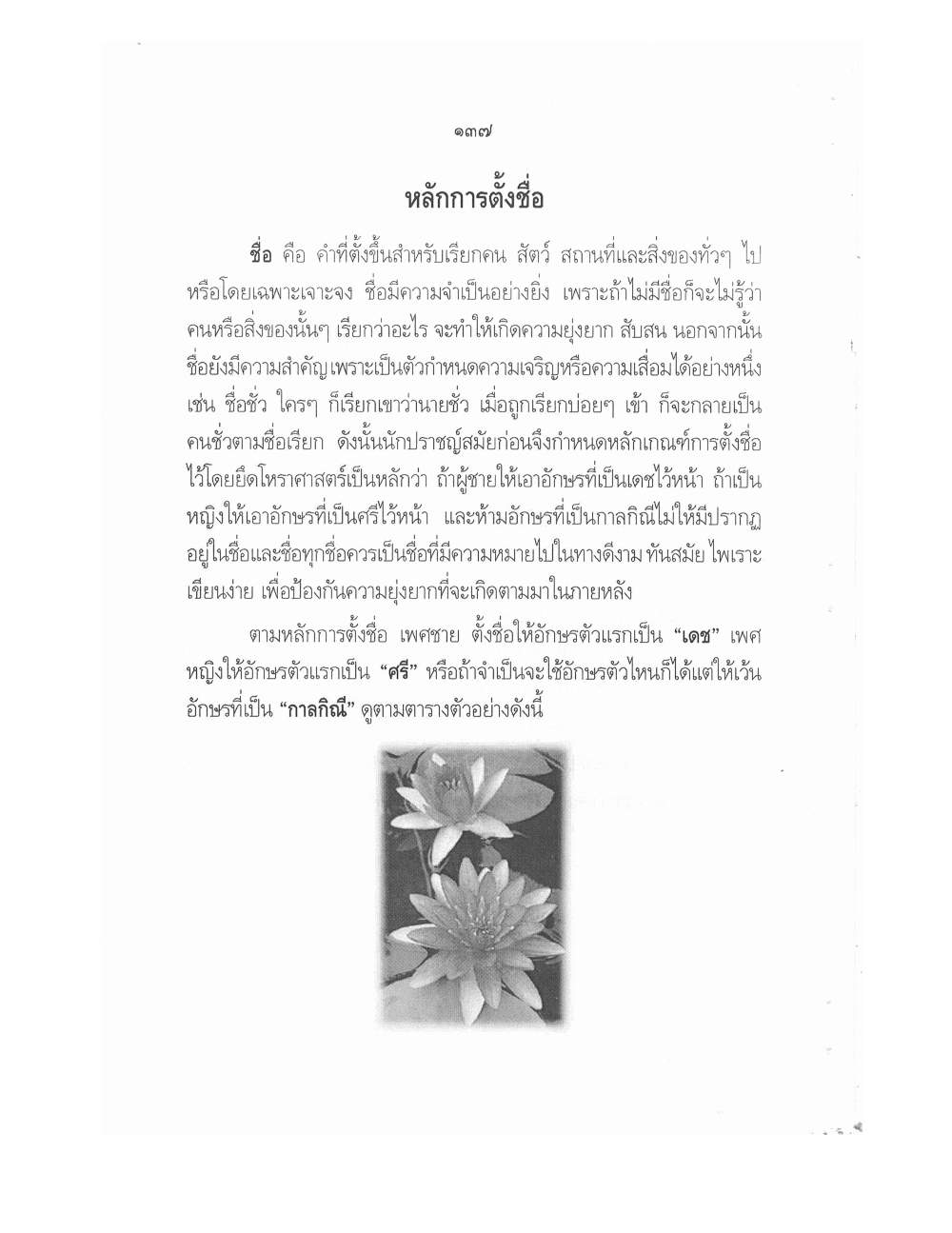
หลักการตั้งชื่อ
ชื่อ คือ คำที่ตั้งขึ้นสำหรับเรียกคน สัตว์ สถานที่และสิ่งของทั่วๆไปหรือโดยเฉพาะเจาะจง ชื่อมีความจำเป็นอย่างยิ่ง เพราะถ้าไม่มีชื่อก็จะไม่รู้ว่าคนหรือสิ่งของนั้นๆ เรียกว่าอะไร จะทำให้เกิดความยุ่งยาก สับสน นอกจากนั้นชื่อยังมีความสำคัญเพราะเป็นตัวกำหนดความเจริญหรือความเสื่อมได้อย่างหนึ่ง เช่น ชื่อชั่ว ใครๆก็เรียกเขาว่านายชั่ว เมื่อถูกเรียกบ่อยๆเข้า ก็จะกลายเป็นคนชั่วตามชื่อเรียก ดังนั้นนักปราชญ์สมัยก่อนจึงกำหนดหลักเกณฑ์การตั้งชื่อไว้โดยยึดโหราศาสตร์เป็นหลักว่า ถ้าผู้ชายให้เอาอักษรที่เป็นเดชไว้หน้า ถ้าเป็นหญิงให้เอาอักษรที่เป็นศรีไว้หน้า และห้ามอักษรที่เป็นกาลกิณีไม่ให้มีปรากฏอยู่ในชื่อและชื่อทุกชื่อควรเป็นชื่อที่มีความหมายไปในทางดีงาม ทันสมัย ไพเราะเขียนง่าย เพื่อป้องกันความยุ่งยากที่จะเกิดตามมาในภายหลัง
ตามหลักการตั้งชื่อ เพศชาย ตั้งชื่อให้อักษรตัวแรกเป็น "เดช" เพศหญิงให้อักษรตัวแรกเป็น "ศรี" หรือถ้าจำเป็นจะใช้อักษรตัวไหนก็ได้แต่ให้เว้นอักษรที่เป็น "กาลกิณี" ดูตามตารางตัวอย่างดังนี้
[ภาพถ่าย: ดอกบัวสองดอกบานอยู่บนพื้นหลังสีเข้ม]
Principles of Naming
A name is a word created for calling a person, animal, place, or thing in general or specifically. A name is extremely necessary, because without a name one would not know what to call a person or thing, causing confusion and difficulty. Beyond that, a name also matters because it can be one factor determining prosperity or decline. For example, if someone is named "Bad," people will keep calling him "Mr. Bad," and being called this repeatedly, he will eventually become a bad person in keeping with his name. For this reason, the sages of old established rules for naming based on astrology: for a man, a letter belonging to the "Dech" (power) group should be placed first; for a woman, a letter belonging to the "Sri" (glory) group should be placed first; and letters belonging to the "Kalakini" (inauspicious) group must never appear in the name. Every name should also carry a meaning that is auspicious, modern, pleasant-sounding, and easy to write, in order to avoid difficulties that might arise later.
According to the principles of naming, for a male the first letter of the name should belong to the "Dech" group; for a female the first letter should belong to the "Sri" group; or, if necessary, any letter may be used as long as letters belonging to the "Kalakini" group are avoided. See the example table below.
[photograph: two water lilies in bloom against a dark background]
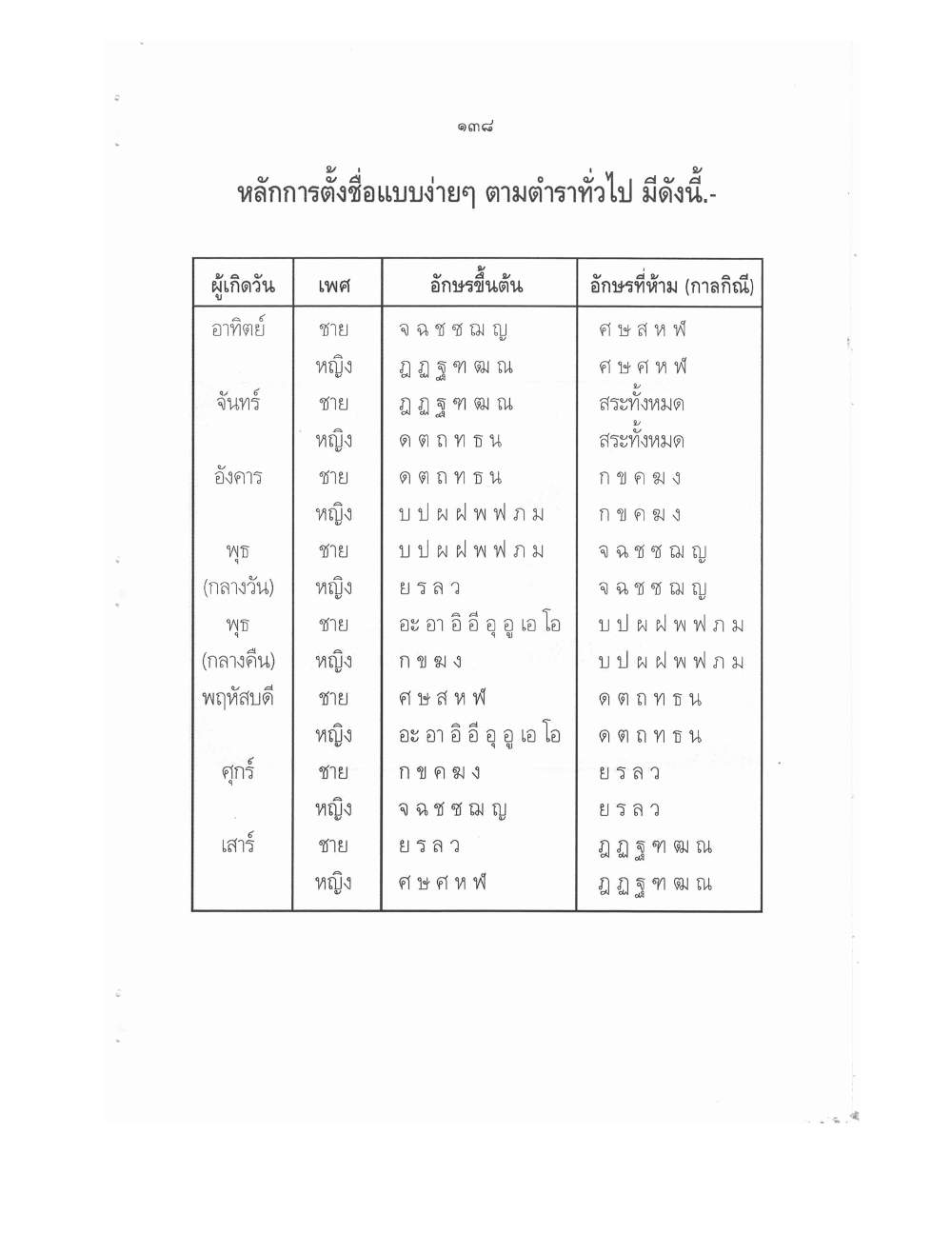
หลักการตั้งชื่อแบบง่ายๆ ตามตำราทั่วไป มีดังนี้.-
[ตาราง] ผู้เกิดวัน | เพศ | อักษรขึ้นต้น | อักษรที่ห้าม (กาลกิณี) อาทิตย์ | ชาย | จ ฉ ช ซ ฌ ญ | ศ ษ ส ห ฬ | หญิง | ฎ ฏ ฐ ฑ ฒ ณ | ศ ษ ส ห ฬ จันทร์ | ชาย | ฎ ฏ ฐ ฑ ฒ ณ | สระทั้งหมด | หญิง | ด ต ถ ท ธ น | สระทั้งหมด อังคาร | ชาย | ด ต ถ ท ธ น | ก ข ค ฆ ง | หญิง | บ ป ผ ฝ พ ฟ ภ ม | ก ข ค ฆ ง พุธ(กลางวัน) | ชาย | บ ป ผ ฝ พ ฟ ภ ม | จ ฉ ช ซ ฌ ญ | หญิง | ย ร ล ว | จ ฉ ช ซ ฌ ญ พุธ(กลางคืน) | ชาย | อะ อา อิ อี อุ อู เอ โอ | บ ป ผ ฝ พ ฟ ภ ม | หญิง | ก ข ค ฆ ง | บ ป ผ ฝ พ ฟ ภ ม พฤหัสบดี | ชาย | ศ ษ ส ห ฬ | ด ต ถ ท ธ น | หญิง | อะ อา อิ อี อุ อู เอ โอ | ด ต ถ ท ธ น ศุกร์ | ชาย | ก ข ค ฆ ง | ย ร ล ว | หญิง | จ ฉ ช ซ ฌ ญ | ย ร ล ว เสาร์ | ชาย | ย ร ล ว | ฎ ฏ ฐ ฑ ฒ ณ | หญิง | ศ ษ ส ห ฬ | ฎ ฏ ฐ ฑ ฒ ณ
Simple Principles of Naming According to Common Textbooks, as Follows:-
[table] Birth day | Sex | Initial letters | Forbidden letters (Kalakini) Sunday | Male | จ ฉ ช ซ ฌ ญ | ศ ษ ส ห ฬ | Female | ฎ ฏ ฐ ฑ ฒ ณ | ศ ษ ส ห ฬ Monday | Male | ฎ ฏ ฐ ฑ ฒ ณ | all vowels | Female | ด ต ถ ท ธ น | all vowels Tuesday | Male | ด ต ถ ท ธ น | ก ข ค ฆ ง | Female | บ ป ผ ฝ พ ฟ ภ ม | ก ข ค ฆ ง Wednesday (day) | Male | บ ป ผ ฝ พ ฟ ภ ม | จ ฉ ช ซ ฌ ญ | Female | ย ร ล ว | จ ฉ ช ซ ฌ ญ Wednesday (night) | Male | อะ อา อิ อี อุ อู เอ โอ | บ ป ผ ฝ พ ฟ ภ ม | Female | ก ข ค ฆ ง | บ ป ผ ฝ พ ฟ ภ ม Thursday | Male | ศ ษ ส ห ฬ | ด ต ถ ท ธ น | Female | อะ อา อิ อี อุ อู เอ โอ | ด ต ถ ท ธ น Friday | Male | ก ข ค ฆ ง | ย ร ล ว | Female | จ ฉ ช ซ ฌ ญ | ย ร ล ว Saturday | Male | ย ร ล ว | ฎ ฏ ฐ ฑ ฒ ณ | Female | ศ ษ ส ห ฬ | ฎ ฏ ฐ ฑ ฒ ณ
หมวดที่ ๔
ปกิณกะ
ว่าด้วยข้อปฏิบัติเบ็ดเตล็ด
Section 4
Miscellaneous Matters
Concerning Various Supplementary Practices
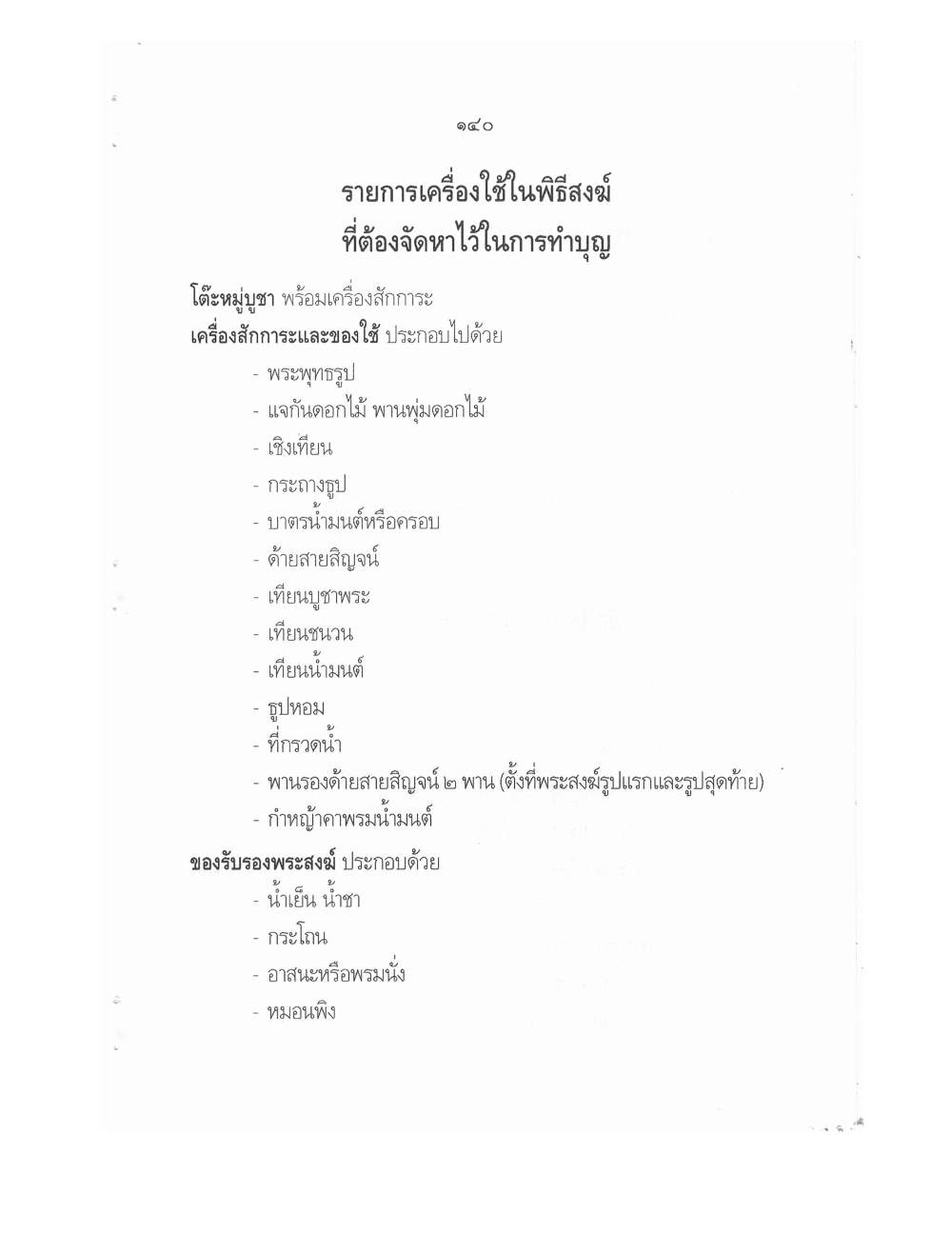
รายการเครื่องใช้ในพิธีสงฆ์
ที่ต้องจัดหาไว้ในการทำบุญ
โต๊ะหมู่บูชา พร้อมเครื่องสักการะ เครื่องสักการะและของใช้ ประกอบไปด้วย - พระพุทธรูป - แจกันดอกไม้ พานพุ่มดอกไม้ - เชิงเทียน - กระถางธูป - บาตรน้ำมนต์หรือครอบ - ด้ายสายสิญจน์ - เทียนบูชาพระ - เทียนชนวน - เทียนน้ำมนต์ - ธูปหอม - ที่กรวดน้ำ - พานรองด้ายสายสิญจน์ ๒ พาน (ตั้งที่พระสงฆ์รูปแรกและรูปสุดท้าย) - กำหญ้าคาพรมน้ำมนต์
ของรับรองพระสงฆ์ ประกอบด้วย - น้ำเย็น น้ำชา - กระโถน - อาสนะหรือพรมนั่ง - หมอนพิง
List of Items Needed for Monastic Ceremonies
To Be Prepared for Merit-Making
Altar table, with offerings Offerings and supplies consist of: - Buddha image - Flower vase, tray of flower arrangements - Candle holders - Incense burner - Holy-water bowl or cover - Sacred thread (sai sin) - Candle for worshiping the Buddha image - Taper candle (for lighting) - Holy-water candle - Fragrant incense - Vessel for pouring the water of dedication - 2 trays for the sacred thread (placed at the first and last monk) - Bundle of khaa grass for sprinkling holy water
Items for receiving the monks consist of: - Cold water, tea - Spittoon - Seat or sitting mat - Backrest cushion/bolster
- เสื่อ พรมปูพื้น
ไทยธรรมถวายพระ ประกอบด้วย - ดอกไม้ธูปเทียน - ไทยธรรม (เป็นของใช้ประจำวันสำหรับพระสงฆ์ เช่น สบู่ ยาสีฟัน เป็นต้น) - ซองปัจจัยหรือซองใบปวารณา
หมอนกราบ หน้าโต๊ะหมู่บูชา (งานมงคลสมรสใช้ ๑ คู่)
หมายเหตุ ถ้าเป็นงานมงคลสมรส จัดแป้งและมงคลแฝดใส่พาน ตั้งไว้ข้างบาตรน้ำมนต์ เข้าพิธีเพื่อความเป็นสิริมงคล
****************************
ข้อสังเกตในการจัดโต๊ะหมู่บูชา
โต๊ะหมู่บูชา คือ โต๊ะสำหรับวางเครื่องสักการะบูชาที่คู่ควรเป็นสง่าเป็นหน้าเป็นตาจุดเด่นของงาน เป็นที่ประดิษฐานพระพุทธรูป สำหรับกราบไหว้เคารพบูชา เพื่อเป็นสิริมงคล การจะจัดโต๊ะหมู่บูชาได้เหมาะสมสวยงามนั้น มีรายละเอียดมากมาย หากจะเขียนคำอธิบายให้พิสดาร คงต้องเขียนขึ้นมาเฉพาะอีกเล่มหนึ่งต่างหาก อาจเรียกว่าตำราการจัดโต๊ะหมู่บูชาก็ได้ แต่เพราะเนื้อที่กระดาษจำกัด จึงขอเขียนพอเป็นข้อสังเกตโดยสังเขปเท่านั้น โต๊ะหมู่บูชา ตามความหมายที่อธิบายไว้ในพจนานุกรมฉบับราชบัณฑิตยสถาน พุทธศักราช ๒๕๔๒ ว่า (นาม) ที่ตั้งเครื่องบูชาประกอบด้วยม้า ๔ ขา หลายตัวคุมกันเป็นหมู่ มีหมู่ ๓ หมู่ ๔ หมู่ ๕ หมู่ ๗ หมู่ ๙ และหมู่ ๑๑
- a mat, a floor rug
Requisites (Thai Tham) offered to the monk, consisting of: - flowers, incense, candles - Thai Tham (daily-use items for the monk(s), such as soap, toothpaste, and the like) - an envelope of monetary offering or a pavāraṇā donation envelope
Prostration cushion, placed in front of the altar table (for a marriage-blessing ceremony, use 1 pair)
Note: for a marriage-blessing ceremony, arrange face powder and the paired auspicious cord (mongkhon fǣt) on a tray and set it beside the holy-water bowl, to bring it into the rite for auspiciousness.
****************************
Observations on Arranging the Altar Table
The altar table (toh mu bucha) is a table for holding the objects of veneration; it ought to be dignified and be the focal point of the event. It is where the Buddha image is enshrined, for paying homage and reverence, so as to bring auspiciousness. Arranging an altar table so that it is fitting and beautiful involves a great many details. To describe it exhaustively would require writing an entire separate volume — one might even call it a treatise on arranging the altar table. But because the space here is limited, I will only set down a few observations in brief. The Altar Table, according to the definition given in the Royal Institute Dictionary, B.E. 2542 [1999], is: (noun) a stand for offerings made up of four-legged trestles, several of which are grouped together as a "set"; there are sets of 3, sets of 4, sets of 5, sets of 7, sets of 9, and sets of 11.
เดิมเรียกว่า "ม้าหมู่บูชา" นี่คือคำอธิบายในพจนานุกรม แท้จริงนอกเหนือจากที่กล่าวไว้แล้ว โต๊ะหมู่บูชา ในแต่ละหมู่ยังแยกย่อยเป็นขนาดเล็ก ขนาดกลาง ขนาดใหญ่พิเศษอีกด้วย เช่น หมู่ ๙ แยกย่อยเป็นหมู่ ๙ ขนาดเล็ก หมู่ ๙ ขนาดกลาง หมู่ ๙ ขนาดใหญ่ และหมู่ ๙ ขนาดใหญ่พิเศษ เป็นต้น ทั้งนี้เพื่อเป็นการสะดวกในการเลือกหาจัดซื้อให้ถูกตามอัธยาศัยและเหมาะสมกับสถานที่ จึงขอเสนอข้อสังเกตดังนี้ ๑. เลือกโต๊ะหมู่บูชาให้เหมาะสมกับสถานที่ที่จะจัดงาน เช่น สถานที่จัดงานทำบุญ กว้าง ๔ x ๔ เมตร แต่จัดโต๊ะหมู่บูชาหมู่ ๙ ขนาดใหญ่ก็ดูคับแคบเต็มห้อง ดูใหญ่เกินไป ควรเลือกเป็นโต๊ะหมู่บูชาหมู่ ๙ ขนาดเล็กหรือเลือกโต๊ะหมู่บูชาหมู่อื่นก็ได้ ที่เหมาะสมกับพื้นที่นั้น ก็จะดูดีเป็นสง่า ๒. จัดโต๊ะหมู่บูชาให้ตั้งอยู่ทางด้านขวามือของแถวพระสงฆ์ ในกรณีที่เนื่องด้วยพิธีสงฆ์ เว้นแต่สถานที่จำกัดตั้งอย่างนั้นไม่ได้ จะตั้งด้านซ้ายของแถวพระสงฆ์ก็ได้ จัดขนานแถวพระสงฆ์ให้ได้ระยะพอดี ไม่ชิดไม่ห่างแถวพระสงฆ์เกินไป ส่วนที่สำหรับกราบพระ คือ พรมปูและหมอนกราบนั้นถ้าเป็นงานทำบุญแบบธรรมดาใช้หมอนกราบ ๑ ที่ หากเป็นงานมงคลสมรสใช้หมอนกราบ ๒ ที่ (ไม่ควรใช้แท่นกราบแบบลดชั้น) ๓. ทำความสะอาดโต๊ะหมู่บูชาให้สะอาดปราศจากฝุ่นผง, หยากเยื่อหยากไย่, น้ำตาเทียน เป็นต้น ๔. จัดตั้งโต๊ะหมู่บูชา วางให้เป็นระเบียบหน้าตับ, ระยะต่อ, จัดวางบนโต๊ะรองรับให้อยู่ตรงกลาง ไม่ค่อนไปทางซ้ายหรือขวา ในกรณีที่โต๊ะหมู่บูชา เป็นโต๊ะที่ทาทองล่องชาด คือ มีสีทองกับสีแดง ให้หันสีทองออกหน้าสีแดงอยู่หลัง บางรายรีบร้อนในการจัด จัดวางสลับกันเป็นสีแดงบ้าง สีทองบ้าง ซึ่งไม่ถูกต้อง ๕. เครื่องทองเหลืองบนโต๊ะหมู่บูชา แจกันเชิงเทียน กระถางธูป อย่า
It was originally called a "m'a mu bucha" (offering trestle-set) — this is the explanation given in the dictionary. In truth, beyond what has already been said, each set of altar tables is further divided into small, medium, and extra-large sizes. For instance, a set of 9 is further divided into a small set of 9, a medium set of 9, a large set of 9, and an extra-large set of 9, and so on. This is for the convenience of choosing and purchasing one that suits one's taste and the venue, so the following observations are offered: 1. Choose an altar table suited to the venue where the event is to be held. For example, if the space for a merit-making event is 4 x 4 metres, but a large set-of-9 altar table is set up, it will look cramped, filling the whole room and appearing too large. One should instead choose a small set-of-9 altar table, or another set altogether, suited to that space — it will then look proper and dignified. 2. Arrange the altar table to stand to the right-hand side of the row of monks, in the case of a monks' ceremony, unless the venue is too confined to allow this, in which case it may stand to the left of the row of monks. Set it parallel to the row of monks at a proper distance — neither too close nor too far from the row of monks. As for the area for prostrating to the Buddha image — that is, the carpet and prostration cushion — if it is an ordinary merit-making event, use 1 prostration cushion; if it is a marriage-blessing ceremony, use 2 prostration cushions (a tiered prostration platform should not be used). 3. Clean the altar table so that it is free of dust, cobwebs, candle-wax drips, and the like. 4. When setting up the altar table, arrange it in orderly ranks and even spacing, placing it centred on the supporting table, not leaning to the left or right. In the case where the altar table is lacquered in gold-and-vermilion — that is, has both gold and red colouring — the gold should face forward with the red behind. Some people, in haste, arrange them alternating red, gold, red, gold, which is incorrect. 5. The brass fittings on the altar table — vases, candlesticks, incense pots — should not be allowed to
ให้มัวหมอง ขัดให้สุกใส เงางาม เชิงเทียนไม่มีน้ำตาเทียนเกาะ กระถางธูปปราศจากขี้ธูป และก้านธูปเก่า ในกรณีใช้เครื่องชุดลายครามหรือเซรามิกก็เช็ดถูให้สะอาดปราศจากฝุ่นผง ๖. ดอกไม้ปักแจกัน จัดให้งามพอสมควรเหมาะสมกับจำนวนโต๊ะหมู่ มีบางรายตั้งโต๊ะหมู่บูชา หมู่ ๙ ขนาดใหญ่ แต่มีแจกันดอกไม้เพียงแค่ ๒ แจกันเท่านั้น มองดูโหรงเหรงบางตาเกินไป บางรายจัดโต๊ะหมู่บูชาหมู่ ๙ ขนาดใหญ่ดังกล่าว มีแจกันดอกไม้พร้อมทั้งพานพุ่มมากมาย จนบดบังพระพุทธรูป ถึงจะดูงาม แต่ไม่เหมาะสม ขอเสนอวิธีการจัดแบบเรียบง่าย ในกรณีจัดโต๊ะหมู่บูชา หมู่ ๙ ขนาดใหญ่ ดังนี้ ๖.๑ โต๊ะสำหรับประดิษฐานพระพุทธรูปบูชา ๑ โต๊ะ ๖.๒ โต๊ะกลางหน้าพระพุทธรูป จัดแจกันดอกไม้ ๒ แจกัน ๖.๓ โต๊ะต่ำสุดวางเชิงเทียน ๒ เชิง กระถางธูป ๑ กระถาง ๖.๔ โต๊ะขนาบซ้าย - ขวา ข้างละ ๓ โต๊ะ รวม ๖ โต๊ะ จัดแจกันดอกไม้ ๖ แจกัน ๗. เลือกสิ่งสักการะ เลือกสรร ธูป ๓ ดอก ดูขนาดเท่ากัน ก้านตรงไม่โค้งงอ หากใช้ธูปพิธีดอกใหญ่ยิ่งดี (ห้องแอร์ควรใช้ธูปไร้ควัน) เลือกเทียน ๒ เล่ม ที่มีสีเดียวกัน ไม่หัก ตรงไม่มีโค้งงอ งานมงคลใช้สีเหลือง (ไม่มีกำหนดสีไว้ แต่เพื่อความสบายใจของบางคนที่เข้าใจว่าเทียนสีขาวเห็นใช้ในงานอวมงคล) เลือกดอกไม้ ควรเป็นดอกบัว ๘. ความหมายของเครื่องสักการะบูชา ธูปสำหรับบูชาพระพุทธเจ้า ใช้ธูปจำนวน ๓ ดอก หมายถึงพระคุณทั้ง ๓ คือ พระปัญญาคุณ พระบริสุทธิคุณ และพระกรุณาคุณ ธูปเมื่อบุคคลจุดแล้ว ย่อมส่งควันหอมฟุ้งไปทั่ว ประดุจพระคุณของพระพุทธเจ้าที่ฟุ้งขจาย
become dull; they should be polished bright and gleaming. Candlesticks should have no wax drippings clinging to them, and incense pots should be free of incense ash and old incense stubs. Where a blue-and-white or ceramic set is used, it too should be wiped clean and free of dust. 6. Flowers arranged in vases should be tasteful and suited to the number of tables in the set. In some cases people set up a large set-of-9 altar table but have only 2 vases of flowers, which looks far too sparse. In other cases people arrange the same large set-of-9 altar table with vases and floral trays in such great abundance that they end up obscuring the Buddha image — however beautiful this may look, it is not fitting. A simple method of arrangement is offered here, for the case of a large set-of-9 altar table, as follows: 6.1 The table for enshrining the Buddha image to be venerated: 1 table 6.2 The middle table in front of the Buddha image: arrange 2 vases of flowers 6.3 The lowest table: place 2 candlesticks, 1 incense pot 6.4 The tables flanking left and right, 3 tables on each side, 6 tables in all: arrange 6 vases of flowers 7. Choosing the objects of veneration: select 3 incense sticks of equal size, with straight, unbent stems — the larger the ceremonial incense sticks, the better (in an air-conditioned room, smokeless incense should be used). Select 2 candles of the same colour, unbroken, straight and unbent; for an auspicious event use yellow (no colour is actually prescribed, but this is for the peace of mind of some people who understand white candles to be used at inauspicious/funeral events). For flowers, lotus should be chosen. 8. The meaning of the objects of veneration For venerating the Buddha, 3 incense sticks are used, representing His three virtues: the virtue of wisdom (paññā-guṇa), the virtue of purity (parisuddhi-guṇa), and the virtue of compassion (karuṇā-guṇa). Once lit, the incense sends its fragrant smoke wafting everywhere, just as the Buddha's virtues spread
ไปในหมู่พุทธบริษัท เทียนสำหรับบูชาพระธรรมเจ้า ใช้จำนวนเลขคู่ เช่น ๒ เล่ม ๔ เล่ม หรือ ๘ เล่ม เป็นต้น เพราะพระธรรมคำสั่งสอนของพระพุทธเจ้า โดยย่อมี ๒ คือ ธรรมะและวินัย เทียน เมื่อบุคคลจุดแล้วส่องแสงขจัดเสียซึ่งความมืดประดุจพระธรรมย่อมให้แสงสว่างแก่ดวงตา คือ ปัญญาของมวลมนุษย์ชาติและสรรพสัตว์ ฉะนั้น ดอกไม้ สำหรับบูชาพระสงฆ์เจ้า ใช้จำนวนเลขคู่ เช่น ๒ แจกัน ๔ แจกัน หรือ ๘ แจกัน เป็นต้น เพราะพระสงฆ์เป็นบุคคลผู้ประพฤติปฏิบัติตามคำสั่งสอนของพระพุทธเจ้า คือ ธรรมะและวินัย อันดอกไม้แม้จะต่างสีต่างกลิ่นต่างพันธุ์ แต่เพราะช่างจัดดอกไม้ผู้ชาญฉลาดจัดสรรดีแล้วปักในแจกันเดียวกันจึงดูงดงาม ประดุจพระสงฆ์ ผู้ประพฤติปฏิบัติตามพระธรรมวินัยย่อมงามสง่าในท่ามกลางพุทธบริษัทฉะนั้น
****************************
[ภาพ: ดอกบัวสีขาวสองดอกบานอยู่เหนือน้ำ ภาพขาวดำ]
throughout the assembly of the faithful. For venerating the Dhamma, candles are used in even numbers — 2, 4, or 8 candles, and so on — because the Buddha's teaching, in brief, consists of two things: Dhamma and Vinaya. Once lit, a candle's light dispels darkness, just as the Dhamma gives light to the eye — that is, wisdom — of all humankind and all beings. For venerating the Sangha, flowers are used in even numbers — 2, 4, or 8 vases, and so on — because monks are those who conduct themselves in accordance with the Buddha's teaching, that is, the Dhamma and Vinaya. Although flowers may differ in colour, scent, and species, when a skilful flower-arranger arranges them well and sets them together in a single vase, they appear beautiful — just as monks who conduct themselves according to the Dhamma and Vinaya appear graceful and dignified amid the assembly of the faithful.
****************************
[photo: two white lotus blossoms in bloom above the water, black-and-white photograph]
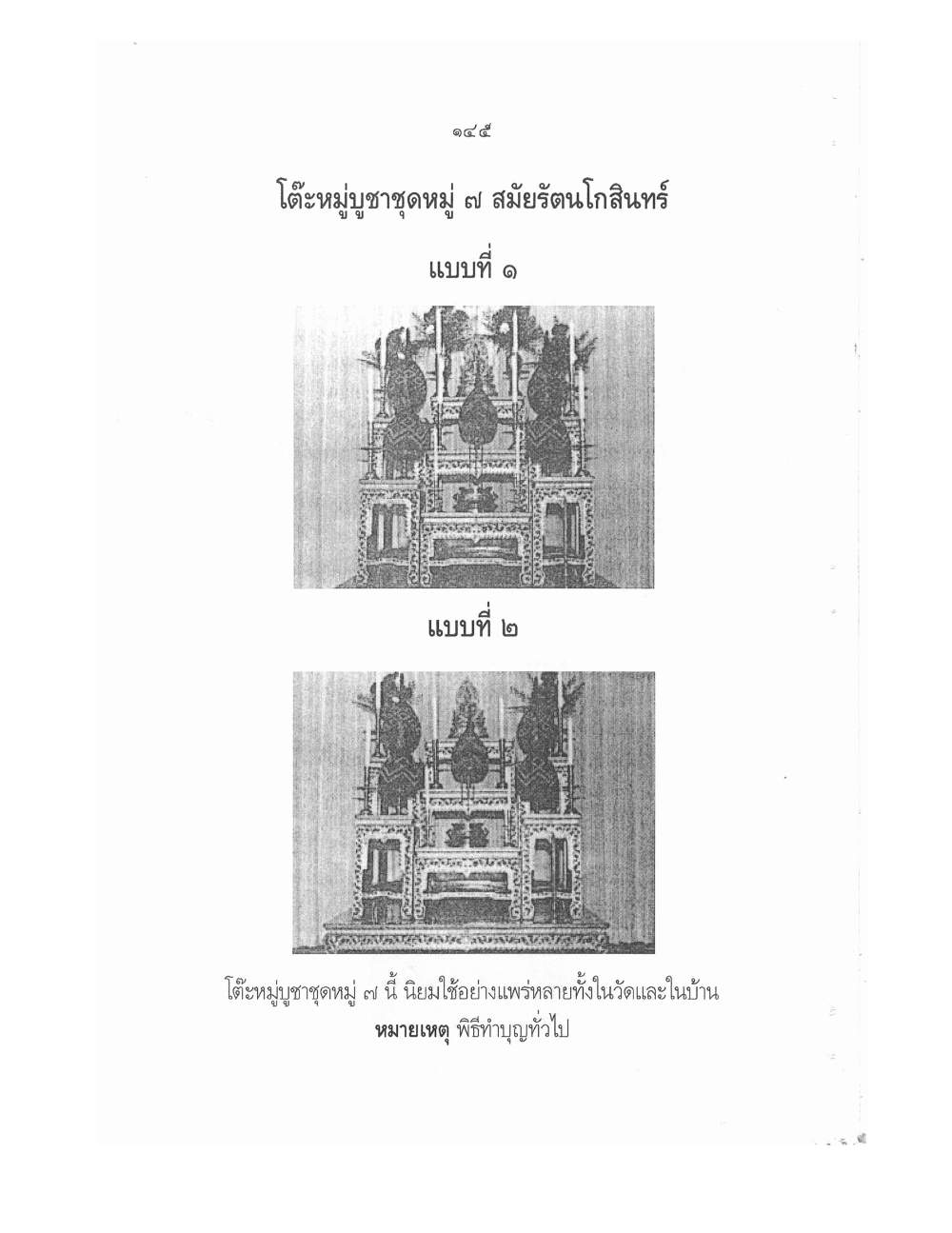
โต๊ะหมู่บูชาชุดหมู่ ๗ สมัยรัตนโกสินทร์
แบบที่ ๑
[ภาพ: โต๊ะหมู่บูชาไม้แกะสลักปิดทองจัดเป็นชุด มีเชิงเทียน กระถางธูป และไม้ประดับวางอยู่บนโต๊ะแต่ละชั้น ฉากหลังเป็นม่านลายทาง]
แบบที่ ๒
[ภาพ: โต๊ะหมู่บูชาไม้แกะสลักปิดทองอีกชุดหนึ่ง จัดวางในลักษณะคล้ายกับแบบที่ ๑]
โต๊ะหมู่บูชาชุดหมู่ ๗ นี้ นิยมใช้อย่างแพร่หลายทั้งในวัดและในบ้าน หมายเหตุ พิธีทำบุญทั่วไป
The Set-of-Seven Altar Table, Rattanakosin Period
Style 1
[photo: a gilded, carved wooden altar-table set, arranged in tiers, with candlesticks, an incense pot, and decorative foliage placed on each level; the backdrop is a striped curtain]
Style 2
[photo: another gilded, carved wooden altar-table set, arranged in a manner similar to Style 1]
This set-of-seven altar table is widely used, both in temples and in private homes. Note: for general merit-making ceremonies.
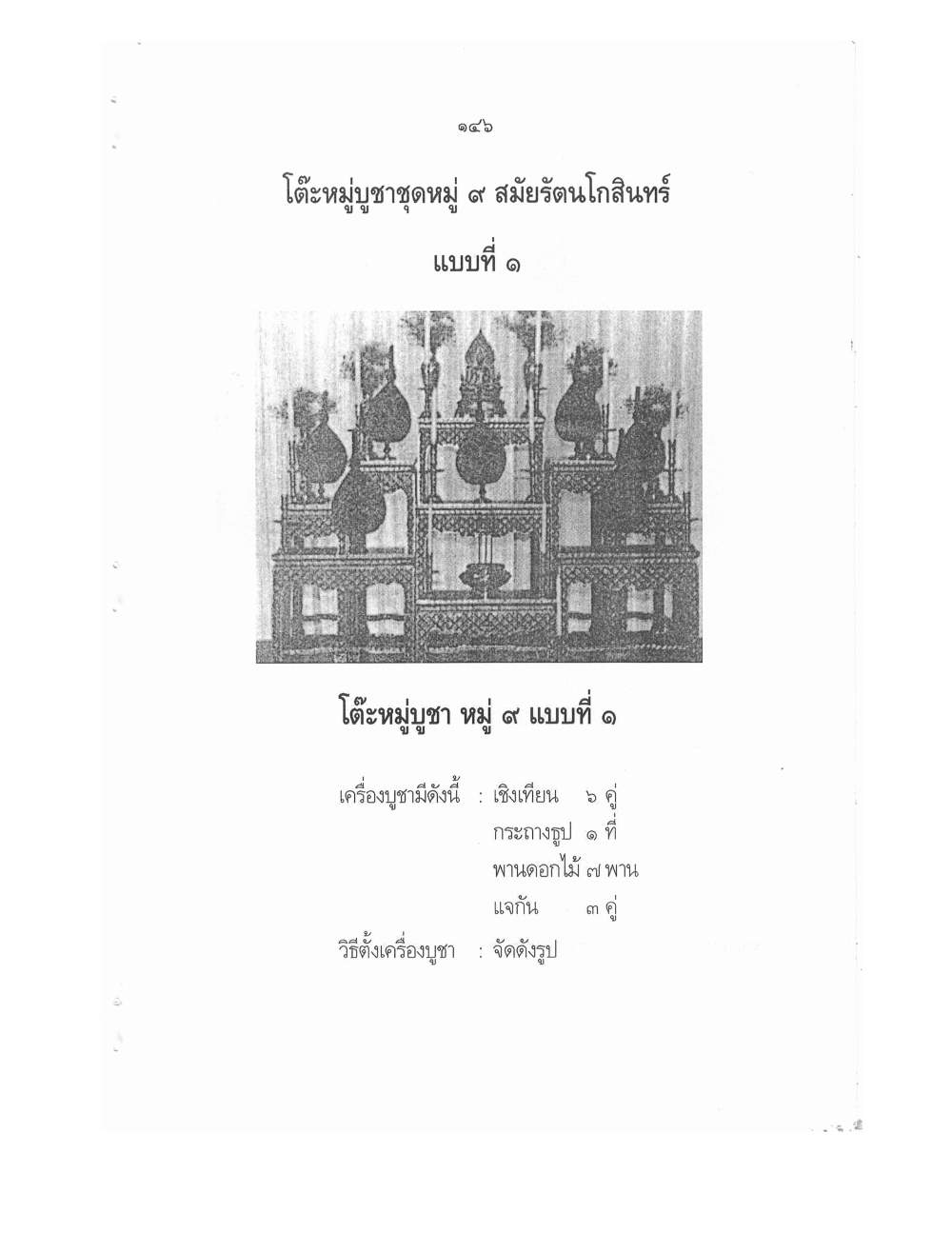
โต๊ะหมู่บูชาชุดหมู่ ๙ สมัยรัตนโกสินทร์
แบบที่ ๑
[ภาพ: โต๊ะหมู่บูชาไม้แกะสลักปิดทองชุดหมู่ ๙ มีเชิงเทียน กระถางธูป และแจกันดอกไม้จัดวางเป็นชั้น ๆ]
โต๊ะหมู่บูชา หมู่ ๙ แบบที่ ๑
เครื่องบูชามีดังนี้ : เชิงเทียน ๖ คู่ กระถางธูป ๑ ที่ พานดอกไม้ ๗ พาน แจกัน ๓ คู่ วิธีตั้งเครื่องบูชา : จัดดังรูป
The Set-of-Nine Altar Table, Rattanakosin Period
Style 1
[photo: a gilded, carved wooden set-of-nine altar table, with candlesticks, an incense pot, and flower vases arranged in tiers]
Altar Table, Set of Nine, Style 1
The offering implements are as follows: candlesticks, 6 pairs incense pot, 1 flower trays, 7 trays vases, 3 pairs Method of arranging the offering implements: arrange as shown in the picture.
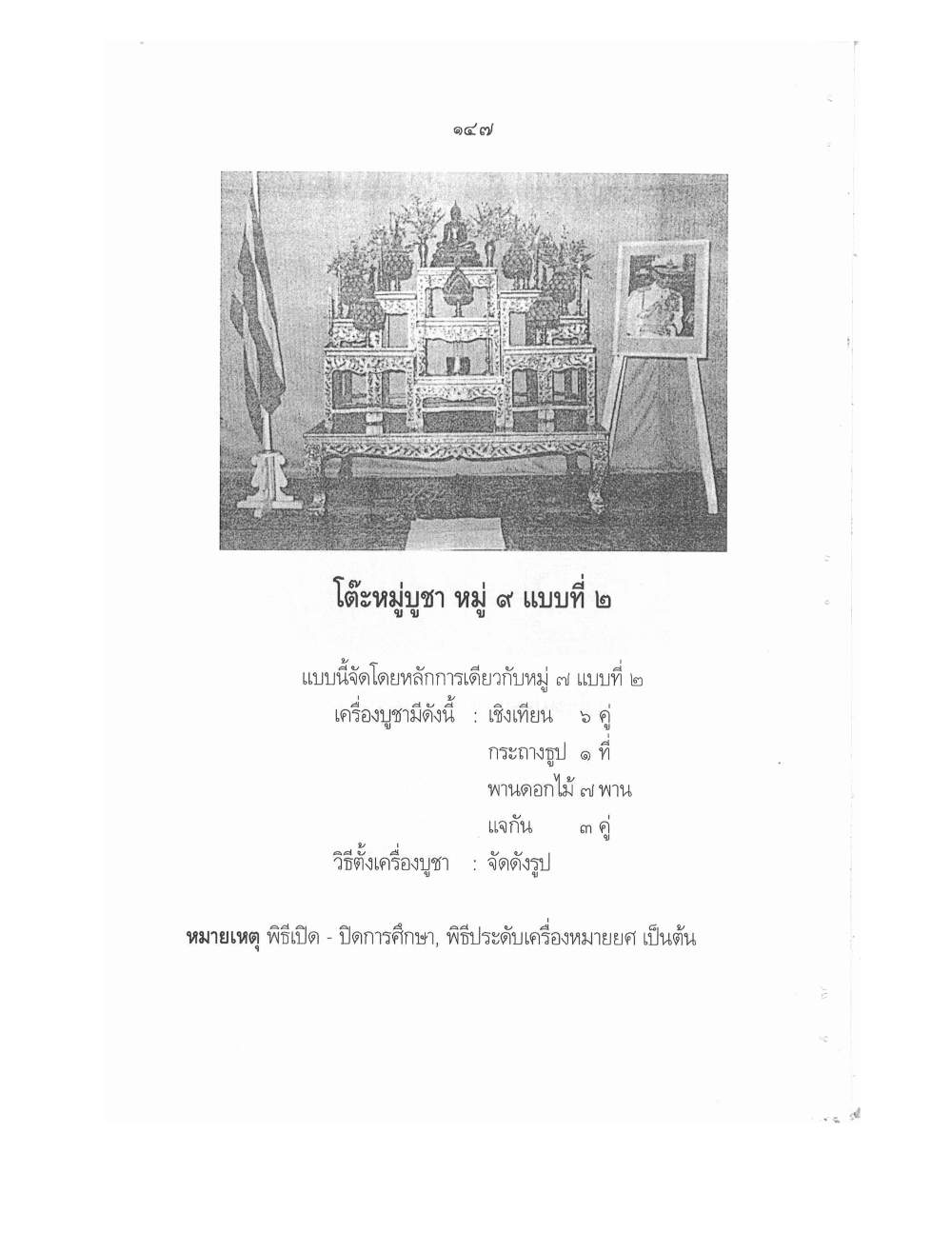
[ภาพ: โต๊ะหมู่บูชาไม้แกะสลักปิดทองสีขาว มีพระพุทธรูปประดิษฐานอยู่ตรงกลาง แจกันดอกไม้และเชิงเทียนจัดวางเป็นชั้น มีธงชาติไทยตั้งอยู่ทางด้านซ้าย และพระบรมฉายาลักษณ์ตั้งบนขาตั้งอยู่ทางด้านขวา]
โต๊ะหมู่บูชา หมู่ ๙ แบบที่ ๒
แบบนี้จัดโดยหลักการเดียวกับหมู่ ๗ แบบที่ ๒ เครื่องบูชามีดังนี้ : เชิงเทียน ๖ คู่ กระถางธูป ๑ ที่ พานดอกไม้ ๗ พาน แจกัน ๓ คู่ วิธีตั้งเครื่องบูชา : จัดดังรูป
หมายเหตุ พิธีเปิด - ปิดการศึกษา, พิธีประดับเครื่องหมายยศ เป็นต้น
[photo: a white, gilded, carved wooden altar table, with a Buddha image enshrined at the centre; flower vases and candlesticks arranged in tiers; a Thai national flag stands to the left, and a royal portrait on an easel stands to the right]
Altar Table, Set of Nine, Style 2
This style is arranged by the same principle as the Set of Seven, Style 2. The offering implements are as follows: candlesticks, 6 pairs incense pot, 1 flower trays, 7 trays vases, 3 pairs Method of arranging the offering implements: arrange as shown in the picture.
Note: for opening/closing ceremonies of a course of study, ceremonies for the conferral of insignia of rank, and the like.
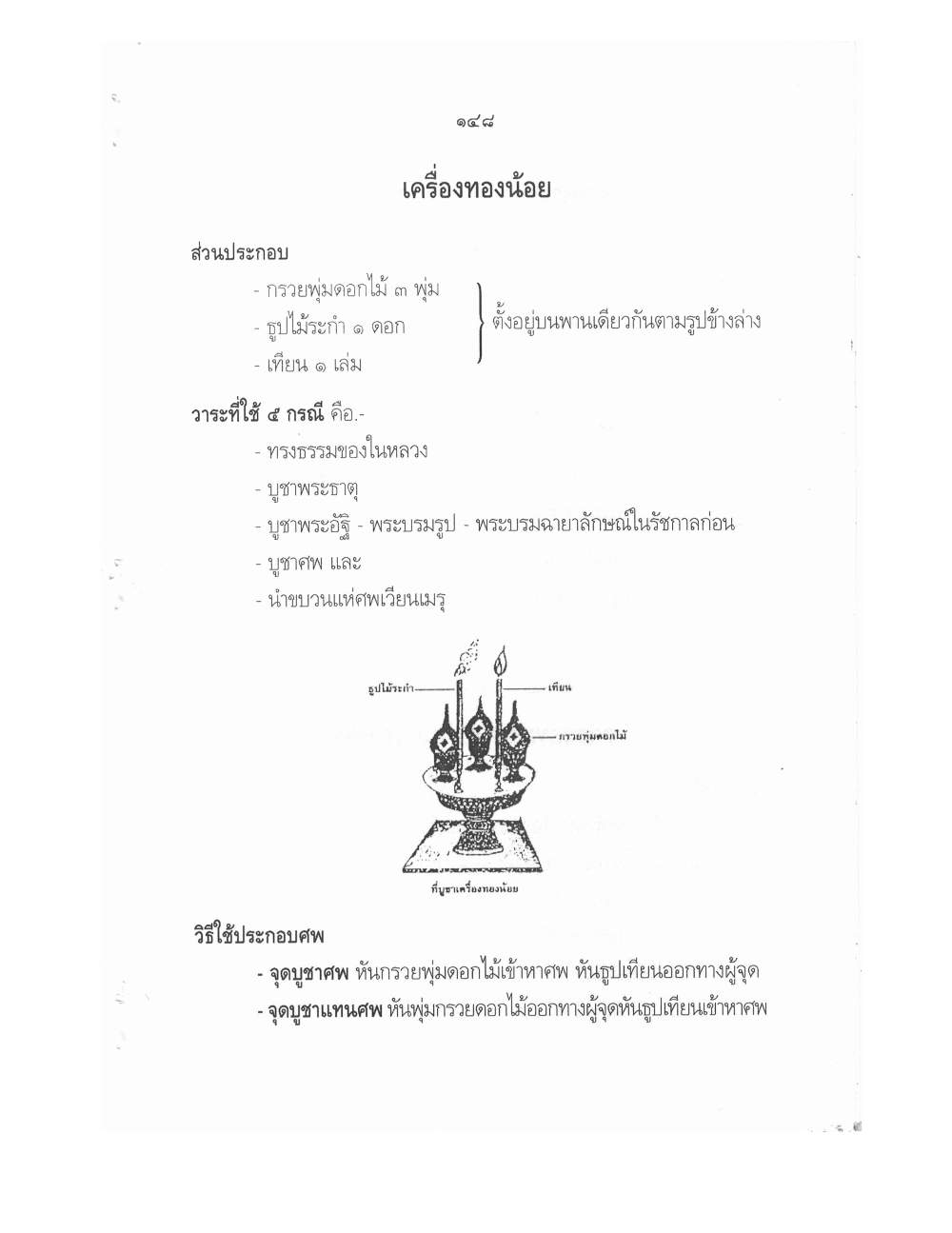
เครื่องทองน้อย
ส่วนประกอบ - กรวยพุ่มดอกไม้ ๓ พุ่ม - ธูปไม้ระกำ ๑ ดอก } ตั้งอยู่บนพานเดียวกันตามรูปข้างล่าง - เทียน ๑ เล่ม
วาระที่ใช้ ๔ กรณี คือ.- - ทรงธรรมของในหลวง - บูชาพระธาตุ - บูชาพระอัฐิ - พระบรมรูป - พระบรมฉายาลักษณ์ในรัชกาลก่อน - บูชาศพ และ - นำขบวนแห่ศพเวียนเมรุ
[ภาพลายเส้น: เครื่องทองน้อยตั้งอยู่บนพาน มีเส้นชี้บอกส่วนประกอบ — "ธูปไม้ระกำ" ชี้ไปที่ธูปด้านซ้าย, "เทียน" ชี้ไปที่เทียนด้านขวา, "กรวยพุ่มดอกไม้" ชี้ไปที่กรวยดอกไม้สามพุ่มตรงกลาง คำบรรยายใต้ภาพว่า "ที่บูชาเครื่องทองน้อย"]
วิธีใช้ประกอบศพ - จุดบูชาศพ หันกรวยพุ่มดอกไม้เข้าหาศพ หันธูปเทียนออกทางผู้จุด - จุดบูชาแทนศพ หันพุ่มกรวยดอกไม้ออกทางผู้จุดหันธูปเทียนเข้าหาศพ
The Lesser Gold Offering Set (Khrueang Thong Noi)
Components: - cone-shaped flower bouquets, 3 bouquets - a rakam-wood incense stick, 1 stick } placed together on the same tray, as shown in the picture below - a candle, 1
Occasions of use, 4 cases, namely: - the King's Dhamma-listening/study occasions - venerating a relic (phra that) - venerating the bone-relics, the royal image, or the royal photograph of a previous reign - venerating a corpse, and - leading the funeral procession in circling the crematorium (meru)
[line drawing: the Lesser Gold Offering Set set upon a tray, with lines labelling its parts — "rakam-wood incense" pointing to the incense stick on the left, "candle" pointing to the candle on the right, "cone-shaped flower bouquets" pointing to the three flower cones in the centre; the caption below the picture reads "stand for the Lesser Gold Offering Set"]
Method of use with a corpse: - Lighting to venerate the corpse: turn the flower-cone bouquets to face the corpse, turn the incense and candle to face the one lighting them. - Lighting in place of the corpse: turn the flower-cone bouquets to face the one lighting them, turn the incense and candle to face the corpse.
การขอพระราชทานน้ำหลวงอาบศพ
วิธีปฏิบัติ (เจ้าภาพหรือทายาท) จัดของดังนี้ - กระทงดอกไม้ ๑ กระทง - ธูปไม้ระกำ ๑ ดอก ใส่บนพาน - เทียน ๑ เล่ม - ใบมรณบัตร ๑ ชุด - หลักฐานที่ได้รับพระราชทานเครื่องราชอิสริยาภรณ์ชั้นสูงสุดแล้วนำไปติดต่อที่กองพระราชพิธี สำนักพระราชวัง ในพระบรมมหาราชวัง ทางกองพระราชพิธีจะดำเนินการให้
หมายเหตุ ถ้าพระสงฆ์มรณภาพ เจ้าภาพหรือทายาทไม่ต้องจัดดอกไม้ ธูปเทียน เป็นหน้าที่ของกรมการศาสนา แจ้งการมรณภาพและดำเนินการขอให้
****************************
การขอพระราชทานเพลิงศพ
วิธีปฏิบัติ ๑. เจ้าภาพทำหนังสือแจ้งความประสงค์ขอไปยังกระทรวงเจ้าสังกัดของผู้ถึงแก่กรรม โดยระบุรายละเอียดต่อไปนี้ ๑.๑ ยศ ชื่อ ตำแหน่ง ของผู้ถึงแก่กรรม ๑.๒ เครื่องราชอิสริยาภรณ์ชั้นสูงสุดที่ได้รับ ๑.๓ สาเหตุของการถึงแก่กรรม ๑.๔ สถานที่ที่ถึงแก่กรรม
Requesting the Royally Bestowed Holy Water for Bathing the Corpse
Procedure: (the host/organiser or the heirs) prepare the following items: - a floral krathong, 1 - a rakam-wood incense stick, 1, placed on a tray - a candle, 1 - death certificates, 1 set - proof of having received the highest-grade royal decoration; this is then brought to the Bureau of Royal Ceremonies, Bureau of the Royal Household, within the Grand Palace, and the Bureau of Royal Ceremonies will carry out the arrangements.
Note: If the deceased is a monk, the host/organiser or the heirs need not prepare flowers, incense, or candles — this is the duty of the Department of Religious Affairs, which notifies the death and carries out the request on their behalf.
****************************
Requesting the Royally Bestowed Cremation Fire
Procedure: 1. The host/organiser writes a letter stating the request, addressed to the ministry to which the deceased belonged, specifying the following details: 1.1 the rank, name, and position of the deceased 1.2 the highest-grade royal decoration received 1.3 the cause of death 1.4 the place of death
๑.๕ วันเวลาที่ถึงแก่กรรม ๑.๖ สถานที่ประกอบพิธีพระราชทานเพลิง ๑.๗ วันเวลาที่ประกอบพิธีพระราชทานเพลิง ๑.๘ ความประสงค์ที่จะขอรับพระราชทานเครื่องเกียรติยศประกอบศพ ๒. ติดต่อทางวัด เพื่อประกอบพิธีพระราชทานเพลิง ๓. การปฏิบัติของสำนักพระราชวัง ๓.๑ ในกรุงเทพมหานคร จะจัดเจ้าพนักงานเชิญไฟหลวงไปพระราชทานโดยรถยนต์หลวง ๓.๒ ในต่างจังหวัด จะจัดหีบเพลิงพระราชทานให้กระทรวงเจ้าสังกัดเป็นหน่วยติดต่อรับไปส่งเจ้าภาพ ถ้าหากมีความประสงค์จะให้เจ้าพนักงานเชิญไฟหลวงไปให้ก็ได้ แต่เจ้าภาพต้องจัดพาหนะมารับ-ส่ง ไป-กลับ ในวันเดียวกัน ๔. ถ้าเป็นการขอพระราชทานเพลิงศพเป็นกรณีพิเศษ เช่น เจ้าภาพมีความประสงค์จะขอพระราชทานให้แก่ผู้ที่ไม่อยู่ในกฎเกณฑ์ตามปกติ ก็สามารถทำได้ โดยเจ้าภาพไปติดต่อที่กองพระราชพิธีสำนักพระราชวังด้วยตนเอง ทางกองพระราชพิธีก็จะให้คำแนะนำและดำเนินการให้ตามที่เห็นเหมาะสมต่อไป
****************************
ข้อปฏิบัติในพิธีต่างๆ บางประการ ของกรมการศาสนา
ในหนังสือ "ศาสนพิธี กรมการศาสนา" ฉบับ พ.ศ. ๒๕๒๓ โดย
1.5 the date and time of death 1.6 the place where the cremation rite will be held 1.7 the date and time the cremation rite will be held 1.8 the wish to request the honorific insignia to accompany the funeral 2. Contact the temple, to arrange the cremation rite. 3. Actions taken by the Bureau of the Royal Household: 3.1 In Bangkok, an official will be assigned to bring the royal fire to bestow it, conveyed by royal motor vehicle. 3.2 In the provinces, a royally bestowed fire-casket will be prepared and given to the ministry to which the deceased belonged, which will act as the unit to receive it and deliver it to the host/organiser. Should there be a wish for an official to personally bring the royal fire, this too can be arranged, but the host/organiser must provide transport to fetch and return it, there and back, on the same day. 4. If the request for the royally bestowed cremation fire is a special case — for example, the host/organiser wishes to request it for someone who does not fall under the ordinary criteria — this too can be done: the host/organiser goes in person to the Bureau of Royal Ceremonies, Bureau of the Royal Household, and the Bureau of Royal Ceremonies will give advice and carry out the arrangements as it sees fit.
****************************
Certain Practices in Various Rites as Set Out by the Department of Religious Affairs
In the book "Religious Ceremonies, Department of Religious Affairs," B.E. 2523 [1980] edition, by
นายชำเลือง วุฒิจันทร์ และคณะได้กล่าวถึงการปฏิบัติบางประการเกี่ยวกับพิธีบำเพ็ญกุศลและพิธีทางราชการบางประการที่น่ารู้ดังนี้.- ๑. เมื่อประธานในพิธีเริ่มจุดธูปเทียน ผู้ร่วมในพิธี ถ้านั่งเก้าอี้ทุกคนยืนขึ้นประนมมือ ถ้านั่งกับพื้น ก็พึงนั่งประนมมือ โดยพร้อมเพรียงกันตามแบบประนมมือทุกประการ ๒. ในพระราชพิธีทรงบำเพ็ญพระราชกุศล เมื่อพระบาทสมเด็จพระเจ้าอยู่หัว ทรงจุดธูปเทียน ข้าราชบริพารในพิธีมงคลยืนตรงอย่างเดียว ไม่ต้องประนมมือเพราะเป็นผู้เข้าเฝ้าโดยถือว่าเป็นพระราชกุศลของพระบาทสมเด็จพระเจ้าอยู่หัวโดยเฉพาะ เพียงแต่ถวายความเคารพพระองค์เท่านั้น ส่วนชาวบ้านทั่วๆ ไปนั้น ควรประนมมือโดยตลอดทั้งในพิธีในข้อ ๑ และ ข้อ ๒
หมายเหตุ สำหรับพิธีอื่นๆที่มีการตั้งโต๊ะหมู่บูชา เช่น พิธีเปิด-ปิดการศึกษาอบรม พิธีเปิด-ปิดการประชุมสัมมนา เป็นต้น ก็ให้ผู้เข้าร่วมพิธีปฏิบัติเช่นเดียวกับข้อ ๑
****************************
การถวายอดิเรก
การถวายอดิเรกพระสงฆ์จะถวายอดิเรกเฉพาะในงานพระราชพิธีที่ได้กราบบังคมทูลอัญเชิญเสด็จพระบาทสมเด็จพระเจ้าอยู่หัว หรือสมเด็จพระนางเจ้าฯ พระบรมราชินีนาถ เสด็จไปเป็นประธานหรืองานที่ทางราชการจัดขึ้นโดยมิได้กราบบังคมทูลอัญเชิญพระบาทสมเด็จพระเจ้าอยู่หัวหรือสมเด็จพระนางเจ้าฯ พระบรมราชินีนาถ เสด็จไปเป็นประธานฯ เช่นงานกฐินพระราชทานเป็นต้น
Mr. Chamlueang Wuthichan and colleagues discussed certain practices concerning merit-making rites and certain official ceremonies that are worth knowing, as follows:- 1. When the presiding officiant at a rite begins lighting the incense and candles, those taking part in the rite — if seated on chairs, everyone stands and presses the palms together (wai); if seated on the floor, they should remain seated and press the palms together — all together, in complete accordance with the proper manner of the wai. 2. In a royal rite of merit-making, when His Majesty the King lights the incense and candles, the royal attendants at the auspicious rite simply stand at attention and need not press their palms together, because they are in royal audience and this is considered to be His Majesty's own royal act of merit specifically; they merely pay their respects to His Majesty. As for ordinary members of the public, they should press their palms together throughout, both in the case described in item 1 and in item 2.
Note: For other rites at which an altar table is set up — such as the opening/closing of a course of study, the opening/closing of a conference or seminar, and the like — those taking part should act in the same manner as in item 1.
****************************
The Offering of the Atireka Chant
The presiding monk offers the Atireka chant only at royal ceremonies to which His Majesty the King, or Her Majesty the Queen, has been respectfully invited to preside, or at an event arranged by the government to which His Majesty the King or Her Majesty the Queen has not been respectfully invited to preside — such as a royally bestowed Kathin ceremony, for example.
พระสงฆ์ผู้เป็นประธานจะกล่าว ยะถา ถวายอนุโมทนา และถวายอดิเรก เมื่อประธานสงฆ์ถวายอดิเรก ผู้ที่ร่วมพิธี (ข้าราชบริพาร) ไม่ต้องประนมมือ
ตัวอย่างคำถวายอดิเรก
อะติเรกะวัสสะสะตัง ชีวะตุ อะติเรกะวัสสะสะตัง ชีวะตุ อะติเรกะวัสสะสะตัง ชีวะตุ ทีฆายุโก โหตุ อะโรโค โหตุ ทีฆายุโก โหตุ อะโรโค โหตุ สุขิโต โหตุ ปะระมินทะมะหาราชา สะราชินี สิทธิกิจจัง สิทธิกัมมัง สิทธิลาโภ ชะโย นิจจัง ปะระมินทะมะหาราชะวะรัสสะ ราชินิยา สะหะ ภะวะตุ สัพพะทา ขอถวายพระพร
ตัวอย่างคำกล่าวถวายพระพรลา
ขอถวายพระพร เจริญพระราชสิริสวัสดิ์พิพัฒนมงคลพระชนมสุขทุกประการ จงมีแด่สมเด็จพระบรมบพิตรพระราชสมภาร พระองค์สมเด็จพระปรมินทรธรรมิกมหาราชาธิราชเจ้า ผู้ทรงพระคุณอันประเสริฐ เวลานี้สมควรแล้ว อาตมภาพทั้งปวงขอถวายพระพรลา แด่สมเด็จพระบรมบพิตรพระราชสมภาร พระองค์ผู้ทรงพระคุณอันประเสริฐ ขอถวายพระพร
****************************
วิธีประเคนของพระสงฆ์
ลักษณะการประเคน - ของที่ประเคนไม่ใหญ่หรือหนักเกินไป
The presiding monk recites the Yathā verse, offers the anumodana (blessing of merit-dedication), and offers the Atireka chant. When the presiding monk offers the Atireka chant, those taking part in the rite (the royal attendants) need not press their palms together.
Example of the Atireka chant text
[Pali, romanised as printed] Atirekavassasataṃ jīvatu — "May [he] live beyond a hundred years" Atirekavassasataṃ jīvatu — "May [he] live beyond a hundred years" Atirekavassasataṃ jīvatu — "May [he] live beyond a hundred years" Dīghāyuko hotu, arogo hotu, dīghāyuko hotu, arogo hotu, sukhito hotu — "May he be long-lived, may he be free of illness; may he be long-lived, may he be free of illness, may he be happy" Paramindra-mahārāja sa-rājinī siddhikiccaṃ siddhikammaṃ siddhilābho jayo niccaṃ — "May the Great King Paramindra together with the Queen have success in their duties, success in their undertakings, success in gain, and victory always" Paramindra-mahārāja-varassa rājiniyā saha bhavatu sabbadā — "May it be so for the Great King Paramindra together with the Queen, at all times" — we offer the blessing.
Example of the words for taking leave with a blessing
We offer the blessing: may royal glory, auspiciousness, and prosperity, and every happiness of the royal life, belong to His Majesty the Supreme Sovereign, His Majesty the Great and Righteous King Paramindra, of excellent virtue. The time is now fitting; we, the assembled monks, ask leave to offer our final blessing to His Majesty the Supreme Sovereign, of excellent virtue. We offer the blessing.
****************************
The Method of Presenting Offerings (Prakhen) to Monks
Characteristics of presenting offerings: - the item presented should not be too large or too heavy
- ของที่ใหญ่หรือหนัก เช่น พระพุทธรูป เป็นต้น ให้ใช้ด้ายสายสิญจน์โยงแล้วยกด้ายสายสิญจน์ถวาย - ไม่มีวัตถุอนามาสเจือปน (วัตถุอนามาส คือ เงิน หรือทอง) - ถ้าเป็นของที่ฉันได้ควรประเคนในกาล (ในกาล คือ เช้า ถึง เที่ยงวัน) เท่านั้น นอกกาลไม่ควรประเคน เพราะขัดต่อพระวินัยสงฆ์
วิธีประเคน
- พึงนั่งคุกเข่า ถ้าพระนั่ง หรือยืน ถ้าพระนั่งบนเก้าอี้ - ยกสิ่งของนั้นด้วยมือทั้งสอง - น้อมสิ่งของนั้นเข้าไปใกล้พระ - ยกสิ่งของให้พ้นจากพื้น สูงพอแมวลอดได้ - ส่งถวายถึงมือพระผู้รับประเคนทีละอย่าง - ถ้าเป็นหญิงให้วางของนั้นลงบนผ้าที่พระจับทอดไว้ - ไม่ควรถวายโดยวิธีจับของชนกัน แม้ของมากอย่างก็ควรถวายทีละอย่าง - เมื่อประเคนแล้วอย่าได้จับของนั้นอีก ถ้าจับต้องประเคนใหม่ - เมื่อประเคนเสร็จแล้วให้ประนมมือน้อมศีรษะไหว้ด้วยความเคารพทุกครั้ง
**********************
หมายกำหนดการ - กำหนดการ
หมายกำหนดการ เป็นเอกสารแจ้งกำหนดขั้นตอนของงานพระราชพิธี โดยเฉพาะลักษณะของเอกสารจะต้องอ้างพระบรมราชโองการ คือ ขึ้นต้นด้วยข้อความว่า "นายกรัฐมนตรี หรือเลขาธิการพระราชวัง รับพระบรมราชโองการ
- For large or heavy items, such as a Buddha image, use a sacred thread (sai sin) looped around the item, then lift and offer it by way of the thread. - The item must contain no admixture of "anamasa" objects (anamasa objects being money or gold). - If it is something the monk may eat, it should only be offered "in time" (in time meaning from morning until noon); offering outside that time is improper, as it conflicts with the monks' Vinaya.
Method of Offering (Prakhen)
- One should kneel if the monk is seated or standing; one may remain seated if the monk is seated in a chair. - Lift the item with both hands. - Bring the item in close to the monk. - Lift the item clear of the floor, high enough for a cat to pass beneath. - Hand the item directly into the receiving monk's hands, one item at a time. - If the offerer is a woman, she should place the item down on a cloth that the monk holds out and spreads. - Items should not be offered by pressing several together; even when there are many items, each should be offered one at a time. - Once an item has been offered, do not touch it again; if touched, it must be offered anew. - When the offering is finished, press the palms together and bow the head in respect every time.
**********************
Note on Ceremonial Schedules — "Mai Kamnot Kan" and "Kamnot Kan"
A mai kamnot kan is a document announcing the sequence of steps of a royal ceremony (phra ratchaphithi). A distinguishing feature of this type of document is that it must invoke the royal command, opening with the words: "The Prime Minister, or the Secretary-General of the Royal Household Bureau, having received the royal command...
เหนือเกล้าฯ สั่งว่า...เสมอไป"
กำหนดการ เป็นเอกสารแจ้งกำหนดขั้นตอนของงานโดยทั่วไปที่ทางราชการหรือส่วนเอกชนจัดทำขึ้น โดยมิได้เป็นงานพระราชพิธี แม้งานนั้นจะเกี่ยวข้องกับพระบาทสมเด็จพระเจ้าอยู่หัวหรือไม่ก็ตาม
**********************
คำอาราธนา
คำอาราธนาศีล ๔
มะยัง ภันเต วิสุง วิสุง รักขะณัตถายะ ติสะระเณนะ สะหะ ปัญจะ สีลานิ ยาจามะ ทุติยัมปิ มะยัง ภันเต วิสุง วิสุง รักขะณัตถายะ ติสะระเณนะ สะหะ ปัญจะ สีลานิ ยาจามะ ตะติยัมปิ มะยัง ภันเต วิสุง วิสุง รักขะณัตถายะ ติสะระเณนะ สะหะ ปัญจะ สีลานิ ยาจามะ
คำอาราธนาศีล ๘
มะยัง ภันเต ติสะระเณนะ สะหะ อัฏฐะ สีลานิ ยาจามะ ทุติยัมปิ มะยัง ภันเต ติสะระเณนะ สะหะ อัฏฐะ สีลานิ ยาจามะ ตะติยัมปิ มะยัง ภันเต ติสะระเณนะ สะหะ อัฏฐะ สีลานิ ยาจามะ
คำอาราธนาศีลอุโบสถ
มะยัง ภันเต ติสะระเณนะ สะหะ อัฏฐังคะสะมันนาคะตัง อุโปสะถัง ยาจามะ ทุติยัมปิ มะยัง ภันเต ติสะระเณนะ สะหะ อัฏฐังคะสะมันนาคะตัง
"...by royal command from above has commanded thus: ...always." [end of the quoted opening formula]
A kamnot kan is a document announcing the sequence of steps of a general event, produced by a government office or a private party, which is not a royal ceremony — regardless of whether the event concerns His Majesty the King or not.
**********************
Words of Invitation (Kham Aratana)
Invitation to the Five Precepts
Mayaṃ bhante, visuṃ visuṃ rakkhaṇatthāya, tisaraṇena saha pañca sīlāni yācāma. Dutiyampi mayaṃ bhante, visuṃ visuṃ rakkhaṇatthāya, tisaraṇena saha pañca sīlāni yācāma. Tatiyampi mayaṃ bhante, visuṃ visuṃ rakkhaṇatthāya, tisaraṇena saha pañca sīlāni yācāma. [Gloss: "Venerable Sir, we request the Three Refuges together with the Five Precepts, to be kept separately." Repeated a second and third time.]
Invitation to the Eight Precepts
Mayaṃ bhante, tisaraṇena saha aṭṭha sīlāni yācāma. Dutiyampi mayaṃ bhante, tisaraṇena saha aṭṭha sīlāni yācāma. Tatiyampi mayaṃ bhante, tisaraṇena saha aṭṭha sīlāni yācāma. [Gloss: "Venerable Sir, we request the Three Refuges together with the Eight Precepts." Repeated a second and third time.]
Invitation to the Uposatha Precepts
Mayaṃ bhante, tisaraṇena saha aṭṭhaṅgasamannāgataṃ uposathaṃ yācāma. Dutiyampi mayaṃ bhante, tisaraṇena saha aṭṭhaṅgasamannāgataṃ...
อุโปสะถัง ยาจามะ ตะติยัมปิ มะยัง ภันเต ติสะระเณนะ สะหะ อัฏฐังคะสะมันนาคะตัง อุโปสะถัง ยาจามะ
หมายเหตุ ถ้าอาราธนาตามลำพังคนเดียว ก็ให้เปลี่ยนคำว่า มะยัง เป็น อะหัง และเปลี่ยน ยาจาม เป็น ยาจามิ
คำอาราธนาพระปริตร (พระเจริญพระพุทธมนต์)
วิปัตติปะฏิพาหายะ สัพพะสัมปัตติสิทธิยา สัพพะทุกขะวินาสายะ ปะริตตัง พรูถะ มังคะลัง วิปัตติปะฏิพาหายะ สัพพะสัมปัตติสิทธิยา สัพพะภะยะวินาสายะ ปะริตตัง พรูถะ มังคะลัง วิปัตติปะฏิพาหายะ สัพพะสัมปัตติสิทธิยา สัพพะโรคะวินาสายะ ปะริตตัง พรูถะ มังคะลัง
คำอาราธนาธรรม (พระเทศน์)
พรัหมา จะ โลกาธิปะติ สะหัมปะติ กัตอัญชะลี อันธิวะรัง อะยาจะถะ สันติธะ สัตตาปประชักขชาติกา เทเสตุ ธัมมัง อะนุกัมปิมัง ปะชัง
**********************
...uposathaṃ yācāma. Tatiyampi mayaṃ bhante, tisaraṇena saha aṭṭhaṅgasamannāgataṃ uposathaṃ yācāma. [Gloss: "Venerable Sir, we request the Three Refuges together with the eight-factored Uposatha observance." Repeated a second and third time.]
Note: If requesting alone, without others present, change the word "mayaṃ" to "ahaṃ" and change "yācāma" to "yācāmi."
Invitation of the Paritta (For a Monk to Chant the Protective Verses)
Vipattipaṭibāhāya sabbasampattisiddhiyā Sabbadukkhavināsāya parittaṃ brūtha maṅgalaṃ. Vipattipaṭibāhāya sabbasampattisiddhiyā Sabbabhayavināsāya parittaṃ brūtha maṅgalaṃ. Vipattipaṭibāhāya sabbasampattisiddhiyā Sabbarogavināsāya parittaṃ brūtha maṅgalaṃ. [Gloss: "For the warding off of misfortune and for the accomplishment of every good fortune, for the destruction of all suffering — recite, O monks, the auspicious protective verses. ...for the destruction of all danger... for the destruction of all sickness — recite the auspicious protective verses."]
Invitation of the Dhamma (For a Monk to Preach)
Brahmā ca lokādhipati sahampati Katañjalī andhivaraṃ ayācatha Santīdha sattāpparajakkhajātikā Desetu dhammaṃ anukampimaṃ pajaṃ. [Gloss: "Brahmā Sahampati, lord of the world, with palms joined, made this excellent request: 'There are beings here with but little dust in their eyes; may the Blessed One teach the Dhamma out of compassion for these beings.'"]
**********************
คำถวายทานต่างๆ
๑. คำถวายสังฆทานเพื่อตนเอง
อิมานิ มะยัง ภันเต ภัตตานิ สะปะริวารานิ ภิกขุสังฆัสสะ โอโณชะยามะ สาธุ โน ภันเต ภิกขุสังโฆ อิมานิ ภัตตานิ สะปะริวารานิ ปะฏิคคัณหาตุ อัมหากัง ทีฆะรัตตัง หิตายะ สุขายะ
ข้าแต่พระสงฆ์ผู้เจริญ ข้าพเจ้าทั้งหลาย ขอน้อมถวายภัตตาหารพร้อมกับของบริวารทั้งหลายเหล่านี้ แก่พระภิกษุสงฆ์ ขอพระภิกษุสงฆ์ จงรับภัตตาหารพร้อมกับของบริวารทั้งหลายเหล่านี้ ของข้าพเจ้าทั้งหลาย เพื่อประโยชน์ เพื่อความสุข แก่ข้าพเจ้าทั้งหลายด้วย ตลอดกาลนานเทอญ
๒. คำถวายสังฆทาน เพื่ออุทิศให้ผู้ตาย
อิมานิ มะยัง ภันเต มะตะกะภัตตานิ สะปะริวารานิ ภิกขุสังฆัสสะ โอโณชะยามะ สาธุ โน ภันเต ภิกขุสังโฆ อิมานิ มะตะกะภัตตานิ สะปะริวารานิ ปะฏิคคัณหาตุ อัมหากัญเจวะ มาตาปิตุอาทีนัญจะ ญาตะกานัง กาละกะตานัง ทีฆะรัตตัง หิตายะ สุขายะ
ข้าแต่พระสงฆ์ผู้เจริญ ข้าพเจ้าทั้งหลาย ขอน้อมถวายภัตตาหารเพื่อผู้ล่วงลับไปแล้ว พร้อมกับของบริวารทั้งหลายเหล่านี้ แก่พระภิกษุสงฆ์ ขอพระภิกษุสงฆ์จงรับภัตตาหารเพื่อผู้ล่วงลับไปแล้วพร้อมกับของบริวารทั้งหลายเหล่านี้ ของข้าพเจ้าทั้งหลาย เพื่อประโยชน์ เพื่อความสุข แก่ข้าพเจ้าทั้งหลายด้วย แก่ญาติทั้งหลายผู้ล่วงลับไปแล้ว มีมารดาบิดา เป็นต้นด้วย ตลอดกาลนานเทอญ
๓. คำถวายผ้าอาบน้ำฝน
อิมานิ มะยัง ภันเต วัสสิกะสาฏิกานิ สะปะริวารานิ ภิกขุสังฆัสสะ โอโณชะยามะ สาธุ โน ภันเต ภิกขุสังโฆ อิมานิ วัสสิกะสาฏิกานิ สะปะริวารานิ
Various Words of Offering (Kham Thawai Than)
1. Words for Offering Sangha Alms-Food for Oneself
Imāni mayaṃ bhante bhattāni saparivārāni bhikkhusaṅghassa onojayāma, sādhu no bhante bhikkhusaṅgho imāni bhattāni saparivārāni paṭiggaṇhātu amhākaṃ dīgharattaṃ hitāya sukhāya. [Gloss: "Venerable Sir, we offer this food together with its accompanying gifts to the community of monks. Well would it be, Venerable Sir, if the community of monks would accept this food together with these accompanying gifts, for our own long-lasting welfare and happiness."]
Venerable Sangha, we humbly offer this food together with these accompanying gifts to the community of monks. May the community of monks accept this food together with these accompanying gifts from us, for our benefit and happiness, for a long time to come.
2. Words for Offering Sangha Alms-Food Dedicated to the Deceased
Imāni mayaṃ bhante matakabhattāni saparivārāni bhikkhusaṅghassa onojayāma, sādhu no bhante bhikkhusaṅgho imāni matakabhattāni saparivārāni paṭiggaṇhātu amhākañceva mātāpitu ādīnañca ñātakānaṃ kālakatānaṃ dīgharattaṃ hitāya sukhāya. [Gloss: "Venerable Sir, we offer this food for the deceased, together with its accompanying gifts, to the community of monks. Well would it be, Venerable Sir, if the community of monks would accept this food for the deceased together with these accompanying gifts, for our own welfare and that of our deceased relatives beginning with mother and father, for a long time."]
Venerable Sangha, we humbly offer this food for the one who has passed away, together with these accompanying gifts, to the community of monks. May the community of monks accept this food for the deceased together with these accompanying gifts from us, for our benefit and happiness, and for the benefit of our deceased relatives beginning with mother and father, for a long time to come.
3. Words for Offering the Rains-Bathing Cloth
Imāni mayaṃ bhante vassikasāṭikāni saparivārāni bhikkhusaṅghassa onojayāma, sādhu no bhante bhikkhusaṅgho imāni vassikasāṭikāni saparivārāni...
ปะฏิคคัณหาตุ อัมหากัญเจวะ มาตาปิตุอาทีนัญจะ ปิยะชะนานัง ทีฆะรัตตัง หิตายะ สุขายะ
ข้าแต่พระสงฆ์ผู้เจริญ ข้าพเจ้าทั้งหลาย ขอน้อมถวายผ้าอาบน้ำฝน พร้อมกับของบริวารทั้งหลายเหล่านี้ แก่พระภิกษุสงฆ์ ขอพระภิกษุสงฆ์ จงรับผ้าอาบน้ำฝน พร้อมกับของบริวารทั้งหลายเหล่านี้ ของข้าพเจ้าทั้งหลาย เพื่อประโยชน์ เพื่อความสุข แก่ข้าพเจ้าทั้งหลายด้วย แก่ปิยชนทั้งหลาย มีมารดาบิดา เป็นต้นด้วย ตลอดกาลนานเทอญ
๔. คำถวายผ้ากฐิน
อิมัง ภันเต สะปะริวารัง กะฐินะทุสสัง สังฆัสสะ โอโณชะยามะ สาธุ โน ภันเต สังโฆ อิมัง สะปะริวารัง กะฐินะทุสสัง ปะฏิคคัณหาตุ ปะฏิคคะเหตตะวา จะ อิมินา ทุสเสนะ กะฐินัง อัตถะระตุ อัมหากัง ทีฆะรัตตัง หิตายะ สุขายะ
ข้าแต่พระสงฆ์ผู้เจริญ ข้าพเจ้าทั้งหลาย ขอน้อมถวายผ้ากฐินพร้อมกับของบริวารนี้ แก่พระสงฆ์ ขอพระสงฆ์ จงรับผ้ากฐินพร้อมกับของบริวารนี้ ของข้าพเจ้าทั้งหลาย ครั้นรับแล้วขอจงกรานกฐินด้วยผ้าผืนนี้ เพื่อประโยชน์ เพื่อความสุข แก่ข้าพเจ้าทั้งหลาย ตลอดกาลนานเทอญ
๕. คำถวายผ้าพระกฐินพระราชทาน (กองทัพอากาศ)
ผ้าพระกฐินทานกับทั้งผ้าอานิสงสบริวารทั้งปวงนี้ ของพระบาทสมเด็จพระปรมินทรมหาภูมิพลอดุลยเดชมหิตลาธิเบศรรามาธิบดีจักรีนฤบดินทร์สยามินทราธิราช บรมนาถบพิตร ผู้ทรงพระคุณอันประเสริฐ กอปรด้วยพระราชศรัทธาโปรดเกล้าโปรดกระหม่อมให้ กองทัพอากาศ น้อมนำมาถวายแด่พระสงฆ์ ซึ่งจำพรรษากาลถ้วนไตรมาสในอาวาสวิหารนี้ขอพระสงฆ์จงรับผ้าพระกฐินทานนี้ กระทำกฐินัตถารกิจ ตามพระบรมพุทธานุญาตนั้นเทอญ
...paṭiggaṇhātu amhākañceva mātāpitu ādīnañca piyajanānaṃ dīgharattaṃ hitāya sukhāya. [Gloss: "...for our own welfare and for that of our beloved ones beginning with mother and father, for a long time."]
Venerable Sangha, we humbly offer this rains-bathing cloth together with these accompanying gifts to the community of monks. May the community of monks accept this rains-bathing cloth together with these accompanying gifts from us, for our benefit and happiness, and for the benefit of our beloved ones beginning with mother and father, for a long time to come.
4. Words for Offering the Kathina Robe-Cloth
Imaṃ bhante saparivāraṃ kaṭhinadussaṃ saṅghassa onojayāma, sādhu no bhante saṅgho imaṃ saparivāraṃ kaṭhinadussaṃ paṭiggaṇhātu, paṭiggahetvā ca iminā dussena kaṭhinaṃ attharatu amhākaṃ dīgharattaṃ hitāya sukhāya. [Gloss: "Venerable Sir, we offer this kathina cloth together with its accompanying gifts to the Sangha. Well would it be, Venerable Sir, if the Sangha would accept this kathina cloth together with its accompanying gifts, and having accepted it, spread the kathina with this cloth, for our own welfare and happiness for a long time."]
Venerable Sangha, we humbly offer this kathina cloth together with these accompanying gifts to the Sangha. May the Sangha accept this kathina cloth together with these accompanying gifts from us, and having accepted it, perform the kathina-spreading ceremony with this cloth, for our benefit and happiness, for a long time to come.
5. Words for Offering the Royally-Bestowed Kathina Robe (Royal Thai Air Force)
This royal kathina offering-cloth, together with all its accompanying merit-cloths and gifts, belongs to His Majesty King Bhumibol Adulyadej the Great — Rama IX of the Chakri dynasty, Sovereign of Siam, possessed of excellent virtue — who, out of royal faith, has graciously ordered the Royal Thai Air Force to humbly bring and present it to the community of monks who have observed the rains-retreat in full for the three months in this monastery. May the community of monks accept this royal kathina offering and perform the kathina-spreading ceremony in accordance with the Lord Buddha's supreme permission.
(ถ้าผู้รับพระราชทาน เป็นหน่วยงาน คณะบุคคลหรือเอกชนอื่นก็เปลี่ยนคำว่า กองทัพอากาศ เป็นอย่างอื่นตามความเป็นจริง)
๖. คำถวายผ้าป่า
อิมานิ มะยัง ภันเต ปังสุกูละจีวะรานิ สะปะริวารานิ ภิกขุสังฆัสสะ โอโณชะยามะ สาธุ โน ภันเต ภิกขุสังโฆ อิมานิ ปังสุกูละจีวะรานิ สะปะริวารานิ ปะฏิคคัณหาตุ อัมหากัง ทีฆะรัตตัง หิตายะ สุขายะ
ข้าแต่พระสงฆ์ผู้เจริญ ข้าพเจ้าทั้งหลาย ขอน้อมถวาย ผ้าบังสุกุลจีวร พร้อมกับของบริวารทั้งหลายเหล่านี้ แก่พระภิกษุสงฆ์ ขอพระภิกษุสงฆ์จงรับผ้าบังสุกุลจีวร พร้อมกับของบริวารทั้งหลายเหล่านี้ ของข้าพเจ้าทั้งหลาย เพื่อประโยชน์ เพื่อความสุข แก่ข้าพเจ้าทั้งหลาย ตลอดกาลนานเทอญ
๗. คำถวายตู้พระอภิธรรม
อิมัง ภันเต อะภิธัมมะมัญชุสัง สะปะริวารัง พุทธัสสะ ปูชะนัตถายะ ภิกขุสังฆัสสะ โอโณชะยามะ สาธุ โน ภันเต ภิกขุสังโฆ อิมัง อะภิธัมมะมัญชุสัง สะปะริวารัง ปะฏิคคัณหาตุ อัมหากัญเจวะ มาตาปิตุอาทีนัญจะ ปิยะชะนานัง ทีฆะรัตตัง หิตายะ สุขายะ
ข้าแต่พระสงฆ์ผู้เจริญ ข้าพเจ้าทั้งหลาย ขอน้อมถวายตู้พระอภิธรรม พร้อมกับของบริวารนี้ แก่พระภิกษุสงฆ์ เพื่อเป็นพุทธบูชา ขอพระภิกษุสงฆ์จงรับตู้พระอภิธรรม พร้อมกับของบริวารนี้ ของข้าพเจ้าทั้งหลาย เพื่อประโยชน์ เพื่อความสุข แก่ข้าพเจ้าทั้งหลายด้วย แก่ปิยชนทั้งหลายมีมารดาบิดาเป็นต้นด้วย ตลอดกาลนานเทอญ
๘. คำถวายพระพุทธรูป
ยัคเฆ ภันเต, สังโฆ ปะฏิชานาตุ, มะยัง ภันเต, อิมัง พุทธะปะฏิมัง,
(If the recipient of the royal offering is an agency, group, or private party other than the Air Force, substitute another name in place of "Royal Thai Air Force," as applicable.)
6. Words for Offering Forest-Robe Cloth (Pha Pa)
Imāni mayaṃ bhante paṃsukūlacīvarāni saparivārāni bhikkhusaṅghassa onojayāma, sādhu no bhante bhikkhusaṅgho imāni paṃsukūlacīvarāni saparivārāni paṭiggaṇhātu amhākaṃ dīgharattaṃ hitāya sukhāya. [Gloss: "Venerable Sir, we offer these discarded-cloth robes together with their accompanying gifts to the community of monks, for our own long-lasting welfare and happiness."]
Venerable Sangha, we humbly offer these paṃsukūla robes together with these accompanying gifts to the community of monks. May the community of monks accept these robes together with these accompanying gifts from us, for our benefit and happiness, for a long time to come.
7. Words for Offering an Abhidhamma Cabinet
Imaṃ bhante abhidhammamañjusaṃ saparivāraṃ buddhassa pūjanatthāya bhikkhusaṅghassa onojayāma, sādhu no bhante bhikkhusaṅgho imaṃ abhidhammamañjusaṃ saparivāraṃ paṭiggaṇhātu amhākañceva mātāpitu ādīnañca piyajanānaṃ dīgharattaṃ hitāya sukhāya. [Gloss: "Venerable Sir, we offer this Abhidhamma cabinet together with its accompanying gifts, for the worship of the Buddha, to the community of monks. Well would it be, Venerable Sir, if the community of monks would accept this cabinet, for our welfare and that of our beloved ones beginning with mother and father."]
Venerable Sangha, we humbly offer this Abhidhamma scripture-cabinet together with these accompanying gifts to the community of monks, as an act of homage to the Buddha. May the community of monks accept this Abhidhamma cabinet together with these accompanying gifts from us, for our benefit and happiness, and for the benefit of our beloved ones beginning with mother and father, for a long time to come.
8. Words for Offering a Buddha Image
Yagghe bhante, saṅgho paṭijānātu, mayaṃ bhante, imaṃ buddhapaṭimaṃ...
พุทธะสาสะนิกานัง, พุทธานุสสะติยา, อุปาทะนัตถายะเจวะ อะภิวาทะนัตถายะจะ, สังฆัสสะ นิยยาเทมะ, สาธุ โน ภันเต, อะยัง พุทธะปะฏิมายะ ทานัสสะ, อานิสังโส, อัมหากัญเจวะ, มาตาปิตุอาทีนัญจะ, ปิยะชะนานัง ทีฆะรัตตัง, หิตายะ สุขายะ สังวัตตะตุ
ข้าแต่พระสงฆ์ผู้เจริญ ขอพระสงฆ์โปรดรับทราบ ข้าพเจ้าทั้งหลายขอมอบถวายพระพุทธปฏิมาองค์นี้ แก่พระสงฆ์ เพื่อประโยชน์แก่การเกิดพุทธานุสสติด้วย เพื่อประโยชน์เป็นที่กราบไหว้ด้วย ของพุทธศาสนิกชนทั้งหลาย ขออานิสงส์แห่งการมอบถวายพระพุทธปฏิมาองค์นี้ ของข้าพเจ้าทั้งหลาย จงเป็นไปเพื่อประโยชน์เพื่อความสุข แก่ข้าพเจ้าทั้งหลายด้วยแก่ปิยชนทั้งหลายมีมารดาบิดาเป็นต้นด้วย ตลอดกาลนานเทอญ
๙. คำถวายเทียนพรรษา
ยัคเฆ ภันเต, สังโฆ ปะฏิชานาตุ, มะยัง ภันเต, เอตัง ปะทีปะยุคัง, สะปะริวารัง, เตมาสัง, พุทธัสสะ ปูชะนัตถายะ, อิมัสสะหมิง อุโปสะถาคาเร, นิยยาเทมะ, สาธุ โน ภันเต, อะยัง เตมาสัง, พุทธัสสะ, ปูชะนัตถายะ, ปะทีปะยุคัสสะ, ทานัสสะ, อานิสังโส, อัมหากัญเจวะ, มาตาปิตุอาทีนัญจะ, ปิยะชะนานัง ทีฆะรัตตัง, หิตายะ สุขายะ สังวัตตะตุ
ข้าแต่พระสงฆ์ผู้เจริญ ขอพระสงฆ์โปรดรับทราบ ข้าพเจ้าทั้งหลายขอมอบถวายเทียนคู่นี้พร้อมกับบริวาร ไว้ ณ อุโบสถนี้ เพื่อเป็นพุทธบูชาตลอดพรรษา ขออานิสงส์แห่งการถวายคู่เทียน เพื่อเป็นพุทธบูชาตลอดพรรษานี้ของข้าพเจ้าทั้งหลาย จงเป็นไปเพื่อประโยชน์ เพื่อความสุข แก่ข้าพเจ้าทั้งหลายด้วย แก่ปิยชนทั้งหลายมีมารดาบิดาเป็นต้นด้วย ตลอดกาลนานเทอญ
๑๐. คำถวายพัดลม
ยัคเฆ ภันเต, สังโฆ ปะฏิชานาตุ, มะยัง ภันเต, เอตัง ยันตะวีชะนิง,
...buddhasāsanikānaṃ, buddhānussatiyā, upādanatthāya c'eva abhivādanatthāya ca, saṅghassa niyyādema, sādhu no bhante, ayaṃ buddhapaṭimāya dānassa, ānisaṃso, amhākañceva, mātāpitu ādīnañca, piyajanānaṃ dīgharattaṃ, hitāya sukhāya saṃvattatu. [Gloss: "...for the benefit of Buddhist devotees, for the recollection of the Buddha, and for their veneration and reverence, we hand this over to the Sangha. Well would it be, Venerable Sir, if the merit of this gift of the Buddha image should conduce to the long-lasting welfare and happiness of ourselves and our beloved ones beginning with mother and father."]
Venerable Sangha, may the Sangha kindly take note: we humbly present this Buddha image to the Sangha, for the arising of recollection of the Buddha, and to serve as an object of veneration for Buddhist devotees. May the merit of our presenting this Buddha image conduce to the benefit and happiness of ourselves, and of our beloved ones beginning with mother and father, for a long time to come.
9. Words for Offering the Rains-Retreat Candle
Yagghe bhante, saṅgho paṭijānātu, mayaṃ bhante, etaṃ padīpayugaṃ, saparivāraṃ, temāsaṃ, buddhassa pūjanatthāya, imasmiṃ uposathāgāre, niyyādema, sādhu no bhante, ayaṃ temāsaṃ, buddhassa, pūjanatthāya, padīpayugassa, dānassa, ānisaṃso, amhākañceva, mātāpitu ādīnañca, piyajanānaṃ dīgharattaṃ, hitāya sukhāya saṃvattatu. [Gloss: "...we hand over this pair of candles together with its accompanying gifts, for three months, for the worship of the Buddha, in this uposatha hall. Well would it be, Venerable Sir, if the merit of offering this pair of candles for the worship of the Buddha for three months should conduce to the long-lasting welfare and happiness of ourselves and our beloved ones beginning with mother and father."]
Venerable Sangha, may the Sangha kindly take note: we humbly present this pair of candles together with their accompanying gifts, here in this ordination hall, to serve as an offering to the Buddha throughout the rains retreat. May the merit of offering this pair of candles as a Buddha-offering throughout the retreat conduce to the benefit and happiness of ourselves, and of our beloved ones beginning with mother and father, for a long time to come.
10. Words for Offering an Electric Fan
Yagghe bhante, saṅgho paṭijānātu, mayaṃ bhante, etaṃ yantavījaniṃ...
สะปะริวารัง, จาตุทิสัสสะ, ภิกขุสังฆัสสะ, อาคะตานะคะตัสสะ,มะหาชะนัสสะ จะ, สีตะสัมปะทานัตถายะ, อิมัสสะหมิง ฐาเน, นิยยาเทมะ, สาธุ โน ภันเต, อะยัง จาตุทิสัสสะ, ภิกขุสังฆัสสะ, อาคะตานาคะตัสสะ, มะหาชะนัสสะ จะ, สีตะสัมปะทานัตถายะ, ยันตะวีชะนิยา, ทานัสสะ, อานิสังโส, อัมหากัญเจวะ, มาตาปิตุอาทีนัญจะ, ปิยะชะนานัง ทีฆะรัตตัง, หิตายะ สุขายะ สังวัตตะตุ
ข้าแต่พระสงฆ์ผู้เจริญ ขอพระสงฆ์โปรดรับทราบ ข้าพเจ้าทั้งหลายขอมอบถวายพัดลม พร้อมกับของบริวารนี้ไว้ ณ สถานที่นี้ เพื่อประโยชน์เป็นเครื่องให้ความเย็น แก่พระภิกษุสงฆ์ผู้อยู่ในทิศทั้ง ๔ ทั้งที่มาแล้วและยังมิได้มา และแก่มหาชน ขออานิสงส์แห่งการถวายพัดลม เพื่อประโยชน์เป็นเครื่องให้ความเย็นแก่พระภิกษุสงฆ์ผู้อยู่อาศัยในทิศทั้ง ๔ ทั้งที่มาแล้วและยังมิได้มา และแก่มหาชนของข้าพเจ้าทั้งหลายนี้ จงเป็นไปเพื่อประโยชน์เพื่อความสุข แก่ข้าพเจ้าทั้งหลายด้วย แก่ปิยชนทั้งหลายมีมารดาบิดาเป็นต้นด้วย ตลอดกาลนานเทอญ
๑๑. คำถวายรถยนต์
ยัคเฆ ภันเต, สังโฆ ปะฏิชานาตุ, มะยัง ภันเต, เอตัง ยันตะระถัง, สะปะริวารัง, จาตุทิสัสสะ, ภิกขุสังฆัสสะ, อาคะตานาคะตัสสะ, วะลัญชะนัตถายะ, อิมัสสะหมิง, อาวาเส, นิยยาเทมะ, สาธุ โน ภันเต, อะยัง, จาตุทิสัสสะ, ภิกขุสังฆัสสะ, อาคะตานาคะตัสสะ, วะลัญชะนัตถายะ, ยันตะระถัสสะ, ทานัสสะ, ผะละวิปาโก, อัมหากัญเจวะ, มาตาปิตุอาทีนัญจะ, ปิยะชะนานัง ทีฆะรัตตัง, หิตายะ สุขายะ สังวัตตะตุ
ข้าแต่พระสงฆ์ผู้เจริญ ขอพระสงฆ์โปรดรับทราบ ข้าพเจ้าทั้งหลายขอมอบถวายรถยนต์คันนี้ พร้อมกับของบริวารไว้ในอาวาสนี้ เพื่อประโยชน์เป็นเครื่องอาศัยใช้สอย ของพระภิกษุสงฆ์ผู้อยู่ในทิศทั้ง ๔ ทั้งที่มาแล้วและยังมิได้มา ขอผลวิบากแห่งการถวายรถยนต์เพื่อประโยชน์เป็นเครื่องอาศัยใช้สอยของ
...saparivāraṃ, cātudisassa, bhikkhusaṅghassa, āgatānāgatassa, mahājanassa ca, sītasampadānatthāya, imasmiṃ ṭhāne, niyyādema, sādhu no bhante, ayaṃ cātudisassa, bhikkhusaṅghassa, āgatānāgatassa, mahājanassa ca, sītasampadānatthāya, yantavījaniyā, dānassa, ānisaṃso, amhākañceva, mātāpitu ādīnañca, piyajanānaṃ dīgharattaṃ, hitāya sukhāya saṃvattatu. [Gloss: "...together with its accompanying gifts, for the community of monks of the four quarters, both those who have come and those yet to come, and for the multitude, for the giving of coolness, we hand over in this place. Well would it be, Venerable Sir, if the merit of this gift of an electric fan, for the giving of coolness, should conduce to the long-lasting welfare and happiness of ourselves and our beloved ones beginning with mother and father."]
Venerable Sangha, may the Sangha kindly take note: we humbly present this electric fan, together with these accompanying gifts, at this place, to serve to give coolness to the community of monks of the four quarters, both those who have come and those yet to come, and to the general public. May the merit of offering this electric fan, to serve to give coolness to the community of monks residing in the four quarters, both those who have come and those yet to come, and to the public, conduce to the benefit and happiness of ourselves, and of our beloved ones beginning with mother and father, for a long time to come.
11. Words for Offering a Motor Vehicle
Yagghe bhante, saṅgho paṭijānātu, mayaṃ bhante, etaṃ yantarathaṃ, saparivāraṃ, cātudisassa, bhikkhusaṅghassa, āgatānāgatassa, valañjanatthāya, imasmiṃ, āvāse, niyyādema, sādhu no bhante, ayaṃ, cātudisassa, bhikkhusaṅghassa, āgatānāgatassa, valañjanatthāya, yantarathassa, dānassa, phalavipāko, amhākañceva, mātāpitu ādīnañca, piyajanānaṃ dīgharattaṃ, hitāya sukhāya saṃvattatu. [Gloss: "...together with its accompanying gifts, for the community of monks of the four quarters, both those who have come and those yet to come, for their use, we hand over in this monastery. Well would it be, Venerable Sir, if the fruit and ripening of the gift of this motor vehicle should conduce to the long-lasting welfare and happiness of ourselves and our beloved ones beginning with mother and father."]
Venerable Sangha, may the Sangha kindly take note: we humbly present this motor vehicle, together with its accompanying gifts, at this monastery, to serve as a conveyance for the use of the community of monks of the four quarters, both those who have come and those yet to come. May the fruit and result of offering this motor vehicle, to serve as a conveyance for the use of...
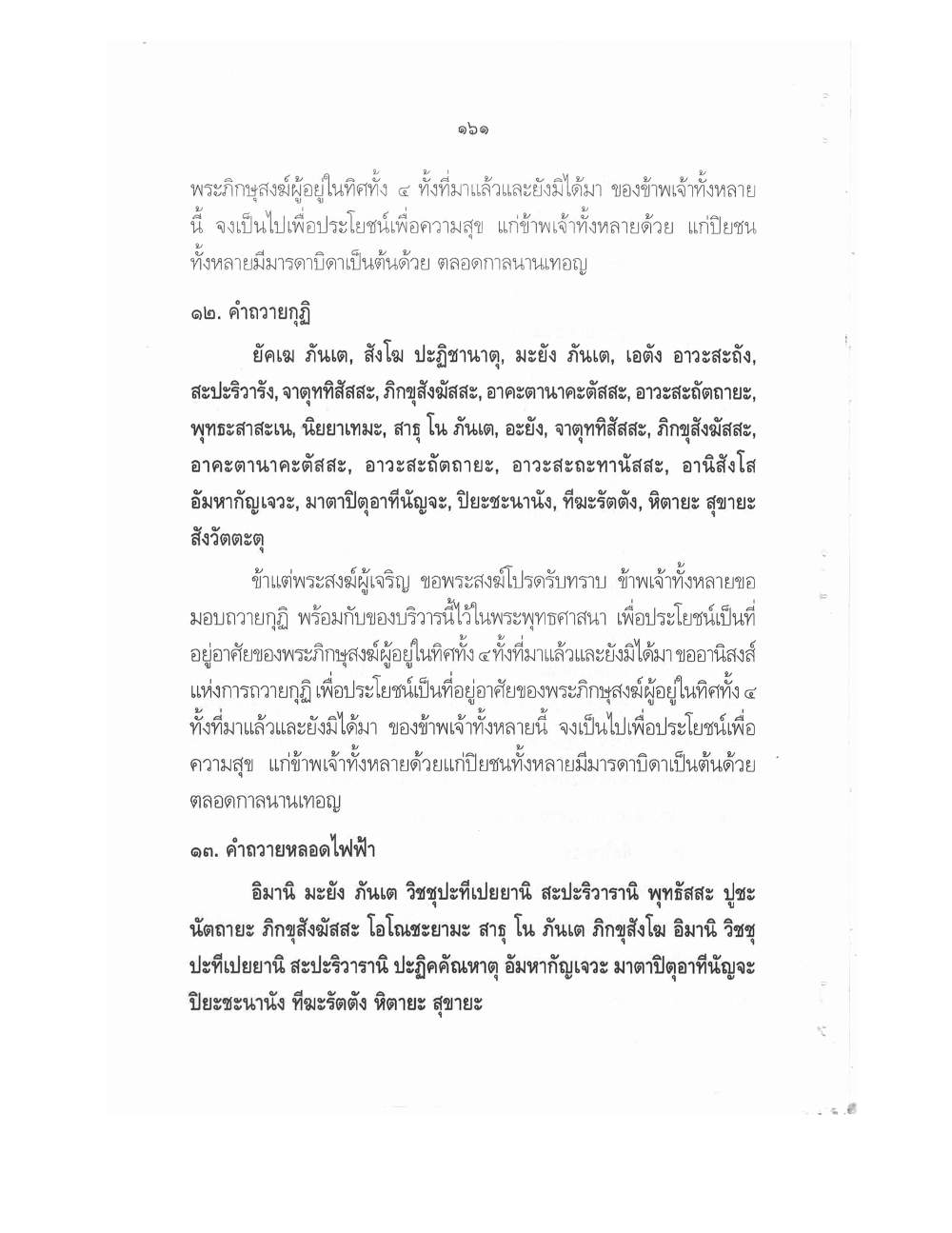
พระภิกษุสงฆ์ผู้อยู่ในทิศทั้ง ๔ ทั้งที่มาแล้วและยังมิได้มา ของข้าพเจ้าทั้งหลายนี้ จงเป็นไปเพื่อประโยชน์เพื่อความสุข แก่ข้าพเจ้าทั้งหลายด้วย แก่ปิยชนทั้งหลายมีมารดาบิดาเป็นต้นด้วย ตลอดกาลนานเทอญ
๑๒. คำถวายกุฏิ
ยัคเฆ ภันเต, สังโฆ ปะฏิชานาตุ, มะยัง ภันเต, เอตัง อาวะสะถัง, สะปะริวารัง, จาตุทิสัสสะ, ภิกขุสังฆัสสะ, อาคะตานาคะตัสสะ, อาวะสะถัตถายะ, พุทธะสาสะเน, นิยยาเทมะ, สาธุ โน ภันเต, อะยัง, จาตุทิสัสสะ, ภิกขุสังฆัสสะ, อาคะตานาคะตัสสะ, อาวะสะถัตถายะ, อาวะสะถะทานัสสะ, อานิสังโส, อัมหากัญเจวะ, มาตาปิตุอาทีนัญจะ, ปิยะชะนานัง, ทีฆะรัตตัง, หิตายะ สุขายะ สังวัตตะตุ
ข้าแต่พระสงฆ์ผู้เจริญ ขอพระสงฆ์โปรดรับทราบ ข้าพเจ้าทั้งหลายขอมอบถวายกุฏิ พร้อมกับของบริวารนี้ไว้ในพระพุทธศาสนา เพื่อประโยชน์เป็นที่อยู่อาศัยของพระภิกษุสงฆ์ผู้อยู่ในทิศทั้ง ๔ ทั้งที่มาแล้วและยังมิได้มา ขออานิสงส์แห่งการถวายกุฏิ เพื่อประโยชน์เป็นที่อยู่อาศัยของพระภิกษุสงฆ์ผู้อยู่ในทิศทั้ง ๔ ทั้งที่มาแล้วและยังมิได้มา ของข้าพเจ้าทั้งหลายนี้ จงเป็นไปเพื่อประโยชน์เพื่อความสุข แก่ข้าพเจ้าทั้งหลายด้วยแก่ปิยชนทั้งหลายมีมารดาบิดาเป็นต้นด้วย ตลอดกาลนานเทอญ
๑๓. คำถวายหลอดไฟฟ้า
อิมานิ มะยัง ภันเต วิชชุปะทีเปยยานิ สะปะริวารานิ พุทธัสสะ ปูชะนัตถายะ ภิกขุสังฆัสสะ โอโณชะยามะ สาธุ โน ภันเต ภิกขุสังโฆ อิมานิ วิชชุปะทีเปยยานิ สะปะริวารานิ ปะฏิคคัณหาตุ อัมหากัญเจวะ มาตาปิตุอาทีนัญจะ ปิยะชะนานัง ทีฆะรัตตัง หิตายะ สุขายะ
...the community of monks residing in the four quarters, both those who have come and those yet to come, from us, conduce to the benefit and happiness of ourselves, and of our beloved ones beginning with mother and father, for a long time to come.
12. Words for Offering a Monk's Dwelling (Kuti)
Yagghe bhante, saṅgho paṭijānātu, mayaṃ bhante, etaṃ āvasathaṃ, saparivāraṃ, cātudisassa, bhikkhusaṅghassa, āgatānāgatassa, āvasatthāya, buddhasāsane, niyyādema, sādhu no bhante, ayaṃ, cātudisassa, bhikkhusaṅghassa, āgatānāgatassa, āvasatthāya, āvasathadānassa, ānisaṃso, amhākañceva, mātāpitu ādīnañca, piyajanānaṃ, dīgharattaṃ, hitāya sukhāya saṃvattatu. [Gloss: "...together with its accompanying gifts, for the community of monks of the four quarters, both those who have come and those yet to come, for their dwelling, we hand over into the Buddhist religion. Well would it be, Venerable Sir, if the merit of this gift of a dwelling should conduce to the long-lasting welfare and happiness of ourselves and our beloved ones beginning with mother and father."]
Venerable Sangha, may the Sangha kindly take note: we humbly present this dwelling (kuti), together with these accompanying gifts, into the Buddhist religion, to serve as a residence for the community of monks of the four quarters, both those who have come and those yet to come. May the merit of offering this dwelling, to serve as a residence for the community of monks of the four quarters, both those who have come and those yet to come, from us, conduce to the benefit and happiness of ourselves, and of our beloved ones beginning with mother and father, for a long time to come.
13. Words for Offering Electric Light Bulbs
Imāni mayaṃ bhante vijjupadīpeyyāni saparivārāni buddhassa pūjanatthāya bhikkhusaṅghassa onojayāma, sādhu no bhante bhikkhusaṅgho imāni vijjupadīpeyyāni saparivārāni paṭiggaṇhātu amhākañceva mātāpitu ādīnañca piyajanānaṃ dīgharattaṃ hitāya sukhāya. [Gloss: "Venerable Sir, we offer these electric lamps together with their accompanying gifts, for the worship of the Buddha, to the community of monks. Well would it be, Venerable Sir, if the community of monks would accept these lamps, for the welfare of ourselves and our beloved ones beginning with mother and father."]
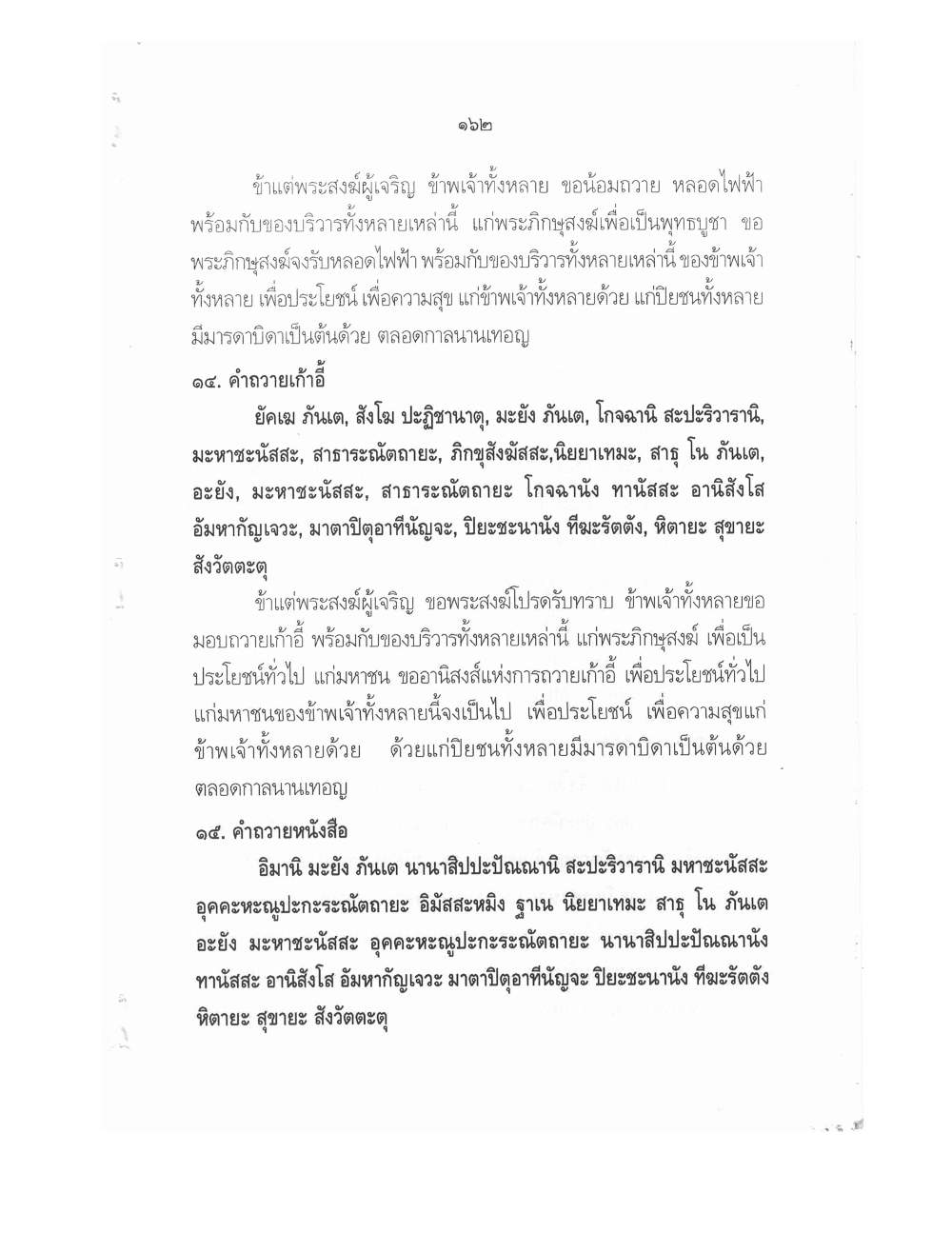
ข้าแต่พระสงฆ์ผู้เจริญ ข้าพเจ้าทั้งหลาย ขอน้อมถวาย หลอดไฟฟ้า พร้อมกับของบริวารทั้งหลายเหล่านี้ แก่พระภิกษุสงฆ์เพื่อเป็นพุทธบูชา ขอพระภิกษุสงฆ์จงรับหลอดไฟฟ้า พร้อมกับของบริวารทั้งหลายเหล่านี้ของข้าพเจ้าทั้งหลาย เพื่อประโยชน์ เพื่อความสุข แก่ข้าพเจ้าทั้งหลายด้วย แก่ปิยชนทั้งหลายมีมารดาบิดาเป็นต้นด้วย ตลอดกาลนานเทอญ
๑๔. คำถวายเก้าอี้
ยัคเฆ ภันเต, สังโฆ ปะฏิชานาตุ, มะยัง ภันเต, โกจฉานิ สะปะริวารานิ, มะหาชะนัสสะ, สาธาระณัตถายะ, ภิกขุสังฆัสสะ,นิยยาเทมะ, สาธุ โน ภันเต, อะยัง, มะหาชะนัสสะ, สาธาระณัตถายะ โกจฉานัง ทานัสสะ อานิสังโส อัมหากัญเจวะ, มาตาปิตุอาทีนัญจะ, ปิยะชะนานัง ทีฆะรัตตัง, หิตายะ สุขายะ สังวัตตะตุ
ข้าแต่พระสงฆ์ผู้เจริญ ขอพระสงฆ์โปรดรับทราบ ข้าพเจ้าทั้งหลายขอมอบถวายเก้าอี้ พร้อมกับของบริวารทั้งหลายเหล่านี้ แก่พระภิกษุสงฆ์ เพื่อเป็นประโยชน์ทั่วไป แก่มหาชน ขออานิสงส์แห่งการถวายเก้าอี้ เพื่อประโยชน์ทั่วไปแก่มหาชนของข้าพเจ้าทั้งหลายนี้จงเป็นไป เพื่อประโยชน์ เพื่อความสุขแก่ข้าพเจ้าทั้งหลายด้วย ด้วยแก่ปิยชนทั้งหลายมีมารดาบิดาเป็นต้นด้วย ตลอดกาลนานเทอญ
๑๕. คำถวายหนังสือ
อิมานิ มะยัง ภันเต นานาสิปปะปัณณานิ สะปะริวารานิ มหาชะนัสสะ อุคคะหะณูปะกะระณัตถายะ อิมัสสะหมิง ฐาเน นิยยาเทมะ สาธุ โน ภันเต อะยัง มะหาชะนัสสะ อุคคะหะณูปะกะระณัตถายะ นานาสิปปะปัณณานัง ทานัสสะ อานิสังโส อัมหากัญเจวะ มาตาปิตุอาทีนัญจะ ปิยะชะนานัง ทีฆะรัตตัง หิตายะ สุขายะ สังวัตตะตุ
Venerable Sangha, we humbly offer these electric light bulbs, together with these accompanying gifts, to the community of monks, as an act of homage to the Buddha. May the community of monks accept these light bulbs together with these accompanying gifts from us, for our benefit and happiness, and for the benefit of our beloved ones beginning with mother and father, for a long time to come.
14. Words for Offering Chairs
Yagghe bhante, saṅgho paṭijānātu, mayaṃ bhante, kocchāni saparivārāni, mahājanassa, sādhāraṇatthāya, bhikkhusaṅghassa, niyyādema, sādhu no bhante, ayaṃ, mahājanassa, sādhāraṇatthāya kocchānaṃ dānassa ānisaṃso amhākañceva, mātāpitu ādīnañca, piyajanānaṃ dīgharattaṃ, hitāya sukhāya saṃvattatu. [Gloss: "...we hand over these chairs together with their accompanying gifts, for the general benefit of the multitude, to the community of monks. Well would it be, Venerable Sir, if the merit of this gift of chairs, for the general benefit of the multitude, should conduce to the long-lasting welfare and happiness of ourselves and our beloved ones beginning with mother and father."]
Venerable Sangha, may the Sangha kindly take note: we humbly present these chairs, together with these accompanying gifts, to the community of monks, for the general benefit of the public. May the merit of offering these chairs for the general benefit of the public, from us, conduce to the benefit and happiness of ourselves, together with our beloved ones beginning with mother and father, for a long time to come.
15. Words for Offering Books
Imāni mayaṃ bhante nānāsippapaṇṇāni saparivārāni mahājanassa uggahaṇūpakaraṇatthāya imasmiṃ ṭhāne niyyādema, sādhu no bhante ayaṃ mahājanassa uggahaṇūpakaraṇatthāya nānāsippapaṇṇānaṃ dānassa ānisaṃso amhākañceva mātāpitu ādīnañca piyajanānaṃ dīgharattaṃ hitāya sukhāya saṃvattatu. [Gloss: "We hand over these various instructional books, together with their accompanying gifts, at this place, as materials for the study and learning of the multitude. Well would it be, Venerable Sir, if the merit of this gift of various books of knowledge, as study materials for the multitude, should conduce to the long-lasting welfare and happiness of ourselves and our beloved ones beginning with mother and father."]
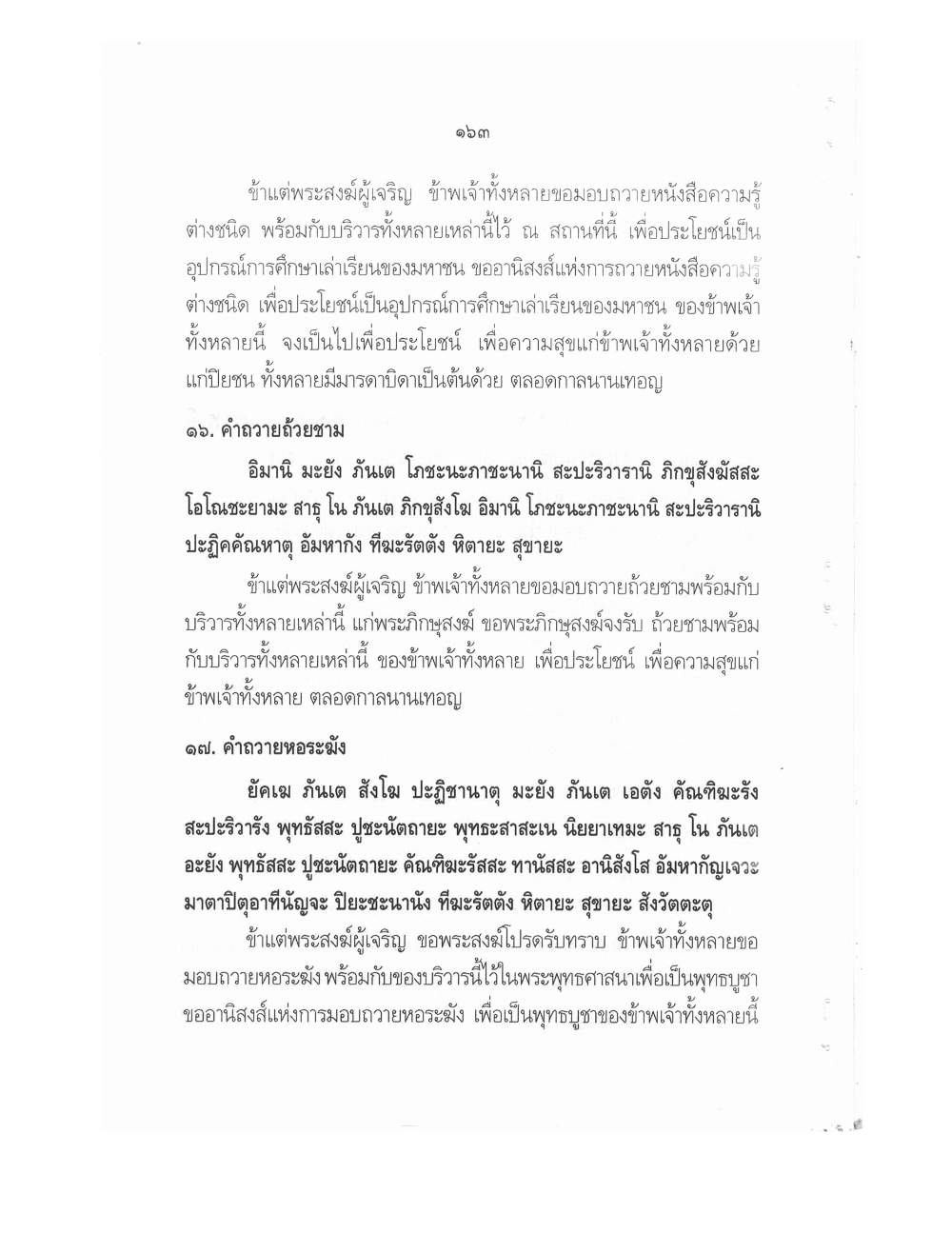
ข้าแต่พระสงฆ์ผู้เจริญ ข้าพเจ้าทั้งหลายขอมอบถวายหนังสือความรู้ต่างชนิด พร้อมกับบริวารทั้งหลายเหล่านี้ไว้ ณ สถานที่นี้ เพื่อประโยชน์เป็นอุปกรณ์การศึกษาเล่าเรียนของมหาชน ขออานิสงส์แห่งการถวายหนังสือความรู้ต่างชนิด เพื่อประโยชน์เป็นอุปกรณ์การศึกษาเล่าเรียนของมหาชน ของข้าพเจ้าทั้งหลายนี้ จงเป็นไปเพื่อประโยชน์ เพื่อความสุขแก่ข้าพเจ้าทั้งหลายด้วย แก่ปิยชน ทั้งหลายมีมารดาบิดาเป็นต้นด้วย ตลอดกาลนานเทอญ
๑๖. คำถวายถ้วยชาม
อิมานิ มะยัง ภันเต โภชะนะภาชะนานิ สะปะริวารานิ ภิกขุสังฆัสสะ โอโณชะยามะ สาธุ โน ภันเต ภิกขุสังโฆ อิมานิ โภชะนะภาชะนานิ สะปะริวารานิ ปะฏิคคัณหาตุ อัมหากัง ทีฆะรัตตัง หิตายะ สุขายะ
ข้าแต่พระสงฆ์ผู้เจริญ ข้าพเจ้าทั้งหลายขอมอบถวายถ้วยชามพร้อมกับบริวารทั้งหลายเหล่านี้ แก่พระภิกษุสงฆ์ ขอพระภิกษุสงฆ์จงรับ ถ้วยชามพร้อมกับบริวารทั้งหลายเหล่านี้ ของข้าพเจ้าทั้งหลาย เพื่อประโยชน์ เพื่อความสุขแก่ข้าพเจ้าทั้งหลาย ตลอดกาลนานเทอญ
๑๗. คำถวายหอระฆัง
ยัคเฆ ภันเต สังโฆ ปะฏิชานาตุ มะยัง ภันเต เอตัง คัณฑิฆะรัง สะปะริวารัง พุทธัสสะ ปูชะนัตถายะ พุทธะสาสะเน นิยยาเทมะ สาธุ โน ภันเต อะยัง พุทธัสสะ ปูชะนัตถายะ คัณฑิฆะรัสสะ ทานัสสะ อานิสังโส อัมหากัญเจวะ มาตาปิตุอาทีนัญจะ ปิยะชะนานัง ทีฆะรัตตัง หิตายะ สุขายะ สังวัตตะตุ
ข้าแต่พระสงฆ์ผู้เจริญ ขอพระสงฆ์โปรดรับทราบ ข้าพเจ้าทั้งหลายขอมอบถวายหอระฆัง พร้อมกับของบริวารนี้ไว้ในพระพุทธศาสนาเพื่อเป็นพุทธบูชา ขออานิสงส์แห่งการมอบถวายหอระฆัง เพื่อเป็นพุทธบูชาของข้าพเจ้าทั้งหลายนี้
Venerable Sangha, we humbly present these various books of knowledge, together with these accompanying gifts, at this place, to serve as materials for the study and learning of the public. May the merit of offering these various books of knowledge, to serve as study materials for the public, from us, conduce to the benefit and happiness of ourselves, together with our beloved ones beginning with mother and father, for a long time to come.
16. Words for Offering Bowls and Dishes
Imāni mayaṃ bhante bhojanabhājanāni saparivārāni bhikkhusaṅghassa onojayāma, sādhu no bhante bhikkhusaṅgho imāni bhojanabhājanāni saparivārāni paṭiggaṇhātu amhākaṃ dīgharattaṃ hitāya sukhāya. [Gloss: "Venerable Sir, we offer these food-vessels together with their accompanying gifts to the community of monks, for our own long-lasting welfare and happiness."]
Venerable Sangha, we humbly present these bowls and dishes together with these accompanying gifts to the community of monks. May the community of monks accept these bowls and dishes together with these accompanying gifts from us, for our benefit and happiness, for a long time to come.
17. Words for Offering a Bell Tower
Yagghe bhante saṅgho paṭijānātu mayaṃ bhante etaṃ gaṇḍigharaṃ saparivāraṃ buddhassa pūjanatthāya buddhasāsane niyyādema, sādhu no bhante ayaṃ buddhassa pūjanatthāya gaṇḍigharassa dānassa ānisaṃso amhākañceva mātāpitu ādīnañca piyajanānaṃ dīgharattaṃ hitāya sukhāya saṃvattatu. [Gloss: "...we hand over this bell tower together with its accompanying gifts, for the worship of the Buddha, into the Buddhist religion. Well would it be, Venerable Sir, if the merit of this gift of a bell tower, for the worship of the Buddha, should conduce to the long-lasting welfare and happiness of ourselves and our beloved ones beginning with mother and father."]
Venerable Sangha, may the Sangha kindly take note: we humbly present this bell tower, together with these accompanying gifts, into the Buddhist religion, as an act of homage to the Buddha. May the merit of presenting this bell tower, as an act of homage to the Buddha, from us...
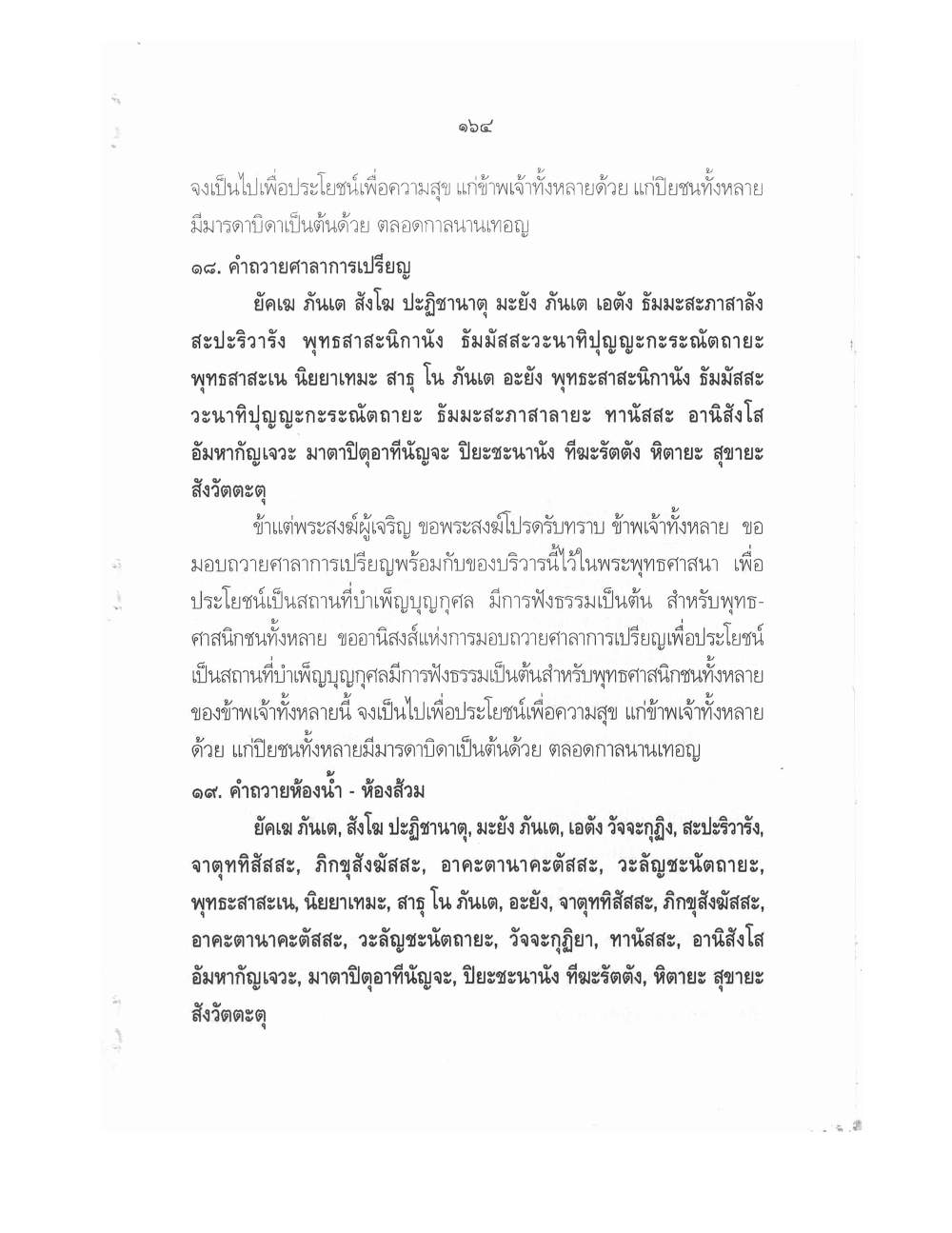
จงเป็นไปเพื่อประโยชน์เพื่อความสุข แก่ข้าพเจ้าทั้งหลายด้วย แก่ปิยชนทั้งหลายมีมารดาบิดาเป็นต้นด้วย ตลอดกาลนานเทอญ
๑๘. คำถวายศาลาการเปรียญ
ยัคเฆ ภันเต สังโฆ ปะฏิชานาตุ มะยัง ภันเต เอตัง ธัมมะสะภาสาลัง สะปะริวารัง พุทธสาสะนิกานัง ธัมมัสสะวะนาทิปุญญะกะระณัตถายะ พุทธสาสะเน นิยยาเทมะ สาธุ โน ภันเต อะยัง พุทธะสาสะนิกานัง ธัมมัสสะวะนาทิปุญญะกะระณัตถายะ ธัมมะสะภาสาลายะ ทานัสสะ อานิสังโส อัมหากัญเจวะ มาตาปิตุอาทีนัญจะ ปิยะชะนานัง ทีฆะรัตตัง หิตายะ สุขายะ สังวัตตะตุ
ข้าแต่พระสงฆ์ผู้เจริญ ขอพระสงฆ์โปรดรับทราบ ข้าพเจ้าทั้งหลาย ขอมอบถวายศาลาการเปรียญพร้อมกับของบริวารนี้ไว้ในพระพุทธศาสนา เพื่อประโยชน์เป็นสถานที่บำเพ็ญบุญกุศล มีการฟังธรรมเป็นต้น สำหรับพุทธศาสนิกชนทั้งหลาย ขออานิสงส์แห่งการมอบถวายศาลาการเปรียญเพื่อประโยชน์เป็นสถานที่บำเพ็ญบุญกุศลมีการฟังธรรมเป็นต้นสำหรับพุทธศาสนิกชนทั้งหลาย ของข้าพเจ้าทั้งหลายนี้ จงเป็นไปเพื่อประโยชน์เพื่อความสุข แก่ข้าพเจ้าทั้งหลายด้วย แก่ปิยชนทั้งหลายมีมารดาบิดาเป็นต้นด้วย ตลอดกาลนานเทอญ
๑๙. คำถวายห้องน้ำ - ห้องส้วม
ยัคเฆ ภันเต, สังโฆ ปะฏิชานาตุ, มะยัง ภันเต, เอตัง วัจจะกุฏิง, สะปะริวารัง, จาตุทิสัสสะ, ภิกขุสังฆัสสะ, อาคะตานาคะตัสสะ, วะลัญชะนัตถายะ, พุทธะสาสะเน, นิยยาเทมะ, สาธุ โน ภันเต, อะยัง, จาตุทิสัสสะ, ภิกขุสังฆัสสะ, อาคะตานาคะตัสสะ, วะลัญชะนัตถายะ, วัจจะกุฏิยา, ทานัสสะ, อานิสังโส, อัมหากัญเจวะ, มาตาปิตุอาทีนัญจะ, ปิยะชะนานัง, ทีฆะรัตตัง, หิตายะ สุขายะ สังวัตตะตุ
...conduce to the benefit and happiness of ourselves, and of our beloved ones beginning with mother and father, for a long time to come.
18. Words for Offering a Sermon Hall (Sala Karn Prian)
Yagghe bhante saṅgho paṭijānātu mayaṃ bhante etaṃ dhammasabhāsālaṃ saparivāraṃ buddhasāsanikānaṃ dhammassavanādipuññakaraṇatthāya buddhasāsane niyyādema, sādhu no bhante ayaṃ buddhasāsanikānaṃ dhammassavanādipuññakaraṇatthāya dhammasabhāsālāya dānassa ānisaṃso amhākañceva mātāpitu ādīnañca piyajanānaṃ dīgharattaṃ hitāya sukhāya saṃvattatu. [Gloss: "...we hand over this Dhamma-assembly hall, together with its accompanying gifts, for the performance of merit such as listening to the Dhamma by Buddhist devotees, into the Buddhist religion. Well would it be, Venerable Sir, if the merit of this gift of a Dhamma hall, for the performance of merit such as Dhamma-listening by Buddhist devotees, should conduce to the long-lasting welfare and happiness of ourselves and our beloved ones beginning with mother and father."]
Venerable Sangha, may the Sangha kindly take note: we humbly present this sermon hall, together with these accompanying gifts, into the Buddhist religion, to serve as a place for performing meritorious deeds such as listening to the Dhamma, for Buddhist devotees. May the merit of presenting this sermon hall, to serve as a place for performing meritorious deeds such as Dhamma-listening for Buddhist devotees, from us, conduce to the benefit and happiness of ourselves, and of our beloved ones beginning with mother and father, for a long time to come.
19. Words for Offering a Bathroom / Toilet
Yagghe bhante, saṅgho paṭijānātu, mayaṃ bhante, etaṃ vaccakuṭiṃ, saparivāraṃ, cātudisassa, bhikkhusaṅghassa, āgatānāgatassa, valañjanatthāya, buddhasāsane, niyyādema, sādhu no bhante, ayaṃ, cātudisassa, bhikkhusaṅghassa, āgatānāgatassa, valañjanatthāya, vaccakuṭiyā, dānassa, ānisaṃso, amhākañceva, mātāpitu ādīnañca, piyajanānaṃ, dīgharattaṃ, hitāya sukhāya saṃvattatu. [Gloss: "...together with its accompanying gifts, for the use of the community of monks of the four quarters, both those who have come and those yet to come, we hand over into the Buddhist religion. Well would it be, Venerable Sir, if the merit of this gift of a toilet, for the use of the community of monks of the four quarters, should conduce to the long-lasting welfare and happiness of ourselves and our beloved ones beginning with mother and father." — the formula continues past the bottom of this page.]
๑๖๕
ข้าแต่พระสงฆ์ผู้เจริญ ขอพระสงฆ์โปรดรับทราบ ข้าพเจ้าทั้งหลายขอมอบถวายห้องน้ำห้องส้วม พร้อมกับของบริวารนี้ไว้ในพระพุทธศาสนา เพื่อประโยชน์ใช้สอยแก่พระภิกษุสงฆ์ผู้อยู่ในทิศทั้ง ๔ ทั้งที่มาแล้วและยังมิได้มา ขออานิสงส์แห่งการถวายห้องน้ำห้องส้วม เพื่อประโยชน์เป็นที่ใช้สอยของพระภิกษุสงฆ์ผู้อยู่ในทิศทั้ง ๔ ทั้งที่มาแล้วและยังมิได้มา ของข้าพเจ้าทั้งหลายนี้จงเป็นไปเพื่อประโยชน์เพื่อความสุข แก่ข้าพเจ้าทั้งหลายด้วยแก่ปิยชนทั้งหลายมีมารดาบิดาเป็นต้นด้วย ตลอดกาลนานเทอญ
๒๐. คำถวายฉัตรกั้นพระพุทธรูป
ยัคเฆ ภันเต, สังโฆ ปะฏิชานาตุ, มะยัง ภันเต, เอตัง เสตะฉัตตาติฉัตตัง, สะปะริวารัง, พุทธัสสะ ปูชะนัตถายะ อิมัสสะหมิง อุโปสะถาคาเร นิยยาเทมะ สาธุ โน ภันเต อะยัง พุทธัสสะ ปูชะนัตถายะ เสตะฉัตตาติฉัตตัสสะ, ทานัสสะ, อานิสังโส อัมหากัญเจวะ, มาตาปิตุอาทีนัญจะ, ปิยะชะนานัง ทีฆะรัตตัง, หิตายะ สุขายะ สังวัตตะตุ
ข้าแต่พระสงฆ์ผู้เจริญ ขอพระสงฆ์โปรดรับทราบ ข้าพเจ้าทั้งหลายขอมอบถวายเศวตฉัตรพร้อมกับของบริวารนี้ไว้ ณ อุโบสถนี้ เพื่อเป็นพุทธบูชา ขออานิสงส์แห่งการมอบถวายเศวตฉัตรเพื่อเป็นพุทธบูชาของข้าพเจ้าทั้งหลายนี้ จงเป็นไปเพื่อประโยชน์เพื่อความสุขแก่ข้าพเจ้าทั้งหลายด้วย แก่ปิยชนทั้งหลายมีมารดาบิดาเป็นต้นด้วย ตลอดกาลนานเทอญ
๒๑. คำถวายเครื่องกำเนิดไฟฟ้า
ยัคเฆ ภันเต, สังโฆ ปะฏิชานาตุ, มะยัง ภันเต, เอตัง วิชชุคคิยันตัง, สะปะริวารัง, จาตุทิสัสสะ, ภิกขุสังฆัสสะ, อาคะตานาคะตัสสะ, โอภาสะนิทานัตถายะ อิมัสสะหมิง อาวาเส นิยยาเทมะ, สาธุ โน ภันเต, อะยัง,
165
Venerable Sangha, may the Sangha please take note. We wish to offer a bathroom and toilet, together with its accessories, to the Buddhist religion, for the use of the monks of the Sangha residing in the four directions, both those who have come and those who have not yet come. May the merit of offering this bathroom and toilet, for the use of the monks of the Sangha residing in the four directions, both those who have come and those who have not yet come, which is ours, be for the benefit and happiness of us all, and of our beloved ones beginning with our mother and father, for a long time to come.
20. Words of Offering a Tiered Umbrella-Canopy for the Buddha Image
[Pali, romanised as printed:] Yagghe bhante, saṅgho paṭijānātu, mayaṃ bhante, etaṃ setachattātichattaṃ, saparivāraṃ, buddhassa pūjanatthāya imasmiṃ uposathāgāre niyyādema. Sādhu no bhante, ayaṃ buddhassa pūjanatthāya setachattātichattassa, dānassa, ānisaṃso amhākañceva, mātāpitu ādīnañca, piyajanānaṃ dīgharattaṃ, hitāya sukhāya saṃvattatu. — [Gloss:] Venerable Sir, may the Sangha please take note. We offer this white multi-tiered umbrella-canopy, together with its accessories, for the worship of the Buddha, dedicating it in this uposatha hall. May it be well, Venerable Sir: may the merit of this gift of the white umbrella-canopy for the worship of the Buddha bring benefit and happiness for a long time to ourselves and to our beloved ones, beginning with our mother and father.
Venerable Sangha, may the Sangha please take note. We wish to offer a white umbrella-canopy together with its accessories, here in this uposatha hall, as an act of Buddha-worship. May the merit of offering this white umbrella-canopy as an act of Buddha-worship, which is ours, be for the benefit and happiness of us all, and of our beloved ones beginning with our mother and father, for a long time to come.
21. Words of Offering an Electric Generator
[Pali, romanised as printed, continues on next page:] Yagghe bhante, saṅgho paṭijānātu, mayaṃ bhante, etaṃ vijjuggiyantaṃ, saparivāraṃ, cātudisassa, bhikkhusaṅghassa, āgatānāgatassa, obhāsanidānatthāya imasmiṃ āvāse niyyādema, sādhu no bhante, ayaṃ, — [Gloss:] Venerable Sir, may the Sangha please take note. We offer this electric generator, together with its accessories, for the sake of giving light to the community of monks of the four quarters, both those who have come and those who have not yet come, dedicating it in this monastery. May it be well, Venerable Sir...
๑๖๖
จาตุทิสัสสะ, ภิกขุสังฆัสสะ, อาคะตานาคะตัสสะ, โอภาสะนิทานัตถายะ, วิชชุคคิยันตัสสะ, ทานัสสะ, ผะละวิปาโก อัมหากัญเจวะ, มาตาปิตุอาทีนัญจะ, ปิยะชะนานัง ทีฆะรัตตัง, หิตายะ สุขายะ สังวัตตะตุ
ข้าแต่พระสงฆ์ผู้เจริญ ขอพระสงฆ์โปรดรับทราบ ข้าพเจ้าทั้งหลายขอมอบถวายเครื่องกำเนิดไฟฟ้า พร้อมกับของบริวารนี้ไว้ในอาวาสนี้ เพื่อประโยชน์เป็นเครื่องให้แสงสว่างแก่พระภิกษุสงฆ์ผู้อยู่ในทิศทั้ง ๔ ทั้งที่มาแล้วและยังมิได้มา ขอผลวิบากแห่งการมอบถวายเครื่องกำเนิดไฟฟ้า เพื่อประโยชน์เป็นเครื่องให้แสงสว่างแก่พระภิกษุสงฆ์ผู้อยู่ในทิศทั้ง ๔ ทั้งที่มาแล้วและยังมิได้มา ของข้าพเจ้าทั้งหลายนี้ จงเป็นไปเพื่อประโยชน์ เพื่อความสุขแก่ข้าพเจ้าทั้งหลายด้วย แก่ปิยชนทั้งหลายมีมารดาบิดาเป็นต้นด้วย ตลอดกาลนานเทอญ
***************************
166
[Pali, romanised as printed, continued from previous page:] ...cātudisassa, bhikkhusaṅghassa, āgatānāgatassa, obhāsanidānatthāya, vijjuggiyantassa, dānassa, phalavipāko amhākañceva, mātāpitu ādīnañca, piyajanānaṃ dīgharattaṃ, hitāya sukhāya saṃvattatu. — [Gloss:] ...for the community of monks of the four quarters, both those who have come and those who have not yet come, for the sake of giving light; may the fruit and result of this gift of the electric generator bring benefit and happiness for a long time to ourselves and to our beloved ones, beginning with our mother and father.
Venerable Sangha, may the Sangha please take note. We wish to offer an electric generator, together with its accessories, to this monastery, for the benefit of giving light to the monks of the Sangha residing in the four directions, both those who have come and those who have not yet come. May the fruit and result of offering this electric generator, for the benefit of giving light to the monks of the Sangha residing in the four directions, both those who have come and those who have not yet come, which is ours, be for the benefit and happiness of us all, and of our beloved ones beginning with our mother and father, for a long time to come.
[decorative row of asterisks marking the end of this section]