Contents · 1 chapter(s) · 176 entries
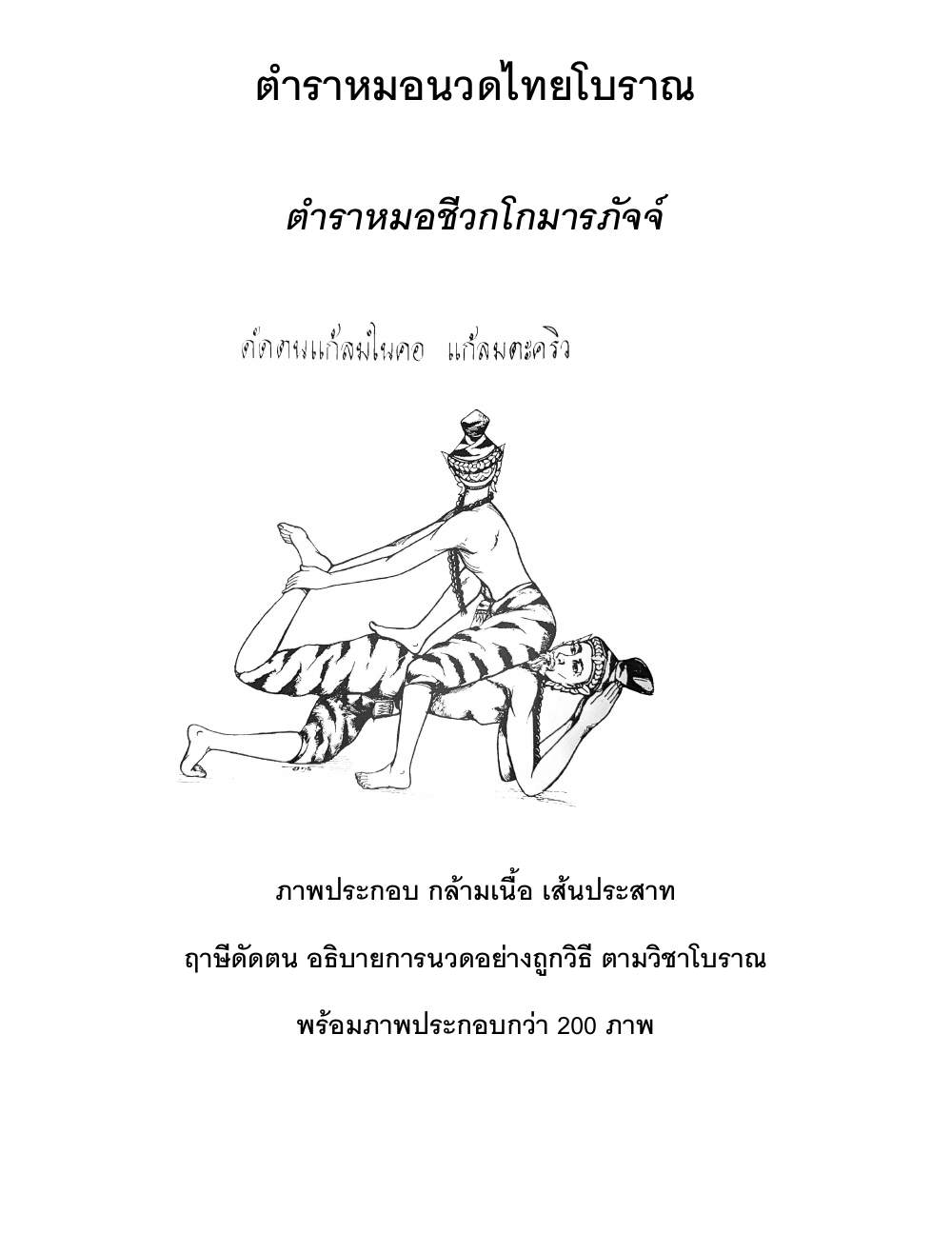
ตำราหมอนวดไทยโบราณ
ตำราหมอชีวกโกมารภัจจ์
ดัดตนแก้ลมในคอ แก้ลมตะคริว
[ภาพ: ฤๅษีดัดตนสองรูปในท่าออกกำลัง สวมโจงกระเบนลายเสือ รูปหนึ่งนั่งจับขาของอีกรูปหนึ่งยกพาดไหล่ อีกรูปหนึ่งนอนหงายเอามือประคองศีรษะ ทั้งสองสวมชฎา]
ภาพประกอบ กล้ามเนื้อ เส้นประสาท
ฤาษีดัดตน อธิบายการนวดอย่างถูกวิธี ตามวิชาโบราณ
พร้อมภาพประกอบกว่า 200 ภาพ
Ancient Thai Massage Manual
The Manual of Doctor Jivaka Komarabhacca
Stretching exercise to relieve wind in the throat, relieve cramps
[Illustration: two ruesi dat ton (hermit self-stretching) figures in a tiger-striped loincloth, exercising. One figure sits gripping the other's raised leg across his shoulder; the other lies on his back cradling his own head with his hands. Both wear the pointed ruesi headdress.]
Illustrations of muscles and nerves
Ruesi Dat Ton: explaining the correct method of massage according to the ancient tradition
With more than 200 accompanying illustrations
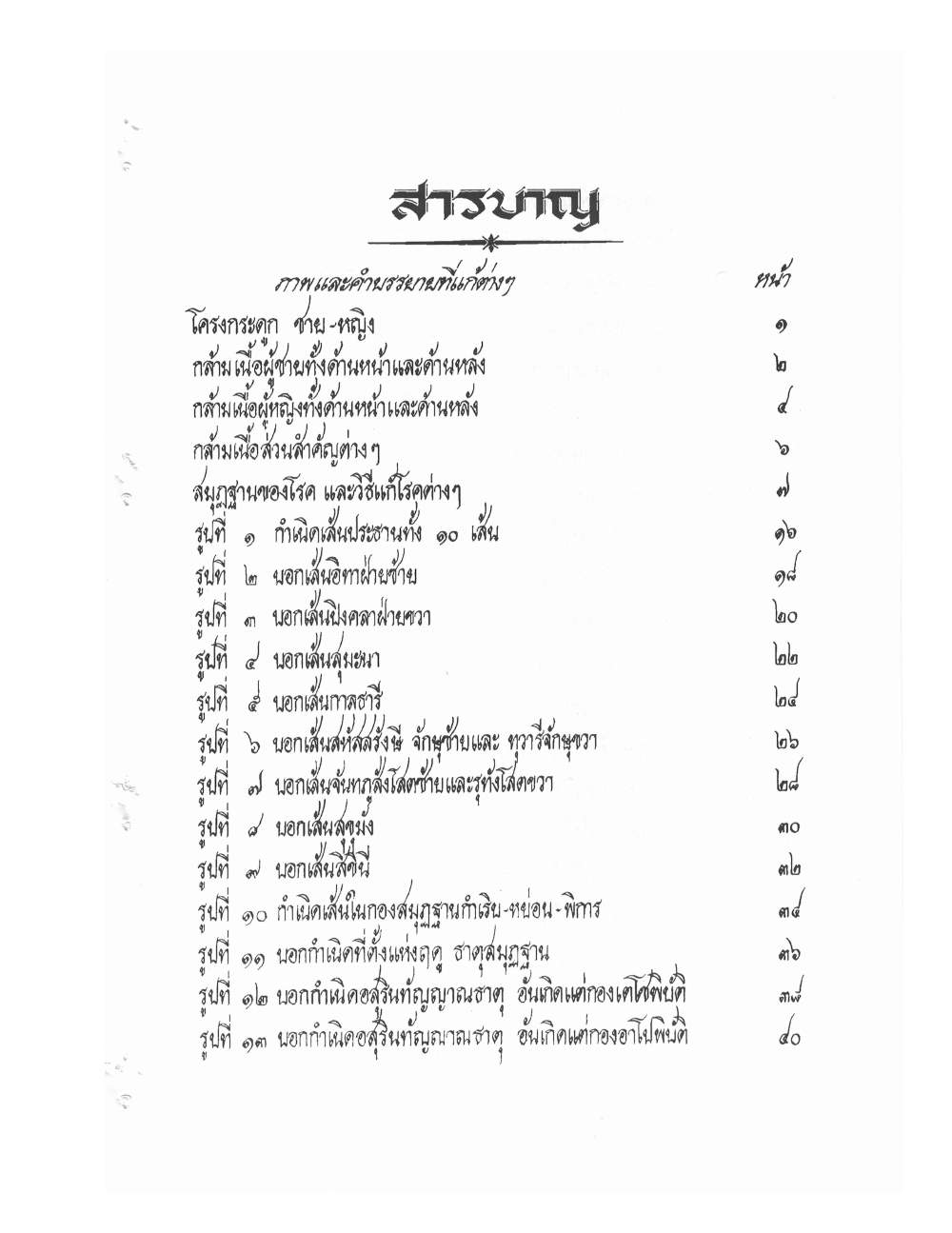
สารบัญ
ภาพและคำบรรยายที่เกี่ยวต่างๆ หน้า โครงกระดูก ชาย-หญิง ๑ กล้ามเนื้อผู้ชายทั้งด้านหน้าและด้านหลัง ๒ กล้ามเนื้อผู้หญิงทั้งด้านหน้าและด้านหลัง ๔ กล้ามเนื้อส่วนสำคัญต่างๆ ๖ สมุฏฐานของโรค และวิธีแก้โรคต่างๆ ๗ รูปที่ ๑ กำเนิดเส้นประธานทั้ง ๑๐ เส้น ๑๖ รูปที่ ๒ บอกเส้นอิทาฝ่ายซ้าย ๑๘ รูปที่ ๓ บอกเส้นปิงคลาฝ่ายขวา ๒๐ รูปที่ ๔ บอกเส้นสุมนา ๒๒ รูปที่ ๕ บอกเส้นกาลธารี ๒๔ รูปที่ ๖ บอกเส้นสหัสรังษี จักษุซ้ายและทวารีจักษุขวา ๒๖ รูปที่ ๗ บอกเส้นจันทภูสังโสตซ้ายและรุจำโสตขวา ๒๘ รูปที่ ๘ บอกเส้นสุขุมัง ๓๐ รูปที่ ๙ บอกเส้นสิกขิณี ๓๒ รูปที่ ๑๐ กำเนิดเส้นในกองสมุฏฐานกำเริบ-หย่อน-พิการ ๓๔ รูปที่ ๑๑ บอกกำเนิดที่ตั้งแห่งฤดู ธาตุสมุฏฐาน ๓๖ รูปที่ ๑๒ บอกกำเนิดอสุรินทัญญาณธาตุ อันเกิดแต่กองเตโชพิบัติ ๓๗ รูปที่ ๑๓ บอกกำเนิดอสุรินทัญญาณธาตุ อันเกิดแต่กองอาโปพิบัติ ๔๐
Table of Contents
Illustrations and their various captions Page Skeleton, male-female 1 Muscles of the male body, front and back 2 Muscles of the female body, front and back 4 Muscles of the various important parts 6 Origins of disease, and methods of curing various diseases 7 Figure 1 The origin of all 10 principal sen (channels) 16 Figure 2 Showing the Ittha sen, left side 18 Figure 3 Showing the Pingkhala sen, right side 20 Figure 4 Showing the Sumana sen 22 Figure 5 Showing the Kalathari sen 24 Figure 6 Showing the Sahatsarangsi sen, left eye, and the Thawari sen, right eye 26 Figure 7 Showing the Chanthaphusang sen, left ear, and the Rucham sen, right ear 28 Figure 8 Showing the Sukhumang sen 30 Figure 9 Showing the Sikkhini sen 32 Figure 10 The origin of the sen within the categories of disorder: excess-deficiency-injury 34 Figure 11 Showing the origin of the seasons, the elemental basis (dhatu-samutthana) 36 Figure 12 Showing the origin of the asurin-yan element, arising from disorder of the Tejo (fire) category 37 Figure 13 Showing the origin of the asurin-yan element, arising from disorder of the Apo (water) category 40
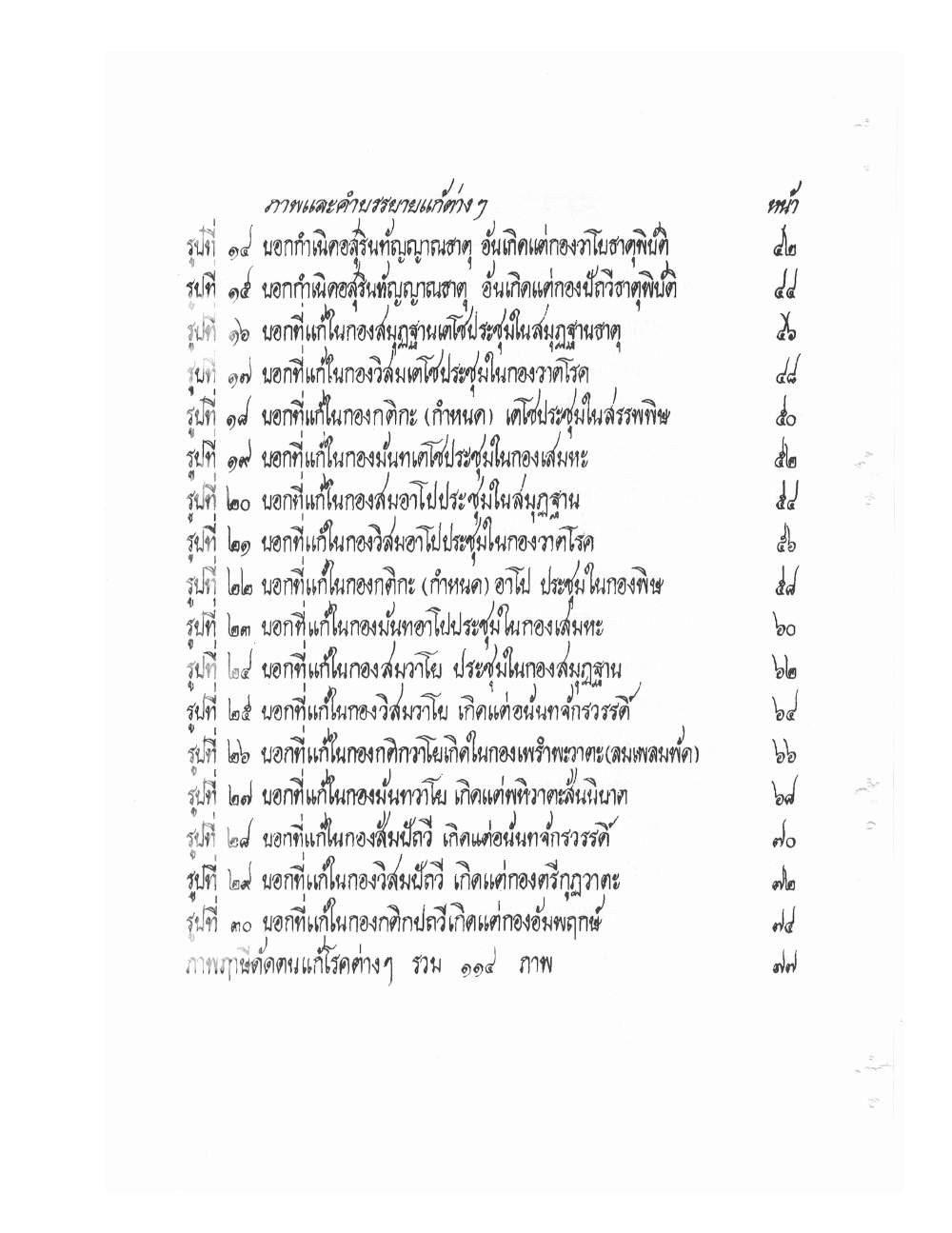
ภาพและคำบรรยายแก้ต่างๆ หน้า รูปที่ ๑๔ บอกกำเนิดอสุรินทัญญาณธาตุ อันเกิดแต่กองวาโยธาตุพิบัติ ๔๒ รูปที่ ๑๕ บอกกำเนิดอสุรินทัญญาณธาตุ อันเกิดแต่กองปัถวีธาตุพิบัติ ๔๔ รูปที่ ๑๖ บอกที่แก้ในกองสมุฏฐานเตโชประชุมในสมุฏฐานธาตุ ๔๖ รูปที่ ๑๗ บอกที่แก้ในกองวิสมเตโชประชุมในกองวาตโรค ๔๘ รูปที่ ๑๘ บอกที่แก้ในกองกติกะ (กำหนด) เตโชประชุมในสรรพพิษ ๕๐ รูปที่ ๑๙ บอกที่แก้ในกองมั่นเตโชประชุมในกองเสมหะ ๕๒ รูปที่ ๒๐ บอกที่แก้ในกองสมอาโปประชุมในสมุฏฐาน ๕๔ รูปที่ ๒๑ บอกที่แก้ในกองวิสมอาโปประชุมในกองวาตโรค ๕๖ รูปที่ ๒๒ บอกที่แก้ในกองกติกะ (กำหนด) อาโป ประชุมในกองพิษ ๕๘ รูปที่ ๒๓ บอกที่แก้ในกองมั่นอาโปประชุมในกองเสมหะ ๖๐ รูปที่ ๒๔ บอกที่แก้ในกองสมวาโย ประชุมในกองสมุฏฐาน ๖๒ รูปที่ ๒๕ บอกที่แก้ในกองวิสมวาโย เกิดแต่อัณฑจักรวรรดิ์ ๖๔ รูปที่ ๒๖ บอกที่แก้ในกองกติกวาโยเกิดในกองเพราพะวาตะ (ลมเพลมพัด) ๖๖ รูปที่ ๒๗ บอกที่แก้ในกองมั่นวาโย เกิดแต่พหิวาตะลื่นนิบาต ๖๘ รูปที่ ๒๘ บอกที่แก้ในกองสมปัถวี เกิดแต่อัณฑจักรวรรดิ์ ๗๐ รูปที่ ๒๙ บอกที่แก้ในกองวิสมปัถวี เกิดแต่กองตรีกฏวาตะ ๗๒ รูปที่ ๓๐ บอกที่แก้ในกองกติกปถวีเกิดแต่กองอัมพฤกษ์ ๗๔ ภาพฤๅษีดัดตนแก้โรคต่างๆ รวม ๑๑๔ ภาพ ๗๗
Illustrations and their various curative captions Page Figure 14 Showing the origin of the asurin-yan element, arising from disorder of the Vayo (wind) category 42 Figure 15 Showing the origin of the asurin-yan element, arising from disorder of the Patavi (earth) category 44 Figure 16 Showing the remedy within the category where Tejo (fire) disorder gathers in the elemental basis 46 Figure 17 Showing the remedy within the category where irregular Tejo gathers in wind-disease 48 Figure 18 Showing the remedy within the fixed (defined) category where Tejo gathers in all poisons 50 Figure 19 Showing the remedy within the category where steady Tejo gathers in phlegm 52 Figure 20 Showing the remedy within the category where normal Apo gathers in the elemental basis 54 Figure 21 Showing the remedy within the category where irregular Apo gathers in wind-disease 56 Figure 22 Showing the remedy within the fixed (defined) category where Apo gathers in poison 58 Figure 23 Showing the remedy within the category where steady Apo gathers in phlegm 60 Figure 24 Showing the remedy within the category where normal Vayo gathers in the elemental basis 62 Figure 25 Showing the remedy within the category where irregular Vayo arises from "the whirling cosmic wheel" 64 Figure 26 Showing the remedy within the fixed Vayo category, arising in the category of gusting/stray wind (spasm-wind) 66 Figure 27 Showing the remedy within the category where steady Vayo arises from external wind causing sudden collapse 68 Figure 28 Showing the remedy within the category where normal Patavi arises from "the whirling cosmic wheel" 70 Figure 29 Showing the remedy within the category where irregular Patavi arises from the triple-knot wind category 72 Figure 30 Showing the remedy within the fixed Patavi category, arising from the category of paralysis (palsy) 74 Illustrations of Ruesi Dat Ton curing various diseases, 114 illustrations in total 77
๑
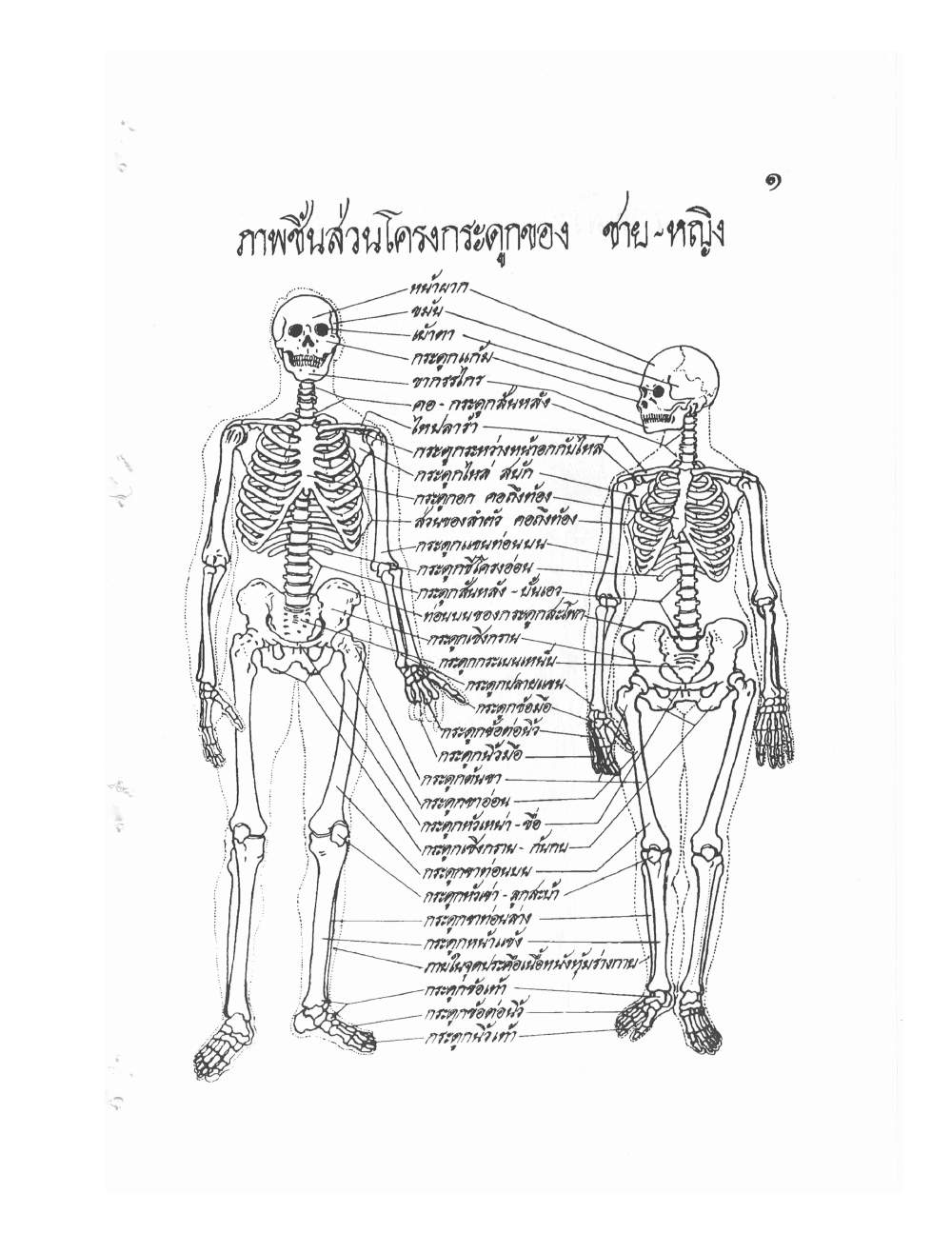
ภาพชิ้นส่วนโครงกระดูกของ ชาย-หญิง
[แผนภาพ: โครงกระดูกมนุษย์สองรูปยืนตรงหันหน้าเข้าหาผู้ดู (ซ้าย-ขวา) มีเส้นชี้จากส่วนต่างๆ ของกระดูกไปยังรายชื่อกำกับด้านขวาของแต่ละรูป]
หน้าผาก ขมับ เบ้าตา กระดูกแก้ม ขากรรไกร คอ - กระดูกสันหลัง ไหปลาร้า กระดูกระหว่างหน้าอกกับไหล่ กระดูกไหล่ สะบัก กระดูกอก คอถึงท้อง ส่วนของลำตัว คอถึงท้อง กระดูกแขนท่อนบน กระดูกข้อโคนงอ่อน กระดูกสันหลัง - บั้นเอว ท่อนแขนของกระดูกสะโพก กระดูกเชิงกราน กระดูกกระเบนเหน็บ กระดูกปลายแขน กระดูกข้อมือ กระดูกข้อต่อนิ้ว กระดูกนิ้วมือ กระดูกต้นขา กระดูกขาอ่อน กระดูกหัวเข่า - ข้อ กระดูกเชิงกราน - กันกน กระดูกขาท่อนบน กระดูกหัวเข่า - ลูกสะบ้า กระดูกขาท่อนล่าง กระดูกหน้าแข้ง กะโหลกประกอบเนื้อหนังหุ้มร่างกาย กระดูกข้อเท้า กระดูกข้อต่อนิ้ว กระดูกนิ้วเท้า
1
Illustration of the parts of the skeleton, male-female
[Diagram: two human skeletons standing upright facing the viewer, one male and one female, with lines pointing from various parts of the bones to the labels listed to the right of each figure]
Forehead Temple Eye socket Cheekbone Jaw Neck - spine Collarbone Bone between chest and shoulder Shoulder bone, shoulder blade Chest bone, throat to abdomen Part of the trunk, throat to abdomen Upper arm bone Elbow joint bone Spine - lower back (lumbar) Upper-arm-bone of the hip (as labeled) Pelvic bone Sacrum Forearm bone Wrist bone Finger joint bone Finger bone Thigh bone Lower thigh bone Knee - joint Pelvis - coccyx (as labeled) Upper leg bone Knee - kneecap Lower leg bone Shin bone Skull, together with the flesh and skin covering the body Ankle bone Toe joint bone Toe bone
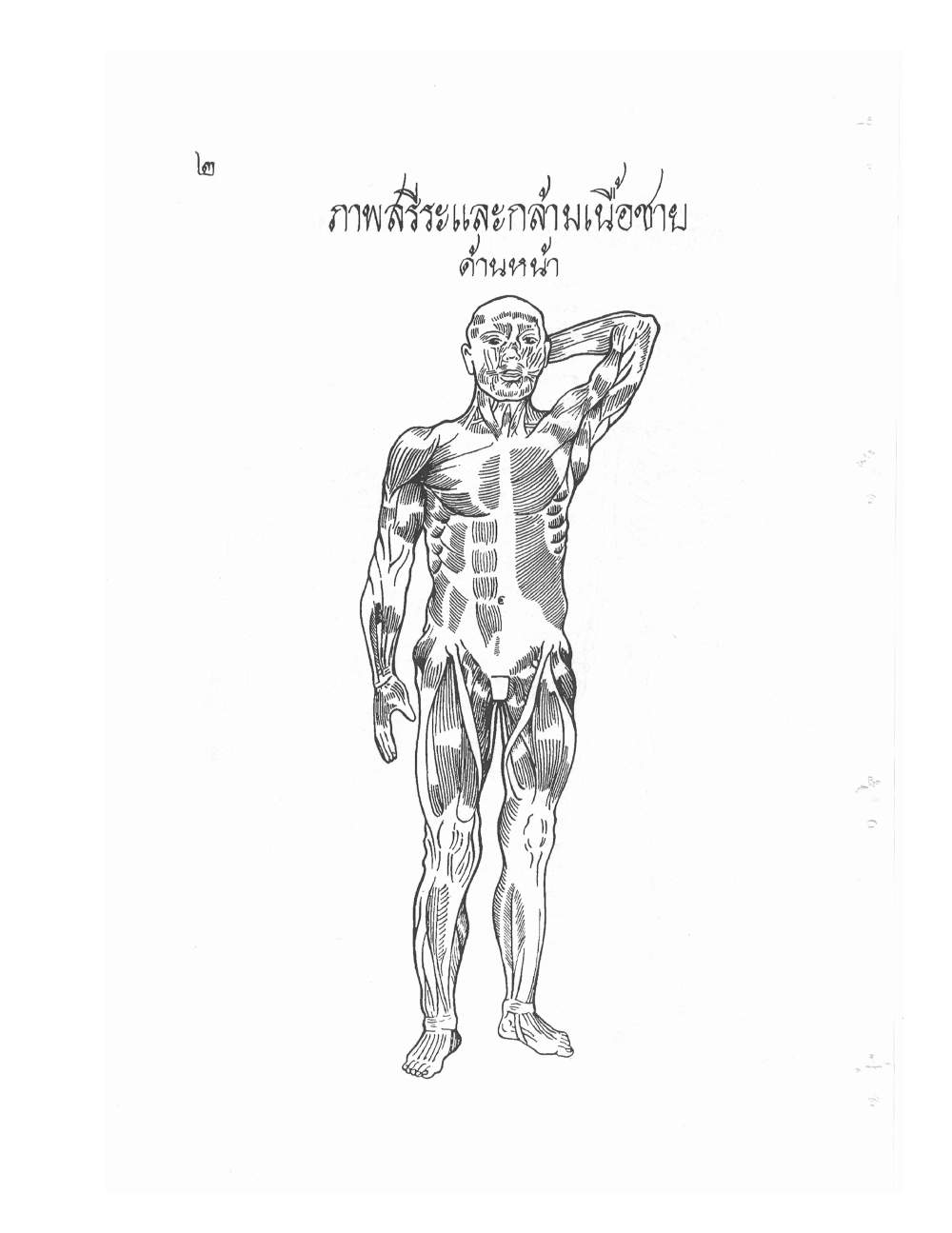
๒
ภาพสรีระและกล้ามเนื้อชาย ด้านหน้า
[ภาพ: รูปกายวิภาคชายเปลือย ยืนหันหน้าเข้าหาผู้ดู มือขวายกขึ้นแตะท้ายทอย แสดงกล้ามเนื้อทั่วร่างกายด้านหน้าตั้งแต่ศีรษะจรดปลายเท้า]
2
Illustration of the male form and musculature Front view
[Illustration: an anatomical figure of a nude male, standing facing the viewer, right hand raised to touch the back of the head, showing the muscles of the whole body, front view, from head to toe]
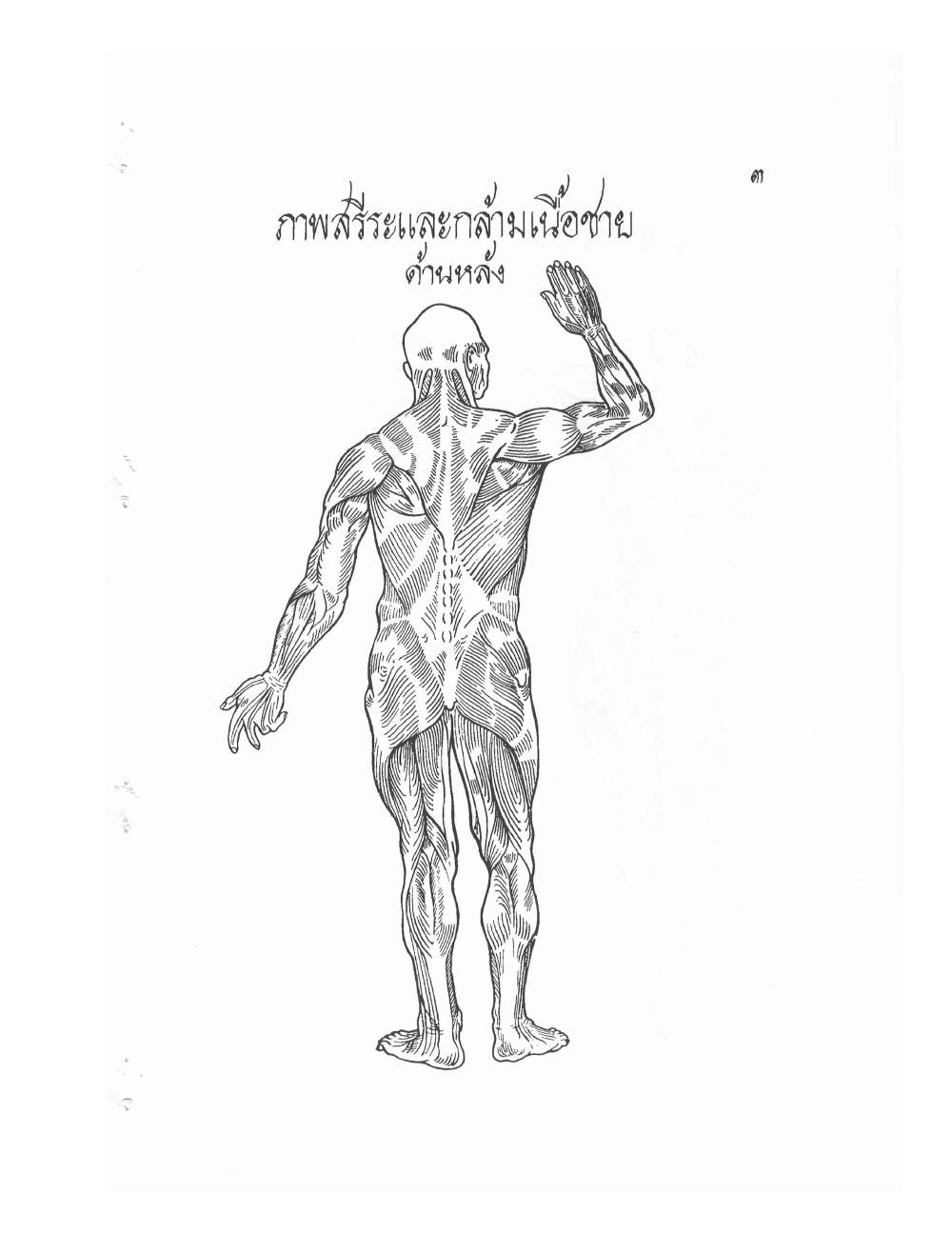
๓
ภาพสรีระและกล้ามเนื้อชาย ด้านหลัง
[ภาพ: รูปกายวิภาคชายเปลือย ยืนหันหลังให้ผู้ดู แขนขวายกขึ้นเหนือศีรษะ แสดงกล้ามเนื้อทั่วร่างกายด้านหลังตั้งแต่ศีรษะจรดปลายเท้า]
3
Illustration of the male form and musculature Back view
[Illustration: an anatomical figure of a nude male, standing with his back to the viewer, right arm raised above the head, showing the muscles of the whole body, back view, from head to toe]
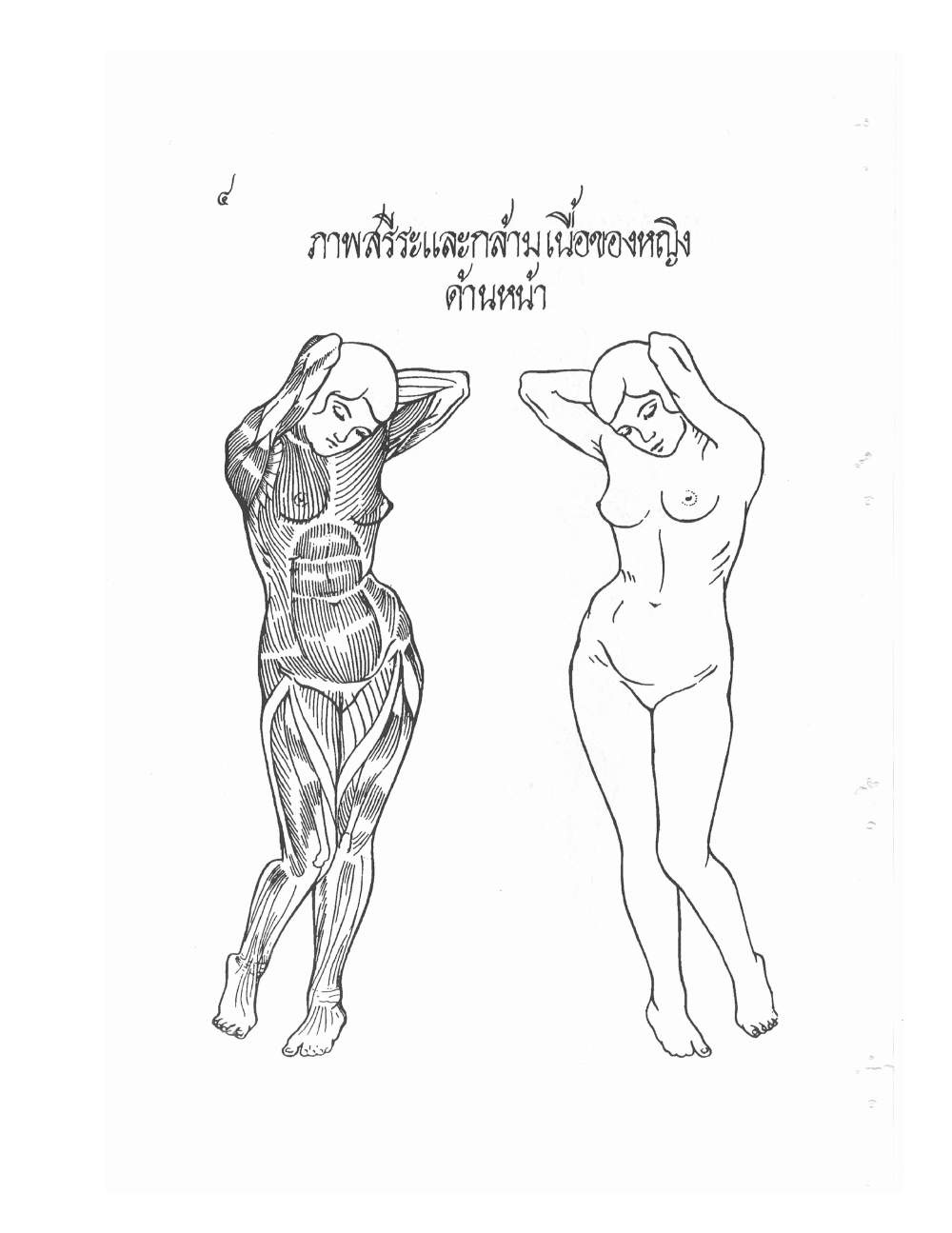
๔
ภาพสรีระและกล้ามเนื้อของหญิง ด้านหน้า
[ภาพ: รูปกายวิภาคหญิงเปลือยสองรูปคู่กัน ทั้งสองยกแขนขึ้นเกล้าผมเหนือศีรษะ รูปซ้ายแสดงกล้ามเนื้อทั่วร่างกาย รูปขวาเป็นรูปเค้าโครงร่างกายเปล่าไม่แสดงกล้ามเนื้อ]
4
Illustration of the female form and musculature Front view
[Illustration: two paired anatomical figures of a nude woman, both with arms raised, hands at the head as if arranging the hair; the figure on the left shows the muscles of the whole body, the figure on the right is a plain outline of the body without the musculature shown]
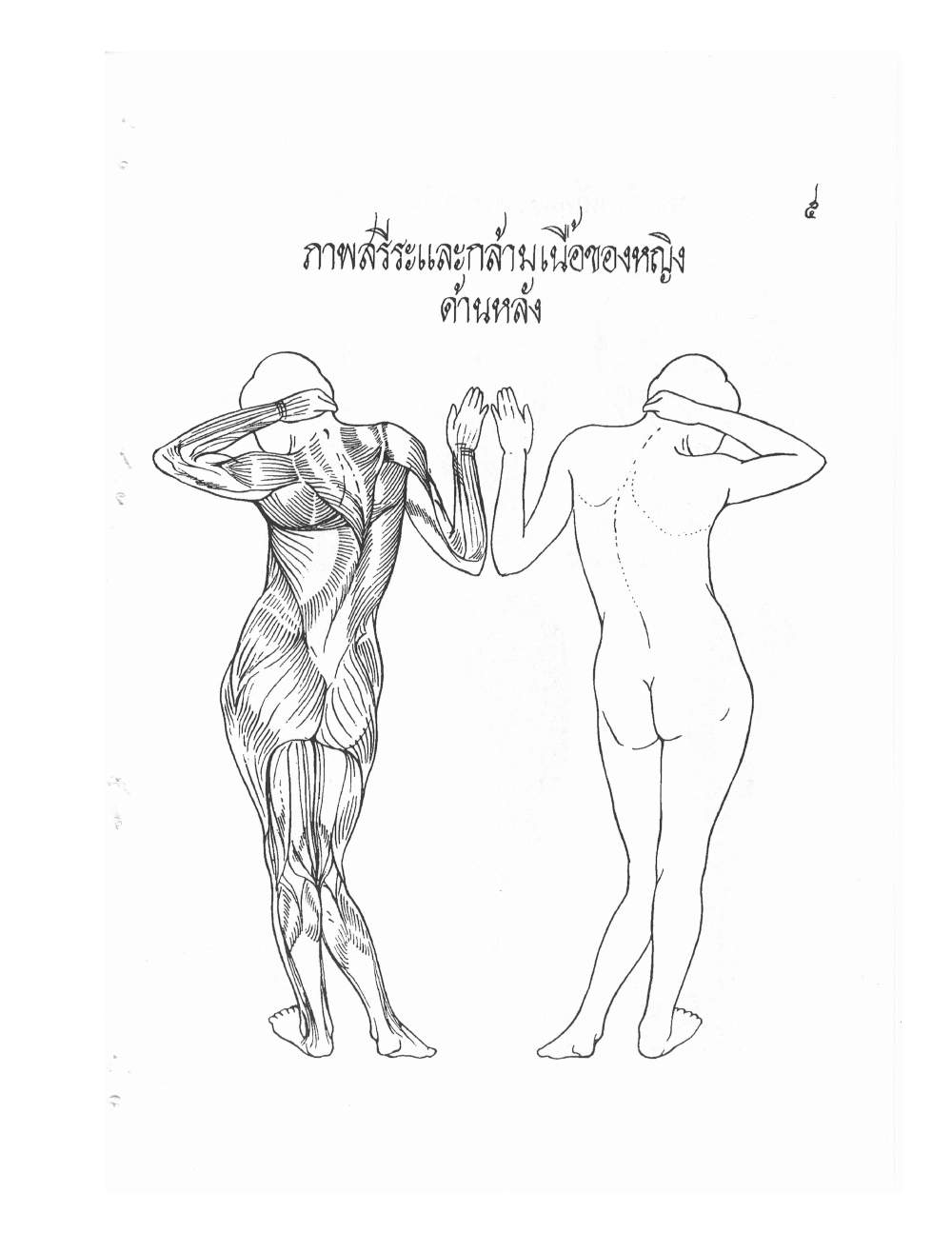
๕
ภาพสรีระและกล้ามเนื้อของหญิง ด้านหลัง
[ภาพ: รูปกายวิภาคหญิงเปลือยสองรูปคู่กัน หันหลังให้ผู้ดู ทั้งสองยกแขนขึ้นเกล้าผมเหนือศีรษะ รูปซ้ายแสดงกล้ามเนื้อทั่วร่างกาย รูปขวาเป็นรูปเค้าโครงร่างกายเปล่าไม่แสดงกล้ามเนื้อ มีเส้นประขีดตามแนวกระดูกสันหลัง]
5
Illustration of the female form and musculature Back view
[Illustration: two paired anatomical figures of a nude woman, backs to the viewer, both with arms raised, hands at the head as if arranging the hair; the figure on the left shows the muscles of the whole body, the figure on the right is a plain outline of the body without the musculature shown, with a dotted line marking the line of the spine]
๖
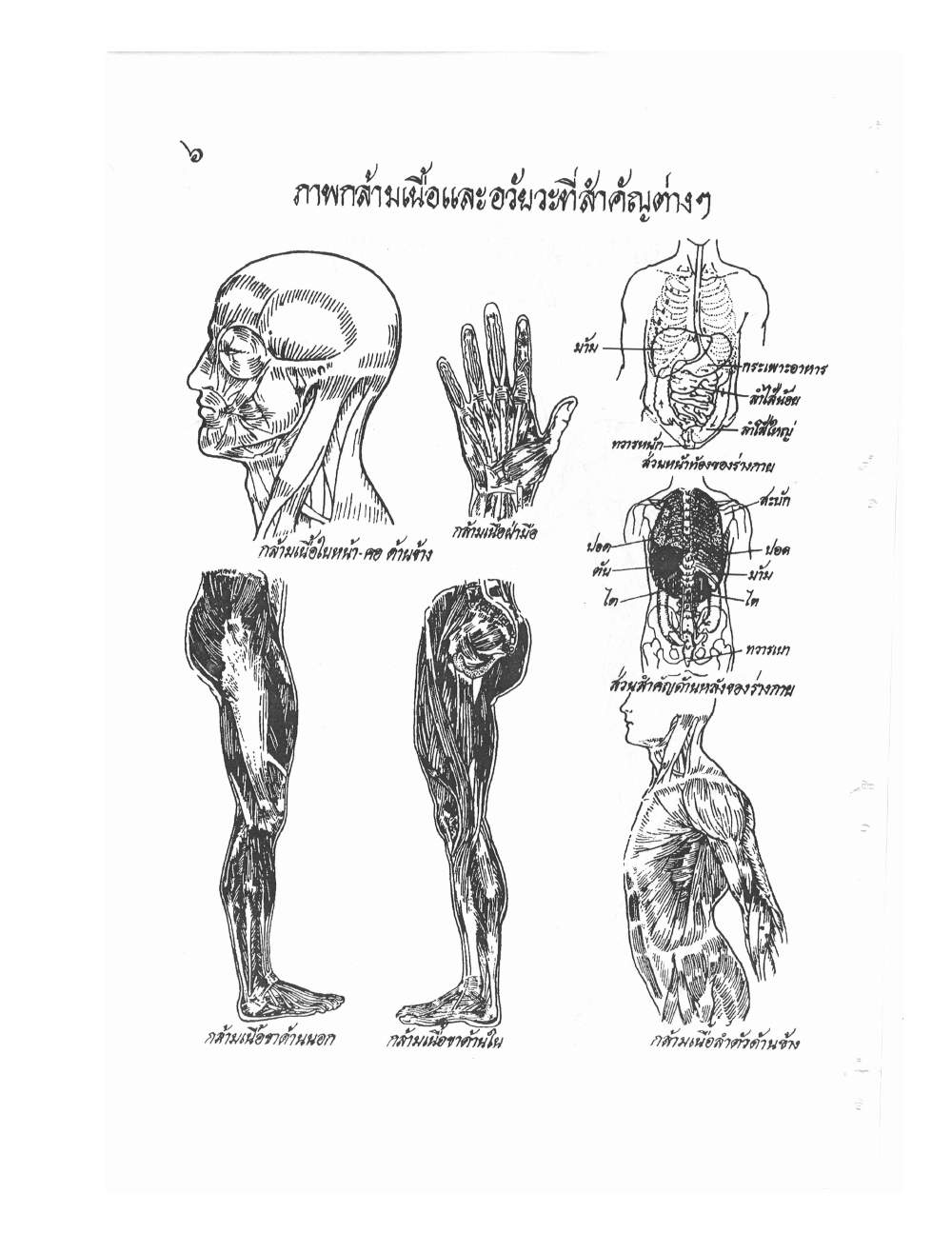
ภาพกล้ามเนื้อและอวัยวะที่สำคัญต่างๆ
[ภาพ: ชุดภาพย่อยหกภาพ]
กล้ามเนื้อในหน้า - คอ ด้านข้าง กล้ามเนื้อฝ่ามือ
ส่วนหน้าท้องของร่างกาย ตับ กระเพาะอาหาร ลำไส้น้อย ลำไส้ใหญ่ ทวารหนัก
ส่วนสำคัญด้านหลังของร่างกาย สะบัก ปอด ปอด ตับ ม้าม ไต ไต ทวารเบา
กล้ามเนื้อขาด้านนอก กล้ามเนื้อขาด้านใน กล้ามเนื้อลำตัวด้านข้าง
6
Illustration of important muscles and organs
[Illustration: a set of six smaller diagrams]
Muscles of the face and neck, side view Muscles of the palm
Front of the abdomen of the body Liver Stomach Small intestine Large intestine Anus
Important parts of the back of the body Shoulder blade Lung Lung Liver Spleen Kidney Kidney Urethra (bladder outlet)
Muscles of the outer leg Muscles of the inner leg Muscles of the side of the trunk
๗
สมุฏฐานของโรค
[เครื่องหมายคั่นลวดลาย]
การเจ็บป่วยในสังขารหรือร่างกายของคนเรานั้น มาจากสมุฏฐานทั้ง ๔ คือ:- ๑. ธาตุสมุฏฐาน ๒. อุตุสมุฏฐาน ๓. อายุสมุฏฐาน ๔. กาลสมุฏฐาน และยังมีมูลเหตุที่ทำให้เกิดการเจ็บป่วยขึ้นได้อีกมากมายหลาย ประการ ดังตัวอย่างย่อๆ ก็คือ ๑ เนื่องด้วยความทรุดโทรมของสังขารเราเพราะ ถูกเผาด้วยไฟชะระอุคดีเผาผลาญให้ร่างกายเก่าแก่ เหี่ยวแห้ง ทรุดโทรม ทุพลภาพคือความชราเข้าครอบงำซึ่งมี ปิตตะ วาตะ และเสมหะพิการเป็นต้น ๒ เนื่องด้วยเชื้อโรคต่างๆเข้ามาสู่ร่างกายของ คนเรา ทำให้ร่างกายของคนเราต้องทรุดโทรมลงไป เมื่อ รวมกับสังขารที่ทรุดโทรมตามธรรมชาติอยู่แล้วจึงยิ่งเพิ่มการ
7
The Origin of Disease
[decorative divider]
The sickness that occurs in the body, or physical form, of a person arises from four origins (samutthana), namely:- 1. Elemental origin (dhatu-samutthana) 2. Seasonal origin (utu-samutthana) 3. Age origin (ayu-samutthana) 4. Temporal/time-of-day origin (kala-samutthana) And there are also many other causes that can bring about sickness — to give a few brief examples: 1. Owing to the decline of the body, because it is burned by the fire of aging, scorching and consuming it so that the body grows old, withers, and declines — the infirmity of old age overtakes it, bringing about disorder of bile (pitta), wind (vata), and phlegm (semha), and so forth. 2. Owing to various germs/diseases entering the body of a person, causing the body to decline further. When this combines with the body's natural decline that is already occurring, it further increases the
๘
ทรุดโทรมของร่างกายเราเร็วยิ่งขึ้น การรักษาพยาบาลเพื่อบรรเทาการเจ็บป่วย หรือ ให้การเจ็บป่วยได้หายไปนั้น แพทย์ก็จะทำการรักษาให้หายโดย- การใช้ยาให้กินภายใน หรือปิดทายาภายนอกตามสมุฏฐาน ของโรคที่เกิดขึ้น ว่าโรคนั้นๆเกิดแต่สมุฏฐานอันใด การรักษา ให้ยานี้จึงทำให้โรคทั้งหลายนั้นหายไปได้ อย่างนี้เราเรียกว่าการ รักษาโรคโดยการให้ยา โรคบางอย่างมีอาการเจ็บป่วยเมื่อยล้าซึ่งไม่สามารถจะ บำบัดด้วยยาให้หายได้ เช่นโรคกระษัยต่างๆ มี กระษัยเส้น กระษัยดาน กระษัยจุก กระษัยเสียด กระษัยทั้น หรือกระ ษัยลงฝัก เป็นต้น ตามที่กล่าวมาย่อๆนี้จะให้หายได้นั้น จำเป็น อย่างยิ่งที่จะต้องใช้วิธีทำการบีบ ทำการนวด ทำการประคบ - รักษาจึงจะบรรเทาหรือหายได้ ถ้ายิ่งนวดด้วยกินยาด้วยก็จะทำให้ โรคนั้นหายโดยเร็วยิ่งขึ้น การบีบ การนวด และการประคบนี้จึง เป็นผลดีที่นิยมแพร่หลายกันมาแต่ครั้งโบราณจนกระทั่งบัดนี้ จึง ได้ยกย่องเรียกกัน สำหรับผู้ให้การรักษาโดยการบีบนวด และ ประคบนั้นว่า หมอนวด
8
of our body still faster. Medical treatment to relieve sickness, or to make an illness go away, is carried out by a physician by giving medicine to be taken internally, or by applying medicine externally, according to the origin of the disease that has arisen — that is, according to which of the origins the disease in question came from. Treating it by giving medicine in this way makes such diseases go away. This we call treating disease by giving medicine. Some diseases involve sickness and fatigue that cannot be cured by medicine alone — such as the various kasai (wasting) diseases: kasai of the sen (channels), kasai dan (hardened mass), kasai chuk, kasai siat, kasai than, or kasai long fak, and so on. To cure the conditions briefly mentioned above, it is absolutely necessary to use the methods of pressing (bip), massaging (nuat), and applying hot compresses (prakhop) — only through such treatment can they be relieved or cured. If massage is combined with taking medicine, it will make the disease go away even faster. Pressing, massaging, and compressing have therefore been a beneficial practice, popular and widespread since ancient times right up to the present. And so those who give treatment by pressing, massaging, and compressing have come to be honored with the title: nuat doctor (masseur).
๙
วิชาการบีบ นวด ประคบนี้ เป็นวิชาการแพทย์ อย่างหนึ่งที่ท่านโบราณาจารย์กล่าวไว้ว่า พระบรมครูชีวกโกมารภัจจ์ แพทย์ เป็นผู้ชำนาญทางเภสัช และแพทย์ศาสตร์ทั้งหลายแล้ว ท่านยังเป็นผู้ชำนาญในทางสรีรศาสตร์ในร่างกายมาแต่กาลก่อน ท่านจึงได้กำหนดเอาเส้นเอ็นทั้งหลายในร่างกายของคนเรานั้น ท่านจึงบันทึกไว้ว่า กายยาวประมาณ ๑ วา หนา ๑ คืบ กว้าง ๑ ศอก และมีลมอันประจำอยู่ในห้วงลึกยาว ๒ องคุลี มีเส้นเอ็นเกี่ยวกระหวัดรัดร่างกายอยู่ประมาณ ๗๒,๐๐๐ เส้น แต่มีเส้นที่สำคัญเป็นประธานอยู่เพียง ๑๐ เส้นเท่านั้น เส้น ประธานที่กล่าวมานี้เรียกชื่อเป็นภาษาบาลีไว้คือ ๑. เส้นอิทา ๒. เส้นปิงคลา ๓. เส้นสุมนา ๔. เส้นกาลธารี หรือกาละทาลี ๕. เส้นสหัสรังษี ๖. เส้นทวารี ๗. เส้นราอุรัง หรือ ลาวุสัง
9
This science of pressing (bip), massaging (nuat), and applying compresses (prakhop) is one branch of medical knowledge described by the ancient masters, who said: the great teacher-physician Jivaka Komarabhacca was skilled in pharmacy and in all branches of medical science, and moreover he had long been skilled in the science of the body's physical structure. He therefore identified all the sen (tendon-channels) within the human body. He recorded that the body is about 1 wa [fathom] long, 1 khuep [handspan] thick, and 1 sok [cubit] wide, and that a wind (lom) resides continually within it, in a cavity 2 finger-breadths (ongkhuli) deep; that there are sen winding around and binding the body together, numbering about 72,000 in all, but only 10 of these sen are important enough to be the principal ones. These principal sen mentioned above are given names in the Pali language, namely: 1. Ittha sen 2. Pingkhala sen 3. Sumana sen 4. Kalathari sen, also called Kalathali 5. Sahatsarangsi sen 6. Thawari sen 7. Ra-urang sen, also called Lawusang
๑๐
๘. เส้นอรังคะ หรืออุลังกะ ๙. เส้นนันทกระหวัด ๑๐. เส้นคิชฌะ
แต่ละเส้นมีหน้าที่ควบคุมเส้นต่างๆ ๑๒,๐๐๐ เส้น ที่อยู่ตามกล้ามเนื้อเป็นหมวดหมู่ของร่างกายเพื่อการดำรงชีพต่อไป
เส้นประธานทั้ง ๑๐ เส้นนั้นมีหน้าที่ดังต่อไปนี้
๑. อิทา ประจำลม จันทกลา เริ่มต้นแต่กึ่งกลางท้อง ใกล้สะดือ แล่นไปจรดหัวเหน่า แล้วเลยไปทางต้นขาข้างซ้าย แล้วย้อนแนมไปตามกระดูกสันหลังเบื้องซ้าย ขึ้นไปบนศีรษะ ผ่านศีรษะแล้วกกลับมาจรดจมูกข้างซ้ายเป็นที่สิ้นสุด
๒. ปิงคลา ประจำลม สุริยะกลา เริ่มต้นแต่กึ่งกลางท้อง ใกล้สะดือ แล่นไปจรดหัวเหน่า แล้วเลยไปทางต้นขาข้างขวา แล้วย้อนแนมไปตามกระดูกสันหลังทางเบื้องขวา ขึ้นไปบนศีรษะ ผ่านศีรษะแล้วกกลับมา จรดจมูกข้างขวาเป็นที่สิ้นสุด
๓. สุมนา เริ่มต้นที่กึ่งกลางท้อง ผ่านเข้าไปในทรวงอก ขึ้นไปตามลำคอ แล้วไปจรดที่โคนลิ้นเป็นที่สิ้นสุด
10
8. The Arangkha (or Ulangka) channel 9. The Nanthakrawat channel 10. The Kitcha channel
Each of these channels governs 12,000 subsidiary channels distributed among the muscles as bodily systems, for the maintenance of life.
The ten principal channels have the following functions:
1. Ittha — governs the wind called Janthakala. It begins at the middle of the abdomen, near the navel, runs down to the pubic bone, then continues along the left thigh, turns back to follow the spine on the left side, rises up over the head, passes over the crown, and returns to end at the left side of the nose.
2. Pingkala — governs the wind called Suriyakala. It begins at the middle of the abdomen, near the navel, runs down to the pubic bone, then continues along the right thigh, turns back to follow the spine on the right side, rises up over the head, passes over the crown, and returns to end at the right side of the nose.
3. Sumana — begins at the middle of the abdomen, passes up through the chest, runs up along the throat, and ends by reaching the base of the tongue.
๑๑
๔. กาละทาสี หรือ กาละทารี เริ่มต้นใกล้เคียงกับเส้นสุมนา แล้วแตกแยกออกเป็น ๔ เส้น เส้นคู่หนึ่งนั้นแล่นไปตามราวนมด้านขวาและซ้ายทั้งสองลอดไปทางรักแร้ เลยไปตามลำแขนทั้งสองข้างโดยตลอดไปจรดนิ้วมือทั้ง ๑๐ นิ้ว เส้นคู่อีกคู่หนึ่งนั้นแล่นพุ่งลงไปตามหน้าขาทั้งสองข้าง แล้วเลยไปตามลำแข้งทั้งสอง ไปจนจรดนิ้วเท้าทั้ง ๑๐ นิ้ว
๕. สหัสสะรังษี เริ่มต้นแต่กึ่งกลางท้อง แล่นไปตามอวัยวะที่สำคัญคือ (๑) แล่นไปจรดปลายเท้าข้างซ้าย (๒) แล่นย้อนมาทางหน้าแข้งผ่านหัวเข่าซ้าย (๓) แล่นจากหัวเข่าซ้ายไปใต้คาง (๔) แล่นจากใต้คางไปยังนัยน์ตาข้างซ้าย เป็นรากของนัยน์ตาข้างซ้าย
๖. ทวารี เริ่มต้นแต่กึ่งกลางท้อง แล่นไปตามอวัยวะที่สำคัญคือ:- (๑) แล่นไปจรดปลายเท้าข้างขวา (๒) แล่นย้อนขึ้นมาทางหน้าแข้งผ่านหัวเข่าขวา
11
4. Kalathasi (or Kalathari) — begins near the Sumana channel, then splits into 4 strands. One pair runs along the chest line on the right and left sides, passing under the armpits, and continuing down both arms to reach all 10 fingers. The other pair runs down the front of both thighs, then continues down both shins to reach all 10 toes.
5. Sahatsarangsi — begins at the middle of the abdomen and runs through the following important parts: (1) Runs to reach the tip of the left foot. (2) Runs back up along the front of the left shin, passing the left knee. (3) Runs from the left knee to under the chin. (4) Runs from under the chin to the left eye, forming the root of the left eye.
6. Thawari — begins at the middle of the abdomen and runs through the following important parts:- (1) Runs to reach the tip of the right foot. (2) Runs back up along the front of the right shin, passing the right knee.
๑๒
(๓) แล่นจากหัวเข่าขวาไปใต้คาง (๔) แล่นจากใต้คางไปยังนัยน์ตาข้างขวา เป็นรากของนัยน์ตาข้างขวา
๗. ลาอุลง หรือ ลาวุลง เริ่มต้นจากใกล้กึ่งกลางท้องใกล้เคียงกันกับเส้นสหัสสะรังษี และเส้นทวารี แล้วแล่นขึ้นไปตามราวนมข้างซ้าย แล่นเลยไปจรดหูข้างซ้าย เป็นรากของหูข้างซ้าย
๘. อุลังคะกะ หรืออุลังกะ เริ่มต้นเช่นเดียวกันกับเส้นลาอุลง แล้วแล่นไปตามราวนมข้างขวา แล่นเลยไปจรดหูข้างขวา เป็นรากของหูข้างขวา
๙. นันทกระหวัด เริ่มต้นในบริเวณใกล้เคียงกับเส้นอุลังคะกะ ปลายเส้นแล่นไปจรดทวารหนักและทวารเบา
๑๐. คิชฌะ เริ่มต้นแต่กึ่งกลางท้องแล่นลงไปทางหัวเหน่า เลยไปจรดลำลึงค์ของชาย และไปจรดปลายนิมิตรของหญิง
บางอาจารย์ท่านกล่าวไว้อีกว่า เส้นประธานทั้ง ๑๐ เส้น ที่เป็นใหญ่กว่าเส้นทั้งหลายนั้น มีเส้นหนึ่งชื่อว่าสุมนา เริ่มออกแต่กึ่งกลางท้องไปจรดลิ้น และมีเส้นอีกเส้นหนึ่งชื่อว่าสิกขินี
12
(3) Runs from the right knee to under the chin. (4) Runs from under the chin to the right eye, forming the root of the right eye.
7. Laulong (or Lawulong) — begins near the middle of the abdomen, close to the Sahatsarangsi and Thawari channels, then runs up along the chest line on the left side, continuing on to reach the left ear, forming the root of the left ear.
8. Ulangkaka (or Ulangka) — begins in the same manner as the Laulong channel, then runs along the chest line on the right side, continuing on to reach the right ear, forming the root of the right ear.
9. Nanthakrawat — begins in the area near the Ulangkaka channel; the end of the channel runs to reach the anus and the urethra.
10. Kitcha — begins at the middle of the abdomen, runs down toward the pubic bone, and continues to reach the penis in men, and the tip of the clitoris in women.
Some teachers have further stated that, among the ten principal channels greater than all the others, there is one named Sumana, which begins at the middle of the abdomen and runs to reach the tongue, and there is another channel named Sikkhini,
๑๓
แล่นออกจากกึ่งกลางท้อง ลงไปจรดลำลึงค์ เส้นสิกขินีนี้เข้าใจได้ว่าเป็นเส้นชื่อว่าคิชฌะนั่นเอง แต่ท่านเรียกชื่อเป็นอีกอย่างหนึ่งไป ท่านยังได้กล่าวไว้อีกว่า ยังมีลมอันหนึ่งเกิดแต่กึ่งกลางท้องขึ้นไปทางเบื้องบน และลงมาเบื้องต่ำประมาณ ๑๐ องคุลี รวมไปกับบรรดาเส้นอื่นทั้งหลายด้วย
[เครื่องหมายคั่น: ลายเส้นประดับ มีดาวเล็กอยู่กึ่งกลาง]
วิธีแก้เส้นและลม
โรคและลมที่เกิดขึ้นแก่คนไข้ ที่ไม่ร้ายแรงเท่าใดนัก มีดังนี้ พร้อมวิธีแก้
๑. ลมปะกัง ให้นวดโขนงคิ้วทั้งสองข้าง ๒. ลมชิวหาสดมภ์ สะอึก นวดซอกคอข้างหน้า ๓. ลมอาเจียนธรรมดา นวดตามบริเวณอก ๔. เมื่อยขบตามเนื้อตัวและใช้สันนิบาต ทำให้ปากเบี้ยว นวดตามคอข้างขวา ๕. มวนท้อง หรือลมอัตวุตสดมภ์ นวดบริเวณริมสีข้างและต่อบริเวณสะดือ ๖. ถ้านอนมิหลับ นวดที่แข้งซ้าย
13
...runs out from the middle of the abdomen, down to the penis. This Sikkhini channel is understood to be the same as the channel named Kitcha, but referred to under a different name. It is also stated that there is a further wind that arises at the middle of the abdomen, rising upward and descending downward about 10 finger-widths, together with the rest of the channels.
[divider ornament: a decorative flourish with a small star at its center]
METHODS FOR TREATING CHANNELS AND WINDS
The illnesses and winds that arise in patients, which are not especially severe, are as follows, with their remedies:
1. Pakang wind — massage both eyebrow ridges. 2. Chiwhasadom wind (tongue-stiffening wind) and hiccups — massage the front of the neck. 3. Ordinary vomiting wind — massage around the chest. 4. Body aching accompanied by sannibat (a paralytic affliction) causing a crooked mouth — massage along the right side of the neck. 5. Stomach churning, or attavutsadom wind — massage around the flanks and continuing to the navel area. 6. If unable to sleep — massage the left shin.
๑๔
๗. ถ้าลิ้นกระด้าง นวดบริเวณฝ่าเท้า ที่ตาตุ่มกลางฝ่าเท้า ตลอดขึ้นถึงเข่า ๘. ถ้าจุกเสียด กินอาหารไม่ได้ นอนไม่หลับ นวดราวนมลงไป ตามบริเวณหน้าท้อง และสีข้างข้างขวา ๙. ถ้าเป็นกล่อนและปัตฆาต มีอาการเมื่อยร่างกายกระดุกกระดิกมิได้ หรือเป็นตะคริว นวดที่ตาตุ่ม ริมแข้งขึ้นไปถึงเข่า และนวดลำแขนทั้งสองข้าง จนถึงง่ามนิ้วทั้ง ๕ ๑๐. ถ้าท้องขึ้นอืดเฟ้อ ปวดตรงท้องน้อย นวดริมตะคากทั้งขวาและซ้าย หรือเอาปลายนิ้วมือลากไปมาเบาๆ ตามบริเวณหน้าท้อง จะทำให้ลำไส้ทำงานเป็นปกติ
[เครื่องหมายคั่น: ลายกนกประดับรูปม้วนใบไม้และดอกไม้]
๑. โรคบางอย่างรักษาก็หาย ไม่รักษาก็หาย ๒. โรคบางอย่างรักษาก็ตาย ไม่รักษาก็ตาย ๓. โรคบางอย่างรักษาหาย ไม่รักษาตาย
[กรอบข้อความ] อารมณ์เสียเพลียใจ ๑ เปลี่ยนนาย ๒ ย้ายบ้าน ๓ เรือรั่ว ๔ [อ่านไม่ออก] ๕ เมียบ่น
14
7. If the tongue is stiff — massage the sole of the foot, at the ankle bone and the center of the sole, continuing up to the knee. 8. If there is stabbing chest pain, inability to eat, and insomnia — massage from the chest line down along the front of the abdomen and the right flank. 9. If there is klon or patkhat (a wasting/paralytic condition), with the body aching so that it cannot move at all, or with cramping — massage at the ankle bone, along the edge of the shin up to the knee, and massage both arms down to the webs of all 5 fingers. 10. If the belly is bloated and distended, with pain in the lower abdomen — massage along the flanks on both right and left sides, or drag the fingertips lightly back and forth over the abdomen; this will restore the intestines to normal function.
[divider ornament: a decorative scroll-and-flower motif]
1. Some illnesses recover whether treated or not. 2. Some illnesses result in death whether treated or not. 3. Some illnesses recover if treated, and result in death if not treated.
[boxed text] EMOTIONAL EXHAUSTION AND WEARINESS OF HEART 1. Changing employers 2. Moving house 3. A leaking boat 4. [illegible] 5. A nagging wife
ภาคที่ ๑
[ภาพประดับ: ลวดลายกนกรูปเปลวไฟหรือดอกบัวตูม]
ภาพและคำบรรยายบอกที่แก้ต่างๆ ทั้งหน้า-หลัง รวม ๖๐ ภาพ
PART 1
[illustration: an ornamental flame- or lotus-bud-shaped Thai decorative motif (kanok-style)]
Images and captions indicating the various treatment points, both front and back. 60 images in total.
๑๖
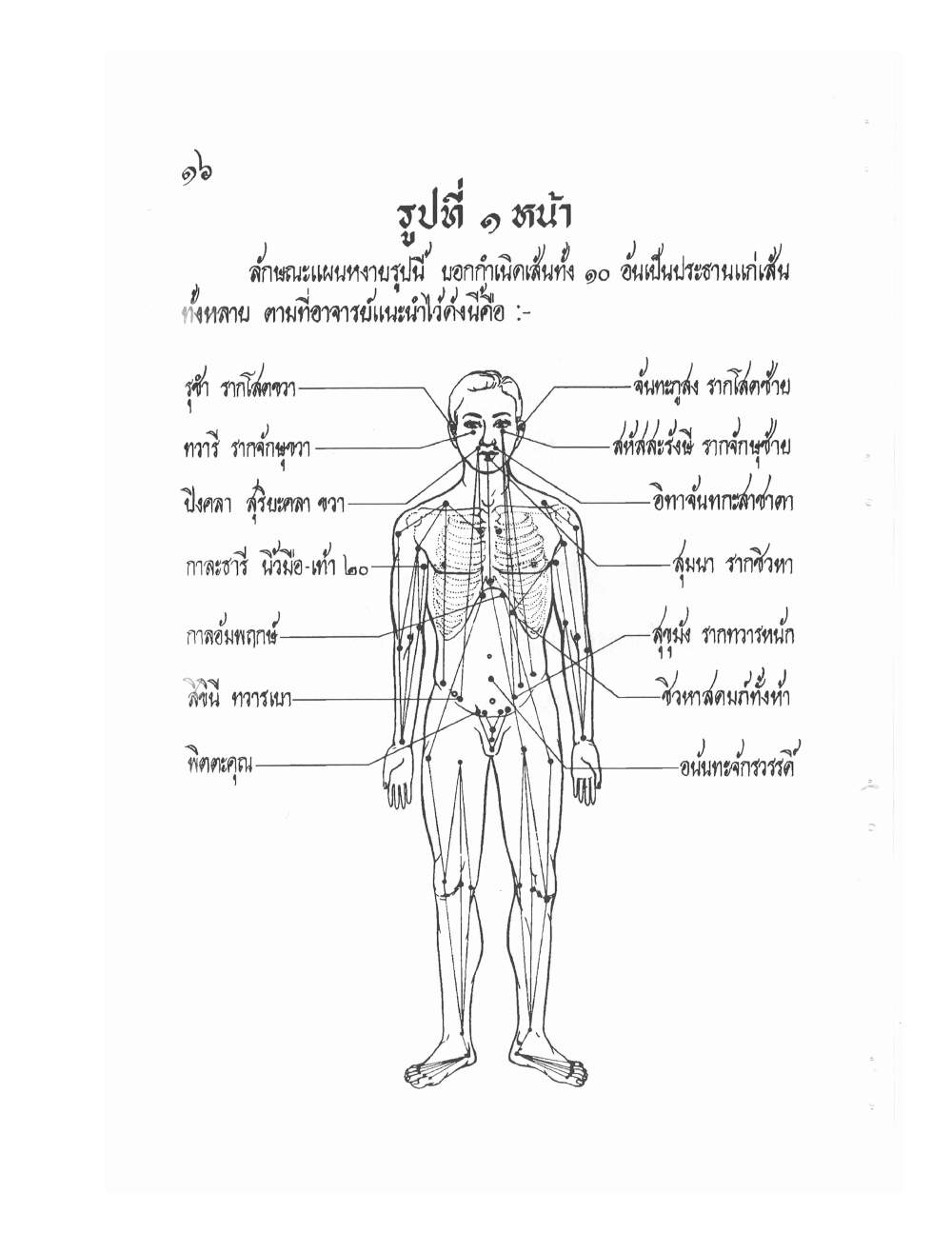
รูปที่ ๑ หน้า
ลักษณะแผนหงายรูปนี้ บอกกำเนิดเส้นทั้ง ๑๐ อันเป็นประธานแก่เส้นทั้งหลาย ตามที่อาจารย์แนะนำไว้ดังนี้คือ:-
[แผนภาพ: รูปคนยืนหันหน้าเข้าหาผู้ดู (แผนหงาย) มีเส้นซี่โครงและอวัยวะภายในทรวงอก-ท้องร่างไว้ และมีเส้นประโยงจากศีรษะ อก ท้อง และขาหนีบ ออกไปยังคำบรรยายทั้งสองข้าง]
รุชา ราก โลดขวา ทวารี ราก จักษุขวา ปิงคลา สุริยะคลา ขวา กาละธารี นิ้วมือ-เท้า ๒๐ กาลอัมพฤกษ์ สิกขินี ทวารเบา พิตตะคุณ
จันทภูสัง ราก โลดซ้าย สหัสสะรังษี ราก จักษุซ้าย อิทา จันทกลาชาตา สุมนา ราก ชิวหา สุขุมัง ราก ทวารหนัก ชิวหาสดมภ์ทั้ง[อ่านไม่ออก] อนันทะจักรวรรดิ์
16
FIGURE 1 — FRONT
This supine-view diagram shows the origin of the 10 principal channels which govern all the other channels, as instructed by the teachers, as follows:-
[diagram: a front-facing outline of a standing human body, with the ribs and internal chest/abdominal structures sketched in, and dotted lines radiating out from the head, chest, abdomen, and groin to labels on either side]
Left-side labels: Rucha — root, right side; Thawari — root of the right eye; Pingkala — right Suriyakala; Kalathari — the 20 fingers and toes; Kalampalue; Sikkhini — the urethra/genital opening; Pittakhun.
Right-side labels: Chanthaphusang — root, left side; Sahatsarangsi — root of the left eye; Ittha — Janthakalachata; Sumana — root of the tongue; Sukhumang — root of the anus; Chiwhasadom [illegible]; Anantachakrawan.
๑๗
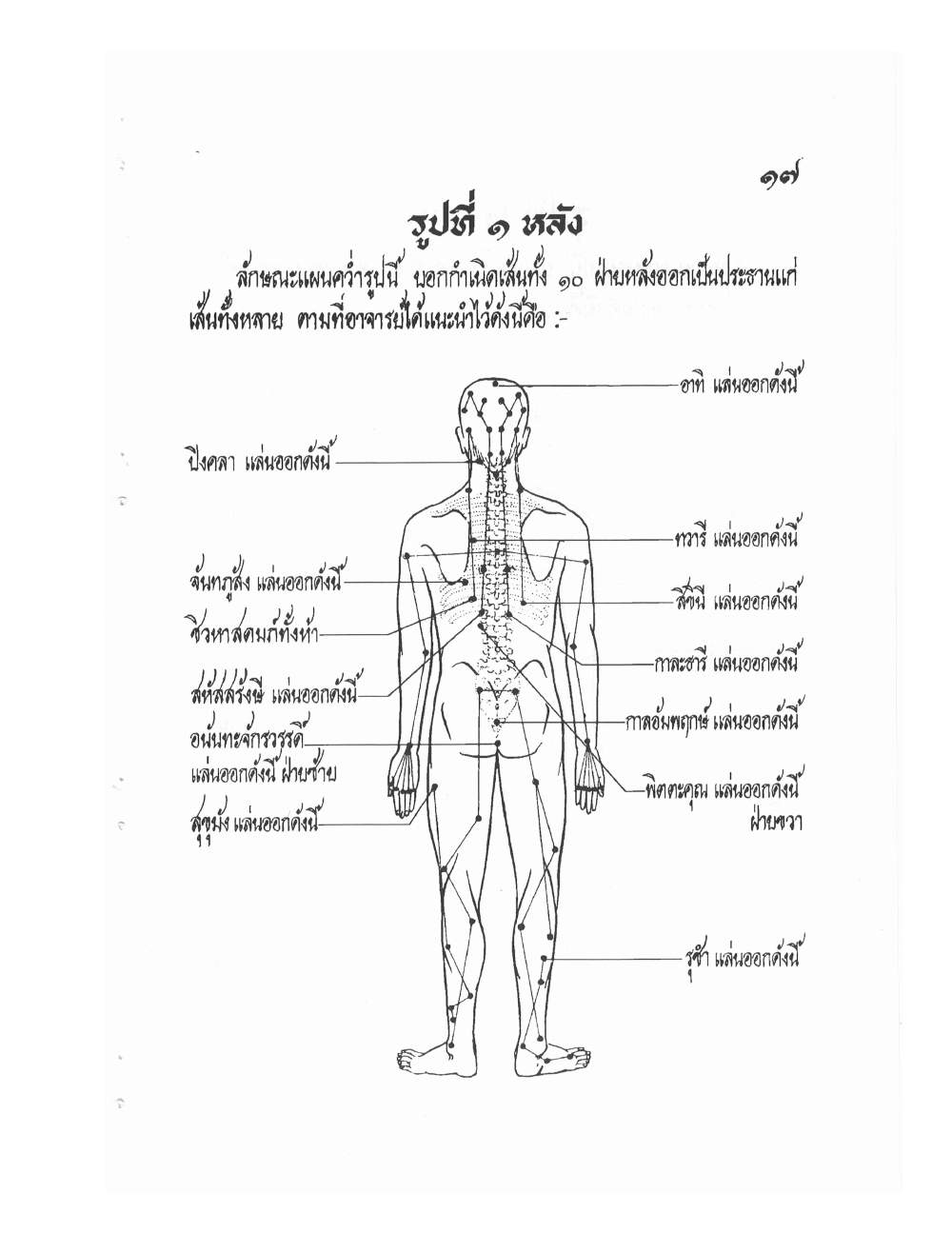
รูปที่ ๑ หลัง
ลักษณะแผนคว่ำรูปนี้ บอกกำเนิดเส้นทั้ง ๑๐ ฝ่ายหลังออกเป็นประธานแก่เส้นทั้งหลาย ตามที่อาจารย์ได้แนะนำไว้ดังนี้คือ:-
[แผนภาพ: รูปคนยืนหันหลังให้ผู้ดู (แผนคว่ำ) มีเส้นกระดูกสันหลังร่างไว้ตลอดแนวหลัง และมีเส้นประโยงจากศีรษะและแนวสันหลัง ออกไปยังคำบรรยายทั้งสองข้าง]
อาทิ แล่นออกดังนี้ ทวารี แล่นออกดังนี้ สิกขินี แล่นออกดังนี้ กาละธารี แล่นออกดังนี้ กาลอัมพฤกษ์ แล่นออกดังนี้ พิตตะคุณ แล่นออกดังนี้ ฝ่ายขวา รุชา แล่นออกดังนี้
ปิงคลา แล่นออกดังนี้ จันทภูสัง แล่นออกดังนี้ ชิวหาสดมภ์ทั้ง[อ่านไม่ออก] สหัสสะรังษี แล่นออกดังนี้ อนันทะจักรวรรดิ์ แล่นออกดังนี้ ฝ่ายซ้าย สุขุมัง แล่นออกดังนี้
17
FIGURE 1 — BACK
This prone-view diagram shows the origin of the 10 channels on the back side, which are principal to all the other channels, as instructed by the teachers, as follows:-
[diagram: a back-view outline of a standing human body, with the spine sketched down the back, and dotted lines radiating out from the head and along the spine to labels on either side]
Right-side labels: Atha (Ittha) runs out as follows; Thawari runs out as follows; Sikkhini runs out as follows; Kalathari runs out as follows; Kalampalue runs out as follows; Pittakhun runs out as follows, right side; Rucha runs out as follows.
Left-side labels: Pingkala runs out as follows; Chanthaphusang runs out as follows; Chiwhasadom [illegible]; Sahatsarangsi runs out as follows; Anantachakrawan runs out as follows, left side; Sukhumang runs out as follows.
๑๘
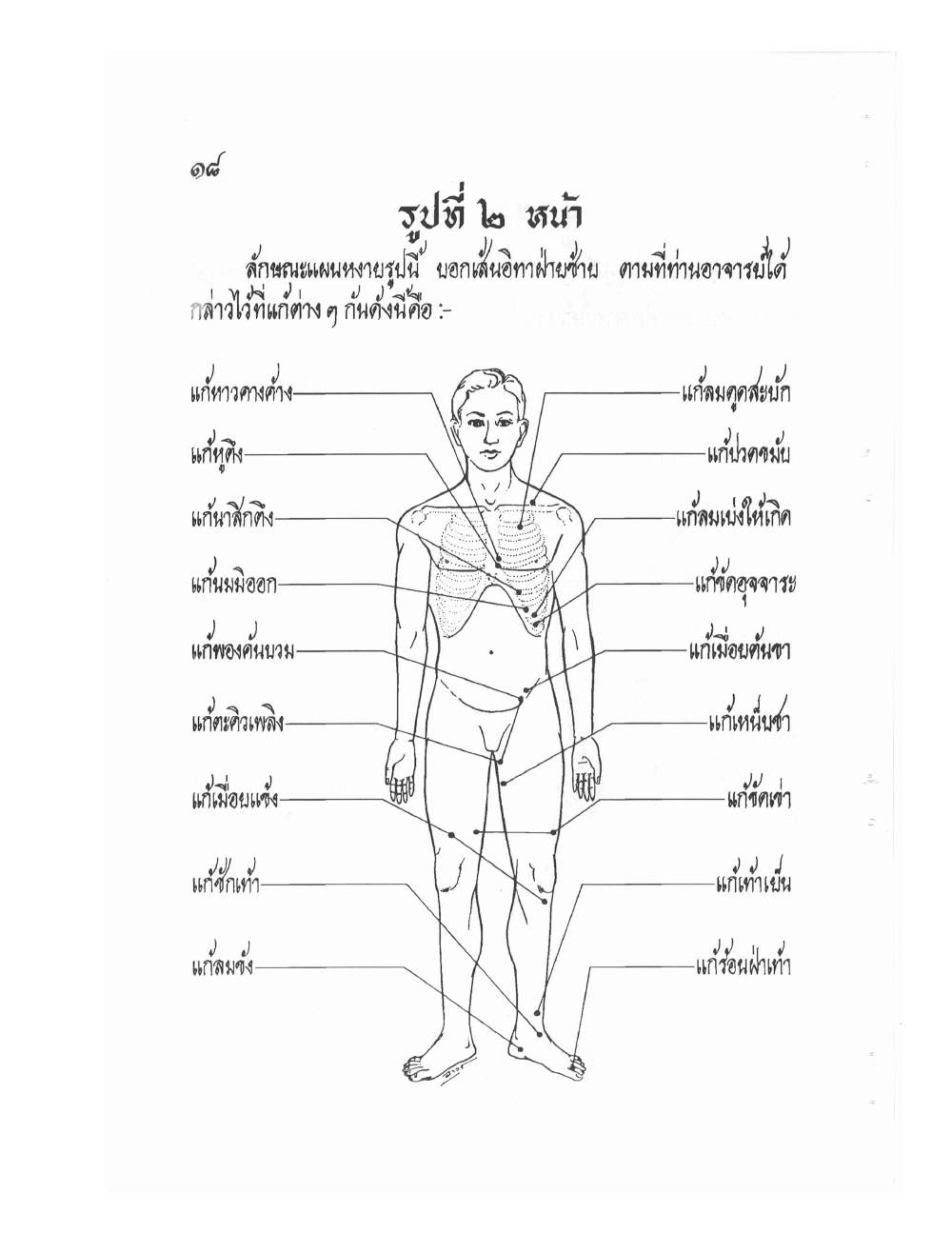
รูปที่ ๒ หน้า
ลักษณะแผนหงายรูปนี้ บอกเส้นอิทาฝ่ายซ้าย ตามที่ท่านอาจารย์ได้กล่าวไว้ที่แก้ต่างๆ กันดังนี้คือ:-
[แผนภาพ: รูปคนยืนหันหน้าเข้าหาผู้ดู มีเส้นซี่โครงและอวัยวะภายในทรวงอก-ท้องร่างไว้ และมีเส้นลากตามแนวเส้นอิทาลงทางซีกซ้าย โยงไปยังคำบรรยายอาการที่แก้ได้ทั้งสองข้าง]
แก้หาวคางค้าง แก้หูตึง แก้นาสิกตึง แก้นมมิออก แก้พองคันบวม แก้ตะคริวเพลิง แก้เมื่อยแข้ง แก้ชักเท้า แก้ลมชัก
แก้ลมคูดสะบัก แก้ปวดขมับ แก้ลมเบ่งให้เกิด แก้ขัดอุจจาระ แก้เมื่อยต้นขา แก้เหน็บชา แก้ขัดเข่า แก้เท้าเย็น แก้ร้อนฝ่าเท้า
18
FIGURE 2 — FRONT
This supine-view diagram shows the Ittha channel on the left side, together with the various conditions it treats, as stated by the teachers, as follows:-
[diagram: a front-facing outline of a standing human body, with the ribs and internal chest/abdominal structures sketched in, and lines tracing the Ittha channel down the left side, radiating out to labels naming the ailment treated at each point]
Left-side labels: for a jaw stuck open from yawning; for tightness/deafness of the ear; for stiffness of the nose; for breast milk that will not come; for swelling and itching; for burning cramp; for aching of the shin; for spasm of the foot; for wind-induced convulsion.
Right-side labels: for wind pulling at the shoulder blade; for pain at the temple; for wind that induces bearing-down (labor); for constipation; for aching of the thigh; for numbness/pins-and-needles; for stiffness of the knee; for cold feet; for burning soles of the feet.
๑๙
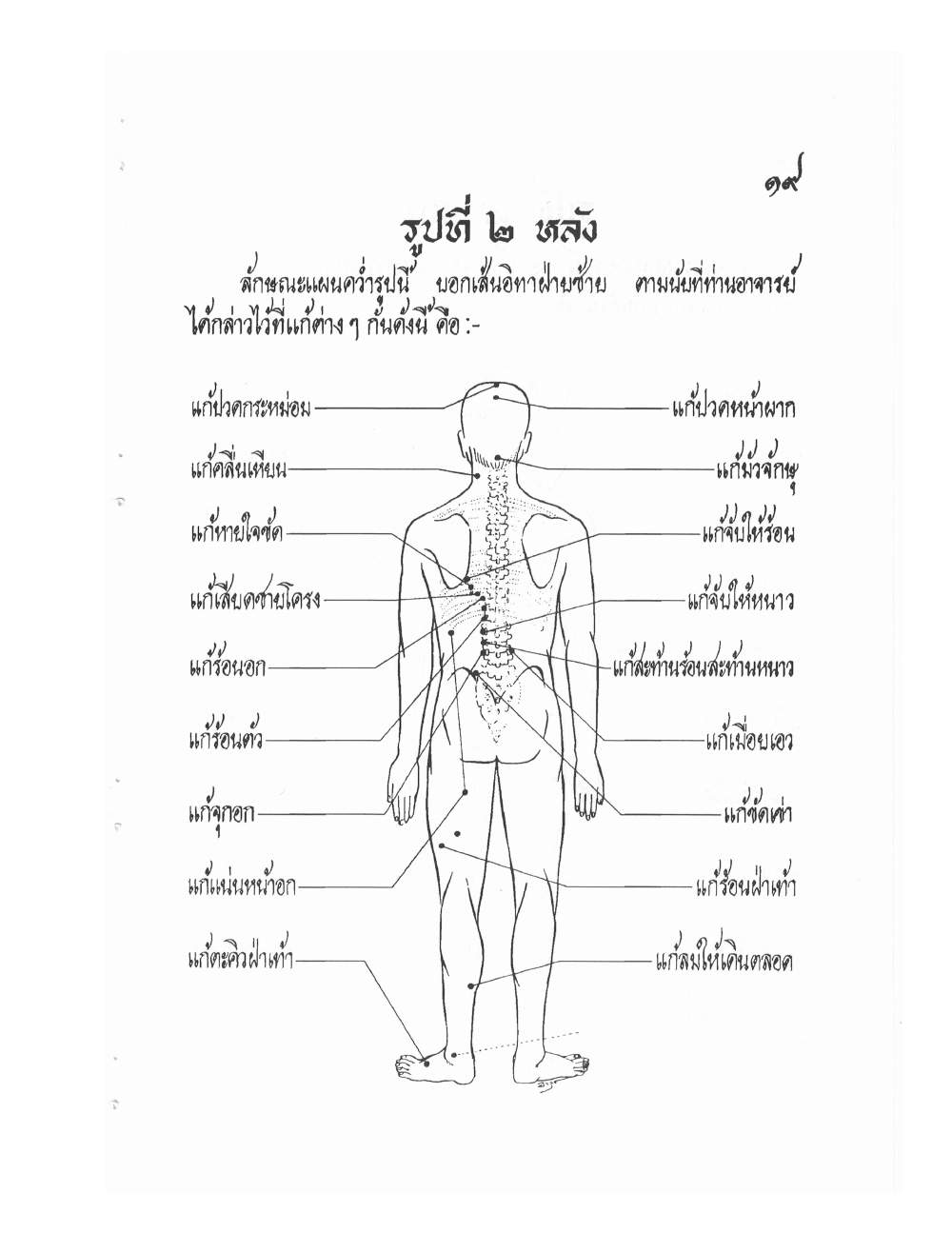
รูปที่ ๒ หลัง
ลักษณะแผนคว่ำรูปนี้ บอกเส้นอิทาฝ่ายซ้าย ตามนัยที่ท่านอาจารย์ได้กล่าวไว้ที่แก้ต่างๆ กันดังนี้คือ:-
[แผนภาพ: รูปคนยืนหันหลังให้ผู้ดู มีเส้นกระดูกสันหลังร่างไว้ตลอดแนวหลัง และมีเส้นลากตามแนวเส้นอิทาลงทางซีกซ้าย โยงไปยังคำบรรยายอาการที่แก้ได้ทั้งสองข้าง]
แก้ปวดกระหม่อม แก้คลื่นเหียน แก้หายใจขัด แก้เสียบดชายโครง แก้ร้อนอก แก้ร้อนตัว แก้จุกอก แก้แน่นหน้าอก แก้ตะคริวฝ่าเท้า
แก้ปวดหน้าผาก แก้มัวจักษุ แก้จับให้ร้อน แก้จับให้หนาว แก้สะท้านร้อนสะท้านหนาว แก้เมื่อยเอว แก้ขัดเข่า แก้ร้อนฝ่าเท้า แก้ลมให้เดินตลอด
19
FIGURE 2 — BACK
This prone-view diagram shows the Ittha channel on the left side, according to what the teachers have stated for treating various conditions, as follows:-
[diagram: a back-view outline of a standing human body, with the spine sketched down the back, and lines tracing the Ittha channel down the spine on the left side, radiating out to labels naming the ailment treated at each point]
Left-side labels: for pain at the crown of the head; for nausea; for difficulty breathing; for a stabbing pain in the ribs; for heat/fever in the chest; for fever of the whole body; for a blocked/choked chest; for tightness of the chest; for cramping in the sole of the foot.
Right-side labels: for pain in the forehead; for blurred vision; for inducing heat (fever); for inducing cold (chills); for alternating chills and fever; for aching of the waist; for stiffness of the knee; for burning soles of the feet; for making the wind (qi) circulate freely throughout the body.
๒๐
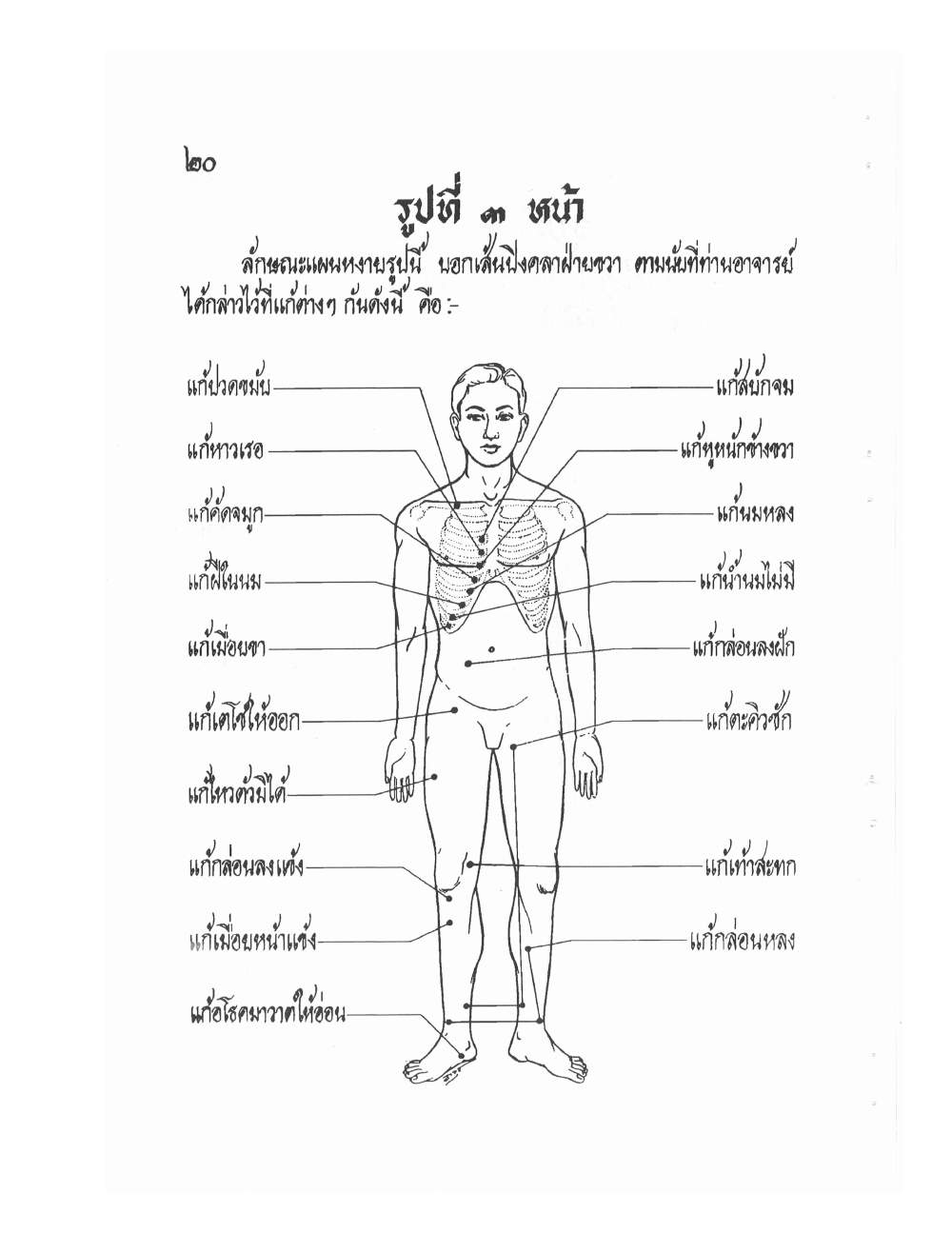
รูปที่ ๓ หน้า
ลักษณะแผนหงายรูปนี้ บอกเส้นปิงคลาฝ่ายขวา ตามนัยที่ท่านอาจารย์ได้กล่าวไว้ที่แก้ต่างๆ กันดังนี้ คือ:-
[แผนภาพ: รูปคนยืนหันหน้าเข้าหาผู้ดู มีเส้นซี่โครงและอวัยวะภายในทรวงอก-ท้องร่างไว้ และมีเส้นลากตามแนวเส้นปิงคลาลงทางซีกขวา โยงไปยังคำบรรยายอาการที่แก้ได้ทั้งสองข้าง]
แก้ปวดขมับ แก้หาวเรอ แก้คัดจมูก แก้ฝีในนม แก้เมื่อยขา แก้เต้าโสให้ออก แก้ไหวตัวมิได้ แก้กล่อนลงแข้ง แก้เมื่อยหน้าแข้ง แก้โรคมาราศให้อ่อน
แก้สยักจมูก แก้หูหนักข้างขวา แก้นมหลง แก้น้ำนมไม่มี แก้กล่อนลงฝัก แก้ตะคริวชัก แก้เท้าสะทก แก้กล่อนหลง
20
FIGURE 3 — FRONT
This supine-view diagram shows the Pingkala channel on the right side, according to what the teachers have stated for treating various conditions, as follows:-
[diagram: a front-facing outline of a standing human body, with the ribs and internal chest/abdominal structures sketched in, and lines tracing the Pingkala channel down the right side, radiating out to labels naming the ailment treated at each point]
Left-side labels: for pain at the temple; for yawning and belching; for a stuffed nose; for an abscess in the breast; for aching of the leg; for bringing out a swollen breast/boil; for the inability to move the body; for klon (a wasting condition) descending into the shin; for aching of the shin; for easing the marat disease.
Right-side labels: for a twitching nose; for heaviness in the right ear; for a misplaced/errant flow of milk; for absence of breast milk; for klon descending into the scrotum; for cramping convulsion; for a startled/twitching foot; for klon gone astray.
๒๑
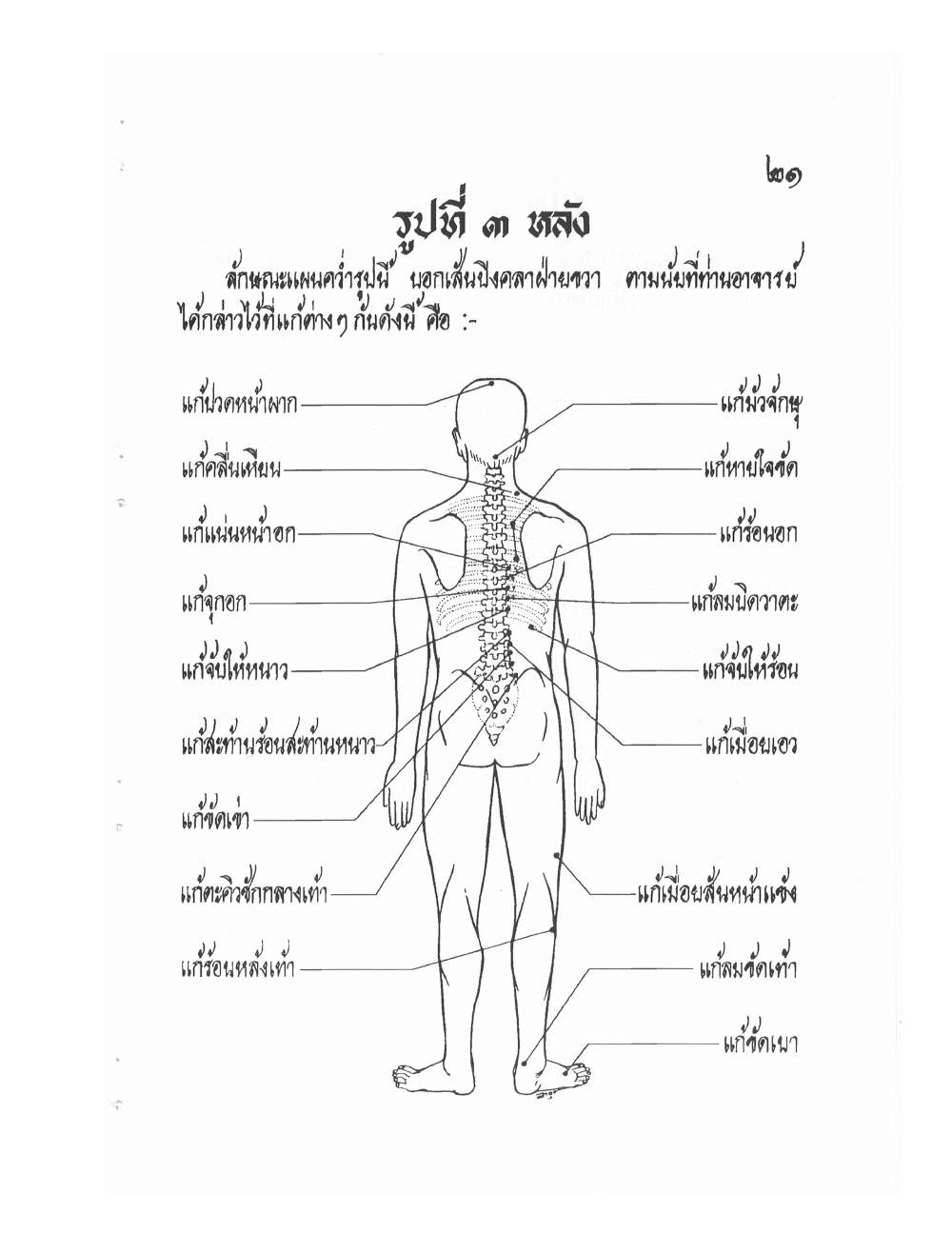
รูปที่ ๓ หลัง
ลักษณะแผนคว่ำรูปนี้ บอกเส้นปิงคลาฝ่ายขวา ตามนัยที่ท่านอาจารย์ได้กล่าวไว้ที่แก้ต่างๆ กันดังนี้ คือ:-
[แผนภาพ: รูปคนยืนหันหลังให้ผู้ดู มีเส้นกระดูกสันหลังร่างไว้ตลอดแนวหลัง และมีเส้นลากตามแนวเส้นปิงคลาลงทางซีกขวา โยงไปยังคำบรรยายอาการที่แก้ได้ทั้งสองข้าง]
แก้ปวดหน้าผาก แก้คลื่นเหียน แก้แน่นหน้าอก แก้จุกอก แก้จับให้หนาว แก้สะท้านร้อนสะท้านหนาว แก้ขัดเข่า แก้ตะคริวชักกลางเท้า แก้ร้อนหลังเท้า
แก้มัวจักษุ แก้หายใจขัด แก้ร้อนอก แก้ลมบิดวาตะ แก้จับให้ร้อน แก้เมื่อยเอว แก้เมื่อยส้นหน้าแข้ง แก้ลมขัดเท้า แก้ขัดเข่า
21
FIGURE 3 — BACK
This prone-view diagram shows the Pingkala channel on the right side, according to what the teachers have stated for treating various conditions, as follows:-
[diagram: a back-view outline of a standing human body, with the spine sketched down the back, and lines tracing the Pingkala channel down the spine on the right side, radiating out to labels naming the ailment treated at each point]
Left-side labels: for pain in the forehead; for nausea; for tightness of the chest; for a blocked/choked chest; for inducing cold (chills); for alternating chills and fever; for stiffness of the knee; for cramping convulsion in the middle of the foot; for burning of the top of the foot.
Right-side labels: for blurred vision; for difficulty breathing; for heat/fever in the chest; for twisted/knotted wind; for inducing heat (fever); for aching of the waist; for aching of the heel and front of the shin; for wind causing stiffness of the foot; for stiffness of the knee.
๒๒
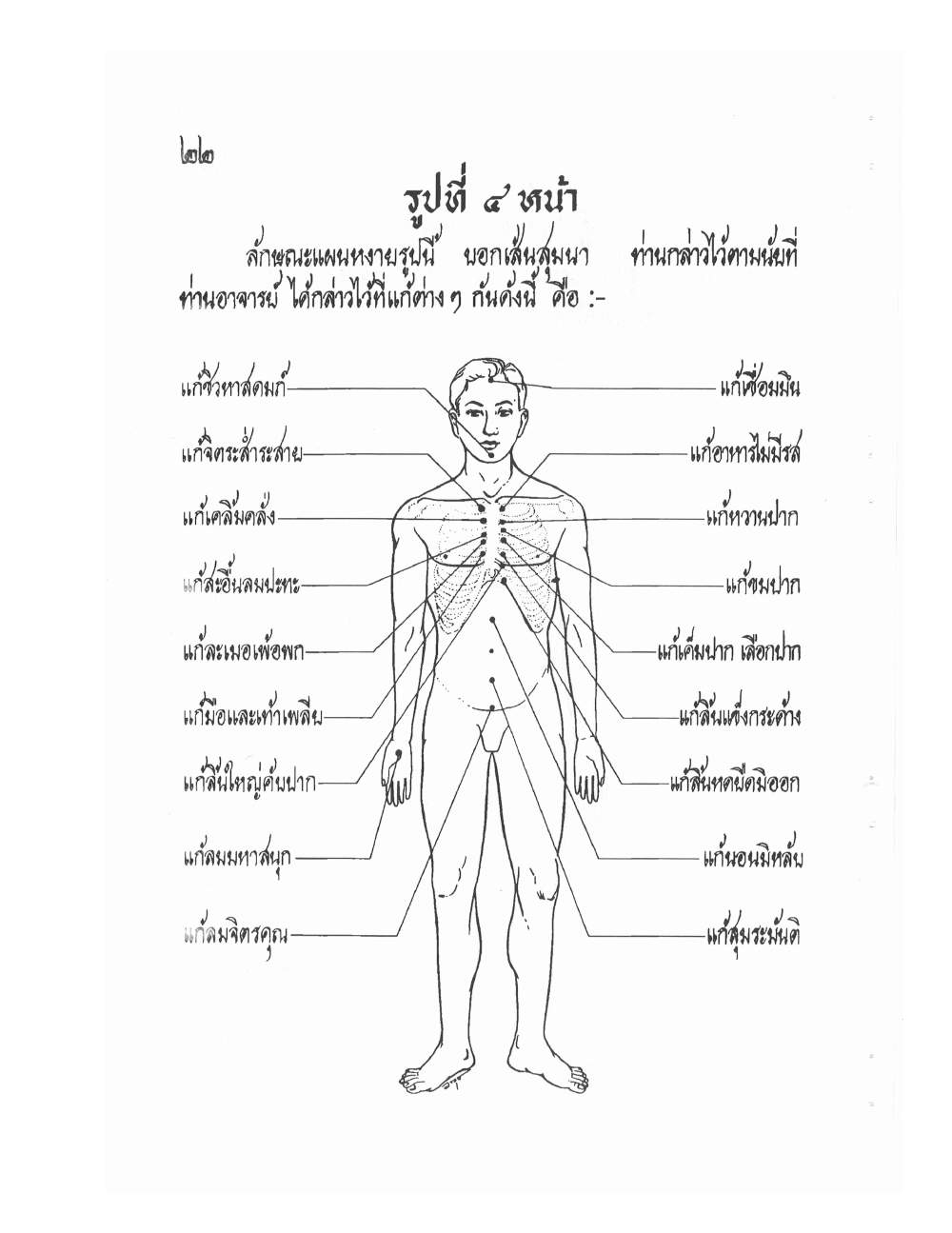
รูปที่ ๔ หน้า
ลักษณะแผนหงายรูปนี้ บอกเส้นสุมนา ท่านกล่าวไว้ตามนัยที่ท่านอาจารย์ได้กล่าวไว้ที่แก้ต่าง ๆ กันดังนี้ คือ :-
[diagram: front-facing standing human figure, nude, with dotted shading over the chest and upper abdomen indicating the course of the Sumana line; small dots mark points down the centerline of the chest and abdomen; ruled lines run from each point out to a labelled phrase at the left or right margin]
ฝั่งซ้าย (บนลงล่าง): แก้ตัวหาสดมภ์ แก้จิตระส่ำระสาย แก้เคลิ้มคลั่ง แก้สะอื้นลมปะทะ แก้ละเมอเพ้อพก แก้มือและเท้าเพลีย แก้ลิ้นใหญ่คับปาก แก้ลมมหาสนุก แก้ลมจิตรคุณ
ฝั่งขวา (บนลงล่าง): แก้เชื่อมมึน แก้อาหารไม่มีรส แก้หวานปาก แก้ขมปาก แก้เค็มปาก เลือกปาก แก้ลิ้นแข็งกระด้าง แก้ลิ้นทดผืดมือออก แก้นอนมิหลับ แก้สุระมันติ
22
Figure 4, Front
The features of this supine (face-up) chart show the Sumana line, given according to the various indications that the teacher-masters have stated for it, each treating a different condition, as follows:
[diagram: a front-facing standing nude male figure, with dotted shading over the chest and upper abdomen marking the path of the Sumana line; dots mark treatment points down the centerline of the torso; ruled lines run from each point to a labelled remedy at the left or right margin]
Left side (top to bottom): Relieves the body developing convulsive fits (sadomph) Relieves the mind being agitated and scattered Relieves delirium/madness Relieves sobbing caused by wind striking [the chest] Relieves sleep-talking and delirious raving Relieves tired hands and feet Relieves the tongue swelling too large for the mouth Relieves the "great-pleasure" wind ailment Relieves the "jitrakhun" wind ailment
Right side (top to bottom): Relieves grogginess/faintness Relieves food having no taste Relieves a sweet taste in the mouth Relieves a bitter taste in the mouth Relieves a salty taste in the mouth, [second term illegible] Relieves the tongue being stiff and rigid Relieves [phrase partly illegible — tongue/hand numbness] Relieves insomnia Relieves [term partly illegible]
๒๓
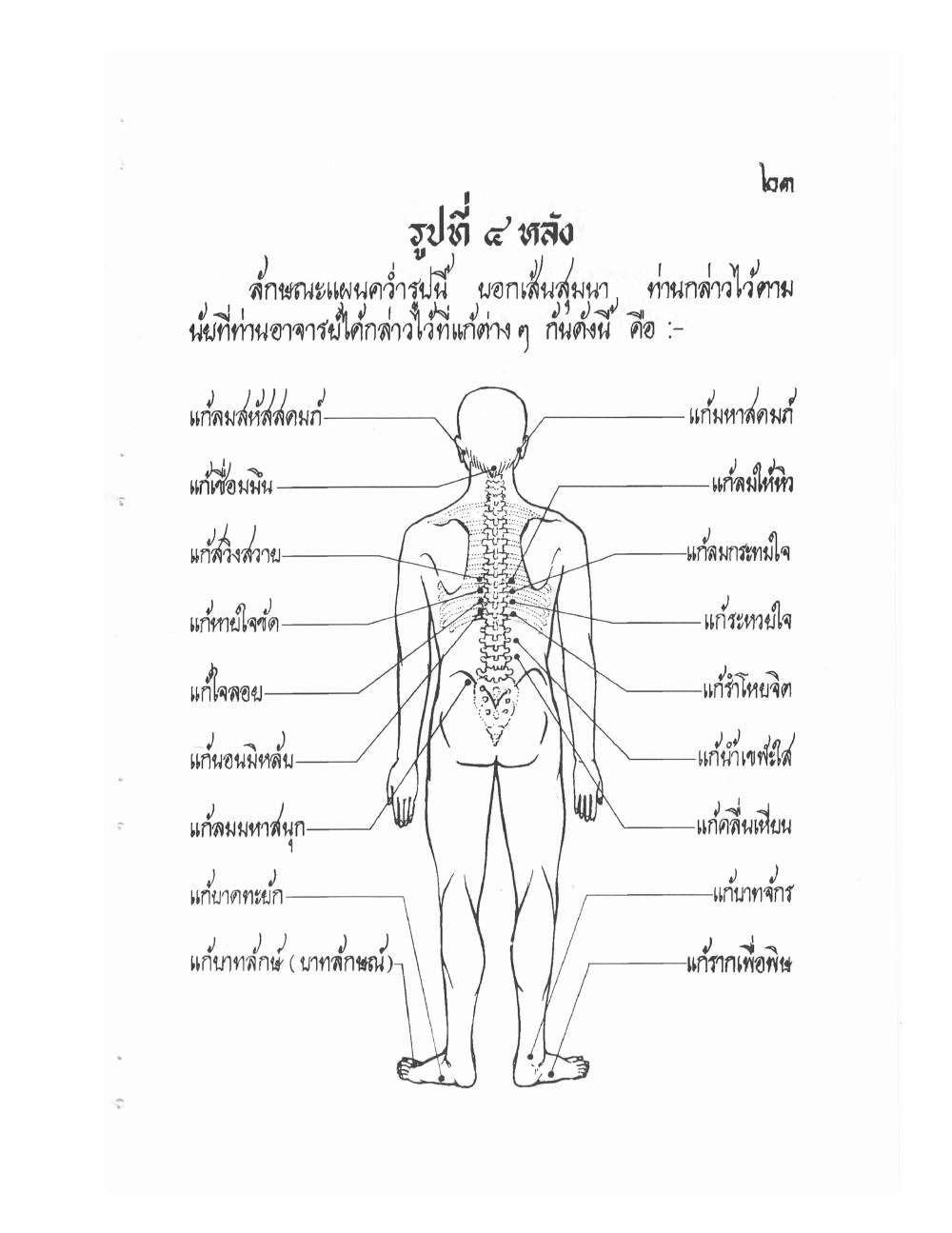
รูปที่ ๔ หลัง
ลักษณะแผนคว่ำรูปนี้ บอกเส้นสุมนา ท่านกล่าวไว้ตามนัยที่ท่านอาจารย์ได้กล่าวไว้ที่แก้ต่าง ๆ กันดังนี้ คือ :-
[diagram: back view of a standing nude male figure, with dotted shading down the spine and shoulder blades and over the sacrum, marking the course of the line on this side; points dotted along the spine and pelvis, with ruled lines to labels at left and right]
ฝั่งซ้าย (บนลงล่าง): แก้ลมหั่สสดมภ์ แก้เชื่อมมึน แก้ลิ้นหวาย แก้ทายใจซัด แก้ใจลอย แก้นอนมิหลับ แก้ลมมหาสนุก แก้บาดทะยัก แก้บาดลักษ์ (บาดลักษณ์)
ฝั่งขวา (บนลงล่าง): แก้มหาสดมภ์ แก้ลมให้หิว แก้ลมกระทำใจ แก้ระหายใจ แก้รำโหยจิต แก้น้ำเขฬะใส แก้คลื่นเหียน แก้บาทจักร แก้รากเพื่อพิษ
23
Figure 4, Back
The features of this prone (face-down) chart show the Sumana line, given according to the various indications that the teacher-masters have stated for it, each treating a different condition, as follows:
[diagram: back view of a standing nude male figure, with dotted shading down the spine and shoulder blades and over the sacrum marking the line's course on this side; dotted points along the spine and pelvis, each joined by a ruled line to a label at the left or right margin]
Left side (top to bottom): Relieves wind-convulsion (hat sadomph) Relieves grogginess/faintness Relieves [term partly illegible, tongue-related] Relieves the heart/mind being thrown into distress Relieves the mind wandering (absent-mindedness) Relieves insomnia Relieves the "great-pleasure" wind ailment Relieves tetanus (lockjaw) Relieves wound-affliction (badalak)
Right side (top to bottom): Relieves great convulsive fits (mahasadomph) Relieves wind causing hunger Relieves wind afflicting the heart Relieves shortness of breath Relieves a weary, mournful mind Relieves clear saliva/phlegm Relieves nausea Relieves foot-wheel [ailment of the feet] Relieves vomiting from poison
๒๔
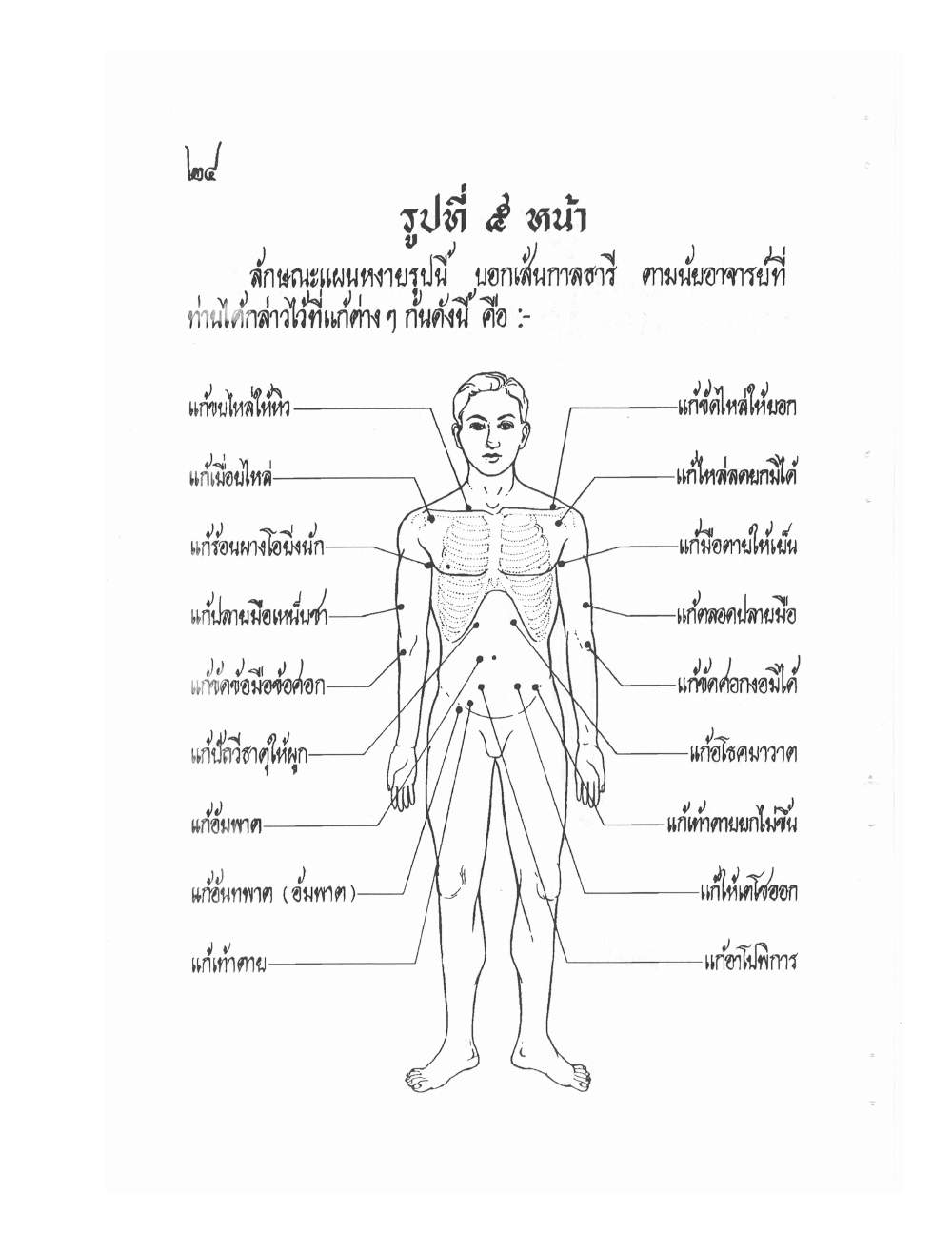
รูปที่ ๕ หน้า
ลักษณะแผนหงายรูปนี้ บอกเส้นกาลธารี ตามนัยอาจารย์ที่ท่านได้กล่าวไว้ที่แก้ต่าง ๆ กันดังนี้ คือ :-
[diagram: front-facing standing nude male figure with dotted shading over the chest, marking the course of the Kalathari line; dotted points along the chest, abdomen and down each arm to the hand, with ruled lines to labels at left and right]
ฝั่งซ้าย (บนลงล่าง): แก้ขนไหล่ให้หิว แก้เมื่อยไหล่ แก้ร้อนผางโอ้ยิ่งนัก แก้ปลายมือเหนื่อยชา แก้บวมข้อมือข้อศอก แก้ปิลวชาตุให้ผูก แก้อัมพาด แก้อันทพาด (อัมพาด) แก้เท้าตาย
ฝั่งขวา (บนลงล่าง): แก้ขัดไหล่ให้ยอก แก้ไหล่ลดยกมิได้ แก้มือตายให้เย็น แก้ตลอดปลายมือ แก้ขัดข้อกงอมิได้ แก้อโรคมาวาต แก้เท้าตายยกไม่ขึ้น แก้ให้เต้นโซ้ขอก แก้อาโปพิการ
24
Figure 5, Front
The features of this supine chart show the Kalathari line, according to the meanings the teacher-masters have stated for its various remedies, as follows:
[diagram: a front-facing standing nude male figure with dotted shading over the chest marking the course of the Kalathari line; dotted points along the chest, abdomen, and down each arm to the hand, each joined by a ruled line to a label at the left or right margin]
Left side (top to bottom): Relieves the shoulder hair/shoulder making one feel faint [phrase uncertain] Relieves aching shoulders Relieves excessive burning heat Relieves numbness and fatigue in the fingertips Relieves swelling of the wrist and elbow joints Relieves parasitic/worm humours causing constipation Relieves paralysis Relieves paralysis (variant spelling) Relieves dead (numb) feet
Right side (top to bottom): Relieves a stiff, aching shoulder Relieves the shoulder being unable to be raised Relieves cold, deadened hands Relieves [condition] reaching to the fingertips Relieves joints that cannot be bent Relieves [term partly illegible, a wind-disease] Relieves feet that cannot be lifted, gone dead Relieves [phrase partly illegible, involuntary twitching] Relieves disorder of the water element (apo)
๒๕
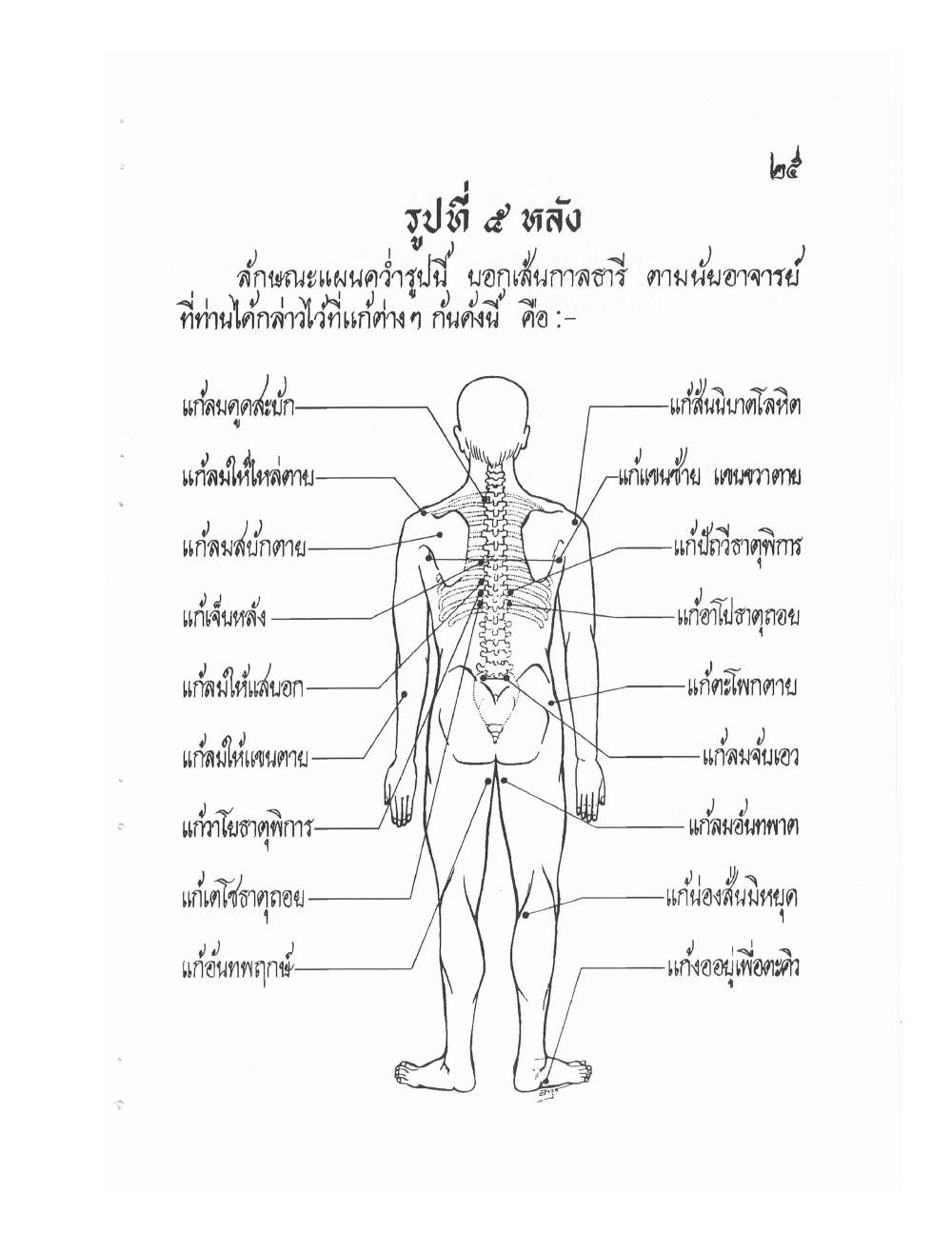
รูปที่ ๕ หลัง
ลักษณะแผนคว่ำรูปนี้ บอกเส้นกาลธารี ตามนัยอาจารย์ที่ท่านได้กล่าวไว้ที่แก้ต่าง ๆ กันดังนี้ คือ :-
[diagram: back view of a standing nude male figure, dotted shading down the spine and shoulders and over the sacrum, marking the Kalathari line on this side; dotted points along the spine, shoulders, arms and legs, with ruled lines to labels at left and right]
ฝั่งซ้าย (บนลงล่าง): แก้ลมคุดสะบัก แก้ลมให้ไหล่ตาย แก้ลมสะบักตาย แก้เจ็บหลัง แก้ลมให้แล่นอก แก้ลมให้เขนตาย แก้วาโยธาตุพิการ แก้เตโชธาตุถอย แก้อินทพฤกษ์
25
Figure 5, Back
The features of this prone chart show the Kalathari line, according to the meanings the teacher-masters have stated for its various remedies, as follows:
[diagram: back view of a standing nude male figure, with dotted shading down the spine and shoulders and over the sacrum marking the Kalathari line on this side; dotted points along the spine, shoulders, arms and legs, each joined by a ruled line to a label at the left or right margin]
Left side (top to bottom): Relieves cramping/knotting of the shoulder blade Relieves the shoulder going numb/dead Relieves the shoulder blade going dead Relieves back pain Relieves wind running into the chest Relieves the leg going numb/dead Relieves disorder of the wind (vayo) element Relieves decline of the fire (tejo) element Relieves [term partly illegible]
[Note: the right-hand label column visible in the source image for this page belongs to Figure 6, Front (the following page); no right-side labels are present with this figure.]
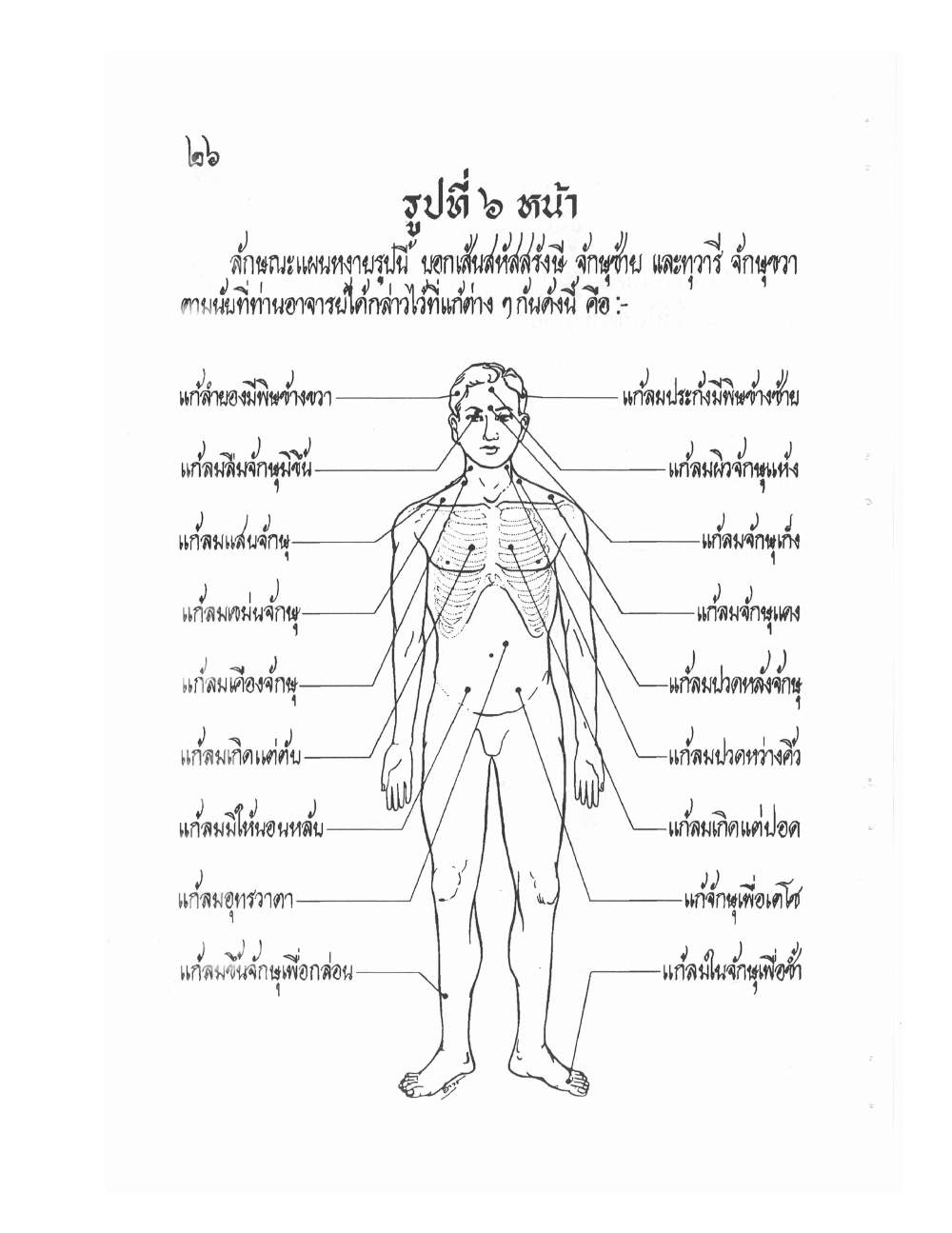
๒๖
รูปที่ ๖ หน้า
ลักษณะแผนหงายรูปนี้ บอกเส้นสหัสรังษี จักษุซ้าย และทุวารี จักษุขวา ตามนัยที่ท่านอาจารย์ได้กล่าวไว้ที่แก้ต่าง ๆ กันดังนี้ คือ :-
[diagram: front-facing standing nude male figure, dotted shading over the face, chest and abdomen marking the courses of the Sahatsarangsi and Thawari lines; dotted points on the brow, chest and abdomen, with ruled lines to labels at left and right]
ฝั่งซ้าย (บนลงล่าง): แก้ลำยองมีพิษข้างขวา แก้ลมลืมจักษุมิชั้น แก้ลมแล่นจักษุ แก้ลมเขม่นจักษุ แก้ลมเคืองจักษุ แก้ลมเกิดแต่ต่อม แก้ลมมิให้นอนหลับ แก้ลมอุทรวาตา แก้ลมขึ้นจักษุเพื่อกล่อน
ฝั่งขวา (บนลงล่าง): แก้ลมประกังมีพิษข้างซ้าย แก้ลมผิวจักษุแห้ง แก้ลมจักษุเก็ง แก้ลมจักษุแดง แก้ลมปวดหลังจักษุ แก้ลมปวดหว่างคิ้ว แก้ลมเกิดแต่ปอด แก้จักษุเพื่อเตโช แก้ลมในจักษุเพื่อชั้ำ
26
Figure 6, Front
The features of this supine chart show the Sahatsarangsi line (left eye) and the Thawari line (right eye), given according to the meanings the teacher-masters have stated for their various remedies, as follows:
[diagram: a front-facing standing nude male figure, with dotted shading over the face, chest and abdomen marking the courses of the two lines; dotted points on the brow, chest and abdomen, each joined by a ruled line to a label at the left or right margin]
Left side (top to bottom): Relieves a poisoned discharge on the right side Relieves wind that makes the eye forget to close [i.e. lose its blink] Relieves wind running to the eye Relieves wind causing a twitching eye Relieves wind irritating the eye Relieves [an ailment] arising from a swelling/gland Relieves wind that prevents sleep Relieves flatulent wind of the abdomen Relieves wind rising to the eye from a hard swelling (kalon)
Right side (top to bottom): Relieves a poisoned discharge on the left side Relieves wind causing dryness of the eye's surface Relieves wind making the eye rigid/staring Relieves wind making the eye red Relieves wind causing pain behind the eye Relieves wind causing pain between the brows Relieves [an ailment] arising from the lungs Relieves the eye afflicted by [excess] fire element Relieves wind within the eye causing bruising
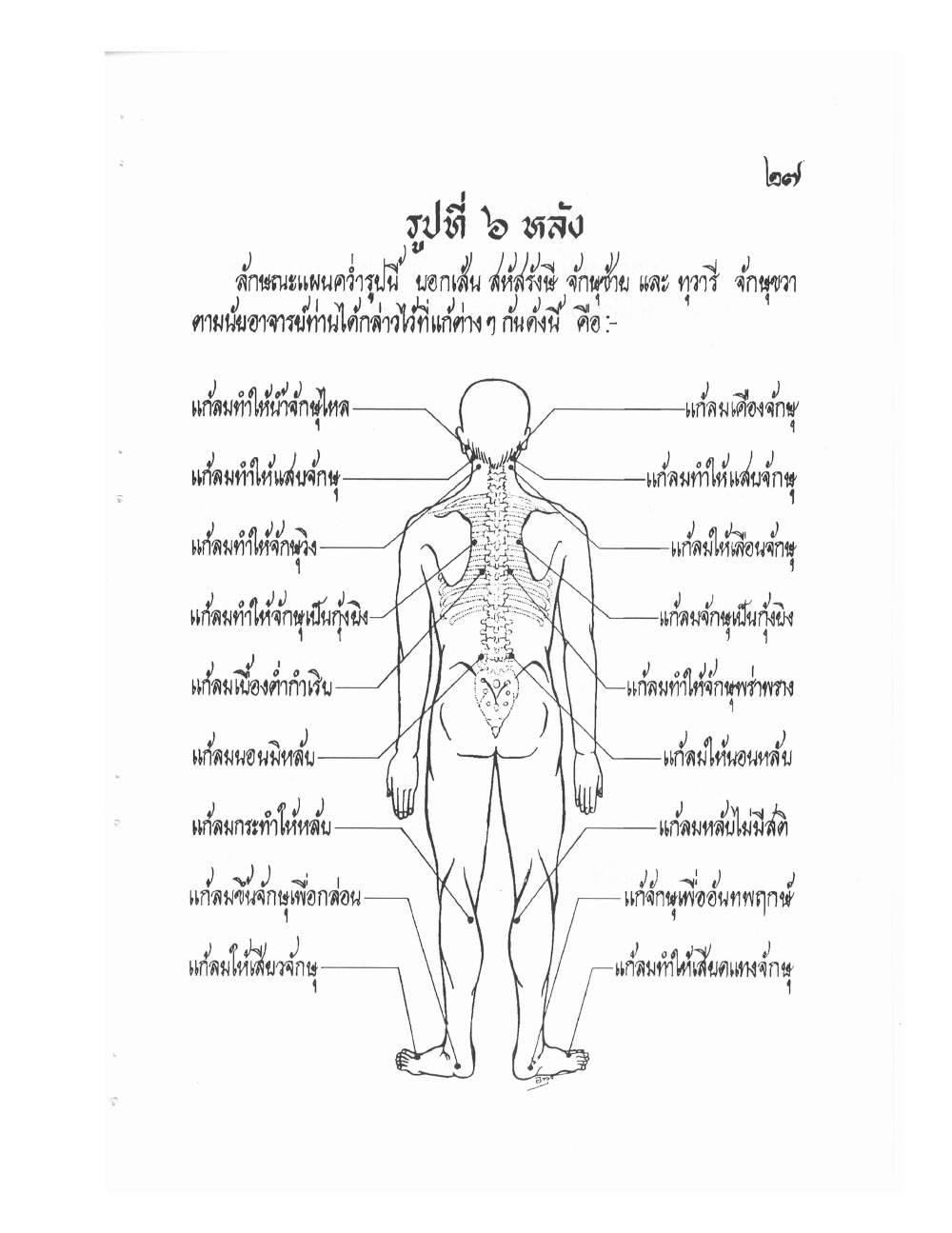
๒๗
รูปที่ ๖ หลัง
ลักษณะแผนคว่ำรูปนี้ บอกเส้น สหัสรังษี จักษุซ้าย และ ทุวารี จักษุขวา ตามนัยอาจารย์ท่านได้กล่าวไว้ที่แก้ต่าง ๆ กันดังนี้ คือ :-
[diagram: back view of a standing nude male figure, dotted shading down the spine and over the sacrum marking the lines' courses on this side; dotted points along the spine, pelvis and down the legs to the feet, with ruled lines to labels at left and right]
ฝั่งซ้าย (บนลงล่าง): แก้ลมทำให้น้ำจักษุไหล แก้ลมทำให้แสบจักษุ แก้ลมทำให้จักษุวิ่ง แก้ลมทำให้จักษุเป็นกุ้งฝัง แก้ลมเบื้องต่ำกำเริบ แก้ลมนอนมิหลับ แก้ลมกระทำให้หลับ แก้ลมขึ้นจักษุเพื่อกล่อน แก้ลมให้เสียวจักษุ
ฝั่งขวา (บนลงล่าง): แก้ลมเคืองจักษุ แก้ลมทำให้แสบจักษุ แก้ลมให้เลื่อนจักษุ แก้ลมจักษุเป็นกุ้งฝัง แก้ลมทำให้จักษุพร่าพราง แก้ลมให้นอนหลับ แก้ลมหลับไม่มีสติ แก้จักษุเพื่ออินทพฤกษ์ แก้ลมทำให้เสียดแทงจักษุ
27
Figure 6, Back
The features of this prone chart show the Sahatsarangsi line (left eye) and the Thawari line (right eye), according to the meanings the teacher-masters have stated for their various remedies, as follows:
[diagram: back view of a standing nude male figure, with dotted shading down the spine and over the sacrum marking the lines' courses on this side; dotted points along the spine, pelvis and down the legs to the feet, each joined by a ruled line to a label at the left or right margin]
Left side (top to bottom): Relieves wind causing the eye to water Relieves wind causing a stinging eye Relieves wind making the eye dart/race Relieves wind making the eye develop a "shrimp-lodged" [cyst-like] growth Relieves wind flaring up in the lower body Relieves wind [causing] insomnia Relieves wind that induces sleep Relieves wind rising to the eye from a hard swelling (kalon) Relieves wind causing a stinging/aching eye
Right side (top to bottom): Relieves wind irritating the eye Relieves wind causing a stinging eye Relieves wind causing the eye to wander/shift Relieves the eye developing a "shrimp-lodged" [cyst-like] growth Relieves wind causing the eye's vision to blur Relieves wind [causing excessive] sleep Relieves sleep without awareness (unconsciousness) Relieves the eye afflicted by [an ailment called] intaphruek Relieves wind causing stabbing pain in the eye
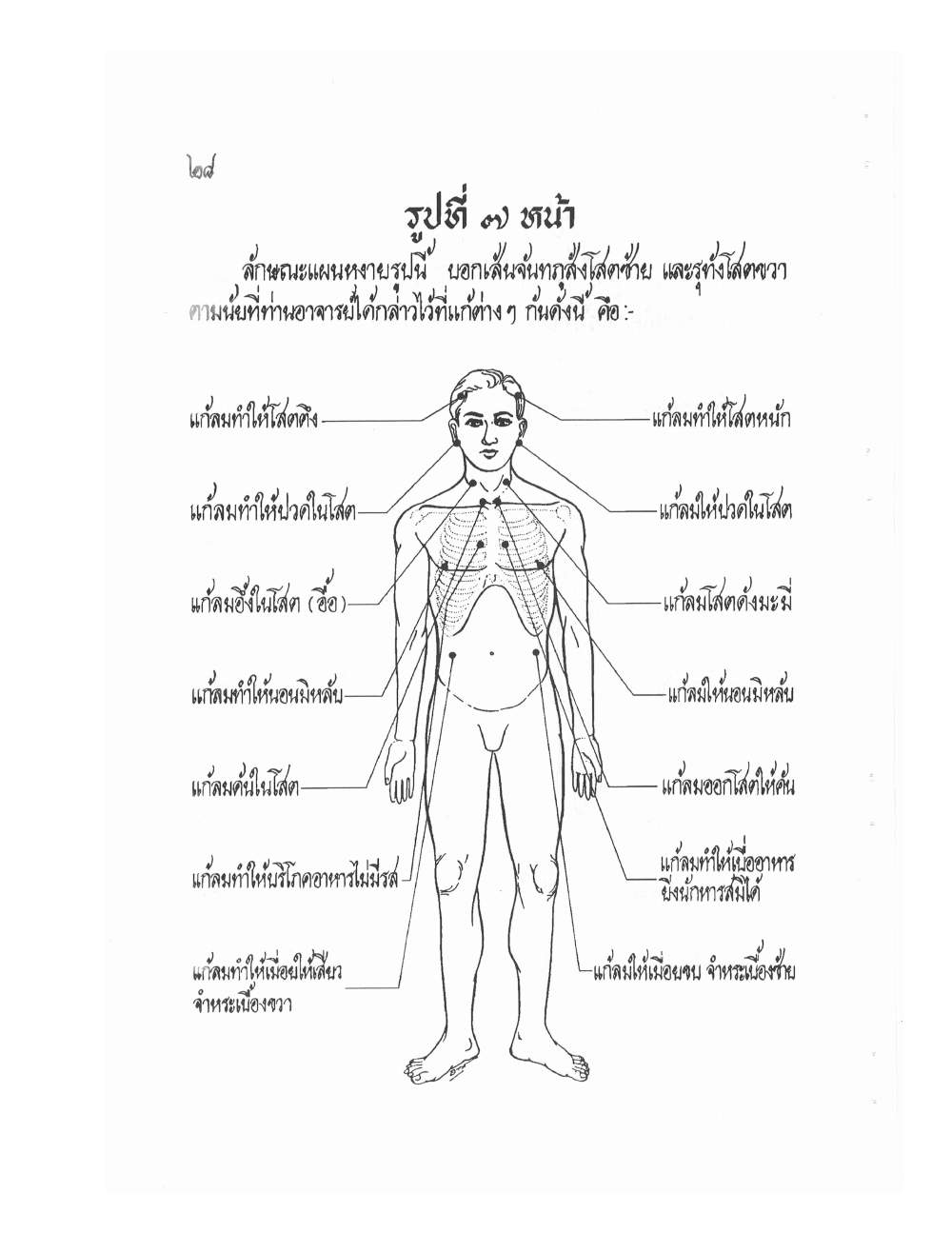
๒๘
รูปที่ ๗ หน้า
ลักษณะแผนหงายรูปนี้ บอกเส้นจันทภูสังโลหิตซ้าย และรุจังโลหิตขวา ตามนัยที่ท่านอาจารย์ได้กล่าวไว้ที่แก้ต่าง ๆ กันดังนี้ คือ :-
[diagram: front-facing standing nude male figure, dotted shading over the head, chest and abdomen marking the courses of the Chanthaphusang and Rucham lines; dotted points on the temples, ears, chest and abdomen, with ruled lines to labels at left and right]
ฝั่งซ้าย (บนลงล่าง): แก้ลมทำให้โสตตึง แก้ลมทำให้ปวดในโสต แก้ลมอึ้งในโสต (อื้อ) แก้ลมทำให้นอนมิหลับ แก้ลมดันในโสต แก้ลมทำให้บริโภคอาหารไม่มีรส แก้ลมทำให้เมื่อยให้เสียว จำหระเมื่องขวา
ฝั่งขวา (บนลงล่าง): แก้ลมทำให้โสตหนัก แก้ลมให้ปวดในโสต แก้ลมโสตดังมะมี่ แก้ลมให้นอนมิหลับ แก้ลมออกโสตให้คัน แก้ลมทำให้เนื้ออาหารมึงนักหารสมิได้ แก้ลมให้เมื่อยขบ จำหระเนื้องซ้าย
28
Figure 7, Front
The features of this supine chart show the Chanthaphusang line (left, relating to blood/hearing) and the Rucham line (right), given according to the meanings the teacher-masters have stated for their various remedies, as follows:
[diagram: a front-facing standing nude male figure, with dotted shading over the head, chest and abdomen marking the courses of the two lines; dotted points on the temples, ears, chest and abdomen, each joined by a ruled line to a label at the left or right margin]
Left side (top to bottom): Relieves wind causing tightness in the ear Relieves wind causing pain inside the ear Relieves wind causing a stuffed, muffled feeling in the ear Relieves wind [causing] insomnia Relieves wind pressing inside the ear Relieves wind that makes food tasteless when eaten Relieves wind causing aching and stinging, [affecting the flesh of] the right side
Right side (top to bottom): Relieves wind causing heaviness in the ear Relieves wind causing pain inside the ear Relieves wind [making] the ear ring/buzz Relieves wind [causing] insomnia Relieves wind coming out of the ear causing itching Relieves wind [affecting] the flesh so that food cannot be relished at all Relieves wind causing soreness and aching, [affecting the flesh of] the left side
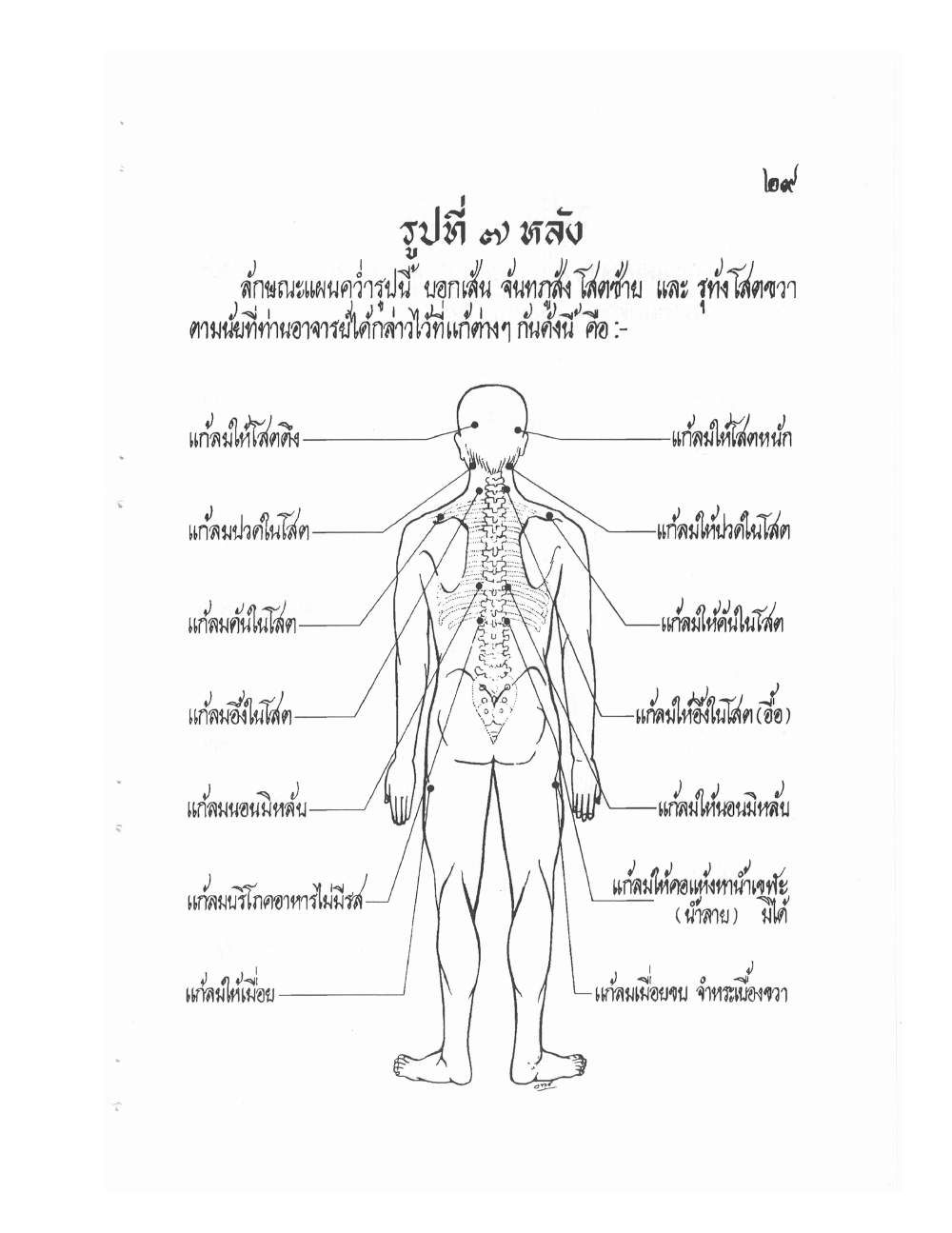
๒๙
รูปที่ ๗ หลัง
ลักษณะแผนคว่ำรูปนี้ บอกเส้น จันทภูสัง โสตซ้าย และ รุจังโสตขวา ตามนัยที่ท่านอาจารย์ได้กล่าวไว้ที่แก้ต่าง ๆ กันดังนี้ คือ :-
[diagram: back view of a standing nude male figure, dotted shading down the spine and over the sacrum marking the courses of the two lines on this side; dotted points along the spine, pelvis and legs, with ruled lines to labels at left and right]
ฝั่งซ้าย (บนลงล่าง): แก้ลมให้โสตตึง แก้ลมปวดในโสต แก้ลมดันในโสต แก้ลมอึ้งในโสต แก้ลมนอนมิหลับ แก้ลมบริโภคอาหารไม่มีรส แก้ลมให้เมื่อย
ฝั่งขวา (บนลงล่าง): แก้ลมให้โสตหนัก แก้ลมให้ปวดในโสต แก้ลมให้ดันในโสต แก้ลมให้อึ้งในโสต (อื้อ) แก้ลมให้นอนมิหลับ แก้ลมให้คอแห้งทำน้ำเขฬะ (น้ำลาย) มิได้ แก้ลมเมื่อยขบ จำหระเนื้องขวา
29
Figure 7, Back
The features of this prone chart show the Chanthaphusang line (left ear) and the Rucham line (right ear), given according to the meanings the teacher-masters have stated for their various remedies, as follows:
[diagram: back view of a standing nude male figure, with dotted shading down the spine and over the sacrum marking the courses of the two lines on this side; dotted points along the spine, pelvis and legs, each joined by a ruled line to a label at the left or right margin]
Left side (top to bottom): Relieves wind causing tightness in the ear Relieves wind causing pain inside the ear Relieves wind pressing inside the ear Relieves wind causing a stuffed, muffled feeling in the ear Relieves wind [causing] insomnia Relieves wind [that makes] food eaten tasteless Relieves wind causing aching
Right side (top to bottom): Relieves wind causing heaviness in the ear Relieves wind causing pain inside the ear Relieves wind pressing inside the ear Relieves wind causing a stuffed, muffled feeling in the ear Relieves wind [causing] insomnia Relieves wind causing the throat to dry so that saliva cannot be produced Relieves wind causing aching and soreness, [affecting the flesh of] the right side
๓๐
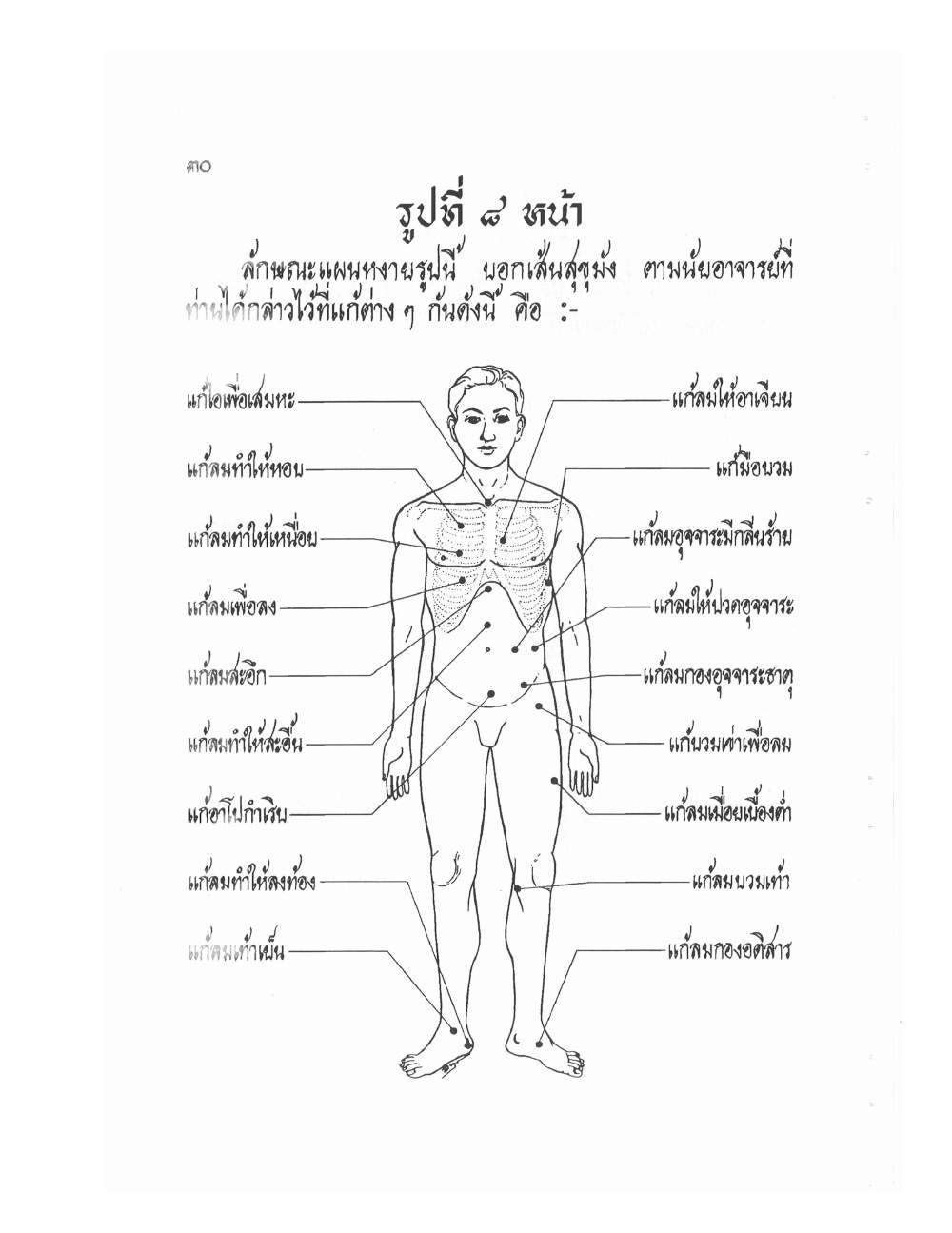
รูปที่ ๘ หน้า
ลักษณะแผนหงายรูปนี้ บอกเส้นสุขุมัง ตามนัยอาจารย์ที่ท่านได้กล่าวไว้ที่แก้ต่าง ๆ กันดังนี้ คือ :-
[diagram: front-facing standing nude male figure, dotted shading over the chest and abdomen marking the course of the Sukhumang line; dotted points down the chest, abdomen, arms and legs to the ankles, with ruled lines to labels at left and right]
ฝั่งซ้าย (บนลงล่าง): แก้ไอเพื่อเสมหะ แก้ลมทำให้หอบ แก้ลมทำให้เหนื่อย แก้ลมเพื่อลง แก้ลมสะอึก แก้ลมทำให้สะอื้น แก้อาโปกำเริบ แก้ลมทำให้ลงท้อง แก้ลมท้าวเผ็น
ฝั่งขวา (บนลงล่าง): แก้ลมให้อาเจียน แก้มือบวม แก้ลมอุจจาระมีกลิ่นร้าย แก้ลมให้ปวดอุจจาระ แก้ลมกองอุจจาระธาตุ แก้บวมเท้าเพื่อลม แก้ลมเมื่อยเนื้อตัว แก้ลมบวมเท้า แก้ลมกองอติสาร
30
Figure 8, Front
The features of this supine chart show the Sukhumang line, according to the meanings the teacher-masters have stated for its various remedies, as follows:
[diagram: a front-facing standing nude male figure, with dotted shading over the chest and abdomen marking the course of the Sukhumang line; dotted points down the chest, abdomen, arms and legs to the ankles, each joined by a ruled line to a label at the left or right margin]
Left side (top to bottom): Relieves coughing caused by phlegm Relieves wind causing shortness of breath Relieves wind causing exhaustion Relieves wind [causing things] to descend/pass through Relieves wind [causing] hiccups Relieves wind causing sobbing Relieves flaring of the water (apo) element Relieves wind causing diarrhoea Relieves [term partly illegible, foot/leg-related]
Right side (top to bottom): Relieves wind causing vomiting Relieves swollen hands Relieves wind giving stools a foul odour Relieves wind causing painful defecation Relieves disorder of the stool/faecal element Relieves swollen feet caused by wind Relieves wind causing aching of the whole body Relieves swollen feet from wind Relieves disorder in the group of dysentery ailments
๓๑
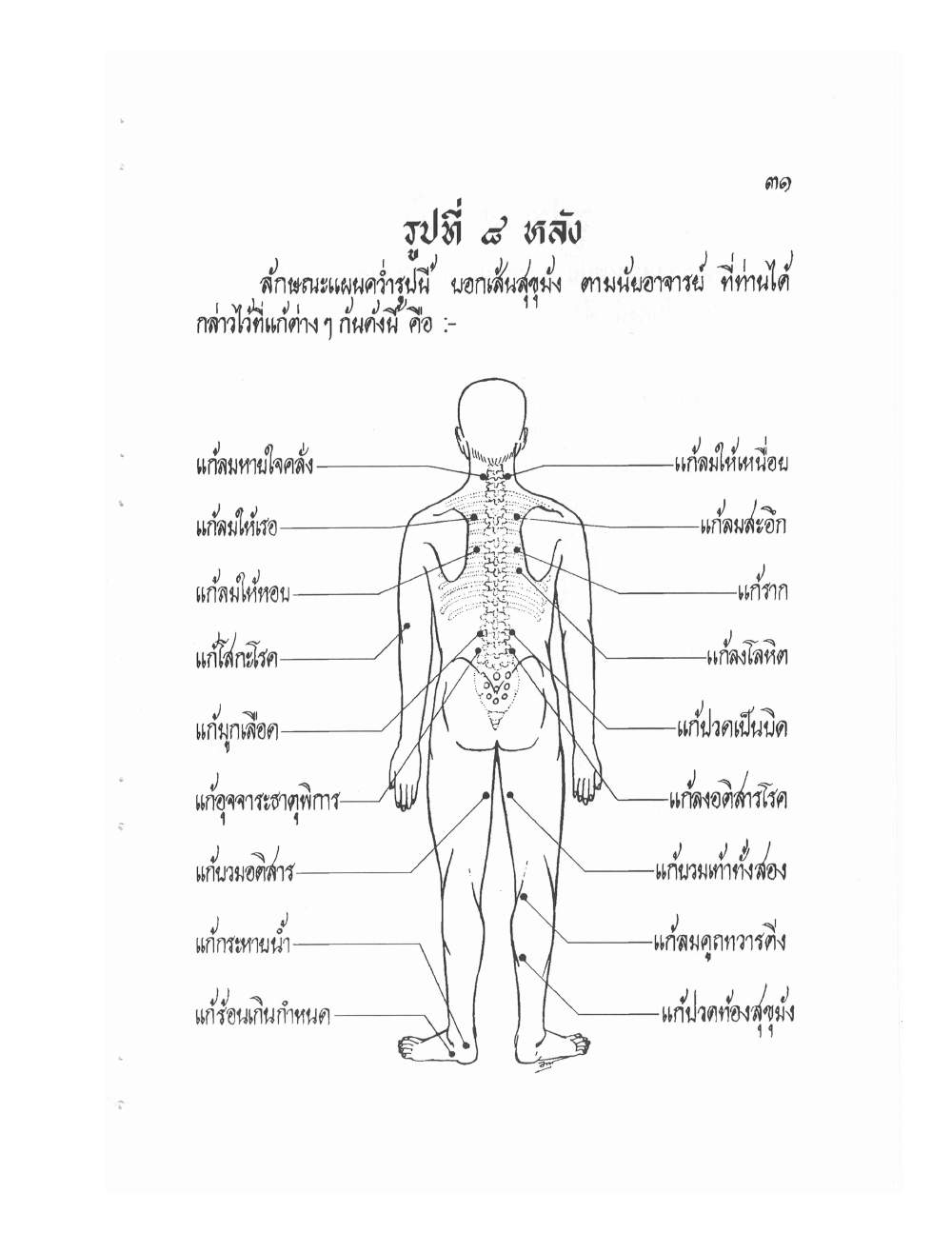
รูปที่ ๘ หลัง
ลักษณะแผนคว่ำรูปนี้ บอกเส้นสุขุมัง ตามนัยอาจารย์ ที่ท่านได้กล่าวไว้ที่แก้ต่าง ๆ กันดังนี้ คือ :-
[diagram: back view of a standing nude male figure, dotted shading down the spine and over the sacrum marking the course of the Sukhumang line on this side; dotted points along the spine, pelvis and legs, with ruled lines to labels at left and right]
ฝั่งซ้าย (บนลงล่าง): แก้ลมหายใจคลั่ง แก้ลมให้เรอ แก้ลมให้หอบ แก้ไส้กะโรค แก้มูกเลือด แก้อุจจาระธาตุพิการ แก้บวมอติสาร แก้กระหายน้ำ แก้ร้อนเกินกำหนด
ฝั่งขวา (บนลงล่าง): แก้ลมให้เหนื่อย แก้ลมสะอึก แก้ราก แก้ลงโลหิต แก้ปวดเป็นมิด แก้ลงอติสารโรค แก้บวมเท้าทั้งสอง แก้ลมคุดทวารตึง แก้ปวดท้องสุขุมัง
31
Figure 8, Back
The features of this prone chart show the Sukhumang line, according to the meanings the teacher-masters have stated for its various remedies, as follows:
[diagram: back view of a standing nude male figure, with dotted shading down the spine and over the sacrum marking the course of the Sukhumang line on this side; dotted points along the spine, pelvis and legs, each joined by a ruled line to a label at the left or right margin]
Left side (top to bottom): Relieves wild, racing breath Relieves belching (wind causing) Relieves shortness of breath Relieves intestinal ailment Relieves mucus and blood [in the stool] Relieves disorder of the faecal element Relieves swelling from dysentery Relieves thirst Relieves excessive heat (fever beyond bounds)
Right side (top to bottom): Relieves wind causing exhaustion Relieves wind [causing] hiccups Relieves vomiting Relieves passing blood [in stool] Relieves a hidden, deep-seated pain Relieves dysenteric illness Relieves swelling of both feet Relieves cramping tightness of the anus Relieves abdominal pain along the Sukhumang [line]
๓๒
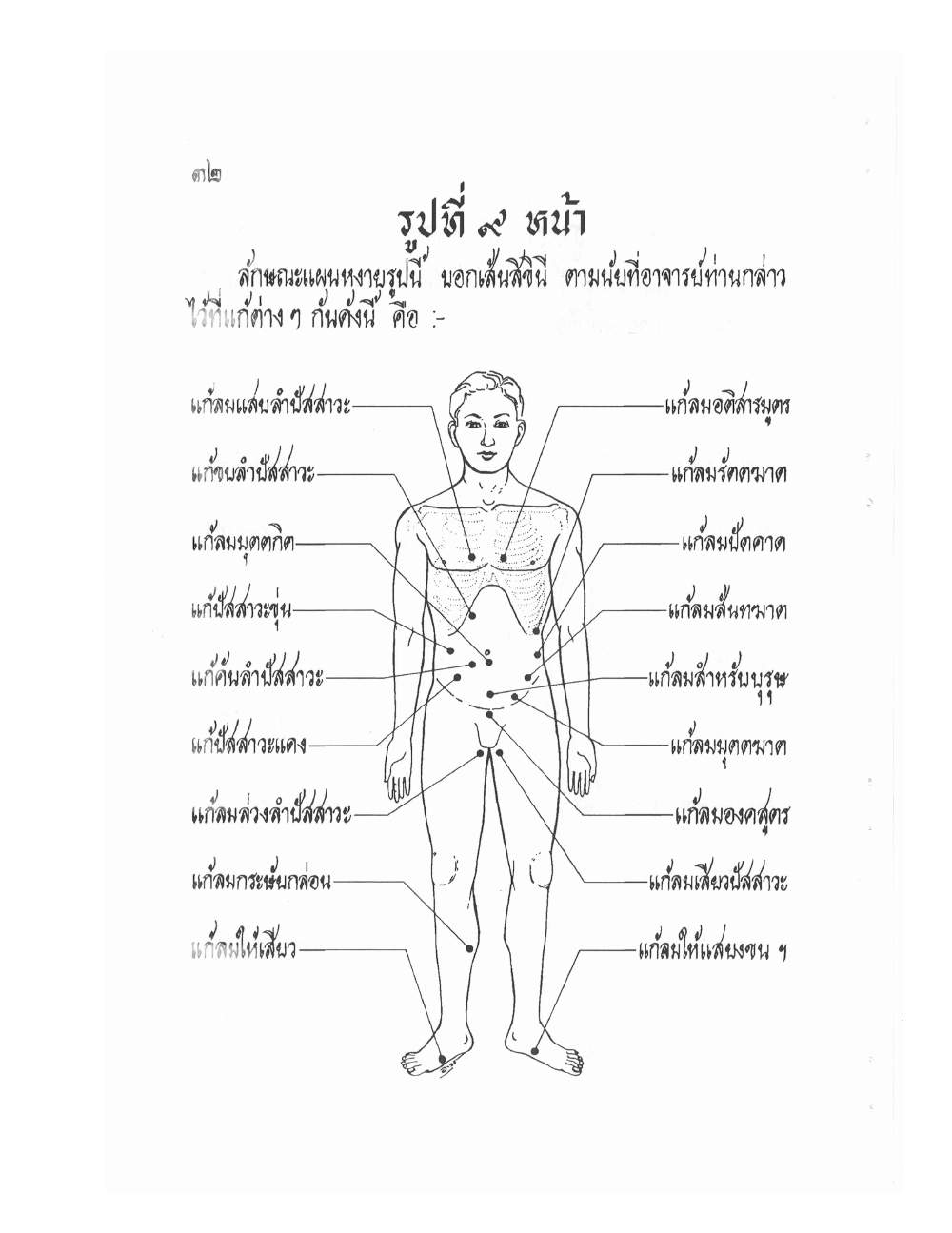
รูปที่ ๙ หน้า
ลักษณะแผนหงายรูปนี้ บอกเส้นสิขินี ตามนัยที่อาจารย์ท่านกล่าวไว้ที่แก้ต่าง ๆ กันดังนี้ คือ :-
[diagram: front-facing standing nude male figure, dotted shading over the chest and abdomen marking the course of the Sikhini line; dotted points down the chest, abdomen and groin, with ruled lines to labels at left and right]
ฝั่งซ้าย (บนลงล่าง): แก้ลมแล่บลำปัสสาวะ แก้ขบลำปัสสาวะ แก้ลมมุตกิด แก้ปัสสาวะขุ่น แก้คั่นลำปัสสาวะ แก้ปัสสาวะแดง แก้ลมล่วงลำปัสสาวะ แก้ลมกระษัยกล่อน แก้ลมให้เสียว
ฝั่งขวา (บนลงล่าง): แก้ลมอติสารมูตร แก้ลมรัตตมาด แก้ลมปัตคาด แก้ลมลันทมาด แก้ลมสำหรับบุรุษ แก้ลมมุตมาด แก้ลมองคสูตร แก้ลมเสียวปัสสาวะ แก้ลมให้แสงขน ๆ
32
Figure 9, Front
The features of this supine chart show the Sikhini line, according to the meanings the teacher-masters have stated for its various remedies, as follows:
[diagram: a front-facing standing nude male figure, with dotted shading over the chest and abdomen marking the course of the Sikhini line; dotted points down the chest, abdomen and groin, each joined by a ruled line to a label at the left or right margin]
Left side (top to bottom): Relieves a piercing pain along the urine stream Relieves cramping pain along the urine stream Relieves painful/obstructed urination (mutakit) Relieves cloudy urine Relieves blocked, straining urination Relieves red (bloody) urine Relieves wind causing urine to pass involuntarily Relieves hernia/swelling from wasting disease (krasai klon) Relieves wind causing a stinging sensation
Right side (top to bottom): Relieves dysenteric [pain in] the urine Relieves bloody urination Relieves [term partly illegible, a groin/genital ailment] Relieves [term partly illegible, urinary retention] Relieves wind afflictions specific to men Relieves urinary retention Relieves urethral stricture (ongkhasut) Relieves stinging urination Relieves wind causing tingling of the body hair
๓๓
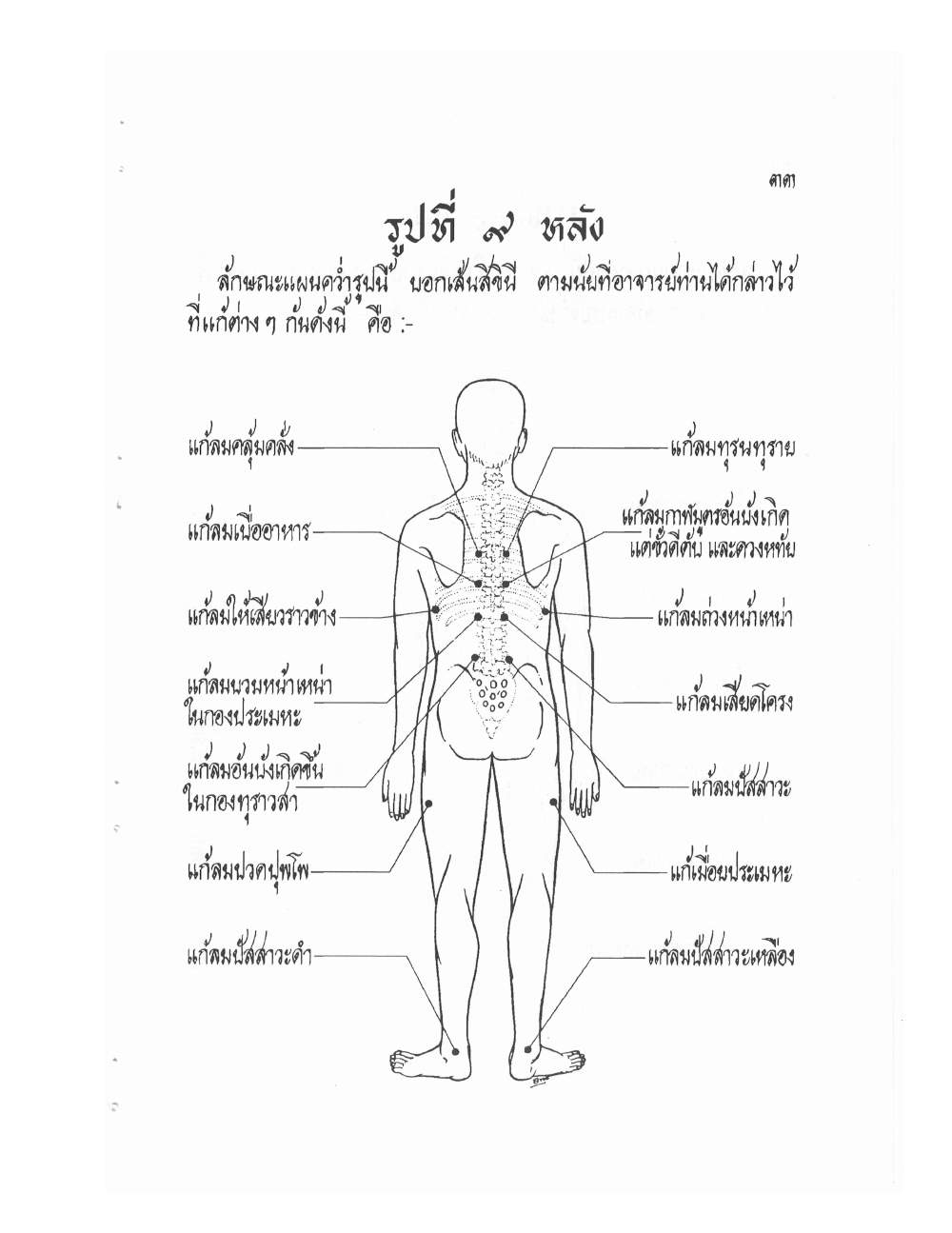
รูปที่ ๙ หลัง
ลักษณะแผนคว่ำรูปนี้ บอกเส้นสิขินี ตามนัยที่อาจารย์ท่านได้กล่าวไว้ที่แก้ต่าง ๆ กันดังนี้ คือ :-
[diagram: back view of a standing nude male figure, dotted shading down the spine and over the sacrum marking the course of the Sikhini line on this side; dotted points along the spine and pelvis, with ruled lines to labels at left and right]
ฝั่งซ้าย (บนลงล่าง): แก้ลมคลุ้มคลั่ง แก้ลมเมื่ออาหาร แก้ลมให้เสียวราวข้าง แก้ลมบวมหน้าเหน่าในกองประเมหะ แก้ลมอันบังเกิดขึ้นในกองทุราวสา แก้ลมปวดปุพโพ แก้ลมปัสสาวะดำ
ฝั่งขวา (บนลงล่าง): แก้ลมทุรนทุราย แก้ลมกาฬมูตรอันบังเกิดแต่ชั่วดีดั่ง และดวงหทัย แก้ลมล่วงหน้าเหน่า แก้ลมเสียดโครง แก้ลมปัสสาวะ แก้เมื่อยประเมหะ แก้ลมปัสสาวะเหลือง
33
Figure 9, Back
The features of this prone chart show the Sikhini line, according to the meanings the teacher-masters have stated for its various remedies, as follows:
[diagram: back view of a standing nude male figure, with dotted shading down the spine and over the sacrum marking the course of the Sikhini line on this side; dotted points along the spine and pelvis, each joined by a ruled line to a label at the left or right margin]
Left side (top to bottom): Relieves wild agitation/mania Relieves wind [arising] from food Relieves wind causing a stinging pain along the flank Relieves wind causing swelling of the genitals within the urinary group of ailments Relieves wind arising within the group of wasting-disease ailments Relieves wind causing pus-related pain Relieves dark (black) urine
Right side (top to bottom): Relieves restless agitation Relieves toxic/dark urine arising from disturbance of temperament and the heart Relieves wind passing forward through the genitals Relieves wind causing stabbing pain in the ribs Relieves [disorders of] urination Relieves aching of the urinary/genital region Relieves yellow urine
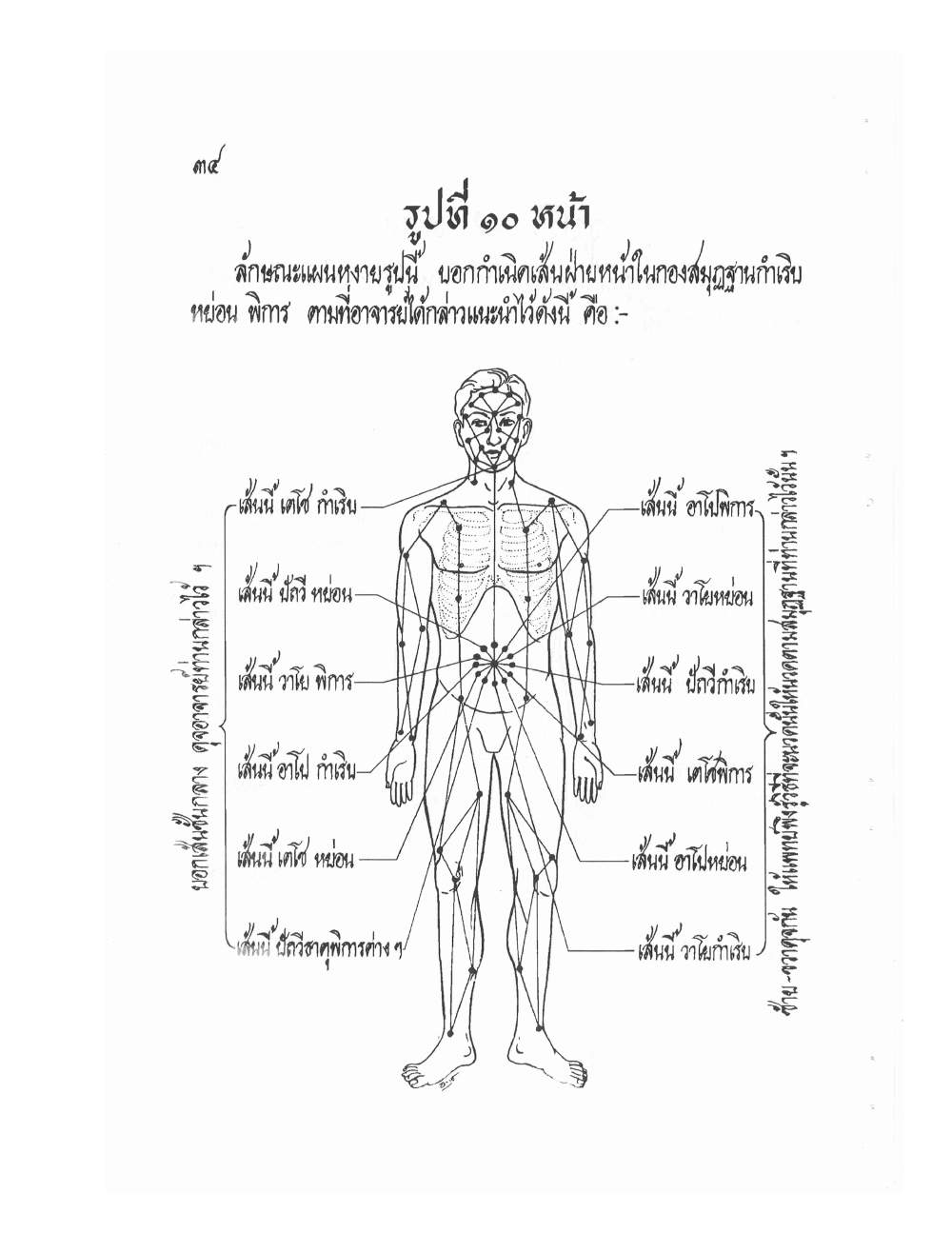
รูปที่ ๑๐ หน้า
ลักษณะแผนหงายรูปนี้ บอกกำเนิดเส้นฝ่ายหน้าในกองสมุฏฐานกำเริบ หย่อน พิการ ตามที่อาจารย์ได้กล่าวแนะนำไว้ดังนี้ คือ :-
[แผนภาพ: รูปร่างมนุษย์ยืนตรงหงายหน้า มีจุดวงกลมเล็ก ๆ กระจายทั่วร่างกาย มีลายจุดประบนหน้าอกและหน้าท้องแสดงอวัยวะภายใน เส้นจำนวนมากลากจากจุดศูนย์กลางที่สะดือแผ่ไปยังจุดต่าง ๆ บนตัว แขน ขา และศีรษะ โยงไปยังป้ายชื่อเส้นทั้งสองข้างของภาพ]
ด้านซ้าย: เส้นนี้ เตโช กำเริบ เส้นนี้ ปถวี หย่อน เส้นนี้ วาโย พิการ เส้นนี้ อาโป กำเริบ เส้นนี้ เตโช หย่อน เส้นนี้ ปถวีชาตุพิการต่าง ๆ
ด้านขวา: เส้นนี้ อาโปพิการ เส้นนี้ วาโยหย่อน เส้นนี้ ปถวีกำเริบ เส้นนี้ เตโชพิการ เส้นนี้ อาโปหย่อน เส้นนี้ วาโยกำเริบ
[อ่านไม่ออก] (อักษรเล็กแนวตั้งกำกับวงเล็บปีกกาทั้งสองข้างของภาพ)
Figure 10, Front
This supine [face-up] diagram shows the origin of the front-side channels under the categories of excess, deficiency, and disorder, as advised and taught by the ajarn (teacher), as follows:
[diagram: a standing human figure, front view, small dots scattered over the body; stippled shading over the chest and abdomen indicating the internal organs; numerous lines radiate from a central point at the navel out to points on the torso, arms, legs, and head, connecting to the channel-name labels on both sides of the image]
Left side (labels, top to bottom): This channel: Tejo (fire), excess This channel: Pathavi (earth), deficient This channel: Vayo (wind), disordered This channel: Apo (water), excess This channel: Tejo (fire), deficient This channel: various disorders of the Pathavi (earth) element
Right side (labels, top to bottom): This channel: Apo (water), disordered This channel: Vayo (wind), deficient This channel: Pathavi (earth), excess This channel: Tejo (fire), disordered This channel: Apo (water), deficient This channel: Vayo (wind), excess
[illegible — small vertical caption text running alongside the brace brackets on both sides of the figure]
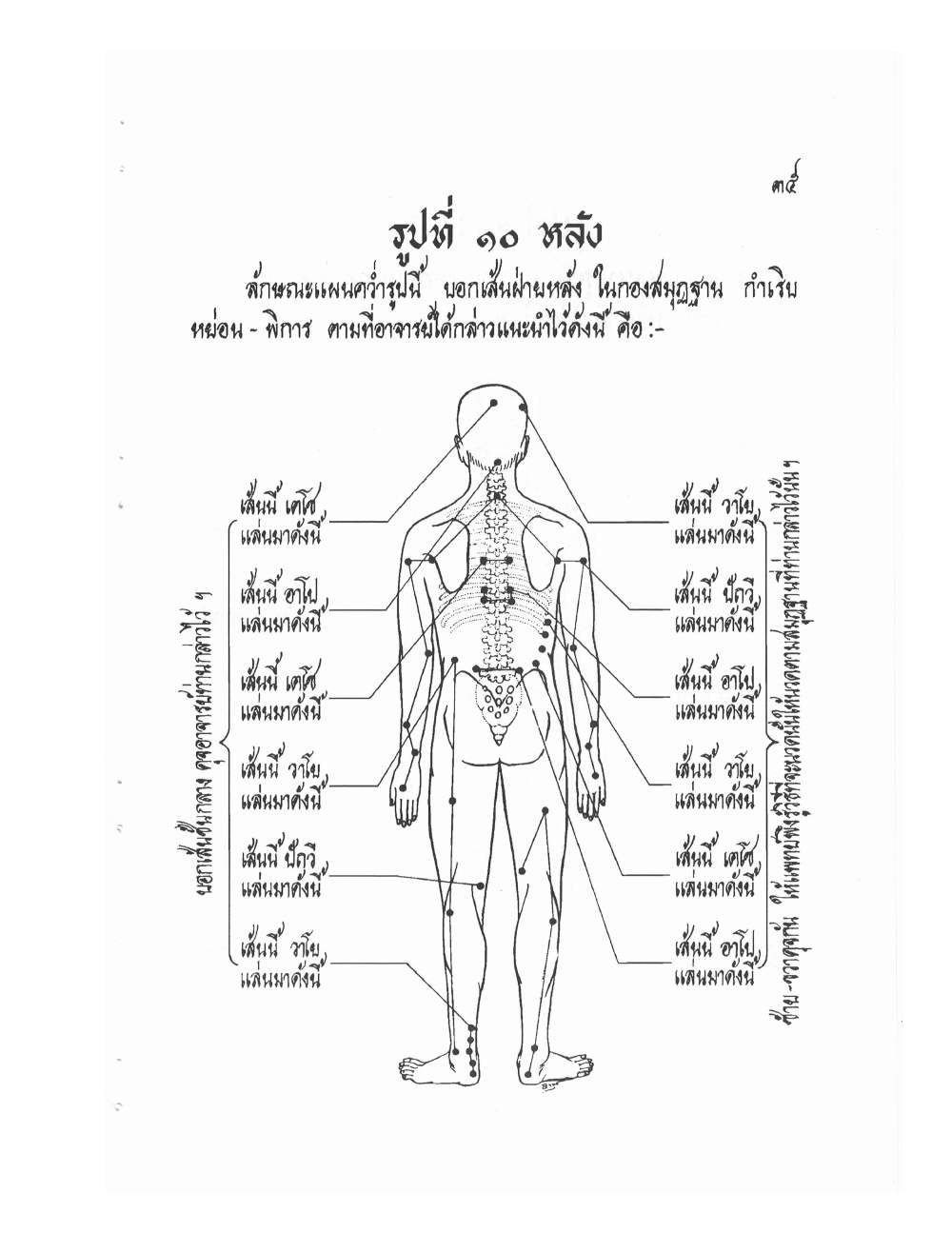
รูปที่ ๑๐ หลัง
ลักษณะแผนคว่ำรูปนี้ บอกเส้นฝ่ายหลัง ในกองสมุฏฐาน กำเริบ หย่อน - พิการ ตามที่อาจารย์ได้กล่าวแนะนำไว้ดังนี้ คือ :-
[แผนภาพ: รูปร่างมนุษย์ยืนตรงคว่ำหน้า (มองจากด้านหลัง) มีลายจุดประตามแนวกระดูกสันหลังและกระเบนเหน็บ เส้นจำนวนมากลากจากกระดูกสันหลังแผ่ไปยังจุดต่าง ๆ บนตัว แขน ขา และศีรษะ โยงไปยังป้ายชื่อเส้นทั้งสองข้างของภาพ]
ด้านซ้าย: เส้นนี้ เตโช แล่นมาดังนี้ เส้นนี้ อาโป แล่นมาดังนี้ เส้นนี้ เตโช แล่นมาดังนี้ เส้นนี้ วาโย แล่นมาดังนี้ เส้นนี้ ปถวี แล่นมาดังนี้ เส้นนี้ วาโย แล่นมาดังนี้
ด้านขวา: เส้นนี้ วาโย แล่นมาดังนี้ เส้นนี้ ปถวี แล่นมาดังนี้ เส้นนี้ อาโป แล่นมาดังนี้ เส้นนี้ วาโย แล่นมาดังนี้ เส้นนี้ เตโช แล่นมาดังนี้ เส้นนี้ อาโป แล่นมาดังนี้
[อ่านไม่ออก] (อักษรเล็กแนวตั้งกำกับวงเล็บปีกกาทั้งสองข้างของภาพ)
Figure 10, Back
This prone [face-down] diagram shows the back-side channels under the categories of excess, deficiency, and disorder, as advised and taught by the ajarn (teacher), as follows:
[diagram: a standing human figure viewed from behind, stippled shading along the spine and sacrum; numerous lines radiate from the spine out to points on the torso, arms, legs, and head, connecting to the channel-name labels on both sides of the image]
Left side (labels, top to bottom): This channel, Tejo (fire), runs thus This channel, Apo (water), runs thus This channel, Tejo (fire), runs thus This channel, Vayo (wind), runs thus This channel, Pathavi (earth), runs thus This channel, Vayo (wind), runs thus
Right side (labels, top to bottom): This channel, Vayo (wind), runs thus This channel, Pathavi (earth), runs thus This channel, Apo (water), runs thus This channel, Vayo (wind), runs thus This channel, Tejo (fire), runs thus This channel, Apo (water), runs thus
[illegible — small vertical caption text running alongside the brace brackets on both sides of the figure]
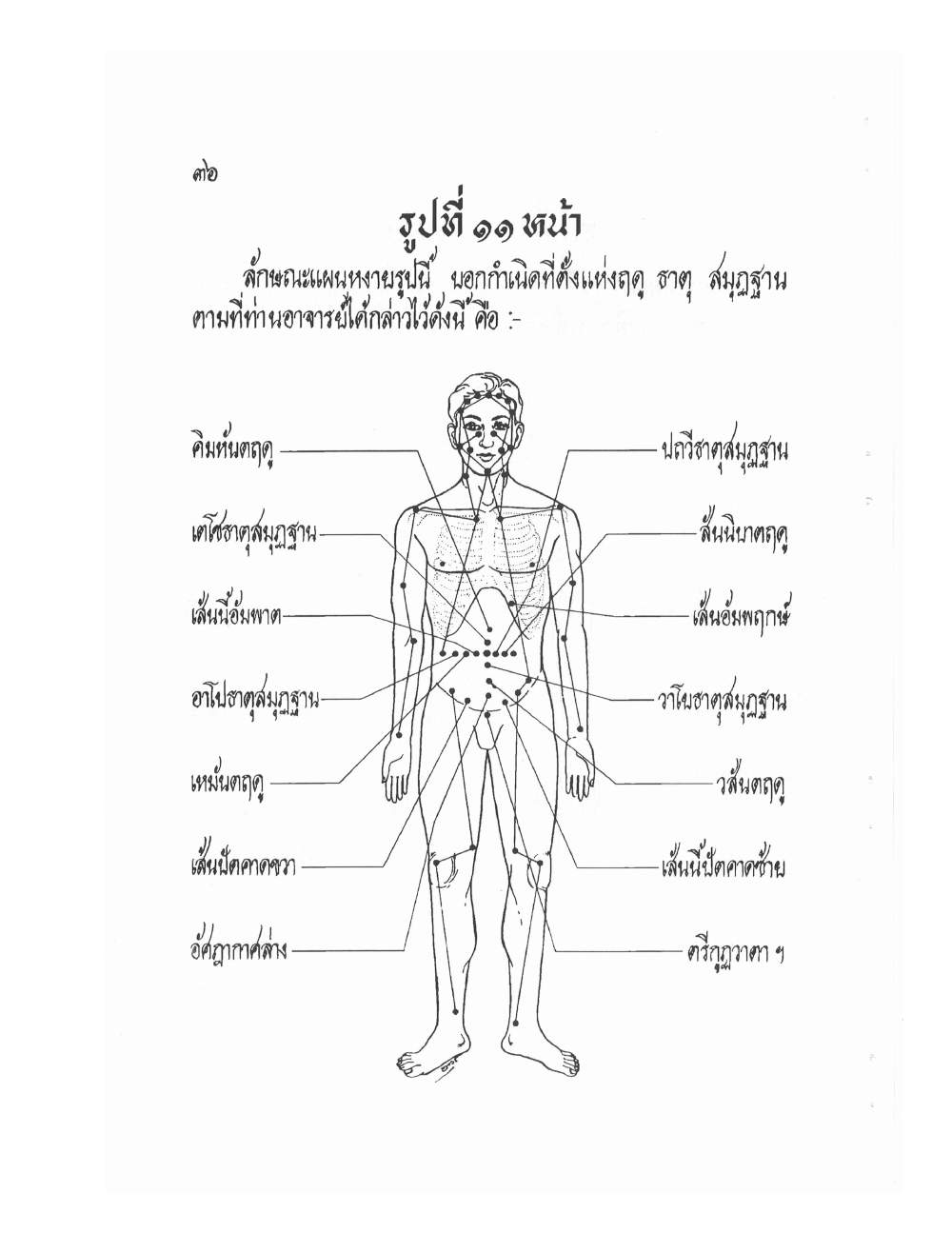
ต่อ
รูปที่ ๑๑ หน้า
ลักษณะแผนหงายรูปนี้ บอกกำเนิดที่ตั้งแห่งฤดู ธาตุ สมุฏฐาน ตามที่ท่านอาจารย์ได้กล่าวไว้ดังนี้ คือ :-
[แผนภาพ: รูปร่างมนุษย์ยืนตรงหงายหน้า มีลายจุดประบนหน้าอกและหน้าท้อง เส้นจำนวนมากลากจากบริเวณสะดือแผ่ไปยังจุดต่าง ๆ บนตัว แขน ขา และศีรษะ โยงไปยังป้ายชื่อทั้งสองข้างของภาพ]
ด้านซ้าย: คิมหันตฤดู เตโชธาตุสมุฏฐาน เส้นนี้อัมพาต อาโปธาตุสมุฏฐาน เหมันตฤดู เส้นนี้ปัตคาดขวา อัฏฐากาศล่าง
ด้านขวา: ปถวีธาตุสมุฏฐาน สันนิบาตฤดู เส้นอัมพฤกษ์ วาโยธาตุสมุฏฐาน วสันตฤดู เส้นนี้ปัตคาดซ้าย ตรีกฏูกวาตา ฯ
Continued
Figure 11, Front
This supine [face-up] diagram shows the origin of the seat of the seasons, the elements, and their etiology, as the ajarn has stated, as follows:
[diagram: a standing human figure, front view, stippled shading over the chest and abdomen; numerous lines radiate from the navel area out to points on the torso, arms, legs, and head, connecting to labels on both sides of the image]
Left side (labels, top to bottom): Hot season (khimhanta rittu) Tejo (fire) element, etiology This channel: paralysis (amphat) Apo (water) element, etiology Cool season (hemanta rittu) This channel: right groin ligament (patkhat) Lower atthakat [a named channel/point]
Right side (labels, top to bottom): Pathavi (earth) element, etiology Combined/complicated-humor season (sannibat rittu) Paralytic channel (amphruek) Vayo (wind) element, etiology Rainy season (wasanta rittu) This channel: left groin ligament (patkhat) Trikatuk wind-disorder channel, etc.
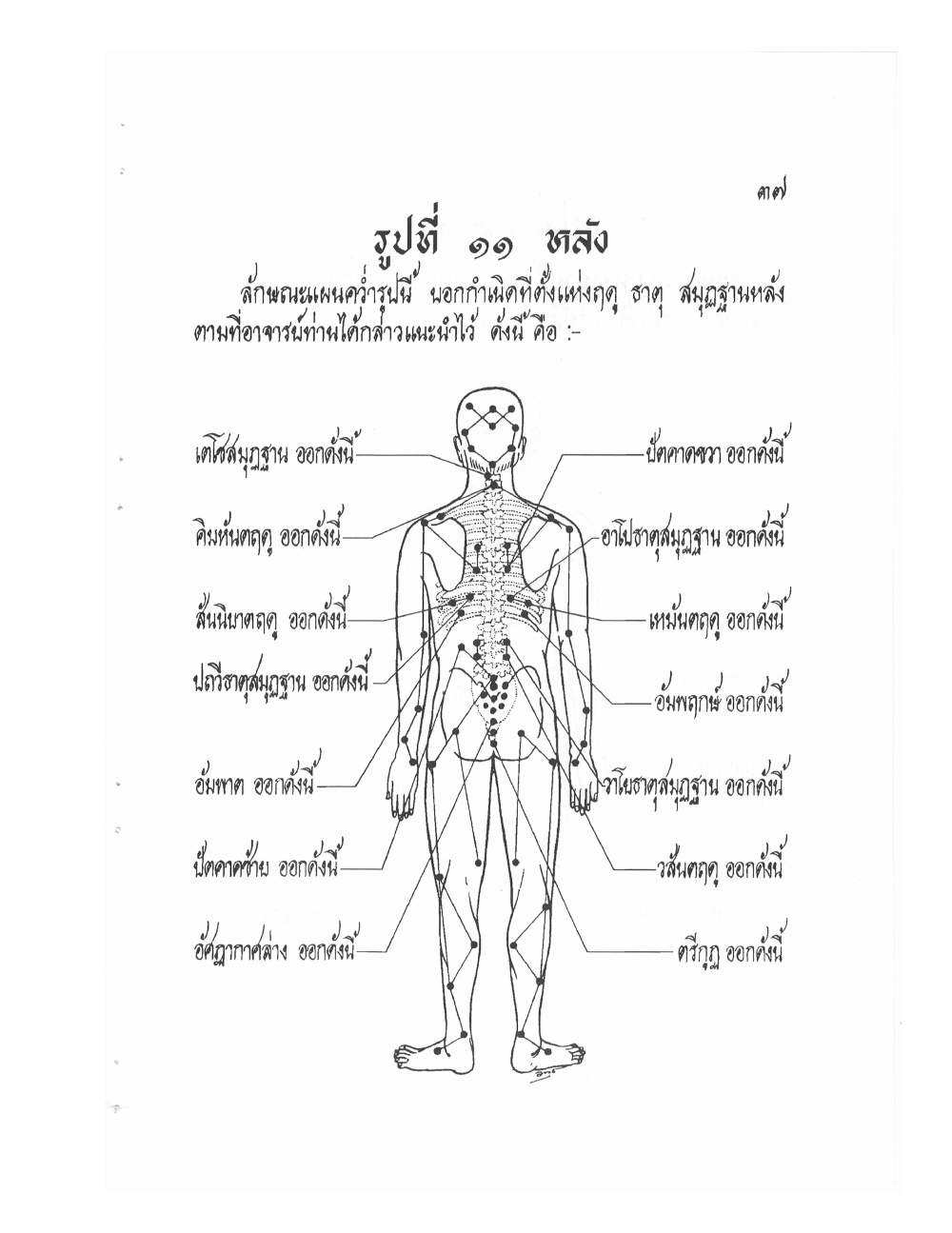
รูปที่ ๑๑ หลัง
ลักษณะแผนคว่ำรูปนี้ บอกกำเนิดที่ตั้งแห่งฤดู ธาตุ สมุฏฐานหลัง ตามที่อาจารย์ท่านได้กล่าวแนะนำไว้ ดังนี้ คือ :-
[แผนภาพ: รูปร่างมนุษย์ยืนตรงคว่ำหน้า (มองจากด้านหลัง) มีลายจุดประตามแนวกระดูกสันหลังและกระเบนเหน็บ เส้นจำนวนมากลากจากกระดูกสันหลังแผ่ไปยังจุดต่าง ๆ บนตัว แขน ขา และศีรษะ โยงไปยังป้ายชื่อทั้งสองข้างของภาพ]
ด้านซ้าย: เตโชสมุฏฐาน ออกดังนี้ คิมหันตฤดู ออกดังนี้ สันนิบาตฤดู ออกดังนี้ ปถวีธาตุสมุฏฐาน ออกดังนี้ อัมพาต ออกดังนี้ ปัตคาดซ้าย ออกดังนี้ อัฏฐากาศล่าง ออกดังนี้
ด้านขวา: ปัตคาดขวา ออกดังนี้ อาโปธาตุสมุฏฐาน ออกดังนี้ เหมันตฤดู ออกดังนี้ อัมพฤกษ์ ออกดังนี้ วาโยธาตุสมุฏฐาน ออกดังนี้ วสันตฤดู ออกดังนี้ ตรีกฏู ออกดังนี้
Figure 11, Back
This prone [face-down] diagram shows the origin of the seat of the seasons, the elements, and their back-side etiology, as the ajarn has advised and taught, as follows:
[diagram: a standing human figure viewed from behind, stippled shading along the spine and sacrum; numerous lines radiate from the spine out to points on the torso, arms, legs, and head, connecting to labels on both sides of the image]
Left side (labels, top to bottom): Tejo (fire) etiology emerges thus Hot season emerges thus Combined-humor season emerges thus Pathavi (earth) element etiology emerges thus Paralysis (amphat) emerges thus Left groin ligament emerges thus Lower atthakat emerges thus
Right side (labels, top to bottom): Right groin ligament emerges thus Apo (water) element etiology emerges thus Cool season emerges thus Paralytic channel (amphruek) emerges thus Vayo (wind) element etiology emerges thus Rainy season emerges thus Trikatuk emerges thus
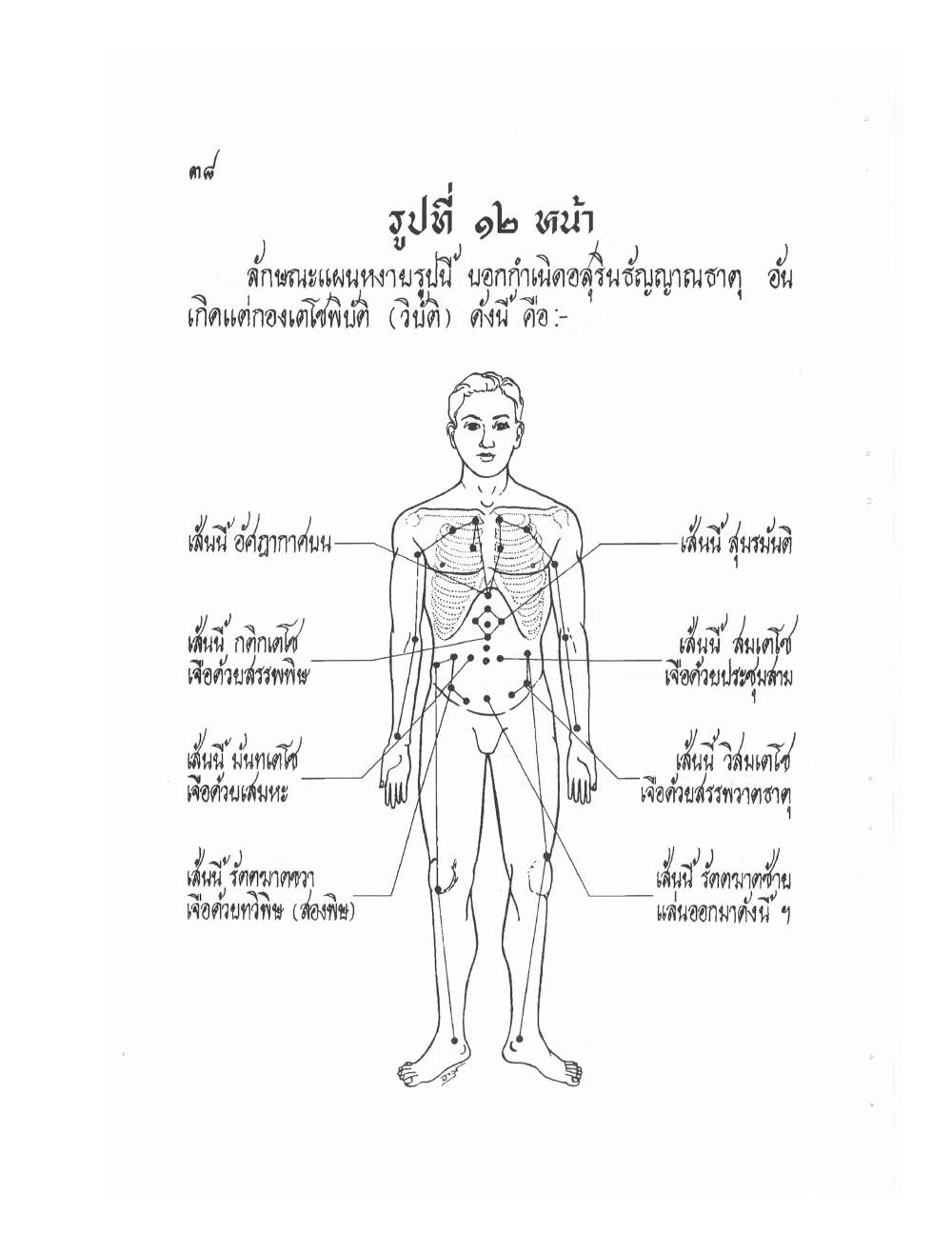
รูปที่ ๑๒ หน้า
ลักษณะแผนหงายรูปนี้ บอกกำเนิดอาการอันเกิดแต่ธาตุ อันเกิดแต่กองเตโชพิบัติ (วิบัติ) ดังนี้ คือ :-
[แผนภาพ: รูปร่างมนุษย์ยืนตรงหงายหน้า มีลายจุดประบนหน้าอกและหน้าท้อง เส้นจำนวนมากลากจากบริเวณสะดือแผ่ไปยังจุดต่าง ๆ บนตัว แขน ขา และศีรษะ โยงไปยังป้ายชื่อทั้งสองข้างของภาพ]
ด้านซ้าย: เส้นนี้ อัฏฐากาศบน เส้นนี้ กติกเตโช เจือด้วยสรรพพิษ เส้นนี้ มันทเตโช เจือด้วยเสมหะ เส้นนี้ รัตตมาตขวา เจือด้วยทวิพิษ (สองพิษ)
ด้านขวา: เส้นนี้ สุมรมันติ เส้นนี้ สมเตโช เจือด้วยประชุมสาม เส้นนี้ วิสมเตโช เจือด้วยสรรพวาตชาตุ เส้นนี้ รัตตมาตซ้าย แล่นออกมาดังนี้ ฯ
Figure 12, Front
This supine [face-up] diagram shows the origin of the effects arising from the elements, specifically those arising from disorder (derangement) of the Tejo (fire) category, as follows:
[diagram: a standing human figure, front view, stippled shading over the chest and abdomen; numerous lines radiate from the navel area out to points on the torso, arms, legs, and head, connecting to labels on both sides of the image]
Left side (labels, top to bottom): This channel: upper atthakat This channel: katika-tejo, mixed with all manner of poison This channel: manta-tejo, mixed with phlegm This channel: right rattamat, mixed with double poison (two poisons)
Right side (labels, top to bottom): This channel: sumaramanti This channel: soma-tejo, mixed with the three [humors] combined This channel: visama-tejo, mixed with the wind element in force This channel: left rattamat, runs out thus
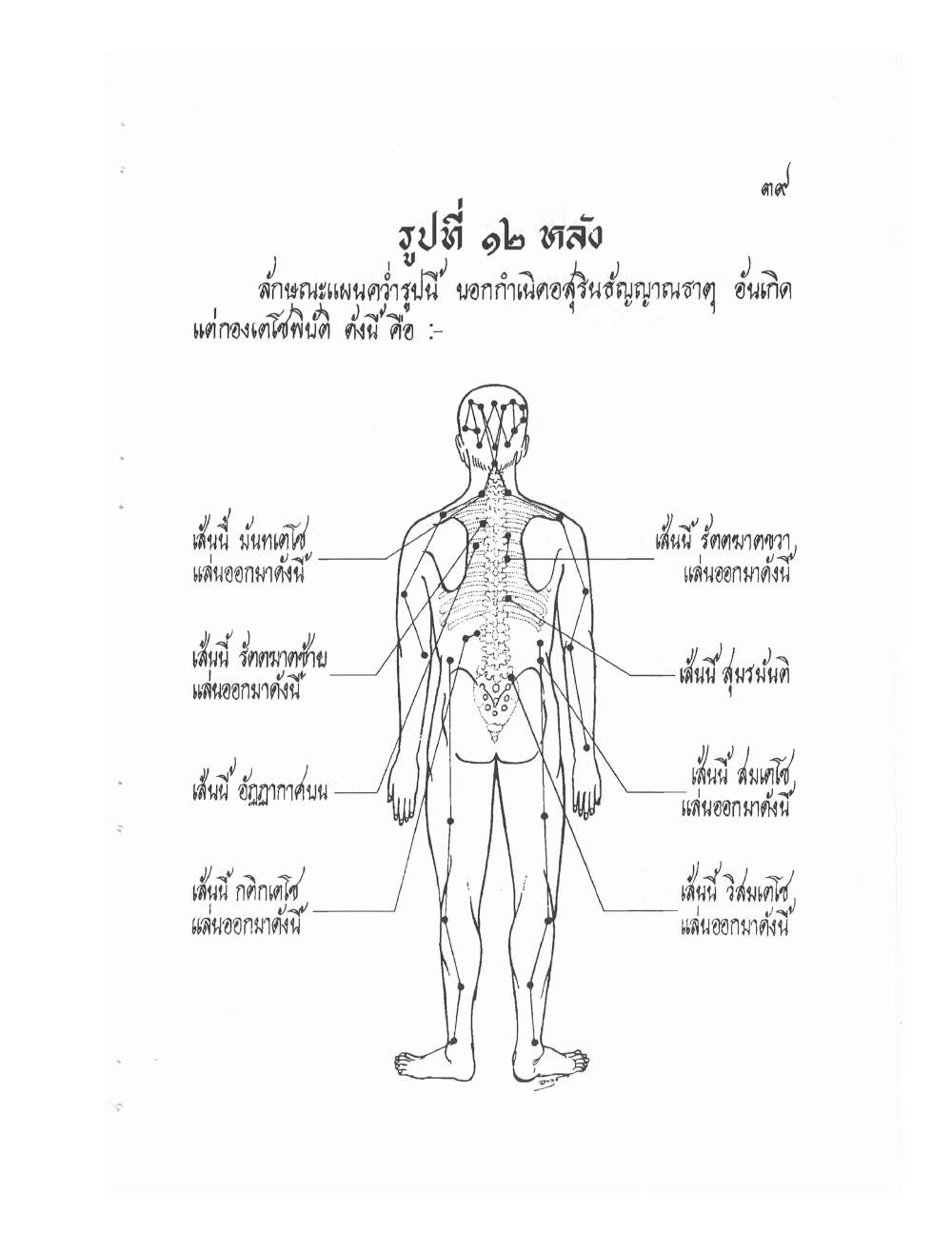
รูปที่ ๑๒ หลัง
ลักษณะแผนคว่ำรูปนี้ บอกกำเนิดอาการอันเกิดแต่ธาตุ อันเกิดแต่กองเตโชพิบัติ ดังนี้ คือ :-
[แผนภาพ: รูปร่างมนุษย์ยืนตรงคว่ำหน้า (มองจากด้านหลัง) มีลายจุดประตามแนวกระดูกสันหลังและกระเบนเหน็บ เส้นจำนวนมากลากจากกระดูกสันหลังแผ่ไปยังจุดต่าง ๆ บนตัว แขน ขา และศีรษะ โยงไปยังป้ายชื่อทั้งสองข้างของภาพ]
ด้านซ้าย: เส้นนี้ มันทเตโช แล่นออกมาดังนี้ เส้นนี้ รัตตมาตซ้าย แล่นออกมาดังนี้ เส้นนี้ อัฏฐากาศบน เส้นนี้ กติกเตโช แล่นออกมาดังนี้
ด้านขวา: เส้นนี้ รัตตมาตขวา แล่นออกมาดังนี้ เส้นนี้ สุมรมันติ เส้นนี้ สมเตโช แล่นออกมาดังนี้ เส้นนี้ วิสมเตโช แล่นออกมาดังนี้
Figure 12, Back
This prone [face-down] diagram shows the origin of the effects arising from the elements, specifically those arising from disorder of the Tejo (fire) category, as follows:
[diagram: a standing human figure viewed from behind, stippled shading along the spine and sacrum; numerous lines radiate from the spine out to points on the torso, arms, legs, and head, connecting to labels on both sides of the image]
Left side (labels, top to bottom): This channel: manta-tejo, runs out thus This channel: left rattamat, runs out thus This channel: upper atthakat This channel: katika-tejo, runs out thus
Right side (labels, top to bottom): This channel: right rattamat, runs out thus This channel: sumaramanti This channel: soma-tejo, runs out thus This channel: visama-tejo, runs out thus
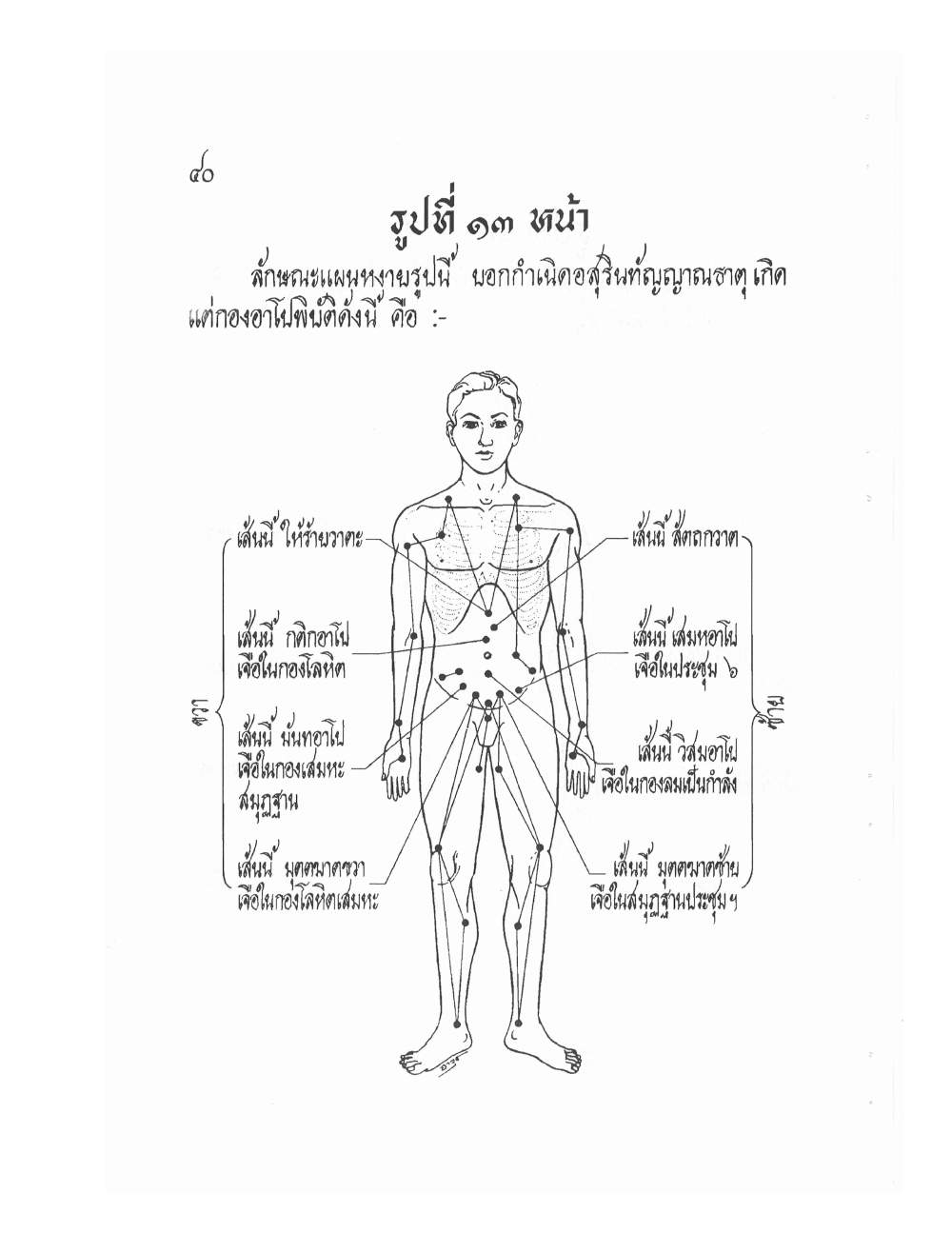
รูปที่ ๑๓ หน้า
ลักษณะแผนหงายรูปนี้ บอกกำเนิดอาการอันเกิดแต่ธาตุ เกิดแต่กองอาโปพิบัติ ดังนี้ คือ :-
[แผนภาพ: รูปร่างมนุษย์ยืนตรงหงายหน้า มีลายจุดประบนหน้าอกและหน้าท้อง เส้นจำนวนมากลากจากบริเวณสะดือแผ่ไปยังจุดต่าง ๆ บนตัว แขน ขา และศีรษะ โยงไปยังป้ายชื่อทั้งสองข้างของภาพ วงเล็บปีกกาด้านซ้ายกำกับคำว่า "ขวา" ด้านขวากำกับคำว่า "ซ้าย"]
ด้านซ้าย (ขวา): เส้นนี้ ให้ร้ายวาตะ เส้นนี้ กติกอาโป เจือในกองโลหิต เส้นนี้ มันทอาโป เจือในกองเสมหะสมุฏฐาน เส้นนี้ มุตตมาตขวา เจือในกองโลหิตเสมหะ
ด้านขวา (ซ้าย): เส้นนี้ สัตถกวาต เส้นนี้ เสมหอาโป เจือในประชุม ๖ เส้นนี้ วิสมอาโป เจือในกองลมเป็นกำลัง เส้นนี้ มุตตมาตซ้าย เจือในสมุฏฐานประชุม ฯ
Figure 13, Front
This supine [face-up] diagram shows the origin of the effects arising from the elements, arising from disorder of the Apo (water) category, as follows:
[diagram: a standing human figure, front view, stippled shading over the chest and abdomen; numerous lines radiate from the navel area out to points on the torso, arms, legs, and head, connecting to labels on both sides of the image; the brace bracket on the left is marked "right" (khwa) and the one on the right is marked "left" (sai)]
Left-side labels (marked "right"): This channel: causing malignant wind This channel: katika-apo, mixed in the blood category This channel: manta-apo, mixed in the phlegm-etiology category This channel: right muttamat, mixed in the blood-phlegm category
Right-side labels (marked "left"): This channel: satthakawat This channel: sema-apo, mixed in the group of six This channel: visama-apo, mixed in the wind category at full force This channel: left muttamat, mixed in the etiology group
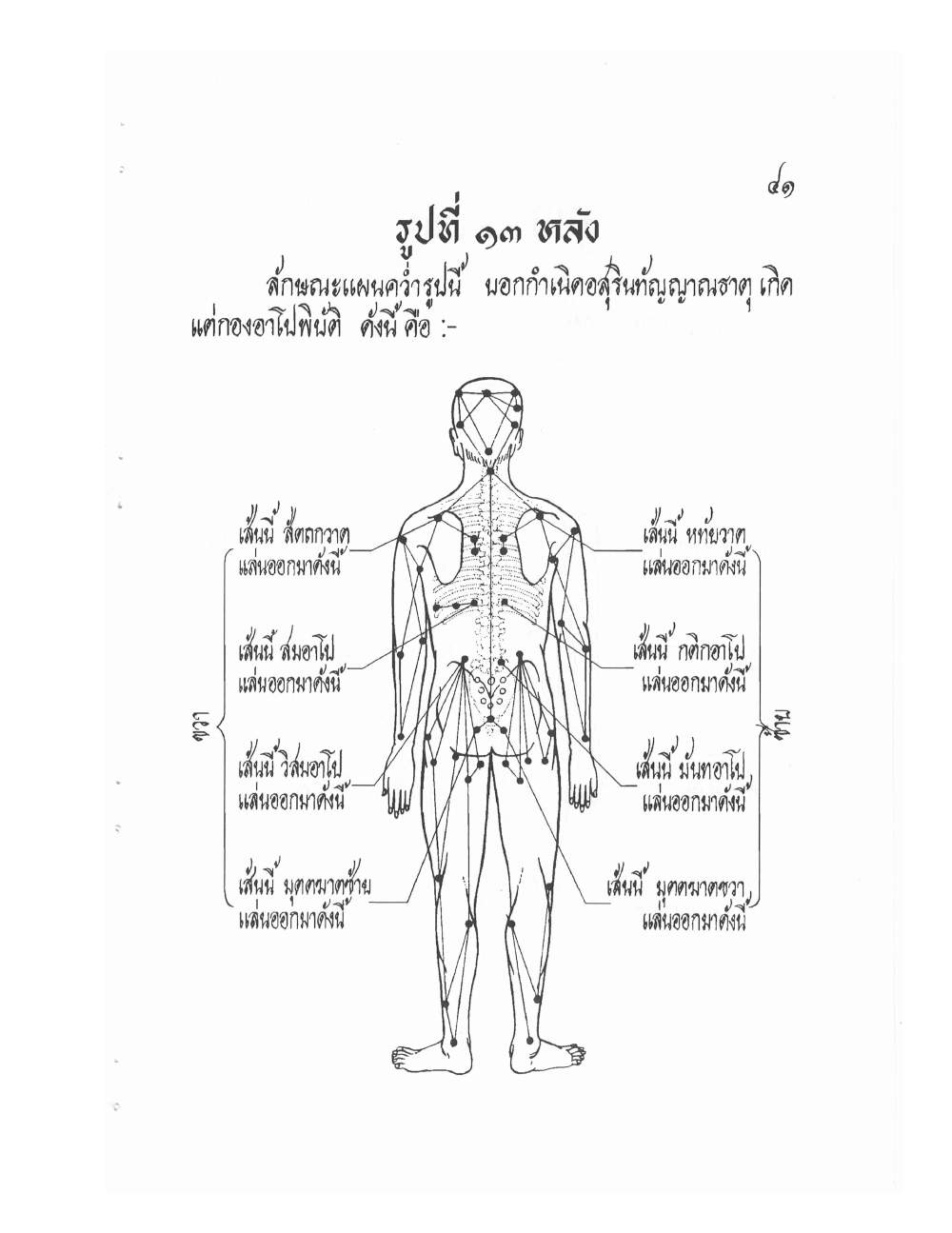
รูปที่ ๑๓ หลัง
ลักษณะแผนคว่ำรูปนี้ บอกกำเนิดอาการอันเกิดแต่ธาตุ เกิดแต่กองอาโปพิบัติ ดังนี้ คือ :-
[แผนภาพ: รูปร่างมนุษย์ยืนตรงคว่ำหน้า (มองจากด้านหลัง) มีลายจุดประตามแนวกระดูกสันหลังและกระเบนเหน็บ เส้นจำนวนมากลากจากกระดูกสันหลังแผ่ไปยังจุดต่าง ๆ บนตัว แขน ขา และศีรษะ โยงไปยังป้ายชื่อทั้งสองข้างของภาพ วงเล็บปีกกาด้านซ้ายกำกับคำว่า "ขวา" ด้านขวากำกับคำว่า "ซ้าย"]
ด้านซ้าย: เส้นนี้ วิหกวาตพัด เส้นนี้ สมอาโป แล่นออกมาดังนี้ เส้นนี้ อัฏฐากาศบน เส้นนี้ กติกอาโป แล่นออกมาดังนี้
ด้านขวา: เส้นนี้ พหิวาตหทัย เส้นนี้ วิสมอาโป แล่นออกมาดังนี้ เส้นนี้ มุตตมาตซ้าย แล่นออกมาดังนี้ เส้นนี้ มันทอาโป แล่นออกมาดังนี้ เส้นนี้ มุตตมาตขวา แล่นออกมาดังนี้
Figure 13, Back
This prone [face-down] diagram shows the origin of the effects arising from the elements, arising from disorder of the Apo (water) category, as follows:
[diagram: a standing human figure viewed from behind, stippled shading along the spine and sacrum; numerous lines radiate from the spine out to points on the torso, arms, legs, and head, connecting to labels on both sides of the image; the brace bracket on the left is marked "right" and the one on the right is marked "left"]
Left side (labels, top to bottom): This channel: wihok-wat-phat (the wind-driving channel) This channel: soma-apo, runs out thus This channel: upper atthakat This channel: katika-apo, runs out thus
Right side (labels, top to bottom): This channel: phahi-wat-hathai (the heart-encircling wind channel) This channel: visama-apo, runs out thus This channel: left muttamat, runs out thus This channel: manta-apo, runs out thus This channel: right muttamat, runs out thus
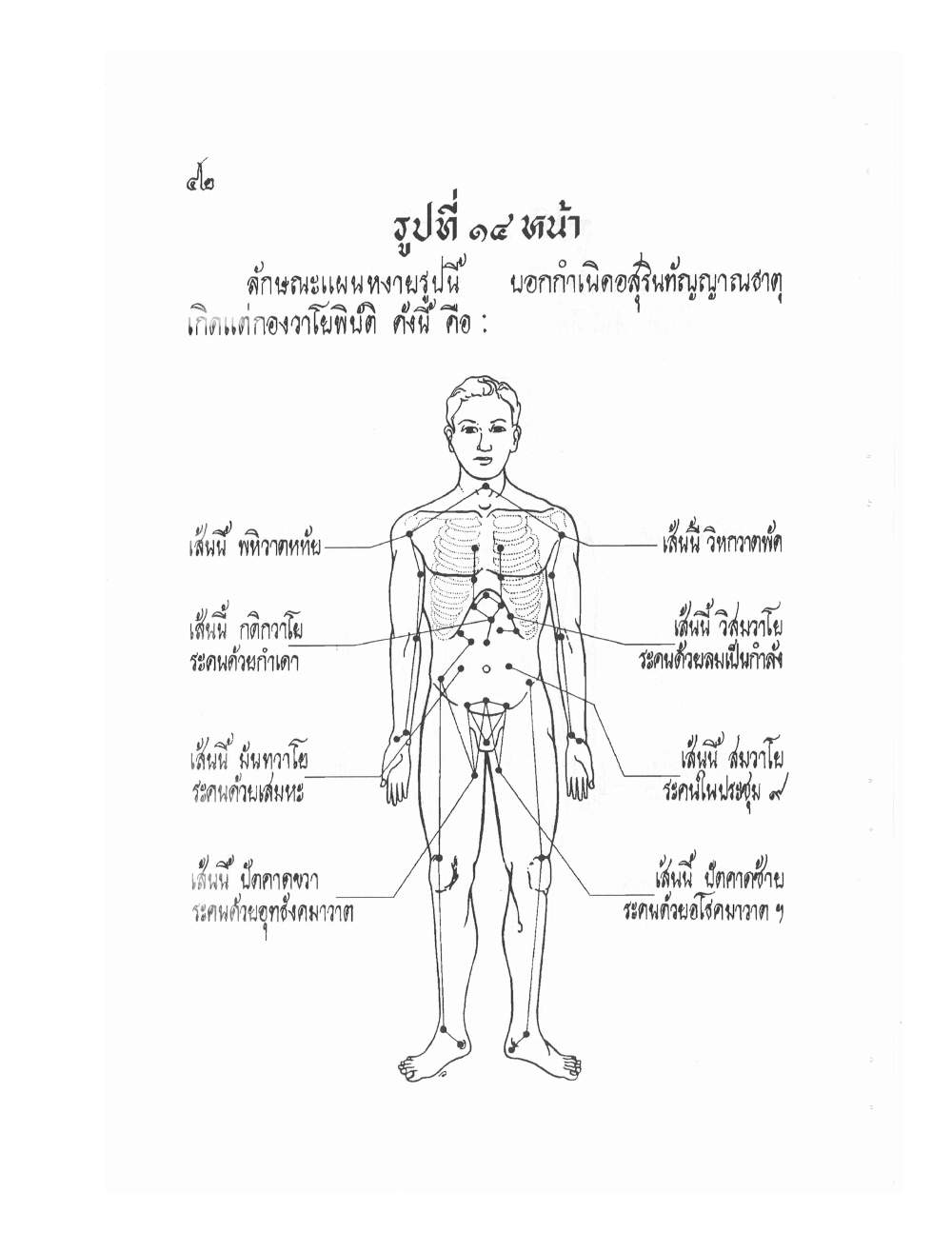
รูปที่ ๑๔ หน้า
ลักษณะแผนหงายรูปนี้ บอกกำเนิดอาการอันเกิดแต่ธาตุ เกิดแต่กองวาโยพิบัติ ดังนี้ คือ :
[แผนภาพ: รูปร่างมนุษย์ยืนตรงหงายหน้า มีลายจุดประบนหน้าอกและหน้าท้อง เส้นจำนวนมากลากจากบริเวณสะดือแผ่ไปยังจุดต่าง ๆ บนตัว แขน ขา และศีรษะ โยงไปยังป้ายชื่อทั้งสองข้างของภาพ]
ด้านซ้าย: เส้นนี้ พหิวาตหทัย เส้นนี้ กติกวาโย ระคนด้วยกำเดา เส้นนี้ มันทวาโย ระคนด้วยเสมหะ เส้นนี้ ปัตคาดขวา ระคนด้วยอุทังคมาวาต
ด้านขวา: เส้นนี้ วิหกวาตพัด เส้นนี้ วิสมวาโย ระคนด้วยลมเป็นกำลัง เส้นนี้ สมวาโย ระคนในประชุม ๙ เส้นนี้ ปัตคาดซ้าย ระคนด้วยโรคมาวาต ฯ
Figure 14, Front
This supine [face-up] diagram shows the origin of the effects arising from the elements, arising from disorder of the Vayo (wind) category, as follows:
[diagram: a standing human figure, front view, stippled shading over the chest and abdomen; numerous lines radiate from the navel area out to points on the torso, arms, legs, and head, connecting to labels on both sides of the image]
Left side (labels, top to bottom): This channel: phahi-wat-hathai (the heart-encircling wind channel) This channel: katika-vayo, mixed with rising heat/bile This channel: manta-vayo, mixed with phlegm This channel: right groin ligament, mixed with the upward-coursing wind
Right side (labels, top to bottom): This channel: wihok-wat-phat (the wind-driving channel) This channel: visama-vayo, mixed with wind at full force This channel: soma-vayo, mixed in the group of nine This channel: left groin ligament, mixed with wind-borne disease
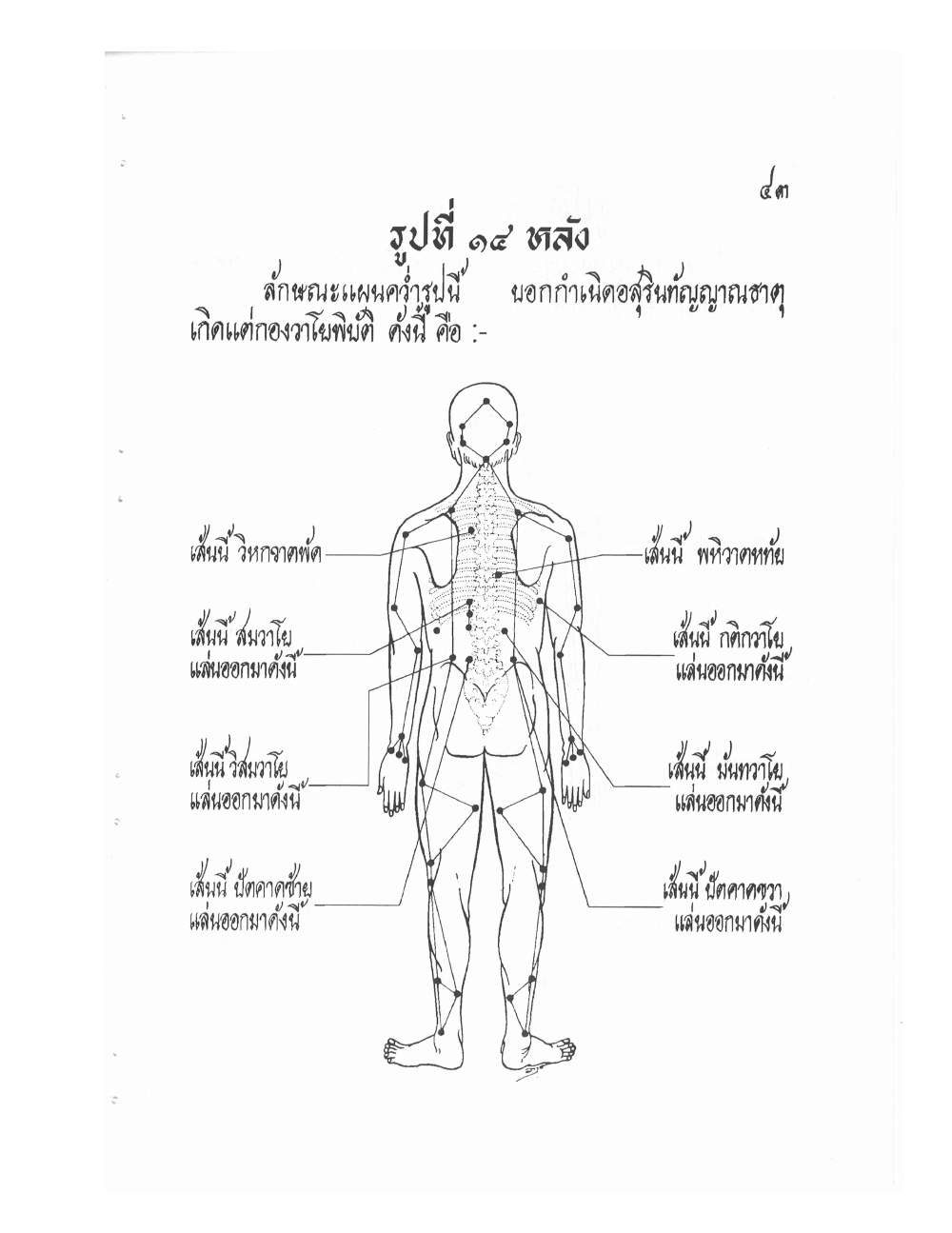
รูปที่ ๑๔ หลัง
ลักษณะแผนคว่ำรูปนี้ บอกกำเนิดอาการอันเกิดแต่ธาตุ เกิดแต่กองวาโยพิบัติ ดังนี้ คือ :-
[แผนภาพ: รูปร่างมนุษย์ยืนตรงคว่ำหน้า (มองจากด้านหลัง) มีลายจุดประตามแนวกระดูกสันหลังและกระเบนเหน็บ เส้นจำนวนมากลากจากกระดูกสันหลังแผ่ไปยังจุดต่าง ๆ บนตัว แขน ขา และศีรษะ โยงไปยังป้ายชื่อทั้งสองข้างของภาพ]
ด้านซ้าย: เส้นนี้ วิหกวาตพัด แล่นออกมาดังนี้ เส้นนี้ สมวาโย แล่นออกมาดังนี้ เส้นนี้ วิสมวาโย แล่นออกมาดังนี้ เส้นนี้ ปัตคาดซ้าย แล่นออกมาดังนี้
ด้านขวา: เส้นนี้ พหิวาตหทัย เส้นนี้ กติกวาโย แล่นออกมาดังนี้ เส้นนี้ มันทวาโย แล่นออกมาดังนี้ เส้นนี้ ปัตคาดขวา แล่นออกมาดังนี้
Figure 14, Back
This prone [face-down] diagram shows the origin of the effects arising from the elements, arising from disorder of the Vayo (wind) category, as follows:
[diagram: a standing human figure viewed from behind, stippled shading along the spine and sacrum; numerous lines radiate from the spine out to points on the torso, arms, legs, and head, connecting to labels on both sides of the image]
Left side (labels, top to bottom): This channel: wihok-wat-phat, runs out thus This channel: soma-vayo, runs out thus This channel: visama-vayo, runs out thus This channel: left groin ligament, runs out thus
Right side (labels, top to bottom): This channel: phahi-wat-hathai This channel: katika-vayo, runs out thus This channel: manta-vayo, runs out thus This channel: right groin ligament, runs out thus
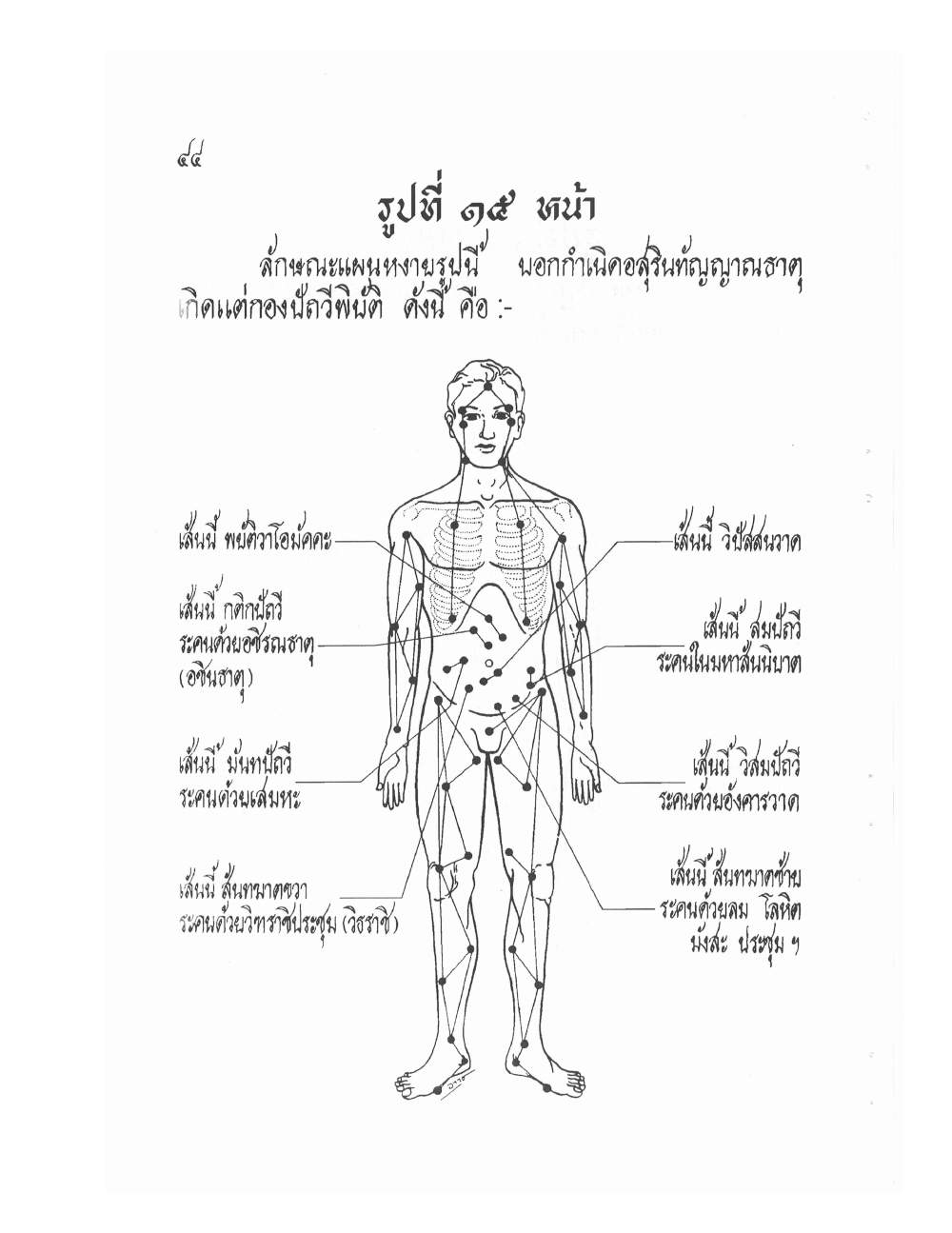
รูปที่ ๑๕ หน้า
ลักษณะแผนหงายรูปนี้ บอกกำเนิดอาการอันเกิดแต่ธาตุ เกิดแต่กองปถวีพิบัติ ดังนี้ คือ :-
[แผนภาพ: รูปร่างมนุษย์ยืนตรงหงายหน้า มีลายจุดประบนหน้าอกและหน้าท้อง เส้นจำนวนมากลากจากบริเวณสะดือแผ่ไปยังจุดต่าง ๆ บนตัว แขน ขา และศีรษะ โยงไปยังป้ายชื่อทั้งสองข้างของภาพ]
ด้านซ้าย: เส้นนี้ พยติวาโตมัคคะ เส้นนี้ กติกปถวี ระคนด้วยอชิรณธาตุ (อชิณธาตุ) เส้นนี้ มันทปถวี ระคนด้วยเสมหะ เส้นนี้ สันทมาตขวา ระคนด้วยวิทราชีประชุม (วิธราชี)
ด้านขวา: เส้นนี้ วิปัสสนวาตา เส้นนี้ สมปถวี ระคนในมหาสันนิบาต เส้นนี้ วิสมปถวี ระคนด้วยองคารวาด เส้นนี้ สันทมาตซ้าย ระคนด้วยลม โลหิต มังสะ ประชุม ฯ
Figure 15, Front
This supine [face-up] diagram shows the origin of the effects arising from the elements, arising from disorder of the Pathavi (earth) category, as follows:
[diagram: a standing human figure, front view, stippled shading over the chest and abdomen; numerous lines radiate from the navel area out to points on the torso, arms, legs, and head, connecting to labels on both sides of the image]
Left side (labels, top to bottom): This channel: phayati-wato-makka This channel: katika-pathavi, mixed with indigestion-element (achirana/achina) This channel: manta-pathavi, mixed with phlegm This channel: right santhamat, mixed with the withrachi group
Right side (labels, top to bottom): This channel: wipatsana-wata This channel: soma-pathavi, mixed in the great combined-humor disorder This channel: visama-pathavi, mixed with charred/scorched wind This channel: left santhamat, mixed with wind, blood, and flesh combined
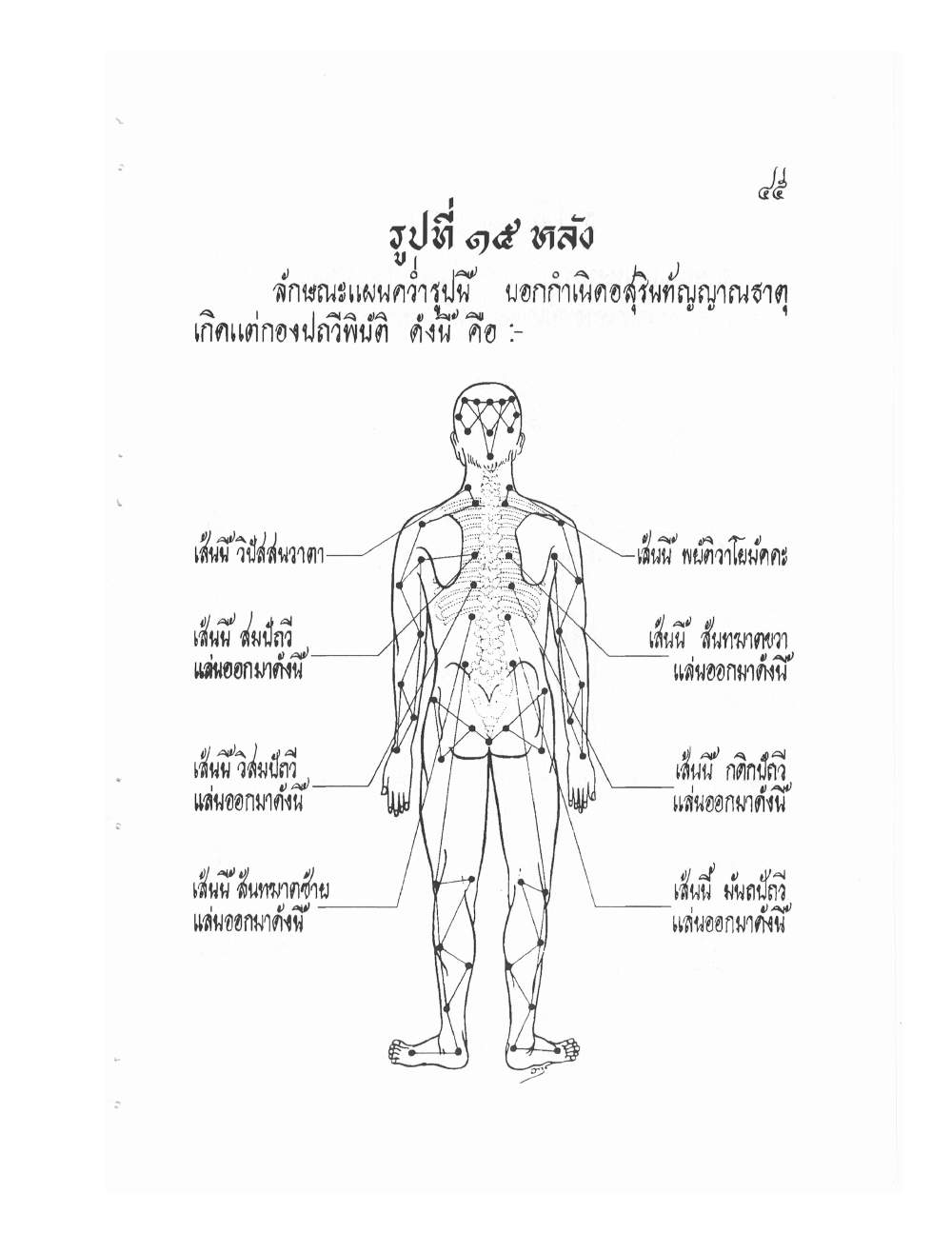
รูปที่ ๑๕ หลัง
ลักษณะแผนคว่ำรูปนี้ บอกกำเนิดอาการอันเกิดแต่ธาตุ เกิดแต่กองปถวีพิบัติ ดังนี้ คือ :-
[แผนภาพ: รูปร่างมนุษย์ยืนตรงคว่ำหน้า (มองจากด้านหลัง) มีลายจุดประตามแนวกระดูกสันหลังและกระเบนเหน็บ เส้นจำนวนมากลากจากกระดูกสันหลังแผ่ไปยังจุดต่าง ๆ บนตัว แขน ขา และศีรษะ โยงไปยังป้ายชื่อทั้งสองข้างของภาพ]
ด้านซ้าย: เส้นนี้ วิปัสสนวาตา เส้นนี้ สมปถวี แล่นออกมาดังนี้ เส้นนี้ วิสมปถวี แล่นออกมาดังนี้ เส้นนี้ สันทมาตซ้าย แล่นออกมาดังนี้
ด้านขวา: เส้นนี้ พยติวาโตมัคคะ เส้นนี้ สันทมาตขวา แล่นออกมาดังนี้ เส้นนี้ กติกปถวี แล่นออกมาดังนี้ เส้นนี้ มันทปถวี แล่นออกมาดังนี้
Figure 15, Back
This prone [face-down] diagram shows the origin of the effects arising from the elements, arising from disorder of the Pathavi (earth) category, as follows:
[diagram: a standing human figure viewed from behind, stippled shading along the spine and sacrum; numerous lines radiate from the spine out to points on the torso, arms, legs, and head, connecting to labels on both sides of the image]
Left side (labels, top to bottom): This channel: wipatsana-wata This channel: soma-pathavi, runs out thus This channel: visama-pathavi, runs out thus This channel: left santhamat, runs out thus
Right side (labels, top to bottom): This channel: phayati-wato-makka This channel: right santhamat, runs out thus This channel: katika-pathavi, runs out thus This channel: manta-pathavi, runs out thus
๔๙
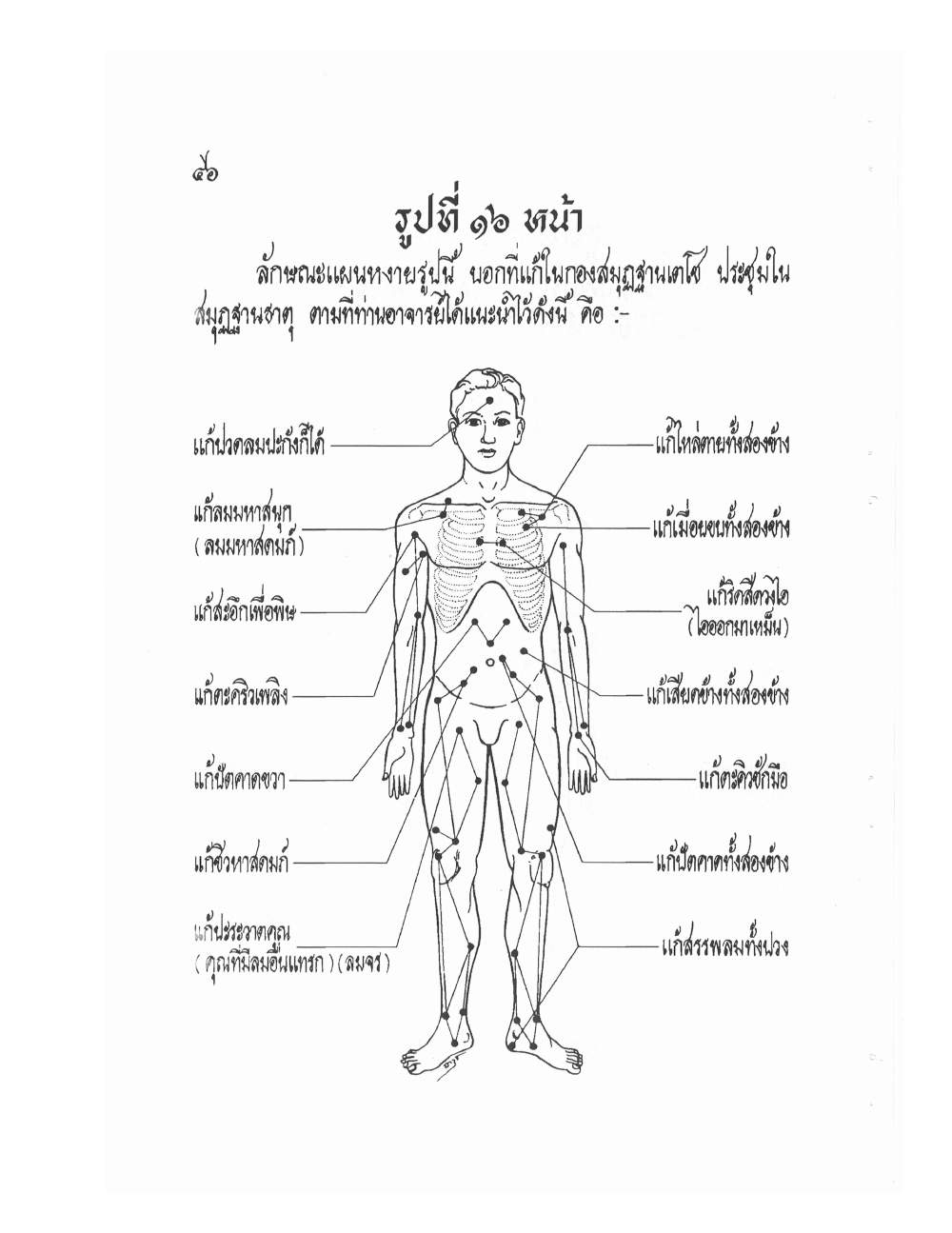
รูปที่ ๑๖ หน้า
ลักษณะแผนหงายรูปนี้ นอกที่แก้ในกองสมุฏฐานเตโช ประชุมในสมุฏฐานชาตุ ตามที่ท่านอาจารย์ได้แนะนำไว้ดังนี้ คือ :- [แผนภาพ: รูปคนยืนเปลือยหันหน้าเข้าหาผู้ดู มีจุดกำกับที่ศีรษะ อก แขน ท้อง ขา และเท้า แต่ละจุดเชื่อมด้วยเส้นไปยังข้อความกำกับทางซ้ายและขวา] แก้ปวดลมปะกังกิ์ได้ — แก้ลมมหาสมุก (ลมมหาสดมภ์) — แก้สะอึกเพื่อพิษ — แก้ตะคริวเพลิง — แก้ปัตคาดขวา — แก้ชิวหาสดมภ์ — แก้ประวาตคุณ (คุณที่มีลมอื่นแทรก)(ลมจร) แก้ไหล่ทายทั้งสองข้าง — แก้เมื่อยขบทั้งสองข้าง — แก้ริดสีดวงไอ (ไอออกมาเหม็น) — แก้เสียดข้างทั้งสองข้าง — แก้ตะคริวชักมือ — แก้ปัตคาดทั้งสองข้าง — แก้สรรพลมทั้งปวง
49
Figure 16, Front
The characteristics of this supine [face-up] chart figure: besides treating [conditions] in the Tejo (Fire) constitution group, [these points] converge in the elemental constitution [category], as the teacher-masters have advised, as follows:-
[diagram: nude standing figure facing the viewer, with points marked on the head, chest, arms, abdomen, legs, and feet, each connected by a line to a caption at left or right]
Left-side captions: Treats wind-pain of the "pakang" type — Treats mahasamuk wind (mahasadom wind) — Treats hiccups from poison — Treats "fire cramp" — Treats right-side pat-khat [muscle/tendon strain] — Treats tongue paralysis (chiwha-sadom) — Treats pra-wat-khun [a condition where another wind has intruded] (traveling wind) Right-side captions: Treats shoulder pain, both sides — Treats aching/soreness, both sides — Treats piles-cough (coughing with foul breath) — Treats stitch pain in the side, both sides — Treats cramp with hand spasm — Treats pat-khat, both sides — Treats all winds generally
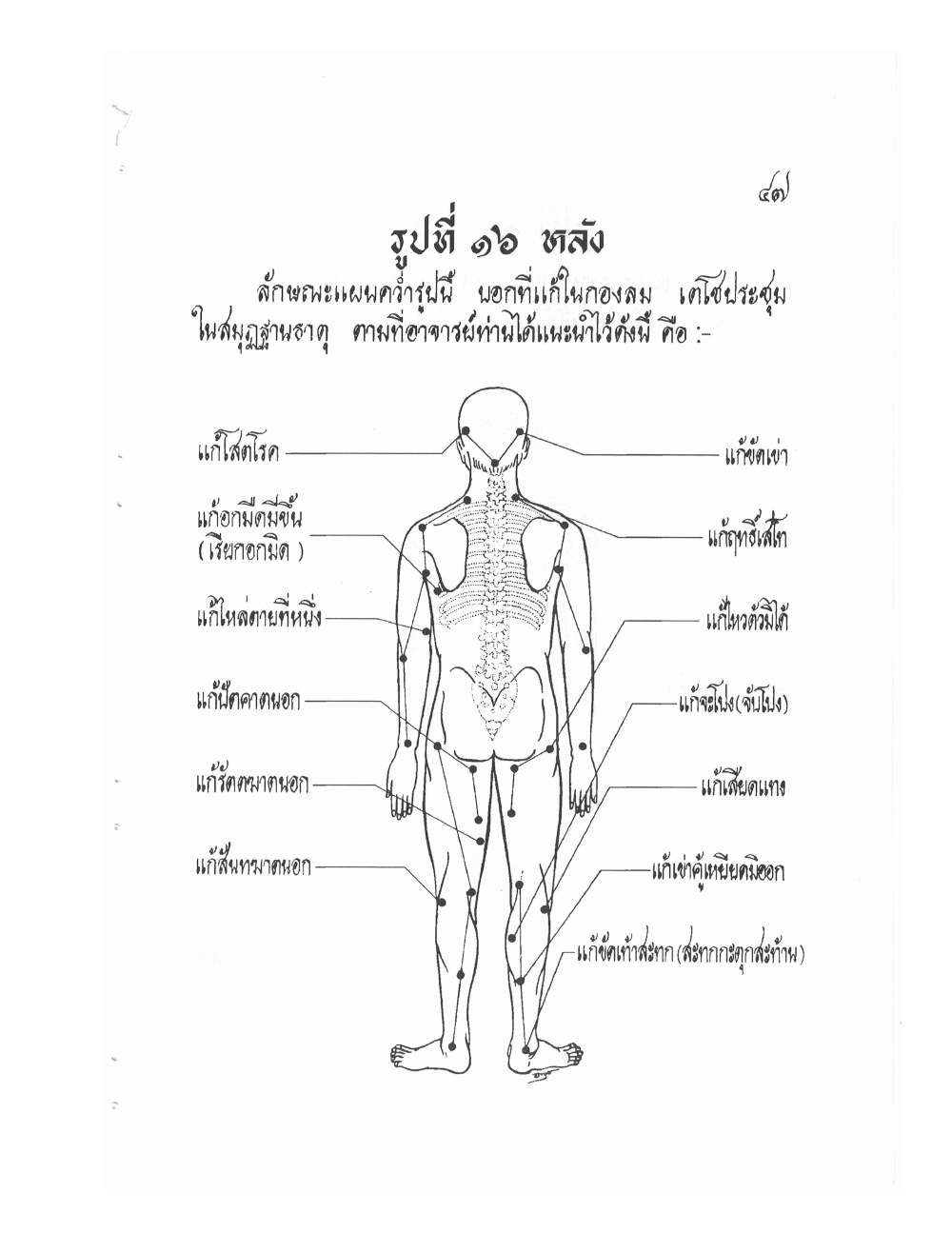
๕๐
รูปที่ ๑๖ หลัง
ลักษณะแผนคว่ำรูปนี้ นอกที่แก้ในกองลม เตโชประชุม ในสมุฏฐานธาตุ ตามที่อาจารย์ท่านได้แนะนำไว้ดังนี้ คือ :- [แผนภาพ: รูปคนยืนเปลือยหันหลังให้ผู้ดู มีจุดกำกับที่ศีรษะ คอ หลัง สะโพก แขน ขา และเท้า แต่ละจุดเชื่อมด้วยเส้นไปยังข้อความกำกับทางซ้ายและขวา] แก้โสตโรค — แก้อกมืดมึนขึ้น (เรียกอกมิด) — แก้ไหล่ตายที่หนึ่ง — แก้ปัตคาดนอก — แก้รัตฆาตนอก — แก้สัพทมาดนอก แก้ขัดเข่า — แก้ฤทธิ์เสโท — แก้ไหวตัวมิได้ — แก้จะโปง (จันโปง) — แก้เสียดแทง — แก้เข่าคู้เหยียดมิออก — แก้ขัดเท้าสะทก (สะทกกะดุกสะท้าน)
50
Figure 16, Back
The characteristics of this prone [face-down] chart figure: besides treating [conditions] in the Wind group, converging with Tejo [Fire], in the elemental constitution, as the teacher-master has advised, as follows:-
[diagram: nude standing figure with back to the viewer, with points marked on the head, neck, back, hips, arms, legs, and feet, each connected by a line to a caption at left or right]
Left-side captions: Treats ear disease — Treats darkening/dizziness of the chest (called "om-mid", a blocked chest) — Treats a dead/numb shoulder (first point) — Treats outer pat-khat — Treats outer rat-khat [strain injury] — Treats outer sap-tha-mat Right-side captions: Treats a stiff knee — Treats the effect of sweat — Treats inability to move the body — Treats "cha-pong" ("chan-pong") swelling — Treats stabbing pain — Treats a knee that cannot bend or straighten — Treats a hindered/jarred foot (trembling, bone-jarring)
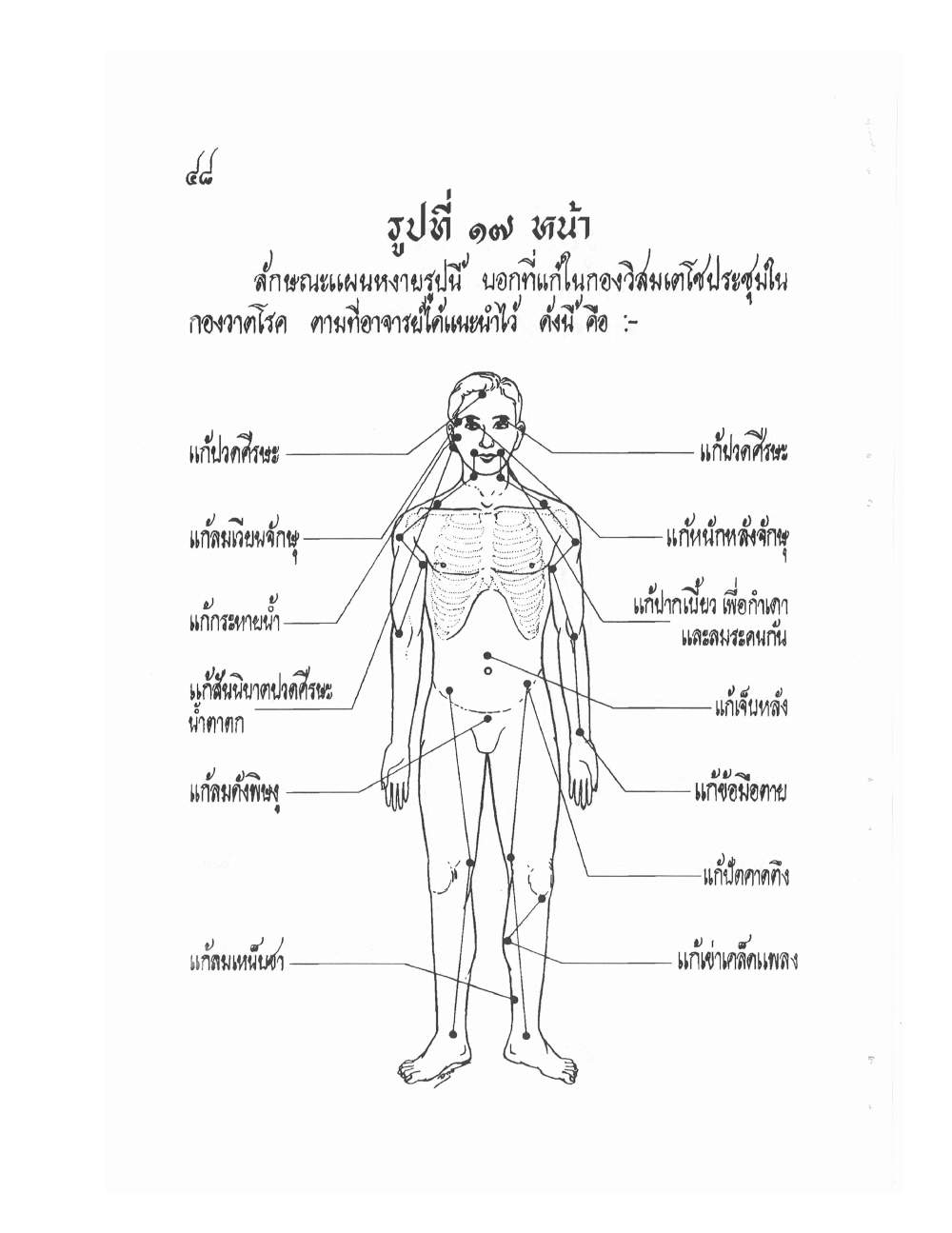
๕๑
รูปที่ ๑๗ หน้า
ลักษณะแผนหงายรูปนี้ นอกที่แก้ในกองวิสมเตโชประชุมใน กองวาตโรค ตามที่อาจารย์ได้แนะนำไว้ ดังนี้ คือ :- [แผนภาพ: รูปคนยืนเปลือยหันหน้าเข้าหาผู้ดู มีจุดกำกับที่ศีรษะ อก ท้อง แขน ขา และเท้า แต่ละจุดเชื่อมด้วยเส้นไปยังข้อความกำกับทางซ้ายและขวา] แก้ปวดศีรษะ — แก้ลมเวียนจักษุ — แก้กระทายน้ำ — แก้สัมพินาตปวดศีรษะ น้ำตาตก — แก้ลมดังพิษ — แก้ลมเหน็บชา แก้ปวดศีรษะ — แก้หนักหลังจักษุ — แก้ปากเบี้ยว เพื่อกำเดาและลมระคนกัน — แก้เจ็บหลัง — แก้ข้อมือตาย — แก้ปัตคาดตึง — แก้เข่าเคล็ดแพลง
51
Figure 17, Front
The characteristics of this supine chart figure: besides treating [conditions] in the Visama-Tejo [irregular Fire] group, converging in the Wind-disease group, as the teacher-master has advised, as follows:-
[diagram: nude standing figure facing the viewer, with points marked on the head, chest, abdomen, arms, legs, and feet, each connected by a line to a caption at left or right]
Left-side captions: Treats headache — Treats wind causing dizzy eyes — Treats "krathai" water [a swelling/wasting condition] — Treats sannibat [combined-humor] headache with tearing eyes — Treats poison-like wind — Treats numbness/tingling wind Right-side captions: Treats headache — Treats heaviness behind the eyes — Treats a crooked mouth [facial palsy], due to head-wind/nosebleed and mixed winds — Treats back pain — Treats a dead/numb wrist — Treats tight pat-khat — Treats a sprained/twisted knee
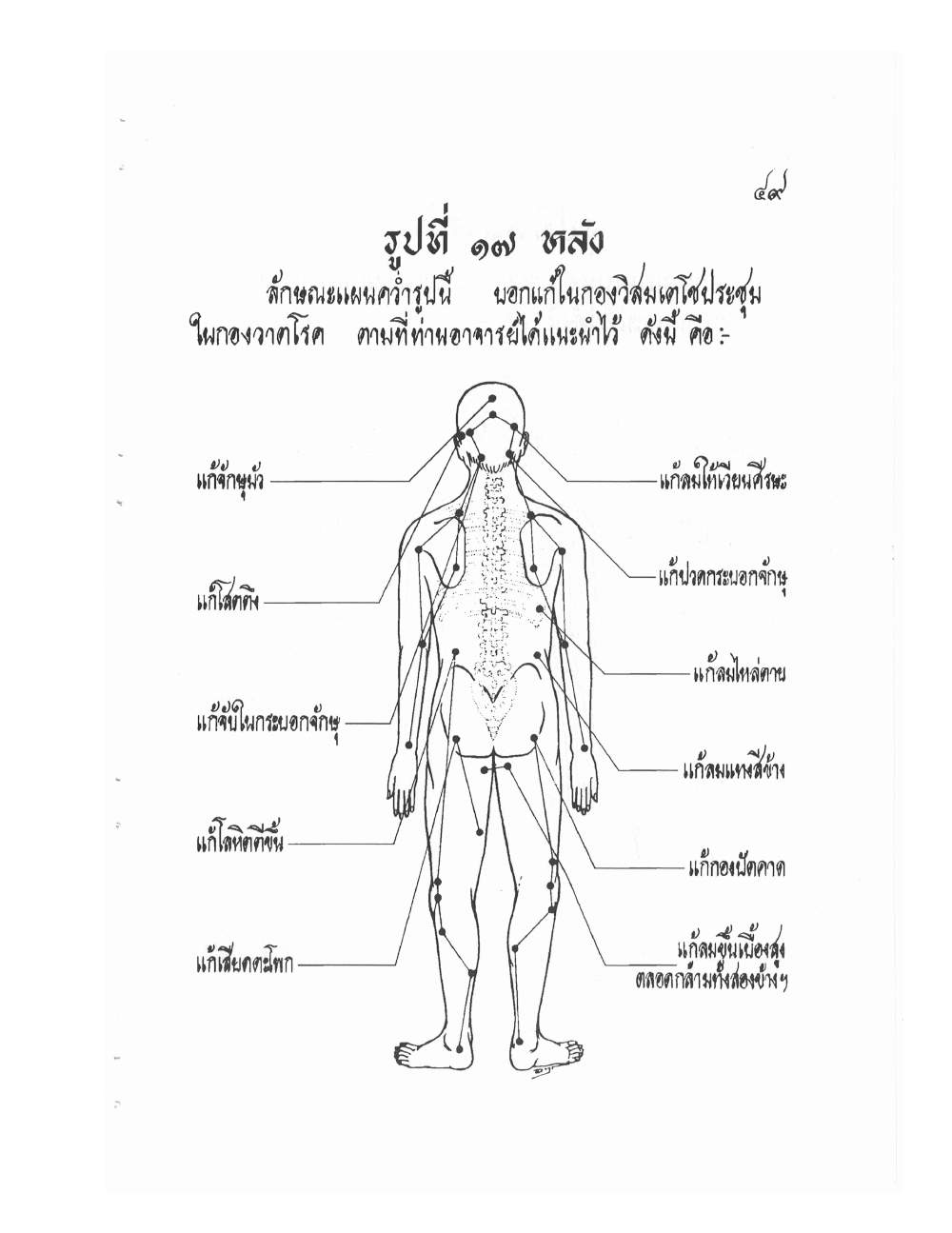
๕๒
รูปที่ ๑๗ หลัง
ลักษณะแผนคว่ำรูปนี้ นอกแก้ในกองวิสมเตโชประชุม ในกองวาตโรค ตามที่ท่านอาจารย์ได้แนะนำไว้ ดังนี้ คือ :- [แผนภาพ: รูปคนยืนเปลือยหันหลังให้ผู้ดู มีจุดกำกับที่ศีรษะ คอ หลัง สะโพก แขน ขา และเท้า แต่ละจุดเชื่อมด้วยเส้นไปยังข้อความกำกับทางซ้ายและขวา] แก้จักษุมัว — แก้โลหิตวิ่ง — แก้จับในกระบอกจักษุ — แก้โลหิตดีขึ้น — แก้เสียดตะโพก แก้ลมให้เวียนศีรษะ — แก้ปวดกระบอกจักษุ — แก้ลมไหล่ตาย — แก้ลมแห้งสีข้าง — แก้กองปัตคาด — แก้ลมขึ้นเบื้องสูง ตลอดกล้ามทั้งสองข้างๆ
52
Figure 17, Back
The characteristics of this prone chart figure: besides treating [conditions] in the Visama-Tejo group, converging in the Wind-disease group, as the teacher-master has advised, as follows:-
[diagram: nude standing figure with back to the viewer, with points marked on the head, neck, back, hips, arms, legs, and feet, each connected by a line to a caption at left or right]
Left-side captions: Treats blurred vision — Treats running/wandering blood — Treats a seizure/spasm in the eye socket — Treats blood that surges/rises — Treats stitch pain in the hip Right-side captions: Treats wind causing dizziness — Treats pain in the eye socket — Treats wind causing a dead/numb shoulder — Treats wind drying out the flank — Treats the pat-khat group [general strain] — Treats wind rising upward, throughout the muscles on both sides
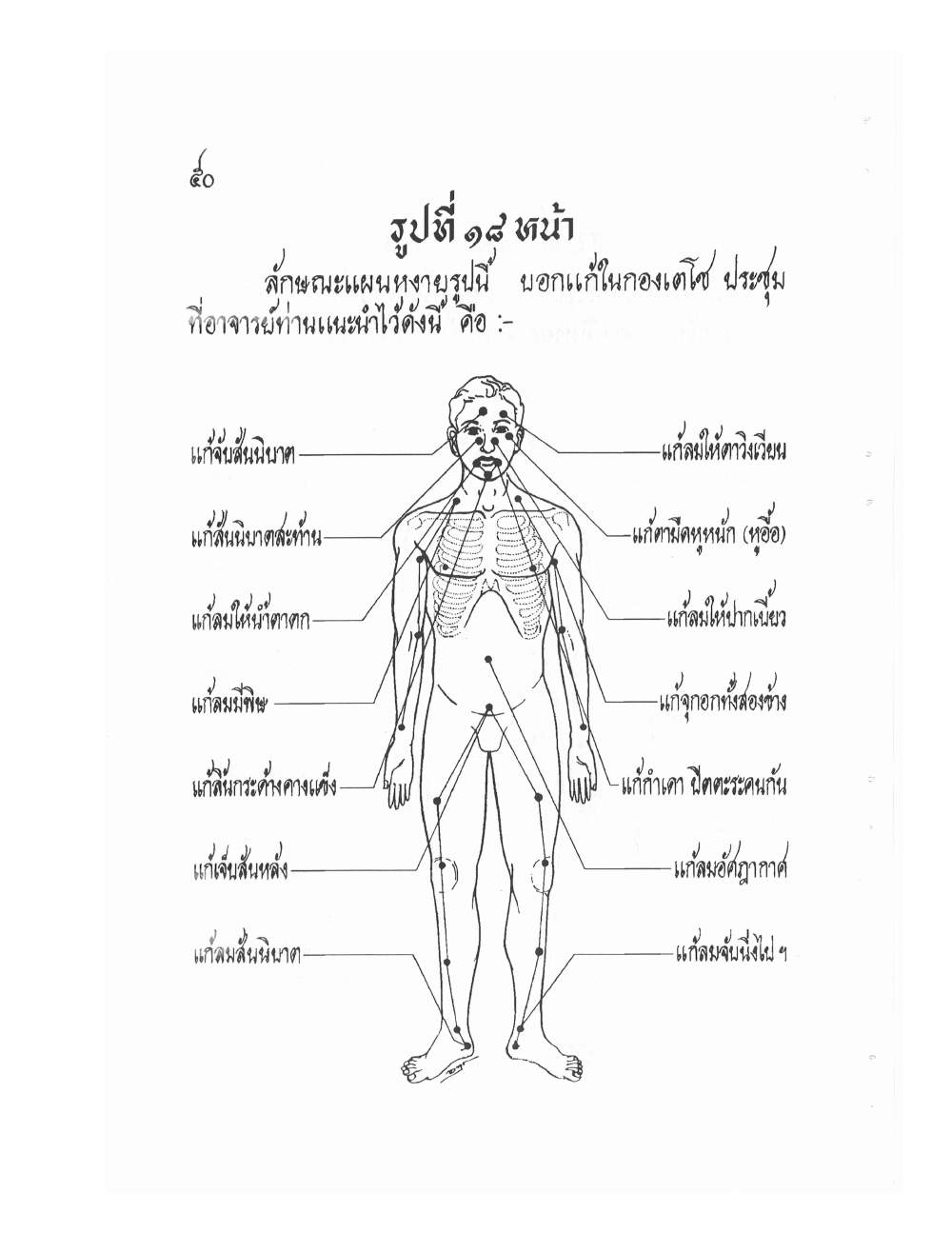
๕๓
รูปที่ ๑๘ หน้า
ลักษณะแผนหงายรูปนี้ นอกที่แก้ในกองเตโช ประชุมที่อาจารย์ท่านแนะนำไว้ดังนี้ คือ :- [แผนภาพ: รูปคนยืนเปลือยหันหน้าเข้าหาผู้ดู มีจุดกำกับที่ศีรษะ อก ท้อง ขาหนีบ แขน ขา และเท้า แต่ละจุดเชื่อมด้วยเส้นไปยังข้อความกำกับทางซ้ายและขวา] แก้จับสันนิบาต — แก้สันนิบาตละท้าน — แก้ลมให้น้ำตาตก — แก้ลมมีพิษ — แก้ลิ้นกระด้างคางแข็ง — แก้เจ็บสันหลัง — แก้ลมสันนิบาต แก้ลมให้ตาวิงเวียน — แก้ตามืดหูหนัก (หูอื้อ) — แก้ลมให้ปากเบี้ยว — แก้จุกอกทั้งสองข้าง — แก้กำเดา ฝีตะระคนกัน — แก้ลมอัษฎากาศ — แก้ลมจับนิ่งไปๆ
53
Figure 18, Front
The characteristics of this supine chart figure: besides treating [conditions] in the Tejo [Fire] group, [these points] converge as the teacher-master has advised, as follows:-
[diagram: nude standing figure facing the viewer, with points marked on the head, chest, abdomen, groin, arms, legs, and feet, each connected by a line to a caption at left or right]
Left-side captions: Treats seizure from sannibat [combined-humor disorder] — Treats sannibat with tremor — Treats wind causing tearing eyes — Treats poisoned wind — Treats a stiff tongue and locked jaw — Treats pain along the spine — Treats sannibat wind Right-side captions: Treats wind causing dizzy vision — Treats dim sight and heavy hearing (ringing ears) — Treats wind causing a crooked mouth — Treats chest tightness, both sides — Treats nosebleed mixed with abscess-wind — Treats "atsadakat" wind [an eightfold/joint wind ailment] — Treats wind that settles and lingers
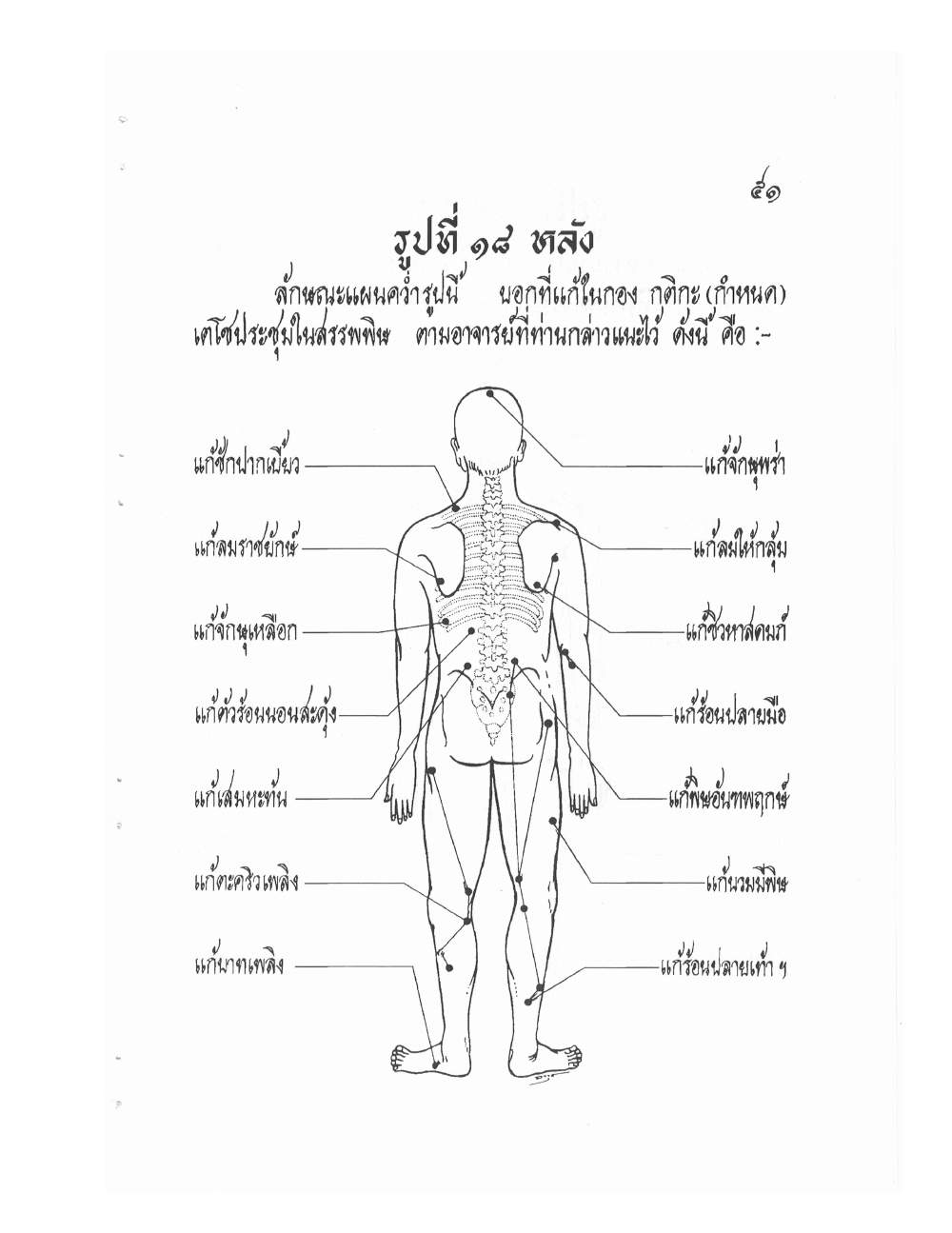
๕๔
รูปที่ ๑๘ หลัง
ลักษณะแผนคว่ำรูปนี้ นอกที่แก้ในกอง กติกะ (กำหนด) เตโชประชุมในสรรพพิษ ตามอาจารย์ที่ท่านกล่าวแนะไว้ ดังนี้ คือ :- [แผนภาพ: รูปคนยืนเปลือยหันหลังให้ผู้ดู มีจุดกำกับที่ศีรษะ คอ หลัง สะโพก แขน ขา และเท้า แต่ละจุดเชื่อมด้วยเส้นไปยังข้อความกำกับทางซ้ายและขวา] แก้ชักปากเบี้ยว — แก้ลมราชยักษ์ — แก้จักษุเหลือก — แก้ตัวร้อนนอนสะดุ้ง — แก้เสมหะทัน — แก้ตะคริวเพลิง — แก้บาทเพลิง แก้จักษุพร่า — แก้ลมให้กลุ้ม — แก้ชิวหาสดมภ์ — แก้ร้อนปลายมือ — แก้พิษอันตพฤกษ์ — แก้นวมพิษ — แก้ร้อนปลายเท้าๆ
54
Figure 18, Back
The characteristics of this prone chart figure: besides treating [conditions] in the Katika (defined/fixed) group, converging with Tejo [Fire] in general poisoning, as the teacher-master has stated and advised, as follows:-
[diagram: nude standing figure with back to the viewer, with points marked on the head, neck, back, hips, arms, legs, and feet, each connected by a line to a caption at left or right]
Left-side captions: Treats convulsive crooked mouth [facial palsy] — Treats "racha-yak" wind [a severe wind ailment] — Treats bulging/staring eyes — Treats fever with restless sleep — Treats phlegm blockage — Treats "fire cramp" — Treats "fire foot" Right-side captions: Treats dim/blurred eyesight — Treats wind causing distress/oppression — Treats tongue paralysis (chiwha-sadom) — Treats heat at the fingertips — Treats poison from the internal organs [antaphruek] — Treats poisoned swelling — Treats heat at the toe-tips
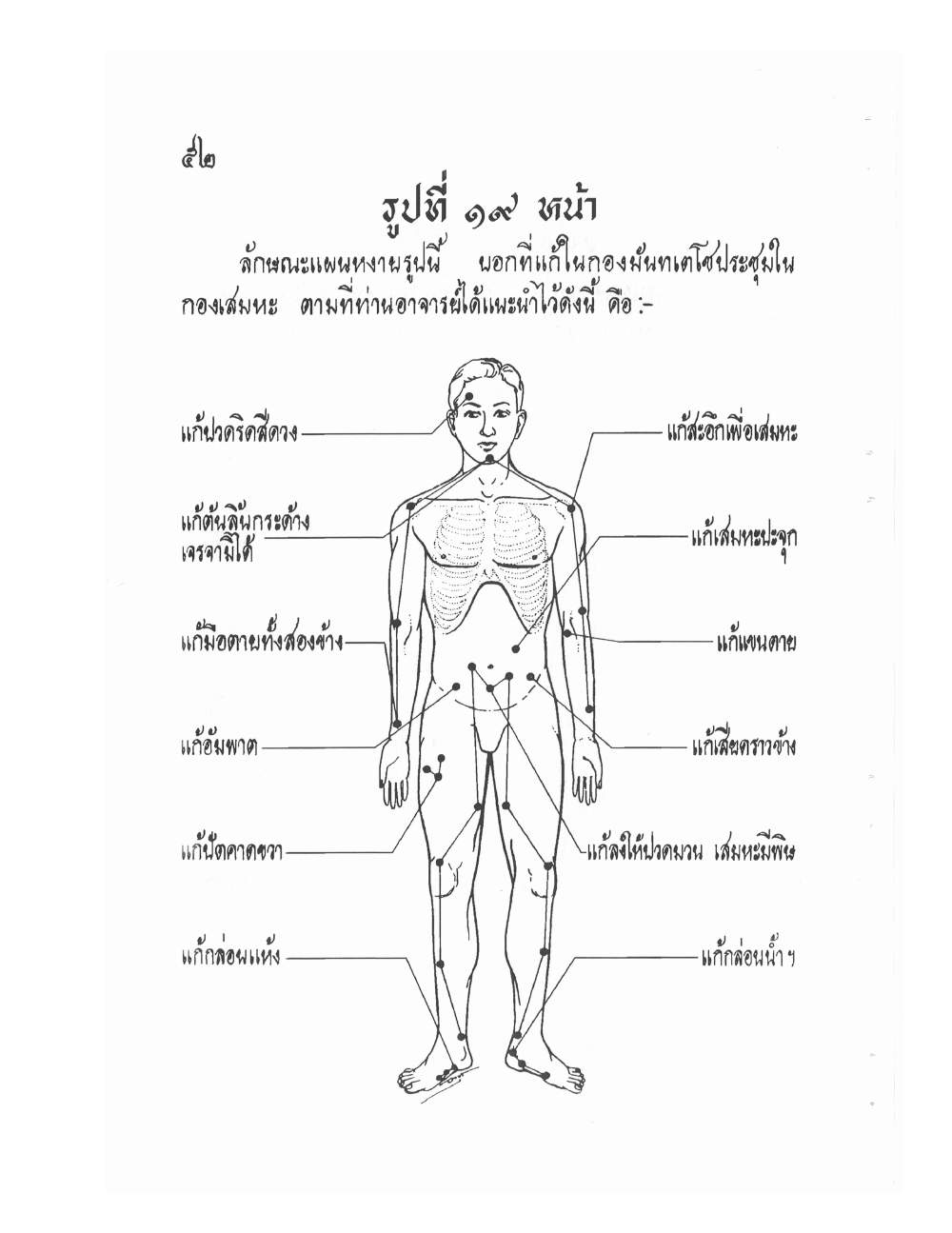
๕๕
รูปที่ ๑๙ หน้า
ลักษณะแผนหงายรูปนี้ นอกที่แก้ในกองมันทเตโชประชุมใน กองเสมหะ ตามที่ท่านอาจารย์ได้แนะนำไว้ดังนี้ คือ :- [แผนภาพ: รูปคนยืนเปลือยหันหน้าเข้าหาผู้ดู มีจุดกำกับที่ศีรษะ อก ท้อง ขาหนีบ แขน ขา และเท้า แต่ละจุดเชื่อมด้วยเส้นไปยังข้อความกำกับทางซ้ายและขวา] แก้ปวดริดสีดวง — แก้ตัวลิ้นกระด้าง เจรจามิได้ — แก้มือตายทั้งสองข้าง — แก้อัมพาต — แก้ปัตคาดขวา — แก้กล่อนแห้ง แก้สะอึกเพื่อเสมหะ — แก้เสมหะปะจุก — แก้แขนตาย — แก้เสียดราวข้าง — แก้ลงให้ปวดมวน เสมหะมีพิษ — แก้กล่อนน้ำๆ
55
Figure 19, Front
The characteristics of this supine chart figure: besides treating [conditions] in the Manda-Tejo [sluggish Fire] group, converging in the Phlegm group, as the teacher-master has advised, as follows:-
[diagram: nude standing figure facing the viewer, with points marked on the head, chest, abdomen, groin, arms, legs, and feet, each connected by a line to a caption at left or right]
Left-side captions: Treats hemorrhoid pain — Treats a stiff tongue, unable to speak — Treats dead/numb hands, both sides — Treats paralysis (hemiplegia) — Treats right-side pat-khat — Treats "dry klon" [a hernia-type wasting condition] Right-side captions: Treats hiccup from phlegm — Treats phlegm congestion — Treats a dead/numb arm — Treats stitch pain along the side — Treats diarrhea with cramping pain, poisoned phlegm — Treats "watery klon"
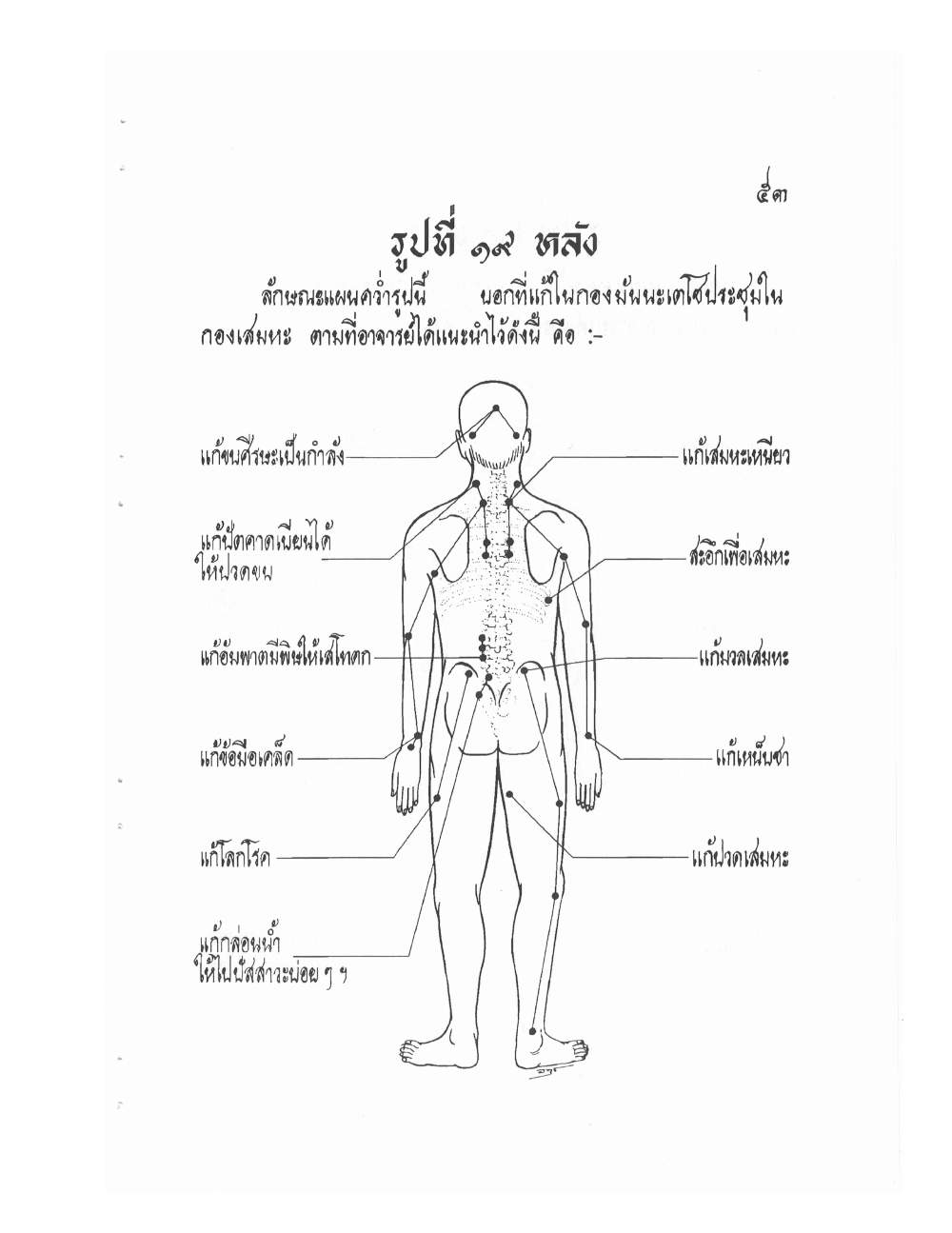
๕๖
รูปที่ ๑๙ หลัง
ลักษณะแผนคว่ำรูปนี้ นอกที่แก้ในกองมันนะเตโชประชุมใน กองเสมหะ ตามที่อาจารย์ได้แนะนำไว้ดังนี้ คือ :- [แผนภาพ: รูปคนยืนเปลือยหันหลังให้ผู้ดู มีจุดกำกับที่ศีรษะ คอ หลัง สะโพก แขน ขา และเท้า แต่ละจุดเชื่อมด้วยเส้นไปยังข้อความกำกับทางซ้ายและขวา] แก้ขมศีรษะเป็นกำลัง — แก้ปัตคาดเมียได้ ให้ปวดขบ — แก้อัมพาตมีพิษให้เสโทตก — แก้ข้อมือเคล็ด — แก้โลกโรค — แก้กล่อนน้ำ ให้ไฝผุสสาวะบ่อยๆ แก้เสมหะเหนียว — สะอึกเพื่อเสมหะ — แก้มวลเสมหะ — แก้เหน็บชา — แก้ปวดเสมหะ
56
Figure 19, Back
The characteristics of this prone chart figure: besides treating [conditions] in the Manda-Tejo [sluggish Fire] group, converging in the Phlegm group, as the teacher-master has advised, as follows:-
[diagram: nude standing figure with back to the viewer, with points marked on the head, neck, back, hips, arms, legs, and feet, each connected by a line to a caption at left or right]
Left-side captions: Treats severe heaviness/numbness of the head — Treats pat-khat, causing gnawing pain — Treats poisoned paralysis with excess sweating — Treats a sprained wrist — Treats "loka-rok" [a wasting/consumptive disease] — Treats watery klon causing frequent urination Right-side captions: Treats sticky phlegm — Hiccup from phlegm — Treats a mass of phlegm — Treats numbness/tingling — Treats phlegm-pain
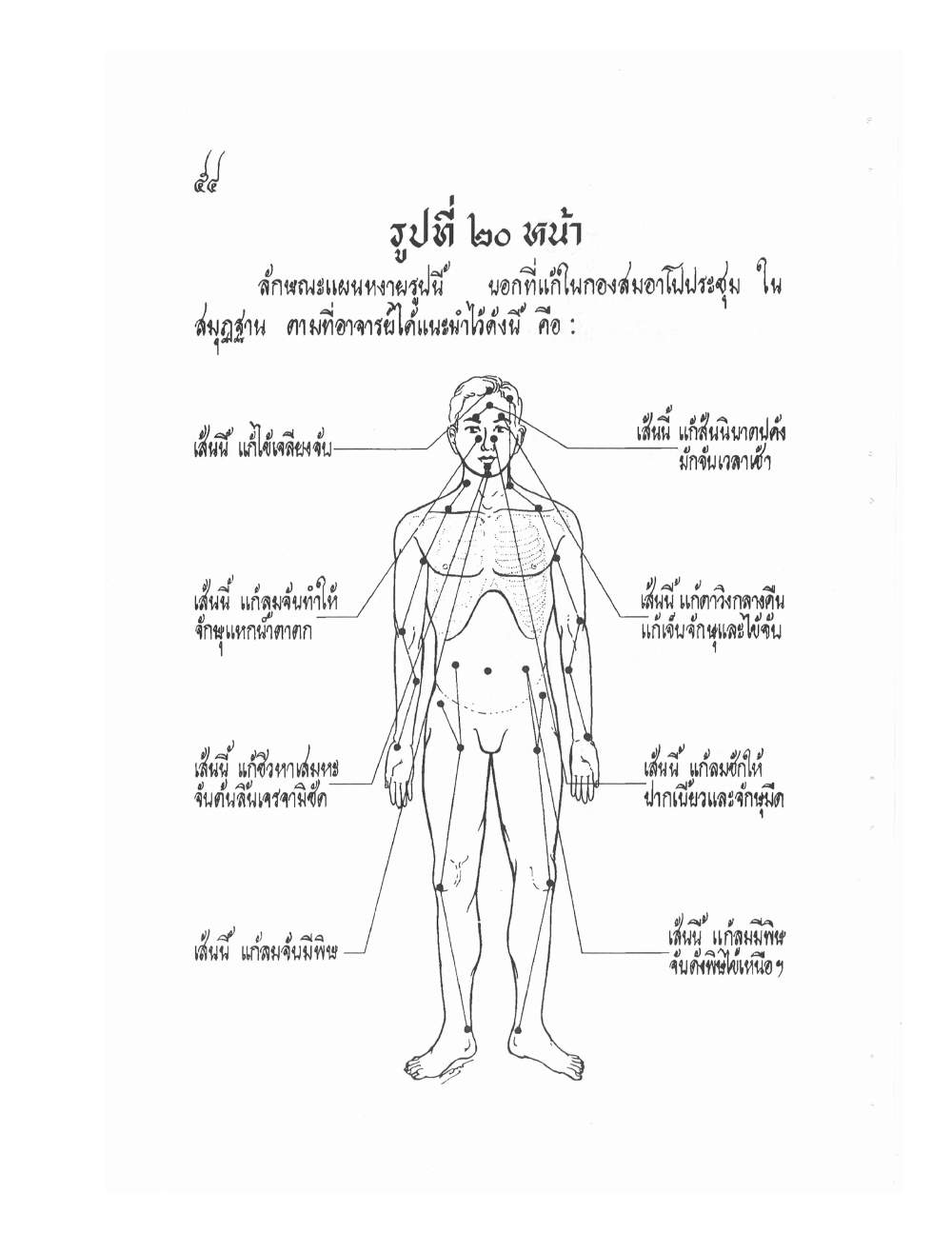
๕๗
รูปที่ ๒๐ หน้า
ลักษณะแผนหงายรูปนี้ บอกที่แก้ในกองสมอาโปประชุม ใน สมุฏฐาน ตามที่อาจารย์ได้แนะนำไว้ดังนี้ คือ : [แผนภาพ: รูปคนยืนเปลือยหันหน้าเข้าหาผู้ดู มีเส้น(ช่อง)หลายเส้นลากจากศีรษะ อก ท้อง แขน และขา ไปยังข้อความกำกับทางซ้ายและขวา] เส้นนี้ แก้ไข้เจลียงจั่น — เส้นนี้ แก้ลมจั่นทำให้จักษุแหกน้ำตาตก — เส้นนี้ แก้ชิวหาเสมหะจั่นต้นลิ้นเจรจามิชัด — เส้นนี้ แก้ลมจั่นมีพิษ เส้นนี้ แก้สันนิบาตฝัก มักจั่นเวลาเช้า — เส้นนี้ แก้ตาวิ่งกลางคืน แก้เจ็บจักษุและไข้จั่น — เส้นนี้ แก้ลมชักให้ปากเบี้ยวและจักษุมืด — เส้นนี้ แก้ลมพิษจั่นดังพิษได้เหนือๆ
57
Figure 20, Front
The characteristics of this supine chart figure: showing what treats [conditions] in the Water-constitution group, converging in the [bodily] constitution, as the teacher-master has advised, as follows:
[diagram: nude standing figure facing the viewer, with several lines/channels drawn from the head, chest, abdomen, arms, and legs to captions at left or right]
Left-side captions: This channel treats "chaliang-chan" fever — This channel treats intermittent wind that makes the eyes bulge open and tear — This channel treats tongue-and-phlegm blockage at the root of the tongue causing unclear speech — This channel treats poisoned intermittent wind Right-side captions: This channel treats sannibat fever, often striking in the morning — This channel treats night eye-trouble, treats eye pain and intermittent fever — This channel treats convulsive wind causing a crooked mouth and darkened vision — This channel treats poison-hives-type wind, resembling poison, in the upper body
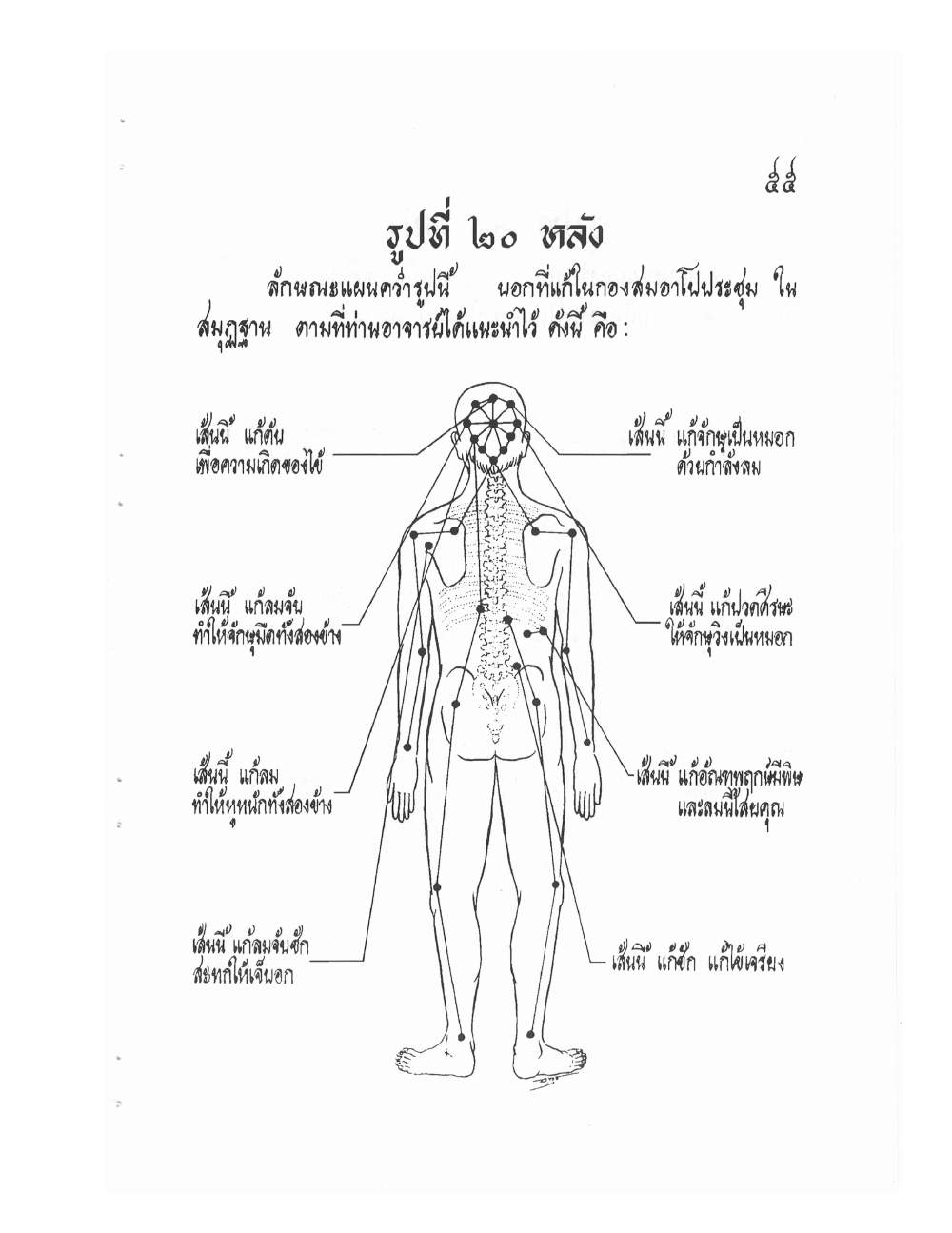
๕๘
รูปที่ ๒๐ หลัง
ลักษณะแผนคว่ำรูปนี้ นอกที่แก้ในกองสมอาโปประชุม ใน สมุฏฐาน ตามที่ท่านอาจารย์ได้แนะนำไว้ ดังนี้ คือ : [แผนภาพ: รูปคนยืนเปลือยหันหลังให้ผู้ดู มีเส้นหลายเส้นลากจากศีรษะ คอ หลัง แขน และขา ไปยังข้อความกำกับทางซ้ายและขวา] เส้นนี้ แก้ต้นเพื่อความเกิดของไข้ — เส้นนี้ แก้ลมจับทำให้จักษุมืดทั้งสองข้าง — เส้นนี้ แก้ลมทำให้หูหนักทั้งสองข้าง — เส้นนี้ แก้ลมจับซักสะทกให้เจ็บอก เส้นนี้ แก้จักษุเป็นหมอกด้วยกำลังลม — เส้นนี้ แก้ปวดศีรษะให้จักษุวิ่งเป็นหมอก — เส้นนี้ แก้อัณฑพฤกษ์มีพิษและลมมีเส้นคาว — เส้นนี้ แก้ชัก แก้ไข้เจรียง
58
Figure 20, Back
The characteristics of this prone chart figure: besides treating [conditions] in the Water-constitution group, converging in the [bodily] constitution, as the teacher-master has advised, as follows:
[diagram: nude standing figure with back to the viewer, with several lines drawn from the head, neck, back, arms, and legs to captions at left or right]
Left-side captions: This channel treats the origin of fever — This channel treats a wind seizure causing darkened vision in both eyes — This channel treats wind causing heavy hearing in both ears — This channel treats wind seizure with convulsive shaking causing chest pain Right-side captions: This channel treats vision clouded like fog from strong wind — This channel treats headache causing vision to blur like fog — This channel treats poisoned swelling of the scrotum and wind affecting the channel — This channel treats convulsions, treats intermittent fever
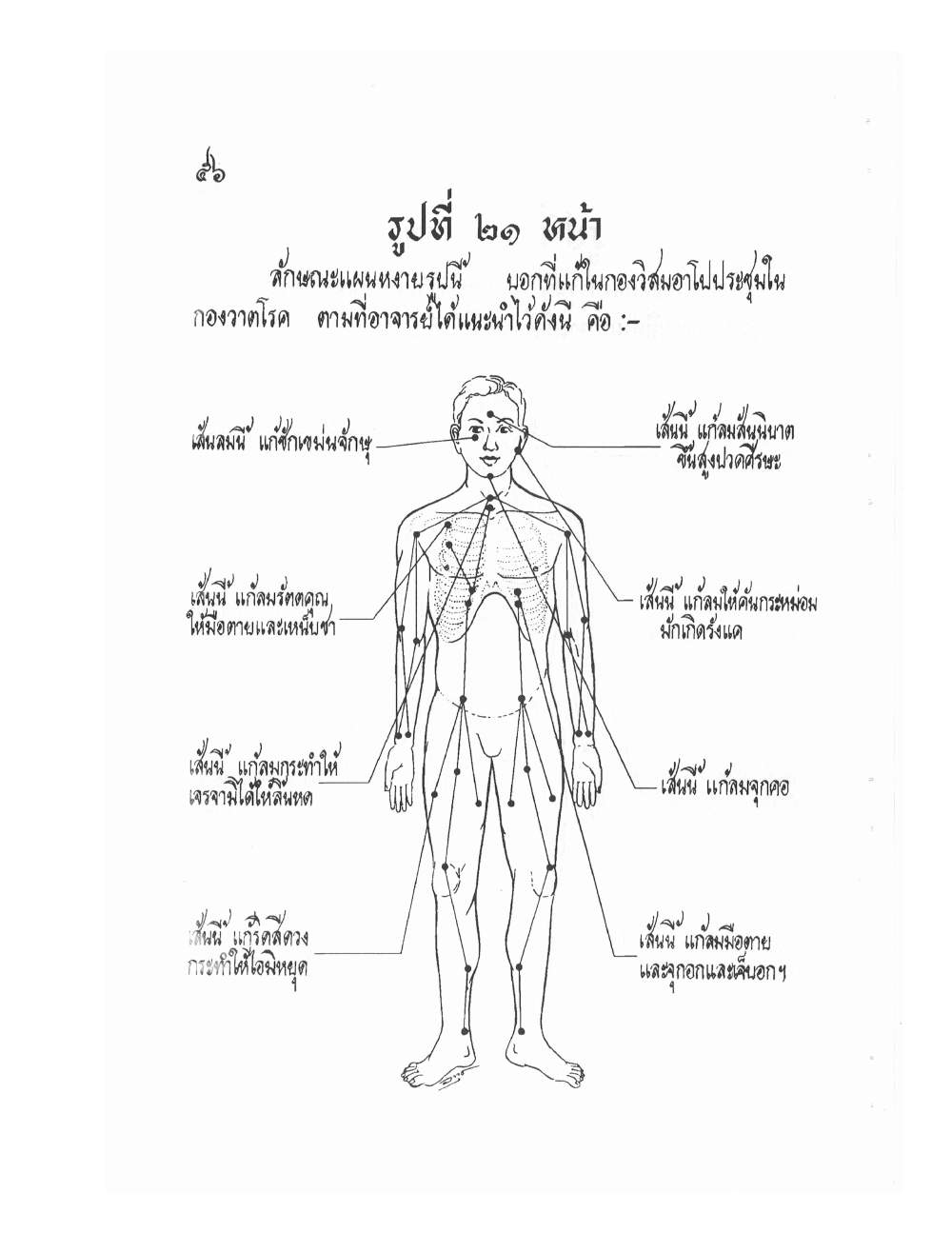
๕๙
รูปที่ ๒๑ หน้า
ลักษณะแผนหงายรูปนี้ บอกที่แก้ในกองวิสมอาโปประชุมใน กองวาตโรค ตามที่อาจารย์ได้แนะนำไว้ดังนี้ คือ :- [แผนภาพ: รูปคนยืนเปลือยหันหน้าเข้าหาผู้ดู มีเส้นหลายเส้นลากจากศีรษะ อก ท้อง แขน และขา ไปยังข้อความกำกับทางซ้ายและขวา] เส้นลมนี้ แก้ชักเขม่นจักษุ — เส้นนี้ แก้ลมรัตคุณให้มือตายและเหน็บชา — เส้นนี้ แก้ลมกระทำให้เจรจามิได้ให้ลิ้นหด — เส้นนี้ แก้ริดสีดวง กระทำให้ไอมิหยุด เส้นนี้ แก้ลมสันนิบาตขึ้นสูงปวดศีรษะ — เส้นนี้ แก้ลมให้ดันกระหม่อมมักเกิดรังแค — เส้นนี้ แก้ลมจุกคอ — เส้นนี้ แก้ลมมือตายและจุกอกและเจ็บอกๆ
59
Figure 21, Front
The characteristics of this supine chart figure: showing what treats [conditions] in the Visama-Apo [irregular Water] group, converging in the Wind-disease group, as the teacher-master has advised, as follows:-
[diagram: nude standing figure facing the viewer, with several lines drawn from the head, chest, abdomen, arms, and legs to captions at left or right]
Left-side captions: This wind-channel treats a twitching eyelid — This channel treats rat-khun wind causing dead hands and numbness/tingling — This channel treats wind causing an inability to speak and a retracted tongue — This channel treats hemorrhoids causing incessant coughing Right-side captions: This channel treats sannibat wind rising high, causing headache — This channel treats wind pressing at the fontanelle, often causing dandruff — This channel treats wind causing throat blockage — This channel treats wind causing dead hands, chest tightness, and chest pain
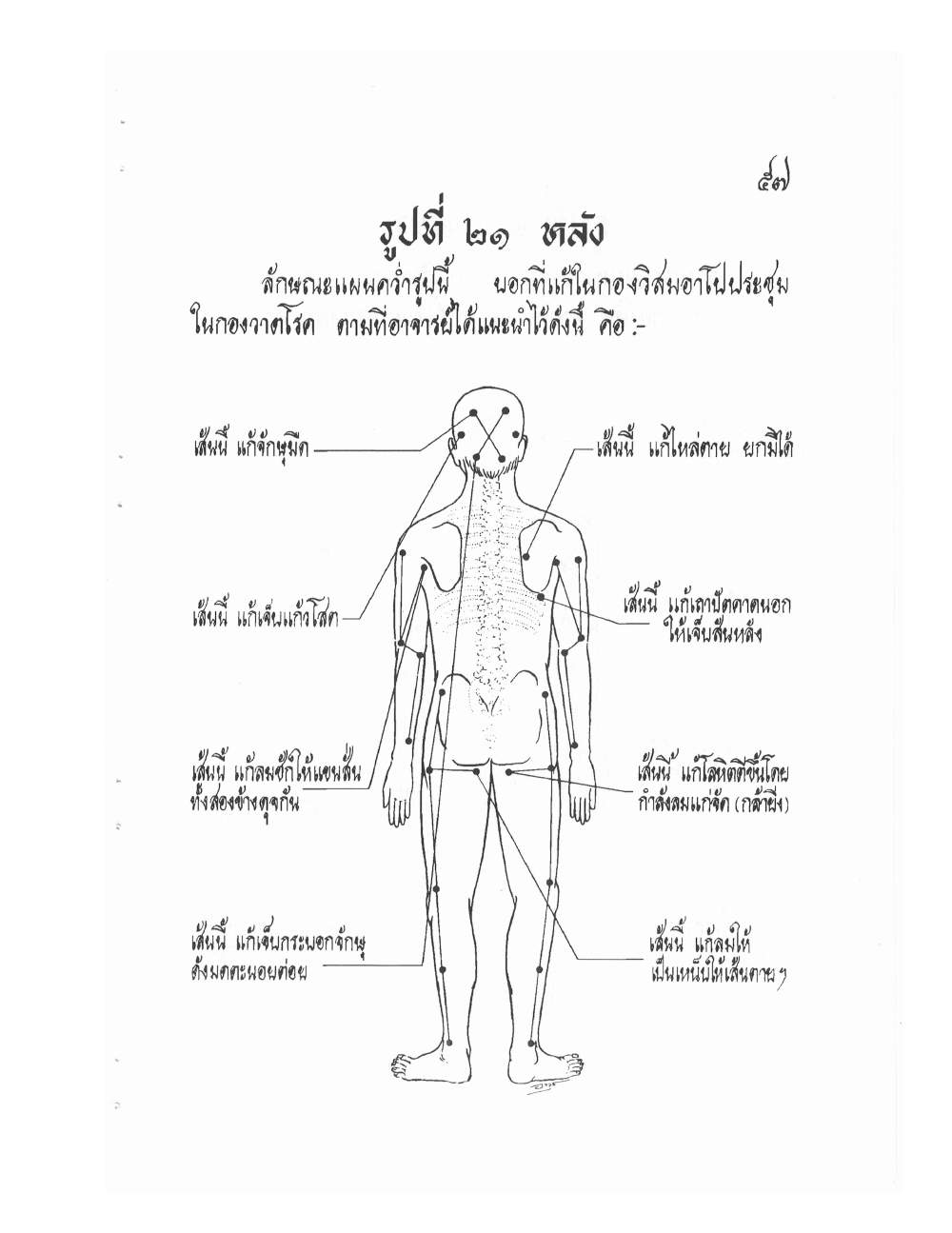
๖๐
รูปที่ ๒๑ หลัง
ลักษณะแผนคว่ำรูปนี้ นอกที่แก้ในกองวิสมอาโปประชุม ในกองวาตโรค ตามที่อาจารย์ได้แนะนำไว้ดังนี้ คือ :- [แผนภาพ: รูปคนยืนเปลือยหันหลังให้ผู้ดู มีเส้นหลายเส้นลากจากศีรษะ คอ หลัง แขน และขา ไปยังข้อความกำกับทางซ้ายและขวา] เส้นนี้ แก้จักษุมืด — เส้นนี้ แก้เจ็บแก้วโสต — เส้นนี้ แก้ลมชักให้แขนสั่นทั้งสองข้างตุกกัน — เส้นนี้ แก้เจ็บกระบอกจักษุดังมดคะนอยต่อย เส้นนี้ แก้ไหล่ตาย ยกมิได้ — เส้นนี้ แก้เถาปัตคาดนอกให้เจ็บสันหลัง — เส้นนี้ แก้โลหิตตีขึ้นโดยกำลังลมแล่นจัด (กล้ายิ่ง) — เส้นนี้ แก้ลมให้เป็นเหน็บให้เส้นตายๆ
60
Figure 21, Back
The characteristics of this prone chart figure: besides treating [conditions] in the Visama-Apo [irregular Water] group, converging in the Wind-disease group, as the teacher-master has advised, as follows:-
[diagram: nude standing figure with back to the viewer, with several lines drawn from the head, neck, back, arms, and legs to captions at left or right]
Left-side captions: This channel treats darkened vision — This channel treats ear-canal pain — This channel treats convulsive wind causing both arms to tremble/twitch together — This channel treats eye-socket pain like ants biting Right-side captions: This channel treats a dead shoulder, unable to lift — This channel treats the outer pat-khat vine causing spinal pain — This channel treats blood surging upward from strong, fast-running wind (very intense) — This channel treats wind causing numbness, deadening the channels
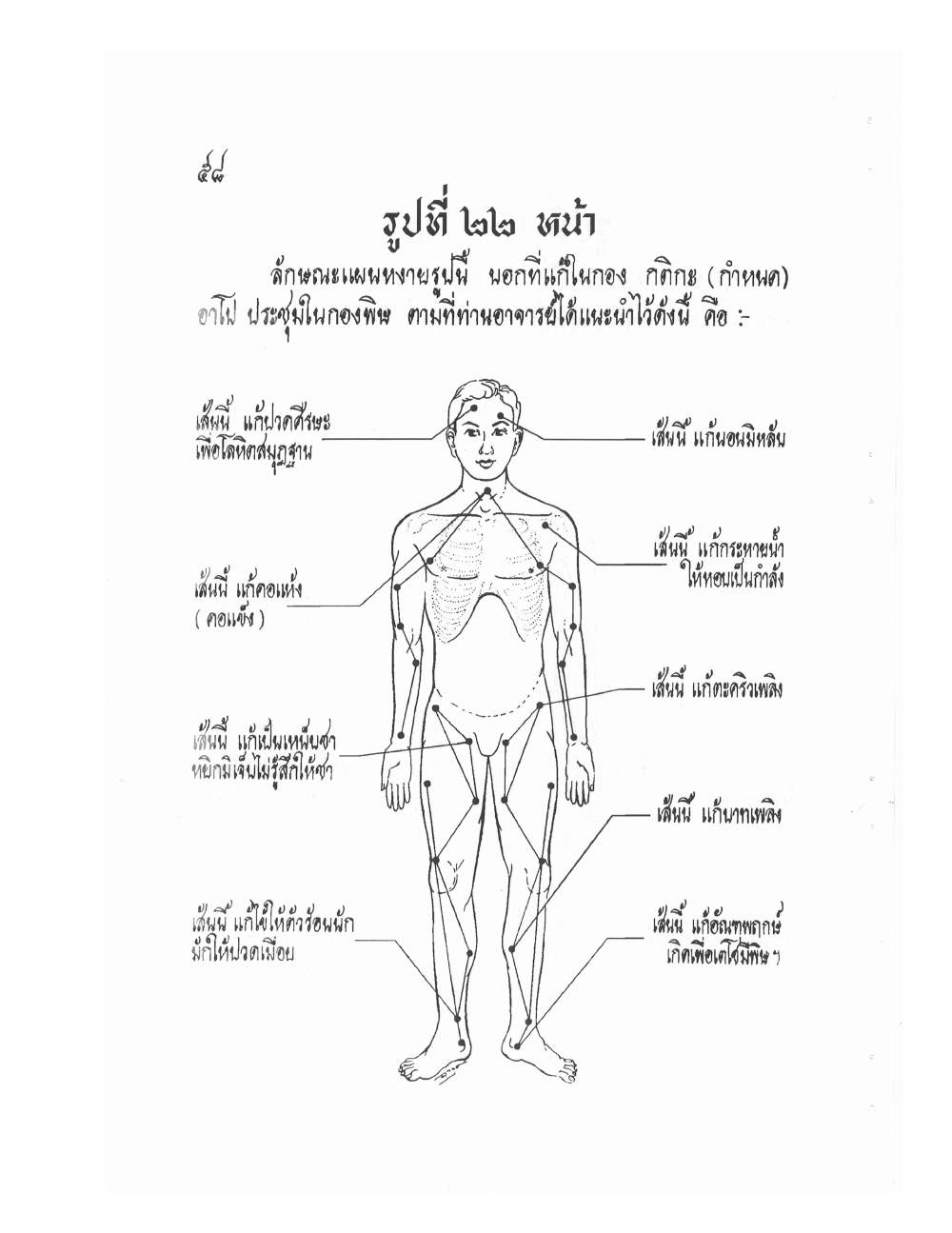
๕๘
รูปที่ ๒๒ หน้า
ลักษณะแผนหงายรูปนี้ บอกที่แก้ในกองกติกอาโป (กำหนด) ประชุมในกองพิษ ตามที่ท่านอาจารย์ได้แนะนำไว้ดังนี้ คือ :-
[ภาพ: รูปคนยืนตรงมองจากด้านหน้า มีจุดกำกับที่ศีรษะ คอ อก ท้อง แขน ขา และเท้า แต่ละจุดโยงเส้นออกไปยังข้อความอธิบายสรรพคุณของเส้นนั้นๆ รายล้อมรูป]
เส้นนี้ แก้ปวดศีรษะ เพื่อโลหิตสมุฏฐาน เส้นนี้ แก้นอนมิหลับ เส้นนี้ แก้คอแห้ง (คอแข็ง) เส้นนี้ แก้กระหายน้ำ ให้หอบเป็นกำลัง เส้นนี้ แก้เป็นเหน็บชา หยิกมิเจ็บไม่รู้สึกให้ชา เส้นนี้ แก้ตะคริวเพลิง เส้นนี้ แก้ไข้ให้ตัวร้อนผัก มักให้ปวดเมื่อย เส้นนี้ แก้บาทเพลิง เส้นนี้ แก้อัณฑพฤกษ์ เกิดเพื่อเตโชพิษ ฯ
58
Figure 22, Front
This chart of the supine (face-up) figure shows the remedies within the stipulated (กำหนด) Water [Apo]-element group, gathered within the Poison group, as the teacher has advised, as follows:
[Diagram: a standing human figure seen from the front, with points marked on the head, neck, chest, abdomen, arms, legs, and feet; each point is connected by a line to a caption describing what that line cures, arranged around the figure]
- This line cures headache, when it arises from a blood cause. - This line cures insomnia. - This line cures a dry throat (stiff neck). - This line cures thirst, and strengthens against panting/breathlessness. - This line cures numbness and tingling — when pinched it does not hurt or feel anything, and goes numb. - This line cures "fire cramps" (ตะคริวเพลิง). - This line cures fever that makes the body burn hot, and often causes aching. - This line cures "fire-foot" (บาทเพลิง). - This line cures swelling of the testicles, arising from Fire-element poison.
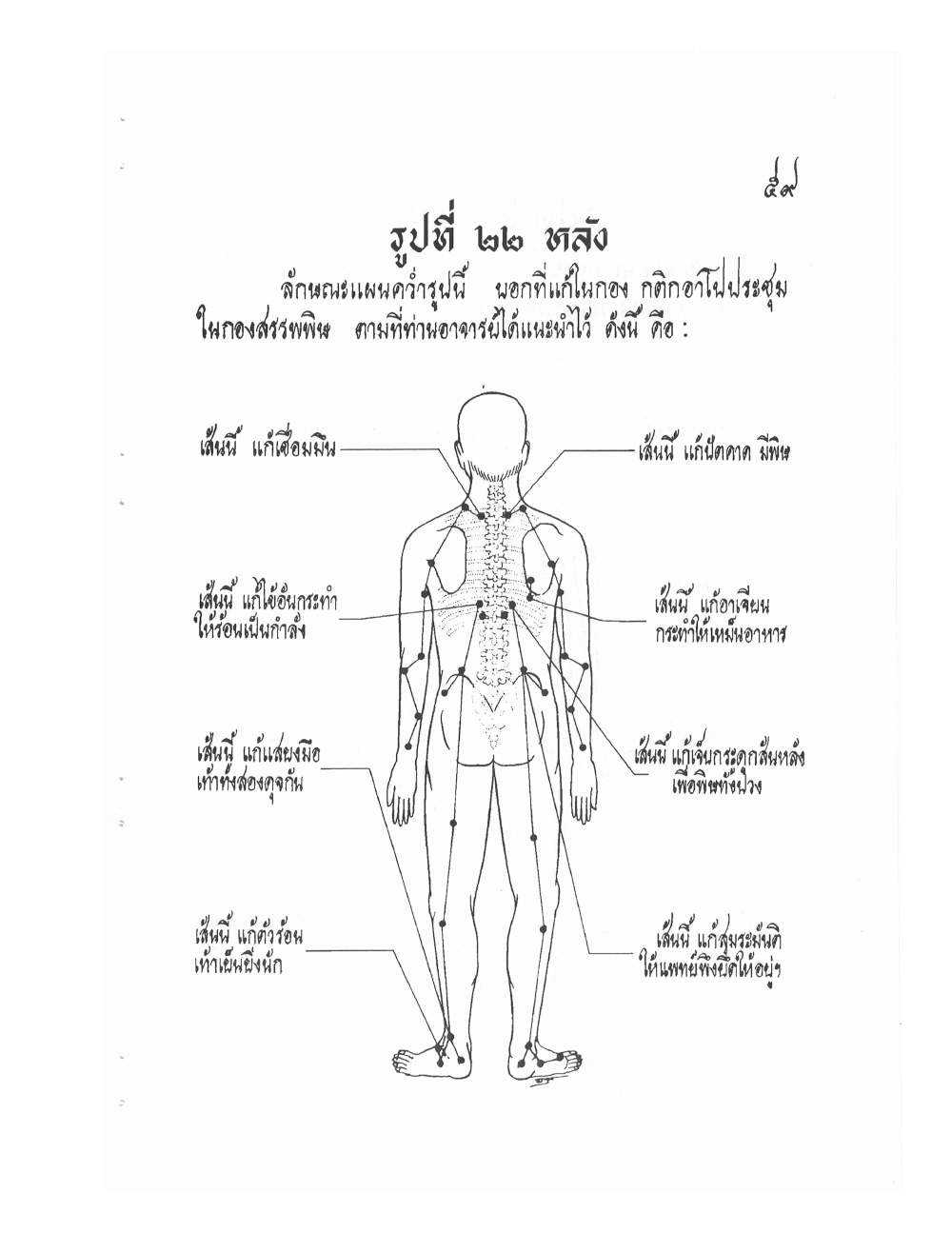
๕๙
รูปที่ ๒๒ หลัง
ลักษณะแผนคว่ำรูปนี้ บอกที่แก้ในกอง กติกอาโปประชุมในกองสรรพพิษ ตามที่ท่านอาจารย์ได้แนะนำไว้ ดังนี้ คือ :-
[ภาพ: รูปคนยืนตรงมองจากด้านหลัง เห็นแนวกระดูกสันหลัง มีจุดกำกับที่คอ หลัง เอว แขน ขา และเท้า แต่ละจุดโยงเส้นออกไปยังข้อความอธิบายสรรพคุณของเส้นนั้นๆ รายล้อมรูป]
เส้นนี้ แก้เสื่อมมึน เส้นนี้ แก้นัตคาด มีพิษ เส้นนี้ แก้ไข้อันกระทำให้ร้อนเป็นกำลัง เส้นนี้ แก้อาเจียน กระทำให้เหม็นอาหาร เส้นนี้ แก้แสยงมือเท้าทั้งสองดุจกัน เส้นนี้ แก้เจ็บกระดูกสันหลัง เพื่อพิษทั้งปวง เส้นนี้ แก้ตัวร้อน เท้าเย็นยิ่งนัก เส้นนี้ แก้สุมระมันติ ให้แพทย์พึงยึดให้อยู่ ๆ
59
Figure 22, Back
This chart of the prone (face-down) figure shows the remedies within the stipulated Water [Apo] group, gathered within the group of all poisons, as the teacher has advised, as follows:
[Diagram: a standing human figure seen from behind, showing the line of the spine, with points marked at the neck, back, waist, arms, legs, and feet; each point is connected by a line to a caption]
- This line cures dullness/mental fog. - This line cures "nat-khat" (a poisonous ailment). - This line cures fever that causes strong heat. - This line cures vomiting, when it makes food smell foul [to the sufferer]. - This line cures trembling of both hands and feet alike. - This line cures pain in the spine, from every kind of poison. - This line cures a hot body with very cold feet. - This line cures "sum-ra-manti" [an unsteady, feverish condition] — the physician should hold [the limb/patient] steady.
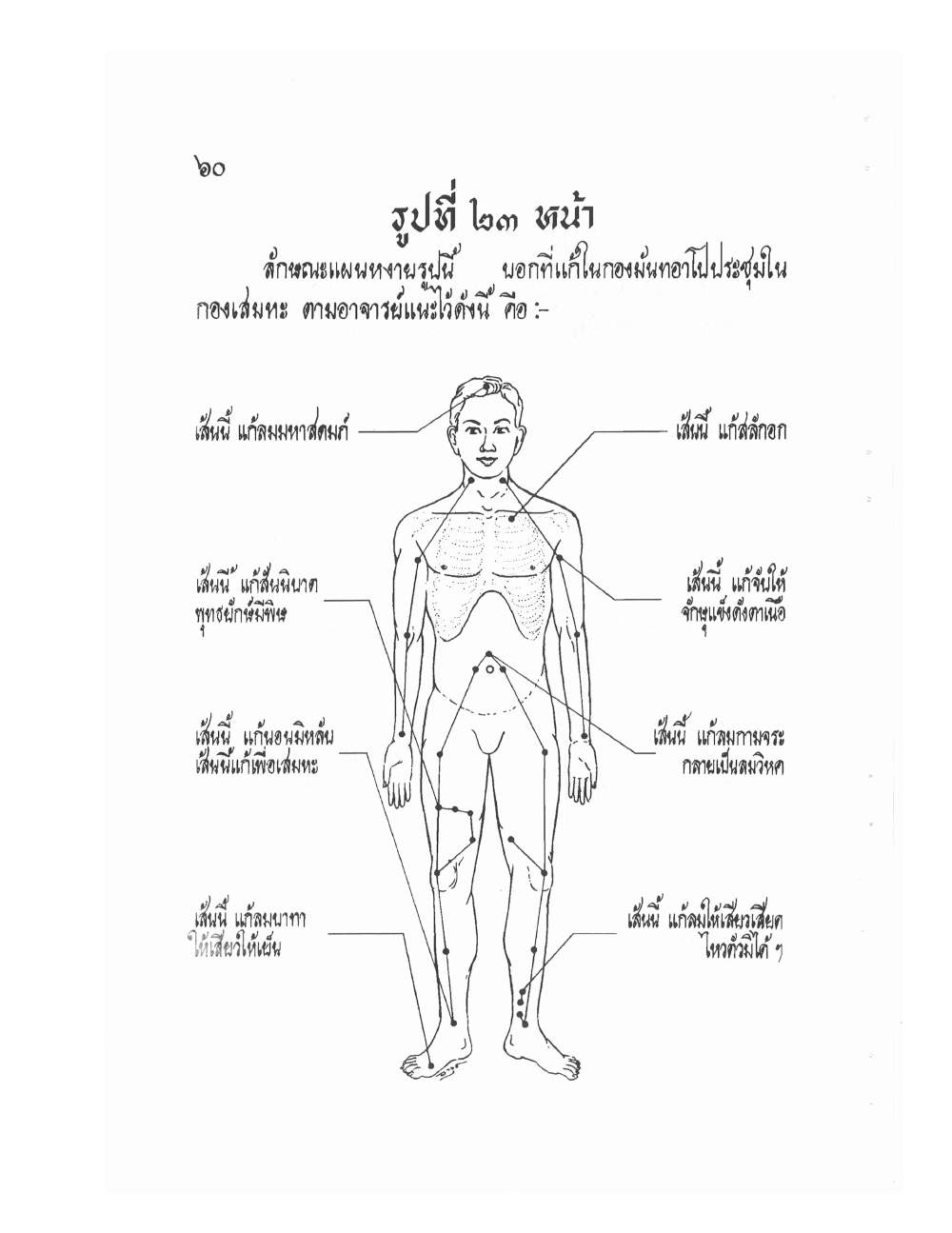
๖๐
รูปที่ ๒๓ หน้า
ลักษณะแผนหงายรูปนี้ บอกที่แก้ในกองมันทาโปประชุมใน กองเสมหะ ตามอาจารย์แนะไว้ดังนี้ คือ :-
[ภาพ: รูปคนยืนตรงมองจากด้านหน้า มีจุดกำกับที่ศีรษะ คอ อก สะดือ แขน ขา และเท้า แต่ละจุดโยงเส้นออกไปยังข้อความอธิบายสรรพคุณของเส้นนั้นๆ รายล้อมรูป]
เส้นนี้ แก้ลมมหาสดมภ์ เส้นนี้ แก้สลักอก เส้นนี้ แก้สันนิบาต พุทธยักษ์มีพิษ ฯ เส้นนี้ แก้จันให้จักษุแข็งดังตาเนื้อ เส้นนี้ แก้นอนมิหลับ เส้นนี้แก้เพื่อเสมหะ เส้นนี้ แก้ลมกามจร กลายเป็นลมวิหค เส้นนี้ แก้ลมพาท ให้เสียวให้เย็น เส้นนี้ แก้ลมให้เสียวเสียด ไหวตัวมิได้ ฯ
60
Figure 23, Front
This chart of the supine figure shows the remedies within the "manta-apo" group, gathered within the Phlegm (เสมหะ) group, as the teacher has advised, as follows:
[Diagram: a standing human figure seen from the front, with points marked on the head, neck, chest, navel, arms, legs, and feet; each point is connected by a line to a caption]
- This line cures the "great pillar wind" (ลมมหาสดมภ์, a paralysing wind-condition). - This line cures "chest-splitting" (สลักอก). - This line cures sannibāt [combined-humor] fever, [when it turns into] the poisonous "Buddha-giant" fever. - This line cures [a condition] that makes the eyes fix and stare as though made of flesh. - This line cures insomnia; this line also cures conditions of Phlegm. - This line cures the wandering-desire wind, which turns into the "bird wind" (ลมวิหค). - This line cures the wind of paralysis (ลมพาท), which gives a feeling of chill. - This line cures a wind that causes stabbing pain, so that the body cannot move.
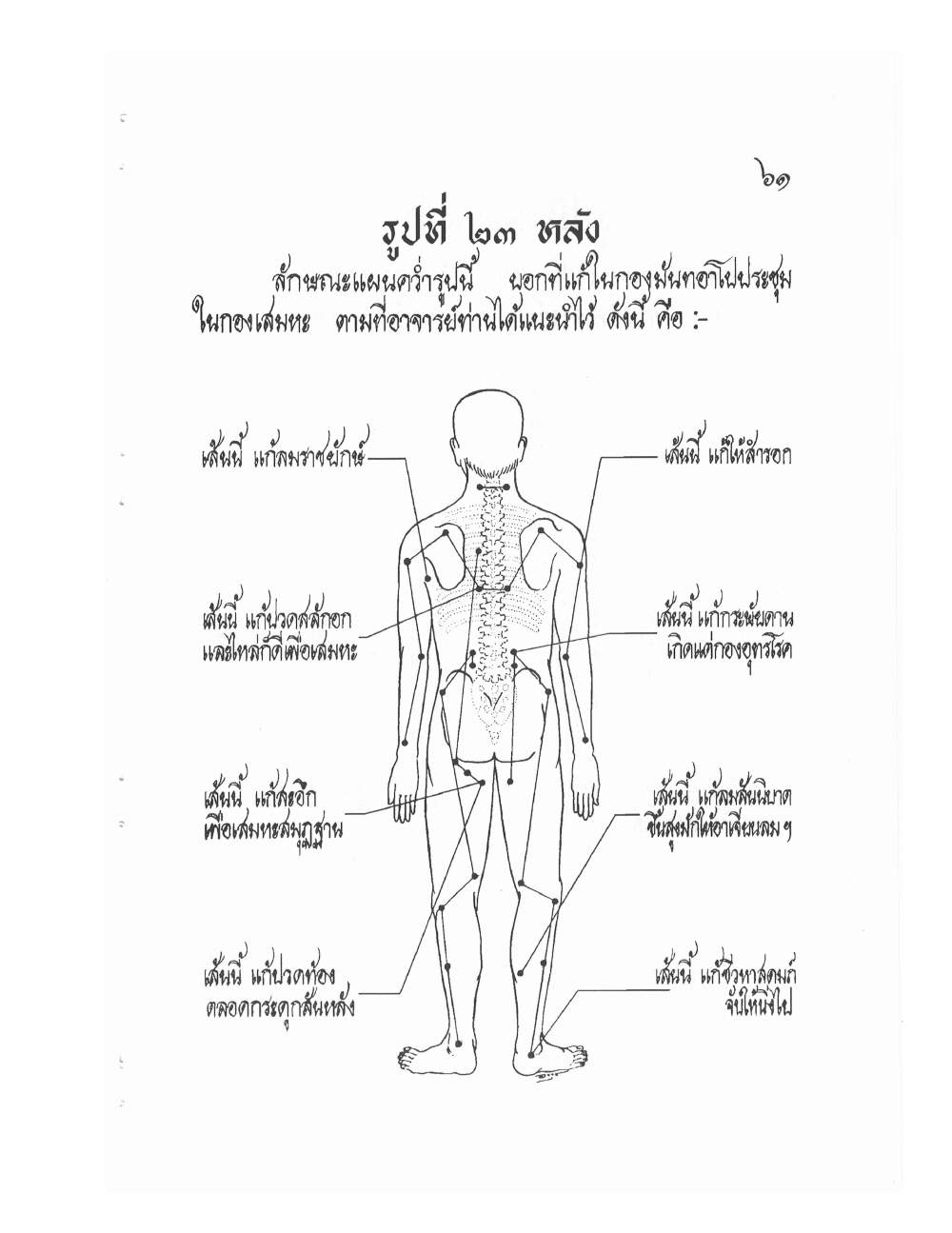
๖๑
รูปที่ ๒๓ หลัง
ลักษณะแผนคว่ำรูปนี้ บอกที่แก้ในกองมันทาโปประชุมในกองเสมหะ ตามที่อาจารย์ท่านได้แนะนำไว้ ดังนี้ คือ :-
[ภาพ: รูปคนยืนตรงมองจากด้านหลัง เห็นแนวกระดูกสันหลัง มีจุดกำกับที่คอ หลัง เอว แขน ขา และเท้า แต่ละจุดโยงเส้นออกไปยังข้อความอธิบายสรรพคุณของเส้นนั้นๆ รายล้อมรูป]
เส้นนี้ แก้ลมราชยักษ์ เส้นนี้ แก้ให้สำรอก เส้นนี้ แก้ปวดสลักอกและไหล่กดดีเพื่อเสมหะ เส้นนี้ แก้กระษัยดาน เกิดแต่กองอุทรโรค ฯ เส้นนี้ แก้สะอึกเพื่อเสมหะลมสมุฏฐาน เส้นนี้ แก้ลมสันนิบาต ชักสูงกันให้อาเจียนลม ฯ เส้นนี้ แก้ปวดท้อง ตลอดกระดูกสันหลัง เส้นนี้ แก้ชิวหาลดมภ์ จันให้นิ่งไป
61
Figure 23, Back
This chart of the prone figure shows the remedies within the "manta-apo" group, gathered within the Phlegm group, as the teacher has advised, as follows:
[Diagram: a standing human figure seen from behind, showing the line of the spine, with points marked at the neck, back, waist, arms, legs, and feet; each point is connected by a line to a caption]
- This line cures the "royal-giant wind" (ลมราชยักษ์). - This line cures regurgitation/vomiting. - This line cures pain of chest-splitting and pressure on the shoulder, from Phlegm. - This line cures "krasai-dan" [an abdominal-mass ailment], arising from the group of stomach diseases. - This line cures hiccups, from Phlegm-and-Wind causes. - This line cures sannibāt wind, when it convulses upward and causes wind-vomiting. - This line cures stomach pain, all along the spine. - This line cures "tongue-pillar" [paralysis of the tongue] — when treated, it makes [the tongue] fall still.
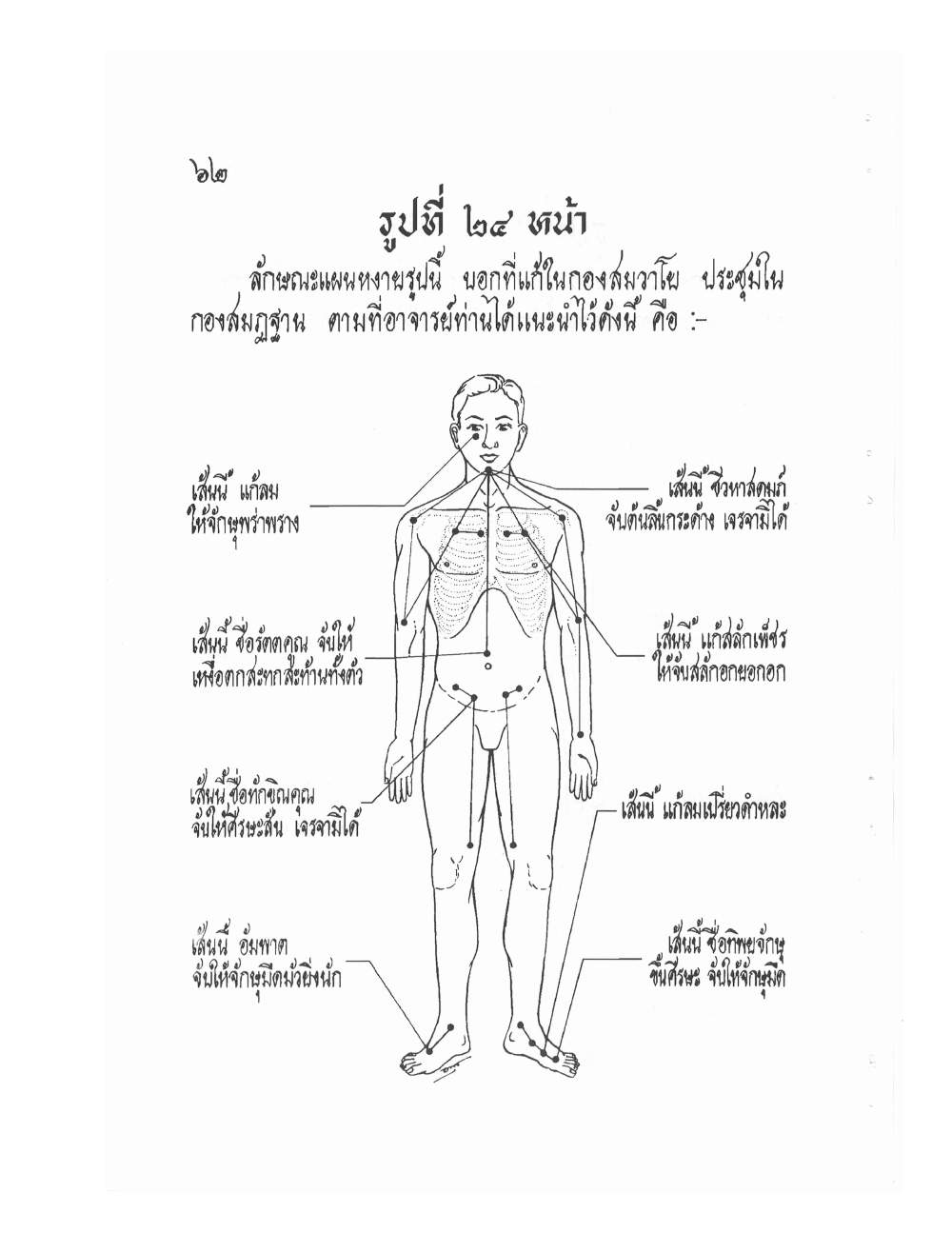
๖๒
รูปที่ ๒๔ หน้า
ลักษณะแผนหงายรูปนี้ บอกที่แก้ในกองสมวาโย ประชุมในกองสมุฏฐาน ตามที่อาจารย์ท่านได้แนะนำไว้ดังนี้ คือ :-
[ภาพ: รูปคนยืนตรงมองจากด้านหน้า มีจุดกำกับที่ใบหน้า คอ อก สะดือ แขน ขา และเท้า แต่ละจุดโยงเส้นออกไปยังข้อความอธิบายสรรพคุณของเส้นนั้นๆ รายล้อมรูป]
เส้นนี้ แก้ลม ให้จักษุพร่าพราง เส้นนี้ ชื่อชิวหาลดมภ์ จันต้นลิ้นกระด้าง เจรจามิได้ เส้นนี้ ชื่อรัตตคุณ จับให้เหงื่อตกสะกสะท้านทั้งตัว เส้นนี้ แก้สลักเพชร ให้จับสลักอกยอกอก เส้นนี้ ชื่อทักขิณคุณ จับให้ศีรษะสั่น เจรจามิได้ เส้นนี้ แก้ลมเปรี้ยวดำหละ เส้นนี้ อัมพาต จับให้จักษุมืดม่วยยิ่งนัก เส้นนี้ ชื่อทิพยจักษุ ชื้นศีรษะ จันให้จักษุมืด
62
Figure 24, Front
This chart of the supine figure shows the remedies within the "soma-wayo" group, gathered within the group of [disease] causes, as the teacher has advised, as follows:
[Diagram: a standing human figure seen from the front, with points marked on the face, neck, chest, navel, arms, legs, and feet; each point is connected by a line to a caption]
- This line cures wind [ailments] that blur and double the vision. - This line is called "tongue-pillar" — it stiffens the root of the tongue, so the sufferer cannot speak. - This line is called "Rattakhun" — when it seizes, it causes sweating and shivering through the whole body. - This line cures "salak-phet" [a piercing pain] — when it seizes, it makes the chest ache and stab. - This line is called "Thakkhinakhun" — when it seizes, it makes the head shake, and the sufferer cannot speak. - This line cures the "sour-black" wind. - This is the "paralysis" line — when it seizes, it makes the eyes go extremely dark and faint. - This line is called "divine eye" — when it rises to the head, it seizes and darkens the eyes.
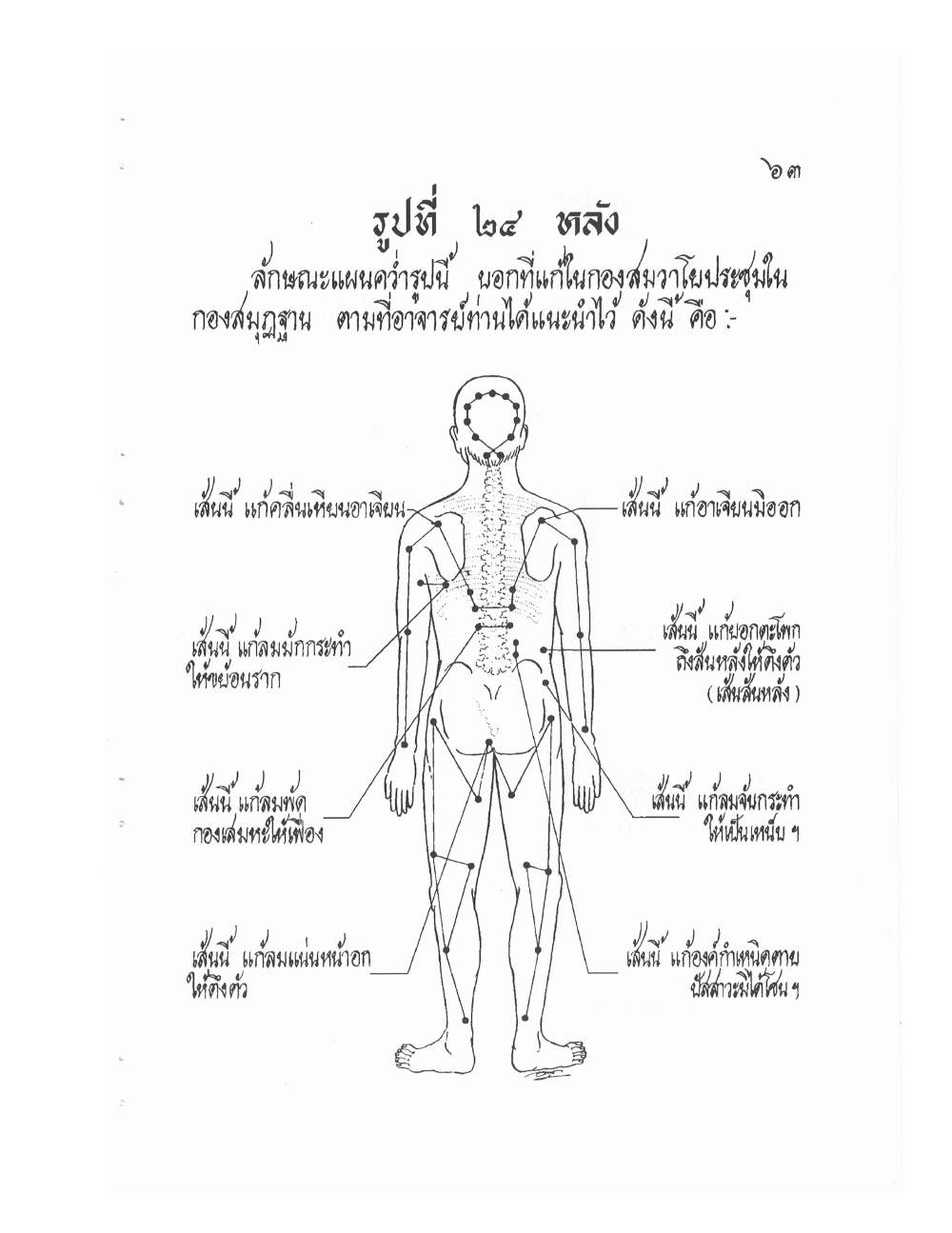
๖๓
รูปที่ ๒๔ หลัง
ลักษณะแผนคว่ำรูปนี้ บอกที่แก้ในกองสมวาโยประชุมในกองสมุฏฐาน ตามที่อาจารย์ท่านได้แนะนำไว้ ดังนี้ คือ :-
[ภาพ: รูปคนยืนตรงมองจากด้านหลัง เห็นแนวกระดูกสันหลัง มีจุดกำกับที่คอ หลัง เอว แขน ขา และเท้า แต่ละจุดโยงเส้นออกไปยังข้อความอธิบายสรรพคุณของเส้นนั้นๆ รายล้อมรูป]
เส้นนี้ แก้คลื่นเหียนอาเจียน เส้นนี้ แก้อาเจียนมิออก เส้นนี้ แก้ลมมักกระทำให้ขย้อนราก เส้นนี้ แก้ยอกตะโพกถึงสันหลังให้ตึงตัว (เส้นสันหลัง) เส้นนี้ แก้ลมพัดกองเสมหะให้เฟื่อง เส้นนี้ แก้ลมจับกระทำให้ฝันเหม็นๆ เส้นนี้ แก้ลมแน่นหน้าอกให้ตึงตัว เส้นนี้ แก้องค์กำเนิดตาย นัสสาวมิได้โน้นๆ
63
Figure 24, Back
This chart of the prone figure shows the remedies within the "soma-wayo" group, gathered within the group of [disease] causes, as the teacher has advised, as follows:
[Diagram: a standing human figure seen from behind, showing the line of the spine, with points marked at the neck, back, waist, arms, legs, and feet; each point is connected by a line to a caption]
- This line cures nausea and vomiting. - This line cures an inability to vomit [when it is needed]. - This line cures wind that often causes retching. - This line cures a wrenched hip that reaches the spine, restoring tautness to the body (the spine line). - This line cures wind that stirs the Phlegm group into excess. - This line cures a seizing wind that causes foul-smelling dreams. - This line cures wind that tightens and constricts the chest. - This line cures the male organ [when it] dies, so that it cannot urinate at all.
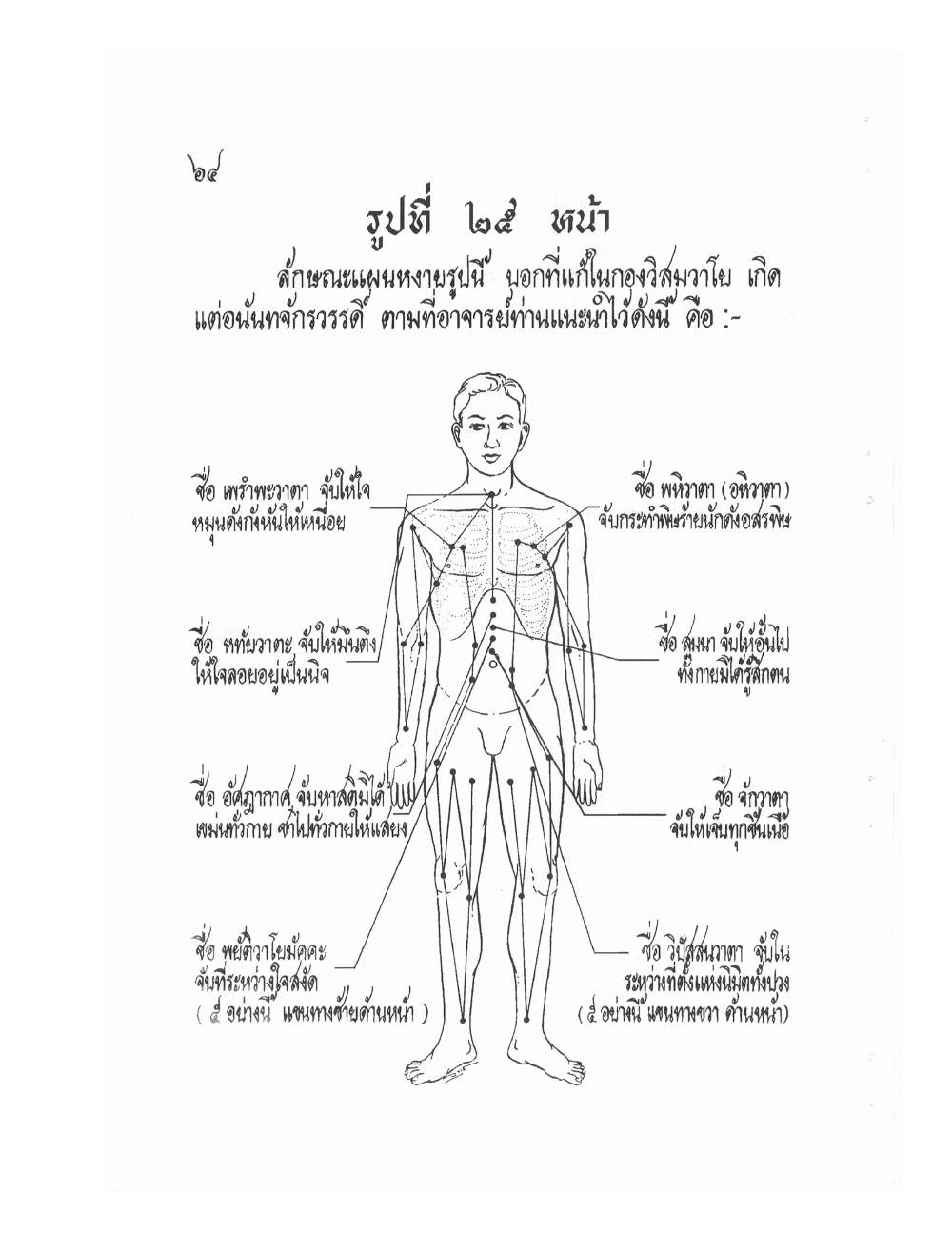
๖๔
รูปที่ ๒๕ หน้า
ลักษณะแผนหงายรูปนี้ บอกที่แก้ในกองวิสมวาโย เกิดแต่อนันตจักรวรรดิ์ ตามที่อาจารย์ท่านแนะนำไว้ดังนี้ คือ :-
[ภาพ: รูปคนยืนตรงมองจากด้านหน้า มีจุดกำกับที่ใบหน้า คอ อก สะดือ แขน ขา และเท้า แต่ละจุดโยงเส้นออกไปยังข้อความอธิบายชื่อและอาการของลมแต่ละชนิด รายล้อมรูป]
ชื่อ เพรำพะวาตา จับให้ใจหมุนดังกงหันให้หน่อย ชื่อ พหิวาตา (อหิวาตา) จับกระทำพิษร้ายนักดังอสรพิษ ชื่อ หทัยวาตะ จับให้มั่นตึง ให้ใจลอยอยู่เป็นนิจ ชื่อ สุมนา จับให้อุ่นไปทั้งกายมิได้รู้สึกตน ชื่อ อัฏฐากาศ จับหาสติมิได้ เสมอทั่วกาย ซ่าไปทั่วกายให้แสยง ชื่อ จักวาตา จับให้เจ็บทุกชิ้นเนื้อ ชื่อ พยัติวาโยมัดคะ จับที่ระหว่างใจสงัด (๕ อย่างนี้ แขนทางซ้ายด้านหน้า) ชื่อ วิปัสสนาวาตา จับในระหว่างที่ตั้งแห่งนิมิตทั้งปวง (๕ อย่างนี้ แขนทางขวา ด้านหน้า)
64
Figure 25, Front
This chart of the supine figure shows the remedies within the "wisama-wayo" [Deranged Wind] group, arising from the "Anan Cakkawan" group, as the teacher has advised, as follows:
[Diagram: a standing human figure seen from the front, with points marked on the face, neck, chest, navel, arms, legs, and feet; each point is connected by a line to a caption naming and describing a particular wind]
- Named "Phrao-phawata" — when it seizes, it makes the heart spin somewhat like a turning wheel. - Named "Phahiwata" (Ahiwata) — when it seizes, it acts with a poison as vicious as a venomous serpent's. - Named "Hathaiwata" (heart-wind) — when it seizes, it tightens [the chest] and leaves the mind constantly adrift. - Named "Sumana" — when it seizes, it makes the whole body feel warm without the sufferer being aware of it. - Named "Atthakat" — when it seizes, the sufferer loses all consciousness; it courses evenly through the whole body, spreading a tremor through it. - Named "Chakwata" — when it seizes, it makes every piece of flesh ache. - Named "Phayatiwayo-matkha" — it seizes in the region of the quiet mind. (5 of these are on the front of the left arm.) - Named "Wipatsanawata" — it seizes in the region where all mental visions arise. (5 of these are on the front of the right arm.)
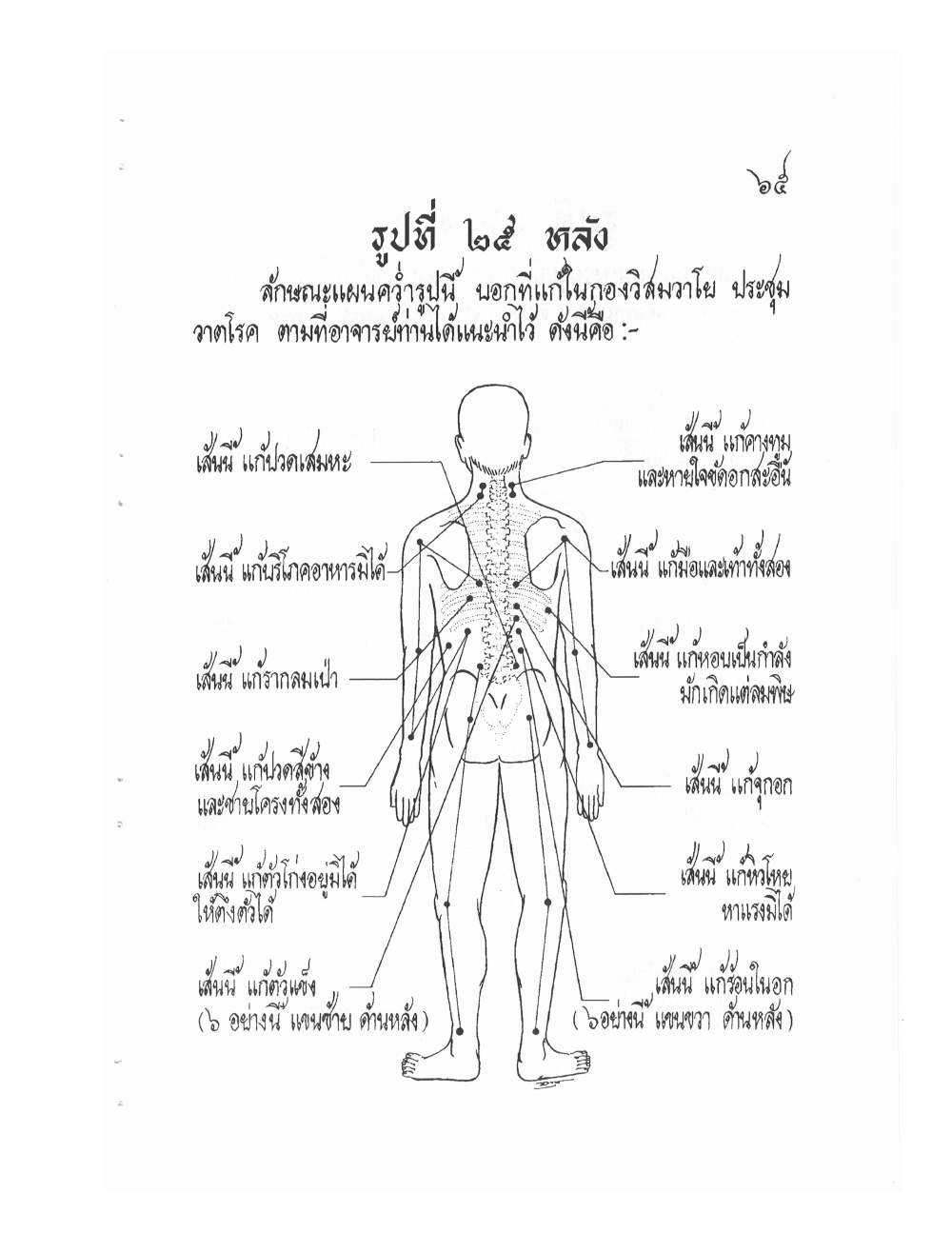
๖๕
รูปที่ ๒๕ หลัง
ลักษณะแผนคว่ำรูปนี้ บอกที่แก้ในกองวิสมวาโย ประชุมวาตโรค ตามที่อาจารย์ท่านได้แนะนำไว้ ดังนี้คือ :-
[ภาพ: รูปคนยืนตรงมองจากด้านหลัง เห็นแนวกระดูกสันหลัง มีจุดกำกับที่คอ หลัง เอว แขน ขา และเท้า แต่ละจุดโยงเส้นออกไปยังข้อความอธิบายสรรพคุณของเส้นนั้นๆ รายล้อมรูป]
เส้นนี้ แก้ปวดเสมหะ เส้นนี้ แก้คางขม และหายใจขัดอกสะอื้น เส้นนี้ แก้บริโภคอาหารมิได้ เส้นนี้ แก้มือและเท้าทั้งสอง เส้นนี้ แก้รากลมเป่า เส้นนี้ แก้หอบเป็นกำลัง มักเกิดแต่ลมพิษ เส้นนี้ แก้ปวดสีข้างและซ้ายโครงทั้งสอง เส้นนี้ แก้จุกอก เส้นนี้ แก้ตัวโก่งอยู่มิได้ให้ตั้งตัวได้ เส้นนี้ แก้หิวโหย หาแรงมิได้ เส้นนี้ แก้ตัวแข็ง (๖ อย่างนี้ แขนซ้าย ด้านหลัง) เส้นนี้ แก้ร้อนในอก (๖ อย่างนี้ แขนขวา ด้านหลัง)
65
Figure 25, Back
This chart of the prone figure shows the remedies within the "wisama-wayo" [Deranged Wind] group, gathered among wind-diseases, as the teacher has advised, as follows:
[Diagram: a standing human figure seen from behind, showing the line of the spine, with points marked at the neck, back, waist, arms, legs, and feet; each point is connected by a line to a caption]
- This line cures Phlegm-pain. - This line cures a bitter jaw/chin and choked, sobbing breath. - This line cures inability to eat food. - This line cures [pain in] both the hands and feet. - This line cures wind-induced retching. - This line cures panting from exertion, usually arising from wind-poison (ลมพิษ, hives). - This line cures pain in both sides of the ribs. - This line cures a blocked/oppressed chest. - This line cures a body that cannot straighten from a hunch, restoring it to an upright posture. - This line cures hunger with no strength. - This line cures a stiff body. (These 6 are on the back of the left arm.) - This line cures heat in the chest. (These 6 are on the back of the right arm.)
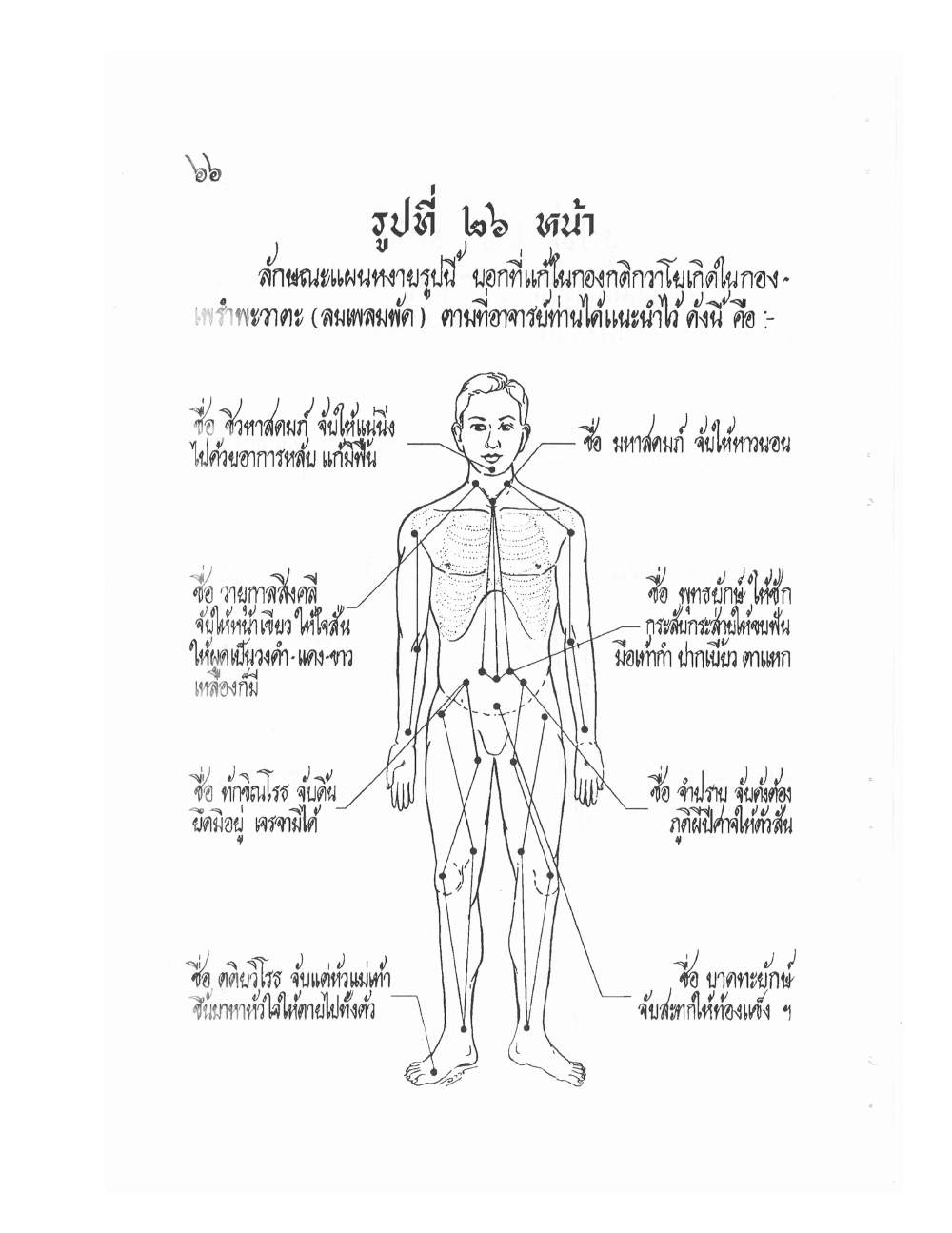
๖๖
รูปที่ ๒๖ หน้า
ลักษณะแผนหงายรูปนี้ บอกที่แก้ในกองกติกวาโยเกิดในกองเพรำพะวาตะ (ลมเพลมพัด) ตามที่อาจารย์ท่านได้แนะนำไว้ ดังนี้ คือ :-
[ภาพ: รูปคนยืนตรงมองจากด้านหน้า มีจุดกำกับที่ใบหน้า คอ อก สะดือ แขน ขา และเท้า แต่ละจุดโยงเส้นออกไปยังข้อความอธิบายชื่อและอาการของลมแต่ละชนิด รายล้อมรูป]
ชื่อ ชิวหาสดมภ์ จับให้แน่นิ่งไปด้วยอาการหลับ แก้มิฟื้น ชื่อ มหาสดมภ์ จับให้หาวนอน ชื่อ วายกาลสิงคลี จับให้หน้าเขียว ให้ใจสั่น ให้ผุดเป็นวงดำ-แดง-ขาว-เหลืองกมี ชื่อ พุทธยักษ์ ให้ชักกระสับกระส่ายให้ชมฟัน มือเท้ากำ ปากเบี้ยว ตาแหก ชื่อ ทักษิณโรธ จับดิ้นยึดมืออยู่ เจรจามิได้ ชื่อ จำปราบ จับดังต้อง ภูตผีปีศาจให้ตัวสั้น ชื่อ ตติยวโรธ จับแต่ห้วนแม่เท้าชื้นมาหาทั่วให้ตายไปทั้งตัว ชื่อ บาดทะยักษ์ จับสะท้อนให้ท้องแข็ง ๆ
66
Figure 26, Front
This chart of the supine figure shows the remedies within the "katika-wayo" group, arising within the "Phrao-phawata" (gusting, blowing wind) group, as the teacher has advised, as follows:
[Diagram: a standing human figure seen from the front, with points marked on the face, neck, chest, navel, arms, legs, and feet; each point is connected by a line to a caption naming and describing a particular wind/ailment]
- Named "tongue-pillar" — when it seizes, it leaves [the sufferer] rigid and still as if asleep, and does not revive. - Named "great pillar" — when it seizes, it causes drowsy yawning. - Named "Wayakan-singkhli" — when it seizes, it turns the face green, makes the heart tremble, and raises rings [on the skin] of black, red, white, and yellow. - Named "Buddha-giant" — it causes convulsive restlessness, grinding of teeth, clenched hands and feet, a twisted mouth, and rolled-back eyes. - Named "Thakkhinarot" — when it seizes, it makes [the sufferer] writhe with clenched hands, unable to speak. - Named "Champrap" — when it seizes, it strikes as though ghosts or spirits had shrunk the body. - Named "Tatiyaworot" — it seizes from the cold, damp soles of the feet and spreads until the whole body goes deathly still. - Named "Batthayak" (tetanus-giant) — when it seizes, it convulses and makes the belly go rigid.
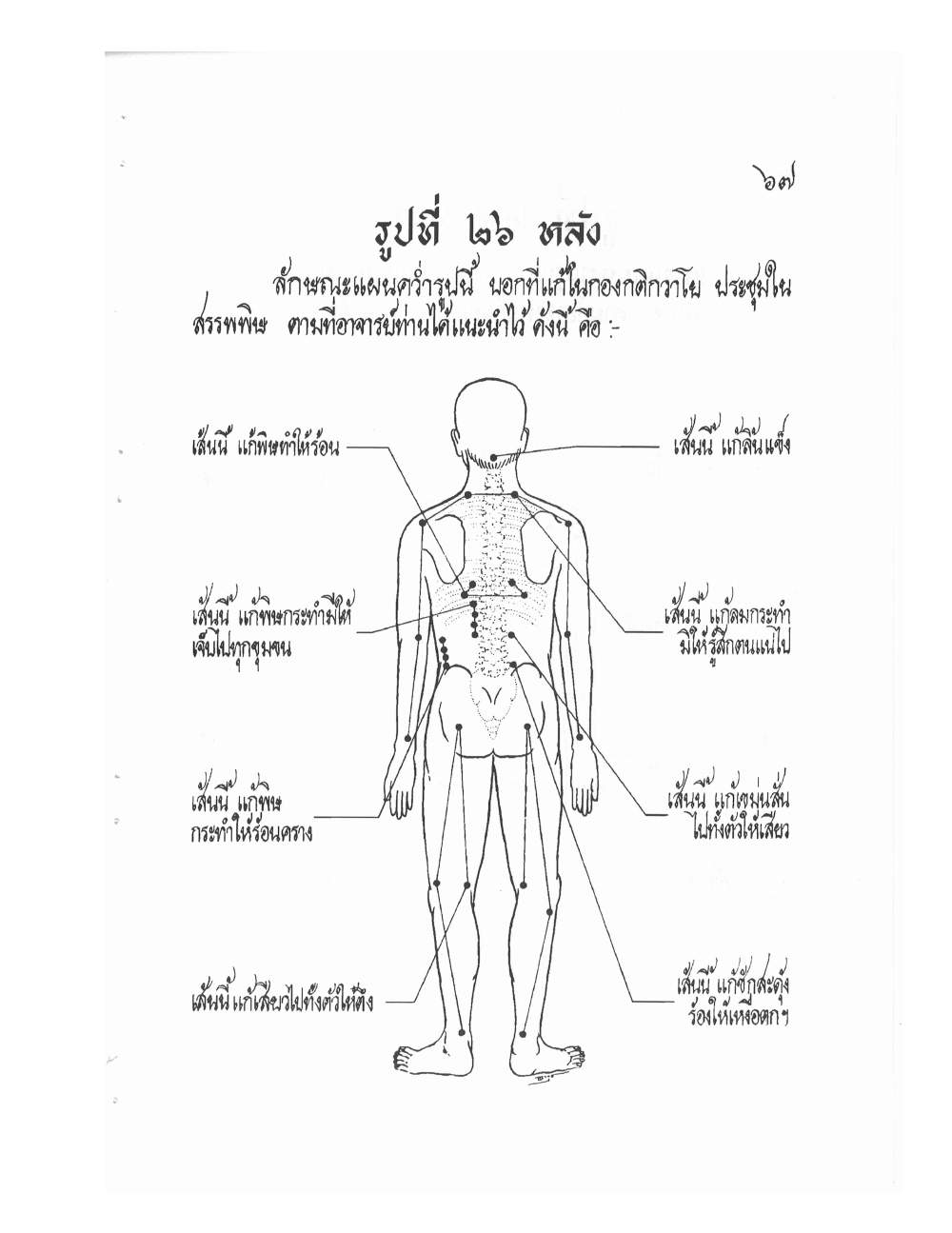
๖๗
รูปที่ ๒๖ หลัง
ลักษณะแผนคว่ำรูปนี้ บอกที่แก้ในกองกติกวาโย ประชุมในสรรพพิษ ตามที่อาจารย์ท่านได้แนะนำไว้ ดังนี้ คือ :-
[ภาพ: รูปคนยืนตรงมองจากด้านหลัง เห็นแนวกระดูกสันหลัง มีจุดกำกับที่คอ หลัง เอว แขน ขา และเท้า แต่ละจุดโยงเส้นออกไปยังข้อความอธิบายสรรพคุณของเส้นนั้นๆ รายล้อมรูป]
เส้นนี้ แก้พิษทำให้ร้อน เส้นนี้ แก้ลมแข็ง เส้นนี้ แก้พิษกระทำมิให้เจ็บไปทุกชุมขน เส้นนี้ แก้ลมกระทำมิให้รู้สึกตนแน่ไป เส้นนี้ แก้พิษกระทำให้ร้อนคราง เส้นนี้ แก้เซ็นสันไปทั้งตัวให้เสียว เส้นนี้ แก้เสียวไปทั้งตัวให้ตึง เส้นนี้ แก้จับให้แน่นิ่งไปไม่มีสติสมปฤดี ๆ
67
Figure 26, Back
This chart of the prone figure shows the remedies within the "katika-wayo" group, gathered among all poisons, as the teacher has advised, as follows:
[Diagram: a standing human figure seen from behind, showing the line of the spine, with points marked at the neck, back, waist, arms, legs, and feet; each point is connected by a line to a caption]
- This line cures poison that causes heat. - This line cures a stiffened wind [condition]. - This line cures poison that makes every pore/hair-follicle ache. - This line cures wind that leaves the sufferer without full awareness. - This line cures poison that makes [the body] moan with heat. - This line cures a tingling that runs numbly through the whole body. - This line cures a tingling through the whole body that tightens it. - This line cures a seizure that leaves [the sufferer] rigid and without consciousness.
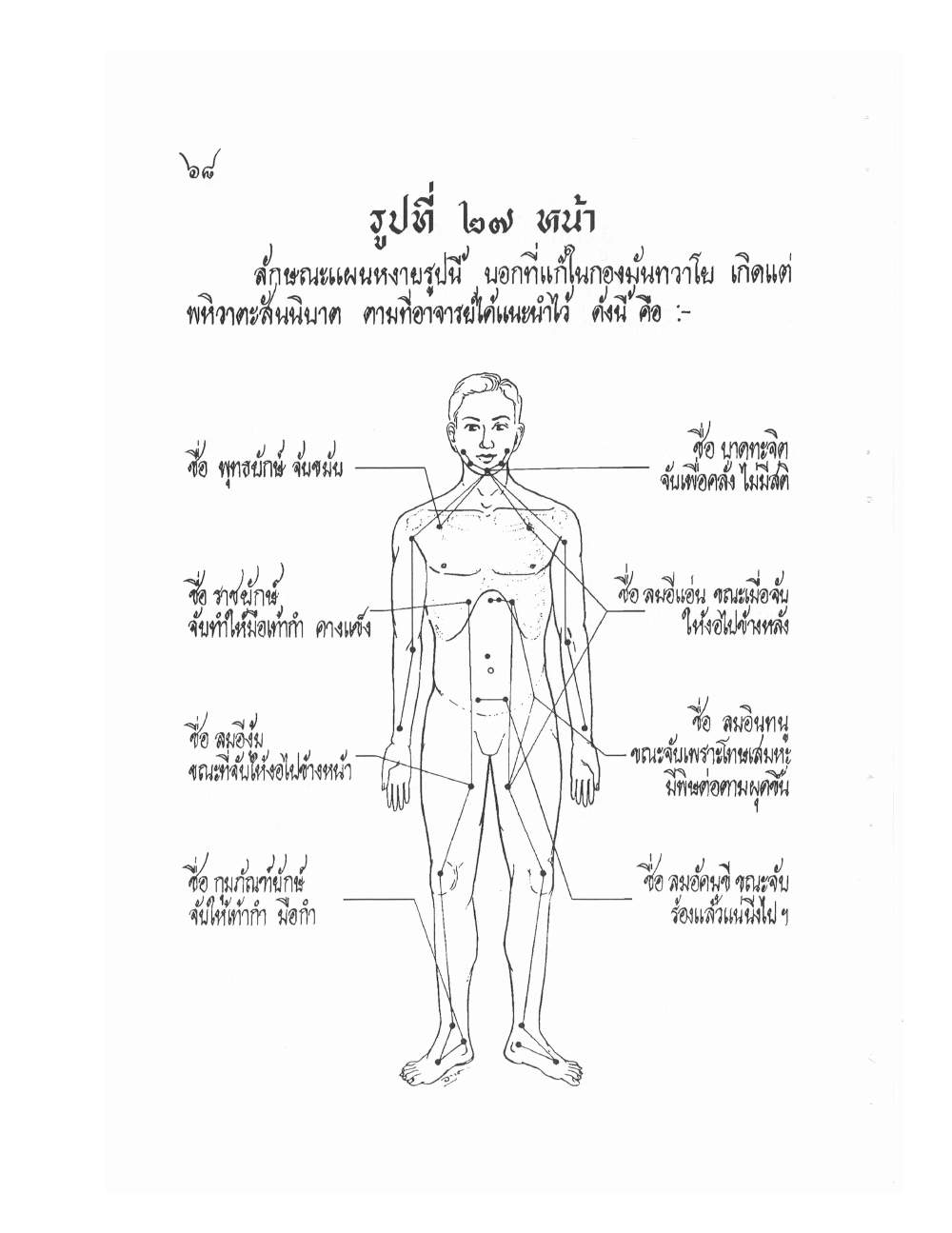
๖๘
รูปที่ ๒๗ หน้า
ลักษณะแผนหงายรูปนี้ บอกที่แก้ในกองมั่นทวาโย เกิดแต่พหิวาตะสันนิบาต ตามที่อาจารย์ได้แนะนำไว้ ดังนี้ คือ :-
[ภาพ: รูปคนยืนตรงมองจากด้านหน้า มีจุดกำกับที่ใบหน้า คอ อก สะดือ แขน ขา และเท้า แต่ละจุดโยงเส้นออกไปยังข้อความอธิบายชื่อและอาการของลมแต่ละชนิด รายล้อมรูป]
ชื่อ พุทธยักษ์ จับซมซาน ชื่อ บาดทะจิต จับเพื่อคลั่งไม่มีสติ ชื่อ ราชยักษ์ จับทำให้มือเท้ากำ คางแข็ง ชื่อ ลมอิแอ่น ขณะเมื่อจับให้งออยู่ข้างหลัง ชื่อ ลมอิงงิง ขณะที่จับให้งออยู่ต่างหน้า ชื่อ ลมอินทนู ขณะจับเพราะโทษเสมหะมีพิษต่อตามผุดขึ้น ชื่อ กมภัณฑยักษ์ จับให้เท้ากำ มือกำ ชื่อ ลมอัคมิชี ขณะจับร้องแล้วแน่นิ่งไป ฯ
68
Figure 27, Front
This chart of the supine figure shows the remedies within the "manthawayo" group, arising from "Phahiwata" sannibāt [combined-humor fever], as the teacher has advised, as follows:
[Diagram: a standing human figure seen from the front, with points marked on the face, neck, chest, navel, arms, legs, and feet; each point is connected by a line to a caption naming and describing a particular wind/ailment]
- Named "Buddha-giant" — when it seizes, it leaves [the sufferer] listless and wandering. - Named "Batthachit" — when it seizes, it causes raving madness, without awareness. - Named "Rachayak" (royal-giant) — when it seizes, it clenches the hands and feet and stiffens the jaw. - Named "i-aen wind" — when it seizes, it bends [the body] backward. - Named "ing-ing wind" — when it seizes, it bends [the body] forward. - Named "inthanu wind" — when it seizes, [it acts] through the fault of Phlegm, whose poison then breaks out on the skin. - Named "Komphanthayak" — when it seizes, it clenches the feet and hands. - Named "akmichi wind" — when it seizes, [the sufferer] cries out, then goes rigid and still.
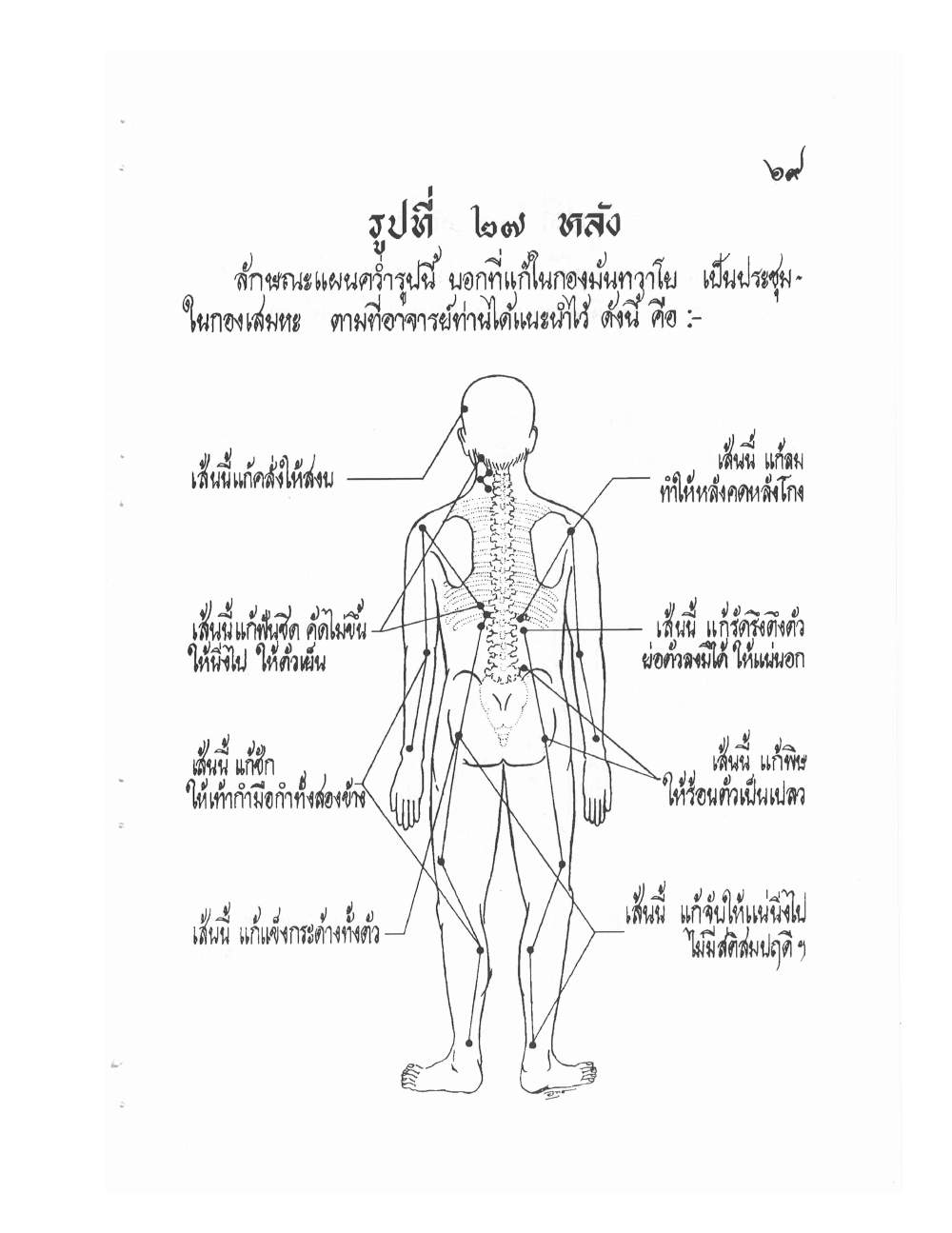
๖๙
รูปที่ ๒๗ หลัง
ลักษณะแผนคว่ำรูปนี้ บอกที่แก้ในกองมั่นทวาโย เป็นประชุมในกองเสมหะ ตามที่อาจารย์ท่านได้แนะนำไว้ ดังนี้ คือ :-
[ภาพ: รูปคนยืนตรงมองจากด้านหลัง เห็นแนวกระดูกสันหลัง มีจุดกำกับที่ศีรษะ คอ หลัง เอว แขน ขา และเท้า แต่ละจุดโยงเส้นออกไปยังข้อความอธิบายสรรพคุณของเส้นนั้นๆ รายล้อมรูป]
เส้นนี้ แก้คลั่งให้สงบ เส้นนี้ แก้ลมทำให้หลังคดหลังโกง เส้นนี้ แก้ฟันขบ คัดไม่ขึ้น ให้มั่งไป ให้ตัวเย็น เส้นนี้ แก้รัดรึงตึงตัว ผ่อตัวลงมิได้ ให้แน่นอก เส้นนี้ แก้ชัก ให้เท้ากำมือกำทั้งสองข้าง เส้นนี้ แก้พิษให้ร้อนตัวเป็นเปลว เส้นนี้ แก้แข็งกระด้างทั้งตัว เส้นนี้ แก้จับให้แน่นิ่งไป ไม่มีสติสมปฤดี ๆ
69
Figure 27, Back
This chart of the prone figure shows the remedies within the "manthawayo" group, gathered within the Phlegm group, as the teacher has advised, as follows:
[Diagram: a standing human figure seen from behind, showing the line of the spine, with points marked at the head, neck, back, waist, arms, legs, and feet; each point is connected by a line to a caption]
- This line calms raving madness. - This line cures wind that curves and bends the back. - This line cures teeth-grinding and lockjaw, restoring [the jaw] and cooling the body. - This line cures a body bound and tightened, unable to relax, with a tight chest. - This line cures convulsions, with both hands and feet clenched. - This line cures poison that makes the body burn as if aflame. - This line cures a stiff, rigid whole body. - This line cures a seizure that leaves [the sufferer] rigid and without consciousness.
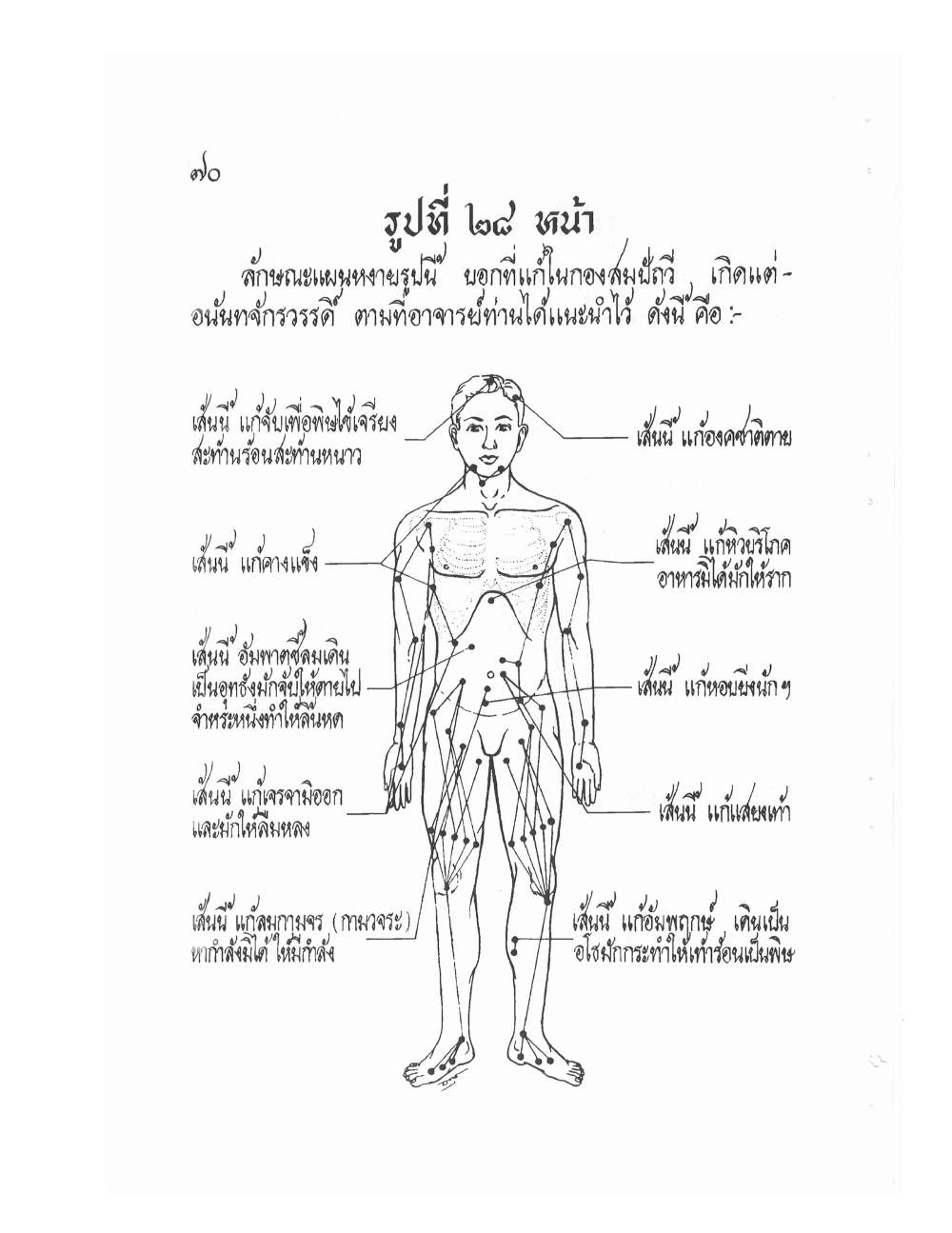
๗๐
รูปที่ ๒๘ หน้า
ลักษณะแผนหงายรูปนี้ บอกที่แก้ในกองสมุฏฐวี เกิดแต่ อนันทจักรวรรดิ์ ตามที่อาจารย์ท่านได้แนะนำไว้ ดังนี้คือ :-
เส้นนี้ แก้จับเพื่อพิษไข้เจรียง สะท้านร้อนสะท้านหนาว เส้นนี้ แก้คางแข็ง เส้นนี้ อัมพาตชักลมเดิน เป็นอุทธังมักจับให้ตายไป จำหระหนึ่งทำให้ลิ้นหด เส้นนี้ แก้เจรจามิออก และมักให้ลืมหลง เส้นนี้ แก้ลมกามจร (กามจระ) หากำลังมิได้ ให้มีกำลัง
เส้นนี้ แก้องคชาติตาย เส้นนี้ แก้หิวบริโภค อาหารมิได้มักให้ราก เส้นนี้ แก้หอบหืดนัก ๆ เส้นนี้ แก้แสยงเท้า เส้นนี้ แก้อัมพฤกษ์ เดินเป็นอโรมักกระทำให้เท้าร้อนเป็นพิษ
[diagram: front (supine) view of a standing male figure, dotted lines and small dots tracing numerous sen (channels) from the head, chest, abdomen, arms, and legs out to the labels listed above on either side; a small open circle is marked near the navel; folio numeral ๗๐ at top left]
70
Figure 28, Front
This supine-body chart shows the points treated in the pathavī (earth-element) group, arising from the boundless cosmos (ananta-cakkavāḷa), as instructed by the teacher-masters, as follows:-
This line: treats seizure from fever-poison and delirium, with alternating chills and hot flashes. This line: treats a locked, stiff jaw. This line: treats paralysis with wind rising upward (uddhaṅga), which may seize [the patient] and cause death; in one case it makes the tongue contract. This line: treats inability to speak, and tends to cause forgetfulness and confusion. This line: treats the wind of the reproductive channel (kāma-jara); where strength is lacking, it restores strength.
This line: treats a dead/numb organ (impotence). This line: treats hunger with inability to eat, which often causes vomiting. This line: treats severe wheezing/asthma. This line: treats numbness of the feet. This line: treats hemiplegia (paresis); when it travels as 'aro' it tends to make the feet hot as though poisoned.
[diagram: front (supine) view of a standing male figure, dotted lines and small dots tracing numerous sen (channels) from the head, chest, abdomen, arms, and legs out to the labels listed above on either side; a small open circle is marked near the navel; folio numeral 70 at top left]
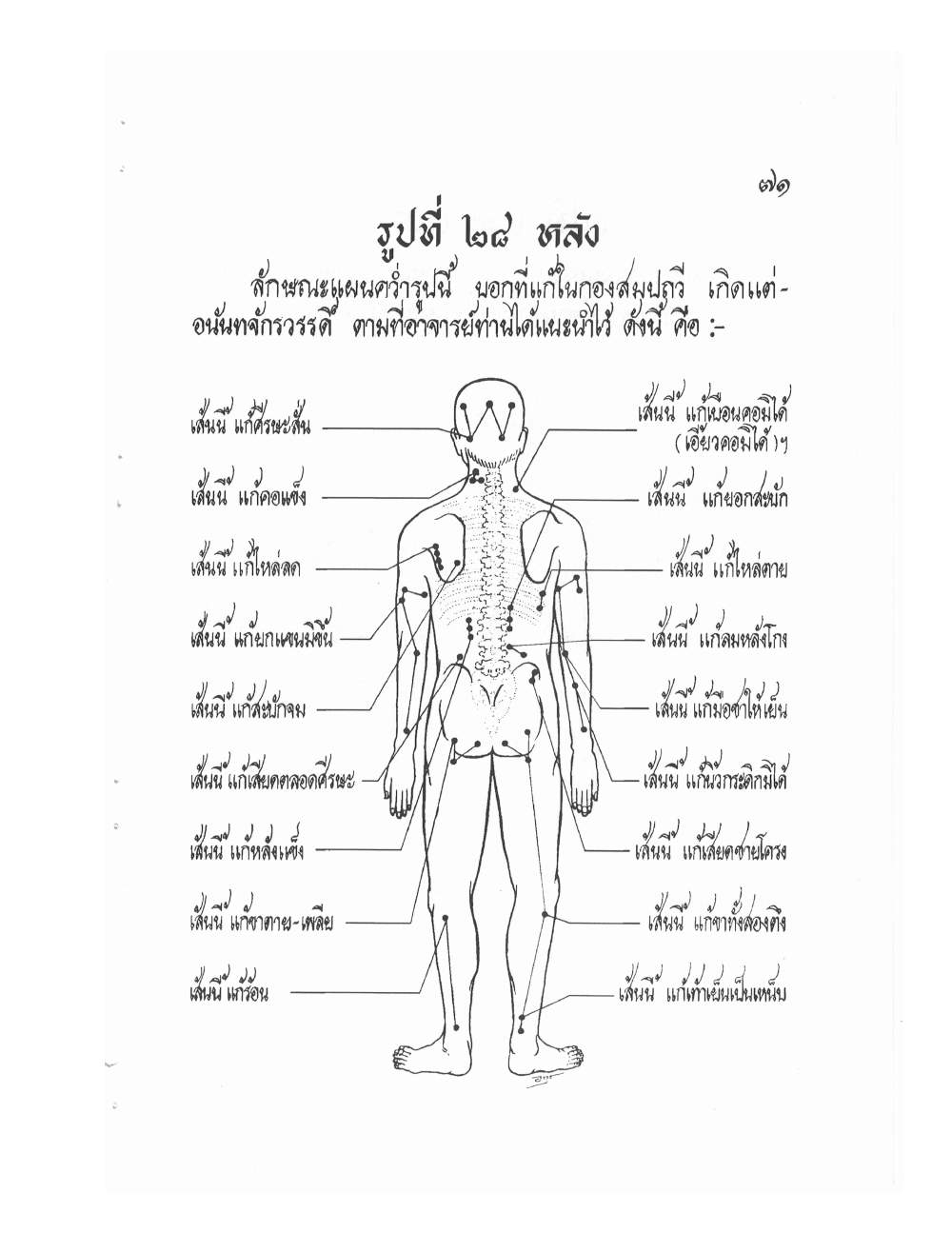
๗๑
รูปที่ ๒๘ หลัง
ลักษณะแผนคว่ำรูปนี้ บอกที่แก้ในกองสมุฏฐวี เกิดแต่- อนันทจักรวรรดิ์ ตามที่อาจารย์ท่านได้แนะนำไว้ ดังนี้คือ :-
เส้นนี้ แก้ศีรษะสั่น เส้นนี้ แก้คอแข็ง เส้นนี้ แก้ไหล่ลด เส้นนี้ แก้ยกเซนมิขึ้น เส้นนี้ แก้สะบักจม เส้นนี้ แก้เสียดตลอดศีรษะ เส้นนี้ แก้หลังแข็ง เส้นนี้ แก้ขาตาย-เพลีย เส้นนี้ แก้ร้อน
เส้นนี้ แก้เอี้ยวคอมิได้ (เอี้ยวคอมิได้)ฯ เส้นนี้ แก้ยอกสะบัก เส้นนี้ แก้ไหล่ตาย เส้นนี้ แก้ลมหลังโกง เส้นนี้ แก้มือชาให้เย็น เส้นนี้ แก้นิ้วกระดิกมิได้ เส้นนี้ แก้เสียดชายโครง เส้นนี้ แก้ขาทั้งสองตึง เส้นนี้ แก้เท้าเย็นเป็นเหน็บ
[diagram: back (prone) view of a standing male figure, dotted lines running down the spine with a stippled band along the backbone, and small dots tracing sen (channels) from the head, shoulders, back, arms, buttocks, and legs out to the labels listed above on either side; folio numeral ๗๑ at top right]
71
Figure 28, Back
This prone-body chart shows the points treated in the pathavī (earth-element) group, arising from the boundless cosmos (ananta-cakkavāḷa), as instructed by the teacher-masters, as follows:-
This line: treats a shaking head. This line: treats a stiff neck. This line: treats a drooping shoulder. This line: treats inability to raise the sen (tendon/channel). This line: treats a sunken shoulder blade. This line: treats aching that runs the whole length of the head. This line: treats a stiff back. This line: treats dead/exhausted legs. This line: treats fever/heat.
This line: treats inability to turn the neck (stiff neck). This line: treats a wrenched shoulder blade. This line: treats a dead/numb shoulder. This line: treats wind that bends the back. This line: treats hands that are numb and cold. This line: treats fingers that cannot move. This line: treats pain along the ribs/flank. This line: treats tightness in both legs. This line: treats cold feet with pins-and-needles numbness.
[diagram: back (prone) view of a standing male figure, dotted lines running down the spine with a stippled band along the backbone, and small dots tracing sen (channels) from the head, shoulders, back, arms, buttocks, and legs out to the labels listed above on either side; folio numeral 71 at top right]
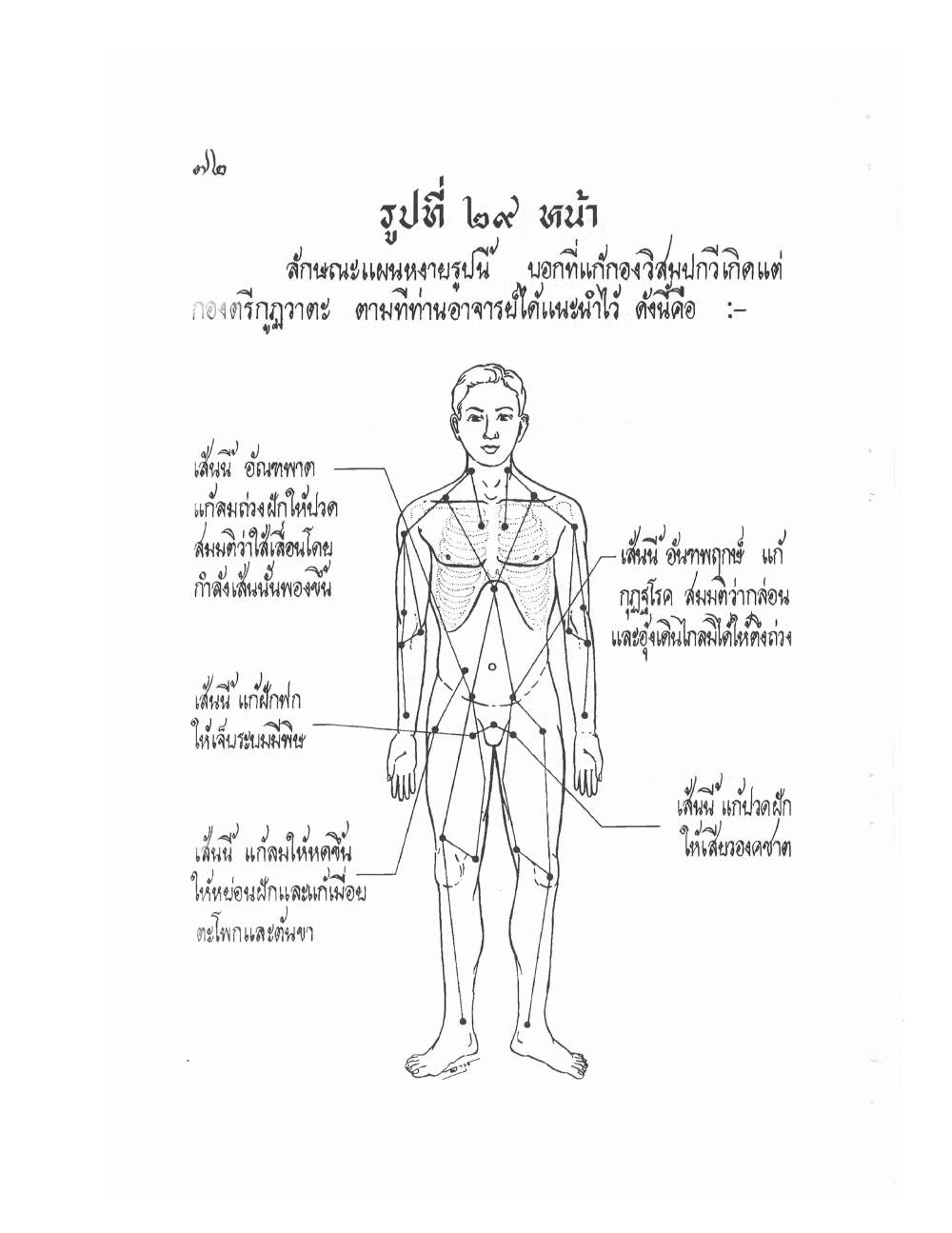
๗๒
รูปที่ ๒๙ หน้า
ลักษณะแผนหงายรูปนี้ บอกที่แก้กองวิสมปกวีเกิด แต่กองตรีกฏฏวาตะ ตามที่ท่านอาจารย์ได้แนะนำไว้ ดังนี้คือ :-
เส้นนี้ อัณฑพาต แก้ลมถ่วงฝักให้ปวด สมมติว่าใส้เลื่อนโดย กำลังเส้นนั้นพองขึ้น เส้นนี้ แก้ฝักฝก ให้เจ็บระบมมีพิษ เส้นนี้ แก้ลมให้หดขึ้น ให้หย่อนฝักและแก้เมื่อย ตะโพกและต้นขา
เส้นนี้ อัณฑพฤกษ์ แก้ กุฏฐโรค สมมติว่ากล่อน และอุ่งเดินไกลมิได้ให้ตึงถ่วง เส้นนี้ แก้ปวดฝัก ให้เสียวองคชาต
[diagram: front (supine) view of a standing male figure, dotted lines and small dots tracing sen (channels) from the head, chest, abdomen, and groin out to the labels listed above on either side; folio numeral ๗๒ at top left]
72
Figure 29, Front
This supine-body chart shows the points treated in the visama-pakati (irregular natural) group, arising from the tri-kaṭṭha-vāta (threefold harsh-wind) group, as instructed by the teacher-masters, as follows:-
This line: the testicular-wind line; treats wind that drags on the scrotum and causes pain, presumed to be a hernia, where the strength of that line makes it swell. This line: treats scrotal soreness, causing a bruised, poisoned-feeling pain. This line: treats wind that causes contraction, loosens the scrotum, and treats aching of the buttocks and thighs.
This line: the testicular-paresis line; treats leprous disease (kuṭṭha), presumed to be hernia and swelling that prevent walking far, causing tightness and dragging. This line: treats aching of the scrotum, causing a shooting pain in the genitals.
[diagram: front (supine) view of a standing male figure, dotted lines and small dots tracing sen (channels) from the head, chest, abdomen, and groin out to the labels listed above on either side; folio numeral 72 at top left]
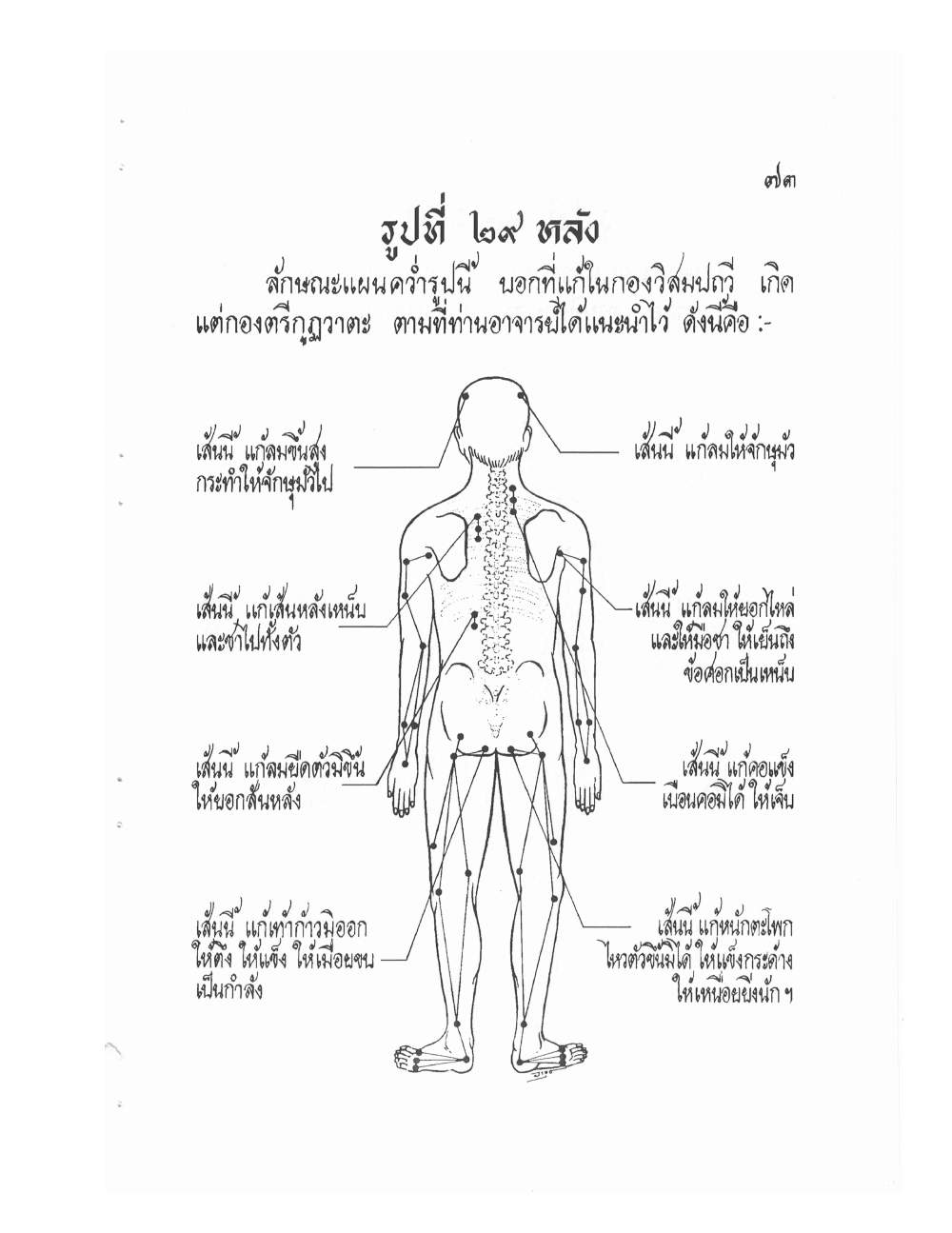
๗๓
รูปที่ ๒๙ หลัง
ลักษณะแผนคว่ำรูปนี้ บอกที่แก้กองวิสมปกวีเกิด แต่กองตรีกฏฏวาตะ ตามที่อาจารย์ได้แนะนำไว้ ดังนี้คือ :-
เส้นนี้ แก้ลมขึ้นสูง กระทำให้จักษุมัวไป เส้นนี้ แก้เส้นหลังเหน็บและซาไปทั้งตัว เส้นนี้ แก้ลมยืดตัวมิขึ้น ให้ยอกสันหลัง เส้นนี้ แก้เท้าก้าวมิออก ให้ตึง ให้แข็ง ให้เมื่อยชม เป็นกำลัง
เส้นนี้ แก้ลมให้จักษุมัว เส้นนี้ แก้ลมให้ยอกไหล่ และให้มือชา ให้เย็นถึงข้อศอกเป็นเหน็บ เส้นนี้ แก้คอแข็ง เอี้ยวคอมิได้ ให้เจ็บ เส้นนี้ แก้หนักตะโพก ไหวตัวขยับมิได้ ให้แข็งกระด้าง ให้เหนื่อยยิ่งนัก ๆ
[diagram: back (prone) view of a standing male figure, dotted lines running down the spine with a stippled band along the backbone, and small dots tracing sen (channels) from the head, back, buttocks, arms, and legs out to the labels listed above on either side; folio numeral ๗๓ at top right]
73
Figure 29, Back
This prone-body chart shows the points treated in the visama-pakati (irregular natural) group, arising from the tri-kaṭṭha-vāta (threefold harsh-wind) group, as instructed by the teacher-masters, as follows:-
This line: treats wind rising high, which causes the eyesight to blur. This line: treats the back sen going numb and the whole body growing weak/faint. This line: treats wind that prevents the body from stretching upright, causing a wrenched spine. This line: treats inability to step the foot forward, causing tightness, stiffness, and great fatigue in the legs.
This line: treats wind that blurs the eyesight. This line: treats wind that wrenches the shoulder, and numbs the hand with cold reaching to the elbow, causing pins-and-needles. This line: treats a stiff neck, unable to turn, causing pain. This line: treats heaviness in the buttocks, inability to shift or move the body, causing stiffness and great exhaustion.
[diagram: back (prone) view of a standing male figure, dotted lines running down the spine with a stippled band along the backbone, and small dots tracing sen (channels) from the head, back, buttocks, arms, and legs out to the labels listed above on either side; folio numeral 73 at top right]
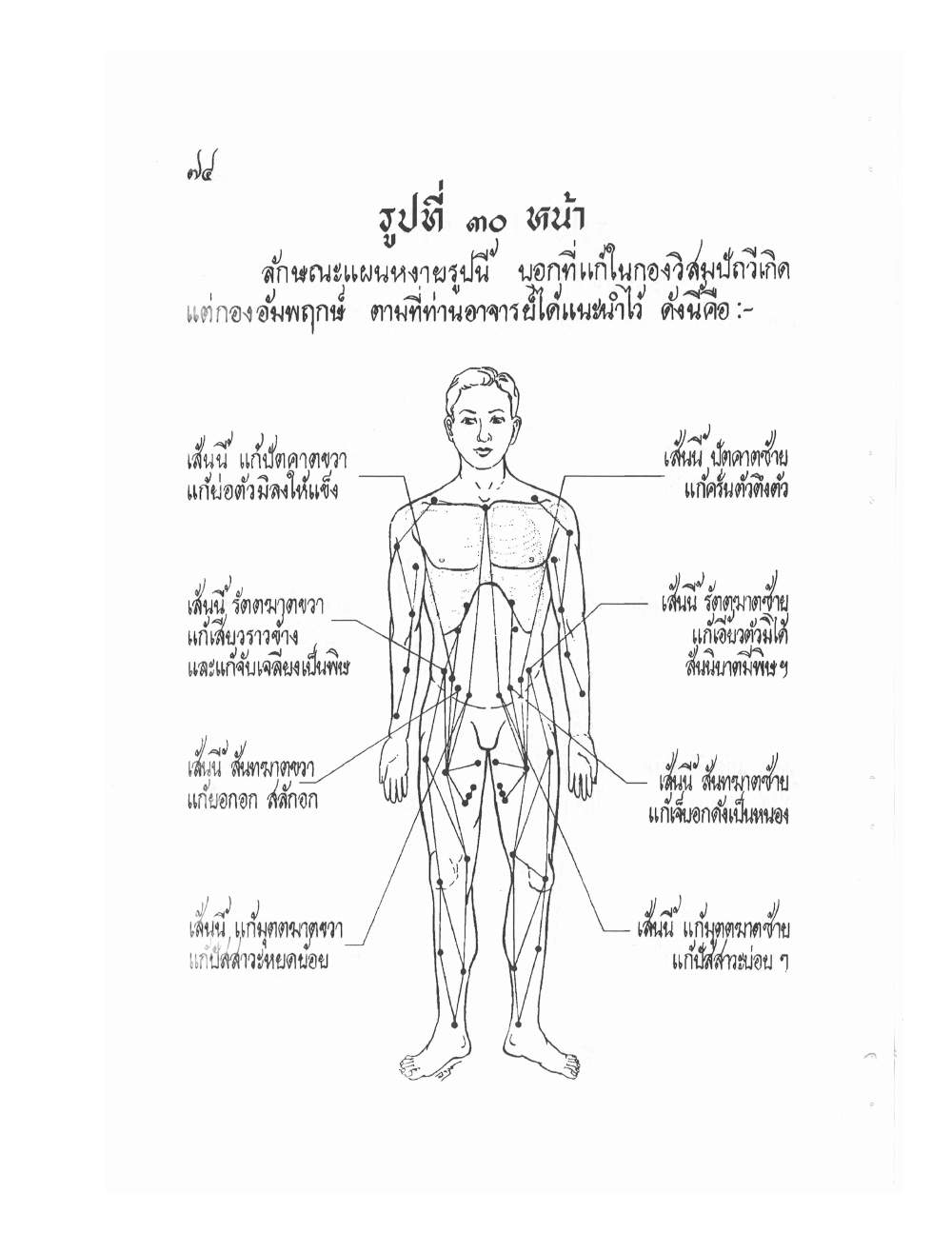
๗๔
รูปที่ ๓๐ หน้า
ลักษณะแผนหงายรูปนี้ บอกที่แก้ในกองวิสมปัถวีเกิด แต่กองอัมพฤกษ์ ตามที่ท่านอาจารย์ได้แนะนำไว้ ดังนี้คือ :-
เส้นนี้ แก้ปัตคาดขวา แก้ย่อตัวมิลงให้แข็ง เส้นนี้ รัตตมาตขวา แก้เสียวราวข้าง และแก้จับเจลียงเป็นพิษ เส้นนี้ สันทฆาตขวา แก้ยอกอก สลักอก เส้นนี้ แก้มุตฆาตขวา แก้ปัสสาวะหยดน้อย
เส้นนี้ ปัตคาดซ้าย แก้ครั่นตัวติงตัว เส้นนี้ รัตตมาตซ้าย แก้เอี้ยวตัวมิได้ สิ้นมิบาทพิษๆ เส้นนี้ สันทฆาตซ้าย แก้เจ็บอกดังเป็นหนอง เส้นนี้ แก้มุตฆาตซ้าย แก้ปัสสาวะบ่อย ๆ
[diagram: front (supine) view of a standing male figure, dotted lines and small dots tracing sen (channels) from the shoulders, chest, abdomen, groin, and thighs out to the labels listed above on either side; folio numeral ๗๔ at top left]
74
Figure 30, Front
This supine-body chart shows the points treated in the visama-pathavī (irregular earth) group, arising from the hemiplegia (paresis) group, as instructed by the teacher-masters, as follows:-
This line: the right patkhat line; treats stiffness that prevents the body from bending down. This line: the right rattamat line; treats a shooting pain along the flank, and treats seizure with poisoned/feverish delirium. This line: the right santhakhat line; treats a wrenched chest, a locked chest. This line: the right mutkhat line; treats scant, dribbling urination.
This line: the left patkhat line; treats a shivering, trembling body. This line: the left rattamat line; treats inability to turn the body, with poison spreading to the very sole of the foot. This line: the left santhakhat line; treats a chest pain as if festering with an abscess. This line: the left mutkhat line; treats frequent urination.
[diagram: front (supine) view of a standing male figure, dotted lines and small dots tracing sen (channels) from the shoulders, chest, abdomen, groin, and thighs out to the labels listed above on either side; folio numeral 74 at top left]
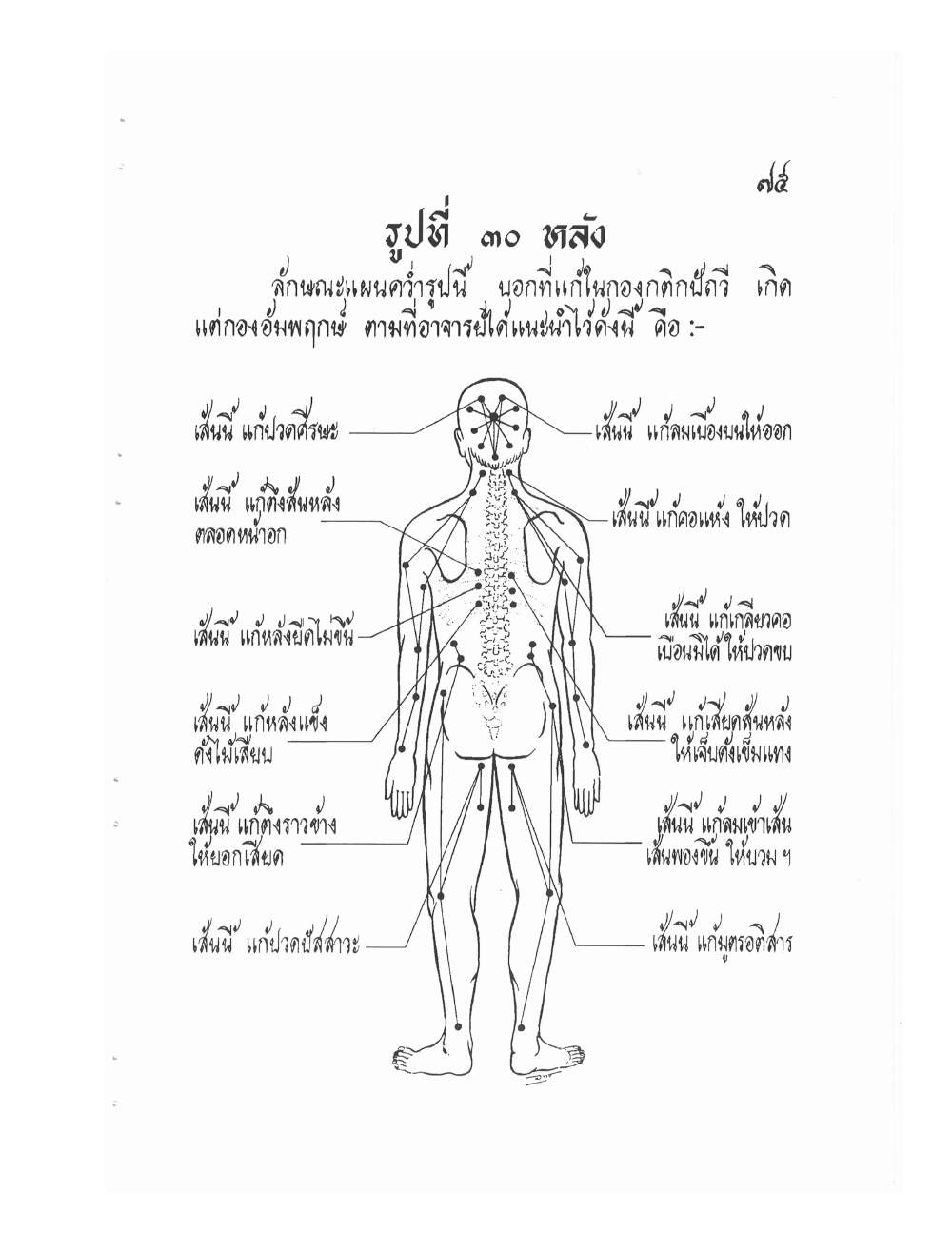
๗๕
รูปที่ ๓๐ หลัง
ลักษณะแผนคว่ำรูปนี้ บอกที่แก้ในกองวิสมปัถวี เกิด แต่กองอัมพฤกษ์ ตามที่อาจารย์ได้แนะนำไว้ ดังนี้คือ :-
เส้นนี้ แก้ปวดศีรษะ เส้นนี้ แก้ตึงสันหลังตลอดหน้าอก เส้นนี้ แก้หลังยึดไม่ขึ้น เส้นนี้ แก้หลังแข็งดังไม้เสียบ เส้นนี้ แก้ตึงราวข้าง ให้ยอกเสียด เส้นนี้ แก้ปวดปัสสาวะ
เส้นนี้ แก้ลมเมื่องบนให้ออก เส้นนี้ แก้คอแข็ง ให้ปวด เส้นนี้ แก้เกลียวคอ เอี้ยวมิได้ ให้ปวดขบ เส้นนี้ แก้เสียดสันหลัง ให้เจ็บดังเข็มแทง เส้นนี้ แก้ลมเข่าเส้น เส้นพองขึ้น ให้บวม ๆ เส้นนี้ แก้มูตรอติสาร
[diagram: back (prone) view of a standing male figure, dotted lines running down the spine with a stippled band along the backbone, radiating dots at the crown of the head, and small dots tracing sen (channels) from the head, back, buttocks, arms, and legs out to the labels listed above on either side; folio numeral ๗๕ at top right]
75
Figure 30, Back
This prone-body chart shows the points treated in the visama-pathavī (irregular earth) group, arising from the hemiplegia (paresis) group, as instructed by the teacher-masters, as follows:-
This line: treats headache. This line: treats tightness running down the spine all the way to the chest. This line: treats a back that cannot straighten/stretch up. This line: treats a back as stiff as a skewer of wood. This line: treats tightness along the flank, causing a wrenching, stabbing pain. This line: treats painful urination.
This line: draws wind that aches above [the body] out. This line: treats a stiff, aching neck. This line: treats a twisted neck, unable to turn, causing a gnawing pain. This line: treats a stabbing pain in the spine, as sharp as a needle. This line: treats wind in the knee, where the sen swells and causes swelling. This line: treats excessive/uncontrolled urination.
[diagram: back (prone) view of a standing male figure, dotted lines running down the spine with a stippled band along the backbone, radiating dots at the crown of the head, and small dots tracing sen (channels) from the head, back, buttocks, arms, and legs out to the labels listed above on either side; folio numeral 75 at top right]

ภาคที่ ๒
ภาพฤๅษีดัดตนแก้โรคต่างๆและกายบริหาร รวม ๑๑๔ ภาพ
[diagram: an ornate lotus-bud-shaped Thai decorative emblem (kranok motif) centered above the title]
Part Two
Images of ruesi dat ton (hermit self-stretching postures) for curing various ailments, and physical exercise 114 images in total
[diagram: an ornate lotus-bud-shaped Thai decorative emblem (kranok motif) centered above the title]
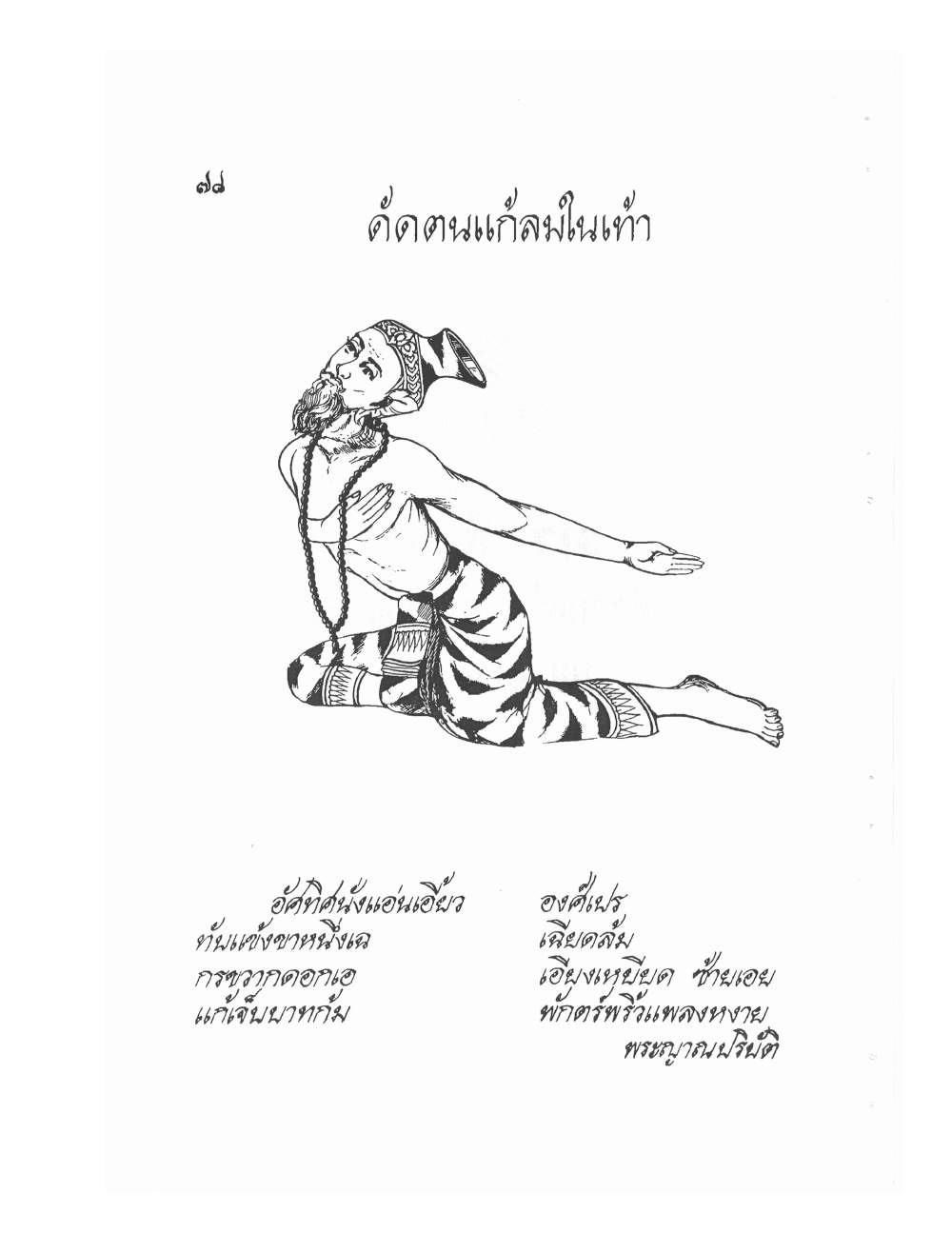
๗๘
ดัดตนแก้ลมในเท้า
อัศวินนั่งแอ่นเอี้ยว ท่อนแข้งขาหนึ่งเฉ กระชวากดอกเอว แก้เจ็บบาทกล่ม
องค์เปรื่อง เฉียดลม เอี้ยงเหยียด ซ้ายเอย พักตร์พริ้วเพลงหงาย
พระญาณปริยัติ
[diagram: a ruesi (hermit-sage) figure wearing a tall conical/horned headdress and a tiger-striped lower garment, a string of prayer beads around the neck, kneeling with one leg folded beneath him and the other leg stretched out flat behind, one hand pressed to his chest and the other arm extended outward with the palm up, head tilted back; folio numeral ๗๘ at top left]
78
Stretch to cure wind in the feet
The knight sits, arching and leaning, one shin and leg drawn aside, the hip and waist curved, this cures aching, cramped feet.
A radiant figure, brushing past the wind, leaning and stretching, to the left, face rippling as in the reclining pose.
[Attributed to] Phra Yan Pariyat.
[diagram: a ruesi (hermit-sage) figure wearing a tall conical/horned headdress and a tiger-striped lower garment, a string of prayer beads around the neck, kneeling with one leg folded beneath him and the other leg stretched out flat behind, one hand pressed to his chest and the other arm extended outward with the palm up, head tilted back; folio numeral 78 at top left]
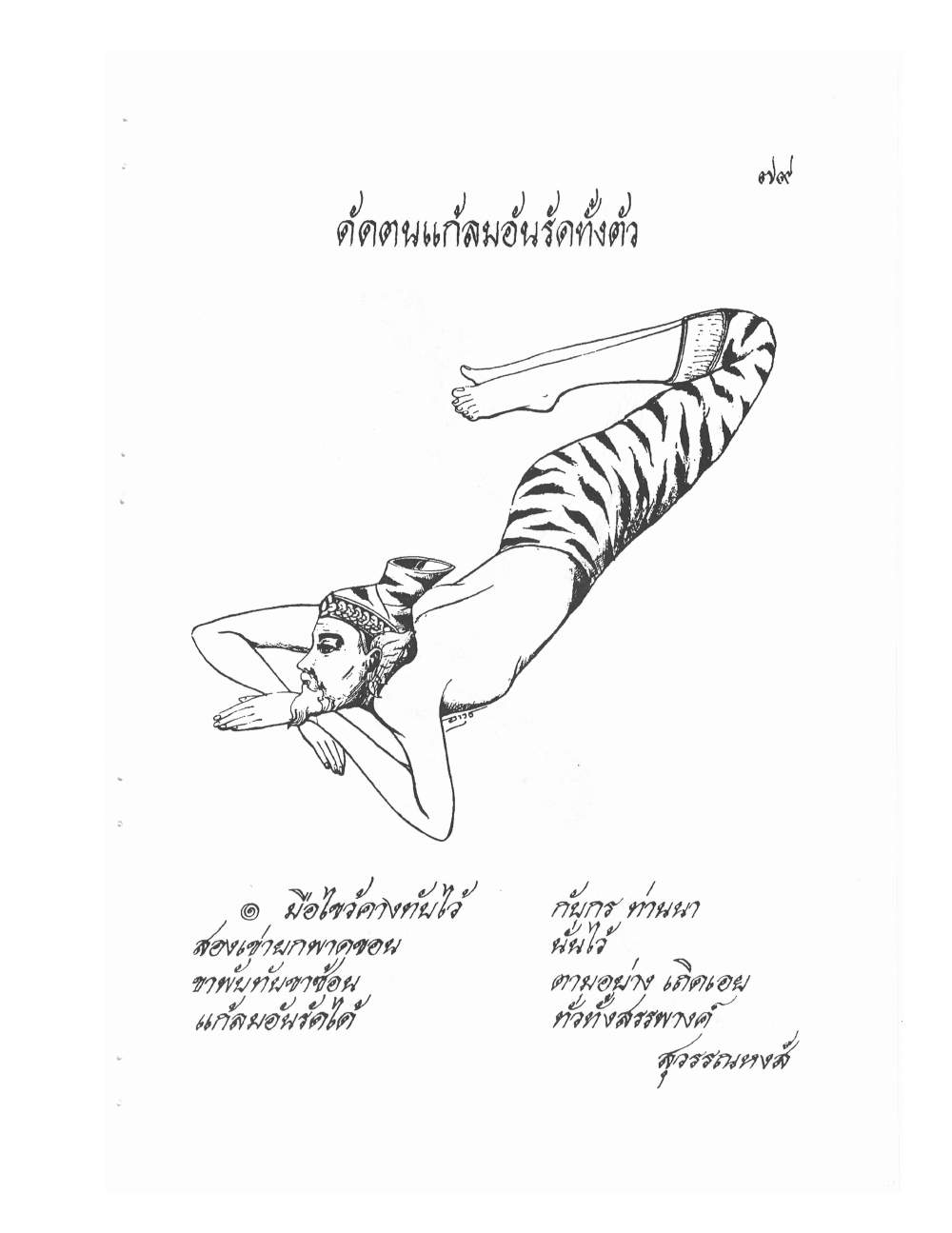
๗๙
ดัดตนแก้ลมอันรัดทั้งตัว
มือไขว่คางหนุนไว้ สองเข่ายกพาดซ้อน ขาพันทับซาซ้อน แก้ลมอัดรัดได้
กัยกร ท่านนา ยันไว้ ตามอย่าง เกิดเอย ทั้งทั้งสรรพางค์
สุวรรณหงส์
[diagram: a ruesi (hermit-sage) figure reclining with his head resting on crossed hands beneath the chin, wearing a horned headdress and a tiger-striped garment, one leg crossed over and raised with the foot lifted in the air; folio numeral ๗๙ at top right]
79
Stretch to cure wind that binds/constricts the whole body
Hands crossed, propping up the chin, both knees raised and laid one over the other, the legs wound and folded across each other, this cures wind that binds and constricts.
The limbs braced, held steady, after this fashion, throughout the whole body.
[Attributed to] Suwannahong.
[diagram: a ruesi (hermit-sage) figure reclining with his head resting on crossed hands beneath the chin, wearing a horned headdress and a tiger-striped garment, one leg crossed over and raised with the foot lifted in the air; folio numeral 79 at top right]
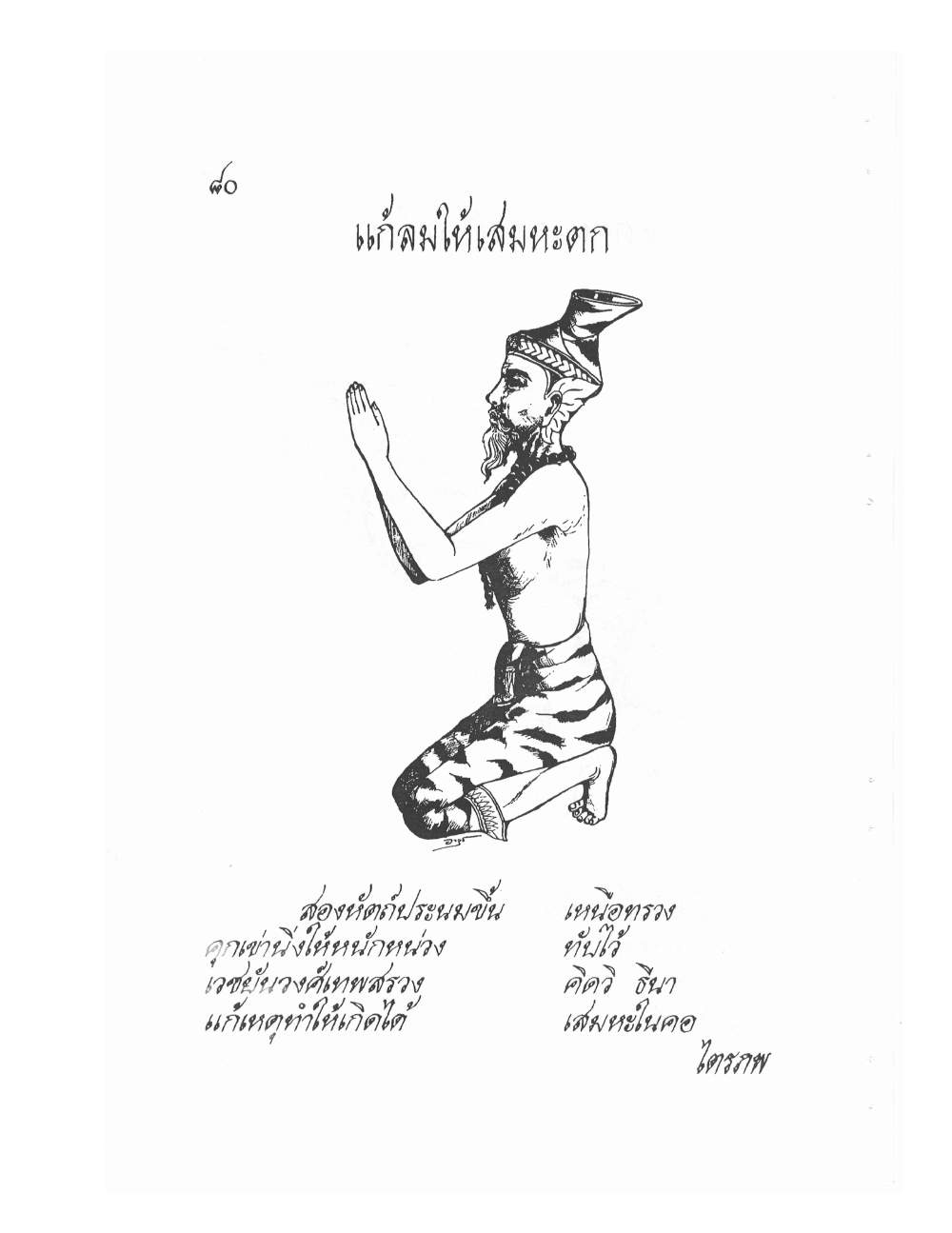
๘๐
แก้ลมให้เสมหะตก
สองหัตถ์ประนมขึ้น คุกเข่านั่งให้หนักหน่วง เวทย์บ่นวงศ์เทพสรวง แก้เหตุทำให้เกิดได้
เหนืออุรวงศ์ ทับไว้ คิดวิ ชินา เสมหะในคอ
ไตรภพ
[diagram: a kneeling ruesi (hermit-sage) figure with both hands pressed together in a wai (gesture of respect) raised before the face, wearing a horned headdress and a tiger-striped garment with a string of prayer beads at the neck; folio numeral ๘๐ at top left]
80
Cure to make phlegm descend by [treating] wind
Both hands raised together in a wai, kneeling, sitting down with full weight, reciting a spell to the assembly of gods, this cures the cause that lets [the affliction] arise.
Pressed down over the chest, contemplating with spell-knowledge, [to clear] the phlegm in the throat.
[Attributed to] Traiphop.
[diagram: a kneeling ruesi (hermit-sage) figure with both hands pressed together in a wai gesture raised before the face, wearing a horned headdress and a tiger-striped garment with a string of prayer beads at the neck; folio numeral 80 at top left]
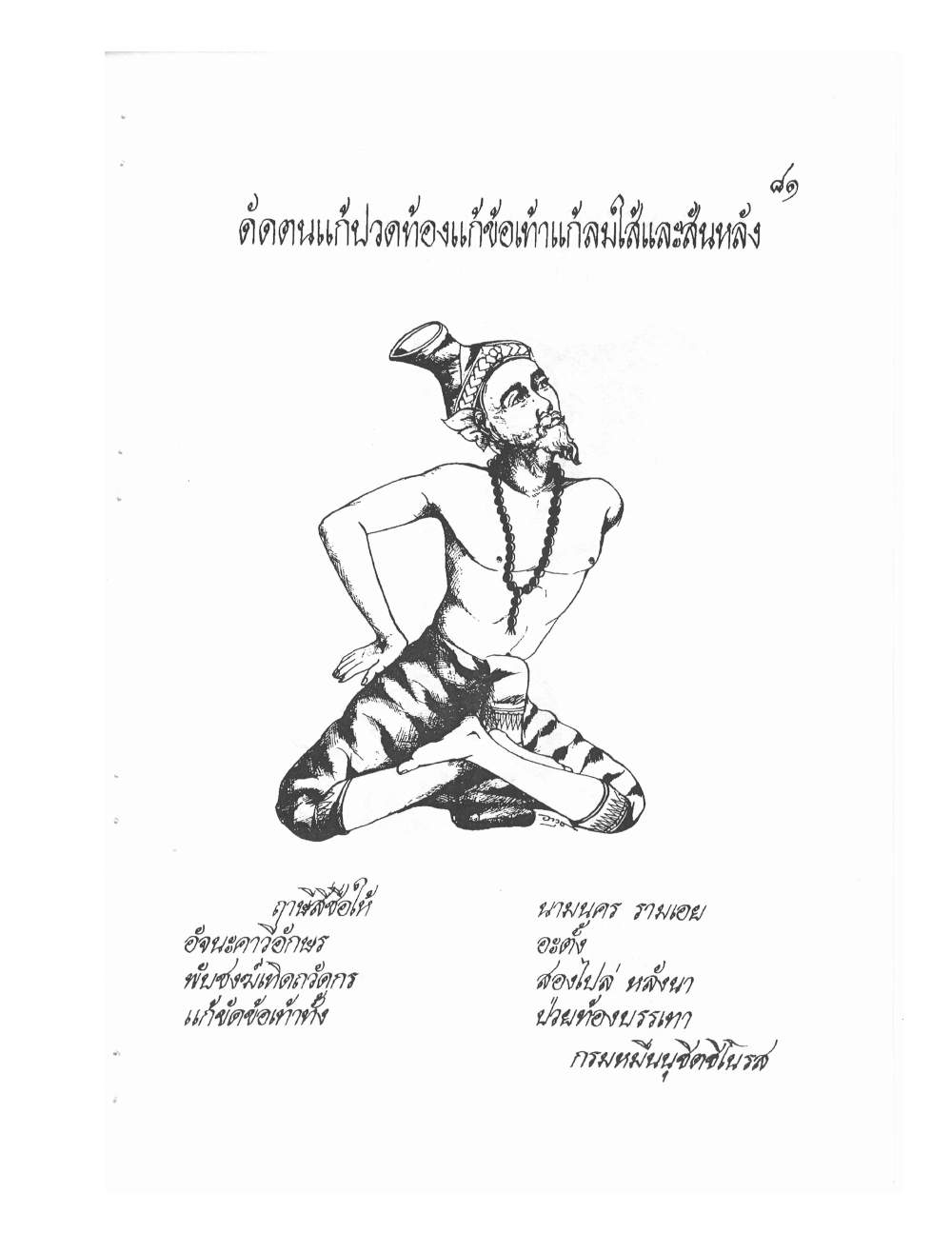
๘๑
ดัดตนแก้ปวดท้อง แก้ข้อเท้า แก้ลมใส้และสันหลัง
ฤๅษีชื่อให้ อัจนะคาวอักษร พันซงฆ์เกิดกวัดกร แก้ขัดข้อเท้าทั้ง
นามนคร รามเอย อะดัง สองไปล่ หลั่งนา ป่วยท้องบรรเทา
กรมหมื่นอุดิษฐ์อิเนรถ
[diagram: a kneeling ruesi (hermit-sage) figure with one hand braced on the hip and the other hand resting on a raised, bent knee, wearing a horned headdress, a tiger-striped garment, and a string of prayer beads; folio numeral ๘๑ at top right]
81
Stretch to cure stomach ache, to cure the ankle, to cure wind in the intestines and the spine
The ruesi is named, in script set down, bound in verse, arising by hand, this cures cramp throughout the ankle.
Named of the city, oh, resounding, the legs moving, pouring forth, easing the ailing belly.
[Attributed to] Krom Muen Uditanuphap.
[diagram: a kneeling ruesi (hermit-sage) figure with one hand braced on the hip and the other hand resting on a raised, bent knee, wearing a horned headdress, a tiger-striped garment, and a string of prayer beads; folio numeral 81 at top right]
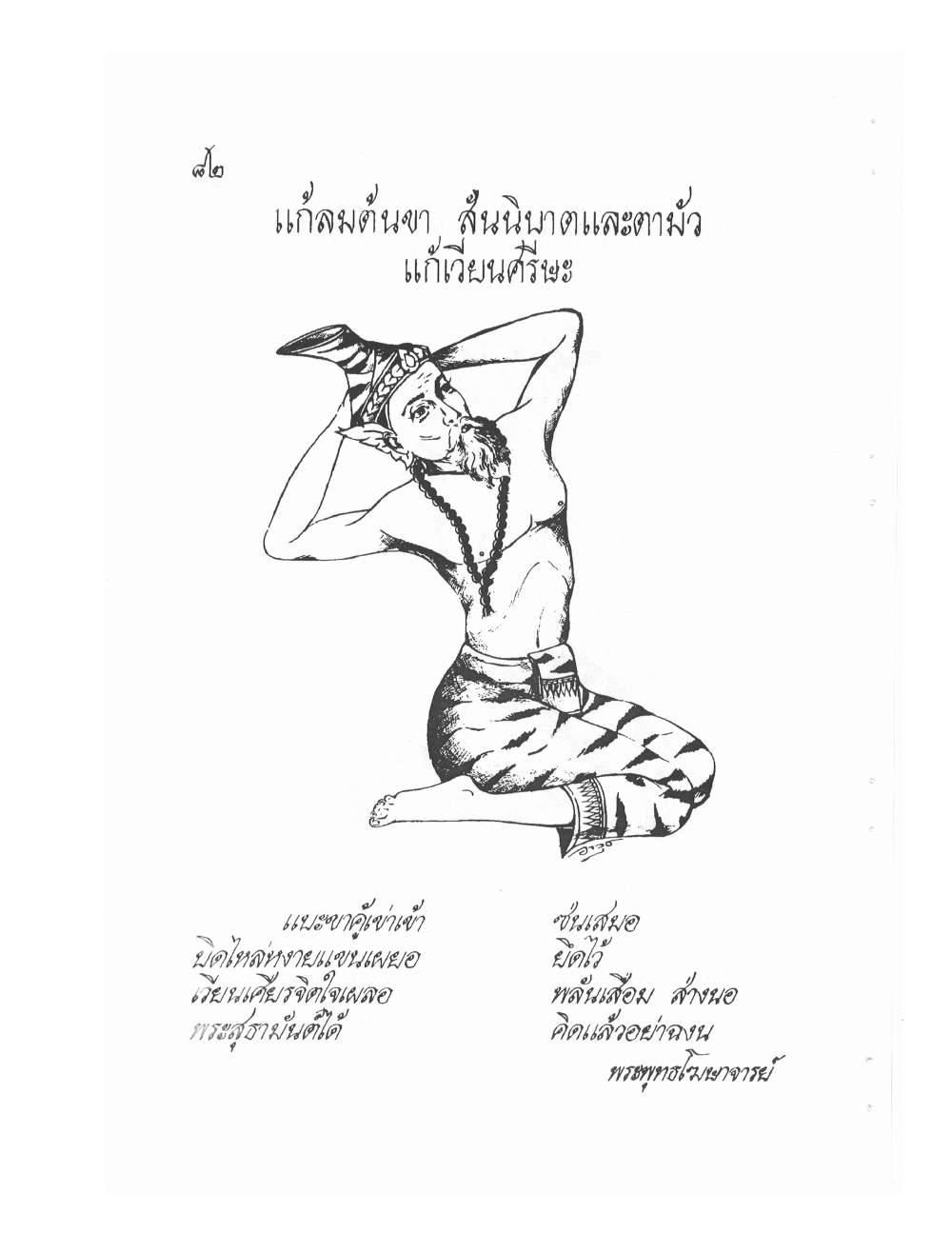
๘๒
แก้ลมต้นขา สิ้นนิมาดและตามัว แก้เวียนศีรษะ
แนะขาคู้เข่าเข้า มิดไหล่หงายแขนเผยอ เวียนเคียรจิตใจเผลอ พระสุธามั่นคงได้
ขึ้นเสมอ ยึดไว้ พลั้นเสื่อม ส่งนอ คิดแล้วอย่าฉงน
พระพุทธโฆษาจารย์
[diagram: a kneeling ruesi (hermit-sage) figure with both hands clasped behind the head and elbows raised, head tilted back, wearing a horned headdress, a tiger-striped garment, and a string of prayer beads; folio numeral ๘๒ at top left]
82
Cure for wind in the thighs, for exhaustion and blurred vision, cure for dizziness
Draw the leg in, bend the knee, shoulders lowered, arms raised and turned upward, when the mind grows dizzy and confused, the Dhamma may still be held steady.
Rising evenly, holding firm, lest it falter and decline, consider this, and do not be perplexed.
[Attributed to] Phra Phutthaghosacariya.
[diagram: a kneeling ruesi (hermit-sage) figure with both hands clasped behind the head and elbows raised, head tilted back, wearing a horned headdress, a tiger-striped garment, and a string of prayer beads; folio numeral 82 at top left]
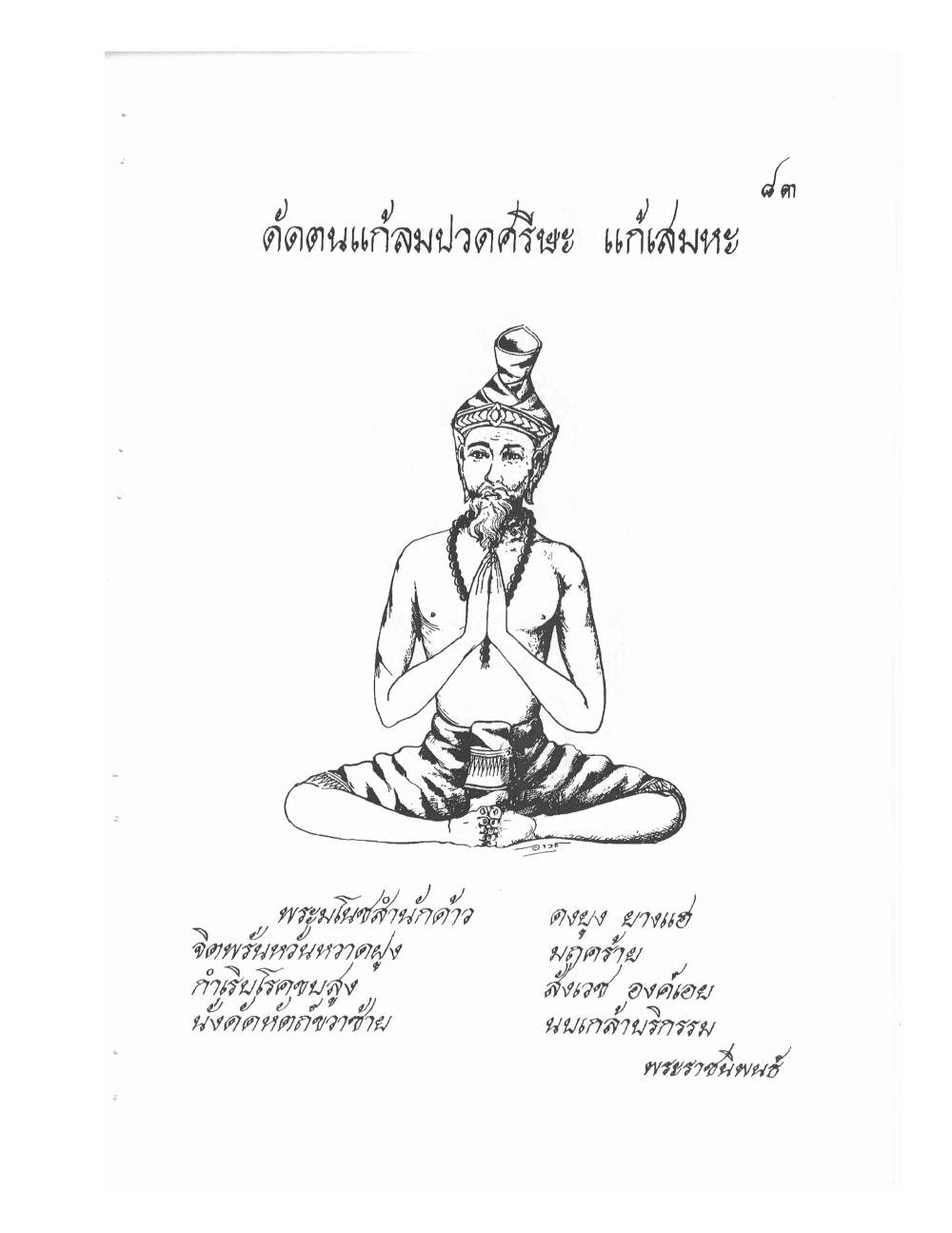
๘๓
ดัดตนแก้ลมปวดศีรษะ แก้เสมหะ
[ภาพ: ฤๅษีนั่งขัดสมาธิ พนมมือไหว้ระดับอก สวมชฎายอดแหลมพันผ้า คาดกรอบหน้า มีเคราและหนวดยาว ลูกประคำคล้องคอ นุ่งผ้าลายเสือ นั่งไขว้ขาปลายเท้าไขว้กันด้านหน้า] พระมโนชล้ำน้ำค้าง คงยุง ย่างแฮ จิตพรั่นหวั่นหวาดฝูง มฤคร้าย กำเริบโรคชมสูง สิ้นเวช องค์เอย นั่งดัดหัตถ์ขวาซ้าย นมเกล้าบริกรรม พระราชนิพนธ์
83
Stretching to cure wind-pain of the head, to cure phlegm
[diagram: a ruesi (hermit-sage) sits cross-legged with palms pressed together in a wai at chest height, wearing a tall pointed, cloth-wrapped headdress with a decorated band, a long beard and moustache, and a rosary around the neck; he wears a tiger-striped lower cloth, seated with the crossed feet drawn together in front]
Verse (khlong si suphap): The mind overflows like dew upon the grass — restless, uneasy, startled as by wild beasts; the ailment rises and worsens gravely. Sit and twist the hands, right and left, bowing the head in reverent practice [to relieve it]. Signature: A royal composition (Phraratchaniphon)
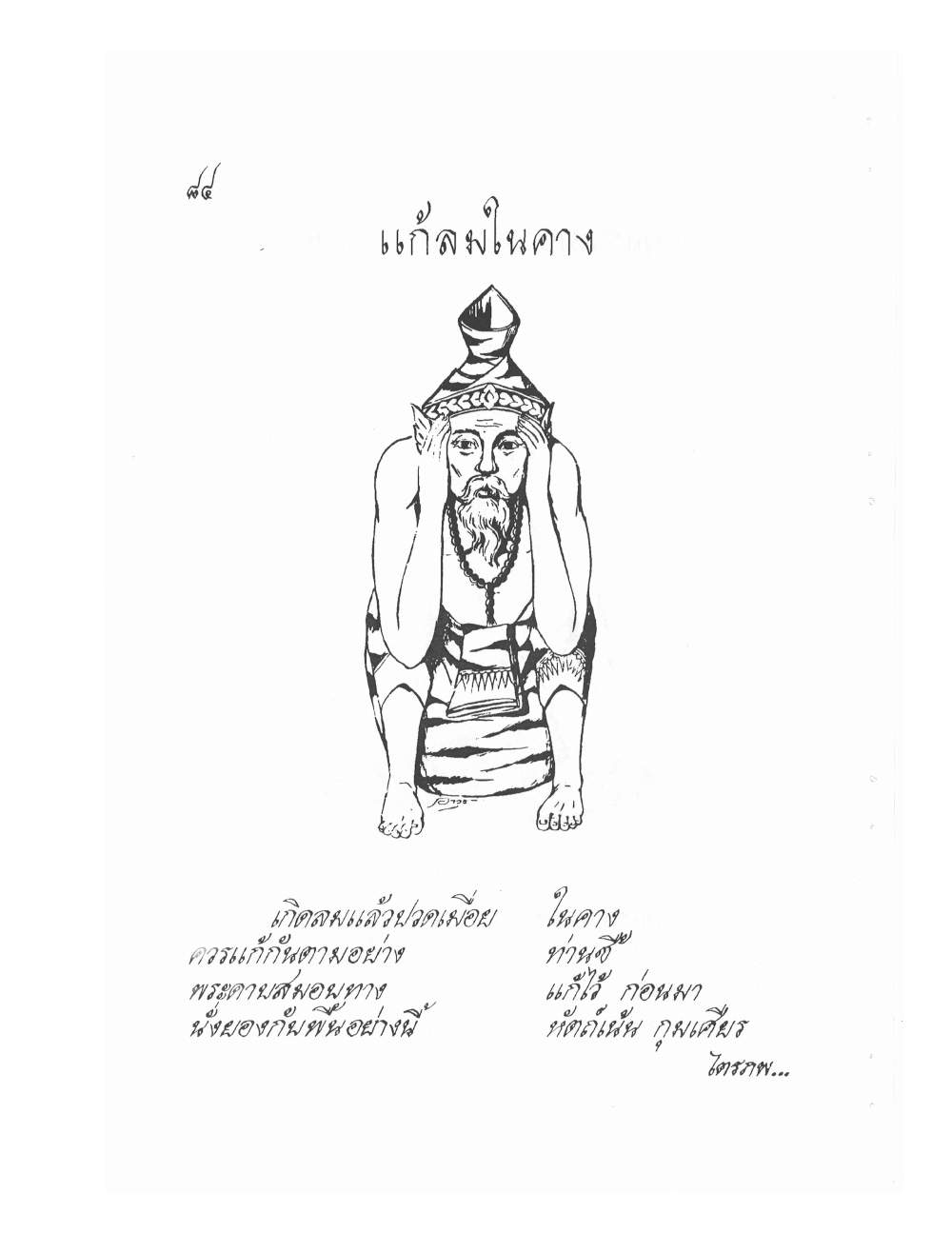
๘๔
แก้ลมในคาง
[ภาพ: ฤๅษีนั่งคุกเข่า ยกมือทั้งสองข้างขึ้นจับที่ขมับ/ศีรษะ สวมชฎายอดแหลม มีเคราและหนวดยาว ลูกประคำคล้องคอ นุ่งผ้าลายเสือ มีสมุดหรือตำราวางที่หน้าตัก] เกิดลมแล้วปวดเมื่อย ในคาง ท่านชี้ ควรแก้กินตามอย่าง แก้ไว้ ก่อนมา พระคายสมอบทาง หัตถ์เข่น กุมเศียร นั่งยองก้มพื้นอย่างนี้ ไตรภพ...
84
Cure for wind in the jaw/chin
[diagram: a ruesi kneels with both hands raised to press against the temples/head; he wears a tall pointed headdress, a long beard and moustache, a rosary around the neck, and a tiger-striped lower cloth, with a book or manual resting on his lap]
Verse: When wind arises it brings an aching soreness in the chin/jaw, as the sages have pointed out. One should treat it by following the prescribed manner, curing it before [it worsens]. Phra Khai laid down the way: press the hands at the temples, cradling the head, crouching and bowing toward the ground in this manner. Signature: Traiphop
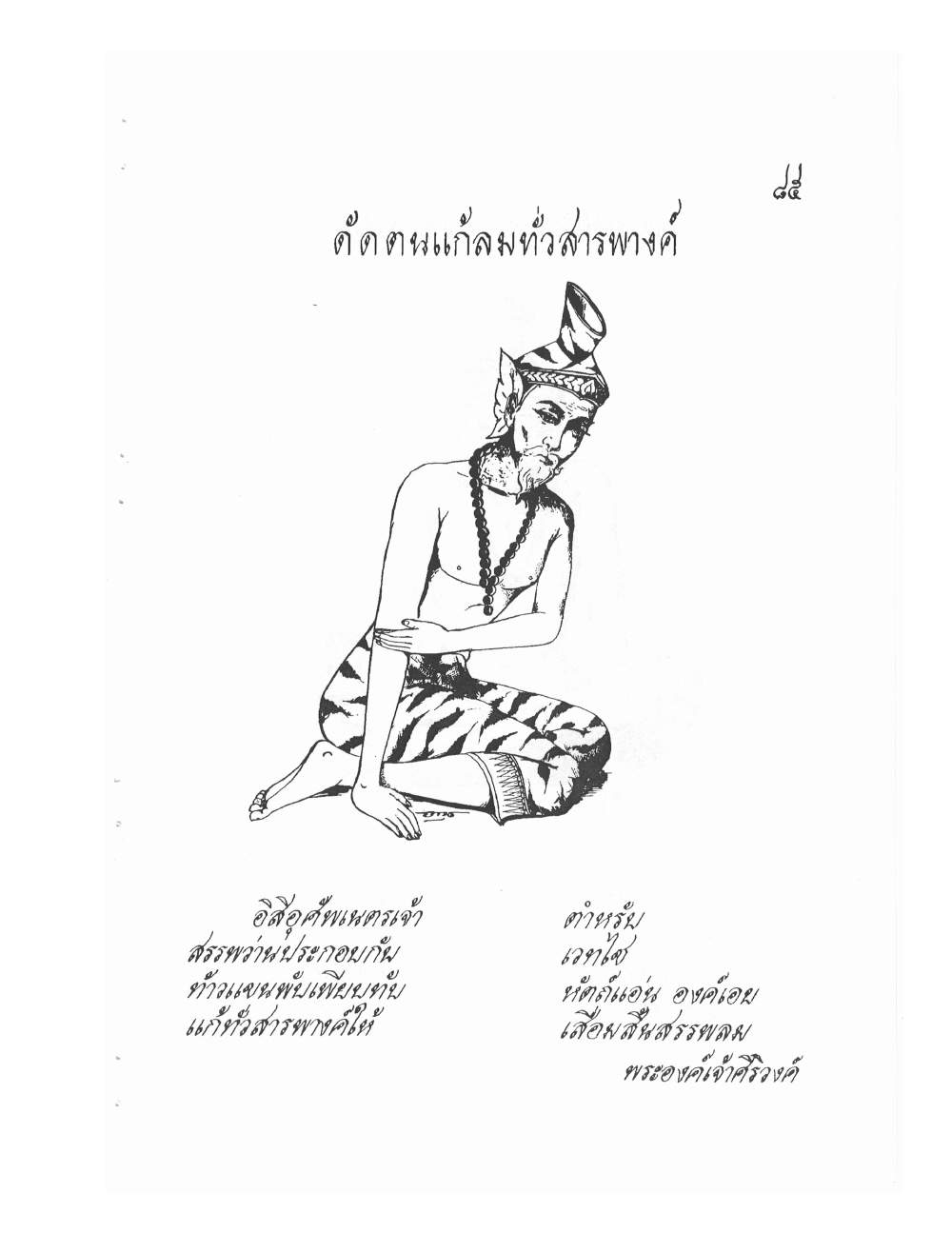
๘๕
ดัดตนแก้ลมทั่วสารพางค์
[ภาพ: ฤๅษีนั่งพับเพียบเอียงตัว มือข้างหนึ่งประคองที่ข้อศอกอีกข้างซึ่งวางพาดบนตัก ก้มหน้าเล็กน้อย สวมชฎายอดแหลม มีเคราและหนวดยาว ลูกประคำคล้องคอยาวถึงกลางลำตัว นุ่งผ้าลายเสือ] อิสีอุศัพเนตรเจ้า ตำหรับ สรรพว่านประกอบกัน เวทไซร้ ท้าวเขนพับเพียบทัน หัตถ์แอบ องค์เอย แก้ทั่วสารพางค์ให้ เสื่อมสิ้นสรรพลม พระองค์เจ้าศิริงค์
85
Stretching to cure wind throughout the whole body
[diagram: a ruesi sits in a folded, sideways seated position, one hand supporting the opposite elbow which rests on his lap, head bowed slightly; he wears a tall pointed headdress, a long beard and moustache, a rosary hanging to mid-torso, and a tiger-striped lower cloth]
Verse: The sage of keen eye set down this formula — all manner of herbs combined together with incantation. Sitting folded to one side, elbow tucked close to the body, this cures wind throughout the whole body, causing every wind-ailment to fade away entirely. Signature: Phra Ong Chao Siring
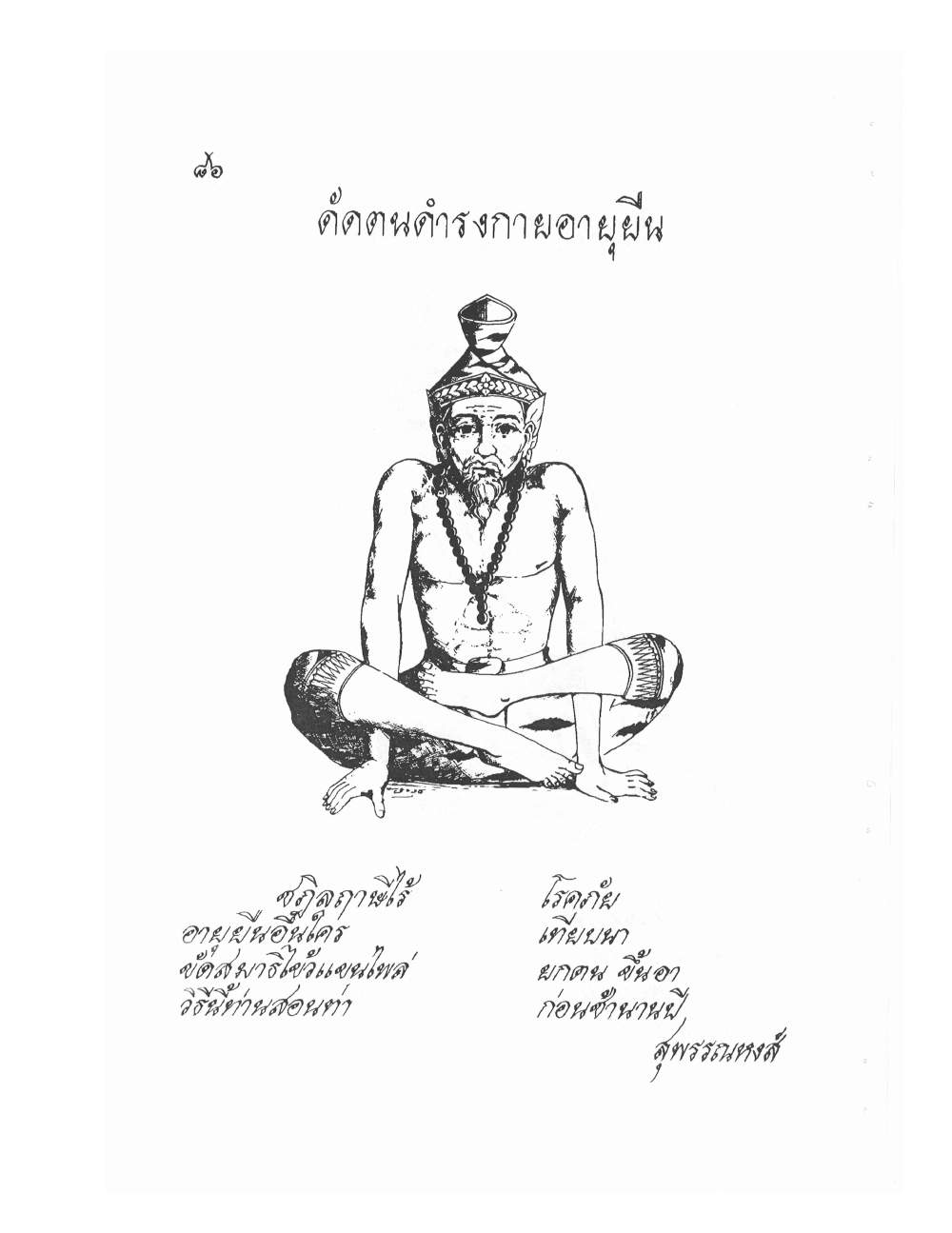
๘๖
ดัดตนดำรงกายอายุยืน
[ภาพ: ฤๅษีนั่งขัดสมาธิ ไขว้ขาข้างหนึ่งพาดยกขึ้นบนอีกข้าง มือทั้งสองจับปลายเท้าที่ยกขึ้น สวมชฎายอดแหลม มีเคราและหนวดยาว ลูกประคำคล้องคอ นุ่งผ้าลายเสือ] สกิ่ลกายไม่รู้ โรคภัย อายุยืนอันครัน เที่ยงแท้ ขัดสมาธิใช้แขนไพล่ ยกตน ขึ้นอา วิธีนี้ท่านสอนท่า ก่อนซ้ำนานปี สุพรรณหงส์
86
Stretching to sustain the body and prolong life
[diagram: a ruesi sits cross-legged with one leg crossed and lifted over the other, both hands gripping the raised foot; he wears a tall pointed headdress, a long beard and moustache, a rosary around the neck, and a tiger-striped lower cloth]
Verse: The body untouched by disease, life prolonged with certainty — sit in meditation posture, twist the arm behind, and lift the body up. This is the method the elders taught, [practiced] before, for many years since. Signature: Suphannahong
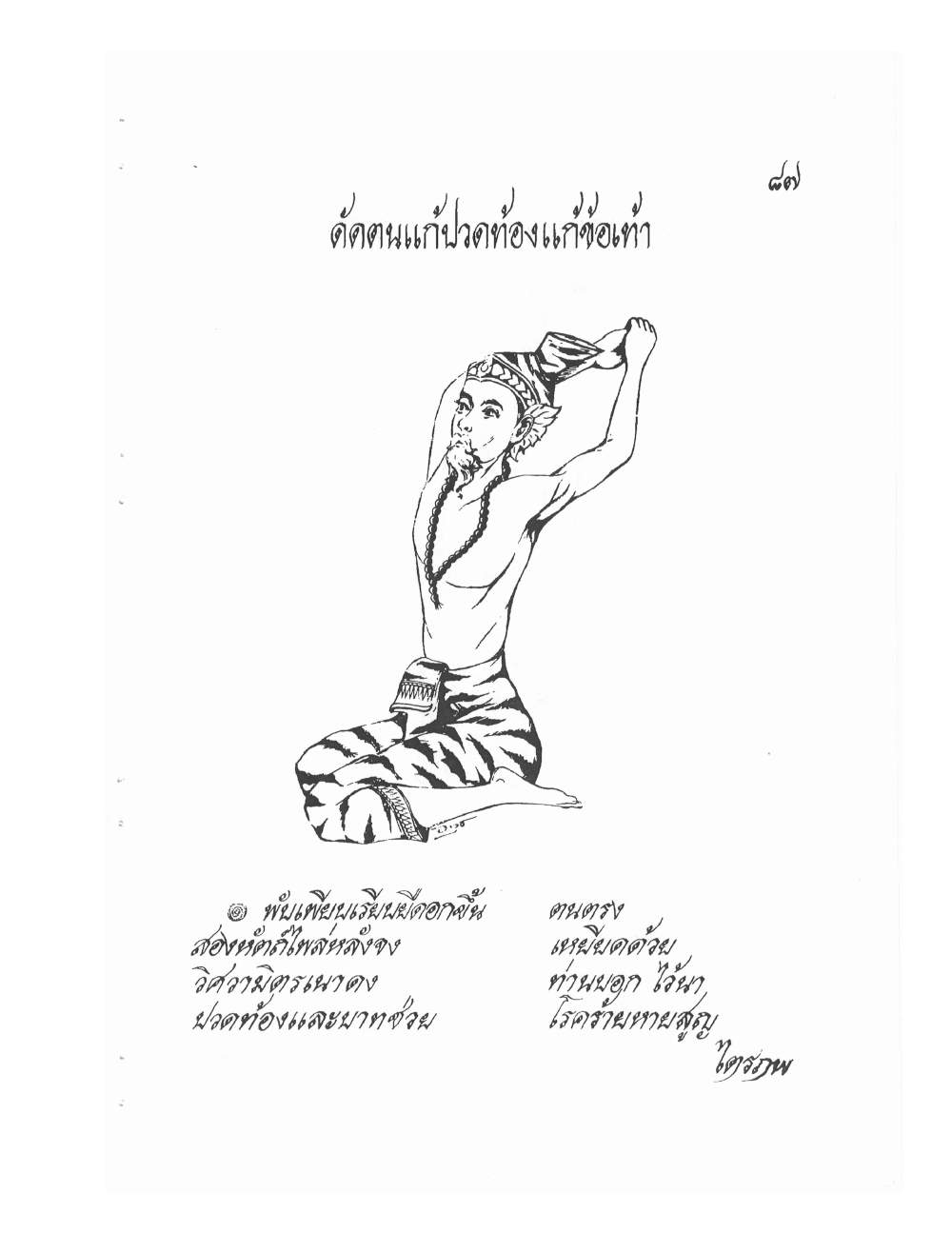
๘๗
ดัดตนแก้ปวดท้องแก้ข้อเท้า
[ภาพ: ฤๅษีนั่งคุกเข่าตัวตรง ยกแขนข้างหนึ่งขึ้นเหนือศีรษะไปด้านหลังจับปลายเท้าที่ยกพับขึ้น อีกมือหนึ่งวางแนบอก สวมกรอบหน้าคาดผ้าโพก มีเคราและหนวดยาว ลูกประคำคล้องคอ นุ่งผ้าลายเสือ] ๐ พันเพียบเรียบยืดอกขึ้น ตนตรง สองหัตถ์ไพล่หลังจง เหยียดด้วย วิศวามิตรเผาดง ท่านบอก ไว้นา ปวดท้องและบาทช่วย โรคร้ายหายสูญ ไตรภพ
87
Stretching to cure stomach ache, to cure ankle joints
[diagram: a ruesi kneels upright, one arm raised overhead and reaching behind to grasp a foot lifted and folded up behind the head, the other hand resting at the chest; he wears a decorated headband, a long beard and moustache, a rosary around the neck, and a tiger-striped lower cloth]
Verse: Sit erect, chest lifted and the body straight; twist both hands behind the back and stretch. Vishvamitra, who burned the forest, taught this method: it relieves stomach ache and aids the foot, so that the grave affliction is utterly banished. Signature: Traiphop
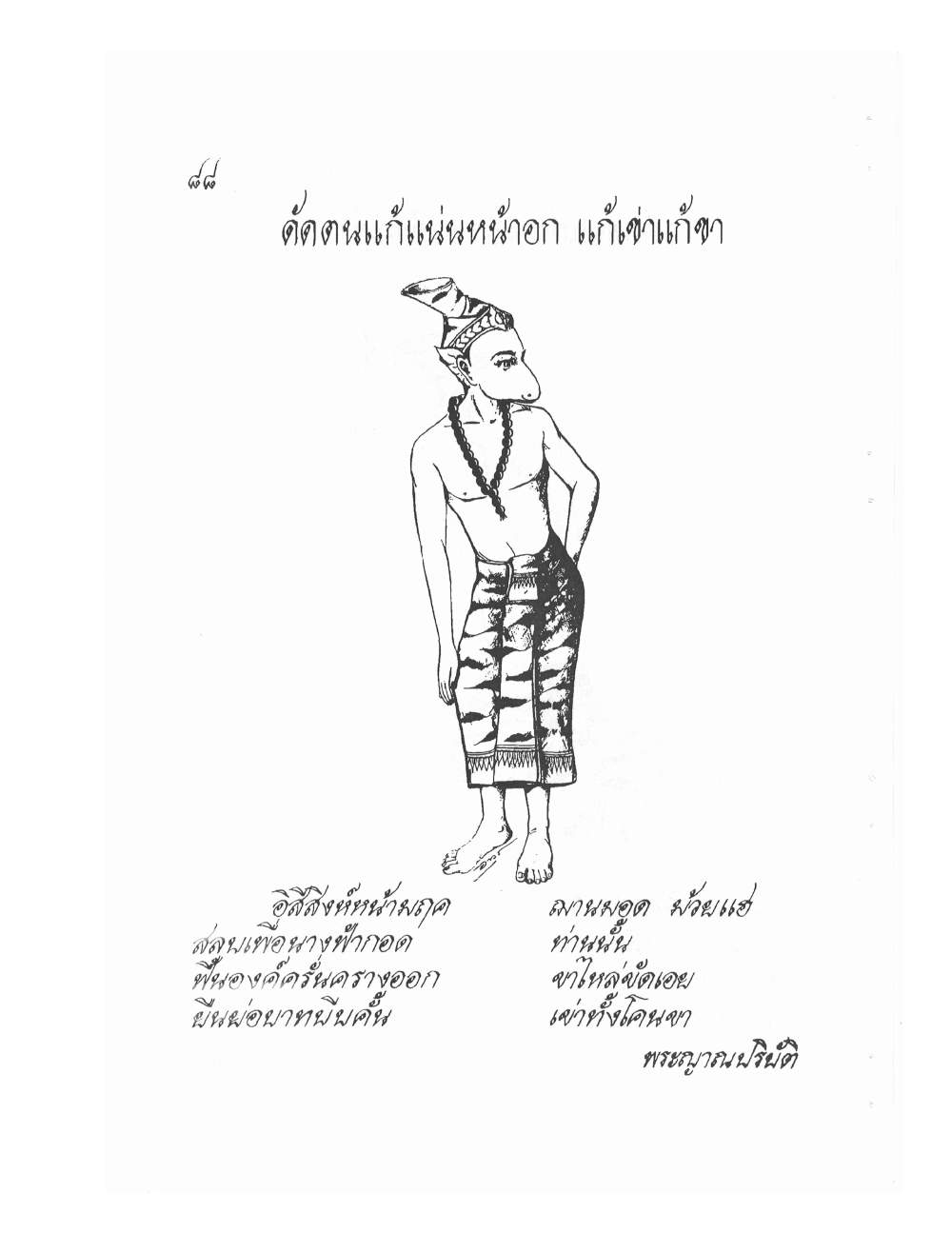
๘๘
ดัดตนแก้แน่นหน้าอก แก้เข่าแก้ขา
[ภาพ: ฤๅษีหน้าคล้ายสัตว์ (ปากยื่นแบบมฤค) ยืนเอามือข้างหนึ่งเท้าสะเอว อีกมือแนบลำตัว คล้องลูกประคำ นุ่งผ้าลายเสือยาวกรอมข้อเท้า] อสีสิงห์หน้ามฤค ลานมอด ม้วยแฮ สลนเพื่อนางฟ้ากอด ท่านนั้น ผืนองค์ครั่นครางออก ขาไหล่ ขัดเอย ยืนย่อบาทมือคั้น เข่าทั้งโคนขา พระญาณปรินติ
88
Stretching to cure chest tightness, to cure the knee and leg
[diagram: a ruesi with an animal-like face (a beast's protruding muzzle) stands with one hand on his hip and the other resting at his side, wearing a rosary and a long tiger-striped lower cloth reaching to the ankles]
Verse: The lion-faced sage, [whose story tells of one who] perished withering away, sorrowing for the embrace of a heavenly maiden — his body groans and aches through hip and shoulder. Standing and crouching, grip the foot with the hand, [easing] the knee and the whole thigh. Signature: Phra Yan Printi
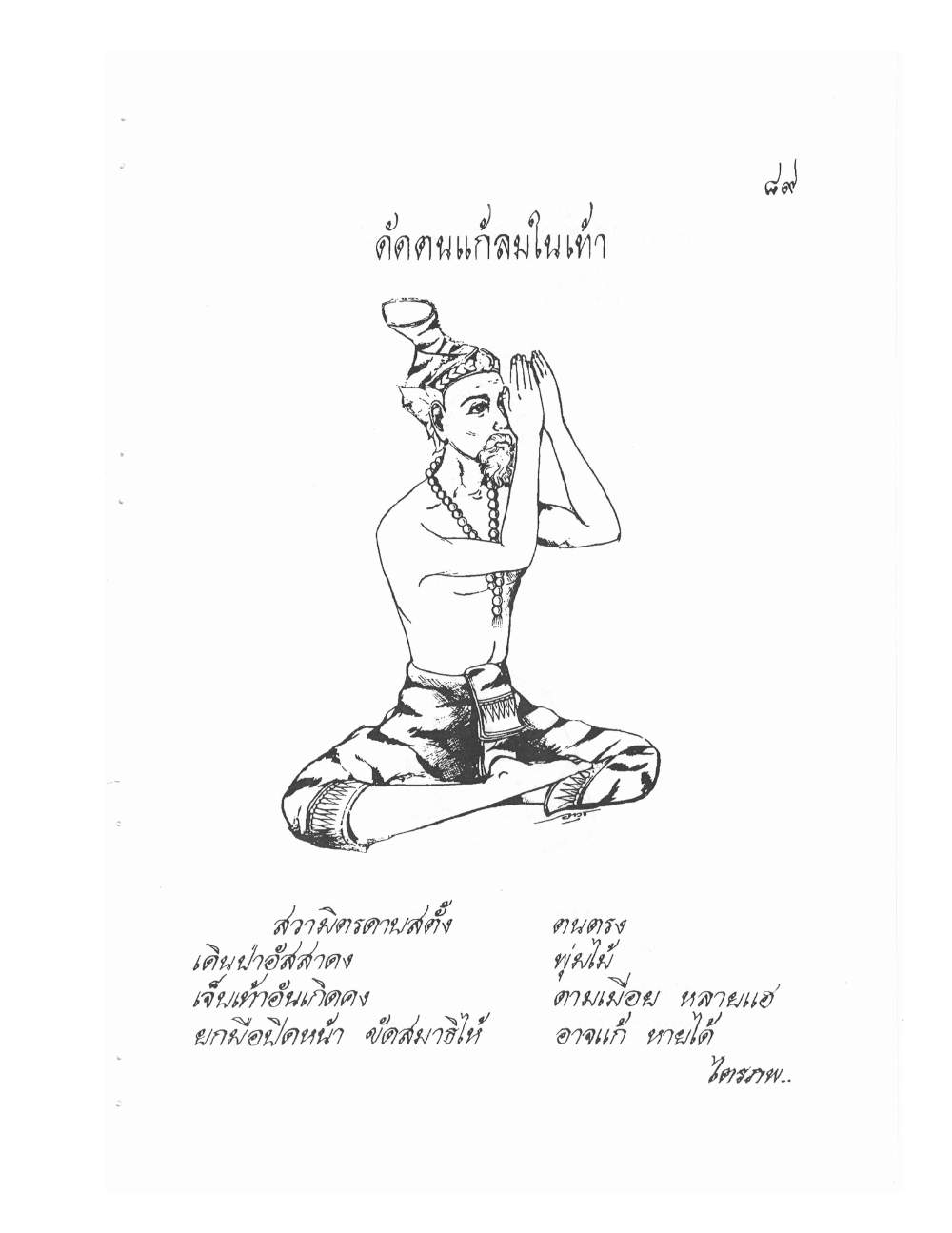
๘๙
ดัดตนแก้ลมในเท้า
[ภาพ: ฤๅษีนั่งขัดสมาธิ ยกมือข้างหนึ่งขึ้นแนบข้างศีรษะ/ใบหน้า อีกมือหนึ่งงอพาดที่ข้อศอก สวมชฎายอดแหลม มีเคราและหนวดยาว ลูกประคำคล้องคอสองเส้น นุ่งผ้าลายเสือ] สวามิตรดาบสตั้ง ตนตรง เดินป่าอัสสาดง พุ่มไม้ เจ็บเท้าอันเกิดคง ตามเมื่อย หลายแฮ ยกมือปิดหน้า ขัดสมาธิให้ อาจแก้ หายได้ ไตรภพ..
89
Stretching to cure wind in the foot
[diagram: a ruesi sits cross-legged with one hand raised alongside the head/face and the other bent and resting at the elbow; he wears a tall pointed headdress, a long beard and moustache, two rosary strands around the neck, and a tiger-striped lower cloth]
Verse: The ascetic Svamitra held his body upright, walking through forest, wilderness, and thicket — the foot pain that arises comes from prolonged weariness, in many forms. Raise the hand to cover the face, and sit in meditation posture; by this the affliction may be cured and made to pass. Signature: Traiphop
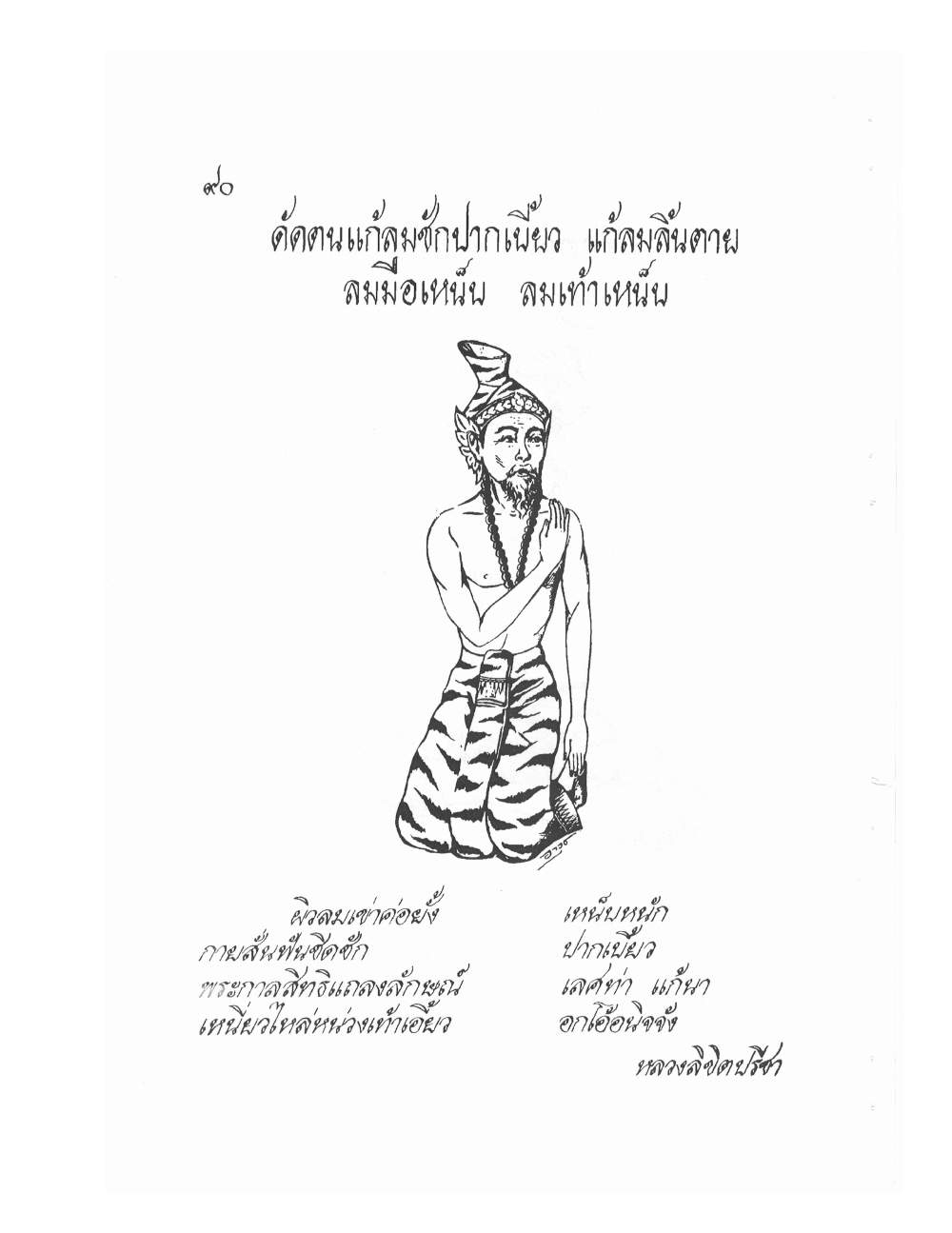
๙๐
ดัดตนแก้ลมชักปากเบี้ยว แก้ลมลิ้นตาย
ลมมือเหน็บ ลมเท้าเหน็บ [ภาพ: ฤๅษีนั่งคุกเข่าพับข้าง มือข้างหนึ่งไขว้ขึ้นแตะไหล่ตรงข้าม สวมชฎายอดแหลม มีเคราและหนวดยาว ลูกประคำคล้องคอ นุ่งผ้าลายเสือ] ผิวลมเข่าค่อยยั้ง เหน็บหนัก กายสั่นพื้นชืดชัก ปากเบี้ยว พระกาลสิทธิแถลงลักษณ์ เลศท่า แก้นา เหนียวไหล่หน่วงเท้าเอี้ยว อกอ่อนจริง หลวงลิขิตปรีชา
90
Stretching to cure wind that pulls the mouth crooked, to cure wind that deadens the tongue; wind that numbs the hand, wind that numbs the foot
[diagram: a ruesi kneels folded to one side, one hand crossed to touch the opposite shoulder; he wears a tall pointed headdress, a long beard and moustache, a rosary around the neck, and a tiger-striped lower cloth]
Verse: When the wind at the knee is not restrained, heavy numbness follows: the body trembles, the ground feels rigid, twitching pulls the mouth crooked. Phra Kanla Sit set forth the manner and secret of the pose to cure this — draw taut the shoulder, weigh down and turn the foot, and the chest [that had grown] weak truly [is eased]. Signature: Luang Likhit Pricha
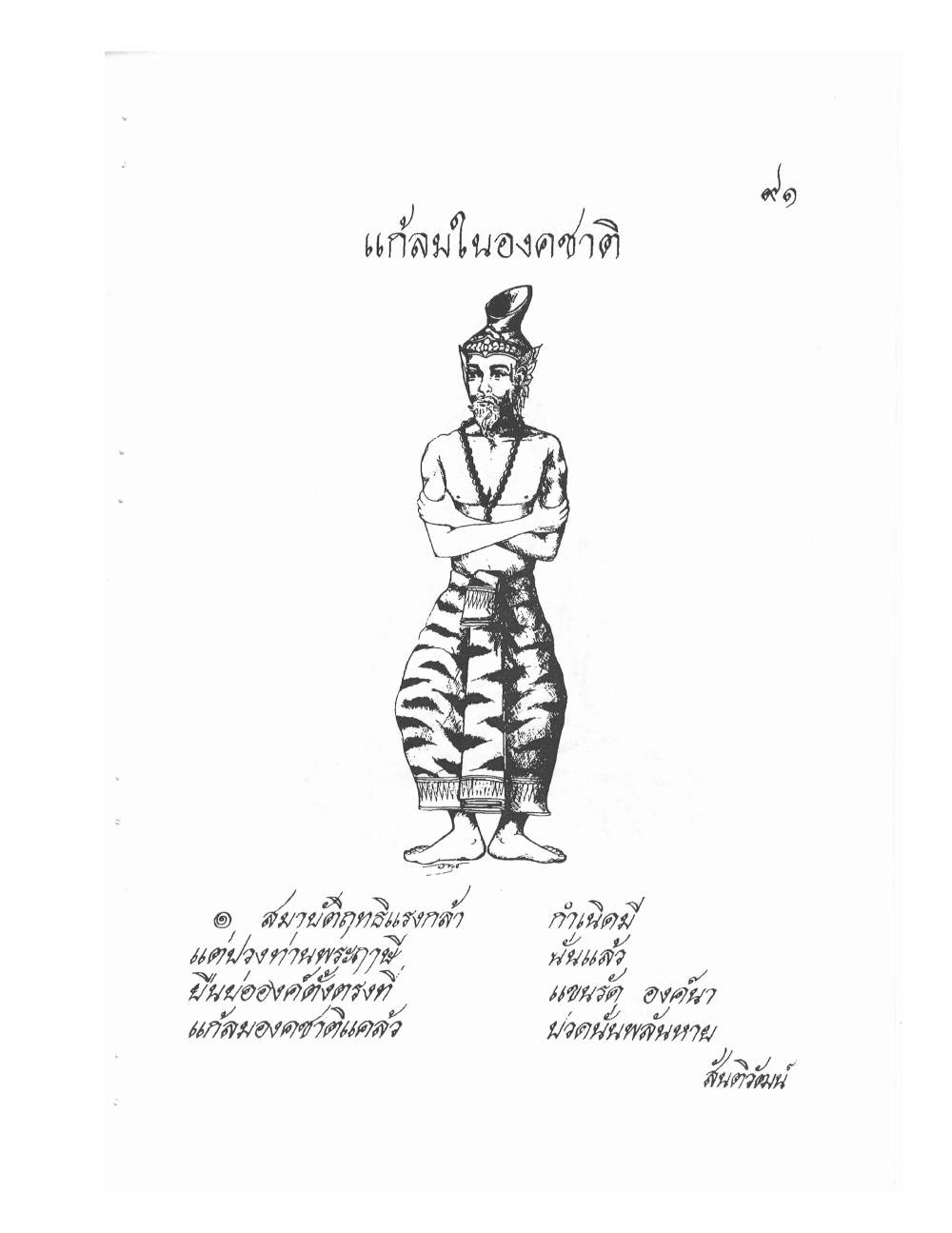
๙๑
แก้ลมในองคชาติ
[ภาพ: ฤๅษียืนตัวตรง กอดอกไขว้แขนทั้งสองข้าง สวมชฎายอดแหลม มีเคราและหนวดยาว ลูกประคำคล้องคอ นุ่งผ้าลายเสือแบบหลวมยาวถึงข้อเท้า] ๐ สมานติกฤทธิ์แรงกล้า กำเนิดมี แต่ปวงท่านพระกายนี้ พันแล้ว ยืนย่อองค์ตั้งตรงที่ แขนรัด องค์นา แก้ลมองคชาติแคล้ว ม่วนนั้นพลันหาย สันติวัฒน์
91
Cure for wind in the male organ
[diagram: a ruesi stands upright with both arms crossed over the chest; he wears a tall pointed headdress, a long beard and moustache, a rosary around the neck, and a loose tiger-striped lower cloth reaching to the ankles]
Verse: A power of great strength has, since birth, bound up this body of the venerable ones entirely. Stand, lower the body, hold it upright in place, and bind the arms about it — thus the wind in the male organ is dispelled, and its distress swiftly departs. Signature: Santiwat
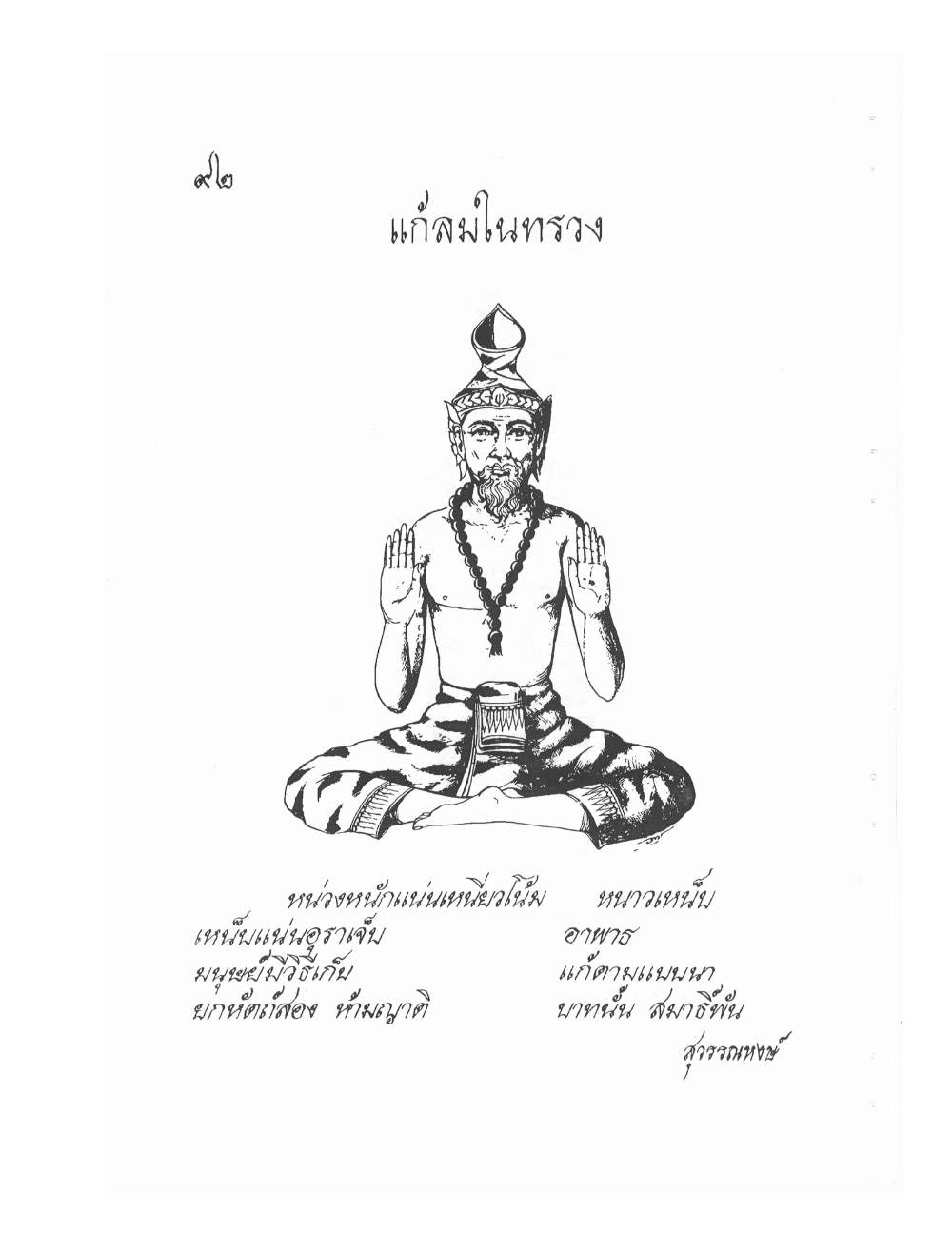
๙๒
แก้ลมในทรวง
[ภาพ: ฤๅษีนั่งขัดสมาธิ ยกมือทั้งสองข้างขึ้นระดับไหล่ หันฝ่ามือออกด้านนอก สวมชฎายอดแหลม มีเคราและหนวดยาว ลูกประคำคล้องคอ นุ่งผ้าลายเสือ] หน่วงหนักแน่นเหนียวโน้ม หนาวเหน็บ เหน็บแน่นอุราเจ็บ อาพาธ มนุษย์มีวิธีเก็บ แก้ตาม แบบนา ยกหัตถ์ถกส่อง ห้ามญาติ บาทนั้น สมาธิพื้น สุวรรณหงษ์
92
Cure for wind in the chest
[diagram: a ruesi sits cross-legged with both hands raised to shoulder height, palms turned outward; he wears a tall pointed headdress, a long beard and moustache, a rosary around the neck, and a tiger-striped lower cloth]
Verse: A heavy, dense, clinging weight brings a numbing chill; numbness settles firmly, and the chest aches with affliction. People have a method laid down to treat it in the prescribed manner: raise the hands, lift and display them as if warding off, [plant] the feet, and settle into meditation posture. Signature: Suwannahong
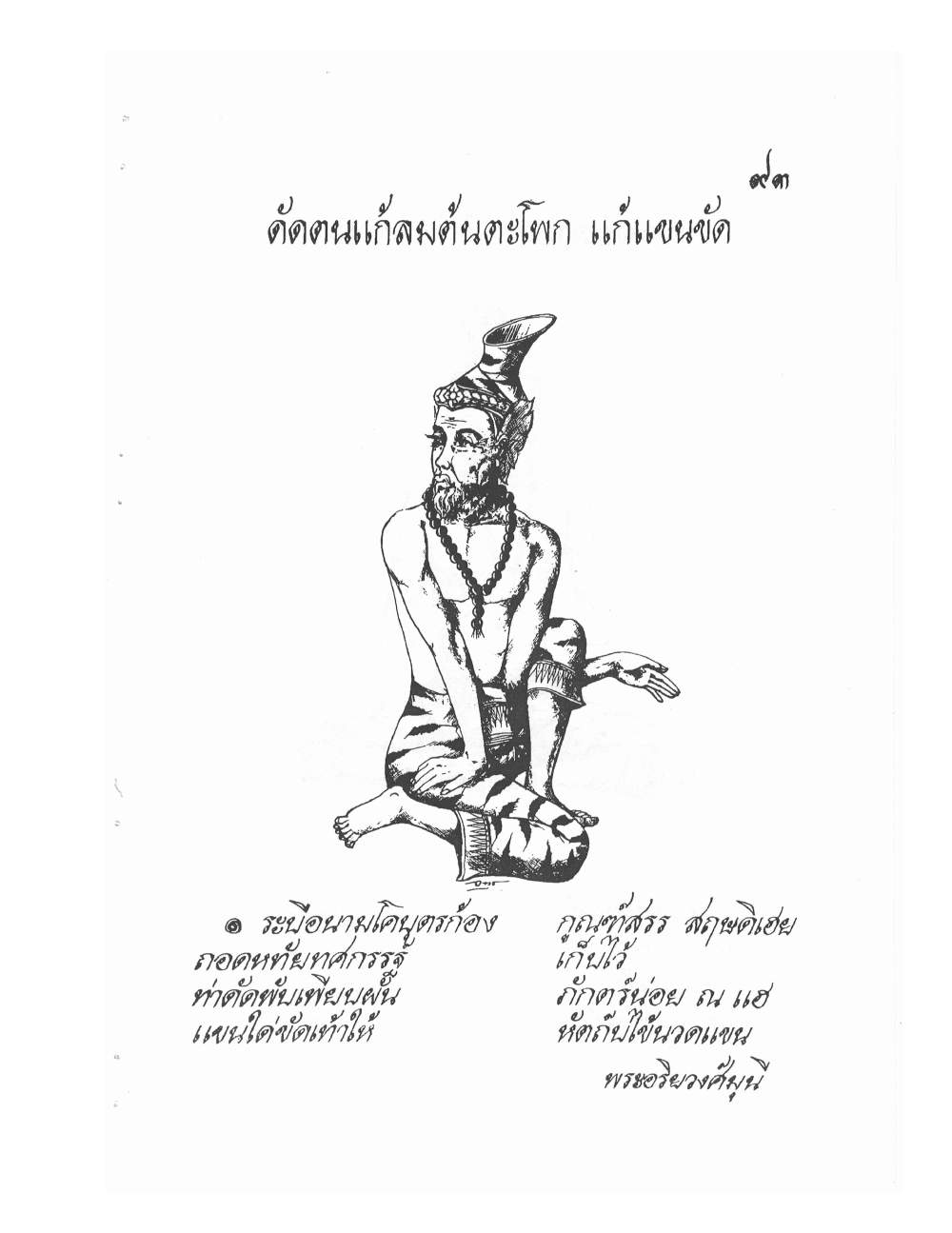
๙๓
ดัดตนแก้ลมต้นตะโพก แก้แขนขัด
[ภาพ: ฤๅษีนั่งพับเพียบเอียงตัว ขาข้างหนึ่งพับไว้ อีกข้างเหยียดไปด้านข้าง แขนข้างหนึ่งเหยียดลงพื้นแบเท้ารับ สวมชฎายอดแหลม มีเคราและหนวดยาว ลูกประคำคล้องคอ นุ่งผ้าลายเสือ] ๐ ระบือนามเค้ามูลก้อง กูณฑ์สรร สถิตย์เอย ถอดหทัยทศกรรฐ์ เก็บไว้ ท่าดัดพับเพียบผัน ก้าวขาน้อย ณ แฮ แขนใดขัดเท้าให้ หัตถ์ผูกยืดแขน พระอริยวงศ์มุนี
93
Stretching to cure wind at the base of the hip/buttock, to cure a stiff arm
[diagram: a ruesi sits folded to one side, one leg tucked and the other extended to the side, one arm stretched down to the ground with the palm resting flat; he wears a tall pointed headdress, a long beard and moustache, a rosary around the neck, and a tiger-striped lower cloth]
Verse: Renowned is the name resounding from ancient origin, dwelling in the vessel [of this teaching] — it is said he drew out the heart of the ten-necked one [Ravana] and kept it. In this folded, turning pose, take a small step with the leg; whichever arm is stiff, bind the hand and stretch that arm. Signature: Phra Ariyawongsamuni
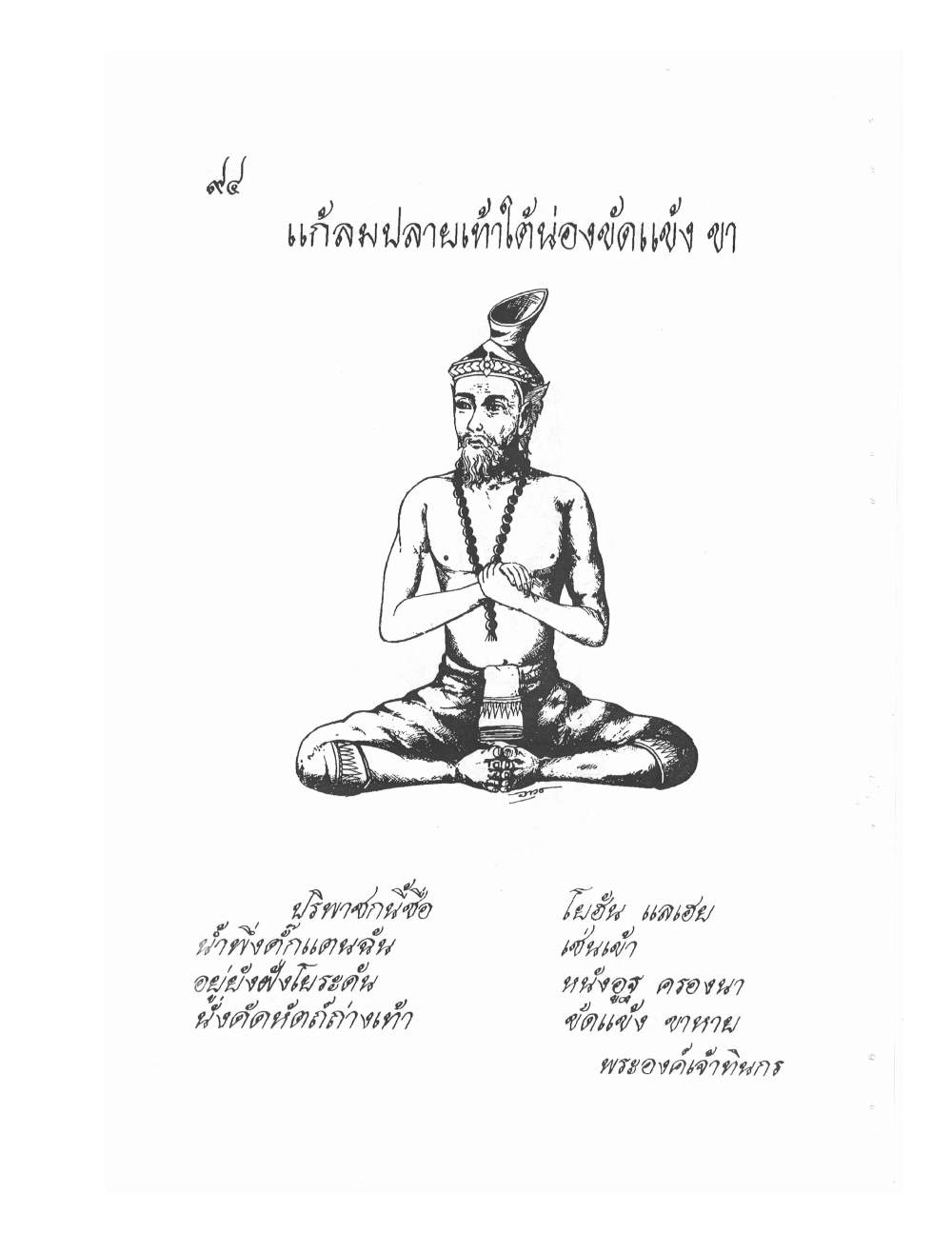
๙๔
แก้ลมปลายเท้าใต้น่องขัดแข้ง ขา
[ภาพ: ฤๅษีนั่งขัดสมาธิ ประสานนิ้วมือทั้งสองข้างเข้าด้วยกันวางที่หน้าตัก สวมชฎายอดแหลม มีเคราและหนวดยาว ลูกประคำคล้องคอ นุ่งผ้าลายเสือ นั่งขาไขว้ปลายเท้าชิดกัน] ปริพาชกนี้ชื่อ โยธิน แลเฮย น้ำพึ่งดักแตนฉัน เซ่นเข้า อยู่ยังฝั่งโยธคั่น หนึ่งอุฐ ครองนา นั่งดัดหัตถ์ถ่างเท้า ขัดแข้ง ขาหาย พระองค์เจ้าทินกร
94
Cure for wind at the tip of the foot, beneath the calf, stiff shin and leg
[diagram: a ruesi sits cross-legged with the fingers of both hands interlaced and resting on the lap; he wears a tall pointed headdress, a long beard and moustache, a rosary around the neck, a tiger-striped lower cloth, and sits with the feet crossed and drawn close together]
Verse: This wandering ascetic was named Yothin — he relied on water and set traps for wasps, offering them as food. He dwelt beside a riverbank, keeping watch over a single hermitage. Sit, twist the hands, and spread the feet apart: thus stiffness in the shin and leg is made to vanish. Signature: Phra Ong Chao Thinnakon
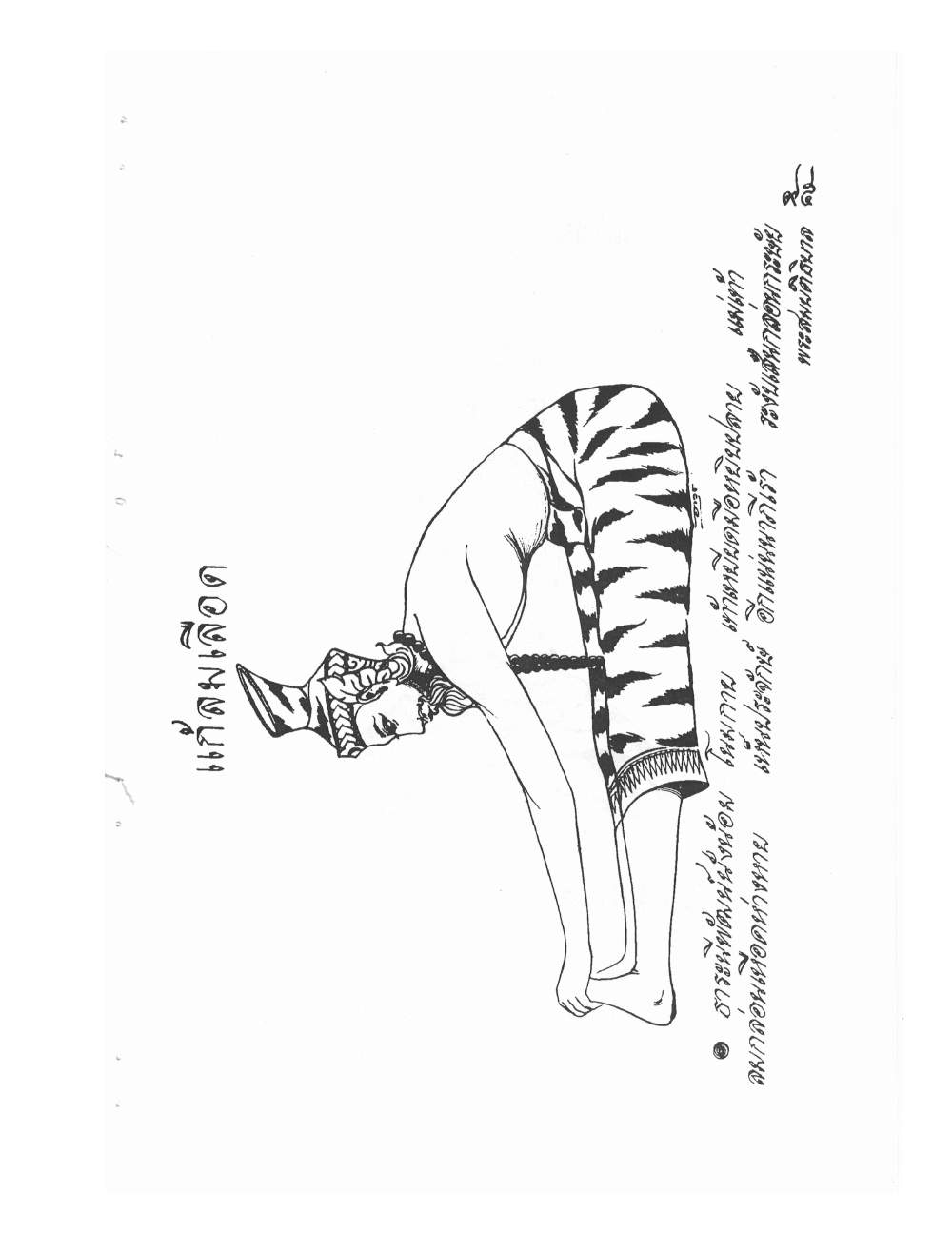
[ภาพ: ฤๅษีสวมหมวกยอดปลายแหลมลายเสือ นุ่งโจงกระเบนลายเสือ ก้มตัวโค้งไปข้างหน้าจนมือแตะปลายเท้าทั้งสองข้าง ขาตึงตรง — ท่าดัดตนก้มแตะเท้า] ๙๘
ดัดตนแก้ลมเลือด
[อ่านไม่ออก]
[Illustration: a ruesi (hermit-sage) wearing a tall pointed tiger-striped cap and tiger-striped lower cloth, bent forward at the waist with both hands reaching down to touch his toes, legs held straight — a forward-bend stretching pose.] 98
Stretching to cure blood-wind
Caption verse: [illegible — this page image is reproduced rotated roughly 90°, and the cursive caption verse could not be read with confidence at the available resolution]
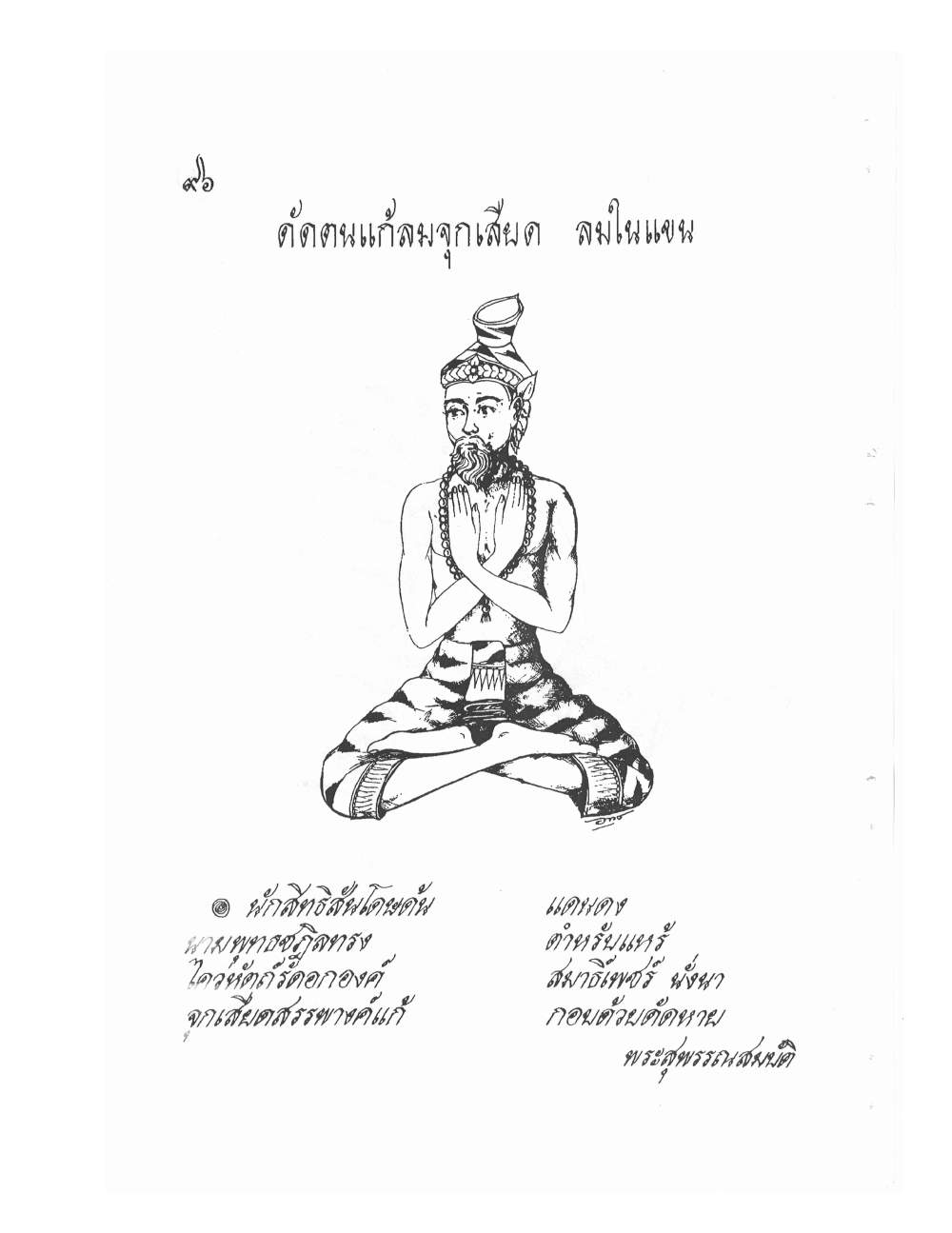
[ภาพ: ฤๅษีสวมหมวกยอดแหลมลายเสือ นั่งขัดสมาธิ พนมมือประนมขึ้นแนบคาง มีลูกประคำคล้องคอ นุ่งลายเสือ] ๙๙
ดัดตนแก้ลมจุกเสียด ลมในแขน
๐ ผู้สิทธิสัญโดยดล นามพุทธจภิลทรง ไตรเพทไตรพิสดาร แดนดง ตำหรับแหร้ สมาธิเพชร นั่งนา จุกเสียดสรรพางค์แก้ กอมด้วยดัดหาย พระสุพรรณสมนติ
[Illustration: a ruesi wearing a tall pointed tiger-striped cap, seated cross-legged with palms pressed together and raised to the chin, a string of prayer beads around his neck, clothed in tiger-striped cloth.] 99
Stretching to cure stitches/blockage of wind, and wind in the arms
He who by his siddhi power ordained this, given by the Lord Buddha to be upheld, versed in the Tripitaka and its lore, from the forest realm, a formula truly excellent: sitting in adamantine meditation, it cures all manner of stitches and blockages throughout the body, curling the limbs to make the stretch relieve them. — Phra Suphan Samanti
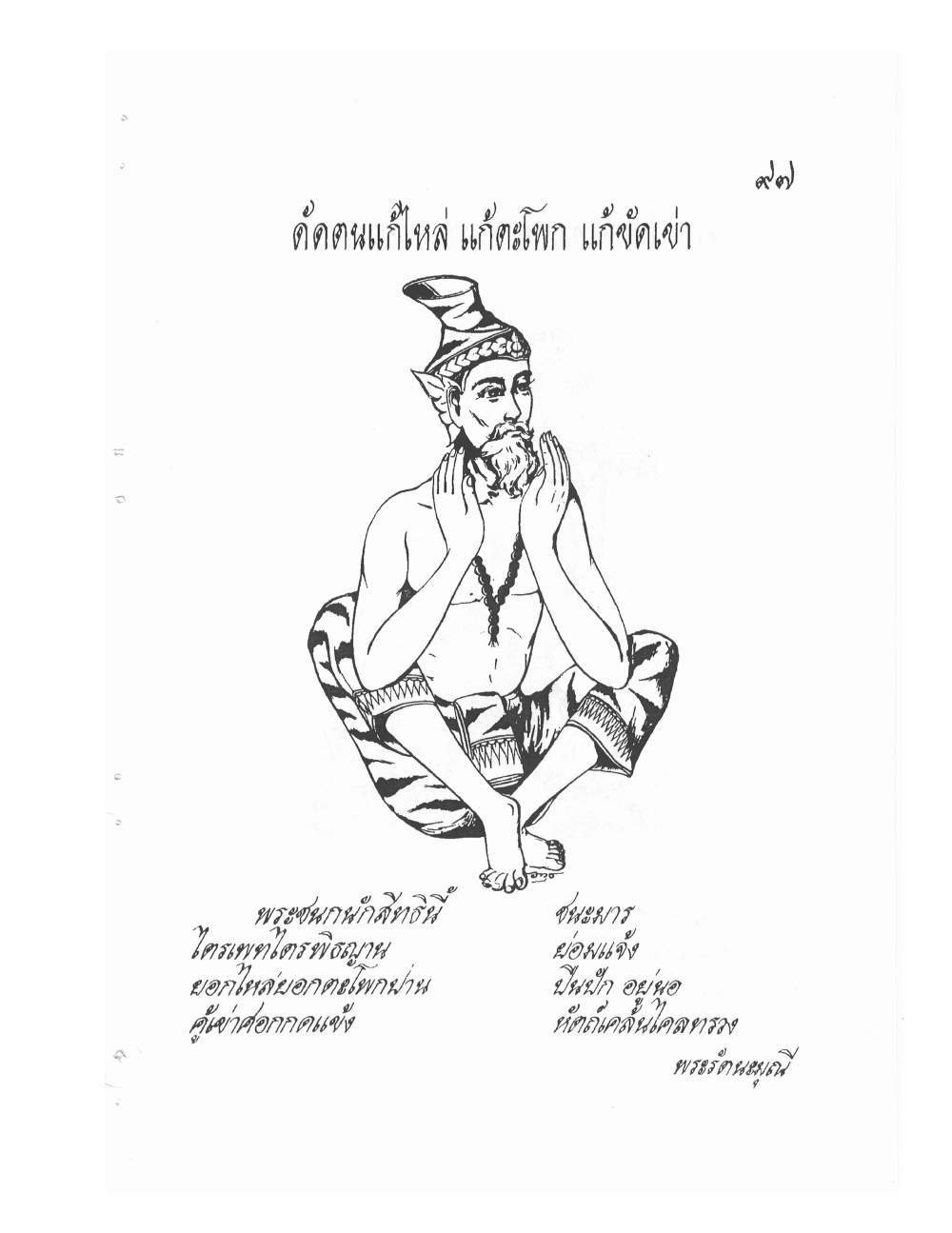
[ภาพ: ฤๅษีสวมหมวกยอดแหลมลายเสือ นั่งพับเพียบ ยกมือขึ้นประนมแนบคาง มืออีกข้างวางที่ตัก มีลูกประคำคล้องคอ นุ่งลายเสือ] ๑๐๐
ดัดตนแก้ไหล่ แก้ตะโพก แก้ขัดเข่า
๐ พระชนกนักสิทธิ์นี้ ชนะมาร ไตรเพทไตรพิธญาณ ย่อมแจ้ง ยอกไหล่ยอกตะโพกฝ่าน คู้เข่าค่อกกดแข็ง ปีนปีก อยู่หนอ หัตถ์เคลื่อนไคลทรวง พระรัตนมุนี
[Illustration: a ruesi wearing a tall pointed tiger-striped cap, seated in a folded-leg posture, one hand raised palm-together to the chin, the other resting on his lap, prayer beads around his neck, clothed in tiger-striped cloth.] 100
Stretching to cure the shoulder, the hip, and stiffness of the knee
This father of adepts, having overcome Mara, is versed in the Tripitaka and the threefold knowledge, clearly perceiving all; when shoulder and hip ache and are wrenched, one draws up the knee and presses it firm, climbing and hemmed in, so it seems, moving the hands across the chest. — Phra Rattana Muni
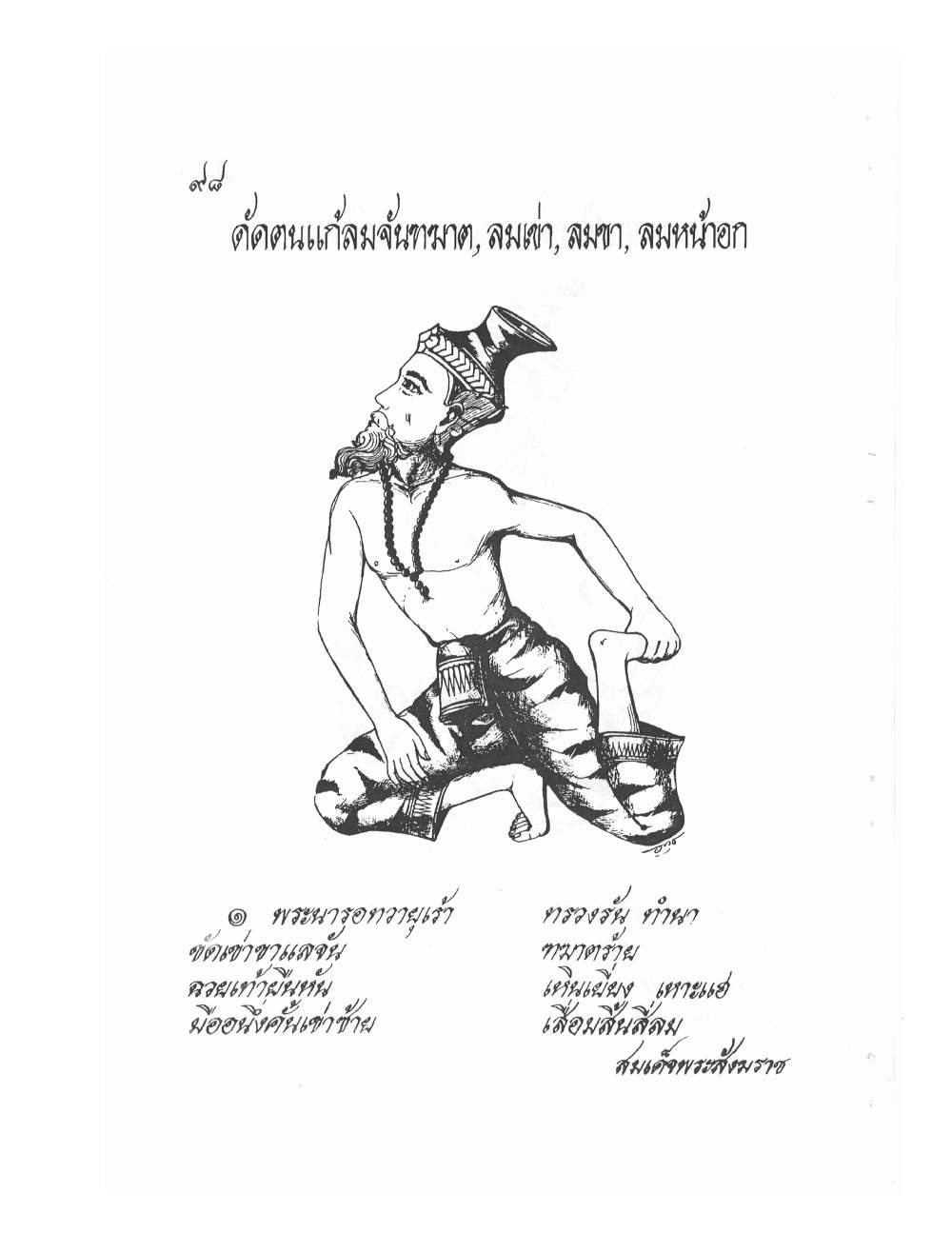
[ภาพ: ฤๅษีสวมหมวกยอดแหลมลายเสือ นั่งคุกเข่าข้างหนึ่ง อีกข้างงอยกเท้าขึ้นให้มือจับข้อเท้า เงยหน้าขึ้น มีลูกประคำคล้องคอ นุ่งลายเสือ] ๑๐๑
ดัดตนแก้ลมจันทมาต, ลมเข่า, ลมขา, ลมหน้าอก
๐ พระนารอทวายุเร้า ทรงรั้น ทำนา ขัดเข่าชานแลจั้น ทมาตร้าย ควยเท้าผินหัน เกินเผี่ยง เหาะเอ่ มืออนึ่งคั่นเข่าซ้าย เสื่อสิ้นสิ้นลม สมเด็จพระสังฆราช
[Illustration: a ruesi wearing a tall pointed tiger-striped cap, kneeling on one leg while the other is bent and raised, one hand gripping the ankle, face turned upward, prayer beads around his neck, clothed in tiger-striped cloth.] 101
Stretching to cure the wind of Chandamat, wind of the knee, wind of the leg, and wind of the chest
Lord Narot, roused by the wind-god, holds himself firm and makes his stand; the knee, thigh and shin stiffen, the cruel wind of Chandamat afflicts them; the foot is turned and twisted, straying from its true line, as if in flight; one hand meanwhile is wedged against the left knee, until the wind is entirely spent. — His Holiness the Supreme Patriarch
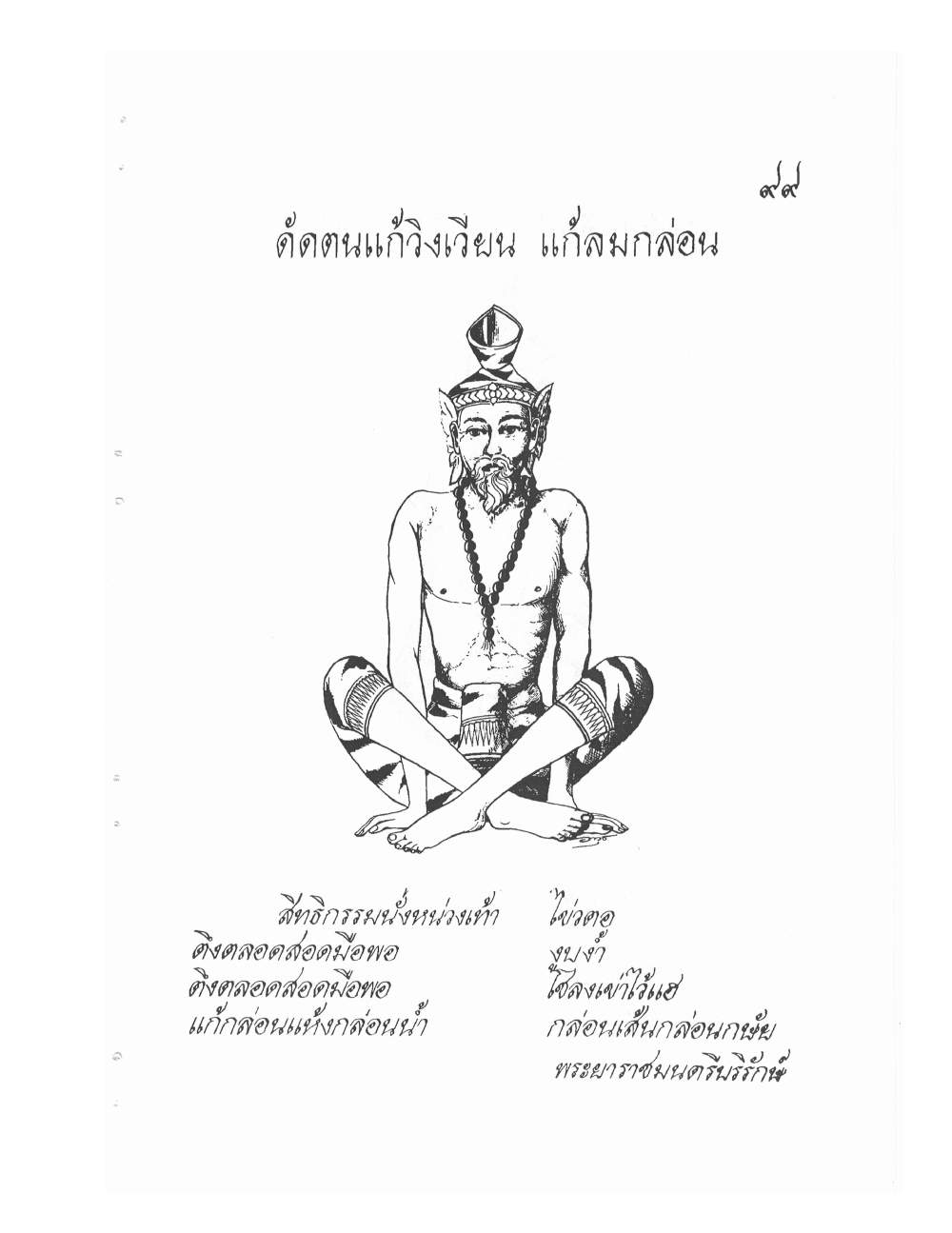
[ภาพ: ฤๅษีสวมหมวกทรงกลมมียอด นั่งขัดสมาธิ วางมือบนตัก มีลูกประคำคล้องคอ นุ่งลายเสือ] ๑๐๒
ดัดตนแก้วิงเวียน แก้ลมกล่อน
๐ สิทธิกรรมนั่งหน่วงเท้า ไข่วตอ ตึงตลอดสอดมือพอ งุ่มง้ำ ตึงตลอดสอดมือพอ ไชลงเข่าไว้เอ แก้กล่อนแห้งกล่อนน้ำ กล่อนเส้นกล่อนกษัย พระยาราชมนตรีบริรักษ์
[Illustration: a ruesi wearing a rounded, peaked cap, seated cross-legged with hands resting on his lap, prayer beads around his neck, clothed in tiger-striped cloth.] 102
Stretching to cure dizziness, and to cure the wind of hernia/wasting
Siddhikamma sits, drawing in the feet, crossed and braced, taut throughout, the hand slipped in just so, bowed and stooped; taut throughout, the hand slipped in, pressed down toward the knee, held there — it cures the dry hernia and the watery hernia, the hernia of the sinews and the wasting hernia. — Phraya Ratchamontri Borirak
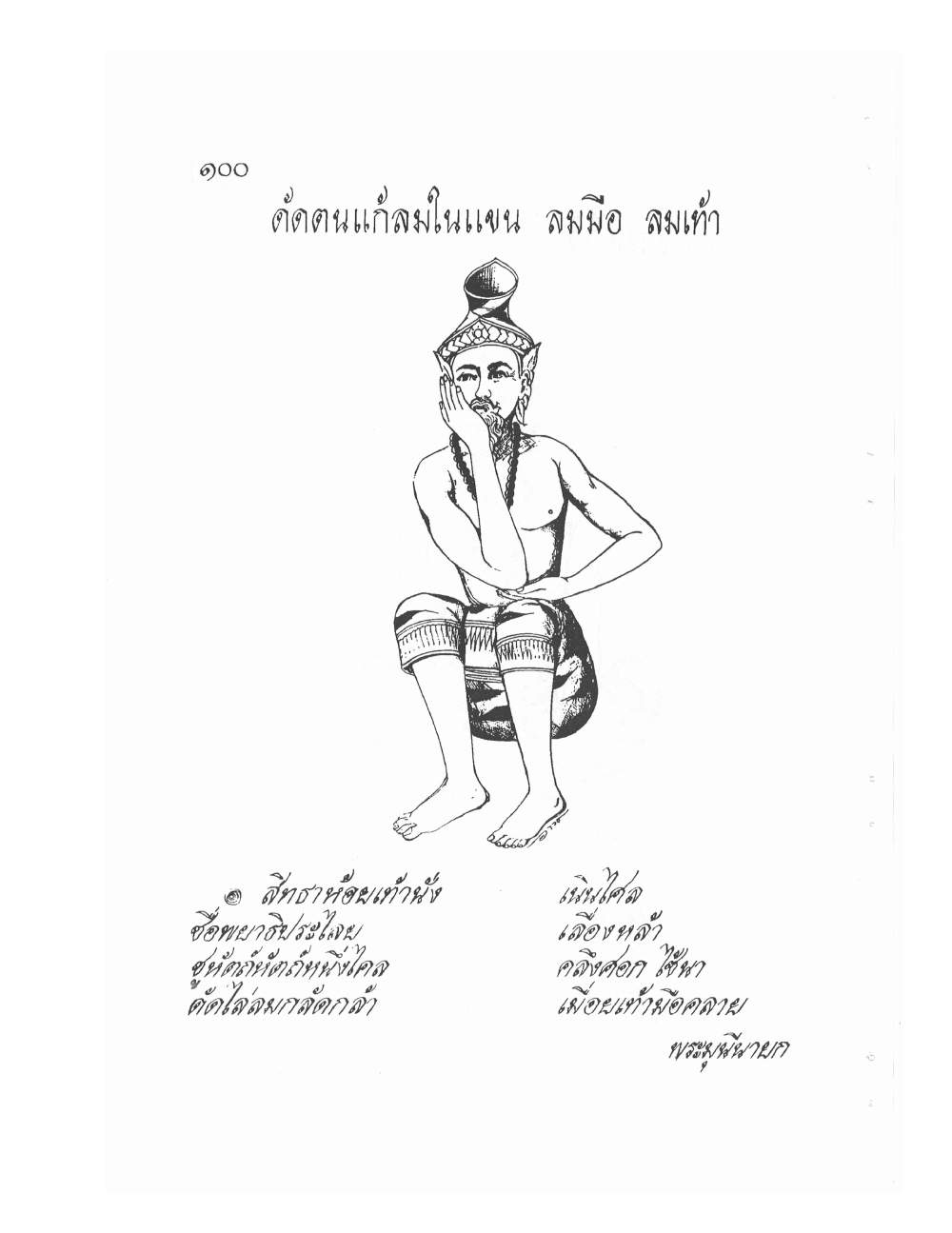
[ภาพ: ฤๅษีสวมหมวกยอดแหลมลายเสือ นั่งบนก้อนกลม เอนตัว มือข้างหนึ่งเท้าคาง อีกข้างวางที่เข่า เท้าทั้งสองห้อยลง มีผมเปียยาวสองข้าง นุ่งลายเสือ] ๑๐๓
ดัดตนแก้ลมในแขน ลมมือ ลมเท้า
๐ สิทธาห้อยเท้านั่ง เห็นไศล ชื่อพยาธิประไวย เลื่องหล้า ชูหัตถ์หัตถ์หนึ่งไคล คลึงศอก ไชนา ตัดไล่ลมกลัดกล้า เนื้อเท้ามือคลาย พระคุณพิทยากร
[Illustration: a ruesi wearing a tall pointed tiger-striped cap, seated on a rounded mound, leaning back, one hand resting under his chin, the other on his knee, both feet hanging free, his hair worn in two long braids, clothed in tiger-striped cloth.] 103
Stretching to cure wind in the arms, wind of the hand, wind of the foot
The adept sits with feet hanging, gazing toward the crags, renowned far and wide by the name of this affliction's remedy; he raises one hand, rubbing at the elbow, pressing in, cutting off the fierce, congealed wind, so the flesh of hand and foot relaxes. — Phra Khun Phitthayakon
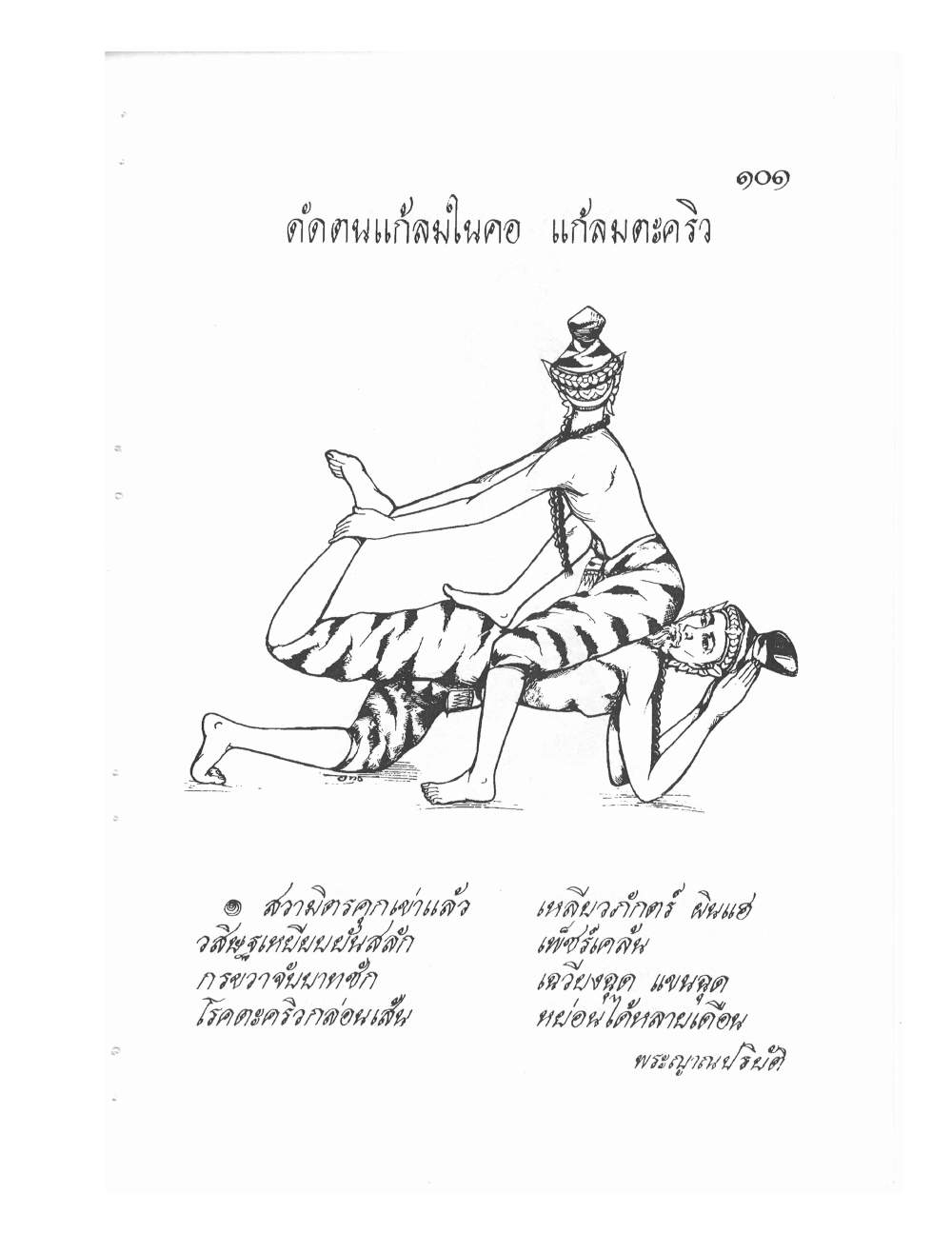
[ภาพ: ฤๅษีสองรูปประกอบท่าคู่กัน — องค์หนึ่งคุกเข่าโค้งตัวไปข้างหน้ายกขาข้างหนึ่งพาดไว้ อีกองค์หนึ่งคุกเข่าอยู่ด้านล่างเงยหน้าขึ้นมือทั้งสองแนบแก้ม] ๑๐๔
ดัดตนแก้ลมในคอ แก้ลมตะคริว
๐ สวามิตรคุกเข่าแล้ว เหลียวภักตร์ ผินแฮ วสิษฐเหยียบยันสลัก เพชร์เคลื่อน กระชวาจันมาทศักดิ์ เคว้งคุด แขนคุด โรคตะคริวกล่อนเส้น หย่อนได้หลายเดือน พระญาณปริยัติ
[Illustration: two ruesi figures performing a paired stretch — one kneels and bends forward, one leg raised and laid across the other; the second kneels beneath him, face turned upward, both hands held to his cheeks.] 104
Stretching to cure wind in the throat, and to cure the wind of cramp
The two companions having knelt, turning their faces to look aside, Vasittha braces and treads firm upon the joint, the vital point shifting, while the might of Chandamat swirls and curls the numbed limb, the numbed arm, and so the disease of cramp and sinew-hernia is loosened and eased for many months. — Phra Yan Pariyat
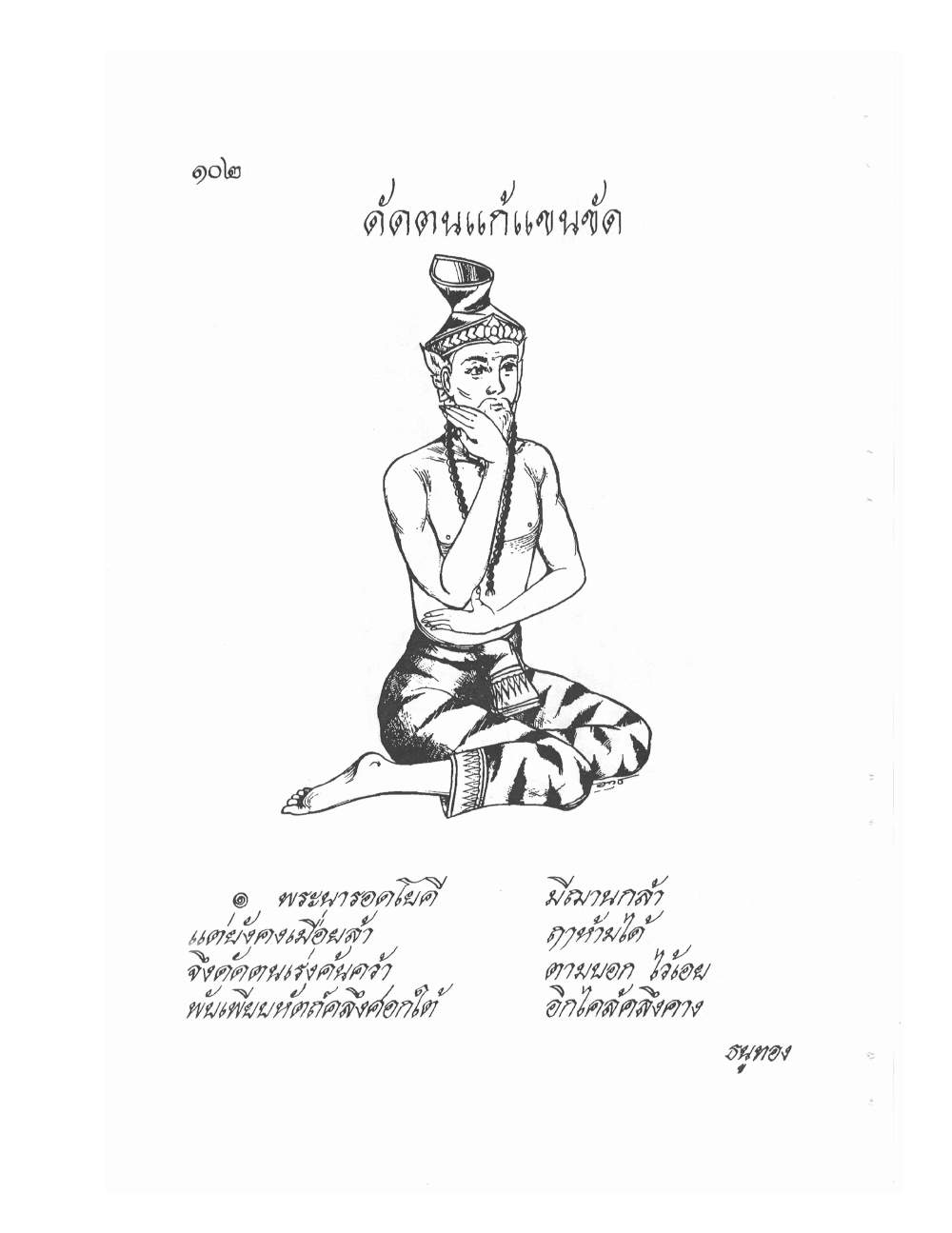
[ภาพ: ฤๅษีสวมหมวกยอดแหลม นั่งขัดสมาธิ มือข้างหนึ่งเท้าแก้ม ครุ่นคิด อีกมือวางที่ท้อง มีผมเปียห้อยด้านหน้า นุ่งลายเสือ] ๑๐๕
ดัดตนแก้แขนขัด
๐ พระผารอดโภคี แต่ยังคงเมื่อยล้า จึงดัดตนเร่งค้นคว้า มีมานกล้า พึ่งเพียงหัตถ์ตัดสิ่งค้อกใต้ ถ่าห้ามได้ ตามนอก ไว้เอย อิกไคล้คลิงคาง ธนุทอง
[Illustration: a ruesi wearing a tall pointed cap, seated cross-legged, one hand propped against his cheek in a thoughtful pose, the other resting on his belly, his hair worn in a braid hanging in front, clothed in tiger-striped cloth.] 105
Stretching to cure a stiff/strained arm
The lord who survived the serpent-realm still felt his weariness lingering, and so he stretched and searched further, his courage gathered, relying only on his hand to cut away what pressed beneath, holding it off as best he could, letting the outer parts follow, and further easing what pressed against his chin. — Thanuthong
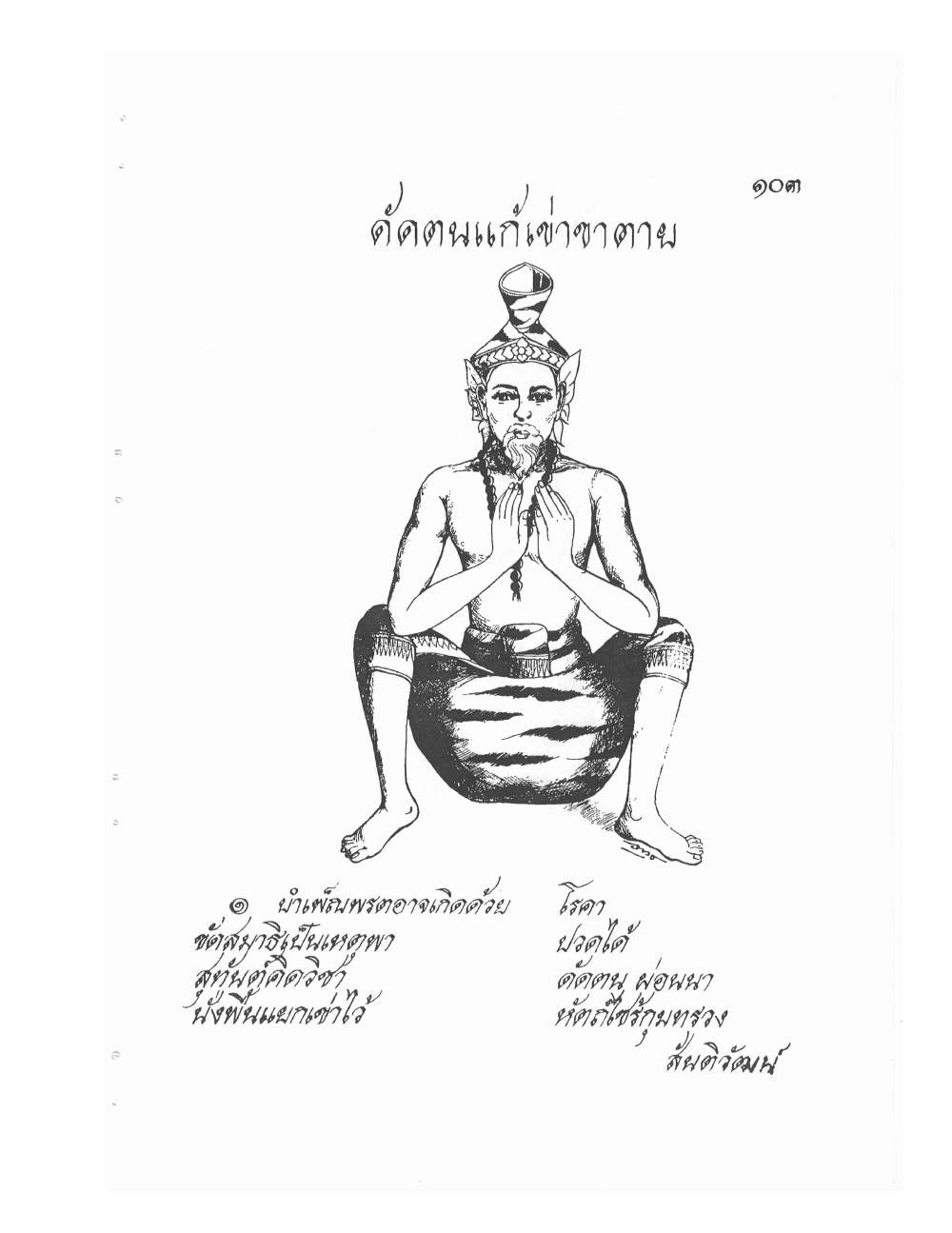
[ภาพ: ฤๅษีสวมหมวกยอดแหลม นั่งขัดสมาธิ พนมมือประคองใต้คาง มีลูกประคำคล้องคอ นุ่งลายเสือ] ๑๐๖
ดัดตนแก้เข่าชาตาย
๐ ผำเพ็ญพรตอาจเกิดด้วย โรคา ขัดสมาธิเป็นเหตุพา ปวดได้ สุทนต์คิดวิชา ดัดตน ผ่อนผ่า ผังพื้นแยกเข่าไว้ หัตถ์ใช้กุมทรวง สิ้นตำรวจ
[Illustration: a ruesi wearing a tall pointed cap, seated cross-legged with palms pressed together and held under his chin, prayer beads around his neck, clothed in tiger-striped cloth.] 106
Stretching to cure numbness and deadness of the knee
In undertaking his ascetic vows an illness may well arise, for sitting cross-legged is itself the cause that brings on the ache; having mastered his craft and considered the remedy, he stretches his body to ease it, planting his feet firm and parting the knees, using his hands to cradle his chest. — Sin Tamruat
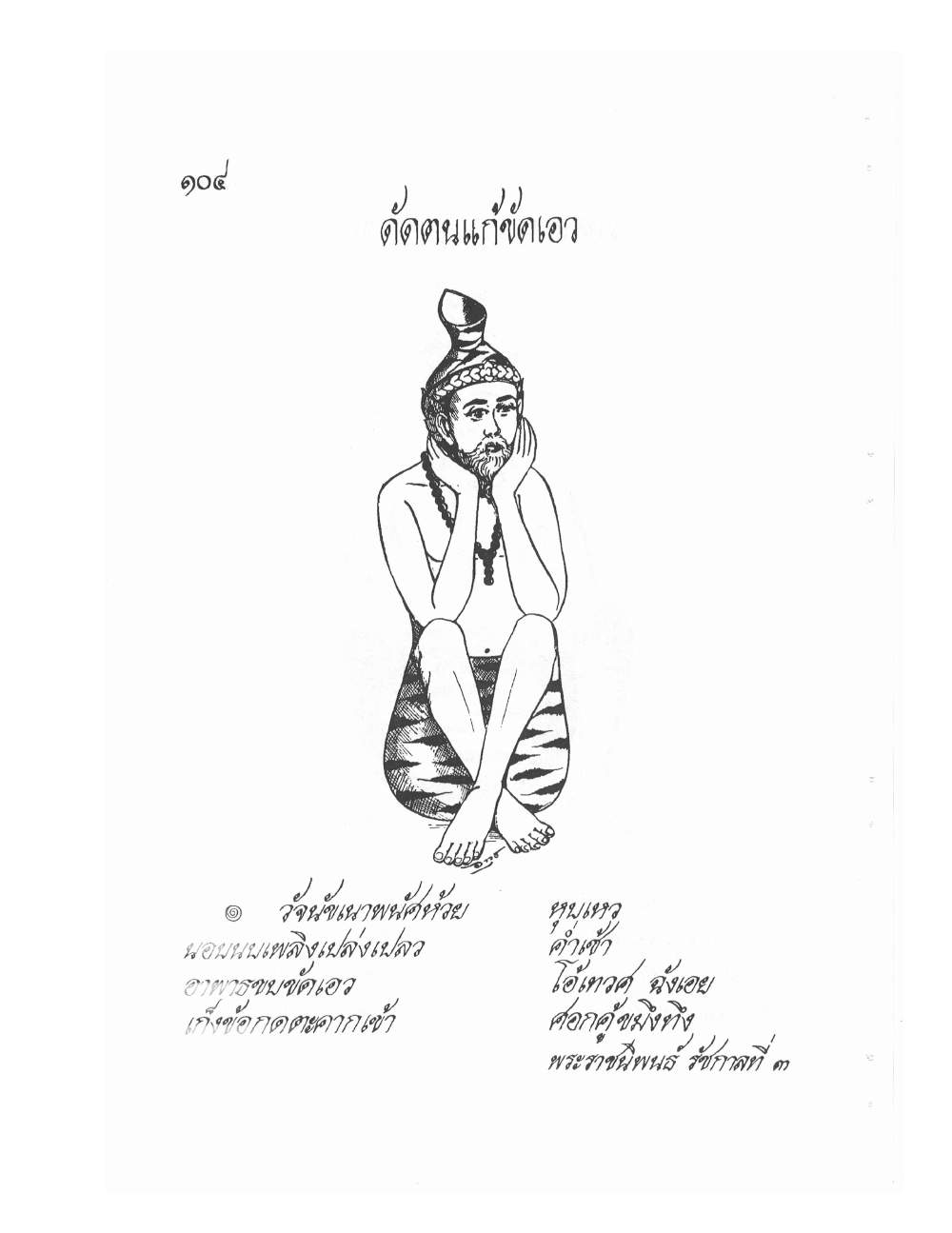
[ภาพ: ฤๅษีสวมหมวกยอดแหลม นั่งขัดสมาธิ มือทั้งสองข้างเท้าแก้มทั้งสองข้าง ครุ่นคิด มีผมเปียสองข้าง นุ่งลายเสือ] ๑๐๗
ดัดตนแก้ขัดเอว
๐ จวนขนาบหนีบหวี วอนนบเพลิงเปล่งเปลว อาพาธขบขัดเอว เก็งข้อกดตะคากเข่า หุบเหว ค่ำเช้า โอ้เทวศ ฉงเอย ศอกคู้ขมิ้งขึง พระราชนิพนธ์ รัชกาลที่ ๓
[Illustration: a ruesi wearing a tall pointed cap, seated cross-legged, both hands propping up his chin/cheeks on either side in a thoughtful pose, hair worn in two braids, clothed in tiger-striped cloth.] 107
Stretching to cure a strained/stiff waist
Hemmed in and pressed close, as if entreating the blazing flame, an affliction gnaws and strains the waist; he braces the joint, pressing the hip against the knee, morning and evening in that closed ravine — oh, what suffering, alas — the elbow drawn up, tight and taut. — A royal composition of King Rama III
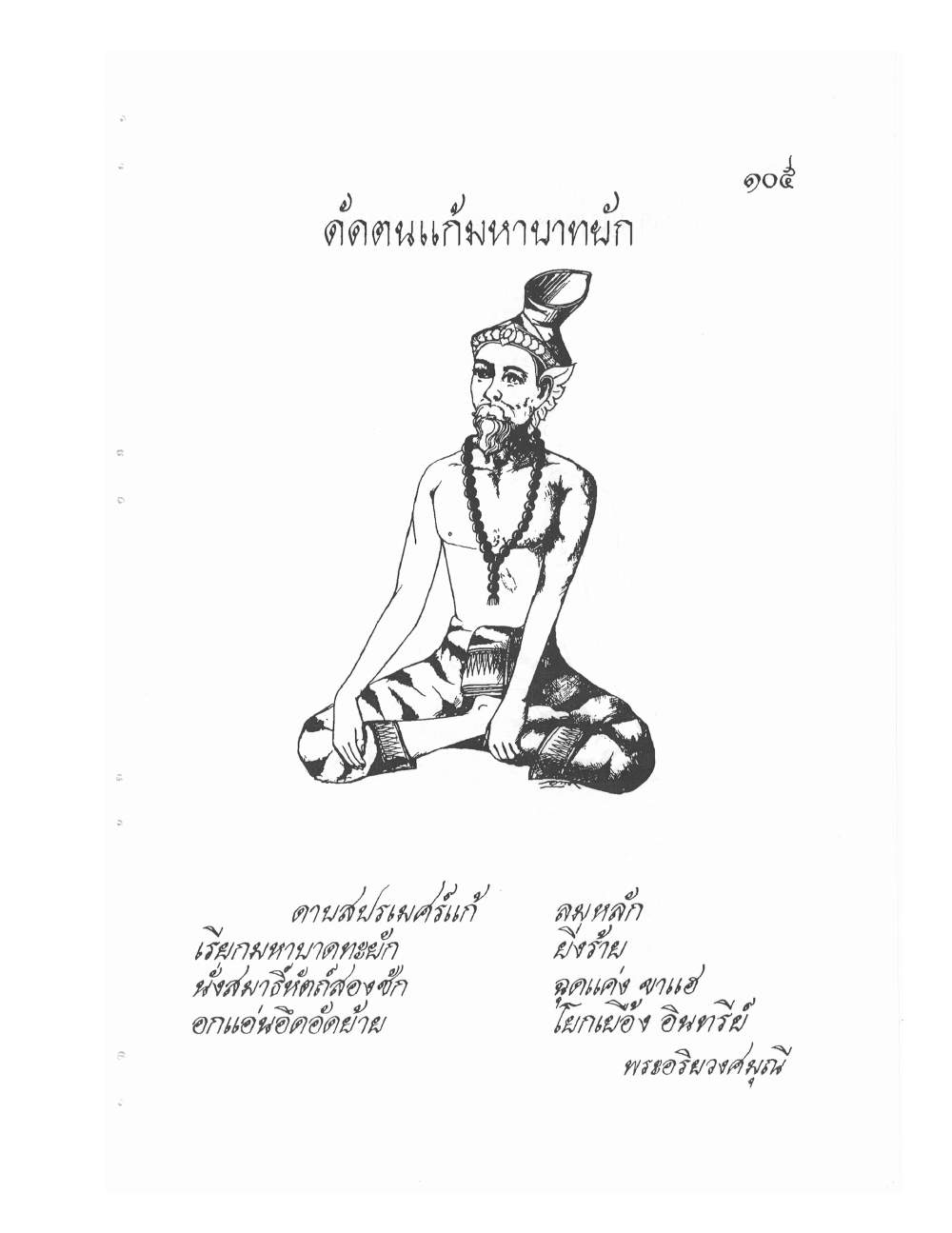
[ภาพ: ฤๅษีสวมหมวกยอดแหลม นั่งขัดสมาธิ มือข้างหนึ่งเท้าคาง ครุ่นคิด อีกมือวางที่ตัก มีผมเปียห้อยด้านหน้า นุ่งลายเสือ] ๑๐๘
ดัดตนแก้มหาบาทฝัก
๐ ดามสัประเมศร์แก้ ลมหลัก เรียกมหาบาดทะฝัก ผิงร้าย นั่งสมาธิหัตถ์สองซ้าย ฉุดแค่ง ขาเอ่ อกแอ่นอึดอัดย้าย โยกเยื้อง อินทรีย์ พระอริยวงศาคุณ
[Illustration: a ruesi wearing a tall pointed cap, seated cross-legged, one hand propped under his chin in a thoughtful pose, the other resting on his lap, his hair worn in a braid hanging in front, clothed in tiger-striped cloth.] 108
Stretching to cure the great affliction of the thigh/shank
He braces himself to master and cure the root wind, called the great affliction of the thigh, a fierce burning; sitting in meditation, both hands to the left, he draws the legs in taut, chest thrust out, restless and shifting, swaying his whole frame. — Phra Ariyawongsakhun
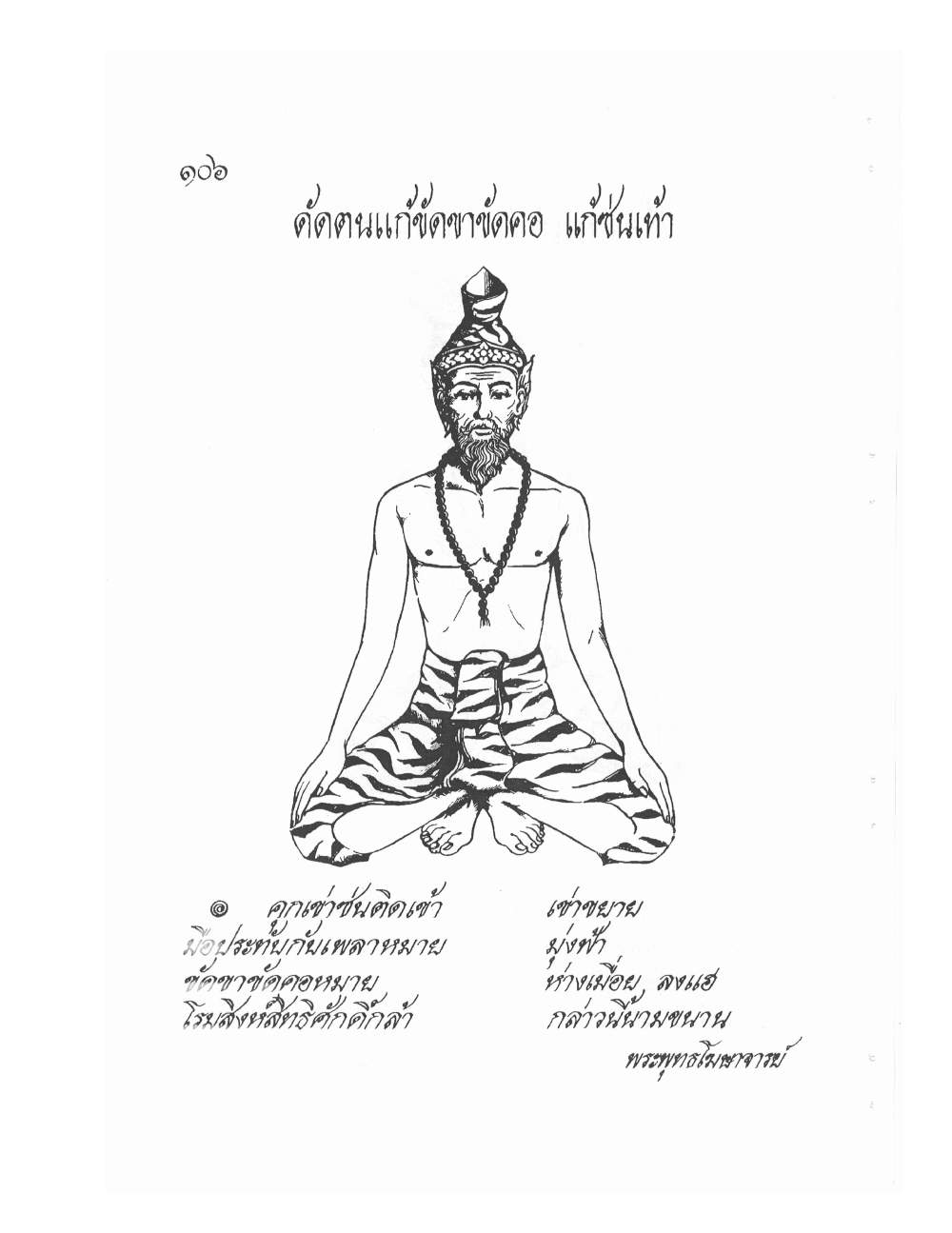
[ภาพ: ฤๅษีสวมหมวกยอดแหลม นั่งขัดสมาธิหันหน้าตรง มือทั้งสองข้างวางแนบเข่าทั้งสองข้าง มีลูกประคำคล้องคอ นุ่งลายเสือ] ๑๐๙
ดัดตนแก้ขัดขาขัดคอ แก้ชาเท้า
๐ คุกเข่าซ้อนติดเข่า เข่าขยาย มือประหนุนกันเพลาหมาย มุ่งฟ้า ขัดขาขัดคอหมาย ท่างเมื่อย ลงเอ โรมสิงห์สิทธิศักดิ์กีล้า กล่าวนี้ยามขนาย พระพุทธโฆษาจารย์
[Illustration: a ruesi wearing a tall pointed cap, seated cross-legged facing directly forward, both hands resting alongside his knees, prayer beads around his neck, clothed in tiger-striped cloth.] 109
Stretching to cure stiffness of the leg and neck, and to cure numbness of the foot
Kneeling with the knees drawn close together, then letting the knees spread wide, the hands prop against the thighs, aimed toward the sky; stiffness of leg and stiffness of neck are eased, the weariness settling down; as mighty and potent as a lion's roar — so it is said in this instruction. — Phra Phutthaghosajarn
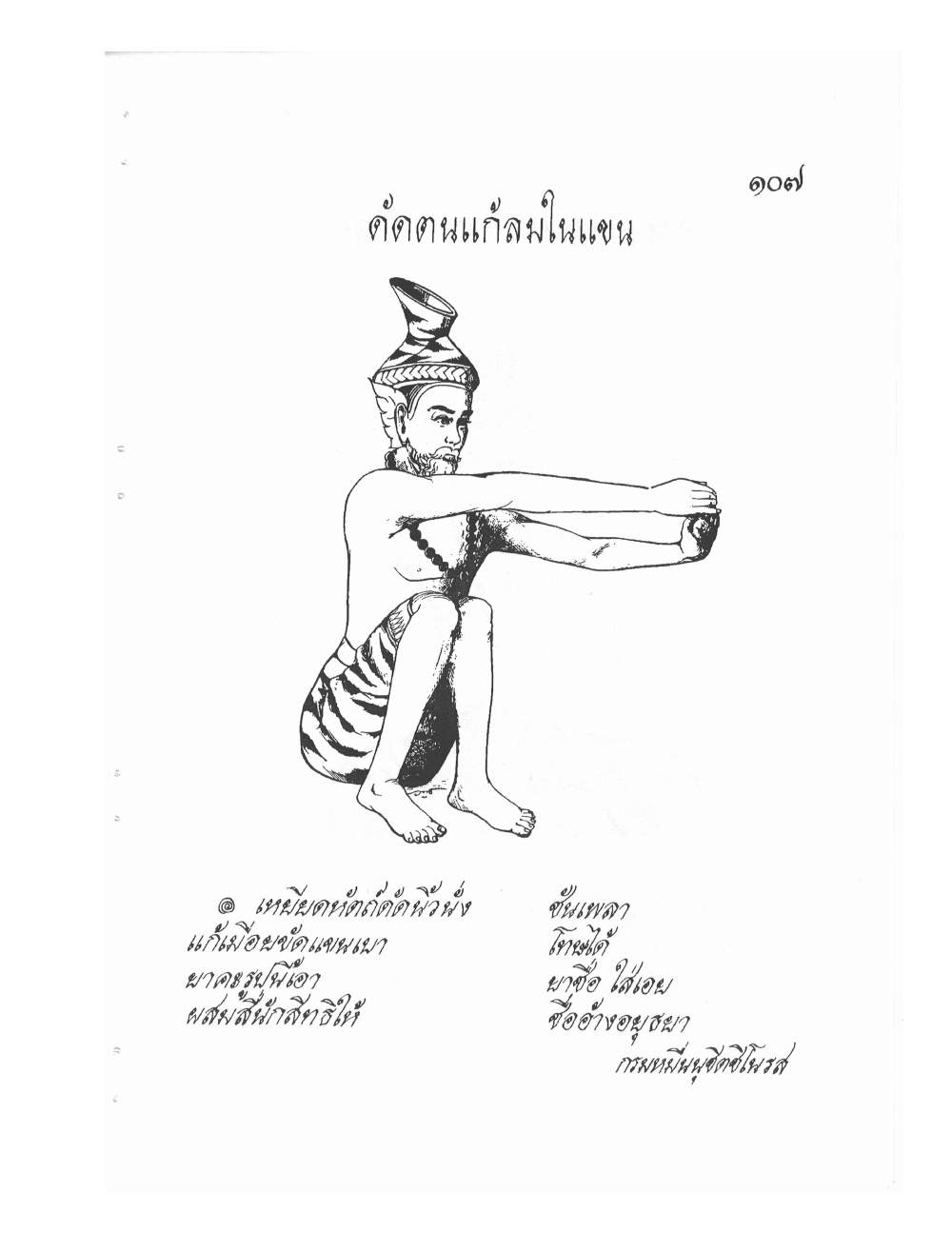
๑๐๗
ดัดตนแก้ลมในแขน
[diagram: a ruesi (hermit-sage) figure wearing a tall horn-shaped cap and beaded mala, tiger-striped lower cloth, seated with legs folded to one side, both arms stretched straight forward, hands clasped/interlocked together]
เหยียดหัตถ์ดัดนิ้วนั่ง ขั้นเพลา แก้เมื่อยขัดแขนเยา โทษได้ ยาคชรุปนีเอา ยาชื่อ ใส่เอย ผสมสี่นักสิทธิให้ ชื่ออ้างอนุชยา กรมหมื่นนุชิตชิโนรส
107
Stretching the body to cure wind [numbness/cramp] in the arms
[diagram: a ruesi (hermit-sage) figure wearing a tall horn-shaped cap and beaded mala, tiger-striped lower cloth, seated with legs folded to one side, both arms stretched straight forward, hands clasped/interlocked together]
Stretch out the hands, bend the fingers while seated, bending at the thigh — this cures the ache and stiffness of the arms, relieving the affliction. A compounded medicine is prepared and applied, named after [the remedy given]. Four adepts together prescribe it, calling it by the name given here. [Signed:] Krommuen Nuchit Chinorot
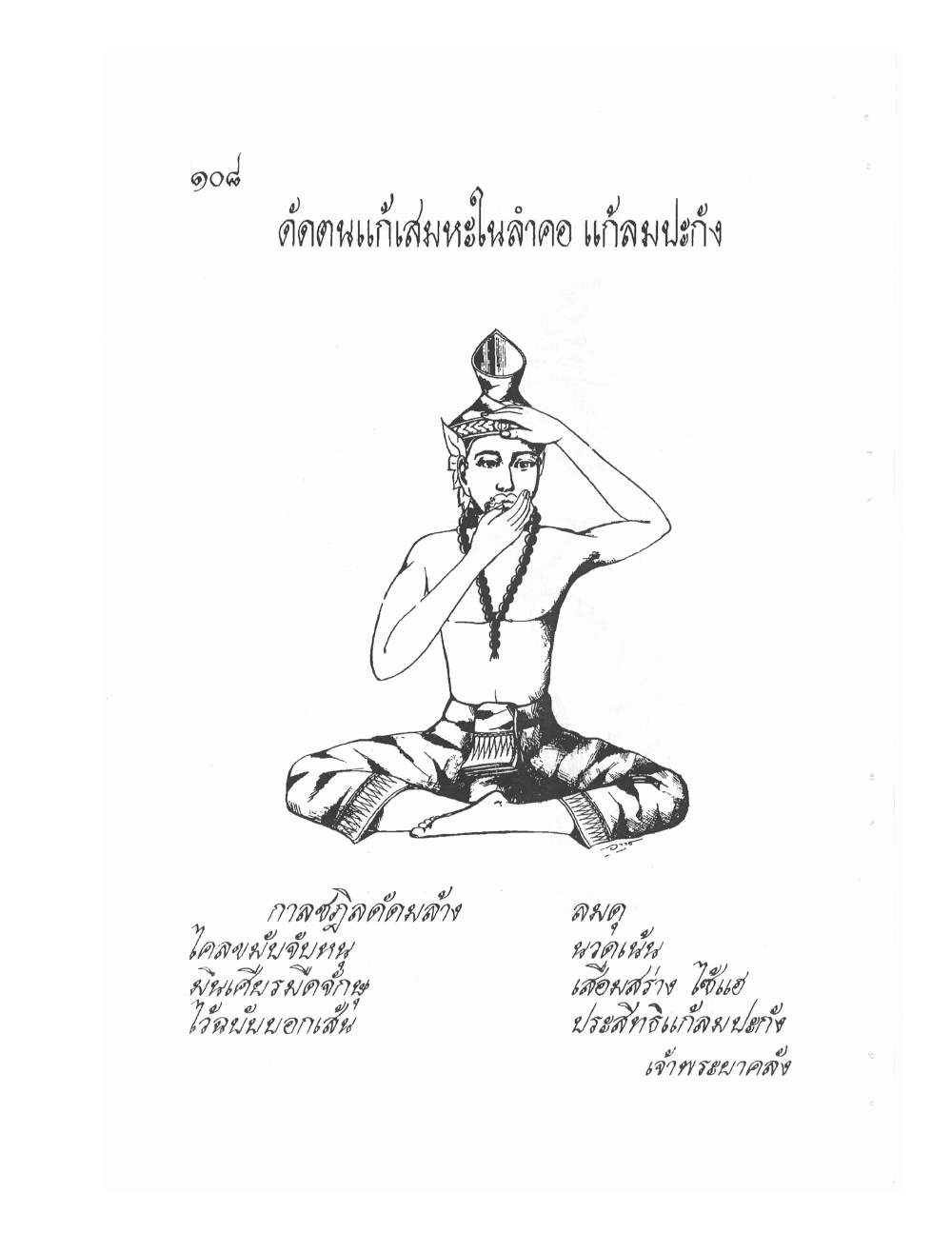
๑๐๘
ดัดตนแก้เสมหะในลำคอ แก้ลมปะกัง
[diagram: a ruesi figure seated cross-legged, one hand resting on top of his horned cap, the other hand raised to his chin/mouth, beaded mala around neck]
กาลชฎิลดัดล้าง ลมตุ ไคลขมิ้นจับหนู ยวดเน้น มินเศียรมิดจำกษ เสื่อมสร่าง ไซ้แฮ ไว้ลมันมอกเส้น ประสิทธิ์แก้ลมปะกัง เจ้าพระยาคลัง
108
Stretching the body to clear phlegm in the throat and cure the wind called "pakang"
[diagram: a ruesi figure seated cross-legged, one hand resting on top of his horned cap, the other hand raised to his chin/mouth, beaded mala around neck]
The ascetic in his topknot stretches to cleanse away the rising wind; turmeric paste is applied firmly and pressed in. Holding the head steady, the affliction subsides and fades away; this keeps the wind bound within the sinews — an effective cure for the "pakang" wind. [Signed:] Chao Phraya Khlang
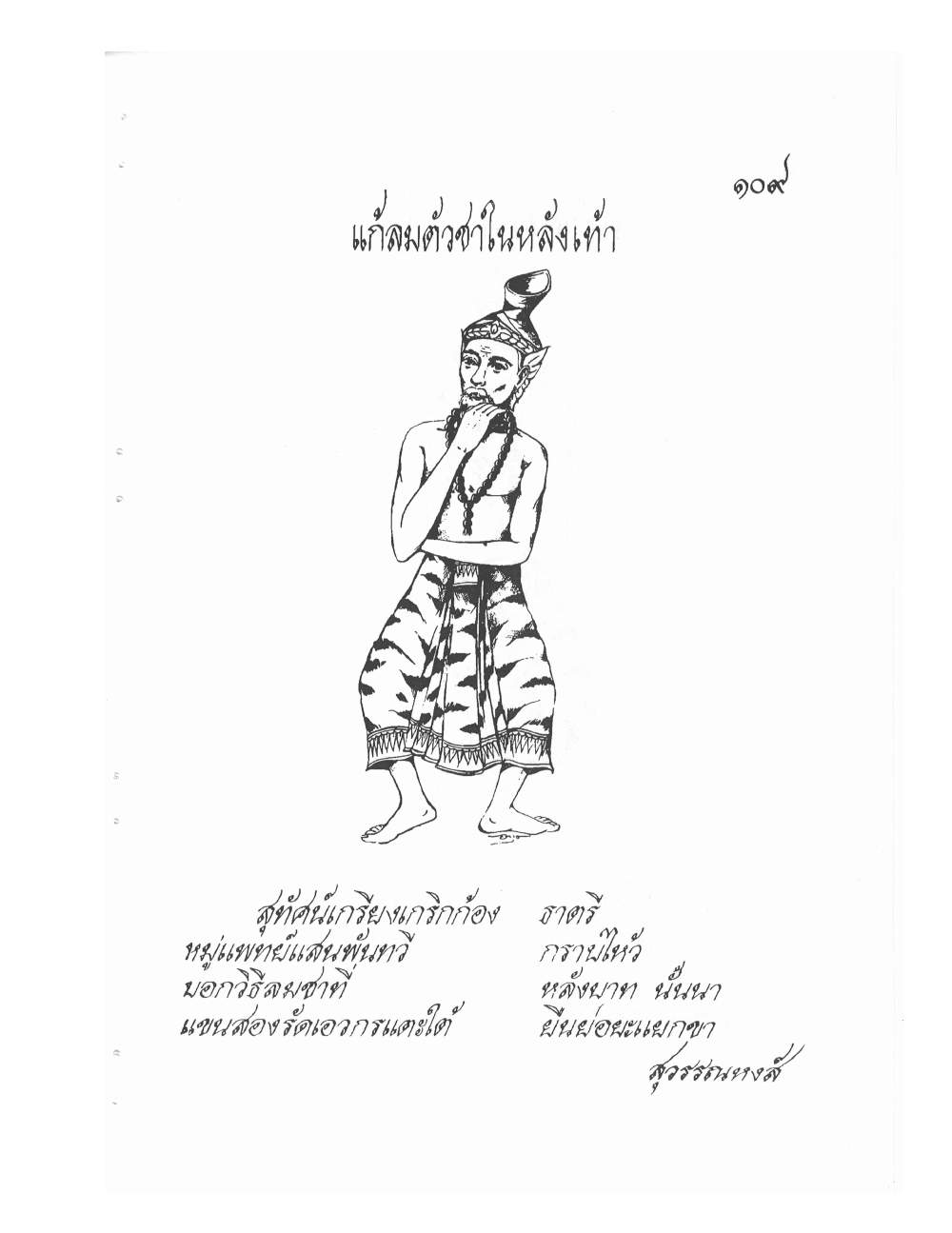
๑๐๙
แก้ลมตัวซ่าในหลังเท้า
[diagram: a ruesi figure standing, one hand raised to the chin/mouth, the other arm crossed in front of the body, beaded mala around neck, tiger-striped cloth]
สุทัศน์เกรียงเกริกก้อง ธาตรี หมู่แพทย์แสนพันทวี กราบไหว้ บอกวิธีลมซ่าที หลังบาท นั้นนา แขนสองรัดเอวกรแตะใต้ ยืนย่อแยกขา สุวรรณหงส์
109
Cure for the tingling/numbing wind on the top of the foot
[diagram: a ruesi figure standing, one hand raised to the chin/mouth, the other arm crossed in front of the body, beaded mala around neck, tiger-striped cloth]
The renowned Suthat, famed throughout the land, is paid homage to by the many thousands of physicians. He teaches the method for the tingling wind that sits on the back of the foot: bind both arms about the waist, touching below, and stand bending with the legs apart. [Signed:] Suwannahong
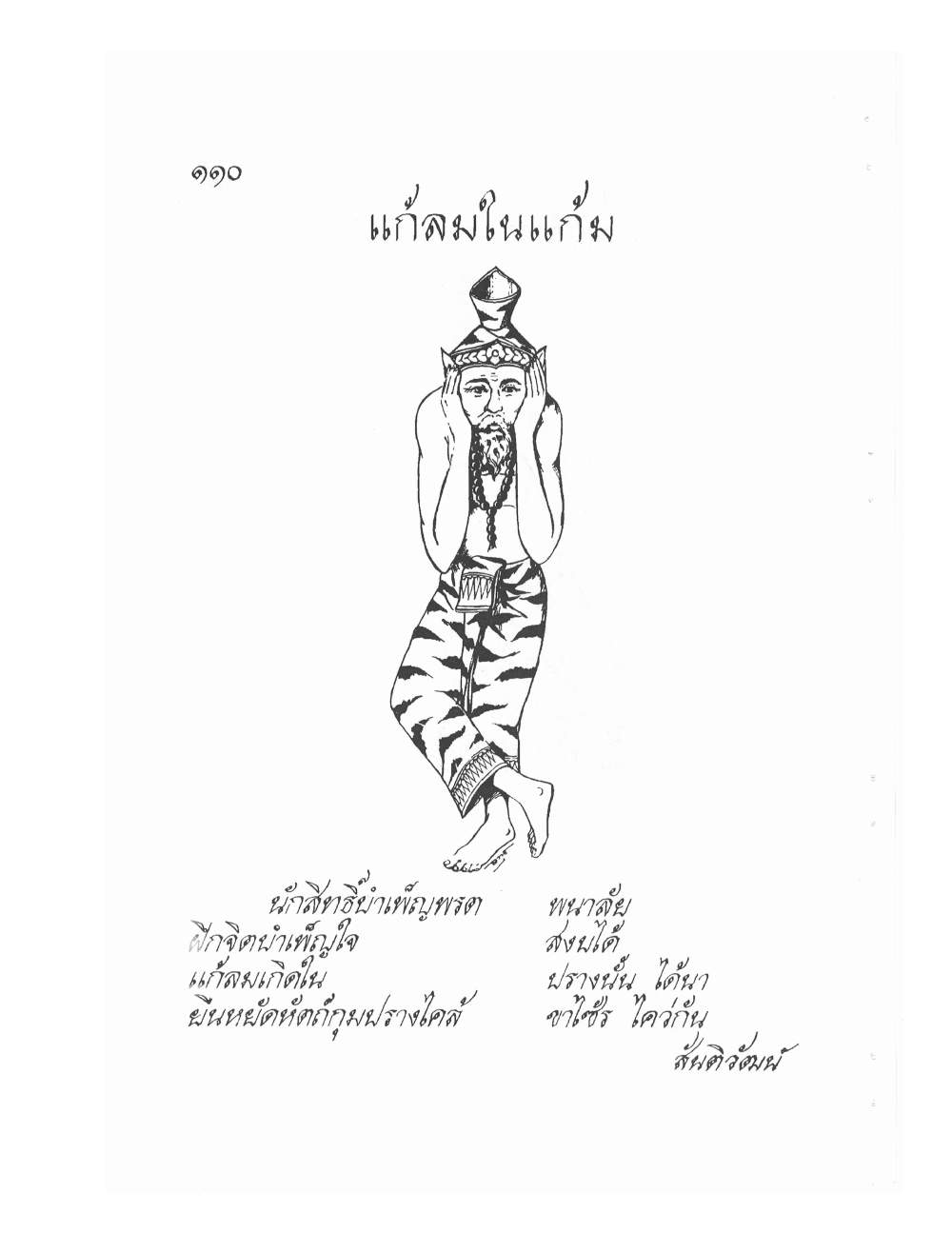
๑๑๐
แก้ลมในแก้ม
[diagram: a ruesi figure seated cross-legged, both hands cupping the sides of the face/cheeks, beaded mala, tiger-striped cloth]
นำสิทธิ์บำเพ็ญพรต พนาลัย ฝึกจิตบำเพ็ญใจ สงบได้ แก้ลมเกิดใน ปรางนั้น ได้นา ยืนหยัดหัตถ์กุมปรางไคล้ ขาไซร้ไขว่กัน สันติวรมย์
110
Cure for wind in the cheeks
[diagram: a ruesi figure seated cross-legged, both hands cupping the sides of the face/cheeks, beaded mala, tiger-striped cloth]
He brings his accomplishment to bear, dwelling austerely in the forest, training the mind in practice until it grows calm. By this the wind that arises in the cheeks is cured; stand firm, cup the cheeks with both hands, with the legs crossed one over the other. [Signed:] Santiwarom
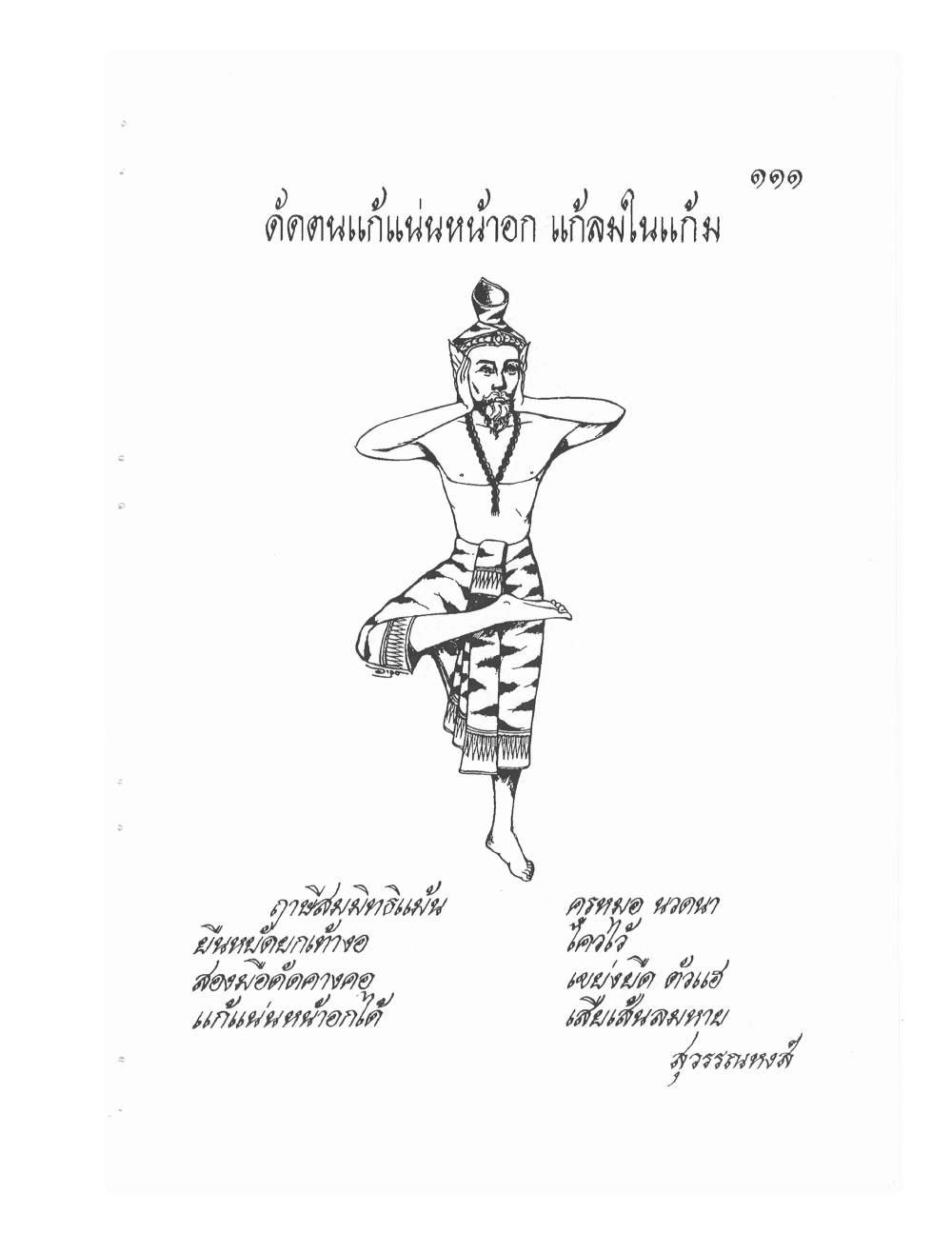
๑๑๑
ดัดตนแก้แน่นหน้าอก แก้ลมในแก้ม
[diagram: a ruesi figure standing on one leg in a tree-like pose, the other leg bent and raised, both hands cupping the ears/head, beaded mala]
ถ้าใครมีฤทธิ์เมิ้น ยืนหยัดยกเท้างอ ส่องมือดัดคางคอ แก้แน่นหน้าอกได้ ครูหมอ นวดนา ใครไร้ เขยิบยืด ตัวเอย เสียเส้นลมหาย สุวรรณหงส์
111
Stretching the body to relieve tightness in the chest and cure wind in the cheeks
[diagram: a ruesi figure standing on one leg in a tree-like pose, the other leg bent and raised, both hands cupping the ears/head, beaded mala]
Whoever has this power stands firm, lifting one bent leg, reaching the hands to the chin and neck, and so relieves tightness of the chest. The teacher-healer massages accordingly, whoever lacks it, shifting and stretching the body, so the afflicted sinew's wind departs. [Signed:] Suwannahong
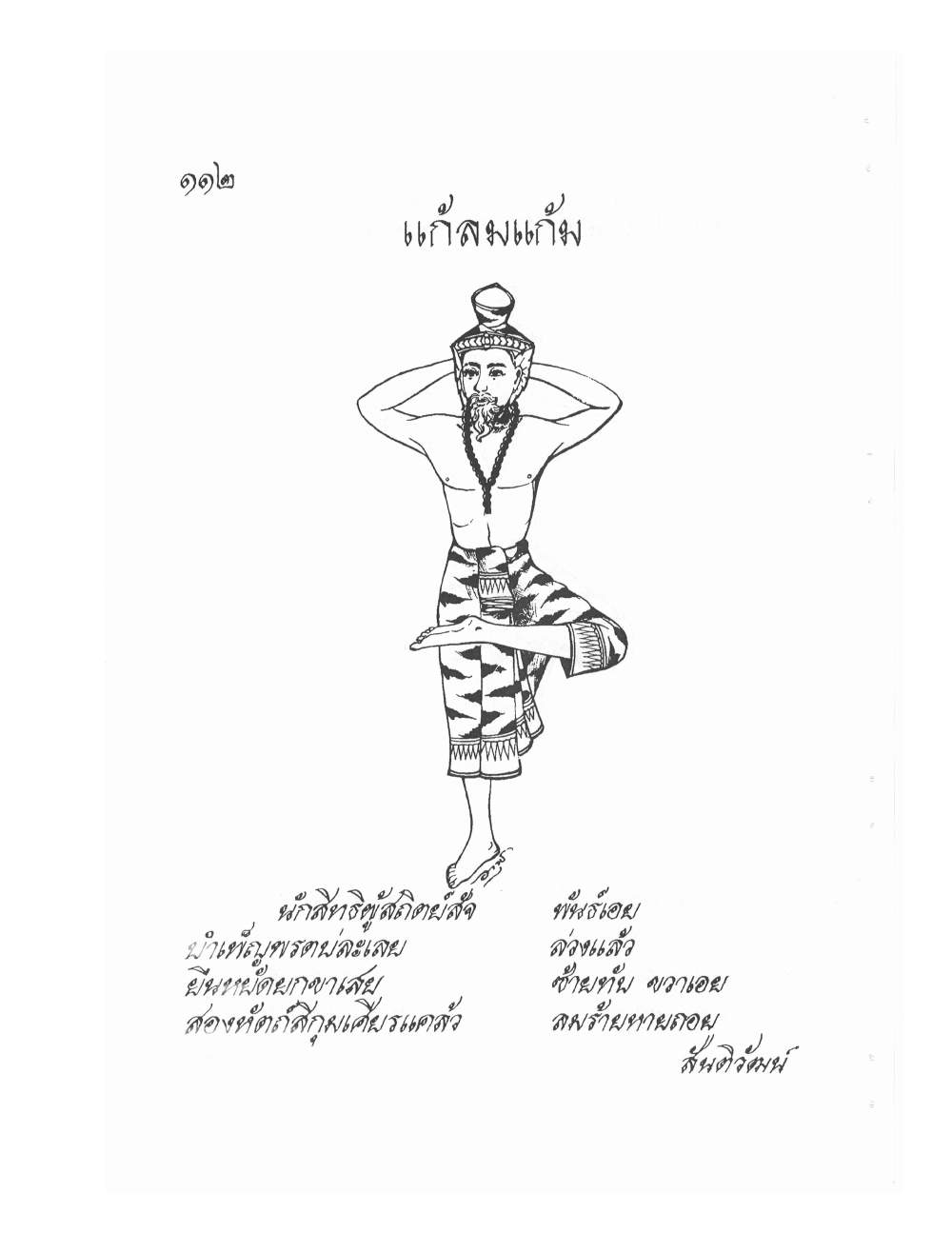
๑๑๒
แก้ลมแก้ม
[diagram: a ruesi figure standing on one leg, the other leg bent and raised, both hands clasped behind the head/neck, beaded mala, tiger-striped cloth]
นักสิทธิ์ฤๅษีสถิตย์สัจ พึ่งธ์เอย น้อมเพ็ญพรตน่ะเลย ล่วงแล้ว ยืนหยัดยกขาเสย ซ้ายทั้ง ขวาเอย สองหัตถ์สอดกุมเศียรแคล้ว ลมร้ายหายถอย สันติวรมย์
112
Cure for wind in the cheeks
[diagram: a ruesi figure standing on one leg, the other leg bent and raised, both hands clasped behind the head/neck, beaded mala, tiger-striped cloth]
The adept-hermit, abiding in truth, relies upon it; he bows to the ascetic practice, and it is accomplished. Stand firm and raise the leg to the side, whether left or right, both hands clasped behind the head — thereby the evil wind recedes and departs. [Signed:] Santiwarom
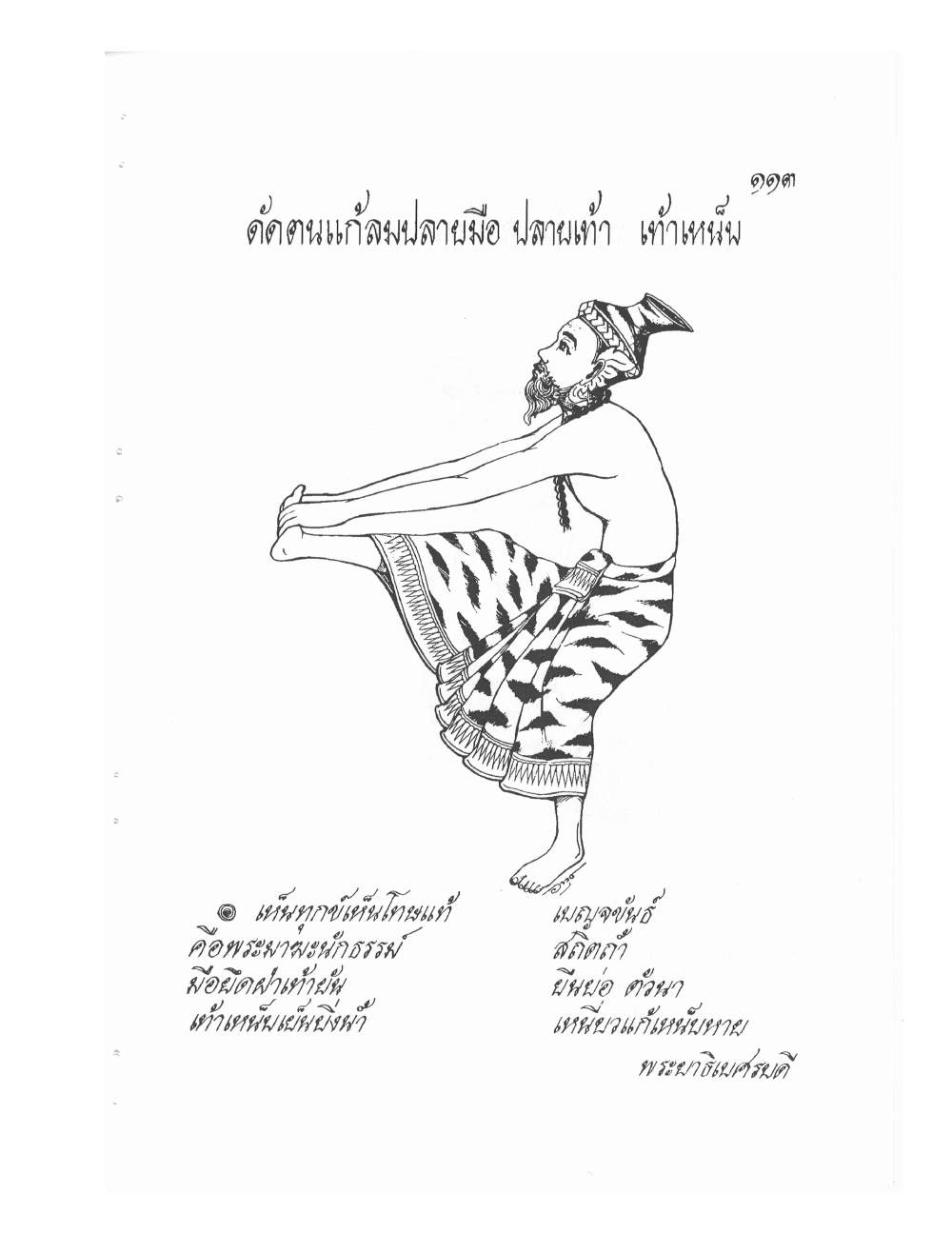
๑๑๓
ดัดตนแก้ลมปลายมือ ปลายเท้า เท้าเหน็บ
[diagram: a ruesi figure in a dramatic balancing pose, one leg raised and gripped by the opposite hand across the body, beaded mala, tiger-striped cloth]
เห็นทุกข์เห็นโทษแท้ เมถุนขันธ์ คือพระมาณะนักธรรม์ สถิตถ้ำ มือยึดฝ่าเท้ายัน ยืนย่อ ตั้งนา เท้าเหน็บเย็นยิ่งผาย เหนี่ยวแก้เหน็บหาย พระยาธิเบศรบดี
113
Stretching the body to cure wind in the fingertips, toe-tips, and numbness of the feet
[diagram: a ruesi figure in a dramatic balancing pose, one leg raised and gripped by the opposite hand across the body, beaded mala, tiger-striped cloth]
He truly perceives suffering and its affliction in the aggregate of the body, being the sage of the Dharma who abides in the cave. The hand grips the sole of the foot and braces it, standing bent thus; where the feet grow cold and numb, this pulling posture cures the numbness away. [Signed:] Phraya Thibetbodi
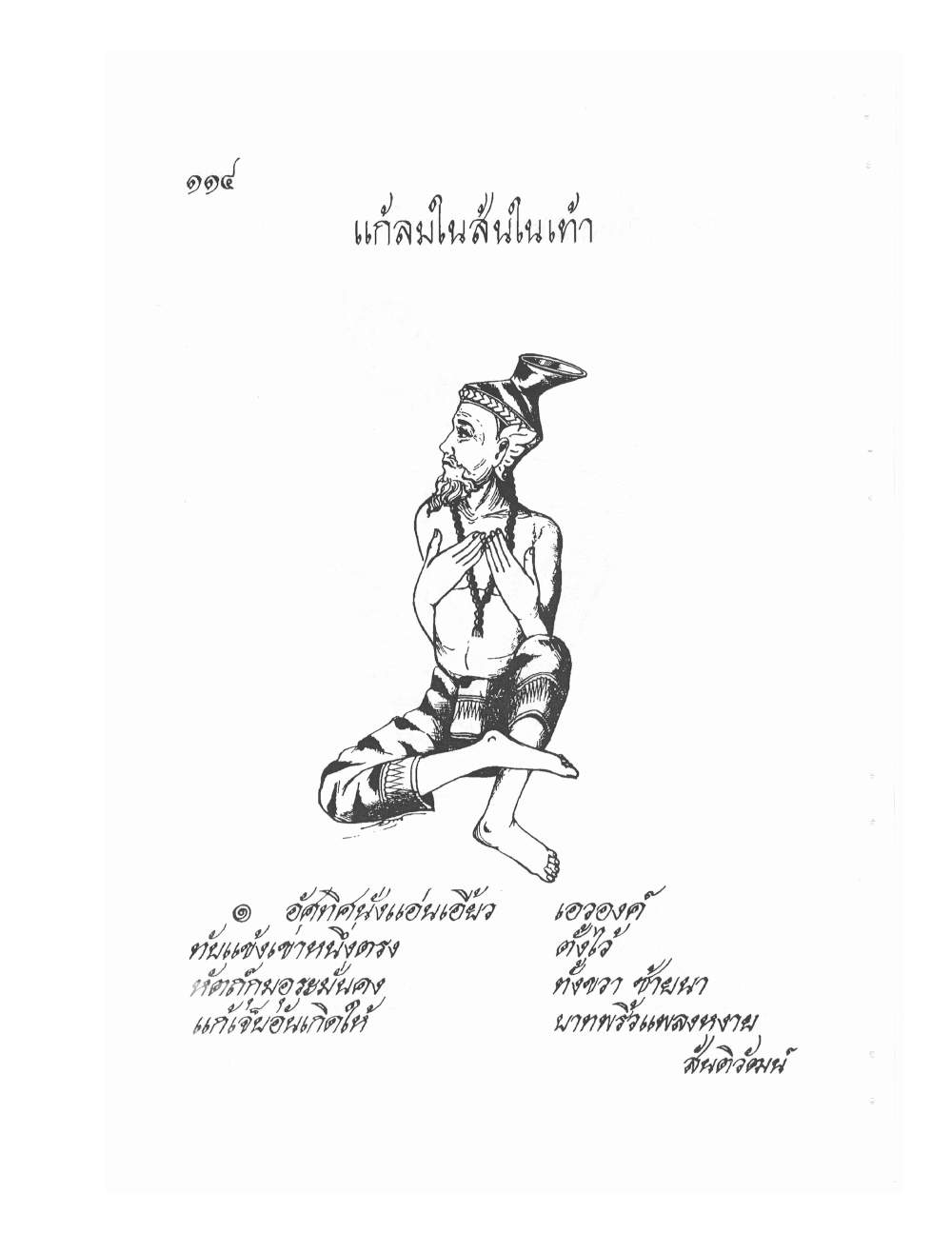
๑๑๔
แก้ลมในส้นในเท้า
[diagram: a ruesi figure kneeling, both hands raised together in front of the chest in a gesture, beaded mala]
อัศดิศนั่งเอนเอี้ยว เอวองค์ ทัยแข็งเข่ายังตรง ตั้งไว้ หัตถ์กุมอวยมั่นคง ทั้งขวา ซ้ายนา แก้เจ็บอันเกิดให้ ผาทพรึงเพลงหงาย สันติวรมย์
114
Cure for wind in the heel and foot
[diagram: a ruesi figure kneeling, both hands raised together in front of the chest in a gesture, beaded mala]
He sits leaning and bending at the waist, keeping the thigh firm and the knee held straight. The hands are clasped and held steady, both the right and the left, curing the pain that has arisen, [the posture held as described]. [Signed:] Santiwarom
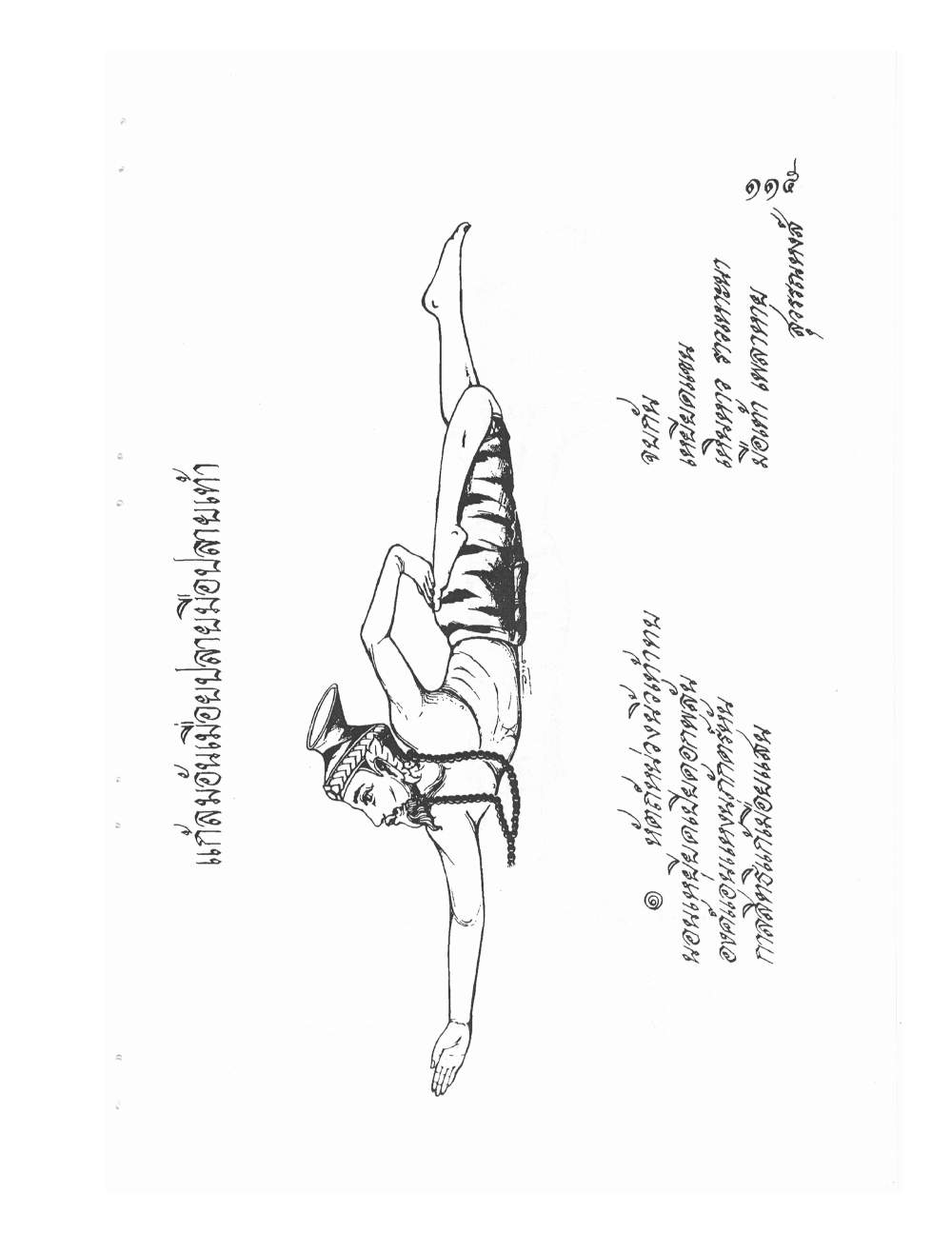
๑๑๕
[diagram: a ruesi figure in an extreme inverted/backbend posture, one leg raised high, the body arched, tiger-striped cloth, beaded mala; two blocks of verse text set beside the figure]
[อ่านไม่ออก]
115
[diagram: a ruesi figure in an extreme inverted/backbend posture, one leg raised high, the body arched, tiger-striped cloth, beaded mala; two blocks of verse text set beside the figure]
[illegible — the accompanying verse could not be read with confidence from the page image]
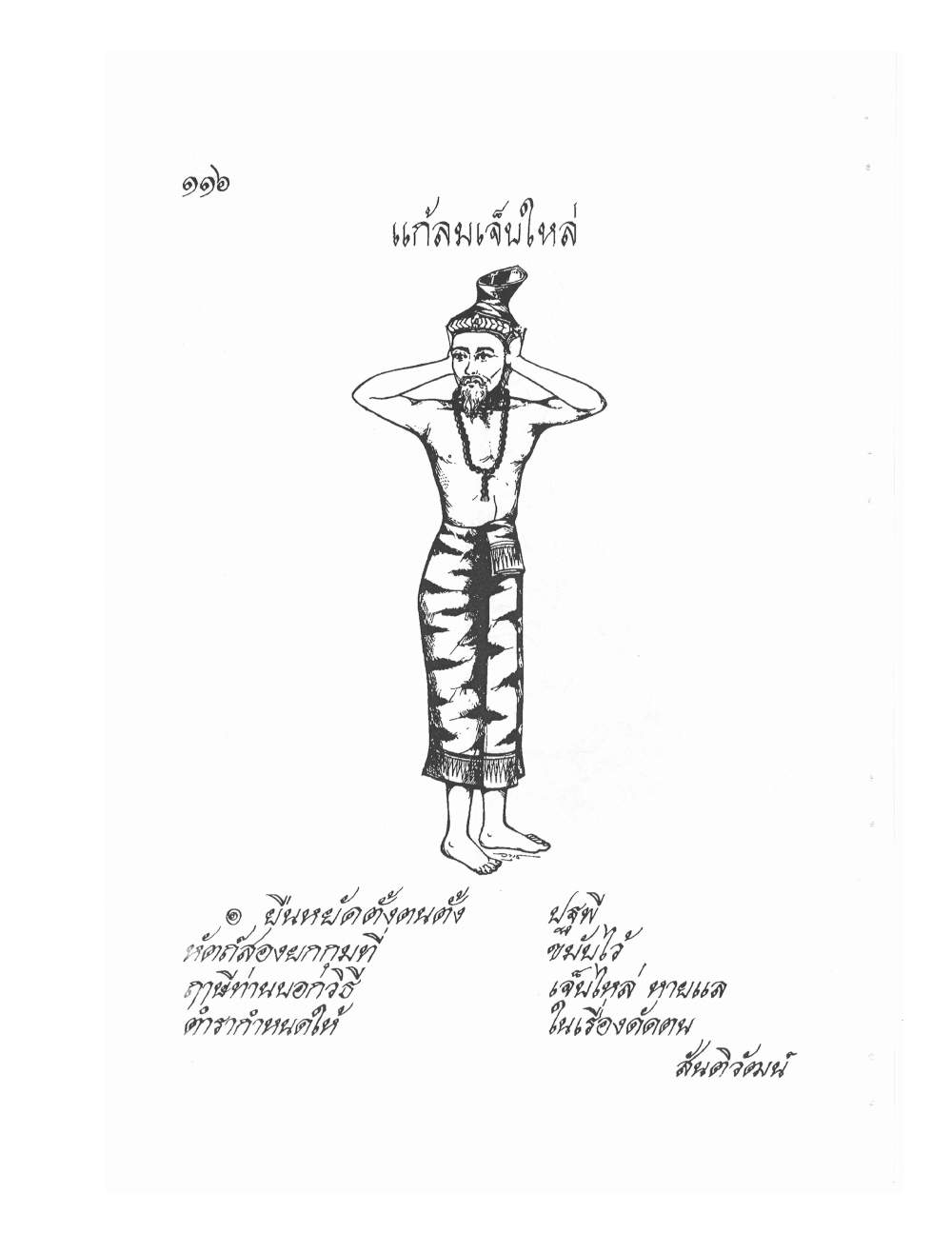
๑๑๖
แก้ลมเจ็บใหล่
[diagram: a ruesi figure standing, both hands clasped behind the neck, beaded mala, tiger-striped cloth]
ยืนหยัดตั้งตนตั้ง ฝีสพ หัตถ์สองยกกุมทัย ขมับไว้ กราบชี้ท่านบอกวิธี เจ็บใหล่ หายแล ตำรากำหนดให้ ในเรื่องดัดตน สันติวรมย์
116
Cure for wind causing shoulder pain
[diagram: a ruesi figure standing, both hands clasped behind the neck, beaded mala, tiger-striped cloth]
Stand firm, holding the body upright, raise both hands and clasp them at the temples. With reverence he points out the method by which shoulder pain is relieved, as the manual prescribes, within the chapter on body-stretching. [Signed:] Santiwarom
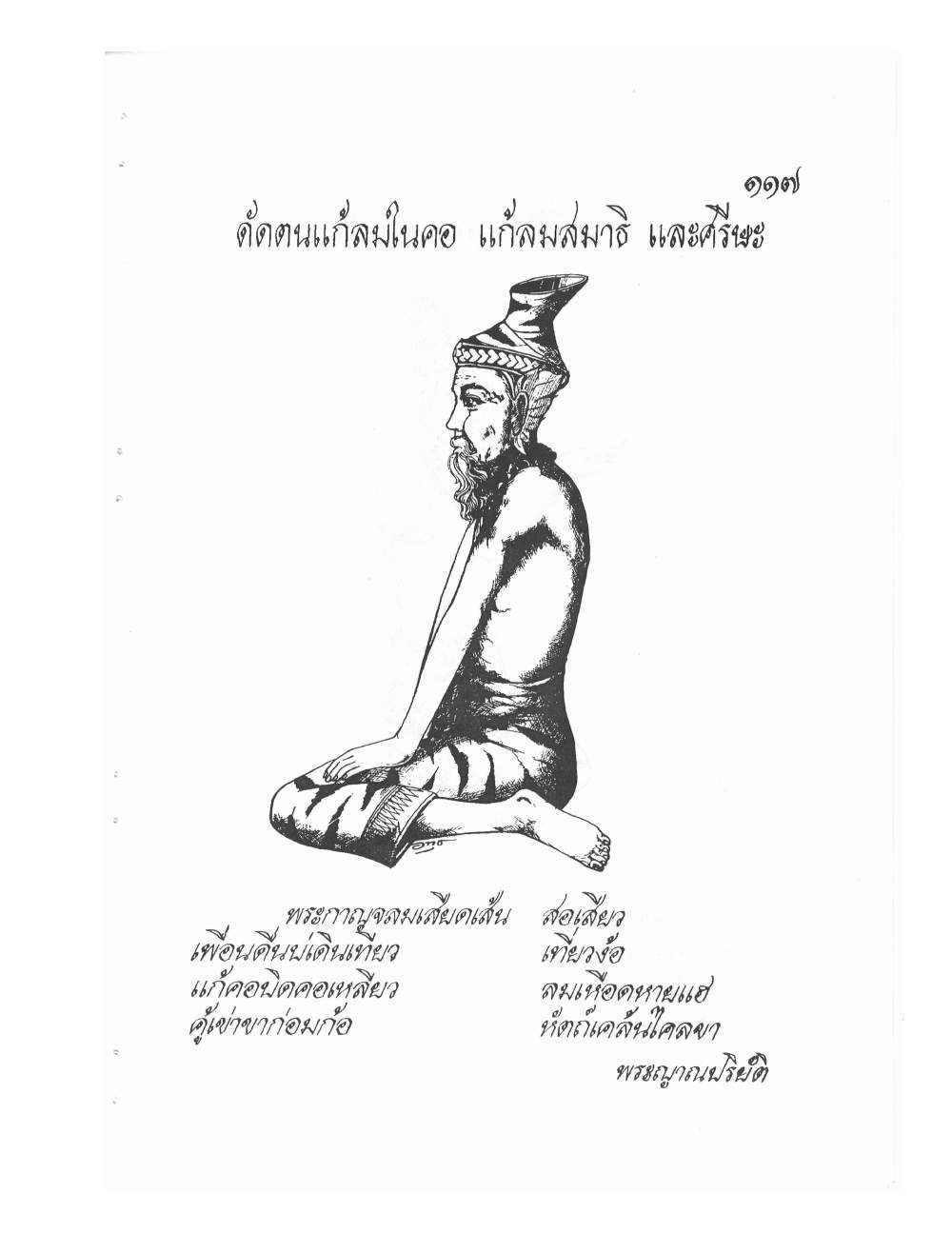
๑๑๗
ดัดตนแก้ลมในคอ แก้ลมสมาธิ และศีรษะ
[diagram: a ruesi figure kneeling, seen from the side, both hands joined together in front of the chest, beaded mala, tiger-striped cloth]
พระกาญจน์ลมเสียดเส้น สอเสี้ยว เพื่อนดื่นมาเดินเที่ยว เที่ยวง้อ แก้คอมิดคอเหลียว ลมเหื้อดหายแฮ คู้เข่าขาก่อมก้อ หัตถ์เคล้นใคลขา พระญาณปริยัติ
117
Stretching the body to cure wind in the neck, wind affecting concentration, and the head
[diagram: a ruesi figure kneeling, seen from the side, both hands joined together in front of the chest, beaded mala, tiger-striped cloth]
Phra Kan, whose wind pierces the sinews at an angle, is sought out by companions who come wandering to visit. It cures a stiff, twisted neck; the lingering wind departs; bend the knees, drawing the legs in, and press the hands along the thigh. [Signed:] Phra Yanpariyat
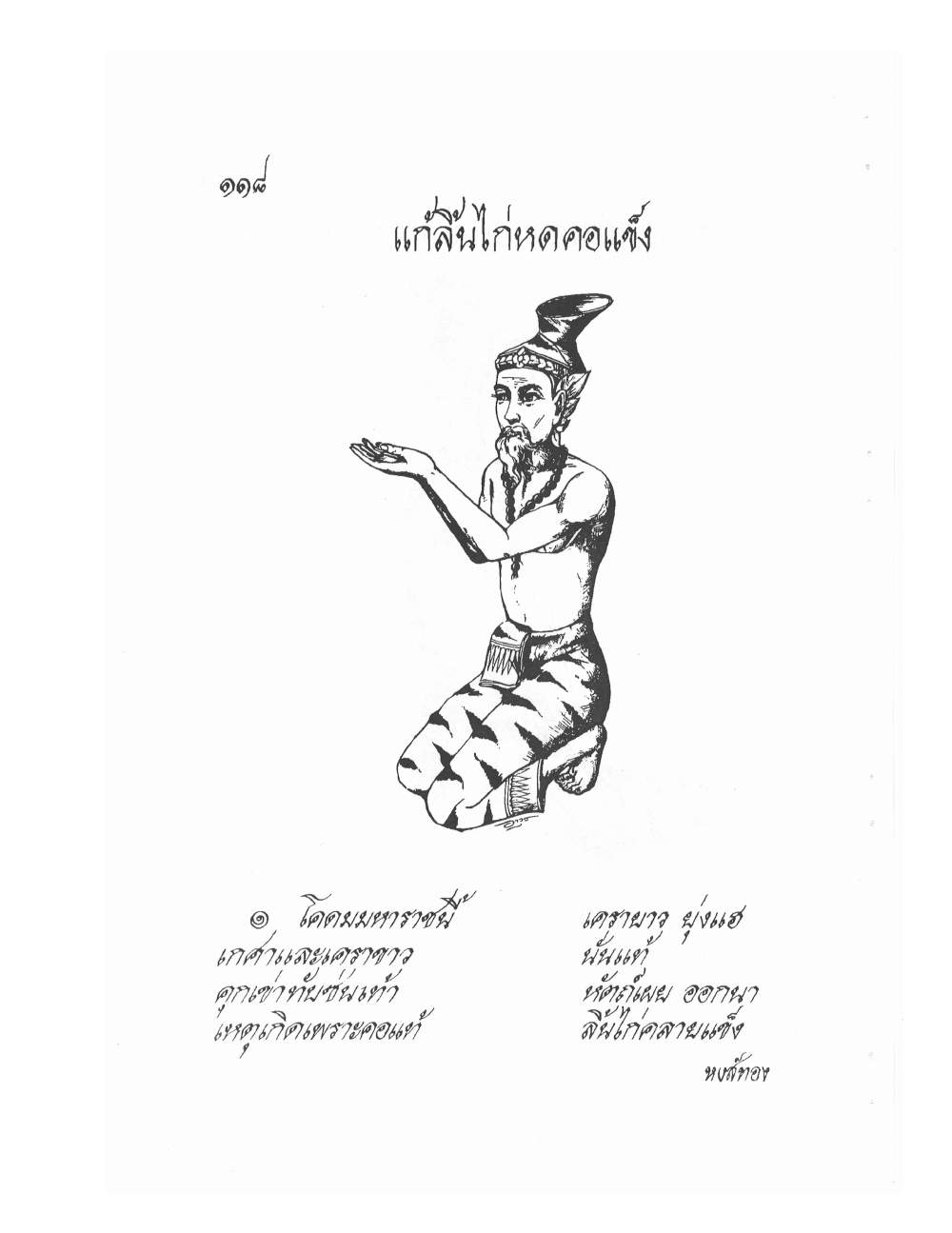
๑๑๘
แก้ลิ้นไก่หดคอแข็ง
[diagram: a ruesi figure kneeling, one hand raised with the palm open and turned upward, the other arm resting across the body, beaded mala, tiger-striped cloth]
โคดมมหาราชนี้ เกศาแลบเครายาว คุกเข่าทั้งส้นเท้า เหตุเกิดเพราะคอแข็ง เครายาว ยุ่งแฮ ผันแท้ หัตถ์เผย ออกนา ลิ้นไก่คลายแข็ง หงส์ทอง
118
Cure for a retracted uvula and a stiff neck
[diagram: a ruesi figure kneeling, one hand raised with the palm open and turned upward, the other arm resting across the body, beaded mala, tiger-striped cloth]
This great sage Gotama, his hair loosed and his beard grown long, kneels down upon his heels, on account of a neck grown stiff. His long beard, disheveled, truly turns [with the motion]; as the hand opens outward, the stiffness of the uvula and neck eases. [Signed:] Hongthong
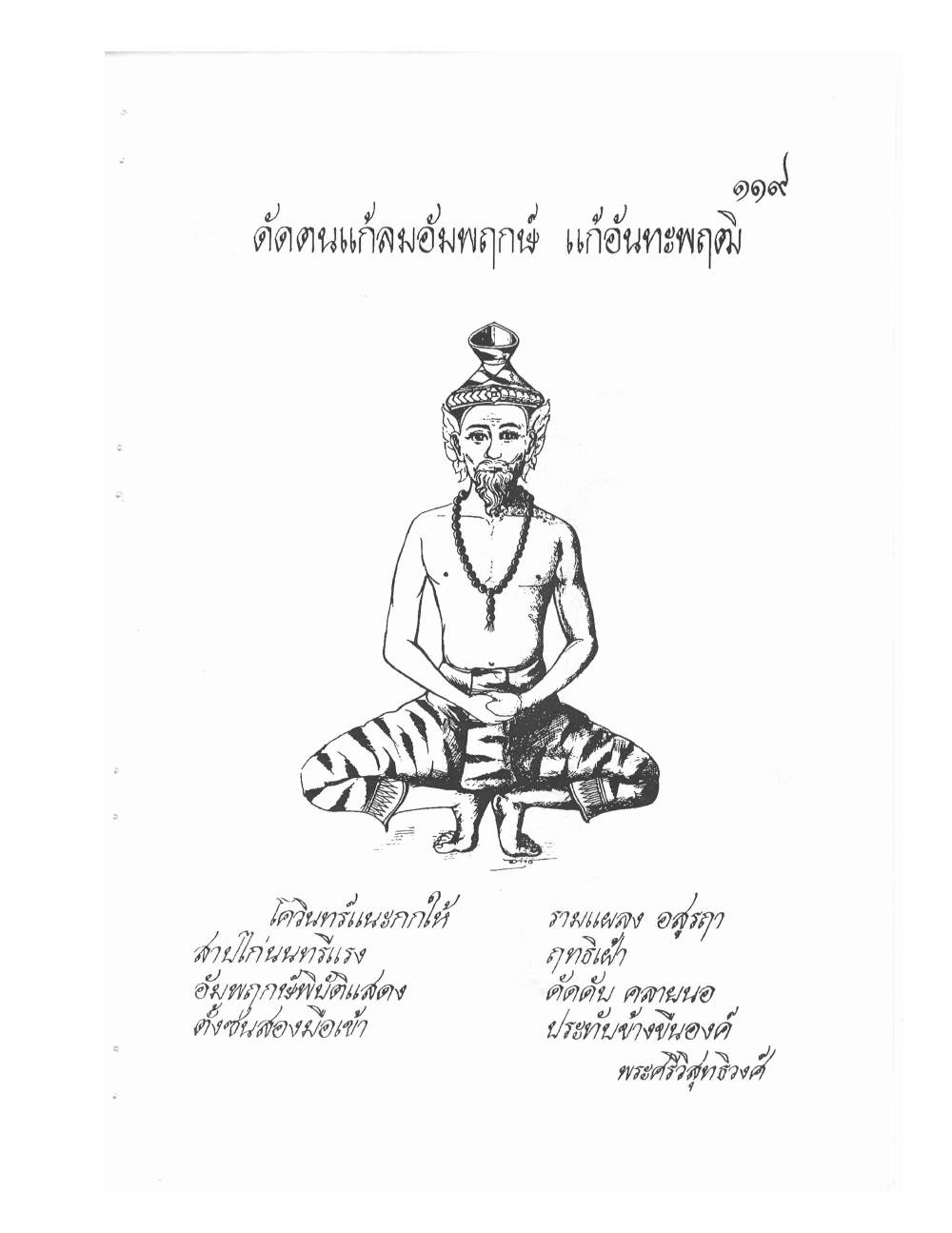
๑๑๙
ดัดตนแก้ลมอัมพฤกษ์ แก้อันทพฤกษ์มิ
โควินทร์เนียรกกให้ รามแผลง อสุรฐา สายไก่นนทรีแรง ฤทธิ์เฝ้า อัมพฤกษ์พิมพ์แสดง ดัดดั้ม คลายนอ ตั้งซนสองมือเข้า ประทับข้างขึ้นองค์ พระศรีวิสุทธิวงศ์
119
Adjusting the body to relieve wind-paralysis (amphalek); to relieve "anthaphreuksami" [an old term for a related affliction, exact sense uncertain]
Govinda taught and gave it, Rama hurled down the asura's power, the cock's-tail-feather strength, its might stands guard, the paralysis-pose is shown, bend and draw in, then ease away the ache, setting both hands in close. press to the side, and raise the body. [signed] Phra Sri Visutthiwong
[illustration: a bearded ruesi hermit wearing a tall pointed hat and prayer beads, seated cross-legged in a tiger-pelt lower garment, both hands joined together low in front of the body near the lap]
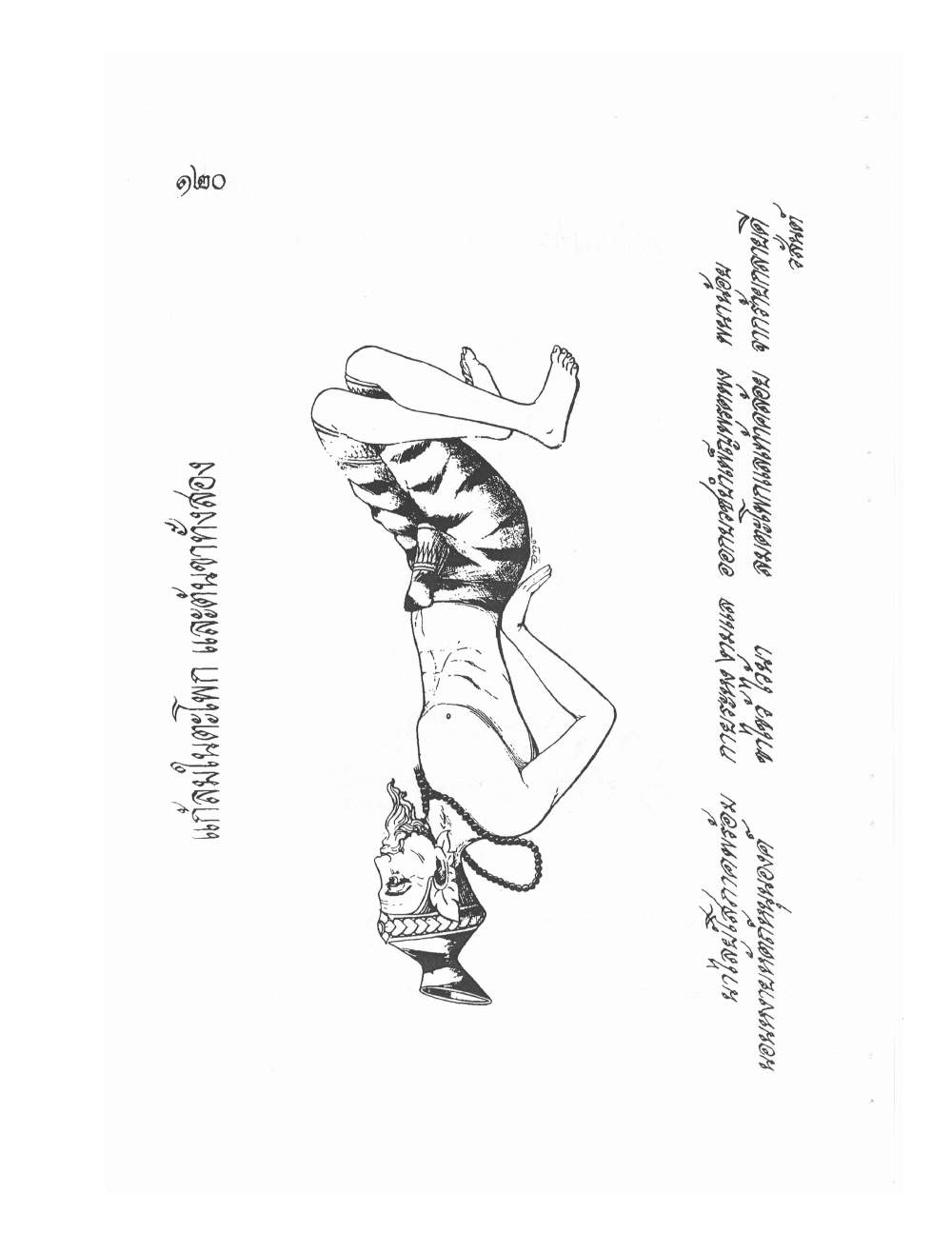
๑๒๐
แก้ลมในตะโพก และต้นขาทั้งสอง
นาไลย์โสภาคพร้อม กายระหง งามแล ออกนวชน่ำเพ็ญพรตพง พนาน้อย ผอมหงายหัตถ์หมุนองค์ ขาไขว้ ไว้นา ลมตะโพกแลเท้าคล้อย จากร้ายกลายดี จสันต์
120
Relieve wind in the hip/buttock and in both thighs
Graceful and well-formed of body, handsome and tall indeed, going forth as a young ascetic to keep his vows, in the small forest, lean, lying back, turning the arm, legs crossed, held in place, the wind of the hip and the trailing foot turns from ill to well. [signed] Cha San(t)
[illustration: the page is printed rotated 90 degrees relative to the book's normal orientation; a bearded ruesi hermit wearing a tall hat and prayer beads is shown upside-down/inverted, wrapped in a tiger-pelt garment from the waist down, both legs drawn up and crossed above the head, one hand braced against the hip]
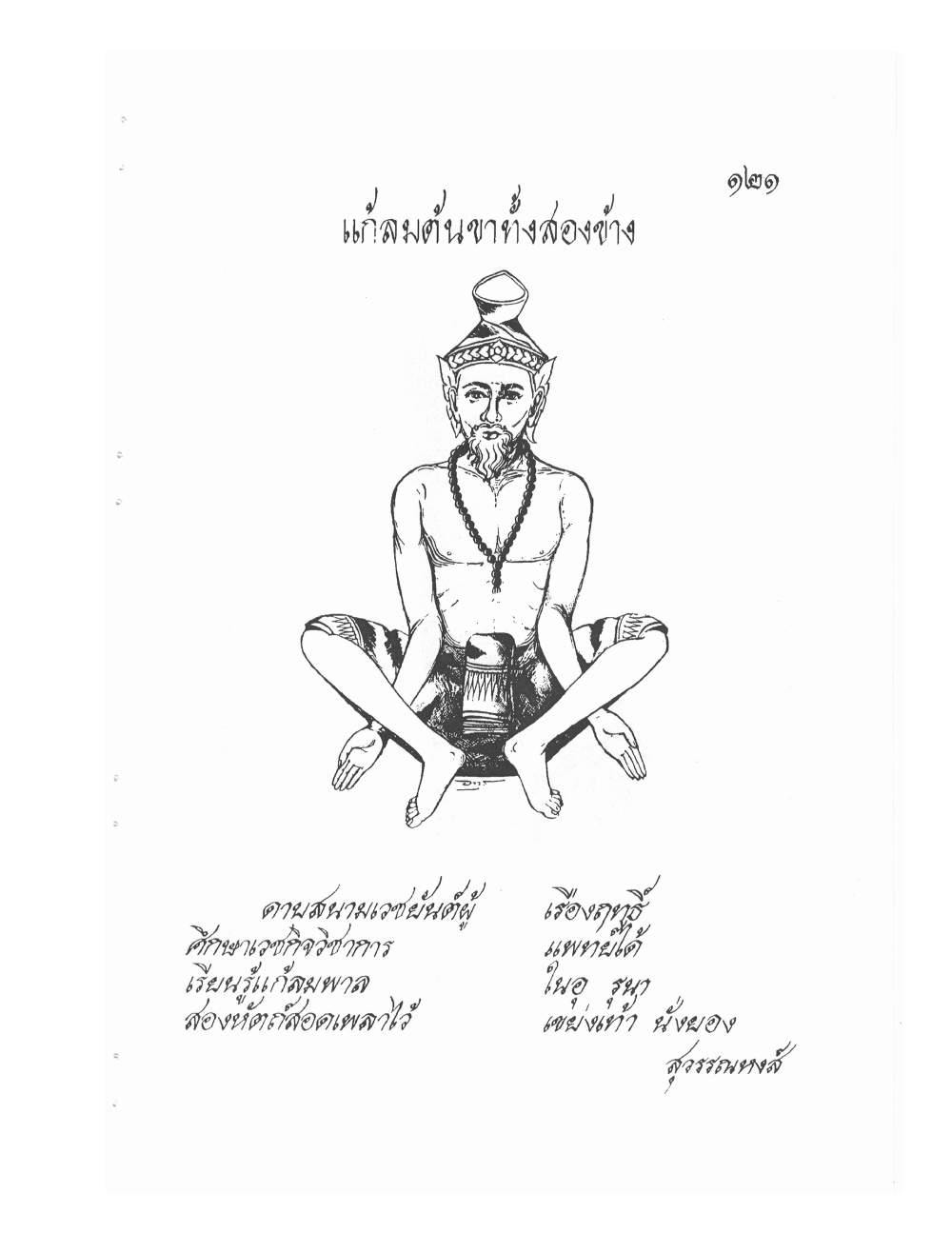
๑๒๑
แก้ลมต้นขาทั้งสองข้าง
ความสนามเจษยนต์ผู้ เรื่องฤทธิ์ ศึกษาเวชกิจวิชาการ แพทย์ได้ เรียนรู้เกลศพาล ในอุรุษยา สองหัตถ์สอดเพลาไว้ เหยียดเท้า นั่งยอง สุวรรณหงส์
121
Relieve wind in both thighs
One versed in the field of this craft, a matter of [healing] power, who studies the practice of medicine, the physician has attained it, learning to overcome affliction, in the thigh, both hands slipped in to hold the leg, foot stretched out, sitting hunched. [signed] Suwannahong
[illustration: a bearded ruesi hermit wearing a tall hat and prayer beads, seated cross-legged in a tiger-pelt garment, both hands resting on his ankles/feet in front of him]
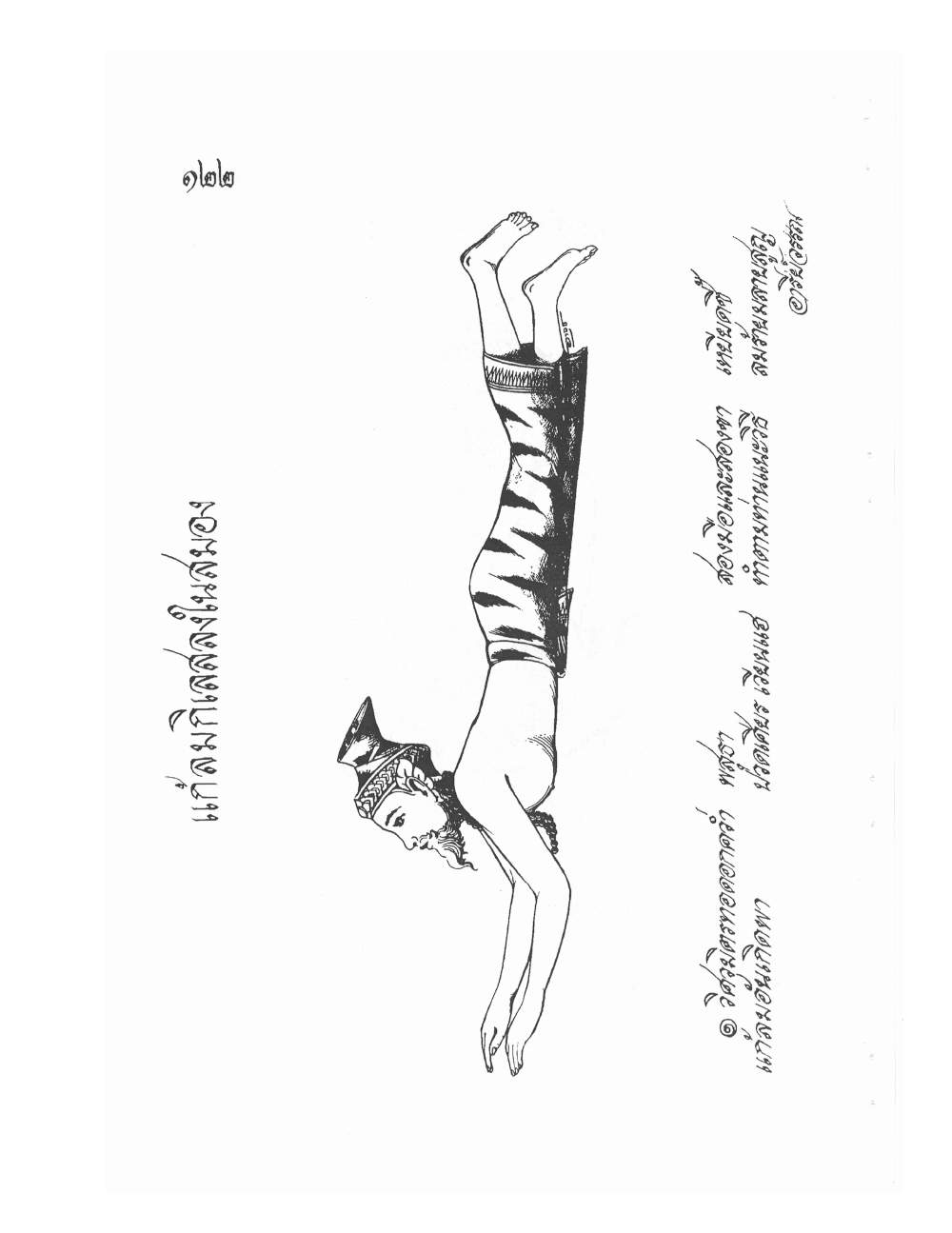
๑๒๒
แก้ลมกิเลสลงในสมอง
๑ วิศวมิตรทอดอกคว่ำ พสุธา สองมือและสองขา เหยียดขึ้น แก้ลมอันเกิดพา ปวดเมื่อย เวียนแฮ ทำตามท่านแนะวิธี ลมร้ายมลายสูญ [อ่านไม่ออก]
122
Relieve the "kilesa" wind that descends into the brain
1. Vishvamitra lay prone, chest to the earth, both hands and both legs stretched upward, to relieve the wind that arises, causing ache and giddiness, do as the sage instructs, and the ill wind is destroyed. [signature illegible]
[illustration: the page is printed rotated 90 degrees relative to the book's normal orientation; a bearded ruesi hermit wearing a tall hat and prayer beads is shown inverted, lying with his head down and both legs raised straight up in the air, one arm braced against the hip]
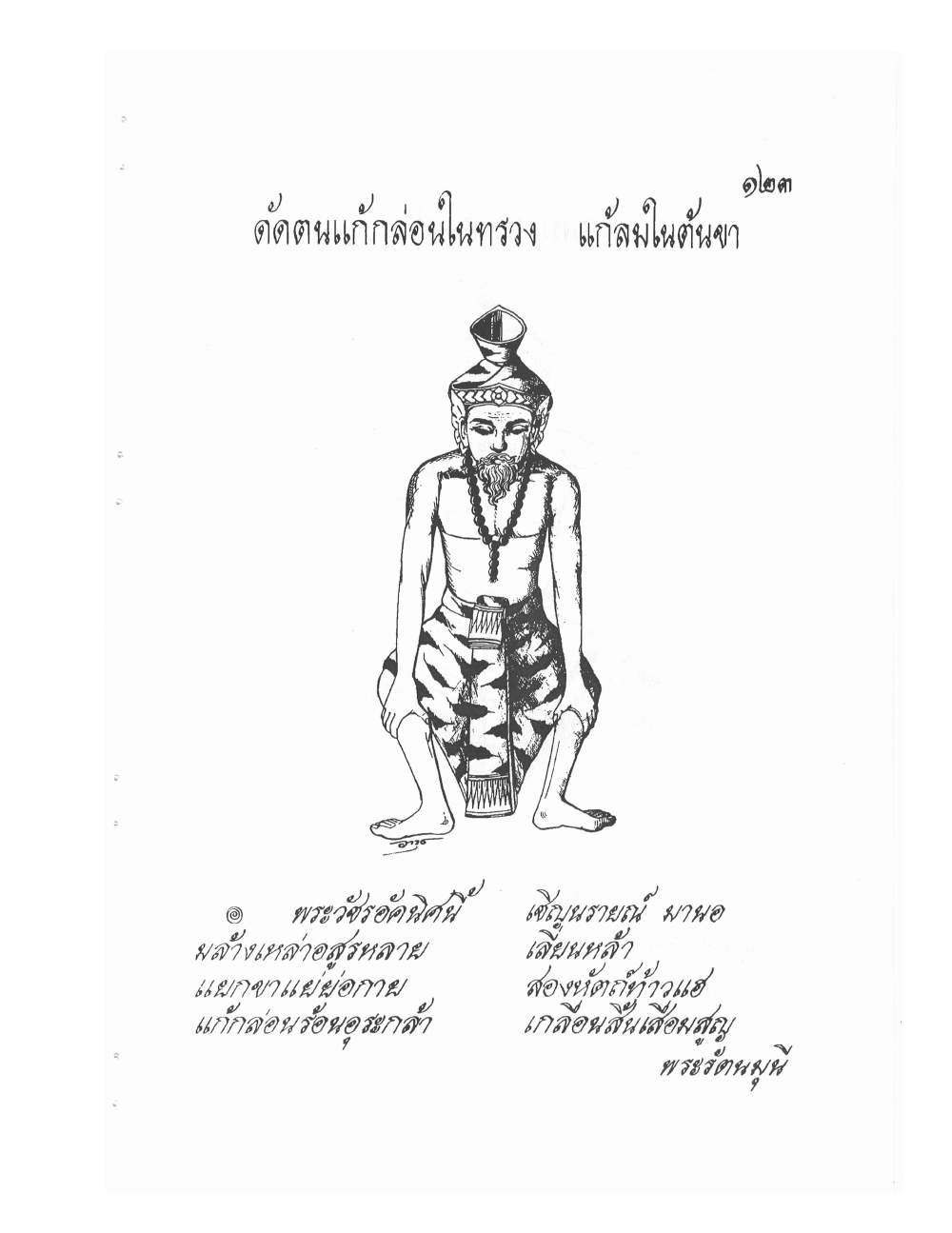
๑๒๓
ดัดตนแก้กล่อนในทรวง แก้ลมในต้นขา
พระวัชรอัคนิศนี้ เชิญนารายณ์มานอ มล้างเหล่าอสูรหลาย เลี้ยนหล้า แยกขาแย่ย่อกาย สองหัตถ์ท้าวแฮ แก้กล่อนร้อนอุระกล้า เกลื้อนสิ้นเสื้อสูญ พระรัตนมุนี
123
Adjusting the body to relieve klon [a swelling/hernia-type ailment] in the chest; relieve wind in the thigh
This thunderbolt of fire, invite Narayana to come and rest, that destroyed the many asura, smoothing the land, legs parted, body lowered, both hands bracing, relieves the burning klon in the chest, until it is wholly worn away and gone. [signed] Phra Rattanamuni
[illustration: a bearded ruesi hermit wearing a tall hat and prayer beads, squatting with both arms crossed and resting on his knees, which are braced against a short patterned pillar/bolster set between his feet]
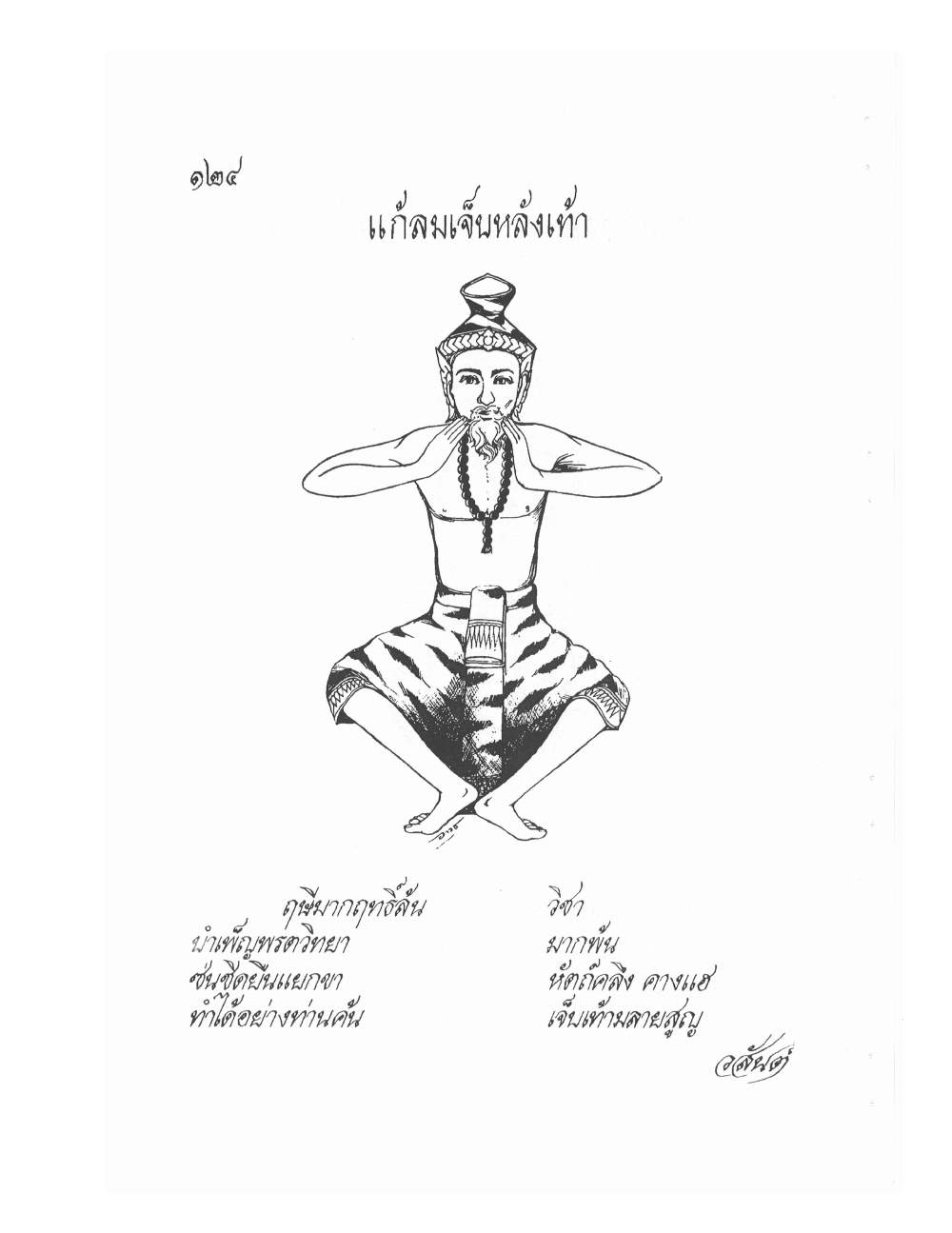
๑๒๔
แก้ลมเจ็บหลังเท้า
ฤาษีมากฤทธิ์ล้น วิชา บำเพ็ญพรตวิทยา มากพ้น ชื่นชิดยืนแยกขา หัตถ์คลึง คางแฮ ทำได้อย่างท่านค้น เจ็บเท้ามลายสูญ จสันต์
124
Relieve wind causing pain on the top of the foot
A ruesi hermit overflowing with power, of great learning, who has cultivated his ascetic vows, far beyond the ordinary, stands close, legs apart, glad at heart, hands rubbing at the chin, do it as the sage has found it, and the pain of the foot is destroyed. [signed] Cha San(t)
[illustration: a bearded ruesi hermit wearing a tall hat and prayer beads, squatting low with feet crossed under him and both hands raised to rub his chin/jaw]
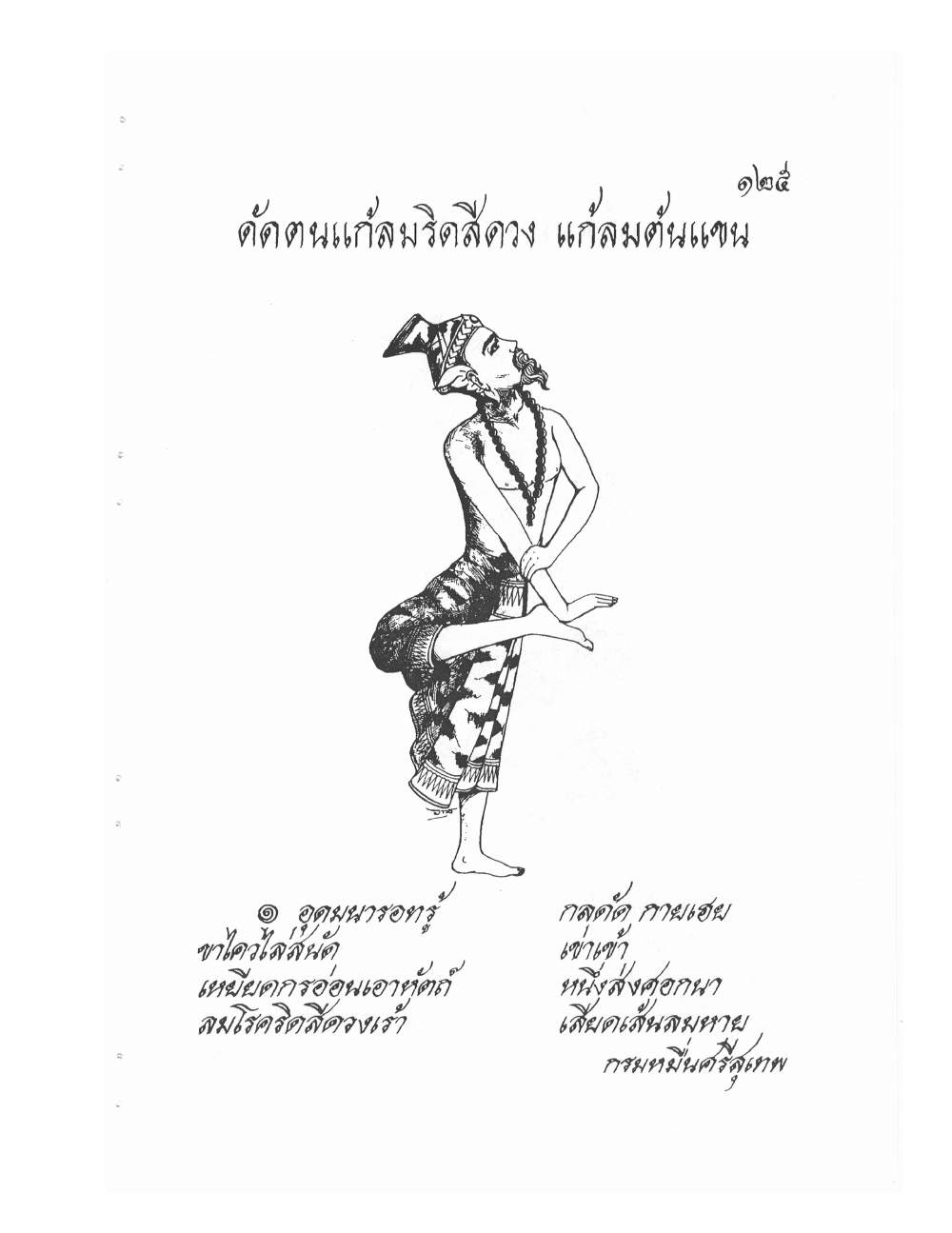
๑๒๕
ดัดตนแก้ลมริดสีดวง แก้ลมต้นแขน
๑ อุดมนวรอทรู้ กลดดั้ว กายเฮย ขาไคว้ไล่ส้นตี เข่าเข้า เหยียดกรอ่อนเอาหัตถ์ หนึ่งส่งศอกผา ลมโรคริดสีดวงเร้า เสียดเส้นลมหาย กรมหมื่นศรีสุเทพ
125
Adjusting the body to relieve wind of ridsiduang [hemorrhoids/fistula]; relieve wind in the upper arm
1. Foremost among those who know it well, the body arched and bent, one leg swung round, heel chasing, knee drawn in, the soft arm stretched out with the hand, one elbow sent out to the side, the wind-sickness of ridsiduang that stirs within the aching vein of wind is made to leave. [signed] Krommuen Sisuthep
[illustration: a bearded ruesi hermit wearing a tall hat and prayer beads, standing on one leg with the head tilted back to look upward, the other leg raised and bent with the hand grasping the ankle]
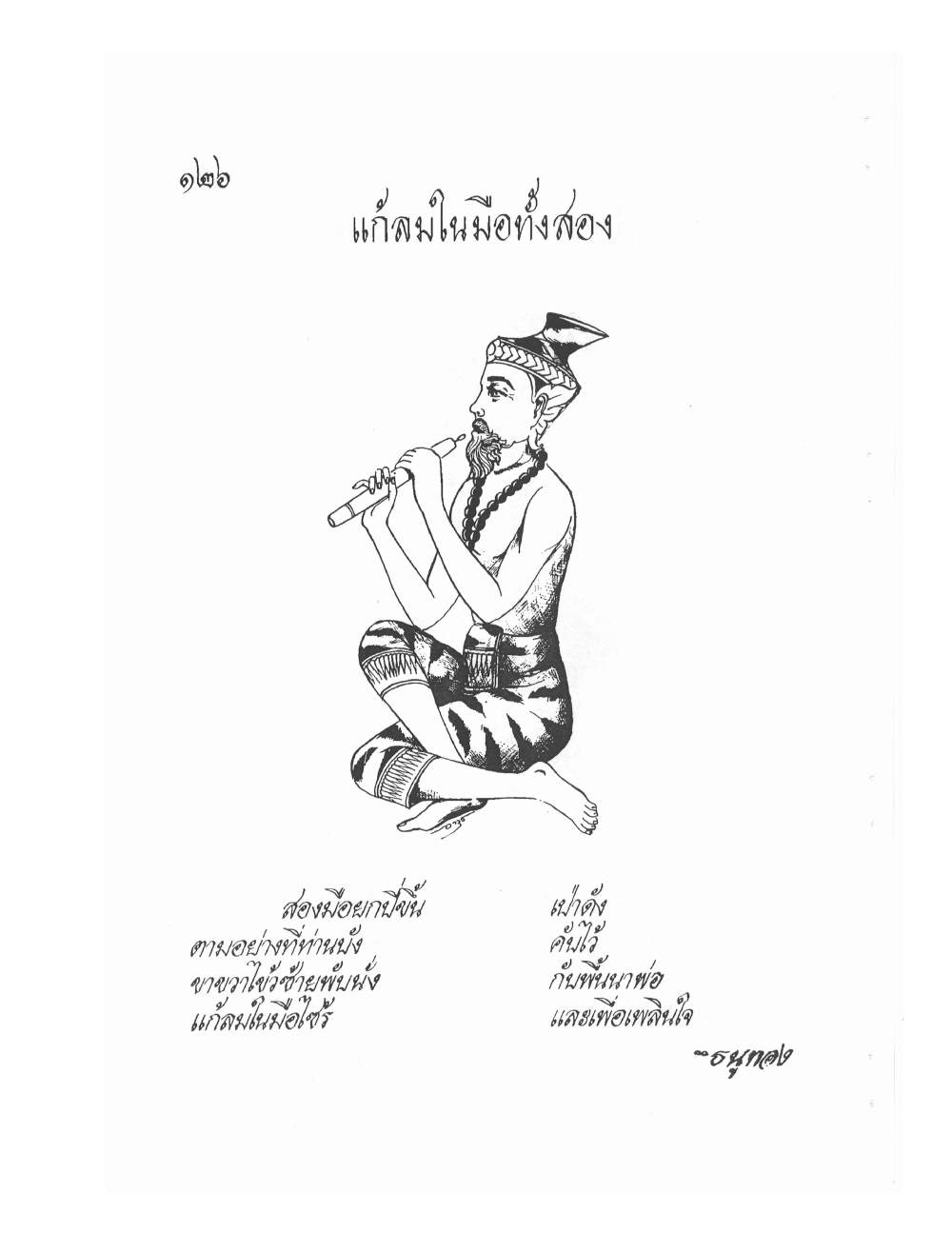
๑๒๖
แก้ลมในมือทั้งสอง
สองมือยกปี่ขึ้น เฝ้าตั้ง ตามอย่างที่ท่านนั่ง คีบไว้ ขาขวาไขว้ซ้ายพื้นนั่ง กับพื้นนาพ่อ แก้ลมในมือไซร้ และเพื่อเพลินใจ ธนูทอง
126
Relieve wind in both hands
Both hands raise the flute, holding it upright and steady, seated in the manner the master sat, gripping it in place, right leg crossed over the left, seated on the ground, set against the ground, good sir, this indeed relieves the wind in the hands, and also brings delight to the heart. [signed] Thanuthong
[illustration: a bearded ruesi hermit wearing a tall hat and prayer beads, seated cross-legged in a tiger-pelt garment, playing a flute held in both hands to his mouth]
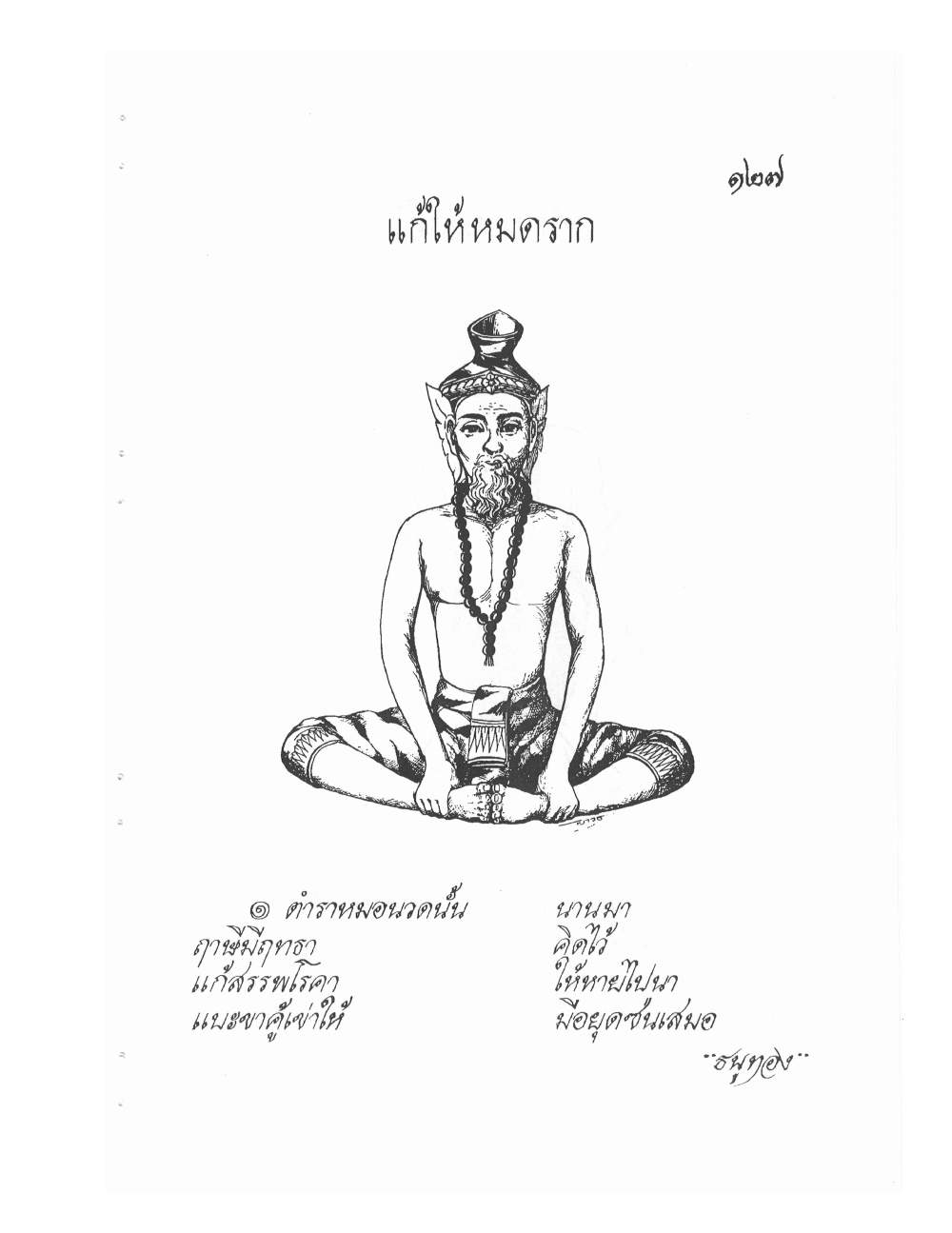
๑๒๗
แก้ให้หมดราก
๑ ตำราหมอนวดนั้น นานมา ภาษีมีฤทธา คิดไว้ แก้สรรพโรคา ให้หายไปนา แบะขาคู้เข่าให้ มือยุดชันเสมอ ธนูทอง
127
Relieve until the vomiting stops entirely
1. This manual of the massage-doctor's craft dates from long ago, its value holds real power, conceived and set down, to cure every kind of ailment until it is well again, spreading the legs and drawing the knees up, the hands holding them steady in place. [signed] Thanuthong
[illustration: a bearded ruesi hermit wearing a tall hat and prayer beads, seated with legs spread and knees bent up, both hands together at his feet]
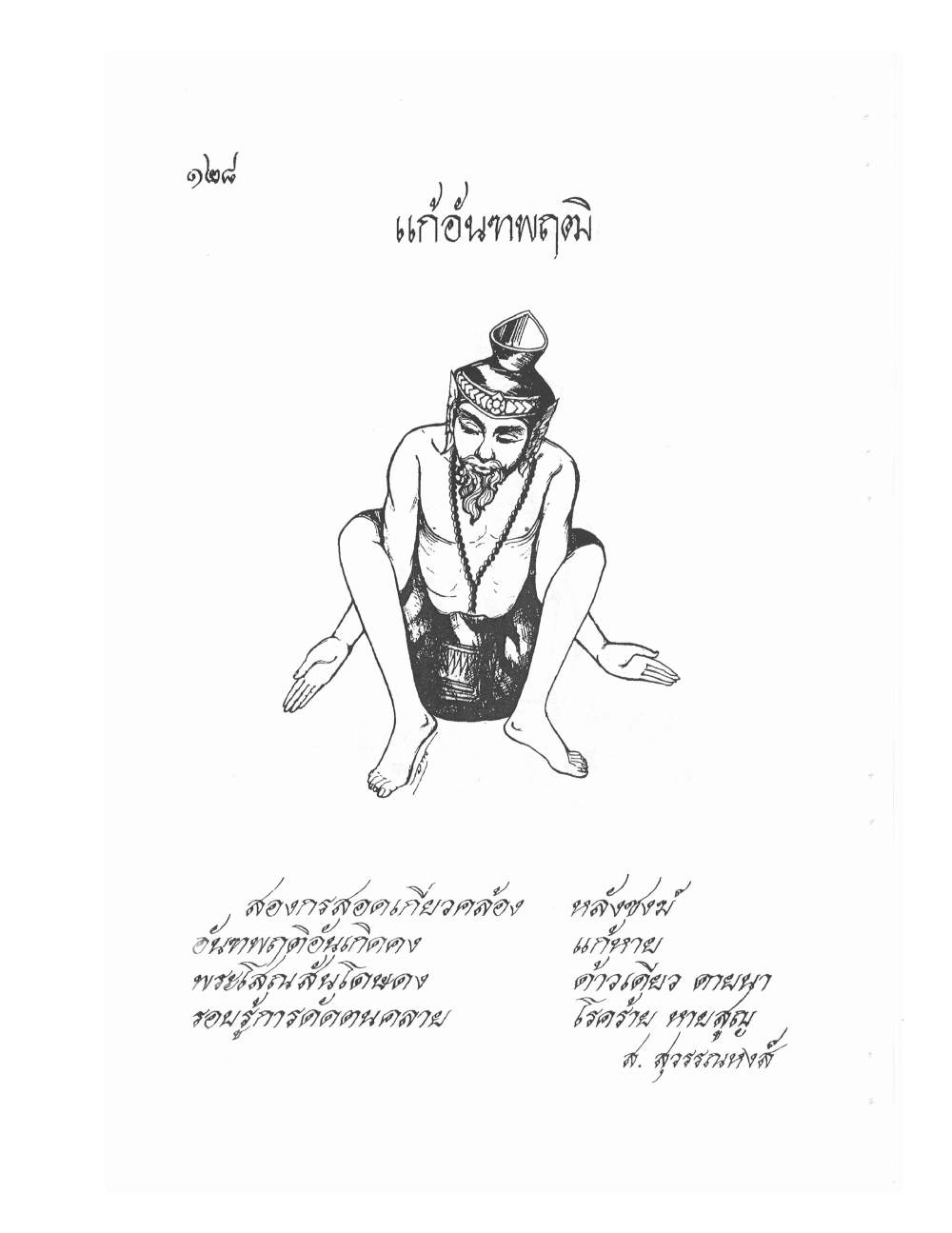
๑๒๘
แก้อันทพฤกษ์มิ
สองกรสอดเกี่ยวคล้อง หลังชงม์ อันทพฤกษ์คือชั้นเกิดคง แก้หาย พรยเสิณสั้นโดยดง ตัวเดียว ตายฬา รอบรู้การดัดตนคลาย โรคร้าย หายสูญ ส. สุวรรณหงส์
128
Relieve "anthaphreuksami" [an old term for a related affliction, exact sense uncertain]
Both arms passed through and hooked together behind the back, this anthaphreuksa is the sort that keeps arising, it is thereby cured, [a further descriptive line, obscure in the original], to know well how to loosen the body by stretching, the evil sickness is destroyed and gone. [signed] S. Suwannahong
[illustration: a bearded ruesi hermit wearing a tall hat and prayer beads, squatting with a dark-colored waist-cloth, both arms held out to the sides with palms open]
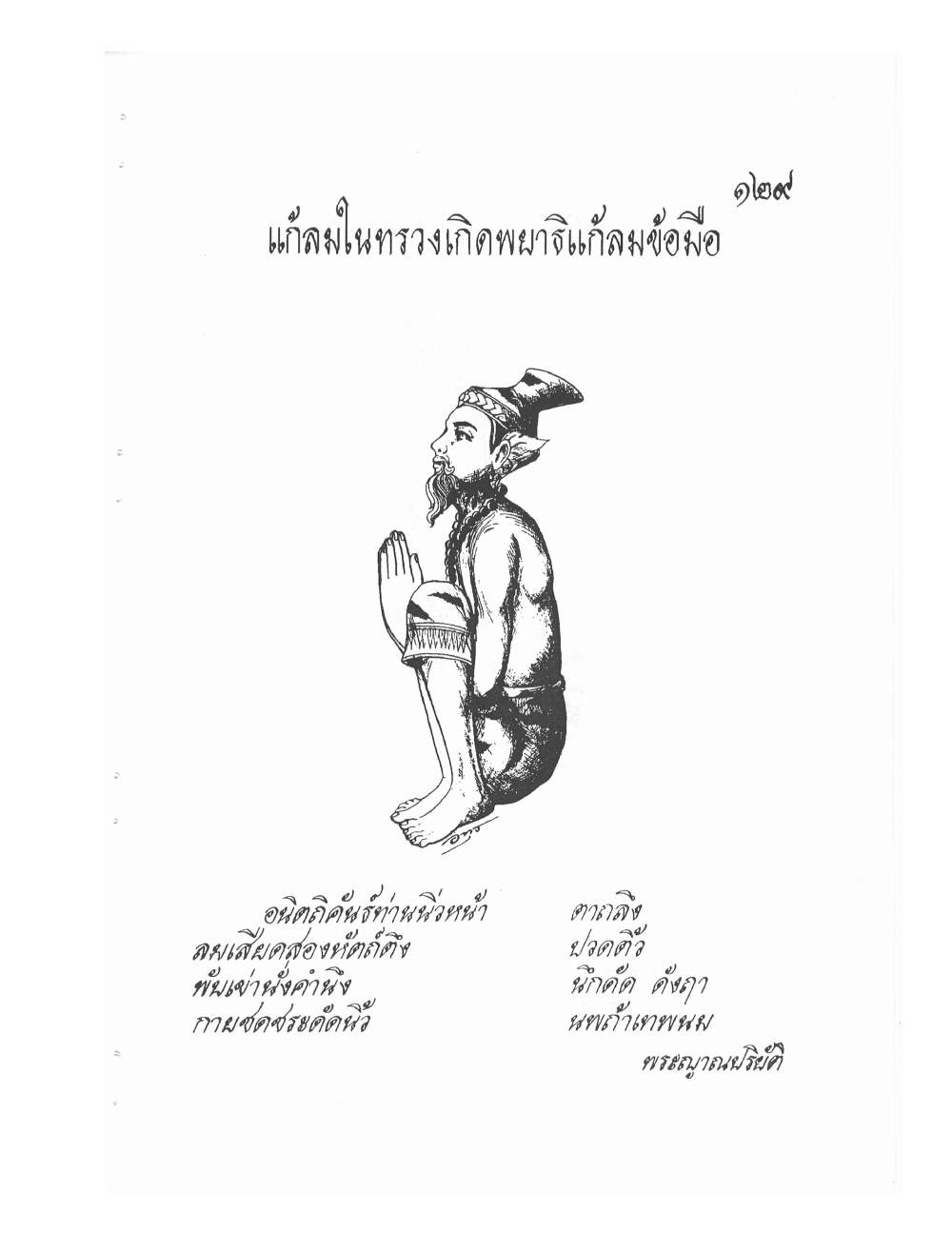
๑๒๙
แก้ลมในทรวงเกิดพยาธิแก้ลมข้อมือ
อนิตถิดันธ์ท่านนิ่วหน้า ตาถลึง ลมเสียดสองหัตถ์ดึง ปวดตึง พันเข่านั่งคำนึง นึกคิด ดังฤา กายซดซรชด้ดนิ้ว นพถ้ำเทพนม พระญาณปริยัติ
129
Relieve wind in the chest that gives rise to disease; relieve wind in the wrist
[The devotee] knits his brow, eyes wide and staring, the wind stabs, pulling at both hands, an aching tightness, kneels, sits in contemplation, thinking, as if in prayer, the body drawn straight, fingers pressed together, [a gesture likened to] the nine sacred grottoes. [signed] Phra Yanpariyat
[illustration: a bearded ruesi hermit wearing a tall hat and prayer beads, kneeling in profile with both hands pressed together in a wai gesture before his chin]
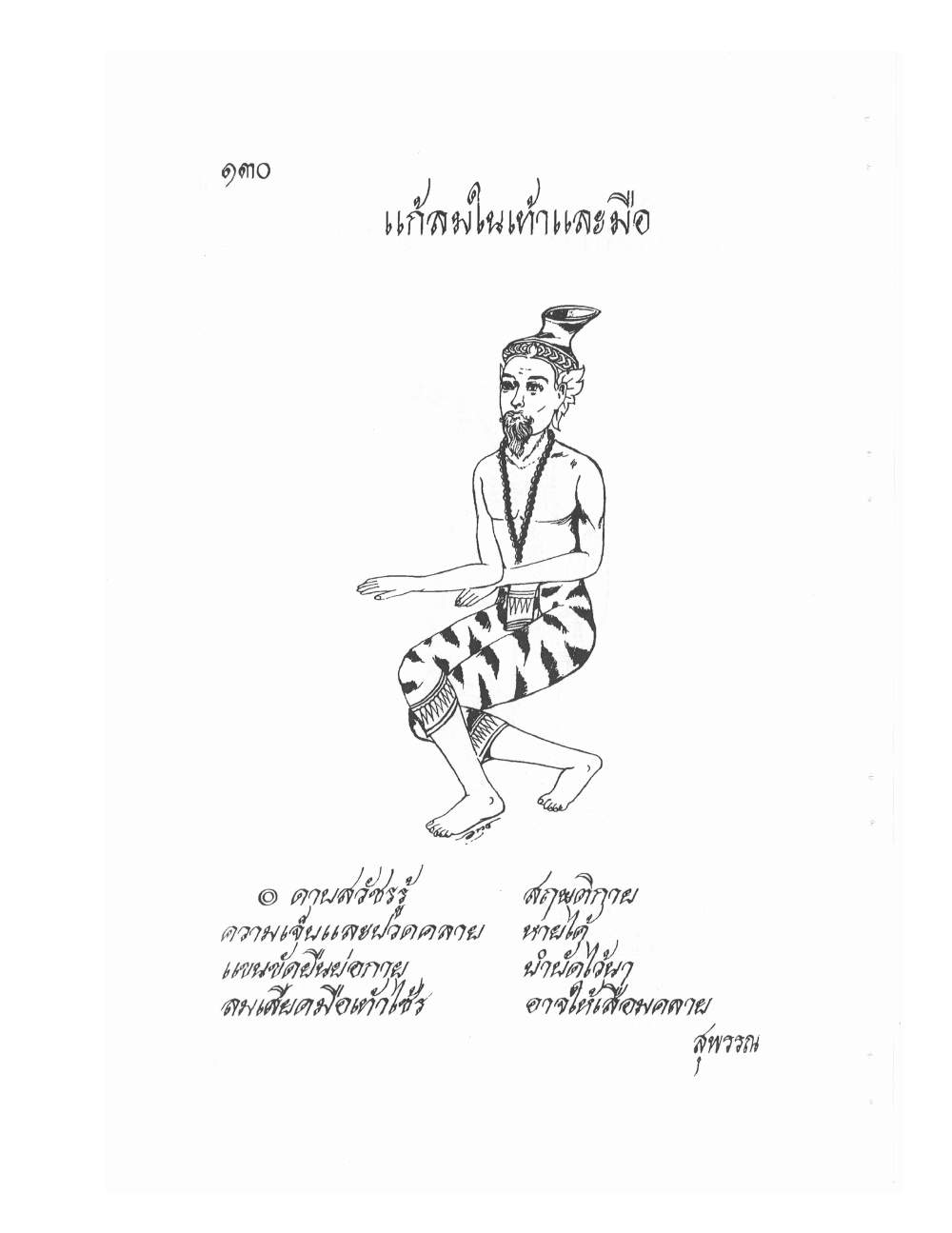
๑๓๐
แก้ลมในเท้าแลมือ
๑ ความสวัสดิ์รู้ สถาพร กาย ความเจ็บแลปวดคลาย หายได้ แขนขัดยืนย่อกาย ผำผัดไว้นา ลมเสียดมือเท้าไซร้ อาจให้เสื่อมคลาย สุพรรณ
130
Relieve wind in the feet and hands
1. To know well-being is to keep the body sound, pain and aching ease away, and are cured, arm braced, standing with the body lowered, turned and set in place, the wind that stabs at the hands and feet can thereby be made to fade and loosen. [signed] Suphan
[illustration: a bearded ruesi hermit wearing a headdress and prayer beads, seated with one leg extended forward and one arm resting across his lap]
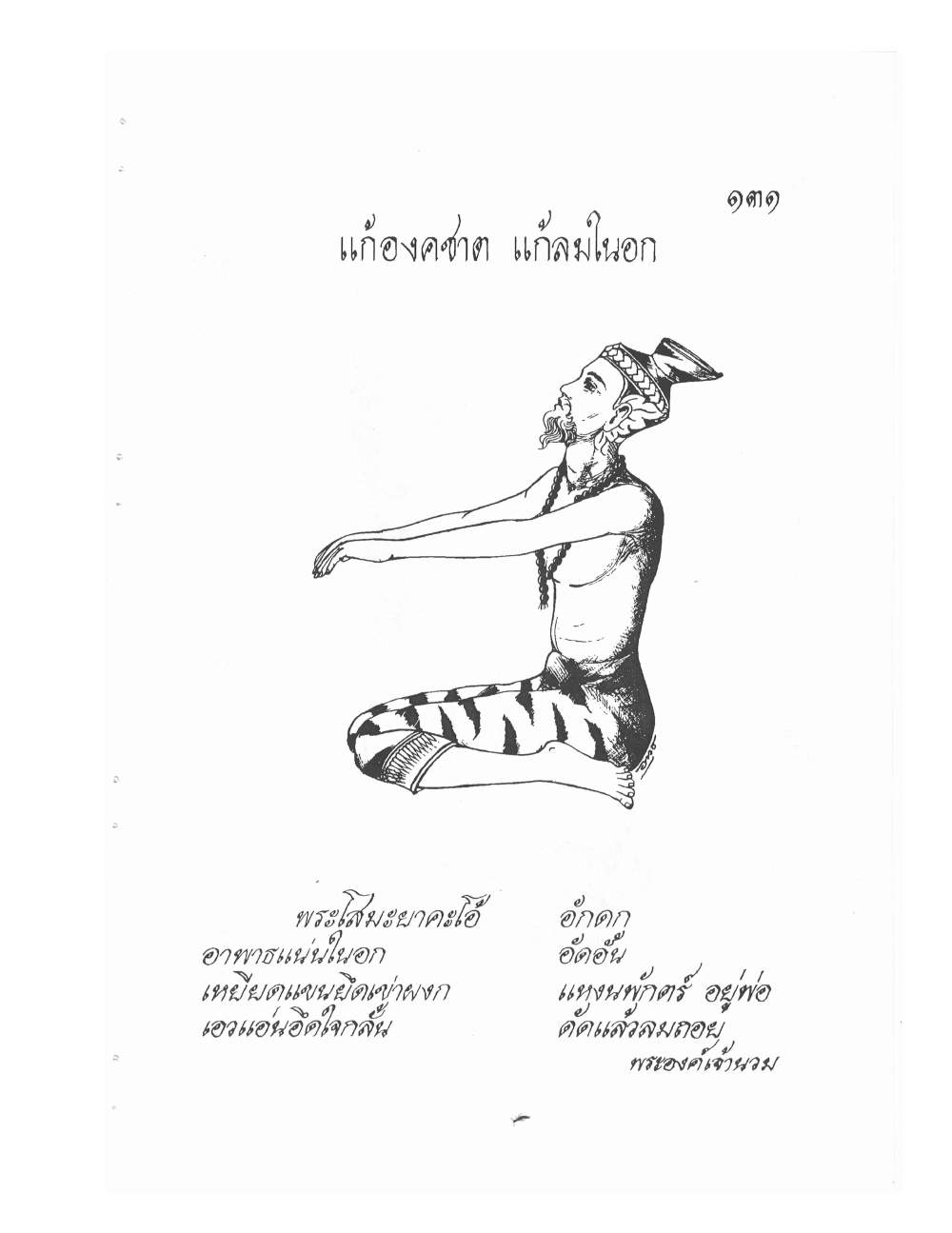
๑๓๑
แก้องคชาต แก้ลมในอก
[ภาพ: ฤๅษีนั่งคุกเข่าข้างหนึ่ง สวมชฎายอดแหลม มีหนวดเครา คล้องลูกประคำ นุ่งหนังเสือ เหยียดแขนขวาตรงไปข้างหน้าระดับไหล่ เงยหน้าขึ้น] พระโสมยาคะโอ้ อ๊กดก อาพาธแน่นในอก อัดอั้น เหยียดแขนยืดเข่าผงก แห่งนพรากรร์ อยู่พ่อ เอวแอ่นอัดใจกลั้น คิดแล้วลมถอย พระองค์เจ้านวม
131
Curing the male organ [ache in the groin/testicles]; curing wind in the chest
[diagram: a ruesi kneeling on one knee, wearing a tall pointed crown, bearded, wearing a prayer-bead necklace and a tiger-skin lower garment, right arm stretched straight out at shoulder height, face tilted upward]
"Venerable Somayaka, oh — the affliction sits packed tight in the chest. Stretch out the arm, straighten up from the bent knee, arch the waist and hold the breath in — pressed and dammed up. [Hold] at that place, father; once thought through, the wind recedes." — Signed: Phra Ong Chao Nuam
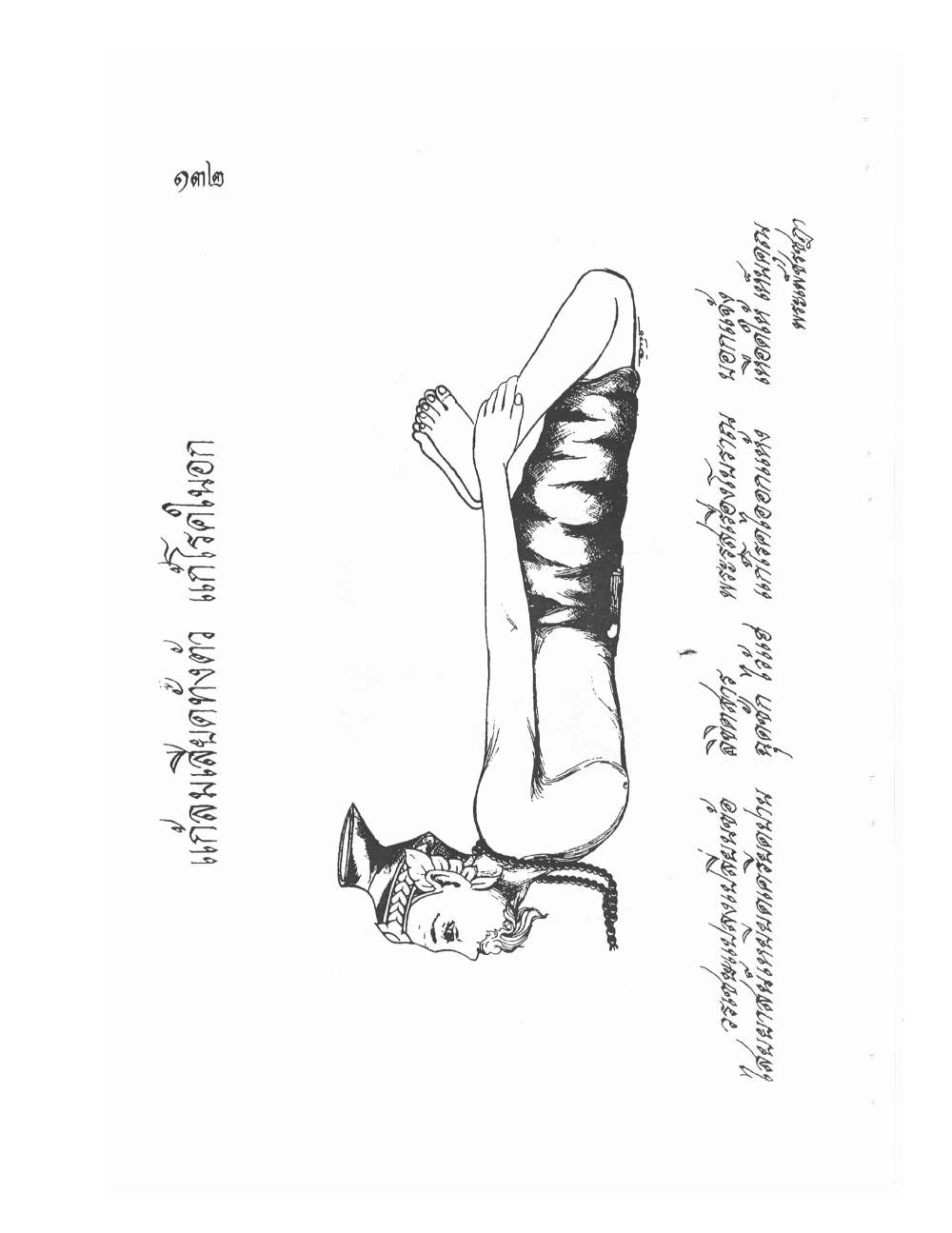
๑๓๒
แก้ลม[อ่านไม่ออก]ทั่วตัว แก้ริดสีดวง[อ่านไม่ออก]
[ภาพ: หน้ากระดาษพิมพ์หมุน ๙๐ องศา — ฤๅษีนั่ง ยกขาข้างหนึ่งพาดขึ้นเหนือศีรษะ ใช้มือทั้งสองจับเท้าไว้ใกล้ใบหน้า สวมชฎายอดแหลม นุ่งหนังเสือ คล้องลูกประคำ] [อ่านไม่ออก — บทกลอนสองคอลัมน์ ตัวอักษรเล็กและหน้าถูกหมุน อ่านไม่ชัดพอจะถอดความได้แน่นอน] [อ่านไม่ออก]
132
Curing wind [illegible] through the whole body; curing [illegible] fistula/hemorrhoid
[diagram: the printed page is rotated 90 degrees — a ruesi seated with one leg raised up behind the head, both hands gripping the foot close to the face, wearing a tall pointed crown, tiger-skin lower garment, and a prayer-bead necklace]
[illegible — the two-column verse is in small script and the page is rotated, not legible enough at this resolution to transcribe with confidence]
[illegible]
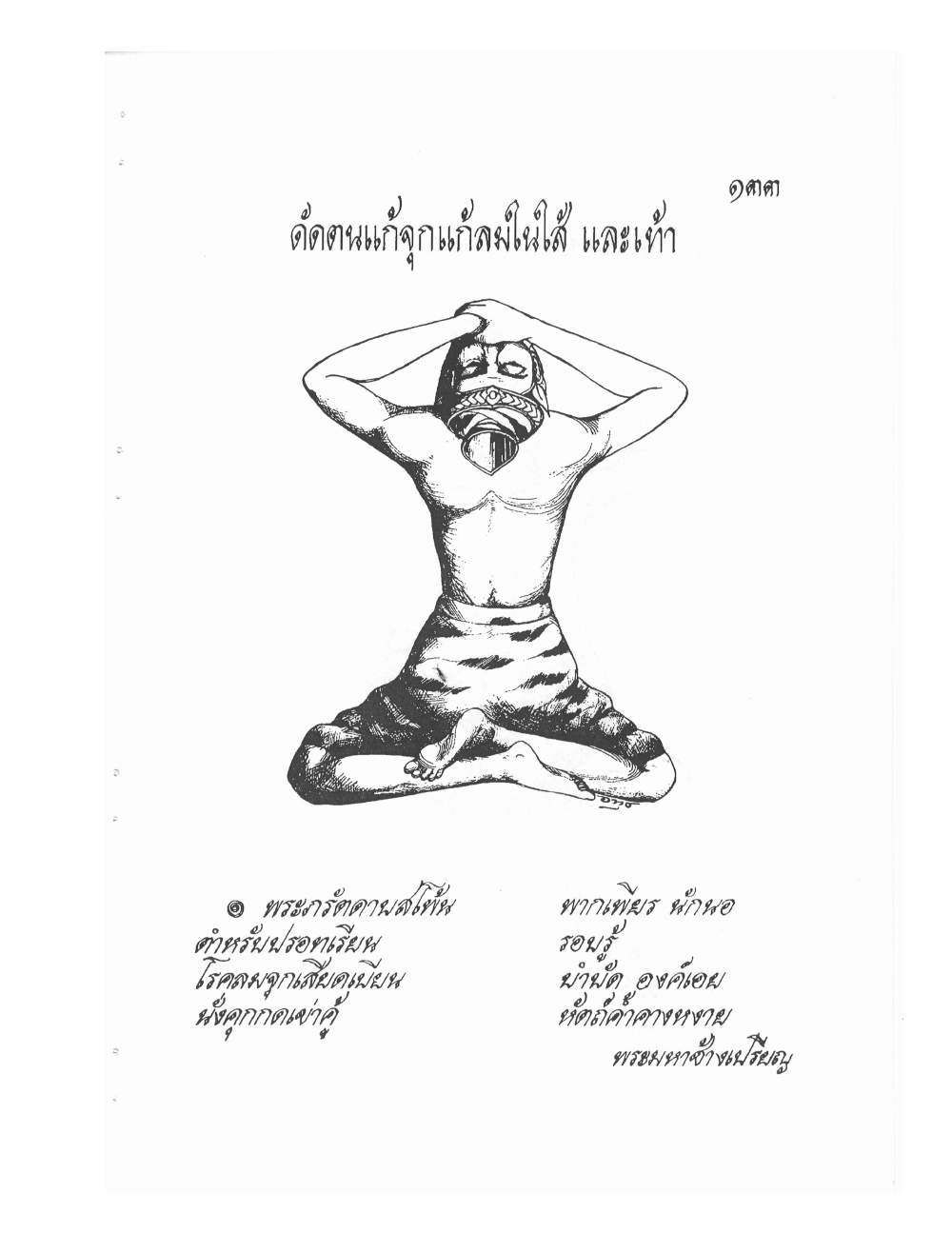
๑๓๓
ดัดตนแก้จุกแก้ลมในไส้ แลเท้า
[ภาพ: ฤๅษีนั่งขัดสมาธิ ยกมือทั้งสองขึ้นกุมศีรษะ/ผม ศอกกางออกทั้งสองข้าง หลับตา สวมกรอบหน้าประดับ คล้องลูกประคำ นุ่งหนังเสือ] พระกรรฐ์ตาบาลสเพิ่น พากเพียร นักหนอ ตำหรับปรอทเรียน รอมรู้ โรคลมจุกเสียดเมียน ย่ำมือ องค์เอย นั่งคุกกดเข่าคู้ หัตถ์ค้ำคางหงาย พระมหาช่วงเปรียญ
133
Stretching the body to cure stitch and wind in the intestines, and the feet
[diagram: a ruesi seated cross-legged, both hands raised to grip the top of the head/hair, elbows out to either side, eyes closed, wearing a jeweled headband, a prayer-bead necklace, and a tiger-skin garment]
"The teacher-ascetic [applies] mercury-formula training — striving hard, indeed, gradually mastering it. For the disease of stitching wind that lodges [inside] — sit kneeling, press down, drawing the knees in; the hand props up, the chin tilts back." — Signed: Phra Maha Chuang, Parian
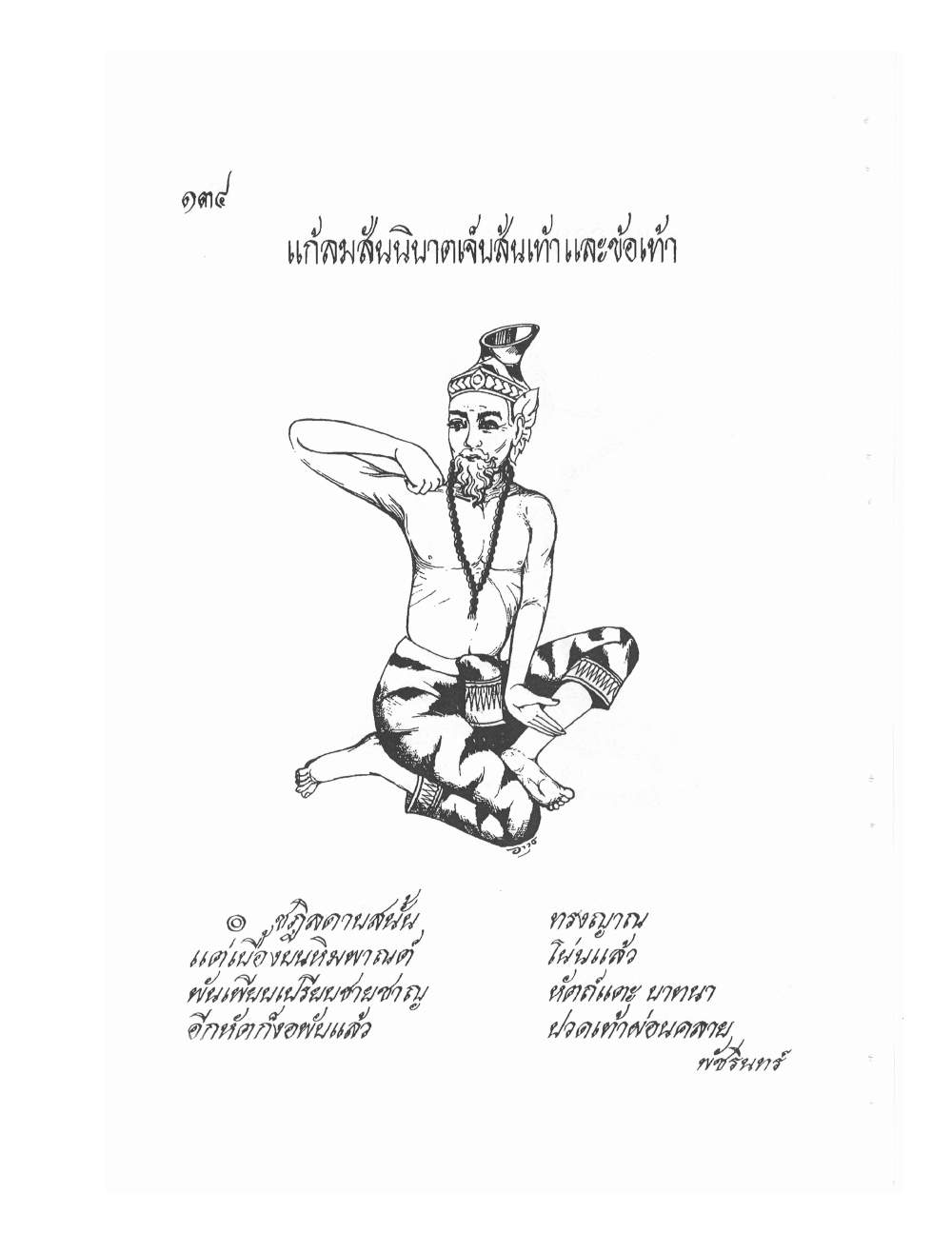
๑๓๔
แก้ลมสันนิบาตเจ็บส้นเท้าและข้อเท้า
[ภาพ: ฤๅษีนั่ง ยกแขนขวาศอกงอ กำหมัดแตะปาก แขนซ้ายจับข้อเท้าขาที่พาดไขว้อยู่ สวมชฎารูปเขาสัตว์ คล้องลูกประคำ นุ่งหนังเสือ มีเครื่องประดับรูปกลองที่เอว] ชฎิลดาบสนั้น ทรงญาณ แต่เมืองยนหิมพานต์ ใฝ่แล้ว พันเพียรเปรียบชายชาญ หัตถ์แตะ บาทนา อีกหัตถ์กี่งอพันแล้ว ฝวดเท้าผ่อนคลาย เพชรินทร์
134
Curing sannibat wind, pain in the heel and the ankle
[diagram: a ruesi seated, right arm raised with the elbow bent and fist touching the mouth, left hand holding the ankle of a leg drawn up and crossed, wearing a horn-shaped crown, a prayer-bead necklace, a tiger-skin garment, and a drum-shaped ornament at the hip]
"That matted-haired ascetic possesses insight, devoted since [his days in] the Himmaphan forest realm. Striving like a skilled man, one hand touches the foot; the other hand, bent and wound about, kneads the foot until it eases and relaxes." — Signed: Phetcharin
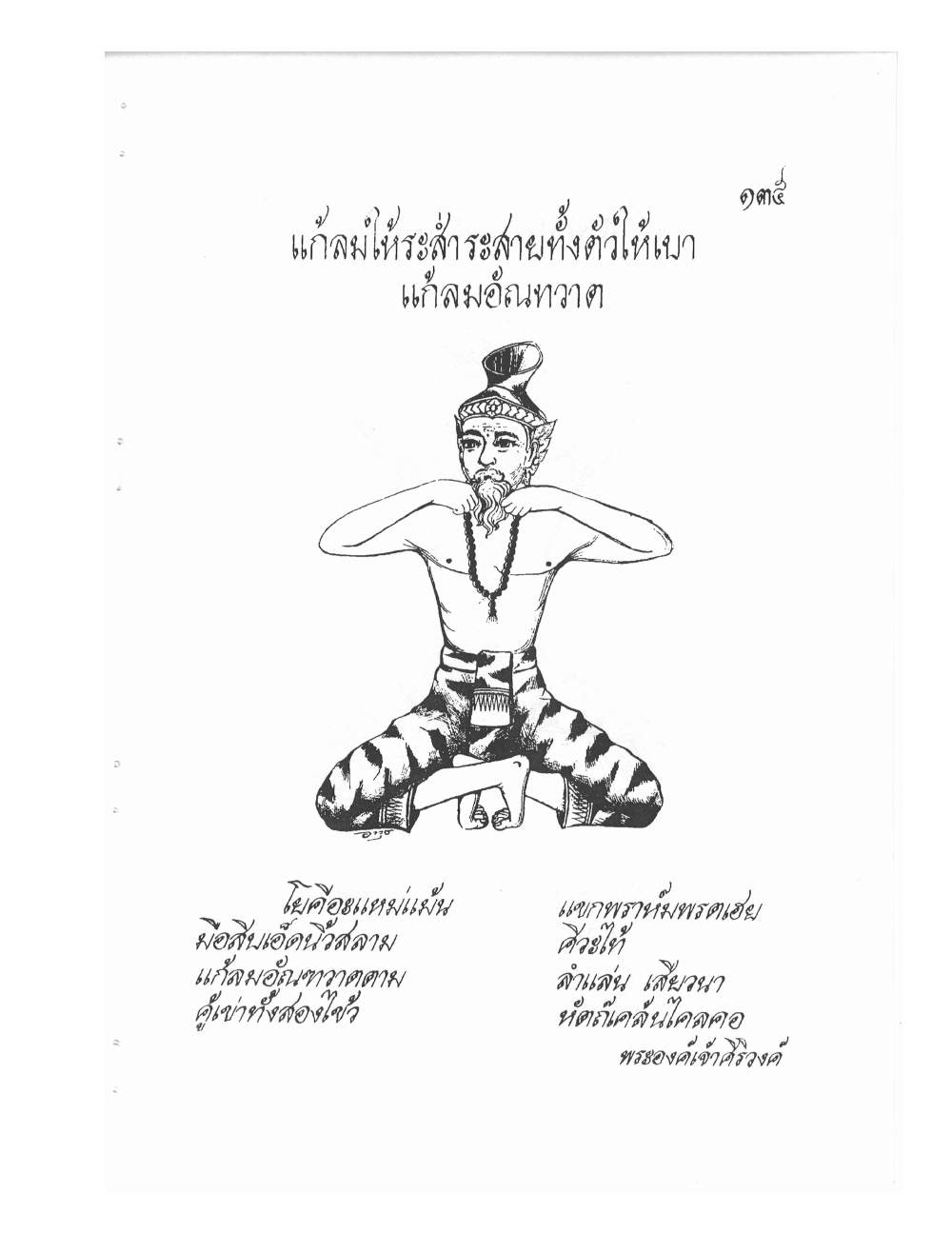
๑๓๕
แก้ลมให้ระส่ำระสายทั้งตัวให้เบา แก้ลมอัณฑวาต
[ภาพ: ฤๅษีนั่งขัดสมาธิ ศอกทั้งสองตั้งอยู่บนเข่า มือทั้งสองประคองคางและเครา สวมชฎารูปเขาสัตว์ คล้องลูกประคำ นุ่งหนังเสือ มีเครื่องประดับรูปกลองที่เอว เท้าไขว้ชนกัน] โยคีอย่าแหม่แม้น แขกพราหมณ์พรตเฮย มือสัมเอ็ดนิ้วสลาม ศิวะให้ แก้ลมอัณฑวาตตาม ลำแล่น เสียวนา คู้เข่าทั้งสองไขว้ หัตถ์เคล้นไคลคอ พระองค์เจ้าศิริงค์
135
Curing wind that makes the whole body restless and unsteady, to make it light; curing wind of the testicles/scrotum
[diagram: a ruesi seated cross-legged, both elbows resting on the knees, the hands cradling the chin and beard, wearing a horn-shaped crown, a prayer-bead necklace, a tiger-skin garment with a drum-shaped hip ornament, feet crossed together]
"O yogi, do not falter — like the vow-keeping brahmin guest, given by Shiva. The hand touches, the fingers press in salutation, following the wind of the scrotum as it runs and stings. Draw up both knees, cross them, and the hand kneads along the neck." — Signed: Phra Ong Chao Siring
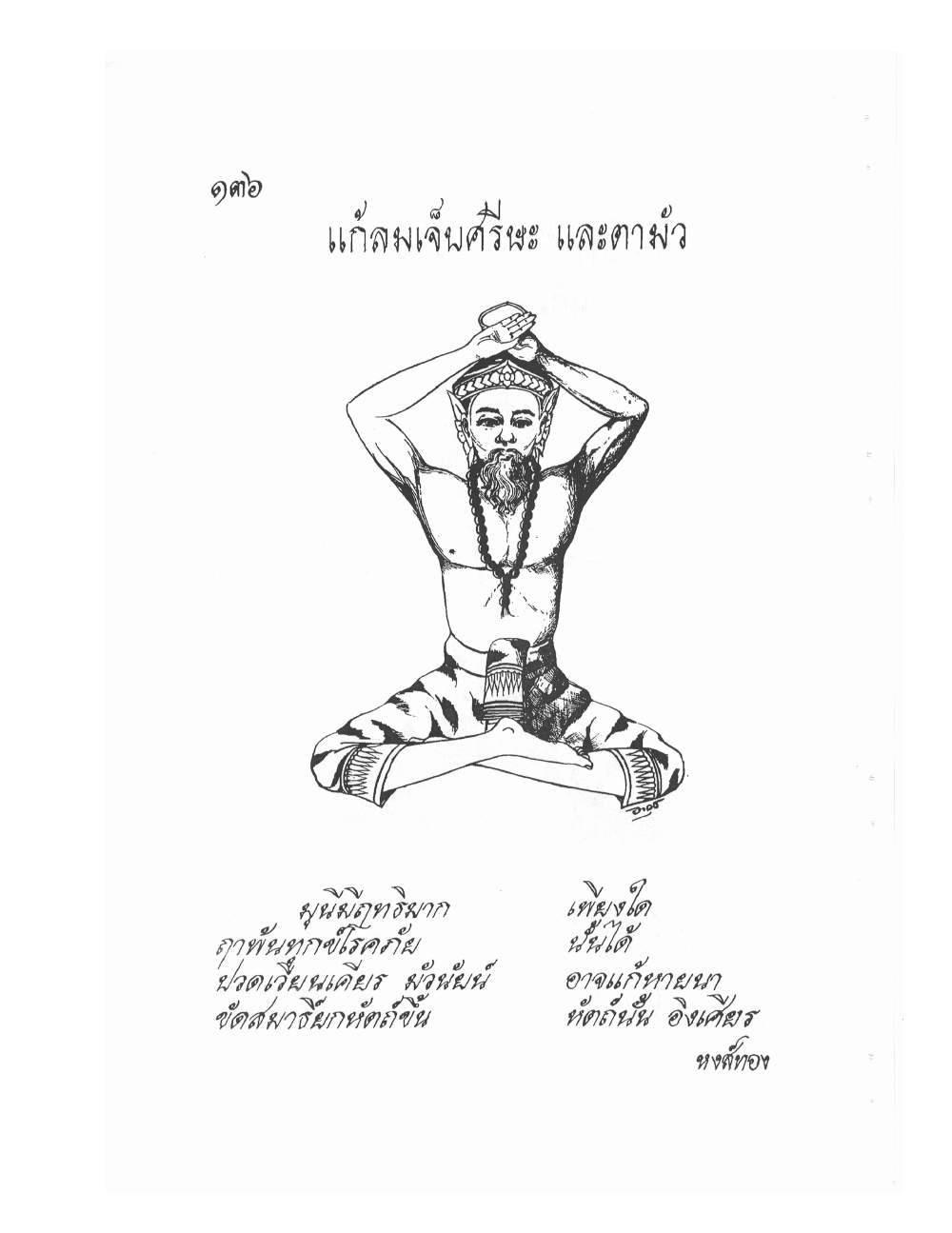
๑๓๖
แก้ลมเจ็บศีรษะ และตาม่ว
[ภาพ: ฤๅษีนั่งขัดสมาธิ ยกมือทั้งสองขึ้นเหนือศีรษะ ประกบกันเหนือชฎา ศอกกางออก สวมชฎาประดับ คล้องลูกประคำ นุ่งหนังเสือ มีเครื่องประดับรูปกลองที่เอว มุนีมีคุทธิ์มาก เพียงใด ถาพ้นทุกข์โรคภัย นั้นได้ ฝวดเวียนเคียร มัวมัยน์ อาจแก้หายนา ขัดสมาธิ์กดหัตถ์ขึ้น หัตถ์นั้น อิงเศียร หงส์ทอง
136
Curing wind headache, and blurred/dizzy vision
[diagram: a ruesi seated cross-legged, both hands raised above the head and joined together over the crown, elbows spread out, wearing a jeweled crown, a prayer-bead necklace, a tiger-skin garment, and a drum-shaped hip ornament]
"However great the sage's spiritual power, only by this can one be freed from the suffering of illness. For dizziness, spinning, and clouded vision — it can indeed be cured. Sit in meditation posture, press the hands upward, resting them against the head." — Signed: Hongthong
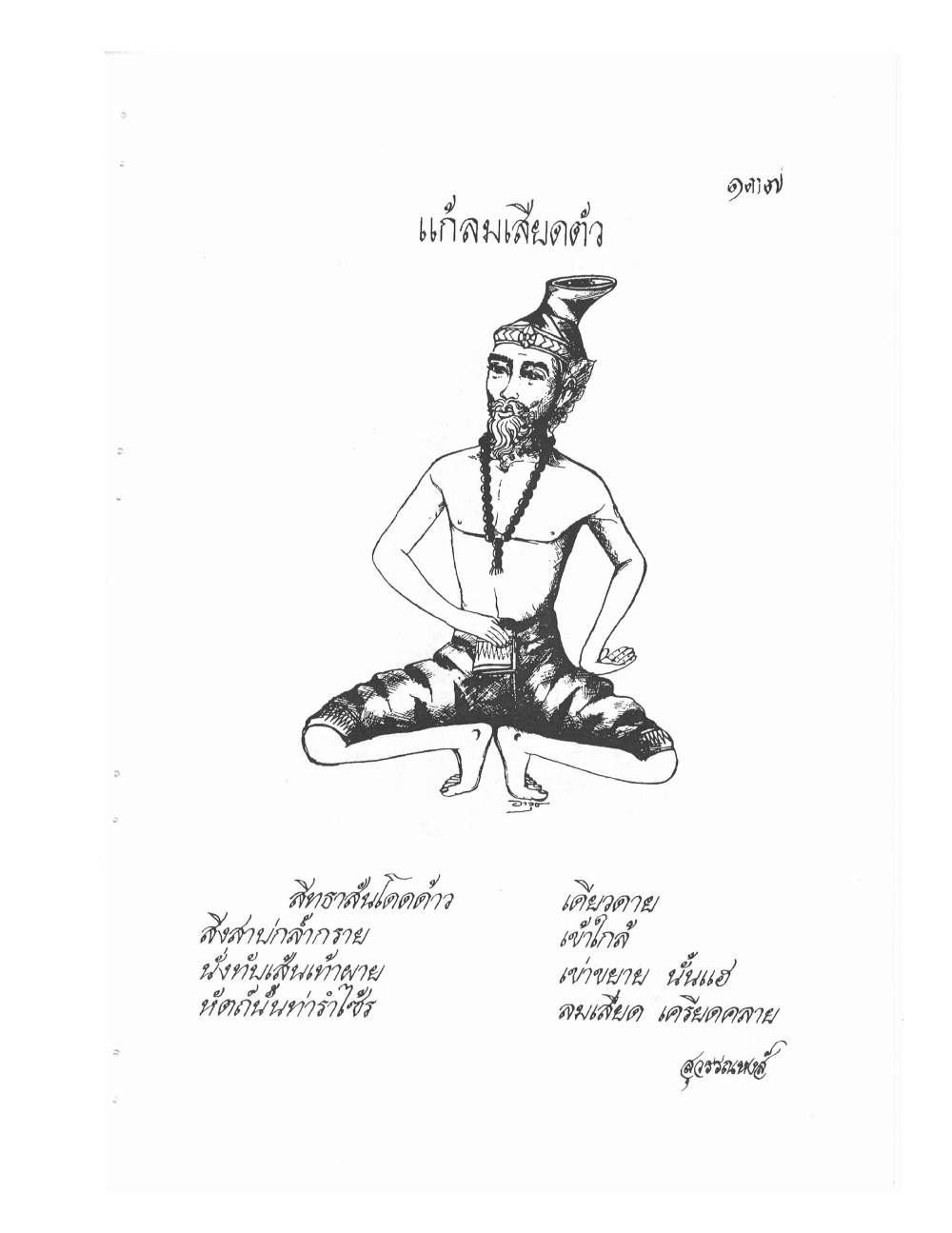
๑๓๗
แก้ลมเสียดตับ
[ภาพ: ฤๅษีนั่งขัดสมาธิ สวมชฎารูปเขาสัตว์ คล้องลูกประคำ มือขวาวางบนเครื่องประดับรูปกลองที่เอว มือซ้ายเท้าสะเอว นุ่งหนังเสือ] สิทธาสิ้นโดดด้าว เดียวดาย สิงสางกล้ำกราย เข้าใกล้ นั่งทับเส้นเท้าผาย เข่าขยาย นั้นแฮ หัตถ์นั้นท่ารำไซร้ ลมเสียด เครียดคลาย สุวรรณหงส์
137
Curing wind that stabs/gnaws at the liver
[diagram: a ruesi seated cross-legged, wearing a horn-shaped crown, a prayer-bead necklace, right hand resting on a drum-shaped hip ornament, left hand resting at the waist, wearing a tiger-skin garment]
"The adept, alone, cut off from his own land, where wild beasts prowl close by — sits pressing on the tendon of the foot, the knee spreading wide; the hand takes up a dance-like gesture, and the stabbing wind, the tension, eases and clears." — Signed: Suwannahong
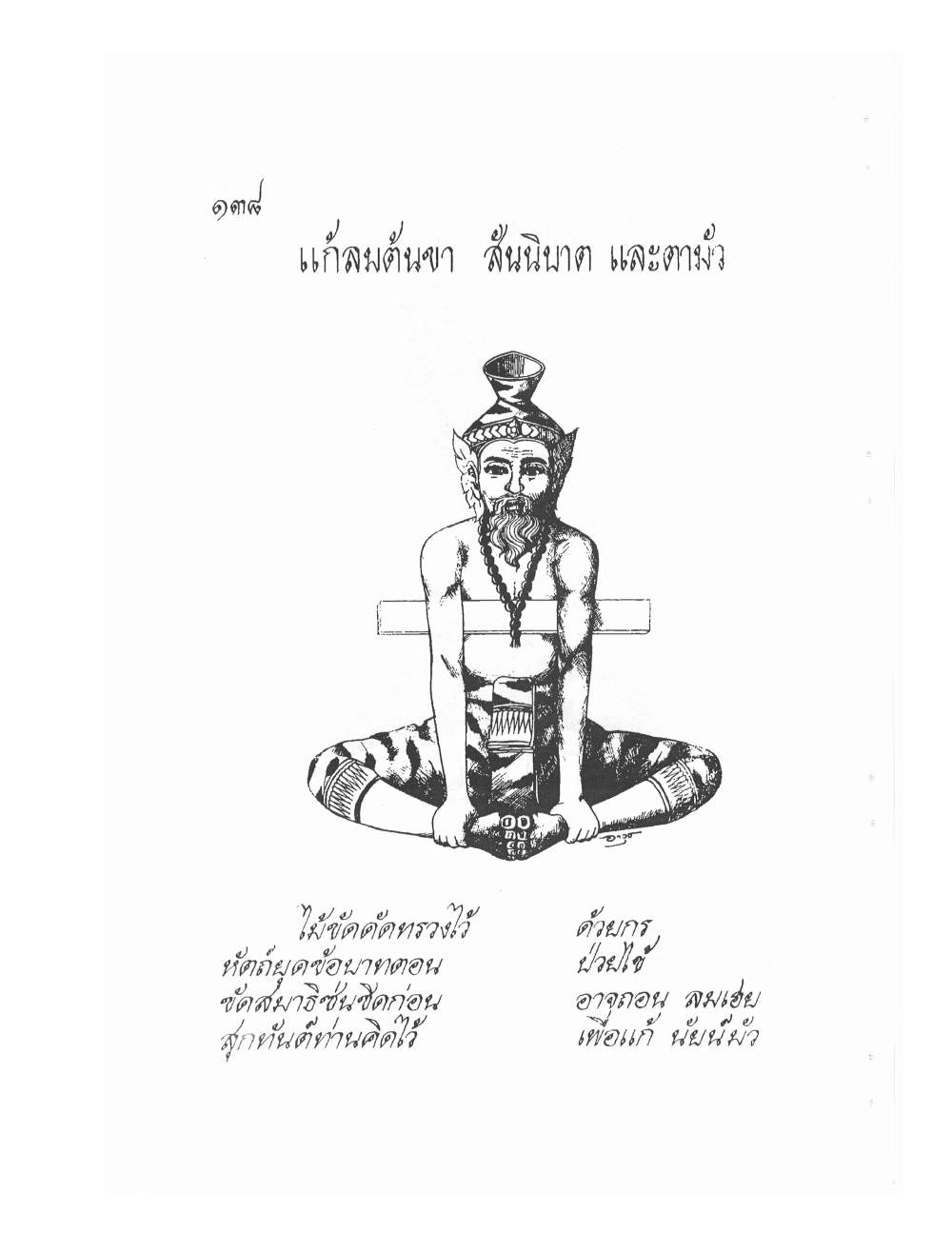
๑๓๘
แก้ลมต้นขา สันนิบาต และตาม่ว
[ภาพ: ฤๅษีนั่ง มีไม้ท่อนขัดพาดอยู่หน้าลำตัว มือทั้งสองจับฝ่าเท้าที่ดึงขึ้นมาใกล้ลำตัว เท้าประดับลวดลายจุดกลม สวมชฎารูปเขาสัตว์ คล้องลูกประคำ นุ่งหนังเสือ] ไม้ขัดดัดทรวงไว้ ด้วยกร หัตถ์ยุดข้อบาทตอน ป่วยไซร้ ขัดสมาธิ์ชิดก่อน อาจถอน ลมเฮย สุกทันต์ท่านคิดไว้ เพื่อแก้ นั่นนัวมัว
138
Curing wind in the thighs, sannibat wind, and blurred vision
[diagram: a ruesi seated with a wooden bar braced across the front of the torso, both hands gripping the soles of the feet drawn up close to the body, the feet marked with a round-dotted pattern, wearing a horn-shaped crown, a prayer-bead necklace, and a tiger-skin garment]
"A brace of wood binds the chest, held by the hands; the hand grips the joint of the foot where the ailment lies. Sit close in meditation posture first — the wind can then be drawn out. The sage devised this to cure that clouded, muddled state." (no separate signature legible on this page)
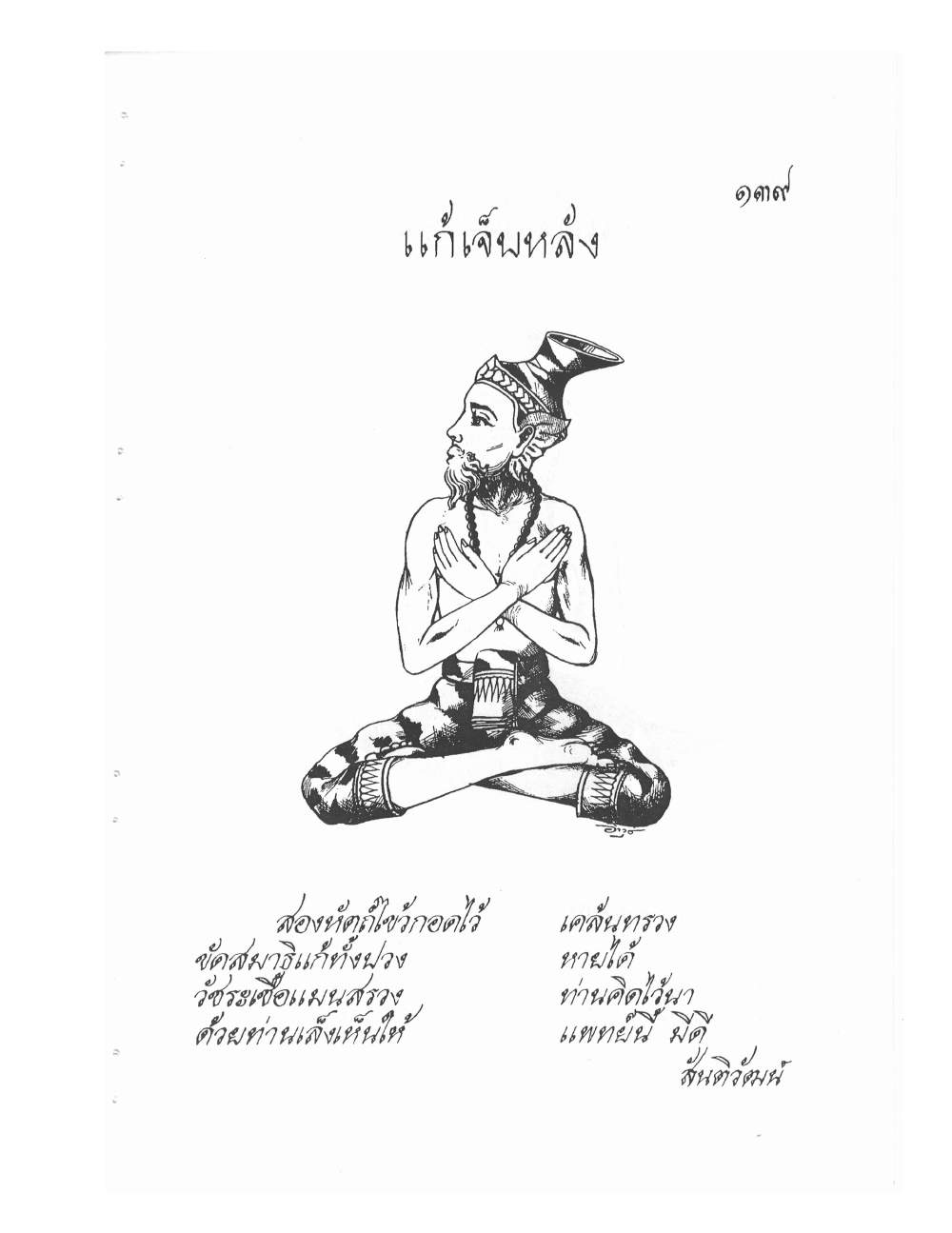
๑๓๙
แก้เจ็บหลัง
[ภาพ: ฤๅษีนั่งขัดสมาธิ ไขว้แขนทั้งสองเป็นรูปกากบาทกอดอก มือแตะไหล่ตรงข้าม สวมชฎารูปเขาสัตว์ คล้องลูกประคำ นุ่งหนังเสือ มีเครื่องประดับรูปกลองที่เอว] สองหัตถ์ไขว้กอดไว้ เคล้นทรวง ขัดสมาธิ์แก้ทั้งปวง หายได้ วัชระเชื้อแมนสรวง ท่านคิดไว้นา ด้วยท่านเล็งเห็นให้ แพทย์นี้ มิได้ สันติวัฒน์
139
Curing back pain
[diagram: a ruesi seated cross-legged, both arms crossed over the chest in an X, each hand touching the opposite shoulder, wearing a horn-shaped crown, a prayer-bead necklace, a tiger-skin garment, and a drum-shaped hip ornament]
"Both hands crossed and held, kneading the chest; sit in meditation posture and every affliction can be cured, made well. The thunderbolt-lineage of the heavenly beings — the master devised this, for he foresaw and granted it; no ordinary physician [could achieve] this." — Signed: Santiwat
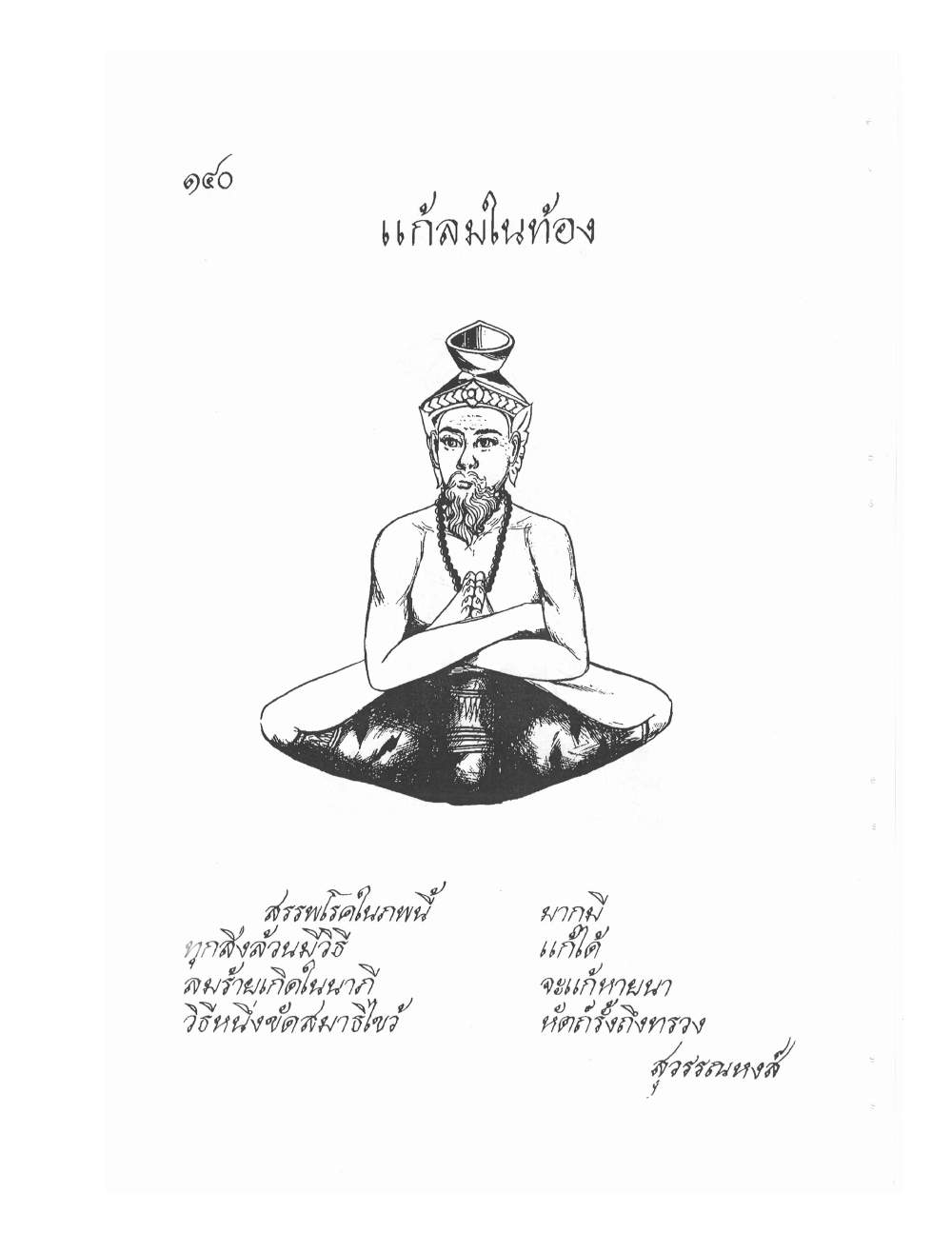
๑๔๐
แก้ลมในท้อง
[ภาพ: ฤๅษีนั่งพับเพียบ มีผ้าคลุมสีเข้มปกคลุมตักและขาทั้งหมด ยกมือทั้งสองประนมไหว้ระดับอก สวมชฎาประดับกลม คล้องลูกประคำ มีหนวดเครา] สรรพโรคในภพนี้ มากมี ทุกสิ่งล้วนมีวิธี แก้ได้ ลมร้ายเกิดในนาภี จะแก้หายนา วิธีหนึ่งขัดสมาธิ์ไขว้ หัตถ์ตั้งถึงทรวง สุวรรณหงส์
140
Curing wind in the belly
[diagram: a ruesi seated with legs folded to one side, a dark cloth draped over the entire lap and legs, both hands raised together in a gesture of respect (wai) at chest level, wearing a rounded jeweled crown, a prayer-bead necklace, and a beard]
"Every disease that exists in this world — there are many; for each and every one there is a method to cure it. Evil wind that arises in the navel [region] can indeed be cured: one method is to sit crossed in meditation posture, raising the hands up to the chest." — Signed: Suwannahong
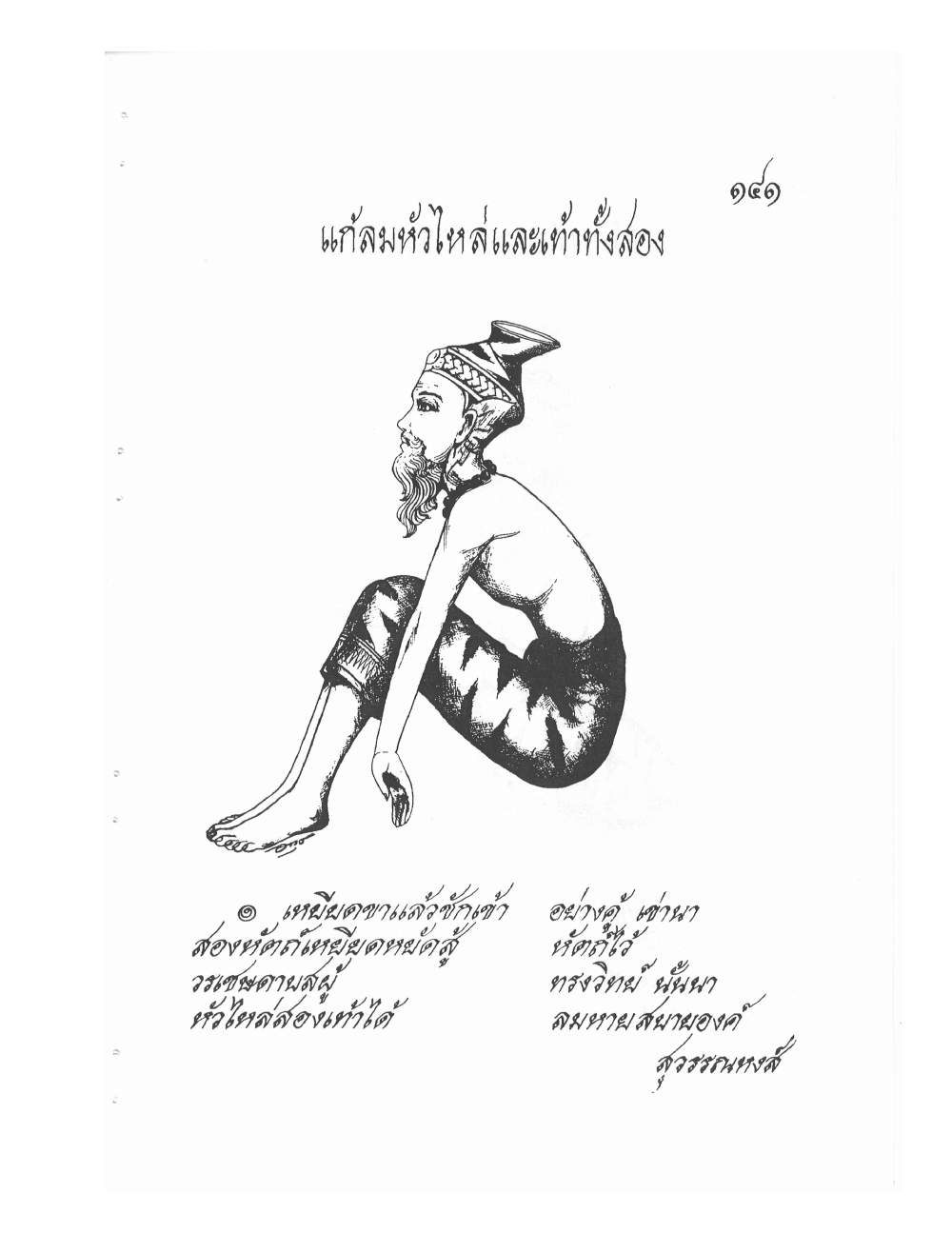
๑๔๑
แก้ลมหัวไหล่และเท้าทั้งสอง
[ภาพ: ฤๅษีหันข้าง นั่งเอนหลังพับขาไปด้านหนึ่ง แขนข้างหนึ่งทอดลงพื้น เงยหน้าขึ้น สวมชฎารูปเขาสัตว์ นุ่งหนังเสือ คล้องลูกประคำ] เหยียดขาแล้วชักเข้า อย่างคู้ เข่านา สองหัตถ์เหยียดหยัดสู้ หัตถ์กี่ไว้ วรเชษฐดาบสผู้ ทรงวิทย์ นั้นนา หัวไหล่สองเท้าได้ ลมหายสบายองค์ สุวรรณหงส์
141
Curing wind in the shoulder and both feet
[diagram: a ruesi in profile, leaning back with the legs folded to one side, one arm resting down toward the floor, face tilted upward, wearing a horn-shaped crown, a tiger-skin garment, and a prayer-bead necklace]
"Stretch the leg out, then draw it in — without bending the knee; the two hands stretch and hold firm, the hands braced in place. The eldest of the ascetics, possessed of learning, [treats] the shoulder and both feet — the wind departs and the body finds ease." — Signed: Suwannahong
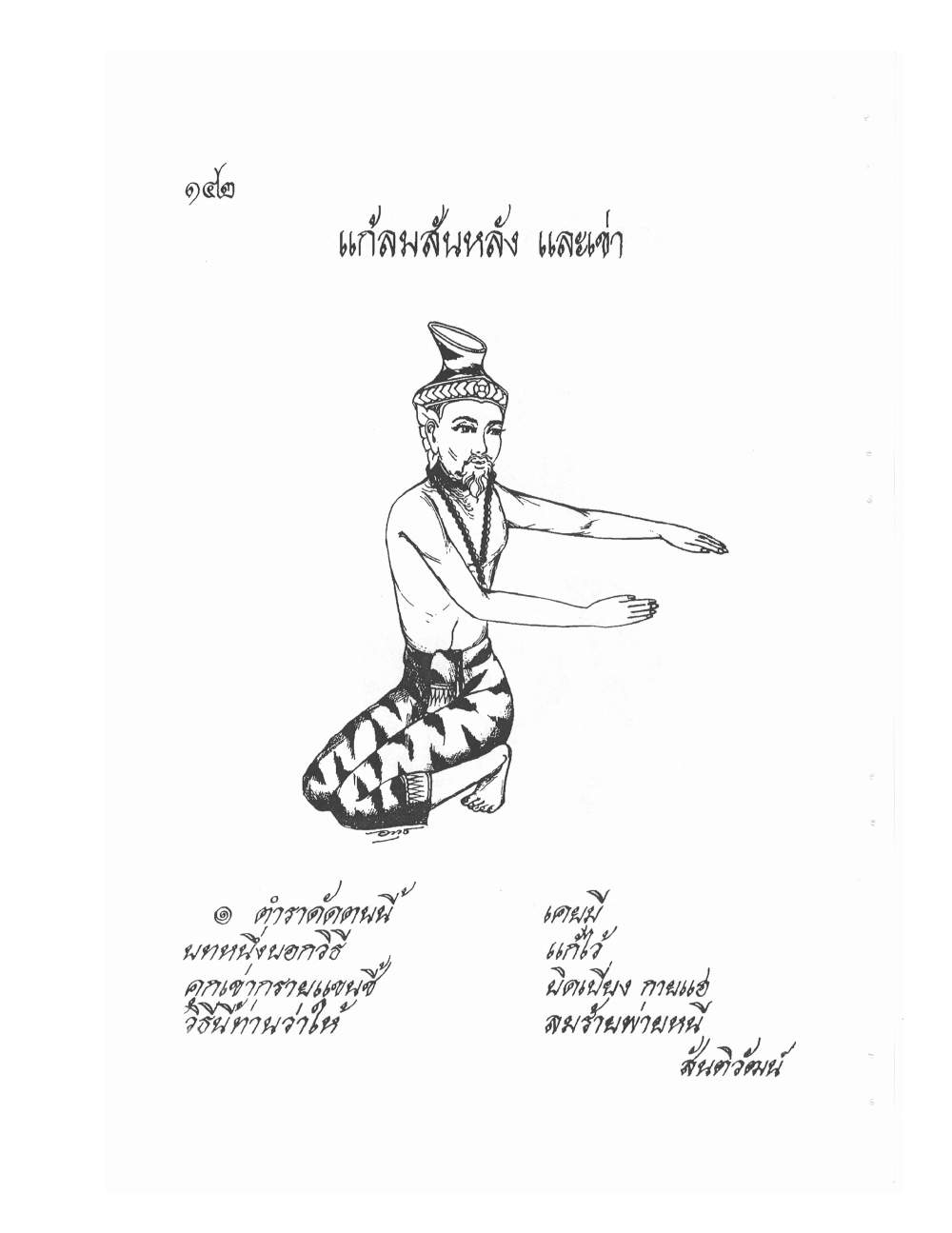
๑๔๒
แก้ลมสันหลัง และเข่า
[ภาพ: ฤๅษีนั่งคุกเข่า ยื่นแขนทั้งสองตรงไปข้างหน้า มือหนึ่งอยู่เหนืออีกมือหนึ่ง ฝ่ามือคว่ำ สวมชฎารูปเขาสัตว์ คล้องลูกประคำ นุ่งหนังเสือ มีเครื่องประดับรูปกลองที่เอว] ตำราดัดตนนี้ เคยมี ผทหนึ่งบอกวิธี แก้ไซร้ คุกเข่ากรายแขนซี้ ผิดเฝียง กายแฮ วิธีท่านว่าให้ สมร้ายพ่ายหนี สันติวัฒน์
142
Curing wind in the spine, and the knees
[diagram: a ruesi kneeling, both arms extended straight forward, one hand above the other, palms facing down, wearing a horn-shaped crown, a prayer-bead necklace, a tiger-skin garment, and a drum-shaped hip ornament]
"This manual of body-stretching has long existed; one method [among them] shows how to cure it. Kneel and sweep the arms out level — where the body is out of alignment — the method he prescribed makes the evil affliction retreat and flee." — Signed: Santiwat
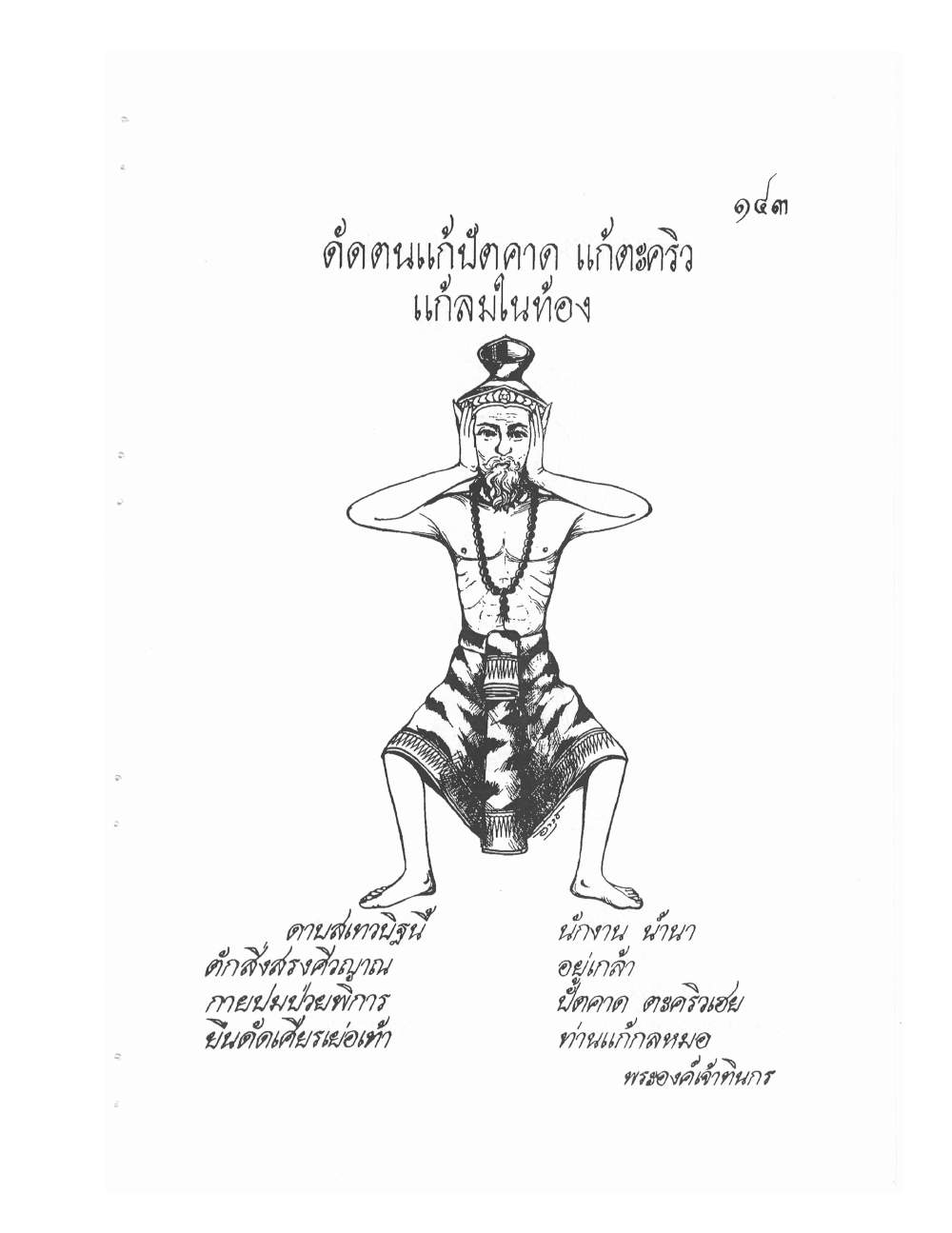
๑๕๓
ดัดตนแก้ปัดคาด แก้ตะคริว แก้ลมในท้อง
ดาบสเทวฤๅษีนี้ ตักสิ่งทรงศิวญาณ กายปมป่วยพิการ ยืนดัดเคียงเหยียดเท้า
นั่งงาน น้ำนา อยู่เกล้า ปัดคาด ตะคริวเฮย ท่านแก้กลหมอ
พระองค์เจ้าทินกร
153
Self-stretch to cure girdling pain, to cure cramps, to cure wind in the belly
[diagram: a hermit (ruesi) figure standing in a wide, deep squat, wearing a tall pointed hat and a long rosary/mala around his neck, both hands raised to cover his ears, gripping a decorated banded pole planted upright between his legs]
This divine hermit-sage, bearing the power of Śiva's knowledge, for a body afflicted and disabled, stands stretching, drawing out the legs —
[of one who] sits at work, [suffering] water/fluid trouble, dwelling coiled up, with girdling pain and cramp, this pose cures it as would a physician.
[Attributed to] Phra Ong Chao Thinnakon.
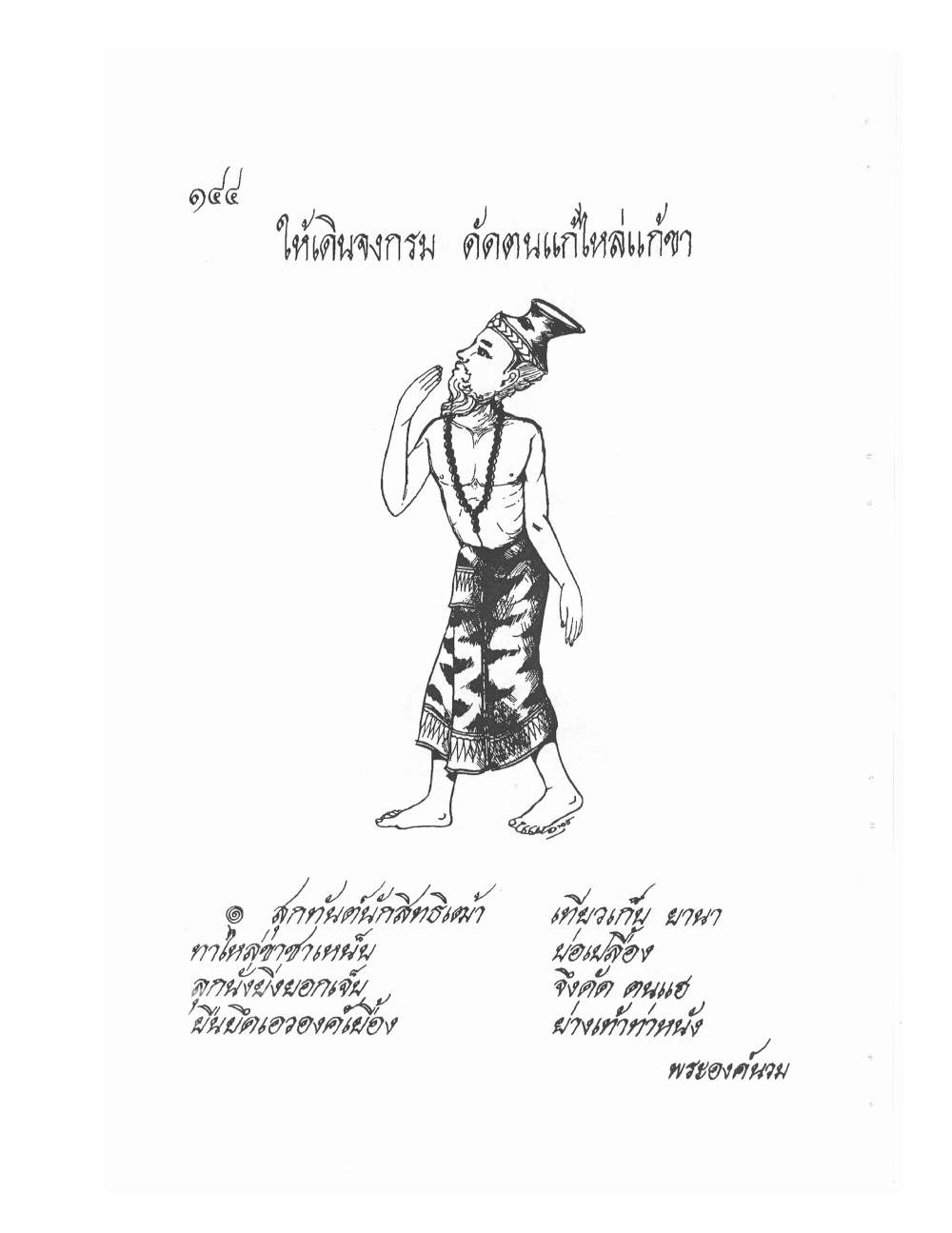
๑๕๔
ให้เดินจงกรม ดัดตนแก้ไหล่แก้ขา
สุกทันต์นักสิทธิเวหา ทำให้ล่าช้าเหินฟ้า ลูกนั่งยิ่งยอกเจ็บ ยันมัดเอวองค์เอี้ยง
เที่ยวเกิน ยานา ผ่อนเปลื้อง จึงดัด ตนแฮ ย่างเท้าท่าหนึ่ง
พระองค์นวม
154
To walk in meditation-pace; self-stretch to cure the shoulder and to cure the leg
[diagram: a hermit figure standing and walking, wearing a tall pointed hat and rosary, one hand raised toward his chin, the other arm hanging relaxed]
This accomplished sage of the sky, made to lag behind, soaring through the air — when the joints ache with sharp, twisting pain, bracing and binding at the waist, the body leaning —
having wandered too far, [growing weary], he eases and loosens [the affliction]; so he stretches his body, stepping forward in this one pose.
[Attributed to] Phra Ong Nuam.
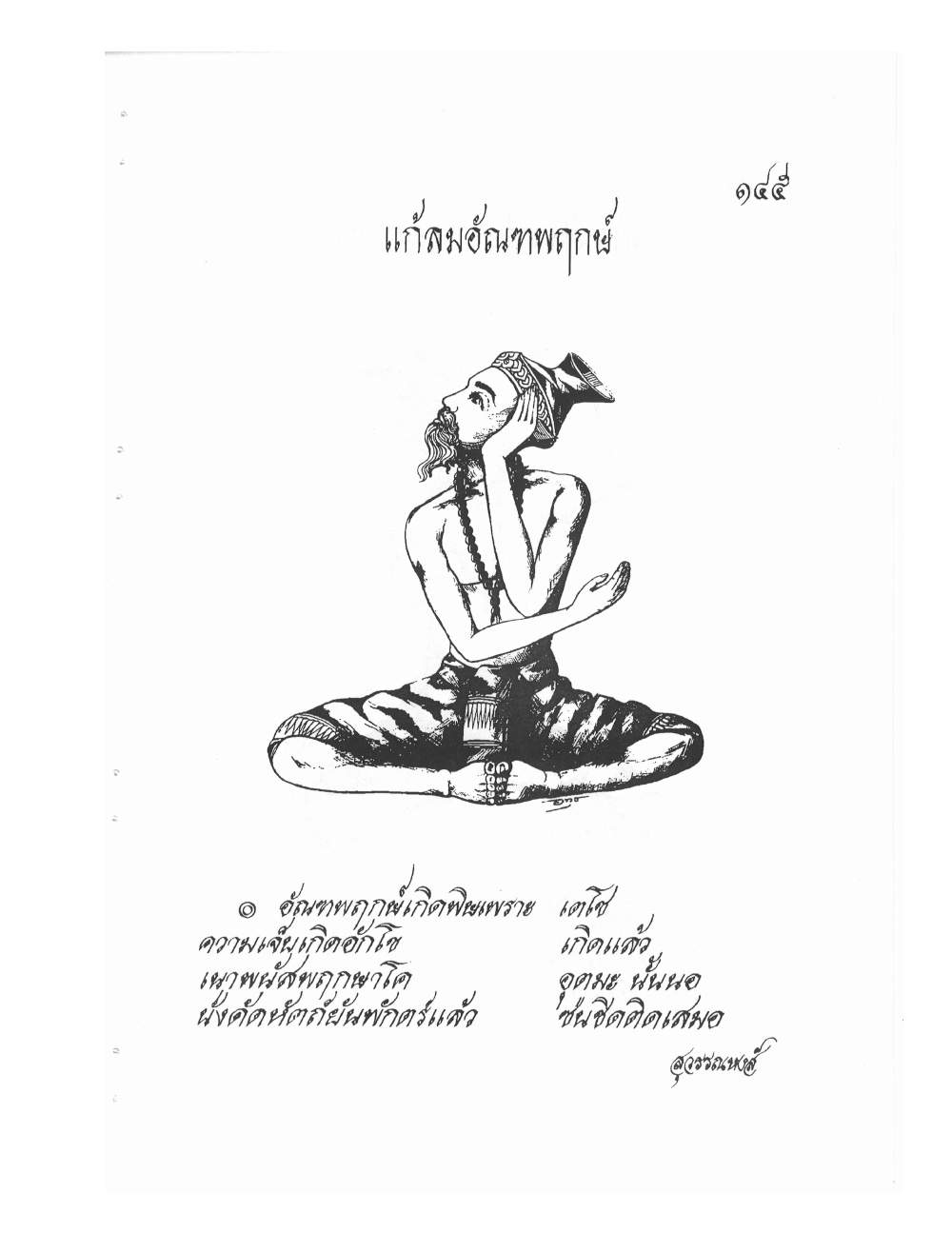
๑๕๕
แก้ลมอัณฑพฤกษ์
อัณฑพฤกษ์เกิดพิษเพราะ ความเจ็บเกิดอักโข เผาพิษพฤกษาโค ผั้งดัดหัตถ์ตั้งพักตร์แล้ว
เตโช เกิดแล้ว อุดมะ ผั้นนอ ซมซิดติดเสมอ
สุวรรณหงส์
155
To cure the wind of the "testicle-tree" affliction
[diagram: a hermit figure seated cross-legged, head tilted back and up, one hand raised and pressed against the side of his head near the temple, the other hand resting open in his lap]
The "testicle-tree" affliction arises from poison, and the pain that comes of it is great; the poison burns like a scorching tree-blight — so he stretches, hand raised, setting his face upward —
[for] the fire-element that has arisen, [to bring it back to its] proper, excellent [state], clinging and lodged there ever the same.
[Attributed to] Suwannahong.
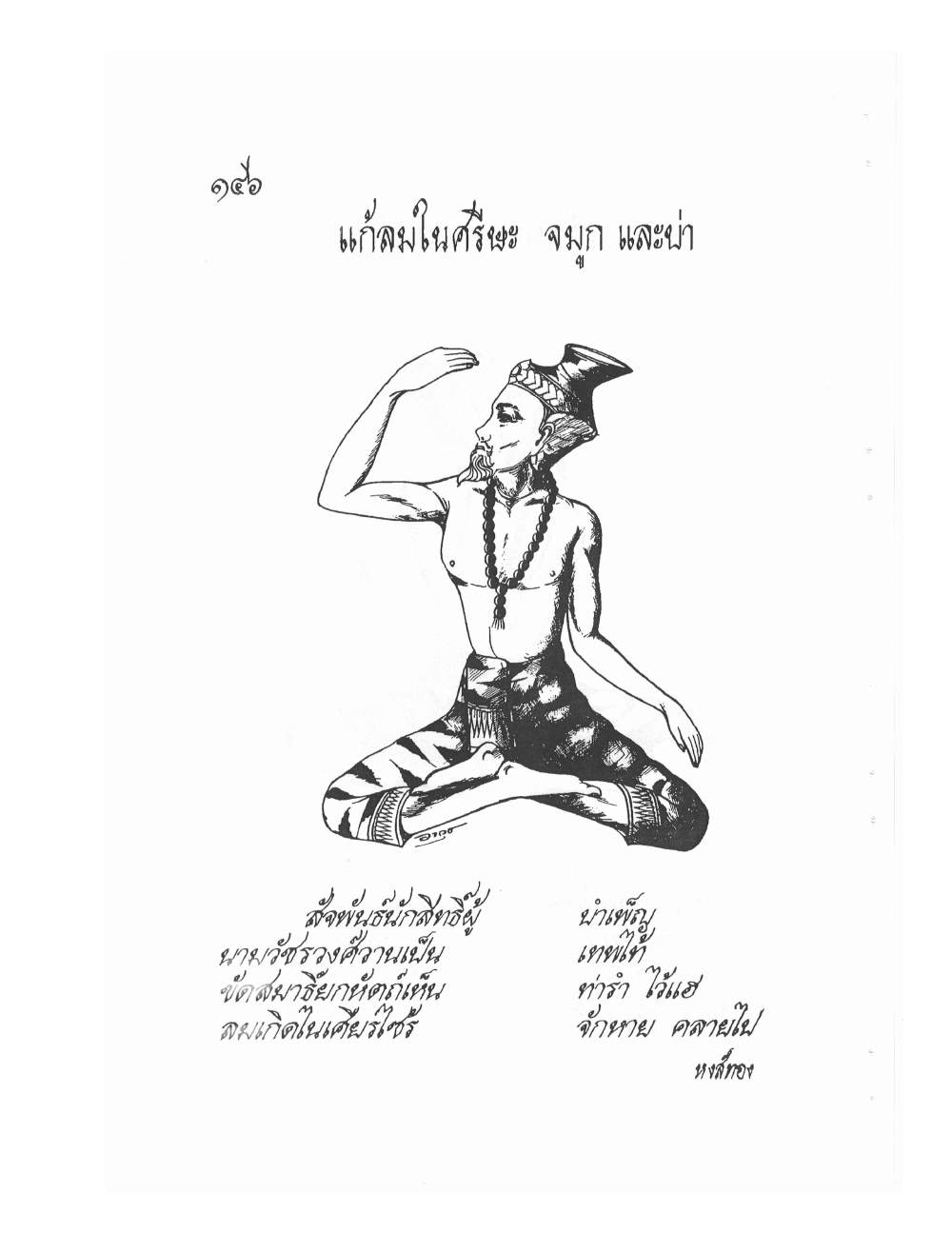
๑๕๖
แก้ลมในศีรษะ จมูก และบ่า
สัจพันธ์นักสิทธิผู้ นามวัชรวงศ์ว่านเป็น ขัดสมาธิยกหัตถ์เห็น ลมเกิดในเศียรไซร้
บำเพ็ญ เทพให้ ท่ารำ ไว้แฮ จักหาย คลายไป
หงส์ทอง
156
To cure wind in the head, the nose, and the shoulder
[diagram: a hermit figure seated cross-legged, one arm raised bent overhead, the other arm extended out to the side]
This accomplished sage of true bond, of the name and lineage of the Diamond (Vajra), sits cross-legged, hand raised, as can be seen — for when wind arises within the head indeed —
he cultivates [this practice], as the devas have granted; this dance-pose is set down so the affliction will fade and dissolve away.
[Attributed to] Hong Thong.
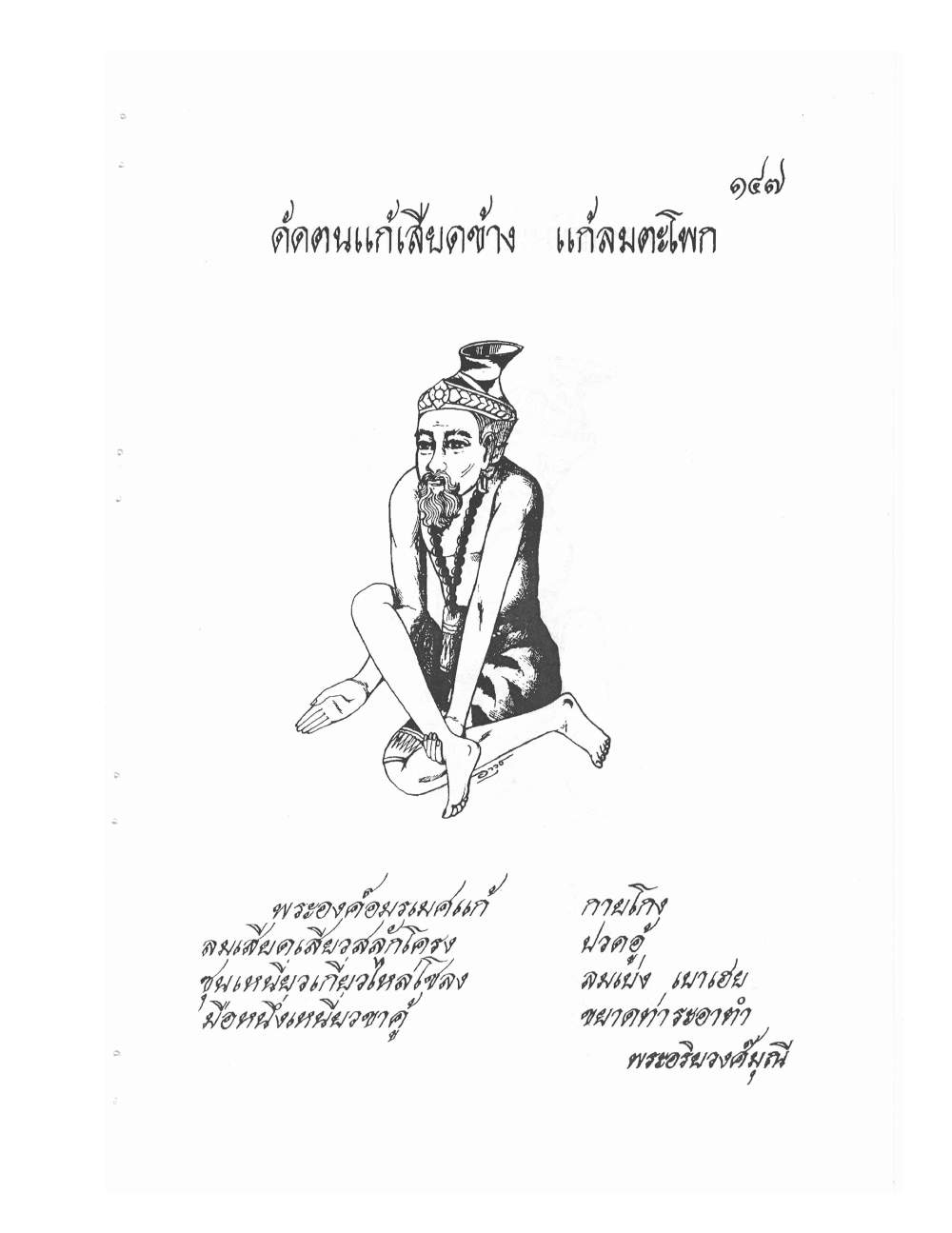
๑๕๗
ดัดตนแก้เสียดข้าง แก้ลมตะโพก
พระองค์อมรเมศแก้ ลมเสียดเสียวสลักโครง ชุณเหนี่ยวเกี่ยวไหล่โซลง มือหนึ่งเหนี่ยวชาคู่
กายโก่ง ฝ่วดอู้ ลมแฝง เฝาเฮย ขยาดท่าร่ยอาทำ
พระอริยงค์มุนี
157
Self-stretch to cure a stabbing pain in the side, to cure wind in the hip
[diagram: a hermit figure seated, one leg bent under him, the other leg extended out with the foot resting on a small cushion, one arm reaching down toward the foot, the body leaning forward and to the side]
This lordly, divine being cures the stabbing, piercing wind that catches at the ribs; drawing in, hooking the shoulder, leaning down, one hand reaching to grasp the [numbed] pair of legs —
the body arches, labouring for breath; wind lies hidden, lurking there; [one must be] wary of this pose, and so does it thus.
[Attributed to] Phra Ariyong Muni.
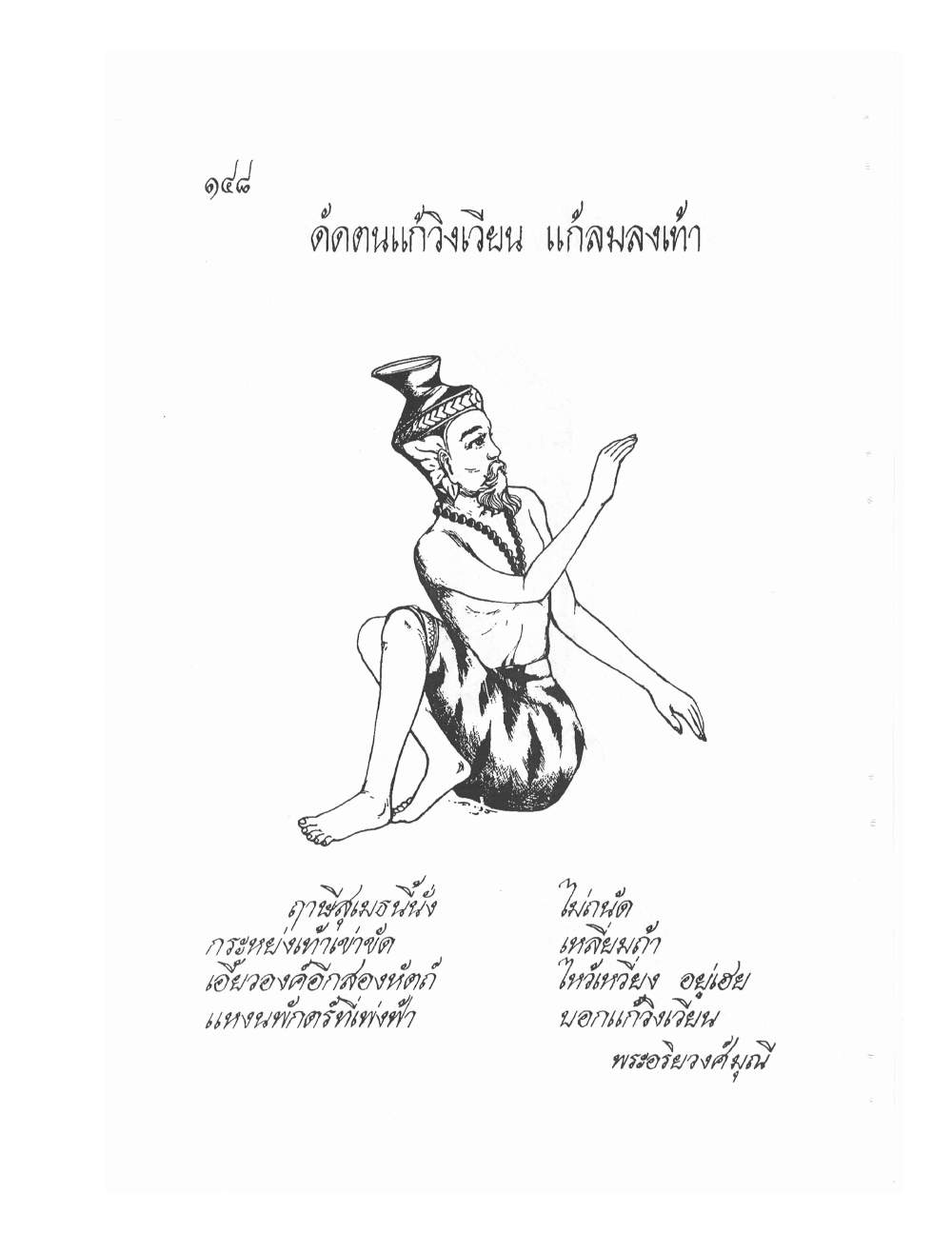
๑๕๘
ดัดตนแก้วิงเวียน แก้ลมลงเท้า
ภาษ์สุเมรุนั่ง กระหย่งเท้าเข่าขัด เอี้ยวองค์อีกสองหัตถ์ แหงนพักตร์ที่เพ่งฟ้า
ไม่ถนัด เหลี่ยมก้า ให้เหวี่ยง อยู่เฮย ยอกแก้วิงเวียน
พระอริยงค์มุนี
158
Self-stretch to cure dizziness, to cure wind that descends into the feet
[diagram: a hermit figure seated with one knee raised and crossed, one hand raised with the arm bent upward, the other hand extended down and out to the side, the face turned up toward the sky]
Seated as if upon Mount Sumeru, with foot raised and knee crossed and locked, the body twisted, both hands moving, face tilted back, gazing up at the sky —
[when the limb feels] unsteady and at an awkward angle, let it be swung [into this position], and the sharp pain and dizziness will be cured.
[Attributed to] Phra Ariyong Muni.
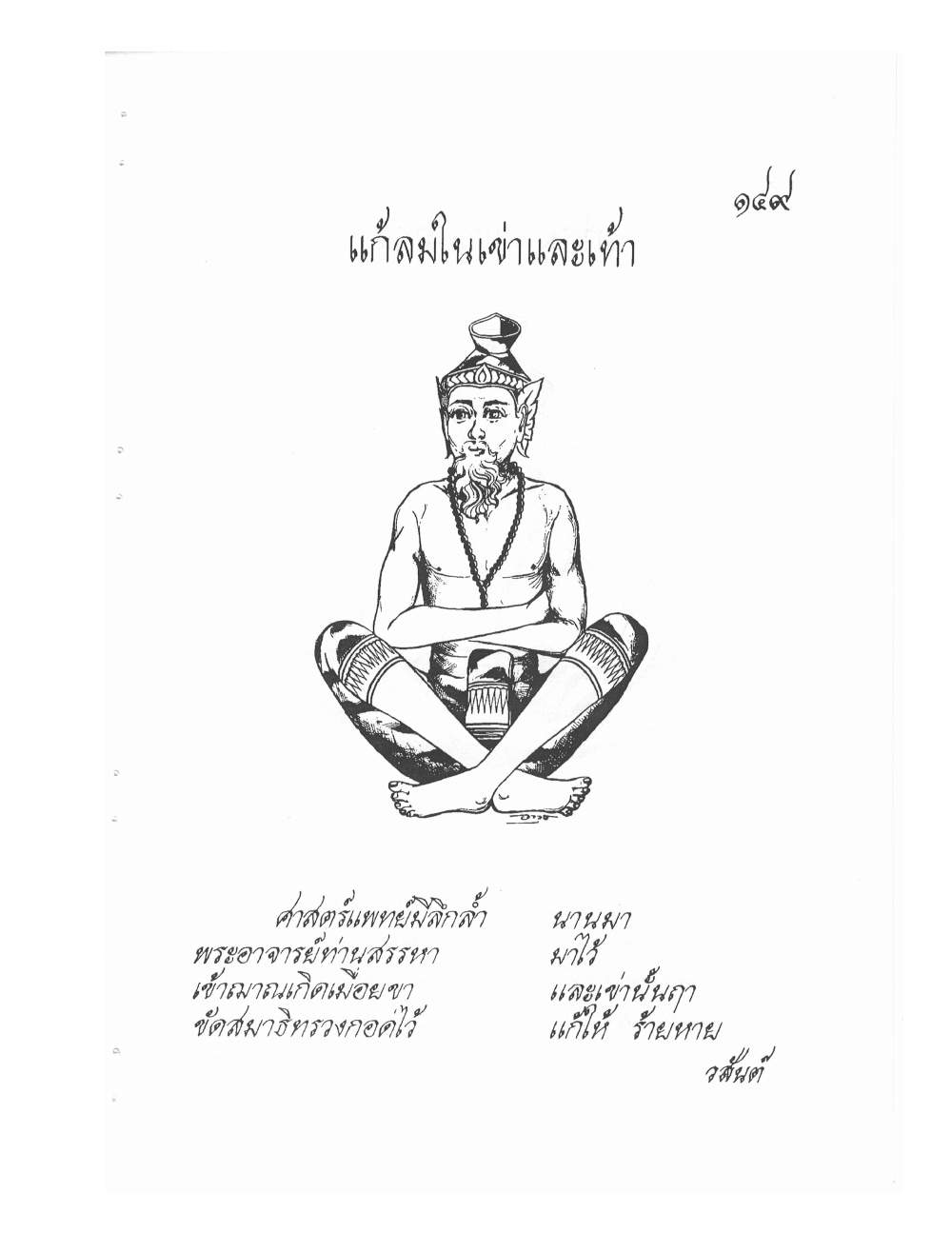
๑๕๙
แก้ลมในเข่า
ศาสตร์แพทย์มีลึกล้ำ พระอาจารย์ท่านสรรหา เข่าเมื่อนเกิดเมื่อยขา ขัดสมาธิทรงกอดไว้
นานมา มาไว้ และเข่านั้นถา แก้ให้ร้ายหาย
วสันต์
159
To cure wind in the knee
[diagram: a hermit figure seated cross-legged, both arms crossed and folded in front, holding the crossed legs in place]
The healing arts run deep indeed; the venerable teacher sought out [this remedy], for when the knees ache and the legs grow weary — sitting cross-legged, holding [the limbs] folded in an embrace,
long-practised, handed down, and so the knee is cured, and the affliction driven away.
[Attributed to] Wasan.
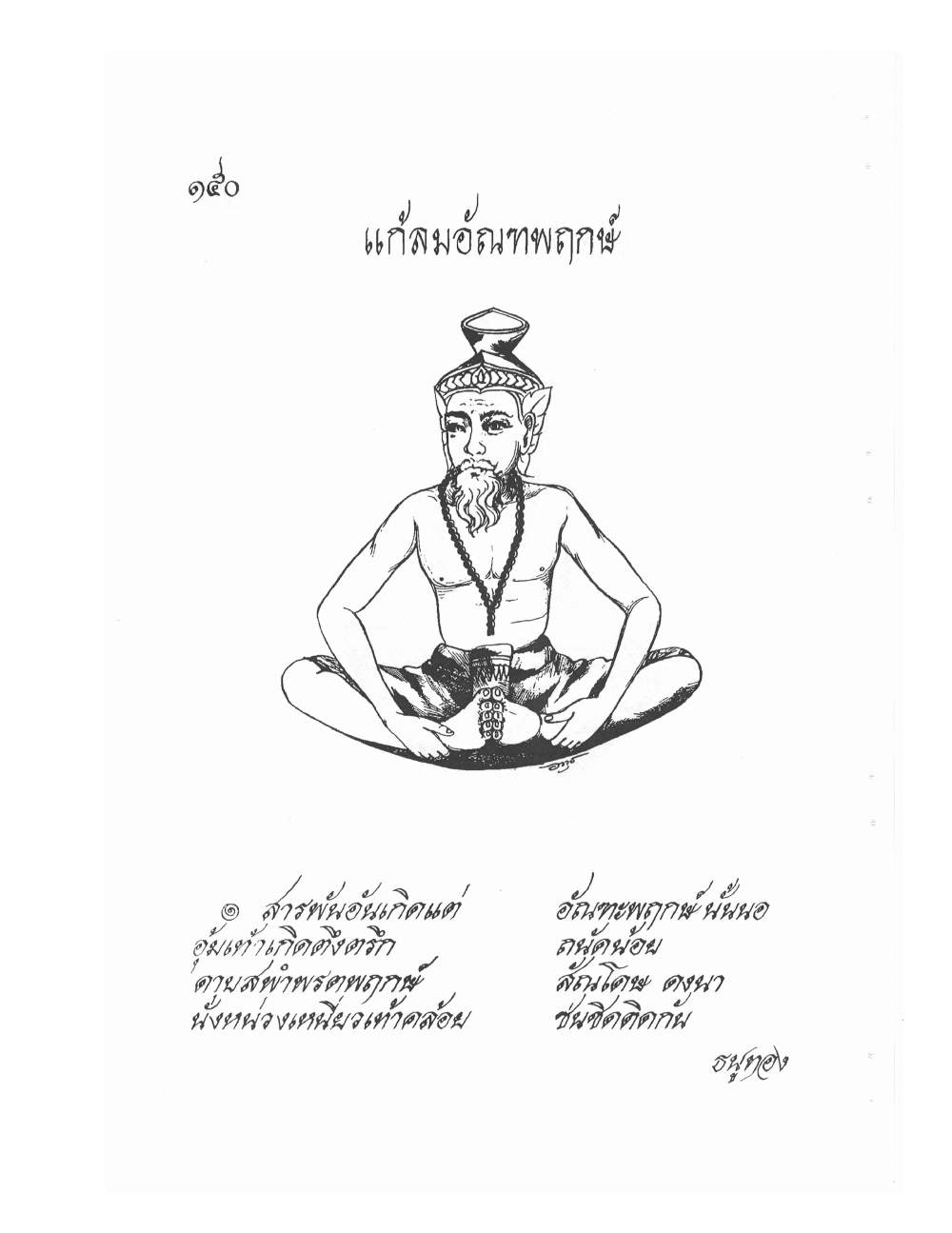
๑๖๐
แก้ลมอัณฑพฤกษ์
สารพัดอันเกิดแต่ อุ่มเท้าเกิดดังตรึก ดวยสำพรตพฤกษ์ นั่งหน่วงเหนี่ยวเท้าคล้อย
อัณฑะพฤกษ์นั้นหนอ ถูกด้วย สถิตโดย ดงมา ซมชิดติดกัน
ธนูทอง
160
To cure the wind of the "testicle-tree" affliction
[diagram: a hermit figure seated cross-legged, facing forward, both hands together grasping his own crossed feet]
All manner of ailment that arises from the numbed foot, arising as if pondered upon, together with the vow-bound tree-affliction — he sits drawing and pulling his trailing foot inward,
for that very "testicle-tree" affliction — this is the right way to meet it, dwelling as it does deep within, clinging and lodged together as one.
[Attributed to] Thanuthong.
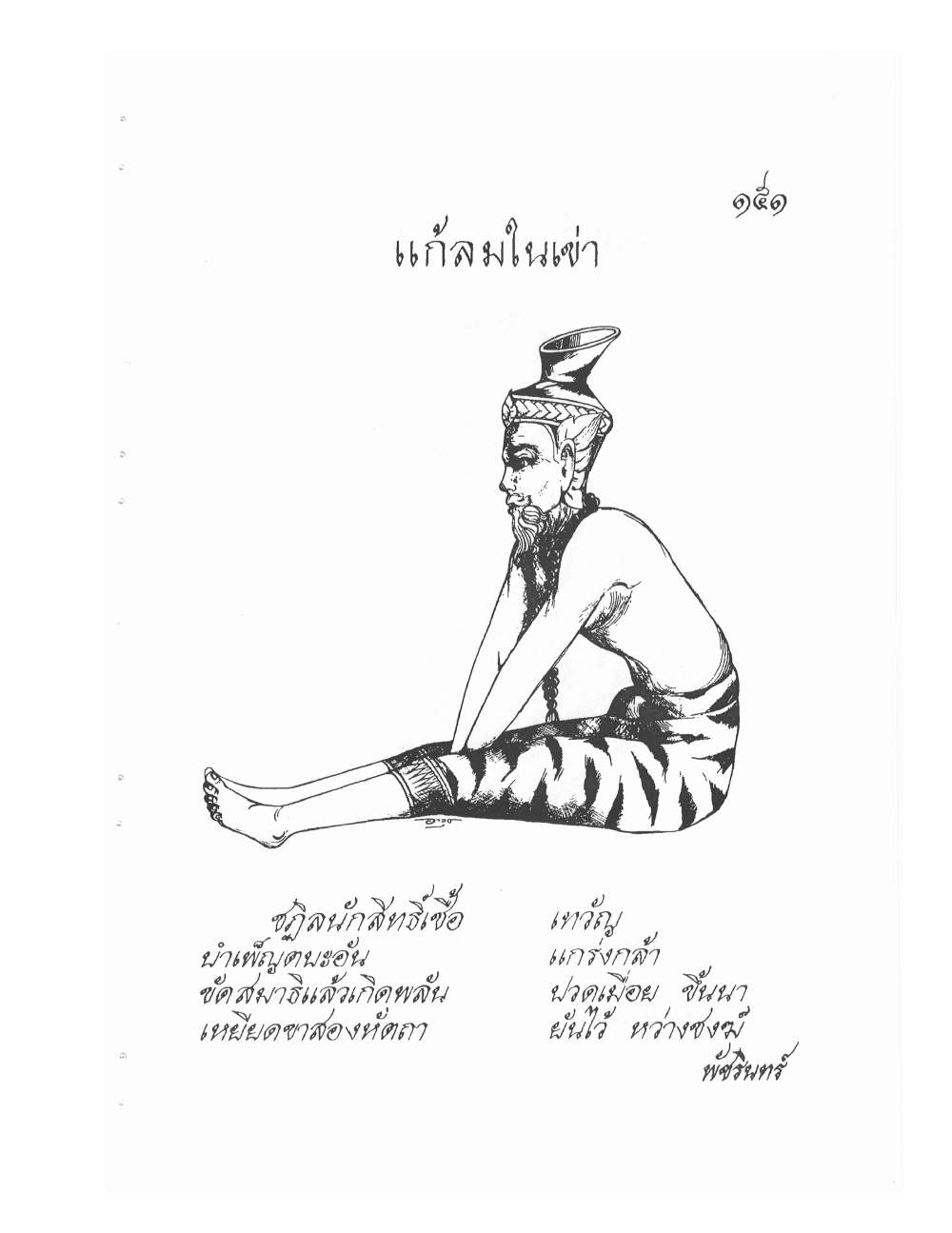
๑๖๑
แก้ลมในเข่า
ชฏิลนักสิทธิ์เชื้อ บำเพ็ญตนระอั้น ขัดสมาธิแล้วเกิดพลั้น เหยียดขาสองหัตถา
เทวัญ แกร่งกล้า ฝวดเมื่อย ขึ้นมา ยันไว้ หว่างชงฆ์
พัชรินทร์
161
To cure wind in the knee
[diagram: a hermit figure seated, one leg extended straight out in front of him, the other leg bent, both hands resting near the bent knee, in profile facing left]
This matted-haired ascetic of noble lineage, long practising austerities without pause, sits cross-legged, and when a spasm suddenly arises, he stretches out the leg, both hands [bracing] —
[strong as] a deity, sturdy and bold, labouring against the ache that rises up, bracing it there between the shins.
[Attributed to] Phatcharin.
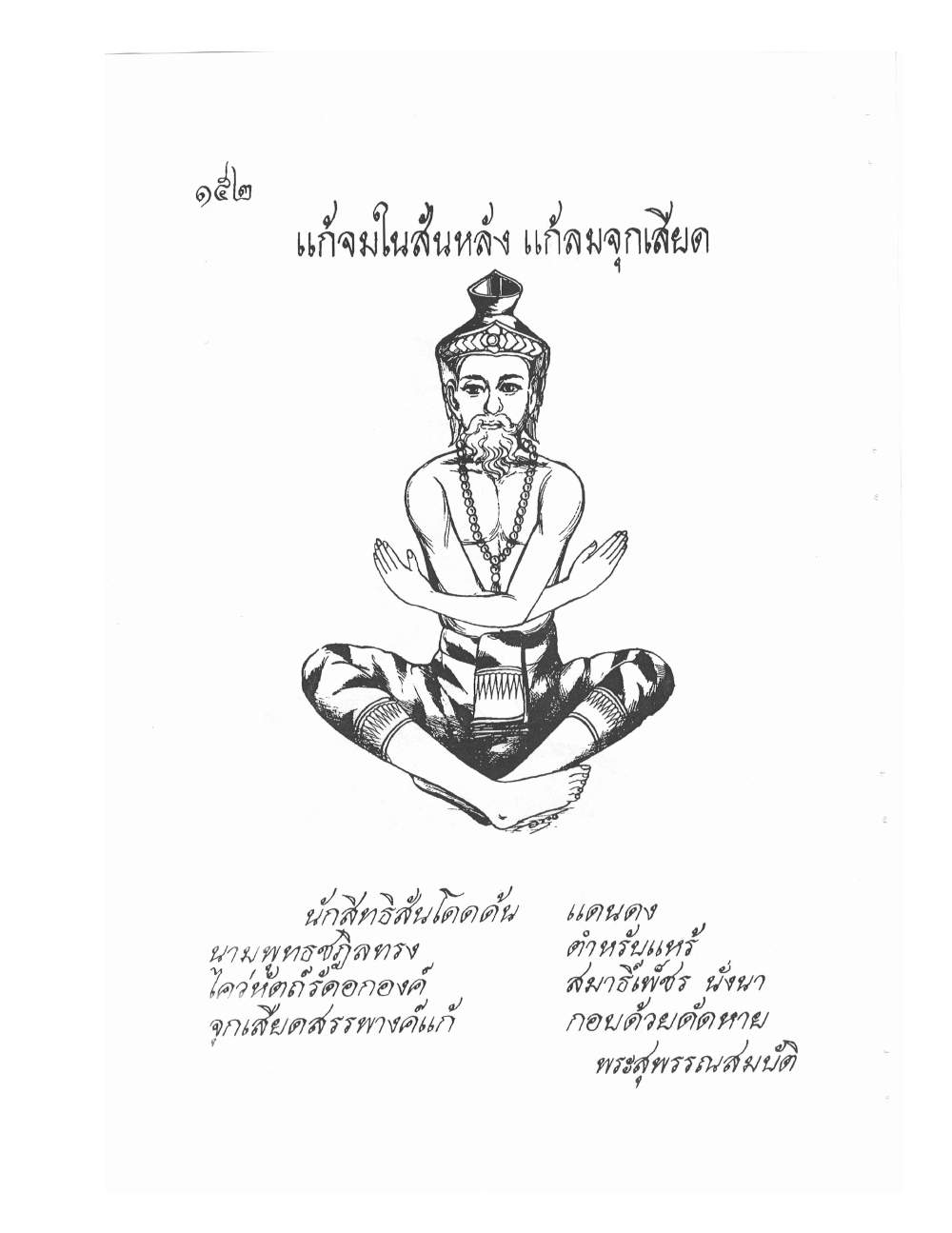
๑๖๒
แก้จมูกในสันหลัง แก้ลมจุกเสียด
นักสิทธิสั้นโดดด้น นามพุทธชฎิลทรง ไขว่หัตถ์รดอกองค์ จุกเสียดสรรพางค์แก้
แดนดง ตำหรับแฮ้ (แฮ) สมาธิเพชร นั่งนา กอบด้วยดับหาย
พระสุพรรณสมบัติ
162
To cure [pain] along the spine, to cure the wind of stitching pain
[diagram: a hermit figure seated cross-legged, both hands crossed in front of his chest]
This accomplished ascetic, leaping and bounding, of the name and bearing of the matted-haired Buddha's disciple, crosses his hands over his own chest, to cure the stabbing, choking pain throughout the body —
[according to] the tradition of the forest realm, this is the formula; sitting in the diamond-like meditation posture, altogether the affliction is extinguished and gone.
[Attributed to] Phra Suphan Sombat.
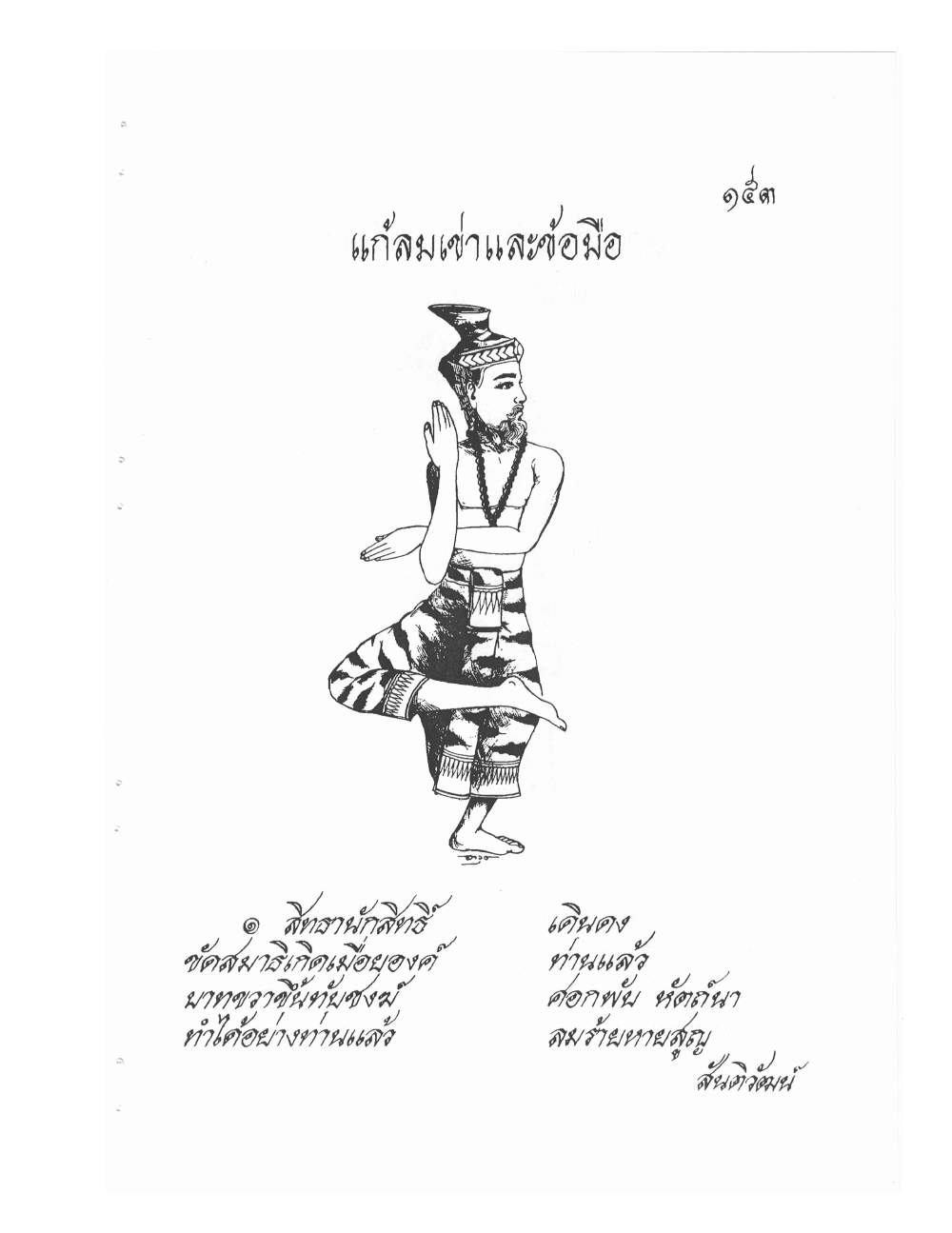
๑๖๓
แก้ลมเข่าและข้อมือ
สิทธาณักสิทธิ์ ขัดสมาธิเกิดเมื่อยองค์ มาทขวาชูขึ้นทรงมือ ทำได้อย่างท่านแล้ว
เดิมดง ท่านแล้ว ต่อกพัน หัตถ์นา ลมร้ายหายสูญ
สิงห์วิจิตร์
163
To cure wind in the knee and the wrist
[diagram: a hermit figure seated with one leg raised and bent, one hand raised palm-out beside the face, the other hand extended forward]
This accomplished siddha, sitting cross-legged, when the body grows weary, raises the right [limb] up and holds up the hand — doing just as the master once did —
originally of the forest, as the master did, binding and joining the hands together, so that the harmful wind is destroyed and vanishes.
[Attributed to] Sing Wichit.
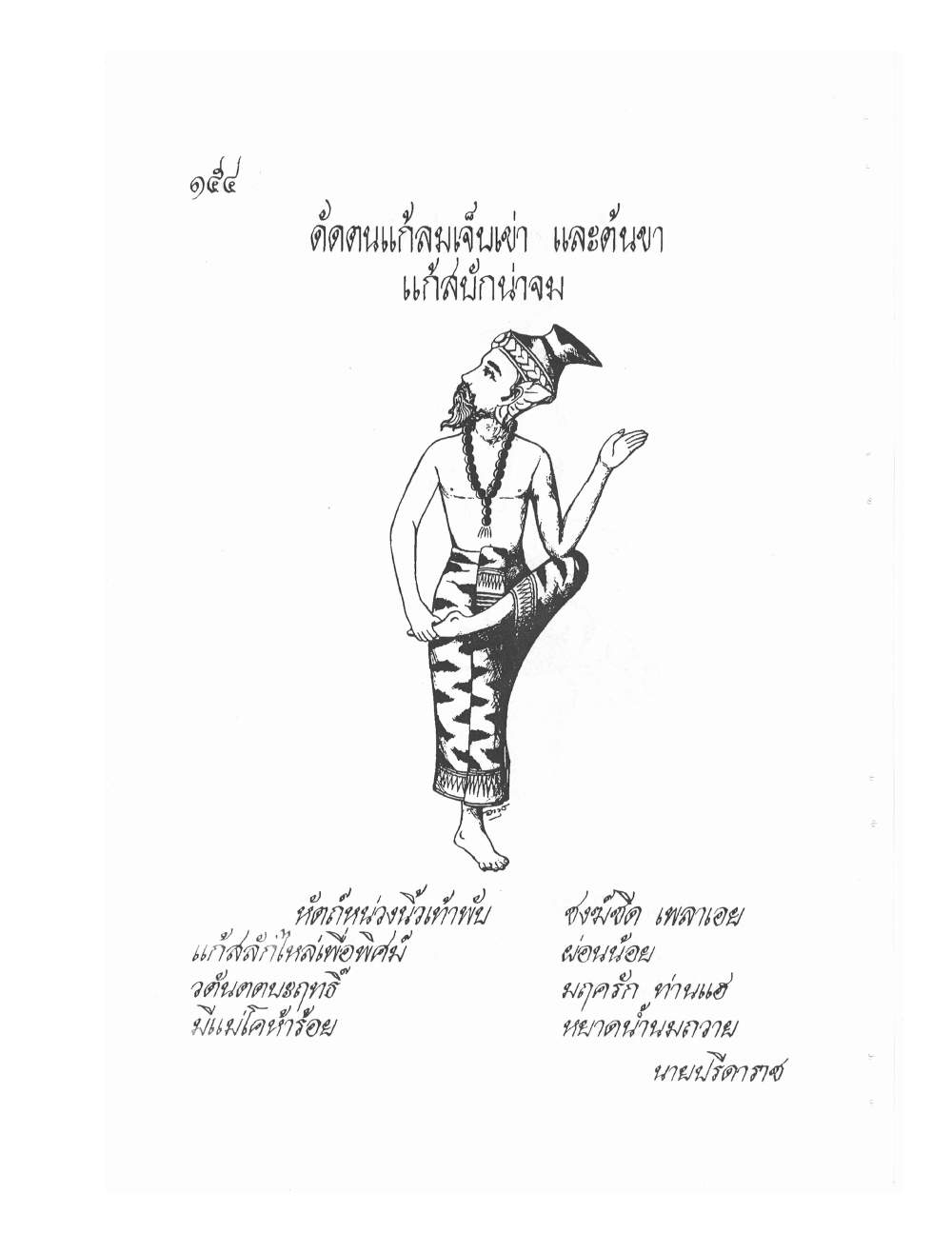
๑๖๔
ดัดตนแก้ลมเจ็บเข่า และต้นขา แก้สะบักน่าจม
หัตถ์หน่วงนิ้วเท้าพับ แก้สลักไหล่เพื่อพิศม์ วดต้นตนขฤทธิ์ มีแม่โคน้ำร้อย
ซงผู้ชิด เพลาเอย ผ่อนน้อย มกรรัก ท่านแฮ หยาดน้ำนมถวาย
นายปรีดาราช
164
Self-stretch to cure the wind-pain of the knee and the thigh, to cure a sinking, stiff shoulder-blade
[diagram: a hermit figure standing on one leg, the raised leg bent with hand grasping the foot, the other hand held out to the side, face turned up]
The hand holds down the folded toes, to cure the catch in the shoulder that causes suffering; by the power of this practised bodily discipline, as though a hundred streams of a mother-cow's [milk flowed] —
drawing close to this posture, easing it little by little, with affection, [as] the master [taught], offering forth drops of milk.
[Attributed to] Nai Preedarat.
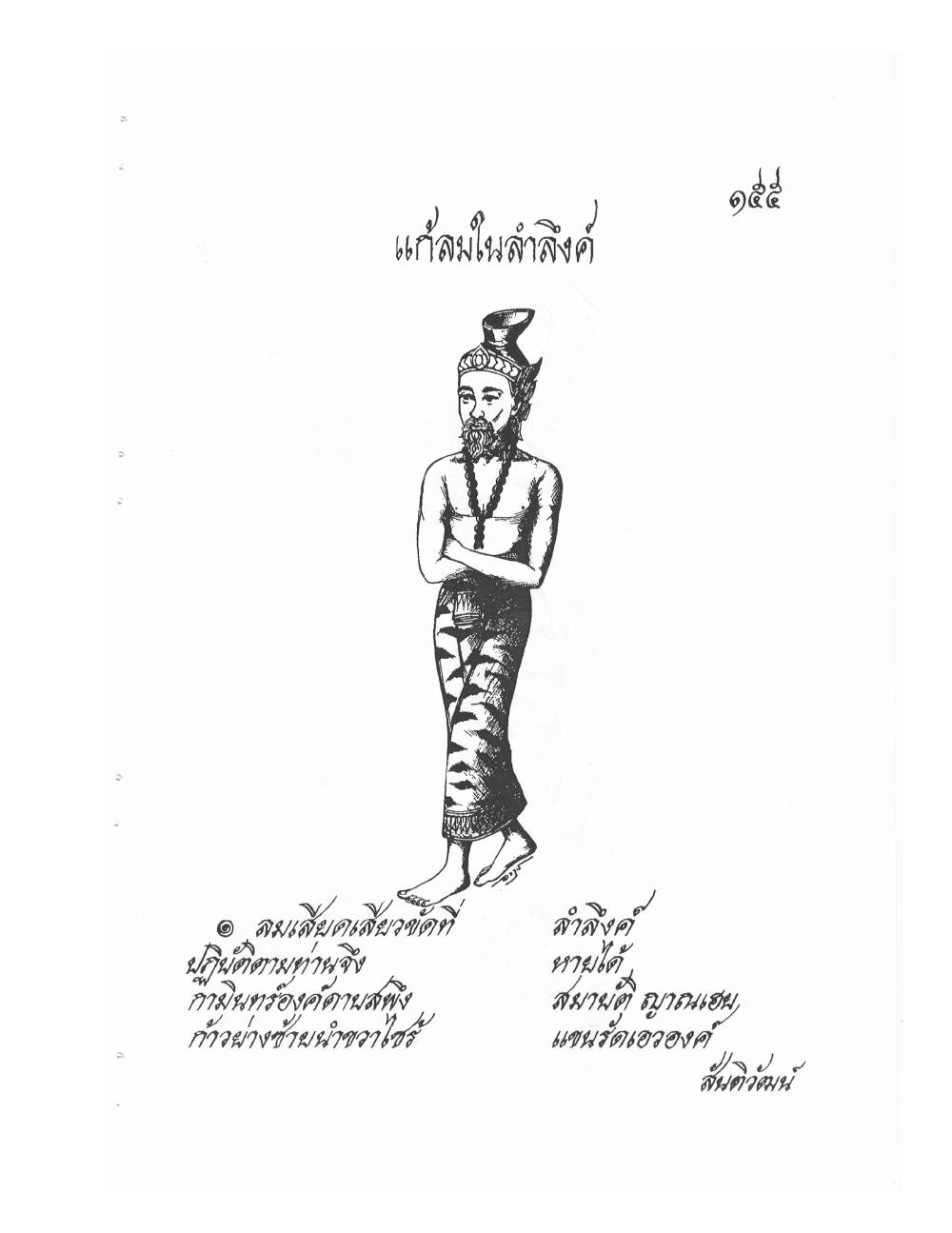
แก้ลมในลำลึงค์
ลมเสียดเสียวขัดที่ ลำลึงค์ ปฏิบัติตามท่านจึง หายได้ กามินทร์องค์ตามสพึง สมาธิ ญาณเอย, ก้าวย่างซ้ายนำขวาไซร้ แขนรัดเอวองค์
สมติวงษ์
[ภาพ: ฤๅษีสวมชฎายอดแหลม ไว้เครา คล้องประคำที่คอ ยืนไขว้แขนกุมอกทั้งสองข้าง นุ่งผ้าลายเสือ ก้าวเท้าซ้ายนำขวา]
Relieving Wind in the Lam-ling [Channel]
The wind stabs and aches, blocked at the lam-ling. Practicing according to the master's way brings recovery. The practitioner follows accordingly, through samadhi and insight. Step the left foot forward, leading the right; wrap the arms about the waist.
— Somtiwong
[Illustration: a bearded hermit (ruesi) wearing a tall pointed hat and a rosary about the neck, standing with both arms crossed over the chest, wearing a tiger-striped lower cloth, stepping forward with the left foot leading the right.]
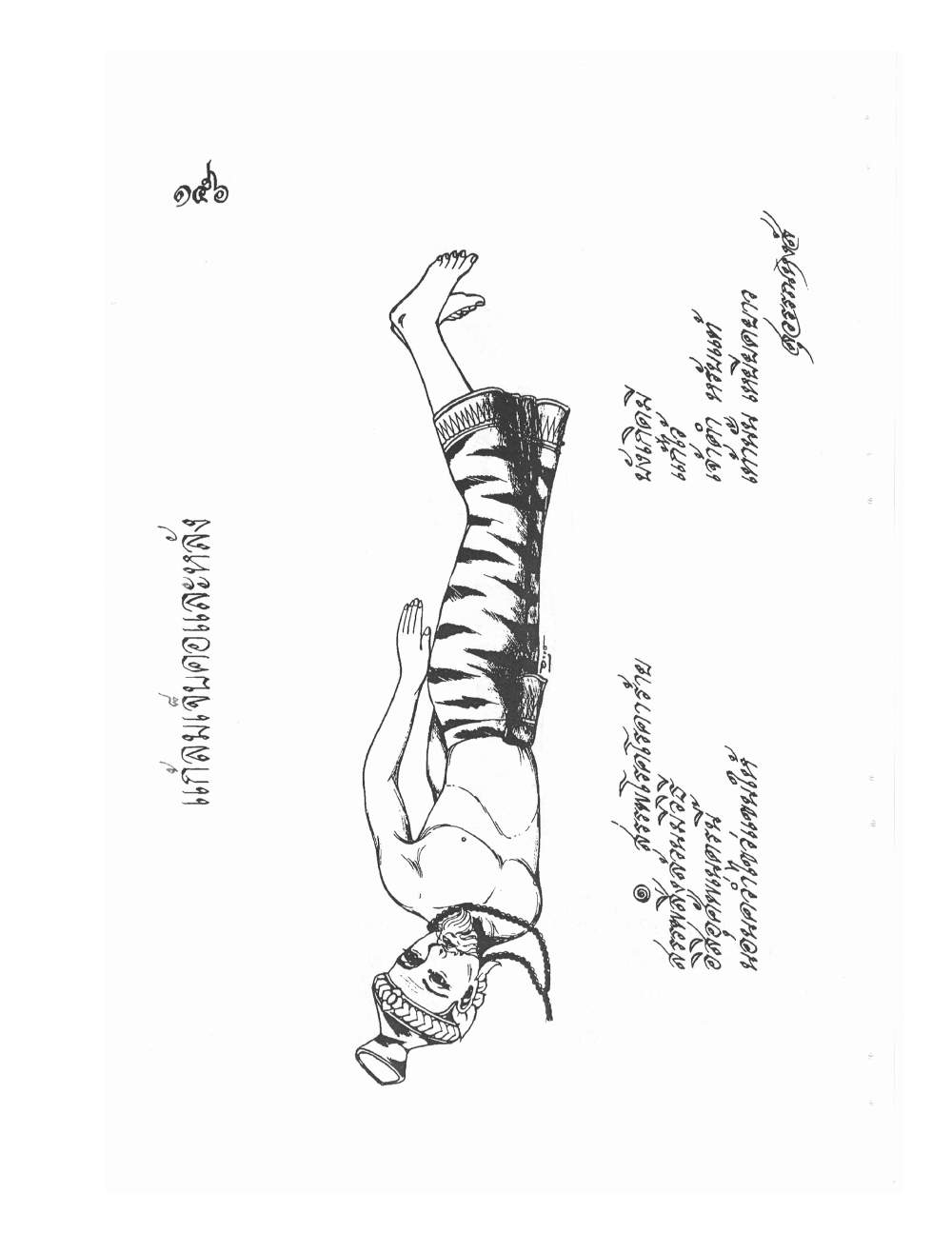
แก้ลมเจ็บคอและหลัง
สรรพโรคโรคาร้าย ยังเกิดมี สรรพสิ่งล้วนมีจริง แก้ได้ [อ่านไม่ออก] เจ้าตำ หรือแท้, นอนคว่ำใช่วางแขนให้ เท้าพ้น เหยียดยาว
สุวรรณหงส์
[ภาพ: ฤๅษีนอนคว่ำเหยียดตัวเต็มที่ แขนทั้งสองข้างเหยียดไปข้างหน้า ขาทั้งสองเหยียดตรงไปด้านหลัง นุ่งผ้าลายเสือ คล้องประคำที่คอ]
Relieving Wind-Pain in the Neck and Back
Every kind of evil illness still arises; all such afflictions truly exist, and can be cured.
[illegible] whether pressed upon, or truly so,
lying face down — do not merely set the arms down; stretch the feet out, extending them long.
— Suwannahong
[Illustration: a hermit lying face down, body stretched out fully, both arms extended forward and both legs extended straight back, wearing a tiger-striped lower cloth with a rosary about the neck.]
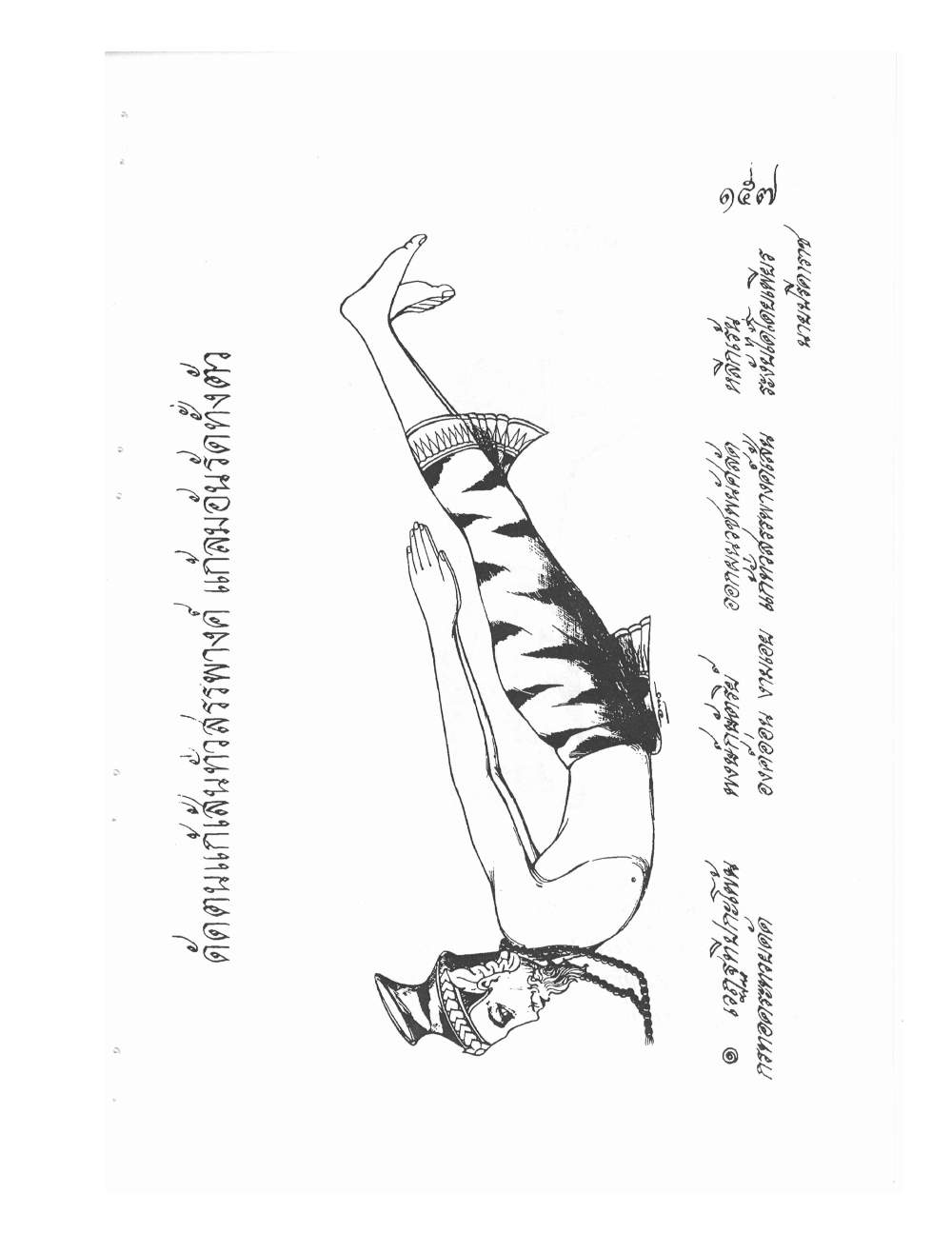
ดัดตนแก้เส้นทั่วสรรพางค์ แก้ลมอันรัดทั่งตัว
เจ้าฤๅทิพกายโพ้น กระทอดระทวยดัด พงษ์กษัตริย์ องค์อ่อน งามเอย ออกผนวชพงศ์กษัตริย์ลัด แก้ทั่วสรรพางค์เส้น หลีกเร้น ระงับได้โดยเพียร
นายปรีดาราช
[ภาพ: ฤๅษีสวมชฎา ยันมือทั้งสองข้างกับพื้น ยกสะโพกขึ้น ยกขาข้างหนึ่งเหยียดสูงไปด้านหลัง นุ่งผ้าลายเสือ คล้องประคำที่คอ]
Stretching to Relieve the Channels Throughout the Body; Relieving Wind that Binds the Whole Body
A lord of celestial form, bending and twisting the body, a prince of gentle, beautiful form — went forth to ordain, a swift prince, curing the channels throughout the whole body, withdrawing into seclusion, subduing the affliction through persistent effort.
— Nai Preedaracha
[Illustration: a hermit in a tall hat, both hands braced against the ground, hips raised, one leg lifted and extended high behind, wearing a tiger-striped lower cloth with a rosary about the neck.]
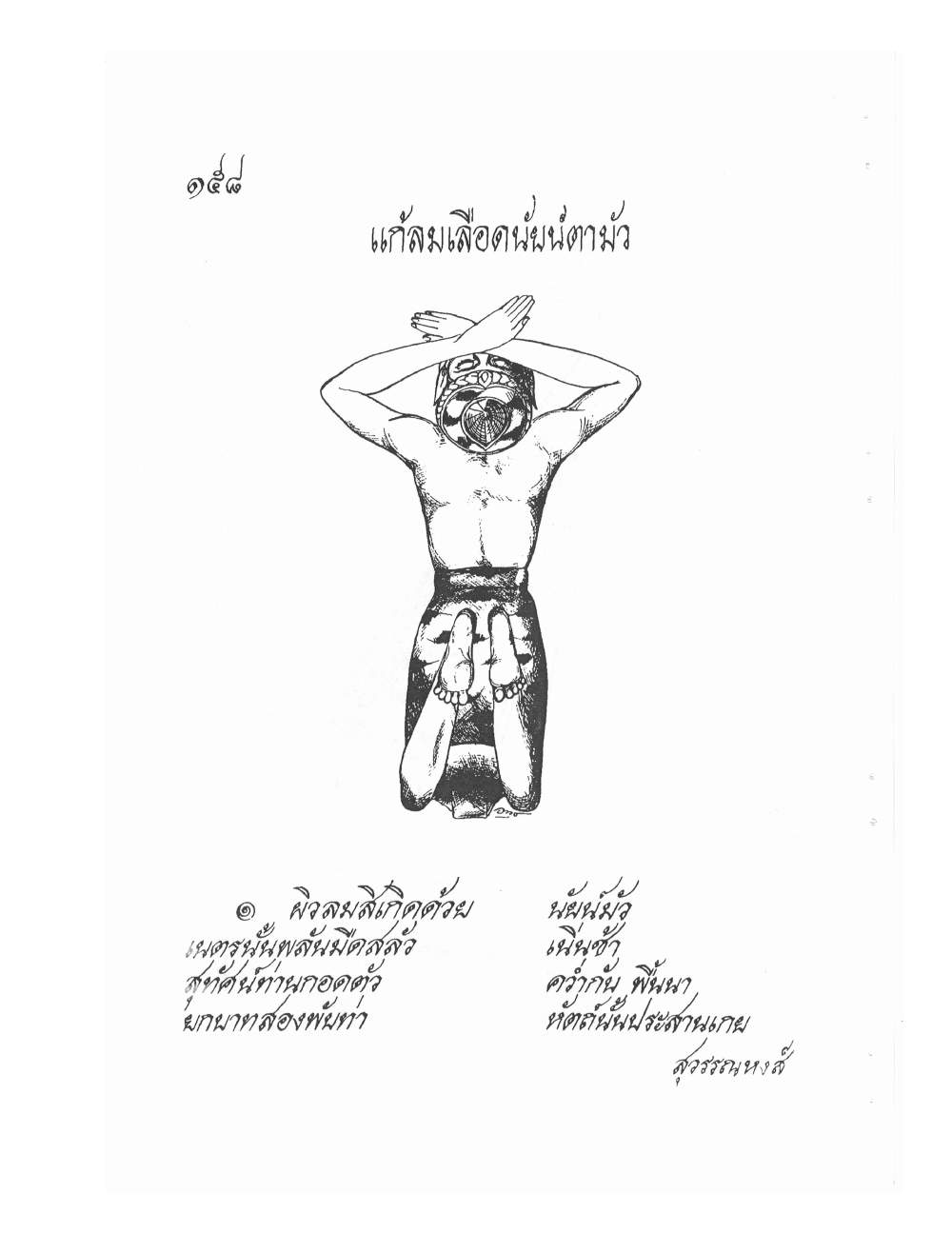
แก้ลมเลือดพลั่นตามัว
ผิวลมสิเกิดด้วย [อ่านไม่ออก] เนตรนั้นพลันมืดสลัว [อ่านไม่ออก] สุทัศน์ท่านกอดตัว คว่ำกัม พื้นนา, ยกฝ่าทั้งสองพนมท่า หัตถ์นั้นประสานเกยา
สุวรรณหงส์
[ภาพ: ฤๅษีสวมชฎา คุกเข่าก้มตัว ไขว้แขนทั้งสองประสานเหนือศีรษะ ฝ่ามือทั้งสองแนบพื้น นุ่งผ้าลายเสือ]
Relieving Wind-Blood Surging that Blurs the Eyes
If wind should arise together with [illegible], the eyes then suddenly grow dark and dim, [illegible], the good practitioner embraces his own body, bowing down to the ground, raising both palms together in reverence, the hands interlaced.
— Suwannahong
[Illustration: a hermit in a tall hat, kneeling and bowing forward, both arms crossed and joined above the head, both palms flat against the ground, wearing a tiger-striped lower cloth.]
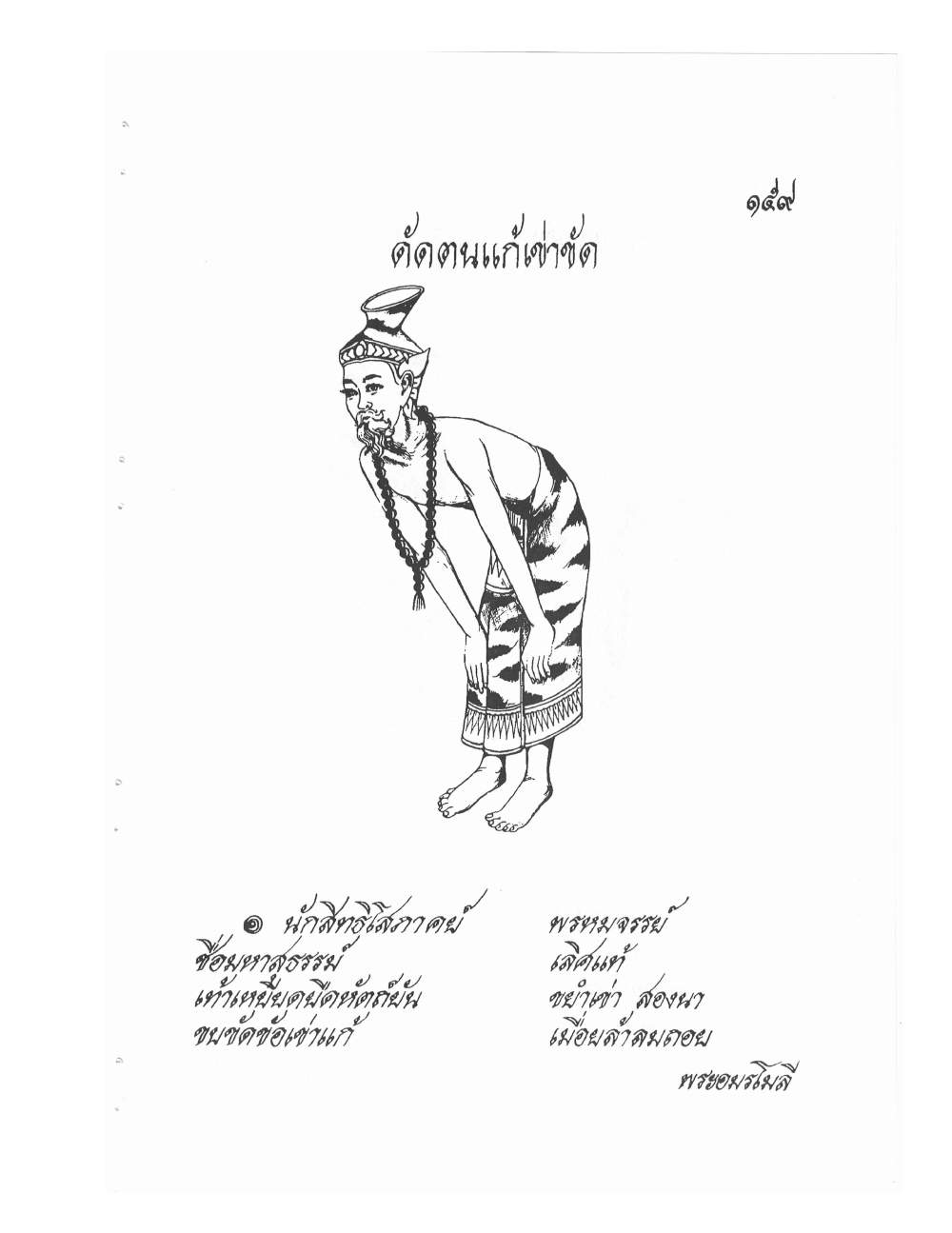
ดัดตนแก้เข่าขัด
นักสิทธิ์เดชกาจ ชื่อมหาสธรรม์ เท้าเหยียดคุมคืดตริยัน ขมวดข้อเข่าแก้
พรหมจรรย์ เลิศแท้ ขยำเท่า สองผา เมื่อยล้าลมถอย
พระอมรโมลี
[ภาพ: ฤๅษีสวมชฎา ก้มตัวลง มือทั้งสองแตะที่ขา นุ่งผ้าลายเสือ คล้องประคำที่คอ]
Stretching to Relieve a Stiff Knee
A mighty ascetic, named Mahasathan, feet drawn together, bent and gathered, unknots the stiffness at the knee.
His holy conduct is truly supreme; kneading the two legs when weary and the wind subsides.
— Phra Amonmoli
[Illustration: a hermit in a tall hat, bending forward at the waist, both hands touching the legs, wearing a tiger-striped lower cloth with a rosary about the neck.]
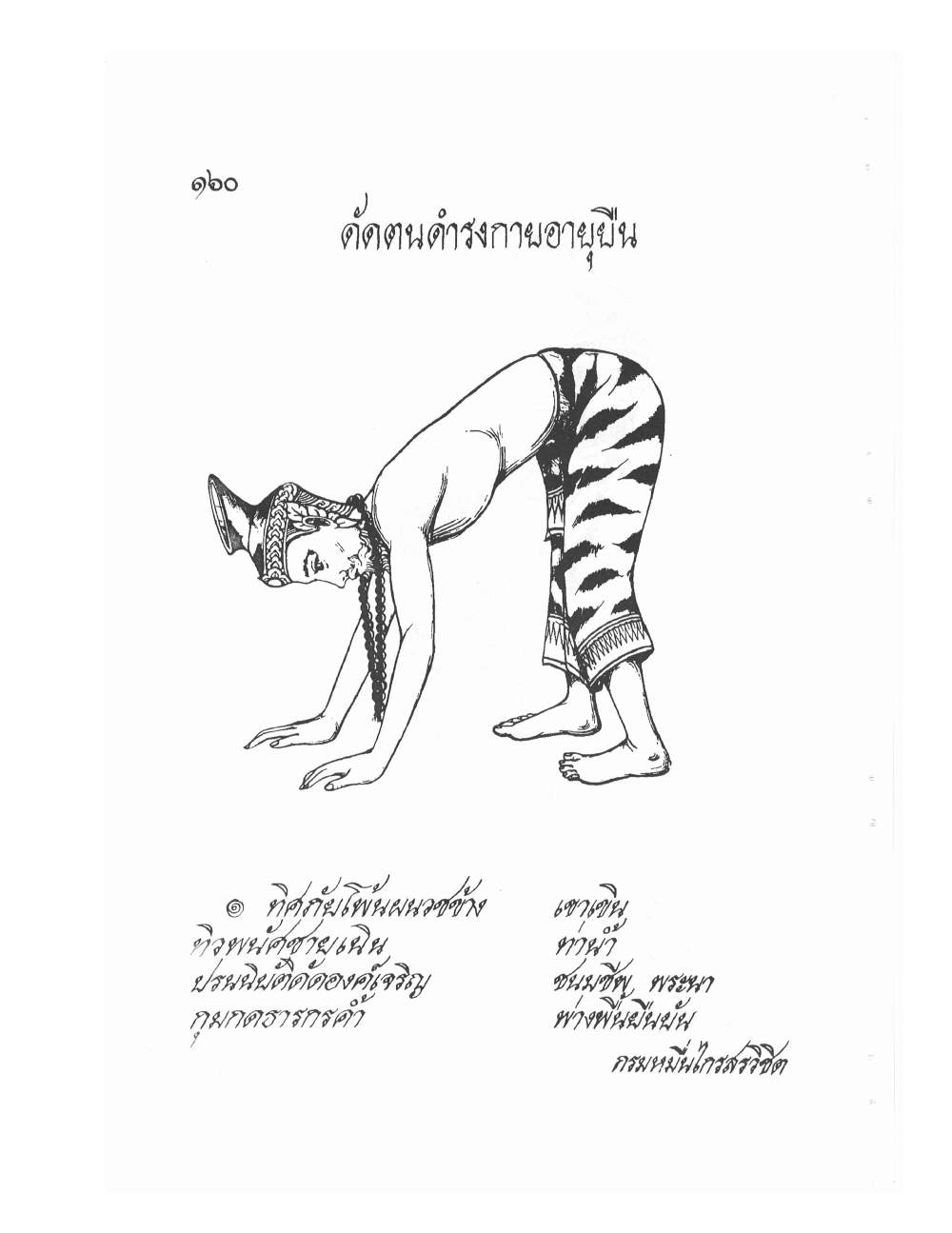
ดัดตนดำรงกายอายุยืน
ทิศกษัยโพ้นผนวชข้าง เขาเขิน ทิ้งพงศ์ชายเผิน ท่าน้ำ ปรพนธ์ติดต่อองค์เจริญ ชนมชีพ พระผา, กุมกดธารกรค่ำ พ่างพื้นยืนยัน
กรมหมื่นไกรสรวิชิต
[ภาพ: ฤๅษีสวมชฎา ยันมือและเท้าทั้งสี่กับพื้น โก่งตัวขึ้นคล้ายท่าสะพานคว่ำ นุ่งผ้าลายเสือ คล้องประคำที่คอ]
Stretching to Sustain the Body for a Long Life
On that far slope he went forth to ordain, by the rising hills, leaving behind his lineage, a fleeting man by the waterside, the teaching carried on, prolonging his life and years, O sage of the mountain, gripping and pressing down with the hands at dusk, steady and firm against the ground.
— Krommuen Kraisonwichit
[Illustration: a hermit in a tall hat, both hands and both feet braced against the ground, the body arched upward like an inverted bridge, wearing a tiger-striped lower cloth with a rosary about the neck.]
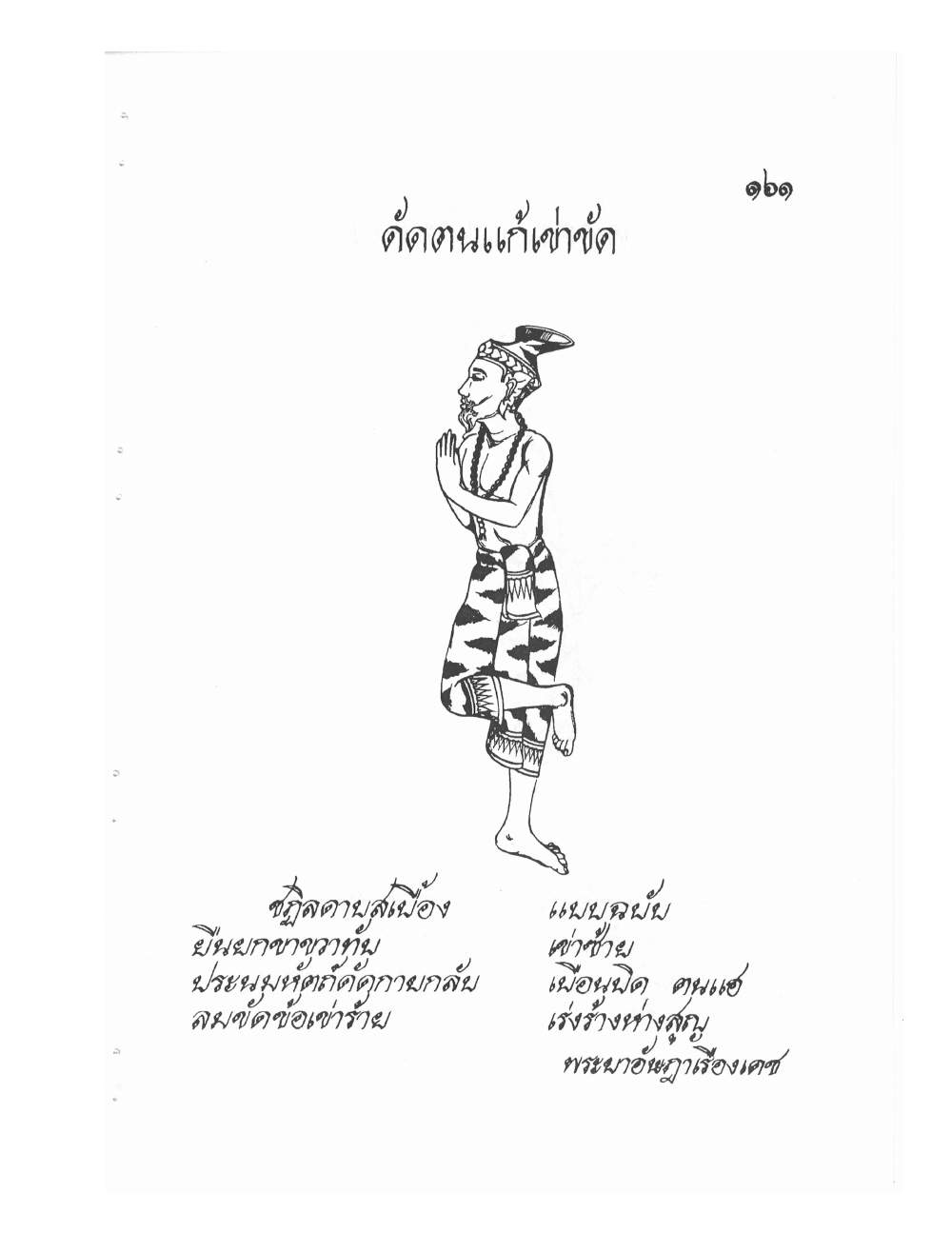
ดัดตนแก้เท้าขัด
ชฎิลดาบสเมือง ยืนยกชาชูวาทุม ประนมหัตถ์คดกายกลั่น ลมขัดข้อเท่าร้าย
แบบฉบับ เท่าซ้าย เมื่อนุ่งคิด ตนแฮ เร่งร้างห่างสูญ
พระมาลัยเทวเรืองเดช
[ภาพ: ฤๅษีสวมชฎา ยืนขาเดียว ยกขาข้างหนึ่งงอเข่าขึ้น ประนมมือไว้ระดับอก นุ่งผ้าลายเสือ]
Stretching to Relieve a Stiff Foot
The ascetic hermit of the town stood and raised himself like a swaying tree, hands joined in reverence, the body bent and gathered, curing the wind that stiffens the ankle joint.
Thus is the model, upon the left foot; when one composes the mind upon oneself, hastening the affliction to depart and vanish far away.
— Phra Malai Thewaruangdet
[Illustration: a hermit in a tall hat, standing on one leg with the other leg raised and bent at the knee, hands joined in a wai gesture at chest height, wearing a tiger-striped lower cloth.]
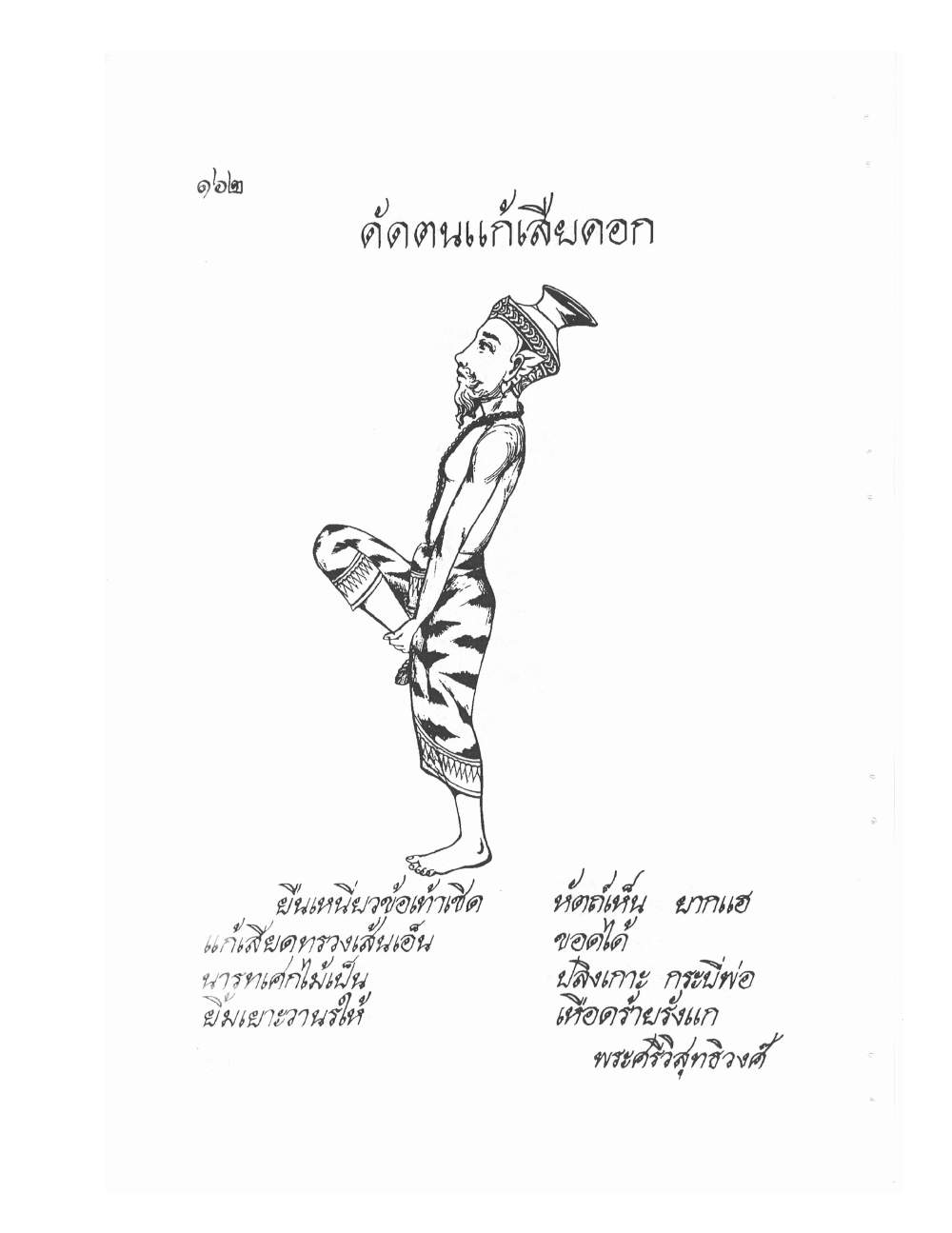
ดัดตนแก้เสี้ยนดอก
ยืนเหนี่ยวข้อเท้าเชิด แก้เสี้ยดทรวงเส้นเอ็น นารทเทวไม้เป็น ยิ้มเยาะวานรให้
หัตถ์เห็น ยากแฮ ขอได้ ปลิงเกาะ กระบี่พ่อ เลือดร้ายรั่งแก
พระศรีสุทธิวงศ์
[ภาพ: ฤๅษีสวมชฎา ยืนขาเดียว ยกขาอีกข้างงอไปด้านหลัง มือจับที่ข้อเท้า นุ่งผ้าลายเสือ คล้องประคำที่คอ]
Stretching to Relieve "Sian Dok" [a Cramping/Splinter-like Affliction]
Standing, gripping and lifting the ankle, relieving the piercing ache of the chest tendon, the divine sage Narada, being as a tree, smiles mockingly, granting it to the monkey.
The hand is seen — how difficult it is! — reaching to ask for it; a leech clings, O father monkey, as the evil, stagnant blood is thereby cured.
— Phra Sisutthiwong
[Illustration: a hermit in a tall hat, standing on one leg with the other leg raised and bent behind, gripping his own ankle with one hand, wearing a tiger-striped lower cloth with a rosary about the neck.]
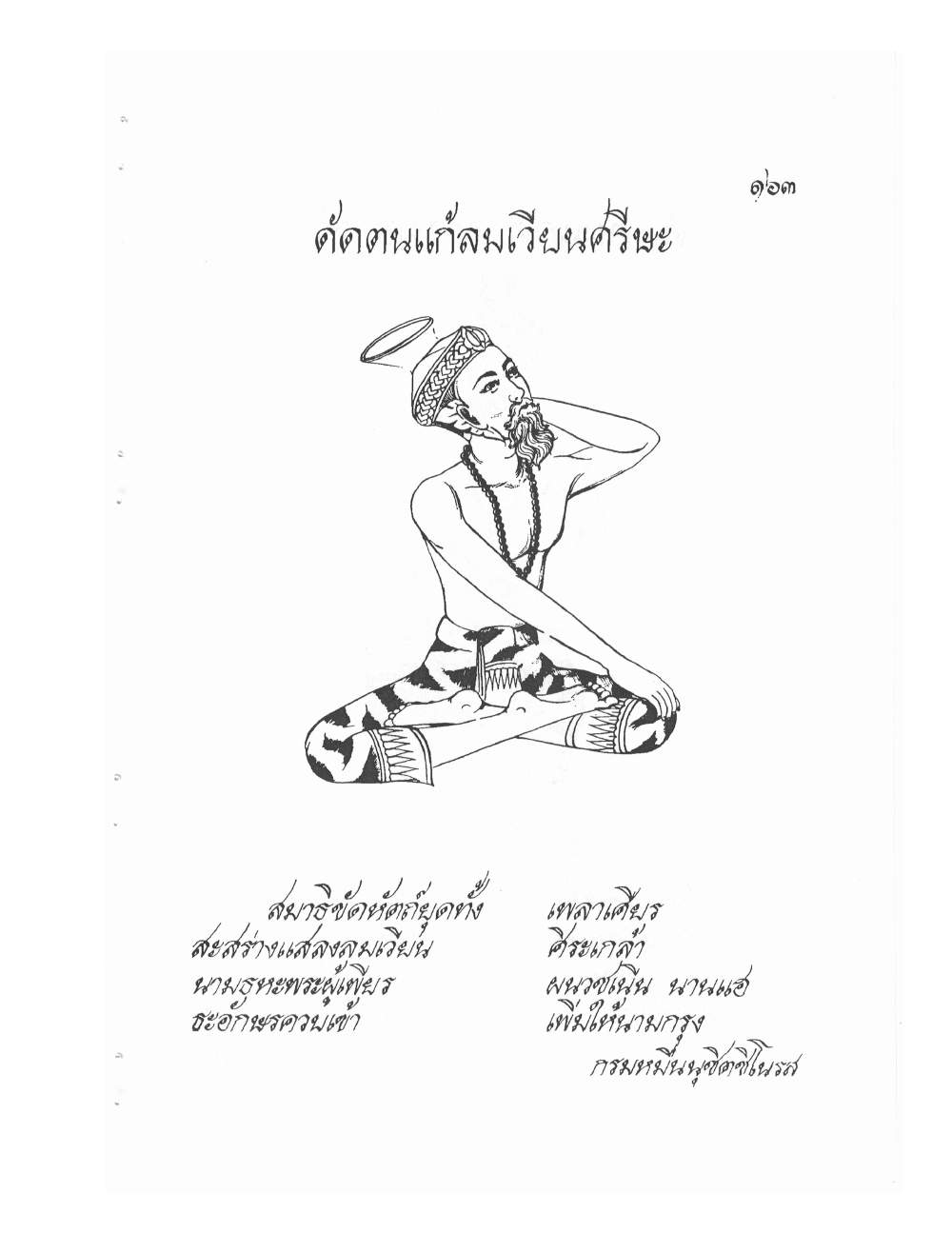
ดัดตนแก้ลมเวียนศีรษะ
สมาธิขัดหัตถ์ยุดทั้ง สะส่างแสลงลมเวียน นามฤๅษีพระผู้เฟื่อง ชะอักษรควรเข้า
เพลาเศียร ศีรษะเกล้า ผนวชเป็น นานแฮ เพิ่มให้นามกรุง
กรมหมื่นนุชิตชิโนรส
[ภาพ: ฤๅษีสวมชฎา นั่งขัดสมาธิ มือข้างหนึ่งยกขึ้นแตะศีรษะ อีกมือหนึ่งยันพื้น มีวงแสงล้อมรอบศีรษะ นุ่งผ้าลายเสือ คล้องประคำที่คอ]
Stretching to Relieve Wind that Causes Dizziness
Seated in samadhi, hands folded and held, clearing away the affliction of the whirling wind, the renowned hermit-sage, whose name deserves to be recorded,
at the turning of the head, gathered at the crown, having been ordained a very long time, adding further to his renowned name.
— Krommuen Nuchitchinorot
[Illustration: a hermit in a tall hat, sitting cross-legged, one hand raised to touch the head and the other braced on the ground, a ring of light encircling the head, wearing a tiger-striped lower cloth with a rosary about the neck.]
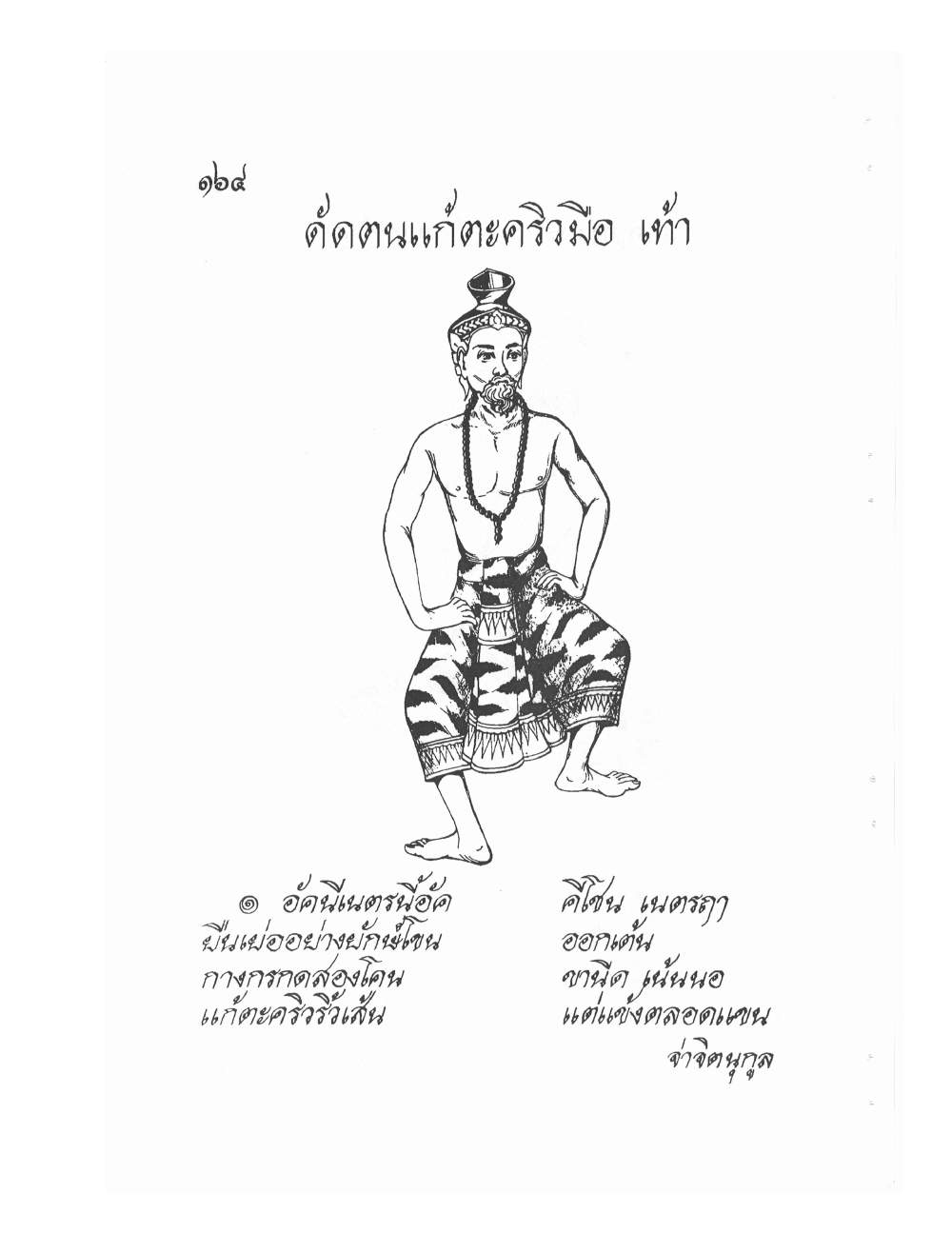
ดัดตนแก้ตะคริวมือ เท้า
อ้าคนึงเนตรหนึ่งอัด ยืนเยื้องอย่างยักษ์โขน กางกรกดสองโคน แก้ตะคริวริ้วเส้น
คี้เชิญ เนตรถา ออกเต้น ขาบิด เห็นนอ แต่แข็งตลอดเขน
จ่าจิตนุกูล
[ภาพ: ฤๅษีสวมชฎา ยืนย่อขา มือทั้งสองเท้าเอว นุ่งผ้าลายเสือ คล้องประคำที่คอ]
Stretching to Relieve Cramps in the Hand and Foot
Gazing intently with fixed eyes, standing turned to the side like a khon-masked giant, spreading the arms and pressing at both hips, relieving the cramp that streaks along the sinew.
[illegible] with watchful eyes,
leaping out, the leg twisted, one can see — yet it remains stiff throughout the shin.
— Ja Chitnukun
[Illustration: a hermit in a tall hat, standing with knees bent, both hands resting on the hips, wearing a tiger-striped lower cloth with a rosary about the neck.]
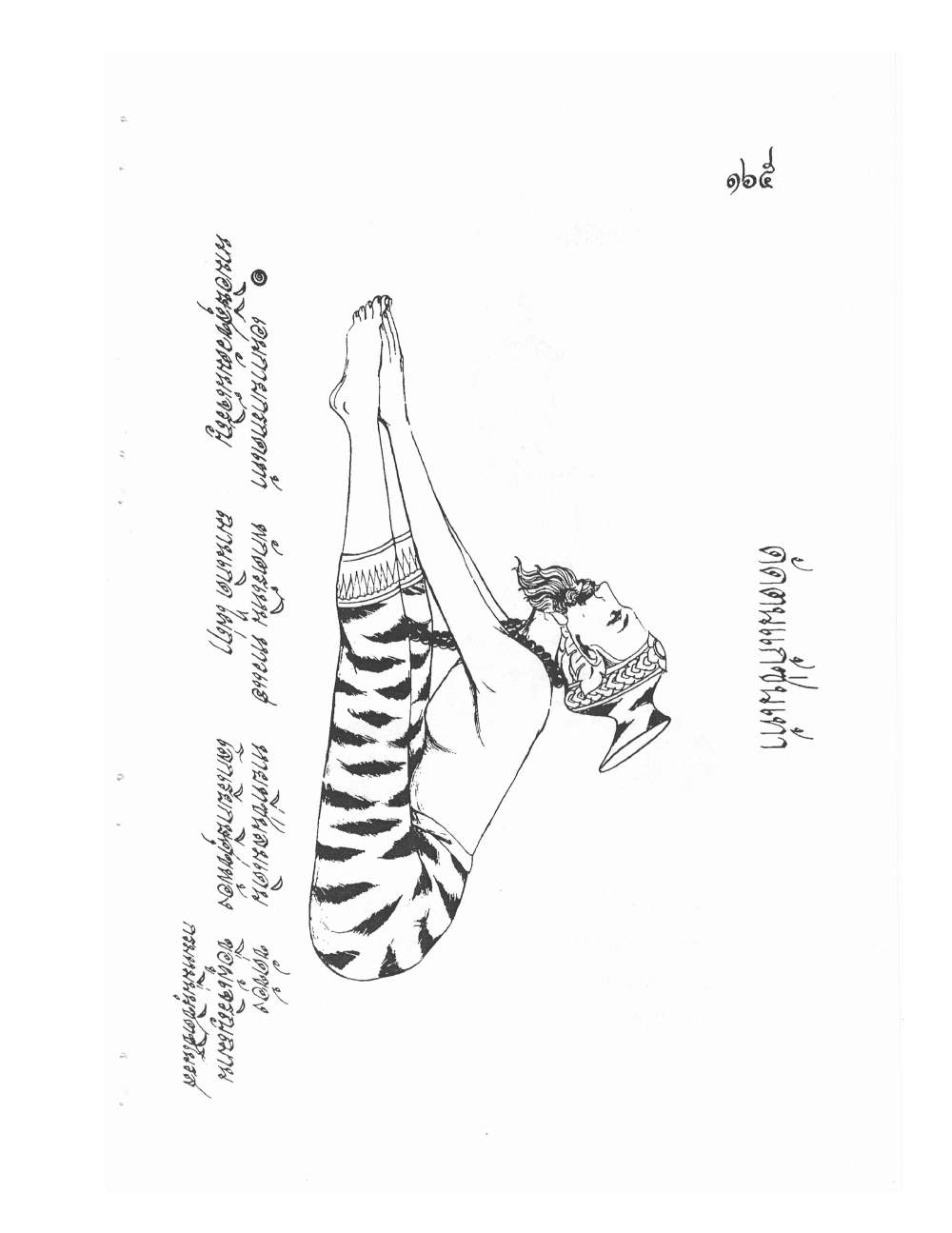
ดัดตนแก้ซ่นเท้า
เอนกายกรกดเท้า พักตร์เอียง หาวแฮ นามอิษีสุขวัณห์เจริญ มานเกิด ไผ่ถา
หายที่ซ่นลมเดิน โลกเรียกชื่อทพ้อง ขัดข้อง ชื่อผู้เจริญลาภ
กรมหมื่นนุชิตชิโนรส
[ภาพ: ฤๅษีสวมชฎา นั่งเหยียดขาทั้งสองไปข้างหน้า ก้มตัวเอามือจับปลายเท้า นุ่งผ้าลายเสือ คล้องประคำที่คอ]
Stretching to Relieve the Heel of the Foot
Leaning the body, the hands pressing toward the feet, the face turned aside, yawning, the hermit named Sukhawan-charoen came to be born among the bamboo groves.
The wind travelling through the heel is thereby cured; the world calls it by that name — once the obstruction clears, [the practitioner] is named a man of flourishing fortune.
— Krommuen Nuchitchinorot
[Illustration: a hermit in a tall hat, seated with both legs stretched forward, bending down with the hands gripping the toes, wearing a tiger-striped lower cloth with a rosary about the neck.]
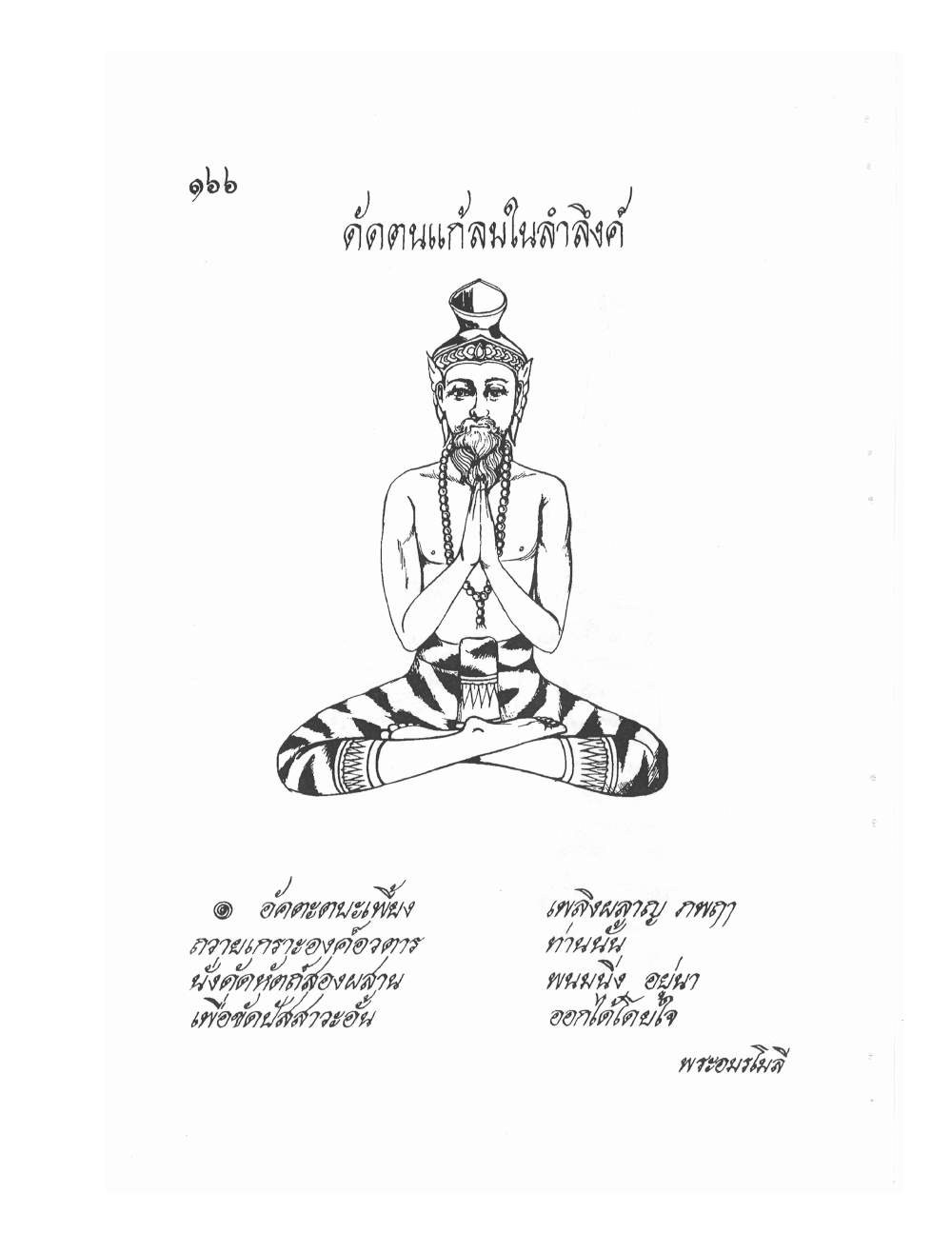
ดัดตนแก้ลมในลำลิงค์
อัคคะตนะเพลิง ถวายเกราะองค์อวตาร นั่งคัดหัตถ์สองผสาน เพื่อขัดพัสสาวะอื่น
เพลิงผลาญ กพกา ท่านนั้น พนมนิ่ง อยู่นา ออกได้โดยใจ
พระอมรโมลี
[ภาพ: ฤๅษีสวมชฎา นั่งขัดสมาธิ ประนมมือทั้งสองไว้ระดับอก นุ่งผ้าลายเสือ คล้องประคำที่คอ]
Stretching to Relieve Wind in the Lam-ling [Channel]
The fire-born one offers up his armor as the incarnate lord, sitting with both hands folded and joined together, so as to clear the obstruction of urination.
The fire consumes [illegible], that one sits still with palms joined in reverence, and it is released according to the will.
— Phra Amonmoli
[Illustration: a hermit in a tall hat, sitting cross-legged, both hands joined in a wai gesture at chest height, wearing a tiger-striped lower cloth with a rosary about the neck.]
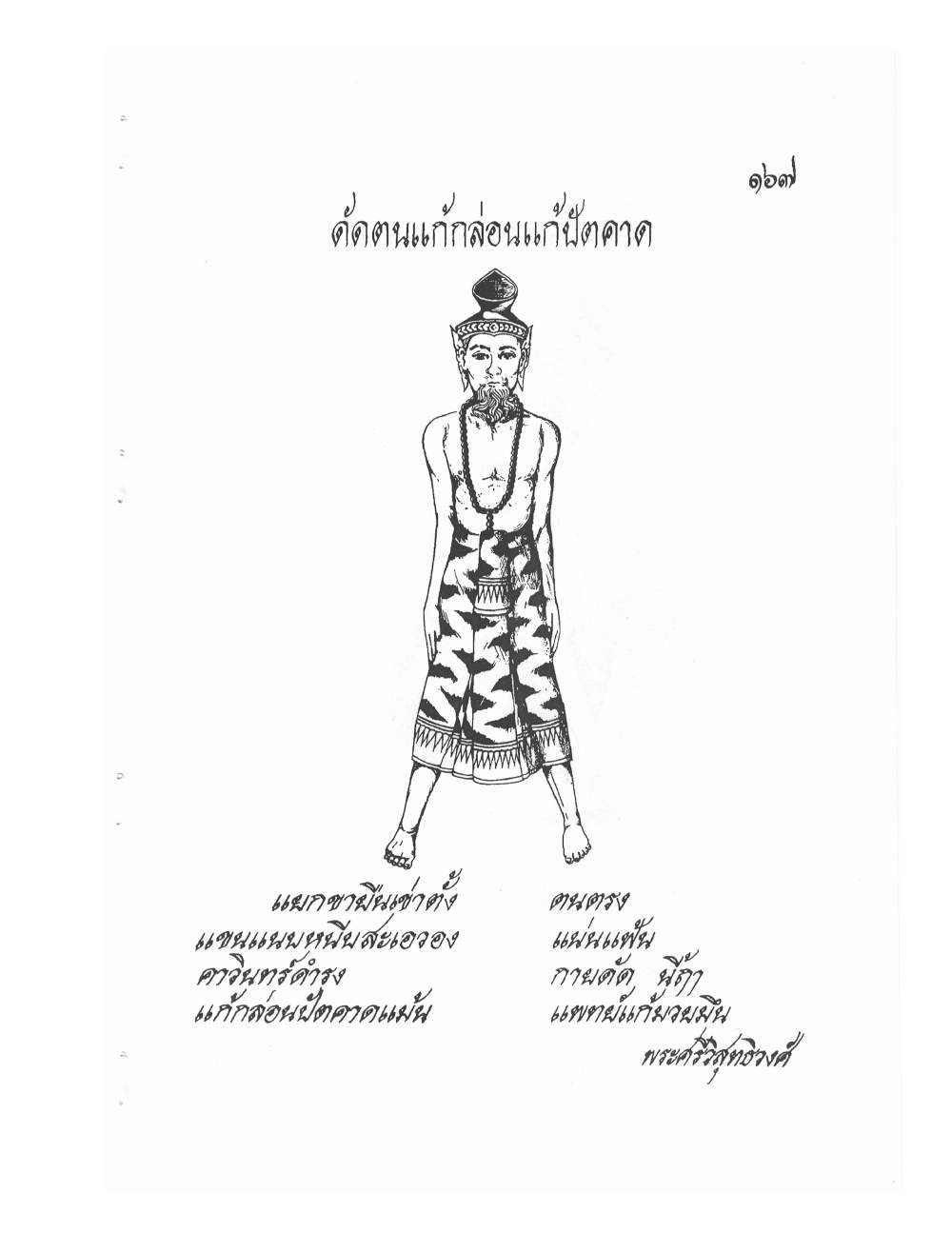
๑๖๗
ดัดตนแก้กล่อนแก้ปัตคาด
[ภาพ: ฤๅษีสวมหมวกยอดแหลม มีลูกประคำคล้องคอ ไว้เครา นุ่งผ้าลายเสือ ยืนตัวตรง แยกขา แขนแนบลำตัว] แยกขาผืนเข่าตั้ง ตนตรง แขนแนบหมิ่นสะเอวอง แม่นแฟ้น คาจินทร์ดำรง กายดัด ผู้ถ้า แก้กล่อนปัตคาดแม้น แพทย์แก้มวยมั่น พระศรีสุทธิวงศ์
167
Body-twisting to cure kalon [an abdominal/groin ailment] and to cure patkhat [muscle and tendon strain]
[Illustration: a bearded ruesi (hermit-ascetic) wearing a tall pointed hat and a strand of prayer beads around his neck, dressed in a tiger-striped wrap, standing upright with legs spread apart, arms resting at his sides] Spread the legs and plant the knees, body upright; press the arms close at the waist, steady and sure; so sustained, the body bent, one who endures; this cures kalon and settles patkhat, as the physician's remedy holds firm. Phra Si Sutthiwong
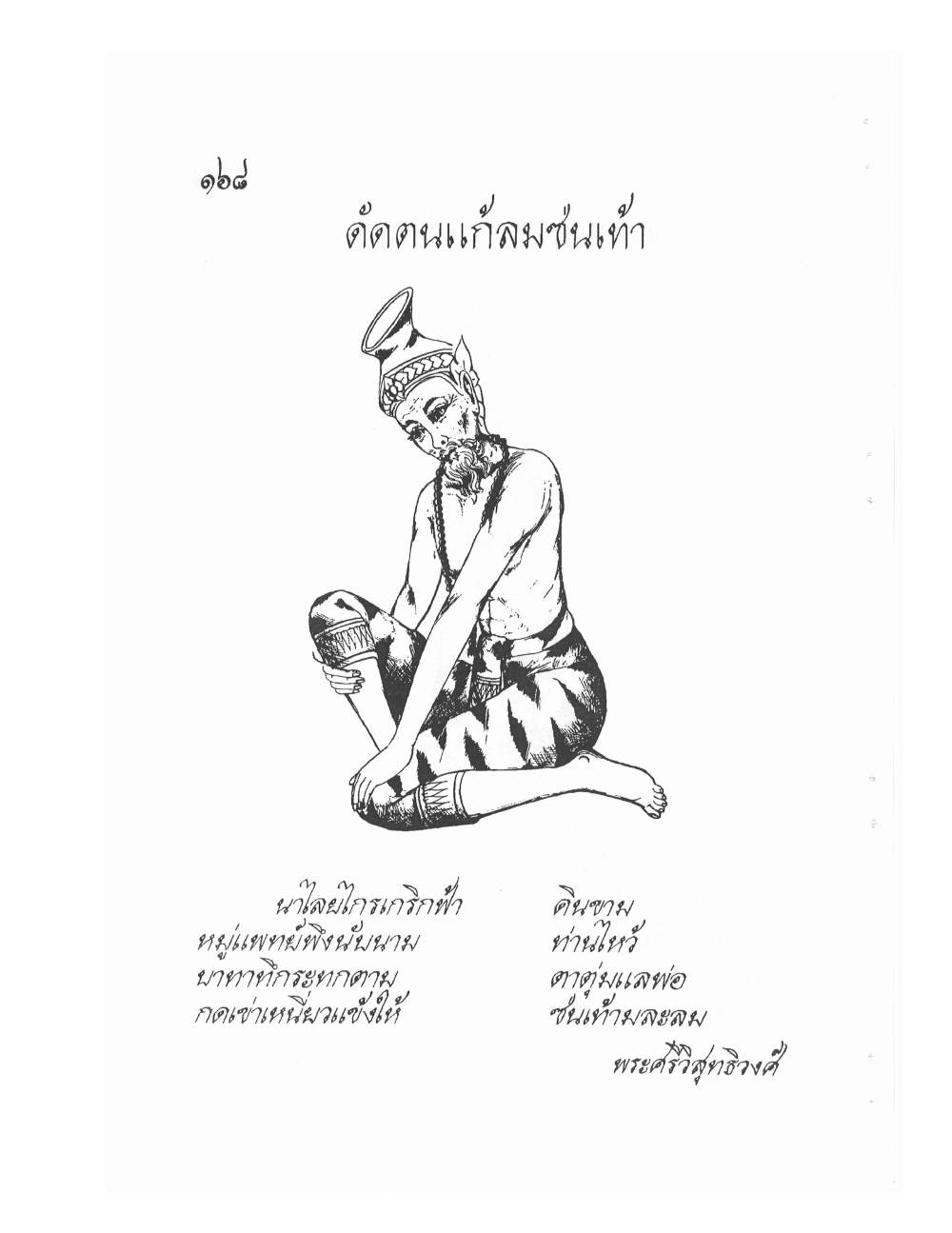
๑๖๘
ดัดตนแก้ลมซ่นเท้า
[ภาพ: นักพรตหน้าม้า สวมหมวกยอดแหลม มีลูกประคำคล้องคอ นุ่งผ้าลายเสือ นั่งพับเพียบ ยกเท้าข้างหนึ่งขึ้น มือจับที่ข้อเท้า] นาไลยไกรเกริกฟ้า ดินซาม หมู่แพทย์พึงนับนาม ท่านไหว้ บาทาทั้งกระทกดาม ตาตุ่มแลพ่อ กดเข่าเหนี่ยวแข็งให้ ซ่นเท้ามละลม พระศรีสุทธิวงศ์
168
Body-twisting to cure numbness/cramping wind in the heel
[Illustration: a horse-headed ascetic wearing a tall pointed hat and a strand of prayer beads, dressed in a tiger-striped wrap, seated with one leg drawn up, gripping his own ankle with his hand] Renowned through heaven and earth alike; physicians ought to reckon and revere his name; the foot is struck and pressed at the ankle-bone, good sir; press the knee, pull it taut and firm — so the wind is driven from the heel. Phra Si Sutthiwong
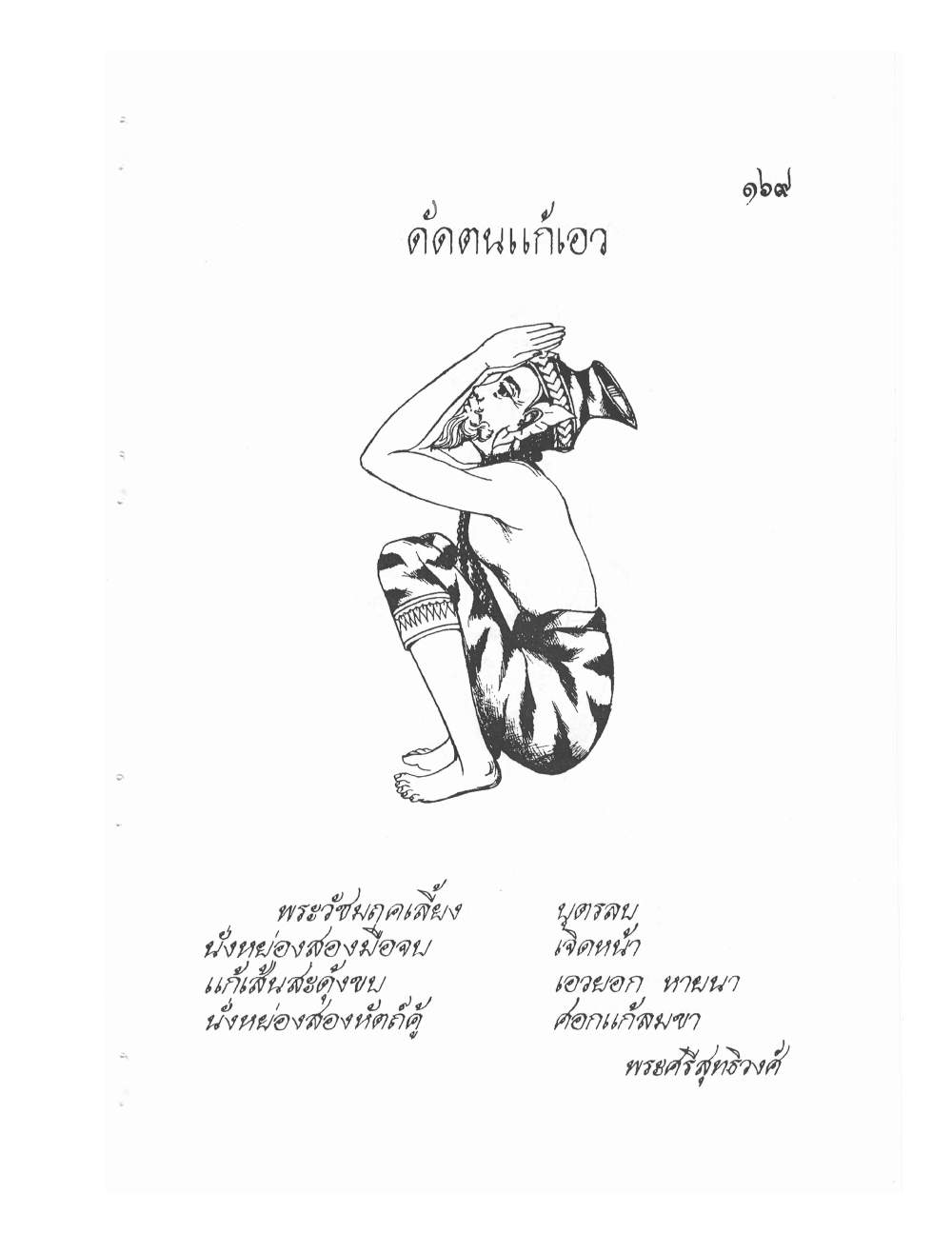
๑๖๙
ดัดตนแก้เอว
[ภาพ: ฤๅษีผมเปีย สวมหมวกยอดแหลม นั่งหย่อง ยกแขนข้างหนึ่งขึ้นแตะที่ศีรษะ อีกขาหนึ่งเหยียดไปข้างหน้า นุ่งผ้าลายเสือ] พระวชิรคุณเลี้ยง บุตรลบ นั่งหย่องสองมือจบ เจิดหน้า แก้เส้นสะดุ้งขบ เอวยอก หายนา นั่งหย่องส่องหัตถ์คู้ ต่อแก้ลมขา พระศรีสุทธิวงศ์
169
Body-twisting to cure the waist
[Illustration: a braided-haired ruesi wearing a tall pointed hat, seated in a crouch with one arm raised, hand touching the head, the other leg stretched forward, dressed in a tiger-striped wrap] Phra Wachirakhun tends his son; seated crouched, both hands joined together, face lifted; this eases the sinews that twinge and clench, and the ache in the waist is relieved; seated crouched, hands folded and bent, carrying on to cure the wind in the leg. Phra Si Sutthiwong
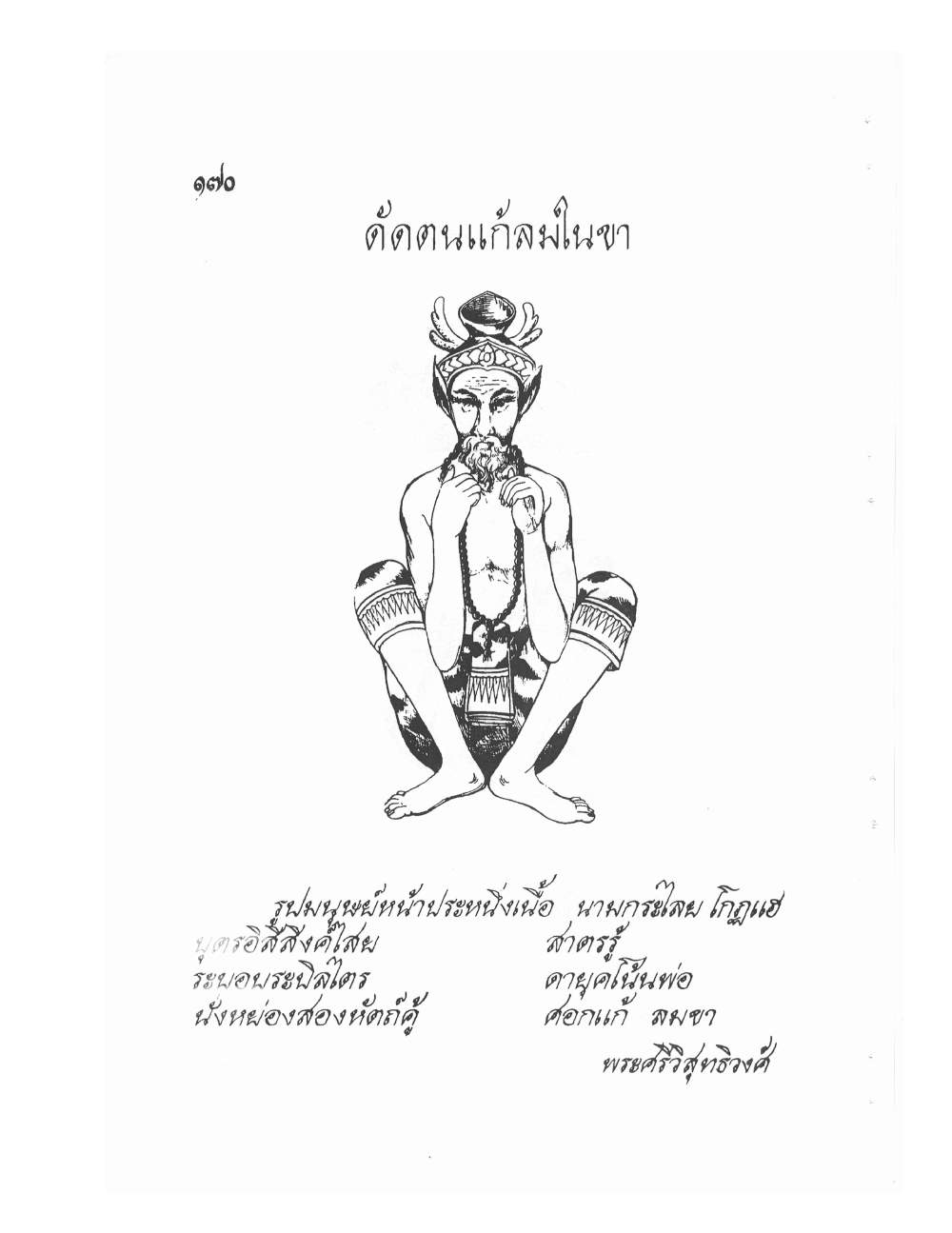
๑๗๐
ดัดตนแก้ลมในขา
[ภาพ: เทพหรือฤๅษีหน้ามนุษย์ สวมหมวกยอดมีปีก นั่งขัดสมาธิ สองมือประนมจับลูกประคำไว้ที่อก] รูปมนุษย์หน้าประหนึ่งเนื้อ นามกรใดลย โกฏแฮ บุตรอิสีสิงห์ใสสย สาตรรู้ ระบอบระบิลไตร ตายุคเดียนพ่อ นั่งหย่องสองหัตถ์คู้ ต่อแก้ลมขา พระศรีสุทธิวงศ์
170
Body-twisting to cure wind in the leg
[Illustration: a deity or ruesi with a human face wearing a tall winged headdress, seated cross-legged, both hands clasped together at the chest holding a strand of prayer beads] A form human of face as if of flesh, whose name is [illegible]; son of the lion-sage, bright and clear, versed in the sciences; following the ancient threefold order, father; seated crouched, both hands folded — this in turn cures the wind in the leg. Phra Si Sutthiwong
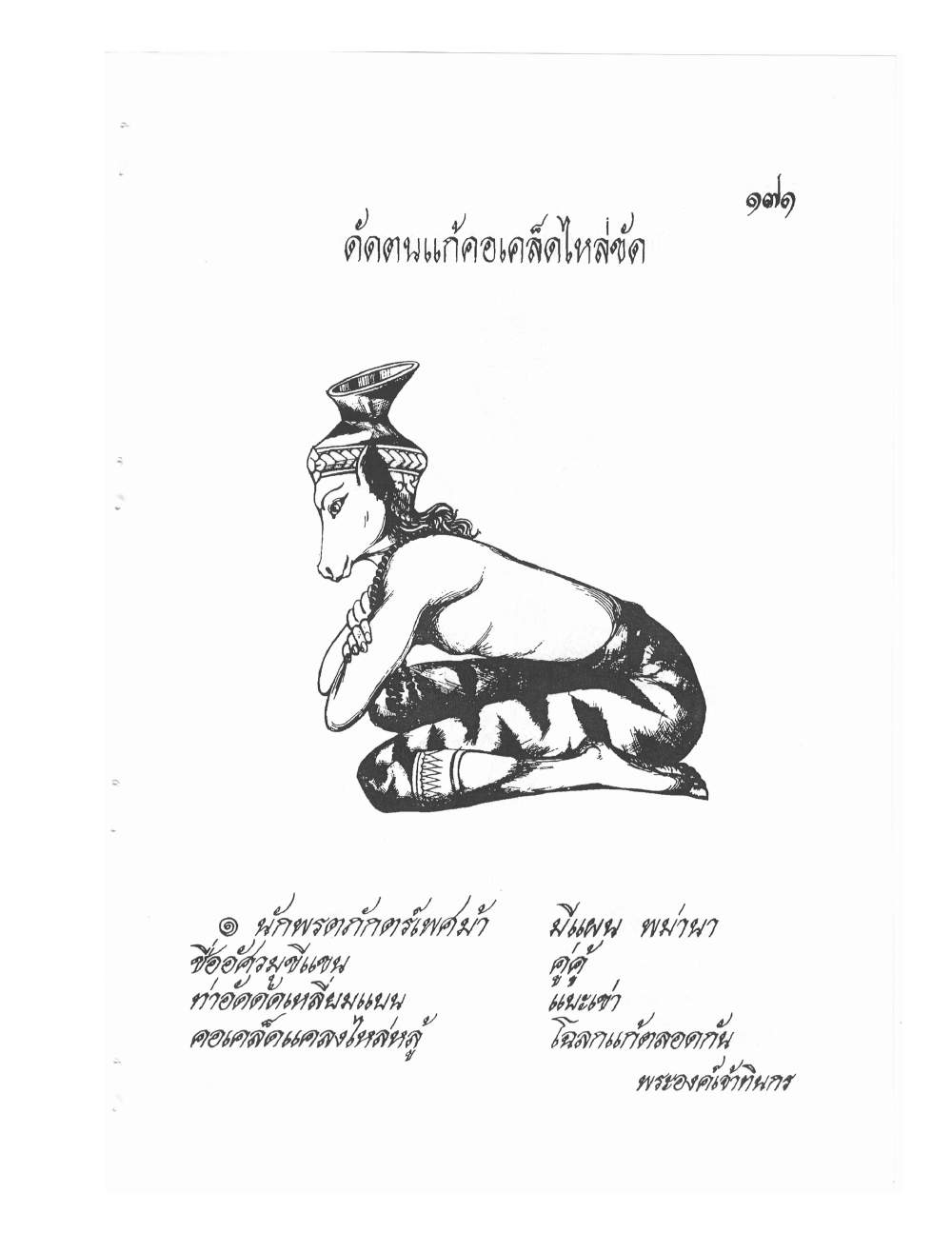
๑๗๑
ดัดตนแก้คอเคล็ดไหล่ขัด
[ภาพ: นักพรตหน้าม้า สวมหมวกยอดแหลม มีลูกประคำคล้องคอ นุ่งผ้าลายเสือ นั่งคุกเข่าตะแคงตัว แขนไขว้กันอยู่ด้านหน้า] ๑ นักพรตกักตร์เพศม้า มิ่งเผ่น พม่านา ชื่ออัศวมุขีแขน คู่คู้ ท่าดัดดั่งเหลี่ยมแบน แนะเข่า คอเคล็ดแคลงไหล่หลู้ โฉลกแก้ตลอดกัน พระองค์เจ้าทินกร
171
Body-twisting to cure a wrenched neck and a jammed shoulder
[Illustration: a horse-headed ascetic wearing a tall pointed hat and a strand of prayer beads, dressed in a tiger-striped wrap, kneeling with the body turned to one side, arms crossed in front of the chest] (1) An ascetic of horse form, a noble creature; named Atsawamukhi, arms folded together; the posture bent at a flat angle, guiding at the knee; this cures a wrenched neck and an aching, jammed shoulder — the remedy carries all the way through. Phra Ong Chao Thinnakon
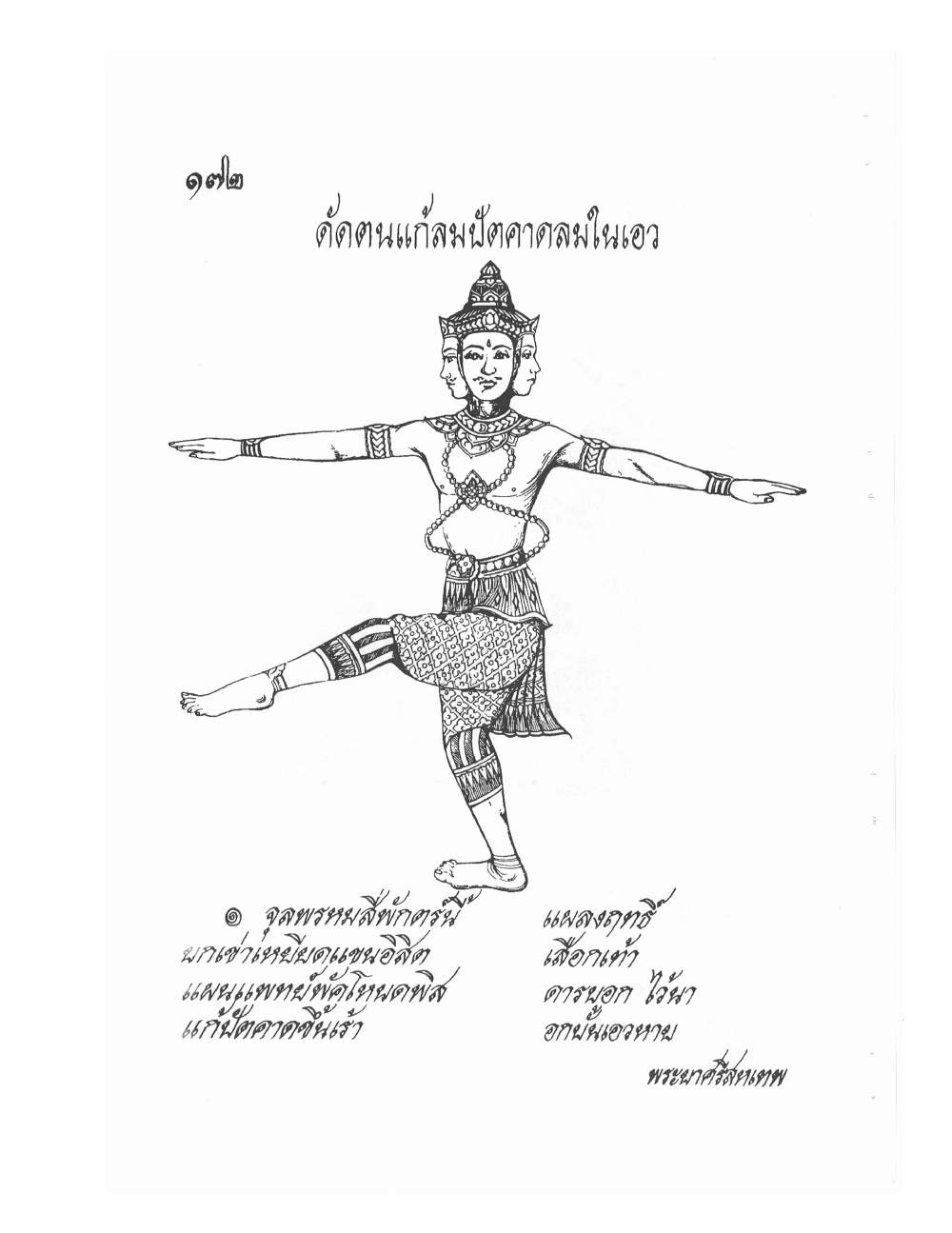
๑๗๒
ดัดตนแก้ลมปัตคาดลมในเอว
[ภาพ: เทพสี่พักตร์ สวมมงกุฎยอดแหลมประดับลวดลาย แขนสองข้างกางออกเสมอไหล่ ยกขาข้างหนึ่งเหยียดออกด้านข้าง นุ่งผ้ายกลายดอก] ๑ จุลพรหมสี่พักตร์ตั้ง แผลงฤทธิ์ ยกเข่าเหยียดแขนอิสต์ เสือกเท้า แผนแพทย์พู้เห็นพิศ ดารมูล ไว้นา แก้ปัตคาดขึ้นเร้า อกผัวเอวหาย พระยาศรีสหเทพ
172
Body-twisting to cure patkhat-wind and wind in the waist
[Illustration: a four-faced deity wearing an ornate pointed crown, both arms stretched out level with the shoulders, one leg raised and extended to the side, dressed in a patterned brocade sarong] (1) The young four-faced Brahma displays his power; knee raised, arm stretched to the side, foot thrust out; the tradition of medicine, on close examination, records the root of it, indeed; this cures patkhat that flares in the chest, and eases the waist. Phraya Si Sahathep
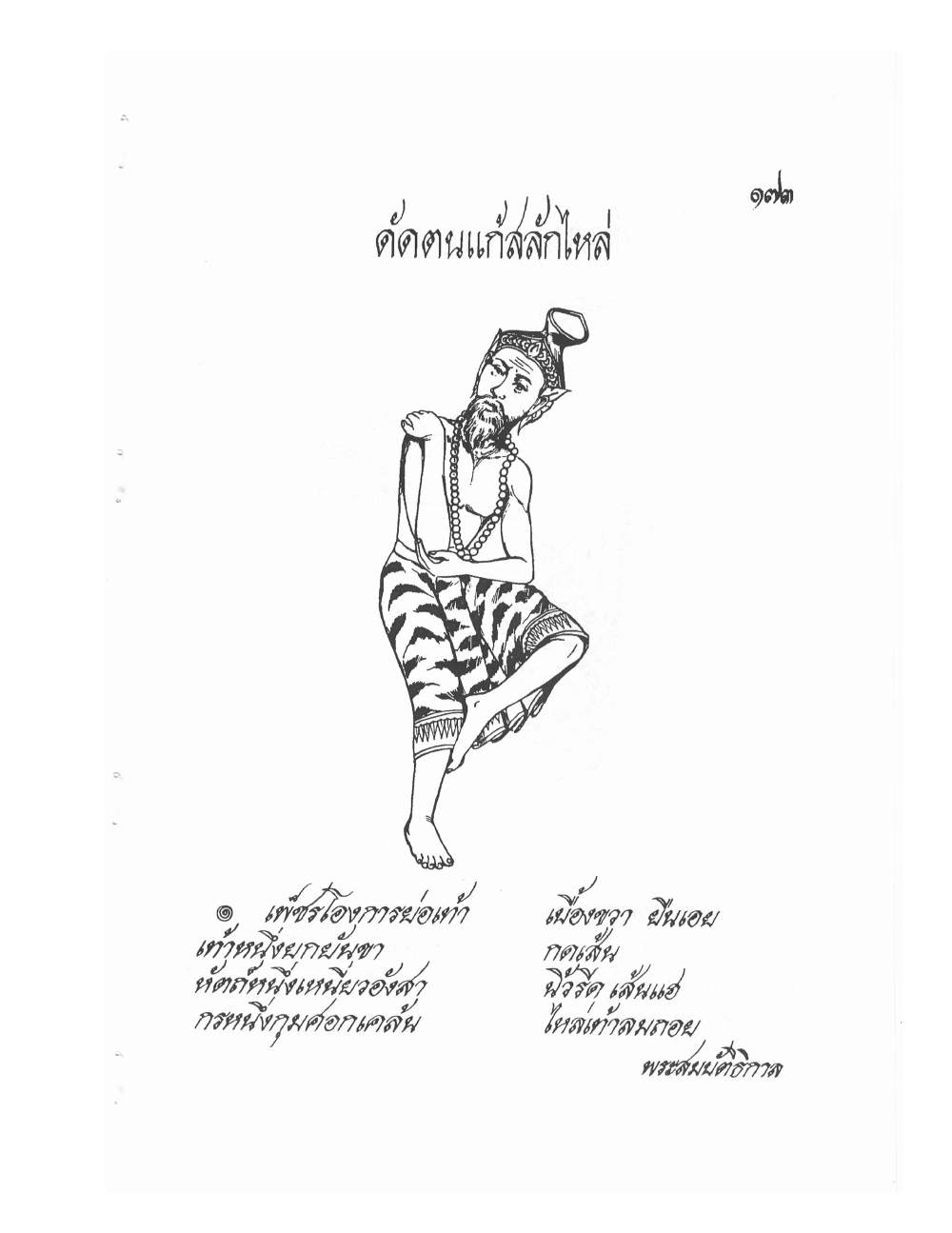
๑๗๓
ดัดตนแก้ลมล้าไหล่
[ภาพ: ฤๅษีสวมหมวกยอดแหลม มีลูกประคำคล้องคอ นุ่งผ้าลายเสือ นั่งพับขาข้างหนึ่ง ยกแขนข้างหนึ่งขึ้นเหนี่ยวเหนือศีรษะ] ๑ เพชรโองการย่อเท้า เมืองขวา ฝันเอย เท้าหนึ่งยกยันขา กดเส้น หัตถ์หนึ่งเหนี่ยวองสา ฝีจริตเส้นแฮ กรหนึ่งกุมคอเคล่น ไหล่เท้าลมถอย พระสมมติอมรพันธุ์
173
Body-twisting to cure fatigue-wind in the shoulder
[Illustration: a ruesi wearing a tall pointed hat and a strand of prayer beads, dressed in a tiger-striped wrap, seated with one leg folded, one arm raised and gripping above the head] (1) The mighty decree draws the foot back to the right, as though in a dream; one foot is raised, braced against the leg, pressing the sinew; one hand grips the upper arm — such is the way of that sinew; one arm cradles the neck, curved — and the wind withdraws from shoulder and foot. Phra Sommuti Amonphan
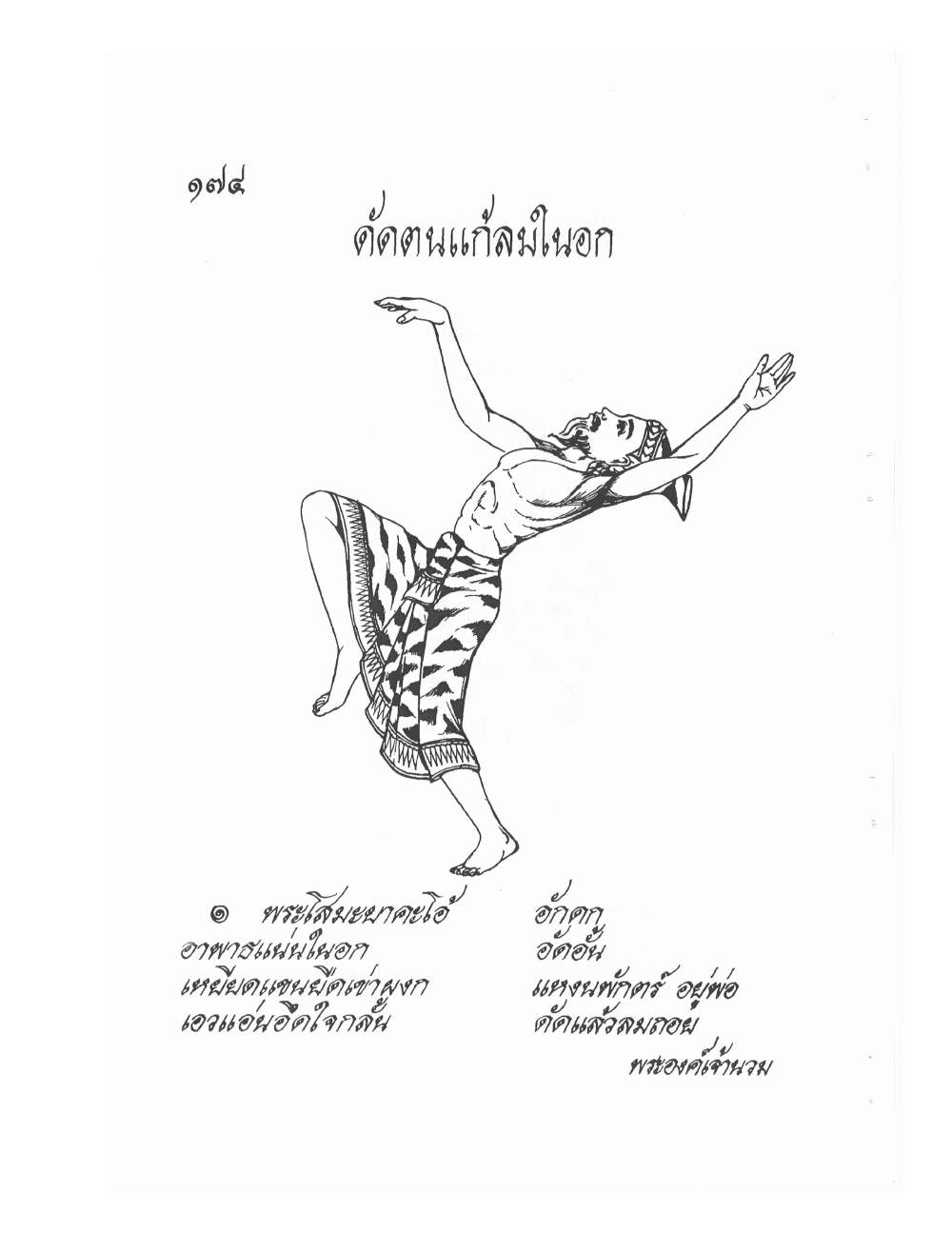
๑๗๔
ดัดตนแก้ลมในอก
[ภาพ: ร่างฤๅษีเอนตัวไปข้างหลัง แขนข้างหนึ่งยกขึ้นเหนือศีรษะ อีกข้างเหยียดออกด้านข้าง ขาข้างหนึ่งยกขึ้น หน้าแหงนขึ้น ผ้าคาดเอวปลิว] ๑ พระโสมยาคะโอ้ อกดุก อาพาธแน่นในอก อัดอั้น เหยียดแขนเซนยื้อเข่าผงก แหงนพักตร์ อยู่พ่อ เอวแอ่นอัดใจกลั้น ดัดแล้วลมถอย พระองค์เจ้านวม
174
Body-twisting to cure wind in the chest
[Illustration: a figure leaning far back, one arm raised overhead and the other stretched out to the side, one leg raised, the face tilted upward, a sash trailing loose at the waist] (1) Phra Som, alas — the chest throbs and aches; the affliction sits tight in the chest, stifling and confined; stretch the arm, strain, tilt the knee upward, face turned up, good sir; the waist arches, the breath held tight — once twisted, the wind subsides. Phra Ong Chao Nuam
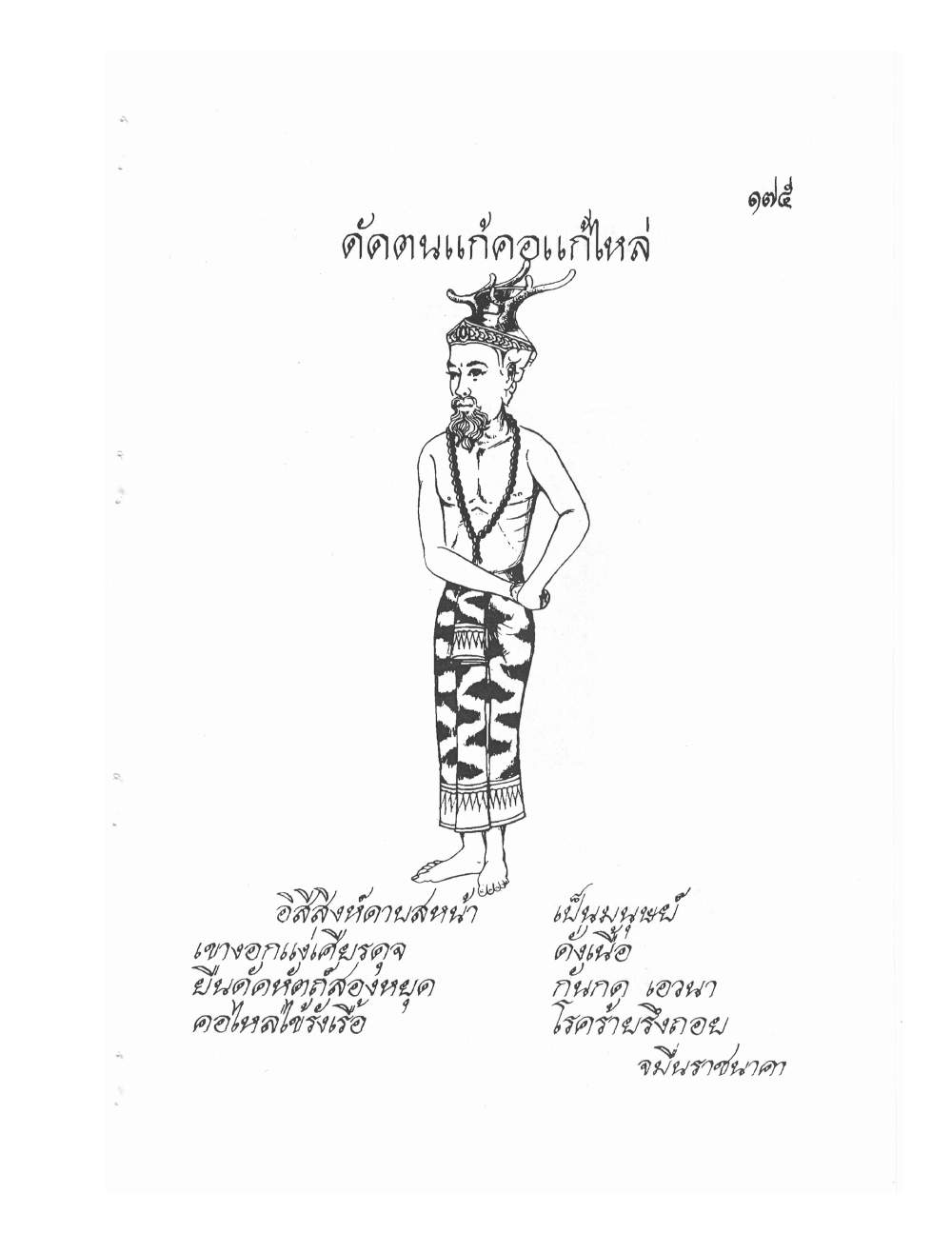
๑๗๕
ดัดตนแก้คอแก้ไหล่
[ภาพ: ฤๅษีสิงห์หน้ามนุษย์ สวมหมวกประดับเขาแตกกิ่ง มีลูกประคำคล้องคอ ยืนมือหนึ่งเท้าเอว อีกมือไขว้ไว้ นุ่งผ้าลายเสือ] อิสีสิงห์ดาบสหน้า เป็นมนุษย์ เขางอกแง่งเขี้ยวดุจ ดั่งเนื้อ ยืนคัดหัตถ์สองหยุด กันกด เอวนา คอไหล่ไข้รังเรื้อ โรคร้ายสิ้นถอย จมื่นราชนาคา
175
Body-twisting to cure the neck and to cure the shoulder
[Illustration: a lion-sage ascetic with a human face, wearing a headdress adorned with branching horns and a strand of prayer beads, standing with one hand on the hip and the other arm crossed, dressed in a tiger-striped wrap] The lion-sage ascetic, human of face; his horns branch out like fangs, resembling those of a beast; standing, both hands drawn back and stilled, pressing at the waist; the lingering illness of neck and shoulder — the malignant disease withdraws entirely. Chamuen Ratnaka
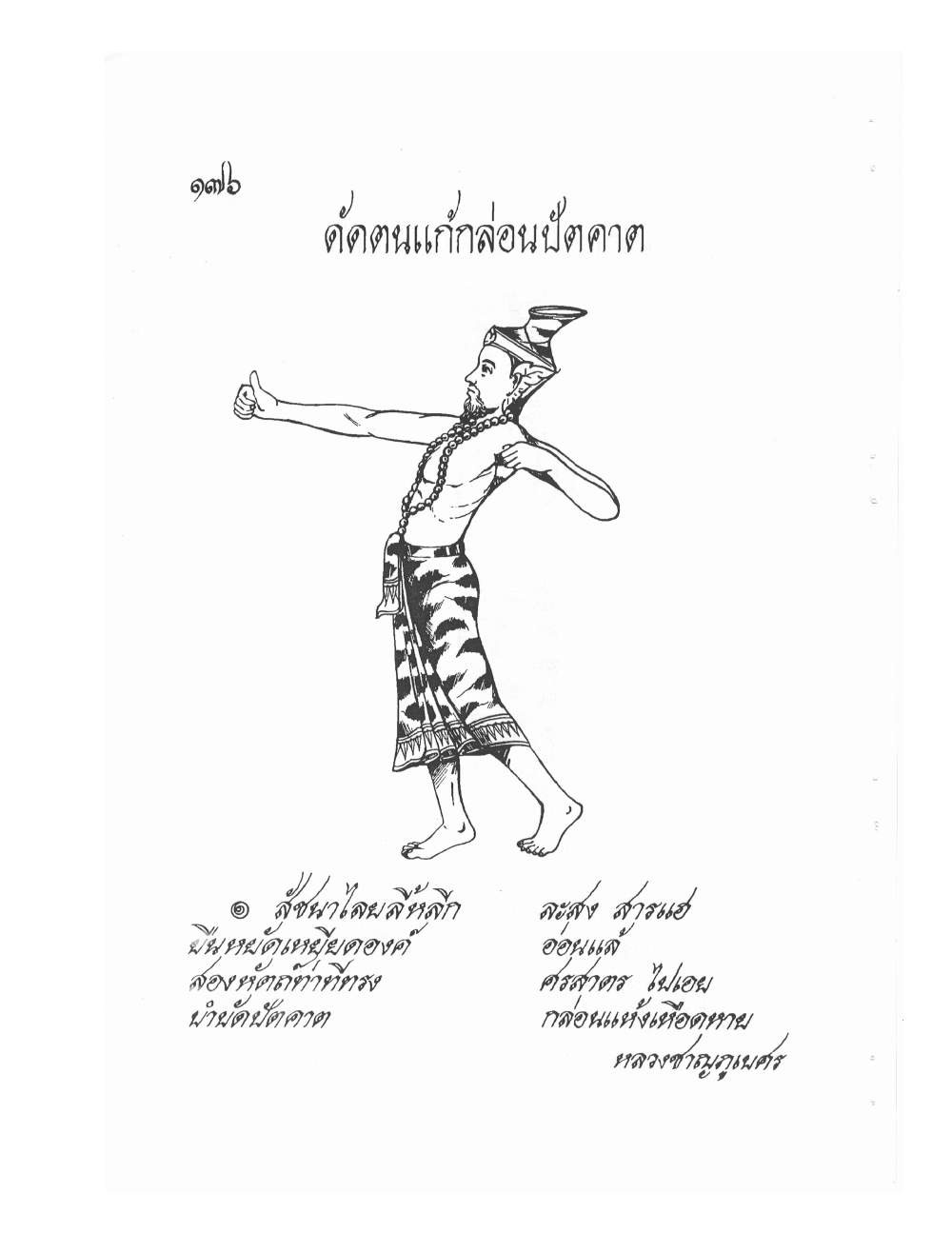
๑๗๖
ดัดตนแก้กล่อนปัตคาด
[ภาพ: ฤๅษีสวมหมวกยอดแหลม ก้าวเดิน แขนข้างหนึ่งเหยียดไปข้างหน้าชูนิ้วโป้ง อีกแขนหักไปด้านหลังที่ไหล่ นุ่งผ้าลายเสือ] ๑ สัชฌาไลยลี้หลีก ละสง สารแฮ ยืนหยัดเหยียดองค์ อ่อนแล่ สองหัตถ์ท่าที่ทรง ศรสาตร ไปเอย น้าวดัดปัตคาด กล่อนแห้งเหือดหาย หลวงสาญกูเมศร
176
Body-twisting to cure kalon and patkhat
[Illustration: a ruesi wearing a tall pointed hat, striding forward, one arm extended ahead with the thumb raised, the other arm bent back at the shoulder, dressed in a tiger-striped wrap] (1) Withdrawn into contemplation, letting go of the message, indeed; standing firm, the body stretched, supple; both hands take the stance of one who holds the bow and arrow, go on; drawing and twisting cures the patkhat — the kalon dries up and is gone. Luang Sankumet
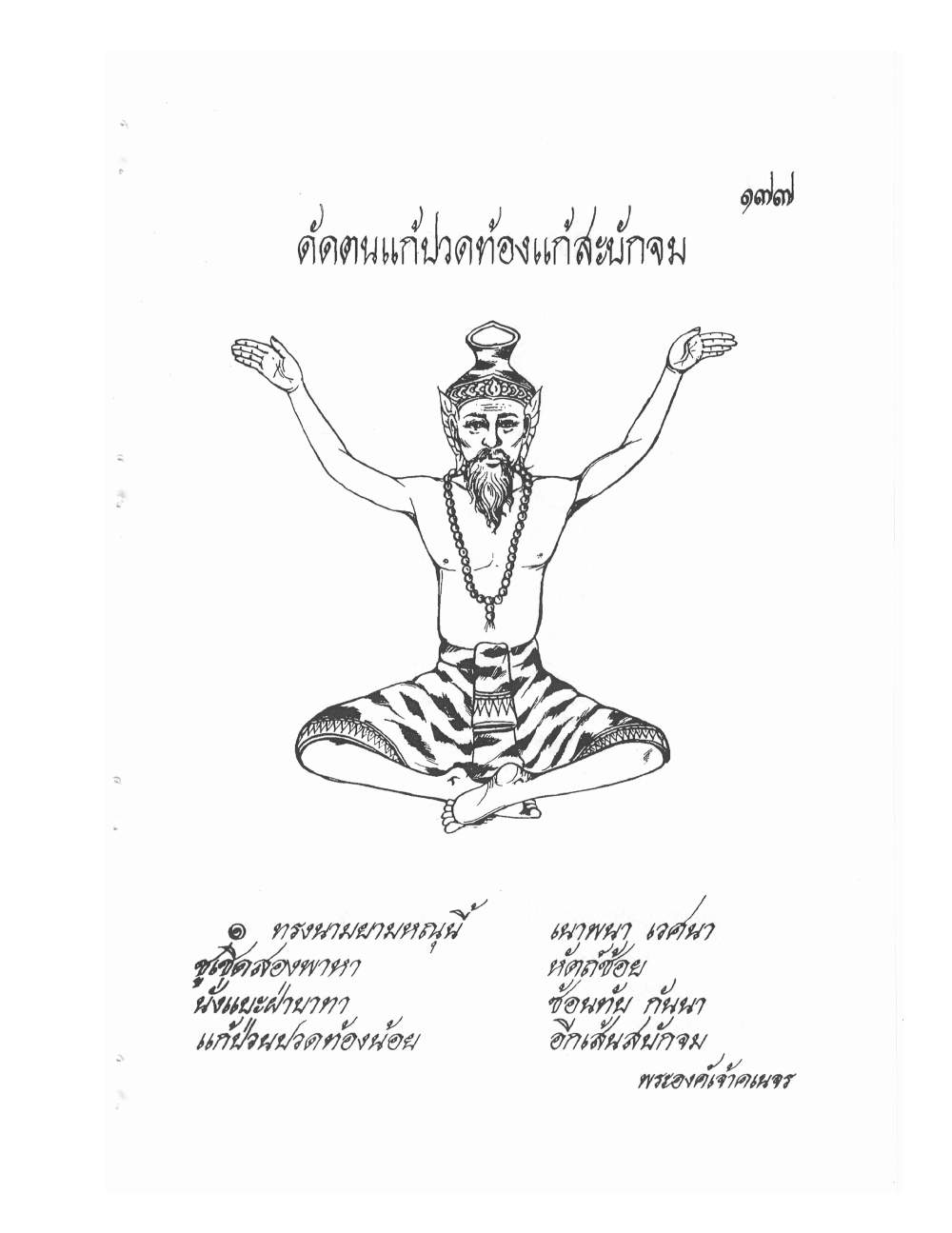
๑๗๗
ดัดตนแก้ปวดท้องแก้สะบักจม
[ภาพ: ฤๅษีสวมหมวกยอดแหลม มีลูกประคำคล้องคอ นั่งขัดสมาธิ ยกแขนทั้งสองข้างกางออกเสมอไหล่ นุ่งผ้าลายเสือ] ๑ ทรงนามยามหิรัญนี้ เผาพนา เวศนา ชูเข่าดั้งสองพาหา หัตถ์ทั้งข้อย นั่งเหมะฝ่ายบาทา ซ้อนทับ กันนา แก้ป่วนปวดท้องน้อย อึกเสี้ยนสะบักจม พระองค์เจ้าคเนจร
177
Body-twisting to cure stomach ache and cure a sunken shoulder blade
[Illustration: a ruesi wearing a tall pointed hat and a strand of prayer beads, seated cross-legged, both arms raised out to the sides level with the shoulders, dressed in a tiger-striped wrap] (1) Bearing this golden name, dwelling in the forest tract; both arms raised alongside the knees, hands as well; seated properly, the feet folded one over the other; this cures the churning ache of the lower belly, and the jammed, sunken shoulder blade. Phra Ong Chao Khanechon
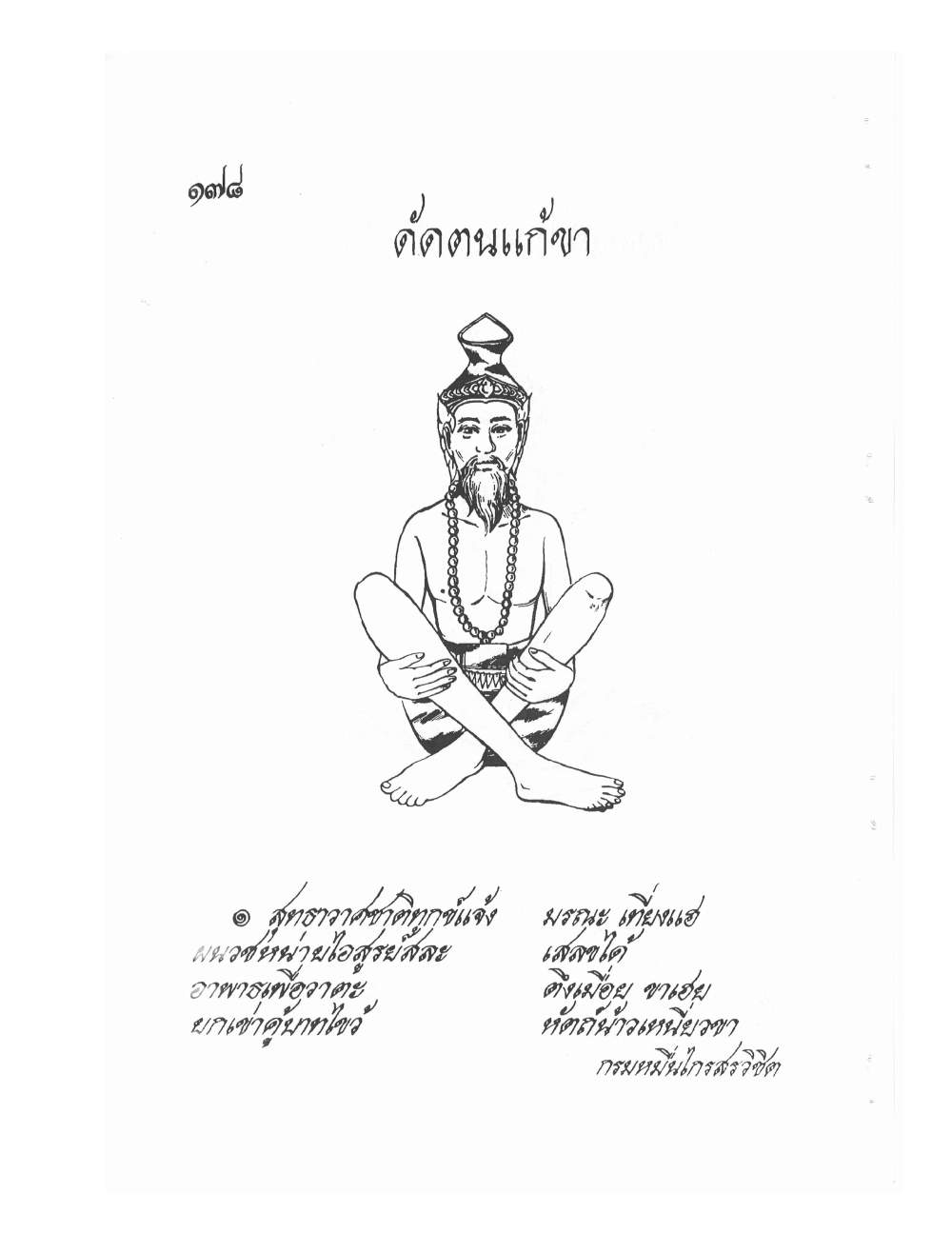
๑๗๘
ดัดตนแก้ขา
[ภาพ: ฤๅษีสวมหมวกยอดแหลม มีลูกประคำคล้องคอ นั่งไขว้ขาทั้งสองข้าง มือทั้งสองจับที่ขา] ๑ สุทธาวาสชาติทุกข์แจ้ง ผนวชหน่ายไอสูรย์สละ มรณะ เที่ยงแฮ อาพาธเพื่อชาติ เสลขได้ ยกเข่าคู้บาทไขว้ ตั้งเมื่อย ขาเอย หัตถ์น้าวเหนี่ยวขา กรมหมื่นไกรสรวิชิต
178
Body-twisting to cure the leg
[Illustration: a ruesi wearing a tall pointed hat and a strand of prayer beads, seated with both legs crossed, both hands gripping the legs] (1) In the Pure Abode the suffering of birth is made plain; having gone forth, wearied of glory, letting it go — death is certain indeed; affliction comes for the sake of birth, [illegible]; raise the knee, cross the feet, bent — the leg grows weary, oh; the hand draws and pulls at the leg. Krommuen Kraisonwichit
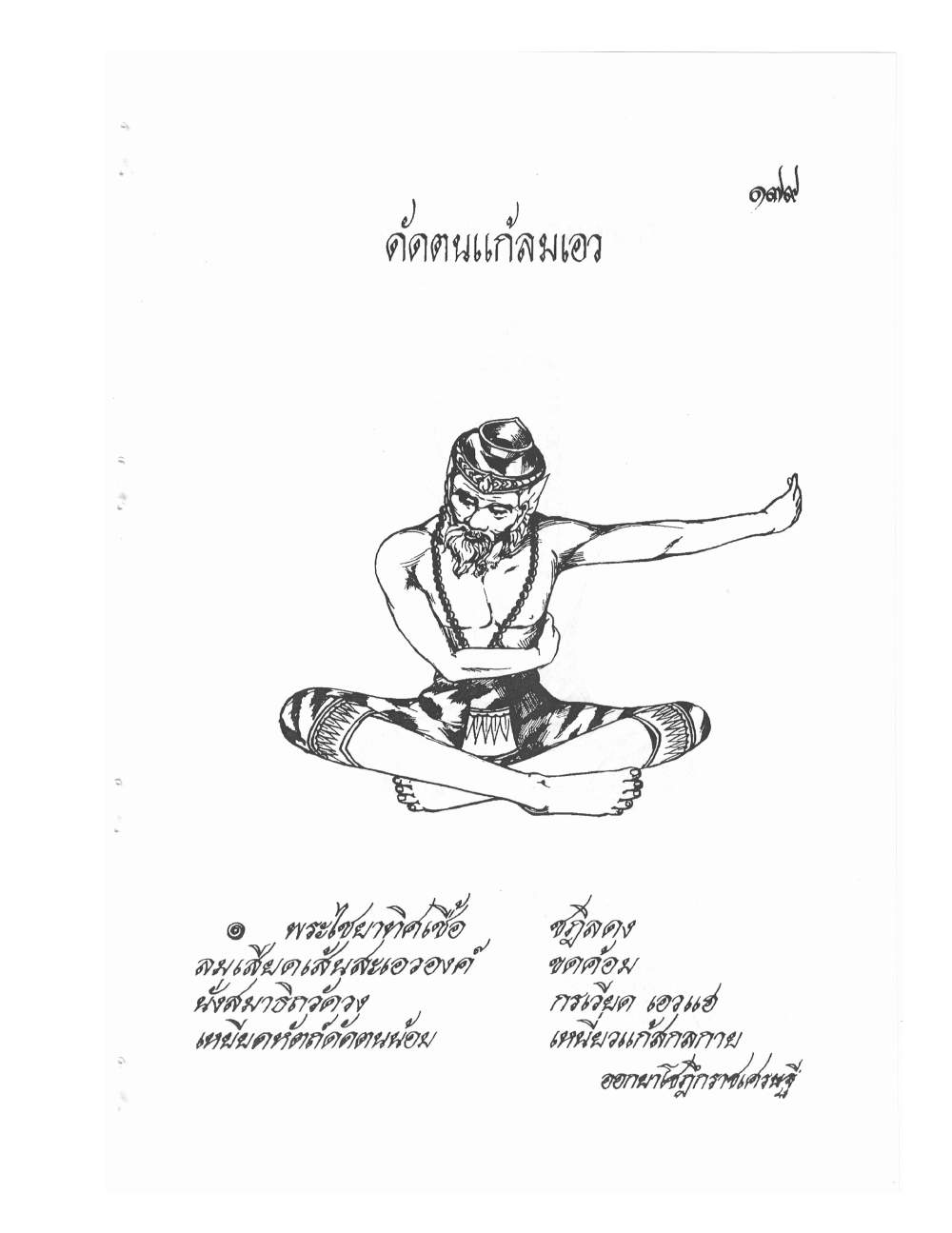
๑๗๙
ดัดตนแก้ลมเอว
[ภาพ: ฤๅษีนั่งขัดสมาธิ สวมหมวกยอดแหลมมีลวดลาย คล้องลูกประคำที่คอ นุ่งผ้าลายเสือ แขนขวาไขว้กอดตัว แขนซ้ายเหยียดตรงออกไปด้านข้างระดับไหล่ ปลายนิ้วกระดกขึ้น] ๏ พระไชยาทิศเชื้อ ชฎิลดง ลมเสียดเส้นสยเอวองค์ ขดค้อม นั่งสมาธิถีบด้วง กรีเดียด เอวแอ่น เหมือนหัตถ์ตัดตนผ่อน เหนี่ยวแก้สกลกาย [อ่านไม่ออก]
179
Stretch to cure wind in the waist
[illustration: a hermit-sage sits cross-legged, wearing a pointed, patterned tiered cap and a beaded mala around his neck, dressed in tiger-striped cloth; his right arm crosses over his own torso while his left arm is extended straight out to the side at shoulder height, fingers raised] Phra Chaiyathit-chuea, forest ascetic — when wind pierces the tendons and twists the waist into a curl, sit in the meditation posture, pressing down, arching the waist, as though by hand untying and easing the whole body.
[illegible — closing attribution line]
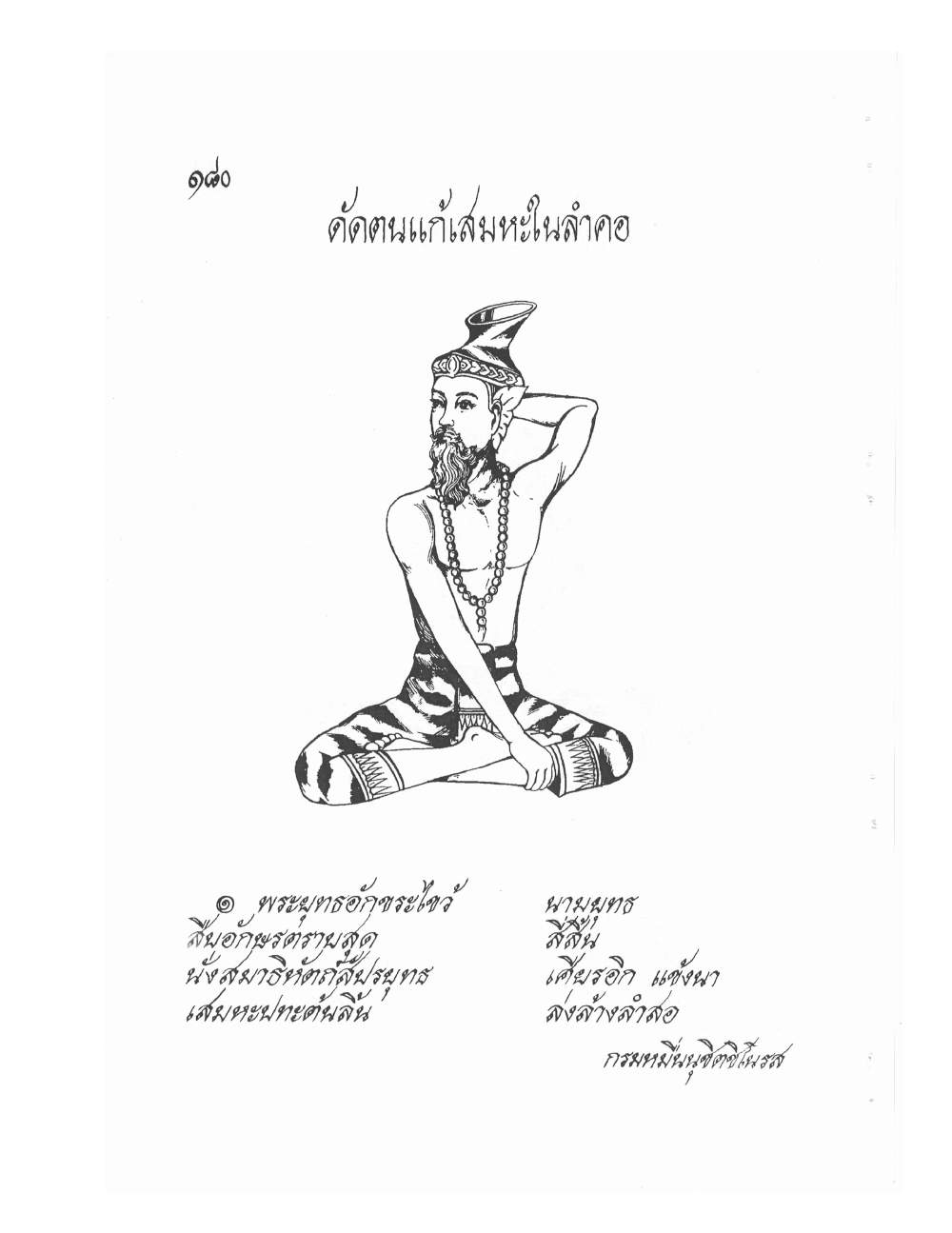
๑๘๐
ดัดตนแก้เสมหะในลำคอ
[ภาพ: ฤๅษีนั่งขัดสมาธิ สวมหมวกทรงแหลมโค้ง คล้องลูกประคำ มือขวายกขึ้นเกี่ยวไว้เหนือศีรษะ มือซ้ายจับข้อเท้าซ้ายที่ยกพาดขึ้นมา นุ่งผ้าลายเสือ] ๏ พระพุทธอักขระไขว้ นามพุทธ สิ้นอักษรตรามสุด สิ้นสิ้น นั่งสมาธิหัตถกลืนพุทธ เคี้ยวอิก แซ่งนา เสมหะฝาดตัดลิ้น ลงล้างลำสอ กรมหมื่นนุชิตชิโนรส
180
Stretch to cure phlegm in the throat
[illustration: a hermit-sage sits cross-legged, wearing a curved, pointed cap and a beaded mala; his right hand is raised and hooked above his head, his left hand grips his own left ankle, which is drawn up; he wears tiger-striped cloth] The Buddha's sacred syllables entwined, in the Buddha's name — when the letters run out, all is consumed, entirely — sit in meditation, the hand as if swallowing the Buddha['s word], chewing, reciting again and again — the astringent phlegm that cuts at the tongue is washed clean down the throat. Krommuen Nuchit Chinorot
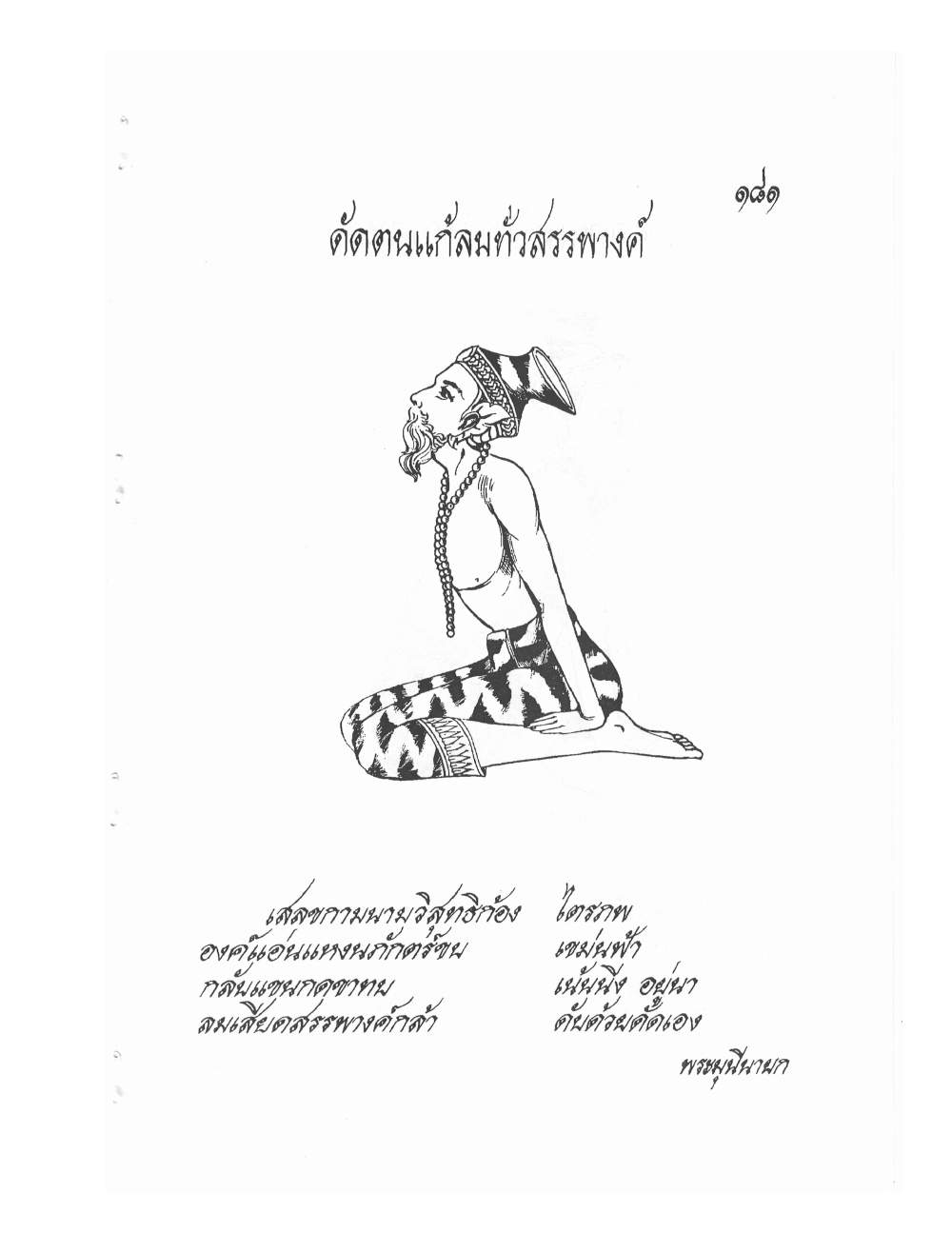
๑๘๑
ดัดตนแก้ลมทั่วสรรพางค์
[ภาพ: ฤๅษีคุกเข่าตัวตั้งตรง แหงนหน้าเงยขึ้นสุด คล้องลูกประคำห้อยยาว มือขวายันพื้นข้างเท้าที่เหยียดไปด้านหลัง สวมหมวกทรงแหลม นุ่งผ้าลายเสือ] เสลขกามนามจิสุทธิก้อง ไตรภพ องค์แอ่นแหงนภักตร์ชม เขม่นฟ้า กลมแขนกดขาทน เหนี่ยวนิ่ง อย่านา ลมเสียดสรรพางค์กล้า ดับด้วยดัดเอง พระมุนีนาก
181
Stretch to cure wind throughout the whole body
[illustration: a hermit-sage kneels upright, head thrown all the way back, a long mala hanging down; his right hand presses the ground beside a leg stretched out behind him; he wears a pointed cap and tiger-striped cloth] One whose pure name resounds through the three worlds — body arched, face lifted, gazing, twitching toward the sky — rounding the arm, pressing down on the leg, holding steady, do not [stop] — the fierce wind piercing the whole body is quelled by the stretching itself. Phra Munee Nak
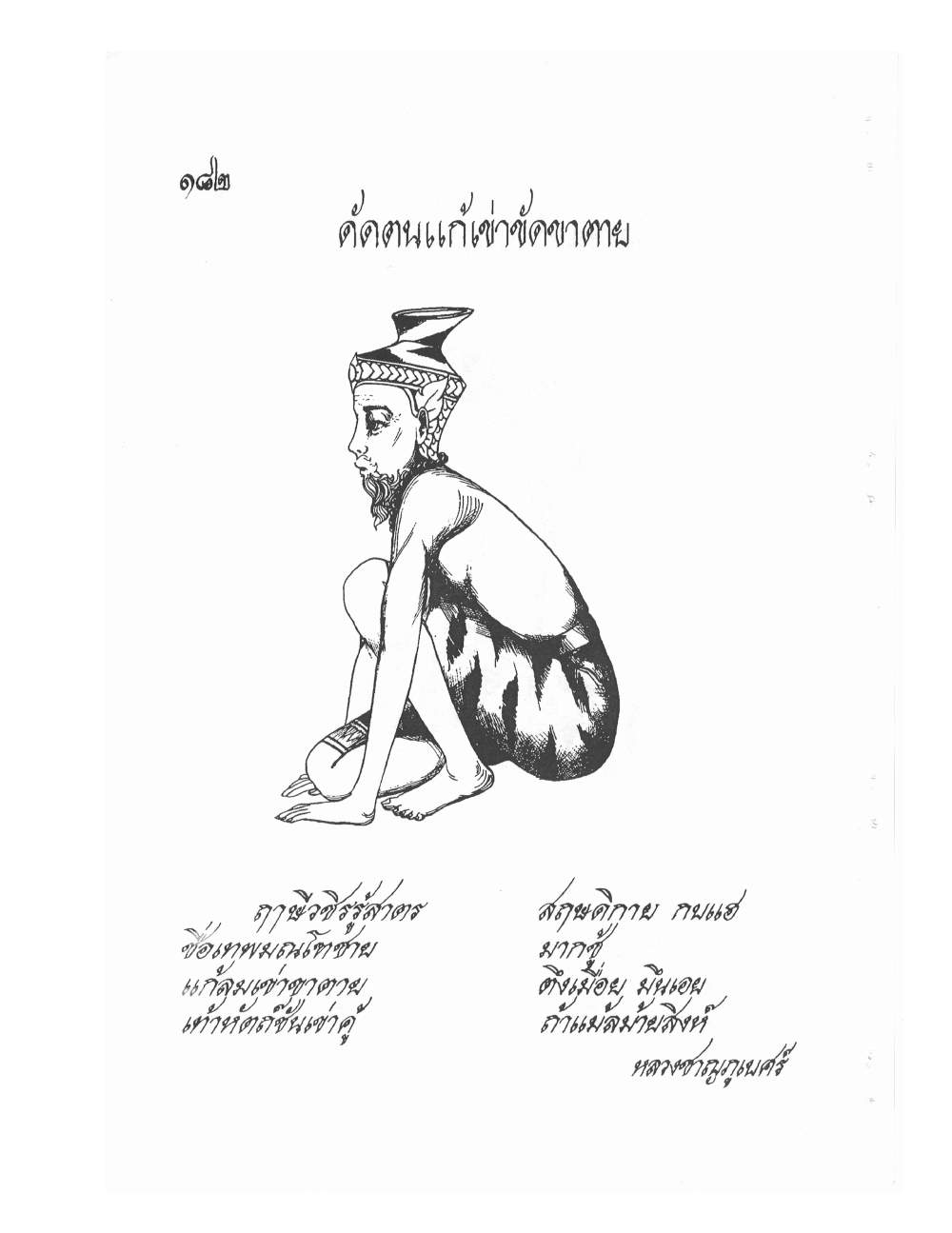
๑๘๒
ดัดตนแก้เข่าขัดขาตาย
[ภาพ: ฤๅษีนั่งยองๆ ตัวเอียงข้าง มือสองข้างประสานจับที่หัวเข่า ศีรษะสวมหมวกทรงแหลม คล้องลูกประคำ นุ่งผ้าลายเสือ] กายฤๅชีรีสวาตร สถนดีกาย กมแฮ ชื่อเทพมณีโชติชาย มากขู้ แกล้งเข่าขาดาย ดึงเมื่อย มันเอย เท่าหัตถ์ชิดเข่าคู่ ถ่ายเม็ดม้ายสิงห์ หลวงชาญเวชศาสตร์
182
Stretch to cure a stiff knee and a numb leg
[illustration: a hermit-sage squats low with his body turned to the side, both hands clasped together at the knee; he wears a pointed cap and a beaded mala, dressed in tiger-striped cloth] The body of the sage, well-formed and composed — named the bright, radiant jewel of the devas — deliberately working the stiff, dead-feeling knee and leg, pulling against the ache — hand brought level and close against the drawn-up knee, [relieving] the affliction. Luang Chan Wetsat
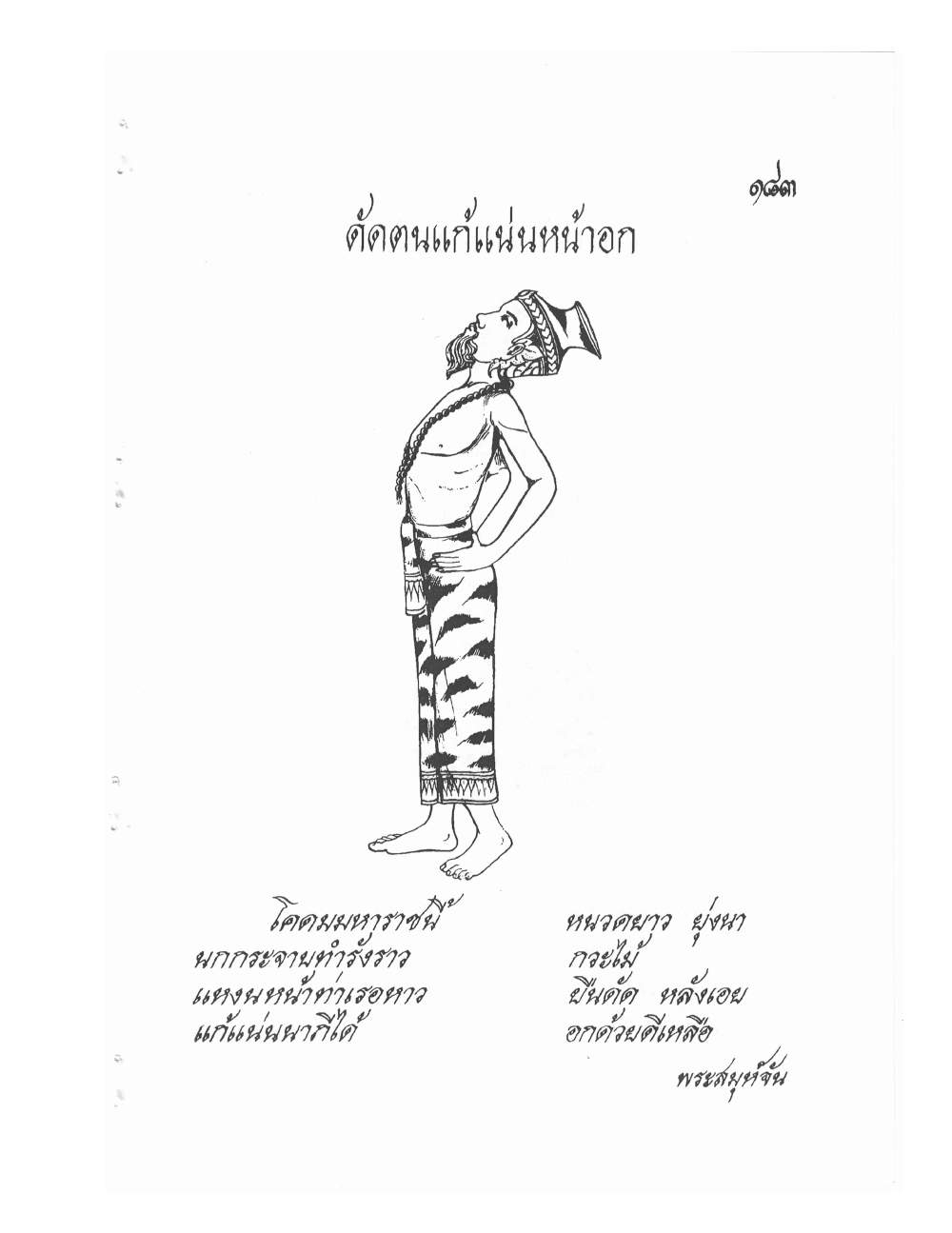
๑๘๓
ดัดตนแก้แน่นหน้าอก
[ภาพ: ฤๅษียืนตัวตรง แหงนหน้าเงยขึ้นสุด มือขวาเท้าสะเอว มือซ้ายห้อยลง สวมหมวกทรงแหลม คล้องลูกประคำ นุ่งผ้าลายเสือ] โคดมมหาราชนี้ หนวดยาว ยุ่งนา ผกกระจายทำรังรวง กวะไม้ แหงนหน้าท่าเรือหาว ยื่นคัด หลังเอย แก้แน่นผาถีได้ อกด้วยดีเหลือ พระสมุห์จัน
183
Stretch to cure tightness in the chest
[illustration: a hermit-sage stands upright, head thrown all the way back, right hand resting on the hip, left hand hanging at his side; he wears a pointed cap and a beaded mala, dressed in tiger-striped cloth] This great Gotama, with a long, unruly beard — like a bird scattering to build its nest upon a branch — head lifted back in the posture of a yawning boat, the back pushed straight and arched — this relieves the oppressive tightness, and the chest is made well indeed. Phra Samuha Chan
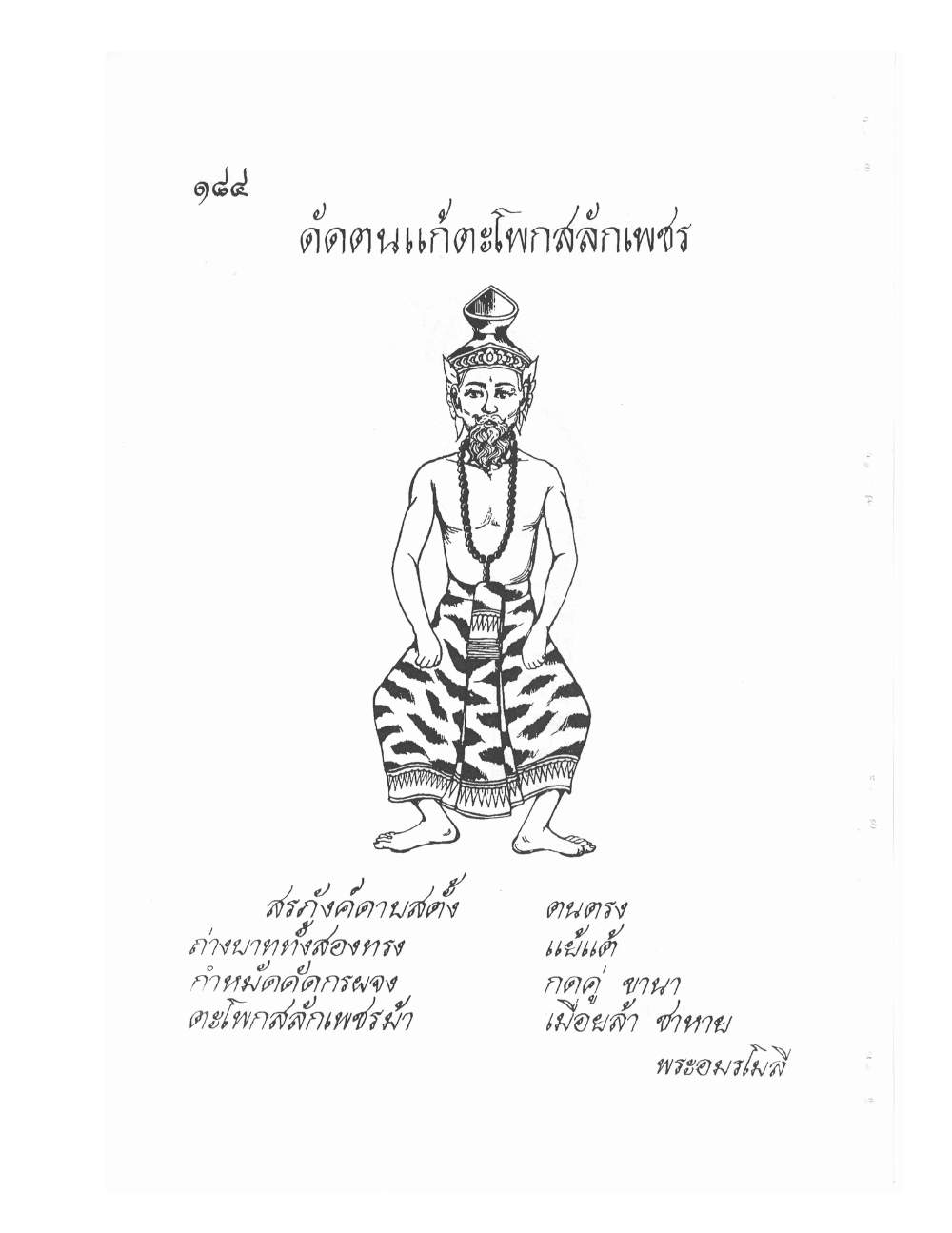
๑๘๔
ดัดตนแก้ตะโพกสลักเพชร
[ภาพ: ฤๅษียืนตัวตรง หันหน้าตรง สวมหมวกทรงกรวยคว่ำ มีลวดลายประดับ คล้องลูกประคำ สองมือวางแนบข้างลำตัว นุ่งผ้าลายเสือแบบหลวมยาว] สรกังค์ดายสดัง ตนตรง ถ่างขาทั้งสองทรง แย้มแต้ กำหมัดคู่กรผจง กดคู่ ขานา ตะโพกสลักเพชรม้ำ เมื่อยล้า ซ่าหาย พระอมรโมลี
184
Stretch to cure aching in the hip and sacrum
[illustration: a hermit-sage stands facing forward, upright, wearing an inverted cone-shaped, decorated cap and a beaded mala, both hands resting at his sides, dressed in a long, loose tiger-striped garment] [first line uncertain — describing the body held straight] spreading both legs apart, standing firm — clenching both fists deliberately, pressing evenly against both legs — the deep ache lodged in the hip and sacrum, wearied and worn, is dispelled and eased. Phra Amon Molee
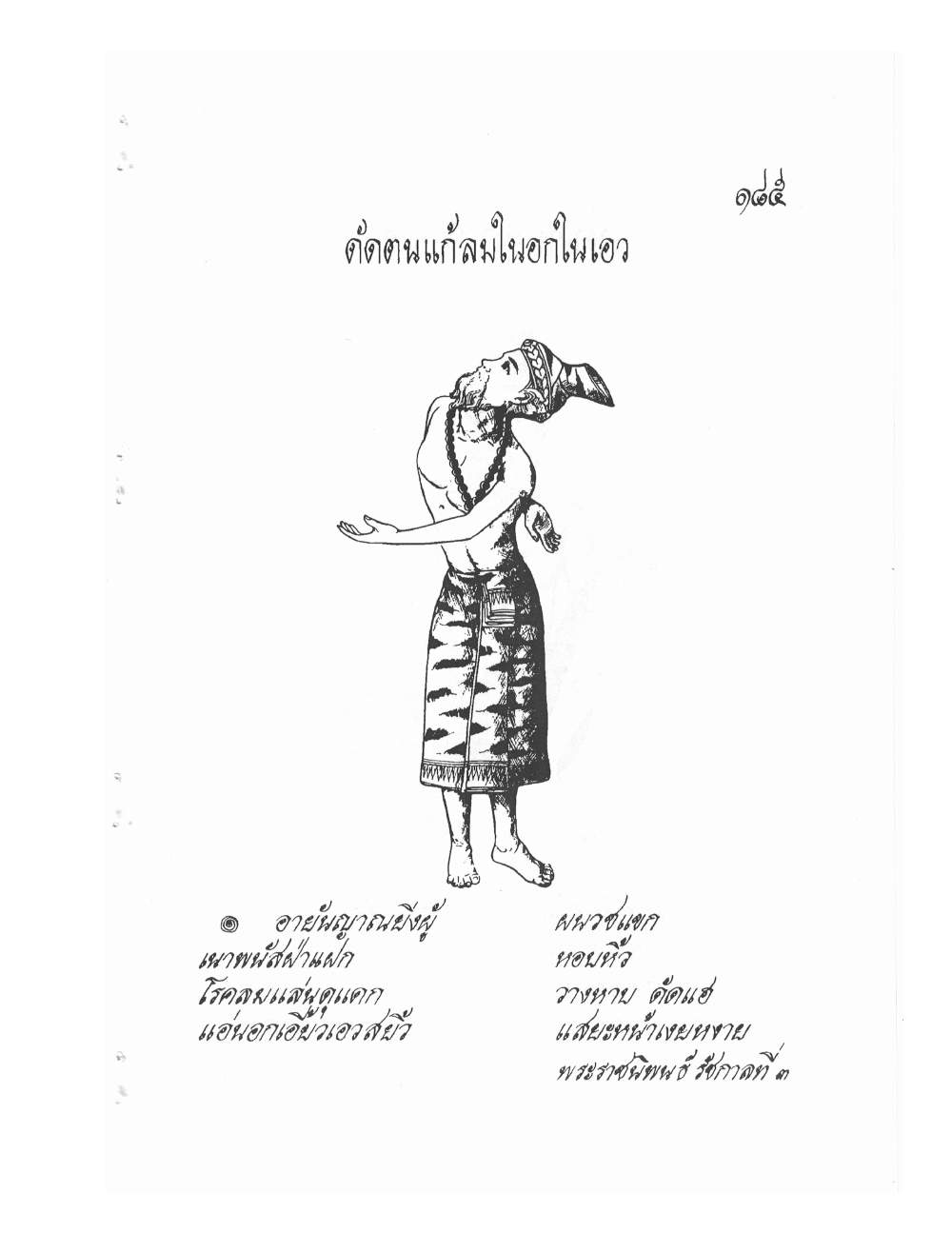
๑๘๕
ดัดตนแก้ลมในอกในเอว
[ภาพ: ฤๅษียืน แหงนหน้าเงยขึ้นสุด มือขวาเหยียดออกไปด้านหน้าระดับเอว ฝ่ามือหงายขึ้น มือซ้ายพับไว้ข้างหลัง สวมหมวกทรงแหลม คล้องลูกประคำ นุ่งผ้าลายเสือ] ๏ อายัณญาณยิ่งผู้ ผผวชแขก เนาพนัสฝ่านฝาก หอมหวี้ โรคลมแล่นดุแตก วางหาย ดัดแฮ แอ่นอกเอี้ยวเอวส่ยั้ว แสยะหน้างยหงาย พระราชนิพนธ์ รัชกาลที่ ๓
185
Stretch to cure wind in the chest and waist
[illustration: a hermit-sage stands with his head thrown all the way back, right arm extended forward at waist height with the palm turned up, left arm folded behind his back; he wears a pointed cap and a beaded mala, dressed in tiger-striped cloth] One of surpassing wisdom, having gone forth as an ascetic, dwelling in the forest wilds, fragrant and far — when the fierce, racing wind-affliction breaks out, it is set down and cured by this stretch — arching the chest, twisting the waist and swaying, baring the teeth, face turned up. Royal composition of King Rama III
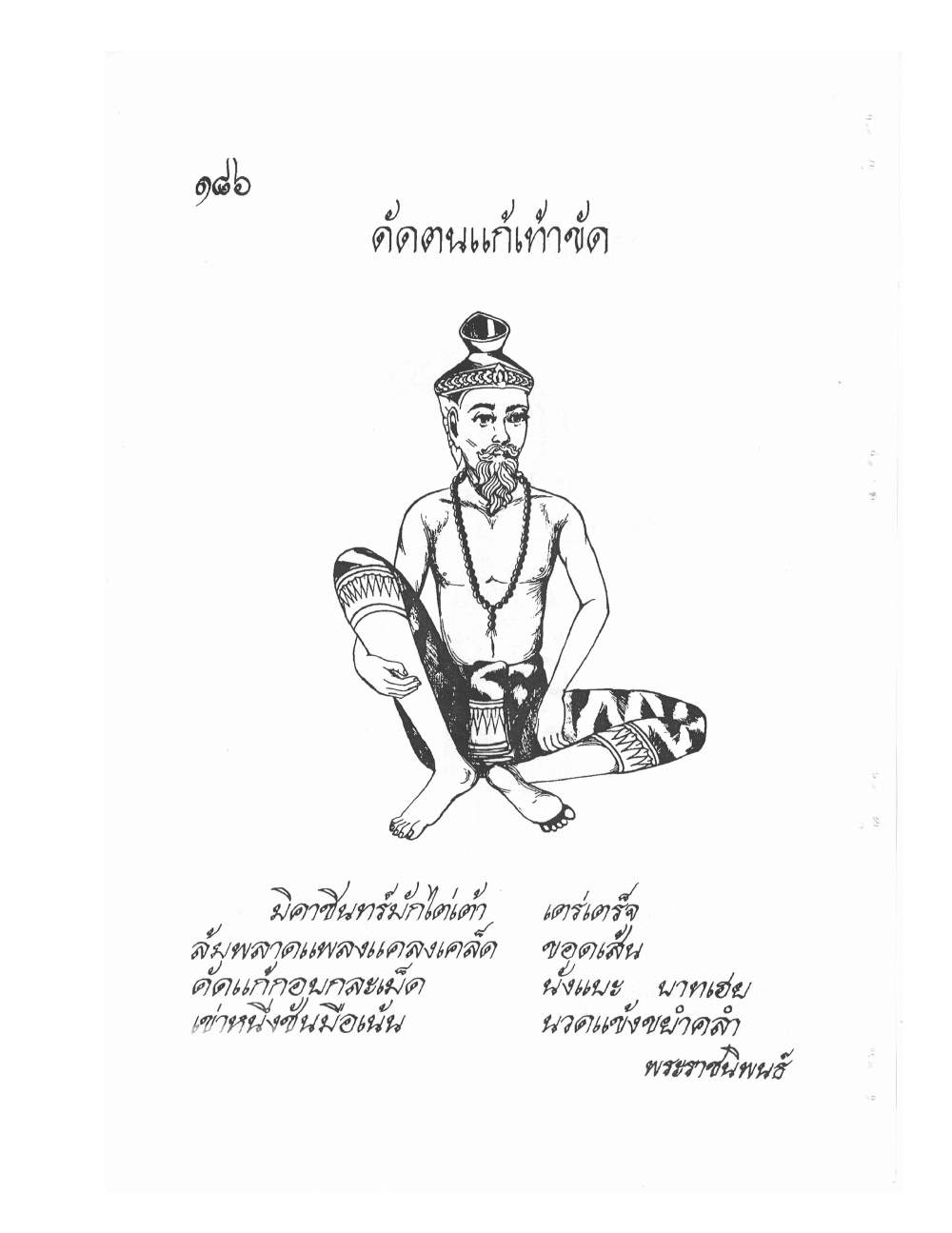
๑๘๖
ดัดตนแก้เท้าขัด
[ภาพ: ฤๅษีนั่ง ขาข้างหนึ่งพับไขว้ทับอีกข้าง มือทั้งสองจับที่เท้าซึ่งยกขึ้นวางไว้บนเข่า สวมหมวกทรงกรวย คล้องลูกประคำ นุ่งผ้าลายเสือ] มิคาชินทร์มักไต่เต้า เตร่เตร็จ ล้มพลาดแพลงแคลงเคล็ด ขอดเส้น ดัดแก้กอบกลเม็ด นั่งแบะ บาทเอย เข่าหนึ่งชิดมือเน้น นวดแข้งขยำคล้ำ พระราชนิพนธ์
186
Stretch to cure a stiff, sprained foot
[illustration: a hermit-sage sits with one leg folded crossed over the other, both hands gripping the foot that is drawn up and rested on the knee; he wears a cone-shaped cap and a beaded mala, dressed in tiger-striped cloth] The lord of beasts is forever climbing, roaming and wandering — stumbling, spraining, the tendon twisted and knotted — the remedy's technique: sit with the foot splayed open — one knee drawn close, the hands pressing firmly, kneading and working the shin. Royal composition
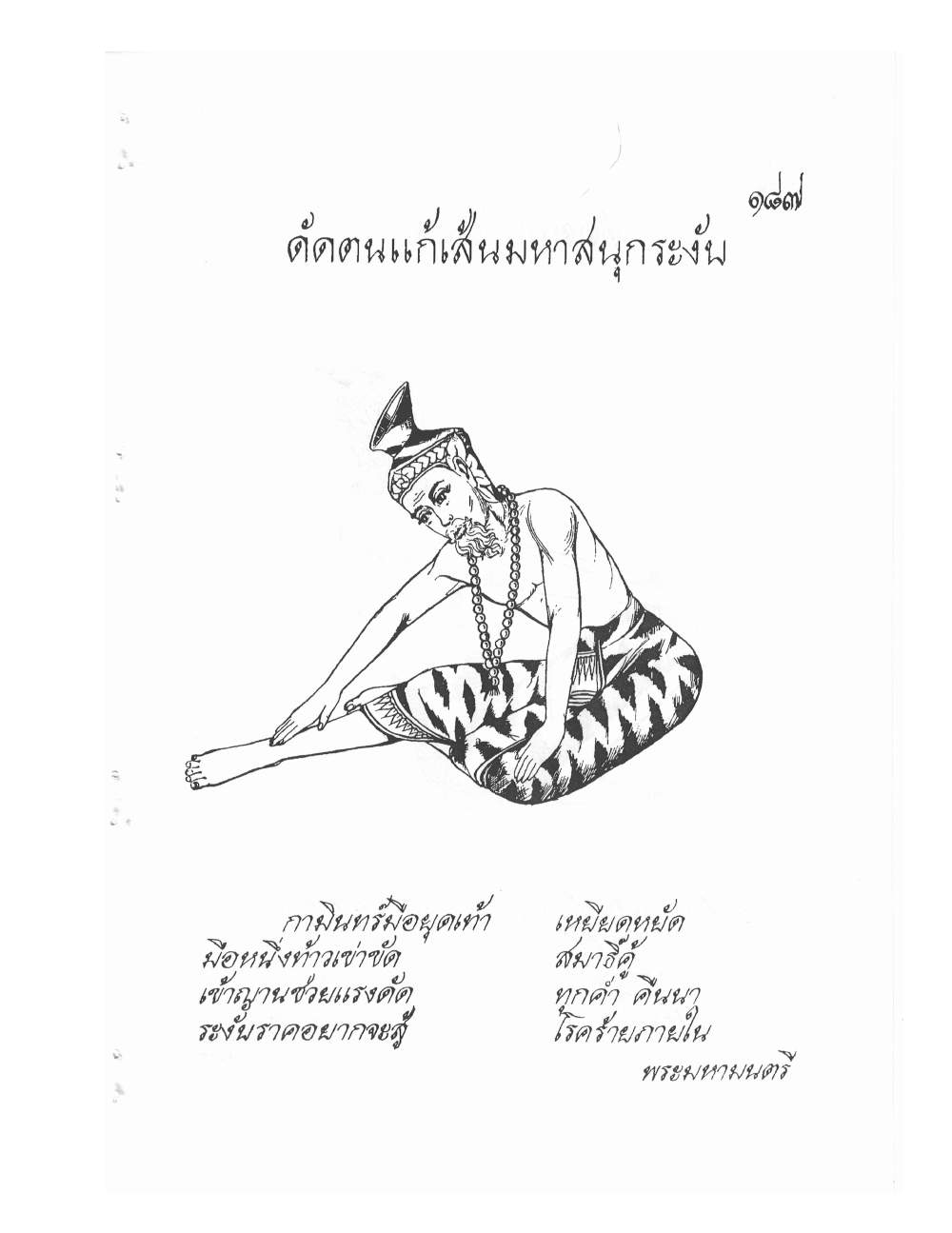
๑๘๗
ดัดตนแก้เส้นมหาสนุกระงับ
[ภาพ: ฤๅษีนั่งเอนตัว มือขวาเหยียดลงจับปลายเท้าข้างที่เหยียดออกไป มือซ้ายวางบนขาอีกข้างที่พับงอ สวมหมวกทรงแหลม คล้องลูกประคำ นุ่งผ้าลายเสือ] กามินทร์มือยุดเท้า เหยียดหยัด มือหนึ่งท้าวเข่าขัด สมาธิคู้ เข้าญาณช่วยแรงดัด ทุกค่ำ คืนนา ระงับราคะอยากจะสู้ โรคร้ายกายใน พระมหามนตรี
187
Stretch to calm the greatly-agitated sinew
[illustration: a hermit-sage leans back, right hand reaching down to grip the tip of an outstretched foot, left hand resting on the other, bent leg; he wears a pointed cap and a beaded mala, dressed in tiger-striped cloth] The lord of desire grips his foot with his hand, stretching it firmly — one hand braced against the bent knee, drawn up in the meditation posture — entering meditative absorption to strengthen the stretch, night after night — this subdues the craving that would contend, and the malignant affliction within the body. Phra Maha Montri
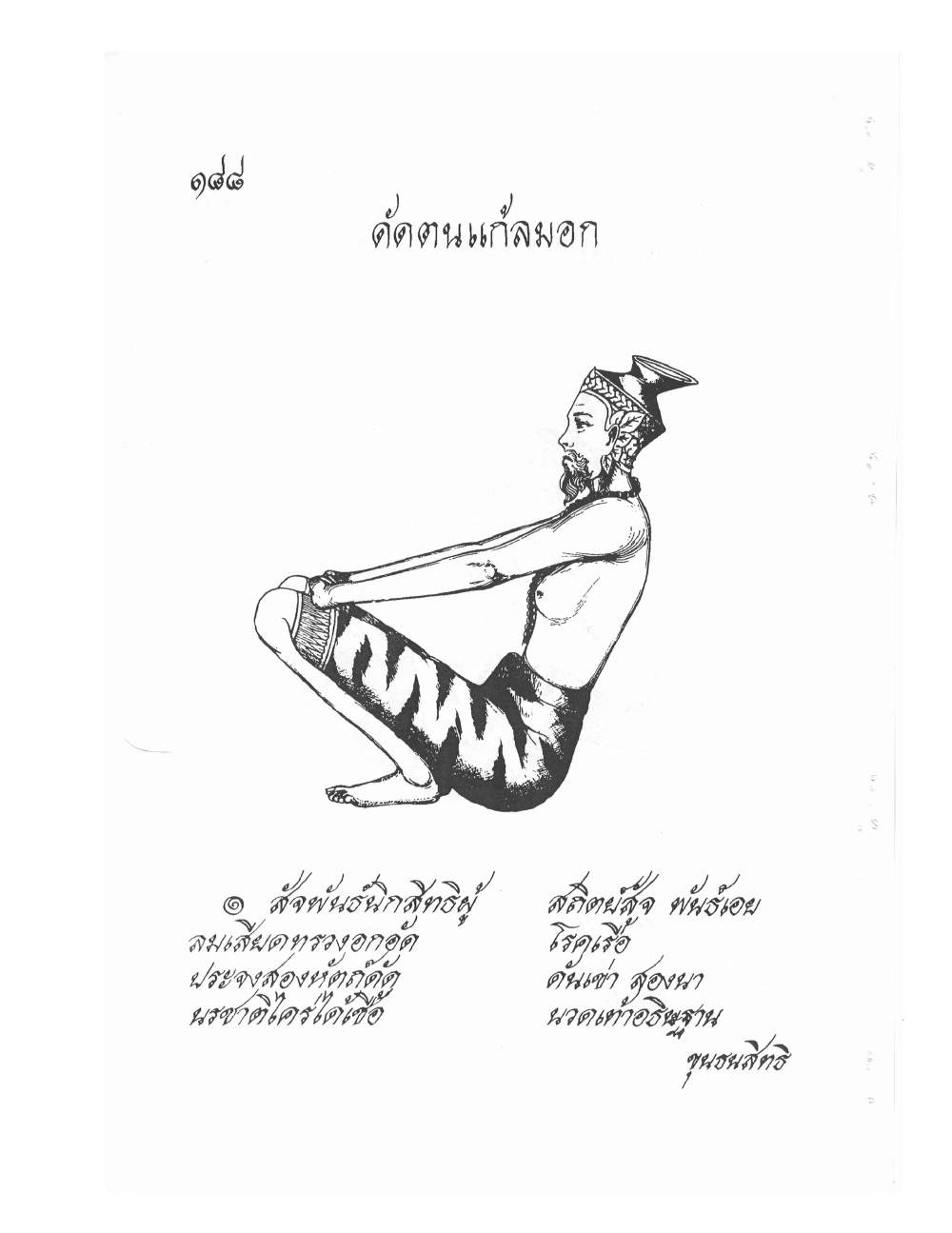
๑๘๘
ดัดตนแก้ลมอก
[ภาพ: ฤๅษีนั่ง ตัวเอนไปด้านหลังเล็กน้อย สองมือเอื้อมจับปลายเท้าข้างหนึ่งที่ยกพาดไว้เหนืออีกขา สวมหมวกทรงแหลม คล้องลูกประคำ นุ่งผ้าลายเสือ] ๏ สัจพันธ์ผูกสุทธิผู้ สถิตย์สัจ พันธ์เอย ลมเสียดทรวงอกอุด โรคเชื้อ ประจงสองหัตถกัด ตีนเท่า สองนา พรชาติใครได้เชื้อ นวดเท้าอธิษฐาน ขุนนนสิทธิ
188
Stretch to cure wind in the chest
[illustration: a hermit-sage sits leaning slightly back, both hands reaching to grip the tip of one foot, which is raised and crossed over the other leg; he wears a pointed cap and a beaded mala, dressed in tiger-striped cloth] Bound by truth, the pure one abides in truth, bound — when wind pierces and blocks the chest, the seed of illness — take care with both hands to grasp evenly at the two feet — whatever merit of birth one has received, [is renewed by] massaging the feet in resolve. Khun Nonsit
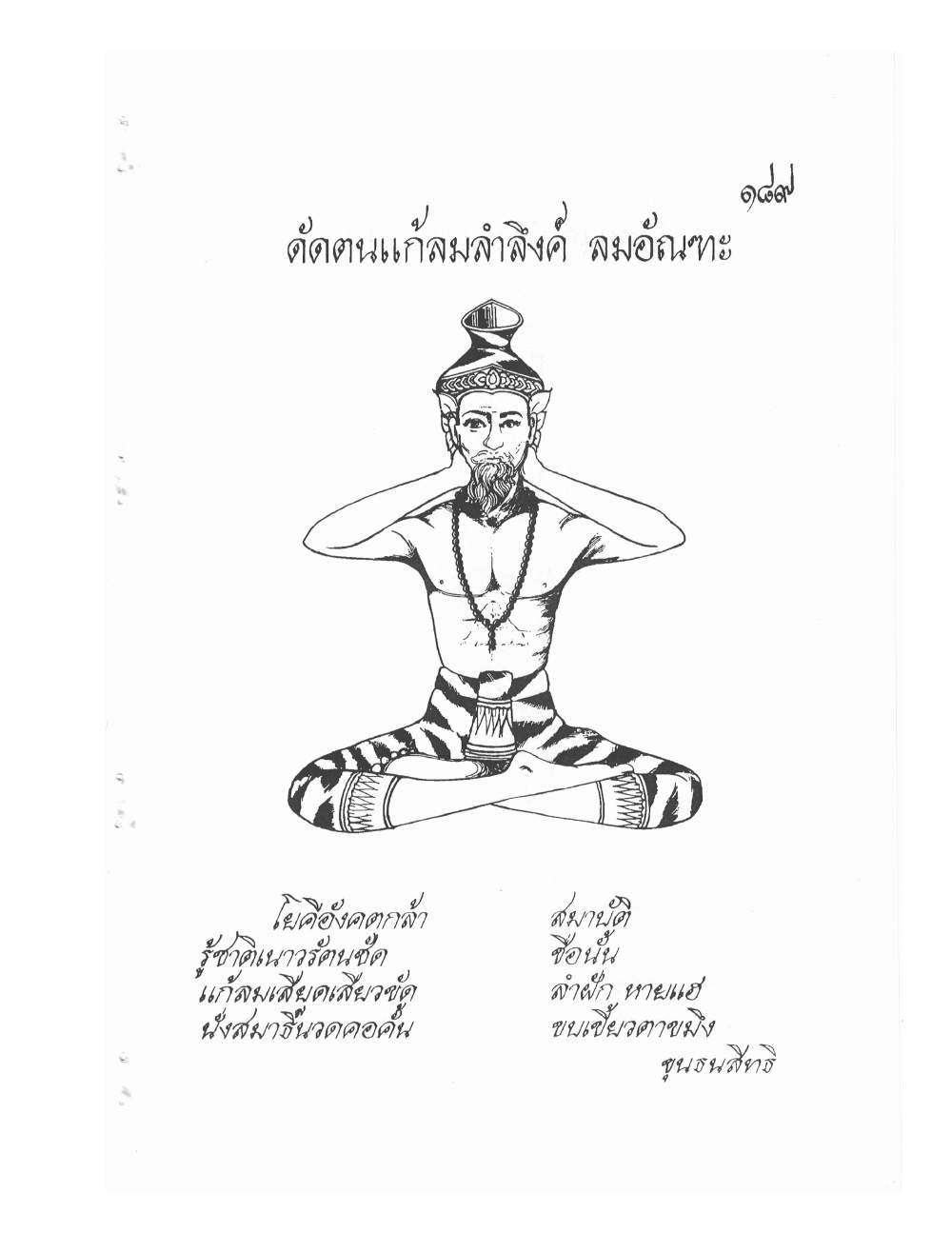
๑๘๙
ดัดตนแก้ลมล้ำลึงค์ ลมอัณฑะ
[ภาพ: ฤๅษีนั่งขัดสมาธิ สองมือยกขึ้นประกบที่ใบหูทั้งสองข้าง สวมหมวกทรงกรวยคว่ำ คล้องลูกประคำ นุ่งผ้าลายเสือ] โยคอึงคตกล้า สมาธิ รู้ชาติเนาวรัตน์ชัด ชื่อนั้น แก้ลมเสียดเสียวชัด ลำผัก หายแฮ นั่งสมาธินวดคอคั้น ขบเคี้ยวตาขมิง ขุนนนสิทธิ
189
Stretch to cure wind deep within the phallus and the wind of the testicles
[illustration: a hermit-sage sits cross-legged, both hands raised and pressed against his two ears; he wears an inverted cone-shaped cap and a beaded mala, dressed in tiger-striped cloth] One firm and resolute in yogic meditation — knowing clearly the nature of the nine gems, that is his name — this cures the sharp, piercing wind-affliction along the [channel], and it is relieved — sitting in meditation, pressing and kneading the neck, clenching the jaw, eyes narrowed. Khun Nonsit
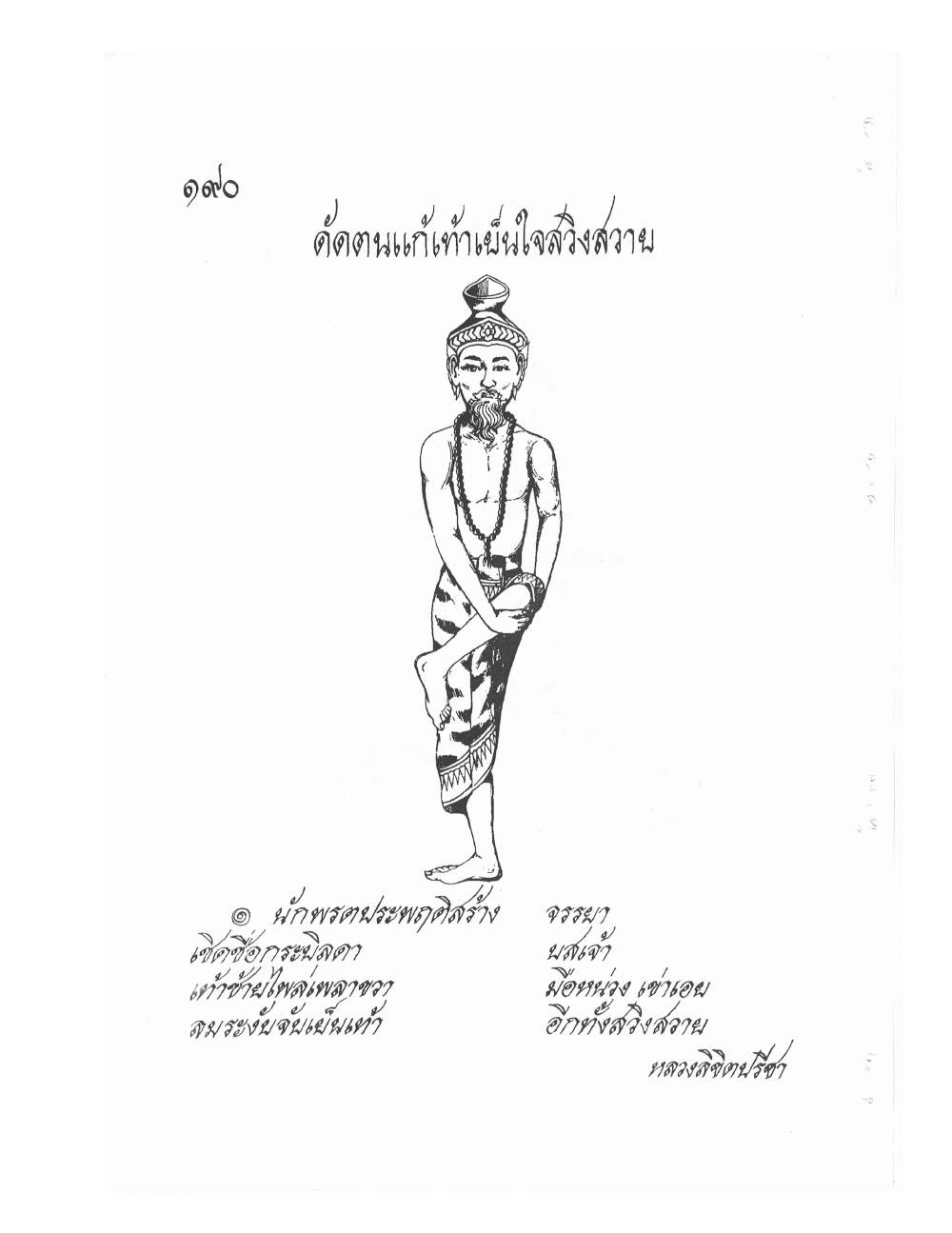
๑๙๐
ดัดตนแก้เท้าเหน็บใจสวิงสวาย
[ภาพ: ฤๅษียืนขาเดียว อีกขายกงอขึ้นเกี่ยวพาดกับมืออีกข้างที่จับไว้ที่เท้า สวมหมวกทรงกรวยคว่ำ คล้องลูกประคำ นุ่งผ้าลายเสือ] ๏ นักพรตประพฤติศีลสร้าง จรรยา เชิดชื้อกระบิลดา บ่สเจ้า เท้าซ้ายไพล่เพลาขวา มือหน่วง เข่าเอย สมระงับจับเพ็ญเท้า อีกทั้งสวิงสวาย หลวงสิทธิปรีชา
190
Stretch to cure a numb foot and a swaying, faint feeling in the heart
[illustration: a hermit-sage stands on one leg, the other leg bent and raised so his hand can grip the foot; he wears an inverted cone-shaped cap and a beaded mala, dressed in tiger-striped cloth] The ascetic, keeping his precepts, builds right conduct — upholding the lineage of his line, dignified — left foot crossed over the right leg, the hand holding the knee steady — this calms and settles, taking firm hold of the foot, curing also the faint, swaying feeling in the heart. Luang Sitthi Preecha
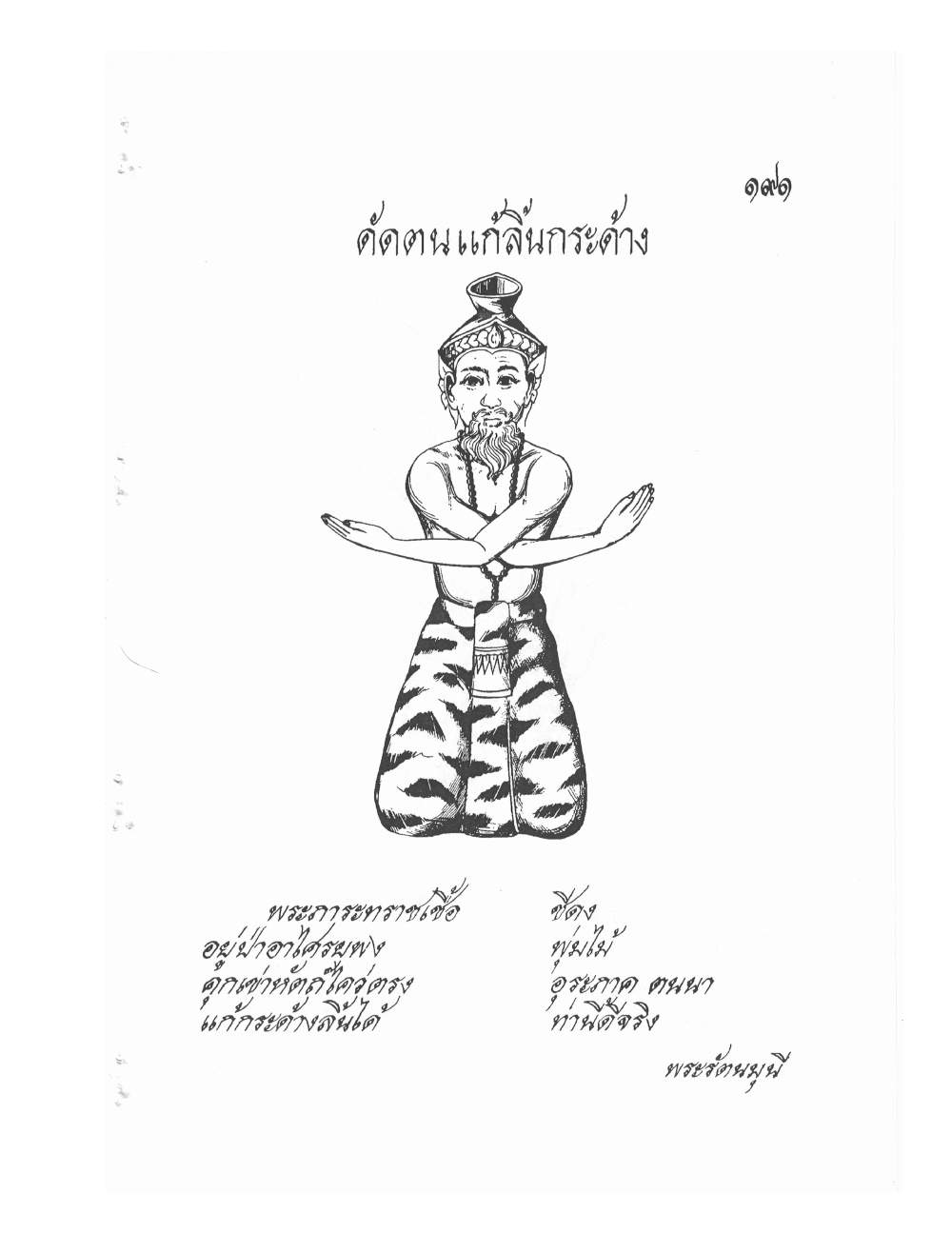
ดัดตนแก้ลิ้นกระด้าง
๑๙๑
[ภาพ: ฤๅษีคุกเข่า สวมมงกุฎยอดแหลมและกรองคอประดับ ไว้เครายาว มีลูกประคำคล้องคอ นุ่งผ้าลายเสือถึงเข่า มีกลองเล็กคาดที่เอว ไขว้แขนทั้งสองไว้ที่หน้าอก ฝ่ามือแบออกทั้งสองข้าง]
พระภารตราชเชื้อ ซึ่ง อยู่ป่าอาศรัยพง พุ่มไม้ คุกเข่าหัตถ์ไขว้ตรง อุระภาค ตนนา [อ่านไม่ออก] แก้กระด้างลิ้นได้ ท่านี้จริง
พระรัตนมุนี
Body-stretching to cure a stiff tongue
191
[Figure: a kneeling hermit figure wearing a tall pointed crown and an ornamented headband, with a long beard and a string of prayer beads around his neck. He is dressed in a tiger-striped garment reaching the knees, with a small drum tied at the waist, his two arms crossed over his chest, palms open outward.]
Phra Bharata-raja-chuea (he of Bharata royal lineage), who dwells in the forest, making his hermitage among thickets and bushes, kneels with his hands crossed straight over the chest region [illegible] — this posture truly cures a stiff tongue.
Phra Rattanamuni