Contents · 1 chapter(s) · 65 entries
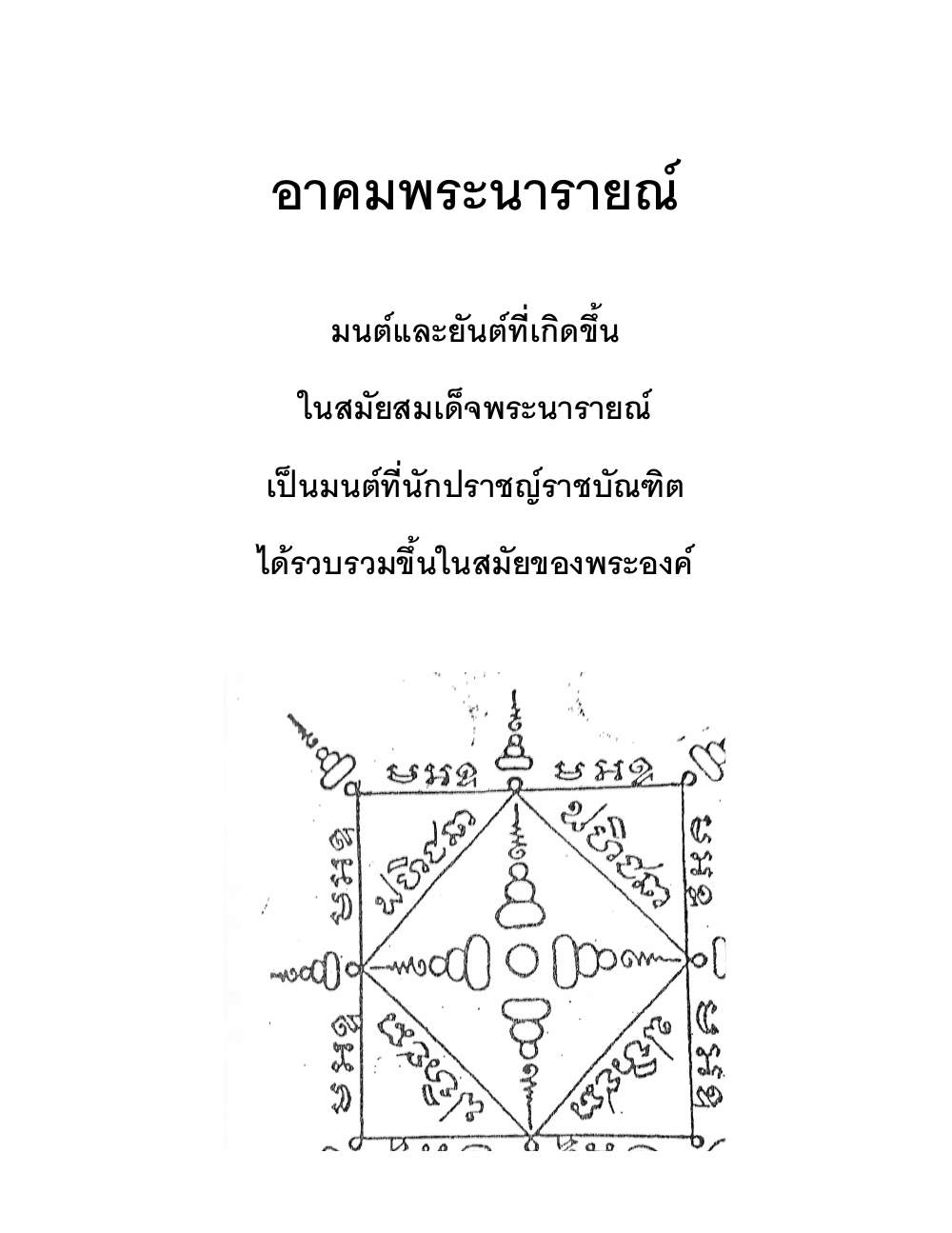
อาคมพระนารายณ์
มนต์และยันต์ที่เกิดขึ้น ในสมัยสมเด็จพระนารายณ์ เป็นมนต์ที่นักปราชญ์ราชบัณฑิต ได้รวบรวมขึ้นในสมัยของพระองค์
[ภาพยันต์: กรอบสี่เหลี่ยมจัตุรัส มีเส้นทแยงมุมจากมุมถึงมุมทำให้เกิดรูปสี่เหลี่ยมข้าวหลามตัดอยู่ตรงกลาง ที่มุมทั้งสี่ของกรอบและปลายแหลมบน-ล่าง-ซ้าย-ขวาของรูปข้าวหลามตัด มีลวดลายคล้ายยอดฉัตรหรือยอดเจดีย์ซ้อนกัน มีอักขระขอมกำกับอยู่ทั้งรอบขอบกรอบด้านนอกและภายในช่องสามเหลี่ยมทั้งสี่ อ่านไม่ชัด]
Akhom of Phra Narai [The Magic of King Narai]
The mantras and yantras that arose in the reign of the great King Narai are mantras that learned scholars and royal savants gathered together during his reign.
[Diagram: a square frame with diagonal lines running corner to corner, forming a diamond shape at the center; at the four outer corners of the frame and at the top, bottom, left, and right points of the inner diamond are ornamental finials resembling stacked stupa-spires; Khom-script characters run along the outer border and within the four triangular compartments, illegible in detail]
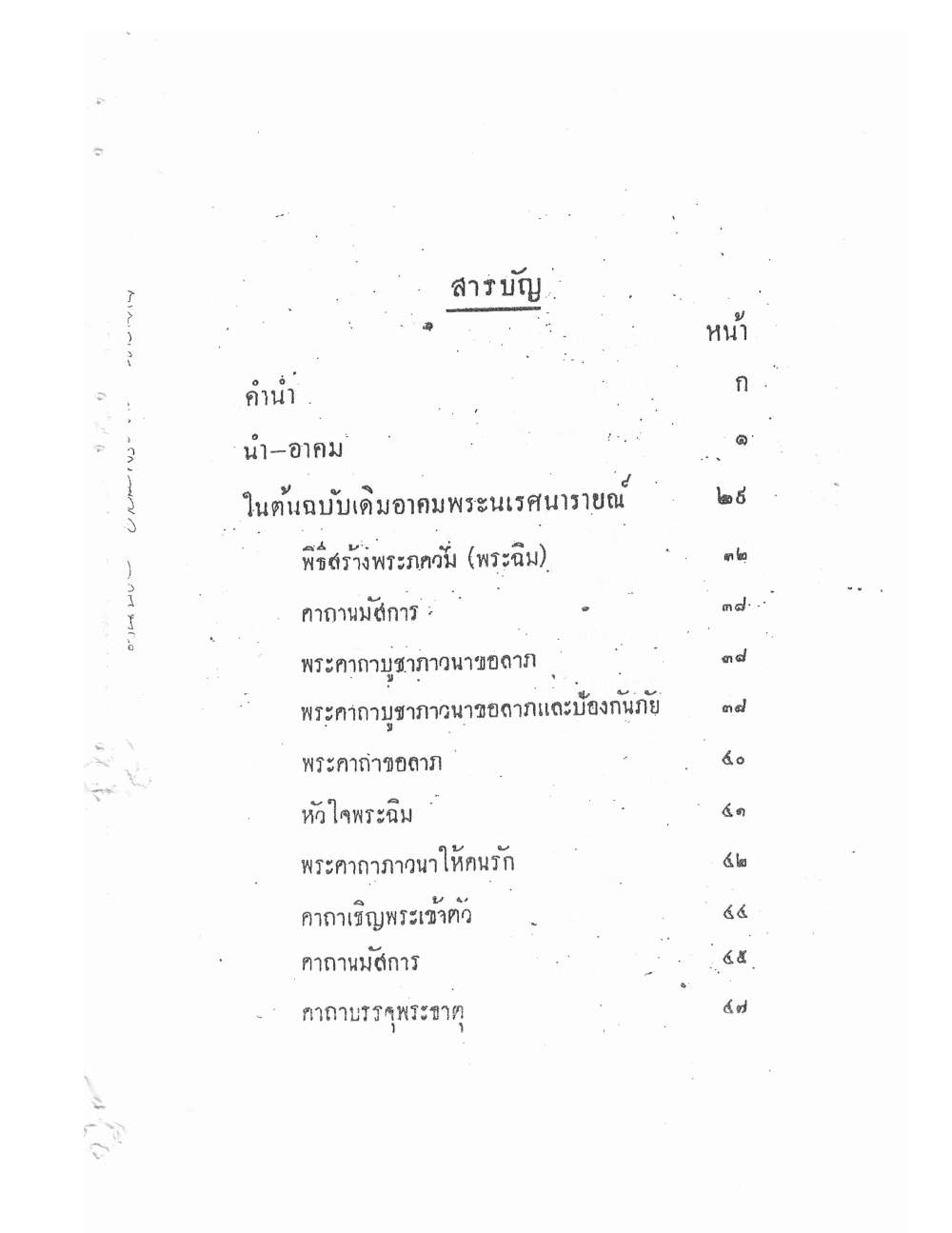
สารบัญ
หน้า คำนำ ก นำ-อาคม ๑ ในต้นฉบับเดิมอาคมพระนเรศนารายณ์ ๒๕ พิธีสร้างพระภควัม (พระฉิม) ๓๒ คาถานมัสการ ๓๘ พระคาถาบูชาภาวนาขอลาภ ๓๘ พระคาถาบูชาภาวนาขอลาภและป้องกันภัย ๓๘ พระคาถาขอลาภ ๔๐ หัวใจพระฉิม ๔๑ พระคาถาภาวนาให้คนรัก ๔๒ คาถาเชิญพระเข้าตัว ๔๔ คาถานมัสการ ๔๕ คาถาบรรจุพระธาตุ ๔๗
Table of Contents
Page Preface [ka] Introduction — Akhom (Magic) 1 In the original manuscript, Akhom of Phra Naret-Narai 25 The ceremony of making the Phra Bhagavam (Phra Chim) image 32 Formula of homage 38 Sacred formula of worship and recitation for requesting fortune 38 Sacred formula of worship and recitation for requesting fortune and warding off harm 38 Sacred formula for requesting fortune 40 Heart-mantra of the Phra Chim 41 Sacred formula of recitation to make someone love you 42 Formula for inviting the Buddha image into oneself 44 Formula of homage 45 Formula for enshrining relics 47
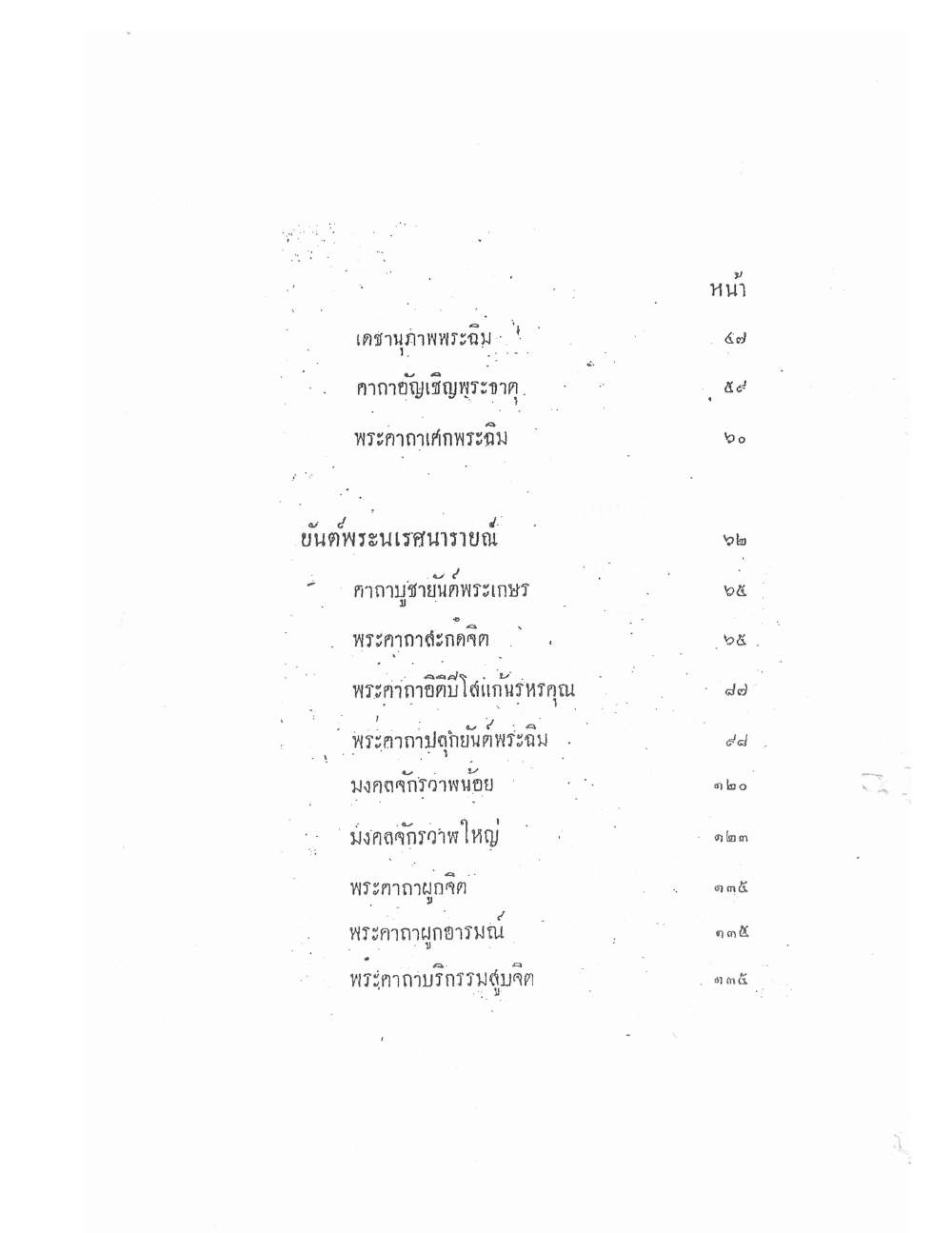
หน้า เดชานุภาพพระฉิม ๔๗ คาถาอัญเชิญพระธาตุ ๕๘ พระคาถาเศกพระฉิม ๖๐
ยันต์พระนเรศนารายณ์ ๖๒ คาถาบูชายันต์พระเกษร ๖๕ พระคาถาสะกดจิต ๖๕ พระคาถาอิติปิโสแก้นรหรคุณ [คำนี้อ่านไม่ชัด] ๗๗ พระคาถาปลุกยันต์พระฉิม ๘๘ มงคลจักรวาลน้อย ๑๒๐ มงคลจักรวาลใหญ่ ๑๒๓ พระคาถาผูกจิต ๑๓๕ พระคาถาผูกอารมณ์ ๑๓๕ พระคาถาบริกรรมสูบจิต ๑๓๕
Page The majestic power of the Phra Chim 47 Formula for inviting the relic 58 Sacred formula for consecrating the Phra Chim 60
The Yantra of Phra Naret-Narai 62 Formula for worshipping the Phra Kesorn yantra 65 Sacred formula for entrancing the mind 65 Sacred Itipiso formula against [rival/enemy influence — word unclear] 77 Sacred formula for animating the Phra Chim yantra 88 The Lesser Auspicious Universe (Mongkol Chakrawan Noi) 120 The Greater Auspicious Universe (Mongkol Chakrawan Yai) 123 Sacred formula for binding the mind 135 Sacred formula for binding the emotions 135 Sacred formula of repeated recitation to subdue the mind 135
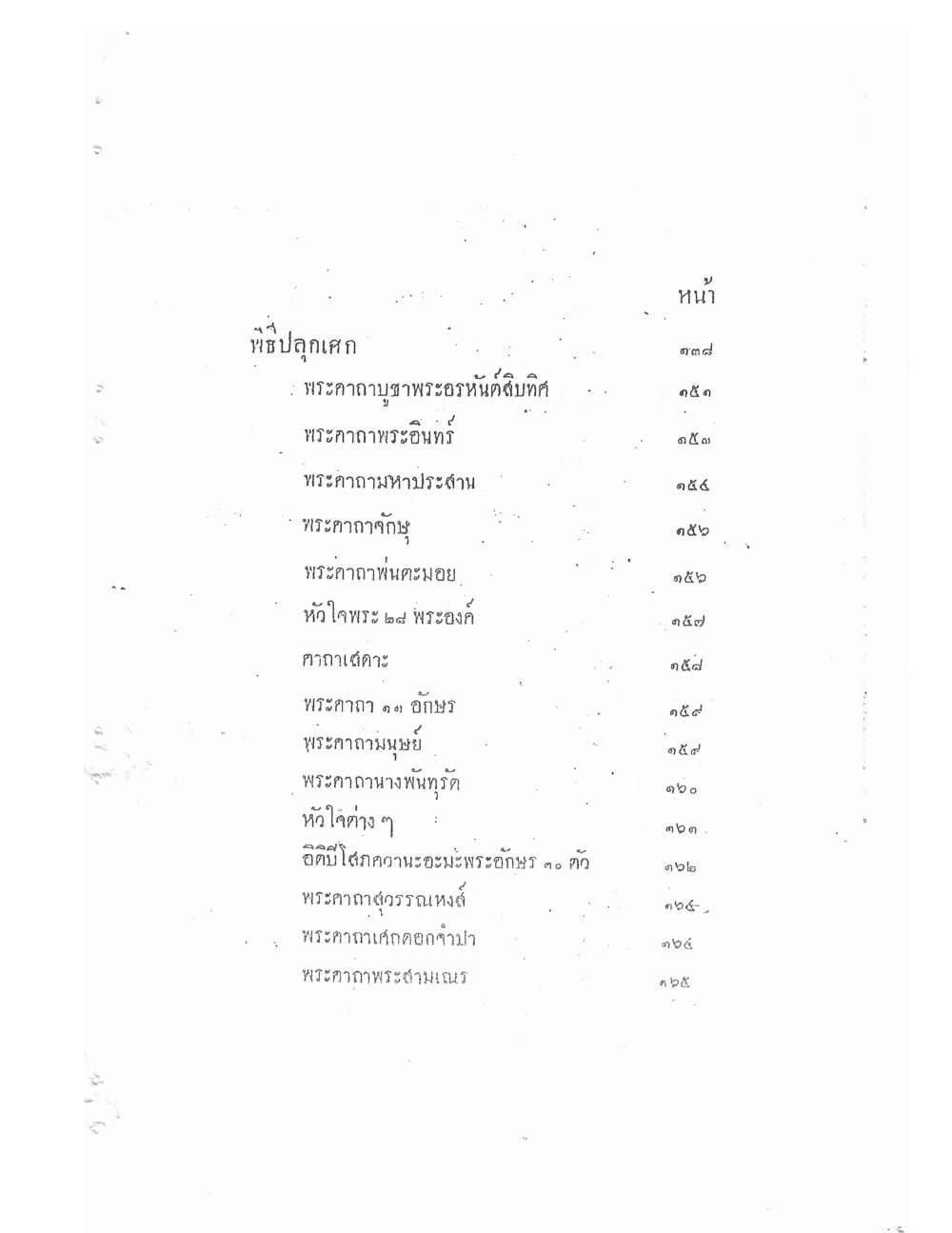
หน้า พิธีปลุกเศก ๓๓๘ พระคาถาบูชาพระอรหันต์สิบทิศ ๓๕๑ พระคาถาพระอินทร์ ๓๕๓ พระคาถามหาประสาน ๓๕๔ พระคาถาจักษุ ๓๕๖ พระคาถาพ่นตะมอย ๓๕๖ หัวใจพระ ๒๘ พระองค์ ๓๕๗ คาถาเศกคาถะ [อ่านไม่ชัด] ๓๕๘ พระคาถา ๑๑ อักษร ๓๕๘ พระคาถามนุษย์ ๓๕๙ พระคาถานางพันทุรัต ๓๖๐ หัวใจต่าง ๆ ๓๖๑ อิติปิโสภควานะอมะพระอักษร ๑๐ ตัว ๓๖๒ พระคาถาสุวรรณหงส์ ๓๖๔ พระคาถาเศกดอกจำปา ๓๖๔ พระคาถาพระสามเณร ๓๖๕
Page The rite of consecration and empowerment 338 Formula for worshipping the Ten-Direction Arahants 351 Formula of Phra Indra 353 Formula of the Great Binding 354 Formula for the eyes 356 Formula for consecrating a mole-charm [talisman] 356 Heart-mantra of the 28 Buddhas 357 Formula for consecrating [word unclear] 358 Sacred formula of the 11 letters 358 Sacred formula for humans 359 Sacred formula of Nang Panthurat 360 Various heart-mantras 361 Itipiso Bhagavā Namo — the 10 sacred letters 362 Sacred formula of the Golden Swan (Suvarnahamsa) 364 Sacred formula for consecrating a champak flower 364 Sacred formula of the novice monk 365
อาคมพระนเรศนารายณ์
นำ-อาคม
อันสืบเนื่องมาจากปรากฏว่า พุทธมนต์และยันต์ แต่ละบทนั้นมีความศักดิ์สิทธิ์มากมายยิ่งนัก ด้วยในสมัย อดีตล่วงมา ท่านผู้ใหญ่ย่อมรับนับถือว่า ได้ปรากฏ อภินิหารให้ความจริงมาแล้ว แต่ท่านผู้อ่านที่นับถือยันต์ ท่านอาจไม่เชื่อเอาเสียเลยก็ได้ว่า บรรดามนต์และยันต์ ต่าง ๆ นั้นไม่มีความขลัง หรือไม่มีความจริงเลย แต่ บางท่านก็อาจจะเชื่อว่า มนต์และยันต์นั้นมีความขลังและ ศักดิ์สิทธิ เพราะได้เคยเห็นหรือได้ทดลองมาแล้ว แต่ ข้าพเจ้าขอแนะนำว่า การจะเชื่อสิ่งหนึ่งสิ่งใดลงไปนั้น ควรเชื่อด้วยเหตุผล มิใช่เชื่อโดยงมงาย ถ้าหากข้าพเจ้า จะถามท่านว่า ท่านเชื่ออิทธิปาฏิหารย์ต่าง ๆ หรือไม่
Akhom [Magic] of Phra Naret-Narai
Introduction — Akhom
This follows from the fact that Buddhist mantras and yantras— each formula—hold very great sanctity indeed. For in ages past, elders and learned men accepted and revered them, and miraculous signs proving their truth have indeed appeared. But readers who esteem yantras may in fact not believe at all that all these mantras and yantras hold no magical power, or no truth whatsoever. But some readers may believe that mantras and yantras do hold power and sanctity, because they have themselves seen or tested them. But I would suggest that believing in any one thing should be done with reason, not through blind credulity. If I were to ask you: do you believe in various miraculous powers or not—
๒
บางท่านก็คงตอบว่าไม่เชื่อเลย แต่บางท่านก็คงตอบว่า เชื่อ ทั้งท่านที่เชื่อและไม่เชื่อนั้น โปรดใคร่ครวญตาม เหตุผลที่ข้าพเจ้าจะกล่าวให้ท่านฟัง
พระพุทธศาสนาของเรามีสิ่งที่น่าอัศจรรย์ที่สุดอยู่ สองประการคือ ความอัศจรรย์ทางฤทธิ ๑ ความอัศจรรย์ ทางคำสอน ๑ พระพุทธเจ้าของเรา เวลาพระองค์จะทรง เทศนาสั่งสอนใคร ในบางครั้งพระองค์ยังต้องทรงใช้ ความอัศจรรย์ทางฤทธิเข้าช่วย ดังมีเรื่องเล่าไว้ใน พระสูตรมากมาย เช่นพระองค์ทรงทรมานโจรองคุลิมาลย์ เป็นการน่าประหลาดหรือไม่ ที่องคุลิมาลย์ทั้งมีกำลังและ เรี่ยวแรงมาก ก็ไม่สามารถจะวิ่งตามพระพุทธองค์ไป ทันได้ และพระองค์ยังได้ทรงยกย่องพระมหาโมคคัลลานะ เถระว่าเป็นผู้เลิศในทางมีฤทธิมาก พระองค์จะทรงโปรด คนที่มีทิฐิมานะมาก ถ้าพระองค์มิได้เสด็จไปเองก็ทรงใช้ ให้พระโมคคัลลานะไปทรมานให้หมดพยศ หมดเดชเสีย ก่อน แล้วพระองค์จึงเสด็จไปแต่ภายหลัง
2
Some will surely answer that they do not believe at all, while others will surely answer that they do believe. Whether you believe or not, please consider carefully the reasoning I am about to lay out for you.
Our Buddhist religion holds two things that are the most wondrous of all: the wonder of supernatural power, one; the wonder of its teachings, one. Our Lord Buddha— whenever He was about to preach and instruct someone— on some occasions still had to make use of the wonder of supernatural power to help. There are many such stories told in the scriptures, such as when He subdued the bandit Angulimala. Is it not remarkable that Angulimala, though possessed of great strength and vigor, was unable to catch up and keep pace with the Buddha no matter how he ran? And the Buddha also praised the Elder Mahamoggallana as foremost among those of great supernatural power. When the Buddha wished to convert people of great stubbornness and pride, if He did not go Himself, He would send Mahamoggallana to subdue them and break their unruliness, exhausting their pride first, and only afterward would He Himself go.
อาคมพระนเรศนารายณ์ ๓
คำว่า ฤทธิ ในทางพระพุทธศาสนา ที่ท่านกล่าว ไว้ในสามัญญผลสูตร ในพระคัมภีร์ไตรปิฎก ซึ่งเรา นับถือกันว่าเป็นคัมภีร์วิเศษในพระพุทธศาสนานั้น หมาย เอาฤทธิที่เกิดทางใจ หรือเรียกว่า มโนมยิทธิ แปล ว่า ฤทธิที่สำเร็จขึ้นจากใจ หรือเรียกอีกอย่างหนึ่งว่า สมาธินั่นเอง
ท่านคงทราบแล้วว่า ยอดของการศึกษาใน พระพุทธ ศาสนานั้น มีอยู่ ๓ ประการคือ ศีล สมาธิ ปัญญา หรือ รวมเรียกว่า ไตรสิกขาบท ทำไมการศึกษา ๓ อย่างนี้ จึง เรียกว่า เป็นยอดของการศึกษา ก็เพราะเป็นการศึกษา เมื่อพ้นทุกข์พบสุขอย่างแท้จริง ศีลเป็นการศึกษาเบื้องต้น ของบุคคลที่จะอบรมให้บริบูรณ์ เมื่อการขึ้นสู่สมาธิ ผู้ที่จะมีสมาธิต้องมีศีลบริสุทธิมาก่อน เมื่ออบรมสมาธิ ได้แก่กล้าแล้ว ก็ย่อมก้าวขึ้นสู่ปัญญาและถึงความหลุดพ้น ซึ่งเป็นต้นสุดยอด
สำหรับปุถุชนเรา เมื่ออบรมศีลดีแล้ว ก็อาจทำสมาธิ ให้เกิดได้ในเบื้องต้น ย่อมสามารถทำให้เกิดฌานสมาธิ
Akhom of Phra Naret-Narai 3
The word 'iddhi' (supernatural power) in Buddhism, as spoken of in the Samannaphala Sutta in the Pali Canon (Tipitaka), which we regard as an especially excellent scripture within Buddhism, refers to power that arises through the mind, also called manomayiddhi, which translates as 'power accomplished from the mind,' or, put another way, simply samadhi (concentration) itself.
You surely already know that the pinnacle of study in Buddhism consists of three things: morality (sila), concentration (samadhi), and wisdom (panna), or together called the Threefold Training. Why is this threefold study called the pinnacle of study? It is because it is the study that, when completed, leads truly to freedom from suffering and the finding of happiness. Morality is the foundational study for a person who wishes to train themselves to completeness. When advancing toward concentration, one who would attain concentration must first have pure morality. Once one has trained concentration to a firm and courageous degree, one naturally advances to wisdom and reaches liberation, which is the ultimate pinnacle.
As for us ordinary worldlings, once we have trained well in morality, we may bring about concentration from the very outset, and thereby become able to bring about meditative absorption (jhana-samadhi)
๔
ขึ้นได้ ผู้ได้ฌานย่อมแสดงฤทธิหรือปาฏิหารย์ได้ตาม ภูมิฌานของตน ดังตัวอย่างพระเทวทัต แม้ได้เพียง รูปฌานก็ยังสามารถจำแลงกายได้ พระเจ้าอชาตศัตรูทรง เลื่อมใสได้ ส่วนวิธีทำให้เกิดสมาธินั้น ก็ใช้คาถา หรือมนต์สำหรับบริกรรม ผู้บริกรรมจะรู้เนื้อความหรือ ไม่รู้ไม่สำคัญ เพราะจุดมุ่งหวังเพื่อต้องการให้จิตใจแน่ว แน่เป็นสมาธิ เพื่อได้สำเร็จกิจ คือบังเกิดความอัศจรรย์ ทางฤทธิของคนเท่านั้น ต่อมาสมาธินั้น ได้มีคณาจารย์ สั่งสอนแพร่หลายมากขึ้น ตลอดจนได้แก้ไขตำราไสย ศาสตร์ของพวกพราหมณ์ เอามนต์ของพราหมณ์ออกเสีย เอาพระพุทธมนต์กับยันต์บรรจุแทน โดยเล็งเห็นกันว่า แม้มนต์ของพวกพราหมณ์ ก็ยังศักดิ์สิทธิมากมาย ถึงเพียง นั้น ถ้าได้ใช้พระพุทธมนต์ จะเพิ่มความศักดิ์สิทธิยิ่ง ขึ้นสักเพียงใด ฉะนั้นการเศกเป่าลงยันต์ในบัดนี้ จึงใช้ พุทธมนต์เป็นหลัก ความนิยมนับถือก็เริ่มแพร่หลายยิ่ง ขึ้น แต่แม้กระนั้นก็ดี ก็ยังมีบุคคลส่วนมากที่ไม่เชื่อ ว่า บรรดาเวทมนต์และยันต์เหล่านั้นจะให้ผลได้จริง ก็สับสน
4
[be brought about]. One who has attained jhana can display power or miracles according to the level of jhana attained, as in the example of Devadatta, who even with only material-sphere jhana was still able to transform his body. King Ajatasattu was thereby won over to faith. As for the method of bringing about concentration, one uses a formula or mantra for repeated recitation. Whether the one reciting understands its meaning or not is unimportant, because the aim is only to make the mind steady and firm in concentration, so as to accomplish the task—that is, to bring about the wonder of power in a person, that alone. Later, regarding this kind of concentration, there arose teachers who spread its instruction ever more widely, to the point of revising the textbooks of black magic belonging to the Brahmins—removing the Brahmin mantras and inserting Buddhist mantras and yantras in their place instead, reasoning that if even the mantras of the Brahmins were so greatly sacred and powerful as that, then using Buddhist mantras would increase that sanctity all the more. Therefore the consecrating and charging of yantras nowadays uses Buddhist mantras as its basis, and this practice has grown ever more widespread and popular. But even so, there are still a great many people who do not believe that all these spells and yantras can truly produce results. This causes confusion,
๕
เห็นเป็นสิ่งไร้สาระ เป็นเครื่องหลอกลวงกันเล่น เพราะ ต้องดูแล้วไม่ปรากฏผลเป็นจริงดังว่า แต่อย่างไรก็ตาม ของจริงแล้วย่อมมีการพิสูจน์ได้ และทนต่อการพิสูจน์ เหมือนอย่างทองคำบริสุทธิ แม้จะเอาไฟลนสักเท่าไรก็ยัง เป็น ทองคำ อยู่นั้นเอง จะกลับกลายเป็นอย่างอื่นไปไม่ ได้ ฉะนั้นจึงขอให้ท่านใช้ปัญญาของท่าน ตรึกตรองดู ตามเหตุผลว่าเวทย์มนต์คาถา และยันต์ต่าง ๆ นั้น มีความ ขลังจริงหรือไม่
เรื่องของเวทมนต์ เรื่องของยันต์เป็นเรื่องของจิตใจ มนต์บทเดียวกันยันต์ๆ เดียวกัน บางคนนับถือขลัง บาง คนก็นับถือไม่ขลัง ทั้งนี้เป็นด้วยศรัทธาความเชื่อมั่น และ สมาธิความแน่วแน่ของจิตนั้นเอง มหาปราชญ์สุนทรภู่ จินตกวีเอกของไทยก็ยังได้กล่าวแนะนำไว้ว่า "อันวิชา อาคมคมถ้า เวลาค่ำควรคิดเป็นนิจสิน จึงศักดิ์ สิทธิฤทธิรณพ้นไพริน ให้เพิ่มภิญโญยศปรากฏไป" ท่านที่เชื่อก็ดี ท่านที่ยังไม่เชื่อก็ดี ขอให้ท่านเข้าใจเถิดว่า บรรดาเวทมนต์ และยันต์ทั้งหลายที่ปรากฏมาแต่แต่ดึก
5
[people] regard it as something worthless, a mere plaything of deception, because when one looks, no result appears to be true as claimed. But however that may be, a genuine thing can always be tested, and it withstands testing— just as with pure gold: no matter how much fire is applied to it, it remains gold; it cannot ever turn into anything else. Therefore I ask you to use your own wisdom, to reflect and consider by reason whether magical spells, formulas, and various yantras truly hold sacred power or not.
The matter of magic spells, the matter of yantras, is a matter of the mind. The very same mantra, the very same yantra—some people find it sacred, others find it not sacred. This is entirely a matter of faith and conviction, and of the firmness of one's own concentration of mind. The great sage Sunthorn Phu, Thailand's foremost poet, also gave this piece of advice: 'As for the arts of magic, if in the evening one thinks of them constantly every day, their sanctity and power will overcome all enemies, bringing ever greater fame and renown.' Whether you already believe or do not yet believe, please understand that all the spells and yantras that have appeared since ancient, ancient times
๖
คำบรรพ์ก็ดี และที่ปรากฏอยู่ทุกวันนี้ก็ดี ล้วนมีความ อัศจรรย์ทางฤทธิเดชปาฏิหารย์อยู่มากมาย แต่ความ อัศจรรย์ของเวทมนต์และยันต์เหล่านี้ จะปรากฏแก่ใครนั้น เป็นของรู้ได้เห็นได้เฉพาะตัว ท่านที่ได้ทดลองถึงจุดที่ให้ เกิดความอัศจรรย์แล้ว ความอัศจรรย์นั้นก็จะปรากฏแก่ ตัวท่านเอง
อนึ่งท่านเชื่อหรือไม่ว่า มนุษย์ทุกคนมีความกลัว ประจำสันดาน มีความหวาดหวั่นต่อภัยอันตรายรอบด้าน ไม่ว่าเด็กไม่ว่าผู้ใหญ่ ย่อมมีความกลัวอยู่ด้วยกันทุกคน เมื่อทุกคนมีความกลัวประจำสันดานอยู่ฉะนี้ จึงจำเป็น ต้องหาสิ่งที่ป้องกันความกลัว แต่ใครจะหาถูกหาผิด หา ได้จริงหรือไม่จริงแก่ไหนนั้น ก็สุดแท้แต่ความแสวงหาของ แต่ละบุคคล มนุษย์ตั้งแต่สมัยดึกดำบรรพ์มา เมื่อ มีความกลัวภัย ก็ได้เคยแสวงหาสิ่งที่ป้องกันตัว เช่น กลัวมืด ก็เห็นว่าแสงสว่างป้องกันภัยได้สิ่งที่เป็นแสงสว่าง เช่นดวงจันทร์ ดวงอาทิตย์ จึงได้ถูกยกย่องนับถือว่าเป็น
6
Whether from ancient tradition or as they appear today, all hold great wonder of miraculous power. But whether the wonder of these spells and yantras will manifest to any given person is something known and seen only by that person individually. Those who have tested them to the point that brings about the wonder will find that the wonder appears to themselves.
Furthermore, do you believe or not that every human being carries fear in their very nature, dread of dangers on every side— whether child or adult, everyone alike carries this fear. Since everyone carries this innate fear in this way, it becomes necessary to seek something to ward off fear. But whether what one finds is right or wrong, whether it is truly effective or not to any degree, that depends entirely on each individual's own search. Human beings, since the most ancient times, whenever they felt fear of danger, have sought things to protect themselves—for example, fearing darkness, they saw that light could ward off danger, and so things that give light, such as the moon and the sun, came to be honored and revered as
อาคมพระนเรศนารายณ์ ๗
ของคุ้มครองป้องกันภัยได้ มีผู้เคารพสักการะบูชาขนาน นามว่า พระจันทร์ พระอาทิตย์ อย่าว่าแต่ดวงจันทร์ ดวงอาทิตย์เลย แม้ต้นไม้ ภูเขา ก็ยังมีผู้ขอให้ช่วย คุ้มครองป้องกันภัย แม้ในทุกวันนี้ก็ยังมีผู้ยอมรับนับ ถือต้นไม้ เจดีย์ และสิ่งอื่น ๆ เป็นเครื่องป้องกันภัยอยู่ มาก แต่สิ่งเหล่านั้นเป็นของใหญ่ ถ้าจะเอาติดตัวสำหรับ เดินทางไปไกล ๆ ก็เอาไปไม่ได้ หรือของที่ติดอยู่กับที่ เอาเคลื่อนที่ไปไม่ได้ อย่างนี้ย่อมเป็นการลำบาก ด้วย เหตุนี้เองจึงได้เกิดเครื่องรางของขลังต่าง ๆ ขึ้น ซึ่งของ เหล่านั้นเป็นของเล็ก ๆ พอจะเอาติดตัวคุ้มครองตัวได้
แต่สิ่งใด ๆ ก็ตาม ที่มนุษย์เคารพสักการะนับถือว่า สามารถจะคุ้มครองป้องกันภัยได้ สิ่งเหล่านั้นทั้งหมด ที่จะยิ่งไปกว่าพระรัตนตรัยเป็นไม่มีแล้ว พระรัตนตรัยเป็น ดวงแก้วมณีอันสุดเลิศ และสามารถที่จะยังมนุษย์ให้หาย ความหวาดกลัวต่อภัยอันตรายต่าง ๆ ได้ และสามารถ จะดลบันดาลให้ได้สิ่งที่ต้องการตามความปรารถนา ผู้ยึด
Akhom of Phra Naret-Narai 7
things capable of sheltering and protecting against harm; people came to revere and worship them, giving them the names Phra Chan (Moon) and Phra Athit (Sun). And it was not only the moon and sun—even trees and mountains had people asking them for protection from harm. Even today there are still people who accept and revere trees, stupas, and other things as means of protection against harm— many such things. But those things are large; if one wished to carry them on one's person while traveling far away, one could not take them along, or things that are fixed in one place cannot be carried and moved. This being troublesome, for this very reason various amulets and charms came to be created, for those things are small enough that one can carry them on the body for protection.
But whatever it may be that people revere and worship, believing it can shelter and protect against harm, of all such things, none surpasses the Triple Gem. The Triple Gem is the most excellent of jewels, and it is able to free human beings from dread and fear of every kind of danger, and it is able to grant whatever one desires according to one's wishes. Those who hold to
๘
ถือพระรัตนตรัยเป็นเครื่องป้องกันตัว ย่อมบรรลุอิทธิพล อันสูงสุดอย่างหาที่เปรียบมิได้
คำว่า พุทธมนต์ แปลว่า มนต์ของพระพุทธเจ้า เมื่อ เรานับถือพระรัตนตรัย คือ พระพุทธ พระธรรม พระสงฆ์ ว่าเป็นเครื่อง ป้องกันภัย ได้อย่าง ไม่มี อะไร จะเปรียบแล้ว เหตุใดเล่าเราจึงจะไม่ยอมเชื่อว่าพระพุทธมนต์ หรือมนต์ ของพระพุทธองค์นั้นจะไม่มีความศักดิ์สิทธิ สามารถที่จะ คุ้มครองป้องกันได้จริงเล่า แม้พระพุทธองค์เองก็ได้ตรัส ไว้ในคัมภีร์ธชัคคสูตรสอนสาวกของพระองค์ว่า "ถ้าพวก เธอไปอยู่ป่าก็ดี ไปอยู่สถานที่เปลี่ยวก็ดี ขอ ให้โปรดระลึกถึงคุณของเราเถิด ความกลัวต่าง ๆ ภัย ที่น่าขนลุก ขนพองสยองเกล้าที่เกิดขึ้นแก่พวกเธอ ก็ จะเหือดหายไป"
ความศักดิ์สิทธิ ความอัศจรรย์ และความขลังของ พระพุทธมนต์มีมากมายสุดที่จะพรรณนา ดังข้าพเจ้าได้ เล่าให้ท่านฟังเพียงย่อ ๆ ฉะนี้ ส่วนท่านจะเชื่อมากน้อยเพียง
8
to the Triple Gem as their protection attain the highest power, beyond all comparison.
The word 'Buddhamanta' [Buddha-mantra] means 'the mantra of the Buddha.' Since we revere the Triple Gem—the Buddha, the Dhamma, the Sangha— as a protection against harm with nothing to compare to it, why then should we refuse to believe that the Buddha's mantra, or the mantra of the Enlightened One, has no sacred power and cannot truly shelter and protect? Even the Buddha Himself declared, in the Dhajagga Sutta [Banner Sutta], teaching his disciples: 'If you go and dwell in the forest, or in some solitary place, please recollect my virtues. Whatever various fears, whatever horrifying dangers that make the hair stand on end may arise for you, will surely fade away.'
The sanctity, the wonder, and the magical power of the Buddha's mantras are too vast to fully describe. As I have told you here only in this brief summary. As for how much or how little you believe,
อาคมพระนเรศนารายณ์ ๙
ไรนั้น เป็นส่วนของท่านเอง ถ้าท่านเชื่อโดยมีเหตุผล กนับว่าความเชื่อของท่านถูกหลัก ความเชื่อของท่านก็จะ ได้เกิดปาฏิหาริย์แก่ตัวท่านเอง
ข้าพเจ้าขอให้ท่านใช้ปัญญาตริตรองดูก่อนที่จะเชื่อ หรือไม่เชื่อ ขอให้ทำใจให้บริสุทธิ์ ทำใจให้เที่ยงตรง อย่า ลำเอียง แล้วท่านจะเชื่อหรือไม่เชื่อก็เป็นเรื่องของท่าน แต่อย่างไรก็ตาม ขอให้ท่านจงเป็นผู้ยึดมั่นไว้ว่า
พระพุทธเจ้า พระธรรม พระสงฆ์ เป็นผู้ ประเสริฐ ทำลายทุกข์ให้พินาศ เป็นมงคลในโลก ท่านจงยึดมั่นพระพุทธ พระธรรม พระสงฆ์ ว่าเป็น สรณะอย่างสูงสุดเลิศ ถ้าท่านต้องการความสุข สวัสดีแก่ตน
เมื่อข้าพเจ้าพูดมาถึงเพียงนี้แล้ว ก็ใคร่จะพูดต่อไปถึง เรื่องมนตราคาถาอาคมและยันต์ต่าง ๆ อันเคยสร้างความ อัศจรรย์อภินิหาร มาแต่เบื้องโบราณกาล และท่านผู้เชื่อมั่น
[Akhom Magic of Phra Naret-Narai] 9
...that [thing] is your own affair. If you believe with good reason, and reckon that your belief is well-founded, then your belief may itself bring about a marvel for you.
I ask that you use your discernment to consider carefully before you believe or disbelieve. Purify your heart, keep your mind straight and honest, and do not be biased. Then whether you believe or not is your own affair. But whatever the case, please hold firmly to this:
The Buddha, the Dharma, and the Sangha are supreme. They utterly destroy suffering; they are auspicious in the world. Hold fast to the Buddha, the Dharma, and the Sangha as the highest refuge, if you wish for happiness and well-being for yourself.
Having spoken this much, I would now like to go on to speak of the mantras, incantations (katha), akhom (magical formulas), and various yantras that have long produced wonders and marvels since ancient times, and of those who firmly believe [in them]...
๑๐
ยังเคารพนับถืออยู่ทุกวันนี้ ท่านคงจะได้ยินคำพังเพยที่คนโบราณกล่าวสืบ ๆ กัน มาว่า "ไม่ได้ด้วยเล่ห์ก็ต้องเอาด้วยกล ไม่ได้ด้วย มนต์ก็ต้องเอาด้วยคาถา" คำพังเพยนี้หมายความว่าถ้า จะหาผู้ใดมีความปรารถนาอันแรงกล้า อยากได้สิ่งใดสิ่ง หนึ่งมาเป็นสมบัติของคน ตลอดถึงการชิงรักหักสวาทก็ดี ถ้าจะหาของที่คนต้องการนั้น ด้วยวิธีธรรมดาอย่างที่สามัญ ชนเขาแสวงหากันนั้นไม่ได้สมประสงค์แล้ว ก็ต้องหา อุบายต่าง ๆ ตามแต่คนจะหาได้ อุบายนั้นอาจถูกทำนอง คลองธรรมก็ได้ หรืออาจผิดคลองธรรมก็ได้ แต่ขึ้นชื่อ ว่าความอยากของมนุษย์ เมื่ออยากได้สิ่งใดแล้ว ก็ต้อง ให้ได้สิ่งนั้นสมประสงค์ ด้วยเหตุนี้แหละ เมื่อไม่ได้โดย ชอบก็ต้องได้โดยผิด ฉะนั้นคำพังเพยนี้จึงเกิดขึ้น หมาย ความว่าเมื่อไม่ได้โดยวิธีธรรมดา ก็ต้องใช้เล่ห์เหลี่ยม ต่าง ๆ หรืออย่างที่เรียกว่าแปดเหลี่ยมแปดคม จนกถม
10
...are still respected and revered to this day.
You have probably heard the old saying, handed down by people of former times, that goes: "What cannot be got by trickery must be got by scheming; what cannot be got by a mantra must be got by an incantation." This saying means that if anyone has a strong desire to obtain something as their own possession — including [desires] as far as winning someone's love away from a rival — and if seeking the thing that person wants through the ordinary means that common people use does not achieve the desired result, then one must resort to various stratagems, whatever a person can devise. Such a stratagem may accord with righteousness, or it may go against righteousness. But such is the nature of human desire: once a person wants something, they must have that thing to satisfy their wish. For this very reason, when it cannot be obtained rightfully, it must be obtained wrongfully. Hence this saying arose, meaning that when something cannot be got by ordinary means, one must resort to various forms of trickery, or to what is called being "eight-sided, eight-edged" [utterly cunning], until [it succeeds — sentence continues on the next page].
อาคมพระนเรศนารายณ์ ๑๑
เป็นลูกกระสุน คือไม่มีเหลี่ยมเลย แม้แสวงหาโดยวิธี นี้ก็ยังไม่สำเร็จ จึงต้องใช้กลอุบายอีกร้อยแปดพันประการ แต่ถ้ายังไม่สำเร็จอีก ก็ต้องมาถึงมนต์หรือคาถาอันเป็น ขั้นสุดท้าย ฉะนั้นมนต์ก็ดี คาถาก็ดี จึงมีผู้นิยมใช้กันอยู่มาก แต่วิธีจะใช้นั้นต่าง ๆ กัน บางคนใช้เพียงเพื่อป้องกัน ตัวหรือป้องกันภัย บางคนใช้มนต์ในทางที่ผิด โดยทำ ให้เกิดโทษภัยแก่คนอื่น
มนต์ก็ดี คาถาก็ดี อาคมก็ดี เหล่านี้ เดิมทีเดียวมา จากคัมภีร์ของพวกพราหมณ์ พราหมณ์เป็นผู้คิดประ ดิษฐ์ขึ้น เป็นต้นตำหรับตำราของเวทย์มนต์ต่าง ๆ และ ได้ใช้มานาน ก่อนพุทธกาลประมาณ ๕๐๐๐ ปี มาแล้ว มนต์เหล่านี้มีชื่อเรียกรวม ๆ ว่าไสยศาสตร์ แปลว่าคัมภีร์ ไสยหรือคัมภีร์ที่ว่าด้วยของขลังต่าง ๆ ไสยศาสตร์นี้แบ่ง ออกเป็น ๒ ประเภท ประเภทหนึ่งใช้ให้เกิดประโยชน์แก่ คน แต่ให้โทษแก่ผู้อื่นอย่างร้ายแรงอาจถึงสิ้นชีวิตได้ ฉะนั้นมนต์ทั้งสองประเภทนี้ จึงได้ถูกนำมาใช้ทั้งในทาง ที่เป็นคุณประโยชน์ก็มี ใช้ในทางเป็นโทษก็มี ในทาง
[Akhom Magic of Phra Naret-Narai] 11
[...until it succeeds] like a bullet [that finds no purchase] — that is, having no weak edge at all. Even if sought by this method it still may not succeed, and so one must resort to a hundred and eight thousand more stratagems. But if even that fails, one must finally come to a mantra or incantation as the very last resort. Hence both mantras and incantations have many devoted users, though the ways of using them differ. Some use them merely for self-protection or to ward off danger; some use mantras wrongly, causing harm to other people.
Mantras, incantations, and akhom alike, all of these originally come from the scriptures of the Brahmins. It was the Brahmins who devised them; they are the original textbooks of the various magical arts (wetmon), and they have been in use for a very long time — about 5,000 years before the Buddhist era. These mantras are collectively known as "saiyasat" (the occult sciences), meaning the scripture of the occult, or the scripture concerning various sacred/potent things. Saiyasat is divided into two categories: one category is used to bring benefit to a person, but [can] bring severe harm to others, possibly even causing death. Therefore both categories of mantra have come to be used — some for beneficial purposes, some for harmful purposes — in the [manner...]
๑๒
ที่เป็นประโยชน์นั้น ได้แก่ใช้ปลุกเสกให้อยู่ยงคงกระพัน หรือพูดง่าย ๆ ก็คือให้ร่างกายของคนนั้นเหนียว ยิงฟันไม่ เข้า ในเรื่องการอยู่ยงคงกระพันนี้ มีนักปราชญ์สมัย ใหม่มาก ท่านไม่นิยมเชื่อเอาเสียเลย อ้างว่าเป็นเรื่องเหลว ไหล เช่นปืนยิงไม่ออก ก็อาจเป็นเพราะถูกปืนขัด ลำกล้องบ้าง หรือเหตุอื่นบ้างก็ได้ ส่วนฟันไม่เข้า นั้นเป็นเพราะร่างกายมนุษย์มีการยืดหยุ่นได้ เมื่อฟันไป แล้วร่างกายตอนที่ถูกฟันนั้นอาจจะยุบลงเล็กน้อย ทำให้ รับความคมของมีดไว้ได้ แต่ว่าอย่างไรก็ตาม ข้าพเจ้า ก็ได้เห็นมาด้วยตาเอง และทดลองมา ด้วยมือของคนเอง เช่น เดียวกัน มีชายคนหนึ่งได้ปลุกเสก ว่าคาถาอาคมเสร็จ แล้วก็ยื่นแขนออกให้ข้าพเจ้าฟัน ข้าพเจ้าก็อยากจะลอง ดูแต่มิได้คิดว่าจะเกิดอะไรขึ้น หรือมิได้คิดว่าถ้าฟันเขา แขนขาดไปจะเกิดโทษผิดอย่างไรบ้าง หยิบมีดดาบอันคม กริบฟันลงไปที่โคนแขนอย่างเต็มที่ คือฟันเยื่อเหนียวด้วย ถ้าไม่เหนียวจริงก็ต้องขาดแน่ ๆ แต่เมื่อฟันลงไปแล้วก็ ปรากฏเป็นรอยคล้ายหนามขีดเลือดออกซิบ ๆ ข้าพเจ้า
12
As for the beneficial kind, this includes casting spells for invulnerability — or, in plain terms, making a person's body "tough," so that gunshots and blades cannot penetrate it. On this matter of invulnerability, there are many modern scholars who refuse to believe it at all, claiming it is nonsense — for instance, that a gun failing to fire may be because the barrel jammed, or for some other reason, while a blade failing to cut may be because the human body has a certain elasticity: when struck, the part of the body that receives the blow may sink in slightly, allowing it to absorb the sharpness of the blade. However that may be, I have seen this myself with my own eyes, and tested it myself with my own hand as well. There was a man who, having finished chanting an incantation, held out his arm for me to strike. I wanted to try it, but did not think about what might happen, nor did I consider what wrongdoing might follow if I struck his arm off. I picked up a very sharp sword and struck down at the base of his arm with full force — that is, I struck to test whether it was truly tough. If it were not truly tough, it would certainly have been severed. But when I struck, there appeared only a mark like a thorn-scratch, with blood oozing out drop by drop. I...
อาคมพระนเรศนารายณ์ ๑๓
ก็ยังตอบไม่ได้จนบัดนี้ว่าเขาเหนียวจริง หรือว่าเป็นเพราะ เหตุใดจึงฟันเขาไม่เข้า นี้เป็นเรื่องของการอยู่ยงคงกระพัน อีกวิธีหนึ่ง การใช้มนต์ไปในทางเสน่ห์ การเกิดความรักใคร่ เป็นเมตตามหานิยม เช่นลงนะหน้าทองบ้าง ทำสาริกาบ้าง เมื่อใครเห็นหน้าแล้วก็ให้เกิดมีจิตเมตตาสงสาร เช่นจะ เข้าหาเจ้านาย ให้ช่วยกิจธุระบางอย่าง ก็เสกนะเข้าไปหา พอเจ้านายเห็นหน้าก็สงสาร คนจะออกปากขอความช่วย เหลือก็ได้โดยสะดวก หรือไปทำผิดมาคนจะต้องถูกทำ โทษ ก็เสกมนต์เข้าไปหาเจ้านาย เรียกว่ามนต์งงงวยพอ เจ้านายเห็นหน้าก็ให้งงงวยไป ที่คิดไว้ว่าจะลงโทษอย่าง หนักก็ระงับไว้ หรือผ่อนหนักให้เป็นเบาไปได้ การใช้ มนต์ดังกล่าวนี้ เรียกว่าใช้มนต์ในทางที่เป็นคุณประโยชน์ แก่คน
ส่วนการใช้มนต์ในทางที่เป็นประโยชน์แก่คน แต่ เป็นโทษแก่คนอื่นนั้น ได้แก่การใช้มนต์ฝังรูป ฝังรอยซึ่งเกี่ยว กับอาถรรพ์ต่าง ๆ วิธีนี้ได้แก่เอาไม้มะแกะเป็นรูปคนที่
[Akhom Magic of Phra Naret-Narai] 13
...even to this day I still cannot say for certain whether he was truly [invulnerably] tough, or for what other reason the blade failed to cut into him. This concerns invulnerability.
Another method is the use of mantras for charm and attraction, to produce love and affection — a "mercy-and-great-popularity" charm (metta mahaniyom), such as inscribing a sacred syllable on the forehead in gold, or making a "sarika" [mynah-bird] charm. When anyone sees that person's face, they are moved to feelings of mercy and pity. For example, if one wishes to approach a superior to ask help with some matter, one enchants the sacred syllable before going; as soon as the superior sees one's face, he feels pity, and the person can then easily voice a request for help and receive it. Or, if someone has done wrong and is due to be punished, one chants a mantra before approaching the superior — this is called a "bewildering mantra" (mon ngong-nguay); as soon as the superior sees that person's face he becomes bewildered, so that a severe punishment he had intended is held back, or eased into a lighter one. The use of mantras in this way is called using mantras for a purpose beneficial to people.
As for the use of mantras that benefit the user but cause harm to other people, this includes the use of mantras to bury effigies or bury marks connected with various forms of black magic (athan). This method involves carving from wood an effigy of the person that...
๑๔
คนต้องการจะให้ร้าย แล้วเอาไปฝังไว้ตามบ้านช่องเสกคาถา อาคมลงไป โดยประสงค์จะให้ผู้นั้นได้รับทุกข์ภัยต่าง ๆ การใช้มนต์ในทางที่ผิดนี้ยังมีอีกมาก เช่นที่เรียกว่าการ ปล่อยคุณ โดยเอาแผ่นเนื้อหรือแผ่นหนังมาเสกให้เดิน แล้วปล่อยไปตามอากาศ ใครเคราะห์ร้ายก็เข้าไปสู่ร่างกาย ของผู้นั้น ถ้าแก้ไม่ได้ก็ถึงสิ้นชีวิตไป การใช้มนต์ แบบนี้เป็นการให้ร้ายแก่ผู้อื่นมาก เป็นโทษอย่างร้าย แรง นอกจากนี้ยังมีการบิดไส้บังพัน และวิธีอย่างอื่น ๆ ซึ่งล้วนแต่เป็นวิธีใช้ที่ผิด ๆ อีกมากมายยิ่งนัก ซึ่งการ ใช้มนต์ในทางที่ผิดอย่างนี้ พวกเราซึ่งเป็นพุทธศาสนิกชน ไม่ควรจะทำเลย
ดังได้กล่าวมาแล้วแต่ต้นว่า เวทย์มนต์คาถาต่าง ๆ ทั้งหลายมีอยู่ในศาสนาพราหมณ์มาก่อน ครั้นพระพุทธ ศาสนาของเราเจริญขึ้น บรรดาคาถาอาคมต่าง ๆ ซึ่งพวก พราหมณ์ได้ใช้กันอยู่นั้นได้ถูกดัดแปลงแก้ไขให้เข้ากับพุทธ ศาสตร์ แม้แต่หนังสือที่พวกพราหมณ์ใช้ก็ได้นำมาแก้ ไขให้เข้ากับหลักพุทธศาสตร์ ตัวอย่างเช่นมนต์ของพวก
14
...a person wishes to harm, then bury it about the house, chanting incantations and akhom over it, with the intent that the person will suffer all manner of misfortune. There are yet more ways in which mantras are used wrongly, such as what is called "releasing a curse" (plòi khun) — taking a strip of flesh or hide, enchanting it so that it can walk, then releasing it into the air; whoever meets with misfortune, it enters that person's body, and if it cannot be countered, it can prove fatal. Using mantras in this manner causes great harm to others and is a very severe wrongdoing. Besides this there is also "twisting the entrails through binding" and other methods, all of which are wrongful uses, and there are a great many more of them. We who are Buddhists should never engage in using mantras wrongly in this way.
As stated from the beginning, magical mantras and incantations of every kind originally existed within the Brahmanical religion. Once our Buddhist religion flourished, the various incantations and akhom that the Brahmins had been using were altered and revised to conform with Buddhist doctrine. Even the texts the Brahmins used were revised to fit the principles of Buddhist doctrine. For example, the mantras of the...
อาคมพระนเรศนารายณ์ ๑๕
พราหมณ์เกือบทุกบท มักจะขึ้นต้นด้วยคำว่าโอม โดยมี ความหมายว่าเป็นการกล่าวนอบน้อมเทพเจ้า ๓ พระองค์ ที่พวกพราหมณ์นับถือ คือ พระพรหม พระวิษณุ พระศิวะ ส่วนในทางพระพุทธศาสนาของเรา นับถือ พระรัตนตรัย คือ พระพุทธ พระธรรม พระสงฆ์ ว่าเป็น สิ่งวิเศษ ฉะนั้นในการขึ้นต้นบทมนต์ หรือคาถาจึง ใช้อักษรเลียนแบบโอม คือคำว่า โอม มาแยกเป็น ๓ อักษร ว่า อ อุ ม อักษร ๓ ตัว เมื่อรวมกันก็คงเป็นรูปโอม เหมือนกัน เพราะตามหลักท่านใช้แผลงอุเป็นโอได้ แต่ ความหมายนั้นต่างกัน คำว่าโอมของพราหมณ์เป็นคำ สรรเสริญเทพเจ้าที่เขานับถือ ส่วนโอม หรือ อ อุ ม ของ เรา กล่าวสรรเสริญคุณพระศรีรัตนตรัย โดยมีความ หมายของอักษรแต่ละตัวว่า อ นั้นได้แก่คำว่า อรหํ หมายถึงพระพุทธเจ้า อุ นั้น ได้แก่คำว่า อุตตมะ หมาย ถึงพระธรรม ม นั้นได้แก่คำว่า มหา หมายถึงพระสงฆ์ ท่านผูกประพันธ์เป็นบทมนต์ไว้ว่า
[Akhom Magic of Phra Naret-Narai] 15
...Brahmins, almost every verse tends to begin with the word "Om," meaning it is an utterance of homage to the three deities the Brahmins revere: Brahma, Vishnu, and Shiva. In our own Buddhist religion, however, we revere the Triple Gem — the Buddha, the Dharma, and the Sangha — as the sacred things. Therefore, at the start of a mantra or incantation, letters imitating "Om" are used: the word "Om" is separated into three letters — A, U, M, three letters — which, when joined together, still form the shape of "Om" in the same way, because according to the rule, U may be transformed into O. But the meaning differs: the Brahmins' word "Om" is a word of praise to the deities they revere, whereas our "Om," or "A U M," is spoken in praise of the virtues of the Triple Gem, with each letter meaning as follows: A stands for the word "Arahaṃ," referring to the Buddha; U stands for the word "Uttama," referring to the Dharma; M stands for the word "Mahā," referring to the Sangha. They composed this into a mantra verse as follows:
๑๖
อรหํ สมฺมาสมฺพุทโธ อุตฺตมํ ธมฺมมชฺฌคา มหาสํฆํ ปโพเธสิ อิจฺเจตํ รตนตฺตยํ
คำว่า อ อุ ม ซึ่งเป็นอักษรย่อในคาถาบทนี้หมายถึง พระรัตนตรัยนั่นเอง ในสมัยต่อมา บรรดาคาถาอาคม ของพวกพราหมณ์ ก็ได้ถูกเปลี่ยนแปลงแก้ไข มาเป็นคำ บาลีเสียมากต่อมาก แต่อย่างไรก็ตาม เรื่องของคาถา อาคมเป็นเรื่องของจิตใจ พระคาถาเดียวกัน บางคนนับ ถือขลัง บางคนก็นับถือไม่ขลัง ทั้งนี้เป็นด้วยศรัทธาความ เชื่อ และสมาธิความแน่วแน่ของจิตใจดังกล่าว พระคาถา อาคมบางบท ข้าพเจ้าอ่านดูแล้วไม่เกิดความเลื่อมใสเลย ดังตัวอย่างที่ข้าพเจ้าเคยพบมา มีชายคนหนึ่งอยู่ในวัย กลางคนแล้ว ได้มาบอกกับข้าพเจ้าว่ามีคาถาอยู่บทหนึ่ง สำหรับภาวนาแล้วทำให้ตัวเบา สามารถขึ้นไปนั่งบนปาก ขวดได้ คาถาบทนี้นอกจากทำให้ตัวเบาแล้วยังอยู่ยงคง กระพันอีกด้วย ถ้าข้าพเจ้าจะเรียกแกก็ยินดีจะให้ ข้าพเจ้า ตกลงเรียนโดยวิธียกครู ซื้อกัญชามาให้แกสูบ ขณะที่
16
Arahaṃ sammā-sambuddho, uttamaṃ dhammam-ajjhagā; mahā-saṃghaṃ pabodhesi, icc-etaṃ ratanattayaṃ. [The Worthy One, the Perfectly Self-Awakened, attained the supreme Dharma; he awakened the great Sangha — this is the Triple Gem.]
The letters A, U, M, which are the abbreviated letters in this incantation, refer precisely to the Triple Gem. In later times, the various incantations and akhom of the Brahmins were altered and revised into Pali words to a very great extent. Nevertheless, the matter of incantations and akhom is a matter of the mind: for the very same incantation, some people consider it potent, while others consider it not potent at all — this being a matter of faith and belief, and of the steadiness of one's concentration, as mentioned. Some incantations, when I read them, produce no confidence in me at all. As an example of what I once encountered: there was a middle-aged man who told me he knew an incantation which, when recited, made the body light, able to climb up and sit on the mouth of a bottle. This incantation, besides making the body light, also conferred invulnerability. He said that if I wished to learn it from him he would gladly teach it to me. I agreed to learn it by the "raising the teacher" method [a formal apprenticeship rite], buying cannabis for him to smoke. While...
อาคมพระนเรศนารายณ์ ๑๗
แก่สูบกัญชานั้น แก่ได้บริกรรมคาถาว่า กัญชะ กัญชา กันหน้ากันหลัง อรหํ พุทโธ นโมพุทธายะ ข้าพเจ้า ฟังแล้วก็ยังไม่เกิดศรัทธาเลื่อมใสเท่าไรนัก เพราะใน คาถาบทนี้ มีคำว่า กัญชาแอบแฝงแซกแซงอยู่ด้วย ถ้า ตัดคำว่ากัญชาออกเสีย คงเหลือแต่ตอนท้ายแล้ว ดู จะขลังมากขึ้นกว่าที่มีคำว่ากัญชาอยู่ด้วย เมื่อชายนั้น กล่าวคาถาแล้ว ก็ได้ให้ข้าพเจ้าลองฟันแก ก็เมื่อคราว ก่อนนั้น ข้าพเจ้าเคยฟันชายคนหนึ่ง แต่ใช้มีดดาบเล่มใหญ่ คมกริบแต่ไม่เข้า ครั้นมาถึงชายคนนั้น ข้าพเจ้าลอง เปลี่ยนเป็นมีดโกนซึ่งคมกริบเช่นเดียวกันแต่ก็ไม่เข้า แล้ว ข้าพเจ้าจึงได้หาขวดเหล้ามาขวดหนึ่ง ให้แกนั่งบนขวดให้ ดู แกก็ขึ้นนั่งบนปากขวด นั่งขัดสมาธิอย่างสบาย โดย ขวดนั้นมิได้ล้มเลย มิหน้าซ้ำยังหมุนตัวไปโดยรอบ ๆ อีกด้วย แต่เรื่องที่ข้าพเจ้าเล่าให้ฟังนี้บางท่านอาจกล่าว ว่าเป็นเพียงวิชาเล่นกล ซึ่งใครๆ หัดแล้วก็อาจทำได้
[2]
[Akhom Magic of Phra Naret-Narai] 17
...he smoked the cannabis, he chanted the incantation: "Kancha, kancha, front and back, Arahaṃ Buddho, Namo Buddhāya." When I heard it, I still felt little faith or confidence, because within this incantation the word "kancha" [cannabis] was slipped in and interwoven. If the word "kancha" were removed, leaving only the latter portion, it would seem more potent than with the word "kancha" included. After the man had recited the incantation, he had me try striking him with a blade. On a previous occasion I had struck another man, using a large sword, very sharp, but it did not cut in. When it came to this man, I tried switching to a razor, equally sharp, but likewise it did not cut in. I then found a liquor bottle and had him sit atop it to show me; he climbed up and sat on the mouth of the bottle, sitting cross-legged in meditation posture quite comfortably, and the bottle never tipped over at all — moreover, he even spun himself around and around on top of it. But this story I have related, some may say, is merely a trick of showmanship which anyone could learn to perform with practice.
[printer's signature mark: 2]
๑๘
แม้การแสดงกลอย่างอื่น ซึ่งยากกว่านี้ยังทำได้โดยมิต้องใช้ อาคมอะไรเลย แต่ที่ข้าพเจ้านำมาเล่าให้ฟังนี้ ก็เพียง แสดงถึงคาถาที่ว่าคาถาบางบทนั้นฟังแล้วไม่เกิดความเลื่อม ใสเพียงพอ ถ้าผู้ที่ไม่เกิดความเลื่อมใสหรือไม่เชื่อ จะนำมาลองใช้ให้เหมือนผู้ที่เขาเชื่อนั้น ก็ย่อมไม่เกิด ประโยชน์ เช่นคาถาที่กล่าวมา ผู้ที่ไม่เชื่อขืนนำมา ใช้ในทางอยู่ยงคงกระพัน ก็คงใช้ไม่ได้แน่ ขึ้นให้ใคร ฟันก็คงเข้าอย่างไม่มีปัญหา ถ้ายังเป็นมีดโกน อาจถึง ถึงกระดูกเลยทีเดียว
เวทย์มนต์คาถาอาคม ซึ่งเป็นของพวกพราหมณ์นั้น ตามเรื่องราวว่าเป็นของขลัง และเป็นสิ่งศักดิ์สิทธิ์จริง ๆ ศักดิ์สิทธิ์ทั้งในทางดีและทางชั่ว แต่ว่าท่านพระอาจารย์ ทั้งหลายผู้นับถือพระพุทธศาสนา ได้พยายามเปลี่ยนแปลง แก้ไขเฉพาะเวทย์มนต์ที่ใช้ ในทางที่เป็นคุณ เป็นประโยชน์ แก่คนทั่ว ๆ ไปเท่านั้น ส่วนที่เป็นโทษนั้นมิได้นำมาใช้ เลย เพราะเป็นการประทุษร้ายต่อชีวิตและทรัพย์สมบัติ
18
Even other feats of trickery, more difficult than this, can be performed without using any magic at all. What I have related here is only meant to show that some incantations, when heard, do not inspire sufficient confidence. If a person who feels no confidence, or does not believe, were to try using it just as a true believer would, no benefit would result. For example, with the incantation described above, if a non-believer insisted on using it for invulnerability, it certainly would not work — whoever struck at him with a blade would surely cut in without any difficulty; if it were a razor, it might well reach the bone.
The magical mantras, incantations, and akhom belonging to the Brahmins are, by tradition, genuinely potent and truly sacred things — sacred in both good ways and evil ways. But the venerable teachers who follow Buddhism have striven to alter and revise them, retaining only those magical mantras used for good, for the benefit of people in general; those that cause harm have never been adopted at all, because they constitute an assault upon life and property
อาคมพระนเรศนารายณ์ ๑๙
เป็นการเบียดเบียนเพื่อนมนุษย์ด้วยกัน ซึ่งเป็นการผิด หลักของพุทธศาสนาอย่างมาก เพราะทางพระพุทธศาสนา ต้องการปลูกจิตใจของคนให้รักใคร่กัน แม้จะมิได้รู้จัก กันมาก่อน มิได้เคยเห็นหน้ากันมาก่อนก็ตาม แต่พอ เห็นหน้ากันก็ให้เกิดความนิยมรักใคร่ซึ่งกันและกันทันที มิ ใช่มีความอาฆาตมาดร้ายเป็นศัตรูกัน ฉะนั้นมนต์และ ยันต์ที่ได้นำมารวบรวมไว้ในหนังสือเล่มนี้ ท่านจึงเห็น ว่าล้วนแต่เป็นมนต์ก่อให้เกิดความรักใคร่ เกิดประโยชน์ แก่ผู้ใช้ทั้งหมด อนึ่งเล่ามนต์และยันต์เหล่านี้ ล้วนแต่ เป็นมนต์และยันต์ที่เกิดขึ้นในสมัยสมเด็จพระนารายณ์ หรือ เป็นมนต์ที่นักปราชญ์ราชบัณฑิตได้รวบรวมขึ้นในสมัยของ พระองค์ จึงได้เรียกว่า มนต์พระนารายณ์ สมเด็จ พระนารายณ์ ซึ่งดำรงพระองค์อยู่ในฐานะเจ้าชีวิตของ ไทย พระองค์หวังที่จะให้ประชาชนชาวไทย มีความ เป็นอยู่อย่างสุขสบาย ฉะนั้นพระองค์จึงทรงประทานมนต์ จะก่อให้เกิดความสุขแก่ประชาชาติของพระองค์ ไฉน
[Akhom Magic of Phra Naret-Narai] 19
[...it constitutes] an oppression of one's fellow human beings, which is greatly contrary to the principles of Buddhism, because Buddhism seeks to cultivate people's hearts so that they love one another. Even those who have never known each other before, never seen each other's faces before — as soon as they see one another's face, they should feel an immediate mutual affection and love, not harbor resentment or become enemies. Therefore, the mantras and yantras compiled in this book, you will see, are all mantras that bring about mutual love and affection, and benefit all who use them. Moreover, these mantras and yantras are all mantras and yantras that arose in the era of His Majesty King Narai, or mantras that learned scholars and royal pandits compiled during his reign — hence they are called "the Mantras of Phra Narai." His Majesty King Narai, who held the position of Lord of Life of the Thai people, hoped that the Thai people would live in happiness and comfort. Therefore he graciously bestowed mantras meant to bring happiness to his people. How could...
๒๐
เลยพระองค์จะนำมนต์ซึ่งเป็นทางทำลายประโยชน์ หรือ ให้เกิดโทษแก่ศัตรูนิกรของพระองค์มาประทานเล่า ฉะนั้น มนต์ของพระองค์แต่ละบท ๆ จึงเห็นว่าเป็นมนต์ที่ศักดิ์สิทธิ์ ให้เกิดความสวัสดิมงคล แก่ผู้ใช้อย่างยิ่งยอด หาที่จะเปรียบ มิได้
ในสมัยของสมเด็จพระนารายณ์ ก็เป็นสมัยที่พวก พราหมณ์ได้นำลัทธิธรรมเนียม ของคน เข้ามาเผยแพร่อยู่ มากแล้ว ผู้ที่อยากจะทราบหลักความจริงในเรื่องพระ- พุทธศาสนาอย่างละเอียด จำเป็นต้องเล่าเรียนศึกษาหา ความรู้จาก พระคัมภีร์ต่าง ๆ ของ พวก พราหมณ์เหล่านั้น ด้วย ตามลัทธิของพวกพราหมณ์นั้น ได้แบ่งพระ- เวทย์หรือคัมภีร์ในศาสนาของเขาออกเป็น ๓ ชนิด เรียก ว่าไตรเพท ใครเรียนจบไตรเพทก็นับว่าเป็นผู้เชี่ยวชาญ เหมือนอย่างใครเรียนจบพระไตรปิฎกของพุทธศาสนาเหมือน กัน ไตรเพทของพราหมณ์นั้น แบ่งออกเป็น ๓ คัมภีร์ คือ ๑. คุณเวท ได้แก่คำฉันท์สำหรับสวดอ้อนวอนและ
20
[...how] could His Majesty ever bring forth a mantra meant to destroy benefit, or to bring harm even upon the ranks of his enemies, and bestow that instead? Therefore each and every mantra of His Majesty is regarded as a most sacred mantra, bringing the highest blessings and well-being to its user, beyond all compare.
In the era of His Majesty King Narai, it was also an age in which the Brahmins had already spread their customs and doctrines widely among the people. Anyone who wished to know the true principles of the Buddhist religion in detail was obliged also to study and seek knowledge from the various scriptures of those Brahmins. According to the doctrine of the Brahmins, they divided the sacred texts, or scriptures, of their religion into 3 kinds, called the "Traiphet" (the Three Vedas). Whoever completed study of the Three Vedas was reckoned an expert, just as whoever completed study of the Buddhist Tipitaka was likewise reckoned an expert. The Brahmins' Three Vedas are divided into 3 scriptures, namely: 1. Khunaphet [Rig Veda], consisting of verses for chanting supplication and...
อาคมพระนเรศนารายณ์ ๒๑.
สรรเสริญพระเจ้า ๒. ยชุรเวท ได้แก่คำสวดบูชา บวงสรวงเทพเจ้า ๓. สามเวท ได้แก่คำฉันท์สำหรับใช้ สวดในพิธีถวายน้ำโสม พระเวทท้ง ๓ นี้ พวกพราหมณ์ เขานับถือว่าเป็นศรุติ คือได้ยิน ได้ฟังและได้รับมาจาก พระโอษฐ์ของพระเจ้าของเขาโดยตรง และมิได้ขีดเขียน และแต่งขึ้นด้วยมนุษย์วิสัยเลย นอกจากคัมภีร์ทั้ง ๓ ดังกล่าวมาแล้วนี้ ยังมีพระเวทอีกคัมภีร์หนึ่งของพราหมณ์ ซึ่งเพิ่มขึ้นภายหลัง คัมภีร์นี้เรียกว่า อาถรรพนเวทย์ เป็น คัมภีร์ที่ประกอบด้วยคาถาอาคมมากมาย สามารถจะ เรียกร้องผีสางมาใช้ให้ไปทำร้ายใครต่อใครได้ หรือ เรียกเอามาเลี้ยงไว้เพื่อป้องกันภัยก็ได้ คัมภีร์อาถรรพน- เวทย์นี้แล เป็นบ่อเกิดของมนต์ต่าง ๆ ที่จำสืบเนื่องกัน มา แม้ในสมัยพุทธกาล พระพุทธเจ้าของเราก็ยัง ทรงสอนให้พระภิกษุสงฆ์ สาวกของพระองค์เรียนมนต์ไว้ ป้องกันตัว ดังมีเรื่องเล่าไว้ในคัมภีร์ พระธรรมบท ว่า กาลครั้งหนึ่ง พระพุทธเจ้าของเราทรงประทับสำราญอิริยา
Akhom Magic of Phra Narai — 21.
[continuing a description of the Rigveda's hymns] praising the gods. 2. Yajurveda — consisting of words of worship and offering recited to the deities. 3. Samaveda — consisting of chants used for reciting in the ceremony of offering soma water. These three Vedas the Brahmins regard as shruti — that is, heard, listened to, and received directly from the mouth of their Lord, and not written down or composed at all by human capacity. Apart from the three scriptures mentioned above, there is yet another Veda-scripture of the Brahmins, added later. This scripture is called the Atharvaveda. It is a scripture filled with countless spells and mantras, capable of summoning spirits to be sent out to harm anyone, or of being kept and tamed to ward off danger. This Atharvaveda scripture is indeed the wellspring from which various mantras have been handed down in unbroken succession. Even in the time of the Buddha, our Lord Buddha still taught the monks, his disciples, to learn mantras to protect themselves, as is told in the scripture of the Dhammapada: once, our Lord Buddha was dwelling at ease [continues on the next page]...
๒๒
บทอยู่ ณ เมืองสาวัตถี ในกาลครั้งนั้นมีภิกษุประมาณ ห้าร้อยรูปอยู่ ณ เมืองสาวัตถี ได้เล่าเรียนพระธรรมวินัย และกัมมัฏฐานจากสำนักพระองค์แล้ว ก็ออกเดินทางไปยัง หมู่บ้านแห่งหนึ่ง ด้วยหวังว่าจะบำเพ็ญสมณธรรมให้ เต็มที่ ขณะพักอยู่ตำบลบ้านนั้น พวกมนุษย์มีความ เลื่อมใส ได้จัดอาหารบิณฑบาตถวาย จัดอาสนะที่ นั่งที่นอนให้ ได้รับความผาสุกสบาย เลี้ยงดูด้วยเครื่อง บริโภคจนอิ่มหนำสำราญ แล้วจึงถามว่า พระผู้เป็นเจ้า มา ณ ที่นี้แล้ว จะออกเดินทางไป ณ ที่ใดต่อไปอีกเล่า พวกภิกษุเหล่านั้นจึงตอบว่า พวกเราจะไปยังที่มีความ สำราญเพื่อจะได้บำเพ็ญสมณธรรม พวกมนุษย์จึงว่า ขออาราธนา ให้อยู่จำพรรษาในตำบลนี้สัก ๓ เดือนก่อน เถิด พวกข้าพเจ้าจะได้บำเพ็ญทานรักษาศีล เมื่อภิกษุรับ นิมนต์แล้ว พวกมนุษย์จึงแนะนำว่าในที่ใกล้หมู่บ้านนี้ มีป่าแห่งหนึ่งเป็นทิวทิวเรียมและเงียบสงัดยิ่งนัก เหมาะแก่ การบำเพ็ญสมณธรรม ขอให้พระคุณเจ้าทั้งหลายจงไป
22
[the Buddha was] dwelling at the city of Savatthi. At that time there were about five hundred monks at Savatthi. Having studied the Dhamma-Vinaya and meditation practice at the Lord's own school, they set out on a journey to a certain village, hoping to devote themselves fully to ascetic practice. While resting in that village, the villagers, filled with faith, prepared and offered alms-food, arranged seats and sleeping places for them, and gave them ease and comfort, feeding them with provisions until they were fully content. Then they asked: "Now that the venerable ones have come here, where will you journey on to next?" The monks replied: "We intend to go to a place of quietness in order to devote ourselves to ascetic practice." The villagers then said: "We beg you to stay and keep the rains-retreat in this village for about three months first, so that we may perform acts of giving and keep the precepts." When the monks accepted the invitation, the villagers advised them that near this village there was a forest, thickly wooded and exceedingly secluded and quiet, well suited to the practice of the ascetic life. "We ask that the venerable ones go [there]..." [continues]
อาคมพระนเรศนารายณ์ ๒๓
พักอยู่ ณ สถานที่นั้นเถิด พวกภิกษุจึงพากันไปยังบ้านนั้น ฝ่ายพวกอมนุษย์ ครั้นเห็นภิกษุพากันมาอาศัยอยู่ในป่า ซึ่งเป็นที่อยู่ของพวกตน ก็คงจะนึกรำคาญ หรือมีความ รังเกียจอย่างใดอย่างหนึ่ง คิดจะหาโอกาสมิให้ภิกษุมาพัก อยู่ในที่นี้ จึงได้พากันไปหลอกหลอนทั้งกลางวันกลางคืน ทำเป็นผีหัวขาดบ้าง ตัวขาดบ้าง แสดงรูปร่างน่ากลัว น่าเกลียด น่าหวาดเสียวต่าง ๆ ตลอดจนส่งเสียงร้องอย่าง โหยหวน พวกภิกษุถูกอมนุษย์หลอกหลอนจนไม่สามารถ จะทนอยู่ได้ จึงออกจากป่าตำบลนั้นพากันไปเฝ้าพระพุทธ- เจ้าเล่าเรื่องกราบทูลให้ทรงทราบ พระพุทธองค์จึงรับสั่งว่า ถ้าเช่นนั้นพวกท่านจงเรียนมนต์จากเราไป แล้วจงกลับไป อยู่ใหม่เถิด พระองค์จึงสอนมนต์แก่พระภิกษุเหล่านั้นว่า
กรณียมัตถกุสเลน ยันตัง สันตัง ปทัง อภิสเมจจ
สักโก อุชู จ สุหุชู จ สุวโจ จสส มุทุ อนติมานี
Akhom Magic of Phra Narai — 23
"...to stay there." So the monks went off to that village. As for the non-human spirits (amanut), when they saw the monks come to dwell in the forest that was their own domain, they no doubt felt annoyed and had some manner of aversion, and thought of finding a way to keep the monks from staying there. So they went about frightening the monks both day and night — appearing as headless ghosts, as bodies with limbs missing, showing terrifying, hideous, and dreadful forms of every kind, and even wailing with mournful cries. The monks were so terrified by the non-human spirits that they could not bear to remain, so they left that forest and went to see the Buddha, telling him the whole matter. The Buddha then commanded: "If that is so, learn a mantra from me, then go back and stay there again." He then taught the mantra to those monks, as follows:
[Pali, as transliterated:] "Karaṇīyam atthakusalena yan taṃ santaṃ padaṃ abhisamecca" — This is what should be done by one skilled in what is good, who has realized that state of peace:
[Pali, as transliterated:] "Sakko ujū ca suhujū ca suvaco cassa mudu anatimānī" — He should be capable, upright, truly upright, easy to speak to, gentle, and free of conceit.
[These are the opening lines of the Karaniya Metta Sutta, given here in Thai-script transliteration of the Pali, as printed on the page.]
๒๔
เมื่อพระภิกษุได้มนต์แล้วก็พากันกลับไปอยู่ป่า ไป ร่ายมนต์บทนี้ในป่านั้น ด้วยอำนาจของพระพุทธมนต์ บทนี้ ทำให้พวกอมนุษย์ที่เคยรังเกียจพวกภิกษุกลับมีใจรัก ใคร่ มีความเมตตา ช่วยกันคุ้มครองป้องกันภัย ทำ บ้านนั้นให้เงียบสงัดเป็นที่น่าอยู่น่ารื่นรมย์ เหมาะแก่การ บำเพ็ญสมณธรรมของพวกภิกษุ ทั้งนี้ด้วยอำนาจของ มนต์บทเศษนี้
ความเรื่องที่เล่ามาพอเป็นตัวอย่างนี้ แสดงว่า แม้ แต่พระพุทธเจ้าของเราก็ยังทรงยกย่องมนต์ว่า มีความ ศักดิ์สิทธิ์และทรงแนะนำพร่ำสอนให้สาวกได้เล่าเรียนเพื่อนำ ไปใช้ป้องกันตัว และยังมีเรื่องอื่น ๆ อีกมาก ที่กล่าว ถึงพระพุทธเจ้าทรงแนะนำให้เรียนมนต์ และให้ใช้มนต์ คุ้มภัยป้องกันตัวเอง และใช้มนต์ให้เป็นประโยชน์แก่ บุคคลอื่นอีกเป็นอันมาก ฉะนั้นขอท่านผู้ใช้มนต์และยันต์ จงเชื่อถือว่า ถ้าใช้ในทางที่ถูกต้องชอบธรรม คือใช้ใน ทางที่ก่อให้เกิดประโยชน์แก่ตัวเองแล้ว ย่อมชื่อว่าเป็น
24
When the monks had received the mantra, they went back to the forest and recited this mantra there. By the power of this sacred Buddha-mantra, the non-human spirits who had once shown aversion to the monks came instead to feel affection and loving-kindness, and helped to guard and protect them from harm, making that place quiet and secluded, a pleasant and delightful place to live, well suited to the monks' practice of ascetic life — all this through the power of this same mantra.
This story, told here as an example, shows that even our Lord Buddha himself praised the mantra as possessing sacred power, and instructed and repeatedly taught his disciples to learn it so as to use it for their own protection. There are also many other accounts telling how the Buddha advised the learning of mantras, and their use for protecting oneself from harm, as well as their use for the benefit of many other people besides. Therefore, may those who use mantras and yantras believe firmly that, if used in a correct and righteous way — that is, in a way that brings benefit to oneself — then it is rightly called...
อาคมพระนเรศนารายณ์ ๒๕
การใช้มนต์โดยถูกต้องตามความประสงค์ของพระพุทธเจ้า ผู้ทรงผูกมนต์ไว้แล้ว แต่ใช้ไปในทางที่ผิดแล้วก็นับว่า ท่านนำโทษภัยมาให้แก่ตัวท่านเอง มนต์และยันต์นั้น มิอาจจะคุ้มครองท่านเลย มนต์และยันต์พระนารายณ์ ที่รวบรวมไว้หนังสือเล่มนี้ ล้วนแต่ทรงคุณภาพอันศักดิ์สิทธิ ยิ่งนัก ได้เคยใช้เป็นผลมามากมายแล้ว สมเด็จพระ นารายณ์มหาราชเจ้า ทรงเห็นความศักดิ์สิทธิ์ และได้ พิจารณาเห็นแล้วว่าทรงคุณอันเลิศยิ่งนัก จึงได้ประสิทธิ ประสาทแก่ปวงชนชาวไทยผู้เป็นข้าขอบขัณฑสีมาของพระ องค์ และพุทธศาสนิกชนทั้งหลายผู้มีจิตใจเลื่อมใส ผู้ มีศรัทธาตั้งมั่นในพระรัตนตรัย เหตุนั้นท่านผู้มีปัญญา ทั้งหลาย ขอได้โปรดเลือกใช้มนต์และยันต์สมเด็จพระ นารายณ์นี้ตามสมควร เพื่อความสุขศิริสวัสดิ์แก่ตัวท่าน และแก่สรรพสัตว์ทั่ว ๆ ไป
ท่านมีความปรารถนาจะใช้มนต์และยันต์ของสมเด็จ พระนารายณ์เล่มนี้ จงกราบไหว้บูชาพระรัตนตรัย ระลึก
Akhom Magic of Phra Narai — 25
the correct use of a mantra, in accordance with the intention of the Buddha who bound (composed) it. But if it is used in a wrong way, then it is reckoned that one has brought misfortune and danger upon oneself; the mantra and yantra will then be unable to protect that person at all. The mantras and yantras of Phra Narayana (King Narai) gathered together in this book are all endowed with very great sacred power, and have already been used to great effect many times. His Majesty King Narai the Great perceived their sacred power, and having considered and seen that they possessed the most excellent virtue, bestowed and granted them to the Thai people who are subjects within his realm, and to all Buddhists whose hearts are devoted, whose faith is firmly established in the Triple Gem. For this reason, may all wise persons please choose to use these mantras and yantras of King Narai as is fitting, for the happiness and good fortune of themselves and of all beings everywhere.
If you wish to use the mantras and yantras of this book of King Narai, you must first pay homage and worship to the Triple Gem, calling to mind...
๒๖
ถึงคุณพระพุทธ พระธรรม และพระสงฆ์ ว่าพระรัตน- ตรัยทั้ง ๓ นี้เป็นของจริงของแท้ จะหาสิ่งใดในโลกมา เปรียบเสมอเหมือนด้วยพระรัตนตรัยทั้ง ๓ นี้ไม่มีเลย พระ รัตนตรัยคุ้มภัยอันตราย และให้เกิดความสุข ความเจริญ แก่ ผู้ระลึกถึงอย่างจริงจัง เที่ยงแท้ ไม่แปรผัน เมื่อท่านได้ น้อมจิตคิดถึงคุณพระรัตนตรัยเช่นนั้นแล้ว ต่อแต่นี้ไปจง ตั้งใจแผ่เมตตาจิตให้ดวงจิตผ่องแผ้ว แล้วจงเลือกเอา มนต์และยันต์ต่าง ๆ ตามที่ท่านมีความประสงค์จะใช้ หยิบ ยกนำมาใช้ตามความปรารถนาเถิด ท่านจะนำมาใช้ เพื่อประโยชน์แก่ตัวท่านเอง หรือเพื่อประโยชน์ที่จะส่ง เคราะห์ญาติมิตรสหายของท่านด้วยก็ได้ แต่ท่านจะส่ง เคราะห์แก่ผู้อื่นแล้ว ท่านต้องตั้งใจแผ่เมตตาจิตให้ผู้ นั้น อย่าได้มีจิตโลภ อยากได้ของเขามาเป็น ปฏิการะ ตอบแทน แล้วสำรวมจิตบริกรรมภาวนา อย่าให้อักขระ วิบัติคลาดเคลื่อนได้ ถ้าท่านปรารถนาจะให้ร่างกายอยู่ ยงคงกะพันชาตรี ก็ต้องทำใจให้แข็ง ไม่ให้ใจหวาด
26
the virtues of the Buddha, the Dhamma, and the Sangha, [recognizing] that these Three Jewels are true and genuine — there is nothing else in the world to compare with these Three Jewels. The Triple Gem protects against danger and harm, and brings happiness and prosperity to those who truly, sincerely, and unwaveringly call it to mind. When you have thus bent your mind to reflect upon the virtues of the Triple Gem, from that point on you should intend to radiate loving-kindness so that the mind becomes clear and bright. Then choose whichever mantras and yantras you wish to use, and take them up and apply them according to your wish. You may use them for your own benefit, or for the benefit of sending good fortune to your relatives and friends as well. But when you send such fortune to another person, you must intend to radiate loving-kindness to that person; you must not harbor greed, wishing to receive something from them in return. Then compose your mind and recite the incantation, taking care that not a single syllable is corrupted or mistaken. If you wish your body to be invulnerable and resistant to weapons, you must make your heart firm and not let your mind be fearful...
อาคมพระนเรศนารายณ์ ๒๗
หวั่นด้วยเครื่องศาสตราอาวุธต่าง ๆ ทำใจให้เหมือนว่า ศาสตราอาวุธที่มาถูกต้องตัวเรานั้น เป็นเพียงธุลีน้อย ๆ มา ถูกผิว ไม่ทำให้ระคายผิวเลย ถ้าท่านปรารถนาจะทำ เมตตามหานิยม ก็ต้องทำใจให้เยือกเย็นประดุจน้ำและ อ่อนโยนสุภาพราบเรียบ สิ่งทั้งหลายที่ท่านปรารถนา เหล่านั้น ก็จักสำเร็จผลแก่ท่านสมดังความปรารถนาทุก ประการ อันการที่มนต์มหาวิเศษนี้จะบันดาลความสำเร็จ และอิทธิฤทธิ์ให้แก่ท่าน เห็นประจักษ์แก่ตาแก่ใจท่าน นั้น ก็สุดแต่ตัวท่านเอง ท่านทำความสำเร็จให้แก่ตัวท่าน มากเพียงไร ผลก็ย่อมเกิดแก่ท่านมากเพียงนั้น สุดท้ายนี้ ขอให้ท่านยึดมั่นในพระพุทธภาษิต ซึ่งพระพุทธเจ้าตรัส แก่พราหมณ์ผู้หนึ่งว่า
อสัชฌายมลา มันตา อนุฏฐานมลา ฆรา มลัง วัณณัสสะ โกสัชชัง ปมาโท รักขโต มลัง
Akhom Magic of Phra Narai — 27
...fearless of any kind of weapon. Make your mind think of it as if any weapon that strikes your body were merely a tiny speck of dust touching the skin, causing no irritation to it at all. If you wish to work loving-kindness and great popularity (metta mahaniyom), you must make your heart cool and calm like water, gentle, courteous, and smooth. All those things that you desire will then be accomplished for you, exactly according to your wish, in every respect. As for whether this most wondrous mantra will bring about success and supernatural power manifest before your eyes and in your heart — that depends entirely upon yourself. However much success you bring about for yourself, that much result will arise for you. Lastly, may you hold firmly to the Buddha's saying, which the Buddha spoke to a certain Brahmin, as follows:
[Pali, as transliterated:] "Asajjhāyamalā mantā, anuṭṭhānamalā gharā; malaṃ vaṇṇassa kosajjaṃ, pamādo rakkhato malaṃ" — Mantras are tainted by not being recited; houses are tainted by neglect; indolence is the taint of beauty; heedlessness is the taint of a guardian.
๒๘
"มนต์ทั้งหลาย ถ้าไม่หมั่นท่องบ่น หมั่น สาธยายก็เป็นมลทิน บ้านเรือนถ้าไม่หมั่นปัดกวาด ก็เปรอะเปื้อน ความเกียจคร้านเป็นมลทินของ ผิวพรรณ ความประมาทเป็นมลทินของผู้รักษา"
[เส้นแบ่งตอน]
28
"Mantras — if one does not diligently recite and regularly chant them, they become tainted. A house, if not diligently swept and cleaned, becomes soiled. Laziness is the taint of one's complexion. Heedlessness is the taint of one who stands guard."
[section divider line, marking the end of this passage]
ในต้นฉบับเดิม
อาคมพระนเรศนารายณ์ [เส้นคั่นลวดลาย]
ข้อความต่อไปนี้ เป็นบันทึกถ้อยคำสำนวนซึ่งขอถือ โอกาสคงเอาไว้ ความเบื้องต้นใน "อาคมพระนเรศ นารายณ์" บ้างสำแดงไว้ดังนี้
"ตำราพระครูเทพแต่ครั้งพระนเรศนารายณ์ ได้กู้ กรุงเทพพระมหานครมานั้น ได้มาแต่พระมหาเถรสิทธิ สุเมธ วัดวัว เมืองสิงห์บุรี แต่ครั้งพระนารายณ์เมือง ลพบุรี ได้มาแต่พระพรหม แล้วได้มาแต่พระโกสา ชานานแล้ว ได้มาแต่พระเดโช แล้วได้มาแต่หลวง สารลักษณ์ แล้วได้มาแต่พระวิชัย วัดท่างเห่า แล้วได้ มาแต่พระอาจารย์คงโหร แล้วได้แต่ผู้เศษสืบ ๆ กันมา ย่อมหาที่สุดมิได้ ถ้าแม้จะเป็นสมณะก็ดี คฤหัสถ์ก็ดี จะได้เป็นใหญ่ ที่เขาทำมาแต่ก่อนก็ได้เป็นใหญ่กว่าเสนา ทั้งหลาย ทั้งปวง ก็มีอยู่บ้างแล้ว."
In the original manuscript
Akhom Magic of Phra Narai [decorative divider]
The following passage is a record of the original wording, which we have taken the opportunity to preserve here. The opening of the "Akhom Magic of Phra Narai" states, in part, as follows:
"The textbook of the Royal Chaplain (Phra Khru Thep) from the time of King Narai — from when [the kingdom] recovered the great capital city — was obtained from the Great Elder Mahathera Sitthi Sumeth of Wat Wua, Singburi province. From the time of King Narai at the city of Lopburi, it was obtained from Phra Phrom; then it was obtained from Phra Kosa, [it] having already been long held; then it was obtained from Phra Decho; then it was obtained from Luang Saralak; then it was obtained from Phra Wichai of Wat Thang Hao; then it was obtained from Phra Ajarn Khong Hon; and then it passed on further through a succession of remaining [teachers] — one cannot find where it ends. Whether one be a monk or a layperson, one who attains greatness through it — those who practiced it in former times did indeed become greater than all the ministers and officials [of the court]; such examples already exist."
[Note: the names given — Phra Phrom, Phra Kosa, Phra Decho, Luang Saralak, Phra Wichai, Phra Ajarn Khong Hon — are the titles/names of successive holders in the transmission lineage of this text.]
๓๐.
ข้อพิสูจน์ตามความหมายข้างต้นนี้ เห็นจะสืบเนื่อง จากพระคำหรับนั้น ได้บ่งถึงบุคคลสำคัญอันเป็นวีรบุรุษ ซึ่งได้จากอภินิหารของอาคมที่ท่านยอมรับนับถือ มีความ ศรัทธาเชื่อมั่นมาแล้ว จึงน่าที่จะสนใจว่า พระคาถาอาคม โดยเฉพาะ "อาคมพระนเรศนารายณ์" ได้แสดงออกถึง ผลน่าเลื่อมใสแต่เดิมมาแล้วอย่างใด.
ซึ่งหลักฐานแสดงเป็นลายลักษณ์อักษร ไม่ใช่คำ ให้การหรือบอกเล่าด้วยปากเปล่า มีดังนี้.
"ยังมีคนยากสองคน ชื่อนายสาม นายเถียร เป็นมหาดเล็กเฝ้าเดือนอยู่กรมพระตำรวจ บุรุษสองคน ได้วิชาอันนี้ไปจากพระครูสุเมธ (เห็นจะเป็นพระมหาเถร สุเมธ นั่นเอง) เสวยสมบัติในพระนคร (เห็นจะหมาย ถึงได้ฐานันดรศักดิ์) นายสามนั้นก็ได้ไปกินเมืองวิเศษ ชาญ (เข้าใจว่าเมืองวิเศษชัยชาญ) เมืองอ่างทอง (อ่างทอง) แล้ว."
"ต่อมาได้พระคำรานี้มาแต่ พระครูสังฆราช แดงโม วัดมหาธาตุ (เข้าใจว่าสมเด็จพระพุทธโฆษาจารย์ นิ่ม)
30.
This point of evidence, according to the meaning given above, seems to follow on from that sacred text; it points to a significant figure, a hero, who attained greatness through the miraculous power of the magical formula that people have accepted and revered, in which they have placed firm faith. It is therefore worth noting how the magical incantations, particularly the "Akhom Magic of Phra Narai," have shown, from their very origin, such inspiring results.
The evidence showing this in written form — not as verbal testimony or oral report — is as follows:
"There were once two poor men, named Nai Sam and Nai Thian, who were royal pages on monthly night duty in the Department of the Royal Police. These two men obtained this knowledge from Phra Khru Sumeth (evidently the same as the Great Elder Mahathera Sumeth mentioned earlier), and rose to prosperity in the capital (evidently meaning they attained rank and title). Nai Sam then went to govern the town of Wiset Chan (understood to mean the town of Wiset Chai Chan), in the province of Ang Thong (Ang Thong)."
"Later, this sacred text was obtained from the Sangharaja [Supreme Patriarch] Daeng Mo of Wat Mahathat (understood to be Somdet Phra Phutthaghosacarya Nim)..." [continues]
อาคมพระนเรศนารายณ์ ๓๑
ซึ่งท่านได้มาแต่พระอาจารย์คงโหร วัดถอดช่อง มาทำ ให้นายตั้ง จึ่ง ได้เป็นพระยาราชภักดีคนหนึ่ง นายอูเป็น ขุนชำนาญ ได้เลื่อนเป็นพระยาชำนาญบุรีรักษ์คนหนึ่งแล้ว ทำให้นายมีได้เป็นพระยาอภัยบุรีรักษ์คนหนึ่งแล้ว มหาชู ได้มาแต่พระอาจารย์คงโหร มาทำให้เจ้าหมื่นสุดนรเทพ คน หนึ่ง ทำให้มหานาค ทำให้นายบื้นมหาดเล็กได้เป็นพระ- ยาราชมนตรี คนหนึ่งแล้ว (มหานาค ได้เป็นที่อะไรต้น ฉบับเลือนอ่านไม่ออก) และทำให้พี่สาวเป็นเพียงแค่คน ใช้ชื่อนางเพิ่งได้เป็นใหญ่กว่าคนทั้งปวง ถ้าผู้ใดจะทำให้ เรียน จึงประสิทธิด้วยตำรานี้ อันเป็นที่จำเริญ สวัสดิ์ พิพัฒนมงคลแก่คน เป็นที่ป้องกันทาสกรรมกรและวงศา บุตรภริยา เป็นบรมสุขในอิธโลกและปรโลกนั้น"
เหล่านี้แสดงว่า อาคมต่อไปนี้ได้แสดงผลให้ประ จักษ์ ในการสร้างคนให้ก้าวหน้าต่อไป หรือป้องกัน อันตรายทั้งมวลที่จะเกิดแก่เรารอบกาย เพราะด้วย อำนาจหรืออภินิหารอาคม ดังจะได้กล่าวต่อไปนี้.
Akhom Magic of Phra Narai — 31
...which he in turn had received from Phra Ajarn Khong Hon of Wat Thot Chong — this brought it about that Nai Tang thereby became a Phraya Ratchaphakdi. Nai U, who was a Khun Chamnan, was promoted to become a Phraya Chamnan Burirak. It also brought it about that Nai Mi became a Phraya Aphaiburirak. Maha Chu obtained it from Phra Ajarn Khong Hon, and it brought it about that Chao Muen Sut Norathep [rose in rank]; it brought advancement to Maha Nak; it caused Nai Buen, a royal page, to become a Phraya Ratchamontri as well. (What position Maha Nak attained is [illegible in the original manuscript].) It even caused an elder sister who was merely a servant, named Nang Phoeng, to become greater than everyone else. Whoever should study [this text] will attain success by means of this textbook, which brings prosperity, well-being, and auspicious advancement to people; it is a protection for servants, laborers, and one's family, children, and wife; it is the highest happiness in this world and the next."
These accounts show that the magical formulas that follow have shown manifest results in advancing people, or in protecting against all manner of danger that may arise around us, through the power and miraculous efficacy of the magic, as will now be told.
๓๒
พิธีสร้างพระภควัม (พระฉิม)
ท่านให้เอารักซ้อนมาแกะเป็นพระภควัม บีดตาสูง องคุลีหนึ่ง เศษกิ่งนิ้ว แล้วควงองค์พระนั้น (คือทะลวง ให้มีช่องตรงกลาง) เสร็จแล้วเอาชันหยอดยอดรักซ้อน, ยอดสวาสดิ์, ยอดกาหลง บดให้ละเอียดเอายันต์ห่อพระ ธาตุพระสารีบุตร พระธาตุพระฉิมพลี บรรจุไว้ในองค์ พระภควัม แล้วเอายาบรรจุเข้าด้วยกัน เอาชันนะ รงใต้ดินอุด ทำสำเร็จเรียบร้อยดีแล้ว ดูฤกษ์จงดี เตรียม บายศรีสำรับหนึ่ง แหวนทอง, เงิน, ใส่ยอดบายศรี ทำขวัญเป็นเวลา ๓ วัน บายศรีสำรับหนึ่ง หัวหมูหัวหนึ่ง ทำขวัญแล้วจึงเอาไว้ที่อันสมควร ให้บูชาเช้าค่ำอย่าให้ ขาดเลย ผู้นั้นจะได้ประเสริฐนัก ปราศจากภัยภัยอัน ตรายทั้งปวง หาที่จะอุปมามิได้ ถ้าแม้จะเข้าการณรงค์ สงครามอาราธนาพระห่อผ้าโพกศีรษะ ถูกยิงมาเป็นห่าฝน มิได้ถูกต้องตัวเลย
ถ้าแม้นเป็นศัตรูทำโทษถึงสิ้น คือหมายความว่า
32
Ceremony for Creating a Phra Phrakhawam (Phra Chim)
Take layered lac-resin and carve it into an image of Phra Phrakhawam, one inch tall plus a little more. Then bore through the body of the image (that is, hollow out a channel through its center). When done, fill it with shellac mixed with layered lac, tips of sawat flowers, and tips of kalong flowers, ground fine; take a yantra wrapping relics of Phra Sariputra and relics of Phra Chimphali and place them inside the body of the Phra Phrakhawam. Then mix in the other medicinal ingredients together, and seal it with underground turmeric-resin. When it is fully and properly finished, choose a good auspicious time. Prepare one set of bai sri (ceremonial offering tray), with a gold ring and a silver ring placed at the top of the bai sri, and perform the soul-calling (khwan) ceremony for a period of 3 days. [Prepare] one set of bai sri with one pig's head. After performing the khwan ceremony, keep [the image] in a suitable place, and make offerings to it morning and evening without fail. Whoever does so will become most excellent, free from all danger and harm, beyond compare. Even should he go into battle and war, and invoke the image wrapped in cloth worn as a headwrap, though bullets come raining down like a downpour, not one will touch his body at all.
If it should happen that an enemy inflicts punishment even unto death — that is to say...
อาคมพระนารายณ์ ๓๓
มีเคราะห์ถึงขนาดจะหมดเนื้อหมดตัว มีทางแก้สะเดาะเคราะห์นั้นได้ คือเอาพระพุทธองค์เคยรับการบูชาสรงน้ำ แล้วเอาน้ำสรงของพระพุทธ อาบตัวของเรา ดื่มรับประทาน ปฏิบัติดังนี้ เคราะห์หนักก็หายมะลายไป
เราพูดอย่างสมัยเก่า คือสมัยที่ผู้ต้องหาต้องมีโทษโบยตี เหตุการณ์เข้าคับขันเช่นนี้ เรามาเปรียบสมัยนี้ สมมติว่าท่านกำลังอยู่ในที่คุมขังอย่างผู้ต้องหา จะกล่าวอุกฉกรรจ์ทางอาญาหรือทางแพ่งก็แล้วแต่ รุ่งพรุ่งเขาจะใส่กุญแจมือนำไปศาล ท่านจะทำอย่างไร
ตำราบ่งเอาไว้ว่าให้ระลึกถึงคุณพระธาตุไว้ เรื่องร้ายจะกลายเป็นเบา แต่ขอให้เราเป็นผู้ต้องหาบริสุทธิ์แล้วกัน คือหมายความว่า เรื่องกล่าวหานั้นไม่มีมูลแห่งความจริง แต่เคราะห์กรรมจำต้องถูกเป็นผู้ต้องหา พระต้องช่วยเราแน่ ระลึกถึงคุณของพระองค์ท่านไว้ โจทก์จะถอนสารไม่มาติดต่อให้การลงโทษเราอีก เมื่อโจทก์ถอนเช่นนั้น เจ้าหน้าที่ก็ไม่สามารถทำรูปสำนวนฟ้องส่งศาลแต่
3
Akhom Phra Narai. 33.
Should your misfortune reach the point of losing everything, body and possessions, there is a way to redeem yourself from it: take a Buddha image that has received worship and bathing water, then take that bathing water and use it to wash your own body, and drink some of it. Do this, and even heavy misfortune will melt away and vanish.
Let us speak in the old-fashioned way — the days when an accused person could be sentenced to flogging. Imagine circumstances as dire as that. Let us compare it to today: suppose you are being held in custody as a suspect, whether accused of a serious criminal offense or a civil matter, and tomorrow morning they will handcuff you and take you to court. What would you do?
The old texts instruct that you should call to mind the virtue of the Buddha's relics; the bad matter will lighten. But let us also be an accused person who is innocent — meaning the accusation has no basis in truth, yet through misfortune one is still made to stand accused. The Buddha will surely help you. Keep his virtue in mind, and the plaintiff will withdraw the complaint and stop pursuing your punishment. When the plaintiff withdraws in that way, the officials will be unable to prepare the case file to send to court, but
[printer's signature mark: 3]
๓๔
ส่งตัวท่านพ้นได้ ขอย้ำว่า อย่าไปทำการทุจริตจริงๆ พระจะช่วยท่านแน่
สมัยนี้โจรผู้ร้ายชุกชุม มีโจรเด็ก โจรใหญ่ ตลอดกระทั่งนักแซงก์บนรถประจำทาง ถ้าท่านมีความเลื่อมใสศรัทธา ขอแนะนำว่า คาถาพุทธคุณกันและให้ความปลอดภัยได้อย่างแท้จริง ตลอดทั้งอัคคีภัย และอุทกภัย คือกันไฟไหม้ และน้ำท่วมเป็นอันตรายแก่บ้านช่อง ครัวเรือน
ขอกระซิบสักหน่อยว่า พระตำหรับเก่ามีการสาปแช่งเอาไว้เสียด้วยดังนี้
"ผู้ใดพบตำรานี้แล้วไม่เชื่อ เหมือนผู้นั้นเกิดมามิได้พบองค์พระสัมมาสัมพุทธเจ้าตกนรกอเวจีแล"
เอาซิท่าน! ลองท่านไม่เชื่อ อย่าว่าทับถมก็แล้วกัน แต่ใครจะเชื่อหรือไม่ก็ตามนั้นแล้วแต่จิตใจเป็นใหญ่ ต่อไปนี้ขออธิบายความศักดิ์สิทธิ์อัศจรรย์ของภควัมไว้
อธิบายว่า
พระภควัมนี้ ใช้สำหรับทางเมตตา เมื่อแกะเป็นรูป
34.
...and will be able to set you free. Let me stress again: do not actually go and commit wrongdoing. The Buddha will surely help you.
These days robbers and criminals are everywhere — there are child thieves, grown thieves, even snatch-thieves on the public buses. If you have faith and devotion, it is recommended that reciting a Buddha-virtue (buddhakhun) mantra will genuinely protect you and keep you safe, against fire hazards and floods alike — that is, it wards off fires and floods that could endanger your home and household.
Let me whisper a little secret: the old manual even carries a curse attached to it, as follows:
"Whoever encounters this text and does not believe it — it is as though that person were born and never encountered the Lord Buddha, and shall fall into the Avīci hell."
There you have it! If you try not believing, don't say I didn't warn you — but whether anyone believes or not is entirely up to their own mind. Next, let me explain the sacred, wondrous power of the Phra Phakhawam (Gavampati) image.
Explanation:
This Phra Phakhawam image is used for the path of loving-kindness (mettā). When carved into a figure...
อาคมพระนารายณ์ ๓๕
องค์พระตามขนาดที่ชี้แจงไว้แล้ว ให้ทำพิธีบรรจุพระธาตุ ถ้าได้ธาตุพระสาวกทั้ง ๓ ยิ่งดี คือ
๑. ธาตุพระสารีบุตร ๒. ธาตุพระโมคคัลลาน์ ๓. ธาตุพระฉิม
ท่านจะไขว่คว้าหาธาตุทั้ง ๓ นี้ได้อย่างไร สุดแต่จะสามารถขวนขวาย ได้แล้วบรรจุลงในองค์พระ เสร็จแล้วตั้งไว้ในที่บูชาอันสมควร มีฉัตรเงิน ฉัตรทอง ตั้งไว้ข้างขวา ข้างซ้าย อุดมด้วยธูปเทียน ข้าวตอก ดอกไม้ สำหรับดอกไม้เลือกสรรหาได้เป็น ๗ สิ่งยิ่งดี บูชาทุกวัน ตอนเช้าก็จัดอาหารถวาย อย่างที่เรียกว่า การถวายข้าวพระนั้นเอง มีคาว ๑ สำรับ หวาน ๑ สำรับ หรืออย่างน้อยอย่างละ ๑ สิ่ง พร้อมด้วยน้ำ ข้าวพระนี้ถวายบูชาตอนเช้าทุกวันอย่าได้ขาด เรียกว่าเป็นกิจวัตรพึงต้องกระทำ
ส่วนตอนค่ำเถ่า ให้บูชาสักการะด้วยดอกมะลิ แตะ
Akhom Phra Narai. 35.
For the Buddha image, according to the size specified earlier, perform the rite of enshrining relics within it. If relics of the three disciples can be obtained, so much the better, namely:
1. Relic of Phra Sāriputta 2. Relic of Phra Moggallāna 3. Relic of Phra Chim (Sivali)
However you manage to obtain these three relics is up to your own effort and means. Once obtained, enshrine them inside the Buddha image. When that is done, place it on a proper altar, with a silver parasol-tier and a gold parasol-tier set to its right and left, and abundant incense, candles, popped rice, and flowers. For the flowers, it is best if seven kinds can be selected and gathered. Make offerings every day: each morning prepare food to offer, in what is called offering the rice to the Buddha — one savory dish and one sweet dish, or at minimum one of each, together with water. This offering of rice must be made every morning without fail; it is called a duty that must be performed.
As for the evening, make an offering with jasmine flowers, and...
๓๖
ดอกไม้หอมต่างๆ ควรใช้น้ำมันหอมคอยชโลมองค์พระ จะเป็นน้ำมันจันทน์ หรือน้ำหอมอย่างอื่นก็ได้ เช่น [Cashmere Bouquet] จะเป็นประโยชน์ทางดีแก่ท่านจริงๆ ดังคำเก่าในพระคัมภีร์แจ้งเอาไว้ว่า "จะเกิดลาภสักการะแก่คนประเสริฐสุดแท้"
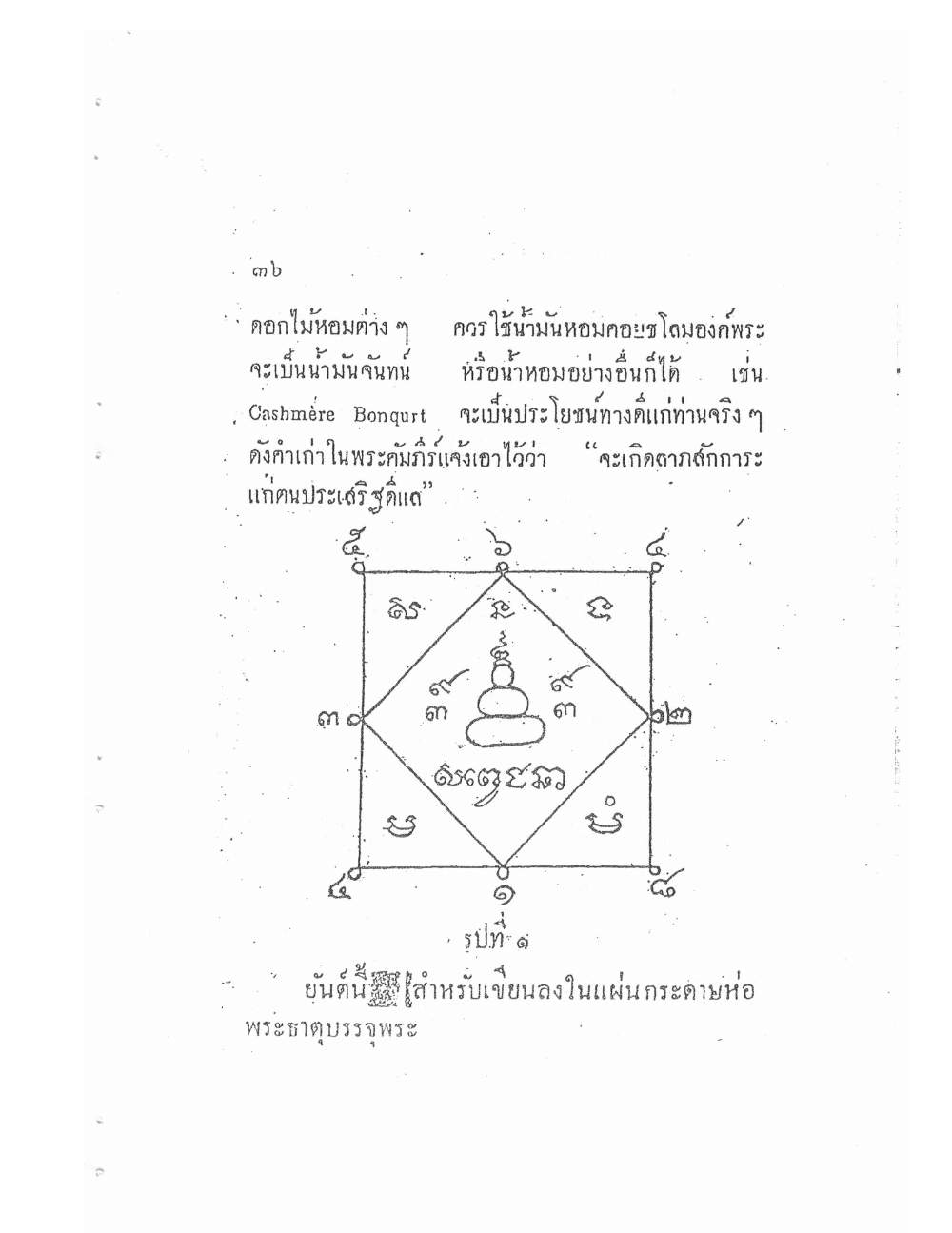
[รูปที่ ๑: ยันต์ผังสี่เหลี่ยม มีเลขไทยกำกับอยู่ที่มุมนอกทั้งแปดจุด (๗ ๖ ๕ / ๓ ๒ / ๔ ๑ ๘) ภายในเป็นรูปสี่เหลี่ยมข้าวหลามตัด มีอักขระขอมกำกับอยู่ที่มุมทั้งสี่ของสี่เหลี่ยมข้าวหลามตัด กลางยันต์เป็นรูปพระเจดีย์สามชั้น มีเลข ๓ กำกับอยู่ทั้งสองข้างซ้ายขวาขององค์เจดีย์ และมีแถวอักขระขอมเรียงอยู่ใต้ฐานเจดีย์ อักขระขอมทั้งหมดอ่านไม่ชัด]
รูปที่ ๑
ยันต์นี้ [อักขระขอม อ่านไม่ชัด] สำหรับเขียนลงในแผ่นกระดาษห่อพระธาตุบรรจุพระ
36.
For various fragrant flowers, one should use scented oil to anoint the Buddha image — it may be sandalwood oil, or another kind of perfume, such as [Cashmere Bouquet]; it will genuinely be of good benefit to you. As the old texts state in the scriptures: 'It will bring fortune and veneration to the truly excellent person.'
[Figure 1: A square-framed yantra with Thai numerals marking eight points around the outer border (7, 6, 5 / 3, 2 / 4, 1, 8). Inside is a diamond (rotated square) shape with Khom characters marking its four corners. At the center of the yantra is a three-tiered stupa (chedi), flanked left and right by the numeral 3, with a row of Khom characters running beneath the base of the stupa. All the Khom characters are not clearly legible.]
Figure 1.
This yantra [Khom characters, not clearly legible] is for writing onto the paper wrapping used to enclose the relic placed inside the Buddha image.
อาคมพระนารายณ์ ๓๗
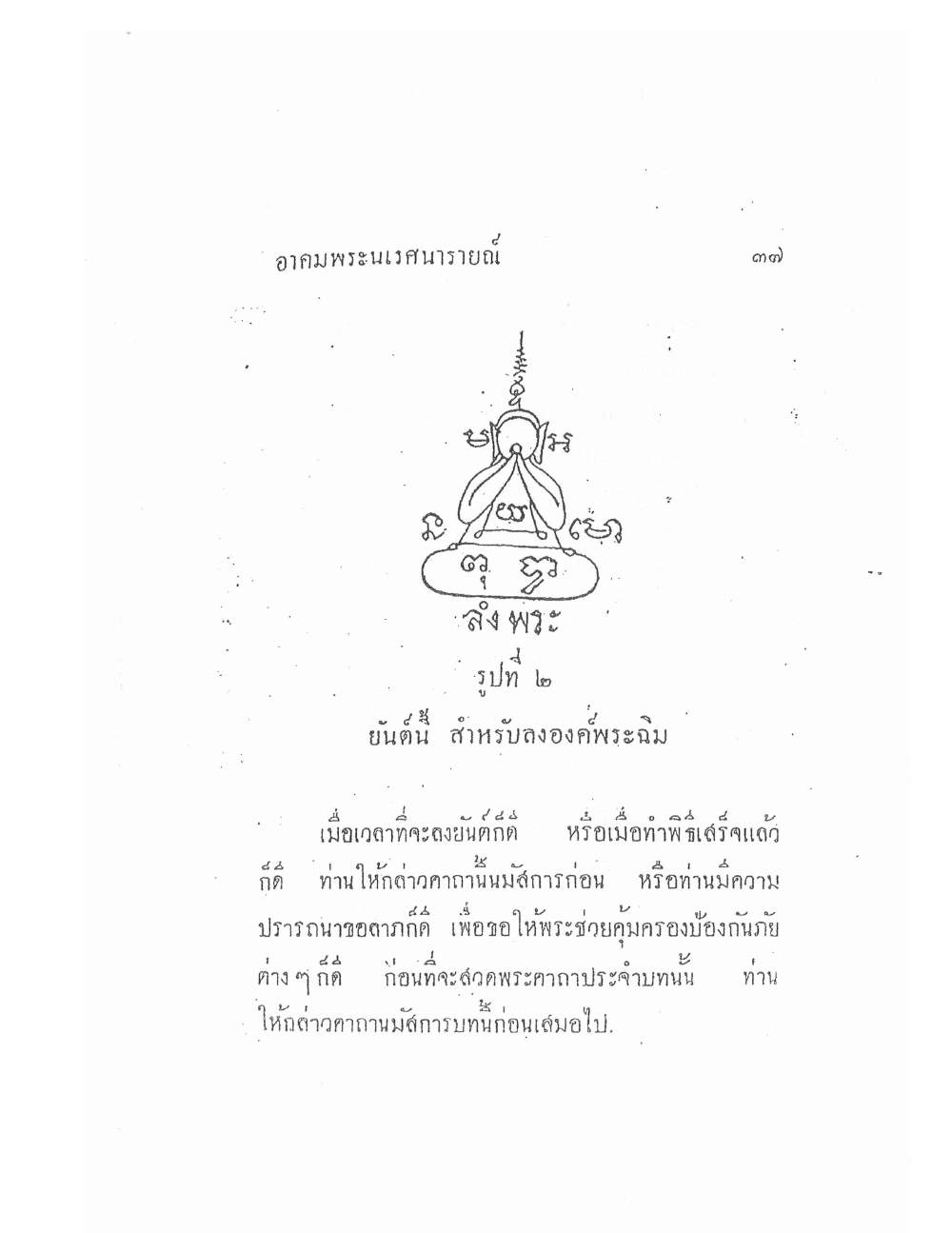
[รูปที่ ๒: ภาพยันต์รูปคล้ายพระสงฆ์หรือเจดีย์ทรงสามเหลี่ยม ยอดบนสุดเป็นเส้นหยักคล้ายรัศมีหรือฉัตร ถัดลงมาเป็นวงกลมแทนศีรษะ มีอักขระขอมขนาบซ้ายขวา ลำตัวเป็นทรงสามเหลี่ยมคล้ายมือพนม มีอักขระขอมกำกับอยู่ภายในและขนาบข้าง ฐานล่างเป็นวงรีมีอักขระขอมกำกับอยู่ภายใน ใต้ภาพมีคำกำกับว่า "ลงพระ" อักขระขอมโดยรอบอ่านไม่ชัด]
รูปที่ ๒ ยันต์นี้ สำหรับลงองค์พระฉิม
เมื่อเวลาที่จะลงยันต์ก็ดี หรือเมื่อทำพิธีเสร็จแล้วก็ดี ท่านให้กล่าวคาถานมัสการก่อน หรือท่านมีความปรารถนาขอลาภก็ดี เพื่อขอให้พระช่วยคุ้มครองป้องกันภัยต่างๆ ก็ดี ก่อนที่จะสวดพระคาถาประจำบทนั้น ท่านให้กล่าวคาถานมัสการบทนี้ก่อนเสมอไป.
Akhom Phra Narai. 37.
[Figure 2: A yantra drawing resembling a monk or a triangular stupa. At the very top is a jagged line like a halo or a tiered umbrella (chatra). Below that is a circle representing a head, flanked on either side by Khom characters. The body is triangular, resembling two hands pressed together in reverence (wai), with Khom characters marking the interior and both sides. The base below is an oval containing further Khom characters. Beneath the whole image is the caption "Inscribe onto the Buddha image" (ลงพระ). The surrounding Khom characters are not clearly legible.]
Figure 2. This yantra is for inscribing onto the Phra Chim image.
Whenever you are about to inscribe the yantra, or whenever you have just finished a rite, or whenever you wish to ask for good fortune, or wish to ask the Buddha to protect and guard you from various dangers — before reciting whichever mantra is proper to the occasion, you should always first recite this homage mantra (khatha namatsakan).
๓๘
พระคาถานมัสการ
ฉิมฺพลี จ มหาเถโร ยกฺขา เทวา ภิปูชิโต โส รโห ปจฺจยา ทินฺหิ อหํ วนฺทามิ ตํ สุทา
พระคาถานี้ ต้องกล่าวนมัสการก่อน จึงใครที่จะว่าพระคาถาทั้งปวงอื่นต่อภายหลัง
พระคาถาบูชาภาวนาขอลาภ
ฉิมฺพลี จ มหาเถโร เทวานรปูชิโต โสรโห ปจฺจยาทินฺหิ มหาลาภํ สพฺพโสตฺถี ภวนฺตุ เม.
พระคาถาบูชาภาวนาขอลาภ และป้องกันภัย
ราชปุตฺโต จ โย เถโร ฉิมฺพลี อติวิสฺสุโต
38.
Homage Mantra (Khatha Namatsakan)
Sīvali ca mahāthero yakkhā devā ca pūjito so raho paccayaṃ dinhi ahaṃ vandāmi taṃ sudā
[Sivali, the great elder, worshipped by yakkhas and devas; he in seclusion having received his requisites — I pay homage to him always.]
This mantra must be recited in homage first; only then may whoever wishes go on to recite all the other mantras afterward.
Mantra of Worship and Meditation for Requesting Fortune
Sīvali ca mahāthero devānarapūjito so raho paccayā dinhi mahālābhaṃ sabba-sotthī bhavantu me.
[Sivali, the great elder, worshipped by gods and men; he in seclusion having received his requisites — great gain; may all well-being come to me.]
Mantra of Worship and Meditation for Requesting Fortune and Protection from Danger
Rājaputto ca yo thero, Sīvali ativissuto — [He who was the elder, a king's son, Sivali, greatly renowned...]
อาคมพระนารายณ์ ๓๙
ลาเภน อุตฺตโม โหติ ยํยํ ชนปทํ ยาติ นิคเม ราชธานิโย สพฺพตฺถ ปูชิโต โหติ เถรสฺส ปาเท วนฺทามิ เถรสฺสานุภาเวน สพฺพลาภํ ภวนฺตุ เม ฉิมฺพลี จ เถรสฺส เอตทคฺคํ สพฺพชนํ สุปติฏฺฐิตํ สาริกธาตุ พุทฺธรูปํ อหํ วนฺทามิ สพฺพทา.
ธมฺมจกฺกํ ปทํ สุตฺวา พุชฺฌิตฺวา อตฺตปทํ สนฺติเก อโห โลเก โลกานํ หกฺกรนํ ภนฺเต ควมฺปติ นาม สุโลเก สุปากโฏ พฺรหฺม ปุตฺโต มหาเถโร อโห เชฏฺฐโก มุนี นตฺถิ เทวา รโหสิ คนฺธพฺพา อสุรา สกฺโก พฺรหฺมาภิปูชิโต นโม พุทฺธสฺส ควมฺปติสฺส นโม ธมฺมสฺส ควมฺปติสฺส นโม สงฺฆสฺส ควมฺปติสฺส สงฺขา สุขวรธมฺม จกฺขุปวรํ นิฏฺฐิตํ
พระคาถาบทนี้ โปรดท่องจำเอาไว้ให้มั่น หรือเรียกว่าท่องบ่นจนขึ้นใจ สำหรับบูชากราบไหว้องค์พระภควัม
Akhom Phra Narai. 39.
[...continuing the Sivali gatha:] '...supreme in gain; to whatever country, town, or royal capital he goes, he is everywhere honored. I pay homage at the elder's feet; by the elder's power, may all gain come to me. Sivali is declared foremost by the elder among all people, well established. I pay homage always to the relic and to the Buddha-image.'
[A devotional Pali verse in praise of Phra Gavampati (Khuan/Kawamphati): having heard and realized the wheel of the Dhamma and one's own path, in the presence of ... in the world, benefactor of the world's beings — venerable one, named Gavampati, well renowned in the world, son of Brahma, the great elder, foremost sage; there is none among the devas, hidden ones, gandhabbas, or asuras who is his equal; honored by Sakka and Brahma alike. Homage to the Buddha through Gavampati; homage to the Dhamma through Gavampati; homage to the Sangha through Gavampati. Reckoning the excellent teaching of happiness, the supreme eye of wisdom is accomplished.]
This mantra should be memorized firmly, or recited over and over until it is fixed in the heart, for use in worshipping and paying homage to the Phra Phakhawam (Gavampati) image.
๔๐
(พระฉิม) ที่ได้จัดสร้างขึ้นเป็นองค์พระนั้น เป็นการบูชาเฉพาะองค์พระภควัมบดีเถระเจ้า เพื่อขอลาภสักการะต่างๆ สำเร็จสมดังความปรารถนาทุกประการ
ตำหรับเก่าท่านกล่าวบ่งชัดไว้สุดท้ายว่า "วิเศษยิ่งนัก"
อนึ่ง ท่านควรทราบไว้ด้วยว่า การบูชาถวายข้าวพระฉิมนั้น จะต้องมีพระคาถากำกับการบูชาไว้ด้วยพระคาถาบูชาถวายข้าวพระฉิม มีดังนี้
สูปโภชนสมฺปนฺนํ วรคนฺธํ ฉิมฺพลิกํ อหํ เทมิ
พระคาถาขอลาภ
พระคาถาบทนี้ สำหรับบริกรรมภาวนาระลึกนึกถึงองค์พระฉิมอยู่เสมอเป็นนิจ เพื่อให้เกิดลาภแก่คนหรือในขณะเดินทางไกล ด้วยรถไฟ รถประจำทาง เครื่องบิน โดยเฉพาะอย่างยิ่ง ท่านที่เดินทางโดยอากาศไป[อ่านไม่ออก]
40.
(As for Phra Chim,) the image that has been created is made for the specific worship of the venerable elder Phra Phakhawam (Gavampati), in order to ask for fortune and veneration of every kind, so that all one's wishes may be fulfilled.
The old manual states plainly at the very end: 'exceedingly wondrous indeed.'
Furthermore, you should also know that the offering of rice to Phra Chim must be accompanied by a proper mantra. The mantra for offering rice to Phra Chim is as follows:
Sūpabhojanasampannaṃ varagandhaṃ, Cimbalikaṃ ahaṃ demi. [I offer to Cimbali (Sivali) this excellent meal, endowed with fine fragrance.]
Mantra for Requesting Fortune
This mantra is for silent recitation, to keep the Phra Chim image constantly in mind, so as to bring fortune to a person, especially while traveling far by train, by bus, or by airplane — most especially for those traveling by air to [illegible].
อาคมพระนารายณ์ ๔๑
ราชการ หรือเพื่อการศึกษา ณ ต่างประเทศมีมาก พ่อค้าพาณิชย์ เดินทางไกลไปหาลาภสักการะทางไกลด้วยพาหนะอย่างใด ๆ ก็ดี แม้จะโดยพาหนะทางน้ำ ให้ภาวนาด้วยพระคาถาบทนี้ไว้ ประโยชน์สุขหรือลาภอาจเกิดได้ระหว่างทางมิได้ขาด:
หัวใจพระฉิม
นชาลิเต สงฺชาลิเต นชาลิเต สงฺชาลิเต นชาลิต พลิราชา
ท่านว่าเท่านี้ ท่านก็จะจับหัวใจพระฉิมพลีได้ เป็นหัวใจพระฉิมพลี สำหรับใช้บริกรรมภาวนาอยู่เป็นนิตย์
คุณสมบัติหรือความมหัศจรรย์ ของพระคาถานี้เพื่อจำทรงท่องบ่นไว้เป็นนิจสิน ก็จะบังเกิดลาภผลแก่ท่านตามความปรารถนา.
Akhom Phra Narai. 41.
...on government duty, or for study abroad, there are many. Merchants travel far to seek fortune and prosperity by any means of conveyance whatsoever, even by water. Recite this mantra silently, and benefit, happiness, or gain may arise continually along the way, without fail:
The Heart-Mantra of Phra Chim
Najālite saṃjālite Najālite saṃjālite Najālita, Baliraja
[Untranslatable seed-mantra syllables.]
Recite only this much, and you will have grasped the heart-mantra of Phra Chimphali (Sivali). This is the heart-mantra of Phra Chimphali, to be recited silently at all times.
The virtue and wondrous power of this mantra — if you keep it firmly in mind and recite it constantly as a daily practice — will bring you fortune and results according to your wishes.
๔๒
พระคาถาภาวนาให้คนรัก
เขาว่าคนรักเท่าผืนหนัง คนชังเท่าผืนเสื่อ คำพังเพยอันนี้ควรใส่ใจจำไว้ โบราณาจารย์ท่านอุปมาเอาไว้ไม่เสียหายเลย และไม่ควรเอามาเป็นปัญหาข้องใจอื่นใดอีกด้วย
มนุษย์ปุถุชนเรา ทุกคนย่อมใคร่ในการรักเคารพนับถือกัน ก็แหละมนุษย์ปุถุชนเรานี้แหละย่อมเว้นจากการเกลียดชังกันไม่ได้ อย่างที่เรียกว่าคนกับคนย่อมกระทบกัน ก็เป็นความหมายให้ท่านเข้าใจดีอยู่แล้ว
คนเราเคยรักกันมาก แต่แล้วก็อาจโกรธกันมาก เพราะกรณีหนึ่งเรื่องใดไม่อาจคาดถึงได้ เมื่อรักกันนั้นความรักถ้าผลิดอกออกผล ใช้เวลาไม่ใช่เล็กน้อย นานวันเดือนปีกันทีเดียว รักกันนั้นจึงจะจับจิตจับใจซึ่งกันและกัน แต่ถ้าจะโกรธกันประเดี๋ยวเดียวเท่านั้นเห็นผล เจ็บป่วยไม่สบายพอปรึกษาแพทย์ เยียวยาตามสมุฏฐานของโรคได้ แต่คนโกรธเกลียดกันจะให้คนรักกันอย่างเดิม เห็นว่ายาก
42.
Mantra for Meditation to Make a Person Love You
They say love is as thin as a sheet of leather, and hatred as thin as a mat — this proverb is worth keeping in mind. The old teachers' comparison does no harm, and it should not be turned into a source of doubt over anything else either.
We ordinary human beings all naturally desire to be loved, respected, and esteemed by one another. And yet, being ordinary human beings, we also cannot avoid feeling dislike or hatred toward one another at times — just as they say, people inevitably rub up against one another. This meaning, you already understand well enough.
People may once have loved each other greatly, but then may come to be greatly angry with each other, because of some single matter that could never have been foreseen. When two people love each other, that love, in order to blossom and bear fruit, takes no small amount of time — many months and years indeed. Only then does love truly take hold of one another's heart and mind. But if they become angry with each other, the effect can be seen in the blink of an eye. When one falls sick and unwell, one may consult a doctor and be treated according to the cause of the illness — but to make people who are angry and full of hatred toward each other love one another as before is seen as difficult.
อาคมพระนารายณ์ ๔๓
ต่อการเอาอื่นเข้าประสาน นอกจากจะใช้พระพุทธคุณเข้าช่วย พูดง่าย ๆ คือเอาทางเมตตาเข้าประสานรอยร้าวนั้นเอง พระคาถาภาวนาให้คนเกลียดกลับคืนรักได้ มีไว้ตามพระตำหรับดังนี้
อิติปารมิตา ฯลฯ จ เต นโม เอหิ เอหิ กรณียเมตฺตํ สกฺตา เลตฺตา กรุณาไมตรี อุเบกขา ไชยะ ไชยะ นารีจักรวัติราธา นโม โจรํ ไมตรี จิตตัง
ที่ว่าคนเกลียดกลับรักได้ เพราะว่าพระคาถาบทนี้สำหรับภาวนาให้คนที่เป็นศัตรูกลับเป็นมิตร แม้คนที่จะประทุษร้ายเรา ก็กลับมีจิตเมตตาสงสารเราก็ได้ ท่านที่มีพ่อเลี้ยงแม่เลี้ยง คนทั้ง ๒ ประเภทนี้มักความเกลียดชังท่าน เพราะเหตุใดก็ตาม ใช้พระคาถานี้ภาวนาเข้าไว้ ก็จะทำให้กลับมีใจรักท่าน
ถ้าหากเราเป็นผู้ปราศจากที่พึ่งพักพิง ใครที่จะผู้อุปถัมภ์ค้ำชู เราจงให้ใครคนใดคนหนึ่ง มีเมตตาจิตต่อ
Akhom Phra Narai. 43.
For bringing something else back into harmony, aside from calling on the power of the Buddha's virtue to help, put simply, it is a matter of using loving-kindness (mettā) itself to mend that rift. A mantra for meditation to turn a person's hatred back into love exists in the old manual, as follows:
[A folk-Pali meditation formula invoking the perfections (pāramitā), homage, and loving-kindness, compassion, sympathetic joy, and equanimity (mettā-karuṇā-muditā-upekkhā), together with an appeal for victory (jaya) and goodwill even from thieves or enemies.]
The reason a person's hatred can be turned back into love is that this mantra is meant to be recited so that one who is an enemy becomes a friend again. Even someone who intends to do us harm may instead come to feel loving-kindness and compassion for us. Those of you who have a stepfather or stepmother — such people often harbor dislike toward you, for whatever reason — should recite this mantra, and it will cause them to come to love you again.
If we should find ourselves without anyone to depend on or take shelter with, and wonder who might support and sustain us, let us have someone, whoever it may be, feel loving-kindness toward...
๔๔
เราแล้ว ท่านว่าให้เขียนชื่อผู้นั้นที่เราปรารถนาใส่ลงในไส้เทียน แล้วบีบปากขันสำริด เอาน้ำใส่ลงในขันสำริด เอาเทียนบีบปากขัน ว่าพระคาถาบทนี้บริกรรมไปจนกว่าเทียนที่บีบปากขันนั้นจะหมด จึงเอาน้ำในขันนั้นมาดื่มบ้าง ล้างหน้าบ้าง แล้วให้สังเกตดูการกระทำของเราภายในไม่ช้าก็จะสำเร็จสมความปรารถนา.
อนึ่งความพระตำหรับชี้แจงไว้ว่า นักโทษจะต้องถูกพิพากษาถึงประหารชีวิตก็ดี พระคาถาบทนี้อาจสามารถให้ลดหย่อนผ่อนจากหนักเป็นเบาได้ คือหมายความว่าตัวเองถูกประหารชีวิตแล้ว เป็นโทษสถานต้องจำเพียงตลอดชีวิตเท่านั้น
คาถาเชิญพระเข้าตัว
พุทฺธาย ธมฺมาย สงฺฆาย สหสฺสโกฏิเทวานํ พฺรหฺมเทวานํ คเต มมํ รกฺขนฺตุ สพฺพทา
พระคาถาบทนี้ สำหรับอาราธนาคุณพระรัตนตรัย คือ
44.
...to us. It is said that you should write the name of the person you desire onto the wick of a candle, then pinch it to the rim of a bronze bowl, put water into the bronze bowl, and fix the candle at the rim of the bowl. Recite this mantra silently until the candle pinched at the bowl's rim has burned all the way down. Then take some of the water in the bowl and drink a little, and wash your face with some of it. Afterward, observe your own conduct — before long, your wish will be fulfilled.
Furthermore, the old manual explains that even when a prisoner has been sentenced to death, this mantra can help reduce the sentence from severe to light — meaning that in place of being executed, the punishment becomes only lifelong imprisonment.
Mantra for Inviting the Buddha into Oneself
Buddhāya dhammāya saṅghāya, sahassakoṭi-devānaṃ brahma-devānaṃ, gate mamaṃ rakkhantu sabbadā.
[To the Buddha, to the Dhamma, to the Sangha; may the thousand-koti gods and Brahma-gods protect me always, wherever I go.]
This mantra is for invoking the virtue of the Triple Gem, namely...
อาคมพระนารายณ์ ๕๕
พระพุทธ พระธรรม พระสงฆ์ อัญเชิญเข้ามาสู่ตัวเรา ผู้ที่ ประสงค์จะทำกิจการใดให้เป็นผลสำเร็จก็ดี หรือจะเดินทาง ไปค้างคืนก็ดี ท่านให้กล่าวคาถาบทนี้ ๓ จบ เชิญพระพุทธ พระธรรม พระสงฆ์ เข้าตัวเราแล้ว จึงทำการทั้งปวงต่อไป
คาถานมัสการ
วนฺทิตฺวา สิรสา พุทฺธํ ชยลาภํ ภวนฺตุ เม
(ท่านผู้ถาม ๆ มาในการพิมพ์ครั้งแรกว่า "คำว่าคาถา เชิญพระเข้าตัวนี้ จะต้องใช้สำหรับพระฉิมเท่านั้นหรือ ๆ จะใช้ได้ทั่วไป" ขอตอบว่า "คาถาเชิญพระเข้าตัวนี้ไม่ถูก แบบของเวทมนต์หรือคาถาอาคม แต่ต้นฉบับเดิมสมุดข่อย ท่านแสดงไว้อย่างนั้น ที่จริงตามที่ทราบมาบ้างเขาไม่เรียก พระเข้าตัว หากเรียกขานเข้าตัวจึงจะถูกต้อง เพราะพระ เข้าตัวใครไม่ได้ เมื่อจะทำอะไรมีแต่ขออำนาจบารมีคุณ พระรัตนตรัยให้ช่วยดลบันดาลดังนี้ บางท่านอาจจะแล้วแต่เกจิ อาจารย์ท่าน)
[Running header:] Akhom Magic of Phra Narai — 55
May the Buddha, the Dhamma, and the Sangha be invoked to enter into us. Whoever wishes any undertaking to succeed, or to travel and stay overnight away from home, should recite this verse three times, inviting the Buddha, the Dhamma, and the Sangha to enter into us; only then proceed with all further actions.
Verse of Homage
"Having paid homage with my head to the Buddha, may victory and gain be mine."
(Readers who wrote in when this book was first printed asked: "Does the phrase 'the verse for inviting the Buddha into the body' apply only to the Phra Chim image, or can it be used generally?" Our answer: "This verse for inviting the Buddha into the body does not actually follow the proper form of a spell or magical mantra, but the original khoi-paper manuscript presented it this way. In truth, as far as we understand, one should not properly speak of 'inviting the Buddha into the body' — if instead one speaks of 'invoking' the Buddha's power into oneself, that would be more correct, since no one can bring the Buddha into their own body. Whenever one is about to do something, one merely asks for the power and blessing of the Triple Gem to grant assistance in this way. Some practitioners may differ, following their own teacher's tradition.)
๕๖
วนฺทิตฺวา สิรสา ธมฺมํ ชยสุขํ ภวนฺตุ เม วนฺทิตฺวา สิรสา สงฺฆํ โสตฺถิ สพฺพํ ภวนฺตุ เม
พระคาถาบทนี้ สำหรับใช้ภาวนาคู่กับคาถาเชิญองค์ พระเข้าสู่ตัว เมื่อภาวนาคาถาเชิญองค์พระแล้ว ให้ภาวนา คาถานี้เป็นคำกล่าวนมัสการพระ ซึ่งถือกันว่าได้เข้ามาอยู่ ในตัวเราแล้ว ๓ จบ จะทำอะไร จะเดินทางไป ณ ที่ใด หรือจะเอา อนุตตโร นำคาถาทั้งปวงก็ได้
(ท่านผู้ถามสงสัยว่า "หรือจะนำ อนุตตโร นำคาถา ทั้งปวงก็ได้นั้น หมายความอย่างไร และนำกันอย่างไร" ขอตอบว่า "อนุตตโร นำคาถาทั้งปวงนั้น หมายความว่า นำแล้วคาถาอาคมจะได้ดีขึ้น ขลังขึ้น อย่างที่เรียกว่าทำให้ มนต์ขลังนั้นเอง การนำให้ได้ ๓ ถึง ๗ คาบแล้ว เราจะทำ อะไรก็ว่าไป เป็นผลสำเร็จทุกอย่าง ขออย่าทำการทุจริต ผิดกฎหมายก็แล้วกัน ผู้สร้างอาคมนี้ไม่รับรอง)
56
"Having paid homage with my head to the Dhamma, may joy and happiness be mine. Having paid homage with my head to the Sangha, may all well-being be mine."
This verse is recited together with the verse for inviting the Buddha-image into the body. After reciting the verse inviting the Buddha-image, recite this verse as a statement of homage to the Buddha, who is now held to have entered and dwell within us — recite three times. Whatever one is about to do, wherever one is about to travel, one may also lead with the word "Anuttaro" to introduce all the other verses.
(Readers who were puzzled asked: "What does it mean to lead with 'Anuttaro' to introduce all the verses, and how is it done?" Our answer: "Leading with Anuttaro to introduce all the verses means that, once led in this way, the magical verses become more potent and effective — this is what is called making the mantra powerful. Lead with it 3 to 7 times, and then whatever we go on to do will succeed completely. Only, please do not use this for wrongdoing or anything against the law — the creator of this collection of mantras takes no responsibility for such misuse.)
อาคมพระนารายณ์ ๕๗
คาถาบรรจุพระธาตุ
น ม ติ ติ พสิ ราชา ติยา อม สคฺุคโตโย สพฺยา นิรมฺตรลาโภ สพฺพสุขา สมฺมาวหา
พระคาถาบทนี้ สำหรับบรรจุพระธาตุเข้าในองค์พระ
เดชานุภาพพระฉิม
ต่อไปนี้ จะได้พูดถึงความศักดิ์สิทธิ์และอิทธฤทธิ์ของ พระฉิม ซึ่งจะดลบันดาลให้แก่ท่านผู้สนใจ หรือผู้ที่ได้ กระทำสักการะบูชาแด่พระองค์แล้ว ก็จะบันดลบันดาลให้ ท่านผู้สนใจจริง ๆ สำเร็จสมความปรารถนาทุกสิ่งทุกอย่างได้ ตามพระตำหรับเก่านี้ท่านกล่าวไว้ว่า
"สิทธิการิยะ อุปเท่ห์พระฉิมพลี ถ้าผู้ใดพบจะได้ร่ำ ทำ ให้ถูกทรัพย์บนทรัพย์ล่าง (หมายความว่า ถ้าท่านผู้ใด
[Running header:] Akhom Magic of Phra Narai — 57
Verse for Enshrining the Relic
[A magical/mantra formula rendered in Thai script; largely a string of invocatory syllables rather than plain Pali — approximate sense: "...king... gain without ceasing... all happiness, rightly bestowed." Precise meaning of several syllables uncertain.]
This verse is for enshrining a relic inside the body of a Buddha image.
The Sacred Power of Phra Chim
Next we shall speak of the sanctity and miraculous power of Phra Chim, which will grant its blessings to those who take an interest in it, or to those who have paid it homage and worship — it will grant to those who are truly sincere the fulfillment of every wish, in every respect. According to this old manual, it is said:
"Siddhikāriya, the method of Phra Chimphli: whoever encounters it will grow wealthy, will find treasure both above ground and below ground." (This means that whoever...
๕๘
พบตำราเล่มนี้แล้ว มีจิตศรัทธาเลื่อมใส ใครจะได้พระฉิม ไว้เป็นสมบัติประจำตัวเพื่อสักการะบูชาสักหนึ่งองค์ เพื่อให้ เกิดลาภ เกิดผล เกิดความสวัสดิมงคลแก่ท่านแล้ว ก็จง เร่งรีบจัดการ และการสร้างสมนี้จะลงมือกระทำการ ท่าน ให้หาฤกษ์ วันดี คืนดี เสียก่อน มิให้คิดการสร้างสมเอา แต่ตามใจ)
ในเรื่องนี้ต้องมีพิธีรีตองมาก ให้ทำเมื่อ ๗ วัน หรือ ๓ วัน คิดดูแล้วพูดง่าย ๆ ก็ให้ทำวันดี เพื่อให้เป็นมงคล แก่ผู้จะกระทำการนั้นเอง สัตตวาร หรือหมายถึง ๗ วัน ก็ได้แก่วันดีที่เป็นศรีมงคลนั้นเอง
ท่านให้กางเพดานกันม่าน เตรียมพร้อมแล้วด้วย บายศรี ๓ สำรับ ให้เอาด้ายสาวพรหมจารีย์จับเป็นมนต์ ให้ได้ ๓ รอบ (เห็นจะหมายความว่า ให้หาด้ายที่ บริสุทธิ์สะอาด ปราศจากมลทินโทษ เครื่องเศร้าหมองต่าง ๆ แล้วเอามาจับเป็นมงคล) "อย่าให้คนเห็นลุ่มล้าเข้า ออกไปมา" (คงจะให้ทำพิธีในที่ที่ไม่มีคนพลุกพล่านเดิน
58
...encounters this manual and feels sincere faith and devotion, and wishes to obtain a Phra Chim image as a personal possession to worship, in order to bring fortune, results, and auspicious well-being — let them make haste to prepare. And when beginning to create the sacred object, one should first seek an auspicious day and night; do not undertake this merely as one pleases.)
This matter requires much ceremony. It should be performed over 7 days, or 3 days — but simply put, one need only choose an auspicious day, so that it is auspicious for the one performing the rite. "Sattavāra," meaning 7 days, refers precisely to such an auspicious, blessed day.
One should set up a canopy with curtains, and prepare three sets of bai-sri offering trays. Have a virgin maiden twist thread into a sacred cord, winding it three times. (This seems to mean: find thread that is pure and clean, free of any stain or defilement, then twist it into an auspicious cord.) "Do not let people see it, crowding in and out" (this presumably means the rite should be performed where there is no bustling foot traffic passing...)
อาคมพระนารายณ์ ๕๙
ผ่านไปมาได้) แล้วให้เย็บตาดบัตรอันหนึ่งกับกระทงทำด้วย ใบตองสด ๘ ทบ ถวายแก่พระอมิตรยู (เห็นจะเป็นมฤตยู) และพระอิศวร ทั้งนางอุมาภควดี เทียนเล่มหนึ่งหนักห้า ตำลึงตามถวายพระฉมพลี แกะให้ เหมือนพระอัจจายนเถระ แกะด้วยแก่นจันทน์หนักได้ รากรักซ้อนก็ได้ แกะทั้งฐานด้วย แต่องค์เดียวหนึ่ง ให้องค์สูงหนึ่งองคุลี หรือ ๒-๓-๔-๕ องคุลี ก็ได้ (หมายความว่าแกะฐาน ๑ องค์ด้วย ส่วนองค์พระนั้น จะแกะให้สูงสักกี่องคุลีก็ได้ สุดแท้แต่ของที่จะแกะ หรือ ต้องการจะให้ตัวงามเพียงใด องค์พระกับฐานนั้นแกะติด กันเป็นอันเดียว) แล้วจึงรวงที่นั่งเสียเอาเหล็กควั่นตอน ใต้ฐานองค์พระให้เป็นช่องเป็นรู หรือที่เรียกว่าทะลวงนั้น เอง) แล้วจึงเอาพระธาตุประจุเข้าไว้ในองค์ เมื่อประจุนั้น ให้ว่าอาการ ๓๒ นั้น ๗ ที (อาการ ๓๒ ได้แก่ เกศา, โลมา, นขา, ทันตา, ฯลฯ) แล้วจึงพิสถานว่า "พระ ฉิมพลีเจ้าเมื่อยังทรงมานอยู่ (ยังมีอายุอยู่ก็ยังไม่ตาย)
[Running header:] Akhom Magic of Phra Narai — 59
...people passing back and forth). Then sew together one gilt-brocade card with a folded tray made from eight layers of fresh banana leaf, and offer it to Phra Amitru (likely meaning Mrityu, the deity of death) and Phra Isuan (Shiva), together with Nang Uma Bhagavadi. Offer one candle weighing five tamlueng to Phra Chomphli. Have the image carved as tradition holds Phra Achayana Thera would have it carved: from sandalwood heartwood of any weight, or from double-layered rak-lacquer root wood, carving the base together with it as a single piece. Let the figure's height be one khoeun (finger-width), or 2, 3, 4, or 5 khoeun — as one wishes. (This means the base is carved as one with it; the image itself may be carved to whatever height, however many finger-widths, depending on the material at hand or how beautiful one wishes it to be — the image and its base are carved joined as a single piece.) Then hollow out a seat by boring with an iron tool beneath the base of the figure, making an opening or hole — what is called "boring through." Then place a relic inside the body of the image. While inserting it, recite the "Thirty-two Parts" seven times (the thirty-two parts being: hair of the head, body hair, nails, teeth, and so on). Then declare: "Phra Chomphli, while he still dwelt [in this life]" (meaning, while he was still alive and had not yet died)
๖๐
นั้นเมื่อประกอบด้วยอาการ ๓๒ นั้นด้วยก็ดี ให้ข้าพเจ้า บริบูรณ์เหมือนอย่างพระฉิมพลีเจ้านั้นเถิด" แล้วจึงเอา ยานี้ (ยาที่กล่าวมาข้างต้น) บดปิดที่ทะลวงนั้น (ที่รอยเจาะนั้น)
ทำเสร็จแล้ว เสกให้ได้ ๗ วัน เสกให้ได้วันละพัน แล้วเอาไว้เป็นที่พึ่งแก่คนเกิด (พระคาถาสำหรับปลุกเสกได้ กล่าวไว้แล้วข้างต้น) ถวายข้าวน้ำ ดอกไม้ อย่าให้ขาดได้
ถ้าจะบูชา วัน ๑ (วันอาทิตย์) บูชาด้วยดอกไม้แดง ว่าพระคาถานี้
ฉิมพลี จ มหาเถโร ยกฺขาเทวา จ ปูชิโต โส รโห ปจฺจยาทิมฺหิ อหํ วนฺทามิ ตํ สทา นมามิ เสฏฺฐํ เกริ มหาตปํ เตชํ
60
"...when I too am endowed with those thirty-two parts, may I become as complete as Phra Chomphli." Then take this medicine (the one mentioned above), grind it and use it to seal the bored hole (the drilled opening).
Once this is completed, consecrate it for 7 days, chanting a thousand times each day. Then keep it as a refuge for the living (the consecration verse has already been given above). Offer food, water, and flowers — never let these run out.
If worshipping on day 1 (Sunday), worship with red flowers, reciting this verse:
"Chimphli, the great elder, worshipped by yakkhas and devas, he who is secluded, at the very source [of blessings], I pay homage to him always. I revere the excellent one, [name uncertain: "Keri"], of great asceticism and power."
อาคมพระนารายณ์ ๖๑
กตญฺญุตาสมา สุยุตฺตํ สพฺพลาภํ นิรนฺตรํ
ต่อไปวัน ๒ (วันจันทร์) ดอกไม้เหลือง, ขาว ใช้ พระคาถานี้บูชา
ฉิมพลี จ มนาปํ สพฺพลาภํ ภวิสฺสติ
ต่อไปวัน ๓ (วันอังคาร) ดอกไม้ขาว ใช้พระคาถา นี้บูชา
ยํ ยํ ปุริสํ อิตฺถี วา ทูเร วา สมีเป วา เถรสุสานุภาเวน สพฺพํ โหนฺติ ปิยํ มม
ต่อไปวัน ๔ (วันพุธ) คงใช้ดอกไม้ขาวเช่นกัน แต่เชิญพระคาถานี้บูชา
ฉิมพลี จ มหาเถโร
[Running header:] Akhom Magic of Phra Narai — 61
"Grateful and well-disciplined, may all fortune come without ceasing."
Next, on day 2 (Monday), use yellow and white flowers, reciting this verse for worship:
"Chimphli, pleasing and dear, all fortune shall come to be."
Next, on day 3 (Tuesday), use white flowers, reciting this verse for worship:
"Whatever man or woman, whether far away or nearby, by the power of the elder's presence in the charnel ground, may all become dear to me."
Next, on day 4 (Wednesday), still use white flowers, but invoke this verse for worship:
"Chimphli, the great elder,"
๖๒
โส รโห ปจฺจยาทิมฺหิ ชยลาภํ มหาลาภํ โสตฺถิ ภวนฺตุ เต
ต่อไปวัน ๕ (วันพฤหัสบดี) วันนี้ต้องใช้ดอกไม้ ๕ สิ่ง บูชาด้วยพระคาถานี้
น ม พ ติ ฉิมฺพลี ราชา บี้ยจกฺกมุทเตยํ สเร นิรนฺตรํ สพฺพลาภํ สุขาวหา
ต่อไปวัน ๖ (วันศุกร์) ใช้ดอกไม้สีขาว เหลือง บูชาด้วยพระคาถานี้
โส รโห ปจฺจยาทิมฺหิ สพฺพลาภํ กโรนฺตุ เม
ต่อไปวันท้ายสุดคือวัน ๗ (วันเสาร์) ให้ใช้ดอกไม้ สีแดง ขาว อัญเชิญพระคาถานี้บูชา
62
"He who is secluded, at the very source, victory and gain, great fortune, may well-being come to be yours."
Next, on day 5 (Thursday), this day requires the use of five kinds of flowers, worshipping with this verse:
[An invocatory formula naming Chimphli as a royal, kingly figure; part of the wording is obscure — approximate sense: "...Chimphli, the king... without ceasing, bringing all gain and happiness."]
Next, on day 6 (Friday), use white and yellow flowers, worshipping with this verse:
"He who is secluded, at the very source, may all fortune be brought to me."
Next, on the final day, day 7 (Saturday), use red and white flowers, and invoke this verse for worship:
อาคมพระนารายณ์ ๖๓
ราชปุตฺโต จ โย เถโร ฉิมฺพลี อิติ วิสฺสุโต ลาเภน อุตฺตโม โหติ ยํ ยํ ชนปทํ ยาติ นิคเม ราชธานิโย สพฺพตฺถ ปูชิโต โหติ เถรสุสานุภาเวน สพฺพํ โหนฺติ ปิยํ มม
พระคาถาข้างต้นนี้ เป็นคาถาสำหรับกล่าวนมัสการ พระธาตุ ซึ่งบรรจุอยู่ในองค์พระฉิม ตามตำราท่านว่าให้ บูชาทุก ๆ วัน อย่าให้ขาดได้สักวันหนึ่งเลย ตั้งแต่วัน ๑ ถึง วัน ๗ หรือวันอาทิตย์ถึงวันเสาร์ ถ้าปฏิบัติได้ดังนี้ ทุก ๆ วัน ท่านว่าวิเศษนัก จะได้รับความเคารพ นับถือจากปวงชนทั่ว ๆ ไป จะมีผู้มายอมรับนับถือเราทุก วันมิได้ขาด ทั้งเทพยดาทั้งหลายก็จะปกปักรักษาผู้นั้น คุ้มครองป้องกันสรรพภัยพิบัติอุบัติเหตุอันตรายได้ และบุคคล
[Running header:] Akhom Magic of Phra Narai — 63
"The elder who is the king's son, known by the name Chimphli, becomes supreme through his gains. Whatever land he journeys to, in every town and royal capital, he is worshipped everywhere. By the power of the elder's presence in the charnel ground, may all become dear to me."
The verse above is used to pay homage to the relic enshrined within the body of the Phra Chim image. According to the manual, one should worship it every single day without missing even one, from day 1 through day 7 — that is, from Sunday through Saturday. If this is practiced every day in this way, it is said to be truly excellent: one will receive respect and reverence from people everywhere, and people will come to accept and revere us without fail, day after day. All manner of deities, too, will protect and guard such a person, shielding them from every calamity, mishap, and danger. And a person...
๖๔
ผู้บูชาพระฉิมนั้น จะปรารถนาสิ่งหนึ่งสิ่งใดแล้ว ท่าน ให้เขียนสิ่งนั้นลงกันพระแล้วรมด้วยควันธูป สิ่งที่คน ปรารถนานั้นก็จะพลันอุบัติขึ้นมา
ถ้าแลทราบว่าจะเดินทางไปในสารทิศใด ๆ ก็ดี ให้ กล่าวคาถานมัสการองค์พระเสียก่อนแล้วจึงไป จะเกิด ความสวัสดีแก่คนที่เดียว การเดินทางของท่าน ไม่ว่า รถประจำทาง หรือรถส่วนตัว เรือประจำทาง หรือเรือ ส่วนตัวจากจังหวัดหนึ่งไปสู่อีกจังหวัดหนึ่ง รถไฟ หรือ เครื่องบิน ย่อมปลอดภัยทุกอย่าง ทั้งเป็นที่ชอบเนื้อเจริญ ใจแก่มนุษย์และเทวดาทั้งหลายเสียด้วย ถ้าจะปรารถนา ให้ท้าวพระยามหาเรา (ท้าวพระยาเดี๋ยวนี้มักจะหายาก เสียแล้ว ผู้เขียนขอเปลี่ยนเป็นผู้ยิ่งใหญ่ให้สมกับกาล สมัยระบอบประชาธิปไตยดีกว่า) ให้เขียนชื่อท่านผู้นั้น ใส่ใต้ที่นั่งพระ แล้วสวดภาวนาด้วยพระคาถา ๗ คาบ ทำให้ได้เจ็ดวัน ท่านผู้ดุดมด้วยความไพศาลยิ่งใหญ่ที่
64
For one who worships the Phra Chim and wishes for any particular thing, write down that wish, place it beneath the image, and fumigate it with incense smoke — the thing wished for will swiftly come to pass.
If you know you must travel in any direction, recite the verse of homage to the image before setting out, and safety alone will come to you. Whether your journey is by public bus or private car, public ferry or private boat, from one province to another, by train, or by airplane — it will be entirely safe, and will also be pleasing and gladdening to both humans and devas. If you wish to draw the favor of a great lord or ruler (nowadays such great lords have become rare, so this author will instead say "an eminent person," more fitting to our present democratic era), write that person's name and place it beneath the seat of the image, then chant the verse seven times, doing this for seven days. That person, abounding in vast greatness...
๖๕
ท่านต้องการ จะมาหาท่านเอง ถึงจะไม่มาก็จะ ต้องราลึกถึงท่านแน่ คอยสังเกต ๓ วัน ๗ วัน ความ รุ่มร้อนราลึกถึง จะต้องส่งใครคนใดคนหนึ่ง เช่นอาจ เป็นเด็กในบ้านให้มาหาท่านแทนตัวแน่นอน
อนึ่ง, ตามพระตำหรับนี้ ได้บ่งชี้ไว้ว่า "ถ้า จะทำพิธีอย่างหนึ่ง, ให้ทาน้ำมันหอม (บ่งว่าให้ซื้อ จากร้านค้า แต่น่าเสียดายที่ไม่บ่งว่าให้ซื้อน้ำมันหอม ยี่ห้ออะไร ท่านคงใจซื้อตามใจรักก็แล้วกัน) เลือก เอาน้ำมันหอมอย่างดีชนิด ๑ (ดีแท้จริง) ให้ได้ ๗ แห่ง มีเกล็ดเสียด้วยว่า เมื่อถามราคาผู้ขายแจ้งว่าเท่าใด ก็มิให้ต่อรองราคา (เดี๋ยวนี้มีบ้างบอกราคาชัดแจ้งว่าสิ่ง ของต่าง ๆ แต่ละอย่างมีราคาเท่าใด ที่จริงลดได้เสมอ)
65
...that person you desire will come seeking you themselves. Even if they do not come, they will certainly think of you — watch for this within 3 days, 7 days. If the longing to recall you grows intense, they will surely have to send someone — perhaps a child of the household — to come to you in their place, without fail.
Also, according to this manual, it is specified: "If performing a certain rite, anoint with fragrant oil" (this indicates one should buy it from a shop — though regrettably it does not specify which brand of fragrant oil, so presumably one should buy according to one's own preference). Choose one kind of the finest fragrant oil (genuinely of the best quality), obtaining it from 7 different places — with the further stipulation that whatever price the seller states, one should not haggle over it. (Nowadays some sellers do state a clear fixed price for each item, but in truth one can usually still get a discount.)
๖๖
เมื่อพนักงานขายของเสนอว่า น้ำมันชนิดนี้มีราคาเท่า นั้น ท่านว่าอย่าได้ต่อรองเขาเลย เท่าใดก็เท่านั้น ซื้อมา ให้ได้ ๗ ร้าน แล้วเอามาแช่พระ เสกด้วยพระคาถา ๑๐๘ คาบ ถวายเครื่องบูชา ทำพิธีบูชาเสร็จแล้ว ต่อ จากนี้ไปจะทำสิ่งใดสิ่งหนึ่ง ก็ใช้น้ำมันหอมนั้นตามความ ปรารถนา
อธิบายว่า
ท่านจะเป็นนักธุรกิจ หรือเป็นข้าราชการหรือ อย่างไรแล้วก็แต่ ก่อนออกจากบ้าน แตะน้ำมันเสียผม ๑ ครั้งแล้วออกจากบ้านไป ศิริมงคลทั้งมวลจะได้แก่ท่าน ตามโชควาสนา
ถ้าท่านจะค้าความ จะเบิกความ จะพ้องความ หรือถูกกล่าวหาเรื่องความ จะต้องไปเบิกความให้ชนะ แล้ว ถึงเอาน้ำมันทาหน้า ทาศีรษะ ทาจมูก ทาคอ
66
When the shop attendant states that this type of oil costs a certain amount, do not haggle with them at all — accept whatever price is given. Buy it in this way from 7 different shops, then bring it and steep it with the sacred image, consecrating it with the verse 108 times. Offer the ceremonial offerings, and once the rite of worship is complete, from then on, whatever you intend to do, use that fragrant oil according to your wish.
Explanation
Whether you are a businessman, a civil servant, or anything else, before leaving the house, touch the oil to your hair once, then leave the house — all manner of auspicious blessing will come to you according to your fortune.
If you are to engage in a legal dispute, to give testimony, to bring or contest a lawsuit, or to be accused in a case and must go to testify in order to win, then take the oil and apply it to your face, your head, your nose, and your neck...
ทาปากแลทาผม แล้วไปเบิกความ พระตำหรับนี้ว่าประเสริฐนัก จะมีทางชนะคดีเด็ดขาด
จะให้เป็นที่รักที่ชอบใจแก่คนทั้งหลาย ท่านให้เอาน้ำมันหอมใส่ขันสำริด แล้วอาราธนาพระลงขัน เสก ๗ ครั้ง
เป็นเกล็ดลับอีกอย่างหนึ่ง คือว่า ถ้าจะไปหาขุนนางวังน่า (ผู้ยิ่งใหญ่ตามกาลสมัย) ท่านให้แช่พระนั้นเพียงคอ แล้วทาหน้าทาตัว
ไปหาบุคคลมียศฐานบรรดาศักดิ์ หรือผู้ยิ่งใหญ่ทำนองเดียวกัน หากแต่สำหรับสมัยโบราณพวกท้าวพระยาเป็นผู้มีอำนาจราชศักดิ์มาก ก็ต้องเปลี่ยนวิธีเสียใหม่ ท่านให้ยักย้าย แช่พระด้วยน้ำมันเพียงปากแล้วทาหน้าทาตัวเช่นกัน
ต่อไปนี้เป็นเรื่องสำคัญมาก สำหรับผู้ใคร่เข้าเฝ้าพระบาทสมเด็จพระเจ้าอยู่หัว ท่านชี้แจงแสดงไว้ดังนี้
Anoint the mouth and the hair, then go and plead your case — this formula is said to be excellent; you will surely win the case decisively.
To make yourself liked and loved by everyone: take fragrant oil, put it in a bronze bowl, then invoke the Buddha image down into the bowl and chant over it 7 times.
Here is another secret trick: if you are going to see an official of the Front Palace (a great personage of that era), soak the Buddha image in the oil up to its neck only, then anoint your own face and body with it.
For going to see a person of rank and title, or another great personage in like manner — though in ancient times the royal lords held very great authority, so the method must be changed accordingly: shift the practice and soak the Buddha image in oil only up to the mouth, then likewise anoint the face and body.
The following is a very important matter — for anyone wishing to have an audience with His Majesty the King, the instructions given are as follows:
"ถ้าจะไปหาพระเจ้าแผ่นดิน ให้แช่เพียงเกศ"
เป็นถ้อยร้อยความ ให้แช่เพียงนม (องค์พระ) สำหรับผู้ใคร่จะเป็นผู้สมัครรับเลือกเป็นผู้แทนราษฎร ให้แช่เพียงคาง เพราะสำหรับกล่าวไว้ว่า "ถ้าจะไปหาอาณาประชาราษฎร ให้เขานิยมรักใคร่" ก็ควรอนุโลมกระทำดังต่อไปนี้
สำหรับผู้ใคร่จะไปหาลาภสักการ ณ สถานที่ใด ๆ ท่านให้แช่เพียงปาก
สำคัญสุดท้ายในเกล็ดนี้ คือการป้องกันสรรพศาสตราวุธในสงคราม ท่านกล่าวเอาไว้ "ใช้แช่เพียงท้องน้อย เมื่อแช่ตามกำหนดแล้ว (เห็นจะเป็นแช่นานพอควรนั้นเอง) ก็จงเอาน้ำมันนั้นมาทาหน้า ทาตัว แล้วไปทำหน้าที่ดูผู้ชายใน แบบฉบับทหารหาญของชาติเกิด จะได้รับความปลอดภัย และได้รับเกียรติยิ่ง ๆ
"If you are going to see the King, soak [the image] only as far as the crown of the head."
As the saying continues: soak only as far as the breast (of the Buddha image) for one who wishes to stand as a candidate representing the people, soak only as far as the chin — because it is said, "if you are going to meet the citizens of the land, so that they will love and favour you" — one should adapt the method accordingly, as follows.
For one who wishes to seek fortune or offerings/favour at any place whatsoever, soak the image only as far as the mouth.
The last and most important point in this set of secrets is protection against all manner of weapons in war. It is said: "soak only as far as the lower belly. Once it has soaked for the prescribed time (evidently meaning long enough), then take that oil and anoint the face and the body, and go and carry out your duty [as befits a man] in the manner of the valiant soldiers of the land of your birth — you will be kept safe, and will win ever greater honour."
ขึ้นไปสมความปรารถนา กระทั่งกลับสู่มาตุภูมิอันเป็นที่รักเคารพของเรา
อนึ่งถ้าท่านผู้ใดปรารถนาจะสร้างพระฉิมไว้บูชาแล้ว ต้องหาฤกษ์หาวันที่ดี ๆ แล้วหาสิ่งที่จะเอามาแกะพระไว้ให้พร้อม แต่เมื่อจะลงมือแกะพระนั้น ต้องแกะวันเดียวให้แล้วเสร็จ อย่าให้ข้ามวันข้ามคืนไปได้เลย ในขณะที่แกะพระนั้น ให้บริกรรมพระคาถาว่า "สัพเพชนา พหูชนา" ตามกำลังวันที่แกะนั้น
พระคาถาอัญเชิญพระธาตุ
ฉิมพลี จ มหาเถโร ลาภสติ นิจจัง สปิ่นตติ จิตตัง กุสลา ธัมมา ปีตุตานิ ถัม กุสลา ธัมมา อุเปกขา อนตุตา อพยากตา ธัมมา
may all come to fulfilment as wished, even unto our safe return to the homeland that we love and revere.
Furthermore, if anyone wishes to have a Chim [Buddha] image carved for veneration, an auspicious day and a good time must be sought, and all the materials needed for the carving prepared beforehand. But once the carving is begun, it must be carved and finished in a single day — it must not be allowed to carry over from one day or night into the next. While carving the image, recite the formula "Sabbe janā, bahū janā" ["all people, many people"] according to the strength appropriate to the day of the carving.
Mantra for Inviting the Relic
[Pali invocation, in Thai script, addressed to the elder monk Chimphali]: Chimphali, the great elder — may fortune and mindfulness be ever constant and joyful; mind [and its] wholesome states; states of rapture, likewise wholesome states; equanimity, unsurpassed; indeterminate states.
พระคาถาบทนี้ สำหรับอัญเชิญพระธาตุเพื่อบรรจุลงในองค์พระ ใช้เทียน ๑ บาท ๗ เล่มบูชา
พระคาถาเสกพระฉิม
ธัมมจักกัง ปทัง สุตวา พุชฌิตวา อปทัง สนฺ- ติเก อรโห โลเก โลกานัง หิตัง การุณา ภันเต ควัมปติ นาม ติสฺโลเก สัจจกโต พรหมปุตฺโต จ มหาเถโร อรโห เตชโก ปุญนินฺทติ โรสโม อินฺทคนฺธัพพา อสุรา เทวา สัพเพ เทวา ปูชิ- โต พุทธัสส ควัมปติ นโม ธัมมัสส ควัมปติ นโม สังฆัสส ควัมปติ สุขวรธัมมัง จักกวรัง นิฏฐิตัง
พระคาถาบทนี้ สำหรับใช้บริกรรมปลุกเสกพระฉิมพลี ซึ่งได้ทำพิธีบรรจุพระธาตุและพิธีอย่างอื่นเสร็จเรียบร้อยแล้ว
This mantra is for inviting the relic in order to enshrine it inside the Buddha image. Use 1 baht's weight of candle, 7 candles, as offering.
Mantra for Consecrating the Chim Image
[Pali invocation, in Thai script, praising the Wheel of the Dhamma and the elder Gavampati]: Having heard and awakened to the Dhammacakka, [he dwells] near, worthy, in the world, for the welfare of the world, compassionate, O Lord; named Gavampati, in the triple world, made truthful, son of Brahma and a great elder, worthy, of great power, honoured and praised; venerated by Indra, gandhabbas, asuras and all the devas, who worship the Buddha; homage — Gavampati; venerate the Dhamma — homage, Gavampati; venerate the Sangha — homage, Gavampati; the excellent, blissful Dhamma, the excellent Wheel. [End of formula.]
This mantra is for reciting to consecrate and empower the Chimphali image, after the rite of enshrining the relic and all other rites have already been duly completed.
พิธีการสร้างพระฉิมพลี และพิธีการทำสักการบูชาพระฉิมพลี ตามที่ปรากฏอยู่ในตำราของพระนเรศนารายณ์ ก็สิ้นข้อความแต่เพียงนี้
The rites for creating the Chimphali image, and the rites for making offerings of veneration to the Chimphali image, as they appear in the treatise of Phra Nares Narai, end here — this is all that is recorded.
ยันต์พระนเรศนารายณ์
คัมภีร์พระนเรศนารายณ์ตอนที่ ๒ ต่อจากพิธีสร้างพระฉิมพลี ได้กล่าวถึงการทำเลขยันต์ไว้โดยละเอียดพิสดาร ยันต์ในพระคัมภีร์นั้นแต่ละบท ๆ ล้วนทรงคุณานุภาพอันยิ่งใหญ่ไพศาล ขอท่านผู้ใช้ยันต์จากพระคัมภีร์นี้ จงเลือกใช้ตามความปรารถนา ในบทนี้เราได้แสดงถึงยันต์แต่ละบท ๆ ตามลำดับอันมีมาในคัมภีร์พระนเรศนารายณ์ ดังต่อไปนี้
ยันต์รูปที่ ๓ ดูหน้า ๖๓
ยันต์นี้เรียกว่า ยันต์พระเกษร ในคัมภีร์ท่านกล่าวถึงวิธีใช้ไว้ว่า "สิทธิการิยะอุปเท่ห์พระเกษร พระฤาษีทั้ง ๑๐๓ องค์คบแต่งไว้ต่าง ๆ ว่าดังนี้ เป็นอันตรายมาสักเท่าใด ๆ ก็ดี ให้อาราธนาออกใส่ศีรษะ อันตรายทั้งหลายหายสิ้น แต่ แต่ถ้าจะเข้าการณรงค์สงคราม ให้อาราธนาพระลง...
Yantras of Phra Nares Narai
The second part of the scripture of Phra Nares Narai, following the rite for creating the Chimphali image, speaks in great and elaborate detail of the making of numerical yantras. Each and every yantra in this scripture possesses vast and mighty power. We ask that anyone who makes use of the yantras from this scripture choose according to their own wish. In this section we present each yantra in turn, in the order in which they appear in the scripture of Phra Nares Narai, as follows.
Yantra Figure 3 — see page 63.
This yantra is called the Yant Phra Kesorn (Yantra of the Sacred Hair). In the scripture, the method of its use is described thus: "The efficacious secret method of Phra Kesorn — the 103 hermit-sages together devised and arranged it in various ways, as follows: however great the danger that may come, whatever it may be, invoke it and place it upon the head, and all manner of dangers will vanish entirely. But if one is to enter into battle in war, one should invoke and bring down the Buddha image [into the oil]...
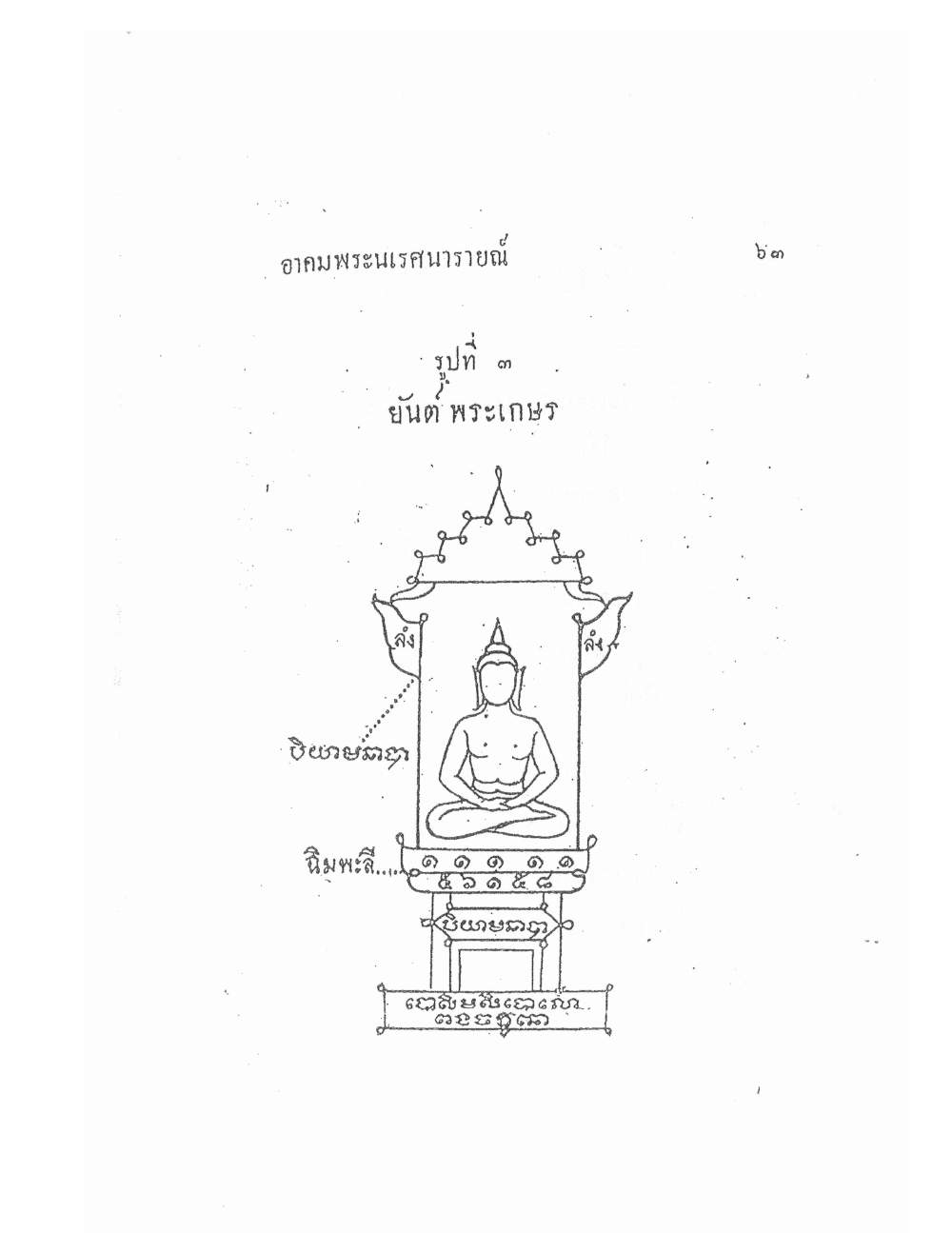
อาคมพระนเรศนารายณ์ ๖๓
รูปที่ ๓ — ยันต์พระเกษร
ลิ่ง ลิ่ง ทิพยมนตรา นิมพะลี ๑ ๑ ๕ ๘ [อักขระขอมในยันต์ อ่านไม่ชัด]
[Running header: Akhom Magic of Phra Nares Narai — p.63]
Figure 3 — Yant Phra Kesorn (Yantra of the Sacred Hair)
[diagram: a seated Buddha image in meditation posture, enclosed within an ornate niche topped by a flame-tipped gable; the two flanking finial banners are each labelled "ling"; a dotted line from the word "thipphayamontra" ("divine mantra") points toward the Buddha image; a dotted line from the word "nimphali" points toward the base of the niche; the numerals 1 1 5 8 are arranged in a row beneath the base; a small cartouche at the foot of the figure bears further script that is not clearly legible]
สรงน้ำมันหอมแล้วใช้เศกด้วยนวหรคุณ ๑๐๘ แล้วจงเอา ยันต์นี้ใส่ แล้วเศกด้วยพระอิติปิโส ฯลฯ ภควาติ ๑๐๘ ที ตามแต่จะปรารถนา เอาน้ำมันหอมประ"
อธิบายว่า
ยันต์พระเกษรความรูปข้างบนนี้ ใช้ลงในแผ่นทองคำ แผ่นเงินหรือแผ่นตะกั่วก็ได้ เป็นยันต์ที่พระฤาษี ๑๐๓ ตน ได้ร่วมแต่งสร้างขึ้นไว้ โดยให้ชื่อว่า ยันต์พระเกษร ถ้าหาก ผู้ใดรับอันตรายต่าง ๆ แม้จะมากมายเพียงไรก็ไม่ต้อง หวาดกลัวเลย ให้อาราธนาองค์พระซึ่งลงไว้ในแผ่นนั้นออก ใส่บนศีรษะของตนเพียงเท่านี้ก็สามารถจะคุ้มครองได้ หรือ จะออกรบปราบศัตรู ก็ใช้อาราธนาพระลงแช่ในน้ำมันหอม แล้วปลุกเศกด้วยพระพุทธคุณ ๑๐๘ จบ หรือจะเศกย่อ ๆ ว่า อิสวาสุ โต ปุ สพุ ภ ก็ได้ เมื่อเศกแล้วจึงเอา ยันต์ขึ้นจากน้ำมันหอมแล้ว เอาไว้บนศีรษะ หรือจะเก็บไว้ บนบูชาตามแต่ควร แล้วจงเอาน้ำมันหอมนั้นมาประพรม
...bathe [it] in fragrant oil, then chant over it with the nine-syllable formula 108 times; then take this yantra and place it [in the oil], and chant over it with the "Itipiso ... Bhagavāti" formula 108 times, according to one's wish; then take the fragrant oil and sprinkle [it]..."
Explanation
This Yant Phra Kesorn shown in the figure above is inscribed on a sheet of gold, silver, or lead. It is a yantra that the 103 hermit-sages together devised and created, giving it the name Yant Phra Kesorn. Should anyone face danger of any kind, however great, there is no need to fear at all — simply invoke the Buddha image inscribed on that sheet and place it upon one's own head, and this alone is enough to protect one. Or, if one is to go out to fight and defeat an enemy, one should invoke the Buddha image and immerse it in fragrant oil, then consecrate it by chanting the Buddha's virtues [the Itipiso formula] 108 times to completion, or one may chant the abbreviated form "Isawāsu Tо Pu Sapu Pha" instead. Once consecrated, take the yantra out of the fragrant oil and place it upon the head, or keep it upon an altar as is fitting, then take that fragrant oil and sprinkle it...
หน้าตามตัว ตั้งใจอธิษฐานกล่าวถึงคุณพระ ปรารถนา สิ่งใดก็ย่อมได้สำเร็จสมดังความปรารถนาทุกประการ
คาถาบูชายันต์พระเกษร
อายันตุ โภนโต อิธ ทานสีลา เนกขัมม- ปัญญา อุตสาห วิริย ขันติ สัจจาธิฏฐานัง เมตตุ- เปกขายุทธาย โว คัณหถ อาวุธานิ
พระคาถาอายันตุโภนโตบทนี้ สำหรับภาวนาเวลา เที่ยงคืน จะบังเกิดลาภผลตามความปรารถนา
พระคาถาสะกดจิต
อิติปิโส พักขวาสวาหับ ภาวนา ๗ ครั้ง ตามพระ คัมภีร์ ท่านว่าขึ้นบ้านใคร ไม่มีใครรู้สึกเลย ท่านว่าแม้แต่ จะขึ้นไปหาลูกสาวเขาบนบ้าน พ่อแม่ก็มิรู้เลย วิเศษนัก
and the face and body [with the oil], intently invoking the Buddha's virtues in one's aspiration — whatever one wishes for will then be accomplished exactly according to that wish, in every respect.
Mantra for Venerating the Yant Phra Kesorn
[Pali invocation, in Thai script, calling upon the venerable ones to grant giving, virtue, renunciation, wisdom, diligence, energy, patience, truthful resolve, loving-kindness and equanimity, and to take up weapons for battle].
This "Āyantu bhonto" mantra is for reciting at midnight; wealth and fortune will arise according to one's wish.
Mantra for Entrancing the Mind
"Itipiso Phakkhawāsawāhap" — recite 7 times. According to the scripture, it is said that whatever house one enters, no one will notice at all; it is said that even if one climbs up to visit someone's daughter in her house, her parents will never know — it is truly wondrous.
(จากท่านผู้ถาม— "พระคาถาสะกดจิต ในบทความ ของยันต์พระเกษรนั้นสงสัยว่า คาถาที่จะต้องใช้ประกอบ กับยันต์พระเกษรเท่านั้นหรือ ๆ จะนำเอามาใช้โดดเดี่ยว ตามลำพังก็ได้" ขอตอบว่า "พระคาถาสะกดจิตนี้ใช้ได้ ทั้งสองทางประกอบกับพระเกษรก็ได้ จะนำเอาไปใช้ตาม ลำพังก็ได้)
(From a reader who asked — "Regarding the Mantra for Entrancing the Mind in the piece about the Yant Phra Kesorn, I wonder: is this mantra to be used only in conjunction with the Yant Phra Kesorn, or may it be used on its own, by itself?" We answer: "This Mantra for Entrancing the Mind may be used either way — in conjunction with the Phra Kesorn, or taken and used entirely on its own.")
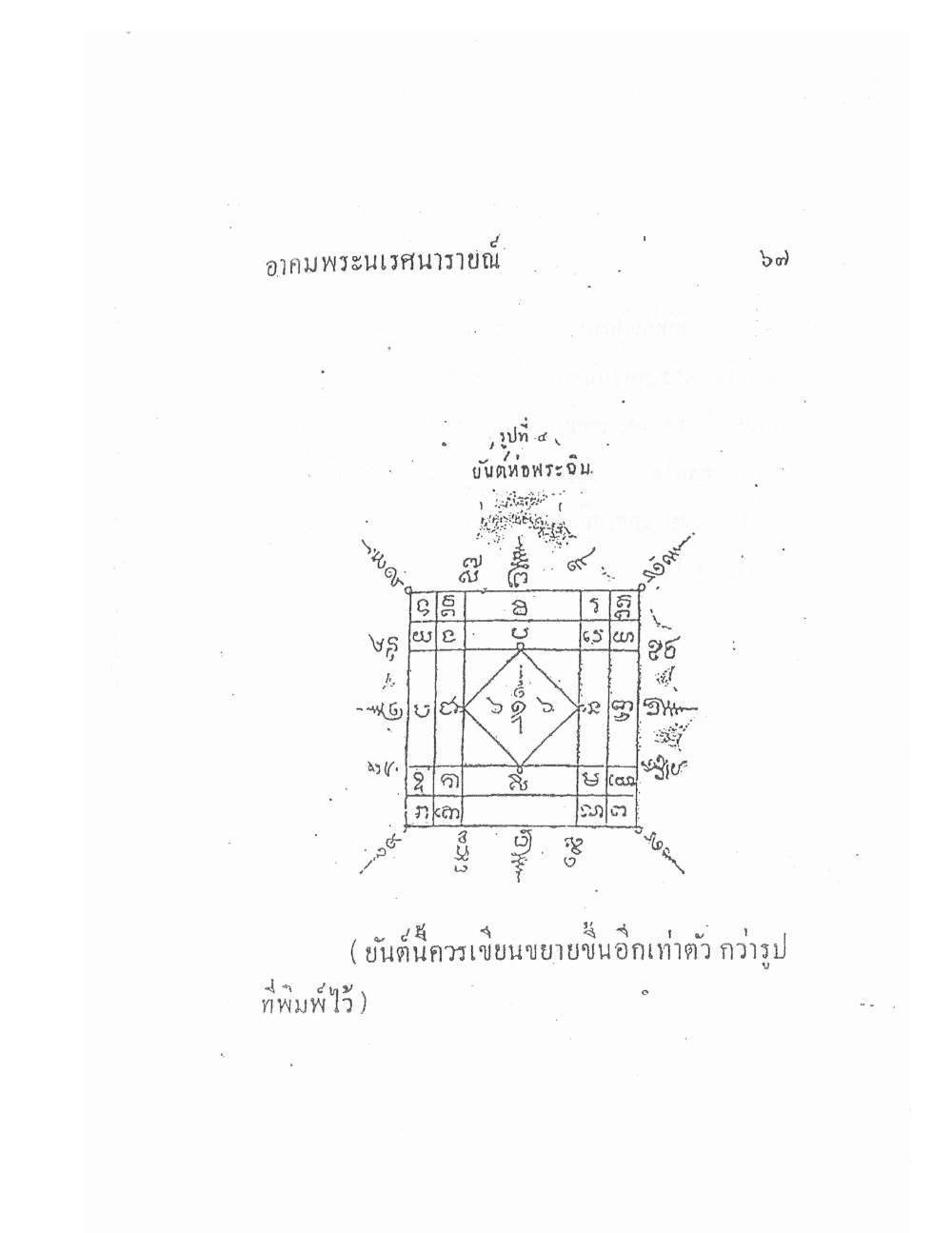
อาคมพระนเรศนารายณ์ ๖๗
รูปที่ ๔ — ยันต์หอพระฉิม
[อักขระขอมและตัวเลขในยันต์ อ่านไม่ชัด]
(ยันต์นี้ควรเขียนขยายขึ้นอีกเท่าตัว กว่ารูปที่พิมพ์ไว้)
[Running header: Akhom Magic of Phra Nares Narai — p.67]
Figure 4 — Yant of the Chim Shrine
[diagram: a magic-square yantra grid, framed on every side by radiating lines each bearing a Khom-script label; a diamond shape is inscribed across the central cells, itself containing further numerals and Khom characters; the script within the grid and along the borders is not clearly legible]
(This yantra should be drawn enlarged, to twice the size of the figure as printed here.)
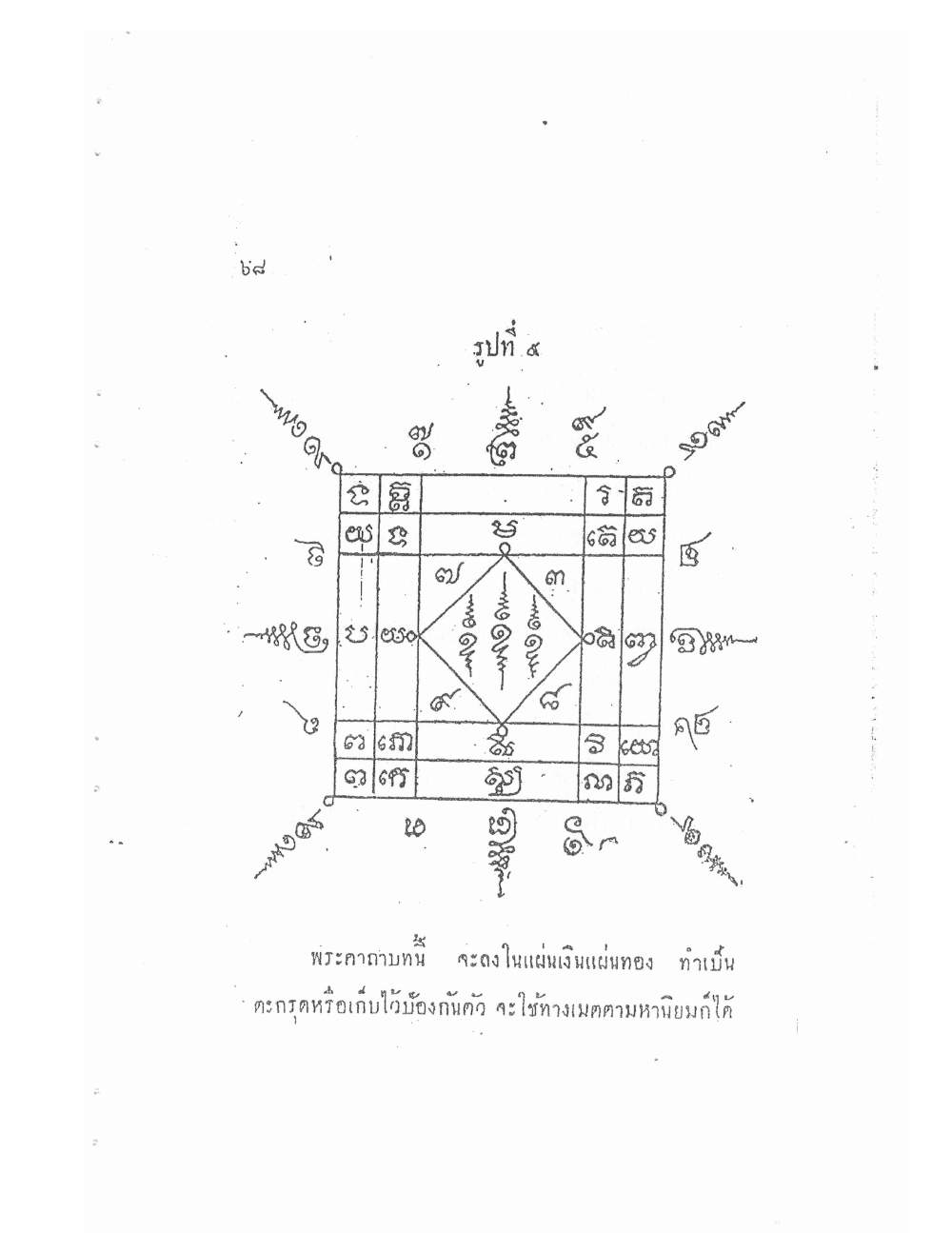
๖๘
รูปที่ ๕
[อักขระขอมและตัวเลขในยันต์ อ่านไม่ชัด]
พระคาถาบทนี้ จะลงในแผ่นเงินแผ่นทอง ทำเป็น ตะกรุดหรือเก็บไว้ป้องกันตัว จะใช้ทางเมตตามหานิยมก็ได้
[page number: 68]
Figure 5
[diagram: a second magic-square yantra grid, similar in style to the previous figure, framed by radiating Khom-script labels and containing a central diamond inscribed with further numerals and Khom characters; the script is not clearly legible]
This formula may be inscribed on a sheet of silver or of gold and made into a takrut (rolled protective charm), or else kept as personal protection; it may also be used for the purpose of metta-mahaniyom (charm and popularity).
อาคมพระนเรศนารายณ์ ๖๙
ยันต์นี้เขียนใส่กระดาษก็ได้ ใส่ผ้าขาวผ้าแดงก็ได้ หรือจะเขียนใส่แผ่นทองแผ่นเงินแผ่นทะกั่วตามชอบ ตำหรับห่อธาตุพระฉิม ด้วยว่าท่านผู้ใดมีธาตุพระฉิมไว้สักการะบูชา ยังไม่สามารถสร้างหรือแกะพระรูปองค์พระฉิมไว้ได้ ท่านให้ทำยันต์ ๒ รูปนี้ห่อธาตุพระฉิมไว้บูชา จะเกิดลาภสักการะแต่ท่าน หรือจะเขียนยันต์นี้ลงในแผ่นทอง หรือแผ่นทะกั่ว แล้วเสกด้วยพระคาถาหัวใจพระฉิมพลัง เอาไว้ป้องกันอุบาทว์จังไรต่างๆ หรือจะปิดหัวเรือปิดไว้ตามต้นไม้ ป้องกันภูตผีปีศาจมิให้หลอกหลอนรบกวนเราได้ หรือจะใส่หมากใส่พลูให้คนไข้คนเจ็บกิน ไข้ก็จะหายได้เหมือนกัน
Akhom [Magic] of Phra Narai — 69
This yantra may be written on paper, or on white or red cloth; or it may be written on a sheet of gold, silver, or lead foil as one prefers — this is the formula for wrapping a relic-image of Phra Chim. For whoever keeps a relic of Phra Chim for reverent worship, but is not yet able to have a full image or carved likeness of Phra Chim made, let him make this yantra — this design — and wrap the relic of Phra Chim in it for worship; blessing and reverence will come to him all the same. Or one may write this yantra on a sheet of gold or lead, then consecrate it with the heart-mantra of Phra Chim's power, and keep it to ward off calamity and every kind of ill omen. Or it may be affixed to the prow of a boat, or fastened to a tree, to protect against spirits and evil ghosts so they cannot deceive or trouble us. Or it may be placed with betel and areca nut for a sick or ailing person to eat, and the sickness will likewise be cured.
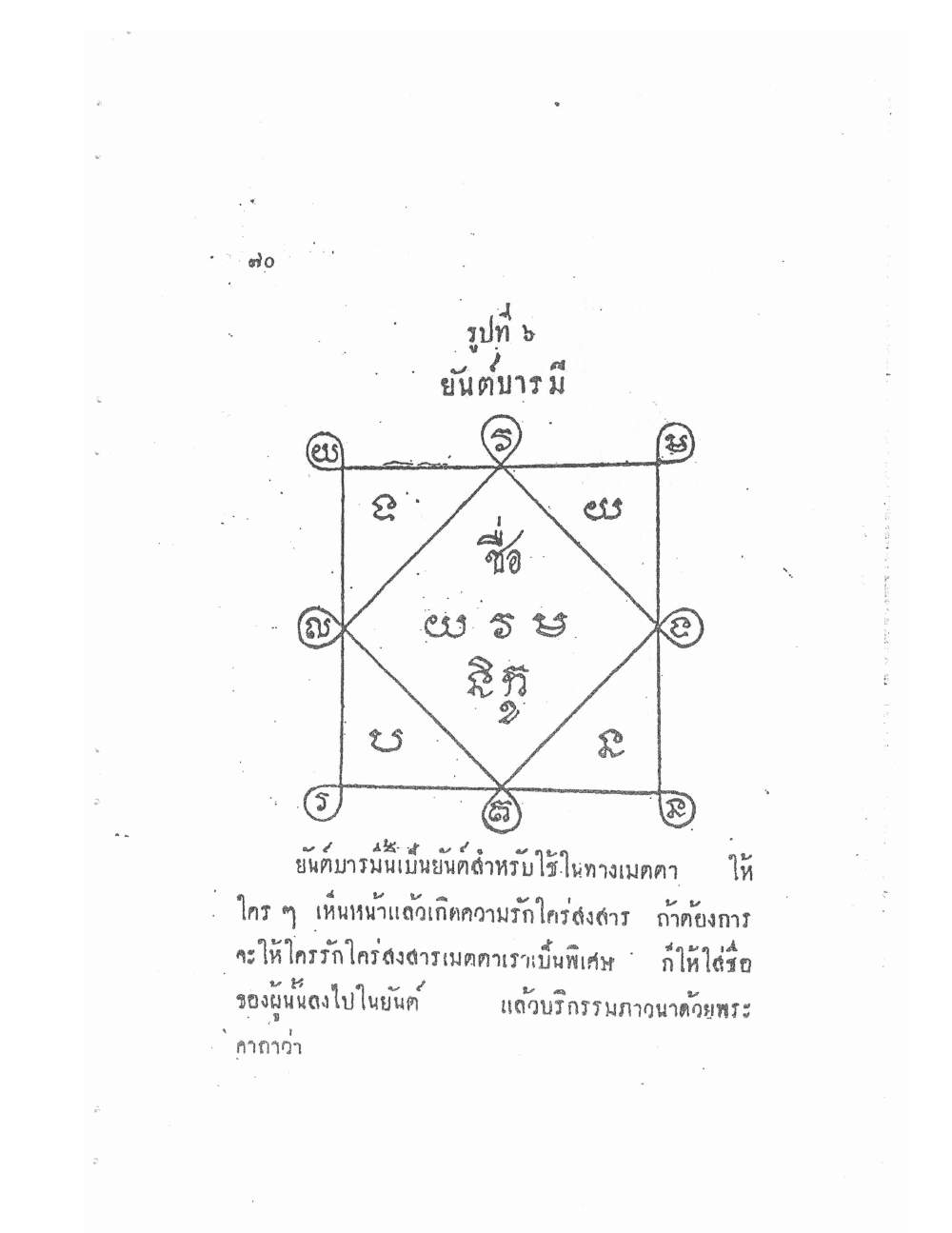
รูปที่ ๖ ยันต์บารมี
๗๐
[อักขระในวงกลมรอบยันต์ อ่านไม่ชัด] ชื่อ [อักขระในยันต์ อ่านไม่ชัด]
ยันต์บารมีนี้เป็นยันต์สำหรับใช้ในทางเมตตา ให้ใครๆ เห็นหน้าแล้วเกิดความรักใคร่สงสาร ถ้าต้องการจะให้ใครรักใคร่สงสารเมตตาเราเป็นพิเศษ ก็ให้ใส่ชื่อของผู้นั้นลงไปในยันต์ แล้วบริกรรมภาวนาด้วยพระคาถาว่า
Figure 6 — The Barami (Perfection/Grace) Yantra
70
[diagram: a square frame with a small circle bearing a syllable at each corner and at the midpoint of each side — eight circles in all, their syllables not confidently legible. A diamond is inscribed within the square, corner to corner, and inside it is written 'ชื่อ' ('name') — a blank left for the practitioner to write in the name of the person to be charmed — together with several further syllables and a numeral, not confidently legible.]
This Barami yantra is a yantra used in the way of loving-kindness (mettā): it makes anyone who sees the bearer's face feel love and fondness. If you wish to make a particular person feel special love, fondness, and compassion toward you, write that person's name into the yantra, then recite the following incantation as a mantra:
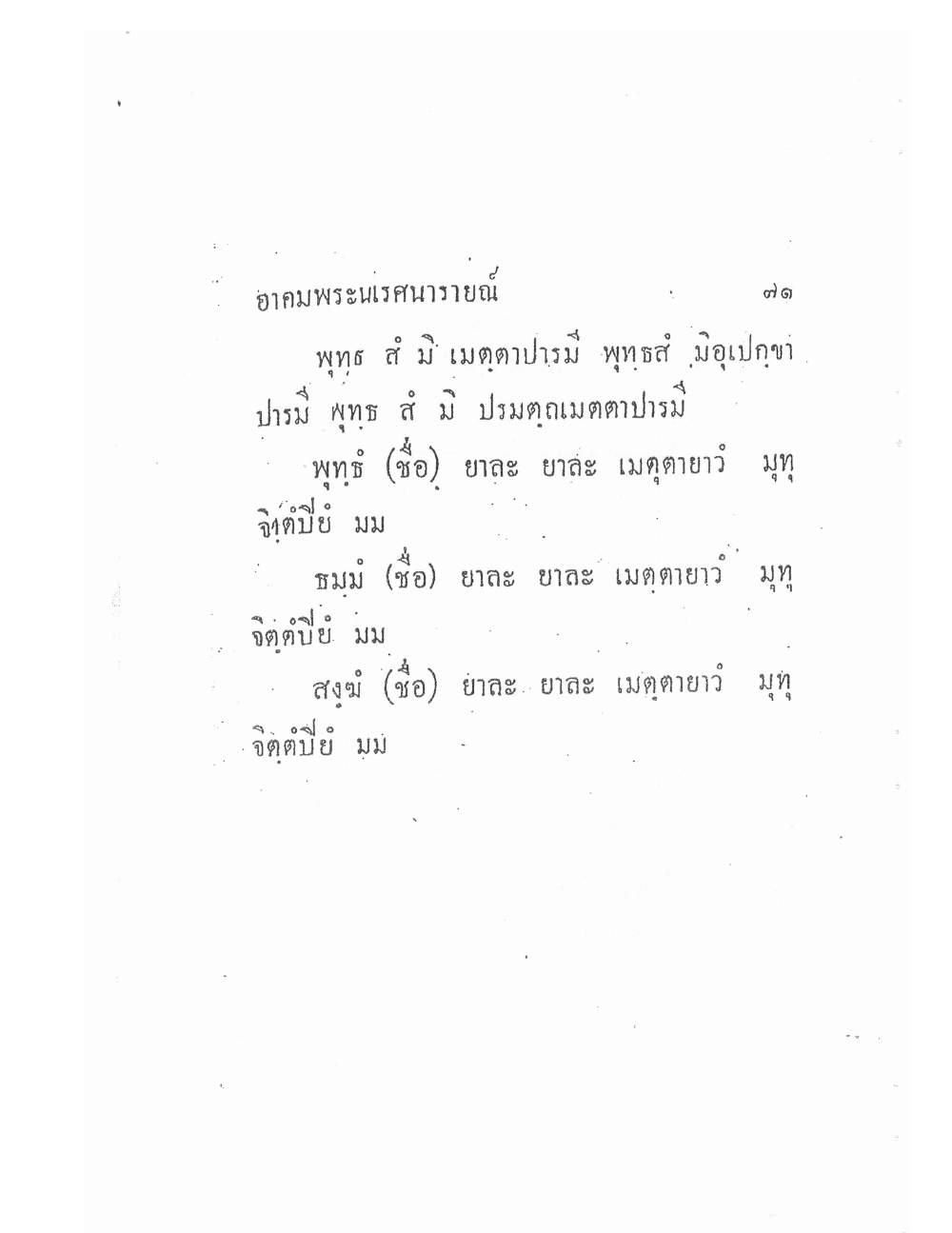
อาคมพระนเรศนารายณ์ ๗๑
พุทธ สำ มิ เมตฺตาปารมี พุทธสำ มิอุเปกฺขาปารมี พุทธ สำ มิ ปรมัตถเมตตาปารมี
พุทธํ (ชื่อ) ยาละ ยาละ เมตฺตายาวํ มุทุจิตฺตปิยํ มม
ธมฺมํ (ชื่อ) ยาละ ยาละ เมตฺตายาวํ มุทุจิตฺตปิยํ มม
สงฺฆํ (ชื่อ) ยาละ ยาละ เมตฺตายาวํ มุทุจิตฺตปิยํ มม
Akhom [Magic] of Phra Narai — 71
Buddhaṃ sami mettāpāramī, Buddhaṃ sami upekkhāpāramī, Buddhaṃ sami paramatthametāpāramī. [Gloss: by the perfection of loving-kindness of the Buddha, by the perfection of equanimity of the Buddha, by the ultimate perfection of loving-kindness of the Buddha.]
Buddhaṃ (name) yāla yāla mettāyāvaṃ muducittapiyaṃ mama. [Gloss: By the Buddha, (name) — yala yala — for as long as loving-kindness lasts, may [his/her] heart be soft and dear to me.]
Dhammaṃ (name) yāla yāla mettāyāvaṃ muducittapiyaṃ mama. [Gloss: By the Dhamma, (name) — may his/her heart likewise be soft and dear to me.]
Saṅghaṃ (name) yāla yāla mettāyāvaṃ muducittapiyaṃ mama. [Gloss: By the Sangha, (name) — may his/her heart likewise be soft and dear to me.]
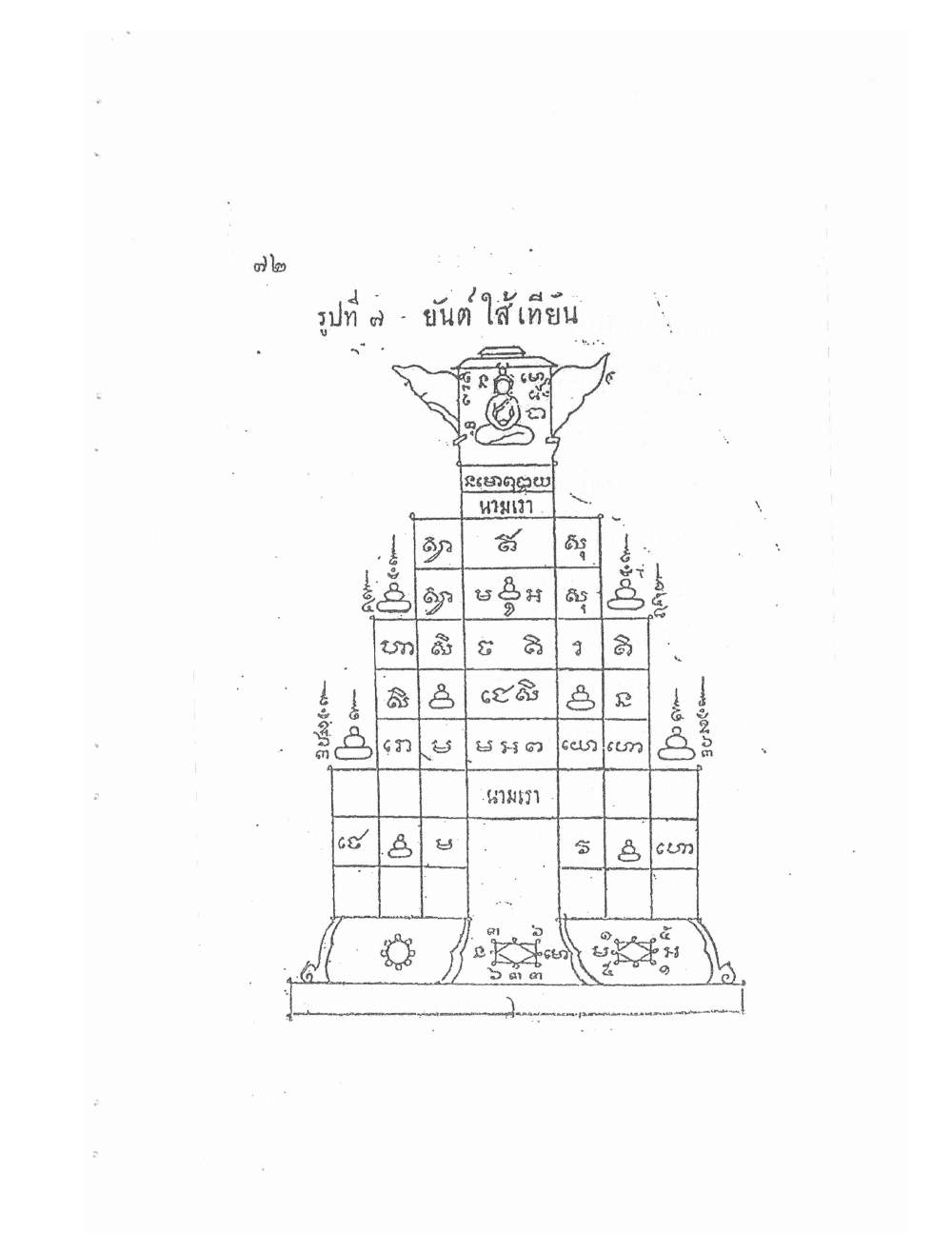
รูปที่ ๗ ยันต์ใส้เทียน
๗๒
นะโมพุทธายะ [อักขระขอมในยันต์ อ่านไม่ชัด] นามเรา [อักขระขอมในยันต์ อ่านไม่ชัด] นามเรา [อักขระขอมในยันต์ อ่านไม่ชัด]
Figure 7 — The Candle-Wick Yantra
72
[diagram: an elaborate yantra drawn in the shape of a stupa (chedi). At the crown, a small seated Buddha image flanked by flourishes, captioned 'Namo Buddhāya'. Below, a grid of small cells runs down the body of the stupa in several tiers, each inscribed with a single letter or syllable too fine to read with confidence; the tiers are flanked by small bell- or stupa-shaped ornaments. Partway down, one row is captioned 'นามเรา' ('my name') — where the practitioner writes in his or her own name — and lower down a second grid tier repeats with another 'นามเรา' caption. At the base, the figure widens into a plinth bearing a circular rosette motif on one side and a hexagram (six-pointed star) enclosing further syllables on the other.]
อาคมพระนเรศนารายณ์ ๗๓
ยันต์นี้สำหรับลงในแผ่นกระดาษข่อย ทำได้เหมือนจุดบูชาพระ ปรารถนาสิ่งใดก็ย่อมได้สิ่งนั้น คนที่เป็นศัตรูกลับเป็นมิตร ถ้าเราต้องการจะให้ศัตรูคนใดกลายเป็นมิตรก็ดี หรือต้องการจะให้ใครรักใคร่สงสารเมตตา อุปถัมภ์ภาวะช่วยเหลือเราก็ดี ให้เขียนชื่อเราไว้ในช่องข้างบนที่บอกไว้ว่า "นามเรา" แล้วเขียนชื่อผู้นั้นลงในช่องข้างล่างที่บอกว่า "นามเขา" แล้วม้วนควันเป็นไส้เทียนจุดบูชาพระ เกิดจะสมความปรารถนา
อนึ่งยันต์นี้นอกจากจะลงในแผ่นกระดาษ จุดบูชาพระ ยังทำเป็นรูปธงสำหรับปักไว้ตามบ้านเรือน ตามเรือกสวนไร่นา เพื่อป้องกันอันตรายต่างๆ ด้วยอย่างประเสริฐ
Akhom [Magic] of Phra Narai — 73
This yantra is for inscribing on a sheet of khoi [mulberry-bark] paper; made [into a wick] it serves like a candle lit in worship of the Buddha — whatever one wishes for, one obtains. One who is an enemy becomes a friend instead. If we wish to turn any enemy into a friend, this will do it; or if we wish for someone to love us, pity us, show us loving-kindness, and support and help us, this too will do it. Write our own name in the upper compartment marked 'นามเรา' ('my name'), then write that other person's name in the lower compartment marked 'นามเขา' ('his/her name'). Then roll it up as a candle-wick and light it in worship of the Buddha, and the wish shall be fulfilled.
Furthermore, besides being inscribed on paper for a candle-wick lit in Buddha-worship, this yantra may also be made into a flag to be planted at one's house, or about one's orchards, gardens, and rice fields, to protect against every kind of danger — most excellently.
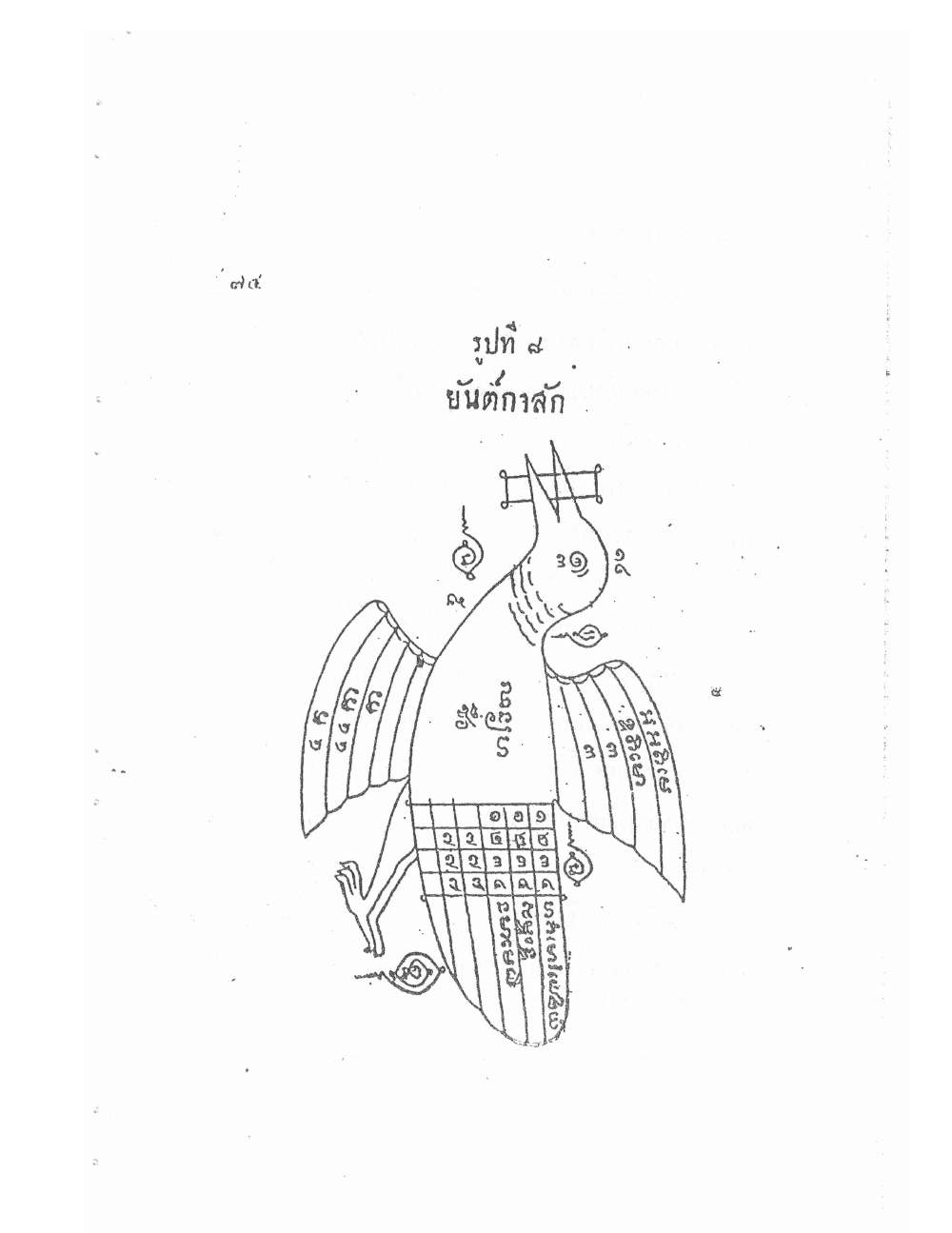
รูปที่ ๘ ยันต์กาลัก
๗๔
[อักขระและตัวเลขในยันต์ อ่านไม่ชัด]
Figure 8 — The Kalak (Thieving Crow) Yantra
74
[diagram: a large yantra drawn in the shape of a crow with wings outspread, a long curved neck, and a beak crowned with a small crest of flourishes. Small spiral (snail-shell) motifs mark points near the head and the foot. The bird's breast and the lower portion of the body and wings are ruled into a grid of small cells, each inscribed with a numeral or short syllable too fine to read with confidence; the wing feathers likewise carry rows of numerals along their length. As explained on the following pages, the breast compartment of this figure — called the 'อกกา' (the crow's breast) — is where a target person's name or house is written for use with an accompanying incantation.]
อาคมพระนเรศนารายณ์ ๗๕
ยันต์นี้มีชื่อเรียกว่ายันต์กาลัก สำหรับลงในแผ่นกระดาษแล้วเผาไฟทำเป็นผง บดประสมกับขมิ้นทาตัวก็ได้ หรือจะทำผงหุงข้าวแดงเอาไว้สีปากเป็นเสน่ห์แก่คนทั้งหลายทั้งนัก
เทวาคนิ นิกาวเท วากหิ สุสุหิการา กาเรภะ ภเรกาเนภะ พสุสุภเนสวาหะ สวาหุม
พระคาถาบทนี้สำหรับเสกยันต์กาลัก วิธีใช้ให้เขียนรูปกาลงในแผ่นกระดาษ แล้วเอายันต์หัวใจนางอุมาภควดีลงหลังกระดาษ ถ้ามีความปรารถนาใครก็ให้เอาชื่อของผู้นั้นลงในอกกา แล้วใส่ก้อนข้าวเป็นข้าวให้กาวันละ ๓ บั้นๆ ทำอยู่ดังนี้ให้ครบ ๗ วัน เสกด้วยพระคาถาทุกคาบตามข้างต้นตามกำลังวัน ถ้าจับเรือนไหนก็มาเรือนนั้น
ถ้าเป็นถ้อยร้อยความกับผู้ใด ให้เขียนชื่อผู้นั้นลงในอกกา เอายันต์หัวใจพระเพลิงลงหลัง เสก ๗ คาบ ทำ ๓ วัน เอาข้าวปั้นให้กากินวันละ ๓ บั้น ศัตรูที่เป็นความกับเราก็จะแพ้ภัยเราแต่
Akhom [Magic] of Phra Narai — 75
This yantra is called the Kalak (Thieving Crow) Yantra. It is inscribed on a sheet of paper and then burned to ash; the ash is ground and mixed with turmeric to anoint the body, or made into a paste to redden the lips — a charm that greatly enchants people in general.
Devākani nikāvate vākahi susuhikārā kārebha bharekānebha pasusubhanesavāhā savāhuṃ. [Gloss: an invocatory string of power-syllables; the source does not gloss it word for word.]
This spell is for consecrating the Kalak yantra. Method of use: draw the figure of a crow on a sheet of paper, then put the heart-mantra of Lady Uma Bhagavati on the back of the paper. If you desire something involving someone, write that person's name into the crow's breast, then place a rice ball for the crow — three balls a day — and continue thus for a full 7 days, chanting every incantation given above according to the day's strength. Whatever house [the crow] then seizes upon, [the outcome] will come to that house.
If it concerns a dispute or quarrel with someone, write that person's name into the crow's breast, put the heart-mantra of the Fire God (Phra Phloeng) on the back, chant it 7 times, do this for 3 days, and give the crow rice balls to eat, 3 balls a day. The enemy who is in dispute with us will then be defeated by us...
๗๖
ถ้าจะให้เป็นมิตรไมตรีกับเรา ก็ให้เขียนรูปผู้นั้นลงในกระดาษ แล้วเอารูปเรือนของเขาใส่ในอกกา เอาหัวใจพระจันทร์ลงหลัง แล้วจึงเอาคาถาเสกตามกำลังวันให้ทำ ๓ วัน เสกข้าวให้กากินวันละ ๓ บั้น เมื่อกาไปจับเรือนผู้ใด ผู้นั้นเป็นไมตรีกับเรา
ถ้าศัตรูทำร้าย ให้เขียนรูปศัตรูใส่กระดาษใส่ลงในอกกา เอายันต์หัวใจพระกาฬลงหลังกา เสก ๓ คาบ แล้วเสกข้าวให้กากินวันละ ๓ บั้น ทำให้ครบ ๓ วัน ถ้าบินไปจับเรือนศัตรู ศัตรูก็จะพ่ายแพ้ภัยแก่เรา
ถ้าจะให้มีตบะเดชะ ให้เขียนรูปกาใส่ในกระดาษ แล้วเอายันต์พระอาทิตย์ลงหลัง แล้วเอายันต์หัวใจพระพรหมลงหลังแล้วเสกพระคาถา บั้นข้าวให้กากินวันละ ๓ บั้น ทำทุกๆ วัน ให้กากินข้าวทุกวันอย่าได้ขาด ก็จะมีฤทธิ์เดชมาก
ถ้าจะให้คนที่โกรธกับเราหายโกรธเรา ให้เขียนรูปคนที่โกรธกับเราใส่อกกา เอายันต์พระอิศวรใส่หลัง
[Page] 76
If you wish to make someone become a friend and ally to us, draw that person's image on paper, then place a picture of his house into the crow's breast, put the heart-mantra of the Moon (Phra Chan) on the back, then chant the incantation according to the day's strength; do this for 3 days, and give the crow rice, 3 balls a day. When the crow goes and seizes upon that person's house, he will become an ally to us.
If an enemy does us harm, draw the enemy's image on paper and place it in the crow's breast, put the yantra-heart-mantra of Phra Kan [a dark/death deity] on the crow's back, chant it 3 times, then give the crow rice, 3 balls a day, for a full 3 days. If it flies and seizes upon the enemy's house, the enemy will be defeated and suffer harm from us.
If you wish to gain personal power and majesty (tabo-decha), draw the figure of a crow on paper, put the Sun yantra on its back, then also put the heart-mantra of Phra Phrom (Brahma) on its back, then chant the incantation; give the crow rice, 3 balls a day, every day without fail, and you will gain very great power and majesty.
If you wish for someone who is angry with us to stop being angry, draw the image of that angry person and place it in the crow's breast, put the yantra of Phra Isuan (Shiva) on the back...
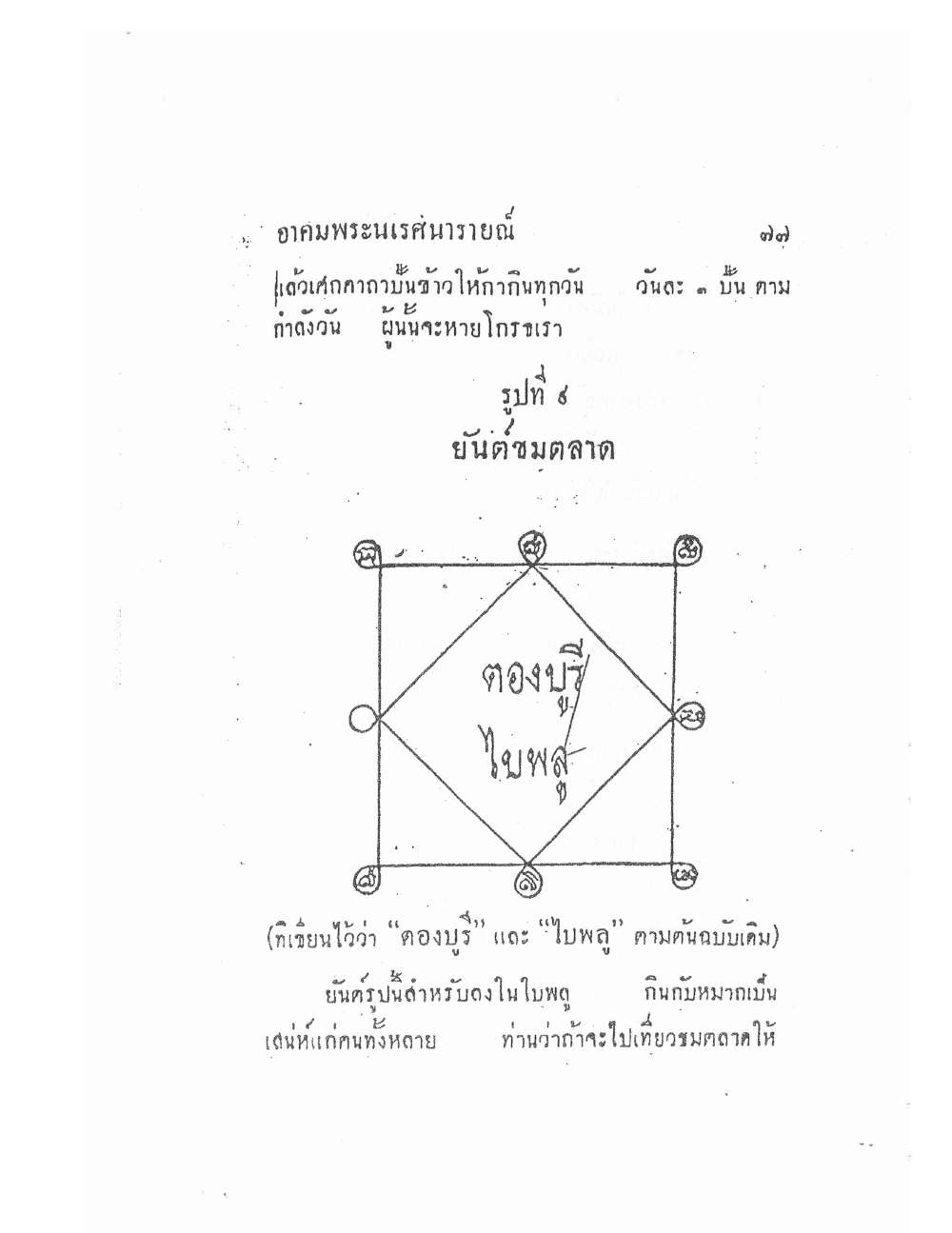
อาคมพระนเรศนารายณ์ ๗๗
แล้วเสกคาถาบั้นข้าวให้กากินทุกวัน วันละ ๑ บั้น ตามกำลังวัน ผู้นั้นจะหายโกรธเรา
รูปที่ ๙ ยันต์ชมตลาด
(ที่เขียนไว้ว่า "ตองบุหรี่" และ "ใบพลู" ตามต้นฉบับเดิม)
ยันต์รูปนี้สำหรับลงในใบพลู กินกับหมากเป็นเสน่ห์แก่คนทั้งหลาย ท่านว่าถ้าจะไปเที่ยวชมตลาดให้
Akhom [Magic] of Phra Narai — 77
...then chant the incantation over a rice ball and give it to the crow to eat every day, one ball a day, according to the day's strength, and that person will stop being angry with us.
Figure 9 — The Market-Charming Yantra
(Written in the original manuscript as 'tong burì' [cigarette-leaf wrapper] and 'bai phlu' [betel leaf])
[diagram: a square frame with a small circle bearing a syllable at each corner and at the midpoint of each side; inside the square a diamond is inscribed corner to corner, within which is written, in two lines, 'ตองบุหรี่' (cigarette-leaf wrapper) over 'ใบพลู' (betel leaf), showing the yantra may be inscribed on either.]
This yantra design is for inscribing onto a betel leaf and chewing it together with the areca nut; it charms people in general. It is said that if you are going out to visit the marketplace, you should...
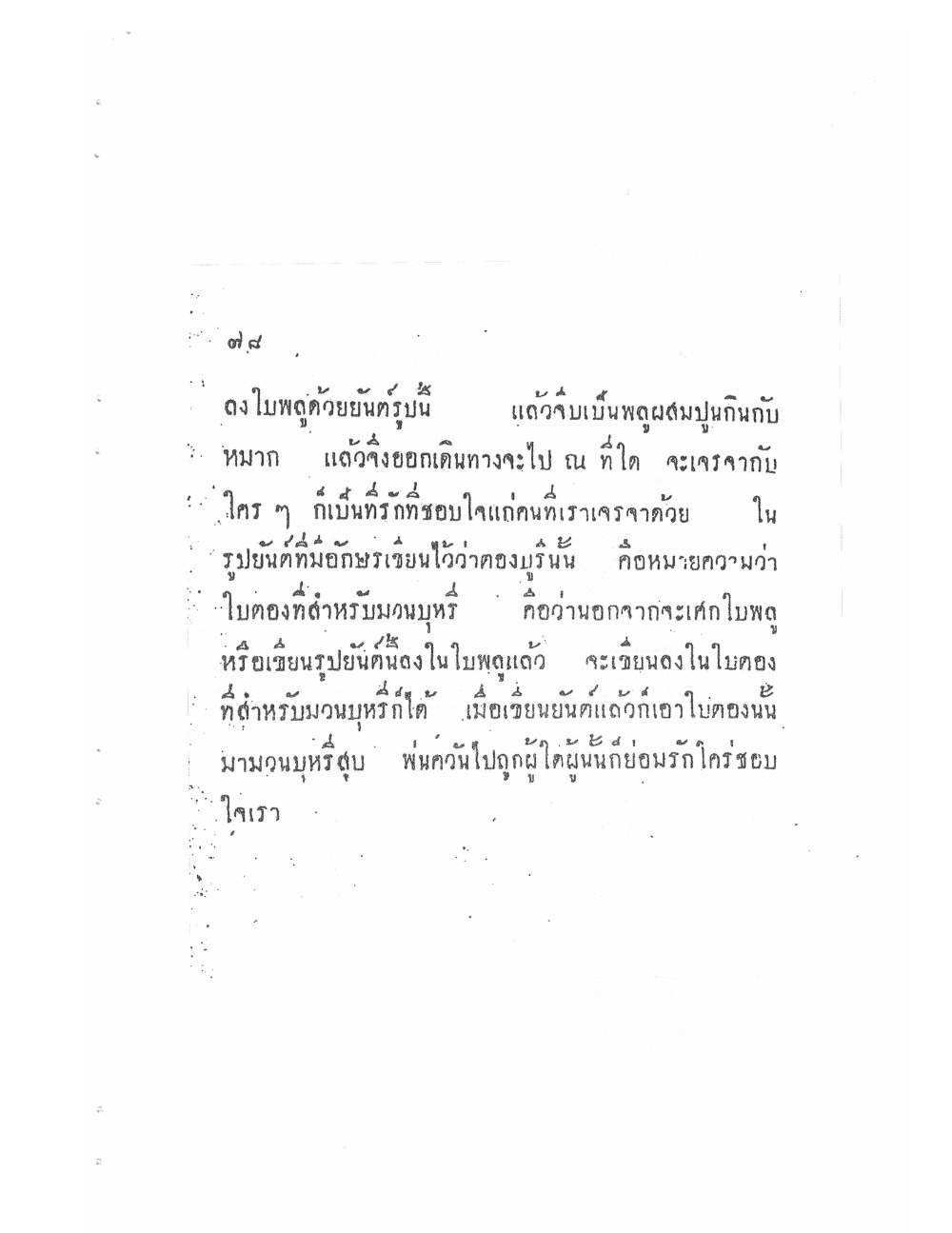
๗๘
ลงใบพลูด้วยยันต์รูปนี้ แล้วจับเป็นพลูผสมปูนกินกับหมาก แล้วจึงยกเดินทางจะไป ณ ที่ใด จะเจรจากับใครๆ ก็เป็นที่รักที่ชอบใจแก่คนที่เราเจรจาด้วย ในรูปยันต์ที่มีอักษรเขียนไว้ว่า ตองบุหรี่นั้น คือหมายความว่าใบตองที่สำหรับมวนบุหรี่ คือว่านอกจากจะเสกใบพลู หรือเขียนรูปยันต์นี้ลงในใบพลูแล้ว จะเขียนลงในใบตองที่สำหรับมวนบุหรี่ก็ได้ เมื่อเขียนยันต์แล้วก็เอาใบตองนั้นมามวนบุหรี่สูบ พ่นควันไปถูกผู้ใดผู้นั้นก็ย่อมรักใคร่ชอบใจเรา
[Page] 78
...write this yantra design onto a betel leaf, then take it as a quid with lime and chew it together with the areca nut; then set out on your way to wherever you are going. Whomever you speak with, you will be loved and liked by that person you converse with. As for the word inscribed on the yantra, 'tong burì' — it means the banana-leaf wrapper used for rolling cigarettes. That is, besides consecrating a betel leaf, or writing this yantra figure onto a betel leaf, one may also write it onto the leaf-wrapper used for rolling cigarettes. Once the yantra is written, take that leaf-wrapper, roll it into a cigarette and smoke it; blow the smoke toward whomever you choose, and that person will come to love and be fond of you.
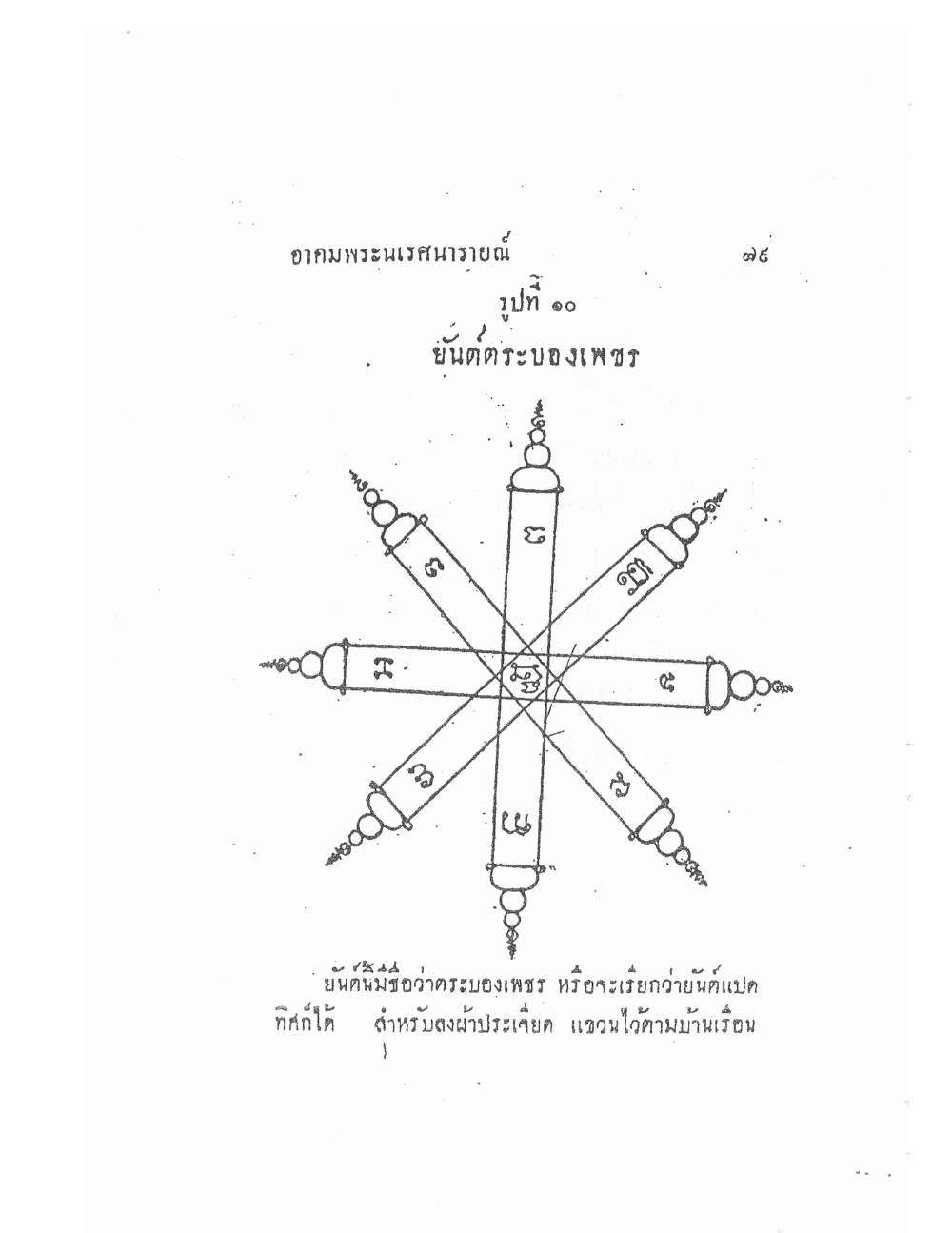
อาคมพระนเรศนารายณ์ ๗๙
รูปที่ ๑๐ ยันต์ตะบองเพชร
อ สัง วิ สุ โล ปุ ส พุ ภ
ยันต์นี้มีชื่อว่าตะบองเพชร หรือจะเรียกว่ายันต์แปดทิศก็ได้ สำหรับลงผ้าประเจียด แขวนไว้ตามบ้านเรือน
Akhom [Magic] of Phra Narai — 79
Figure 10 — The Diamond Mace (Vajra Club) Yantra
[diagram: an eight-pointed star (compass rose) formed of two crossed bars radiating from a small central medallion; each of the eight rays ends in a bead-and-flame finial, and at the tip of each ray, as well as in the central medallion, one syllable of the formula 'a saṃ vi su lo pu sa phu bha' is inscribed]
A saṃ vi su lo pu sa phu bha
This yantra is named the 'Diamond Mace' (ตะบองเพชร), or it may also be called the 'Eight-Direction Yantra.' It is for inscribing onto a protective cloth strip (pha prajiat) [worn or tied as a talisman], to be hung up about the house.
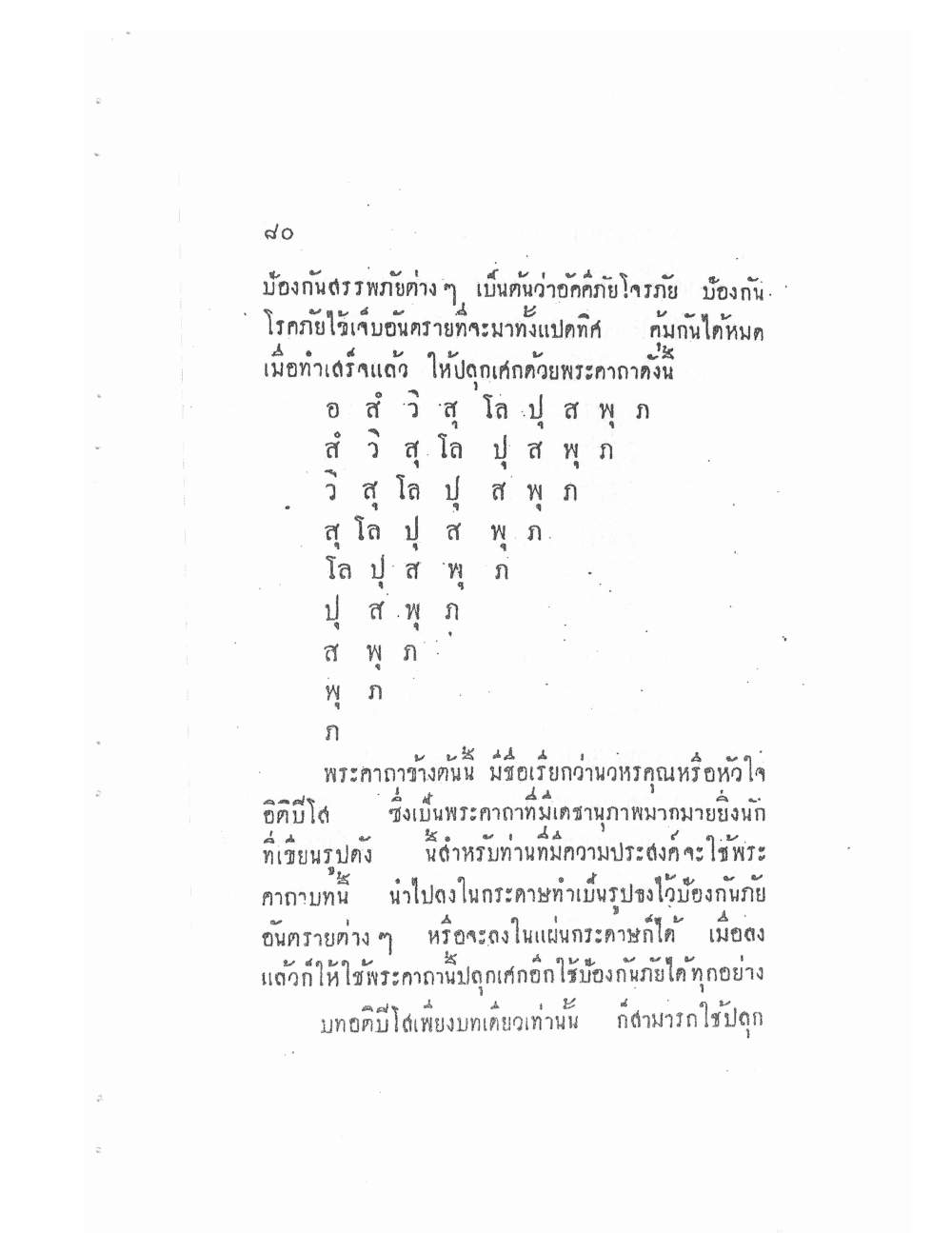
๘๐
ป้องกันสรรพภัยต่างๆ เป็นต้นว่าอัคคีภัยโจรภัย ป้องกันโรคภัยไข้เจ็บอันตรายที่จะมาทั้งแปดทิศ กันได้หมด เมื่อทำเสร็จแล้ว ให้ปลุกเสกด้วยพระคาถาดังนี้
อ สํ วิ สุ โล ปุ ส พุ ภ สํ วิ สุ โล ปุ ส พุ ภ วิ สุ โล ปุ ส พุ ภ สุ โล ปุ ส พุ ภ โล ปุ ส พุ ภ ปุ ส พุ ภ ส พุ ภ พุ ภ ภ
พระคาถาบทนี้ มีชื่อเรียกว่านวหรคุณ หรือหัวใจอิติปิโส ซึ่งเป็นพระคาถาที่มีเดชานุภาพมากมายยิ่งนัก ที่เขียนรูปดังนี้สำหรับท่านที่มีความประสงค์จะใช้พระคาถาบทนี้ นำไปลงในกระดาษทำเป็นรูปธงไว้ป้องกันภัยอันตรายต่างๆ หรือจะลงในแผ่นกระดาษก็ได้ เมื่อลงแล้วก็ให้ใช้พระคาถานี้ปลุกเสกอีก ก็ใช้ป้องกันภัยได้ทุกอย่าง
มีแต่อิติปิโสเพียงบทเดียวเท่านั้น ก็สามารถใช้ปลุก
[Page] 80
...protects against every kind of danger, such as fire and robbers, and wards off sickness, illness, and calamity coming from all eight directions, warding off everything. Once you have finished [inscribing the yantra], animate/consecrate it by chanting this incantation:
A saṃ vi su lo pu sa phu bha Saṃ vi su lo pu sa phu bha Vi su lo pu sa phu bha Su lo pu sa phu bha Lo pu sa phu bha Pu sa phu bha Sa phu bha Phu bha Bha
[Gloss: a nine-syllable formula recited as a descending triangle, one syllable dropped from the front on each successive line.]
This incantation is called the 'Navahoracun' [Nine-fold Power / Nine Constellations], or the 'Heart of Itipiso.' It is a formula of very great and far-reaching power. This figure is set down here for those who wish to use this incantation: take it and inscribe it on paper made into the shape of a flag to guard against every kind of danger; or it may simply be written on a plain sheet of paper. Once inscribed, use this same incantation to consecrate it again, and it will then ward off every kind of danger.
Even just the Itipiso alone, this single formula by itself, can be used to consecrate...
อาคมพระนเรศนารายณ์ ๘๑
เศกยันต์ได้ทุกชนิด ท่านพระอาจารย์ในปางก่อนได้แยก บทอิติปิโสไว้สำหรับป้องกันภัยก็ได้ ใช้ในทางเมตตา มหานิยมก็ได้ ให้ชื่อพระอิติปิโสไว้ต่าง ๆ กันคือ
๑. อิติปิโสรัตนมาลา ๒. อิติปิโสเต็มที่ ๓. อิติปิโสแปดทิศ ๔. อิติปิโสแปลงรูป ๕. อิติปิโสกริ่งไตรภพ ๖. อิติปิโสนารายณ์คายจักร ๗. หัวใจอิติปิโส
ทั้ง ๗ อย่างนี้รวมเรียกว่าอิติปิโสกลบท แต่ละ อย่าง ๆ มีคุณานุภาพอันไพศาลยิ่งนัก อิติปิโสกลบทแต่ละ อย่างนี้มีข้อความวิจิตรพิสดารมาก ข้าพเจ้าจักได้รวบ รวมอธิบายไว้อีกตอนหนึ่งต่างหาก เฉพาะในหนังสือเล่ม นี้ข้าพเจ้าได้อธิบายแต่ข้อที่ ๗ คือหัวใจอิติปิโสเพียงข้อ เดียว ซึ่งได้อธิบายไว้โดยละเอียดแล้วในยันต์รูปที่ ๑๑ ท่านผู้ใดปรารถนาโปรดเปิดอ่านดูเถิด
๖
Akhom Magic of Phra Naresuan-Narai 81
...can consecrate yantras of every kind. The teacher-masters of former times separated out the Itipiso verse for use in protection from danger; it can also be used in the way of loving-kindness and popularity charms. The names given to the various forms of Phra Itipiso are as follows:
1. Itipiso Rattanamala (Garland of Gems) 2. Itipiso Temthi (The Complete One) 3. Itipiso Paedthit (Eight Directions) 4. Itipiso Plaengrup (Transforming Form) 5. Itipiso Kring Traiphop (Ringing Through the Three Worlds) 6. Itipiso Narai Khaichak (Narayana Spinning the Discus) 7. Huajai Itipiso (The Heart of Itipiso)
All 7 of these together are called the Itipiso Konlabot [combination formulas]. Each one possesses vast and far-reaching power. Each of these Itipiso Konlabot formulas contains extremely intricate and elaborate material, which I will gather and explain in a separate section. In this particular book I have explained only item 7, the Heart of Itipiso, alone — which has already been explained in detail under Yantra Figure No. 11. Whoever wishes [to know more], please turn to and read it there.
[printer's signature/gathering mark: 6]
๘๒
ในบทนี้จะขอยกรูปอิติปิโสแปดทิศ มาให้ท่านดูพอ เป็นตัวอย่างดังนี้
อิติปิโสแปดทิศ
อิ ร ชา ค ต ร สา ติ หํ จ โต โร ถิ นํ ปิ สมฺ ร โล ปุ สตฺ พุทฺ โส มา ณ ก ริ ถา โธ ภ สมฺ สมฺ วิ ส เท ภ ค พุทฺ ปนฺ ทู ทมฺ ว ค วา โธ โน อ ม ม วา อ วิชฺ สุ นุตฺ สา นุสฺ ติ
อิติปิโสแปดทิศนั้นนับว่าเป็นของอัศจรรย์ยิ่งนัก มี อักษรแต่ละตัวในบทพระพุทธคุณนั้นเรียงลงมาได้ ๗ แถว ๆ ละ ๘ อักษรพอดี พอเหมาะไม่ขาดไม่เกินจึงนับว่า เป็นพระคาถาที่มีความมหัศจรรย์อยู่มาก เป็นที่น่าเลื่อมใส ยิ่งนัก ขอท่านจงตั้งใจภาวนาบริกรรมเถิด จะเกิดผล อันยิ่งใหญ่แก่ท่าน
(หัวใจอิติปิโสพบในตำราอื่นเหมือนกันแต่ผิดเพี้ยน กับตำรานี้ เป็นคนละอาจารย์)
82
In this section I will present the figure of the Eight-Direction Itipiso for you to see, as an example, as follows:
Itipiso, Eight Directions
[grid of 8 rows by 7 columns of Pali syllables, transliterated into Thai, forming the acrostic Itipiso/Buddha-virtue formula spelled out in eight directions — see the transcription for the exact syllables]
The Eight-Direction Itipiso is considered an extremely wondrous thing. The letters within the Buddha-virtue verse fall into exactly 7 columns of 8 letters each — fitting perfectly, neither short nor over — and so it is reckoned a formula of great wonder, deeply inspiring of faith. Set your mind and recite it with devotion; a great result will arise for you.
(The Heart of Itipiso is also found, the same in substance, in other treatises, though differing somewhat from this text, being from a different master.)
อาคมพระนเรศนารายณ์ ๘๓
รูปที่ ๑๑ ยันต์ประสิทธิ
[อักขระในยันต์ อ่านไม่ชัด]
Akhom Magic of Phra Naresuan-Narai 83
Figure 11 Yantra Prasit (Yantra of Accomplishment)
[diagram: a stepped, diamond-shaped yantra set within an outer rectangular frame whose four corners are rounded roundels, each marked with a small Thai numeral. Short inscriptions run along the four sides of the outer frame. Within the frame, a large diamond is inscribed, containing a smaller diamond which in turn frames a square crossed by both diagonals; a small stupa-like emblem sits at the very center, with two more such emblems placed above and below it. Four small demon/yaksha-like faces are drawn at the inner corners of the large diamond. The Thai-transliterated Pali/khom syllables filling the frame and diamond bands are too small and faint at this resolution to read with confidence.]
๘๔
ยันต์นี้ขอเรียกว่า ยันต์ประสิทธิ สำหรับลงผ้า ประเจียด ลงแผ่นกระดาษ แผ่นเงิน ทอง นาก ทำเป็น ตะกรุด ในตำราท่านบอกไว้ว่า
"ยันต์นี้ลงตะกรุดดอกเดียว หาที่จะอุปมา มิได้เลย ท่านตีราคาไว้หาค่ามิได้ ร้อยชั่งทอง หนึ่งแล"
เมื่อลงยันต์เรียบร้อยแล้ว ให้เสกด้วย อ สํ วิ สุ โล ปุ ส พุ ภ ๑๐๘ จบ ตัวผู้ อ สํ วิ สุ โล ปุ ป ย ป ๑๐๘ จบ ตัวเมียคู่กัน เสกตะกรุด ชื่อว่าเนาวหรคุณแฝด
อธิบายว่า
ยันต์นี้แม้ลงตะกรุดเพียงดอกเดียวเท่านั้น ท่านก็ บอกว่ามีคุณค่าอันล้ำเลิศหาที่จะเปรียบมิได้ ใช้ได้สารพัด ในการอยู่ยงคงกระพันชาตรี สามารถจะป้องกันสรรพภัย พิบัติต่าง ๆ ได้ จะไปในสารทิศใดก็มีคนต้อนรับ ได้ ลาภสักการะไม่ขอยาก ผู้ใดได้กระทำยันต์นี้ไว้สักการะ บูชา ท่านว่าผู้นั้นได้ของอันมีราคาหาประมาณมิได้
84
This yantra I shall call the Yantra Prasit (Yantra of Accomplishment). It is used for inscribing on protective cloth, on sheets of paper, or on sheets of silver, gold, or gold-copper alloy, made into a takrut [rolled amulet]. The treatise states:
'This yantra, inscribed onto even a single takrut, has nothing to which it can be compared. Its worth cannot be reckoned — it is valued at a full hundred bars of gold.'
Once the yantra has been properly inscribed, chant over it with 'A Saṃ Vi Su Lo Pu Sa Phu Bha' 108 times for the male piece, and 'A Saṃ Vi Su Lo Pu Pa Ya Pa' 108 times for the paired female piece, consecrating the two takrut together as a pair. This is called the 'Twin Navaharaguna.'
Explanation:
Even inscribed onto just a single takrut, this yantra, it is said, possesses value of the highest order, beyond comparison. It can be used for every purpose — for invulnerability of the body — and it can protect against every kind of danger and calamity. Wherever one goes, one will be welcomed by people, and gain and honor will come without difficulty. Whoever makes this yantra and keeps it with reverence and worship is said to possess a thing whose worth cannot be measured.
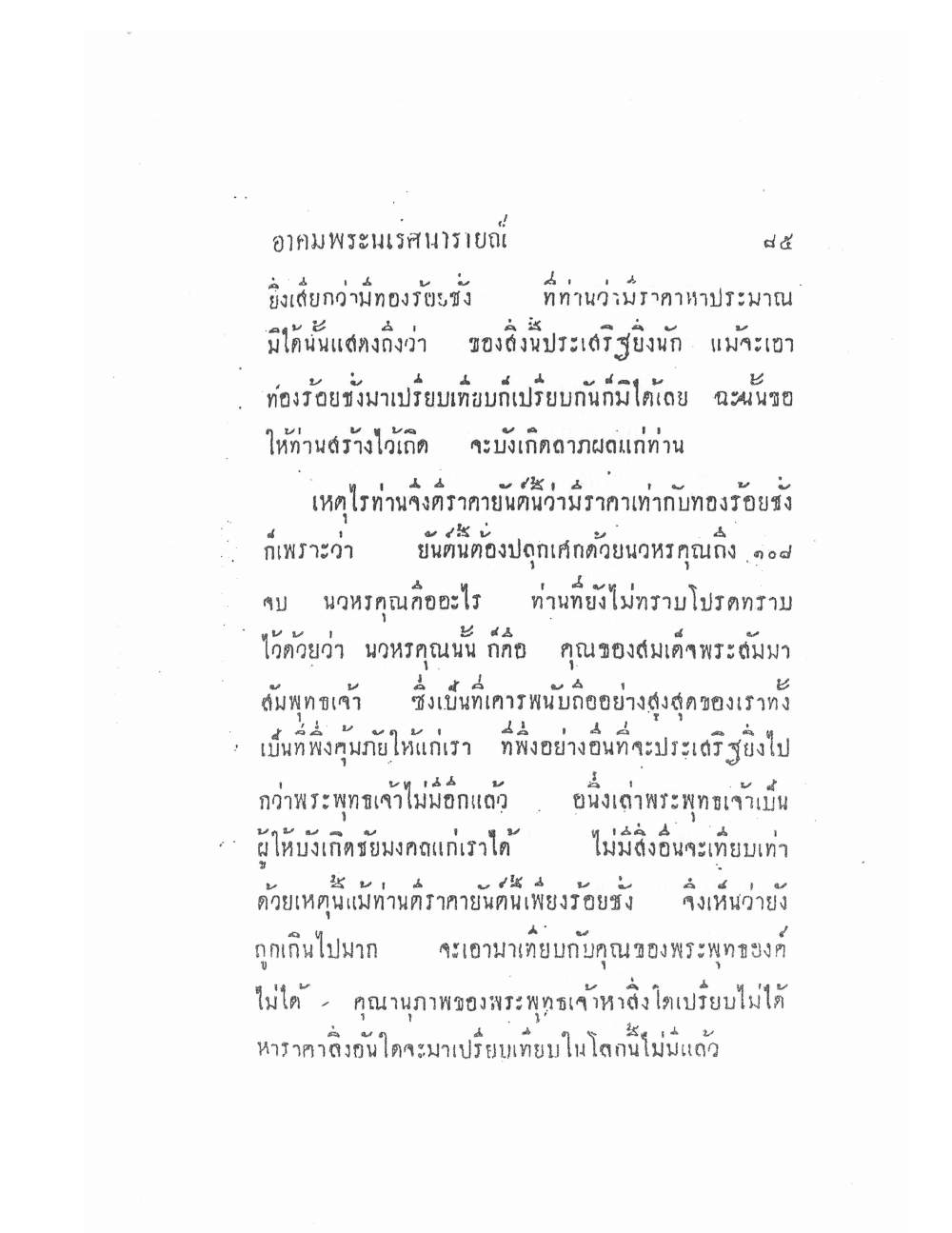
อาคมพระนเรศนารายณ์ ๘๕
ยิ่งเสียกว่ามีทองร้อยชั่ง ที่ท่านว่ามีราคาหาประมาณ มิได้นั้นแสดงถึงว่า ของสิ่งนี้ประเสริฐยิ่งนัก แม้จะเอา ทองร้อยชั่งมาเปรียบเทียบก็เปรียบกันมิได้เลย ฉะนั้นขอ ให้ท่านสร้างไว้เถิด จะบังเกิดลาภผลแก่ท่าน
เหตุใดท่านจึงตีราคายันต์นี้ว่ามีราคาเท่ากับทองร้อยชั่ง ก็เพราะว่า ยันต์นี้ต้องปลุกเสกด้วยนวหรคุณถึง ๑๐๘ จบ นวหรคุณคืออะไร ท่านที่ยังไม่ทราบโปรดทราบ ไว้ด้วยว่า นวหรคุณนั้น ก็คือ คุณของสมเด็จพระสัมมา สัมพุทธเจ้า ซึ่งเป็นที่เคารพนับถืออย่างสูงสุดของเราทั้ง เป็นที่พึ่งภัยให้แก่เรา ที่พึ่งอย่างอื่นที่จะประเสริฐยิ่งไป กว่าพระพุทธเจ้าไม่มีอีกแล้ว อนึ่งเฉพาะพระพุทธเจ้าเป็น ผู้ให้บังเกิดชัยมงคลแก่เราได้ ไม่มีสิ่งอื่นจะเทียบเท่า ด้วยเหตุนี้แม้ท่านตีราคายันต์นี้เพียงร้อยชั่ง จึงเห็นว่ายัง ถูกเกินไปมาก จะเอามาเทียบกับคุณของพระพุทธองค์ ไม่ได้ คุณานุภาพของพระพุทธเจ้าหาสิ่งใดเปรียบไม่ได้ หาราคาสิ่งอันใดจะมาเปรียบเทียบในโลกนี้ไม่มีแล้ว
Akhom Magic of Phra Naresuan-Narai 85
[It is worth] even more than a hundred bars of gold. In saying that its value cannot be estimated, this shows that this thing is exceedingly excellent — even bringing a hundred bars of gold to compare would not compare at all. Therefore, I ask that you make one; benefit and gain will arise for you.
Why is it that this yantra is valued at the equal of a hundred bars of gold? It is because this yantra must be consecrated with the Navaharaguna [the Nine Virtues] a full 108 times. What is the Navaharaguna? For those who do not yet know, be informed that the Navaharaguna is the virtue of the Lord Buddha, the Fully Self-Enlightened One, which is the highest object of our reverence and veneration, and our refuge from danger. There is no other refuge more excellent than the Buddha. Moreover, it is the Buddha alone who can bring about auspicious victory for us; nothing else compares. For this reason, even valuing this yantra at merely a hundred [gold bars] is, in fact, still far too little — it cannot truly be compared with the virtue of the Lord Buddha. The power of the Buddha's virtue has nothing to compare with it; there is no price of any kind in this world that could be set against it.
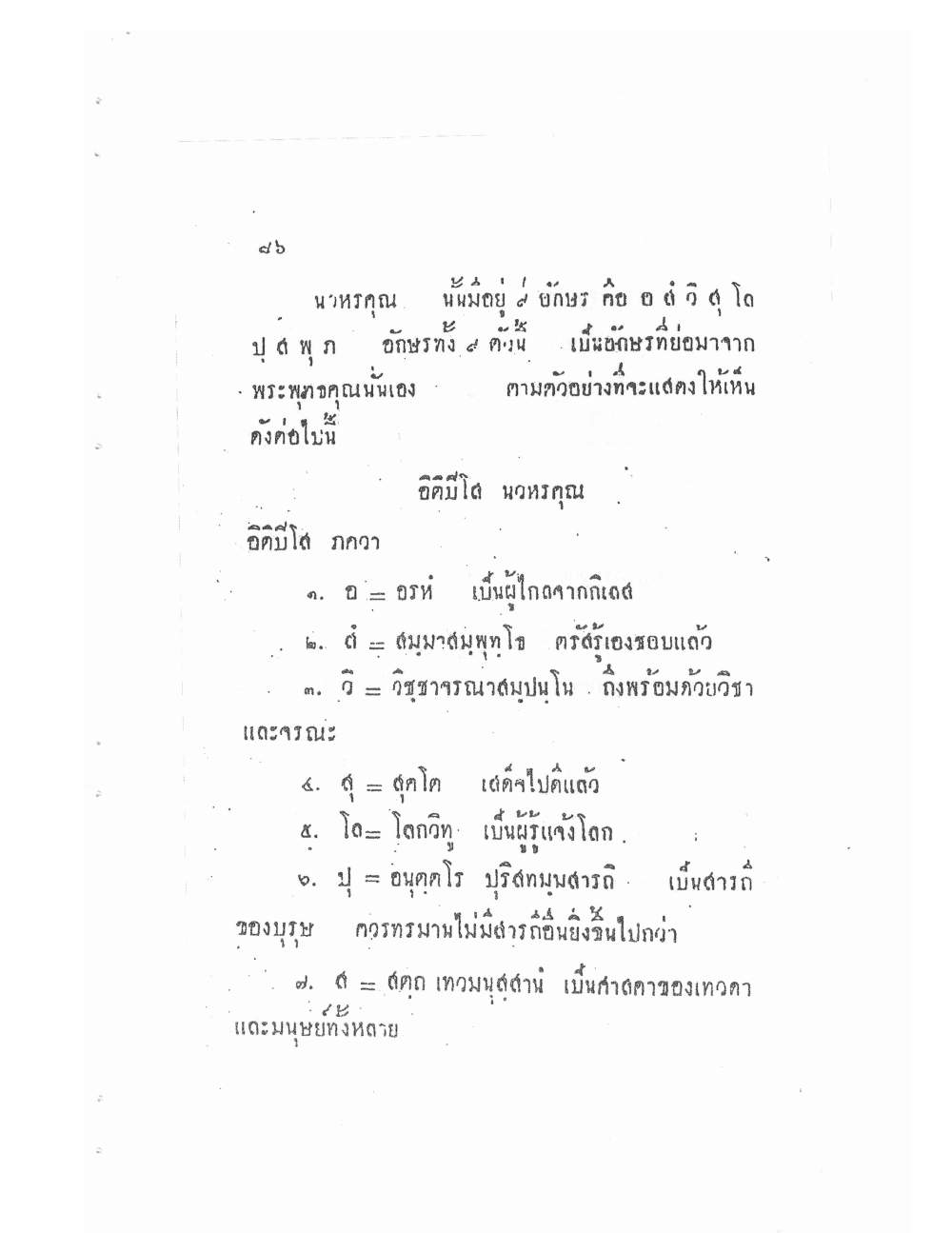
๘๖
นวหรคุณ นั้นมีอยู่ ๙ อักษร คือ อ สํ วิ สุ โล ปุ ส พุ ภ อักษรทั้ง ๙ ตัวนี้ เป็นอักษรที่ย่อมาจาก พระพุทธคุณนั้นเอง ตามตัวอย่างที่จะแสดงให้เห็น ดังต่อไปนี้
อิติปิโส นวหรคุณ
อิติปิโส ภควา
๑. อ = อรหํ เป็นผู้ไกลจากกิเลส
๒. สํ = สมฺมาสมฺพุทฺโธ ตรัสรู้เองชอบแล้ว
๓. วิ = วิชฺชาจรณสมฺปนฺโน ถึงพร้อมด้วยวิชา แลจรณะ
๔. สุ = สุคโต เสด็จไปดีแล้ว
๕. โล = โลกวิทู เป็นผู้รู้แจ้งโลก
๖. ปุ = อนุตฺตโร ปุริสทมฺมสารถิ เป็นสารถี ของบุรุษ ควรทรมานไม่มีสารถีอื่นยิ่งขึ้นไปกว่า
๗. ส = สตฺถา เทวมนุสฺสานํ เป็นศาสดาของเทวดา แลมนุษย์ทั้งหลาย
86
The Navaharaguna consists of 9 letters, namely: A, Saṃ, Vi, Su, Lo, Pu, Sa, Phu, Bha. These 9 letters are letters abbreviated from the Buddha's own virtues, as shown in the example below:
Itipiso, the Nine Virtues (Navaharaguna)
Itipiso Bhagavā [Thus is the Blessed One]
1. A = Arahaṃ — He who is far from defilement.
2. Saṃ = Sammāsambuddho — He who has rightly awakened by himself.
3. Vi = Vijjācaraṇasampanno — He who is perfect in knowledge and conduct.
4. Su = Sugato — He who has gone well.
5. Lo = Lokavidū — He who is the knower of the world.
6. Pu = Anuttaro purisadammasārathi — He who is the charioteer/trainer of persons who should be tamed; there is no other trainer that surpasses him.
7. Sa = Satthā devamanussānaṃ — He who is the teacher of gods and human beings.
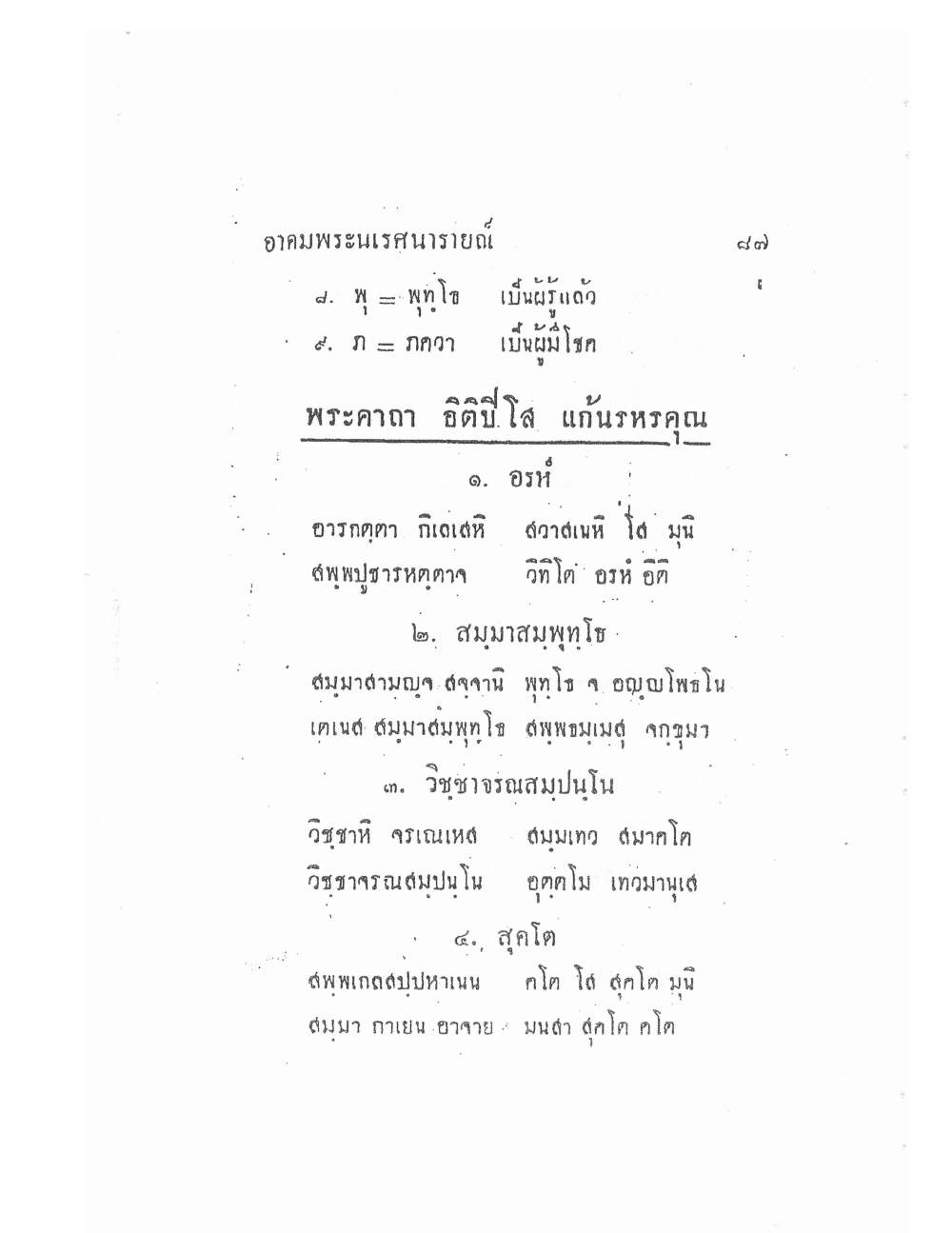
อาคมพระนเรศนารายณ์ ๘๗
๘. พุ = พุทฺโธ เป็นผู้รู้แล้ว
๙. ภ = ภควา เป็นผู้มีโชค
พระคาถา อิติปิโส แก้นวหรคุณ ______________________
๑. อรหํ
อารกตฺตา กิเลเสหิ สวาสเนหิ โส มุนิ สพฺพปูชารหตฺตาจ วิทิโต อรหํ อิติ
๒. สมฺมาสมฺพุทฺโธ
สมฺมาสามญฺจ สจฺจานิ พุทฺโธ จ อนฺญโพธนํ เตเนส สมฺมาสมฺพุทฺโธ สพฺพธมฺเมสุ จกฺขุมา
๓. วิชฺชาจรณสมฺปนฺโน
วิชฺชาหิ จรเณเหส สมฺมเทว สมาคโต วิชฺชาจรณสมฺปนฺโน อุตฺตโม เทวมานุเส
๔. สุคโต
สพฺพเกตสปฺปหาเนน คโต โส สุคโต มุนิ สมฺมา คมเนน อาจาย มนสา สุคโต คโต
Akhom Magic of Phra Naresuan-Narai 87
8. Phu = Buddho — He who is the Knowing One.
9. Bha = Bhagavā — He who is fortunate/blessed.
The Itipiso Verses Expounding the Nine Virtues (Navaharaguna) ______________________
1. Arahaṃ ['Worthy']
[Pali stanza, kept as transliterated in the text — Ārakattā kilesehi savāsanehi so muni / sabbapūjārahattā ca vidito arahaṃ iti] Gloss: Because that sage is far from the defilements together with their latent traces, and because he is worthy of all worship, he is known as 'Arahaṃ.'
2. Sammāsambuddho ['Perfectly Self-Enlightened']
[Pali stanza — Sammā sāmañca saccāni buddho ca aññabodhanaṃ / tena esa sammāsambuddho sabbadhammesu cakkhumā] Gloss: Because he has rightly and by himself awakened to the truths, and awakens others also, he is thus 'Sammāsambuddho,' possessed of the eye [of insight] into all phenomena.
3. Vijjācaraṇasampanno ['Perfect in Knowledge and Conduct']
[Pali stanza — Vijjāhi caraṇehesa sammadeva samāgato / vijjācaraṇasampanno uttamo devamānuse] Gloss: Because he is perfectly endowed with both knowledge and conduct, he is 'Vijjācaraṇasampanno,' supreme among gods and men.
4. Sugato ['Well-Gone']
[Pali stanza — Sabbaketasappahānena gato so sugato muni / sammā gamanena ācāya manasā sugato gato] Gloss: Because that sage has gone, having abandoned all defilements, and has gone rightly by a pure path and a pure mind, he is 'Sugato.'
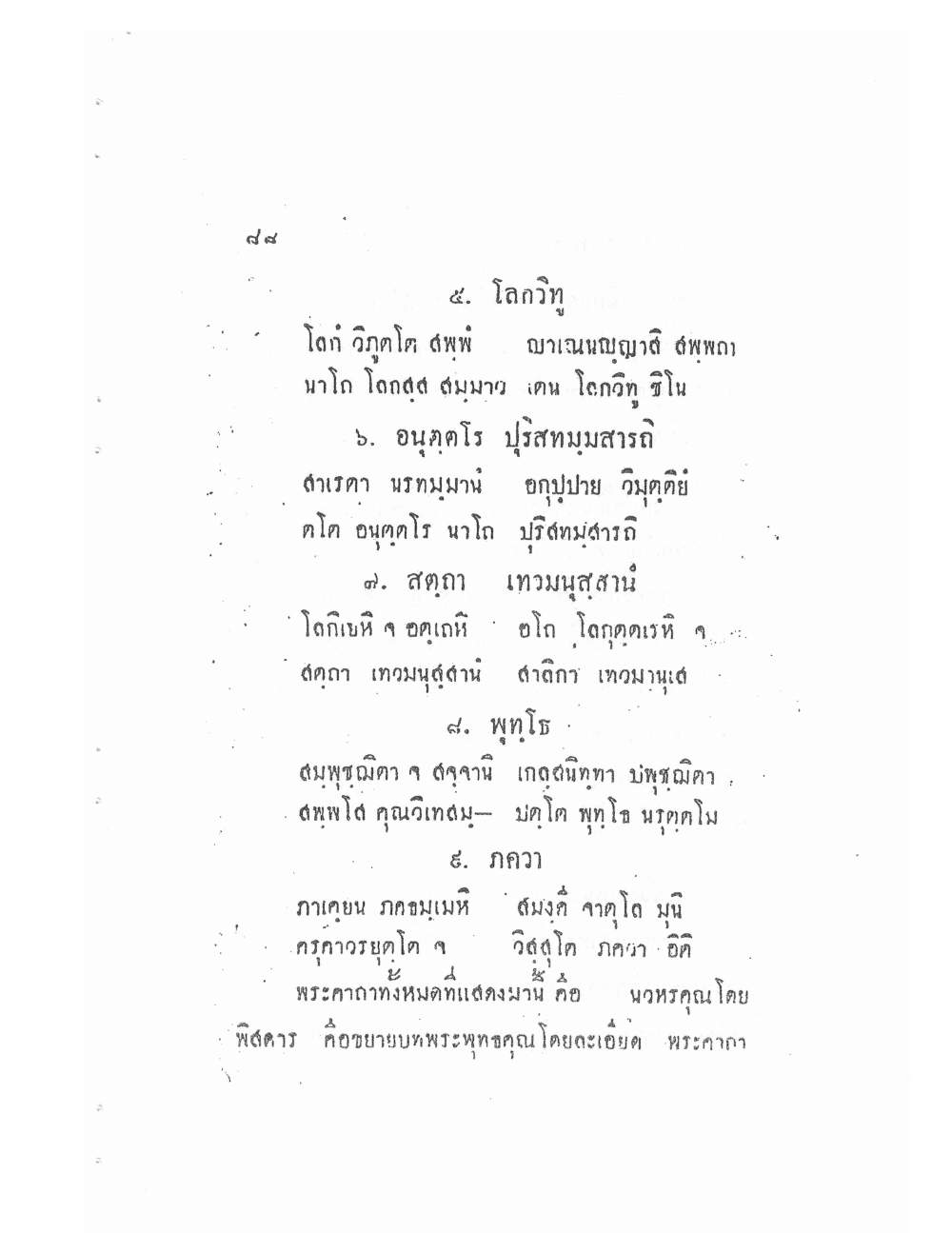
๘๘
๕. โลกวิทู
โลกํ วิทิตฺวา สพฺพํ ญาเณนญฺญาสิ สพฺพถา นาโถ โลกสฺส สมฺมาว เตน โลกวิทู ชิโน
๖. อนุตฺตโร ปุริสทมฺมสารถิ
สาเรตา นรทมฺมานํ อกุปฺปาย วิมุตฺติยา โส อนุตฺตโร นาโถ ปุริสทมฺมสารถิ
๗. สตฺถา เทวมนุสฺสานํ
โลกิเยหิ จ อตฺเถหิ อโถ โลกุตฺตเรหิ จ สตฺถา เทวมนุสฺสานํ สาติกา เทวมานุเส
๘. พุทฺโธ
สมฺพุชฺฌิตา จ สจฺจานิ เกตสนิทฺทา ปพุชฺฌิตา สพฺพโส คุณวิเทสมฺ— มคโต พุทฺโธ นรุตฺตโม
๙. ภควา
ภาเคยน ภคอมฺเมหิ สมงฺคี จาตุโล มุนิ กรุณาวรยุตฺโต จ วิสฺสุโต ภควา อิติ
พระคาถาทั้งหมดที่แสดงมานี้ คือ นวหรคุณโดย พิสดาร คือขยายบทพระพุทธคุณโดยละเอียด พระคาถา
88
5. Lokavidū ['Knower of the World']
[Pali stanza — Lokaṃ viditvā sabbaṃ ñāṇena aññāsi sabbathā / nātho lokassa sammā va tena lokavidū jino] Gloss: Because, having known the whole world, he understood it fully in every way by knowledge, and is thus rightly the refuge of the world, the Conqueror is 'Lokavidū.'
6. Anuttaro purisadammasārathi ['Unsurpassed Trainer of Persons to be Tamed']
[Pali stanza — Sāretā naradammānaṃ akuppāya vimuttiyā / so anuttaro nātho purisadammasārathi] Gloss: Because he guides persons who need taming toward unshakeable liberation, this unsurpassed refuge is the 'Charioteer of persons to be tamed.'
7. Satthā devamanussānaṃ ['Teacher of Gods and Men']
[Pali stanza — Lokiyehi ca atthehi atho lokuttarehi ca / satthā devamanussānaṃ sātikā devamānuse] Gloss: Through both worldly and supramundane benefits, he is the teacher of gods and human beings, the benefactor of gods and men.
8. Buddho ['The Awakened One']
[Pali stanza — Sambujjhitā ca saccāni ketasaniddā pabujjhitā / sabbaso guṇavidesam-magato buddho naruttamo] Gloss: Because he has fully awakened to the truths, and has roused himself from the sleep of the mental fetters, and has arrived, through every kind of quality, at the highest, he is 'Buddho,' the highest of men.
9. Bhagavā ['The Blessed One']
[Pali stanza — Bhāgeyana bhaga-ammehi samaṅgī cātulo muni / karuṇāvarayutto ca vissuto bhagavā iti] Gloss: Because that peerless sage is endowed with good fortune and glorious qualities, and is joined with supreme compassion, he is renowned as 'Bhagavā.'
All of the verses set out above together constitute the Navaharaguna in full — that is, the Buddha-virtue verse expanded in detail. [The following] verse...
อาคมพระนเรศนารายณ์ ๘๙
ทั้งหมดนี้ เมื่อย่อลงไปจนถึงที่สุดคงได้อักษรย่อเพียง ๙ ตัวเท่านั้น ท่านปรารถนาจะทราบนวหรคุณโดยละเอียด จงตรวจดูบนพระคาถานี้เถิด จะเห็นได้ว่านวหรคุณนั้น มีอรรถยืดยาวมาก
ยันต์บทนี้ นอกจาก เสกด้วยพระคาถานวหรคุณแล้ว ยังให้เสกด้วย อ สํ วิ สุ โล ปุ ป ย ป อีก ๑๐๘ จบ พระคาถาบทนี้อาจเคลื่อนมาจากอักษรย่อ สํ วิ ส ปุ ก ย ป ก็ได้ อักษรย่อนี้ หมายถึงหัวใจพระธรรม ๘ คัมภีร์ จึงเป็นยอดแห่งพระพุทธมนต์ทั้งหลาย พระพุทธเจ้าทรง แสดงพระธรรมเทศนาโปรดพระพุทธมารดา เพื่อฉลอง พระคุณพระพุทธมารดาของพระองค์ ก็ได้เทศนาด้วย พระคัมภีร์ทั้ง ๘ นั้น
ฉะนั้นจึงเห็นได้ว่า พระคาถาที่ลงกำกับยันต์แต่ละบท ก็ดี คาถาที่สำหรับใช้ปลุกเสกก็ดี แต่ละบท ๆ นั้น ล้วนแต่ท่านเลือกสรรเอามาแต่พระพุทธมนต์อันวิเศษ ผู้ ใดได้สร้างยันต์นี้ไว้บูชา จึงได้ชื่อว่าผู้นั้นได้ของวิเศษไว้ใน
Akhom Magic of Phra Naresuan-Narai 89
All of this, when abbreviated down to its final form, comes to only 9 letters. If you wish to know the Navaharaguna in full detail, examine these verses; you will see that the Navaharaguna carries a very extensive meaning.
For this yantra formula, besides consecrating it with the Navaharaguna verses, it should also be consecrated with 'A Saṃ Vi Su Lo Pu Pa Ya Pa' another 108 times. This verse may possibly be a variant derived from the abbreviated letters 'Saṃ Vi Sa Pu Ka Ya Pa.' This abbreviation refers to the Heart of the Dhamma in 8 scriptures, and is thus the pinnacle of all Buddhist mantras. When the Buddha delivered his Dhamma teaching to liberate his mother, in order to repay the debt of gratitude owed to his mother, he taught using those same 8 scriptures.
Thus it can be seen that the verses inscribed to accompany each section of the yantra, as well as the verses used for consecration — each and every one of them — were all specially chosen from the most excellent Buddhist mantras. Whoever makes and keeps this yantra for worship may thus be said to possess something extraordinary within...
๙๐
ครัวเรือนของตน ดีกว่าท่านจะได้แก้วแหวนเงินทองอันมี ราคาอีก
ขณะที่ท่านจะทำพิธีลงยันต์บทนี้ แม้แต่เพียงเริ่ม ลากเส้นยันต์ก็ดี ลงอักขระทุก ๆ ตัวก็ดี ท่านจงภาวนา บริกรรมนวหรคุณเรื่อย ๆ ไปอย่าให้ขาดได้ ถ้าจะลง ในแผ่นผ้า ก็ขยายรูปยันต์ออกตามส่วนของผ้า จะ ขยายให้ใหญ่สักเท่าไร ๆ ก็ได้ หรือจะลงในแผ่น ตะกรุด ก็ย่อส่วนให้เล็กลงพอบรรจุลงในแผ่นนั้นได้ ข้อ สำคัญควรระวัง อย่าให้อักษรที่มีอยู่ในรูปยันต์นั้นคลาด เคลื่อนได้
ท่านจะทำไว้สักการะบูชาหรือทำ เพื่อประโยชน์แก่ผู้ อื่นก็ตาม จงตั้งใจให้เกิดประโยชน์จริง ๆ ทำให้เป็น สมาธิแน่วแน่ มนต์ที่ปลุกเสกนั้นจึงจะเป็นมนต์ขลัง แล้ว และจะบันดาลให้สำเร็จสมดังความปรารถนาของท่าน
90
...within one's own household — better than obtaining jewelry or money of great value.
While performing the rite of inscribing this yantra formula, even from the very moment you begin drawing the yantra's lines, and as you inscribe each and every letter, you should recite the Navaharaguna continuously throughout, without letting it lapse. If it is to be inscribed on a cloth, then enlarge the yantra figure in proportion to the cloth — it may be enlarged to any size at all. Or if it is to be inscribed on a takrut sheet, then shrink it down small enough to fit onto that sheet. The important point to be careful of is that none of the letters within the yantra figure should be allowed to become distorted or altered.
Whether you make it for your own worship, or make it for the benefit of others, set your intention so that it produces true benefit, keeping the mind firmly concentrated. Only then will the mantra that is consecrated become a truly potent, sacred mantra — and it will bring about the fulfillment of your wishes.
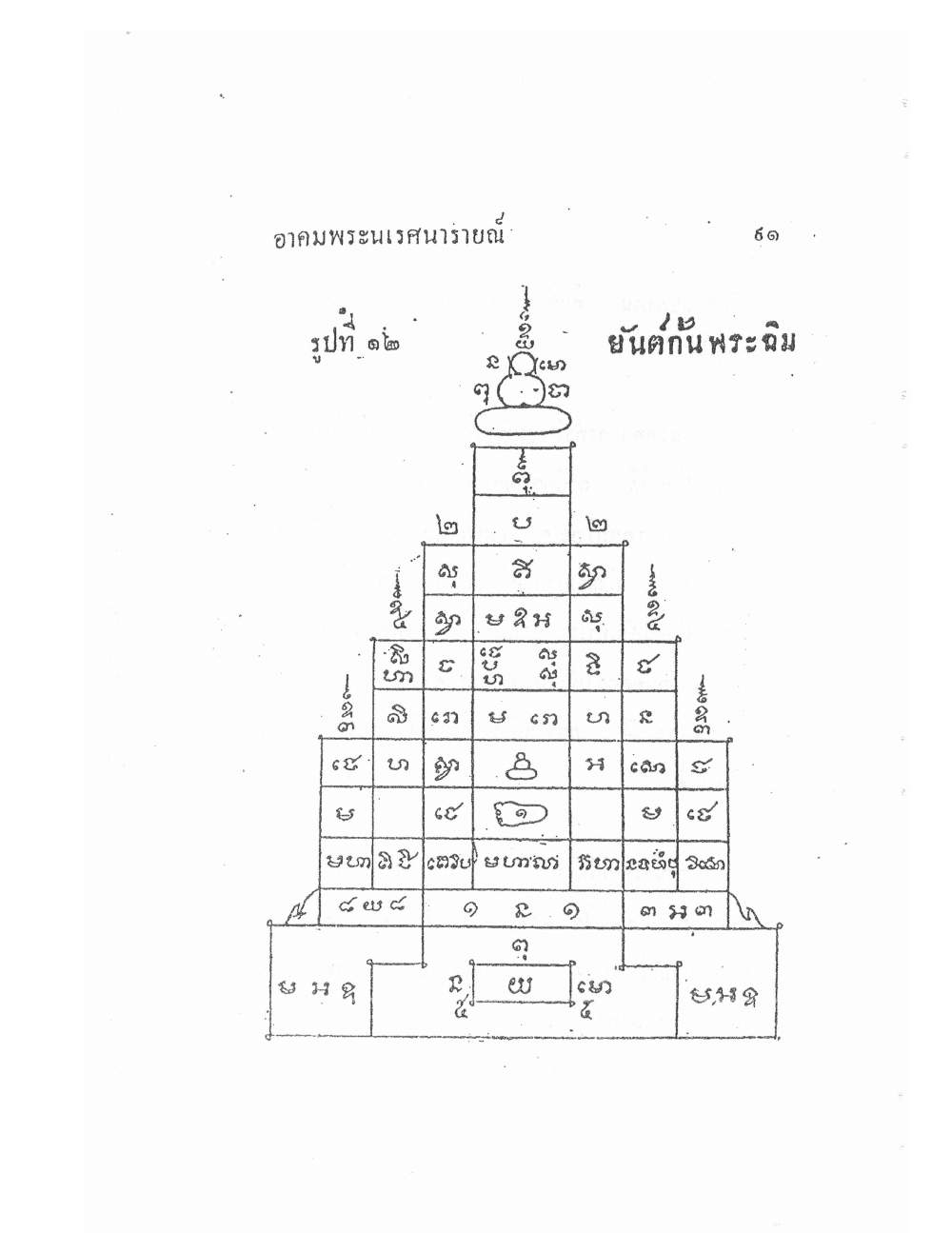
อาคมพระนเรศนารายณ์ ๙๑
รูปที่ ๑๒ ยันต์กันพระฉิม
[อักขระในยันต์ อ่านไม่ชัด]
Akhom Magic of Phra Naresuan-Narai 91
Figure 12 Yantra Kan Phra Chim
[diagram: a stepped, pyramid-shaped yantra of several tiers of boxes narrowing toward the top, topped by a small seated Buddha image on a lotus-like base with a tall spire/flame finial above the head. The tiers, from top to bottom, hold varying numbers of boxes, each inscribed with a single Thai/khom letter or short syllable; small numerals mark some corners of the tiers. Partway down, two small demon or yaksha faces flank the tiers on either side. Within the lower tiers a small stupa emblem and a footprint-like emblem are inscribed in two of the boxes. Below the pyramid, a wider rectangular base register is divided into cells holding short syllable groups, with a small square inset near its center. The individual khom/Thai letters inside the many small cells are too small and faint at this resolution to read with confidence.]
๙๒
ยันต์นี้มีชื่อว่า ยันต์กันพระฉิม สำหรับลงฝาผนัง ท่านมิได้มีโอกาสสร้างองค์พระฉิมไว้สักการะบูชาแล้ว ควร จะสร้างยันต์นี้ไว้ จะเขียนลงในแผ่นผ้าขาวก็ได้ หรือจะ เขียนลงในกระดาษแข็ง ทำเป็นฝากันถ้อมพระฉิมพต้อีก ชั้นหนึ่ง ผู้ใดได้ทำยันต์นี้ไว้บูชา จะเพิ่มกำลังอิทธิฤทธิ์ให้แก่ ผู้บูชาอีกมาก เมื่อจะลงยันต์ในขณะที่ทำพิธีลากเส้นยันต์ ให้บริกรรมพระคาถาดังนี้
ปญฺจ ปญฺจ อภิญฺญา ๕ อฏฺฐุ อฏฺฐ นามํ ๘ ปตฺติ จตุพฺรหฺมวิหาโร ๔ ปฏิสมฺภิทาญาณ ๔ เสฏฺฐ ปญฺจปาตํ ๕ รวสตฺถานวนุนาวหารตนุน ๕ เจวทส ปารมิจ มหาเตโช ๗-๓ อุปนุนามหาทสุส ๘-๒ จมตุถา ทสฺสนสวยนฺตุ ๕-๑ อุนาโลมกวรงฺสิทฺธิ
ภาวนาบริกรรมลากยันต์ไปจนกว่าจะเสร็จ เมื่อเสร็จ แล้วให้ปลุกเสกด้วยพระคาถาว่า
พุทธานุสสติ ธมฺมานุสฺสติ สงฺฆานุสฺสติ พุทฺธ ชีวิตํ ยาวนิพฺพานํ สรณํ คจฺฉามิ ธมฺม ชีวิตํ ยาวนิพฺพานํ สรณํ คจฺฉามิ สงฺฆ ชีวิตํ ยาวนิพฺพานํ สรณํ คจฺฉามิ
92
This yantra is called the Yantra Kan Phra Chim [the 'Phra Chim-Guardian Yantra'], used for inscribing on a wall. If one has not had the opportunity to make an image of Phra Chim to worship and revere, one should make this yantra instead — it may be written on a sheet of white cloth, or written on stiff paper, made into an additional protective covering-sheet for [an image of] Phra Chim. Whoever makes this yantra for worship will greatly increase their power and psychic potency. While performing the rite of drawing the yantra's lines, recite the following verse:
[Pali-derived numerological formula, kept as transliterated in the text: Pañca pañca abhiññā 5, aṭṭhu aṭṭha nāmaṃ 8, patti catubrahmavihāro 4, paṭisambhidāñāṇa 4, seṭṭha pañcapātaṃ 5, ravasatthānavanunāvahāratanuna 5, jevadasa pāramija mahātejo 7-3, upanunāmahādasusa 8-2, jamatuthā dassanasavayantu 5-1, unālomakavaraṃsiddhi — this is a mnemonic cipher linking magical syllables to numbered doctrinal categories (the 5 higher knowledges, 4 divine abodes, 4 analytical knowledges, etc.) rather than a grammatical sentence, and no separate gloss is given on the page]
Recite this continuously while drawing the yantra, until it is complete. When finished, consecrate it with the following verse:
Buddhānussati, Dhammānussati, Saṅghānussati [Recollection of the Buddha, the Dhamma, and the Saṅgha] 'Buddhaṃ jīvitaṃ yāva nibbānaṃ saraṇaṃ gacchāmi' [I go for refuge in the Buddha, as my life, until nibbāna] 'Dhammaṃ jīvitaṃ yāva nibbānaṃ saraṇaṃ gacchāmi' [I go for refuge in the Dhamma, as my life, until nibbāna] 'Saṅghaṃ jīvitaṃ yāva nibbānaṃ saraṇaṃ gacchāmi' [I go for refuge in the Saṅgha, as my life, until nibbāna]
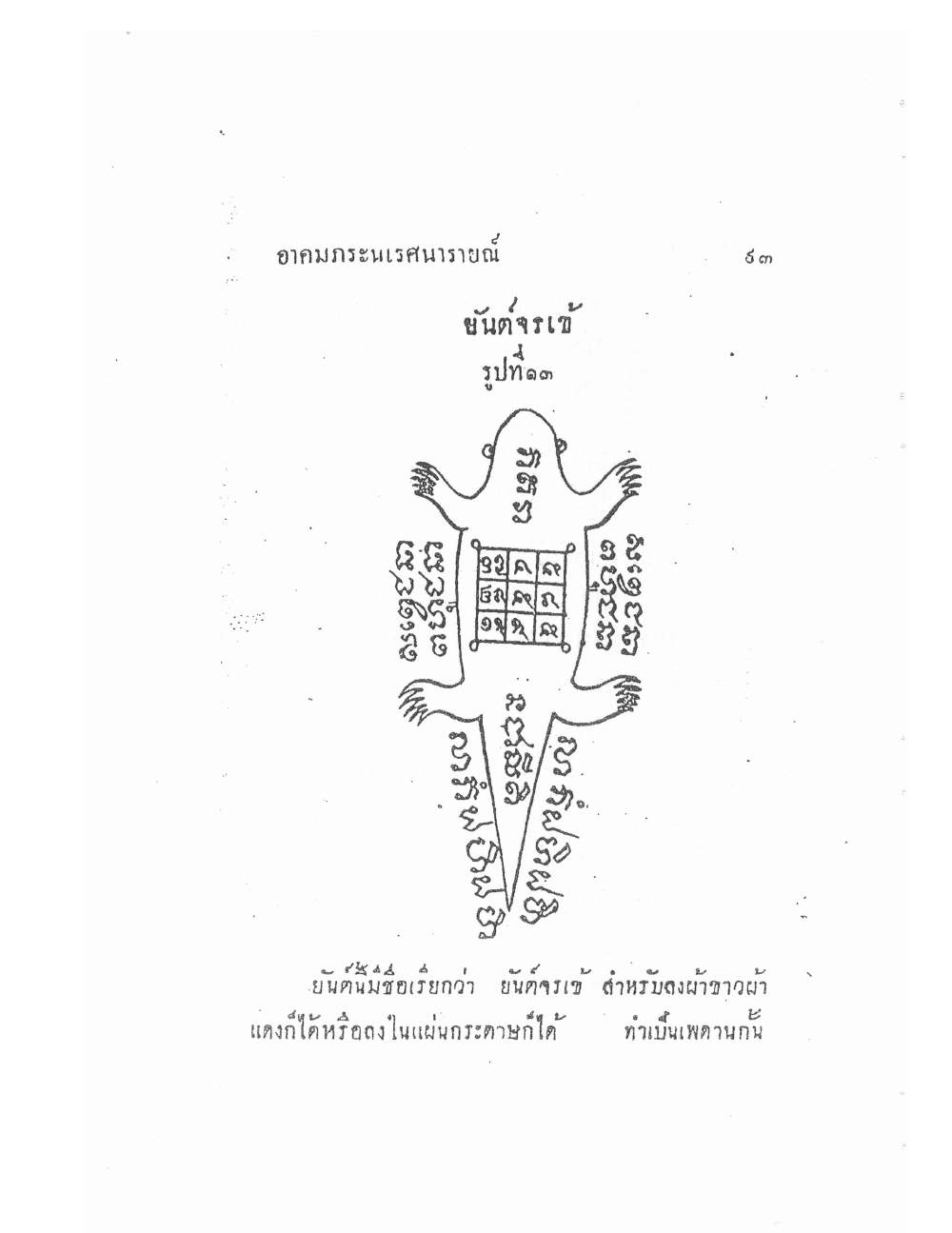
อาคมพระนเรศนารายณ์ ๙๓
ยันต์จรเข้
รูปที่ ๑๓
[อักขระขอมในยันต์ อ่านไม่ชัด]
ยันต์นี้มีชื่อเรียกว่า ยันต์จรเข้ สำหรับลงผ้าขาวผ้า แดงก็ได้หรือลงในแผ่นกระดาษก็ได้ ทำเป็นเพดานกั้น
Akhom of Phra Naresuan-Narai 93
Crocodile Yantra
Figure 13
[diagram: a stylized crocodile (or lizard) drawn in the shape of a dagger — a head with two small knobs and four clawed limbs, its body containing a 3x3 grid of nine cells inscribed with numerals/Khom characters, its lower body tapering to a long blade-like point; Khom-script inscriptions run down both edges of the blade and along each of the four limbs — illegible]
This yantra is called the Crocodile Yantra. It may be inscribed on white cloth or red cloth, or written on a sheet of paper. It is made into a canopy hung above [reading of final phrase uncertain].
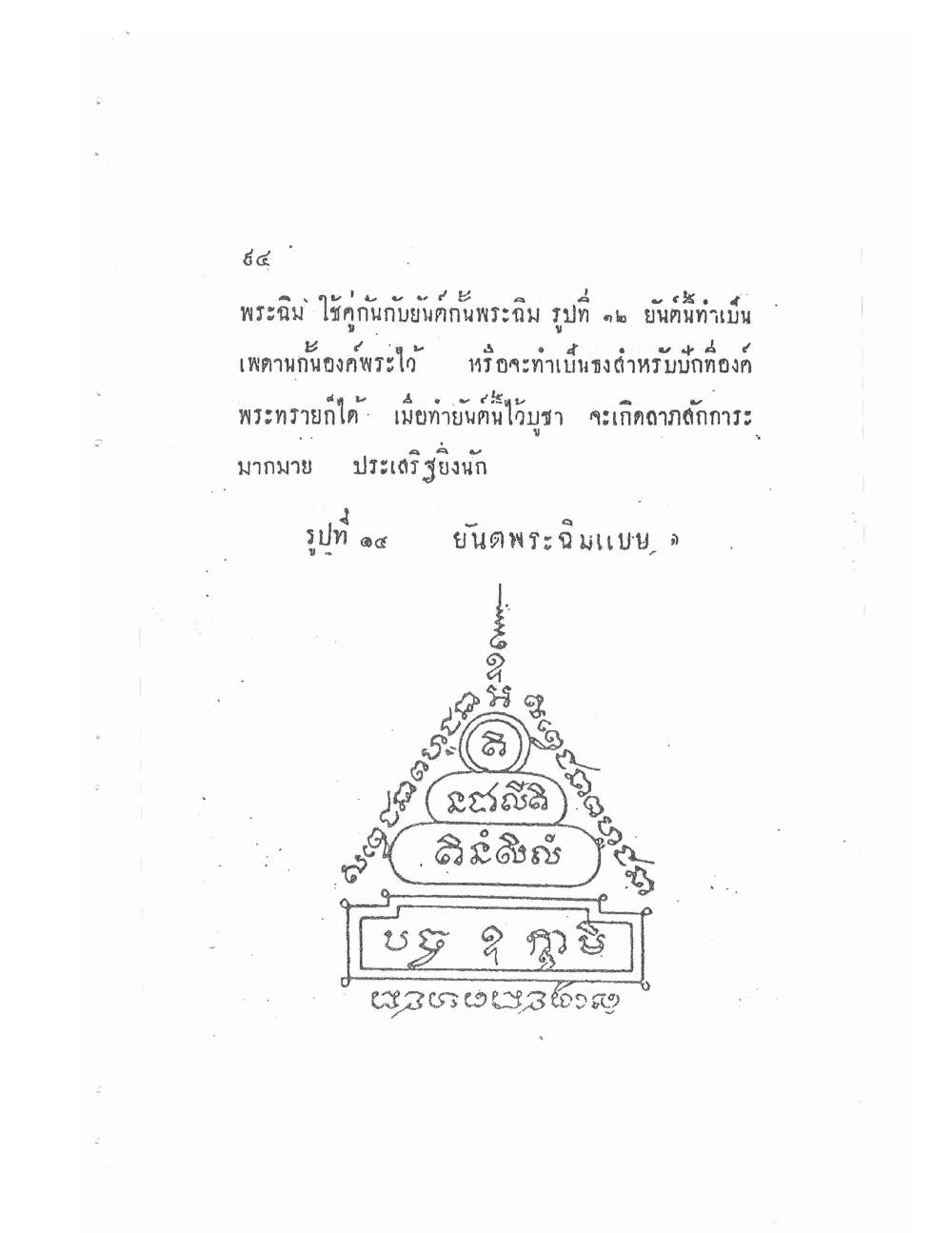
๙๔
พระฉิม ใช้คู่กันกับยันต์กันพระฉิม รูปที่ ๑๒ ยันต์นี้ทำเป็น เพดานกั้นองค์พระไว้ หรือจะทำเป็นธงตำหรับปักที่องค์ พระทรายก็ได้ เมื่อทำยันต์นี้ไว้บูชา จะเกิดลาภสักการะ มากมาย ประเสริฐยิ่งนัก
รูปที่ ๑๔ ยันต์พระฉิมแบบ ๑
[อักขระขอมในยันต์ อ่านไม่ชัด]
94
...Phra Chim: used together with the Yantra Guarding Phra Chim, Figure 12. This yantra can be made into a canopy to shelter the Buddha image, or made into a flag/banner to plant at a sand-stupa image [Phra Sai]. When this yantra is made and kept for worship, it will bring abundant fortune and merit — most excellent indeed.
Figure 14 — Yant Phra Chim, Style 1
[diagram: a triangular yantra topped with a coiled finial. Near the apex, inside a small circle, sits a single character. Below it, two stacked oval cartouches contain inscriptions. Khom-script text runs down both slanted sides of the triangle. At the base sits a rectangular panel containing three characters, bordered underneath by a further line of Khom script — illegible]
อาคมพระนเรศนารายณ์ ๙๕
ยันต์นี้มีชื่อว่ายันต์พระฉิม ท่านที่ยังไม่สามารถจะ สร้างองค์พระฉิมไว้สักการะบูชา จะสร้างยันต์นี้บูชาก่อนก็ได้ ยันต์นี้ถือว่าเป็นยันต์แทนองค์พระฉิม หรือเท่ากับสร้างองค์ พระฉิมก็ดุจเดียวกัน หรือจะลงในกระดาษทำเป็นไส้เทียน ก็ได้ แล้วเอาขี้ผึ้งหนัก ๑ บาทมาควั่น เอาด้ายสาวพรหม- จารีย์มาทำไส้ด้วย หรือจะลงใบพลูให้ดื่มกิน ก็จะได้ รับความเมตตาปรานีจากหญิงผู้นั้น
อนึ่งถ้าจะทำการค้าขาย ให้ลงยันต์ด้วยบทพาหุง แล้วเอาลงสรงน้ำ เศกด้วย[อ่านไม่ออก]ปารมิตา ๆ ตๆ จเตนโม ๑๑ คาบ เอาประพรมสินค้าที่เราจะขังการให้ขาย น้ำมนต์ ที่เหลือก็เอาล้างหน้าบ้าง ลูบตัวบ้าง กินบ้าง ปรารถนาสิ่งใด ก็สำเร็จสมความปรารถนา
ถ้าจะทำไว้สักการะบูชา ยังบ้านเรือนเคหสถานของ คน ก็จงเก็บดอกไม้บูชาทุกวัน อย่าให้ขาดได้ และให้สวด ถวายพรพระด้วยบทพาหุง ทุกวัน จะมีความสุขความเจริญ
Akhom of Phra Naresuan-Narai 95
This yantra is called the Yantra of Phra Chim. Anyone who is not yet able to make a Phra Chim image for worship may first make and worship this yantra instead. This yantra is held to stand in place of a Phra Chim image — equal to making one. It may also be written on paper and used as a candle wick: take one baht-weight of beeswax and roll it around the wick, using nine strands of thread spun by a virgin (a chaste, unmarried woman) to form the wick. Or it may be written on a betel leaf and given to someone to eat, and one will receive the affection and compassion of that woman.
Furthermore, if one wishes to trade or do business, write this yantra together with the Phahung verse, then place it for a ritual bath in water, chant [illegible] parami- twice, then Jetana Namo eleven times, and use it to sprinkle the merchandise one wishes to sell. The remaining lustral water may be used to wash the face, rub on the body, or drink; whatever one wishes for will be fulfilled.
If one wishes to keep it for worship in the home, one should offer flowers to it every day without fail, and recite the blessing with the Phahung verse daily — one will then have happiness and prosperity.
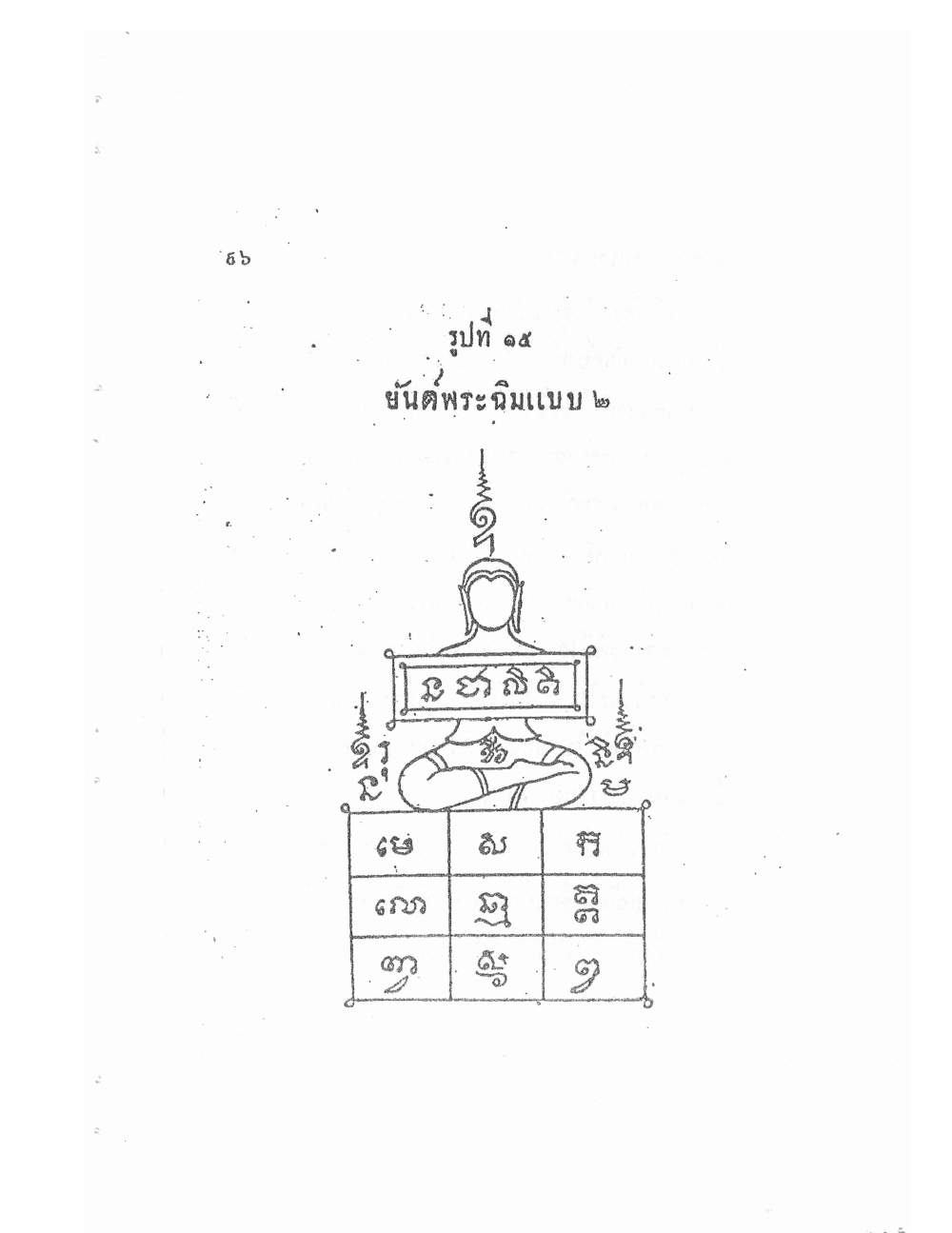
๙๖
รูปที่ ๑๕ ยันต์พระฉิมแบบ ๒
[อักขระขอมในยันต์ อ่านไม่ชัด]
96
Figure 15 — Yant Phra Chim, Style 2
[diagram: a seated meditating figure (a monk or Buddha image) beneath a coiled finial, wearing a rectangular cartouche across the chest inscribed with four characters, flanked left and right by small flame-shaped finials with vertical Khom inscriptions beside them; the figure sits cross-legged atop a 3x3 grid of nine cells, each inscribed with a character — all illegible]
อาคมพระนเรศนารายณ์ ๙๗
ยันต์พระฉิมรูปนี้เป็นอีกแบบหนึ่ง มีวิธีทำและวิธีใช้ เช่นเดียวกับยันต์องค์แรก พระยันต์องค์นี้จะใช้ลงกระดาษ ทำใส้เทียนก็ได้ ใช้ขี้ผึ้งหนัก ๑ บาท ควั่นเป็นเทียนบูชา พระ เอาด้ายสาวพรหมจารีมา ๙ เส้นทำเป็นไส้เทียน ในขณะที่ทำการควั่นเทียนนั้น ให้เสกด้วยพระคาถาว่า อิติปิโส ภควาติ จะเสก ๓ ครั้ง หรือ ๗ ครั้งก็ได้ เสก เทียนเสร็จก่อนแล้วจึงจุดตามถวายพระ (การเสกเทียนนี้ ต้องใช้หัวใจอิติปิโส บท อสังวิสุโล ปุสะพุพะ, อิกะวิด, พุทธโมยะโวนะโร ก็ใช้ได้) แล้วบริกรรมด้วยพระคาถา ว่า น ชา ลิ ติ ไปจนกว่าจะสิ้นเทียน ย่อมจะเป็นที่รักใคร่ เป็นที่นิยม บูชาของคนทั้งหลาย
ถ้าจะทำเป็นเทียนเสน่ห์ ให้เอาอุณาโลมที่ฐานพระ ออกเสีย แล้วจึงเขียนชื่อเราลงไปที่ต้นเทียน ชื่อเขาลงไป ที่ปลายเทียนแล้วให้บริกรรมไปกว่าจะสิ้นเทียน ด้วยพระ คาถาว่า น ชา ลิ ติ ผู้นั้นจะเมตตารักใคร่เรายิ่งนัก
Akhom of Phra Naresuan-Narai 97
This Phra Chim yantra is of another style; its method of making and using is the same as the first yantra. This yantra can also be written on paper and made into a candle wick. Use one baht-weight of beeswax, rolled into a candle to offer to the Buddha; use nine strands of thread spun by a virgin to make the wick. While rolling the candle, chant the sacred verse 'Itipiso Bhagavāti' three or seven times. Having finished consecrating the candle, light it and offer it to the Buddha. (For consecrating this candle one may also use the heart-mantra of Itipiso: 'A Saṃ Vi Su Lo Pu Sa Bu Pha,' 'Ika Vid,' or 'Buddha-moya-vonaro.') Then recite the sacred verse 'Na Chā Li Ti' continuously until the candle is spent — one will thereby become loved and esteemed, an object of worship among all people.
If one wishes to make a love-charm candle, remove the uṇālōma (topknot mark) from the base of the Buddha image, then write one's own name at the base of the candle and the other person's name at its tip, and recite continuously until the candle burns out, using the sacred verse 'Na Chā Li Ti.' That person will come to feel great affection and love for you.
พระคาถาปลุกยันต์พระฉิม
ยันต์พระฉิมทั้งแบบ ๑ และแบบ ๒ นี้ เมื่อท่านได้ สร้างขึ้นแล้วให้ปลุกด้วยพระคาถาดังนี้
อ สํ วิ สุ ปุ ๑๐๘ จิ เจ รุ นิ ๑๐๘ น ชา ลิ ติ ๑๐๘ น ม พ ท ๑๐๘
บทละ ๑๐๘ จบ
เสร็จแล้ว จึงบริกรรมภาวนาด้วยพระคาถาต่อไปว่า ฉิมพลี จ มหาเถโร มนุสสเทวตาราชานรกฺขตุ ปูชิโต โส รโห ปัจจยาทิมฺหิ อหํ วนฺทามิ สพฺพทา เสก ๑๐๘ ครั้ง หรือถ้าจะเอายันต์ทั้งสองนี้ (จะใช้แบบไหน ก็ได้แบบหนึ่ง) ทำใส้เทียน ก็ให้ปลุกด้วยพระคาถาข้างต้นนี้ โดยปลุกยันต์ที่ทำใส้เทียนเสียก่อน แล้วจึงควั่นเทียน ควั่น เสร็จแล้วจึงปลุกอีกทีหนึ่ง เช่นเดียวกับยันต์พระฉิมแบบ ๒ จบแล้วจึงจุดบูชาพระ เมื่อจุดแล้ว ให้บริกรรมคาถา ต่อไปว่า
The Sacred Verse for Awakening the Phra Chim Yantra
For the Phra Chim yantra of both Style 1 and Style 2, once you have made it, awaken (consecrate) it with the following sacred verses:
A Saṃ Vi Su Pu — 108 [times] Ji Je Ru Ni — 108 [times] Na Chā Li Ti — 108 [times] Na Ma Pha Tha — 108 [times]
Each verse recited 108 times.
Having finished, then recite the following sacred verse in meditation: 'Chimphalī ca mahāthero, manussa-devatā-rājāno rakkhantu, pūjito so raho paccayādimhi, ahaṃ vandāmi sabbadā' (Homage to Chimphali, the great elder — may humans, gods, and kings protect him; he who is revered as our earliest refuge, I pay homage to him always). Chant 108 times. Or, if using either of the two yantras to make a candle wick, awaken it with the verse above by first awakening the yantra used for the wick, then rolling the candle. Once rolled, awaken it once more, just as with Style 2 of the Phra Chim yantra. When finished, light it and offer it to the Buddha. Once lit, recite the following sacred verse in meditation:
อาคมพระนเรศนารายณ์ ๙๙
อมพระพุย พระพาย พระสหาย อันศักดิ์สิทธิ์ เรือง ฤทธิ์ ช่วยนำเอาพระเดชพระยันต์บทนี้ ข้ามแม่น้ำ ห้วย และหนอง คลองบึงบาง แหวนกันตะกรุดกัน ก็ช่วยนำเอา พระเดชพระยันต์บทนี้ให้ไปถึงที่เราจงใจนั้นเถิด พระคาถา บทนี้ให้เสกจนสิ้นเทียน พระคาถาบทนี้ใช้ในการทำน้ำมนต์ หรือสวดมนต์ขอลาภดีนัก
Akhom of Phra Naresuan-Narai 99
Om, Phra Phui, Phra Phai, and Phra Sahai [reading of these deity/spirit names uncertain], sacred and mighty in power, help carry the power of this yantra-verse across rivers, streams, and marshes, canals and swamps; may every ring and every amulet-cord likewise help carry the power of this yantra-verse to wherever we intend it to go. This sacred verse is to be chanted until the candle is entirely spent. This sacred verse is used in making lustral water, or when reciting for the sake of good fortune — it is very effective.
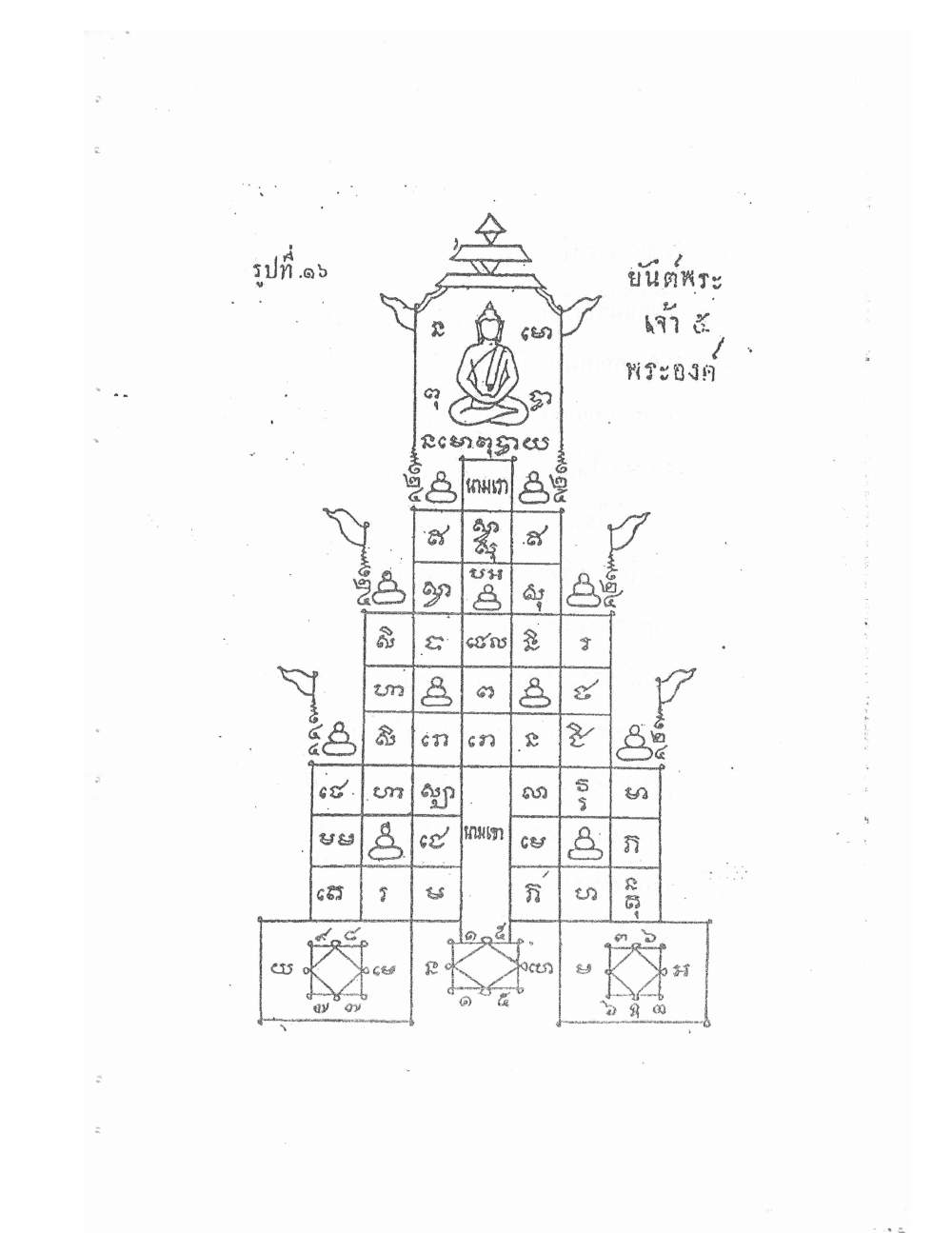
รูปที่ ๑๖ ยันต์พระเจ้า ๕ พระองค์
[อักขระขอมในยันต์ อ่านไม่ชัด]
นะโมพุทธาย
Figure 16 — Yantra of the Five Lord Buddhas
[diagram: an elaborate pagoda-shaped yantra. At the top, beneath a tiered spire and finial, sits a robed monk or Buddha figure inside a shrine-like frame, flanked by two characters. Below the figure runs the inscription 'Namo Buddhāya' down the centre. The lower body of the pagoda is built from tiers of grid-cells, each inscribed with a Khom character, several cells also marked with small stupa icons, flanked on both sides by banner-flags and stupa finials. At the base sit three separate diamond-lattice cartouches, each bordered by a rectangle and inscribed with characters — all Khom-script content illegible]
Namo Buddhāya (Homage to the Buddha — the five syllables here representing the Five Lord Buddhas)
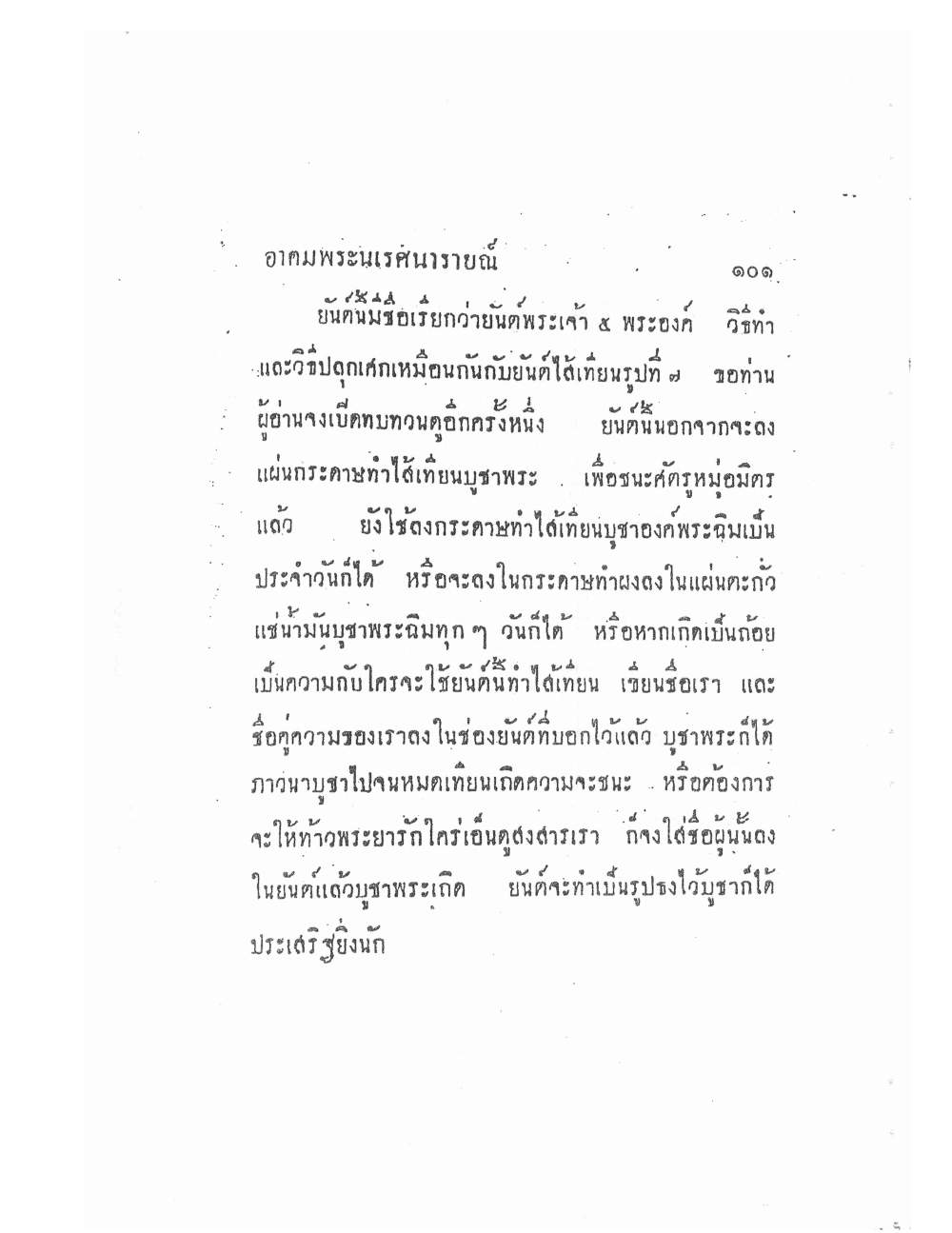
อาคมพระนเรศนารายณ์ ๑๐๑
ยันต์นี้มีชื่อเรียกว่ายันต์พระเจ้า ๕ พระองค์ วิธีทำ และวิธีปลุกเสกเหมือนกันกับยันต์ใส้เทียนรูปที่ ๗ ขอท่าน ผู้อ่านจงเปิดทบทวนดูอีกครั้งหนึ่ง ยันต์นี้นอกจากจะลง แผ่นกระดาษทำใส้เทียนบูชาพระ เพื่อชนะศัตรูหมู่มิตร แล้ว ยังใช้ลงกระดาษทำใส้เทียนบูชาองค์พระฉิมเป็น ประจำวันก็ได้ หรือจะลงในกระดาษทำผงลงในแผ่นตะกั่ว แช่น้ำมันบูชาพระฉิมทุก ๆ วันก็ได้ หรือหากเกิดเป็นถ้อย เป็นความกับใครจะใช้ยันต์นี้ทำใส้เทียน เขียนชื่อเรา และ ชื่อคู่ความของเราลงในช่องยันต์ที่บอกไว้แล้ว บูชาพระก็ได้ ภาวนาบูชาไปจนหมดเทียนเกิดความจะชนะ หรือต้องการ จะให้ท้าวพระยารักใคร่เอ็นดูสงสารเรา ก็จงใส่ชื่อผู้นั้นลง ในยันต์แล้วบูชาพระเกิด ยันต์จะทำเป็นรูปธงไว้บูชาก็ได้ ประเสริฐยิ่งนัก
Akhom of Phra Naresuan-Narai 101
This yantra is called the Yantra of the Five Lord Buddhas. Its method of making and consecrating is the same as the candle-wick yantra shown in Figure 7; readers are asked to turn back and review it again. Besides being written on paper and used as a candle wick offered to the Buddha to overcome enemies and rally friends, this yantra may also be written on paper and used daily as a candle wick offered to the Phra Chim image. It may also be written on paper, made into powder, applied to a sheet of lead, and steeped in oil to be offered daily to Phra Chim. Or, if one has a dispute or lawsuit with someone, one may use this yantra as a candle wick, writing one's own name and the name of one's opponent in the yantra's designated compartments, then worship the Buddha and recite in meditation until the candle is spent — victory will follow. Or if one wishes for a lord or person of rank to feel affection, pity, and compassion for oneself, write that person's name into the yantra and then worship — this too will occur. The yantra may also be made in the form of a flag for worship — most excellent indeed.
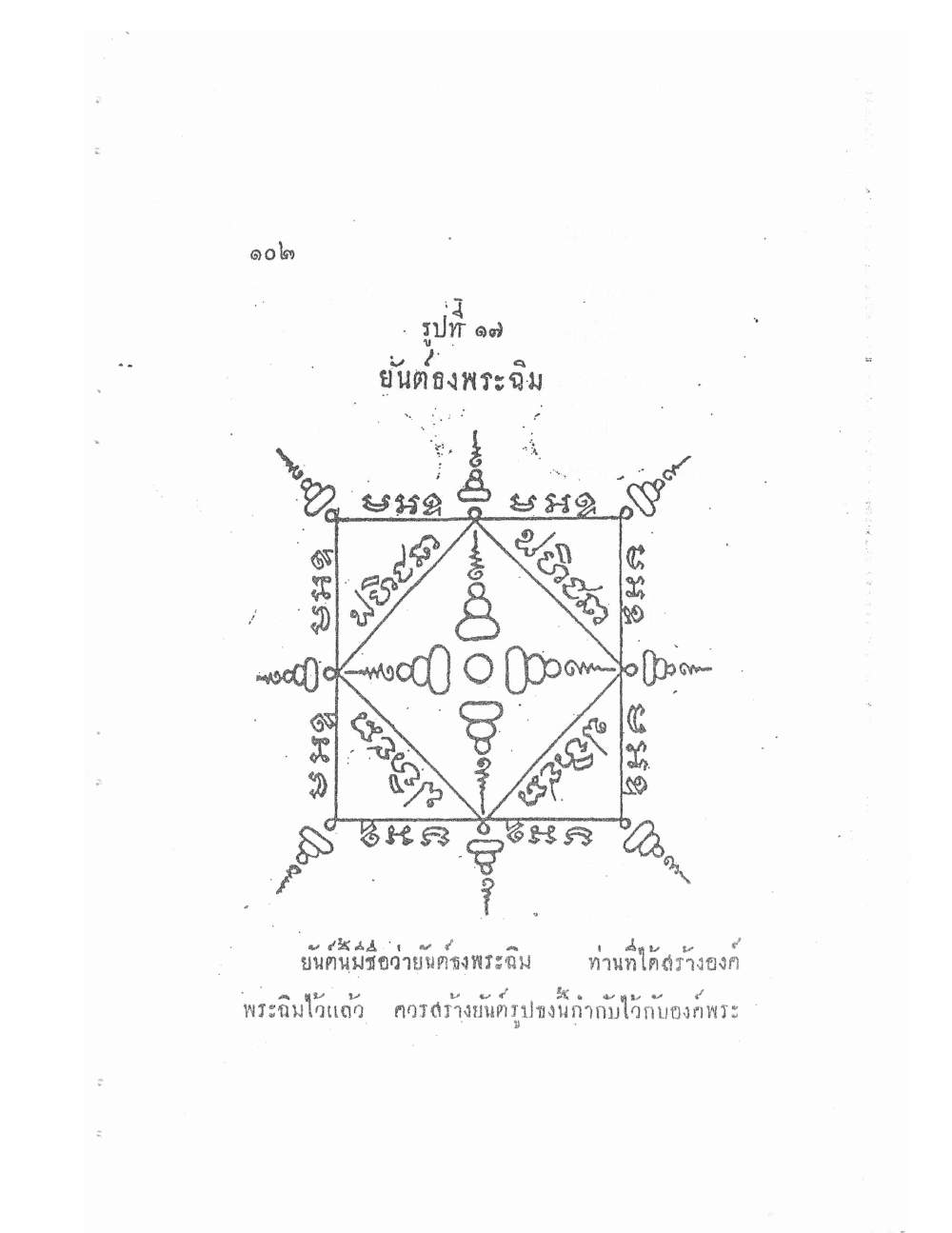
๑๐๒
รูปที่ ๑๗ ยันต์ธงพระฉิม
[อักขระขอมในยันต์ อ่านไม่ชัด]
ยันต์นี้มีชื่อว่ายันต์ธงพระฉิม ท่านที่ได้สร้างองค์ พระฉิมไว้แล้ว ควรสร้างยันต์รูปนี้กำกับไว้กับองค์พระ
102
Figure 17 — Phra Chim Flag Yantra
[diagram: a square yantra containing an inner diamond frame with a small circle at the centre; the diamond's four triangular sections and the square's four sides are each inscribed with a character; the outer corners of the square carry star-burst finials, and each of the four outer edges is labelled with paired characters — all Khom-script content illegible]
This yantra is called the Phra Chim Flag Yantra. Those who have already made a Phra Chim image should also make this yantra to accompany it—
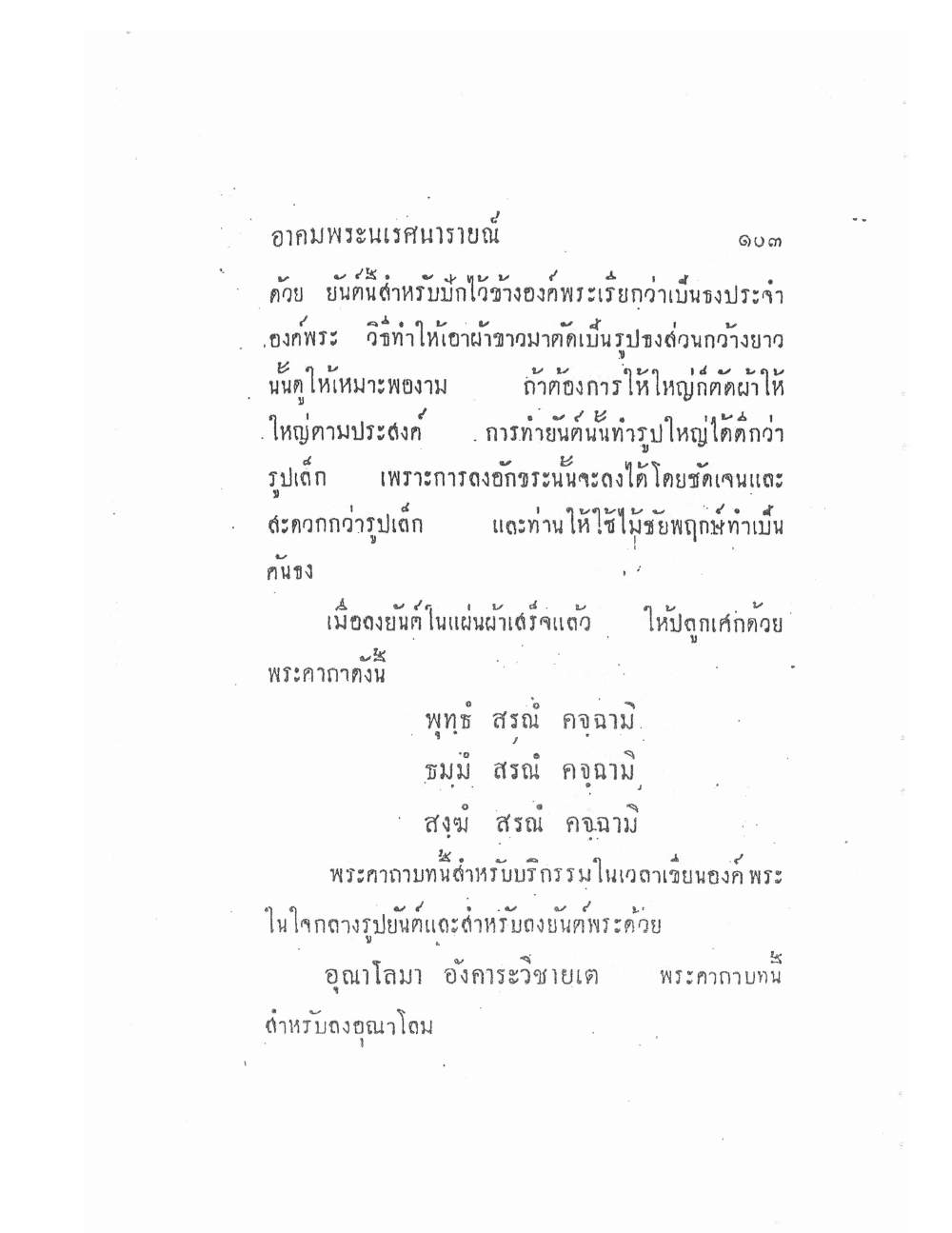
อาคมพระนเรศนารายณ์ ๑๐๓
ด้วย ยันต์นี้สำหรับปักไว้ข้างองค์พระเรียกว่าเป็นธงประจำ องค์พระ วิธีทำให้เอาผ้าขาวมาตัดเป็นรูปธงส่วนกว้างยาว นั้นดูให้เหมาะพองาม ถ้าต้องการให้ใหญ่ก็ตัดผ้าให้ ใหญ่ตามประสงค์ การทำยันต์นั้นทำรูปใหญ่ได้ดีกว่า รูปเล็ก เพราะการลงอักขระนั้นจะลงได้โดยชัดเจนและ สะดวกกว่ารูปเล็ก และท่านให้ใช้ไม้ชัยพฤกษ์ทำเป็น คันธง
เมื่อลงยันต์ในแผ่นผ้าเสร็จแล้ว ให้ปลุกเสกด้วย พระคาถาดังนี้
พุทธํ สรณํ คจฺฉามิ ธมฺมํ สรณํ คจฺฉามิ สงฺฆํ สรณํ คจฺฉามิ
พระคาถาบทนี้สำหรับบริกรรมในเวลาเขียนองค์พระ ในใจกลางรูปยันต์และสำหรับลงยันต์พระด้วย
อุณาโลมา อังคาระวิชายเต พระคาถาบทนี้ สำหรับลงอุณาโลม
Akhom of Phra Naresuan-Narai 103
—because this yantra is meant to be planted beside the Buddha image, being called the flag proper to that image. The method: take white cloth and cut it into the shape of a flag, with width and length judged to look fitting and handsome; if a larger flag is wanted, cut the cloth larger as desired. It is better to make the yantra large rather than small, because the characters can then be written clearly and more easily than on a small one. The flagpole should be made of chai-phruek wood (Cassia javanica, the 'victory tree').
Once the yantra has been written on the cloth, consecrate it with the following sacred verse:
'Buddhaṃ saraṇaṃ gacchāmi. Dhammaṃ saraṇaṃ gacchāmi. Saṅghaṃ saraṇaṃ gacchāmi.' (I go to the Buddha for refuge. I go to the Dhamma for refuge. I go to the Sangha for refuge.)
This verse is to be recited in meditation while drawing the Buddha image at the centre of the yantra, and also when writing the yantra of the Buddha.
'Uṇālomā aṅkāravijāyate' — this verse is for writing the uṇālōma (the sacred curl/topknot mark).
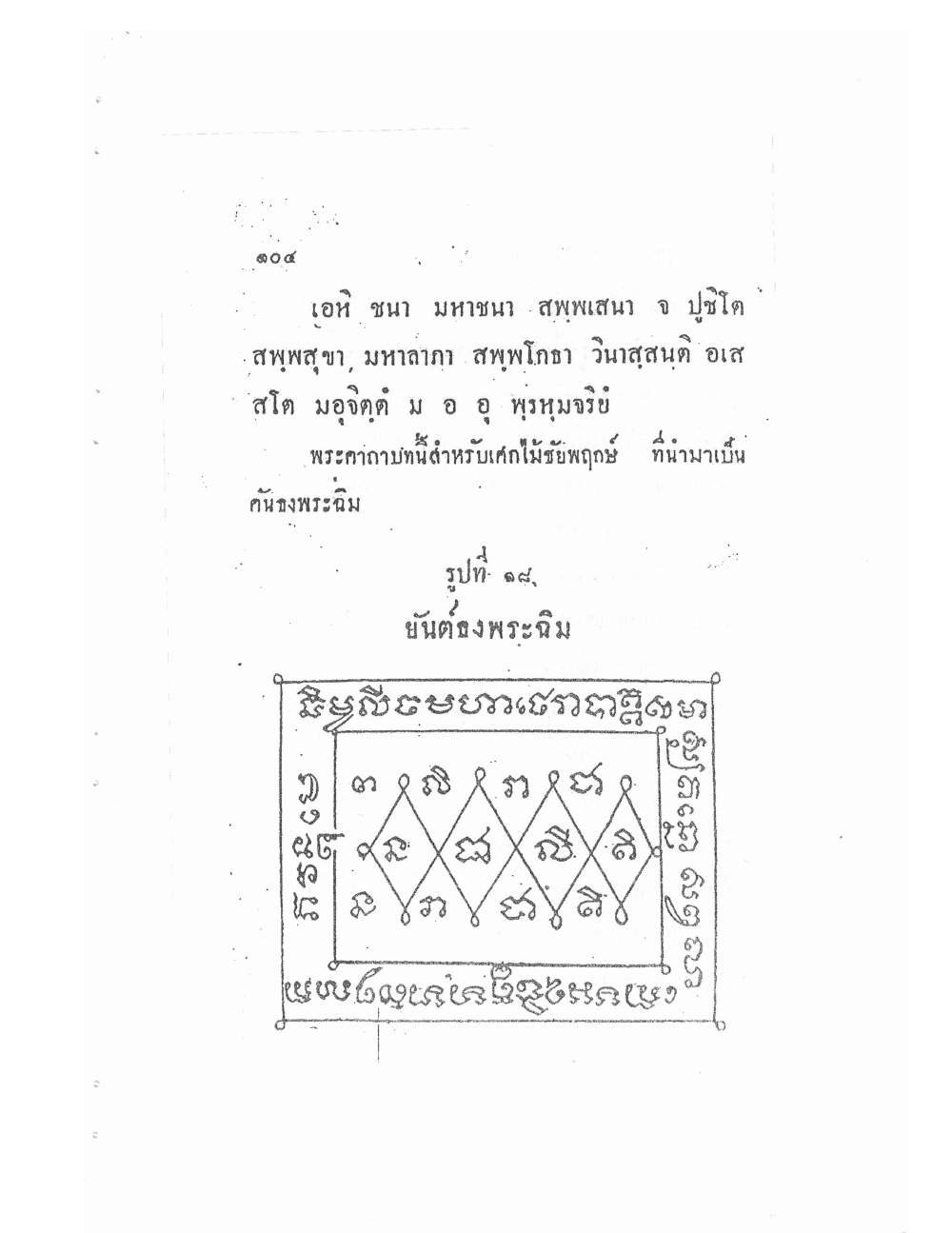
๑๐๔
เอหิ ชนา มหาชนา สพฺพเสนา จ ปูชิโต สพฺพสุขา มหาลาภา สพฺพโภคา วินาสสนฺติ อเส สโต มอุจิตตํ ม อ อุ พฺรหฺมจริยํ
พระคาถาบทนี้สำหรับเสกไม้ชัยพฤกษ์ ที่นำมาเป็น คันธงพระฉิม
รูปที่ ๑๘
ยันต์ธงพระฉิม
[อักขระขอมในยันต์ อ่านไม่ชัด]
104
'Ehi janā mahājanā sabbasenā ca pūjito, sabbasukhā mahālābhā sabbabhogā vināsasanti asesato ma-ucittaṃ ma a u brahmacariyaṃ' (Come, O people, great crowds, all armies — revered; may all happiness, great gain, and all fortune arrive without end... a verse invoking universal welfare and the holy life — exact sense of the closing syllables uncertain).
This sacred verse is for consecrating the chai-phruek wood that is made into the flagpole of the Phra Chim flag.
Figure 18
Phra Chim Flag Yantra
[diagram: a rectangular yantra bordered on all four sides by a continuous band of Khom-script inscription; the interior is divided into two rows of diamond-shaped compartments (a lattice of joined diamonds), each compartment inscribed with a character — all Khom-script content illegible]
อาคมพระนเรศนารายณ์ ๑๐๕
ยันต์นี้มีชื่อว่ายันต์ของพระฉิม เช่นกับรูป ๑๗ เหตุ ที่มียันต์ซ้ำกัน ๒ รูปนี้ก็ด้วยว่าท่านผู้ที่สร้างพระฉิมนั้น ถ้า ได้สร้างรูปของกำกับด้วยก็จะยิ่งเป็นการวิเศษ ของนั้นจะ ทำเป็นของคู่ก็ได้ของเดี่ยวก็ได้ ถ้าทำของเดี่ยวปักไว้ด้านขวา ของ องค์พระ ถ้าจะทำของคู่ปักไว้ทั้งสองข้าง ยันต์รูปที่ ๑๘ นี้สำหรับท่านที่ประสงค์จะทำยันต์ของคู่ บูชาพระฉิม ด้านขวาปักของรูป ๑๗ ด้านซ้ายปักรูป ๑๘ วิธีท่านนี้ เหมือนกันกับยันต์รูป ๑๗ ต่างแต่คาถาสำหรับปริกรรม ในเวลาปลุกเสกเท่านั้น ยันต์นี้คงใช้แผ่นผ้าเป็นรูปของแก้ว ใช้ไม้ชัยพฤกษ์เป็นก้านของเช่นเดียวกัน พระคาถาสำหรับ เสกไม้ชัยพฤกษ์เป็นก้านช่อว่าดังนี้
อิติ ภควา กลา สุทธา ติติ ตุตุ ถ้าข้างขึ้น ให้เสกด้วยพระคาถาบทนี้ลงท้ายว่า ติติ ถ้าข้างแรมให้เสก ด้วยพระคาถาบทนี้เช่นเดียวกันแต่ลงท้ายว่า ตุตุ
เมื่อทำพิธีปลุกเสกแล้ว ให้นำจนปักไว้ในที่บูชา ข้างองค์พระฉิม จัดหาดอกไม้ธูปเทียนนำมาถวายท่าน กล่าวคาถาถวายดอกไม้ธูปเทียนว่า
Akhom Magic of Naret-Narai — page 105
This yantra is called the yantra of Phra Chim, the same as figure 17. The reason there are two duplicate yantras is that if the one who had the Phra Chim image made also had this accompanying figure made, it would be all the more excellent. It may be made as a pair or singly. If made singly, mount it pinned on the right side of the Buddha image; if a pair is to be made, pin one on each side. Yantra figure 18 is for those who wish to make the paired set to worship Phra Chim — pin figure 17 on the right side and figure 18 on the left side. This method is the same as for yantra figure 17, differing only in the mantra recited during the consecration. This yantra still uses a cloth panel shaped like a gem, using ChaiPhruek wood as the stem in the same way. The mantra for consecrating the ChaiPhruek-wood stem is as follows:
'Iti bhagavā kalā suddhā titi tutu.' During the waxing moon, recite this mantra ending with 'titi'; during the waning moon, recite the same mantra but end with 'tutu.'
When the consecration rite is complete, mount it pinned at the place of worship beside the Phra Chim image. Prepare flowers, incense, and candles to offer to it, and recite the verse for offering flowers, incense and candles as follows:
๑๐๖
อิม อคฺคีทีป ปุปฺผํ ฉิมพลี มหาเคชํ อหํ เทมิ
เมื่อกล่าวคาถาบูชาดอกไม้ธูปเทียนแล้ว ให้กล่าวคาถา ต่อไปนี้
สพฺเพ ชนา พหู ชนา อาคจฺเฉยฺย อาคจฺฉาหิ
พระคาถาบทนี้เป็นพระคาถาบูชาโชคลาภ ให้ภาวนา ทุกวันอย่าให้ขาดได้วันละ ๓ จบ ตามสมควร ลาภจะ ไหลมาเทมามิได้ขาด
106
'Imaṃ aggidīpaṃ pupphaṃ chimphalī mahā-gejaṃ ahaṃ demi' — [Pali offering formula: 'I offer this light and these flowers to great Chimphali.']
After reciting the verse for offering flowers, incense and candles, recite the following verse:
'Sabbe janā bahū janā āgaccheyya āgacchāhi' — [Pali: 'May all people, many people, come; come to me.']
This verse is a mantra for invoking good fortune. Recite it every day without fail, three times a day as is fitting, and wealth will flow in without ever ceasing.
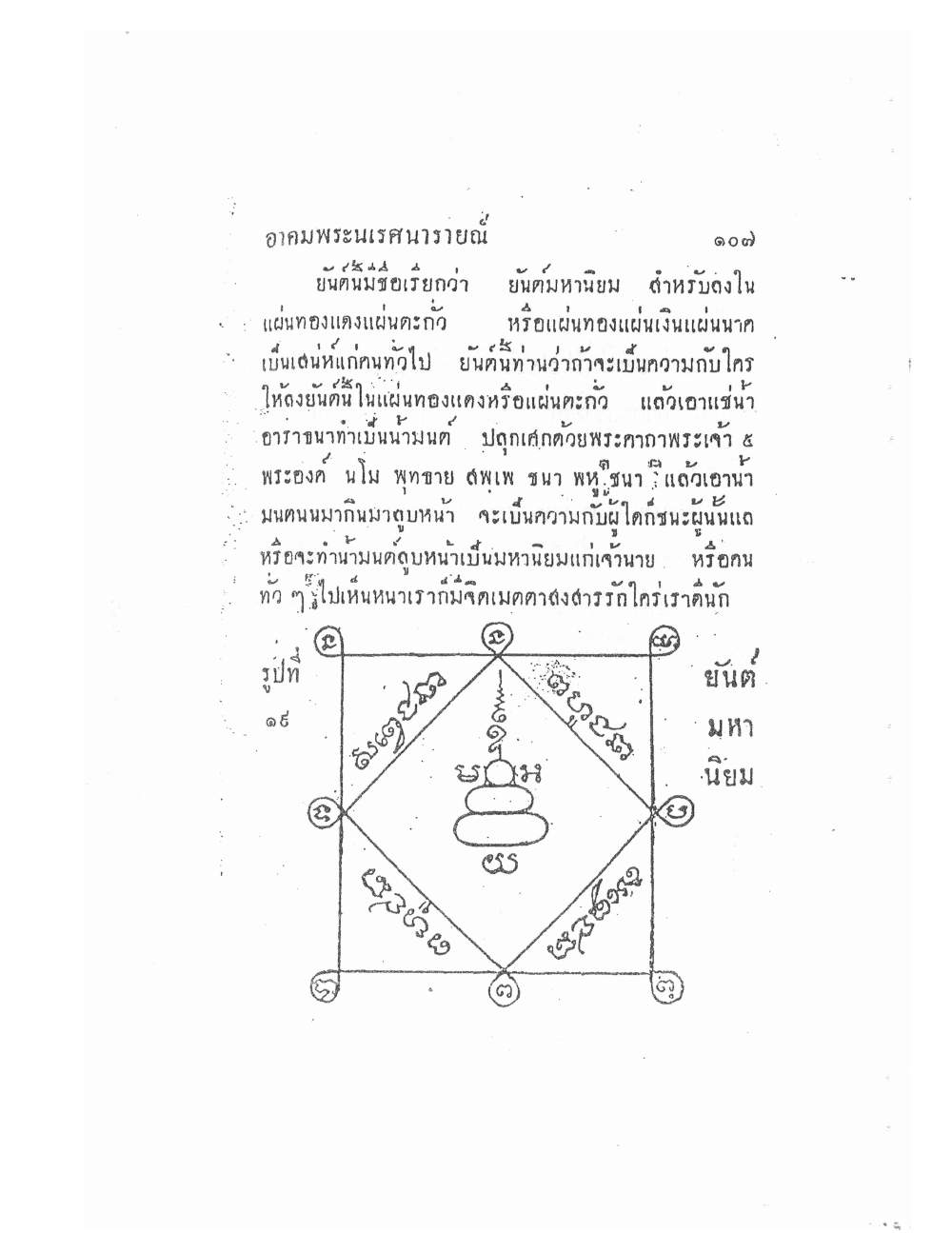
อาคมพระนเรศนารายณ์ ๑๐๗
ยันต์นี้มีชื่อเรียกว่า ยันต์มหานิยม สำหรับลงใน แผ่นทองแดงแผ่นตะกั่ว หรือแผ่นทองแผ่นเงินแผ่นนาค เป็นเสน่ห์แก่คนทั่วไป ยันต์นี้ท่านว่าถ้าจะเป็นความกับใคร ให้ลงยันต์นี้ในแผ่นทองแดงหรือแผ่นตะกั่ว แล้วเอาแช่น้ำ อาราธนาทำเป็นน้ำมนต์ ปลุกเสกด้วยพระคาถาพระเจ้า ๕ พระองค์ นโม พุทธาย สพฺเพ ชนา พหู ชนา แล้วเอาน้ำ มนต์นั้นมากินมาดูบหน้า จะเป็นความกับผู้ใดก็ชนะผู้นั้นแล หรือจะทำน้ำมนต์ดูบหน้าเป็นมหานิยมแก่เจ้านาย หรือคน ทั่ว ๆ ไปเห็นหน้าเราก็มีจิตเมตตาสงสารรักใคร่เราทั้งนัก
รูปที่ ๑๙
ยันต์มหานิยม
[ยันต์: รูปสี่เหลี่ยมข้าวหลามตัดภายในกรอบสี่เหลี่ยมจัตุรัส มีวงกลมเล็กประจำอยู่แปดจุด (สี่มุมของกรอบนอกและสี่จุดปลายของข้าวหลามตัดด้านใน) แต่ละจุดกำกับด้วยตัวเลขไทย ตามเส้นทแยงมุมมีอักขระขอมในยันต์ อ่านไม่ชัด กลางยันต์เป็นฐานซ้อนชั้นคล้ายเจดีย์ มีอักขระ "ยม" กำกับอยู่]
Akhom Magic of Naret-Narai — page 107
This yantra is called the Mahaniyom Yantra ("Great Charm/Popularity Yantra"). It is to be inscribed on a sheet of copper, lead, gold, silver, or naga-alloy [a gold-silver-copper alloy], and serves as a charm to attract people generally. Tradition holds that if you wish to prevail in a dispute with anyone, inscribe this yantra on a copper or lead sheet, then soak it in water, consecrate it as holy water, and empower it with the mantra of the Five Buddhas: 'Namo buddhāya, sabbe janā bahū janā.' Then drink that holy water and rub it on your face; whomever you are in dispute with, you will prevail over them. Or make the holy water and rub it on the face to gain great popularity with a superior, or so that ordinary people who see your face will feel compassion and affection for you.
Figure 19
The Mahaniyom Yantra
[Diagram: a diamond shape inscribed within a square frame, with a small circle at each of eight points — the four corners of the outer square and the four points of the inner diamond. Each circle is marked with a Thai numeral. Along the diagonal lines are khom/akhom characters within the yantra, illegible. At the center is a tiered pedestal shape resembling a stupa, marked with the character "ยม."]
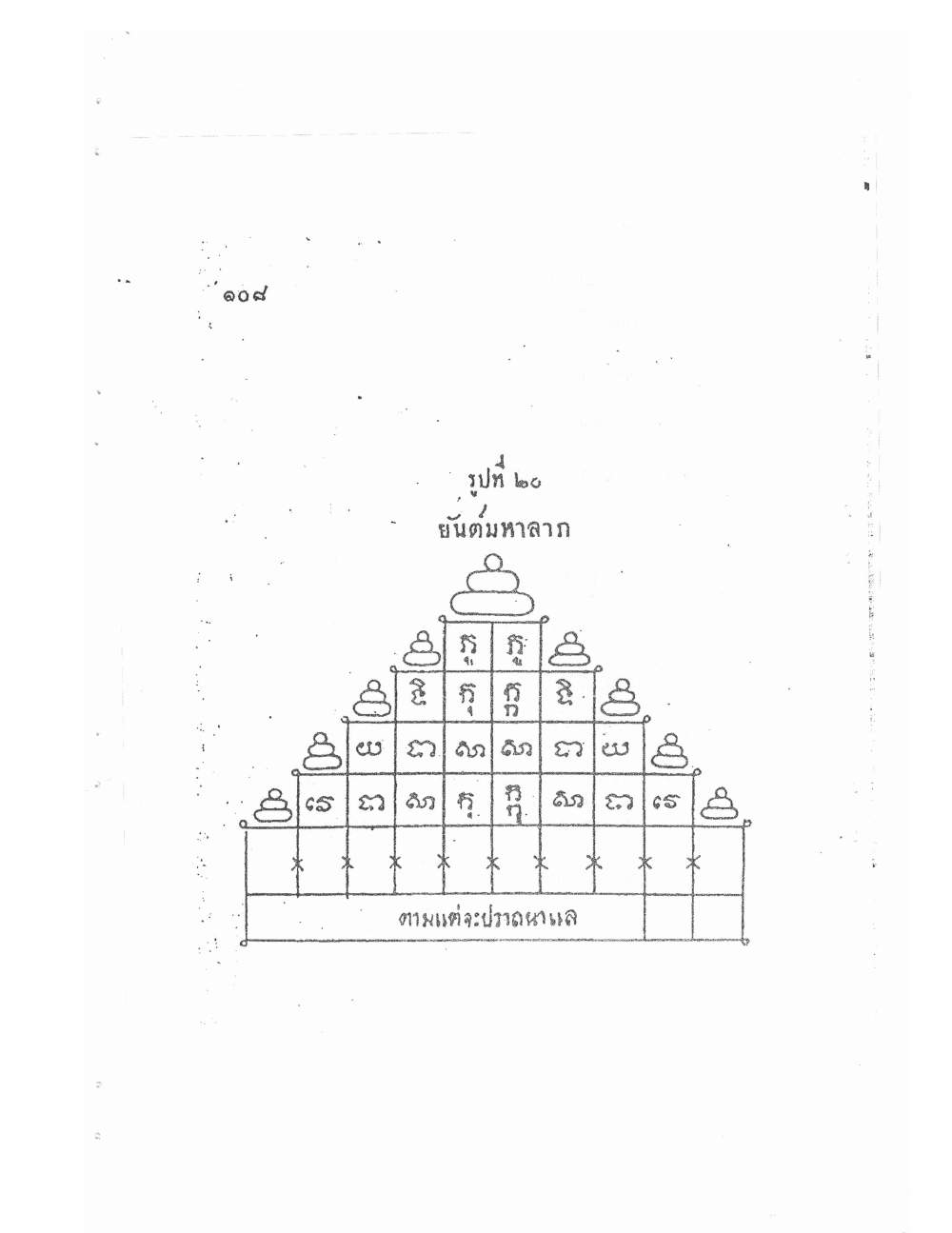
๑๐๘
รูปที่ ๒๐ ยันต์มหาลาภ [ยันต์: รูปทรงขั้นบันไดคล้ายฐานเจดีย์ ประกอบด้วยแถวของช่องสี่เหลี่ยมเรียงซ้อนเป็นชั้น ชั้นบนสุดเป็นยอดทรงระฆังคว่ำ แต่ละชั้นถัดลงมามีช่องบรรจุอักขระขอม อ่านไม่ชัด ขนาบข้างทุกชั้นด้วยยอดทรงระฆังคว่ำขนาดเล็ก ชั้นล่างสุดมีเครื่องหมายกากบาทเรียงเป็นแถว] ตามแต่จะปรารถนาแล
108
Figure 20 The Mahalap Yantra ("Great Fortune Yantra") [Diagram: a stepped, pyramid-shaped figure resembling a stupa base, built of rows of squares stacked in tiers. The topmost tier is a small inverted-bell-shaped finial. Each descending tier contains cells filled with khom/akhom characters, illegible, flanked on both sides at every tier by small bell-shaped finials. The bottom row is a line of X marks.] — according to whatever one wishes.
อาคมพระนเรศนารายณ์ ๑๐๙
ยันต์นี้มีชื่อว่ายันต์มหาลาภ สำหรับลงในแผ่นเงิน แผ่นทองแผ่นตะกั่ว หรือจะลงในผ้าขาวผ้าแดงทำเป็นธง ไว้บูชาสักการะประจำบ้านเรือนก็ได้นัก ตามตำราท่านว่า เป็นยันต์มหาวิเศษ จะปรารถนาสิ่งใดให้อาราธนายันต์นี้ หรือจะอาราธนาทำน้ำมนต์ แล้วปลุกเสกด้วยพระคาถา ว่าดังนี้
เวทาสากุ กุสาเทวา ทาสาคะ ตะสายะทิ กุกุ ทิภูภู มหาลาภ ภวนฺตุ เม
เมื่อบริกรรมภาวนาจบแล้ว จะปรารถนาสิ่งใดสิ่ง หนึ่งย่อมสำเร็จสมดังความปรารถนาทุกประการ พระ คาถาบทนี้ท่านว่าเสกข้าวให้สัตว์กิน สัตว์นั้นเดียงเชื่อง เดียงง่าย สัตว์ทั้งหลาย เช่น นก ปลา เมื่อเราเอาอาหาร มาเสกด้วยพระคาถาบทนี้แล้ว ให้นกกิน ก็ดี ให้ปลากิน ก็ดี นกทั้งหลาย ปลาทั้งหลาย ก็จะเชื่องเข้ามาหาเราให้ เราจับคล้าจับตัวเล่นได้ แต่ว่าพระคาถานี้เราต้องบริกรรม ด้วยเมตตาภาวนาสงสารสัตว์ เมื่อสัตว์เชื่องแล้วจะจับ
Akhom Magic of Naret-Narai — page 109
This yantra is called the Mahalap Yantra ("Great Fortune Yantra"). It is to be inscribed on a sheet of silver, gold, or lead, or it may be inscribed on white or red cloth made into a banner, to be kept for daily worship in the household. According to the texts, it is said to be a supremely excellent yantra: to obtain whatever you desire, invoke this yantra, or invoke it to make holy water, then consecrate it reciting this mantra:
'Vedāsāku kusādevā dāsāgā tasāyathi kuku thibhūbhū mahālābha bhavantu me' — [Pali: 'May there be great fortune for me.']
When the recitation is complete, whatever single thing you wish for will be entirely fulfilled according to your wish. This mantra, it is said, may also be recited over rice given to an animal to eat, so that the creature becomes tame and easily gentled — creatures such as birds and fish. When we take food and consecrate it with this mantra, then give it to birds to eat, or to fish to eat, the birds and fish will become tame and come to us, so that we may catch hold of them and play with them. But this mantra must be recited with loving-kindness and compassion for the creature; once the creature is tame, it may be caught —
๑๑๐
สัตว์นั้นเป็นอาหารมิได้แล ถ้ากระทำดังนั้นมนต์จะเสื่อม คาถาจะหมดความศักดิ์สิทธิ์
พระคาถาบทนี้ อย่าว่าแต่สัตว์เดียงเลยแม้แต่สัตว์ ในป่าที่ดุร้าย เพื่อภาวนาพระคาถาบทนี้แล้วแม้แต่เรา เดินทางไปในป่าก็ไม่ต้องกลัวว่าสัตว์ป่าต่าง ๆ เช่นเสือร้าย ช้างร้ายจะทำอันตรายได้ เมื่อภาวนาคาถาบทนี้จะทำให้ สัตว์ที่ดุร้ายกลับมีใจดี หายความเหี้ยมโหดกลับเป็นมิตร กับเราได้ พึงดูตัวอย่างพระสุวรรณสามเมื่อตอนอยู่ป่า มีเนื้อถกมฤคาล้อมรอบ เป็นบริวาร เวลาจะเดินไปตักน้ำยัง ท่านนำก็ฝูงสัตว์ต่าง ๆ ตามไปเป็นบริวาร ทั้งนกด้วย อำนาจพระคาถาเมตตาหานิยมนั้นเอง ถ้าเราอยากจะ ให้สัตว์เลี้ยงของเราเชื่อง หรือสัตว์ต่าง ๆ ที่มาอยู่กับเรา เชื่อง ไม่ให้ไปยังถิ่นอื่น ก็จงเสกข้าวให้ทานทุกวันเถิดสัตว์ เลี้ยงทั้งหลายจะไม่ไปจากเราเลย
110
— not to be used as food for the creature. If one does that, the mantra will decline, and the incantation will lose all its sacred power.
As for this mantra, it is not only tame creatures — even ferocious wild beasts of the forest: once we have recited this mantra, even when we walk through the forest we need not fear that wild animals such as fierce tigers or savage elephants will do us harm. Reciting this mantra causes even ferocious beasts to become kind-hearted, losing their cruelty and becoming our friends. Consider the example of Prince Suvannasam [Suvarnasama], who, while dwelling in the forest, was surrounded by a retinue of deer; whenever he went to fetch water, a whole host of various animals — and birds too — would follow him as his retinue, all through the power of this mantra of loving-kindness and great popularity. If we wish our domestic animals to be tame, or wish other creatures that come to live with us to be tame and not wander off elsewhere, then recite this mantra over rice and give it as alms every day, and our animals will never leave us.
อาคมพระนเรศนารายณ์ ๑๑๑
รูปที่ ๒๑
ยันต์พระรัตนตรัย
[ยันต์: เหนือตารางมีอักขระขอมเรียงเป็นสองแถว อ่านไม่ชัด ตรงกลางมีฐานซ้อนชั้นคล้ายเจดีย์สองยอด ยอดซ้ายกำกับด้วยตัวเลข ๘ ยอดขวากำกับด้วยตัวเลข ๒] ด้านล่างเป็นตาราง ๓x๓ ช่อง บรรจุตัวเลขไทยดังนี้ ๗ ๕ ๗ ๑ ๓ ๑ ๓ ๕ ๗
ยันต์นี้มีชื่อว่ายันต์พระรัตนตรัย หรือเรียกว่าพระ รัตนตรัยระลึก ยันต์นี้สำหรับลงตะกรุดหรือลงผ้าขาว,
Akhom Magic of Naret-Narai — page 111
Figure 21
The Yantra of the Triple Gem
[Diagram: above a grid, two rows of khom/akhom characters, illegible. In the middle is a two-peaked tiered pedestal shape resembling a stupa; the left peak is marked with the numeral 8, the right peak with the numeral 2.] Below is a 3x3 grid of cells containing the following Thai numerals: 7 5 7 1 3 1 3 5 7
This yantra is called the Yantra of the Triple Gem, also known as the Remembrance of the Triple Gem. This yantra is for inscribing on a takrut [rolled amulet cylinder] or on white cloth,
๑๑๒
เอาไว้คุ้มตัวป้องกันภัยต่าง ๆ ได้ดีนัก เมื่อลงยันต์เสร็จ แล้ว ให้ปลุกเสกด้วยพระคาถาพระเจ้า ๕ พระองค์ น โม พุท ธา ย เวลาเสกให้ว่าดังนี้
น โม พุท ทะสะมิ เสกให้ได้ ๑๐๘ ครั้ง ธา ย
แล้วจึงลงเลขยันต์ประทับหลังหัวท้ายด้วยเลขดังนี้
๗ ๗ ๓ ๗ ๗
เมื่อลงเลขประทับหลังหัวท้ายแล้วให้ลงเลขประทับคอด้าน ดังนี้
๕ ๑ ๓ ๑ ๙
112
— to be kept to protect the body from various dangers, very effectively. Once the yantra has been inscribed, consecrate it with the mantra of the Five Buddhas, 'Na Mo Phut Tha Ya.' When consecrating, recite as follows:
Na Mo Phut } thasami — consecrate it for 108 repetitions Tha Ya
Then inscribe the number-yantra stamped at the head and tail [of the amulet] with these numbers:
7 7 3 7 7
Once the numbers are stamped at the head and tail, inscribe the numbers stamped at the neck/collar section as follows:
5 1 3 1 9
อาคมพระนเรศนารายณ์ ๑๑๓
อธิบายว่า
คำว่าดอกต่างในที่นี้ หมายความว่า ยันต์นี้จะลง แผ่นเงิน แผ่นทอง แผ่นนาค ทำเป็นสาริกาก็ได้ ตะกรุด สาริกานั้นจะต้องทำสองดอก คือตัวผู้ดอกหนึ่ง ตัวเมีย ดอกหนึ่ง เวลาจะใช้ท่านให้อมไว้ในปาก อมไว้ข้างบน ดอกหนึ่ง อมไว้ข้างล่างดอกหนึ่ง โดยมากตะกรุดสาริกา มักจะทำดอกเล็ก ๆ ตัวผู้เอาใส่ไว้โคนเหงือกข้างบน ตัว เมียเอาใส่ไว้โคนเหงือกข้างล่าง ผู้ที่อมตะกรุดสาริกา ท่านว่ามีเสน่ห์ยิ่งนัก จะเจรจากับใคร ๆ ก็เป็นที่นิยม เชื่อถือ แม้จะขออะไร ๆ จากคนอื่นก็ย่อมสำเร็จได้สม ประสงค์
ตะกรุดสาริกานี้ แม้จะไม่อมไว้ในปาก จะใส่ใน ตลับผงสำหรับสีปากก็ได้ เวลาจะไปหาใคร ๆ ให้เป็น เสน่ห์ ก็เอาผงใส่ที่ตะกรุดสาริกาไว้ขนมาเสกด้วยพระ คาถาแล้วสีปากก่อน จึงไปเจรจากับผู้อื่นดังนัก หรือจะไม่ ทำเป็นตะกรุด จะลงในแผ่นตะกั่วแล้วเอาใส่ไว้ในตลับผง ก็ได้ มีคุณเหมือนกัน พระคาถาสำหรับเสกผงสีปาก สาริกา ว่าดังนี้
Akhom Magic of Naret-Narai — page 113
Explanation
The term 'paired florets' here means: this yantra may be inscribed on a sheet of silver, gold, or naga-alloy and made into a Sarika [myna-bird charm]. The Sarika takrut must be made in two pieces: one 'male' floret and one 'female' floret. When in use, hold them in the mouth — one held on the upper side, one held on the lower side. Most Sarika takrut are made quite small; the male piece is placed at the base of the gum on the upper side, the female piece at the base of the gum on the lower side. One who holds the Sarika takrut in the mouth, it is said, gains exceptional charisma — whatever one speaks to anyone becomes trusted and well received, and even in asking anything of others, one's wishes are readily fulfilled.
Even without holding this Sarika takrut in the mouth, it may instead be placed in a container of lip powder. When going to meet someone in order to charm them, take the powder that has been kept with the Sarika takrut, consecrate it with the mantra, apply it to the lips first, and only then go to converse with the other person. Or, instead of making it into a takrut, it may be inscribed on a sheet of lead and placed in the powder container — this has the same virtue. The mantra for consecrating the Sarika lip powder is as follows:
๑๑๔
กรวิก สโร อิว สโร โอฏฺฐชิวฺหา สมาชิน นิปติ สมยํ อหํ วจนํ สุตฺวา ชิวฺหาย มธุรํ มธุกา วาจนฺติ สุภาสิตํ สทฺทํ สุตฺวา ปิยสทฺทา สพฺเพ ชนา พหู ชนา สพฺเพ อิตฺถิโย ปุริสา ทรกา สทฺทา นุสนฺติ ปิปติยา มนุญฺญํ คเหตฺวา คณฺหาหิ ทพฺหํ จุมฺหิตฺวาหทยํ จิตฺตํ สพฺพชนํ ธมฺมเทสนา ปญฺจ พุทฺธา นมามิหํ
พระคาถานี้สำหรับเสกทอง เสกขผง ตามกำลังวัน เมื่อจะไปขับร้องนั้นจึงเสก หมายความว่าถ้าจะไปร้องเพลง ต้องการ จะให้เสียงไพเราะเป็นที่จับใจผู้ฟัง ให้เสกด้วย พระคาถาบทนี้แล้วไปร้องเพลงเถิด ผู้ฟังได้ยินเสียงแล้วจะ พอใจเรายิ่งนัก (นักร้องทั้งชายและหญิงควรสนใจ)
ส่วนวิธีจะเสกทองนั้น ท่านให้ทำดังนี้ ให้เอาทอง มาแผ่ให้บาง แล้วเอากาบรักและกาบชุมแสงมาทำ เป็นด้ามเหล็กจาร แล้วจึงเอาเหล็กจารนั้นลงองค์พระใส่ลง ไปในแผ่นทองที่เอาแผ่ออกนั้น เมื่อจะไปเทศน์ก็ดี จะไป สวดหรือขับร้องก็ดี ท่านให้เอาแผ่นทองนั้นม้วนเข้าแล้ว เสียบเข้าไว้ในพัน ถ้าผู้ใดได้ยินเสียงของเราก็ดี หรือว่า เสียงของเรานั้นได้ยินไปถึงไหนก็ดี เสียงของเราก็เป็นเสน่ห์
114
'Karavika saro iva saro oṭṭhajivhā samājina nipati samayaṃ ahaṃ vacanaṃ sutvā jivhāya madhuraṃ madhukā vācanti subhāsitaṃ saddaṃ sutvā piyasaddā sabbe janā bahū janā sabbe itthiyo purisā darakā saddā nusanti pipatiyā manuññaṃ gahetvā gaṇhāhi dabbhaṃ jumhitvā hadayaṃ cittaṃ sabbajanaṃ dhammadesanā pañca buddhā namāmihaṃ' — [Pali verse invoking the sweet voice of the karavika bird, an eloquence mantra calling for one's speech to become as sweet as honey and beloved by all people — women, men, and children alike — paying homage to the Five Buddhas.]
This mantra is for consecrating gold, and for consecrating [lip-]powder, according to the day of the lunar month; consecrate it just before going out to sing. This means: if you are going to sing and want your voice to be melodious and captivating to the listener, consecrate it with this mantra and then go and sing — those who hear the voice will be exceedingly pleased with you. (Both male and female singers should take note of this.)
As for the method of consecrating the gold, it is done as follows. Take gold and beat it into a thin sheet. Then take rak-lacquer sheath and chum-saeng wood sheath and fashion them into the handle of an inscribing stylus. Then use that stylus to inscribe a Buddha image onto the thin gold sheet that has been beaten out. When going to preach a sermon, or to chant, or to sing, roll up that gold sheet and tuck it into your garments. Whoever hears our voice, or wherever our voice happens to reach, our voice will become a charm —
อาคมพระนเรศนารายณ์ ๑๑๕
ไปถึงนั้น ใคร ๆ ที่ได้ยินเสียงของเรา จะเกิดมีใจเมตตา กรุณารักใคร่เรา แม้มิได้เห็นหน้าเราแล้วก็ประดุจหนึ่งจะ ขาดใจตายไปเสียทีเดียว
ถ้าหากว่าจะไปหาขุนนาง ท้าวพระยา หรือผู้มีบุญ หนักศักดิ์ใหญ่ ให้เสียบไว้ข้างขวา ถ้าจะไปหาสตรีให้ เสียบไว้ข้างซ้าย นักเทศน์ถ้าจะไปเทศนาให้เสียบไว้ข้างขวา
วิธีจะทำสาริกาหรือลงองค์พระในแผ่นทองนั้น ท่าน ให้ดูฤกษ์งามยามดีเสียก่อน แล้วให้จัดบายศรี สำรับ ๑ ขันล้างหน้าใบหนึ่ง เงินเหรียญ ๑ บาท ผ้าขาวสำหรับรอง นั่งทำพิธีหนึ่งผืน สถานที่จะลงนั้น ถ้าสามารถจะเข้าไป ลงในพระอุโบสถได้ยิ่งดี พึงตั้งใจอธิษฐานจิตต่อหน้า พระประธานในพระอุโบสถ ขอให้สิ่งของที่ท่านเกิดความ ศักดิ์สิทธิ์ มีอภินิหาร มีเดชานุภาพมากมาย เมื่ออธิษฐาน แล้วจึงใช้เหล็กจารลงองค์พระเสร็จแล้ว ปลุกด้วยพระคาถา ดังข้างต้นนั้นเถิด แล้วจึงม้วนทองไว้ใช้ ชื่อว่าเป็นแก้วหา ค่ามิได้แล
Akhom Magic of Naret-Narai — page 115
— wherever it reaches, anyone who hears our voice will come to feel loving-kindness, compassion, and affection for us; even without having seen our face, they will feel as though their heart could break with longing.
If you are going to see an official, a lord, or a person of great merit and high rank, tuck it on the right side. If you are going to see a woman, tuck it on the left side. A preacher going to give a sermon should tuck it on the right side.
As for the method of making the Sarika [charm] or inscribing the Buddha image on the gold sheet: first look for an auspicious day and hour. Then arrange one set of bai sri [ceremonial floral offering], one basin for washing the face, one baht coin, and one piece of white cloth to sit on while performing the rite. As for the place to do the inscribing, it is best if you are able to go and do it inside the ordination hall [ubosot]. Set your mind and make a solemn vow before the principal Buddha image in the ubosot, asking that the object attain sanctity, miraculous power, and great potency. Once the vow is made, use the inscribing stylus to inscribe the Buddha image; when finished, consecrate it with the mantra given above. Then roll up the gold sheet for use — it is called a gem beyond price.
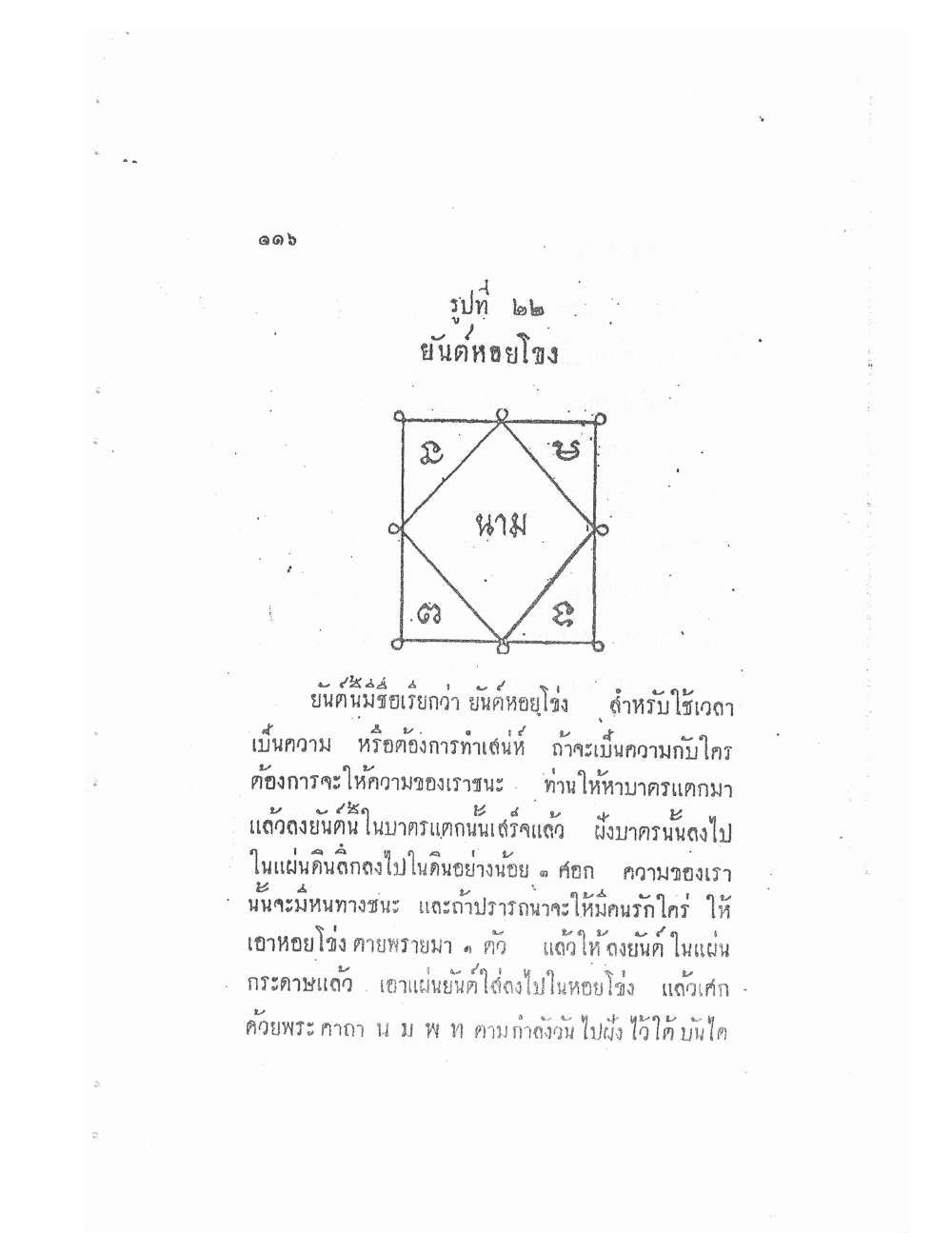
๑๑๖
รูปที่ ๒๒
ยันต์หอยโข่ง
[ยันต์: กรอบสี่เหลี่ยมจัตุรัส มีเส้นทแยงมุมเป็นรูปข้าวหลามตัดอยู่ภายใน มุมทั้งสี่ของกรอบนอกมีอักขระ/ตัวเลขกำกับ (บนซ้ายคล้าย ๒, บนขวาคล้าย ๘, ล่างซ้ายคล้าย ๓, ล่างขวาคล้าย ๙) และที่มุมทั้งสี่ของรูปข้าวหลามตัดด้านในมีอักขระขอมกำกับ อ่านไม่ชัด กลางยันต์มีอักษรไทยเขียนว่า "นาม"]
ยันต์นี้มีชื่อเรียกว่า ยันต์หอยโข่ง สำหรับใช้เวลา เป็นความ หรือต้องการทำเสน่ห์ ถ้าจะเป็นความกับใคร ต้องการจะให้ความของเราชนะ ท่านให้หาบาตรแตกมา แล้วลงยันต์ในบาตรแตกนั้นเสร็จแล้ว จึงบาตรนั้นลงไป ในแผ่นดินลึกลงไปในดินอย่างน้อย ๑ ศอก ความของเรา นั้นจะมีหนทางชนะ และถ้าปรารถนาจะให้มีคนรักใคร่ ให้ เอาหอยโข่งตายพรายมา ๑ ตัว แล้วให้ลงยันต์ในแผ่น กระดาษแล้ว เอาแผ่นยันต์ใส่ลงไปในหอยโข่ง แล้วเสก ด้วยพระคาถา น ม พ ท ตามกำลังวัน ไปฝังไว้ใต้บันได
116
Figure 22
The Snail-Shell Yantra
[Diagram: a square frame with diagonal lines forming an inner diamond shape. At each of the four corners of the outer square is a character/numeral (top-left resembling 2, top-right resembling 8, bottom-left resembling 3, bottom-right resembling 9), and at each of the four points of the inner diamond is a khom/akhom character, illegible. In the center of the yantra, the Thai word "นาม" (name) is written.]
This yantra is called the Snail-Shell Yantra, used at a time of legal dispute, or when one wants to work a charm. If you are in a dispute with someone and want your case to prevail, obtain a cracked alms bowl, inscribe the yantra inside that cracked bowl, and once done, bury the bowl in the ground, at least one cubit deep — then your case will find its way to victory. And if you wish for someone to fall in love with you, take one dead, hollow apple-snail shell, inscribe the yantra on a sheet of paper, place the paper yantra inside the snail shell, and consecrate it with the mantra 'Na Mo Phut Tha' according to the day of the lunar month, then go and bury it beneath the [house] stairs.
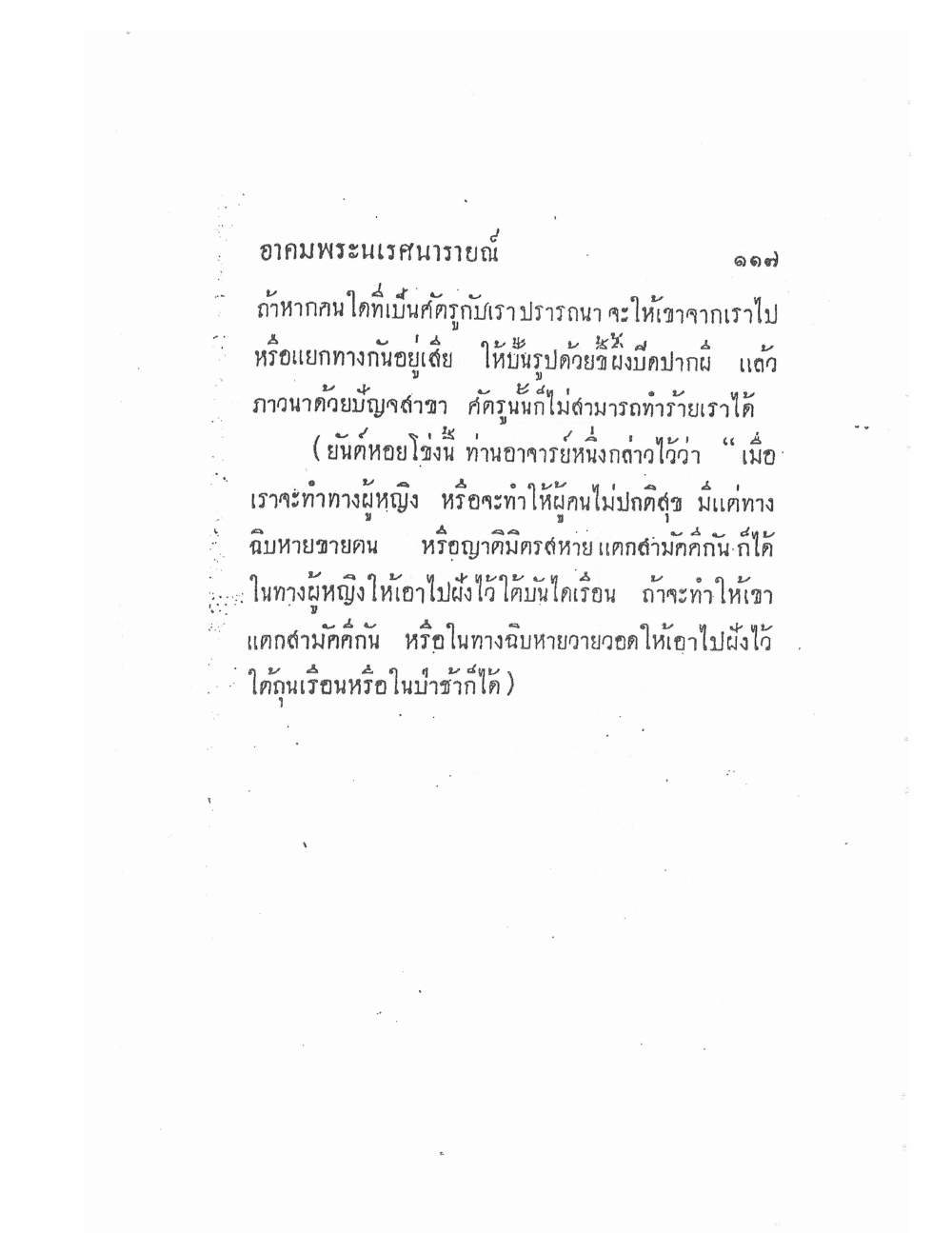
๑๑๗
อาคมพระนเรศนารายณ์
ถ้าหากคนใดที่เป็นศัตรูกับเราปรารถนา จะให้เขาจากเราไป หรือแยกทางกันอยู่เสีย ให้ปั้นรูปด้วยขี้ผึ้งปิดปากผี แล้ว ภาวนาด้วยบัญจสาขา ศัตรูนั้นก็ไม่สามารถทำร้ายเราได้
(ยันต์หอยโข่งนี้ ท่านอาจารย์หนึ่งกล่าวไว้ว่า "เมื่อ เราจะทำทางผู้หญิง หรือจะทำให้ผู้คนไม่ปกติสุข มีแต่ทาง ฉิบหายขายคน หรือญาติมิตรสหายแตกสามัคคีกันก็ได้ ในทางผู้หญิงให้เอาไปฝังไว้ใต้บันไดเรือน ถ้าจะทำให้เขา แตกสามัคคีกัน หรือในทางฉิบหายวายวอดให้เอาไปฝังไว้ ใต้ถุนเรือนหรือในป่าช้าก็ได้)
117
Akhom Magic of Phra Narai
If there is anyone who is our enemy, and we wish to make him leave us or go his separate way, mold a figure of him in beeswax, seal its mouth shut, then chant [the spell] Panjasakha [Five Branches] over it. That enemy will then be unable to do us any harm.
(Regarding this Conch-shell Yantra, one teacher-master said: "When we wish to work against a woman, or to make people lose their peace, bringing only ruin and loss to them, or to break apart friends and kin so they turn against one another — for working against a woman, take [the charm] and bury it beneath the house stairs. If it is to break people's harmony with one another, or to bring ruin and destruction, bury it beneath the house [floor] or in a cemetery.")
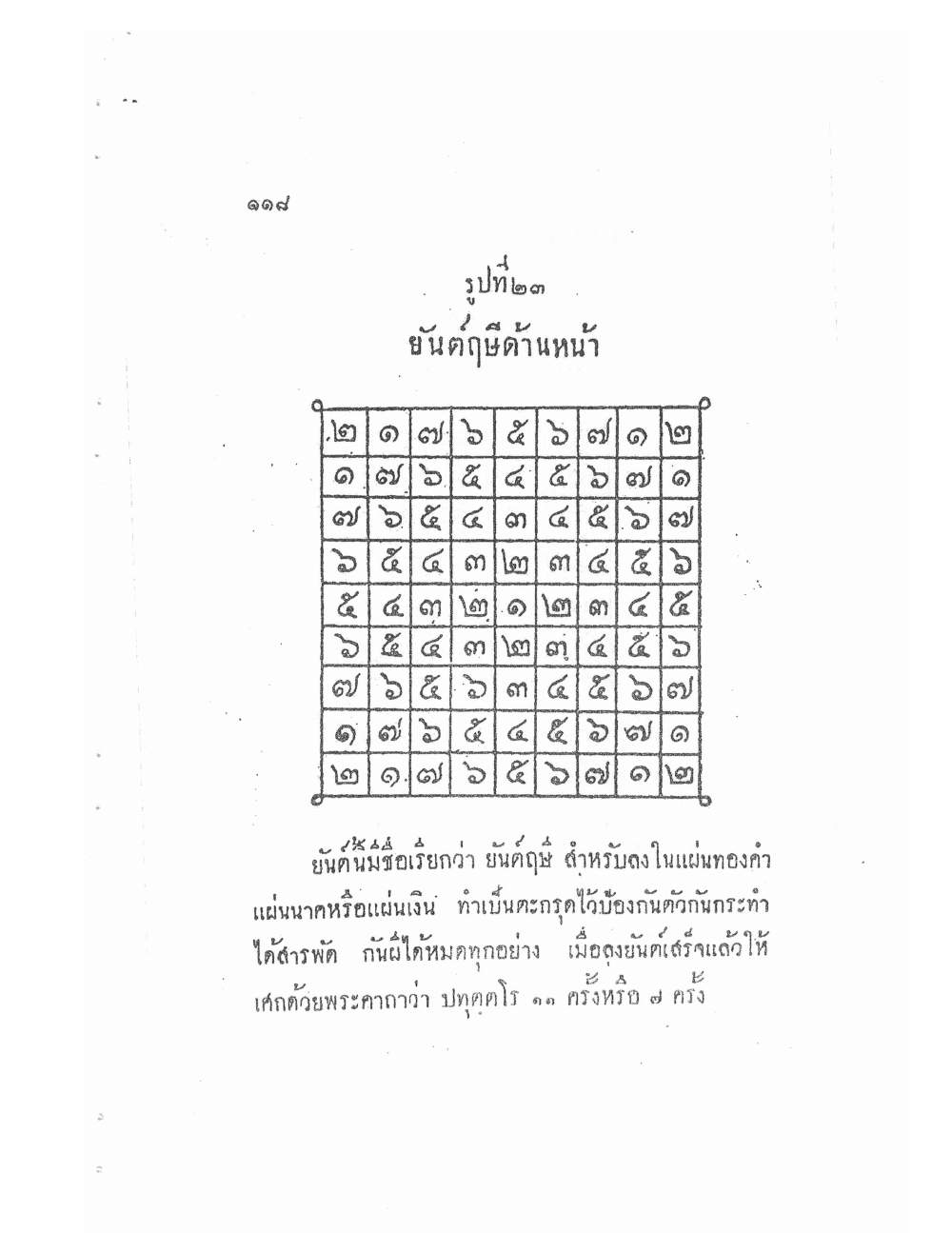
๑๑๘
รูปที่ ๒๓ ยันต์ฤๅษีด้านหน้า
[ตารางยันต์ ๙x๙ ช่อง บรรจุเลขไทย: แถว ๑: ๒ ๑ ๗ ๖ ๕ ๖ ๗ ๑ ๒ แถว ๒: ๑ ๗ ๖ ๕ ๔ ๕ ๖ ๗ ๑ แถว ๓: ๗ ๖ ๕ ๔ ๓ ๔ ๕ ๖ ๗ แถว ๔: ๖ ๕ ๔ ๓ ๒ ๓ ๔ ๕ ๖ แถว ๕: ๕ ๔ ๓ ๒ ๑ ๒ ๓ ๔ ๕ แถว ๖: ๖ ๕ ๔ ๓ ๒ ๓ ๔ ๕ ๖ แถว ๗: ๗ ๖ ๕ ๔ ๓ ๔ ๕ ๖ ๗ แถว ๘: ๑ ๗ ๖ ๕ ๔ ๕ ๖ ๗ ๑ แถว ๙: ๒ ๑ ๗ ๖ ๕ ๖ ๗ ๑ ๒]
ยันต์นี้มีชื่อเรียกว่า ยันต์ฤๅษี สำหรับลงในแผ่นทองคำ แผ่นนากหรือแผ่นเงิน ทำเป็นตะกรุดไว้ป้องกันตัวกันกระทำ ได้สารพัด กันผีได้หมดทุกอย่าง เมื่อลงยันต์เสร็จแล้วให้ เสกด้วยพระคาถาว่า ปทุตฺตโร ๑๑ ครั้งหรือ ๗ ครั้ง
118
Figure 23 Front Ruesi [Hermit-Sage] Yantra
[A 9x9 grid yantra filled with Thai numerals, symmetrical about its center, forming a numerological diagram — the numbers step outward from a central 1 through a repeating 1–7 sequence.]
This yantra is called the Ruesi Yantra. It is for inscribing onto a sheet of gold, a sheet of nak [gold-copper-silver alloy], or a sheet of silver, made into a takrut [amulet tube] to protect the wearer and guard against all manner of harm — it wards off every kind of ghost. Once the yantra has been inscribed, consecrate it with the sacred formula "Patuttaro," [chanted] 11 times or 7 times.
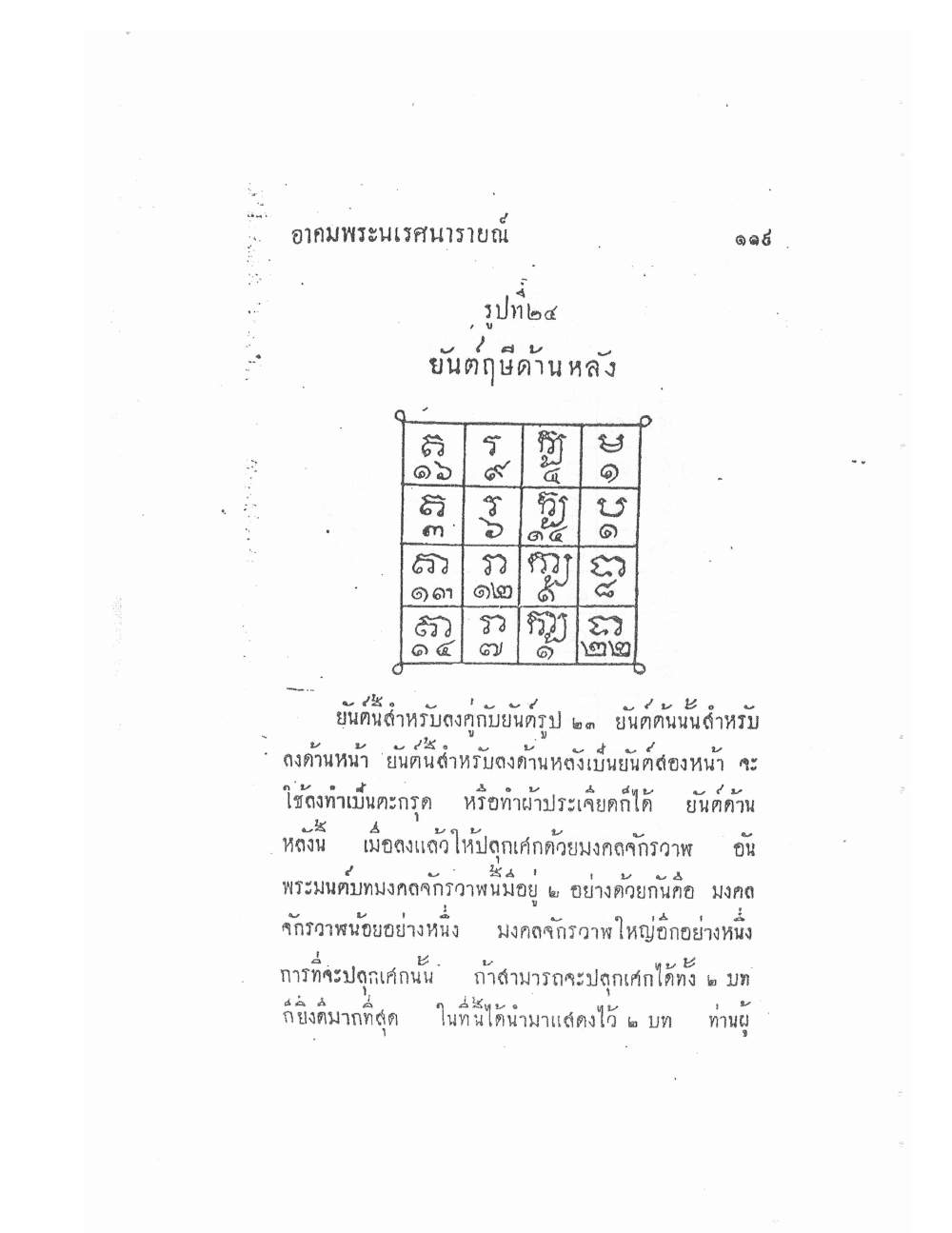
อาคมพระนเรศนารายณ์ ๑๑๙
รูปที่ ๒๔ ยันต์ฤๅษีด้านหลัง
[ตารางยันต์ ๔x๔ ช่อง แต่ละช่องมีอักขระ (บางช่องเป็นอักขระขอมในยันต์ อ่านไม่ชัด) กำกับด้วยเลขไทย ได้แก่ประมาณ ๑๖, ๙, ๕, ๑ / ๓, ๖, ๑๔, ๑ / ๑๑, ๑๒, ๔, ๘ / ๑๔, ๗, ๑, ๒๒]
ยันต์นี้สำหรับลงคู่กับยันต์รูป ๒๓ ยันต์ต้นนั้นสำหรับ ลงด้านหน้า ยันต์นี้สำหรับลงด้านหลังเป็นยันต์สองหน้า จะ ใช้ลงทำเป็นตะกรุด หรือทำผ้าประเจียดก็ได้ ยันต์ด้าน หลัง เมื่อลงแล้วให้ปลุกเสกด้วยมงคลจักรวาฬ อัน พระมนต์บทมงคลจักรวาฬนี้มีอยู่ ๒ อย่างด้วยกันคือ มงคล จักรวาฬน้อยอย่างหนึ่ง มงคลจักรวาฬใหญ่อีกอย่างหนึ่ง การที่จะปลุกเสกนั้น ถ้าสามารถจะปลุกเสกได้ทั้ง ๒ บท ก็ยิ่งดีมากที่สุด ในที่นี้ได้นำมาแสดงไว้ ๒ บท ท่านผู้
Akhom Magic of Phra Narai 119
Figure 24 Back Ruesi [Hermit-Sage] Yantra
[A 4x4 grid yantra; each cell holds a character — some appear to be Khom/akkhara script in the yantra, not confidently legible — paired with a Thai numeral, with values roughly 16, 9, 5, 1 / 3, 6, 14, 1 / 11, 12, 4, 8 / 14, 7, 1, 22.]
This yantra is inscribed as a pair with the yantra in Figure 23. That earlier yantra is for the front side; this one is for the back, making it a double-sided yantra. It may be made into a takrut [amulet tube] or into a prajiat cloth [protective cloth strip]. As for the back-side yantra, once inscribed, it should be consecrated with the Mongkhon Chakkrawan [Cosmic Blessing chant]. There are two versions of this Mongkhon Chakkrawan formula: the Lesser Mongkhon Chakkrawan, and the Greater Mongkhon Chakkrawan. As for the consecration, it is best of all if both formulas can be used to consecrate it. Here, both formulas are presented. The...
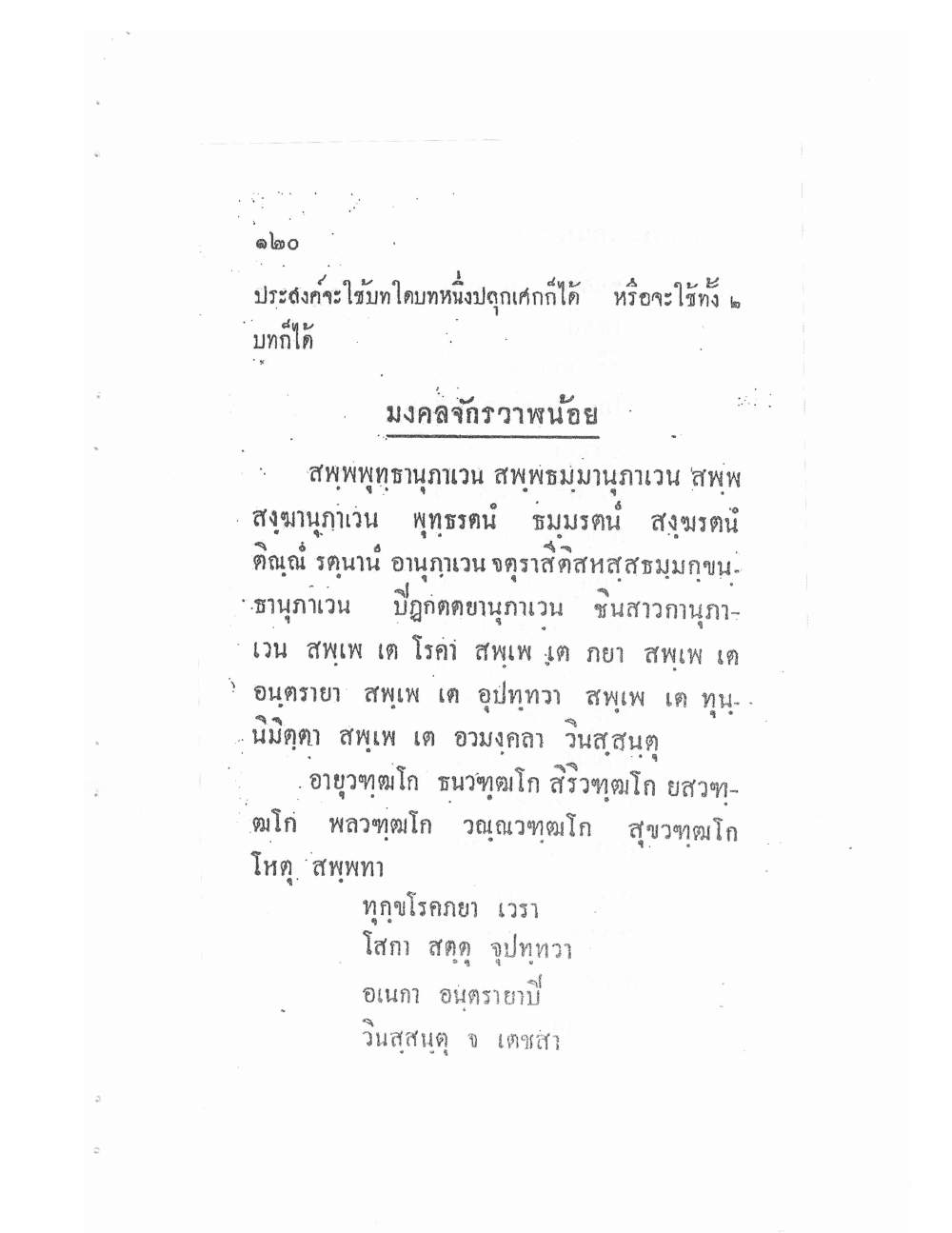
๑๒๐
ประสงค์จะใช้บทใดบทหนึ่งปลุกเสกก็ได้ หรือจะใช้ทั้ง ๒ บทก็ได้
มงคลจักรวาฬน้อย
สัพพพุทธานุภาเวน สัพพธัมมานุภาเวน สัพพ สังฆานุภาเวน พุทธรัตนัง ธัมมรัตนัง สังฆรัตนัง ติณณัง รัตนานัง อานุภาเวน จตุราสีติสหัสสธัมมักขัน- ธานุภาเวน ปิฏกัตตยานุภาเวน ชินสาวกานุภา- เวน สัพเพ เต โรคา สัพเพ เต ภยา สัพเพ เต อันตรายา สัพเพ เต อุปัททวา สัพเพ เต ทุน- นิมิตตา สัพเพ เต อวมงคลา วินัสสันตุ
อายุวัฑฒโก ธนวัฑฒโก สิริวัฑฒโก ยสวัฑ- ฒโก พลวัฑฒโก วัณณวัฑฒโก สุขวัฑฒโก โหตุ สัพพทา
ทุกขโรคภยา เวรา โสกา สัตตุ จ อุปัททวา อเนกา อันตรายาปิ วินัสสันตุ จ เตชสา
120
[The practitioner] wishing to use one formula or the other for consecration may do so, or may use both formulas together.
Lesser Mongkhon Chakkrawan [Cosmic Blessing]
[Pali:] Sabbabuddhanubhavena sabbadhammanubhavena sabbasanghanubhavena buddharatanam dhammaratanam sangharatanam tinnam ratananam anubhavena caturasitisahassadhammakkhandhanubhavena pitakattayanubhavena jinasavakanubhavena sabbe te roga sabbe te bhaya sabbe te antaraya sabbe te upaddava sabbe te dunnimitta sabbe te avamangala vinassantu. Gloss: By the power of all the Buddha, by the power of all the Dhamma, by the power of all the Sangha; by the power of the Three Jewels — the Jewel of the Buddha, the Jewel of the Dhamma, the Jewel of the Sangha; by the power of the eighty-four thousand sections of the Dhamma; by the power of the Three Pitakas; by the power of the Victor's disciples — may all illnesses, all dangers, all perils, all calamities, all evil omens, and all inauspicious things be destroyed.
[Pali:] Ayuvaddhako dhanavaddhako siriwaddhako yasavaddhako balavaddhako vannavaddhako sukhavaddhako hotu sabbada. Gloss: May there always be an increase of lifespan, an increase of wealth, an increase of glory, an increase of fame, an increase of strength, an increase of beauty, an increase of happiness.
[Verse:] Dukkharogabhaya vera, soka sattu ca upaddava, aneka antarayapi, vinassantu ca tejasa. Gloss: May suffering, illness, danger, enmity, sorrow, foes and calamities, and the many perils, all be destroyed by this power.
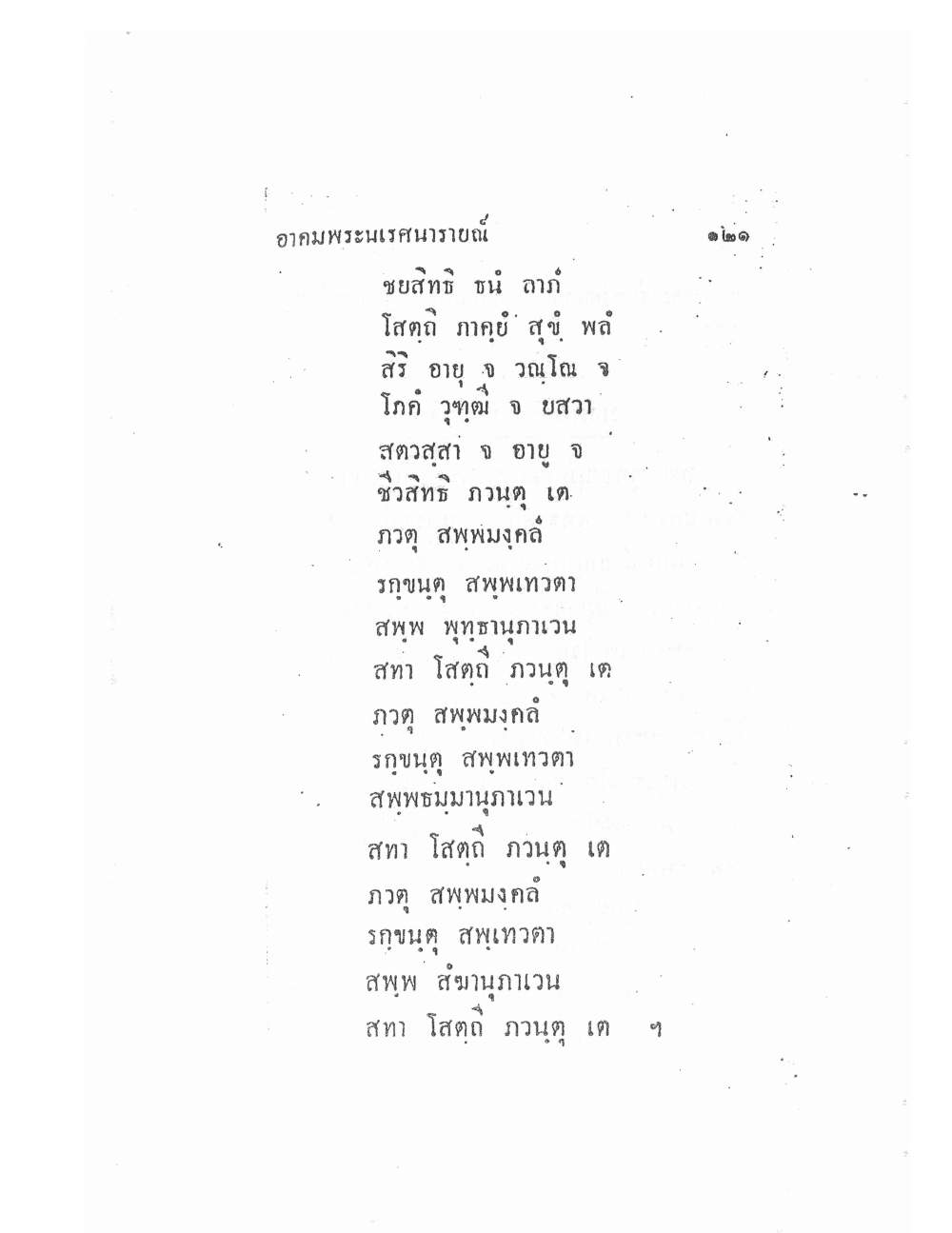
อาคมพระนเรศนารายณ์ ๑๒๑
ชยสิทธิ ธนัง ลาภัง โสตถิ ภาคยัง สุขัง พลัง สิริ อายุ จ วัณโณ จ โภคัง วุฑฒี จ ยสวา
สัตวัสสา จ อายุ จ ชีวสิทธิ ภวันตุ เต
ภวตุ สัพพมงคลัง รักขันตุ สัพพเทวตา สัพพพุทธานุภาเวน สทา โสตถิ ภวันตุ เต
ภวตุ สัพพมงคลัง รักขันตุ สัพพเทวตา สัพพธัมมานุภาเวน สทา โสตถิ ภวันตุ เต
ภวตุ สัพพมงคลัง รักขันตุ สัพพเทวตา สัพพสังฆานุภาเวน สทา โสตถิ ภวันตุ เต ฯ
Akhom Magic of Phra Narai 121
[Pali:] Jayasiddhi dhanam labham, sotthi bhagyam sukham balam, siri ayu ca vanno ca, bhogam vuddhi ca yasava, satavassa ca ayu ca, jivasiddhi bhavantu te. Gloss: May you have victory, wealth, gain, safety, fortune, happiness, strength, glory, long life, beauty, prosperity, growth, and fame; may you live a hundred years, and may your life succeed.
[Pali:] Bhavatu sabbamangalam, rakkhantu sabbadevata, sabbabuddhanubhavena, sada sotthi bhavantu te. Gloss: May every blessing be yours; may all the deities protect you; by the power of all the Buddha, may you forever be safe and well.
[Pali:] Bhavatu sabbamangalam, rakkhantu sabbadevata, sabbadhammanubhavena, sada sotthi bhavantu te. Gloss: May every blessing be yours; may all the deities protect you; by the power of all the Dhamma, may you forever be safe and well.
[Pali:] Bhavatu sabbamangalam, rakkhantu sabbadevata, sabbasanghanubhavena, sada sotthi bhavantu te. Gloss: May every blessing be yours; may all the deities protect you; by the power of all the Sangha, may you forever be safe and well.
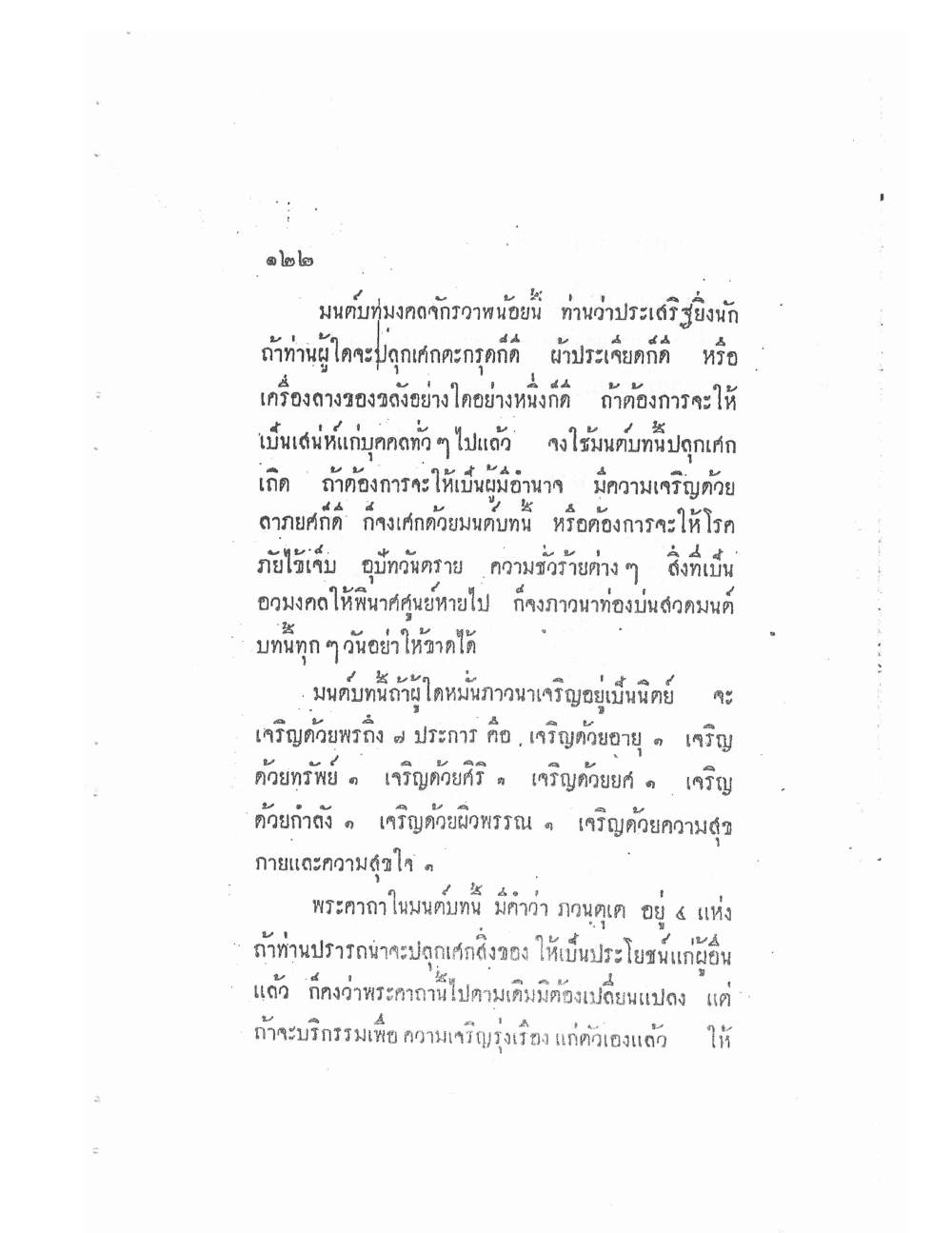
๑๒๒
มนต์บทมงคลจักรวาฬน้อยนี้ ท่านว่าประเสริฐยิ่งนัก ถ้าท่านผู้ใดจะปลุกเสกตะกรุดก็ดี ผ้าประเจียดก็ดี หรือ เครื่องรางของขลังอย่างใดอย่างหนึ่งก็ดี ถ้าต้องการจะให้ เป็นเสน่ห์แก่บุคคลทั่ว ๆ ไปแล้ว จงใช้มนต์บทนี้ปลุกเสก เถิด ถ้าต้องการจะให้เป็นผู้มีอำนาจ มีความเจริญด้วย ลาภยศก็ดี ก็จงเสกด้วยมนต์บทนี้ หรือต้องการจะให้โรค ภัยไข้เจ็บ อุบัติวันตราย ความชั่วร้ายต่าง ๆ สิ่งที่เป็น อวมงคลให้พินาศศูนย์หายไป ก็จงภาวนาท่องบ่นสวดมนต์ บทนี้ทุก ๆ วันอย่าให้ขาดได้
มนต์บทนี้ถ้าผู้ใดหมั่นภาวนาเจริญอยู่เป็นนิตย์ จะ เจริญด้วยพรถึง ๘ ประการ คือ เจริญด้วยอายุ ๑ เจริญ ด้วยทรัพย์ ๑ เจริญด้วยศิริ ๑ เจริญด้วยยศ ๑ เจริญ ด้วยกำลัง ๑ เจริญด้วยผิวพรรณ ๑ เจริญด้วยความสุข กายและความสุขใจ ๑
พระคาถาในมนต์บทนี้ มีคำว่า ภวนฺตุ เต อยู่ ๔ แห่ง ถ้าท่านปรารถนาจะปลุกเสกสิ่งของ ให้เป็นประโยชน์แก่ผู้อื่น แล้ว ก็จงว่าพระคาถานี้ไปตามเดิมไม่ต้องเปลี่ยนแปลง แต่ ถ้าจะบริกรรมเพื่อ ความเจริญรุ่งเรือง แก่ตัวเองแล้ว ให้
122
This Lesser Mongkhon Chakkrawan mantra, it is said, is exceedingly excellent. If anyone wishes to consecrate a takrut, a prajiat cloth, or any other kind of protective charm, and wants it to become a charm of allure for people in general, let him consecrate it with this mantra. If he wants it to grant power and prosperity in wealth and status, let him consecrate with this mantra as well. Or if he wants illness, misfortune, accidents and dangers, and various evils — all inauspicious things — to be destroyed and vanish, let him recite and chant this mantra every day without fail.
Whoever diligently and continually recites this mantra will prosper with eight blessings: prospering in lifespan, prospering in wealth, prospering in glory, prospering in status, prospering in strength, prospering in complexion, and prospering in bodily and mental happiness.
In the sacred formula of this mantra, the phrase 'bhavantu te' occurs in four places. If you wish to consecrate an object for the benefit of someone else, recite the formula exactly as it is, with no need to change it. But if you are chanting it for your own prosperity and flourishing, then...
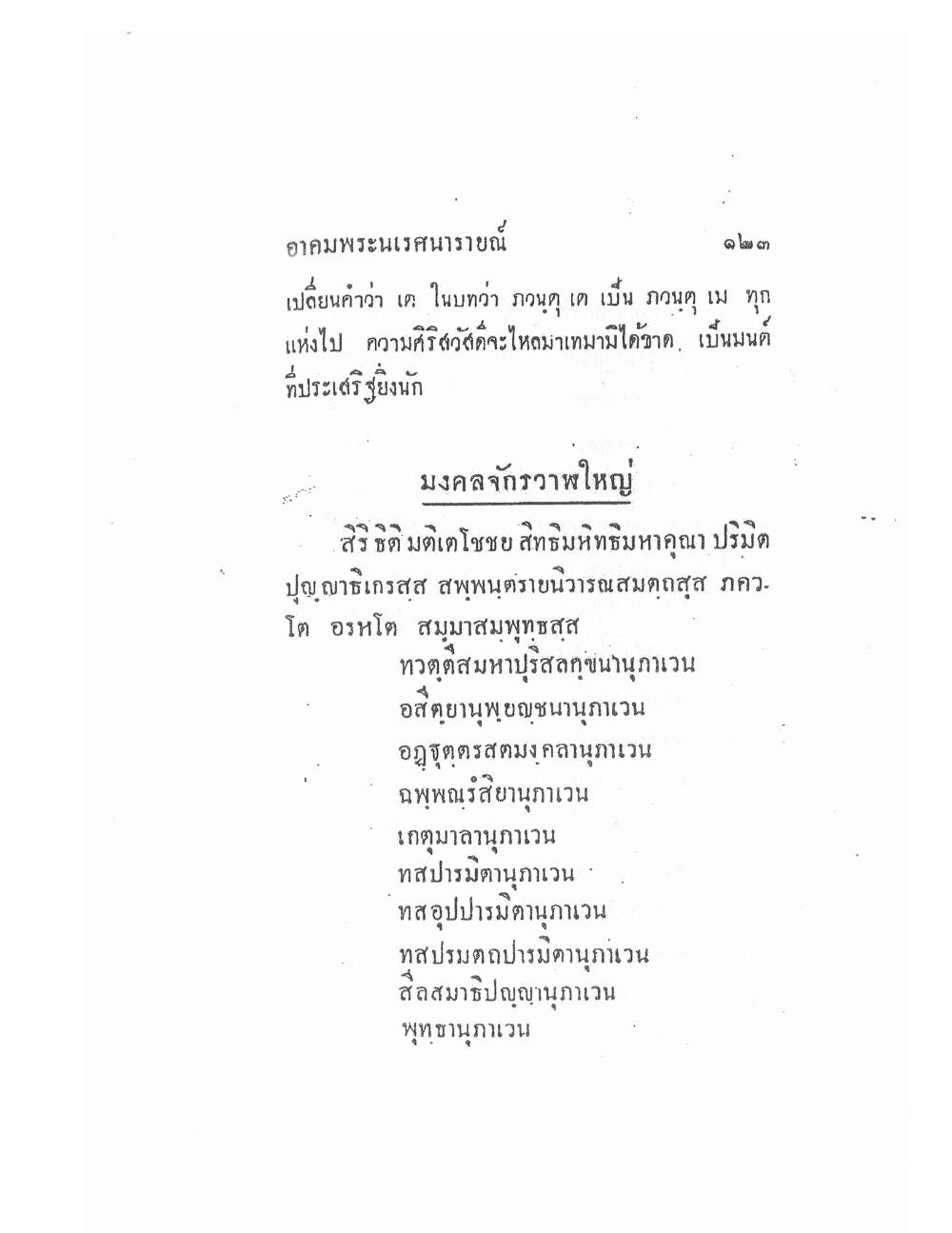
อาคมพระนเรศนารายณ์ ๑๒๓
เปลี่ยนคำว่า เต ในบทว่า ภวนฺตุ เต เป็น ภวนฺตุ เม ทุก แห่งไป ความศิริสวัสดิ์จะได้มาเทมามิได้ขาด เป็นมนต์ ที่ประเสริฐยิ่งนัก
มงคลจักรวาฬใหญ่
สิริ ธิติ มติ เตโชชย สิทธิมหิทธิมหาคุณา ปริมิต ปุญญาธิเกรสสะ สัพพันตรายนิวารณสมัตถัสสะ ภคว- โต อรหโต สัมมาสัมพุทธัสสะ ทวัตติสมหาปุริสลักขณานุภาเวน อสีตยานุพยัญชนานุภาเวน อัฏฐุตตรสตมงคลานุภาเวน ฉพพัณณรังสิยานุภาเวน เกตุมาลานุภาเวน ทสปารมิตานุภาเวน ทสอุปปารมิตานุภาเวน ทสปรมัตถปารมิตานุภาเวน สีลสมาธิปัญญานุภาเวน พุทธานุภาเวน
Akhom Magic of Phra Narai 123
Change the word 'te' in the phrase 'bhavantu te' to 'bhavantu me' throughout. Then glory and well-being will keep coming without ceasing. This is an exceedingly excellent mantra.
Greater Mongkhon Chakkrawan [Cosmic Blessing]
[Pali:] Siri dhiti mati tejojaya siddhimahiddhimahaguna parimita punnadhikessa sabbantarayanivaranasamatthassa bhagavato arahato sammasambuddhassa — by the power of the thirty-two marks of a great man, by the power of the eighty minor characteristics, by the power of the one hundred and eight blessings, by the power of the six-colored radiance, by the power of the halo of light, by the power of the ten perfections, by the power of the ten higher perfections, by the power of the ten ultimate perfections, by the power of morality, concentration, and wisdom, by the power of the Buddha — Gloss: [invoking] the glory, steadfastness, wisdom, fiery victory, accomplishment, great supernatural power and great virtue, of the boundlessly meritorious Blessed One, the Worthy One, the Perfectly Self-Enlightened One, able to ward off every danger...
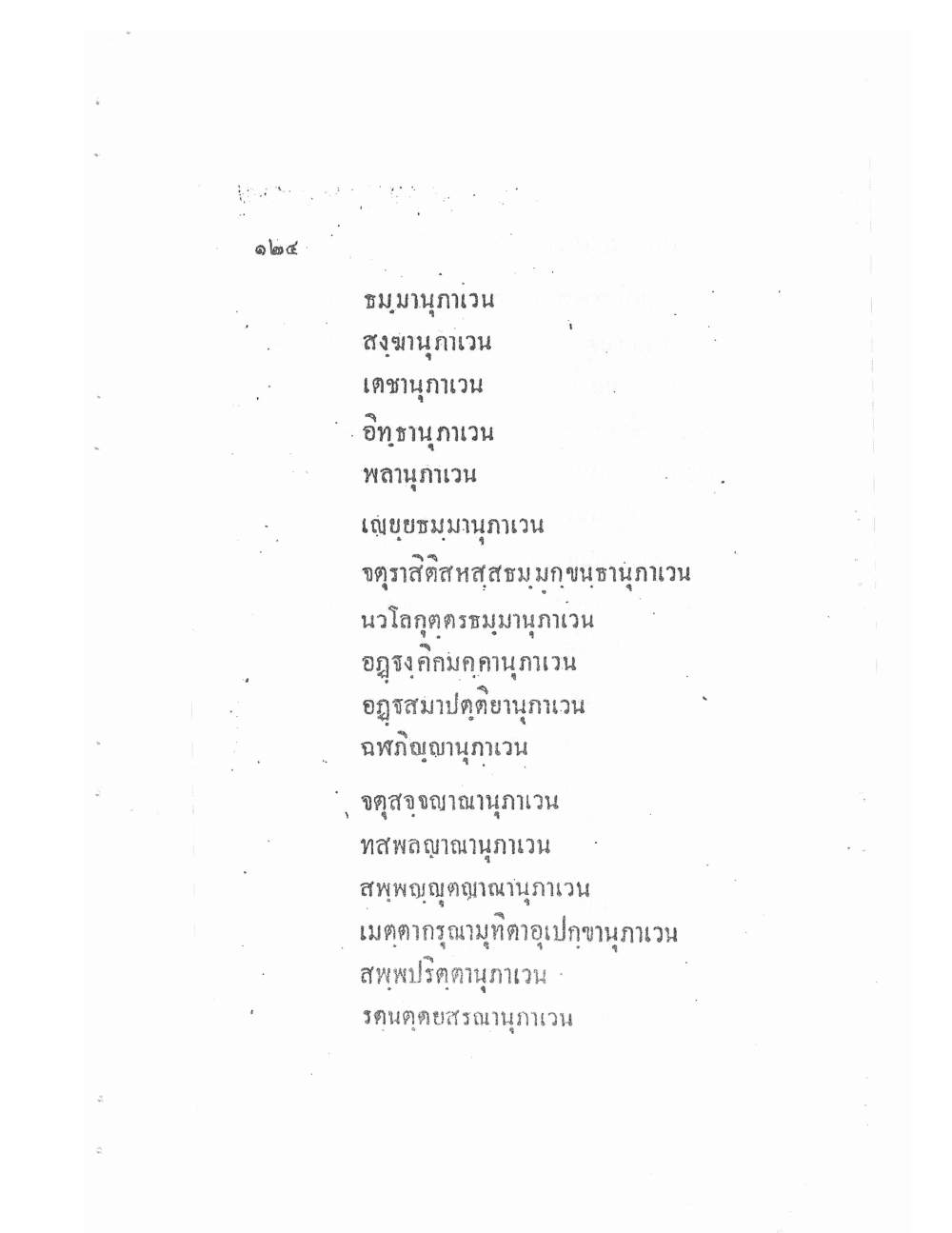
๑๒๔
ธัมมานุภาเวน สังฆานุภาเวน เตชานุภาเวน อิทธานุภาเวน พลานุภาเวน
เญยยธัมมานุภาเวน จตุราสีติสหัสสธัมมักขันธานุภาเวน นวโลกุตตรธัมมานุภาเวน อัฏฐังคิกมัคคานุภาเวน อัฏฐสมาปัตติยานุภาเวน ฉฬภิญญานุภาเวน
จตุสัจจญาณานุภาเวน ทสพลญาณานุภาเวน สัพพัญญุตญาณานุภาเวน เมตตากรุณามุทิตาอุเปกขานุภาเวน สัพพปริตตานุภาเวน รัตนัตตยสรณานุภาเวน
124
by the power of the Dhamma, by the power of the Sangha, by the power of splendor, by the power of supernatural accomplishment, by the power of strength,
by the power of the knowable Dhamma, by the power of the eighty-four thousand sections of the Dhamma, by the power of the nine transcendent states, by the power of the Noble Eightfold Path, by the power of the eight attainments, by the power of the six higher knowledges,
by the power of the wisdom of the Four Noble Truths, by the power of the wisdom of the Ten Powers, by the power of omniscient wisdom, by the power of loving-kindness, compassion, sympathetic joy, and equanimity, by the power of all protective chants, by the power of taking refuge in the Three Jewels —
อาคมพระนเรศนารายณ์ ๑๒๕
ตุยฺหํ สัพพโรคโสกุปัทวทุกขโทมนัสสุปายา- สา วินัสสันตุ สัพพอันตรายาปิ วินัสสันตุ สัพพ สังกัปปา ตุยฺหํ สมิชฌันตุ ฑีฆายุตา ตุยฺหํ โหตุ สตวัสสชีเวน สมังคิโก โหตุ สัพพทาอากาสปัพ- พตภูมิคงคามหาสมุทธา อารักขกา เทวดา สทา ตุเมหิ อนุรักขันตุ
คำว่า ตุยฺหํ นี้ถ้าท่านจะปลุกเสกเพื่อประโยชน์แก่ตัว ท่านเอง ให้เปลี่ยนใช้ว่า อเมหิ ถ้าท่านจะทำเพื่อประโยชน์ แก่ผู้อื่น จึงคงใช้ตามแบบเดิม
ภวตุ สัพพมงคลัง รักขันตุ สัพพเทวตา สัพพพุทธานุภาเวน สทา โสตถิ ภวันตุ เต ภวตุ สัพพมงคลัง รักขันตุ สัพพเทวตา สัพพธัมมานุภาเวน สทา โสตถิ ภวันตุ เต ภวตุ สัพพมงคลัง
Akhom Magic of Phra Narai 125
[Pali:] Tuyham sabbarogasokupaddavadukkhadomanassupayasa vinassantu, sabbantarayapi vinassantu, sabbasankappa tuyham samijjhantu, dighayuta tuyham hotu satavassajivena samangiko hotu sabbada, akasapabbatabhumigangamahasamuddha arakkhaka devata sada tumehi anurakkhantu. Gloss: May all your illnesses, sorrows, calamities, suffering, grief, and despair be destroyed; may every danger too be destroyed; may all your intentions succeed; may you have long life; may you always be endowed with a hundred years of living; may the guardian deities of the sky, the mountains, the earth, the rivers, and the great ocean forever protect you.
As for the word 'tuyham' [to you] here — if you are consecrating something for your own benefit, change it to 'amhi' [to me]. If you are doing it for someone else's benefit, keep using the original form.
May every blessing be yours; may all the deities protect you; by the power of all the Buddha, may you forever be safe and well. May every blessing be yours; may all the deities protect you; by the power of all the Dhamma, may you forever be safe and well. May every blessing be...
๑๒๖
รักขันตุ สัพพเทวตา สัพพสังฆานุภาเวน สทา โสตถิ ภวันตุ เต
(คำว่า เต ในบทว่า ภวนฺตุ เต นั้น ถ้าท่านผู้ใด ประสงค์จะทำเพื่อประโยชน์แก่ตนเอง ให้เปลี่ยนเป็น เม เหมือนดังที่ได้อธิบายมาแล้ว ในมนต์บท มงคลจักรวาฬ น้อย)
นักขัตตยักขภูตานัง ปาปัคคหนิวารณา ปริตตัสสานุภาเวน หันตวา เตสัง อุปัททเว
เฉพาะพระคาถาบทนี้ให้เสก ๓ จบ มนต์บทนี้ประ- เสริฐยิ่งกว่ามงคลจักรวาฬน้อย แม้มนต์บทมงคลจักรวาฬ น้อยก็นับว่าเป็นมนต์ที่ประเสริฐเลิศล้ำยิ่งนักแล้ว บทมงคล จักรวาฬใหญ่ยังมีอิทธิยิ่งใหญ่ไปกว่า สามารถจะกำจัด สรรพภัยพิบัติซึ่งจะบังเกิดขึ้นมาได้ทุกทิศ จะปรารถนาสิ่งใด ย่อมสำเร็จทุกประการ พระคาถาบทนี้ถ้าภาวนาทุก ๆ วันจะ เป็นผู้มีอายุยืนยิ่งกว่าร้อยพรรษมี เทพยดาทั้งปวงก็จะปกป้อง
126
May all the deities protect you; by the power of all the Sangha, may you forever be safe and well.
(As for the word 'te' in the phrase 'bhavantu te' — if anyone wishes to do this for his own benefit, change it to 'me,' as already explained in the Lesser Mongkhon Chakkrawan mantra.)
[Pali:] Nakkhattayakkhabhutanam papaggahanivarana, parittassanubhavena hantva tesam upaddave. Gloss: By the power of this protective chant, which wards off the stars, yakshas, spirits, and malevolent planets, may their calamities be destroyed.
This particular formula should be chanted 3 times. This mantra is even more excellent than the Lesser Mongkhon Chakkrawan. Even the Lesser Mongkhon Chakkrawan mantra is already considered a supremely excellent mantra, yet the Greater Mongkhon Chakkrawan formula has even greater power still — able to dispel every calamity that might arise from any direction. Whatever one wishes for will be accomplished in every respect. If this formula is recited every day, one will live even longer than a hundred years, and all the deities will protect...
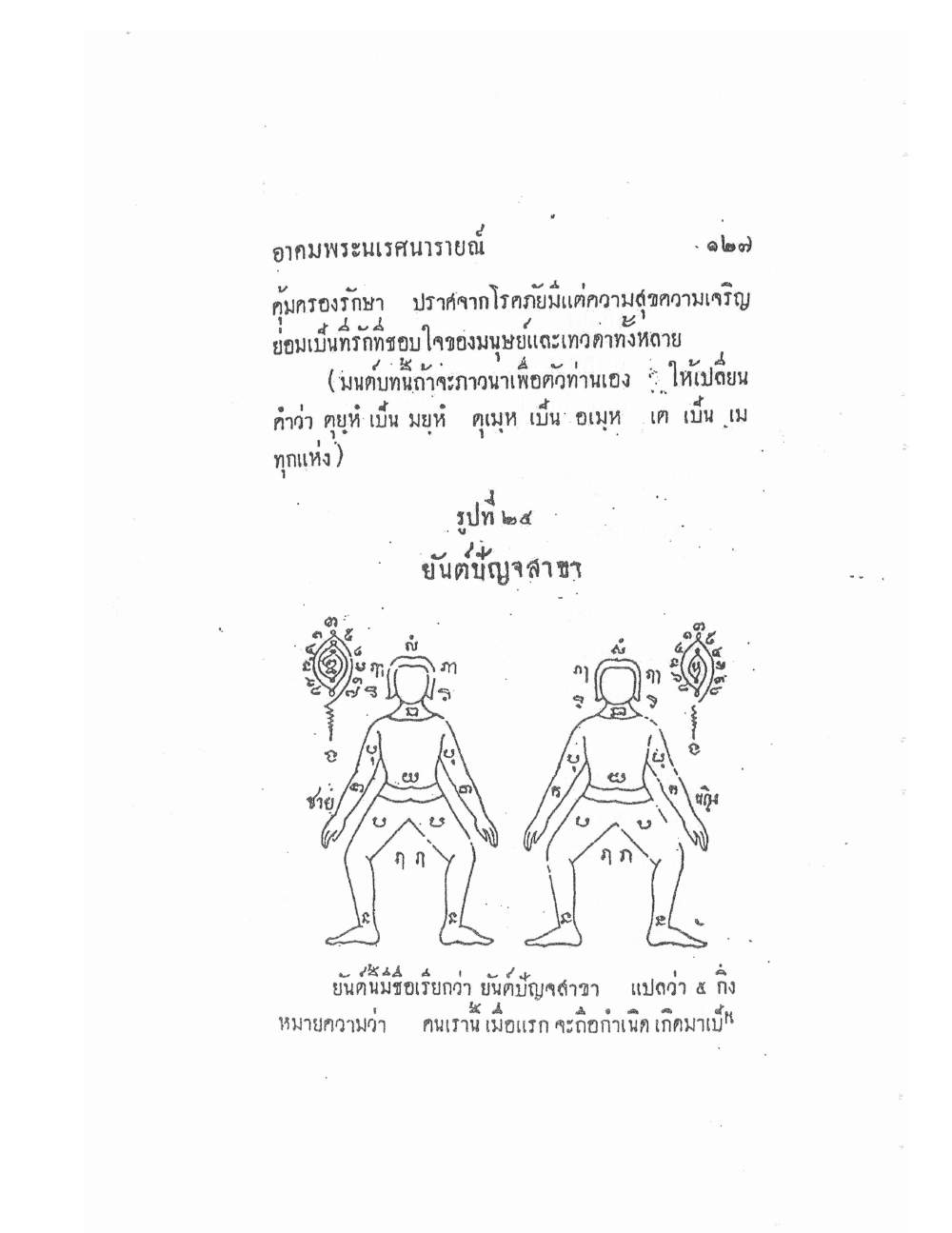
อาคมพระนเรศนารายณ์ ๑๒๗
คุ้มครองรักษา ปราศจากโรคภัย มีแต่ความสุขความเจริญ ย่อมเป็นที่รักที่ชอบใจของมนุษย์และเทวดาทั้งหลาย
(มนต์บทนี้ถ้าจะภาวนาเพื่อตัวท่านเอง ให้เปลี่ยน คำว่า ตุยฺหํ เป็น มยฺหํ ตุเมหิ เป็น อเมหิ เต เป็น เม ทุกแห่ง)
รูปที่ ๒๕
ยันต์บัญจสาขา
[ภาพยันต์รูปมนุษย์สองรูปยืนหันหน้าเข้าหากัน แต่ละรูป มีอักขระ (บางตัวเป็นอักขระขอมในยันต์ อ่านไม่ชัด) กำกับ อยู่ตามศีรษะ ลำตัว แขน และขา และมีวงรีจารึกอักขระขอม ลอยอยู่เหนือศีรษะแต่ละรูป ด้านซ้ายกำกับคำว่า "ชาย" ด้านขวากำกับคำว่า "หญิง"]
ยันต์นี้มีชื่อเรียกว่า ยันต์บัญจสาขา แปลว่า ๕ กิ่ง หมายความว่า คนเราเมื่อแรกจะถือกำเนิดเกิดมาเป็น
Akhom Magic of Phra Narai 127
...protecting and guarding, free from illness and danger, having only happiness and prosperity — one will surely become beloved and cherished by both humans and deities.
(If this mantra is to be chanted for your own benefit, change the word 'tuyham' to 'mayham,' 'tumehi' to 'amhi,' and 'te' to 'me,' throughout.)
Figure 25
Panjasakha [Five Branches] Yantra
[A diagram of two human figures standing facing each other, each marked with characters — some appear to be Khom/akkhara script in the yantra, not confidently legible — at the head, torso, arms, and legs, and each topped with an oval bearing Khom-script characters floating above the head. The left figure is labeled 'male,' the right figure labeled 'female.']
This yantra is called the Panjasakha Yantra, meaning 'Five Branches.' It means that when a person first comes to be conceived and born, they become...
๑๒๘
มนุษย์ชายหญิงนั้น แรกเริ่มเดิมทีเขาเรียกว่า กลละ ถ้า จะเปรียบให้เห็นก็เหมือนอย่างว่า เอาเส้นผมอันละเอียดมา ผ่าออกเป็น ๘ ส่วน เอาแต่ส่วนหนึ่งนั้นจุ่มลงไปในน้ำมัน งาแล้วยกขึ้นมาถือห้อยไว้ น้ำมันงาที่ไหลย้อยลงมาติดอยู่ ที่ปลายเส้นผม ซึ่งมีรูปกลมและเล็กเกือบจะมองไม่เห็นนั้น แล ท่านเรียกว่า กลละ มนุษย์ที่แรกเกิดนั้นจะเกิดเป็น กลละก่อนอย่างนี้ ครั้นแล้วกลละนั้นจะค่อย ๆ โตขึ้น จาก หยดน้ำซึ่งมองเห็นใสนั้นกลายเป็นก้อนดำขึ้น เรียกว่า ชนะ จาก ชนะ จึงเป็น เปสิ เรียกว่าก้อนเนื้อหรือชิ้นเนื้อ จาก ก้อนเนื้อกลม ๆ นั้น ได้เกิดปุ่มขึ้น ๕ ปุ่ม ปุ่มที่ ๑ เป็น ศีรษะ ปุ่มที่ ๒-๓ เป็นแขนขวาแขนซ้าย ปุ่มที่ ๔-๕ เป็น ขาขวาขาซ้าย ปุ่มนั้นค่อย ๆ เติบโตเจริญขึ้น แล้วจึง ปรากฏให้เห็นเป็นศีรษะและแขนขาไว้ชัดเจนขึ้น ดังนั้นแล เรียกว่าปัญจสาขา มนุษย์เราเกิด เป็นปัญจสาขา ขึ้นด้วย อาการอย่างนี้
ยันต์นี้มีวิธีใช้ได้หลายอย่าง ดังจะอธิบายเป็นลำดับ ไป อย่างหนึ่งจะใช้เป็นเสน่ห์ให้หญิงชายรักใคร่กัน มี จิตปฏิพัทธ์ต่อกัน หญิงชายที่เป็นศัตรูกันให้กลายเป็น
128
As for that male or female human being — at the very first, they call it a 'kalala' [embryonic drop]. To give a comparison, it is as if one took a fine strand of hair and split it into eight parts, then dipped only one of those parts into sesame oil and lifted it up to let it hang. The drop of sesame oil that trickles down and clings to the tip of the hair — round in shape and so tiny it is almost invisible — that, they say, is called a 'kalala.' A human being, at the moment of first conception, comes into being as a kalala in just this way. Then that kalala gradually grows: from a clear droplet it becomes a dark clot, called 'chana' [thickened mass]. From 'chana' it then becomes 'pesi,' meaning a lump or piece of flesh. From that round lump of flesh, five buds arise: the first bud becomes the head; the second and third buds become the right and left arms; the fourth and fifth buds become the right and left legs. Those buds gradually grow and develop, and then appear clearly as a head and limbs. This is why it is called 'panjasakha' [five branches] — a human being comes to be formed as panjasakha in this manner.
This yantra can be used in many ways, as will be explained in turn. One way is to use it as a charm to make a man and woman fall in love with each other, their hearts bound together in mutual affection — turning a man and woman who are enemies into...
อาคมพระนเรศนารายณ์ ๑๒๕
มิตรกัน ผัวเมียที่เคยอยู่ด้วยกันแล้วมาแตกแยกกัน ทำ ให้กลับมาอยู่ด้วยกันอีก ท่านให้เขียนยันต์นี้ลงในแผ่น กระดาษเป็น ๒ รูป คือรูปชายหนึ่งหญิงหนึ่ง แล้วเขียนชื่อ ชายและชื่อหญิงลงในรูปยันต์ทั้งสองนั้น แล้วปลุกเสกตาม ความปรารถนาของคนเถิด
ถ้าต้องการให้หญิงรัก ให้มีใจใฝ่ฝันคิดถึงเราให้ เสกด้วยมนต์ดังนี้ อมภมย่อน ภมะยอนอิสิ สาวน้อย สาวใหญ่ หัวใบพระพัดใบทองช่อภมะยอน หัวใจครวญ ร่ำลักถึงกูน้ำมูกเต็มขันน้ำมันแดดร้อน อย่าให้อรทัยมาหากู สิทธิอินคราสวาหะ
(มนต์บทนี้ในการพิมพ์ครั้งแรกมีผู้ถามมาว่า คำว่า "อย่า" ให้อรทัยมาหากูนั้น คำว่า "อย่า" นี้สงสัยว่าจะเกิน คำไป เพราะมนต์บทนี้เสกเพื่อให้หญิงมีใจใฝ่ฝันถึง แต่ ทำไมจึงจะมาห้ามไม่ให้ผู้หญิงมาหา ขอตอบว่า มนต์บท นี้ท่านผู้อาจารย์แปลงเอาไว้ก็ได้ หรืออาจจะไม่เป็นจริงก็ได้
๕
Akhom Magic of Phra Naresnarai, p.125
[a section on renewing lost friendship, continuing from the previous page:] ...friends. For a husband and wife who used to live together but then separated, to make them come back together again, the master instructs: write this yantra on a sheet of paper as two figures, namely one figure of a man and one of a woman. Then write the man's name and the woman's name onto the two yantra figures. Then consecrate it according to the wish of the person.
If you want a woman to love you, to have her heart yearn and dream of you, enchant with this mantra: "Om phama-yon, phamayon-isi" [invocation syllables] — young girl, grown girl, sacred leaf-fan, golden leaf, spray of phamayon; [her] heart moans and weeps, longing for me, my nose running full from the heat of the burning sun — do not let Orathai [poetic name for the beloved maiden] come looking for me. Success, om, kara, svaha.
(Regarding this mantra verse, when the book was first printed a reader asked: in the line "do not let Orathai come looking for me," is the word "do not" [อย่า] a mistake, since this mantra is cast so that the woman's heart will yearn for the caster — so why would it then forbid her from coming? The answer given: this mantra verse may have been altered by the author-teacher himself, or it may simply not be accurate.)
["5" — a printer's signature/quire number at the foot of the page]
๑๓๐
เป็น ๒ นัย ข้าพเจ้าเป็นแต่เพียงคัดดอกออกมาตรงตาม ต้นฉบับสมุดข่อยเดิมเท่านั้น)
เมื่อร่ายมนต์บทนี้แล้ว ให้เป่ามนต์ฝากพระพายไป ขอให้พระพายรำเพยพัด เอากลิ่นดอกไม้บูชาพระนี้ไปยัง บ้านของหญิงเถิด เมื่อหญิงได้กลิ่นดอกไม้ของเราแล้วก็ จะเกิดมีใจใฝ่ฝันถึงเรา กระสับกระส่ายอยู่บ้านมิได้ต้อง มาหาเราแล
(ที่จริงการเป่ามนต์ฝากพระพายนี้ เท่าที่ข้าพเจ้า ทราบเรียกว่าเทพรำลึกนั้นเป็นของต่างกัน ไม่ใช่คาถาฝาก พระพาย คาถาฝากพระพายเมื่อดับเทียนแล้วเอามือโบก ควันเทียนไป แล้วให้ว่าดังนี้ "พุทโธระหังพุทโธ, นชาติดิเม อะมะอุ, พุทโธระหังพุทโธ"
อนึ่งมนต์เทพรำลึกจะนำ มาใช้กับยันต์ บัญจสาขา เท่า นั้น ถ้าจะแยกออกมาใช้ต่างหากท่านท่านว่าจะมิได้ผลเลย ถ้าจะใช้ประกอบกับมนต์บทอื่นก็อาจได้ผล)
ถ้านางใจแข็งมิมาหาเรา ให้ปลุกเสกด้วยพระคาถา ว่า อมเทพรำลึกกระกริกจิต กระกริกใจ กระกริก
p.130
...has two versions. I have merely selected and copied out the verses to match exactly with the original khoi (mulberry-paper) manuscript.)
After chanting this mantra, blow it and entrust it to Phra Phai [the Wind God]. Ask Phra Phai to blow gently and carry the scent of these offered flowers to the woman's house. Once the woman smells our flowers' scent, her heart will begin to yearn and dream of us; she will grow restless at home and be unable to stay, and will have to come seek us out.
(In truth, this practice of blowing the mantra and entrusting it to Phra Phai — as far as I know it is called "the reminding deity" [thep ramluek] — is a different thing, not the spell for entrusting to Phra Phai. The spell for entrusting to Phra Phai is: after extinguishing a candle, wave your hand to send the candle-smoke off, then recite: "Phutho rahang phutho, nachatidime amaʼu, phutho rahang phutho."
Also, the "reminding deity" mantra is to be used only together with the five-branch [bencha-sakha] yantra. If separated out and used alone, it is said to produce no effect at all; but combined with another mantra verse it may still work.)
If the woman's heart remains hard and she does not come to us, consecrate with the sacred verse: "Om, reminding deity, tremble [her] mind, tremble [her] heart, tremble..." [continues on the next page]
อาคมพระนเรศนารายณ์ ๑๓๑
พระทัยอิ่มให้สะดุ้งยังรุ่ง ยังค่ำ อย่ากระทำการ อย่าหลับ อย่านอนบนหมอนบนฟูก ร่ำลึกถึงร่ำพึงถึงจะมานั่งถ้าคอย สม นั่งชมแต่เงา นางอิงคลึงเคล้าภิรมย์ชมเชยพระพาย เจ้าเอย มารับเครื่องสังเวย อมสิทธิสวาหะ ก่อนที่จะ ภาวนาพระคาถาบทนี้ ให้จัดเครื่องสังเวยพระพายกล่าว คำอัญเชิญพระพายมายังที่บูชาของเราแล้ว บริกรรม มนต์บทนี้จบแล้วฝากพระพายให้นำไปยังบ้านหญิง ให้ ประณมมืออุ้มเอาพระพายเข้ามา แล้วเบิกมือออกไป เพื่อส่งให้พระพายไปหาผู้ที่เราปรารถนา มนต์บทนี้เรียก ว่าเทพรำลึก
(ท่านผู้ถามไว้ในการพิมพ์ครั้งแรกว่า การจัดเครื่อง สังเวยพระพายนั้นจัดกันอย่างไรมีอะไรบ้าง และคำอัญเชิญ พระพายมายังที่บูชาของเรานั้น คำอัญเชิญมีอย่างไรบ้างนั้น ขอตอบดังนี้ "เครื่องสังเวยมีกุ้งพล่าปลาย่างขนมนมเนยใส่ กระทง" คำอัญเชิญพระพายว่าดังนี้ "โอมพระพายเจ้าเอย จงมาเป็นสง่าราศี ชิวหา[อ่านไม่ออก]พระมนต์คาถาให้พ้น ห้วยหนองคลองบึงบางแม่น้ำกว้างระหว่างใหญ่ พระคาถา
Akhom Magic of Phra Naresnarai, p.131
...make her heart restless from dawn till dusk; let her do no work, let her not sleep, let her not lie down on pillow or mattress; let her long and pine for me until she comes to sit, waiting properly, sitting gazing only at my shadow; let the lady cling and embrace, delighting and caressing — dear Lord Phra Phai, come and receive the offering. Success, om, svaha.
Before reciting this sacred verse, arrange the offerings for Phra Phai, speak the words inviting Phra Phai to our place of worship, and once that is done, recite this mantra to its end and entrust it to Phra Phai to carry to the woman's house. Press the palms together as if cradling Phra Phai within them, bring them in, then open the hands outward to send Phra Phai off to find the person we desire. This mantra verse is called "the reminding deity."
(A reader asked, at the first printing, how the offerings for Phra Phai are arranged and what they consist of, and what the words are for inviting Phra Phai to our place of worship. The answer: "The offerings consist of spicy shrimp salad, grilled fish, and sweets with milk and cream, placed in a small leaf tray." The invitation to Phra Phai runs: "Om, dear Lord Phra Phai, come and be glorious; [let your] tongue [several words illegible] the sacred mantra-spell so that it may pass beyond streams, marshes, canals, swamps, and the great wide river between — the sacred verse [continues]."
๑๓๒
จำนงจงใจให้ภูตอื่นนั้น พระพายเจ้าเอย ช่วยพัดเอาดวงจิต อื่นนั้นมาสู่จิตของข้าเจ้า อากัจฉายะ อากัจฉาหิ เอหิจิตตัง เอหิจิตตัง มะมะ" พระอาจารย์ท่านบอกไว้อย่างนี้)
อมเพชรพญาธร เสด็จโคจรอยู่บนเวหา กูจะเรียก มิ่งมา กูจะใช้มิ่งไปสู่สาวอันสำอาง สาวพรหมจารีซึ่ง ไปเร็วพลัน อมสิทธิสวาหะ มนต์บทนี้เรียกว่า มนต์ เพชรพญาธรเป็นมนต์ที่ภาวนา เพื่ออัญเชิญเพชรพญาธร มาแล้ว ให้ช่วยไปบอกหญิงที่เราปรารถนา หญิงนั้นจะ บังเกิดจิตใจไหวหวั่นอยู่บ้านมิได้ ต้องมาหาเราแล
(ท่านผู้ถามไว้มีข้อสงสัยมาอีกว่า "การภาวนาเพชร พญาธรนั้นให้ภาวนาต่อท้ายมนต์เทพรำลึกใช่หรือไม่ ถ้า หากว่าใช่สงสัยว่าเมื่อเราได้บริกรรมเมตตาเทพรำลึกฝาก พระพายไปแล้วเหตุใดจึงต้องเชิญเพชรพญาธรให้ช่วยบอก หญิงที่เราปรารถนาอีกเล่า" ขอตอบว่า "การที่ใช้เพชร พญาธรนี้ก็คือว่าให้ไปแทนตัวคนที่ทำหญิง อันเพชรพญาธร คนนี้เป็นคนเก่งต้องไปช่วยเอามา ปลุกปล้ำเอามา)
แม้ว่าองค์เพชรพญาธรนั้น อาจจะไปไถลเสียกลาง
p.132
...to draw that other spirit's mind [to me]. Dear Lord Phra Phai, please blow and bring that other person's heart to my heart. Akaccha-ya, akaccha-hi, ehi cittang, ehi cittang mama." The teacher-master instructed it this way.)
Om, Phet Phanyathon [a swift meteor-spirit], travelling across the sky, I shall call your radiance to come; I shall send your radiance to the fair, adorned young maiden, the virgin girl — go swiftly. Success, om, svaha. This mantra verse is called the Phet Phanyathon mantra; it is recited to invite the Phet Phanyathon spirit, and once he has come, to have him go and tell the woman we desire. That woman's heart will then grow restless; unable to remain at home, she must come seek us out.
(The reader raised a further question: "Is the Phet Phanyathon invocation to be recited right after the reminding-deity mantra? If so, I wonder — once we have already performed the loving-kindness reminding-deity rite and sent it off with Phra Phai, why would we then also need to invite Phet Phanyathon to help tell the woman we desire?" The answer: "The reason for using Phet Phanyathon is that he goes in place of the person who must fetch the woman. This Phet Phanyathon spirit is a capable one, and must go and help retrieve her, wrestling her free and bringing her.")
Even so, the Phet Phanyathon spirit himself might go astray, in the middle [of the road — continues on next page]
อาคมพระนเรศนารายณ์ ๑๓๓
ทาง มิได้ตรงไปยังบ้านหญิง ท่านว่าให้ภาวนาด้วยพระ คาถาว่า โสทายะ อมกิ ๆ อย่าหยุด พระทิศระกะวาโย ชาตุ อมพัชมิโสทายะมรณังภเว มนต์บทนี้สำหรับภาวนา ส่งเพชรพญาธรไปเมื่อหานาง มิให้ไปเถลไถลเสียใน ระหว่างทาง
ถ้าหากว่าเราจะไปหาหญิง ให้ปลุกยันต์ด้วยพระ คาถาว่า
อม อิถีลิงคัง ปุริสสวาโห อชายส
พระคาถาบทนี้สำหรับเสกกล้อมยันต์ เมื่อเราจะ ออกเดินทางไปให้ภาวนาเรื่อยไป นางอยู่บ้านมิได้ต้อง เยี่ยมหน้าออกมาให้เราได้เห็นหน้านาง
อิมัง พิณทุกัปปัง กะโรมิ ทุติยัมปิ อิมัง ทุพิณกัปปัง กะโรมิ ตติยัมปิ อิมัง พิณทุกัปปัง กะโรมิ
พระคาถานี้สำหรับพินทุบัญจสาขาขึ้นแล้ว จึงควัน เป็นไส้เทียน ส่วนเทียนที่จะใช้ควันนั้นท่านให้เอาชันผงหนัก หนึ่งบาทมาควันเป็นเทียน (คำว่าพินทุนั้นหมายความว่า
Akhom Magic of Phra Naresnarai, p.133
...the road, so that he does not go straight to the woman's house, one should recite the sacred verse: "Sothaya, om ki ki, do not stop, Phra Thisarakawayo chatu, om phatchami sothaya, maranang phave." This mantra verse is for reciting when sending Phet Phanyathon out to find the woman, so that he does not stray and dawdle along the way.
If instead we ourselves are going to seek out the woman, consecrate the yantra with the sacred verse:
"Om itthilingang purisasavaho achayasa"
This verse is for enchanting around the yantra. As we set out on the journey, recite it continuously; the woman, though at home, will be unable to stay in and must come out and show her face so that we may see her.
"Imang pinthukappang karomi. Tutiyampi imang thu-pinthakappang karomi. Tatiyampi imang pinthukappang karomi."
This sacred verse is for [marking] the dots of the five branches; once they are made, [the mark] is then smoked to form a candle-wick. As for the candle used for the smoking, take one baht-weight of resin powder and smoke it into a candle. (The word "pinthu" [dot/point] means...) [continues on next page]
๑๓๔
เอาวัตถุอย่างใดอย่างหนึ่งเป็นต้นว่าดินสอดำ จุดลงไปใน ยันต์เป็นการรูปปลุกเสก คล้ายกับว่าในรูปยันต์นั้นรู้สึกมี ชีวิตขึ้น ส่วนคำว่าบัญจสาขานั้นคือปุ่ม ๕ ปุ่ม ที่ได้อธิบาย มาแล้วข้างต้น วิธีทำพินทุบัญจสาขานั้น ให้เอาเหล็ก จารหรือดินสอจุดลงไปที่ศีรษะ ที่แขนทั้งสองขาทั้งสอง แล้วว่าคาถากำกับดังนี้
รูปขันโธ เวทนาขันโธ สัญญาขันโธ สังขาร ขันโธ วิญญาณขันโธ
คาถานี้เรียกคาถาบัญจสาขา ให้บริกรรมภาวนา ขณะที่เอาวัตถุจุดลงไปตามสาขาต่าง ๆ นั้น ให้ครบทั้ง ๕ สาขา สาขาละ ๑ จบ เมื่อลงยันต์ในแผ่นกระดาษแล้ว ให้[อ่านไม่ออก]ลงชื่อหญิง ในยันต์รูปยันต์ที่เขียนนั้น ให้เขียนรูปหญิงอยู่ซ้ายรูปชายอยู่ขวา แล้วเอาใบรัก ซ้อนมาสองใบ ลงยันต์ที่กำกับรูปชายและรูปหญิง (ดู ภาพประกอบ) แล้วเอาพระคาถานี้ "โอม อิถีตัง" ล้อม ให้รอบจะเสกด้วยปากเปล่าอย่างเดียว หรือจะเขียนพระ
p.134
[continuing:] take some object, for instance a black pencil, and dot it onto the yantra as an act of consecration, as though the figure in the yantra becomes imbued with life. As for the term "bencha-sakha" [five-branch], it refers to the five points already explained above. The method for making the bencha-sakha dots is: take an iron stylus or a pencil and touch it down onto the head, both arms, and both legs, while reciting this accompanying verse:
"Rupa-khandho, vedana-khandho, sañña-khandho, sankhara-khandho, viññana-khandho."
This verse is called the bencha-sakha verse; recite it while touching the object onto each of the branches/points, covering all five points, once for each point. Once the yantra is drawn on the paper, have [several words illegible] write down the woman's name. In the yantra figure that is drawn, the female figure should be drawn on the left and the male figure on the right. Then take two overlapping ruk-leaves ["leaves of love"] and place the yantra marking the male and female figures upon them (see accompanying picture). Then take this sacred verse, "Om itthitang," and encircle [the figures] with it, either reciting it aloud alone, or else writing the sacred [verse — continues on next page]
อาคมพระนเรศนารายณ์ ๑๓๕
คาถาบทนี้ ลงไปในใบรักซ้อนนั้นด้วยก็ได้ ถ้าจะเขียนลง ไปก็ให้บริกรรมไปด้วย
ต่อจากนี้ให้ทำพิธีผูกจิต ผูกอารมณ์ปลุกเสกให้รูป ยันต์นั้นเกิดมีชีวิตชีวาขึ้น
พระคาถาผูกจิต
ม อ อุสิวัง พรหมรูปนิหูหัง (ออกชื่อ) นามนิ นามนิ จิตตัง พุทธัง อารัมมณัง ธัมมัง อารัมมณัง สังฆัง อารัมมณัง
พระคาถาผูกอารมณ์
โย กร มหิมา
พระคาถาบริกรรมสูบจิต
กูจะสูบวาโย กูจะสูบอาโป กูจะสูบเตโช กูจะสูบปฐวี กูจะสูบอาหาร กูจะสูบรานจิต กูจะ สูบนิมิต กูจะริ กูจะสูบนางนั้น พุทธังอุปปัตติ ธัมมังอุปปัตติ สังฆังอุปปัตติ (ลงชื่อตัวเราด้านขวา ลงชื่อหญิงทางด้านซ้าย) แล้วบริกรรมสูบจิตให้ได้ทุกวัน
Akhom Magic of Phra Naresnarai, p.135
[continuing:] this sacred verse may also be written into the overlapping ruk-leaves themselves; if writing it down, one should recite it at the same time.
After this, perform the rite of binding the mind and binding the emotions, to consecrate the yantra figure so that it becomes vivid and alive.
Sacred verse for binding the mind
"Ma o usiwang, phrom-rup nihuhang" (say the name [of the person]) "namani namani, cittang, phuddhang arammanang, dhammang arammanang, sanghang arammanang."
Sacred verse for binding the emotions
"Yo kara mahima."
Sacred verse recited while drawing in the mind
"I shall draw in wind, I shall draw in water, I shall draw in fire, I shall draw in earth, I shall draw in sustenance, I shall draw away [her] mind, I shall draw in [her] vision, I shall stir desire, I shall draw in that woman. Phuddhang uppatti, dhammang uppatti, sanghang uppatti." (Write one's own name on the right side, write the woman's name on the left side.) Then recite this drawing-in-the-mind incantation every day.
๑๓๖
อนึ่งเมื่อจะลงชื่อชายให้ภาวนาพระคาถาดังนี้
นามชิเม ถาเน นาม วิกรึงคเร
เมื่อจะลงชื่อหญิง ให้ภาวนาพระคาถาดังนี้
นามสุญตัง มรณัง ภเว
เมื่อจะลง ศีรษะ (เศียร) ให้ภาวนาพระคาถาดังนี้
สีส พุทธา ปน ชายเต
เมื่อจะลงองค์ให้ภาวนาพระคาถาดังนี้
องค์พุทธา ปน ชายเต
เมื่อจะลงพระบาท ให้บริกรรมพระคาถาดังนี้
ปาทพุทธา ปน ชายเต
เมื่อจะลงอุณาโลม ให้บริกรรมพระคาถาดังนี้
อุณาโลมา ปน ชายเต
เมื่อลงครบทุกแห่งแล้ว ให้ปลุกเสกด้วยพระคาถา ว่าดังนี้
ตินิ องกุรชาตานิ วิกรึงคเร โอมรณังชวนติเย สวาห
p.136
Furthermore, when writing the man's name, recite this sacred verse: "Namachime thane nama, wikarungkhare."
When writing the woman's name, recite this sacred verse: "Namasuññatang maranang phave."
When marking the head, recite this sacred verse: "Sisa buddha pana chayate."
When marking the body, recite this sacred verse: "Ongkha buddha pana chayate."
When marking the feet, recite this sacred verse: "Pada buddha pana chayate."
When marking the ūrṇā-curl [the sacred whorl of hair between the brows], recite this sacred verse: "Unnaloma pana chayate."
Once every place has been marked, consecrate it with this sacred verse:
"Tini ongkurajatani wikarungkhare, om maranang chuwantiye svaha."
อาคมพระนเรศนารายณ์ ๑๓๗
พระคาถาบทนี้เริ่มตั้งแต่บทว่า สีส พุทธา ปน ชายเต ไปจนจบบท นอกจากจะใช้สำหรับปลุกเสกกับยันต์นี้โดย เฉพาะแล้ว ยังใช้สำหรับปลุกเสก ยันต์ที่มีรูปพระพุทธ องค์ได้ทั่ว ๆ ไป เมื่อเขียนรูปพระพุทธองค์ลงไปแล้ว ให้ ปลุกเสกด้วยพระคาถาบทนี้ ยันต์นั้นจึงจะเกิดความศักดิ์ สิทธิ์แก่ผู้บูชาแล
บรรดายันต์ต่าง ๆ เท่าที่นำมาแสดงไว้ในที่นี้ เป็น เพียงส่วนหนึ่งในพระคัมภีร์ของพระนเรศนารายณ์ ได้เลือก สรรเอาเฉพาะที่ท่านผู้ประสงค์จะต้องการใช้ นำมาแสดงไว้ เพียง ๒๕ ยันต์เท่านั้น หากเป็นที่พึงพอใจของท่านแล้ว ผู้รวบรวมเรียบเรียง จะได้รวบรวมนำมาแสดงเพื่อเป็น ความรู้แก่ท่านผู้สนใจอีกต่อไปในโอกาสหน้า
Akhom Magic of Phra Naresnarai, p.137
This sacred verse, beginning from the phrase "sisa buddha pana chayate" through to the end, besides being used to consecrate this particular yantra, may also be used generally for consecrating any yantra bearing a figure of the Buddha. Once the Buddha figure has been drawn, consecrate it with this sacred verse, and the yantra will thereby gain sanctity for the one who venerates it.
As for the various yantras presented here, they represent only a portion of the scripture of Phra Naresnarai [the grimoire attributed to King Narai]. The compiler has selected only those which readers wishing to make use of them would need, presenting here only twenty-five yantras in total. If this meets with readers' satisfaction, the compiler-editor will gather further material to present as knowledge for interested readers on a future occasion.
พิธีปลุกเศก
บรรดารูปยันต์ต่าง ๆ รวม ๒๕ ยันต์ ซึ่งได้ประมวล มาไว้ในหนังสือเล่มนี้ ล้วนแต่เป็นยันต์แต่ครั้งสมัยสมเด็จ พระเจ้าอยู่หัวกรุงศรีอยุธยา ได้เคยใช้เห็นผลศักดิ์สิทธิ์มา แล้วท่านผู้เฒ่าผู้แก่ ได้เคยทดลองใช้เห็นผลประจักษ์แก่ตา นับว่าสมัยโน้นมาถึงบัจจุบันนี้ เป็นเวลาหลายร้อยปีมา แล้ว ถ้าสิ่งของเหล่านี้ไม่ดีจริงก็คงเสื่อมสูญไปเสียนาน คงไม่มีใครที่จะคิดค้นนำมาใช้สืบต่อกัน นี่แสดงถึงว่าเป็นสม บัติแต่ครั้งโน้นได้อยู่มาได้จนทุกวันนี้ ก็เพราะเป็นของดี จริง ใช้ได้ผลจริงจึงคงมีอยู่
อันพิธีปลุกเศกสิ่งของต่าง ๆ ที่ท่านต้องการ จะทำ เพื่อ ประโยชน์แก่ตนเองก็ดี หรือเพื่อประโยชน์แก่ผู้อื่นก็ดี หาก ท่านปลุกเศกด้วยตนเองแล้ว ต้องการจะให้ศักดิ์สิทธิ์ยิ่งก็ ก็ควร ที่จะคอยหาโอกาสเอาเข้ารวมในพิธี ปลุก เศกรวม กัน ทำเป็นครั้งเป็นคราวตามอารามต่าง ๆ ที่บริการนั้น ๆ จัดทำ
The Rite of Consecration
All the various yantra figures gathered in this book, twenty-five yantras in total, are yantras dating from the era of His Majesty the King of the city of Ayutthaya. They have been used before with sacred results witnessed; elders have tested them and seen the results plainly with their own eyes. Counting from that era to the present is already several hundred years. If these things were not truly good, they would surely have faded into oblivion long ago; surely no one would have troubled to seek them out and keep using them generation after generation. This shows that, being possessions from that era which have survived down to this very day, it is precisely because they are truly good, and truly effective, that they still remain.
As for the rite of consecrating the various objects one wants — whether for one's own benefit or for the benefit of others — if you consecrate them yourself and wish for them to be even more sacred, it is well to watch for an opportunity to join a group consecration ceremony, held from time to time at various monasteries offering such services, which they organize [continues on next page]
ขึ้น การปลุกเศกนั้น ท่านว่าต้องหาวันฤกษ์ดีเช่นวันเสาร์ ห้า คือวันเสาร์เดือนห้าขึ้นห้าค่ำ แม้แรมห้าค่ำก็ใช้ได้ แต่ส่วนข้างขึ้นไม่ได้ หรือวันจันทร์ครู่ คือวันจันทร์เดือน สามขึ้นสามค่ำ หรือแรมสามค่ำก็ได้ วันเสาร์ห้าสำหรับ ปลุกเศกหรือทำสิ่งของที่เกี่ยวกับอิทธิฤทธิ์ คือแสดงถึง ทางอยู่ยงคงกระพัน ออกทัพจับศึก ส่วนวันจันทร์ครู่นั้น นิยมทำของหรือปลุกเศกสิ่งให้เกิดบุญฤทธิ์ คือทำเมตตา มหานิยมให้เกิดเสน่ห์รักใคร่ เมื่อได้ฤกษ์งามยามดี อย่างนี้แล้วจึงทำ อันการจะทำนั้นนอกจากได้วันดีแล้วยัง ต้องหาเวลาดีอีกด้วย เรื่องของเวลานั้นถ้าผู้ทำเป็นโหร ก็สามารถจะหาฤกษ์วันได้เอง แต่ถ้ามิใช่โหรก็ควรจะไป หาฤกษ์กับโหรเสียก่อน เมื่อได้ทั้งวันและเวลามาแล้ว ผู้ ทำพิธีควรนุ่งขาวห่มขาวรักษาศีล ๕ หรือศีล ๘ ทำใจให้ บริสุทธิ์สะอาด ปราศจากเครื่องเศร้าหมองใจ มีโทส โกรธ หลงเป็นต้น การนุ่งขาวห่มขาวนั้นคือว่าเมื่อทำใจให้ บริสุทธิ์แล้ว ก็ต้องทำกายให้บริสุทธิ์ด้วย ตลอดจนวาจา ก็ต้องบริสุทธิ์ เจรจาแต่ถ้อยคำที่อ่อนหวานสุภาพเรียบ
[continuing:] ...held. As for the consecration rite, it is said one must find an auspicious day, such as "Saturday Five" — that is, a Saturday in the fifth lunar month on the fifth waxing day; the fifth waning day may also be used, but no other waxing day will do. Or "Monday Khru" — a Monday in the third lunar month on the third waxing day, or the third waning day. "Saturday Five" is for consecrating or making objects connected with supernatural power, meaning invulnerability and going to war or battle. "Monday Khru," by contrast, is favoured for making objects or consecrating things to produce merit-power, that is, loving-kindness and popularity charms that produce charm and mutual affection. Only once such a fine, auspicious day has been found should the rite be performed. Besides needing a good day, one must also find a good time. As for the time, if the practitioner is himself an astrologer he can determine the auspicious time himself; if not, he should first consult an astrologer for the auspicious time. Once both the day and the time have been obtained, the one performing the rite should dress in white, observe the Five or Eight Precepts, and purify the mind, free of anything that clouds the heart such as anger, hatred, or delusion. Dressing in white means that once the mind has been purified, the body too must be purified, and likewise speech must be purified; one should speak only in gentle, polite, measured [words — continues on next page]
๑๔๐
ร้อย เมื่อทำกายวาจาใจให้บริสุทธิ์แล้ว ก่อนจะทำพิธี ท่านให้เสกน้ำบ้วนปากเสียก่อนด้วยพระคาถาว่า
พุทธัง ปราสะ สิงหวาจา ประสิทธิ เม ธัมมัง ปราสะ สิงหวาจา ประสิทธิ เม สังฆัง ปราสะ สิงหวาจา ประสิทธิ เม
แล้วจึงทำพิธีปลุกเศกสิ่งของต่าง ๆ ต่อไป การเสก สิ่งของนี้บางท่านนิยมทำตั้งแต่วันเข้าพรรษา จนกระทั่งถึง วันออกพรรษา ปลุกเศกอยู่อย่างนี้ทุก ๆ วันตลอดไตร มาสสามเดือน สิ่งของเหล่านี้ชื่อว่าสำเร็จประโยชน์ได้ ตามอุดมคติของพุทธศาสนิกไทยเรา
ตามที่ว่ามาน เป็นเรื่องของการปลุกเศกเฉพาะตัว แต่ถ้าจะทำพิธีปลุกเศกเป็นการใหญ่ จะต้องทำพิธีใหญ่ ยิ่งกว่านี้มาก และต้องสิ้นเปลืองค่าใช้จ่ายอักโข ผู้มี ทรัพย์น้อย ๆ ไม่สามารถจะทำพิธีนี้ ให้สำเร็จไปได้ด้วย ลำพังตนเอง จำต้องอาศัยความร่วมมือจาก ผู้ อื่น ด้วย หรือการร่วมมือจากบริการ เช่นใครจะสร้างพระพิมพ์ไว้ บูชา ก็บริการกันหลาย ๆ คนด้วยกันมารวมกันสร้างเข้า
p.140
...measured [words]. Once body, speech, and mind have been purified, before performing the rite, one should first consecrate mouth-rinsing water with the sacred verse:
"Buddhang parasa singhavaca, prasiddhi me. Dhammang parasa singhavaca, prasiddhi me. Sanghang parasa singhavaca, prasiddhi me."
Only then does one proceed with the consecration rite for the various objects. Some practitioners prefer to perform this consecration daily, from the day of entering the Rains Retreat until the day of leaving it, consecrating in this way every day throughout the three-month Rains period. Such objects are said to attain their efficacy in accordance with the ideal held by us Thai Buddhists.
What has been described above concerns consecration performed for oneself alone. But to hold a consecration as a great public rite, one must perform a far grander ceremony than this, requiring considerable expense. Those of little wealth cannot manage to carry out this rite successfully by themselves alone; they must rely on the cooperation of others as well, or on cooperation through communal service — for instance, if someone wishes to have a Buddha image cast for worship, several people cooperate together, joining forces to have it made [continues beyond this excerpt]
อาคมพระนเรศนารายณ์ ๑๔๑
พิธีพร้อมกัน ถ้าได้ช่วยกันสร้างร่วมทำพิธีด้วยกันแล้ว ค่าใช้จ่ายต่าง ๆ ก็ออกกันเพียงคนละเล็กละน้อย สิ่งที่จะได้มานั้นก็มีประโยชน์อันยิ่งใหญ่
พิธีใหญ่ ๆ นั้น มักจะทำกันตามพระอารามต่าง ๆ เพราะถือว่าวัดเป็นสถานที่ศักดิ์สิทธิ์ ในการทำของเหล่านี้อยู่แล้ว ใครจะทำอะไรบ้างก็มีหัวหน้าคอยป่าวประกาศชักชวนมาร่วมกันทำ พิธีนี้เป็นพิธีใหญ่จริง ๆ จะต้องนิมนต์พระอาจารย์เจ้าคงแก่เรียน มาร่วมพิธีเท่าที่จะนิมนต์มาได้ การเริ่มพิธีนี้ก็ต้องเลือกเอาวันดี ฤกษ์ดีงามยามดีแล้วจัดสถานที่ขึ้น โดยมากเลือกเอาพระอุโบสถและลานหน้าพระอุโบสถเป็นที่ประกอบพิธี ในเบื้องต้นให้จัดการวงล้อมสถานที่นั้นด้วยด้ายสายสิญจน์ ปักฉัตรธง ล้วนแต่สีขาว ๆ ทั้งนี้เพื่อความบริสุทธิ์ แล้วเตรียมสิ่งของต่าง ๆ ที่สำหรับจะทำพิธีปลุกเสก ไว้ในสถานที่นั้นให้พร้อมด้วยดอกไม้เครื่องกระยาบวชต่าง ๆ มีหัวหมูบายศรีเป็นต้น ตลอดจนธูปเทียนเครื่องบูชา เทียนชัยเป็นเทียนที่สำคัญมากจะขาดมิได้ เมื่อเตรียมสิ่งของเครื่องใช้เสร็จ
Akhom Magic of Phra Naret Narai — page 141
Holding the ceremony together: if people help one another to arrange and carry out the ceremony jointly, then the various expenses are shared, each person paying only a small amount; yet what is gained from it is of very great benefit.
Large ceremonies of this kind are usually held at various monasteries, because a temple is held to already be a sacred place suited to such undertakings. Whoever wishes to take part, a leader announces it and invites people to join in together. For this to be a truly great ceremony, learned teacher-monks (ajarn) must be invited to take part, as many as can be invited. To begin the ceremony an auspicious day, astrological moment, and hour must be chosen, and then the site is set up. Usually the ubosot (ordination hall) and the courtyard in front of it are chosen as the place to hold the ceremony. At the outset the site is to be encircled with the sacred thread (sai sin), with banners and pennants planted, all in white — this being for the sake of purity. Then the various items needed for the consecration (pluk sek) rite are prepared and laid out at the site, together with flowers and offering trays of various kinds, including a pig's head and bai sri floral cones, among other things, as well as incense, candles, and other articles of worship — the victory candle (thian chai) being an especially important one that must not be lacking. Once the preparation of the equipment is finished...
๑๔๒
แล้วต่อนี้ไปเริ่มทำพิธีปลุกเสก โดยอาราธนาพระอาจารย์มาเจริญพระพุทธมนต์เจ็ดตำนาน ธัมมจักกัปปวัตนสูตรจบแล้ว ต่อจากนั้นอาราธนาพระอาจารย์นั่งล้อมวงปลุกเสกสิ่งของ อาราธนาพระอาจารย์นั่งปรก ถ้าเป็นพิธีปลุกเสกพระเครื่องต่าง ๆ ก็สวดพุทธาภิเษก สวดท้องภาณอีกด้วย การสวดพุทธาภิเษกก็ดี สวดท้องภาณก็ดี ต้องใช้พระสงฆ์เป็นจำนวนค่อนข้างมาก เพราะบทสวดยืดยาว พระอาจารย์ทำพิธีปลุกเสกอยู่อย่างนี้ตลอดคืน ถ้าเป็นพิธีใหญ่ก็ทำพิธีปลุกเสกกันตั้ง ๓ วัน ๓ คืน ถึง ๗ วัน ๗ คืนจึงเสร็จพิธี
สิ่งของที่ปลุกเสกในพิธีใหญ่ ๆ อย่างนี้ ชื่อว่าเป็นของศักดิ์สิทธิ์มาก พระอาจารย์ที่นั่งปรกบางท่าน ได้มองเห็นสิ่งมหัศจรรย์ต่าง ๆ บางท่านมองเห็นเป็นแสงสว่างคล้ายกับสายรุ้งพุ่งลงมาในพิธีกรรม แสดงถึงพุทธานุภาพ บางท่านเห็นเป็นเทวดามาช่วย บางท่านมองเห็นเป็นควันผ้าขาวมาช่วยทำพิธีปลุกเสก พระอาจารย์ทั้งหลายในขณะที่ท่านนั่งบริกรรมอยู่นั้น ได้เห็นความมหัศจรรย์แตกต่างกัน
142
After that one proceeds to begin the consecration (pluk sek) ceremony, by inviting the teacher-monks to chant the Seven Books (jet tamnan), ending with the Dhammacakkappavattana Sutta. When that is finished, the teacher-monks are then invited to sit in a circle around the objects to consecrate them, and a teacher is invited to sit in meditation (nang prok). If it is a consecration ceremony for amulets of various kinds, the Buddhabhiseka chant is recited, along with the recitation-book readings (thong phan) as well. Whether it is the Buddhabhiseka recitation or the thong-phan recitation, a fairly large number of monks is needed, because the chanted texts are very long. The teacher-monks carry on the consecration rite like this throughout the night; if it is a great ceremony, the consecration is carried out for as long as 3 days and 3 nights, up to 7 days and 7 nights, before the ceremony is complete.
Objects consecrated in such great ceremonies are said to be very sacred. Some of the teacher-monks who sit in meditation have witnessed marvellous things of various kinds — some perceive a bright light like a rainbow streaming down during the rite, showing the power of the Buddha; some see deities coming to help; some see a mist of white cloth coming to assist in performing the consecration. The teacher-monks, while sitting reciting their formulas, each witnessed marvels that differed from one another.
อาคมพระนเรศนารายณ์ ๑๔๓
ดังนี้ รวมความว่าในพิธีหนึ่ง ๆ ถ้าได้ทำแล้วก็เกิดปาฏิหาริย์ปรากฏแก่คณะท่านพระอาจารย์เหล่านั้น มากบ้างน้อยบ้าง ทั้งนี้แสดงถึงอานุภาพของพระรัตนตรัยว่ามีความศักดิ์สิทธิ์เพียงไร
แม้แต่องค์สมเด็จพระสัมมาสัมพุทธเจ้า พระองค์ก็ยังแนะนำให้พระสาวก สวดมนต์เสกเป่าเพื่อป้องกันสรรพภัยพิบัติอุบัติอันตรายต่าง ๆ บางครั้งพระองค์ก็ทรงเล่าเรื่องอดีตนิทานที่ล่วงมานานแล้วให้พระสาวกฟัง ดังตัวอย่างที่จะนำมาแสดงให้ท่านผู้อ่านทราบ เป็นบางเรื่องดังต่อไปนี้
ภาคครั้งหนึ่ง ในเมืองไพศาลีเกิดโรคภัยไข้เจ็บแก่มนุษย์ต่าง ๆ ซึ่งอาศัยอยู่ในเมืองนั้น เริ่มต้นด้วยทุพภิกขภัย คือภัยที่เกิดจากข้าวปลาอาหารหายาก ต่อจากนั้นก็เกิดโรคภัยที่เรียกกันว่าโรคห่าลงเมือง ผู้คนเสียชีวิตเป็นอันมากตลอดจนถูกเด็กเล็กแดง ผู้ใหญ่ผู้น้อยหญิงชายต้องสูญเสียชีวิตไปวันละมาก ๆ เพราะโรคนี้ ความได้ทราบไปถึงสมเด็จพระบรมศาสดา อาศัยที่พระพุทธ
Akhom Magic of Phra Naret Narai — page 143
In this way. In sum, in each such ceremony, if properly performed, miracles appear to the assembled teacher-monks, to a greater or lesser degree. This shows how sacred and powerful the Triple Gem truly is.
Even the Lord Buddha, the Fully Enlightened One, himself advised his disciples to chant protective spells to ward off all manner of calamities and dangers. At times he would relate stories of the distant past to his disciples for them to hear. Some examples of these are given below for the reader's knowledge, as follows.
Once, in the city of Vesali [Paisali], sickness befell the various people living in that city. It began with famine — scarcity of rice, fish, and food. After that there arose the disease known as "the plague descending on the city." Great numbers of people lost their lives, down to small infants; old and young, men and women, had to lose their lives in great numbers every day because of this disease. Word of this reached the Lord Buddha, since the Buddha...
๑๔๔
องค์มีพระมหากรุณาแก่ประชาชน พระองค์จึงมีพระพุทธฎีกาให้พระอานนท์เถระพุทธอนุชา ให้ไปทำพิธีสวดมนต์บริกรรมพระคาถา เพื่อกำจัดบัดเป่าโรคภัยให้หายสูญ พระอานนท์เถระได้รับพุทธบัญชาแล้ว จึงไปยังเมืองไพศาลีพร้อมด้วยพระสงฆ์ผู้เป็นบริวารหมู่ใหญ่ ทำพิธีสวดมนต์ตลอดยามสามแห่งราตรี คือว่าสวดมนต์อยู่คืนยังรุ่งจนถึงคืนวันที่สาม สมเด็จพระบรมศาสดาเสด็จไปเอง แล้วได้ทรงสวดพระพุทธมนต์พร้อมด้วยพระภิกษุสงฆ์จนสว่าง รุ่งขึ้นเช้าปรากฏว่าโรคภัยไข้เจ็บในเมืองไพศาลีนั้นสูญหายไปสิ้น ทั้งนี้ด้วยอานุภาพของพระพุทธมนต์
อีกเรื่องหนึ่ง พระพุทธองค์ทรงเล่าเรื่องให้พระสาวกฟังว่า ครั้งหนึ่งพระองค์เสวยพระชาติเป็นพระยานกยูงทอง อาศัยอยู่บนยอดเขาแห่งหนึ่ง เวลาเช้าก่อนที่จะออกหากิน ได้ร่ายมนต์บทหนึ่งว่าดังนี้
อุเทตยญฺจกฺขุมา เอกราชา หรึสฺสวณฺโณ ปฐวิปฺปภาโส ตํ ตํ นมสฺสามิ หรึสฺสวณฺณํ ปฐวิปฺปภาสํ
144
...the Buddha had great compassion for the people, and so he gave a Buddha-command to the Elder Ananda, his cousin in the Dharma, directing him to go and perform a rite of chanting and reciting sacred verses in order to drive out and dispel the sickness so that it would vanish entirely. The Elder Ananda, having received the Buddha's command, went to the city of Vesali together with a great retinue of monks, and performed the chanting rite throughout the three watches of the night — that is, chanting continuously through the night until the third night. The Lord Buddha himself then went there in person and recited the sacred chants together with the community of monks until dawn. The following morning it was found that the sickness in the city of Vesali had vanished completely — all through the power of the sacred chant.
Another story: the Buddha told his disciples that once, in a former birth, he had been born as the Golden Peacock King, dwelling atop a certain mountain. Each morning, before going out to forage for food, he would recite a certain spell, as follows:
[Pali, kept as romanised in Thai script:] "Udetayañcakkhumā ekarājā, harissavaṇṇo pathavippabhāso, taṃ taṃ namassāmi harissavaṇṇaṃ pathavippabhāsaṃ" — gloss: "The all-seeing one arises, the sole sovereign [the sun], golden-hued, illuminator of the earth; to that golden-hued illuminator of the earth I pay homage."
อาคมพระนเรศนารายณ์ ๑๔๕
ตยชฺช คุตฺตา วิหเรมุ ทิวสํ เย พฺราหฺมณา เวทคุ สพฺพธมฺเม เต เม นโม เต จ มํ ปาลยนฺตุ นมตฺถุ พุทฺธานํ นมตฺถุ โพธิยา นโม วิมุตฺตานํ นโม วิมุตฺติยา
เมื่อร่ายมนต์บทนี้จบแล้ว พระยานกยูงทองนั้นจึงได้ออกหากิน ครั้นตอนเย็นกลับจากหากินแล้ว ก่อนจะนอนได้ร่ายมนต์อีกบทหนึ่งว่าดังนี้
อเปตยญฺจกฺขุมา เอกราชา หรึสฺสวณฺโณ ปฐวิปฺปภาโส ตํ ตํ นมสฺสามิ หรึสฺสวณฺณํ ปฐวิปฺปภาสํ ตยชฺช คุตฺตา วิหเรมุ รตฺตึ เย พฺราหฺมณา เวทคุ สพฺพธมฺเม เต เม นโม เต จ มํ ปาลยนฺตุ นมตฺถุ พุทฺธานํ นมตฺถุ โพธิยา นโม วิมุตฺตานํ นโม วิมุตฺติยา
๑๐
Akhom Magic of Phra Naret Narai — page 145
[Pali, kept as romanised in Thai script:] "Tayajja guttā viharemu divasaṃ, ye brāhmaṇā vedagū sabbadhamme, te me namo te ca maṃ pālayantu, namatthu buddhānaṃ namatthu bodhiyā, namo vimuttānaṃ namo vimuttiyā" — gloss: "Thus today, being protected, may we dwell through the day. To those brahmins versed in all the Vedas [i.e. the Buddhas, knowers of all things], I pay homage; may they protect me. Homage to the Buddhas, homage to the Bodhi. Homage to those who are liberated, homage to liberation."
When this spell was finished, the Golden Peacock King would then go out to forage for food. Then, in the evening, upon returning from foraging, before going to sleep he would recite another spell, as follows:
[Pali, kept as romanised in Thai script:] "Apetayañcakkhumā ekarājā, harissavaṇṇo pathavippabhāso, taṃ taṃ namassāmi harissavaṇṇaṃ pathavippabhāsaṃ, tayajja guttā viharemu rattiṃ, ye brāhmaṇā vedagū sabbadhamme, te me namo te ca maṃ pālayantu, namatthu buddhānaṃ namatthu bodhiyā, namo vimuttānaṃ namo vimuttiyā" — gloss: "The all-seeing one departs, the sole sovereign, golden-hued, illuminator of the earth; to that golden-hued illuminator of the earth I pay homage. Thus today, being protected, may we dwell through the night. To those brahmins versed in all the Vedas, I pay homage; may they protect me. Homage to the Buddhas, homage to the Bodhi. Homage to those who are liberated, homage to liberation."
[10]
๑๔๖
เมื่อพระยานกยูงทองร่ายมนต์บทนี้จบลงแล้ว จึงนอนหลับอยู่บนยอดเขา พระยานกยูงทองปฏิบัติอยู่อย่างนี้เป็นนิจนิรันดร์ คือเช้าก่อนจะออกหากินก็ร่ายมนต์ ครั้นกลับจากหากินแล้วก่อนนอนก็ร่ายมนต์เสียก่อน พระยานกยูงทองก็อยู่ด้วยความผาสุก ตลอดมาสิ้นกาลนาน
วันหนึ่งพระอัครมเหสี ของพระเจ้ากรุงพาราณสี ได้ทรงพระสุบินนิมิตเห็นพระยานกยูงทอง ในนิมิตนั้นว่าได้ทรงสดับเสียงอันไพเราะของพระยานกยูงทอง มาเทศนาธรรมให้ฟัง พระองค์ทรงโสมนัสแลติดใจในเสียงอันไพเราะมาก ครั้นตื่นจากบรรทมก็ทรงจำความฝันนั้นได้แม่นยำ มีความปรารถนาที่จะได้ทอดพระเนตรเห็นพระยานกยูงทองในฝัน และอยากทรงสดับเสียงจึงได้กราบทูลพระสวามีแล้วเล่าเรื่องความฝันให้ฟังโดยละเอียด แล้วจึงกราบทูลวิงวอน ขอให้พระราชาทรงใช้ให้ใครไปนำนกยูงทองมาพระราชทาน พระราชาทรงคัดค้านว่านกยูงทองจะมีอยู่ที่ไหน นั้นเป็นเรื่องความฝันต่างหาก แต่แล้วก็ถูกพระอัครมเหสีอ้อนวอนทนมิได้และขัดมิได้ จึงรับสั่ง
146
When the Golden Peacock King finished reciting this spell, he then went to sleep atop the mountain. The Golden Peacock King carried on in this manner forever without fail — reciting the spell each morning before going out to forage, and reciting it again before sleeping upon returning from foraging. The Golden Peacock King thus lived on in happiness for a very long time.
One day the chief queen consort of the King of Varanasi had a dream-vision in which she saw the Golden Peacock King. In that vision she heard the beautiful voice of the Golden Peacock King coming to preach the Dharma to her. She was delighted and utterly captivated by that beautiful voice. Upon waking from sleep she remembered the dream exactly and clearly. She longed to behold the Golden Peacock King with her own eyes as in the dream, and wished to hear its voice, so she reported to her royal husband and related the dream to him in full detail. She then pleaded and begged him to send someone to bring the golden peacock to present to her. The King objected, saying: where would such a golden peacock even be found — that was merely a matter of a dream. But then, unable to bear or refuse the chief queen's pleading, he gave the order...
อาคมพระนเรศนารายณ์ ๑๔๗
ให้หานายพรานป่าเข้ามาได้ถามดูว่า เท่าที่นายพรานป่าเคยออกเที่ยวล่าสัตว์นั้น ได้พบนกยูงทอง ณ สถานที่ใดบ้าง นายพรานป่าจึงกราบทูลว่าได้เคยพบมันอยู่บนยอดเขาแห่งเดียว พระราชาทรงดีพระทัยมาก รับสั่งให้นายพรานไปดักจับเอามาถวาย และแล้วพระราชทานทรัพย์แก่นายพราน พร้อมทั้งเครื่องใช้ในการเดินทางต่าง ๆ เป็นอันมาก เมื่อนายพรานได้รับพระราชทานแล้ว จึงเดินทางไปยังที่อยู่ของพระยานกยูงทอง ได้เฝ้าสังเกตการดูว่า พระยานกยูงทองเคยลงหากิน ณ ที่ใดเป็นประจำทุกวัน ครั้นทราบแน่ชัดแล้วจึงเอาบ่วงไปดัก ณ สถานที่นั้น
ด้วยประการฉะนี้ จึงลับเนื่องไปถึงนกยูง อันพระยานกยูงทองนั้น ก่อนจะออกหากินยังที่ ๆ นายพรานเอาบ่วงดักไว้ ด้วยเดชานุภาพของมนต์ บ่วงของนายพรานก็ไม่สามารถจะรัดพระยานกยูงทองได้ นายพรานพยายามดักอยู่เป็นเวลานาน ก็ไม่สามารถจะจับพระยานกยูงทองได้ จึงมาใคร่ครวญว่า ด้วยเหตุใดหนอบ่วงของเราจึงสามารถ
Akhom Magic of Phra Naret Narai — page 147
...to have a forest hunter brought in to ask him whether, in all his time hunting in the forest, he had ever come across a golden peacock, and where. The hunter reported that he had once seen one, atop a single mountain. The King was greatly pleased, and ordered the hunter to go set a trap and bring it to him, then bestowed wealth upon the hunter, together with a great many items of equipment for the journey. Once the hunter had received the royal gifts, he set out for the dwelling place of the Golden Peacock King. He kept watch and observed the place where the Golden Peacock King habitually came down to forage every day. Once he had determined this for certain, he laid a snare at that spot.
[The narrative continues] concerning the peacock: the Golden Peacock King, before going out to forage at the very place where the hunter had set the snare, [would recite his spell]; by the power of the spell, the hunter's snare was unable to bind the Golden Peacock King. The hunter kept trying to trap him for a long time but could not catch the Golden Peacock King. He then pondered over why it was that his snare was able to...
๑๔๘
จะดักจับพระยานกยูงทองได้ ก็ได้ทราบว่าพระยานกยูงทองนั้นก่อนที่จะออกหากินได้ร่ายมนต์ทุกวัน จึงคิดว่าเราจะทำอุบายอย่างไรดีจึงจะจับพระยานกยูงทองนั้นได้ ครั้นคิดอุบายอย่างหนึ่งได้แล้ว จึงไปจับเอานางนกยูงสาวมาตัวหนึ่ง ให้ส่งเสียงร้องเพลงเจื้อยแจ้วอยู่ในเชิงเขาที่พระยานกยูงอาศัยอยู่นั้น ฝ่ายพระยานกยูงทองครั้นได้สดับเสียงนางนกยูงก็มีจิตเคลิบเคลิ้ม ลืมร่ายมนต์ก่อนออกหากิน พยายามจะออกติดตามดูนางนกยูงโผลงตรงบ่วงที่นายพรานดักไว้ บ่วงนั้นก็รัดขาทั้งสองข้างของพระยานกยูงทอง นายพรานจึงจับเอาไปถวายพระราชาได้ ทั้งนี้ก็เพราะพระยานกยูงทองมิได้ร่ายมนต์ จึงเป็นเหตุให้ได้รับภัย (ทั้งนี้เพราะเพศตรงกันข้ามเป็นภัยโดยแท้) มนต์บทนี้มีชื่อเรียกว่าพรหมมนต์ เป็นมนต์ที่สำหรับบริกรรมภาวนาเวลาออกกลางคืนกลางป่า ให้ภาวนาแล้วจะพ้นภัยจากสัตว์ภัยต่าง ๆ
ตามเรื่องที่นำมาเล่าให้ท่านผู้สนใจฟังนั้น ย่อมให้เห็นแล้วว่า อันมนต์ทั้งหลายนั้นมีความศักดิ์สิทธิ์แอบแฝง
148
...trap the Golden Peacock King. He learned that the Golden Peacock King recited a spell every day before going out to forage. He then thought about what ruse he might use in order to catch the Golden Peacock King. Once he had thought of a scheme, he went and caught a young hen peacock, and made her sing out sweetly, warbling, at the foot of the mountain where the Golden Peacock King lived. When the Golden Peacock King heard the hen peacock's voice, his mind became entranced, and he forgot to recite the spell before going out to forage. He tried to fly out after the hen peacock and landed straight into the snare the hunter had laid. The snare then bound both legs of the Golden Peacock King, and the hunter was able to catch him and present him to the King. This came about because the Golden Peacock King had failed to recite the spell, which was the cause of his coming to harm (this being because the opposite sex is truly a source of danger). This spell is called the Brahma-mantra; it is a spell for silent recitation when going out at night in the forest — recite it and one will be free from danger from all manner of dangerous creatures.
From the story related here for interested readers, it can already be seen that spells of every kind possess a hidden sanctity...
อาคมพระนเรศนารายณ์ ๑๔๙
อยู่มากมายเพียงไร ถ้าได้ตั้งใจสาธยายบริกรรมเสมอแล้ว ก็สามารถจะคุ้มภัยได้
การบริกรรมร่ายมนต์นั้น นอกจากเป็นเครื่องป้องกันภัยต่าง ๆ ดังตัวอย่างที่นำมาเล่าให้ฟังแล้ว ยังใช้ให้เกิดประโยชน์อย่างอื่นอีกเป็นเอนกประการ พระองคุลิมาลเถรเจ้า ได้กระทำน้ำมนต์ให้หญิงมีครรภ์แก่คนหนึ่งซึ่งเจ็บท้องและไม่สามารถจะคลอดบุตรได้ พระเถระได้ทำน้ำมนต์ให้หญิงนั้นกิน นางก็คลอดบุตรได้ง่าย และมิได้เจ็บป่วยประการใด มนต์บทนี้เรียกว่า มนต์พระองคุลิมาล มนต์นั้นมีเพียงสั้น ๆ ดังนี้
ยโตหํ ภคินิ อริยาย ชาติยา ชาโต นาภิชานามิ สญฺจิจฺจ ปาณํ ชีวิตา โวโรเปตา เตน สจฺเจน โสตฺถิ เต โหตุ โสตฺถิ คพฺภสฺส
นอกจากนี้ การร่ายมนต์ยังทำให้หายโรคภัยไข้เจ็บได้ ดังมีเรื่องเล่าว่า ครั้งหนึ่งพระมหากัสสปเถรเจ้า ไม่สบายได้รับความลำบากมาก พระพุทธเจ้าทรงทราบเสด็จไปครสมนต์ให้ฟัง พอตรัสจบพระมหากัสสปก็หายจาก
Akhom Magic of Phra Naret Narai — page 149
...however great [that hidden sanctity] may be, if one recites the spell with sustained sincere intent, one can indeed be protected by it.
Reciting spells is not only a means of protection from various dangers, as shown in the examples related above; it is also used to bring about many other kinds of benefit. The Elder Angulimala once made holy water for a pregnant woman who was in labour pains and unable to give birth. The Elder made the holy water for the woman to drink, and she was then able to give birth easily, without suffering any harm at all. This spell is called the Angulimala spell; it is quite short, as follows:
[Pali, kept as romanised in Thai script:] "Yato'haṃ bhagini ariyāya jātiyā jāto, nābhijānāmi sañcicca pāṇaṃ jīvitā voropetā, tena saccena sotthi te hotu, sotthi gabbhassa" — gloss: "Sister, since I was born of the noble birth [i.e. since my ordination], I do not recall ever having intentionally deprived any living being of life. By this truth, may you be well; may your womb [child] be well."
Besides this, reciting spells can also cure sickness. There is a story that once the Elder Mahakassapa fell ill and suffered greatly. The Buddha, learning of it, went and recited a spell for him to hear. As soon as he finished speaking, Mahakassapa recovered from...
๑๕๐
อาการ ลุกขึ้นถวายบังคมพระพุทธองค์ได้ พระมหาโมคคัลลานะอาการหนัก พระพุทธองค์ก็เสด็จไปแสดงมนต์ให้ฟัง พระโมคคัลลานะก็หายจากอาการเช่นเดียวกัน ครั้งหนึ่งพระพุทธเจ้าทรงประชวร ก็ได้ให้พระจุนทเถระสวดมนต์ถวาย พระพุทธองค์ก็หายจากประชวร
เรื่องมนต์คาถาเท่าที่ยกมานี้ ล้วนแต่มีหลักฐานอ้างอิงทั้งนั้น มิใช่กล่าวไว้ลอย ๆ โดยไม่มีเรื่องราวประกอบ และมีความศักดิ์สิทธิ์จริง มีอานุภาพสามารถคุ้มครองป้องกันภัยได้จริง รักษาโรคภัยไข้เจ็บได้จริง ฉะนั้นขอให้ท่านพิจารณาเอาเองเถิดว่า มนต์คาถานั้นมีความศักดิ์สิทธิ์เพียงไหน แม้แต่องค์สมเด็จสัมมาสัมพุทธเจ้า ก็ยังตรัสให้พระอนุชากระทำดังเรื่องที่เล่ามาแล้วแต่ต้น ฉะนั้นมนต์บทอื่น ๆ ที่รวบรวมไว้นี้ ก็คงล้วนแต่เป็นมนต์อันศักดิ์สิทธิ์ จึงได้แสดงอานุภาพให้ประจักษ์มาแล้วทั้งนั้น ท่านอย่าได้สงสัยเลย
150
...his illness, and was able to rise and pay homage to the Buddha. [Another time] the Elder Mahamoggallana was gravely ill; the Buddha went and recited a spell for him to hear, and Moggallana likewise recovered from his condition. On another occasion the Buddha himself fell ill, and had the Elder Cunda recite a chant for him; the Buddha then recovered from his illness.
As for these accounts of spells and chants cited here, all of them are backed by evidence and sources — they are not stated loosely without any accompanying account — and they possess genuine sanctity, with real power to protect against danger and to genuinely cure sickness and disease. Let the reader therefore judge for themselves how sacred these spells and chants truly are. Even the Lord Buddha, the Fully Enlightened One himself, instructed his own [spiritual] brother to act as told in the stories related from the beginning. Therefore the other spells collected here must likewise all be sacred spells, since they have already shown their power made manifest, just as described. Let no one harbour any doubt about this at all.
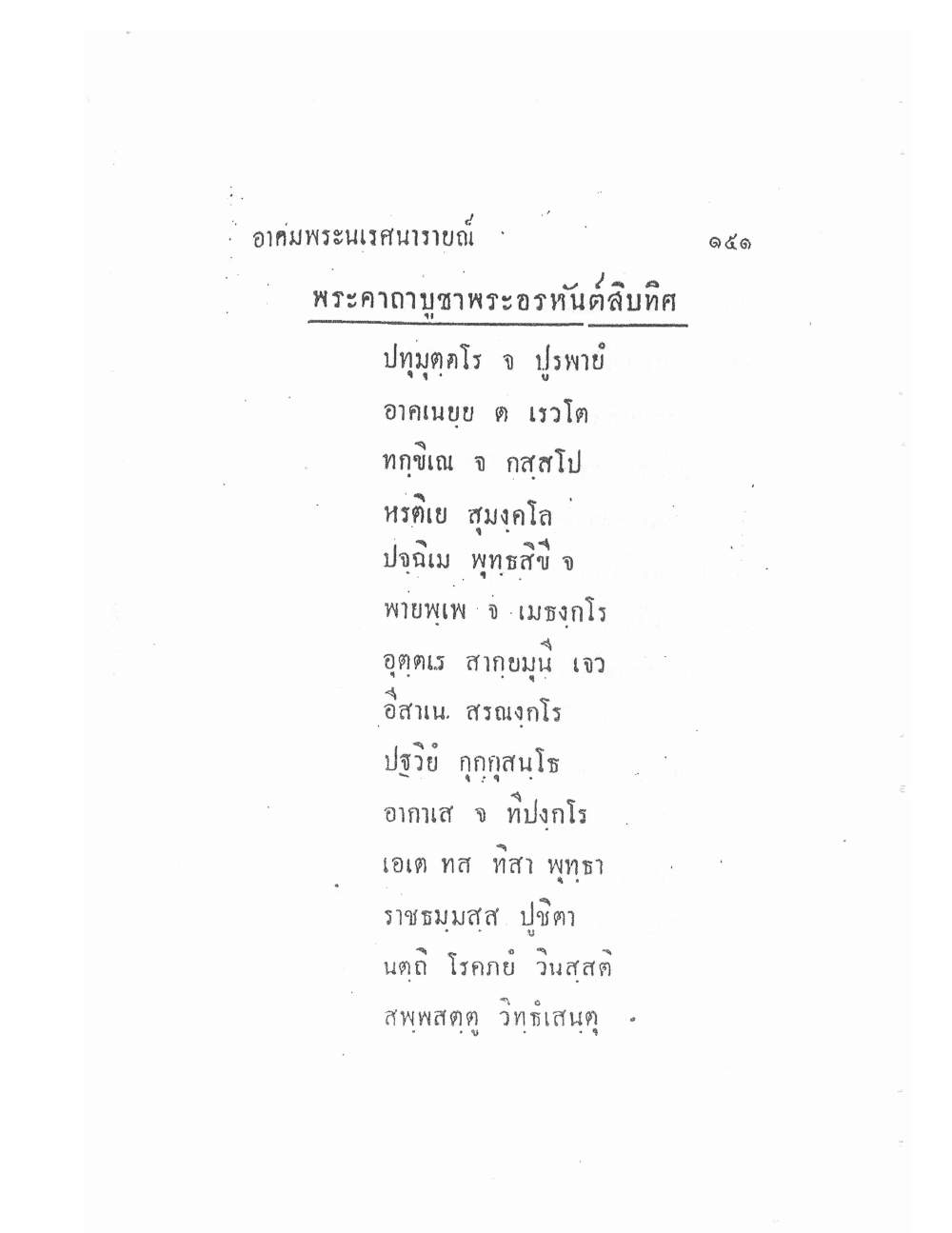
อาคมพระนเรศนารายณ์ ๑๕๑
พระคาถาบูชาพระอรหันต์สิบทิศ
ปทุมุตฺตโร จ ปุรพายํ อาคเนยฺย ต เรวโต ทกฺขิเณ จ กสฺสโป หรติย สุมงฺคโล ปจฺฉิเม พุทฺธสิขี จ พายพฺเพ จ เมธงฺกโร อุตฺตเร สากยมุนี เจว อีสาเน สรณงฺกโร ปฐวิยํ กุกฺกุสนฺโธ อากาเส จ ทีปงฺกโร เอเต ทส ทิสา พุทฺธา ราชธมฺมสฺส ปูชิตา นตฺถิ โรคภยํ วินสฺสติ สพฺพสตฺตุ วิทฺธํเสนฺตุ
Akhom Magic of Phra Naret Narai — page 151
The Verse for Venerating the Arahants of the Ten Directions
[Pali, kept as romanised in Thai script:] "Padumuttaro ca purabāyaṃ, āgaññeyya ta Revato, dakkhiṇe ca Kassapo, haratiya Sumaṅgalo, pacchime Buddhasikhī ca, vāyabbe ca Medhaṅkaro, uttare Sākyamunī ceva, īsāne Saraṇaṅkaro, paṭhaviyaṃ Kukkusandho, ākāse ca Dīpaṅkaro, ete dasa disā buddhā, rājadhammassa pūjitā, natthi rogabhayaṃ vinassati, sabbasattu viddhaṃsentu" — gloss: naming a Buddha or Arahant for each of the ten directions and placing them as protectors of righteous kingship — Padumuttara in the east, Revata in the south-east, Kassapa in the south, Sumangala in the south-west, Buddhasikhī in the west, Medhankara in the north-west, Sakyamuni in the north, Saranankara in the north-east, Kukkusandha below, and Dipankara above — concluding with the wish: may there be no danger of disease, may it be destroyed, and may all enemies be vanquished.
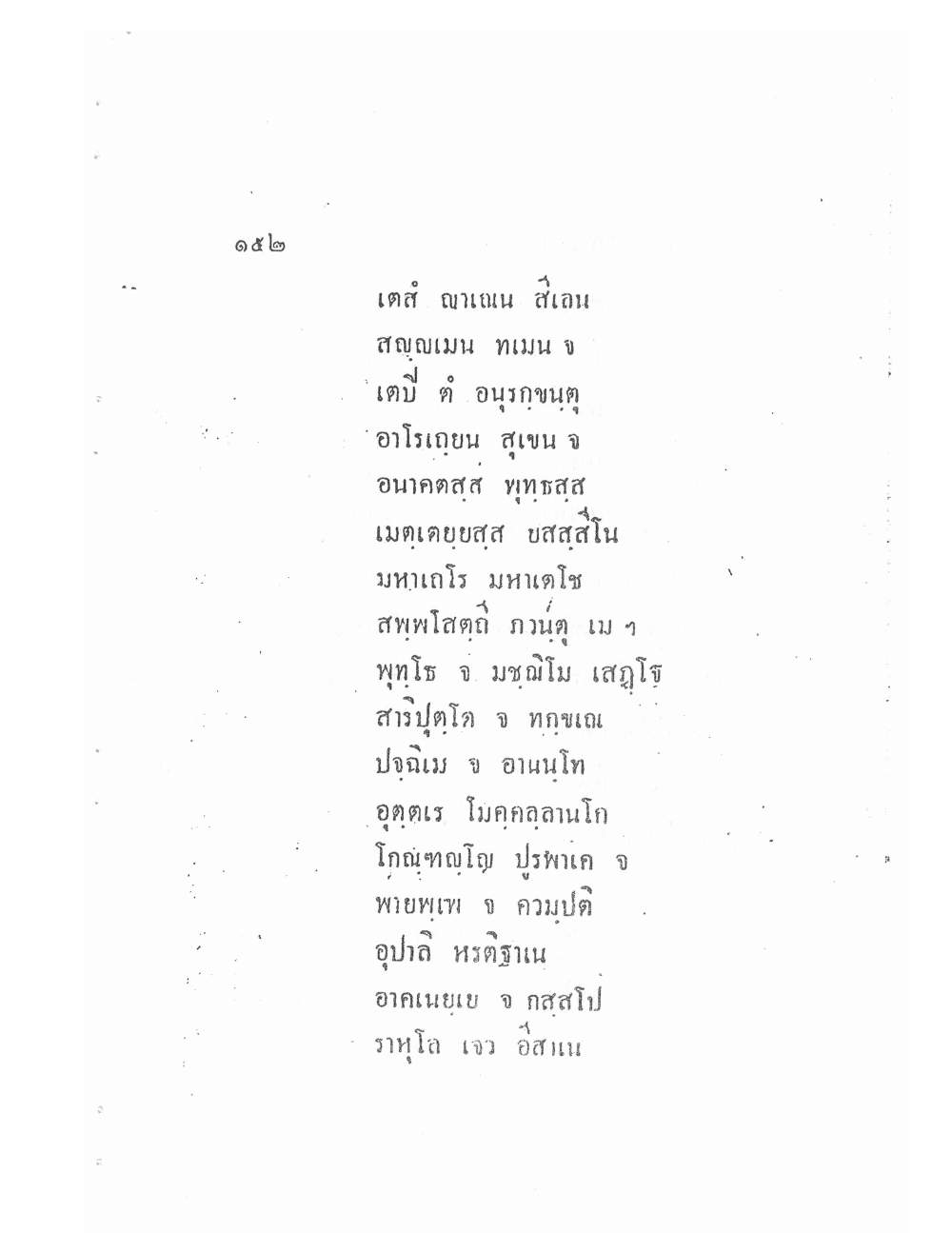
๑๕๒
เตสํ ญาเณน สีเลน สญฺญเมน ทเมน จ เตปิ ตํ อนุรกฺขนฺตุ อาโรเคฺยน สุเขน จ อนาคตสฺส พุทฺธสฺส เมตฺเตยฺยสฺส ยสสฺสิโน มหาเถโร มหาเตโช สพฺพโสตฺถี ภวนฺตุ เม ฯ พุทฺโธ จ มชฺฌิโม เสฏฺโฐ สาริปุตฺโต จ ทกฺขิเณ ปจฺฉิเม จ อานนฺโท อุตฺตเร โมคฺคลฺลานโก โกณฺฑญฺโญ ปุรพาเค จ พายพฺเพ จ ควมฺปติ อุปาลิ หรติฏฺฐาเน อาคเนยฺเย จ กสฺสโป ราหุโล เจว อีสาเน
152
[Continuing the same verse from the preceding page.] Pali, kept as romanised in Thai script: "Tesaṃ ñāṇena sīlena, saññamena damena ca, te pi taṃ anurakkhantu, ārogyena sukhena ca, anāgatassa Buddhassa Metteyyassa yasassino, mahāthero mahātejo, sabbasotthī bhavantu me. Buddho ca majjhimo seṭṭho, Sāriputto ca dakkhiṇe, pacchime ca Ānando, uttare Moggallānako, Koṇḍañño purabhāge ca, vāyabbe ca Gavampati, Upāli haratiṭṭhāne, āgaññeyye ca Kassapo, Rāhulo ceva īsāne" — gloss: by their wisdom, virtue, restraint and self-mastery, together with the power of the future Buddha, the glorious Metteyya, the Great Elder of great majesty, may they all watch over and protect [the bearer] with health and happiness, and may every kind of well-being come to me. The verse then places the Buddha himself, foremost, at the centre; Sariputta in the south; Ananda in the west; Moggallana in the north; Kondañña toward the east; Gavampati in the north-west; Upali in the south-west; Kassapa in the south-east; and Rahula in the north-east.
อาคมพระนเรศนารายณ์ ๑๕๓
สพฺเพ เต พุทฺธมงฺคลา โย ฌตฺวา ปูชิโต โลเก นิทฺทุกฺโข นิรุปทฺทโว มหาเตโช สทา โหนฺตุ สพฺพโสตฺถี ภวนฺตุ เม ฯ
พระคาถาบทนี้เรียกว่า พระคาถาพระอรหันต์สิบทิศ หรือเรียกอีกอย่างหนึ่งว่า พุทธมงคล สำหรับสวดบูชาพระทุกคืน เป็นการป้องกันภัยอันตรายที่จะมาเบียดเบียนเรา และป้องกันได้หมดทุกทิศ ภัยจะมาทางทิศใดก็คุ้มกันได้หมด พระคาถานี้จะเขียนใส่ผ้าขาวผ้าแดงปิดตามประตูบ้าน หรือทำเป็นธงแขวนไว้กลางบ้านก็ได้
คาถาพระอินทร์
สกฺโก โอสกำ พุทฺธโฆสาจารย์ สิตฺตาย สิหฬภาสา
Akhom of Phra Naresuan-Narai 153
[Pali verse:] Sabbe te buddhamaṅgalā / yo ñatvā pūjito loke / niddukkho nirupaddavo / mahātejo sadā hontu / sabbasotthī bhavantu me. (Roughly: "All these are blessings of the Buddha, honoured by one who has known them in the world. Free of suffering, free of affliction, may great glory always be, may complete well-being be mine.")
This verse is called the Verse of the Ten-Direction Arahants, or is also known by another name, the Buddha-Blessing (Phutthamongkhon). It is for chanting in homage to the Buddha every night. It protects against dangers that would come to trouble us, warding them off from every direction — whichever direction harm comes from, it is fully guarded against. This verse may be written on white or red cloth and posted at the house gate, or made into a banner and hung in the middle of the house.
The Verse of Indra
[Opening lines of a Pali-style formula, said to have been given by Indra — continued and explained on the next page:] "Sakko osakaṃ Buddhaghosācāriya, sittāya sīhaḷabhāsā" [some syllables not confidently legible].
๑๕๔
พระคาถาบทนี้ พระอินทร์ถวายพระพุทธโฆสาจารย์ เมื่อไปแปลพระธรรมเมืองลังกาเป็นภาษาสิงหฬ เสกส้มอก็ได้ เสกพริกไทยก็ได้ เสกว่านก็ได้ แล้วกินเถิดจะเกิดบัญญาเลิศ ปราชญ์เปรื่องวิเศษกว่าคนทั้งหลาย
อิจฺเจว โมคฺคลฺลาโน นรอคฺคิ ปวตฺเตสิ เตโชธาตุ สมาหิตา
พระคาถาทั้งสองข้างต้นนี้ ในตำราท่านบอกว่าใช้ได้ทุกอย่างตามแต่จะใช้เสก จะเสกยากินแก้โรคก็ดี จะเสกเป่าดับพิษไฟ น้ำร้อนรวก ไฟรวก ถอนพิษได้ทั้งนั้น
พระคาถามหาประสาน
จตุตาโร ยถา ปตฺโต เอโก ปตฺโต อธิฏฺฐามิ
พระคาถาบทนี้ ได้เมื่อพระพุทธเจ้าจะทรงรับข้าวปายาสที่นางสุชาดาน้อมเข้าไปถวาย พระองค์ไม่มีบาตรจะ...
154
This verse was given by Indra to the elder Buddhaghosa when he went to translate the Dhamma in the land of Lanka into the Sinhalese language. It may be used to charm a lime, to charm black pepper, or to charm a medicinal herb (wan); eating it afterward brings outstanding intelligence — one becomes a sage more excellent than all other people.
[Pali verse:] "Icceva Moggallāno / naraggi pavattesi / tejodhātu samāhitā" (roughly: "Thus indeed did Moggallāna set forth the fire; the fire-element is well composed/gathered.")
As for these two verses above, the treatise says they may be used for anything one wishes to charm: charming medicine to be drunk as a cure for illness is good, and charming and blowing to extinguish the poison of fire, of scalding water, of the stinging rovak-plant, or of fire-rovak — it draws out the poison in every case.
The Great-Mending Verse
[Pali verse:] "Catutāro yathā patto / eko patto adhiṭṭhāmi" ("As the four bowls became as one bowl, I resolve upon one bowl.")
This verse arose at the time the Buddha was about to accept the milk-rice porridge that Lady Sujātā respectfully brought forward to offer him. The Lord had no alms bowl to... [continues on the next page]
อาคมพระนเรศนารายณ์ ๑๕๕
รับ จึงร้อนถึงท้าวจาตุมหาราชทั้งสี่ คือ ท้าวธตรฐ ท้าววิรุฬหก ท้าววิรูปักข์ ท้าวกุเวร ต่างองค์ต่างนำบาตรเข้ามาน้อมถวายพระพุทธองค์ องค์ละหนึ่งใบรวมเป็นบาตรถึง ๔ ใบ พระพุทธองค์จึงทรงอธิษฐานบาตรทั้ง ๔ ใบนั้นรวมเข้าเป็นใบเดียว
พระคาถานี้สำหรับประสานรอยแตกรอยร้าวต่าง ๆ ประสานกระดูกที่หักที่แตก ประสานแผล ประสานเนื้อหนังในร่างกายให้ติดกัน ถ้าใครจะทำท่านให้เรี่ยเอาขวัญข้าวหกสลึง เสกน้ำมันหนักหนึ่งบาท แล้วให้ทำยาประคบมหาประสานกระดูกหัก ท่านให้เอามะขามเปียก ๑ ผัก เบี้ยใหญ่ ๑ กระทือ ๑ ไพล ๑ เกลือ ๑ ยาทั้ง ๕ สิ่งนี้ตำให้ละเอียด แล้วเอายาห่อผ้าให้แน่น แล้วเอากะทะตั้งไฟให้อุ่น ๆ เอาห่อยาแคะกะทะแล้วประคบเถิด เสร็จแล้วให้เสกน้ำมันเตรียมไว้ เอาเข้าเฝือก ๓ วัน แล้วจึงแก้เฝือกเสียแล้วทาด้วยน้ำมันไปจนกว่าจะหาย
Akhom of Phra Naresuan-Narai 155
...having received them, [the Buddha's need] became urgent, and so it reached the Four Great Kings — namely King Dhataraṭṭha, King Virūḷhaka, King Virūpakkha, and King Kuvera. Each of them brought a bowl to respectfully offer to the Buddha, one bowl apiece, four bowls altogether. The Buddha then resolved that the four bowls should merge into a single bowl.
This verse is for mending cracks and various fissures — for knitting broken or fractured bones together, for closing wounds, and for joining the flesh and skin of the body. If anyone wishes to use it: collect a khwan-offering of six satang worth of rice, charm one baht-weight of oil, then make a poultice medicine, the "Great Mending" medicine for broken bones. Take: one piece of tamarind pulp, one large cowrie shell, one piece of krathue (a ginger relative), one piece of phlai (a ginger relative), and one piece of salt. Pound these five ingredients finely, then wrap the medicine tightly in cloth. Set a pan over the fire to warm it, place the medicine-bundle in the heated pan, and apply it as a compress. When done, have the charmed oil ready; splint the limb for three days, then remove the splint and rub with the oil until it heals.
๑๕๖
คาถาพระจักขุ
จกฺขุนฺตา ชิวฺหายนฺตํ อิถิมา ปิยํ มม
พระคาถานี้ ภาวนาเรียกคนที่รักใคร่ให้มาหาเราประเสริฐนัก หรือจะใช้ประสานเนตร ตามตำราท่านว่าดีนักแล
พระคาถาพ่นตะมอย
โอมตะมอย มหาตะมอย สวาหะ
พระคาถานี้สำหรับใช้พ่นตะมอย ให้ภาวนาพระคาถานี้พ่นตะมอย ๓ จบ ในตำราท่านว่าดีนักแล ได้ทำแล้วอย่าสนเท่ห์เลย
156
The Eye Verse
[Pali-style verse:] "Cakkhuntā / jivhāyantaṃ / itthimā piyaṃ mama" (roughly concerning eyes and tongue, and: "may women be dear to me / come to me").
This verse, when recited, calls the one you love to come to you — most excellent. Or it may be used for joining/mending the eyes. According to the treatise, it is said to be very good indeed.
The Verse for Blowing on a Stye
"Om tamoi, mahā tamoi, svāhā."
This verse is for blowing on a stye (tamoi, a swelling on the eyelid). Recite this verse while blowing on the stye three times. The treatise says it is very effective indeed — having done it, do not doubt it.
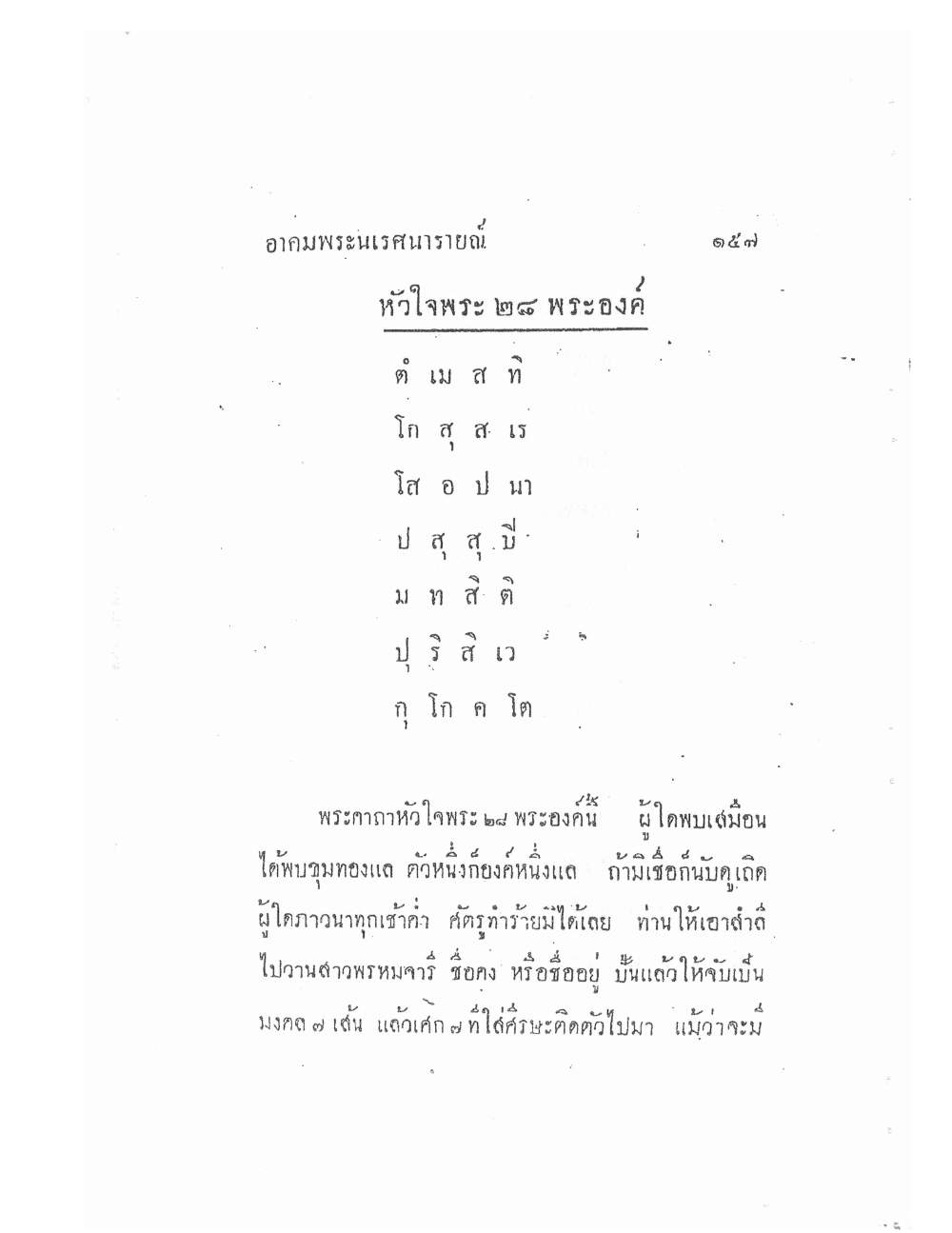
อาคมพระนเรศนารายณ์ ๑๕๗
หัวใจพระ ๒๘ พระองค์
ตำ เม ส ทิ โก สุ ส เร โส อ ป นา ป สุ สุ บี ม ท สิ ติ ปุ ริ สิ เว กุ โก ค โต
พระคาถาหัวใจพระ ๒๘ พระองค์นี้ ผู้ใดพบเสมือนได้พบขุมทองแล ตัวหนึ่งก็องค์หนึ่งแล ถ้าเชื่อกันนับถือเถิด ผู้ใดภาวนาทุกเช้าค่ำ ศัตรูทำร้ายมิได้เลย ท่านให้เอาด้ายไปวานสาวพรหมจารีชื่อคง หรือชื่ออยู่ ปั่นแล้วให้จับเป็นมงคล ๗ เส้น แล้วเสก ๗ ทีใส่ศีรษะคิดตัวไปมา แม้ว่าจะมี...
Akhom of Phra Naresuan-Narai 157
The Heart-Syllables of the 28 Buddhas
[Table of syllables, one per Buddha, arranged seven to a row:] Taṃ Me Sa Thi / Ko Su Sa Re / So A Pa Nā / Pa Su Su Bī / Ma Tha Si Ti / Pu Ri Si We / Ku Ko Kha To.
Whoever encounters this verse of the Heart-Syllables of the 28 Buddhas is as if he has found a hoard of gold indeed — one syllable, one Buddha. Let one have faith and revere it. Whoever recites it every morning and evening, enemies can never do him harm. One should have a virgin girl — named Khong, or named Yu — spin thread, then take it up as seven auspicious (mongkhon) strands, charm it seven times, place it upon the head, and it will wind and turn; even should there be...
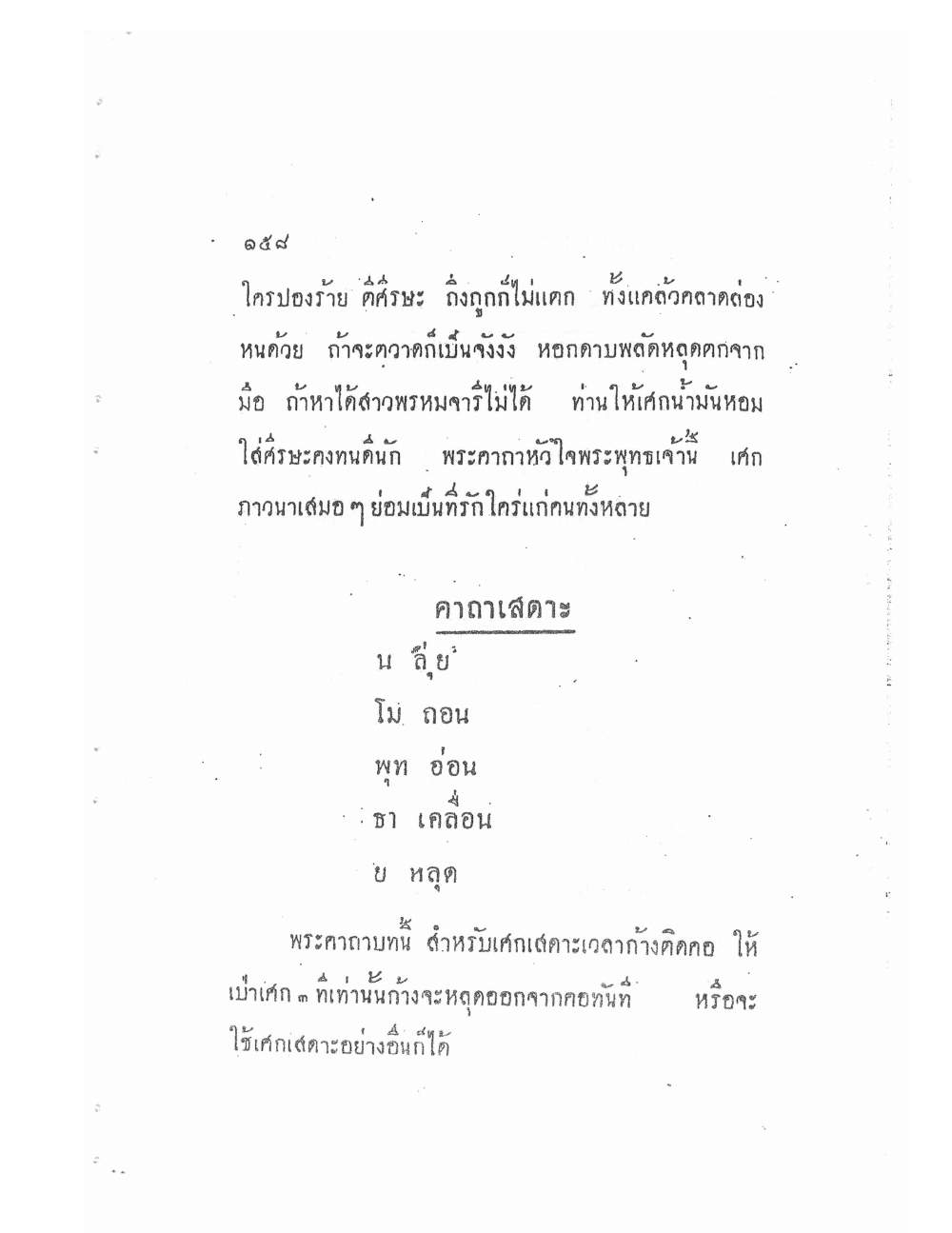
๑๕๘
ใครปองร้ายคิดฆ่า ถึงถูกก็ไม่แตก ทั้งแคล้วคลาดตลอดหน้าด้วย ถ้าจะตวาดก็เป็นจังงัง หอกดาบพลัดหลุดตกจากมือ ถ้าหาสาวพรหมจารีไม่ได้ ท่านให้เสกน้ำมันหอมใส่ศีรษะคงทนดีนัก
พระคาถาหัวใจพระพุทธเจ้านี้ เสกภาวนาเสมอ ๆ ย่อมเป็นที่รักใคร่แก่คนทั้งหลาย
คาถาเสดาะ
น ลุย โม ถอน พุท อ่อน ธา เคลื่อน ย หลุด
พระคาถาบทนี้ สำหรับเสกเสดาะเวลาก้างติดคอ ให้เป่าเสก ๓ ทีเท่านั้น ก้างจะหลุดออกจากคอทันที หรือจะใช้เสกเสดาะอย่างอื่นก็ได้
158
Whoever intends harm and thinks to kill, even if struck, [the blade] will not cut through; one is safe from every mishap throughout as well. Should the attacker try to shout out, he will be struck dumb, and spear and sword will slip and fall from his hand. If a virgin girl cannot be found, one may instead charm fragrant oil and place it on the head — it holds very well.
This Heart-Verse of the Buddha, charmed and recited constantly, naturally makes one beloved by all people.
The Releasing Verse
[Syllables of "Namo Buddhāya" each paired with a verb of release:] Na — wade free; Mo — draw out; Phut — soften; Thā — shift loose; Ya — come free.
This verse is for reciting to release a fish bone stuck in the throat. Blow and recite it just three times, and the bone will come loose from the throat at once. Or it may be used for other kinds of releasing as well.
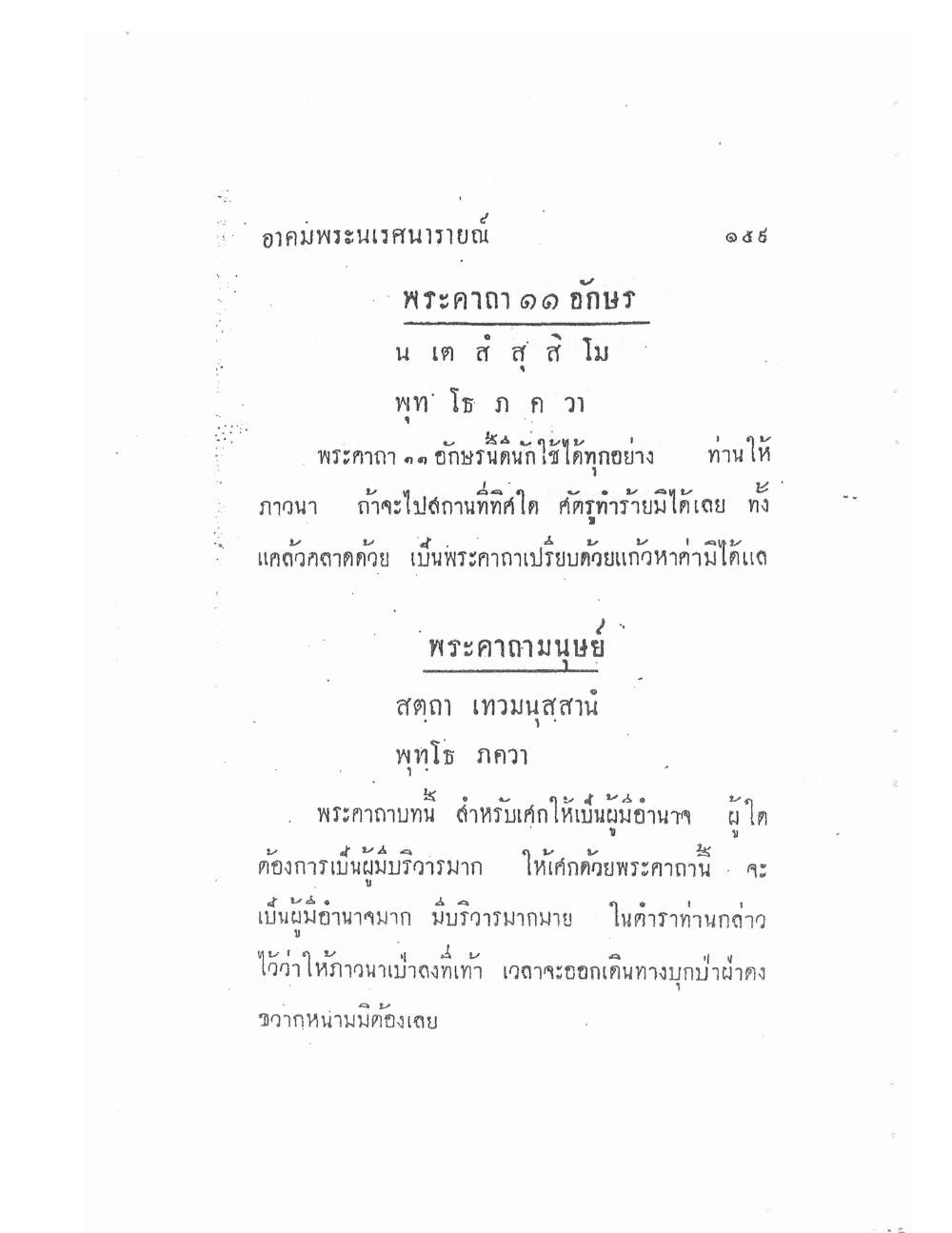
อาคมพระนเรศนารายณ์ ๑๕๙
พระคาถา ๑๑ อักษร
น เต สํ สุ สิ โม พุท โธ ภ ค วา
พระคาถา ๑๑ อักษรนี้ดีนักใช้ได้ทุกอย่าง ท่านให้ภาวนา ถ้าจะไปสถานที่ทิศใด ศัตรูทำร้ายมิได้เลย ทั้งแคล้วคลาดด้วย เป็นพระคาถาเปรียบด้วยแก้วหาค่ามิได้แล
พระคาถามนุษย์
สตฺถา เทวมนุสฺสานํ พุทฺโธ ภควา
พระคาถาบทนี้ สำหรับเสกให้เป็นผู้มีอำนาจ ผู้ใดต้องการเป็นผู้มีบริวารมาก ให้เสกด้วยพระคาถานี้ จะเป็นผู้มีอำนาจมาก มีบริวารมากมาย ในตำราท่านกล่าวไว้ว่าให้ภาวนาเป่าลงที่เท้า เวลาจะออกเดินทางบุกป่าฝ่าดงขวากหนามมิต้องเลย
Akhom of Phra Naresuan-Narai 159
The Eleven-Syllable Verse
"Na te saṃ su si mo / Buddho bhagavā" — an eleven-syllable mnemonic verse.
This eleven-syllable verse is excellent, usable for anything. One should recite it: wherever one travels, in any direction, enemies can never do harm, and one is safe from every mishap besides. It is a verse comparable to a priceless gem indeed.
The Human Verse
"Satthā devamanussānaṃ / Buddho bhagavā" ("[He is] the Teacher of gods and humans, the Blessed Buddha.")
This verse is for charming so as to become a person of authority. Whoever wishes to have many followers should charm with this verse; he will become a person of great authority with many followers. The treatise states that one should recite it while blowing upon the feet before setting out to travel, cutting through forest and jungle — one will never be troubled by thorns.
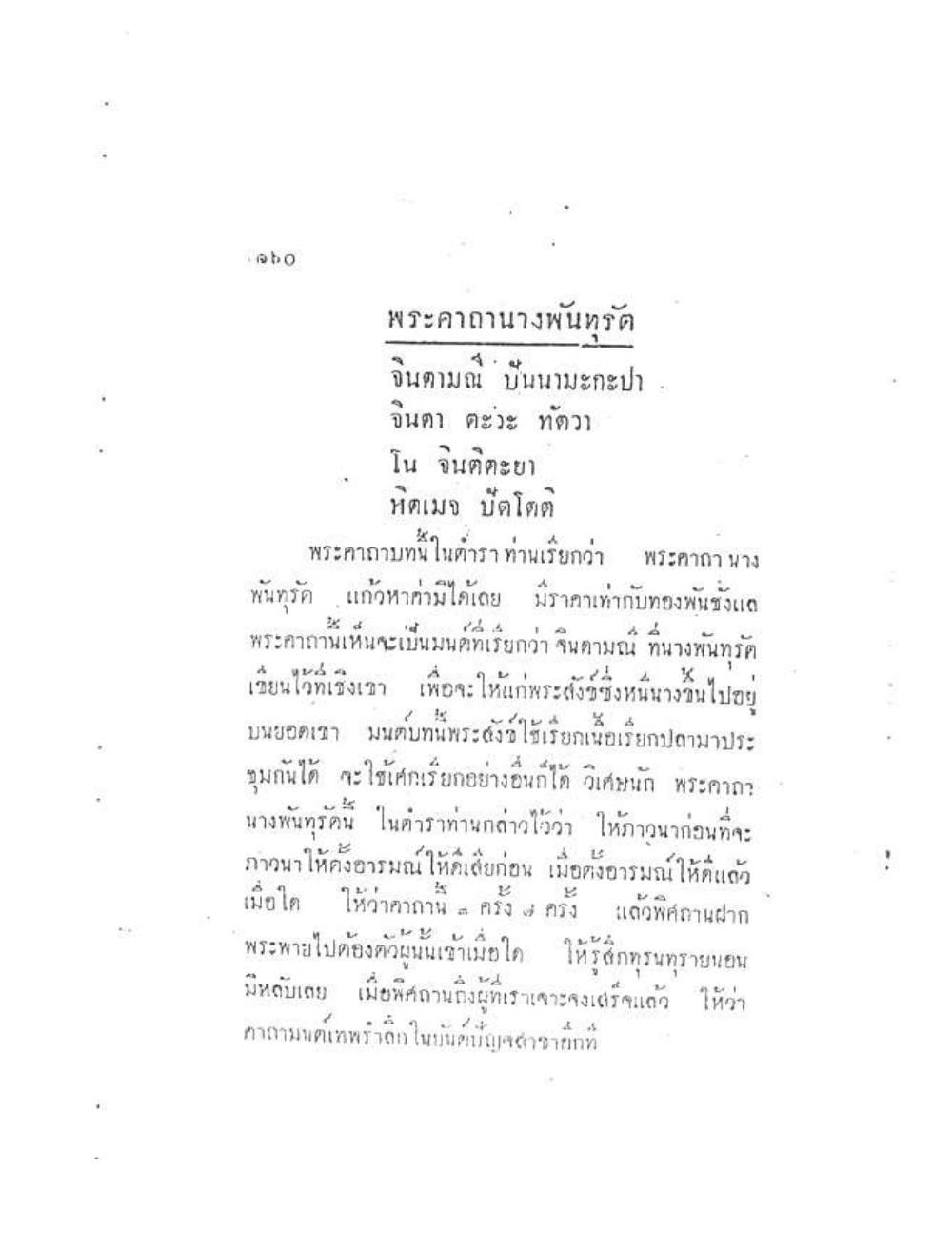
๑๖๐
พระคาถานางพันธุรัค
จินตามณี บันดาลมกกะปา จินดา คะวะ ทัดวา โน จินติตะยา หิตเมจ บัดโตติ
พระคาถาบทนี้ในตำรา ท่านเรียกว่า พระคาถานางพันธุรัค แก้วหาค่ามิได้เลย มีราคาเท่ากับทองพันชั่งแล พระคาถานี้เห็นจะเป็นมนต์เรียกว่า จินดามณี ทำนางพันธุรัคเขียนไว้ที่เชิงเขา เพื่อจะให้แก่พระสังข์ซึ่งหนีนางขึ้นไปอยู่บนยอดเขา มนต์บทนี้พระสังข์ใช้เรียกเนื้อเรียกปลามาประชุมกันได้ จะใช้เสกเรียกอย่างอื่นก็ได้วิเศษนัก พระคาถานางพันธุรัคนี้ ในตำราท่านกล่าวไว้ว่า ให้ภาวนาก่อนที่จะภาวนาให้ตั้งอารมณ์ให้ดีเสียก่อน เมื่อตั้งอารมณ์ให้ดีแล้วเมื่อใด ให้ว่าคาถานี้ ๓ ครั้ง ๗ ครั้ง แล้วพึงสถานฝากพระพายไปต้องตัวผู้นั้นเข้าเมื่อใด ให้รู้สึกทุรนทุรายนอนไม่หลับเลย เมื่อพึงสถานถึงผู้ที่เราเจาะจงเสร็จแล้ว ให้ว่าคาถามนต์เทพราชิกในนั้นเป็นอันจบสายกิน...
160
The Verse of Nang Phanthurat
[Mantra syllables, meaning uncertain in several places — a wish-granting-gem (chintāmaṇī) invocation:] "Chintamani bandal mokkapa / chinda khawa thatwa / no chintitaya / hitmet battoti."
This verse the treatise calls the Verse of Nang Phanthurat — a gem beyond price, worth as much as a thousand chang-weights of gold. This verse appears to be the spell called Chintamani, which Nang Phanthurat wrote out at the foot of the mountain so as to give it to Phra Sang, who had fled from her to dwell atop the mountain. With this spell Phra Sang could call the animals of the forest and the fish to gather together; it may also be used to summon other things — most wondrous indeed. Regarding this Verse of Nang Phanthurat, the treatise states: before reciting, one must first settle one's mind and feelings well. Once the mind is well settled, recite this verse three times, seven times, then entrust it, borne upon the wind, so that it reaches the body of the intended person. Once it reaches them, they will feel restless and unable to sleep at all. When it has reached the one we intend, recite the mantra of the ruling deities within it, and with that it is complete... [text continues]
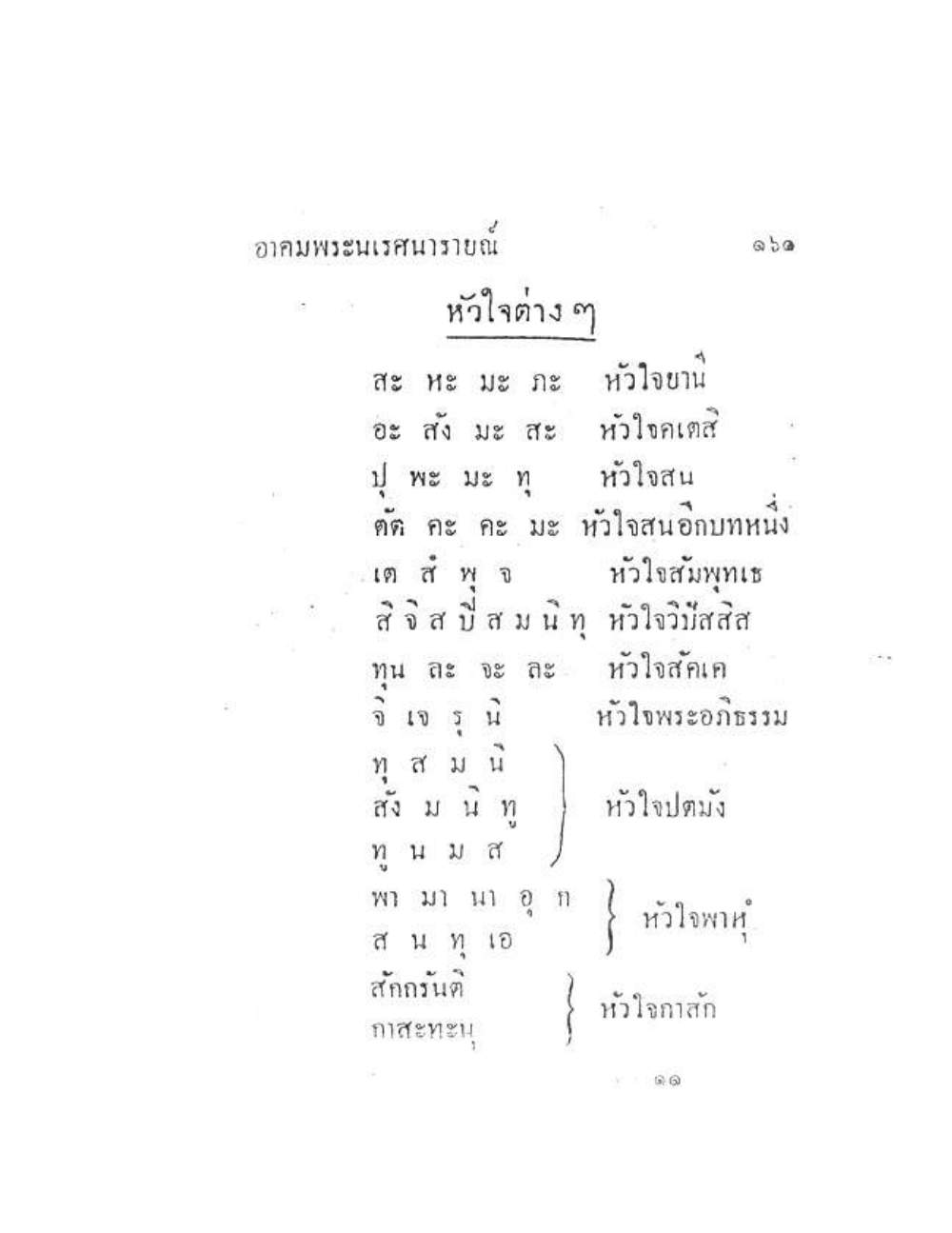
อาคมพระนเรศนารายณ์ ๑๖๑
หัวใจต่าง ๆ
สะ หะ มะ ภะ หัวใจยาน อะ สัง มะ สะ หัวใจคเนสิ ปุ พะ มะ ทุ หัวใจสน ตัด คะ คะ มะ หัวใจสนอีกบทหนึ่ง เต สํ พุ จ หัวใจสัมพุทเธ สิ เจ ส บี ส ม นิ ทุ หัวใจวิมุสสิส ทุน ละ จะ ละ หัวใจสัคเค จิ เจ รุ นิ หัวใจพระอภิธรรม ทุ ส ม นิ สัง ม นิ ทู } หัวใจปถมัง ทู น ม ส พา มา นา อุ ก ส น ทุ เอ } หัวใจพาหุง สักกรันติ กาสะทะนุ } หัวใจกาสัก
Akhom of Phra Naresuan-Narai 161
Various Heart-Syllables
[A table pairing groups of mnemonic syllables with the name of the formula they stand for:] Sa Ha Ma Pha — Heart of the Vehicle (Yan) A Saṅ Ma Sa — Heart of Khanesi Pu Pha Ma Thu — Heart of Son (Tranquility) Tat Kha Kha Ma — Heart of Son, another version Te Saṃ Phu Ja — Heart of Sambuddhe Si Je Sa Bī Sa Ma Ni Thu — Heart of Vimutti(sa) Thun La Ja La — Heart of Sagge (Heaven) Ji Je Ru Ni — Heart of the Abhidhamma Thu Sa Ma Ni / Saṅ Ma Ni Thū / Thū Na Ma Sa (grouped together) — Heart of Patthamang Phā Mā Nā U Ka / Sa Na Thu E (grouped together) — Heart of Phahung Sakkarantī / Kāsathanu (grouped together) — Heart of Kasak
[The syllable-mnemonics themselves are kept as printed; only the name of each formula is translated above.]
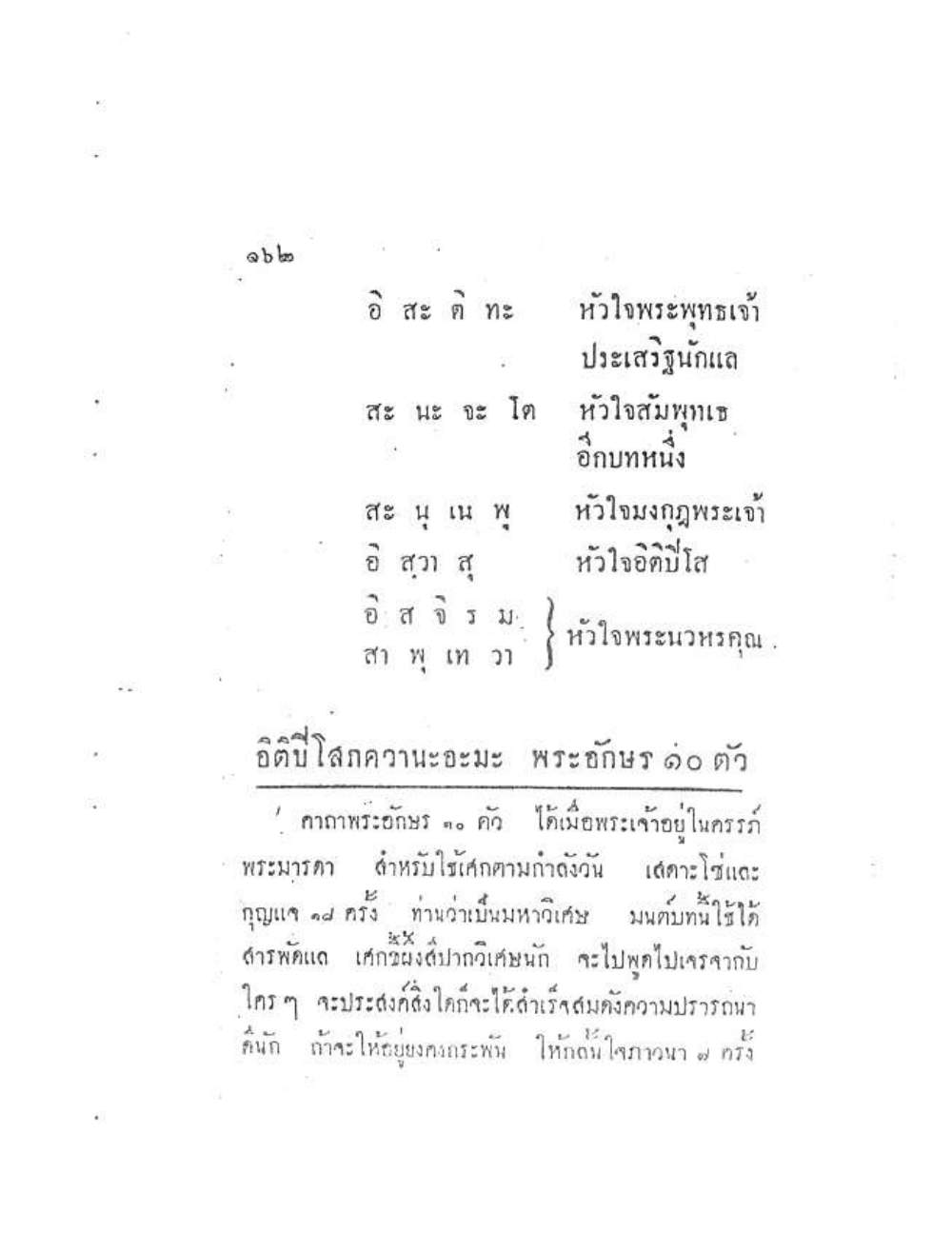
๑๖๒
อิ สะ ติ ทะ หัวใจพระพุทธเจ้าประเสริฐนักแล สะ นะ จะ โต หัวใจสัมพุทเธอีกบทหนึ่ง สะ นุ เน พุ หัวใจมงกุฎพระเจ้า อิ สวา สุ หัวใจอิติปิโส อิ ส จิ ร ม สา พุ เท วา } หัวใจพระนวหรคุณ
อิติปิโสภควานะอะมะ พระอักษร ๖๐ ตัว
คาถาพระอักษร ๖๐ ตัว ได้เมื่อพระเจ้าอยู่ในครรภ์พระมารดา สำหรับใช้เสกตามกำลังวัน เสกยาโซ่และกุญแจ ๘ ครั้ง ท่านว่าเป็นมหาวิเศษ มนต์บทนี้ใช้ได้สารพัดแล เสกผงปิดปากวิเศษนัก จะไปพูดไปเจรจากับใคร ๆ จะประสงค์สิ่งใดก็จะได้สำเร็จสมดังความปรารถนาทั้งนัก ถ้าจะให้อยู่ยงคงกระพัน ให้กดลิ้นภาวนา ๗ ครั้ง...
162
[Table continued:] I Sa Ti Tha — Heart of the Buddha, most excellent indeed Sa Na Ja To — Heart of Sambuddhe, another version Sa Nu Ne Phu — Heart of the Lord's Crown (Mongkut) I Swā Su — Heart of Itipiso I Sa Ji Ra Ma / Sā Phu Te Wā (grouped together) — Heart of the Nine Buddha-Virtues (Nawaharakhun)
Itipiso Bhagavā Na Ama — The Sixty-Letter Formula
This sixty-letter verse was obtained while the Lord [Buddha] was still in his mother's womb. It is to be charmed according to the strength/influence of the day [of the week]; charm a chain and lock with it eight times, and it is said to be greatly wondrous. This spell can be used for all manner of things: charming a powder to seal one's mouth is most excellent — when going to speak or negotiate with anyone, whatever one desires will be achieved just as wished for. If one wishes to become invulnerable, press [something with] the tongue while reciting seven times... [text continues]
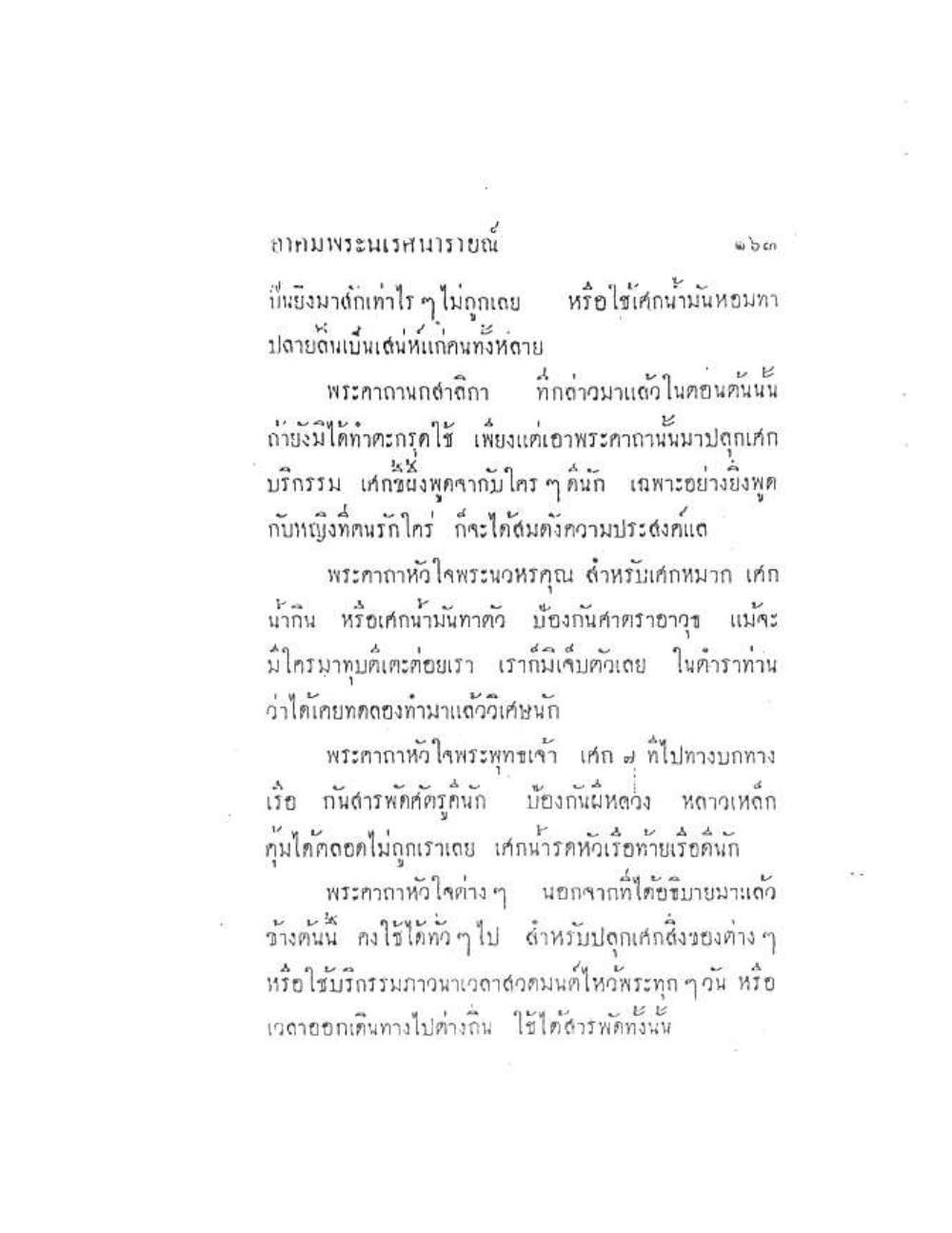
อาคมพระนเรศนารายณ์ ๑๖๓
เป็นยิ่งมากนักเท่าไร ๆ ไม่ถูกเลย หรือใช้เสกน้ำมันหอมทาปลายด้ามเป็นเสน่ห์แก่คนทั้งหลาย
พระคาถานกสาลิกา ที่กล่าวมาแล้วในตอนต้นนั้น ถ้ายังไม่ได้ทำตะกรุดใช้ เพียงแต่เอาพระคาถานั้นมาปลุกเสกบริกรรม เสกจึงพูดจากับใคร ๆ ดีนัก เฉพาะอย่างยิ่งพูดกับหญิงที่ตนรักใคร่ ก็จะได้สมดังความประสงค์แล
พระคาถาหัวใจพระนวหรคุณ สำหรับเสกหมาก เสกน้ำกิน หรือเสกน้ำมันทาตัว ป้องกันศาสตราอาวุธ แม้จะมีใครมาทุบตีเตะต่อยเรา เราก็ไม่เจ็บตัวเลย ในตำราท่านว่าได้เคยทดลองทำมาแล้ววิเศษนัก
พระคาถาหัวใจพระพุทธเจ้า เสก ๗ ทีไปทางบกทางเรือ กันสารพัดศัตรูดีนัก ป้องกันผีหลอก หลาวเหล็กคุ้มได้ตลอดไม่ถูกเราเลย เสกน้ำรดหัวเรือท้ายเรือดีนัก
พระคาถาหัวใจต่าง ๆ นอกจากที่ได้อธิบายมาแล้วข้างต้นนี้ คงใช้ได้ทั่ว ๆ ไป สำหรับปลุกเสกสิ่งของต่าง ๆ หรือใช้บริกรรมภาวนาเวลาสวดมนต์ไหว้พระทุก ๆ วัน หรือเวลาออกเดินทางไปต่างถิ่น ใช้ได้สารพัดทั้งนั้น
Akhom of Phra Naresuan-Narai 163
However great [an attack], it will never once strike true. Or one may charm fragrant oil and rub it on the tip of a handle, as a charm of allure for all people.
As for the Myna-Bird (Nok Salika) verse mentioned earlier at the beginning — if one has not yet made it into an amulet cord to wear, one need only take up that verse to consecrate and recite silently; charming it makes conversing with anyone go very well, especially so when speaking with a woman one loves — one's wish will be fulfilled just as desired.
The Heart-Verse of the Nine Buddha-Virtues: for charming betel-nut, for charming drinking water, or for charming oil to rub on the body — it protects against weapons. Even should someone come to beat, kick, or strike us, we will feel no pain at all. The treatise says this has been tested many times and found most excellent.
The Heart-Verse of the Buddha: recite it seven times before travelling by land or by water — it wards off every kind of enemy very well, protects against ghosts and apparitions, and iron spears cannot touch us at all throughout the journey. It is also excellent for charming water to sprinkle on the bow and stern of a boat.
As for the various other Heart-Verses, beyond what has already been explained above, they may generally be used for consecrating various objects, or recited silently as a mantra during daily prayers and the paying of respect to the Buddha, or when setting out to travel to other places — they may be used for anything at all.
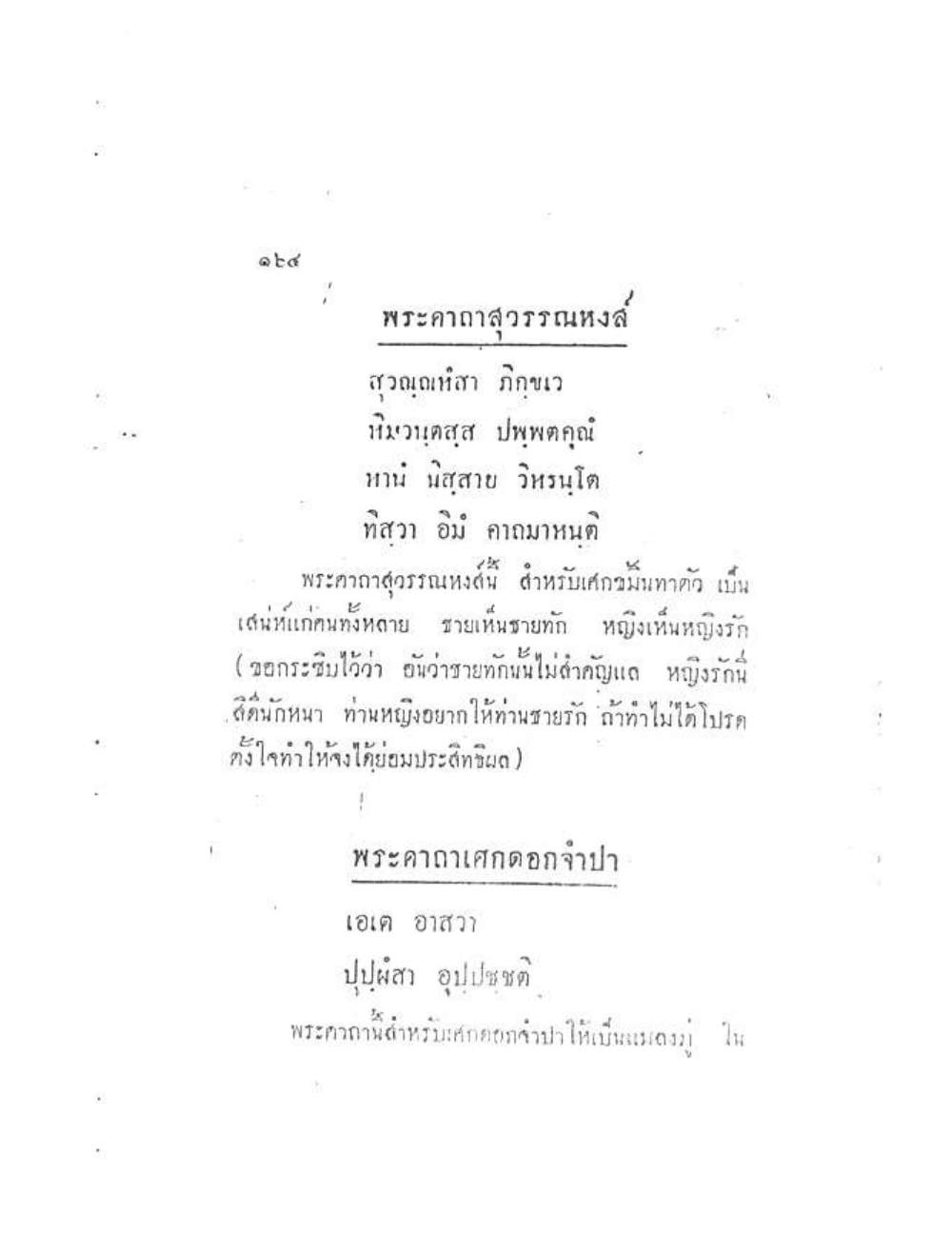
๑๖๔
พระคาถาสุวรรณหงส์
สุวณฺณเห สา ภิกฺขเว หิงฺวนฺตสฺส ปพฺพตคุณํ หานํ นิสฺสาย วิหรนฺโต ทิสฺวา อิมํ คาถามหนฺติ
พระคาถาสุวรรณหงส์นี้ สำหรับเสกขมิ้นทาตัว เป็นเสน่ห์แก่คนทั้งหลาย ชายเห็นชายทัก หญิงเห็นหญิงรัก (ขอกระซิบไว้ว่า อันว่าชายทักนั้นไม่สำคัญแต หญิงรักนี้สำคัญนักหนา ท่านหญิงอยากให้ท่านชายรัก ถ้าทำไม่ได้โปรดกังใจทำให้จงได้ย่อมประสิทธิผล)
พระคาถาเสกดอกจำปา
เอเต อาสวา ปุปฺผสา อุปฺปชฺชติ
พระคาถานี้สำหรับเสกดอกจำปาให้เป็นแมงภู่ ใน...
164
The Golden Swan Verse
[Pali-style verse:] "Suvaṇṇahe sā bhikkhave / hiṅgavantassa pabbataguṇaṃ / hānaṃ nissāya viharanto / disvā imaṃ gāthā mahantī" [some syllables uncertain; roughly concerning a golden swan dwelling by virtue of a mountain, and one who has seen this great verse].
This Golden Swan verse is for charming turmeric to rub on the body, making it a charm of allure to all people: a man who sees [the wearer] will greet him, a woman who sees him will love him. (Let me whisper this aside: as for a man's greeting, it does not matter so much, but a woman's love matters a great deal indeed. If a lady wishes for a gentleman to love her and cannot manage it on her own, let her set her heart firmly upon it and it will surely take effect.)
The Verse for Charming a Champa Flower
[Pali-style verse:] "Ete āsavā / pupphasā uppajjati" ("These essences arise from the flower.")
This verse is for charming a champa flower so that it becomes a bumblebee, in... [the sentence is cut off at the bottom of the page and continues onto the following page, which is outside this set]
อาคมพระนเรศนารายณ์ ๑๖๕ คำราท่านบอกว่าได้เคยทำเคยใช้มาแล้ว พระอาจารย์อยู่วัดชัยชนะสงคราม อย่าได้สงสัยสนเท่ห์เลย
พระคาถาพระสามเณร
สุมนสามเณโรติ มํ ธาเรตุ อานุภาโว
พระคาถาบทนี้ เป็นพระคาถาที่สามเณรลงไปหาพระเถระอุปคุต ซึ่งจำพรรษาอยู่ ณ นาคพิภพ พระคาถาบทนี้สามารถจะหายตัวได้ แปลงรูปก็ได้ บังเหรียญก็ได้ ให้กลั้นใจภาวนา ๑ ครั้ง แล้วลงดำน้ำ น้ำจะมิเข้าจมูกและปากเลย ใช้ดำลงในน้ำหาของตกในน้ำดีนัก
พระคาถานางพระธรณี
จตุภูตา มหาภูตา จิตติยา เอหิ เอหิ พนธุ พุทธา มสาปิโน
Akhom of Phra Narai [running header] — 165 [folio number] The teacher's own words say this has truly been done and used before; the presiding master lives at Wat Chai Chana Songkhram — do not doubt it in the least.
The Novice Monk's Mantra
Sumana-sāmaṇero-ti Maṃ dhāretu ānubhāvo
This is the mantra the novice monk used when he went down to see the elder Upagutta, who keeps the rains-retreat in the nāga realm [under the water]. With it one can become invisible, change one's shape, or make a coin vanish from sight. Hold the breath and recite it once, then dive into the water — water will not enter the nose or mouth. Very good for diving to search for things that have sunk in the water.
The Mantra of Lady Dharani (the Earth Goddess)
Catubhūtā mahābhūtā Cittiyā ehi ehi Bandhu buddhā masāpino [These lines are mantra syllables; no further gloss is given on the page.]
๑๖๖ พระคาถานางพระธรณีนี้ สำหรับภาวนาเรียกภูตของสตรี หรือจิตของสตรี ใช้ได้ ๑๐๘ คาบ แต่จะใช้เกินหาค่ามิได้เลย (คือว่าค่าปริมาณมิได้)
พระคาถามหาประสานนัย
จตุตาโร ยถา เอโก ปตุโต ตถาคโต อธิฏฐามิ
พระคาถานี้เป็นพระคาถามหาประสานบาตร ๔ ใบ ซึ่งพระพุทธเจ้าประสานเป็นใบเดียวกัน วิธีใช้เหมือนอย่างที่กล่าวมาแล้วข้างต้น
หัวใจพระทศชาติ
เตชสุเนม ภูจนาวิเจ ภูมโจอิติ สุโภสวณกโต
166 This Mantra of Lady Dharani is for reciting to summon the spirit (phi) of a woman, or the mind of a woman. It may be recited 108 times, but its worth cannot be measured — that is, it is beyond price.
The Great Mantra of Joining
Catutāro yathā eko patuto Tathāgato adhiṭṭhāmi
This is the great mantra by which the Buddha joined four alms-bowls into a single bowl. The method of use is the same as described above.
The Heart-Syllables of the Ten Birth Tales (Thotsachat)
Te cha su ne ma Phu ja na wi je Phu ma cho i ti Su pho sa wa na ka to [A mnemonic "heart" verse, one syllable drawn from each of the Buddha's Ten Great Birth Tales; no further gloss is given on the page.]
อาคมพระนเรศนารายณ์ ๑๖๗ หัวใจพระทศชาตินี้ ท่านให้เอาบุหรี่หรือยามาเสกกินแล้ว ยิงฟันแทงมิเข้าเลย, ได้ใช้ทดลองมามากแล้วอย่าสนเท่ห์เลย วิเศษนัก
พระคาถาเสกข้าว
ปเจสนุจนุโต ปกาเสนติ เวสสวณุโณ ปวุจฺจติ
พระคาถานี้สำหรับเสกข้าวเปลือก ข้าวสาร เสกมงคลส่วม ซัดผีได้ ผีให้ออกจากตัวคน
พระคาถาสะกดมิให้
ตถา ทวราชา อติปิโส ภควา อติมนตา ชยุยยา มนตา อติภควา
Akhom of Phra Narai — 167 Regarding the Heart-Syllables of the Ten Birth Tales: consecrate a cigarette or medicine with this mantra and have the person eat/smoke it; thereafter, gunshot, blade, and stabbing weapons cannot penetrate the body. This has been tested and proven many times over — do not doubt it, it is especially potent.
Mantra for Consecrating Rice
Pacesanujanto pakāsenti Vessavaṇo pavuccati
This mantra is for consecrating unhusked rice or milled rice, for blessing a boundary/threshold, and for casting out a spirit — to drive a ghost out of a person's body.
Mantra to Restrain [an Enemy] From [Acting] (title as printed, incomplete)
Tathā dvārājā Atipiso bhagavā Atimantā chayuyyā Mantā atibhagavā [Mantra syllables; no explanatory prose given on this page.]
๑๖๘
พระคาถามหาช้าง
โอ หตฺถิ นาคโต ราชาหัตถ ๆ
พระคาถามนต์ม้า
โอ อสฺวราชาหัตถ ๆ
พระคาถายักษ์
ทนฺทหิกาโรนุโต อนุตราโย
พระคาถาทั้ง ๓ บทนี้ ถ้าต้องการจะให้คนอื่นเห็นตัวเราเป็นช้าง ก็ให้ภาวนาคาถามหาช้าง ผู้คนทั้งหลายก็จะมองเห็นเราเป็นช้าง ถ้าต้องการจะให้คนอื่นเห็นเราเป็นม้า จงบริกรรมมนต์ม้า คนอื่นก็จะเห็นเราเป็นม้า ถ้าจะให้เห็นเป็นยักษ์ ให้ยืนถือกระบองแล้วบริกรรมพระคาถายักษ์ คนอื่นก็จะมองเห็นตัวเราเป็นยักษ์จริงเสียด้วย
168
The Great Elephant Mantra
Oṃ hatthi nāgato rājā hatthu hatthu
The Horse Mantra
Oṃ assarājā hatthu hatthu
The Yaksha (Ogre) Mantra
Tanta-hikāronuto Anutarāyo
As for these three mantras: if you want other people to see your body as an elephant, recite the Great Elephant Mantra, and everyone will see you as an elephant. If you want others to see you as a horse, recite the Horse Mantra, and others will see you as a horse. If you want to be seen as a yaksha, stand holding a club and recite the Yaksha Mantra, and others will truly see your body as a yaksha as well.
อาคมพระนเรศนารายณ์ ๑๖๙
พระคาถามหาละลวย
ชิหชิวลกปุโป พระคาถานี้เรียกว่าพระคาถาหนึ่งคำถึงทอง ถ้าหญิงร้องขึ้นให้รีบเอาคาถาบทนี้เป่าไปตามปาก ร้องขึ้นมิได้เลย
กาย มุทุตา จิตตมุทุตา พระคาถานี้เสกขมิ้นทาต่อมหญิงรัก
อิสสราชา นาคราชา พระคาถานี้เป่าผู้หญิงรักเรา
จกฺขุวทุกายจิตตํ อิตฺถยํ ปิยงฺนม พระคาถาบทนี้เป่าหญิง ประสพเนตรดื่นักแล
มะอะอุ จิตมึงมานี้ อมนุสฺสนฺติ พระคาถานี้เรียกจิตหญิงดื่นัก
ภูตะ ภูตา เอหิ มามา อาคจฺฉาหิ พระคาถาบทนี้สำหรับเรียกภูตหญิง เมื่อจะใช้คาถาเรียกจิตหญิง ให้ใช้พระคาถาเรียกภูตหญิงบทนี้เสียก่อน จึงภาวนาคาถาเรียกจิตหญิงต่อภายหลัง
Akhom of Phra Narai — 169
The Great Charming Mantra (Maha Laluai)
Chih chiwalaka pupo — this mantra is called the "One Word Worth Gold" mantra. If a woman begins to cry out, quickly take this mantra and blow it toward her mouth, and she will be unable to cry out at all.
Kāya mudutā, cittamudutā — this mantra is for consecrating turmeric to rub on, to make a woman fall in love.
Issarājā nākarājā — this mantra is blown toward a woman so that she comes to love us.
Cakkhu-vadukāya-cittaṃ itthiyaṃ piyaṅ-nama — this mantra is blown toward a woman; it is exceptionally effective for catching her eye.
Ma-a-u, cit-mueng-manī amanussanti — this mantra is for summoning a woman's mind/heart; exceptionally effective.
Bhūta bhūtā ehi māmā āgacchāhi — this mantra is for summoning a woman's spirit (phi). When one wishes to use the mantra that summons a woman's mind, one must first use this mantra to summon her spirit, and only afterward recite the mantra that summons her mind.
๑๗๐ อมตลวยงวยงง จงใจรักทักปราศรัย ดังญาติกาพี่น้อง ครั้นมิเห็นหน้ากูก็ร้องให้ ครั้นเห็นหน้ากูก็มาดะไม้อ่อนหวาน
อมพระภิเนตรแลต้องตานางยิ่งเห็นรักพิศวาส สวาหะ พระคาถาบทนี้สำหรับเสกให้หญิงรัก หญิงหลงไหลใฝ่ฝัน
มะ อะ อุ เมตตา ฯ มหาอิตถิยา สัพพเสนหา ฯ ปูชิต สัพพสุข มหาลาภ สัพพโกรธ วินาศสันติ พระคาถาบทนี้สำหรับเสกขี้ผึ้งสีปาก เป็นเสน่ห์แก่คนทั้งหลายวิเศษนักแล
สิทธิกิจจัง สโมภาคัง สโมมนุญญัง อทุธรรูปัง มตวสิเนยเย ปฐมัง ธัมมัง อิมัง หทัย อิถี มงคลัง สวาหะ
พระคาถาบทนี้เรียกว่า พระคาถาพระสีทันชมตลาด วิธีใช้ท่านให้เสกแป้งหอมขาวเหลือง เสก ๗ ที ผัดหน้าพอสมควร เป็นที่รักแก่หญิงทั้งหลายยิ่งนัก ถ้าจะไปยังสถานที่ใดก็ดี หญิงเห็นหน้าเราเมื่อไร ให้มีใจรัก เมื่อนั้น
170 Oṃ talūai-ngūai-ngong — let her heart love and speak gently to me, as though I were her own kin, brother or sister; when she does not see my face, let her weep, and when she sees my face, let her come to me with soft, sweet words.
Oṃ phra bhinetra lae tǭng tā nāng ying hen rak phisawāt svāhā — this mantra is for enchanting a woman so that she falls in love; she becomes infatuated and dreams of the practitioner.
Ma a u mettā, mahā-itthiyā sabba-sanehā, pūjita sabba-sukha mahā-lābha sabba-krodha vināsa santi — this mantra is for consecrating lip-wax; it becomes a charm that makes one beloved by everyone, exceptionally so.
Siddhi-kijjaṃ samobhāgaṃ samomanuññaṃ athuddharūpaṃ matawasineyye pathamaṃ dhammaṃ imaṃ hadai itthī maṅgalaṃ svāhā
This mantra is called the Mantra of Phra Sithan Who Charms the Marketplace. To use it, consecrate yellow-white scented powder, reciting the mantra seven times, then lightly powder the face with it. It makes one greatly beloved by women everywhere. Wherever one goes, the moment a woman lays eyes on one's face, she falls in love — at that moment [the passage is cut off at the bottom edge of the page; it continues onto the next leaf].
อาคมพระนเรศนารายณ์ ๑๗๑ ในตำราท่านกล่าวไว้ว่าพระคาถาบทนี้ มหาปานวัดประตูคี ราคาไว้เท่ากับราคาทองคำหนัก ๑ ชั่ง
สเทวมนุสสานํ ปิโสโหติ พระคาถานี้สำหรับเสกขี้ผึ้งสีขาว เป็นที่ชอบใจแก่หญิง และท้าวพระยาขุนนางทั้งหลายดื่นัก
ปิยา พระคาถาสองตัวนี้ให้ใช้ภาวนาเวลาพูดกับหญิงดื่นัก ก่อนจะพูดให้ว่าคาถาว่า มนาปา ดังนี้ก่อนแล้วจึงพูดเถิด
จิตตวาโย โม เม มยฺหํ อิตฺถี วา อาคจฉาหิ พระคาถาบทนี้ ถ้าต้องการจะให้หญิงรัก ให้ภาวนาเอาใจนึกถึงรักนักแล ในตำราท่านว่าได้ทดลองใช้มาแล้วอย่าสงสัยเลย
พระคาถามหิทธิฤทธิ์
ม อ อุ / อุ อ ม } ยุ ตุ ตุ ยุ ม ป ฑ ย ง
Akhom of Phra Narai — 171 The manuals say that this mantra — Maha Pan of Wat Pratu Khi — was once valued at the price of one chang's weight of gold.
Sa-devamanussānaṃ piso hoti — this mantra is for consecrating white lip-wax; it makes one greatly liked by women, and by lords, princes, and officials of every rank.
Piyā — these two syllables are recited before speaking with a woman; before speaking, say the word "manāpā" first, and only then speak.
Cittavāyo, mo me mayhaṃ itthī vā āgacchāhi — this mantra: if one wants a woman to fall in love, recite it while concentrating fully on love; the manuals say it has been tested with success — do not doubt it.
The Mantra of Great Power (Mahitthirit)
[figure: two rows of syllables, "ม อ อุ" over "อุ อ ม", braced together and linked to the string "ยุ ตุ ตุ ยุ ม ป ฑ ย ง" — an arrangement of charm-syllables rather than continuous prose; no explanatory gloss is given on the page.]
๑๗๒ พระคาถานี้เสกน้ำมันหอม ๗ ครั้ง ถูบคมอาวุธถ้ามือ หมายความว่า อาวุธที่คมต่างๆ เมื่อเราว่าคาถานี้ถูบคมอาวุธนั้นแล้ว อาวุธนั้นก็หายคม ใช้ฟันแทงอะไรไม่เข้าเลย
ม อ อุ อิ สฺวา สุ อิ สิก ข เต
คาถานี้เสกน้ำมันหอม ๗ ครั้ง ฟันแทงมิได้เลย ในตำราท่านว่าเคยทำมาแล้ว เห็นประจักษ์
อจูภย สักลา วาตหิ วรพท ภย ภยา โสรกขมํ มารวิชินํ
พุทธํ บังพระจักขุ บัง ม อ อุ มิเห็น อินโม ตสฺส ลงขพคติ
พระพุทธํ บังพระจักขุ ม พระธมฺมํ บังพระจักขุ ม พระสงฺฆํ บังพระจักขุ
ม พระพุทธํ บังจิต พระธมฺมํ บังจิต พระสงฺฆํ บังจิต
พุทธํ บังทุกทิศ ปิดทุกเทวดา
พระพุทธํ บังเน พระธมฺมํ บังเน พระสงฺฆํ บังเน
172 This mantra: consecrate scented oil, reciting seven times, then wipe it over the edge of the weapon in one's hand. That is, for weapons of any sharpness — once this mantra is recited and wiped over the blade, that weapon loses its edge and cannot cut or stab anything at all.
Ma o u i svā su i sika kha te
This mantra: consecrate scented oil, reciting seven times [and apply it to the body] — one cannot be cut or stabbed at all. The manuals say this has been done before, and it is proven true.
Ajūbhaya sakalā vātahi varapatha bhaya bhayā Sorakkhamaṃ māravijinaṃ
Buddhaṃ blocks the Eye [of onlookers]; blocks; ma o u; unseen; [further charm-syllables, meaning obscure]
Phra Buddhaṃ blocks the Eye; Ma; Phra Dhammaṃ blocks the Eye; Ma; Phra Saṅghaṃ blocks the Eye —
Ma; Phra Buddhaṃ blocks the mind; Phra Dhammaṃ blocks the mind; Phra Saṅghaṃ blocks the mind —
Buddhaṃ blocks every direction, shuts out every deity —
Phra Buddhaṃ conceals us; Phra Dhammaṃ conceals us; Phra Saṅghaṃ conceals us.
อาคมพระนเรศนารายณ์ ๑๗๓ พระพุทธํ บังจิต พระธมฺมํ บังจิต พระสงฺฆํ บังจิต กูเสียดให้ชิด อติปิโส ภควา
พระคาถานี้สำหรับใช้ภาวนา เมื่อถึงคราวอับจน
ปฏิกฺกมนฺตุ ภูตานิ โสหิ นโม ภควโต นโม สตฺตนฺนํ สมฺมาสมฺพุทธานนฺติ
พระคาถาพระยาสุวรรณโมระ นกยูงทอง พระคาถาบทนี้ สำหรับเสกตะกรุดหรือพิสมร ๑๐๘ ครั้ง อยู่ยงคงกระพัน ฟันแทงไม่เข้า หรือบันดาลให้ผิดพลาด ในตำราท่านกล่าวว่าได้เคยผจญมามากนักแล้ว วิเศษจริงๆ คำว่าพิสมรนั้น บางท่านอาจจะยังไม่รู้จัก คือเอาใบตาลมาตัดเป็นรูปสี่เหลี่ยมบ้าง สามเหลี่ยมบ้าง หรือจะตัดเป็นรูปอะไรๆ ก็ได้ แล้วลงอักขระ (พระคาถา) ตามความประสงค์ พิสมรนั้นก็เหมือนตะกรุดนั้นเอง ตะกรุดนั้นใช้แผ่นทอง แผ่นเงิน แผ่นนาค ลงอักขระแล้วม้วนกลมๆ ส่วนพิสมรนั้น มักใช้ทองแดง ทองเหลือง ตะกั่ว ลงอักขระแล้วปลุกเสกด้วยพระคาถาต่างๆ เสร็จแล้วเอาเชือกถัก
Akhom of Phra Narai — 173 Phra Buddhaṃ conceals the mind, Phra Dhammaṃ conceals the mind, Phra Saṅghaṃ conceals the mind — let me draw close unnoticed — atipiso bhagavā.
This mantra is for reciting when one has reached a desperate, cornered situation.
Paṭikkamantu bhūtāni Sohi namo bhagavato Namo sattannaṃ sammāsambuddhānanti
The Mantra of Phraya Suvannamora, the Golden Peacock. This mantra is for consecrating a takrut (rolled amulet) or a phitsamon (cut-and-inscribed amulet), reciting it 108 times: it grants invulnerability, so that blade or stab cannot penetrate, or it causes an attacker's aim to go astray. The manuals say this has been put to the test many times, and it is truly remarkable. As for the word "phitsamon" — some readers may not yet know it: one takes a palm leaf, cuts it into a square, a triangle, or any shape one likes, then inscribes the sacred characters (the mantra) according to one's purpose. A phitsamon is essentially the same thing as a takrut. A takrut is made from a sheet of gold, silver, or naga-alloy, inscribed with the characters and rolled into a cylinder; a phitsamon, however, is usually made of copper, brass, or lead, inscribed with the characters and then consecrated with various mantras. Once finished, it is bound up with woven cord...
๑๗๔ หุ้มอีกชั้นหนึ่ง ปลายสองข้างมีชายไว้สำหรับผูกที่เอว หรือผูกที่โคนแขน แต่เดิมทีเดียว ใช้ใบตาลลงอักขระทำพิสมร บางทีก็ม้วนเหมือนตะกรุด บางทีก็ไม่ม้วน ภายหลังเปลี่ยนเป็นทองแดงบ้าง ทองเหลืองบ้าง ตะกั่วบ้าง ความจริงตะกรุดกับพิสมรนั้น ก็เกือบจะเป็นอย่างเดียวกัน แต่มาเรียกต่างกันตรงที่ว่า ถ้าใช้แผ่นทอง แผ่นนาค หรือตะกั่ว ทองแดง ทองเหลือง ลงอักขระแล้วม้วนกลมๆ จึงเรียกว่าตะกรุด ถ้าใช้อย่างอื่น ลงอักขระ เรียกว่า พิสมร ตะกรุดก็ดี พิสมรก็ดี ถ้ากล่าวถึงอำนาจหรืออิทธิพลแล้วก็มีค่าเท่ากัน ท่านผู้ใช้มีความมั่นใจอย่างไรก็ใช้ได้สำเร็จสมดังความประสงค์ทุกอย่าง
พระคาถากำบังตัว
น/โม/พุท/ธา/ย } หิจังงัง
น/โม/พุท/ธา/ย } บังตัง
174 ...and is wrapped once more with another layer, leaving the two ends of the cord as tassels for tying at the waist or around the upper arm. Originally, palm leaf inscribed with sacred characters was used to make a phitsamon; sometimes it was rolled up like a takrut, sometimes left unrolled. Later it came to be made of copper, brass, or lead instead. In truth, a takrut and a phitsamon are nearly the same thing; they are simply called by different names according to this rule: if made from a sheet of gold, naga-alloy, lead, copper, or brass, inscribed with characters and rolled into a cylinder, it is called a takrut; if made in some other form, it is called a phitsamon. Whether takrut or phitsamon, when it comes to power or potency they are of equal worth — whatever confidence the wearer holds, it will bring success according to every wish.
Mantra for Concealing the Body
[figure: the five syllables Na-Mo-Phut-Tha-Ya written stacked vertically in a column, braced together] labeled "hi-jang-ngang" [a charm-word, meaning obscure]
[figure: the same five syllables Na-Mo-Phut-Tha-Ya in a second stacked column, braced together] labeled "bang-tang" ["to conceal / block"]
อาคมพระนเรศนารายณ์ ๑๗๕ น/โม/พุท/ธา/ย } บังจิตตัง
น/โม/พุท/ธา/ย } สุตตลัง
ธา/พุท/น/โม/ย } (ไม่มีคำกำกับ)
น/โม/พุท/ธา/ย } หายตัวบัดนี้
พระคาถานี้ สำหรับบริกรรมภาวนาในเวลาเข้าที่คับขัน เช่นไปกลางดงกลางป่า พบสัตว์ร้ายหรือโจรจะเข้าทำร้าย ก็ให้ภาวนาพระคาถานี้ หรือต้องการจะหายตัวดูเองบ้าง ท่านให้เขียนพระคาถาลงในฝ่ามือซ้อนๆ กัน แล้วภาวนาไป สามารถจะหายตัวได้ การลงอักขระนั้น ถ้าท่านสามารถจะลงเป็นอักขระขอมได้ยิ่งดีวิเศษนัก พระคาถานี้ใช้คู่กับพระคาถาบทก่อน เมื่อถึงคราวอับจนดังที่กล่าว
Akhom of Phra Narai — 175 [figure, first column: the syllables Na-Mo-Phut-Tha-Ya stacked vertically, braced together] labeled "bang-jit-tang" ["conceal the mind"]
[figure, second column: the same syllables Na-Mo-Phut-Tha-Ya stacked, braced] labeled "sut-ta-lang" [a charm-word, meaning obscure]
[figure, third column: the syllables reordered as Tha-Phut-Na-Mo-Ya, stacked and braced, with no label given]
[figure, fourth column: the syllables Na-Mo-Phut-Tha-Ya stacked, braced] labeled "become invisible now"
This mantra is for reciting in moments of danger or desperation — for instance, walking through deep forest or jungle and encountering a dangerous animal, or when bandits are about to attack: recite this mantra then. Or, if one wishes to make oneself vanish from sight, write the mantra onto the palm of the hand, layering the characters one over another, then recite it — one will be able to become invisible. As for writing the characters: if you are able to write them in Khom script, it is all the better and especially potent. This mantra is used together with the previous one, for the moment one is truly cornered, as described above.